Prasanna

Samacheer Kalvi 9th Social Science Geography Solutions Chapter 6 Man and Environment

You can Download Samacheer Kalvi 9th Social Science Book Solutions Guide Pdf, Tamilnadu State Board help you to revise the complete Syllabus and score more marks in your examinations.

Tamilnadu Samacheer Kalvi 9th Social Science Geography Solutions Chapter 6 Man and Environment

Man and Environment Textual Exercise

I. Choose the correct answer.

Question 1.
All external influences and factors that affect the growth and development of living organisms is ………
(a) Environment
(b) Ecosystem
(c) Biotic factors
(d) Abiotic factors.
Answer:
(a) Environment

Samacheer Kalvi 9th Social Science Geography Solutions Chapter 6 Man and Environment

Question 2.
The ‘World Population Day’ is observed on every year.
(a) August 11th
(b) September 11th
(c) July 11th
(d) January 11th
Answer:
(c) July 11th

Question 3.
The statistical study of human population is
(a) Demography
(b) Morphology
(c) Etymology
(d) Seismography
Answer:
(a) Demography

Question 4.
The extraction of valuable minerals and other geological minerals from the mines, is …..
(a) Fishing
(b) Lumbering
(c) Mining
(d) Agriculture
Answer:
(c) Mining

Question 5.
The Secondary sector of the economy produces …… from raw materials.
(a) Semi finished goods
(b) Finished goods
(c) Economic goods
(d) raw materials
Answer:
(b) Finished goods
Samacheer Kalvi 9th Social Science Geography Solutions Chapter 6 Man and Environment

Question 6.
Gradual increase of the earth’s temperature by the Green house gases in the atmosphere is called …….
(a) Acid rain
(b) thermal pollution
(c) Global warming
(d) Deforestation
Answer:
(c) Global warming

II. Consider the given statements and choose the right option given below.

Question 7.
Assertion (A): Ozone layer in the stratosphere is considered as a protective shield.
Reason (R): It prevents the UV radiation from reaching the earth’s surface.
(a) A and R are correct and A explains R
(b) A and R are correct, but A does not explain R
(c) A is incorrect but R is correct
(d) Both A and R are incorrect
Answer:
(a) A and R are correct and A explains R

Question 8.
Assertion (A): In tertiary activities, instead of producing goods by themselves, they are in the process of production.
Reason (R): People in Tertiary activities are purely eco friendly.
(a) Both A and R are incorrect
(b) A and R are correct, but A does not explain R
(c) A is correct and R is incorrect.
(d) A and R are correct and A explains R.
Answer:
(c) A is correct and R is incorrect.

III. Match the following:
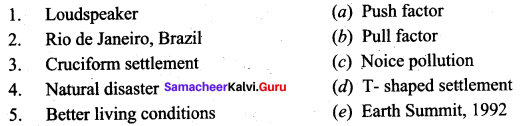
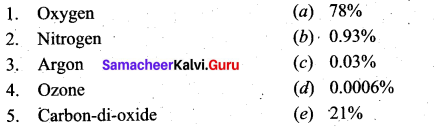
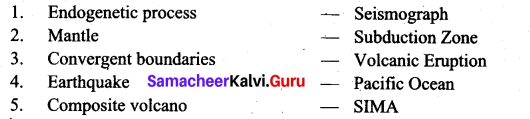
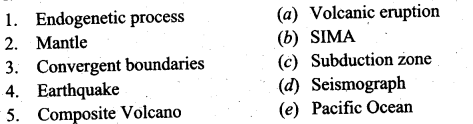
Samacheer Kalvi 9th Social Science Geography Solutions Chapter 6 Man and Environment 1
Answers:
1. (c)
2. (e)
3. (d)
4. (a)
5. (b)

IV. Answer the following in brief:

Question 1.
What do you mean by the term ‘density of population’?
Answer:

  1. Density of population refers to the number of people living per sq.km.
  2. Population density = \(\frac { Total population }{ Total land area }\)

Samacheer Kalvi 9th Social Science Geography Solutions Chapter 6 Man and Environment

Question 2.
What is ‘black death’?
Answer:
The black death is estimated to have killed 30 – 60 percent of Europe’s total population during the 14th century. The dominant explanation for black death is attributed to the outbreak of plague.

Question 3.
Where do we have high and low densities of population?
Answer:

  1. Areas of high density (above 50 people per sq.km) – East Asia, South Asia, northwest Europe and Eastern North America.
  2. Areas of low density (less than 10 people per sq.km) – Central Africa, Western Australia, Northern Russia, Canada, etc.

Question 4.
What is Green House effect?
Answer:
Global warming is caused by the increase of green house gases such as carbondioxide, methane, water vapour and Chloro Fluoro Carbons(CFC), carbon monoxide, photo chemical oxidants and hydrocarbons, which are responsible for the heat retention ability of the atmosphere. Global warming causes climatic change, ozone layer depletion, rise in sea level and drowning of coastal inhabited land, melting of ice, etc., They are posing an even greater threat to human existence and so, man must start thinking of protecting the environment from pollution.

Samacheer Kalvi 9th Social Science Geography Solutions Chapter 6 Man and Environment

Question 5.
Write any two ways of how the locals and the government restored Palk Bay. Restoration of Palk Bay
Answer:
Local communities, government and civic organisations all came together not just to conserve the remaining mangroves, but also to restore it.

  • Saplings of native species of plants and trees are being grown, planted and cared for.
  • Live colonies of coral from the Gulf of Mannar Biosphere Reserve are being transplanted to Palk Bay. The existing mangroves and the region are being mapped and the way land is used around the mangrove is being studied.
  • The local communities are actively involved in the conservation and restoration of the mangroves. Education and awareness programmes about mangrove ecosystem are being undertaken.

Question 6.
Define

  1. Population growth
  2. Census
  3. Sustainable Development.

Answer:

  1. Population growth: Population growth refers to an increase in the number of people who reside in a particular area during a particular period.
  2. Census: It is an official enumeration of population carried out periodically, It records information about the characteristics of population such as age, sex, literacy and occupation.
  3. Sustainable Development : Sustainable development is a development that meets the needs of the present without compromising the ability of future generation to meet their own needs.

V. Distinguish the following:

Question 1.
Birth rate and Death Rate
Answer:

Birth Rate Death Rate
Number of live births per 1000 people in a year Number of deaths under one year of age for every 1000 live births in a year

Question 2.
Emigration and Immigration
Answer:

Emigration Immigration Emigration Immigration
Emigration means moving out or to leave a place. Immigration means to enter or come into a new country for the purpose of settling there.

Question 3.
Rural settlement and urban settlement
Answer:

Rural Settlement

Urban Settlement

Any settlement where most of the people are engaged in primary activities like agriculture, forestry, mining and fishery is known as a rural settlement. Urban is the term related to cities and towns where people are primarily engaged in non-agricultural activities, such as secondary, tertiary and quartemary activities.
The most important and unique feature of rural settlements is the vast, open spaces with green, pollution-free environment. The common characteristic feature of an urban unit is that they are compact, congested and liable to a large number of population.

Question 4.
Metropolitan and Mega cities
Answer:

Metropolitan

Mega cities

Cities accommodating population between 10 lakhs and 50 lakhs are metropolitan cities. E.g.: Madurai Cities with more than 50 lakh population are called Megacities. E.g.: Greater Chennai

Question 5.
Primary Activities Secondary Activities
Answer:

Primary Activities Secondary Activities
Primary Activities pertaining to the extraction of raw materials from the earth’s surface. For example food gathering, hunting, lumbering, fishing, cattle rearing, mining and agriculture. Secondary Activities transform raw materials into finished goods.
For example Iron and Steel industries, automobile manufacturing, etc.

VI. Give reasons for the following:

Question 1.
Reforestation is encouraged throughout the world.
Answer:

  1. Planting new trees can help to reduce the amount of CO2 in the air.
  2. Gases like Carbon dioxide and methane are major contributors to the changing climate.
  3. Reforestation is an effective mitigation strategy to fight global warming.
  4. Reforestation can help to restore what the erosion has damaged.

Samacheer Kalvi 9th Social Science Geography Solutions Chapter 6 Man and Environment

Question 2.
Acid rain destroys the ecosystem.
Answer:
When pollutants combine with water vapour in the presence of sunlight and oxygen, they form dilute sulphuric and nitric acids in the atmosphere. When this mixture precipitates from the atmosphere, it is called acid rain. This would cause lot of damages to life and property. It would affect the health of humans and animals, alter the constituents of water bodies, plants and trees may die as it deteriorates the soil quality and many more damages to nature.

Question 3.
The economy of the quaternary sector is called the knowledge economy.
Answer:

  1. The quaternary sector of the economy is a way to describe a knowledge-based part of the economy.
  2. It typically includes knowledge-oriented economic sectors such as information technology, media, research, and development.
  3. It is based on knowledge and skill.
  4. It consists of intellectual industries providing information services such as computing and ICT.

Question 4.
Population growth has to be brought under control.
Answer:
Population growth leads to high competition for all available resources. It leads to poor quality of life, education, food supply, low income and so on. The resources of Earth may exhaust one day and would lead to the end of mankind.

Samacheer Kalvi 9th Social Science Geography Solutions Chapter 6 Man and Environment

Question 5.
Sustainable development growth has been set to protect the planet.
Answer:

  1. Sustainable development is the organising principle for meeting human development goals.
  2. At the same time sustaining the ability of natural systems to provide the natural resources and ecosystem services upon which the economy and society depend.
  3. In September 2015, the limited Nations General Assembly firmly adopted the “Universal, integrated and transformative” 2030 Agenda for Sustainable Development, a set of 17 sustainable Development goals (SDGs)
  4. The goals are to be implemented and achieved in every country from the year 2016 to 2030.

VII. Answer in a paragraph:

Question 1.
Explain the factors affecting the distribution of the population.
Answer:
Population distribution refers to the way in which people are spread out across the earth surface. The world population is not uniformly distributed, owing to the following factors.
(a) Physical factors:
It includes temperature, rainfall, Soil, relief, water, natural vegetation, distribution of minerals and availability of energy resources.

(b) Historical factors:
Regions with historical importance (river valley civilizations, war and constant invasions fall under historical factors responsible for population distribution.

(c) Economic factors:
Educational Institutions, employment opportunities, manufacturing industries, luxurious amenities, trade and commerce and other facilities encourage dense population in an area.

Question 2.
Describe the patterns of rural settlement with neat diagrams.
Answer:
Rectangular pattern:
Rectangular pattern of settlements are found in plain areas or valleys. The roads are rectangular and cut each other at right angles.
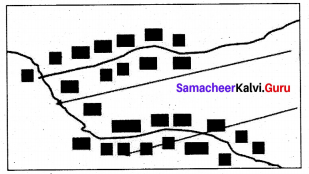
Samacheer Kalvi 9th Social Science Geography Solutions Chapter 6 Man and Environment 80
Linear pattern:
In a linear pattern, the houses are located along a road, railway line and along the edge of the river valley or along a levee.
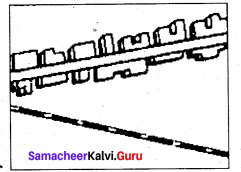
Samacheer Kalvi 9th Social Science Geography Solutions Chapter 6 Man and Environment 81
Circular or semicircular pattern:
The pattern of settlement that is found around the lakes, ponds and sea coasts are called circular or semi circular pattern.
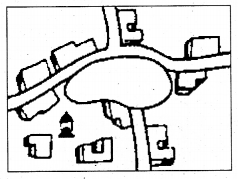
Samacheer Kalvi 9th Social Science Geography Solutions Chapter 6 Man and Environment 82
Star-like pattern:
Where several metalled or unmetalled roads converge, star-shaped settlements develop. In the star-shaped settlements, houses are spread out along the sides of roads in all directions.
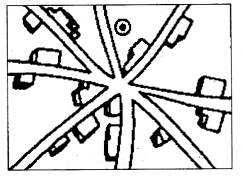
Samacheer Kalvi 9th Social Science Geography Solutions Chapter 6 Man and Environment 83
Triangular pattern:
Triangular patterns of rural settlement generally develop at the confluence of rivers.
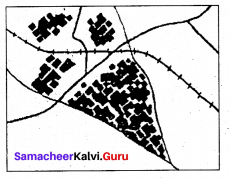
Samacheer Kalvi 9th Social Science Geography Solutions Chapter 6 Man and Environment 84
T-Shaped, Y-Shaped, Cross-Shaped or
Cruciform settlements:
T-shaped settlements develop at trijunctions of the roads (T), while Y-shaped settlements emerge as the places where two roads converge with the third one. Cruciform settlements develop on the cross-roads which extend in all four directions.
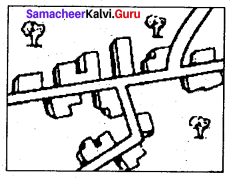
Samacheer Kalvi 9th Social Science Geography Solutions Chapter 6 Man and Environment 85

Nebular pattern:
The arrangement of roads is almost circular which ends at the central location or nucleus of the settlement around the house of the main landlord of the village or around a mosque, temple or church.
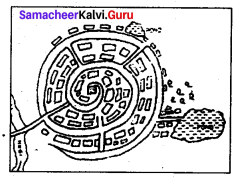
Samacheer Kalvi 9th Social Science Geography Solutions Chapter 6 Man and Environment 86

VIII. HOTS:

Question 1.
Study your area and write down its settlement pattern.
Answer:

  1. My area is Velachery, Chennai – 42.
  2. It was developed after late 1990, in the Southern axis radiating out of the city.
  3. It was built over a complex of low-lying wetlands.
  4. In an already sunken Velachery, repeated road repairs had led to the roads increasing in height.
  5. Lifting houses to escape floods.
  6. Though Velachery is still a low lying area and the rainy season will be bad, it wouldn’t be as bad as before.
  7. It is a place where we can get all facilities like transport, shopping, restaurants, hair parlours etc., within 1 km

IX. Map skill:

A. On the outline map of the world mark the following.
1. An area of the high density of population in Europe
2. An area of the low density of population in Australia
3. PalkBay
4. A fracking banned country
5. England – A country affected by ‘black death’
6. Denmark – First country where the modem census was conducted «
7. River Hwang Ho
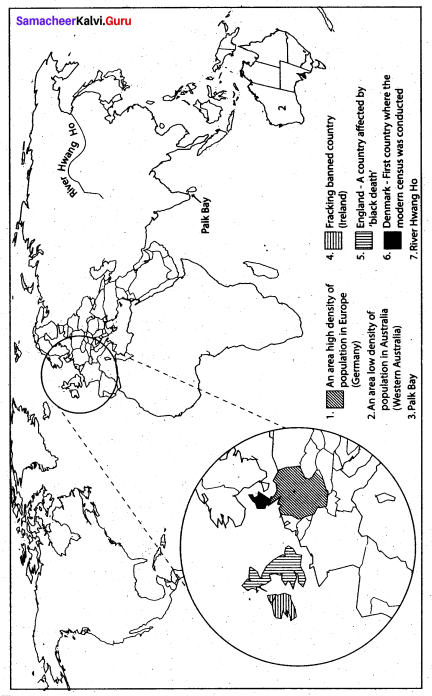
Samacheer Kalvi 9th Social Science Geography Solutions Chapter 6 Man and Environment 90

B. On the outline map of Tamil Nadu mark the following.

1. A metropolitan city
2. A district with 7857 people per sq. km.
3. Gulf of Mannar
4. Palk Strait
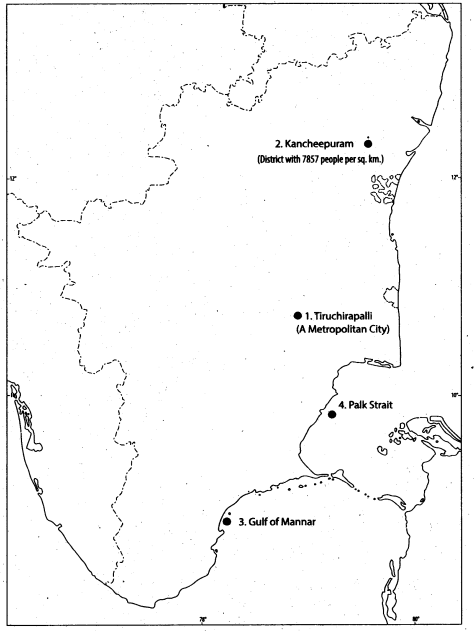
Samacheer Kalvi 9th Social Science Geography Solutions Chapter 6 Man and Environment 96

Man and Environment ADDITIONAL QUESTIONS

I. Choose the correct answer.

Question 1.
The interaction between man as an individual with his family, occupation and society is ……..
(a) Natural Environment
(b) Human Environment
(c) Man-made Environment
(d) None of these
Answer:
(b) Human Environment

Samacheer Kalvi 9th Social Science Geography Solutions Chapter 6 Man and Environment

Question 2.
The physical factor is ………..
(a) temperature
(b) war
(c) trade
(d) commerce
Answer:
(a) temperature

Question 3.
The economical factor is ……..
(a) rainfall
(b) water
(c) soil
(d) luxurious amenities
Answer:
(d) luxurious amenities

Question 4.
To enter (or) come into a new country for the purpose of settling there is known as ………..
(a) internal migration
(b) emigration
(c) immigration
(d) none of these
Answer:
(c) immigration

Question 5.
The rural settlement that is found at the confluence of rivers is ……….
(a) linear pattern
(b) circular pattern
(c) starlike pattern
(d) triangular pattern
Answer:
(d) triangular pattern

Samacheer Kalvi 9th Social Science Geography Solutions Chapter 6 Man and Environment

Question 6.
Transforming raw materials into finished goods is an activity.
(a) primary
(b) secondary
(c) tertiary
(d) quinary
Answer:
(b) secondary

Samacheer Kalvi 9th Social Science Geography Solutions Chapter 6 Man and Environment

Question 7.
…….. is man-made pollution.
(a) Vehicular emission
(b) Wind erosion
(c) Pollen disposal
(d) Evaporation of organic compounds
Answer:
(a) Vehicular emission

Question 8.
Dry recyclable wastes are ……..
(a) food products
(b) packing plastics
(c) diapers
(d) mobiles
Answer:
(b) packing plastics

Question 9.
Van Mahotsav is a weeklong festival celebrated between ………
(a) 1st and 7th July
(b) 1st and 7th June
(c) 1st and 7th August
(d) 1st and 7th September
Answer:
(a) 1st and 7th July

Question 10.
…… disease is caused by water pollution.
(a) Hypertension
(b) Mental illness
(c) Stress
(d) Diarrhoea
Answer:
(d) Diarrhoea

II. Consider the given statements and choose the right option given below:

Question 1.
Assertion (A): Noise pollution is basically a problem in urban areas, industrial areas, transport areas due to bombardment, traffic, etc.
Reason (R): It has an impact on the habitat of animals migration and health of inhabitants.
(a) A and R are correct and A explains R
(b) A and R are correct and A does not explain R
(c) A is incorrect and R is correct
(d) Both A and R are incorrect
Answer:
(a) A and R are correct and A explains R

Question 2.
Assertion (A): Things used for domestic purposes can be reused and recycled.
Reason (R): Organic waste matter should be disposed of far away from settlements.
(a) Both A and R are incorrect
(b) Both A and R are correct
(c) A is correct and R is wrong
(d) A and R are correct and A explains R
Answer:
(b) Both A and R are correct

III. Match the following:
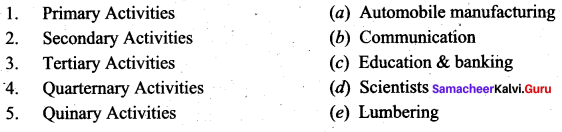
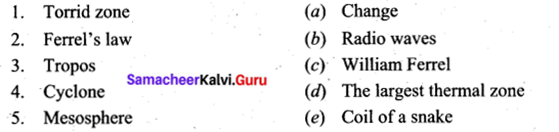
Samacheer Kalvi 9th Social Science Geography Solutions Chapter 6 Man and Environment 95
Answers:
1. (e)
2. (a)
3. (b)
4. (c)
5. (d)

IV. Fill in the blanks.
1. …….. is the statistical study of the human population.
2. ……. is an official enumeration of the population carried out periodically.
3. …… is a condition when a country has more people than its resources to sustain.
4. Cities with more than 50 lakh population are called ……..
5. ……… Activities pertaining to the extraction of raw materials from the earth’s surface.
6. …….. is a poisonous gas made up of molecules consisting three oxygen atoms.
7. ……. refers to the process of increase in urban population and urban areas in a country.
8. Economic sustainability is successfully implemented through strong ………
Answers:
1. Demography
2. Census
3. Overpopulation
4. megacities
5. Primary
6. Ozone
7. Urbanisation
8. Public Distribution System

V. Answer the following in brief.

Question 1.
Define Environment.
Answer:
The environment is a set of relationships between man and nature. Man has survived through the ages, dwelling within his surrounding called the environment.

Question 2.
Write a short note on “Human Environment”.
Answer:
Human environment is defined as the interaction between man as an individual, with his family, occupation, and society. It is also related to various cultural aspects such as education, religion, economics and politics.

Samacheer Kalvi 9th Social Science Geography Solutions Chapter 6 Man and Environment

Question 3.
What is Demography?
Answer:
In ancient Greek, ‘demos’ means people and ‘graphis’ means study Of measurement: So, ‘Demography’is the statistical study of human population.

Question 4.
What does population distribution refer to?
Answer:
Population distribution refers to the way in which people are spread out across the earth’s surface.

Question 5.
What do you mean by Nebular pattern of road arrangement?
Answer:
The arrangement of roads is almost circular which ends at the central location or nucleus of the settlement around the house of the main landlord of the village or around a mosque, temple or church.

Question 6.
Mention the patterns of Rural Settlement.
Answer:

  1. Rectangular pattern
  2. Linear pattern
  3. Circular or semicircular pattern
  4. Star-like pattern
  5. Triangular pattern
  6. T-Shaped, Y-Shaped, Cross-Shaped or Cruciform settlements
  7. Nebular pattern

Question 7.
What are the control measures for Noise pollution?
Answer:
The control measures of noise pollution are:

  1. Development of green belt vegetation.
  2. Installation of decibel meters along highways and in places of public gatherings.
  3. Planting trees along the compound wall to protect houses.

Question 8.
State the problems of urbanisation.
Answer:
As the town expands, it mounts more pressure on the transport system, water supplies, sewage, and profuse disposal. The overall development creates problems like air pollution, water pollution, traffic congestion and noise pollution, etc., This disturbed environment affects human beings as mental illness, heart troubles, breathing problems, etc.

Samacheer Kalvi 9th Social Science Geography Solutions Chapter 6 Man and Environment

Question 9.
Classify wastes.
Answer:
Wastes can be classified into five types, which are commonly found around the house. These include liquid waste, solid rubbish, organic waste, recyclable rubbish and hazardous waste like e-waste.

Question 10.
What do you mean by Environmental Sustainability?
Answer:
Environmental sustainability is the ability of the environment to support a defined level of environmental quality and natural resource extraction rates forever to mankind. Unnecessary disturbances to the environment should be avoided whenever possible.

VI. Distinguish the following

Question 1.
Natural Environment and Human Environment.
Answer:

Natural Environment Human Environment
The components of natural components of the environment are lithosphere, atmosphere, hydrosphere and biosphere. The human environment is defined as the interaction between man as an individual, with his family, occupation, and society.
This includes the biotic and abiotic components like ponds, lakes, grasslands, forests, mountains, etc. It is related to various cultural aspects such as education, religion, economics and politics.

Question 2.
Rectangular Pattern and Linear Pattern.
Answer:

Rectangular Pattern

Linear Pattern

Rectangular patterns of settlements is found in plain areas or valleys. The roads are rectangular and cut each other at right angles. In a linear pattern, the houses are located along a road, railway line, and along the edge of the river valley or along a levee.

Question 3.
Tertiary Activities and Quarternary Activities.
Answer:

Tertiary Activities Quarternary Activities
Activities which by themselves do not produce goods, but support the process of production are called tertiary activities. The activities related to Research and Development, as well as knowledge are called Quaternary activities.
For example Transport, communication, banking, storage, and trade. For e.g. Services like a consultation, education, and banking.

Question 4.
Town and City
Answer:

Town City
A town is generally larger than a village but smaller than a city. It has a population of less than 1 lakh. Cities are much larger than towns and have a greater number of economic functions.
The population in cities is estimated to be more than 1 lakh.
E.g.: Arakkonam near Chennai E.g.: Coimbatore

VII. Give Reasons

Question 1.
“It is easy to add but difficult to maintain.”
Answer:

  1. The population is a dynamic phenomenon where distribution and composition are constantly changing.
  2. Human population increases as babies are born and decreases as people die. So it is easy to increase the number but difficult to maintain.

Question 2.
“Human settlement can be described as any temporary (or) permanent unit area”.
Answer:

  1. During the early days man preferred tree branches, caves, pits (or) even rock cuts as his shelter.
  2. Slowly settlements came into existence.
  3. Later small settlements developed into villages, towns, cities. So he started living in settled areas.

Question 3.
“We must use forest products properly”.
Answer:
Besides providing habitats for animals and livelihoods for humans, forest products are one of the most essential things in our day to day life. Therefore we must use forest products properly.

Samacheer Kalvi 9th Social Science Geography Solutions Chapter 6 Man and Environment

Question 4.
“Pollution is an unfavourable modification of the natural world”.
Answer:
Pollute means to degrade or to make dirty. It is caused entirely (or) partly due to direct (or) indirect actions of human beings. So pollution is an unfavourable modification of the natural world.

Question 5.
Why do we get impervious diseases like skin cancer, blindness, loss of plankton?
Answer:
Due to the depletion of the ozone layer, UV rays fall on the earth’s surface and leads to impervious diseases like skin cancer, blindness, loss of plankton etc.

VIII. Answer in a paragraph.

Question 1.
Define Sustainable Development. Explain Social Sustainability and Economic Sustainability.
Answer:
“Sustainable development is a development that meets the needs of the present without compromising the ability of future generation to meet their own needs”. For sustainable development to be achieved, it is crucial to harmonize three core elements: economic growth, social aspects and environmental protection. These elements are interconnected and are crucial for the wellbeing of individuals and societies. To achieve true sustainability, we need to balance the economic, social, and environmental factors of sustainability in equal harmony.

Social Sustainability
The ability of a social system such as a country, family, or organization to function at a defined level of social well-being and harmony is called social sustainability. Problems like war, endemic poverty, widespread injustice, and low education rates are symptoms of a system in socially unsustainable. The balancing capacity of a government in maintaining peaceful existence towards other countries and at the same time providing the requirements of its citizens without affecting the environment creates social sustainability.

Economic Sustainability
The people on earth consume far more than what is their fair share.

  • Economic sustainability is successfully implemented through a strong Public Distribution System.
  • Economic sustainability ensures that our economic growth maintains a healthy balance with our ecosystem.

Samacheer Kalvi 9th Social Science Geography Solutions Chapter 6 Man and Environment Read More »
Samacheer Kalvi 10th Social Science Geography Solutions Chapter 5 India: Population, Transport, Communication, and Trade

You can Download Samacheer Kalvi 10th Social Science Book Solutions Guide Pdf, Tamilnadu State Board help you to revise the complete Syllabus and score more marks in your examinations.

Tamilnadu Samacheer Kalvi 10th Social Science Geography Solutions Chapter 5 India: Population, Transport, Communication, and Trade

India: Population, Transport, Communication, and Trade Textual Exercise

I. Choose the correct answer.

Question 1.
The scientific study of different aspects of population is called ……..
(a) Photography
(b) Demography
(c) Choreography
(d) Population density
Answer:
(b) Demography

Samacheer Kalvi 10th Social Science Geography Solutions Chapter 5 India: Population, Transport, Communication, and Trade

Question 2.
The state with highest literacy rate as per 2011 census is:
(a) Tamil nadu
(b) Karnataka
(c) Kerala
(d) Uttarpradesh.
Answer:
(c) Kerala

Question 3.
Human Development is measured in terms of …….
(a) Human Resource Index
(b) Per capita index
(c) Human Development Index
(d) UNDP
Answer:
(c) Human Development Index

Samacheer Kalvi 10th Social Science Geography Solutions Chapter 5 India: Population, Transport, Communication, and Trade

Question 4.
…………………. transport provides door to door services.
(a) Railways
(b) Roadways
(c) Airways
(d) Waterways.
Answer:
(b) Roadways

Question 5.
The length of Golden Quadrilateral superhighways in India is
(a) 5846 km
(b) 5847 km
(c) 5849 km
(d) 5800 km
Answer:
(a) 5846 km
Samacheer Kalvi 10th Social Science Geography Solutions Chapter 5 India: Population, Transport, Communication, and Trade

Question 6.
The length of navigable Inland waterways in India is:
(a) 17,500 km
(b) 5000 km
(c) 14,500 km
(d) 1000 km
Answer:
(c) 14,500 km

Question 7.
The National Remote sensing Centre (NRSC) is located at
(a) Bengaluru
(b) Chennai
(c) Delhi
(d) Hyderabad
Answer:
(d) Hyderabad

Samacheer Kalvi 10th Social Science Geography Solutions Chapter 5 India: Population, Transport, Communication, and Trade

Question 8.
The transport useful in the inaccessible areas is:
(a) Roadways
(b) Railways
(c) Airways
(d) Waterways
Answer:
(c) Airways

Question 9.
Which of the following is associated with helicopter services?
(a) Air India
(b) Indian Airlines
(c) Vayudoot
(d) Pavan Hans
Answer:
(d) Pavan Hans

Samacheer Kalvi 10th Social Science Geography Solutions Chapter 5 India: Population, Transport, Communication, and Trade

Question 10.
The major import item of India is:
(a) Cement
(b) Jewells
(c) Tea
(d) Petroleum
Answer:
(d) Petroleum

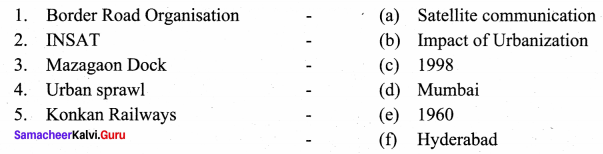
II. Match the following.

Samacheer Kalvi 10th Social Science Geography Solutions Chapter 5 India Population, Transport, Communication, and Trade 1
Answers:
1. (f)
2. (a)
3. (d)
4. (b)
5. (c)

III. Answer the following questions briefly.

Question 1.
What is Human Development?
Answer:
Dr Mahabub-ul-haq defined Human Development as “it is a process of enlarging the range of people’s choice, increasing their opportunities for education, health care, income and empowerment. It covers the full range of human choices from a sound physical environment to economic, social and political freedom”.

Question 2.
What is migration? State its types.
Answer:
It is the movement of people across regions and territories.

  1. Internal migration and
  2. International migration.

Question 3.
Write any four advantages of railways.
Answer:
Advantages of Railways:

  1. Cater to the needs of large scale movement of traffic for freight and passengers.
  2. Promotes trade, tourism, education etc.
  3. Promotes National integration by bringing people together.
  4. Facilitates the quick movement of perishable goods.

Samacheer Kalvi 10th Social Science Geography Solutions Chapter 5 India: Population, Transport, Communication, and Trade

Question 4.
Write a note on Pipeline network transport in India.
Answer:
Pipelines are used for transporting crude oil, petroleum products and natural products and natural gas from oil fields to the refineries, factories and big thermal power plants. Pipelines are more reliable and considerably safer mode of transportation. The possibility of pilferage or product less on pipelines is almost negligible. The basic limitations of pipelines is that they are capital intensive mode of transportation.

Samacheer Kalvi 10th Social Science Geography Solutions Chapter 5 India: Population, Transport, Communication, and Trade

Question 5.
State the major Inland waterways of India.
Answer:

  1. Ganga – Bhagirathi – Hoogly river system between Haldia and Allahabad.
  2. Stretch of the Brahmaputra river between Dhubri and Sadiya National Waterway.
  3. The waterway between Kollam and Kottapuram – the first national waterway.

Question 6.
What is communication? What are its types?
Answer:
Communication refers to exchange of ideas, messages, emotions, either written or oral, from one place to another.
Types of communications are :

  1. personal communication and
  2. mass communication.

Question 7.
Define “International trade”.
Answer:
Trade carried on between two or more countries is called “International trade”. It is also called as external trade or foreign trade. It has two components Exports and Imports.

Samacheer Kalvi 10th Social Science Geography Solutions Chapter 5 India: Population, Transport, Communication, and Trade

Question 8.
State the merits of Roadways.
Answer:

  1. Cost of construction of roads is much lower.
  2. Provides door to door services thus the cost of loading and unloading is much lower.
  3. Used as feeder to other modes of transport to reach any destination be it railway station, sea port or airport, one need to travel through roads.

IV. Distinguish between.

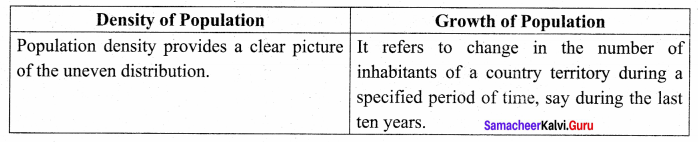
Question 1.
The density of population and growth of population.
Answer:
Samacheer Kalvi 10th Social Science Geography Solutions Chapter 5 India Population, Transport, Communication, and Trade 5

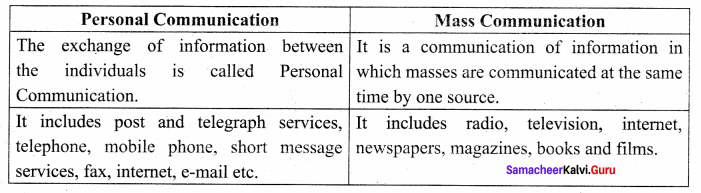
Question 2.
Personal communication and mass communication.
Answer:
Samacheer Kalvi 10th Social Science Geography Solutions Chapter 5 India Population, Transport, Communication, and Trade 6

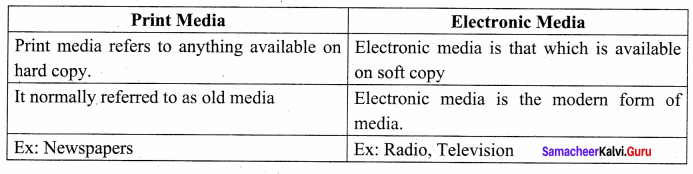
Question 3.
Print Media and Electronic Media.
Answer:
Samacheer Kalvi 10th Social Science Geography Solutions Chapter 5 India Population, Transport, Communication, and Trade 7

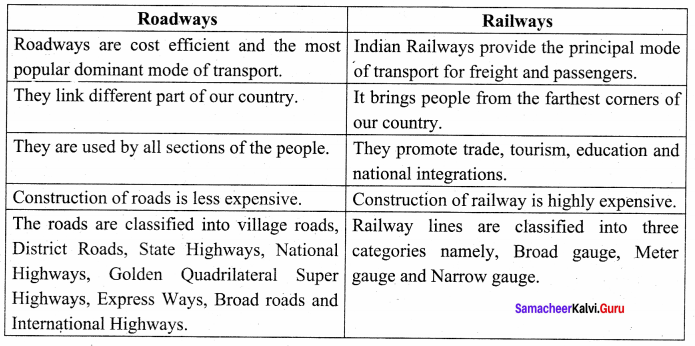
Question 4.
Roadways and Railways.
Answer:
Samacheer Kalvi 10th Social Science Geography Solutions Chapter 5 India Population, Transport, Communication, and Trade 8

Question 5.
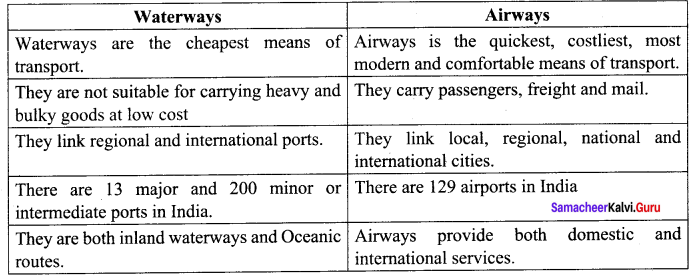
Waterways Airways
Answer:
Samacheer Kalvi 10th Social Science Geography Solutions Chapter 5 India Population, Transport, Communication, and Trade 9

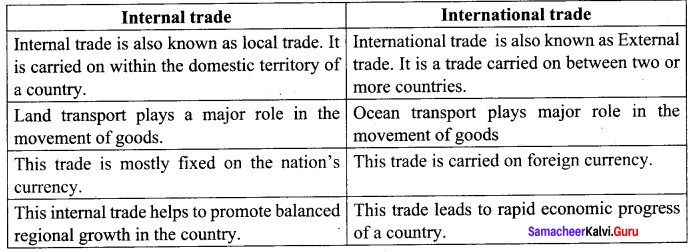
Question 6.
Internal trade and International trade.
Answer:
Samacheer Kalvi 10th Social Science Geography Solutions Chapter 5 India Population, Transport, Communication, and Trade 10

V. Answer the following in a paragraph.

Question 1.
What is urbanization? Explain its impacts.
Answer:
“The process of society’s transformation from rural to urban is known as urbanization”.

Impacts of Urbanization:

  1. Overcrowding in urban centres.
  2. It creates urban sprawl.
  3. It leads to the formation of slums.
  4. Shortage of houses in urban areas.
  5. It creates water scarcity in the cities.
  6. It creates drainage problem.
  7. It poses the problem of solid waste management.
  8. It increases traffic congestion in cities.
  9. It increases the rate of crime.

A rapid rate of urbanization in society is taken as an indicator of its economic development.

Question 2.
Explain the importances of satellite communication in India.
Answer:
Satellite images are used for weather forecasting, monitory of natural calamities, surveillance of border areas etc. The communication through satellites emerged as a new era in communication in our country after the establishment of Indian Space Research Organization (ISRO) in 1969. Satellite systems in India can be grouped into two on the basis of two satellites namely “Indian National Satellite” (INSAT) and “Indian Remote Sensing Satellite” (IRS). These satellites collect data in several spectral band and transmit there to ground stations for various uses. The communication and remote sensing satellites INSAT and IRS have revolutionized India’s communication system. Metrological studies and natural resource management.

The National Remote Sensing Agency (NRSA) at Hyderabad provides facilities for acquisition of data and its processing. There is no doubt that India has irrefatably arrived as a space power in the world. The INSAT series are used for relaying signals to television, telephone, radio, mobile phone. It is also useful in weather detection, internet. The INSAT series GSAT series, GSAT series KALPANA -1, HAMSAT, EDUSAT are the major communication satellite used for communication purpose. GSAT – 7A is the recent launch for communication programs. INSAT – IB launched on 30th August, 1983 is the first communication satellite in INSAT series.

Samacheer Kalvi 10th Social Science Geography Solutions Chapter 5 India: Population, Transport, Communication, and Trade

Question 3.
Bring out the distribution and density of population in India.
Answer:
The term “Population Distribution” refers to the way the people are spaced over the earth’s surface.

The distribution of population in India is unevenly distributed due to the vast variation in the availability of resources.

Factors that affect the distribution of population are: Terrain, climate, soil, water bodies, mineral resources, industries, transport and urbanization.

Areas of high concentration of population: Industrial centres and the areas of good agricultural lands.

Areas of thin population: high mountains, arid lands, thickly forested areas and some remote comers and some areas are even uninhabited.

Most populous states in India: Uttar Pradesh is the most populous state in India (199.5 million) followed by Maharashtra (112.3 million), Bihar (103.8 million) West Bengal (91.3 million) and the combined Andhra Pradesh (84.6 million).

Least populated State: Sikkim (0.61 million).

Union territory with high population: Delhi (16.75 million). Union territory with least population – Lakshadweep (64,073).

Question 4.
Explain the process of measuring Human Development.
Answer:
Dr. Mahabub – ul – Haq defined as “It is a process of enlarging the range of people’s choice, increasing their opportunities for education, health care, income and empowerment”. Human
Development Index (HDI) is a composite index focusing on three basic dimensions of human development.

  1. Health – life expectancy at birth,
  2. Education – expected years of schooling for school age children and average years of schooling for the adult population,
  3. Income – Measured by gross national income and per capita income.

Samacheer Kalvi 10th Social Science Geography Solutions Chapter 5 India: Population, Transport, Communication, and Trade

Question 5.
Classify and explain the roadways in India.
Answer:
Roadways play an important role in carrying goods and passengers for short, medium and long distances. It is highly suitable for short-distance services.

For the purpose of construction and maintenance Roadways in India are classified into:

  1. National Highways (NH)
  2. State Highways (SH)
  3. District Roads
  4. Rural Roads (Village roads)
  5. Border Roads
  6. International Highways

National Highways:

  1. Ministry of Road Transport and Highways of India is responsible for the development and maintenance of the National Highways in India.
  2. These Highways are connecting capitals of states, major ports, rail junctions, industrial and tourist centres.
  3. The total length of the National Highways in India is 1,01,011 Km which accounts for 1.8% of total road network length in 2016.
  4. The longest National Highway NH-7 runs from Varanasi (U.R) to Kanyakumari (T.N) to a distance of 2369 km.
  5. The shortest National Highway is NH-47A, runs from Emakulum to Kochi port (Willington Island) covering a distance of 6 km.

State Highways:

  1. These roads are administered and financed by State Governments.
  2. These highways link important cities, towns and district headquarters within the state and connect them with national highways or highways of neighbouring states.
  3. State highways run to a length of 1,76,166 km as of 2016.

District Roads:

  1. District Roads are constructed and maintained by the Public Works Department of the states.
  2. District Roads provide connectivity between the district and taluk headquarters with the state highways and national highways.
  3. The total length of the road is 5,61,940 km in 2016.
  4. Rural Roads (Village Roads): They are maintained by village Panchayats.
  5. It links different villages with their neighbouring towns.
  6. Rural roads connectivity is a key component of Rural development.
  7. The total length of Rural roads in India is 39,35,337 km as of 2016.
  8. Rural roads consists of Panchayat roads, (Zilla Parishad, Panchayat Samiti, Gram Panchayat), roads of the Pradhan Mantri Gram Sadak Yojana (PMGSY) and those constructed by the State PWDs.

Border Roads:

  1. They are constructed and maintained by Border Roads Organization established in 1960 for the development of the roads of Northern and North Eastern border areas.
  2. These are the roads of strategic importance in border areas.
  3. The Border Road organization has constructed world’s highest road joining Chandigarh and Leh in Ladak (at an altitude 4,270 mt).
  4. Golden Quadrilateral: This project was launched in 1999.
  5. It connects India’s four metropolitan cities Delhi – Kolkata – Chennai Mumbai.
  6. It has 4/6 lanes and of 5,846 km long.
  7. North-South and East-West corridors: These two corridors intersect at Jhansi.
  8. North-South Corridor connects Srinagar in Jammu and Kashmir with Kaniyakumari in Tamil Nadu (4,076 km).
  9. The East-West corridor connects Silchar in Assam with port town of Porbandar in Gujarat (3,640 km).

Samacheer Kalvi 10th Social Science Geography Solutions Chapter 5 India: Population, Transport, Communication, and Trade

Express ways: These are the multi lane good quality highways for high speed traffic. Eg: (a) Mumbai – Pune Road, (b) Delhi – Agra.

International Highways:

  1. These Highways have been constructed with an aid from World Bank under an agreement with the Economic and Social Commission for Asia-pacific (ESCAP).
  2. These roads link India with her neighbouring countries – Pakistan, Nepal, Bhutan, Bangladesh and Myanmar.

India has the second-longest road network in the world.

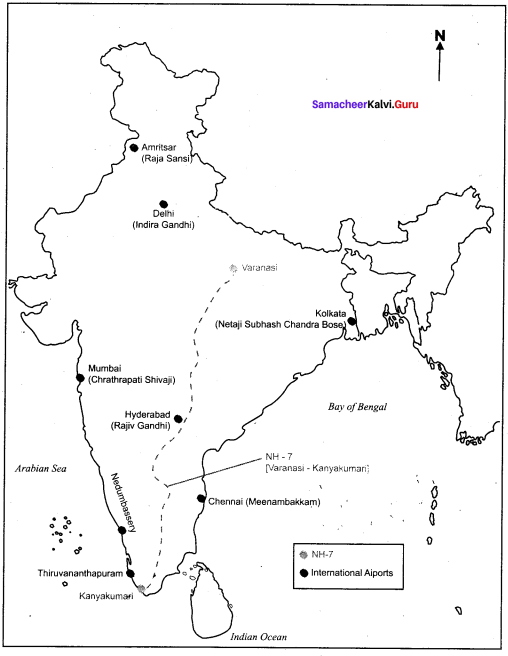
VI. On the outline map of India mark the following.

1. National Highway NH-7.
3. Major International Airports in India.
Samacheer Kalvi 10th Social Science Geography Solutions Chapter 5 India Population, Transport, Communication, and Trade 50

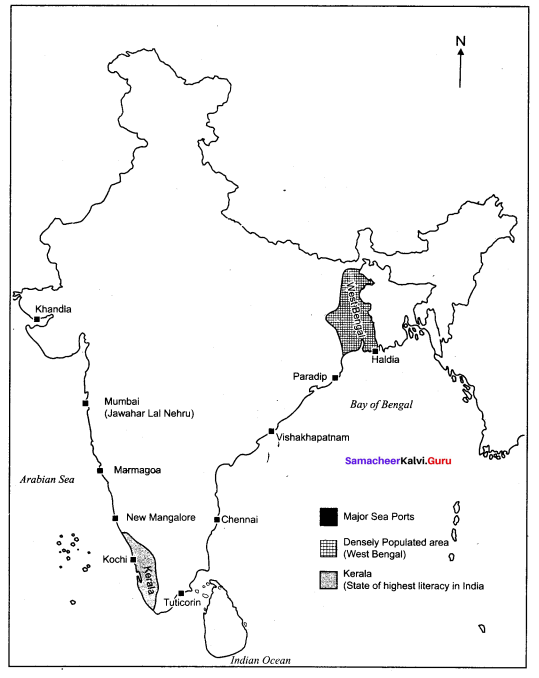
2. Major seaports in India.
4. Densely populated state of India.
5. State of highest literacy in India.
Samacheer Kalvi 10th Social Science Geography Solutions Chapter 5 India Population, Transport, Communication, and Trade 51

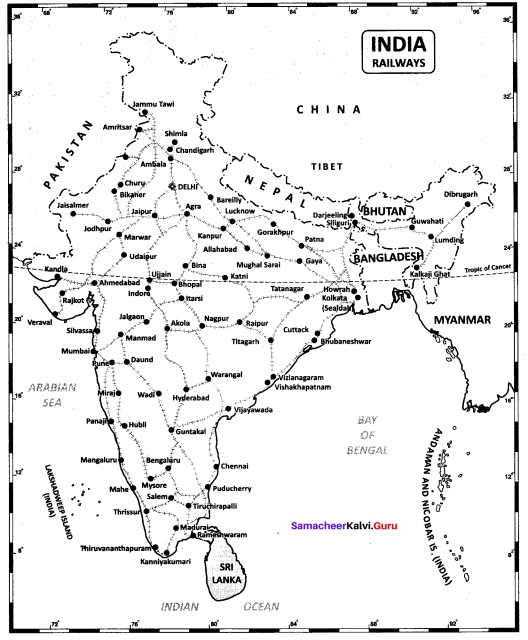
6. Railway zones of India
Samacheer Kalvi 10th Social Science Geography Solutions Chapter 5 India Population, Transport, Communication, and Trade 52

In-Text Hots Questions:

Question 1.
What could be the reason for uneven distribution of population in India?
Answer:
The uneven distribution of population in the country is the result of several factors such as physical, socio-economic and historical ones.

Physical factors: Relief, climate, water, natural, vegetation, mineral and energy resources.

Socio-economic factors: Religion, political issues economy, human settlements, transport network, industrialization, urbanization, employment opportunity etc.

Samacheer Kalvi 10th Social Science Geography Solutions Chapter 5 India: Population, Transport, Communication, and Trade

Question 2.
What are the reasons for the rapid growth of population in India?
Answer:

  • Widening gap between birth and death rates.
  • Low age at marriage.
  • High illiteracy.
  • Religious attitudes towards family planning.

Question 3.
The sex ratio in our country is always unfavourable to females. Give reasons.
Answer:

  1. Attitude of the people: Prestige and pride in having male child made them to prefer a male child to a female child.
  2. Female infanticide: Even now in same places it is being done for fear of neglect by their family members if they give birth to a female child.
  3. Future marriage expenses on female child.
  4. Considered as weaker sex so will not be given opportunity to prove their ability suppressed by male domination.

Question 4.
Find out what are the functions of NHAI.
Answer:
The functions of National Highways Authority of India (NHAI) are:

  • To develop, maintain and manage the national highways and any other highways vested in, or entrusted to it by the Government.
  • Survey, develop, maintain and manage highways vested in, or entrusted to it.
  • Construct offices or workshops and establish and maintain hotels, motels, restaurants and rest-rooms at or near the highways vested in, or entrusted to it.
  • Construct residential buildings and townships for its Employees.
  • Regulate and control the plying of vehicles on the highways vested in or entrusted to it for the proper management thereof.
  • Provide such facilities and amenities for the users of the highways vested in, or entrusted to it as are in the opinion the Authority, necessary for the smooth flow of traffic on such highways.
  • Advise the Central Government on matters relating to highways.

Question 5.
What are the highlights and benefits of the Golden Quadrilateral Highways?
Answer:
The main objective of this project is connectivity, speed and safety.

Connectivity: Connects four major metropolitan cities enhances the movement of goods and people to the industrial areas enhances job development.
Access to hinterland of agricultural areas to market areas, ports for export needs.

Speed: Reduces the travel time.

Safety: Six lanes super highways meant for safety.

This project was launched in the year 1999. Implemented by National Highway Authority of India.

Encourages the private sector companies to invest, develop and maintain these highways.

Question 6.
Why is air travel preferred in the north eastern states?
Answer:

  • Due to mountains, rivers, etc. road journey becomes too long even for short distance.
  • So air travel is the most feasible option and the costs are also quite low due to subsidies by the government.
  • Most of the cities have regional active airports.
  • Air transport is preferred mainly in the North eastern states of India.

Samacheer Kalvi 10th Social Science Geography Solutions Chapter 5 India: Population, Transport, Communication, and Trade

Question 7.
Find out the major trade blocks which are useful for multilateral trade.
Answer:
Major trade blocks useful for Multilateral trade.

EU: European Union

APEC: (Asian Pacific Economic Community) .

ASEAN: (Association of South East Asian Nations)

SAPTA: (South Asian Preferential Trade Agreement)

These trade blocks made the international trade easier. All member countries who signed the agreement are treated equally. These trade blocks remove the barriers and complications arose between nations in international trade.

Activity:

Question 1.
Prepare a seminar topic about “Role of Railways in Indian Economy”.
Answer:
Role of Railways in Indian Economy

  • Railways are the principle mode of transportation for freight and passengers in India.
  • Railways also make it possible to conduct multifarious activities like business, sight seeing, pilgrimage along with transportation of goods over longer distances.
  • Railways in India bind the economic life of the country as well as accelerate the development of industry and agriculture.
  • The distribution pattern of the railway netw ork in the country has been largely influenced by physiographic, economic and administrative factors.

Question 2.
Collect the names for different types of goods and differentiate it and make a table as perishable and non-perishable goods.
Answer:
Perishable goods are foods like fresh meat, seafood, and ripe fruits.
Non-perishable are items that do not spoil or decay.
Ex. Canned goods, all pasta types, sugar, flour, curls and chips if air-sealed.

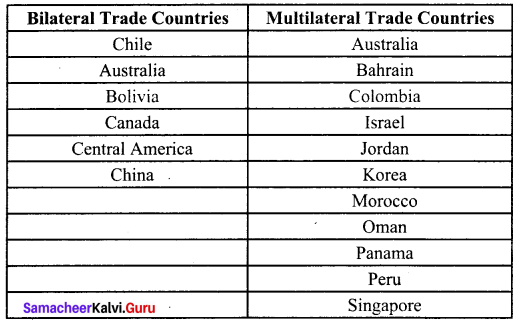
Question 3.
Collect the countries names and make it as a table of Bilateral trade and multilateral trade countries.
Answer:
Samacheer Kalvi 10th Social Science Geography Solutions Chapter 5 India Population, Transport, Communication, and Trade 90

Find Out:

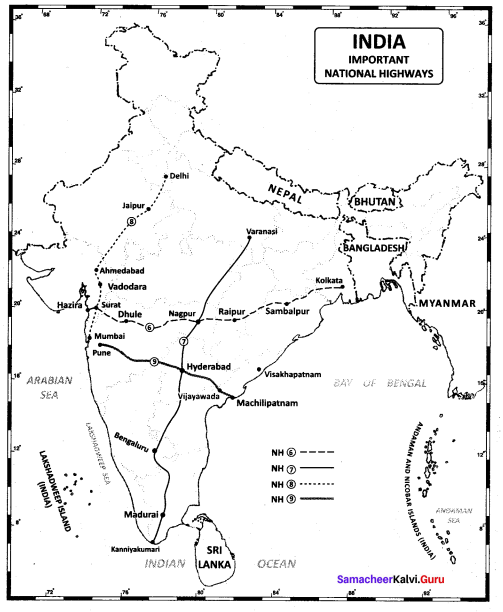
The important National Highways in India and label it on the outline map of India.

The important National Highways in India are:
NH-6- Hazira to Kolkata (via Nagpur, Raipur, Sambalpur and Dhule)
NH-7 -Varanasi to Kanyakumari (Nagpur, Bangaluru and Madurai
NH-8 – Delhi to Mumbai (Jaipur, Ahmedabad and Vadodara)
NH-9 – Pune to Machilipatnam and Hyderabad, Vijayawada

The important National Highways in India.
Samacheer Kalvi 10th Social Science Geography Solutions Chapter 5 India Population, Transport, Communication, and Trade 101

India: Population, Transport, Communication, and Trade Additional Questions

I. Choose the correct answer.

Question 1.
India is the ……. most populous country in the world.
(a) first
(b) second
(c) sixth
Answer:
(b) second

Samacheer Kalvi 10th Social Science Geography Solutions Chapter 5 India: Population, Transport, Communication, and Trade

Question 2.
The …………………. is the least populous state.
(a) Assam
(b) Goa
(c) Sikkim
(d) Arunachal Pradesh
Answer:
(c) Sikkim

Question 3.
Postal service and telegraph are some of the ………. communication.
(a) personal
(b) professional
(c) mass
Answer:
(a) personal

Question 4.
In India the year of demographic divide registered negative growth rate is ………………….
(a) 1921
(b) 1931
(c) 1947
(d) 1950
Answer:
(a) 1921

Question 5.
The headquarters of the Northern Railways is ………
(a) Jabalpur
(b) Allahabad
(c) Guwahati
Answer:
(c) Guwahati

Samacheer Kalvi 10th Social Science Geography Solutions Chapter 5 India: Population, Transport, Communication, and Trade

Question 6.
The National Highways Authority of India was established in:
(a) 1975
(b) 1985
(c) 1995
(d) 2005
Answer:
(c) 1995

Question 7.
The first railway line was laid between in 1853.
(a) Delhi and Kolkata
(b) Mumbai and Kolkata
(c) Mumbai and Thane
Answer:
(c) Mumbai and Thane

Question 8.
Indian Railways is organized into …………………. zones for operations and management.
(a) 15
(b) 20
(c) 16
(d) 19
Answer:
(c) 16

Question 9.
Trade blocs are created to make the ……. trade easier.
(a) Multilateral
(b) Bilateral
(c) Local
Answer:
(a) Multilateral

Samacheer Kalvi 10th Social Science Geography Solutions Chapter 5 India: Population, Transport, Communication, and Trade

Question 10.
The …………………. is the fuel efficient and eco-friendly mode of transport.
(a) Roadways
(b) Railways
(c) Waterways
(d) Airways
Answer:
(c) Waterways

Question 11.
The headquarters of Indian Railways is ……..
(a) Mumbai
(b) New Delhi
(c) Nagpur
Answer:
(b) New Delhi

Question 12.
The …………………. are the most powerful means of print media.
(a) Radio
(b) Magazines
(c) Fax
(d) Newspapers
Answer:
(d) Newspapers

Question 13.
The highways connecting the four metropolitan cities – Chennai, Mumbai, Delhi and Kolkata.
(a) Six lanes super highways
(b) Expressways
(c) Border Roads
Answer:
(a) Six lanes super highways

Question 14.
Primitive method of trade was known as system.
(a) communication
(b) barter
(c) bilateral
(d) balanced
Answer:
(b) barter

Question 15.
Metro Rail transport in Chennai was introduced in …….
(a) 2015
(b) 2014
(c) 2005
Answer:
(a) 2015

Question 16.
Since 1957 All India Radio came to be called ……..
(a) Akshvani
(b) Sooriyan FM
(c) Vivith Bharathy
Answer:
(a) Akshvani

Question 17.
The Government of India merged all the Indian Airlines under ………
(a) TATA Airline
(b) National Aviation Corporation of India
(c) Airport Authority of India
Answer:
(b) National Aviation Corporation of India

Question 18.
Which mode of transportation reduces trans-shipment losses and delays.
(a) Railways
(b) Pipelines
(c) Roadways
Answer:
(b) Pipelines

Samacheer Kalvi 10th Social Science Geography Solutions Chapter 5 India: Population, Transport, Communication, and Trade

Question 19.
Which of the following sates is not connected with the H.V.J. Pipeline?
(a) Madhya Pradesh
(b) Maharashtra
(c) Gujarat
Answer:
(b) Maharashtra

Question 20.
Which one of the following ports is the deepest land-locked and well protected port along the
east coast?
(a) Chennai
(b) Paradip
(c) Vishakhapatnam
Answer:
(c) Vishakhapatnam

Question 21.
Which one of the following terms is used to describe trade between two or more countries?
(a) Internal Trade
(b) International Trade
(c) Local Trade
Answer:
(b) International Trade

Question 22.
The National Highway No.l is also known as
(a) Mahatma Gandhi Marg
(b) Sher Shah Suri Marg
(c) Jawahar Lai Nehru Road
Answer:
(b) Sher Shah Suri Marg

Question 23.
Trade carried in cities, towns and villages is called
(a) External trade
(b) Local trade
(c) international trade
Answer:
(b) Local trade

Question 24.
The Indian National Highways are maintained by the department of …….
(a) State Public Works Department
(b) Zila Parishad
(c) Central Public Works Department
Answer:
(c) Central Public Works Department

Samacheer Kalvi 10th Social Science Geography Solutions Chapter 5 India: Population, Transport, Communication, and Trade

Question 25.
Which one of the following organizations constructs Border roads in India?
(a) PWD
(b) CPWD
(c) NHAI
Answer:
(c) NHAI

Question 26.
World has become a global village due to which of the following?
(a) Transport and communication
(b) Engineering Industry
(c) International trade
Answer:
(a) Transport and communication

Question 27.
Border Roads Organization was established in
(a) 1950
(b) 1955
(c) 1960
Answer:
(c) 1960

Question 28.
The longest highways of India is
(a) National Highway – 8
(b) National Highway – 7
(c) National Highway – 1
Answer:
(b) National Highway – 7

Question 29.
Delhi and Mumbai are connected by …..
(a) National Highway – 1
(b) National Highway – 15
(c) National Highway – 8
Answer:
(c) National Highway – 8

Samacheer Kalvi 10th Social Science Geography Solutions Chapter 5 India: Population, Transport, Communication, and Trade

Question 30.
Which Port is the major iron ore exporting port of the country?
(a) Mumbai Port
(b) Marmagoa
(c) Kandala Port
Answer:
(b) Marmagoa

Question 31.
The biggest port is …….
(a) Mumbai Port
(b) Marmagoa Port
(c) Kandala Port
Answer:
(a) Mumbai Port

Question 32.
The extreme south – western port is …….
(a) Tuticorin Port
(b) Kochi Port
(c) New Mangalore Port
Answer:
(b) Kochi Port

II. Fill in the blanks.

1. Our National Integration is strengthened by the ……
2. …… have been replaced by more powerful diesel or electric engines.
3. There are ……… major ports located on the coast line of India.
4. Crude oil, petroleum and natural gas are transported by ……….
5. The largest terrestrial network of the world is ……….
6. The latest means of communication is ………
7. The multi purpose satellite system for telecommunication is …… – INSAT
8. The roadways are able to connect most of the ……… villages.
9. It is easier to construct and maintain ………..
10. National highways are maintained by ……… Government.
11. Indian railways system is the ……… in Asia.
12. Under transport the ….. forms the lifeline of the country.
13. The city ……. is the focal point from where railway lines radiate in all directions.
14. River Ganga is navigable upto …….
15. This world has been shrunk since the introduction of ……..
Answers:
1. Railways
2. Steam Engines
3. 13
4. pipelines
5. Doordharshan
6. Satellite
7. Indian National Satellite
8. remote
9. roadways
10. Central
11. largest
12. Railways
13. Delhi
14. Varanasi
15. Internet

Samacheer Kalvi 10th Social Science Geography Solutions Chapter 5 India: Population, Transport, Communication, and Trade

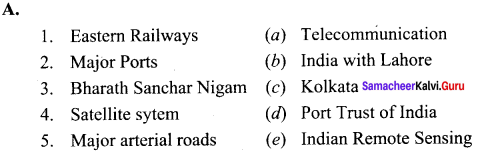
III. Match the following.

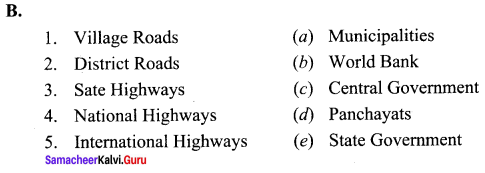
Samacheer Kalvi 10th Social Science Geography Solutions Chapter 5 India Population, Transport, Communication, and Trade 80
Answers:
(1 – c)
(2 – d)
(3 – a)
(4 – e)
(5 – b)

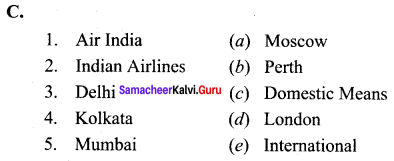
Samacheer Kalvi 10th Social Science Geography Solutions Chapter 5 India Population, Transport, Communication, and Trade 81
Answers:
(1 – d)
(2 – a)
(3 – e)
(4 – c)
(5 – b)

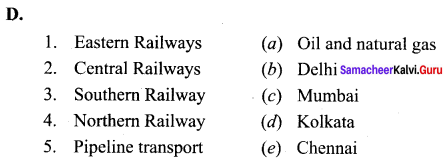
Samacheer Kalvi 10th Social Science Geography Solutions Chapter 5 India Population, Transport, Communication, and Trade 82
Answers:
(1 – e)
(2 – c)
(3 – a)
(4 – b)
(5 – d)

Samacheer Kalvi 10th Social Science Geography Solutions Chapter 5 India Population, Transport, Communication, and Trade 83
Answers:
(1 – d)
(2 – c)
(3 – e)
(4 – b)
(5 – a)

IV. Answer in one word.

Question 1.
What provides information regarding the population of our country?
Answer:
The Census of India.

Question 2.
When was the first Census held in India?
Answer:
1872

Question 3.
When was the first complete census taken?
Answer:
1881

Question 4.
After how many years Census is held in India?
Answer:
Census is held regularly after every tenth year.

Samacheer Kalvi 10th Social Science Geography Solutions Chapter 5 India: Population, Transport, Communication, and Trade

Question 5.
Which is the most comprehensive source of demographic, social and economic data in India?
Answer:
Indian Census

Question 6.
What is the population of India according to 2001 and 2011 Census?
Answer:
India’s population size as on March 2001 stood at 1,028 million and in 2011 is 1,210 million.

Question 7.
Which is the most populous state of India?
Answer:
Uttar Pradesh

Question 8.
Which is the least populated state of India?
Answer:
Sikkim

Samacheer Kalvi 10th Social Science Geography Solutions Chapter 5 India: Population, Transport, Communication, and Trade

Question 9.
Which is the least populated region of India?
Answer;
Lakshadweep

Question 10.
Name the five most populated states in India.
Answer:

  1. Uttar Pradesh,
  2. Maharashtra,
  3. Bihar,
  4. West Bengal and
  5. Andhra Pradesh.

Question 11.
Define population density.
Answer
It is calculated as the number of persons per unit area.

Question 12.
Which is the least densely populated state of India?
Answer:
Andhra Pradesh with 17 persons per sq.km.

Question 13.
Name the three main processes of change of population.
Answer:
Birth rates, death rates and migration.

Question 14.
Which two countries have a higher average population density than India?
Answer:
Bangladesh and Japan.

Samacheer Kalvi 10th Social Science Geography Solutions Chapter 5 India: Population, Transport, Communication, and Trade

Question 15.
What are various types of migration?
Answer:
Internal migration and International migration.

Question 16.
Define age structure.
Answer:
It refers to the number of people in different age groups in a country.

Question 17.
Define sex ratio.
Answer:
Sex ratio is defined as the number of females per 1000 males in the popultion.

Question 18.
Is sex ratio balanced in India?
Answer:
No

Samacheer Kalvi 10th Social Science Geography Solutions Chapter 5 India: Population, Transport, Communication, and Trade

Question 19.
Which regions of India has the highest and lowest sex ratio as per Census 2011?
Answer:
Kerala has a sex ratio of 1084 females per 1000 males, Delhi has only 866 females per 1000 males.

Question 20.
Who is a literate?
Answer:
A person aged 7 years and above who can read and write with understanding in any language is treated as literate.

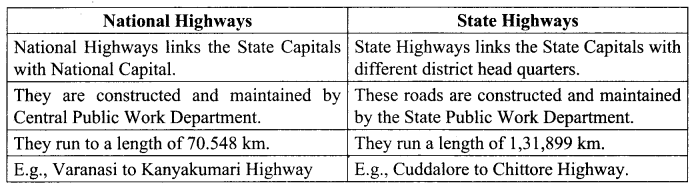
V. Distinguish between.

Question 1.
National Highways and State Highways.
Answer:
Samacheer Kalvi 10th Social Science Geography Solutions Chapter 5 India Population, Transport, Communication, and Trade 30

Question 2.
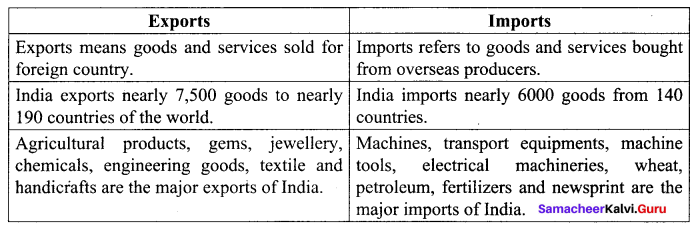
Exports and Imports.
Answer:
Samacheer Kalvi 10th Social Science Geography Solutions Chapter 5 India Population, Transport, Communication, and Trade 31

Question 3.
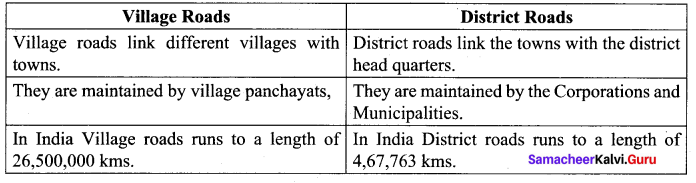
Village Roads and District Roads.
Answer:
Samacheer Kalvi 10th Social Science Geography Solutions Chapter 5 India Population, Transport, Communication, and Trade 38

Question 4.
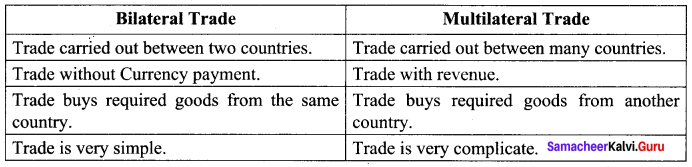
Bilateral Trade and Multilateral Trade
Answer:
Samacheer Kalvi 10th Social Science Geography Solutions Chapter 5 India Population, Transport, Communication, and Trade 32

Question 5.
Birth Rate and Death Rate
Answer:
Samacheer Kalvi 10th Social Science Geography Solutions Chapter 5 India Population, Transport, Communication, and Trade 33

Samacheer Kalvi 10th Social Science Geography Solutions Chapter 5 India: Population, Transport, Communication, and Trade

Question 6.
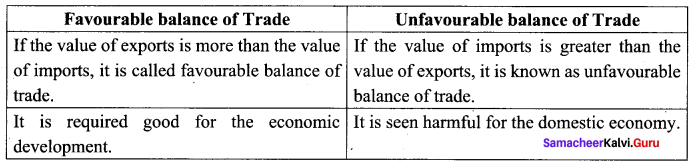
Favourable balance of trade and Unfavaourable balance of Trade
Answer:
Samacheer Kalvi 10th Social Science Geography Solutions Chapter 5 India Population, Transport, Communication, and Trade 34

VI. Answer the following questions briefly.

Question 1.
What is the position of Indian population in the World?
Answer:

  1. India is the second most populous country in the world.
  2. It is the home of 17.5% of world’s population.
  3. One out of every six persons in the w orld is from India.
  4. Our population is almost equal to the combined population of USA, Indonesia, Brazil, Pakistan, Bangladesh and Japan.

Question 2.
How is the population of India grouped?
Answer:
The population of a nation is generally grouped into three broad categories.

  1. Children (below 15 years): They are economically unproductive and need to be provided with food, clothing, education and medical care.
  2. Working Age (15-59 years): They are economically productive and biologically reproductive. They comprise the working population.
  3. Aged (above 59 years): They can be economically productive though they may have retired.

Samacheer Kalvi 10th Social Science Geography Solutions Chapter 5 India: Population, Transport, Communication, and Trade

Question 3.
What does the term “population change” refer to?
Answer:
The term “population change” refers to an increase or decrease of population of an area from one period to another period.

Question 4.
Name the three major superhighway project.
Answer:

  1. Golden Quadrilateral Super Highways: It links Delhi – Kolkata – Chennai – Mumbai and Delhi by six lane Super Highways.
  2. North – South Corridor: Linking Srinagar (Jammu and Kashmir) and Kanyakumari (Tamil Nadu).
  3. East-West Corridor: Linking Silcher (Assam) and Porbandar (Gujarat). The major objective of these Super Highways is to reduce the time and distance between the mega cities of India.

Question 5.
Name the three major means of transport in the world?
Answer:
The three major means of transport in the world are:

  1. Land transport: Roadways, Railways and pipelines.
  2. Waterways: Inland waterways and ocean routes
  3. Air transport: Domestic airways and International airways.

Question 6.
What is trade? What are the types of ti;ade?
Answer:

  1. Trade is an act or process of buying, selling or exchanging goods and services.
  2. Types of trades are
    • Internal trade
    • International trade.

Question 7.
Write about the merits of air transport.
Answer:
Airways are the quickest, costliest most modem and comfortable means of transport.

  1. Facilitates connectivity on a regional, national and international scale.
  2. Made accessibility by connecting difficult terrains like high mountains and deserts.
  3. It carries passengers, freight and mail.
  4. Air transport plays a key role in times of emergency, during the time of natural and man made calamities like floods, epidemics and wars.

Samacheer Kalvi 10th Social Science Geography Solutions Chapter 5 India: Population, Transport, Communication, and Trade

Question 8.
What are the merits of pipeline transport?
Answer:

  1. It can be laid through difficult terrain as well as under water.
  2. Initial cost of laying pipelines is high but subsequent cost for maintenance and operation is low.
  3. It ensures steady supply and minimizes transhipment losses and delays.
  4. Pipeline operation involves very low consumption of energy.

Samacheer Kalvi 10th Social Science Geography Solutions Chapter 5 India: Population, Transport, Communication, and Trade

Question 9.
What are the different kinds of mail services introduced by Department of posts?
Answer:

  1. Cards and envelopes are considered first-class mail and airlifted between ‘ stations both land and air.
  2. The second class mail includes-book packets, registered newspapers and periodicals, carried by surface mail covering land and water transport.
  3. Recently six mail channels have been introduced to facilitate quick delivery of mails in large towns and cities. They are Rajdhani channel, Metro Channel, Green Channel, Business Channel, Bulk mail Channel

Question 10.
Explain MRTS (Metro Rail System).
Answer:

  1. The Mass Rapid Transit System is an elevated line of the suburban railways in Chennai.
  2. This Railway is administrated by the state owned Southern Railway.
  3. This railway line currently runs from Chennai beach to Velachery covering 17 stations for a distance of 25 km.

Question 11.
What do you mean by Foreign Exchange?
Answer:
Foreign Exchange is the mechanism or process by which payments between any two places operating under different national currency systems are effected without passing of actual money or gold etc.

Question 12.
What are the four ship building yards in India?
Answer:

  1. Hindustan Shipyard at Vishakhapatnam.
  2. Garden reach workshop at Kolkata.
  3. Mazagaon Dock at Mumbai.
  4. Kochin Ship Yard and Kochi.

Question 13.
Define the term Dependency Ratio.
Answer:
The ratio between the economically active and economically inactive of population is termed as Dependency Ratio.

VII. Answer in a paragraph:

Question 1.
Define population. Why there is a need to study population?
Answer:

  1. The total number of people residing in a country at a specified period of time is called “population” of that country. The study of population is known as Demography.
  2. The human population has many components but the most fundamental are its numbers, composition, distribution and density. The study on these aspects also would reveal the work force of the country.
  3. Population census of India provides the detailed information about the demography of India.

Question 2.
Name the major National Waterways of our country.
Answer:

  1. The Ganga river between Allahabad and Haldia (1620 km). National Waterways No. 1
  2. The Brahmaputra river between Sadiya and Dhubri (891 km) – National Waterways No.2
  3. The West Coast Canal in Kerala (Kottapuram – Komman – Udyogmandal and Champakkara Canals – 205 km) – National Waterways No.3
  4. Specified stretches of Godavari and Krishna rivers along with Kakinada Puducherry Stretch of canals (1078 km) – National Waterways No.4 (v) Specified stretches of river Brahmani along with Matai river, delta channels of Mahanadi and Brahmani rivers and East Coast Canal (588 km) – National Waterways No.5.

There are some other inland waterways on which substantial transportation taken place. These are Mandavi, Zuari and cumberjua, Sundarbans, Barak, backwaters of Kerala and tidal stretches of some other rivers.

Samacheer Kalvi 10th Social Science Geography Solutions Chapter 5 India: Population, Transport, Communication, and Trade

Question 3.
Explain about the population composition.
Answer:
Population composition refers to characteristics such as age, sex, marital status, caste, language, education, occupation etc.

The study of composition of population helps us to understand the Social, economic and demographic structure of population.

Age Composition: Population of a county is generally grouped into three broad categories.

  1. Children less than 15 years of age (29.5%)
  2. The people above 60years (8%)
  3. These two categories falls under dependent population (37,5%)
  4. Independent population 16 – 59 years (62.5%)

It shows that our country has enormous man power i.e., working force.

Sex Ratio: Sex ratio is defined as the number of females per 1000 male population.

This is an important social indicator to measure the extent of equality between males and females in a society at a given rime.

According to 2011 census the sex ratio of the country is 940 females per 1000 males.

Literacy Rate: It is an important indicator of quality of people.

The people who are able to read and write are known as literates. The percentage of literate people to the total population is termed as literacy rate.

As per 2011 India’s literacy rate is 74.04%.

Occupational Structure: The economically active part of a country’s population are termed as workers.

They are placed under three categories as main workers, marginal workers and non workers.

Main workers are those who worked for the major part of the preceding year at least 6 months or 183 days.

Who worked less than six months are marginal.

People who have not worked at all comes under non workers.

In India as per 2011 census 75.23% are main workers and 24.77% of the people belong to marginal workers.

Question 4.
What are the means of transportation and communication called the lifelines of a nation and its economy?
Answer:
The development of a country depends upon the production of goods and services as well as their movement to their destination. Transport plays an important role in the economy. Because of transport raw materials reach to the factory or industry, and finally finished products reach to the consumer. It has helped in both production and distribution of goods. Hence, all efficient means of transport are prerequisites for fast development.

India is well – linked with the rest of the world despite its vast size, diversity and linguistic and socio-cultural plurality. Railways, airways, waterways, newspapers, radio, television, cinema and internet etc., have been contributing to its socio-economic progress in many ways. The trades from local to international levels have added to the vitality of its economy. It has also enriched our life and added substantially to growing amenities and facilities for the comforts of life. Hence, it is right to say that means of transportation and communication are the lifelines of a nation and its economy.

Samacheer Kalvi 10th Social Science Geography Solutions Chapter 5 India: Population, Transport, Communication, and Trade Read More »
Samacheer Kalvi 11th Maths Solutions Chapter 8 Vector Algebra – I Ex 8.1

You can Download Samacheer Kalvi 11th Maths Book Solutions Guide Pdf, Tamilnadu State Board help you to revise the complete Syllabus and score more marks in your examinations.

Tamilnadu Samacheer Kalvi 11th Maths Solutions Chapter 8 Vector Algebra – I Ex 8.1

Question 1.
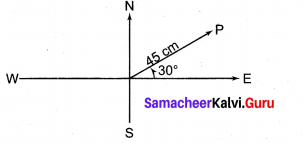
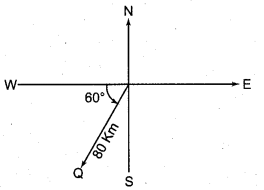
Represent graphically the displacement of
(i) 45 cm 30 ° north of east
(ii) 80 km, 60° south of west
Solution:
(i) 45 cm 30 0 north of east
Samacheer Kalvi 11th Maths Solutions Chapter 8 Vector Algebra - I Ex 8.1 1
(ii) 80 km 60° south of west
Samacheer Kalvi 11th Maths Solutions Chapter 8 Vector Algebra - I Ex 8.1 2

Question 2.
Prove that the relation R defined on the set V of all vectors by \(\vec{a}\) R \(\vec{b}\) if \(\vec{a}=\vec{b}\) is an equivalence relation on V.
Solution:
\(\vec{a}\) R \(\vec{b}\) is given as \(\vec{a}=\vec{b}\).
(i) \(\vec{a}\) = \(\vec{a}\) ⇒ \(\vec{a}\) R \(\vec{a}\)
(i.e.,) the relation is reflexive.

(ii) \(\vec{a}=\vec{b}\) ⇒ \(\vec{b}\) = \(\vec{a}\)
(i.e.,) \(\vec{a}\) R \(\vec{b}\) – \(\vec{b}\) R \(\vec{a}\)
So, the relation is symmetric.

(iii) \(\vec{a}=\vec{b} ; \vec{b}=\vec{c} \Rightarrow \vec{a}=\vec{c}\)
(i.e) \(\vec{a}\) R \(\vec{b}\) ; \(\vec{b}\) R \(\vec{c}\) ⇒ \(\vec{a}\) R \(\vec{c}\)
So the given relation is transitive
So, it is an equivalence relation.

Question 3.
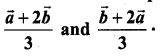
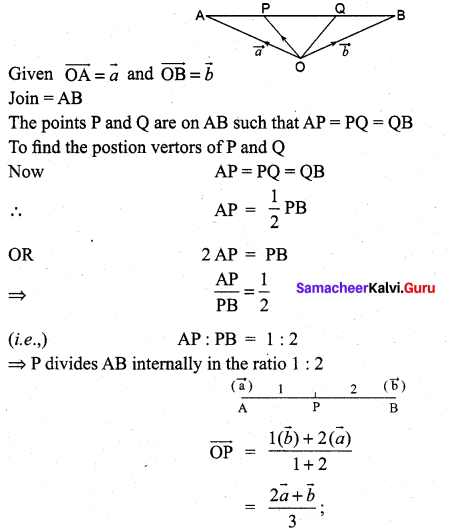
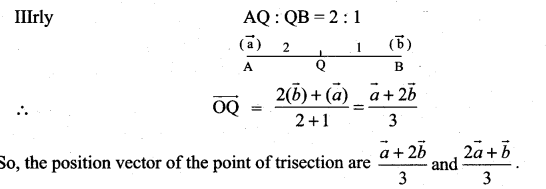
Let \(\vec{a}\) and \(\vec{a}\) be the position vectors of points A and B. Prove that the position vectors of the points which trisect the line segment AB are Samacheer Kalvi 11th Maths Solutions Chapter 8 Vector Algebra - I Ex 8.1 3
Solution:
Samacheer Kalvi 11th Maths Solutions Chapter 8 Vector Algebra - I Ex 8.1 4
Samacheer Kalvi 11th Maths Solutions Chapter 8 Vector Algebra - I Ex 8.1 5

Samacheer Kalvi 11th Maths Solutions Chapter 8 Vector Algebra - I Ex 8.1

Question 4.
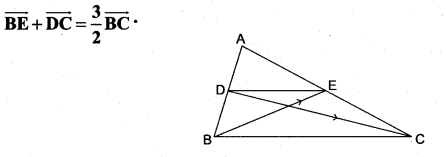
If D and E are the midpoints of the sides AB and AC of a triangle ABC, prove that
Samacheer Kalvi 11th Maths Solutions Chapter 8 Vector Algebra - I Ex 8.1 6
Solution:
Samacheer Kalvi 11th Maths Solutions Chapter 8 Vector Algebra - I Ex 8.1 7

Question 5.
Prove that the line segment joining the midpoints of two sides of a triangle is parallel to the third side whose length is half of the length of the third side.
Solution:
Samacheer Kalvi 11th Maths Solutions Chapter 8 Vector Algebra - I Ex 8.1 8
Samacheer Kalvi 11th Maths Solutions Chapter 8 Vector Algebra - I Ex 8.1 9

Question 6.
Prove that the line segments joining the midpoints of the adjacent sides of a quadrilateral form a parallelogram.
Solution:
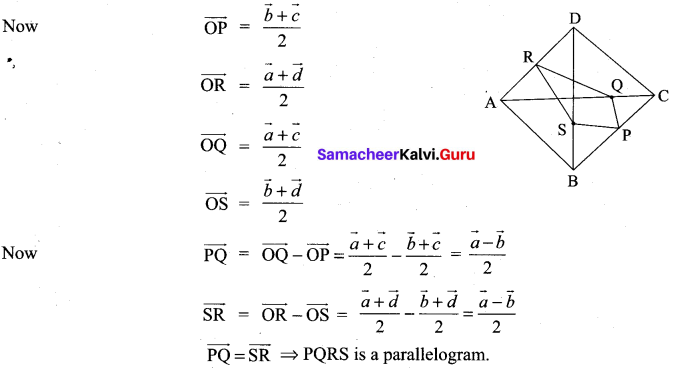
Samacheer Kalvi 11th Maths Solutions Chapter 8 Vector Algebra - I Ex 8.1 10
In a quadrilateral when opposite sides are equal and parallel it is a parallelogram So, PQRS is a parallelogram, from (1) and (2).

Question 7.
If \(\vec{a}\) and \(\vec{b}\) represent a side and a diagonal of a parallelogram, find the other sides and the other diagonal.
Solution:
OABC is a parallelogram where
Samacheer Kalvi 11th Maths Solutions Chapter 8 Vector Algebra - I Ex 8.1 11

Samacheer Kalvi 11th Maths Solutions Chapter 8 Vector Algebra - I Ex 8.1

Question 8.
If \(\overrightarrow{\mathrm{PO}}+\overrightarrow{\mathrm{OQ}}=\overrightarrow{\mathrm{QO}}+\overrightarrow{\mathrm{OR}}\), prove that the points P, Q, R are collinear.
Solution:
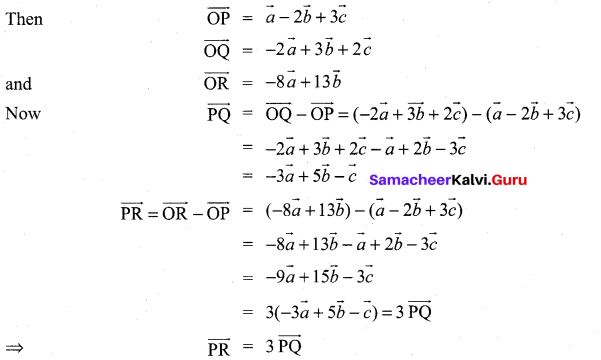
Samacheer Kalvi 11th Maths Solutions Chapter 8 Vector Algebra - I Ex 8.1 12
But Q is a common point.
⇒ P, Q, R are collinear.

Question 9.
If D is the midpoint of the side BC of a triangle ABC, prove that \(\overrightarrow{\mathbf{A B}}+\overrightarrow{\mathbf{A C}}=2 \overrightarrow{\mathbf{A D}}\)
Solution:
D is the midpoint of ∆ ABC.
Samacheer Kalvi 11th Maths Solutions Chapter 8 Vector Algebra - I Ex 8.1 13

Question 10.
If G is the centroid of a triangle ABC, prove that \(\overrightarrow{\mathrm{GA}}+\overrightarrow{\mathrm{GB}}+\overrightarrow{\mathrm{GC}}=0\)
Solution:
For any triangle ABC,
\(\overrightarrow{\mathrm{GA}}+\overrightarrow{\mathrm{GB}}+\overrightarrow{\mathrm{GC}}=0\)
Now G is the centroid of ∆ABC, which divides the medians (AD, BE and CF) in the ratio 2 : 1.
Samacheer Kalvi 11th Maths Solutions Chapter 8 Vector Algebra - I Ex 8.1 14
Samacheer Kalvi 11th Maths Solutions Chapter 8 Vector Algebra - I Ex 8.1 15

Question 11.
Let A, B, and C be the vertices of a triangle. Let D, E, and F be the midpoints of the sides BC, CA, and AB respectively. Show that \(\overrightarrow{\mathrm{AD}}+\overrightarrow{\mathrm{BE}}+\overrightarrow{\mathrm{CF}}=\overrightarrow{0}\)
Solution:
In ∆ABC, D, E, F are the midpoints of BC, CA, and AB respectively.
Samacheer Kalvi 11th Maths Solutions Chapter 8 Vector Algebra - I Ex 8.1 16
Samacheer Kalvi 11th Maths Solutions Chapter 8 Vector Algebra - I Ex 8.1 17

Question 12.
If ABCD is a quadrilateral and E and F are the midpoints of AC and BD respectively, then prove that \(\overrightarrow{\mathbf{A B}}+\overrightarrow{\mathbf{A D}}+\overrightarrow{\mathbf{C B}}+\overrightarrow{\mathbf{C D}}=4 \overrightarrow{\mathrm{EF}}\)
Solution:
ABCD is a quadrilateral in which E and F are the midpoints of AC and BD respectively.
Samacheer Kalvi 11th Maths Solutions Chapter 8 Vector Algebra - I Ex 8.1 18

Samacheer Kalvi 11th Maths Solutions Chapter 8 Vector Algebra – I Ex 8.1 Additional Problems

Question 1.
Shown that the points with position vectors Samacheer Kalvi 11th Maths Solutions Chapter 8 Vector Algebra - I Ex 8.1 22 are collinear.
Solution:
To prove the points P, Q, R are collinear we have to prove that \(\overrightarrow{\mathrm{PQ}}\) = t \(\overrightarrow{\mathrm{PR}}\) where t is a scalar.
Let the given points be P, Q, R.
Samacheer Kalvi 11th Maths Solutions Chapter 8 Vector Algebra - I Ex 8.1 19
So, the points P, Q, R are collinear (i.e,) the given points are collinear.

Question 2.
If ABC and A’B’C’ are two triangles and G, G’ be their corresponding centroids, prove that \(\overrightarrow{\mathrm{AA}^{\prime}}+\overrightarrow{\mathrm{BB}^{\prime}}+\overrightarrow{\mathrm{CC}^{\prime}}=3 \overrightarrow{\mathrm{GG}}\)
Solution:
Let O be the origin.
We know when G is the centroid of ∆ ABC,
Samacheer Kalvi 11th Maths Solutions Chapter 8 Vector Algebra - I Ex 8.1 20

Samacheer Kalvi 11th Maths Solutions Chapter 8 Vector Algebra - I Ex 8.1

Question 3.
Prove using vectors the mid-points of two opposite sides of a quadrilateral and the mid-points of the diagonals are the vertices of a parallelogram.
Solution:
ABCD is a quadrilateral with position vectors
OA = \(\vec{a}\), OB = \(\vec{b}\), OC = \(\vec{c}\) and OD = \(\vec{d}\)
P is the midpoint of BC and R is the midpoint of AD.
Q is the midpoint of AC and S is the midpoint of BD.
To prove PQRS is a parallelogram. We have to prove that \(\overrightarrow{\mathrm{PQ}}=\overrightarrow{\mathrm{SR}}\)
Samacheer Kalvi 11th Maths Solutions Chapter 8 Vector Algebra - I Ex 8.1 21

Samacheer Kalvi 11th Maths Solutions Chapter 8 Vector Algebra – I Ex 8.1 Read More »
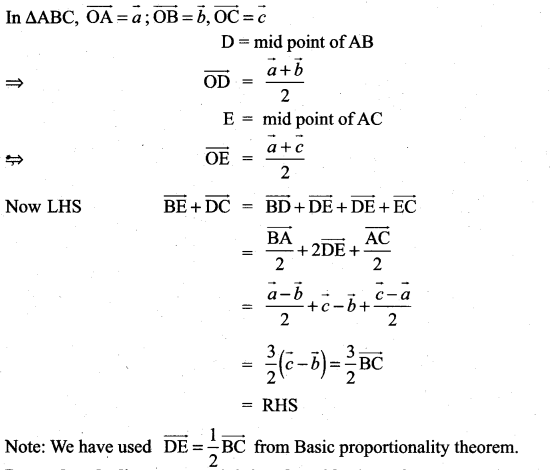
Samacheer Kalvi 9th Social Science Geography Solutions Chapter 3 Atmosphere

You can Download Samacheer Kalvi 9th Social Science Book Solutions Guide Pdf, Tamilnadu State Board help you to revise the complete Syllabus and score more marks in your examinations.

Tamilnadu Samacheer Kalvi 9th Social Science Geography Solutions Chapter 3 Atmosphere

Atmosphere Textual Exercise

I. Choose the Best Answer.

Question 1.
…………… is the most important gas for the survival of living
(a) Helium
(b) carbon-di-oxide
(c) oxygen
(d) methane
Answer:
(c) oxygen

Question 2.
The lowest layer of the atmosphere is ……………
(a) Troposphere
(b) Stratosphere
(c) Exosphere
(d) Mesosphere
Answer:
(a) Troposphere

Question 3.
…………. reflects radio waves.
(a) Exosphere
(b) Ionosphere
(c) Mesosphere
(d) Stratosphere
Answer:
(c) Mesosphere

Question 4.
The average global surface temperature is …………….
(a) 12°c
(b) 13°c
(c) 14°c
(d) 15°c
Answer:
(b) 13°c

Samacheer Kalvi 9th Social Science Geography Solutions Chapter 3 Atmosphere

Question 5.
The process of change of state of water from gaseous to liquid state is called ……………..
(a) Precipitation
(b) evaporation
(c) transpiration
(d) condensation
Answer:
(d) condensation

Question 6.
The …………… is the chief energy source of the Earth.
(a) Sun
(b) Moon
(c) Stars
(d) clouds
Answer:
(a) Sun

Question 7.
All types of clouds are found in the ……………….
(a) Troposphere
(b) Ionosphere
(c) Mesosphere.
(d) Exosphere
Answer:
(a) Troposphere

Question 8.
…………….. clouds are called ‘Sheep clouds’.
(a) Alto-cumulus
(b) Alto-Stratus
(c) Nimbo-stratus
(d) Cirro-cumulus
Answer:
(a) Alto-cumulus

Question 9.
The Monsoons are ……………
(a) Prevailing winds
(b) Periodic winds
(c) local winds
(d) none of the above
Answer:
(b) Periodic winds

Question 10.
Dew in the form of ice crystals is called ………….
(a) frost
(b) fog
(c) mist
(d) sleet
Answer:
(d) sleet

Question 11.
………………. is called the eye of the storm.
(a) Pressure
(b) wind
(c) cyclones
(d) snow
Answer:
(c) cyclones

Samacheer Kalvi 9th Social Science Geography Solutions Chapter 3 Atmosphere

Question 12.
The vertical movement of air is called ……………
(a) Wind
(b) storm
(c) Air current
(d) drift
Answer:
(c) Air current

II. Match the following.

Samacheer Kalvi 9th Social Science Geography Solutions Chapter 3 Atmosphere 1
Answer:
1. (e)
2. (d)
3. (a)
4. (b)
5. (c)
6. (g)
7. (f)

III. Answer the following questions briefly.

Question 1.
Define the atmosphere.
Answer:

  1. The blanket of air that surrounds the Earth is called the atmosphere.
  2. It is held close to the earth by gravitational attraction.
  3. The atmosphere is a mixture of gases, water vapour, and dust particles in different proportions

Question 2.
Name the different atmospheric layers.
Answer:
The different atmospheric layers are Troposphere* Stratosphere, Mesosphere, Thermosphere, and Exosphere.

Question 3.
Mention the factors that affect the climate.
Answer:
The factors that affect weather and climate are

  1. Latitude or distance from the equator
  2. Altitude height above the sea level
  3. Nearness to the sea
  4. Nature of the prevailing winds
  5. Mountain barrier
  6. Cloud cover
  7. Ocean currents
  8. Natural vegetation

Question 4.
What is insulation?
Answer:
The amount of heat received from the sun in the form of short waves is called insulation (or) incoming Solar Radiation.

Question 5.
What are isotherms?
Answer:
Some of the processes that are responsible for atmospheric heat are Radiation, Conduction, Convection, and Advection.

Question 6.
Write a short note on ‘Lapse rate’.
Answer:

  • Altitude refers to the height above sea level.
  • The temperature decreases at the rate of 1°C far every 165 mts of height. This is called “Normal Lapse rate”.

Question 7.
What are the processes responsible for heating the atmosphere?
Answer:
The processes responsible for heating the atmosphere are Radiation, Conduction, Convection and Advection.

Samacheer Kalvi 9th Social Science Geography Solutions Chapter 3 Atmosphere

Question 8.
Mention the planetary wind system of the earth.
Answer:
The winds which constantly blow in the same direction throughout the year are called the planetary winds. They are also called permanent winds (or) the prevailing winds.

Question 9.
Write a short note on:
(a) Trade winds (b) Roaring Forties
Answer:
(a) Trade winds:

  1. Trade winds blow from the subtropical high-pressure belt to the Equatorial low-pressure belt in both the hemispheres.
  2. They blow with great regularity, force and in a constant direction throughout the year.
  3. These winds were helpful to traders, hence called trade winds.
  4. As they move westwards, they become dry and do not give rainfall.

(b) Roaring Forties:

  1. Westerlies are the permanent winds that blow from the tropical high-pressure belt to the subpolar low-pressure belt in both the hemispheres.
  2. The velocity of westerlies become so vigorous and fast to be called Roaring Forties at 40°, Furious Fifties at 50°, and screaming Sixties at 60° latitudes.

Question 10.
How are clouds formed?
Answer:

  1. A large amount of water evaporates each day from the surface of the Sea.
  2. This is the principal source of atmospheric moisture.
  3. Cool moisture-laden air gets collected around particles like dust, salt content from the sea, smoke, etc, and forms clouds.
  4. Sometimes mixing warmer and cooler air also produces clouds.

Question 11.
What are the different types of rainfall?
Answer:

  1. Rainfall is the most predominant type of precipitation.
  2. Moisture laden air masses raise upwards, forms clouds, and bring rainfall.
  3. Based on the mechanisms of raising the air, there are three types of rainfall.
  4. They are
    • Convectional rainfall
    • Frontal or Cyclonic rainfall
    • Orographic rainfall.

Question 12.
What is Precipitation? What are the different forms of precipitation?
Answer:

  1. Falling down of condensed water vapour in different forms is called Precipitation.
  2. When the dew point is reached in the cloud water droplets become saturated and start to fall as Precipitation.
  3. The different types of precipitation are
    • drizzle
    • rain
    • sleet
    • snow
    • hail etc.

Samacheer Kalvi 9th Social Science Geography Solutions Chapter 3 Atmosphere

Question 13.
Write short notes on:

  1. Drizzle
  2. rain
  3. sleet
  4. snow
  5. heat

Answer:

  1. Drizzle: The falling of numerous uniform minute droplets of water with a diameter of less than 0. 5 is called a driggle.
  2. Rain: Rain is the most widespread and important form of precipitation in places having temperatures above the freezing point.
  3. Sleet: Sleet refers to precipitation in form of pallets made up of transparent and translucent ice. This is a mixture of snow and rain.
  4. Snow: Snow is formed when condensation occurs below the freezing point. It is the precipitation of opaque and semi-opaque ice crystals.
  5. Heat: Heat is the energy which makes an object hot, while temperature measures the intensity of heat.

Question 14.
How are Cyclones classified?
Answer:
Cyclones Can be classified into

  1. Tropical cyclones
  2. Temperate cyclones
  3. Extra-Tropical cyclones.

IV. Distinguish between the following.

Question 1.
Weather and climate.
Answer:

S.No. Weather Climate
(i) Weather is the study of atmospheric conditions for a short duration over small areas. It is the study of the average weather condition observed over a long period of time for a larger area.
(ii) The weather changes very often; hour to hour and day today. Climate is more (or) less permanent and remains the same always.
(iii) The study of weather is called meteorology. The study of climate is called climatology.

Question 2.
Land breeze and sea breeze.
Answer:

S.No. Land Breeze Sea Breeze
(i) During the night the land cools more rapidly than the ocean. Cool air sinks and forms high pressure. During the day the landmasses get heated more rapidly than the oceans.
(ii) The wind that blows from land to sea during the night is called a land breeze. Heated air ascends and this causes low pressure on the adjoining ocean, therefore the wind blows from the ocean to land in the afternoon. This is called a sea breeze.

Question 3.
Windward side and Leeward side.
Answer:

S.No. Windward side     Leeward side
(i) The windward side of a mountain which faces the prevailing wind. The Leeward side of the mountain is the side sheltered from the wind.
(ii) It receives heavy rainfall. It receives very less rainfall.

Question 4.
Tropical cyclone and Temperate cyclones
Answer:

S.No.

Tropical cyclones

Temperate cyclones

(i) Tropical cyclone develops in the Intertropical convergent zone. They are formed due to the differential heating of land & Sea. Temperate cyclones are formed along a front, where hot and cold air masses meet.
(ii) They often cause heavy loss of life and properly on the coasts and become weak after reaching the landmasses. Temperate cyclones do not become weak like Tropical cyclones on reaching the land.
(iii) Tropical cyclones are known as ‘cyclones’ in the Indian ocean. Temperate cyclones are called western disturbances in India.

V. Give reasons.

Question 1.
Cyclones cause huge loss of life and property.
Answer:

  1. A Tropical cyclone is a rapidly rotating storm system.
  2. It is characterised by a low pressure center, a closed low level atmospheric circulation, strong winds and a spiral arrangement of thunderstorms, that produce heavy rain.
  3. Very strong winds many damage installations, dwellings, communication systems, trees etc.
  4. Therefore, it results in loss of life and property.
  5. Heavy prolonged rains due to cyclones may cause river floods and submergence of low-lying areas of rain, causing loss of life and property.

Samacheer Kalvi 9th Social Science Geography Solutions Chapter 3 Atmosphere

Question 2.
Cloudy days are warmer than cloudless days.
Answer:
On a cloudy day some energy from the sun gets into the atmosphere through the clouds but can’t get out again, when this happens the heat builds up during the day, so it gets warmer outside.

Question 3.
Fog is dangerous for traffic.
Answer:

  1. Fog is a thick cloud of tiny water droplets suspended in the atmosphere at or near the earth’s surface.
  2. It obscures or restricts visibility to a greater extent than mist.
  3. It strictly reduces visibility to below 1 km.
  4. Many lives are lost each year worldwide from accidents involving fog conditions on the highways, including multiple – vehicle collisions.
  5. The aviation travel industry is affected by the severity of fog conditions.

Question 4.
Convectional rainfall is also called 4 O’clock rain.
Answer:

  1. The convectional rainfall occurs regularly in the equatorial region in the evenings.
  2. The ascending moist air cools, condenses, and results in convectional rainfall. So it is called 4 O’clock rainfall.

Question 5.
Polar Easterlies are cold and dry. Why it is so?
Answer:

  1. The polar easterlies are the dry, cold prevailing winds that blow from the high-pressure areas of the polar highs at the North and South poles towards low-pressure areas within the westerlies at high latitudes when air moves near the poles, cold temperatures shrink the air.
  2. These are weak winds flowing from the Northeast direction in the Northern Hemisphere and South east direction in the Southern Hemisphere.

VI. Paragraph Questions.

Question 1.
Write a paragraph about the structure of the atmosphere.
Answer:
The blanket of air that surrounds the Earth is called the atmosphere. The five atmospheric layers are Troposphere, Stratosphere, Mesosphere, Thermosphere and Exosphere.
Troposphere: The lowest layer of the atmosphere is the troposphere. The Greek word ‘tropos’ means ‘turn’ or change. The layer extends up to 8 kms at the poles and up to 18 kms at the Equator. The temperature decreases with increasing height. Almost all weather phenomenon take place in this layer. Hence it is called weather making layer. The upper limit of the troposphere is called as tropopause.

Stratosphere: Stratosphere lies above the troposphere. It extends to a height of about 50 km above earth surface. Since this layer is a concentration of ozone molecules, it is also referred as ozonosphere. The temperature increases with increase in height in this layer. Large jet planes normally fly here. The upper limit of the stratosphere is called as stratopause. Mesosphere: Mesosphere extends between 50km and 80km. The temperature increases with increasing height. Radio waves transmitted from earth are reflected back to earth from this layer. Most of the meteors nearing the earth, get burned here. The uppermost limit of the mesosphere is the mesopause.

Thermosphere: Thermosphere exists above the mesosphere. It extends to about 600 km. The composition of gases in the lower thermosphere is more or less uniform, hence it is called ‘‘Homosphere”. The upper portion of the thermosphere has uneven composition of gases and hence it is referred as “Heterosphere”. Here the temperature increases with increasing height. Ionosphere is a layer of the thermosphere that contains Ions and free electrons.

Exosphere: The uppermost layer of the atmosphere is called exosphere. This layer is extremely rarefied with gases and gradually merges with the outer space. This zone is characterized by aurora Australis and aurora borealis.

Question 2.
Explain the different types of permanent winds.
Answer:
Westerlies are the permanent Winds that blow from the tropical high pressure belt to the sub polar low pressure belt in both the hemispheres. They blow from South West to North East . in the northern hemisphere and North West to South East in the southern hemisphere. The velocity of westerlies become so vigorous and fast to be called Roaring Forties at 40°, Furious Fifties at 50° and Screaming Sixties at 60° latitudes.

Question 3.
How are clouds classified? Explain them.
Answer:
According to their height, clouds are classified into the following types

  • High clouds (6 – 20 km Height)
  • Middle clouds (2.5 km – 6 km Height)
  • Low clouds (ground surface to 25 km height)

These major types of clouds are further divided into different types on the basis of shape and structure.

  1. High clouds
    • Cirrus: Detached clouds in the form of white delicate fibrous silky filaments formed at the high sky (8000 meters to 12000 meters) are called Cirrus clouds. These clouds are dry and do not give rainfall.
    • Cirrocumulus: White patched, sheet or layer like clouds composed of ice crystals. Cirrostratus: Smooth milky transparent whitish clouds composed of tiny ice crystals.
  2. Middle clouds
    • Alto-stratus: Thin sheets of grey or blue coloured clouds in uniform appearance, consisting of frozen water droplets.
    • Alto-cumulus: clouds fitted closely together in parallel bands, called ‘Sheep clouds’ or woolpack clouds.
    • Nimbo stratus: These are clouds of dark colour very close to the ground surface associated with rain, snow or sleet.
  3. Low clouds
    • Strato-cumulus: Grey or whitish layer of non-fibrous low clouds found in rounded patches at a height of 2500 to 3000 meters, associated with fair or clear weather.
    • Stratus: Dense, low lying fog-like clouds associated with rain or snow.
    • Cumulus: Dome-shaped with a flat base often resembling a cauliflower, associated with fair weather.
    • Cumulo-nimbus: Fluffy thick towering thunderstorm cloud capable of producing heavy rain, snow, hailstorm or tornadoes.

Samacheer Kalvi 9th Social Science Geography Solutions Chapter 3 Atmosphere

Question 4.
How are cyclones formed? How are they classified?
Answer:
The term cyclone is a Greek word meaning “coil of a snake”. Cyclones are centres of low pressure where winds from the surrounding high-pressure area converge towards the centre in a spiral form. Due to the rotation of the earth, the cyclonic winds in the northern hemisphere move in anti-clockwise direction, whereas they move in a clockwise direction in the southern hemisphere.
Cyclones can be classified into

Tropical cyclones, Temperate cyclones and Extratropical cyclones. Tropical cyclones: Tropical cyclones develop in the Intertropical convergence zone [ITCZ], They are formed due to the differential heating of land and sea.
Tropical cyclones are known as ‘cyclones’ in Indian ocean, ‘typhoons’ in the western pacific ocean, ‘hurricanes’ in the Atlantic and eastern Pacific ocean, ‘baguios’ in Phillipines and ‘willy willy’ in Australia. Tropical cyclones often cause heavy .loss of life and property on the coasts and become weak after reaching the landmasses.

Temperate cyclones: Temperate cyclones are formed along a front where hot and cold air masses meet in mid-latitudes between 35° and 65°N and S. Temperate cyclones do not become weak like the tropical cyclones on reaching the land. Temperate cyclone commonly occurs over the North Atlantic Ocean, northwest Europe, Mediterranean basin. Mediterranean basin’s temperate cyclones extend up to Russia and India in winter. In India, it is called the western disturbances.

Extratropical cyclones: Extratropical cyclones occur in the latitudes between 30° and 60° in both hemispheres. They are also called mid-latitude cyclones. They collect energy from temperature differences which are found in higher latitudes. Extratropical cyclones produce mild showers to heavy gales, thunderstorms, blizzards, and tornadoes.

Question 5.
Explain the different forms of precipitation.
Answer:
Precipitation
Falling down of condensed water vapour in different forms is called Precipitation. When the dew point is reached in the cloud water droplets become saturated and start to fall. Hence, they fall on the earth as precipitation.
The climatic conditions/ factors influencing the forms of precipitation mainly are:

  • Temperature.
  • Altitude
  • Cloud type
  • Atmospheric conditions.
  • Precipitation process.

The main forms of precipitation include drizzle, rain, sleet, snow, hail, etc.
Drizzle: The falling of numerous uniform minute droplets of water with a diameter of less than 0. 5 is called a drizzle from low clouds. Sometimes drizzles are combined with fog and hence reduce visibility.

Rain: Rain is the most widespread and important form of precipitation in places having temperatures above the freezing point. It occurs only when there is abundant moisture in the air. The diameter of a raindrop is more than 5 mm.

Sleet: Sleet refers to precipitation, in the form of pellets made up of transparent and translucent ice. This precipitation is a mixture of snow and rain.

Snow: Snow is formed when condensation occurs below the freezing point. It is the precipitation of opaque and semi-opaque ice crystals. When these ice crystals collide and stick together, it becomes snowflakes.

Hails: Hails are chunks of ice (greater than 2 cm in diameter) falling from the sky, during a rainstorm or thunderstorm.
Hailstones are a form of solid precipitation where small pieces of ice fall downwards. These are destructive and dreaded forms of solid precipitation because they destroy agricultural crops and human lives.

VII. Activity:

  1. Preparing chart of clouds at various atmospheric levels. – Individual Activity.
  2. Collecting proverbs clouds and rain-related proverbs. – Individual Activity.
  3. Poem on ‘clouds’ and ‘rain’. – Individual Activity.
  4. Report writing observes the clouds for a week. Write your report about the shape and colours of the clouds. – Group Activity.
  5. Working models (a) Rain Gauge (b) Wind vane – Group Activity.
    • The teacher takes initiative to complete the following activities.
    • The students get the assistance of the teacher to complete the given task.
  6. Preparing a bar diagram:
    (a) Collect the data of the temperature of Kanyakumari, Delhi, Allahabad, and Itanagar for a day.
    (b) Also collect the data of rainfall received by Jaisalmer (Rajasthan), Mawsynram (Meghalaya), Nagapattinam, Coimbatore for a day. – Group Activity.
  7. Become a budding Meteorologist:
    Record the local weather condition of your place for a week. – Group Activity.
    Samacheer Kalvi 9th Social Science Geography Solutions Chapter 3 Atmosphere 2

Answer:
You can do this activity in groups under the guidance of your teacher.

In-text HOTs Questions

Question 1.
Why is Troposphere called weather making layer?
Answer:
The troposphere is the lowest layer of the atmosphere. It is also known as the weather-making zone because all physical processes of weather, like wind, clouds, storms, rainfall, mist, fog, and hail, occur here.

Atmosphere Additional Questions

I. Choose the correct answer.

Question 1.
This is a permanent gas in the atmosphere.
(a) Nitrogen
(b) Argon
(c) Methane
(d) Helium
Answer:
(a) Nitrogen

Question 2.
This gas helps in protecting the earth from radiation.
(a) Hydrogen
(b) Nitrogen
(c) Ozone
(d) CO2
Answer:
(c) Ozone

Question 3.
The uppermost layer of the atmosphere is …………….
(a) Stratosphere
(b) Mesosphere
(c) Exosphere
(d) Thermosphere
Answer:
(c) Exosphere

Samacheer Kalvi 9th Social Science Geography Solutions Chapter 3 Atmosphere

Question 4.
This precipitation is a mixture of snow and rain.
(a) Sleet
(b) Snow
(c) Hail
(d) Hailstones
Answer:
(a) Sleet

Question 5.
The humidity of the atmosphere is measured by the wet and dry bulb thermometer called ………….
(a) Anemometer
(b) Thermometer
(c) Hygrometer
(d) Barometer
Answer:
(c) Hygrometer

Question 6.
This is one of the most feared weather phenomena.
(a) Snow
(b) Hailstones
(c) Sleet
(d) Hails
Answer:
(b) Hailstones

Question 7.
Tropical cyclones in India is known as ……………
(a) Baguio’s
(b) willy willy
(c) hurricanes
(d) Cyclones
Answer:
(d) Cyclones

Question 8.
The wind blowing from the east is ……………
(a) Planetary winds
(b) Easterly winds
(c) Variable winds
(d) Local winds
Answer:
(b) Easterly winds

Question 9.
This is the wettest place in India.
(a) Mawsynram
(b) the Western Ghats
(c) Shillong
(d) Pune
Answer:
(a) Mawsynram

Question 10.
This is the earth’s magnetic belt ………………
(a) Thermosphere
(b) Stratosphere
(c) Mesosphere
(d) Magnetosphere
Answer:
(d) Magnetosphere

II. Match the following.
(a)
Samacheer Kalvi 9th Social Science Geography Solutions Chapter 3 Atmosphere 3
Answer:
(a)
1. (e)
2. (a)
3. (b)
4. (d)
5. (c)

(b)
Samacheer Kalvi 9th Social Science Geography Solutions Chapter 3 Atmosphere 4
Answer:
(b)
1. (d)
2. (c)
3. (a)
4. (e)
5. (b)

III. Answer the following questions briefly.

Question 1.
Who discovered Nitrogen in the Atmosphere? When?
Answer:
In 1772 CE Daniel Rutherford discovered Nitrogen in the atmosphere.

Samacheer Kalvi 9th Social Science Geography Solutions Chapter 3 Atmosphere

Question 2.
What are Auroras?
Answer:
Auroras are cosmic glowing lights produced by a stream of electrons discharged from the Sun’s surface due to magnetic storms that are seen as unique multicolored fireworks hanging in the polar sky during midnight.

Question 3.
What are mountain barriers?
Answer:

  • The location of the mountains influences the climate of a place.
  • The mountain chains act as a natural barrier for the wind.
  • Sometimes they prevent the entry of cold winds into the country (or) the escape of monsoon winds, thus having a great influence over the climate.

Question 4.
What happens to atmospheric pressure with altitude?
Answer:

  • Air pressure decreases with altitude.
  • The air molecules became scattered and more widely spaced at higher altitudes.
  • The air pressure develops by 34 millibars per 300 meters increase in height.

Question 5.
What do you call the winds of a particular area?
Answer:

  • The winds that are blown in a particular locality for a short period of time are called the local winds.
  • The effects of these local winds are experienced only in that particular area.

Question 6.
Define the terms (a) Absolute humidity (b) Relative humidity.
Answer:
Absolute humidity: The amount of water vapour in the atmosphere is called Absolute Humidity.
Relative Humidity: The ratio between the amount of water vapour in the atmosphere and the amount of water vapour it can hold is Relative humidity.

IV. Distinguish between the following.

Question 1.
Conduction and Convection.
Answer:

Conduction Convection
Conduction is the transfer of heat from a hot body to a cold body through contact. Convection is the transfer of heat by movement or circulation of air in a mass.

Question 2.
Isobar and Isotherm.
Answer:

Isobar Isotherm
An Isobar is an imaginary line drawn through places having equal atmospheric pressure reduced to sea level. An imaginary line on a map connecting points having the same temperature

V. Give reasons.

Question 1.
Thermosphere is also referred to as “Heterosphere”.
Answer:
The upper portion of the Thermosphere has an uneven composition of gases and hence it is referred as “Heterosphere”.

Question 2.
The wind blows from ocean to land in the afternoon. Why?
Answer:

  1. During the day the land masses get heated more rapidly than the oceans.
  2. Heated air ascends and causes low pressure on the adjoining ocean.
  3. Therefore the wind blows from ocean to land in the afternoon.

Samacheer Kalvi 9th Social Science Geography Solutions Chapter 3 Atmosphere

Question 3.
The subtropical high pressure are called “horse latitudes”. Why?
Answer:

  1. With little water and food left for humans, sailors used to throw the horses into the sea in order to make the vessels lighter.
  2. Henceforth these belts (or) latitudes are called “horse latitudes”.

Question 4.
“Water droplets fall on the earth as precipitation”. Why?
Answer:

  1. When the dew point is reached in the cloud, water droplets become saturated and start to fall.
  2. Hence they fall on the earth as precipitation.

VI. Paragraph questions.

Question 1.
Describe the “composition of the atmosphere”.
Answer:
(i) Atmosphere is a mixture of gases, water vapour and dust particles in different proportions.

(ii) Nitrogen (78%) and Oxygen (21%) are permanent gases of the atmosphere. They constitute 99% of the total composition and their percentages always remain the same without any change.

(iii) The remaining one percentage is occupied by Argon (0.93%), Carbon-di-oxide, (0.03%), Neon (0.0018%), Helium (0.0005%), Ozone (0.00006%) and Hydrogen (0.00005%). Krypton, Xenon and Methane are also present in trace. Water vapour (0 – 0.4%) is also found in the atmosphere, which plays an important role in predicting weather phenomenon.

(iv) The other solid particles present in the atmosphere includes dust particles, salt particles, pollen grains, smoke, soot, volcanic ashes etc.,
(v) Oxygen is most important for living organisms.
(vi) CO2 absorbs heat and keeps the atmosphere warm by insulation and radiation.
(vii) Nitrogen acts as a diluent and is chemically inactive.
(viii) Ozone helps in protecting the earth from radiation.
(ix) The solid particles in the atmosphere acts as nuclei on which water vapour condense to form precipitation.

Question 2.
How is the Orographic rainfall caused?
Answer:
Orographic rainfall, also called relief rainfall, is caused when air is forced to rise against a high mountain. The mountain barriers lying across the direction of air flow, force the moisture laden air rise along the mountain slope. This results in the cooling of the air, which leads to the formation of clouds and rain. This rainfall is called Orographic rainfall. The side of the ‘ mountain facing the wind is called the windward side and receives heavy rainfall. It is called the rainfed region. The other side of the mountain that does not face the wind is called the leeward side and receives less rainfall becomes rain shadow region.

VII. HOTs (Higher Order Thinking skills) Questions

Question 1.
Why is Troposphere called as weather making layer?
Answer:
‘Tropos’ means ‘turn’ (or) change. Almost all weather phenomenon takes place in this layer. Hence Troposphere is called as weather making layer.

Samacheer Kalvi 9th Social Science Geography Solutions Chapter 3 Atmosphere

Question 2.
Cuddalore and Nagapattinam are always affected by cyclones. Why?
Answer:

  1. Coastal zone is exposed to natural forces including cyclones and Tsunamis.
  2. Cuddalore and Nagapattinam are situated on the Sea-Shore.
  3. Cuddalore and Nagapattinam are vulnerable to storms.
  4. During Summer Bay of Bengal subject to intense heat cause to raise the humid and unstable air masses that produce cyclone.

Samacheer Kalvi 9th Social Science Geography Solutions Chapter 3 Atmosphere Read More »
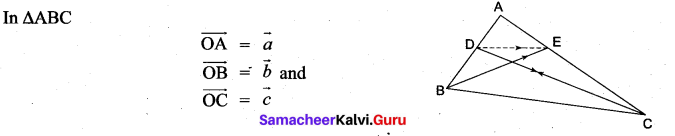
Samacheer Kalvi 11th Maths Solutions Chapter 1 Sets Ex 1.2

You can Download Samacheer Kalvi 11th Maths Book Solutions Guide Pdf, Tamilnadu State Board help you to revise the complete Syllabus and score more marks in your examinations.

Tamilnadu Samacheer Kalvi 11th Maths Solutions Chapter 1 Sets Ex 1.2

Question 1.
Discuss the following relations for reflexivity, symmetricity and transitivity:

(i) The relation R defined on the set of all positive integers by “mRn if m divides n”.
Solution:
Let Z = {1, 2, 3, ……….}
R is a relation defined on the set of all positive integers by m R n if m divides n
R = { (m, n) : \(\frac{\mathrm{m}}{\mathrm{n}}\) for all m, n ∈ Z } n

(a) Reflexive:
m divides m for all m ∈ Z
∴ (m, m) ∈ R for all m ∈ Z
Hence R is reflexive

(b) Symmetric:
Let (m, n) ∈ R ⇒ m divides n
⇒ n = km for some integers k
But km need not divide m, ie. n need not divide m
∴ (n, m) ∉ R
Hence R is not symmetric.

(c) Transitive:
Let (m, n), (n, r) ∈ R
Then m divides n ⇒ n = km and
n divides r ⇒ r = k1n
r = k1(km) = (k1k) m
m divides r
∴ (m, r) ∈ R
Hence R is transitive.

(ii) Let P denote the set of all straight lines in a plane. The relation R defined by “lRm if l is perpendicular to m”.
Solution:
P = {set of all straight lines in a plane}
lRm ⇒ l is perpendicular to m

(a) lRl ⇒ l is not perpendicular to l
⇒ It is not reflexive

(b) lRm ⇒ l is perpendicular to m
mRl ⇒ m is perpendicular to l
It is symmetric

(c) l perpendicular to m ⇒ m perpendicular to n ⇒ l is parallel to n It is not transitive
Samacheer Kalvi 11th Maths Solutions Chapter 1 Sets Ex 1.2

(iii) Let A be the set consisting of all the members of a family. The relation R defined by “aRb if a is not a sister of b”.
Solution:
Let F = Father,
M = Mother
G = Male child
H = Female child
A = { F, M, G, H }
The relation R is defined by
a R b if a is not a sister of b.
R = {(F, F), (F, M), (F, G), (F, H), (M, F), (M, M), (M, G), (M, H), (G, F), (G, M), (G, G), (G, H), (H, F), (H, M), (H, H)}

(a) Reflexive:
(F, F) , (M , M), (G, G), ( H, H ) ∈ R
∴ R is reflexive.

(b) Symmetric:
For (G, H) ∈ R, we have (H, G) ∉ R
∴ R is not symmetric.

(c) Transitive:
Suppose in a family if we take mother M , male child-G and female child-H.
H is not a sister of M ⇒ HRM, (H, M) ∈ R
M is not a sister of G ⇒ MRG, (M, G) ∈ R
But H is a sister of G ⇒ HRG, (H, G) ∉ R
Thus, for (H, M), (M, G) ∈ R
we have (H, G) ∉ R
∴ R is transitive.

(iv) Let A be the set consisting of all the female members of a family. The relation R
defined by “aRb if a is not a sister of b”.
Solution:
A = {set of all female members of a family}

(a) aRa ⇒ a is a sister of a
It is reflexive

(b) aRb ⇒ a is a sister of b
bRa ⇒ b is the sister of a
⇒ It is symmetric

(c) aRb ⇒ a is a sister of b bRc ⇒ b is a sister of c aRc ⇒ a can be the sister of c It is not transitive.

(v) On the set of natural numbers the relation R defined by “xRy if x + 2y = 1”.
Solution:
x + 2y = 1 for x, y ∈ N
There is no x , y ∈ N satisfying x + 2y = 1
∴ The relation R is an empty relation.
An empty relation is symmetric and transitive.
∴ R is symmetric and transitive.
R is not reflexive

Samacheer Kalvi 11th Maths Solutions Chapter 1 Sets Ex 1.2

Question 2.
Let X = {a, b, c, d} and R = {(a, a), {b, b), (a, c)}. Write down the minimum number
of ordered pairs to be included to R to make it
(i) reflexive
(ii) symmetric
(iii) transitive
(iv) equivalence
Solution:
X = {a, b, c, d}
R = {(a, a), (b, b), (a, c)}
(i) To make R reflexive we need to include (c, c) and (d, d)
(ii) To make R symmetric we need to include (c, a)
(iii) R is transitive
(iv) To make R reflexive we need to include (c, c)
To make R symmetric we need to include (c, c) and (c, a) for transitive
∴ The relation now becomes
R = {(a, a), (b, b), (a, c), (c, c), (c, a)}
∴ R is equivalence relation.

Question 3.
Let A = {a, b, c} and R = {(a, a), (b, b), (a, c)}. Write down the minimum number of ordered pairs to be included to R to make it
(i) reflexive
(ii) symmetric
(iii) transitive
(iv) equivalence
Solution:
Given A = {a, b, c }
R = { (a, a), (b, b),(a, c) }
(i) The minimum ordered pair to be included to R in order to make it reflexive is (c, c).
(ii) The minimum ordered pair to be included to R in order to make it symmetrical is (c, a).
(iii) R is transitive. We need not add any pair.
(iv) After including the ordered pairs (c, c),(c, a) to R the new relation becomes
R1 = { (a, a), (b, b), (c, c) , (a, c) , (c, a) }
R1 is reflexive symmetric and transitive.
∴ R1 is an equivalence relation.

Samacheer Kalvi 11th Maths Solutions Chapter 1 Sets Ex 1.2

Question 4.
Let P be the set of all triangles in a plane and R be the relation defined on P as aRb if a is
similar to b. Prove that R is an equivalence relation.
Solution:
P = {set of all triangles in a plane}
aRb ⇒ a similar to b

(a) aRa ⇒ every triangle is similar to itself
∴ aRa is reflexive

(b) aRb ⇒ if a is similar to b ⇒ b is also similar to a.
⇒ It is symmetric

(c) aRb ⇒ bRc ⇒ aRc
a is similar to b and b is similar to c
⇒ a is similar to a
⇒ It is transitive
∴ R is an equivalence relation

Samacheer Kalvi 11th Maths Solutions Chapter 1 Sets Ex 1.2

Question 5.
On the set of natural numbers let R be the relation defined by aRb if 2a + 3b = 30. Write down the relation by listing all the pairs. Check whether it is
(i) reflexive
(ii) symmetric
(iii) transitive
(iv) equivalence
Solution:
N = {set of natural numbers}
R ={(3, 8), (6, 6), (9, 4), (12, 2)}

(a) (3, 3) ∉ R ⇒ R is not reflexive
2a + 3b = 30
3b = 30 – 2a
b = \(\frac{30-2 a}{3}\)

(b) (3, 8) ∈ R(8, 3) ∉ R
⇒ R is not symmetric

(c) (a, b) (b, c) ∉ R ⇒ R is transitive
∴ It is not an equivalence relation.

Question 6.
Prove that the relation “friendship” is not an equivalence relation on the set of all people in Chennai.
Solution:
If a is a friend of b and b is a friend of c, then a need not be a friend of c.
a R b and b R c does not imply a R c.
∴ R is not transitive.
∴ The relation is not an equivalence relation.

Samacheer Kalvi 11th Maths Solutions Chapter 1 Sets Ex 1.2

Question 7.
On the set of natural numbers let R be the relation defined by aRb if a + b ≤ 6. Write down the relation by listing all the pairs. Check whether it is
(i) reflexive
(ii) symmetric
(iii) transitive
(iv) equivalence
Solution:
Set of all natural numbers aRb if a + b ≤ 6
R= {(1, 1), (1, 2), (1, 3), (1, 4), (1, 5), (2, 1), (2, 2), (2, 3), (2, 4), (3, 1), (3, 2), (3, 3), (4, 1), (4, 2), (5, 1)}
(i) (5, 1) ∈ R but(5, 5) ∉ R
It is not reflexive

(ii) aRb ⇒ bRa ⇒ It is symmetric

(iii) (4, 2), (2, 3) ∈ R ⇒ (4, 3) ∉ R
∴ It is not transitive

(iv) ∴ It is not an equivalence relation

Question 8.
Let A = {a, b, c}. What is the equivalence relation of smallest cardinality on A? What is the equivalence relation of largest cardinality on A?
Solution:
A = { a, b, c }
Let R1 = { (a, a),(b, b),(c, c) }
Clearly, R1 is reflexive, symmetric, and transitive.
Thus R1 is the equivalence relation on A of smallest cardinality, n (R1) = 3
Let R2 = { (a, a), (b, b), (c, c), (a, b), (b, a), (b, c), (c, b), (c, a), (a, c)}

(i) Reflexive:
(a, a) , (b, b) , (c, c) ∈ R
∴ R2 is reflexive.

(ii) Symmetric:
(a , b) ∈ R2 we have (b, a) ∈ R2
(b , c) ∈ R2 we have (c, b) ∈ R2
(c , a) ∈ R2 we have (a, c) ∈ R2
∴ R2 is symmetric.

(iii) Transitive:
(a, b), (b, c) ∈ R2 ⇒ (a, c) ∈ R2
(b, c), (c, a) ∈ R2 ⇒ (b, a) ∈ R2
(c, a) , (a, b) ∈ R2 ⇒ (c, b) ∈ R2
∴ R2 is transitive and R2 is an equivalence relation of largest cardinality.
n (R2) = 9

Samacheer Kalvi 11th Maths Solutions Chapter 1 Sets Ex 1.2

Question 9.
In the set Z of integers, define mRn if m – n is divisible by 7. Prove that R is an equivalence relation.
Solution:
mRn if m – n is divisible by 7
(a) mRm = m – m = 0
0 is divisible by 7
∴ It is reflexive

(b) mRn = {m – n) is divisible by 7
nRm = (n – m) = – {m – n) is also divisible by 7
It is symmetric
Samacheer Kalvi 11th Maths Solutions Chapter 1 Sets Ex 1.2 1

It is transitive
mRn if m – n is divisible by 7
∴ R is an equivalence relation.

Samacheer Kalvi 11th Maths Solutions Chapter 1 Sets Ex 1.2 Additional Questions

Question 1.
Find the range of the function.
f = {(1, x), (1, y), (2, x), (2, y), (3, z)}
Solution:
The range of the function is {x, y, z}.

Question 2.
For n, m ∈ N, It means that it is a factor of n & m. Then find whether the given relation is an equivalence relation.
Solution:
Since n is a factor of n. So the relation is reflexive.
When n is a factor of m (where m ≠ n) then m cannot be a factor of n.
So the relation is not symmetric when n is a factor of m and m is a factor of p then n will be a factor of p. So the given relation is transitive. So it is not an equivalence relation.

Samacheer Kalvi 11th Maths Solutions Chapter 1 Sets Ex 1.2

Question 3.
Verify whether the relation “is greater than” is an equivalence relation.
Solution:
You can do it yourself.

Samacheer Kalvi 11th Maths Solutions Chapter 1 Sets Ex 1.2 Read More »
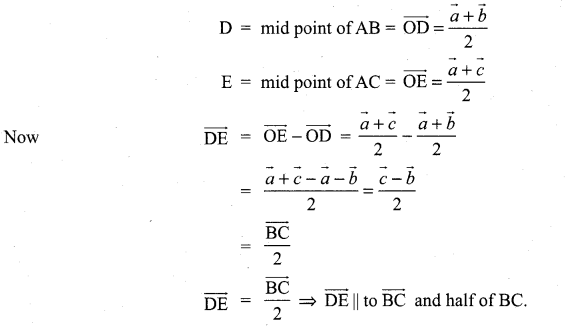
Samacheer Kalvi 11th Maths Solutions Chapter 7 Matrices and Determinants Ex 7.1

You can Download Samacheer Kalvi 11th Maths Book Solutions Guide Pdf, Tamilnadu State Board help you to revise the complete Syllabus and score more marks in your examinations.

Tamilnadu Samacheer Kalvi 11th Maths Solutions Chapter 7 Matrices and Determinants Ex 7.1

Question 1.
Construct an m × n matrix A = [aij], where aij is given by
Samacheer Kalvi 11th Maths Solutions Chapter 7 Matrices and Determinants Ex 7.1 1
Solution:
(i) aij = \(\frac{(i-2 j)^{2}}{2}\)
Here m = 2, n = 3
So we have to construct a matrix of order 2 × 3
Samacheer Kalvi 11th Maths Solutions Chapter 7 Matrices and Determinants Ex 7.1 2

(ii) Here m = 3 and n = 4
So we have to construct a matrix order 3 × 4
The general form of a matrix of order 3 × 4 will be
Samacheer Kalvi 11th Maths Solutions Chapter 7 Matrices and Determinants Ex 7.1 3
Samacheer Kalvi 11th Maths Solutions Chapter 7 Matrices and Determinants Ex 7.1 4

Question 2.
Find the values of p, q, r and s if
Samacheer Kalvi 11th Maths Solutions Chapter 7 Matrices and Determinants Ex 7.1 5
Solution:
When two matrices (of the same order) are equal then their corresponding entries are equal.
Samacheer Kalvi 11th Maths Solutions Chapter 7 Matrices and Determinants Ex 7.1 6
p2 – 1 = 1 ………… (1)
– 31 – q3 = – 4 ……….. (2)
r + 1 = \(\frac{3}{2}\) ……… (3)
s – 1 = – π ……….. (4)
(1) ⇒ p2 – 1 ⇒ p2 = 1 + 1 = 2
p = ±√2
(2) ⇒ – 31 – q3 – 4
31 + q3 = 4
q3 = 4 – 31 = – 27
q3 = (-3)3
q = – 3
(3) ⇒ r + 1 = \(\frac{3}{2}\)
r = \(\frac{3}{2}\) – 1 = \(\frac{1}{2}\)
(4) ⇒ s – 1 = – π
s = 1 – π
∴ The required values are
p = ±√2,
q = 3,
r = \(\frac{1}{2}\),
s = 1 – π

Samacheer Kalvi 10th Maths Solutions Chapter 3 Algebra Additional Questions

Question 3.
Determine the value of x + y if Samacheer Kalvi 11th Maths Solutions Chapter 7 Matrices and Determinants Ex 7.1 7
Solution:
\(\left[ \begin{matrix} 2x\quad +\quad y & 4x \\ 5x\quad -\quad 7 & 4x \end{matrix} \right] \) = \(\left[ \begin{matrix} 7 & 7y\quad -\quad 13 \\ y & x\quad +\quad 6 \end{matrix} \right]\)
Equating the corresponding entries
2x + y = 7 ………. (1)
4x = 7y – 13
4x – 7y = – 13 ………. (2)
5x – 7 = y
5x – y = 7 ………. (3)
4x = x + 6
4x – x = 6
3x = 6
x = \(\frac{6}{3}\) = 2 ………. (4)
Substituting for x in equation (1)
(1) ⇒ 2 × 2 + y = 7
y = 7 – 4 = 3
The required values are x = 2 and y = 3
x + y = 2 + 3 = 5
x + y = 5

Question 4.
Determine the matrices A and B if they satisfy
Samacheer Kalvi 11th Maths Solutions Chapter 7 Matrices and Determinants Ex 7.1 8
Solution:
Samacheer Kalvi 11th Maths Solutions Chapter 7 Matrices and Determinants Ex 7.1 9
Samacheer Kalvi 11th Maths Solutions Chapter 7 Matrices and Determinants Ex 7.1 10
Samacheer Kalvi 11th Maths Solutions Chapter 7 Matrices and Determinants Ex 7.1 11

Question 5.
If A = \(\left[\begin{array}{ll}{\mathbf{1}} & {\boldsymbol{a}} \\ {\mathbf{0}} & {\mathbf{1}}\end{array}\right]\), then compute A4
Solution:
Samacheer Kalvi 11th Maths Solutions Chapter 7 Matrices and Determinants Ex 7.1 12
Samacheer Kalvi 11th Maths Solutions Chapter 7 Matrices and Determinants Ex 7.1 13

Question 6.
Consider the matrix Aα = \(\left[\begin{array}{cc}{\cos \alpha} & {-\sin \alpha} \\ {\sin \alpha} & {\cos \alpha}\end{array}\right]\)
(i) Show that AαAβ = Aα + β.
(ii) Find all possible real values of satisfying the condition Aα + ATα = 1.
Solution:
Samacheer Kalvi 11th Maths Solutions Chapter 7 Matrices and Determinants Ex 7.1 14
General solution is α = 2nπ + \(\frac{\pi}{3}\), n ∈ Z

Question 7.
If A = \(\left[\begin{array}{rr}{4} & {2} \\ {-1} & {x}\end{array}\right]\) such that (A – 2I) (A – 3I) = 0, find the value of x.
Solution:
Samacheer Kalvi 11th Maths Solutions Chapter 7 Matrices and Determinants Ex 7.1 15

Question 8.
If A = \(\left[\begin{array}{ccc}{\mathbf{1}} & {\mathbf{0}} & {\mathbf{0}} \\ {\mathbf{0}} & {\mathbf{1}} & {\mathbf{0}} \\ {\boldsymbol{a}} & {\boldsymbol{b}} & {-\mathbf{1}}\end{array}\right]\), show that A2 is a unit matrix.
Solution:
Samacheer Kalvi 11th Maths Solutions Chapter 7 Matrices and Determinants Ex 7.1 16

Question 9.
If A = Samacheer Kalvi 11th Maths Solutions Chapter 7 Matrices and Determinants Ex 7.1 17 and A3 – 6A2 + 7A + KI = 0, find the value of k.
Solution:
Samacheer Kalvi 11th Maths Solutions Chapter 7 Matrices and Determinants Ex 7.1 18
Samacheer Kalvi 11th Maths Solutions Chapter 7 Matrices and Determinants Ex 7.1 19

Question 10.
Give your own examples of matrices satisfying the following conditions in each case:
(i) A and B such that AB ≠ BA.
(ii) A and B such that AB = 0 = BA, A ≠ 0 and B ≠ 0.
(iii) A and B such that AB = 0 and BA ≠ 0.
Solution:
Samacheer Kalvi 11th Maths Solutions Chapter 7 Matrices and Determinants Ex 7.1 20
Samacheer Kalvi 11th Maths Solutions Chapter 7 Matrices and Determinants Ex 7.1 21
Samacheer Kalvi 11th Maths Solutions Chapter 7 Matrices and Determinants Ex 7.1 22

Question 11.
Show that f(x) f(y) = f(x + y), where f(x) = Samacheer Kalvi 11th Maths Solutions Chapter 7 Matrices and Determinants Ex 7.1 23
Solution:
Samacheer Kalvi 11th Maths Solutions Chapter 7 Matrices and Determinants Ex 7.1 24
Samacheer Kalvi 11th Maths Solutions Chapter 7 Matrices and Determinants Ex 7.1 25

Question 12.
If A is a square matrix such that A2 = A, find the value of 7A – (I + A)3.
Solution:
Given A is a square matrix such that A2 = A.
(I + A)3 = (I + A) (I + A) (I + A)
= (I . I + I . A + A . I + A . A) (I + A)
= (I + A + A + A2) (I + A)
= (I + 2A + A ) (I + A)
[Given A2 = A]
= (I + 3A) (I + A)
= I . I + I . A + 3A . I + 3A . A
= I + A + 3A + 3A2
= I + 4A + 3A
[Given A2 = A]
(I + A)3 = I + 7A
∴ 7A – (I + A)2 = 7A – (I + 7A)
= 7A – I – 7A
7A – (I + A)2 = – I

Question 13.
Verify the property A (B + C) = AB + AC, when the matrices A, B, and C are given by
Samacheer Kalvi 11th Maths Solutions Chapter 7 Matrices and Determinants Ex 7.1 26
Solution:
Samacheer Kalvi 11th Maths Solutions Chapter 7 Matrices and Determinants Ex 7.1 27
Samacheer Kalvi 11th Maths Solutions Chapter 7 Matrices and Determinants Ex 7.1 28

Question 14.
Find the matrix A which satisfies the matrix relation Samacheer Kalvi 11th Maths Solutions Chapter 7 Matrices and Determinants Ex 7.1 29
Solution:
Samacheer Kalvi 11th Maths Solutions Chapter 7 Matrices and Determinants Ex 7.1 30
Samacheer Kalvi 11th Maths Solutions Chapter 7 Matrices and Determinants Ex 7.1 31

Question 15.
Samacheer Kalvi 11th Maths Solutions Chapter 7 Matrices and Determinants Ex 7.1 32
(i) (A + B)T = AT + BT = BT + AT
(ii) (A – B)T = AT – BT
(iii) (BT)T = B.
Solution:
Samacheer Kalvi 11th Maths Solutions Chapter 7 Matrices and Determinants Ex 7.1 33
Samacheer Kalvi 11th Maths Solutions Chapter 7 Matrices and Determinants Ex 7.1 34
Samacheer Kalvi 11th Maths Solutions Chapter 7 Matrices and Determinants Ex 7.1 35
Samacheer Kalvi 11th Maths Solutions Chapter 7 Matrices and Determinants Ex 7.1 36

Question 16.
If A is a 3 × 4 matrix and B is a matrix such that both ATB and BAT are defined, what is the order of the matrix B?
Solution:
Given Order of A = 3 × 4
∴ Order of AT = 4 × 3
Given that ATB is defined.
∴ Number of columns of AT = Number of rows of B
Number of rows of B = 3
Also given BAT is defined.
∴ Number of columns of B = Number of rows of AT
Number of columns of B = 4
∴ Order of B = 3 × 4

Question 17.
Express the following matrices is the sum of a symmetric matrix and a skew-symmetric matrix:
Samacheer Kalvi 11th Maths Solutions Chapter 7 Matrices and Determinants Ex 7.1 37
Solution:
Samacheer Kalvi 11th Maths Solutions Chapter 7 Matrices and Determinants Ex 7.1 38
Samacheer Kalvi 11th Maths Solutions Chapter 7 Matrices and Determinants Ex 7.1 39
Samacheer Kalvi 11th Maths Solutions Chapter 7 Matrices and Determinants Ex 7.1 40

Question 18.
Find the matrix A such that Samacheer Kalvi 11th Maths Solutions Chapter 7 Matrices and Determinants Ex 7.1 41
Solution:
Samacheer Kalvi 11th Maths Solutions Chapter 7 Matrices and Determinants Ex 7.1 42
Samacheer Kalvi 11th Maths Solutions Chapter 7 Matrices and Determinants Ex 7.1 43

Question 19.
If A = Samacheer Kalvi 11th Maths Solutions Chapter 7 Matrices and Determinants Ex 7.1 44 is a matrix such that AAT = 9I, find the values of x and y.
Solution:
Samacheer Kalvi 11th Maths Solutions Chapter 7 Matrices and Determinants Ex 7.1 45

Question 20.
Samacheer Kalvi 11th Maths Solutions Chapter 7 Matrices and Determinants Ex 7.1 46
Solution:
Samacheer Kalvi 11th Maths Solutions Chapter 7 Matrices and Determinants Ex 7.1 47
Samacheer Kalvi 11th Maths Solutions Chapter 7 Matrices and Determinants Ex 7.1 48

Question 21.
Construct the matrix A = [aij]3×3, where aij = i- j. State whether A is symmetric or skew- symmetric.
Solution:
Given A is a matrix of order 3 × 3
Samacheer Kalvi 11th Maths Solutions Chapter 7 Matrices and Determinants Ex 7.1 49
Here AT = -A
⇒ A is skew-symmetric

Question 22.
Let A and B be two symmetric matrices. Prove that AB = BA if and only if AB is a symmetric matrix.
Solution:
Let A and B be two symmetric matrices
⇒ AT = A and BT = B …………….. (1)
Given that AB = BA (2)
To prove AB is symmetric:
Now (AB)T = BTAT = BA
(from(1)) But (AB)T = AB by ………….. (2)
⇒ AB is symmetric.
Conversely, let AB be a symmetric matrix.
⇒ (AB)T = AB
i.e. BTAT = AB
i.e. BA = AB (from (1))
⇒ AB is symmetric

Question 23.
If A and B are symmetric matrices of the same order, prove that
(i) AB + BA is a symmetric matrix.
(li) AB – BA is a skew-symmetric matrix.
Solution:
Given A and B are symmetric matrices of the same order.
∴ AT = A , BT = B

(i) AB + BA is a symmetric matrix
(AB + BA)T = (AB )T + (BA)T
= BTAT + ATBT
= BA + AB
= AB + BA
∴ AB + BA is a symmetric matrix.

(ii) AB – BA is a skew – symmetric matrix
(AB – BA)T = (AB )T (BA )T
= BTAT – ATBT
= BA – AB
(AB – BA)T = – (AB – BA)
∴ AB – BA is a skew symmetric matrix.

Question 24.
A shopkeeper in a Nuts and Spices shop makes gift packs of cashew nuts, raisins, and almonds.
The pack-I contains 100 gm of cashew nuts, 100 gm of raisins, and 50 gm of almonds. Pack-II contains 200 gm of cashew nuts, 100 gm of raisins, and 100 gm of almonds. Pack-III contains 250 gm of cashew nuts, 250 gm of raisins, and 150 gm of almonds. The cost of 50 gm of cashew nuts is ₹ 50, 50 gm of raisins is ₹ 10, and 50 gm of almonds is₹ 60. What is the cost of each gift pack?
Solution:
Samacheer Kalvi 11th Maths Solutions Chapter 7 Matrices and Determinants Ex 7.1 50
Samacheer Kalvi 11th Maths Solutions Chapter 7 Matrices and Determinants Ex 7.1 51

Samacheer Kalvi 11th Maths Solutions Chapter 7 Matrices and Determinants Ex 7.1 Additional Problems

Question 1.
Samacheer Kalvi 11th Maths Solutions Chapter 7 Matrices and Determinants Ex 7.1 52
Prove that (i) AB ≠ BA
(ii) A(BC) = (AB) C
(iii) A(B + C) = AB + AC
(iv) AI = IA = A
Solution:
Samacheer Kalvi 11th Maths Solutions Chapter 7 Matrices and Determinants Ex 7.1 53
Samacheer Kalvi 11th Maths Solutions Chapter 7 Matrices and Determinants Ex 7.1 54
Samacheer Kalvi 11th Maths Solutions Chapter 7 Matrices and Determinants Ex 7.1 55
Samacheer Kalvi 11th Maths Solutions Chapter 7 Matrices and Determinants Ex 7.1 56

Question 2.
If A = \(\left[\begin{array}{ll}{2} & {3} \\ {4} & {5}\end{array}\right]\) find A2 – 7A – 2I.
Solution:
Samacheer Kalvi 11th Maths Solutions Chapter 7 Matrices and Determinants Ex 7.1 57
Samacheer Kalvi 11th Maths Solutions Chapter 7 Matrices and Determinants Ex 7.1 58

Question 3.
Samacheer Kalvi 11th Maths Solutions Chapter 7 Matrices and Determinants Ex 7.1 59
Solution:
Samacheer Kalvi 11th Maths Solutions Chapter 7 Matrices and Determinants Ex 7.1 60

Samacheer Kalvi 11th Maths Solutions Chapter 7 Matrices and Determinants Ex 7.1 61

Question 4.
Samacheer Kalvi 11th Maths Solutions Chapter 7 Matrices and Determinants Ex 7.1 62
Solution:
Samacheer Kalvi 11th Maths Solutions Chapter 7 Matrices and Determinants Ex 7.1 63
Samacheer Kalvi 11th Maths Solutions Chapter 7 Matrices and Determinants Ex 7.1 64
Samacheer Kalvi 11th Maths Solutions Chapter 7 Matrices and Determinants Ex 7.1 65

Question 5.
If A = \(\left[\begin{array}{rr}{3} & {-5} \\ {-4} & {2}\end{array}\right]\), show that A2 – 5A – 14I = 0 where I is the unit matrix of order 2.
Solution:
Samacheer Kalvi 11th Maths Solutions Chapter 7 Matrices and Determinants Ex 7.1 66

Samacheer Kalvi 10th Maths Solutions Chapter 3 Algebra Additional Questions

Question 6.
If A = \(\left[\begin{array}{rr}{3} & {-2} \\ {4} & {-2}\end{array}\right]\), find k so that A2 = kA – 2I
Solution:
Samacheer Kalvi 11th Maths Solutions Chapter 7 Matrices and Determinants Ex 7.1 67
Samacheer Kalvi 11th Maths Solutions Chapter 7 Matrices and Determinants Ex 7.1 68

Question 7.
If A = \(\left[\begin{array}{lll}{1} & {2} & {2} \\ {2} & {1} & {2} \\ {2} & {2} & {1}\end{array}\right]\), show that A2 – 4A – 5I = 0
Solution:
Samacheer Kalvi 11th Maths Solutions Chapter 7 Matrices and Determinants Ex 7.1 69
Samacheer Kalvi 11th Maths Solutions Chapter 7 Matrices and Determinants Ex 7.1 70

Question 8.
Samacheer Kalvi 11th Maths Solutions Chapter 7 Matrices and Determinants Ex 7.1 71
Solution:
Samacheer Kalvi 11th Maths Solutions Chapter 7 Matrices and Determinants Ex 7.1 72
Samacheer Kalvi 11th Maths Solutions Chapter 7 Matrices and Determinants Ex 7.1 73
Samacheer Kalvi 11th Maths Solutions Chapter 7 Matrices and Determinants Ex 7.1 74
Samacheer Kalvi 11th Maths Solutions Chapter 7 Matrices and Determinants Ex 7.1 75

Question 9.
Samacheer Kalvi 11th Maths Solutions Chapter 7 Matrices and Determinants Ex 7.1 76
Solution:
Samacheer Kalvi 11th Maths Solutions Chapter 7 Matrices and Determinants Ex 7.1 77
Samacheer Kalvi 11th Maths Solutions Chapter 7 Matrices and Determinants Ex 7.1 78

Samacheer Kalvi 10th Maths Solutions Chapter 3 Algebra Additional Questions

Question 10.
Samacheer Kalvi 11th Maths Solutions Chapter 7 Matrices and Determinants Ex 7.1 79
Solution:
Samacheer Kalvi 11th Maths Solutions Chapter 7 Matrices and Determinants Ex 7.1 80
Samacheer Kalvi 11th Maths Solutions Chapter 7 Matrices and Determinants Ex 7.1 81

Samacheer Kalvi 11th Maths Solutions Chapter 7 Matrices and Determinants Ex 7.1 Read More »
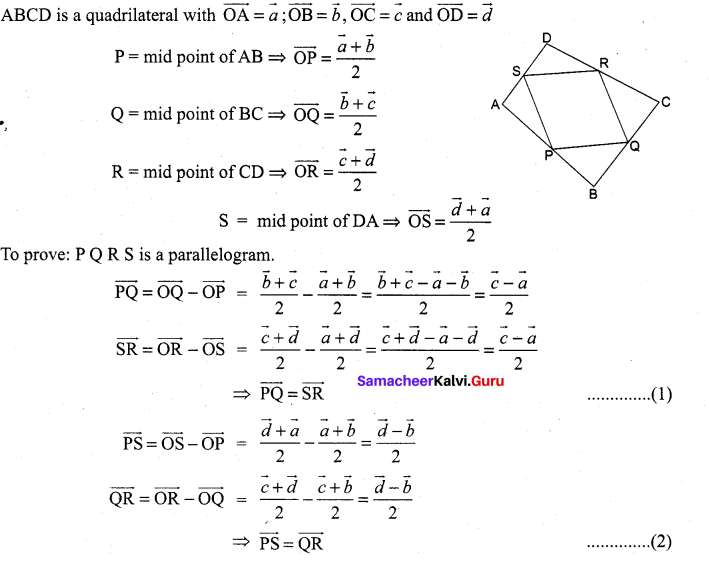
Samacheer Kalvi 9th Social Science Geography Solutions Chapter 5 Biosphere

You can Download Samacheer Kalvi 9th Social Science Book Solutions Guide Pdf, Tamilnadu State Board help you to revise the complete Syllabus and score more marks in your examinations.

Tamilnadu Samacheer Kalvi 9th Social Science Geography Solutions Chapter 5 Biosphere

Biosphere Textual Exercise

I. Fill in the blanks.

  1. An area where animals, plants, and microorganisms live and interact with one another is known as ………
  2. …….. are also called Heterotrophs.
  3. ……. is a system of interlocking and independent food chains.
  4. ………. is an extensive large ecosystem.
  5. The vegetative type commonly found in desert biomes is called …..
  6. ……. is an aquatic biome that is found where fresh water and saltwater mix.

Answers:

  1. Habitat
  2. Consumers
  3. Food web
  4. A biome
  5. Xerophytes
  6. Estuary

II. Choose the correct answer.

Question 1.
The coldest biome on Earth is ……….
(a) Tundra
(b) Taiga
(c) Desert
(d) Oceans
Answer:
(a) Tundra

Samacheer Kalvi 9th Social Science Geography Solutions Chapter 5 Biosphere

Question 2.
This is the smallest unit of the biosphere.
(a) Ecosystems
(b) Biome
(c) Environment
(d) None of the above
Answer:
(a) Ecosystems

Question 3.
Nutrients are recycled in the atmosphere with the help of certain microorganisms, referred to as
(a) Producers
(b) Decomposers
(c) Consumers
(d) None of the above
Answer:
(b) Decomposers
Samacheer Kalvi 9th Social Science Geography Solutions Chapter 5 Biosphere

Question 4.
To which climatic conditions are Xerophytic plants specifically adapted to?
(a) Saline and sandy
(b) Limited moisture availability
(c) Cold temperature
(d) Humid
Answer:
(a) Saline and sandy

Question 5.
Why is the usage of rainforest biomes for large scale agriculture unsustainable?
(a) because it is too wet
(b) because the temperature is too warm
(c) because the soil is too thin
(d) because the soil is poor
Answer:
(b) because the temperature is too warm

Questions 6-8 are assertion type questions.
Directions:
(A) Both assertion (A) and reason (R) are true; R explains A
(B) Both assertion (A) and reason (R) are true; R does not explain A
(C) A is true; R is false
(D) Both A and R are false
Answer:
(C) A is true; R is false

Question 6.
(A): Heterotrophs do not produce their own food.
(R): They depend on autotrophs for their nourishment.
Answer:
(C) A is true; R is false

Question 7.
(A): Hotspots are the regions characterised by numerous endemic plants and animal species
living in a vulnerable environment.
(R): To manage and focus on conservation work more effectively, researchers identified hotspots.
Answer:
(A) Both assertion (A) and reason (R) are true; R explains A

Samacheer Kalvi 9th Social Science Geography Solutions Chapter 5 Biosphere

Question 8.
(A): The number of gorillas in Africa has plummeted by 60% in the past twenty years.
(R): Non-intervention of human beings in the forest areas.
Answer:
(D) Both A and R are false

III. Answer the following in brief:

Question 1.
What is Biosphere?
Answer:

  1. Biosphere, the fourth sphere of the Earth, is a life supporting layer that exists on the earth’s surface.
  2. This layer on earth encompasses the Lithosphere, Hydrosphere and Atmosphere.
  3. It includes flora and fauna that thrive on or near the earth’s surface.
  4. Biosphere harbours all ecosystems on the earth and sustains life forms including mankind.

Question 2.
What is an ecosystem?
Answer:
The place on earth where living organisms live and interact with one another and with their physical environment is called an ecosystem.

Samacheer Kalvi 9th Social Science Geography Solutions Chapter 5 Biosphere

Question 3.
What does the term ‘biodiversity’ mean?
Answer:

  1. Biosphere is made up of different ecosystems and biomes.
  2. All living things, large or small, are grouped into species.
  3. The area in which an animal, plant or micro organism lives is called its habitat.
  4. A wide variety of plants and animals live in a particular habitat known as biodiversity.

Question 4.
What is meant by loss of biodiversity?
Answer:
The extinction of species (flora and fauna) due to human and natural influences is called loss of biodiversity. The biodiversity loss has a great impact on mankind and also affects land, water, air etc. Habitat destruction due to deforestation, population explosion, pollution and global warming are the major cause for loss of biodiversity.

Question 5.
Mention the various terrestrial biomes.
Answer:

  1. Terrestrial biomes are a group of living organisms that live and interact with one another on land.
  2. They are mainly determined by temperature and rainfall.
  3. Some of the major terrestrial biomes of the world are
    • Tropical Forest Biomes
    • Tropical Savanna Biomes
    • Desert Biomes
    • Temperate Grassland Biomes and
    • Tundra Biomes

IV. Distinguish between the following:

Question 1.
Producers and Decomposers.
Answer:

S.No. Producers Decomposers
(i) They are self-nourishing components of the ecosystem. They are organisms that are incapable of preparing its own food.
(ii) Producers are called Autotrophs. e.g. Plants, Algae, Bacteria, etc. Decomposers are organisms that are incapable of preparing its own food. They are called Saprotrophs. e.g. Fungus, Mushrooms.

Question 2.
Terrestrial biomes and Aquatic biomes
Answer:

S.No. Terrestrial biomes Aquatic biomes
(i) It is a group of living organisms that live and interact with one another on land. It is a group of living organisms that live and interact with one another for nutrients and shelter.
(ii) They are determined by temperature and rainfall. These are influenced by a series of abiotic factors.
(iii) Terrestrial biomes are Tropical forest biomes, Tropical Savanna biomes, Desert biomes, Temperate Grassland biomes and Tundra biomes. Aquatic biomes are Fresh water biomes and Marine biomes.

Question 3.
Tropical vegetation and Desert vegetation
Answer:

S.No. Tropical vegetation Desert vegetation
(i) Half of the World’s Tropical forests are found in Central and South America. Deserts are found in the Western Margin of the continents.
(ii) This biome extends between 10°N and 10°S of the equator. This extends between 20°N and 30°S latitudes.
(iii) This weather condition favours thick vegetative cover. They possess special type of vegetation called xerophytes.
(iv) People in this region sustain their livelihood through food gathering. People in this region sustain their life through food gathering and hunting.
(v) High annual rainfall and relatively constant temperature is likely Annual rainfall is less than 25 c.m in these regions.

Question 4.
Savannas and Tundra
Answer:

S.No. Savannas Tundras
(i) Tropical grasslands are generally found between tropical forests. These vast lowlands are found where the ground remains frozen.
(ii) Generally hot climate and dry. They also experience moderate to low rainfall. Generally long severe winter and short cool summer.
(iii) Found in the Sahel, South of Sahara in East Africa and in Australia. Found in Greenland Arctic and Antarctic regions and Northern parts of Asia, Canada and Europe.
(iv) Chief occupation is herding. Hunting and fishing are their main occupations.

V. Give reasons for the following:

Question 1.
Producers are also called autotrophs.
Answer:

  1. Producers are self-nourishing components of the ecosystem.
  2. Flence they are called autotrophs.

Samacheer Kalvi 9th Social Science Geography Solutions Chapter 5 Biosphere

Question 2.
Biosphere provides a stable ecosystem.
Answer:

  1. Biosphere extends from the deep ocean trenches to lush rain forests.
  2. People play an important role in maintaining the flow of energy in the biosphere.
  3. There are places on earth that are both biologically rich and deeply threatened.
  4. Hence Biosphere provides a stable ecosystem.

VI. Answer the following in a paragraph:

Question 1.
Explain the various components of the ecosystem.
Answer:
An ecosystem consists of three basic components, namely
(a) Abiotic components
(b) Biotic components and
(c) Energy components

(a) Abiotic Components:

  1. Abiotic components include the non-living, inorganic, physical and chemical factors in the environment. Eg. Land, Air, Water, Calcium, Iron etc.

(b) Biotic Components:

  1. Biotic components include plants, animals and microorganisms.
  2. Biotic components can be classified into three categories:
    • Producers
    • Consumers
    • Decomposers.
  3. Producers are self-nourishing components of the ecosystem. Elence they are called Autotrophs.
  4. They are found both on land and water. Eg. Plants, Algae, Bacteria etc.
  5. Consumers are those that depend on producers, directly or indirectly. Hence they are called Heterotrophs.
  6. Decomposers are some organisms that are incapable of preparing its own food. They live on dead and decaying plants and animals. Hence they are called Saprotrophs.

(c) Energy Components

  1. All organisms in the biosphere use energy to work and convert one form of energy into another.
  2. The Sun is the ultimate source of energy for the biosphere as a whole.
  3. The producers, consumers and decomposers contribute a lot to the energy flow in an ecosystem.

Question 2.
Write a paragraph on the functions of an ecosystem.
Answer:
Functions of an ecosystem: The living organisms form an interacting set of flora and fauna which are organized into trophic levels, food chains and food webs. The functioning of an ecosystem depends on the pattern of the energy flow, as it helps in the distribution and circulation of the organic and inorganic matter within an ecosystem. Energy flow generally takes place in a hierarchical order in an ecosystem through various levels. These levels are called trophic levels. The chain of transformation of energy from one group of organisms to another, through various trophic levels is called a food chain. A system of interlocking and interdependent food chains is called a food web.

Samacheer Kalvi 9th Social Science Geography Solutions Chapter 5 Biosphere

Question 3.
Explain about the aquatic biomes on Earth.
Answer:
Aquatic biome is a group of living organisms that live and interact with one another and its aquatic environment for nutrients-and shelter. It is broadly classified as fresh water biomes and marine biomes.

A. Fresh water Biomes:

  1. Fresh water biomes comprises lakes, ponds, rivers, streams,.wetlands etc.
  2. It is influenced by various abiotic components such as the volume of water, water flow, composition of oxygen, temperature, etc.
  3. Humans, rely on freshwater biomes for drinking water, crop irrigation, sanitation and industry.
  4. Water lily, lotus, duck weeds etc. are the common plants found here.
  5. Trout, salmon, turtles, crocodiles etc. are the animals found here.

B. Marine Biomes:

  1. They are the largest aquatic biomes on earth.
  2. They are continuous bodies of salt water and provide a wide range of habitats for marine plants and animals.
  3. Coral reefs are a second kind of marine biomes within the ocean.
  4. Estuaries, coastal areas where salt water and fresh water mix, form a third unique marine biome.
  5. As water provides maximum mobility to marine organisms, nutrients are circulated more quickly and efficiently here than the terrestrial biomes.
  6. Apart from animals, plants such as kelp, algae, phytoplankton etc. also grow in water.
  7. Some of the threats and issues to aquatic biomes are overfishing, pollution and rise in sea level.

VII. Find out the dates for the following:

  1. World Wild Life Day – …………
  2. International Day of Forest – ………..
  3. World Water Day – ………..
  4. Earth Day – ………….
  5. World Environment Day –  ………………
  6. World Oceans Day – …………

Answers:

  1. March 3rd
  2. March 21st
  3. March 22nd
  4. April 22nd
  5. June 5th
  6. June 8th

VIII. Map Study

Locate the following on the world outline map.

  1. Prairies
  2. Downs
  3. Tundra Biomes
  4. Equatorial Biomes

You can identify and locate the above-mentioned grasslands with the help of an atlas.
Hint: Temperate grasslands are called differently in different parts of the world.
Prairies – North America
Downs – Australia and New Zealand
Tundra – Greenland, Arctic and Antarctic regions and Northern parts of Asia, Canada and Europe
Equatorial Biomes – Near the equator in Central and South America, parts of Africa and Asia

IX. Picture Study

Narrate the given food web of Arctic Tundra in your own words.

  1. The flow of energy from the sun through an ecosystem can be illustrated in a food chain.
  2. Within a food Chain there are produces. e.g., grasses, lichens, Arctic wildflower, etc.
  3. Life in any biome includes producers (plants) and consumers (energy obtained from producers)
  4. These consumers may be further classified as herbivores (plant-eater) carnivores(meat-eaters) (or) anniores (feed on a combination of both animals and plants).

Samacheer Kalvi 9th Social Science Geography Solutions Chapter 5 Biosphere 1

Biosphere Additional Questions

I. Fill in the blanks.

1. ……… are self-nourishing components of the ecosystem.
2. All living things, large or small are grouped into ………
3. The ……. is the ultimate source of energy for the biosphere as a whole.
4. Decomposers live on dead and decaying plants and animals and are called ………
5. The extinction of species (flora and fauna) due to human and natural influences is called ………
6. The branch of science that deals with ecosystem is called ………
7. The temperate grasslands are called …… in North America.
8. ……….. is a fertile fresh water source found in deserts and semi-arid regions.
Answers:
1. Producers
2. species
3. sun
4. Saprotrophs
5. Lass of biodiversity
6. Ecology
7. Prairies
8. An Oasis

II. Choose the correct answer.

Question 1.
……….. the fourth sphere of the Earth.
(a) Lithosphere
(b) Hydrosphere
(c) Biosphere
(d) Atmosphere
Answer:
(c) Biosphere

Samacheer Kalvi 9th Social Science Geography Solutions Chapter 5 Biosphere

Question 2.
………. are found both on land and water.
(a) Autotrophs
(b) Heterotrophs
(c) Saprotrophs
(d) None of the above
Answer:
(a) Autotrophs

Question 3.
Consumers are those that depend on directly (or) indirectly are called ………..
(a) Saprotrophs
(b) Heterotrophs
(c) Autotrophs
(d) None of the above
Answer:
(b) Heterotrophs

Question 4.
A group of living organisms that live and interact with One another on land is ………
(a) Tropical Savanna Biomes
(b) Tropical Forest Biomes
(c) Desert Biomes
(d) Terrestrial Biomes
Answer:
(d) Terrestrial Biomes

Question 5.
The chain of transformation of energy from one group of organisms to another through various trophic levels is called as ……….
(a) Food chain
(b) Food web
(c) Trophic level
(d) None of the above
Answer:
(a) Food chain

Samacheer Kalvi 9th Social Science Geography Solutions Chapter 5 Biosphere

Questions 6-8 are Assertion (A) Reason (R) type.
(A) Both Assertion (A) and Reason (R) are true. (R) explains (A).
(B) Both Assertion (A) and Reason (R) are true. (R) does not explain (A).
(C) (A) is true; (R) is false.
(D) Both (A) and (R) are false.

Question 6.
Assertion (A): In Biodiversity each species, no matter how big of small has an important role to play in the ecosystem.
Reason (R): It maintains the ecological balance.
Answer:
(A) Both Assertion (A) and Reason (R) are true. (R) explains (A).

Samacheer Kalvi 9th Social Science Geography Solutions Chapter 5 Biosphere

Question 7.
Assertion (A): As the soil is sandy and saline deserts remain agriculturally unproductive. Reason (R): Tribal people who live in deserts practice food gathering and hunting.
Answer:
(B) Both Assertion (A) and Reason (R) are true. (R) does not explain (A).

Question 8.
Assertion (A): Aquatic animals use 10% energy to obtain oxygen.
Reason (R): Terrestrial animals use only 2-4% of energy to obtain oxygen.
Answer:
(D) Both (A) and (R) are false.

III. Answer the following in brief.

Question 1.
What does an ecosystem consists of?
Answer:
An ecosystem consists of three basic components, namely
(A) Abiotic components
(B) Biotic components and
(C) Energy component.

Question 2.
Define Abiotic Components.
Answer:
Abiotic components include the non-living, in-organic, physical and chemical factors in the environment, e.g., Land, Air, Water, Calcium, Iron, etc.

Question 3.
What are energy components?
Answer:
All organisms in the biosphere use energy to work and convert one form of energy into another. The Sun is the ultimate source of energy for the biosphere as a whole. The solar energy gets transformed into other forms of energy through the various components in the ecosystem. The producers, consumers and the decomposers contribute a lot to the energy flow in an ecosystem.

Question 4.
State the unique weather condition that favours thick vegetative cover in the Tropical Forest Biomes.
Answer:
The climate in these biomes shows little seasonal variation with high annual rainfall and relatively constant, high temperature. This unique weather condition favours thick vegetative cover.

Samacheer Kalvi 9th Social Science Geography Solutions Chapter 5 Biosphere

Question 5.
How do the people live Desert Biomes?
Answer:
People who live here practice food gathering and hunting. They move their temporary settlements frequently in search of pastures. Transportation becomes very difficult here and is carried on by camels. Reptiles like snakes, lizards, scorpions etc., are most commonly found here.

Question 6.
Mention the Temperate Grasslands in different parts of the world.
Answer:
Temperate grasslands are called differently in different parts of the world.
Prairies – North America
Steppes – Eurasia
Pampas – Argentina and Uruguay
Veld – South Africa
Downs – Australia and Newzealand.

Question 7.
What is an oasis?
Answer:
An oasis is a fertile fresh water source found in deserts and semi-arid regions. Oases are fed by springs. Crops like date palms, figs, citrus fruits, maize etc. are cultivated near these oases.

Samacheer Kalvi 9th Social Science Geography Solutions Chapter 5 Biosphere

Question 8.
What is a Biosphere Reserve?
Answer:
A Biosphere Reserve is a special ecosystem or specialized environment with flora and fauna that require protection and nurturing. There are 18 Bioshpere Reserves in India.

IV. Distinguish the following. 

Question 1.
Producers Consumers
Answer:

Producers Consumers
Producers are self nourishing components of the ecosystem. Hence they are called Autotrophs. They are found both on land and water, e.g. Plants, Algae, Bacteria etc. Consumers are those that depend on producers, directly or indirectly. Hence they are called Heterotrophs.


Question 2.
Abiotic components Biotic components
Answer:

Abiotic components Biotic Components
Abiotic components include the non-living, inorganic, physical and chemical factors in the environment, e g. Land, Air, Water, Calcium, Iron etc. Biotic components include plants, animals and micro organisms. Biotic components can be classified into three categories.

Question 3.
Mention any 3 points between Aquatic ecosystem and Terrestrial ecosystem.
Answer:

S.No. Aquatic Ecosystem Terrestrial Ecosystem
(i) Aquatic ecosystem exists on water covering 71% of the earth surface. Terrestrial ecosystem exists on land covering 29% of the earth surface.
(ii) Aquatic animals use 20% of energy to obtain oxygen. Terrestrial animals use only 1-2% of energy to obtain oxygen.
(iii) In this ecosystem there is abundant of water with limited oxygen supply. In this ecosystem there is less availability of water, greater availability of gases and temperature fluctuation.

V. Give reasons for the following.

Question 1.
Stable biosphere has to be conserved.
Answer:
A healthy ecosystem provides clean water, pure water, enriched soil, food, raw materials, medicines etc. Hence stable biosphere has to be conserved.

Question 2.
The Primary cause of today’s loss of biodiversity.
Answer:
The primary cause of today’s loss of biodiversity is habitat alteration caused by human activities. The ever increasing population results in overexploitation of biological resources. This has an adverse impact, on flora and fauna on earth. There are places on earth that are both biologically rich and deeply threatened.

Samacheer Kalvi 9th Social Science Geography Solutions Chapter 5 Biosphere

Question 3.
The Net Primary productivity is low in Tundra.
Answer:
This biome experiences long severe winter and short cool summer. Due to the prevailing of low temperature and short growing seasons, the net primary productivity is very low in tundra.

VI. Answer in a paragraph.

Question 1.
Write down the differences between the Aquatic Ecosystem and Terrestrial Ecosystem.
Answer:

S.No. Aquatic Ecosystem Terrestrial Ecosystem
(i) Aquatic ecosystem exists on water covering 71 % of the earth surface. Terrestrial ecosystem exists on land covering 29% of the earth surface.
(ii) Aquatic animals use 20% of energy to obtain oxygen. Terrestrial animals use only 1-2% of energy to obtain oxygen.
(iii) In this ecosystem there is abundant of Water with limited oxygen supply. In this ecosystem there is less availability of water, greater availability of gases and temperature fluctuation.
(iv) The small drifting photosynthetic organisms of the ocean called photo phytoplankton are regarded as the major primary producer. The primary producer is the plant that produces food through the photosynthetic process.
(v) Aquatic environment is more stable with smaller fluctuation in temperature and another variable. The terrestrial environment is quite unstable as the land surface is affected by great risks from external impacts.

Question 2.
Desert Biomes.
Answer:
Deserts are usually found on the western margins of the continents between 20° and 30° N and S latitudes. The annual rainfall is less than 25 cm in these regions. Due to the lack of rainfall and arid conditions, these regions do not possess any vegetation but have special vegetation type called Xerophytes. As the soil is sandy and saline, deserts remain agriculturally unproductive. Drought resistant thorny scrubs and bushes, palms are found here.

Tribal people who live here practice food gathering and hunting. They move their temporary settlements frequently in search of pastures. Transportation becomes very difficult here and is carried on by camels. Reptiles like snakes, lizards, scorpions etc., are most commonly found here.

Samacheer Kalvi 9th Social Science Geography Solutions Chapter 5 Biosphere Read More »
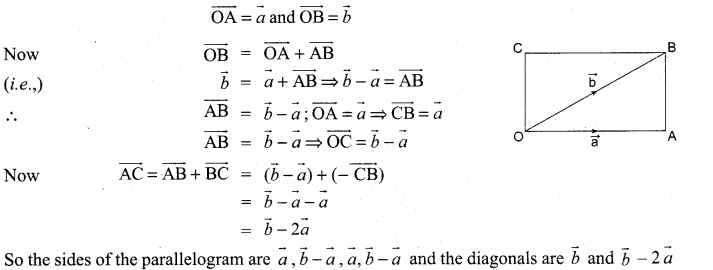
Samacheer Kalvi 10th Science Solutions Chapter 4 Electricity

You can Download Samacheer Kalvi 10th Science Book Solutions Guide Pdf, Tamilnadu State Board help you to revise the complete Syllabus and score more marks in your examinations.

Tamilnadu Samacheer Kalvi 10th Science Solutions Chapter 4 Electricity

Samacheer Kalvi 10th Science Electricity Textual Solved Problems

Question 1.
A charge of 12 coulomb flows through a bulb in 5 seconds. What is the current through the bulb?
Solution:
Charge Q = 12 C, Time t = 5s. Therefore,
Current \(\mathrm{I}=\frac{\mathrm{Q}}{\mathrm{t}}=\frac{12}{5}=2.4 \mathrm{A}\).

Question 2.
The work done in moving a charge of 10 C across two points in a circuit is 100 J. What is the potential difference between the points?
Solution:
Charge Q = 10 C, Work Done W = 100 J
Potential Difference \(\mathrm{V}=\frac{\mathrm{W}}{\mathrm{Q}}=\frac{100}{10}\)
Therefore, V = 10 volt.

Question 3.
Calculate the resistance of a conductor through which a current of 2 A passes, when the potential difference between its ends is 30 V.
Solution:
Current through the conductor I = 2 A,
Potential Difference V = 30 V
From Ohm’s Law: R = \(\frac{\mathrm{V}}{\mathrm{I}}\)
Therefore, R = \(\frac{30}{2}\) = 15 Ω.

Question 4.
The resistance of a wire of length 10 m is 2 ohm. If the area of cross-section of the wire is 2 × 10⁻⁷ m2, determine its

  1. Resistivity
  2. Conductance
  3. Conductivity

Solution:
Given: Length, L = 10 m, Resistance, R = 2 ohm
and Area, A = 2 × 10⁻⁷ m2
Samacheer Kalvi 10th Science Solutions Chapter 4 Electricity 1

Question 5.
Three resistors of resistances 5 ohms, 3 ohms and 2 ohms are connected in series with 10 V battery. Calculate their effective resistance and the current flowing through the circuit.
Solution:
R1 = 5 Ω, R2 = 3 Ω, R3 = 2 Ω, V = 10 V
RS = R1 + R2 + R3 = 5 + 3 + 2 = 10 Ω
The current, \(\mathrm{I}=\frac{\mathrm{V}}{\mathrm{R}_{\mathrm{s}}}=\frac{10}{10}=1 \mathrm{A}\).

Question 6.
An electric heater of resistance 5 Ω is connected to an electric source. If a current of 6 A flows through the heater, then find the amount of heat produced in 5 minutes.
Solution:
Given resistance R = 5 Ω, Current I = 6 A,
Time t = 5 minutes = 5 × 60 s = 300 s
Amount of heat produced, H = I2Rt = 62 × 5 × 300 = 54000 J
Hence, H = 54000 J.

Question 7.
Two bulbs are having the ratings as 60 W, 220 V and 40 W, 220 V respectively. Which one has a greater resistance?
Solution:
Electric power \(\mathrm{P}=\frac{\mathrm{V}^{2}}{\mathrm{R}}\)
For the same value of V, R is inversely proportional to P.
Therefore, the lesser the power, the greater the resistance
Hence, the bulb with 40 W, 220 V rating has greater resistance.

Question 8.
Calculate the current and the resistance of a 100 W, 200 V electric bulb in an electric circuit.
Solution:
Power P = 100 W and Voltage V = 200 V
Power P = VI
So, Current, I = \(\frac{P}{V}\) = \(\frac{100}{200}\) = 0.5 A
Resistance, R = \(\frac{\mathrm{V}}{\mathrm{I}}\) = \(\frac{200}{0.5}\) = 400 Ω.

Question 9.
In the circuit diagram is given below resistors R1, R2 and R3 of 5 Ω, 10 Ω and 20 Ω respectively are connected as shown in fig.
Calculate:
(A) Current through each resistor
(B) The total current in the circuit
(C) The total resistance in the circuit
Samacheer Kalvi 10th Science Solutions Chapter 4 Electricity 2
Solution:
(A) Since the resistors are connected in parallel, the potential difference across each resistor is same (i.e. V = 10 V)
Therefore, the current through R1 is, \(\mathrm{I}_{1}=\frac{\mathrm{V}}{\mathrm{R}_{1}}=\frac{10}{5}=2 \mathrm{A}\)
Current through R2, \(\mathrm{I}_{2}=\frac{\mathrm{V}}{\mathrm{R}_{2}}=\frac{10}{10}=1 \mathrm{A}\)
Current through R3, \(I_{3}=\frac{V}{R} \quad \frac{10}{20}=0.5 A\)

(B) Total current in the circuit, I = I1 + I2 + I3 = 2 + 1 + 0.5 = 3.5 A

(C) Total resistance in the circuit
Samacheer Kalvi 10th Science Solutions Chapter 4 Electricity 3
Hence, \(\mathrm{R}_{\mathrm{p}}=\frac{20}{7}=2.857 \Omega\).

Question 10.
Three resistors of 1 Ω, 2 Ω and 4 Ω are connected in parallel in a circuit. If a 1 Ω resistor draws a current of 1 A, find the current through the other two resistors.
Solution:
R1 = 1 Ω, R2 = 2 Ω, R3 = 4 Ω, Current I1 = 1 A
The potential difference across the 1 Ω resistor = I1R1 = 1 × 1 = 1 V
Since, the resistors are connected in parallel in the circuit, the same potential difference will exist across the other resistors also.
So, the current in the 2 Ω resistor, \(\frac{\mathrm{V}}{\mathrm{R}_{2}}=\frac{1}{2}=0.5 \mathrm{A}\)
Similarly, the current in the 4 Ω resistor, \(\frac{\mathrm{V}}{\mathrm{R}_{3}}=\frac{1}{4}=0.25 \mathrm{A}\).

Samacheer Kalvi 10th Science Electricity Textual Evaluation

I. Choose the best answer

Question 1.
Which of the following is correct?
(a) Rate of change of charge is electrical power.
(b) Rate of change of charge is current.
(c) Rate of change in energy is current.
(d) Rate of change of current is a charge.
Answer:
(b) Rate of change of charge is current

Question 2.
SI unit of resistance is ______.
(a) mho
(b) joule
(c) ohm
(d) ohmmeter.
Answer:
(c) ohm

Question 3.
In a simple circuit, why does the bulb glow when you close the switch?
(a) The switch produces electricity.
(b) Closing the switch completes the circuit.
(c) Closing the switch breaks the circuit.
(d) The bulb is getting charged.
Answer:
(d) The bulb is getting charged.

Question 4.
Kilowatt-hour is the unit of _______.
(a) resistivity
(b) conductivity
(c) electrical energy
(d) electrical power.
Answer:
(c) electrical energy
SamacheerKalvi.Guru

II. Fill in the blanks

Question 1.
When a circuit is open, ______ cannot pass through it.
Answer:
Current.

Question 2.
The ratio of the potential difference to the current is known as ______.
Answer:
Ohm’s law.

Question 3.
The wiring in a house consists of ______ circuits.
Answer:
domestic electric

Question 4.
The power of an electric device is a product of _____ and ______.
Answer:
electric current, the potential difference.

Question 5.
LED stands for ______.
Answer:
Light Emitting Diode.

III. State whether the following statements are true or false: If false correct the statement.

Question 1.
Ohm’s law states the relationship between power and voltage.
Answer:
False.
Correct Statement: Ohm’s law states the relationship between potential difference and current.

Question 2.
MCB is used to protect household electrical appliances.
Answer:
True.

Question 3.
The SI unit for electric current is the coulomb.
Answer:
False.
Correct Statement: The SI unit of electric current is Ampere.

Question 4.
One unit of electrical energy consumed is equal to 1000 kilowatt-hour.
Answer:
True.
SamacheerKalvi.Guru

Question 5.
The effective resistance of three resistors connected in series is lesser than the lowest of the individual resistances.
Answer:
False.
Correct Statement: The effective resistance of three resistors connected in series is greater than the highest of the individual resistance.

IV. Match the items in column-I to the items in column-II:

Question 1.

1. Electric current (a) Volt
2. Potential difference (b) Ohmmeter
3. Specific resistance (c) Watt
4. Electrical power (d) Joule
5. Electrical energy (e) Ampere

Answer:
1. (e) Ampere
2. (a) Volt
3. (b) Ohmmeter
4. (c)Watt
5. (d) Joule

V. Assertion and Reason Type Questions

Mark the correct choice as
(a) If both the assertion and the reason are true and the reason is the correct explanation of the assertion.
(b) If both the assertion and the reason are true, but the reason is not the correct explanation of the assertion.
(c) If the assertion is true, but the reason is false.
(d) If the assertion is false, but the reason is true.

Question 1.
Assertion: Electric appliances with a metallic body have three wire connections.
Reason: Three – pin connections reduce heating of the connecting wires
Answer:
(c) If the assertion is true, but the reason is false.
Correct Reason: Three – pin connections to protect the electrical shocking. Because appliances carry high electric current.

Question 2.
Assertion: In a simple battery circuit the point of highest potential is the positive terminal of the battery.
Reason: The current flows towards the point of the highest potential.
Answer:
(c) If the assertion is true, but the reason is false.
Correct Reason: The current flows towards the points of the lower potential.

Question 3.
Assertion: LED bulbs are far better than incandescent bulbs.
Reason: LED bulbs consume less power than incandescent bulbs.
Answer:
(a) If both the assertion and the reason are true and the reason is the correct explanation of the assertion.

VI. Very Short Answer Questions.

Question 1.
Define the unit of current.
Answer:
The SI unit of electric current is ampere (A). The current flowing through a conductor is said to be one ampere when a charge of one coulomb flows across any cross-section of a conductor in one second. Hence,
1 ampere = \(\frac{1 \text { coulomb }}{1 \text { second }}\).

Question 2.
What happens to the resistance, when the conductor is made thicker?
Answer:
Resistance of a conductor is inversely proportional to the area of cross section of the conductors. Hence, resistance is inversely proportional to square of the radius of the conductor.
R ∝ \(\frac{1}{A}\)
R ∝ \(\frac{1}{r^2}\)
When a conductor is made thicker, radius will be increased and so its resistance will be decreased.

Question 3.
Why is tungsten metal used in bulbs, but not infuse wires?
Answer:
Because tungsten has a high melting point it is used in blubs. It cannot be used in fuse wires because in fuse wires the material must have a low melting point.

Question 4.
Name any two devices, which are working on the heating effect of the electric current.
Answer:
(i) Electric heater
(ii) Fuse wire

VII. Short Answer Questions.

Question 1.
Define electric potential and potential difference.
Answer:
Electric Potential: The electric potential at a point is defined as the amount of work done in moving a unit positive charge from infinity to that point against the electric force.

Electric Potential Difference: The electric potential difference between two points is defined as the amount of work done in moving a unit positive charge from one point to another point against the electric force.
SamacheerKalvi.Guru

Question 2.
What is the role of the earth wire in domestic circuits?
Answer:
This wire provides a low resistance path to the electric current. The earth wire sends the current from the body of the appliance to the Earth, whenever a live wire accidentally touches the body of the metallic electric appliance. Thus, the earth wire serves as a protective conductor, which saves us from electric shocks.

Question 3.
State Ohm’s law.
Answer:
According to Ohm’s law, at a constant temperature, the steady current ‘I’ flowing through a conductor is directly proportional to the potential difference ‘V’ between the two ends of the conductor.
I ∝ V
V = IR.

Question 4.
Distinguish between the resistivity and conductivity of a conductor.
Answer:

Resistivity Conductivity
1. It is the resistance of a conductor of unit length and unit area of cross-section. 1. It is the reciprocal of electrical resistivity of a material.
2. Its unit is ohm metre 2. Its unit is ohm-1 metre-1 or mho metre-1
3. It is the measure of the resisting power of a specified material to the passage of an electric current. 3. It is the measure of its ability to pass the current through it.

Question 5.
What connection is used in domestic appliances and why?
Answer:
Parallel connection is used in domestic appliances. When any disconnection of one circuit in our home, does not affect the other circuit.

VIII. Long Answer Questions.

Question 1.
With the help of a circuit diagram derive the formula for the resultant resistance of three resistances connected:
(a) in series and
(b) in parallel
Answer:
(a) Resistors in Series:
A series circuit connects the components one after the other to form a ‘single-loop’. A series circuit has only one loop through which current can pass. If the circuit is interrupted at any point in the loop, no current can pass through the circuit and hence no electric appliances connected in the circuit will work. Series circuits are commonly used in devices such as flashlights. Thus, if

(i) Resistors are connected end to end so that the same current passes through each of them, then they are said to be connected in series.
Samacheer Kalvi 10th Science Solutions Chapter 4 Electricity 4
(ii) Let, three resistances R1, R2 and R3 be connected in series.

(iii) Let the current flowing through them be I.

(iv) According to Ohm’s Law, the potential differences V1, V2 and V3 across R1 , R2 and R3 respectively, are given by:
V1 = IR1 …. (1)
V2 = IR2 …. (2)
V3 = IR3 …. (3)
The sum of the potential differences across the ends of each resistor is given by:
V = V1 + V2 + V3
using equations (1), (2) and (3), we get
V = IR1 + IR2 + IR3 …. (4)

(v) The effective resistor is a single resistor, which can replace the resistors effectively, so as to allow the same current through the electric circuit.

(vi) Let, the effective resistance of the series-combination of the resistors, be RS. Then,
V = IRS ….(5)
Combining equations (4) and (5)
IRS = IR1 + IR2 + IR3
RS = R1 + R2 + R3
Thus, we can understand that
SamacheerKalvi.Guru

(vii) When a number of resistors are connected in series, their equivalent resistance or effective resistance is equal to the sum of the individual resistances.

(viii) When V resistors of equal resistance R are connected in series, the equivalent resistance is ‘nR’. i.e., RS = nR

(ix) The equivalent resistance in a series combination is greater than the highest of the individual resistances.

(b) Resistors in Parallel:
A parallel circuit has two or more loops through which current can pass. If the circuit is disconnected in one of the loops, the current can still pass through the other loop(s). The wiring in a house consists of parallel circuits.
Samacheer Kalvi 10th Science Solutions Chapter 4 Electricity 5
(i) Consider that three resistors R1, R2 and R3 are connected across two common points A and B.

(ii) The potential difference across each resistance is the same and equal to the potential difference between A and B. This is measured using the voltmeter.

(iii) The current I arriving at A divides into three branches I1, I2 and I3 passing through R1, R2 and R3 respectively.
According to the Ohm’s law, we have,
\(I_{1}=\frac{V}{R_{1}}\) …(1)
\(I_{2}=\frac{V}{R_{2}}\) ….(2)
\(I_{3}=\frac{V}{R_{3}}\) …. (3)
The total current through the circuit is given by
I = I1 + I2 + I3
Using equations (1), (2) and (3), we get
\(\mathrm{I}=\frac{\mathrm{V}}{\mathrm{R}_{1}}+\frac{\mathrm{V}}{\mathrm{R}_{2}}+\frac{\mathrm{V}}{\mathrm{R}_{3}}\) …. (4)
Let the effective resistance of the parallel combination of resistors be RP Then,
\(\mathrm{I}=\frac{\mathrm{V}}{\mathrm{R}_{\mathrm{P}}}\) …. (5)
Combining equations (4) and (5), we have
\(\frac{\mathrm{V}}{\mathrm{R}_{\mathrm{P}}}=\frac{\mathrm{V}}{\mathrm{R}_{1}}+\frac{\mathrm{V}}{\mathrm{R}_{2}}+\frac{\mathrm{V}}{\mathrm{R}_{3}}\)
\(\frac{1}{\mathrm{R}_{\mathrm{P}}}=\frac{1}{\mathrm{R}_{1}}+\frac{1}{\mathrm{R}_{2}}+\frac{1}{\mathrm{R}_{3}}\).

(iv) When a number of resistors are connected in parallel, the sum of the reciprocals of the individual resistances is equal to the reciprocal of the effective or equivalent resistance.

(v) When ‘n’ resistors of equal resistances R are connected in parallel, the equivalent resistance is \(\frac{\mathrm{R}}{n}\)
\(\frac{1}{\mathrm{R}_{\mathrm{P}}}=\frac{1}{\mathrm{R}}+\frac{1}{\mathrm{R}}+\frac{1}{\mathrm{R}} \ldots+\frac{1}{\mathrm{R}}=\frac{n}{\mathrm{R}}\)
Hence, \(\mathrm{R}_{\mathrm{P}}=\frac{\mathrm{R}}{n}\)

(vi) The equivalent resistance in a parallel combination is less than the lowest of the individual resistances.

Question 2.
(a) What is meant by electric current?
(b) Name and define its unit.
(c) Which instrument is used to measure the electric current? How should it be connected in a circuit?
Answer:
(a) Electric current is the rate of flow of charges in a conductor.
(b) The unit of current is ampere. The current flowing through a conductor is said to be one ampere, when a charge of one coulomb flows across any cross-section of a conductor, in one second. Hence,
1 ampere = \(\frac{1 coulomb}{1 second}\)
(c) Ammeter is used to measure electric current. Ammeter is always connected in series.

Question 3.
(a) State Joule’s law of heating.
(b) An alloy of nickel and chromium is used as the heating element. Why?
(c) How does a fuse wire protect electrical appliances?
Answer:
(a) The heat produced in the resistor is H = W = VQ
We know that the relation between the charge and current is Q = It.
Using this, we get H = VIt
From Ohm’s Law, V = IR. Hence, we have H = I2Rt
This is known as Joule’s law of heating.
Joule’s law of heating states that the heat produced in any resistor is:

  • Directly proportional to the square of the current passing through the resistor. H = VIt
  • Directly proportional to the resistance of the resistor. V = IR
  • Directly proportional to the time for which the current is passing through the resistor. H = I2Rt

(b) An alloy of nickel and chromium is used as the heating element. Because:

  • it has high resistivity
  • it has a high melting point
  • it is not easily oxidized.

(c) (i) The fuse wire is connected in series, in an electric circuit.
(ii) When a large current passes through the circuit, the fuse wire melts due to Joule’s heating effect and hence the circuit gets disconnected.
(iii) Therefore, the circuit and the electric appliances are saved from any damage.
(iv) The fuse wire is made up of a material whose melting point is relatively low.

Question 4.
Explain about domestic electric circuits, (circuit diagram not required)
Answer:
In our homes, electricity is distributed through the domestic electric circuits wired by the electricians. The first stage of the domestic circuit is to bring the power supply to the main-box from a distribution panel, such as a transformer. The important components of the main-box are: (i) a fuse box and (ii) a meter. The meter is used to record the consumption of electrical energy. The fuse box contains either a fuse wire or a Miniature Circuit Breaker (MCB). The function of the fuse wire or an MCB is to protect the household electrical appliances from overloading due to excess current.

An MCB is a switching device, which can be activated automatically as well as manually. It has a spring attached to the switch, which is attracted by an electromagnet when an excess current passes through the circuit. Hence, the circuit is broken and the protection of the appliance is ensured.

The electricity is brought to houses by one wire has a red insulation and is called the ‘live wire’. The other wire has a black insulation and is called the ‘neutral wire’. The electricity supplied to your house is actually an alternating current having an electric potential of 220 V. Both, the live wire and the neutral wire enter into a box where the main fuse is connected with the live wire. After the electricity meter, these wires enter into the main switch, which is used to discontinue the electricity supply whenever required. After the main switch, these wires are connected to live wires of two separate circuits.

Out of these two circuits, one circuit is of a 5 A rating, which is used to run the electric appliances with a lower power rating, such as tube lights, bulbs and fans. The other circuit is of a 15 A rating, which is used to two insulated wires. Out of these two wires, run electric appliances with a high power rating, such as air-conditioners, refrigerators, electric iron and heaters. It should be noted that all the circuits in a house are connected in parallel, so that the disconnection of one circuit does not affect the other circuit. One more advantage of the parallel connection of circuits is that each electric appliance gets an equal voltage.

Question 5.
(a) What are the advantages of LED TV on normal TV?
(b) List the merits of the LED bulb.
Answer:
(a) (i) It has a brighter picture quality.
(ii) It is thinner in size.
(iii) It uses less power and consumes very less energy.
(iv) Its life span is more
(v) It is more reliable

(b) (i) As there is no filament, there is no loss of energy in the form of heat. It is cooler than the incandescent bulb.
(ii) In comparison with the fluorescent light, the LED bulbs have a significantly low power requirement.
(iii) It is not harmful to the environment.
(iv) A wide range of colours is possible here.
(v) It is cost-efficient and energy-efficient.
(vi) Mercury and other toxic materials are not required.
SamacheerKalvi.Guru

IX. Numerical Problems:

Question 1.
An electric iron consumes energy at the rate of 420 W when heating is at the maximum rate and 180 W when heating is at the minimum rate. The applied voltage is 220 V. What is the current in each case?
Solution:
Case: 1
Power (P) = 420W
Applied Voltage (V) = 220V
Current \(\mathrm{I}=\frac{\mathrm{P}}{\mathrm{V}}=\frac{420}{220}=1.9 \mathrm{A}\)

Case: 2
Power (P) = 180 W
Applied Voltage (V) = 2.20 V
Current \(\mathrm{I}=\frac{\mathrm{P}}{\mathrm{V}}=\frac{180}{220}=0.8 \mathrm{A}\)

Question 2.
A 100-watt electric bulb is used for 5 hours daily and four 60 watt bulbs are used for 5 hours daily. Calculate the energy consumed (in kWh) in the month of January.
Answer:
Energy used by 100 W bulb is E = P × t
= 100 × 5 = 500 Wh
Energy used by four 60 W bulbs E = 4 × 60 × 5 = 1200 Wh
Total energy per day = 500 + 1200 = 1700 Wh
= 1.7 kWh
Number of days in January = 31 days.
Energy consumed in January = 31 × 1.7 = 52.7 kWh.

Question 3.
A torch bulb is rated at 3 V and 600 mA. Calculate it’s?
(a) power
(b) resistance
(c) energy consumed if it is used for 4 hours.
Solution:
V = 3V and I = 600 mA = 600 × 10-3 A
(a) Power (P) = VI
= 3 × 600 × 10-3
= 1800 × 10-3
= 1.8 W (or) watt.

(b) Resistance (R) = \(\frac{\mathrm{V}}{\mathrm{I}}\) = \(\frac{3}{600 \times 10^{-3}}\) = 5 Ω.

(c) Power (P) = 1.8 W and
Time = 4 hours = 4 × 60 × 60 = 14400 second
Energy consumed E = P × t = 1.8 × 14400 = 25920 joules
E = 25.9 KJ.

Question 4.
A piece of wire having a resistance R is cut into five equal parts.
(a) How will the resistance of each part of the wire change compare with the original resistance?
(b) If the five parts of the wire are placed in parallel, how will the resistance of the combination change?
(c) What will be the ratio of the effective resistance in series connection to that of the parallel connection?
Solution:
(a) Consider a piece of wire having resistance R. It cut into 5 equal parts. So number of equal resistros are 5. n = 5
When ‘n’ resistors of equal resistance R are connected in series, the equivalent resistance is ‘nR’
RS = nR
⇒ RS = 5R
⇒ R = \(\frac{\mathrm{R}_{\mathrm{s}}}{5}\)
⇒ R = 0.2 RS
Each part of resistance ‘R’ is equal to 0.2 times of original resistance.

(b) Effective Resistance of 5 Resistors
\(\frac{1}{\mathrm{R}_{\mathrm{P}}}=\frac{1}{\mathrm{R}}+\frac{1}{\mathrm{R}}+\frac{1}{\mathrm{R}}+\frac{1}{\mathrm{R}}+\frac{1}{\mathrm{R}}\) = \(\frac{5}{\mathrm{R}}\)
\(\mathrm{R}_{\mathrm{P}}=\frac{\mathrm{R}}{5}=0.2 \mathrm{R}\) = 0.2 R.
SamacheerKalvi.Guru

(c) Effective resistance of series combination RS = 5R
Effective resistance of parallel combination \(\mathrm{R}_{\mathrm{p}}=\frac{\mathrm{R}}{5}\)
The ratio of series connection to the parallel connection
\(\frac{\mathrm{R}_{\mathrm{s}}}{\mathrm{R}_{\mathrm{p}}}=\frac{5 \mathrm{R}}{(\mathrm{R} / \mathrm{s})}\)
\(\frac{\mathrm{R}_{\mathrm{s}}}{\mathrm{R}_{\mathrm{p}}}=5 \mathrm{R} \times \frac{5}{\mathrm{R}}\) = 25
RS : RP = 25 : 1.

XI. HOTS Questions

Question 1.
Two resistors when connected in parallel give the resultant resistance of 2 ohms, but when connected in series the effective resistance becomes 9 ohms. Calculate the value of each resistance.
Solution:
Resultant resistance of parallel combination RP = 2 Ω
Resultant resistance of series combination RS = 9 Ω
Samacheer Kalvi 10th Science Solutions Chapter 4 Electricity 6
2(R1 + R2) = R1R2 ….. (1)
RS = R1 + R2
⇒ 9 = R1 + R2
⇒ R1 = 9 – R2 ….. (2)
Substitute equation (2) in equation (1)
2(9 – R2 + R2) = (9 – R2) R2
⇒ \(18=9 \mathrm{R}_{2}-\mathrm{R}_{2}^{2}\)
⇒ \(\mathrm{R}_{2}^{2}-9 \mathrm{R}_{2}+18=0\)
⇒ (R2 – 3) (R2 – 6) = 0
⇒ R2 = 3, 6
(i) If R2 = 3; R1 = 9 – R2 = 9 – 3 = 6 Ω
(ii) If R2 = 6; R1 = 9 – R2 = 9 – 6 = 3 Ω.

Question 2.
How many electrons are passing per second in a circuit in which there is a current of 5 A?
Answer:
A current 1018 electrons
A current of 5A consists
= 5 × 6.25 × 1018 electrons = 31.25 × 10¹⁸
Number of electrons passing per second
= 31.25 × 10¹⁸ electrons

Question 3.
A piece of wire of resistance 10 ohms is drawn out so that its length is increased to three times its original length. Calculate the new resistance.
Solution:
Specific resistance (ρ) = \(\frac{\mathrm{RA}}{l}\)
\(\mathrm{R}=\frac{\rho l}{\mathrm{A}}\)
When the length is increased by three and then the area of cross-section is reduced by three,
Samacheer Kalvi 10th Science Solutions Chapter 4 Electricity 7

Samacheer Kalvi 10th Science Electricity Additional Questions

I. Choose the Correct Answer

Question 1.
The motion of electric charges through a conductor will constitute ______.
(a) electric current
(b) electric potential
(c) electric field
(d) none.
Answer:
(a) electric current

Question 2.
Electric charge is expressed in:
(a) Volt
(b) Joule
(c) Coulomb
(d) Ohm
Answer:
(c) Coulomb

Question 3.
A charge of 60 coulomb flows through a bulb in 5 minutes what is the current through the bulb?
(a) 2 A
(b) 0.2 A
(c) 12 A
(d) 0.12 A.
Answer:
(b) 0.2 A
Hint: \(\mathrm{I}=\frac{q}{t}=\frac{60}{5 \times 60}=\frac{1}{5}=0.2 \mathrm{A}\)

Question 4.
1 coulomb of charge is equivalent to the charge of:
(a) 6.25 × 10¹⁸ electrons
(b) 6 × 10¹⁸ protons
(c) 1.6 × 10⁻¹⁹ electrons
(d) 1.6 × 10⁻¹⁹ protons
Answer:
(a) 6.25 × 10¹⁸ electrons

SamacheerKalvi.Guru

Question 5.
The S.I. unit of electric potential difference is ______.
(a) Ampere
(b) Joule
(c) Watt
(d) Volt.
Answer:
(d) Volt

Question 6.
The potential difference V is proportional to the current I, the graph between V and I is a _____.
(a) straight line
(b) parabola
(c) ellipse
(d) none.
Answer:
(a) straight line

Question 7.
In an electric circuit, voltmeter reads 24V and ammeter reads 6A. The value of resistance is:
(a) 40Ω
(b) 2Ω
(c) 0.25Ω
(d) 4Ω
Answer:
(d) 4Ω

Question 8.
What is the potential difference between the ends of a resistor of 15 Ω when a current of 2 A passes through it?
(a) 30 V
(b) 7.5 V
(c) 3 V
(d) 300 V.
Answer:
(a) 30 V

Question 9.
How much heat is generated when current I is passing through a resistor for time t?
(a) I2Rt
(b) IR2t
(c) VI
(d) I2R
Answer:
(a) I2Rt

Question 10.
The unit of conductance is _____.
(a) ohm-1
(b) volt-1 ampere
(c) both (a) and (b)
(d) ohm.
Answer:
(c) both (a) and (b)

Question 11.
Two electric bulbs have resistances in the ratio 1 : 2. If they are joined in series, the energy consumed in these are in the ratio:
(a) 1 : 2
(b) 2 : 1
(c) 4 : 1
(d) 1 : 1
Answer:
(a) 1 : 2

Question 12.
The resistance of a wire of length 10 cm is 2 ohm, then its conductance is _____.
(a) 0.5 ohm
(b) 5 ohm-1
(c) 0.5 ohm-1
(d) 20 ohm-1.
Answer:
(c) 0.5 ohm-1
SamacheerKalvi.Guru

Question 13.
The value of current flowing through a circuit consisting of two resistance 6Ω and 18Ω in series with a battery of 3 V is:
(a) 0.5 A
(b) 0.125 A
(c) 6 A
(d) 0.25 A
Answer:
(b) 0.125 A

Question 14.
When two 2 Ω resistors are connected in parallel, the effective resistance is _____.
(a) 4 Ω
(b) 1 Ω
(c) 0.5 Ω
(d) 5 Ω.
Answer:
(b) 1 Ω

Question 15.
When two 2 Ω resistors are connected in series, the effective resistance is ______.
(a) 1 Ω
(b) 4 Ω
(c) 5 Ω
(d) 2 Ω.
Answer:
(b) 4 Ω

Question 16.
One kilowatt-hour is:
(a) 3.6 × 10⁶J
(b) 1000 W
(c) 3600 W-1
(d) 2.778 × 10³ J
Answer:
(a) 3.6 × 10⁶J

Question 17.
When ‘n’ number of resistors are connected in parallel, the effecive resistance for parallel is _____.
(a) nR
(b) \(\frac{n}{\mathrm{R}}\)
(c) \(\frac{\mathbf{R}}{n}\)
(d) none of these.
Answer:
(c) \(\frac{\mathbf{R}}{n}\)

Question 18.
The effective resistance for the given circuit in AB _____.
Samacheer Kalvi 10th Science Solutions Chapter 4 Electricity 8
(a) 1 Ω
(b) 2 Ω
(c) 3 Ω
(d) 1.5 Ω.
Answer:
(d) 1.5 Ω.

Question 19.
The effective resistance between AB in the given circuit _____.
Samacheer Kalvi 10th Science Solutions Chapter 4 Electricity 9
(a) \(\frac{1}{4}\) Ω
(b) \(\frac{1}{2}\) Ω
(c) \(\frac{3}{4}\) Ω
(d) \(\frac{4}{3}\) Ω.
Answer:
(d) \(\frac{4}{3}\) Ω.

Question 20.
The symbol of Ammeter is:
(a) V
(b) A
(c) G
(d) I
Answer:
(b) A

Question 21.
Tungsten material is used in _____.
(a) Fuse wire
(b) bulbs
(c) batteries
(d) none.
Answer:
(b) bulbs

Question 22.
When a charge 24 C flow through a bulb in 10 second then the current flowing through the bulb is:
(a) 1.2 A
(b) 2.4 A
(c) 4.8 A
(d) 0.06 A
Answer:
(b) 2.4 A

Question 23.
The unit of electric power is _____.
(a) Volt-ampere
(b) Watt
(c) both (a) and (b)
(d) only (b).
Answer:
(c) both (a) and (b)

Question 24.
One horsepower is equal to _____.
(a) 764 watt
(b) 746 watt
(c) 647 watt
(d) 674 watt.
Answer:
(b) 746 watt

Question 25.
Unit of specific resistance is:
(a) mho
(b) mho m
(c) ohm m
(d) ampere
Answer:
(c) ohm m

SamacheerKalvi.Guru

Question 26.
To protect the horse hold electrical appliances from overloading due to excess current _____.
(a) Fuse wire
(b) MCB
(c) both (a) and (b)
(d) none.
Answer:
(c) both (a) and (b)

Question 27.
In India, domestic circuits are supplied with a frequency of ______.
(a) 60 Hz
(b) 50 Hz
(c) 220 Hz
(d) 230 Hz.
Answer:
(b) 50 Hz

Question 28.
What is the unit of conductivity?
(a) ohm m-1
(b) mho m
(c) ohm m
(d) mho m-1
Answer:
(d) mho m-1

Question 29.
The colour of the LED will depend on the type of _____ used.
(a) circuit
(b) materials
(c) display
(d) segment.
Answer:
(b) materials

Question 30.
One way of overcoming the energy crisis is to use more _______ bulbs.
(a) filament
(b) glass
(c) LCD
(d) LED.
Answer:
(d) LED

Question 31.
When resistances are connected in parallel current is more as effective resistance is:
(a) maximum
(b) less
(c) more
(d) minimum
Answer:
(b) less

Question 32.
The current in the electric bulb of 100 W and 200 V electric circuit is _____.
(a) 5 A
(b) 0.5 A
(c) 50 A
(d) 500 A.
Answer:
(b) 0.5 A

II. Fill in the Blanks

Question 1.
Rate of flow of charges in a conductor is _____.
Answer:
electric current.

Question 2.
_____ is used to fix the magnitude of the current through a circuit.
Answer:
Resistor.

Question 3.
______ is used to select the magnitude of the current through a circuit.
Answer:
Rheostat.

Question 4.
_____ is used to measure the current.
Answer:
Ammeter.

Question 5.
______ is used to measure the potential difference.
Answer:
Voltmeter.

Question 6.
______ is used to indicate the direction of the current.
Answer:
Galvanometer.
SamacheerKalvi.Guru

Question 7.
Electric current passes in the circuit from _____ terminal to the _____ terminal.
Answer:
positive, negative.

Question 8.
Electrical resistivity is _____ for different materials.
Answer:
different.

Question 9.
Reciprocal of resistance is ______.
Answer:
conductance.

Question 10.
Reciprocal of electrical resistivity is ______.
Answer:
electrical conductivity.

Question 11.
The equivalent resistance in a series combination is _____ than the highest of the individual resistances.
Answer:
greater.

Question 12.
The equivalent resistance in a parallel combination is _____ than the lowest of the individual resistances.
Answer:
less.

Question 13.
The heating effect of current is used in devices like _____ and _____.
Answer:
electric heater, electric iron.

Question 14.
Nichrome is an alloy of _____ and _____.
Answer:
Nickel, Chromium.

Question 15.
The filament is made up of a material whose ______ is very high.
Answer:
melting point.

Question 16.
Electric power is the product of _____ and _____.
Answer:
electric current, a potential difference.

Question 17.
The important components of main box are _____ and _____.
Answer:
fuse box, meter.
SamacheerKalvi.Guru

Question 18.
LED is _____.
Answer:
Light Emitting Diode.

Question 19.
LCD is _____.
Answer:
Liquid Crystal Display.

Question 20.
An array of LEDs act as ______.
Answer:
pixels.

Question 21.
A _____ is the display device used to give an output in the form of _____.
Answer:
Seven Segment display, numbers or text.

III. Match the following.

Question 1.

1. LED (a) heating device
2. Fuse wire (b) alloy
3. Tungsten (c) semiconductor device
4. Nichrome (d) Filament
5. Electric heater (e) MCB

Answer:
1. (c) semiconductor device
2. (e) MCB
3. (d) Filament
4. (b) alloy
5. (a) heating device

Question 2.

1. Power (a) V = IR
2. Joule’s law (b) \(\rho=\frac{R A}{l}\)
3. Ohm’s law (c) P = VI
4. Specific Resistance (d) I = \(\frac { Q }{ t }\)
5. Electric energy (e) H = I2RT

Answer:
1. (c) P = VI
2. (e) H = I2RT
3. (a) V = IR
4. (b) \(\rho=\frac{R A}{l}\)
5. (e) I = \(\frac { Q }{ t }\)

Question 3.

1. Ammeter (a) To measure resistance
2. Voltmeter (b) Direction of current
3. Galvanometer (c) To measure voltage
4. Ohmmeter (d) To measure current

Answer:
1. (d) To measure current
2. (c) To measure voltage
3. (b) Direction of current
4. (a) To measure resistance

Question 4.

1. \(\rho=\frac{R A}{l}\) (a) watt
2. \(\sigma=\frac{1}{\rho}\) (b) Ωm
3. E = P × t (c) coulomb
4. P = VI (d) m-1-1
5. q = It (e) Kilowatt-hour

Answer:
1. (b) Ω-1m
2. (d) m-1-1
3. (e) Kilowatt-hour
4. (a) watt
5. (c) coulomb

Question 5.
Samacheer Kalvi 10th Science Solutions Chapter 4 Electricity 10
Answer:
1. (c) Resistor
2. (e) Rheostat
3. (b) Voltmeter
4. (a) Ammeter
5. (d) Diode

IV. State whether the following statements are true or false: If false correct the statement.

Question 1.
The equivalent resistance in a series combination in lesser than the highest of the individual resistances.
Answer:
False.
Correct Statement: The equivalent resistance in a series combination is greater than the highest of the individual resistances.

Question 2.
When ‘n’ number of resistors of equal resistance R connected in series, the equivalent resistance is \(\mathrm{R}_{\mathrm{P}}=\frac{\mathrm{R}}{n}\).
Answer:
False.
Correct Statement: RS = nR.
SamacheerKalvi.Guru

Question 3.
When resistors are connected in series, a current is less as effective resistance is more.
Answer:
False.
Correct Statement: Current is more as effective resistance is less.

Question 4.
Nichrome is an alloy of copper and chromium.
Answer:
False.
Correct Statement: Nichrome is an alloy of nickel and chromium.

Question 5.
The fuse wire is made up of a material whose melting point is relatively high.
Answer:
False.
Correct Statement: The fuse wire is made up of a material whose melting point is relatively low.

V. Very Short Answer Questions

Question 1.
When a steady current flows in a conductor of non-uniform cross-section will the charge passing per unit time depend on area of cross section of the conductor?
Answer:
No, the charge passing per unit time through the conductor is independent of area of cross-section of the wire.

Question 2.
Name any two – component and give its use?
Answer:
Samacheer Kalvi 10th Science Solutions Chapter 4 Electricity 11

Question 3.
Define the unit of electric potential?
Answer:

  1. The SI unit of electric potential or potential difference is volt (V).
  2. The potential difference between two points is one volt if one joule of work is done in moving one coulomb of charge from one point to another against the electric force.
    \(1 \text { volt }=\frac{1 \text { joule }}{1 \text { coulomb }}\)

Question 4.
Draw a graph between V and I for a conductor by ohm’s law?
Answer:
Samacheer Kalvi 10th Science Solutions Chapter 4 Electricity 12

Question 5.
What is the relationship between conductance and resistance? State the Unit of conductance.
Answer:
conductance = \(\frac{1}{resistance}\)
G = \(\frac{1}{R}\)
Unit of conductance is mho.

Question 6.
Define the unit of electric power.
Answer:
The SI unit of electric power is watt. When a current of 1 ampere passes across the ends of a conductor, which is at a potential difference of 1 volt, then the electric power is
P = 1 volt × 1 ampere = 1 watt.

Question 7.
Define one kilowatt-hour? Give its value?
Answer:
One kilowatt-hour is otherwise known as one unit of electrical energy. One kilowatt-hour means that electric power of 1000 watt has been utilized for an hour.
1 kWh = 1000 watt-hour = 1000 × (60 × 60) watt-second = 3.6 × 10⁶ J.

Question 8.
Define electric current.
Answer:
Electric current is defined as the rate of flow of charge in a conductor.

VI. Short Answer Questions

Question 1.
Define electrical resistivity? Give its unit.
Answer:
The electrical resistivity of a material is defined as the resistance of a conductor of unit length and unit area of cross – section.
Its unit is ohm metre.

Question 2.
Define specific resistance electrical conductivity? Give its unit.
Answer:
The reciprocal of electrical resistivity of a material is called its electrical conductivity.
\(\sigma=\frac{1}{\rho}\)
Its unit is ohm-1 metre-1. It is also represented as mho metre-1.
SamacheerKalvi.Guru

Question 3.
Differences between series and parallel circuit?
Answer:

Criteria Series Parallel
Equivalent resistance More than the highest resistance Less than the lowest resistance
Amount of current Current is less as effective resistance is more Current is more as effective resistance is less
Switching ON/OFF If one appliance is disconnected, others also do not work. If one appliance is disconnected, others will work independently.

Question 4.
Distinguish electric power and electric energy?
Answer:

Electric Power Electric Energy
Electric Power is defined as the rate of doing work It is the capacity to do electric work
P = VI E = P × t
Unit is watt Unit is joule (or) [kWh]

Question 5.
Define electric potential difference.
Answer:
The electric potential difference between two points is defined as the amount of work done in moving a unit positive charge from one point to another point against the electric force.

Question 6.
Define Volt.
Answer:
The potential difference between two points is one volt, if one joule of work is done in moving one coulomb of charge from one point to another against the electric force.
1 volt = \(\frac{1joule}{1coulomb}\)

Question 7.
What is the unit of resistance? Define its unit of resistance is ohm.
Answer:
Resistance of a conductor is said to be one ohm if a current of one ampere flows through it when a potential difference of one volt is maintained across its ends.
1 ohm = \(\frac{1volt}{1amphre}\)

VII. Answer in detail.

Question 1.
Explain the series connection of parallel resistors.
Answer:
(i) If we consider the connection of a set of parallel resistors that are connected in series, we get a series – parallel circuit.
(ii) Let R1 and R2 be connected in parallel to give an effective resistance of RP1.
(iii) Similarly, let R3 and R4 be connected in parallel to give an effective resistance of RP2.
(iv) Then, both of these parallel segments are connected in series.
Samacheer Kalvi 10th Science Solutions Chapter 4 Electricity 13
Samacheer Kalvi 10th Science Solutions Chapter 4 Electricity 14
Finally, using the equation the RS = R1 + R2 + R3 net effecitve resistance is given by Rtotal = RP1 + RP2

Question 2.
Explain the parallel connection of series resistors.
Answer:
(i) Let R1 and R2 be connected in parallel to give an effective resistance of RP1.
(ii) If you consider a connection of a set of series resistors connected in a parallel circuit, we get a parallel-series circuit.
(iii) Let R1 and R2 be connected in series to give an effective resistance of RS1.
(iv) Similarly, let R3 and R4 be connected in series to give an effective resistance of RS2.
(v) Then, both of these serial segments are connected in parallel.
Samacheer Kalvi 10th Science Solutions Chapter 4 Electricity 15
Parallel – Series combination of resistors
Using equation RS = R1 + R2 + R3 we get
RS = R1 + R2 + R3
RS1 = R1 +R2
RS2 = R3 + R4
Finally, using equation, \(\frac{1}{\mathrm{R}_{\mathrm{p}}}=\frac{1}{\mathrm{R}_{1}}+\frac{1}{\mathrm{R}_{2}}+\frac{1}{\mathrm{R}_{3}}\) the net effective resistance is given by \(\frac{1}{\mathrm{R}_{\text {total }}}=\frac{1}{\mathrm{R}_{\mathrm{s} 1}}+\frac{1}{\mathrm{R}_{\mathrm{s} 2}}\).

VIII. Numerical Problems

Question 1.
Show that one ampere is equivalent to a flow of 6.25 × 10¹⁸ elementary charges per second.
Solution:
I = 1 A, t = 1 s, e = 1.6 × 10⁻¹⁹ C
q = ne
\(\mathrm{I}=\frac{q}{t}=\frac{n e}{t}\)
Number of electrons, \(n=\frac{\mathrm{I} t}{e}=\frac{1 \times 1}{1.6 \times 10^{-19}}=6.25 \times 10^{18}\).

Question 2.
How many electrons pass through a lamp in one minute, if the current is 300 mA?
Solution:
Samacheer Kalvi 10th Science Solutions Chapter 4 Electricity 16

Question 3.
Calculate the resistivity of the material of wire 10 m long, 0.4 mm in diameter and having a resistance of 20 Ω.
Solution:
l = 10 m; d = 0.4 mm = 0.4 × 10⁻³ m
r = 0.2 × 10⁻³ m
R = 20 Ω
Resistivity (or) specific resistance of a material
Samacheer Kalvi 10th Science Solutions Chapter 4 Electricity 17

Question 4.
Find the effective resistance between A and B in the given circuit.
Solution:
Effective resistance in parallel combination 3 Ω and 2 Ω
Samacheer Kalvi 10th Science Solutions Chapter 4 Electricity 18
\(\frac{1}{\mathrm{R}_{\mathrm{p}}}=\frac{1}{\mathrm{R}_{1}}+\frac{1}{\mathrm{R}_{2}}=\frac{1}{3}+\frac{1}{2}=\frac{2+3}{6}=\frac{5}{6} \Omega\)
\(R_{P}=\frac{6}{5}\) = 1.2 Ω
Samacheer Kalvi 10th Science Solutions Chapter 4 Electricity 19
RS = R1 + R2 = 1.2 + 2 = 3.2 Ω.

Samacheer Kalvi 10th Science Solutions Chapter 4 Electricity Read More »

Samacheer Kalvi 9th Social Science Geography Solutions Chapter 1 Lithosphere – I Endogenetic Processes

You can Download Samacheer Kalvi 9th Social Science Book Solutions Guide Pdf, Tamilnadu State Board help you to revise the complete Syllabus and score more marks in your examinations.

Tamilnadu Samacheer Kalvi 9th Social Science Geography Solutions Chapter 1 Lithosphere – I Endogenetic Processes

Lithosphere – I Endogenetic Processes Textual Exercise

I. Choose the correct answer.

Question 1.
The ………….. is the rigid outer layer of the Earth.
(a) core
(b) mantle
(c) Crust
(d) inner core
Answer:
(c) Crust

Question 2.
…………… layer is made up of liquid iron.
(a) Inner core
(b) Outer core
(c) Mantle
(d) Crust
Answer:
(b) Outer core

Question 3.
Magma is found in the ……………
(a) crust
(b) mantle
(c) core
(d) None of the above
Answer:
(b) mantle

Samacheer Kalvi 9th Social Science Geography Solutions Chapter 1 Lithosphere - I Endogenetic Processes

Question 4.
Diastrophism is connected to ……………
(a) volcanism
(b) earthquakes
(c) tectonics
(d) fold/fault
Answer:
(c) tectonics

Question 5.
The movement of tectonic plates is induced by ………….. energy.
(a) hydel
(b) thermal
(c) wave
(d) tidal
Answer:
(b) thermal

Question 6.
In the ancient period, Gondwana land moved towards ………….. direction.
(a) north
(b) south
(c) east
(d) west
Answer:
(a) north

Question 7.
Many million years ago, India was a part of the super continent ………….
(a) Gondwana
(b) Laurasia
(c) Panthalasa
(d) Pangea
Answer:
(a) Gondwana

Question 8.
The movement of plates that creates stress and tension in the rocks causing them to stretch and cracks result in ………….
(a) fold
(b) fault
(c) mountain
(d) earthquake
Answer:
(b) fault

Question 9.
……………… refers to a bowl-shaped depression found at the top of the volcano.
(a) crater
(b) vent
(c) chamber
(d) volcanic cone
Answer:
(a) crater

Question 10.
The point of origin of an Earthquake is called the …………..
(a) epicentre
(b) focus
(c) seismic wave
(d) magnitude
Answer:
(a) epicentre

II. Match the following.

Samacheer Kalvi 9th Social Science Geography Solutions Chapter 1 Lithosphere - I Endogenetic Processes 1
Answer:
Samacheer Kalvi 9th Social Science Geography Solutions Chapter 1 Lithosphere - I Endogenetic Processes 2

III. Consider the given statements.

Question 1.
(i) Mt. Fuji is a dormant Volcano.
(ii) Mt. Kilimanjaro is a dormant Volcano.
(iii) Mt. Tanzania is a dormant Volcano.
Which of the statement(s) is are true?
(a) (i) is true
(b) (ii) is true .
(c) (iii) is true
(d) (i) (ii) (iii) are true
Answer:
(a) (i) is true

Question 2.
Statement: Magma gushes out when it finds vents.
Reason: Interior of the Earth contains compressed hot magma.
Which of the statement(s) is are true?
(a) Statement & reason are true
(b) Statement is true, reason is false
(c) Statement is false reason is true
(d) Statement & reason are false
Answer:
(a) is true

Question 3.
Statement I: Mountain ranges are formed by the collision of tectonic plates.
Statement II: The movement of tectonic plates is due to the thermal energy from the mantle.
(a) Statement I is false II is true
(b) Statement I and II are false
(c) Statement I is true II is false
(d) Statement I and II are true
Answer:
(d) is true

IV. Answer the following in one or two sentences.

Question 1.
Write a brief note on the various spheres of the Earth.
Answer:
(i) The Earth is divided into Biotic and ABiotic Spheres.
Samacheer Kalvi 9th Social Science Geography Solutions Chapter 1 Lithosphere - I Endogenetic Processes 3
(ii) Biotic sphere is the Biosphere
A Biotic sphere is further divided into Lithosphere, Atmosphere and Hydrosphere.

Question 2.
Mention the layers of the interior of the Earth.
Answer:
The structure of the earth’s interior is divided into three layers namely the crust, the mantle, the core.

  1. The crust is the outer layer of the earth, where we live. The major elements of crust are silica (Si) and aluminium (Al). Hence it is named SIAL.
  2. The mantle is the interior part beneath the crust. The major elements of the mantle are silica (Si) and magnesium (Mg). Hence it is called SIMA.
  3. The core is the innermost and hottest layer of the earth. It is composed mainly of nickel (Ni) and iron (Fe). Hence it is called NIFE.

Question 3.
What is pedosphere?
Answer:
The ‘Pedosphere’ is part of the lithosphere made up of soil and dirt. It exists at the interface of the lithosphere, atmosphere, hydrosphere, and biosphere.

Question 4.
Define Plate tectonics.
Answer:

  1. The word Tsunami is a Japanese term, means harbour waves.
  2. It refers to large seismically generated sea waves caused by Earthquakes, submarine explosions, and landslides.
  3. These waves travel at a great speed (more than 500 km per hour) and the length of the waves exceeds 600 km.
  4. These waves reach a height of more than 15m near the seashore and are capable of causing destruction along the coastal area.

Question 5.
Write a note on Fold and fault?
Answer:
Folding: Due to lateral compressional forces, the plates are forced to move upwards and downwards. This is called folding.
Faulting: The movement of plates also creates stress and tension in the rocks, causing them to stretch and crack. This called ‘faulting’.

Question 6.
What is a Tsunami?
Answer:

  1. Earthquakes generate seismic waves.
  2. The nature, force, and speed of these seismic waves depend on the nature of the medium through which it
  3. The point of origin of an earthquake is called focus
  4. The epicenter is a point on the Earth surface that lies directly above the focus
  5. The impact of the earthquake is felt most at the epicenter

Samacheer Kalvi 9th Social Science Geography Solutions Chapter 1 Lithosphere - I Endogenetic Processes

Question 7.
What is a Volcano? Mention its major components.
Answer:
A volcano is a vent or an opening on the surface of the Earth’s crust through which hot solid, liquid, and gaseous materials (Magma) erupt out to the surface from the Earth’s interior.

Question 8.
What is an Earthquake and how it occurs?
Answer:

  1. Most Earthquakes and Volcanic eruptions do not strike randomly but occur along the plate boundaries.
  2. One such area is the circum – Pacific Ring of Fire.
  3. Here the Pacific Plate meets many surrounding plates. The Ring of Fire is the most seismically and volcanically active zone in the world.

Question 9.
What are seismic waves and mention their types?
Answer:
Earthquakes generate seismic waves. The nature force and speed of these seismic waves depend on the nature of the medium through which it passes.
The major types are

  • Primary (or) P waves
  • Secondary (or) S waves
  • Surface waves (or) L waves.

Question 10.
Write about the Pacific Ring of fire.
Answer:

  • The Pacific Ring of Fire is an arc around the Pacific Ocean where many volcanoes are found.
  • The Pacific Ring of Fire is the most seismically and volcanically active zone in the world.

V. Give Reasons for the following.

Question 1.
SIAL floats over SIMA.
Answer:

  1. SIAL floats over SIMA because SIAL is less dense and lighter.
  2. SIAL consists of Silica and Aluminium which is lighter than SIMA which contains silica and Magnesium. Therefore SIAL floats or SIMA.

Question 2.
Igneous rocks are also called Primary Rocks or Mother rocks.
Answer:
Igneous rocks are also called Primary Rocks (or) Mother rocks because all other rocks are directly or indirectly formed from them.

VI. Distinguish between.

Question 1.
Core and crust.
Answer:

S.No. Core Crust
(i) The core is the innermost hottest layer of the earth and the true centre. The crust is the outer layer of the earth.
(ii) It is composed mainly of Nickel (Ni) and Iron (Fe). So it is termed as NIFE. It is composed of Silica and Aluminium. So it is termed as SIAL.
(iii) Denser materials exist within Earth’s core. Lighter materials exist on the surface.

Question 2.
Epicentre and Hypocentre.
Answer:

S.No. Epicentre Hypocentre
(i) Epicentre is a point on the Earth’s surface that lies directly above the focus. It is a point within the earth where an earthquake rupture starts.
(ii) The impact of the Earthquake is felt, the most at the centre. It generates series of elastic waves.

Question 3.
Divergent and convergent boundaries.
Answer:

Divergent Boundary Convergent Boundary
The plates pull away from each other as magma pushes up from the mantle. The plate moves towards each other and sometimes a plate sinks under another.

Samacheer Kalvi 9th Social Science Geography Solutions Chapter 1 Lithosphere - I Endogenetic Processes

Question 4.
Primary waves and Secondary waves.
Answer:

S.No. Primary waves Secondary waves
(i) These waves are the fastest of all the Earthquake waves and the first to reach the epicentre. Secondary waves travel less faster than the primary waves.
(ii) These waves pass through solids, liquids and gases. These waves travel only through solids.
(iii) The average velocity of these waves is -5.3 k.m/sec to 10.6 k.m/second. The average velocity of these waves is 1 k.m/sec to 8 k.m/second.

Question 5.
Shield Volcano and Volcanic Dome.
Answer:

S.No. Shield Volcano Volcanic Dome
(i) Shield volcanoes are formed by intense viscous lava. A lava dome (or) Volcanic dome is roughly circular mound formed due to the slow ejection of viscous lava from a volcano.
(ii) As the lava is rich in silica with intense viscosity, it is prevented from flowing far from its vent, e.g., Paricutin, Mexico. These are shallow depositions with gently sloping sides. Hence the lava flows out in all directions to create a shield, e.g., Mauna Loa, Hawai.

VII. Write answers in a Paragraph.

Question 1.
Describe the structure of the Earth.
Answer:
(a) The structure of the Earth:

  1. The outer surface and inner core of the earth are totally different in their nature and structure.
  2. The structure of the earth’s interior is divided into three layers namely the crust, the mantle and the core.

(b) Crust:

  1. Crust is the outer layer of the earth, where we live
  2. It is the solid and rigid layer of the earth.
  3. The thickness of the crust is greater below the continents than the ocean floor.
  4. The crust is classified as the continental crust and oceanic crust.
  5. The major elements of crust are silica and aluminium, hence it is called SIAL.

(c) Mantle:

  1. The interior part beneath the crust is called the mantle, which is about 2,900 km thick.
  2. The major elements of the mantle are silica and magnesium hence it is known as SIMA.
  3. In the upper part of the mantle, the rock remains solid, whereas, in the lower part of the mantle, rocks arc in molten form.
  4. This molten rock inside the Earth is called ‘magma’

(d) Core:

  1. The core is the innermost and hottest layer of the earth which lies below the mantle.
  2. It is composed mainly of nickel and iron, hence it is called NIFE.
  3. The core is divided into solid inner core and liquid outer core.
  4. The presence of large quantities of iron in the core is responsible for the earth’s gravitational force.
  5. As the earth rotates on its axis, the liquid outer core spins over the solid inner core and generates the earth’s magnetic field.

Question 2.
Write a note on the internal and external processes of Earth.
Answer:
The formation and deformation of landforms on the surface of the Earth is a continuous activity of two broad processes i.e. internal and external. These processes cause stress and deformation on Earth materials and finally bring changes on the surface of the Earth. These are referred as Geomorphic Processes.

The forces that act from the Earth’s interior towards the Earth’s surface are called Internal processes or Endogenetic processes. These forces build the landscape and create topographic relief.

The forces that act on the surface of the Earth due to natural agents like running water, glacier, wind, waves etc. are called External processes or Exogenetic processes. These external processes tear the landscape down into relatively low elevated plains.

Question 3.
How are volcanoes classified based on the periodicity of their eruptions?
Answer:
Based on the periodicity of eruptions, volcanoes are classified into
(a) Active volcano
(b) Dormant volcano
(c) Extinct volcano.

(a) Active Volcano:
Active volcanoes are those which constantly eject volcanic lava, gases, and fragmented materials.
Eg: Mount St. Helens in the United States.

(b) Dormant Volcano:
Volcanoes that do not show any sign of volcanic activity for a long period of time are known as dormant volcanoes.
Sometimes there may be a sudden explosion which may cause unimaginable loss to life and property.
Eg: Mt. Fuji, Japan

(c) Extinct or Dead Volcano
When a volcano permanently stops its volcanic activity, then it is called an extinct or dead volcano.
Eg: Mt. Kilimanjaro, Tanzania.

Samacheer Kalvi 9th Social Science Geography Solutions Chapter 1 Lithosphere - I Endogenetic Processes

Question 4.
Explain the effects of Volcanoes.
Answer:
Effects of volcanoes can be given under two groups as constructive effects and destructive effects.
(a) Constructive Effects:

  1. Volcanic materials enrich the soil fertility that promotes agricultural activities.
  2. The hot volcanic regions help in generating geothermal energy.
  3. Many dormant and active volcanoes are the most attractive tourist spots in the world.
  4. Most of the volcanic materials are used as building materials.

(b) Destructive Effects:

  1. Volcanic eruption causes earthquakes to fast floods and mudslides and rockfall.
  2. Lava can travel very far and bum, bury or damage anything in its path.
  3. A large amount of dust and ash makes breathing hard and irritable.
  4. Volcanic emotions can alter the weather conditions and disrupt transport (Iceland volcanic emotion) in and around the volcanic region.

VIII. Map Skill.

On the given outline map of the world, mark the following:
(a) Pacific Ring of fire
(b) Earthquake-prone zones (any two)
(c) Locate any two active volcanoes of the world
(d) Himalayas and Alps ranges
(e) Rift valley of East Africa
Answer:
(a) Pacific Ring of fire: It is a major area and an arc in the basin of the Pacific ocean where many earthquakes and volcanic emptions occur.
Samacheer Kalvi 9th Social Science Geography Solutions Chapter 1 Lithosphere - I Endogenetic Processes 4

(b) Earthquake prone zones (any two): Turkey, Indonesia
Samacheer Kalvi 9th Social Science Geography Solutions Chapter 1 Lithosphere - I Endogenetic Processes 5

(c) Locate any two active volcanoes of the world: Hawaii, Mount Fujji
Samacheer Kalvi 9th Social Science Geography Solutions Chapter 1 Lithosphere - I Endogenetic Processes 6

(d) Himalayas and Alps ranges
Samacheer Kalvi 9th Social Science Geography Solutions Chapter 1 Lithosphere - I Endogenetic Processes 7

(e) Rift valley of East Africa
Samacheer Kalvi 9th Social Science Geography Solutions Chapter 1 Lithosphere - I Endogenetic Processes 8

IX. Higher Order Thinking Skills (HOTs) Questions.

Question 1.
Consider the various sources of information related to the Earth’s Interior. Classify the above as DIRECT & INDIRECT sources of information. Give reasons.
Answer:
• Seismic activity
• Earth’s magnetism
• Volcanoes
• Mined rocks
• Gravitational force
• Meteors

  • Seismic Activity: Frequency and size of an earthquake.
  • Earth’s magnetism: Due to the movement of molten material under the earth’s crust.
  • Volcanoes: A rupture in the crust of a planetary-mass object such as Earth, that allows hot lava, volcanic ash & gases to escape.
  • Mined Rocks: Excavating hard minerals:
  • Gravitational force: A natural phenomenon.
  • Meteors: A bright streak of light.

Question 2.
Scientists use GPS to measure the rate of Tectonic Plate movements. Discuss.
Answer:
GPS works by sending radio signals from satellites to ground stations. The distance between the satellites and the station is recorded. Over time, these distances change slightly. Scientists can measure the rate of Tectonic Plate movements by recording the time it takes for ground stations to move a given distance.

In-text HOTs Question

Question 1.
Pacific Ring of Fire — Most seismically and volcanically active. Why?
Answer:
The Pacific Ring of fire is an arc around the Pacific Ocean. It is associated with a nearly continuous series of oceanic trenches, volcanic arcs, and volcanic belts and plate movements. It has 452 volcanoes (more than 75% of the world’s active and dormant volcanoes). The Ring of Fire is a direct result of plate tectonics: the movement and collisions of lithospheric plates. That is why it is the most seismically and volcanically active zone in the world.

X. Life Skills

Imagine that you feel tremors or shocks in your locality. What will be your role in saving • lives from destruction? List out the Do’s and Don’ts.
Answer:

(a) Do’s

  1. Dropdown onto your hands and knees. This can protect you from falling but allows you to still move if necessary.
  2. Cover your hand and neck and your entire body if possible under a study-table or desk. If there is no shelter nearby, only then should you get down near an interior wall or next to low-lying furniture that won’t fall on you and cover your head and neck with your arms and hands.
  3. Hold on to your shelter or to your head and neck until the shaking stops. Be prepared to move with your shelter if the shaking shifts it around.

(b) Dont’s

  1. Do not run outside or to other rooms during shaking. The area near the exterior walls of a building is the most dangerous place to be. Windows, facades, and architectural details are often the first parts of the building to collapse.
  2. Do not stand in a doorway. In modem houses, doorways are no stronger than any other part of the house and the doorway does not protect you from the most likely source of injury.
  3. If you are outside, do not go near power lines or electric units. Move away from buildings, trees, street lights, and utility wires. If you are in an open space, stay there till the shaking stops.

More Instructions:

  1. Stay calm and do not panic.
  2. Avoid going near the beach after the earthquake is over as a strong earthquake can set off a tsunami.
  3. If possible have supplies set aside in an emergency kit.
  4. You may include first aid, bottled water, canned or dried food to carry during an emergency.

Student Activities

Question 1.
Collect a few rock samples from your area and classify them on the basis of what you have learned.
Answer:
You can do this activity under the guidance of your teacher.

Question 2.
Narrate the processes involved in the given rock cycle diagram in your own words.
Answer:
Samacheer Kalvi 9th Social Science Geography Solutions Chapter 1 Lithosphere - I Endogenetic Processes 9
Rocks are continually changing from one type to another and back again. Rock Cycle is the geologic process that describes the transition of rocks between the three rock types: igneous, sedimentary, and metamorphic. The forces inside the earth bring the rocks closer to the surface. Here the rocks are weathered, eroded, and compacted. Then the forces on the earth sink the rocks. Back down, the rocks are heated, pressed, and melted. So the elements that create rocks are constantly being recycled.

Samacheer Kalvi 9th Social Science Geography Solutions Chapter 1 Lithosphere - I Endogenetic Processes

Question 3.
Here is a list of a few mountains.

  • Ural Mountains, Andes Mountains, Vindhya Range, Alps mountains
  • Satpura range, Rocky Mountains, Sierra Nevada.
  • Identify and Locate with help of an atlas

Answer:
You can identify and locate the above-mentioned mountains with the help of an atlas or the Internet.

Question 4.
(a) Arrange a few books one above the other on a table. Just shake the table and observe what happens.
Answer:
You can do this activity under the guidance of your teacher.

(b) Ask two students to hold two ends of a rope. Instruct one of them to shake the rope, while the other holds it lightly and then firmly. What do you observe?
Answer:
You can do this activity under the guidance of your teacher.

Question 5.
Take a bottle filled with soda. Give it a few shakes. Now twist the cap open. What do you observe?
Answer:
A capped bottle is under uniform pressure. The molecules of carbon dioxide gas and liquid are at equilibrium (due to a uniform pressure). When we shake the bottle, the contents are pressurized. So when the cap is opened, the liquid comes out with a force and fizzes.

Lithosphere – I Endogenetic Processes Additional Questions

I. Choose the correct answer.

Question 1.
This is the solid outer part of the Earth.
(a) Lithosphere
(b) Atmosphere
(c) Hydrosphere
(d) Biosphere
Answer:
(a) Lithosphere

Question 2.
Earths’ surface is a vast area of _______ million.
(a) 490
(b) 510
(c) 500
(d) 520
Answer:
(b) 510

Question 3.
This is the storehouse of rocks.
(a) crust
(b) core
(c) mantle
(d) None of the above
Answer:
(a) crust

Question 4.
The word ‘Igneous’ is derived from the …………… word.
(a) Arabic
(b) Roman
(c) Latin
(d) Sanskrit
Answer:
(c) Latin

Samacheer Kalvi 9th Social Science Geography Solutions Chapter 1 Lithosphere - I Endogenetic Processes

Question 5.
An aggregate of minerals on the Earth’s Crust is called _______
(a) Magma
(b) Waves
(c) Rock
(d) Core

Question 6.
These waves are the fastest of all the Earthquake waves.
(a) P – waves
(b) S – waves
(c) L- waves
(d) None of the above
Answer:
(a) P – waves

Question 7.
The sixth deadliest natural disaster due to the Tsunami caused in the year …………..
(a) 1996
(b) 1998
(c) 2000
(d) 2004
Answer:
(d) 2004

Question 8.
…………… is a vent (or) and opening on the surface of the Earth crust.
(a) Volcano
(b) Tsunami
(c) Earthquake
(d) None of the above
Answer:
(a) Volcano

Question 9.
Seismology deals with __________
(a) Tsunami
(b) Earthquakes
(c) Volcano
(d) Crust
Answer:
(b) Earthquakes

Question 10.
Composite volcanoes are commonly found in the ………….. ocean.
(a) Pacific
(b) Southern
(c) Indian
(d) Atlantic
Answer:
(a) Pacific

II. Match the following.
(a)
Samacheer Kalvi 9th Social Science Geography Solutions Chapter 1 Lithosphere - I Endogenetic Processes 10
Answer:
1. (b)
2. (c)
3. (a)
4. (e)
5. (d)

b.
Samacheer Kalvi 9th Social Science Geography Solutions Chapter 1 Lithosphere - I Endogenetic Processes 11
Answer:
1. (d)
2. (a)
3. (b)
4. (c)

III. Consider the given statements

Question 1.
(i) When magnia reaches this Earth’s surface, it is referred to as ‘Lava’. (True)
(ii) The interior of the earth contains very hot molten material called ‘Magma’. (True)
(iii) Sedimentary are also called Primary (or) Mother rocks. (False)
(a) (i) is true
(b) (i) & (ii) are true (iii) false
(c) (iii) is true
(d) (i), (ii), (iii) are true
Answer:
(b) (i) and (ii) are true (iii) false

Question 2.
(i) The plates move vertically in convergent Boundary. (False)
(ii) The plates pull away from each other in the Transform boundary. (False)
(iii) The plates slide horizontally past each other in Transform Boundary. (True)
(a) (i) is false
(b) (i) and (ii) are false
(c) (ii) false (i) and (iii) are true
(d) (i) (ii) are false (iii) true
Answer:
(i) (ii) are false (iii) true

IV. Answer the following questions in one or two sentences.

Question 1.
What is Hydrosphere?
Answer:
The Hydrosphere is the watery part of the Earth’s surface including oceans, rivers, lakes, and water vapour.

Question 2.
What are fossils?
Answer:
The bodies of plants and animals that fall on the sedimentary rock deposits get embedded in the layers and form fossils.

Question 3.
What do you know about the Active Volcano?
Answer:
Active volcanoes are those which constantly eject volcanic lava, gases, and fragmented materials, e g., Mount St. Helens in the United States.

Samacheer Kalvi 9th Social Science Geography Solutions Chapter 1 Lithosphere - I Endogenetic Processes

Question 4.
What is Geology?
Answer:
Science deals with the physical structure and substances of the earth their history and the processes which act on them.

Question 5.
What do the internal processes generate?
Answer:

  • The internal processes generate heat and eject materials from deep below the Earth’s crust.
  • Internal radioactivity is the principal source of power for this process.

V. Give reasons for the following.

Question 1.
Why did Tsunami occur on 26th December 2004?
Answer:

  • It was the result of the Indo-Australian plate subducting below the Eurasian plate.
  • It was caused by an earthquake measuring a magnitude of above 9 in the Richter scale.
    Hence the seafloor was uplifted, displacing the sea water above.

Question 2.
Why does the lava flow out in all directions in the shield volcano?
Answer:

  • Shield volcanoes are formed by intense viscous, lava.
  • These are shallow depositions with gently sloping sides.
  • Hence the lava flows out in all directions to create a shield.

VI. Distinguish between:

Question 1.
Internal Processes and External processes.
Answer:

S.No. Internal Processes External processes
(i) The forces that act from the Earth’s interior toward the Earth’s surface are called Internal processes. The forces that act on the surface of the Earth due to natural agents like running water, glacier, wind, waves, etc., are called External processes.
(ii) These forces build the landscape and create topographic relief. These external processes tear the landscape down into relatively low elevated plains.

Question 2.
Seismology and Geology.
Answer:

Seismology Geology
The science that deals with Earthquakes are called seismology’ Science that deals with the physical structure and substance of the earth their history and the processes which act on them.

Question 3.
Atmosphere and Biosphere.
Answer:

Atmosphere

Biosphere

The atmosphere is a thin layer of gases that surround the Earth. The Biosphere is the layer of Earth where life exists.

VII. Write answers in a Paragraph.

Samacheer Kalvi 9th Social Science Geography Solutions Chapter 1 Lithosphere - I Endogenetic Processes

Question 1.
Give an account tsunami.
Answer:

  1. The word Tsunami is a Japanese term meaning harbour waves.
  2. It is adopted to describe large seismically generated sea waves caused by Earthquakes, submarine explosions, and landslides.
  3. These waves travel at a great speed (more than 500 km/hr) and the length of the waves exceeds 600 kms.
  4. These waves reach a height of more than 15 m near the seashore and are capable of causing destruction along the coastal area.
  5. On 26th December 2004, a tsunami occurred in the Indian ocean.
  6. It was the result of the Indio-Australian Plate subducting below the Eurasian plate.
  7. lt was caused by an earthquake measuring a magnitude of above 9 in the Richter Scale.
  8. The Earthquake caused the seafloor to uplift, displacing the seawater above.

Samacheer Kalvi 9th Social Science Geography Solutions Chapter 1 Lithosphere – I Endogenetic Processes Read More »
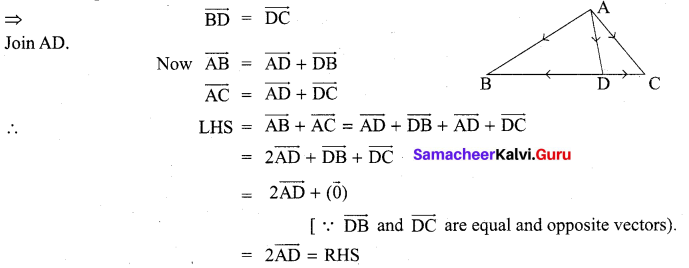
Samacheer Kalvi 10th Social Science History Solutions Chapter 10 Social Transformation in Tamil Nadu

You can Download Samacheer Kalvi 10th Social Science Book Solutions Guide Pdf, Tamilnadu State Board help you to revise the complete Syllabus and score more marks in your examinations.

Tamilnadu Samacheer Kalvi 10th Social Science History Solutions Chapter 10 Social Transformation in Tamil Nadu

Social Transformation in Tamil Nadu Textual Exercise

I. Choose the correct answer.

Question 1.
……………. was the pioneer of social Reformers in India.
(a) C.W. Damotharanar
(b) Periyar
(c) Raja Rammohan Roy
(d) Maraimalai Adigal
Answer:
(c) Raja Rammohan Roy

Samacheer Kalvi 10th Social Science History Solutions Chapter 10 Social Transformation in Tamil Nadu

Question 2.
…………….. established a full-fledged printing press in 1709, atTranquebar.
(a) Caldwell
(b) F.W. Ellis
(c) Ziegenbalg
(d) Meenakshisundaram
Answer:
(c) Ziegenbalg

Question 3.
……………. was the official newspaper of the Self Respect Movement.
(a) Kudi Arasu
(b) Puratchi
(c) Viduthalai
(d) Paguththarivu
Answer:
(a) Kudi Arasu

Samacheer Kalvi 10th Social Science History Solutions Chapter 10 Social Transformation in Tamil Nadu

Question 4.
Periyar wanted religion to be replaced by :
(a) Nationalism
(b) Iconoclasm
(c) Rationalism
(d) Spiritualism
Answer:
(c) Rationalism

Question 5.
…………… founded Adi Dravida Mahajana Sabha in 1893.
(a) Rettaimalai Srinivasan
(b) B. R. Ambedkar
(c) Rajaji
(d) M. C. Rajah
Answer:
(a) Rettaimalai Srinivasan

Samacheer Kalvi 10th Social Science History Solutions Chapter 10 Social Transformation in Tamil Nadu

Question 6.
India’s first organised trade union, the Madras Labour Union was formed in ……………..
(a) 1918
(b) 1917
(c) 1916
(d) 1914
Answer:
(a) 1918

Question 7.
……………. was established by the Justice Party Government for the selection of Government officials.
(a) Staff Selection Board
(b) Public Service Commission
(c) Provincial Staff Recruitment Board
(d) Staff Selection Commission
Answer:
(a) Staff Selection Board

Question 8.
…………….. was the first elected Legislative Council Member from the depressed class in Madras Province.
(a) M.C. Rajah
(b) Rettaimalai Srinivasan
(c) T.M. Nair
(d) P. Varadarajulu
Answer:
(a) M.C. Rajah

II. Fill in the blanks.

1. …………… was the first non-European language that went into print.
2. The college of Fort St. George was founded by ……………….
3. …………….. is considered the father of Tamil linguistic purism.
4. ……………. was the first to approve participation of women in the electoral politics.
5. The name Suriyanarayana Sastri changed in Tamil as …………
6. ………….. gave prominence to Tamil music.
7. The first Woman Legislator in India was …………
Answers:
1. Tamil
2. F.W. Ellis
3. Maraimalai Adigal
4. Justice Party government
5. Parithimar Kalignar
6. Abraham Pandithar
7. Muthulakshmi Reddi

III. Choose the correct statement.

Question 1.
(i) Thirukkural was one of the earliest Tamil literary texts to be published in 1812.
(ii) Maraimalai Adigal collected and edited different palm leaf manuscripts of the Tamil grammar and literature.
(iii) Robert Caldwell established the close affinity between the Dravidian languages in contrast with Sanskrit and also established the antiquity of Tamil.
(iv) Thiru.Vi. Kalyanasundaram was an early pioneer in Trade union movement. .
(a) (i) and (ii) are correct
(b) (i) and (iii) are correct
(c) (iv) is correct
(d) (ii) and (iii) are correct
Answer:
(b) (i) and (iii) are correct

Samacheer Kalvi 10th Social Science History Solutions Chapter 10 Social Transformation in Tamil Nadu

Question 2.
(i) Margret Cousin was one of the founders of Women’s India Association.
(ii) Periyar spent his entire life campaigning against superstitions through Thinkers or Rationalists Forums he had formed.
(iii) Singaravelar was a staunch supporter of the Flindu Mahasabha.
(iv) Periyar emphasised that the caste system in South India is linked with the arrival of Brahmins from the North.
(a) (iii) and (iv) are correct
(b) (ii), (iii) and (iv) are correct
(c) (i) (ii) and (iv) are correct
(d) (ii) and (iii) are correct
Answer:
(c) (i) (ii) and (iv) are correct

Question 3.
Assertion (A): The Justice Party continued to remain in government from 1920-1937 in Madras Presidency.
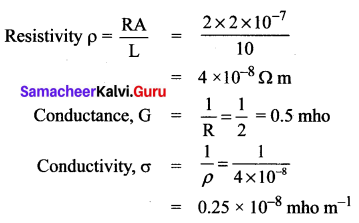
Reason (R): The Congress Party boycotted the Madras Legislature during this period of Dyarchy.
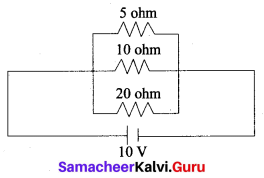
(a) Both A and R are correct
(b) A is correct, but R is not the correct explanation
(c) Both A and R are wrong
(d) R is correct, but it has no relevance to A
Answer:
(a) Both A and R are correct

Samacheer Kalvi 10th Social Science History Solutions Chapter 10 Social Transformation in Tamil Nadu

Question 4.
Assertion (A): As World War I was in progress, the British Government was considering the introduction of representative institutions for Indians after the war.
Reason (R): In 1920, Dyarchy as a form of Government was introduced in the provinces.
(a) A is correct, but R is not the correct reason
(b) Both A and R are wrong
(c) Both A and R are right
(d) A is wrong and R has no relevance to A
Answer:
(b) Both A and R are wrong

IV. Match the following.
Samacheer Kalvi 10th Social Science History Solutions Chapter 10 Social Transformation in Tamil Nadu 1
Answer:
1. (d)
2. (c)
3. (a)
4. (b)

V. Answer briefly.

Question 1.
Write a note on Tamil Renaissance.
Answer:

  1. The cultural hegemony of colonialism and the rise of humanism brought several changes in the socio – cultural life of the Indian subcontinent.
  2. Modem Tamil Nadu too experienced such a historical transition.
  3. Tamil language and cultural played a significant role in their identity construction.
  4. The introduction of printing press linguistic research on Dravidian languages etc under pinned the process of Tamil renaissance.
  5. Religious literature was taken up for publication after the advent of printing technology.

Question 2.
Highlight the contribution of Caldwell for the cause of South Indian languages.
Answer:
In 1816, F.W. Ellis formulated the theory that the South Indian languages belonged to a separate family which was unrelated to the Indo-Aryan family of languages. Robert Caldwell expanded this argument in a book titled, A comparative Grammar of the Dravidian or South Indian Family of languages, in 1856. He established a close affinity between the Dravidian languages in contrast with Sanskrit and also established the antiquity of Tamil.

Samacheer Kalvi 10th Social Science History Solutions Chapter 10 Social Transformation in Tamil Nadu

Question 3.
List out the personalities who contributed to the revival of Tamil literature through their writings.
Answer:
C.W. Damotharanar (1832 – 1901) and U.V. Swaminathar (1855 – 1942) Parithimar Kalaignar (1870 – 1903), Thiru.Vi. Kalyanasundaram (1883 – 1953), Maraimalai Adigal (1876 – 1950), Subramania Bharathi (1882 – 1921), S. Vaiyapuri (1891 – 1956), and the poet Bharathidasan (1891 – 1964) in their ownways and through their writings, contributed to the revival of Tamil Literature.

Question 4.
Discuss the importance of Hindu Religious Endowment Act passed by the Justice ministry?
Answer:
Tamil Nadu has a large number of temples. These temples commanded huge resources which were monopolised and exploited by the dominant caste in the society and led to the mismanagement of public resources. The Justice Party introduced the Hindu Religious Endowment Act in 1926 and enabled any individual, irrespective of their caste affiliation, to become member of the temple committee and govern the resources of the religious institutions.

Question 5.
What do you know of the Cheranmadevi Gurukulam incident?
Answer:

  1. Caste based discrimination in the dinning hall at the Cheranmadevi Gurukulam (School), which was run by V.V. Subramaniam (a Congress leader) with the financial support of theTamil Nadu Congress Committee.
  2. Periyar was disappointed when, despite his objections and protests against this discrimination, the Congress continued to support the iniquitous practice in the Gurukulam.

Question 6.
Name the newspapers published by the South Indian Liberal Foundation.
Answer:
Name of the newspapers:

  1. Dravidian in Tamil
  2. Justice in English
  3. Andhra Prakasika in Telugu

Question 7.
Estimate Periyar as a Feminist.
Answer:

  1. Periyar was critical of patriarchy. He condemned child marriage and the devadasi system (institution of temple girls).
  2. Right from 1929, when the Self – Respect Conferences began to voice its concern over the plight of women, Periyar had been emphasising women’s right to divorce and property.
  3. Periyar objected to terms like “giving in marriage”. This, he said treats woman as a thing.
  4. He wants it substituted by “Valkaithunai” (companion) a word for marriage taken from the Thirukkural. Periyar’s most important work on this subject is why the woman is enslaved?
  5. Periyar believed that property rights for women would provide them a social status and protection. He welcomed equal rights for males and females in property, guardianship and adoption.
  6. He was a strong champion of birth control and contraception and said that motherhood was a burden to women.
  7. In 1989 Government of Tamil Nadu fulfilled the dream of radical reformers by the introduction of the Hindu Succession Tamil Nadu Amendment Act of 1989, which ensured the equal rights to ancestral . property for women in inheritance.

Question 8.
Explain the proceedings of All India Trade Union Congress Conference held in 1920?
Answer:
The first All India Trade Union Conference (AITUC) was held on 31st October 1920 in Bombay. The delegates discussed several resolutions. These included a demand for protection from police interference in labour disputes, the maintenance of an unemployment register, restrictions on exporting foodstuffs, compensation for injuries and health insurance. In addition, the delegates demanded that Indian workers be given some representation in the government, just as employers had representation on legislative councils.

VI. Answer all the questions given under each caption.

Question 1.
Periyar E.V.R
(a) When did Periyar found Dravidar Kazhagam?
Answer:
Periyar found Dravidar Kazhagam in 1944.

(b) What were the Newspapers and Journals run by Periyar?
Answer:
The newspapers and journals started by Periyar were – Kudi Arasu, Revolt, Puratchi, Paguththarivu and Viduthalai.

(c) Why was Periyar known as Vaikom hero?
Answer:
In Vaikom, people protested against the practice of no access to the temples by the lower caste people. After the local leaders were arrested Periyar led the Temple Entry Movement and was imprisoned. So, people hailed him as Vaikom Virar or hero of Vaikom.

(d) Which was the most important work of Periyar?
Answer:
Right from 1929, when the Self-respect Conferences began to voice its concern over the plight of women, Periyar had been emphasising women’s right to divorce and property. Periyar’s most important work on this subject is Why the Woman is Enslaved?

Samacheer Kalvi 10th Social Science History Solutions Chapter 10 Social Transformation in Tamil Nadu

Question 2.
Labour movement in tamilnadu

(a) Highlight the factors that caused the birth of Trade Union Movement
Answer:
The First World War (1914 – 18) provides stimulus to industrial growth in India. At the end of the war there were retrenchments across the industries. Combined with high prices, this gave a momentum to the labour movement.

(b) dentify the three prominent persons associated with the Madras Labour Union.
Answer:
B.P. Wadia, Singaravelar, Thiru.Vi. Kalyanasundaram

(c) Where was the first conference of All India Trade Union Congress held?
Answer:
Bombay

(d) Who organised the first ever celebration of May Day in Madras and which year?
Answer:
Singaravelar organised the first ever celebration of May Day in 1923.

Question 3.
Maraimalai Adigal
(a) Name the Sangam texts for which Maraimalai Adigal wrote commentaries.
Answer:
Pattinappalai and Mullaipattu.

(b) Name the Journal where he worked as a young man.
Answer:
Siddhanta Deepika

(c) Why did he oppose imposition of Hindi?
Answer:
Adigal promoted the use of pure Tamil words and removal of the Sanskrit influences from Tamil language. He painted out that Tamil language would suffer with the introduction of Hindi.

(d) Who were the key influences in Maraimalai Adigal’s life?
Answer:
His teachers P. Sundaram Pillai and Somasundara Nayagar were the key influences in Maraimali Adigal’s life.

VII. Answer in detail.

Question 1.
Attempt an essay on the foundation and development of Tamil Renaissance in the 19th Century.
Answer:

  1. In the nineteenth century, Tamil scholars like C.W. Damotharanar (1832 – 1901) and U.V. Swaminathar (1855 – 1942) spent their lifetime in the re-discovery of the Tamil classics.
  2. C.W. Damotharanar collected and edited different palm-leaf manuscripts of the Tamil grammar and literature.
  3. His editions included such texts as Tolkappiyam, Viracholiyam, Iraiyanar-Akapporul, Ilakkana Villakkam, Kaliththokai and Culamani.
  4. U.V. Swaminathar a student of Meenakshi Sundaranar took efforts to publish the classical texts such a Civakachinthamani (1887), Paththupattu (1889), Chilapathikaram (1892), Purananuru (1894), Purapporul – Venpa – Malai (1895), Manimekalai (1898), Ainkurunuru (1903) and Pathitrupathu (1904).
  5. The publication of these ancient literary texts created an awareness among the Tamil people about their historical tradition, language, literature and religion.
  6. In 1816 F.W. Ellis (1777 – 1819) who founded the College of Fort . St. George formulated the theory that the South Indian languages belonged to separate family which was unrelated to the Indo – Aryan family of languages.
  7. Robert Caldwell (1814 – 1891) expanded this argument in a book titled A Comparative Grammar of the Dravidian (or) South Indian family of Languages in 1856.
  8. He established the close affinity between the Dravidian languages in contrast with Sanskrit and also established the antiquity of Tamil.
  9. Tamil intellectuals of this period identified the fundamental differences between Tamil / Dravidian / Egalitarian and Sanskrit / Aryan Brahmanism.
  10. They argued that Tamil was a language of Dravidian people who are Non – Brahmin and their social life was casteless, gender – sensitised and egalitarian.
  11. These ideas are exemplified in the Tamil invocation song in the play, Manonmaniam written by R Sundaranar (1855 – 1897).
  12. Abraham Pandithar (1859 – 1919) gave prominence to Tamil music and published books on the history of Tamil music.
  13. C.W. Damotharanar, U.V. Swaminathar Thiru.Vi. kalyanasundaram (1883 – 1953), Parithimar Kalaignar (1870 – 1903) Maraimalai Adigal (1876 – 1950), Subramania Bharathi (1882 – 1921), S. Vaiyapuri (1891 – 1956), and the poet Bharathidasan (1891 – 1964) in their own ways and through their writings, contributed to the revival of Tamil literature.
  14. V.G. Suryanarayana Sastri one of the earliest scholars to identify the influence of Sanskrit on Tamil and adopted a pure Tamil name for himself: Parithimar Kalaignar.
  15. He was the first to argue that Tamil is a classical language and demanded that the University of Madras should not call Tamil a vernacular language.
  16. Maraimalai Adigal (1876 – 1950) is considered the father of Tamil linguistic purism and the founder of Tani Tamil Iyakkam.
  17. His daughter Neelambikai complied a dictionary that provided pure Tamil equivalents to Sanskrit words that had crept into Tamil vocabulary.

Question 2.
Describe the background for the formation of the Justice party and point out its contribution to the cause of social justice.
Answer:
It was the period of World War I. The British government thought to introduce representative institutions for Indians after the war. Fearing that such political reforms would further strengthen the political power of Brahmins, educated non-Brahmins decided to organize themselves politically. So, in 1916, some prominent non-Brahmin leaders came together from South Indian Liberation Federation (SILF). It later came to be known as the Justice Party. It was a political party in the Madras Presidency of British India.

Contribution of the Justice Party to the cause-social justice:
The Justice Party government widened education and employment opportunities for the majority of the population and created space for them in the political sphere. The Justices removed the legal hindrances restricting inter-caste marriages and broke the barriers that prevented Adi Dravidars from the use of public wells and tanks. In 1921, the Madras legislature under the Justice Party government was the first to approve participators of women in the electoral politics.

Samacheer Kalvi 10th Social Science History Solutions Chapter 10 Social Transformation in Tamil Nadu

Question 3.
Estimate Periyar E.V.R’s decisive contribution to the social transformation of Tamil Nadu.
Answer:

  1. Periyar was keen on the introduction of reservations in representative bodies such as the legislative council for Non – Brahmins.
  2. Periyar understood the relevance of mass communication in spreading rationalist thought. He started a number of newspapers and journals.
  3. He also supported Ambedkar’s demand for separate electorates for scheduled castes.
  4. Periyar had a close relationship with Singaravelar who is considered the first communist of South India and a pioneer of Buddhism.
  5. In 1937, in opposition to the Rajaji’s Government move to introduce compulsory Hindi in schools, he launched a popular movement to oppose it.
  6. The anti – Hindi agitation (1937 – 39) had a big impact of Tamil Nadu’s politics. Periyar was imprisoned for his role in the movement.
  7. Rajaji, the Chief Minister of Madras State (1952 – 54), introduced a vocational education programme with training in tune with their father’s occupation.
  8. Periyar criticised it as Kula Kalvi Thittam (caste – based education scheme) and opposed it tooth and nail.
  9. Anti-north Indian campaigns had made Periyar to take an anti – Hindi stand.
  10. Periyar’s experiences taught him that it was necessary to eradicate religion in order to impart progress and Justice.
  11. Periyar wanted religion to be replaced by rationalism.
  12. Periyar objected to the hereditary priesthood in temples.
  13. He advocated inter – caste and Self Respect Marriages devoid of any such rituals.
  14. Periyar was critical of patriarchy. He condemned child – marriage and the devadasi system (institution of temple girls).
  15. Periyar objeeted to terms like “giving in marriage” This he said, treats women as a thing- He wants it substituted by Valkaithunai (companion).
  16. Periyar’s most important work on this subject is why women is enslaved? (xvz7) Periyar believe that property rights for women would provide them a social status and protection.
  17. Periyar had been emphasising women’s right to divorce and property.

VIII. Students Activity

Question 1.
Students can be taught to distinguish between Labour Movement and Trade Union Movement. Project work on the activities of local trade union organizations be done by students.
Answer:
Do it yourself.

Question 2.
Students can compile the activities of the local writers’ associations or women’s collectives.
Answer:
Do it yourself.

Social Transformation in Tamil Nadu Additional Questions

I. Choose the correct answer.

Question 1.
South Indian Liberal Federation is otherwise known as the ……………….
(a) Dravidian Party
(b) Janatha Party
(c) Justice Party
Answer:
(c) Justice Party

Question 2.
………………. is an ideological and cultural phenomenon.
(a) Culture
(b) Heritage
(c) Renaissance
(d) Architecture
Answer:
(c) Renaissance

Samacheer Kalvi 10th Social Science History Solutions Chapter 10 Social Transformation in Tamil Nadu

Question 3.
The greatest social reformer of Tamil Nadu ……………
(a) E.V. Ramasamy
(b) Nehru
(c) Gandhiji
Answer:
(a) E.V. Ramasamy

Question 4.
The fundamentalist religious practices that denied humans their:
(a) religious
(b) social
(c) culture
(d) dignity
Answer:
(d) dignity

Question 5.
All India Women conference was organized at
(a) Pune
(b) Bombay
(c) Thame
Answer:
(a) Pune

Question 6.
………………. is one of earliest Tamil literary text.
(a) Thirukkural
(b) Chilapathikaram
(c) Purananuru
(d) Manimekalai
Answer:
(a) Thirukkural

Question 7.
Justice Party failed in the year ……………
(a) 1937
(b) 1934
(c) 1930
Answer:
(a) 1937

Question 8.
………………. and ………………. spent their life time in the discovery of the Tamil classics.
(a) C.W. Damotharanar
(b) U.V. Swaminathar
(c) both (a) and (b)
(d) none
Answer:
(c) both (a) and (b)

Samacheer Kalvi 10th Social Science History Solutions Chapter 10 Social Transformation in Tamil Nadu

Question 9.
In 1921, the Justice Party granted women the right to ……………
(a) Education
(b) Vote
(c) Property
Answer:
(b) Vote

Question 10.
Who was a student of Meenakshi Sundaranar?
(a) P. Sundaranar
(b) Thiru.Vi. Ka
(c) U.V. Swaminathar
(d) Parithimar Kalaignar
Answer:
(c) U.V. Swaminathar

Question 11.
Who collected and edited different palm-leaf manuscripts of the Tamil grammar and literature?
(a) Ziegenbalg
(b) C. W. Damotharanar
(c) Singaravelar
(d) Subramaniya Bharati
Answer:
(b) C. W. Damotharanar

Question 12.
Whose writings contributed to the revival of Tamil literature?
(a) Subramania Bharathi
(b) Bharathidasan
(c) Thiru.Vi.Ka
(d) All the above
Answer:
(d) All the above

Question 13.
Women’s India Association was started in ……………….
(a) 1916
(b) 1917
(c) 1920
(d) 1921
Answer:
(b) 1917

Question 14.
Who wrote commentaries on the sangam texts?
(a) Parithimar Kalaignar
(b) Maraimalai Adigal
(c) U.V. Swaminathar
(d) Ramalinga Adigal
Answer:
(b) Maraimalai Adigal

II. Fill in the blanks :

1. The Justice Party was established in ……………
2. …………… was the first Non – European language that went for print.
3. In 1578 a Tamil book ThambiranVanakkam was published from …………….
4. In 1816 ……………. founded the college of Fort St. George.
5. Ramalinga Adigal is popularly known as ………….
6. ……………. was founded by Pandithar Iyotheethassar.
7. …………. popularly known as M. C. Rajah.
8. M. Singaravelar organized the first celebration of ……………. in 1923.
9. WIA was started in 1917 by ………………
10. The Self-Respect Movement championed not only the causes of the non-Brahmin Hindus, but also that of the ………………
11. ……………. is known for the crucial role he played in the abolition of Sati.
12. Tamil Renaissance questioned the cultural ceremony of ………………
13. ……………… was an early pioneer in Buddhist revival.
14. The Madras Non-Brahmin Association was founded in 1909 to help the …………. students.
Answers:
1. 1916
2. Tamil
3. Goa
4. F. W. Ellis
5. Vallalar
6. Advaidananda Sabha
7. Mylai Chinnathambi Raja
8. May Day
9. Annie Besant
10. Muslims
11. Raja Rammohan Roy
12. Brahminism
13. M. Singaravelu
14. Non-Brahmin

III. Choose the correct statement.

Question 1.
(i) Rettaimalai Srinivasan was a close associate of Dr. B.R. Ambedkar.
(ii) He participated in the third Round Table Conference held in London.
(iii) He voiced the opinions of the marginalised sections of the society.
(iv) He was a signatory to the Poona Pact of 1932.
(a) (i) and (ii) are correct
(b) (i), (iii) and (iv) are correct
(c) (ii), (iii) and (iv) are correct
(d) (ii) and (iii) are correct
Answer:
(b) (i), (iii) and (iv) are correct

Question 2.
(i)Agamic temples permitted the performance of rituals in Tamil.
(ii) Tamil songs had a marginal place in musical concerts.
(iii) M.C. Rajah systematically studied the history of Tamil music.
(iv) Abraham Pandithar founded the Tanjore Sangitha Vidya Mahajana Sangam in 1912.
(a) (i) and (iii) are correct
(b) (ii) and (iii) are correct
(c) (ii) and (iv) are correct
(d) (i), (ii) and (iii) are correct
Answer:
(c) (ii) and (iv) are correct

IV. Match the following.

1. Justice (a) E. V. Ramasamy Periyar
2. Vaikom Hero (b) T. M. Nair
3. Devadasi System (c) Dr. Muthulakshmi Reddy
4. Justice Party (d) English News Paper

Answer:
1. (d)
2. (a)
3. (c)
4. (b)

1. Andhra University (a) Kerala
2. Vaikom Sathyagraha (b) 1924
3. Widow Remarriage Act (c) 1856
4. Public Service Commission (d) 1925
5. Vaikom (e) 1929

Answer:
1. (d)
2. (b)
3. (c)
4. (e)
5. (a)

1. Self Respect Movement (a) Anna Durai
2. Dravidan (b) Periyar
3. Dravida Munnetra kazhagam (c) Dr. Muthulakshmi Reddy
4. The First Woman Doctor (d) News paper

Answer:
1. (b)
2. (d)
3. (a)
4.(c)

1. Manonmaniam (a) Tamil language movement
2. Tamil Isai Iyakkam (b) Liberation
3. Valkaitunai (c) Regions
4. Viduthalai (d) P. Sundaram Pillai
5. Tinais (e) Companion

Answer:
1. (d)
2. (a)
3. (e)
4. (b)
5. (c)

V. Answer briefly:

Question 1.
What is Renaissance?
Answer:
Renaissance is an ideological and cultural phenomenon. It is closely tied to modernity, rationalism, and the progressive movement of the society.

Question 2.
Narrate Dr. Muthulakshmi rule in the agitation against Devadasi system.
Answer:
(i) Dr. Muthulakshmi dedicated herself to the cause of removing the cruel practice of devadasi system from Tamil Nadu. She fought against this system vigorously.

(ii) Appreciating her role in the agitation against Devadasi System she was nominated to the Tamil Nadu Legislative Council in 1929.

(iii) She was vehemently supported in her efforts by Thiru. Muvalur Ramamirtham and Periyar.

(iv) As a result the Justice Party Government enacted a law abolishing Devadasi System.

Question 3.
How for printing press played a significant role in Tamil literary works?
Answer:

  1. The introduction of printing press linguistic research on Dravidian languages underpinned the process of Tamil renaissance.
  2. Religious literature was taken up for publication in the early years after the advent of printing technology.
  3. This led the resurgence of interest among Tamil scholars in publishing the more ancient Tamil classics around that period.

Samacheer Kalvi 10th Social Science History Solutions Chapter 10 Social Transformation in Tamil Nadu

Question 5.
Write about Dr. Muthulakshmi Reddy.
Answer:
Dr. Muthulakshmi Reddy was the first woman in India to get a degree in medicine. She started the cancer institute at Adyar. She dedicated herself to the cause of removing the cruel practice devadasi system from Tamil Nadu.

Question 6.
What kind of vocational education programme was introduced by C. Rajagopalachari in Madras State? How did Periyar react to this?
Answer:
C. Rajagopalachari introduced a vocational education programme that encouraged imparting school children with training in tune with their father’s occupation. Periyar criticised it as caste-based education scheme and opposed it severely.

Question 7.
Write a short note on Tani Tamil Iyakkam.
Answer:

  1. Maraimalai Adigal promoted the use of pure Tamil words and removal of the Sanskrit influence from the Tamil language.
  2. The movement made a great impact on Tamil culture especially in language and literature.
  3. His daughter Neelambikai played an important role in its foundation.
  4. The movement was critical of Hindi, Sanskrit and Brahminical hegemony in Tamil society.
  5. This movement paved the way for later social movements that countered Brahminical and the Sanskrit tradition in Tamil society.

Question 8.
Throw light on the context in which the Dravidian Movement emerged.
Answer:
In Madras Presidency, Brahmins dominated all the fields of society, especially politics, education and job opportunities in the government. The 1911 census showed that Brahmins were slightly over 3 percent of Madras Presidency’s population, and non-Brahmins 90 percent. Yet in the ten years from 1901 to 1911 Madras University turned out 4074 Brahmin graduates compared with only 1035 non-Brahmin graduates. It was in this context the Dravidian movement emerged as a defense of the non-Brahmin castes against the Brahmin dominance.

Question 9.
Mention the women activists in the Self – Respect Movement.
Answer:
There were several women activists in the Self Respect Movement. Muthulakshmi Ammaiyar, Nagammai Kannamma, Nilavathi, Muvalu Ramamirtham, Rukmani Ammal, Alarmelmangai Thayammal, Nilambikai and Sivakami Chidambaranar.

Question 10.
What are the countries Periyar visited over the years?
Answer:
Over the years Periyar visited many countries and interacted with intellectuals all over. He visited Singapore and Malaya, Egypt, U.S.S.R, Greece, Turkey, Germany, England, Spain, France and Portugal.

VI. Answer all the questions given under each caption:

Question 1.
The Justice Party.
(a) Who established the Justice Party?
Answer:
Dr. C. Natesanar, Sir Pitti Theyagarayar, T.M. Nair and Alamelu Mangai Thayarammal established the Justice Party.

(b) When did the Justice Party come to power?
Answer:
The Justice Party came to power in 1920.

(c) When was it defeated?
Answer:
The Justice Party was defeated in 1937.

(d) Write any two achievements of the Justice Party.
Answer:

  • It introduced the system of giving free pattas for housing sites to the poor.
  • In 1929 Annamalai university was opened.

Question 2.
The Justice Party

(a) Who established the Justice Party?
Answer:
T.M. Nair and Thiyagaraja Chetty.

(b) When did the Justice Party come to power?
Answer:
In 1920.

(c) When was it defeated?
Answer:
In 1937.

(d) Write the work of the Justice Party.
Answer:
The Justice Party worked towards legislating provisions for communal . representation-reservations for various communities. Two communal Government orders (1921 and 1922) were passed to ensure equitable distribution in appointments to achieving social Justice.

Samacheer Kalvi 10th Social Science History Solutions Chapter 10 Social Transformation in Tamil Nadu

Question 3.
Language agitation before Indian Independence
(a) Name the movements that helped to galvanise the Tamil language.
Answer:
Maraimalai Adigal’s Pure Tamil Movement, the language reforms of Periyar and Tamil Isai Movement.

(b) Highlight the contribution of Abraham Pandithar for the cause of Tamil music.
Answer:
Abraham Pandithar systematically studied the history of Tamil music and attempted to reconstruct ancient Tamil musical system. He founded the Tanjore Sangitha Vidya Mahajana Sangam in 1912 which became the kernel of the Tamil Isai Movement or Tamil Music Movement.

(c) What was seen as a threat to Tamil language and music?
Answer:
The implementation of Hindi as a compulsory language in Tamil Nadu, at various points of time, was seen as a threat to Tamil language and culture.

(d) Who introduced Hindi as a compulsory subject in schools?
Answer:
C. Rajagopalachari introduced Hindi as a compulsory subject in schools.

Question 4.
Women’s movements
(a) Why were several streams of women’s movements and organisations established in the early twentieth century?
Answer:
They were established to address the question of women empowerment in Madras Presidency.

(b) Why did women’s India Association publish pamphlets and bulletins in different languages?
Answer:
It published pamphlets and bulletins in different languages to detail the problems of personal hygiene, marriage laws, voting rights, child care and women’s role in the public.

(c) Why was the All India Women’s Conference formed in 1927?
Answer:
It was formed to address the problem of women’s education and recommended that the government implement various policies for the uplift of women.

(d) What was one major objective of the Self-Respect movement?
Answer:
One major objective of the Self-Respect movement was women’s liberation.
IMPORTANT EVENTS AND YEARS:

Year Events
1905 Partition of Bengal / Swadeshi Movement
1906 Swadeshi Steam Navigation Company was started
1916 Home Rule League / Lucknow Pact
1917 Champaran Satyagraha
1918 Kheda Satyagraha
1919 Rowlatt Act, Jalianwala Bagh Massacre
1920 Khilafat Movement /Non-Co-operation Movement
1922 Chauri Chaura incident
1923 The formation of Swaraj Party
1927 The appointment of the Simon Commission
1928 Motilal Nehru Report
1929 The Lahore Congress Session
1930 Salt Satyagraha / First Round Table Conference
1931 Gandhi Irwin Pact / Second Round Table Conference
1932 Communal Award / Poona Pact / Third Round Table Conference
1935 The Government of India Act
1937 First Congress Ministry in Provinces
1940 August Offer / Individual Satyagraha
1942 Cripps Mission / Quit India Movement
1945 Wavell Plan / Simla Conference
1946 RIN Revolt / Cabinet Mission / Interim Government
1947 Mountbatten Plan / India won Independence

Samacheer Kalvi 10th Social Science History Solutions Chapter 10 Social Transformation in Tamil Nadu Read More »