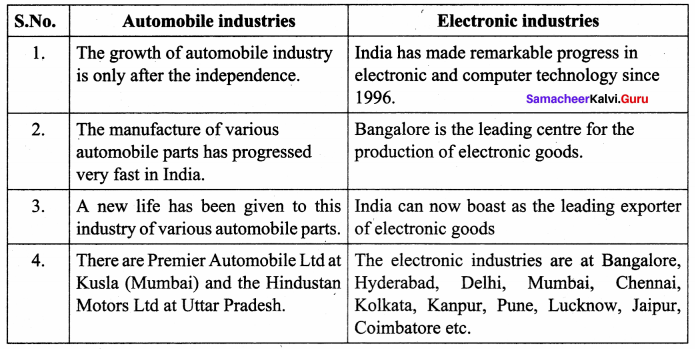
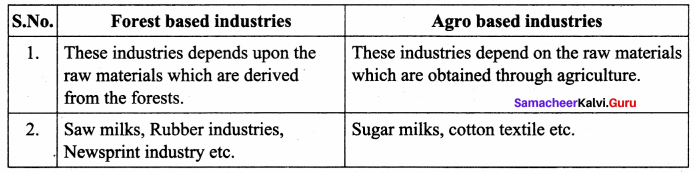
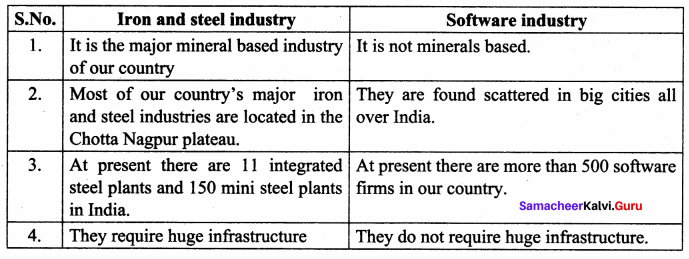
Prasanna

Samacheer Kalvi 10th Social Science History Solutions Chapter 8 Nationalism: Gandhian Phase

You can Download Samacheer Kalvi 10th Social Science Book Solutions Guide Pdf, Tamilnadu State Board help you to revise the complete Syllabus and score more marks in your examinations.

Tamilnadu Samacheer Kalvi 10th Social Science History Solutions Chapter 8 Nationalism: Gandhian Phase

Nationalism: Gandhian Phase Textual Exercise

I. Choose the correct answer.

Question 1.
Who was arrested during the anti-Rowlatt protests in Amritsar?
(a) Motilal Nehru
(b) Saifuddin Kitchlew
(c) Mohamed Ali
(d) Raj Kumar Shukla
Answer:
(b) Saifuddin Kitchlew

Question 2.
In which session of the Indian National Congress was Non-Cooperation approved?
(a) Bombay
(b) Madras
(c) Lucknow
(d) Nagpur
Answer:
(d) Nagpur

Question 3.
Which among the following was declared as ‘Independence Day’?
(a) 26th January 1930
(b) 26th December 1929
(c) 16th June 1946
(d) 15th January 1947
Answer:
(a) 26th January 1930

Question 4.
When was the first Forest Act enacted?
(a) 1858
(b) 1911
(c) 1865
(d) 1936
Answer:
(c) 1865

Samacheer Kalvi 10th Social Science History Solutions Chapter 8 Nationalism: Gandhian Phase

Question 5.
On 8 January 1933 which day was observed …………..
(a) Temple Entry Day
(b) Day of Deliverance
(c) Direct Action Day
(d) Independence Day
Answer:
(a) Temple Entry Day

Question 6.
Which Act introduced Provincial Autonomy?
(a) 1858 Act
(b) Indian Councils Act, 1909
(c) Government of India Act, 1919
(d) Govemment of India Act, 1935
Answer:
(d) Govemment of India Act, 1935

Question 7.
Who defeated Pattabhi Sitaramaya, Gandhi’s candidate, and became the President of the Congress in 1939?
(a) Rajendra Prasad
(b) Jawaharlal Nehru
(c) Subash Chandra Bose
(d) Maulana Abul Kalam Azad
Answer:
(c) Subash Chandra Bose

Samacheer Kalvi 10th Social Science History Solutions Chapter 8 Nationalism: Gandhian Phase

Question 8.
Where was Gandhi when India attained independence on 15th August 1947?
(a) New Delhi
(b) Ahmedabad
(c) Wardha
(d) Noakhali
Answer:
(d) Noakhali

II. Fill in the blanks.

1. Gandhi was thrown out of the first-class compartment in ………….. station.
2. Gandhi regarded ……………. as his political guru.
3. Khilafat Movement was led by …………….
4. Government of India Act of 1919 introduced …………….. in the provinces.
5. The Civil Disobedience Movement in North West Frontier Province was led by …………….
6. Ramsay Macdonald announced ……………….. which provided separate electorates to the minorities and the depressed classes.
7. ………….. established Congress Radio underground during the Quit India Movement.
8. …………….. coined the term ‘Paksitan’.
Answers:
1. Pietermaritzburg railway
2. Gopal Krishna Gokhale
3. AH Brothers
4. Dyarchy
5. Khan Abdul Ghaffar Khan
6. Communal Award
7. Usha Mehta
8. Choudhry Rahmat Ali

III. Choose the correct statement.

Question 1.
(i) The Communist Party of India was founded in Tashkent in 1920.
(ii) M. Singaravelu was tried in the Kanpur Conspiracy Case.
(iii) The Congress Socialist Party was formed by Jayaprakash Narayan, Acharya Narendra Dev and Mino Masani.
(iv) The Socialists did not participate in the Quit India Movement.
(a) (i) and (ii) are correct
(b) (ii) and (iii) are correct
(c) (iv) is correct
(d) (i) (ii) and (iii) are correct
Answer:
(d) (i) (ii) and (iii) are correct

Question 2.
(i) Hindustan Republican Army was formed in Kanpur in 1924.
(ii) Ram Prasad Bismil was tried in the Kakori Conspiracy Case.
(iii) Hindustan Socialist Republican Association was formed by Surya Sen.
(iv) Chittagong Armoury Raid was carried out by B.K. Dutt.
(a) (i) and (ii) are correct
(b) (i) and (iii) are correct
(c) (iii) is correct
(d) (iii) and (iv) are correct.
Answer:
(a) (i) and (ii) are correct

Samacheer Kalvi 10th Social Science History Solutions Chapter 8 Nationalism: Gandhian Phase

Question 3.
Assertion: The Congress attended the First Round Table Conference.
Reason: Gandhi-lrwin Pact enabled the Congress to attend the Second Round Table Conference.
(a) Both A and R are correct but R is not the correct explanation .
(b) A is correct but R is wrong
(c) A is wrong but R is correct
(d) Both A and R are correct and R is the correct explanation
Answer:
(c) A is wrong but R is correct

Question 4.
Assertion: The Congress Ministries resigned in 1939.
Reason: The Colonial government of India entered the war without consulting the elected Congress ministries.
(a) Both A and R are correct but R is not the correct explanation
(b) A is correct but R is wrong
(c) Both A and R are wrong
(d) Both A and R are correct and R is the correct explanation
Answer:
(d) Both A and R are correct and R is the correct explanation

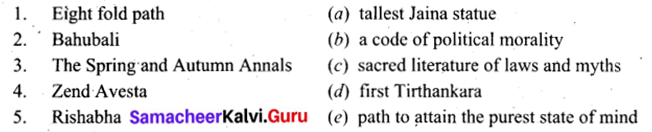
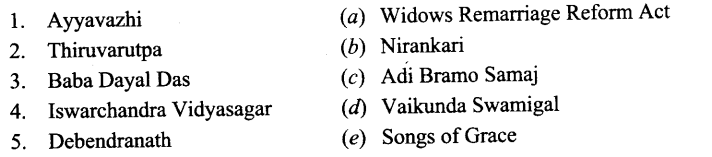
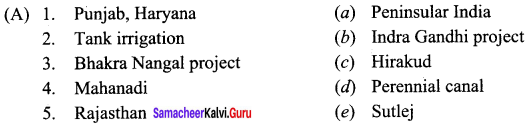
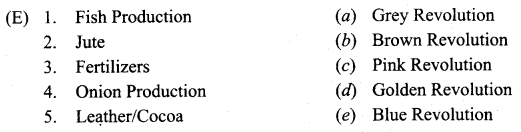
IV. Match the following.
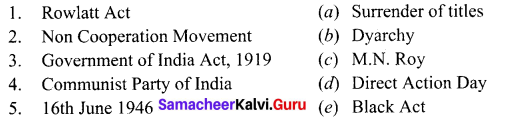
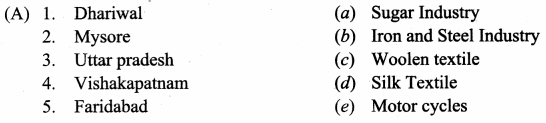
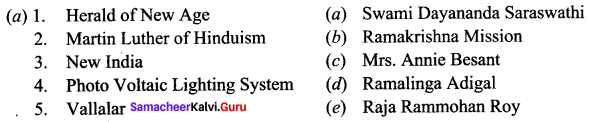
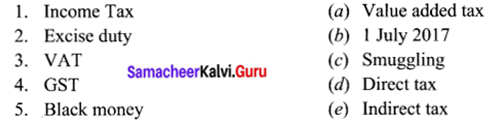
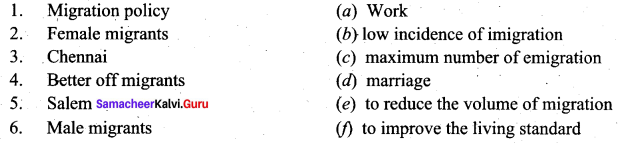
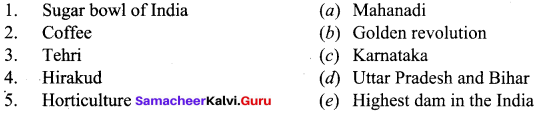
Samacheer Kalvi 10th Social Science History Solutions Chapter 8 Nationalism Gandhian Phase 1
Answer:
1. (e)
2. (a)
3. (b)
4. (c)
5. (d)

V. Answer the following briefly.

Question 1.
Describe the Jallianwala Bagh Massacre.
Answer:

  1. To protest against the Rowlatt Act and the arrest of the two prominent local leaders Dr. Saifuddin kitchlew and Dr. Sathyapal at Amritsar a public meeting was arranged on 13th April 1919 at Jallianwalla Bagh in Amritsar.
  2. Thousands of villagers assembled there.
  3. General Dyer heard about the gathering, surrounded the place with his troops and an armoured vehicle.
  4. The only entrance to the park was blocked.
  5. without any warning firing took place for ten minutes till the troops ran out of ammunition.
  6. Nearly 379 were killed and more than thousands injured due to stampede.
  7. After this incident martial law was declared in Punjab especially in Amritsar.
  8. The brutality enraged Indians. This incident made Rabindranath Tagore and Gandhi to renounce and surrender their titles and medal.

Question 2.
Write a note on the Khilafat Movement.
Answer:
After World War I, the Caliph of Turkey, who was considered the head of Muslims all over the world, was given a very harsh treatment. The Khilafat Movement started in support of the Caliph. It was led by Maulana Mohamed Ali and Maulana Shaukat Ali, popularly known as the Ali brothers. It aimed to restore the prestige and power of the Caliphate. Mahatma Gandhi supported the movement and saw it an opportunity to unite the Hindus and the Muslims.

Question 3.
Why did Gandhi withdraw the Non-Cooperation Movement?
Answer:
On February 5th 1922 a mass procession was took over by the nationalists and the peasants.

  1. Gandhiji advised them not to indulge in any violence. Provoked by the police the people turned in to violence. The angry mob burnt the police station killing 22 policemen.
  2. Gandhiji was upset and immediately withdrew the movement.

Samacheer Kalvi 10th Social Science History Solutions Chapter 8 Nationalism: Gandhian Phase

Question 4.
What was the conflict between the Swarajists and no-changers?
Answer:
In due course of time the Congress got divided into two groups—pro-changers (swarajists) and no-changers. Some of the Congressmen led by Motilal Nehru and C. R. Das wanted to contest the elections and enter the legislature. They argued that the national interest could be promoted by working in the Legislative Councils under Dyarchy and weakening the colonial government from within. These Congressmen were called the pro-changers. On the other hand, no-changers like Vallabhbhai Patel, C Rajagopalachari and other followers of Gandhi wanted to continue non-cooperation with the government.

Question 5.
Why was Simon Commission boycotted?
Answer:
On 8 December 1927, the British Government announced Indian statutory commission to super-wise and bring changes in the functioning of the Government in India, (to review the working of the Government of India Act of 1919 and to further suggest reforms in the administration)

  1. The committee composed of seven members headed by Sir John Simon, widely known as “Simon Commission”.
  2. No Indian members were there in the committee, Indians felt denial of their right to decide their own constitution. So all sections of India including congress and Muslim league decided to boycott the Simon commission.
  3. When the Simon commission came to India they were greeted with flag marches with slogan “Go back Simon” and protest wherever they went.

Question 6.
What is Poorna Swaraj?
Answer:
Some of the Congressmen were not satisfied with dominion status of India and wanted to demand complete independence. In the Congress Session held in Lahore in December 1929 with Jawaharlal Nehru as the President, Poorna Swaraj was declared as the goal. Subsequently, 26 January 1930 was declared as the Independence Day and a pledge was taken all over the country to attain Poorna Swaraj without using any kind of violence.

Samacheer Kalvi 10th Social Science History Solutions Chapter 8 Nationalism: Gandhian Phase

Question 7.
Write a note on Bhagat Singh.
Answer:

  1. Bhagat Singh, Sukhdev and their comrades reorganized the ‘Hindustan Republican Army’ (HRA) in Punjab.
  2. By the influence of socialistic ideals they named it as “Hindustan Socialist Republican Association” in 1928.
  3. Bhagat Singh was held responsible for the assassination of ‘Sanders’ a British police officer who lathi charged Lala Laj pat Rai that led to his death.
  4. Secondly he along with B. K. Dutt threw a smoke bomb in to the central assembly in 1929 and threw pamphlets shouting Inquilab Zindabadh.
  5. He along with Rajaguru was arrested and sentenced to death at the age of 23.
  6. Bhagat Singh’s daring and courage inspired many youths across India.

Question 8.
What are the terms of the Poona Pact?
Answer:
The main terms of the Poona Pact were:
(i) The principle of separate electorates was abandoned. Instead, the principle of joint electorate was accepted with reservation of seats for the depressed classes.

(ii) Reserved seats for the depressed classes were increased from 71 to 147. In the Central Legislature 18 per cent of the seats were reserved.

VI. Answer all the questions given under each caption.

Question 1.
Gandhi and Mass Nationalism

(a) Which incident is considered a turning point in the life of Gandhi?
Answer:
The racial discrimination Gandhi had personally in South Africa was a turning point.

(b) Name the works that influenced Gandhi?
Answer:
He was deeply influenced by the works of Tolstoy “The Kingdom of God is within you” Ruskins ‘Unto this last’ and Thoreau’s ‘Civil Disobedience’.

(c) How did Gandhi use satyagraha as a strategy in South Africa?
Answer:
Gandhiji used the strategy of Satyagraha for fighting the issues of immigration and racial discrimination.

(d) What do you know about the Champaran Satyagraha?
Answer:
Champaran Satyagraha ended the oppression of the peasants by the Indigo planters. It gave the object of ‘Civil Disobedience’. The success of champaran Satyagraha made Gandhiji as a leader of mass struggle.

Question 2.
Constructive Programme of Gandhi
(a) What is constructive programme?
Answer:
Programmes that aimed at Khadi promotion, Hindu-Muslim unity and the abolition of untouchability are called constructive programmes.

(b) What did Gandhi exhort the Congressmen to do?
Answer:
He exhorted the Congressmen to go throughout their districts and spread the message of Khaddar, the message of Hindu-Muslim unity, the message of anti-untouchability and take up in hand the youth of the country and make them the real soldiers of Swaraj.

(c) How did Gandhi try to bring about Hindu-Muslim unity?
Answer:
Gandhi tried to bring about Hindu-Muslim unity to strengthen the cause of Swaraj.

(d) What is the contribution of Gandhi towards abolition of untouchability?
Answer:
Gandhiji wanted to abolish untouchability from the country. He undertook an all-India tour called the Harijan Tour. He started the Harijan Sevak Sangh to work for the removal of discriminations. He worked to promote education, cleanliness and hygiene and giving up of liquor among the depressed class. He also launched the Temple Entry Movement.

Samacheer Kalvi 10th Social Science History Solutions Chapter 8 Nationalism: Gandhian Phase

Question 3.
Subhas Chandra Bose and Ina

(a) How did Subhas Chandra Bose reach Japan?
Answer:
Subhas Chandra Bose made his way and reached Japan on a Submarine.

(b) Who headed the women wing of Indian National Army?
Answer:
The women wing of Indian National Army was headed by captain Lakshmisahgal.

(c) How did Subhas Chandra Bose reorganize the INA?
Answer:
Subhas Chandra Bose reorganized INA in to three brigades: Gandhi Brigade, Nehru Brigade and a women brigade named after Rani of Jhansi.

(d) Name the slogan provided by Subhas Chandra Bose.
Answer:
Subhas Chandra Bose gave the Slogan‘Dilli Chalo’.

VII. Answer in detail.

Question 1.
Examine the factors that led to the transformation of Gandhi into a mass leader.
Answer:

  1. Gandhi was a person dedicated to the cause of poorest of the poor instantly gained the goodwill of the masses.
  2. He visited Champaran (Bihar) for the cause of getting the solution for the peasants and the people suffering under the exploitation of indigo planters.
  3. On reaching Champaran he was asked by the police to return back but he refused.
  4. He was summoned for trial.
  5. The news spread like wildfire and people in thousands swarmed the place in support of Gandhi.
  6. Eventually a committee was formed with Gandhi as a member recommended the abolition of the “tinkathia system”. Thus ending the oppression of the peasants by the Indigo planters.
  7. His fruitful intervention in Ahmadabad mill strike and kheda Satyagraha helped Gandhi to establish as a leader of mass struggle.
  8. His ability to mobilise the common people across the country through truth and Non- violence transformed Gandhi into a mass leader.

Question 2.
Critically examine the Civil Disobedience Movement as the typical example of Gandhian movement.
Answer:
Programmes such as no-base campaigns caught the imagination of the peasants. Gandhi announced a no-tax campaign in Bardoli in February 1922. These movements greatly enhanced Gandhi’s reputation as a national leader, especially the peasants. Gandhi made a nation-wide tour. Wherever he visited there was a bonfire of foreign clothes. Thousands left government jobs, students gave up their studies in large numbers and the lawyers gave up thriving practices. Boycott of British goods and institutions were effective.

The boycott of the Prince of Wales’ visit to India was successful. During this boycott trade unions and workers participated actively. However, Gandhi suddenly withdrew the movement because of the Chauri Chaura incident. On 5 February 1922 a procession of the nationalists in Chauri Chaura, a village near Gorakhpur in present-day Uttar Pradesh provoked by the police turned violent. The mob burnt the police station 22 policemen lost their lives. Gandhi immediately withdrew the movement. Gandhi was arrested and was released only in 1924.

Question 3.
Discuss the reasons behind the partition of India.
Answer:

  1. Muslim League was formed mainly to fight for the political rights of the Indian Muslims.
  2. Jinnah revived the Muslim League in 1934 with the determination of demanding separate state for Muslims.
  3. By 1940 he was demanding a separate nation for Muslims arguing that in Independent India Muslims would lose all political power to the Hindus.
  4. The Muslim league dubbed the congress as a Hindu organisation.
  5. The British policy of Divide and rule had encouraged the vested interests of the Muslims to exploit the religious differences.
  6. Cripps mission declared that it would provide a federal Government and the provinces were divided in to three groups namely.
  7. Non – Muslim majority provinces, Muslim majority provinces in the North west and in the North East.
  8. This proposal was agreed by both the parties but interpreted it differently.
  9. The congress wanted the division temporary but the Muslim league wanted to be permanent.
  10. Differences arose between the congress and the Muslim League led to the Hindu – Muslim conflicts bringing the communal violence.
  11. Finally Mountbatten plan – Two Nation theory – dividing India in to two states India and Pakistan.
  12. Partition of India was the ultimate outcome to split the unity of Independent India.

VIII. Activity

Question 1.
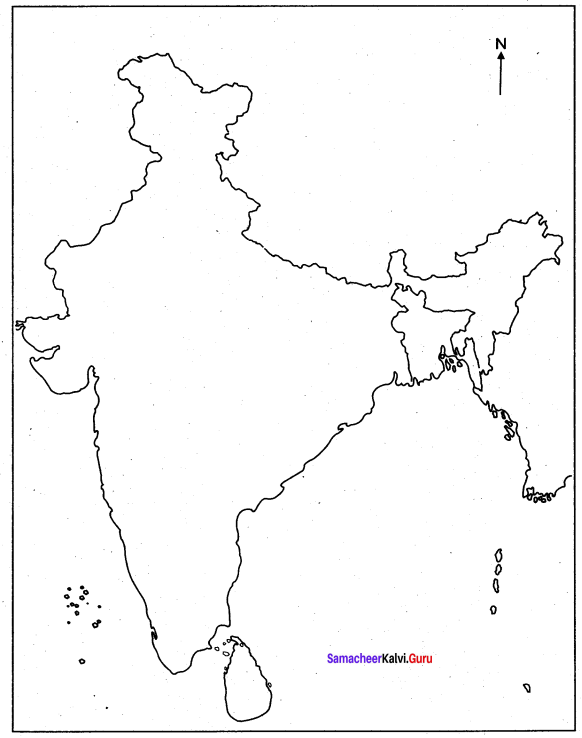
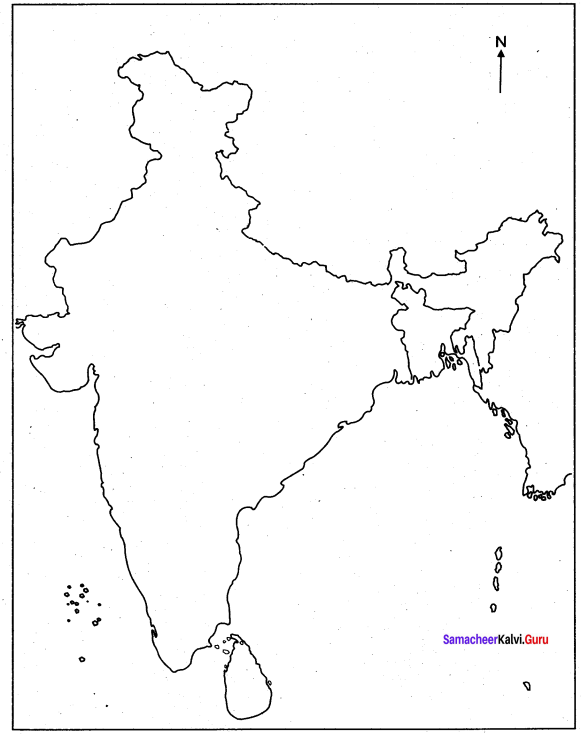
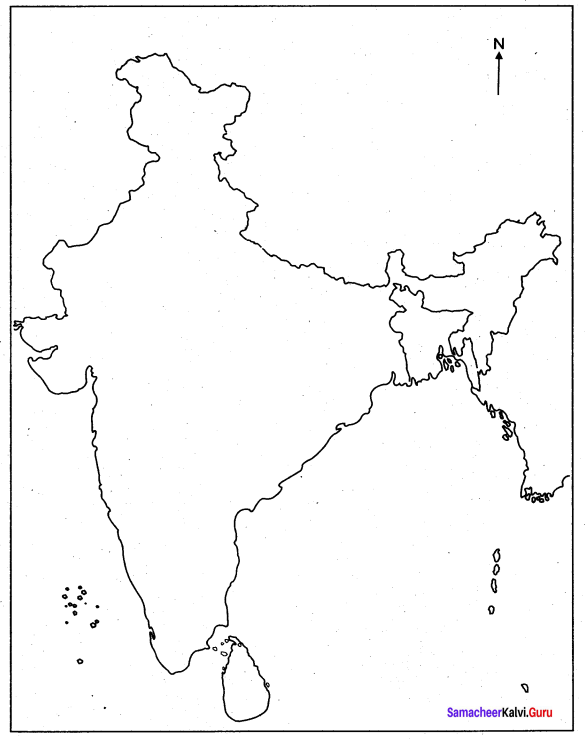
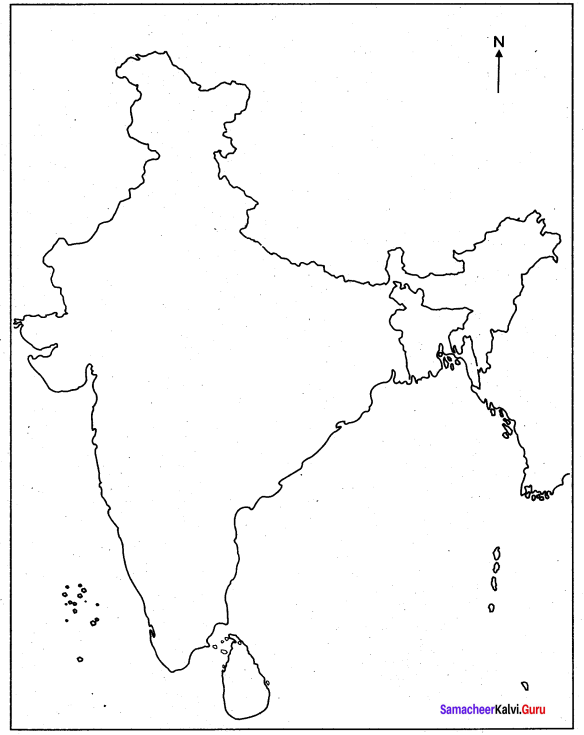
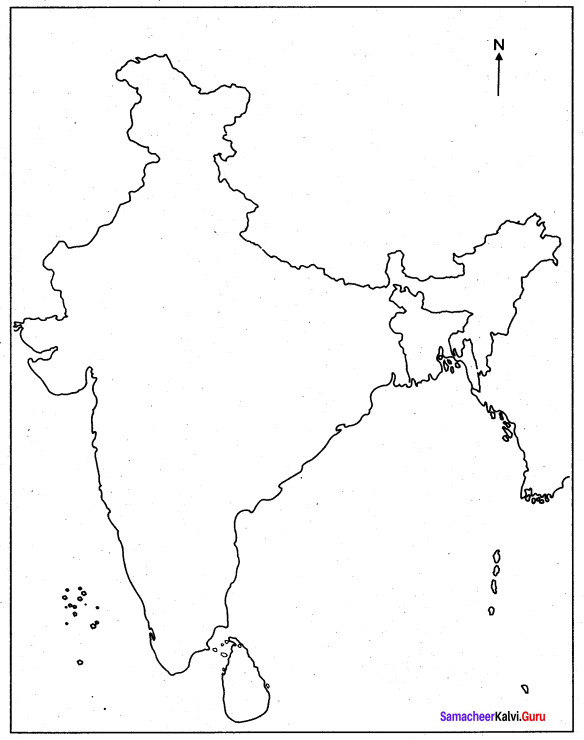
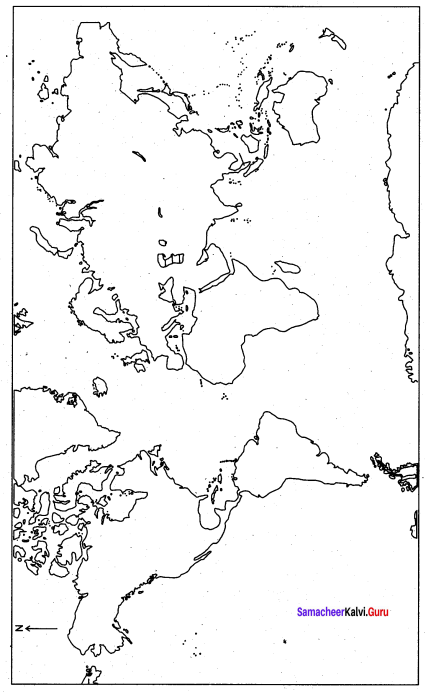
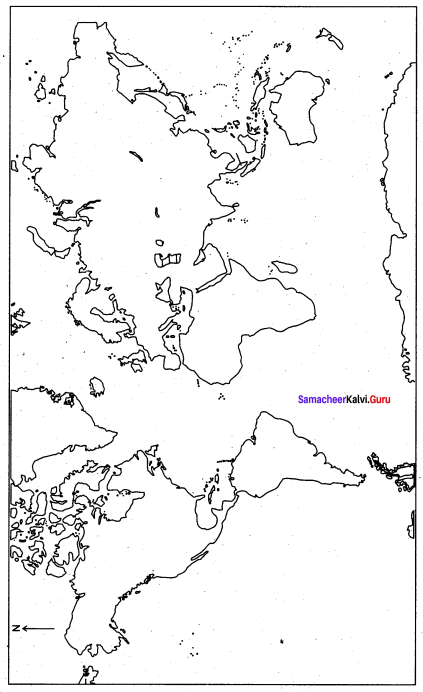
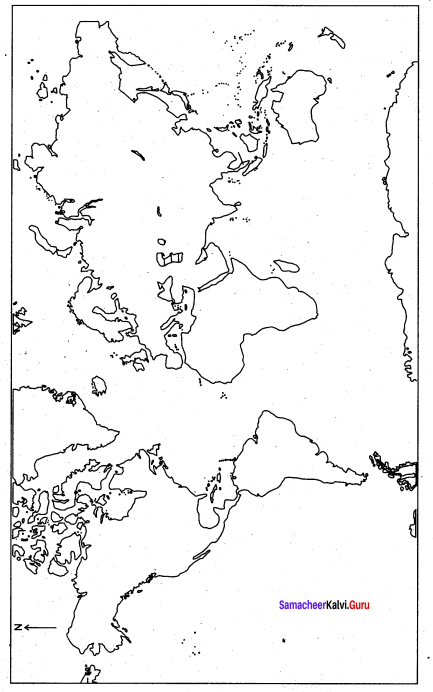
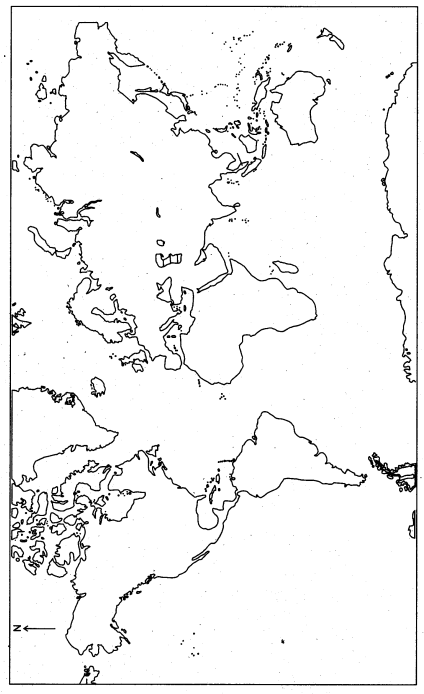
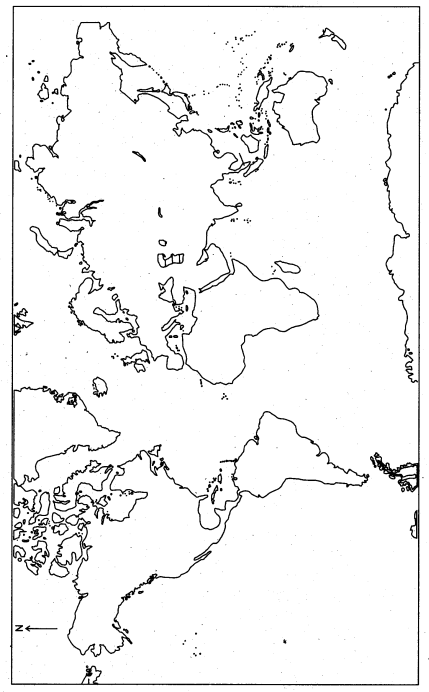
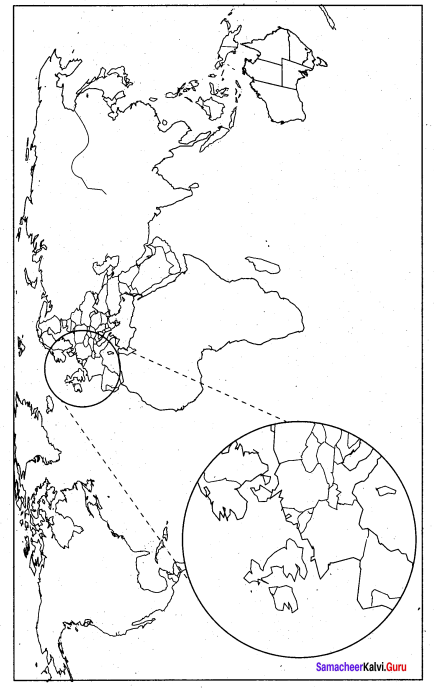
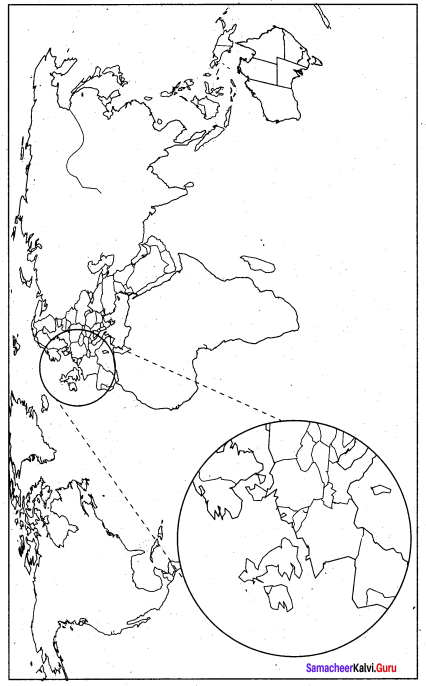
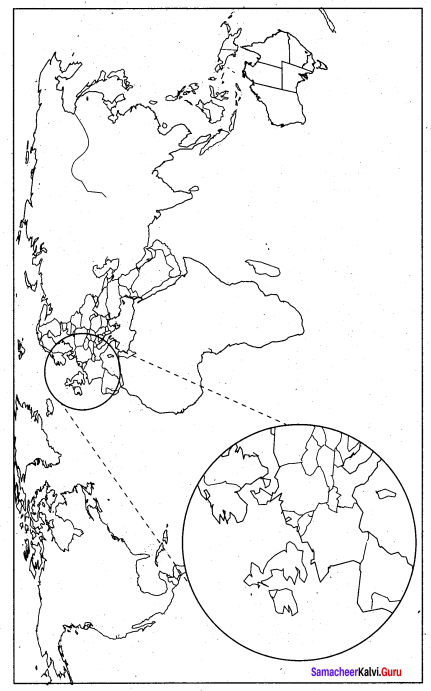
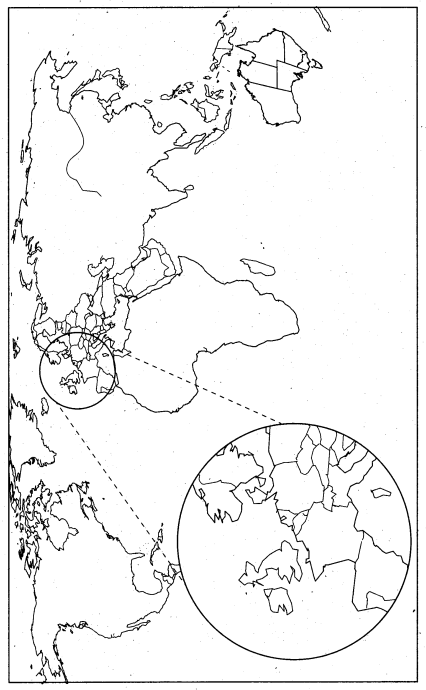
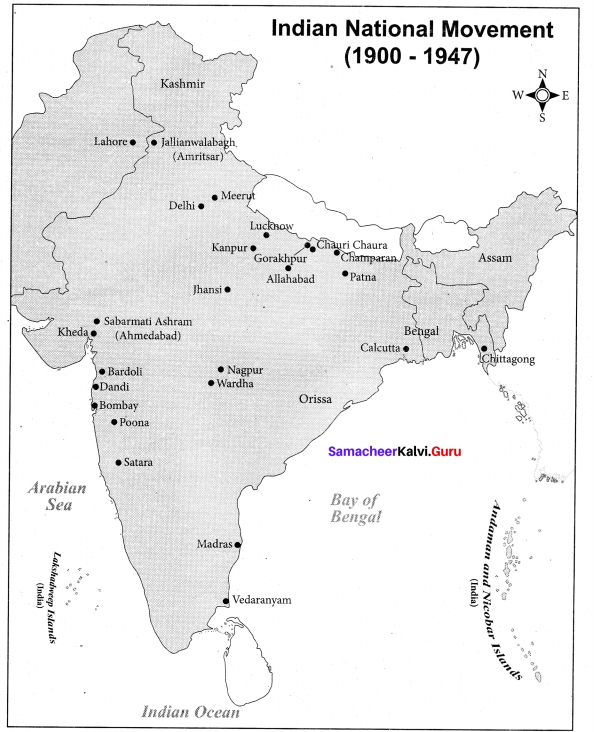
Students can be asked to mark the important places of Gandhian Movement in a map and write a sentence or two about what happened there.
Samacheer Kalvi 10th Social Science History Solutions Chapter 8 Nationalism Gandhian Phase 2

  • Amritsar and Lahore: The anti-Rowlatt protest was intense in Punjab, especially in Amritsar and Lahore.
  • Delhi: All India Khilafat Conference was held at Delhi in November 1919.
  • Calcutta: The Indian National Congress approved the non-cooperation movement in a special session held in Calcutta on September 1920.
  • Gorakhpur: On 5 February 1922 a procession of the nationalists in Chauri Chaura, a village near Gorakhpur in present-day Uttar Pradesh provoked by the police turned violent.
  • Sabarmati Ashram: At the break of dawn on 12 March 1930 Gandhi set out from Sabarmati Ashram with 78 of its inmates.
  • Dandi: At the age of 61 Gandhi covered a distance of 241 miles in 24 days to reach Dandi at sunset on 5 April 1930.
  • Vedaranyam: In Tamil Nadu, C. Rajaji led a similar salt march from Tiruchirappalli to Vedaranyam.

Question 2.
Students can be divided into groups and asked to debate the views of Gandhi, Jinnah, B.R. Ambedkar, Revolutionaries and Communists.
Answer:
Do it yourself.

Nationalism: Gandhian Phase Additional Questions

I. Choose the correct answer.

Question 1.
The unification of the country was brought by the British ……………
(a) Imperialism
(b) Politics
(c) Conquerts
Answer:
(a) Imperialism

Samacheer Kalvi 10th Social Science History Solutions Chapter 8 Nationalism: Gandhian Phase

Question 2.
Gandhi sailed to England to study.
(a) law
(b) Politics
(c) business
(d) Philosophy
Answer:
(a) law

Question 3.
The religious and social reformers prepared the ground for the rise of …………..
(a) Nationalism
(b) Revolution
(c) Mutiny
Answer:
(a) Nationalism

Question 4.
In South Africa ……………… were treated as coolies.
(a) Gujarathi’s
(b) Indians
(c) South African people
(d) English people
Answer:
(b) Indians

Question 5.
Home – Rule league in Bombay was formed by ………….
(a) Nehru
(b) Tilak
(c) Bharathi
Answer:
(b) Tilak

Samacheer Kalvi 10th Social Science History Solutions Chapter 8 Nationalism: Gandhian Phase

Question 6.
Towards the end of 19th ……………… century synthetic dyes had forced indigo out of the market.
(a) British
(b) Chinese
(c) German
(d) French
Answer:
(c) German

Question 7.
The slogan adopted during Swadeshi movement was ………….
(a) Go back to Vedas
(b) Vande Mataram
(c) Swaraj is my birth right
Answer:
(b) Vande Mataram

Question 8.
………………… returned his knighthood after the Jallianwala Bagh tragedy for the brutality by the British.
(a) Maulana Mohammed Ali
(b) Mrs. Annie Besant
(c) Motilal Nehru
(d) Rabindranath Tagore
Answer:
(d) Rabindranath Tagore

Question 9.
The first session of the Indian National Congress was chained by …………..
(a) Tilak
(b) A.O. Hume
(c) W.C. Bannerjee
Answer:
(c) W.C. Bannerjee

Samacheer Kalvi 10th Social Science History Solutions Chapter 8 Nationalism: Gandhian Phase

Question 10.
Khilafat movement came to an end with the abolition of caliphate in:
(a) Isreal
(b) Arabia
(c) Turkey
(d) India
Answer:
(c) Turkey

Question 11.
Dr. Annie Besant was an …………..
(a) English lady
(b) Indian lady
(c) Irish lady
Answer:
(c) Irish lady

Question 12.
In Tamil Nadu C. Rajaji led the salt March from ………………… to vedaranyam
(a) Tanjore
(b) Madurai
(c) Thirunelveli
(d) Tiruchirapalli
Answer:
(d) Tiruchirapalli

Question 13.
Rowlatt Act was passed in …………
(a) 1919
(b) 1917
(c) 1918
Answer:
(a) 1919

Samacheer Kalvi 10th Social Science History Solutions Chapter 8 Nationalism: Gandhian Phase

Question 14.
Gandhi attended the ………………… held at London in 1931 after Gandhi – Irwin pact was signed.
(a) First Round Table Conference
(b) Second Round Table Conference
(c) Third Round Table Conference
(d) Cabinet mission
Answer:
(b) Second Round Table Conference

Question 15.
C. R. Das and Motilal Nehru formed ……………… party.
(a) Khadar
(b) DMK
(c) Swarajya
Answer:
(c) Swarajya

Question 16.
To form the interim Government Nehru sought the help of ……………
(a) Abdul Kalam Azad
(b) Jinnah
(c) Salimullah Khan
Answer:
(b) Jinnah

Question 17.
Separate state for Muslims was demanded by ……………
(a) Netaji
(b) Jinnah
(c) Ali brothers
Answer:
(b) Jinnah

Question 18.
In which year, Ahmedabad mill strike took place?
(a) 1916
(b) 1917
(c) 1918
Answer:
(c) 1918

Samacheer Kalvi 10th Social Science History Solutions Chapter 8 Nationalism: Gandhian Phase

Question 19.
Anti-Rowlatt protest was intense in ……………
(a) Punjab
(b) Maharashtra
(c) Haryana
Answer:
(a) Punjab

Question 20.
The Khilafat Committee meeting was held in ………….
(a) Lucknow
(b) Allahabad
(c) Amritsar
(d) Kanpur
Answer:
(b) Allahabad

Question 21.
The Poona Pact took place between Mahatma Gandhi and …………….
(a) Ambedkar
(b) Jawaharlal Nehru
(c) Vallabhai Patel
(d) M. N. Roy
Answer:
(a) Ambedkar

Question 22.
Who was sent as Viceroy to India with the specific task of transfer of power?
(a) Sir John Simon
(b) Pethick Lawrence
(c) Sir Strafford Cripps
(d) Lord Mountbatten
Answer:
(d) Lord Mountbatten

II. Fill in the blanks :

1. The Indian National Congress was founded in ………………
2. The congress became divided as …………. and …………….
3. The Moderates and the Extremists joined in the Lucknow session in …………..
4. In the …………… session Jawaharlal Nehru met Gandhiji for the first time.
5. ‘Nethaji’ means …………….
6. The All India Muslim League was formed by a group of Muslim …………… and ……………
7. The Rowlatt Act curbed …………… rights such as the freedom of expression and strengthened powers.
8. Mahatma Gandhi abruptly called off the ………………. movement when it took violent turn.
9. The congress resolved to fight for Puma Swaraj in 1929 under the presidentship of ………………
10. The Quit India Movement started in ………………
11. The programme of Non-cooperation included boycott of foreign goods and spreading the doctrine of ……………….
12. During 1902 the Hindu Mahasabha was gaining popularity under ………………. and the Muslim League under Ali Brothers.
13. In the Congress session held in Lahore in December 1929 with Jawaharlal Nehru as the President, …………….. was declared as the goal.
14. Gandhiji started the Harijan Sevak Sangh to work for the removal of ……………..
15. The All India Congress Committee that met at ………….. on 8 August, 1942 passed the Quit India Resolution demanding immediate ending of the British mle in India.
Answers:
1. 1885
2. Extremist, Moderates
3. 1916
4. Lucknow
5. Leader
6. landlords, nawabs
7. Fundamental
8. Non-cooperation
9. Jawaharlal Nehru
10. 1942
11. Swadeshi
12. Madan Mohan Malaviya
13. Pooma Swaraj
14. discriminations
15. Bombay

III. True or false:

1. Subash Chandra Bose was a moderate nationalist.
2. The Jallianwala Bagh Massacre occurred in Amritsar on Baisaki day.
3. The Swadeshi Movement started after the partition of Bengal.
4. Maulan Azad became the major spokes person for the demand for Pakistan.
5. Khan Abdul Ghaffar Khan also known as Badshah Khan founded the Khudai Khidmatgar.
Answer:
1. False
2. True
3. True
4. False
5. True

IV. Choose the correct statement.

Question 1.
(i) The Wavell Plan was announced in June 1945.
(ii) It provided for an interim government, with an equal number of Hindus and Muslims in the Viceroy’s Executive Council.
(iii) All portfolios, including war portfolio, was to be held by Indian ministers.
(iv) However, in Shimla Conference, the Congress and the Muslim League could not come to an agreement.
(a) (i) and (ii) are correct
(b) (i) (ii) and (iii) are correct .
(c) (ii) (iii) and (iv) are correct
(d) (i) (ii) and (iv) are correct
Answer:
(d) (i) (ii) and (iv) are correct

Samacheer Kalvi 10th Social Science History Solutions Chapter 8 Nationalism: Gandhian Phase

Question 2.
Assertion: After the First World War the Caliph of Turkey, who was considered the head of Muslims all over the world, was given a harsh treatment.
Reason: The Khilafat Movement was started in support of the Caliph.
(a) Both A and R are correct and R is the right explanation.
(b) A is right but R is wrong.
(c) Both A and R are wrong.
(d) Both A and R are correct but R is not the right explanation
Answer:
(a) Both A and R are correct and R is the right explanation.

V. Match the following.

1. Surat split (a) 1905
2. Swadeshi Movement (b) 1906
3. Home Rule Movement (c) 1907
4. Minto-Morley Reforms (d) 1916
5. Birth of Muslim League (e) 1909

Answer:
1. (c)
2. (a)
3. (d)
4. (e)
5. (b)

1. Motilal Nehru (a) Uttar Pradesh
2. Chauri Chaura (b) Swarajya party
3. Lion of Punjab (c) Khan Abdul Ghaffar Khan
4. Communal Award (d) Lala Lajpat Rai
5. Frontier Gandhi (e) Ramsay Mac Donald

Answer:
1. (b)
2. (a)
3. (d)
4. (e)
5. (c)

1. Cripp’s Mission (a) 1922
2. Cabinet Mission (b) 1932
3. The August offer (c) 1940
4. Poona Pact (d) 1942
5. Chauri Chaura incident (e) 1946

Answer:
1. (d)
2. (e)
3. (c)
4. (b)
5. (a)

1. Gandhiji returned to India from South Africa (a) 1931
2. Jallianwala Bagh massacre (b) 1915
3. No tax campaign in Bardoli (c) 1919
4. Third Round Table Conference (d) 1922
5. Gandhiji revived the Civil Disobedience Movement (e) 1932

Answer:
1. (b)
2. (c)
3. (d)
4. (e)
5. (a)

VI. Answer briefly:

Question 1.
Write a brief note on Gandhi’s early life.
Answer:
Mohandas Karam Chand Gandhi was bom in a well to do family on 2nd October 1869 at Porbandar.

  1. His father was Kaba Gandhi served as Diwan of Porbandar and Rajkot.
  2. Mother was putlibai, a devout vaishavite influenced the young Gandhi.
  3. After passing matriculation Gandhi sailed to England to study law in 1888.
  4. After becoming barrister Gandhi returned to India in June 1891.
  5. He strongly believed in British sense of justice and fair play till he experienced racial discrimination by himself.
  6. A Gujarati firm sought his service for assistance in a law suit in South Africa, and he left in April 1893 to South Africa.

Question 2.
Name some of the important moderate leaders.
Answer:

  • Dadabai Naoroji
  • Surendranath Banarjee
  • Pheroze Sha Mehta
  • Gopala Krishna Gokhale
  • M. G. Ranade

Question 3.
What influenced Gandhi to get trained in the path of Satyagraha?
Answer:

  1. Gandhi ideas were formed due to a blend of Indian and Western thoughts.
  2. He was greatly influenced by western thinkers and was highly critical of western civilisation and industrialisation.
  3. He was inspired by writings of Ruskin and established the phoenix settlements and the Tolstoy Farm.
  4. These settlements had equality, community living and dignity of labour and formed as training grounds for the Satyagraha.

Samacheer Kalvi 10th Social Science History Solutions Chapter 8 Nationalism: Gandhian Phase

Question 4.
When and by whom was the Indian National Congress founded?
Answer:
The Indian National Congress was founded in 1885 by Allan Octavian Hume, a retiree L civil servant.

Question 5.
Write a note on Pro – changers and no – changers of group of congress.
Answer:
In 1923 there was a split in congress namely prochangers and no changers after the suspension of Non – cooperation movement by Gandhi in 1922.

Pro – Changers: The congressmen led by Mothilal Nehru and C.R Das wanted to contest the elections and enter the legislature.

They had the notion that national interest could be promoted by working in the legislative councils under Dyarchy and wreck the colonial Government within.

They effectively used the legislature as a platform for propagation of nationalist ideas.

No. Changers: Staunch followers of Gandhi like Vallabhbhai Patel. C. Rajaji and others who wanted to continue non – cooperation with the Government.

Samacheer Kalvi 10th Social Science History Solutions Chapter 8 Nationalism: Gandhian Phase

Question 6.
Why was Khilafat Movement started?
Answer:

  1. After the defeat of Germany in the first world war, the Turkish empire was broken up.
  2. Its territories were shared by British and France.
  3. The Sultan of Turkey was humiliated.
  4. The Sultan was also the caliph or the religious leader of the Muslims.
  5. So the Muslims started the Khilafat Movement.
  6. The Ali brothers Mohammad Ali and Shaukat Ali started the Khilafat Movement in India.

Question 7.
Write a note on Direct Action Day call by Muslims.
Answer:

  1. Differences arose between congress and Muslim league.
  2. When the congress nominated a Muslim member the league argued it was to be sole representative of the Muslim and withdrew its approval.
  3. Jinnah declared 16th August 1946 as the “Direct Action Day”.
  4. Hartals, and demonstrations took place which soon turned in to Hindu – Muslim conflict.
  5. It spread to other districts of Bengal. The worst affected district was ‘ Noakhali.
  6. Gandhi left for the worst affected regions bringing the communal violence under control and spread the message of peace and non – violence.

Question 8.
Write about Swaraj party.
Answer:
(i) In order to lead the national movement a section of the nationalist leaders like C.R. Das and Motilal Nehru formed the Swaraj party in 1923.

(ii) Instead of boycotting the Assemblies there leaders wanted to oppose the British Government from within the legislature.

(iii) It passed the resolution demanding the establishment of a responsible Government in India,

(iv) After the death of C. R. Das the Swaraj party was dissolved.

Question 9.
Who were the members of the Cabinet Mission?
Answer:

  1. Pethick Lawrence
  2. A.V. Alexander
  3. Sir Stafford Cripps

Question 10.
Explain the Communal Award and Poona Pact of 1932.
Answer:

  • At the end of the Second Round Table Conference the British Prime Minister Ramsay MacDonald announced a scheme known as the communal Award.
  • It provided separate electorates for the minorities and the depressed classes.
  • Dr. Ambedkar accepted it but Gandhiji protested against this and went on a fast into death.
  • After the Poona Pact in 1932 Gandhiji’s ended his fast.
  • The depressed communities agreed to have joint electorates with adequate representation.

Question 11.
How India was partitioned?
Answer:

  • The new state Pakistan comprised of west Punjab, Sind, north west frontier provinces.
  • All the remaining provinces remained with the Indian dominion.

Question 12.
Inspired by Ruskin, Gandhiji established two settlements. Write their names and features.
Answer:
Inspired by Ruskin Gandhiji established the Phoenix Settlements in 1905 and the Tolstoy Farm in 1910. Equality, community living and dignity of labour were inculcated in the settlements. They were also the training grounds for the satyagrahis.

Samacheer Kalvi 10th Social Science History Solutions Chapter 8 Nationalism: Gandhian Phase

Question 13.
Why did Gandhiji support the Khilafat Movement?
Answer:
Gahdhiji supported the Khilafat Movement as he saw it as an opportunity to unite the Hindus and the Muslims.

Question 14.
The Non-cooperation Movement got nation-wide support. Support the statement with valid points.
Answer:
The Non-cooperation Movement was supported by the people of all sections. They boycotted foreign goods and spread the doctrine of Swadeshi. Thousands left government jobs, students gave up their studies in large numbers and the lawyers gave up thriving practices. They also boycotted the Prince of Wales’ visit to India. The trade unions and workers also participated actively.

Question 15.
What were the recommendations of the Nehru Report?
Answer:

  1. Dominion status for India
  2. Elections of the Central Legislature and the Provincial Legislatures on the basis of joint and mixed electorates
  3. Reservation of seats for the Muslims in Central Legislature and in provinces where they are in a minority and for the Hindus in North West Frontier Province where they were in a minority
  4. Provision of fundamental rights, and universal adult franchise.

Question 16.
Jinnah was hailed as ambassador of Hindu-Muslim unity. What made him change his stand?
Or
Under what circumstances did Jinnah begin to espouse the cause of separate nation for Muslims?
Answer:
Jinnah demanded one-third of seats be reserved for Muslims. But it was rejected in the All Party Conference. Later he proposed a resolution which came to be known as Jinnah’s Fourteen Points. However, it was also rejected. Thereafter, he changed his stand and began to espouse the cause of separate nation for Muslims.

Question 17.
Why did the negotiations between the Cripps Mission and the Congress fail? What did the Cripps Mission offer?
Answer:
The negotiations between the Cripps Mission and the Congress failed because Britain was not willing to transfer of effective power immediately. The Cripps Mission offered:

  1. Grant of Dominion Status after the War
  2. Indian Princes could sign a separate agreement with the British implying the acceptance for the demand of Pakistan.
  3. British control of defence during the War.

VI. Answer all the questions given under each caption:

Question 1.
Factors leading to the rise of National Movement
(a) How did the national leaders inspire the people?
Answer:
They inspired the people with the ideas of self-respect and self-confidence.

(b) When was the Vernacular Press Act passed?
Answer:
The Vernacular Press Act was passed in 1878.

(c) What was the policy of the British?
Answer:
The British followed the policy of “Divide and Rule”.

(d) How did the British consider the Indians?
Answer:
The British considered the Indians as inferior and uncivilized.

Samacheer Kalvi 10th Social Science History Solutions Chapter 8 Nationalism: Gandhian Phase

Question 2.
Role of socialists

(a) Who provided the leadership for the Quit India movement when the leaders of congress were in jail?
Answer:
The socialists provided the leadership for the movement in the absence of congress leaders.

(b) Who escaped from the jail and what they did?
Answer:
Jayaprakash Narayan and Ramanand Misra escaped from the prison and organised underground movement.

(c) Who was the women activists who played a heroic role?
Answer:
Aruna Asaf Ali was the woman activists who played a heroic role.

(d) What Gandhi did to stop the atrocities done by the British Government?
Answer:
Gandhi commenced a twenty one day fast in February 1943 which nearly threatened his life.

Question 3.
Extremists
(a) Name the extremists leaders:
Answer:

  1. Lokmanya Bala Gangadhar Tilak
  2. Bipin Chandra Pal
  3. Lala Lajpat Rai
  4. Arabind Ghosh

(b) What did Tilak declare?
Answer:
Tilak declared, “Swaraj is my birth right and I shall have it”.

(c) Name the festivals revived by Tilak?
Answer:
Tilak revived the celebration of “Ganapathi and “Shivaji” festivals.

(d) What was the desire of the militant nationalists?
Answer:
The Militant Nationalists desired to change the aim of the congress and the means to attain it.

Question 4.
Royal indian Navy Revolt

(a) When and where the Royal Indian Navy ratings revolt?
Answer:
In February 1946 at Bombay the Royal Indian Navy ratings revolted.

(b) Where was similar strikes occurred?
Answer:
Strikes occurred in the Indian Air Force and the Indian signal corps Jabalpur.

(c) What was big blow to the imperial power?
Answer:
British surrender in South – East Asia to the Japanese was a big blow to imperial prestige.

(d) What was the effect of this revolt?
Answer:
All political leaders were released and ban on congress was lifted.

Question 5.
The Mount Batten Plan
(a) Who became the Governor General of India in 1947?
Answer:
Lord Mount Batten became the Governor General of India in 1947.

(b) Who was the last British Governor General?
Answer:
Lord Mount Batten was the last British Governor General.

(c) What was Mount Batten Plan?
Answer:
India would be divided into two independent countries namely Indian Union and the Pakistan Union.

(d) What was the reaction of the Congress and Muslim League?
Answer:
Both the Congress and the Muslim League accepted this plan.

Samacheer Kalvi 10th Social Science History Solutions Chapter 8 Nationalism: Gandhian Phase

Question 6.
Direct Action Day call by Muslim League
(a) What led to a difference between Congress and Muslim League?
Answer:
The nomination of a Muslim member by the Congress led to a difference between Congress and Muslim League.

(b) What was the League’s argument?
Answer:
The League argued it was to be the sole representative of the Muslims and so withdrew its approval.

(c) What happened on the Direct Action Day?
Answer:
Hartals and demonstrations took place which soon turned into Hindu-Muslim communal conflict.

(d) Which district of Bengal was the worst affected? What did Gandhiji do to control the situation?
Answer:
The district of Noakhali was the worst affected. Gandhiji toured the worst affected regions on bare foot spreading the message of peace and non-violence.

Question 7.
Independence and Partition.
(a) Which Act gave effect to the Mount Batten Plan?
Answer:
The Indian Independence Act gave effect to the Mount Batten Plan.

(b) When did the Act come into being?
Answer:
The Act came into being on 18 July 1947.

(c) What changes came with the enactment of the Act?
Answer:
The Act abolished the sovereignty of the British Parliament over India. India was partitioned into two dominions—India and Pakistan.

VII. Answer the following in detail.

Question 1.
Narrate how the tribal groups were affected by the Forest Acts enacted by the British? Who attained martyrdom for the cause of forest dwellers?
Answer:

  1. The First Forest Act was enacted by the British in 1865.
  2. This act restricted the access of the forest dwellers to the forest areas to collect firewood, cattle fodder and other minor forest produce such as honey seeds, nuts, medicinal herbs.
  3. Indian Forest Act of 1878.
  4. Claimed that original ownership of forests was with the state.
  5. Waste lands and fallow lands were included as forests.
  6. Shifting cultivation practiced by the tribal people was prohibited.
  7. Alienation of forests from local control was stiffly resisted by the aggrieved tribals and the nationalists.
  8. Uprising of adivasis (1922 – 24) organised by Alluri Sitarama Raju in Rampa.
  9. He made Adivasi areas – the forest area along the Godawari district Vishakapatnam (Eastern ghats) his home.
  10. The Adivasis lived in utter poverty and were harassed by police, forest and revenue officials.
  11. The efforts of Raju against corrupt officials to protect the interests of Rampa tribals altered the British to target his life.
  12. A special team of Malabar police was sent to suppress the uprising of Rampa Adivasis in 1922 – 24.
  13. For the cause of forest dwellers Alluri Sitarama Raju attained martyrdom.

Samacheer Kalvi 10th Social Science History Solutions Chapter 8 Nationalism: Gandhian Phase

Question 2.
Write a short note on Salt Satyagraha. Causes for the Salt Satyagraha:
Answer:

  1. The British Government levied tax on common salt used by millions of people.
  2. It hit the poor hard. So Gandhiji started the civil disobedience movement on 12th March 1930
  3. This movement is known as Salt Satyagraha or the civil disobedience movement.

Dandi March:

  1. Gandhi had 78 chosen followers including Sarojini Naidu left Sabarmathi Ashram to Dandi.
  2. It covered nearly a distance of 400 km. Thousands of Indians joined the March.
  3. They reached Dandi on 6th April. The slogan “Vande Mathara”, echoed every where Gandhiji broke the salt laws on the same day by preparing salt from sea water.

Results:

  1. Gandhiji was arrested and put into the prison.
  2. In Tamil Nadu Rajagopalachari organized a march from Trichy to Vedaranyam on Tanjore coast to break the salt laws.

Question 3.
Write a paragraph on Quit India Movement:
Answer:
Quit India Movement – 1942:

  1. The failure of Cripps mission brought about a change in Gandhi’s attitude.
  2. He felt that non-violent methods so far followed did not yield the desired effect. !*‘) Therefore he asked for the complete withdrawal of the British from India.

Resolution:

  1. During the Second World War Japan got victory over victory.
  2. The Congress leaders felt that the presence of English in India would naturally invite Japan to invade India.
  3. So the congress working committee passed a resolution on 8th August 1942 demanding the immediate withdrawal of the British from India.

Gandhi’s memorable speech:
I am not going to be satisfied with anything short of complete freedom. We shall do or die. We shall either free India or die in the attempt.
Results:

  • Gandhiji, Nehru, Abul Kalam Azad and other prominent leaders of the congress were arrested.
  • Due to lack of proper leadership violent riots took place everywhere.
  • At the end of the Second World War, labour party under Clement Atlee came to power in England. He was the supporter of Indian freedom struggle.
  • He withdraw all the prohibitory orders imposed on the Congress by the British and also deputed a mission to find a solution for India’s problem.

Samacheer Kalvi 10th Social Science History Solutions Chapter 8 Nationalism: Gandhian Phase

Question 4.
Throw light on the Round Table Conferences. How did they disappoint the Congress leaders?
Answer:
The First Round Table Conference was held at London in November 1930 in the midst of the Civil Disobedience Movement. Ramsay MacDonald, the British Prime Minister, proposed a federal government with provincial autonomy. There was a deadlock over the question of separate electorates for the minorities. The Congress did not attend this conference as all its leaders were in jail. So, the conference closed without any result. It was clear that without
‘ Congress participation the discussions were of no value. Gandhiji was released from the jail unconditionally.

The Viceroy Lord Irwin held talks with Gandhiji on 5 March 1931. The British agreed to the demand of immediate release of all political prisoners not involved in violence, return of confiscated land and lenient treatment of the government employees who had resigned. It also permitted the people of coastal villages to make salt and non-violent picketing. The Congress agreed to suspend the Civil Disobedience Movement and attend the Second Round Table Conference. Gandhiji attended this conference which began on 7 September 1931 but refused to accept separate electorates for the minorities. As a result, the second conference also failed.

On returning to India on 28th December 1931, Gandhiji revived the Civil Disobedience Movement. This time the government was prepared to meet the resistance. So, it enforced martial law and arrested Gandhiji on 4th January 1932. Soon all the Congress leaders were also arrested. Protests and picketing by people were suppressed with force. The national st press was completely banned. In the meantime, the Third Round Table Conference was he id from 17 November to 24 December 1932. The Congress did not participate in the confers ce as it had revived the Civil Disobedience Movement.
IMPORTANT EVENTS AND YEARS:

Year Events
1915 Gandhiji arrived in India from South Africa
1918 Kheda Satyagraha
1919 Rowlatt Act, Government of India Act, Jalianwala Bagh Massacre
1920 Non Co-operation Movement
1921 Ahmedabad Congress Session
1922 Chauri Chaura incident / Suspension of Non Co-operation movement
1923 Birth of Swaraj Party
1924 Formation of Hindustan Republican Army
1925 Death of C.R. Das / Swaraj Party dissolved
1927 Formation of Simon Commission
1928 Arrival of Simon Commission to India / The Nehru Report
1929 Lahore Congress
1930 Salt Satyagraha / Civil Disobedience Movement / Dandi March / First Round Table Conference
1931 Gandhi Irwin Pact / Second Round Table Conference
1932 Poona Pact / The Communal Award / Third Round Table Conference
1935 Government of India Act
1937 Provincial Elections
1939 Second World War started
1940 Jinnah’s demand for separate nation – Pakistan / August offer
1945 End of Second World War
1946 Arrival of Cabinet Mission / Interim Government under Nehru
1947 Mount Batten Plan / Indian Independence Act / India became independent
1948 Gandhiji assassination
1950 Indian constitution came to force / India became a republic


Samacheer Kalvi 10th Social Science History Solutions Chapter 8 Nationalism: Gandhian Phase Read More »

Samacheer Kalvi 9th Social Science History Solutions Chapter 4 Intellectual Awakening and Socio-Political Changes

You can Download Samacheer Kalvi 9th Social Science Book Solutions Guide Pdf, Tamilnadu State Board help you to revise the complete Syllabus and score more marks in your examinations.

Tamilnadu Samacheer Kalvi 9th Social Science History Solutions Chapter 4 Intellectual Awakening and Socio-Political Changes

Intellectual Awakening and Socio-Political Changes Textual Exercise

I. Choose the correct answer.

Question 1.
Identify the founder of a new sect who exemplified simplicity and self-denial.
(a) Buddha
(b) Lao-tze
(c) Confucius
(d) Zoroaster
Answer:
(a) Buddha

Question 2.
The Magadha king influenced by the teachings of Mahavira.
(a) Dhananandha
(b) Chandragupta
(c) Bimbisara
(d) Shishunaga
Answer:
(b) Chandragupta

Question 3.
The northern India extended from the Kabul Valley in the north to the Godavari in the south witnessed the rise of Sixteen States.
(a) Mahajanapadas
(b) Gana-sanghas
(c) Dravida
(d) Dakshinapatha
Answer:
(a) Mahajanapadas

Question 4.
Tri-ratnas are the three priniciples taught by ……………..
(a) Buddha
(b) Mahavira
(c) Lao-tze
(d) Confucius
Answer:
(b) Mahavira

Samacheer Kalvi 9th Social Science History Solutions Chapter 4 Intellectual Awakening and Socio-Political Changes

Question 5.
The account which throws light on Mauryan polity and society …………..
(a) Marco Polo
(b) Fahien
(c) Megasthanes
(d) Seleucus
Answer:
(c) Megasthanes

Question 6.
(i) Under the Magadha king the mahamatriyas functioned as secretaries to the ministers.
(ii) Accounts of Megasthanes titled Indica is a useful record about Mauryan polity and society.
(iii) Nanda’s attempt to build an imperial structure was cut short by Ashoka who founded the Mauryan kingdom.
(iv) According to tradition, towards the end of his life Chandragupta became an ardent follower of Buddhism.
(a) (i) is correct
(b) (ii) is correct
(c) (i) and (ii) is correct
(d) (iii) and (iv) is correct
Answer:
(i), (ii), (iii) and (iv) are correct

II. Fill in the blanks.

1. ………….. is a collection of sacred literature of different epochs, containing prayers, confessions and myths.
2. In the Gangetic plain …………… agriculture required the use of bullocks.
3. Jains believe that …………….. came in a long line of Tirthankaras and he was the twenty – fourth and the last.
4. The place where Buddha attained enlightenment has been built into the Mahabodhi temple that still exists in ……………..
5. The rock edicts form the reliable source to know about the Mauryan empire in particular the Dharmic rule of ……………….
Answer:
1. ZendAvesta
2. Iron plough
3. Mahavira
4. Bodh Gaya
5. Ashoka

III. Find out the correct statement.

Question 1.
(a) The introduction of Bronze tools made easy the removal of dense forest cover from the banks of the Ganges.
(b) Ajivikas had a small presence in western India.
(c) The clusters where particular clansmen were dominant came to be known were Pre-Maury an states.
(d) Of the kingdoms mentioned in the literature .of the period Kashi, Kosala and Magadha are considered to be powerful.
Answer:
(a) incorrect
(b) incorrect
(c) incorrect
(d) correct

Question 2.
(a) Ajatashatru was the first important king of Magadha.
(b) Bimbisara succeeded in establishing a comprehensive structure of administration.
(c) The Mauryas were the first of non-Kshatriya dynasties to rule in northern India.
(d) Nanda’s attempt to build an imperial structure was cut short by Ashoka.
Answer:
(a) incorrect
(b) correct
(c) incorrect
(d) incorrect

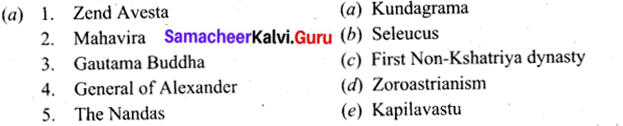
IV. Match the following.

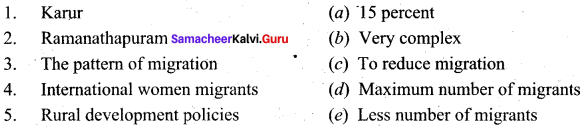
Samacheer Kalvi 9th Social Science History Solutions Chapter 4 Intellectual Awakening and Socio-Political Changes 1
Answer:
1. (e)
2. (a)
3. (b)
4. (c)
5. (d)

V. Answer the following briefly.

Question 1.
The invention of the smelting of Iron transformed both production and warfare. Justify.
Answer:

  1. The invention of the smelting of iron transformed both production and warfare.
  2. Before iron, copper, and its alloy, bronze which was expensive was employed in production.
  3. The weapons (or) ploughs made of copper (of) bronze edges became blunt quickly.
  4. Iron ore in contrast was available in abundance.
  5. The “weapons made of iron was in usage.
  6. The iron axe enabled cultivators to clear the jungles and the iron plough was used to break the hardest soil.

Question 2.
Elaborate on the term “Tri-Ratna”.
Answer:
The three principles of Jainism, also known as Tri-Ratnas are the following:

  1. Right faith: Belief in the teachings and wisdom of Mahavira.
  2. Right knowledge: Acceptance of the theory that there is no God and that the world existed without a creator.
  3. Right action: It refers to Mahavira’s observance of the fire great views
    • Ahimsa
    • Honesty
    • Kindness
    • Truthfulness
    • not coveting or desiring things belonging to others.

Question 3.
What do you know of Ajatasatru?
Answer:

  • Ajatashatru, the son of Bimbisara is said to have murdered his father and ascended the throne in 493 BCE.
  • He continued his father’s policy of expansion through military conquests.
  • He strengthened the Rajagriha fort and also built another fort at Pataligrama on the Ganges. It served as the exchange centre for the local produce and late became the Mauryan capital of Pataliputra.
  • Ajatasatru died in 461 BCE.

Question 4.
What does the Edict of Kalinga convey?
Answer:

  • In one of his Kalinga edicts, he tells his horror and sorrow over the deaths which the war and conquest caused.
  • In yet another edict, he makes it known that Ashoka would not tolerate any longer the death (or) captivity or even the hundredth (or) thousandth part of the number killed and captive in Kalinga.

Question 5.
Highlight the steps taken by Ashoka to spread Buddhism.
Answer:
Steps were taken by Ashoka to spread Buddhism:

  1. Ashoka became an ardent Buddhist after meeting the Buddhist monk Upagupta and propounded his Dharma.
  2. He issued edicts, which were carved out in the rock.
  3. He protected the animals.
  4. Hospitals were constructed for them and animal sacrifice was forbidden.
  5. Ashoka sent his son Mahendra and his daughter Sanghamitra to Ceylon to spread his message of Dharma there. Ashoka died after ruling for 38 years.

VI. Answer all the questions given under each caption.

Question 1.
Zoroastrianism
(a) Who was the founder?
Answer:
Zoroaster of Persia is the founder of Zoroastrianism.

(b) Name the God he proclaimed.
Answer:
Ahura Mazda (the Lord of lights)

(c) What did Zoroaster teach?
Answer:
Zoroaster taught that the great object of a religious state or society is the cultivation of morality.

(d) What was the highest form of worship?
Answer:
Fire was worshipped as a symbol of the deity and considered the highest form of worship.

Samacheer Kalvi 9th Social Science History Solutions Chapter 4 Intellectual Awakening and Socio-Political Changes

Question 2.
Gautama Buddha
(a) What was the original name of Buddha?
Answer:
The original name of Buddha was Siddhartha.

(b) Name the birthplace of Buddha.
Answer:
The birthplace of Buddha in Lumbini Garden near Kapilavasthu in 567 BCE.

(c) Where did he get enlightenment?
Answer:
He got enlightenment in the Mahabodhi temple, which still exists in Bodh Gaya (Bihar).

(d) Mention the place of his first sermon.
Answer:
The place of his first sermon was Samath.

VII. Answer the following in detail.

Question 1.
Discuss the five cardinal principles of Confucius.
Answer:
Five Cardinal Principles of Confucius Ethics

  1. Humaneness
  2. Righteousness
  3. Propriety
  4. Wisdom
  5. Trustworthiness

(i) Confucius said that wisdom grows from the family and that the foundation of society is the disciplined individual in an orderly family.

(ii) The superior man, according to him, is not merely intelligent or scholarly, but his character should be exemplary.

(iii) The superior man of Confucius possesses three virtues: intelligence, courage, and goodwill

(iv) Though Confucius insisted on children obeying parents and wife her husband, he also clearly proposed that “when the command is wrong a son should resist his father and a minister should resist the prince.’’

(v) When asked about government, he said that there are three requisites for it: “That there should be sufficiency of food, the sufficiency of military equipment and confidence of the people in their ruler.”

(vi) The philosophy of Confucius gave the Chinese people awareness about their political rights.

(vii) It also clearly listed the government’s duty towards the people. Confucius felt that the government should work with an ideal.

(viii) In matters of national life, Confucius felt that the people in the nation are the actual and proper source of political sovereignty. He advised that the ruler must appoint persons of character in the government to govern the people impartially.

(ix) Confucianism is often characterized as a system of social and ethical philosophy rather than as a religion.

Question 2.
Compare and contrast the principles of Jainism and Buddhism.
Answer:

  1. The founders of Jainism and Buddhism did not prescribe killing as a religious rite.
  2. They secured their livelihood mostly by alms. Celibacy and abstinence from holding property made the new teachers much more acceptable than the Brahman priests.
  3. The people’s resentment about the expensive and elaborate Vedic rituals, animal sacrifice, and the desire for wealth eventually took them towards Jainism and Buddhism.
  4. Mahavira and Buddha lived a life of purity and exemplified simplicity and self-denial. They lived in the times of Bimbisara and Ajatashatru, the famous kings of Magadha.
  5. The commercial development of the northern cities like Kaushambi, Kushinagar, Benaras, Vaishali, and Rajgir added importance to the Vaishyas who turned to Buddhism and Jainism in their eagerness to improve their social status.

Student Activities

Question 1.
Prepare a case study of Asoka’s Edicts.
Answer:
“There are 33 edicts, including 14 Major Rock edicts, 7 Pillar edicts and 2 Kalinga edicts apart from Minor Rock edicts and Minor Pillar inscriptions”.
(i) The students can be divided into three groups in the class. Each group will be assigned a particular work, such as Major Rock Edicts, Pillar Edicts, and Kalinga Edicts.
(ii) They can refer to History Books, from the library (or) download from the Internet.
(iii) The teacher will be there to motivate the students.

Question 2.
Enact a drama about the life and teachings of Buddha.
Answer:
(i) You can prepare the script with the assistance of your teacher.
(ii) The drama can be enacted as a recreational activity in the class.

Assignment with teacher’s guidance

(i) List out the countries where Buddhism exists in the world and mark it on the world map. Some of the Buddhist countries are Cambodia, Thailand, Myanmar, Bhutan, Sri Lanka, Laos, Mongolia, Japan, Taiwan, Singapore, South Korea, Malaysia, China, and Vietnam. The students can mark these places on the world map.
(ii) Prepare a clay model of Sanchi Stupa, Darmachakra.
You can do this activity in groups with the help of your teacher.

Intellectual Awakening and Socio-Political Changes Additional Questions

I. Choose the correct answer.

Question 1.
The discovery of ………….. marked the beginning of the second phase in the history of civilisations.
(a) Iron
(b) Gold
(c) Copper
(d) Bronze
Answer:
(a) Iron

Question 2.
…………… said that wisdom grows from the family.
(a) Lao-Tse
(b) Zoroaster
(c) Confucius
(d) Buddha
Answer:
(c) Confucius

Question 3.
The doctrines and rituals of the Zoroastrians have many similarities to those of the ……………
(a) Buddhism
(b) Vedas
(c) Jainism
(d) Taoism
Answer:
(b) Vedas

Question 4.
Buddhism was preached in people’s language ……………….
(a) Pali
(b) Sanskrit
(c) Hindi
(d) Chinese
Answer:
(a) Pali

Samacheer Kalvi 9th Social Science History Solutions Chapter 4 Intellectual Awakening and Socio-Political Changes

Question 5.
Chandragupta’s son was ……………
(a) Bimbisara
(b) Bindusara
(c) Ajatasatru
(d) None of the above
Answer:
(b) Bindusara

Question 6.
(i) Monastries and temples served the purpose of imparting education.
(ii) Nalanda was a great monastery built by the Magadha empire.
(iii) Nalanda became the most renowned seat of learning.
(iv) Fees were charged to the students.
(a) (i) is correct
(b) (ii) is correct
(c) (iii) is correct
(d) (i), (ii), (iii) are correct (iv) is incorrect
Answer:
(d) (i), (ii), (iii) are correct (iv) is incorrect

II. Fill in the blanks.

  1. The philosophy of Confucius gave the Chinese people awareness about them……………..
  2. ………….. was pained to find his people worshipping primitive deities.
  3. Mahavira and Buddha lived a life of purity and exemplified …………… and …………….
  4. The statue of Bahubali at …………… in Karnataka is the tallest Jain statue ever carved out in India.
  5. Buddha belonged to the Sakya class he was also known as ……………….
  6. Buddhism was split into two as ………….. and ……………
  7. ………….. succeeded in establishing a comprehensive structure of administration.
  8. Alexander’s death, however, cleared the way for the founding of a great empire …………….. empire in India.
  9. The envoy of Seleucus’s was …………….
  10. Chandragupta’s minister Chanakya is credited with a book titled …………..

Answer:

  1. Political rights
  2. Zoroaster
  3. Simplicity, Self-denial
  4. Shravanabelgola
  5. Sakya Muni
  6. Hinayana & Mahayana
  7. Bimbisara
  8. Mauryan
  9. Megasthenes
  10. Arthasastra

III. Match the following.

Samacheer Kalvi 9th Social Science History Solutions Chapter 4 Intellectual Awakening and Socio-Political Changes 2
Answer:
1. (d)
2. (a)
3. (e)
4. (b)
5. (c)

IV. Answer the following questions briefly.

Question 1.
Who were the two great thinkers in the sixth century BCE?
Answer:
Confucius and Lao-Tse were the two great thinkers in the sixth century BCE.

Question 2.
Mention the five important works of Confucius.
Answer:

  1. The Book of Records
  2. The Book of odes
  3. The Book of changes
  4. The spring and Autumn Annals
  5. The Book of History.

Samacheer Kalvi 9th Social Science History Solutions Chapter 4 Intellectual Awakening and Socio-Political Changes

Question 3.
Name the seven qualities of Ahura Mazda.
Answer:

  1. light
  2. good mind
  3. right
  4. dominion
  5. piety
  6. well-being
  7. immortality.

Question 4.
What kind of life Mahavira and Buddha live?
Answer:
Mahavira and Buddha lived a life of purity and exemplified simplicity and self-denial.

Question 5.
Write a short note on “split in Jainism”.
Answer:

  • In course of time, Jainism split into two branches namely the Digambaras (Sky-clad) and the Svetambaras (White-clad)
  • The Digambaras were the Orthodox followers of Mahavira. They rejected clothes altogether. The Svetambaras wore a white dress from head to toe.

Question 6.
What did Buddha do to establish Buddhism?
Answer:

  • Buddha in order to carry his message to different parts of India established the Buddhist Sangha (or) the Holy order of Monks.
  • The bhikshus (monks) and the bhikshunis (nuns) were enlisted for spreading the faith and they were required to lead a life of purity and poverty.

Question 7.
What do you know about the Nanda dynasty?
Answer:

  1. Mahapadma Nanda founded the Nanda dynasty.
  2. The Nandas were the first of non-Kshatriya dynasties to rule in North India.
  3. Nandas gave importance to irrigation with the canals, they built touching even the Kalinga kingdom.

Question 8.
Mention the Educational centres of Mauryan Administration.
Answer:

  1. Monastries and temples served the purpose of imparting education.
  2. Nalanda was a great monastery built by the Magadha Empire.
  3. Educational centres offered Buddhist and Vedic literature, logic, grammar, medicine, philosophy, and astronomy.
  4. Even the science of war was taught.
  5. Nalanda became the most renowned seat of learning in course of time.

V. Answer all the questions given under each caption.

Question 1.
Confucius.
(a) When was Confucius born?
Answer:
Confucius was bom in the Shantung province of China in 551 BCE.

(b) Mention the five important works of Confucius.
Answer:

  1. The Book of Records
  2. The Book of odes
  3. The Book of changes
  4. The spring and Autumn Annals
  5. The Book of History.

(c) What are the five cardinal principles of “Confucius” Ethics?
Answer:

  1. Humaneness
  2. Righteousness
  3. Propriety
  4. Wisdom
  5. Trustworthiness.

(d) Mention the three virtues to be possessed by a superior man.
Answer:
Intelligence, courage, and goodwill.

Samacheer Kalvi 9th Social Science History Solutions Chapter 4 Intellectual Awakening and Socio-Political Changes

Question 2.
Jainism.
(a) When was Mahavira born?
Answer:
Vardhamana Mahavira was bom in 599 BCE at Kundagrama near Vaishali.

(b) Mention the three principles of Jainism.
Answer:

  1. Right faith
  2. Right knowledge
  3. Right Action.

(c) Name the rulers who patronised Jainism.
Answer:
Dhana Nanda, Chandra Gupta Maurya, and Kharavela.

(d) What are the two branches of Jainism?
Answer:
The two branches are Digambaras and Svetambaras.

VI. Answer the following in detail.

Question 1.
Explain the teachings of Lao-Tse (Taoism).
Answer:

  1. The cause of human unhappiness in the world is human selfishness. Selfishness creates unlimited human desires, which can never be satisfied.
  2. In nature, all things act in a natural way. The law of human conduct must correspond with nature.
  3. Humans live a life under the regulation of someone. This is because they have acquired knowledge and have not remained innocent. On the basis of their acquired knowledge, they have built up an urban civilisation and have made themselves unhappy.

Question 2.
Give reasons for the decline of Buddhism.
Answer:
Buddhism declined in India due to the following reasons:

  1. Buddhism was popular in the beginning because it was preached in people’s language (Pali). The later texts were written in Sanskrit, which was difficult for the common people to understand.
  2. The split in Buddhism into Hinayana and Mahayana was another vital reason. Image worship in Mahayana made no difference between Hinduism and Buddhism.
  3. Buddhism lost its royal patronage during the reign of Guptas.
  4. Further, the invasions of Huns and Turks almost wiped out Buddhism.

Samacheer Kalvi 9th Social Science History Solutions Chapter 4 Intellectual Awakening and Socio-Political Changes Read More »

Samacheer Kalvi 10th Science Solutions Chapter 1 Laws of Motion

You can Download Samacheer Kalvi 10th Science Book Solutions Guide Pdf, Tamilnadu State Board help you to revise the complete Syllabus and score more marks in your examinations.

Tamilnadu Samacheer Kalvi 10th Science Solutions Chapter 1 Laws of Motion

Samacheer Kalvi 10th Science Laws of Motion Textual Solved Problems

Question 1.
Calculate the velocity of a moving body of mass 5 kg whose linear momentum is 2.5 kg ms-1.
Solution:
Linear momentum = mass × velocity
Velocity = \(\frac { linear momentum }{ mass }\)
V = \(\frac { 2.5 }{ 0.5 }\) = 0.5 ms-1.

Question 2.
A door is pushed, at a point, whose distance from the hinges is 90 cm, with a force of 40 N. Calculate the moment of the force about the hinges.
Solution:
Formula: The moment of a force M = F × d
Given: F = 40 N and d = 90 cm = 0.9 m.
Hence, moment of the force = 40 × 0.9 = 36 Nm.

Question 3.
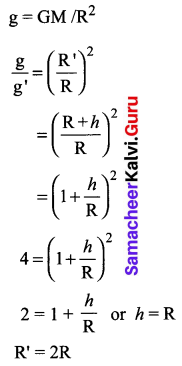
At what height from the centre of the Earth the acceleration due to gravity will be \(\frac { 1 }{ 4 }\)th of its value as at the Earth.
Solution:
Data: Height from the centre of the Earth, R’ = R + h
The acceleration due to gravity at that height, g’ = \(\frac { g }{ 4 }\)
Formula:
Samacheer Kalvi 10th Science Solutions Chapter 1 Laws of Motion 1
From the centre of the Earth, the object is placed at twice the radius of the earth.

Samacheer Kalvi 10th Science Laws of Motion Textbook Evaluation

I. Choose the correct answer.

1. The inertia of a body depends on _____ .
(a) weight of the object
(b) acceleration due to gravity of the planet
(c) mass of the object
(d) Both a & b.
Answer:
(c) mass of the object

Question 2.
Impulse is equals to:
(a) rate of change of momentum
(b) rate of force and time
(c) change of momentum
(d) rate of change of mass
Answer:
(c) change of momentum

Question 3.
Newton’s III law is applicable to ______ .
(a) for a body is at rest
(b) for a body in motion
(c) both a & b
(d) only for bodies with equal masses.
Answer:
(c) both a & b

Question 4.
Plotting a graph for momentum on the X-axis and time on Y-axis. The slope of the momentum-time graph gives:
(a) Impulsive force
(b) Acceleration
(c) Force
(d) Rate of force
Answer:
(c) Force

Question 5.
In which of the following sport the turning of the effect of force used?
(a) swimming
(b) tennis
(c) cycling
(d) hockey.
Answer:
(c) cycling
SamacheerKalvi.Guru
Question 6.
The unit of ‘g’ is ms-2. It can be also expressed as _____ .
(a) cm s-1
(b) N kg-1
(c) Nm2 kg-1
(d) cm2 s-2
Answer:
(b) N kg-1

Question 7.
One kilogram force equals to:
(a) 9.8 dyne
(b) 9.8 × 10⁴ N
(c) 98 × 104 dyne
(d) 980 dyne
Answer:
(c) 98 × 104 dyne

Question 8.
The mass of a body is measured on planet Earth as M kg. When it is taken to a planet of radius half that of the Earth then its value will be ____ kg.
(a) 4M
(b) 2M
(c) \(\frac { M }{ 4 }\)
(d) M.
Answer:
(c) \(\frac { M }{ 4 }\)

Question 9.
If the Earth shrinks to 50% of its real radius its mass remaining the same, the weight of a body on the Earth will _____ .
(a) decrease by 50%
(b) increase by 50%
(c) decrease by 25%
(d) increase by 300%.
Answer:
(c) decrease by 25%

Question 10.
To project the rockets which of the following
principle(s) is /(are) required?
(a) Newton’s third law of motion
(b) Newton’s law of gravitation
(c) Law of conservation of linear momentum
(d) Both (a) and (c)
Answer:
(d) Both (a) and (c)

II. Fill in the blanks.

Question 1.
To produce a displacement _____ is required.
Answer:
force.

Question 2.
Passengers lean forward when the sudden brake is applied in a moving vehicle. This can be explained by ____.
Answer:
the inertia of motion.

Question 3.
By convention, the clockwise moments are taken as _____ and the anticlockwise moments are taken as _____.
Answer:
negative, positive.

Question 4.
______ is used to change the speed of the car.
Answer:
Acceleration.
SamacheerKalvi.Guru

Question 5.
A man of mass 100 kg has a weight of _____ at the surface of the Earth.
Answer:
980 N.

III. State whether the following statements are true or false. Correct the statement if it is false:

Question 1.
The linear momentum of a system of particles is always conserved.
Answer:
False.
Correct Statement: The linear momentum of a system of particles is always conserved if no external force acts.

Question 2.
The apparent weight of a person is always equal to his actual weight.
Answer:
True.

Question 3.
Weight of a body is greater at the equator and less at the polar region.
Answer:
False.
Correct Statement: Weight of a body is lesser at the equator and greater at the polar region.

Question 4.
Turning a nut with a spanner having a short handle is so easy than one with a long handle.
Answer:
False.
Correct Statement: Turning a nut with a spanner having a short handle is so harder than one with a long handle.

Question 5.
There is no gravity in the orbiting space station around the Earth. So the astronauts feel weightlessness.
Answer:
False.
Correct Statement: There is a gravity in the orbiting space station around the earth. Since space station and astronauts have equal acceleration. Both the astronauts and space station are in the state of weightlessness.

IV. Match the following.

Question 1.

Column I Column II
1. Newton’s I law (a) Propulsion of a rocket
2. Newton’s II law (b) Stable equilibrium of a body
3. Newton’s III law (c) Law of force
4. Law of conservation of linear momentum (d) Flying nature of a bird

Answer:
1. (b) Stable equilibrium of a body
2. (c) Law of force
3. (d) Flying nature of a bird
4. (a) Propulsion of a rocket

V. Assertion & Reasoning

Mark the correct choice as
(a) If both the assertion and the reason are true and the reason is the correct explanation of assertion.
(b) If both the assertion and the reason are true, but the reason is not the correct explanation of the assertion.
(c) Assertion is true, but the reason is false.
(d) Assertion is false, but the reason is true.
SamacheerKalvi.Guru

Question 1.
Assertion: The sum of the clockwise moments is equal to the sum of the anticlockwise moments.
Reason: The principle of conservation of momentum is valid if the external force on the system is zero.
Answer:
(b) If both the assertion and the reason are true, but the reason is not the correct explanation of the assertion.

Question 2.

  1. Assertion: The value of ‘g’ decreases as height and depth increase from the surface of the Earth.
  2. Reason: ‘g’ depends on the mass of the object and the Earth.

Answer:
(c) The assertion is true, but the reason is false.

VI. Answer briefly.

Question 1.
Define inertia. Give its classification.
Answer:
Inertia: The inherent property of a body to resist any change in its state of rest or the state of uniform motion, unless it is influenced upon by an external unbalanced force, is known as ‘inertia’.
Types of Inertia

  • Inertia of rest
  • Inertia of motion
  • Inertia of direction

Question 2.
Classify the types of force based on their application.
Answer:

  1. Like parallel forces
  2. Unlike parallel forces

Question 3.
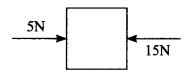
If a 5 N and a 15 N forces are acting opposite to one another. Find the resultant force and the direction of action of the resultant force.
Solution:
The two forces are unlike parallel forces
Samacheer Kalvi 10th Science Solutions Chapter 1 Laws of Motion 2
Let P = 5N, Q = 15N
Resultant force (R) = P – Q = 5 + (-15) = -10N
R = -10N.
The resultant force acting along the direction of “Q”.

Question 4.
Differentiate mass and weight.
Answer:

Mass Weight
The quantity of matter contained in the body The gravitation force exerted on it due to the Earth’s gravity alone.
Scalar quantity Vector quantity
Unit: Kg Unit: N
Constant at all the places Variable with respect to gravity.

Question 5.
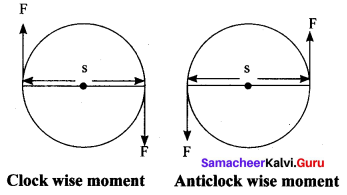
Define moment of a couple.
Answer:
Rotating effect of a couple is known as moment of a couple.
Moment of a couple = Force × perpendicular distance between the line of action of forces
M = F × S

Question 6.
State the principle of moments.
Answer:
When a number of like or unlike parallel forces act on a rigid body and the body is in equilibrium, then the algebraic sum of the moments in the clockwise direction is equal to the algebraic sum of the moments in the anticlockwise direction.

Question 7.
State Newton’s second law.
Answer:
“The force acting on a body is directly proportional to the rate of change of linear momentum of the body and the change in momentum takes place in the direction of the force”.
SamacheerKalvi.Guru

Question 8.
Why a spanner with a long handle is preferred to tighten screws in heavy vehicles?
Answer:
This is because turning effect to tighten the screws depends upon the perpendicular distance of the applied force from the axis of rotation is power arm. Larger the power armless is the force required to turn the screws. So spanner is provided with a long handle.

Question 9.
While catching a cricket ball the fielder lowers his hands backwards. Why?
Answer:
(i) When the fielder lowers his hands backwards, he increases the value of time of collision and so retardation is decreased.
(ii) Hence retarding force becomes lesser than before and the palm of the fielder is not hurt very much.

Question 10.
How does an astronaut float in a space shuttle?
Answer:
An astronaut float in a space shuttle because both are in the state of weightlessness. Both are experiencing equal acceleration towards earth as free fall bodies. Astronauts are not floating but falling freely.

VII. Solve the given problems.

Question 1.
Two bodies have a mass ratio of 3 : 4. The force applied to the bigger mass produces an acceleration of 12 ms-2. What could be the acceleration of the other body, if the same force acts on it?
Solution:
Mass ratio of the bodies = 3 : 4 and same force is (m1 : m2) acting on the body and a2 = 12 ms-2
∴ m1a1 = m2a2
\(\frac{m_{1}}{m_{2}}=\frac{a_{2}}{a_{1}} \Rightarrow \frac{3}{4}=\frac{a_{2}}{a_{1}}\)
\(a_{1}=\frac{4}{3} \times 12=16 \mathrm{ms}^{-2}\)

Question 2.
A ball of mass 1 kg moving with a speed of 10 ms-1 rebounds after a perfectly elastic collision with the floor. Calculate the change in linear momentum of the ball.
Solution:
Mass of a ball = 1 kg
Velocity of the bail before collision,
u = 10 m/s
Velocity of the ball after collision,
v = – u
= -10 m/s
Change in momentum,
P = m(v – u)
P = 1(-10 – 10)
= -20 kg m/s.

Question 3.
A mechanic unscrews a nut by applying a force of 140 N with a spanner of length 40 cm. What should be the length of the spanner if a force of 40 N is applied to unscrew the same nut?
Solution:
Given F1 = 140 N, d1 = 40 cm, F2 = 40 N, d2 = ?
In, both the cases, moment of forces applied are equal
F1d1 = F2d2
\(\begin{array}{l}{d_{2}=\left(\frac{F_{1}}{F_{2}}\right) d_{1}} \\ {d_{2}=40 \times \frac{140}{40}=140 \mathrm{cm}}\end{array}\)
SamacheerKalvi.Guru

Question 4.
The ratio of masses of two planets is 2 : 3 and the ratio of their radii are 4 : 7 Find the ratio of their accelerations due to gravity.
Solution:
The ratio of masses of two planets m1 : m2 = 2 : 3
The ratio of radii of two planets R1 : R2 = 4 : 7
Formula:
Samacheer Kalvi 10th Science Solutions Chapter 1 Laws of Motion 3

VIII. Answer in detail.

Question 1.
What are the types of inertia? Give an example for each type.
Answer:
Types of Inertia:
(i) Inertia of rest: The resistance of a body to change its state of rest is called inertia of rest. Eg: When you vigorously shake the branches of a tree, some of the leaves and fruits are detached and they fall down.

(ii) Inertia of motion: The resistance of a body to change its state of motion is called inertia of motion. Eg: An athlete runs some distance before jumping. Because, this will help him jump longer and higher.

(iii) Inertia of direction: The resistance of a body to change its direction of motion is called inertia of direction. Eg: When you make a sharp turn while driving a car, you tend to lean sideways.

Question 2.
State Newton’s laws of motion.
Answer:
Newton’s First Law: Everybody continues to be in its state of rest or the state of uniform motion along a straight line unless it is acted upon by some external force.

Newtons Second law: The force acting on a body is directly proportional to the rate of change of linear momentum of the body and the change in momentum takes place in the direction of the force.

Newtons Third Law: For every action, there is an equal and opposite reaction. They always act on two different bodies.

Question 3.
Deduce the equation of a force using Newton’s second law of motion.
Answer:
“The force acting on a body is directly proportional to the rate of change of linear momentum of the body and the change in momentum takes place in the direction of the force”.
Let, ‘m’ be the mass of a moving body, moving along a straight line with an initial speed ‘u’ After a time interval of ‘t’, the velocity of the body changes to ‘v’ due to the impact of an unbalanced external force F.
Initial momentum of the body (Pi) = mu
Final momentum of the body (Pf) = mv
Change in momentum ∆p = Pf – Pi = mv – mu
By Newton’s second law of motion,
Force, F ∝ rate of change of momentum
F ∝ change in momentum / time
\(\begin{array}{l}{\mathrm{F} \propto \frac{m v-m u}{t}} \\ {\mathrm{F}=\frac{k m(v-u)}{t}}\end{array}\)
Here, k is the proportionality constant, k = 1 in all systems of units.
Hence, \(\mathrm{F}=\frac{m(v-u)}{t}\)
Since, acceleration = change in velocity / time,
a = (v – u)/t.
Hence, we have F = m × a
Force = mass × acceleration

  • No external force is required to maintain the motion of a body moving with uniform velocity.
  • When the net force acting on a body is not equal to zero, then definitely the velocity of the body will change.
  • Thus, change in momentum takes place in the direction of the force. The change may take place either in magnitude or in direction or in both.

Question 4.
State and prove the law of conservation of linear momentum.
Answer:
(i) There is no change in the linear momentum of a system of bodies as long as no net external force acts on them.
(ii) Let us prove the law of conservation of linear momentum with the following illustration:
Samacheer Kalvi 10th Science Solutions Chapter 1 Laws of Motion 4
(iii) Let two bodies A and B having masses m1 and m2 move with initial velocity u1 and u2 in a straight line.
(iv) Let the velocity of the first body be higher than that of the second body. i.e., u1 > u2.
(v) During an interval of time t second, they tend to have a collision. After the impact, both of them move along the same straight line with a velocity v1 and v2 respectively.
Force on body B due to A,
\(\mathrm{F}_{\mathrm{B}}=\frac{m_{2}\left[v_{2}-u_{2}\right]}{t}\)
Force on body A due to B,
\(\mathrm{F}_{\mathrm{A}}=\frac{m_{1}\left[v_{1}-u_{1}\right]}{t}\)
By Newton’s III law of motion, Action force = Reaction force
FA = -FB
\(\begin{aligned} \frac{m_{1}\left[v_{1}-u_{1}\right]}{t} &=\frac{m_{2}\left[v_{2}-u_{2}\right]}{t} \\ m_{1} v_{1}+m_{2} v_{2} &=m_{1} u_{1}+m_{2} u_{2} \end{aligned}\)
The above equation confirms in the absence of an external force, the algebraic sum of the momentum after collision is numerically equal to the algebraic sum of the momentum before collision.
Hence the law of conservation linear momentum is proved.

Question 5.
Describe rocket propulsion.
Answer:
Propulsion of rockets is based on the law of conservation of linear momentum as well as Newton’s III law of motion. Rockets are filled with a fuel (either liquid or solid) in the propellant tank. When the rocket is fired, this fuel is burnt and a hot gas is ejected with a high speed from the nozzle of the rocket, producing a huge momentum. To balance this momentum, an equal and opposite reaction force is produced in the combustion chamber, which makes the rocket project forward.

While in motion, the mass of the rocket gradually decreases, until the fuel is completely burnt out. Since, there is no net external force acting on it, the linear momentum of the system is conserved. The mass of the rocket decreases with altitude, which results in the gradual increase in velocity of the rocket. At one stage, it reaches a velocity, which is sufficient to just escape from the gravitational pull of the Earth. This velocity is called escape velocity.

Question 6.
State the universal law of gravitation and derive its mathematical expression.
Answer:
This law states that every particle of matter in this universe attracts every other particle with a force. This force is directly proportional to the product of their masses and inversely proportional to the square of the distance between the centres of these masses. The direction of the force acts along the line joining the masses.
Samacheer Kalvi 10th Science Solutions Chapter 1 Laws of Motion 5
The force between the masses is always attractive and it does not depend on the medium where they are placed.
Let, m1 and m2 be the masses of two bodies A and B placed r metre apart in space.
Force F ∝ m1 × m2
F ∝ \(1 / r^{2}\)
On combining the above two expressions
\(\begin{array}{l}{\mathrm{F} \propto \frac{m_{1} \times m_{2}}{r^{2}}} \\ {\mathrm{F}=\frac{\mathrm{G} m_{1} m_{2}}{r^{2}}}\end{array}\)
Where G is the universal gravitational constant.
Its value in SI unit is 6.674 × 10⁻¹¹ Nm2 kg-2.

Question 7.
Give the applications of the universal law of gravitation.
Answer:
Application of Newton’s law of gravitation are:
(i) Dimensions of the heavenly bodies can be measured using the gravitation law. Mass of the Earth, radius of the Earth, acceleration due to gravity, etc., can be calculated with a higher accuracy.
(ii) Helps in discovering new stars and planets.
(Hi) Helps to explain germination of roots is due to the property of geotropism which is the property of a root responding to the gravity.
(iv) One of the irregularities in the motion of stars is called ‘Wobble’ lead to the disturbance in the motion of a planet nearby. In this condition the mass of the star can be calculated using the law of gravitation.
(v) Helps to predict the path of the astronomical bodies.

IX. HOT Questions.

Question 1.
Two blocks of masses 8 kg and 2 kg respectively, lie on a smooth horizontal surface in contact with one other. They are pushed by a horizontally applied force of 15 N. Calculate the force exerted on the 2 kg mass.
Solution:
Samacheer Kalvi 10th Science Solutions Chapter 1 Laws of Motion 6
Given: m1 = 8 kg, m2 = 2 kg, F = 15 N
F = mtotal, F = (m1 + m2) a = (8 + 2) a = 10 a
15 = 10 a
⇒ a = \(\frac{15}{10}=\frac{3}{2}\) ms-2
Force exerted by mass of 8 kg
F = m1 a = \(8 \times \frac{3}{2}\) = 12 N.

Question 2.
A heavy truck and bike are moving with the same kinetic energy. If the mass of the truck is four times that of the bike, then calculate the ratio of their momenta. (Ratio of momenta = 1 : 2)
Solution:
Given: Let m1, m2 are the masses of truck and bike.
m1 = 4m2
Here kinetic energies of both truck and bike are same
\(\begin{aligned} m_{1} v_{1}^{2} &=m_{2} v_{2}^{2} \\ 4 m_{2} v_{1}^{2} &=m_{2} v_{2}^{2} \\ \frac{v_{1}}{v_{2}} &=\frac{1}{2} \\ v_{2} &=2 v_{1} \end{aligned}\)
Ratio of momenta: \(\frac{p_{1}}{p_{2}}=\frac{m_{1} v_{1}}{m_{2} v_{2}}=\frac{4 m_{2}}{m_{2}} \cdot \frac{v_{1}}{2 v_{1}}\) = 2
P1 : P2 = 2 : 1.
SamacheerKalvi.Guru

Question 3.
“Wearing a helmet and fastening the seat belt is highly recommended for the safe journey”.Justify your answer using Newton’s laws of motion.
Answer:
During the motion of car and two wheelers, when the brakes are applied, the vehicles slow down but our body tends to continue in the same state of motion due to inertia. So this may cause injury to passengers. Hence they are advised to wear a helmet and seat belt.

Samacheer Kalvi 10th Science Laws of Motion Additional Questions

I. Choose the correct answer.

Question 1.
A cricketer catches a ball of mass 150 gm in 0.1s and which is moving with a speed of 20 ms-1, then he experiences the force of ____ _.
(a) 300 N
(b) 30 N
(c) 3 N
(d) 0.3 N.
Answer:
(b) 30 N
Hint: Impulse = change in momentum
F.∆t = mv – mu
\(\mathrm{F}=\frac{m v-m u}{\Delta t}\)
\(=\frac{150 \times 10^{-3} \times 20}{0.1}=30 \mathrm{N}\)

Question 2.
SI unit of force is:
(a) Dyne
(b) newton
(c) kgms-1
(d) Joule
Answer:
(b) newton

Question 3.
A coin is dropped in a lift. It takes time t1 to reach the floor, when the lift is stationary, it takes time t2, when the lift is moving up with constant acceleration, then ____ _.
(a) t1 > t2
(b) t1 < t2
(c) t1 = t2
(d) None.
Answer:
(a) t1 > t2

Question 4.
An unbalanced force acts on a body, the body:
(a) must remain at rest
(b) must be accelerated
(c) must move with uniform velocity
(d) move with uniform motion
Answer:
(b) must be accelerated

Question 5.
A satellite in its orbit around the earth is weightless on account of its _____.
(a) velocity
(b) momentum
(c) angular momentum
(d) acceleration.
Answer:
(c) angular momentum
SamacheerKalvi.Guru

Question 6.
When two or more forces acting on a body and the body does not change its position, then the forces are:
(a) imbalanced
(b) mechanical force
(c) balanced forces
(d) none
Answer:
(c) balanced forces

Question 7.
What would be the acceleration due to gravity at another planet, whose mass and radius core twice that of earth?
(a) g
(b) \(\frac{g}{2}\)
(c) \(\frac{g}{4}\)
Answer:
(b) \(\frac{g}{2}\)
Hint: We know that \(\mathrm{g}=\frac{\mathrm{GM}}{\mathrm{R}^{2}}\)
\(\frac{g_{1}}{g_{2}}=\frac{\left(\frac{\mathrm{GM}}{\mathrm{R}^{2}}\right)}{\left(\frac{\mathrm{G} .2 \mathrm{M}}{4 \mathrm{R}^{2}}\right)}\)
\(\frac{g_{1}}{g_{2}}=2 \quad \Rightarrow \quad g_{2}=\frac{1}{2} g_{1}\)

Question 8.
At sea level, the value of “g” is maximum at _____.
(a) the poles
(b) the equator
(c) 45° south latitude
(d) 45° north of longitude.
Answer:
(a) the poles

Question 9.
An object cannot change the state of rest or motion, until a force is applied. This inability of the object is called:
(a) inertia
(b) mass
(c) weight
(d) acceleration
Answer:
(a) inertia

Question 10.
The ability of a body to maintain its state of rest or motion is called ______.
(a) mechanics
(b) kinematics
(c) kinetics
(d) Inertia.
Answer:
(d) Inertia.

Question 11.
_____ deals with the bodies, which are at rest under the action of forces.
(a) Statics
(b) Dynamics
(c) Kinematics
(d) Kinetics.
Answer:
(a) Statics

Question 12.
A motor car starts from rest and moves after 5 seconds. If its velocity is 200 m/s then its acceleration is:
(a) 100 m/s²
(b) 40 m/s²
(c) 20 m/s²
(d) 80 m/s²
Answer:
(b) 40 m/s²

Question 13.
_____ deals with the motion of bodies considering the cause of motion.
(a) Force
(b) Dynamics
(c) Statics
(d) Kinetics.
Answer:
(d) Kinetics
SamacheerKalvi.Guru

Question 14.
Linear momentum = _____
(a) mass × velocity
(b) mass × distance
(c) distance × time
(d) \(\frac{\text { mass }}{\text { velocity }}\).
Answer:
(a) mass × velocity

Question 15.
The inability of the body to change its state is:
(a) force
(b) momentum
(c) acceleration
(d) inertia
Answer:
(d) inertia

Question 16.
Two or more forces of equal or unequal magnitude acting along the same direction, parallel to each other are called _____.
(a) like parallel forces
(b) unlike parallel forces
(c) resultant force
(d) balanced force.
Answer:
(a) like parallel forces

Question 17.
The axis of the fixed edge about which the thing is rotated is called as _____ .
(a) axis of rotation
(b) fixed axis rotation
(c) point of rotation
(d) Fixed point.
Answer:
(a) axis of rotation

Question 18.
When a net force acts on an object, the object will be accelerated in the direction of force with an acceleration proportional to:
(a) force on the object
(b) velocity
(c) mass
(d) inertia
Answer:
(a) force on the object

Question 19.
Rotating effect of a couple is known as ______ .
(a) product of forces
(b) the momentum of a couple
(c) mass
(d) momentum.
Answer:
(b) momentum of a couple

Question 20.
The amount of force required to produce an acceleration of 1 ms-2 in a body of mass _____ is called unit force.
(a) 10 kg
(b) 100 kg
(c) 1 kg
(d) 0 kg.
Answer:
(c) 1 kg

Question 21.
The acceleration of a body is due to:
(a) balance force
(b) electrostatic force
(c) unbalanced force
(d) conservative force
Answer:
(c) unbalanced force

Question 22.
Universal gravitational constant ______ .
(a) G = 6.684 × 10⁻¹⁰ Nm2 kg-1
(b) G = 7.4 × 10¹⁰ Nm2
(c) G = 6.623 × 10¹¹ Nm2 kg-1
(d) G = 6.674 × 10⁻¹¹ Nm2 kg-2
Answer:
(d) G = 6.674 × 10⁻¹¹ Nm2 kg-2

Question 23.
Mean value of the acceleration due to gravity is ______ .
(a) 10.1 ms-2
(b) 8.8 ms-2
(c) 9.8 ms-2
(d) 9.8 ms.
Answer:
(c) 9.8 ms-2
SamacheerKalvi.Guru

Question 24.
The unit of weight is:
(a) kg
(b) g
(c) Newton
(d) ms-1
Answer:
(c) Newton

Question 25.
The value of accelaration due to gravity on the surface of the moon is _____ .
(a) 1.75 ms-1
(b) 3.8 ms-2
(c) 1.625 ms-2
(d) 1.625 ms-1
Answer:
(c) 1.625 ms-2

Question 26.
The unit of weight is _____ .
(a) kg m
(b) kg
(c) newton
(d) kg m-1
Answer:
(c) newton

Question 27.
The weight of a body is _____ poles than at the equatorial region.
(a) more
(b) less
(c) zero
(d) one.
Answer:
(a) more

Question 28.
In a collision between a heavier body and a lighter body, which body experiences greater force?
(a) heavier body
(b) lighter body
(c) both the body experience same force
(d) both body exchange acceleration
Answer:
(c) both the body experience same force

II. Fill in the blanks.

Question 1.
Turning a tap is an example of ____
Answer:
couple.

Question 2.
Torque is a _______ quantity.
Answer:
vector.

Question 3.
1 gf is equal to _____ dyne.
Answer:
980.

Question 4.
The resultant force acting on a body is equal to zero then the body will be in ______
Answer:
equilibrium.

Question 5.
The force equal to resultant but opposite in direction is ______
Answer:
equilibrate.

Question 6.
The product of force and time is ______
Answer:
impulse.

Question 7.
The force between the masses is always ______
Answer:
attractive.

Question 8.
The quantity of matter contained in the object is known as _____
Answer:
mass.

Question 9.
The magnitude of the universal gravitational constant is _____.
Answer:
6.674 × 10⁻¹¹ Nm2 kg-2

Question 10.
Propulsion of rockets is based on the ____ and ____
Answer:
Law of conservation of linear momentum & Newton’s third law.

Question 11.
Parallel unequal forces are acting in ______ directions.
Answer:
Opposite.

Question 12.
Torque and force are the ____ quantities.
Answer:
vector.
SamacheerKalvi.Guru

Question 13.
The unit of moment of a couple is _____ .
Answer:
newton metre (Nm).

Question 14.
A _____ enables you to manoeuvre a car easily by transferring a _______ to the wheels with less effort.
Answer:
steering wheel, torque.

Question 15.
_____ is required to produce the acceleration of a body.
Answer:
Force.

Question 16.
The acceleration is produced along the radius is called ______
Answer:
centripetal acceleration.

Question 17.
______ is equal to the magnitude of change in momentum.
Answer:
impulse.

Question 18.
A large force acting for a very short interval of time is called as ______ .
Answer:
impulse Force.

Question 19.
Mass of the earth _____
Answer:
5.972 × 1024 kg.

Question 20.
The relation between acceleration due to gravity (g) and the universal gravitational constant (G) is _____ .
Answer:
\(g=\frac{G M}{R^{2}}\).

III. State whether the following statements are true or false, correct the statement if it is false.

Question 1.
Rest and motion are interrelated terms.
Answer:
True.

Question 2.
In the C.G.S. system, the unit of linear momentum is kg ms-1.
Answer:
False.
Correct Statement: In the C.G.S. system, the unit of linear momentum is g cms-1.

Question 3.
An external force is required to maintain the motion of a body moving with uniform velocity.
Answer:
False.
Correct Statement: No external force is required to maintain the motion of a body moving with uniform velocity.

Question 4.
The amount of force required for a body of mass 1 gram produces an acceleration of 1 cm s-2
Answer:
True.
SamacheerKalvi.Guru

Question 5.
By Newton’s III – law of motion, the action force is not equal to the reaction force.
Answer:
False.
Correct Statement: By Newton’s III – law of motion, the action force is equal to the reaction force.

Question 6.
The value of acceleration due to gravity (g) is not the same at all the points on the surface of the earth.
Answer:
True.

Question 7.
The value of acceleration due to gravity on the surface of the moon is 1.625 ms-2.
Answer:
True.

Question 8.
The regularities in the motion of stars are called ‘wobble’.
Answer:
False.
Correct Statement: The irregularities in the motion of stars is called ‘wobble’.

Question 9.
Mechanics is divided into kinematics and kinetics.
Answer:
False.
Correct Statement: Mechanics is divided into statics and dynamics.

Question 10.
Application of Newton’s law of gravitation helps to predict the path of the astronomical bodies.
Answer:
True.

IV. Match the following.

Question 1.

1. Linear momentum (a) Mass and acceleration
2. Force (b) Change in momentum
3. Moment of force (c) GM/R2
4. Impulse (d) Mass and velocity
5. Acceleration due to gravity (e) Force and perpendicular distance

Answer:
1. (d) Mass and velocity
2. (a) Mass and acceleration
3. (e) Force and perpendicular distance
4. (b) Change in momentum
5. (c) GM/R2

Question 2.

1. Kinetics (a) Causes the motion
2. Kinematics (b) In equilibrium
3. Balanced force (c) The motion of bodies without cause
4. Unbalanced force (d) The motion of bodies with cause

Answer:
1. (d) The Motion of bodies with cause
2. (c) The Motion of bodies without cause
3. (b) In equilibrium
4. (a) Causes the motion

V. Assertion & Reasoning

Mark the correct choice as
(a) If both the assertion and the reason are true and the reason is the correct explanation of assertion.
(b) If both the assertion and the reason are true, but the reason is not the correct explanation of the assertion.
(c) Assertion is true, but the reason is false.
(d) Assertion is false, but the reason is true.

Question 1.
Assertion: At poles value of acceleration due to gravity (g) is greater than that of the equator.
Reason: Earth rotates on its axis in addition to revolving around the sun.
Answer:
(a) If both the assertion and the reason are true and the reason is the correct explanation of assertion.

Question 2.
Assertion: The force exerted by the earth on an apple is more than that exerted by apple on the earth.
Reason: The force on apple exerts on the earth is determined by the mass of the apple only.
Answer:
(d) The assertion is false but the reason is true

Question 3.
Assertion: A freely falling body is in the state of weightlessness
Reason: A body becomes conscious of its weight only when it is opposed
Answer:
(a) If both the assertion and the reason are true and the reason is the correct explanation of assertion.
SamacheerKalvi.Guru

Question 4.
Assertion: Newton’s third law of motion is applicable only when bodies are in motion.
Reason: Newton’s third law applies to all types of forces, e.g. gravitational, electric or magnetic forces.
Answer:
(d) The assertion is false but the reason is true.

Question 5.
Assertion: The apparent weight of the person is zero, in which condition or state is known as weightless.
Reason: When the person in a lift moves down with an acceleration (a) is equal to the acceleration due to gravity (g)
Answer:
(a) If both the assertion and the reason are true and the reason is the correct explanation of assertion.

Question 6.
Assertion: A gear is a circular wheel with teeth around its rim.
Reason: It helps to change the speed of rotation of a wheel by changing the force and helps to transmit power.
Answer:
(c) The assertion is true, but the reason is false.

Question 7.
Assertion: Mass of a body is defined as the gravitational force exerted on it due to earth’s gravity alone
Reason: Weight = mass × acceleration due to gravity.
Answer:
(d) The assertion is false, but the reason is true.

Question 8.
Assertion: Weight is a vector quantity.
Reason: Direction of weight is always towards the centre of the earth.
Answer:
(a) If both the assertion and the reason are true and the reason is the correct explanation of assertion.

Question 9.
Assertion: Resultant force is equal to the vector sum of all the forces.
Reason: A system cannot be brought to equilibrium by applying another force.
Answer:
(b) If both the assertion and the reason are true, but the reason is not the correct explanation of the assertion.

VI. Answer briefly

Question 1.
Define Linear momentum.
Answer:
The product of mass and velocity of a moving body gives the magnitude of linear momentum. It acts in the direction of the velocity of the object. Linear momentum is a vector quantity.
Linear Momentum = mass × velocity.
Unit of momentum in SI system is Kg ms-1 and in C.G.S system its unit is g cm s-1

Question 2.
What is the resultant force?
Answer:
When several forces act simultaneously on the same body, then the combined effect of the multiple forces can be represented by a single force, which is termed as ‘resultant force’.

Question 3.
What is meant by equilibrant?
Answer:
A system can be brought to equilibrium by applying another force, which is equal to the resultant force in magnitude, but opposite in direction. Such force is called as ‘Equilibrant’.
SamacheerKalvi.Guru

Question 4.
Explain the Newton third law of motion with examples.
Answer:
‘For every action, there is an equal and opposite reaction. They always act in two different bodies’.
Example: When you fire a bullet, the gun recoils backwards and the bullet is moving forward (Action) and the gun equalises this forward action by moving backwards (Reaction).

Question 5.
How did the change in momentum achieve?
Answer:
Change in momentum can be achieved in two ways. They are:

  • A large force acting for a short period of time and
  • A smaller force acting for a longer period of time.

Question 6.
Define impulse.
Answer:
A large force acting for a very short interval of time is called as ‘Impulsive force’.When a force F acts on a body for a period of time t, then the product of force and time is known as ‘impulse’ represented by ‘J’
Impulse, J = F × t …….. (1)
By Newton’s second law
F = ∆p / t (A refers to change)
∆p = F × t ………. (2)
From (1) and (2)
J = ∆p
Impulse is also equal to the magnitude of change in momentum.
Its unit is kg ms-1 or Ns.

Question 7.
What is meant by free fall?
Answer:

  1. When the person in a lift moves down with an acceleration (a) equal to the acceleration due to gravity (g), i.e., when a = g, this motion is called as ‘free fall’.
  2. The apparent weight (R = m (g – g) = 0) of the person is zero. This condition or state refers to the state of weightlessness.

Question 8.
Define weightlessness.
Answer:
Whenever a body or a person falls freely under the action of Earth’s gravitational force alone, it appears to have zero weight. This state is referred to as ‘weightlessness’.

Question 9.
Explain the various causes of the apparent weight of a person in a moving lift.
Answer:

Case 1: Lift is moving upward with an acceleration ‘a’ Case 2: Lift is moving downward with an acceleration ‘a’ Case 3: Lift is at rest. Case 4: Lift is falling down freely
R – W = Fnet = ma
⇒ R = W + ma
⇒ R = mg + ma
⇒ R = m(g + a)
W – R = Fnet = ma
⇒ R = W – ma
⇒ R = mg – ma
⇒ R = m(g – a)
Here,the acceleration is zero
a = 0
R = W
R = mg
Here,the acceleration is equal to g
a = g
R = m(g – g) = 0
R > W R < W R = W R = 0
Apparent weight is greater than the actual weight. Apparent weight is lesser than the actual weight. Apparent weight is equal to the actual weight. Apparent weight is equal to zero.

Question 10.
Explain the variation of acceleration due to gravity.
Answer:
Variation of acceleration due to gravity (g):

  1. Since, g depends on the geometric radius of the Earth, (g ∝ 1 / R2), its value changes from one place to another on the surface of the Earth.
  2. The geometric radius of the Earth is maximum in the equatorial region and minimum in the polar region, the value of g is maximum in the polar region and minimum at the equatorial region.
  3. When you move to a higher altitude from the surface of the Earth, the value of g reduces.
  4. when you move deep below the surface of the Earth, the value of g reduces. Value of g is zero at the centre of the Earth.

Question 11.
Define one newton and one dyne.
Answer:
Definition of 1 newton (N): The amount of force required for a body of mass 1 kg produces an acceleration of 1 ms-2, 1 N = 1 kg ms-2
Definition of 1 dyne: The amount of force required for a body of mass 1 gram produces an acceleration of 1 cms-2, 1 dyne = 1 g cms-2; also 1 N = 105 dyne.

Question 12.
How can you measure the moment of the couple?
Answer:
(i) Rotating effect of a couple is known as the moment of a couple.
(ii) Moment of a couple is measured by the product of any one of the forces and the perpendicular distance between the line of action of two forces. The turning effect of a couple is measured by the magnitude of its moment.
(iii) Moment of a couple = Force × perpendicular distance between the line of action of forces
M = F × S
(iv) The unit of moment of a couple is newton metre (N m) in SI system and dyne cm in the CGS system.
(v) By convention, the direction of moment of a force or couple is taken as positive if the body is rotated in the anti-clockwise direction and negative if it is rotating in the clockwise direction.
They are shown in Figures.
Samacheer Kalvi 10th Science Solutions Chapter 1 Laws of Motion 7

Question 13.
Define Torque.
Answer:
(i) The rotating or turning effect of a force about a fixed point or fixed axis is called the moment of the force about that point or torque (τ).
(ii) τ = F × d
(iii) Torque is a vector quantity.
(iv) Its SI unit is Nm.

VII. Answ er in detail.

Question 1.
Explain any three application of Torque.
Answer:
Application of Torque:
(i) Gears: A gear is a circular wheel with teeth around its rim. It helps to change the speed of rotation of a wheel by changing the torque and helps to transmit power.

(ii) Seasaw: Most of you have played on the seesaw. Since there is a difference in the weight of the persons sitting on it, the heavier person lifts the lighter person. When the heavier person comes closer to the pivot point (fulcrum) the distance of the line of action of the force decreases. It causes less amount of torque to act on it. This enables the lighter person to lift the heavier person.

(iii) Steering Wheel: A small steering wheel enables you to manoeuvre a car easily by transferring torque to the wheels with less effort.

Question 2.
State Newton’s third law. Explain it with three examples.
Answer:
Newton’s third law of motion: Newton’s third law states that ‘for every action, there is an equal and opposite reaction. They always act in two different bodies’.
If a body A applies a force FA on a body B, then the body B reacts with force FB on the body A, which is equal to FA in magnitude, but opposite in direction.
FB = -FA
Examples:

  • When birds fly they push the air downwards with their wings (Action) and the air pushes the bird upwards (Reaction).
  • When a person swims he pushes the water using the hands backwards (Action), and the water pushes the swimmer in the forward direction (Reaction).
  • When you fire a bullet, the gun recoils backwards and the bullet is moving forward (Action) and the gun equalises this forward action by moving backwards (Reaction).

Question 3.
Derive the relation between ‘g’ and G. Explain how to determine the mass of earth.
Answer:
(i) Let us compute the magnitude of this force in two ways. Let, M be the mass of the Earth and m be the mass of the body.
(ii) The entire mass of the Earth is assumed to be concentrated at its centre.
(iii) The radius of the Earth is R = 6378 km (= 6400 km approximately). By Newton’s law of gravitation, the force acting on the body is given by
\(\mathrm{F}=\frac{\mathrm{GM} m}{\mathrm{R}^{2}}\) ….(1)
Samacheer Kalvi 10th Science Solutions Chapter 1 Laws of Motion 8
(iv) The radius of the body considered is negligible when compared with the Earth’s radius. Now, the same force can be obtained from Newton’s second law of motion.
(v) According to this law, the force acting on the body is given by the product of its mass and acceleration (called weight). Here, acceleration of the body is under the action of gravity hence a = g
F = ma = mg
F = weight = mg ……. (2)
Comparing equations J = F × t and ΔP = F × t, we get
\(m g=\frac{G M m}{R^{2}}\) …….. (3)
Acceleration due to gravity
\(g=\frac{\mathrm{GMm}}{\mathrm{R}^{2}}\) ……. (4)
Mass of the Earth (M):
Rearranging the equation (4), the mass of the Earth is obtained as follows:
Mass of the Earth M = g R2 / G
Substituting the known values of g, R and G, you can calculate the mass of the Earth as M = 5.972 × 1024 kg.

VIII. Problems.

Question 1.
A cricket ball of mass 0.5 kg strikes a bat normally with a velocity of 30 ms-1 and rebounds with a velocity of 20 ms-1 in the opposite direction, calculate the impulse of the force exerted by the ball on the bat.
Solution:
Impulse = change in momentum = mu – (-mv)
= m (u + v)
= 0.5 (30 + 20)
= 25 Ns

Question 2.
A force exerted on a body of mass 100 g changes its speed by 0.2 ms-1 in each second. Calculate the magnitude of the force.
Given, mass m = 100 g = 0.1 kg and acceleration a = 200 cms-2 = 0.2 ms-2.
Solution:
F = ma = 0.1 × 0.2 = 0.02 N.

Samacheer Kalvi 10th Science Solutions Chapter 1 Laws of Motion Read More »

Samacheer Kalvi 10th Social Science Geography Solutions Chapter 4 Resources and Industries

You can Download Samacheer Kalvi 10th Social Science Book Solutions Guide Pdf, Tamilnadu State Board help you to revise the complete Syllabus and score more marks in your examinations.

Tamilnadu Samacheer Kalvi 10th Social Science Geography Solutions Chapter 4 Resources and Industries

Resources and Industries Textual Exercise

I. Choose the correct answer.

Question 1.
Manganese is used in …
(a) Storage batteries
(b) Steel Making
(c) Copper smelting
(d) Petroleum Refining
Answer:
(b) Steel Making

Samacheer Kalvi 10th Maths Solutions Chapter 2 Numbers and Sequences Ex 2.9

Question 2.
The Anthracite coal has:
(a) 80 to 95% Carbon
(b) Above 70% Carbon
(c) 60 to 70% Carbon
(d) Below 50% Carbon
Answer:
(a) 80 to 95% Carbon

Samacheer Kalvi 10th Maths Solutions Chapter 2 Numbers and Sequences Ex 2.9

Question 3.
The most important constituents of petroleum are hydrogen and
(a) Oxygen
(b) Water
(c) Carbon
(d) Nitrogen
Answer:
(c) Carbon

Question 4.
The city which is called as the Manchester of South India is:
(a) Chennai
(b) Salem
(c) Madurai
(d) Coimbatore
Answer:
(d) Coimbatore

Question 5.
The first Jute mill of India was established at
(a) Kolkata
(b) Mumbai
(c) Ahmedabad
(d) Baroda
Answer:
(a) Kolkata

Question 6.
The first Nuclear Power station was commissioned in:
(a) Gujarat
(b) Rajasthan
(c) Maharashtra
(d) Tamil Nadu
Answer:
(c) Maharashtra

Question 7.
The most abundant source of energy is
(a) Biomass
(b) Sun
(c) Coal
(d) Oil
Answer:
(b) Sun

Question 8.
The famous Sindri Fertilizer Plant is located in:
(a) Jharkhand
(b) Bihar
(c) Rajasthan
(d) Assam
Answer:
(a) Jharkhand

Question 9.
The nucleus for the development of the Chotanagpur plateau region is
(a) Transport
(b) Mineral Deposits
(c) Large demand
(d) Power Availability
Answer:
(b) Mineral Deposits

Samacheer Kalvi 10th Maths Solutions Chapter 2 Numbers and Sequences Ex 2.9

Question 10.
One of the shore based steel plants of India is located at:
(a) Kolkata
(b) Tuticorin
(c) Goa
(d) Visakhapatnam
Answer:
(d) Visakhapatnam

II. Match the following.

Samacheer Kalvi 10th Social Science Geography Solutions Chapter 4 Resources and Industries 1
Answer:
a – 2,
b – 1,
c – 4,
d – 5,
e – 3

Samacheer Kalvi 10th Social Science Geography Solutions Chapter 4 Resources and Industries 2
Answer:
a – 5,
b – 4,
c – 1,
d – 2,
e – 3

III. Answer the following questions briefly.

Question 1.
Define the resource and state its types.
Answer:
Any matter or energy derived from the environment and is used by living things including humans is termed as resource. Based on continued availability classified into Renewable and Non-Renewable Resources.

Question 2.
Name the states that lead in the production of Iron ore in India.
Answer:
Jharkhand, Odisha Chhattisgarh, Karnataka, Andhra pradesh and Tamil Nadu.

Question 3.
What are the minerals and its types?
Answer:
Mineral is a natural substance of organic or inorganic origin with definite chemical and physical properties.
Minerals are broadly grouped into two Metallic minerals and Non-Metallic minerals.

Samacheer Kalvi 10th Maths Solutions Chapter 2 Numbers and Sequences Ex 2.9

Question 4.
State the uses of magnesium.
Answer:

  1. It is an important minerals used for making iron and steel and serves as basic raw material for alloying.
  2. It is also used in manufacturing bleaching powder, insecticides, paints and batteries.

Question 5.
What is natural gas?
Answer:

  1. Natural gas is a natural hydrocarbon gas mixture primarily consisting of methane.
  2. Usually accompanies the petroleum accumulations.
  3. It is formed when layers of decomposed plants and animals are exposed to intense heat and pressure over thousands of years.

Question 6.
Name the different types of coal with their carbon content.
Answer:

  1. Anthracite: contains 80 to 90% Carbon
  2. Bituminous: contains 60 to 80% Carbon
  3. Lignite : 40 to 90% Carbon
  4. Peat: Contains less than 40% Carbon

Question 7.
Mention the major areas of jute.production in India.
Answer:

  1. The major Jute producing area are in West Bengal and concentrated along Hoogly river within the radius of six kilometer of Kolkata.
  2. Andhra Pradesh, Bihar, Uttar Pradesh, Assam, Chattisgarh and Odisha are other jute producing areas.

Question 8.
Name the important oil producing regions of India.
Answer:
Oil in India is obtained from both from on-shore and off-shore areas.

Western Coast off shore oil fields:

  1. Mumbai high oil fields
  2. Gujarat Coast
  3. Basseim oil field, South of Mumbai high
  4. Ankleshwar
  5. Cambay-Luni Region
  6. Ahemedabad-Kalol Region
  7. Aliabet oil feild, south of Bhavanagar

Eastern Coast off shore oil fields:

  1. Brahmaputra valley
  2. Digboi oil feilds
  3. Nahoratiya oil fields
  4. Moran-Hugrijan oil field
  5. Rudrasagar-Lawa oil feilds
  6. Surrma valley
  7. Offshore of Andaman and Nicobar, Gulf of Mannar, Baleshwar coast, Punjab, Haryana and Uttar Pradesh.

IV. Distinguish between.

Question 1.
Renewable and Non-renewable resources.
Answer:
Samacheer Kalvi 10th Social Science Geography Solutions Chapter 4 Resources and Industries 60

Question 2.
Metallic and non-metallic minerals.
Answer:
Samacheer Kalvi 10th Social Science Geography Solutions Chapter 4 Resources and Industries 61

Samacheer Kalvi 10th Maths Solutions Chapter 2 Numbers and Sequences Ex 2.9

Question 3.
Agro based industry and mineral based industry.
Answer:
Samacheer Kalvi 10th Social Science Geography Solutions Chapter 4 Resources and Industries 62

Question 4.
Jute industry and the sugar industry.
Answer:
Samacheer Kalvi 10th Social Science Geography Solutions Chapter 4 Resources and Industries 63

Question 5.
Conventional energy and Non-conventional energy.
Answer:
Samacheer Kalvi 10th Social Science Geography Solutions Chapter 4 Resources and Industries 64

V. Answer the following in a paragraph.

Question 1.
Write about the distribution of cotton textile industries in India.
Answer:
The cotton textile industry is the largest organized modem industry of India.

The major cotton textile industries are concentrated in the States of Maharashtra. Gujarat, West Bengal, Uttar Pradesh and Tamil Nadu.

The location of cotton textile industries states are due to the presence of black cotton soil, humid climate, cheap labour, availability of capital, transport facilities, port facilities, power supply and good market.

Mumbai: Manchester of India.
Coimbatore: Manchester of South India
Kanpur: Manchester of Uttar Pradesh

The above cities have more number of cotton mills.

Samacheer Kalvi 10th Maths Solutions Chapter 2 Numbers and Sequences Ex 2.9

Question 2.
Explain the factors responsible for the concentration of jute industries in the hoogly region.
Answer:
Most of the Jute mills of India are centralised in “Hooghly Basin” of the West Bengal. The factors responsible for the concentration of Jute industry in Hooghly Basin region are:

  1. Ganga, Brahmaputra delta regions grow about 90% of India’s Jute and provides raw materials in jute mills.
  2. Coal for power is obtained from Raniganj coalfields.
  3. Hooghly River provides cheap water transport and soft water for washing, processing, retting and dyeing jute.
  4. Humid climate is favourable for spinning and weaving.
  5. Cheap labour is available from West Bengal, Bihar and Uttar Pradesh.
  6. Conductive port facility of Kolkata for export and import at Kolkata.

In addition to West Bengal, Jute mills are also located in Andhra pradesh, Uttar pradesh, Bihar, Madhya pradesh and Odisha.

India exports jute products to Australia, U.K, Thailand, U.S.A, Canada, Argentina, East Africa, New Zealand and Indonesia.

Question 3.
Write an account on the major iron and steel industries of India.
Answer:

1. Mineral based industries:

  • The major minerals based industry of our country is the iron and steel industry.
  • It is a key or basic industry and lays the foundation for other industries.
  • These industries form the economic backbone of a country.

2. Location of Iron and Steel Industries:
Most of our country’s major iron and steel industries are located in the Chotanagpur plateau region.

3. Distribution of Iron and Steel Industries:
India has 11 integrated steel plant and 150 mini steel plants and a large number of rolling and re-rolling mills.

  1. Tata Iron and Steel Company [TISCO]: In 1911, Tata Iron and Steel Company was setup at Jamshedpur. Its major products are Pig Iron and Crude steel.
  2. Indian Iron and Steel Company [IISCO]: The Steel plant at Kulti, Bumpur and Hirapur were integrated and the Indian iron and steel company was set up at Bumpur in 1972.
  3. Visweshwaraya Iron Steel Ltd(VISL): Visweshwaraya Iron Steel Limited was set up in 1923 at Bhadravati in Karnataka. Its major products are alloy and sponge steel.
    • Hindustan Steel Limited (HSL) – Bhilai: It is located in Durg district of Chattisgarh. It started its production in 1957. Its major products are Railway Equipment and shipbuilding.
    • Hindustan Steel Limited (HSL) – Rourkela: It was established in 1965 in Odisha. Its major products include hot and cold rolled sheets, Galvanized sheets and electrical plates.
    • Hindustan Steel Limited (HSL) – Durgapur: It was established in 1959 in Durgapur of West Bengal. Its major products are alloy,steel, construction materials and railway equipments.
    • Hindustan Steel Limited (HSL) – Bokaro: It is situated in the Hazaribagh district of Jharkhand. It started its operation in 1972. Its major products are sludge and slog.
  4. Salem Steel Ltd: It is located at salem in Tamil Nadu. It started its production in 1982. The major products are stainless steel.
  5. Vijayanagar Steel Plant: The Vijayanagar Steel Plant has been set up at Tomagal in Karnataka. It started its production in 1994. The major products are flat steel and long steel.
  6. The Visakhapatnam Steel Plant(VSP): It started its operation in 1981 at Visakhapatnam in Andhra pradesh. Its major products are Hot metal.

4. Mini Steel Plants:

  1. Mini steel plants are decentralized secondary units with capacity ranging from 10,000 tonnes to 5 lakh tonnes per year.
  2. They produce mild steel, alloy steel and stainless steel.
  3. Most of the mini steel plants are located in areas far away from the major steel plants so that they can meet the local demands.

VI. On the outline map of India mark the following

Question 1.
Iron ore production centres.
Answer:
Samacheer Kalvi 10th Social Science Geography Solutions Chapter 4 Resources and Industries 70

Question 2.
Centres of Petroleum and Natural Gas production.
Answer:
Samacheer Kalvi 10th Social Science Geography Solutions Chapter 4 Resources and Industries 71

Question 3.
Coal mining centres.
Answer:
Samacheer Kalvi 10th Social Science Geography Solutions Chapter 4 Resources and Industries 72

Question 4.
Areas of cltivation of cotton.
Answer:
Samacheer Kalvi 10th Social Science Geography Solutions Chapter 4 Resources and Industries 73

Question 5.
Iron and Steel Industries.
Answer:
Samacheer Kalvi 10th Social Science Geography Solutions Chapter 4 Resources and Industries 74
Resources and Industries Additional Questions

I. Choose the correct answer.

Question 1.
The cotton textile industry is ……..
(a) Mineral-based industry
(b) Agro-based industry
(c) Forest-based industry
Answer:
(b) Agro-based industry

Question 2.
………………. is the largest coal-producing state in India.
(a) Rajasthan
(b) TamilNadu
(c) Jharkhand
(d) Odisha
Answer:
(c) Jharkhand

Samacheer Kalvi 10th Maths Solutions Chapter 2 Numbers and Sequences Ex 2.9

Question 3.
Tata Iron and Steel industry is located at ………
(a) Durgapur
(b) Bhilai
(c) Jamshedpur
Answer:
(c) Jamshedpur

Question 4.
………………. is the oldest oil field in the country.
(a) Gulf of Mannar
(b) Dibrugarh
(c) Digboi
(d) Rudra Sagar
Answer:
(c) Digboi

Question 5.
The City Known as Electronic Capital is ……….
(a) Kanpur
(b) Delhi
(c) Bangalore
Answer:
(c) Bangalore

Question 6.
The flexible mode of power generation is ………………. very quickly adapting to changing demands.
(a) Thermal power
(b) Hydropower
(c) Solar power
(d) Nuclear power
Answer:
(b) Hydropower

Question 7.
…….. is the major exporter of jute.
(a) India
(b) China
(c) Bangladesh
Answer:
(c) Bangladesh

Question 8.
Development of wind power in India began in the year:
(a) 1976
(b) 1966
(c) 1986
(d) 1906
Answer:
(c) 1986

Samacheer Kalvi 10th Maths Solutions Chapter 2 Numbers and Sequences Ex 2.9

Question 9.
Petroleum is also known as ……..
(a) Black oil
(b) Mineral oil
(c) Yellow liquid
Answer:
(b) Mineral oil

Question 10.
………………. is the process by which the cotton seeds are removed from the cotton fibre.
(a) Ginning
(b) Relting
(c) Pruning
(d) Tapping
Answer:
(a) Ginning

Question 11.
The first automobile industry was started at ………
(a) Uttar pradesh
(b) Kurla
(c) Lucknow
Answer:
(b) Kurla

Question 12.
Make in India programme was launched in ………………. the year:
(a) 2000
(b) 2004
(c) 2014
(d) 2016
Answer:
(c) 2014

Question 13.
The Oldest and the largest integrated Iron and Steel plant of India is
(a) Tata Iron and Steel Company
(b) Salem Steel Ltd
(c) Indian Iron and Steel Company
Answer:
(a) Tata Iron and Steel Company

Samacheer Kalvi 10th Maths Solutions Chapter 2 Numbers and Sequences Ex 2.9

Question 14.
India exports software service to nearly ………………. countries in the world.
(a) 65
(b) 75
(c) 85
(d) 95
Answer:
(d) 95

Question 15.
Jharkhand is the leading producer of
(a) Bauxite
(b) Mica
(c) Indian ore
Answer:
(b) Mica

Question 16.
………. is contained in the Monazite sand.
(a) Oil
(b) Thorium
(c) Coal
Answer:
(b) Thorium

Question 17.
Where are minerals usually found?
(a) On rocks
(b) On earth crust
(c) On ores
Answer:
(c) On ores

Question 18.
Minerals occur igneous and metamorphic rocks in
(a) the veins and the lodes
(b) layers
(c) alluvial deposit
Answer:
(a) the veins and the lodes

Samacheer Kalvi 10th Maths Solutions Chapter 2 Numbers and Sequences Ex 2.9

Question 19.
…….. is the basic minerals and the backbone of industrial development.
(a) Coal
(b) Copper
(c) Iron ore
Answer:
(c) Iron ore

Question 20.
…….. metal has a very high content of iron up to 70%.
(a) Magnetic ore
(b) Limonite ore
(c) Hematite ore
Answer:
(a) Magnetic ore

Question 21.
……… is the largest producer of manganese ore in India.
(a) Kudremukh
(b) Odisha
(c) Bailadila
Answer:
(b) Odisha

Question 22.
……… is the basic raw material for the cement industry.
(a) Gypsum
(b) Limestone
(c) Potash salt
Answer:
(b) Limestone

Question 23.
……. is the hardest mineral.
(a) Gold
(b) Diamond
(c) Ruby
Answer:
(b) Diamond

Question 24.
…….. is the softest mineral.
(a) Talc
(b) Salt
(c) Cement
Answer:
(a) Talc

Samacheer Kalvi 10th Maths Solutions Chapter 2 Numbers and Sequences Ex 2.9

Question 25.
Which one is not a ferrous mineral?
(a) Iron ore
(b) Copper
(c) Hematite
Answer:
(b) Copper

Question 26.
Which one of the following is not a property of Copper?
(a) It is ductile
(b) It is a good conductor
(c) It is hard
Answer:
(c) It is hard

Question 27.
The mineral ore from which aluminium is mainly obtained.
(a) Copper
(b) bauxite
(c) iron ore
Answer:
(b) bauxite

Question 28.
…….. is the finest iron ore.
(a) Hematite
(b) Magnetite
(c) Lignite
Answer:
(b) Magnetite

Question 29.
……. and …….. are obtained from veins and Nodes.
(a) Zinc and copper
(b) Copper and coal
(c) Coal and Bauxite
Answer:
(a) Zinc and copper

Samacheer Kalvi 10th Maths Solutions Chapter 2 Numbers and Sequences Ex 2.9

Question 30.
……. is not a conventional source of energy.
(a) Coal
(b) Biogas
(c) firewood
Answer:
(b) Biogas

Question 31.
The largest solar plant of India is located at …….
(a) Madhapur
(b) Nagarcoil
(c) Madurai
Answer:
(c) Madurai

II. Fill in the blanks.

1. ……… is a silvery grey element.
2. ……… is the first metal used by man.
3. Bauxite is an important one from which …….. is extracted.
4. In ancient time, ……… was used in ayurvedic medicine.
5. ……… is an inflammable organic substance composed mainly of hydrocarbons.
6. …….. usually accompanies petroleum accumulation.
7. India is the second-largest producer of ……..
8. ……… is the largest producer of silk.
9. The first paper mill of India was started in ………
10. The first Jute mill in India was established ……… at near Kolkata.
11. The by-product of the sugar industry are ……. and ……………
12. Most of the jute mills of India are centralized in …….. basin of the West Bengal
13. India is the ……… sugar-producing country in the world.
14. High-grade iron ore is available in …… in Jharkhand.
15. The fast-growing industry of India is …….. industry.
16. The Manchester of Tamil Nadu is ……..
17. The process of rearing silkworm is called ………
18. The first short based integrated steel plant in the country is the …
19. The Electronic capital of India is called ……….
20. Low quality brown coal is called ……..
21. …….. makes our toothpaste white.
22. The first hydro-electric power station in India was established at …….
23. Limestone is found in ………. rocks.
Answers:
1. Manganese
2. Copper
3. aluminium
4. Mica
5. Coal
6. Natural gas
7. raw silk
8. Karnataka
9. West Bengal
10. Rishra
11. Bagasse, Molasses
12. Hooghly
13. second
14. Singbhum
15. automobile
16. Coimbatore
17. Sericulture
18. Vishakhapatnam Steel Plant
19. Bangalore
20. lignite
21. Titanium Oxide
22. Darjeeling
23. Sedimentary

III. Match the following.

Samacheer Kalvi 10th Social Science Geography Solutions Chapter 4 Resources and Industries 80
Answers
1. (c)
2. (d)
3. (a)
4. (b)
5. (e)

Samacheer Kalvi 10th Social Science Geography Solutions Chapter 4 Resources and Industries 81
Answers:
1. (b)
2. (e)
3. (a)
4. (c)
5. (d)

Samacheer Kalvi 10th Social Science Geography Solutions Chapter 4 Resources and Industries 82
Answers:
1. (c)
2. (e)
3. (d)
4. (b)
5. (a)

Samacheer Kalvi 10th Social Science Geography Solutions Chapter 4 Resources and Industries 83
Answers:
1. (c)
2. (d)
3. (a)
4. (b)
5. (e)

Samacheer Kalvi 10th Social Science Geography Solutions Chapter 4 Resources and Industries 84
Answers:
1. (c)
2. (a)
3.(e)
4. (b)
5. (e)

IV. Answer in one or two words.

Question 1.
What makes our toothpaste white?
Answer:
Titanium oxide

Question 2.
Name the rock which is made of one mineral.
Answer:
Limestone

Samacheer Kalvi 10th Maths Solutions Chapter 2 Numbers and Sequences Ex 2.9

Question 3.
How many minerals have been identified so far in the world?
Answer:
Nearly 2000

Question 4.
Name the mineral which is used to harden steel during manufacturing.
Answer:
Manganese

Question 5.
Which is the most abundantly available fossil fuel?
Answer:
Coal

Question 6.
How many thermal power plants are there in India?
Answer:
310 thermal plants

Question 7.
Which energy can be produced from ocean water?
Answer:
Tidal energy

Samacheer Kalvi 10th Maths Solutions Chapter 2 Numbers and Sequences Ex 2.9

Question 8.
What are two categories of minerals?
Answer:

  1. Metallic
  2. Non-metallic

Question 9.
Name the two countries which import iron ore from India?
Answer:
Japan and India

Question 10.
In what form ore minerals generally found?
Answer:
In the form of ores.

Question 11.
Name the two important coalfields of India?
Answer:
Jharia and Bokaro

V. Answer in brief.

Question 1.
Give the full form of these abbreviated words:
Answer:
SAIL – Steel Authority of India Limited
MOIL – Manganese Ore India Limited
HCL – Hindustan Copper Limited
NALCO – National Aluminium Company Limited
NLCIL – Neyveli Lignite Corporation of India Limited

Samacheer Kalvi 10th Maths Solutions Chapter 2 Numbers and Sequences Ex 2.9

Question 2.
How do we get metals?
Answer:
We get metals by processing minerals ores.

Question 3.
What are the uses of petroleum?
Answer:
Petroleum is used as a source of power and fuel for automobiles, aeroplanes, ships and locomotives.

Question 4.
What are the by products of Jute industry?
Answer:
Gunny bags, canvas, pack sheets, jute webs, lassian, carpets, cordage and twines

Question 5.
What are the by-products of petroleum?
Answer:
The by-products of petroleum are Lubricants, Kerosene, Vaseline, Tar, Soap, Terylene and Wax.

Samacheer Kalvi 10th Maths Solutions Chapter 2 Numbers and Sequences Ex 2.9

Question 6.
List out the sugar-producing states of India?
Answer:
Uttar Pradesh, Bihar, Punjab, Haryana, Maharashtra, Karnataka, Andhra Pradesh, Tamil Nadu.

Question 7.
Name some of the Nuclear power stations in India.
Answer:

  1. Rawatbhatta-Kota in Rajasthan.
  2. Kalpakkam and Kudankulam in Tamil Nadu.
  3. Narora in Uttar Pradesh.
  4. Kaiga in Karnataka and Kakrapara in Gujarat.

Question 8.
List out the leading states of paper production in our country.
Answer:
West Bengal, Maharashtra, Madhya Pradesh, Karnataka and Andhra Pradesh.

Question 9.
Name some of the major software industries in the country?
Answer:
Tata Consultancy Services (TCS) , L and T Infotech, i-Flex, Accenture, Cognizant, GalexE Solutions India Pvt Limited and ITC Infotech are the major software industries in the country.

Question 10.
How are the industries classified on the basis of raw materials?
Answer:

  1. Agro based industries
  2. Forest based industries
  3. Mineral based industries

Question 11.
Define the term ‘ore’.
Answer:
The term ‘ore’ is used to describe an accumulation of any mineral mixed with other elements.

Question 12.
Why is natural gas considered an eco-friendly fuel?
Answer:
Because of low carbon dioxide emissions.

Samacheer Kalvi 10th Maths Solutions Chapter 2 Numbers and Sequences Ex 2.9

Question 13.
How is thermal electricity generated?
Answer:
Thermal electricity is generated by using coal, petroleum and natural gas.

Question 14.
How is hydro-electricity generated?
Answer:
Hydro-electricity is generated by fast flowing water.

Question 15.
What is called pruning?
Answer:
Trimming of over grown branches of tea plants is known as pruning.

Question 16.
What is ginning?
Answer:
The seeds are separated from the cotton fibre by means of a process called ginning.

Samacheer Kalvi 10th Maths Solutions Chapter 2 Numbers and Sequences Ex 2.9

Question 17.
Name the chief silk weaving centers of India.
Answer:
Srinagar, Amritsar, Murshidabad, V aranasi, Pune, Mysore, Bangalore, Arani and Kanchipuram. Karnataka is famous for silk worm rearing.

Question 18.
What is Byssionosis?
Answer:
Byssionosis also called “Brown lung disease” or “Monday fever” ia an occupational lung disease caused dust in inadequately ventilated working environments.

Question 19.
Mention any four activities which require energy.
Answer:

  1. Cook food
  2. Provide light and heat
  3. Propel vehicles
  4. Drive machinery in industries

Question 20.
How is natural gas used?
Answer:
Natural gas is used as a source of energy as well as an industrial raw material in the petrochemical industry.

Samacheer Kalvi 10th Maths Solutions Chapter 2 Numbers and Sequences Ex 2.9

Question 21.
Mention any three major iron ore belts of India.
Answer:

  1. Odisha – Jharkhand belt
  2. Durg – Bastar – Chandrapur belt in Chattisgarh and Maharashtra
  3. Bellary – Chitradurga – Chikmangalur – Tumkur belt in Karnataka

Question 22.
Mention the properties of Mica.
Answer:

  1. It is made up of a series of plates or leaves.
  2. It splits easily into thin sheets.
  3. Mica can be clear, black, green, red, yellow or brown.
  4. Mica is considered an important mineral used in electric and electronic industries.

Question 23.
What is solar energy?
Answer:
The energy obtained from the sun is known as the solar energy. It does not cause environmental problems as it is pollution free.

Samacheer Kalvi 10th Maths Solutions Chapter 2 Numbers and Sequences Ex 2.9

Question 24.
Mention the importance of sugar industry.
Answer:
India is the world’s second largest producer of sugarcane after Brazil. Sugar industry provide employment to 2.86 lakh workers, besides creating extensive indirect employment and income for 25 million cultivators of sugarcane. It is also an important source of excise duty.

Question 25.
Write about Silk industry.
Answer:
India is one of the large producer of raw silk. Sericulture is the process of rearing silkworm. The chief silk weaving centres are Srinagar, Amritsar, Murshidabad, Varanasi, Pune, Mysore, Bangalore, Salem, Arani and Kanchipuram. Karnataka is famous for silkworm rearing.
India exports exclusively silk fabrics like scarves, dress-materials and sarees. The principal buyers of Indian silk are West Germany, Singapore, USA, UK, Russia, Saudi Arabia and Kuwait.

Question 26.
How are deposits of bauxite formed and aluminium obtained?
Answer:
Bauxite deposits are formed due to decomposition of wide variety of rocks rich in aluminium silicates. Ores containing aluminium are obtained from bauxite which is a clay-like substance from which alumina and later aluminium is obtained.

Question 27.
Write the importance of Solar energy.
Answer:

  1. Solar energy does not cause environmental problems as it is pollution free.
  2. India has enormous possibilities of tapping solar system.
  3. It is becoming popular in rural and remote areas of India. Thus, it will be able to minimise the dependence of rural households on firewood and dunk cake.

Question 28.
How is nuclear energy obtained?
Answer:
Nuclear energy is obtained by altering the structure of atoms. When such an alteration is made, much energy is released in the form of heat and this is used to generate electric power. Uranium and thorium, which are available in Jharkhand and the Aravalli ranges of Rajasthan are used for generating atomic or nuclear power. The monazite sands of Kerala is also rich in thorium.

Samacheer Kalvi 10th Maths Solutions Chapter 2 Numbers and Sequences Ex 2.9

Question 29.
Give the importance of the Salem Steel Plant.
Answer:
Salem Steel Plant started for commercial production in 1982. It is a major producer of world class stainless steel, which is exported to USA, Mexico, Australia and some other countries of South East Asia.

Question 30.
Give an account of Electronic industry of India.
Answer:
India has made remarkable progress in electronic and computer technology since 1996. “Bangalore” is known as the Electronic Capital of India as it is the leading centre for the production of electronic goods. The other centres are Hyderabad, Delhi, Mumbai, Chennai, Kolkata, Kanpur, Pune, Lucknow, Jaipur, Coimbatore etc. India can now boast as the leading exporter of electronic goods. It covers a wide range of products including television, transistor, telephone, cellular phones, computer and varied equipment for posts and telegraph, defence, railway and meteorological departments.

VI. Distinguish Between.

Question 1.
Textile industry and Jute industry
Answer:
Samacheer Kalvi 10th Social Science Geography Solutions Chapter 4 Resources and Industries 86

Question 2.
Solk industry and Jute industry
Answer:
Samacheer Kalvi 10th Social Science Geography Solutions Chapter 4 Resources and Industries 87

Samacheer Kalvi 10th Maths Solutions Chapter 2 Numbers and Sequences Ex 2.9

Question 3.
Automobile industry and Electronic industries
Answer:
Samacheer Kalvi 10th Social Science Geography Solutions Chapter 4 Resources and Industries 88

Question 4.
Forest based industries and Agro based industries
Answer:
Samacheer Kalvi 10th Social Science Geography Solutions Chapter 4 Resources and Industries 89

Question 5.
Ginning and Retting
Answer:
Samacheer Kalvi 10th Social Science Geography Solutions Chapter 4 Resources and Industries 95
Ginning Retting
The seeds are separated from the cotton fibre by the process of Ginning. Retting is a micro-biology process which loosens the outer bark and makes it easier to remove the jute fibres from the stalk.

Question 6.
Iron and steel industry and Software industry
Answer:
Samacheer Kalvi 10th Social Science Geography Solutions Chapter 4 Resources and Industries 96

VII. Answer in detail.

Question 1.
What are Resources? How they are classified based on their availability? Give examples.
Answer:

(i) Natural resources are the matter or energy obtained from the environment used by living things including human beings.

(ii) Natural resources include air, water, soil, minerals, fossil, fuels, plants, wild life etc..

(iii) They are classified on several basis. Based on continued availability the resources are classified into two types:

Renewable Resources:
The resources which have natural regeneration after their utilization. Eg: Solar energy, Wind energy, Bio gas, tidal energy, wave energy etc

Non – Renewable Resources:
The resources that cannot be replaced again after utilization.
Eg: Minerals like Coal, Petroleum, Natural gas, Iron ore, Manganese, Bauxite etc.

(iv) Many natural resources are used as raw materials and they play a vital role in the economic development of a region.

Samacheer Kalvi 10th Maths Solutions Chapter 2 Numbers and Sequences Ex 2.9

Question 2.
Describe the factors encouraging cotton textile industry in Mumbai.
Answer:
Mumbai in Maharashtra is the leading cotton textile center and it is called the “Manchester of India”.
The following factors favour the cotton industries in Mumbai:

  1. Location of port facilities for the export of finished goods.
  2. Well connected to rail and road links with cotton growing area.
  3. Humid coastal climate favours yarning.
  4. Availability of capital goods and finance.
  5. Availability of manpower.

VIII. Expand the following:

1. NFTDC – Non-Ferrous Material Technology Department Centre
2. SAIL – Steel Authority of India Limited
3. MOIL Manganese Ore India Limited
4. HCL – Hindustan Copper Limited
5. NALCO – National Aluminium Company Limited
6. CIL Coal India Limited
7. MOP & NG – The Ministry of Petroleum and Natural Gas
8. GAIL The Gas Authority of India Limited
9. CNG Compressed Natural Gas
10. NPCIL – The Nuclear Power Corporation of India Limited
11. DAE – Department of Atomic Energy
12. NHPC National Hydroelectric Power Corporation
13. MNES Ministry of Non-Conventional Energy Source
14. NIWE – The National Institute of Wind Energy
15. CSTRI – Central Silk Technological Research Institute
16. NEPA National Newsprint and Paper Mills
17. BHEL – Bharat Heavy Electrical Limited
18. TCS Tata Consultancy Service
19. NTPC – National Thermal Power Corporation

Samacheer Kalvi 10th Social Science Geography Solutions Chapter 4 Resources and Industries Read More »

Samacheer Kalvi 10th Social Science History Solutions Chapter 5 Social and Religious Reform Movements in the 19th Century

You can Download Samacheer Kalvi 10th Social Science Book Solutions Guide Pdf, Tamilnadu State Board help you to revise the complete Syllabus and score more marks in your examinations.

Tamilnadu Samacheer Kalvi 10th Social Science History Solutions Chapter 5 Social and Religious Reform Movements in the 19th Century

Social and Religious Reform Movements in the 19th Century Textual Exercise

I. Choose the correct answer.

Question 1.
In which year was Sati abolished?
(a) 1827
(b) 1829
(c) 1826
(d) 1927
Answer:
(b) 1829

Question 2.
What was the name of the Samaj founded by Dayanand Saraswati?
(a) Arya Samaj
(b) Brahmo Samaj
(c) Prarthana Samaj
(d) Adi Brahmo Samaj
Answer:
(a) Arya Samaj

Samacheer Kalvi 10th Social Science History Solutions Chapter 5 Social and Religious Reform Movements in the 19th Century

Question 3.
Whose campaign and work led to the enactment of Widow Remarriage Reform Act of 1856?
(a) Iswarchandra Vidyasagar
(b) Raja Rammohan Roy
(c) Annie Besant
(d) Jyotiba Phule
Answer:
(a) Iswarchandra Vidyasagar

Question 4.
Whose voice was Rast Goftar?
(a) Parsi Movement
(b) Aligarh Movement
(c) Ramakrishna Mission
(d) Dravida Mahajana Sabha
Answer:
(a) Parsi Movement

Question 5.
Who was the founder of Namdhari Movement?
(a) Baba Dayal Das
(b) Baba Ramsingh
(c) Gurunanak
(d) Jyotiba Phule
Answer:
(b) Baba Ramsingh

Question 6.
Who was Swami 5hradhananda?
(a) a disciple of Swami Vivekananda
(b) one who caused a split in the Brahmo Samaj of India
(c) one who caused a split in the Arya Samaj
(d) founder of Samathuva Samajam.
Answer:
(c) one who caused a split in the Arya Samaj

Question 7.
Who was the founder of Widow Remarriage Association?
(a) M.G. Ranade
(b) Devendranath Tagore
(c) Jyotiba Phule
(d) Ayyankali
Answer:
(a) M.G. Ranade

Question 8.
Who was the author of the book Satyarthaprakash?
(a) Dayananda Saraswathi
(b) Vaikunda Swamy
(c) Annie Besant
(d) Swami Shradanatha
Answer:
(a) Dayananda Saraswathi

II. Fill in the blanks.

1. ……… founded the Samarasa Vedha Sanmarga Sangam.
2. The founder of Poona Sarvajanik Sabha was ………
3. Satyashodak Samaj was launched by ………
4. Gulumgir was written by ………
5. Satyarthaprakash enumerates the positive principles of ………
6. Ramakrishna Mission was established by ………
7. ……… was the forerunner of Akali Movement.
8. ……… brought tremendous changes in the caste structure in Kerala.
9. Oru paisa Tamilan was started by ………
Answers:
1. Ramalinga Swamigal
2. M.G. Ranade
3. Jyotiba Phule
4. Jyotiba Phule
5. conduct
6. Swami Vivekanand
7. Singh Sabha
8. Narayan Guru
9. Iyothee Thassar

III. Choose the correct statement.

Question 1.
(i) Raja Rammohan Roy preached monotheism
(ii) He encouraged idolatry
(iii) He published tracts condemning social evils
(iv) Raja Rammohan Roy was supported by Governor General William Bentinck
(a) (i) is correct
(b) (i) and (ii) are correct
(c) (i) (ii) and (iii) are correct
(d) (i) (iii) and (iv) are correct
Answer:
(d) (i) (iii) and (iv) are correct

Question 2.
(i) Prarthana Samaj was founded by Dr. Atma Ram Pandurang.
(ii) Prarthana Samaj encouraged interdining and inter-caste marriage.
(iii) Jyotiba Phule worked for the upliftment of men.
(iv) Prarthana Samaj had it’s origin in the Punjab.
(a) (i) is correct
(b) (ii) is correct
(c) (i) and (ii) are correct
(d) (iii) and (iv) are correct
Answer:
(c) (i) and (ii) are correct

Question 3.
(i) Ramakrishna Mission was actively involved in social causes such as education, health care, relief in time of calamities.
(ii) Ramakrishna emphasised the spiritual union with god through ecstatic practices.
(iii) Ramakrishna established the Ramakrishna Mission
(iv) Ramakrishna opposed the Partition of Bengal
(a) (i) is correct
(b) (i) and (ii) are correct
(c) (iii) is correct (d)
(iv) alone correct
Answer:
(b) (i) and (ii) are correct

Question 4.
Assertion (A): Jyotiba Phule opened orphanages and homes for widows
Reason (R): Jyotiba Phule opposed child marriage and supported widow remarriage
(a) Assertion is correct but reason is not apt to the assertion
(b) Assertion is correct and the reason is apt to the assertion
(c) Both are wrong
(d) Reason is correct but assertion is irrelevant
Answer:
(b) Assertion is correct and the reason is apt to the assertion

IV. Match the following.

Samacheer Kalvi 10th Social Science History Solutions Chapter 5 Social and Religious Reform Movements in the 19th Century 1
Answers:
1. (d)
2. (e)
3. (b)
4. (a)
5. (c)

V. Answer briefly.

Question 1.
Mention the four articles of faith laid down by Maharishi Debendranath Tagore?
Answer:
He laid down four articles of faith.

  1. In the beginning there was nothing. The one Supreme Being alone existed who created the universe.
  2. He alone is the God of Truth, Infinite wisdom, Goodness and power, eternal, omnipresent.
  3. Our Salvation depends on belief in Him and in His worship in this world.
  4. Belief consists in loving Him and doing His will.

Question 2.
Discuss Mahadev Govind Ranade’s contribution to social reforms.
Answer:
Mahadev Govind Ranade was a great social reformer. He advocated for inter-caste dining, inter-caste marriage, widow remarriage and improvement of women and depressed classes. He founded the Widow Marriage Association, the Poona Sarvajanik Sabha and Decean Education society.

Question 3.
Assess the role of Ayyankali in fighting for the cause of “untouchables.”
Answer:
Ayyankali, as a child faced the problems that made him turn into a leader of an anti-caste movement. He fought for the basic rights including access to public spaces and entry to schools. He wore clothes associated with upper castes and rode an ox-cart which was a ban for untouchables on public roads.

Question 4.
Write a note on reforms of Ramalinga Adigal.
Answer:
Ramalinga swamigal emphasised the bonds of responsibility and compassion between living beings. He empressed the view that those who lack compassion for suffering beings are hard hearted, their wisdom clonded. He showed his compassion and mercy on all living beings including plants. He established the Samarasa Vedha Sanmarga Sangam in 1865 and it was renamed in 1872 as ‘Samarasa Suddha Sanmarga Sathya Sangam’ which means ‘Society for pure truth in universal self-hood’. Ramalinga also estabilished a free feeding house for everyone.

Question 5.
What was the impact of Swami Vivekananda’s activist ideology?
Answer:
Vivekananda’s activist ideology breed a sense of confidence among Indians. It kindled the desire for political change among many western-education young Bengal. He advocated that service to humanity is service to God. His ideology allowed the lower caste Hindus to be allowed in the Hindu rituals.

Question 6.
What are the differences between Reformist Movements and Revival Movements?
Answer:
While the reformist movements strived to change the fundamental system and structures of the society, through gradual changes within the existing institutions; revivalist movements tended to revive formers customs or practices and thus take the society back to the glorious past.

Samacheer Kalvi 10th Social Science History Solutions Chapter 5 Social and Religious Reform Movements in the 19th Century

Question 7.
List the social evils eradicated by Brahmo Samaj.
Answer:

  1. Abolition of Sati in 1829, Child marriage and Polygamy.
  2. Advocated Education for women, western science in schools and colleges.

Question 8.
Highlight the work done by Jyotiba Phule for the welfare of the poor and the marginalized.
Answer:
Jyotiba Phule worked for the upliftment of depressed classes and the causes of women. He opened orphanges and homes for widows. He opened the first school for ‘untouchable’ in 1852 in Poona. He launched the Satyashodhak Samaj (Truth-Seekers Society) in 1870 to stir the non-Brahman masses to self-respect and ambition. He supported widow remarriage, which was prohibited particularly among high-caste Hindus. His work, Gulamgiri (slavery) is an important work that condemned the inequlities of caste.

Question 9.
What was the impact of lyotheeThassar’s visit to SriLanka.
Answer:
He converted himself to Buddhism. He founded the Sakya Buddhist society at Madras. He believed that the revival of Buddhism could liberate the people from the evil of caste that afflicted the Hindu society. He called the ‘Untouchables, Sathi Petham Atra Dravidar and urged them to register as castelss Dravidians.

VI. Answer all the questions given under each caption:

Question 1.
Aligarh Movement

(i) What is the main aim of this Movement?
Answer:
The main aim of the Aligarh Movement was to persuade the Muslims to acquire modem knowledge and English language.

(ii) Who is considered the soul of this Movement?
Answer:
Sir Sayed Ahmed Khan is considered the soul of the Aligarh Movement.

(iii)Why were English books translated into Urudu?
Answer:
Many English Books were translated into Urdu in order to enable the Muslims to accept the western science and take up government services.

(iv) Name the college which was later raised to the status of a University?
Answer:
Aligarh Muhammadan Anglo-Oriental College.

Question 2.
Ramalinga Adigal

(i) What is Jeevakarunya?
Answer:
Ramalinga Adigal showed his compassion and mercy on all living beings including plants . This he called as Jeevakarunya.

(ii) What are the Songs of Grace?
Answer:
His voluminous songs were compiled and published under the title Thiruvarutpa which are called Songs of Grace.

(iii) Point out the major contribution of Samarasa Vedha Sanmarga Sathya Sangam?
Answer:
The Major contribution of Samarasa Vedha Sanmarga Sathya Sangam were to establish free feeding house for everyone irrespective of caste at Vadalur in 1867.

(iv) Where did he establish his free feeding house?
Answer:
The free feeding house is at Vadalur, established in 1867.

Question 3.
Deoband Movement

(a) Who were the organizers of this Movement?
Answer:
The Deoband Movement was organised be the orthodox Muslim Ulemas.

(b) What were the two main objectives of the Movement?
Answer:
The two main objectives of this Movement were:

  • to propagate the pure teachings of the Quran and the Hadith
  • to encourage the spirit of Jihad against the foreign and un-Ismalic elements

(c) Who founded the school at Deoband?
Answer:
The Ulemas under the leadership of Muhammad Qusim Wanoutavi and Rashed Ahmad Gangohi founded the school at Deoband in the Saharanpur district of Uttar Pradesh in 1866.

(d) Against whom the fatwa was issued by Deoband Ulema?
Answer:
In 1888 Deoband Ulemas issued the fatwa (a religious decree) against Syed Ahmed Khan’s Orgnisation called ‘The United Patriotic Association’ and ‘The Muhammadan Anglo-Oriental Association.

VII. Answer in detail.

Question 1.
Compare and contrast the contributions of Revivalist Movements with that of Reform Movements.
Answer:

  1. Reform Movements were the Brahmo Samaj, the Prarthana Samaj and the Aligarh movement.
  2. Revival movements were the Arya Samaj, the Ramakrishna mission, Deoband Movement.
  3. To compare, both the reform and revival movements were in some way or other attack the social evils that prevailed in the society like sati, female infanticide, child marriages and various superstitious beliefs and complex rituals.
  4. The reform movements strived to change the fundamental system and structure of the society, while the reformist movements strived to revive the earlier customs and practices, protecting the cultural heritage of the country.
  5. Revival movements proved that the rich cultural heritage of India was found superior to the Western culture. That’s why, Arya Samaj advocated ‘Go back to the Vedas’.
  6. The Reform movement responded to the changes in the time period and scientific thinking of the modem era.
  7. For example, Brahmo Samaj, considers other religions such as Christianity, Islam as equal to Hinduism.
  8. Arya Samaj believes in the superiority of Hinduism.
  9. The Reform movements were influenced by the Western culture, whereas the Revival movements were influenced by Indian culture only.

Question 2.
Discuss the circumstances that led to the Reform movements of 19th century.
Answer:

  1. The nineteenth century India was plagued with a number of social evils such as sati, child marriage, female infanticide, polygamy and so on.
  2. Women were subjugated by men and were not allowed to get education. They were restricted to home and hearth. They were considered inferior to men.
  3. The condition of the depressed classes was miserable. They were subject to untouchable. Their entry to schools, temples and other public places, meant for upper castes, was banned. Hence, there was no education among the people belonging to lower castes.
  4. There were other evil practices prevalent in the Indian society such as excessive superstitious religious beliefs, animal sacrifice, which needed attention of the social reformers for the benefit of the common people of the society.
  5. There was total absence of reason in the society. The system of child marriage was prevalent which resulted to child widows. These widows were never accepted in the family and were destined to lead a pathetic life. These were the circumstances that led to the Reform movements in the nineteenth century.

Question 3.
Evaluate the contributions of Ramakrishna Paramahamsa and Swami
Answer:
Vivekananda to regenerate Indian society.

  1. Ramakrishna Paramahamsa was a simple priest of Kolkata gained popularity by emphasising the spiritual union with God by singing bhajans.
  2. He declared that the manifestations of the divine mother were infinite and said ‘Jiva is Siva’ which means all living beings are God.
  3. He insisted on not mercy, rather service. Service for Man as regarded as Service to God.
  4. After his death in 1886, his disciples, especially Vivekananda established the Ramakrishna Mission, which undertook not only religious activities but also social causes.
  5. Education, Health Care, Relief in times of calamities were the main social works of the mission.
  6. Vivekananda emphasised a cultural nationalism and made a call to Indian youth to regenerate Hindu society.
  7. His ideas gave a sense of self-confidence among Indians who felt inferior in relation to the materialistic achievements of the west.
  8. He suggested the orthodox Hindus that the lower castes should be allowed to engaged in the Hindu rituals from which they were excluded.
  9. Vivekananda’s activist ideology rekindled the desire for political change among many Western education young Bengalis.
  10. His ideas were inspiring to many of the militant nationalist before Indian independence and even for today’s people.

Samacheer Kalvi 10th Social Science History Solutions Chapter 5 Social and Religious Reform Movements in the 19th Century

Question 4.
Write an essay on the role played by the 19th century reformers towards the cause of Women.
Answer:
Several social reformers emerged during the 19th century India who played a big role towards the cause of women:

(i) Raja Rammohun Roy was deeply concerned with the prevanting customs of sati, child marriage and polygamy. He advocated the rights of widows to remarry. He wanted – polygamy to end. He raised voice against sati system and forced the Governor-General William Bentinck to abolish this social evil in 1829. He condemned the subjugation of women and opposed the prevailing ideas that women were inferior to men. He strongly advocated education for women.

(ii) Ishwar Chandra Vidyasagar was lead against the burning of widows. He supported the idea of widow remarriage. He played a leading role in promoting education of girls and helped them in setting up a number of schools. He dedicated his entire life for the betterment of the child widows of the Hindu society. He led a movement that resulted in the widows’ Remarriage Reform Act of 1856.

(iii) Jyotiba Phule worked for the cause of women. He opposed child marriage and supported widow remarriage, which was prohibited particularly their lives for the uplift of the depressed classes and women. Jyotiba opened orphanages and homes for widows.

(iv) Swami Dayanand Saraswati said that the prohibition of widow remarriage had no scriptural sanction.

(v) Reformers like R.C. Bhandarkar and Justice Mahadev Govind Ranade devoted themselves to activities such as widow remarriage and improvement of women and depressed classes. M.G. Ranade founded the widow Remarriage Association in 1861.

Social and Religious Reform Movements in the 19th Century Additional Questions

I. Choose the correct answer:

Question 1.
The pioneer of the reform movements was
(a) Raja Rammohan Roy
(b) Keshab ChandraSen
(c) Devendranath Tagore
Answer:
(a) Raja Rammohan Roy

Question 2.
……………… dedicated his whole life for the betterment of the child widows of the Hindu Society.
(a) M.G. Ranade
(b) Iswar Chandra Vidyasagar
(c) Atma Ram Pandurang
(d) Ramakrishna
Answer:
(b) Iswar Chandra Vidyasagar

Question 3.
Swami Dayananda Saraswathi started the
(a) Brahmo Samaj
(b) Arya Samaj
(c) Prarthana Samaj
Answer:
(b) Arya Samaj

Question 4.
The first age of consent Act was passed in the year ………………
(a) 1830
(b) 1840
(c) 1850
(d) 1860
Answer:
(d) 1860

Question 5.
Vallalar’s devotional songs are compiled in a volume called
(a) Devaram
(b) Ettuthogai
(c) Thiru Arutpa
Answer:
(c) Thiru Arutpa

Question 6.
……………… wrote the book Satyarthaprakash.
(a) Shraddhananda
(b) Dayananda Saraswathi
(c) Jyotiba Phule
(d) Narayana Guru
Answer:
(b) Dayananda Saraswathi

Question 7.
Sir Syed Ahamed Khan started a school at
(a) Alipore
(b) Allepey
(c) Ghazipur
Answer:
(c) Ghazipur

Samacheer Kalvi 10th Social Science History Solutions Chapter 5 Social and Religious Reform Movements in the 19th Century

Question 8.
Inspired by Sree Narayan Guru, ……………… founded the Sadhu Jana Paripalana Sangam.
(a) Deoband
(b) Ayyankali
(c) Sayyid Ahmed Khan
(d) Ramalinga Adigal
Answer:
(b) Ayyankali

Question 9.
“Go back to Vedas” was said by
(a) Swami Dayananda Saraswathi
(b) Annie Besant
(c) Swami Vivekananda
Answer:
(a) Swami Dayananda Saraswathi

Question 10.
Ramalinga Adigal was popularly known as ………………
(a) Nirankar
(b) Vallalar
(c) Vaikunda Swami
(d) Iyothee Thassar
Answer:
(b) Vallalar

II. Fill in the blanks:

1. ……… was the pioneer of reform movements.
2. Raja Rammohan Roy was called the ……… India.
3. Prarthana Samaj was founded in Bombay in 1867 by ………
4. Swami Dayananda Saraswathi founded the ……… in 1875.
5. ……… was founded by Madame Blavatsky and Henry S Olcott.
6. Annie Besant started the ……… movement.
7. ……… was founded by Swami Vivekananda.
8. Samarasa Sudha Sanmarka Sangam was started by ………
9. ……… was started by Sir Syed Ahamed Khan.
10. Jyotiba Phule formed the ………
11. The Hindus who had been converted to other religions were reconverted by ………
12. Theosophy means ………
13. Home Rule movement was started by ………
14. The childhood name of Swami Vivekananda was ………
15. Sathya Gnana Sabai was established by ………
16. “The Hindus and Muslims are the two eyes of the beautiful bird that was India” was said by ………
17. “Satya Shodhak Samaj” was formed by ………
Answers:
1. Raja Rammohan Roy
2. Herald of New Age
3. Dr. Atmaram Pandurang
4. Arya Saniaj
5. The Theosophical Society
6. Home Rule
7. The Ramakrishna Mission
8. Ramalinga Adigal
9. The Aligarh movement
10. Satya Shodhak Samaj
11. Suddhi movement
12. Wisdom of God
13. Annie Besant
14. Narendranath Dutta
15. ValIalar
16. Syed Ahamed Khan
17. Jyotiba Phule

III. Match the following:

Samacheer Kalvi 10th Social Science History Solutions Chapter 5 Social and Religious Reform Movements in the 19th Century 60
Answers:
1. (e)
2. (a)
3. (c)
4. (b)
5. (d)

Samacheer Kalvi 10th Social Science History Solutions Chapter 5 Social and Religious Reform Movements in the 19th Century 61
Answer:
1. (d)
2. (c)
3. (a)
4. (e)
5. (b)

Samacheer Kalvi 10th Social Science History Solutions Chapter 5 Social and Religious Reform Movements in the 19th Century 62
Answers:
1. (d)
2. (c)
3. (a)
4. (e)
5. (b)

IV. Answer the following briefly:

Question 1.
Write a note on the Age of Consent Act.
Answer:
The Age of Consent Act was enacted by the efforts of the reformer Vidyasagar in 1860. Initially it was fixed for ten years. Later it was raised to twelve years in 1891 and thirteen years in 1925.

Samacheer Kalvi 10th Social Science History Solutions Chapter 5 Social and Religious Reform Movements in the 19th Century

Question 2.
Name the services rendered by the Arya Samaj.
Answer:

  1. Arya Samaj opposed Child marriage, Polygamy, Purdha System, Casteism and Sati.
  2. It advocated women education, inter-caste marriage and inter-dining.
  3. It insisted on education of the women and upliftment of the depressed classes.
  4. The Samaj started a number of schools all over the country to impart English and Vedic education. These schools are called Dayananda Anglo-Vedic schools and colleges.

Question 3.
Who opposed Arya Samaj for its doctrinal purity?
Answer:
Swami Shraddhananda opposed Arya Samaj for its doctrinal purity. He was the opinion that the group running the DAV schools are too westernised and thereby ignore founder’s ideology. Therefore he started own network of schools, Gurukulas, emphasising the study of vedas.

Question 4.
What are the teachings of Vallalar?
Answer:

  1. Vallalar condemned the inequalities based on birth.
  2. He advocated that feeding the poor is the highest form of worship.
  3. He insisted compassion and mercy on all living things.
  4. According to Vallalar “Service to mankind is the path of Moksha”
  5. God is the personification of mercy and knowledge.
  6. The path of compassion and mercy are the only way to reach God.

Question 5.
What are the Islamic Reform movements originated in India and what do they mainly focus on?
Answer:
Scientific society founded of Sir Sayyid Ahmed Khan was his first initiative. Later he founded the Aligarh Movement emphasising education and started Aligarh University. Deoband movement organised by The orthodox Muslim Ulema to spread the spirit of Muslims against un-islamic elements.

Question 6.
Name the followers of Swami Dayananda Saraswathi.
Answer:

  1. Lala Lajpat Rai
  2. Lala Hansraj
  3. Pandit Guru Dutt
  4. Bala Gangathara Tilak
  5. Gopala Krishna Gokhale

Question 7.
Who started the Sadharan Samaj? Why?
Answer:
In 1866, Keshab Chandra Sen left the Brahmo Samaj and founded a new organisation called as Debendranath’s organisation. Later it was called as Adi Brahmo Samaj. When Keshab’s 14 yrs old daughter married to an Indian prince, the opponents of child marriage left Brahmo Samaj and started the SadharanSamaj.

Question 8.
Write a note on Keshab Chandra Sen.
Answer:

  1. He was one of the followers of Raja Rammohan Roy.
  2. After the death of Raja Rammohan Roy, the works of the Brahmo Samaj were carried on by Keshab Chandra Sen.
  3. Because of his efforts, an act was passed in 1872. It abolished polygamy and child marriage.

Question 9.
What are the Social reforms of Jyotiba Phule?
Answer:

  1. He revolted against the domination of the Brahmins.
  2. He worked for the rights of the peasants and other low caste people.
  3. He formed the “Satya Shadhak Samaj” in 1873, to liberate the people of lower caste from the suppression by Brahmins.
  4. He started Orphanage for the unfortunate children.
  5. He decided to construct a common bathing tank outside his house for the people of lower caste people.

Question 10.
Write a short note about ‘Sree Narayana Guru’.
Answer:

  1. He was a great social reformer from Kerala.
  2. He started ‘Sree Narayana Guru Dharma Paripalana Yogam’ in 1903.
  3. It worked for the social economic and educational development of the Ezhava community and other backward people.
  4. He condemned animal sacrifices, casteism and other social evils.

Question 11.
What is called ‘Jeeva Karunya’?
Answer:

  1. St. Ramalinga had the view that love is the “Master key to Spirituality”.
  2. He showed compassion and mercy not only on human beings, but also on plants, insects, birds and animals. This is called ‘Jeeva Karunya’.

V. Answer all the questions given under each Captions:

Question 1.
Brahmo Samaj

(a) When was it founded? Who was its founder?
Answer:
Brahmo Samaj was founded in 1828 by Raja Ram Mohan Roy.

(b) What was the important Legislation passed due to the efforts of. its founder?
Answer:
Abolition of Sati in 1829 was the important Legislation passed due to the efforts of its founder.

(c) What does the Samaj forbade?
Answer:
The Samaj forbade idol-worship and condemned meaning less religious rituals an ceremonies.

(d) Whow took over the Samaj leadership after the death of its founder?
Answer:
Maharishi Debendranath Tagore, carried on the work of the founder after his death in 1833.

Samacheer Kalvi 10th Social Science History Solutions Chapter 5 Social and Religious Reform Movements in the 19th Century

Question 2.
Arya Samaj

(a) What was the original name of Swamy Dayananda Saraswathi?
Answer:
Mul Shankar

(b) Who was his guru”?
Answer:
Swamy Viijanand was his guru.

(c) What was his motto?
Answer:
His motto was “Go back to Vedas”.

(d) What did the Samaj advocate?
Answer:
The samaj advocated women education, inter-caste marriage and inter-dining.

Question 3.
Social Reform Movements in Kerala and Tamil nadu

(a) Name few Social Reformers from Kerala and Tamil Nadu.
Answer:
Sri Narayana Guru and Ayyarkali from Kerala and Ramalinga Adigal, Vaikunta Swamigal from Tamil Nadu.

(b) How was Vaikundar called by his followers. What was his cult called as?
Answer:
His followers called him respectfully as Ayya (father) and his cult was known as Ayya vazhi (The path of Ayya).

(c) What happened to the voluminous songs composed by Ramalinga Adigal?
Answer:
His voluminous songs were compiled and published under the title Thiruvarutpa (songs of Grace).

(d) Name the Association founded by Ayyankali inspired by Sree Narayana Guru?
Answer:
Ayyankali founded the Sadhu Jana Paripalana Sangam (Association for the protection of the poor) in 1907, inspired by Sree Narayana Guru.

Question 4.
Aligarh Movement

(a) Name the first religious movement of the Muslims.
Answer:
Aligarh Movement was the first religious movement of the Muslims.

(b) What did Sir Syed Ahmed Khan strongly believe?
Answer:
He strongly believed in the Hindu-Muslim unity.

(c) What was his greatest achievement?
Answer:
His greatest achievement was the establishment of the Mohammaden Anglo Oriental College at Aligarh in 1875.

(d) Name the newspaper published by him.
Answer:
Tahzil-ud-Akhlaq

VI. Answer the following questions in detail:

Question 1.
Write about Brahmo Samaj.

(a) The Foundation of the Brahmo Samaj:
Answer:

  1. Raja Rammohan Roy founded “Atmiya Saba” in 1815.
  2. Later it developed into “Brahmo Samaj” in 1828.

(b) Aim of the Brahmo Samaj:
Answer:
To cure Hindu society and religion from all its evils and set it on right footing.

(c) Principle of the Brahmo Samaj:
Answer:
The Brahmo Samaj believed in a ‘Universal religion’ based on the principles of one Supreme God.

(d) Services of the Brahmo Samaj:
Answer:

  1. The samaj condemned idol worship, costly rites and rituals, cartle distinctions, untouchability and the practice of Sati.
  2. Because of Raja Rammohan Roy’s hard work, William Bentinck passed Sati prohibition Act in 1829.
  3. The samaj also fought against polygamy and child marriage and supported inter-caste marriage and widow remarriage.
  4. It tried to obtain a respectable position for women in the Indian Society.
  5. It encouraged the study of English language and the western science in India. By western studies superstitions and blind faiths were removed from India. After the death of Raja Rammohan Roy, the works of the samaj was carried on by great men like Keshab Chandra Sen and Devendranath Tagore.

Question 2.
Write a note on Social Reformers of Tamil Nadu in the 19th century.
Answer:
Ramalinga Swamigal: Ramalinga Adigal was popularly known as Vallalar. He showed his compassion and mercy on all living beings including plants. This he called as Jeevakarunya. He established Samarasa Vedha Sanmarga Sangam in 1865. He also established a free feeding house for everyone irrespective of caste at Vadalur in 1867. He wrote many songs which were compiled in the name of Thiruvarutpa.

Vaikunda Swamigal: His original name was Mudichudum Perumal which changed as Muthukutty because of the objection by upper class. He calls himself Vaikuntar. He preached the idea of equality and condemned the ’ worship of idols. He was against animal sacrifice in the name of religion. He was against caste differences and wanted social integration of the society.

Iyothee Thassaar: Iyothee Thassar was scholar , writer ,siddha medicine practitioner and also journalist and political activist. He campaigned for the social justice and worked for building up a casteless society and removal of untouchability. He established several schools for untouchables in Tamil Nadu. He published a weekly ‘Oru Paisa Tamilan’ in 1907 and it lasted till 1914. He worked also for the revival of Buddhism.

Samacheer Kalvi 10th Social Science History Solutions Chapter 5 Social and Religious Reform Movements in the 19th Century

Question 3.
“Ramalinga Adigal played a prominent role in the social and Religious Reform Movements” – Explain it.
Answer:

  1. St. Ramalinga tried his best to find solution to the social evils by inculcating spiritual awareness.
  2. St. Ramalinga led to unity and solidarity of the Tamils.
  3. He favoured the creation of a casteless society to be guided by God.
  4. He believed God to be in the form of “Arul Perum Jothi”.
  5. Ramalinga Adigal believed that hunger and poverty are the evils of the society.
  6. He advocated that feeding the poor is the highest form of worship.
  7. Ramalinga Adigal condemned the inequalities based on birth and promoted universal love and brother-hood.
  8. As a result, he founded Sathya Dharma Sala at Vadalur for feeding the poor. It provides food to everyone irrespective of caste and creed throughout the year.
  9. He showed compassion and mercy not only on human beings, but also on plants, insects, birds and animals. This is called “Jeeva Karunya”.
  10. He opposed superstitious beliefs and rituals.
  11. He emphasized on being vegetarian.
  12. He forbade the killing of animals for the sake of food.
  13. In 1870, he established Sathya Gnana Sabai.
  14. His devotional songs are compiled in a volume called “Thiru Arutpa”.

Important years and events:

Samacheer Kalvi 10th Social Science History Solutions Chapter 5 Social and Religious Reform Movements in the 19th Century 80

Samacheer Kalvi 10th Social Science History Solutions Chapter 5 Social and Religious Reform Movements in the 19th Century Read More »

Samacheer Kalvi 10th Social Science Economics Solutions Chapter 4 Government and Taxes

You can Download Samacheer Kalvi 10th Social Science Book Solutions Guide Pdf, Tamilnadu State Board help you to revise the complete Syllabus and score more marks in your examinations.

Tamilnadu Samacheer Kalvi 10th Social Science Economics Solutions Chapter 4 Government and Taxes

Government and Taxes Textual Exercise

I. Choose the correct answer.

Question 1.
The three levels of governments in India are ………………
(a) Union, state and local
(b) Central, state and village
(c) Union, municipality and panchayat
(d) None of the above
Answer:
(a) Union, state and local

Question 2.
In India, taxes are including:
(a) Direct taxes
(b) Indirect taxes.
(c) Both (a) and (b)
(d) None of these
Answer:
(c) Both (a) and (b)

Question 3.
Which is the role of government and development policies?
(a) Defence
(b) Foreign policy
(c) Regulate the economy
(d) all of above
Answer:
(d) all of above

Question 4.
The most common and important tax levied on an individual in India is:
(a) Service tax
(b) Excise duty.
(c) Income tax
(d) Central sales tax
Answer:
(c) Income tax

Question 5.
Under which tax one nation, one uniform tax is ensured ……………
(a) Value added tax (VAT)
(b) Income tax
(c) Goods and service tax
(d) Sales tax
Answer:
(c) Goods and service tax

Samacheer Kalvi 10th Social Science Economics Solutions Chapter 4 Government and Taxes

Question 6.
Income tax was introduced in India for the first time in the year:
(a) 1860
(b) 1870
(c) 1880
(d) 1850
Answer:
(a) 1860

Question 7.
………………. tax is charged on the benefits derived from property ownership.
(a) Income tax
(b) Wealth tax
(c) Corporate tax
(d) Excise duty
Answer:
(b) Wealth tax

Question 8.
What are identified as causes of black money?
(a) Shortage of goods
(b) High tax rate
(c) Smuggling
(d) All of above
Answer:
(d) All of above

Question 9.
Tax evasion is the illegal evasion of taxes by …………..
(a) Individuals
(b) Corporations
(c) Trusts
(d) All of the above
Answer:
(d) All of the above

Question 10.
Payments are:
(a) Fees and fines
(b) Penalities and forfeitures
(c) None of the above
(d) Both (a) and (b)
Answer:
(d) Both (a) and (b)

II. Fill in the blanks.

1. …………… is levied by the government for the development of the state’s economy.
2. The origin of the word ‘tax’ is from the word ……………
3. The burden of the ……………… tax cannot be shifted to others.
4. ………….. tax is levied on companies that exist as separate entities from their shareholders.
5. The Goods and Service Tax act came into effect on ………………
6. The unaccounted money that is concealed from the tax administrator is called …………….
Answers:
1. Tax
2. Taxation
3. Direct
4. Corporate
5.1 July 2017
6. Black money

III. Which of the following statement is correct about GST?

Question 1.
(i) GST is the ‘one-point tax’.
(ii) This aims to replace all direct taxes levied on goods and services by the Central and State governments.
(iii) It will be implemented from 1 July 2017 throughout the country.
(iv) It will unified the tax structure in India.
(a) i and ii are correct
(b) ii, iii and iv are correct
(c) i, iii and iv are correct
(d) All are correct
Answer:
(c) i, iii and iv are correct

Samacheer Kalvi 10th Social Science Economics Solutions Chapter 4 Government and Taxes

Question 2.
Choose the incorrect statements.
(i) Shortage of goods, whether natural or artificial, is the root cause of black money.
(ii) Industrial sector has been the major contributor to black money.
(iii) Smuggling is one of the major sources of black money.
(iv) When the tax rate is low, more black money is generated.
(a) i and ii
(b) iv
(c) i
(d) ii and iii
Answer:
(b) iv

IV. Match the following.

Samacheer Kalvi 10th Social Science Economics Solutions Chapter 4 Government and Taxes 1
Answer:
1. (d)
2. (e)
3. (a)
4. (b)
5. (c)

V. Give Short Answers.

Question 1.
Define tax.
Answer:
According to Prof. Seligman, “A tax is a compulsory contribution from a person to the Government to defray the expenses incurred in the common interest of all, without reference to special benefits conferred”.

Question 2.
Why we pay tax to the government?
Answer:
The levying of taxes aims to raise revenue to fund governance or to alter prices in order to affect demand. States and their functional equivalents throughout history have used money provided by taxation to carry out many functions. Some of these include expenditures on economic infrastructure (transportation, sanitation, public safety, education, healthcare our systems, to name a few), military, scientific research, culture and the arts, public works and public insurance and the operation of government itself. A government’s ability to raise taxes is called its fiscal capacity.

Question 3.
Write the canons of tax system?
Answer:
Canon of equity, Canon of certainty, canons of Economy and Convenience, Canon of Productivity and Canon of Elasticity.

Samacheer Kalvi 10th Social Science Economics Solutions Chapter 4 Government and Taxes

Question 4.
What are the types of tax? Give examples.
Answer:
(i) J.S. Mill defines a direct tax as “one which is demanded from the very persons who it is intended or desired should pay it.” Some direct taxes are income tax, wealth tax and corporation tax.

(ii) If the burden of the tax can be shifted to others, it is an indirect tax. The impact is on one person while the incidence is on the another person. Therefore, in the case of indirect taxes, the tax payer is not the tax bearer. Some indirect taxes are stamp duty, entertainment tax, excise duty and goods and service tax (GST).

Question 5.
Write short note on Goods and Service Tax.
Answer:
The Goods and services taxes is one of the indirect taxes levied when a consumer buys a good or service. The tax came into effect on 1 July 2017. ’ The motto is one nation, one market, one tax.

Question 6.
What is progressive tax?
Answer:
Progressive tax rate is one in which the rate of taxation increases (multiplier) as the tax base increases (multiplicand). The amount of tax payable is calculated by multiplying the tax base with the tax rate. In the case of a progressive tax, the multiplicand (income) increases. When income increases, the tax rate also increases. This is known as a progressive tax.

Question 7.
What is meant by black money?
Answer:
Black money is unaccounted money. It is the income on which taxes have not been paid. In other words, the unaccounted money that is concealed from the tax administrator is called black money.

Question 8.
What is tax evasion?
Answer:
Tax evasion is the illegal evasion of taxes by individuals, corporations and trusts. Tax evasion often entails taxpayers deliberately misrepresenting the true state of their affairs to the tax authorities to reduce their tax liability and includes dishonest tax reporting, such as declaring less income, profits or gains than the amounts actually earned, or overstating deductions.

Question 9.
Write some causes of tax evasion.
Answer:

  1. Hight rate of taxes.
  2. Low educational level of population.
  3. Complicated procedures of tax payments.
  4. Lack of citizen’s tax integrity.

Question 10.
What is the difference between tax and payments?
Answer:

S. No. Tax Payments
1 Tax is compulsory to the government without getting any direct benefits. Fee is the payment for getting any service.
2 If the element of revenue for general purpose of the state predominates, the levy becomes a tax. While a fee is a payment for a specific benefit privilege although the special to the primary purpose of regulation in public interest.
3 Tax is a compulsory payment. Fee is a voluntary payment.
4 If tax is imposed on a person, he has to pay it; otherwise he has to be penalised. On the other hand fee is not paid if the person do not want to get the service.
5 In this case, tax payer does not expect any direct benefit.

Example: Income tax, gift box, wealth tax, VAT etc.

Fee payer can get direct benefit for paying fee.

Examples: stamp fee, driving license fee, government registration fee

VI. Brief Answer

Question 1.
Briefly explain the role of government in development policies.
Answer:
The role of government and development policies:
In India, the three levels of governments, namely, union, state and local, have been carrying out various functions for the benefit of people and society at large. These roles are into divided into seven categories for easy understanding.

Defence: This is an essential security function to protect our nation from our enemies. We know that we have three services, namely, army, navy and air force. The Union government is responsible for creating and maintaining defence forces.

Foreign Policy: In today’s world, we need to maintain friendly relationships with all the other countries in the world. India is committed to world peace. We should also maintain cordial economic relationships through exports and imports, sending and receiving investments and labour. This service is also provided by the Union government.

Conduct of periodic elections: India is a democratic country. We elect our representatives to Parliament and state assemblies. The Union government creates laws and administrative system and conducts elections to these two legislature institutions. Similarly the state governments conduct elections to local bodies within the state.

Law and order: Both the Union and state governments enact numerous laws to protect our rights, properties and to regulate our economy and society. To settle disputes, the Union government has a vibrant judicial system consisting of courts at the national, state and lower levels and state governments take the responsibility for administering the police force in respective states.

Samacheer Kalvi 10th Social Science Economics Solutions Chapter 4 Government and Taxes

Public administration and provision of public goods: The government generally administers the economy and society through various departments, for example, revenue department, schools, hospitals, rural development and urban development. The list of departments with the Union and state governments are available in the public domain. The local governments provide public goods like local roads, drainage, drinking water and waste collection and disposal.

Redistribution of income and poverty alleviation: Governments collect various taxes to finance the various activities mentioned earlier. The taxes are collected in a way that the high-income people can bring in more tax revenue to the government than the poor. The governments also spend money such that the poor are given some basic necessities of life like food, shelter, clothing education, health care and monthly income to the very poor persons. Thus collecting taxes and spending for the poor is how the government redistributes income and introduces measures to reduce poverty.

Regulate the economy: The Union government, through the Reserve Bank of India, controls money supply and controls the interest rate, inflation and foreign exchange rate. The main objective is to remove too much of fluctuation in these rates. The Union also controls the economy through various other agencies such as Securities Exchange Board of India and Competition Commission of India. All the governments in India run public sector enterprises to provide important goods and services at affordable rates to the people.

Question 2.
Explain some direct and indirect taxes.
Answer:
Taxes are compulsory payments to Government by the people without expecting anything in return. Taxes are of two types: Direct taxes and Indirect taxes. .
Direct Taxes: A tax imposed on an individual or organisation which is paid directly is called as Direct taxes.

Some of the Direct taxes are explained below:

Income Tax:

  1. It is charged directly based on the income of a person.
  2. The rate at which it is charged varies depending on the level of income.

Corporate Tax:

  1. It is charged on companies that exist as separate entities from their shareholders.
  2. It is charged on interest gains from sale of capital assets located in India.
  3. It is also charged for fees for a technical services and dividends.

Wealth Tax:

  1. It is charged on the benefits derived from property ownership, on its current market value. .

Indirect Taxes:
Stamp Duty:

  1. It is a tax that is paid on official documents like marriage registration or documents related to a property in contractual agreements.

Entertainment Tax:

  1. It is a tax that is charged by the Government on any source of entertainment provided. Eg: Amusement Parks, Movie tickets, Exhibitions.

Excise Duty:

  1. It is levied on the goods at the time of its manufacture.
  2. In addition to sales tax, this tax is imposed.

Goods and services Tax:

  1. It is levied when a consumer buys a goods or services.
  2. GST varies with the nature of the goods.

Samacheer Kalvi 10th Social Science Economics Solutions Chapter 4 Government and Taxes

Question 3.
Write the structure of GST.
Answer:
Structure of Goods and Service Tax (GST):
State Goods and Service Tax (SGST): Intra state (within the state) VAT/sales tax, purchase tax, entertainment tax, luxury tax, lottery tax and state surcharge and cesses.

Central Goods and Service Tax (CGST): Intra state (within the state) Central Excise Duty , service tax, countervailing duty, additional duty of customs, surcharge, education and secondary/higher secondary cess

Integrated Goods and Service Tax (IGST): Inter state (integrated GST) There are four major GST rates: 5%, 12%, 18% and 28%. Almost all the necessities of life like vegetables and food grains are exempted from this tax.

Question 4.
What is black money? Write the causes of black money.
Answer:
Black money is funds earned in the black market on which income and other taxes have not been paid.

Cause of Black money:

  1. Shortage of goods: Even if it is shortage occurring naturally or created artificially, it is the root cause of black money.
  2. Licensing proceeding: Permit, quota, license all these are associated with maldistribution of commodities in short supply which results in black money.
  3. Contribution of the Industrial sector: For example the controller of public limited companies tries to buy commodities at lower prices and bill them at high amount and the balance goes to them personally.
  4. Smuggling: Precious metals like gold and silver, electronic goods, textiles were levied heavy excise duty. To avoid paying these duties, smuggling is done illegally that results in black money.
  5. Tax structure: When tax rates are high, tax evasion naturally arises that leads to generation of black money.

Question 5.
Explain the role of taxation in economic development.
Answer:
The role of taxation in developing economics is as follows.
Resource mobilisation: Taxation enables the government to mobilise a substantial amount of revenue. The tax revenue is generated by imposing direct taxes such as personal income tax and corporate tax and indirect taxes such as customs duty, excise duty, etc.

Reduction in equalities of income: Taxation follows the principle of equity. The direct taxes are progressive in nature. Also certain indirect taxes, such as taxes on luxury goods, is also progressive in nature.

Social welfare: Taxation generates social welfare. Social welfare is generated due to higher taxes on certain undesirable products like alcoholic products.

Foreign exchange: Taxation encourages exports and restricts imports, Generally developing countries and even the developed countries do not impose taxes on export items.

Regional development: Taxation plays an important role in regional development, Tax incentives such as tax holidays for setting up industries in backward regions, which induces business firms to set up industries in such regions.

Control of inflation: Taxation can be used as an instrument for controlling inflation. Through taxation the government can control inflation by reducing the tax on the commodities.

VII. Project and activity

Question 1.
Collect information about the local taxes (water, electricity and house tax etc).
Answer:
Do it yourself.

Question 2.
Students purchase some goods on the shop. The teacher and students discuss those goods, maximum retail price, purchasing price or GST.
Answer:
Do it yourself.

Government and Taxes Additional Questions

I. Choose the correct answer.

Question 1.
……………. is an essential security function to protect our nation from our enemies.
(a) Foreign policy
(b) Defence
(c) Excise duty
Answer:
(b) Defence

Question 2.
From …………………. many economists had given lists of Canons of taxation.
(a) Marshall
(b) Adam Smith
(c) Pigou
(d) Malthus
Answer:
(b) Adam Smith

Samacheer Kalvi 10th Social Science Economics Solutions Chapter 4 Government and Taxes

Question 3.
In India taxes are collected by all the ……………. tiers of government.
(a) two
(b) three
(c) four
Answer:
(b) three

Question 4.
A Government’s ability to raise taxes is called its …………………. capacity.
(a) Fiscal
(b) Monetary
(c) Defence
(d) None of these
Answer:
(a) Fiscal

Question 5.
The taxes on properties are collected by ……………… Governments.
(a) Local
(b) State
(c) Union
Answer:
(a) Local

Question 6.
The act of GST was passed in the parliament on 29th March :
(a) 2015
(b) 2016
(c) 2017
(d) 2018
Answer:
(c) 2017

Question 7.
…………….. is one of the major sources of black money.
(a) Saving
(b) Smuggling
(c) Shortage of good
Answer:
(b) Smuggling

II. Fill in the blanks :

1. The Union government is responsible for creating and maintaining ……………..
2. The ……………. conduct elections to local bodies within the state.
3. Tax means …………………
4. The present Indian tax system is based on the …………….. tax system.
5. …………… was the first country to implement GST in 1954.
Answers:
1. defence forces
2. state government
3. estimate
4. ancient
5. France

III. Match the following.

1. Excise duty (a) Major sources of black money
2. Stamp duty (b) Unaccounted money
3. Entertainment (c) Tax paid for official documents
4. Black money (d) Movie ticket
5. Smuggling (e) Manufactured goods

Answers:
1. (e)
2. (c)
3. (d)
4. (b)
5. (a)

IV. Short Answer:

Question 1.
Who levies tax? why?
Answer:
Tax is levied by the Government for the development of the State’s economy.

Question 2.
Write about corporate tax.
Answer:
It is levied on companies that exist as separate entities from their shareholders. It is charged on royalties, interest gains from sale of capital assets located in India and fees for a technical services and dividends.

Question 3.
What do you understand by local tax?
Answer:
Local tax is a tax charged by a local government such as a city or country.

Samacheer Kalvi 10th Social Science Economics Solutions Chapter 4 Government and Taxes

Question 4.
Write about stamp duty.
Answer:
Stamp duty is a tax is paid on official documents like marriage registration or documents related to a property and in some contractual agreements.

Question 5.
What is the aim motto of goods and services tax?
Answer:
It aims to replace all indirect taxes levied on goods and services by the Central and State Governments. Its motto is “One nation, one market, one tax”.

V. Answer the following in detail.

Question 1.
What are the effects of Tax evasion.
Answer:

  1. Tax evasion results in black money.
  2. It prevents the resource mobilisation of the Central Government leading to shortage of funds.
  3. It leads to distorting saving and Investment pattern of the economy and availability of resources for various sectors of the economy.
  4. Tax evasion undermines the equity attributes of the tax system.
  5. Tax evasion and black money encourage the concentration of economic power in few hands.
  6. It consumers time and energy of tax administration to find out the tax evaders and put them under the right stream.

Question 2.
Explain the causes of tax evasions.
Answer:
(i) Tax evasion resulting in black money prevents the resource mobilisation efforts of the Union government. Shortage of funds distorts implementation of developmental plans and forces the government to resort to deficit financing in case public expenditure is inelastic.

(ii) Tax evasion interferes with the declared economic policies of the government by distorting saving and investment patterns and availability of resources for various sectors of the economy.

(iii) Tax evasion undermines the equity attribute of the tax system. Honest taxpayers willingly bear disproportionate tax burden, feel demoralised and lured to join the tax evaders’ camp.

(iv) Tax evasion and black money encourage the concentration of economic power in the hands of undeserving groups in the country, which, in turn, is a threatening to the economy in its way.

(v) Evasion of tax consumes time and energy of tax administration to disentangle the intricate manipulations of tax dodgers.

Samacheer Kalvi 10th Social Science Economics Solutions Chapter 4 Government and Taxes Read More »

Samacheer Kalvi 9th Social Science Civics Solutions Chapter 1 Forms of Government and Democracy

You can Download Samacheer Kalvi 9th Social Science Book Solutions Guide Pdf, Tamilnadu State Board help you to revise the complete Syllabus and score more marks in your examinations.

Samacheer Kalvi 9th Social Science Civics Solutions Chapter 1 Forms of Government and Democracy

Forms of Government and Democracy Textual Exercise

I. Choose the correct answer.

Question 1.
A system of government in which one person reigns supreme, usually a king or queen, is called ……..
(a) autocracy
(b) monarchy
(c) democracy
(d) republic
Answer:
(b) monarchy

Samacheer Kalvi 9th Social Science Civics Solutions Chapter 1 Forms of Government and Democracy

Question 2.
A system of government by one person with absolute power.
(a) Aristocracy
(b) Theocracy
(c) Democracy
(d) Autocracy
Answer:
(d) Autocracy

Question 3.
When a country is governed by a few privileged, the form of government is called ……
(a) Aristocracy
(b) Parliamentary
(c) Democracy
(d) Republic
Answer:
(a) Aristocracy

Question 4.
Former Soviet Union is an example for ……
(a) aristocracy
(b) theocracy
(c) oligarchy
(d) republic
Answer:
(c) oligarchy

Question 5.
Select the odd one ……
(a) India
(b) USA
(c) France
(d) Vatican
Answer:
(d) Vatican

Samacheer Kalvi 9th Social Science Civics Solutions Chapter 1 Forms of Government and Democracy

Question 6.
Abraham Lincoln was the President of the
(a) USA
(b) UK
(c) USSR
(d) India
Answer:
(a) USA

Question 7.
Kudavolai system was followed by ……….
(a) Gheras
(b) Pandyas
(c) Cholas
(d) Kalabhras
Answer:
(c) Cholas

Question 8.
Direct Democracy in olden times existed ………
(a) In the republics of ancient India
(b) Among the USA
(c) In the city-state of ancient Athens
(d) Among the UK
Answer:
(c) In the city-state of ancient Athens

Question 9.
In which country has democracy originated? .
(a) India
(b) Switzerland
(c) USA
(d) Athens
Answer:
(d) Athens

Question 10.
From which language was the term “Democracy” derived?
(a) Greek
(b) Latin
(c) Persian
(d) Arabic
Answer:
(a) Greek

Samacheer Kalvi 9th Social Science Civics Solutions Chapter 1 Forms of Government and Democracy

Question 11.
In democracy the final authority rests with ………
(a) The Parliament
(b) The People
(c) The council of Ministers
(d) The President
Answer:
(b) The People

Question 12.
Which one of the country has Presidential form of government?
(a) India
(b) Britain
(c) Canada
(d) USA
Answer:
(d) USA

Question 13.
The largest democratic country in the world is ……..
(a) Canada
(b) India
(c) USA
(d) China
Answer:
(b) India

Question 14.
Assertion (A): Direct democracy is practised in Switzerland.
Reason (R): People directly participates in decision making.
(a) Both (A) and (R) are true and (R) explains (A)
(b) Both (A) and (R) are true and (R) does not explain (A)
(c) (A) is correct and (R) is false
(d) (A) is false and (R) is true
Answer:
(a) Both (A) and (R) are true and (R) explains (A)

Question 15.
Assertion (A): India has parliamentary form of democracy.
Reason (R): Indian parliament comprises two houses.
(a) Both (A) and (R) are true and (R) explains (A)
(b) Both (A) and (R) are true and (R) does not explain (A)
(c) (A) is correct and (R) is false
(d) (A) is false and (R) is true
Answer:
(a) Both (A) and (R) are true and (R) explains (A)

Question 16.
The meaning of Franchise is ………
(a) Right to elect
(b) Right to vote for the poor
(c) Right to vote
(d) Right to vote for the rich
Answer:
(c) Right to vote

Samacheer Kalvi 9th Social Science Civics Solutions Chapter 1 Forms of Government and Democracy

Question 17.
The grant of universal franchise creates ………….
(a) Social equality
(b) Economic equality
(c) Political equality
(d) Legal equality
Answer:
(c) Political equality

Question 18.
Prime Minister of India is appointed by …….
(a) Lok Sabha
(b) Rajya Sabha
(c) Speaker
(d) President
Answer:
(d) President

Question 19.
The President of India can nominate ……….
(a) 12 members to Lok Sabha
(b) 2 members of Rajya Sabha
(c) 12 members to Rajya Sabha
(d) 14 members of Rajya Sabha
Answer:
(c) 12 members to Rajya Sabha

Question 20.
The First general elections after independence in India were held in …………
(a) 1948
(b) 1952
(c) 1957
(d) 1947
Answer:
(b) 1952

II. Fill in the blanks.

  1. The Constitution of India was finally adopted on ………
  2. The two types of democracy are …….. and ……….
  3. An example of direct democracy is ………
  4. India has a …….. form of democracy.
  5. ……. was the first Prime Minister of independent India.
  6. The first general elections were held in British India in the year …….
  7. The Parliament House in India was designed by …… and ……….

Answers:

  1. 26th November 1949
  2. Direct and Indirect
  3. Switzerland
  4. Parliamentary
  5. Jawaharlal Nehru
  6. 1920
  7. Edwin Lutyens and Herbert Baker

III. Match the following.

Samacheer Kalvi 9th Social Science Civics Solutions Chapter 1 Forms of Government and Democracy 1
Answers:
1. (d)
2. (a)
3. (b)
4. (c)

IV. Give short answers.

Question 1.
Give Abraham Lincoln’s definition of democracy.
Answer:
Abraham Lincoln defines democracy as a government of the people, by the people, and for the people.

Question 2.
Mention the forms of democracy.
Answer:
Samacheer Kalvi 9th Social Science Civics Solutions Chapter 1 Forms of Government and Democracy 80

Question 3.
Distinguish between direct and indirect democracy.
Answer:

Direct democracy Indirect democracy
When the people themselves directly express their will on public affairs, the type of government is called pure or direct democracy.
e.g., Ancient Greek city-states, Switzerland
When the people express their will on public affairs, through their elected representatives, the type of government is called indirect or representative democracy.
e.g., The prevailing system of democracy in India, USA and UK

V. Answer in detail.

Question 1.
What are the challenges to democracy? Explain.
Answer:

  1. The promise of democracy is far from realized anywhere in the world
  2. Democracy does not have a challenger, but it does not mean that it does not face any challenge.
  3. Major challenges to Indian Democracy are
    • Illiteracy
    • Poverty
    • Gender Discrimination
    • Regionalism
    • Casteism, Communalism and Religious Fundamentalism
    • Corruption
    • Criminalisation of Politics and Political violence
  4. Democracy is the dominant form of government in the Contemporary world.
  5. It does not face a serious challenger or rival
  6. In the last hundred years, there was an expansion of democracy all over the world.
  7. Challenges can be faced with the Cooperation of the people in the country.

Question 2.
Explain the conditions necessary for the success of democracy in India.
Answer:

  1. Empowerment of the poor and illiterates to enjoy the goodness of democracy.
  2. Willingness among the elected people not to misuse their powerful position and public wealth.
  3. Eradication of social evils and dangers from which democracy suffers.
  4. An impartial and efficient press to form public opinion.
  5. Presence of strong public opinion.
  6. Feeling of tolerance and communal harmony among the people.
  7. Awareness among the people of the fundamental rights that they are entitled to enjoy.
  8. Conscious check and vigilance on the working of the elected representatives.
  9. Powerful and responsible opposition.

Samacheer Kalvi 9th Social Science Civics Solutions Chapter 1 Forms of Government and Democracy

Question 3.
What is your opinion about democracy in India?
Answer:

  1. Democracy in India has been appreciated worldwide.
  2. It is an example of Democracy which is remarkable in many aspects
  3. It is the largest electorate in history, a huge range of parties and a parliamentary system.
  4. But we do not really have broad consensus on large scale reforms and plans to improve the whole country.
  5. We are a big nation with huge population
  6. There are problems, constraints in the implementation of programs and policies for the benefit of the people.
  7. But which system does not have problems?
  8. Democracy gives us right to express our views:
  9. Solutions found through democratic means are better and long-lasting
  10. We have a wonderful law, Right to Information Act, use it judiciously to propagate our moves.
  11. If the necessary conditions for the success of Democracy are fulfilled, there will be smooth functioning of Democracy in the country.

VI. Project and Activity.

Question 1.
Discuss in the class what is a universal adult franchise? Why is it important?
Answer:

  1. The teacher arranges a discussion session.
  2. The students will be divided into two groups to discuss on the above content.

Universal Adult Franchise: The Article 326 of the Indian Constitution grants universal adult suffrage, according to which every adult citizen is entitled to cast his/her vote in all state elections unless that citizen is convicted of certain criminal offences (or) deemed unsound of mind.

Why is it important?

  1. It has nothing to do with economic growth or staying ahead, of the competition. Under this system a government is elected that is accountable to the people it governs.
  2. Because every vote counts, issues in society receive their appropriate weight in terms of importance and urgency. ,

Question 2.
“Democracy is the power of the majority which respects minority.” Discuss.
Answer:

  1. Democracy requires, minority rights equally as it does majority rule.
  2. Indeed, as democracy is understood today the minority’s rights must be protected no matter how alienated a minority is from the majority society. Otherwise, the minority rights lose their meaning.

Samacheer Kalvi 9th Social Science Civics Solutions Chapter 1 Forms of Government and Democracy

Question 3.
Conduct a mock election in your class.
Answer:
Election activities in the classroom

  1. Campaigning
  2. Voting Booth
  3. Voter Registration form
  4. Campaign posters
  5. Cast your Ballot
  6. Reward your voters
  7. Tally up the votes
  8. Graph the votes.
  • Before beginning, think of issues, students enjoy voting on, make up copies of a short voter registration form for each student.
  • Have a ballot box.
  • After the election issue is chosen you will need to make up a ballot for each student.

Question 4.
A group discussion on the merits and demerits of democracy of India in the classroom.
Answer:
Merits and Demerits of Democracy:
Merits

  1. Responsible and accountable government.
  2. Equality and fraternity.
  3. Sense of responsibility among common people.
  4. Local self-government.
  5. Development and prosperity for all.
  6. Popular sovereignty.
  7. Sense of cooperation and fraternal feeling

Demerits

  1. Indirect or representative nature of democracy.
  2. Lack of interest in the democratic process and hence lower turnout in elections.
  3. Instability in governance due to fractured mandate.
  4. Delay in decision – making process.

VII. HOTS

Question 1.
Will you have the right to equality under a dictatorship? What would be the attitude regarding public opinion in such a country?
Answer:

  1. A dictator is a political leader who possesses absolute power
  2. This power is used in an oppressive manner.
  3. A state which is ruled by a dictator is called a dictatorship.
  4. Under small type of government, public opinions have no place. Opinions are suppressed.
  5. There is no freedom of expression or freedom of right.

Samacheer Kalvi 9th Social Science Civics Solutions Chapter 1 Forms of Government and Democracy

Question 2.
How does democracy lead to a peaceful and a harmonious life among the citizens? Explain.
Answer:
Democracy safeguards the fundamental rights which are defined as basic human freedoms which every Indian citizen has the right to enjoy for proper and harmonious development of personality. The students can refer and download from the Internet.

VIII. Life Skills

Select a group of countries, Research each country and tell what type of government it has: Aristocracy, Monarchy, Autocracy, Oligarchy, Theocracy, Democracy, Republic. Then, provide characteristics of this country that helped you determine the type of government.

Country name Type of Government Characteristics of the country’s government

The teacher can assign this as a Project & Group Activity for the students.

Forms of Government and Democracy Additional Questions

I. Choose the correct answer.

Question 1.
A system of government by one person with absolute power is ……
(a) Autocracy
(b) Aristocracy
(c) Monarchy
(d) Oligarchy
Answer:
(a) Autocracy

Question 2.
Democracy as a government of the people, by the people and for the people defined by ……..
(a) Mahatma Gandhi
(b) Jawaharlal Nehru
(c) Abraham Lincoln
(d) Herbert Baker
Answer:
(c) Abraham Lincoln

Question 3.
Democracy began ………. years ago.
(a) 2000
(b) 2500
(c) 3000
(d) 3200
Answer:
(b) 2500

Samacheer Kalvi 9th Social Science Civics Solutions Chapter 1 Forms of Government and Democracy

Question 4.
Kudavolai system was a very notable and unique feature of the village administration of …….
(a) Cheras
(b) Cholas
(c) Pandyas
(d) Pallavas
Answer:
(b) Cholas

Question 5.
This is the dominant form of government in the contemporary world.
(a) Oligarchy
(b) Monarchy
(c) Theocracy
(d) Democracy
Answer:
(d) Democracy

Question 6.
Assertion (A): The term ‘democracy’ is derived from two Greek words demos meaning people and create meaning power.
Reason (R): Literally democracy means “the power of the people”.
(a) Both (A) and (R) are true and (R) explains (A)
(b) Both (A) and (R) are true (A) explains (R)
(c) (A) is correct and (R) is false
(d) (A) is false and (R) is true
Answer:
(a) Both (A) and (R) are true and (R) explains (A)

Question 7.
Assertion (A): India has a parliamentary form of democracy.
Reason (R): The Indian Parliament comprises the elected representatives of people.
(a) Both (A) and (R) are true and (R) explains (A)
(b) Both (A) and (R) are true (A) explains (R)
(c) (A) is correct and (R) is false
(d) (A) is false and (R) is true
Answer:
(a) Both (A) and (R) are true and (R) explains (A)

Samacheer Kalvi 9th Social Science Civics Solutions Chapter 1 Forms of Government and Democracy

Question 8.
Indian citizen above years of age can exercise the right to vote in India.
(a) 16
(b) 17
(c) 18
(d) 19
Answer:
(c) 18

II. Fill in the blanks.

  1. The modern world prefers ……….
  2. The democratic institutions existed in India as early as the …….. period.
  3. An example of Indirect Democracy is ……….
  4. India has a …….. government with elected representatives at the federal, state, and local levels.
  5. The two houses of our Parliament are ………. and ………
  6. A group of people living in the same place having particular characteristics in common is ………

Answers:

  1. Democracy
  2. Vedic
  3. India
  4. Democracy Quasi Federal
  5. Lok Sabha and Rajya Sabha
  6. Community

III. Match the following.

Samacheer Kalvi 9th Social Science Civics Solutions Chapter 1 Forms of Government and Democracy 60
Answers:
1. (d)
2. (e)
3. (a)
4. (b)
5. (c)

IV. Give short answers.

Question 1.
What do you mean by “Republic”?
Answer:
A state in which supreme power is held by the people and their elected representatives and which has an elected (or) nominated President rather than a Monarch. e.g., India, Australia.

Question 2.
What is Democracy?
Answer:

  1. Democracy is a form of government that allows people to choose their rulers.
  2. Only leaders elected by the people should rule the country.
  3. People have the freedom to express views, freedom to organise and freedom to protest.

Question 3.
Mention the salient features of Democracy.
Answer:

  1. Elected representatives of people and final decision-making power to the representatives.
  2. Free and fair elections.
  3. Universal adult franchise with each vote having equal value.
  4. Fundamental rights and protection of individual freedom.

V. Answer in detail.

Question 1.
Though democracy in India has been appreciated worldwide for its working there is still a lot of scope for improvement – Discuss.
Answer:
Though democracy in India has been appreciated worldwide for its work, there is still a lot of scope for improvement. The above-mentioned steps must be taken to ensure the smooth functioning of democracy in the country.

Indian democracy can be successful and vibrant only when its citizens imbibe and reflect in their behavior the basic democratic values like equality, freedom, social justice, accountability, and respect for all. Their mindset, thinking and behavior are expected to be in tune with the essential conditions of democracy. They have to appreciate the opportunities for their desired roles like participation, making the system accountable, fulfilling obligations, and playing proactive roles to actualize the goals of democracy.

Samacheer Kalvi 9th Social Science Civics Solutions Chapter 1 Forms of Government and Democracy Read More »

Samacheer Kalvi 10th Social Science Geography Solutions Chapter 6 Physical Geography of Tamil Nadu

You can Download Samacheer Kalvi 10th Social Science Book Solutions Guide Pdf, Tamilnadu State Board help you to revise the complete Syllabus and score more marks in your examinations.

Tamilnadu Samacheer Kalvi 10th Social Science Geography Solutions Chapter 6 Physical Geography of Tamil Nadu

Physical Geography of Tamil Nadu Textual Exercise

I. Choose the correct answer.

Question 1.
The latitudinal extent of Tamil Nadu is …………..
(a) 8°4’N to 13°35’N
(b) 8°5’S to 13°35’S
(c) 8°0′ to 13°5’N
(d) 8°0’S to 13°05’S
Answer:
(a) 8°4’N to 13°35’N

Samacheer Kalvi 10th Social Science Geography Solutions Chapter 6 Physical Geography of Tamil Nadu

Question 2.
The longitudinal extent of Tamil Nadu is
(a) 76° 18’E to 80°20’E
(b) 76° 18’W to 80°20’W
(c) 86°18’E to 10°20’E
(d) 86°18’W to 10°20’W
Answer:
(a) 76° 18’E to 80°20’E

Question 3.
The highest peak in Tamil Nadu is ……………..
(a) Anaimudi
(b) Doddabetta
(c) Mahendragiri
(d) Servarayan
Answer:
(b) Doddabetta

Question 4.
Which of the following passes is not located in the Western Ghats of Tamil Nadu?
(a) Palghat
(b) Shencottah
(c) Bhorghat
(d) Achankoil
Answer:
(c) Bhorghat

Samacheer Kalvi 10th Social Science Geography Solutions Chapter 6 Physical Geography of Tamil Nadu

Question 5.
Which one of the following river flows into the Arabian Sea?
(a) Periyar
(b) Cauvery
(c) Chittar
(d) Bhavani
Answer:
(a) Periyar

Question 6.
The district with largest mangrove forest cover in Tamil Nadu is:
(a) Ramanathapuram
(b) Nagapattinam
(c) Cuddalore
(d) Theni
Answer:
(c) Cuddalore

Question 7.
The forest cover of Tamil Nadu as per 2017 Indian Forest Report is ………………
(a) 20.21%
(b) 20.31%
(c) 21.20%
(d) 21.30%
Answer:
(a) 20.21%

Question 8.
Retreating monsoon wind picks up moisture from:
(a) Arabian sea
(b) Bay of Bengal
(c) Indian Ocean
(d) Timor sea
Answer:
(b) Bay of Bengal

Question 9.
Which of the following district is affected by sand dunes to a large extent?
(a) Theni
(b) Madurai
(c) Thanjavur
(d) Ramanathapuram
Answer:
(d) Ramanathapuram

Question 10.
The district which has the largest forest cover in Tamil Nadu is:
(a) Dharmapuri
(b) Vellore
(c) Dindigul
(d) Erode
Answer:
(a) Dharmapuri

Samacheer Kalvi 10th Social Science Geography Solutions Chapter 6 Physical Geography of Tamil Nadu

II. Fill in the blanks.

1. The plateau which lies between the Nilgiris and Dharmapuri districts is ……………..
2. ……………. is the highest peak in the southernmost part of the Eastern Ghats.
3. The riverine Island of Srirangam is located between …………… and ………….. branches of cauvery.
4. ……………… soil is suitable for the cultivation of tea and coffee plants.
5. ……………. is the Tamil Nadu state animal which is found in
Answers:
1. Bharamahal
2. Solaikaradu
3. Northern, Southern
4. Laterite
5. Nilgiri Tahr, Nilgiri Hills

III. Match the following.

Samacheer Kalvi 10th Social Science Geography Solutions Chapter 6 Physical Geography of Tamil Nadu 1
Answers:
1. (d)
2. (c)
3. (b)
4. (e)
5. (a)

IV. Assertion type Question.

Question 1.
Assertion (A): Tamil Nadu does not receive much rainfall from the southwest monsoon. Reasoning (R): It is situated in the rain shadow area of the Western Ghats.
(a) Both (A) and (R) are true and (R) explains (A).
(b) Both (A) and (R) are true but, (R) does not explain (A).
(c) (A) is true but, (R) is false.
(d) (R) is true but, (A) is false.
Answer:
(a) Both (A) and (R) are true and (R) explains (A).

Question 2.
Assertion (A): Red soil is rich in iron oxides Reasoning (R): It is formed by leaching
(a) Both (A) and (R) are true and (R) explains (A).
(b) Both (A) and (R) are true but, (R) does not explain (A).
(c) (A) is true but, (R) is false.
(d) (R) is true but, (A) is false.
Answer:
(b) Both (A) and (R) are true but, (R) does not explain (A).

V. Answer the following questions briefly.

Question 1.
State the boundaries of Tamil Nadu.
Answer:
Tamil Nadu is bounded by Bay of Bengal in the East, Kerala in the West, Andhra Pradesh in the North Karnataka in the North West and Indian Ocean in the South.

Question 2.
List out the districts of Tamil Nadu which are partly/fully located on Eastern and Western Ghats separately.
Answer:
Eastern Ghats:
Parangimalai, Chennai, Javadhu hills, Vellore, Salem, Sirumalai, Dindigul, Thiruvannamalai, Bhubaneswar, Namakkal, Perambalur.

Western Ghats:
Kanyakumari, Tirunelveli, Theni, Coimbatore, Nilgiri.

Samacheer Kalvi 10th Social Science Geography Solutions Chapter 6 Physical Geography of Tamil Nadu

Question 3.
What is ‘Teri’?
Answer:
The sand dunes formed along the coast of Ramanathapuram and Thoothukudi districts are called “Teri”.

Question 4.
How is coastal plain formed?
Answer:
It is formed by the rivers that flow towards east and drain in the Bay of Bengal.

Question 5.
Name the major islands of Tamil Nadu.
Answer:
Pamban, Hare, Kurusadai, Nallathanni Theevu, Pullivasal, Srirangam, Upputanni, Island grounds, Kattupalli Island, Quibble island and Vivekananda rock memorial are some major islands of Tamil Nadu.

Question 6.
Name the tributaries of river Thamirabarani.
Answer:
Karaiyar, Servalar, Manimuthar, Gadananathi, Pachaiyar, Chittar and Ramanathi are its main tributaries.

Question 7.
Define Disaster Risk Reduction.
Answer:
Disaster Risk Reduction (UNDRR) According to United Nations Office for Disaster Risk Reduction is “the concept and practice of reducing disaster risks through systematic efforts to analyses and reduce the causal factors of disasters”. This includes reducing exposure to hazards, lessening the vulnerability of people and property, wise management of land and environment and early warning for adverse events.

Question 8.
During cyclone, how does the Meterological department warn the fishermen?
Answer:
During disturbed weather over the seas, the ports likely to be affected are warned by concerned ACWCs / CWCs by advising the port authorities through port warnings to hoist appropriate Storm Warning Signals. The Department also issues “Fleet forecast” for Indian Navy. Coastal Bulletins for Indian coastal areas covering up to 75 km from the coastline and sea area bulletins for the sea areas beyond 75 km. The special warnings are issued for fishermen four times a day in normal weather and every three hourly in accordance with the four-stage warning in case of disturbed weather.

The general public, the coastal residents and fishermen are warned through state government officials and broadcast of warnings through All India Radio and National Television telecast programmes in national and regional hook up. A sytem of warning dissemination for fishermen through World Space Digital Based radio receiver is being planned.

VI. Distinguish between the following.

Question 1.
Western Ghats and Eastern Ghats.
Answer:
Western Ghats Eastern Ghats

Western Ghats Eastern Ghats
Western Ghats is a continuous one. Its average height is form 2,000 to 3000 m. Eastern Ghats are not continuous and irregular. Its average height from is 1,100 to 1,600 metres
The Western Ghats enters the state through the Nilgiri District and runs upto KanyaKumari District They extend from Northeast to Southwest through the districts of Vellore Dharmapuri and Erode
The highest hills of Western Ghats is Anaimalai (2700 m) The highest hills of Eastern Ghats is Shervaryan hills (1500-1600 m)

Question 2.
Southwest Monsoon and Northeast Monsoon.
Answer:
Southwest Monsoon Northeast Monsoon

Southwest Monsoon

Northeast Monsoon

Southwest Monsoon occurs between June to September. North east monsoon occurs between Octobar and December.
It is Summer Monsoon. It is Winter Monsoon.
The districts of Nilgiris, Kanyakumari, Salem, Coimbatore and Erode get rainfall. The coromandal coast of Tamil Nadu gets heavy rainfall from north east monsoon.

Question 3.
Tropical evergreen and Tropical deciduous forests.
Answer:
Tropical evergreen forest Tropical deciduous forests

Tropical evergreen forest

Tropical deciduous forests

They are called Evergreen forest since the leaves are present always They are called Tropical Deciduous forests
They never shed their leaves They shed their leaves to avoid loss of moisture during dry season
They are located in places which receive more than 200 cms of rainfall They are located in areas which receive rainfall between 100 and 200 cms.

VII. Give reasons for the following:

Question 1.
Eastern Ghats are not a continuous range.
Answer:
The Eastern Ghats are not a continuous range because it is dissected at many places by the rivers flowing towards the east that drain into the Bay of Bengal.

Question 2.
Tamil Nadu receives low rainfall during southwest monsoon.
Answer:
During southwest monsoon, Tamil Nadu is located in the rain shadow region for the wind, which blows from the Arabian sea. As a result, Tamil Nadu receives only a meagre rainfall from this monsoon. Rainfall during this season decreases from west to east.

Question 3.
Alluvial soil is fertile.
Answer:
Alluvial soil is formed by the deposition of rivers and are rich in minerals like lime, potassium magnesium, nitrogen and phosphoric acid. Hence it is fertile in nature.

Samacheer Kalvi 10th Social Science Geography Solutions Chapter 6 Physical Geography of Tamil Nadu

Question 4.
Cuddalore is a multiprone disaster zone.
Answer:
Cuddalore districts is prone to natural calamities having experienced landfalls of major cyclones formed in the Bay of Bengal region. Apart from the cyclones, 2004 Tsunami caused massive damages to life and property in Cuddalore and its adjacent Nagapattinam district. Cyclone Thane which made landfall here caused major loss to life and property.

VIII. Answer the following in a paragraph.

Question 1.
Describe the nature of the plateau region of Tamil Nadu.
Answer:

  1. Location: Plateaus of Tamil Nadu are located between the Western Ghats and the Eastern Ghats.
  2. Area and Shape: It covers an area of about 60,000 sq. km and is roughly triangular in shape.
  3. Slope and height: It is broader in the North and very narrow in the South. It’s height increases from East to West ranging between 150 and 600 metres.
  4. Sub-divisions: Baramahal plateau, Coimbatore plateau and Madurai plateau.

Question 2.
Write an account on river Cauvery.
Answer:
The main river of Tamil Nadu is cauvery which originates at Talacauvery in the Brahmragiri hills of Kodagu (coorg) district of Karnataka in the Western Ghats.

About 416 km of its course falls in Tamil Nadu. It serves as the boundary between Karnataka and Tamil Nadu for a distance of 64 km. A tributary called Bhavani joins Cauvery on the right bank about 45 km from the Mettur Reservoir.

Thereafter, it takes easterly course to enter into the plains of Tamil Nadu. Cauvery and its distributaries in its lower course drain the districts of Nagapattinam, Thanjavur, Thivarur and Thiruchirapalli. The cauvery, kollidam and the vellar jointly drain central part of the Tamil . Nadu. The head of the cauvery delta is near the islands of Srirangam. Kollidam branches off from cauvery at Grand Anaicut, also called as kallanai was built across the river cauvery.

After kallanai, the river breaks into a large number of distributaries and forms a network all over the delta. The network of tributaries within the delta of cauvery in the coast is called as the ‘Garden of Southern India’. It merges into Bay of Bengal to the south of cuddalore. Cauvery along with its tributaries Bhavani, Noyyal, Mayar and Amaravathi is the most important source of canal irrigation.

Samacheer Kalvi 10th Social Science Geography Solutions Chapter 6 Physical Geography of Tamil Nadu

Question 3.
Explain the characteristic features of summer and winter seasons of Tamil Nadu.
Answer:

  1. The State of Tamil Nadu lies to the South of Tropic of cancer, which is near the Equator.
  2. As it receives vertical Sunrays, the temperature the State is relatively high throughout the year.
  3. But the climate of the coastal regions are influenced by the surrounding seas Bay of Bengal and the Indian Ocean enjoys tropical maritime climate.

Characteristic features of Summer Season:

  1. There is a steady rise in temperature from South to North.
  2. Generally the temperature various from 30°C to more than 40°C.
  3. Summer falls in the months of March, April and May. Hottest month is the month of May.
  4. In this season particularly in the month of May Southern , part of the. State receives some rainfall from pre-monsoon showers and some parts experience convectional rainfall.

Winter Season:

  1. During January and February Tamil Nadu receives the slanting rays of the sun.
  2. So the weather is slightly cooler. The difference between summer and winter temperature is not very high.
  3. Winter temperature in the State varies from 15°C to 25°C. However in hill stations it ranges from 5°C to 0°C forming thick mist and frost.
  4. The season is generally dry.

Question 4.
What is desertification and write about the areas affected by it in Tamil Nadu.
Answer:
Desertification is a type of land degradation in which a relatively dry areas of land becomes a desert, typically losing its bodies of water as well as vegetation and wild life. Theni, the Nilgiris and Kanniyakumari are the worst affected districts. About 12,000 hectares (120 Sq.km) were affected by sand deposition in Theni and Rajapalayam.

Question 5.
Bring out the types and distribution of soils in Tamil Nadu.
Answer:

Types of Soils Distribution of Soil in Tamil Nadu
Alluvial Soil It is found in river valley regions and coastal plains. Thanjavur, Tiruvarur, Nagapattinam, Villupuram, Cuddalore, Tirunelveli and kanniyakumari
Black Soil Coimbatore, Madurai, Virudhunagar, Tirunelveli and Thoothukudi
Red Soil Sivagangai and Ramanathapuram
Laterite Soil Kancheepuram, Tiruvallur and Thanjavur districts and source patches over the mountain region in the Nilgiris
Saline Soil Saline soils in Tamil Nadu are confined to the Coromandel coast and vedaranyam

Question 6.
Name the areas which are affected by landslides. What will you do before, during and after landslides?
Answer:

  1. A collapse of a mass of Earth or rock from a mountain or cliff is called landslide.
  2. One of the most vulnerable district affected by landslides is Nilgiris.
  3. The other regions which are prone to landslides are Coimbatore and Palani hill of Dindigul district.

Risk Reduction Measures:
Before:

  1. Create awareness
  2. Stay alert and awake
  3. Monitor the News update
  4. Make evacuation plan
  5. Listen for any unusual sounds indication such as.
  6. Moving debris – trees cracking, boulders knocking.
  7. Consider leaving the place of landslides if it is safe to do so.

During:

(a) If Indoors:

  • Find cover in the section of the building that is farthest away from the approaching landslide.
  • Take shelter under a strong table or bench.
  • Hold on firmly and stay until all movement has ceased.

(b) If outdoors:

  • Move quickly away from its likely path.
  • Keeping clear of embankments, trees, power lines and poles.
  • Avoid crossing roads and bridges and stay away from landslides.
  • The slope may experience additional failures for hours todays afterwards.

(c) After:

  • Stay away from the slide area.
  • Listen to local radio or television for the latest emergency information.
  • Watch for flooding which may occur after a landslide or debris flow.
  • Check for injured and trapped persons near the slide, without entering the direct slide area.

IX. Map study

Question 1.
Mark important rivers, distribution of soil and forest types on different Tamil Nadu maps.
Answer:
Samacheer Kalvi 10th Social Science Geography Solutions Chapter 6 Physical Geography of Tamil Nadu 2
Samacheer Kalvi 10th Social Science Geography Solutions Chapter 6 Physical Geography of Tamil Nadu 3
Samacheer Kalvi 10th Social Science Geography Solutions Chapter 6 Physical Geography of Tamil Nadu 4

In-text Activity

Question 1.
Find out the coastal districts of Tamil Nadu with the help of a map.
Answer:
Samacheer Kalvi 10th Social Science Geography Solutions Chapter 6 Physical Geography of Tamil Nadu 5

Question 2.
Group the districts of Tamil Nadu which share their boundary with the states of Andhra Pradesh, Karnataka and Kerala separately.
Answer:

S. No

States

Districts of Tamil Nadu which share their boundary with other states

1. Andhra Pradesh Vellore, Tiruvallur
2. Karnataka Krishnagiri, Erode
3. Kerala Nilgiris, Coimbatore, Teni, Tirunelveli, Kanyakumari

In-Text Find Out

Question 1.
Name the first state of India created on linguistic basis.
Answer:
Andhra State on October 1st, 1953.

Question 2.
Why was the capital of Tamil Nadu renamed?
Answer:
The then local people called the capital of Tamil Nadu as Chennapattinam after the Vassal Chennapa Naicker who ruled this region and in the Sale Deed it was mentioned in the name after the Chenna Kesava temple which was the face of the city during that time. In 1996 Madras was officially renamed as Chennai in Tamil.

Question 3.
What is the meaning of the word ‘Chennai’?
Answer:
According to a suggestion, the city was named after the Chennakesava Perumal temple in the 1600s. The word Chennai in Tamil means ‘face’, with the temple regarded as the face of the city. The city was called Chennapatnam, which became to be abbreviated as Chennai.

Samacheer Kalvi 10th Social Science Geography Solutions Chapter 6 Physical Geography of Tamil Nadu

Question 4.
Between in which latitude and longitude, is your school located?
Answer:
Do it yourself.

Question 5.
Why are mountain heights measured from mean sea level and not from ground level?
Answer:
Sea level is the base level for measuring elevation and depth on Earth. Because the ocean is one continuous body of water, its surface tends to seek the same level throughout the world.

Question 6.
Name the hill resorts of Western Ghats and Eastern Ghats in Tamil Nadu?
Answer:
Western Ghats: Annaimalai, Cardamon Hills, Palani Hills.
Eastern Ghats: Shevaroy Hills, Kalrayan Hills.

Samacheer Kalvi 10th Social Science Geography Solutions Chapter 6 Physical Geography of Tamil Nadu

Question 7.
Is Ooty located on Western Ghats?
Answer:
Ooty is located on the Nilgiri hills which is a range of the Western Ghats.

Question 8.
Name the hill station located in Western Ghats and Eastern Ghats of Tamil Nadu?
Answer:
Western Ghats: Nilgiris, Kodaikanal, Annaimalai, Palani, Andipati and Agasthiyar Hills.
Eastern Ghats: Javadhu, Servarayan, Kalrayan, Kollimalai, Pachaimalai.

Question 9.
Why is the Nilgiri hills called as Blue Mountains?
Answer:
From all the directions and point of view these hills appear bluish hue in their natural settings. Hence the Nilgiri hills are called as Blue Mountains.

Question 10.
What is the kind of landform on which you live and what is its height?
Answer:
Do it yourself.

Question 11.
What is Agni Nakshatram?
Answer:

  • Temperature of the states increases in the second week of February.
  • Gradually it increases in the months of March, May and June.
  • The hottest part of the summer season is known as “Agni Nakshatram” or Katthiriveyyil.

Question 12.
Group the districts of Tamil Nadu into low, moderate and heavy rainfall regions.
Answer:

S. No

Distribution of Rainfall

Regions

1. Low Rainfall Nammakkal, karur, Erode, Thuthukudi, Dharmapuri, Madurai, Thiruchirappalli, perambalur, Krishnagiri.
2. Moderate Rainfall Puddukottai, Virudhunagar, Sivagangai, Thanjavur, Salem, Ramanathapuram, Dindigal, Theni, Vellore.
3. Heavy Rainfall Kancheepuram, chennai, Villupuram, Thiruvallur, Thiruvarur, Cuddalore, Nagapattinam, Nilgiri.

Physical Geography of Tamil Nadu Additional Questions

I. Choose the correct answer.

Question 1.
There are ……………… districts in Tamil Nadu.
(a) 32
(b) 35
(c) 30
Answer:
(b) 35

Question 2.
Tamil Nadu is the ………………. largest State in India regarding its area.
(a) 10th
(b) 12th
(c) 11th
(d) 20th
Answer:
(c) 11th

Question 3.
The state lying on the …………… tip of the Indian Peninsula is Tamil Nadu.
(a) Southern
(b) Western
(c) Eastern
Answer:
(a) Southern

Samacheer Kalvi 10th Social Science Geography Solutions Chapter 6 Physical Geography of Tamil Nadu

Question 4.
At present there are districts in Tamil Nadu.
(a) 25
(b) 35
(c) 14
(d) 29
Answer:
(b) 35

Question 5.
Geographically Tamil Nadu is divided into five ……………..
(a) Plain region
(b) Hilly region
(c) Physical division
Answer:
(c) Physical division

Question 6.
The topography of the Tamil Nadu State slopes towards:
(a) East
(b) West
(c) North
(d) South
Answer:
(a) East

Question 7.
………….. is located in the border of Tamil Nadu and Kerala.
(a) Nilgiri Hills
(b) Anaimalai
(c) Cardamom Hills
Answer:
(b) Anaimalai

Samacheer Kalvi 10th Social Science Geography Solutions Chapter 6 Physical Geography of Tamil Nadu

Question 8.
Cardamom hills are also known as :
(a) Pachaimalai
(b) Servarayan
(c) Yelamalai
(d) Kalvarayan
Answer:
(c) Yelamalai

Question 9.
The trees of ……………. forest shed their leaves during dry season.
(a) Tidel
(b) Deciduous
(c) Evergreen
Answer:
(b) Deciduous

Question 10.
Kolli hills is a small mountain range located in district.
(a) Madurai
(b) Dindigal
(c) Namakkal
(d) Salem
Answer:
(c) Namakkal

Samacheer Kalvi 10th Social Science Geography Solutions Chapter 6 Physical Geography of Tamil Nadu

Question 11.
…………… determines thickness of soil profile.
(a) Climate
(b) Time
(c) Wind
Answer:
(b) Time

Question 12.
The rivers of Tamil Nadu originates from :
(a) Eastern Ghats
(b) Western Ghats
(c) River plains
(d) Plateaus
Answer:
(b) Western Ghats

Question 13.
………….. is the most common trigger of a landslide.
(a) Air
(b) Fire
(c) Water
Answer:
(c) Water

Question 14.
………………. is also known as retreating monsoon.
(a) South west monsoon
(b) Tropical cyclones
(c) North east monsoon
(d) Pre-monsoon shower
Answer:
(c) North east monsoon

Question 15.
…………. dams are located at the foothills of Anaimalai.
(a) Aliyar and Tirumurthy
(b) Vaigai
(c) Mettur
Answer:
(a) Aliyar and Tirumurthy

II. Match the following.

a.

1. State Bird (a) 226
2. State Animal (b) Emerald Dove
3. State Tree (c) 234
4. Assembly Constituencies (d) Palm tree
5. Taluks (e) Nilgiri Tahr

Answer:
1. (b)
2. (e)
3. (d)
4. (c)
5. (a)

b.

1. Tamil (a) South
2. 35 (b) Madurai
3. Indian Ocean (c) State Language
4. Vaigai (d) Queen of hills station
5. Ooty (e) Districts

Answer:
1. (c)
2. (e)
3. (a)
4. (b)
5. (d)

III. Answer briefly:

Question 1.
Name the local bodies of Tamil Nadu:
Answer:
Tamil Nadu consists of:

  • 35 – Districts
  • 39 – Lok Sabha Constituencies
  • 234 – Assembly Constituencies
  • 76 – Revenue Division
  • 125 – Municipalities
  • 561 – Town Panchayats
  • 12,618 – Village Panchayats

Question 2.
Name the passes that are found in the Western Ghats.
Answer:
The passes in the Western Ghats are Palghat, Shencottah, Aralvoimozhi and Achankoil.

Question 3.
Name the water bodies bordering Tamil Nadu.
Answer:

  • Bay of Bengal on the east.
  • Indian Ocean on the south.

Question 4.
Write a short note on Anaimalai.
Answer:
Anaimalai is located in the border of Tamil Nadu and Kerala. It is located in the South of Palghat gap. Valparai hill station and Kadamparai hydroelectric Power Plant are located on this hill. Anaimalai Tiger Reserve and Aliyar Reserve Forest is here. The dams Aliyar and Tirumurthy are located at the foothills of this range.

Samacheer Kalvi 10th Social Science Geography Solutions Chapter 6 Physical Geography of Tamil Nadu

Question 5.
What are called Cholamandalam Plains?
Answer:
The coastal plains of Tiruvallur, Kanchipuram, Cuddalore and Villupuram are together known as the Cholamandalam Plains.

Question 6.
Name the districts that one located in the plains of Cauvery.
Answer:
The fertile plains of Cauvery is found in Salem, Erode, Karur, Tiruchirappalli, Pudukottai, Thanjavur, Thiruvarur and Nagapattinam.

Question 7.
Name the types of forests found in Tamil Nadu.
Answer:

  1. Tropical Evergreen Forests
  2. Montane Temperate Forests
  3. Tropical Deciduous Forests
  4. Mangrove Forests and
  5. Tropical Thom Forests

Question 8.
Name the Wettest place in Tamil Nadu.
Answer:
Chinnakallar near Valparai is the Wettest place in Tamil Nadu. It is the third Wettest place in India.

Question 9.
What are the factors that determine the formation of soil?
Answer:

  • Parent Rock
  • Climate
  • Relief
  • Time factor
  • Flora, fauna and micro organisms

Question 10.
Name of factors that are responsible for soil erosion.
Answer:
Soil erosion occurs due to deforestation, overgrazing, urbanisation and heavy rainfall.

IV. Distinguish Between:

Question 1.
Marina Beach and Rameshwaram Beach
Answer:

Marina Beach

Rameshwaram Beach

It is located in the city of Chennai. It is located near the Gulf of Mannar.
It is one of the major tourist attraction of the city. Pilgirms and tourists come here.
It extends to a distance of 13 kms. The sea waves rise to a maximum height of 3 cm only.

Question 2.
River Cauvery and River Vaigai
Answer:

River Cauvery

River Vaigai

It originates at Tala Cauvery in the Brahmagiri hills of Kodagu districts of Karnataka in the Western Ghats. It rises from the eastern slopes of the Vamsanadu hills of Western Ghats of Tamil Nadu.
The main tributaries are Bhavani, Noyyal, Moyar and Amaravathi. Its tributaries are Suruliyaur, Tayalaru and Mullaru.
Mettur dam has been constructed across Cauvery Vaigai dam has been constructed across Vagai.

Samacheer Kalvi 10th Social Science Geography Solutions Chapter 6 Physical Geography of Tamil Nadu

Question 3.
Thorn forests and Mangrove forests
Answer:

Thorn forests

Mangrove forests

These forest are found in dry areas with low rainfall. They are found in the tropical and subtropical tidal areas with high degree of salinity.
The vegetation is widely scattered to trees and bushes. Mangrove trees grow along the estuaries and back waters.
They are highly adaptive to dry conditions with deep roots, thick items and fleshy leaves. The trees belong to the genus Rhizophora.
They are found in the districts of Dharmapuri, Ramanathapuram, Viruthunagar districts in Tamil Nadu. Pichavaram, Vedaranyam, Muthupet, Chatram and Thoothukudi in Tamil Nadu.

V. Give Reasons:

Question 1.
Does Thanjavur has less than 1% of forest cover?
Answer:

  • Thanjavur has alluvial soil
  • It is suitable for agriculture
  • So there is less then 1% of forest cover.

Question 2.
Why do Nilgiris and Kanyakumari get more rainfall during the southwest Monsoon season?
Answer:

  1. The south west monsoon occurs between June and September.
  2. Nilgiris, Kanyakumari, the western part of Coimbatore, Dharmapuri and Salem get benefitted during southwest monsoon season.
  3. As the southwest monsoon starts its downpour of rain in the western ghats, the western parts of Tamil Nadu receive about 150 cm of rain fall, on an average.

Samacheer Kalvi 10th Social Science Geography Solutions Chapter 6 Physical Geography of Tamil Nadu

Question 3.
East Coast of Tamil Nadu does not receive much rainfall during Southwest Monsoon
Answer:

  • This occurs due to the southwesterly direction of Monsoon winds.
  • Most of the eastern and central parts of Tamil Nadu become rain shadow regions for this season.

VI. Answer in a paragraph.

Question 1.
Describe the geographical location of TamilNadu.
Answer:

  • Tamil Nadu, a state in Southern India, is bordered by the states of Kerala, Karnataka and Andra pradesh.
  • Bay of Bengal on the east, Indian ocean on the South, Kerala and Karnataka on the West and Andra Pradesh on the North.
  • Gulf of Mannar and Palk strait separate Tamil Nadu from the Island of Srilanka, which lies to the South east of India.
  • It is the 11th largest state in India.
  • The state extends from 8° 4’N to 13° 35’N latitudes and from 76° 18’Eto 80° 20’E longitudes.
  • Its Eastern and Western extremities are defined by the point Calimere and the hills of Anaimalai respectively.
  • The Northern extremity of the state is marked by Pulicat lake and the Southern most point is Cape Comorin.
  • The state of Tamil Nadu is a triangular land mass at the south eastern end of the continent.
  • It has 1,076 km long coast line, the second longest in India.

Question 2.
Write about the rainfall regions of Tamil Nadu.
Answer:
Rainfall regions of Tamil Nadu Distribution of rain fall.
Samacheer Kalvi 10th Social Science Geography Solutions Chapter 6 Physical Geography of Tamil Nadu 6

Question 3.
Write a paragraph on the Nilgiris hills.
Answer:

  1. The Nilgiri hills is located in the Northwestern part of Tamil Nadu.
  2. It consists of 24 peaks with more than 2000 metres height.
  3. Doddabetta is the highest peak (2,637 metres) followed by Mukkuruthi (2,554 metres).
  4. Ooty and Coonoor are the major hill stations.
  5. It has more than 2,700 species of flowering plants.
  6. The state animal Nilgiri Tahr is found in this hill.
  7. By extensive tea plantations and cattle grazing destroyed and disturbed much of the Nilgiris montane grasslands and shrublands.

Samacheer Kalvi 10th Social Science Geography Solutions Chapter 6 Physical Geography of Tamil Nadu Read More »

Samacheer Kalvi 9th Social Science Economics Solutions Chapter 5 Migration

You can Download Samacheer Kalvi 9th Social Science Book Solutions Guide Pdf, Tamilnadu State Board help you to revise the complete Syllabus and score more marks in your examinations.

Tamilnadu Samacheer Kalvi 9th Social Science Economics Solutions Chapter 5 Migration

Migration Textual Exercise

I. Choose the correct answer.

Question 1.
According to 2011 census, the total population of India was
(a) 121 crore
(b) 221 crore
(c) 102 crore
(d) 100 crore
Answer:
(a) 121 crore

Samacheer Kalvi 9th Social Science Economics Solutions Chapter 5 Migration

Question 2
……… has recorded the maximum number of out migrants.
(a) Ramanathapuram
(b) Coimbatore
(c) Chennai
(d) Vellore
Answer:
(c) Chennai

Question 3.
During 2015, …….. illiterates were migrants from Tamil Nadu.
(a) 7%
(b) 175%
(c) 23%
(d) 9%
Answer:
(a) 7%

Question 4.
The poorer sections of the population people migrate for ……….
(a) Survival strategy
(b) Improve their living standards
(c) Service
(d) Getting experience
Answer:
(a) Survival strategy

II. Fill in the blanks.

  1. Migration is enumerated ……. on ……. and bases.
  2. The mobility of the population is rural areas is ……. than urban areas.
  3. In rural India, as per census 2011, …… percent of the population is counted as migrants.
  4. ……. is the major reason for female migration.
  5. Any migrant stream would consist of …….. sub-streams.

Answers:

  1. place of birth, place of residence
  2. greater
  3. 37 %
  4. Saratoga
  5. heterogenous

III Match the following:

Samacheer Kalvi 9th Social Science Economics Solutions Chapter 5 Migration 1
Answers:
1. (e)
2. (d)
3. (c)
4. (f)
5. (b)
6. (a)

IV. Give short Answers

Question 1.
Enlist the reasons for migration.
Answer:
In the Census of India, migration is enumerated on two bases,

  1. Place of birth: if the place of birth is different from the place of enumeration (known as life-time migrant);
  2. Place of residence: if the place of the last residence is different from the place of enumeration (known as migrant by place of last residence).

Samacheer Kalvi 9th Social Science Economics Solutions Chapter 5 Migration

Question 2.
What are the major factors responsible for female migrants in India?
Answer:
Marriage and the movement associated with marriage appear to be a major factor responsible for women’s mobility in India and Tamil Nadu.

Question 3.
Name four districts in Tamil Nadu which record low number of imigration.
Answer:
Cuddalore, Karur, Tiruvannamalai, Velur, Namakkal, Salem, Dindigul, Krishnagiri, Nilgiris, and Dharmapuri districts record the low incidence of emigrants.

Question 4.
What are the factors responsible for the poorer sections and better-off sections to migrate.
Answer:
The poorer sections of the people migrate for survival, but migrants from better-off sections migrate to improve their living standards.

Samacheer Kalvi 9th Social Science Economics Solutions Chapter 5 Migration

Question 5.
List the four destinations and the percentage of migrants from Tamil Nadu.
Answer:

  1. Of the total migrants who go to foreign countries, nearly 20% have chosen to go to Singapore.
  2. 18 % have gone to United Arab Emirates.
  3. 16 % to Saudi Arabia.
  4. 13 % to United States of America.
  5. Malaysia, Kuwait, Oman, Quatar, Australia and England are also refered as important destinations for migrants from Tamil Nadu, in 2015.

Question 6.
What does the study reveal about the occupation undertaken by migrants?
Answer:
The study clearly reveals various occupations undertaken by the migrants: highly skilled proffessions on one hand and low skilled occupations on the other, along with a large number of semi-skilled occupations.

Samacheer Kalvi 9th Social Science Economics Solutions Chapter 5 Migration

V. Answer in Detail

Question 1.
State the aims of migration policies.
Answer:
Policies to address the problem of migration in developing countries such as ours essentially aim at the following:
(a) To reduce the volume of migration:

  1. As a large part of the migration is a reflection of poverty and insecurity faced by large • sections of the rural people, the focus of intervention has to be in rural areas.
  2. Rural development policies to reduce poverty and insecurity would be essential to reduce migration.

(b) To redirect the migrant streams:

  1. Redirection of migrant streams, away from big metropolitan cities is a desirable policy option.
  2. This policy can help in reducing spatial inequalities by suitable strategies such as developing a more dispersed pattern of urbanisation.

Question 2.
Discuss the patterns of migration.
Answer:
The pattern of migration is very complex, comprising of a number of streams:

  • rural to rural; rural to urban; urban to rural; urban to urban
  • short, medium and long-distance migration streams
  • long-term stable migration and short-term circulatory type of movements

Each of these streams would consist of different types of migrants, (from different social classes) each with its own reason for migration. The extent and nature of these migrant streams would essentially depend on.

  • pressures and aspirations experienced by people at the origin of migration
  • constraints imposed on mobility at the origin of migration
  • opportunities at the destination and availability of information regarding these opportunities and
  • the cost of migration.

Question 3.
Elucidate about some of the interesting findings on migration in Tamil Nadu.
Answer:
This study has made some interesting findings, as discussed below:

  1. Of the total migrants in Tamil Nadu, 65 percent have migrated or moved abroad while 35 percent have moved within the country.
  2. Chennai district has recorded the maximum number of emigrants followed by Coimbatore, Ramanathapuram and Tiruchirapalli districts;
  3. Cuddalore, Kamr, Tiruvannamalai, Velur, Namakkal, Salem, Dindigul, Krishnagiri, Nilgiris and Dharmapuri districts record low incidence of emigrants.

Samacheer Kalvi 9th Social Science Economics Solutions Chapter 5 Migration

Question 4.
Analyse the educational qualification of migrants from Tamil Nadu in 2015.
Answer:
On the question of educational qualifications of migrants from Tamil Nadu, the study reveals that in 2015 about 7 % were illiterates; 30 % have completed. Class X; 10 % have completed Class XII; 15 % had undergone vocational training; 11 % were graduates; 12% were professionally qualified and 11 % had Post Graduate degrees.

VI Write the correct statement

Question 1.
In recent times workers from Tamil Nadu are moving to Africa.
Answer:
In the more recent period workers from Tamil Nadu have been moving to countries in the Gulf, United States of America and Australia.

Question 2.
In Tamil Nadu, the extent of migration is much higher in urban areas compared to rural areas.
Answer:
In Tamil Nadu the extent of migration is much higher in rural areas.

Question 3.
Any migrant stream would consist of homogenous sub streams.
Answer:
Any migrant stream would consist of heterogeneous sub-streams.

Question 4.
Two out of every 10 persons is reported to be a migrant.
Answer:
Two out of every 5 persons is reported to be a migrant.

Samacheer Kalvi 9th Social Science Economics Solutions Chapter 5 Migration

VII. Project & Activity

Question 1.
Prepare statistical data by interacting with your classmates and school mates and find out how many families have migrated.
Answer:
You can prepare the assignment using internet, under the guidance of your teacher.

Question 2.
Prepare an album of pictures on Rural to Rural, Rural to Urban, Urban to Rural and Urban to Urban migration.
Answer:
You can prepare the assignment using internet, under the guidance of your teacher.

VIII. Life Skills

Question 1.
Collect data on various languages spoken in your class and represent it through a pie chart.
Answer:
You can prepare the assignment using the internet, under the guidance of your teacher.

Migration Additional Questions

I. Choose the correct answer.

Question 1.
The percentage of migrants in Tamil Nadu is ……… percent.
(a) 40
(b) 42
(c) 43
(d) 41
Answer:
(c) 43

Samacheer Kalvi 9th Social Science Economics Solutions Chapter 5 Migration

Question 2.
The percent of female migrants in 2011 ……. literally means “rule of the people”.
(a) 53
(b) 52
(c) 51
(d) 50
Answer:
(a) 53

Question 3.
Out of 7.2 crore people ….. crore people were counted as migrants.
(a) 3.11
(b) 3.13
(c) 3.12
(d) 3.14
Answer:
(b) 3.13

Question 4.
The largest migration corridor in the world in 2010 was …….
(a) Mexico
(b) Australia
(c) Dubai
(d) Saudi
Answer:
(a) Mexico

Samacheer Kalvi 9th Social Science Economics Solutions Chapter 5 Migration

Question 5.
Of the International migrants, % are women.
(a) 10
(b) 20
(c) 15
(d) 25
Answer:
(c) 15

II. Match the following:

Samacheer Kalvi 9th Social Science Economics Solutions Chapter 5 Migration 65
Answers:
1. (e)
2. (d)
3. (b)
4. (a)
5. (c)

III. Fill in the blanks.

  1. The percentage of migrants in Tamil Nadu in 2011 is ………
  2. The male migrants in Tamil Nadu is …… in 2011.
  3. Movement related to …… and ……. appears to be the driving force for migration among men.

Answers:

  1. 43
  2. 35
  3. work, employment

IV. Give short answers.

Question 1.
The percentage of migrants was at a much higher rate in Tamil Nadu. Comment.
Answer:
In Tamil Nadu out of 7.2 crore people, 3.13 crore people were counted as migrants, in 2011. That is, the percentage of migrants was 37 percent in the country, while it was at a much higher rate in Tamil Nadu at 43 percent.

Question 2.
Write a short note on “Female Migration”.
Answer:
However, an examination of .data clearly indicates that a larger proportion of females are reported to be migrants compared to males. In the country as a whole, 53 percent are female migrants while 23 percent are male migrants, in 2011. In Tamil Nadu, the picture is very similar, with more than half the females (52%) reporting their status as migrants, by place of last residence, and 35 percent are male migrants.

Samacheer Kalvi 9th Social Science Economics Solutions Chapter 5 Migration

Question 3.
What does the recent study say about mobility in Tamil Nadu?
Answer:
In the more recent period workers from Tamil Nadu have been moving to countries in the Gulf, the United States of America and Australia. In 2015, an independent research study was conducted to understand the level, nature and pattern of migration in Tamil Nadu.

V. Answer in detail.

Question 1.
On what factors the extent and nature of migration depend?
Answer:
Each of these streams would consist of different types of migrants, (from different social classes) each with its own reason for migration. The extent and nature of these migrant streams would essentially depend on.

  • pressures and aspirations experienced by people at the origin of migration
  • constraints imposed on mobility at the origin of migration
  • opportunities at the destination and availability of information regarding these opportunities
  • the cost of migration

Samacheer Kalvi 9th Social Science Economics Solutions Chapter 5 Migration 75
Samacheer Kalvi 9th Social Science Economics Solutions Chapter 5 Migration 76
Samacheer Kalvi 9th Social Science Economics Solutions Chapter 5 Migration 77
Samacheer Kalvi 9th Social Science Economics Solutions Chapter 5 Migration 78
Samacheer Kalvi 9th Social Science Economics Solutions Chapter 5 Migration 79
Samacheer Kalvi 9th Social Science Economics Solutions Chapter 5 Migration 80
Samacheer Kalvi 9th Social Science Economics Solutions Chapter 5 Migration 81
Samacheer Kalvi 9th Social Science Economics Solutions Chapter 5 Migration 82
Samacheer Kalvi 9th Social Science Economics Solutions Chapter 5 Migration 83
Samacheer Kalvi 9th Social Science Economics Solutions Chapter 5 Migration 90
Samacheer Kalvi 9th Social Science Economics Solutions Chapter 5 Migration 84
Samacheer Kalvi 9th Social Science Economics Solutions Chapter 5 Migration 85
Samacheer Kalvi 9th Social Science Economics Solutions Chapter 5 Migration 86
Samacheer Kalvi 9th Social Science Economics Solutions Chapter 5 Migration 87
Samacheer Kalvi 9th Social Science Economics Solutions Chapter 5 Migration 88
Samacheer Kalvi 9th Social Science Economics Solutions Chapter 5 Migration 89

Samacheer Kalvi 9th Social Science Economics Solutions Chapter 5 Migration 91

Samacheer Kalvi 9th Social Science Economics Solutions Chapter 5 Migration Read More »

Samacheer Kalvi 10th Social Science Geography Solutions Chapter 3 Components of Agriculture

You can Download Samacheer Kalvi 10th Social Science Book Solutions Guide Pdf, Tamilnadu State Board help you to revise the complete Syllabus and score more marks in your examinations.

Tamilnadu Samacheer Kalvi 10th Social Science Geography Solutions Chapter 3 Components of Agriculture

Components of Agriculture Textual Exercise

I. Choose the correct answer.

Question 1.
The soil which is rich in iron oxides is …………
(a) Alluvial
(b) Black
(c) Red
(d) Alkaline
Answer:
(c) Red
Samacheer Kalvi 10th Social Science Geography Solutions Chapter 3 Components of Agriculture

Question 2.
Which of the following organization has divided the Indian soils into 8 major groups?
(a) Indian Council of Agricultural Research
(b) Indian Meteorological Department
(c) Soil Survey of India
(d) Indian Institute of Soil Science
Answer:
(a) Indian Council of Agricultural Research

Question 3.
The soils formed by the rivers are: ……….
(a) Red soils
(b) Black soils
(c) Desert soils
(d) Alluvial soils
Answer:
(d) Alluvial soils

Samacheer Kalvi 10th Social Science Geography Solutions Chapter 3 Components of Agriculture

Question 4.
……………… is the highest gravity dam in india
(a) Hirakud dam
(b) Bhakra Nangal dam
(c) Mettur dam
(d) Nagarjuna Sagar dam
Answer:
(b) Bhakra Nangal dam

Question 5.
……… is a cash crop.
(a) Cotton
(b) Wheat
(c) Rice
(d) Maize
Answer:
(a) Cotton
Samacheer Kalvi 10th Social Science Geography Solutions Chapter 3 Components of Agriculture

Question 6.
Black soils are also called as:
(a) Arid solis
(b) Saline soils
(c) Regur soils
(d) Mountain soils
Answer:
(c) Regur soils

Question 7.
The longest dam in the world is ……..
(a) Mettur dam
(b) Kosi dam
(c) Hirakud dam
(d) Bhakra-Nangal dam
Answer:
(c) Hirakud dam

Question 8.
The leading producer of rice in India is:
(a) Punjab
(b) Maharashtra
(c) Uttar Pradesh
(d) West Bengal
Answer:
(d) West Bengal

Question 9.
Which crop is called as “Golden Fibre” in India?
(a) Cotton
(b) Wheat
(c) Jute
(d) Tobacco
Answer:
(c) Jute

Samacheer Kalvi 10th Social Science Geography Solutions Chapter 3 Components of Agriculture

Question 10.
The state which leads in the production of coffee is:
(a) West Bengal
(b) Karnataka
(c) Odisha
(d) Punjab
Answer:
(b) Karnataka

Samacheer Kalvi 10th Social Science Geography Solutions Chapter 3 Components of Agriculture

II. Consider the given statements and choose the right option given below.

Question 1.
Assertion (A): Horticulture involves the cultivation of fruits, vegetables, and flowers.
Reason (R): India ranks first in the world in the production of mango, banana, and citrus fruits.
(a) Both (A) and (R) are true and (R) explains (A)
(b) Both (A) and (R)are true: (R) does not explain (A)
(a) is correct (R) is false
(d) (A) is false (R) is true
Answer:
(a) Both (A) and (R) are true and (R) explains (A)

Question 2.
Assertion (A): Alluvial soil is formed by the deposition of eroded and decayed materials brought by the rivers.
Reason (R): Paddy and wheat are grown well in the soil.
(a) Both (A) and (R) are true and (R) explains (A)
(b) Both (A) and (R)are true and (R) does not explain (A)
(c) (A) is correct (R) is false
(d) (A) is false (R) is true
Answer:
(d) (A) is false (R) is true

III. Pick the odd one out.

Question 1.
(a) Wheat
(b) Rice
(c) Millets
(d) Coffee
Answer:
(d) Coffee

Question 2.
(a) Khadar
(b) Bhangar
(c) Alluvial soil
(d) Black soil
Answer:
(d) Black soil

Question 3.
(a) Inundational canals
(b) Perennial canals
(c) Tanks
(d) Canals
Answer:
(c) Tanks

Samacheer Kalvi 10th Social Science Geography Solutions Chapter 3 Components of Agriculture

IV. Match the following.

Samacheer Kalvi 10th Social Science Geography Solutions Chapter 3 Components of Agriculture 1
Answers:
1. (d) Uttar Pradesh and Bihar
2. (c) Karnataka
3. (e) Highest dam in the India
4. (a) Mahanadi
5. (b) Golden revolution

V. Answer in brief:

Question 1.
Define soil.
Answer:

  1. Soil is the upper most layer of the land surface.
  2. It is composed of minerals, organic matter, living organisms, air and water.

Question 2.
Name the types of soil found in India.
Answer:

  1. Alluvial Soils
  2. Black soils
  3. Red soils
  4. Laterite soils
  5. Forest and mountain soils
  6. Arid and desert soils
  7. Saline and alkaline soils
  8. Peaty and marshy soils.

Question 3.
State any two characteristics of black cotton soil.
Answer:

  1. Black cotton soil are sticky (clayey) when wet and develops cracks when dry.
  2. Has high degree of moisture retentivity.

Samacheer Kalvi 10th Social Science Geography Solutions Chapter 3 Components of Agriculture

Question 4.
What is Multipurpose project?
Answer:
A comprehensive river valley project which serves a number of purposes simultaneously is called a “Multi purpose project”.

Question 5.
Define Agriculture.
Answer:
Agriculture is the process of producing food for people, fodder for cattle, fibre and many other desired products by cultivation and raising of animals (livestock).

Question 6.
State the types of agriculture practices in India.
Answer:

  1. Subsistence Farming
  2. Shifting Agriculture
  3. Intensive Farming
  4. Dry Farming
  5. Mixed Farming Agriculture
  6. Terrace Cultivation

Question 7.
Name the seasons of agriculture in India?
Answer:
Seasons of agriculture in India:

  1. Kharif season (June – September)
  2. Zaid season (April – June)
  3. Rabi season (October – March)

Samacheer Kalvi 10th Social Science Geography Solutions Chapter 3 Components of Agriculture

Question 8.
Mention the plantation crops of India.
Answer:
Plantation crops are cultivated for the purpose of exports. These are cultivated in large estates on hilly slopes.
Tea, coffee, rubber and spices are the major plantation crops of India.

Question 9.
What do you mean by livestock?
Answer:

  1. Livestock consists of Cattle, goats, buffaloes, sheeps and pigs. It also includes poultry.
  2. It is an integral component of the farming system in India due to its multi-functional outputs and contribution to socio-cultural security.

Question 10.
Write a brief note on the categories of fisheries in India.
Answer:
Fisheries in India are a very important economic activity and a flourishing sector with varied resources and potentials. In India, fishing is categorised into two types: they are
1. Marine or Sea Fisheries
2. Inland or Fresh Water Fisheries

1. Marine or Sea Fisheries: It includes coastal, off-shore and deep sea fisheries mainly on the continental shelf upto a depth of 200 m. Among the coastal states, Kerala leads in the marine fish production in India.

2. Inland or Fresh Water Fisheries: Rivers, lakes, canals, reservoirs, ponds, tanks etc. are the sources of fresh water and provide fresh water fisheries. About 50 percent of the country’s total fish production comes from the inland fisheries and Andhra Pradesh is the leading producer in India.

VI. Give reasons.

Question 1.
Agriculture is the backbone of India.
Answer:
More than 50% of Indian population is engaged in agriculture and its allied • industries. 25% of our National Income is from agricultural sector. It is the livelihood for the Indian population. Hence Agriculture is the backbone of India.

Question 2.
Rain water harvesting is necessary.
Answer:
Rain water harvesting is an activity of direct collection and storage of water for our purpose or it can be reached into the ground for withdrawal later.

India experience Tropical monsoon type of climate. It gives a seasonal rainfall. It is not uniform and is highly erratic. Most of the time the rainfall is scanty. Hence it is necessary to save the available rain water.

Samacheer Kalvi 10th Social Science Geography Solutions Chapter 3 Components of Agriculture

Question 3.
Small farms are predominant in India.
Answer:
Most of the farmers in India has only small land holdings and fragmented land due to ancestral property share. Mainly in densely populated areas of intensively cultivated states.

VII. Distinguish between the following.

Question 1.
Rabi and Kharif crop seasons.
Answer:

S.No. Rabi Kharif
1. Rabi crops are sown in the beginning of the winter (i.e.) in November. Kharif crops are sown in the beginning of monsoon (i.e.) in June.
2. The crops are harvested in the beginning of summer (i.e) in March. The crops are harvested in the early days of November.
3. Major crops are wheat, tobacco, mustard, pulses, linseed and grains. Major crops are paddy, maize, cotton, millets, jute and sugarcane.

Question 2.
Inundational canal and perennial canal.
Answer:

S.No. Inundational canal perennial canal
1. In this, water is taken out directly from the rivers without making any kind of barrage or dam. These are developed from perennial rivers by constructing barrage to regulate the flow of water.
2. These canals are not useful for irrigation. These canals are useful for irrigation
3. Punjab has got a large numbers of inundation canals drawing water from sutlej river. These canals are found in Punjab, Haryana and UP.

Question 3.
Marine fishing and Inland fishing.
Answer:

S.No. Marine fishing Inland fishing
1. It includes coastal off-shore and deep sea fisheries mainly on the continent shelf. Rivers, lakes, canals, reservoirs, ponds, tanks etc.
2. Kerala leads in the marine fish production in India. Andhra Pradesh is the leading producer in India.

Question 4.
Alluvial soils and Black soils.
Answer:
Samacheer Kalvi 10th Social Science Geography Solutions Chapter 3 Components of Agriculture 80

VIII. Answer in a paragraph:

Question 1.
State the types of soil in India and explain the characteristics and distribution of soil.
Answer:
Samacheer Kalvi 10th Social Science Geography Solutions Chapter 3 Components of Agriculture 81
Samacheer Kalvi 10th Social Science Geography Solutions Chapter 3 Components of Agriculture 82
Samacheer Kalvi 10th Social Science Geography Solutions Chapter 3 Components of Agriculture 83
Samacheer Kalvi 10th Social Science Geography Solutions Chapter 3 Components of Agriculture 84

Question 2.
Write about any two Multipurpose projects of India.
Answer:

  1. Multipurpose project is a scinetific management of water resources in our country.
  2. Construction of dam across rivers is aimed to serve many purposes such as irrigation, hydro power generation, floods control, water supply for drinking and industrial purpose, development of fisheries, navigation etc.
  3. In India we have many multipurpose River valley projects.

Bhakra Nangal Project:

  1. Bhakra Nangal project is the largest and the most important river valley project named after two dams built at Bhakra and Nangal to harness the water of the Sutlej river.
  2. This dam is the highest gravity dam in the world and forms the Gobmd Sagar Reservoir.
  3. It irrigates an area of about 52,609 sq.km in the states of Punjab, Haryana and Rajasthan.
  4. This project generates about 1500 megawatt of Hydropower electricity.
  5. It is the second tallest dam in Asia with a height of 226 m.

Mettur Dam:

  1. Mettur Dam has been constructed on the river Kaveri at Salem. The Reservoir behind this dam has been called Stanley Reservoir with a height of 176 ft.
  2. This project irrigates about 16.5 lakh acres of land in 12 districts of TamilNadu in Kaveri delta basin.
  3. 40 megawatts hydro power is being produced from this project.

Samacheer Kalvi 10th Social Science Geography Solutions Chapter 3 Components of Agriculture

Question 3.
Bring out the characteristics of Intensive and Plantation farming.
Answer:
Intensive farming:

  1. It involves various types of agriculture with higher levels of input, such as capital and labour, per unit of agricultural land area.
  2. It aims to maximize yields from available land through various means, such as heavy use of pesticides and chemical fertilizers.
  3. Intensive farming is practiced in Punjab, parts of Rajasthan, Uttar Pradesh, and Madhya Pradesh in India.

Plantation farming:

  1. It is a single crop farming, practised on a large area.
  2. Crops are mainly grown for the market.
  3. It is both labour intensive and capital intensive.
  4. It has an interface of agriculture and industry.
  5. Developed network of transport and communication connecting the plantation processing industries and markets play an important role in the development of plants. Example-tea, coffee, rubber, sugarcane, etc.

Question 4.
Examine the geographical conditions favourable for the cultivation of rice and wheat.
Answer:
Soil: Deep fertile clayey or loamy soils are suited.
Temperature and Rainfall: Require mean temperatures of 24°C and annual rainfall of 150 cm.
Rice is mainly a tropical crop.
Wheat: Wheat is a temperate or sub-tropical crop. Fertile alluvial soil or mixed soil is ideal for wheat cultivation.
Rainfall: Moderate 50cm – 100cm rainfall.
Temperature: It requires 10°-15°C at the time of sowing and 20°-25°C at the time of ripening.

IX. HOTS Questions.

Question 1.
Can you imagine a world without agriculture?
Answer:

  1. No, it fs impossible to imagine a world without agriculture.
  2. Agriculture satisfy the basic need of food to millions of people and live stocks.
  3. It provide raw materials for agro based industries.
  4. Export of agricultural produces help in the development of Country’s economy.

Samacheer Kalvi 10th Social Science Geography Solutions Chapter 3 Components of Agriculture

Question 2.
Can you give solutions for the prevailing water disputes in South India (construction of dams / raising of dams / cleaning of tanks)?
Answer:
Dams are meant to mitigate flood and drought by containing water and releasing it as per demand and supply. These days, dams are seen more as hydropower generators. However, in some cases, the price paid to construct a dam, especially in social and environmental terms, becomes too high. Instead of building new dams, we should attend to underperformance of existing ones. For irrigation purposes, we can revive traditional community-managed networks and recharge underground aquifers through rainwater.

We can use technology and develop adaptive farming techniques. Mathematical models can be developed to estimate the water availability in the river based on the rain estimation of the particular year. For example, if estimation says that there won’t be much rain in the particular year then the farmers can be advised to grow oil seeds, millets, etc. If good rains are predicted then the farmers can grow sugarcane, paddy, etc.

The improper use and management of water also add to the water crisis. Pollution and mining of riverbeds are irreversibly transforming riverine ecosystems. In many regions, excessive groundwater pumping has lowered water tables and worsened the problems. The solution lies in reversing environmental degradation, ensuring equitable allocation of water, and minimising disputes on the use of rivers. The health of any waterscape is fundamental to the well-being, lives and livelihoods of communities that depend on it.

X. Map exercise
1. Demarcate the major tracts of alluvial soils.
2. Delineate the main regions of black soil.
6. Demarcate the regions of desert soil.
Samacheer Kalvi 10th Social Science Geography Solutions Chapter 3 Components of Agriculture 86

4. Shade the regions of jute cultivation.
5. Mark any three tea and coffee growing areas.
Samacheer Kalvi 10th Social Science Geography Solutions Chapter 3 Components of Agriculture 90

3. Locate the Hirakud dam, Mettur dam and Damodar dam.
7. Locate the fishing hubs: Tuticorin, Chennai, Cochin, Mumbai, Machilipatnam
8. Demarcate: Cauvery delta, Godavari delta
Samacheer Kalvi 10th Social Science Geography Solutions Chapter 3 Components of Agriculture 91

Components of Agriculture Additional Questions

I. Choose the correct answer.

Question 1.
Paddy is grown well in the ……….
(a) black soil
(b) laterite soil
(c) alluvial soil
Answer:
(c) alluvial soil

Samacheer Kalvi 10th Social Science Geography Solutions Chapter 3 Components of Agriculture

Question 2.
……………… soils are formed due to ill drainage.
(a) Mountain
(b) Saline and alkaline
(c) Peaty
(d) Desert
Answer:
(b) Saline and alkaline

Question 3.
The predominant types of Indian agriculture is …….
(a) commercial agriculture
(b) subsistence agriculture.
(c) primitive agriculture
Answer:
(b) subsistence agriculture.

Question 4.
The effective source of irrigation in areas of low level relief is ……………… irrigation.
(a) Canal
(b) Tank
(c) Well
(d) Lakes
Answer:
(a) Canal

Samacheer Kalvi 10th Social Science Geography Solutions Chapter 3 Components of Agriculture

Question 5.
Black soils are ideal for the cultivation of
(a) Rice
(b) Jute
(c) Cotton
Answer:
(c) Cotton

Question 6.
……………… is the leading state in tank irrigation.
(a) Tamil Nadu
(b) Karnataka
(c) Andhra Pradesh
(d) Telangana
Answer:
(a) Tamil Nadu

Samacheer Kalvi 10th Social Science Geography Solutions Chapter 3 Components of Agriculture

Question 7.
The staple food of South Indian is ………
(a) Rice
(b) Wheat
(c) Millets
Answer:
(a) Rice

Question 8.
……………… River valley project is a joint venture between Bihar and Nepal.
(a) Kosi
(b) Damodhar
(c) Bhakranangal
(d) Tungabhadra
Answer:
(a) Kosi

Question 9.
One of the important Kharif crops is ………..
(a) Barley
(b) Cotton
(c) Vegetables
Answer:
(b) Cotton

Samacheer Kalvi 10th Social Science Geography Solutions Chapter 3 Components of Agriculture

Question 10.
The name of the shifting agriculture followed by the tribals of Odisha and Andhra Pradesh is:
(a) Jhum
(b) Podu
(c) Poonam
(d) Penda
Answer:
(b) Podu

Question 11.
In Kerala ………….. has many coffee estates.
(a) Kochi
(b) Wynad
(c) Trivandrum
Answer:
(b) Wynad

Question 12.
The leading state in wool production is ……………… with 32.9%
(a) Karnataka
(b) Jammu and Kashmir
(c) Rajasthan
(d) West Bengal
Answer:
(c) Rajasthan

Samacheer Kalvi 10th Social Science Geography Solutions Chapter 3 Components of Agriculture

Question 13.
The ……… is known as Sorrow of Bihar.
(a) Krishna
(b) Damodar
(c) Kosi
Answer:
(c) Kosi

Question 14.
The Periyar river has its source in the state of ……..
(a) Tamil Nadu
(b) Karnataka
(c) Kerala
Answer:
(c) Kerala

Question 15.
There is demand for additional farm labour due to ……….
(a) irrigation
(b) rainfall
(c) electrification
Answer:
(a) irrigation

Samacheer Kalvi 10th Social Science Geography Solutions Chapter 3 Components of Agriculture

Question 16.
To areas of small holidays …….. irrigation is well suited.
(a) well
(b) tubewell
(c) canal
Answer:
(b) tubewell

Question 17.
The ……… dam is constructed on the river Beas.
(a) Bakra Nangal
(b) Pong
(c) Mettur
Answer:
(b) Pong

Question 18.
The Kosi project in Bihar has been taken up in co-operation with ………
(a) Nepal
(b) Bhutan
(c) Thailand
Answer:
(a) Nepal

Question 19.
The Mettur dam irrigates Coimbatore and ………. district.
(a) Thanjavur
(b) Tiruchy
(c) Salem
Answer:
(c) Salem

Samacheer Kalvi 10th Social Science Geography Solutions Chapter 3 Components of Agriculture

Question 20.
Lower Bhavani project is located in ………….. district.
(a) coimbatore
(b) Tiruchy
(c) Salem
Answer:
(a) coimbatore

II. Fill in the blanks.

1. The Prime source of water is ……….
2. Canals taken out from reverse without regulating system are called ……… canals.
3. Shifting agriculture is performed by ……… people.
4. The most widely distributed source of irrigation in India is ……….
5. The highest gravity dam in the world is the ……..
6. The longest irrigation canal in the world is ………..
7. The longest dam in the world is the ………. dam.
8. The Cauvery delta canal system belongs to the …….. era.
9. The Bhavani river is one of the tributaries of the ………
10. The two important fibre crops are …….. and ………..
11. A Coffee research center is located at ……….
12. Topography of India favours ………. type of climate.
13. Dry farming mainly depends on ………..
14. Dual cropping is otherwise known as ………
15. As an impact of ………. the production of wheat has been increased in Punjab and Haryana.
16. The major cash crop is ………..
17. Coffee is a ……… crop.
18. Rubber plantation were first established in ……… in 1902.
19. ………. is the leading state in the wool production.
20. At the time of natural calamities farmers are helped by …….. scheme.
Answers:
1. rainfall
2. inundation
3. tribal
4. wells
5. Bhakra Nangal dam
6. Rajasthan canal
7. Hirakud
8. Pre-christian
9. cauvery
10. cotton, jute
11. Yercaud
12. monsoon
13. irrigation
14. double cropping
15. Green revolution
16. sugar cane
17. beverage
18. Kerala
19. Rajasthan
20. crop insurance

III. Match the following.

Samacheer Kalvi 10th Social Science Geography Solutions Chapter 3 Components of Agriculture 50
Answers:
1. (d)
2. (a)
3. (e)
4. (c)
5. (b)

Samacheer Kalvi 10th Social Science Geography Solutions Chapter 3 Components of Agriculture 51
Answers:
1. (c)
2. (e)
3. (d)
4. (a)
5 .(b)

Samacheer Kalvi 10th Social Science Geography Solutions Chapter 3 Components of Agriculture 52
Answers:
1. (b)
2. (e)
3. (d)
4. (a)
5. (c)

Samacheer Kalvi 10th Social Science Geography Solutions Chapter 3 Components of Agriculture 53
Answers:
1. (c)
2. (d)
3. (e)
4. (b)
5. (a)

Samacheer Kalvi 10th Social Science Geography Solutions Chapter 3 Components of Agriculture 54
1. (e)
2. (d)
3. (a)
4. (c)
5. (b)

Samacheer Kalvi 10th Social Science Geography Solutions Chapter 3 Components of Agriculture 55
Answers:
1. (c)
2. (d)
3. (a)
4. (e)
5. (b)

IV. Answer in one word.

Question 1.
What are the determinant factors of agriculture?
Answer:

  1. Physical factor
  2. Institutional factors
  3. Infrastructural factors
  4. Technological factors

Question 2.
Name the types of farming.
Answer:

  1. Subsistence farming
  2. Shifting agriculture
  3. Intensive farming
  4. Dry farming
  5. Mixed fanning agriculture
  6. Terrace cultivation

Samacheer Kalvi 10th Social Science Geography Solutions Chapter 3 Components of Agriculture

Question 3.
Why and where millets are cultivated?
Answer:
Millets are cultivated in poor soils. They are rich in nutritional content higher when wheat or rice. They also provide fodder for cattle. They grown in almost all the states in India.

Question 4.
Name the Cotton growing areas of India.
Answer:
Gujarat, Maharashtra, Andhra pradesh, Karnataka, Tamil Nadu, Madhya Pradesh, Punjab and Haryana.

Question 5.
What are plantation crops?
Answer:

  1. Tea
  2. Coffee
  3. Rubber

Question 6.
Name the oil seeds of India.
Answer:
Ground nut, sesamum, rape seed, mustard, sunflower seed, castor seed, coconut, soyabean etc.

Samacheer Kalvi 10th Social Science Geography Solutions Chapter 3 Components of Agriculture

Question 7.
What are the natural conditional required for the cultivation of cotton?
Answer:

  1. Cotton grows well in tropical and subtropical climate.
  2. Black soil is the most suitable soil for cotton cultivation.

Question 8.
What are the crops grown in rabi for cotton cultivation?
Answer:
Wheat, barley, gram and oil seeds.

Question 9.
Name the jute producing states in India.
Answer:
West Bengal, Bihar, Assam, Orissa and Meghalaya.

Question 10.
Mention the different methods of rice cultivation.
Answer:
Drilling, dibbling and transplanting.

Question 11.
What is ginning?
Answer:
The seeds are separated from the cotton fibre by means of a process called ginning.

Samacheer Kalvi 10th Social Science Geography Solutions Chapter 3 Components of Agriculture

Question 12.
Why is jute called the “ Golden fibre” of India?
Answer:
Jute is called the Golden fibre of India because India earns valuable foreign exchange by exporting jute.

Question 13.
How is Bio-Technology useful in agriculture?
Answer:
Adopting Bio-Technology is environmentally safe and sustainable, cost of production of the farmers will be decreased.

Question 14.
Name the major crops of India.
Answer:

  1. Food crops
  2. Cash crops
  3. Plantation crops
  4. Horticulture

Question 15.
Who is the largest production of rice in the world?
Answer:
China

Samacheer Kalvi 10th Social Science Geography Solutions Chapter 3 Components of Agriculture

Question 16.
What are the two types of canals?
Answer:

  1. Inundation canals
  2. Perennial canals

Question 17.
What is Animal husbandry?
Answer:
It is the art of rearing animals for milk, skin, hide and horns and farm works.

Question 18.
Name the leading wool production areas in India.
Answer:

  1. Rajasthan
  2. Jammu and Kashmir
  3. Karnataka

Question 19.
Name some important varieties of fishes.
Answer:
Cat fish, Herrings, Mackerels, Perches, Eels, Mullets etc.

Samacheer Kalvi 10th Social Science Geography Solutions Chapter 3 Components of Agriculture

Question 20.
Name the top five fish producing states of India.
Answer:

  1. Andhra Pradesh
  2. West Bengal
  3. Gujarat
  4. Kerala
  5. Tamil Nadu

Question 21.
Name the important multipurpose projects of India.
Answer:

  1. Damodar valley project
  2. Bhakra-Nangal project
  3. Hirakud project

V. Distinguish Between:

Question 1.
The Khadar and Bhangar
Answer:

S.No. Khadar Bhangar
1. Khadar is the newer alluvium. Bhangar is the older alluvium.
2. It is sandy. It is light coloured soil. It is clayey in nature.

Question 2.
Well irrigation and Tube well irrigation.
Answer:
Samacheer Kalvi 10th Social Science Geography Solutions Chapter 3 Components of Agriculture 95

Question 3.
Unicropping and Dual cropping
Answer:
Samacheer Kalvi 10th Social Science Geography Solutions Chapter 3 Components of Agriculture 96

Question 4.
Food crops and Cash crops
Answer:
Samacheer Kalvi 10th Social Science Geography Solutions Chapter 3 Components of Agriculture 97

Question 5.
Wet farming and Dry farming
Answer:
Samacheer Kalvi 10th Social Science Geography Solutions Chapter 3 Components of Agriculture 98

Question 6.
Horticulture and Animal husbandry.
Answer:
Samacheer Kalvi 10th Social Science Geography Solutions Chapter 3 Components of Agriculture 99

VI. Answer in brief.

Question 1.
Name the crops that are grown in alluvial soil.
Answer:
Rice, Wheat, Sugarcane and Oilseeds are mainly grown in alluvial soil.

Question 2.
Explain how land forms influence the pattern of agricultural.
Answer:
The major relief features are mountains, plateaus and plains. Among them, the plains with abundant alluvial soil determines the agricultural productivity. Ex: North Indian Plain, Coastal plains and deltaic plains of South India favour agriculture activity paddy and wheat are the main crops cultivated this region.

Samacheer Kalvi 10th Social Science Geography Solutions Chapter 3 Components of Agriculture

Question 3.
Name the factors on which the sources of irrigation depend?
Answer:
Sources of Irrigation depend upon the following factors: Topography, soil, rainfall, availability of surface or ground water, nature of river and requirements of crops.

Question 4.
Write about drip system.
Answer:
Drip system is used to watering like drops at near the root of plant. It will cover a tiny area at plant, but suitable for big trees and horticulture plant too which used to grow bigger.

Question 5.
What is a tank?
Answer:
A tank is a natural or man-made hollow on the surface developed by constructing a small bund around it across a stream.

Samacheer Kalvi 10th Social Science Geography Solutions Chapter 3 Components of Agriculture

Question 6.
What is mixed farming agriculture?
Answer:
Mixed farming is defined as a system of farm which includes crops production, raising, livestock, poultry, fisheries, bee keeping etc. to sustain and satisfy as many needs of the farmer as possible.

Question 7.
What are the three methods of sowing rice in India?
Answer:
Rice in India is sown in three ways namely:

  1. Broadcasting
  2. Ploughing or drilling
  3. Transplanting

Question 8.
Name the different breeds of Indian cattle.
Answer:

  1. Milch Breed
  2. Draught breed and
  3. Mixed or General breed.

VII. Answer in a paragraph.

Question 1.
What are the main problems faced by the Indian soils? How can we conserve soil?
Solution:

  1. Soil degradation is an acute problem in India.
  2. The main reasons are:
    • Soil erosion
    • Waterlogging
    • Saline and Alkaline due to dry climate.
  3. Deforestation and use of excessive fertilizers.

Methods of Conservation and Management of soil:

In order to retain the fertility and to prevent soil from erosion the following conservation methods can be useful.

  1. Afforestation
  2. Constructing Dams and Barrages
  3. Prevention of overgrazing
  4. Improved methods of Agricultural practices namely:
    • Contour ploughing
    • Rotation of crops
    • Strip cropping
    • Planting shelterbelts
    • Adopting techniques of sustainable agriculture for better soil management.

Question 2.
Write a brief account on Damodar valley project.
Answer:
Damodar valley project sets an example towards managing our water resources on scientific lines. Damodar though a small river, was called the “river of sorrow’’ owing to devastating floods it caused. It flows from Chotanagpur in south Bihar, to West Bengal. This project consists of series of small dams on the tributaries of Damodar. There are few hydel power stations st Tilaya, Konar Naithon and Panchet. They have been integrated in a common grid for the growing industrial complexes around South East Bihar and West Bengal. It irrigates half a million hectares of land in parts of South Bihar and West Bengal.

Samacheer Kalvi 10th Social Science Geography Solutions Chapter 3 Components of Agriculture

Question 3.
Name the oil seeds grown in India and its areas of production. How oil seeds are commercially important?
Answer:
Oil seeds are the vital source of fat in Indian diet obtained from number of crops like ground nut, linseed, mustard, grape seed, sesame, sunflower, castor seeds, cotton seeds etc.

Uses: They are commercially important too. Since they provide oil and oil cakes which are used for making lubricants, varnish, medicine, perfume, candles, soap, manure and cattle feed.

Areas of production: Gujarat is the largest producer of oil seeds. Other major producer of oil seeds are Rajasthan, Madhya Pradesh, Maharashtra and Andhra Pradesh.

Question 4.
Write about the Cash crops in India.
Answer:
The crops which are cultivated for commercial purposes are called Cash crops. These crops include sugarcane, tobacco, fibre crops (cotton jute and mesta) and oil seeds.

1. Sugar cane:
Sugar cane is the most important cash of India and is the second largest producer in the world. It provides raw materials for the sugar industry which is the second largest industrial category of our country. Besides providing sugar, gur and Khandsari, it supplies molasses for alcohol industry and bagasse for paper industry. India is ranked Cuba and Brazil. Uttar Pradesh is the leading producer of sugar cane followed by Maharashtra, Karnataka, Tamil Nadu and Gujarat.

2. Cotton:
Cotton is the most important cash crop of India. It provides raw material to the largest industry of India. India ranks second next to China in the production of cotton. 79% of the total area and production in the country were contributes by Gujarat, Maharashtra, Andhra pradesh and Punjab.

3. Jute:
It is a tropical crops, grows well in the alluvial soil. It provides raw material for jute industry. It is used for manufacturing of gunny bags, carpets, lessian, ropes and strings, rugs, clothes, tarpaulins, upholstery etc. West Bengal is the leading state both in cultivation and production. Oil seeds

4. Oil seeds:
Oil seeds, the premier source of fat in the Indian diet are derived from number of crops like groundnut, grapes seed, mustard, sesame, linseed, sunflower, castor seed, cotton seed, nigar seed etc. Gujarat is India’s largest oilseeds producing state. Others are Rajasthan, MP, Maharashtra and Andhra Pradesh. In groundnut production, India is the second largest producer in the world after China.

Samacheer Kalvi 10th Social Science Geography Solutions Chapter 3 Components of Agriculture Read More »