Prasanna

Samacheer Kalvi 9th Maths Solutions Chapter 9 Probability Additional Questions

You can Download Samacheer Kalvi 9th Maths Book Solutions Guide Pdf, Tamilnadu State Board help you to revise the complete Syllabus and score more marks in your examinations.

Tamilnadu Samacheer Kalvi 9th Maths Solutions Chapter 9 Probability Additional Questions

EXERCISE 9.1

Question 1.
An unbiased die is thrown. What is the probability of getting
(i) an even number or a multiple of 3.
(ii) a number between 3 and 6.
Solution:
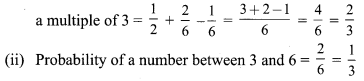
(i) Probability of getting an even number \(\frac{3}{6}=\frac{1}{2}\)
Probability of getting a multiple of 3 = \(\frac{2}{6}\)
Probability of getting an even multiple of 3 = \(\frac{1}{6}\)
Probability of getting an even number or
Samacheer Kalvi 9th Maths Chapter 9 Probability Additional Questions 1
Samacheer Kalvi 9th Maths Solutions Chapter 9 Probability Additional Questions
Question 2.
Two unbiased coins are tossed simultaneously find the probability of getting
(i) two heads
(ii) one head
(iii) at least one head
(iv) at most one head.
Solution:
S = {HH, HT, TH, TT}
(i) probability of two heads = \(\frac{1}{4}\)
(ii) probability of one head = \(\frac{1}{2}\)
(iii) probability of at least one head = \(\frac{3}{4}\)
(iv) probability of at most one head = \(\frac{3}{4}\)

Question 3.
Find the probability that a leap year selected at random will contain 53 Sundays.
Solution:
S = {Sunday Monday, Monday Tuesday, Tuesday Wednesday, Wednesday Thursday, Thursday Friday, Friday Saturday, Saturday Sunday}
n (S) = 7; n (A) = 2; P(A) = \(\frac{2}{7}\)

Question 4.
What is the probability that a number selected from the numbers 1, 2, 3, 25 is a prime number when each of the given numbers is equally likely to be selected?
Solution:
A = {2, 3, 5, 7, 11, 13, 17, 19,23}
P(A) = \(\frac{9}{25}\)

EXERCISE 9.2

Question 1.
Tickets numbered from 1 to 20 are mixed up together and then a ticket is drawn at random. What is the probability that the ticket has a number which is a multiple of 3 or 7?
Solution:
A = {3, 6, 9, 12, 15, 18, 7, 14}
Samacheer Kalvi 9th Maths Chapter 9 Probability Additional Questions 2

Question 2.
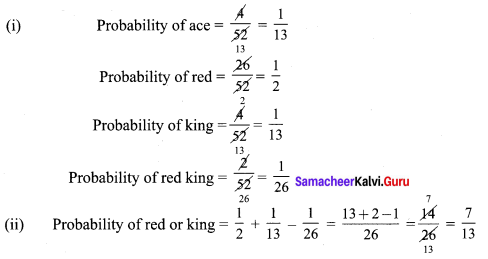
One card is drawn from a pack of 52 cards, each of the 52 cards being equally likely to be drawn. Find the probability that the card drawn is
(i) an ace,
(ii) either red card or king.
Solution:
Samacheer Kalvi 9th Maths Chapter 9 Probability Additional Questions 3

Question 3.
A bag contains 3 red and 2 blue marbles. A marble is drawn at random. What is the probability of drawing a blue marble?
Solution:
Samacheer Kalvi 9th Maths Chapter 9 Probability Additional Questions 4

Question 4.
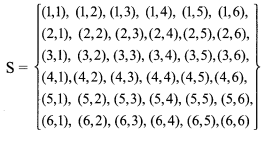
Two dice are thrown simultaneously. Find the probability of getting
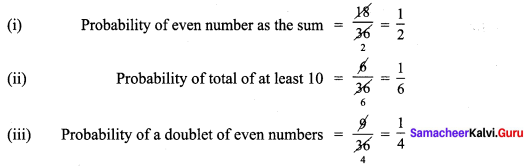
(i) an even number as the sum.
(ii) a total of at least 10
(iii) a doublet of even number.
Solution:
Samacheer Kalvi 9th Maths Chapter 9 Probability Additional Questions 5
n(S) = 36
Samacheer Kalvi 9th Maths Chapter 9 Probability Additional Questions 6
Samacheer Kalvi 9th Maths Solutions Chapter 9 Probability Additional Questions
Question 5.
An urn contains 10 red and 8 white balls. One ball is drawn at random. Find the probability that the ball drawn is white.
Solution:
Samacheer Kalvi 9th Maths Chapter 9 Probability Additional Questions 7

Samacheer Kalvi 9th Maths Solutions Chapter 9 Probability Additional Questions Read More »

Samacheer Kalvi 9th Maths Solutions Chapter 2 Real Numbers Additional Questions

You can Download Samacheer Kalvi 9th Maths Book Solutions Guide Pdf, Tamilnadu State Board help you to revise the complete Syllabus and score more marks in your examinations.

Tamilnadu Samacheer Kalvi 9th Maths Solutions Chapter 2 Real Numbers Additional Questions

Exercise 2.1

Question 1.
Find only two rational numbers between \(\frac { 1 }{ 4 }\) and \(\frac { 3 }{ 4 }\).
Solution:
A rational number between \(\frac { 1 }{ 4 }\) and \(\frac { 3 }{ 4 }\) = \(\frac { 1 }{ 2 }\) ( \(\frac { 1 }{ 4 }\) + \(\frac { 3 }{ 4 }\)) = \(\frac { 1 }{ 2 }\) (1) = \(\frac { 1 }{ 2 }\)
Another rational number between \(\frac { 1 }{ 2 }\) and \(\frac { 3 }{ 4 }\) = \(\frac { 1 }{ 2 }\) ( \(\frac { 1 }{ 2 }\) + \(\frac { 3 }{ 4 }\)) = \(\frac { 1 }{ 2 }\) ( \(\frac { 2+3 }{ 4 }\) = \(\frac { 31}{ 2 }\) × \(\frac { 5 }{ 4 }\)) = \(\frac { 5 }{ 8 }\)
The rational numbers \(\frac { 1 }{ 2 }\) and \(\frac { 5 }{ 8 }\) lies between \(\frac { 1 }{ 4 }\) and \(\frac { 3 }{ 2 }\) .

Question 2.
Is zero a rational numbers? Give reasons for your answer.
Solution:
Yes, since \(\frac { 0 }{ 2 }\) = 0, (i.e) it can be written in the form \(\frac { p }{ q }\) where q ≠ 0

Samacheer Kalvi 9th Maths Solutions Chapter 2 Real Numbers Additional Questions

Exercise 2.2

That’s literally all there is to it! 9/20 as a decimal is 0.45

Question 1.
Express the following decimal expansion is the form \(\frac { p }{ q }\) , where p and q are integers and q ≠ 0.
(i) 0.75
(ii) 0.625
(iii) 0.5625
(iv) 0.28
Solution:
Samacheer Kalvi 9th Maths Chapter 2 Real Numbers Additional Questions 1

Question 2.
Convert \(\overline { 0.9 }\) to a rational number.
Solution:
(i) Let x = \(0.\overline { 9 }\). Then x = 0.99999….
Multiplying by 10 on both sides, we get
10x = 9.99999….. = 9 + 0.9999….. = 9 + x
9x = 9
x = 1. That is, \(0.\overline { 9 }\) = 1 (∵ 1 is rational number).

Exercise 2.3

Question 1.
Classify the following number as rational or irrational.
(i) \(\sqrt { 11 }\)
(ii) \(\sqrt { 81 }\)
(iii) 0.0625
(iv) \(0.8\overline { 3 }\)
Solution:
(i) \(\sqrt { 11 }\) is an irrational number. (11 is not a perfect square number)
(ii) \(\sqrt { 81 }\) = 9 = \(\frac { 9 }{ 1 }\) , a rational number.
(iii) 0.0625 is a terminating decimal
∴ 0. 0625 is a rational number.
(iv) \(0.8\overline { 3 }\) = 0.8333
The decimal expansion is non-terminating and recurring.
∴ \(0.8\overline { 3 }\) is a rational number.

Question 2.
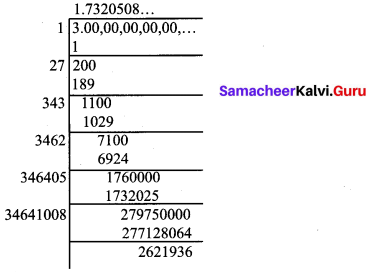
Find the decimal expansion of \(\sqrt { 3 }\).
Solution:
Samacheer Kalvi 9th Maths Chapter 2 Real Numbers Additional Questions 2

Question 3.
Find any 4 irrational numbers between \(\frac { 1 }{ 4 }\) and \(\frac { 1 }{ 3 }\).
Solution:
\(\frac { 1 }{ 4 }\) = 0.25 and \(\frac { 1 }{ 3 }\) = 0.3333 = \(0.\overline { 3 }\)
In between 0.25 and \(0.\overline { 3 }\) there are infinitely many irrational numbers .
Four irrational numbers between 0.25 and \(0.\overline { 3 }\) are
0.2601001000100001 ……
0.2701001000100001 ……
0.2801001000100001 …..
0.3101001000100001 ……

Samacheer Kalvi 9th Maths Solutions Chapter 2 Real Numbers Additional Questions

Exercise 2.4

Question 1.
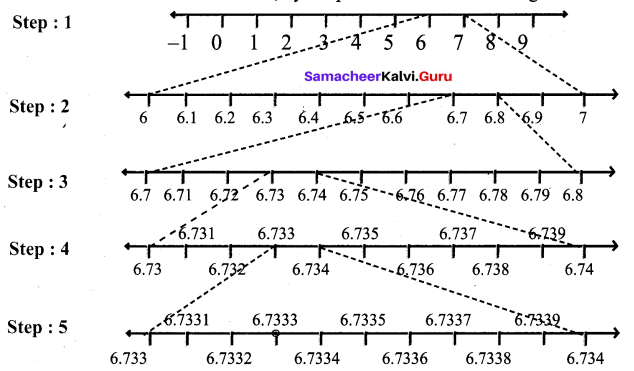
Visualise \(6.7\overline { 3 }\) on the number line, upto 4 decimal places.
Solution:
We locate 6.73 on the number line, by the process of successive magnification.
Samacheer Kalvi 9th Maths Chapter 2 Real Numbers Additional Questions 3
Step 1 : First we note that \(6.7\overline { 3 }\) lies between 6 and 7.
Step 2 : Divide the portion between 6 and 7 into 10 equal parts and use a magnifying glass to visualise that \(6.7\overline { 3 }\) lies between 6.7 and 6.8.
Step 3 : Divide the portion between 6.7 and 6.8 into 10 equal parts and use a magnifying glass to visualise that \(6.7\overline { 3 }\) lies between 6.73 and 6.74.
Step 4 : Divide the portion between 6.73 and 6.74 into 10 equal parts and use a magnifying glass to visualise that \(6.7\overline { 3 }\) lies between 6.733 and 6.734.
Step 5 : Divide the portion between 6.733 and 6.734 into 10 equal parts and use a magnifying glass to visualise that \(6.7\overline { 3 }\) lies between 6.7332 and 6.7334.
We note that \(6.7\overline { 3 }\) is visualised closed to 6.7332 than to 6.7334.

Question 2.
Find whether x and y are rational or irrational in the following:
(i) a = 2 + \(\sqrt{3}\), b = 2 – \(\sqrt{3}\); x = a + b, y = a – b
(ii) a = \(\sqrt{2}\) + 7, b = x = a + b, y = a – b
Solution:
(i) Given that a = 2 + \(\sqrt{3}\), b = 2 – \(\sqrt{3}\)
x = a + b = (2+ \(\sqrt{3}\)) +(2 – \(\sqrt{3}\)) = 4, a rational number.
y = a – b = {2 + \(\sqrt{3}\)) – (2 – \(\sqrt{3}\)) = 2\(\sqrt{3}\) , an irrational number.

(ii) Given that a = \(\sqrt{2}\) + 7,b = \(\sqrt{2}\) – 7
x = a + b = (\(\sqrt{2}\) + 7)+ (\(\sqrt{2}\) – 7) = 2\(\sqrt{2}\), an irrational number.
y = a – b = (\(\sqrt{2}\) + 7 ) – (\(\sqrt{2}\) – 7) = 14, a rational number.

Exercise 2.5

Question 1.
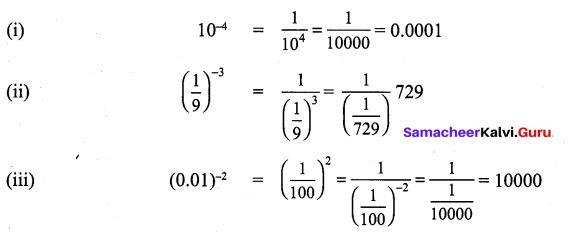
Evaluate :
(i) 10-4
(ii) (\(\frac { 1 }{ 9 }\))-3
(iii) (0.01)-2
Solution:
Samacheer Kalvi 9th Maths Chapter 2 Real Numbers Additional Questions 4

Question 2.
Find the value of 625\(\frac { 3 }{ 4 }\) :
Solution:
Samacheer Kalvi 9th Maths Chapter 2 Real Numbers Additional Questions 5

Question 3.
Find the value of 729\(\frac { -5 }{ 6 }\) :
Solution:
Samacheer Kalvi 9th Maths Chapter 2 Real Numbers Additional Questions 6

Question 4.
Use a fractional index to write :
(i) (5\(\sqrt { 125 }\))7
(ii) \(\sqrt [ 3 ]{ 7 }\)
Solution:
(i) (5\(\sqrt { 125 }\))7 = 125\(\frac { 7 }{ 5 }\)
(ii) \(\sqrt [ 3 ]{ 7 }\) = 7\(\frac { 1 }{ 3 }\)

Samacheer Kalvi 9th Maths Solutions Chapter 2 Real Numbers Additional Questions

Exercise 2.6

Question 1.
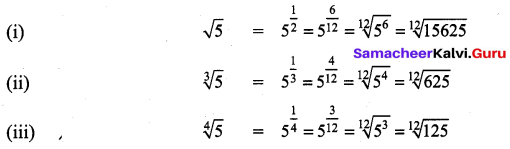
Can you reduce the following numbers to surds of same order.
(i) \(\sqrt{ 5 }\)
(ii) \(\sqrt [ 3 ]{ 5 }\)
(iii) \(\sqrt [ 4 ]{ 5 }\)
Solution:
Samacheer Kalvi 9th Maths Chapter 2 Real Numbers Additional Questions 7
Now the surds have same order

Question 2.
Express the following surds in its simplest form
(i) \(\sqrt { 27 }\)
(ii) \(\sqrt [ 3 ]{ 128 }\)
Solution:
Samacheer Kalvi 9th Maths Chapter 2 Real Numbers Additional Questions 8

Question 3.
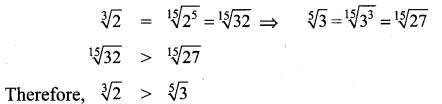
Show that \(\sqrt [ 3 ]{ 2 }\) > \(\sqrt [ 5 ]{ 3 }\).
Solution:
Samacheer Kalvi 9th Maths Chapter 2 Real Numbers Additional Questions 9

Question 4.
Express the following surds in its simplest form \(\sqrt [ 4 ]{ 324 }\).
Solution:
Samacheer Kalvi 9th Maths Chapter 2 Real Numbers Additional Questions 10
order = 4 ; radicand = 4; Coefficient = 3

Samacheer Kalvi 9th Maths Solutions Chapter 2 Real Numbers Additional Questions

Question 5.
Simplify \(\sqrt { 63 }\) – \(\sqrt { 175 }\) + \(\sqrt { 28 }\)
Solution:
Samacheer Kalvi 9th Maths Chapter 2 Real Numbers Additional Questions 11

Question 6.
Arrange in ascending order: \(\sqrt [ 3 ]{ 2 }\), \(\sqrt [ 2 ]{ 4 }\), \(\sqrt [ 4 ]{ 3 }\)
Solution:
The order of the surds \(\sqrt [ 3 ]{ 2 }\), \(\sqrt [ 2 ]{ 4 }\), \(\sqrt [ 4 ]{ 3 }\) are 3, 2, 4
L.CM. of 3, 2, 4 = 12.
Samacheer Kalvi 9th Maths Chapter 2 Real Numbers Additional Questions 12

Exercise 2.7

Question 1.
Subtract 6\(\sqrt { 7 }\) from 9\(\sqrt { 7 }\). Is the answer rational or irrational?
Solution:
9\(\sqrt { 7 }\) – 6\(\sqrt { 7 }\) = (9 – 6) \(\sqrt { 7 }\) = 3\(\sqrt { 7 }\)
The answer is irrational.

Question 2.
Simplify,: \(\sqrt { 44 }\) + \(\sqrt { 99 }\) – \(\sqrt { 275 }\).
Solution:
Samacheer Kalvi 9th Maths Chapter 2 Real Numbers Additional Questions 13

Question 3.
Compute and give the answer in the simplest form : 3 \(\sqrt { 162 }\) x 7 \(\sqrt { 50 }\) x 6 \(\sqrt { 98 }\)
Solution:
3 \(\sqrt { 162 }\) × 7 \(\sqrt { 50 }\) × 6 \(\sqrt { 98 }\) = \((3 \times 9 \sqrt{2} \times 7 \times 5 \sqrt{2} \times 6 \times 7 \sqrt{2})\)
= \(3 \times 7 \times 6 \times 9 \times 5 \times 7 \times \sqrt{2} \times \sqrt{2} \times \sqrt{2}=79380 \sqrt{2}\)

Exercise 2.8

Question 1.
Write in scientific notation : (60000000)3
Solution:
(60000000)3 = (6.0 × 10⁷)4 = (6.0)4 × (107)4
= 1296 × 1028
= 1.296 × 103 × 1028 = 1.296 × 1031

Question 2.
Write in scientific notation : (0.00000004)3
Solution:
(0.00000004)3 = (4.0 × 10⁻⁸)3 = (4.0)3 × (10-8)3
= 64 × 10-24 = 6.4 × 10 × 10-24 = 6.4 × 10⁻²³

Question 3.
Write in scientific notation : (500000)5 × (3000)3
Solution:
(500000)5 × (3000)3 = (5.0 × 10⁵)3 × (3.0 × 103)3
= (5.0)2 × (105)2 × (3.0)3 × (103)3
= 25 × 1010 × 27 × 109 = 675 × 1019
= 675.0 × 1019 = 6.75 × 102 × 1019= 6.75 × 10²¹

Question 4.
Write in scientific notation : (6000000)3 ÷ (0.00003)2
Solution:
(6000000)3 + (0.00003)2 = (6.0 × 10⁶)3 + (3.0 × 10⁻⁵)2
= (6.0 × 10⁶)3 ÷ (3.0 × 10⁻⁵)2 = 216 × 1018 ÷ 9 × 10-10
= \(\frac{216 \times 10^{9}}{9 \times 10^{-10}}\)
= 24 × 1018 × 1010 = 24 × 1028
= 24.0 × 1028 = 2.4 × 10 × 1028 = 2.4 × 1029

Samacheer Kalvi 9th Maths Solutions Chapter 2 Real Numbers Additional Questions

Exercise 2.9

Multiple Choice Questions :
Question 1.
A number having non-terminating and recurring decimal expansion is
(1) an integer
(2) a rational number
(3) an irrational number
(4) a whole number
Solution:
(2) a rational number
Hint:
Irrational number have nonterminating and non recurring decimal expansion.

Question 2.
If a number has a non-terminating and non-recurring decimal expansion, then it is
(1) a rational number
(2) a natural number
(3) an irrational number
(4) an integer
Solution:
(3) an irrational number
Hint: Rational number gave terminating or recurring and non-terminating decimal expansion.

Question 3.
Decimal form of \(\frac { -3 }{ 4 }\) is
(1) -0.75
(2) -0.50
(3) -0.25
(4) -0.125
Solution:
(1) -0.75
Hint:
\(\frac { 1 }{ 4 }\) = 0.25; \(\frac {1 }{ 2 }\) = 0.5; \(\frac { 3 }{ 4 }\) = 0.75

Samacheer Kalvi 9th Maths Solutions Chapter 2 Real Numbers Additional Questions

Question 4.
Which one of the following has a terminating decimal expansion?
Samacheer Kalvi 9th Maths Chapter 2 Real Numbers Additional Questions 14
Solution:
(1) \(\frac { 5 }{ 32 }\)
Hint:
32 = 25 ⇒ \(\frac { 5 }{ 32 }\) has terminating decimal expansion

Question 5.
Which one of the following is an irrational number?
(1) π
(2) √9
(3) \(\frac { 1 }{ 4 }\)
(4) \(\frac { 1 }{ 5 }\)
Solution:
(1) π

Question 6.
Which one of the following are irrational numbers?
Samacheer Kalvi 9th Maths Chapter 2 Real Numbers Additional Questions 15
(a) (ii), (iii) and (iv)
(b) (i), (ii) and (iv)
(c) (i), (ii) and (iii)
(d) (i), (iii) and (iv)
Solution:
(d) (i), (iii) and (iv)
Hint:
\(\sqrt{4+\sqrt{25}}=\sqrt{9}=3 ; \sqrt{8-\sqrt[3]{8}}=\sqrt{8-2}=\sqrt{6}\)

Question 7.
Which of the following is not an irrational number?
(1) \(\sqrt {2}\)
(2) \(\sqrt {5}\)
(3) \(\sqrt {3}\)
(4) \(\sqrt {25}\)
Solution:
(4) \(\sqrt {25}\)

Question 8.
In simple form, \(\sqrt [ 3 ]{ 54 }\) is?
(1) 3 \(\sqrt [ 3 ]{ 2 }\)
(2) 3 \(\sqrt [ 3 ]{ 27 }\)
(3) 3 \(\sqrt [ 3 ]{ 2 }\)
(4) \(\sqrt { 3 }\)
Solution:
(1) 3 \(\sqrt [ 3 ]{ 2 }\)

Question 9.
\(\sqrt [ 3 ]{ 192 }\) + \(\sqrt [ 3 ]{ 24 }\)
(1) 3\(\sqrt [ 3 ]{ 6 }\)
(2) 6\(\sqrt [ 3 ]{ 3 }\)
(3) 3\(\sqrt [ 3 ]{ 216 }\)
(4) 3\(\sqrt [ 6 ]{ 216 }\)
Solution:
(2) 6\(\sqrt [ 3 ]{ 3 }\)

Samacheer Kalvi 9th Maths Solutions Chapter 2 Real Numbers Additional Questions

Question 10.
5\(\sqrt { 21 }\) × 6\(\sqrt { 10 }\)
(1) 30\(\sqrt { 210 }\)
(2) 30
(3) \(\sqrt { 210 }\)
(4) 210\(\sqrt { 30 }\)
Solution:
(1) 30\(\sqrt { 210 }\)

Text Book Activities

Activity – 1
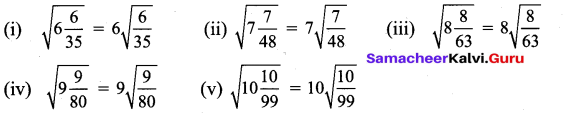
Is it interesting to see this pattern? \(\sqrt{4 \frac{4}{15}}=4 \sqrt{\frac{4}{15}} \text { and } \sqrt{5 \frac{5}{24}}=5 \sqrt{\frac{5}{24}}\) Verify it. Can you frame 4 such new surds?
Solution:
Samacheer Kalvi 9th Maths Chapter 2 Real Numbers Additional Questions 16

Activity – 2
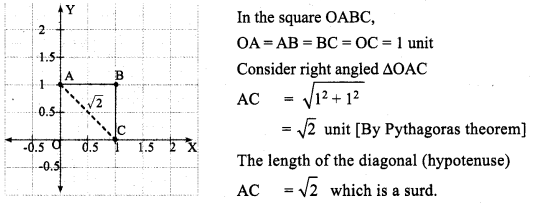
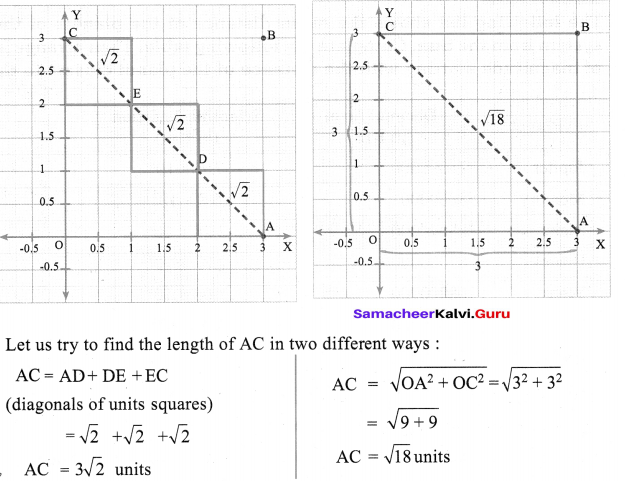
Take a graph sheet and mark O, A, B, C as follows:
Samacheer Kalvi 9th Maths Chapter 2 Real Numbers Additional Questions 17
Consider the following graphs:
Samacheer Kalvi 9th Maths Chapter 2 Real Numbers Additional Questions 18
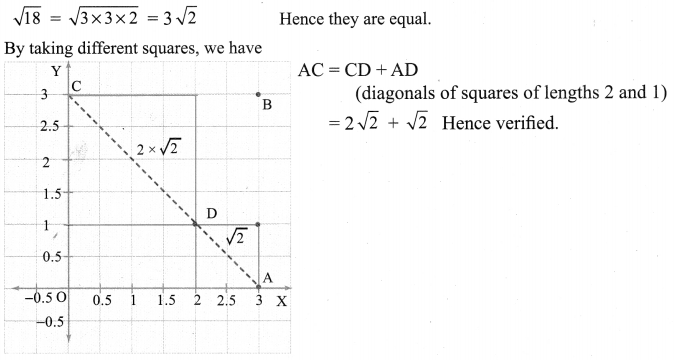
Are they equal? Discuss. Can you verify the same by taking different squares of different lengths?
Solution:
Samacheer Kalvi 9th Maths Chapter 2 Real Numbers Additional Questions 19

Activity – 3
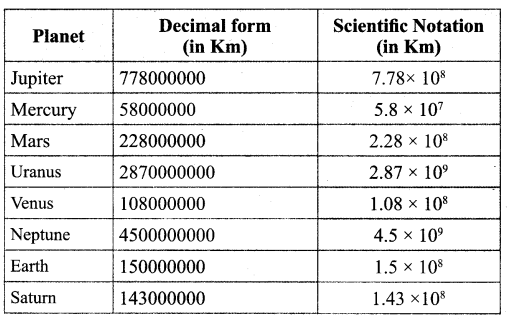
The following list shows the mean distance of the planets of the solar system from the Sun. Complete the following table. Then arrange in order of magnitude starting with the distance of the planet closest to the Sun.
Solution:
Samacheer Kalvi 9th Maths Chapter 2 Real Numbers Additional Questions 20
Arrange the planets in order of distance from the sun.
Mercury, Venus, Earth, Mars, Jupiter, Saturn, Uranus, Neptune and Pluto.

Samacheer Kalvi 9th Maths Solutions Chapter 2 Real Numbers Additional Questions Read More »

Samacheer Kalvi 9th Social Science Geography Solutions Chapter 2 Lithosphere – II Exogenetic Processes

You can Download Samacheer Kalvi 9th Social Science Book Solutions Guide Pdf, Tamilnadu State Board help you to revise the complete Syllabus and score more marks in your examinations.

Tamilnadu Samacheer Kalvi 9th Social Science Geography Solutions Chapter 2 Lithosphere – II Exogenetic Processes

Lithosphere – II Exogenetic Processes Textual Exercise

I. Choose the correct answer.

Weathering the Storm in Ersama MCQ Questions Class 9 English with Answers.

Question 1.
The disintegration or decomposition of rocks is generally called as …………………
(a) weathering
(b) erosion
(c) transportation
(d) deposition
Answer:
(a) weathering

Question 2.
The process of the levelling up of land by means of natural agents.
(a) aggradation
(b) degradation
(c) gradation
(d) none
Answer:
(c) gradation

Question 3.
……………. is seen in the lower course of the river.
(a) Rapids
(b) Alluvial fan
(c) Delta
(d) Gorges
Answer:
(c) Delta

Samacheer Kalvi 9th Social Science Geography Solutions Chapter 2 Lithosphere - II Exogenetic Processes

Question 4.
Karst topography is formed due to the action of ………………
(a) Glacier
(b) Wind
(c) Sea waves
(d) Ground water
Answer:
(d) Ground water

Question 5.
Which one of the following is not a depositional feature of a glacier?
(a) cirque
(b) Moraines
(c) Drurrtlins
(d) Eskers
Answer:
(a) cirque

Question 6.
Deposits of fine silt blown by wind is called as …………….
(a) Loess
(b) Barchans
(c) Hamada
(d) Ripples
Answer:
(a) Loess

Question 7.
Stacks are formed by …………….
(a) Wave erosion
(b) River erosion
(c) Glacial erosion
(d) Wind deposion
Answer:
(a) Wave erosion

Question 8.
……………… erosion is responsible for the formation of cirque.
(a) wind
(b) glacial
(c) river
(d) underground water
Answer:
(b) glacial

Question 9.
Which one of the following is a second order land form?
(a) Asia
(b) Deccan Plateau
(c) Kulu valley
(d) Marina Beach
Answer:
(b) Deccan Plateau

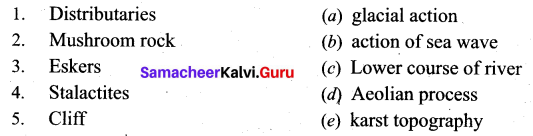
II. Match the following.

Samacheer Kalvi 9th Social Science Geography Solutions Chapter 2 Lithosphere - II Exogenetic Processes 1
Answer:
1. (c)
2. (d)
3. (a)
4. (e)
5. (b)

III. Answer in brief.

Question 1.
Define weathering.
Answer:
Weathering is the disintegration and decomposition of the material of the earth’s crust by its exposure to the atmosphere.

Question 2.
What do you mean by biological weathering?
Answer:
Biological weathering occurs due to the penetration and expansion of plant roofs, earthworms, burrowing animals (rabbits, rats), and same human activities.

Question 3.
Mention the three courses of a river with any two landforms associated with each course.
Answer:

  1. The course of a river is divided into
    • The Upper course
    • The Middle course
    • The Lower course.
  2. The land features carved by a river in its upper course are V-shaped valleys, gorges, canyons, rapids, potholes, spurs, and waterfalls.
  3. In the middle course of a river some typical landforms like alluvial fans, flood plains, meanders, oxbow lakes, etc., are formed.
  4. The lower course of a river develops typical landforms like delta and estuary.

Samacheer Kalvi 9th Social Science Geography Solutions Chapter 2 Lithosphere - II Exogenetic Processes

Question 4.
What are the Ox-bow lakes?
Answer:

  1. Meanders in due course of time become almost a complete circle with narrow necks.
  2. This in turn gets abandoned and forms a lake. This is called an Ox-bow lake.

Question 5.
How does a cave differ from a sea arch?
Answer:

Sea cave

Sea Arch

A prolonged wave attack on the base of a cliff erodes rock materials which results in the formation of caves. When two caves approach one another from either side of a headland and Unite, they form an arch, e.g., Neil Island, Andaman & Nicobar.

Question 6.
List out any four karst topographical areas found in India.
Answer:
Karts areas in Indian are given below:

  1. Guptadham caves – Western Bihar
  2. Robert cave and Tapkeshwar Temple – Uttarakhand.
  3. Pandav caves – Pachmarhi, Madhya Pradesh.
  4. Kutumsar – Bastar District in Chattisgarh
  5. Borra caves of Visakhapatnam – Andhra Pradesh.

Question 7.
What do you mean by a hanging valley?
Answer:
These are valleys eroded by the tributary glacier and that hangs over the main valley.

Question 8.
Define:
(a) Moraine
(b) Drumlin
(c) Esker.
Answer:
(a) Moraine:
Landforms formed by the glacial deposits of the valley or continental glaciers are termed as Moraines. They are of various shapes and sizes, like the ground, terminal, and lateral moraine, etc.

(b) Drumlins:
Drumlins are deposits of glacial moraines that resemble giant inverted teaspoons or half cut eggs.

(c) Eskers:
Long Narrow ridges composed of boulders gravel and sand deposited by streams of melting water which run parallel to a glacier are called Eskers.

Question 9.
Mention the various features formed by wind erosion.
Answer:

  • The erosional landforms of wind: Mushroom rocks, Inselbergs, and Yardangs
  • The Depositional Landforms of wind: Sand dunes, Barchans, and loess.

Samacheer Kalvi 9th Social Science Geography Solutions Chapter 2 Lithosphere - II Exogenetic Processes

Question 10.
What are the wave-cut platforms?
Answer:

  1. Flat surface found at the foot of sea cliffs are called wave platform
  2. Wave cut platform is also referred to as beach, shelf, terrace, and plain.

IV. Distinguish between:

Question 1.
Physical and chemical weathering
Answer:

S.No. Physical weathering Chemical weathering
(i) It is the breakdown of rocks without changing their chemical composition through the action of physical forces. Disintegration and. decomposition of rocks due to chemical reactions is called Chemical weathering.
(ii) Cracks are formed and disintegration occurs eventually. Chemical weathering takes place through the processes of oxidation, carbonation solution and hydration.
(iii) Exfoliation, block disintegration, granular disintegration, etc., are the different types of weathering. The agents of Chemical weathering are oxygen, CO2 and Hydrogen.

Question 2.
Delta and Estuary
Answer:

S.No. Delta Estuary
(i) A triangular-shaped low lying area formed by the river at its mouth is called Delta. Deltas have fine deposits of sediments enriched with minerals.
(ii) Estuary is formed where the rivers meet the sea. Deposition of silt by the river is not possible in the estuaries like Delta as if the waves keep on eroding the deposits e.g. River Narmada, River Tapti.

Question 3.
Stalactite and stalagmite
Answer:

Stalactite Stalagmite
When the water containing dissolved calcite gradually drips from the ceiling of the caves, water evaporates and the remaining calcite hangs from the ceiling and thus Stalactites are formed. When the calcite deposits rises upward like a pillar Stalagmites are formed.

Samacheer Kalvi 9th Social Science Geography Solutions Chapter 2 Lithosphere - II Exogenetic Processes

Question 4.
Longitudinal and Transverse sand dunes
Answer:

Longitudinal Transverse sand dunes.
Longitudinal dunes are long narrow ridges of sand, which extend in a direction parallel to the prevailing winds. These dunes are called Seifs in Sahara. Transverse dunes are asymmetrical in shape. They are formed by alternate slow and fast winds that blow from the same direction.

Question 5.
Inselbergs and yardangs
Answer:

S.No. Inselbergs Yardangs
(i) Certain hard rocks like igneous rocks are more resistant to wind action. In arid regions, certain rocks .have hard and soft layers arranged vertically.
(ii) Isolated residual hills rising abruptly from their surroundings are termed as inselbergs. e.g., Uluru (or) Ayers Rock – Australia. When winds blow over these rocks, the soft layers get eroded leaving irregular crests. These are called Yardangs.

Question 6.
Spit and bar
Answer:

Spit

Bar

A spit is a ridge (or) embankment of sediment, attached to the land on one end and terminating in open water on the other end. Spits are common at the mouth of estuaries, e.g., Kakinada Spit. A bar is an elongated deposit of sand, shingle (or) mud found in the sea almost parallel to the shoreline.

V. Give Reasons.

Question 1.
Chemical weathering is predominant in hot and humid zones.
Answer:

  1. Chemical is predominant in hot and humid zones because the warm temperature and rainfall increases the chemical weathering.
  2. It encourages the decomposition of plant matter to produce chemicals such as humic acids and CO2
    These chemicals increase the rate of weathering.

Question 2.
Slit deposits are less at estuaries than deltas.
Answer:

  1. Deltas form at the mouths of large rivers when sediments and silt accumulate.
  2. As sediments continue to accumulate, the course of the river may even be changed.
  3. Estuary is formed where the rivers meet the sea.
  4. Deposition of silt by the river is not possible here in the estuaries like delta as if the waves keep on eroding the deposits.

Samacheer Kalvi 9th Social Science Geography Solutions Chapter 2 Lithosphere - II Exogenetic Processes

Question 3.
The snow line is at the sea level in Polar regions.
Answer:
The snow line is at the sea level in Polar regions because the higher the latitude lowers the snow line from sea level. –

Question 4.
Wind can possibly erode the rocks from aO sides.
Answer:

  • Wind erosion can occur in any area where the Soil (or) Sand is not compacted (or) if it is finely granulated in nature.
  • Wind can loosen the materials and send them in all directions.

Question 5.
In limestone regions, surface drainage is rarely found.
Answer:

  1. Groundwater percolating through cracks removes the soluble rock while leaving an enlarged channel for the further flow of water.
  2. If there is a thick cover of soil above the soluble rock, surface streams may flow above the subterranean karst drainage system.
  3. But most commonly, dissolution features occur at the surface.
  4. Therefore there are a few continuous surface streams.

VI. Answer in Paragraph.

Question 1.
Write a note on weathering classify and explain.
Answer:
Weathering is the disintegration and decomposition of materials of the earth’s crust by their exposure to the atmosphere. There are three types of weathering,
(a) Physical weathering
(b) Chemical weathering
(c) Biological weathering

Physical weathering: It is the breakdown of rocks without changing their chemical composition, through the action of physical forces. The constant freezing and thawing of rocks during the night and day leads to the expansion and contraction of rocks. Cracks are formed and disintegration occurs eventually. Exfoliation, block disintegration, granular disintegration, etc., are the different types of weathering.

Chemical weathering: Disintegration and decomposition of rocks due to chemical reactions are called Chemical Weathering. This is predominantly high in the hot and humid regions such as the equatorial, tropical, and subtropical zones. Chemical weathering takes place through the processes of oxidation, carbonation, solution, and hydration. The agents of Chemical weathering are Oxygen, Carbon-dioxide, and Hydrogen.

Biological weathering: Biological weathering occurs due to the penetration and expansion of plant roots, earthworms, burrowing animals (rabbits, rats), and some human activities.

Question 2.
Explain the erosional landforms formed by underground water.
Answer:
(a) Erosional landforms formed by underground water.

  • Most of the erosions take place due to the process of solution.
  • When rainwater mixes with carbon-di-oxide and enters a limestone region, it dissolves and destroys much of the limestone.
  • As a result, landforms such as Terra Rossa, Lappies, sinkholes, swallow holes, dolines, uvulas, poljes, caves, and caverns are formed.

(b) Terra Rossa: The deposition of red clay soil on the surface of the Earth is due to the dissolution of limestone content in rocks.

(c) When the joints of limestone rocks are corrugated by groundwater, long furrows are formed. These are called Lappies.

(d) A funnel-shaped depressions formed due to the dissolution of limestone rock is called sinkholes.

(e) Caves are hollows that are formed by the dissolution of limestone rocks when carbon-di-oxide in the air turns into carbonic acid. Caverns are caves with irregular floors.

Question 3.
What is a glacier? Explain its types.
Answer:
A Glacier is a large mass of ice that moves slowly over the land, from its place of accumulation. It is also known as the ‘River of ice’. The place of accumulation is called a snowfield. The height above which there is a permanent snow cover in the higher altitude or latitude is called snowline. The higher the latitude, the lower the snowline from sea level.

The gradual transformation of snow into granular ice is called ‘firn’ or ‘ neve’ and finally, it becomes solid glacial ice.
Movement of Glacier: The large mass of ice creates pressure at its bottom and generates heat. Due to this, the glacier melts a little and starts to move The rate of movement of a glacier varies from a few centimeters to several hundred meters a day. The movement of glaciers depends on slope, the volume of the glacier, thickness, roughness at the bottom (friction), etc., and Temperature. Like the rivers, glaciers also carry out erosion, transportation, and deposition.

Types of Glacier: Glaciers are broadly divided into two types based on the place of occurrences, such as Continental glacier and valley glacier.

Question 4.
Describe the depositional work of winds.
Answer:
(a) Depositional landforms of wind:

  • Deposition occurs when the speed of wind is reduced by the presence of obstacles like bushes, forests and rock structures.
  • The sediments carried by wind get deposited on both the windward and leeward sides of these obstacles.

(b) Sand dunes: In deserts, during sandstorms, wind carries loads of sand. When the speed of wind decreases, huge amount of sand gets deposited. These mounds or hills of sand are called sand dunes.

(c) Barchans: Barchans are isolated, crescent-shaped sand dunes. They have gentle slopes on the windward side and steep slopes on the leeward side.

(d) Transverse dunes: They are asymmetrical in shape. They are formed by alternate slow and fast winds that blow from the same direction.

(e) Longitudinal dunes: Longitudinal dunes are long narrow ridges of sand, which extend in a direction parallel to prevailing winds.

(f) Loess:

  1. The term loess refers to the deposits of fine silt and porous sand over a vast region.
  2. Extensive loess deposits are found in Northern and Western China, the Pampas of Argentina, in Ukraine, and in the Mississippi valley of the United States.

Samacheer Kalvi 9th Social Science Geography Solutions Chapter 2 Lithosphere - II Exogenetic Processes

Question 5.
Give a detailed account of the three orders of landforms.
Answer:
Major land forms:
(i) First order landforms : Continents & Oceans
(ii) Second-order landforms: Mountains, Plateaus, and plains minor land forests
(iii) Third-order landforms: Deltas, Fjords coasts, Sand dimes, Beaches, Valleys, Cirques, Mushroom rocks, Limestone rocks.

First-order land forms:

  1. Continents: (i) It is a very large area of land.
    (ii) One of the seven large landmasses on the earth’s surface, surrounded by sea.
    Asia, Africa, Europe, North America, South America, Australia, and Antarctica.
  2. Oceans: A very large expanse of sea, Atlantic ocean, Arctic ocean, Pacific ocean, Indian ocean, and Antarctic ocean.

Second-order landforms: Mountains, Plateaus, and Plains.

  1. Mountains: A large natural elevation of the earth’s surface, rising abruptly from the surrounding level, e.g., the Himalayas.
  2. Plateaus: An area of fairly level high ground, e.g., Tibetan plateau.
  3. Plains: A large area of flat land, e.g., Coastal plains.

Third-order landforms: Deltas, Fjords, Sand dunes, Beaches, Valleys, Cirques, Mushroom rocks, Limestone rocks.

  1. Deltas: A triangular-shaped low lying area formed by the river at its mouth is called Delta. Fjords: These are glacial valleys that are partly submerged in the sea.
  2. Sand Dunes: In deserts, a huge amount of sand gets deposited. These mounds (or) hills of sand are called sand dunes.
  3. Beaches: Sand and gravel are moved and deposited by waves along the shore to form Beaches. Valleys: A low area of land between hills (or) mountains typically with a river (or) stream flowing through it.
  4. Cirques: The glacier erodes the steep sidewalls of the mountain and farms bowl shaped armchair. It is termed as a cirque.
  5. Mushroom rocks: By the constant wearing down action of wind the bottom of the rock gets eroded away to form a mushroom-like structure. This is called Mushroom rock (or) Pedestal rock.
  6. Limestone rocks: The underground water creates distinct landforms in limestone regions called Karst Topography. It consists of calcite, aragonite.

VII. Consider the given statements and choose the right option given below.

Question (i).
1. ‘I’ shaped valley is an erosional feature of the river.
2. ‘U’ shaped valley is an erosional feature of the glacier.
3. ‘V’ shaped valley is an erosional feature of the glacier.
(a) (i), (ii) and (iii) are right
(b) (i) and (ii) are right
(c) (i) and (iii) are right
(d) only (i) is right
Answer:
(d) only (ii) is right

Question (ii).
Statement I: Running water is an important agent of gradation.
Statement II: The work of the river depends on the slope of land on which-it flows.
(a) Statement I is false II is true
(b) Statement I and II are false
(c) Statement I is true II is false
(d) Statement I and II are true
Answer:
(a) Statement I is false II is true

Question (iii).
Statement: Limestone regions have less underground water.
Reason : Water does not percolate through limestone.
(a) The statement is right reason is wrong.
(b) The statement is wrong Reason is right.
(c) The statement and reason are wrong.
(d) The statement and reason are right.
Answer:
(d) The statement and reason are right.

VIII. HOTS

Question 1.
Is wind the only gradational agent in the desert?
Answer:
Yes, the wind is the only gradational agent in the desert.
e.g., Erosional activity: Yardung
Depositional activity: Sand Dimes.

Samacheer Kalvi 9th Social Science Geography Solutions Chapter 2 Lithosphere - II Exogenetic Processes

Question 2.
Underground water is more common in limestone areas than surface runoff. Why?
Answer:
The chief constituent of limestone is calcium carbonate which is soluble in pure water and easily soluble in carbonated water.

Question 3.
The river channels in the lower course are wider than the upper course.
Answer:
The reasons are,

  1. The river splits into a number of channels called distributaries.
  2. The river brings downloads of debris from its upper and middle.
  3. The river deposits and develop typical landforms like Delta and Estuary.

In-text HOTs Questions

Question 1.
Is weathering a pre-requisite in the formation of soil?
Answer:

  1. Yes, weathering a pre-requisite in the formation of soil.
  2. The rock materials in due course of time are weathered further to form soil.
  3. Soil is a mixture of disintegrated rock material.

Question 2.
The snowline of the Alps’is 2700 metre whereas the snowline of Greenland is just 600 mts. Find out the reason.
Answer:
On tropical mountains, the snowline may be as high as 500 mts, but when traced poleward it descends to 2700 mts in the European Alps to 600 meters in Greenland and just to se-a level near the poles. –

IX. Map Skill.

Question 1.
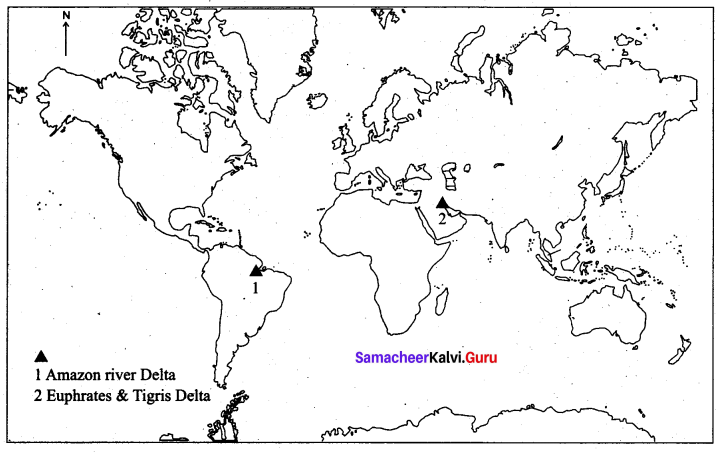
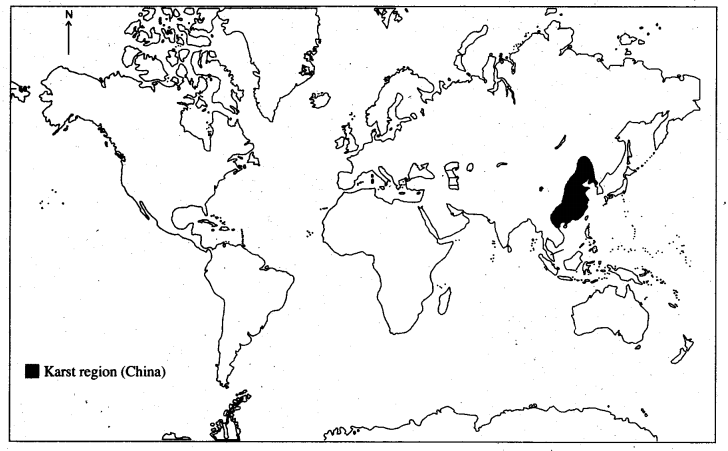
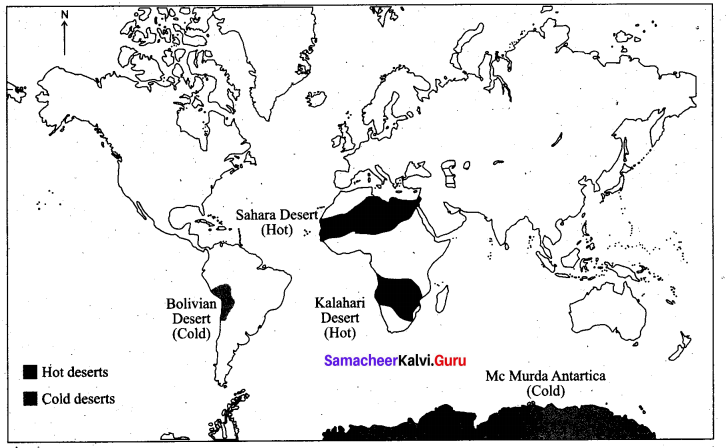
On the given outline map of the world, mark the following.
1. Any two deltas
2. A Karst region
3. Any two hot and cold deserts
Answer:
1. Any two deltas – Euphrates & Tigris Delta and Amazon river Delta
Samacheer Kalvi 9th Social Science Geography Solutions Chapter 2 Lithosphere - II Exogenetic Processes 2

2. A Karst region – China
Samacheer Kalvi 9th Social Science Geography Solutions Chapter 2 Lithosphere - II Exogenetic Processes 3

3. Any two hot and cold desets
Samacheer Kalvi 9th Social Science Geography Solutions Chapter 2 Lithosphere - II Exogenetic Processes 4

X. Give geographical terms for the following:

Question 1.
(a) Chemical alteration of carbonate rocks on limestone region.
(b) Flat surfaces near cliffs.
(c) Erosion + Transportation + Deposition =
(d) The bottom line of a snowfield.
Answers:
(a) Carbonation
(b) Plateau
(c) Gradation
(d) The snowline

Lithosphere – I Endogenetic Processes Additional Questions

I. Choose the correct answer.

Question 1.
The process of dissolution of rock substances in water is …………….
(a) oxidation
(b) solution
(c) gradation
(d) hydration
Answer:
(b) solution

Question 2.
This generally originate from mountains.
(a) lake
(b) sea
(c) river
(d) ocean
Answer:
(c) river

Question 3.
The cylindrical holes drilled vertically in the river bed are …………….
(a) Potholes
(b) canyons
(c) rapid
(d) Gorge
Answer:
(a) Potholes

Question 4.
The largest Delta in the world is …………….
(a) The Nile River Delta
(b) The Ganga – Brahmaputra Delta
(c) The Yellow river Delta
(d) The Indus Delta
Answer:
(b) The Ganga – Brahmaputra Delta

Samacheer Kalvi 9th Social Science Geography Solutions Chapter 2 Lithosphere - II Exogenetic Processes

Question 5.
The redness of the red clay soil is due to. the presence of ……………
(a) iron oxide
(b) carbon
(c) copper
(d) magnesium
Answer:
(a) iron oxide

Question 6.
The most powerful agents of gradation are ……………
(a) Rivers
(b) Glaciers
(c) Sea waves
(d) Streams
Answer:
(c) Sea waves

II. Match the following.

Samacheer Kalvi 9th Social Science Geography Solutions Chapter 2 Lithosphere - II Exogenetic Processes 7
Answer:
1. (e)
2. (a)
3. (d)
4. (b)
5. (a)

III. Answer in brief.

Question 1.
Define Granular Disintegration.
Answer:
Granular disintegration takes place in crystalline rocks where the grains of the rocks become loose and fall out. This is due to the action of temperature & frost.

Question 2.
Mention the land features carved by a river in its upper course.
Answer:
‘V’ shaped valleys, Gorges, Canyons, rapids, potholes, spurs and waterfalls.

Question 3.
What are “Pot Holes”?
Answer:
Due to the river action, cylindrical holes are drilled vertically in the river bed with varying depth and diametre.

Question 4.
State the other erosional features of Karst regions in other parts of the world.
Answer:
Swallow Holes, Uvalas, Dolines, Poljis are the other erosional features.

Question 5.
What are Transverse Dunes?
Answer:

  1. Transverse Dunes are asymmetrical in shape.
  2. They are formed by alternate slow and fast winds that blow from the same direction.

Samacheer Kalvi 9th Social Science Geography Solutions Chapter 2 Lithosphere - II Exogenetic Processes

Question 6.
What are the wave-cut Platforms?
Answer:
Flat surface found at the foot of the sea cliffs are called a wave Cut platform. It is also referred to as Beach, shelf, terrace, and plain.

IV. Distinguish between.

Question 1.
Oxidation and Carbonation.
Answer:

S.No. Oxidation Carbonation
(i) Oxygen in the atmosphere reacts with the Iron found in rocks thus leading to the formation of Iron oxide. This process is known as oxidation. Carbonation is the mixing of water with atmospheric CO2 forming carbonic acid.
(ii) Oxidation weakens the rocks. It is important in the formation of caves, in the limestone region.

Question 2.
Alluvial Plain and Flood Plain.
Answer:

S.No. Alluvial Plain Flood Plain
(i) A fan-shaped deposition made by the river at the foothills is called an alluvial plain. Fine sediments are deposited on river banks when a river floods and is called flood plain.
(ii) These deposits are rich and fertile useful for cultivation. These sediments make the region rich and fertile.

Question 3.
Arete and Matterhorn.
Answer:

Arete Matterhorn
Aretes are narrow ridges formed when two cirque walls joined together back to back and forms narrow knife-like ridges. The pyramidal peaks formed when three (or) more cirques meet together are referred as matterhoms.

Question 4.
Sea Cave and Sea Arch.
Answer:

Sea Cave

Arch

Prolonged wave attack on the base of a cliff erodes rock materials which result in the formation of caves. When two caves approach one another from either side of a headland and Unite, they form an arch, e.g., Neil Island, Andaman Nicobar.

V. Give reasons.

Question 1.
Why do Biological weathering occur?
Answer:
Biological weathering occurs due to the penetration and expansion of plant roots, earthworms, burrowing animals (rabbits and rats), and some human activities.

Question 2.
Why is Karst Topography formed?
Answer:
Karst Topography is formed due to the dissolution of soluble rocks such as limestone, dolomite, and Gypsum.

Question 3.
Why do the Pedestal rock look like mushroom?
Answer:
By the constant wearing down action of wind, the bottom gets eroded away to form a mushroom-like structure. So the Pedestal rock looks like a mushroom.

VI. Answer in a Paragraph.

Question 1.
Explain the origin of the river and its course.
Answer:
Rivers generally originate from mountains and end in a sea or lake. The whole path that a river flows through is called its course. The course of a river is divided into:
(i) The upper course
(ii) The middle course and
(iii) The lower course

(i) The Upper Course: Erosion is the most dominant faction of the river in the upper course. In this course, a river usually tumbles down the steep mountain slopes. The steep gradient increases the velocity and the river channel performs erosion with great force to widen and deepen its valley. The land features carved by a river in its upper course are V-shaped valleys, gorges, canyons, rapids, potholes, spurs, and waterfalls.

(ii) The Middle Course: The river enters the plain in its middle course. The volume of water increases with the confluence of many tributaries and thus increases the load of the river. Thus, the predominant action of a river is transportation. The deposition also occurs due to the sudden decrease in velocity. The river in the middle course develops some typical landforms like alluvial fans, flood plains, meanders, ox-bow lakes, etc.,

(iii) The Lower course: The river, moving downstream across a broad, level plain is loaded with debris, brought down from its upper and middle courses. Large deposits of sediments are found at the level bed and the river splits into a number of channels called distributaries. The main work of the river here is a deposition and it develops typical landforms like delta and estuary.

Samacheer Kalvi 9th Social Science Geography Solutions Chapter 2 Lithosphere - II Exogenetic Processes

Question 2.
Describe the Erosional landforms of Sea.
Answer:
Some of the erosional landforms of sea waves are sea cliff, sea cave, arch, stack, beach, bar and spit and wave-cut platform.

  • Sea Cave: Prolonged wave attack on the base of a cliff erodes rock materials, which results in the formation of caves.
  • Sea Arch: When two caves approach one another from either side of a headland and unite, they form an arch, e.g., Neil Island, Andaman, and Nicobar.
  • Sea Stack: Further erosion by waves ultimately leads to the total collapse of the arch. The seaward portion of the headland will remain as a pillar of rock known as a stack. Eg the Old man of Hoy in Scotland.
  • Sea Cliffs: Sea cliffs are steep rock faces formed when sea waves dash against them. The rocks get eroded to form steep vertical walls.
  • WaveCut Platforms: Flat surface found at the foot of sea cliffs are called wave-cut platforms. Wave cut platform is also referred to as beach, shelf, terrace, and plain.

VII. Consider the given statements and choose the right option given below.

Question 1.
(i) The nature and magnitude of weathering differ from place to place and region to region.
(ii) Granular disintegration takes place due to the action of volcanoes.
(iii) Weathering is a pre-requisite in the formation of soil.
Which of the above statement is/are the right statement.
(a) (i), (ii) and (iii) are right
(b) (i) & (ii) are right
(c) (i) & (iii) are right
(d) only (i) is right.
Answer:
(c) is right

Question 2.
(i) Small streams that join the main river is tributary.
(ii) River Gangas is a tributary.
Which of the above statement is/are the right statement.
(a) The statement is the right reason is wrong
(b) The statement is the wrong reason is right
(c) The statement & reason are wrong
(d) The statement & reason are right
Answer:
(a) is right.

VIII. Map Skill.

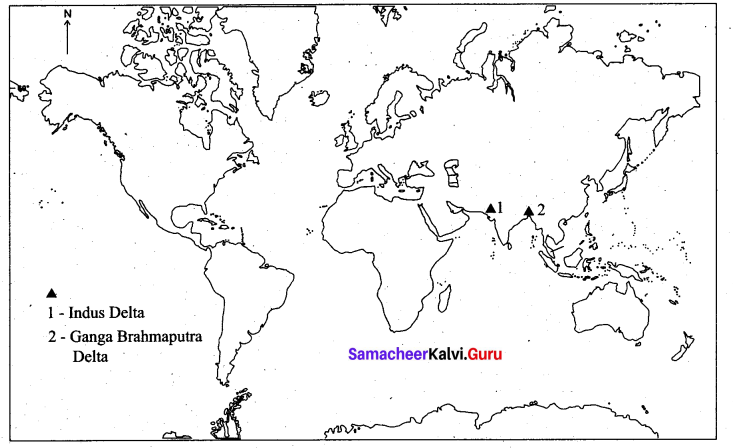
Question 1.
Indus and Ganga Brahmaputra Delta
Answer:
Samacheer Kalvi 9th Social Science Geography Solutions Chapter 2 Lithosphere - II Exogenetic Processes 5

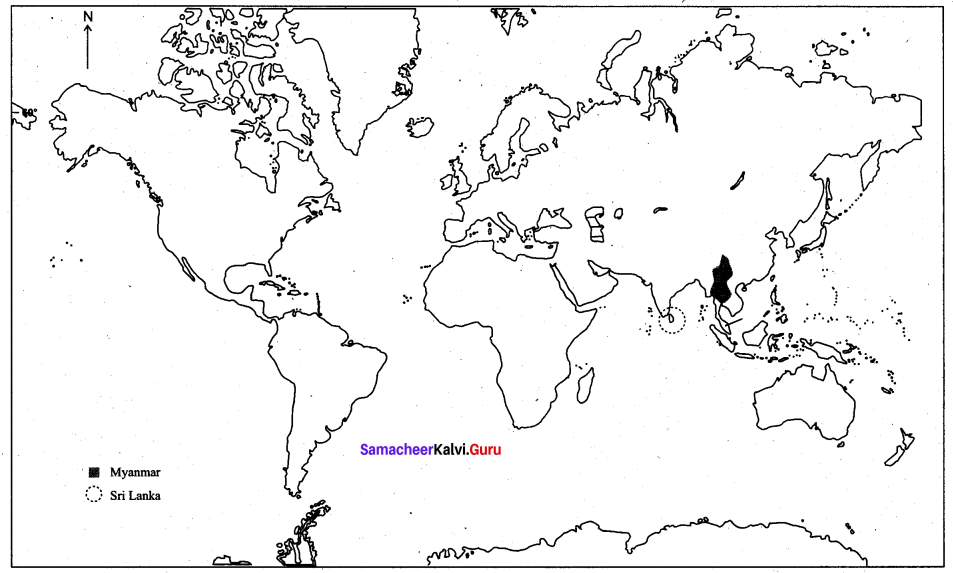
2. Sri Lanka & Myanmar
Samacheer Kalvi 9th Social Science Geography Solutions Chapter 2 Lithosphere - II Exogenetic Processes 6

Samacheer Kalvi 9th Social Science Geography Solutions Chapter 2 Lithosphere – II Exogenetic Processes Read More »

Samacheer Kalvi 10th Maths Solutions Chapter 2 Numbers and Sequences Ex 2.2

You can Download Samacheer Kalvi 10th Maths Book Solutions Guide Pdf, Tamilnadu State Board help you to revise the complete Syllabus and score more marks in your examinations.

Tamilnadu Samacheer Kalvi 10th Maths Solutions Chapter 2 Numbers and Sequences Ex 2.2

Question 1.
For what values of natural number n, 4n can end with the digit 6?
Solution:
4n = (2 × 2)n = 2n × 2n
2 is a factor of 4n.
So, 4n is always even and end with 4 and 6.
When n is an even number say 2, 4, 6, 8 then 4n can end with the digit 6.
Example:
42 = 16
43 = 64
44 = 256
45 = 1,024
46 = 4,096
47 = 16,384
48 = 65, 536
49 = 262,144

Question 2.
If m, n are natural numbers, for what values of m, does 2n × 5m ends in 5?
Answer:
2n is always even for any values of n.
[Example. 22 = 4, 23 = 8, 24 = 16 etc]

5m is always odd and it ends with 5.
[Example. 52 = 25, 53 = 125, 54 = 625 etc]
But 2n × 5m is always even and end in 0.
[Example. 23 × 53 = 8 × 125 = 1000
22 × 52 = 4 × 25 = 100]
∴ 2n × 5m cannot end with the digit 5 for any values of m.

Samacheer Kalvi 10th Maths Solutions Chapter 2 Numbers and Sequences Ex 2.2

Question 3.
Find the H.C.F. of 252525 and 363636.
Solution:
To find the H.C.F. of 252525 and 363636
Using Euclid’s Division algorithm
363636 = 252525 × 1 + 111111
The remainder 111111 ≠ 0.
∴ Again by division algorithm
252525 = 111111 × 2 + 30303
The remainder 30303 ≠ 0.
∴ Again by division algorithm.
111111 = 30303 × 3 + 20202
The remainder 20202 ≠ 0.
∴ Again by division algorithm
30303 = 20202 × 1 + 10101
The remainder 10101 ≠ 0.
∴ Again using division algorithm
20202 = 10101 × 2 + 0
The remainder is 0.
∴ 10101 is the H.C.F. of 363636 and 252525.

Least common denominator calculator online – calculated LCD of a set of numbers. ➤ Free online LCD calculator.

Question 4.
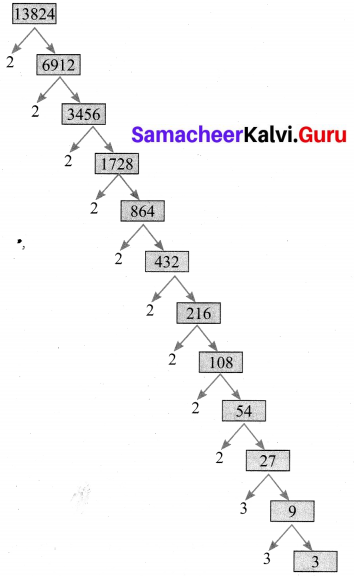
If 13824 = 2a × 3b then find a and b.
Solution:
If 13824 = 2a × 3b
Using the prime factorisation tree
Samacheer Kalvi 10th Maths Chapter 2 Numbers and Sequences Ex 2.2 1
13824 = 2 × 2 × 2 × 2 × 2 × 2 × 2 × 2 × 2 × 3 × 3 × 3
= 29 × 33 = 2a × 3b
∴ a = 9, b = 3.

Question 5.
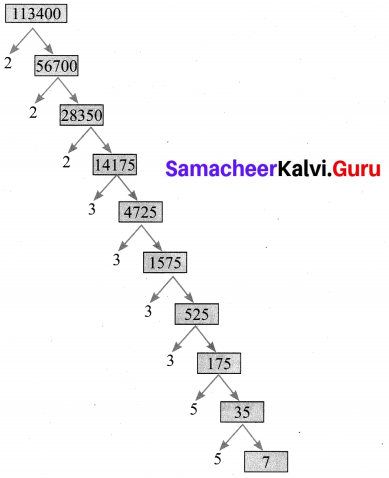
If p1x1 × p2x2 × p3x3 × p4x4 = 113400 where p1, p2, p3, p4 are primes in ascending order and x1, x2, x3, x4 are integers, find the value of P1, P2, P3, P4 and x1, x2, x3, x4.
Solution:
If p1x1 × p2x2 × p3x3 × p4x4 = 113400
p1, p2, p3, P4 are primes in ascending order, x1, x2, x3, x4 are integers.
using Prime factorisation tree.
Samacheer Kalvi 10th Maths Chapter 2 Numbers and Sequences Ex 2.2 2
113400 = 2 × 2 × 2 × 3 × 3 × 3 × 3 × 5 × 5 × 7
= 23 × 34 × 52 × 7
= p1x1 × p2x2 × p3x3 × p4x4
∴ p1= 2, p2 = 3, p3 = 5, p4 = 7, x1 = 3, x2 = 4, x3 = 2, x4 = 1.
Samacheer Kalvi 10th Maths Solutions Chapter 2 Numbers and Sequences Ex 2.2

Question 6.
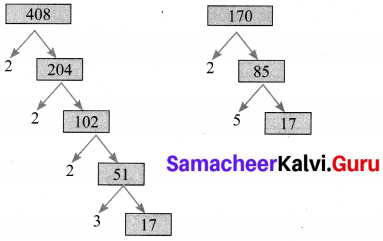
Find the L.C.M. and H.C.F. of 408 and 170 by applying the fundamental theorem of arithmetic.
Solution:
408 and 170.
Samacheer Kalvi 10th Maths Chapter 2 Numbers and Sequences Ex 2.2 3
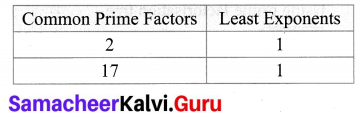
408 = 23 × 31 × 171
170 = 21 × 51 × 171
Samacheer Kalvi 10th Maths Chapter 2 Numbers and Sequences Ex 2.2 4
∴ H.C.F. = 21 × 171 = 34.
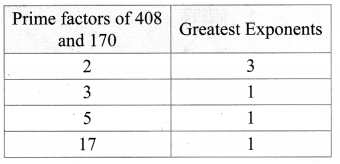
To find L.C.M, we list all prime factors of 408 and 170, and their greatest exponents as follows.
Samacheer Kalvi 10th Maths Chapter 2 Numbers and Sequences Ex 2.2 5
∴ L.C.M. = 23 × 31 × 51 × 171
= 2040.

Question 7.
Find the greatest number consisting of 6 digits which is exactly divisible by 24, 15, 36?
Solution:
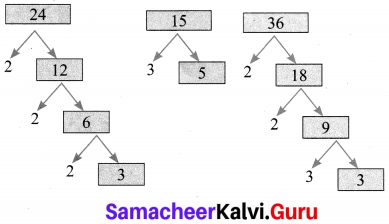
To find L.C.M of 24, 15, 36
Samacheer Kalvi 10th Maths Chapter 2 Numbers and Sequences Ex 2.2 6
24 = 23 × 3
15 = 3 × 5
36 = 22 × 32
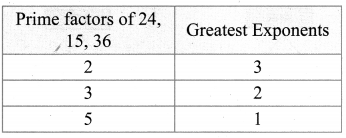
Samacheer Kalvi 10th Maths Chapter 2 Numbers and Sequences Ex 2.2 7
∴ L.C.M = 23 × 32 × 51
= 8 × 9 × 5
= 360
If a number has to be exactly divisible by 24, 15, and 36, then it has to be divisible by 360. Greatest 6 digit number is 999999.
Common multiplies of 24, 15, 36 with 6 digits are 103680, 116640, 115520, …933120, 999720 with six digits.
∴ The greatest number consisting 6 digits which is exactly divisible by 24, 15, 36 is 999720.

Samacheer Kalvi 10th Maths Solutions Chapter 2 Numbers and Sequences Ex 2.2

Question 8.
What is the smallest number that when divided by three numbers such as 35, 56 and 91 leaves remainder 7 in each case?
Answer:
Find the L.C.M of 35, 56, and 91
35 – 5 × 7 56
56 = 2 × 2 × 2 × 7
91 = 7 × 13
L.C.M = 23 × 5 × 7 × 13
= 3640
Since it leaves remainder 7
The required number = 3640 + 7
= 3647
The smallest number is = 3647

Question 9.
Find the least number that is divisible by the first ten natural numbers.
Solution:
The least number that is divisible by the first ten natural numbers is 2520.
Hint:
1,2, 3,4, 5, 6, 7, 8,9,10
The least multiple of 2 & 4 is 8
The least multiple of 3 is 9
The least multiple of 7 is 7
The least multiple of 5 is 5
∴ 5 × 7 × 9 × 8 = 2520.
L.C.M is 8 × 9 × 7 × 5
= 40 × 63
= 2520

Samacheer Kalvi 10th Maths Solutions Chapter 2 Numbers and Sequences Ex 2.2 Read More »

Samacheer Kalvi 9th Maths Solutions Chapter 3 Algebra Ex 3.8

You can Download Samacheer Kalvi 9th Maths Book Solutions Guide Pdf, Tamilnadu State Board help you to revise the complete Syllabus and score more marks in your examinations.

Tamilnadu Samacheer Kalvi 9th Maths Solutions Chapter 3 Algebra Ex 3.8

Question 1.
Factorise each of the following polynomials using synthetic division:
(i) x3 – 3x2 – 10x + 24
(ii) 2x3 – 3x2 – 3x + 2
(iii) -7x + 3 + 4x3
(iv) x3 + x2 – 14x – 24
(v) x3 – 7x + 6
(vi) x3 – 10x2 – x + 10
Solution:
(i) x3 – 3x2 – 10x + 24
Let p(x) = x3 – 3x2 – 10x + 24
Sum of all the co-efficients = 1 – 3 – 10 + 24 = 25 – 13 = 12 ≠ 0
Hence (x – 1) is not a factor.
Sum of co-efficient of even powers with constant = -3 + 24 = 21
Sum of co-efficients of odd powers = 1 – 10 = – 9
21 ≠ -9
Hence (x + 1) is not a factor.
p (2) = 23 – 3 (22) – 10 × 2 + 24 = 8 – 12 – 20 + 24
= 32 – 32 = 0 ∴ (x – 2) is a factor.
Now we use synthetic division to find other factor
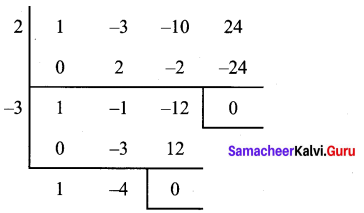
Samacheer Kalvi 9th Maths Chapter 3 Algebra Ex 3.8 1
Thqs (x – 2) (x + 3) (x – 4) are the factors.
∴ x3 – 3x2 – 10x + 24 = (x – 2) (x + 3) (x – 4)

The polynomial division calculator allows you to divide two polynomials to find the quotient and the remainder of the division.

(ii) 2x2 – 3x2 – 3x + 2
Let p (x) = 2x3 – 3x2 – 3x + 2
Sum of all the co-efficients are
2 – 3 – 3 + 2 = 4 – 6 = -2 ≠ 0
∴ (x – 1) is not a factor
Sum of co-efficients of even powers of x with constant = -3 + 2 = – 1
Sum of co-efficients of odd powers of x = 2- 3= -1
(-1) = (-1)
∴ (x + 1) is a factor
Let us find the other factors using synthetic division
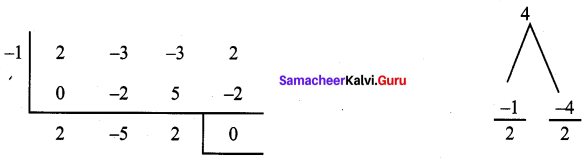
Samacheer Kalvi 9th Maths Chapter 3 Algebra Ex 3.8 2
Quotient is 2x2 – 5x + 2 = 2x – 4x – x + 2 = 2x (x – 2) – 1 (x – 2)
= (x – 2) (2x – 1)
∴ 2x3 – 3x2 – 3x + 2 = (x + 1) (x – 2) (2x – 1)

(iii) -7x + 3 + 4x3
Let p(x) = 4x3 + 0x2 – 7x + 3
Sum of the co-efficients are = 4 + 0 – 7 + 3
= 7 – 7 = 0
∴ (x- 1) is a factor
Sum of co-efficients of even powers of x with constant = 0 + 3 = 3
Sum of co-efficients of odd powers of x with constant = 4 – 7 = -3
-3 ≠ -3
∴ (x + 1) is not a factor
Using synthetic division, let us find the other factors.
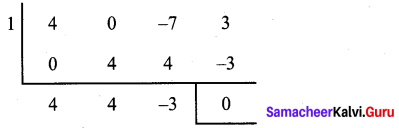
Samacheer Kalvi 9th Maths Chapter 3 Algebra Ex 3.8 3
Samacheer Kalvi 9th Maths Chapter 3 Algebra Ex 3.8 4
Quotient is 4x2 + 4x – 3
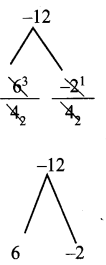
= 4x2 + 6x – 2x – 3
= 2x (2x + 3) – 1 (2x + 3)
= (2x + 3) (2x – 1)
∴ The factors are (x – 1), (2x + 3) and (2x – 1)
∴ -7x + 3 + 4x3 = (x + 1) (2x + 3) (2x – 1)

Samacheer Kalvi 9th Maths Solutions Chapter 3 Algebra Ex 3.8

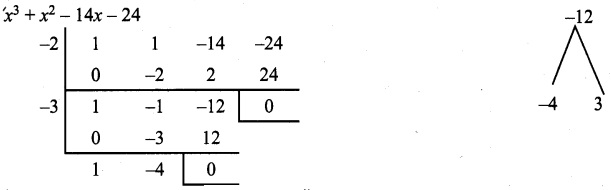
(iv) x3 + x2 – 14x – 24
Let p (x) = x3 + x2 – 14x – 24
Sum of the co-efficients are = 1 + 1 – 14 – 24 = -36 ≠ 0
∴ (x – 1) is not a factor
Sum of co-efficients of even powers of x with constant = 1 – 24 = -23
Sum of co-efficients of odd powers of x = 1 – 14 = -3
-23 ≠ -13
∴ (x + 1) is also not a factor
p(2) = 23 + 22 – 14 (2) – 24 = 8 + 4 – 28 – 24
= 12 – 52 ≠ 0, (x – 2) is a not a factor
p (-2) = (-2)3 + (-2)2 – 14 (-2) – 24
= -8 + 4 + 28 – 24 = 32 – 32 = 0
∴ (x + 2) is a factor
To find the other factors let us use synthetic division.
Samacheer Kalvi 9th Maths Chapter 3 Algebra Ex 3.8 5
∴ The factors are (x + 2), (x + 3), (x + 4)
∴ x3 + x2 – 14x – 24 = (x + 2) (x + 3) (x – 4)

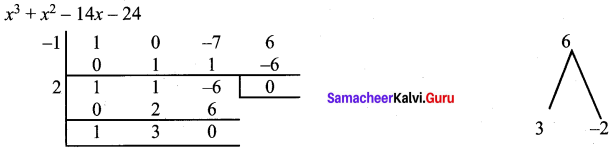
(v) x3 – 7x + 6
Let p (x) = x3 + 0x2 – 7x + 6
Sum of the co-efficients are = 1 + 0 – 7 + 6 = 7 – 7 = 0
∴(x- 1) is a factor
Sum of co-efficients of even powers of x with constant = 0 + 6 = 6
Sum of coefficient of odd powers of x = 1 – 7 = -7
6 ≠ -7
∴ (x + 1) is not a factor
To find the other factors, let us use synthetic division.
Samacheer Kalvi 9th Maths Chapter 3 Algebra Ex 3.8 6
∴ The factors are (x – 1), (x – 2), (x + 3)
∴ x3 + 0x2 – 7x + 6 = (x – 1) (x – 2) (x + 3)

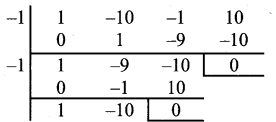
(vi) x3 – 10x2 – x + 10
Let p (x) = x3 – 10x2 – x + 10
Sum of the co-efficients = 1 – 0 – 1 + 10
= 11 – 11 = 0
∴ (x – 1) is a factor
Sum of co-efficients of even powers of x with constant = -10 + 10 = 0
Sum of co-efficients of odd powers of = 1 – 1 = 0
∴(x + 1) is a factor
Synthetic division
Samacheer Kalvi 9th Maths Chapter 3 Algebra Ex 3.8 7
∴ x3 + 10x2 – x + 10 = (x – 1) (x + 1) (x – 10)

Samacheer Kalvi 9th Maths Solutions Chapter 3 Algebra Ex 3.8 Read More »

Samacheer Kalvi 8th Maths Solutions Term 1 Chapter 2 Measurements Ex 2.4

Students can Download Maths Chapter 2 Measurements Ex 2.4 Questions and Answers, Notes Pdf, Samacheer Kalvi 8th Maths Book Solutions Guide Pdf helps you to revise the complete Tamilnadu State Board New Syllabus and score more marks in your examinations.
Samacheer Kalvi 8th Maths Solutions Term 1 Chapter 2 Measurements Ex 2.4

Tamilnadu Samacheer Kalvi 8th Maths Solutions Term 1 Chapter 2 Measurements Ex 2.4

Miscellaneous Practice Problems

Question 1.
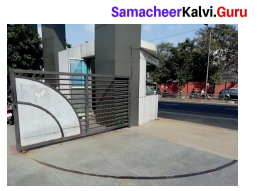
Two gates are fitted at the entrance of a library. To open the gates easily, a wheel is fixed at 6 feet istance from the wall ito which the gate is fixed. If one of the gates is opened to 90°, find the distance moved by the wheel (π = 3.14).
Samacheer Kalvi 8th Maths Term 1 Chapter 2 Measurements Ex 2.4 1
Solution:
Let A be the position of the wall AC be the gate in initial position and AB be position when it is moved 90°.
Now the arc length BC gives the distance moved by the wheel.
Length of the arc
= \(\frac{\theta}{360^{\circ}}\) × 2πr units
= \(\frac{90^{\circ}}{360^{\circ}}\) × 2 × 3.14 × 6 feets
= 3.14 × 3 feets
= 9.42 feets
∴ Distance moved by the wheel = 9.42 feets.

Question 2.
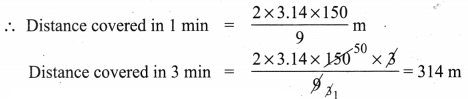
With his usual speed, if a person covers a circular track of radius 150 ra in 9 minutes, find the distance that he covers in 3 minutes (π = 3.14).
Solution:
Radius of the circular track = 150m
Distance covers in 9 minutes = Perimeter of the circle = 2 × π × r units
Distance covered in 9 min = 2 × 3.14 × 150 m
Samacheer Kalvi 8th Maths Term 1 Chapter 2 Measurements Ex 2.4 2
Distance he covers in 3 min = 314 m

Question 3.
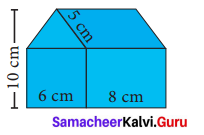
Find the area of the house drawing given in the figure.
Samacheer Kalvi 8th Maths Term 1 Chapter 2 Measurements Ex 2.4 3
Solution:
Area of the house = Area of a square of side 6 cm + Area of a rectangle with l = 8cm, h = 6 cm + Area of a ∆ with b = 6 cm and h = 4 cm + Area of a parallelogram with b = 8 cm, h = 4 cm
= (side × side) + (l × b) + (\(\frac{1}{2}\) × b × h) + 6h cm2
= (6 × 6) + (8 × 6) + (\(\frac{1}{2}\) × 6 × 4) + (8 × 4) cm2
= 36 + 48 + 12+ 32 cm2
Required Area = 128 cm2

Question 4.
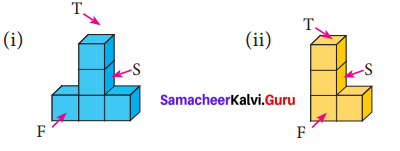
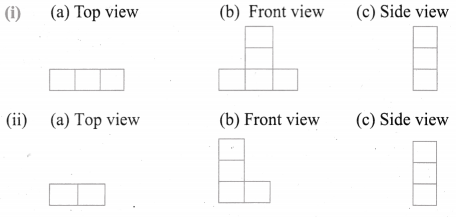
Draw the top, front and side view of the following solid shapes.
Samacheer Kalvi 8th Maths Term 1 Chapter 2 Measurements Ex 2.4 4
Solution:
Samacheer Kalvi 8th Maths Term 1 Chapter 2 Measurements Ex 2.4 5

Samacheer Kalvi 8th Maths Solutions Term 1 Chapter 2 Measurements Ex 2.4

Question 5.
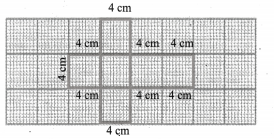
Draw the net for the cube of side 4 cm in a graph sheet.
Solution:
Samacheer Kalvi 8th Maths Term 1 Chapter 2 Measurements Ex 2.4 6

Challenging Problems

FeetFinder is the easiest way for verified users to buy and sell feet pictures and videos in a safe and secure environment.

Question 6.
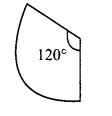
Guna has fixed a single door of 3 feet wide in his room whereas Nathan has fixed a double door, each 1 \(\frac{1}{2}\) feet wide in his room. From the closed state, if each of the single and double doors can open up to 120°, whose door requires a minimum area?
Samacheer Kalvi 8th Maths Term 1 Chapter 2 Measurements Ex 2.4 7
Solution:
(a) Width of the door that Guna fixed = 3 feet.
When the door is open the radius of the sector = 3 feet
Angle covered = 120°
∴ Area required to open the door = \(\frac{120^{\circ}}{360^{\circ}}\) × πr2 = \(\frac{120^{\circ}}{360^{\circ}}\) × π × 3 × 3 = 37π feet2

(b) Width of the double doors that Nathan fixed = 1\(\frac{1}{2}\) feet.
Angle described to open = 120°
Area required to open = 2 × Area of the sector
= 2 × \(\frac{120^{\circ}}{360^{\circ}} \times \pi \times \frac{3}{2} \times \frac{3}{2} \text { feets }^{2}=\frac{3 \pi}{2}\) feet2
= \(\frac{1}{2}\) (3π) feet2
∴ The double door requires the minimum area.

Question 7.
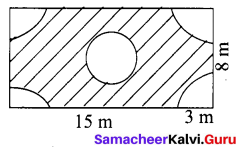
In a rectangular field which measures 15 m × 8m, cows are tied with a rope of length 3m at four corners of the field and also at the centre. Find the area of the field where none of the cow can graze. (π = 3.14).
Solution:
Area of the field where none of the cow can graze = Area of the rectangle – [Area of 4 quadrant circles] – Area of a circle
Samacheer Kalvi 8th Maths Term 1 Chapter 2 Measurements Ex 2.4 8
Area of the rectangle = l × b units2
= 15 × 8 m2 = 120 m2
Area of 4 quadrant circles = 4 × \(\frac{1}{4}\) πr2 units
Radius of the circle = 3 m
Area of 4 quadrant circles = 4 × \(\frac{1}{4}\) × 3.14 × 3 × 3 = 28.26m2
Area of the circle at the middle = πr2 units
= 3.14 × 3 × 3m2 = 28.26m2
∴ Area where none of the cows can graze
= [120 – 28.26 – 28.26]m2 = 120 – 56.52 m2 = 63.48m2

Question 8.
Three identical coins, each of diameter 6 cm are placed as shown. Find the area of the shaded region between the coins, (π = 3.14) ( \(\sqrt{3}\) = 1.732)
Samacheer Kalvi 8th Maths Term 1 Chapter 2 Measurements Ex 2.4 9
Solution:
Given diameter of the coins = 6 cm
∴ Radius of the coins = \(\frac{6}{2}\) = 3 cm
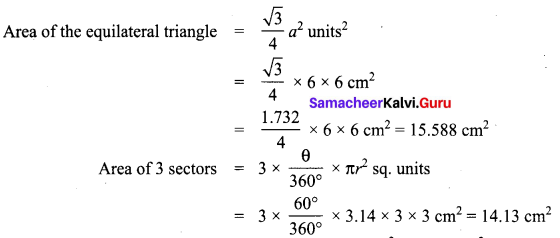
Area of the shaded region = Area of equilateral triangle – Area of 3 sectors of angle 60°
Area of the equilateral triangle
Samacheer Kalvi 8th Maths Term 1 Chapter 2 Measurements Ex 2.4 10
∴ Area of the shaded region = 15.588 – 14.13 cm2 = 1.458 cm2
Required area 1.458 cm2 (approximately)

Samacheer Kalvi 8th Maths Solutions Term 1 Chapter 2 Measurements Ex 2.4

Question 9.
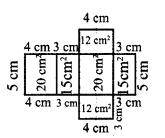
Using graph sheet, draw the net for the cuboid whose length is 5cm, breadth is 4cm and height is 3cm and also find its area.
Solution:
Net for the cuboid is:
Samacheer Kalvi 8th Maths Term 1 Chapter 2 Measurements Ex 2.4 11
One of the possible nets for a cuboid of length = 5 cm, breadth = 4 cm, height = 3 cm is given above
Area of the cuboid
= 20 cm2 + 15 cm2 + 20 cm2 + 15 cm2 + 12 cm2 + 12 cm2 = 94 cm2
Using formula,
Surface area of a cuboid
= 2 (lb + bh + lh) unit2
= 2(5 × 4 + 4 × 3 + 5 × 3) cm2
= 2(20 + 12 + 15) cm2
= 94 cm2

Question 10.
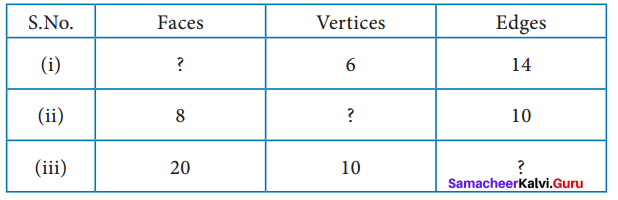
Using Euler’s formula, find the unknowns.
Samacheer Kalvi 8th Maths Term 1 Chapter 2 Measurements Ex 2.4 12
Solution:
Euler’s formula is given by F + V- E = 2
(i) V = 6, E = 14
By Euler’s formula
= F + 6 – 14 = 2
F = 2 + 14 – 6
F = 10

(ii) F = 8, E = 10
By Euler’s formula
= 8 + V – 10 = 2
V = 2 – 8 + 10
V = 4

(iii) F = 20, V = 10
By Euler’s formula
= 20 + 10 – E = 2
30 – E = 2
E = 30 – 2
E = 28
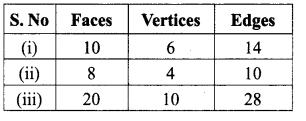
Tabulating the required unknowns
Samacheer Kalvi 8th Maths Term 1 Chapter 2 Measurements Ex 2.4 13

Samacheer Kalvi 8th Maths Solutions Term 1 Chapter 2 Measurements Ex 2.4 Read More »

Samacheer Kalvi 9th Maths Solutions Chapter 1 Set Language Ex 1.5

You can Download Samacheer Kalvi 9th Maths Book Solutions Guide Pdf, Tamilnadu State Board help you to revise the complete Syllabus and score more marks in your examinations.

Tamilnadu Samacheer Kalvi 9th Maths Solutions Chapter 1 Set Language Ex 1.5

Question 1.
Using the adjacent venn diagram, find the following sets:
(i) A – B
(ii) B – C
(iii) A’ ∪ B’
(vi) A’ ∩ B’
(v) (B ∪ C)’
(vi) A – (B ∪ C)
(vii) A – (B ∩ C)
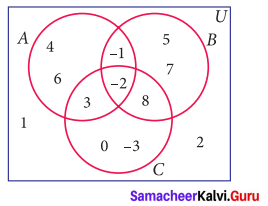
Samacheer Kalvi 9th Maths Chapter 1 Set Language Ex 1.5 1
Solution:
(i) A – B = {3, 4, 6}
(ii) B – C = {-1, 5, 7}
(iii) A’ ∪ B’
A’ = {1, 2, 0, -3, 5, 7, 8}
B’ = {-3, 0, 1, 2, 3, 4, 6)
A’ ∪ B’ = {-3, 0, 1, 2, 3, 4, 5, 6, 7, 8)

(iv) A’ ∩ B’
A’ ∩ B’ = {-3, 0, 1, 2}

(v) B ∪ C = {-3, -2, -1, 0, 3, 5, 7, 8}
(B ∪ C)’ = U – (B ∪ C)
= {-3, -2, -1, 0, 1,2, 3, 4, 5, 6, 7, 8} – {-3, -2, -1, 0, 3, 5, 7, 8}
(B ∪ C)’ = {1, 2, 4, 6}

(vi) A – (B ∪ C) = {-2, -1, 3, 4,6} – {-3, -2, -1, 0, 3, 5, 7, 8} = {4, 6}
A – (B ∩ C)
B ∩ C = {-2, 8}
A- (B ∩ C) = {-2, -1, 3, 4, 6} – {-2, 8} = {-1, 3, 4, 6}

Question 2.
If K = {a, b, d, e,f}, L = {b, c, d, g} and M {a, b, c, d, h} then find the following:
(i) K ∪ (L ∩ M)
(ii) K ∩ (L ∪ M)
(iii) (K ∪ L) ∩ (K ∪ M)
(iv) (K ∩ L) ∪ (K ∩ M) and verify distributive laws.
Solution:
K = {a, b, d, e, f}, L = {b, c, d, g} and M {a, b, c, d, h}
(i) K ∪ (L ∩ M)
L ∩ M = {b, c, d, g} ∩ {a, b, c, d, h} = {b, c, d}
K ∪ (L ∩ M) = {a, b, d, e, f } ∪ {b, c, d) = {a, b, c, d, e, f}

(ii) K ∩(L ∪ M)
L ∪ M = {a, b, c, d, g, h}
K ∩ (L ∪ M) = {a, b, d, e, f} ∩ {a, b, c, d, g, h} = {a, b, d}

(iii) (K ∪ L) ∩ (K ∪ M)
K ∪ L = {a, b, c, d, e, f, g}
K ∪ M = {a, b, c, d, e, f, h}
(K ∪ L) ∩ (K ∪ M) = {a, b, c, d, e,f}

(iv) (K ∩ L) ∪ (K ∩ M)
(K ∩ L) = {b, d)
(K ∩ M) = {a,b,d}
(K ∩ L) ∪ (K ∩ M) = {b, d} ∪ {a, b, d} = {a, b, d}

Distributive laws
K ∪ (L ∩ M) = (K ∪ L) ∩ (K ∪ M)
{a, b, c, d, e, f) = {a, b, c, d, e, f, g} ∩ {a, b, c, d, e, f, h}
= {a, b, c, d, e, f}
Thus Verified.
K ∩ (L ∪ M) = (K ∩ L) ∪ (K ∩ M)
{a, b, d} = {a, b, c, d, e, f, g} ∪ {a, b, c, d, e, f, h}
= {a, b, d}
Thus Verified.

Question 3.
If A = {x : x ∈ Z, -2 < x ≤ 4}, B = {x : x ∈ W, x ≤ 5}, C ={-4, -1, 0, 2, 3, 4}, then verify A ∪ (B ∩ C) = (A ∪ B) ∩ (A ∪ C).
Solution:
A = {x : x ∈ Z, -2 < x ≤ 4} = {-1, 0, 1, 2, 3, 4}
B = {x : x ∈ W, x ≤ 5} = {0, 1, 2, 3, 4, 5}
C = {-4, -1, 0, 2, 3, 4}
A ∪ (B ∩ C)
B ∩ C = {0, 1, 2, 3, 4, 5} ∩ {-4, -1, 0, 2, 3, 4} = {0, 2, 3, 4}
A ∪ (B ∩ C) = {-1, 0, 1, 2, 3, 4} ∪ (0, 2, 3, 4} ={-1, 0, 1, 2, 3, 4} …………. (1)
(A ∪ B) ∩ (A ∪ C)
A ∩ B = {0, 1, 2, 3, 4}
A ∩ C = {-1, 0, 2, 3, 4}
(A ∩ B) ∪ (A ∩ C) = {0, 1, 2, 3, 4} ∪ {-1, 0, 2, 3, 4}= {-1, 0, 1, 2, 3, 4} …………. (2)
From (1) and (2), it is verified that
A ∪ (B ∩ C) = (A ∪ B) ∩ (A ∪ C)

Samacheer Kalvi 9th Maths Solutions Chapter 1 Set Language Ex 1.5

Question 4.
Verify A ∪ (B ∩ C) = (A ∪ B) ∩ (A ∪ C) using Venn diagrams.
Solution:
L.H.S A ∪ (B ∩ C)
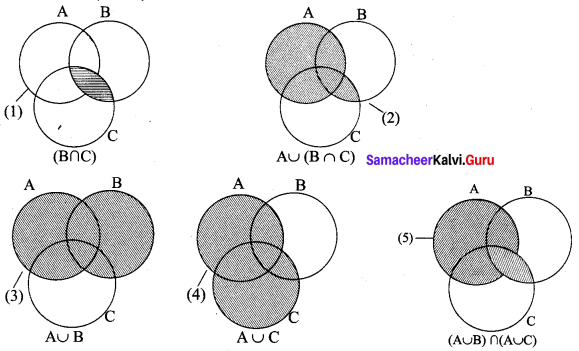
Samacheer Kalvi 9th Maths Chapter 1 Set Language Ex 1.5 2
From (2) and (5), it is verified that A ∪ (B ∩ C) = (A ∪ B) ∩ (A ∪ C)

Question 5.
If A = {b, c, e, g, h}, B = {a, c, d, g, i} and C = {a, d, e, g, h}, then show that A – (B ∩ C) = (A – B) ∪ (A – C).
Solution:
A = {b, c, e, g, h}
B = {a, c, d, g, i}
C = {a, d, e, g, h}
B ∩ C = {a, d, g}
A – (B ∩ C) = {b, c, e, g, h} – {a, d, g} = {b, c, e, h} ……..… (1)
A- B = {b, c, e, g, h} – {a, c, d, g, i} = {b, e, h}
A – C = {b, c, e, g, h} – {a, d, e, g, h} = {b, c}
(A – B) ∪ (A – C) = {b, c, e, h} ………..… (2)
From (1) and (2) it is verified that
A – (B ∩ C) = (A – B) ∪ (A – C)

Question 6.
If A = {x : x = 6 n ∈ W and n < 6}, B = {x : x = 2n, n ∈ N and 2 < n ≤ 9} and C = {x : x = 3n, n ∈ N and 4 ≤ n < 10}, then show that A – (B ∩ C) = (A – B) ∪ (A – C)
Solution:
A = {x : x = 6n, n ∈ W, n < 6}
x = 6n
n = {0, 1, 2, 3, 4, 5}
⇒ x = 6 × 0 = 0
x = 6 × 1= 6
x = 6 × 2 = 12
x = 6 × 3 = 18
x = 6 × 4 = 24
x = 6 × 5 = 30
∴ A = {0, 6, 12, 18, 24, 30}

B = { x : x = 2n, n ∈ N, 2 < n ≤ 9}
n = {3, 4, 5, 6, 7, 8, 9}
x = 2 n
⇒ x = 2 × 3 = 6
2 × 4 = 8
2 × 5 = 10
2 × 6 = 12
2 × 7 = 14
2 × 8 = 16
2 × 9 = 18
∴ B {6, 8, 10, 12, 14, 16, 18}

C = { x : x = 3n, n ∈ N, 4 ≤ n < 10}
N = { 4, 5, 6, 7, 8, 9}
x = 3 × 4 = 12
⇒ x = 3 × 5 = 15
x = 3 × 6 = 18
x = 3 × 7 = 21
x = 3 × 8 = 24
x = 3 × 9 = 27
x = 2 × 9 = 18
∴ C = {12, 15, 18, 21, 24, 27}

A – (B ∩ C) = (A – B) ∪ (A – C)
L.H.S R.H.S
B ∩ C = {12,18}
A – (B ∩ C) = {0, 6, 12, 18, 24, 30} – {12, 18} = {0, 6, 24, 30} ……….…. (1)
(A – B) = {0, 24, 30}
(A – C) = {0, 6, 30}
(A – B) ∪ (A – C) = {0, 6, 24, 30} …………. (2)
From (1) and (2), it is verified that
A – (B ∩ C) = (A – B) ∪ (A – C).

Question 7.
If A = {-2, 0, 1, 3, 5}, B = {-1, 0, 2, 5, 6} and C = {-1, 2, 5, 6, 7}, then show that A – (B ∪ C) = (A – B) ∩ (A – C).
Solution:
A = {-2, 0, 1, 3, 5},
B = {-1, 0, 2, 5, 6}
C ={-1, 2, 5, 6, 7}
B ∪ C = {-1, 0, 2, 5, 6, 7}
A – (B ∪ C) = {-2, 1, 3} …………. (1)
(A – B) = {-2, 1, 3}
(A – C) = {-2, 0, 1, 3}
(A – B) ∩ (A – C) = {-2, 1, 3} ………..… (2)
From (1) and (2), it is verified that . A – (B ∪ C) = (A – B) ∩ (A – C)

Samacheer Kalvi 9th Maths Solutions Chapter 1 Set Language Ex 1.5

Question 8.
if A={y: y = \(\frac{a+1}{2}\), a W and a 5},B = {y: y=\(\frac{2 n-1}{2}\),n W and n < 5} and C={1,\(-\frac{1}{2}\), 1, \(\frac{3}{2}\), 2} then show that A – (B ∪ C) = (A – B) ∩ (A – C).
Solution:
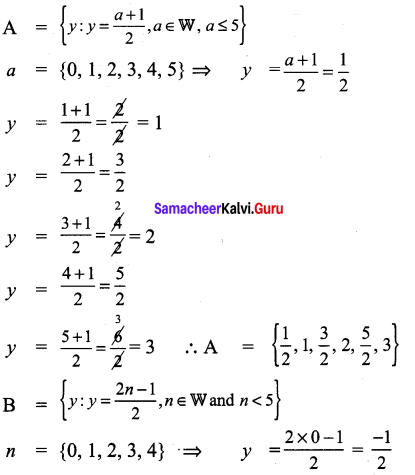
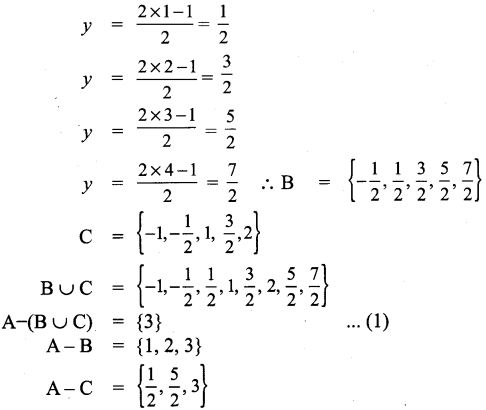
Samacheer Kalvi 9th Maths Chapter 1 Set Language Ex 1.5 3
Samacheer Kalvi 9th Maths Chapter 1 Set Language Ex 1.5 4
(A – B) ∩ (A – C) = {3} …………. (2)
From (1) and (2), it is verified that A – (B ∪ C) = (A – B) ∩ (A – C).

Question 9.
Verify A – (B ∩ C) = (A – B) ∪ (A – C) using Venn diagrams.
Solution:
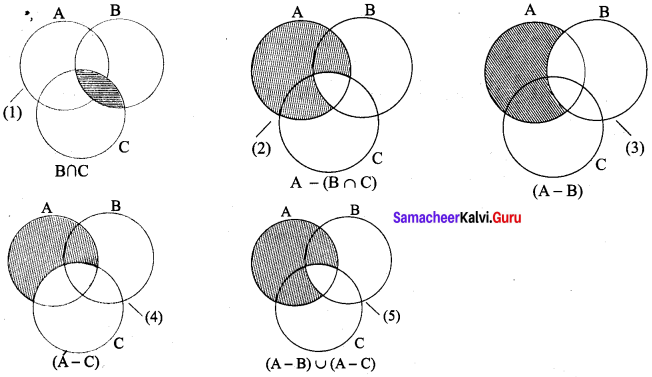
Samacheer Kalvi 9th Maths Chapter 1 Set Language Ex 1.5 5
∴ A – (B ∩ C) = (A – B) ∪ (A – C)
Hence it is proved.

Question 10.
If U = {4, 7, 8, 10, 11, 12, 15, 16}, A = {7, 8, 11, 12} and B = {4, 8, 12, 15}, then verify De Morgan’s Laws for complementation.
U = {4, 7, 8, 10, 11, 12, 15, 16}
A = {7, 8, 11, 12}, B = {4, 8, 12, 15}
De Morgan’s Laws for complementation.
(A ∪ B)’ = A’ ∩ B’
A ∪ B = {4, 7, 8, 11, 12, 15}
(A ∪ B)’ = {4, 7, 8, 10, 11, 12, 15, 16} – {4, 7, 8, 11, 12, 15}
= {10, 16} ……………. (1)
A’ = {4, 10, 15, 16}
B’ = {7, 10, 11, 16}
A’ ∩ B’ = {10, 16} ………………(2)
From (1) and (2) it is verified that (A ∪ B)’ = A’ ∩ B’.

Samacheer Kalvi 9th Maths Solutions Chapter 1 Set Language Ex 1.5

Question 11.
Verify (A ∩ B)’ = A’ ∪ B’ using Venn diagrams.
Solution:
(A ∩ B)’ = A’ ∪ B’
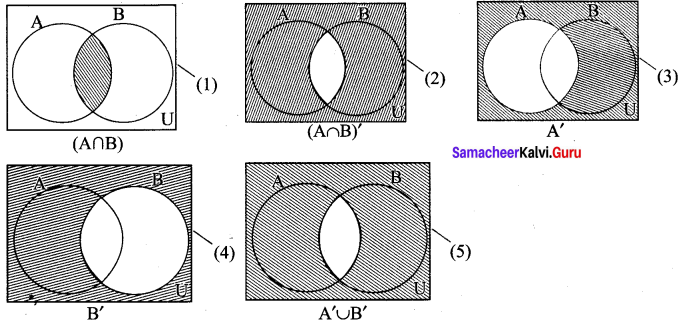
Samacheer Kalvi 9th Maths Chapter 1 Set Language Ex 1.5 6
(2) = (5)
∴ (A ∩ B)’ = A’ ∪ B’

Samacheer Kalvi 9th Maths Solutions Chapter 1 Set Language Ex 1.5 Read More »

Samacheer Kalvi 9th Maths Solutions Chapter 8 Statistics Ex 8.3

You can Download Samacheer Kalvi 9th Maths Book Solutions Guide Pdf, Tamilnadu State Board help you to revise the complete Syllabus and score more marks in your examinations.

Tamilnadu Samacheer Kalvi 9th Maths Solutions Chapter 8 Statistics Ex 8.3

Question 1.
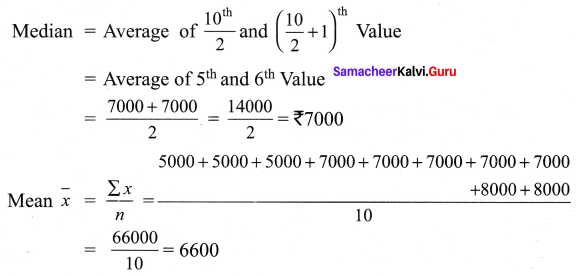
The monthly salary of 10 employees in a factory are given below : ₹ 5000, ₹ 7000, ₹ 5000, ₹ 7000, ₹ 8000, ₹ 7000, 17000, ₹ 8000, ₹ 7000, ₹ 5000 Find the mean, median and mode.
Solution:
The monthly salary of 10 employees are ₹ 5000, ₹ 7000, ₹ 5000, ₹ 7000, ₹ 8000, ₹ 7000, ₹ 7000, ₹ 8000, ₹ 7000, ₹ 5000.
Writing in ascending order ₹ 5000, ₹ 5000, ₹ 5000, ₹ 7000, ₹ 7000, ₹ 7000, ₹ 8000, ₹ 8000
Number of values =10 which is an even number.
Samacheer Kalvi 9th Maths Chapter 8 Statistics Ex 8.3 1
In this given data ₹ 7000 occurs maximum number of 5 times
∴ Mode = ₹ 7000/-
∴ Mean = ₹ 6600/-
Mode = ₹ 7000/-
Samacheer Kalvi 9th Maths Solutions Chapter 8 Statistics Ex 8.3
Question 2.
Find the mode of the given data : 3.1, 3.2, 3.3, 2.1,1.3, 3.3, 3.1
Solution:
3.1, 3.2, 3.3, 2.1, 1.3, 3.3, 3.1
In this given data 3.1, 3.3 occurs twice
₹ Mode = 3.1 and 3.3 (bimodal)

Question 3.
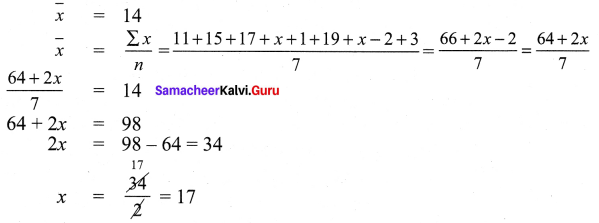
For the data 11, 15, 17, x + 1, 19, x – 2, 3 if the mean is 14 , find the value of x. Also find the mode of the data.
Solution:
The data given is 11, 15, 17, x + 1, 19, x – 2, 3
Samacheer Kalvi 9th Maths Chapter 8 Statistics Ex 8.3 2
The data 11, 15, 17, 17 + 1, 19, 17 – 2, 3 = 11, 15, 17, 18, 19, 15, 3
In this given data 15 occurs twice. Hence the mode is 15.

Question 4.
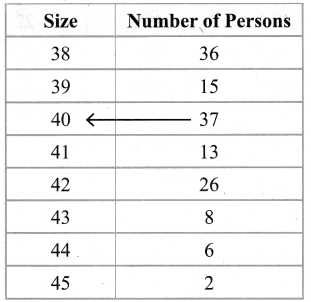
The demand of track suit of different sizes as obtained by a survey is given below:
Samacheer Kalvi 9th Maths Chapter 8 Statistics Ex 8.3 3
Which size is in greater demand ?
Solution:
Samacheer Kalvi 9th Maths Chapter 8 Statistics Ex 8.3 4
∴ Size 40 has maximum frequency 37.
∴ 40 is the mode.
Samacheer Kalvi 9th Maths Solutions Chapter 8 Statistics Ex 8.3
Question 5.
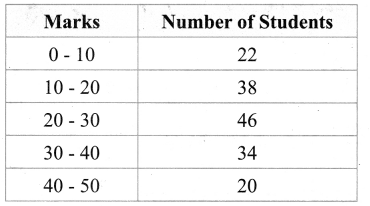
Find the mode of the following data:
Samacheer Kalvi 9th Maths Chapter 8 Statistics Ex 8.3 6
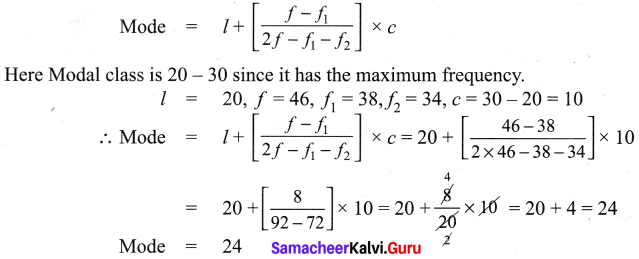
Solution:
Samacheer Kalvi 9th Maths Chapter 8 Statistics Ex 8.3 7

Question 6.
Find the mode of the following distribution:
Samacheer Kalvi 9th Maths Chapter 8 Statistics Ex 8.3 9
Solution:
Samacheer Kalvi 9th Maths Chapter 8 Statistics Ex 8.3 10
Samacheer Kalvi 9th Maths Solutions Chapter 8 Statistics Ex 8.3
Samacheer Kalvi 9th Maths Chapter 8 Statistics Ex 8.3 11
Samacheer Kalvi 9th Maths Chapter 8 Statistics Ex 8.3 12

Samacheer Kalvi 9th Maths Solutions Chapter 8 Statistics Ex 8.3 Read More »

Samacheer Kalvi 9th Maths Solutions Chapter 8 Statistics Ex 8.2

You can Download Samacheer Kalvi 9th Maths Book Solutions Guide Pdf, Tamilnadu State Board help you to revise the complete Syllabus and score more marks in your examinations.

Tamilnadu Samacheer Kalvi 9th Maths Solutions Chapter 8 Statistics Ex 8.2

Question 1.
Find the median of the given values : 47, 53, 62, 71, 83, 21, 43, 47, 41.
Solution:
47, 53, 62, 71, 83, 21, 43, 47, 41
Ascending order = 21, 41, 43, 47, 47, 53, 62, 71, 83
The number of values 9, which is odd
Samacheer Kalvi 9th Maths Chapter 8 Statistics Ex 8.2 1

Question 2.
Find the Median of the given data: 36, 44, 86, 31, 37, 44, 86, 35, 60, 51.
Solution:
36, 44, 86, 31, 37, 44, 86, 35, 60, 51
Ascending order 31, 35, 36, 37, 44, 44, 51, 60, 86, 86
The number of values = 10, which is an even number
Samacheer Kalvi 9th Maths Chapter 8 Statistics Ex 8.2 2
Samacheer Kalvi 9th Maths Solutions Chapter 8 Statistics Ex 8.2
Question 3.
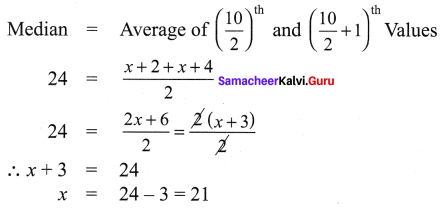
The median of observation 11, 12,14, 18, x + 2, x + 4, 30, 32, 35, 41 arranged in ascending order is 24. Find the values of x.
Solution:
11, 12, 14, 18, x + 2, , x + 4, 30, 32, 35, 41
The number of values = 10, which is an even number
Samacheer Kalvi 9th Maths Chapter 8 Statistics Ex 8.2 3

Question 4.
A researcher studying the behaviour of mice has recorded the time (in seconds) taken by each mouse to locate its food by considering 13 different mice as 31, 33, 63, 33, 28, 29, 33, 27, 27, 34, 35, 28, 32. Find the median time that mice spent in searching its food.
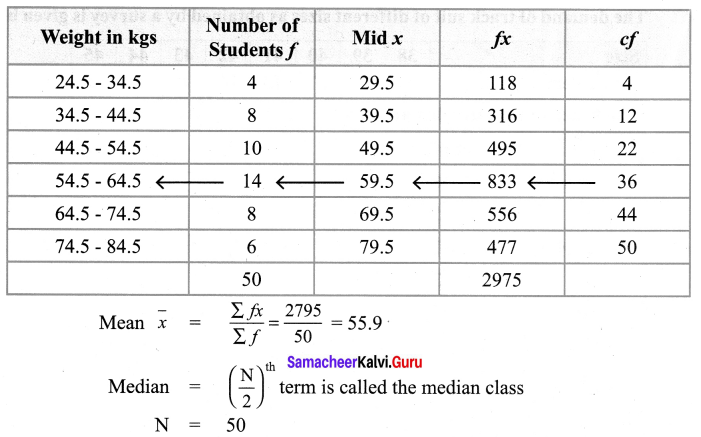
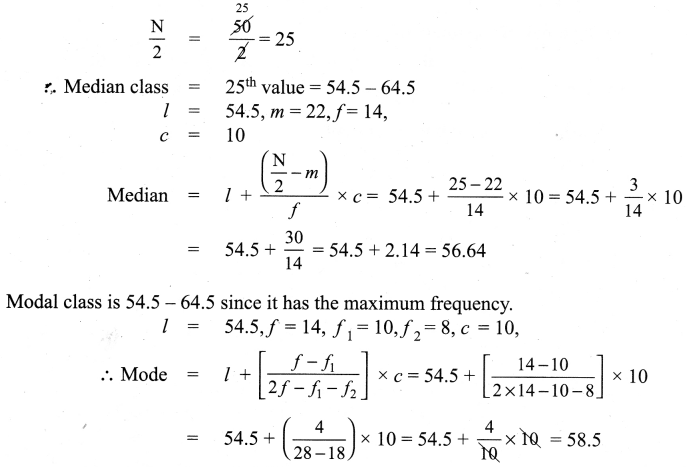
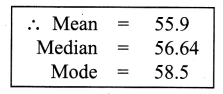
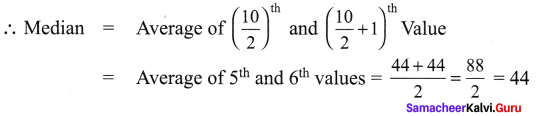
Solution:
31, 33, 63, 33, 28, 29, 33, 27, 27, 34, 35, 28, 32 Writing in ascending order we get 27, 27, 28, 28, 29, 31, 32, 33, 33, 33, 34, 35, 63
Number of values = 13 which is an odd number
Samacheer Kalvi 9th Maths Chapter 8 Statistics Ex 8.2 4

Question 5.
The following are the marks scored by the students in the Summative Assessment exam
Samacheer Kalvi 9th Maths Chapter 8 Statistics Ex 8.2 5
Calculate the median.
Solution:
Samacheer Kalvi 9th Maths Chapter 8 Statistics Ex 8.2 6
Samacheer Kalvi 9th Maths Solutions Chapter 8 Statistics Ex 8.2
Question 6.
The mean of five positive integers is twice their median. If four of the integers are 3, 4, 6, 9 and median is 6, then find the fifth integer.
Solution:
The five integers are 3, 4, 6, 9, x
Samacheer Kalvi 9th Maths Chapter 8 Statistics Ex 8.2 7
Samacheer Kalvi 9th Maths Chapter 8 Statistics Ex 8.2 8

Samacheer Kalvi 9th Maths Solutions Chapter 8 Statistics Ex 8.2 Read More »

Samacheer Kalvi 9th Maths Solutions Chapter 8 Statistics Ex 8.1

You can Download Samacheer Kalvi 9th Maths Book Solutions Guide Pdf, Tamilnadu State Board help you to revise the complete Syllabus and score more marks in your examinations.

Tamilnadu Samacheer Kalvi 9th Maths Chapter 8 Solutions Statistics Ex 8.1

Question 1.
In a week, temperature of a certain place is measured during winter are as follows 26°C, 24°C, 28°C, 31°C, 30°C, 26°C, 24°C. Find the mean temperature of the week.
Solution:
Samacheer Kalvi 9th Maths Chapter 8 Statistics Ex 8.1 1
Mean temperature of the week = 27°C
Samacheer Kalvi 9th Maths Solutions Chapter 8 Statistics Ex 8.1
Question 2.
The mean weight of 4 members of a family is 60kg. Three of them have the weight 56kg, 68kg and 72kg respectively. Find the weight of the fourth member.
Samacheer Kalvi 9th Maths Chapter 8 Statistics Ex 8.1 2
Solution:
Samacheer Kalvi 9th Maths Chapter 8 Statistics Ex 8.1 3
∴ The weight of the fourth member = 44 kg

Question 3.
In a class test in mathematics, 10 students scored 75 marks, 12 students scored 60 marks, 8 students scored 40 marks and 3 students scored 30 marks. Find the mean of their score.
Solution:
Total number of students = 10 + 12 + 8 + 3 = 33
Total score of 33 students = 10 × 75 + 12 × 60 + 8 × 40 + 3 × 30
= 750 + 720 + 320 + 90 = 1880
Samacheer Kalvi 9th Maths Chapter 8 Statistics Ex 8.1 4
= 56.96 or 57 approximately

Question 4.
In a research laboratory scientists treated 6 mice with lung cancer using natural medicine. Ten days later, they measured the volume of the tumor in each mouse and given the results in the table.
Samacheer Kalvi 9th Maths Chapter 8 Statistics Ex 8.1 5
Find the mean.
Solution:
Samacheer Kalvi 9th Maths Chapter 8 Statistics Ex 8.1 6
x = 142.5 mm3

Question 5.
If the mean of the following data is 20.2, then find the value of p
Samacheer Kalvi 9th Maths Chapter 8 Statistics Ex 8.1 7
Solution:
Samacheer Kalvi 9th Maths Chapter 8 Statistics Ex 8.1 8
(30 +p) 20.2 = 610+20p
606 +20.2p = 610+20p
20.2 p – 20p = 610 – 606 = 4
0.2 = 4

Samacheer Kalvi 9th Maths Chapter 8 Statistics Ex 8.1 50
Samacheer Kalvi 9th Maths Solutions Chapter 8 Statistics Ex 8.1
Question 6.
In the class, weight of students is measured for the class records. Calculate mean weight of the class students using Direct method.
Samacheer Kalvi 9th Maths Chapter 8 Statistics Ex 8.1 60
Solution:
Samacheer Kalvi 9th Maths Chapter 8 Statistics Ex 8.1 70

Question 7.
Calculate the mean of the following distribution using Assumed Mean Method:
Samacheer Kalvi 9th Maths Chapter 8 Statistics Ex 8.1 11
Solution:
Let Assumed mean be 25
Samacheer Kalvi 9th Maths Chapter 8 Statistics Ex 8.1 12

Question 8.
Find the Arithmetic Mean of the following data using Step Deviation Method
Samacheer Kalvi 9th Maths Chapter 8 Statistics Ex 8.1 13
Solution:
Standard Deviation Method
Samacheer Kalvi 9th Maths Chapter 8 Statistics Ex 8.1 14
Samacheer Kalvi 9th Maths Solutions Chapter 8 Statistics Ex 8.1

Samacheer Kalvi 9th Maths Solutions Chapter 8 Statistics Ex 8.1 Read More »