Prasanna

Samacheer Kalvi 6th Maths Solutions Term 1 Chapter 6 Information Processing Ex 6.2

You can Download Samacheer Kalvi 6th Maths Book Solutions Guide Pdf, Tamilnadu State Board help you to revise the complete Syllabus and score more marks in your examinations.

Samacheer Kalvi 6th Maths Solutions Term 1 Chapter 6 Information Processing Ex 6.2

Tamilnadu Samacheer Kalvi 6th Maths Solutions Term 1 Chapter 6 Information Processing Ex 6.2

Question 1.
In the following magic triangle, arrange the numbers from 1 to 6, so that you get the same sum on all its sides.
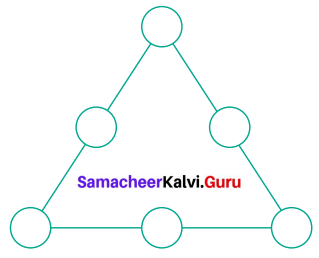
Samacheer Kalvi 6th Maths Term 1 Chapter 6 Information Processing Ex 6.2 Q1
Solution:
Step 1: Complete the corners with smaller numbers 1, 2 and 3.
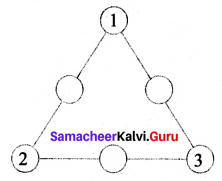
Samacheer Kalvi 6th Maths Term 1 Chapter 6 Information Processing Ex 6.2 Q1.1
Step 2: The side having smallest numbers 1 & 2 are to be filled with the greatest number 6, the second smallest 1 & 3 side to be filled with the second largest 5 at the middle and so on.
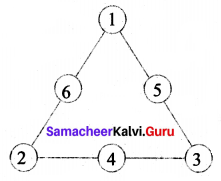
Samacheer Kalvi 6th Maths Term 1 Chapter 6 Information Processing Ex 6.2 Q1.2
The magic sum is 1 + 6 + 2 = 2 + 4 + 3 = 3 + 5 + 1 = 9. Some other ways are given below.
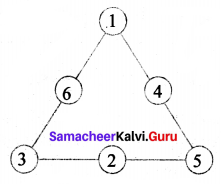
Samacheer Kalvi 6th Maths Term 1 Chapter 6 Information Processing Ex 6.2 Q1.3
The magic sum = 1 + 6 + 3 = 3 + 2 + 5 = 5 + 4 + 1 = 10.
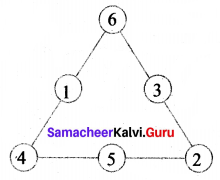
Samacheer Kalvi 6th Maths Term 1 Chapter 6 Information Processing Ex 6.2 Q1.4
The magic sum 6 + 1 + 4 = 4 + 5 + 2 = 2 + 3 + 6 = 11.
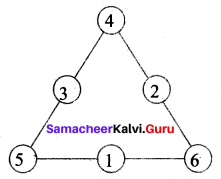
Samacheer Kalvi 6th Maths Term 1 Chapter 6 Information Processing Ex 6.2 Q1.5
The magic sum 4 + 3 + 5 = 5 + 1 + 6 = 6 + 2 + 4 = 12.

Question 2.
Using the numbers from 1 to 9
(i) Can you form a magic triangle?
(ii) How many magic triangles can be formed?
(iii) What are the sums of the sides of the magic triangle?
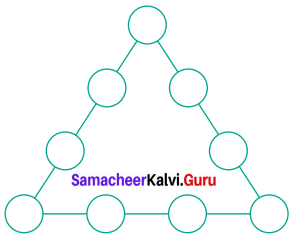
Samacheer Kalvi 6th Maths Term 1 Chapter 6 Information Processing Ex 6.2 Q2
Solution:
(i) Yes, we can form
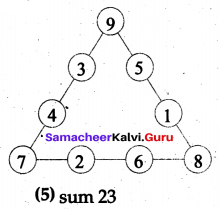
(ii) 5
(iii)
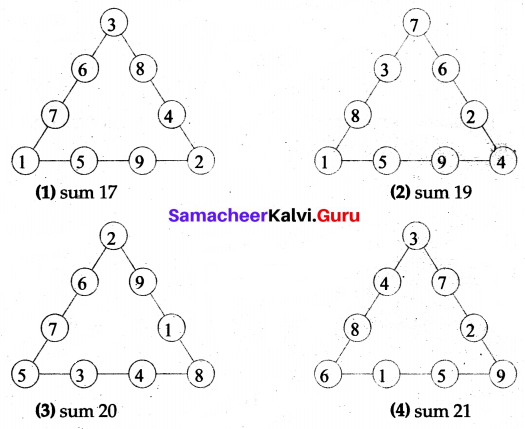
Samacheer Kalvi 6th Maths Term 1 Chapter 6 Information Processing Ex 6.2 Q2.1
Samacheer Kalvi 6th Maths Term 1 Chapter 6 Information Processing Ex 6.2 Q2.2
Sums are 17, 19, 20, 21, and 23.

Samacheer Kalvi 6th Maths Solutions Term 1 Chapter 6 Information Processing Ex 6.2

Question 3.
Arrange the odd numbers from 1 to 17 without repetition to get a sum of 30 on each side of the magic triangle.
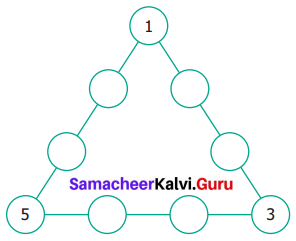
Samacheer Kalvi 6th Maths Term 1 Chapter 6 Information Processing Ex 6.2 Q3
Solution:
The odd numbers between 1 to 17 are 1, 3, 5, 7, 9, 11, 13, 15, 17.
Step 1: Place the smaller numbers 1, 3, 5 on the comers.
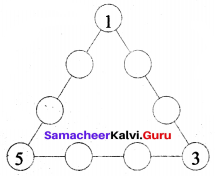
Samacheer Kalvi 6th Maths Term 1 Chapter 6 Information Processing Ex 6.2 Q3.1
Step 2: Arrange another set of smaller numbers 7, 9, and 11 on each side.
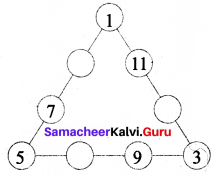
Samacheer Kalvi 6th Maths Term 1 Chapter 6 Information Processing Ex 6.2 Q3.2
Step 3: Arrange the remaining numbers 13,15,17 to give the total 30.
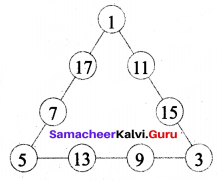
Samacheer Kalvi 6th Maths Term 1 Chapter 6 Information Processing Ex 6.2 Q3.3
Magic sum = 30.

Question 4.
Put the numbers 1, 2, 3, 4, 5, 6, and 7 in the circles so that each straight line of three numbers add up to the same total.

Samacheer Kalvi 6th Maths Term 1 Chapter 6 Information Processing Ex 6.2 Q4
Solution:
Here there is even number of terms. Also we know that 1 + 6 = 7, 2 + 5 = 7, 3 + 4 = 7; so placing 7 at the centre, and the pairs (1, 6) (2, 5) and (3, 4) at. the opposite ends we get, the answer.
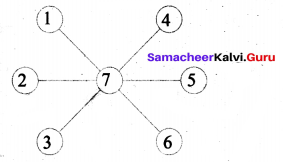
Samacheer Kalvi 6th Maths Term 1 Chapter 6 Information Processing Ex 6.2 Q4.1

Samacheer Kalvi 6th Maths Solutions Term 1 Chapter 6 Information Processing Ex 6.2

Question 5.
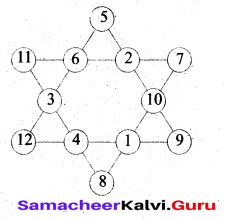
Place the number 1 to 12 in the 12 circles so that the sum of the numbers in each of the six lines of the star is 26. Use each number from 1 to 12 exactly once. Find more possible ways.

Samacheer Kalvi 6th Maths Term 1 Chapter 6 Information Processing Ex 6.2 Q5
Solution:
The given star can be viewed as two magical triangular as.
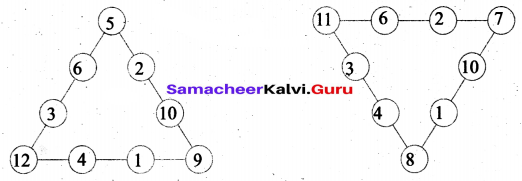
Samacheer Kalvi 6th Maths Term 1 Chapter 6 Information Processing Ex 6.2 Q5.1
Now the required arrangement is
Samacheer Kalvi 6th Maths Term 1 Chapter 6 Information Processing Ex 6.2 Q5.2
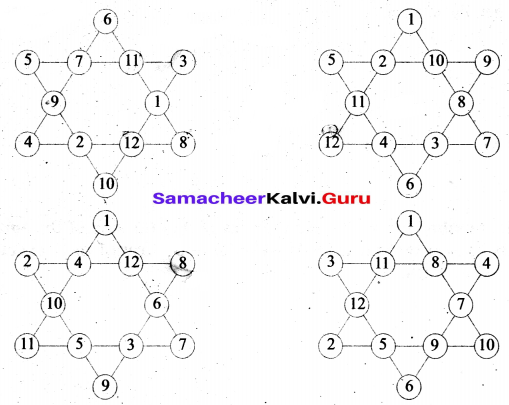
Some other arrangements are
Samacheer Kalvi 6th Maths Term 1 Chapter 6 Information Processing Ex 6.2 Q5.3

Samacheer Kalvi 6th Maths Solutions Term 1 Chapter 6 Information Processing Ex 6.2 Read More »
Samacheer Kalvi 6th Maths Solutions Term 1 Chapter 5 Statistics Ex 5.4

You can Download Samacheer Kalvi 6th Maths Book Solutions Guide Pdf, Tamilnadu State Board help you to revise the complete Syllabus and score more marks in your examinations.
Samacheer Kalvi 6th Maths Solutions Term 1 Chapter 5 Statistics Ex 5.4

Tamilnadu Samacheer Kalvi 6th Maths Solutions Term 1 Chapter 5 Statistics Ex 5.4

Miscellaneous Practice Problems

Question 1.
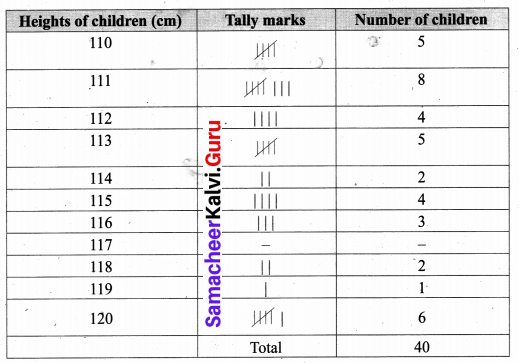
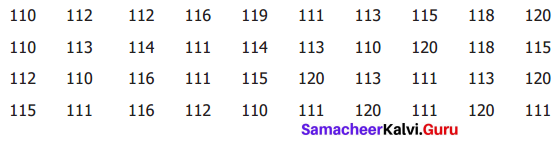
The heights (in centimetres) of 40 children are
Samacheer Kalvi 6th Maths Term 1 Chapter 5 Statistics Ex 5.4 Q1
Prepare a tally mark table.
Solution:
Samacheer Kalvi 6th Maths Term 1 Chapter 5 Statistics Ex 5.4 Q1.1

Question 2.
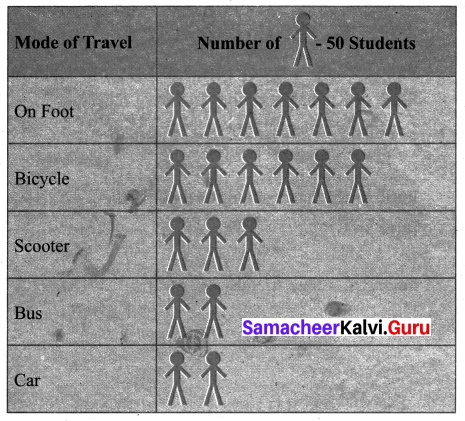
There are 1000 students in a school. Data regarding the mode of transport of the students as given below. Draw a pictograph to represent the data.
Samacheer Kalvi 6th Maths Term 1 Chapter 5 Statistics Ex 5.4 Q2
Solution:
The pictograph for the mode of transport of students.
Samacheer Kalvi 6th Maths Term 1 Chapter 5 Statistics Ex 5.4 Q2.1

Samacheer Kalvi 6th Maths Solutions Term 1 Chapter 5 Statistics Ex 5.4

Question 3.
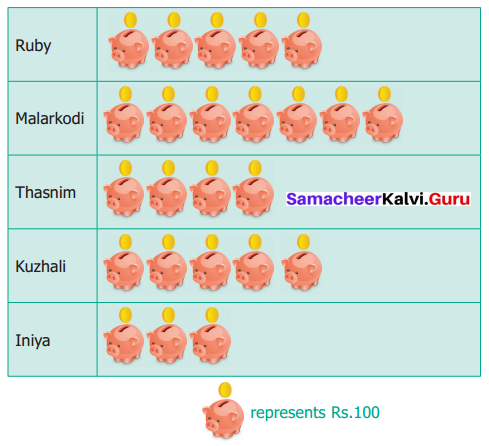
The following pictograph shows the total savings of a group of friends in a year. Each picture represents a saving of Rs. 100. Answer the following questions.
Samacheer Kalvi 6th Maths Term 1 Chapter 5 Statistics Ex 5.4 Q3
(i) What is the ratio of Ruby’s saving to that of Thasnim’s?
(ii) What is the ratio of Kuzhali’s savings to that of others?
(iii) How much is Iniya’s savings?
(iv) Find the total amount of savings of all your friends?
(v) Ruby and Kuzhali save the same amount. Say True or False.
Solution:
(i) Ratio of Ruby’s saving to that of Thasnim’s
\(=\frac{\text { Ruby’s saving }}{\text { Thasnim’s saving }}=\frac{5 \times 100}{4 \times 100}=\frac{5}{4}=5: 4\)
Ratio of Ruby’s saving to that of Thasnims = 5 : 4
(ii) Ratio of Kuzhali’s savings to that of others
\(=\frac{\text { kuzhali’s saving }}{\text { others saving }}=\frac{5 \times 100}{19 \times 100}=\frac{5}{19}=5: 19\)
Ratio of Kuzhali’s saving to that of others = 5 : 19
(iii) Iniya’s saving = 3 × 100 = ₹ 300
(iv) Saving of all the friends = (5 + 7 + 4 + 5 + 3) × 100 = 24 × 100 = ₹ 2400.
Total savings = ₹ 2400
(v) True.

Challenging Problems

Question 4.
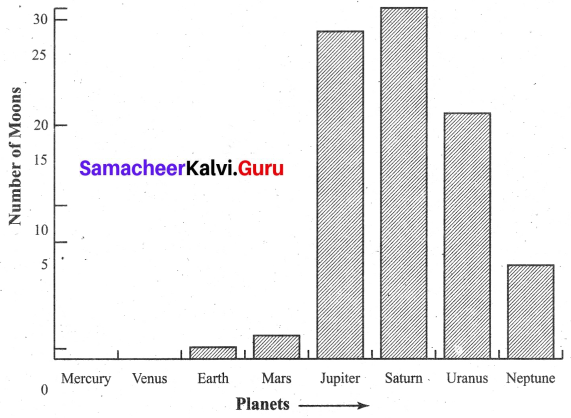
The table shows the number of moons that orbit each of the planets in our solar system.
Samacheer Kalvi 6th Maths Term 1 Chapter 5 Statistics Ex 5.4 Q4
Make a Bar graph for the above data.
Solution:
Samacheer Kalvi 6th Maths Term 1 Chapter 5 Statistics Ex 5.4 Q4.1

Question 5.
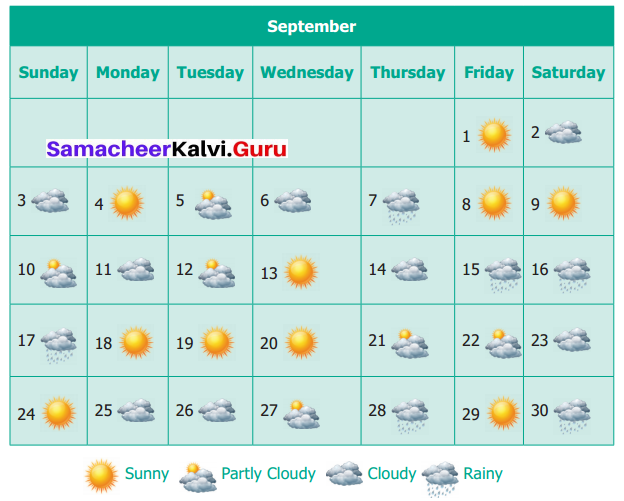
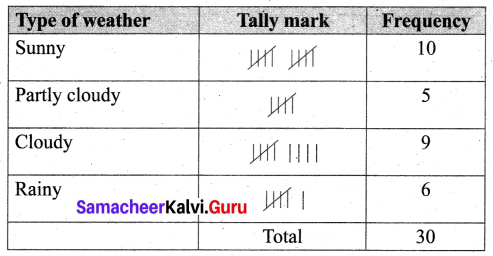
The predictions of Weather in the month of September is given below:
Samacheer Kalvi 6th Maths Term 1 Chapter 5 Statistics Ex 5.4 Q5
(i) Make a frequency table of the types of weather by reading the calender.
(ii) How many days are either cloudy or partly cloudy
(iii) How many days do not have rain? Give two ways to find the answer?
(iv) Find the ratio of the number of sunny days to Rainy days.
Solution:
Frequency Table for the Type of weather for the month of September
Samacheer Kalvi 6th Maths Term 1 Chapter 5 Statistics Ex 5.4 Q5.1
(ii) 14 days.
(iii) For 24 days there is no rain.
(a) From the total 30 days, we subtract the rainy days i.e 30 – 6 = 24 days (from the frequency table)
(b) From the picture, we can count the non-rainy days.
(iv) Ratio of number of Sunny day to Rainy days
\(=\frac{\text { Number of Sunny days }}{\text { Number of Rainy days }}=\frac{10}{6}=\frac{5}{3}=5: 3\)
The ratio of a number of Sunny days to Rainy days = 5 : 3.

Samacheer Kalvi 6th Maths Solutions Term 1 Chapter 5 Statistics Ex 5.4

Question 6.
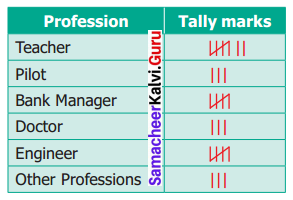
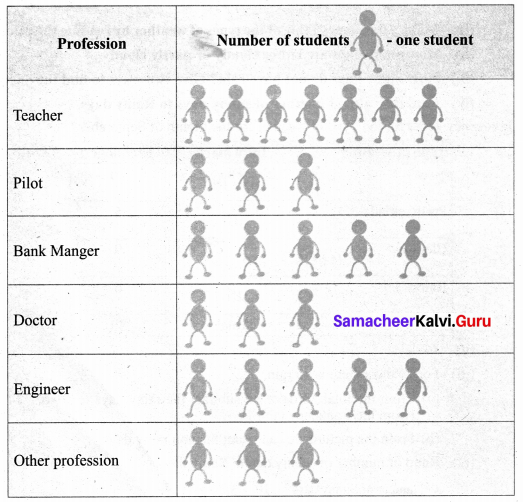
26 students were interviewed to find out what they want to become in the future. Their responses are given in the following table.
Samacheer Kalvi 6th Maths Term 1 Chapter 5 Statistics Ex 5.4 Q6
Represent this data using the pictograph
Solution:
Samacheer Kalvi 6th Maths Term 1 Chapter 5 Statistics Ex 5.4 Q6.1

Question 7.
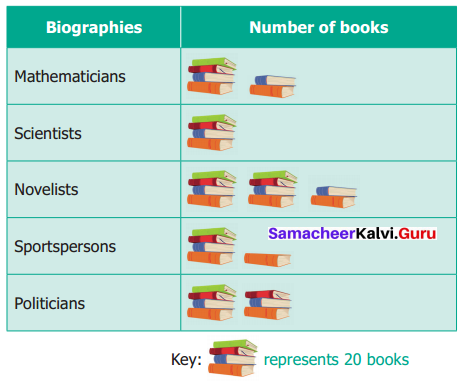
Yasmin of class VI was given a task to count the number of books which are biographies, in her school library. The information collected by her is represented as follows.
Samacheer Kalvi 6th Maths Term 1 Chapter 5 Statistics Ex 5.4 Q7
Observe the pictograph and answer the following questions.
(i) Which title has the maximum number of biographies?
(ii) Which title has the minimum number of biographies?
(iii) Which title has exactly half the number of biographies as Novelists?
(iv) How many biographies are there on the title of Sportspersons?
(v) What is the total number of biographies in the library?
Solution:
(i) ‘The title Novelists’ have the maximum number of biographies
(ii) ‘The title Scientists’ have a minimum number of biographies.
(iii) ‘Sportspersons’ title has exactly half the number of biographies as Novelist.
(iv) \((1 \times 20)+\frac{20}{4}=20+5=25\) biographies are there in the title sportsperson.
(v) 8 × 20 = 160 biographies are there in the library.

Question 8.
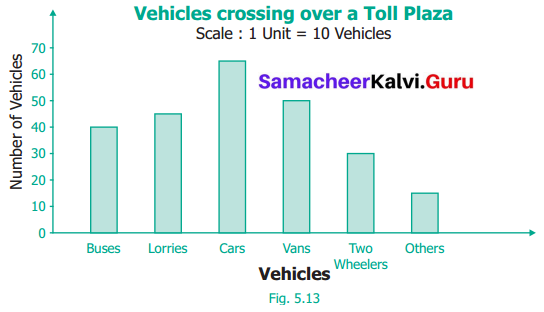
The bar graph illustrates the results of a survey conducted on vehicles crossing over a Toll Plaza in one hour.
Samacheer Kalvi 6th Maths Term 1 Chapter 5 Statistics Ex 5.4 Q8
Observe the bar graph carefully and fill up the following table.
Samacheer Kalvi 6th Maths Term 1 Chapter 5 Statistics Ex 5.4 Q8.1
Solution:
Samacheer Kalvi 6th Maths Term 1 Chapter 5 Statistics Ex 5.4 Q8.2

Question 9.
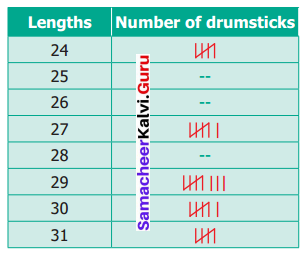
The lengths (in the nearest centimetre) of 30 drumsticks are given as follows.
Samacheer Kalvi 6th Maths Term 1 Chapter 5 Statistics Ex 5.4 Q9
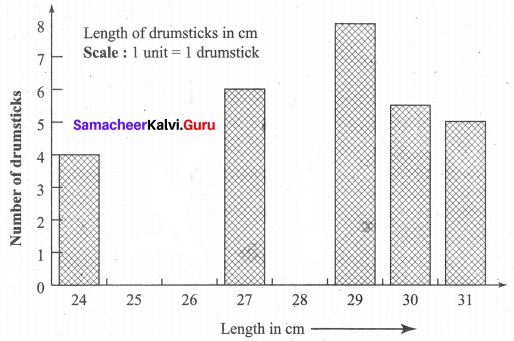
Draw the bar graph showing the same information.
Solution:
The bar graph showing the same information is given below:
Samacheer Kalvi 6th Maths Term 1 Chapter 5 Statistics Ex 5.4 Q9.1

Samacheer Kalvi 6th Maths Solutions Term 1 Chapter 5 Statistics Ex 5.4

Question 10.
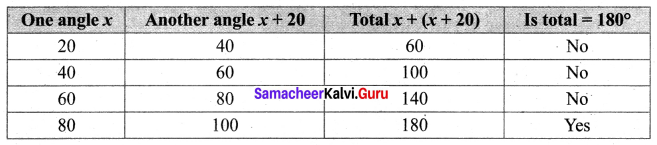
Given two angles are supplementary i.e. their sum = 180°.
Solution:
Let the angle be x.
Then anothcf angle = x + 20 (given)
Samacheer Kalvi 6th Maths Term 1 Chapter 5 Statistics Ex 5.4 Q10
The two angles are 80° and 100°

Samacheer Kalvi 6th Maths Solutions Term 1 Chapter 5 Statistics Ex 5.4 Read More »

Samacheer Kalvi 7th Maths Solutions Term 1 Chapter 1 Number System Ex 1.5

Students can Download Maths Chapter 1 Number System Ex 1.5 Questions and Answers, Notes Pdf, Samacheer Kalvi 7th Maths Book Solutions Guide Pdf helps you to revise the complete Tamilnadu State Board New Syllabus and score more marks in your examinations.

Tamilnadu Samacheer Kalvi 7th Maths Solutions Term 1 Chapter 1 Number System Ex 1.5

Question 1.
One night in Kashmir, the temperature is -5°C. Next day the temperature is 9°C. What is the increase in temperature?
Solution:
Temperature in the first day = -5°C
Temperature in the next day = 9°C
∴ Increase in temperature = 9°C – (-5°C)
= 9°C + (+5°C) = 14°C

Question 2.
An atom can contain protons which have a positive charge (+) and electrons which have a negative charge (-). When an electron and a proton pair up, they become neutral (0) and cancel the charge at. Now determine the net charge:
(i) 5 electrons and 3 protons → -5 + 3 = -2 that is 2 electrons \(\ominus\ominus\)
(ii) 6 protons and 6 electrons →
(iii) 9 protons and 12 electrons →
(iv) 4 protons and 8 electrons →
(v) 7 protons and 6 electrons →
Solution:
(ii) 6 protons and 6 electrons → (+6) + (-6) = 0
(iii) 9 protons and 12 electrons → (+9) + (-12) = 9-12 = -3 ⇒ 3 electrons \(\ominus\ominus\ominus\)
(iv) 4 protons and 8 electrons → (+4) + (-8) = +4 – 8 = -4 ⇒ 4 electrons \(\ominus\ominus \ominus\ominus\)
(v) 7 protons and 6 electrons → (+7) + (-6) = +1 = 1 proton \(\oplus\)

Question 3.
Scientists use the Kelvin scale (K) as an alternative temperature scale to degrees Celsius (°C) by the relation T°C = (T + 273)K. Convert the following to Kelvin:
(i) -275°C
(ii) 45°C
(iii) -400°C
(iv) -273°C
Solution:
(i) -275°C = (-275 + 273)K = -2K
(ii) 45°C = (45 + 273)K = 318 K
(iii) -400°C = (-400 + 273)K = -127 K
(iv) -273°C = (-273 + 273) K = 0K

Samacheer Kalvi 7th Maths Solutions Term 2 Chapter 1 Number System Ex 1.5

Question 4.
Find the amount that is left in the student’s bank account, if he has made the following transaction in a month. His initial balance is ₹ 690.
(i) Deposit (+) of ₹ 485
(ii) Withdrawal (-) of ₹ 500
(iii) Withdrawal (-) of ₹ 350
(iv) Deposit (+) of ₹ 89
(v) If another ₹ 300 was withdrawn, what would the balance be?
Solution:
(i) Initial balance of student’s account = ₹ 690
Deposited amount = ₹ 485 (+)
∴ Amount left in the account = ₹ 690 + ₹ 485 = ₹ 1175

(ii) Balance in the account = ₹ 1175
Amount withdrawn = ₹ 500 (-)
Amount left = ₹ 1175 – ₹ 500 = ₹ 675

(iii) Balance in the account = ₹ 675
Amount withdrawn = ₹ 350 (-)
Amount left = ₹ 675 – ₹ 350 = ₹ 325

(iv) Balance in the account = ₹ 325
Amount deposited = ₹ 89(+)
Amount left = ₹ 325 + ₹ 89 = ₹ 414

(v) Balance in the account = ₹ 414
Amount withdrawn = ₹ 300 (-)
Amount left = ₹ 414 – ₹ 300 = ₹ 114

Question 5.
A poet Tamizh Nambi lost 35 pages of his ‘lyrics’ when his file had got wet in the rain. Use integers, to determine the following.
(i) If Tamil Nambi wrote 5 pages per day, how many day’s work did he lose?
(ii) If four pages contained 1800 characters, (letters) how many characters were lost?
(iii) If Tamil Nambi is paid ₹ 250 for each page produced, how much money did he lose?
(iv) If Kavimaan helps Tamizh Nambi and they are able to produce 7 pages per day, how many days will it take to recreate the work lost?
(v) Tamizh Nambi pays Kavimann ₹ 100 per page for his help. How much money does Kavimaan receive?
Solution:
Total pages lost – 35
One day work = 5 page 35
35 pages = \(\frac{35}{5}\) = 7 days work
∴ 7 day’s work he lost.

(ii) Number of characters in four pages = 1800
Number of characters in one page = \(\frac{1800}{4}\) = 450
∴ Number of characters in 35 pages = 450 × 35 = 15,750 characters

(iii) Payment for one page = ₹ 250
∴ Payment for 35 pages = ₹ 250 × ₹ 35 = ₹ 8,750

(iv) Number of pages recreated a day = 7
∴ To recreate 35 pages day’s needed = \(\frac{35}{7}\) = 5 days

(v) Payment of Kavimaan = ₹ 100 per page
∴ for 35 pages payment = ₹ 100 × 35 = ₹ 3,500

Question 6.
Add 2 to me. Then multiply by 5 and subtract 10 and divide new by 4 and I will give you 15! Who am I?
Solution:
According to the problem {[(I + 2) × 5] – 10} ÷ 4 = 15
{[(I + 2) × 5] – 10} = 15 × 4 = 60
I + 2 = \(\frac{70}{5}\) = 14
(I + 2) × 5 = 60 + 10 = 70
I = 14 – 2 ; I = 12

Question 7.
Kamatchi, a fruit vendor sells 30 apples and 50 pomegranates. If she makes a profit of ? 8 per apple and loss ? 5 per pomegranate. What will be her overall profit or loss?
Solution:
Number of apples Kamatchi sold = 30
Profit per apple = ₹ 8(+)
∴ Profit for 30 apples = 30 × 8 = ₹ 240
Number of pomegranates sold 50
Loss per pomegranate = ₹ 5(-)
Loss on selling 50 pomegranates = 50 × (-5) = ₹ -250
Overall loss = -250 + 240 = ₹ -10
i.e. loss ₹ 10.

Samacheer Kalvi 7th Maths Solutions Term 2 Chapter 1 Number System Ex 1.5

Question 8.
During a drought, the water level in a dam fell 3 inches per week for 6 consecutive weeks. What was the change in the water level in the dam at the end of this period?
Solution:
Water level fall per week = -3 inches
∴ Water level decrease for 6 weeks = 6 ₹ (-3) = 18 inches
∴ decrease of 18 inches of water level.

Question 9.
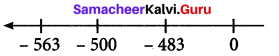
Buddha was born in 563 BC (BCE) and died in 483 BC (BCE). Was he alive in 500 BC (BCE)? and find his life time. (Source: Compton’s Encyclopedia)
Solution:
Years in BCC (BCE) are taken as negative integers.
Samacheer Kalvi 7th Maths Solutions Term 2 Chapter 1 Number System Ex 1.5 2
Buddha was bom in -563
and died in -483
So he was alive in 500 BC (BCE)
Life time = -483 – (-563) = -483 + 563 = +80
Buddha’s life time = 80 years.

Samacheer Kalvi 7th Maths Solutions Term 1 Chapter 1 Number System Ex 1.5 Read More »

Samacheer Kalvi 7th Maths Solutions Term 1 Chapter 1 Number System Ex 1.2

Students can Download Maths Chapter 1 Number System Ex 1.2 Questions and Answers, Notes Pdf, Samacheer Kalvi 7th Maths Book Solutions Guide Pdf helps you to revise the complete Tamilnadu State Board New Syllabus and score more marks in your examinations.

Tamilnadu Samacheer Kalvi 7th Maths Solutions Term 1 Chapter 1 Number System Ex 1.2

Question 1.
Fill in the blanks
(i) -44 + ____ = -88
(ii) ___ – 75 = -45
(iii) ___ – (+50) = -80
Solution:
(i) -44
(ii) 30
(iii) -30

Question 2.
Say True or False.
(i) (-675) – (-400) = -1075
(ii) 15 – (-18) is the same as 15 + 18
(iii) (-45) – (-8) = (-8) – (-45)
Solution:
(i) False
(ii) True
(iii) False

Question 3.
Find the value of the following.
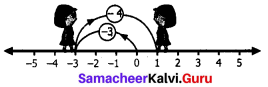
(i) -3 – (-4) using number line.
Solution:
We start at zero facing positive direction. Move 3 units backward to represent (-3). Then turn towards the negative side and move 4 units backwards. We reach+1.
Samacheer Kalvi 7th Maths Term 1 Chapter 1 Number System Ex 1.2 1
∴ (-3) – (-4) = +1

(ii) 7 – (-10) using number line
Solution:
Samacheer Kalvi 7th Maths Term 1 Chapter 1 Number System Ex 1.2 2
We start at zero facing positive direction. Move 7 units forward to represent (+7). Then turn towards the negative side and move 10 units backwards.
We reach +17
∴ 1 – (-10) = +17

(iii) 35 – (-64)
Solution:
35 – (-64) = 35+ (Additive inverse of-64) = 35 + (+64) = 99
∴ 35 – (-64) = 99

(iv) -200 – (+100)
Solution:
-200 – (+100) = -200 + (Additive inverse of+100) = -200 + (-100) = -300
-200 – (+100) = -300

SamacheerKalvi.Guru

Question 4.
Kabilan was having 10 pencils with him. He gave 2 pencils to senthil and 3 to Karthick. Next day his father gave him 6 more pencils, from that he gave 8 to his sister. How many pencils are left with him?
Solution:
Total pencils Kabilan had = 10
No. of pencils given to Senthil = 2
No. of pencils given to Karthick = 3.
Now number of pencils left with Kabilan = 10 – 2 – 3 = 8 – 3 = 5
Number of pencils got from his father = 6
No. total pencils Kabilan had = 5 + 6 = 11
Number of pencils given to his sister = 8
Number of pencils left with Kabilan = 11 – 8 = 3

Question 5.
A lift is on the ground floor. If it goes 5 floors down and then moves up to 10 floors from there, then in which floor will the lift be?
Solution:
Initially the lift will be in the ground floor representing ‘0’
It goes to 5 floors down ⇒ -5
Then it moves 10 floors up +10.
Now the lift will be = 0 – 5 + 10 = -5 + 10
= 5th floor (above the ground floor)

Question 6.
When Kala woke up, her body temperature was 102°F. She took medicine for fever. After 2 hours it was 2°F lower. What was her temperature then?
Solution:
Kala’s temperature initially = 102°F
After two hours the temperature decreased = -2°F
Now the final temperature = 102°F – 2°F = 100°F

Question 7.
What number should be added to (-17) to get -19?
Solution:
According to the problem = -17 + A number = -19
The number = -19 + 17 = -2
∴ -2 should be added to -17 to get -19

SamacheerKalvi.Guru

Question 8.
A student was asked to subtract (-12) from -47. He got -30. Is he correct? Justify.
Solution:
Subtracting -12 from -47, we get
-47 – (-12) = -47 + (Additive inverse of-12)
= -47 + (+12) = -35
But the students answer is -30.
So he is not correct.

Objective Type Questions

Question 9.
(-5) – (-18)
(i) 23
(ii) -13
(iii) 13
(iv) -23
Solution:
(iii) 131

Question 10.
(-100) – 0 + 100 =
(i) 200
(ii) 0
(iii) 100
(iv)-200
Solution:
(ii) 0

Samacheer Kalvi 7th Maths Solutions Term 1 Chapter 1 Number System Ex 1.2 Read More »

Samacheer Kalvi 7th Maths Solutions Term 1 Chapter 5 Geometry Ex 5.1

Students can Download Maths Chapter 5 Geometry Ex 5.1 Questions and Answers, Notes Pdf, Samacheer Kalvi 7th Maths Book Solutions Guide Pdf helps you to revise the complete Tamilnadu State Board New Syllabus and score more marks in your examinations.

Tamilnadu Samacheer Kalvi 7th Maths Solutions Term 1 Chapter 5 Geometry Ex 5.1

Question 1.
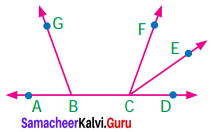
Name the pairs of adjacent angles.
Solution:
(i) ∠ABG and ∠GBC are adjacent angles.
(ii) ∠BCF and ∠FCD are adjacent angles.
(iii) ∠BCF and ∠FCE are adjacent angles.
(iv) ∠FCE and ∠ECD are adjacent angles.
Samacheer Kalvi 7th Maths Term 1 Chapter 5 Geometry Ex 5.1 1

Question 2.
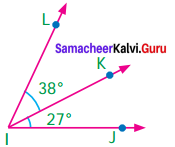
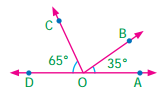
Find the angle ∠JIL from the given figure.
Solution:
∠LIK and ∠KIJ are adjacent angles.
∴ ∠JIL = ∠LIK + ∠KIJ
= 38° + 27°
= 65°
∴ ∠JIL = 65°
Samacheer Kalvi 7th Maths Term 1 Chapter 5 Geometry Ex 5.1 2

Question 3.
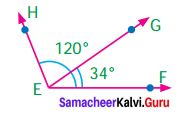
Find the angles ∠GEH from the given figure.
Solution:
Samacheer Kalvi 7th Maths Term 1 Chapter 5 Geometry Ex 5.1 3
∠HEF = ∠HEG + ∠GEF
120° = ∠HEG + 34°
120°- 34° = ∠GEH + 34° – 34°
∠GEH = 86°

Question 4.
Given that AB is a straight line. Calculate the value of x° in the following cases.
Samacheer Kalvi 7th Maths Term 1 Chapter 5 Geometry Ex 5.1 5
Solution:
(i) Since the angles are linear pair ∠AOC + ∠BOC = 180°
72° + x° = 180°
72° + x° – 12° = 180°- 72°
x° = 108°

(ii) Since the angles are linear pair
∠AOC + ∠BOC = 180°
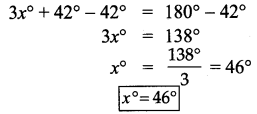
3x + 42° = 180°
Samacheer Kalvi 7th Maths Term 1 Chapter 5 Geometry Ex 5.1 6

(iii) Since the angles are linear pair
∠AOC + ∠BOC = 180°
4x° + 2x° = 180°
6x° = 180°
x° = 180°

Question 5.
One angle of a linear pair is a right angle. What can you say about the other angle?
Solution:
If the angle are linear pair, then their sum is 180°.
Given one angle is right angle ie 90°.
∴ The other angle = 180° -90° = 90°
∴ The other angle also a right angle

Question 6.
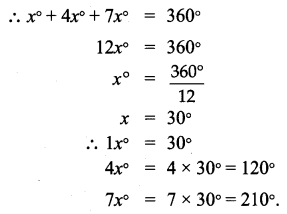
If the three angles at a point are in the ratio 1 : 4 : 7, find the value of each angle?
Solution:
We know that the sum of angles at a point is 360°.
Given the three angles are in the ratio 1:4:7.
Let the three angles be 1x, 4x, 7x.
Samacheer Kalvi 7th Maths Term 1 Chapter 5 Geometry Ex 5.1 7
∴ The three angles are 30°, 120° and 210°.

Question 7.
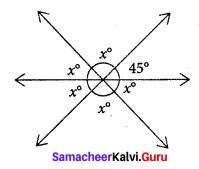
Three are six angles at a point. One of them is 45° and the other five angles are all equal. What is the measure of all the five angles.
Solution:
We know that the sum of angles at a point is 360°.
One angle = 45°
Let the equal angles be x° each
∴ x° + x° + x° + x° + x° + 45° = 360°
5x° + 45° – 45° = 360° – 45°
Samacheer Kalvi 7th Maths Term 1 Chapter 5 Geometry Ex 5.1 50
5x° = 315°
Samacheer Kalvi 7th Maths Term 1 Chapter 5 Geometry Ex 5.1 51
∴ Measure of all 5 equal angles = 63°.

Question 8.
In the given figure, identify
(i) Any two pairs of adjacent angles.
(ii) Two pairs of vertically opposite angles.
Solution:
(i) (a) ∠PQT and ∠TOS are adjacent angles.
(b) ∠PQU and ∠UQR are adjacent angles.
(ii) (a) ∠PQT and ∠RQU are vertically opposite angles.
(b) ∠TQR and ∠PQU are vertically opposite angles.

Question 9.
The angles at a point are x°, 2x°, 3x°, 4x° and 5x°. Find the value of the largest angle?
Sum of angles at a point = 360°
∴ x° + 2x° + 3x° + 4x° + 5x° = 360°
15x° = 360°
x° = \(\frac{360^{\circ}}{15}\)
x° = 24°.
∴ The largest angle = 5x°
= 5 × 24° = 120°
The largest angle is 120°

Question 10.
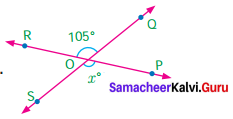
From the given figure, find the missing angle.
Solution:
Lines \(\overleftrightarrow { RP }\) and \(\overleftrightarrow { SQ }\) are interesting at ‘O’
Samacheer Kalvi 7th Maths Term 1 Chapter 5 Geometry Ex 5.1 53
∴ Vertically opposite angles are equal.
∴ x = 105°
∴ Missing angle = 105°

Question 11.
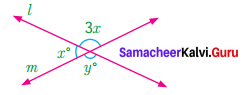
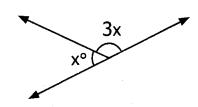
Find the angles x° and y° in the figure shown.
Samacheer Kalvi 7th Maths Term 1 Chapter 5 Geometry Ex 5.1 54
Solution:
Consider the line m.
x° and 3x° are linear pair of angles
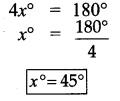
∴ x° + 3x° = 180°
Samacheer Kalvi 7th Maths Term 1 Chapter 5 Geometry Ex 5.1 56
Samacheer Kalvi 7th Maths Term 1 Chapter 5 Geometry Ex 5.1 55
x° = 45°
Also lines l and m intersects.
Vertically opposite angles are equal.
ie 3x° = y°
3 × 45° = y°
y = 135°
x° = 15° and
y° = 135°

Question 12.
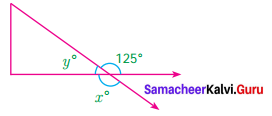
Using the figure, answer the following questions.
Samacheer Kalvi 7th Maths Term 1 Chapter 5 Geometry Ex 5.1 66
(i) What is the measure of angle x°?
(ii) What is the measure of angle y°?
Solution:
From the figure x° and 125° are vertically opposite angles. So they are equal ie
ie x° = 125°
Also y° and 125° are linear pair of angles.
∴ y° + 125° = 180°
y° + 125° – 125° = 180°- 125°
y° = 55°
x° = 125°,
y° = 55°

Question 13.
Adjective angles have
(i) No common interior, no common arm, no common vertex.
(ii) One common vertex, one common arm, common interior
(iii) One common arm, one common vertex, no common interior.
(iv) One common arm, no common vertex, no common interior.
Solution:
(iii) one common arm, one common vertex, no common interior

Question 14.
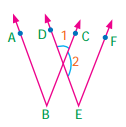
In the given figure the angles ∠1 and ∠2 are
(i) Opposite angles
(ii) Adjacent angles
(iii) Linear angles
(iv) Supplementary angles
Samacheer Kalvi 7th Maths Term 1 Chapter 5 Geometry Ex 5.1 100
Solution:
(iii) Linear pair

Question 15.
Vertically opposite angles are
(i) not equal in measure
(ii) Complementary
(iii) supplementary
(iv) equal in measure
Solution:
(iv) equal in measure

Question 16.
The sum of all angles at a point is
(i) 360°
(ii) 180°
(iii) 90°
(iv) 0°
Solution:
(i) 360°

Question 17.
The measure of ∠BOC is
(i) 90°
(ii) 180°
(iii) 80°
(iv) 100°
Samacheer Kalvi 7th Maths Term 1 Chapter 5 Geometry Ex 5.1 58
Solution:
(iii) 80°

Samacheer Kalvi 7th Maths Solutions Term 1 Chapter 5 Geometry Ex 5.1 Read More »

Samacheer Kalvi 6th Maths Solutions Term 3 Chapter 1 Fractions Ex 1.1

You can Download Samacheer Kalvi 6th Maths Book Solutions Guide Pdf, Tamilnadu State Board help you to revise the complete Syllabus and score more marks in your examinations.
Samacheer Kalvi 6th Maths Solutions Term 3 Chapter 1 Fractions Ex 1.1

Tamilnadu Samacheer Kalvi 6th Maths Solutions Term 3 Chapter 1 Fractions Ex 1.1

Question 1.
Fill in the blanks.
(i) 7\(\frac{3}{4}\) + 6\(\frac{1}{2}\) = _______
(ii) The sum of whole number and a proper fraction is called ______
(iii) 5\(\frac{1}{3}\) – 3\(\frac{1}{2}\) = ______
(iv) 8 ÷ \(\frac{1}{2}\) = ______
(v) The number which has its own reciprocal is _______.
Solution:
(i) 14\(\frac{1}{4}\)
(ii) Mixed Fraction
(iii) 1\(\frac{5}{6}\)
(iv) 16
(v) 1

Question 2.
Say True or False.
(i) 3\(\frac{1}{2}\) can be written as 3 + \(\frac{1}{2}\).
(ii) The sum of any two proper fractions is always an improper fraction.
Hint: \(\frac{1}{2}+\frac{1}{4}=\frac{3}{4}\)
(iii) The mixed fraction of \(\frac{13}{4}\) is 3\(\frac{1}{4}\)
(iv) The reciprocal of an improper fraction is always a proper fraction.
(v) 3\(\frac{1}{4}\) × 3\(\frac{1}{4}\) = 9\(\frac{1}{16}\)
Solution:
(i) True
(ii) False
(iii) True
(iv) True
(v) False

Samacheer Kalvi 6th Maths Solutions Term 3 Chapter 1 Fractions Ex 1.1

The mixed number 2 2 3 as an improper fraction.

Question 3.
Answer the following :
Solution:
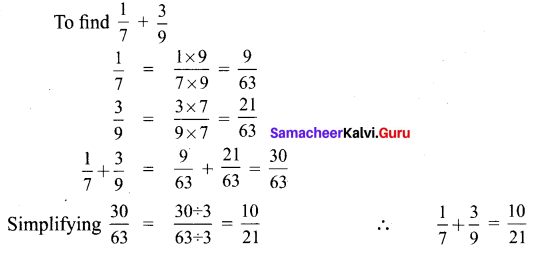
(i) Find the sum of \(\frac{1}{7}\) and \(\frac{3}{9}\)
Samacheer Kalvi 6th Maths Solutions Term 3 Chapter 1 Fractions Ex 1.1 1

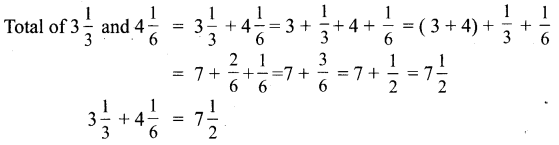
(ii) What is the total of 3\(\frac{1}{3}\) and 4\(\frac{1}{6}\).
Samacheer Kalvi 6th Maths Solutions Term 3 Chapter 1 Fractions Ex 1.1 2

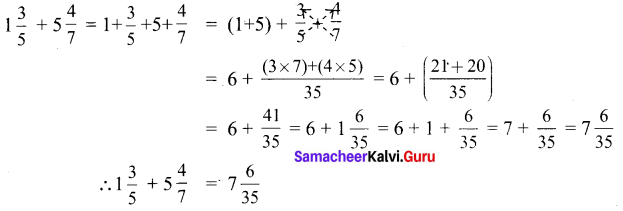
(iii) Simplify : 1\(\frac{3}{5}\) + 5\(\frac{4}{7}\)
Samacheer Kalvi 6th Maths Solutions Term 3 Chapter 1 Fractions Ex 1.1 3

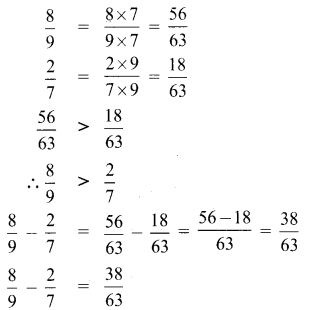
(iv) Find the difference between \(\frac{8}{9}\) and \(\frac{2}{7}\)
Samacheer Kalvi 6th Maths Solutions Term 3 Chapter 1 Fractions Ex 1.1 4

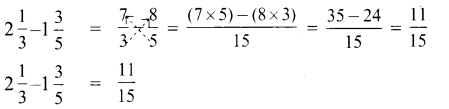
(v) Subtract 1\(\frac{3}{5}\) and 2\(\frac{1}{3}\)
Samacheer Kalvi 6th Maths Solutions Term 3 Chapter 1 Fractions Ex 1.1 5

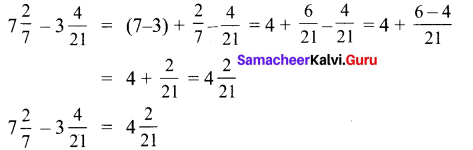
(vi) Simplify: 7\(\frac{2}{7}\) – 3\(\frac{4}{21}\)
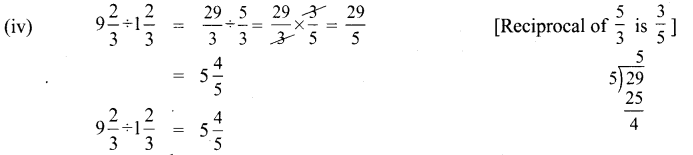
Samacheer Kalvi 6th Maths Solutions Term 3 Chapter 1 Fractions Ex 1.1 6

fraction and whole number calculator

Question 4.
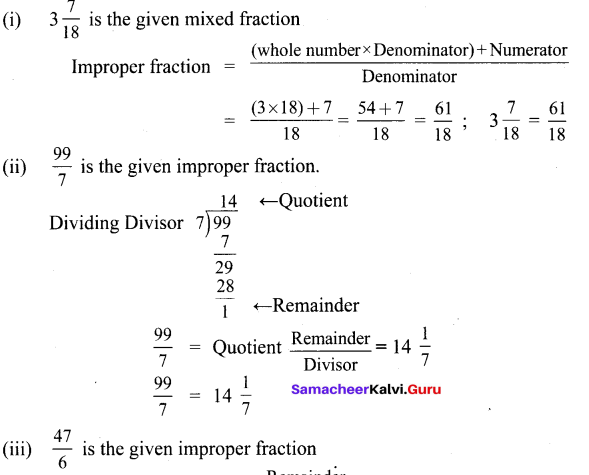
Convert mixed fraction into improper fractions and vice versa:
Samacheer Kalvi 6th Maths Solutions Term 3 Chapter 1 Fractions Ex 1.1 7
Solution:
Samacheer Kalvi 6th Maths Solutions Term 3 Chapter 1 Fractions Ex 1.1 8
Samacheer Kalvi 6th Maths Solutions Term 3 Chapter 1 Fractions Ex 1.1 9

Samacheer Kalvi 6th Maths Solutions Term 3 Chapter 1 Fractions Ex 1.1

Question 5.
Multiply the following :
Samacheer Kalvi 6th Maths Solutions Term 3 Chapter 1 Fractions Ex 1.1 10
Solution:
Samacheer Kalvi 6th Maths Solutions Term 3 Chapter 1 Fractions Ex 1.1 11
Samacheer Kalvi 6th Maths Solutions Term 3 Chapter 1 Fractions Ex 1.1 12

Question 6.
Divide the following:
Samacheer Kalvi 6th Maths Solutions Term 3 Chapter 1 Fractions Ex 1.1 13
Solution:
Samacheer Kalvi 6th Maths Solutions Term 3 Chapter 1 Fractions Ex 1.1 14
Samacheer Kalvi 6th Maths Solutions Term 3 Chapter 1 Fractions Ex 1.1 15

Question 7.
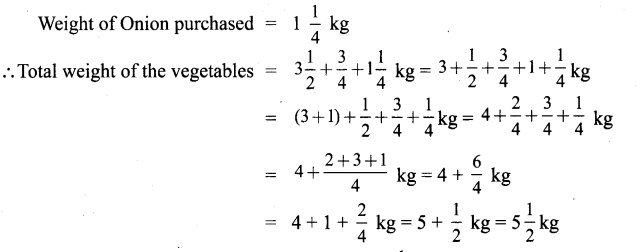
Gowri purchased 3\(\frac{1}{2}\) kg of tomatoes, \(\frac{3}{4}\) kg of brinjal and 1\(\frac{1}{4}\) kg of onion, what is the total weight of the vegetables she bought?
Solution:
Weight of tomatoes Gowri purchased = 3\(\frac{1}{2}\) kg
Weight of Brinjal purchased = \(\frac{3}{4}\) kg
Samacheer Kalvi 6th Maths Solutions Term 3 Chapter 1 Fractions Ex 1.1 16
Total weight of vegetables that Gowri purchased = 5\(\frac{1}{2}\) kg

Samacheer Kalvi 6th Maths Solutions Term 3 Chapter 1 Fractions Ex 1.1

Question 8.
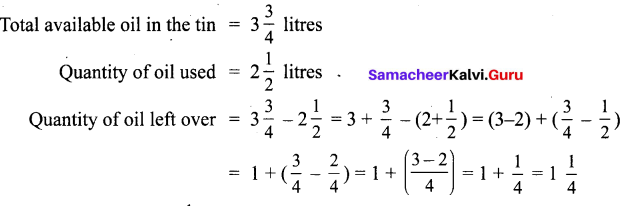
An oil tin contains 3\(\frac{3}{4}\) litres of oil of which 2\(\frac{1}{2}\) litres of oil is used. How much oil is left over?
Solution:
Samacheer Kalvi 6th Maths Solutions Term 3 Chapter 1 Fractions Ex 1.1 17
Quantity of oil leftover = 1\(\frac{1}{4}\) litres.

Question 9.
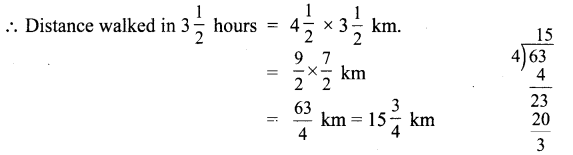
Nilavan can walk 4\(\frac{1}{2}\)km in an hour. How much distance will he cover in 3\(\frac{1}{2}\) hours?
Solution:
Distance walked by Nilavan in one hour = 4\(\frac{1}{2}\) km.
Samacheer Kalvi 6th Maths Solutions Term 3 Chapter 1 Fractions Ex 1.1 18
Nilavan walks 15\(\frac{3}{4}\) km in 3\(\frac{1}{2}\) hours

Samacheer Kalvi 6th Maths Solutions Term 3 Chapter 1 Fractions Ex 1.1

Question 10.
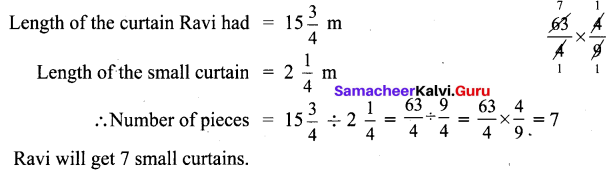
Ravi bought a curtain of length 15\(\frac{3}{4}\) m. If he cut the curtain into small pieces each of length 2\(\frac{1}{4}\) m, then how many small curtains will he get?
Solution:
Samacheer Kalvi 6th Maths Solutions Term 3 Chapter 1 Fractions Ex 1.1 19

Objective Type Questions

Question 11.
Which of the following statement is incorrect?
Samacheer Kalvi 6th Maths Solutions Term 3 Chapter 1 Fractions Ex 1.1 20
Solution:
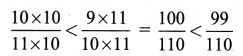
(d)\(\frac{10}{11}<\frac{9}{10}\)
Hint:
Samacheer Kalvi 6th Maths Solutions Term 3 Chapter 1 Fractions Ex 1.1 21

Question 12.
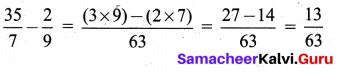
The difference between \(\frac{3}{7}\) and \(\frac{2}{7}\) is
Samacheer Kalvi 6th Maths Solutions Term 3 Chapter 1 Fractions Ex 1.1 22
Solution:
(a) \(\frac{13}{63}\)
Hint:
Samacheer Kalvi 6th Maths Solutions Term 3 Chapter 1 Fractions Ex 1.1 23

Question 13.
The reciprocal of \(\frac{53}{17}\) is
Samacheer Kalvi 6th Maths Solutions Term 3 Chapter 1 Fractions Ex 1.1 24
Solution:
(c) \(\frac{17}{53}\)
Hint:
\(\frac{\frac{1}{53}}{\frac{53}{17}}=\frac{17}{53}\)

Samacheer Kalvi 6th Maths Solutions Term 3 Chapter 1 Fractions Ex 1.1

Question 14.
If \(\frac{6}{7}\) = \(\frac{A}{49}\), then the value of A is
(a) 42
(b) 36
(c) 25
(d) 48
Solution:
(a) 42

Question 15.
Pugazh has been given four choices for his pocket money by his father. Which of the choices should he take in order to get the maximum money?
Samacheer Kalvi 6th Maths Solutions Term 3 Chapter 1 Fractions Ex 1.1 25
Solution:
(c) \(\frac{4}{5}\) of ₹150

Samacheer Kalvi 6th Maths Solutions Term 3 Chapter 1 Fractions Ex 1.1 Read More »

Samacheer Kalvi 7th Maths Solutions Term 1 Chapter 1 Number System Ex 1.3

Students can Download Maths Chapter 1 Number System Ex 1.3 Questions and Answers, Notes Pdf, Samacheer Kalvi 7th Maths Book Solutions Guide Pdf helps you to revise the complete Tamilnadu State Board New Syllabus and score more marks in your examinations.

Tamilnadu Samacheer Kalvi 7th Maths Solutions Term 1 Chapter 1 Number System Ex 1.3

Question 1.
Fill in the blanks.
(i) -80 × ____ = -80
(ii) (-10) × ____ = 20
(iii) 100 × ___ = -500
(iv) ____ × (-9) = -45
(v) ___ × 75 = 0
Solution:
(i) 1
(ii) -2
(iii) -5
(iv) 5
(v) 0

Question 2.
Say True or False:
(i) (-15) × 5 = 75
(ii) (-100) × 0 × 20 = 0
(iii) 8 × (-4) = 32
Solution:
(i) False
(ii) True
(iii) False

Question 3.
What will be the sign of the product of the following:
(i) 16 times of negative integers.
(ii) 29 times of negative integers.
Solution:
(i) 16 is an even interger.
If negative integers are multiplied even number of times, the product is a positive integer.
∴ 16 times a negative integer is a positive integer.

(ii) 29 times negative integer.
If negative integers are multiplied odd number of times, the product is a negative integer. 29 is odd.
∴ 29 times negative integers is a negative integer.

SamacheerKalvi.Guru

Question 4.
Find the product of
(i) (-35) × 22
(ii) (-10) × 12 × (-9)
(iii) (-9) × (-8) × (-7) × (-6)
(iv) (-25) × 0 × 45 × 90
(v) (-2) × (+50) × (-25) × 4
Solution:
(i) 35 × 22 = -770
(ii) (-10) × 12 × (-9) = (-120) × (-9) = +1080
(iii) (-9) × (-8) × (-7) × (-6) = (+72) × (-7) × (-6) = (-504) × (-6) = +3024
(iv) (-25) × 0 × 45 × 90 = 0 × 45 × 90 = 0 × 90 = 0
(v) (-2) × (+50) × (-25) × 4 = (-100) × -25 × 4 = 2500 × 4 = 10,000

Question 5.
Check the following for equality and if they are equal, mention the property.
(i) (8 – 13) × 7 and 8 – (13 × 7)
Solution:
Consider (8 – 13) × 7 = (-5) × 7 = -35
Now 8 – (13 × 7) = 8 – 91 = -83
∴ (8 – 13) × 7 ≠ 8 – (13 × 7)

(ii) [(-6) – (+8)] × (-4) and (-6) – [8 × (-4)]
Solution:
[(-6) – (+8)] × (-4) = [(-6) + (-8)] × (-4) = (-14) × (-4) = +56
Now (-6) – [8 × (-4)] = (-6) – (-32)
= (-6) + (+32) = +26
∴ [(-6) – (+8)] × (-4) ≠ (-6) – [8 × (-4)]

(iii) 3 × [(-4) + (-10)] and [3 × (-4) + 3 × (-10)]
Solution:
Consider 3 × [(-4) + (-10)] = 3 × -14 = -42
Now [3 × (-4) + 3 × (-10)] = (-12) + (-30) = -42
Here 3 × [(-4) + (-10)] = [3 × (-4) + 3 × (-10)]
It is the distributive property of multiplication over addition.

Question 6.
During summer, the level of the water in a pond decreases by 2 inches every week due to evaporation. What is the change in the level of the water over a period of 6 weeks?
Solution:
Level of water decreases a week = 2 inches.
Level of water decreases in 6 weeks = 6 × 2 = 12 inches

SamacheerKalvi.Guru

Question 7.
Find all possible pairs of integers that give a product of -50.
Solution:
Factor of 50 are 1, 2, 5, 10, 25, 50.
Possible pairs of integers that gives product -50:
(-1 × 50), (1 × (-50)), (-2 × 25), (2 × (-25)), (-5 × 10), (5 × (-10))

What is the factor of 50?​. Answer: The factors of 50 are 1, 2, 5,10, 25, and 50.

Objective Type Questions

Question 8.
Which of the following expressions is equal to -30.
(i) -20 – (-5 × 2)
(ii) (6 × 10) – (6× 5)
(iii) (2 × 5)+ (4 × 5)
(iv) (-6) × (+5)
Solution:
(iv) (-6) × (+5)
Hint:
(i) -20 + (10) = -10
(ii) 60 – 30 = 30
(iii) 10 + 20 = 30
(iv) (-6) × (+5) = – 30

Question 9.
Which property is illustrated by the equation: (5 × 2) + (5 × 5) = 5 × (2 + 5)
(i) commutative
(ii) closure
(iii) distributive
(iv) associative
Solution:
(iii) distributive

SamacheerKalvi.Guru

Question 10.
11 × (-1) = _____
(i) -1
(ii) 0
(iii) +1
(iv) -11
Solution:
(iv) -11

Question 11.
(-12) × (-9) =
(i) 108
(ii) -108
(iii) +1
(iv) -1
Solution:
(i) 108

Samacheer Kalvi 7th Maths Solutions Term 1 Chapter 1 Number System Ex 1.3 Read More »

Samacheer Kalvi 6th Maths Solutions Term 2 Chapter 2 Measurements Ex 2.2

You can Download Samacheer Kalvi 6th Maths Book Solutions Guide Pdf, Tamilnadu State Board help you to revise the complete Syllabus and score more marks in your examinations.
Samacheer Kalvi 6th Maths Solutions Term 2 Chapter Chapter 2 Measurements Ex 2.2

Tamilnadu Samacheer Kalvi 6th Maths Solutions Term 2 Chapter 2 Measurements Ex 2.2

Question 1.
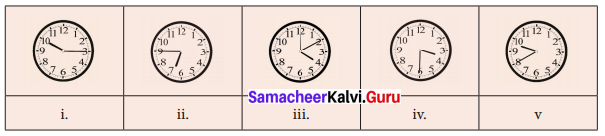
Say the time in two ways:
Samacheer Kalvi 6th Maths Solutions Term 2 Chapter 2 Measurements Ex 2.2 Q1
Solution:
(i) 10 : 15 hours, quarter past 10
(ii) 6 : 45 hours, quarter to 7
(iii) 4 : 10 hours, 10 minutes past 4
(iv) 3 : 30 hours, half past 3
(v) 9 : 40 hours, 20 minutes to 10

Question 2.
Match the following:
(i) 9.55 – (a) 20 minutes past 2
(ii) 11.50 – (b) quarter past 4
(iii) 4.15 – (c) quarter to 8
(iv) 7.45 – (d) 5 minutes to 10
(v) 2.20 – (e) 10 minutes to 1?
Solution:
(i) 9.55 – (d) 5 minutes to 10
(ii) 11.50 – (e) 10 minutes to 12
(iii) 4.15 – (b) quarter past 4
(iv) 7.45 – (c) quarter to 8
(v) 2.20 – (a) 20 minutes past 2

Question 3.
Convert the following :
(i) 20 minutes into seconds
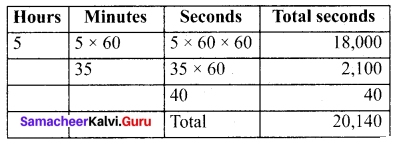
(ii) 5 hours 35 minutes 40 seconds into seconds
(iii) 3\(\frac { 1 }{ 2 }\) hours into minutes
(iv) 580 minutes into hours
(v) 25200 seconds into hours
Solution:
(i) 20 minutes into seconds
20 minutes = 20 × 60 seconds = 1200 seconds
(ii) 5 hours 35 minutes 40 seconds into seconds
Samacheer Kalvi 6th Maths Solutions Term 2 Chapter 2 Measurements Ex 2.2 Q3
∴ 5 hours 35 minutes 40 seconds = 20,140 seconds
(iii) 3\(\frac { 1 }{ 2 }\) hours into minutes
3\(\frac { 1 }{ 2 }\) hours = 3 hours 30 minutes
= 3 × 60 minutes + 30 minutes
= 180 minutes + 30 minutes
= 210 minutes
∴ 3\(\frac { 1 }{ 2 }\) hours = 210 minutes
(iv) 5580 minutes into hours
580 minutes = \(\frac{580}{60}\) hours = 9 hours 40 minutes
∴ 580 minutes = 9 hours 40 minutes
(v) 25200 seconds into hours
25200 seconds = \(\frac{25200}{60}\) minutes = 420 minutes = \(\frac{420}{60}\) hours = 7 hours
∴ 25200 seconds = 7 hours

Samacheer Kalvi 6th Maths Solutions Term 2 Chapter Chapter 2 Measurements Ex 2.2

Question 4.
The duration of electricity consumed by the farmer for his pump set on Monday and Tuesday was 7 hours 20 minutes 35 seconds and 3 hours 44 minutes 50 seconds respectively. Find the total duration of consumption of electricity.
Solution:
Electricity consumption on Monday = 7 hours + 20 minutes + 35 seconds
Electricity consumption on Tuesday = 3 hours + 44 minutes + 50 seconds
Total consumption = 10 hours + 64 minutes + 85 seconds
= 10 hours + (60 + 4) minutes + (60 + 25) seconds
= 1o hours + 1 hrs 4 minutes + 1 minutes 25 seconds
= 11 hours 5 minutes 25 seconds
∴ Total consumption of electricity = 11 hours 5 minutes 25 seconds

Question 5.
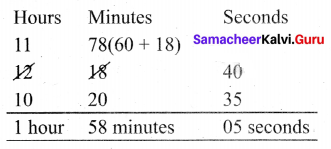
Subtract 10 hrs 20 min 35 sec from 12 hrs 18 min 40 sec.
Solution:
Samacheer Kalvi 6th Maths Solutions Term 2 Chapter 2 Measurements Ex 2.2 Q5
1 hour 58 minutes 05 seconds

Question 6.
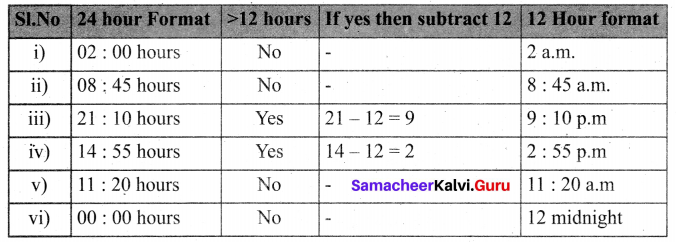
Change the following into 12 hour format:
(i) 02 : 00 hours
(ii) 08 : 45 hours
(iii) 21 : 10 hours
(iv) 11 : 20 hours
(v) 00 : 00 hours
Solution:
Samacheer Kalvi 6th Maths Solutions Term 2 Chapter 2 Measurements Ex 2.2 Q6

Question 7.
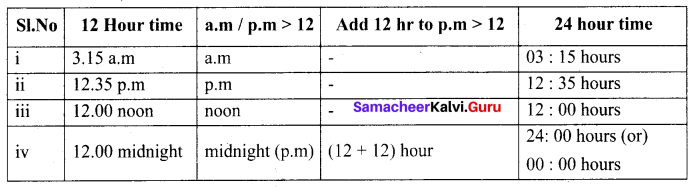
Change the following into 24-hour format.
(i) 3.15 a.m.
(ii) 12.35 p.m.
(iii) 12.00 noon
(iv) 12.00 midnight.
Solution:
Samacheer Kalvi 6th Maths Solutions Term 2 Chapter 2 Measurements Ex 2.2 Q7

Question 8.
Calculate the duration of time.
(i) from 5.30 a.m to 12.40 p.m
(ii) from 1.30 p.m to 10.25 p.m
(iii) from 20:00 hours to 4:00 hours
(iv) from 17:00 hours to 5 :15 hours
Solution:
(i) From 5.30 am to 12.40 pm
= (5.30 am to 12 pm) + 12 pm to 12.40 pm
= 6 hrs 30 min + 40 min
= 6 hrs 70 min
= 7 hrs 10 min
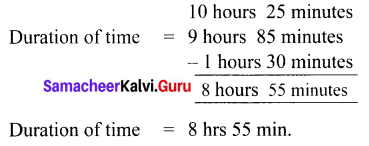
(ii) from 1.30 pm to 10.25 p.m.
Samacheer Kalvi 6th Maths Solutions Term 2 Chapter 2 Measurements Ex 2.2 Q8
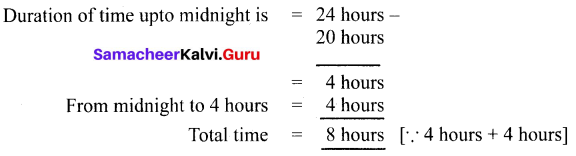
(iii) from 20 : 00 hrs to 4 : 00 hrs.
Samacheer Kalvi 6th Maths Solutions Term 2 Chapter 2 Measurements Ex 2.2 Q8.1
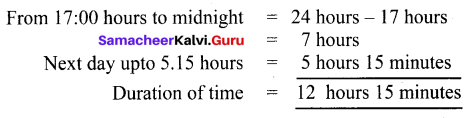
(iv) from 17 : 00 hours to 5 : 15 hours.
Samacheer Kalvi 6th Maths Solutions Term 2 Chapter 2 Measurements Ex 2.2 Q8.2

Samacheer Kalvi 6th Maths Solutions Term 2 Chapter Chapter 2 Measurements Ex 2.2

Question 9.
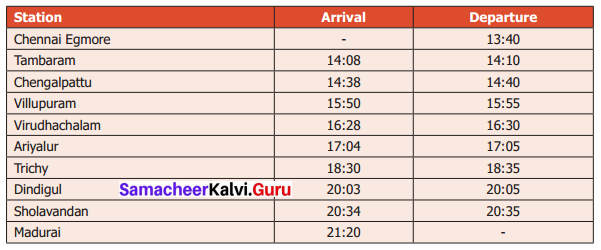
The departure and arrival timing of the Vaigai Superfast Express (No. 12635) from Chennai Egmore to Madurai Junction are given. Read the details and answer the following.
Samacheer Kalvi 6th Maths Solutions Term 2 Chapter 2 Measurements Ex 2.2 Q9
(i) At what time does the Vaigai Express start from Chennai and arrive at Madurai?
(ii) How many halts are between there Chennai and Madurai?
(iii) How long does the train halt at the Villupuram junction?
(iv) At what time does the train come to Sholavandan?
(v) Find the journey time from Chennai Egmore to Madurai?
Solution:
(i) It starts from Chennai at 13 : 40 hrs and arrive at Madurai at 21 : 20 hrs.
(ii) There are 8 halts.
(iii) Departure from Villupuram = 15 hours 55 minutes
Arrival at Villupuram = 15 hours 50 minutes
The train halt at Villupuram for = 05 minutes
(iv) At 20 : 34 hours the train come to Sholavandan
(v) Arrival time at Madurai = 20 hours 80 (20 + 60) minutes
Departure time from Chennai Egmore = 13 hours 40 minutes
Journey Time = 07 hours 40 minutes

Question 10.
Manickam joined a chess class on 20.02.2017 and due to exam, he left practice after 20 days. Again he continued practice from 10.07.2017 to 31.03.2018. Calculate how many days did he practice?
Solution:
Before Exams, he practiced for 20 days.
Days From 10.07.2017 to 31.03.2018
July – 22 Days (From 10.7.2017)
August – 31 Days
September – 30 Days
October – 31 Days
November – 30 Days
December – 31 Days
January 2018 – 31 Days
February – 28 Days
March – 31 Days (upto 31.3.2018)
Total – 265 Days
Total number of days practiced = Number of days practiced before exam + Number of days practiced after exam
= 20 + 265
= 285 days.
∴ He practiced for 285 days.

This age difference calculator determines the age gap in relationships or the simple time difference between the births of two people.

Question 11.
A clock gains 3 minutes every hour. If the clock is set correctly at 5 a.m, find the time shown by the clock at 7 p.m?
Solution:
5 a.m. = 5.00 hours
7 p.m = 19.00 hours
Difference = 19.00 – 5.00 = 14.00 hours
Time gain = 14 × 3 = 42 minutes
Time shown by the clock = 7.42 p.m

Question 12.
Find the number of days between republic day and kalvi valarchi day in 2020.
Solution:
2020 is a leap year republic day – 26.01.2020
Kalvi valarchi day – 15.07.2020
Jan – 5
Feb – 29
Mar – 31
April – 30
May – 31
June – 30
July – 14
Total – 170 days

Question 13.
If the 11th of January 2018 is Thursday, what is the day on 20th July of the same year?
Solution:
January – 21 Days (31 – 10)
February – 28 Days
March – 31 Days
April – 30 Days
May – 31 Days
June – 30 Days
July – 19 Days
Total – 190 Days
190 days ÷ 7
190 days = 27 weeks + 1 day
The required day is the first day after Thursday.
∴ 20th of July is Friday.

Samacheer Kalvi 6th Maths Solutions Term 2 Chapter Chapter 2 Measurements Ex 2.2

Question 14.
(i) Convert 480 days into years
(ii) Convert 38 months into years
Solution:
(i) Convert 480 days into years.
We know that 1 year = 365 days. [∵ 480 – 365 = 115 days ]
480 days = 1 year 115 days.
115 days = \(\frac{115}{30}\) months = 3 months 25 days
∴ 480 days = 1 year 3 months 25 days.
(ii) Convert 38 months into years
1 year has 12 months.
38 months = \(\frac{38}{12}\) years = 3 years 2 months
∴ 38 months = 3 years 2 months.

Question 15.
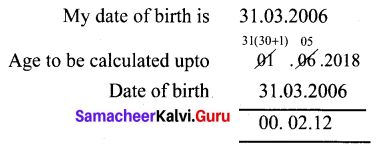
Calculate your age as on 01.06.2018
Solution:
Samacheer Kalvi 6th Maths Solutions Term 2 Chapter 2 Measurements Ex 2.2 Q15
Age is 12 years 2 months

Our free age calculator will calculate your age today, or at any point in past or future. Find how old you are in years, months weeks and days.

Objective Type Questions

Question 16.
2 days = …….. hours
(i) 38
(ii) 48
(iii) 28
(iv) 40
Solution:
(ii) 48

Question 17.
3 weeks = _____ days.
(a) 21
(b) 7
(c) 14
(d) 28
Solution:
(a) 21

Question 18.
Number of ordinary years between two consecutive leap years is
(i) 4 years
(ii) 2 years
(iii) 1 year
(iv) 3 years
Solution:
(iv) 3 years

Question 19.
What time will it 5 hours after 22 : 35 hours?
(a) 2 : 30 hrs
(b) 3 : 35 hrs
(c) 4 : 35 hrs
(d) 5 : 35 hrs
Solution:
(b) 3 : 35 hrs

Question 20.
2 \(\frac{1}{2}\) years is equal to months.
(i) 25
(ii) 30
(iii) 24
(iv) 5
Solution:
(ii) 30

Samacheer Kalvi 6th Maths Solutions Term 2 Chapter Chapter 2 Measurements Ex 2.2

Samacheer Kalvi 6th Maths Solutions Term 2 Chapter 2 Measurements Ex 2.2 Read More »
Samacheer Kalvi 9th Maths Solutions Chapter 3 Algebra Ex 3.3

You can Download Samacheer Kalvi 9th Maths Book Solutions Guide Pdf, Tamilnadu State Board help you to revise the complete Syllabus and score more marks in your examinations.

Tamilnadu Samacheer Kalvi 9th Maths Solutions Chapter 3 Algebra Ex 3.3

Question 1.
Check whether p(x) is a multiple of g(x) or not.
p(x) = x3 – 5x2 + 4x – 3, g(x) = x – 2
Solution:
p(x) = x3 – 5x2 + 4x – 3; g(x) = x – 2
Let g(x) = 0
x – 2 = 0
x = 2
p(2) = 23 – 5(22) + 4(2) – 3
= 8 – 5 × 4 + 8 – 3 = 8 – 20 + 5 = -7 ≠ 0
⇒ p(x) is not a multiple of g(x)

Question 2.
By remainder theorem, find the remainder when, p(x) is divided by g(x) where,
(i) p(x) = x3 – 2x2 – 4x – 1; g(x) = x + 1
(ii) p(x) = 4x3 – 12x2 + 14x – 3; g(x) = 2x – 1
(iii) p(x) = x3 – 3x2 + 4x + 50; g(x) = x – 3
Solution:
(i) p(x) = x3 – 2x2 – 4x – 1; g(x) = x + 1
Let g(x) = x + 1
x + 1 = 0
x = -1
P(-1) = (-1)3 – 2(-1)2 – 4(-1) – 1
= -1 -2 × 1 + 4 – 1
= -4 + 4 = 0
∴ Remainder = 0.

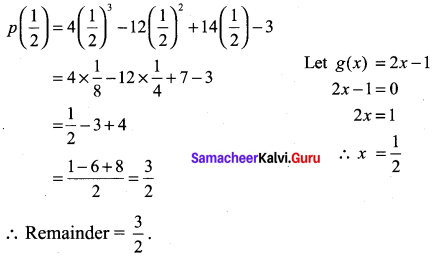
(ii) p(x) = 4x3 – 12x2 + 14x – 3; g(x) = 2x – 1
Samacheer Kalvi 9th Maths Chapter 3 Algebra Ex 3.3 1

(iii) p(x) = x3 – 3x2 + 4x + 50 ; g(x) = x – 3
Let g(x) = x – 3
x – 3 = 0
x = 3
p(3) = 33 – 3(32) + 4(3) + 50
= 27 – 27 + 12 + 50
= 62
∴ Remainder = 62.

Samacheer Kalvi 9th Maths Solutions Chapter 3 Algebra Ex 3.3

Question 3.
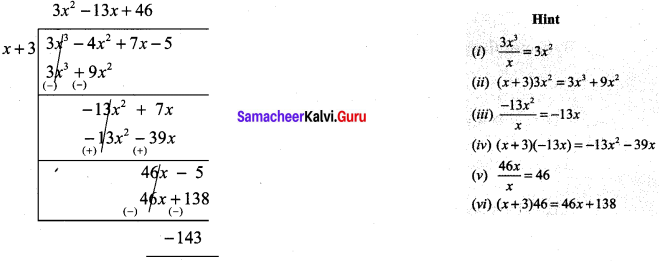
Find the remainder when 3x3 – 4x2 + 7x – 5 is divided by (x + 3)
Solution:
(3x3 – 4x2 + 7x – 5) + (x + 3)
Samacheer Kalvi 9th Maths Chapter 3 Algebra Ex 3.3 2
The remainder is -143.

Question 4.
What is the remainder when x2018 + 2018 is divided by x – 1.
Solution:
x2018 + 2018 is divided by x – 1
Let g(x) = x – 1 = 0
x = 1
p(x) = x2018 + 2018
p(1)= 12018 + 2018
= 1 + 2018 = 2019

Remainder Theorem Calculator is a free online tool that displays the quotient and remainder of division for the given polynomial expressions.

Question 5.
For what value of k is the polynomial p(x) = 2x3 – kx2 + 3x + 10 exactly divisible by (x – 2).
Solution:
Let g(x) = x – 2 = 0
x = 2
Since p(x) is exactly divisible by (x – 2)
p(2) = 2(23) – k(22) + 3(2)+ 10
= 16 – 4k + 6 + 10
= 32 – 4k = 0
= -k = -32
k= \(\frac{32}{4}\) = 8.

Question 6.
If two polynomials 2x3 + ax2 + 4x – 12 and x3 + x2 – 2x + a leave the same remainder when divided by (x – 3), find the value of a. and also find the remainder.
Solution:
Let f(x) = 2x3 + ax2 + 4x – 12 and g(x) = x3 + x2 – 2x + a
When f(x) is divided by x – 3, the remainder is f(3).
Now f(3) = 2(3)3 + a(3)2 + 4(3) – 12 = 54 + 9a + 12 – 12
f(3) = 9a + 54 …………. (1)
When g(x) is divided by x – 3, the remainder is g(3).
Now g(3) = 33 + 32 – 2(3) + a = 27 + 9 – 6 + a
g(3) = a + 30 ……….. (2)
Since, the remainder’s are same (1) = (2)
Given that f(3) = g(3)
That is 9a + 54 = a + 30
9a – a = 30 – 54 ⇒ 8a = -24 ∴ a = -3
Substituting a = -3 in f(3), we get
f(3) = 9(-3) + 54 = -27 + 54
f(3) = 27
∴ The remainder is 27.

Samacheer Kalvi 9th Maths Solutions Chapter 3 Algebra Ex 3.3

Question 7.
Determine whether (x – 1) is a factor of the following polynomials:
(i) x3 + 5x2 – 10x + 4
(ii) x4 + 5x2 – 5x + 1
Solution:
(i) Let P(x) = x3 + 5x2 – 10x + 4
By factor theorem (x – 1) is a factor of P(x), if P(1) = 0
P(1) = 13 + 5(12) – 10(1) + 4 = 1 + 5 – 10 + 4
P(1) = 0
∴ (x – 1) is a factor of x3 + 5x2 – 10x + 4

(ii) Let P(x) = x4 + 5x2 – 5x + 1
By/actor theorem, (x – 1) is a factor of P(x), if P( 1) = 0
P(1) = 14 + 5 (12) – 5(1) + 1 = 1 + 5 – 5 + 1 = 2 ≠ 0
∴ (x – 1) is not a factor of x4 + 5x2 – 5x + 1

Question 8.
Using factor theorem, show that (x – 5) is a factor of the polynomial 2x3 – 5x2 – 28x + 15
Solution:
LetP(x) = 2x3 – 5x2 – 28x + 15
By factor theorem, (x – 5) is a factor of P(x), if P(5) = 0
P(5) = 2 (5)2 – 5 (5)2 – 28 (5) + 15
= 2 × 125 – 5 × 25 – 140 + 15
= 250 – 125 – 140 + 15 = 265 – 265 = 0
∴ (x – 5) is a factor of 2x3 – 5x2 – 28x + 15

Samacheer Kalvi 9th Maths Solutions Chapter 3 Algebra Ex 3.3

Question 9.
Determine the value of m, if (x + 3) is a factor of x3 – 3x2 – mx + 24.
Solution:
Let P(x) = x3 – 3x2 – mx + 24
By using factor theorem,
(x + 3) is a factor of P(x), then P (-3) = 0
P(-3) = (-3)3 -3 (-3)2 – m (-3) + 24 = 0
⇒ -27 – 3 × 9 + 3m + 24 = 0 ⇒ 3m = 54 – 24
⇒ m = \(\frac{30}{3}\) = 10

Question 10.
If both (x – 2) and (x – \(\frac{1}{2}\)) are the factors of ax2 + 5x + b, then show that a = b.
Solution:
Let P(x) = ax2 + 5x + b
(x – 2) is a factor of P(x), if P(2) = 0
P(2) = a(2)2 + 5(2) + b = 0
4a + 10 + b = 0
4 a + b = – 10 …………….. (1)
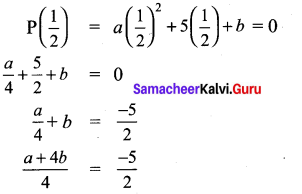
(x – \(\frac{1}{2}\)) is a factor of P(x), P(\(\frac{1}{2}\)) = 0
Samacheer Kalvi 9th Maths Chapter 3 Algebra Ex 3.3 3
2a + 8b = -20
a + 4b = – 10 ……………… (2)
From (1) and (2)
4a + b = – 10 …………. (1)
a + 4b = – 10 ………… (2)
(1) and (2) ⇒ 4a + b = a + 4b
3a = 3b
∴ a = b. Hence it is proved.

Question 11.
If (x – 1)divides the polynomial kx3 – 2x2 + 25x – 26 without remainder, then find the value of k.
Solution:
Let P(x) = kx3 – 2x2 + 25x – 26
By factor theorem, (x – 1) divides P(x) without remainder, P (1) = 0
P(1) = k(1)3 -2 (1)2 + 25 (1) – 26 = 0
k – 2 + 25 – 26 = 0
k – 3 =0
k = 3

Question 12.
Check if (x + 2) and (x – 4) are the sides of a rectangle whose area is x2 – 2x – 8 by using factor theorem.
Solution:
Let P(x) = x2 – 2x2 – 8
By using factor theorem,(x + 2) is a factor of P(x), if P (-2) = 0
P(-2) = (-2)2 – 2 (-2) – 8 = 4 + 4 – 8 = 0
and also (x -4) is a factor of P (x), if P (4) = 0
p (4) = 42 – 2(4) – 8 = 16 – 8 – 8 = 0
∴ (x + 2), (x – 4) are the sides of a rectangle whose area is x2 – 2x – 8.

Samacheer Kalvi 9th Maths Solutions Chapter 3 Algebra Ex 3.3 Read More »
Samacheer Kalvi 10th Maths Solutions Chapter 3 Algebra Ex 3.8

You can Download Samacheer Kalvi 10th Maths Book Solutions Guide Pdf, Tamilnadu State Board help you to revise the complete Syllabus and score more marks in your examinations.

Tamilnadu Samacheer Kalvi 10th Maths Solutions Chapter 3 Algebra Ex 3.8

Question 1.
Find the square root of the following polynomials by division method
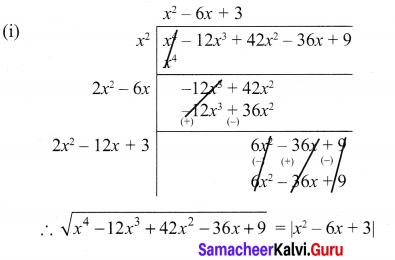
(i) x4 – 12x3 + 42x2 – 36x + 9
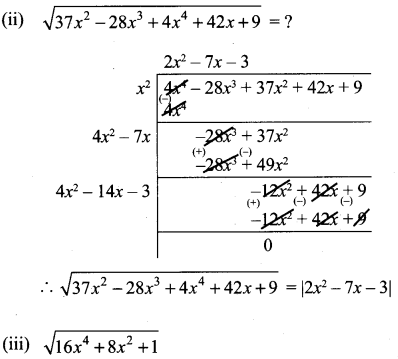
(ii) 37x2 – 28x3 + 4x4 + 42x + 9
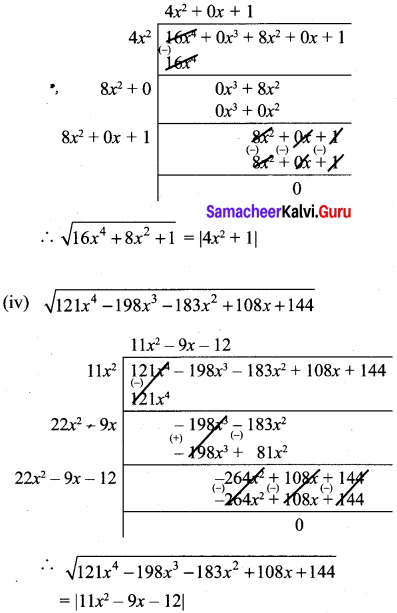
(iii) 16x4 + 8x2 + 1
(iv) 121x4 – 198x3 – 183x2 + 216x + 144
Solution:
The long division method in finding the square root of a polynomial is useful when the degrees of a polynomial is higher.
Samacheer Kalvi 10th Maths Chapter 3 Algebra Ex 3.8 1
Samacheer Kalvi 10th Maths Chapter 3 Algebra Ex 3.8 2
Samacheer Kalvi 10th Maths Chapter 3 Algebra Ex 3.8 3

Synthetic Division Calculator. The calculator will divide the polynomial by the binomial using synthetic division, with steps shown.

Question 2.
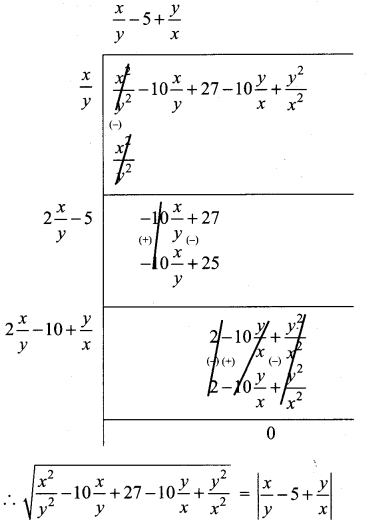
Find the square root of the expression \(\frac{x^{2}}{y^{2}}-10 \frac{x}{y}+27-10 \frac{y}{x}+\frac{y^{2}}{x^{2}}\)
Solution:
Samacheer Kalvi 10th Maths Chapter 3 Algebra Ex 3.8 4

Samacheer Kalvi 10th Maths Solutions Chapter 3 Algebra Ex 3.8

Question 3.
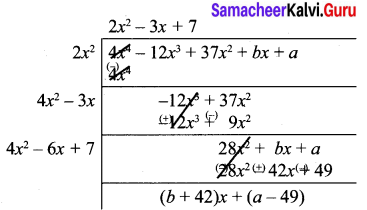
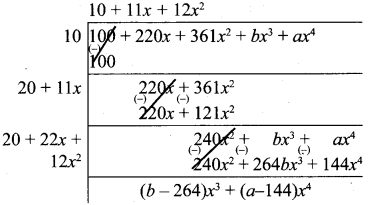
Find the values of a and b if the following polynomials are perfect squares
(i) 4x4 – 12x3 + 37x2 + bx + a
(ii) ax4 + bx3 + 361ax2 + 220x + 100
Solution:
(i)
Samacheer Kalvi 10th Maths Chapter 3 Algebra Ex 3.8 5
Since it is a perfect square.
Remainder = 0
⇒ b + 42 = 0, a – 49 = 0
b = -42, a = 49

(ii) ax4 + bx3 + 361ax2 + 220x + 100
Samacheer Kalvi 10th Maths Chapter 3 Algebra Ex 3.8 6
Since remainder is 0
a = 144
b = 264

Question 4.
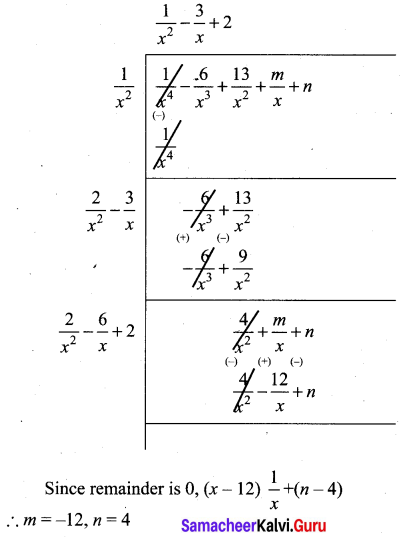
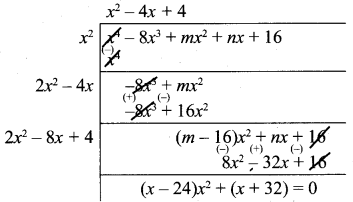
Find the values of m and n if the following expressions are perfect squares
(i) \(\frac{1}{x^{4}}-\frac{6}{x^{3}}+\frac{13}{x^{2}}+\frac{m}{x}+n\)
(ii) x4 – 8x3 + mx2 + nx + 16
Solution:
(i)
Samacheer Kalvi 10th Maths Chapter 3 Algebra Ex 3.8 7

(ii)
Samacheer Kalvi 10th Maths Chapter 3 Algebra Ex 3.8 8
Since remainder is 0,
m = 24, n = -32

Samacheer Kalvi 10th Maths Solutions Chapter 3 Algebra Ex 3.8 Read More »