Prasanna

Samacheer Kalvi 9th Maths Solutions Chapter 1 Set Language Ex 1.3

You can Download Samacheer Kalvi 9th Maths Book Solutions Guide Pdf, Tamilnadu State Board help you to revise the complete Syllabus and score more marks in your examinations.

Tamilnadu Samacheer Kalvi 9th Maths Solutions Chapter 1 Set Language Ex 1.3

Question 1.
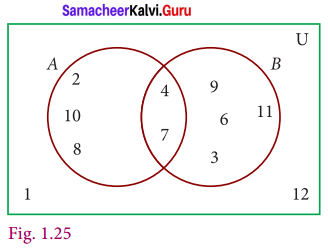
Using the given venn diagram, write the elements of
(i) A
(ii) B
(iii) A ∪ B
(iv) A ∩ B
(v) A – B
(vi) B – A
(vii) A’
(viii) B’
(ix) U
Solution:
(i) A = {2, 4, 7, 8, 10}
(ii) B = {3, 4, 6, 7, 9, 11}
(iii) A ∪ B = {2, 3, 4, 6, 7, 8, 9, 10, 11}
(iv) A ∩ B = {4, 7}
(v) A – B = {2, 8, 10}
(vi) B – A = {3, 6, 9, 11}
(vii) A’ = {1, 3, 6, 9, 11, 12}
(viii) B’ = {1, 2, 8, 10, 12}
(ix) U = {1, 2, 3, 4, 6, 7, 8, 9, 10, 11, 12}.

Question 2.
Find A ∪ B, A ∩ B, A – B and B – A for the following sets.
(i) A = {2, 6, 10, 14} and B = {2, 5, 14, 16}
(ii) A = {a, b, c, e, u} and B = {a, e, i, o, u]
(iii) A = {x : x ∈ N, x ≤ 10} and B = {x : x ∈ W, x < 6}
(iv) A = Set of all letters in the word “mathematics” and B = Set of all letters in the word “geometry”
Solution:
(i) A = {2, 6, 10, 14} and B = {2, 5, 14, 16}
A ∪ B = {2, 6, 10, 14} ∪ {2, 5, 14, 16} = {2, 5, 6, 10, 14, 16}
A ∩ B = {2, 6, 10, 14} ∩ {2, 5, 14, 16} = {2, 14}
A – B = {2, 6, 10, 14} – {2, 5, 14, 16} = {6, 10}
B – A = {2, 5, 14, 16} – {2, 6, 10, 14}  = {5, 16}

(ii) A = {a, b, c, e, u} and B = {a, e, i, o, u}
A ∪ B = {a, b, c, e, u) ∪ {a, e, i, o, u) = {a, b, c, e, i, o, u}
A ∩ B = {a, b, c, e, u} ∩ {a, e, i, o, u} {a, e, u}
A – B = {a, b, c, e, u) – {a, e, i, o, u) = {b, c}
B – A = {a, e, i, o, u} – {a, b, c, e, u} =  {i, o}

(iii) x ∈ {1, 2, 3, ……..} ; x ∈ {0, 1, 2, 3, 4, 5, ……..}
A = {1, 2, 3, 4, 5, 6, 7, 8, 9, 10}
B = {0, 1, 2, 3, 4, 5}
A ∪ B = {1, 2, 3, 4, 5, 6, 7, 8, 9, 10} ∪ {0, 1, 2, 3, 4, 5} = {0, 1, 2, 3, 4, 5, 6, 7, 8, 9, 10}
A ∩ B = {1, 2, 3, 4, 5, 6, 7, 8, 9, 10} ∩ {0, 1, 2, 3, 4, 5} = {1, 2, 3, 4, 5}
A – B = {1, 2, 3, 4, 5, 6, 7, 8, 9, 10} – {0, 1, 2, 3, 4, 5} = {6, 7, 8, 9, 10}
B – A = {0, 1, 2, 3, 4, 5} – {1, 2, 3, 4, 5, 6, 7, 8, 9, 10} = {0}

(iv) A= {m, a, t, h, e, i, c, s), B = {g, e, o, m, t, r, y)
A ∪ B = {m ,a, t, h, e, i, c, s} ∪ {g, e, o, m, t, r, y} = {m, a, t, h, e, i, c, s, g, o, r, y)
A ∩ B = {m, a, t, h, e, i, c, s} ∩ {g, e, o, m, t,r,y} = {m, t, e}
A – B = {m ,a, t, h, e, i, c, s} ∪ {g, e, o, m, t, r, y} = {a, h, i, c, s)
B – A = {m, a, t, h, e, i, c, 5} ∩ {g, e, o, m, t,r,y} = {g, o, r, y}

Samacheer Kalvi 9th Maths Solutions Chapter 1 Set Language Ex 1.3

Question 3.
If U = {a, b, c, d, e,f g ,h}, A = {b, d, f, h} and B = {a, d, e, h}, find the following sets.
(i) A’
(ii) B’
(iii) A’ ∪ B’
(iv) A’ ∩ B’
(v) (A ∪ B)’
(vi) (A ∩ B)’
(vii) (A’)’
(viii) (B’)’
Solution:
(i) A’ = U – A = {a, b, c, d, e, f, g, y} – {b, d, f, h} = {a, c, e, g}
(ii) B’ = U – B = {a, b, c, d, e, f, g, y) – {a, d, e, h] = {b, c, f, g}
(iii) A’ ∪ B’= {a, c, e, g} ∪ {b, c, f, g} = {a, b, c, e, f g}
(iv) A’ ∩ B’= {a, c, e, g} ∩ {b, c, f, g} = {c, g}
(v) (A ∪ B)’ = U – (A ∪ B) = {a, b, c, d, e, f, g, y) – {a, b, d, e, f, h} = {c, g}
(vi) (A ∩ B)’ = U – (A ∩B) = {a, b, c, d, e, f, g, y} – {d, h} = {a, b, c, e, f, g}
(vii) (A’)’ = U – A’ = {a, b, c, d, e, f, g, h} – {a, c, e, g} = {b, d, f, h)
(viii) (B’)’ = U – B’ = {a, b, c, d, e, f, g, h} – {b, c, f, g} = {a, d, e, h}

Question 4.
Let U = {0, 1, 2 , 3, 4, 5, 6, 7}, A = {1, 3, 5, 7} and B = {0, 2, 3, 5, 7}, find the following sets.
(i) A’
(ii) B’
(iii) A ‘ ∪ B’
(iv) A’ ∩ B’
(v) (A ∪ B)’
(vi) (A ∩ B)’
(vii) (A’)’
(viii) (B’)’
Solution:
(i) A’ = U – A = {0, 1 ,2, y, 4, 5, 6, 7} – {1, 3, 5, 7} = {0, 2, 4, 6}
(ii) B’ = U – B = {0, 1, 2, 3, 4, 5, 6 ,7} – {0, 2, 3, 5, 7} = {1, 4, 6}
(iii) A’ ∪ B’ = {0, 2, 4, 6} ∪ {1, 4, 6} = {0, 1, 2, 4, 6}
(iv) A’ ∩ B’ = {0, 2, 4, 6} ∩ {1, 4, 6} = {4, 6}
(v) (A ∪ B)’ = U – (A ∪ B) = {0, 1, 2, 3, 4, 5, 6, 7} – {0, 1, 2, 3, 5, 7} = {4, 6}
(vi) (A ∩ B)’ = U – (A ∩ B)= {0, 1, 2, 3, 4, 5, 6, 7} – {3,5,7} = {0, 1, 2, 4, 6}
(vii) (A’)’ = U – A’ = {0, 1, 2, 3, 4, 5, 6, 7} – {0, 2, 4, 6} = {1, 3, 5, 7}
(viii) (B’)’ = U – B’ = {0, 1, 2, 3, 4, 5, 6, 7} – {1, 4, 6} = {0, 2, 3, 5, 7}.

Question 5.
Find the symmetric difference between the following sets.
(i) P = {2, 3, 5, 7, 11} and Q = {1, 3, 5, 11}
(ii) R = {l, m, n, o, p} and S = {j, l, n, q)
(iii) X = {5, 6, 7} and Y = {5, 7, 9, 10}
Solution:
(i) P = {2, 3, 5, 7, 11}
Q= {1, 3, 5, 11}
P – Q = {2, 3, 5, 7, 11} – {1, 3, 5, 11} = {2, 7}
Q – P = {1, 3, 5, 11} – {2, 3, 5, 7, 11} = {1}
P ∆ Q = (P – Q) ∪ (Q – P) = {2, 7} ∪ {1} = {1, 2, 7}

(ii) R = {l, m, n, o, p}
S = {j, l, n, q}
R – S = {l, m, n, o, p) – {j, l, n, q} = {m, o, p)
s – R = {j, l, n, q) – {l, m, n, o, p}= {j, q}
R ∆ S = (R – S) ∪ (S – R) = {m, o, p) ∪ {j, q} = {j, m, o, p, q)

(iii) X = {5, 6, 7}
Y = {5, 7, 9, 10}
X – Y = {5, 6, 7} – {5, 7, 9, 10} – {6}
Y – X = {5, 6, 9, 10} – {5, 6, 7} = {9, 10}
X ∆ Y = (X – Y) ∪ (Y – X) = {6} ∪ {9, 10} = {6, 9, 10}.

Samacheer Kalvi 9th Maths Solutions Chapter 1 Set Language Ex 1.3

Question 6.
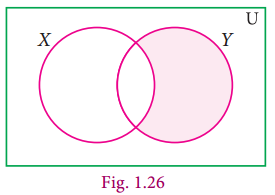
Using the set symbols, write down the expressions for the shaded region in the following
(i)
(ii)
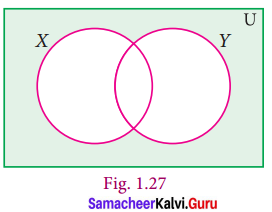
(iii)
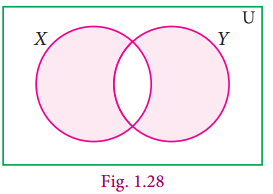
Solution:
(i) X – Y
(ii) (X ∪ Y)’
(iii) (X – Y) ∪ (X – Y)

Question 7.
Let A and B be two overlapping sets and the universal set U. Draw appropriate Venn diagram for each of the following,
(i) A ∪ B
(ii) A ∩ B
(iii) (A ∩ B)’
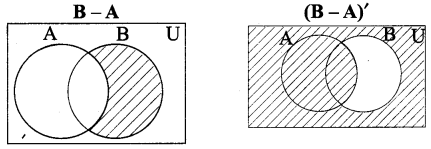
(iv) (B – A)’
(v) A’ ∪ B’
(vi) A’ ∩ B’
(vii)What do you observe from the diagram (iii) and (v)?
Solution:
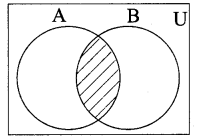
(i) A ∪ B
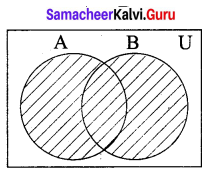
Samacheer Kalvi 9th Maths Chapter 1 Set Language Ex 1.3 5
(ii) A ∩ B
Samacheer Kalvi 9th Maths Chapter 1 Set Language Ex 1.3 6
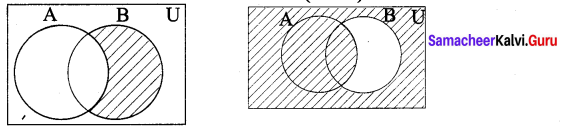
(iii) (A ∩ B)’

(iv) (B – A)’

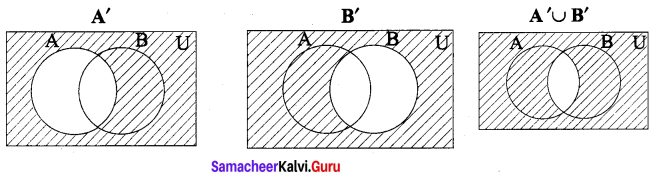
(v) A’ ∪ B’

(vi) A’ ∩ B’
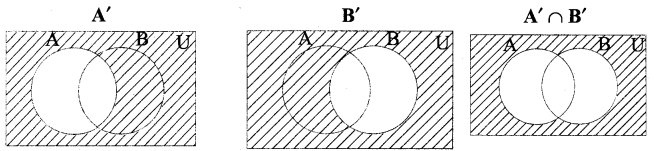
(vii) From the diagram (iii) and (v) we observe that (A ∩ B)’ = A’ ∪ B’.
Samacheer Kalvi 9th Maths Solutions Chapter 1 Set Language Ex 1.3 Read More »
Samacheer Kalvi 9th Maths Solutions Chapter 9 Probability Ex 9.1

You can Download Samacheer Kalvi 9th Maths Book Solutions Guide Pdf, Tamilnadu State Board help you to revise the complete Syllabus and score more marks in your examinations.

Tamilnadu Samacheer Kalvi 9th Maths Solutions Chapter 9 Probability Ex 9.1

Question 1.
You are walking along a street. If you just choose a stranger crossing you, what is the probability that his next birthday will fall on a Sunday?
Solution:
Days in a week (S) = {Sunday, Monday, Tuesday, Wednesday, Thursday, Friday, Saturday}
n( S) = 7
∴ No. of days in week = 7
Event of selecting Sunday (A) = {Sunday}
n(A) = 1
∴ Probability of selecting Sunday = \(\frac{n(\mathrm{A})}{n(\mathrm{S})}=\frac{1}{7}\)
Samacheer Kalvi 9th Maths Solutions Chapter 9 Probability Ex 9.1
Question 2.
What is the probability of drawing a King or a Queen or a Jack from a deck of cards?
Solution:
Number of cards n(S) = 52
No. of King cards n(A) = 4
No. of Queen cards n(B) = 4
No. of Jack cards n(C) = 4
Probability of drawing a King card
\(=\quad \frac{n(\mathrm{A})}{n(\mathrm{S})}=\frac{4}{52}\)
Probability of drawing a Queen card
\(=\frac{n(\mathrm{B})}{n(\mathrm{S})}=\frac{4}{52}\)
Probability of drawing a Jack card
\(=\frac{n(\mathrm{C})}{n(\mathrm{S})}=\frac{4}{52}\)
The Probability of drawing a King or a Queen or a Jack from a deck of cards
\(=\mathrm{P}(\mathrm{A})+\mathrm{P}(\mathrm{B})+\mathrm{P}(\mathrm{C})=\frac{4}{52}+\frac{4}{52}+\frac{4}{52}=\frac{4+4+4}{52}=\frac{12}{52}=\frac{3}{13}\)

Question 3.
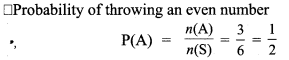
What is the probability of throwing an even number with a single standard dice of six faces?
Solution:
Faces of a dice (S) = {1, 2, 3, 4, 5, 6}
n(S) = 6
Event of throwing an even number
A = {2, 4, 6}, n(A) = 3
Samacheer Kalvi 9th Maths Chapter 1 Set Language Ex 9.1 1

Question 4.
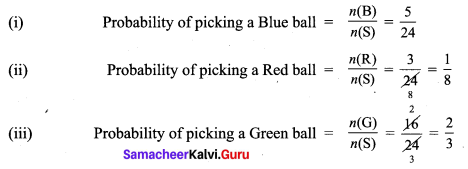
There are 24 balls in a pot. If 3 of them are Red, 5 of them are Blue and the remaining are Green then, what is the probability of picking out
(i) a Blue ball,
(ii) a Red ball and
(iii) a Green ball?
Solution:
n(S) = 24
Red – n(R) = 3
Blue – n(B) = 5
Green – n(G) = 16
Samacheer Kalvi 9th Maths Chapter 1 Set Language Ex 9.1 2

Question 5.
When two coins are tossed, what is the probability that two heads are obtained?
Solution:
Sample space when two coins are tossed (S) = {HH, TT, HT, TH}
n(S) = 4
Event of getting two heads (A) = {HH}
n(A) = 1
Probability of getting two heads P(A) = \(\frac{n(\mathrm{A})}{n(\mathrm{S})}=\frac{1}{4}\)

Question 6.
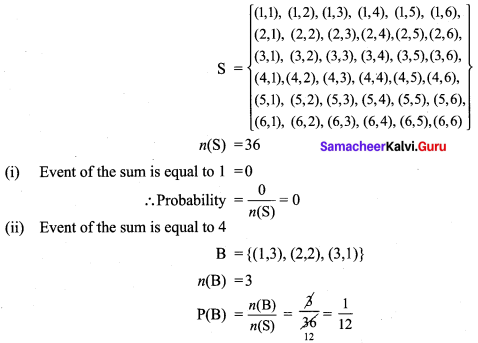
Two dice are rolled, find the probability that the sum is
(i) equal to 1
(ii) equal to 4
(iii) less than 13
Solution:
When two dice are rolled Sample space
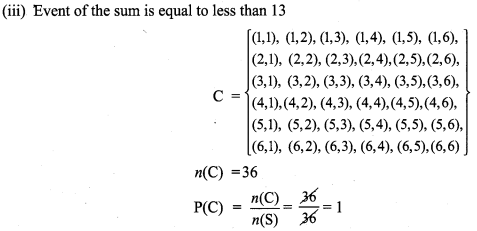
Samacheer Kalvi 9th Maths Chapter 1 Set Language Ex 9.1 3
Samacheer Kalvi 9th Maths Chapter 1 Set Language Ex 9.1 4
Samacheer Kalvi 9th Maths Solutions Chapter 9 Probability Ex 9.1
Question 7.
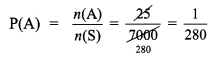
A manufacturer tested 7000 LED lights at random and found that 25 of them were defective. If a LED light is selected at random, what is the probability that the selected LED light is a defective one.
Solution:
n(S) = 7000 S – Total no. of lights.
n(A) = 25 A – Defective ones.
Samacheer Kalvi 9th Maths Chapter 1 Set Language Ex 9.1 7

Question 8.
In a football match, a goalkeeper of a team can stop the goal, 32 times out of 40 attempts tried by a team. Find the probability that the opponent team can convert the attempt into a goal.
Solution:
Total no. of attempts n(S) = 40
Total no. of attempts by A team n(A) = 32
Total no. of attempts by the opponent team B = n(B) = 40 – 32 = 8
Samacheer Kalvi 9th Maths Chapter 1 Set Language Ex 9.1 8

Question 9.
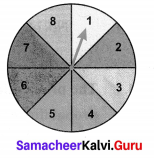
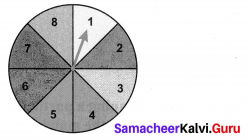
What is the probability that the spinner will not land on a multiple of 3?
Solution:
Total no. of choices n(S) = 8
Total no. of multiples of 3 A = {3, 6}
n(A) = 2
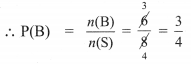
Event of non-multiples of 3B = {1, 2, 4, 5, 7, 8}
n(B) = 6
Samacheer Kalvi 9th Maths Chapter 1 Set Language Ex 9.1 9

Question 10.
Frame two problems in calculating probability, based on the spinner shown here.
Samacheer Kalvi 9th Maths Chapter 1 Set Language Ex 9.1 11
Solution:
(i) What is the probability that the spinner will land on an even number?
(ii) What is the probability that the spinner will not land on a prime number.
Samacheer Kalvi 9th Maths Solutions Chapter 9 Probability Ex 9.1

Samacheer Kalvi 9th Maths Solutions Chapter 9 Probability Ex 9.1 Read More »
Samacheer Kalvi 9th Maths Solutions Chapter 1 Set Language Ex 1.2

You can Download Samacheer Kalvi 9th Maths Book Solutions Guide Pdf, Tamilnadu State Board help you to revise the complete Syllabus and score more marks in your examinations.

Tamilnadu Samacheer Kalvi 9th Maths Solutions Chapter 1 Set Language Ex 1.2

Question 1.
Find the cardinal number of the following sets.
(i) M = {p, q, r, s, t, u}
(ii) P = {x : x = 3n + 2, n ∈ W and x < 15}
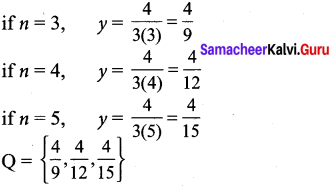
(iii) Q = {v : v = \(\frac { 4 }{ 3n }\) ,n ∈ N and 2 < n ≤ 5}
(iv) R = {x : x is an integers, x ∈ Z and -5 ≤ x < 5}
(v) S = The set of all leap years between 1882 and 1906.
Solution:
(i) n(M) = 6
(ii) W = {0, 1, 2, 3, ……. }
if n = 0, x = 3(0) + 2 = 2
if n = 1, x = 3(1) + 2 = 5
if n = 2, x = 3(2) + 2 = 8
if n = 3, x = 3(3)+ 2 =11
if n = 4, x = 3(4) + 2=14
∴ P= {2, 5, 8, 11, 14}
n(P) = 5

(iii) N = {1,2, 3, 4, …..}
n ∈ {3, 4, 5}

n(Q) = 3

(iv) x ∈ z
R = {-5, – 4, -3, -2, -1, 0, 1, 2, 3, 4}
n(R)= 10.

(v) S = {1884, 1888, 1892, 1896, 1904}
n (S) = 5.

Question 2.
Identify the following sets as finite or infinite.
(i) X = The set of all districts in Tamilnadu.
(ii) Y = The set of all straight lines passing through a point.
(iii) A = {x : x ∈ Z and x < 5}
(iv) B = {x : x2 – 5x + 6 = 0, x ∈ N}
Solution:
(i) Finite set
(ii) Infinite set
(iii) A = { ……. , -2, -1, 0, 1, 2, 3, 4}
∴ Infinite set

(iv) x2 – 5x + 6 = 0
(x – 3) (x – 2) = 0
B = {3, 2}
∴ Finite set.

Samacheer Kalvi 9th Maths Solutions Chapter 1 Set Language Ex 1.2

Question 3.
Which of the following sets are equivalent or unequal or equal sets?
(i) A = The set of vowels in the English alphabets.
B = The set of all letters in the word “VOWEL”
(ii) C = {2, 3, 4, 5}
D = {x : x ∈ W, 1 < x < 5}
(iii) X = A = { x : x is a letter in the word “LIFE”}
Y = {F, I, L, E}
(iv) G = {x : x is a prime number and 3 < x < 23}
H = {x : x is a divisor of 18}
Solution:
(i) A = {a, e, i, o, u}
B = {V, O,W, E, L}
The sets A and B contain the same number of elements.
∴ Equivalent sets

(ii) C ={2, 3, 4, 5}
D = {2, 3, 4}
∴ Unequal sets

(iii) X = {L, I, F, E}
Y = {F, I, L, E}
The sets X and Y contain the exactly the same elements.
∴ Equal sets.

(iv) G = {5, 7, 11, 13, 17, 19}
H = {1, 2, 3, 6, 9, 18}
∴ Equivalent sets.

Question 4.
Identify the following sets as null set or singleton set.
(i) A = (x : x ∈ N, 1 < x < 2}
(ii) B = The set of all even natural numbers which are not divisible by 2.
(iii) C = {0}
(iv) D = The set of all triangles having four sides.
Solution:
(i) A = { } ∵ There is no element in between 1 and 2 in Natural numbers.
∴ Null set

(ii) B = { } ∵ All even natural numbers are divisible by 2.
∴ B is Null set

(iii) C = {0}
∴ Singleton set

(iv) D = { }
∵ No triangle has four sides.
∴ D is a Null set.

Question 5.
State which pairs of sets are disjoint or overlapping?
(i) A = {f, i, a, s} and B = {a, n, f, h, s)
(ii) C = {x : x is a prime number, x > 2} and D = {x : x is an even prime number}
(iii) E = {x: x is a factor of 24} and F = {x : x is a multiple of 3, x < 30}
Solution:
(i) A = {f, i, a, s}
B = {a, n, f, h, s}
A ∩ B ={f, i, a, s} ∩ {a, n,f h, s} = {f, a, s}
Since A ∩ B ≠ ϕ , A and B are overlapping sets.

(ii) C = {3, 5, 7, 11, ……}
D = {2}
C ∩ D = {3, 5, 7, 11, …… } ∩ {2} = { }
Since C ∩ D = Ø, C and D are disjoint sets.

(iii) E = {1, 2, 3, 4, 6, 8, 12, 24}
F = {3, 6, 9, 12, 15, 18, 21, 24, 27}
E ∩ F = {1, 2, 3, 4, 6, 8, 12, 24} ∩ {3, 6, 9, 12, 15, 18, 21, 24, 27}
= {3, 6, 12, 24}
Since E ∩ F ≠ ϕ, E and F are overlapping sets.

Question 6.
If S = {square,rectangle,circle,rhombus,triangle}, list the elements of the following subset of S.
(i) The set of shapes which have 4 equal sides.
(ii) The set of shapes which have radius.
(iii) The set of shapes in which the sum of all interior angles is 180°
(iv) The set of shapes which have 5 sides.
Solution:
(i) {Square, Rhombus}
(ii) {Circle}
(iii) {Triangle}
(iv) Null set.

Samacheer Kalvi 9th Maths Solutions Chapter 1 Set Language Ex 1.2

Question 7.
If A = {a, {a, b}}, write all the subsets of A.
Solution:
A= {a, {a, b}} subsets of A are { } {a}, {a, b}, {a, {a, b}}.

Question 8.
Write down the power set of the following sets.
(i) A = {a, b}
(ii) B = {1, 2, 3}
(iii) D = {p, q, r, s}
(iv) E = Ø
Solution:
(i) The subsets of A are Ø, {a}, {b}, {a, b}
The power set of A
P(A ) = {Ø, {a}, {b}, {a,b}}

(ii) The subsets of B are ϕ, {1}, {2}, {3}, {1, 2}, {2, 3}, {1, 3}, {1, 2, 3}
The power set of B
P(B) = {Ø, {1}, {2}, {3}, {1, 2}, {2, 3}, {1, 3}, {1, 2, 3}}

(iii) The subset of D are Ø, {p}, {q}, {r}, {s}, {p, q}, {p, r}, {p, s}, {q, r}, {q, s}, {r, s},{p, q, r}, {q, r, s}, {p, r, s}, {p, q, s}, {p, q, r, s}}
The power set of D
P(D) = {Ø, {p}, {q}, {r}, {s}, {p, q}, {p, r}, {p, s}, {q, r}, {q, s}, {r, s}, {p, q, r}, {q, r, s}, {p, r, s}, {p, q, s}, {p, q, r, s}

(iv) The power set of E
P(E) = { }.

Question 9.
Find the number of subsets and the number of proper subsets of the following sets.
(i) W = {red,blue, yellow}
(ii) X = { x2 : x ∈ N, x2 ≤ 100}.
Solution:
(i) Given W = {red, blue, yellow}
Then n(W) = 3
The number of subsets = n[P(W)] = 23 = 8
The number of proper subsets = n[P(W)] – 1 = 23 – 1 = 8 – 1 = 7

(ii) Given X ={1,2,3, }
X2 = {1, 4, 9, 16, 25, 36, 49, 64, 81, 100}
n(X) = 10
The Number of subsets = n[P(X)] = 210 = 1024
The Number of proper subsets = n[P(X)] – 1 = 210 – 1 = 1024 – 1 = 1023.

Samacheer Kalvi 9th Maths Solutions Chapter 1 Set Language Ex 1.2

Question 10.
(i) If n(A) = 4, find n[P(A)].
(ii) If n(A) = 0, find n[P(A)].
(iii) If n[P(A)] = 256, find n(A).
Solution:
(i) n( A) = 4
n[ P(A)] = 2n = 24 = 16
(ii) n(A) = 0
n[P(A)] = 20 = 1
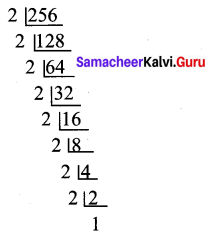
(iii) n[P(A)] = 256

n[P(A)] = 28
∴ n(A) = 8.

Samacheer Kalvi 9th Maths Solutions Chapter 1 Set Language Ex 1.2 Read More »

Samacheer Kalvi 9th Maths Solutions Chapter 1 Set Language Ex 1.1

You can Download Samacheer Kalvi 9th Maths Book Solutions Guide Pdf, Tamilnadu State Board help you to revise the complete Syllabus and score more marks in your examinations.

Tamilnadu Samacheer Kalvi 9th Maths Solutions Chapter 1 Set Language Ex 1.1

Question 1.
Which of the following are sets?
(i) The Collection of prime numbers upto 100.
(ii) The Collection of rich people in India.
(iii) The Collection of all rivers in India.
(iv) The Collection of good Hockey players.
Solution:
(i) A = {2, 3, 5, 7,11, 13,17,19, 23, 29, 31, 37, 41, 43, 47, 53, 59, 61, 67, 71, 73, 79, 83, 89 and 97}
As the collection of prime numbers upto 100 is known and can be counted (well defined). Hence this is a set.
(ii) The collection of rich people in India. Rich people has no definition.
Hence, it is not a set.
(iii) A = {Cauvery, Sindhu, Ganga, }
Hence, it is a set.
(iv) The collection of good hockey players is not a well – defined collection because the criteria for determining a hockey player’s talent may vary from person to person.
Hence, this collection is not a set.

Question 2.
Listthe set of letters of the following words in Roster form.
(i) INDIA
(ii) PARALLELOGRAM
(iii) MISSISSIPPI
(iv) CZECHOSLOVAKIA
Solution:
(i) A = {I, N, D, A}
(ii) B = {P, A, R, L, E, O, G, M}
(iii) C = {M, I, S, P}
(iv) D = {C, Z, E, H, O, S, L, V, A, K, I}.

Samacheer Kalvi 9th Maths Solutions Chapter 1 Set Language Ex 1.1

Question 3.
Consider the following sets A = {0, 3, 5, 8} B = {2, 4, 6, 10} C = {12, 14, 18, 20}
(a) State whether True or false.
(i) 18 ∈ C
(ii) 6 ∉A
(iii) 14 ∉ C
(iv) 10 ∈ B
(v) 5 ∈ B
(vi) 0 ∈ B

(b) Fill in the blanks?
(i) 3 ∈ ___
(ii) 14 e ___
(iii) 18 ___ B
(iv) 4 ___ B
Solution:
(a) (i) True
(ii) True
(iii) False
(iv) True
(v) False
(vi) False,

(b) (i) A
(ii) C
(iii) ∉
(iv) ∈

Question 4.
Represent the following sets in Roster form.
(i) A = The set of all even natural numbers less than 20.
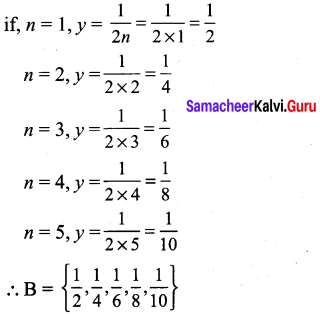
(ii) B = {y : y = \(\frac{1}{2 n}\), n ∈ N, n ≤ 5}
(iii) C = (x : x is perfect cube, 27 < x < 216}
(iv) D = {x : x ∈ Z, -5 < x ≤ 2}
Solution:
(i) A= {2,4, 6, 8,10, 12, 14,16, 18}
(ii) N = { 1, 2, 3, 4, 5}
Samacheer Kalvi 9th Maths Chapter 1 Set Language Ex 1.1 1
(iii) C = {64, 125}
(iv) D = {-4,-3, -2, -1,0, 1, 2}

Question 5.
Represent the following sets in set builder form.
(i) B = The set of all Cricket players in India who scored double centuries in One Day Internationals.
(ii) C = { \(\frac{1}{2}, \frac{2}{3}, \frac{3}{4} \ldots . .\)}.
(iii) D = The set of all tamil months in a year.
(iv) E = The set of odd Whole numbers less than 9.
Solution:
(i) B = {x : x is an Indian player who scored double centuries in one day internationals}
(ii) C = {x : x = \(\frac{n}{n+1}\), n ∈ N}
(iii) D = {x : x is a tamil month in a year}
(iv) E = {x : x is odd number, x ∈ W, x < 9, where W is the set of whole numbers}.

Samacheer Kalvi 9th Maths Solutions Chapter 1 Set Language Ex 1.1

Question 6.
Represent the following sets in descriptive form.
(i) P = {January, June, July}
(ii) Q = {7, 11, 13, 17, 19, 23, 29}
(iii) R= {x : x ∈ N,x< 5}
(iv) S = {x : x is a consonant in English alphabets}
Solution:
(i) P is the set of English Months begining with J.
(ii) Q is the set of all prime numbers between 5 and 31.
(iii) R is the set of all natural numbers less than 5.
(iv) S is the set of all English consonants.


Samacheer Kalvi 9th Maths Solutions Chapter 1 Set Language Ex 1.1 Read More »
Samacheer Kalvi 10th Maths Solutions Chapter 2 Numbers and Sequences Additional Questions

You can Download Samacheer Kalvi 10th Maths Book Solutions Guide Pdf, Tamilnadu State Board help you to revise the complete Syllabus and score more marks in your examinations.

Tamilnadu Samacheer Kalvi 10th Maths Solutions Chapter 2 Numbers and Sequences Additional Questions

Question 1.
Use Euclid’s algorithm to find the HCF of 4052 and 12756.
Solution:
Since 12576 > 4052 we apply the division lemma to 12576 and 4052, to get HCF
12576 = 4052 × 3 + 420.
Since the remainder 420 ≠ 0, we apply the division lemma to 4052
4052 = 420 × 9 + 272.
We consider the new divisor 420 and the new remainder 272 and apply the division lemma to get
420 = 272 × 1 + 148, 148 ≠ 0.
∴ Again by division lemma
272 = 148 × 1 + 124, here 124 ≠ 0.
∴ Again by division lemma
148 = 124 × 1 + 24, Here 24 ≠ 0.
∴ Again by division lemma
124 = 24 × 5 + 4, Here 4 ≠ 0.
∴ Again by division lemma
24 = 4 × 6 + 0.
The remainder has now become zero. So our procedure stops. Since the divisor at this stage is 4.
∴ The HCF of 12576 and 4052 is 4.

Question 2.
If the HCF of 65 and 117 is in the form (65m – 117) then find the value of m.
Answer:
By Euclid’s algorithm 117 > 65
117 = 65 × 1 + 52
52 = 13 × 4 × 0
65 = 52 × 1 + 13
H.C.F. of 65 and 117 is 13
65m – 117 = 13
65 m = 130
m = \(\frac { 130 }{ 65 } \) = 2
The value of m = 2

The smallest number to appear on both lists is 60, so 60 is the least common of 15 and 20.

Question 3.
Find the LCM and HCF of 6 and 20 by the prime factorisation method.
Solution:
We have 6 = 21 × 31 and
20 = 2 × 2 × 5 = 22 × 51
You can find HCF (6, 20) = 2 and LCM (6, 20) = 2 × 2 × 3 × 5 = 60. As done in your earlier classes. Note that HCF (6, 20) = 21 = product of the smallest power of each common prime factor in the numbers.
LCM (6, 20) = 22 × 31 × 51 = 60.
= Product of the greatest power of each prime factor, involved in the numbers.

Samacheer Kalvi 10th Maths Solutions Chapter 2 Numbers and Sequences Additional Questions

Common Multiples of 16: 16, 32, 48, 64, 80,… Hence the Least common multiple of 12 and 16 is 48. The LCM of 12 and 16 is 48.

Question 4.
Prove that \(\sqrt { 3 }\) is irrational.
Answer:
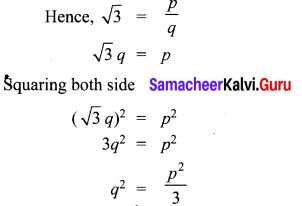
Let us assume the opposite, (1) \(\sqrt { 3 }\) is irrational.
Hence \(\sqrt { 3 }\) = \(\frac { p }{ q } \)
Where p and q(q ≠ 0) are co-prime (no common factor other than 1)
Samacheer Kalvi 10th Maths Chapter 2 Numbers and Sequences Additional Questions 1
Hence, 3 divides p2
So 3 divides p also …………….. (1)
Hence we can say
\(\frac { p }{ 3 } \) = c where c is some integer
p = 3c
Now we know that
3q2 = p2
Putting = 3c
3q2 = (3c)2
3q2 = 9c2
q2 = \(\frac { 1 }{ 3 } \) × 9c2
q2 = 3c2
\(\frac{q^{2}}{3}\) = C2
Hence 3 divides q2
So, 3 divides q also ……………. (2)
By (1) and (2) 3 divides both p and q
By contradiction \(\sqrt { 3 }\) is irrational.

Question 5.
Which of the following list of numbers form an AP? If they form an AP, write the next two terms:
(i) 4, 10, 16, 22, …
(ii) 1, -1,-3, -5,…
(iii) -2, 2, -2, 2, -2, …
(iv) 1, 1, 1, 2, 2, 2, 3, 3, 3,…
Solution:
(i) 4, 10, 16, 22, …….
We have a2 – a1 = 10 – 4 = 6
a3 – a2 = 16 – 10 = 6
a4 – a3 = 22 – 16 = 6
∴ It is an A.P. with common difference 6.
∴ The next two terms are, 28, 34

(ii) 1, -1, -3, -5
t2 – t1 = -1 – 1 = -2
t3 – t2 = -3 – (-1) = -2
t4 – t3 = -5 – (-3) = -2
The given list of numbers form an A.P with the common difference -2.
The next two terms are (-5 + (-2)) = -7, -7 + (-2) = -9.

(iii) -2, 2,-2, 2,-2
t2 – t1 = 2-(-2) = 4
t3 – t2 = -2 -2 = -4
t4 – t3 = 2 – (-2) = 4
It is not an A.P.

(iv) 1, 1, 1, 2, 2, 2, 3, 3, 3
t2 – t1 = 1 – 1 = 0
t3 – t2 = 1 – 1 = 0
t4 – t3 = 2 – 1 = 1
Here t2 – t1 ≠ t3 – t2
∴ It is not an A.P.

Question 6.
Find n so that the nth terms of the following two A.P.’s are the same.
1, 7,13,19,… and 100, 95,90,…
Answer:
The given A.P. is 1, 7, 13, 19,….
a = 1, d = 7 – 1 = 6
tn1 = a + (n – 1)d
tn1 = 1 + (n – 1) 6
= 1 + 6n – 6 = 6n – 5 … (1)
The given A.P. is 100, 95, 90,….
a = 100, d = 95 – 100 = – 5
tn2 = 100 + (n – 1) (-5)
= 100 – 5n + 5
= 105 – 5n …..(2)
Given that, tn1 = tn2
6n – 5 = 105 – 5n
6n + 5n = 105 + 5
11 n = 110
n = 10
∴ 10th term are same for both the A.P’s.

Question 7.
In a flower bed, there are 23 rose plants in the first row, 21 in the second, 19 is the third, and so on. There are 5 rose plants in the last row. How many rows are there in the flower bed?
Answer:
The number of rose plants in the 1st, 2nd, 3rd,… rows are
23, 21, 19,………….. 5
It forms an A.P.
Let the number of rows in the flower bed be n.
Then a = 23, d = 21 – 23 = -2, l = 5.
As, an = a + (n – 1)d i.e. tn = a + (n – 1)d
We have 5 = 23 + (n – 1)(-2)
i.e. -18 = (n – 1)(-2)
n = 10
∴ There are 10 rows in the flower bed.

Samacheer Kalvi 10th Maths Solutions Chapter 2 Numbers and Sequences Additional Questions

Question 8.
Find the sum of the first 30 terms of an A.P. whose nth term is 3 + 2n.
Answer:
Given,
tn = 3 + 2n
t1 = 3 + 2 (1) = 3 + 2 = 5
t2 = 3 + 2 (2) = 3 + 4 = 7
t3 = 3 + 2 (3) = 3 + 6 = 9
Here a = 5,d = 7 – 5 = 2, n = 30
Sn = \(\frac { n }{ 2 } \) [2a + (n – 1)d]
S30 = \(\frac { 30 }{ 2 } \) [10 + 29(2)]
= 15 [10 + 58] = 15 × 68 = 1020
∴ Sum of first 30 terms = 1020

Question 9.
How many terms of the AP: 24, 21, 18, . must be taken so that their sum is 78?
Solution:
Here a = 24, d = 21 – 24 = -3, Sn = 78. We need to find n.
We know that,
Sn = \(\frac { n }{ 2 } \) (2a + (n – 1)d)
78 = \(\frac { n}{ 2 } \) (48 + 13(-3))
78 = \(\frac { n}{ 2 } \) (51 – 3n)
or 3n2 – 51n + 156 = 0
n2 – 17n + 52 = 0
(n – 4) (n – 13) = 0
n = 4 or 13
The number of terms are 4 or 13.

Question 10.
The sum of first n terms of a certain series is given as 3n2 – 2n. Show that the series is an arithmetic series.
Solution:
Given, Sn = 3n2 – 2n
S1 = 3 (1)2 – 2(1)
= 3 – 2 = 1
ie; t1 = 1 (∴ S1 = t1)
S2 = 3(2)2 – 2(2) = 12 – 4 = 8
ie; t1 + t2 = 8 (∴ S2 = t1 + t2)
∴ t2 = 8 – 1 = 7
S3 = 3(3)2 – 2(3) = 27 – 6 = 21
t1 + t2 + t3 = 21 (∴ S3 = t1 + t2 + t3)
8 + t3 = 21 (Substitute t1 + t2 = 8)
t3 = 21 – 8 ⇒ t3 = 13
∴ The series is 1,7,13, …………. and this series is an A.P. with common difference 6.

Samacheer Kalvi 10th Maths Solutions Chapter 2 Numbers and Sequences Additional Questions Read More »

Samacheer Kalvi 11th Maths Solutions Chapter 5 Binomial Theorem, Sequences and Series Ex 5.4

You can Download Samacheer Kalvi 11th Maths Book Solutions Guide Pdf, Tamilnadu State Board help you to revise the complete Syllabus and score more marks in your examinations.

Tamilnadu Samacheer Kalvi 11th Maths Solutions Chapter 5 Binomial Theorem, Sequences and Series Ex 5.4

Expanding Binomials Calculator online with solution and steps.

Question 1.
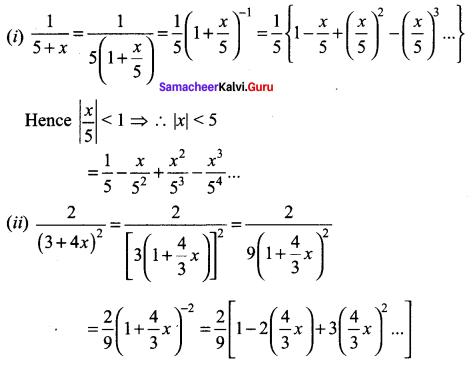
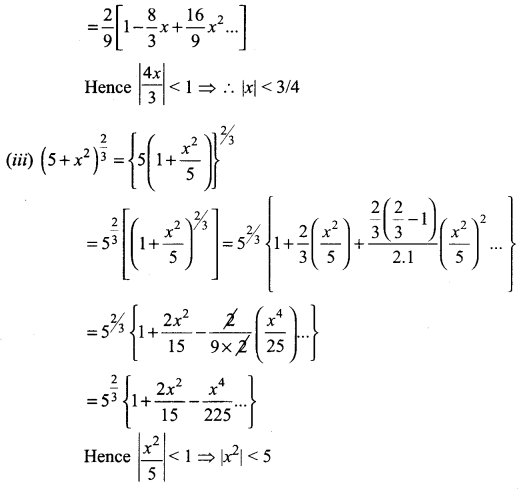
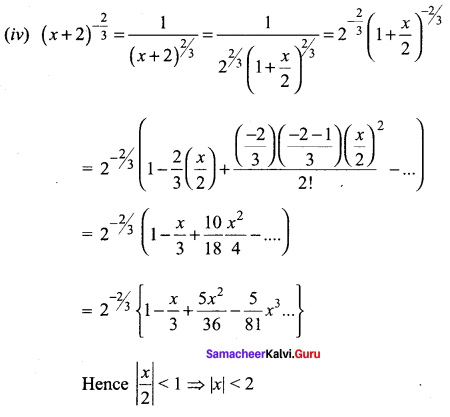
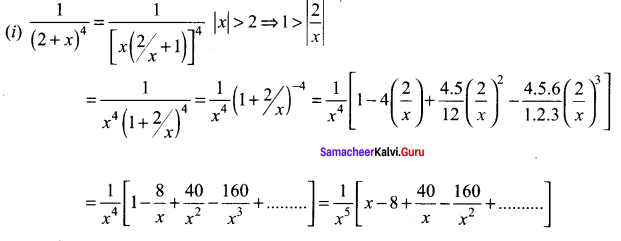
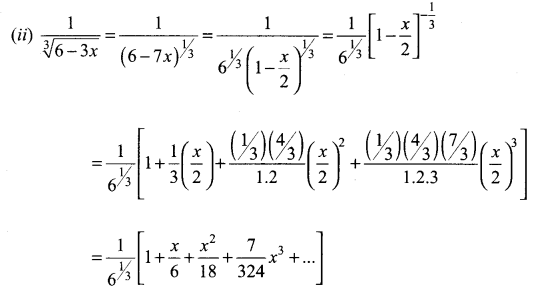
Expand the following in ascending powers of x and find the condition on x for which the binomial expansion is valid.
Solution:
Samacheer Kalvi 11th Maths Solutions Chapter 5 Binomial Theorem, Sequences and Series Ex 5.4 1
Samacheer Kalvi 11th Maths Solutions Chapter 5 Binomial Theorem, Sequences and Series Ex 5.4 2
Samacheer Kalvi 11th Maths Solutions Chapter 5 Binomial Theorem, Sequences and Series Ex 5.4 3

Question 2.
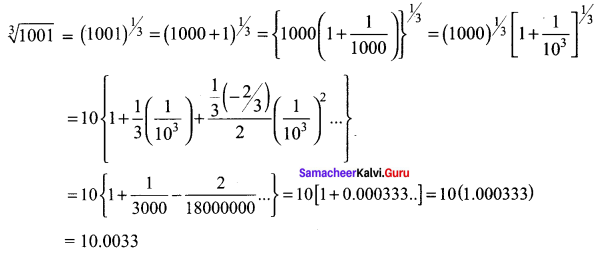
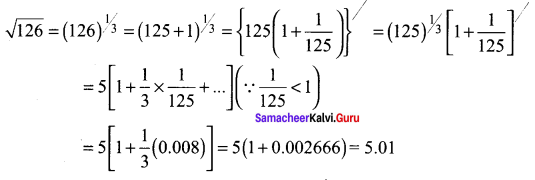
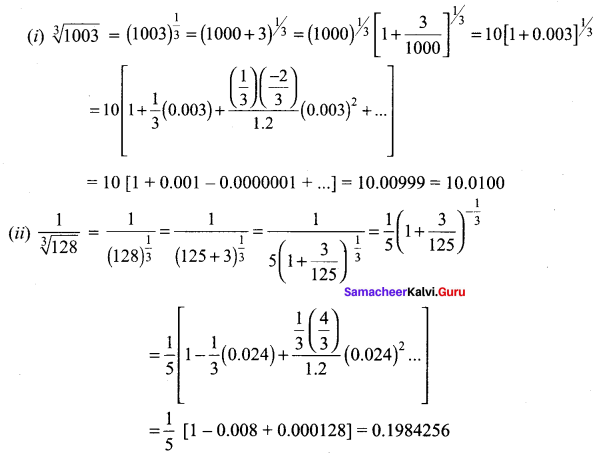
Find \(\sqrt[3]{1001}\) approximately (two decimal places).
Solution:
Samacheer Kalvi 11th Maths Solutions Chapter 5 Binomial Theorem, Sequences and Series Ex 5.4 4

Question 3.
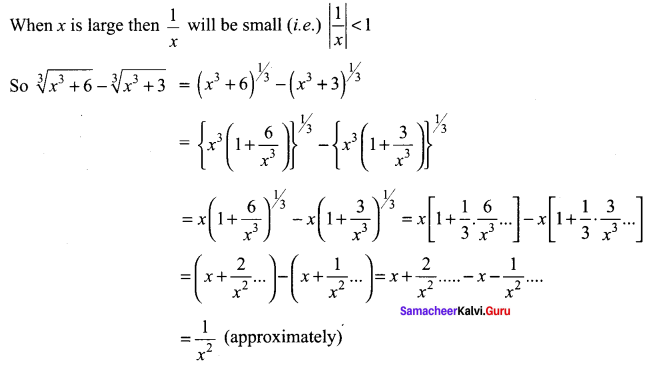
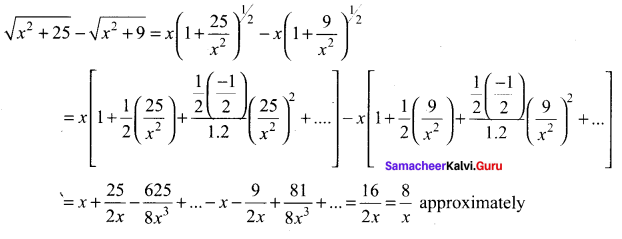
Samacheer Kalvi 11th Maths Solutions Chapter 5 Binomial Theorem, Sequences and Series Ex 5.4 5
Solution:
Samacheer Kalvi 11th Maths Solutions Chapter 5 Binomial Theorem, Sequences and Series Ex 5.4 6

Question 4.
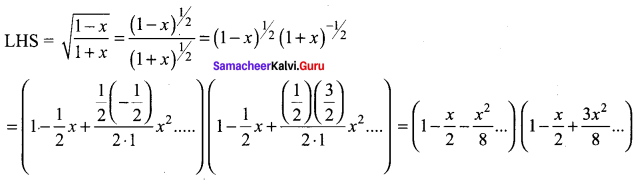
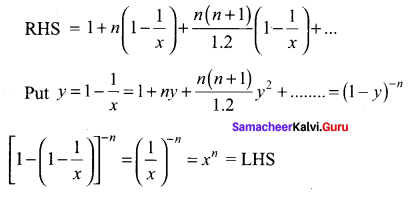
Samacheer Kalvi 11th Maths Solutions Chapter 5 Binomial Theorem, Sequences and Series Ex 5.4 7
Solution:
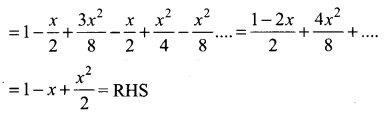
Samacheer Kalvi 11th Maths Solutions Chapter 5 Binomial Theorem, Sequences and Series Ex 5.4 8
Samacheer Kalvi 11th Maths Solutions Chapter 5 Binomial Theorem, Sequences and Series Ex 5.4 9

Question 5.
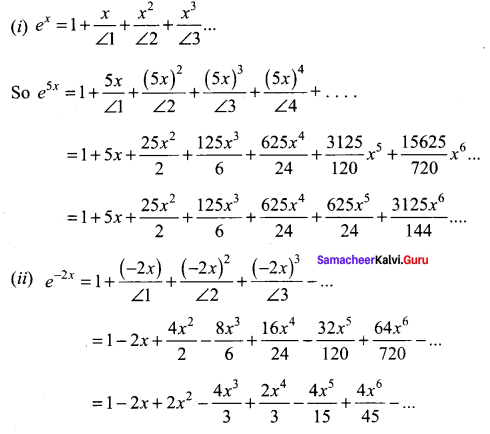
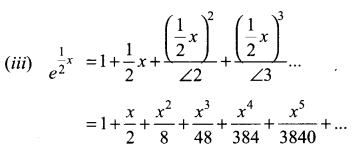
Write the first 6 terms of the exponential series
(i) e5x
(ii) e-2x
(iii) \(e^{\frac{x}{2}}\)
Solution:
Samacheer Kalvi 11th Maths Solutions Chapter 5 Binomial Theorem, Sequences and Series Ex 5.4 10
Samacheer Kalvi 11th Maths Solutions Chapter 5 Binomial Theorem, Sequences and Series Ex 5.4 11

Samacheer Kalvi 11th Maths Solutions Chapter 5 Binomial Theorem, Sequences and Series Ex 5.4

Question 6.
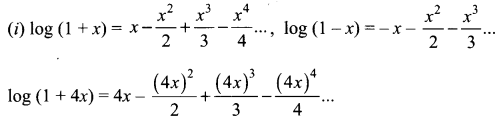
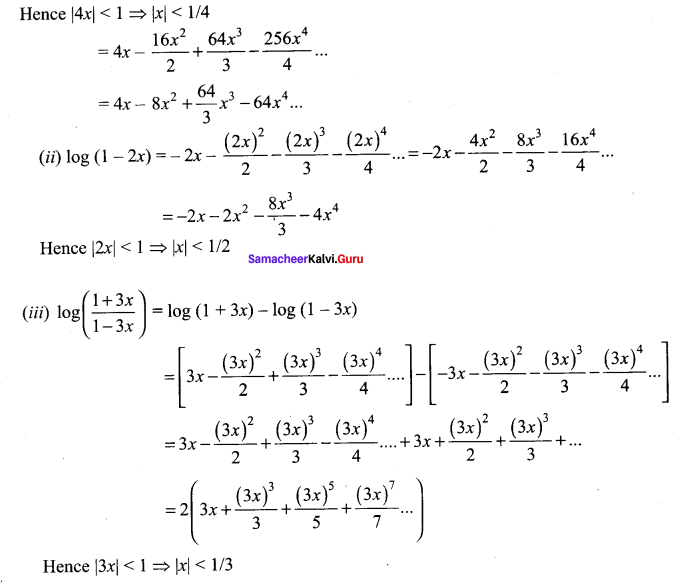
Write the first 4 terms of the logarithmic series
(i) log(1 + 4x),
(ii) log(1 – 2x),
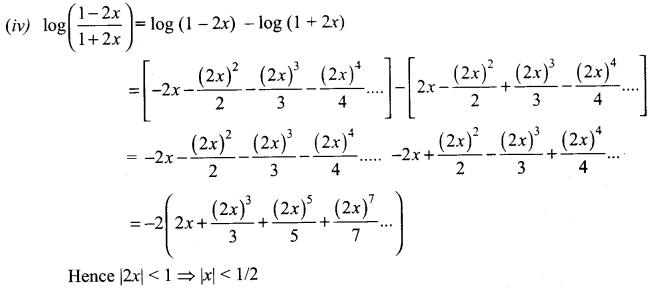
(iii) \(\log \left(\frac{1+3 x}{1-3 x}\right)\)
(iv) \(\log \left(\frac{1-2 x}{1+2 x}\right)\).
Find the intervals on which the expansions are valid.
Solution:
Samacheer Kalvi 11th Maths Solutions Chapter 5 Binomial Theorem, Sequences and Series Ex 5.4 111
Samacheer Kalvi 11th Maths Solutions Chapter 5 Binomial Theorem, Sequences and Series Ex 5.4 12
Samacheer Kalvi 11th Maths Solutions Chapter 5 Binomial Theorem, Sequences and Series Ex 5.4 13

Question 7.
Samacheer Kalvi 11th Maths Solutions Chapter 5 Binomial Theorem, Sequences and Series Ex 5.4 17
Solution:
Samacheer Kalvi 11th Maths Solutions Chapter 5 Binomial Theorem, Sequences and Series Ex 5.4 18

Question 8.
Samacheer Kalvi 11th Maths Solutions Chapter 5 Binomial Theorem, Sequences and Series Ex 5.4 19
Solution:
Samacheer Kalvi 11th Maths Solutions Chapter 5 Binomial Theorem, Sequences and Series Ex 5.4 20

Samacheer Kalvi 11th Maths Solutions Chapter 5 Binomial Theorem, Sequences and Series Ex 5.4

Question 9.
Samacheer Kalvi 11th Maths Solutions Chapter 5 Binomial Theorem, Sequences and Series Ex 5.4 21
Solution:
Samacheer Kalvi 11th Maths Solutions Chapter 5 Binomial Theorem, Sequences and Series Ex 5.4 22

Question 10.
Samacheer Kalvi 11th Maths Solutions Chapter 5 Binomial Theorem, Sequences and Series Ex 5.4 23
Solution:
Samacheer Kalvi 11th Maths Solutions Chapter 5 Binomial Theorem, Sequences and Series Ex 5.4 24
Samacheer Kalvi 11th Maths Solutions Chapter 5 Binomial Theorem, Sequences and Series Ex 5.4 25

Samacheer Kalvi 11th Maths Solutions Chapter 5 Binomial Theorem, Sequences and Series Ex 5.4 Additional Questions

Question 1.
Samacheer Kalvi 11th Maths Solutions Chapter 5 Binomial Theorem, Sequences and Series Ex 5.4 26
Solution:
Samacheer Kalvi 11th Maths Solutions Chapter 5 Binomial Theorem, Sequences and Series Ex 5.4 27

Samacheer Kalvi 11th Maths Solutions Chapter 5 Binomial Theorem, Sequences and Series Ex 5.4

Question 2.
Write the four terms in the expansions of the following:
Samacheer Kalvi 11th Maths Solutions Chapter 5 Binomial Theorem, Sequences and Series Ex 5.4 28
Solution:
Samacheer Kalvi 11th Maths Solutions Chapter 5 Binomial Theorem, Sequences and Series Ex 5.4 29
Samacheer Kalvi 11th Maths Solutions Chapter 5 Binomial Theorem, Sequences and Series Ex 5.4 30

Question 3.
Evaluate the following:
Samacheer Kalvi 11th Maths Solutions Chapter 5 Binomial Theorem, Sequences and Series Ex 5.4 31
Solution:
Samacheer Kalvi 11th Maths Solutions Chapter 5 Binomial Theorem, Sequences and Series Ex 5.4 32

Samacheer Kalvi 11th Maths Solutions Chapter 5 Binomial Theorem, Sequences and Series Ex 5.4

Question 4.
Samacheer Kalvi 11th Maths Solutions Chapter 5 Binomial Theorem, Sequences and Series Ex 5.4 33
Solution:
Samacheer Kalvi 11th Maths Solutions Chapter 5 Binomial Theorem, Sequences and Series Ex 5.4 34

Question 5.
Samacheer Kalvi 11th Maths Solutions Chapter 5 Binomial Theorem, Sequences and Series Ex 5.4 35
Solution:
Samacheer Kalvi 11th Maths Solutions Chapter 5 Binomial Theorem, Sequences and Series Ex 5.4 36

Samacheer Kalvi 11th Maths Solutions Chapter 5 Binomial Theorem, Sequences and Series Ex 5.4 Read More »
Samacheer Kalvi 10th Maths Solutions Chapter 5 Coordinate Geometry Ex 5.4

You can Download Samacheer Kalvi 10th Maths Book Solutions Guide Pdf, Tamilnadu State Board help you to revise the complete Syllabus and score more marks in your examinations.

Tamilnadu Samacheer Kalvi 10th Maths Solutions Chapter 5 Coordinate Geometry Ex 5.4

Question 1.
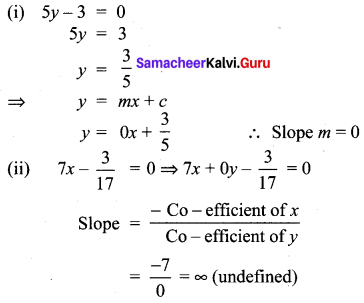
Find the slope of the following straight lines
(i) 5y – 3 = 0
(ii) \(7 x-\frac{3}{17}\) = 0
Solution:
Samacheer Kalvi 10th Maths Chapter 5 Coordinate Geometry Ex 5.4 1

Question 2.
Find the slope of the line which is
(i) parallel to y = 0.7x -11
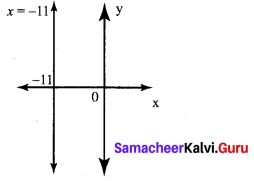
(ii) perpendicular to the line x = -11
Solution:
(i) y = 0.7x – 11
line parallel to y = 0.7x – 11 is y = 0.7x + C
If the lines are parallel, slopes are equal
∴ The slope of the required line is 0.7.
(ii) m = tan θ = tan 90°= ∞ undefined.
Samacheer Kalvi 10th Maths Chapter 5 Coordinate Geometry Ex 5.4 50

Samacheer Kalvi 10th Maths Solutions Chapter 5 Coordinate Geometry Ex 5.4

Question 3.
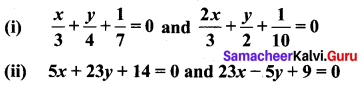
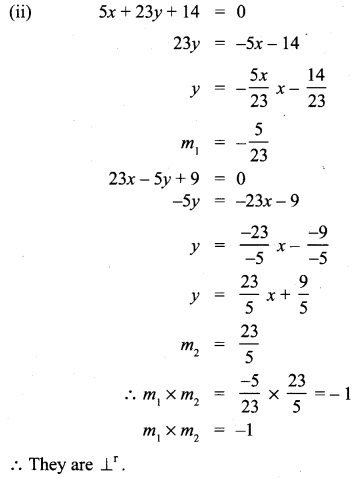
Check whether the given lines are parallel or perpendicular
Samacheer Kalvi 10th Maths Chapter 5 Coordinate Geometry Ex 5.4 2
Solution:
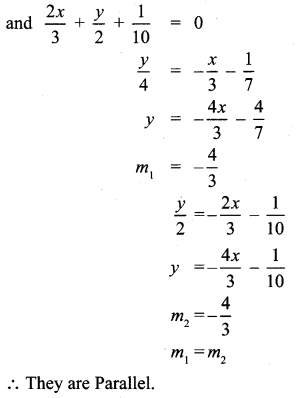
(i) \(\frac{x}{3}+\frac{y}{4}+\frac{1}{7}\) = 0
Samacheer Kalvi 10th Maths Chapter 5 Coordinate Geometry Ex 5.4 3
Samacheer Kalvi 10th Maths Chapter 5 Coordinate Geometry Ex 5.4 4

Question 4.
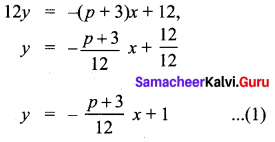
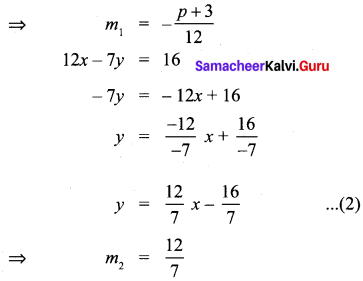
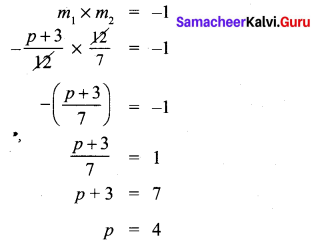
If the straight lines 12y = -(p + 3)x + 12, 12x – 7y = 16 are perpendicular then find ‘p’.
Solution:
Samacheer Kalvi 10th Maths Chapter 5 Coordinate Geometry Ex 5.4 6
Samacheer Kalvi 10th Maths Chapter 5 Coordinate Geometry Ex 5.4 7
Samacheer Kalvi 10th Maths Chapter 5 Coordinate Geometry Ex 5.4 8

Samacheer Kalvi 10th Maths Solutions Chapter 5 Coordinate Geometry Ex 5.4

Question 5.
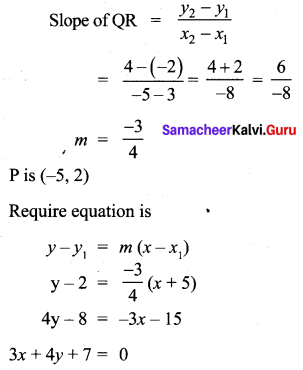
Find the equation of a straight line passing through the point P (-5, 2) and parallel to the line joining the points Q(3, -2) and R(-5, 4).
Solution:
Samacheer Kalvi 10th Maths Chapter 5 Coordinate Geometry Ex 5.4 9

Question 6.
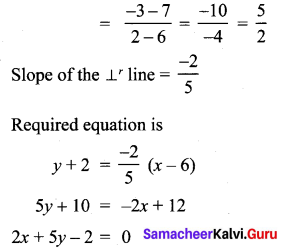
Find the equation of a line passing through ; (6, -2) and perpendicular to the line joining the points (6, 7) and (2, -3).
Solution:
Slope of line joining (6, 7) and (2,-3) is
Samacheer Kalvi 10th Maths Chapter 5 Coordinate Geometry Ex 5.4 10

Question 7.
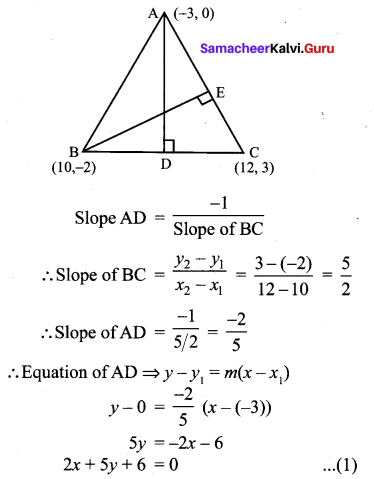
A(-3, 0) B(10, – 2) and C(12, 3) are the vertices of ∆ABC . Find the equation of the altitude through A and B.
Solution:
A(-3, 0), B(10, -2), C(12, 3)
Since AD ⊥ BC
Samacheer Kalvi 10th Maths Chapter 5 Coordinate Geometry Ex 5.4 11
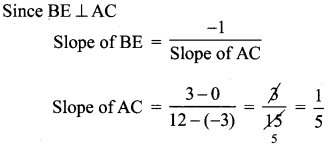
Samacheer Kalvi 10th Maths Chapter 5 Coordinate Geometry Ex 5.4 12
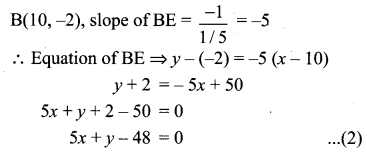
Samacheer Kalvi 10th Maths Chapter 5 Coordinate Geometry Ex 5.4 13
(1), (2) are the required equations of the altitudes through A and B.

Samacheer Kalvi 10th Maths Solutions Chapter 5 Coordinate Geometry Ex 5.4

Question 8.
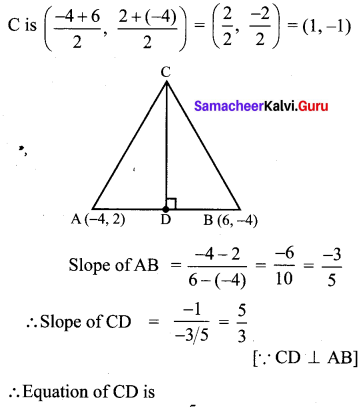
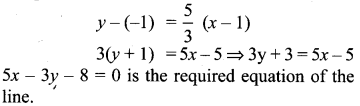
Find the equation of the perpendicular bisector of the line joining the points A(-4, 2) and B(6, -4).
Solution:
Mid Point AB is
Samacheer Kalvi 10th Maths Chapter 5 Coordinate Geometry Ex 5.4 14
Samacheer Kalvi 10th Maths Chapter 5 Coordinate Geometry Ex 5.4 60

Question 9.
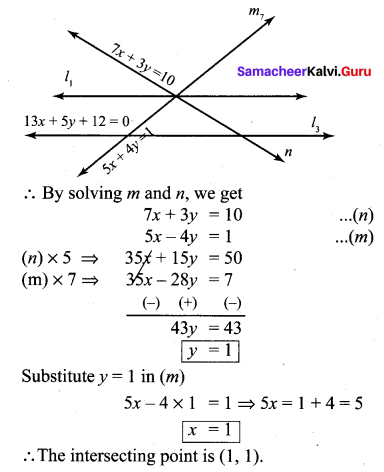
Find the equation of a straight line through the intersection of lines 7x + 3y = 10, 5x – 4y = 1
and parallel to the line 13x + 5y + 12 = O
Solution:
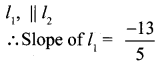
Samacheer Kalvi 10th Maths Chapter 5 Coordinate Geometry Ex 5.4 15
l1 passes through the intersecting point.
Samacheer Kalvi 10th Maths Chapter 5 Coordinate Geometry Ex 5.4 16
Samacheer Kalvi 10th Maths Chapter 5 Coordinate Geometry Ex 5.4 17

Samacheer Kalvi 10th Maths Solutions Chapter 5 Coordinate Geometry Ex 5.4

Question 10.
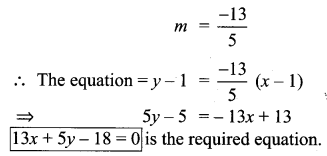
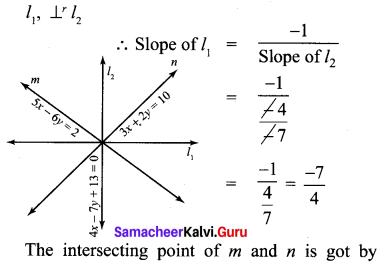
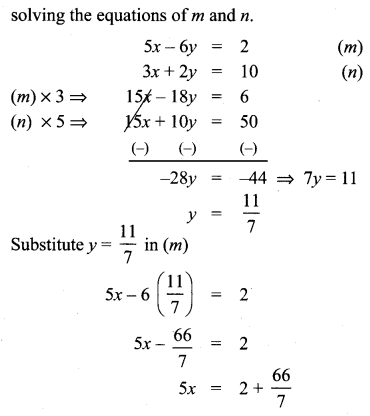
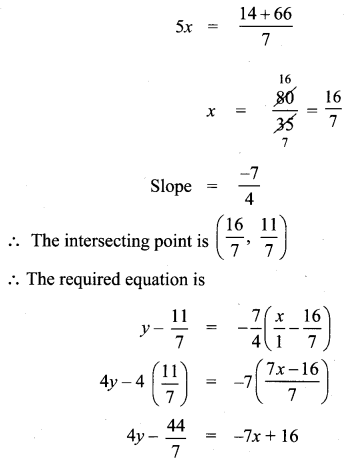
Find the equation of a straight line through the intersection of lines 5x – 6y = 2, 3x + 2y = 10 and perpendicular to the line 4x – 7y + 13 = 0
Solution:
Samacheer Kalvi 10th Maths Chapter 5 Coordinate Geometry Ex 5.4 18
Samacheer Kalvi 10th Maths Chapter 5 Coordinate Geometry Ex 5.4 19
Samacheer Kalvi 10th Maths Chapter 5 Coordinate Geometry Ex 5.4 20
Samacheer Kalvi 10th Maths Chapter 5 Coordinate Geometry Ex 5.4 70

Question 11.
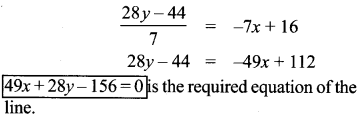
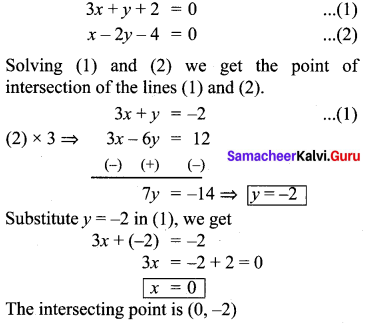
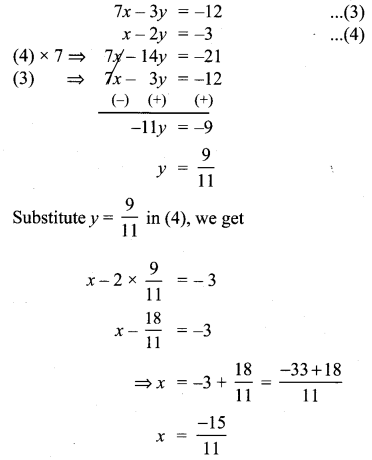
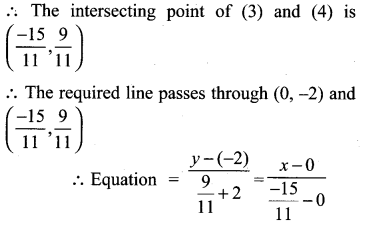
Find the equation of a straight line joining the point of intersection of 3x + y + 2 = 0 and x – 2y – 4 = 0 to the point of intersection of 7x – 3y = -12 and 2y = x + 3
Solution:
Samacheer Kalvi 10th Maths Chapter 5 Coordinate Geometry Ex 5.4 21
Samacheer Kalvi 10th Maths Chapter 5 Coordinate Geometry Ex 5.4 22
Samacheer Kalvi 10th Maths Chapter 5 Coordinate Geometry Ex 5.4 23
Samacheer Kalvi 10th Maths Chapter 5 Coordinate Geometry Ex 5.4 24

Samacheer Kalvi 10th Maths Solutions Chapter 5 Coordinate Geometry Ex 5.4

Question 12.
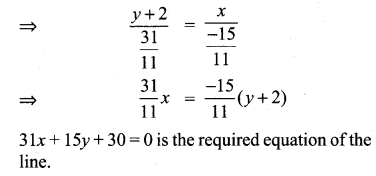
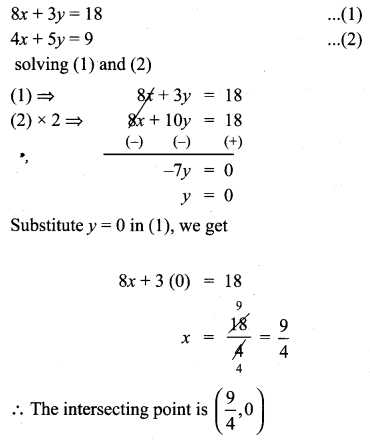
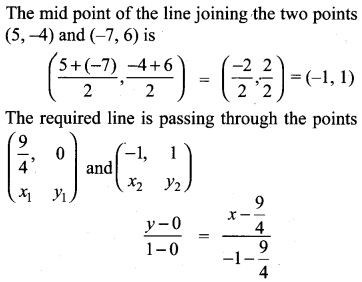
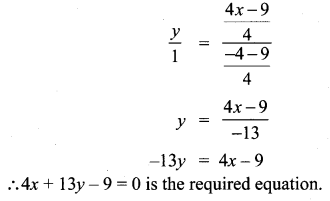
Find the equation of a straight line through the point of intersection of the lines 8x + 3+ = 18, 4x + 5+ = 9 and bisecting the line segment joining the points (5, -4) and (-7, 6).
Solution:
The intersecting point of the lines
Samacheer Kalvi 10th Maths Chapter 5 Coordinate Geometry Ex 5.4 25
Samacheer Kalvi 10th Maths Chapter 5 Coordinate Geometry Ex 5.4 26
Samacheer Kalvi 10th Maths Chapter 5 Coordinate Geometry Ex 5.4 27

Samacheer Kalvi 10th Maths Solutions Chapter 5 Coordinate Geometry Ex 5.4 Read More »

Samacheer Kalvi 7th Maths Solutions Term 1 Chapter 5 Geometry Additional Questions

Students can Download Maths Chapter 5 Geometry Additional Questions and Answers, Notes Pdf, Samacheer Kalvi 7th Maths Book Solutions Guide Pdf helps you to revise the complete Tamilnadu State Board New Syllabus and score more marks in your examinations.

Tamilnadu Samacheer Kalvi 7th Maths Solutions Term 1 Chapter 5 Geometry Additional Questions

Exercise 5.1

Question 1.
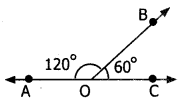
Can two adjacent angles be supplementary?
Solution:
Yes, In the figure
Samacheer Kalvi 7th Maths Term 1 Chapter 5 Geometry Ex 5.1 101
∠AOB and ∠BOC are adjacent angles.
Also ∠AOB + ∠BOC = 180°
∴ ∠AOB and ∠BOC are supplementary

Question 2.
Can two obtuse angles form a linear pair?
Solution:
No, the sum of the measures of two obtuse angles is more than 180°.

Question 3.
Can two right angles form a linear pair?
Solution:
Yes, because the sum of two right angles is 180° and form a linear pair.

SamacheerKalvi.Guru

Question 4.
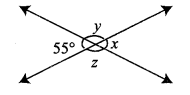
Find x, y and z from the figure.
Samacheer Kalvi 7th Maths Term 1 Chapter 5 Geometry Ex 5.1 102
Solution:
x = 55° vertically opposite angles
y + 55° = 180°
y = 180°- 55°
y = 125°

Execise 5.2

Question 1.
Can two lines intersect in more than one point ?
Solution:
No, two lines cannot intersect in more than one point.

Question 2.
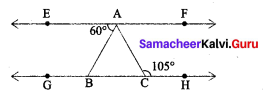
In the figure EF parallel to GH
Solution:
∠EAB = 60° and ∠ACD = 105°
Determine (i) ∠CAF and
(ii) ∠BAC
Samacheer Kalvi 7th Maths Solutions Term 1 Chapter 5 Geometry Additional Questions 50
Solution:
(i) Since EF || GH and AC is a transversal
⇒ ∠CAF + ∠ACH = 180°
⇒ ∠CAF + 105° = 180° .
= 75°
(ii) ∴ EF || GH and AC is transversal.
∴ ∠EAC = ∠ACH [ ∵ Alternate interior angles]
⇒ ∠BAC = 105°
⇒ ∠BAC + ∠BAB = 105°
⇒ ∠BAC + 60° = 105°
⇒ ∠BAC = 105° – 60°
= 45°
∴ ∠CAF = 75° and ∠BAC = 45°.

SamacheerKalvi.Guru

Question 3.
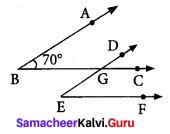
In the given figure, the arms of two angles are parallel. If ∠ABC = 70°, then find
(i) ∠DGC
(ii) ∠DEF
Samacheer Kalvi 7th Maths Solutions Term 1 Chapter 5 Geometry Additional Questions 60
Solution:
We have AB||ED and BC || EF
(i) BC is transversal
∠DGC = ∠ABC [corresponding angles]
But ∠ABC = 70°
∠DGC = 70°

(ii) ED is a transversal to BC||EF
∴ ∠DEF = ∠DGC [corresponding]
∠DGC = 70°
∠DEF = 70°

Exercise 5.6

Question 1.
In the following figure, show that CD || EF
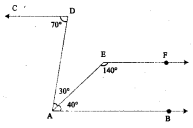
Solution:
Samacheer Kalvi 7th Maths Solutions Term 1 Chapter 5 Geometry Additional Questions 74
∠BAD = ∠BAE + ∠EAD
= 40°+ 30° = 70°.
and ∠CDA = 70°
∠BAD = ∠CDA
But they form a pair of alternate angles
⇒ AB || CD
Also ∠BAE + ∠AEF = 40° + 140° = 180°
But they form a pair of interior opposite angles.
⇒ AB || EF
From (1) and (2), we get
AB || CD || EF
⇒ CD || EF
SamacheerKalvi.Guru

Question 2.
In the adjoining figure, the lines \(\overleftrightarrow { AB } \) and \(\overleftrightarrow { CD } \) intersect at ‘O’. If ∠COB = 50°, find the measures of the other three angles.
Solution:
∠COB = 50°
∠AOD = 50° (vertically opposite angles)
Now ∠AOC and ∠COB form a linear pair,
Thus ∠AOC + ∠COB = 180°
⇒ ∠AOC + 50° = 180°.
∠AOC = 180° – 50° = 130°
Also ∠AOC and ∠BOD are vertically opposite angles.
∴ ∠BOD = ∠AOC = 130°
Thus the three angles are
∠AOD = 50°
∠AOC =130°
∠BOD = 130°

Samacheer Kalvi 7th Maths Solutions Term 1 Chapter 5 Geometry Additional Questions Read More »
Samacheer Kalvi 10th Maths Solutions Chapter 6 Trigonometry Ex 6.4

You can Download Samacheer Kalvi 10th Maths Book Solutions Guide Pdf, Tamilnadu State Board help you to revise the complete Syllabus and score more marks in your examinations.

Tamilnadu Samacheer Kalvi 10th Maths Solutions Chapter 6 Trigonometry Ex 6.4

Question 1.
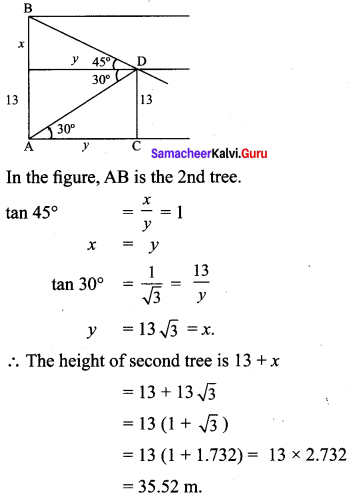
From the top of a tree of height 13 m the angle of elevation and depression of the top and bottom of another tree are 45° and 30° respectively. Find the height of the second tree. (\(\sqrt{3}\) = 1.732)
Solution:
Samacheer Kalvi 10th Maths Chapter 6 Trigonometry Ex 6.4 1

Samacheer Kalvi 10th Maths Solutions Chapter 6 Trigonometry Ex 6.4

Question 2.
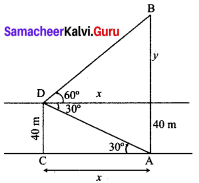
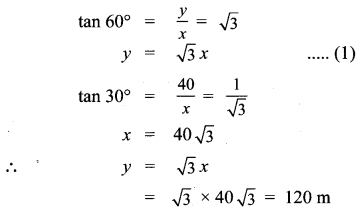
A man is standing on the deck of a ship, which is 40 m above water level. He observes the angle of elevation of the top of a hill as 60° and the angle of depression of the base of the hill as 30°. Calculate the distance of the hill from the ship and the height of the hill. (\(\sqrt{3}\) = 1.732)
Solution:
Samacheer Kalvi 10th Maths Chapter 6 Trigonometry Ex 6.4 2
Samacheer Kalvi 10th Maths Chapter 6 Trigonometry Ex 6.4 3
∴ The height of the hill = 120 + 40 = 160 m
The distance of the hill from the ship is AC = x = \(40 \sqrt{3}\) m = 69.28 m

Question 3.
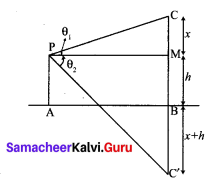
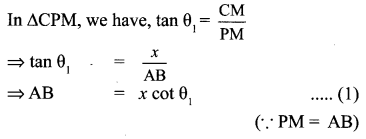
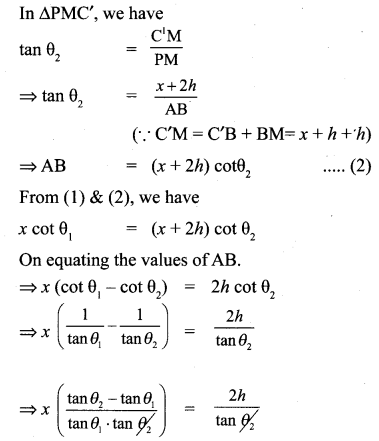
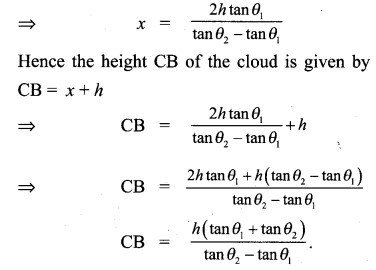
If the angle of elevation of a cloud from a point ‘h’ metres above a lake is θ1 and the angle of depression of its reflection in the lake is θ2. Prove that the height that the cloud is located from the ground is \(\frac{h\left(\tan \theta_{1}+\tan \theta_{2}\right)}{\tan \theta_{2}-\tan \theta_{1}}\)
Solution:
Samacheer Kalvi 10th Maths Chapter 6 Trigonometry Ex 6.4 4
Let AB be the surface of the lake and let p be the point of observation such that AP = h meters.
Let C be the position of the cloud and C’ be its reflection in the lake. Then CB = C’B.
Let PM be ⊥r from P on CB
Then ∠CPM = θ1, and ∠MPC = θ2
Let CM = x.
Then CB = CM + MB = CM + PA
= x + h
Samacheer Kalvi 10th Maths Chapter 6 Trigonometry Ex 6.4 5
Samacheer Kalvi 10th Maths Chapter 6 Trigonometry Ex 6.4 6
Samacheer Kalvi 10th Maths Chapter 6 Trigonometry Ex 6.4 50
Hence proved

Samacheer Kalvi 10th Maths Solutions Chapter 6 Trigonometry Ex 6.4

Question 4.
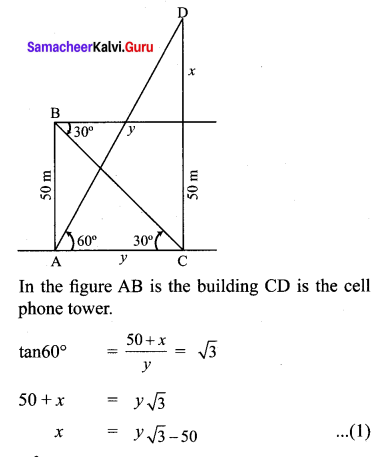
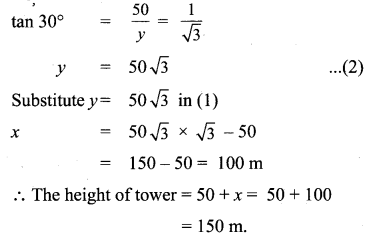
The angle of elevation of the top of a cell phone tower from the foot of a high apartment is 60° and the angle of depression of the foot of the tower from the top of the apartment is 30°. If the height of the apartment is 50 m, find the height of the cell phone tower. According to radiations control norms, the minimum height of a cell phone tower should be 120 m. State if the height of the above mentioned cell phone tower meets the radiation norms.
Solution:
Samacheer Kalvi 10th Maths Chapter 6 Trigonometry Ex 6.4 7
Samacheer Kalvi 10th Maths Chapter 6 Trigonometry Ex 6.4 8
Since 150m > 120m, yes the height of the above mentioned tower meet the radiation norms.

Question 5.
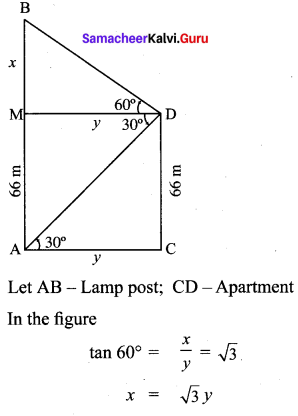
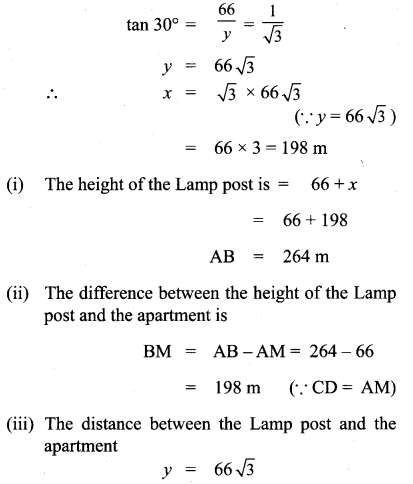
The angles of elevation and depression of the top and bottom of a lamp post from the top of a 66 m high apartment are 600 and 30° respectively. Find
(i) The height of the lamp post.
(ii) The difference between height of the lamp post and the apartment.
(iii) The distance between the lamp post and the apartment. (\(\sqrt{3}\) = 1.732)
Solution:
Samacheer Kalvi 10th Maths Chapter 6 Trigonometry Ex 6.4 9
Samacheer Kalvi 10th Maths Chapter 6 Trigonometry Ex 6.4 10
= 114.312 m

Samacheer Kalvi 10th Maths Solutions Chapter 6 Trigonometry Ex 6.4

Question 6.
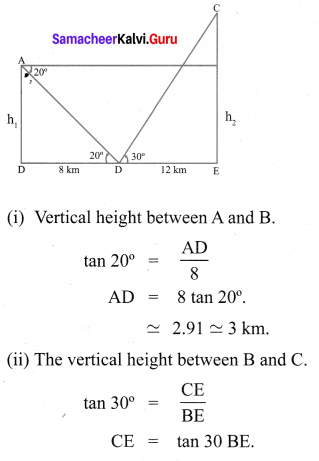
Three villagers A, B and C can see each T other across a valley. The horizontal distance between A and B is 8 km and the horizontal distance between B and C is 12 km. The angle of depression of B from A is 20° and the angle of elevation of C from B is 30° . Calculate :
Samacheer Kalvi 10th Maths Chapter 6 Trigonometry Ex 6.4 11
(i) the vertical height between A and B.
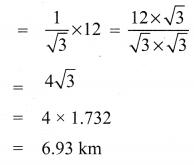
(ii) the vertical height between B and C. (tan20° = 0.3640, \(\sqrt{3}\) = 1.732)
Solution:
Samacheer Kalvi 10th Maths Chapter 6 Trigonometry Ex 6.4 12
Samacheer Kalvi 10th Maths Chapter 6 Trigonometry Ex 6.4 13

Samacheer Kalvi 10th Maths Solutions Chapter 6 Trigonometry Ex 6.4 Read More »
Samacheer Kalvi 10th Maths Solutions Chapter 6 Trigonometry Additional Questions

You can Download Samacheer Kalvi 10th Maths Book Solutions Guide Pdf, Tamilnadu State Board help you to revise the complete Syllabus and score more marks in your examinations.

Tamilnadu Samacheer Kalvi 10th Maths Solutions Chapter 6 Trigonometry Additional Questions

Question 1.
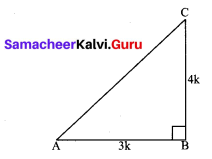
Given tan A = \(\frac{4}{3}\), find the other trigonometric ratios of the angle A.
Solution:
Let us first draw a right ∆ABC.
Now, we know that tan A = \(\frac{\mathrm{BC}}{\mathrm{AB}}=\frac{4}{3}\)
Therefore, if BC = 4k, then AB = 3k, where k is a positive number.
Samacheer Kalvi 10th Maths Solutions Chapter 6 Trigonometry Additional Questions 1
Now, by using the pythagoras theorem, we have
AC2 = AB2 + BC2
= (4k)2 + (3k)2 = 25 k2
AC = 5k
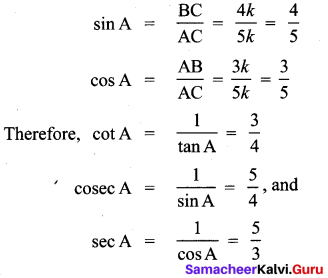
So,
Now, we can write all the trigonometric ratios using their definitions.
Samacheer Kalvi 10th Maths Solutions Chapter 6 Trigonometry Additional Questions 2

Question 2.
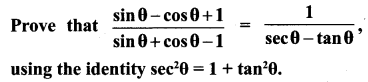
Samacheer Kalvi 10th Maths Solutions Chapter 6 Trigonometry Additional Questions 3
Solution:
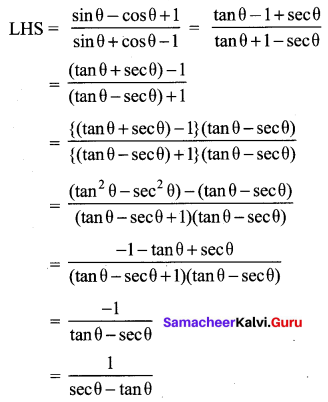
Since we will apply the identity involving sec θ and tan θ, let us first convert the LHS (of the identity we need to prove) in terms of sec θ and tan θ by dividing numerator and denominator by cos θ.
Samacheer Kalvi 10th Maths Solutions Chapter 6 Trigonometry Additional Questions 4
Which is the RHS of the identity, we are required to prove.

Samacheer Kalvi 10th Maths Solutions Chapter 6 Trigonometry Additional Questions

Question 3.
Prove that sec A (1 – sin A) (sec A + tan A) = 1.
Solution:
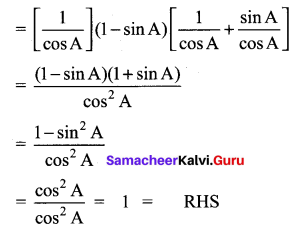
LHS = sec A(1 – sin A)(sec A + tan A)
Samacheer Kalvi 10th Maths Solutions Chapter 6 Trigonometry Additional Questions 5

Question 4.
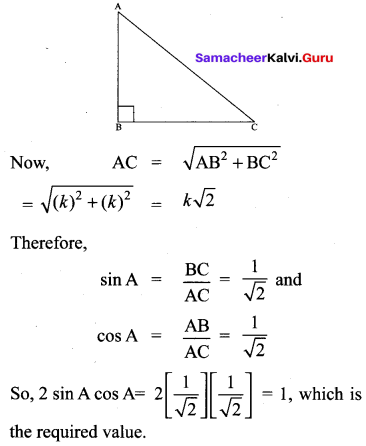
In a right triangle ABC, right-angled at B, if tan A = 1, then verify that 2 sin A cos A = 1.
Solution:
In ABC, tan A = \(\frac{B C}{A B}\)
Let AB = BC = k, where k is a positive number.
Samacheer Kalvi 10th Maths Solutions Chapter 6 Trigonometry Additional Questions 50

Samacheer Kalvi 10th Maths Solutions Chapter 6 Trigonometry Additional Questions

Question 5.
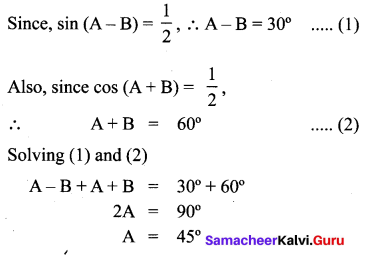
If sin (A – B) = \(\frac{1}{2}\), cos (A + B) = \(\frac{1}{2}\), 0° < A + B ≤ 90°, A > B, find A and BC
Solution:
Samacheer Kalvi 10th Maths Solutions Chapter 6 Trigonometry Additional Questions 6
We get,
A = 45° and B = 15°

Question 6.
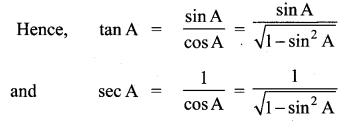
Express the ratios cos A, tan A and sec A in terms of sin A.
Solution:
Since
cos2A + sin2A = 1, therefore,
cos2A = 1 – sin2A
i.e., cos A = \(\pm \sqrt{1-\sin ^{2} A}\)
This gives cos A = \(\sqrt{1-\sin ^{2} A}\)
Samacheer Kalvi 10th Maths Solutions Chapter 6 Trigonometry Additional Questions 7

Question 7.
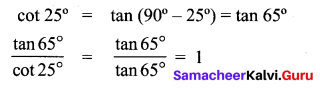
Evaluate \(\frac{\tan 65^{\circ}}{\cot 25^{\circ}}\)
Solution:
We know:
cot A = tan(90° – A)
So,
Samacheer Kalvi 10th Maths Solutions Chapter 6 Trigonometry Additional Questions 9

Samacheer Kalvi 10th Maths Solutions Chapter 6 Trigonometry Additional Questions

Question 8.
Since sin 3A = cos(A – 26°), where 3A is an acute angle, find the value at A.
Solution:
We are given that sin 3A = cos (A – 26°) ….. (1)
Since sin 3A = cos(90° – 3A) we can write (1) as cos(90° – 3A) = cos(A – 26°)
Since 90° – 3A and A – 26° are both acute angles.
90° – 3A = A – 26°
which gives A = 29°

Question 9.
Express cot 85° + cos 75° in terms of trigonometric ratios of angles between 0° and 45°.
Solution:
cot 85° +cos 75°
= cot(90° – 5°) + cos(90° – 15°)
= tan 5° + sin 15°

Samacheer Kalvi 10th Maths Solutions Chapter 6 Trigonometry Additional Questions

Question 10.
From a point on a bridge across a river, the angles of depression of the banks on opposite sides at the river are 30° and 45°, respectively. If the bridge is at a height at 3 m from the banks, find the width at the river.
Solution:
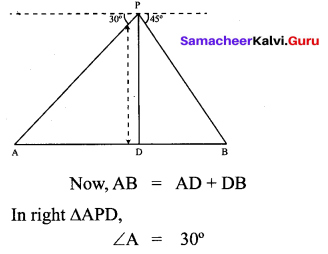
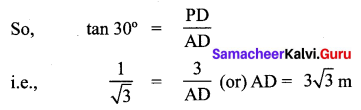
A and B represent points on the bank on opposite sides at the river, so that AB is the width of the river. P is a point on the bridge at a height of 3m i.e., DP = 3 m. We are interested to determine the width at the river which is the length at the side AB of the ∆APB.
Samacheer Kalvi 10th Maths Solutions Chapter 6 Trigonometry Additional Questions 10
Samacheer Kalvi 10th Maths Solutions Chapter 6 Trigonometry Additional Questions 11
Also, in right ∆PBD,
B = 45°
So, BD = PD = 3 m
Now, AB = BD + AD
= 3 + \(3 \sqrt{3}\) = 3(1 + \(\sqrt{3}\))m
Therefore, the width at the river is 3(\(\sqrt{3}\) + 1)

Samacheer Kalvi 10th Maths Solutions Chapter 6 Trigonometry Additional Questions Read More »