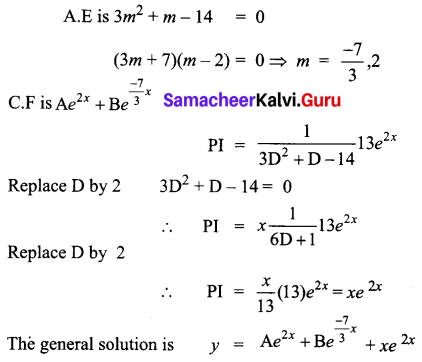
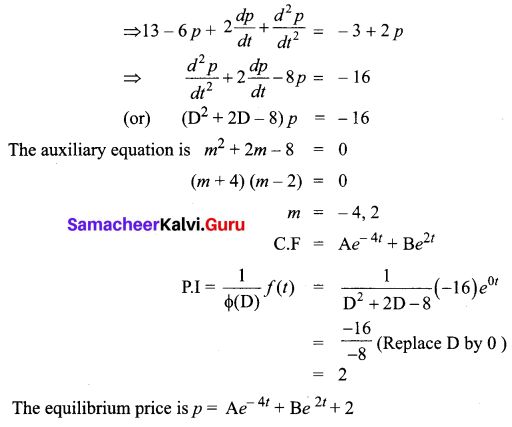
Prasanna

Samacheer Kalvi 6th Maths Solutions Term 3 Chapter 5 Information Processing Ex 5.1

You can Download Samacheer Kalvi 6th Maths Book Solutions Guide Pdf, Tamilnadu State Board help you to revise the complete Syllabus and score more marks in your examinations.
Samacheer Kalvi 6th Maths Solutions Term 3 Chapter 5 Information Processing Ex 5.1

Tamilnadu Samacheer Kalvi 6th Maths Solutions Term 3 Chapter 5 Information Processing Ex 5.1

Question 1.
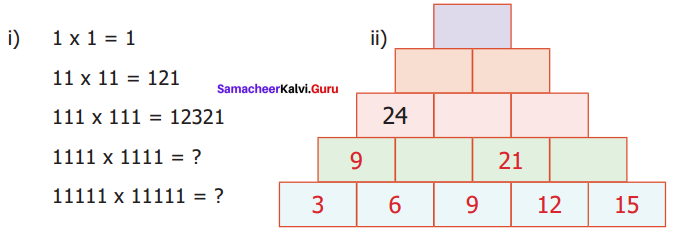
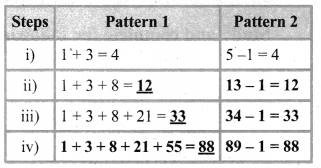
Study and complete the following pattern.
Samacheer Kalvi 6th Maths Solutions Term 3 Chapter 5 Information Processing Ex 5.1 1
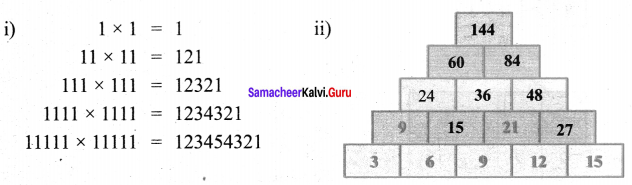
Solution:
Samacheer Kalvi 6th Maths Solutions Term 3 Chapter 5 Information Processing Ex 5.1 2

Question 2.
Find next three numbers in the following number patterns,
i) 50, 51, 53, 56, 60,…
ii) 77, 69, 61, 53,…
iii) 10, 20, 40, 80, …..
iv) \(\frac{21}{33}, \frac{321}{444}, \frac{4321}{5555}\)
Solution:
i) The pattern generating these numbers is
50, 50 + 1, 51 + 2, 53 + 3, 56 + 4, 60 + 5, 65 + 6, 71 + 7,
∴ 50, 51, 53, 56, 60, 65, 71, 78, ……
∴ The next three numbers will be 65, 71, 78

ii) The pattern generating these numbers is
77, 77 – 8, 69 – 8, 61 – 8, 53 – 8, 45 – 8, 37 – 8, 29
77, 69, 61, 53, 45, 37, 29, 21,
∴ The next three numbers will be 45, 37, 29.

iii) The pattern generating these numbers is
10, 10 + 10, 20 + 20, 40 + 40, 80 + 80, 160 + 160, 320 + 320,….
10, 20, 40, 80, 160, 320, 640,….
∴ The next three numbers will be 160, 320, 640.

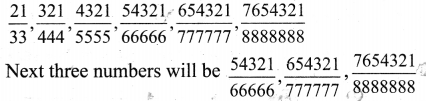
iv) The pattern generating these numbers is
Samacheer Kalvi 6th Maths Solutions Term 3 Chapter 5 Information Processing Ex 5.1 50

Samacheer Kalvi 6th Maths Solutions Term 3 Chapter 5 Information Processing Ex 5.1

Question 3.
Consider the Fibonacci sequence 1, 1, 2, 3, 5, 8, 13, 21, 34, 55,… Observe and complete the following table by understanding the number pattern followed. After filling the table discuss the pattern followed in addition and subtraction of the numbers of the sequence.
Samacheer Kalvi 6th Maths Solutions Term 3 Chapter 5 Information Processing Ex 5.1 51
Solution:
Samacheer Kalvi 6th Maths Solutions Term 3 Chapter 5 Information Processing Ex 5.1 52

Question 4.
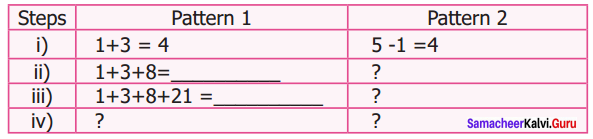
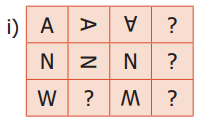
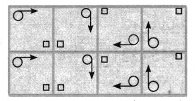
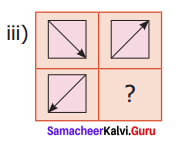
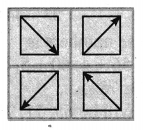
Complete the following patterns.
Samacheer Kalvi 6th Maths Solutions Term 3 Chapter 5 Information Processing Ex 5.1 53
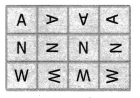
Solution:
Samacheer Kalvi 6th Maths Solutions Term 3 Chapter 5 Information Processing Ex 5.1 54
Rotate the figure 90°C clockwise to get the next figure.
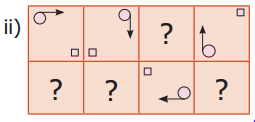
Samacheer Kalvi 6th Maths Solutions Term 3 Chapter 5 Information Processing Ex 5.1 55
Solution:
Samacheer Kalvi 6th Maths Solutions Term 3 Chapter 5 Information Processing Ex 5.1 56
* Move the circled arrow to each comer clockwise and place the square to the opposite comer of the arrow, in first row.
* Copy the first row in the second row.
Samacheer Kalvi 6th Maths Solutions Term 3 Chapter 5 Information Processing Ex 5.1 57
Solution:
Samacheer Kalvi 6th Maths Solutions Term 3 Chapter 5 Information Processing Ex 5.1 58
Rotate the arrow inside the square 90° anticlockwise direction so that the arrow pointing each comer anticlockwise.

Samacheer Kalvi 6th Maths Solutions Term 3 Chapter 5 Information Processing Ex 5.1

Question 5.
Find HCF of the following pair of numbers by Euclid’s game.
(i) 25 and 35
(ii) 36 and 12
(iii) 15 and 29
Solution:
(i) 25 and 35
By Euclid’s game, HCF(a, b) = HCF (a, a – b), if a > b.
Here 35 > 25
∴ HCF (25, 35) = HCF (35, 25)
= HCF (15, 10) = HCF (10, 5)
= HCF (5, 5) = 5
∴ HCF (25, 35) = 5

(ii) 36and 12
By Euclid’s game
HCF (36, 12) = HCF (36 – 12, 12) = HCF (24, 12)
= HCF(12, 12) = 12
∴ HCF(36, 12) = 12

(iii) 15 and 29
Here 29 > 15
HCF (29, 15) = HCF (15, 29 – 15)
= HCF(15, 14) = HCF(14, 1) = 1
∴ HCF(29, 15) = 1

Question 6.
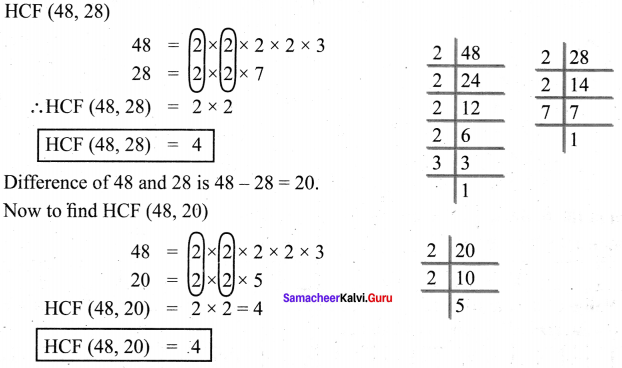
Find HCF of 48 and 28. Also, find the HCF of 48 and the number Obtained by finding their difference.
Solution:
Samacheer Kalvi 6th Maths Solutions Term 3 Chapter 5 Information Processing Ex 5.1 60

Question 7.
Give instructions to fill in a bank withdrawal form issued in a bank.
Solution:
Instructions:

  • Fill in the date of withdrawal.
  • Fill in the account number in the proper place.
  • Fill the branch of a bank.
  • Fill in the Name of the account holder.
  • Fill the amount to be withdrawn in words.
  • Fill in the amount to be withdrawn in numbers.
  • Put the signature of the account holder.

Samacheer Kalvi 6th Maths Solutions Term 3 Chapter 5 Information Processing Ex 5.1

Question 8.
Arrange the name of your classmates alphabetically.
Solution:
Name of my classmates is given below.

  1. Akila
  2. Akshaya
  3. Bharathi
  4. Divya
  5. Ezhil
  6. Fathima
  7. Gayathri
  8. Helen
  9. Irusammal
  10. Joy
  11. Kaviya
  12. Lakshmi
  13. Monika
  14. Nisha
  15. Olin
  16. Patsy
  17. Queenlin
  18. Ratha
  19. Sindhu
  20. Vidhya

Question 9.
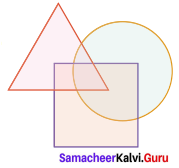
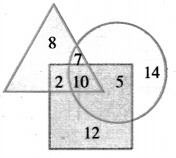
Follow and execute the instructions given below?
i) Write the number 10 in the place common to the three figures
ii) Write the number 5 in the place common for square and circle only.
iii) Write the number 7 in the place common for triangle and circle only.
iv) Write the number 2 in the place common for triangle and square only.
v) Write the numbers 12,14 and 8 only in the square, circle and triangle respectively.
Samacheer Kalvi 6th Maths Solutions Term 3 Chapter 5 Information Processing Ex 5.1 84
Solution:
Samacheer Kalvi 6th Maths Solutions Term 3 Chapter 5 Information Processing Ex 5.1 85

Question 10.
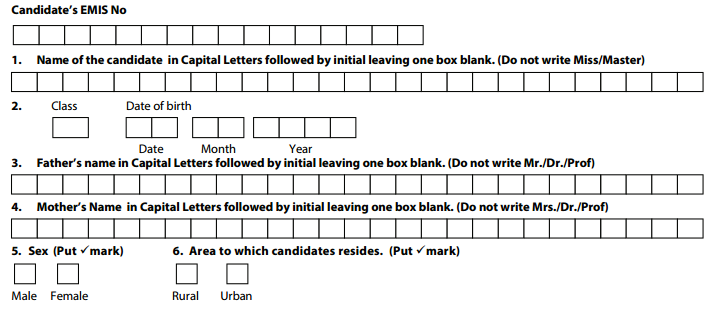
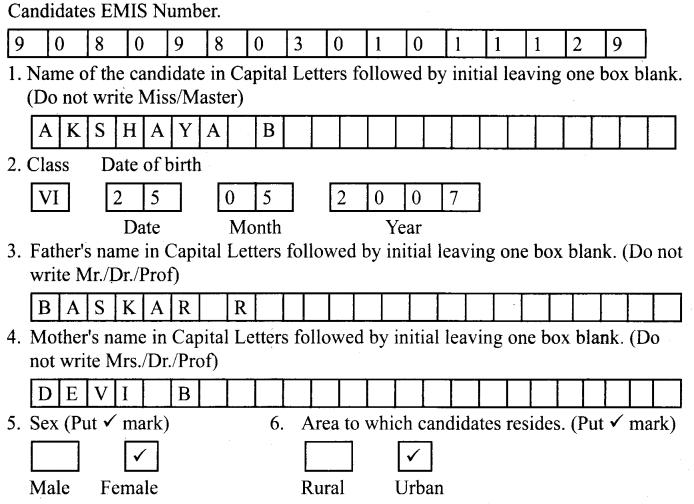
Fill in the following information.
Samacheer Kalvi 6th Maths Solutions Term 3 Chapter 5 Information Processing Ex 5.1 86
Solution:
Samacheer Kalvi 6th Maths Solutions Term 3 Chapter 5 Information Processing Ex 5.1 88

Samacheer Kalvi 6th Maths Solutions Term 3 Chapter 5 Information Processing Ex 5.1

Objective Type Questions

Question 11.
The next term in the sequence 15, 17, 20, 22, 25, is
(a) 28
(b) 29
(c) 27
(d) 26
Solution:
(c) 27

Question 12.
What will be the 25th letter in the pattern? ABCAABBCCAAABBBCCC
(a) B
(b) C
(c) D
(d) A
Hint:
Write A, B, C with increasing number of A, B, and C
Solution:
(a) B

Question 13.
The difference between the 6th term and the 5th term in the Fibonacci sequence is
(a) 6
(b) 8
(c) 5
(d) 3
Solution:
(d) 3

Question 14.
The 11th term in the Lucas sequence 1, 3, 4, 7,… is
(a) 199
(b) 76
(c) 123
(d) 47
Solution:
(a) 199

Question 15.
If the Highest Common Factor of 26 and 54 is 2, then the HCF of 54 and 28 is
(a) 26
(b) 2
(c) 54
(d) 1
Solution:
(b) 2

Samacheer Kalvi 6th Maths Solutions Term 3 Chapter 5 Information Processing Ex 5.1 Read More »

Samacheer Kalvi 6th Maths Solutions Term 1 Chapter 5 Statistics Ex 5.3

You can Download Samacheer Kalvi 6th Maths Book Solutions Guide Pdf, Tamilnadu State Board help you to revise the complete Syllabus and score more marks in your examinations.
Samacheer Kalvi 6th Maths Solutions Term 1 Chapter 5 Statistics Ex 5.3

Tamilnadu Samacheer Kalvi 6th Maths Solutions Term 1 Chapter 5 Statistics Ex 5.3

Question 1.
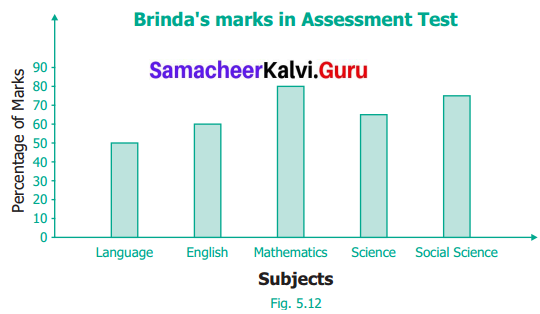
Read the given Bar Graph which shows the percentage of marks obtained by Brinda in different subjects in an assessment test.
Samacheer Kalvi 6th Maths Term 1 Chapter 5 Statistics Ex 5.3 Q1
Observe the bar graph and answer the following questions.
(i) 1 unit = ___ % of marks on vertical line.
(ii) Brinda has scored maximum marks in _____ subject.
(iii) Brinda has scored minimum marks in ______ subject.
(iv) The percentage of marks scored by Brinda in Science is _____
(v) Brinda scored 60% marks in the subject ______
(vi) Brinda scored 20% more in _______ subject than _____ subject.
Solution:
(i) 10
(ii) Mathematics
(iii) Language
(iv) 65%
(v) English
(vi) Mathematics, English

Question 2.
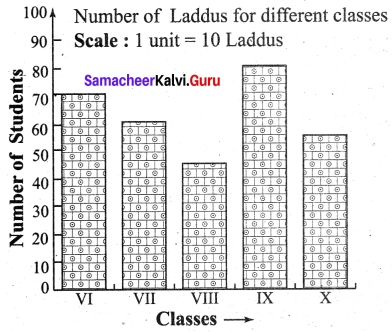
Chitra has to buy Laddus in order to distribute to her friends as follows:
Samacheer Kalvi 6th Maths Term 1 Chapter 5 Statistics Ex 5.3 Q2
Draw a Bar Graph for this data.
Solution:
Samacheer Kalvi 6th Maths Term 1 Chapter 5 Statistics Ex 5.3 Q2.1

Samacheer Kalvi 6th Maths Solutions Term 1 Chapter 5 Statistics Ex 5.3

Question 3.
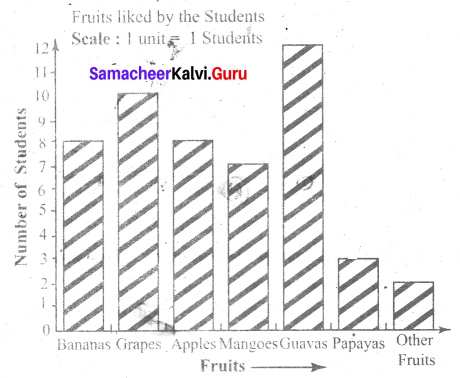
The fruits liked by the students of a class are as follows:
Samacheer Kalvi 6th Maths Term 1 Chapter 5 Statistics Ex 5.3 Q3
Draw a Bar Graph for this data.
Solution:
Samacheer Kalvi 6th Maths Term 1 Chapter 5 Statistics Ex 5.3 Q3.1

Question 4.
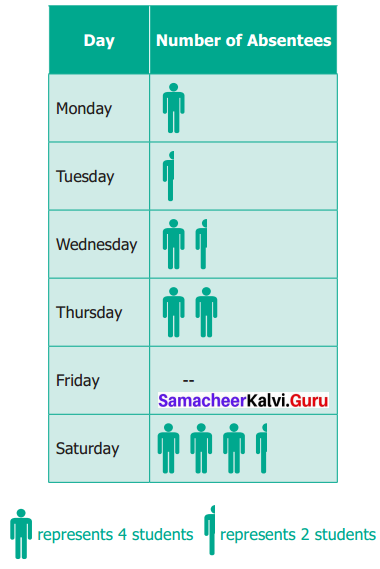
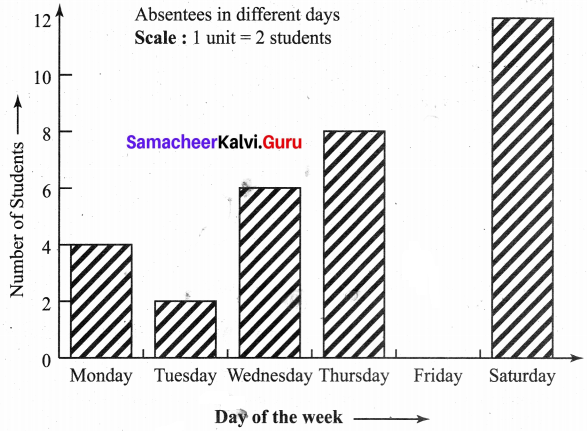
The pictograph below gives the number of absentees on different days of the week in class six. Draw the Bar graph for the same.
Samacheer Kalvi 6th Maths Term 1 Chapter 5 Statistics Ex 5.3 Q4
Solution:
Samacheer Kalvi 6th Maths Term 1 Chapter 5 Statistics Ex 5.3 Q4.1

Samacheer Kalvi 6th Maths Solutions Term 1 Chapter 5 Statistics Ex 5.3

Objective Type Questions

Question 5.
A bar graph can be drawn using _____
(a) Horizontal bars only
(b) Vertical bars only
(c) Both horizontal bars and vertical bars
(d) Either horizontal bars or vertical bars.
Solution:
(d) Either horizontal bars or vertical bars

Question 6.
The spaces between any two bars in a bar graph _____
(a) can be different
(b) are the same
(c) are not the same
(d) all of these
Solution:
(b) are the same

Samacheer Kalvi 6th Maths Solutions Term 1 Chapter 5 Statistics Ex 5.3 Read More »

Samacheer Kalvi 6th Maths Solutions Term 2 Chapter 1 Numbers Ex 1.3

You can Download Samacheer Kalvi 6th Maths Book Solutions Guide Pdf, Tamilnadu State Board help you to revise the complete Syllabus and score more marks in your examinations.
Samacheer Kalvi 6th Maths Solutions Term 2 Chapter Chapter 1 Numbers Ex 1.3

Tamilnadu Samacheer Kalvi 6th Maths Solutions Term 2 Chapter 1 Numbers Ex 1.3

Miscellaneous Practice Problems

Question 1.
Every even number greater than 2 can be expressed as the sum of two prime numbers. Verify this statement for every even number up to 16.
Solution:
4 = 2 + 2
6 = 3 + 3
8 = 3 + 5
10 = 3 + 7
12 = 5 + 7
14 = 3 + 11
16 = 3 + 13

Question 2.
Is 173 a prime? Why?
Solution:
yes, because it has two factors.

Question 3.
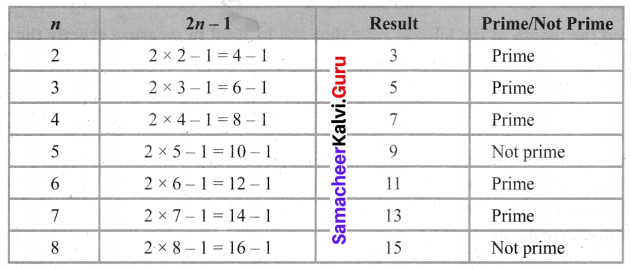
For which of the numbers, from n = 2 to 8, is 2n – 1 a prime?
Solution:
Samacheer Kalvi 6th Maths Solutions Term 2 Chapter 1 Numbers Ex 1.3 Q3
For n = 2, 3, 4, 6 and 7 it is prime.

Question 4.
Explain your answer with the reason for the following statements.
(i) A number is divisible by 9 if it is divisible by 3.
(ii) A number is divisible by 6 if it is divisible by 12.
Solution:
(i) False, 42 is divisible by 3 but it is not divisible by 9
(ii) True, 36 is divisible by 12. Also divisible by 6.

Samacheer Kalvi 6th Maths Solutions Term 2 Chapter Chapter 1 Numbers Ex 1.3

Question 5.
Find A as required
(i) The greatest 2 digit number 9A is divisible by 2.
(ii) The least number 567A is divisible by 3.
(iii) The greatest 3 digit number 9A6 is divisible by 6.
(iv) The number A08 is divisible by 4 and 9.
(v) The number 225A85 is divisible by 11.
Solution:
(i) A number is divisible by 2 if it is an even number.
The greatest 2 digit even number is 98.
∴ A = 8

(ii) A number is divisible by 3 if the sum of its digits is divisible by 3
Sum of digits of 567A = 5 + 6 + 7+ A = 18 + A
∴ 18 is divisible by 3
∴ A maybe 0
The number will be 5670

(iii) A number is divisible by 6 if it is divisible by both 2 and 3
9A6 is even and so divisible by 2
If A = 9 then the sum of digits will be = 24 which is divisible by 3.
The number will be 996 and A = 9

(iv) 08 is divisible by 4, so A08 is divisible by 4.
If A = 1 then the sum of digits will be 9 which is divisible by 9.
The number will be 108 and A = 1

(v) 5 + A + 2 – (8 + 5 + 2) = 7 + A – 15 = -8 + A
∴ A = 8

Question 6.
Numbers divisible by 4 and 6 are divisible by 24. Verify this statement and support your answer with an example.
Solution:
False 12 is divisible by both 4 and 6. But not divisible by 24

Question 7.
The sum of any two successive odd numbers ir always divisible by 4. Justify this statement with an example.
Solution:
True.
The sum of any two consecutive odd numbers is divisible by 4
For example 11 + 13 = 24, divisible by 4
Also, all the consecutive odd numbers are of the form 4n + 1 or 4n + 3
Their sum = 4x + 4 which is divisible by 4.

Question 8.
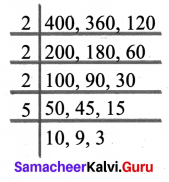
Find the length of the longest rope that can be used to measure exactly the ropes of length lm 20 cm, 3m 60 cm and 4 m.
Solution:
Length of ropes are 4 m, 3 m 60 cm and lm 20 cm = 400 cm, 360 cm, 120 cm
Finding HCF (400, 360, 120)
10, 9 and 3 has no common divisor
HCF (400, 360, 120) = 2 × 2 × 2 × 5 = 40
The length of the rope will be 40 cm
Samacheer Kalvi 6th Maths Solutions Term 2 Chapter 1 Numbers Ex 1.3 Q8

Samacheer Kalvi 6th Maths Solutions Term 2 Chapter Chapter 1 Numbers Ex 1.3

Challenge Problems

Question 9.
The sum of three prime numbers is 80. The difference between the two of them is 4. Find the numbers.
Solution:
Three prime numbers 2, 37, 41
Sum 2 + 37+ 41 = 80
The difference between the two of them 41 – 37 = 4

Question 10.
Find the sum of all the prime numbers between 10 and 20 and check whether that sum is divisible by all the single-digit numbers.
Solution:
prime numbers between 10 and 20
11, 13, 17, 19
Sum 11 + 13 + 17 + 19 = 60
60 is divisible by 1, 2, 3, 4, 5, 6

Question 11.
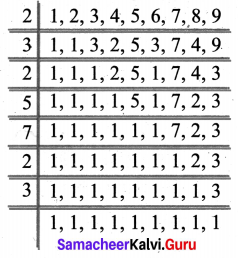
Find the smallest number which is exactly divisible by all the numbers from 1 to 9.
Solution:
To find the smallest number we have to Find the LCM (1, 2, 3, 4, 5, 6, 7, 8, 9)
LCM is 2 × 3 × 2 × 5 × 7 × 2 × 3 = 2520
The required number is 2520
Samacheer Kalvi 6th Maths Solutions Term 2 Chapter 1 Numbers Ex 1.3 Q11

Question 12.
The product of any three consecutive number is always divisible by 6. Justify this statement with an example.
Solution:
Yes. Because one of every two consecutive integers is even and so the product of three consecutive integers is even and divisible by 2.
Also one of every 3 consecutive integers is divisible by 3.
Product of any three consecutive integers is divisible by 6.
Example: 5 × 6 × 7

Question 13.
Malarvizhi, Karthiga, and Anjali are friends and natives of the same village. They work in different places. Malarvizhi comes to her home once in 5 days. Similarly, Karthiga and Anjali come to their homes once in 6 days and 10 days respectively. Assuming that they met each other on the 1st of October, when will all the three again?
Solution:
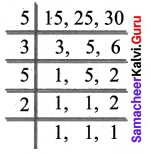
Find the LCM (5, 6, 10)
LCM (15, 25, 30) = 5 × 6 = 30
They meet again after 30 days
∴ They met on 1st October
They will meet again on 31st October
Samacheer Kalvi 6th Maths Solutions Term 2 Chapter 1 Numbers Ex 1.3 Q13

Question 14.
In an apartment consisting of 108 floors, two lifts A & B starting from the ground floor, stop at every 3rd and 5th floor respectively. On which floors, will both of them stop together?
Solution:
Multiples of 3 are 3, 6, 9, 12, 15, 18, 21, 24, 27, 30, 33, 36, 39, 42, 45, 48, 51, 54, 57, 60, 63, 66, 69, 72, 75, 78, 81, 84, 87, 90, 93, 96, 99, 102, 105
Multiples of 5 are 5, 10, 15, 20, 25, 30, 35, 40, 45, 50, 55, 60, 65, 70, 75, 80, 85, 90, 95, 100, 105
Common multiples of 3 and 5 are 15, 30, 45, 60, 75, 90 and 105
Both the lifts will stop at floors 15, 30, 45, 60, 75, 90 and 105

Samacheer Kalvi 6th Maths Solutions Term 2 Chapter Chapter 1 Numbers Ex 1.3

Question 15.
The product of 2 two-digit numbers is 300 and their HCF is 5. What are the numbers?
Solution:
Given that HCF of 2 numbers is 5
The numbers may like 5x and 5y
Also given their product = 300
5x × 5y = 300
⇒ 25xy = 300
⇒ \(x y=\frac{300}{25}\)
⇒ xy = 12
The possible values of x andy be (1, 12) (2, 6) (3, 4)
The numbers will be (5x, 5y)
⇒ (5 × 1, 5 × 12) = (5, 60)
⇒ (5 × 2, 5 × 6) = (10, 30)
⇒ (5 × 3, 5 × 4) = (15, 20)
(5, 60) is impossible because the given the numbers are two digit numbers.
The remaining numbers are (10, 30) and (15, 20)
But given that HCF is 5
(10, 30) is impossible, because its HCF = 10
The numbers are 15, 20

Question 16.
Find whether the number 564872 is divisible by 88?
Solution:
872 is divisible by 8.
Hence 56 + 872 is divisible by 8
(2 + 8 + 6) – (7 + 4 + 5) = 16 – 16 = 0
∴ 564872 is divisible by 11
∴ 564872 is divisible by 88.

Question 17.
Wilson, Mathan, and Guna can complete one round of a circular track in 10, 15, and 20 minutes respectively. If they start together at 7 a.m from the starting point, at what time will they meet together again at the starting point?
Solution:
LCM (10, 15, 20) = 60
∴ They will meet at 8 a.m

Samacheer Kalvi 6th Maths Solutions Term 2 Chapter 1 Numbers Ex 1.3 Read More »

Samacheer Kalvi 6th Maths Solutions Term 3 Chapter 3 Perimeter and Area Ex 3.1

You can Download Samacheer Kalvi 6th Maths Book Solutions Guide Pdf, Tamilnadu State Board help you to revise the complete Syllabus and score more marks in your examinations.
Samacheer Kalvi 6th Maths Solutions Term 3 Chapter 3 Perimeter and Area Ex 3.1

Tamilnadu Samacheer Kalvi 6th Maths Solutions Term 3 Chapter 3 Perimeter and Area Ex 3.1

Question 1.
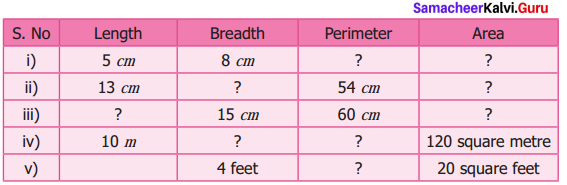
The table given below contains some measures of the rectangle. Find the unknown values.
Samacheer Kalvi 6th Maths Solutions Term 3 Chapter 3 Perimeter and Area Ex 3.1 1
Solution:
(i) Area of the rectangle = (length × breadth) sq unit.
Perimeter of a rectangle = 2(1 + b) units.
l = 5 cm
b = 8 cm
∴ p = 2 (l + b) cm = 2 (5 + 8) cm = 2 × 13 cm
p = 26 cm
Area = (l × b) cm2 = (5 × 8) cm2
A = 40 cm2

(ii) l = 13 cm
p = 54 cm
Perimeter = 2 (l + b) units
54 = 2 (13 + b) cm
\(\frac{54}{2}\) = 13 + b
27 = 13 + b
b = 27 – 13
b = 14 cm
Area = l × b sq. unit = 13 × 14 cm2
A = 182 cm2

(iii) b = 15 cm
p = 60 cm
p = 2 (l + b) units
60 = 2 (l + 15) cm
\(\frac{60}{2}\) = l + 15
30 = l + 15
l = 30 – 15 .
l = 15 cm
Area = l × b unit2 = 15 × 15 cm2 = 225 cm2
A = 225 cm2

(iv) l = 10 m
Area = 120 sq metre
Area = l × b sq.m
120 = 10 × 6
b = \(\frac{120}{10}\)
b = 12 m
Perimeter =2 (l + b) units = 2(10 + 12) units = 2 × 22 m
A = 44 m

(v) b = 4 feet.
Area = 20 sq. feet
Area = l × b sq .feet
20 = l × 4
l = \(\frac{20}{4}\) feet
l = 5 feet
Perimeter = 2 (l + b) units.
p = 2 (5 + 4) feet = 2 × 9
p = 18 feet
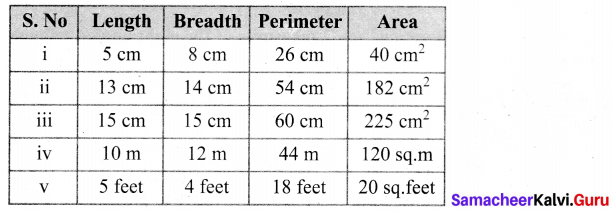
Completing the unknown values in the table.
Samacheer Kalvi 6th Maths Solutions Term 3 Chapter 3 Perimeter and Area Ex 3.1 2

Question 2.
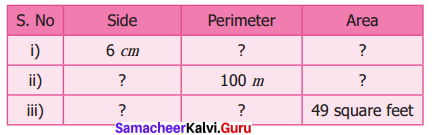
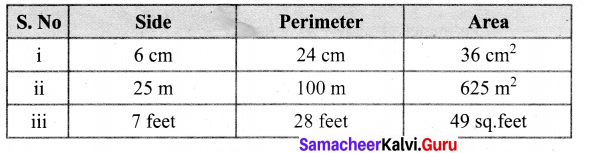
The table given below contains some measures of the square. Find the unknown values.
Samacheer Kalvi 6th Maths Solutions Term 3 Chapter 3 Perimeter and Area Ex 3.1 3
Solution:
Perimeter of a square = (4 × side) units
Area of a square = (side × side) unit2
(i) s = 6 cm
Perimeter = 4s units = 4 × 6 cm = 24 cm
P = 24 cm
Area = s × s unit2 = 6 × 6 cm2 = 36 cm2
A = 36 cm2

(ii) Perimeter = 4 × s unit
100 = (4 × s) m
\(\frac{100}{4}\) = s
s = 25 m
Area = s × s unit2= 25 × 25 m2 = 625m2
A = 625m2

(iii) Area = s × s unit2
49 = s × s square feet
s2 = 72
s = 7 feet
Perimeter = 4 × s unit = 4 × 7 feet = 28 feet
Perimeter = 28 feet
Completing the unknown values in the table
Samacheer Kalvi 6th Maths Solutions Term 3 Chapter 3 Perimeter and Area Ex 3.1 4

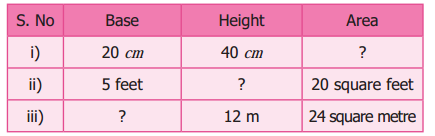
Question 3.
The table given below contains some measures of the triangle. Find the unknown values.
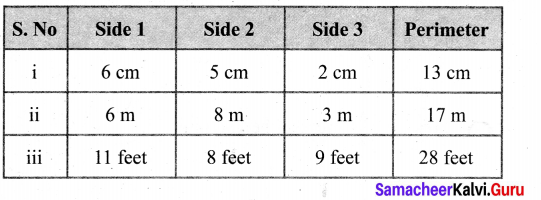
Samacheer Kalvi 6th Maths Solutions Term 3 Chapter 3 Perimeter and Area Ex 3.1 5
Solution:
Area of the right triangle = \(\frac{1}{2}\) × (base × height) unit2
(i) b = 20 cm
h = 40 cm
Area = \(\frac{1}{2}\) (b × h) cm2 = \(\frac{1}{2}\) × 20 × 40 = 400 cm2
A = 400 cm2

(ii) b = 5 feet
Area = \(\frac{1}{2}\) × b × h unit2
= 20 = \(\frac{1}{2}\) × 5 × h sq. feet
\(\frac{20 \times 2}{5}\) = h
h = 8 feet

(iii) Area = \(\frac{1}{2}\) × (base × height) unit2
24 = \(\frac{1}{2}\) × b × 12 m2
base = \(\frac{24 \times 2}{12}\) m = 4 m
Base = 4m
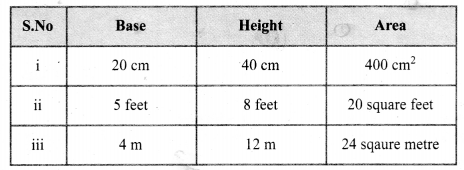
Tabulating the unknown values
Samacheer Kalvi 6th Maths Solutions Term 3 Chapter 3 Perimeter and Area Ex 3.1 6

Samacheer Kalvi 6th Maths Solutions Term 3 Chapter 3 Perimeter and Area Ex 3.1

Question 4.
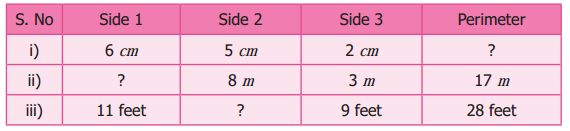
The table given below contains some measures of the triangles. Find the unknown values.
Samacheer Kalvi 6th Maths Solutions Term 3 Chapter 3 Perimeter and Area Ex 3.1 7
Solution:
Perimeter of a triangle = sum of three sides.
(i) Perimeter = 6 + 5 + 2 cm = 13 cm
p = 13 cm

(ii) Perimeter = (side 1 + side 2 + side 3) m
17 = (side 1 + 8 + 3) m
17 m = (side 1 + 11) m
side 1 = 17 – 11 = 6m

(iii) Perimeter = side 1 + side 2 + side 3
28 feet = 11 feet + side 2 + 9 feet
28 ft = 20 feet + side 2
28 – 20 = side 2
side = 8 feet
Tabulating the unknowns.
Samacheer Kalvi 6th Maths Solutions Term 3 Chapter 3 Perimeter and Area Ex 3.1 8

Question 5.
Fill in the blanks.
i) 5 cm2 = mm2
Hint: 1 cm2 = 100 mm2
ii) 26 m2 = cm2
Hint: 1 m2 = 10000
iii) 8 km2 = m2
Hint 4 1 km2– 1000000 m2
Solution:
(i) 500
(ii) 2,60,000
(iii) 80,00,000

Question 6.
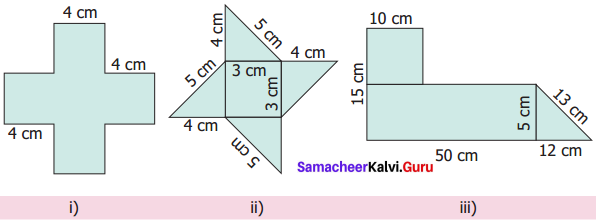
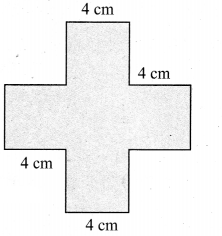
Find the perimeter and area of the following shapes.
Samacheer Kalvi 6th Maths Solutions Term 3 Chapter 3 Perimeter and Area Ex 3.1 9
Solution:
(i) Perimeter = (4 + 4 + 4 + 4 + 4 + 4 + 4 + 4 + 4 + 4 + 4 + 4) cm = 48 cm
Perimeter = 48 cm
Area of 5 squares of side 4 cm
Area of a square = (side × side) unit2
∴ A = 5 × (4 × 4) cm2 = 5 × 16 cm2 = 80 cm2
80 cm2
Samacheer Kalvi 6th Maths Solutions Term 3 Chapter 3 Perimeter and Area Ex 3.1 10
(ii) Perimeter = (4 + 5 + 4 + 5 + 4 + 5 + 4 + 5)cm = 36cm
Perimeter = 36 cm
Area of a square of side 3cm + Area of 4 right triangles
= (3 × 3) + [4 × \(\frac{1}{2}\) × 4 × 3] cm2 = (9 + 24) cm2 = 33 cm2
Area = 33 cm2

(iii) Perimeter = (50 + 12 + 13 + 40 + 10 + 10 + 10 + 5) cm = 150 cm
Perimeter = 150 cm
Area = Area of a rectangle + Area of a square + Area of a right triangle.
= (l × b) + (s × s) + ( \(\frac{1}{2}\) × b × h) cm2
= (50 × 5) + (10 × 10) + \(\frac{1}{2}\) × 12 × 5) cm2
= (250 + 100 + 30) cm2 = 380 cm2
Area = 380 cm2

Samacheer Kalvi 6th Maths Solutions Term 3 Chapter 3 Perimeter and Area Ex 3.1

Question 7.
Find the perimeter and area of the rectangle whose length is 6 m and breadth 4 m.
Solution:
Perimeter of a rectangle P = 2(1 + b) units.
Length l = 6m
breadth b = 4 m
p = 2 × (6 + 4)m = 2 × 10 m
Perimeter = 20 m
Area = l × b unit2 = 6 × 4 m2 = 24 m2
Area = 24 m2

Question 8.
Find the perimeter and the area of the square whose side is 8 cm.
Solution:
Perimeter of a square = (4 × side) units
Side = 8 cm
∴ Perimeter = 4 × 8 cm = 32 cm
Perimeter = 32 cm
Area of a square = (side × side) unit2 = (8 × 8) cm2 = 64 cm2
Area = 64 cm2

Question 9.
Find the perimeter and area of the right angled triangle whose sides are 6 feet, 8 feet and 10 feet.
Solution:
Perimeter of a right angled triangle = sum of three sides
= (6 + 8 + 10) feets = 24 feets.
Area of a right angled triangle = \(\frac{1}{2}\) × (b × h) unit2
Here the longest side is 10 feet which is the hypoteneous
∴ Sides containing right angle are 6 feet and 8 feet
let base = 6 feet and height = 8 feet
∴ Area = \(\frac{1}{2}\) × 6 × 8 feet2 = 24 sq. feet
Area = 24 sq feet.

Question 10.
Find the perimeter of
i) A scalene triangle with sides 7 m, 8 m, 10 m
ii) An isosceles triangle with equal sides 10 cm each and third side is 7 cm.
iii) An Equilateral triangle with a side of 6 cm.
Solution:
i) Perimeter of a scalene triangle = (7 + 8 + 10) m = 25 m
ii) The three sides of the isosceles triangle are 10 cm, 10 cm and 7 cm
∴ Perimeter = (10 + 10 + 7) cm = 27 cm
iii) An equilateral triangle with a side of 6 cm.
The sides of equilateral triangle are 6 cm, 6 cm and 6 cm
∴ Perimeter = (6 + 6 + 6) cm = 18 cm

Samacheer Kalvi 6th Maths Solutions Term 3 Chapter 3 Perimeter and Area Ex 3.1

Question 11.
The area of a rectangular shaped photo is 820 sq. cm. and its width is 20 cm. What is its length? Also find its perimeter.
Solution:Area of a rectangle = (length × breadth) unit2
Here width = 20 cm (breadth)
Area = 820 sq. cm
∴ 820 sq.cm = (length × 20) cm2
Length = \(\frac{820}{20}\) =41 cm
Length of the photo = 41 cm
Perimeter of a rectangle = 2(l + b) units = 2 (41 + 20) cm = 2 × 61 = 122 cm
Perimeter of the photo = 122 cm

Question 12.
A square park has 40 m as its perimeter. What is the length of its side? Also find its area.
Solution:
Given perimeter = 40 m
Perimeter of a square = 4 × Length of a side
40 = 4 × Length of a side
∴ Length of its side = \(\frac{40}{4}\) m = 0 m
∴ Side of the park = 10m
Area of a square = (Side × side) unit2 = (10 × 10) m2 = 100 m2
∴ Area of the Park = 100 m2

Question 13.
The scalene triangle has 40 cm as its perimeter and whose two sides are 13 cm and 15 cm, find the third side.
Solution:
Given two sides of a scalene triangle are 13 cm and 15 cm
The perimeter of the triangle = sum of three sides
40 = 13 + 15 + Third side
40 = 28 + Third side
∴ Third side = 40 – 28 = 12 cm
∴ The third side of the triangle = 12 cm

Question 14.
A field is in the shape of right angled triangle whose base is 25 m and height 20 m. Find the cost of levelling the field at the rate of ₹ 45/- per sq. m.
Solution:
Area of a right angled triangle = \(\frac{1}{2}\) × (base × height) unit2
base = 25 m
height = 20 m
∴ Area = \(\frac{1}{2}\) × (25 × 20)
Area = 250 m2
Cost of levelling per m2 = ₹ 45.
∴ Cost of levelling 250 m2 = 250 × 45 = ₹ 11,250
Cost of levelling = ₹ 11,250

Question 15.
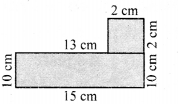
A square of side 2 cm is joined with a rectangle of length 15 cm and breadth 10 cm. Find the perimeter of the combined shape.
Solution:perimeter of the combined figure
= (2 + 15 + 10 + 15 + 8 + 2 + 2) cm
= 54 cm
Samacheer Kalvi 6th Maths Solutions Term 3 Chapter 3 Perimeter and Area Ex 3.1 11

Objective Type Questions

Question 16.
The following figures are of equal area. Which figure has the least perimeter?
Samacheer Kalvi 6th Maths Solutions Term 3 Chapter 3 Perimeter and Area Ex 3.1 12
Solution:
Samacheer Kalvi 6th Maths Solutions Term 3 Chapter 3 Perimeter and Area Ex 3.1 13
Hint:
(a) 12 units
(b) 10 units
(c) 12 units
(d) 12 units

Question 17.
If two identical rectangles of perimeter 30 cm are joined together, then the perimeter of the new shape will be
(a) equal to 60 cm
(b) less than 60 cm
(c) greater than 60 cm
(d) equal to 45 cm
Solution:
(b) less than 60 cm
Hint:
Samacheer Kalvi 6th Maths Solutions Term 3 Chapter 3 Perimeter and Area Ex 3.1 14

Question 18.
If every side of a rectangle is doubled, then its area becomes times.
(a) 2
(b) 3
(c) 4
(d) 6
Solution:
(c) 4

Samacheer Kalvi 6th Maths Solutions Term 3 Chapter 3 Perimeter and Area Ex 3.1

Question 19.
The side of a square is 10 cm. If its side is tripled, then by how many times will its perimeter increase?
(a) 2 times
(b) 4 times
(c) 6 times
(d) 3 times
SolutionL
(d) 3 times
30 × 4 = 120 = 3 × 40

Question 20.
The length and breadth of a rectangular sheet of paper are 15 cm and 12 cm respectively. A rectangular piece is cut from one of its corners. Which of the following statement is correct for the remaining sheet?
(a) Perimeter remains the same but the area changes
(b) Area remains the same but the perimeter changes
(c) There will be a change in both area and perimeter
(d) Both the area and perimeter remains the same
Solution:
(c) There will be a change in both area and perimeter
Hint:
Samacheer Kalvi 6th Maths Solutions Term 3 Chapter 3 Perimeter and Area Ex 3.1 15

Samacheer Kalvi 6th Maths Solutions Term 3 Chapter 3 Perimeter and Area Ex 3.1 Read More »

Samacheer Kalvi 12th Business Maths Solutions Chapter 5 Numerical Methods Ex 5.3

Students can download 12th Business Maths Chapter 5 Numerical Methods Ex 5.3 Questions and Answers, Samacheer Kalvi 12th Business Maths Book Solutions Guide Pdf helps you to revise the complete Tamilnadu State Board New Syllabus and score more marks in your examinations.

Tamilnadu Samacheer Kalvi 12th Business Maths Solutions Chapter 5 Numerical Methods Ex 5.3

Choose the correct answer.

Question 1.
2 y0 = ______
(a) y2 – 2y1 + y0
(b) y2 + 2y1 – y0
(c) y2 + 2y1 + y0
(d) y2 – y1 + 2y0
Answer:
(a) y2 – 2y1 + y0
Hint:
2 y0 = ∆(∆y0) = ∆(y1 – y0) = ∆y1 – ∆y0
= (y2 – y1) – (y1 – y0)
= y2 – 2y1 + y0

Question 2.
∆f(x) = _______
(a) f(x + h)
(b) f(x) – f(x + h)
(c) f(x + h) – f(x)
(d) f(x) – f(x – h)
Answer:
(c) f(x + h) – f(x)
Hint:
∆f(x) = f(x + h) – f(x)

Samacheer Kalvi 12th Business Maths Solutions Chapter 5 Numerical Methods Ex 5.3

Question 3.
E = ______
(a) 1 + ∆
(b) 1 – ∆
(c) 1 + ∇
(d) 1 – ∇
Answer:
(a) 1 + ∆
Hint:
E = 1 + ∆

Question 4.
If h = 1, then ∆(x2) = ________
(a) 2x
(b) 2x – 1
(c) 2x + 1
(d) 1
Answer:
(c) 2x + 1
Hint:
∆(x2) = (x + h)2 – x2 = (x + 1)2 – x2 = 2x + 1

Samacheer Kalvi 12th Business Maths Solutions Chapter 5 Numerical Methods Ex 5.3

Question 5.
If c is a constant then ∆c = ______
(a) c
(b) ∆
(c) ∆2
(d) 0
Answer:
(d) 0

Question 6.
If m and n are positive integers then ∆mn f(x) = _______
(a) ∆m+n f(x)
(b) ∆m f(x)
(c) ∆n f(x)
(d) ∆m-n f(x)
Answer:
(a) ∆m+n f(x)

Samacheer Kalvi 12th Business Maths Solutions Chapter 5 Numerical Methods Ex 5.3

Question 7.
If ‘n’ is a positive integer ∆n [∆-n f(x)] _______
(a) f(2x)
(b) f(x + h)
(c) f(x)
(d) ∆ f(2x)
Answer:
(c) f(x)

Question 8.
E f(x) = _______
(a) f(x – h)
(b) f(x)
(c) f(x + h)
(d) f(x + 2h)
Answer:
(c) f(x + h)

Samacheer Kalvi 12th Business Maths Solutions Chapter 5 Numerical Methods Ex 5.3

Question 9.
∇ = _______
(a) 1 + E
(b) 1 – E
(c) 1 – E-1
(d) 1 + E-1
Answer:
(c) 1 – E-1

Question 10.
∇ f(a) = ______
(a) f(a) + f(a – h)
(b) f(a) – f(a + h)
(c) f(a) – f(a – h)
(d) f(a)
Answer:
(c) f(a) – f(a – h)

Samacheer Kalvi 12th Business Maths Solutions Chapter 5 Numerical Methods Ex 5.3

Question 11.
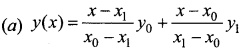
For the given points (x0 , y0) and (x1, y1) the Lagrange’s formula is ______
Samacheer Kalvi 12th Business Maths Solutions Chapter 5 Numerical Methods Ex 5.3 Q11
Answer:
Samacheer Kalvi 12th Business Maths Solutions Chapter 5 Numerical Methods Ex 5.3 Q11.1

Question 12.
Lagrange’s interpolation formula can be used for ________
(a) equal intervals only
(b) unequal intervals only
(c) both equal and unequal intervals
(d) none of these
Answer:
(c) both equal and unequal intervals

Samacheer Kalvi 12th Business Maths Solutions Chapter 5 Numerical Methods Ex 5.3

Question 13.
If f(x) = x2 + 2x + 2 and the interval of differencing is unity then ∆ f(x) _______
(a) 2x – 3
(b) 2x + 3
(c) x + 3
(d) x – 3
Answer:
(b) 2x + 3
Hint:
f(x) = 2x2 + 2x + 2
h = 1
∆f(x) = (x + 1)2 + 2(x + 1) + 2 – x2 – 2x – 2
= x2 + 2x + 1 +2x + 2 + 2 – x2 – 2x – 2
= 2x + 3

Question 14.
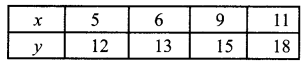
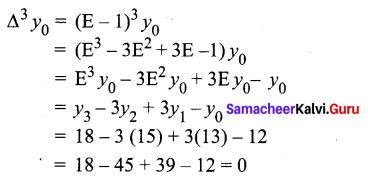
For the given data find the value of ∆3 y0 is _________
Samacheer Kalvi 12th Business Maths Solutions Chapter 5 Numerical Methods Ex 5.3 Q14
(a) 1
(b) 0
(c) 2
(d) -1
Answer:
(b) 0
Hint:
Samacheer Kalvi 12th Business Maths Solutions Chapter 5 Numerical Methods Ex 5.3 Q14.1

Samacheer Kalvi 12th Business Maths Solutions Chapter 5 Numerical Methods Ex 5.3 Read More »

Samacheer Kalvi 10th Maths Solutions Chapter 8 Statistics and Probability Ex 8.2

You can Download Samacheer Kalvi 10th Maths Book Solutions Guide Pdf, Tamilnadu State Board help you to revise the complete Syllabus and score more marks in your examinations.

Tamilnadu Samacheer Kalvi 10th Maths Solutions Chapter 8 Statistics and Probability Ex 8.2

Question 1.
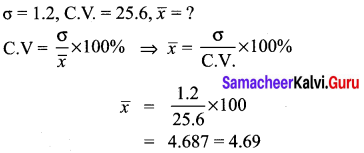
The standard deviation and coefficient of variation of a data are 1.2 and 25.6 respectively. Find the value of mean.
Solution:
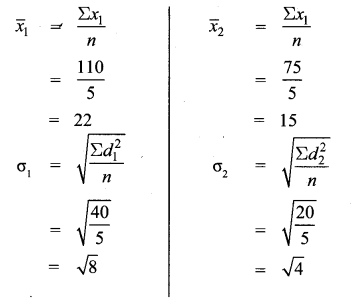
Co-efficient of variation C.V. = \(\mathrm{C.V}=\frac{\sigma}{\overline{x}} \times 100\)
Samacheer Kalvi 10th Maths Chapter 8 Statistics and Probability Ex 8.2 1

Question 2.
The standard deviation and coefficient of variation of a data are 1.2 and 25.6 respectively. Find the value of mean.
Solution:
Samacheer Kalvi 10th Maths Chapter 8 Statistics and Probability Ex 8.2 2

Samacheer Kalvi 10th Maths Solutions Chapter 8 Statistics and Probability Ex 8.2

Question 3.
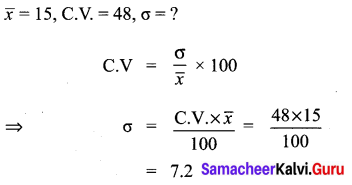
If the mean and coefficient of variation of a data are 15 and 48 respectively, then find the value of standard deviation.
Solution:
Samacheer Kalvi 10th Maths Chapter 8 Statistics and Probability Ex 8.2 3

Question 4.
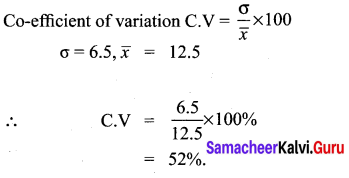
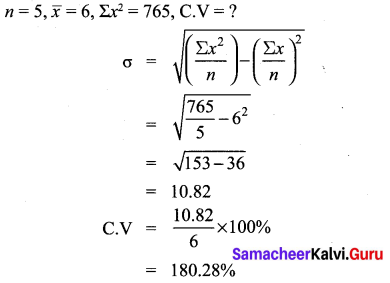
If n = 5 , \(\overline{x}\) = 6, \(\Sigma x^{2}\) = 765, then calculate the coefficient of variation.
Solution:
Samacheer Kalvi 10th Maths Chapter 8 Statistics and Probability Ex 8.2 4

Samacheer Kalvi 10th Maths Solutions Chapter 8 Statistics and Probability Ex 8.2

Question 5.
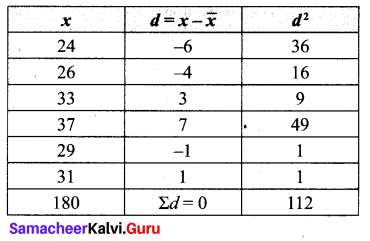
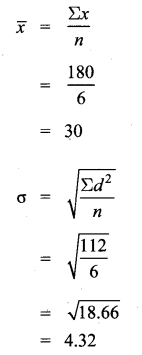
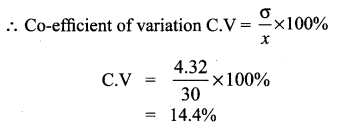
Find the coefficient of variation of 24, 26, 33, 37, 29,31.
Solution:
Samacheer Kalvi 10th Maths Chapter 8 Statistics and Probability Ex 8.2 5
Samacheer Kalvi 10th Maths Chapter 8 Statistics and Probability Ex 8.2 6
Samacheer Kalvi 10th Maths Chapter 8 Statistics and Probability Ex 8.2 7

Question 6.
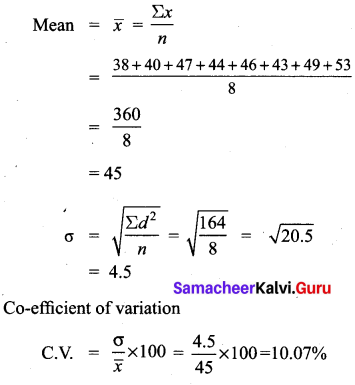
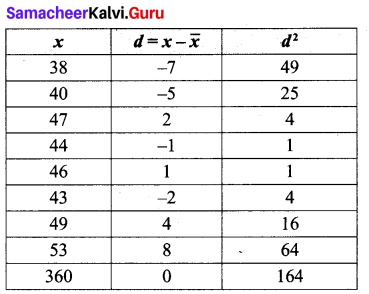
The time taken (in minutes) to complete a homework by 8 students in a day are given by 38, 40, 47, 44, 46, 43, 49, 53. Find the coefficient of variation.
Solution:
Samacheer Kalvi 10th Maths Chapter 8 Statistics and Probability Ex 8.2 8

Samacheer Kalvi 10th Maths Solutions Chapter 8 Statistics and Probability Ex 8.2

Question 7.
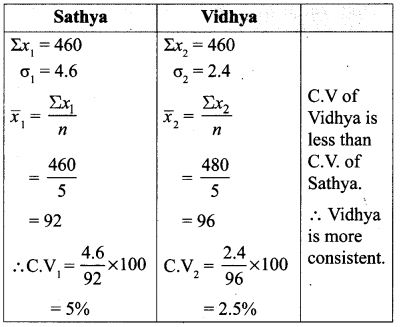
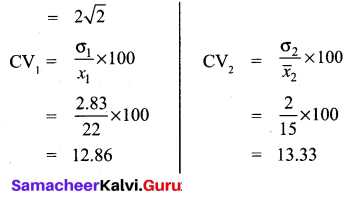
The total marks scored by two students Sathya and Vidhya in 5 subjects are 460 and 480 with standard deviation 4.6 and 2.4 respectively. Who is more consistent in performance?
Solution:
Samacheer Kalvi 10th Maths Chapter 8 Statistics and Probability Ex 8.2 9
Samacheer Kalvi 10th Maths Chapter 8 Statistics and Probability Ex 8.2 10

Question 8.
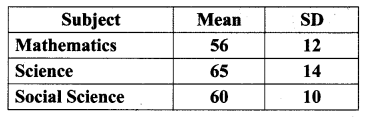
The mean and standard deviation of marks obtained by 40 students of a class in three subjects Mathematics, Science and Social Science are given below.
Samacheer Kalvi 10th Maths Chapter 8 Statistics and Probability Ex 8.2 11
Which of the three subjects shows highest variation and which shows lowest variation in marks?
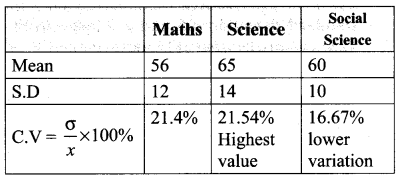
Solution:
Samacheer Kalvi 10th Maths Chapter 8 Statistics and Probability Ex 8.2 12
Science subject shows highest variation. Social science shows lowest variation.

Samacheer Kalvi 10th Maths Solutions Chapter 8 Statistics and Probability Ex 8.2

Question 9.
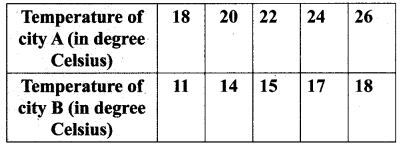
The temperature of two cities A and B in a winter season are given below.
Samacheer Kalvi 10th Maths Chapter 8 Statistics and Probability Ex 8.2 13
Find which city is more consistent in temperature changes?
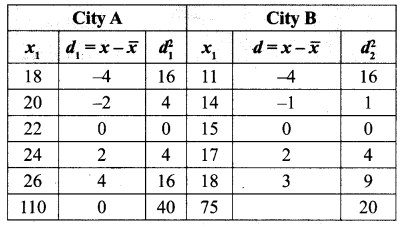
Solution:
Samacheer Kalvi 10th Maths Chapter 8 Statistics and Probability Ex 8.2 14
Samacheer Kalvi 10th Maths Chapter 8 Statistics and Probability Ex 8.2 15
Samacheer Kalvi 10th Maths Chapter 8 Statistics and Probability Ex 8.2 16
∴ Co-efficient of variation of City A is less than C.V of City B.
∴ City A is more consistent.

Samacheer Kalvi 10th Maths Solutions Chapter 8 Statistics and Probability Ex 8.2 Read More »

Samacheer Kalvi 10th Maths Solutions Chapter 7 Mensuration Ex 7.2

You can Download Samacheer Kalvi 10th Maths Book Solutions Guide Pdf, Tamilnadu State Board help you to revise the complete Syllabus and score more marks in your examinations.

Tamilnadu Samacheer Kalvi 10th Maths Solutions Chapter 7 Mensuration Ex 7.2

Question 1.
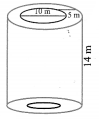
A 14 m deep well with inner diameter 10 m is dug and the earth taken out is evenly spread all around the well to form an embankment of width 5 m. Find the height of the embankment.
Solution:
Inner diameter = 10 m
Inner radius = 5 m
Inner height = 14 m
Samacheer Kalvi 10th Maths Chapter 7 Mensuration Ex 7.2 1
Volume of the cylinder = πr2h cubic units
\(=\frac{22}{7} \times 5 \times 5 \times 14\)
= 1100 m3
Volume of the hollow = n(R2 – r2)h cubic units
R = 10 m
r = 5 m
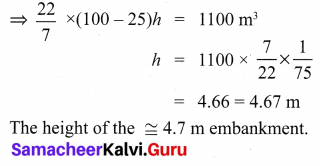
\(\Rightarrow \frac{22}{7} \times\left(10^{2}-5^{2}\right) h=1100 \mathrm{m}^{3}\)
(∵ the earth taken out = the earth spread all around)
Samacheer Kalvi 10th Maths Chapter 7 Mensuration Ex 7.2 2

Question 2.
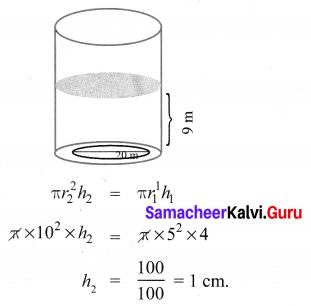
A cylindrical glass with diameter 20 cm has water to a height of 9 cm. A small cylindrical metal of radius 5 cm and height 4 cm is immersed it completely. Calculate the raise of the water in the glass?
Solution:
The volume of the water raised = Volume of the cylindrical metal.
Samacheer Kalvi 10th Maths Chapter 7 Mensuration Ex 7.2 3
∴ The height of the raised water in the glass = 1 cm.

Samacheer Kalvi 10th Maths Solutions Chapter 7 Mensuration Ex 7.2

Question 3.
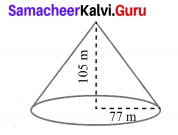
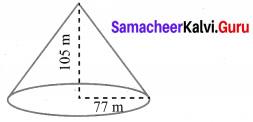
If the circumference of a conical wooden piece is 484 cm then find its volume when its height is 105 cm.
Solution:
Circumference of the base of the cone = 484 cm
height = 105 cm
∴ 2πr = 484
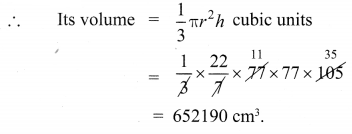
Samacheer Kalvi 10th Maths Chapter 7 Mensuration Ex 7.2 4
\(r=484 \times \frac{1}{2} \times \frac{7}{22}\)
= 77 cm
Samacheer Kalvi 10th Maths Chapter 7 Mensuration Ex 7.2 5

Question 4.
A conical container is fully filled with petrol. The radius is 10m and the height is 15 m. If the container can release the petrol through its bottom at the rate of 25 cu. meter per minute, in how many minutes the container will be emptied. Round off your answer to the nearest minute.
Solution:
Volume of the cone = \(\frac{1}{3} \pi r^{2} h\) cu. units.
Samacheer Kalvi 10th Maths Chapter 7 Mensuration Ex 7.2 6
Volume of the given conical container = \(\frac{1}{3} \times \pi \times 10 \times 10 \times 15\)
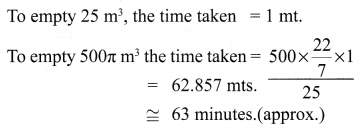
= 500π m3
Samacheer Kalvi 10th Maths Chapter 7 Mensuration Ex 7.2 7

Samacheer Kalvi 10th Maths Solutions Chapter 7 Mensuration Ex 7.2

Question 5.
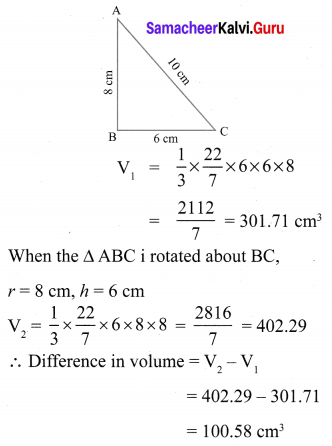
A right angled triangle whose sides are 6 cm, 8 cm and 10 cm is revolved about the sides containing the right angle in two ways. Find the difference in volumes of the two solids so formed.
Solution:
When the triangle ABC is rotated about AB, the
Samacheer Kalvi 10th Maths Chapter 7 Mensuration Ex 7.2 8

Question 6.
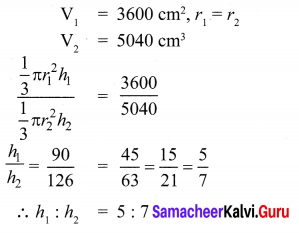
The volumes of two cones of same base radius are 3600 cm3 and 5040 cm3. Find the ratio of heights.
Solution:
Samacheer Kalvi 10th Maths Chapter 7 Mensuration Ex 7.2 9

Samacheer Kalvi 10th Maths Solutions Chapter 7 Mensuration Ex 7.2

Question 7.
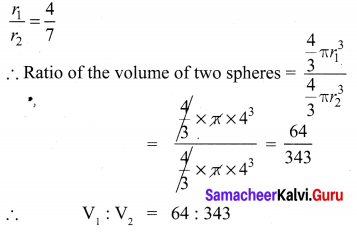
If the ratio of radii of two spheres is 4 : 7, find the ratio of their volumes.
Solution:
Samacheer Kalvi 10th Maths Chapter 7 Mensuration Ex 7.2 10

Question 8.
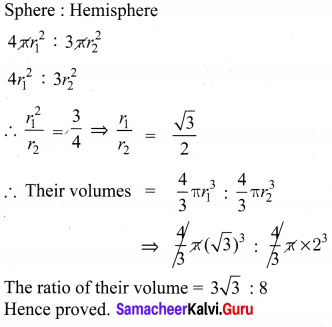
A solid sphere and a solid hemisphere have equal total surface area. Prove that the ratio of their volume is \(3 \sqrt{3} : 4\)
Solution:
Samacheer Kalvi 10th Maths Chapter 7 Mensuration Ex 7.2 11

Question 9.
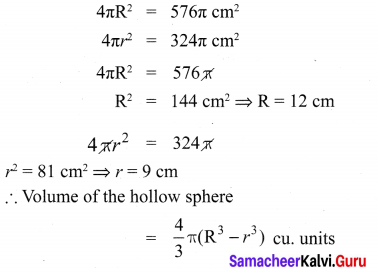
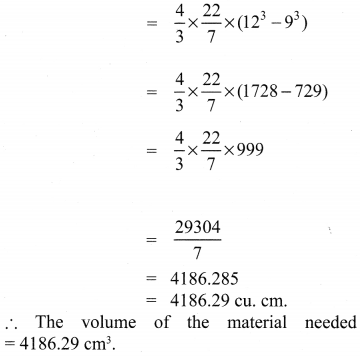
The outer and the inner surface areas of a spherical copper shell are 576π cm2 and 324π cm2 respectively. Find the volume of the material required to make the shell.
Solution:
Samacheer Kalvi 10th Maths Chapter 7 Mensuration Ex 7.2 12
Samacheer Kalvi 10th Maths Chapter 7 Mensuration Ex 7.2 13

Samacheer Kalvi 10th Maths Solutions Chapter 7 Mensuration Ex 7.2

Question 10.
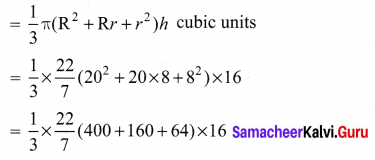
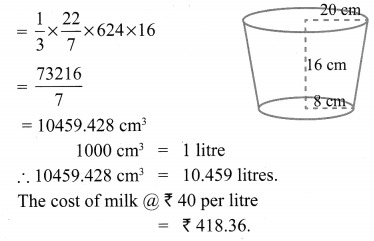
A container open at the top is in the form of a frustum of a cone of height 16 cm with radii of its lower and upper ends are 8 cm and 20 cm respectively. Find the cost of milk which can completely fill a container at the rate of ₹ 40 per litre.
Solution:
Volume of the frustum
Samacheer Kalvi 10th Maths Chapter 7 Mensuration Ex 7.2 14
Samacheer Kalvi 10th Maths Chapter 7 Mensuration Ex 7.2 15

Samacheer Kalvi 10th Maths Solutions Chapter 7 Mensuration Ex 7.2 Read More »

Tamil Nadu 11th Physics Model Question Paper 2 English Medium

Students can Download Tamil Nadu 11th Physics Model Question Paper 2 English Medium Pdf, Tamil Nadu 11th Physics Model Question Papers helps you to revise the complete Tamilnadu State Board New Syllabus and score more marks in your examinations.

TN State Board 11th Physics Model Question Paper 2 English Medium

Tamil Nadu 11th Physics Model Question Paper 2 English Medium

Instructions:

  1. The question paper comprises of four parts
  2. You are to attempt all the parts. An internal choice of questions is provided wherever: applicable
  3. All questions of Part I, II, III, and IV are to be attempted separately
  4. Question numbers to 15 in Part I are Multiple choice Questions of one mark each. These are to be answered by choosing the most suitable answer from the given four alternatives and writing the option code and the corresponding answer
  5. Question numbers 16 to 24 in Part II are two-mark questions. These are lo be answered in about one or two sentences.
  6. Question numbers 25 to 33 in Part III are three-mark questions. These are lo be answered in about three to five short sentences.
  7. Question numbers 34 to 38 in Part IV are five-mark questions. These are lo be answered in detail. Draw diagrams wherever necessary.

Time: 3 Hours
Max Marks: 70

PART – I

Answer all the questions. [15 × 1 = 15]

Question 1.
The direction of the angular velocity vector is along…………
(a) the tangent to the circular path
(b) the inward radius
(c) the outward radius
(d) the axis of rotation
Answer:
(d) the axis of rotation

Tamil Nadu 11th Physics Model Question Paper 2 English Medium

Question 2.
The angle between two vectors 2\(\hat{i}\) + 3\(\hat{j}\) + \(\hat{k}\) and -3\(\hat{j}\) + 6\(\hat{k}\) is………..
(a) 0°
(b) 30°
(c) 60°
(d) 90°
Answer:
(d) 90°

Question 3.
The breaking stress of a wire depends on………….
(a) length of a wire
(b) nature of the wire
(c) diameter of the wire
(d) shape of the cross section
Answer:
(b) nature of the wire

Question 4.
The moment of inertia of a rigid body depends upon…………….
(a) distribution of mass from axis of rotation
(b) angular velocity of the body
(c) angular acceleration of the body
(d) mass of the body
Answer:
(a) distribution of mass from axis of rotation

Question 5.
The stress versus strain graphs for wires of two materials A and B are as shown in the graph.If YA and YB are the young’s moduli of the materials then……….
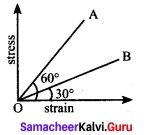
Tamil Nadu 11th Physics Model Question Paper 2 English Medium 1
(a) YB = 2YA
(b) YA = YB
(c) YB = 3YA
(d) YA = 3YB
Answer:
(d) YA = 3YB
Hint:
Slope of stress strain curve gives the young’s modules YA = tan 60° = √3 ; YB = tan 30° \(\frac{1}{√3}\)
\(\frac{Y_A}{Y_B}\) = \(\frac{√3}{\frac{1}{√3}}\) = 3 ⇒ YA = 3YB

Question 6.
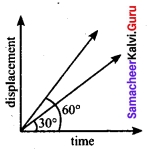
The ratio of the velocities of two particles as shown in figure is…………
Tamil Nadu 11th Physics Model Question Paper 2 English Medium 2
(a) 1 : √3
(b) √3 : 1
(c) 1 : 3
(d) 3 : 1
Answer:
(c) 1 : 3
Hint:
Velocity = Slope of the line formed in displacement v/s time graph = Tan θ
Va : Vb = Tan θA : Tan θB
= Tan 30° : Tan 60°
Va : Vb = 1 : 3

Question 7
The load-elongation graph of three wires of the same material are shown. Which of the following wire is the thickest?
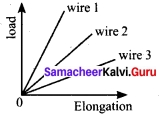
Tamil Nadu 11th Physics Model Question Paper 2 English Medium 3
(a) wire 1
(b) wire 2
(c) wires
(d) all of them have same thickness
Answer:
(a) wire 1
Hint:
Wire 1 is the thickness compared to other wires. Because the elongation of the wire 1 is minimum.

Question 8.
The waves produced by a motor boat sailing in water.are………
(a) transverse
(b) longitudinal
(c) longitudinal and transverse
(d) stationary
Answer:
(c) longitudinal and transverse

Question 9.
A sound wave whose frequency is 5000 Hz travels in air and then hits the water surface. Theratio of its wavelengths in water surface. The ratio of its wavelengths in water and air is………….
(a) 4.30
(b) 0.23
(c) 5.30
(d) 1.23
Answer:
(a) 4.30
Hint:
f = 5000 Hz ; Va = 343 ms-1; Vb = 1480 ms-1
Ratio of wavelength \(\frac{λ_a}{λ_w}\) = \(\frac{V_w}{f}\) × \(\frac{f}{V_a}\) = \(\frac{1480}{343}\) = 4.31

Question 10.
The wavelength of two sine waves and λ1 = 1 m and λ2 = 6 m, the corresponding wave numbers are respectively…………
(a) 1.05 rad m-1 and 6.28 rad m-1
(b) 6.28 rad m-1 and 1.05 rad m-1
(c) 1 rad m-1 and 0.1666 rad m-1
(d) 0.166 rad m-1 and 1 rad m-1
Answer:
(b) 6.28 rad m-1 and 1.05 rad m-1
Hint:
Standard wave equation, Y = A sin (kx – ωt)
K1 = \(\frac{2π}{λ_1}\) = \(\frac{2π}{1}\) = 6.28 rad m-1
K2 = \(\frac{2π}{λ_2}\) = \(\frac{2π}{6}\) = 1.05 rad m-1

Question 11.
During an adiabatic process, the pressure of a gas is proportional to the cube of its absolute temperature. The value of \(\frac{C_p}{C_r}\) for that gas is ………..
(a) \(\frac{3}{5}\)
(b) \(\frac{4}{3}\)
(c) \(\frac{5}{3}\)
(d) \(\frac{3}{2}\)
Answer:
(b) \(\frac{4}{3}\)
Hint:
PT = \(\frac{γ}{1-γ}\) = constant …….(1)
PT-3 = constant ……….(2)
From equation (1) and (2) \(\frac{γ}{1-γ}\) = (-3)
∴ γ = \(\frac{3}{2}\)

Tamil Nadu 11th Physics Model Question Paper 2 English Medium

Question 12.
If the rms speed of the molecules of a gas is 1000 ms-1 the average speed of the molecule is………..
(a) 1000 ms-1
(b) 922 ms-1
(c) 780 ms-1
(d) 849 ms-1
Answer:
(b) 922 ms-1
Hint:
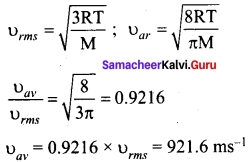
Tamil Nadu 11th Physics Model Question Paper 2 English Medium 4

Question 13.
In a cyclic process, work done by the system will be ………….
(a) zero
(b) more than the heat given to the system
(c) equal to heat given to the system
(d) independent of heat given to system
Answer:
(c) equal to heat given to the system

Question 14.
A closed tube partly filled with water lies is a horizontal plane. If the tube is rotated about perpendicular bisector, the moment of inertia of the system…………
(a) increases
(b) decreases
(c) remains constant
(d) depends on sense of rotation
Answer:
(c) remains constant

Question 15.
Force acting on the particle moving with constant speed is…………..
(a) always zero
(b) need not be zero
(c) always non zero
(d) cannot be concluded
Answer:
(a) always zero
Hint:
In a straight line motion, velocity (speed) is constant, a = 0; F = ma = 0

PART – II

Answer any six questions in which Q. No 23 is compulsory. [6 × 2 = 12]

Question 16.
Write limitations of dimensional analysis with examples, (any 2 points only) Limitations of Dimensional analysis.
Answer:

  1. This method gives no information about the dimensionless constants in the formula like 1, 2, …..π, e, etc.
  2. This method is not suitable to derive relations involving trigonometric, exponential and logarithmic functions.
  3. It can only check on whether a physical relation is dimensionally correct but not the correctness of the relation. For example, using dimensional analysis, s = ut + \(\frac{1}{3}\) at² is dimensionally correct whereas the correct relation is s = ut +\(\frac{1}{2}\) at²

Question 17.
A particle of mass 2 kg experiences two forces \(\vec{F_1}\) =5\(\hat{i}\) + 8\(\hat{j}\) + 7\(\hat{k}\) and \(\vec{F_2}\) = 3\(\hat{i}\) – 4\(\hat{j}\) + 3\(\hat{k}\). What is the acceleration of the particle?
Answer:
We use Newton’s second law, \(\vec{F}_{net}\) = m\(\vec{a}\) where \(\vec{F}_{net}\) = \(\vec{F_1}\) + \(\vec{F_2}\). From the equations the acceleration is \(\vec{a}\) = \(\frac{\vec{F}_{net}}{m}\), where
\(\vec{F}_{net}\) = (5 + 3)\(\vec{i}\) + (8 – 4)\(\vec{j}\) + (7 + 3)\(\vec{k}\)
\(\vec{F}_{net}\) = 8\(\vec{i}\) + 4\(\vec{j}\) + 10\(\vec{k}\)
\(\vec{a}\) = (\(\frac{8}{2}\))\(\vec{i}\) + (\(\frac{4}{2}\))\(\vec{j}\) + (\(\frac{10}{2}\))\(\vec{k}\)
\(\vec{a}\) = 4\(\vec{j}\) + 2\(\vec{j}\) + 5\(\vec{k}\)

Question 18.
An electron and proton are detected in a cosmic ray experiment, the first with kinetic energy 10 KeV and the second with 100 KeV. Which is faster, the electron or the proton? Obtain the ratio of their speeds.
(electron mass : 9.11 × 10⁻³¹ kg : proton mass : 1.67 × 10⁻²⁷ kg : lev = 1.6 × 10⁻¹⁹ J)
Answer:
Here Ke = 10 keV and Kp = 100 keV
me = 9.11 × 10⁻³¹ kg and mp = 1.67 × 10⁻²⁷ kg
As K = \(\frac{1}{2}\) mv² or v = \(\sqrt {\frac{2K}{m}}\)
Hence
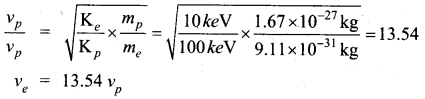
Tamil Nadu 11th Physics Model Question Paper 2 English Medium 5

Question 19.
A bullet of mass 20 g strikes pendulum of mass 5 kg. The centre of mass of pendulum rises a vertical distance of 10 cm. If the bullet gets embedded into the pendulum, calculate its initial speed.
Answer:
Given data: m1 = 20 g = 20 × 10-3kg; m2 = 5 kg; s = 10 × 10-2m
Let the speed of the bullet be v. The common velocity of bullet and pendulum bob is V. According to law of conservation of linear momentum.
V = \(\frac{m_1v}{(m_1+m_2)}\) = \(\frac{20×10^{-3}v}{5+20×10^{-3}}\) = \(\frac{0.02}{5.02}\) v = 0.004 v
The bob with bullet go up with a deceleration of g= 9.8 ms-2. Bob and bullet come to rest at a height of 10 × 10-2 m.
from IIIrd equation of motion
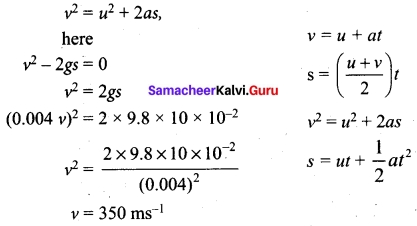
Tamil Nadu 11th Physics Model Question Paper 2 English Medium 6

Tamil Nadu 11th Physics Model Question Paper 2 English Medium

Question 20.
Get the relation between rotational kinetic energy and angular momentum.
Answer:
Let a rigid body of moment of inertia I rotate with angular velocity ω
The angular momentum of a rigid body is, L = Iω
The rotational kinetic energy of the rigid body is, KE = \(\frac{1}{2}\)Iω²
By multiplying the numerator and denominator of the above equation with I, we get a relation between L and KE as,
KE= \(\frac{1}{2}\) \(\frac{I^2ω^2}{I}\) = \(\frac{1}{2}\) \(\frac{(Iω)^2}{I}\)
KE = \(\frac{L^2}{2I}\)

Question 21.
Why is there no lunar eclipse and solar eclipse every month?
Answer:
If the orbits of the Moon and Earth lie on the same plane, during full Moon of every month, we can observe lunar eclipse. If this is so during new oon we can observe solar eclipse. But Moon’s orbit is tilted 5° with respect to Earth’s orbit. Due to this 5° tilt, only during certain periods of the year, the Sun, Earth and Moon align in straight line leading to either lunar eclipse or solar eclipse depending on the alignment.

Question 22.
Calculate the change in internal energy of a block of copper of mass 200 g when it is heated from 25°C to 75°C. Specific heat of copper = 0.1 cal / g / °C and assume change in volume is negligible.
Answer:
dQ = cmΔT = 0.1 × 200 (75 – 25) = 100 calorie
dw = Pdv = 0
dU = dQ – dW = 100 – 0 = 100 calorie = 4200 J

Question 23.
The shortest distance travelled by a particle executing SHM from mean position in 2 seconds is equal to \(\frac{√3}{2}\) times of its amplitude. Determine its time period.
Answer:
Given data t = 2s ; y = \(\frac{√3}{2}\)A ; T = ?
displacement y = A sin ωt = A sin \(\frac{2π}{T}\) t
\(\frac{√3}{2}\)A = A sin \(\frac{2π×2}{T}\) ; sin \(\frac{4π}{T}\) = \(\frac{√3}{2}\) = sin \(\frac{π}{3}\)
∴ \(\frac{4π}{3}\) = \(\frac{π}{3}\) ; T = 12s

Question 24.
What are the differences from sliding and slipping?
Answer:

Sliding Slipping
(i) Velocity of centre of mass is greater than Rco i.e. VCM > Rco. Velocity of centre of mass is lesser than Rco. i.e. VCM < Rco
(ii) Velocity of translational motion is greater than velocity of rotational motion. Velocity of translation motion is lesser than velocity of rotational motion.
(iii) Resultant velocity acts in the forward direction. Resultant velocity acts in the backward direction.

PART – III

Answer any six questions in which Q.No. 29 is compulsory. [6 × 3 = 18]

Question 25.
You are given a thread and a metre scale. How will you estimate the diameter of the thread?
Answer:
The diameter of a thread is so small. Therefore we cannot measure it using metre scale. We wind a number of turns of the thread on the metre scale so that the turns are closely touching one another.
Measure the length (l) of the windings on the scale which contains number of turns.
∴ Diameter of thread = \(\frac{1}{n}\)

Question 26.
Consider two cylinders with same radius and same mass. Let one of the cylinders be solid and another one be hollow. When subjected to same torque, which one among them gets more angular acceleration than the other?
Answer:
Moment of inertia of a solid cylinder about its axis Is = \(\frac{π}{2}\)MR²
Moment of inertia of a hollow cylinder about its axis lh = MR³
Is = \(\frac{π}{2}\)Ih or Ih = 2Is
torque τ = lα ⇒ α = \(\frac{τ}{I}\)
αs = \(\frac{τ}{I_s}\) and ah = \(\frac{τ}{I_h}\)
αsIs = αhIh ⇒ αs = αh \(\frac{I_h}{I_s}\)
Ih > Ih ⇒ \(\frac{I_h}{I_s}\) > 1
∴ as > ah

Question 27.
The reading of pressure meter attached with a closed pipe is 5 × 10⁵ Nm-2. On opening the valve of the pipe, the reading of the pressure meter is 4.5 × 10⁵ Nm-2. Calculate the speed of the water flowing in the pipe.
Answer:
Using Bernoulli’s equation
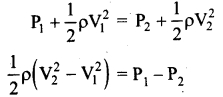
Tamil Nadu 11th Physics Model Question Paper 2 English Medium 7
Here initial velocity V1 = 0 and density of water ρ = 1000 kg m 3
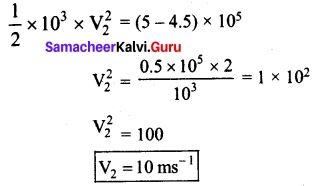
Tamil Nadu 11th Physics Model Question Paper 2 English Medium 8

Question 28.
State and prove perpendicular axis theorem.
Answer:
Perpendicular axis theorem: This perpendicular axis theorem holds good only for plane laminar objects.

The theorem states that the moment of inertia of a plane laminar body about an axis perpendicular to its plane is equal to the sum of moments of inertia about two perpendicular axes lying in the plane of the body such that all the three axes are mutually perpendicular and have a common point.

Tamil Nadu 11th Physics Model Question Paper 2 English Medium

Question 29.
State Stoke’s law and give some practical applications of Stoke’s law.
Answer:
The viscous force F acting on a spherical body of radius r depends directly on:
(i) radius (r) of the sphere
(ii) velocity (v) of the sphere and
(iii) coefficient of viscosity q of the liquid
Therefore F ∝ ηxryvz = F = k ηxryvz, where k is a dimensionless constant. Using dimensions, the above equation can be written as
[MLT-2] = k [ML-1T-1]z × [L]y × [LT-1]x
On solving, we get x = 1, y = 1 and z = 1. Therefore, F = kηrv
Experimentally, Stoke found that the value of k = 6π
F = 6πηrv
This relation is known as Stoke’s law.
Practical applications of Stoke’s law Since the raindrops are smaller in size and their terminal velocities are small, remain suspended in air in the form of clouds. As they grow up in size, their terminal velocities increase and they start falling in the form of rain.
This law explains the following:

  1. Floatation of clouds
  2. Larger raindrops hurt us more than the smaller ones
  3. A man coming down with the help of a parachute acquires constant terminal velocity.

Question 30.
Derive the ratio of two specific heat capacities of triatomic molecules.
(a) Linear molecule:
Answer:
Energy of one mole
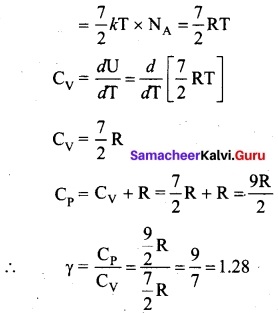
Tamil Nadu 11th Physics Model Question Paper 2 English Medium 9

(b) Non – Linear molecule:
Answer:
Energy of one mole
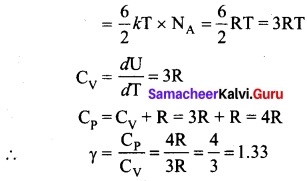
Tamil Nadu 11th Physics Model Question Paper 2 English Medium 10
Note that according to kinetic theory model of gases the specific heat capacity at constant volume and constant pressure are independent of temperature. But in reality it is not sure. The specific heat capacity varies with the temperature.

Question 31.
If 5 L of water at 50°C is mixed with 4 L of of water at 30°C, what will be the final temperature of water? Take the specific heat capacity of water as 4184 J kg-1 k-1.
Answer:
We can use the equation Tf = \(\frac{m_{1} s_{1} \mathrm{T}_{1}+m_{2} s_{2} \mathrm{T}_{2}}{m_{1} s_{1}+m_{2} s_{2}}\)
m1 = 5L = 5 kg ancl m2 = 4 L = 4 kg, s1 = s2 and T1 = 50°C = 323K and T2 = 30°C = 303 K

Tamil Nadu 11th Physics Model Question Paper 2 English Medium 11
Tf = 314.11 K – 273 K ≈ 41°C.
Suppose if we mix equal amount of water (m1 = m2) with 50°C and 30°C, then the final temperature is average of two temperatures.
Tf = \(\frac{T_1+T_2}{2}\) = \(\frac{323+303}{2}\) = 313 K = 40°C
Suppose if both the water are at 30°C then the final temperature will also 30°C. It implies that they are at equilibrium and no heat exchange takes place between each other.

Tamil Nadu 11th Physics Model Question Paper 2 English Medium

Question 32.
Smooth block is released at rest on a 45° incline and then slides a distance d. If the time taken of slide on rough incline is n times as large as that to slide than on a smooth incline. Show that co-efficient of friction µ = (1 – \(\frac{1}{n_2}\))
Answer:
When there is no friction, the block slides down the inclined plane with acceleration.
a – g sin θ
when there is friction, the downward acceleration of the block is
a’ = g (sin θ — µ cos θ)
As the block slides a distance d in each case so
d = \(\frac{1}{2}\) at² = \(\frac{1}{2}\) a’t’²
\(\frac{a}{a’}\) = \(\frac{t’^2}{t^2}\) = \(\frac{(nt)^2}{r^2}\) = n² or \(\frac{g sin θ}{g(sin θ – µ cos θ)}\) = n²
Solving, we get (Using θ = 45°)
µ = 1 – \(\frac{1}{n_2}\)

Question 33.
How do you distinguish between stable and unstable equilibrium?
Answer:

Stable Equilibrium Unstable Equilibrium
(i) The body tries to come back to equilibrium if slightly disturbed and released. The body cannot come back to equilibrium if slightly disturbed and released.
(ii) The center of mass of the body shifts slightly higher if disturbed from equilibrium. The center of mass of the body shifts slightly lower if disturbed from equilibrium.
(iii) Potential energy of the body is minimum and it increases if disturbed. Potential energy of the body is not minimum and it decreases if disturbed.

PART – IV

Answer all the questions. [5 × 5 = 25]

Question 34. (a).
What are the limitation of Dimensional formula? By assuming that the frequency y of a vibrating string may depend upon
(i) Tension
(ii) length (l)
(iii) mass per unit
length (m), prove that γ ∝ \(\frac{1}{l}\) \(\sqrt{\frac{T}{M}}\)
Answer:
(i) Limitations of Dimensional analysis:

  1. This method gives no information about the dimensionless constants in the formula like 1, 2, ……. π, e, etc.
  2. This method cannot decide whether the given quantity is a vector or a scalar.
  3. This method is not suitable to derive relations involving trigonometric, exponential and logarithmic functions.
  4. It cannot be applied to an equation involving more than three physical quantities.
  5. It can only check on whether a physical relation is dimensionally correct but not the correctness of the relation. For example, using dimensional analysis, s = ut + \(\frac{π}{2}\) at² is dimensionally correct whereas the correct relation is s = ut + \(\frac{π}{2}\) at².

(ii) n ∝ Ia Tbmc, [I] = [M0L1 T0]
[T] = [M1L1T-2] (force)
[M] = [M1L-1T0]
[M0L0T-1] = [M0L1T0]a [M1L1T-2]b [M0L-1T0]a
b + c = 0
a + b – c = 0
-2b = -1 ⇒ b = \(\frac{π}{2}\)
c = –\(\frac{π}{2}\)a = 1
γ ∝ \(\frac{1}{l}\) \(\sqrt{\frac{T}{M}}\)

Tamil Nadu 11th Physics Model Question Paper 2 English Medium

[OR]

(b) Prove the law of conservation of linear momentum. Use it to find the recoil velocity of a gun when a bullet is fired from it.
Answer:
In nature, conservation laws play a very important role. The dynamics of motion of bodies can be analysed very effectively using conservation laws. There are three conservation laws in mechanics. Conservation of total energy, conservation of total linear momentum, and conservation of angular momentum. By combining Newton’s second and third laws, we can derive the law of conservation of total linear momentum.

When two particles interact with each other, they exert equal and opposite forces on each other. The particle 1 exerts force \(\frac{\vec{F}_{12}}{m}\) on particle 2 and particle 2 exerts an exactly equal and opposite force \(\frac{\vec{F}_{12}}{m}\) on particle 1 according to Newton’s third law.
\(\frac{\vec{F}_{21}}{m}\) = –\(\frac{\vec{F}_{21}}{m}\) ……….(1)
In terms of momentum of particles, the force on each particle (Newton’s second law) can be written as
\(\frac{\vec{F}_{12}}{m}\) = \(\frac{\vec{dp_1}}{dt}\) and \(\frac{\vec{F}_{21}}{m}\) = \(\frac{\vec{dp_2}}{dt}\) ………(2)
Here \(\vec{p}_1\) is the momentum of particle 1 which changes due to the force \(\vec{F}_{12}\) exerted by
particle 2. Further \(\vec{p}_2\) is the momentum of particle 2. This changes due to \(\vec{F}_{21}\) exerted by particle 1.
Substitute equation (2) in equation (1)
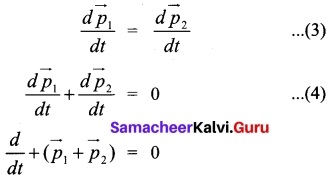
Tamil Nadu 11th Physics Model Question Paper 2 English Medium 12
It implies that \(\vec{p_1}\) + \(\vec{p_2}\) constant vector (always).
\(\vec{p_1}\) + \(\vec{p_2}\) is the total linear momentum of the two particles (\(\vec{p_{tot}}\) = \(\vec{p_1}\) + \(\vec{p_2}\)).It is also called as total linear momentum of the system. Here, the two particles constitute the system. From this result, the law of conservation of linear momentum can be stated as follows.

If there are no external forces acting on the system, then the total linear momentum of the system (\(\vec{p}_{tot}\)) is always a constant vector. In other words, the total linear momentum of the system is conserved in time. Here the word ‘conserve’ means that \(\vec{p_1}\) and p\(\vec{p_2}\) can vary, in such a way that \(\vec{p_1}\) + \(\vec{p_2}\) is a constant vector.

The forces \(\vec{F_{12}}\) and \(\vec{F_{21}}\) are called the internal forces of the system, because they act only between the two particles. There is no external force acting on the two particles from outside. In such a case the total linear momentum of the system is a constant vector or is conserved.

To find the recoil velocity of a gun when a bullet is fired from it:
Consider the firing of a gun. Here the system is Gun+bullet. Initially the gun and bullet are at rest, hence the total linear momentum of the system is zero. Let \(\vec{p_1}\) be the momentum of the bullet and \(\vec{p_2}\) the momentum of the gun before firing. Since initially both are at rest,
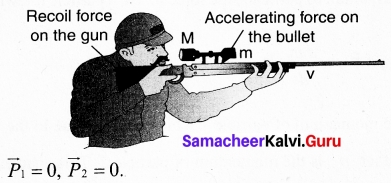
Tamil Nadu 11th Physics Model Question Paper 2 English Medium 13
Total momentum before firing the gun is zero, \(\vec{p_1}\) + \(\vec{p_2}\) = 0
According to the law of conservation of linear momentum, total linear momemtum has to be zero after the firing also.

When the gun is fired, a force is exerted by the gun on the bullet in forward direction. Now the momentum of the bullet changes from \(\vec{p_1}\) + \(\vec{p_1}\). To conserve the total linear momentum of the system, the momentum of the gun must also change from \(\vec{p_2}\) to \(\vec{p_2}\) Due to the conservation of linear momentum, \(\vec{p_1}\)+ \(\vec{p_2}\)= 0. It implies that \(\vec{p_1}\) = – \(\vec{p_2}\), the momentum of the gun is exactly equal, but in the opposite direction to the momentum of the bullet. This is the reason after firing, the gun suddenly moves backward with the momentum (\(\vec{p_2}\)). It is called ‘recoil momentum’. Th is is an example of conservation of total linear momentum.

Tamil Nadu 11th Physics Model Question Paper 2 English Medium

Question 35 (a).
Explain the variation of g with
(i) latitude
(ii) altitude.
Answer:
(i) Latitute: When an object is on the surface fo the Earth, it experiences a centrifugal force that depends on the latitude of the object on Earth. If the Earth were not spinning, the force on the object would have been mg. However, the object experiences an additional centrifugal force due to spinning of the Earth.
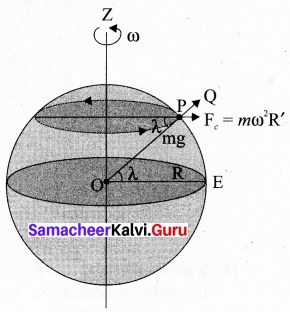
Tamil Nadu 11th Physics Model Question Paper 2 English Medium 14
This centrifugal force is given by mω²R’.
OPz cos λ = \(\frac{PZ}{OP}\) = \(\frac{R’}{R}\)
R’ = R cos λ
where λ is the latitude. The component of centrifugal acceleration experienced by the object in the direction opposite to g is
NaPQ = ω²R cos λ = ω²R COS² λ
Since R’ = R cos λ
Therefore, g’ = g – ω²R cos² λ
From the above expression, we can infer that at equator, λ = 0, g’ = g ω²R. The acceleration due to gravity is minimum. At poles λ = 90; g’ = g, it is maximum. At the equator, g’ is minimum.

(ii) Altitude: Consider an object of mass m at a height h from the surface of the Earth. Acceleration experienced by the object due to Earth is
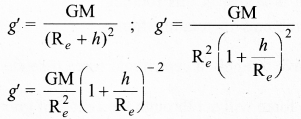
Tamil Nadu 11th Physics Model Question Paper 2 English Medium 15
If h << Re: We can use Binomial expansion. Taking the terms up to first order
g’ =\( \frac{\mathrm{GM}}{\mathrm{R}_{e}^{2}}\left[1+\frac{h}{\mathrm{R}_{e}}\right]^{-2}\)
If h << R sub>e: We can use Binomial expansion. Taking the terms up to first order
(1 + x)ⁿ = 1 + nx
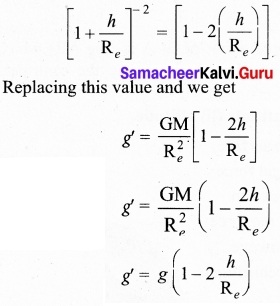
Tamil Nadu 11th Physics Model Question Paper 2 English Medium 16
We find that g’ < g. This means that as altitude h increases the acceleration due to gravity g decreases.
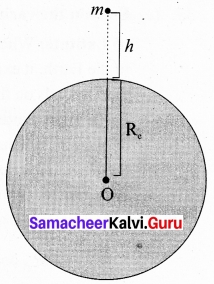
Tamil Nadu 11th Physics Model Question Paper 2 English Medium 17

[OR]

(b) Explain why a cyclist bends while negotiating a curve road? Arrive at the expression for angle of bending for a given velocity.
Answer:
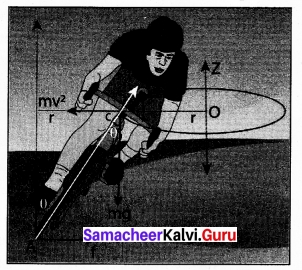
Tamil Nadu 11th Physics Model Question Paper 2 English Medium 18
Let us consider a cyclist negotiating a circular level road (not banked) of radius r with a speed v. The cycle and the cyclist are considered as one system with mass m. The center gravity of the system is C and it goes in a circle of radius r with center at O. Let us choose the line OC as X-axis and the vertical line through O as Z-axis as shown in Figure.

The system as a frame is rotating about Z-axis. The system is at rest in this rotating frame. To solve problems in rotating frame of reference, we have to apply a centrifugal force (pseudo force) on the system which will be \(\frac{mv^2}{r}\). this force will act through the center of gravity. the forces acting on the system are , (i) gravitational force (mg), (ii) Normal force (n), (iii) frictional force (f) and (iv) centrifugal force (\(\frac{mv^2}{r}\)). As the system is in equilibrium in the rotational frame of will be of reference, the net external force and net external torque must be zero. Let us consider all torques about the point A in Figure.
For rotational equilibrium,
\(\vec{τ}_{net}\) = 0
The torque due to the gravitational force about point A is (mg AB) which causes a clockwise turn that is taken as negative. The torque due to the centripetal force is (\(\frac{mv^2}{r}\) BC) which causes an anticlock wise turn that is taken as positive
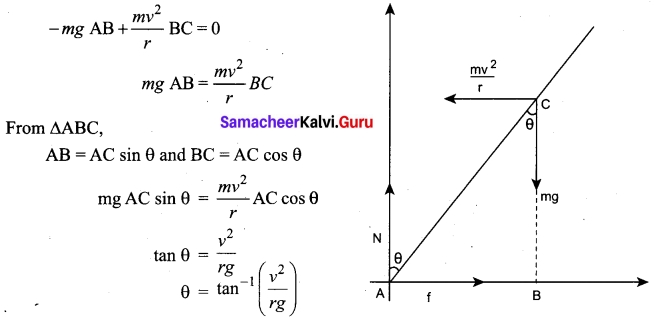
Tamil Nadu 11th Physics Model Question Paper 2 English Medium 19
While negotiating a circular level road of radius Force diagrams for the cyclist r at velocity v, a cyclist has to bend by an angle in turns
0 from vertical given by the above expression to stay in equilibrium (i.e. to avoid a fall).

Question 36 (a).
Derive an expression for moment of inertia of a uniform ring and uniform disc.
Answer:
Let us consider a uniform ring of mass M and radius R. To find the moment of inertia of the ring about an axis passing through its center and perpendicular to the plane, let us take an infinitesimally small mass {dm) of length (dx) of the ring. This (dm) is located at a distance R, which is the radius of the ring from the axis as shown in figure.
The moment of inertia (dl) of this small mass (dm) is,
dl = (dm) R²
The length of the ring is its circumference (2πR). AS the mass is uniformly distributed, the mass per unit length (λ) is,
mass M
λ = \(\frac{mass}{length}\) = \(\frac{M}{2πR}\)
The mass (dm) of the infinitesimally small length is,
dm = λ dx = \(\frac{M}{2πR}\) dx
Now, the moment of inertia (I) of the entire ring is,
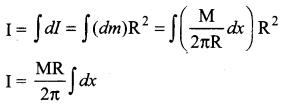
Tamil Nadu 11th Physics Model Question Paper 2 English Medium 20
To cover the entire length of the ring, the limits of integration are taken from 0 to 2πR.
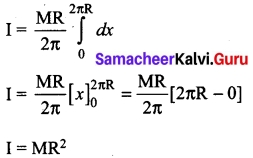
Tamil Nadu 11th Physics Model Question Paper 2 English Medium 21

Tamil Nadu 11th Physics Model Question Paper 2 English Medium

[OR]

(b) Explain how overtones are produced in a (i) closed organ pipe
Answer:
(i) Closed organ pipes: Look at the picture of a clarinet, shown in figure. It is a pipe with one end closed and the other end open. If one end of a pipe is closed, the wave reflected at this closed end is 180° out of phase with the incoming wave. Thus there is no displacement of the particles at the closed end. Therefore, nodes are formed at the closed end and anti¬nodes are formed at open end.
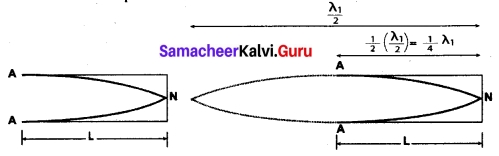
Tamil Nadu 11th Physics Model Question Paper 2 English Medium 22
(a) No motion of particles which leads to nodes at closed end and antinodes at open and (fundamental mode) (N-node, A-antinode)
Let us consider the simplest mode of vibration of the air column called the fundamental mode. Anti-node is formed at the open end and node at closed end. From the figure, let L be the length of the tube and the wavelength of the wave produced. For the fundamental mode of vibration, we have,
L = \(\frac{λ_1}{4}\) or λ1 = 4L …(1)
The frequency of the note emitted is . v v
fp = \(\frac {v}{λ_1}\) = \(\frac{v}{4L}\) …….(2)
which is called the fundamental note.
The frequencies higher than fundamental frequency can be produced by blowing air strongly at open end. Such frequencies are called overtones.
The figure (b) shows the second mode of vibration having two nodes and two antinodes,
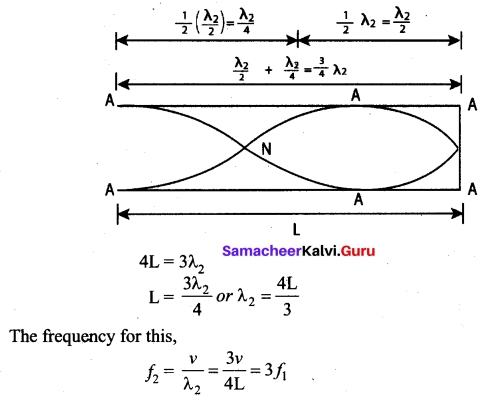
Tamil Nadu 11th Physics Model Question Paper 2 English Medium 23
is called first over tone, since here, the frequency is three times the fundamental frequency it is called third harmonic.
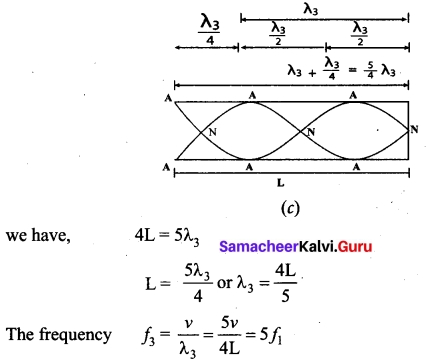
The figure (c) shows third mode of vibration having three nodes and three anti-nodes.
Tamil Nadu 11th Physics Model Question Paper 2 English Medium 24
is called second over tone, and since n = 5 here, this is called fifth harmonic. Hence, the closed organ pipe has only odd harmonics and f1 : f2 : f3 : f4 : …… = 1 : 3 : 5 : 7 : …… ………(3)

Question 37 (a).
What is meant by Doppler effect? Discuss following cases.
(i) source moves towards stationary observer
(ii) source moves away from stationary observer
Answer:
When the source and the observer are in relative motion with respect to each other and to the medium in which sound propagates, the frequency of the sound wave observed is different from the frequency of the source. This phenomenon is called Doppler Effect.

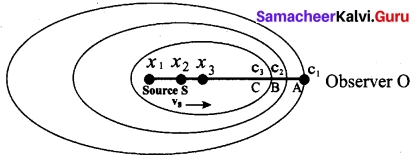
(i) Source moves towards the observer: Suppose a source S moves to the right (as shown in figure) with a velocity vs and let the frequency of the sound waves produced by the source be fs. We assume the velocity of sound in a medium is v. The compression (sound wave front) produced by the source S at three successive instants of time are shown in the figure. When S is at position x1 the compression is at C1. When S is at position x2, the compression is at C2 and similarly for x3 and C3. Assume that if C1 reaches the observer’s position A then at that instant C2reaches the point B and C3 reaches the point C as shown in the figure. It is obvious to see that the distance between compressions C2 and C3 is shorter than distance between C3 and C2. This means the wavelength decreases when the source S moves towards the observer O (since sound travels longitudinally and wavelength is the distance between two consecutive compressions). But frequency is inversely related to wavelength and therefore, frequency increases.
Tamil Nadu 11th Physics Model Question Paper 2 English Medium 25
Let λ be the wavelength of the source S as measured by the observer when S is at position x1 and λ’ be wavelength of the source observed by the observer when S moves to position x2. Then the change in wavelength is Δλ = λ – λ’ = vst, where t is the time taken by the source to travel between x1 and x2. Therefore,
λ’ = λ – vst ………..(1)
But t = \(\frac{λ}{v}\) ………(2)
On substituting equation (2) in equation (3), we get
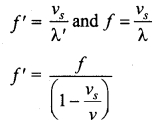
λ’ = λ\(\left(1-\frac{v_{s}}{v}\right)\)
Since frequency is inversely proportional to wavelength, we have
Tamil Nadu 11th Physics Model Question Paper 2 English Medium 26
Since, \(\frac{v_s}{v}\) << 1, we use the binomial expansion and retaining only first order in \(\frac{v_s}{v}\) we get
f’ = f(1 + \(\frac{v_s}{v}\))v ………..(4)

(ii) Source moves away from the observer: Since the velocity here of the source is opposite in direction when compared to case (a), therefore, changing the sign of the velocity of the source in the above case i.e, by substituting (vs → -vs) in equation (1), we get
\(f^{\prime}=\frac{f}{\left(1+\frac{v_{s}}{v}\right)}\) ………(5)
Using binomial expansion again, we get,
\(f^{\prime}=f\left(1-\frac{v_{s}}{v}\right)\) ……….. (6)

Tamil Nadu 11th Physics Model Question Paper 2 English Medium

[OR]

(b) (i) Define specific heat capacity of gas at constant volume
(ii) Define specific heat capacity of gas at constant pressure
(iii) Derive the relationship between Cp and Cv.
Answer:
(i) The amount of heat energy required to raise the temperature of one kg of a substance by 1 K or 1?C by keeping the volume constant is called specific heat capacity at constant volume.
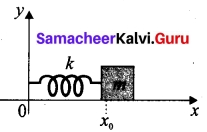
Tamil Nadu 11th Physics Model Question Paper 2 English Medium 27

(ii) The amount of heat required to rise the temperature of one mole of a substance by IK or 1°C at constant volume is called molar specific heat capacity at constant volume.
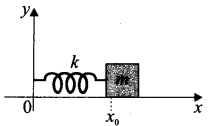
Tamil Nadu 11th Physics Model Question Paper 2 English Medium 28

(iii) Application of law of equipartition energy in specific heat of a gas Meyer’s relation Cp – Cv = R connects the two specific heats for one mole of an ideal gas.
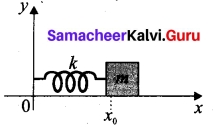
Tamil Nadu 11th Physics Model Question Paper 2 English Medium 29
Equipartition law of energy is used to calculate the value of Cp – Cv and the ratio between them γ = \(\frac{C_p}{C_v}\) Here y is called adiabatic exponent.

Question 38 (a).
Explain Isobaric process and derive the work done in this process.
Answer:
Isobaric process: This is a thermodynamic process that occurs at constant pressure. Even though pressure is constant in this process, temperature, volume and internal energy are not constant. From the ideal gas equation, we have
V = (\(\frac{µR}{P}\))T ………(1)
Here \(\frac{µR}{P}\) = constant
In an isobaric process the temperature is directly proportional to volume.
V ∝ T (Isobaric process) …(2)
This implies that for a isobaric process, the V-T graph is a straight line passing through the origin.
If a gas goes from a state (Vi ,Ti) to (Vf, Tf) at constant pressure, then the system satisfies the following equation
\(\frac{T_f}{V_f}\) = \(\frac{T_i}{V_i}\) …(3)
Examples for Isobaric process:
(i) When the gas is heated and pushes the piston so that it exerts a force equivalent to atmospheric pressure plus the force due to gravity then this process is isobaric.

(ii) Most of the cooking processes in our kitchen are isobaric processes. When the food is cooked in an open vessel, the pressure above the food is always at atmospheric pressure.

The PV diagram for an isobaric process is a horizontal line parallel to volume axis. Figure (a) represents isobaric process where volume decreases figure (b) represents isobaric process where volume increases.
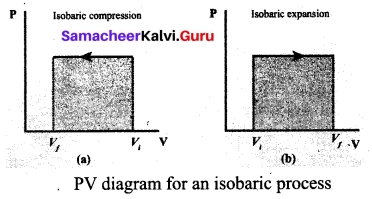
Tamil Nadu 11th Physics Model Question Paper 2 English Medium 30
The work done in an isobaric process: Work done by the gas
\(\mathbf{W}=\int_{\mathbf{V}_{\mathbf{i}}}^{\mathbf{V}_{f}} \mathbf{P} d \mathbf{V}\) …….(4)
In an isobaric process, the pressure is constant, so P comes out of the integral,

Tamil Nadu 11th Physics Model Question Paper 2 English Medium 31
Where ΔV denotes change in the volume. If ΔV is negative, W is also negative. This implies that the work is done on the gas. If ΔV is positive, W is also positive, implying that work is done by the gas.
The equation (6) can also be rewritten using the ideal gas equation.
From ideal gas equation
PV = µRT and V = \(\frac{µRT}{P}\)
Substituting this in equation (6) we get
W = µRTf (1 – \(\frac{T_i}{T_f}\)) …….(7)
In the PV diagram, area under the isobaric curve is equal to the work done in isobaric process.
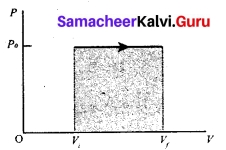
Tamil Nadu 11th Physics Model Question Paper 2 English Medium 32
The first law of thermodynamics for isobaric process is given by
ΔU = Q – PΔV ……..(8)
W = PΔY, ΔU = Q – µRTf [1 – \(\frac{T_i}{T_f}\)]

Tamil Nadu 11th Physics Model Question Paper 2 English Medium

[OR]

(b) Explain how the interference of waves is formed.
Answer:
Consider two harmonic waves having identical frequencies, constant phase difference φ and same wave form (can be treated as coherent source), but having amplitudes A1 and A2, then
y1 = A1sin (kx – ωf), ……(1)
y2 = A2 sin (kx – ωt + φ) …..(2)
Suppose they move simultaneously in a particular direction, then interference occurs (i.e., overlap of these two waves). Mathematically
y = y1 + y2 …….(3)
Therefore, substituting equation (1) and equation (3) in equation (3), we get
y = A1 sin (kx – ωt) + A2 sin (kx – ωt + φ)
Using trigonometric identity sin (α + β) = (sin α cos β + cos α sin β ), we get
y= A1 sin (kx – ωt) + A2 [sin (kx – ωt) cos φ + cos (kx – ωt) sin φ]
y= sin (kx – ωt) (A1 + A2 cos φ) + A2 sin φ cos (kx – ωt) ……(4)
Let us re-define A cos θ = (A1 + A2 cos φ) …(5)
and A sin θ = A2 sin φ …(6)
then equation (4) can be rewritten as y = A sin (kx – ωt) cos θ + A cos (kx – ωt) sin θ
y = A (sin (kx – ωt) cos θ + sin θ cos (kx – ωt))
y = A sin (kx – ωt + θ) ……..(7)
By squaring and adding equation (5) and equation (6), we get
A2 =\mathrm{A}_{1}^{2}+\mathrm{A}_{2}^{2} + 2A1 A2 cos φ ……..(8)
Since, intensity is square of the amplitude (I = A2), we have
I = I1 + I2 + 2\(\sqrt{I_1I_2}\) COS φ ……..(9)
This means the resultant intensity at any point depends on the phase difference at that point.

(a) For constructive interference: When crests of one wave overlap with crests of another wave, their amplitudes will add up and we get constructive interference. The resultant wave has a larger amplitude than the individual waves as shown in figure (a). The constructive interference at a point occurs if there is maximum intensity at that point, which means that
cos φ = + 1 ⇒ φ = 0, 2π, 4π,… = 2πn,
where n = 0, 1, 2,…
This is the phase difference in which two waves overlap to give constructive interference. Therefore, for this resultant wave,
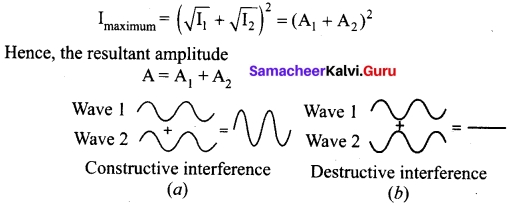
Tamil Nadu 11th Physics Model Question Paper 2 English Medium 33

(b) For destructive interference: When the trough of one wave overlaps with the crest of another wave, their amplitudes “cancel” each other and we get destructive interference as shown in figure (b). The resultant amplitude is nearly zero. The destructive interference occurs if there is minimum intensity at that point, which means cos φ = – 1 ⇒ φ = π, 3π, 5π,… = (2 n – 1) π, where n = 0,1,2,…. i.e. This is the phase difference in which two waves overlap to give destructive interference. Therefore,

Tamil Nadu 11th Physics Model Question Paper 2 English Medium 34
Hence, the resultant amplitude
A= |A1 – A2|

Tamil Nadu 11th Physics Model Question Paper 2 English Medium

Tamil Nadu 11th Physics Model Question Paper 2 English Medium Read More »

Samacheer Kalvi 12th Business Maths Solutions Chapter 6 Random Variable and Mathematical Expectation Ex 6.2

Students can download 12th Business Maths Chapter 6 Random Variable and Mathematical Expectation Ex 6.2 Questions and Answers, Samacheer Kalvi 12th Business Maths Book Solutions Guide Pdf helps you to revise the complete Tamilnadu State Board New Syllabus and score more marks in your examinations.

Tamilnadu Samacheer Kalvi 12th Business Maths Solutions Chapter 6 Random Variable and Mathematical Expectation Ex 6.2

Question 1.
Find the expected value for the random variable of an unbiased die.
Solution:
Let X denote the number on the top side of the unbiased die.
The probability mass function is given by the following table.
Samacheer Kalvi 12th Business Maths Solutions Chapter 6 Random Variable and Mathematical Expectation Ex 6.2 Q1
The expected value for the random variable X is E(X) = \(\sum_{x} x P_{x}(x)\)
Samacheer Kalvi 12th Business Maths Solutions Chapter 6 Random Variable and Mathematical Expectation Ex 6.2 Q1.1

Question 2.
Let X be a random variable defining number of students getting A grade. Find the expected value of X from the given table.
Samacheer Kalvi 12th Business Maths Solutions Chapter 6 Random Variable and Mathematical Expectation Ex 6.2 Q2
Solution:
Expected value of X, E(X) = \(\sum_{x} x P_{x}(x)\)
E(X) = (0 × 0.2) + (1 × 0.1) + (2 × 0.4) + (3 × 0.3)
= 0 + 0. 1 + 0.8 + 0.9
= 1.8

Samacheer Kalvi 12th Business Maths Solutions Chapter 6 Random Variable and Mathematical Expectation Ex 6.2

Question 3.
The following table is describing the probability mass function of the random variable X.
Samacheer Kalvi 12th Business Maths Solutions Chapter 6 Random Variable and Mathematical Expectation Ex 6.2 Q3
Find the standard deviation of x.
Solution:
The standard deviation of X, σx is given by σx = √Var[X]
Now Var(X) = E(X2) – [E(X)]2
From the given table,
Samacheer Kalvi 12th Business Maths Solutions Chapter 6 Random Variable and Mathematical Expectation Ex 6.2 Q3.1
Hence the standard deviation of X is 2.15

Question 4.
Let X be a continuous random variable with probability density function.
Samacheer Kalvi 12th Business Maths Solutions Chapter 6 Random Variable and Mathematical Expectation Ex 6.2 Q4
Find the expected value of X.
Solution:
The expected value of the random variable is given by E(X) = \(\int_{-\infty}^{\infty} x f(x) d x\)
According to the problem we have,
Samacheer Kalvi 12th Business Maths Solutions Chapter 6 Random Variable and Mathematical Expectation Ex 6.2 Q4.1

Samacheer Kalvi 12th Business Maths Solutions Chapter 6 Random Variable and Mathematical Expectation Ex 6.2

Question 5.
Let X be a continuous random variable with probability density function
Samacheer Kalvi 12th Business Maths Solutions Chapter 6 Random Variable and Mathematical Expectation Ex 6.2 Q5
Find the mean and variance of X.
Solution:
Given that X is a continuous random variable.
The mean of X is the expected value of X.
Samacheer Kalvi 12th Business Maths Solutions Chapter 6 Random Variable and Mathematical Expectation Ex 6.2 Q5.1

Question 6.
In investment, a man can make a profit of ₹ 5,000 with a probability of 0.62 or a loss of ₹ 8,000 with a probability of 0.38. Find the expected gain.
Solution:
Let X be the random variable which denotes the gain in the investment. It is given that X takes the value 5000 with probability 0.62 and -8000 with a probability 0.38.
(Note that we take -8000 since it is a loss)
The probability distribution is given by
Samacheer Kalvi 12th Business Maths Solutions Chapter 6 Random Variable and Mathematical Expectation Ex 6.2 Q6
E(X) = (0.38) (-8000) + (0.62) (5000)
= -3040 + 3100
= 60
Hence the expected gain is ₹ 60

Samacheer Kalvi 12th Business Maths Solutions Chapter 6 Random Variable and Mathematical Expectation Ex 6.2

Question 7.
What are the properties of Mathematical expectation?
Solution:
The properties of Mathematical expectation are as follows:
(i) E(a) = a, where ‘a’ is a constant
(ii) Addition theorem: For two r.v’s X and Y, E(X + Y) = E(X) + E(Y)
(iii) Multiplication theorem: E(XY) = E(X) E(Y)
(iv) E(aX) = aE(X), where ‘a’ is a constant
(v) For constants a and b, E(aX + b) = a E(X) + b

Question 8.
What do you understand by Mathematical expectation?
Solution:
The expected value of a random variable gives a measure of the center of the distribution of the variable. In other words, E(X) is the long-term average value of the variable. The expected value is calculated as a weighted average of the values of a random variable in a particular experiment. The weights are the probabilities. The mean of the random variable X is µX = E(X).

Question 9.
How do you define variance in terms of Mathematical expectation?
Solution:
Let X be a random variable. Let E(X) denote the expectation of X.
Then the variance is defined in terms of the mathematical expectation as follows.
(a) X is discrete r.v with p.m.f p(x). Then Var(X) = \(\sum[x-\mathrm{E}(\mathrm{X})]^{2} p(x)\)
(b) X is continuous r.v with p.d.f fx(x). Then Var(X) = \(\int_{-\infty}^{\infty}[X-E(X)]^{2} f_{X}(x) d x\)

Samacheer Kalvi 12th Business Maths Solutions Chapter 6 Random Variable and Mathematical Expectation Ex 6.2

Question 10.
Define Mathematical expectation in terms of a discrete random variable.
Solution:
Let X be a discrete random variable with probability mass function (p.m.f) P(x). Then, its expected value is defined by E(X) = \(\sum_{x} x p(x)\)
In other words, if x1, x2, x3,…… xn are the different values of X, and p(x1), p(x2) …..p(xn) are the corresponding probabilities, then E(X) = x1 p(x1) + x2 p(x2) + x3 p(x3) +… xn p(xn)

Question 11.
State the definition of Mathematical expectation using a continuous random variable.
Solution:
Let X be a continuous random variable with probability density function f(x). Then the expected value of X is
\(\mathrm{E}(\mathrm{X})=\int_{-\infty}^{\infty} x f(x) d x\)
If the integral exists, E(X) is the mean of the values, otherwise, we say that the mean does not exist.

Question 12.
In a business venture, a man can make a profit of ₹ 2,000 with a probability of 0.4 or have a loss of ₹ 1,000 with a probability of 0.6. What are his expected, variance and standard deviation of profit?
Solution:
Let X be the random variable denoting the profit of the business venture.
The probability distribution of X is given as follows
Samacheer Kalvi 12th Business Maths Solutions Chapter 6 Random Variable and Mathematical Expectation Ex 6.2 Q12
E(X) = (-1000) (0.6) + (2000) (0.4)
= – 600 + 800
= 200
E(X2) = (-1000)2 (0.6) + (2000)2 (0.4)
= 6,00,000 + 16,00,000
= 22,00,000
V(X) = E(X2) – [E(X)]2
= 22,00,000 – 40000
= 21,60,000
Standard deviation = √Var[X]
= \(\sqrt{2160000}\)
= 1469.69
Thus the expected value of profit is ₹ 200. The variance of profit is ₹ 21,60,000 and the standard deviation of profit is ₹ 1469.69.

Samacheer Kalvi 12th Business Maths Solutions Chapter 6 Random Variable and Mathematical Expectation Ex 6.2

Question 13.
The number of miles an automobile tyre lasts before it reaches a critical point in tread wear can be represented by a p.d.f.
Samacheer Kalvi 12th Business Maths Solutions Chapter 6 Random Variable and Mathematical Expectation Ex 6.2 Q13
Find the expected number of miles (in thousands) a tyre would last until it reaches the critical tread wear point.
Solution:
Let the continuous random variable X denote the number of miles (in thousands) till an automobile tyre lasts.
The expected value is E(X) = \(\int_{-\infty}^{\infty} x f(x) d x\)
From the problem we have,
\(E(X)=\int_{0}^{\infty}(x) \frac{1}{30} e^{\frac{-x}{30}} d x\)
We use integration by parts to evaluate the integral
Samacheer Kalvi 12th Business Maths Solutions Chapter 6 Random Variable and Mathematical Expectation Ex 6.2 Q13.1
Hence the expected number of miles is 30,000.

Question 14.
A person tosses a coin and is to receive ₹ 4 for a head and is to pay ₹ 2 for a tail. Find the expectation and variance of his gains.
Solution:
Let X be the discrete random variable which denotes the gain of the person.
The probability distribution of X is given by
Samacheer Kalvi 12th Business Maths Solutions Chapter 6 Random Variable and Mathematical Expectation Ex 6.2 Q14
(Here, since a coin is tossed the probability is equal for the outcomes head or tail)
Samacheer Kalvi 12th Business Maths Solutions Chapter 6 Random Variable and Mathematical Expectation Ex 6.2 Q14.1
Thus the expectation of his gains is 1 and the variance of his gains is 9.

Samacheer Kalvi 12th Business Maths Solutions Chapter 6 Random Variable and Mathematical Expectation Ex 6.2

Question 15.
Let X be a random variable and Y = 2X + 1. What is the variance of Y if the variance of X is 5?
Solution:
Given X is a random variable and Y = 2X + 1 and Var(X ) = 5
Var (Y) = Var (2X + 1) = (2)2 = 4
Var X = 4(5) = 20

Samacheer Kalvi 12th Business Maths Solutions Chapter 6 Random Variable and Mathematical Expectation Ex 6.2 Read More »

Samacheer Kalvi 12th Business Maths Solutions Chapter 4 Differential Equations Ex 4.5

Students can download 12th Business Maths Chapter 4 Differential Equations Ex 4.5 Questions and Answers, Samacheer Kalvi 12th Business Maths Book Solutions Guide Pdf helps you to revise the complete Tamilnadu State Board New Syllabus and score more marks in your examinations.

Tamilnadu Samacheer Kalvi 12th Business Maths Solutions Chapter 4 Differential Equations Ex 4.5

Solve the following differential equations:

Question 1.
\(\frac{d^{2} y}{d x^{2}}-6 \frac{d y}{d x}+8 y=0\)
Solution:
The auxiliary equation is
m² – 6m + 8 = 0
m² – 4m – 2m + 8 = 0
m (m – 4) – 2 (m – 4) = 0
(m – 2) (m – 4) = 0
m = 2, 4
Roots are real and different
∴ The complementary function is
Aem1x + Bem2x
C.F = Ae2x + Be4x
∴ The general solution is y = Ae2x + Be4x

Question 2.
\(\frac{d^{2} y}{d x^{2}}-4 \frac{d y}{d x}+4 y=0\)
Solution:
The auxiliary equation is
m² – 4m + 4 = 0
m² – 2m – 2m + 4 = 0
m (m – 2) – 2 (m – 2) = 0
(m – 2) (m – 2) = 0
m = 2, 2
Roots are real and equal
∴ The complementary function is
(Ax + B)emx
∴ C.F = (Ax + B)e2x
∴ The general solution is y = (Ax + B) e2x

Question 3.
(D2 + 2D + 3) y = 0
Solution:
The auxiliary equations A.E is m2 + 2m + 3 = 0
⇒ m2 + 2m + 1 + 2 = 0
⇒ (m + 1)2 = -2
⇒ m + 1 = ± √2i
⇒ m = – 1 ± √2i
It is of the form α ± iβ
The complementary function (C.F) = e-x [A cos √2 x + B sin √2 x]
The general solution is y = e-x [A cos √2 x + B sin √2 x]

Question 4.
\(\frac{d^{2} y}{d x^{2}}-2 k \frac{d y}{d x}+k^{2} y=0\)
Solution:
The auxiliary equation is
m² – 2km + k² = 0
m² – km – km + k² = 0
m (m – k) – k (m – k) = 0
(m – k) (m – k) = 0
m = k, k
Roots are real and equal
∴ The complementary function is
(Ax + B)emx
∴ C.F = (Ax + B)ekx
∴ The general solution is y = (Ax + B) ekx

Question 5.
(D2 – 2D – 15) y = 0 given that \(\frac{d y}{d x}\) = 0 and \(\frac{d^{2} y}{d x^{2}}\) = 2 when x = 0
Solution:
A.E is m2 – 2m – 15 = 0
(m – 5)(m + 3) = 0
m = 5, -3
C.F = Ae5x + Be-3x
The general solution is y = Ae5x + Be-3x …….. (1)
Samacheer Kalvi 12th Business Maths Solutions Chapter 4 Differential Equations Ex 4.5 Q5

Question 6.
(4D2 + 4D – 3) y = e2x
Solution:
The auxiliary equations is 4m2 + 4m – 3 = 0
Samacheer Kalvi 12th Business Maths Solutions Chapter 4 Differential Equations Ex 4.5 Q6

Question 7.
\(\frac{d^{2} y}{d x^{2}}\) + 16y = 0
Solution:
The auxiliary equation is m² + 16 = 0
m² = -16
m = ±\(\sqrt { -16}\)
m = ± 4i
It is of the form of α ± ß
Here α = 0 ß = 4
C.F = eαx [A cosß x + B sinß x]
= e0 [A cos4x + B sin4x]
= A cos4x + B sin4x
∴ The general solution is
y = A cos4x + B sin4x

Question 8.
(D2 – 3D + 2)y = e3x which shall vanish for x = 0 and for x = log 2
Solution:
A.E is m2 – 3m + 2 = 0
⇒ (m – 2) (m – 1) = 0
⇒ m = 2, 1
CF = Ae2x + Bex
Samacheer Kalvi 12th Business Maths Solutions Chapter 4 Differential Equations Ex 4.5 Q8

Question 9.
(D2 + D – 6)y = e3x + e-3x
Solution:
A.E is m2 + m – 6 = 0
(m + 3) (m – 2) = 0
Samacheer Kalvi 12th Business Maths Solutions Chapter 4 Differential Equations Ex 4.5 Q9

Question 10.
(D2 – 10D + 25)y = 4e5x + 5
Solution:
A.E is m2 – 10m + 25 = 0
⇒ (m – 5)2 = 0
⇒ m = 5, 5
C.F = (Ax + B) e5x
Samacheer Kalvi 12th Business Maths Solutions Chapter 4 Differential Equations Ex 4.5 Q10

Question 11.
(4D2 + 16D + 15) y = 4\(e^{\frac{-3}{2} x}\)
Solution:
A.E is 4m2 + 16m + 15 = 0
(2m + 3) (2m + 5) = 0
Samacheer Kalvi 12th Business Maths Solutions Chapter 4 Differential Equations Ex 4.5 Q11

Question 12.
(3D2 + D – 14)y = 13e2x
Solution:
Samacheer Kalvi 12th Business Maths Solutions Chapter 4 Differential Equations Ex 4.5 Q12

Question 13.
Suppose that the quantity demanded Qd = 13 – 6p + 2\(\frac{d p}{d t}+\frac{d_{2} p}{d t^{2}}\) and quantity supplied Qs = -3 + 2p where p is the price. Find the equilibrium price for market clearance.
Solution:
For market clearance, the required condition is Qd = Qs
Samacheer Kalvi 12th Business Maths Solutions Chapter 4 Differential Equations Ex 4.5 Q13

Samacheer Kalvi 12th Business Maths Solutions Chapter 4 Differential Equations Ex 4.5 Read More »