Prasanna

Samacheer Kalvi 12th Business Maths Solutions Chapter 10 Operations Research Ex 10.3

Students can download 12th Business Maths Chapter 10 Operations Research Ex 10.3 Questions and Answers, Samacheer Kalvi 12th Business Maths Book Solutions Guide Pdf helps you to revise the complete Tamilnadu State Board New Syllabus and score more marks in your examinations.

Tamilnadu Samacheer Kalvi 12th Business Maths Solutions Chapter 10 Operations Research Ex 10.3

Question 1.
Given the following pay-off matrix (in rupees) for three strategies and two states of nature.
Samacheer Kalvi 12th Business Maths Solutions Chapter 10 Operations Research Ex 10.3 Q1
Select a strategy using each of the following rule (i) Maximin (ii) Minimax
Solution:
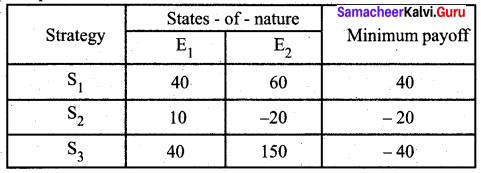
(i) Maximin principle
Samacheer Kalvi 12th Business Maths Solutions Chapter 10 Operations Research Ex 10.3 Q1.1
Max (40, -20, -40) = 40. Since the maximum pay-off is Rs.40, the best strategy is S1 according to maximin rule.
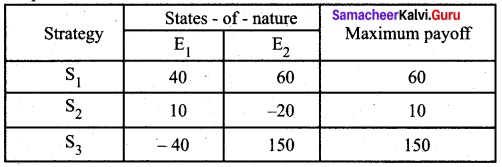
(ii) Minimax principle
Samacheer Kalvi 12th Business Maths Solutions Chapter 10 Operations Research Ex 10.3 Q1.2
Min (60, 10, 150) = 10. Since the minimum pay- off is Rs. 10, the best strategy is S2 according to minimax rule.

Samacheer Kalvi 12th Business Maths Solutions Chapter 10 Operations Research Ex 10.3

Question 2.
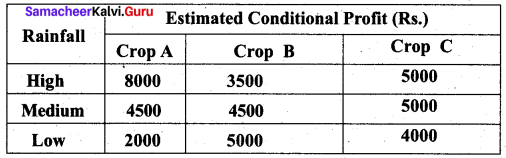
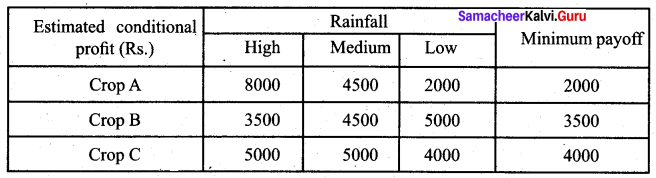
A farmer wants to decide which of the three crops he should plant on his 100-acre farm. The profit from each is dependent on the rainfall during the growing season. The farmer has categorized the amount of rainfall as high, medium and low. His estimated profit for each is shown in the table.
Samacheer Kalvi 12th Business Maths Solutions Chapter 10 Operations Research Ex 10.3 Q2
If the farmer wishes to plant the only crop, decide which should be his best crop using (i) Maximin (ii) Minimax
Solution:
(i) Maximin principle
Samacheer Kalvi 12th Business Maths Solutions Chapter 10 Operations Research Ex 10.3 Q2.1
Max (2000, 3500, 4000) = 4000. Since the maximum profit is Rs. 4000, he must choose crop C as the best crop.
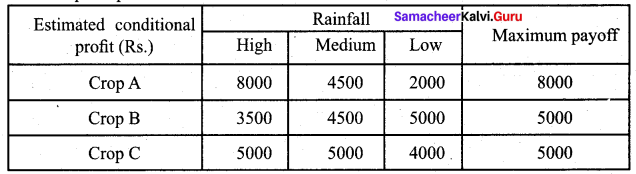
(ii) Minimax principle
Samacheer Kalvi 12th Business Maths Solutions Chapter 10 Operations Research Ex 10.3 Q2.2
Min (8000, 5000, 5000) = 5000. Since the minimum cost is Rs.5000, he can choose crop B and crop C as the best crop.

Samacheer Kalvi 12th Business Maths Solutions Chapter 10 Operations Research Ex 10.3

Question 3.
The research department of Hindustan Ltd. has recommended paying the marketing department to launch a shampoo of three different types. The marketing types of shampoo to be launched under the following estimated pay-offs for various level of sales.
Samacheer Kalvi 12th Business Maths Solutions Chapter 10 Operations Research Ex 10.3 Q2
What will be the marketing manager’s decision if (i) Maximin and (ii) Minimax principle applied?
Solution:
(i) Maximin principle
Samacheer Kalvi 12th Business Maths Solutions Chapter 10 Operations Research Ex 10.3 Q3.1
Max (10, 5, 3) = 10. Since the maximum pay-off is 10 units, the marketing manager has to choose Egg shampoo by Maximin rule.
(ii) Minimax principle
Samacheer Kalvi 12th Business Maths Solutions Chapter 10 Operations Research Ex 10.3 Q3.2
Min (30, 40, 55) = 30. Since the minimum pay-off is 30 units, the marketing manager has to choose Egg shampoo by minimax rule.

Samacheer Kalvi 12th Business Maths Solutions Chapter 10 Operations Research Ex 10.3

Question 4.
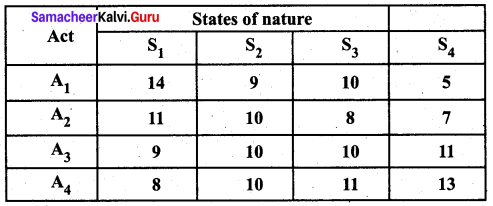
Following pay-off matrix, which is the optimal decision under each of the following rule (i) Maximin (ii) Minimax
Samacheer Kalvi 12th Business Maths Solutions Chapter 10 Operations Research Ex 10.3 Q4
Solution:
(i) Maximin principle
Samacheer Kalvi 12th Business Maths Solutions Chapter 10 Operations Research Ex 10.3 Q4.1
Max (5, 7, 9, 8) = 9. Since the maximum pay-off is 9, the optimal decision is A3 according to maximin rule.
(ii) Minimax principle
Samacheer Kalvi 12th Business Maths Solutions Chapter 10 Operations Research Ex 10.3 Q4.2
Min (14, 11, 11, 13) = 11. Since the minimum pay-off is 11, the optimal decision A2 and A3 according to minimax rule.

Samacheer Kalvi 12th Business Maths Solutions Chapter 10 Operations Research Ex 10.3 Read More »

Samacheer Kalvi 12th Business Maths Solutions Chapter 8 Sampling Techniques and Statistical Inference Ex 8.2

Students can download 12th Business Maths Chapter 8 Sampling Techniques and Statistical Inference Ex 8.2 Questions and Answers, Samacheer Kalvi 12th Business Maths Book Solutions Guide Pdf helps you to revise the complete Tamilnadu State Board New Syllabus and score more marks in your examinations.

Tamilnadu Samacheer Kalvi 12th Business Maths Solutions Chapter 8 Sampling Techniques and Statistical Inference Ex 8.2

Question 1.
Mention two branches of statistical inference?
Solution:
The two branches of statistical inference are estimation and testing of hypothesis.

Question 2.
What is an estimator?
Answer:
An estimator is a statistic that is used to infer the value of an unknown population parameter in a statistical model. The estimator is a function of the data arid so it is also a random variable.

Samacheer Kalvi 12th Business Maths Solutions Chapter 8 Sampling Techniques and Statistical Inference Ex 8.2

Question 3.
What is an estimate?
Solution:
Any specific numerical value of the estimator is called an estimate. For example, sample means are used to estimate population means.

Question 4.
What is point estimation?
Solution:
Point estimation involves the use of sample data to calculate a single value which is to serve as a best estimate of an unknown population parameter. For example the mean height of 145 cm from a sample of 15 students is‘a point estimate for the mean height of the class of 100 students.

Samacheer Kalvi 12th Business Maths Solutions Chapter 8 Sampling Techniques and Statistical Inference Ex 8.2

Question 5.
What is interval estimation?
Solution:
Interval estimation is the use of sample data to calculate an interval of possible values of an unknown population parameter. For example the interval estimate for the population mean is (101.01, 102.63).This gives a range within which the population mean is most likely to be located.

Question 6.
What is confidence interval?
Solution:
A confidence interval L a type of interval estimate, computed from the statistics of the observed data, that might contain the true value of an unknown population parameter. The numbers at the upper and lower end of a confidence interval are called confidence limits. For example, if mean is 7.4 with confidence interval (5.4, 9.4), then the numbers 5.4 and 9.4 are the confidence limits.

Question 7.
What is null hypothesis? Give an example.
Solution:
A null hypothesis is a type of hypothesis, that proposes that no statistical significance exists in a set of given observations. For example, let the average time to cook a specific dish is 15 minutes. The null hypothesis would be stated as “The population mean is equal to 15 minutes”, (i.e) H0 : µ = 15

Samacheer Kalvi 12th Business Maths Solutions Chapter 8 Sampling Techniques and Statistical Inference Ex 8.2

Question 8.
Define the alternative hypothesis.
Solution:
The alternative hypothesis is the hypothesis that is contrary to the null hypothesis and it is denoted by H1.
For example if H1 : µ = 15, then the alternative hypothesis will be : H1 : µ ≠ 15, (or) H1 : µ < 15 (or) H1 : µ > 15.

Question 9.
Define the critical region.
Solution:
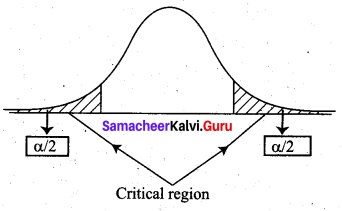
The critical region is the region of values that corresponds to the rejection of the null hypothesis at some chosen probability level. For the two-tailed test, the critical region is given below.
Samacheer Kalvi 12th Business Maths Solutions Chapter 8 Sampling Techniques and Statistical Inference Ex 8.2 Q9
where α is the level of significance.

Question 10.
Define critical value.
Solution:
A critical value is a point on the test distribution that is compared to the test statistic to determine whether to reject the null hypothesis. It depends on the level of significance. For example, if the confidence level is 90% then the critical value is 1.645.

Question 11.
Define the level of significance
Solution:
The level of significance is defined as the probability of rejecting a null hypothesis by the test when it is really true, which is denoted as α. That is P(Type 1 error) = α. For example, the level of significance 0.1 is related to the 90% confidence level.

Samacheer Kalvi 12th Business Maths Solutions Chapter 8 Sampling Techniques and Statistical Inference Ex 8.2

Question 12.
What is a type I error?
Solution:
In statistical hypothesis testing, a Type f error is the rejection of a true null hypothesis. Example of Type I errors includes a test that shows a patient to have a disease when he does not have the disease, a fire alarm going on indicating a fire when there is no fire (or) an experiment indicating that medical treatment should cure a disease when in fact it does not.

Question 13.
What is the single-tailed test?
Solution:
A single-tailed test or a one-tailed test is a statistical test in which the critical area of a distribution is one-sided so that it is either greater than or less than a certain value, but not both. For the null hypothesis H0 : µ = 16.91, the alternative hypothesis H1 : µ > 16.91 or H1 : µ < 16.91 are one-tailed tests.

Question 14.
A sample of 100 items, draw from a universe with mean value 4 and S.D 3, has a mean value 3.5. Is the difference in the mean significant?
Solution:
Given Sample size n = 100
Sample mean \(\bar{x}\) = 3.5
Population mean µ = 4
Population SD σ = 3
Now, null hypothesis H0 : µ = 4
Alternative hypothesis H1 : µ ≠ 4 (Two tail)
We take level of significance α = 5% = 0.05
The table value \(\mathrm{Z}_{\alpha / 2}\) = 1.96
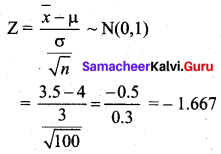
Test statistic
Samacheer Kalvi 12th Business Maths Solutions Chapter 8 Sampling Techniques and Statistical Inference Ex 8.2 Q14
Since the alternative hypothesis is of the two-tailed test we can take |Z| = 1.667. We observe that 1.667 < 1.96 (i.e) |Z| < \(\mathrm{Z}_{\alpha / 2}\). So at 5% level of significance, the null hypothesis H0 is accepted. Therefore, we conclude that there is no significant difference between the sample mean and the population mean.

Samacheer Kalvi 12th Business Maths Solutions Chapter 8 Sampling Techniques and Statistical Inference Ex 8.2

Question 15.
A sample of 400 individuals is found to have a mean height of 67.47 inches. Can it be reasonably regarded as a sample from a large population with a mean height of 67.39 inches and standard deviation of 1.30 inches?
Solution:
Given Sample size n = 400
Sample mean \(\bar{x}\) = 67.47
Population mean µ = 67.39
Population SD σ = 1.3
Null hypothesis H0 : µ = 67.39 inches
(the sample has been drawn from the population with mean heights 67.39 inches)
Alternative hypothesis H1 : µ ≠ 67.39 inches
(the sample has not been drawn from the population with mean height 67.39 inches)
The level of significance α = 5% = 0.05
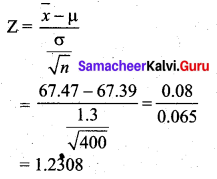
Test statistic
Samacheer Kalvi 12th Business Maths Solutions Chapter 8 Sampling Techniques and Statistical Inference Ex 8.2 Q15
The significant value or table value \(\mathrm{Z}_{\alpha / 2}\) = 1.96. We see that 1.2308 < 1.96 (i.e) Z < \(\mathrm{Z}_{\alpha / 2}\). Since the calculated value is less than the table value at 5% level of significance, the null hypothesis is accepted. Hence we conclude that the data does not provide us with any evidence against the null hypothesis. Thus, the sample has been drawn from a large population with a mean height of 67.39 inches and S.D 1.3 inches.

Question 16.
The average score on a nationally administered aptitude test was 76 and the corresponding standard deviation was 8. In order to evaluate a state’s education system, the scores of 100 of the state’s students were randomly selected. These students had an average score of 72. Test at a significance level of 0.05 if there is a significant difference between the state scores and the national scores.
Solution:
Given Population mean µ = 76
Population SD σ = 8
Sample size n = 100
Sample mean \(\bar{x}\) = 72
Significance level α = 0.05
Null hypothesis H0 : µ = 76
(i.e) there is no difference between the state scores and the national scores.
Alternative hypothesis H1 : µ ≠ 76
(i.e) there is a significant difference between the state scores and the nationals scores of the aptitude test.
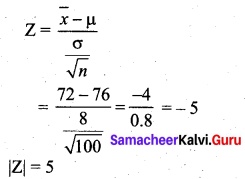
Test statistic
Samacheer Kalvi 12th Business Maths Solutions Chapter 8 Sampling Techniques and Statistical Inference Ex 8.2 Q16
The significant value or table value \(\mathrm{Z}_{\alpha / 2}\) = 1.96. Comparing the calculated value and table value, we find that |Z| > \(\mathrm{Z}_{\alpha / 2}\) (i.e) 5 > 1.96. So the null hypothesis is rejected and we accept the alternative hypothesis. So we conclude that at the significance level of 5%, there is a difference between the state scores and the national scores of the nationally administered amplitude test.

Samacheer Kalvi 12th Business Maths Solutions Chapter 8 Sampling Techniques and Statistical Inference Ex 8.2

Question 17.
The mean breaking strength of cables supplied by a manufacturer is 1,800 with a standard deviation of 100. By a new technique in the manufacturing process it is claimed that the breaking strength of the cables has increased. In order to test this claim a sample of 50 cables is tested. It is found that the mean breaking strength is 1,850. Can you support the claim at 0.01 level of significance?
Solution:
Given Population mean µ = 1800
Population SD σ = 100
Sample size n = 50
Sample mean \(\bar{x}\) = 1850
Significance level α = 0.01
Null hypothesis H0 : µ = 1800
(i.e) the breaking strength of the cables has not increased, after the new technique in the manufacturing process.
Alternative hypothesis H1 : µ > 1800 (i.e) the new technique was successful.
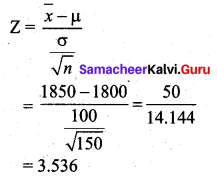
Test statistic
Samacheer Kalvi 12th Business Maths Solutions Chapter 8 Sampling Techniques and Statistical Inference Ex 8.2 Q17
The table value for the one-tailed test is Zα = 2.33.
Comparing the calculated value and table value, we find that Z > Zα (i.e.) 3.536 > 2.33.

Inference: Since the calculated value is greater than the table value at 1 % level of significance, the null hypothesis is rejected and we accept the alternative hypothesis. We conclude that by the new technique in the manufacturing process the breaking strength of the cables is increased. So the claim is supported at 0.01 level of significance.

Samacheer Kalvi 12th Business Maths Solutions Chapter 8 Sampling Techniques and Statistical Inference Ex 8.2 Read More »

Samacheer Kalvi 12th Business Maths Solutions Chapter 3 Integral Calculus II Ex 3.4

Students can download 12th Business Maths Chapter 3 Integral Calculus II Ex 3.4 Questions and Answers, Samacheer Kalvi 12th Business Maths Book Solutions Guide Pdf helps you to revise the complete Tamilnadu State Board New Syllabus and score more marks in your examinations.

Tamilnadu Samacheer Kalvi 12th Business Maths Solutions Chapter 3 Integral Calculus II Ex 3.4

Choose the correct answer form the given alternatives.

Question 1.
Area bounded by the curve y = x(4 – x) between the limits 0 and 4 with x-axis is ________
(a) \(\frac{30}{3}\) sq.units
(b) \(\frac{31}{2}\) sq.units
(c) \(\frac{32}{3}\) sq.units
(d) \(\frac{15}{2}\) sq.units
Answer:
(c) \(\frac{32}{3}\) sq.units
Hint:
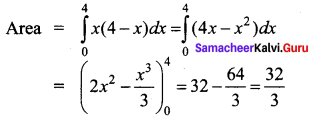
Samacheer Kalvi 12th Business Maths Solutions Chapter 3 Integral Calculus II Ex 3.4 Q1

Question 2.
Area bounded by the curve y = e-2x between the limits 0 ≤ x ≤ ∞ is ______
(a) 1 sq.units
(b) \(\frac{1}{2}\) sq.unit
(c) 5 sq.units
(d) 2 sq.units
Answer:
(b) \(\frac{1}{2}\) sq.unit
Hint:
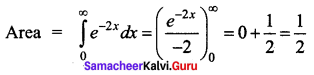
Samacheer Kalvi 12th Business Maths Solutions Chapter 3 Integral Calculus II Ex 3.4 Q2

Question 3.
Area bounded by the curve y = \(\frac{1}{x}\) between the limits 1 and 2 is ________
(a) log 2 sq.units
(b) log 5 sq.units
(c) log 3 sq.units
(d) log 4 sq.units
Answer:
(a) log 2 sq.units
Hint:
Area A = \(\int _{1}^{2}\) ydx = \(\int _{1}^{2}\) \(\frac { 1 }{x}\) dx = [log x]\(_{1}^{2}\)
= log 2 – log 1 = log (2/1) = log (2)

Question 4.
If the marginal revenue function of a firm is MR = \(e^{\frac{-x}{10}}\), then revenue is ______
(a) \(-10 e^{\frac{-x}{10}}\)
(b) \(1-e^{\frac{-x}{10}}\)
(c) \(10\left(1-e^{\frac{-x}{10}}\right)\)
(d) \(e^{\frac{-x}{10}}+10\)
Answer:
(c) \(10\left(1-e^{\frac{-x}{10}}\right)\)
Hint:
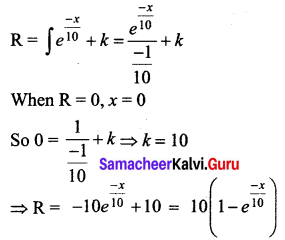
Samacheer Kalvi 12th Business Maths Solutions Chapter 3 Integral Calculus II Ex 3.4 Q4

Question 5.
If MR and MC denotes the marginal revenue and marginal cost functions, then the profit functions is ________
(a) P = ∫(MR – MC) dx + k
(b) P = ∫(MR + MC) dx + k
(c) P = ∫(MR) (MC) dx + k
(d) P = ∫(R – C) dx + k
Answer:
(a) P = ∫(MR – MC) dx + k
Hint:
Profit = Revenue – Cost

Question 6.
The demand and supply functions are given by D(x) = 16 – x2 and S(x) = 2x2 + 4 are under perfect competition, then the equilibrium price x is ________
(a) 2
(b) 3
(c)4
(d) 5
Answer:
(a) 2
Hint:
D(x) = 16 – x2 , S(x) = 2x2 + 4
Under equilibriuim, D(x) = S(x)
⇒ 16 – x2 = 2x2 + 4
⇒ 3x2 = 12
⇒ x = ±2.
Since x cannot be negative x = 2.

Question 7.
The marginal revenue and marginal cost functions of a company are MR = 30 – 6x and MC = -24 + 3x where x is the product, then the profit function is _______
(a) 9x2 + 54x
(b) 9x2 – 54x
(c) 54x – \(\frac{9 x^{2}}{2}\)
(d) 54x – \(\frac{9 x^{2}}{2}\) + k
Answer:
(d) 54x – \(\frac{9 x^{2}}{2}\) + k
Hint:
Profit P = ∫(MR – MC) dx
= ∫[(30 – 6x) – (-24 + 3x)] dx
= ∫(30 – 6x + 24 – 3x) dx
= ∫(54 – 9x) dx = 54x – \(\frac { 9x^2 }{2}\) + k

Question 8.
The given demand and supply function are given by D(x) = 20 – 5x and S(x) = 4x + 8 if they are under perfect competition then the equilibrium demand is _______
(a) 40
(b) \(\frac{41}{2}\)
(c) \(\frac{40}{3}\)
(d) \(\frac{41}{5}\)
Answer:
(c) \(\frac{40}{3}\)
Hint:
D(x) = S(x) in equilibrium
20 – 5x = 4x + 8
9x = 12
x = \(\frac{4}{3}\) = x0
p0 = 20 – 5(\(\frac{4}{3}[/ltex])
= 20 – [latex]\frac{20}{3}\)
= \(\frac{40}{3}\)

Question 9.
If the marginal revenue MR = 35 + 7x – 3x2, then the average revenue AR is _______
(a) 35x + \(\frac{7 x^{2}}{2}\) – x3
(b) 35x + \(\frac{7 x}{2}\) – x2
(c) 35 + \(\frac{7 x}{2}\) + x2
(d) 35 + 7x + x2
Answer:
(b) 35x + \(\frac{7 x}{2}\) – x2
Hint:
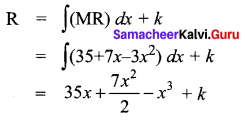
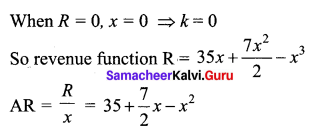
Samacheer Kalvi 12th Business Maths Solutions Chapter 3 Integral Calculus II Ex 3.4 Q9
Samacheer Kalvi 12th Business Maths Solutions Chapter 3 Integral Calculus II Ex 3.4 Q9.1

Question 10.
The profit of a function p(x) is maximum when _______
(a) MC – MR = 0
(b) MC = 0
(c) MR = 0
(d) MC + MR = 0
Answer:
(a) MC – MR = 0
Hint:
P = Revenue – Cost
P is maximum when \(\frac{d p}{d x}\) = 0
\(\frac{d p}{d x}\) = R'(x) – C'(x) = MR – MC = 0

Question 11.
For the demand function p(x), the elasticity of demand with respect to price is unity then ________
(a) revenue is constant
(b) cost function is constant
(c) profit is constant
(d) none of these
Answer:
(a) revenue is constant
Hint:
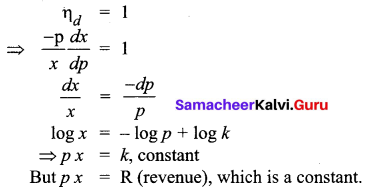
Samacheer Kalvi 12th Business Maths Solutions Chapter 3 Integral Calculus II Ex 3.4 Q11

Question 12.
The demand function for the marginal function MR = 100 – 9x2 is _______
(a) 100 – 3x2
(b) 100x – 3x2
(c) 100x – 9x2
(d) 100 + 9x2
Answer:
(a) 100 – 3x2
Hint:
R = ∫MR dx = ∫(100 – 9x²) dx
R = 100x – \(\frac { 9x^3 }{3}\) + k
when x = 0, R = 0, then k = 0
∴ R = 100x – 3x³
Demand function
p = \(\frac { R }{x}\) = \(\frac { 100x – 3x^3 }{x}\) = 100 – 3x²

Question 13.
When x0 = 5 and p0 = 3 the consumer’s surplus for the demand function pd = 28 – x2 is _______
(a) 250 units
(b) \(\frac{250}{3}\) units
(c) \(\frac{251}{2}\) units
(d) \(\frac{251}{3}\) units
Answer:
(b) \(\frac{250}{3}\) units
Hint:
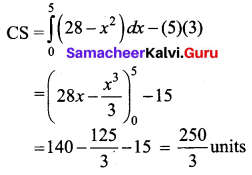
Samacheer Kalvi 12th Business Maths Solutions Chapter 3 Integral Calculus II Ex 3.4 Q13

Question 14.
When x0 = 2 and P0 = 12 the producer’s surplus for the supply function Ps = 2x2 + 4 is _______
(a) \(\frac{31}{5}\) units
(b) \(\frac{31}{2}\) units
(c) \(\frac{32}{3}\) units
(d) \(\frac{30}{7}\) units
Answer:
(c) \(\frac{32}{3}\) units
Hint:
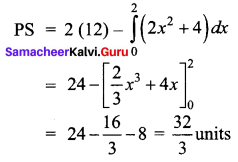
Samacheer Kalvi 12th Business Maths Solutions Chapter 3 Integral Calculus II Ex 3.4 Q14

Question 15.
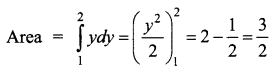
Area bounded by y = x between the lines y = 1, y = 2 with y-axis is ______
(a) \(\frac{1}{2}\) sq.units
(b) \(\frac{5}{2}\) sq.units
(c) \(\frac{3}{2}\) sq.units
(d) 1 sq.unit
Answer:
(c) \(\frac{3}{2}\) sq.units
Hint:
Samacheer Kalvi 12th Business Maths Solutions Chapter 3 Integral Calculus II Ex 3.4 Q15

Question 16.
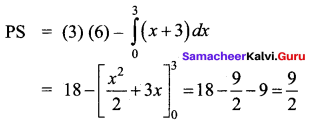
The producer’s surplus when the supply function for a commodity is P = 3 + x and x0 = 3 is _______
(a) \(\frac{5}{2}\)
(b) \(\frac{9}{2}\)
(c) \(\frac{3}{2}\)
(d) \(\frac{7}{2}\)
Ans:
(b) \(\frac{9}{2}\)
Hint:
x0 = 3, p = 3 + x ⇒ p0 = 3 + 3 = 6
Samacheer Kalvi 12th Business Maths Solutions Chapter 3 Integral Calculus II Ex 3.4 Q16

Question 17.
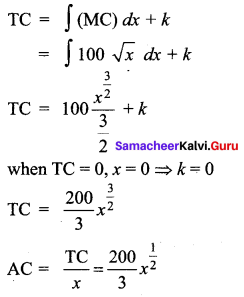
The marginal cost function is MC = 100√x. find AC given that TC = 0 when the output is zero is ______
(a) \(\frac{200}{3} x^{\frac{1}{2}}\)
(b) \(\frac{200}{3} x^{\frac{3}{2}}\)
(c) \(\frac{200}{3 x^{\frac{3}{2}}}\)
(d) \(\frac{200}{3 x^{\frac{1}{2}}}\)
Answer:
(a) \(\frac{200}{3} x^{\frac{1}{2}}\)
Hint:
Samacheer Kalvi 12th Business Maths Solutions Chapter 3 Integral Calculus II Ex 3.4 Q17

Question 18.
The demand and supply function of a commodity are P(x) = (x – 5)2 and S(x) = x2 + x + 3 then the equilibrium quantity x0 is ________
(a) 5
(b) 2
(c) 3
(d) 19
Answer:
(b) 2
Hint:
P(x) = S(x)
(x – 5)² = x² + x + 3
x² – 10x + 25 = x² + x + 3
⇒ 25 – 3 = x + 10x
⇒ 11x = 22
⇒ x = 2

Question 19.
The demand and supply function of a commodity are D(x) = 25 – 2x and S(x) = \(\frac{10+x}{4}\) then the equilibrium price p0 is _________
(a) 5
(b) 2
(c) 3
(d) 10
Answer:
(a) 5
Hint:
At market equilibrium, D(x) = S(x)
25x – 2x = \(\frac { 10+x }{4}\) ⇒ 4(25 – 2x) = 10 + x
100 – 8x = 10 + x ⇒ 100 – 10 = x + 8x
9x = 90 ⇒ x = 10
when x = 10 P = 25 – 2 (10) = 25 – 20 = 5

Question 20.
If MR and MC denote the marginal revenue and marginal cost and MR – MC = 36x – 3x2 – 81, then the maximum profit at x is equal to _______
(a) 3
(b) 6
(c) 9
(d) 5
Answer:
(c) 9
Hint:
The maximum profit occurs when MR – MC = 0
⇒ 36x – 3x2 – 81 = 0
⇒ x2 – 12x + 27 = 0
⇒ (x – 9)(x – 3) = 0
⇒ x = 9, 3
Now \(\frac{d p}{d x}\) = 36x – 3x2 – 81 ⇒ \(\frac{d^{2} p}{d x^{2}}\) = 36 – 9x
At x = 9, \(\frac{d^{2} p}{d x^{2}}\) = 36 – 81 < 0
At x = 3, \(\frac{d^{2} p}{d x^{2}}\) = 36 – 27 > 0
Therefore profit is maximum when x = 9.

Question 21.
If the marginal revenue of a firm is constant, then the demand function is ________
(a) MR
(b) MC
(c) C(x)
(d) AC
Answer:
(a) MR
Hint:
MR = k (constant)
Revenue function R = ∫(MR) dx + c1
= ∫kdx + c1
= kx + c1
When R = 0, x = 0, ⇒ c1 = 0
R = kx
Demand function p = \(\frac{R}{x}=\frac{k x}{x}\) = k constant
⇒ p = MR

Question 22.
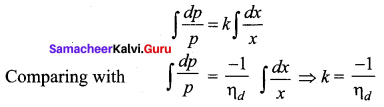
For a demand function p, if \(\int \frac{d p}{p}=k \int \frac{d x}{x}\) then k is equal to _______
(a) ηd
(b) -ηd
(c) \(\frac{-1}{\eta_{d}}\)
(d) \(\frac{1}{\eta_{d}}\)
Answer:
(c) \(\frac{-1}{\eta_{d}}\)
Hint:
Samacheer Kalvi 12th Business Maths Solutions Chapter 3 Integral Calculus II Ex 3.4 Q22

Question 23.
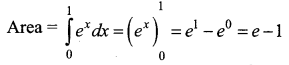
Area bounded by y = ex between the limits 0 to 1 is _________
(a) (e – 1) sq.units
(b) (e + 1) sq.units
(c) (1 – \(\frac{1}{e}\)) sq.units
(d) (1 + \(\frac{1}{e}\)) sq.units
Answer:
(a) (e – 1) sq.units
Hint:
Samacheer Kalvi 12th Business Maths Solutions Chapter 3 Integral Calculus II Ex 3.4 Q23

Question 24.
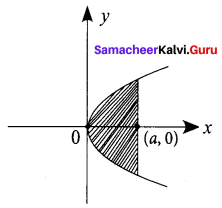
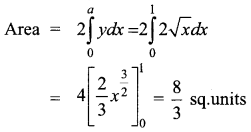
The area bounded by the parabola y2 = 4x bounded by its latus rectum is _______
(a) \(\frac{16}{3}\) sq.units
(b) \(\frac{8}{3}\) sq.units
(c) \(\frac{72}{3}\) sq.units
(d) \(\frac{1}{3}\) sq.units
Answer:
(b) \(\frac{8}{3}\) sq.units
Hint:
y2 = 4x
Comparing with y2 =4ax gives a = 1
Since parabola is symmetric about x – axis,
Samacheer Kalvi 12th Business Maths Solutions Chapter 3 Integral Calculus II Ex 3.4 Q24
Samacheer Kalvi 12th Business Maths Solutions Chapter 3 Integral Calculus II Ex 3.4 Q24.1

Question 25.
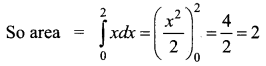
Area bounded by y = |x| between the limits 0 and 2 is _______
(a) 1 sq.units
(b) 3 sq.units
(c) 2 sq.units
(d) 4 sq.units
Answer:
(c) 2 sq.units
Hint:
When x lies between 0 and 2
|x| = x
Samacheer Kalvi 12th Business Maths Solutions Chapter 3 Integral Calculus II Ex 3.4 Q25
Area = 2 sq.units

Samacheer Kalvi 12th Business Maths Solutions Chapter 3 Integral Calculus II Ex 3.4 Read More »

Tamil Nadu 11th Commerce Model Question Paper 5 English Medium

Students can Download Tamil Nadu 11th Commerce Model Question Paper 5 English Medium Pdf, Tamil Nadu 11th commerce Model Question Papers helps you to revise the complete Tamilnadu State Board New Syllabus and score more marks in your examinations.

TN State Board 11th Commerce Model Question Paper 5 English Medium

Instructions:

  1.  The question paper comprises of four parts.
  2.  You are to attempt all the parts. An internal choice of questions is provided wherever applicable.
  3. questions of Part I, II. III and IV are to be attempted separately
  4. Question numbers 1 to 20 in Part I are objective type questions of one -mark each. These are to be answered by choosing the most suitable answer from the given four alternatives and writing the option code and the corresponding answer
  5. Question numbers 21 to 30 in Part II are two-marks questions. These are to be answered in about one or two sentences.
  6. Question numbers 31 to 40 in Parr III are three-marks questions, These are to be answered in about three to five short sentences.
  7. Question numbers 41 to 47 in Part IV are five-marks questions. These are to be answered) in detail. Draw diagrams wherever necessary.

Time: 2\(\frac{1}{2}\) Hours
Maximum Marks: 90

Part – I

Choose the correct answer. Answer all the questions: [20 × 1 = 20]

Question 1.
The Reserve Bank of India commenced its operations from April 1 ………………..
(a) 1936
(b) 1935
(c) 1934
(d)1923
Answer:
(b) 1935

Tamil Nadu 11th Commerce Model Question Paper 5 English Medium

Question 2.
What kind of tax is the GST?
(a) Direct tax
(b) Indirect tax
(c) Debenture on the type of goods and services
(d) All of the above
Answer:
(b) Indirect tax

Question 3.
Who wrote “Arthasasthra”?
(a) Kautilya
(b) Chanakya
(c) Thiruvalluvar
(d) Elangovadigal
Answer:
(a) Kautilya

Question 4.
Which is not a division of activities based on the ownership?
(a) Private enterprise
(b) Foreign enterprise
(c) Public enterprise
(d) Joint enterprise
Answer:
(b) Foreign enterprise

Question 5.
The board of directors of a company is elected by ………………
(a) creditors
(b) debtors
(c) debenture holders
(d) share holders
Answer:
(d) share holders

Tamil Nadu 11th Commerce Model Question Paper 5 English Medium

Question 6.
Enterprises operating in several countries but managed from one country is termed as ………………
(a) Government company
(b) Multinational company
(c) Private company
(d) Joint venture
Answer:
(b) Multinational company

Question 7.
The traditional functions of RBI are ………………
(i) Monopoly of note issue
(ii) Monetary authority
(iii) Regulating Banking System
(iv) Banker’s Bank
(a) (i) and (ii)
(b) (i) and (iii)
(c) (i) and (iv)
(d) (ii) and (iv)
Answer:
(c) (i) and (iv)

Question 8.
Which of the following is not applicable in insurance contract?
(a) Unilateral contract
(b) Conditional contract
(c) Indemnity contract
(d) Inter-personal contract
Answer:
(c) Indemnity contract

Question 9.
The advantages of sole trading are ………………
(i) easy formation
(ii) limited capital
(iii) flexibility
(iv) hasty decision
(a) (i) and (ii)
(b) (i) and (iii)
(c) (ii) and (iv)
(d) (i) and (iv)
Answer:
(b) (i) and (iii)

Tamil Nadu 11th Commerce Model Question Paper 5 English Medium

Question 10.
Air consignment note is prepared in ……………. forms.
(a) One
(b) Two
(c) Three
(d) Four
Answer:
(c) Three

Question 11.
Match List – I with List – II and select the correct answer using the codes given below:
List – I
(i)  Barter system
(ii) Bank official
(iii) Sole trading
(iv) Joint Hindu family

List – II
(1) Employment
(2) Invention of money
(3) Co-parcener
(4) Non-corporate enterprise
code:
(a) (i) 2, (ii) 1, (iii) 4, (iv) 3
(b) (i) 1, (ii) 2, (iii) 3, (iv) 4
(c) (i) 4, (ii) 2, (iii) 3, (iv) 1
(d) (i) 3, (ii) 2, (iii) 1, (iv) 4
Answer:
(a) (i) 2, (ii) 1, (iii) 4, (iv) 3

Question 12.
The role of government in logistics management is through ………………..
(a) Legislations
(b) Governance
(c) Transport
(d) Distribution
Answer:
(d) Distribution

Question 13.
Which of the following holder is given voting right?
(a) Debentures
(b) Preference shares
(c) Equity shares
(d) Bonds
Answer:
(c) Equity shares

Question 14.
Who is the last middleman in the channel of distribution?
(a) Wholesaler
(b) Producer
(c) Retailer
(d) Customer
Answer:
(c) Retailer

Tamil Nadu 11th Commerce Model Question Paper 5 English Medium

Question 15.
……………….. warehouses are licensed by the government and are permitted to accept the goods on bond.
(a) Bonded
(b) Cold storage
(c) Public
(d) All of the above
Answer:
(a) Bonded

Question 16.
Which one of the following is correctly matched?
(a) Life insurance – Nearest cause
(b) Causa proxima – Life assurance
(c) Health insurance – Life Insurance
(d) Motor vehicle insurance – Mediciaim policy
Answer:
(d) Motor vehicle insurance – Mediciaim policy

Question 17.
The features of partnership are ………………
(i) contractual relationship
(ii) limited liability
(iii) mutual agency
(iv) common seal
(a) (i) and (ii)
(b) (i) and (iii)
(c) (ii) and (iv)
(d) (ii) and (iii)
Answer:
(b) (i) and (iii)

Question 18.
Which is not a Regional Rural Bank ?
(a) Pallavan Grama Bank
(b) Valluvar Grama Bank
(c) Pandian Grama Bank
(d) Indian Bank
Answer:
(d) Indian Bank

Question 19.
From the following which one is non-corporate form of business?
(a) Joint stock company
(b) Sole Trading Business
(d) Government Company
(d) Co-operatives
Answer:
(b) Sole Trading Business

Tamil Nadu 11th Commerce Model Question Paper 5 English Medium

Question 20.
Outsource is carried out for the benefit of ………….
(a) global village
(b) transport
(c) factory
(d) time and money
Answer:
(d) time and money

Part-II

Answer any seven questions in which Question No. 30 is compulsory. [7 x 2 = 14]

Question 21.
Mention any four examples of MNC.
Answer:

  1. Coca-cola corporation
  2. Unilever Ltd
  3. Sony corporation
  4. IBM

Question 22.
What is meant by Marine Insurance?
Answer:
Marine insurance is a contract of insurance under which the insurer undertakes to indemnify the insured against marine losses. The insured pays the premium for the insurer’s guarantee to make good the losses arising from marine perils. Marine perils may be damage of ship, fire, etc.

Question 23.
Give some examples of sole trading business.
Answer:
Saravana Stores, Hotel Saravana Bhavan, grocery stores, petty shops, etc.

Tamil Nadu 11th Commerce Model Question Paper 5 English Medium

Question 24.
It is a document involved in export trade. It is issued by the captain of the ship. What does it mean? Write a short note about this.
Answer:
This document is Mate’s Receipt. It is issued by the captain of the ship acknowledging the receipt of goods on board by him to the port of specified destination. This contains details like quantity of goods shipped and number of packages condition for packing, etc.

Question 25.
What is meant by private company?
Answer:
Private limited company is a type of company which is formed with minimum two shareholders and two directors, the minimum requirement with respect to authorised or paid up capital of Rs. 1,00,000 has been omitted by the Companies (Amendment) Act, 2015 w.e.f 29th of May, 2015. Another crucial condition of a private limited company is that it by its articles of association restricts the right to transfer its shares and also prohibits any invitation to the public to subscribe for any securities of the company.

Question 26.
It is a private sector bank. It is also called as non-banking financial companies. What is the name of the bank? Mention any two objectives of the bank.
Answer:
The name of the bank is Small Finance Banks (SFBs). It is a private sector bank. Objectives:

  • Mobilising rural savings (accepting deposits).
  • Providing credit to farmers and small industries.

Question 27.
Give the meaning of trade.
Answer:
The buying and selling of goods and services consists of trade. Trade is conducted in order to earn profit.

Question 28.
Human activity is divided into:

  1. economic activity
  2. non-economic activity.

What is meant by non-economic activity? Mention two examples of this.
Answer:
Activities undertaken to satisfy social and psychological needs are called non-economic activities.
Examples – cooking food for family, celebrating festivals, etc.

Question 29.
What do you mean by Articles of Association?
Answer:
Articles of Association is a secondary document which contains the purpose, duties and responsibilities of the members. It has to be filed with the registrar of companies at the time of forming the company. It contains the details of the internal management of the company.

Tamil Nadu 11th Commerce Model Question Paper 5 English Medium

Question 30.
Who is a franchisee?
Answer:
The individual who acquires the right to operate the business or use the trademark of the seller is known as the franchisee.

Part-III

Answer any seven questions in which Question No. 40 is compulsory. [7 x 3 = 21]

Question 31.
Explain any three objectives of IMF.
Answer:
International Monetary Fund (IMF) is an international organisation, having headquarters in Washington DC.
Objectives:

  • Promoting international monetary co-operation.
  • Ensuring balanced international trade.
  • Ensuring exchange rate stability.

Question 32.
Trade between buyer and seller of different countries is called foreign trade. It is also called international trade. What is the classification of foreign trade?
Answer:
On the basis of sale and purchase of goods and services, international or foreign trade can be divided into three types:
They are –

  • Export trade:
    Selling of goods from one country to another country.
  • Import trade:
    When a country purchases goods from another country is called import trade.
  • Entrepot trade:
    Goods are imported for the purpose of exporting is called entrepot trade.

Question 33.
What are the various kinds of social responsibilities?
Answer:

  • Economic responsibility
  • Legal responsibility
  • Ethical responsibility
  • Discretionary responsibility

Question 34.
For commencing a company, two main documents are needed. They are:

  1. Memorandum of Association,
  2. Articles of Association.

Articles of Association is a document which contains the duties and responsibilities of members. What are the contents of Articles of Association? (Any six points)
Answer:

  • Amount of shares, capital, value and type of shares.
  • Rights of each class of shareholders regarding voting, dividend, return of capital.
  • Rules regarding issue of shares and debentures.
  • Procedures as well as regulations in respect of making calls on shares.
  • Manner of transfer of shares.
  • Declaration of dividends.
  • Borrowing powers of the company.
  • Rules regarding the appointment, remuneration, removal of directors.
  • Procedure for conducting proxy, quorum, meetings, etc.
  • Procedures concerning keeping of books and audits.
  • Seal of the company.
  • Procedures regarding the winding up of the company.

Question 35.
Siva takes a policy for the non-recovery of freight.

  1. What kind of policy is this?
  2. Also write a brief note about this.

Answer:

  1. The policy is freight insurance, coming under marine insurance.
  2. A marine policy is taken to safeguard against non-recovery of freight; it is called as freight insurance. It is useful to the shipping company to collect the freight.

Question 36.
Write any three characteristics of sole trader.
Answer:

  • Ownership by one man:
    This is owned by single person. The sole trader contributes the required capital. He is not only the owner of the business but also manages the entire affairs.
  • Freedom of work and Quick Decisions:
    Since an individual is himself as a owner, he need not consult anybody else. Hence he can take quick decisions.
  • Unlimited Liability:
    When his business assets are not sufficient to pay off the business debts he has to pay from his personal property.

Question 37.
Write down the functions of IMF.
Answer:
IMF is an international organisation having head quarters at Washington DC.
Functions of IMF:

  • It acts as a short term credit institution at the international level. .
  • It provides machinery for ordinary adjustments of exchange rates.
  • It promotes economic stability and global growth by encouraging countries.

Question 38.
Why is balance of payments prepared?
Answer:
Balance of payments help in framing monetary, fiscal and trade policies of country. Government keenly observes balance of payment position of its important trade partners in making policy decisions. It reveals whether a country produces enough economic output to pay for its growth.

Tamil Nadu 11th Commerce Model Question Paper 5 English Medium

Question 39.
What is the necessity of entrepot trade?
Answer:
Meaning of Entrepot Trade:
If a country imports goods for the purpose of exporting the same goods to other country, it is known as entrepot trade. Necessity for Entrepot Trade – A country can re-export the goods for the following reasons:

  • The country may not have any accessible trade routes connecting the importing country.
  • The goods imported may require further processing before exporting. For this, some facilities may not be available in exporting or importing country.
  • There may not have any bilateral trade agreement between both the countries.
  • Importer and exporter may not share good economic relation with each other.

Question 40.
What is pledge?
Answer:
A customer transfers the possession of an article with the creditor (banker) and receives loan. Till the repayment of loan, the article is under the custody of the borrower. If the debtor fails to refund the loan, creditor (banker) will auction the article pawned and adjust the outstanding loan from the sale proceeds.

Part – IV

Answer all the questions. [7 x 5 = 35]

Question 41(a).
What is IRDAI? Explain the objectives of IRDAI.
Answer:
Insurance Regulatory Development and Authority of India is the statutory and apex body that governs, regulates and supervises the insurance in India. It was constituted in the year 2000 by Parliament of India Act called IRDAI Act, 1999.
Objectives of IRDAI:

  • To promote the interest and rights of policy holders.
  • To promote and ensure the growth of Insurance industry.
  • To ensure speedy settlement of genuine claims and to prevent frauds and malpractices.
  • To bring transparency and orderly conduct in financial markets, dealing with insurance.

[OR]

Question 41(b).
Explain the features of factoring.
Answer:

  1. Maintenance of book-debts:
    A factor takes the responsibility of maintaining the accounts of debtors of a business institution.
  2. Credit coverage:
    The factor accepts the risk burden of loss of bad debts leaving the seller to concentrate on his core business.
  3. Cash advances:
    Around eighty percent of the total amount of accounts receivables is paid as advance cash to the client.
  4. Collection service:
    Issuing reminders, receiving part payments, collection of cheques from part of the factoring service.
  5. Advice to clients:
    From the past history of debtors, the factor is able to provide advises Jregarding the credit worthiness of customers, perception of customers about the products of the client, etc.

Question 42 (a).
What are the hindrances of business? Explain any five hindrances.
Answer:
There are so many hindrances of business. They are as follows:
(1) Hindrance of Person:
The manufacturers and consumers do not know each other. It is called as hindrance of a person. It is removed by the trade or trader. The trader is connecting the producer and the consumer.

(2) Hindrance of Place:
The manufacturing place is different from the place of consumption. This difficulty is known as hindrance of place. It is removed by the transport.

(3) Hindrance of Time:
Goods are produced in one season but may be demanded throughout the year. Some goods are produced throughout the year, but may be used in certain season. It is known as hindrance of time. It is removed by the warehouse.

(4) Hindrance of risk:
Fire, theft, floods, etc., may bring huge loss to the business. It is known as hindrance of risk. It is overcome by the insurance companies.

(5) Hindrance of knowledge:
The difficulty of not knowing the place and availability of goods is known as hindrance of knowledge. It is removed by advertising and communication.

[OR]

Tamil Nadu 11th Commerce Model Question Paper 5 English Medium

Question 42 (b).
Every business enterprise has certain objectives which regulate and generate its activities. The objectives may be classified into five types. Explain the objectives of business.
Answer:
(1) Economic Objectives:
Economic objectives of business refer to the objective of earning profit and also other objectives that are necessary to be pursued to achieve the profit objective, which includes creation of customers, regular innovations and best possible use of available resources.

(2) Social Objectives:
Social objective are those objectives of business, which are desired to be achieved for the benefit of the society. Since business operates in a society by utilizing its scarce resources, the society expects something in return for its welfare

(3) Organizational Objectives:
The organizational objectives denote those objectives an organization intends to accomplish during the course of its existence in the economy like expansion and modernization, supply of quality goods to consumers, customers’ satisfaction, etc.

(4) Human Objectives:
Human objectives refer to the objectives aimed at the well-being as well as fulfillment of expectations of employees as also of people who are disabled, handicapped and deprived of proper education and training. The human objectives of business may thus include economic well-being of the employees, social and psychological satisfaction of employees and development of human resources.

(5) National Objectives:
Being an important part of the country, every business must have the objective of fulfilling national goals and aspirations.

Tamil Nadu 11th Commerce Model Question Paper 5 English Medium

Question 43 (a).
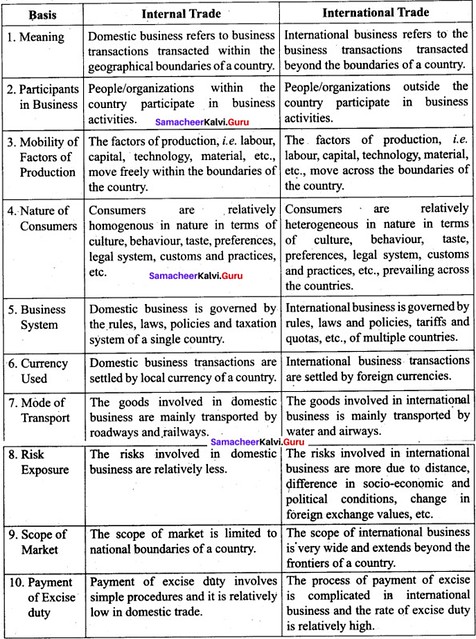
The trade takes place between the traders of one country is known as Internal trade. Whereas the trade takes place between two countries is called as International trade. Distinguish between internal trade and international trade.
Answer:
Tamil Nadu 11th Commerce Model Question Paper 5 English Medium

[OR]

Question 43 (b).
Describe the functions of IMF.
Answer:

  • It acts as short term.credit institution at the international level.
  • It provides machinery for ordinary adjustments of exchange rates.
  • It has a reservoir of currencies of the member countries from which a borrower can borrow currencies of other nations.
  • It promotes economic stability and global growth by encouraging countries adopt sound economic and financial policies.
  • It offers technical assistance and training to help member countries strengthen and implement effective policies. Technical assistance is offered in formulating banking, fiscal, monetary and exchange policies.
  • It helps member countries correct their imbalance in balance of payment.

Question 44 (a).
Describe the role of Chamber of Commerce in promotion of internal trade.
Answer:

  1. Transportation or inter-state movement of goods:
    The Chambers facilitate registration of vehicles, surface transport policies, construction of highways and roads in promoting interstate movement of goods.
  2. Harmonisation CGST and SGST structure.
  3. Marketing of agro products and related issues:
    The associations of agriculturists and other federations interact with farming co-operatives to streamline local subsidies and formulate marketing policies for selling agro products.
  4. Weights and measures and prevention of duplication of brands:
    They help the Government in formulation and implementation of uniform policies in weights and measures and prevention of duplication of brands.
  5. Promoting sound infrastructure:
    They interact with Government to construct roads, ports, electricity, railways, etc.
  6. Labour legislation:
    They interact with the Government on regular basis and the issues related to labour laws, retrenchments, compensation, etc., so that the industry can run efficiently, generate employment and achieve maximum productivity.

[OR]

Question 44 (b).
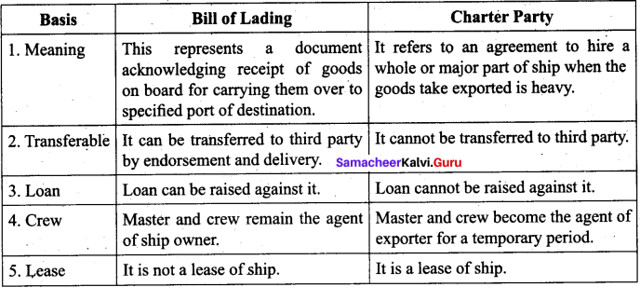
What are the differences between bill of lading and Charter party?
Answer:
Tamil Nadu 11th Commerce Model Question Paper 5 English Medium

Tamil Nadu 11th Commerce Model Question Paper 5 English Medium

Question 45 (a).
Goods were exchanged for goods prior to invention of money. It is known as barter system. There are certain constraints for the barter system. What are the constraints of the barter system?
Answer:
The constraints of barter system are:
(1) Lack of Double Coincidence of Wants:
Unless two persons who have surplus have the demand for the goods possessed by each other, barter could not materialize. If this “coincidence of wants” does not exist, barter cannot take place.

(2) Non-existence of Common Measure of Value:
Barter system could not determine the value of commodities to be exchanged as they lacked commonly acceptable measures to evaluate each and every commodity.

(3) Lack of Direct Contact between Producer and Consumers:
It was not possible for buyers and sellers to meet face to face in many contexts for exchanging the commodities for commodities.

(4) Lack of surplus stock:
Absence of surplus stock was one of the impediments in barter system. If the buyers and sellers do not have surplus then no barter was possible.

Tamil Nadu 11th Commerce Model Question Paper 5 English Medium

[OR]

Question 45 (b).
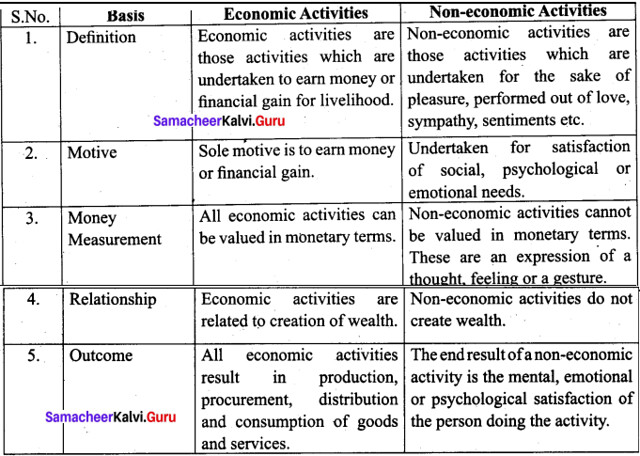
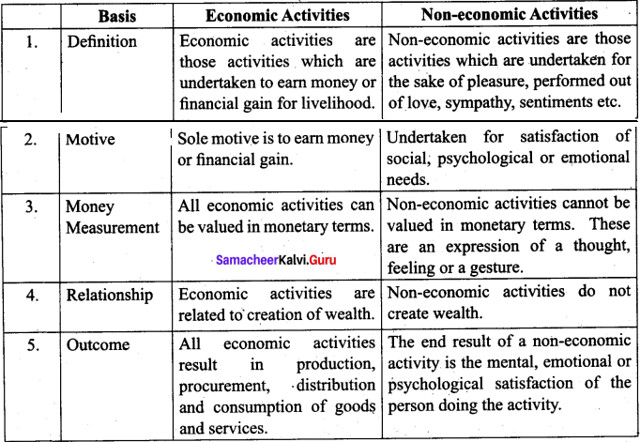
Distinguish between economic and non-economic activity.
Answer:
Tamil Nadu 11th Commerce Model Question Paper 5 English Medium

Question 46 (a).
What are the five features of income tax?
Answer:
Features of Income Tax in India:
(1) Levied as Per the Constitution:
Income tax is levied in India by virtue of entry No. 82 of list I (Union List) of Seventh Schedule to the Article 246 of the Constitution of India.

(2) Levied by Central Government:
Income tax is charged by the Central Government on all incomes other than agricultural income. However, the power to charge income tax on agricultural income has been vested wife the State Government as per entry 46 of list II, i.e., State List.

(3) Direct Tax:
Income tax is direct tax. It is because the liability to deposit and ultimate burden are on sane person. The person earning income is liable to pay income tax out of his own pocket am cannot pass on the burden of tax to another person.

(4) Annual Tax:
Income tax is an annual tax because it is the income of a particular year which is chargeable to tax.

(5) Taxon Person:
It is a tax on income earned by a person. The term ‘person’ has been defined under the income tax Act. It includes individual, Hindu Undivided Family, Firm, Company, local authority, Association of person or body of Individual or any other artificial juridical persons. The persons who are covered under Income tax Act are called ‘assessees’

Tamil Nadu 11th Commerce Model Question Paper 5 English Medium

[OR]

Question 46 (b).
Describe the features of factoring.
Answer:

  • Maintenance of book-debts:
    A factor takes the responsibility of maintaining the accounts of cebtors of a business institution.
  • Credit coverage:
    The factor accepts the risk burden of loss of bad debts leaving the seller to concentrate on his core business.
  • Cash advances:
    Around eighty percent of the total amount of accounts receivables is paid as advance cash to the client.
  • Collection service:
    Issuing reminders, receiving part payments, collection of cheques from part of the factoring service.
  • Advice to clients:
    From the past history of debtors, the factor is able to provide advices regarding the credit worthiness of customers, perception of customers about tie products of the client, etc.

Question 47 (a).
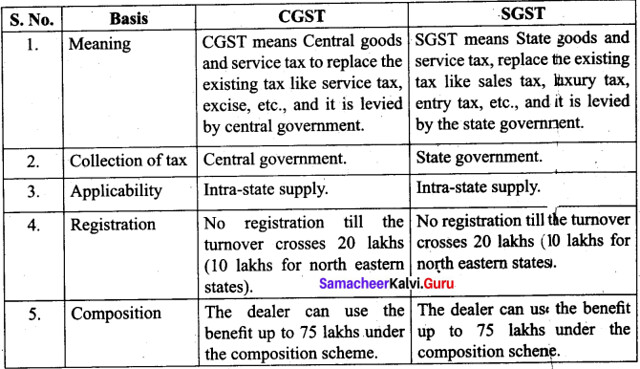
Compare CGST and SGST
Answer:
Tamil Nadu 11th Commerce Model Question Paper 5 English Medium

Question 47 (b).
Point out the objectives of WTO.
Answer:

  • Improving the standard of living of people in member countries.
  • Making optimum utilization of world’s resources for sustainable development of member countries.
  • Promoting an integrated more viable and durable trading system in the sphere of international business.
  • Expansion of trade in goods and services.
  • Ensuring full employment and large steady growth volume of real income and effective demand. .
  • Protecting the environment.

Tamil Nadu 11th Commerce Model Question Paper 5 English Medium Read More »

Tamil Nadu 11th Commerce Model Question Paper 4 English Medium

Students can Download Tamil Nadu 11th Commerce Model Question Paper 4 English Medium Pdf, Tamil Nadu 11th commerce Model Question Papers helps you to revise the complete Tamilnadu State Board New Syllabus and score more marks in your examinations.

TN State Board 11th Commerce Model Question Paper 4 English Medium

Instructions:

  1.  The question paper comprises of four parts.
  2.  You are to attempt all the parts. An internal choice of questions is provided wherever applicable.
  3. questions of Part I, II. III and IV are to be attempted separately
  4. Question numbers 1 to 20 in Part I are objective type questions of one -mark each. These are to be answered by choosing the most suitable answer from the given four alternatives and writing the option code and the corresponding answer
  5. Question numbers 21 to 30 in Part II are two-marks questions. These are to be answered in about one or two sentences.
  6. Question numbers 31 to 40 in Parr III are three-marks questions, These are to be answered in about three to five short sentences.
  7. Question numbers 41 to 47 in Part IV are five-marks questions. These are to be answered) in detail. Draw diagrams wherever necessary.

Time: 2\(\frac{1}{2}\) Hours
Maximum Marks: 90

Part – I

Choose the correct answer. Answer all the questions: [20 × 1 = 20]

Question 1 .
……………. refers to occupation in which people work for others and get remuneration in the form of wages or salaries.
(a) Employment
(b) Profession
(c) Business
(d) Industry
Answer:
(a) Employment

Tamil Nadu 11th Commerce Model Question Paper 4 English Medium

Question 2.
The following are the disadvantages of a sole trader.
(i) Limited capital
(ii) Unlimited liability
(iii) Easy formation
(iv) Small capital
(a) (i) and (iii)
(b) (i) and (ii)
(c) (ii) and (iv)
(d) (i) and (iv)
Answer:
(b) (i) and (ii)

Question 3.
Which of the following is not a function of RBI?
(a) Banker to the Government
(b) Acceptance of deposits
(c) Banker’s Bank
(d) Monopoly of Note issue
Answer:
(b) Acceptance of deposits

Question 4.
Which one of the following is a type of Marine insurance?
(a) Money back
(b) Mediclaim
(c) Health Insurance
(d) Cargo Insurance
Answer:
(d) Cargo Insurance

Question 5.
Registration of partnership is ……………
(a) Compulsory
(b) Optional
(c) Not necessary
(d) None of these
Answer:
(b) Optional

Question 6.
The relationship between the outsiders and the company is defined in …………….
(a) Prospectus
(b) Articles of Association
(c) Memorundum of Association
(d) Certificate of incorporate
Answer:
(a) Prospectus

Tamil Nadu 11th Commerce Model Question Paper 4 English Medium

Question 7.
In 1969 ……………. Banks were nationalised in India.
(a) 20
(b) 14
(c) 6
(d) 26
Answer:
(b) 14

Question 8.
MSMEs are important for the nations economy because they significantaly contributed to
(a) industrial production
(b) exports
(c) employment
(d) all the above
Answer:
(d) all the above

Question 9.
Co-operative fails because of …………….
(a) Unlimited membership
(b) Cash trading
(c) Mismanagement
(d) Loss making
Answer:
(c) Mismanagement

Question 10.
Which is not recent trend in transportation?
(a) Mono rail
(b) Pipeline transport
(c) Bullock cart
(d) Conveyor transport
Answer:
(c) Bullock cart

Tamil Nadu 11th Commerce Model Question Paper 4 English Medium

Question 11.
Which one of the following is a type of Marine insurance?
(a) Money back
(b) Mediclaim
(c) Hull insurance
(d) Cargo insurance
Answer:
(c) Hull insurance

Question 12.
Match List – I with List – II and select the correct answer using the codes given below:
List – I
(i) Limited liability
(ii) Unlimited liability
(iii) Voluntary organization
(iv) Special Statute

List – II
(1) Public corporation
(2) Co-operatives
(3) Joint stock company
(4) Partnership

Codes:
(a) (i) 1, (ii) 2, (iii) 3, (iv) 4
(b) (i) 3, (ii) 4, (iii) 1, (iv) 2
(c) (i) 3, (ii) 4, (iii) 2, (iv) 1
(d) (i) 2, (ii) 1, (iii) 4, (iv) 3
Answer:
(b) (i) 3, (ii) 4, (iii) 1, (iv) 2

Question 13.
Aids to trade is also called as …………….
(a) Trade
(b) Advertisement
(c) Warehousing
(d) Auxiliaries to trade
Answer:
(d) Auxiliaries to trade

Tamil Nadu 11th Commerce Model Question Paper 4 English Medium

Question 14.
Dispersion of decision making power to branches / subsidiaries to head office represents …………….
(a) Centralisation
(b) Decentralisation
(c) Power
(d) Integration
Answer:
(b) Decentralisation

Question 15.
Which one of the following is not correctly matched?
(a) Development Banks – Pallavan Grama Bank
(b) Specialised Banks – Private Sector Bank
(c) Regional Rural Banks – EXIM Bank
(d) Indian Bank – Industrial Bank
Answer:
(d) Indian Bank – Industrial Bank

Question 16.
The main benefit of outsourcing is …………….
(a) Productivity
(b) Cost reduction
(c) Skill
(d) Units
Answer:
(b) Cost reduction

Question 17.
Debenture holders are entitled to a fixed rate of …………….
(a) dividend
(b) profits
(c) interest
(d) ratio
Answer:
(c) interest

Tamil Nadu 11th Commerce Model Question Paper 4 English Medium

Question 18.
An ………………. is a document prepared by the importer and sent to the exporter to buy the goods.
(a) invoice
(b) indent
(c) enquiry
(d) charter party
Answer:
(b) indent

Question 19.
………………. acts as connective link between the producer and the consumer.
(a) Trade
(b) Industry
(c) Commerce
(d) Business
Answer:
(a) Trade

Question 20.
……………….. is the basic principle behind every insurance contract.
(a) Service
(b) Co-operation
(c) Fixed deposit
(d) Social service
Answer:
(b) Co-operation

Part-II

Answer any seven questions in which Question No. 30 is compulsory. [7 x 2 = 14]

Question 21.
What do you mean by business?
Answer:
Business refers to any human activity undertaken on a regular basis with the object to earn profit through production, distribution, sale or purchase of goods and services.

Question 22.
When two or more families agree to live and work together to earn profit – Identify the form of business organization. Also give any two features of it.
Answer:
The form of business organization is Joint Hindu Family Business. They are doing business with family property.
Features:

  • Governed by Hindu Law
  • Membership by birth

Question 23.
What is meant by barter system?
Answer:
In barter system, goods were exchanged for goods prior to invention of money.

Tamil Nadu 11th Commerce Model Question Paper 4 English Medium

Question 24.
Some enterprises operate in more than one country. But it is incorporated in one country. What does the organisation mean? What are the other names of the organisation?
Answer:
The name of the organisation is Multinational Corporation. The other names of MNC is known by:
(a) Global enterprise
(b) International enterprise
(c) World enterprise
(d) Transnational corporation

Question 25.
Are low taxes possible in Co-operative society?
Answer:
Yes, Low taxes are possible in co-operative society because it is a non-profit enterprise, and government provides various exemptions and tax concessions.

Question 26.
What are the services included in the service business?
Answer:
Educational, Medical, Hospitality and banking are the services included in service businesses. Bank service is the nerve center of industry and commerce in a country.

Tamil Nadu 11th Commerce Model Question Paper 4 English Medium

Question 27.
Who is called a partner?
Answer:
The persons who enter into partnership are individually called ‘Partners’.

Question 28.
Who are Rochdale pioneers?
Answer:
At first, the co-operative movement was started by Robert Owen, in the year 1844. He formed a consumer’s co-operative society in England with 28. workers as members, called “Rochdale Society of Equitable Pioneers”.

Question 29.
Give a short note on FCI.
Answer:
Food Corporation of India (FCI) provides storage facilities for food grains. It also hires storage capacity from other sources such as Central Warehousing Corporation, State Warehousing Corporation and Private parties. It was set up under the Food Corporation Act 1964.

Question 30.
Write a short note on debentures.
Answer:
Debentures are an important instrument for raising long term debt capital. A company can raise funds through issue of debentures which bear a fixed rate of interest.

Part-III

Answer any seven questions in which Question No. 40 is compulsory. [7 x 3 = 21]

Question 31.
What is charter party?
Answer:
When goods are to be consigned in large quantity, it is advantageous to hire the whole or substantial part of the ship. The document through which this contract is made is known as ‘Charter Party’ may also be known as ‘Voyage Charter’ or ‘Time Charter’. The person who hires the ship is known as ‘Charter’. The charter becomes responsible to the third parties for the acts of the master and crew of the ship.

Question 32.
What is meant by ‘Mail order retailing’?
Answer:
Mail order business is the retail trade that sells the goods through mail. There is no direct contact between the buyer and seller in this type of trading.
Procedure:

  1. Advertisements provide information about the products to consumers.
  2. Order receiving and processing: On receiving orders, the goods are sent to the customers through the post office by Value Payable Post (VPP).
  3. Receiving Payments: At the time of receiving goods, the customers have to make full payment of goods.

Question 33.
Mention the functions of ‘SAARC’
Answer:

  1. Monitoring and co-ordinating the development programme.
  2. Determining inter-sectoral priorities.
  3. Mobilizing cooperation within and outside the region.
  4. Dealing with modalities of financing!

Question 34.
Write any three characteristics of sole proprietorship.
Answer:

  • Ownership by one man:
    This is owned by single person. The sole trader contributes the required capital. He is not only the owner of the business but also manages the entire affairs.
  • Freedom of work and Quick Decisions:
    Since an individual is himself as a owner, he need not consult anybody else. Hence he can take quick decisions.
  • Unlimited Liability:
    When his business assets are not sufficient to pay off the business debts he has to pay from his personal property.

Question 35.
Distinguish between extractive and genetic industries.
Answer:

  1. Extractive Industries:
    These industries extract or draw out products from natural sources.
    Extractive industries supply some basic raw materials that are mostly products of geographical or natural environment.
  2. Genetic Industries:
    These industries remain engaged in breeding plants and animals for their use in further reproduction.
    The seeds, nursery companies, poultry, diary, piggery, hatcheries, nursery, fisheries and apiary, etc.

Question 36.
What is meant by ATM?
Answer:
ATM means Automated Teller Machine. A customer can withdraw money any time, anywhere in India from the ATM machine using the ATM card given by his / her bank. The machine also shows the balance available in the customers’ account, provides statement print of the few past transactions, etc.

Tamil Nadu 11th Commerce Model Question Paper 4 English Medium

Question 37.
List the kinds of social responsibility.
Answer:

  • Economic responsibility
  • Legal responsibility
  • Ethical responsibility
  • Discretionary responsibility

Question 38.
List the steps in factoring process.
Answer:

  1. The firm enters into a factoring arrangement with a factor, which is generally a financial institution, for invoice purchasing.
  2. Whenever goods are sold on credit basis, an invoice is raised and a copy of the same is sent to the factor.
  3. The debt amount due to the firm is transferred to the factor through assignment and the same is intimated to the customer.

Question 39.
Write a note on agricultural income.
Answer:
Agricultural income is any rent or revenue derived from land which is situated in India and is used for agriculture purposes. It is fully exempted from tax u /s 10(1) and as such does not form part of total income.

Tamil Nadu 11th Commerce Model Question Paper 4 English Medium

Question 40.
There are two schools of Hindu law in Joint Hindu family business organisation. What are the two schools of Hindu law? Explain.
Answer:
In Joint Hindu Family business, there are two schools of Hindu Law: one is Dayabhaga which is prevalent in Bengal and Assam, and the other is Mitakshara prevalent in the rest of the country. In Mitakshara Law, there is a son’s right by birth in the property of joint family.

Part – IV

Answer all the questions. [7 x 5 = 35]

Question 41 (a).
Business consists of many hindrances, while facilitating the production and distribution of goods.
(i) List out any five hindrances.
(ii) Explain any three.
(iii) How they are overcome?
Answer:
(i) For production of goods and services, there are so many hindrances. They are:

  • Hindrance of person
  • Hindrance of place _
  • Hindrance of Time
  • Hindrance of knowledge .
  • Hindrance of Finance

(ii) 1. Hindrance of Person:
The problem of not knowing the place of consumers is called as hindrance of person. Because the manufacturer does not know the consumer, and the consumer does not know the producer. This difficulty is called Hindrance of person.

2. Hindrance of place:
The difficulty of connecting the place of production with the place of consumption is known as hindrance of place. The goods may be produced in one place but it may be used throughout the world, in many places. This problem is known as place hindrance.

Tamil Nadu 11th Commerce Model Question Paper 4 English Medium

3. Hindrance of Time:
Goods may be produced in certain period only. But it may be demanded throughout the year. Some goods may be produced throughout the year, but may be used in certain time only. This difficulty is known as hindrance of time.

(iii) Hindrance of person may be eliminated by the trader; the trader links the producer and consumer.
Hindrance of place can be overcome by the transport. The transport is connecting the place of production and place of consumption. Hindrance of time can be removed by warehouses. Goods can be stored in the warehouses till the time of demand.

[OR]

Question 41 (b).
Explain briefly about Business Process Outsourcing under the following headings:
(i) Meaning
(ii) Core activities
(iii) Any three benefits

(i) Meaning of outsourcing:
Business process outsourcing is a recent type of business in service sector. BPO (Business process sector) refers to outsourcing the work which is routine in nature to an outside agency. This practice was in USA in few companies.

(ii) Core Activities:
Companies can benefit in the long run provided they are keen on their core activities. A core activity involves experience, expertise, efficiency and even investment in the field of specialisation.

(iii) Benefits:

  1. Focusing on the core activities:
    Companies can focus on their core competence, a few areas where the company has distinct capability.
  2. To fill up economic development:
    Outsourcing stimulates entrepreneurship, encouraging employment opportunities, which increases economic development.
  3. Reduction in investment:
    Companies through outsourcing avails the services of outsiders which in turn reduces the investment requirements.

Question 42 (a).
TO manage the government, revenue is needed. For the revenue, the government is collecting income from various methods. That revenue is used to meet the expenses of the government.
(i) How the government is collecting revenue from the public?
(ii) Also explain the methods of collecting tax.
Answer:
(i) The government is levying Tax for getting revenue. Tax is a compulsory payment by the public. It is the basic source of revenue to the government.

Tamil Nadu 11th Commerce Model Question Paper 4 English Medium

(ii) Tax is divided into two types:

  1. Direct Tax:
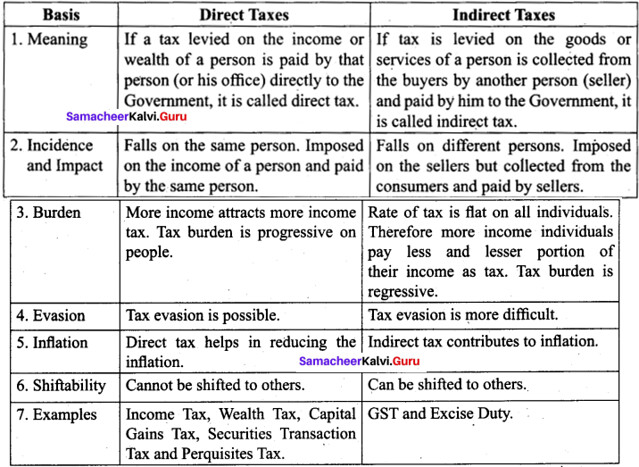
    If a tax is levied on the income or wealth of a person and paid by that person directly to the government, it is called direct tax. Example: Income Tax, Wealth Tax and Capital Gains Tax.
  2. Indirect Tax:
    If a tax is levied on the goods or services of a person (seller); it is collected from the buyers and is paid by seller to the Government, it is called indirect tax. Example:

[OR]

Question 42 (b).
Explain the functions of wholesalers, (any 5)
Answer:
Meaning of wholesalers:
The traders who are engaged in wholesale trade are called wholesalers. A wholesaler buys goods in bulk directly from manufacturers and sells them in small lots to customers.
Functions of Wholesalers – The following are the functions of wholesalers:

(1) Collection of Goods:
Wholesaler collects the goods from the manufacturers or producers in bulk.

Tamil Nadu 11th Commerce Model Question Paper 4 English Medium

(2) Storage of Goods:
Wholesaler collects and stores them safely in warehouses, till they are sold out.

  1. Distribution:
    Wholesaler sells goods to different retailers. Thus he performs the function of distribution.
  2. Financing:
    Wholesalers provide financial support to producers and manufacturers by providing money in advance to them. He also sells goods to retailer on credit.
  3. Risk Taking:
    Wholesaler buys finished goods from the producer and stores them in the warehouses till they are sold out. The wholesalers bear the risk arising from price, and damage of goods.
  4. Grading and Packing:
    Wholesaler classifies the goods into different categories. He grades the goods on the basis of quality, size and weight, etc.
  5. Providing Information:
    Wholesalers provide valuable information to retailers and producers.

Question 43(a).
Explain the types of Mercantile agents.
Answer:
Mercantile Agents are also called functional middlemen. A businessman appoints a person to buy and sell goods on his behalf. There are many types of Mercantile Agents:
(1) Brokers:
A broker is one who bargains for another and receives commission for his service. He brings the buyer and the seller to negotiate the contract.

(2) Factors:
A factor is a mercantile agent to whom goods are entrusted for sale by a principal. He takes physical possession of the goods, but does not obtain ownership of the goods.

(3) Commission Agent or Consignees:
A commission agent buys and sells goods on behalf of the principal for a fixed rate of commission. All risks connected with his transactions are borne by the principal.

Tamil Nadu 11th Commerce Model Question Paper 4 English Medium

(4) Del-credere Agents:
The agent who guarantees to the principal the collection of cash from credit sales is called ‘del-credere agent’. He is paid an additional commission known as del-credere commission for bearing the risk.

(5) Auctioneers:
They are agents who sell goods by auction on behalf of their principals. They are selling by giving notification to the public. The notice gives details about the date, time, place and details of goods for sales.

[OR]

Question 43 (b).
What are the objectives of GST?
Answer:

  • To create a common market with uniform tax rate in India. (One Nation, One Tax and One
    Market)
  • To eliminate the cascading effect of taxes, GST allows set-off of prior taxes for the same transactions as input tax credit.
  • To boost Indian exports, the GST already collected oh the inputs will be refunded and thus there will be no tax on all exports.
  • To increase the tax base by bringing more number of tax payers and increase tax revenue.
  • To simplify tax return procedures through common forms and avoidance of visiting tax departments.
  • To provide online facilities for payment of taxes and submission of forms.

Question 44 (a).
Explain any five principles of Co-operative society.
Answer:
(1) Voluntary and Open Membership:
Co-operatives are voluntary organisations, open to all people able to use its services and willing to accept the responsibilities of membership, without gender, social, racial, political or religious discrimination.

(2) Democratic Member Control:
Co-operatives are democratic organisations controlled by their members – those who buy the goods or use the services of the co-operative-who actively participate in setting policies and making decisions.

(3) Member’s Economic Participation:
Members contribute equally to, and democratically control, the capital of the co-operative. This benefits members in proportion to the business they conduct with the co-operative rather than on the capital invested.

Tamil Nadu 11th Commerce Model Question Paper 4 English Medium

(4) Autonomy and Independence:
Co-operatives are autonomous, self-help organisations controlled by their members. If the co-operative enters into agreements with other organisations or raises capital from external sources, it is done so based on terms that ensure democratic control by the members and maintains the co-operative’s autonomy.

(5) Education, Training, and Information:
Co-operatives provide education and training for members, elected representatives, managers and employees so they can contribute effectively to the development of their co-operative. Members also inform the general public about the nature and benefits of co-operatives.

[OR]

Question 44 (b).
Explain the advantages of warehousing.
Answer:

  • It safeguards the stock for the merchants who do not have storage place.
  • Warehouses reduce the distribution cost of the traders by storing the goods in bulk and allow the trader to take the goods in small lots to his shop.
  • It helps in selection of channel of distribution. The producer will prefer whether to a wholesaler or retailer.
  • It assists in maintaining the continuous sale and avoid the possibilities of “Out of Stock”.
  • It creates employment opportunities for both skilled and unskilled workers to improve their standard of living.

Question 45 (a).
Distinguish between economic activity and non-economic activity.
Answer:
Tamil Nadu 11th Commerce Model Question Paper 4 English Medium

[OR]

Question 45 (b).
State the constraints of barter system.
Answer:
The constraints of barter system are:
(1) Lack of Double Coincidence of Wants:
Unless two persons who have surplus have the demand for the goods possessed by each other, barter could not materialize. If this “coincidence of wants” does not exist, barter cannot take place.

(2) Non-existence of Common Measure of Value:
Barter system could not determine the value of commodities to be exchanged as they lacked commonly acceptable measures to evaluate each and every commodity.

(3) Lack of Direct Contact between Producer and Consumers:
It was not possible for buyers and sellers to meet face to face in many contexts for exchanging the commodities for commodities.

(4) Lack of surplus stock:
Absence of surplus stock was one of the impediments in barter system. If the buyers and sellers do not have surplus then no barter was possible.

Tamil Nadu 11th Commerce Model Question Paper 4 English Medium

Question 46 (a).
Explain the classification of companies on the basis of nationality.
Answer:
1. Domestic Companies:
A company which cannot be termed as foreign company under the provision of the Companies Act should be regarded as a domestic company.

2. Foreign Companies:
A foreign company means a company which is incorporated in a country outside India under the law of that country. The following documents must be filed with the Registrar of Companies-

  • A certified copy of the charter or statutes under which the company is incorporated.
  • The full address of the registered office of the company.
  • A list of directors and secretary of the company.
  • The name and address of any Indian resident who is authorised to accept legal documents on behalf of the company.
  • The full address of the company’s principal place of business in India.

3. Multi National Companies:
A Multi National Company (MNC) is a huge industrial organisation which-

  • Operates in more than one country.
  • Carries out production, marketing and research activities.
  • Seeks to maximise profits world over. A domestic company or a foreign company can be a MNC.

[OR]

Question 46 (b).
Every nation has one central bank. It controls the entire banking system of the country.

  1. What is the name of our central bank?
  2. Explain the organisational structure of our central bank.

Answer:

  1. In India the Reserve Bank of India (RBI) is the central bank
  2. The head office of the RBI is situated in Mumbai. This central office has 33 departments in 2017. It has four zonal offices in Mumbai, Delhi, Calcutta and Chennai functioning under local boards with deputy governors as their heads. It also has 19 regional offices and 11 sub-offices (2017).

The RBI is governed by a central board of directors. The 21 member board is appointed by the Government of India. It consists of:

  • One Governor and four deputy governors appointed for a period of four years
  • Ten Directors from various fields
  • Two Government officials
  • Four Directors – one each from local boards

Question 47 (a).
What are the advantages of warehousing?
Answer:

  1. It safeguards the stock for the merchants who do not have storage place.
  2. Warehouses reduce the distribution cost of the traders by storing the goods in bulk and allow the trader to take the goods in small lots to his shop.
  3. It helps in selection of channel of distribution. The producer will prefer whether to a wholesaler or retailer.
  4. It assists in maintaining the continuous sale and avoid the possibilities of “Out of Stock”.
  5. It creates employment opportunities for both skilled and unskilled workers to improve their standard of living. .

[OR]

Question 47 (b).
Short term and medium term loans are provided by commercial banks. It is repayable in one lump sum or in installments. Loans may be of various types. Explain the various kinds of loan granted by the commercial banks.
Answer:
Banks can provide various kinds of loan to the customers. They are as follows:

  1.  Housing Loan:
    Accepting the title deeds of the house as security, banks provide medium and long term loans, based on the monthly income of the customer. It is a boon to the middle class salaried employees who cannot afford to pay the full price of a house in a lump sum.
  2. Consumer Loans:
    Loan is granted to the customer to purchase durables like refrigerator, air-conditioner, laptop, washing machine, television, etc.
  3. Vehicle Loans:
    Two wheelers, cars, buses and other vehicles can be purchased by individuals as well as organisations obtaining vehicle loans from the banks.
  4. Educational Loan:
    Loan is provided by banks to students for studying undergraduate, post graduate or professional courses. Loan may be received in instalments to pay the educational fees.
  5. Jewel Loan:
    Customers can pledge their gold jewels and obtain loans from banks. Interest should be paid every month.

Tamil Nadu 11th Commerce Model Question Paper 4 English Medium Read More »

Samacheer Kalvi 12th Business Maths Solutions Chapter 9 Applied Statistics Ex 9.4

Students can download 12th Business Maths Chapter 9 Applied Statistics Ex 9.4 Questions and Answers, Samacheer Kalvi 12th Business Maths Book Solutions Guide Pdf helps you to revise the complete Tamilnadu State Board New Syllabus and score more marks in your examinations.

Tamilnadu Samacheer Kalvi 12th Business Maths Solutions Chapter 9 Applied Statistics Ex 9.4

Choose the correct answer.

Question 1.
A time series is a set of data recorded _______
(a) Periodically
(b) Weekly
(c) Successive points of time
(d) all the above
Answer:
(d) all the above

Question 2.
A time series consists of ________
(a) Five components
(b) Four components
(c) Three components
(d) Two components
Answer:
(b) Four components

Samacheer Kalvi 12th Business Maths Solutions Chapter 9 Applied Statistics Ex 9.4

Question 3.
The components of a time series which is attached to short term fluctuation are _______
(a) Secular trend
(b) Seasonal variations
(c) Cyclic variation
(d) Irregular variation
Answer:
(d) Irregular variation

Question 4.
Factors responsible for seasonal variations are ______
(a) Weather
(b) Festivals
(c) Social customs
(d) All the above
Answer:
(d) All the above

Samacheer Kalvi 12th Business Maths Solutions Chapter 9 Applied Statistics Ex 9.4

Question 5.
The additive model of the time series with the components T, S, C and I is _______
(a) y = T + S + C × I
(b) y = T + S × C × I
(c) y = T + S + C + I
(d) y = T + S × C + I
Answer:
(c) y = T + S + C + I

Question 6.
Least square method of fitting a trend is _______
(a) Most exact
(b) Least exact
(c) Full of subjectivity
(d) Mathematically unsolved
Answer:
(a) Most exact

Samacheer Kalvi 12th Business Maths Solutions Chapter 9 Applied Statistics Ex 9.4

Question 7.
The value of ‘b’ in the trend line y = a + bx is _________
(a) Always positive
(b) Always negative
(c) Either positive or negative
(d) Zero
Answer:
(c) Either positive or negative

Question 8.
The component of a time series attached to long term variation is trended as _______
(a) Cyclic variation
(b) Secular variations
(c) Irregular variation
(d) Seasonal variations
Answer:
(b) Secular variations

Samacheer Kalvi 12th Business Maths Solutions Chapter 9 Applied Statistics Ex 9.4

Question 9.
The seasonal variation means the variations occurring within ________
(a) A number of years
(b) within a year
(c) within a month
(d) within a week
Answer:
(b) within a year

Question 10.
Another name of the consumer’s price index number is _______
(a) Whole-sale price index number
(b) Cost of living index
(c) Sensitive
(d) Composite
Answer:
(b) Cost of living index

Samacheer Kalvi 12th Business Maths Solutions Chapter 9 Applied Statistics Ex 9.4

Question 11.
Cost of living at two different cities can be compared with the help of _______
(a) Consumer price index
(b) Value index
(c) Volume index
(d) Un-weighted index
Answer:
(a) Consumer price index

Question 12.
Laspeyre’s index = 110, Paasche’s index = 108, then Fisher’s Ideal index is equal to _______
(a) 110
(b) 108
(c) 100
(d) 109
Answer:
(d) 109
Hint:
Fisher’s Index = \(\sqrt{110 \times 108}\) = 109

Samacheer Kalvi 12th Business Maths Solutions Chapter 9 Applied Statistics Ex 9.4

Question 13.
Most commonly used index number is _________
(a) Volume index number
(b) Value index number
(c) Price index number
(d) Simple index number
Answer:
(c) Price index number

Question 14.
Consumer price index are obtained by ________
(a) Paasche’s formula
(b) Fisher’s ideal formula
(c) Marshall Edgeworth formula
(d) Family budget method formula
Answer:
(d) Family budget method formula

Samacheer Kalvi 12th Business Maths Solutions Chapter 9 Applied Statistics Ex 9.4

Question 15.
Which of the following Index number satisfy the time-reversal test?
(a) Laspeyre’s Index number
(b) Paasche’s Index number
(c) Fisher’s Index number
(d) All of them
Answer:
(c) Fisher’s Index number

Question 16.
While computing a weighted index, the current period quantities are used in the _______
(a) Laspeyre’s method
(b) Paasche’s method
(c) Marshall Edgeworth method
(d) Fisher’s ideal method
Answer:
(b) Paasche’s method

Samacheer Kalvi 12th Business Maths Solutions Chapter 9 Applied Statistics Ex 9.4

Question 17.
The quantities that can be numerically measured can be plotted on a ________
(a) p – chart
(b) c – chart
(c) x bar chart
(d) np – chart
Answer:
(c) x bar chart

Question 18.
How many causes of variation will affect the quality of a product?
(a) 4
(b) 3
(c) 2
(d) 1
Answer:
(c) 2

Samacheer Kalvi 12th Business Maths Solutions Chapter 9 Applied Statistics Ex 9.4

Question 19.
Variations due to natural disorder is known as _______
(a) random cause
(b) non-random cause
(c) human cause
(d) all of them
Answer:
(a) random cause

Question 20.
The assignable causes can occur due to _______
(a) poor raw materials
(b) unskilled labour
(c) faulty machines
(d) all of them
Answer:
(d) all of them

Samacheer Kalvi 12th Business Maths Solutions Chapter 9 Applied Statistics Ex 9.4

Question 21.
A typical control charts consists of ________
(a) CL, UCL
(b) CL, LCL
(c) CL, LCL, UCL
(d) UCL, LCL
Answer:
(c) CL, LCL, UCL

Question 22.
\(\bar{X}\) chart is a ______
(a) attribute control chart
(b) variable control chart
(c) neither Attribute nor variable control chart
(d) both Attribute and variable control chart
Answer:
(b) variable control chart

Samacheer Kalvi 12th Business Maths Solutions Chapter 9 Applied Statistics Ex 9.4

Question 23.
R is calculated using ______
(a) \(x_{\max }-x_{\min }\)
(b) \(x_{\min }-x_{\max }\)
(c) \(\bar{x}_{\max }-\bar{x}_{\min }\)
(d) Samacheer Kalvi 12th Business Maths Solutions Chapter 9 Applied Statistics Ex 9.4 Q23
Answer:
(a) \(x_{\max }-x_{\min }\)

Question 24.
The upper control limit for \(\bar{X}\) chart is given by _______
(a) \(\overline{\mathrm{X}}+\mathrm{A}_{2} \overline{\mathrm{R}}\)
(b) Samacheer Kalvi 12th Business Maths Solutions Chapter 9 Applied Statistics Ex 9.4 Q24
(c) Samacheer Kalvi 12th Business Maths Solutions Chapter 9 Applied Statistics Ex 9.4 Q24.1
(d) Samacheer Kalvi 12th Business Maths Solutions Chapter 9 Applied Statistics Ex 9.4 Q24.2
Answer:
(c) Samacheer Kalvi 12th Business Maths Solutions Chapter 9 Applied Statistics Ex 9.4 Q24.1

Samacheer Kalvi 12th Business Maths Solutions Chapter 9 Applied Statistics Ex 9.4

Question 25.
The LCL for R chart is given by ________
(a) \(\mathrm{D}_{2} \overline{\mathrm{R}}\)
(b) Samacheer Kalvi 12th Business Maths Solutions Chapter 9 Applied Statistics Ex 9.4 Q25
(c) Samacheer Kalvi 12th Business Maths Solutions Chapter 9 Applied Statistics Ex 9.4 Q25.1
(d) \(\mathbf{D}_{3} \overline{\mathbf{R}}\)
Answer:
(d) \(\mathbf{D}_{3} \overline{\mathbf{R}}\)

Samacheer Kalvi 12th Business Maths Solutions Chapter 9 Applied Statistics Ex 9.4 Read More »

Tamil Nadu 11th English Previous Year Question Paper June 2019

Students can Download Tamil Nadu 11th English Previous Year Question Paper June 2019 Pdf, Tamil Nadu 11th English Model Question Papers helps you to revise the complete Tamilnadu State Board New Syllabus and score more marks in your examinations.

TN State Board 11th English Previous Year Question Paper June 2019

Instructions:

  1.  The question paper comprises of four parts.
  2.  You are to attempt all the parts. An internal choice of questions is provided wherever applicable.
  3. questions of Part I, II. III and IV are to be attempted separately
  4. Question numbers 1 to 20 in Part I are objective type questions of one -mark each. These are to be answered by choosing the most suitable answer from the given four alternatives and writing the option code and the corresponding answer
  5. Question numbers 21 to 30 in Part II are two-marks questions. These are to be answered in about one or two sentences.
  6. Question numbers 31 to 40 in Parr III are three-marks questions, These are to be answered in about three to five short sentences.
  7. Question numbers 41 to 47 in Part IV are five-marks questions. These are to be answered) in detail. Draw diagrams wherever necessary.

Time: 3.00 Hours
Maximum Marks: 90

PART – I

I. Answer all the questions. [20 x 1 = 20]
Choose the correct synonym for the underlined words from the options given.

Question 1.
The role of the University today is not Cloistered.
(a) flexible
(b) restricted
(c) determined
(d) challenging
Answer:
(b) restricted

Tamil Nadu 11th English Previous Year Question Paper June 2019

Question 2.
She thumped the sagging skin of the dilapidated drum.
(a) preserved
(b) repaired
(c) damaged
(d) costly
Answer:
(c) damaged

Question 3.
I am always reluctant to trust a departing visitor to post an important letter.
(a) insensitive
(b) interested
(c) unwilling
(d) forgetful
Answer:
(c) unwilling

Choose the correct antonym for the underlined words from the options given.

Question 4.
He has a memory like a sieve or is an audacious perverter of the truth.
(a) clever
(b) timid
(c) rigid
(d) strong
Answer:
(b) timid

Question 5.
It is because of their antipathy to pills and potions………..
(a) faith
(b) loyalty
(c) interest
(d) liking
Answer:
(d) liking

Question 6.
The other teams ………. weight in, which is compulsory for all players.
(a) optional
(b) natural
(c) critical
(d) occasional
Answer:
(a) optional

Question 7.
Choose the correct prefix for the word “Comfort”.
(a) dis
(b) de
(c) un
(d) under
Answer:
(a) dis

Question 8.
My grandfather is very sick, but the doctor has said that he will “recover”.
(a) pull up
(b) pull on
(c) pull out
(d) pull through
Answer:
(d) pull through

Tamil Nadu 11th English Previous Year Question Paper June 2019

Question 9.
Choose the meaning of the idiom in the sentence.
It is raining on and off for the past two days.
(a) normally
(b) violently
(c) continuously
(d) intermittently
Answer:
(d) intermittently

Question 10.
Choose the clipped form of the word “helicopter”.
(a) heli
(b) helicop
(c) copter
(d) helter
Answer:
(c) copter

Question 11.
Choose the right definition for the given term “Dermatologist”.
(a) One who treats stomach disorders
(b) One who treats heart complications
(c) One who specializes in lung diseases
(d) One who specializes in skin problems
Answer:
(d) One who specializes in skin problems

Question 12.
Choose the expanded form of “MHRD”.
(a) Member of Human Resource Department
(b) Ministry of Human Resource Development
(c) Modem Housing Rural Development
(d) Metro Highways and Railways Department
Answer:
(b) Ministry of Human Resource Development

Question 13.
Ability” is a ……….. word.
(a) trisyllabic
(b) tetrasyllable
(c) disyllabic
(d) pentasyllabic
Answer:
(b) tetrasyllable

Question 14.
The protestors were arrest enmasse yesterday.
Choose the meaning of the foreign word underlined in the above sentence.
(a) mercilessly
(b) before sunset
(c) all together
(d) as usual
Answer:
(c) all together

Question 15.
I cannot put up with this nonsense anymore. (Replace the phrasal verb with a single word)
(a) tolerate
(b) handle
(c) witness
(d) rectify
Answer:
(a) tolerate

Tamil Nadu 11th English Previous Year Question Paper June 2019

Question 16.
Choose the word that cannot be used after “Key” to form a compound word.
(a) note
(b) lock
(c) board
(d) hole
Answer:
(b) lock

Question 17.
Choose the correct sentence pattern.
We met a great writer in the library.
(a) SVOA
(b) SVOC
(c) SVIODO
(d) SVC A
Answer:
(a) SVOA

Question 18.
Choose the unclipped form of “memo”.
(a) memorabilia
(b) memorizer
(c) memorandum
(d) memento
Answer:
(c) memorandum

Question 19.
Choose the suitable preposition and fill in the blank.
A cool and moist breeze drifted ………. the open windows.
(a) from
(b) within
(c) against
(d) through
Answer:
(d) through

Question 20.
Add a suitable question tag to the statement given below.
You can never misuse your power and authority,……….?
(a) can’t you
(b) would you
(c) wouldn’t you
(d) can you
Answer:
(d) can you

Tamil Nadu 11th English Previous Year Question Paper June 2019

PART – II

II. Answer any seven of the following: [7 × 2 = 14]
(i) Read the following sets of poetic lines and answer any four of the following. [4 × 2 = 8]

Question 21.
“Most of all, I want to relearn
How to laugh,……..”
(а) What does the poet want to relearn?
(b) Whom does he want to relearn from?
Answer:
(a) The poet wants to relearn to laugh with his eyes.
(b) The poet wants to relearn to laugh from his little son.

Question 22.
“Let’s talk of graves, of worms, and epitaphs,
Make dust our paper………”,
(а) Define the term ‘epitaphs’.
(b) Mention the figure of speech used here.
Answer:
(a) Epitaphs are ‘a phrase written as an inscription on a tombstone in memory of a person who has died.
(b) Metaphor

Question 23.
“He, who does not stoop, is a king we adore.
We bow before competence and merit;”
(а) Pick out the words in alliteration in the second line.
(b) Who is adored as a king?
Answer:
(a) ‘bow and before’ are the words that alliterate.
(b) An upright or straight forward person is adored as a king.

Question 24.
“Athletes, I’ll drink to you,
Or eat with you,
Or anything except compete with you.”
(a) What does the term ‘drink to you’ mean?
(b) Does the poet want to compete with the athletes?
Answer:
(a) The term ‘drink to you’ means to wish for someone’s success.
(b) The poet is ready to drink or eat with the athletes but never wants to compete with them.

Question 25.
“And‘ this my faith that every flower
Enjoys the air it breathes…….”
(a) What is the poet’s faith?
(b) Identify the figure of speech used here.
Answer:
(a) The poet has faith that nature lives, breathes and enjoys its own presence. Twigs, birds, creepers all live in harmony with each other in absolute bliss and contentment.
(b) Personification.

Question 26.
“For he’s a fiend in feline shape,
a monster of depravity.”
(а) How is Macavity described in this line?
(b) Explain the phrase ‘monster of depravity’.
Answer:
(а) Macavity is described as a “demon in the shape of a cat”.
(b) Satan is called the master of depravity. T.S. Eliot calls Macavity, the master of depravity. He means that the cat is an embodiment of evil. He is wicked, all the time involved in doing something evil.

Tamil Nadu 11th English Previous Year Question Paper June 2019

(ii) Do as directed (any three) [3 x 2 = 6]

Question 27.
Report the following dialogue:
Answer:
Leena : “Mom, I burnt my finger.”
Mother : “I have warned you not to play with fire.”
Leena exclaimed with sorrow to her mother that she had burnt her finger. Mother said that she had warned her not to play with fire.

Question 28.
Change the Voice of the following sentences.
My friend was arrested by the police on a charge of theft.
He was released soon for lack of evidence.
Answer:
The police arrested my friend on a charge of theft.
They/The police released him soon for lack of evidence.

Question 29.
Convert the following simple sentence into a compound sentence.
On hearing their teacher’s footsteps, the boys ran away.
Answer:
They heard their teacher’s footsteps and the boys ran away.

Question 30.
If Reema had informed me earlier, I would have returned home. (Begin the sentence with ‘Had’)
Answer:
Had Reema informed me earlier, I would have returned home.

PART – III

III. Answer any seven of the following: [7 x 3 = 21]
(i) Explain any two of the following with Reference to the Context: [2 x 3 = 6]

Question 31.
“Every hillock has a summit to boast!”
Answer:
Reference: These lines are from the poem “Everest is not the Only Peak” written by Kulothungan.

Context and Explanation: The poet says these words while exploding the myth about achievements or world records. He says climbing Everest alone is not a feat. Every hillock has a peak. He means that every effort, however small it may be, must be respected and appreciated. Each one sets a challenge as per his limited capacity and strives to achieve it in life.

Tamil Nadu 11th English Previous Year Question Paper June 2019

Question 32.
“I have also learned to say “Goodbye”
When I mean “Good-riddance”:”
Answer:
Reference: This line is from the poem “Once upon a time” written by Gabriel Okara.

Context: The poet says these while sharing his exasperation over his own deceitful behaviour with fellow humans.

Explanation: Gabriel Okara regrets that the days when people were innocent and expressed their true emotions in their greetings and day to day interactions have changed a lot. The traditional saying “Goodbye” means ‘God be with you’. But, in modem times, in the postcolonial context it means “good riddance”. The poet finds himself behaving the same way others behave. He is also wearing faces like dresses. He has lost his true cultural identity.

Question 33.
“His powers of levitation would make a fakir stare”
Answer:
Reference: These words are from the poem “Macavity – the mystery cat” written by T.S. Eliot. Context: T.S. Eliot says, these words describing the skills of Macavity – The mystery cat. Explanation: Macavity does all kinds of mischiefs, petty thefts. He breaks things also. But before anyone could link the crime to Macavity he makes good his escape, floating in the air, jumping from building to building. His powers of levitatioh baffles even a fakir who has mystical powers.

(ii) Answer any two of the following questions briefly: [2 x 3 = 6]

Question 34.
What made the dogs follow the grandmother after school hours?
Answer:
Grandmother brought a bundle of stale chapattis with her to the temple. The village dogs followed her. On return, she went on throwing the chapattis to the dogs who growled and fought with each other to have a piece of chapatti.

Question 35.
How did Mary Kom manage to get financial support for her trip to the USA?
Answer:
Mary Korn’s dad gave her Rs. 2,000/-. She spoke to her friend Onler about her problem. He took some elders and friends to meet the two Members of Parliament and seek their support. Two MPs donated Rs. 5,000/- and 3,000/- respectively. Thus Mary Kom managed to raise a . princely sum of Rs. 10,000/-for her trip to USA.

Question 36.
What happened to Bryson when he leaned to tie his shoelace?
Answer:
When Bryson leaned to tie a shoe lace inside the air-craft, someone in the seat ahead of him threw his seat back into full recline. The author found himself pinned helplessly in a crash position.

Tamil Nadu 11th English Previous Year Question Paper June 2019

(iii) Answer any three of the following questions briefly: [3 x 3 = 9]

Question 37.
You are Joseph, the sports secretary of XYZ School. Draft a mail to the Director of Rajarathinam Stadium at Egmore, seeking permission to conduct your School Annual Sports Day celebration in the Stadium.
Answer:
From
Joseph
XYZ School
A.K. Puram
Chennai
25th July, 2021

To
The Director
Rajarathinam Stadium
Egmore
Chennai
Dear Sir,
Sub: Reg. Permission to conduct School Annual Sports Day celebration in the Stadium

I am Joseph, the sports secretary of XYZ School, A.K. Puram. We are celebrating the Annual Sports Day on 14th August 2021. As we have invited a special dignitary as the chief guest we would like to conduct this Sports Day celebration in Rajarathinam Stadium at Egmore. Therefore I kindly request you to grant your consent.

Thank you
Yours sincerely
Joseph
Sports Secretary
Address on the envelope
To
The Director
Rajarathinam Stadium
Egmore
Chennai.

Question 38.
Describe the process of cleaning an overhead water tank.
Answer:

  • First empty the tank by draining the water.
  • Then clean the floors and the walls of the tank by manual scrubbing.
  • After scrubbing, a vacuum cleaner can be used to remove the remaining dirt.
  • After the scrubbing, the floors and ceiling of the tank is washed using water and high pressure jet.
  • To ensure that the tank is germ free, it is necessary to disinfect the tank. Usually liquid bleach is used.
  • After this, the tank is again filled with water, and is made to run through the taps to disinfect the water pipes.
  • The water from the tank is now drained and can be left for drying. After the tank is dry, you can refill the tank.

Tamil Nadu 11th English Previous Year Question Paper June 2019

Question 39.
Expand the news headlines in a sentence each.
Answer:
(a) Tension at Sabarimala – Women pilgrims targetted.
(b) Police nabs gang of 6 robbers in Trichy – Seizes jewellery.
(c) Longest cold spell in Delhi in 14 years – Cold wave to continue.
Answer:
(a) Tensions are high in Kerala as Sabarimala temple gates were opened today to all devotees, including women, for the first time since a Supreme Court order overturned a centuries- old ban on women of menstruating age -between 10 and 50 – from visiting the shrine.

(b) The Trichy police busted a gang of robbers involved in breaking into a jewellery shop on June 27 and have recovered valuables worth Rs. 1.60 lakh. The gang comprising six members was arrested on Thursday night.

(c) According to reports from India Meteorological Department (IMD), Delhi is facing the longest cold spell in a December in as long as fourteen years and apparently, it’s going to remain like this for a while.

Question 40.
Complete the proverbs using the words given below.
(a) An idle ………. a devil’s workshop, (soul, body, mind)
(b) ………. is in the eye of the beholder. (Magic, Beauty, Problem)
(c) Don’t judge a ……… by its cover, (book, pillow, letter)
Answer:
(a) mind
(b) Beauty
(c) book

PART – IV

IV. Answer the following: [7 × 5 = 35]

Question 41.
Why was Mary Kom named the “Queen of Boxing” and “Magnificent Mary”?
Answer:
After Mary Kom’s first silver medal in Pennsylvania in 2001, there was no looking back. Her medal haul continued even after her marriage putting an end to the speculation of family and friends that her marriage may slow down her career progression. She retained the world title in the third World Women’s Boxing Championship at Podolsk in Russia in 2005. She won her fourth gold also in 2006. She had won several golds for India from 2001 to 2004.

She had won all the Senior Women’s Boxing Championships, Second Women’s Championship (2002), Second Asian Women’s Boxing Championship at Hisar (2003) and the Witch Cup Boxing Championship at Paes, Hungary. There were a number of other International World Championships in Taiwan, Vietnam, Denmark and so on. But it was retaining her World title in 2006 by defeating Steluta Duta of Romania which was considered as Mary Kom’s greatest achievement in life. With this hat-trick of World Championship wins, the media christened her, “Queen of Boxing” and “Magnificent Mary”.

Tamil Nadu 11th English Previous Year Question Paper June 2019

Question 42.
Explain the things Gabriel Okara has learnt when he grew into an adult.
Answer:
The African poet observes a marked change in the attitude of modem people. Those who were once so genuine, warm and sincere, have now suddenly turned cold and hostile towards him. He realizes that the early values in the society like sincerity, good-naturedness, simplicity, whole-heartedness, hospitality, friendliness, originality and uniqueness have now drastically changed. The earlier warmth and heartfulness have gone.

He finds himself behaving the same way as those around him. He has learnt to wear different faces for different occasions. He wears faces like dresses. He says not what his heart tells him. His smiles are also fake. He smiles only to be socially accepted. He has learnt to say “Good bye”, when he wants to say ‘good riddance’. After being bored, he brings a fake smile and says “It’s been nice talking to you”.

[OR]

The poem ‘Everest is not the only peak’ does not focus on the destination but the journey towards it. Discuss.
Answer:
The poet discusses the merits of efforts, duty and devotion and values of honesty, uprightness and service-mindedness. He does not have any special appreciation to those who reach great peaks like Himalayas. He appreciates the process, the journey and not the destination. When the whole world has a perspective of seeking glory using any foul method Or underhand dealing, the poet differs from it. For him the means is more important than the end.

However modest may be one’s position is, it is adorable if attained by competence and merit. Pride is not in heights one reaches but in a life that knows no bending or kneeling. The poet respects one who does not stoop as a king. Thus the poet pays importance to the journey of life not the destination.

Question 43.
Write a paragraph (150 words) by developing the following hints.
Philip – travels – train – Brill Manor – meets Bertie – second son – left purse – four quids – needs money – requests Philip to lend him – two pounds -did not help – true son – mistaken for a fraud.
Answer:
The young man who entered the coach gave out a smothered curse, he was engaged in searching something elusive angrily and uselessly. From time to time, he dug a six penny bit out of a waist coat pocket and stared.at it sadly, then resumed his search. He voluntarily broke the silence. He exclaimed that Mr. Sletherby was going to Bill Manor. He introduced himself as Bertie, the younger son of Mrs. Saltpen-Jago. He admitted that he was away for about six months and had not seen his own mother.

Making use of the lucky coincidence that he was going to Brill Manor, he asked for a loan of three pounds as he had lost his sovereign purse and was desperately in need of help. He promised to meet him on the subsequent Monday. There is a dramatic irony when the son himself gives a different version of his mom’s appearance. This influences the decision of Mr. Sletherby in refusing to lend Bertie a loan of three pounds and mistaking the true son Bertie to be a fraud.

[OR]

Jack and Jill – things in instalments – house on instalment – Aunt Jane visited – preached – ease and comfort of buying – first baby in instalment.
Answer:
The Never Never Nest is a comic one-act play about a young couple who make full use of the buy-now-pay-later system. Jack and Jill were a young married couple who had a small baby. One day Aunt Jane visited them and was surprised to find that even though Jack’s salary was not high, they lived in a beautiful house with all comforts. She began to wonder whether, as a wedding gift she had given them 2000 pounds instead of 20 pounds. Otherwise how did Jack and Jill buy all these things?

Then Jane understood that though they had everything, nothing really belonged to them. They bought everything on installments. Only a steering wheel of the car, a wheel and two cylinders had been paid for. The total amount to be paid towards instalments was more than their earnings. Aunt Jane was shocked at the way Jack and Jill ran their family. Before she left, she gave ten pounds to Jill and told them to make at least one article completely theirs, using that money. While Jack went with aunt Jane to the bus stop, Jill sent the money to Dr. Martin. Jack came back and said that he wanted to pay two months instalments on the car using the aunt’s gift. But Jill said that by paying this money to Dr. Martin, their baby would become completely theirs.

Tamil Nadu 11th English Previous Year Question Paper June 2019

Question 44.
Write a summary or Make notes of the following passage.
Answer:
Stress is a part of everyday life. There are many instances when stress can be helpful. A fire alarm is intended to cause the stress that alerts you to avoid danger. The stress created by a deadline to finish a paper can motivate you to finish the assignment on time. But when experienced in excess, stress has the opposite effect.

It can harm our emotional and physical health and limit our ability to function at home, in school and within our relationships. The good news is that, since we are responsible for bringing about much of our own stress, we can also do much to manage stress by learning and practicing specific stress reduction strategies.

Practice time management skills to manage your academic schedule, social activities and making time for yourself. Set and implement specific goals for yourself that will improve your mood and help you reduce stress. Avoid procrastination. It can create more mental and physical stress. Exercise regularly, Physical activity can help you bum-off the energy generated by stress. Do meditation, practice good sleep habits to ensure that you are well rested.

Stress and it’s Management:
No. of words given in the original passage: 184
No. of words to be written in the summary: 184/3 = 61 ± 5

Rough Draft:
Stress is a part of everyday life. At times stress can be helpful. It helps you avoid dangers and motivates you to finish an assignment on time. But excessive stress leads to emotional and physical health breakdown. Hence it is good to learn to manage your own stress. Set and implement specific goals. Avoid procrastination. Exercise regularly, do meditation and practice good sleep habits.

Fair Draft
Stress and it’s Management:
Stress is a part of everyday life. At times stress can be helpful. It helps you avoid dangers and motivates you to finish an assignment on time. But excessive stress leads to emotional and physical health breakdown. Hence it is good to learn to manage your own stress. Set and implement specific goals. Avoid procrastination. Exercise regularly, do meditation and practice good sleep habits.

No. of words in the summary: 64

[OR]

Notes:
Answer:
Stress and it’s Management Stress

  • part of everyday life
  • stress can be helpful
  • fire alarm – avoid dangers and
  • Motivation to finish an assignment on time.

Excessive stress

  • emotional and physical health breakdown.
  • distorts our behaviour at home, school

Management of stress

  • set and implement specific goals.
  • avoid procrastination.
  • exercise regularly
  • meditation
  • good sleep habits

Tamil Nadu 11th English Previous Year Question Paper June 2019

Question 45.
Write a letter to the Inspector of Police reporting a theft in your house.
Answer:
12.10.20
From
D. Siddarth
Royapuram
Chennai

To
Inspector of Police
Chennai
Respected Sir,
Sub: Regarding theft in my house.
I, Siddharth, am a resident of Royapuram, North Chennai. On 11th October 2020 when I returned from work I found the almirah of my house opened and gold worth Rs. 5 lakhs and money worth Rs. 1 lakh stolen. These were kept to present for my sister’s wedding which is going to take place on 22nd October 2020. Therefore, I bring the theft to your notice in order to nab the culprits and kindly request you to help me recover my belongings at the earliest. Thanking you.

Yours sincerely
Siddharth
Address on the Envelope
To
Inspector of Police
Chennai

[OR]

Write a paragraph on ‘the various reasons for road accidents in Indian cities’.
Answer:
The Various Reasons for Road Accidents in Indian Cities:
According to a recent data, around one and a half lakh persons die due to road accidents per year in Indian cities among which most of the deaths are avoidable. The first reason for this is traffic rules violation by riders and drivers. These include; over speeding and red light jumping. Other reasons are bad roads, drunken driving, distractions to drivers such as usage of mobile phones, stereo/radio in vehicles, animals or big banners and billboards, avoiding safety measures like seat belt and helmets, and so on.

Certain people lose control when the other vehicles overtake them from the wrong sides. People are riot willing to learn from their own or others mistakes. It is high time for the government to take necessary steps to reduce the number of accidental deaths by; constructing better designed roads that will cater to the requirements of pedestrians, two-wheelers, and other slow-moving traffic, regulating the safety features of vehicles as well as stricter enforcement of the traffic rules and regulations.

Tamil Nadu 11th English Previous Year Question Paper June 2019

Question 46.
(i) Read the following sentences, spot the errors and rewrite the sentence correctly.
(a) Malini told to her cousin that she would donate some money.
(b) Though I had a good sleep, but I feel very tired.
(c) Every tourist has a amazing story to share.
(d) One of the components are already missing.
(e) Mr. Mohan is going through the most worst phase of his life.
Answer:
(a) Malini told her cousin that she would donate some money.
(b) Though I had a good sleep I feel very tired.
(c) Every tourist has an amazing story to share.
(d) One of the components is already missing.
(e) Mr. Mohan is going through the worst phase of his life.

[OR]

(ii) Fill in the blanks with the correct tense forms of the verbs given in brackets.
(a) Helena ……….. (visit) several doctors before she ……….. (find) out what the problem ………… (be) with her knee.
(b) The fire-service ………… endanger their ………… safety, during their operations, (personal, personnel)
Answer:
(a) visited, found, was
(b) personnel, personal

Question 47.
Read the following passage carefully and answer the questions given below:
At the end of his voyage, Sindbad decided to settle down at Baghdad and spend the rest of his life there. But soon he got tired of this kind of life, which was not at all active. He disliked laziness and wished to be doing something always. So he joined with several other friendly merchants and set out to sea a second time.

They set sail in a good ship and soon reached an island and walked for some distance but could see neither men nor animals. While the other merchants, were amusing themselves in various ways, Sindbad sat down under a tree near a small river to take his food. He had a good meal and fell asleep. He did know how long he slept, but when he woke up, the ship was no longer seen.
Questions:
(a) What did Sindbad decide to do at the end of his first voyage?
(A) Why did he embark on a voyage the second time?
(c) Describe the island the merchants reached.
(d) What did the merchants do after landing on the island?
(e) What happened when Sindbad was fast asleep?
Answer:
(a) At the end of his voyage, Sindbad decided to settle down at Baghdad and spend the rest of his life there.
(b) He got tired of that kind of life, which was not at all active. He disliked laziness and wished to be doing something always.
(c) There were neither men nor animals in that island.
(d) The other merchants, were amusing themselves in various ways.
(e) The ship had gone when Sindbad was fast asleep.

Tamil Nadu 11th English Previous Year Question Paper June 2019

[OR]

Frame a dialogue between two friends discussing and analysing a movie they recently watched (minimum five exchanges).
Answer:
Anand : The movie was superb!
Abhay : Yes. I enjoyed the action sequence.
Anand : Oh! Me too. The action choreography was too good and realistic.
Abhay: Even the comedy scenes were amusing.
Anand : Yogi Babu has done a decent job.
Abhay : I like his confidence.
Anand : But the twist in the story should have been more sensible.
Abhay : Yes. There was something missing in the connectivity after the intermission.
Anand : Yes. Overall, it was worth watching.
Abhay : Definitely. It was a good time pass.

Tamil Nadu 11th English Previous Year Question Paper June 2019 Read More »

Tamil Nadu 11th Physics Model Question Paper 5 English Medium

Students can Download Tamil Nadu 11th Physics Model Question Paper 5 English Medium Pdf, Tamil Nadu 11th Physics Model Question Papers helps you to revise the complete Tamilnadu State Board New Syllabus and score more marks in your examinations.

TN State Board 11th Physics Model Question Paper 5 English Medium

Tamil Nadu 11th Physics Model Question Paper 2 English Medium

Instructions:

  1. The question paper comprises of four parts
  2. You are to attempt all the parts. An internal choice of questions is provided wherever: applicable
  3. All questions of Part I, II, III, and IV are to be attempted separately
  4. Question numbers to 15 in Part I are Multiple choice Questions of one mark each. These are to be answered by choosing the most suitable answer from the given four alternatives and writing the option code and the corresponding answer
  5. Question numbers 16 to 24 in Part II are two-mark questions. These are lo be answered in about one or two sentences.
  6. Question numbers 25 to 33 in Part III are three-mark questions. These are lo be answered in about three to five short sentences.
  7. Question numbers 34 to 38 in Part IV are five-mark questions. These are lo be answered in detail. Draw diagrams wherever necessary.

Time: 3 Hours
Max Marks: 70

PART – I

Answer all the questions. [15 × 1 = 15]

Question 1.
The moment of inertia of a disc of mass M and radius R about an axis which is tangential to the circumference of the disc and parallel to the diameter is……….
(a) \(\frac{5}{4}\) MR²
(b) \(\frac{3}{2}\) MR²
(c) \(\frac{4}{5}\) MR²
(d) \(\frac{2}{3} \)MR²
Answer:
(a) \(\frac{5}{4}\) MR²

Question 2.
A swimmer’s speed in the direction of flow of river is 16 km h-1. Against the direction of flow of river, the swimmer’s speed is 8 km h-1. The swimmer’s speed in still water and the velocity of flow of the river respectively are……….
(a) 12 km h-1, 4 km h-1
(b) 4 km h-1, 12 km h-1
(c) 24 km h-1, 16 km h-1
(d) 16 km h-1, 24 km h-1
Answer:
(a) 12 km h-1, 4 km h-1
Hint:
According to the question u + v = 16 and u – v = 8
By solving, we get the speed of swimmer in still water, u = 12 km h-1
Speed of flow of river, v = 4 km h-1

Question 3.
Shear modulus is zero for………
(a) solids
(b) liquids
(c) gases
(d) liquids and gases
Answer:
(c) gases

Question 4.
If the length and time period of an oscillating pendulum have errors of 1% and 2% respectively. The error in the estimation of ‘g’ is ………
(a) 1%
(b) 2%
(c) 3%
(d) 5%
Answer:
(d) 5%
Hint:
\(\frac{ΔL}{L}\) = 1% and \(\frac{ΔT}{T}\) = 2%
Now we have, T = 2π\(\sqrt{\frac{T}{g}}\); g = 4π\(\frac{L}{T^2}\)
\(\frac{Δg}{g}\) × 100 = (\(\frac{ΔL}{L}\)×100) + 2(\(\frac{ΔL}{L}\) × 100) = 1% + 2(2%)

Question 5.
A system of binary stars of masses mA and mB are moving is a circular orbits of radius rA and rB respectively. If TA and TB are the time periods of masses mA and mB respectively then,………
(a) TA = TB
(b) If mA > mA than TA > TB
(c) If rB > rA than TB > TA
(d) \(\frac{T_A}{T_B}\) = (\(\frac{r_A}{r_B}\))3/2
Answer:
(a) TA = TB
Hint:
\(\frac{Gm_Am_B}{(r_A+r_B)^2}\) = \(\frac{m_Ar_A4π^2}{T_A^2}\) = \(\frac{m_Br_B4π^2}{T_A^2}\)
mA rA = mB rB ; TA = TB

Question 6.
The temperature of a wire is doubled. The Young’s modulus of elasticity………
(a) will also double
(b) will become four times
(c) will remain same
(d) will decrease
Answer:
(d) will decrease

Tamil Nadu 11th Physics Model Question Paper 2 English Medium

Question 7.
A small sphere of radius 2 cm falls from rest in a viscous liquid. Heat is produced due to viscous force. The rate of production of heat when the sphere attains its terminal velocity is proportional to
(a) 2²
(b) 2³
(c) 24
(d) 25
Answer:
(d) 25
Hint:
Rate of heat produced = F.V
(6πr|rv)v = bTtrirv2
(V α r²) Terminal velocity a r5 α 25
[Here r = 2 m]

Question 8.
The equations of two waves acting in perpendicular direction are given as x = a cos (ωt + δ) and y = a cos (ωt + α) where δ = α + π/2 the resultant wave represents……….
(a) a parabola
(b) a circle
(c) an ellipse
(d) a straight line
Answer:
(d) a straight line

Question 9.
Two vibrating tunning forks produces progressive waves given by y1 = 4 sin 500 πt and y2 = 2 sin 506 πt where t is in seconds, number of beats produced per minute is……….
(a) 60
(b) 3
(c) 369
(d) 180
Answer:
(d) 180
Hint:
ω1 = 2πf1 ω2 = 2πf2
500 π = 2πf1 506 π = 2πf2
f1 = 250 f2 = 253
f2 = f1 = 3 beats per sec and 3 × 60 = 180 beats per minute.

Question 10.
If the temperature of the wire is increased, then the young’s modulus will………
(a) remains the same
(b) decrease
(c) increase rapidly
(d) increase by very small amount
Answer:
(b) decrease

Question 11.
A light string passing over a smooth light pulley connects two blocks of masses m1 and m2 (vertically). If the acceleration of the system is g/8 then the ratio of the masses is
(a) 8 : 1
(b) 9 : 7
(c) 4 : 3
(d) 5 : 3
Answer:
(b) 9 : 7
Hint:
The FBD diagram, the force can be
m2a = T – m2g [a = \(\frac{g}{8}\)]
m1a = m1g – T
Adding we get, (m1 + m2) a = (m1 – m2)g
Putting the values, we get = \(\frac{m_1}{m_2}\) = \(\frac{9}{7}\)

Question 12.
A perfect gas is contained in a cylinder kept in vacuum. If the cylinder suddenly bursts, then the temperature of the gas……..
(a) is increased
(b) becomes OK
(c) remains unchanged
(d) is decreased
Answer:
(c) remains unchanged

Question 13.
The sample of gas expands from v1 to v2. The amount of work done by the gas is greatest, when the expansion is, ………..
(a) adiabatic
(b) isobaric
(c) isothermal
(d) equal in all cases
Answer:
(c) isothermal

Question 14.
The magnitude of a vector is given by……….
(a) |\(\vec{A}\)| = Ax² + Ay² + Az²
(b) |\(\vec{A}\)| = (Ax² + Ay² + Az²)1/2
(c) (A1 + A2 + A3
(d) A1 cos θ + A2 cos θ + A1 A2 cos θ
Answer:
(b) |\(\vec{A}\)| = (Ax² + Ay² + Az²)1/2

Tamil Nadu 11th Physics Model Question Paper 2 English Medium

Question 15.
Two soap bubbles of radii in the ratio of 2 : 1. What is the ratio of excess pressure inside them?
(a) 1 : 2
(b) 1 : 4
(c) 2 : 1
(d) 4 : 1
Answer:
(a) 1 : 2
Hint:
Tamil Nadu 11th Physics Model Question Paper 5 English Medium 1

PART – II

Answer any six questions in which Q. No 23 is compulsory.

Question 16.
The position of an object moving along x axis is given by x = a + b² here a = 8.5 m, b = 2.5 ms-2 and t is time in second. Calculate the velocity at t = 0 and t = 2 s and also calculate average velocity between t = 2 s and t = 4 s.
Answer:
v = \(\frac{dx}{dt}\) = \(\frac{d}{dt}\)(a + bt²) = 2bt = 5.0 t ms-1
At, t = 0, v = 0 ms-1 and at t = 2 s v = 10 ms-1
Average velocity = \(\frac{x(4)-x(2)}{4-2}\) = \(\frac{a+16b-a-4b}{2}\) = 6 b = 6 × 2.5 = 15.0 ms-1

Question 17.
Two vectors are given as \(\vec{b}\) = 2\(\hat{i}\) + 3\(\hat{j}\) + 5\(\hat{k}\) and F = 3\(\hat{i}\) – 2\(\hat{j}\) + 4\(\hat{k}\). Find the resultant vector.
Answer:
Tamil Nadu 11th Physics Model Question Paper 5 English Medium 2
\(\vec{τ}\) = (12 -(-10))\(\hat{i}\) + (15 – 8)\(\hat{j}\) + (-4 – 9)\(\hat{k}\)
\(\vec{τ}\) = 22\(\hat{i}\) + 7\(\hat{j}\) – 13\(\hat{k}\)

Question 18.
A ball is thrown downward from a height of 30 m with a velocity of 10 ms-1. Determine the velocity with which the ball strikes the ground by using law of conservation of energy.
Answer:
Given data:
Height from which the ball is dropped = 30 m
Velocity with which the ball is dropped = 10 ms-1
According to law of conservation of energy,
Gain in kinetic energy = Loss in potential energy
For bodies falling down, v² = u² + 2gh
v² = (10)² + 2 × 9.8 × 30 = 688
v = 26.23 ms-1

Question 19.
At what height, the value of g is same as at a depth of \(\frac{R}{2}\)?
Answer:
At depth = \(\frac{R}{2}\), value of acceleration due to gravity
Tamil Nadu 11th Physics Model Question Paper 5 English Medium 3

Question 20.
Give any two applications of viscosity.
Answer:

  1. The oil used as a lubricant for heavy machinery parts should have a high viscous coefficient. To select a suitable lubricant, we should know its viscosity and how it varies with temperature.
    [Note: As temperature increases, the viscosity of the liquid decreases]. Also, it helps to choose oils with low viscosity used in car engines (light machinery).
  2. The highly viscous liquid is used to damp the motion of some instruments and is used as brake oil in hydraulic brakes.
  3. Blood circulation through arteries and veins depends upon the viscosity of fluids.
  4. Millikan conducted the oil drop experiment to determine the charge of an electron. He used the knowledge of viscosity to determine the charge.

Question 21.
An object is in uniform motion along a straight line, what will be position time graph for the motion of object, if
(i) both x0 and v are positive |\(\vec{v}\)| is constant where x0 is position at t = 0.
(ii) x0 = positive, v = negative is |\(\vec{v}\)| constant.
(iii) x0 = negative, v = positive |\(\vec{v}\)| is constant.
(iv) both x0 and v are negative |\(\vec{v}\)| is constant.
Answer:
Tamil Nadu 11th Physics Model Question Paper 5 English Medium 4

Question 22.
A sphere contracts in volume by 0.01% when taken to the bottom of sea 1 km deep. Find the bulk modulus of the material of the sphere.
Answer:
Here
Tamil Nadu 11th Physics Model Question Paper 5 English Medium 5

Tamil Nadu 11th Physics Model Question Paper 2 English Medium

Question 23.
State the second law of thermodynamics in terms of entropy.
Answer:
“For all the processes that occur in nature (irreversible process), the entropy always increases. For reversible process entropy will not change”. Entropy determines the direction in which natural process should occur.

Question 24.
What is an epoch?
Answer:
The phase of a vibrating particle corresponding to time t = 0 is called initial phase or epoch. At, t = 0, Φ = Φ0
The constant Φ0 is called initial phase or epoch. It tells about the initial state of motion of the vibrating particle.

PART – III

Answer any six questions in which Q.No. 29 is compulsory. [6 × 3 = 18]

Question 25.
Derive the relation between torque and angular momentum.
Answer:
We have the expression for magnitude of angular momentum of a rigid body as, L = Iω. The expression for magnitude of torque on a rigid body is, τ = Ia.
We can further write the expression for torque as,
τ = I\(\frac{dω}{dt}\) (∵α = \(\frac{dω}{dt}\))
Where, ω is angular velocity and a is angular acceleration. We can also write equation,
Tamil Nadu 11th Physics Model Question Paper 5 English Medium 6

Question 26.
Discuss the properties of scalar and vector products.
Properties of vector (cross) product.
(i) The vector product of any two vectors is always another vector whose direction is perpendicular to the plane containing these two vectors, i.e., orthogonal to both the vectors \(\vec{A}\) and \(\vec{B}\) even though the vectors \(\vec{A}\) and \(\vec{B}\) may or may not be mutually orthogonal.

(ii) The vector product of two vectors is not commutative, i.e., \(\vec{A}\) × \(\vec{B}\) ≠ \(\vec{B}\) × \(\vec{A}\)
But., \(\vec{A}\) × \(\vec{B}\) = –[\(\vec{B}\) × \(\vec{A}\)]
Here it is worthwhile to note that |\(\vec{A}\) × \(\vec{B}\)| = |\(\vec{B}\) × \(\vec{A}\)| = AB sin θ i.e., in the case of the product vectors \(\vec{A}\) × \(\vec{B}\) and \(\vec{B}\) × \(\vec{A}\), the magnitudes are equal but directions are opposite to each other.

Properties of scalar product:

  1. The product quantity \(\vec{A}\).\(\vec{B}\) is always a scalar. It is positive if the angle between the vectors is acute (i.e., < 90°) and negative if the angle-between them is obtuse (i.e. 90°< θ < 180°).
  2. The scalar product is commutative, i.e. \(\vec{A}\).\(\vec{B}\) = \(\vec{B}\).\(\vec{A}\).
  3. The vectors obey distributive law i.e. \(\vec{A}\)(\(\vec{B}\) + \(\vec{C}\)) = \(\vec{A}\).\(\vec{B}\) + \(\vec{A}\).\(\vec{C}\).
  4. The angle between the vectors θ = cos-1 (\(\frac{\vec{A}.\vec{B}}{AB}\))

Question 27.
A block of mass m slides down the plane inclined at an angle 60° with an acceleration g/2. Find the co-efficient of kinetic friction.
Answer:
Kinetic friction comes to play as the block is moving on the surface.
The forces acting on the mass are the normal force perpendicular to surface, downward gravitational force and kinetic friction fk along the surface.
Along the x-direction.
Tamil Nadu 11th Physics Model Question Paper 5 English Medium 7
There is no motion along the y-direction as normal force is exactly balanced by the mg cos θ.
mg cos θ = N mg/2
Tamil Nadu 11th Physics Model Question Paper 5 English Medium 8

Tamil Nadu 11th Physics Model Question Paper 2 English Medium

Question 28.
Write a note on work done by a variable force?
Answer:
Tamil Nadu 11th Physics Model Question Paper 5 English Medium 9
When the component of a variable force F acts on a body, the small work done (dW) by the force in producing a small displacement dr is given by the relation
dW = F cos θ dr [F cos θ is the component of the variable force F] .
where, F and θ are variables. The total work done for a displacement from initial position ri. to final position rf is given by the relation,
\(\int_{\eta}^{r_{f}} d \mathrm{W}=\int_{r_{i}}^{r_{f}} \mathrm{F} \cos \theta dr\)
A graphical representation of the work done by a variable force is shown in figure given below. The area under the graph is the work done by the variable force.

Question 29.
Why do we have seasons on Earth?
Answer:
The common misconception is that ‘Earth revolves around the Sun, so when the Earth is very far away, it is winter and when the Earth is nearer, it is summer’. Actually, the seasons in the Earth arise due to the rotation of Earth around the Sun with 23.5° tilt. Due to this 23.5° tilt, when the northern part of Earth is farther to the Sun, the southern part is nearer to the Sun. So when it is summer in the northern hemisphere, the southern hemisphere experience winter.

Question 30.
Obtain an expression for the excess of pressure inside a liquid drop.
Answer:
Excess of pressure inside air bubble in a liquid: Consider an air bubble of radius R inside a liquid having surface tension T. Let P1 and P2 be the pressures outside and inside the air bubble, respectively. Now, the excess pressure inside the air bubble is AP = P1 – P2.
Tamil Nadu 11th Physics Model Question Paper 5 English Medium 10
In order to find the excess pressure inside the air bubble, let us consider the forces acting on the air bubble. For the hemispherical portion of the bubble, considering the forces acting on it, we get,

(i) The force due to surface tension acting towards right around the rim of length 2πR is FT = 2πRT
(ii) The force due to outside pressure P1 is to the right acting across a cross sectional area of πR² is Fp1 = P1πR²
(iii) The force due to pressure P2 inside the bubble, acting to the left is Fp2 = P2πR².
As the air bubble is in equilibrium under the action of these forces, Fp2 = FT + Fp1
P2πR² = 2πRT + P1πR² ⇒ (P1 – P2)πR² = 2πRT
Excess pressure is ΔP = P2 – P1 = \(\frac{2T}{R}\)

Tamil Nadu 11th Physics Model Question Paper 2 English Medium

Question 31.
Consider the Earth as a homogeneous sphere of radius R and a straight hole is bored in it through its centre. Show that a particle dropped into the hole will execute a simple harmonic motion such that its time period is
Answer:
T = 2π\(\sqrt{\frac{R}{g}}\)
Oscillations of a particle dropped in a tunnel along the diameter of the earth:
Consider earth to be a sphere of radius R and centre O. A straight tunnel is dug along the diameter of the earth. Let lg’ be the value of acceleration due to gravity at the surface of the Earth.

Suppose a body of mass ‘m’ is dropped into the tunnel and it is at point R i.e., at a depth d below the surface of the earth at any instant.
If g’ is acceleration due to gravity at P.
then g’ = g(1 – \(\frac{d}{R}\)) = g(\(\frac{R-d}{R}\))
If y is distence of the body from the centre of the earth then,
Tamil Nadu 11th Physics Model Question Paper 5 English Medium 11
R – d = y
∴ g’ = g(\(\frac{y}{R}\))
Force acting on the body a point p is
F= -mg’ = –\(\frac{mg}{R}\) y i.e.,F α y
Negative sign indicates that the force acts in the opposite direction of displacement.
Thus the body will execute SHM with force constant,
k = \(\frac{mg}{R}\)
The period of oscillation of the body will be
Tamil Nadu 11th Physics Model Question Paper 5 English Medium 12

Question 32.
Which of the following represents simple harmonic motion.,
(a) x = A sin ωt + B cos 2 ωt
(b) λ = Aelωt
(c) x = A ln ωt
Answer:
(a) x = A sin ωt + B cos 2 ωt
Tamil Nadu 11th Physics Model Question Paper 5 English Medium 13
This differential equation is not like the differential equation of a SHM. Therefore, x = A sin ωt + B cos 2ωt does not represent SHM.
Tamil Nadu 11th Physics Model Question Paper 5 English Medium 14
This differential equation is like the differential equation of SHM. Therefore, x = Aelωt represents SHM.

(c) x = A ln ωt
Tamil Nadu 11th Physics Model Question Paper 5 English Medium 15
This differential equation is not like the differential equation of a SHM. Therefore, x = A In ωt does not represent SHM.

Question 33.
Obtain an expression for the excess of pressure inside a liquid drop.
Answer:
Excess pressure inside the liquid drop: Consider a liquid drop of radius R and the surface tension of the liquid is T.
The various forces acting on the liquid drop are:
(i) Force due to surface tension FT = 2πRT towards right.
(ii) Force due to outside pressure Fp1 = P1πR² towards right.
(iii) Force due to inside pressure Fp2 = P2πR² towards left.
Tamil Nadu 11th Physics Model Question Paper 5 English Medium 16
As the drop is in equilibrium, Fp2 = FT = Fp1
P2πR² = 2πRT + P1πR² ⇒ (P2 – P1)πR² = 2πRT
Excess pressure is ΔP = P2 – P2 = \(\frac{2T}{R}\)

Tamil Nadu 11th Physics Model Question Paper 2 English Medium

PART – IV

Answer all the questions. [5 x 5 = 25]

Question 34 (a).
Explain in detail the idea of weightlessness using lift as an example.
Answer:
When a man is standing in the elevator, there are two forces acting on him.
1. Gravitational force which acts downward. If we take the vertical direction as positive y direction, the gravitational force acting on the man is \(\vec{F}_G\)G = – mg\(\hat{j}\)
2. The normal force exerted by floor on the man which acts vertically upward, \(\vec{N}\) = N\(\hat{j}\)

Weightlessness of freely falling bodies: Freely falling objects experience only gravitational force. As they fall freely, they are not in contact with any surface (by neglecting air friction). The normal force acting on the object is zero. The downward acceleration is equal to the acceleration due to the gravity of the Earth, i.e., (a = g)

Newton’s 2nd law acting on the man N = m(g – a) [∵a = g] N = 0.

[OR]

(b) How will you determine the velocity of sound using resonance air column apparatus?
Answer:
The resonance air column apparatus is one of the simplest techniques to measure the speed of sound in air at room temperature. It consists of a cylindrical glass tube of one meter length whose one end A is open and another end B is connected to the water reservoir R through a rubber tube as shown in figure. This cylindrical glass tube is mounted on a vertical stand with a scale attached to it. The tube is partially filled with water and the water level can be adjusted by raising or lowering the water in the reservoir R. The surface of the water will act as a closed end and other as the open end.

Therefore, it behaves like a closed organ pipe, forming nodes at the surface of water and antinodes at the closed end. When a vibrating tuning fork is brought near the open end of the tube, longitudinal waves are formed inside the air column. These waves move downward as shown in Figure, and reach the surfaces of water and get reflected and produce standing waves. The length of the air column is varied by changing the water level until a loud sound is produced in the air column. At this particular length the frequency of waves in the air column resonates with the frequency of the tuning fork (natural frequency of the tuning fork). At resonance, the frequency of sound waves produced is equal to the frequency of the tuning fork. This will occur only when the length of air column is proportional to (\(\frac{1}{4}\))th of the wavelength of the sound waves produced. Let the first resonance occur at length L1 then
Tamil Nadu 11th Physics Model Question Paper 5 English Medium 17
\(\frac{1}{4}\)λ = L1 ……..(1)
But since the antinodes are not exactly formed at the open end, we have to include a correction, called end correction e, by assuming that the antinode is formed at some small distance above the open end. Including this end correction, the first resonance is
\(\frac{1}{4}\)λ = L1 + e …….(2)
Now the length of the air column is increased to get the second resonance. Let L2 be the length at which the second resonance occurs. Again taking end correction into account, we have
\(\frac{3}{4}\)λ = L2 + e ……..(3)
In order to avoid end correction, let us take the difference of equation (2) and equation (1), we get \(\frac{3}{4}\)λ – \(\frac{1}{4}\)λ = (L2 + e) – (L1 + e) ⇒ \(\frac{1}{2}\)λ, = L2 – L1 = ΔL ⇒ λ = 2ΔL
The speed of the sound in air at room temperature can be computed by using the formula
v = fλ = 2fΔL
Further, to compute the end correction, we use equation (2) and equation (3), we get
e = \(\frac{L_2-3L_1}{2}\)

Tamil Nadu 11th Physics Model Question Paper 2 English Medium

Question 35 (a).
Briefly explain the origin of friction. Show that in an inclined plane, angle of friction is equal to angle of repose.
Answer:
If a very gentle force in the horizontal direction is given to an object at rest on the table it does not move. It is because of the opposing force exerted by the surface on the object which resists its motion. This force is called the frictional force.

During the time of Newton and Galileo, frictional force was considered as one of the natural forces like gravitational force. But in the twentieth century, the understanding on atoms, electron and protons has changed the perspective. The frictional force is actually the electromagnetic force between the atoms on the two surfaces. Even well polished surfaces have irregularities on the surface at the microscopic level.

The component of force parallel to the inclined plane (mg sin θ) tries to move the object down. The component of force perpendicular to the inclined plane (mg cos θ) is balanced by the Normal force (N).
N = mg cos θ ……(1)
When the object just begins to move, the static friction attains its maximum value
fs = \(f_{s}^{\max }\)
This friction also satisfies the relation
\(f_{s}^{\max }\) = µs sin θ ……(2)
Equating the right hand side of equations (1) and (2),
\(f_{s}^{\max }\)/N = sin θ / cos θ
From the definition of angle of friction, we also know that
tan θ = µs …….(3)
in which θ is the angle of friction.
Thus the angle of repose is the same as angle of friction. But the difference is that the angle of repose refers to inclined surfaces and the angle of friction is applicable to any type of surface.

[OR]

(b) Show that the minimum speed at the lowest point as \(\sqrt{5gr}\) in a vertical circle executed by the object.
Answer:
Minimum speed at the lowest point 1
To have this minimum speed (v2 = \(\sqrt{gr}\) at point 2, the body must have minimum speed
also at point 1. By making use of equation we can find the minimum speed at point 1.
\(v_{1}^{2}-v_{2}^{2}\) = 4gr ……..(1)
Substituting equation v2 = \(\sqrt{gr}\) in \(v_{1}^{2}-v_{2}^{2}\) = 4gr
\(v_{1}^{2}\) = 5gr
v1 = \(\sqrt{5gr}\) …..(2)
Tamil Nadu 11th Physics Model Question Paper 5 English Medium 18
The body must have a speed at point 1, v1 ≥ \(\sqrt{5gr}\) to stay in the circular path. From equations v2 = \(\sqrt{gr}\) and v1 = \(\sqrt{5gr}\), it is clear that the minimum speed at the lowest point 1 should be 5 times more than the minimum speed at the highest point 2, so that the body loops without leaving the circle.

Tamil Nadu 11th Physics Model Question Paper 2 English Medium

Question 36 (a).
What are the characteristics of stationery waves? Give the laws of transverse vibrations in a stretched string.
Characteristics of stationary waves:
1. Stationary waves are characterised by the confinement of a wave disturbance between two rigid boundaries. This means, the wave does not move forward or backward in a medium (does not advance), it remains steady at its place. Therefore, they are called “stationary waves or standing waves”.
2. Certain points in the region in which the wave exists have maximum amplitude, called as anti-nodes and at certain points the amplitude is minimum or zero, called as nodes.
3. The distance between two consecutive nodes (or) anti-nodes is \(\frac{λ}{2}\).
4. The distance between a node and its neighbouring anti-node is \(\frac{λ}{4}\).
5. The transfer of energy along the standing wave is zero.

Laws of transverse vibrations in stretched strings: There are three laws of transverse vibrations of stretched strings which are given as follows:
(i) The law of length: For a given wire with tension T (which is fixed) and mass per unit length µ (fixed) the frequency varies inversely with the vibrating length. Therefore,
f ∝ \(\frac{1}{l}\) ⇒ f = \(\frac{c}{l}\)
⇒ l × f = C, where C is a constant

(ii) The law of tension: For a given vibrating length l (fixed) and mass per unit length µ (fixed) the frequency varies directly with the square root of the tension T.
f ∝ √T
⇒ A√T, where A is constant

(iii) The law of mass: For a given vibrating length l (fixed) and tension T (fixed) the frequency varies inversely with the square root of the mass per unit length µ.
f ∝ \(\frac{1}{√µ}\)
⇒ f = \(\frac{B}{√µ}\) where B is constant

[OR]

(b) Define isothermal process. Derive an expression for work done in isothermal process.
Answer:
Isothermal process:
It is a process in which the temperature remains constant but the pressure and volume of a thermodynamic system will change. The ideal gas equation is PV = µRT

Work done in an isothermal process: Consider an ideal gas which is allowed to expand quasi-statically at constant temperature from initial state (Pii) to the final state (Pf, Vf). We can calculate the work done by the gas during this process. The work done by the gas,
W = \(\int_{v_{i}}^{v_{f}} \mathrm{p} d \mathrm{v}\) ……(1)
As the process occurs quasi-statically, at every stage the gas is at equilibrium with the surroundings. Since it is in equilibrium at every stage the ideal gas law is valid. Writing pressure in terms of volume and temperature,
P = \(\frac{µRT}{V}\) …….(2)
Substituting equation (2) in (1) we get
Tamil Nadu 11th Physics Model Question Paper 5 English Medium 19
In equation (3), we take µRT out of the integral, since it is constant throughout the isothermal process.
By performing the integration in equation (3), we get
W = µRT ln (\(\frac{V_f}{V_i}\)) …….(4)
Since we have an isothermal expansion, \(\frac{V_f}{V_i}\) < 1, so ln (\(\frac{V_f}{V_i}\)) < 0 As a result the work done by the gas during an isothermal expansion is positive.
The above result in equation (4) is true for isothermal compression also. But in an isothermal compression \(\frac{V_f}{V_i}\) < 1, so ln (\(\frac{V_f}{V_i}\)) < 0
As a result the work done on the gas in an isothermal compression is negative.
In the PV diagram the work done during the isothermal expansion is equal to the area under the graph.
Tamil Nadu 11th Physics Model Question Paper 5 English Medium 20
Similarly for an isothermal compression, the area under the PV graph is equal to the work done on the gas which turns out to be the area with a negative sign.

Tamil Nadu 11th Physics Model Question Paper 2 English Medium

Question 37 (a).
Convert a velocity of 72 km h-1 into ms-1 with the help of dimensional analysis.
Answer:
n1 = 72 km h-1 n2 = ? ms-1
L1 = 1 km L2 = 1 m
T1 = lh T2 = 1S
Tamil Nadu 11th Physics Model Question Paper 5 English Medium 21

[OR]

(b) convert
(i) 3 m.s-2 to km h-2
(ii) G = 6.67 × 10⁻¹¹ N m² kg-2 to cm³ g-1 s-2
Answer:
Tamil Nadu 11th Physics Model Question Paper 5 English Medium 22
= 3.8880 × 10⁴ km h-2 = 3.9 ×. 104 km h-2

(ii) G = 6.67 × 10⁻¹¹ Nm² kg-2
= 6.67 × 10⁻¹¹ (kg m s-2) (m² kg-2)
= 6.67 × 10⁻¹¹ kg-1 m³ s-2
= 6.67 × 10⁻¹¹ (1000 g)-1 (100 cm)³ (s-2)
= 6.67 × 10⁻¹¹ × \(\frac{1}{1000}\) × 100 × 100 × 100 g-1 cm³ s-2
= 6.67 × 10⁻⁸ g-1 cm³ s-2

Question 38 (a)
(i) A uniform sphere of mass 200 g rotates on a horizontal surface without shipping. If centre of the sphere moves with a velocity 2.00 cm/s then its kinetic energy is?
As the sphere rolls without slipping on the plane surface, it’s angular speed about the center is w = \(\frac{v_{\mathrm{CM}}}{r}\)
kinetic energy,
Tamil Nadu 11th Physics Model Question Paper 5 English Medium 23

(ii) Derive the expression for kinetic energy in rotating object and also derive the relation between rotational kinetic energy and angular momentum.
Let us consider a rigid body rotating with angular velocity co about an axis as shown in figure. Every particle of the body will have the same angular velocity co and different tangential velocities v based on its positions from the axis of rotation.
Tamil Nadu 11th Physics Model Question Paper 5 English Medium 24
Let us choose a particle of mass mi situated at distance ri. from the axis of rotation. It has a tangential velocity vi given by the relation, vi = ri ω. The kinetic energy KEi of the particle is,
KEi = \(\frac { 1 }{ 2 }\) mivi2
writing the expression with the angular velocity,
KE = \(\frac { 1 }{ 2 }\) mi(riω)2 = \(\frac { 1 }{ 2 }\) (miri22
For the kinetic energy of the whole body, which is made up of large number of such particles, the equation is written with summation as,
KE = \(\frac { 1 }{ 2 }\)(∑ miri2)w2
where, the term ∑ miri2) is the moment of inertia I of the whole body. ∑ miri2)
Hence, the expression for KE of the rigid body in rotational motion is,
KE = \(\frac { 1 }{ 2 }\)Iω2
This is analogous to the expression for kinetic energy in translational motion.
KE = \(\frac { 1 }{ 2 }\)Mv2

Relation between rotational kinetic energy and angular momentum:
Let a rigid body of moment of inertia I rotate with angular velocity w.
The angular momentum of a rigid body is, L = I ω
The rotational kinetic energy of the rigid body is, KE = \(\frac { 1 }{ 2 }\)I w2
By multiplying the numerator and denominator of the above equation with I, we get a relation between L and KE as,
KE =\(\frac { 1 }{ 2 }\) \(\frac{I^{2} \omega^{2}}{I}\) = \(\frac { 1 }{ 2 }\)\(\frac{(\mathrm{I} \omega)^{2}}{\mathrm{I}}\)

Tamil Nadu 11th Physics Model Question Paper 2 English Medium

[OR]

(b) what is a sonometer? Give its construction and working. Explain how to determine the frequency of tuning fork using sonometer.
Answer:
Stationary waves in sonometer:
Sono means sound related, and sonometer implies sound – related measurements. It is a device for demonstrating the relationship between the frequency of the sound produced in the transverse standing wave in a string, and the tension, length and mass per unit length of the string. Therefore, using this device, we can determine the following quantities:
Tamil Nadu 11th Physics Model Question Paper 5 English Medium 25

the frequency of the tuning fork or frequency of alternating current the tension in the string the unknown hanging mass.

Construction:
The sonometer is made up of a hollow box which is one meter long with a uniform metallic thin string attached to it. One end of the string is connected to a hook and the other end is connected to a weight hanger through a pulley as shown in figure. Since only one string is used, it is also known as monochord. The weights are added to the free end of the wrire to increase the tension of the wfire. Two adjustable wooden knives are put over the board, and their positions are adjusted to change the vibrating length of the stretched wire.

working:
A transverse stationary or standing wave is produced and hence, at the knife edges P and Q, nodes are formed. In between the knife edges, anti-nodes are formed. If the length of the vibrating element is l then
l = \(\frac { λ }{ 2 }\) ⇒ λ = 2l
Let f be the frequency of the vibrating element, T the tension of in the string and µ the mass per unit length of the string. Then using equation ,we get
ƒ = \(\frac { v }{ λ}\) = \(\frac { 1 }{ 2l }\)\(\sqrt{\frac{T}{\mu}}\)
Let p be the density of the material of the string and d be the diameter of the string. Then the mass per unit length µ,
µ = Area x density = πr2p = \(\frac{\pi \rho d^{2}}{4}\)
Tamil Nadu 11th Physics Model Question Paper 5 English Medium 26

Tamil Nadu 11th Physics Model Question Paper 2 English Medium

Tamil Nadu 11th Physics Model Question Paper 5 English Medium Read More »

Tamil Nadu 11th Commerce Model Question Paper 3 English Medium

Students can Download Tamil Nadu 11th Commerce Model Question Paper 3 English Medium Pdf, Tamil Nadu 11th commerce Model Question Papers helps you to revise the complete Tamilnadu State Board New Syllabus and score more marks in your examinations.

TN State Board 11th Commerce Model Question Paper 3 English Medium

Instructions:

  1.  The question paper comprises of four parts.
  2.  You are to attempt all the parts. An internal choice of questions is provided wherever applicable.
  3. questions of Part I, II. III and IV are to be attempted separately
  4. Question numbers 1 to 20 in Part I are objective type questions of one -mark each. These are to be answered by choosing the most suitable answer from the given four alternatives and writing the option code and the corresponding answer
  5. Question numbers 21 to 30 in Part II are two-marks questions. These are to be answered in about one or two sentences.
  6. Question numbers 31 to 40 in Parr III are three-marks questions, These are to be answered in about three to five short sentences.
  7. Question numbers 41 to 47 in Part IV are five-marks questions. These are to be answered) in detail. Draw diagrams wherever necessary.

Time: 2\(\frac{1}{2}\) Hours
Maximum Marks: 90

Part – I

Choose the correct answer. Answer all the questions: [20 × 1 = 20]

Question 1.
Coca-cola company is an example of ………….
(a) MNC
(b) Govt Company
(c) Joint Venture
(d) Public company
Answer:
(a) MNC

Question 2.
A Government company purchases shares in the name of ………….
(a) Prime minister
(b) President
(c) Chief Justice of India
(d) State Chief Minister
Answer:
(b) President

Question 3.
The terms used in insurance are ………….
(i)) Nomination
(ii) Fixed Deposit
(iii) Indent
(iv) Surrender value
(a) (i) and (ii)
(b) (i) and (iv)
(c) (iii) and (iv)
(d) (ii) and (iii)
Answer:
(b) (i) and (iv)

Tamil Nadu 11th Commerce Model Question Paper 3 English Medium

Question 4.
The partnership deed is also called ………….
(a) Articles of Association
(b) Articles of partnership
(c) Partnership Act
(d) Partnership
Answer:
(b) Articles of partnership

Question 5.
A warehouse holds goods as a center ………….
(a) marketing
(b) storing
(c) distribution
(d) selling
Answer:
(c) distribution

Question 6.
Match List – I with List – II and select the correct answer using the codes given below:
List – I
(i) Chain stores
(ii) Market traders
(iii) Speciality stores
(iv) Auctioneers

List – II
1. Internal trader
2. Mercantile agent
3. Fixed shop large retailers
4. ixed shop small retailers

Codes:
(a) (i) 1, (ii) 2, (iii) 3, (iv) 4
(b) (i) 4, (ii) 3, (iii) 2, (iv) 1
(c) (i) 3, (ii) 1, (iii) 4, (iv) 2
(d) (i) 4, (ii) 2, (iii) 3, (iv) 1
Answer:
(c) (i) 3, (ii) 1, (iii) 4, (iv) 2

Tamil Nadu 11th Commerce Model Question Paper 3 English Medium

Question 7.
Which of the following is not a land transport?
(a) Bullock cart
(b) Tramways
(c) Air transport
(d) Railway transport
Answer:
(c) Air transport

Question 8.
The main benefits of logistics is ………….
(a) productivity
(b) cost minimisation
(c) profitability
(d) storage
Answer:
(b) cost minimisation

Question 9.
…………. In Joint Hindu family business, how one gets the membership?
(a) By agreement
(b) By birth
(c) By investing capital
(d) By Managing
Answer:
(c) By investing capital

Question 10.
Co-operative fails because of ………….
(a) Unlimited Membership
(b) Cash trading
(c) Mismanagement
(d) Loss-making
Answer:
(c) Mismanagement

Tamil Nadu 11th Commerce Model Question Paper 3 English Medium

Question 11.
Occupation of an engineer is ………….
(a) Employment
(b) Business
(c) Profession
(d) Sole proprietor
Answer:
(b) Business

Question 12.
Hindrance of risk is removed by ………….
(a) Transport
(b) Insurance
(c) Warehouse
(d) Advertisement
Answer:
(b) Insurance

Question 13.
Which of the following is not an electronic banking function?
(a) NEFT
(b) RTGS
(c) ECS
(d) Safety lockers
Answer:
(d) Safety lockers

Question 14.
…………. is an acknowledgement of receipt of goods issued by dock authorities to the owner of the goods.
(a) Dock receipt
(b) Dock warrant
(c) Warehouse warrant
(d) Delivery order
Answer:
(a) Dock receipt

Tamil Nadu 11th Commerce Model Question Paper 3 English Medium

Question 15.
Investment limit of micro enterprise under manufacturing sector does not exceed lakhs.
(a) 10
(b) 20
(c) 25
(d) 50
Answer:
(c) 25

Question 16.
The main aim of home trade is ………….
(a) To raise the standard of living
(b) To provide the essential goods and services economically
(c) To raise the national income
(d) To obtains all type of goods
Answer:
(b) To provide the essential goods and services economically

Question 17.
Day market is called as ………….
(a) Angadi
(b) Market
(c) Nalangadi
(d) Allangadi
Answer:
(c) Nalangadi

Tamil Nadu 11th Commerce Model Question Paper 3 English Medium

Question 18.
In which form, the owner, establisher and manager is only one?
(a) Joint enterprise
(b) Govt company
(c) Co-operative society
(d) Sole proprietor
Answer:
(d) Sole proprietor

Question 19.
Re-export trade is otherwise called as trade.
(a) Entrepot
(b) Export
(c) Import
(d) Foreign
Answer:
(a) Entrepot

Question 20.
The Head quarters of WTO is located at ………….
(a) New york
(b) London
(c) Geneva
(d) Brazil
Answer:
(c) Geneva

Part-II

Answer any seven questions in which Question No. 30 is compulsory. [7 x 2 = 14]

Question 21.
What is meant by Allangadi?
Answer:
The night market was called as Allangadi according to Saint Poet Ilango in Silapathigaram, Madurai-Kanchi.

Question 22.
An organization which is formed voluntarily for the public service ‘One man – One vote’ principle is followed in this organization. What is that organization? Write a short note about this.
Answer:
It is a co-operative organisation. Co-operative organisation is formed for the service of the members. It can be voluntarily organised by the public. In this organisation, man is given importance than money.

Tamil Nadu 11th Commerce Model Question Paper 3 English Medium

Question 23.
Who is called Karta?
Answer:
All the affairs of a Joint Hindu Family are controlled and managed by one person who is known as‘Karta or Manager’.

Question 24.
Write a note on ECS.
Answer:
Electronic Clearing Service (ECS) was launched by the RBI in 1995. It is an electronic method of fund transfer from a bank to another bank.

Question 25.
What do you mean by industry?
Answer:
Industry refers to economic activities, which are connected with conversion of resources into useful goods. The production side of business activity is referred as industry.

Question 26.
Who is a sleeping partner?
Answer:
A sleeping partner is the one who contributes capital and shares in the profits or losses of the firm but does not take part in the management of the business.

Question 27.
Write the meaning of the term ‘bank’.
Answer:
In simple words, bank is an institution, which deals in money and credit. The Bank, normally refers to Commercial Bank.

Question 28.
What is a crop insurance?
Answer:
This policy is to provide financial support to farmers in case of a crop failure due to drought or flood. It generally covers all risks of loss or damages relating to production of rice, wheat, millets, oil seeds and pulses, etc.

Tamil Nadu 11th Commerce Model Question Paper 3 English Medium

Question 29.
What do you mean by Articles of Association?
Answer:
Articles of Association is a secondary document which contains the purpose, duties and responsibilities of the members. It has to be filed with the registrar of companies at the time of forming the company. It contains the details of the internal management of the company.

Question 30.
What is Mutual funds?
Answer:
An individual investor, who wants to invest in equities and bond with a balance of risk and return generally can invest in mutual funds. Nowadays people invest in stock markets through a mutual fund.

Part-III

Answer any seven questions in which Question No. 40 is compulsory. [7 x 3 = 21]

Question 31.
What is meant by Government company?
Answer:
A “Government company” is defined under Section 2(45) of the Companies Act, 2013 as “any company in which not less than 51% of the paid-up share capital is held by the Central Government, or by any State Government or Governments, or partly by the Central Government and partly by one or more State Governments, and includes a company which is a subsidiary company of such a Government company”.

Tamil Nadu 11th Commerce Model Question Paper 3 English Medium

Question 32.
Explain any three features of public corporation.
Answer:
A public corporation is a form of public enterprise, which is created by a special Act of Parliament or State Legislature.
Features:

  1. Special Statute:
    It is created by a special Act of the Parliament or the State Legislature. The Act defines its objectives, functions and relations to the ministry.
  2. Separate Legal Entity:
    A public corporation is a separate legal entity with perpetual succession and common seal.
  3. Capital Provided by the Government:
    The capital of a public corporation is provided by the government or by agencies of the government.

Question 33.
Who can demand performance?
Answer:

  1. Promisee – Only a promisee can demand performance and not a stranger demand performance of the contract.
  2. Legal Representative – Legal representative can demand Exception performance. Contrary intention appears from the contract. Contract is of a personal nature.
  3. Third party – Exception to “stranger to a contract”.

Question 34.
What is Bill of lading?
Answer:
Bill of Lading, refers to a document signed by ship owner or to his agent mentioning that goods specified have been received and it would be delivered to the importer or his agent at the port of destination if good condition subject to terms and conditions mentioned therein.

Tamil Nadu 11th Commerce Model Question Paper 3 English Medium

Question 35.
Write short notes on:
(a) Industry
(b) Employment
Answer:
(a) Industry:
It includes all those business activities which are connected with raising, production or processing of consumer goods. Example – bread, butter and shoes.

(b) Employment:
It refers to the occupation in which people work for others and get remuneration in the form of wages or salaries. Example – manager, clerk, bank official.

Question 36.
What are the different modes of discharge by implied consent?
Answer:
Different modes of discharge by implied consent are:
(a) Novation
(b) Alteration
(c) Recession
(d) Remission
(e) Accord and Satisfaction
(f) Waiver
(g) Merger

Question 37.
State two disadvantages of franchising.
Answer:
(1) Franchising fees:
The initial franchising fee and the subsequent renewal fee can be very high in case of successful businesses. From the franchisee’s point of view, this may be a deterrent.

(2) Fixed royalty payment:
The franchisee has to make payment of royalty to the franchiser on a regular basis. This considerably reduces the income of the franchisee.

Tamil Nadu 11th Commerce Model Question Paper 3 English Medium

Question 38.
Who is a del-credere agent?
Answer:
The agent who guarantees to the principal the collection of cash from credit sales is called ‘del-credere agent’. If they do not pay the agent would bear the loss himself. He is given an additional commission known as del-credere commission bearing the risk.

Question 39.
Point out any three objectives of WTO.
Answer:

  1. Improving the standard of living of people in member countries.
  2. Making optimum utilization of world’s resources for sustainable development of member countries.
  3. Promoting an integrated more viable and durable trading system in the sphere of international business.

Question 40.
What are the contents of indent?
Answer:
Contents of an Indent:
(a) Quantity of goods sent
(b) Design of goods
(c) Price
(d) Nature of packing shipment
(e) Mode of shipment
(f) Period of delivery
(g) Mode of payment

Part – IV

Answer all the questions. [7 x 5 = 35]

Question 41(a).
Dissolution of firm means dissolution of partnership. In this, the business comes to an end. Dissolution of partnership means the termination of the original partnership agreement. Explain the circumstances of dissolving the partnership through court.
Answer:
Dissolution of partnership means that the business comes to an end. It may be dissolution of firm, or dissolution of partnership.
Dissolution of firm is taken in two ways:

  1. Without order of the court
  2. With the order of the court

Dissolution with the older of the court: The court may order dissolution of a firm at a suit of a partner in any of the following circumstances:
(a) When a partner becomes insane.
(b) Permanent incapacity of any partner.
(c) Misconduct of any partner.
(d) Breach of agreement which makes the business impracticable.
(e) Transfer of interest to third person.
(f) Continued loss.
(g) When the court finds that it is just and equitable to dissolve the firm.

Tamil Nadu 11th Commerce Model Question Paper 3 English Medium

[OR]

Question 41 (b).
Explain any five general utility functions of commercial banks.
Answer:
Secondary functions of commercial banks can be classified into agency services and general utility services.

General Utility Functions:

  1. Issue of demand drafts and bankers’ cheques:
    Demand drafts and Bankers’ cheques are issued to public and customers. Instead of sending money they can attach these instruments.
  2. Accepting bill of exchange:
    Banks accept bills on behalf of customers and make payments to the foreign exporter.
  3. Safety Lockers:
    Valuable documents and jewels etc can be kept in a vault provided by a bank for a rent.
  4. Letter of credit:
    This document is given by bank on behalf of importing customer to exporter, guaranteeing payment for the imports.
  5. Travellers’ cheques:
    Customers need not carry cash during travel in India or abroad. The denomination and words are printed in the cheque.

Question 42(a).
What are the hindrances of business? Explain any five hindrances.
Answer:
There are so many hindrances of business. They are as follows:

  1. Hindrance of Person:
    The manufacturers and consumers do not know each other. It is called as hindrance of a person. It is removed by the trade or trader. The trader is connecting the producer and the consumer.
  2. Hindrance of Place:
    The manufacturing place is different from the place of consumption. This difficulty is known as hindrance of place. It is removed by the transport.
  3. Hindrance of Time:
    Goods are produced in one season but may be demanded throughout the year. Some goods are produced throughout the year, but may be used in certain season. It is known as hindrance of time. It is removed by the warehouse.
  4. Hindrance of risk:
    Fire, theft, floods, etc., may bring huge loss to the business. It is known as hindrance of risk. It is overcome by the insurance companies.
  5. Hindrance of knowledge:
    The difficulty of not knowing the place and availability of goods is known as hindrance of knowledge. It is removed by advertising and communication.

[OR]

Question 42 (b).
Every business enterprise has certain objectives which regulate and generate its activities. The objectives may be classified into five types. Explain the objectives of business.
Answer:

(1) Economic Objectives:
Economic objectives of business refer to the objective of earning profit and also other objectives that are necessary to be pursued to achieve the profit objective, which includes creation of customers, regular innovations and best possible use of available resources.

(2) Social Objectives:
Social objectives are those objectives of business, which are desired to be achieved for the benefit of the society. Since business operates in a society by utilizing its scarce resources, the society expects something in return for its welfare.

(3) Organizational Objectives:
The organizational objectives denote those objectives an organization intends to accomplish during the course of its existence in the economy like expansion and modernization, supply of quality goods to consumers and customers’ satisfaction, etc.

(4) Human Objectives:
Human objectives refer to the objectives aimed at the well-being as well as fulfillment of expectations of employees as also of people who are disabled, handicapped and deprived of proper education and training. The human objectives of business may thus include economic well-being of the employees, social and psychological satisfaction of employees and development of human resources.

Tamil Nadu 11th Commerce Model Question Paper 3 English Medium

(5) National Objectives:
Being an important part of the country, every business must have the objective of fulfilling national goals and aspirations.

Question 43(a).
Write the procedure for registration of a partnership firm.
Answer:
Procedure for registration of a partnership firm:
A statement should be prepared stating the following particulars:

  • Name of the firm
  • The principal place of business
  • Name of other places where the firm carried on business
  • Names and addresses of all the partners
  • The date on which each partner joined the firm
  • The duration of the firm

This statement signed by all the partners should be produced to the Registrar of Firms along with the necessary registration fee of Rs. 3. Any change in the above particulars must be communicated to the Registrar within 14 days of such alteration.

[OR]

Question 43 (b).
Write short notes on:

  1. Analytical Industry
  2. Genetic Industry
  3. Construction Industry

Answer:

  1. Analytical Industry:
    It analyses and separates different elements from the same materials, as in the case of oil refinery.
  2. Genetic Industries:
    These industries remain engaged in breeding plants and animals for their use in further reproduction. The seeds, nursery companies, poultry, diary, piggery, hatcheries, nursery, fisheries, apiary and etc., are classic examples of genetic industries.
  3. Construction Industries:
    These industries are involved in the construction of building, dams, bridges, roads, as well as tunnels and canals.

Question 44 (a).
Explain any five essentials of a valid contract.
Answer:

  1. Offer and Acceptance:
    There must be two parties to an agreement namely one party making the offer and the other party accepting it.
  2. Legal Relationship:
    The parties must have the intention to create legal relationship between them. An agreement of Social or domestic nature is not at all a contract.
  3. Lawful Consideration (quid pro quo):
    As per Contract Act under Sec. 2(d) Consideration means something in return. A contract without consideration becomes invalid.
  4. Lawful Object (Section 23):
    The object of agreement should be lawful and legal. It must not be immoral, illegal or opposed to public policy.’
  5. Free Consent (Section 13 and 14):
    Consent of the parties must be free and genuine. Consent means agreeing upon same thing in the same sense at the same time i.e. there should be consensus – ad – idem. Consent is said to be free when it is not caused by coercion, undue influence, fraud, misrepresentation or mistake.

[OR]

Question 44 (b).
Tax is classified into direct and indirect tax. Tax is a revenue to the government. It is used for the welfare of the country. Distinguish between direct and indirect taxes.
Answer:
Tamil Nadu 11th Commerce Model Question Paper 3 English Medium - 1
Question 45 (a).
Explain the advantages of warehousing.
Answer: …

Tamil Nadu 11th Commerce Model Question Paper 3 English Medium Read More »

Tamil Nadu 11th Physics Model Question Paper 3 English Medium

Students can Download Tamil Nadu 11th Physics Model Question Paper 3 English Medium Pdf, Tamil Nadu 11th Physics Model Question Papers helps you to revise the complete Tamilnadu State Board New Syllabus and score more marks in your examinations.

TN State Board 11th Physics Model Question Paper 3 English Medium

Tamil Nadu 11th Physics Model Question Paper 2 English Medium

Instructions:

  1. The question paper comprises of four parts
  2. You are to attempt all the parts. An internal choice of questions is provided wherever: applicable
  3. All questions of Part I, II, III, and IV are to be attempted separately
  4. Question numbers to 15 in Part I are Multiple choice Questions of one mark each. These are to be answered by choosing the most suitable answer from the given four alternatives and writing the option code and the corresponding answer
  5. Question numbers 16 to 24 in Part II are two-mark questions. These are lo be answered in about one or two sentences.
  6. Question numbers 25 to 33 in Part III are three-mark questions. These are lo be answered in about three to five short sentences.
  7. Question numbers 34 to 38 in Part IV are five-mark questions. These are lo be answered in detail. Draw diagrams wherever necessary.

Time: 3 Hours
Max Marks: 70

Tamil Nadu 11th Physics Model Question Paper 2 English Medium

PART – I

Answer all the questions. [15 x 1 = 15]
Question 1.
A force F is applied on a square plate of side L. If percentage error in determination of L is 2% and that in F is 4%, the permissible error in pressure is ……….. .
(a) 2%
(b) 4%
(c) 6%
(d) 8%
Answer:
(d) 8%
Hint:
Pressure P = \(\frac { F }{ A }\) = \(\frac { F }{ L² }\)
\(\frac { ∆P }{ P }\) × 100 = (\(\frac { ∆F }{ F }\) × 100) + (\(\frac { ∆L }{ L }\) × 100) = 4% + 2(2%)
\(\frac { ∆P }{ P }\) × 100 = 8%

Question 2.
From the displacement – time graph shown below, particle is ……….. .
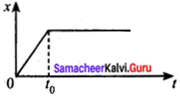
Tamil Nadu 11th Physics Model Question Paper 3 English Medium 1
(a) continuously going in positive x – direction
(b) at rest
(c) going with increasing velocity upto a time t0 and then becomes constant
(d) moves at a constant velocity upto a time t0, and then stops
Answer:
(d) moves at a constant velocity upto a time t0, and then stops

Question 3.
The potential energy of the system increases if work is done ……….. .
(a) upon the system by a non conservative force
(b) by the system against a conservative force
(c) by the system against a non conservative force
(d) upon the system by a conservative force
Answer:
(b) by the system against a conservative force

Question 4.
If x = at2 + bt + c where x is displacement as a function of time. The dimension of ‘a’ and ‘b’ are respectively ……… .
(a) LT-1 and LT-2
(b) LT-2 and LT-1
(c) L and LT-2
(d) LT-1 and L
Answer:
(b) LT-2 and LT-1
Hint:
According to principle of homogeneity, the displacement, x = at2 + bt + c
Dimensionally, [L] = [LT-2] [T2] + [LT-1] [T]
Where a = LT-2 and b = LT-1

Question 5.
A satellite in its orbit around earth is weightless on account of its ……….. .
(a) momentum
(b) acceleration
(c) speed
(d) none
Answer:
(b) acceleration

Question 6.
The displacement of a particle along x – axis is given by x = 7t2 + 8t + 3. Its acceleration and velocity at t = 2s respectively ……….. .
(a) 36 ms-1, 14 ms-2
(b) 14 ms-2, 36 ms-1
(c) 47 ms-2, 21 ms-1
(d) 2 ms-1, 47 ms-2
Answer:
(b) 14 ms-2, 36 ms-1
Hint:
x = 7t2 + 8t + 3 dx
V = \(\frac { dx }{ dt }\) = 14t + 8;
at t = 2s; V = 36 ms-1
a = \(\frac { dv }{ dt }\) = 14 ms-2

Question 7.
A sphere of radius r cm falls from rest in a viscous liquid. Heat is produced due to viscous force. The rate of production of heat when the sphere attains its terminal velocity is proportional to ……….. .
(a) r2
(b) r3
(c) r4
(d) r5
Answer:
(d) r5
Hint:
Rate of heat production = F.V
= 6πηrv × v = 6πηrv2
[v ∝ r2] Terminal velocity ∝ r5

Question 8.
A body of weight mg is hanging on a string which extends its length l. The workdone in extending the string is ……….. .
(a) mgl
(b) \(\frac { mgl }{ 2 }\)
(c) 2 mgl
(d) none of these
Answer:
(b) \(\frac { mgl }{ 2 }\)
Hint:
The extension length is
Workdone (W) = Force × distance
Workdone in extension string = Weight × Length extension
mg × \(\frac { l }{ 2 }\)
W = \(\frac { mgl }{ 2 }\)

Tamil Nadu 11th Physics Model Question Paper 2 English Medium

Question 9.
If Sp and Sv denote the specific heat of nitrogen gas per unit mass at constant pressure and constant volume respectively, then ……….. .
(a) Sp– Sv = 28R
(b) Sp – Sv = \(\frac { R }{ 28 }\)
(c) Sp – Sv = \(\frac { R }{ 14 }\)
(d) Sp – Sv = R
Answer:
(b) Sp – Sv = \(\frac { R }{ 28 }\)
Hint:
According to Mayer’s relation, Sp – Sv = \(\frac { R }{ m }\)
For Nitrogen, m = 28
Sp – Sv = \(\frac { R }{ 28 }\)

Question 10.
A particle is moving eastwards with velocity of 5 m/s. In 10 sec the velocity changes to 5 m/s northwards. The average acceleration in this time is ……….. .
(a) zero
(b) \(\frac { 1 }{ √2 }\) m/s2 towards north – west
(c) \(\frac { 1 }{ √2 }\) m/s2 towards north – east
(d) \(\frac { 1 }{ 2 }\) m/s2 towards north – west
Answer:
(b) \(\frac { 1 }{ √2 }\) m/s2 towards north – west
Hint:
Tamil Nadu 11th Physics Model Question Paper 3 English Medium 2
\(\vec { a } \) = \(\frac { d\vec { v } }{ dt }\)
= \(\frac { 5 }{ 2 } (\hat { j } -\hat { i) } \)
= \(\frac { 1 }{ 2 } (\hat { j } -\hat { i) } \)
a = \(\frac { 1 }{ √2 }\) m/s-2

Question 11.
In an isochoric process, we have ……….. .
(a) W ≠ 0, U = 0, Q = 0, T = 0
(b) W ≠ 0, U ≠ 0, Q = 0, T = 0
(c) W = 0, U = 0, Q ≠ 0, T ≠ 0
(d) W = 0, U ≠ 0, Q ≠ 0, T ≠ 0
Answer:
(d) W = 0, U ≠ 0, Q ≠ 0, T ≠ 0

Question 12.
The efficiency of a carnot engine operations between boiling and freezing points of water is ……….. .
(a) 0.1
(b) 100
(c) 1
(d) 0.27
Answer:
(d) 0.27
Hint:
η = [1 – (\(\frac { { T }_{ 2 } }{ { T }_{ 1 } } \))] = [1 – \(\frac { 273 }{ 373 }\)]
η = 0.268
∴ η = 0.27

Question 13.
Bernoulli’s equation is consequences of conservation of ……….. .
(a) energy
(b) linear momentum
(c) angular momentum
(d) mass
Answer:
(a) energy

Question 14.
By what velocity a ball be projected vertically upwards so that the distance covered in 5th second is twice of that covered in 6 m second (tale g = 10 ms-2) ……….. .
(a) 19.6 ms-1
(b) 58.8 ms-1
(c) 49 ms-1
(d) 65 ms-1
Answer:
(d) 65 ms-1
Hint:
Distance covered int he 5th second
S5= u + \(\frac { 1 }{ 2 }\)(-10) × (2 × 5 – 1)
S5 = u – 5 × 9 = u – 45
Distance covered in the 6th second
S6= u +\(\frac { 1 }{ 2 }\)(-10) × (2 × 6 – 1) = u – 5 × 11
S6 = u – 55 .
Here S5 = 6S6 and we get solving
u = 65 ms-1

Tamil Nadu 11th Physics Model Question Paper 2 English Medium

Question 15.
Unit of Stefan’s constant is ……….. .
(a) watt m2 k4
(b) watt m2 / k4
(c) watt k4 / m2
(d) watt / m2 k4
Answer:
(d) watt / m2 k4

PART – II

Answer any six questions in which Q. No 23 is compulsory. [6 × 2 = 12]

Question 16.
Get an expression for stopping distance of a vehicle in terms of initial velocity v0 and deceleration ‘a’.
Answer:
Let s be the distance travelled by a vehicle before it stops
Using v² – u² = 2as,
We can get 0² – \(v_{0}^{2}\) = -2as
∴ s = \(\frac{v_{0}^{2}}{2a}\)
The stopping distance is directly proportional to \(v_{0}^{2}\). i.e. By doubling initial velocity it increase stopping distance by 4 times. Provided deceleration is kept as constant.

Question 17.
A carnot engine has the same efficiency, when operated
(i) between 100 K and 500 K
(ii) between TK and 900 K. Find the value of T.
Answer:
(i) Here T1 = 500 K; T2 = 100 K
η = 1 – \(\frac{T_2}{T_1}\) =1 – \(\frac{100}{500}\) = 1 – 0.2 = 0.8

(ii) Now, T1= 900 K; T2 = T and n = 0.8
Again, η = 1 – \(\frac{T_2}{T_1}\)
0.8 = 1 – \(\frac{T}{900}\) = 1 – 0.8 = 0.2
∴ T = 180K

Question 18.
A block at rest explodes into 3 parts are -2p\(\vec{j}\) and p\(\vec{j}\). Calculate the magnitude of the momentum of the third part.
Answer:
Let \(\vec{P}\) be the momentum of third particle after the explosion of bomb. According to law of conservation of momentum
-2p\(\vec{i}\) + p\(\vec{j}\) + \(\vec{P}\) = 0 (or) \(\vec{P}\) = 2p\(\vec{i}\) – p\(\vec{j}\)
P = \(\sqrt{(2p)^2+(-p)^2}\) = p√5

Question 19.
Discuss the possibilities of work done to be zero.
Answer:
Work done is zero in the following cases.
(i) When the force is zero (F = 0). For example, a body moving on a horizontal smooth frictionless surface will continue to do so as no force (not even friction) is acting along the plane. (This is an ideal situation.)

(ii) When the displacement is zero (dr = 0). For example, when force is applied on a rigid wall it does not produce any displacement. Hence, the work done is zero as shown in figure.

(iii) When the force and displacement are perpendicular (θ = 90°) to each other, when a body moves on a horizontal direction, the gravitational force (mg) does not work on the body, since it acts at right angles to the displacement as shown in Figure (b). In circular motion the centripetal force does not do work on the object moving on a circle as it is always perpendicular to the displacement as shown in Figure (c).
Tamil Nadu 11th Physics Model Question Paper 3 English Medium 3

Tamil Nadu 11th Physics Model Question Paper 2 English Medium

Question 20.
Define (a) unit of length (b) unit of electric current in SI system.
Answer:
Given v = at² + \(\frac{b}{c+t}\)
The physical quantities which are having same dimensional formula only can be added.
Dimensional formula for v = LT-1
Dimensional formula for c = T
Dimensional formula for at² = LT-1
a = \(\frac{LT_{-1}}{T^2}\) = LT-3
Dimensional formula for \(\frac{b}{c+t}\) = LT-1
∴ b = L [∵ c + t = T]

Question 21.
A solid cylinder of mass 20 kg rotates about it axis with angular speed 100 s-1 the radius of the cylinder is 0.25 m. Calculate moment of inertia of the solid cylinder.
Answer:
Given Data : R = 0.25 m, M = 20 kg, ω = 100 s-1
We know that
moment of inertia of the solid cylinder = \(\frac{MR^2}{2}\)
\(\frac{20×(0.25)^2}{2}\) = 0.625 kgm²
K.E of rotation = \(\frac{1}{2}\) Iω²
\(\frac{1}{2}\) × 0.625 × (100)² = 3125 J
∴ Angular momentum L = Iω = 0.625 × 100
L = 62.5 Js

Question 22.
Why moon has no atmosphere?
Answer:
The acceleration due to gravity of moon ‘g’ is small. Therefore the escape velocity on the surface of moon is also small. The molecules of in its atmosphere have greater thermal velocities than escape speed. The molecules can easily escaped from the atmosphere of moon. Hence the moon has no atmosphere.

Question 23.
A refrigerator has cop of 3. How much work must be supplied to the refrigerator in order to remove 200 J of heat from its interion?
Answer:
COP = β = \(\frac{Q_L}{W}\)
W = \(\frac{Q_c}{COP}\) = \(\frac{200}{3}\) = 66.67 J

Question 24.
What is the effect of gravitational force of attraction acting on the person be inside the satellite and stand on moon?
Answer:
The gravitational force of attraction of the Earth on the person inside the satellite provides the centripetal force necessary to move in an orbit. A person standing on the moon possesses weight due to the additional gravitational pull of the moon on the person.

Tamil Nadu 11th Physics Model Question Paper 2 English Medium

PART – III

Answer any six questions in which Q.No. 29 is compulsory. [6 × 3 = 18]

Question 25.
State and prove Archimedes principle.
Answer:
Archimedes Principle: It states that when a body is partially or wholly immersed in a fluid, it experiences an upward thrust equal to the weight of the fluid displaced by it and its upthrust acts through the centre of gravity of the liquid displaced.

Proof: Consider a body of height ‘h’ lying inside a liquid of density p, at a depth x below the free surface of the liquid. Area of cross section of the body is V. The forces on the sides of the body cancel out.
Tamil Nadu 11th Physics Model Question Paper 3 English Medium 4
Pressure at the upper face of the body, P1′ = xpg.
Pressure at the lower face of the body, P2′ = (x + h) pg
Thrust acting on the upper face of the body is F1 = P1 a = xρga acting vertically downwards,
Thrust acting on the lower face of the body is F2 = P2a = (x + h) ρga acting vertically upwards.
The resultant force (F2 – F1) is acting on the body in the upward direction and is called upthrust (U).
U = F2 – F1 = (x + h) ρga – xρga = ahρg
But ah = V, Volume of the body = Volume of liquid
U = Vρg = Mg
i. e., Upthrust or buoyant force = Weight of liquid displaced.
This proves the Archimedes principle.

Question 26.
State kepler’s three laws.
Answer:

  1. Law of Orbits: Each planet moves around the Sun in an elliptical orbit with the Sun at one of the foci.
  2. Law of area: The radial vector (line joining the Sun to a planet) sweeps equal areas in equal intervals of time.
  3. Law of period: The square of the time period of revolution of a planet around the Sun in its elliptical orbit is directly proportional to the cube of the semi-major axis of the ellipse.
    T² ∝ a³
    \(\frac{T²}{a³}\) = Constant

Question 27.
Write the properties of vector product of two vectors.
Answer:
Properties of vector product of two vectors are:
(i) The vector product of any two vectors is always another vector whose direction is perpendicular to the plane containing these two vectors, i.e., orthogonal to both the vectors \(\vec{A}\) and \(\vec{B}\), even though the vectors \(\vec{A}\) and \(\vec{B}\) may or may not be mutually orthogonal.

(ii) The vector product of two vectors is not commutative, i.e., \(\vec{A}\) × \(\vec{B}\) ≠ \(\vec{B}\) × \(\vec{A}\). But, \(\vec{A}\) × \(\vec{B}\) = –\(\vec{B}\) × \(\vec{A}\).

Here it is worthwhile to note that |\(\vec{A}\) × \(\vec{B}\)| = |\(\vec{B}\) x \(\vec{A}\)| = AB sin θ i.e., in the case of the product vectors \(\vec{A}\) × \(\vec{A}\) and \(\vec{B}\) × \(\vec{A}\), the magnitudes are equal but directions are opposite to each other.

(iii) The vector product of two vectors will have maximum magnitude when sin θ = 1, i.e., θ = 90° i.e., when the vectors \(\vec{A}\) and \(\vec{B}\) are orthogonal to each other.
(\(\vec{A}\) × \(\vec{B}\))max = AB\(\hat{n}\)

(iv) The vector product of two non-zero vectors will be minimum when sin θ = 0, i.e., θ = 0° or 180°
(\(\vec{A}\) × \(\vec{B}\))min = 0
i.e., the vector product of two non-zero vectors vanishes, if the vectors are either parallel or antiparallel.

(v) The self-cross product, i.e., product of a vector with itself is the null vector
\(\vec{A}\) × \(\vec{A}\) = AA sin 0° \(\hat{n}\) = \(\vec{0}\)
In physics the null vector \(\vec{0}\) is simply denoted as zero.

(vi) The self-vector products of unit vectors are thus zero.
\(\vec{i}\) × \(\vec{i}\) = \(\vec{j}\) × \(\vec{j}\) = \(\vec{k}\) × \(\vec{k}\) = 0

Question 28.
Let the two springs A and B such that KA > KB on which spring will more work has to be done if they are stretched by the same force.
Answer:
F = K.x so x = \(\frac{F}{K}\)
For same F
Tamil Nadu 11th Physics Model Question Paper 3 English Medium 5

Tamil Nadu 11th Physics Model Question Paper 2 English Medium

Question 29.
Differentiate slipping and sliding.
Answer:

                              Sliding Slipping
(i) Velocity of centre of mass is greater than Rω i.e. VCM > Rω. Velocity of centre of mass is lesser than Rω. i.e. VCM < Rω
(ii) Velocity of translational motion is greater than velocity of rotational motion. Velocity of translation motion is lesser than velocity of rotational motion.
(iii) Resultant velocity acts in the forward direction. Resultant velocity acts in the backward direction.

Question 30.
Jupiter is at a distance of 824.7 million km from the earth. Its angular diameter is measured to be 35.72” calculate the diameter of Jupiter.
Answer:
Distance of Jupiter = 824.7 × 10⁶ km = 8.247 × 10¹¹ m
Angular diameter = 35.72 × 4.85 × 10-6 rad = 173.242 × 10⁻⁶ rad
= 1.73 × 10⁻⁴ rad
Diameter of Jupiter D = θ × d= 1.73 × 10-4 rad × 8.247 × 1011 m
= 14.267 × 10⁷m = 1.427 × 10⁸m (or) 1.427 × 10⁵ km

Question 31.
A wire 10 m long has a cross-sectional area 1.25 × 10⁻⁴ m². It is subjected to a load of 5 kg. If young’s modulus of the material is 4 × 10¹⁰ Nm-2. calculate the elongation produced in the wire, [take g = 10 ms-2]
Answer:
We know that
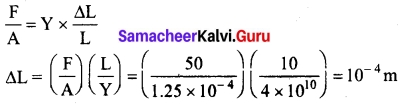
Tamil Nadu 11th Physics Model Question Paper 3 English Medium 6

Question 32.
State and explain the law of equipartition of energy.
Answer:
According to kinetic theory, the average kinetic energy of system of molecules in thermal equilibrium at temperature T is uniformly distributed to all degrees of freedom (x or y or z directions of motion) so that each degree of freedom will get \(\frac{1}{2}\) kT of energy. This is called law of equipartition of energy.
Average kinetic energy of a monatomic molecule (with f = 3) = 3 × \(\frac{1}{2}\) KT = \(\frac{3}{2}\) KT
Average kinetic energy of diatomic molecule at low temperature (with f = 5) = 5 × \(\frac{1}{2}\) KT = \(\frac{5}{2}\) KT
Average kinetic energy of a diatomic molecule at high temperature (with f = 7) = 7 × \(\frac{1}{2}\) KT = \(\frac{7}{2}\) KT
Average kinetic energy of linear triatomic molecule (with f = 7) = 7 × \(\frac{1}{2}\) KT = \(\frac{7}{2}\) KT
Average kinetic energy of non linear triatomic molecule (with f = 6) = 6 × \(\frac{1}{2}\) KT = 3 KT

Question 33.
A cylindrical tank of height 0.4 m is open at the top and has a diameter 0.16 m. Water is filled in it up to height of 0.16 m. Find the time taken to empty the tank through a hole of radius 5 × 10⁻³ m in its bottom.
Answer:
The velocity of efflux through the hole v = \(\sqrt{2gh}\)
Let R, r be the radius of cylindrical tank and hole and ‘dh’ is the decrease in height of water in time ‘dt’ sec use principle of continuity at the top and hole
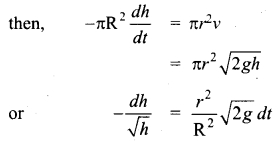
Tamil Nadu 11th Physics Model Question Paper 3 English Medium 7
integrating it within the condition of problem,
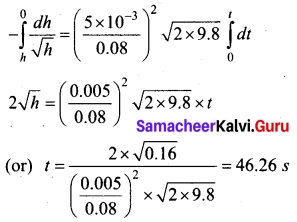
Tamil Nadu 11th Physics Model Question Paper 3 English Medium 8

Tamil Nadu 11th Physics Model Question Paper 2 English Medium

PART – IV

Answer all the questions. [5 × 5 = 25]

Question 34 (a).
Show that the path of oblique projection is parabola.
Answer:
This projectile motion takes place when the initial velocity is not horizontal, but at some angle with the vertical, as shown in Figure.(Oblique projectile)
Examples:

  1. Water ejected out of a hose pipe held obliquely.
  2. Cannon fired in a battle ground.

Consider an object thrown with initial velocity at an angle θ with the horizontal.
Then,
u = u\(\vec{i}\) + u\(\vec{j}\)
where u = u cos θ is the horizontal component and u = u sin θ, the vertical component of velocity.

Since the acceleration due to gravity is in the direction opposite to the direction of vertical component uy, this component will gradually reduce to zero at the maximum height of the projectile. At this maximum height, the same gravitational force will push the projectile to move downward and fall to the ground. There is no acceleration along the x direction throughout the motion. So, the horizontal component of the velocity (ux = u cos θ) remains the same till the object reaches the ground.
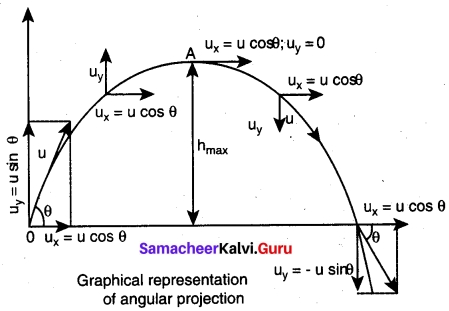
Tamil Nadu 11th Physics Model Question Paper 3 English Medium 9
Hence after the time t, the velocity along horizontal motion vx = ux + axt = ux = u cos θ
The horizontal distance travelled by projectile in time t is sx = uxt + \(\frac{1}{2}\) ax
Here, sx = x, ux = u cos θ, ax = 0
Tamil Nadu 11th Physics Model Question Paper 3 English Medium 10
Thus, x = u cos θ.t or t = \(\frac{x}{u cos θ }\) ………..(1)
Next, for the vertical motion vy = uy + ayt
Here uy = u sin θ, ay = -g (acceleration due to gravity acts opposite to the motion).
Thus, vy = u sin θ – gt
The vertical distance travelled by the projectile in the same time t is
Here, sy = y, uy = u sin θ, ax = -g
Then y = u sin θ t – \(\frac{1}{2}\) gt² ……..(2)
Substitute the value of t from equation (1) in equation (2), we have
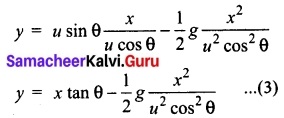
Tamil Nadu 11th Physics Model Question Paper 3 English Medium 11
Thus the path followed by the projectile is an inverted parabola.

Tamil Nadu 11th Physics Model Question Paper 2 English Medium

[OR]

(b) Explain the motion of block connected by a string in vertical motion.
Answer:
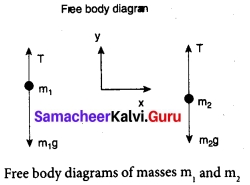
Tamil Nadu 11th Physics Model Question Paper 3 English Medium 12
Case 1: Vertical motion: Consider two blocks of masses m1 and m2 (m1 > m2) connected by a light and inextensible string that passes over a pulley as shown in figure.
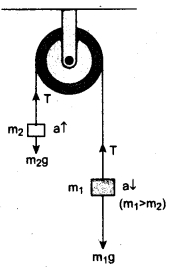
Tamil Nadu 11th Physics Model Question Paper 3 English Medium 13
Let the tension in the string be T and acceleration a. When the system is released, both the blocks start moving, m2 vertically upward and m1 downward with same acceleration a. The gravitational force m1g on mass m1 is used in lifting the mass m2.
The upward direction is chosen as y direction. The free body diagrams of both masses are shown in figure.
Applying Newton’s second law for mass m2
T\(\hat{j}\) – m2g\(\hat{j}\) = m2a\(\hat{j}\)
The left hand side of the above equation is the total force that acts on m2 and the right hand side is the product of mass and acceleration of m2 in y direction.
By comparing the components on both sides, we get
T – m2g = m2a …..(1)
Similarly, applying Newton’s second law for mass m1
T\(\hat{j}\) – m1g\(\hat{j}\) = -m1a\(\hat{j}\)
As mass m1 moves downward (-\(\hat{j}\)), its acceleration is along (-\(\hat{j}\))
By comparing the components on both sides, we get
T – m1g = -m1a
m1g – T = m1a ……(2)
Adding equations (1) and (2), we get
m1g – m2g = m1a – m2a
(m1 – m2)g = (m1 + m1)a ……(3)
From equation (3), the acceleration of both the masses is
a = (\(\frac{m_1-m_2}{m_1+m_2}\))g …….(4)
If both the masses are equal (m1 = m2), from equation (4)
a = 0
This shows that if the masses are equal, there is no acceleration and the system as a whole will be at rest.
To find the tension acting on the string, substitute the acceleration from the equation (4) into the equation (1).
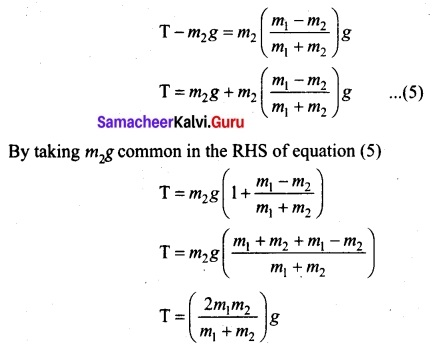
Tamil Nadu 11th Physics Model Question Paper 3 English Medium 14
Equation (4) gives only magnitude of acceleration.
For mass m1, the acceleration vector is given by \(\vec{a}\) = –\(\frac{m_1-m_2}{m_1+m_2}\)g\(\hat{j}\)
For mass m2, the acceleration vector is given by \(\vec{a}\) = \(\frac{m_1-m_2}{m_1+m_2}\)g\(\hat{j}\)

Tamil Nadu 11th Physics Model Question Paper 2 English Medium

Question 35 (a).
Derive the expression for Carnot engine efficiency.
Answer:
Efficiency of a Carnot engine: Efficiency is defined as the ratio of work done by the working substance in one cycle to the amount of heat extracted from the source.
η = \(\frac{Workdone}{Heat extracted}\) = \(\frac{W}{Q_H}\) ……..(1)
From the first law of thermodynamics, W = QH – QL
η = \(\frac{Q_H – Q_L}{Q_H}\) = 1 – \(\frac{Q_L}{Q_H}\) ……..(2)
Applying isothermal conditions, we get,
QH = μRTHln \(\frac{V_2}{V_1}\)
QL = μRTLln \(\frac{V_3}{V_4}\) ………(3)
Here we omit the negative sign. Since we are interested in only the amount of heat (QL) ejected into the sink, we have
\(\frac{T_L}{T_H}\) = \(\frac{Q _L ln (\frac{V_3}{V_4})}{Q _H ln (\frac{V_2}{V_1})}\) …….(4)
By applying adiabatic conditions, we get,
\(\mathrm{T}_{\mathrm{H}} \mathrm{V}_{2}^{\gamma-1}=\mathrm{T}_{\mathrm{L}} \mathrm{V}_{3}^{\gamma-1}\)
\(\mathrm{T}_{\mathrm{H}} \mathrm{V}_{1}^{\gamma-1}=\mathrm{T}_{\mathrm{L}} \mathrm{V}_{4}^{\gamma-1}\)
By dividing the above two equations, we get
\(\left(\frac{v_{2}}{V_{1}}\right)^{\gamma-1}=\left(\frac{V_{3}}{V_{4}}\right)^{\gamma-1}\)
Which implies that \(\frac{V_2}{V_1}\) = \(\frac{V_3}{V_4}\) ……(5)
Substituting equation (5) in (4), we get
\(\frac{Q_L}{Q_H}\) = \(\frac{T_L}{T_H}\) ……..(6)
∴ The efficiency η = 1 – \(\frac{T_L}{T_H}\) ………….(7)
Note : TL and TH should be expressed in Kelvin scale.

Important results:

  1. n is always less than 1 because TL is less than TH. This implies the efficiency cannot be 100%.
  2. The efficiency of the Carnot’s engine is independent of the working substance. It depends only on the temperatures of the source and the sink. The greater the difference between the two temperatures, higher the efficiency.
  3. When TH = TL the efficiency n = 0. No engine can work having source and sink at the same temperature.

[OR]

(b). Explain the concepts of fundamental frequency, harmonics and overtones in detail.
Answer:
Fundamental frequency and overtones: Let us now keep the rigid boundaries at x = 0 and x = L and produce a standing waves by wiggling the string (as in plucking strings in a guitar). Standing waves with a specific wavelength are produced. Since, the amplitude must vanish at the boundaries, therefore, the displacement at the boundary must satisfy the following conditions y(x = 0, t) = 0 and y(x = L, t) = 0………….(1)
Since, the nodes formed are at a distance \(\frac{ λ_n}{2}\) apart, we have n \(\frac{ λ_n}{2}\) = L where n is an integer, L is the length between the two boundaries and λ n is the specific wavelength that satisfy the specified boundary conditions. Hence,
λ n = \(\frac{2L}{n}\)…………(2)
Therefore, not all wavelengths are allowed. The (allowed) wavelengths should fit with the specified boundary conditions, i.e., for n = 1, the first mode of vibration has specific wavelength λ n= 2L. Similarly for n = 2, the second mode of vibration has specific wavelength
λ 2 = \(\frac{2L}{2}\) = L
For n = 3, the third mode of vibration has specific wavelength
λ 3 = \(\frac{2L}{3}\)
and so on.
The frequency of each mode of vibration (called natural frequency) can be calculated.
We have, fn = \(\frac{v}{λ_n}\) = n \(\frac{v}{2L}\) ………..(3)
The lowest natural frequency is called the fundamental frequency.
f1 = \(\frac{v}{λ_1}\) = \(\frac{v}{2L}\) …………(4)
The second natural frequency is called the first over tone.
f2 = 2\(\frac{v}{2L}\) = \(\frac{1}{L} \sqrt{\frac{T}{\mu}}\)
The third natural frequency is called the second over tone.
f3 = 3\(\frac{v}{λ_2}\) = \(3\left(\frac{1}{2L} \sqrt{\frac{T}{\mu}}\right)\)
and so on.
Therefore, the nth natural frequency can be computed as integral (or integer) multiple of fundamental frequency, i.e.,
fn = nf1, where n is an integer …….(5)
If natural frequencies are written as integral multiple of fundamental frequencies, then the frequencies are called harmonics. Thus, the first harmonic is f1 = f1(the fundamental frequency is called first harmonic), the second harmonic is f2 = 2f1, the third harmonic is f3 = 3f1 etc.

Tamil Nadu 11th Physics Model Question Paper 2 English Medium

Question 36 (a).
Compare any two salient features of static and kinetic friction.
Answer:
Static Friction: Static friction is the force which opposes the initiation of motion of an object on the surface. The magnitude of static frictional force fs lies between 0 ≤ fs ≤ μsNs
where,
μs – coefficient of static friction
N – Normal force
Kinetic friction: The frictional force exerted by the surface when an object slides is called as kinetic friction. Also called as sliding friction or dynamic friction,
fk = μkN
where:
μk– the coefficient of kinetic friction
N – Normal force exerted by the surface on the object

(ii) To move an object-push or pull? Which is easier? Explain.
Answer:
When a body is pushed at an arbitrary angle θ (0 to \(\frac{π}{2}\)), the applied force F can be
resolved into two components as F sin θ parallel to the surface and F cos θ perpendicular to the surface as shown in figure. The total downward force acting on the body is mg + F cos θ. It implies that the normal force acting on the body increases. Since there is no acceleration along the vertical direction the normal force N is equal to
NPush = mg + F cos θ ….(1)
As a result the maximal static friction also increases and is equal to
\(f_{x}^{\max }\) = μrNPush = μs(mg + F cos θ ) ……(2)
Equation (2) shows that a greater force needs to be applied to push the object into motion.
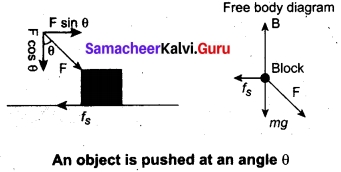
Tamil Nadu 11th Physics Model Question Paper 3 English Medium 15
When an object is pulled at an angle θ, the applied force is resolved into two components as shown in figure. The total downward force acting on the object is
NPull = mg – F cos θ ……..(3)
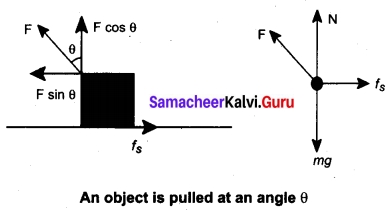
Tamil Nadu 11th Physics Model Question Paper 3 English Medium 16
Equation (3)shows that the normal force is less than NPull. From equations (1) and (3), it is easier to pull an object than to push to make it move.

[OR]

(b). Describe the vertical oscillations of a spring.
Answer:
Vertical oscillations of a spring: Let us consider a massless spring with stiff ness constant or force constant k attached to a ceiling as shown in figure. Let the length of the spring before loading mass m be L. If the block of mass m is attached to the other end of spring, then the spring elongates by a length l. Let F1, be the restoring force due to stretching of spring. Due to mass m, the gravitational force acts vertically downward. We can draw free-body diagram for this system as shown in figure. When the system is under equilibrium,
F1+ mg = 0 ……(1)
But the spring elongates by small displacement 1, therefore,
F1 ∝ l ⇒ F1 = -kl …(2)
Substituting equation (2) in equation (1), we get – kl + mg = 0
-kl + mg = 0
mg = l or \(\frac{m}{k}\) = \(\frac{l}{g}\) …….(3)
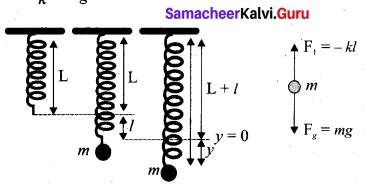
Tamil Nadu 11th Physics Model Question Paper 3 English Medium 17
Suppose we apply a very small external force on the mass such that the mass further displaces downward by a displacement y, then it will oscillate up and down. Now, the restoring force due to this stretching of spring (total extension of spring is( y + 1) is
F2 ∝ (y + l)
F2 = -k(y + l) = -ky – kl …..(4)
Since, the mass moves up and down with acceleration \(\frac{d^2y}{dt^2}\) diagram for this case, we get
-ky – kl + mg = m\(\frac{d^2y}{dt^2}\) …….(5)
The net force acting on the mass due to this stretching is
F = F2 + mg
F = – ky – kl + mg ……..(6)
The gravitational force opposes the restoring force. Substituting equation (3) in equation (6), we get
F = – ky – kl + kl = -ky
Applying Newton’s law, we get
m\(\frac{d^2y}{dt^2}\) = -ky
m\(\frac{d^2y}{dt^2}\) = –\(\frac{k}{m}\)y ……(7)
The above equation is in the form of simple harmonic differential equation. Therefore, we get the time period as
T = 2π, \(\sqrt{\frac{m}{k}}\) second …….(8)
The time period can be rewritten using equation (3)
T = 2π, \(\sqrt{\frac{m}{k}}\) = 2πl\(\frac{l}{g}\) second ……(9)
The acceleration due to gravity g can be computed from the formula
g = 4π²(\(\frac{1}{T^2}\)) ms-2

Tamil Nadu 11th Physics Model Question Paper 2 English Medium

Question 37 (a).
State and prove Bernoulli’s theorem
Answer:
Bernoulli’s theorem: According to Bernoulli’s theorem, the sum of pressure energy, kinetic energy, and potential energy per unit mass of an incompressible, non-viscous fluid in a streamlined flow remains a constant. Mathematically,
\(\frac{p}{roe}\) + \(\frac{1}{2}\)v² + gh = Constant
This is known as Bernoulli’s equation.
Proof : Let us consider a flow of liquid through a pipe AB. Let V be the volume of the liquid when it enters A in a time t which is equal to the volume of the liquid leaving B in the same time. Let aA, vA and PA be the area of cross section of the tube, velocity of the liquid and pressure exerted by the liquid at A respectively.
Let the force exerted by the liquid at A is
FA = PA aA
Distance travelled by the liquid in time t is d = vAt
Therefore, the work done is W = FAd = PAaAvAt
But aAvAt = aAd = V, volume of the liquid entering at A.
Thus, the work done is the pressure energy (at A), W = FAd = PAV
Pressure energy per unit volume at
A = \(\frac{pressure energy}{volume}\) = \(\frac{P_AV}{V}\) = PA
Pressure energy per unit mass at
A = \(\frac{pressure energy}{volume}\) = \(\frac{P_AV}{m}\) = \(\frac{P_A}{\frac{m}{v}}\) = \(\frac{P_A}{ρ}\)
Since m is the mass of the liquid entering at A in a given time, therefore, pressure energy of the liquid at A is
EPA – PAV = PAV × (\(\frac{m}{m}\)) = m\(\frac{P_A}{ρ}\)
Potential energy of the liquid at A,
PEA = mghA
Due to the flow of liquid, the kinetic energy of the liquid at A,
KEA = \(\frac{π}{2}\)m \(v_{A}^{2}\)
Therefore, the total energy due to the flow of liquid at A,
EA = EPA + KEA + PEA
EA = m\(\frac{P_A}{ρ}\) + \(\frac{1}{2}\) mv\(v_{A}^{2}\) + mg hA
Similarly, let aB, vB and PB be the area of cross section of the tube, velocity of the liquid and pressure exerted by the liquid at B. Calculating the total energy at FB, we get
EB = m\(\frac{P_B}{ρ}\) + \(\frac{1}{2}\) mv\(v_{B}^{2}\) + mg hB
From the law of conservation of energy,
EA = EB
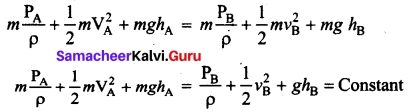
Tamil Nadu 11th Physics Model Question Paper 3 English Medium 18
Thus, the above equation can be written as
\(\frac{P}{ρg}\) + \(\frac{1}{2}\) \(\frac{V_2}{g}\) + h = Constant
Tamil Nadu 11th Physics Model Question Paper 3 English Medium 19
The above equation is the consequence of the conservation of energy which is true until there is no loss of energy due to friction. But iri practice, some energy is lost due to friction. This arises due to the fact that in a fluid flow, the layers flowing with different velocities exert frictional forces on each other. This loss of energy is generally converted into heat energy. Therefore, Bernoulli’s relation is strictly valid for fluids with zero viscosity or non-viscous liquids. Notice that when the liquid flows through a horizontal pipe, then
h = 0 ⇒ \(\frac{P}{ρg}\) +\(\frac{1}{2}\) \(\frac{V_2}{g}\) = Constant

Tamil Nadu 11th Physics Model Question Paper 2 English Medium

[OR]

(b) Write down the postulates of kinetic theory of gases.
Answer:

  1. All the molecules of a gas are identical, elastic spheres.
  2. The molecules of different gases are different.
  3. The number of molecules in a gas is very large and the average separation between them is larger than size of the gas molecules.
  4. The molecules of a gas are in a state of continuous random motion.
  5. The molecules collide with one another and also with the walls of the container.
  6. These collisions are perfectly elastic so that there is no loss of kinetic energy during collisions.
  7. Between two successive collisions, a molecule moves with uniform velocity.
  8. The molecules do not exert any force of attraction or repulsion on each other except during collision. The molecules do not possess any potential energy and the energy is wholly kinetic.
  9. The collisions are instantaneous. The time spent by a molecule in each collision is very small compared to the time elapsed between two consecutive collisions.
  10. These molecules obey Newton’s laws of motion even though they move randomly.

Question 38 (a).
Discuss in detail the energy in simple harmonic motion.
Energy in simple harmonic motion:
Answer:
(a) Expression for Potential Energy
For the simple harmonic motion, the force and the displacement are related by Hooke’s law
\(\vec{F}\) = -k\(\vec{r}\)
Since force is a vector quantity, in three dimensions it has three components. Further, the force in the above equation is a conservative force field; such a force can be derived from a scalar function which has only one component. In one dimensional case
F = -kx ……(1)
We know that the work done by the conservative force field is independent of path. The potential energy U can be calculated from the following expression.
F = –\(\frac{dU}{dx}\)
Comparing (1) and (2), we get
–\(\frac{dU}{dx}\) = -kx
dU = kx dx
This work done by the force F during a small displacement dx stores as potential energy
Tamil Nadu 11th Physics Model Question Paper 3 English Medium 20
From equation to ω = \(\sqrt{\frac{k}{m}}\), we can substitute the value of force constant k = mω² in equation (3),
U(x) = \(\frac{1}{2}\)mω²x² …..(4)
where ω is the natural frequency of the oscillating system. For the particle executing simple harmonic motion from equation y = A sin ωt, we get
x = A sin ωt
U(t) = \(\frac{1}{2}\)mω²A² sin² ωt ……(5)
This variation of U is shown in figure.

Tamil Nadu 11th Physics Model Question Paper 2 English Medium

(b) Expression for Kinetic Energy
Kinetic energy
KE = \(\frac{1}{2}\)m\(v_{x}^{2}\) = \(\frac{1}{2}\)m(\(\frac{dx}{dt}\))² …..(6)
Since the particle is executing simple harmonic motion, from equation
y = A sin ωt
x = A sin ωt
Tamil Nadu 11th Physics Model Question Paper 3 English Medium 21
Therefore, velocity is
vx = \(\frac{dx}{dt}\) = Aω cos ωt ….(7)
Tamil Nadu 11th Physics Model Question Paper 3 English Medium 22
This variation with time is shown in figure.

(c) Expression for Total Energy
Total energy is the sum of kinetic energy and potential energy
E = KE + U ….(11)
E = \(\frac{1}{2}\) mω² (A² – x²) + \(\frac{1}{2}\) mω²x²
Hence, cancelling x² term,
E = \(\frac{1}{2}\) mω²A² = constant ……(12)
Alternatively, from equation (5) and equation (10), we get the total energy as
E = \(\frac{1}{2}\) mω²A² sin² ωt + \(\frac{1}{2}\) mω²A² cos² ωt
= \(\frac{1}{2}\) mω²A² (sin² ωt + cos² ωt)
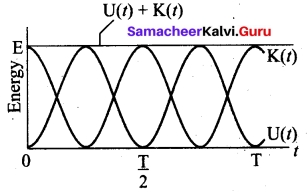
Tamil Nadu 11th Physics Model Question Paper 3 English Medium 23
From trigonometry identity, (sin² ωt + cos² ωt) = 1
E = \(\frac{1}{2}\) mω²A² = constant
which gives the law of conservation of total energy.
Thus the amplitude of simple harmonic oscillator, can be expressed in terms of total energy.
A = \(\sqrt{\frac{2E}{mω^2}}\) =\(\sqrt{\frac{2E}{k}}\)

Tamil Nadu 11th Physics Model Question Paper 2 English Medium

[OR]

(b) Explain the formation of stationary waves.
Answer:
Consider two harmonic progressive waves (formed by strings) that have the same amplitude and same velocity but move in opposite directions. Then the displacement of the first wave (incident wave) is
y1 = A sin (kx – ωt) (waves move toward right) ……(1)
and the displacement of the second wave (reflected wave) is
y2 = A sin (kx + ωt) (waves move toward left) …….(2)
both will interfere with each other by the principle of superposition, the net displacement is
y = y1 + y2 ……(3)
Substituting equation (1) and equation (2) in equation (3), we get
y = A sin (kx – ωt)+A sin (kx + ωt) …….(4)
Using trigonometric identity, we rewrite equation (4) as
y(x, t) = 2A cos (ωt) sin (kx) ……(5)
This represents a stationary wave or standing wave, which means that this wave does not move either forward or backward, whereas progressive or travelling waves will move forward or backward. Further, the displacement of the particle in equation (5) can be written in more compact form,
y(x, t) = A’ cos (ωt)
where, A’ = 2A sin (kx), implying that the particular element of the string executes simple harmonic motion with amplitude equals to A’. The maximum of this amplitude occurs at positions for which
sin (kx) = 1 ⇒ kx = \(\frac{π}{2}\), \(\frac{3π}{2}\), \(\frac{5π}{2}\), …… = mπ
where m takes half integer or half integral values. The position of maximum amplitude is known as antinode. Expressing wave number in terms of wavelength, we can represent the anti-nodal positions as
xm = (\(\frac{2m+1}{2}\)) \(\frac{λ}{2}\) where> m = 0, 1, 2…. ……(6)
For m = 0we have maximum at x0 = \(\frac{λ}{2}\)
For m = 1 we have maximum at x1 = \(\frac{3λ}{4}\)
For m = 2 we have maximum at x2 = \(\frac{5λ}{4}\) and so on.
The distance between two successive antinodes can be computed by

Tamil Nadu 11th Physics Model Question Paper 3 English Medium 24
Similarly, the minimum of the amplitude A’ also occurs at some points in the space, and these points can be determined by setting
sin (kx) = 0 ⇒ kx = 0, π, 2π, 3π,…. = nπ
where n takes integer or integral values. Note that the elements at these points do not vibrate (not move), and the points are called nodes. The nth nodal positions is given by,
xn = n\(\frac{λ}{2}\) where, n = 0,1,2,… …..(7)
For n = 0we have minimum at x0 = 0
For n = 1 we have minimum at x1 = \(\frac{λ}{2}\)
For n = 2 we have maximum at x2 = λ and so on.
The distance between any two successive nodes can be calculated as
xn – xn-1 = n\(\frac{λ}{2}\) – (n – 1) \(\frac{λ}{2}\) = \(\frac{λ}{2}\)

Tamil Nadu 11th Physics Model Question Paper 2 English Medium

Tamil Nadu 11th Physics Model Question Paper 3 English Medium Read More »