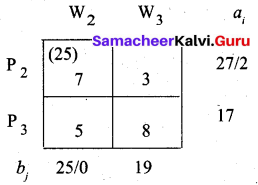
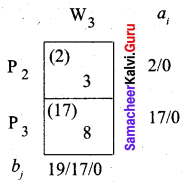
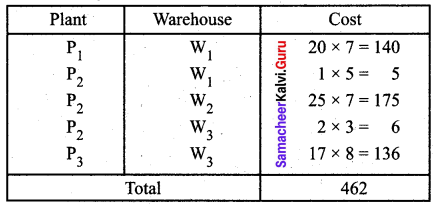
Class 12

Samacheer Kalvi 12th Business Maths Solutions Chapter 7 Probability Distributions Additional Problems

Students can download 12th Business Maths Chapter 7 Probability Distributions Additional Problems and Answers, Samacheer Kalvi 12th Business Maths Book Solutions Guide Pdf helps you to revise the complete Tamilnadu State Board New Syllabus and score more marks in your examinations.

Tamilnadu Samacheer Kalvi 12th Business Maths Solutions Chapter 7 Probability Distributions Additional Problems

Choose the correct answer:

Question 1.
If X is a poisson variate with P (X = 1) = P (X = 2), the mean of the poisson variate is equal to _____
(a) 1
(b) 2
(c) -2
(d) 3
Answer:
(b) 2
Hint:
P(X = 1) = P(X = 2)
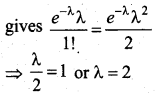
Samacheer Kalvi 12th Business Maths Solutions Chapter 7 Probability Distributions Additional Problems I Q1

Question 2.
If ‘λ’ is the mean of the Poisson distributions, then P (X = 0) is given by ________
(a) \(e^{-\lambda}\)
(b) \(e^{\lambda}\)
(c) e
(d) \(\lambda^{-e}\)
Answer:
(a) \(e^{-\lambda}\)
Hint:

Samacheer Kalvi 12th Business Maths Solutions Chapter 7 Probability Distributions Additional Problems I Q2

Samacheer Kalvi 12th Business Maths Solutions Chapter 7 Probability Distributions Additional Problems

Question 3.
A larger standard deviation for a normal distribution with an unchanged mean indicates that the curve becomes, ____
(a) narrower and more peaked
(b) flatter and wider
(c) more skewed to the right
(d) more skewed to the left
Answer:
(b) flatter and wider

Question 4.
If X ~ N (0, 4), the value of P(|X| ≥ 2.2) is ______
(a) 0.2321
(b) 0.8438
(c) 0.2527
(d) 0.2714
Answer:
(d) 0.2714
Hint:
P (|X| ≥ 2.2)
= P (X > 2.2) + P (X < -2.2)
= P(Z > \(\frac{2.2-0}{2}\)) + P(Z < \(\frac{-2.2-0}{2}\))
= P(Z > 1.1) + P(Z < -1.1)
= 2 P(Z > 1.1) (by symmetry)
= 2[0.5 – P(0 < Z < 1.1)]
= 2 [0.5 – 0.3643]
= 0.2714

Samacheer Kalvi 12th Business Maths Solutions Chapter 7 Probability Distributions Additional Problems

Question 5.
For a binomial distribution.

  1. If n = 1, then E(X) is ________
  2. The variance is always ________
  3. Successive trials are ______
  4. Negatively skewed when _______
  5. Number of parameters is _______
  6. n = 10, p = 0.3, variance is _______
  7. Is symmetrical when ______
  8. n = 6, p = 0.9, P (X = 7) is _______
  9. Mean, median and mode will be equal when ______

Answer:

  1. p
  2. less than mean
  3. independent
  4. p > \(\frac {1}{2}\)
  5. two
  6. 2.1
  7. p = q
  8. zero
  9. p = 0.5

Question 6.
For a Normal distribution

  1. The parameters which controls the flatness of the curve is _____ & ______
  2. If Y = 5X + 10 and X ~ N (10, 25), then mean of Y is _______
  3. Normal curve is asymptotic to the ________
  4. The median corresponds to the value of Z = _______
  5. The area under the normal curve on either side of mean is _______

Answer:

  1. µ, σ
  2. 60
  3. X-axis
  4. µ
  5. 0.5

Samacheer Kalvi 12th Business Maths Solutions Chapter 7 Probability Distributions Additional Problems

Question 7.
Heights of college girls follows a normal distribution with mean 65 inches and a standard deviation of 3 inches. About what proportion of girls are between 65 and 67 inches tall?
(a) 0.75
(b) 0.5
(c) 0.25
(d) 0.17
Answer:
(c) 0.25
Hint:
P (65 < X < 67)
= P(\(\frac{65-65}{3}\) < Z < \(\frac{67-65}{3}\))
= P(0 < Z < 67)
= 0.2486 ~ 0.25

Question 8.
Which one of these is a binomial random variable?
(a) time is taken by a randomly chosen student to complete an exam
(b) number of books bought by a randomly chosen student
(c) number of women taller than 150 cm in a random sample of 10 women
(d) number of CD’s a randomly selected person owns
Answer:
(c) number of women taller than 150 cm in a random sample of 10 women

Samacheer Kalvi 12th Business Maths Solutions Chapter 7 Probability Distributions Additional Problems

Question 9.
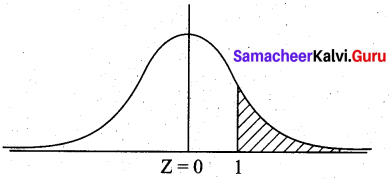
Pulse rates of adult men follows a normal distribution with a mean of 70 and a standard deviation of 8. Which choice tells how to find the proportion of men that have a pulse rate greater than 78?
Samacheer Kalvi 12th Business Maths Solutions Chapter 7 Probability Distributions Additional Problems I Q9
(a) find the area to the left of Z = 1 under the normal curve
(b) find the area between Z = -1 and Z = 1 under the standard normal curve
(c) find the area to the right of Z = 1 under the standard normal curve
(d) find the area to the right of Z = -1 under the standard normal curve
Answer:
(c) find the area to the right of Z = 1 under the standard normal curve
Hint:
P(X > 78) = P(Z > \(\frac{78-70}{8}\)) = P(Z > 1)

2 Mark Questions

Question 1.
The probability that a radio manufactured by a company will be defective is \(\frac{1}{10}\). If 15 such radios are inspected, find the probability that exactly 3 will be defective.
Solution:
Given n = 15, p = \(\frac{1}{10}\) = 0.1, q = 0.9 10
Let X be the binomial variable, denoting the number of radios.
We want probability of exactly 3 defectives, (i.e) P (X = 3)
Now P (X = 3) = \(^{15} \mathrm{C}_{3}(0.1)^{3}(0.9)^{12}\)
= 455 (0.001) [(0.9)4]3
= (455) (0.001) (0.6561)3
= 0.1285

Question 2.
The probability that a bulb produced in a factory will fuse after 10 days is 0.05. Find the probability that out of 5 such bulbs, not more than 1 will fuse after 400 days of use.
Solution:
Given that X ~ B (5, 0.05)
(i.e.) n = 5, p = 0.05, q = 0.95
P(X ≤ 1) = P(X = 0) + P(X = 1)
= \(^{5} \mathrm{C}_{0}(0.05)^{0}(0.95)^{5}+^{5} \mathrm{C}_{1}(0.05)^{1}(0.95)^{4}\)
= (0.95)5 + 5 (0.05) (0.95)4
= (0.95)4 + [0.95 + 0.25]
= 0.9774

Samacheer Kalvi 12th Business Maths Solutions Chapter 7 Probability Distributions Additional Problems

Question 3.
The number of traffic accidents that occur in a particular road follows a Poisson distribution with a mean of 9.4. Find the probability that less than two accidents will occur on this road during a randomly selected month.
Solution:
Let X be the Poisson variate with mean λ = 9.4.
Now P(X < 2) = P (X = 0) + P (X = 1)
= \(e^{-9.4}\) [1 + 9.4]
= \(e^{-9.4}\) (10.4)
= 0.00086

Question 4.
What is the probability of getting 2 Sundays out of 15 days selected at random?
Solution:
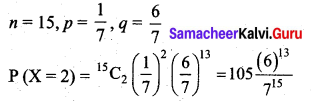
Samacheer Kalvi 12th Business Maths Solutions Chapter 7 Probability Distributions Additional Problems II Q4

Samacheer Kalvi 12th Business Maths Solutions Chapter 7 Probability Distributions Additional Problems

Question 5.
Find the mean and standard deviation of a Poisson variate X which satisfies the condition P(X = 2 ) = P(X = 3)
Solution:
P(X = 2 ) = P(X = 3)
\(\frac{e^{-\lambda} \lambda^{2}}{2 !}=\frac{e^{-\lambda} \lambda^{3}}{3 !}\)
1 = \(\frac{\lambda}{3}\) (or) λ = 3
Variance for Poisson distribution is λ = 3. Hence s.d = √3

Question 6.
Between 5 to 6 p.m., the average number of phone calls per minute is 4. What is the probability that there is no phone call during a minute?
Solution:
Let X be the Poisson variate denoting the number of phone calls per minute.
Given that mean λ = 4. We want P(X = 0)
Now P(X = 0) = \(\frac{e^{-4} \lambda^{0}}{0 !}\) = e-4 = 0.0183

Samacheer Kalvi 12th Business Maths Solutions Chapter 7 Probability Distributions Additional Problems

Question 7.
2% cars are defective. What is the probability that one of 150 cars, there is exactly one defective car?
Solution:
Let X be the Poisson variate denoting the number of defective cars. The mean λ is given by
λ = \(\frac {2}{100}\) × 150 = 3
So P(X = 1) = \(\frac{e^{-3}(3)^{1}}{1 !}\) = 3e-3 = 0.1494

Question 8.
What is the standard deviation of the number of recoveries among 48 patients, the probability of recovering is 0.75.
Solution:
Given n = 48, p = 0.75, q = 0.25
This is a binomial distribution.
The variance is given by Var (X) = npq
= (48) (0.75) (0.25)
= 9 .
So the standard deviation is √9 = 3

3 and 5 Mark Questions

Question 1.
What is the probability of success of the binomial distribution satisfying the following condition: 4P(X = 4) = P(X = 2) and having other parameter as 6?
Solution:
Given n = 6, 4P(X = 4) = P(X = 2).
We have to find p.
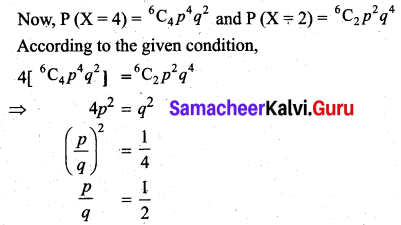
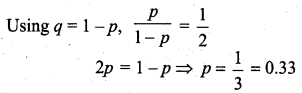
Samacheer Kalvi 12th Business Maths Solutions Chapter 7 Probability Distributions Additional Problems III Q1
Samacheer Kalvi 12th Business Maths Solutions Chapter 7 Probability Distributions Additional Problems III Q1.1

Question 2.
Wool fibre breaking strengths are normally distributed with mean µ = 23.56 and S.D σ = 4.55. What proportion of fibres would have a breaking strength of 14.45 or less?
Solution:
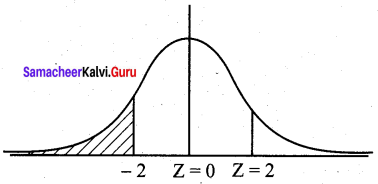
Samacheer Kalvi 12th Business Maths Solutions Chapter 7 Probability Distributions Additional Problems III Q2
Let X be the normal variable denoting the breaking strengths.
We want to find
P(X ≤ 14.45) = P(Z ≤ \(\frac{14.45-23.56}{4.55}\)) = P(Z ≤ -2.00)
By Symmetry,
P(Z ≤ -2) = P(Z ≥ 2)
= 0.5 – P(0 ≤ Z ≤ 2)
= 0.5 – 0.4772
= 0.0228
Hence the proportion of fibres with a breaking strength of 14.45 or less is 2.28%

Samacheer Kalvi 12th Business Maths Solutions Chapter 7 Probability Distributions Additional Problems

Question 3.
The finish times for marathon runners during a race are normally distributed with a mean of 195 minutes and a standard deviation of 25 minutes.
(a) What is the probability that a runner will complete the marathon within 3 hours?
(b) Calculate to the nearest minute, the time by which the first 8% runners have completed the marathon?
(c) What proportion of the runners will complete the marathon between 3 hours and 4 hours?
Solution:
Let X be the normal variate denoting the finish time of the marathon runners.
Given the mean µ = 195 and s.d σ = 25
(a) P(X ≤ 3 hours)
= P(X ≤ 180 minutes)
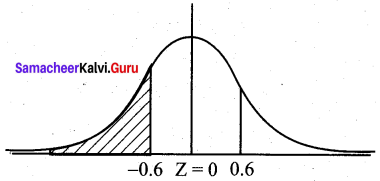
= P(Z ≤ \(\frac{180-195}{25}\))
= P(Z ≤ -0.6)
By symmetry
P(Z ≤ -0.6)
= P(Z ≤ 0.6)
= 0.5 – P(0 ≤ Z ≤ 0.6)
= 0.5 – 0.2258
= 0.2742
(i.e) Probability of a runner taking less than 3 hours is 0.2742
Samacheer Kalvi 12th Business Maths Solutions Chapter 7 Probability Distributions Additional Problems III Q3
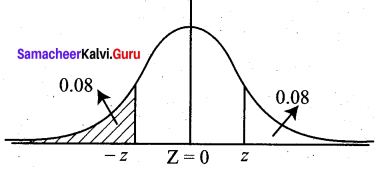
(b) Given the probability is 8% = 0.08
P (Z ≥ z) = 0.08
0.5 – P(0 ≤ Z ≤ z) = 0.08
P(0 ≤ Z ≤ z) = 0.42
z = 1.41 (from normal tables)
Hence \(\frac{X-195}{25}\) = -1.41
X = 25 (-1.41) + 195 = 159.75 = 160 minutes
Samacheer Kalvi 12th Business Maths Solutions Chapter 7 Probability Distributions Additional Problems III Q3.1
(c) P(3 hours < X < 4 hours)
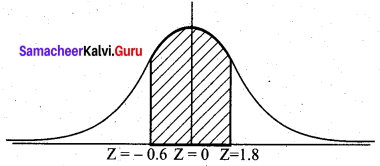
= P (180 min < X < 240 min)
= P(\(\frac{180-195}{25}\) < Z < \(\frac{240-195}{25}\))
= P(-0.6 < Z < 1.8)
= P (-0.6 < Z < 0) + P (0 < Z < 1.8)
= P(0 < Z < 0.6) + P(0 < Z < 1.8)
= 0.2258 + 0.4641
= 0.6899
Hence the proportion of runners taking between 3 hours and 4 hours is 68.99%
Samacheer Kalvi 12th Business Maths Solutions Chapter 7 Probability Distributions Additional Problems III Q3.2

Question 4.
The probability that a driver must stop at any one traffic light is 0.2. There are 15 sets of traffic lights on the journey.
(а) What is the probability that a student must stop at exactly 2 of the 15 sets of traffic lights?
(b) What is the probability that a student will be stopped at 1 or more of the 15 sets of traffic lights?
Solution:
Let X be the binomial random variable denoting the number of traffic lights.
Given n = 15, p =0.2, q = 0.8
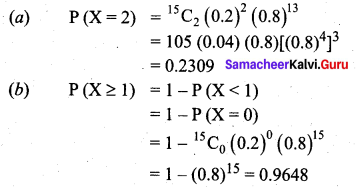
Samacheer Kalvi 12th Business Maths Solutions Chapter 7 Probability Distributions Additional Problems III Q4

Samacheer Kalvi 12th Business Maths Solutions Chapter 7 Probability Distributions Additional Problems

Question 5.
A radioactive source emits 4 particles on average during a five-second period.
(а) Calculate the probability that it emits 3 particles during a five-second period.
(b) Find the probability that it emits at least one particle during a 5 second period.
(c) During a 10 second period, what is the probability that 6 particles are emitted?
Solution:
Let X be the Poisson variable denoting the number of particles emitted.
Given the mean λ = 4
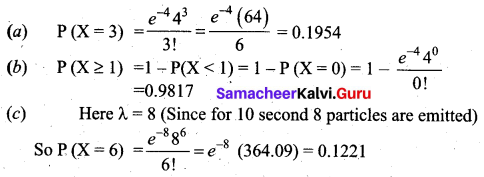
Samacheer Kalvi 12th Business Maths Solutions Chapter 7 Probability Distributions Additional Problems III Q5

Question 6.
Given that X ~ B (n, p) and E(X) = 24, Var(X) = 8, find the values of n and p.
Solution:
We know E(X) = np = 24 and Var(X) = npq = 8
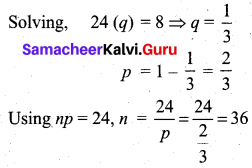
Samacheer Kalvi 12th Business Maths Solutions Chapter 7 Probability Distributions Additional Problems III Q6

Samacheer Kalvi 12th Business Maths Solutions Chapter 7 Probability Distributions Additional Problems

Question 7.
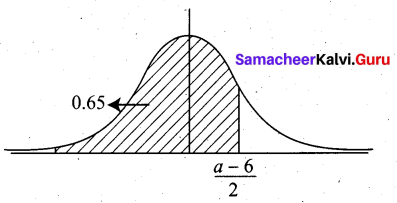
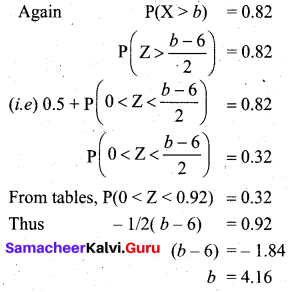
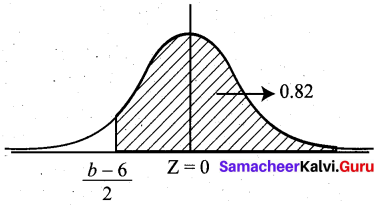
Given that X ~ N (6, 4), find the values of ‘a’ and ‘b’ such that P (X ≤ a) = 0.6500 and P(X ≤ b) = 0.8200
Solution:
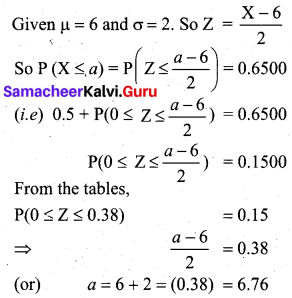
Samacheer Kalvi 12th Business Maths Solutions Chapter 7 Probability Distributions Additional Problems III Q7
Samacheer Kalvi 12th Business Maths Solutions Chapter 7 Probability Distributions Additional Problems III Q7.1
Samacheer Kalvi 12th Business Maths Solutions Chapter 7 Probability Distributions Additional Problems III Q7.2
Samacheer Kalvi 12th Business Maths Solutions Chapter 7 Probability Distributions Additional Problems III Q7.3

Samacheer Kalvi 12th Business Maths Solutions Chapter 7 Probability Distributions Additional Problems Read More »

Samacheer Kalvi 12th Business Maths Solutions Chapter 10 Operations Research Additional Problems

Students can download 12th Business Maths Chapter 10 Operations Research Additional Problems and Answers, Samacheer Kalvi 12th Business Maths Book Solutions Guide Pdf helps you to revise the complete Tamilnadu State Board New Syllabus and score more marks in your examinations.

Tamilnadu Samacheer Kalvi 12th Business Maths Solutions Chapter 10 Operations Research Additional Problems

I. One Mark Questions

Choose the correct Answer

Question 1.
Which of the following methods is used to verify the optimality of the current solution of the transportation problem?
(a) Least cost method
(b) Vogel’s method
(c) North-west comer rule
(d) None of these
Answer:
(a) Least cost method

Question 2.
The degeneracy’in the transportation problem indicates that _________
(a) Dummy allocations need to be added
(b) The problem has no feasible solution
(c) Multiple optimal solutions exist
(d) All of the above
Answer:
(c) Multiple optimal solutions exist

Samacheer Kalvi 12th Business Maths Solutions Chapter 10 Operations Research Additional Problems

Question 3.
The Hungarian method can also be used to solve ______
(a) Transportation problem
(b) Travelling salesman problem
(c) A linear programming problem
(d) All the above
Answer:
(b) Travelling salesman problem

Question 4.
An optimal solution of an assignment problem can be obtained only if, _________
(a) each row and column has only one zero element
(b) each row and column has at least one zero element
(c) The data is arranged in a square matrix
(d) None of the above
Answer:
(d) None of the above

Samacheer Kalvi 12th Business Maths Solutions Chapter 10 Operations Research Additional Problems

Question 5.
Say True or False.

  1. In a transportation problem, a single source may supply something to all destinations.
  2. A transportation model must have the same number of rows and columns.
  3. It is usually possible to find an optimal solution to a transportation problem that is degenerate.
  4. In a transportation problem, a dummy source is given a zero cost, while in an assignment problem, a dummy source is given a very high cost.
  5. The Hungarian method operates on the principle of matrix reduction, whereby the cost table is reduced to a set of opportunity costs.

Answer:

  1. True
  2. False
  3. True
  4. False
  5. True

Question 6.
Fill in the blanks.

  1. In a transportation problem, we must make the number of ________ and _______ equal.
  2. ______ or ______ are used to balance an assignment problem.
  3. The method of finding an initial solution based on opportunity costs is called _______
  4. ________ occurs when the number of occupied squares is less than the number of rows plus the number of columns minus one.
  5. Both transportation and assignment problems are members of a category of LP problems called ________
  6. In the case of an unbalanced problem, shipping cost coefficients of ______ are assigned to each dummy factory or warehouse.

Answer:

  1. units supplied, units demanded
  2. Dummy rows, dummy columns
  3. Vogel’s approximation method
  4. Degeneracy
  5. Network flow problems
  6. zero

Samacheer Kalvi 12th Business Maths Solutions Chapter 10 Operations Research Additional Problems

Question 7.
Match the following.

(a) Dummy column (i) Finding initial solution
(b) Northwest comer rule (ii) Rows ≠ Columns
(c) Hungarian method (iii) Supply ≠ Demand
(d) Feasible solution (iv) Assignment problem
(e) Unbalanced problem (v) All demand and supply constraints are met

Answer:
(a) – (iii)
(b) – (i)
(c) – (iv)
(d) – (v)
(e) – (ii)

Question 8.
The objective function of transportation problem is to ________
(a) Maximise total cost
(b) Minimise the total cost
(c) Total cost should be zero
(d) All the above
Answer:
(b) Minimise the total cost

Samacheer Kalvi 12th Business Maths Solutions Chapter 10 Operations Research Additional Problems

Question 9.
In transportation problem, optimal solution can be verified by using _______
(a) NWC
(b) LCM
(c) MODI method
(d) Matrix method
Answer:
(c) MODI method

Question 10.
The cells in the transportation problem can be classified as _______
(a) assigned cells and empty cells
(b) allocated cells and unallocated cells
(c) occupied and unoccupied cells
(d) assigned and unoccupied cells
Answer:
(c) occupied and unoccupied cells

Samacheer Kalvi 12th Business Maths Solutions Chapter 10 Operations Research Additional Problems

Question 11.
In transportation problem if total supply > total demand we add _________
(a) dummy row with cost 0
(b) dummy column with cost 0
(c) dummy row with cost 1
(d) dummy column with cost 1
Answer:
(b) dummy column with cost 0

Question 12.
In an LPP the objective function is to be ________
(a) Minimised
(b) Maximised
(c) (a) or (b)
(d) only (b)
Answer:
(c) (a) or (b)

Samacheer Kalvi 12th Business Maths Solutions Chapter 10 Operations Research Additional Problems

Question 13.
The method used for solving an assignment problem is called ________
(a) Reduced matrix method
(b) MODI method
(c) Hungarian method
(d) Graphical method
Answer:
(c) Hungarian method

II. 2 Mark Questions

Question 1.
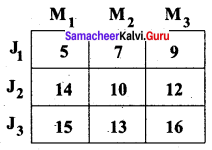
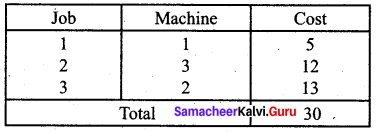
Consider 3 jobs to be assigned to 3 machines. The cost for each combination is shown in the table below. Find the minimal job machine combinations.
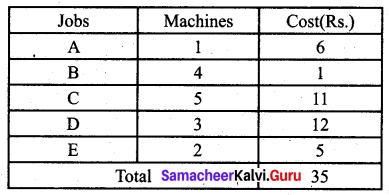
Samacheer Kalvi 12th Business Maths Solutions Chapter 10 Operations Research Additional Problems 1
Solution:
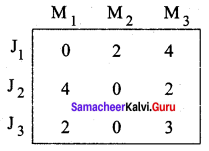
Step 1:
Samacheer Kalvi 12th Business Maths Solutions Chapter 10 Operations Research Additional Problems 2
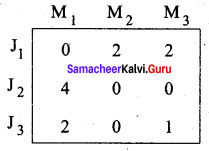
Step 2:
Samacheer Kalvi 12th Business Maths Solutions Chapter 10 Operations Research Additional Problems 3
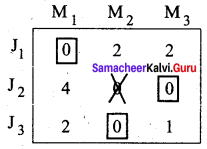
Step 3: (Assignment)
Samacheer Kalvi 12th Business Maths Solutions Chapter 10 Operations Research Additional Problems 4
Optimal assignment:
Samacheer Kalvi 12th Business Maths Solutions Chapter 10 Operations Research Additional Problems 5

Question 2.
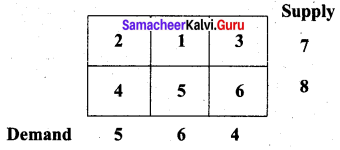
Find an initial basic feasible solution by LCM.
Samacheer Kalvi 12th Business Maths Solutions Chapter 10 Operations Research Additional Problems 6
Solution:
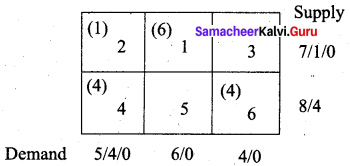
Samacheer Kalvi 12th Business Maths Solutions Chapter 10 Operations Research Additional Problems 7
Total cost = (1 × 2) + (6 × 1) + (4 × 4) + (4 × 6)
= 2 + 6 + 16 + 24
= 48

Samacheer Kalvi 12th Business Maths Solutions Chapter 10 Operations Research Additional Problems

Question 3.
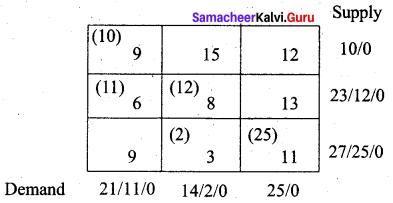
Find an initial basic feasible solution by the North West Corner Rule (NWC).
Samacheer Kalvi 12th Business Maths Solutions Chapter 10 Operations Research Additional Problems 8
Solution:
Total demand = Total supply = 60
Samacheer Kalvi 12th Business Maths Solutions Chapter 10 Operations Research Additional Problems 9
Total cost = (10 × 9) + (11 × 6) + (12 × 8) + (2 × 3) + (25 × 11)
= 90 + 66 + 96 + 6 + 275
= 533

Question 4.
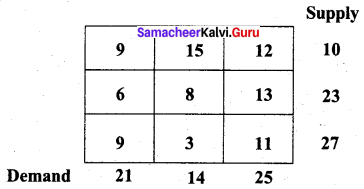
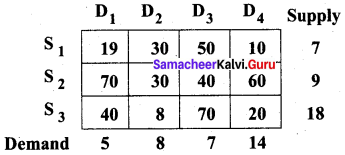
Find an initial basic feasible solution using Least cost method.
Samacheer Kalvi 12th Business Maths Solutions Chapter 10 Operations Research Additional Problems 10
Solution:
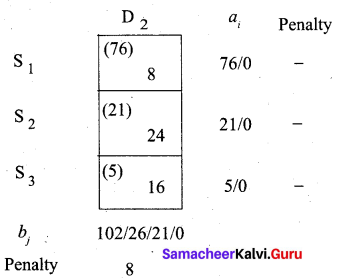
Total Demand = 5 + 8 + 7 + 14 = 34
Total Supply = 7 + 9 + 18 = 34
Since they are equal, problem is balanced.
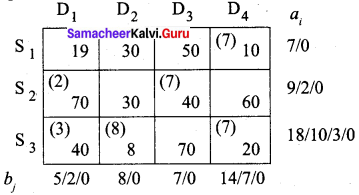
Samacheer Kalvi 12th Business Maths Solutions Chapter 10 Operations Research Additional Problems 11
The minimum total transportation cost is = (7 × 10) + (2 × 70) + (7 × 40) + (3 × 40) + (8 × 8) + (7 × 20)
= 70 + 140 + 280 + 120 + 64 + 140
= Rs. 814

Samacheer Kalvi 12th Business Maths Solutions Chapter 10 Operations Research Additional Problems

Question 5.
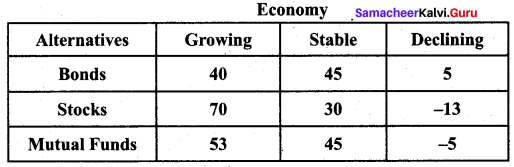
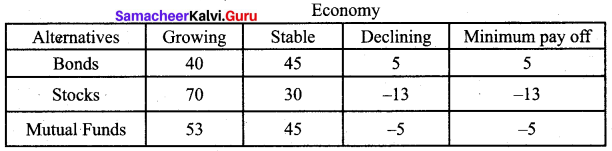
Find the investment option using Maximin rule for the following:
Samacheer Kalvi 12th Business Maths Solutions Chapter 10 Operations Research Additional Problems 12
Solution:
Samacheer Kalvi 12th Business Maths Solutions Chapter 10 Operations Research Additional Problems 13
Max (5, -13, -5) = 5. Since the maximum payoff is 5, by maximin criteria, the decision is to invest in bonds.

III. 3 and 5 Marks Questions

Question 1.
Find an optimal solution to the following transportation problem by North West Corner Method.
Samacheer Kalvi 12th Business Maths Solutions Chapter 10 Operations Research Additional Problems 14
Solution:
Total supply = 65 = Total demand. So the given problem is balanced.
First allocation:
Samacheer Kalvi 12th Business Maths Solutions Chapter 10 Operations Research Additional Problems 15
Second allocation:
Samacheer Kalvi 12th Business Maths Solutions Chapter 10 Operations Research Additional Problems 16
Third allocation:
Samacheer Kalvi 12th Business Maths Solutions Chapter 10 Operations Research Additional Problems 17
Fourth allocation:
Samacheer Kalvi 12th Business Maths Solutions Chapter 10 Operations Research Additional Problems 18
Total Transportation cost
Samacheer Kalvi 12th Business Maths Solutions Chapter 10 Operations Research Additional Problems 19

Question 2.
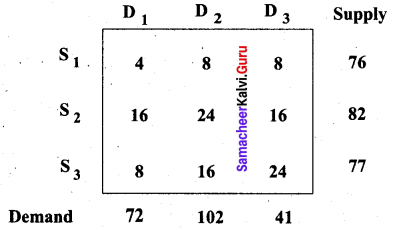
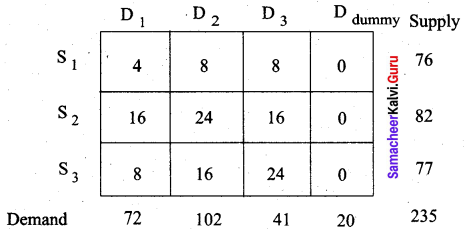
Find an initial basic solution for the following transportation problem by Vogel’s Approximation method.
Samacheer Kalvi 12th Business Maths Solutions Chapter 10 Operations Research Additional Problems 20
Solution:
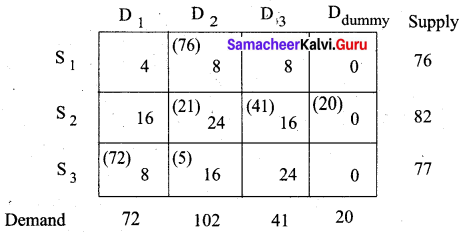
Total demand = 72 + 102 + 41 = 215 and
Total supply = 76 + 82 + 77 = 235.
Total supply > Total demand. So we add a dummy constraint with 0 unit cost and with allocation 20 (235 – 215). The modified table is
Samacheer Kalvi 12th Business Maths Solutions Chapter 10 Operations Research Additional Problems 21
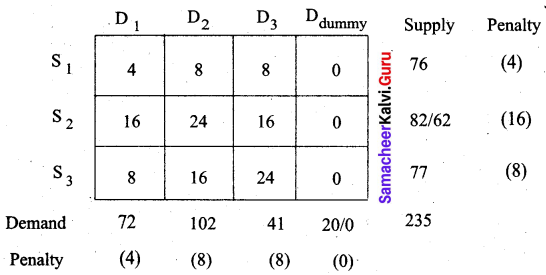
First allocation:
Samacheer Kalvi 12th Business Maths Solutions Chapter 10 Operations Research Additional Problems 22
The maximum penalty is 16. Allot 20 units to cell (S2, Ddummy)
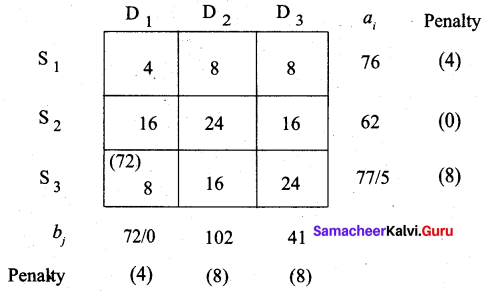
Second allocation:
Samacheer Kalvi 12th Business Maths Solutions Chapter 10 Operations Research Additional Problems 23
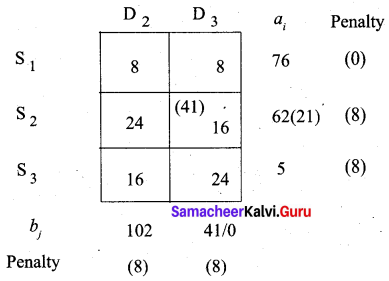
Third allocation:
Samacheer Kalvi 12th Business Maths Solutions Chapter 10 Operations Research Additional Problems 24
Fourth allocation:
Samacheer Kalvi 12th Business Maths Solutions Chapter 10 Operations Research Additional Problems 25
The final allocation table is given below.
Samacheer Kalvi 12th Business Maths Solutions Chapter 10 Operations Research Additional Problems 26
The minimum total cost = (76 × 8) + (21 × 24) + (41 × 16) + (20 × 0) + (72 × 8) + (5 × 16) = 2424

Samacheer Kalvi 12th Business Maths Solutions Chapter 10 Operations Research Additional Problems

Question 3.
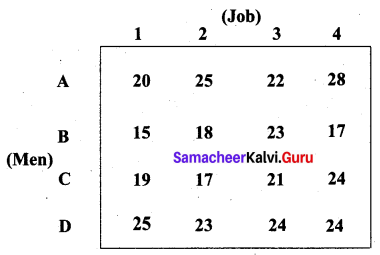
A company has 4 men available for 4 separate jobs. Only one man can work on anyone job. The cost of assigning each man to each job is given below. Find the optimal solution by the Hungarian method.
Samacheer Kalvi 12th Business Maths Solutions Chapter 10 Operations Research Additional Problems 27
Solution:
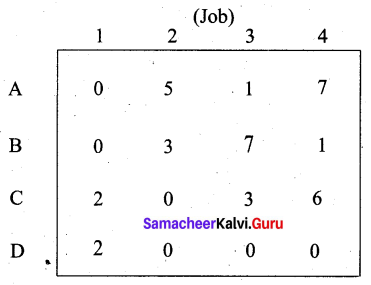
The number of rows and columns are equal. So the given problem is a balanced assignment problem and we can get an optimal solution.
Step 1:
Samacheer Kalvi 12th Business Maths Solutions Chapter 10 Operations Research Additional Problems 28
Step 2:
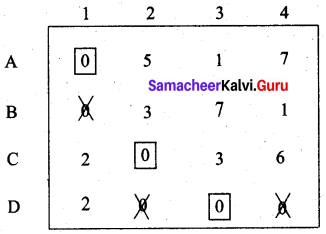
Samacheer Kalvi 12th Business Maths Solutions Chapter 10 Operations Research Additional Problems 29
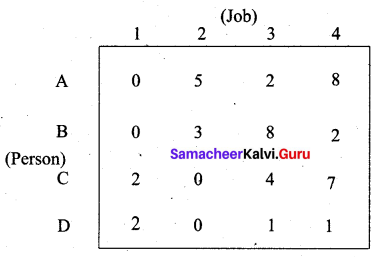
Step 3: (Assignment)
Samacheer Kalvi 12th Business Maths Solutions Chapter 10 Operations Research Additional Problems 30
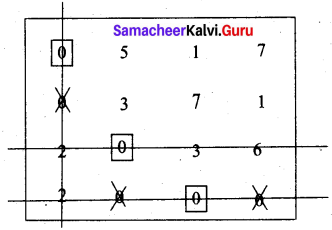
We are not able to assign job for person B. Proceed as follows. Draw a minimum number of vertical and horizontal lines to cover all the zeros.
Samacheer Kalvi 12th Business Maths Solutions Chapter 10 Operations Research Additional Problems 31
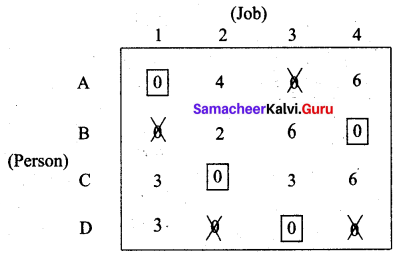
Subtract the smallest element 1 from all the uncovered elements and add it to the elements which lie at the intersection of two lines. Thus we obtain another reduced matrix for fresh assignment.
Samacheer Kalvi 12th Business Maths Solutions Chapter 10 Operations Research Additional Problems 32
Total cost is
Samacheer Kalvi 12th Business Maths Solutions Chapter 10 Operations Research Additional Problems 33

Question 4.
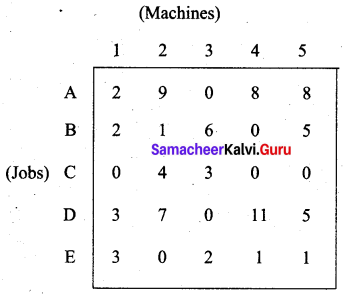
There are five machines and five jobs are to be assigned and the cost matrix is given below. Find the proper assignment.
Samacheer Kalvi 12th Business Maths Solutions Chapter 10 Operations Research Additional Problems 34
Solution:
Step 1: (Row-reduction)
Samacheer Kalvi 12th Business Maths Solutions Chapter 10 Operations Research Additional Problems 35
Step 2: (Column – reduction)
Samacheer Kalvi 12th Business Maths Solutions Chapter 10 Operations Research Additional Problems 36
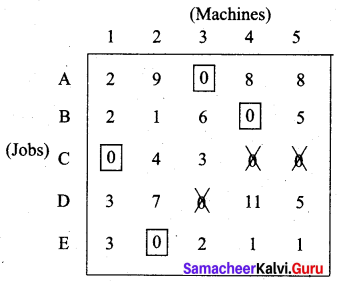
Step 3: (Assignment)
Samacheer Kalvi 12th Business Maths Solutions Chapter 10 Operations Research Additional Problems 37
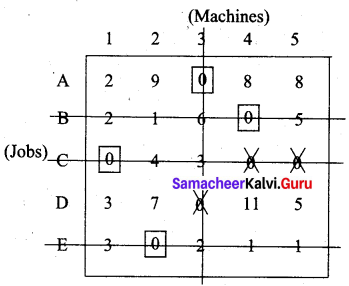
We are not able to assign a machine to job D. We proceed as follows.
Samacheer Kalvi 12th Business Maths Solutions Chapter 10 Operations Research Additional Problems 38
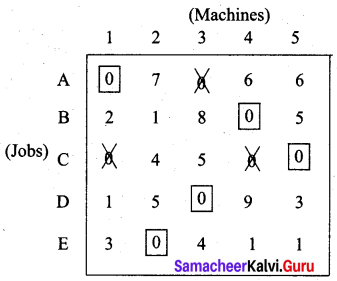
The smallest uncovered element is 2. Subtract 2 from all those elements which are not covered. Add 2 all elements which are at the intersection of two lines. Then proceed with the new matrix.
Samacheer Kalvi 12th Business Maths Solutions Chapter 10 Operations Research Additional Problems 39
The assignment is as follows
Samacheer Kalvi 12th Business Maths Solutions Chapter 10 Operations Research Additional Problems 40

Samacheer Kalvi 12th Business Maths Solutions Chapter 10 Operations Research Additional Problems

Question 5.
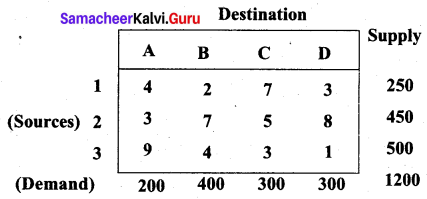
The cost of transportation from 3 sources to four destinations are given in the follow¬ing table. Obtain an initial basic feasible solution using
(i) North West Corner Rule (NWC)
(ii) Least Cost Method (LCM) and
(iii) Vogel’s Approximation Method (VAM)
Samacheer Kalvi 12th Business Maths Solutions Chapter 10 Operations Research Additional Problems 41
Solution:
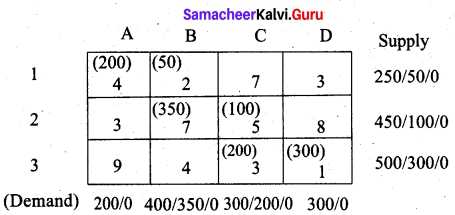
(i) North West Corner Rule
We start by allotting the units to the North -West Comer cell. We show all the allocations in a single table.
Samacheer Kalvi 12th Business Maths Solutions Chapter 10 Operations Research Additional Problems 42
Total transportation cost is (200 × 4) + (50 × 2) + (350 × 7) + (100 × 5) + (200 × 3) + (1 × 300)
= 800 + 100 + 2450 + 500 + 600 + 300
= Rs. 4750

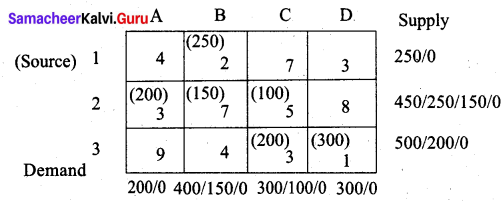
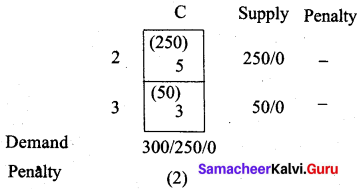
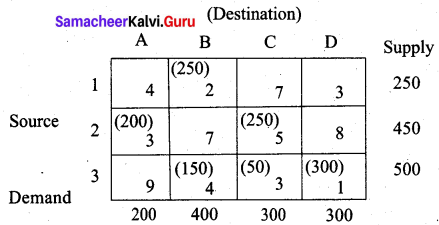
(ii) Least cost method (LCM)
Samacheer Kalvi 12th Business Maths Solutions Chapter 10 Operations Research Additional Problems 43
Transportation cost is = (250 × 2) + (200 × 3) + (150 × 7) + (100 × 5) + (200 × 3) + (300 × 1)
= 500 + 600+ 1050 + 500 + 600 + 300
= Rs. 3550

Samacheer Kalvi 12th Business Maths Solutions Chapter 10 Operations Research Additional Problems

(iii) Vogel Approximation Method (VAM)
Samacheer Kalvi 12th Business Maths Solutions Chapter 10 Operations Research Additional Problems 44
There are five penalties which have the maximum value 2. The cell with the least cost is row 3 and hence select cell (3, D) for allocation.
Samacheer Kalvi 12th Business Maths Solutions Chapter 10 Operations Research Additional Problems 45
There are four penalties which have maximum value 2. Select cell (1, B) which has the least cost for allocation.
Samacheer Kalvi 12th Business Maths Solutions Chapter 10 Operations Research Additional Problems 46
The largest penalty is 6. Allot units to cell (2, A)
Samacheer Kalvi 12th Business Maths Solutions Chapter 10 Operations Research Additional Problems 47
The largest penalty is 3. Allot units to cell (3, B)
Samacheer Kalvi 12th Business Maths Solutions Chapter 10 Operations Research Additional Problems 48
We first allot 50 units to cell (3, C) which has less cost. Then the balance units we allot to cell (2, C). We get the final allocation table as follows.
Samacheer Kalvi 12th Business Maths Solutions Chapter 10 Operations Research Additional Problems 49
Transportation cost is = (250 × 2) + (200 × 3) + (250 × 5) + (150 × 4) + (50 × 3) + (300 × 1)
= 500 + 600 + 1250 + 600 + 150 + 300
= Rs. 3400

Samacheer Kalvi 12th Business Maths Solutions Chapter 10 Operations Research Additional Problems Read More »

Samacheer Kalvi 12th Business Maths Solutions Chapter 2 Integral Calculus I Ex 2.12

Students can download 12th Business Maths Chapter 2 Integral Calculus I Ex 2.12 Questions and Answers, Samacheer Kalvi 12th Business Maths Book Solutions Guide Pdf helps you to revise the complete Tamilnadu State Board New Syllabus and score more marks in your examinations.

Tamilnadu Samacheer Kalvi 12th Business Maths Solutions Chapter 2 Integral Calculus I Ex 2.12

Choose the correct answer.

Question 1.
Samacheer Kalvi 12th Business Maths Solutions Chapter 2 Integral Calculus I Ex 2.12 Q1
Answer:
(b) \(\frac{-1}{2 x^{2}}+c\)
Hint:
Samacheer Kalvi 12th Business Maths Solutions Chapter 2 Integral Calculus I Ex 2.12 Q1.1

Question 2.
Samacheer Kalvi 12th Business Maths Solutions Chapter 2 Integral Calculus I Ex 2.12 Q2
Answer:
(c) \(\frac{2^{x}}{\log 2}+c\)

Question 3.
\(\int \frac{\sin 2 x}{2 \sin x} d x\) is _______
(a) sin x + c
(b) \(\frac {1}{2}\) sin x + c
(c) cos x + c
(d) \(\frac {1}{2}\) cos x + c
Answer:
(a) sin x + c
Hint:
Samacheer Kalvi 12th Business Maths Solutions Chapter 2 Integral Calculus I Ex 2.12 Q3

Question 4.
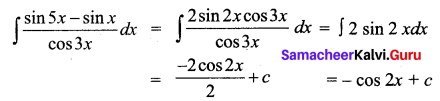
\(\int \frac{\sin 5 x-\sin x}{\cos 3 x} d x\) is _____
(a) -cos 2x + c
(b) –\(\frac {1}{2}\) cos 2x + c
(c) \(-\frac{1}{4}\) cos 2x + c
(d) -4 cos 2x + c
Answer:
(a) -cos 2x + c
Hint:
Samacheer Kalvi 12th Business Maths Solutions Chapter 2 Integral Calculus I Ex 2.12 Q4

Question 5.
Samacheer Kalvi 12th Business Maths Solutions Chapter 2 Integral Calculus I Ex 2.12 Q5
Answer:
(a) \(\frac{1}{2}(\log x)^{2}\)
Hint:
Samacheer Kalvi 12th Business Maths Solutions Chapter 2 Integral Calculus I Ex 2.12 Q5.1

Question 6.
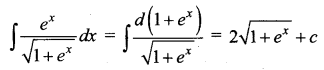
Samacheer Kalvi 12th Business Maths Solutions Chapter 2 Integral Calculus I Ex 2.12 Q6
Answer:
(b) \(2 \sqrt{1+e^{x}}+c\)
Hint:
Samacheer Kalvi 12th Business Maths Solutions Chapter 2 Integral Calculus I Ex 2.12 Q6.1

Question 7.
Samacheer Kalvi 12th Business Maths Solutions Chapter 2 Integral Calculus I Ex 2.12 Q7
Answer:
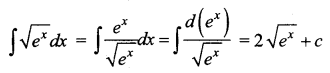
(b) \(2 \sqrt{e^{x}}+c\)
Hint:
Samacheer Kalvi 12th Business Maths Solutions Chapter 2 Integral Calculus I Ex 2.12 Q7.1

Question 8.
Samacheer Kalvi 12th Business Maths Solutions Chapter 2 Integral Calculus I Ex 2.12 Q8
Answer:
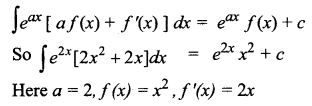
(a) \(e^{2 x} x^{2}+c\)
Hint:
Samacheer Kalvi 12th Business Maths Solutions Chapter 2 Integral Calculus I Ex 2.12 Q8.1

Question 9.
Samacheer Kalvi 12th Business Maths Solutions Chapter 2 Integral Calculus I Ex 2.12 Q9
Answer:
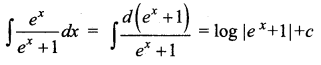
(d) \(\log \left|e^{x}+1\right|+c\)
Hint:
Samacheer Kalvi 12th Business Maths Solutions Chapter 2 Integral Calculus I Ex 2.12 Q9.1

Question 10.
\(\int\left[\frac{9}{x-3}-\frac{1}{x+1}\right] d x\) is _____
(a) log|x – 3| – log|x + 1| + c
(b) log|x – 3| + log|x + 1| + c
(c) 9log|x – 3| – log|x + 1| + c
(d) 91og|x – 3| + log|x + 1| + c
Answer:
(c) 9log|x – 3| – log|x + 1| + c

Question 11.
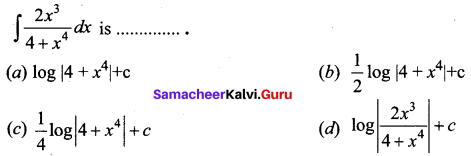
Samacheer Kalvi 12th Business Maths Solutions Chapter 2 Integral Calculus I Ex 2.12 Q11
Answer:
(b) \(\frac{1}{2} \log \left|4+x^{4}\right|+c\)
Hint:
Samacheer Kalvi 12th Business Maths Solutions Chapter 2 Integral Calculus I Ex 2.12 Q11.1

Question 12.
Samacheer Kalvi 12th Business Maths Solutions Chapter 2 Integral Calculus I Ex 2.12 Q12
Answer:
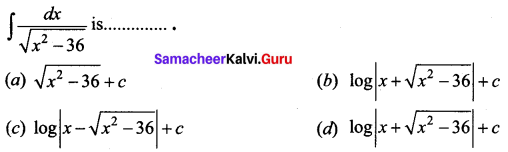
(b) \(\log |x+\sqrt{x^{2}-36}|+c\)
Hint:
Samacheer Kalvi 12th Business Maths Solutions Chapter 2 Integral Calculus I Ex 2.12 Q12.1

Question 13.
Samacheer Kalvi 12th Business Maths Solutions Chapter 2 Integral Calculus I Ex 2.12 Q13
Answer:
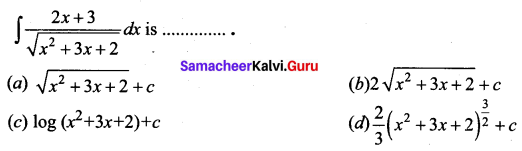
(b) \(2 \sqrt{x^{2}+3 x+2}+c\)
Hint:
Samacheer Kalvi 12th Business Maths Solutions Chapter 2 Integral Calculus I Ex 2.12 Q13.1

Question 14.
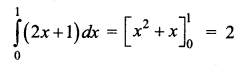
\(\int_{0}^{1}(2 x+1) d x\) is _______
(a) 1
(b) 2
(c) 3
(d) 4
Answer:
(b) 2
Hint:
Samacheer Kalvi 12th Business Maths Solutions Chapter 2 Integral Calculus I Ex 2.12 Q14

Question 15.
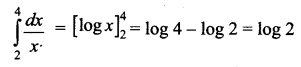
\(\int_{2}^{4} \frac{d x}{x}\) is _______
(a) log 4
(b) 0
(c) log 2
(d) log 8
Answer:
(c) log 2
Hint:
Samacheer Kalvi 12th Business Maths Solutions Chapter 2 Integral Calculus I Ex 2.12 Q15

Question 16.
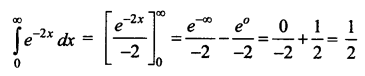
\(\int_{0}^{\infty} e^{-2 x} d x\) is _____
(a) 0
(b) 1
(c) 2
(d) \(\frac{1}{2}\)
Answer:
(d) \(\frac{1}{2}\)
Hint:
Samacheer Kalvi 12th Business Maths Solutions Chapter 2 Integral Calculus I Ex 2.12 Q16

Question 17.
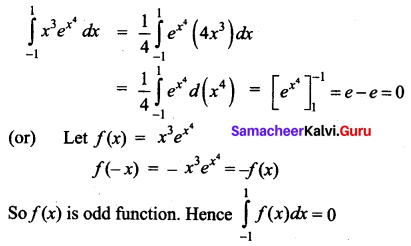
\(\int_{-1}^{1} x^{3} e^{x^{4}} d x\) is _______
(a) 1
(b) \(2 \int_{0}^{1} x^{3} e^{x^{4}} d x\)
(c) 0
(d) 2
Answer:
(c) 0
Hint:
Samacheer Kalvi 12th Business Maths Solutions Chapter 2 Integral Calculus I Ex 2.12 Q17

Question 18.
If f(x) is a continous function and a < c < b, then \(\int_{a}^{c} f(x) d x+\int_{c}^{b} f(x) d x\) is _____
(a) \(\int_{a}^{b} f(x) d x-\int_{a}^{c} f(x) d x\)
(b) \(\int_{a}^{c} f(x) d x-\int_{a}^{a} f(x) d x\)
(c) \(\int_{a}^{b} f(x) d x\)
(d) 0
Answer:
(c) \(\int_{a}^{b} f(x) d x\)

Question 19.
The value of \(\int_{\frac{\pi}{2}}^{\frac{\pi}{2}} \cos x d x\) is _______
(a) 0
(b) 2
(c) 1
(d) 4
Answer:
(b) 2
Hint:
Samacheer Kalvi 12th Business Maths Solutions Chapter 2 Integral Calculus I Ex 2.12 Q19

Question 20.
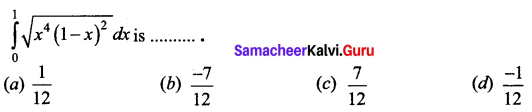
Samacheer Kalvi 12th Business Maths Solutions Chapter 2 Integral Calculus I Ex 2.12 Q20
Answer:
(a) \(\frac{1}{12}\)
Hint:
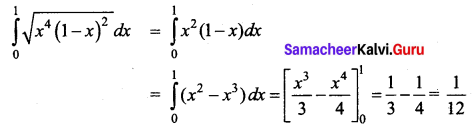
Samacheer Kalvi 12th Business Maths Solutions Chapter 2 Integral Calculus I Ex 2.12 Q20.1

Question 21.
Samacheer Kalvi 12th Business Maths Solutions Chapter 2 Integral Calculus I Ex 2.12 Q21
Answer:
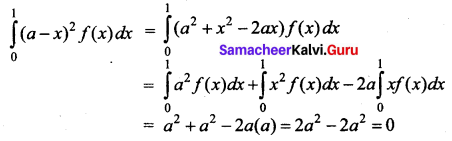
(b) 0
Hint:
Samacheer Kalvi 12th Business Maths Solutions Chapter 2 Integral Calculus I Ex 2.12 Q21.1

Question 22.
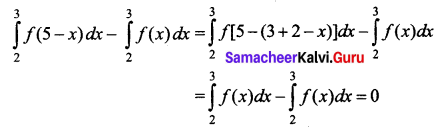
The value of \(\int_{2}^{3} f(5-x) d x-\int_{2}^{3} f(x) d x\) is _______
(a) 1
(b) 0
(c) -1
(d) 5
Answer:
(b) 0
Hint:
Samacheer Kalvi 12th Business Maths Solutions Chapter 2 Integral Calculus I Ex 2.12 Q22

Question 23.
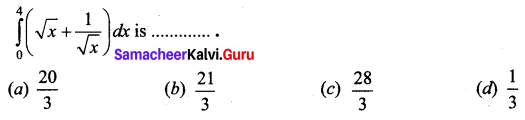
Samacheer Kalvi 12th Business Maths Solutions Chapter 2 Integral Calculus I Ex 2.12 Q23
Answer:
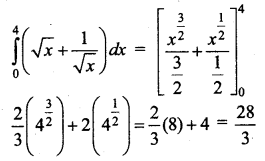
(c) \(\frac{28}{3}\)
Hint:
Samacheer Kalvi 12th Business Maths Solutions Chapter 2 Integral Calculus I Ex 2.12 Q23.1

Question 24.
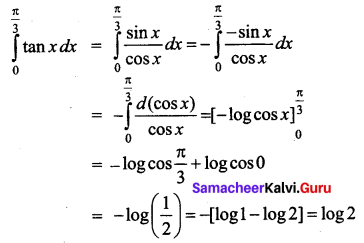
\(\int_{0}^{\frac{\pi}{3}} \tan x d x\) is _______
(a) log 2
(b) 0
(c) log√2
(d) 2 log 2
Answer:
(a) log 2
Hint:
Samacheer Kalvi 12th Business Maths Solutions Chapter 2 Integral Calculus I Ex 2.12 Q24

Question 25.
Using the factorial representation of the gamma function, which of the following is the solution for the gamma function Γ(n) when n = 8 is _______
(a) 5040
(b) 5400
(c) 4500
(d) 5540
Answer:
(a) 5040
Hint:
Γ(8) = Γ(7 + 1) = 7! = 5040

Question 26.
Γ(n) is _____
(a) (n – 1)!
(b) n!
(c) n Γ(n)
(d) (n – 1) Γ(n)
Answer:
(a) (n – 1)!
Hint:
Γ(n) = Γ(n – 1) + 1 = (n – 1)!

Question 27.
Γ(1) is ______
(a) 0
(b) 1
(c) n
(d) n!
Answer:
(b) 1
Hint:
Γ(1) = (1 – 1)! = 0! = 1

Question 28.
Samacheer Kalvi 12th Business Maths Solutions Chapter 2 Integral Calculus I Ex 2.12 Q28
Answer:
(d) \(\int_{0}^{\infty} e^{-x} x^{n-1} d x\)

Question 29.
Γ(\(\frac{3}{2}\)) is _____
(a) √π
(b) \(\frac{\sqrt{\pi}}{2}\)
(c) 2√π
(d) \(\frac{3}{2}\)
Answer:
(b) \(\frac{\sqrt{\pi}}{2}\)
Hint:
Samacheer Kalvi 12th Business Maths Solutions Chapter 2 Integral Calculus I Ex 2.12 Q29

Question 30.
\(\int_{0}^{\infty} x^{4} e^{-x} d x\) is _______
(a) 12
(b) 4
(c) 4!
(d) 64
Answer:
(c) 4!
Hint:
Samacheer Kalvi 12th Business Maths Solutions Chapter 2 Integral Calculus I Ex 2.12 Q30

Samacheer Kalvi 12th Business Maths Solutions Chapter 2 Integral Calculus I Ex 2.12 Read More »

Samacheer Kalvi 12th Business Maths Solutions Chapter 4 Differential Equations Ex 4.6

Students can download 12th Business Maths Chapter 4 Differential Equations Ex 4.6 Questions and Answers, Samacheer Kalvi 12th Business Maths Book Solutions Guide Pdf helps you to revise the complete Tamilnadu State Board New Syllabus and score more marks in your examinations.

Tamilnadu Samacheer Kalvi 12th Business Maths Solutions Chapter 4 Differential Equations Ex 4.6

Choose the correct answer.

Question 1.
The degree of the differential equation \(\frac{d^{4} y}{d x^{4}}-\left(\frac{d^{2} y}{d x^{2}}\right)^{4}+\frac{d y}{d x}=3\) is _________
(a) 1
(b) 2
(c) 3
(d) 4
Answer:
(a) 1
Hint:
Highest order derivative is \(\frac { d^2y }{dx^4}\)
Power of the highest order derivative is 1
∴ degree = 1

Question 2.
The order and degree of the differential equation \(\sqrt{\frac{d^{2} y}{d x^{2}}}=\sqrt{\frac{d y}{d x}+5}\) are respectively
(a) 2 and 3
(b) 3 and 2
(c) 2 and 1
(d) 2 and 2
Answer:
(c) 2 and 1
Hint:
Squaring both sides, we get \(\frac{d^{2} y}{d x^{2}}=\frac{d y}{d x}+5\)
So order = 2, degree = 1

Question 3.
The order and degree of the differential equation \(\left(\frac{d^{2} y}{d x^{2}}\right)^{\frac{3}{2}}-\sqrt{\left(\frac{d y}{d x}\right)}-4=0\) are respectively.
(a) 2 and 6
(b) 3 and 6
(c) 1 and 4
(d) 2 and 4
Answer:
(a) 2 and 6
Hint:
Samacheer Kalvi 12th Business Maths Solutions Chapter 4 Differential Equations Ex 4.6 Q3

Question 4.
The differential equation \(\left(\frac{d x}{d y}\right)^{3}+2 y^{\frac{1}{2}}=x\) is _________
(a) of order 2 and degree 1
(b) of order 1 and degree 3
(c) of order 1 and degree 6
(d) of order 1 and degree 2
Answer:
(b) of order 1 and degree 3

Question 5.
The differential equation formed by eliminating a and b from y = aex + be-x is _______
(a) \(\frac{d^{2} y}{d x^{2}}-y=0\)
(b) \(\frac{d^{2} y}{d x^{2}}-\frac{d y}{d x}=0\)
(c) \(\frac{d^{2} y}{d x^{2}}=0\)
(d) \(\frac{d^{2} y}{d x^{2}}-x=0\)
Answer:
(a) \(\frac{d^{2} y}{d x^{2}}-y=0\)
Hint:
Samacheer Kalvi 12th Business Maths Solutions Chapter 4 Differential Equations Ex 4.6 Q5

Question 6.
If y = cx + c – c3 then its differential equation is ______
Samacheer Kalvi 12th Business Maths Solutions Chapter 4 Differential Equations Ex 4.6 Q6
Answer:
(a) \(y=x \frac{d y}{d x}+\frac{d y}{d x}-\left(\frac{d y}{d x}\right)^{3}\)
Hint:
y = cx + c – c³ ……… (1)
\(\frac { dy }{dx}\) = c
(1) ⇒ y = x\(\frac { dy }{dx}\) + \(\frac { dy }{dx}\) – (\(\frac { dy }{dx}\))³

Question 7.
The integrating factor of the differential equation \(\frac{d x}{d y}\) + Px = Q is _____
(a) e∫Pdx
(b) ∫Pdx
(c) ∫Pdy
(d) e∫Pdy
Answer:
(d) e∫Pdy

Question 8.
The complementary function of (D2 + 4) y = e2x is _______
(a) (Ax + B) e2x
(b) (Ax + B) e-2x
(c) A cos 2x + B sin 2x
(d) Ax-2x + Be2x
Answer:
(c) A cos 2x + B sin 2x
Hint:
(D² + 4) y = e2x
The auxiliary equation is m² + 4 = 0
m² = -4 ⇒ m = ±\(\sqrt { -4}\)
m = ± 2i
It is of the form α ± ß i
Here α = 0 and ß = 2
C.F = eαx (A cos ßx + B sin ßx)
= e° (A cos2x + B sin2x)
C.F = A cos2x + B sin2x

Question 9.
The differential equation of y = mx + c is (m and c are arbitrary constants).
(a) \(\frac{d^{2} y}{d x^{2}}=0\)
(b) y = x \(\frac{d y}{d x}\)
(c) x dy + y dx = 0
(d) y dx – x dy = 0
Answer:
(a) \(\frac{d^{2} y}{d x^{2}}=0\)
Hint:
y = mx + c
\(\frac { dy }{dx}\) = m ⇒ \(\frac { d^2y }{dx^2}\) = 0

Question 10.
The particular integral of the differential equation \(\frac{d^{2} y}{d x^{2}}-8 \frac{d y}{d x}+16 y=2 e^{4 x}\) is ________
(a) \(\frac{x^{2} e^{4 x}}{2 !}\)
(b) \(\frac{e^{4 x}}{2 !}\)
(c) x2 e4x
(d) xe4x
Answer:
(c) x2 e4x
Hint:
Samacheer Kalvi 12th Business Maths Solutions Chapter 4 Differential Equations Ex 4.6 Q10

Question 11.
Solution of \(\frac{d x}{d y}\) + px = 0
(a) x = cepy
(b) x = ce-py
(c) x = py + c
(d) x = cy
Answer:
(b) x = ce-py
Hint:
Samacheer Kalvi 12th Business Maths Solutions Chapter 4 Differential Equations Ex 4.6 Q11

Question 12.
If sec2 x is an integrating factor of the differential equation \(\frac{d y}{d x}\) + Py = Q then P = _____
(a) 2 tan x
(b) sec x
(c) cos2 x
(d) tan2 x
Answer:
(a) 2 tan x
Hint:
Samacheer Kalvi 12th Business Maths Solutions Chapter 4 Differential Equations Ex 4.6 Q12

Question 13.
The integrating factor of x\(\frac{d y}{d x}\) – y = x2 is _____
(a) \(\frac{-1}{x}\)
(b) \(\frac{1}{x}\)
(c) log x
(d) x
Answer:
(b) \(\frac{1}{x}\)
Hint:
Samacheer Kalvi 12th Business Maths Solutions Chapter 4 Differential Equations Ex 4.6 Q13

Question 14.
The solution of the differential equation \(\frac{d y}{d x}\) + Py = Q where P and Q are the function of x is ______
Samacheer Kalvi 12th Business Maths Solutions Chapter 4 Differential Equations Ex 4.6 Q14
Answer:
(c) \(y e^{\int p d x}=\int \mathrm{Q} e^{\int p d x} d x+c\)

Question 15.
The differential equation formed by eliminating A and B from y = e-2x (A cos x + B sin x) is _______
(a) y2 – 4y1 + 5y = 0
(b) y2 + 4y1 – 5y = 0
(c) y2 – 4y1 – 5y = 0
(d) y2 + 4y1 + 5y = 0
Answer:
(d) y2 + 4y1 + 5y = 0
Hint:
Samacheer Kalvi 12th Business Maths Solutions Chapter 4 Differential Equations Ex 4.6 Q15

Question 16.
The particular integral of the differential equation f(D) y = eax where f(D) = (D – a)2 ________
(a) \(\frac{x^{2}}{2} e^{2 x}\)
(b) xeax
(c) \(\frac{x}{2} e^{2 x}\)
(d) x2 e2x
Answer:
(a) \(\frac{x^{2}}{2} e^{2 x}\)

Question 17.
The differential equation of x2 + y2 = a2 is _____
(a) x dy + y dx = 0
(b) y dx – x dy = 0
(c) x dx – y dx = 0
(d) x dx + y dy = 0
Answer:
(d) x dx + y dy = 0
Hint:
x² + y² = a²
Differentiating w.r.t x
2x+ 2y\(\frac { dy }{dx}\) = 0
2x = -2y \(\frac { dy }{dx}\) ⇒ x = -y\(\frac { dy }{dx}\)
xdx = -ydy ⇒ xdx + ydy = 0

Question 18.
The complementary function of \(\frac{d^{2} y}{d x^{2}}-\frac{d y}{d x}=0\) is ______
(a) A + B ex
(b) (A + B) ex
(c) (Ax + B) ex
(d) (Aex + B)
Answer:
(a) A + B ex
Hint:
\(\frac { d^y }{dx^2}\) – \(\frac { dy }{dx}\) = 0
The auxiliary equation is m² – m = 0
m(m – 1) = 0 ⇒ m = 0, 1.
The roots are real and different
∴ C.F = Aem1x + Bem2x
C.F = Ae0x + Be1x
= A + Bex

Question 19.
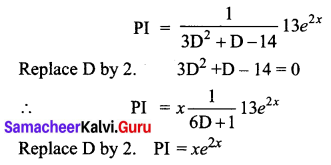
The P.I of (3D2 + D – 14)y = 13e2x is _______
(a) \(\frac{x}{2}\) e2x
(b) x e2x
(c) \(\frac{x^{2}}{2}\) e2x
(d) 13xe2x
Answer:
(b) xe2x
Hint:
Samacheer Kalvi 12th Business Maths Solutions Chapter 4 Differential Equations Ex 4.6 Q19

Question 20.
The general solution of the differential equation \(\frac{d y}{d x}\) = cos x is _______
(a) y = sin x + 1
(b) y = sin x – 2
(c) y = cos x + c, c is an arbitrary constant
(d) y = sin x + c, c is an arbitrary constant
Answer:
(d) y = sin x + c, c is an arbitrary constant
Hint:
\(\frac { dy }{dx}\) = cos x
dy = cos x dx
∫dy = ∫cos x dx ⇒ y = sin x + c

Question 21.
A homogeneous differential equation of the form \(\frac{d y}{d x}=f\left(\frac{y}{x}\right)\) can be solved by making substitution
(a) y = vx
(b) v = yx
(c) x = vy
(d) x = v
Answer:
(a) y = vx

Question 22.
A homogeneous differential equation of the form \(\frac{d x}{d y}=f\left(\frac{x}{y}\right)\) can be solved by making substitution,
(a) x = vy
(b) y = vx
(c) y = v
(d) x = v
Answer:
(a) x = vy

Question 23.
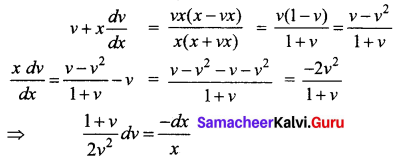
Samacheer Kalvi 12th Business Maths Solutions Chapter 4 Differential Equations Ex 4.6 Q23
Answer:
(d) \(\frac{1+v}{2 v^{2}} d v=-\frac{d x}{x}\)
Hint:
Samacheer Kalvi 12th Business Maths Solutions Chapter 4 Differential Equations Ex 4.6 Q23.1

Question 24.
Which of the following is the homogeneous differential equation?
(a) (3x – 5) dx = (4y – 1) dy
(b) xy dx – (x3 + y3) dy = 0
(c) y2 dx + (x2 – xy – y2) dy = 0
(d) (x2 + y) dx = (y2 + x) dy
Answer:
(c) y2 dx + (x2 – xy – y2) dy = 0

Question 25.
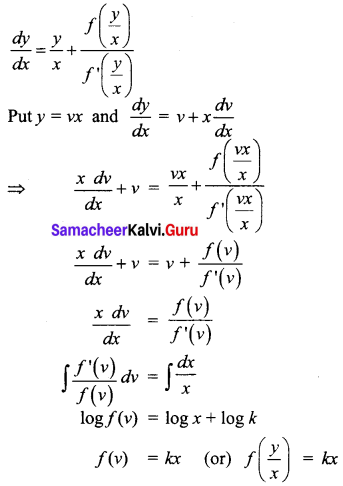
The solution of the differential equation \(\frac{d y}{d x}=\frac{y}{x}+\frac{f\left(\frac{y}{x}\right)}{f^{\prime}\left(\frac{y}{x}\right)}\) is ______
(a) f(\(\frac{y}{x}\)) = kx
(b) x f(\(\frac{y}{x}\)) = k
(c) f(\(\frac{y}{x}\)) = ky
(d) y f(\(\frac{y}{x}\)) = k
Answer:
(a) f(\(\frac{y}{x}\)) = kx
Hint:
Samacheer Kalvi 12th Business Maths Solutions Chapter 4 Differential Equations Ex 4.6 Q25

Samacheer Kalvi 12th Business Maths Solutions Chapter 4 Differential Equations Ex 4.6 Read More »

Samacheer Kalvi 12th Business Maths Solutions Chapter 7 Probability Distributions Ex 7.1

Students can download 12th Business Maths Chapter 7 Probability Distributions Ex 7.1 Questions and Answers, Samacheer Kalvi 12th Business Maths Book Solutions Guide Pdf helps you to revise the complete Tamilnadu State Board New Syllabus and score more marks in your examinations.

Tamilnadu Samacheer Kalvi 12th Business Maths Solutions Chapter 7 Probability Distributions Ex 7.1

Question 1.
Define Binomial distribution.
Solution:
A random variable X is said to follow a binomial distribution with parameter ‘n’ and ‘p’ if it assumes only non-negative value and its probability mass function is given by
Samacheer Kalvi 12th Business Maths Solutions Chapter 7 Probability Distributions Ex 7.1 Q1

Question 2.
Define Bernoulli trials.
Solution:
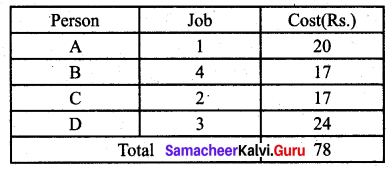
A random experiment whose outcomes are of two types namely success S and failure F, occurring with probabilities p and q, is called a Bernoulli trial.
Example 1, Tossing of a coin (Head or Tail)
Example 2, Writing an exam (Pass or Fail)

Samacheer Kalvi 12th Business Maths Solutions Chapter 7 Probability Distributions Ex 7.1

Question 3.
Derive the mean and variance of binomial distribution.
Solution:
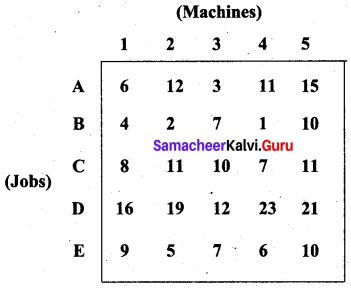
Let X be a random variable with the Binomial distribution.
The probability function of X is
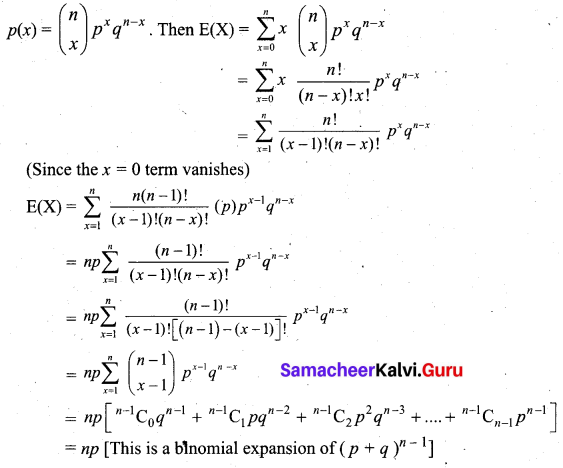
Samacheer Kalvi 12th Business Maths Solutions Chapter 7 Probability Distributions Ex 7.1 Q3
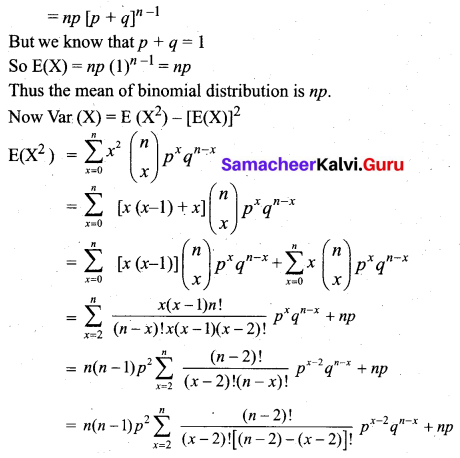
Samacheer Kalvi 12th Business Maths Solutions Chapter 7 Probability Distributions Ex 7.1 Q3.1
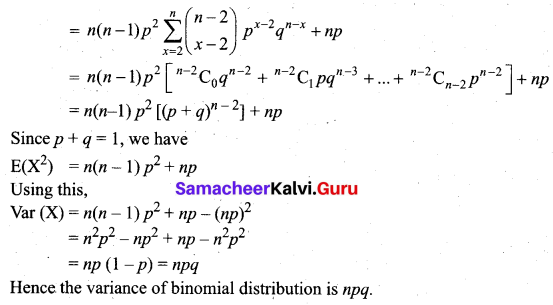
Samacheer Kalvi 12th Business Maths Solutions Chapter 7 Probability Distributions Ex 7.1 Q3.2

Question 4.
Write down the conditions for which the binomial distribution can be used.
Solution:
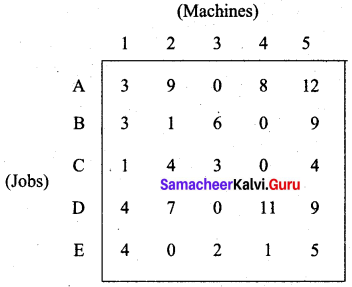
The binomial distribution can be used under the following conditions:

  • The number of trials (or) observations ‘n’ is fixed (finite).
  • Each observation is independent of each other.
  • In every trial, there are only two possible outcomes – success or failure.
  • The probability of success ‘p’ is the same for each outcome.

Samacheer Kalvi 12th Business Maths Solutions Chapter 7 Probability Distributions Ex 7.1

Question 5.
Mention the properties of the binomial distribution.
Solution:
Property 1:
The binomial distribution is symmetrical when the probability of success ‘p’ is 0.5 (or) when a number of trials ‘n’ is very large. In other words, if p = q = 1/2, the distribution is symmetric about the median. If p ≠ q, then it is skewed distribution, (p < 0.5 → positively skewed, p > 0.5 → negatively skewed)

Property 2:
The variance is less than mean (i,e,) npq < np

Question 6.
If 5% of the items produced turn out to be defective, then find out the probability that out of 10 items selected at random there are
(i) exactly three defectives
(ii) at least two defectives
(iii) exactly 4 defectives
(iv) find the mean and variance
Solution:
Let p be the probability of a defective item.
Given that, p = 5% = \(\frac{5}{100}\) = 0.05
So q = 1 – p = 1 – 0.05 = 0.95. Also n = 10.
Let X be the random variable which follows the binomial distribution. Then X ~ B (10, 0.05)
(i) P(exactly three defectives) = P(X = 3)
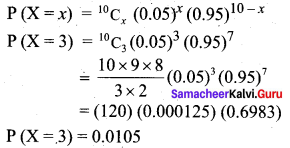
Samacheer Kalvi 12th Business Maths Solutions Chapter 7 Probability Distributions Ex 7.1 Q6
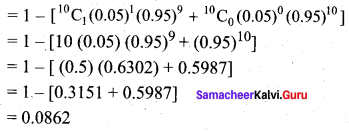
(ii) P(atleast two defectives) = P (X ≥ 2) = 1 – P (X < 2)
= 1 – [P(X = 1) + P(X = 0)]
Samacheer Kalvi 12th Business Maths Solutions Chapter 7 Probability Distributions Ex 7.1 Q6.1
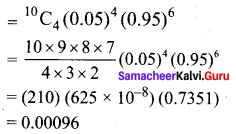
(iii) P(exactly 4 defectives) = P(X = 4)
Samacheer Kalvi 12th Business Maths Solutions Chapter 7 Probability Distributions Ex 7.1 Q6.2
(iv) We know that mean = np = (10) (0.05) = 0.5
Variance = npq = (10) (0.05) (0.95) = 0.475

Samacheer Kalvi 12th Business Maths Solutions Chapter 7 Probability Distributions Ex 7.1

Question 7.
In a particular university, 40% of the students are having newspaper reading habit. Nine university students are selected to find their views on reading habit. Find the probability that
(i) none of those selected has newspaper reading habit
(ii) all those selected have newspaper reading habit
(iii) at least two-third have newspaper reading habit.
Solution:
Let X be the binomial random variable which denotes the number of students having newspaper reading habit.
It is given that 40% of students have reading habit.
p = \(\frac{40}{100}\) = 0.4 and q = 1 – 0.4 = 0.6
(i) P(none of selected have newspaper reading habit) = P(X = 0)
Now X ~ B (9, 0.4)
The p.m.f is given by P (X = x) = p (x) = \(^{9} \mathrm{C}_{x}(0.4)^{x}(0.6)^{9-x}\)
P(X = 0) = \(^{9} \mathrm{C}_{0}(0.4)^{0}(0.6)^{9}\) = (0.6)9 = 0.01008 (using calculator)
(ii) P (all selected have newspaper reading habit)
= P (X = 9)
= \(^{9} \mathrm{C}_{9}(0.4)^{9}(0.6)^{0}\)
= (0.4)9
= 0.000262 (using calculator)
(iii) P (at least two third have newspaper reading habit) = P (X ≥ 6)
{9 students are selected. Two third of them means \(\frac{2}{3}\) (9) = 6}
Now P (X ≥ 6) = P (X = 6) + P (X = 7) + P (X = 8) + P (X = 9)
Samacheer Kalvi 12th Business Maths Solutions Chapter 7 Probability Distributions Ex 7.1 Q7
= (84) (0.004096) (0.216) + 36 (0.0016384) (0.36) + 9 (0.00065536) (0.6) + 0.000262
= 0.074318 + 0.021234 + 0.003539 + 0.000262
= 0.099353

Question 8.
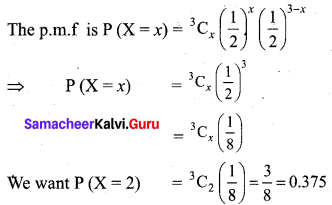
In a family of 3 children, what is the probability that there will be exactly 2 girls?
Solution:
Let X denote the binomial variable which denotes the number of girls.
Given that n = 3 and p = q = \(\frac {1}{2}\)
Samacheer Kalvi 12th Business Maths Solutions Chapter 7 Probability Distributions Ex 7.1 Q8
Hence the probability that there will be exactly 2 girls is. 0.375.

Samacheer Kalvi 12th Business Maths Solutions Chapter 7 Probability Distributions Ex 7.1

Question 9.
Defects in yarn manufactured by a local mill can be approximated by a distribution with a mean of 1.2 defects for every 6 metres of length. If lengths of 6 metres are to be inspected, find the probability of fewer than 2 defects.
Solution:
Given mean np = 1.2 and n = 6
p = \(\frac{1.2}{6}\) = 0.2, q = 1 – 0.2 = 0.8
Let X be a binomial variable denoting the number of defects, (i.e,) X ~ B (6, 0.2)
p.m.f is given by P (X = x) = \(^{6} \mathrm{C}_{x}(0.2)^{x}(0.8)^{6-x}\)
We want P(X < 2) = P(X = 0) + P (X = 1)
= \(^{6} \mathrm{C}_{0}(0.2)^{0}(0.8)^{6}+^{6} \mathrm{C}_{1}(0.2)^{1}(0.8)^{5}\)
= (0.8)6 + 6 (0.2) (0.8)5
= 0.262144 + 0.393216
= 0.65536
Thus if lengths of 6 metres are to be inspected, the probability of less than 2 defects is 0.65536.

Question 10.
If 18% of the bolts produced by a machine are defective, determine the probability that out of the 4 bolts chosen at random
(i) exactly one will be defective
(ii) none will be defective
(iii) at most 2 will be defective
Solution:
Let X be the random variable denoting the number of defective bolts.
The probability of defective bolts p = \(\frac{18}{100}\) = 0.18 ⇒ q = 0.82.
Also n = 4
The p.m.f is P (X = x ) = \(^{4} \mathrm{C}_{x}(0.18)^{x}(0.82)^{4-x}\)
(i) P (exactly one defective) = P(X = 1)
= \(^{4} \mathrm{C}_{1}(0.18)^{1}(0.82)^{3}\)
= 4 (0.18) (0.82)3
= 0.3969
(ii) P (no defective) = P(X = 0)
= \(^{4} \mathrm{C}_{0}(0.18)^{0}(0.82)^{4}\)
= (0.82)4
= 0.45212
(iii) P (atmost 2 defective) = P(X ≤ 2)
= P(X = 2) + P(X = 1) + P(X = 0)
= \(^{4} \mathrm{C}_{2}\) (0.18)2 (0.82)2 + 0.3969 + 0.45212
= 0.1307 + 0.3969 + 0.45212
= 0.97972

Samacheer Kalvi 12th Business Maths Solutions Chapter 7 Probability Distributions Ex 7.1

Question 11.
If the probability of success is 0.09, how many trials are needed to have a probability of at least one success as 1/3 or more?
Solution:
Given p = 0.09 (success)
q = 0.91 (failure)
We have to find number of trials ‘n.’
According to the problem,
P(X ≥ 1 ) > \(\frac{1}{3}\)
(We must have atleast one success)
1 – P(X < 1) > \(\frac{1}{3}\)
1 – P(X = 0) > \(\frac{1}{3}\)
(or) P(X = 0) < \(\frac{2}{3}\)
Using p.m.f, we have,
\(^{n} \mathrm{C}_{0}(0.09)^{0}(0.91)^{n}<\frac{2}{3}\)
(0.91)n < \(\frac{2}{3}\)
we can use log tables to calculate (or) by trial method try for n = 1, 2,…… using calculator.
We observe that (0.91)5 < \(\frac{2}{3}\). Thus we need minimum 5 trial or more.

Question 12.
Among 28 professors of a certain department, 18 drive foreign cars and 10 drive locally made cars. If 5 of these professors are selected at random, what is the probability that at least 3 of them drive foreign cars?
Solution:
Here n = 5, p = \(\frac{18}{28}=\frac{9}{14}\), q = \(\frac{10}{28}=\frac{5}{14}\)
(i.e.) the probability of professors driving foreign cars p = \(\frac{9}{14}\), and those who drive local cars q = \(\frac{5}{14}\).
Let X be the Binomial random variable denoting persons who drive foreign cars.
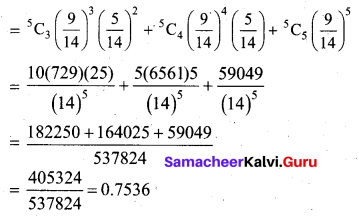
Then the p.m.f of X is given by P (X = x) = \(^{5} \mathrm{C}_{x}\left(\frac{9}{14}\right)^{x}\left(\frac{5}{14}\right)^{5-x}\)
We want P (X ≥ 3) = P (X = 3) + P (X = 4) + P (X = 5)
Samacheer Kalvi 12th Business Maths Solutions Chapter 7 Probability Distributions Ex 7.1 Q12

Samacheer Kalvi 12th Business Maths Solutions Chapter 7 Probability Distributions Ex 7.1

Question 13.
Out of 750 families with 4 children each, how many families would be expected to have
(i) at least one boy
(ii) at most 2 girls
(iii) and children of both sexes?
Assume equal probabilities for boys and girls.
Solution:
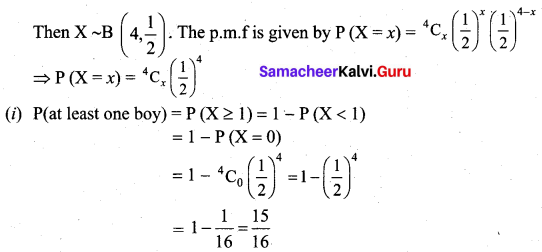
Given that 750 families are considered each with 4 children. We will find the probabilities for one particular family and then multiply by 750.
In other words, n = 4, p = q = \(\frac{1}{2}\) (since boy and girl child have equal probability).
Let X denote the binomial random variable which denotes the number of boys in the family.
Samacheer Kalvi 12th Business Maths Solutions Chapter 7 Probability Distributions Ex 7.1 Q13
So out of 750 families the number of families would be expected to have atleast one boy is \(\frac{15}{16}\) × 750 = 703
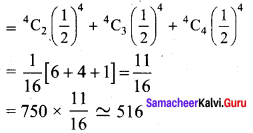
(ii) P(atmost 2 girls) = P(2G, 2B) + P(1G, 3B) + P(0G, 4B)
= P(X = 2) + P(X = 3) + P(X = 4)
Samacheer Kalvi 12th Business Maths Solutions Chapter 7 Probability Distributions Ex 7.1 Q13.1
Thus out of 750 families, 516 families would be expected to have atmost 2 girls.
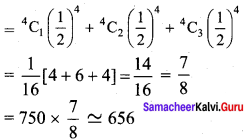
(iii) P(children of both sexes) = P(both boys and girls)
Out of 4 children the sample space is given by {BGGG, BBGG, BBBG}and each case in any order.
So we require P(1B, 3G) + P(2B, 2G) + P(3B, 1G)
(i.e,) P(X = 1) + P(X = 2) + P(X = 3)
Samacheer Kalvi 12th Business Maths Solutions Chapter 7 Probability Distributions Ex 7.1 Q13.2
Thus out of 750 families, 656 families would be expected to have children of both sexes.

Question 14.
Forty percent of business travellers carry a laptop. In a sample of 15 business travelers
(i) what is the probability that 3 will have a laptop?
(ii) what is the probability that 12 of the travelers will not have a laptop?
(iii) what is the probability that atleast three of the travelers have a laptop?
Solution:
Let X be the binomial variables which denotes the number of business travellers having a laptop.
Given that n = 15 and P = 40% = 0.4. So q = 1 – 0.4 = 0.6. Thus X ~ B (15, 0.4).
The p.m.f of X is given by P (X = x) = \(^{15} \mathrm{C}_{x}(0.4)^{x}(0.6)^{15-x}\)
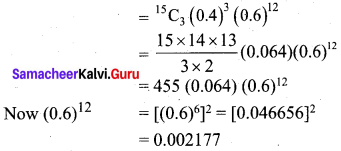
(i) P(3 travellers will have a laptop) = P (X = 3)
Samacheer Kalvi 12th Business Maths Solutions Chapter 7 Probability Distributions Ex 7.1 Q14
Note: The calculation can be done by method of logarithms also.
P(X = 3) = 455 (0.064) (0.002177) = 0.0634
(ii) P(12 of the travellers will not have a laptop)
= P(15 – 12 = 3 will have a laptop)
= P(X = 3) = 0.0634 (from the previous subdivision)
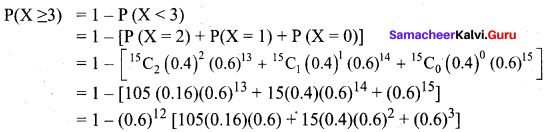
(iii) P(atleast three of the travellers have a laptop)
Samacheer Kalvi 12th Business Maths Solutions Chapter 7 Probability Distributions Ex 7.1 Q14.1
Using (0.6)12 = 0.002177 from the previous subdivision, we have
= 1 – (0.002177) [10.08 + 2.16 + 0.216]
= 1 – (0.002177) (12.456)
= 1 – 0.02712
= 0.9729

Samacheer Kalvi 12th Business Maths Solutions Chapter 7 Probability Distributions Ex 7.1

Question 15.
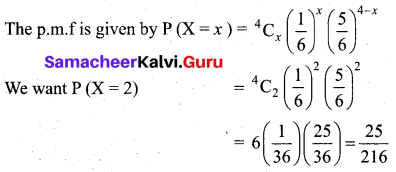
A pair of dice is thrown 4 times. If getting a doublet is considered a success, find the probability of 2 successes.
Solution:
Let p be the probability of getting a doublet, (i.e,) probability of success. When we throw a pair of dice there are 36 possibilities. The number of doublets is 6 [(1, 1) (2, 2), (3, 3) (4, 4) (5, 5) (6, 6)].
So p = \(\frac{6}{36}=\frac{1}{6}\)
q = 1 – \(\frac{1}{6}\) = \(\frac{5}{6}\)
Let X be the random variable denoting the number of doublet in 4 throws.
Then X ~ B (4, \(\frac{1}{6}[/latex)]
Samacheer Kalvi 12th Business Maths Solutions Chapter 7 Probability Distributions Ex 7.1 Q15
Hence the probability of 2 successes is [latex]\frac{25}{216}\)

Question 16.
The mean of a binomial distribution is 5 and the standard deviation is 2. Determine the distribution.
Solution:
Given mean = 5 and standard deviation = 2
(i.e,) np = 5 and √npq = 2 ⇒ npq = 4
5q = 4 ⇒ q = \(\frac{4}{5}\), p = 1 – \(\frac{4}{5}\) = \(\frac{1}{5}\)
Again np = 5 gives \(\frac{n}{5}\) = 5 ⇒ n = 25
So the p.m.f of the distribution is given by P (X = x) = \(\left(\begin{array}{c}
25 \\
x
\end{array}\right)\left(\frac{1}{5}\right)^{x}\left(\frac{4}{5}\right)^{25-x}\)

Samacheer Kalvi 12th Business Maths Solutions Chapter 7 Probability Distributions Ex 7.1

Question 17.
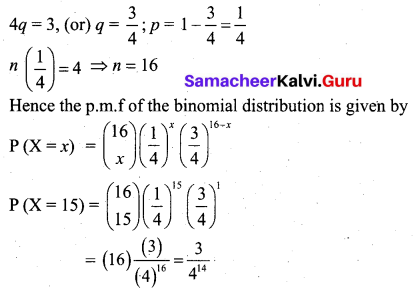
Determine the binomial distribution for which the mean is 4 and variance 3. Also find P(X = 15)
Solution:
Given mean = 4 and variance is 3.
(i.e,) np = 4 and npq = 3
Samacheer Kalvi 12th Business Maths Solutions Chapter 7 Probability Distributions Ex 7.1 Q17

Question 18.
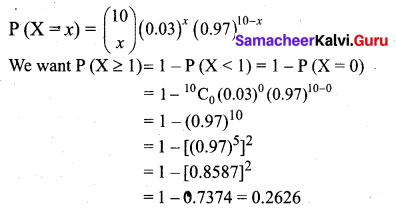
Assume that a drug causes a serious side effect at a rate of three patients per one hundred. What is the probability that at least one person will have side effects in a random sample of ten patients taking the drug?
Solution:
According to the problem, n = 10, p = \(\frac{3}{100}\) = 0.03 where p is the probability that a drug causes side effect. Now X ~ B (10, 0.03). The p.m.f is given by
Samacheer Kalvi 12th Business Maths Solutions Chapter 7 Probability Distributions Ex 7.1 Q18
Thus the probability that at least one person will have side effects is 0.2626.

Samacheer Kalvi 12th Business Maths Solutions Chapter 7 Probability Distributions Ex 7.1

Question 19.
Consider five mice from the same litter, all suffering from Vitamin A deficiency. They are fed a certain dose of carrots. The positive reaction means recovery from the disease. Assume that the probability of recovery is 0.73. What is the probability that at least 3 of the 5 mice recover?
Solution:
Given n = 5 and the probability of recovery p = 0.73.
So q = 1 – 0.73 = 0.27. X ~ B (5, 0.73).
The p.m.f of X is given by
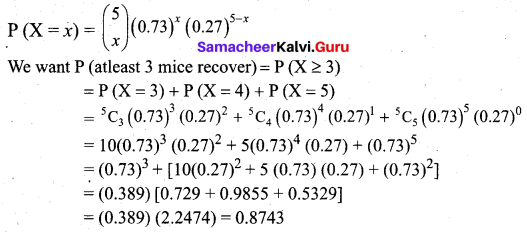
Samacheer Kalvi 12th Business Maths Solutions Chapter 7 Probability Distributions Ex 7.1 Q19
Thus the probability that at least 3 of the 5 mice recover is 0.8743.

Question 20.
An experiment succeeds twice as often as it fails, what is the probability that in the next five trials there will be
(i) three successes and
(ii) at least three successes.
Solution:
Given a number of trials n = 5.
Let P be the probability of success and q be the probability of failure. It is given that p = 2q.
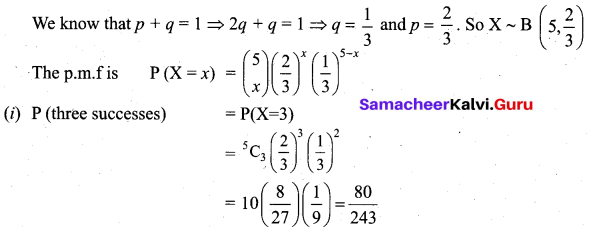
Samacheer Kalvi 12th Business Maths Solutions Chapter 7 Probability Distributions Ex 7.1 Q20
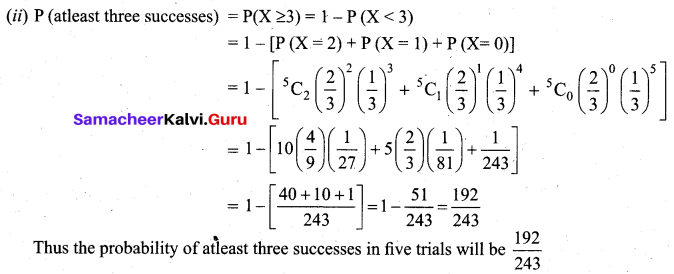
Samacheer Kalvi 12th Business Maths Solutions Chapter 7 Probability Distributions Ex 7.1 Q20.1

Samacheer Kalvi 12th Business Maths Solutions Chapter 7 Probability Distributions Ex 7.1 Read More »

Samacheer Kalvi 12th Business Maths Solutions Chapter 4 Differential Equations Ex 4.1

Students can download 12th Business Maths Chapter 4 Differential Equations Ex 4.1 Questions and Answers, Samacheer Kalvi 12th Business Maths Book Solutions Guide Pdf helps you to revise the complete Tamilnadu State Board New Syllabus and score more marks in your examinations.

Tamilnadu Samacheer Kalvi 12th Business Maths Solutions Chapter 4 Differential Equations Ex 4.1

Question 1.
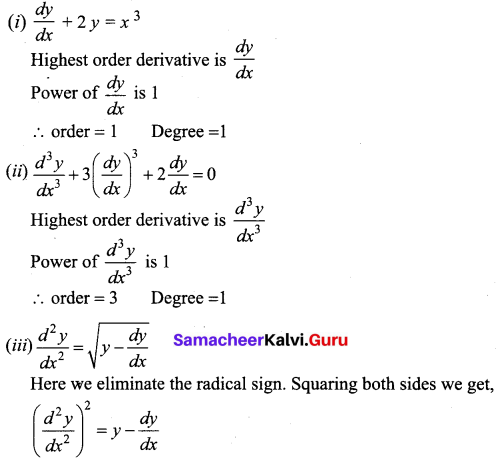
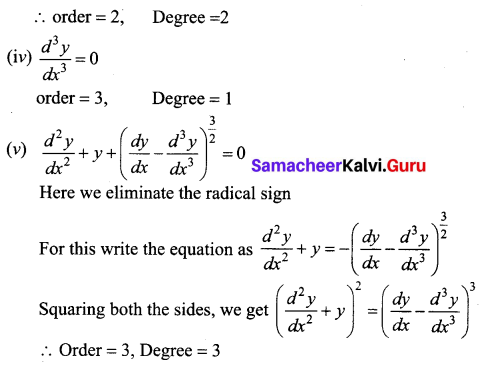
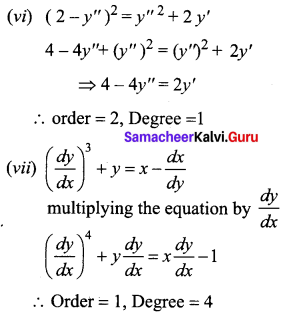
Find the order and degree of the following differential equations.
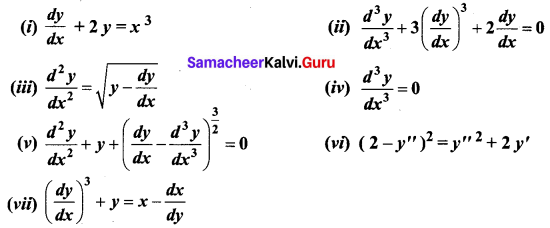
Samacheer Kalvi 12th Business Maths Solutions Chapter 4 Differential Equations Ex 4.1 Q1
Solution:
Samacheer Kalvi 12th Business Maths Solutions Chapter 4 Differential Equations Ex 4.1 Q1.1
Samacheer Kalvi 12th Business Maths Solutions Chapter 4 Differential Equations Ex 4.1 Q1.2
Samacheer Kalvi 12th Business Maths Solutions Chapter 4 Differential Equations Ex 4.1 Q1.3

Question 2.
Find the differential equation of the following
(i) y = cx + c – c3
(ii) y = c(x – c)2
(iii) xy = c2
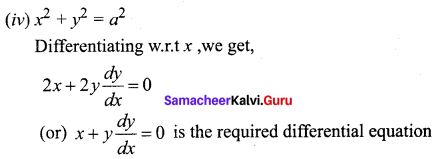
(iv) x2 + y2 = a2
Solution:
(i) y = cx + c – c³ ……… (1)
Differentiating w.r.t. x, we get
\(\frac { dy }{dx}\) = c(1) + 0 ⇒ c = \(\frac { dy }{dx}\)
Equation (1) ⇒ y = x(\(\frac { dy }{dx}\)) + (\(\frac { dy }{dx}\)) – (\(\frac { dy }{dx}\))³

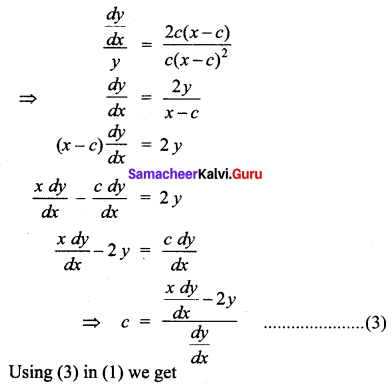
(ii) y = c(x – c)2 …… (1)
We have to eliminate c
Differentiating w.r.t x ,we get, \(\frac{d y}{d x}\) = 2c(x – c) ….. (2)
Dividing (2) by (1) we get
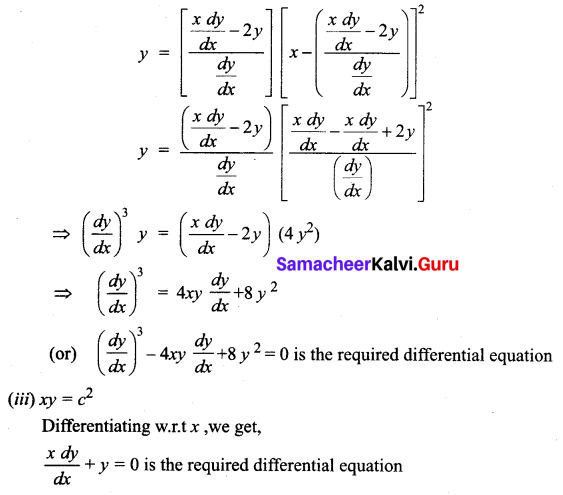
Samacheer Kalvi 12th Business Maths Solutions Chapter 4 Differential Equations Ex 4.1 Q2
Samacheer Kalvi 12th Business Maths Solutions Chapter 4 Differential Equations Ex 4.1 Q2.1
Samacheer Kalvi 12th Business Maths Solutions Chapter 4 Differential Equations Ex 4.1 Q2.2

Question 3.
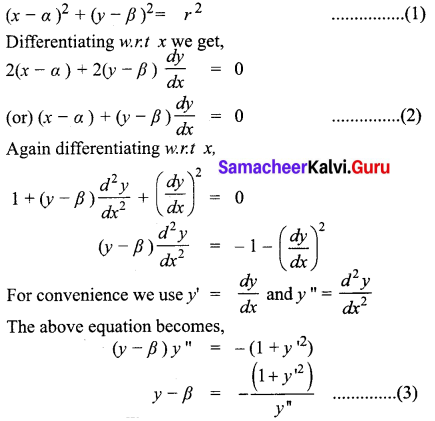
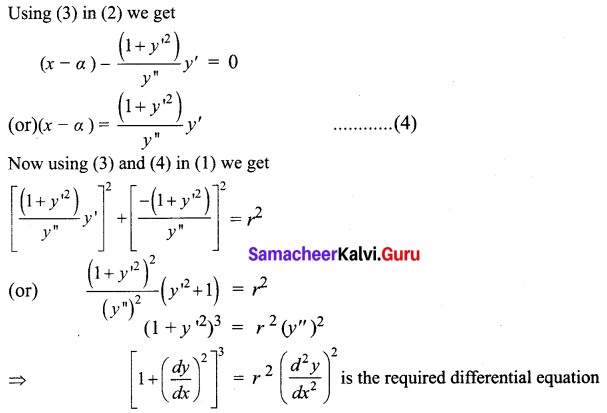
Form the differential equation by eliminating α and β from (x – α)2 + (y – β)2 = r2
Solution:
Samacheer Kalvi 12th Business Maths Solutions Chapter 4 Differential Equations Ex 4.1 Q3
Samacheer Kalvi 12th Business Maths Solutions Chapter 4 Differential Equations Ex 4.1 Q3.1

Question 4.
Find the differential equation of the family of all straight lines passing through the origin.
Solution:
Equation of the straight line passing through the origin (0, 0) is y = mx ………. (1)
Differentiating w.r. to x, we get
\(\frac { dy }{dx}\) = m(1) ⇒ m = \(\frac { dy }{dx}\)
Substituting this value of m in equation (1)
y = x\(\frac { dy }{dx}\)

Question 5.
Form the differential equation that represents all parabolas each of which has a latus rectum 4a and whose axes are parallel to the x-axis.
Solution:
Equation of parabola whose axis is parallel to the x-axis with latus rectum 4a is
(y – β)2 = 4a(x – α) ………(1)
Here (α, β) is the vertex of the parabola.
Differentiating (1) w.r.t x, we get
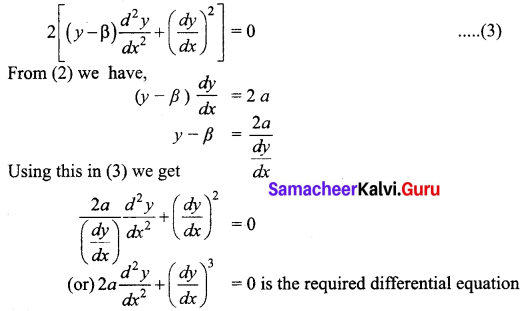
2(y – β) \(\frac{d y}{d x}\) = 4a ……. (2)
Again, differentiating (2) w.r.t x, we get
Samacheer Kalvi 12th Business Maths Solutions Chapter 4 Differential Equations Ex 4.1 Q5

Question 6.
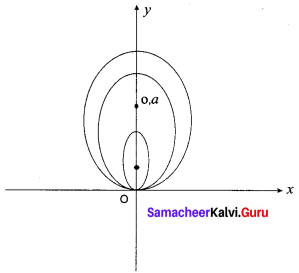
Find the differential equation of all circles passing through the origin and having their centers on the y-axis.
Solution:
Samacheer Kalvi 12th Business Maths Solutions Chapter 4 Differential Equations Ex 4.1 Q6
The circles pass through the origin. They have their centres at (o, a)
The circles have radius a. so the equation of the family of circles is given by
x2 + (y – a)2 = a2
x2 + y2 – 2ay + a2 = a2
x2 + y2 = 2ay ……. (1)
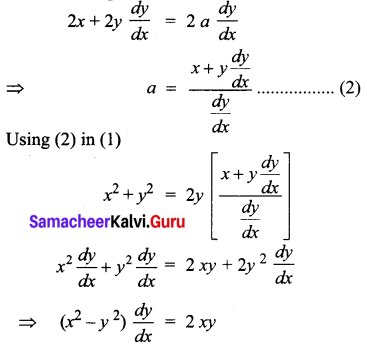
Differentiating w.r.t x,
Samacheer Kalvi 12th Business Maths Solutions Chapter 4 Differential Equations Ex 4.1 Q6.1
\(\frac{d y}{d x}=\frac{2 x y}{x^{2}-y^{2}}\) is the required differential equation of all circles passing through origin and having their centres on the y-axis.

Question 7.
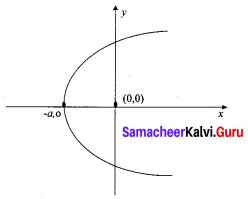
Find the differential equation of the family of a parabola with foci at the origin and axis along the x-axis.
Solution:
The given family of parabolas have foci at the origin and axis along the x-axis.
Samacheer Kalvi 12th Business Maths Solutions Chapter 4 Differential Equations Ex 4.1 Q7
The equation of such family of parabolas is given by
y2 = 4a(x + a) …… (1)
Differentiating w.r.t x,
Samacheer Kalvi 12th Business Maths Solutions Chapter 4 Differential Equations Ex 4.1 Q7.1
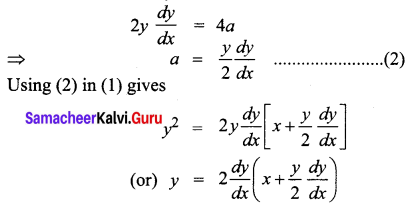
\(y=2 x \frac{d y}{d x}+y\left(\frac{d y}{d x}\right)^{2}\) is the required differential equation.

Samacheer Kalvi 12th Business Maths Solutions Chapter 4 Differential Equations Ex 4.1 Read More »

Samacheer Kalvi 12th Business Maths Solutions Chapter 9 Applied Statistics Ex 9.1

Students can download 12th Business Maths Chapter 9 Applied Statistics Ex 9.1 Questions and Answers, Samacheer Kalvi 12th Business Maths Book Solutions Guide Pdf helps you to revise the complete Tamilnadu State Board New Syllabus and score more marks in your examinations.

Tamilnadu Samacheer Kalvi 12th Business Maths Solutions Chapter 9 Applied Statistics Ex 9.1

Question 1.
Define Time series.
Solution:
When quantitative data are arranged in the order of their occurrence, the resulting series is called the Time Series.

Question 2.
What is the need for studying time series?
Solution:
We should study time series for the following reasons.

  • It helps in the analysis of past behaviour.
  • It helps in forecasting and for future plans.
  • It helps in the evaluation of current achievements.
  • It helps in making comparative studies between one time period and others.

Therefore time series helps us to study and analyze the time-related data which involves in business fields, economics, industries, etc…

Samacheer Kalvi 12th Business Maths Solutions Chapter 9 Applied Statistics Ex 9.1

Question 3.
State the uses of time series.
Solution:
A time-series carries profound importance in business and policy planning. It is used to compare the current trends with that in the past or the expected trends. Thus it gives a clear picture of growth or downfall. Most of the time series data related to fields like Economics, Business, Commerce etc. For example the production of a product, cost of a product, sales of a product, national income, salary of an individual etc. By close observation of time series data, one can predict and plan for future operations in industries and other fields.

Question 4.
Mention the components of the time series.
Solution:
Components of Time Series
There are four types of components in a time series. They are as follows;

  1. Secular Trend
  2. Seasonal variations
  3. Cyclic variations
  4. Irregular variations

Samacheer Kalvi 12th Business Maths Solutions Chapter 9 Applied Statistics Ex 9.1

Question 5.
Define the secular trend.
Solution:
Secular Trend: It is a general tendency, of time series to increase or decrease or stagnates during a long period of time. An upward tendency is usually observed in the population of a country, production, sales, prices in industries, the income of individuals etc., A downward tendency is observed in deaths, epidemics, prices of electronic gadgets, water sources, mortality rate etc….

Question 6.
Write a brief note on seasonal variations.
Solution:
Seasonal Variations: As the name suggests, tendency movements are due to nature which repeats themselves periodically in every season. These variations repeat themselves in less than one year time. It is measured in an interval of time. Seasonal variations may be influenced by natural force, social customs and traditions. These variations are the results of such factors which uniformly and regularly rise and fall in the magnitude. For example, selling of umbrellas’ and raincoat in the rainy season, sales of cool drinks in the summer season, crackers in Deepawali season, purchase of dresses in a festival season, sugarcane in Pongal season.

Samacheer Kalvi 12th Business Maths Solutions Chapter 9 Applied Statistics Ex 9.1

Question 7.
Explain cyclic variations.
Solution:
Cyclic Variations: These variations are not necessarily uniformly periodic in nature. That is, they may or may not follow exactly similar patterns after equal intervals of time. Generally, one cyclic period ranges from 7 to 9 years and there is no hard and fast rule in the fixation of years for a cyclic period. For example, every business cycle has a Start- Boom-Depression- Recover, maintenance during booms and depressions, changes in government monetary policies, changes in interest rates.

Question 8.
Discuss irregular variation.
Solution:
Irregular Variations: These variations do not have a particular pattern and there is no regular period of time of their occurrences. These are accidental changes which are purely random or unpredictable. Normally they are short – term variations, but its occurrence sometimes has its effect so intense that they may give rise to new cyclic or other movements of variations. For example floods, wars, earthquakes, Tsunami, strikes, lockouts etc…

Samacheer Kalvi 12th Business Maths Solutions Chapter 9 Applied Statistics Ex 9.1

Question 9.
Define the seasonal index.
Solution:
Seasonal Index for every season (i.e) months, quarters or year is given by
Seasonal Index (S.I) = \(\frac{\text { Seasonal Average }}{\text { Grand average }}\) × 100
Where seasonal average is calculated for month, (or) quarter depending on the problem and Grand Average (G) is the average of averages.

Question 10.
Explain the method of fitting a straight line.
Solution:
The method of fitting a straight line is as follows
Procedure:
(i) The straight-line trend is represented by the equation Y = a + bX ….. (1)
where Y is the actual value, X is time, a, b are constants
(ii) The constants ‘a’ and ‘b’ are estimated by solving the following two normal Equations
ΣY = n a + b ΣX ……(2)
ΣXY = a ΣX + b ΣX2 ……(3)
Where n = number of years given in the data.
(iii) By taking the mid-point of the time as the origin, we get ΣX = 0
(iv) When ΣX = 0, the two normal equations reduces to
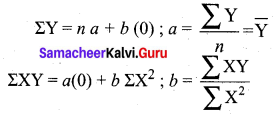
Samacheer Kalvi 12th Business Maths Solutions Chapter 9 Applied Statistics Ex 9.1 Q10
The constant ‘a’ gives the mean of Y and ‘6’ gives the rate of change (slope).
(v) By substituting the values of ‘a’ and ‘b’ in the trend equation (1), we get the Line of Best Fit.

Samacheer Kalvi 12th Business Maths Solutions Chapter 9 Applied Statistics Ex 9.1

Question 11.
State the two normal equations used in fitting a straight line.
Solution:
The normal equations used in fitting a straight line are
ΣY = na + b ΣX and ΣXY = a ΣX + b ΣX2
Where n = number of years given in the data,
X = time
Y = actual value
a, b = constants

Question 12.
State the different methods of measuring trend.
Solution:
Measurements of Trends
Following are the methods by which we can measure the trend.

  1. Freehand or Graphic Method
  2. Method of Semi-Averages
  3. Method of Moving Averages
  4. Method of Least Squares

Samacheer Kalvi 12th Business Maths Solutions Chapter 9 Applied Statistics Ex 9.1

Question 13.
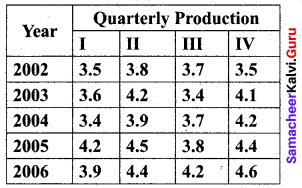
Compute the average seasonal movement for the following series.
Samacheer Kalvi 12th Business Maths Solutions Chapter 9 Applied Statistics Ex 9.1 Q13
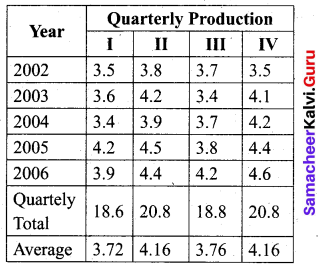
Solution:
Samacheer Kalvi 12th Business Maths Solutions Chapter 9 Applied Statistics Ex 9.1 Q13.1
Grand average = \(\frac{3.72+4.16+3.76+4.16}{4}\) = 3.95
Seasonal Index (S.I) for I quarter = \(\frac { Average\quad of\quad I\quad quarter }{ Grand\quad Average }\) × 100
S.I. for I quarter = \(\frac{3.72}{3.95}\) × 100 = 94.1772
S.I. for II quarter = \(\frac{4.16}{3.95}\) × 100 = 105.3165
S.I. for III quarter = \(\frac{3.76}{3.95}\) × 100 = 95.1899
S.I. for IV quarter = \(\frac{4.16}{3.95}\) × 100 = 105.3165
Thus we obtain the average seasonal movement.

Question 14.
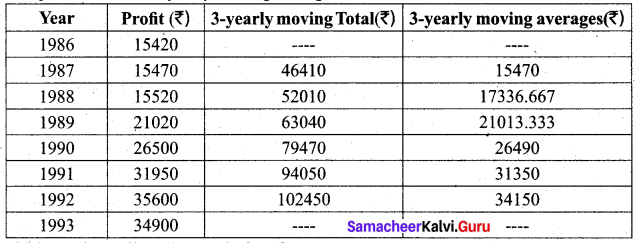
The following figures relate to the profits of a commercial concern for 8 years.
Samacheer Kalvi 12th Business Maths Solutions Chapter 9 Applied Statistics Ex 9.1 Q14
Find the trend of profits by the method of three year moving averages.
Solution:
Computation of three-yearly moving averages
Samacheer Kalvi 12th Business Maths Solutions Chapter 9 Applied Statistics Ex 9.1 Q14.1
The last column gives the trend of profits.

Samacheer Kalvi 12th Business Maths Solutions Chapter 9 Applied Statistics Ex 9.1

Question 15.
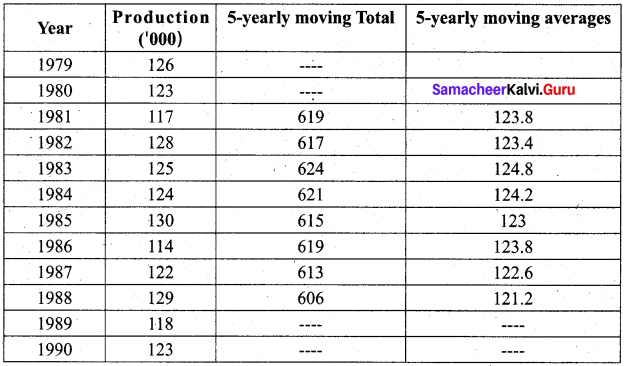
Find the trend of production by the method of a five-yearly period of moving average for the following data:
Samacheer Kalvi 12th Business Maths Solutions Chapter 9 Applied Statistics Ex 9.1 Q15
Solution:
Computation of five-yearly moving averages
Samacheer Kalvi 12th Business Maths Solutions Chapter 9 Applied Statistics Ex 9.1 Q15.1
The last column gives the trend in the production by the method of the five-yearly period of moving average.

Question 16.
The following table gives the number of small – scale units registered with the Directorate of Industries between 1985 and 1991. Show the growth on a trend line by the freehand method.
Samacheer Kalvi 12th Business Maths Solutions Chapter 9 Applied Statistics Ex 9.1 Q16
Solution:
We follow the procedure as given below
(a) Plot the data on a graph
(b) Join all the points by a free hand smooth curve
(c) A line is drawn which passes through the maximum number of plotted points
Samacheer Kalvi 12th Business Maths Solutions Chapter 9 Applied Statistics Ex 9.1 Q16.1

Samacheer Kalvi 12th Business Maths Solutions Chapter 9 Applied Statistics Ex 9.1

Question 17.
The Annual production of a commodity is given as follows:
Samacheer Kalvi 12th Business Maths Solutions Chapter 9 Applied Statistics Ex 9.1 Q17
Fit a straight line trend by the method of least squares.
Solution:
Computation of trend values by the method of least squares. (ODD years)
Samacheer Kalvi 12th Business Maths Solutions Chapter 9 Applied Statistics Ex 9.1 Q17.1
Therefore, the required equation of the straight line trend is given by Y = a + bX
(i.e) Y = 169.429 + 3.286 X (or) Y = 169.429 + 3.286 (x – 1998)
The trends values are obtained by
When x = 1995, Yt = 169.429 + 3.286 (1995 – 1998) = 159.57
When x = 1996, Yt = 169.429 + 3.286 (1996 – 1998) = 162.86
When x = 1997, Yt = 169.429 + 3.286 (1997 – 1998) = 166.14
When x = 1998, Yt = -169.429 + 3.286 (1998 – 1998) = 169.43
When x = 1999, Yt = 169.429 + 3.286 (1999 – 1998) = 172:72
When x = 2000, Yt = 169.429 + 3.286 (2000 – 1998) = 176.00
When x = 2001, Yt = 169.429 + 3.286 (2001 – 1998) = 179.29

Question 18.
Determine the equation of a straight line which best fits the following data.
Samacheer Kalvi 12th Business Maths Solutions Chapter 9 Applied Statistics Ex 9.1 Q18
Compute the trend values for all years from 2000 to 2004.
Solution:
Computation of trend values by the method of least squares. (ODD years)
Samacheer Kalvi 12th Business Maths Solutions Chapter 9 Applied Statistics Ex 9.1 Q18.1
Samacheer Kalvi 12th Business Maths Solutions Chapter 9 Applied Statistics Ex 9.1 Q18.2
Therefore, the equation of the straight line which best fits the data is given by Y = a + b X
(i.e) Y= 54 + 5.4 X
(or) Y = 54 + 5.4 (x – 2002)
The trends values are obtained as follows
When x = 2000, \(\hat{Y}\) = 54 + 5.4 (2000 – 2002) = 43.2
When x = 2001, \(\hat{Y}\) = 54 + 5.4 (2001 – 2002) = 48.6
When x = 2002, \(\hat{Y}\) = 54 + 5.4 (2002 – 2002) = 54
When x = 2003, \(\hat{Y}\) = 54 + 5.4 (2003 – 2002) = 59.4
When x = 2004, \(\hat{Y}\) = 54 + 5.4 (2004 – 2002) = 64.8

Samacheer Kalvi 12th Business Maths Solutions Chapter 9 Applied Statistics Ex 9.1

Question 19.
The sales of a commodity in tones varied from January 2010 to December 2010 as follows:
Samacheer Kalvi 12th Business Maths Solutions Chapter 9 Applied Statistics Ex 9.1 Q19
Fit a trend line by the method of semi-average.
Solution:
Since the number of months is even (12), we can equally divide the given data in two equal parts and obtain the averages of the first six months and last six months
Samacheer Kalvi 12th Business Maths Solutions Chapter 9 Applied Statistics Ex 9.1 Q19.1
Thus we obtain semi-average I = 276.667 and semi-average II = 213.333
To fit a trend line we plot each value at the mid-point (month) of each half, (i.e) we plot 276.667 in the middle of March and April; we plot 213.333 in the middle of September and October. We join the two points by a straight line. This is the required line.
Samacheer Kalvi 12th Business Maths Solutions Chapter 9 Applied Statistics Ex 9.1 Q19.2

Question 20.
Use the method of monthly averages to find the monthly indices for the following data of production of a commodity for the years 2002, 2003 and 2004.
Samacheer Kalvi 12th Business Maths Solutions Chapter 9 Applied Statistics Ex 9.1 Q20
Solution:
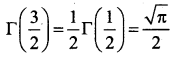
Computation of monthly indices for the production of a commodity using the method of monthly averages.
Samacheer Kalvi 12th Business Maths Solutions Chapter 9 Applied Statistics Ex 9.1 Q20.1
Samacheer Kalvi 12th Business Maths Solutions Chapter 9 Applied Statistics Ex 9.1 Q20.2
Samacheer Kalvi 12th Business Maths Solutions Chapter 9 Applied Statistics Ex 9.1 Q20.3
All the values are given in the above table in the last row.

Samacheer Kalvi 12th Business Maths Solutions Chapter 9 Applied Statistics Ex 9.1

Question 21.
Calculate the seasonal indices from the following data using the average from the following data using the average method:
Samacheer Kalvi 12th Business Maths Solutions Chapter 9 Applied Statistics Ex 9.1 Q21
Solution:
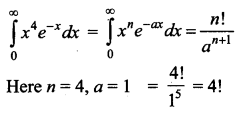
Computation of quarterly indices.by the method of simple averages.
Samacheer Kalvi 12th Business Maths Solutions Chapter 9 Applied Statistics Ex 9.1 Q21.1
Samacheer Kalvi 12th Business Maths Solutions Chapter 9 Applied Statistics Ex 9.1 Q21.2
The seasonal indices are given in the last row of the table above.

Question 22.
The following table shows the number of salesmen working for a certain concern.
Samacheer Kalvi 12th Business Maths Solutions Chapter 9 Applied Statistics Ex 9.1 Q22
Use the method of least squares to fit a straight line and estimate the number of salesmen in 1997.
Solution:
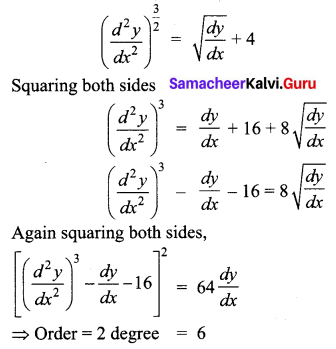
Samacheer Kalvi 12th Business Maths Solutions Chapter 9 Applied Statistics Ex 9.1 Q22.1
Samacheer Kalvi 12th Business Maths Solutions Chapter 9 Applied Statistics Ex 9.1 Q22.2
Therefore, the required equation of the straight line trend is given by
Y = a + bX
Y = 48.8 + 2 X
Y = 48.8 + 2 (x – 1994)
The trend values are obtained as follows:
When x = 1992, \(\hat{Y}\) = 48.8 + 2(1992 – 1994) = 44.8
When x = 1993, \(\hat{Y}\) = 48.8 + 2 (1993 – 1994) = 46.8
When x = 1994, \(\hat{Y}\) = 48.8 + 2 (1994 – 1994) = 48.8
When x = 1995, \(\hat{Y}\) = 48.8 + 2 (1995 – 1994) = 50.8
When x = 1996, \(\hat{Y}\) = 48.8 + 2 (1996 – 1994) = 52.8
In the year 1997, the estimated number of salesmen is \(\hat{Y}\) = 48.8 + 2 (1997 – 1994)
= 48.8 + 6
= 54.8 ~ 55

Samacheer Kalvi 12th Business Maths Solutions Chapter 9 Applied Statistics Ex 9.1 Read More »

Samacheer Kalvi 12th Business Maths Solutions Chapter 5 Numerical Methods Additional Problems

Students can download 12th Business Maths Chapter 5 Numerical Methods Additional Problems and Answers, Samacheer Kalvi 12th Business Maths Book Solutions Guide Pdf helps you to revise the complete Tamilnadu State Board New Syllabus and score more marks in your examinations.

Tamilnadu Samacheer Kalvi 12th Business Maths Solutions Chapter 5 Numerical Methods Additional Problems

One Mark Questions

Question 1.
Match the following.

(a) ∆f(x) (i) 2x + 1
(b) E2 f(x) (ii) 1 + ∆
(c) E (iii) f(x + h) – f(x)
(d) ∆x2, h = 1 (iv) f(x + 2h)

Answer:
(a) – (iii), (b) – (iv), (c) – (ii), (d) – (i)

Question 2.
E-n f(x) is ______
(a) f(x + nh)
(b) f(x – nh)
(c) f(-nh)
(d) f(x – n)
Answer:
(b) f(x – nh)

Samacheer Kalvi 12th Business Maths Solutions Chapter 5 Numerical Methods Additional Problems

Question 3.
E is a _____
(a) shifting operator
(b) Displacement operator
(c) 1 + ∆
(d) all of these
(e) none of these
Answer:
(d) all of these

Question 4.
4 y3 = _______
(a) (E – 1)4 y3
(b) (E3 – 1) y3
(c) (E – 1)3 y0
(d) (E – 1)4 y0
Answer:
(a) (E – 1)4 y3

Samacheer Kalvi 12th Business Maths Solutions Chapter 5 Numerical Methods Additional Problems

Question 5.
Fill in the blanks.

  1. The two methods of interpolation are _______ and _______
  2. If values of x are not equidistant we use _______ method.
  3. ∆(f(x) + g(x)) = ______
  4. k yn = ______
  5. The first three terms in Newton’s method will give a ________ interpolation.

Answer:

  1. graphical method, algebraic method
  2. Lagrange’s method
  3. ∆f(x) + ∆g(x)
  4. k-1 yn+1 – ∆k-1 yn
  5. Parabolic

Question 6.
Say true or false

  1. ∇y2 = y1 – y0
  2. 2 yn = ∇yn – ∇yn+1
  3. When 5 values are given, the polynomial which fits the data is of degree 4
  4. E ∆ = ∆ E
  5. f(2) + ∆f(2) = f(3)

Answer:

  1. False
  2. True
  3. True
  4. True
  5. True

II. 2 Mark Questions

Question 1.
Find the missing term from the following data.
Samacheer Kalvi 12th Business Maths Solutions Chapter 5 Numerical Methods Additional Problems II Q1
Solution:
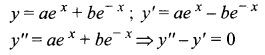
Since three values of y = f(x) are given, the polynomial which fits the data is of degree two.
Hence third differences are zero.
Samacheer Kalvi 12th Business Maths Solutions Chapter 5 Numerical Methods Additional Problems II Q1.1

Samacheer Kalvi 12th Business Maths Solutions Chapter 5 Numerical Methods Additional Problems

Question 2.
From the following data estimate the export for the year 2000
Samacheer Kalvi 12th Business Maths Solutions Chapter 5 Numerical Methods Additional Problems II Q2
Solution:
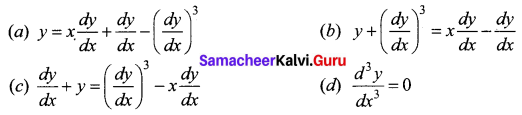
Consider a polynomial of degree two.
Hence third differences are zero.
Samacheer Kalvi 12th Business Maths Solutions Chapter 5 Numerical Methods Additional Problems II Q2.1

Question 3.
For the tabulated values of y = f(x), find ∆y3 and ∆3y2
Samacheer Kalvi 12th Business Maths Solutions Chapter 5 Numerical Methods Additional Problems II Q3
Solution:
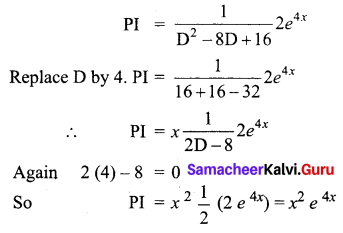
Samacheer Kalvi 12th Business Maths Solutions Chapter 5 Numerical Methods Additional Problems II Q3.1

Question 4.
If f(x) = x2 + ax + b, find ∆r f(x)
Solution:
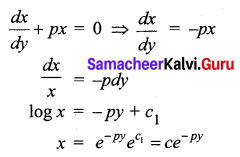
∆f(x) = f(x + h) – f(x)
= [(x + h )2 + a(x + h) + b] – [x2 + ax + b]
= 2xh + h2 + ah
2 f(x) = [2(x + h) h + h2 + ah] – [2xh + h2 + ah] = 2h2
3 f(x) = 0
Thus ∆r f(x) = 0 for all r ≥ 3

Samacheer Kalvi 12th Business Maths Solutions Chapter 5 Numerical Methods Additional Problems

Question 5.
Show that ∆3 y4 = ∇3 y7
Solution:
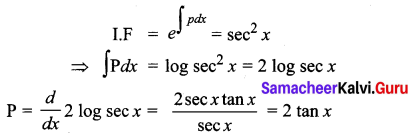
Samacheer Kalvi 12th Business Maths Solutions Chapter 5 Numerical Methods Additional Problems II Q5
Hence proved

III. 3 and 5 Marks Questions

Question 1.
If f(0) = 5, f(1) = 6, f(3) = 50, f(4) = 105, find f(2) by using Lagrange’s formula.
Solution:
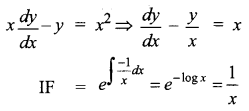
Samacheer Kalvi 12th Business Maths Solutions Chapter 5 Numerical Methods Additional Problems III Q1
Samacheer Kalvi 12th Business Maths Solutions Chapter 5 Numerical Methods Additional Problems III Q1.1

Question 2.
Find y when x = 0.2 given that
Samacheer Kalvi 12th Business Maths Solutions Chapter 5 Numerical Methods Additional Problems III Q2
Solution:
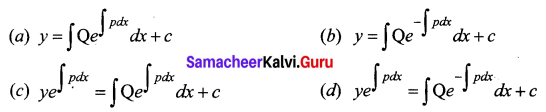
Since the required value of y is near the beginning of the table, we use Newton’s forward difference formula
Samacheer Kalvi 12th Business Maths Solutions Chapter 5 Numerical Methods Additional Problems III Q2.1
Samacheer Kalvi 12th Business Maths Solutions Chapter 5 Numerical Methods Additional Problems III Q2.2

Samacheer Kalvi 12th Business Maths Solutions Chapter 5 Numerical Methods Additional Problems

Question 3.
Find the number of men getting wages between Rs.30 and Rs.35 from the following table:
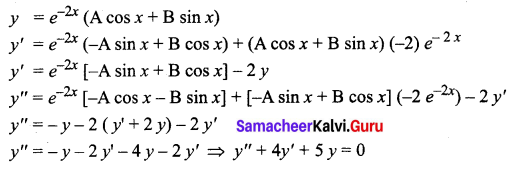
Samacheer Kalvi 12th Business Maths Solutions Chapter 5 Numerical Methods Additional Problems III Q3
Solution:
The difference table
Samacheer Kalvi 12th Business Maths Solutions Chapter 5 Numerical Methods Additional Problems III Q3.1
Samacheer Kalvi 12th Business Maths Solutions Chapter 5 Numerical Methods Additional Problems III Q3.2
No. of men getting wages less than 35 is 24. Therefore the number of men getting wages between Rs.30 and Rs.35 is y (35) – y (30)
(i.e) 24 – 9 = 15

Question 4.
Using Newton’s formula estimate the population of town for the year 1995:
Samacheer Kalvi 12th Business Maths Solutions Chapter 5 Numerical Methods Additional Problems III Q4
Solution:
1995 lies in (1991, 2001). Hence we use Newton’s backward interpolation formula.
Here x = 1995, xn = 2001, h = 10
1995 = xn + nh
⇒ 1995 = 2001 + 10n
⇒ n = \(\frac{1995-2001}{10}\)
⇒ n = -0.6
The backward difference table is given below
Samacheer Kalvi 12th Business Maths Solutions Chapter 5 Numerical Methods Additional Problems III Q4.1
y = 101 – 4.8 + 0.48 + 0.056 + 0.1008
y = 96.8368
Hence the population for the year 1995 is 96.837 thousands.

Samacheer Kalvi 12th Business Maths Solutions Chapter 5 Numerical Methods Additional Problems

Question 5.
Using Lagrange’s formula find y(11) from the following table
Samacheer Kalvi 12th Business Maths Solutions Chapter 5 Numerical Methods Additional Problems III Q5
Solution:
Given
x0 = 6, y0 = 13
x1 = 7, y1 = 14
x2 = 10, y2 = 15
x3 = 12, y3 = 17
x = 11
Using Lagrange’s formula,
Samacheer Kalvi 12th Business Maths Solutions Chapter 5 Numerical Methods Additional Problems III Q5.1

Samacheer Kalvi 12th Business Maths Solutions Chapter 5 Numerical Methods Additional Problems Read More »

Samacheer Kalvi 12th Business Maths Solutions Chapter 6 Random Variable and Mathematical Expectation Additional Problems

Students can download 12th Business Maths Chapter 6 Random Variable and Mathematical Expectation Additional Problems and Answers, Samacheer Kalvi 12th Business Maths Book Solutions Guide Pdf helps you to revise the complete Tamilnadu State Board New Syllabus and score more marks in your examinations.

Tamilnadu Samacheer Kalvi 12th Business Maths Solutions Chapter 6 Random Variable and Mathematical Expectation Additional Problems

One Mark Questions

Question 1.
If a fair coin is tossed three times the probability function p(x) of the number of heads x is _______
Samacheer Kalvi 12th Business Maths Solutions Chapter 6 Random Variable and Mathematical Expectation Additional Problems I Q1
Samacheer Kalvi 12th Business Maths Solutions Chapter 6 Random Variable and Mathematical Expectation Additional Problems I Q1.1
(d) None of these
Answer:
Samacheer Kalvi 12th Business Maths Solutions Chapter 6 Random Variable and Mathematical Expectation Additional Problems I Q1.2
Hint:
The sample space is HHH, HHT, HTH, HTT, THH, THT, TTH and TTT
Number of heads is 0, 1, 2, 3 with probability \(\frac{1}{8}, \frac{3}{8}, \frac{3}{8}\) and \(\frac{1}{8}\)

Question 2.
If a discrete random variable has the probability mass function as
Samacheer Kalvi 12th Business Maths Solutions Chapter 6 Random Variable and Mathematical Expectation Additional Problems I Q2
then the value of K is _______
(a) \(\frac{1}{11}\)
(b) \(\frac{1}{12}\)
(c) \(\frac{2}{13}\)
(d) \(\frac{4}{9}\)
Answer:
(b) \(\frac{1}{12}\)
Hint:
k + 3 k + 6k + 2k = 1
⇒ 12k = 1
⇒ k = \(\frac{1}{12}\)

Samacheer Kalvi 12th Business Maths Solutions Chapter 6 Random Variable and Mathematical Expectation Additional Problems

Question 3.
If the probability density function of X is f(x) = Cx (2 – x), and 0 < x < 2, then value of C is ______
(a) \(\frac{4}{3}\)
(b) \(\frac{6}{5}\)
(c) \(\frac{3}{4}\)
(d) \(\frac{3}{5}\)
Answer:
(c) \(\frac{3}{4}\)
Hint:
Samacheer Kalvi 12th Business Maths Solutions Chapter 6 Random Variable and Mathematical Expectation Additional Problems I Q3

Question 4.
The random variables X and Y are independent if ______
(a) E(XY) = 1
(b) E(XY) = 0
(c) E(XY) = E(X) E(Y)
(d) E(X + Y) = E(X) + E(Y)
Answer:
(c) E(XY) = E(X) E(Y)

Samacheer Kalvi 12th Business Maths Solutions Chapter 6 Random Variable and Mathematical Expectation Additional Problems

Question 5.
If a random variable X has the following distribution
Samacheer Kalvi 12th Business Maths Solutions Chapter 6 Random Variable and Mathematical Expectation Additional Problems I Q5
then the expected value of X is ______
(a) \(\frac{3}{2}\)
(b) \(\frac{1}{6}\)
(c) \(\frac{1}{2}\)
(d) \(\frac{1}{3}\)
Answer:
(b) \(\frac{1}{6}\)
Hint:
E(X) = \(\frac{-1}{3}-\frac{2}{6}+\frac{1}{6}+\frac{2}{3}=\frac{1}{3}-\frac{1}{6}=\frac{1}{6}\)

Question 6.
Var (4X + 7) = _____
(a) 7
(b) 16 Var (X)
(c) 11
(d) None of these
Answer:
(b) 16 Var (X)
Hint:
Var (4X + 7) = (42) Var (X)

Samacheer Kalvi 12th Business Maths Solutions Chapter 6 Random Variable and Mathematical Expectation Additional Problems

Question 7.
Match the following:

(a) Random variable (i) Arithmetic mean
(b) Speed of a car (ii) Discrete variable
(c) E(aX + b) (iii) Chance variable
(d) No. of students in a class (iv) Continuous variable
(e) E(X) (v) aE(X) + b

Answer:
(a) – (iii)
(b) – (iv)
(c) – (v)
(d) – (ii)
(e) – (i)

Question 8.
If E(X) = 2 and E(Z) = 4, then E (Z – X) is ______
(a) 2
(b) 6
(c) 0
(d) -2
Answer:
(a) 2
Hint:
E(Z – X) = E(Z) – E(X) = 4 – 2 = 2

Samacheer Kalvi 12th Business Maths Solutions Chapter 6 Random Variable and Mathematical Expectation Additional Problems

Question 9.
Fill in the blanks:

  1. The distribution function F (X) is equal to _______
  2. Two types of random variables are ______ and ______
  3. Probability mass function is also called ______
  4. Cumulative distribution function is also called ________
  5. Probability density function is also called ______ and _______
  6. d F(x) is known as ______ of X.
  7. E(X) is denoted by _______
  8. Variance is a measure of ______ or _______ of X.
  9. Standard deviation is defined as _______
  10. Mean is the _______ of a density. Variance is the ________ of a density.

Answers:

  1. P(X ≤ x)
  2. discrete and continuous
  3. discrete probability function
  4. distribution function
  5. continuous probability function, integrating the density function
  6. probability differential
  7. µx
  8. the spread, dispersion of the density
  9. √Var[X]
  10. center of gravity, the moment of inertia.

2 Mark Questions

Question 1.
Verify whether the following function is a probability mass function or not. Hence find c.d.f.
Samacheer Kalvi 12th Business Maths Solutions Chapter 6 Random Variable and Mathematical Expectation Additional Problems II Q1
Solution:
Σpi = \(\frac{1}{3}+\frac{2}{3}\) = 1 and pi > 0.
So the given function is a p.m.f. c.d.f is given by
F (x) = P (X ≤ x)
F(1) = P(X ≤ 1) = P(X = 1) = \(\frac{1}{3}\)
F(2) = P (X ≤ 2) = P(X = 1) + P (X = 2) = \(\frac{1}{3}+\frac{2}{3}\) = 1
Samacheer Kalvi 12th Business Maths Solutions Chapter 6 Random Variable and Mathematical Expectation Additional Problems II Q1.1

Question 2.
Consider the following probability distribution of X.
Samacheer Kalvi 12th Business Maths Solutions Chapter 6 Random Variable and Mathematical Expectation Additional Problems II Q2
Is p(xi) a p.m.f?
Solution:
p(xi) > 0 for all i
Samacheer Kalvi 12th Business Maths Solutions Chapter 6 Random Variable and Mathematical Expectation Additional Problems II Q2.1
Hence p(xi) is a p.m.f.

Samacheer Kalvi 12th Business Maths Solutions Chapter 6 Random Variable and Mathematical Expectation Additional Problems

Question 3.
The probability that a man fishing at a particular place will catch 1, 2, 3 and 4 fish are 0.4, 0.3, 0.2 and 0.1. What is the expected number of fish caught?
Solution:
Let X denote the no.of fish caught by the man.
Samacheer Kalvi 12th Business Maths Solutions Chapter 6 Random Variable and Mathematical Expectation Additional Problems II Q3
E(X) = 1(0.4) + 2 (0.3) + 3 (0.2) + 4 (0.1)
= 0.4 + 0.6 + 0.6 + 0.4
= 2

Question 4.
A random variable X has the following probability function.
Samacheer Kalvi 12th Business Maths Solutions Chapter 6 Random Variable and Mathematical Expectation Additional Problems II Q4
Find the value of K.
Solution:
We know that Σp(xi) = 1
⇒ 0.1 + K + 0.2 + 2K + 0.3 + K = 1
⇒ 4K + 0.6 = 1
⇒ 4K = 0.4
⇒ K = 0.1

Samacheer Kalvi 12th Business Maths Solutions Chapter 6 Random Variable and Mathematical Expectation Additional Problems

Question 5.
A person receives a sum of rupees equal to the square of the number that appears on the face when a die is tossed. How much money can he expect to receive?
Solution:
Let the random variable X denote the square of the number that can appear on the face of a die. Then the distribution is given by
Samacheer Kalvi 12th Business Maths Solutions Chapter 6 Random Variable and Mathematical Expectation Additional Problems II Q5

3 and 5 Marks Questions

Question 1.
For the following distribution of X.
Samacheer Kalvi 12th Business Maths Solutions Chapter 6 Random Variable and Mathematical Expectation Additional Problems III Q1
(i) P(X ≤ 1)
(ii) P(X ≤ 2 )
(iii) P(0 < X < 2)
Solution:
(i) P(X ≤ 1) = P (X = 1) + P (X = 0)
\(=\frac{1}{2}+\frac{1}{6}=\frac{4}{6}=\frac{2}{3}\)
(ii) P(X ≤ 2) = P(X = 2) + P(X = 1) + P(X = 0)
\(=\frac{3}{10}+\frac{1}{2}+\frac{1}{6}=\frac{29}{30}\)
(iii) P(0 < X < 2) = P(X = 1) = \(\frac{1}{2}\)

Question 2.
Given that p.d.f of a random variable X as follows
Samacheer Kalvi 12th Business Maths Solutions Chapter 6 Random Variable and Mathematical Expectation Additional Problems III Q2
Find K and c.d.f.
Solution:
Samacheer Kalvi 12th Business Maths Solutions Chapter 6 Random Variable and Mathematical Expectation Additional Problems III Q2.1
Samacheer Kalvi 12th Business Maths Solutions Chapter 6 Random Variable and Mathematical Expectation Additional Problems III Q2.2

Samacheer Kalvi 12th Business Maths Solutions Chapter 6 Random Variable and Mathematical Expectation Additional Problems

Question 3.
Suppose that the life in hours of a certain part of radio tube is an r.v X with p.d.f given by
Samacheer Kalvi 12th Business Maths Solutions Chapter 6 Random Variable and Mathematical Expectation Additional Problems III Q3
(i) What is the probability that all of three Such tubes in a given radio set will have to be replaced in the first 150 hours?
(ii) What is the probability that none of the three tubes will be replaced?
Solution:
(i) A tube in the radio set will have to be replaced during the first 150 hours if its life is less than 150 hours. Hence the required probability is
Samacheer Kalvi 12th Business Maths Solutions Chapter 6 Random Variable and Mathematical Expectation Additional Problems III Q3.1
The probability that all three of the original tubes will have to be replaced during the first 150 hours is \(\left(\frac{1}{3}\right)^{3}=\frac{1}{27}\)
(ii) The probability that a tube is not replaced is given by P(X > 150)
= 1 – P(X ≤ 150)
= 1 – \(\frac{1}{3}\)
= \(\frac{2}{3}\)
Hence the probability that none of the three tubes will be replaced during the 150 hours of operation is \(\left(\frac{2}{3}\right)^{3}=\frac{8}{27}\)

Question 4.
Let X be a continuous random variable with p.d.f:
Samacheer Kalvi 12th Business Maths Solutions Chapter 6 Random Variable and Mathematical Expectation Additional Problems III Q4
(i) Find ‘a’
(ii) compute P(X ≤ 1.5)
Solution:
Samacheer Kalvi 12th Business Maths Solutions Chapter 6 Random Variable and Mathematical Expectation Additional Problems III Q4.1
Samacheer Kalvi 12th Business Maths Solutions Chapter 6 Random Variable and Mathematical Expectation Additional Problems III Q4.2

Samacheer Kalvi 12th Business Maths Solutions Chapter 6 Random Variable and Mathematical Expectation Additional Problems

Question 5.
A random variable X has the probability function as follows:
Samacheer Kalvi 12th Business Maths Solutions Chapter 6 Random Variable and Mathematical Expectation Additional Problems III Q5
Find E(3X + 1), E(X2) and Var(X).
Solution:
E(X) = (-1) (0.2) + 0(0.3) + 1(0.5) = -0.2 + 0.5 = 0.3
So E(3X + 1) = 3 E(X) + 1 = 3(0.3) + 1 = 1.9
E(X2) = (-1)2 (0.2) + 02 (0.3) + 12 (0.5) = 0.2 + 0.5 = 0.7
Var(X) = E(X2) – [E(X)]2 = 0.7 – (0.3)2 = 0.61

Question 6.
A player tossed two coins. If two heads show he wins Rs.4. If one head shows he wins Rs.2, but if two tails show he must pay Rs.3 as a penalty. Calculate the expected value of ‘ the sum won by him.
Solution:
Let X be the discrete random variable denoting the sum won by the player. We know that,
Probability of getting 2 heads = \(\frac{1}{4}\)
Probability of getting 1 head is \(\frac{1}{2}\)
Probability of getting 2 tail is \(\frac{1}{4}\)
So the player wins Rs.4 with probability \(\frac{1}{4}\), he wins Rs. 2 with probability \(\frac{1}{2}\) and loses Rs.3 with probability \(\frac{1}{4}\)
Samacheer Kalvi 12th Business Maths Solutions Chapter 6 Random Variable and Mathematical Expectation Additional Problems III Q6
E(X) = 4(\(\frac{1}{4}\)) + 2(\(\frac{1}{2}\)) – 3(\(\frac{1}{4}\))
= 1 + 1 – \(\frac{3}{4}\)
= \(\frac{5}{4}\)
Thus the expected value of the sum won by him is Rs.1.25.

Samacheer Kalvi 12th Business Maths Solutions Chapter 6 Random Variable and Mathematical Expectation Additional Problems Read More »

Samacheer Kalvi 12th Business Maths Solutions Chapter 2 Integral Calculus I Ex 2.11

Students can download 12th Business Maths Chapter 2 Integral Calculus I Ex 2.11 Questions and Answers, Samacheer Kalvi 12th Business Maths Book Solutions Guide Pdf helps you to revise the complete Tamilnadu State Board New Syllabus and score more marks in your examinations.

Tamilnadu Samacheer Kalvi 12th Business Maths Solutions Chapter 2 Integral Calculus I Ex 2.11

Evaluate the following integrals as the limit of the sum:

Question 1.
\(\int_{0}^{1}(x+4) d x\)
Solution:
Samacheer Kalvi 12th Business Maths Solutions Chapter 2 Integral Calculus I Ex 2.11 Q1
Samacheer Kalvi 12th Business Maths Solutions Chapter 2 Integral Calculus I Ex 2.11 Q1.1

Question 2.
\(\int_{1}^{3} x d x\)
Solution:
Samacheer Kalvi 12th Business Maths Solutions Chapter 2 Integral Calculus I Ex 2.11 Q2

Question 3.
\(\int_{1}^{3}(2 x+3) d x\)
Solution:
Samacheer Kalvi 12th Business Maths Solutions Chapter 2 Integral Calculus I Ex 2.11 Q3
Samacheer Kalvi 12th Business Maths Solutions Chapter 2 Integral Calculus I Ex 2.11 Q3.1

Question 4.
\(\int_{0}^{1} x^{2} d x\)
Solution:
Samacheer Kalvi 12th Business Maths Solutions Chapter 2 Integral Calculus I Ex 2.11 Q4

Samacheer Kalvi 12th Business Maths Solutions Chapter 2 Integral Calculus I Ex 2.11 Read More »