Class 9

Samacheer Kalvi 9th Social Science Civics Solutions Chapter 1 Forms of Government and Democracy

You can Download Samacheer Kalvi 9th Social Science Book Solutions Guide Pdf, Tamilnadu State Board help you to revise the complete Syllabus and score more marks in your examinations.

Samacheer Kalvi 9th Social Science Civics Solutions Chapter 1 Forms of Government and Democracy

Forms of Government and Democracy Textual Exercise

I. Choose the correct answer.

Question 1.
A system of government in which one person reigns supreme, usually a king or queen, is called ……..
(a) autocracy
(b) monarchy
(c) democracy
(d) republic
Answer:
(b) monarchy

Samacheer Kalvi 9th Social Science Civics Solutions Chapter 1 Forms of Government and Democracy

Question 2.
A system of government by one person with absolute power.
(a) Aristocracy
(b) Theocracy
(c) Democracy
(d) Autocracy
Answer:
(d) Autocracy

Question 3.
When a country is governed by a few privileged, the form of government is called ……
(a) Aristocracy
(b) Parliamentary
(c) Democracy
(d) Republic
Answer:
(a) Aristocracy

Question 4.
Former Soviet Union is an example for ……
(a) aristocracy
(b) theocracy
(c) oligarchy
(d) republic
Answer:
(c) oligarchy

Question 5.
Select the odd one ……
(a) India
(b) USA
(c) France
(d) Vatican
Answer:
(d) Vatican

Samacheer Kalvi 9th Social Science Civics Solutions Chapter 1 Forms of Government and Democracy

Question 6.
Abraham Lincoln was the President of the
(a) USA
(b) UK
(c) USSR
(d) India
Answer:
(a) USA

Question 7.
Kudavolai system was followed by ……….
(a) Gheras
(b) Pandyas
(c) Cholas
(d) Kalabhras
Answer:
(c) Cholas

Question 8.
Direct Democracy in olden times existed ………
(a) In the republics of ancient India
(b) Among the USA
(c) In the city-state of ancient Athens
(d) Among the UK
Answer:
(c) In the city-state of ancient Athens

Question 9.
In which country has democracy originated? .
(a) India
(b) Switzerland
(c) USA
(d) Athens
Answer:
(d) Athens

Question 10.
From which language was the term “Democracy” derived?
(a) Greek
(b) Latin
(c) Persian
(d) Arabic
Answer:
(a) Greek

Samacheer Kalvi 9th Social Science Civics Solutions Chapter 1 Forms of Government and Democracy

Question 11.
In democracy the final authority rests with ………
(a) The Parliament
(b) The People
(c) The council of Ministers
(d) The President
Answer:
(b) The People

Question 12.
Which one of the country has Presidential form of government?
(a) India
(b) Britain
(c) Canada
(d) USA
Answer:
(d) USA

Question 13.
The largest democratic country in the world is ……..
(a) Canada
(b) India
(c) USA
(d) China
Answer:
(b) India

Question 14.
Assertion (A): Direct democracy is practised in Switzerland.
Reason (R): People directly participates in decision making.
(a) Both (A) and (R) are true and (R) explains (A)
(b) Both (A) and (R) are true and (R) does not explain (A)
(c) (A) is correct and (R) is false
(d) (A) is false and (R) is true
Answer:
(a) Both (A) and (R) are true and (R) explains (A)

Question 15.
Assertion (A): India has parliamentary form of democracy.
Reason (R): Indian parliament comprises two houses.
(a) Both (A) and (R) are true and (R) explains (A)
(b) Both (A) and (R) are true and (R) does not explain (A)
(c) (A) is correct and (R) is false
(d) (A) is false and (R) is true
Answer:
(a) Both (A) and (R) are true and (R) explains (A)

Question 16.
The meaning of Franchise is ………
(a) Right to elect
(b) Right to vote for the poor
(c) Right to vote
(d) Right to vote for the rich
Answer:
(c) Right to vote

Samacheer Kalvi 9th Social Science Civics Solutions Chapter 1 Forms of Government and Democracy

Question 17.
The grant of universal franchise creates ………….
(a) Social equality
(b) Economic equality
(c) Political equality
(d) Legal equality
Answer:
(c) Political equality

Question 18.
Prime Minister of India is appointed by …….
(a) Lok Sabha
(b) Rajya Sabha
(c) Speaker
(d) President
Answer:
(d) President

Question 19.
The President of India can nominate ……….
(a) 12 members to Lok Sabha
(b) 2 members of Rajya Sabha
(c) 12 members to Rajya Sabha
(d) 14 members of Rajya Sabha
Answer:
(c) 12 members to Rajya Sabha

Question 20.
The First general elections after independence in India were held in …………
(a) 1948
(b) 1952
(c) 1957
(d) 1947
Answer:
(b) 1952

II. Fill in the blanks.

  1. The Constitution of India was finally adopted on ………
  2. The two types of democracy are …….. and ……….
  3. An example of direct democracy is ………
  4. India has a …….. form of democracy.
  5. ……. was the first Prime Minister of independent India.
  6. The first general elections were held in British India in the year …….
  7. The Parliament House in India was designed by …… and ……….

Answers:

  1. 26th November 1949
  2. Direct and Indirect
  3. Switzerland
  4. Parliamentary
  5. Jawaharlal Nehru
  6. 1920
  7. Edwin Lutyens and Herbert Baker

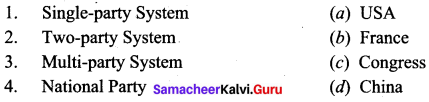
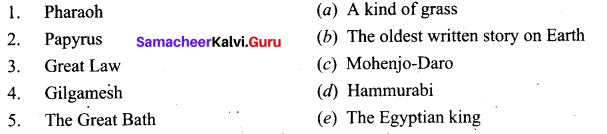
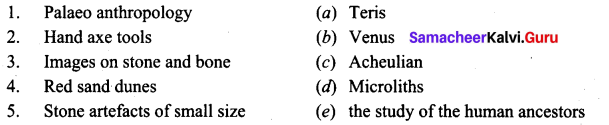
III. Match the following.

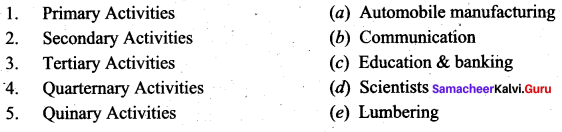
Samacheer Kalvi 9th Social Science Civics Solutions Chapter 1 Forms of Government and Democracy 1
Answers:
1. (d)
2. (a)
3. (b)
4. (c)

IV. Give short answers.

Question 1.
Give Abraham Lincoln’s definition of democracy.
Answer:
Abraham Lincoln defines democracy as a government of the people, by the people, and for the people.

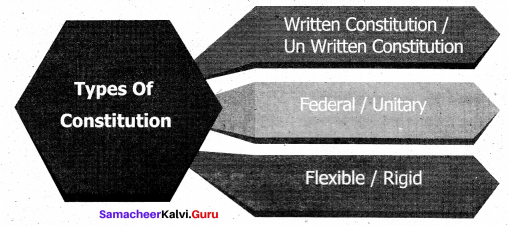
Question 2.
Mention the forms of democracy.
Answer:
Samacheer Kalvi 9th Social Science Civics Solutions Chapter 1 Forms of Government and Democracy 80

Question 3.
Distinguish between direct and indirect democracy.
Answer:

Direct democracy Indirect democracy
When the people themselves directly express their will on public affairs, the type of government is called pure or direct democracy.
e.g., Ancient Greek city-states, Switzerland
When the people express their will on public affairs, through their elected representatives, the type of government is called indirect or representative democracy.
e.g., The prevailing system of democracy in India, USA and UK

V. Answer in detail.

Question 1.
What are the challenges to democracy? Explain.
Answer:

  1. The promise of democracy is far from realized anywhere in the world
  2. Democracy does not have a challenger, but it does not mean that it does not face any challenge.
  3. Major challenges to Indian Democracy are
    • Illiteracy
    • Poverty
    • Gender Discrimination
    • Regionalism
    • Casteism, Communalism and Religious Fundamentalism
    • Corruption
    • Criminalisation of Politics and Political violence
  4. Democracy is the dominant form of government in the Contemporary world.
  5. It does not face a serious challenger or rival
  6. In the last hundred years, there was an expansion of democracy all over the world.
  7. Challenges can be faced with the Cooperation of the people in the country.

Question 2.
Explain the conditions necessary for the success of democracy in India.
Answer:

  1. Empowerment of the poor and illiterates to enjoy the goodness of democracy.
  2. Willingness among the elected people not to misuse their powerful position and public wealth.
  3. Eradication of social evils and dangers from which democracy suffers.
  4. An impartial and efficient press to form public opinion.
  5. Presence of strong public opinion.
  6. Feeling of tolerance and communal harmony among the people.
  7. Awareness among the people of the fundamental rights that they are entitled to enjoy.
  8. Conscious check and vigilance on the working of the elected representatives.
  9. Powerful and responsible opposition.

Samacheer Kalvi 9th Social Science Civics Solutions Chapter 1 Forms of Government and Democracy

Question 3.
What is your opinion about democracy in India?
Answer:

  1. Democracy in India has been appreciated worldwide.
  2. It is an example of Democracy which is remarkable in many aspects
  3. It is the largest electorate in history, a huge range of parties and a parliamentary system.
  4. But we do not really have broad consensus on large scale reforms and plans to improve the whole country.
  5. We are a big nation with huge population
  6. There are problems, constraints in the implementation of programs and policies for the benefit of the people.
  7. But which system does not have problems?
  8. Democracy gives us right to express our views:
  9. Solutions found through democratic means are better and long-lasting
  10. We have a wonderful law, Right to Information Act, use it judiciously to propagate our moves.
  11. If the necessary conditions for the success of Democracy are fulfilled, there will be smooth functioning of Democracy in the country.

VI. Project and Activity.

Question 1.
Discuss in the class what is a universal adult franchise? Why is it important?
Answer:

  1. The teacher arranges a discussion session.
  2. The students will be divided into two groups to discuss on the above content.

Universal Adult Franchise: The Article 326 of the Indian Constitution grants universal adult suffrage, according to which every adult citizen is entitled to cast his/her vote in all state elections unless that citizen is convicted of certain criminal offences (or) deemed unsound of mind.

Why is it important?

  1. It has nothing to do with economic growth or staying ahead, of the competition. Under this system a government is elected that is accountable to the people it governs.
  2. Because every vote counts, issues in society receive their appropriate weight in terms of importance and urgency. ,

Question 2.
“Democracy is the power of the majority which respects minority.” Discuss.
Answer:

  1. Democracy requires, minority rights equally as it does majority rule.
  2. Indeed, as democracy is understood today the minority’s rights must be protected no matter how alienated a minority is from the majority society. Otherwise, the minority rights lose their meaning.

Samacheer Kalvi 9th Social Science Civics Solutions Chapter 1 Forms of Government and Democracy

Question 3.
Conduct a mock election in your class.
Answer:
Election activities in the classroom

  1. Campaigning
  2. Voting Booth
  3. Voter Registration form
  4. Campaign posters
  5. Cast your Ballot
  6. Reward your voters
  7. Tally up the votes
  8. Graph the votes.
  • Before beginning, think of issues, students enjoy voting on, make up copies of a short voter registration form for each student.
  • Have a ballot box.
  • After the election issue is chosen you will need to make up a ballot for each student.

Question 4.
A group discussion on the merits and demerits of democracy of India in the classroom.
Answer:
Merits and Demerits of Democracy:
Merits

  1. Responsible and accountable government.
  2. Equality and fraternity.
  3. Sense of responsibility among common people.
  4. Local self-government.
  5. Development and prosperity for all.
  6. Popular sovereignty.
  7. Sense of cooperation and fraternal feeling

Demerits

  1. Indirect or representative nature of democracy.
  2. Lack of interest in the democratic process and hence lower turnout in elections.
  3. Instability in governance due to fractured mandate.
  4. Delay in decision – making process.

VII. HOTS

Question 1.
Will you have the right to equality under a dictatorship? What would be the attitude regarding public opinion in such a country?
Answer:

  1. A dictator is a political leader who possesses absolute power
  2. This power is used in an oppressive manner.
  3. A state which is ruled by a dictator is called a dictatorship.
  4. Under small type of government, public opinions have no place. Opinions are suppressed.
  5. There is no freedom of expression or freedom of right.

Samacheer Kalvi 9th Social Science Civics Solutions Chapter 1 Forms of Government and Democracy

Question 2.
How does democracy lead to a peaceful and a harmonious life among the citizens? Explain.
Answer:
Democracy safeguards the fundamental rights which are defined as basic human freedoms which every Indian citizen has the right to enjoy for proper and harmonious development of personality. The students can refer and download from the Internet.

VIII. Life Skills

Select a group of countries, Research each country and tell what type of government it has: Aristocracy, Monarchy, Autocracy, Oligarchy, Theocracy, Democracy, Republic. Then, provide characteristics of this country that helped you determine the type of government.

Country name Type of Government Characteristics of the country’s government

The teacher can assign this as a Project & Group Activity for the students.

Forms of Government and Democracy Additional Questions

I. Choose the correct answer.

Question 1.
A system of government by one person with absolute power is ……
(a) Autocracy
(b) Aristocracy
(c) Monarchy
(d) Oligarchy
Answer:
(a) Autocracy

Question 2.
Democracy as a government of the people, by the people and for the people defined by ……..
(a) Mahatma Gandhi
(b) Jawaharlal Nehru
(c) Abraham Lincoln
(d) Herbert Baker
Answer:
(c) Abraham Lincoln

Question 3.
Democracy began ………. years ago.
(a) 2000
(b) 2500
(c) 3000
(d) 3200
Answer:
(b) 2500

Samacheer Kalvi 9th Social Science Civics Solutions Chapter 1 Forms of Government and Democracy

Question 4.
Kudavolai system was a very notable and unique feature of the village administration of …….
(a) Cheras
(b) Cholas
(c) Pandyas
(d) Pallavas
Answer:
(b) Cholas

Question 5.
This is the dominant form of government in the contemporary world.
(a) Oligarchy
(b) Monarchy
(c) Theocracy
(d) Democracy
Answer:
(d) Democracy

Question 6.
Assertion (A): The term ‘democracy’ is derived from two Greek words demos meaning people and create meaning power.
Reason (R): Literally democracy means “the power of the people”.
(a) Both (A) and (R) are true and (R) explains (A)
(b) Both (A) and (R) are true (A) explains (R)
(c) (A) is correct and (R) is false
(d) (A) is false and (R) is true
Answer:
(a) Both (A) and (R) are true and (R) explains (A)

Question 7.
Assertion (A): India has a parliamentary form of democracy.
Reason (R): The Indian Parliament comprises the elected representatives of people.
(a) Both (A) and (R) are true and (R) explains (A)
(b) Both (A) and (R) are true (A) explains (R)
(c) (A) is correct and (R) is false
(d) (A) is false and (R) is true
Answer:
(a) Both (A) and (R) are true and (R) explains (A)

Samacheer Kalvi 9th Social Science Civics Solutions Chapter 1 Forms of Government and Democracy

Question 8.
Indian citizen above years of age can exercise the right to vote in India.
(a) 16
(b) 17
(c) 18
(d) 19
Answer:
(c) 18

II. Fill in the blanks.

  1. The modern world prefers ……….
  2. The democratic institutions existed in India as early as the …….. period.
  3. An example of Indirect Democracy is ……….
  4. India has a …….. government with elected representatives at the federal, state, and local levels.
  5. The two houses of our Parliament are ………. and ………
  6. A group of people living in the same place having particular characteristics in common is ………

Answers:

  1. Democracy
  2. Vedic
  3. India
  4. Democracy Quasi Federal
  5. Lok Sabha and Rajya Sabha
  6. Community

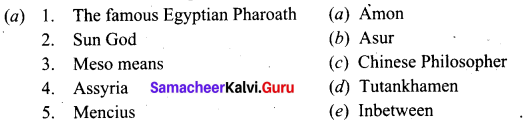
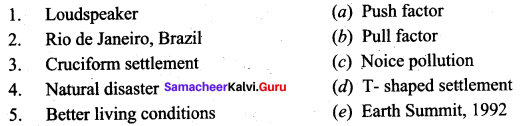
III. Match the following.

Samacheer Kalvi 9th Social Science Civics Solutions Chapter 1 Forms of Government and Democracy 60
Answers:
1. (d)
2. (e)
3. (a)
4. (b)
5. (c)

IV. Give short answers.

Question 1.
What do you mean by “Republic”?
Answer:
A state in which supreme power is held by the people and their elected representatives and which has an elected (or) nominated President rather than a Monarch. e.g., India, Australia.

Question 2.
What is Democracy?
Answer:

  1. Democracy is a form of government that allows people to choose their rulers.
  2. Only leaders elected by the people should rule the country.
  3. People have the freedom to express views, freedom to organise and freedom to protest.

Question 3.
Mention the salient features of Democracy.
Answer:

  1. Elected representatives of people and final decision-making power to the representatives.
  2. Free and fair elections.
  3. Universal adult franchise with each vote having equal value.
  4. Fundamental rights and protection of individual freedom.

V. Answer in detail.

Question 1.
Though democracy in India has been appreciated worldwide for its working there is still a lot of scope for improvement – Discuss.
Answer:
Though democracy in India has been appreciated worldwide for its work, there is still a lot of scope for improvement. The above-mentioned steps must be taken to ensure the smooth functioning of democracy in the country.

Indian democracy can be successful and vibrant only when its citizens imbibe and reflect in their behavior the basic democratic values like equality, freedom, social justice, accountability, and respect for all. Their mindset, thinking and behavior are expected to be in tune with the essential conditions of democracy. They have to appreciate the opportunities for their desired roles like participation, making the system accountable, fulfilling obligations, and playing proactive roles to actualize the goals of democracy.

Samacheer Kalvi 9th Social Science Civics Solutions Chapter 1 Forms of Government and Democracy Read More »

Samacheer Kalvi 9th Social Science Economics Solutions Chapter 5 Migration

You can Download Samacheer Kalvi 9th Social Science Book Solutions Guide Pdf, Tamilnadu State Board help you to revise the complete Syllabus and score more marks in your examinations.

Tamilnadu Samacheer Kalvi 9th Social Science Economics Solutions Chapter 5 Migration

Migration Textual Exercise

I. Choose the correct answer.

Question 1.
According to 2011 census, the total population of India was
(a) 121 crore
(b) 221 crore
(c) 102 crore
(d) 100 crore
Answer:
(a) 121 crore

Samacheer Kalvi 9th Social Science Economics Solutions Chapter 5 Migration

Question 2
……… has recorded the maximum number of out migrants.
(a) Ramanathapuram
(b) Coimbatore
(c) Chennai
(d) Vellore
Answer:
(c) Chennai

Question 3.
During 2015, …….. illiterates were migrants from Tamil Nadu.
(a) 7%
(b) 175%
(c) 23%
(d) 9%
Answer:
(a) 7%

Question 4.
The poorer sections of the population people migrate for ……….
(a) Survival strategy
(b) Improve their living standards
(c) Service
(d) Getting experience
Answer:
(a) Survival strategy

II. Fill in the blanks.

  1. Migration is enumerated ……. on ……. and bases.
  2. The mobility of the population is rural areas is ……. than urban areas.
  3. In rural India, as per census 2011, …… percent of the population is counted as migrants.
  4. ……. is the major reason for female migration.
  5. Any migrant stream would consist of …….. sub-streams.

Answers:

  1. place of birth, place of residence
  2. greater
  3. 37 %
  4. Saratoga
  5. heterogenous

III Match the following:

Samacheer Kalvi 9th Social Science Economics Solutions Chapter 5 Migration 1
Answers:
1. (e)
2. (d)
3. (c)
4. (f)
5. (b)
6. (a)

IV. Give short Answers

Question 1.
Enlist the reasons for migration.
Answer:
In the Census of India, migration is enumerated on two bases,

  1. Place of birth: if the place of birth is different from the place of enumeration (known as life-time migrant);
  2. Place of residence: if the place of the last residence is different from the place of enumeration (known as migrant by place of last residence).

Samacheer Kalvi 9th Social Science Economics Solutions Chapter 5 Migration

Question 2.
What are the major factors responsible for female migrants in India?
Answer:
Marriage and the movement associated with marriage appear to be a major factor responsible for women’s mobility in India and Tamil Nadu.

Question 3.
Name four districts in Tamil Nadu which record low number of imigration.
Answer:
Cuddalore, Karur, Tiruvannamalai, Velur, Namakkal, Salem, Dindigul, Krishnagiri, Nilgiris, and Dharmapuri districts record the low incidence of emigrants.

Question 4.
What are the factors responsible for the poorer sections and better-off sections to migrate.
Answer:
The poorer sections of the people migrate for survival, but migrants from better-off sections migrate to improve their living standards.

Samacheer Kalvi 9th Social Science Economics Solutions Chapter 5 Migration

Question 5.
List the four destinations and the percentage of migrants from Tamil Nadu.
Answer:

  1. Of the total migrants who go to foreign countries, nearly 20% have chosen to go to Singapore.
  2. 18 % have gone to United Arab Emirates.
  3. 16 % to Saudi Arabia.
  4. 13 % to United States of America.
  5. Malaysia, Kuwait, Oman, Quatar, Australia and England are also refered as important destinations for migrants from Tamil Nadu, in 2015.

Question 6.
What does the study reveal about the occupation undertaken by migrants?
Answer:
The study clearly reveals various occupations undertaken by the migrants: highly skilled proffessions on one hand and low skilled occupations on the other, along with a large number of semi-skilled occupations.

Samacheer Kalvi 9th Social Science Economics Solutions Chapter 5 Migration

V. Answer in Detail

Question 1.
State the aims of migration policies.
Answer:
Policies to address the problem of migration in developing countries such as ours essentially aim at the following:
(a) To reduce the volume of migration:

  1. As a large part of the migration is a reflection of poverty and insecurity faced by large • sections of the rural people, the focus of intervention has to be in rural areas.
  2. Rural development policies to reduce poverty and insecurity would be essential to reduce migration.

(b) To redirect the migrant streams:

  1. Redirection of migrant streams, away from big metropolitan cities is a desirable policy option.
  2. This policy can help in reducing spatial inequalities by suitable strategies such as developing a more dispersed pattern of urbanisation.

Question 2.
Discuss the patterns of migration.
Answer:
The pattern of migration is very complex, comprising of a number of streams:

  • rural to rural; rural to urban; urban to rural; urban to urban
  • short, medium and long-distance migration streams
  • long-term stable migration and short-term circulatory type of movements

Each of these streams would consist of different types of migrants, (from different social classes) each with its own reason for migration. The extent and nature of these migrant streams would essentially depend on.

  • pressures and aspirations experienced by people at the origin of migration
  • constraints imposed on mobility at the origin of migration
  • opportunities at the destination and availability of information regarding these opportunities and
  • the cost of migration.

Question 3.
Elucidate about some of the interesting findings on migration in Tamil Nadu.
Answer:
This study has made some interesting findings, as discussed below:

  1. Of the total migrants in Tamil Nadu, 65 percent have migrated or moved abroad while 35 percent have moved within the country.
  2. Chennai district has recorded the maximum number of emigrants followed by Coimbatore, Ramanathapuram and Tiruchirapalli districts;
  3. Cuddalore, Kamr, Tiruvannamalai, Velur, Namakkal, Salem, Dindigul, Krishnagiri, Nilgiris and Dharmapuri districts record low incidence of emigrants.

Samacheer Kalvi 9th Social Science Economics Solutions Chapter 5 Migration

Question 4.
Analyse the educational qualification of migrants from Tamil Nadu in 2015.
Answer:
On the question of educational qualifications of migrants from Tamil Nadu, the study reveals that in 2015 about 7 % were illiterates; 30 % have completed. Class X; 10 % have completed Class XII; 15 % had undergone vocational training; 11 % were graduates; 12% were professionally qualified and 11 % had Post Graduate degrees.

VI Write the correct statement

Question 1.
In recent times workers from Tamil Nadu are moving to Africa.
Answer:
In the more recent period workers from Tamil Nadu have been moving to countries in the Gulf, United States of America and Australia.

Question 2.
In Tamil Nadu, the extent of migration is much higher in urban areas compared to rural areas.
Answer:
In Tamil Nadu the extent of migration is much higher in rural areas.

Question 3.
Any migrant stream would consist of homogenous sub streams.
Answer:
Any migrant stream would consist of heterogeneous sub-streams.

Question 4.
Two out of every 10 persons is reported to be a migrant.
Answer:
Two out of every 5 persons is reported to be a migrant.

Samacheer Kalvi 9th Social Science Economics Solutions Chapter 5 Migration

VII. Project & Activity

Question 1.
Prepare statistical data by interacting with your classmates and school mates and find out how many families have migrated.
Answer:
You can prepare the assignment using internet, under the guidance of your teacher.

Question 2.
Prepare an album of pictures on Rural to Rural, Rural to Urban, Urban to Rural and Urban to Urban migration.
Answer:
You can prepare the assignment using internet, under the guidance of your teacher.

VIII. Life Skills

Question 1.
Collect data on various languages spoken in your class and represent it through a pie chart.
Answer:
You can prepare the assignment using the internet, under the guidance of your teacher.

Migration Additional Questions

I. Choose the correct answer.

Question 1.
The percentage of migrants in Tamil Nadu is ……… percent.
(a) 40
(b) 42
(c) 43
(d) 41
Answer:
(c) 43

Samacheer Kalvi 9th Social Science Economics Solutions Chapter 5 Migration

Question 2.
The percent of female migrants in 2011 ……. literally means “rule of the people”.
(a) 53
(b) 52
(c) 51
(d) 50
Answer:
(a) 53

Question 3.
Out of 7.2 crore people ….. crore people were counted as migrants.
(a) 3.11
(b) 3.13
(c) 3.12
(d) 3.14
Answer:
(b) 3.13

Question 4.
The largest migration corridor in the world in 2010 was …….
(a) Mexico
(b) Australia
(c) Dubai
(d) Saudi
Answer:
(a) Mexico

Samacheer Kalvi 9th Social Science Economics Solutions Chapter 5 Migration

Question 5.
Of the International migrants, % are women.
(a) 10
(b) 20
(c) 15
(d) 25
Answer:
(c) 15

II. Match the following:

Samacheer Kalvi 9th Social Science Economics Solutions Chapter 5 Migration 65
Answers:
1. (e)
2. (d)
3. (b)
4. (a)
5. (c)

III. Fill in the blanks.

  1. The percentage of migrants in Tamil Nadu in 2011 is ………
  2. The male migrants in Tamil Nadu is …… in 2011.
  3. Movement related to …… and ……. appears to be the driving force for migration among men.

Answers:

  1. 43
  2. 35
  3. work, employment

IV. Give short answers.

Question 1.
The percentage of migrants was at a much higher rate in Tamil Nadu. Comment.
Answer:
In Tamil Nadu out of 7.2 crore people, 3.13 crore people were counted as migrants, in 2011. That is, the percentage of migrants was 37 percent in the country, while it was at a much higher rate in Tamil Nadu at 43 percent.

Question 2.
Write a short note on “Female Migration”.
Answer:
However, an examination of .data clearly indicates that a larger proportion of females are reported to be migrants compared to males. In the country as a whole, 53 percent are female migrants while 23 percent are male migrants, in 2011. In Tamil Nadu, the picture is very similar, with more than half the females (52%) reporting their status as migrants, by place of last residence, and 35 percent are male migrants.

Samacheer Kalvi 9th Social Science Economics Solutions Chapter 5 Migration

Question 3.
What does the recent study say about mobility in Tamil Nadu?
Answer:
In the more recent period workers from Tamil Nadu have been moving to countries in the Gulf, the United States of America and Australia. In 2015, an independent research study was conducted to understand the level, nature and pattern of migration in Tamil Nadu.

V. Answer in detail.

Question 1.
On what factors the extent and nature of migration depend?
Answer:
Each of these streams would consist of different types of migrants, (from different social classes) each with its own reason for migration. The extent and nature of these migrant streams would essentially depend on.

  • pressures and aspirations experienced by people at the origin of migration
  • constraints imposed on mobility at the origin of migration
  • opportunities at the destination and availability of information regarding these opportunities
  • the cost of migration

Samacheer Kalvi 9th Social Science Economics Solutions Chapter 5 Migration 75
Samacheer Kalvi 9th Social Science Economics Solutions Chapter 5 Migration 76
Samacheer Kalvi 9th Social Science Economics Solutions Chapter 5 Migration 77
Samacheer Kalvi 9th Social Science Economics Solutions Chapter 5 Migration 78
Samacheer Kalvi 9th Social Science Economics Solutions Chapter 5 Migration 79
Samacheer Kalvi 9th Social Science Economics Solutions Chapter 5 Migration 80
Samacheer Kalvi 9th Social Science Economics Solutions Chapter 5 Migration 81
Samacheer Kalvi 9th Social Science Economics Solutions Chapter 5 Migration 82
Samacheer Kalvi 9th Social Science Economics Solutions Chapter 5 Migration 83
Samacheer Kalvi 9th Social Science Economics Solutions Chapter 5 Migration 90
Samacheer Kalvi 9th Social Science Economics Solutions Chapter 5 Migration 84
Samacheer Kalvi 9th Social Science Economics Solutions Chapter 5 Migration 85
Samacheer Kalvi 9th Social Science Economics Solutions Chapter 5 Migration 86
Samacheer Kalvi 9th Social Science Economics Solutions Chapter 5 Migration 87
Samacheer Kalvi 9th Social Science Economics Solutions Chapter 5 Migration 88
Samacheer Kalvi 9th Social Science Economics Solutions Chapter 5 Migration 89

Samacheer Kalvi 9th Social Science Economics Solutions Chapter 5 Migration 91

Samacheer Kalvi 9th Social Science Economics Solutions Chapter 5 Migration Read More »

Samacheer Kalvi 9th Social Science History Solutions Chapter 5 The Classical World

You can Download Samacheer Kalvi 9th Social Science Book Solutions Guide Pdf, Tamilnadu State Board help you to revise the complete Syllabus and score more marks in your examinations.

Tamilnadu Samacheer Kalvi 9th Social Science History Solutions Chapter 5 The Classical World

The Classical World Textual Exercise

I. Choose the correct answer.

Question 1.
…………….. is the Greek city-state which resisted the Persians to the end.
(a) Acropolis
(b) Sparta
(c) Athens
(d) Rome
Answer:
(c) Athens

Question 2.
The other name for the Greeks was …………….
(a) Hellenists
(b) Hellenes
(c) Phoenicians
(d) Spartans
Answer:
(b) Hellenes

Question 3.
The founder of the Han dynasty was …………..
(a) Wu Ti
(b) Hung Chao
(c) Liu Pang
(d) Mangu Khan
Answer:
(c) Liu Pang

Samacheer Kalvi 9th Social Science History Solutions Chapter 5 The Classical World

Question 4.
…………… was the Roman Governor responsible for the crucifixion of Jesus.
(a) Innocent I
(b) Hildebrand
(c) Leo I
(d) Pontius Pilate
Answer:
(d) Pontius Pilate

Question 5.
The Peloponnesian War was fought between ……………… and ……………
(a) Greeks and Persians
(b) Plebeians and Patricians
(c) Spartans and Athenians
(d) Greeks and Romans
Answer:
(c) Spartans and Athenians

II. Find out the correct statement.

Question 1.
(i) First Persian attack on Greece failed.
(ii) The downfall of the Roman Empire is attributed to Julius Caesar.
(iii) The Barbarians who invaded Rome were considered to be culturally advanced.
(iv) Buddhism weakened the Roman Empire.
(a) (i) is correct
(b) (ii) is correct
(c) (ii) and (iii) are correct
(d) (iv) is correct
Answer:
(a) (i) is correct

Question 2.
(i) Euclid developed a model for the motion of planets and stars.
(ii) Romans established a republic after overthrowing Etruscans.
(iii) Acropolis became a famous slave market.
(iv) Rome and Carthage united to drive out the Greeks.
(a) (i) is correct
(b) (ii) is correct
(c) (ii) and (iv) are correct
(d) (iv) is correct
Answer:
(c) (ii) and (iv) are correct

Question 3.
(i) Silk road was closed during the Han dynasty.
(ii) Peasant uprisings posed threats to Athenian democracy.
(iii) Virgil’s Aeneid glorified Roman imperialism.
(iv) Spartacus killed Julius Caesar. f
(a) (i) is correct
(b) (ii) is correct
(c) (ii) and (iv) are correct
(d) (iii) is correct
Answer:
(d) (iii) is correct

Question 4.
(i) Roman Emperor Marcus Aurelius was a tyrant.
(ii) Romulus Aurelius was the most admired ruler in Roman History.
(iii) Fabius was a famous Carthaginian general.
(iv) Tacitus is respected more than Livy as a historian.
(a) (i) is correct
(b) (ii) is correct
(c) (ii) and (iii) are correct
(d) (iv) is correct
Answer:
(d) (iv) is correct

Samacheer Kalvi 9th Social Science History Solutions Chapter 5 The Classical World

Question 5.
(i) Buddhism went to China from Japan
(ii) After the crucifixion of Jesus, St Thomas spread the Christian doctrine
(iii) St Sophia Cathedral was the most magnificent building in Europe
(iv) Trajan was one of the worst dictators Rome had.
(a) (i) is correct
(b) (ii) is correct
(c) (iii) is correct
(d) (iv) is correct
Answer:
(c) (iii) is correct

III. Match the following:

Samacheer Kalvi 9th Social Science History Solutions Chapter 5 The Classical World 1
Answer:
1. (e)
2. (c)
3. (a)
4. (b)
5. (d)

IV. Fill in the blanks.

  1. Greeks defeated the Persians at ………………
  2. …………… stood in favour of poor peasants in the Roman republic.
  3. Buddhism came to China from India during the reign of …………… dynasty.
  4. The most magnificent building in Europe was ……………
  5. ……….. and …………… were Magistrates in Rome.

Answers:

  1. Marathon in 490 B.C.
  2. Tiberius Gracchus and Garius do Gracchus
  3. Han
  4. St. Sophia Cathedral
  5. Marius and Sulla

V. Answer all questions given under each heading.

Question 1.
The emergence of Rome as an empire
(a) Who were the Gracchus brothers?
Answer:
Tiberius Gracchus and Garius do Gracchus were Patricians. They voiced their opinion in favour of the poor peasants.

(b) What role did they play?
Answer:
They voiced their opinion in favour of the poor peasants.

(c) What was the outcome of their martyrdom?
Answer:
The Martyrdom of the Gracchus brothers played a decisive role in the transformation of the Roman Republic into the Roman Empire.

(d) Who was the first Roman Emperor?
Answer:
Marus Aureillus was the first Roman Emperor.

Samacheer Kalvi 9th Social Science History Solutions Chapter 5 The Classical World

Question 2.
Han Dynasty
(a) Who was the founder of the Han Empire?
Answer:
Han Dynasty was founded by Liu Pang.

(b) What was the capital of the Han Empire?
Answer:
The capital of the Han Empire was Chang-an.

(c) Where did they have their new capital?
Answer:
They had their new capital at Xuchang.

(d) Who was the powerful ruler of the Han dynasty?
Answer:
The most popular and powerful ruler was Wu Ti.

VI. Answer the following briefly.

Question 1.
Attempt an account of slavery in Rome.
Answer:

  • Rome produced a new labour force called slaves.
  • A major source of revenue to the Roman state was slave trade.
  • Slave labour led to the impoverishment of free labour.
  • The island of Delos became a great slave market.
  • There were more slave revolts in Rome than in Greece.
  • The revolt of Spartacus was the most famous.

Question 2.
Highlight the main contribution of Constantine.
Answer:
The main contribution of Constantine was conversion to Christianity. He himself became a Christian and Christianity became the official religion of the Empire.

Question 3.
What do you know of the Carthaginian leader Hannibal?
Answer:

  • Carthage sent a general named Hannibal.
  • He defeated the Roman army and made a great part of Italy a desert.
  • In the second Punic War, Fabius confronted Hannibal and defeated him in the Battle of Zama.
  • Pursued by the Roman army, Hannibal ended his life by poisoning himself.

Question 4.
What were the reasons for the prosperity of Han Empire?
Answer:

  1. The Han Empire threw open the silk road for trade.
  2. A large export trade mainly in silk reached as far as the Roman Empire.
  3. In the North artisans and herders of rival “barbarian” dynasties brought in new techniques like the methods of harnessing horses, use of saddle and stirrup, techniques of building bridges and mountain roads, and seafaring.
  4. Such innovations made the Han Empire prosperous.

Question 5.
Write about St. Sophia Cathedral.
Answer:

  • St. Sophia Cathedral was built in the mid-sixth century AD (CE).
  • It was the most magnificent building in Europe.
  • It was known for its innovative architectural techniques.
  • This Cathedral was turned into a mosque by the Ottoman Turks when they captured Constantinople.

VII. Answer the following in detail:

Question 1.
Discuss the rise and growth of Athens, pointing out its glorious legacy.
Answer:

  1. In Athens, the pressure from below resulted in the replacement of both oligarchy and tyranny by “democracy.”
  2. The law-making power in Athens was vested in an assembly open to all freemen.
  3.  Judges and lower officials were chosen by lots.
  4. This arrangement was resented by the upper classes who considered democracy to be the rule of the mob.
  5. The history of many Greek city-states was one of the continual struggles by the rich landowners against “democracy”.
  6. The only exception was Athens, where “democracy’ survived for about 200 years
  7. Athens had a great leader, Pericles, who held power for thirty years.
  8. During his rule, Athens and Sparta were continuously at war with each other. This war is known as the Peloponnesian War.
  9. Athens, despite hostility and disturbance from Sparta, became a noble city with magnificent buildings.
  10. There were great artists and great thinkers.
  11. Historians, therefore, call this the Age of Pericles.
  12. The great historians Herodotus and Thucydides lived during the period.
  13. Socrates was a great thinker of the Pericles era.
  14. Plato, Aristotle, Democritus, and Epicurus belonged to this period.

Samacheer Kalvi 9th Social Science History Solutions Chapter 5 The Classical World

Question 2.
Highlight the contributions of Rome to World Civilization.
Answer:
The Byzantine emperors, who ruled from the city of Constantinople for about 1,000 years,
called themselves Romans. But their language was Greek. The splendor of Constantinople with its luxurious royal palaces, its libraries, its scholars familiar with the writings of Greeks 1 and Romans, and its fascinating St. Sophia Cathedral are the legacies they have left behind.

However, in terms of the development of science and technology, there was no progress during this I period. The economies of the Empire’s provinces were in the hands of large local landowners. The small peasants always lived on the edge of poverty. The fundamental weakness of
Byzantine Civilization stood exposed when the participants of the Fourth Crusade pillaged it and I ruled it.

Student Activities

Question 1.
In an outline map of Europe, the students are to sketch the extent of the Western and Eastern Roman Empire.
Answer:
Samacheer Kalvi 9th Social Science History Solutions Chapter 5 The Classical World 2

The Classical World Additional Questions

I. Choose the correct answer.

Question 1.
………….. a fortified city of ancient Greeks on a hill in Athens is an illustrative example of their advancement.
(a) Acropolis
(b) Athens
(c) Sparta
(d) None of the above
Answer:
(a) Acropolis

Question 2.
The word …………….. literally means “rule of the people”.
(a) Autocracy
(b) Communism
(c) Socialism
(d) Democracy
Answer:
(d) Democracy

Question 3.
Aristotle was the disciple of ……………
(a) Socrates
(b) Plato
(c) Pericles
(d) Augustus
Answer:
(b) Plato

Samacheer Kalvi 9th Social Science History Solutions Chapter 5 The Classical World

Question 4.
“Natural History” was completed by ………….
(a) Pliny the Elder
(b) Antoninus Pius
(c) Marcus Aurelius
(d) Tacitus
Answer:
(a) Pliny the Elder

Question 5.
……………. came to China from India during the reign of the Han Dynasty.
(a) Jainism
(b) Sikhism
(c) Buddhism
(d) Christianity
Answer:
(c) Buddhism

Question 6.
……………. started spreading the Christian doctrine after the Crucifixion of Jesus.
(a) St. Paul
(b) St. Thomas
(c) St. Antony
(d) St. John
Answer:
(a) St. Paul

II. Find out the correct statement.

Question 1.
(i) Until 8th Century B.C. (BCE) Greece was different from the rest of the world.
(ii) Democracy literally means “rule of the people”.
(iii) The Greek city-states have an elaborate bureaucracy.
(iv) The entire period of Alexander’s reign was not spent on wars.
(a) (i) is correct
(b) (ii) is correct
(c) (ii) and (iii) are correct
(d) (iv) is correct
Answer:
(b) (ii) is correct

Question 2.
(i) Prisoners of war were enslaved in Rome.
(ii) Rome developed into a normal town.
(iii) In the beginning Rome was a society of Businessmen.
(iv) A major source of revenue to the Roman state was the slave trade.
(a) (i) is correct
(b) (ii) is correct
(c) (i) and (iv) are correct
(d) (iii) is correct
Answer:
(c) (i) and (iv) are correct

Question 3.
(i) The revolt of Spartacus was the most famous.
(ii) The Island of Delos became a great slave market.
(iii) Catalina’s victory led to mob violence.
(iv) Livy was a Poetist.
(a) (i) is correct
(b) (i) and (ii) are correct
(c) (iii) is correct
(d) (iv) is correct
Answer:
(b) (i) and (ii) are correct

Question 4.
(i) Han Empire once again threw open the silk road for trade.
(ii) Buddhism came to China from Indonesia.
(iii) With Buddhism came to the influence of Indian art to Korea.
(iv) The period after Han rule witnessed political stability across the country.
(a) (i) is correct
(b) (i) and (iii) are correct
(c) (ii) is correct
(d) (iii) and (iv) are correct
Answer:
(a) (i) is correct

Question 5.
(i) Jewish had no faith in Jesus.
(ii) They hoped Messiah would not arrive.
(iii) Jesus was against the rich and the hypocrites.
(iv) Christianity did not spread in Europe.
(a) (i) is correct
(b) (ii) is correct
(c) (iii) is correct
(d) (iv) is correct
Answer:
(c) (iii) is correct

III. Match the following:

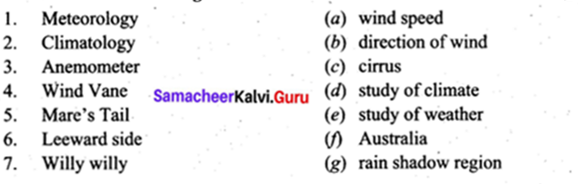
Samacheer Kalvi 9th Social Science History Solutions Chapter 5 The Classical World 3
Answer:

  1. (f)
  2. (g)
  3. (a)
  4. (b)
  5. (c)
  6. (d)
  7. (e)

IV. Fill in the blanks.

  1. Under ……….. the new rich exploited the smaller landholders.
  2. The Persian danger had united the ……………..
  3. Cultural development took place rapidly after Alexander’s death. 323 BC is called ………….. civilization.
  4. A major source of revenue to the Roman state was ……………
  5. The most distinguished writers of the ……………… Age brought glory to the empire.
  6. The most popular and powerful ruler of the Han Dynasty was …………….
  7. Some of the Buddhist art of the time show the impact of …………… styles.
  8. One of the Roman emperors …………….. himself became a Christian.
  9. Internal Crisis and invasion of Franks, Goths, and Vandals ended the …………….
  10. Christianity became a state religion of …………….. and began to spread in Europe.

Answers:

  1. Oligarchy
  2. Greeks
  3. Hellenistic
  4. Slave trade
  5. Augustus
  6. Wu Ti
  7. Hellenistic
  8. Constantine
  9. Roman Empire
  10. Byzantium

V. Answer all questions given under each heading.

Question 1.
Athenian Democracy.
(a) What replaced the oligarchy and tyranny in Athens?
Answer:
Democracy.

(b) With whom the law-making power was vested in Athens?
Answer:
The law-making power in Athens was vested in an assembly open to all freemen.

(c) What united the Greeks?
Answer:
The Persian danger had united the Greeks.

(d) How many years were Democracy survived in Athens?
Answer:
Democracy survived in Athens for about 200 years.

Samacheer Kalvi 9th Social Science History Solutions Chapter 5 The Classical World

Question 2.
Hellenistic Civilization.
(a) Who established the kingdom in Macedonia?
Answer:
Alexander the Great.

(b) How did this kingdom succeed?
Answer:
This kingdom succeeded in annexing two historic empires of Egypt and the Middle East.

(c) How did Alexander spend his life?
Answer:
The entire period of Alexander’s reign was spent on wars.

(d) When did the cultural development take place? What is it called?
Answer:
After the death of 323 B.C. and is called Hellenistic civilization.

VI. Answer the following briefly.

Question 1.
What do you know about the classical world?
Answer:

  1. Greece, Rome, and China represented the classical world which ended with the fall of the Western Roman Empire.
  2. Until the end of the 5th Century AD (CE), Christianity was confined to the Roman Empire.

Question 2.
Why did the first Persian attack on Greece fail?
Answer:
The first Persian attack on Greece failed due to the fact that the Persian army suffered from disease and lack of food during its March.

Question 3.
Comment on the ‘Age of Pericles’.
Answer:

  1. Athens, despite hostility and disturbance from Sparta, became a noble city with magnificent buildings.
  2. There were great artists and great thinkers.
  3. Historians, therefore, call this the Age of Pericles.

Question 4.
What do you know about Socrates?
Answer:

  1. Socrates was the greatest of the thinkers of the Pericles Era.
  2. As a philosopher, he discussed difficult problems with his friends to bring the truth out of discussions.

Question 5.
Who were the capable rulers in Rome after the death of Augustus?
Answer:
Trajan (98-117), Antoninus Pius (138-161), and Marcus Aurelius (161-180) were the capable enlightened rulers.

Samacheer Kalvi 9th Social Science History Solutions Chapter 5 The Classical World

Question 6.
Who were Barbarians?
Answer:
A group of people from a very different country (or) culture that is considered to be less culturally advanced and more violent than their own were Barbarians.

Question 7.
What is known as Silk Road (or) Silk Route?
Answer:
The trade route from China to Asia Minor and India, known as the Silk Road or Silk Route, linked China with the West. Goods and ideas between the two great civilizations of Rome and China were exchanged through this route. Silk went westward, and wools, gold, and silver went east. China received Buddhism from India via the Silk Road.

Question 8.
Who spread Christianity after Jesus’s crucifixion?
Answer:

  1. St. Paul started spreading the Christian doctrine.
  2. Paul succeeded in his effort and Christianity gradually spread.

VII. Answer the following in detail.

Question 1.
Explain the “Rise of Christianity”.
Answer:
(i) After a brief period of glory in the days of David and Solomon, the Jewish people had a great fall and experienced extreme hardship.

(ii) While spreading out all over the Roman Empire and elsewhere, they hoped that a Messiah would arrive to restore their pristine glory.

(iii) Initially they laid many hopes on Jesus. Jesus was against the rich and the hypocrites and condemned certain observances and ceremonials.

(iv) This was not to the liking of the priests, who turned against Jesus and handed him over to the Roman Governor Pontius Pilate. Looked upon as a political rebel by the Roman authorities, Jesus was tried and crucified.

(v) After Jesus’s crucifixion, St Paul started spreading the Christian doctrine. Paul succeeded in his effort and Christianity gradually spread.

(vi) Romans were prepared to tolerate Christianity. But the refusal of the Christians to pay respect to the Emperor’s image was viewed as political treason.

(vii) It led to the persecution of Christians. Their property was confiscated and they were thrown to the lions.

(viii) Yet the Roman Empire did not succeed in suppressing Christianity. One of the Roman emperors Constantine himself became a Christian. Christianity thus became the official religion of the Empire.

Samacheer Kalvi 9th Social Science History Solutions Chapter 5 The Classical World Read More »

Samacheer Kalvi 9th Social Science History Solutions Chapter 6 The Middle Ages

You can Download Samacheer Kalvi 9th Social Science Book Solutions Guide Pdf, Tamilnadu State Board help you to revise the complete Syllabus and score more marks in your examinations.

Tamilnadu Samacheer Kalvi 9th Social Science History Solutions Chapter 6 The Middle Ages

The Middle Ages Textual Exercise

I. Choose the correct answer.

Question 1.
……………….. was the old religion of Japan.
(a) Shinto
(b) Confucianism
(c) Taoism
(d) Animism
Answer:
(a) Shinto

Question 2.
…………. means great name/lord.
(a) Daimyo
(b) Shogun
(c) Fujiwara
(d) Tokugawa
Answer:
(a) Daimyo

Question 3.
The Arab General who conquered Spain was …………..
(a) Tariq
(b) Alaric
(c) Saladin
(d) Mohammad the Conqueror
Answer:
(a) Tariq

Question 4.
Harun-al-Rashid was the able emperor of ……………
(a) Abbasid dynasty
(b) Umayyad dynasty
(c) Sassanid dynasty
(d) Mongol dynasty
Answer:
(a) Abbasid dynasty

Samacheer Kalvi 9th Social Science History Solutions Chapter 6 The Middle Ages

Question 5.
Feudalism centred around ……………
(a) vassalage
(b) slavery
(c) serfdom
(d) land
Answer:
(a) vassalage

II. Find out the correct statement.

Question 1.
(i) Chengiz Khan was an intolerant person in religion
(ii) Mongols destroyed the city of Jerusalem
(iii) Crusades weakened the Ottoman Empire
(iv) Pope Gregory succeeded in making King Henry IV to abdicate the throne by means of Interdict
(a) (i) is correct
(b) (ii) is correct
(c) (ii) and (iii) are correct
(d) (iv) is correct
Answer:
(d) (iv) is correct

Question 2.
(i) Mangu Khan was the Governor of China.
(ii) Mongol court in China impressed Marco Polo.
(iii) The leader of Red Turbans was Hung Chao.
(iv) Mongols established their rule in China in the name of Yuan dynasty.
(a) (i) is correct
(b) (ii) is correct
(c) (ii) and (iv) are correct
(d) (iv) is correct
Answer:
(c) (ii) and (iv) are correct

Question 3.
(i) Boyang and Changon were built during Sung dynasty.
(ii) Peasant uprisings led to the collapse of Tang dynasty.
(iii) Seljuq Turks were a tribe of Tartars.
(iv) Mongols established their rule in China in the name of Yuan dynasty.
(a) (i) is correct
(b) (ii) is correct
(c) (iii) is correct
(d) (iv) is correct
Answer:
(iii) and (iv) are correct

Question 4.
Assertion (A): Buddhism went to China from India.
Reason (R): The earliest Indian inhabitants in China were the followers of Buddhism.
(a) A is correct; R is wrong
(b) Both A & R are wrong
(c) Both A &, R are correct
(d) A is wrong R is irrelevant to A
Answer:
(a) A is correct; R is wrong

Question 5.
Assertion (A): The fall of Jerusalem into the hands of Seljuk Turks led to the Crusades.
Reason (R): European Christian pilgrims were denied access to Jerusalem. .
(a) A is correct; R is not the correct explanation of A ‘
(b) A and R are correct
(c) A and R are wrong
(d) A is correct, R is the correct explanation of A
Answer:
(d) A is correct, R is the correct explanation of A

III. Fill in the blanks.

  1. 1. ……………. were the original inhabitants of Japan.
  2. 2. ……………. was the original name of Japan.
  3. 3. ………… was the original name of Medina. ,
  4. 4. ………….were the barbarians posing a threat to the Chinese in the north.
  5. 5. …………… established Ottoman supremacy in the Balkans.

Answer:

  1. 1. Ainus
  2. 2. Yamato
  3. 3. Yethrib
  4. 4. The Mongols
  5. 5. Mohammed II

IV. Match the following:

Samacheer Kalvi 9th Social Science History Solutions Chapter 6 The Middle Ages 1
Answer:
1. (d)
2. (e)
3. (a)
4. (c)
5. (b)

V. Answer all questions given under each heading.

Question 1.
Shogunate in Japan.
(a) Name the two Daimyo families that fought for power in Japan.
Answer:
The Tara and Minamota

(b) Who emerged successful in the fight?
Answer:
Yoritomo emerged successful in the fight.

(c) What was the title given by the Emperor to the victorious?
Answer:
The high sounding title of Sei-i-tai Shogun (which means the Barbarian-Subduing-Great- General).

(d) Where was the capital of the first Shogunate established?
Answer:
The capital of the first Shogunate established at Kamakura,

Samacheer Kalvi 9th Social Science History Solutions Chapter 6 The Middle Ages

Question 2.
Rule of Abbasids.
(a) Who were the Abbasids?
Answer:
The descendants of the Prophet Mohammad’s uncle Abbas and his followers were called Abbasids. ’ ,

(b) What was the title assumed by Abbasid Caliph?
Answer:
“The commander of the faithful” was the title assumed by Abbasid Caliph.

(c) Where did they have their new capital?
Answer:
Baghdad in Iraq

(d) In whose period was the Abbasid Empire at the height of its glory?
Answer:
The Abbasid Empire was at the height of its glory during the reign of Harun-al-Rashid.

VI. Answer the following briefly.

Question 1.
The Great Wall of China.
Answer:
Between 8th and 7th centuries B.C. (BCE), the warring states in China built defensive walls to protect themselves from enemies from the north. During Chin (Qin) Dynasty, the separate walls were connected and consequently the wall stretched from east to west for about 5000 kilometres. This wall, considered to be one of the wonders of the world, served to keep nomadic tribes out. The Wall was further extended and strengthened by the succeeding dynasties. Now ’ it is 6,700 kilometres in length.

Question 2.
Contribution of Arabs to Science and Technology.
Answer:
The Arabs had a scientific spirit of inquiry. In some subjects like medicine and mathematics they learnt much from India. Many Arab students went to Takshashila, which was still a great university for specialized medicine. Indian scholars and mathematicians came in large numbers to Baghdad. Sanskrit books on medicine and other subjects were translated into Arabic. In medicine and surgery, Arab physicians and surgeons earned a great reputation.

Samacheer Kalvi 9th Social Science History Solutions Chapter 6 The Middle Ages

Question 3.
Impact of Crusades.
Answer:
Crusades ended the feudal relations. Many of the nobles who went to East to take part in the Crusades either stayed too long a period or did not return. The serfs took advantage of their absence to break away from their bondage to the soil. Increasing demand for products of the East led to expansion of trade. Venice, Genoa and Pisa emerged as important commercial centres in the Mediterranean region.

Constantinople ceased to be the middle man in the trade between the East and the West. The elimination of powerful nobles had its influence in strengthening the monarchy in France and England. One notable outcome of Crusades was the loss of prestige suffered by Pope and Papacy.

Question 4.
How was Feudalism organized in the Middle Ages?
Answer:
Samacheer Kalvi 9th Social Science History Solutions Chapter 6 The Middle Ages 2

Question 5.
Write about the two instruments used by Medieval Pope to assert his authority.
Answer:
New elements were included in Christian theology. They were the theory of priesthood and the theory of sacraments. These two elements increased the power of the clergy. These two elements also helped the Church to extend its authority over all of its lay members. Excommunication and Interdict were the two instruments used against those who defied the Church.

VII. Answer the following in detail.

Question 1.
Discuss the emergence of Japan under the Shogunate.
Answer:
During the two-hundred-year rule of Fujiwaras, a new class of large landholders emerged. These landholders were also military men, called Daimyos (meaning great names-lords). The Daimyos became powerful with their retainers and armies. Involved in personal fights, they ignored the central government in Kyoto. Out of the fight between two chief families, the Tara and the Minamota, Yoritomo emerged successful. In AD (CE) 1192, the emperor gave him the high sounding title of Sei-i-tai-Shogun, which means the Barbarian-subduing-Great-General. The title carried full power to govern hereditarily. The Shogun became the real ruler. In this way began the rule of Shogunate.

Question 2.
Who were the Mongols? How did they rule China?
Answer:

  1. Mongols were nomads. They came into Europe from the Steppes of Asiatic Russia.
  2. They were herdsmen. ‘
  3. The Mongols were experts in warfare and produced a remarkable chief, Chengiz Khan.
  4. He was a great military genius.
  5. His religion was Shamanism, a worship of the “Everlasting Blue Sky. Mongols’ hold over Russia for about 300 years made Russia technologically backward from the rest of Europe until the end of Middle Ages”.

Rule in China

  1. The Mongols established their rule in the name of Yuan dynasty.
  2. The Mongols, who overran Persia and the whole of Central Asia, did not spare China either.
  3. Mangu Khan became the Great Khan in 1252 who appointed Kublai Khan the Governor of China.
  4. The Mongol presence from one end of Eurasia to the other played a key role in spreading Chinese technological advances to the less developed societies in the west.
  5. Though the Mongol court in Beijing impressed a foreigner like Marco Polo, the poverty of peasantry continued.
  6. There were revolts of religious sects and secret societies.
  7. Finally, the leader of “Red Turbans” Chu Yuan Chang took the Mongol capital Beijing and proclaimed himself emperor in 1369.
  8. The Ming Empire, which replaced the Mongol empire, consciously discouraged industry and foreign trade in order to concentrate on agriculture.
  9. This resulted in China lagging behind in the 16th century. ‘
  10. Other parts of Eurasia, building on the techniques of the Chinese, began to march ahead.

Student Activities

Question 1.
In an outline map of Europe, the students are to sketch the extent of Ottoman Empire at the height of its glory
Answer:
Samacheer Kalvi 9th Social Science History Solutions Chapter 6 The Middle Ages 3

Question 2.
Students are to be guided by teachers to look through Google the architectural splendours of Saracenic architecture.
Answer:
You can do this activity under the guidance of your teacher.

Assignment with Teacher’s guidance.

Question 1.
Sketching Ottoman family tree and attempting a biographical account of Saladin of Egypt and Suleiman the Magnificent of Ottoman Empire.
Answer:
The teacher can guide the students to google and find out. Narrate the entire Ottoman family tree.

Question 2.
Attempting an account of the Crusades led by Richard the Lion-Hearted of England and German Emperor Frederick Barbarossa.
Answer:
You can do this activity under the guidance of your teacher.

The Middle Ages Additional Questions

I. Choose the correct answer.

Question 1.
Historians call the period between ………………. and …………… as the Middle Ages.
(a) 470 A.D and 1400 A.D.-(C.E)
(b) 460 A.D (C.E) and 1450 A.D (C.E)
(c) 475 A.D (C.E) and 1453 A.D (C.E)
(d) 476 A.D (C.E) and 1453 A.D (C.E)
Answer:
(d) 476 A.D (C.E) and 1453 A.D (C.E)

Question 2.
The founders of Saracenic Civilization were …………….
(a) Arabs
(b) Jews
(c) Persians
(d) Syrians
Answer:
(a) Arabs

Question 3.
……………. dynasty undertook enormous public works.
(a) Sui
(b) Tang
(c) Sung
(d) Yuan
Answer:
(b) Tang

Samacheer Kalvi 9th Social Science History Solutions Chapter 6 The Middle Ages

Question 4.
……………… excelled in Ceramics and Porcelain-making.
(a) Japan
(b) Korea
(c) China
(d) Europe
Answer:
(c) China

Question 5.
Japan’s name was given by a ………….. Emperor.
(a) Mongol
(b) Chinese
(c) Korean
(d) Russian
Answer:
(b) Chinese

Question 6.
…………… established Islam.
(a) Abu Bakr
(b) Abbas
(c) Prophet Mohammed
(d) None of the above
Answer:
(c) Prophet Mohammed

Question 7.
……………. is the holy city of the Christians.
(a) Jerusalem
(b) Baghdad
(c) Venice
(d) Pisa
Answer:
(a) Jerusalem

Question 8.
Chengiz Khan was the remarkable chief of ……………..
(a) Turks
(b) Arabs
(c) Mongols
(d) Chinese
Answer:
(c) Mongols

II. Find out the correct statement.

Question 1.
(i) Tang dynasty undertook enormous public works.
(ii) Land was divided into smdll peasant holdings.
(iii) Now the length of the Great Wall of China is 6,800 kilometres.
(iv) The agricultural surplus went to the Aristocrats as rents.
(a) (i) is correct
(b) (i) and (ii) are correct
(c) (iii) is correct
(d) (iv) is correct
Answer:
(b) (i) and (ii) are correct

Question 2.
(i) The message of equality and brotherhood had great appeal only for Arabs.
(ii) Mohammed and his followers stayed in their birth place.
(iii) The flight of Mohammad from Mecca in 622 A.D is called Hijrat. :
(iv) Mohammad died 20 years after the Hijrat.
(a) (i) is correct
(b) (ii) is correct
(c) (iii) is correct
(d) (iv) is correct
Answer:
(c) (iii) is correct

Question 3.
(i) Traders and artisans were brought under the feudal system.
(ii) The merchants and artisans formed guilds and groups.
(iii) In course of time they obeyed the nobles and kings. ,
(iv) This development continued the Feudal system. –
(a) (i) is correct
(b) (ii) is correct
(c) (iii) is correct
(d) (iv) is correct
Answer:
(b) (ii) is correct

Question 4.
Assertion: Seljuq Turks were a tribe of Tartars from Central Asia.
Reason: They established a powerful empire in Persia.
(a) A is correct R is wrong
(b) Both A and R are wrong
(c) Both A and R are correct
(d) A is correct R is irrelevant to A.
Answer:
(c) Both A and R are correct

Samacheer Kalvi 9th Social Science History Solutions Chapter 6 The Middle Ages

Question 5.
Assertion: The Abbasid Empire was at the height of its glory during the reign of Harun-al- Rashid.
Reason: The Arab Empire flourished soon after the death of Harun-al-Rashid.
(a) A is correct; R is not the correct explanation of A
(b) A and R are correct
(c) A and R are wrong
(d) A is correct, R is the correct explanation of A .
Answer:
(a) A is correct; R is not the correct explanation of A

III. Fill in the blanks.

1. …………….. period was also a period of great prosperity to the landowning class, officials and rich merchants. .
2. The original religion of Japan, the Shinto was a mixture of nature and ……………..
3. The first great family that controlled the state was the ……………… family.
4. The first Shogunate is called the ……………. Shogunate.
5. …………… advocated simplicity and equality.
6. The capital of Umayyads was …………..
7. The other name of Baghdad was ……………..
8. …………….. ended the feudal relations.
9. The religion of Chengiz Khan was ……………..
10. …………… meant depriving a person of all the privileges of a Christian.
Answers:
1. Sung
2. ancestor worship
3. Soga
4. Kamakura
5. Islam
6. Damascus
7. the city of Arabian Nights
8. Crusades
9. Shamanism
10. Excommunication

IV. Match the following:

Samacheer Kalvi 9th Social Science History Solutions Chapter 6 The Middle Ages 4
Answer:
1. (g)
2. (a)
3. (b)
4. (f)
5. (c)
6. (d)
7. (e)

V. Answer all questions given under each heading.

Question 1.
Yuan Dynasty
(a) Who overran Persia and China?
Answer:
The Mongols overran Persia and China.

(b) Who was appointed as the Governor of China?
Answer:
Kublai Khan

(c) Mention the foreigner who impressed the Beijing.
Answer:
Marco Polo

(d) Who was the leader of the “Red Turbans”?
Answer:
Chu Yuan Chang

Question 2.
Punic Wars
(a) Who were Carthaginians?
Answer:
The Carthaginians were the descendants of the Phoenicians who excelled in seafaring and trade.

(b) Write about the Third Punic War.
Answer:
After the defeat and destruction of the Carthage in the Third Punic War, Rome emerged as an unrivalled power in the western world.

(c) Who united to drive out the Greeks?
Answer:
Rome and Carthage united to drive out the Greeks.

(d) Who was Hannibal?
Answer:
Hannibal was a general who defeated the Roman army and made a great part of Italy a desert.

Question 3.
Silk Route
(a) What is meant by Silk route?
Answer:
The trade route from China to Asia Minor and India, known as the Silk Road or Silk Route.

(b) Which places were linked by this route?
Answer:
It linked China with the West. Goods and ideas between the two great civilizations of Rome and China were exchanged through this route.

(c) Name the good exchanged from East to West and West to East.
Answer:
Silk went westward, and wools, gold, and silver went east.

(d) Name the religion which reached China through this route.
Answer:
China received Buddhism from India via the Silk Road. .

Question 4.
Slave Trade in Rome
(a) Why was the new labour force produced by Rome?
Answer:
Rome produced a new labour force for the rich to exploit. Big landholders bought slaves cheaply and used them to cultivate their estates.

(b) What was the strength of the Slave population in the 1st century B.C.?
Answer:
The strength of the slave population in the 1st century B.C. was 3.25 million.

(c) What was the result of Slave trade?
Answer:
Slave trade led to the impoverishment of free labour. Many poor peasants had to abandon their children who also ended up in the slave markets.

(d) Which place became a great slave market?
Answer:
The island of Delos became a great slave market.

Samacheer Kalvi 9th Social Science History Solutions Chapter 6 The Middle Ages

Question 5.
Arabs’ Scholarly Pursuits.
(a) What did the Abbasid Caliphs do?
Answer:
Abbasid Caliphs did not attempt to conquer new lands.

(b) What were their interest?
Answer:
They were more interested in scholarly pursuits.

(c) Name the subjects, they learnt from India.
Answer:
Medicine and Mathematics.

(d) In which field (Arabs) they earned a great reputation? .
Answer:
In medicine and surgery, Arab physicians and surgeons earned a great reputation.

VI. Answer the following briefly.

Question 1.
Write a short account of the public works undertaken by Tang dynasty.
Answer:

  • Tang dynasty undertook enormous public works. Two capital cities, Boyang and Chang- on, were built.
  • Scholar officials, trained in Confucius Philosophy, were appointed to counterbalance the landowning aristocratic class.
  • Land was divided into small peasant holdings.
  • As a result, the agricultural surplus went to the state as taxes, not to the aristocrats as rents. State monopoly of salt, and tea added to its- revenues.

Question 2.
What led to the collapse of Chin dynasty?
Answer:

  • Shih Huang Ti crushed all local rulers and established a strong central government.
  • However, uprisings of the peasantry, unlike in other cultures, occurred again and again in China.
  • Such uprisings led to the collapse of Chin dynasty.

Question 3.
What do you know about Sung Dynasty?
Answer:

  1. The rebellion of hard-pressed peasantry under the leadership of Hung Ch’ao dealt a death knell to the tottering Tang empire.
  2. The empire split into five rival states, until it was reunited under a new dynasty, Sung.
  3. Trade and industry flourished during the reign of Sung dynasty.
  4. Iron and steel industries became highly organized.

Question 4.
Why did Oligarchy start in Greece?
Answer:

  1. When the Greek City-States first emerged, they still carried the legacy of the past.
  2. The rulers came from lines of traditional chieftains.
  3. Those who grew rich from the expansion of trade, resented the privileges enjoyed by the old ruling families.
  4. The outcome was the overthrow of the kings and the establishment of “oligarchies” in many city-states.

Samacheer Kalvi 9th Social Science History Solutions Chapter 6 The Middle Ages

Question 5.
Name the Empire which replaced the Mongol Empire. What did they do?
Answer:
The Ming Empire, which replaced the Mongol empire, consciously discouraged industry and foreign trade in order to concentrate on agriculture. This resulted in China lagging behind in the 16th century. Other parts of Eurasia, building on the techniques of the Chinese, began to march ahead.

Question 6.
Write about the reign of Alexander, the Great.
Answer:

  1. Under Alexander the Great, the Greeks were able to establish a kingdom in Macedonia.
  2. This kingdom succeeded in annexing two historic empires of Egypt and the Middle East.
  3. But the entire period of Alexander’s reign was spent on wars.
  4. The Greek school of Science, Mathematics and Philosophy reached its peak in the Greek.

Question 7.
What was the message given by Islam?
Answer:
Islam gave a message of brotherhood. Mohammed laid stress on the equality of all those who were Muslims. This message of equality and brotherhood had great appeal not only for the Arabs, who were divided into warring tribes but also for people in other parts of the world.

Question 8.
What do you know about Excommunication and Interdict?
Answer:
Excommunication meant depriving a person of all the privileges of a Christian. He was denied the right to sacraments in Church. His or her body could not be buried in the consecrated ground. Interdict was to deny benefits of religion to a ruler’s subject, intended to kindle their resentment against him.

VII. Answer the following in detail.

Question 1.
Describe Feudalism in detail, with diagram.
Answer:
Despite the hold of powerful religions such as Christianity and Islam, the economic life of . people was governed by feudal relations.
In the prevailing anarchy and violence, the mighty living in strong castles seized whatever they could and the poor peasants and labourers suffered. The latter were not organized to defend their interests. There was no strong central government either to protect them. Out of this chaos and disorder evolved the feudal system.
Samacheer Kalvi 9th Social Science History Solutions Chapter 6 The Middle Ages 5
The king, supposed to represent God on earth, was at the head of the feudal regime. Immediately after him were the great nobles, known as dukes, counts, earls. The relationship was one of a vassal. The nobles in turn had vassals of their own, dividing and distributing their fief to lesser nobles called viscounts or barons. Last in this order were the knights, whose fiefs could not be divided.

At the bottom were the villeins or serfs. In the feudal system which centered around vassalage, there was no idea of equality or freedom.
There were only rights and obligations. The Bishops, Abbots and Cardinals and the Church came under this socio-political structure. The nobility and the clergy did not do any physical work. So the burden of producing the food and other necessities of life fell on the peasants and. Feudalism artisans.

Samacheer Kalvi 9th Social Science History Solutions Chapter 6 The Middle Ages Read More »

Samacheer Kalvi 9th Social Science Economics Solutions Chapter 3 Money and Credit

You can Download Samacheer Kalvi 9th Social Science Book Solutions Guide Pdf, Tamilnadu State Board help you to revise the complete Syllabus and score more marks in your examinations.

Tamilnadu Samacheer Kalvi 9th Social Science Economics Solutions Chapter 3 Money and Credit

Money and Credit Textual Exercise

I. Choose the correct answer.

Question 1.
1. Certain metals like ….. (gold/iron) were used as a medium of exchange in ancient times.
2. The Head Quarters of the RBI is at ….. (Chennai / Mumbai).
3. International trade is carried on in terms of …… (US Dollars / Pounds).
4. The currency of Japan is ……. (Yen/Yuan)
Answers:
1. gold
2. Mumbai
3. US Dollars
4. Yen
Samacheer Kalvi 9th Social Science Economics Solutions Chapter 3 Money and Credit

II. Fill in the blanks.
1. …… system can be considered as the first form of trade.
2. Money supply is divided into ……
3. The first printing press of the RBI was started at ………
4. …… act as a regulator of the circulation of money.
5. The thesis about money by B.R. Ambedkar is ……..
Answers:
1. Barter
2. four
3. Nasik, Maharashtra
4. The Reserve Bank of India
5. The Problem of the Rupee

III. Match the following:

Samacheer Kalvi 9th Social Science Economics Solutions Chapter 3 Money and Credit 1
Answers:
1. (c)
2. (e)
3. (a)
4. (b)
5. (d)

Samacheer Kalvi 9th Social Science Economics Solutions Chapter 3 Money and Credit

IV. Give short answers.

Question 1.
Why was money invented?
Answer:

  1. At-home planning the expenses is based on the monthly incomes, pending expenditure, savings, payment of interest etc.
  2. The budgets of a country or state are also framed on the basis of money.
  3. The government, as well as, private institutions and industries calculate their financial status through money.
  4. A common item with a standard value for the effective exchange of goods was needed. Therefore money was invented.

Question 2.
What is ancient money?
Answer:

  1. Measuring the quantity and value of the goods exchanged were found very difficult. To solve these issues they fixed a common item with a standard value for the effective exchange of goods.
  2. Gold, silver, and copper were called ancient money.

Question 3.
What were the items used as barter during the olden days?
Answer:
Leather, beads, shells, tobacco, salt, com, cattle, and even slaves were exchanged as barter, say economists.

Samacheer Kalvi 9th Social Science Economics Solutions Chapter 3 Money and Credit

Question 4.
What is spice route? Why was it called so?
Answer:

  1. Pepper, spices, pearls, gems, rubies and muslin clothes were exported from the eastern sea of Tamil Nadu.
  2. Pepper and spices took a major share of the exports. Hence this route was called the spice route.

Question 5.
What is natural money?
Answer:

  1. The metals such as silver and gold gained importance gradually all over the world.
  2. So, these metals were used as a standard value in the exchange of goods.
  3. This was called natural money.

Question 6.
Why were coins of the low value printed in large quantities?
Answer:

  1. Mines had a limited reserve of the metals.
  2. An alternative was found and coins were made using metals with lesser value.
  3. These were used to buy and sell goods of lesser value.
  4. It was used as the money of the poor people.

Hence the coins of low value were printed in large quantities.

Samacheer Kalvi 9th Social Science Economics Solutions Chapter 3 Money and Credit

Question 7.
What is meant by foreign exchange?
Answer:

  1. Currency is the medium of exchange in a country.
  2. The Indian currency is called the Indian Rupee.
  3. In a country, the foreign currency is called foreign exchange.
  4. The purchasing capacity of all currencies in the world are compared using the US dollar as the standard currency.
  5. This value differs from country to country.
  6. Most of the international trade transactions are carried out in the US dollar.

V. Answer in Detail.

Question 1.
Explain how money is transacted in the digital world.
Answer:
Money has become an inseparable part of everyone’s life today. It has changed its form in the economic front. Money transactions are done through many ways in the electronic world. One has to visit the bank and fill in a challan or produce a cheque to withdraw money from his account.

Now this practice is gradually vanishing. Instead, one can easily withdraw the necessary amount from an Automated Teller Machine (ATM), with the help of an ATM debit card. One can easily withdraw the money needed at any time at ATMs located everywhere. A person can deposit money in their account without visiting the branch.

Similarly, credit cards are also available, through which things are bought on credit and the amount can be paid later.

Samacheer Kalvi 9th Social Science Economics Solutions Chapter 3 Money and Credit

Question 2.
Explain in detail the role of RBI in the country.
Answer:

  1. A government has the responsibility to regulate the money supply and oversee the monetary policy.
  2. Hoarding of money must be avoided at all costs in a country’s economy.
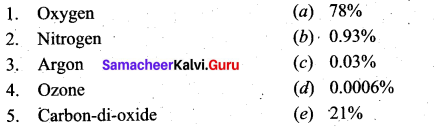
  3. Only then money can be saved in banks.
  4. All the major and important banks were nationalised (1969) in India.
  5. The Reserve Bank of India (RBI) regulates the circulation of currency in India.
  6. The Reserve Bank of India started its operations on 1st April 1935.
  7. It was permanently moved to Mumbai from the year 1937.
  8. RBI was nationalised in 1949. 85% of the printed currency is let for circulation.
  9. According to the statistics available as in August 2018, currency worth 19 lakh crore is in circulation.

Question 3.
Write in detail about the various functions of money.
Answer:
When money replaced the barter system, a lot of practical issues were solved. Money acts a medium of exchange, a unit of measurement, a store of value, and a standard of deferred payments. It plays an important role in transactions.

The medium of Exchange: Money should be accepted liberally in exchange for goods and services in a country.

Unit of Account: Money should be the common, standard unit of calculating a country’s total consumer goods, products, services etc. For example, if a book costs ₹ 50, it means that the price of the book is equal to 50 units of money. Money is used to measure and record financial transactions in a country.

A Store of Value: Money is used as a store of purchasing power. It can be used to finance future payments.

Samacheer Kalvi 9th Social Science Economics Solutions Chapter 3 Money and Credit

Question 4.
What are the divisions of the money supply?
Answer:
The money supply is divided into four;
M1 = Currency held with the public + cash Reserves in commercial and Co-operative banks + cash reserves in the RBI.
M2 = M1 + Money saved in Post office and bank savings accounts
M3 = M1 + Time Deposits in Commercial and co-operative banks
M4 = M3 + Post office savings Money

VI. Write the correct statement.

A.
1. The barter system flourished wherever civilizations thrived.
2. This was the initial form of trade.
(i) 1 is correct; 2 is wrong
(ii) Both 1 and 2 are correct
(iii) Both 1 and 2 are wrong
(iv) 1 is wrong; 2 is correct
Answer:
(ii) Both 1 and 2 are correct

B.
1. Most of the international trade transactions are carried out in US dollars.
2. No other country except the US carries out trade in the world.
(i) Both the statements are correct.
(ii) Both the statements are wrong.
(iii) 1 is correct; 2 is wrong
(iv) 1 is wrong; 2 is correct
Answer:
(iii) 1 is correct; 2 is wrong

VII. Project and activity.

Question 1.
Visit a local museum and collect information about the coins displayed there.
Answer:
You can do this activity under the guidance of your teacher.

Samacheer Kalvi 9th Social Science Economics Solutions Chapter 3 Money and Credit

Question 2.
Imagine you are going abroad for a Post Graduation course in architecture. Write a letter to the Branch Manager regarding an education loan.
Answer:
18.04.2019
Chennai
From
Deepa
18, Meenakshi Nagar
Nerkundram
To
The Branch Manager
HDFC Bank
T. Nagar
Chennai-600 017
Respected Sir,
Sub: Request for Educational Loan
I am Deepa, a student of Architecture living in Chennai. I have completed my degree course with 85% marks. I have got an opportunity to pursue a Post Graduation course in Architecture at King’s College, London. As I belong to an economically weaker section, I need your help in funding my studies. I am applying for an educational loan at your esteemed bank. I herewith enclose the copies of my mark sheet and admission letter. Could you please consider my request for the loan? I shall be obliged for the same.
Thank you,
Yours sincerely,
Deepa
Enclosures:
1. B.Arch. mark sheet
2. Admission Letter for Post Graduation in Architecture

To
The Branch Manager
HDFC Bank
T. Nagar, Chennai – 600 017

VIII. Life skills – Student Activity.
Question 1.
Observe a 20 rupee note. What is written on it?
Answer:
• RESERVE BANK OF INDIA
• GUARANTEED BY THE CENTRAL GOVERNMENT
• I PROMISE TO PAY THE BEARER THE SUM OF TWENTY RUPEES
Students can write other words written in different languages:
• …………………………………………….
• …………………………………………….

Question 2.
Prepare a family budget for a month.
Answer:

  1. The class will be divided into 4 groups.
  2. They will be asked to prepare a family budget with the help of parents.
  3. The report will be presented in the class by each group.

Money and Credit Additional Questions

I. Choose the correct answer.
1. ………….. (Ancient men/Modern men) hunted and gathered food.
2. …………. (Goods/Metals) be termed as the first form of money.
3. ……… (The later Cholas/The early Cholas) allowed the traders to have their own army.
4. All the major and important banks were nationalised in ……. (1969/1970) in India.
5. The currency of England is …………. (Pound/Dollar).
6. The currency of Saudi Arabia is ………. (Ringgit/Riyal).
Answers:
1. Ancient men
2. Metals
3. The later Cholas
4. 1969
5. Pound
6. Riyal

Samacheer Kalvi 9th Social Science Economics Solutions Chapter 3 Money and Credit

II. Fill in the blanks.

  1. The …….. system was the initial form of international trade.
  2. …… plays a predominant and inseparable role in all our lives.
  3. The first form of money is ……….
  4. ……… issued a coin of silver weighing 178 grams which were termed as the Rupiya.
  5. A government has the responsibility to regulate the money supply and oversee the ……… policy.
  6. ………. attempts to meet the educational aspirations of the society.
  7. There is no security required for the loan amount upto ₹ ………. lakhs.
  8. The …… regulates the circulation of currency in India.
  9. The Indian currency is called the ………
  10. Till 1947, the currency notes with the image of …….. were in circulation.

Answers:

  1. Barter
  2. Money
  3. Metals
  4. Sher Shah Suri
  5. Monetary
  6. Educational loan
  7. 4 lakhs
  8. Reserve Bank of India
  9. Indian Rupee INR
  10. King George VI

III. Match the following.

Samacheer Kalvi 9th Social Science Economics Solutions Chapter 3 Money and Credit 80
Answers:
1. (f)
2. (g)
3. (a)
4. (b)
5. (d)
6. (c)
7. (e)

IV. Give short answers.

Question 1.
Give a short account of the life of ancient men.
Answer:
Ancient man hunted and gathered food. He lived in caves and forests. In later stages, he invented weapons for hunting and gathering food. Later, he invented fire and learned to practice agriculture. He used mud to build houses and settle down in a place, and also to make earthenware.

Samacheer Kalvi 9th Social Science Economics Solutions Chapter 3 Money and Credit

Question 2.
How does money play a predominant and inseparable role in all our lives?
Answer:
The Government, as well as, private institutions and industries calculate their financial status through money. Thus, money plays a predominant and inseparable role in all our lives.

Question 3.
How were the later cholas treated the traders?
Answer:
The later Cholas allowed the traders to have their own army. Historical evidences state that during this period, small traders and producers gave credit to the Tamil traders to support their export needs.

Question 4.
Where were the barter system flourished?
Answer:
The barter system flourished wherever civilizations thrived. This system was active not only within a civilization, but also among civilizations. This was the initial form of international trade.

Question 5.
What is currency?
Answer:
Currency is the medium of exchange in a country. The Indian currency is called the Indian Rupee (INR). In a country the foreign currency is called foreign exchange.
Purchasing capacity of all currencies in the world are compared using the US dollar as the standard currency. This value differs from country to country.

Samacheer Kalvi 9th Social Science Economics Solutions Chapter 3 Money and Credit

Question 6.
What do the Government do with the savings in the banks?
Answer:
A major portion of the savings in banks are used for the development of industries, economic growth and various development schemes for the welfare of the poor.

Question 7.
What is Credit?
Answer:
Farmers avail credit during monsoons for buying seeds, agricultural input and other expenses. Traders and small entrepreneurs need credit for their needs. Even large industries receive credit to take up their new projects.

Samacheer Kalvi 9th Social Science Economics Solutions Chapter 3 Money and Credit

Question 8.
Give an account of Self Help Groups.
Answer:
People who live in a particular place or those who are involved in a certain work join together as a group and start saving. These are called as Self Help Groups. The nationalised banks provide help to these groups through micro-credit. Credit given though Self Help Groups for street vendors, fishermen, especially women and the poor really make a difference in their life.

V. Answer in detail.

Question 1.
How is currency printed in India?
Answer:
In 1925, the British government established a government press at Nasik in Maharashtra. Currencies were printed three years later. In 1974, a press was started in Dewas, Madhya Pradesh. (Security Printing and Minting Corporation of India Ltd.) In the 1990s. two more presses were started in Mysuru, Karnataka and Salboni in West Bengal to print bank notes. The Reserve Bank of India has the authority to decide the value of currency to be printed and how the amount should reach its destination safely. Around ten thousand workers are employed here. Countries like Sri Lanka, Bhutan, Iraq and Africa have drawn contracts for printing their currencies and sent to the respective countries.

Though the RBI has the power to print up to ten thousand rupee notes, at present a maximum of upto rupees two thousand is printed.

Samacheer Kalvi 9th Social Science Economics Solutions Chapter 3 Money and Credit

Question 2.
Write in detail the Foreign Exchange rate equivalent to US Dollars.
Answer:
Samacheer Kalvi 9th Social Science Economics Solutions Chapter 3 Money and Credit 60

VI. Write the correct statement.

A.
1. Money is recognized as a standard record for the payment of a thing or service.
2. Using this currency, people can purchase things, pay taxes and repay debts.
(i) Both 1 and 2 are correct
(ii) Both 1 and 2 are wrong
(iii) 1 is correct; 2 is wrong
(iv) 1 is wrong; 2 is correct
Answer:
(i) Both 1 and 2 are correct

B.
1. Paper money was introduced because metal supply was limited.
2. All the major and important banks were nationalised in 1964, in India.
(i) Both 1 and 2 are correct
(ii) Both 1 and 2 are wrong
(iii) 1 is correct; 2 is wrong (iv) 1 is wrong; 2 is correct
Answer:
(iii) 1 is correct; 2 is wrong

HOTS

Question 1.
How important is foreign exchange to one’s country?
Answer:

  1. During any Crisis Foreign exchange reserves come to the rescue of any country. It absorbs the distress related to such crisis.
  2. It increases the confidence in the monetary and exchange rate policies of the government.
  3. Foreign exchange reserves are the foreign currencies held by the Country’s Central Bank. They are also called Foreign currency reserves (or) Foreign reserves. They manage their currencies.

Thus foreign exchange is important to any country.

Samacheer Kalvi 9th Social Science Economics Solutions Chapter 3 Money and Credit Read More »

Samacheer Kalvi 9th Social Science History Solutions Chapter 3 Early Tamil Society and Culture

You can Download Samacheer Kalvi 9th Social Science Book Solutions Guide Pdf, Tamilnadu State Board help you to revise the complete Syllabus and score more marks in your examinations.

Tamilnadu Samacheer Kalvi 9th Social Science History Solutions Chapter 3 Early Tamil Society and Culture

Early Tamil Society and Culture Textual Exercise

I. Choose the correct answer.

Question 1.
The name of the script used in the Sangam Age ………….
(a) English
(b) Devanagari
(c) Tamil-Brahmi
(d) Granta
Answer:
(c) Tamil-Brahmi

Question 2.
The Sri Lankan chronicle composed in the Pali language mentioning about merchants and horse traders from Tamil Nadu
(a) Deepa vamsa
(b) Arthasastra
(c) Mahavamsa
(d) Indica
Answer:
(c) Mahavamsa

Question 3.
The notable Chola king credited with bringing forest lands under the plough and developing irrigational facilities.
(a) Karikalan
(b) Rajarajari I
(c) Kulothungan
(d) Rajendran I
Answer:
(a) Karikalan

Question 4.
Inscription that mentions the Cheras …………..
(a) Pugalur
(b) Gimar
(c) Pulimankombai
(d) Madurai
Answer:
(a) Pugalur

Samacheer Kalvi 9th Social Science History Solutions Chapter 3 Early Tamil Society and Culture

Question 5.
The famous Venetian traveller described Kayal as a great and noble city.
(a) Vasco da Gama
(b) Alberuni
(c) Marco Polo
(d) Megasthenes
Answer:
(c) Marco Polo

Question 6.
(i) Coins as a medium of exchange were introduced for the first time in the Sangam Age.
(ii) Prakrit was the language used by the common people in Northern India during the Mauryan period.
(iii) Vienna Papyrus, a Roman document, mentions trade related to Muziri.
(iv) The concept of Thinai is presented in the Tamil grammar work of Pathupaattu.
(a) (i) is correct
(b) (ii) is correct
(c) (i) and (ii) is correct
(d) (iii) and (iv) is correct
Answer:
(i) is correct
(ii) is correct
(iii) is correct
(iv) incorrect

Question 7.
(i) Pathitrupathu speaks about the Pandya kings and their territory.
(ii) The Akanaanuru describes the trading activities at Kaveripoompattinum.
(iii) The Chola Emblem was the tiger and they issued square copper coins with images of a tiger.
(iv) Neythal is a sandy desert region.
(a) (i) is correct
(b) (ii) and (iii) is correct
(c) (iii) is correct
(d) (iv) is correct
Answer:
(i) incorrect
(ii) incorrect
(iii) is correct
(iv) incorrect

II. Fill in the blanks.

1. ……………. are documents scripted on stones, copper plates, coins, and rings.
2. ………….. refers to systematically digging a site to recover material evidence for exploring societies of the past.
3. ……………. the classic work on economy and statecraft authored by Kautilya during the Mauryan period.
4. …………… is a poetic theme which means a class or category and refers to habitat or ecozone with specific physiographical characteristics.
5. …………. referred to the Westerners, including the Greeks, Romans, and West Asian people.
Answers:
1. Epigraphy
2. Archeological excavations
3. Arthasastra
4. Sangam poems
5. Yavanar

III. Find out the correct statement.

Question 1.
(a) Evidence of iron smelting has been found in Kodumanal and Guttur.
(b) Periplus of Erythren Sea mentions the pepper trade with India.
(c) Punch marked coins are the earliest coins used in India mostly made of gold.
(d) The Sangam Age has its roots in the Bronze Age.
Answer:
(a) correct
(b) incorrect
(c) correct
(d) incorrect

Question 2.
(a) The Cheras ruled over the Kaveri delta and their capital was Uraiyur.
(b) The Maangulam Tamil-Brahmi inscriptions mention the King Karikalan.
(c) The terms Vanikan and Nigama appear in Tamil-Brahmi inscriptions were different types of merchants.
(d) Salt merchants were called Vanikars and they travelled in bullock carts along with their family.
Answer:
(a) incorrect
(b) incorrect
(c) correct
(d) incorrect

IV. Match the following.

Samacheer Kalvi 9th Social Science History Solutions Chapter 3 Early Tamil Society and Culture 1
Answer:
1. (d)
2. (a)
3. (e)
4. (c)
5. (b)

V. Answer the following questions briefly.

Question 1.
Archaeological sites provide evidence of past history – Discuss.
Answer:

  1. Archaeology is the study of the past by interpretation of the material cultural remains.
  2. Such remains are unearthered by the Systematic excavation of old inhabitation sites called archaeological sites.
  3. Archaeological sites have mounds which are an accumulation of soil, pottery, building, and organic remains and objects.
  4. In many parts of Tamil Nadu, they are called Nattam, Kottai, and Medu.
  5. Such sites provide evidence of how people lived in the past.

Question 2.
How important coin as a source of evidence for the study of the Sangam Age?
Answer:

  • Coins as a medium of exchange were introduced for the first time in the Sangam Age.
  • The coins of the Cheras, the Cholas and the Pandyas, punch-marked coins, and Roman coins form another important source of evidence from the Sangam Age.
  • They were used as bullion for their metal value and as ornaments.

Question 3.
The Tamil rulers were independent of Mauryan authority. What explanation would you offer?
Answer:

  1. The Tamil rulers were independent of Mauryan authority because Ashokan inscriptions found in present-day Odisha, Karnataka, Telangana, and Andhra Pradesh are not seen in Tamil Nadu and Kerala.
  2. So we can conclude the status of Tamil rulers.

Question 4.
Agriculture was one of the main sources of subsistence in the Sangam Age. Give reasons.
Answer:

  1. Agriculture was one of the main sources of subsistence.
  2. Crops like paddy, sugarcane, millets were cultivated.
  3. Both wet and dryland farming was practiced.
  4. Varieties of rice such as Sennel, Vennel, aivananel (a type of rice) are mentioned in the literature.
  5. People in the forest adopted Punam or shifting cultivation.

Samacheer Kalvi 9th Social Science History Solutions Chapter 3 Early Tamil Society and Culture

Question 5.
Overseas interactions brought glory to ancient Tamilagam. Give examples in support.
Answer:

  • Tamil country had connections with countries overseas both in the east and west.
  • Roman ships used monsoon winds to cross the Western Sea or the Arabian Sea to connect Tamilagam with the Western world.
  • Spices including pepper, ivory, and precious stones were exported. Metal including gold, silver and copper, and precious stones were imported.
  • Yavanar referred to the Westerners, including the Greeks, Romans, and West Asian people. Yavana derives from the Greek region of Ionia.

VI. Answer all the questions given under each caption.

Question 1.
Hero Stones:
(a) What was the common practice in a pastoral society?
Answer:
As cattle were considered an important source of wealth, raiding cattle owned by adjoining tribes and clans was common practice in a pastoral society.

(b) Who plundered the cattle wealth of enemies?
Answer:
Tribal chieftains plundered the cattle wealth of enemies whose warriors fought to protect their cattle.

(c) How were the dead warriors remembered?
Answer:

  1. Many warriors died in such battles and were remembered as martyrs.
  2. Memorial stones were erected in their honour.

(d) Which Tamil text describes the procedures for erecting hero stones?
Answer:
Tholkappiyam describes the procedures for erecting hero stones.

Question 2.
Non-Tamil Sources (Foreign Accounts):
(a) What does the presence of the non-Tamil sources reveal?
Answer:
(a) The presence of the non-Tamil sources reveals the extensive contacts and interactions of the early Tamil society with the outside world.

(b) Name the classic work of the Mauryan period that makes a mention that the pearl and shells came from Pandya country.
Answer:
Arthasastra the classic work of the Mauryan period makes mentions that the pearl and shells came from the Pandya country.

(c) What is a chronicle?
Answer:
Chronicle is a narrative text presenting the important historical events in chronological order.

(d) Who speaks about the pepper trade between the Roman empire and India?
Answer:
Pliny the Elder, a Roman, speaks about the pepper trade with India by the Romans.

Question 3.
Industries and Crafts of the Sangam Age:
(a) What were the important aspects of urbanisation?
Answer:
Craft production and craft specialization were important aspects of urbanisation.

(b) What is the Tamil name for a potter?
Answer:
“Kuyavar” is the Tamil name for potter.

(c) What were the different types of pottery used by the peopla?
Answer:
Blackware, russet-coated painted ware, black, and red ware potteries were the different types of pottery used.

(d) Identify the Iron implements required for agriculture and warfare.
Answer:
Swords, daggers and spears were the iron implements required for agriculture and warfare.

VII. Answer the following in detail.

Question 1.
To what extent do you think the political powers of Tamilagam influenced Sangam Age polity?
Answer:

  • Sangam Age has its roots in the Iron Age.
  • In the Iron Age people were organised into chiefdoms.
  • From such communities of Iron-Age emerged the Vendhars of the early historic period and the Velirs of the Sangam Age were chieftains.
  • Tamil rulers were independent of the Mauryan authority.
  • Among the political powers of the Sangam Age, the Cheras, the Cholas and the Pandyas occupied pre-eminent positions. They were known as Muvendhar (the three kings).
  • The Muvendhar controlled the major towns and ports of the Sangam period.
  • The Cheras controlled the region of present-day Kerala and also the Western parts of Tamil Nadu.
  • Vanci was the capital, Muciri and Thondi were their Port towns.
  • The Cholas ruled over the Kaveri delta and the Northern parts of Tamil Nadu. Uraiyur was their capital, Kaveripoompattinam was the Port town.
  • The Pandyas who ruled the Southern part of Tamil Nadu are referred to as the Ashokan inscriptions.
    Madurai was the capital.
  • Apart from the Vendhars, there were Velirs and numerous chieftains who occupied territories on the margins of the muvendhar.
  • The Sangam Age society was a society in transition from a tribal community ruled by a chief to a larger kingdom ruled by a king.
    Social stratification had begun to take root in Tamil society by the Sangam times.
    Thus the political powers of Tamilagam influenced Sangam society.

Question 2.
Indicate how the industries and crafts of the Sangam Age contribute to their economy.
Answer:

  1. Craft production and craft specialisation were important aspects of urbanisation.
  2. In the Sangam Age there were professional groups that produced various commodities.
  3. The system of production of commodities is called industry.
  4. Iron smelting was undertaken in traditional furnaces and such furnaces have been found in many archaeological sites.
  5. Evidence of iron smelting was found in Kodumanal and Guttur.
  6. Iron implements for agriculture and warfare were produced.
  7. Roman gold coins were used to make jewellery.
  8. Evidence of gold smelting was found at Pattanam in Kerala.
  9. Specialised groups called vanikars travelled in groups trading goods and commodities between regions.
  10. Barter was the primary mode of exchange.
  11. Tamilagam exported pepper, ivory, and precious stones to the western world and imported gold, silver, copper, etc.
  12. Indian pottery has been discovered at Berenike, a port on the Red Sea Coast.
  13. A stone with the name ‘Perumpatankal’ has been found at Khuan Luk Pat, Thailand.
  14. Southeast Asia was known as Suvama Bhoomi in Tamil literature.
  15. The economy of the Sangam Age was mixed as elaborated in the Thinai concept.
  16. People practiced agriculture, pastoralism, trade and money exchange, hunting and gathering, and fishing depending upon the ecozones in which they lived.

Student Activities

Question 1.
Mark on the map of south India, the ancient Tamilagam and the territories of Tamil kingdoms.
Answer:
You can take guidance from your teacher and reference from the internet to mark the ancient Tamilagam and the territories of Tamil Kingdoms on the map of South India.

Question 2.
Visit a museum and collect information about inscriptions, coins and instruments used by the ancient people.
Answer:
The teacher can arrange a visit to the museum for the students. The students can collect information about inscriptions, coins, and instruments used by the ancient people.

Question 3.
Visit the early historic sites of Arikkamedu, Kaveripoompattinam, Keezhadi etc.
Answer:
The teacher can arrange a visit to the early historic sites of Arikkamedu, Kaveripoompattinam, Keezhadi, etc.

Samacheer Kalvi 9th Social Science History Solutions Chapter 3 Early Tamil Society and Culture

Question 4.
Conduct a study on materials excavated from prehistoric sites and on Tamil-Brahmi script.
Answer:
You can do this activity with the help of your teacher.
Assignment with teacher’s guidance
1. A power-point presentation on the origin of human life.
Refer to the Books, Internet to collect the points.

Early Tamil Society and Culture Additional Questions

I. Choose the correct answer.

Question 1.
The earliest written work on Tamil Grammar is ………………..
(a) Thirukural
(b) Tholkappiam
(c) Pathinen Melkanakku
(d) Pathinen Kilkanakku
Answer:
(b) Tholkappiam

Question 2.
This is an Epic …………..
(a) Silappathikaaram
(b) Pattinapallai
(c) Mullai pathu
(d) Madurai Kanchi
Answer:
(a) Silappathikaaram

Question 3.
During the Sangam Age …………… landscape followed the pastoral way of life.
(a) Marutham
(b) Neithal
(c) Mullai
(d) Palai
Answer:
(c) Mullai

Question 4.
……………… is an ornament made in precious stone where images are carved on the surface.
(a) Cameo
(b) Intagliol
(c) Chronicle
(d) Papyrus
Answer:
(a) Cameo

Question 5.
The roots of the Sangam Age is in ……………
(a) Bronze Age
(b) Mesolithic Age
(c) Iron Age
(d) None of the above
Answer:
(c) Iron Age

Question 6.
(i) Bullion means precious metal available in the form of ingots, (correct)
(ii) Punch-marked coins are the earliest coins used in India, (correct)
(iii) Non-Tamil literary sources also offer information on early Tamil society, (correct)
(iv) Millets were cultivated in the wetlands, (incorrect)
(a) (i) is correct
(b) (i) & (ii) are correct
(c) (i), (ii) & (iii) are correct
(d) (iv) is correct
Answer:
(c) (i), (ii) & (iii) are correct

Question 7.
(i) Barter was the primary mode of exchange.
(ii) Spices including pepper and precious stones were exported.
(iii) The Sangam Age saw the first urbanization in Tamilagam.
(iv) People in the Sangam Age had no faith in religion.
(a) (i) is correct
(b) (i) is correct (ii) incorrect
(c) (i) is correct (iv) incorrect
(d) (i), (ii), (iii) correct (iv) incorrect
Answer:
(d) (i), (ii), (iii) correct (iv) incorrect

II. Fill in the blanks.

  1. ………….. collection includes ten long songs.
  2. Act of destruction of heritage property (or) property belonging to others are called ……………..
  3. …………… is the study of the past by interpretation of the material cultural remains.
  4. …………. Geography is a gazetteer and atlas of Roman times.
  5. ………… table is an illustrated map of the Roman Roads.
  6. A paper produced out of the papyrus plant used extensively for writing purposes in ancient …………..
  7. The Silappathikaram speaks about ………………. who built a temple for Kannagi.
  8. ………….. is a long poem about Kaveripoompattinam.
  9. The Pamban coast is famous for ……………..
  10. Spices including …………., …………. and ………. were exported.

Answers:

  1. Pathupattu
  2. Vandalism
  3. Archaeology
  4. Ptolemy’s
  5. Pentingerian
  6. Egypt
  7. Gheran Senguttuvan
  8. Pattinappalai
  9. Pearl fishery
  10. Pepper, Ivory, Precious stones

III. Match the following.

Samacheer Kalvi 9th Social Science History Solutions Chapter 3 Early Tamil Society and Culture 2
Answer:
1. (c)
2. (e)
3. (a)
4. (b)
5. (d)

IV. Answer the following questions briefly.

Question 1.
Discuss Tamil Traders and Sailors.
Answer:
As seafaring people, Tamil traders and sailors established commercial and cultural links across the seas, and merchants from foreign territories also visited the Tamil region.

Question 2.
What does the third section of the Tholkappiyam describe?
Answer:
The third section of Tholkappiyam describes poetic conventions that provide information on Tamil social life.

Question 3.
What does the development of Script mark?
Answer:

  1. The development of the script marks the beginning of the historical period.
  2. The period before the use of a written script is called the prehistoric period.

Samacheer Kalvi 9th Social Science History Solutions Chapter 3 Early Tamil Society and Culture

Question 4.
What do you know about the Hero stones of the Post-Sangam Age?
Answer:

  1. Hero stones of the Post-Sangam Age and the Pallava period occur in large numbers in pastoral regions especially around the Chengam region near Thiruvannamalai district.
  2. These hero stones have inscriptions and images of warriors and names of heroes.

Question 5.
What does the Erythrean sea refer to?
Answer:

  1. Erythrean sea refers to the waters around the red sea.
  2. It makes references to the Sangam Age, Ports of Muciri, Thondi, Korkai, and Kumari as well as the Gheras and the Pandyas.

Question 6.
What is Ptolemy’s Geography?
Answer:
Ptolemy’s Geography is a Gazetteer and atlas of Roman times providing geographical details of the Roman Empire in the Second Century CE.

Question 7.
What do you know about Muvendhar?
Answer:
Among the political powers of the Sangam Age, the Cheras, the Cholas and the Pandyas occupied pre-eminent positions. They were known as Muvendhar (the three kings). The muvendhar controlled the major towns and ports of the Sangam period.

Question 8.
What is an Urban centre?
Answer:
A planned town with brick architecture and a proper layout. Urban centres have a larger population involved in non-agrarian, commercial and political occupations. Various industrial activities are seen in these towns.

V. Answer all the questions given under each caption.
Question 1.
Tholkappiam.
(i) What is the earliest written work on Tamil grammar?
Answer:
Tholkappiyam.

(ii) To whom did it attribute?
Answer:
Tholkappiyam attributed to Tholkappiyar.

(iii) What does the third section of Tholkappiam describe?
Answer:
The third section describes the poetic conventions that provide information on Tamil social life.

(iv) Mention the oldest among the Tamil Texts.
Answer:
Pathupattu and Ettuthogai.

Question 2.
Pearl fishery and shell bangle.
(i) Which place is famous for pearl fishery?
Answer:
The Parpban coast is famous for pearl fishery.

(ii) What was very common in the Sangam Age?
Answer:
Shell bangles were very common in the Sangam Age.

(iii) Who collected conch shells from Pamban Island?
Answer:
The Parathavers collected conch shells from Pamban Island.

(iv) What does Sangam literature describe?
Answer:
Sangam literature describes women wearing shell bangles.

VI. Answer the following in detail.

Question 1.
Write a note on Tamil Brahmi inscriptions.
Answer:

  1. Inscriptions are documents scripted on stone, copper plates, and other media such as coins, rings etc.
  2. Tamil Brahmi was the first script used for writing in Tamil Nadu.
  3. Inscriptions in Tamil-Brahmi are found in caves and rock shelters and on pottery and other objects like coins, rings, seals etc.
  4. Tamil Brahmi inscriptions have been found in more than 30 sites in Tamil Nadu, mostly on cave surfaces and rock shelters.
  5. These caves were the abodes of Jain monks.
  6. The natural caves were converted into a residence by cutting a drip-line to keep rainwater away from the cave.
  7. Inscriptions often occur below such driplines.
  8. The sites have smooth stone beds carved on rock surfaces for monks.
  9. Maangulam, Muttupatti, Pugalur, Arachalur and Kongarpuliyankulam, and Jambai are some of the major sites of such caves with Tamil Brahmi inscriptions.
  10. Around Madurai, many such caves with the Tamil Brahmi inscriptions can be still seen. Many of them are located along ancient trade routes.

Samacheer Kalvi 9th Social Science History Solutions Chapter 3 Early Tamil Society and Culture

Question 2.
Give an account of “Emergence of towns and ports”.
Answer:

  1. The Sangam Age saw the first urbanization in Tamilagam.
  2. Cities developed and they had brick buildings, roof tiles, ring wells and planned towns, streets, and storehouses.
  3. The towns worked as ports and artisanal centres. Arikkamedu, Kaveripoompattinam, Azhagankulam and Korkai on the east coast and Pattanam in Kerala were port centres.
  4. Kanchipuram, Uraiyur, Karur, Madurai, and Kodumanal were inland traded centres.
  5. Many goods and commodities were produced in these centres and were exported to various regions.
  6. Though few in number, large towns appeared in the Sangam Age.
  7. Small villages however were found in many areas. Bronze vessels, beads, shell bangles, glass beads, pottery with names of people written in Tamil-Brahmi script were found at these sites.

Samacheer Kalvi 9th Social Science History Solutions Chapter 3 Early Tamil Society and Culture Read More »

Samacheer Kalvi 9th Social Science Civics Solutions Chapter 3 Human Rights

You can Download Samacheer Kalvi 9th Social Science Book Solutions Guide Pdf, Tamilnadu State Board help you to revise the complete Syllabus and score more marks in your examinations.

Tamilnadu Samacheer Kalvi 9th Social Science Civics Solutions Chapter 3 Human Rights

Human Rights Textual Exercise

I. Choose the correct answer.

Question 1.
‘Apartheid’ was followed by
(a) South Sudan
(b) South Africa
(c) Nigeria
(d) Egypt
Answer:
(b) South Africa

Samacheer Kalvi 9th Social Science Civics Solutions Chapter 3 Human Rights

Question 2.
…….. right exercises in the formation and administration of a government.
(a) Social
(b) Economic
(c) Political
(d) Cultural
Answer:
(c) Political

Question 3.
A 10 year old boy is working in a shop. Which right can you use to recover him?
(a) Right to equality
(b) Right to freedom
(c) Right against child labour exploitation
(d) Right to freedom of Religion
Answer:
(c) Right against child labour exploitation

Samacheer Kalvi 9th Social Science Civics Solutions Chapter 3 Human Rights

Question 4.
Which one of the following rights has increased the influence of the people over bureaucracy?
(a) Right to equality
(b) Right to information
(c) Right to education
(d) Right to freedom
Answer:
(b) Right to information

Question 5.
What is the time limit to get the information from RTI Act 2005?
(a) 20 days
(b) 25 days
(c) 30 days
(d) 35 days
Answer:
(c) 30 days

Question 6.
…….. right was removed from the fundamental Rights by the 44th Amendment.
(a) Right to own (or) sell property
(b) Right to freedom of religion
(c) Child labour and right against exploitation
(d) None of the above
Answer:
(c) Child labour and right against exploitation

Samacheer Kalvi 9th Social Science Civics Solutions Chapter 3 Human Rights

Question 7.
Which of the following statements are true?
(i) The state Human Rights commission was established in 1993.
(ii) It has the power of a civil count.
(iii) It’s power extend beyond the state.
(iv) It can also recommend compensation to victims.
(a) (i) and (ii) are true
(b) (i) and (iii) are true
(c) (i), (ii) and (iii) are true
(d) (i), (ii) and (iv) are true
Answer:
(d) (i), (ii) and (iv) are true

Question 8.
Consider the following statements.
Assertions (A): Rights and duties are the two sides of the same coin.
Reason (R): We have a right to freedom of religions. We have to promote harmony and the spirit of the people of other religions.
(a) both A and R are correct and R explains A
(b) both A and R are correct but R does not explain A
(c) A is correct but R is false
(d) A is false but R is correct
Answer:
(a) both A and R are correct and R explains A

Question 9.
According to the UNO a child is a person who has not completed the age of …….. years.
(a) 12
(b) 14
(c) 16
(d) 18
Answer:
(d) 18

Samacheer Kalvi 9th Social Science Civics Solutions Chapter 3 Human Rights

Question 10.
Kailash Satyarthi and Malala have been awarded Nobel Prize for
(a) Literature
(b) Peace
(c) Physics
(d) Economics
Answer:
(b) Peace

II. Fill in the blanks.

  1. The Universal Declaration of Human Rights (UDHR) was adopted on ……….
  2. The Universal Declaration of Human Rights Contains …….. articles.
  3. The Fundamental Duties were incorporated in the Constitution by ……… Amendment Act.
  4. The National Human Rights Commission was established on ………..
  5. ……… act came into effect on 1st April 2010.
  6. Indian state to implement women ancestral property Act in 1989 was ………..
  7. The Civil Rights movement in the United State was initiated by ……….

Answers:

  1. 10th December 1948
  2. 30
  3. 42nd
  4. 12th October 1993
  5. Right to Education
  6. Hindu Succession Act
  7. Rosa Parks

III. Match the following:

Samacheer Kalvi 9th Social Science Civics Solutions Chapter 3 Human Rights 1
Answers:
1. (c)
2. (e)
3. (a)
4. (b)
5. (d)

IV. Give short answers.

Question 1.
What is Human Right?
Answer:
The U.N.O defines Human rights as “The right inherent to all human beings, regardless of race, gender, nationality, ethnicity, language, religion, or any other status. Everyone is entitled to these rights without discrimination.”

Question 2.
What are the fundamental rights?
Answer:

  • Right to Equality
  • Right to Freedom
  • Right against Exploitation
  • Right to Freedom of Conscience and Religion
  • Cultural and Educational Rights for minorities
  • Right to Constitutional Remedies

Samacheer Kalvi 9th Social Science Civics Solutions Chapter 3 Human Rights

Question 3.
What are the Child Rights define by the UNO?
Answer:
The UNO adopted the Rights of the child on 20th November 1989. They are

  1. Right to life
  2. Right to the family environment
  3. Right to Education
  4. Right to benefit from Social security
  5. Right against sexual exploitation
  6. Right against sale or trafficking
  7. Right against other forms of exploitation like Child labour.

Question 4.
Write a short note on the Right to Constitutional Remedies.
Answer:
Fundamental Rights are guaranteed by the Constitution. By this right, a person can adopt Constitutional means and approach a court if he is denied the Fundamental Rights. The court then issues orders which are called ‘Writs’ to the government to restore the rights to the citizen. The Constitutional Remedies put to right anything which may be wrong in terms of the Constitution. This right, therefore, protects and safeguards all other rights.

Question 5.
Define: POCSO
Answer:

  1. POCSO is the Right against sexual exploitation.
  2. The state should protect children from sexual exploitation and abuse when they are forced or persuaded to take part in Sexual activities physically or mentally.
  3. POCSO Act – Protection of Children from Sexual Offences Act was passed in 2012.
  4. It regards the best interest of the child as being of paramount importance at every stage.

Samacheer Kalvi 9th Social Science Civics Solutions Chapter 3 Human Rights

Question 6.
Why do children need special attention?
Answer:

  1. Children are considered to be future citizens and an asset to a nation.
  2. They should be brought up with warmth and by nurturing their interest.
  3. The children when loved and appreciated, realizes their value.
  4. This makes the child feel secured and develops self-esteem.
  5. Eventually, the child is ready to face challenges in life with a positive attitude.

Question 7.
What are the contributions to labourers by B.R. Ambedkar?
Answer:
Dr.B.R. Ambedkar’s contribution to labourers.

  1. Reduction in Factory Working Hours (8 hours a day)
  2. Compulsory Recognition of Trade Unions
  3. Employment Exchange in India
  4. Employees State Insurance (ESI)
  5. Minimum Wages
  6. Coal and Mica Mines Provident Fund

Question 8.
‘All are equal before the law’. But we have enacted a separate law for women – Justify.
Answer:

  1. The National Commission for Women (NCW) is constituted in India to review the Constitutional and legal safeguards for women.
  2. Recommends remedial measures.
  3. Advises the government on all matters of policy affecting the welfare and development of women in the country.
  4. Women’s rights under the Constitution of India mainly include equality, dignity, and freedom from discrimination.

Samacheer Kalvi 9th Social Science Civics Solutions Chapter 3 Human Rights

Question 9.
Write about the Right against exploitation.
Answer:
(a) Right against exploitation is a fundamental right for every citizen.

(b) It is against the law to employ children below 14 years of age in mines, factories or other occupations. Neither contractor nor an employer can force a worker to do a job against their will.

(c) Children are subjected to sale or trafficking for various reasons – economic exploitation, sexual exploitation, sexual abuse, drug trafficking, and child labour.

(d) The state should protect children from sexual exploitation and abuse when they are forced or persuaded to take part in sexual activities physically or mentally.

Question 10.
Differentiate Fundamental Rights and Human Rights.
Answer:

Fundamental Rights Human Rights
The elemental rights of the citizens of a country, which are listed in the constitution and enforceable under the law is known as fundamental rights. The rights that a human being deserves to survive with respect and freedoms.
Fundamental rights include only those rights which are basic to a normal life. Human rights include those rights which are basic to real life and are absolute, i.e. it cannot be taken away.
Fundamental rights are guaranteed under the constitution of the country. Human rights are recognised at the international level.

V. Answer in Detail.

Question 1.
Write a paragraph about UDHR.
Answer:

  1. The Universal Declaration of Human Rights is a milestone document in the history of human rights.
  2. The Declaration was proclaimed by the United Nations General Assembly in Paris on 1 Oth December 1948.
  3. This is the first time it sets out the fundamental human rights to be universally protected and the UDHR has been translated into many languages.
  4. There are 30 articles in the Universal Declaration of Human Rights.
  5. It guarantees freedom of expression as well as civil, political, social, economic, and cultural rights.
  6. These rights apply to all people, irrespective of their race, gender, and nationality, as all people are born free and equal.

Question 2.
What are the fundamental duties? How would you follow these in your school premises?
Answer:
These were incorporated in the Constitution by the 42nd Amendment Act in 1976. The
Constitution states eleven Fundamental Duties as given below:

  1. Respect for the Constitution and its ideals and institutions, the National Flag and the National Anthem.
  2. To follow and cherish the noble ideals which inspired our National Struggle for freedom.
  3. To uphold and protect the sovereignty, unity, and integrity of India.
  4. To defend the country and render national service when called upon to do so.
  5. To promote harmony and spirit of common brotherhood amongst all the people of India, transcending religious, linguistic, regional or sectional diversities, to renounce practices derogatory to the dignity of women.
  6. To value and preserve the rich heritage of our composite culture.
  7. To protect and improve the natural environment including forests, lakes, rivers and wildlife and have compassion for living creatures.
  8. To develop the scientific temper, humanism, and the spirit of inquiry and reform.
  9. To safeguard public property and to abjure from violence.
  10. To strive towards excellence in all spheres of individual and collective activity, so that the nation constantly rises to higher levels of endeavour and achievements.
  11. To provide opportunities for education by the parent and guardian to their child or ward upto the age of 14 years.

Question 3.
How does the National Human Rights Commission protect our rights?
Answer:
The National Human Rights Commission is an autonomous body constituted in 1993. It consists of a chairman and few other members. The National Human Rights Commission protects our rights in the following ways.

  1. To inquire into the violation of human rights or negligence in the prevention of such violation by a public servant
  2. To intervene in court proceedings relating to human rights
  3. To undertake and promote research in the field of human rights
  4. To engage in human rights education among various sections of society
  5. To encourage the effects of NGOs and institutions working in the field of human rights.

Samacheer Kalvi 9th Social Science Civics Solutions Chapter 3 Human Rights

Question 4.
What are the benefits for workers provided by labour law?
Answer:

  • Reduction in Factory Working Hours (8 hours a day)
  • Compulsory Recognition of Trade Unions
  • Employment Exchange in India
  • Employees State Insurance (ESI)
  • Minimum Wages
  • Coal and Mica Mines Provident Fund

Women Labourers’ Welfare and Ambedkar Dr. B.R. Ambedkar framed many laws for women workers in India such as the ‘Mines Maternity Benefit Act’, ‘Women Labour Welfare Fund’, ‘Women and Child Labour Protection Act’, ‘Maternity Benefit for Women Labour’, and ‘Restoration of Ban on Employment of Women on Underground Work in Coal Mines’.

Question 5.
How do you enjoy the fundamental rights in your life?
Answer:

  1. Right to Equality assures equality before law and equal protection of law. Prohibition or discrimination on the grounds of religion, caste, races, gender or place of birth is offensive.
  2. Right to Freedom assures Freedom of speech and expression, Freedom to assemble peacefully without arms, Freedom to form associations and unions, Freedom to reside and settle in any part of India, Freedom to move freely throughout the territory of India and Freedom to practice any profession and carry on any occupation, trade or business.
  3. Right against Exploitation protects the child below 14 years of age from getting employed in mines, factories or other occupations.
  4. Right to Freedom of Conscience and Religion gives us the freedom to follow and practice a religion of our choice.
  5. Through Cultural and Educational Rights the Constitution gives us the right to preserve,
    protect and promote culture. We have the right to open schools, associations and societies to preserve and promote our tradition and culture.
  6. Right to Constitutional Remedies protects and safeguards all other rights.

VI. Project and Activity

Question 1.
How do you protect yourself from child abuse/sexual exploitation and trafficking?
Answer:
You can do this activity under the guidance of your teacher.

Samacheer Kalvi 9th Social Science Civics Solutions Chapter 3 Human Rights

Question 2.
Write an article titled “My country, My Rights”.
Answer:
You can do this activity under the guidance of your teacher.

Human Rights Additional Questions

I. Choose the correct answer.

Question 1.
UDHR has played a crucial role in promoting
(a) Individual Rights
(b) Human Rights
(c) Fundamental Rights
(d) None of the above
Answer:
(b) Human Rights

Question 2.
NCW was constituted to safeguard
(a) Students
(b) Women
(c) Labourers
(d) Children
Answer:
(b) Women

Question 3.
Fundamental duties were incorporated in the Indian Constitution in the year
(a) 1976
(b) 1980
(c) 1975
(d) 1950
Answer:
(a) 1976

Samacheer Kalvi 9th Social Science Civics Solutions Chapter 3 Human Rights

Question 4.
Which of the following statements are true?
Answer:
(i) The general explanations of Human Rights by UDHR is not a legally binding document.
(ii) UDHR has a political and moral importance.
(a) (i) is correct (ii) is wrong
(b) (i) is wrong (ii) is correct
(c) (i), (ii) and (iii) are wrong
(d) Both (i) and (ii) are correct
Answer:
(d) Both (i) and (ii) are correct

II. Fill in the blanks.

  1. In 1994 ……… became the President of South Africa.
  2. UNO was established in the year ……
  3. Political rights are given to the citizens by ……….
  4. Protection and promotion of human rights is India in the responsibility of ……….
  5. The written order from the court or other legal authority is called a ………..

Answers:

  1. Nelson Mandela
  2. 1945
  3. Law
  4. NHRC
  5. Writ

III. Match the following

Samacheer Kalvi 9th Social Science Civics Solutions Chapter 3 Human Rights 80
Answers:
1. (b)
2. (e)
3. (a)
4. (b)

IV. Give short answers.

Question 1.
What are Extended rights?
Answer:
The Child rights, SC and ST rights, Women rights, Right to Information Act (RTI), and Labour laws come under Extended rights.

Question 2.
Which incident changed the course of Gandhi’s life?
Answer:

  1. M.K. Gandhi was evicted from a first-class compartment on the night of 7th June 1893.
  2. This incident changed the course of his life.
  3. He took up the fight against racial oppression.
  4. His active non-violence started from that date.

Samacheer Kalvi 9th Social Science Civics Solutions Chapter 3 Human Rights

Question 3.
Write a note on Nelson Mandela.
Answer:
Nelson Mandela raised his voice against Apartheid. When he organised defiant campaigns against the government, he was imprisoned. He was released in 1990 by President F. W. de Klerk: The efforts taken by Mandela and de Klerk put an end to apartheid. In 1994, a general election was held and Nelson Mandela, the leader of the African National Congress, became President.

Question 4.
What does the term Civil rights refer to?
Answer:
The term ‘ Civil rights’ refers to the basic rights afforded by laws of the government.
It is guaranteed to every person regardless of race, nationality, colour, gender, age, religion etc.

Question 5.
What is NHRC?
Answer:
The National Human Right Commission (NHRC) is an autonomous body constituted on 12th October 1993 under the protection of Human Rights Act, 1993. It consists of a chairman and few other members. NHRC is responsible for the protection and promotion of human rights in India. The Act defines the right relating to life, liberty, equality and dignity of the individual guaranteed by the Constitution or embodied in the international covenants.

V. Answer in detail.

Question 1.
What are the functions of SHRC?
Answer:
The functions of SHRC are,

  1. The SHRC shall enquire into violation of human rights in respect of matters specified in the state and concurrent lists.
  2. Its objectives and duties are the same as NHRC but confined only to the state. It has a chairman and two members.
  3. It has the power of a civil court, and can take cognizance of cases if received.
  4. It can also recommend compensation to victims.

Question 2.
Explain Child Rights.
Answer:
Child Rights are,

(a) Right to life:

  1. A child has the right to survive even before its birth.
  2. The right to survival also includes the right to be born, the right to basic needs of food, shelter and clothing and a dignified living.

(b) Right to Family Environment:

  1. A child has the right to live a normal childhood in a family environment.
  2. Children who have been left destitute, abandoned or orphaned also have the right to live.
  3. These children can be given for adoption to caring families.

(c) Right to Education:
Right to Education Act is an Act of the Parliament of India enacted in 2009 for free and compulsory education for children from 6 to 14 years of age as under Article 21 A of the Constitution.

(d) Right against sale or trafficking:

  1. Children should be treated as individuals with fundamental human rights.
  2. Children are subj eCted to sale or trafficking for various reasons like economic exploitation, sexual exploitation, sexual abuse, drug trafficking and child labour.

(e) Right against sexual exploitation:

  1. The state should protect children from sexual exploitation and abuse.
  2. POCSO Act- Protection of Children from Sexual Offences Act in 2012.

Samacheer Kalvi 9th Social Science Civics Solutions Chapter 3 Human Rights Read More »

Samacheer Kalvi 9th Social Science History Solutions Chapter 8 The Beginning of the Modern Age

You can Download Samacheer Kalvi 9th Social Science Book Solutions Guide Pdf, Tamilnadu State Board help you to revise the complete Syllabus and score more marks in your examinations.

Tamilnadu Samacheer Kalvi 9th Social Science History Solutions Chapter 8 The Beginning of the Modern Age

The Beginning of the Modern Age Textual Exercise

I. Choose the correct answer.

Question 1.
Who among the following is known as the Father of Humanism?
(a) Leonardo da Vinci
(b) Francisco Petrarch
(c) Erasmus
(d) Thomas More
Answer:
(b) Francisco Petrarch

Question 2.
The School of Athens was painted by ……………..
(a) Raphael Sanzio
(b) Michelangelo
(c) Albrecht Durer
(d) Leonardo da Vinci
Answer:
(a) Raphael Sanzio

Question 3.
William Harvey discovered ……………
(a) Heliocentric theory
(b) Geocentric theory
(c) Gravitational force
(d) Circulation of blood
Answer:
(d) Circulation of blood

Samacheer Kalvi 9th Social Science History Solutions Chapter 8 The Beginning of the Modern Age

Question 4.
Who wrote the 95 Theses?
(a) Martin Luther
(b) Zwingli
(c) John Calvin
(d) Thomas More
Answer:
(a) Martin Luther

Question 5.
Who wrote the book Institutes of Christian Religion?
(a) Martin Luther
(b) Zwingli
(c) John Calvin
(d) Cervantes
Answer:
(c) John Calvin

Question 6.
Which sailor was the first to cross the Equator?
(a) Henry, the Navigator
(b) Lopo Gonzalves
(c) Bartholomew Diaz
(d) Christopher Columbus
Answer:
(b) Lopo Gonzalves

Question 7.
…………… named the sea as the Pacific Ocean as it was very calm.
(a) Columbus
(b) Amerigo Vespucci
(c) Ferdinand Magellan
(d) Vasco-da-Gama
Answer:
(c) Ferdinand Magellan

Question 8.
The continent of America was named after …………..
(a) Amerigo Vespucci
(b) Christopher Columbus
(c) Vasco da Gama
(d) Hernando Cortez
Answer:
(a) Amerigo Vespucci

Question 9.
……………… was the headquarters of the Portuguese possession in the East.
(a) Manila
(b) Bombay
(c) Pondicherry
(d) Goa
Answer:
(d) Goa

Question 10.
Which among the following plants were introduced from America to Europe?
(a) Sugarcane
(b) Sweet Potato
(c) Rice
(d) Wheat
Answer:
(b) Sweet Potato

II. Fill in the blanks.

  1. In 1453 Constantinople was captured by …………….
  2. ……………. was known as Prince among Humanists.
  3. …………. is famous for his paintings on the ceiling of the Sistine Chapel.
  4. The reformation of the Catholic Church is known as …………….
  5. The chief features of the Commercial Revolution were …………., ……………, and ……………

Answers:

  1. Ottoman Turks
  2. Erasmus
  3. Michelangelo
  4. Counter-Reformation
  5. Banking, Joint-stock companies, and growth of trade

III. Find out the correct statement.

Question 1.
(a) Martin Luther broke away from the Catholic Church because he was discriminated.
(b) John Calvin’s government in Geneva was liberal and fun-filled.
(c) King Henry VIII had deep theological differences with the Catholic Church.
(d) Council of Trent reemphasized the importance of ceremonies and the significance of the mass.
Answer:
(d) Council of Trent reemphasized the importance of ceremonies and the significance of the mass.

Question 2.
(a) Discovery of new lands and sea routes shifted the economic centre from Italian city-states to Spain and Portugal.
(b) Horses were native to America.
(c) During the beginning of the Modem Age, State did not interfere in economic activities.
(d) The Portuguese collaborated with the Arabs in its trading activities in India.
Answer:
(a) and (d)

IV. Match the following:

Samacheer Kalvi 9th Social Science History Solutions Chapter 8 The Beginning of the Modern Age 1
Answer:
1. (d)
2. (e)
3. (c)
4. (a)
5. (b)

V. Answer the following questions briefly.

Question 1.
Explain how the invention of the printing press influenced Renaissance, Reformation, and Geographical discoveries.
Answer:

  1. The printing press enabled the production of multiple copies of a manuscript and their spread all over western Europe.
  2. In less than fifty years after the invention of the Gutenberg printing press, about six million books had been printed.
  3. The invention of the printing press not only spread knowledge widely but also promoted critical thinking.

Question 2.
Write a short note on the impact of the Renaissance.
Answer:

  • Its most important contribution was the idea of humanism.
  • The introduction and practice of writing in the vernacular, starting from Dante, enriched the growth of vernacular languages which in turn provided the intellectual basis for the rise of nation-states.
  • Renaissance made a beginning in criticizing the corrupt and worldly practices of the Church.
  • Discovery of new land routes and remapping of the world.
  • Similarly, inquisitiveness and empiricism of the renaissance combined with knowledge of classical science led to new inventions in science.

Question 3.
Outline the differences between Martin Luther with the Catholic Church.
Answer:

  1. Martin Luther rejected the belief that ceremonies and penances would lead to salvation.
  2. He argued that it was by faith alone that one could attain salvation.
  3. The grace of God would be bestowed by the divine will alone and not by the deeds of the people.
  4. Further, the Bible could be read and interpreted by all and not by the Church alone.
  5. Thus, he rejected the role of the Church as an intermediary between the individual and God.

Question 4.
Write a brief note on Counter-Reformation.
Answer:

  • The Protestant reformation posed a threat to the Catholic Church.
  • In order to meet the challenge, Pope Paul III and his successors introduced a number of rigorous reforms in the Church. They dealt with corruption severely and stopped the sale of offices.
  • The Council of Trent reemphasized the importance of ceremonies and the significance of the mass.
  • Further, it revitalized the Inquisition to deal with opposition to the Church. It also gave official sanction to the Society of Jesus.
  • This reformation of the Catholic Church from within is known as Counter-Reformation.

Samacheer Kalvi 9th Social Science History Solutions Chapter 8 The Beginning of the Modern Age

Question 5.
What is the Columbian Exchange?
Answer:
One of the most important outcomes of the conquest of the Americas by the European colonial powers was the movement of plants, animals, technology, culture, and strange diseases between the Americas and Europe or between the New World and the Old World. This is known as the Columbian Exchange.

VI. Answer all the questions given under each caption.

Question 1.
Renaissance
(a) Give reasons as to why the renaissance originated in the Italian city-states.
Answer:
The Italian city-states were centres of cultural activities since the fourteenth century. With the coming of the scholars and artists from Constantinople, there was a surge of enthusiasm and interest in studying classical literature and art of Greeks and Romans in the Italian city-states. This creative upsurge was reflected in their writings, art, architecture, and music. This cultural fluorescence is known as the renaissance.

(b) Name some of the important humanists and their works.
Answer:
Petrarch (Father of Humanism) – My Secret Book
Dante – Divine Comedy
Machiavelli – The Prince
Erasmus – In Raise of Folly
Sir Thomas More – Utopia
Cervantes – Don Quixote

(c) List the differences between medieval art and Renaissance art.
Answer:
Renaissance paintings and sculptures were realistic and naturalistic. They improved over medieval paintings and sculptures which were stylized, unrealistic and two-dimensional. They portrayed natural landscapes, human anatomy, emotions, and ideas.

(d) Describe humanism.
Answer:
Humanism laid emphasis on human dignity and nature. Renaissance humanism promoted the view that humans are endowed with attributes that are to be used to achieve greatness.

Question 2.
Reformation
(а) Why did Martin Luther protest against the Church?
Answer:
Martin Luther rejected several teachings and practices of the Roman Catholic Church. He strongly disputed the Catholic view on indulgences.

(b) What is the doctrine of justification by faith?
Answer:
Martin Luther argued that it was by faith alone that one could attain salvation. He put forward the doctrine of justification by faith. The grace of God would be bestowed by the divine will alone, and not by the deeds of the people.

(c) Why did Henry VIII establish the Anglican Church? ”
Answer:
King Henry VIII longed for a son who would succeed him to the throne. For this purpose Henry wanted to marry again and therefore appealed to the Pope to annul his marriage with Catherine. However, the Holy Roman Emperor was Catherine’s nephew and he pressurized the Pope not to agree to his request.

As the Pope kept evading his decision, King Henry VIII grew impatient and broke his ties with Rome. By a series of Acts he established a separate Anglican Church. He confiscated the properties of the Catholic Church and monasteries in England and declared himself the Supreme Head of the Anglican Church.

(d) Mention the contribution of Ignatius Loyola.
Answer:
St. Ignatius Loyola founded the Society of Jesus to propagate Christianity. Its main work was through education and service to the destitute. It started a number of educational institutions, orphanages, and homes for the destitute. Soon their missionaries were present in all parts of the world to spread the Catholic religion.

Question 3.
Geographical Discoveries
(a) Who is Henry, the Navigator?
Answer:
Henry the Navigator of Portugal laid the foundation for long-distance sea voyages. He established a navigation school to train sailors. In his school, he taught them how to use navigational instruments such as the mariner’s compass and the astrolabe.

(b) List the causes for the geographical discoveries.
Answer:
Seafaring and adventurous spirit to explore, curiosity generated by the Renaissance, and the travel accounts of Marco Polo and Ibn Battuta all contributed to geographical discoveries. The primary factor was economic. When the Ottoman Turks blocked the land route between the East and the West, spices and other goods became costlier. This intensified the urge to discover a new sea route to Asia.

(c) What led to the extinction of the natives of America?
Answer:

  1. Many natives also died because of epidemic diseases brought by the colonizers.
  2. The most dangerous weapons the natives had to encounter were these deadly diseases against which they were defenseless.
  3. It led to the near annihilation of the natives in most parts of the Americas.

(d) What is triangular trade?
Answer:
The Trans-Atlantic Trade was a triangular trade. The European countries purchased slaves from Africa who were transported to America. In return, they got sugar and other raw materials from America. The European countries profited immensely from this trade.

VII. Answer the following in detail.

Question 1.
Discuss how the Renaissance, Reformation, and Geographical discoveries heralded the modern age?
Answer:
The Italian city-states were centres of cultural activities since the fourteenth century. With the coming of the scholars and artists from Constantinople, there was a surge of enthusiasm and interest in studying classical literature and art of Greeks and Romans in the Italian city-states. This creative upsurge was reflected in their writings, art, architecture, and music. This cultural fluorescence is known as the renaissance. The origin of the word renaissance is from the Italian word renascent meaning rebirth. It is called the renaissance because there was a rebirth or revival of classical Greek and Latin literature.

Many scholars in Italy went in search of manuscripts of classical literature. Greek scholar Manuel Chrysoloras who taught Greek classics in Italy, Guarino and Giovanni Aurispa, to name just a few, visited Constantinople several times to collect Greek manuscripts. Later they printed what they collected. This provided stimulus to the flowering of a renaissance.

The critical thinking and inquisitive spirit of Renaissance humanism helped people question such practices of the Church. Humanists such as Erasmus and Sir Thomas More, apart from condemning the corrupt practices of the Church, were also critical of its doctrine. They issued pamphlets and published books highlighting the abuses of the Catholic Church.

Attempts to reform the Church before the sixteenth century met with failure. Those who protested were punished with death by the Church. However, in the age of reason, the moves of the reformers were supported by some of the rulers of the nation-states. This they thought would provide them an opportunity to free themselves from the interference of the Church in the affairs of the state.

The Lutheran reformation opened the gates for other Protestant reformations. Though inspired by the very same reasons as that of the Lutheran reformation, they showed differences in their doctrinal approach.

Question 2.
Examine the outcome of geographical discoveries.
Answer:

  1. The geographical discoveries transformed the European understanding of the world.
  2. As a result of the discovery of new lands and new sea routes, the economic centre of Europe shifted from the Italian city-states to Spain and Portugal.
  3. Both Spain and Portugal established colonies that led to their economic prosperity.
  4. Spanish discovery of the New World led to the conquest of Mexico and South America.
  5. Plants such as maize, potatoes, sweet potatoes, tomatoes, pineapple, beans, and cocoa, and animals such as turkey and guinea pigs, were transported from America into Europe.
  6. From Europe, sugarcane, wheat, rice, horses, cattle, sheep, and goats were sent to America.
  7. But the deadly diseases affected the natives of America annihilating them totally.
  8. This resulted in the slave trade and Africa started having a strong slave market.
  9. The triangular trade flourished.
  10. Geographical discoveries led to the commercial revolution which resulted in the emergence of Banking, joint-stock companies and growth of trade.

Student Activities

Question 1.
In an outline map of the World, mark the routes of:
(a) Bartholomew Diaz
(b) Vasco-da-Gama
(c) Columbus
(d) Magellan
Answer:
Samacheer Kalvi 9th Social Science History Solutions Chapter 8 The Beginning of the Modern Age 2
Samacheer Kalvi 9th Social Science History Solutions Chapter 8 The Beginning of the Modern Age 3

Question 2.
Write a brief biography of Martin Luther.
Answer:
Martin Luther was bom in 1483. He was a German professor of theology, composer, priest, monk, and a seminal figure in the Protestant Reformation. He was ordained to the priesthood in 1507. He was a scrupulous follower of the Catholic faith. However, on his visit to Rome he was shocked by the luxurious life of the officials of the Church. Luther proposed an academic discussion of the practice and efficacy of indulgences in his Ninety-five Theses of 1517.

His refusal to renounce all of his writings at the demand of Pope Leo X in 1520 and the Holy Roman Emperor Charles V at the Diet of Worms in 1521 resulted in his excommunication by the pope and condemnation as an outlaw by the Holy Roman Emperor. Luther’s reformation marked the first successful break from the Church and establishment of the Protestant Church. He died in 1546.

The Beginning of the Modern Age Additional Questions

I. Choose the correct answer.

Question 1.
Europe was gradually moving towards urbanization due to decline of …………..
(a) Feudalism
(b) Trade
(c) Freedom
(d) Population
Answer:
(a) Feudalism

Question 2.
Cervantes of …………. wrote Don Quixote,
(a) Portugal
(b) Persia
(c) Italy
(d) Spain
Answer:
(d) Spain

Question 3.
……………… proved that earth revolved around the sun through a mathematical model.
(a) Ptolemy
(b) Galileo
(c) Copernicus
(d) Euclid
Answer:
(c) Copernicus

Question 4.
………… put forward the doctrine of justification by faith.
(a) Frederick
(b) Martin Luther
(c) Thomas More
(d) Johann Tetzel
Answer:
(b) Martin Luther

Samacheer Kalvi 9th Social Science History Solutions Chapter 8 The Beginning of the Modern Age

Question 5.
……….., with the support of King Ferdinand and Queen Isabella of Spain, set sail in three ships.
(a) Henry
(b) Ptolemy
(c) Columbus
(d) Amerigo Vespucci
Answer:
(c) Columbus

II. Fill in the blanks.

1. The Portuguese navy defeated the King of Calicut and captured Goa …………….
2. The introduction of Sugarcane led to the establishment of Sugarcane plantation in …………… islands.
3. Mercantilism refers to ……………. system.
4. The English East India Company had monopoly trade in ………………
5. Machiavelli wrote a …………… treatise called‘The Prince’.
6. The office of the Pope was known as …………..
7. ………….. founded the Society of Jesus to propagate Christianity.
8. Henry, the Navigator of Portugal laid the foundation for …………….
9. …………….. trade increased with the discovery and colonization of America.
Answers:
1. Zamorin
2. Caribbean
3. economic
4. India
5. political
6. Papacy
7. St. Ignatius Loyola
8. long-distance voyages
9. Slave

III. Match the following:

Samacheer Kalvi 9th Social Science History Solutions Chapter 8 The Beginning of the Modern Age 4
Answer:
1. (b)
2. (c)
3. (d)
4. (e)
d. (a)

IV. Give short answers.

Question 1.
What subject were taught in the Italian universities?
Answer:
Italian universities taught humanities namely language, grammar, rhetoric, history and ethics which prepared the students for public life, commerce and administration. The study of humanities was so popular in the Italian Universities. Students from all over the world flocked there.

Question 2.
Explain the term Inquisition.
Answer:
Inquisition was an institution of the Catholic Church to deal with heresies beliefs in opposition to the Catholic faith.Those found guilty and who recanted were awarded milder punishments and imprisonment. Those who refused to recant were burnt at the stake. The most infamous inquisition was the Spanish Inquisition.

Question 3.
Write about Zwingli and Calvin.
Answer:
Zwingli of Switzerland and John Calvin of Geneva followed Martin Luther. Zwingli worked from Zurich and was against all forms of rituals. John Calvin also apposed all forms of display of wealth. Calvin codified his views in his book Institutes of Christian Religion. He believed that church should be independent of political control on religious matters. Calvinism became more popular.

Question 4.
Bring out the main features of India at the dawn of Modern Age in Europe.
Answer:
The Mughal rule started in 1526 A.D. Vijayanagar state, founded in 1336, rose to a great power under Krishnadeva Raya. Portuguese established their empire in the East with headquarters at Goa. In Tamil Nadu, in Madurai, Nayak rule began dividing the Pandya kingdom into seventy two palayams. The arrival of Jesuit Missions and the work of St. Francis Xavier, as a member of Society of Jesus, led to conversion of fishing community to Christianity (Catholicism) in Thoothukudi region.

V. Answer all questions given under each heading.

Question 1.
Growth of trade and Rise of Towns.
(a) Where did the process urbanisation start first in Europe?
Answer:
This process of urbanisation started first in Italy because of its prosperous Mediterranean trade.

(b) Name the city states which profited due to this trade.
Answer:
Italian city-states such as Venice and Genoa profited immensely from this trade.

(c) What were the new ideas born in this Context?
Answer:
In this context, new ideas leading to the Renaissance, Refonhation and Exploration through sea voyages were bom.

(d) What did the Arabs bring?
Answer:
The Arabs brought spices from the east and then transported them by land to the ports of the Mediterranean region.

Question 2.
Fall of Constantinople.
(a) Who captured Constantinople?
Answer:
In 1453 A.D. Constantinople, the capital of the Byzantine Empire, was captured by the Ottoman Turks.

(b) What was the result?
Answer:
This acted as a catalyst for the birth of Renaissance. It also led to the discovery of new land routes. .

(c) Who moved towards the Italian City states?
Answer:
Following the Turkish occupation, a number of scholars, artists and artisans left Constantinople moving towards the Italian city states.

(d) What was promoted by them?
Answer:
Their presence and encouragement promoted the study of classical literature and art of Greeks and Romans.

Samacheer Kalvi 9th Social Science History Solutions Chapter 8 The Beginning of the Modern Age

Question 3.
Science during Renaissance.
(a) Who inspired the advances in Science?
Answer;
The advances in science were inspired by Ptolemy, Archimedes, Euclid and others.

(b) What was proved by Copernicus?
Answer:
Copernicus proved that earth revolved around the sun through a mathematical model.

(c) What was the contribution of Galileo?
Answer:
Galileo proved further astronomical proof with the aid of the telescope he invented.

(d) What role was played by the Church in the field of science?
Answer:
The Church continued to prevent the growth of science as it undermined its importance.

Question 4.
Vasco da Gama:
(а) When did Vasco da Gama sailed from Portugal?
Answer:
In 1497 A.D. Vasco da Gama sailed from Portugal.

(b) Where did he reach in Africa?
Answer:
He reached the Cape of Good Hope in Africa.

(c) Where did he reach on the Malabar Coast?
Answer:
1498 A.D. he reached Calicut on the Malabar Coast.

(d) Why was Vasco da Gama astounded?
Answer:
At Calicut, Vasco da Gama was astounded to find pepper and other spices, a precious commodity in Portugal, available at low prices.

VII. Answer the following in detail:

Question 1.
Write about Martin Luther.
Answer:
Martin Luther, a monk of the Augustinian Order and a Professor’ of Theology in the University of Wittenberg, was a devout Christian and a scrupulous follower of the Catholic faith. However, on his visit to Rome he was shocked by the luxurious life of the officials of the Church. Martin Luther wrote a pamphlet against the sale of indulgences, sale of offices and other corrupt practices. He listed out ninety five points and pasted them on the Church door of Wittenberg. Martin Luther signalled his revolt by publicly burning the Papal Bull.

Samacheer Kalvi 9th Social Science History Solutions Chapter 8 The Beginning of the Modern Age

Luther further elaborated his differences with the Church. He rejected the belief that ceremonies and penances would lead to salvation. He argued that it was by faith alone that one could attain salvation. He put forward the doctrine of justification by faith. The grace of God would be bestowed by the divine will alone and not by tfie deeds of the people. Luther’s reformation marked the first successful break from the Church and establishment of the Protestant Church.

Samacheer Kalvi 9th Social Science History Solutions Chapter 8 The Beginning of the Modern Age Read More »

Samacheer Kalvi 9th Maths Solutions Chapter 3 Algebra Ex 3.12

You can Download Samacheer Kalvi 9th Maths Book Solutions Guide Pdf, Tamilnadu State Board help you to revise the complete Syllabus and score more marks in your examinations.

Tamilnadu Samacheer Kalvi 9th Maths Solutions Chapter 3 Algebra Ex 3.12

Question 1.
Solve by the method of elimination
(i) 2x – y = 3; 3x + y = 7
(ii) x – y = 5; 3x + 2y = 25
(iii) \(\frac{x}{10}+\frac{y}{5}\) = 14; \(\frac{x}{8}+\frac{y}{6}\) = 15
(iv) 3(2x + y) = 7xy; 3(x + 3y) = 11xy
(v) \(\frac{4}{x}\) + 5y = 7; \(\frac{3}{x}\) + 4y = 5
(vi) 13x + 11y = 70; 11x + 13y = 74
Solution:
(i) 2x – y = 3 ………….. (1)
3x + y = 7 ………… (2)
Samacheer Kalvi 9th Maths Chapter 3 Algebra Ex 3.12 1
Substitute x = 2 in (1)
2(2) – y = 3
4 – y = 3
-y = 3 – 4
-y = -1
∴ Solution: x = 2; y = 1
Verification:
Substitute x = 2, y = 1 in (2)
3(2) + 1 = 7 = RHS
∴ Verified.

Samacheer Kalvi 9th Maths Chapter 3 Algebra Ex 3.12 2
Substitute y = 2 in (1)
x – 2 = 5
x = 5 + 2
x = 7
∴ Solution: x = 7, y = 2
Verification:
Substitute x = 7, y = 2 in (2)
3(7) + 2(2) = 21 + 4 = 25 = RHS
∴ Verified.

Samacheer Kalvi 9th Maths Chapter 3 Algebra Ex 3.12 3
Substitute y = 30 in (1)
x + 2 (30) = 140
x + 60 = 140
x = 140 – 60
x = 80
∴ Solution: x = 80; y = 30
Verification:
Substitute x = 80, y = 30 in (2)
3(80) + 4(30) = 240 + 120 = 360 = RHS
∴ Verified.

(iv) 3(2x +y) = 7xy ⇒ 6x + 3y = 7xy ………. (1)
3(x + 3y) = 11xy ⇒ 3x + 9y = 11xy ………….. (2)
Samacheer Kalvi 9th Maths Chapter 3 Algebra Ex 3.12 4
Samacheer Kalvi 9th Maths Chapter 3 Algebra Ex 3.12 5
Substitute a = 1 in (5)
6b + 3(1) = 7
6b + 3 = 7
6b = 7 – 3
b = \(\frac{4}{6}=\frac{2}{3}\)
∴a = \(\frac{1}{x}\) = 1 ⇒ x = 1
b = \(\frac{1}{y}=\frac{2}{3}\) ⇒ y = \(\frac{3}{2}\)
∴ Solution: x = 1; y = \(\frac{3}{2}\)

Samacheer Kalvi 9th Maths Chapter 3 Algebra Ex 3.12 6
Samacheer Kalvi 9th Maths Chapter 3 Algebra Ex 3.12 7
Substitute y = 4 in (1)
13x + 11 (4) = 70
13x + 44 = 70
13x = 70 – 44 = 26
x = \(\frac{26}{13}\) = 2
∴ Solution: x = 2; y = 4

Samacheer Kalvi 9th Maths Solutions Chapter 3 Algebra Ex 3.12

Question 2.
The monthly income of A and B are in the ratio 3:4 and their monthly expenditures are in the ratio 5 : 7. If each saves ₹ 5,000 per month, find the monthly income of each.
Solution:
Let the monthly income of A and B be 3x and 4x respectively.
Let the monthly expenditure of A and B be 5y and 7y respectively.
∴ 3x – 5y = 5000 ……… (1)
4x – 7y = 5000 ……….. (2)
Samacheer Kalvi 9th Maths Chapter 3 Algebra Ex 3.12 8
Substitute y = 5000 in (1)
3x – 5 (5000) = 5000
3x – 25000 = 5000
3x = 5000 + 25000
3x = 30000
x = 10000
∴ Monthly income of A is 3x = 3 × 10000 = ₹ 30000
Monthly income of B is 4x = 4 × 10000 = ₹ 40000

Question 3.
Five years ago, a man was seven times as old as his son, while five year hence, the man will be four times as old as his son. Find their present age.
Solution:
Let the man’s present age = x
Five years ago his age is = x – 5
Let his son’s age be = y
5 years ago his son’s age = y – 5
∴ x – 5 = 7(y – 5)
x – 5 = 7y – 35
x – 7y = -35 + 5
x – 7y = – 30 ……….. (1)
After 5 years, man’s age will be = x + 5
His son’s age will be = y + 5
∴ x + 5 = 4(y + 5)
x + 5 = 4y + 20
x – 4y = 20 – 5
⇒ x – 4y = 15 ………….. (2)
Samacheer Kalvi 9th Maths Chapter 3 Algebra Ex 3.12 9
Substitute y = 15 in (1)
x – 7 (15) = -30
x – 105 – 30
x = – 30 + 105
x = 75
∴ Man’s Age = 75, His son’s Age =15

Samacheer Kalvi 9th Maths Solutions Chapter 3 Algebra Ex 3.12 Read More »

Samacheer Kalvi 9th Maths Solutions Chapter 5 Coordinate Geometry Additional Questions

You can Download Samacheer Kalvi 9th Maths Book Solutions Guide Pdf, Tamilnadu State Board help you to revise the complete Syllabus and score more marks in your examinations.

Tamilnadu Samacheer Kalvi 9th Maths Solutions Chapter 5 Coordinate Geometry Additional Questions

Exercise 5.1

Question 1.
State whether the following statements are true/false.
(i) (5, 7) is a point in the IV quadrant.
(ii) (-2, -7) is a point in the III quadrant.
(iii) (8, -7) lies below the x-axis.
(iv) (-2, 3) lies in the II quadrant.
(v) For any point on the x-axis its y-coordinate is zero.
Solution:
(i) False
(ii) True
(iii) True
(iv) True
(v) True

Question 2.
Locate the points
(i) (3, 5) and (5, 3)
(ii) (-2, -5) and (-5, -2) in the rectangular coordinate system.
Solution:
Samacheer Kalvi 9th Maths Chapter 5 Coordinate Geometry Additional Questions 1

Question 3.
In which quadrant does the following points lie?
(i) (5, 2)
(ii) (-5, -8)
(iii) (-7, 1)
(iv) (8, -3)
Solution:
(i) I quadrant
(ii) III quadrant
(iii) II quadrant
(iv) IV quadrant.

Question 4.
Write down the ordinate of the following points.
(i) (7, 5)
(ii) (2, 9)
(iii) (-5, 8)
(iv) (7, -4)
Solution:
(i) 5
(ii) 9
(iii) 8
(iv) -4 (ordinate is the y-coordinate)

Exercise 5.2

Question 1.
Find the distance between the following pairs of points.
(i) (-4, 0) and (3, 0)
(ii) (-7, 2) and (5, 2)
Solution:
(i) The points (-4, 0) and (3, 0) lie on the x-axis. Hence,
Samacheer Kalvi 9th Maths Chapter 5 Coordinate Geometry Additional Questions 2
(ii) The points (5,2) and (-7,2) lie on a line parallel to the x-axis. Hence the distance
Samacheer Kalvi 9th Maths Chapter 5 Coordinate Geometry Additional Questions 60

Question 2.
Show that the three points (4, 2), (7, 5) and (9, 7) lie on a straight line.
Solution:
Let the points be A(4, 2), B(7, 5) and C(9, 7). By the distance formula.
Samacheer Kalvi 9th Maths Chapter 5 Coordinate Geometry Additional Questions 61
Hence the points A, B and C are collinear.

Question 3.
Determine whether the points are vertices of a right triangle A(-3, -4), B(2, 6) and C (-6, 10).
Solution:
Samacheer Kalvi 9th Maths Chapter 5 Coordinate Geometry Additional Questions 62
Hence ABC is a right angled triangle since the square of one side is equal to sum of the squares of the other two sides.

Question 4.
Show that the points (a, a), (-a, -a) and (\(-a \sqrt{3}, a \sqrt{3}\)) form an equilateral triangle.
Solution:
Let the points be represented by A (a, a), B(-a, -a) and C(\(-a \sqrt{3}, a \sqrt{3}\)) using the distance formula.
Samacheer Kalvi 9th Maths Chapter 5 Coordinate Geometry Additional Questions 63
Since all the sides are equal the points form an equilateral triangle.

Question 5.
Prove that the points (-7, -3), (5, 10), (15, 8) and (3, -5) taken in order are the corners of a parallelogram.
Solution:
Let A, B, C and D represent the points (-7, -3), (5, 10), (15, 8) and (3, -5) respectively.
Samacheer Kalvi 9th Maths Chapter 5 Coordinate Geometry Additional Questions 64
i.e. The opposite sides are equal. Hence ABCD is a parallelogram.

Question 6.
Show that the following points A (3, 1) B(6, 4) and C(8, 6) lies on a straight line. Samacheer Kalvi 9th Maths Chapter 5 Coordinate Geometry Additional Questions 65
Solution:
Using the distance formula, we have
Samacheer Kalvi 9th Maths Chapter 5 Coordinate Geometry Additional Questions 66
Therefore the points lie on a straight line.

Question 7.
If the distance between the points (5, -2), (1, a) is 5 units. Find the value of a.
Samacheer Kalvi 9th Maths Chapter 5 Coordinate Geometry Additional Questions 67
Solution:
Samacheer Kalvi 9th Maths Chapter 5 Coordinate Geometry Additional Questions 68

Exercise 5.3

Question 1.
A, B and C are vertices of ∆ ABC. D, E and F are mid points of sides AB, BC and AC respectively. If the coordinates of A, D and F are (-3, 5), (5, 1) and (-5, -1) respectively. Find the coordinates of B, C and E.
Solution:
Samacheer Kalvi 9th Maths Chapter 5 Coordinate Geometry Additional Questions 70

Question 2.
If A(10, 11) and B(2, 3) are the coordinates of end points of diameter of circle. Then find the centre of the circle.
Solution:
Samacheer Kalvi 9th Maths Chapter 5 Coordinate Geometry Additional Questions 80

Question 3.
Find the coordinates of the point which divides the line segment joining the points (3, 1) and (5, 13) internally in the ratio 3 : 5.
Solution:
Samacheer Kalvi 9th Maths Chapter 5 Coordinate Geometry Additional Questions 90

Exercise 5.4

Question 1.
Using section formula, show that the points A(7, -5), B(9, -3) and C(13, 1) are collinear.
Solution:
Samacheer Kalvi 9th Maths Chapter 5 Coordinate Geometry Additional Questions 91

Question 2.
A car travels at an uniform speed. At 2pm it is at a distance of 5 km at 6 pm it is at a distance of 120 km. Using section formula, find at what distance it will reach 2 mid night.
Solution:
Samacheer Kalvi 9th Maths Chapter 5 Coordinate Geometry Additional Questions 92

Question 3.
Find the coordinates of the point which divides the line segment joining the point A(3, 7) and B(-11, -2) in the ratio 5 : 1.
Solution:
Samacheer Kalvi 9th Maths Chapter 5 Coordinate Geometry Additional Questions 93

Exercise 5.5

Question 1.
Find the centroid of the triangle whose vertices are (2, -5), (5, 11) and (9, 9)
Solution:
Samacheer Kalvi 9th Maths Chapter 5 Coordinate Geometry Additional Questions 94

Question 2.
If the centroid of a triangle is at (10, -1) and two of its vertices are (3, 2) and (5, -11). Find the third vertex of the triangle.
Solution:
Samacheer Kalvi 9th Maths Chapter 5 Coordinate Geometry Additional Questions 95

Exercise 5.6

Multiple Choice Questions :

Question 1.
The point (-2, 7) lies is the quadrant
(1) I
(2) II
(3) III
(4) IV
Hint:
(-, +) lies in IInd quadrant
Solution:
(2) II

Question 2.
The point (x, 0) where x < 0 lies on
(1) OX
(2) OY
(3) OX’
(4) OY’
Hint:
(-, 0) lies on OX’
Solution:
(3) OX’

Question 3.
For a point A(a, b) lying in quadrant III.
(1) a > 0, b < 0
(2) a < 0, b < 0
(3) a > 0, b > 0
(4) a < 0, b > 0
Hint:
(-, -) lies in IIIrd quadrant
Solution:
(2) a < 0, b < 0

Question 4.
The diagonal of a square formed by the points (1, 0) (0, 1) and (-1, 0) is
(1) 2
(2) 4
(3) \(\sqrt{2}\)
(4) 8
Hint:
Samacheer Kalvi 9th Maths Chapter 5 Coordinate Geometry Additional Questions 50
Solution:
(1) 2

Samacheer Kalvi 9th Maths Solutions Chapter 5 Coordinate Geometry Additional questions

Question 5.
The triangle obtained by joining the points A(-5, 0) B(5, 0) and C(0, 6) is
(1) an isosceles triangle
(2) right triangle
(3) scalene triangle
(4) an equilateral triangle
Hint:
Triangles having two sides equal are called isosceles.
Solution:
(a) an isosceles triangle

Text Book Activities

Activity 1.
Plot the following points on a graph sheet by taking the scale as 1cm = 1 unit. Find how far the points are from each other? A (1, 0) and D (4, 0). Find AD and also DA. Is AD = DA? You plot another set of points and verify your result.
Samacheer Kalvi 9th Maths Chapter 5 Coordinate Geometry Additional Questions 99
Solution:
AD = DA is correct.
Samacheer Kalvi 9th Maths Chapter 5 Coordinate Geometry Additional Questions 100

Samacheer Kalvi 9th Maths Solutions Chapter 5 Coordinate Geometry Additional Questions Read More »