Class 12

Samacheer Kalvi 12th Maths Solutions Chapter 1 Applications of Matrices and Determinants Ex 1.1

You can Download Samacheer Kalvi 12th Maths Book Solutions Guide Pdf, Tamilnadu State Board help you to revise the complete Syllabus and score more marks in your examinations.

Tamilnadu Samacheer Kalvi 12th Maths Solutions Chapter 1 Applications of Matrices and Determinants Ex 1.1

Question 1.
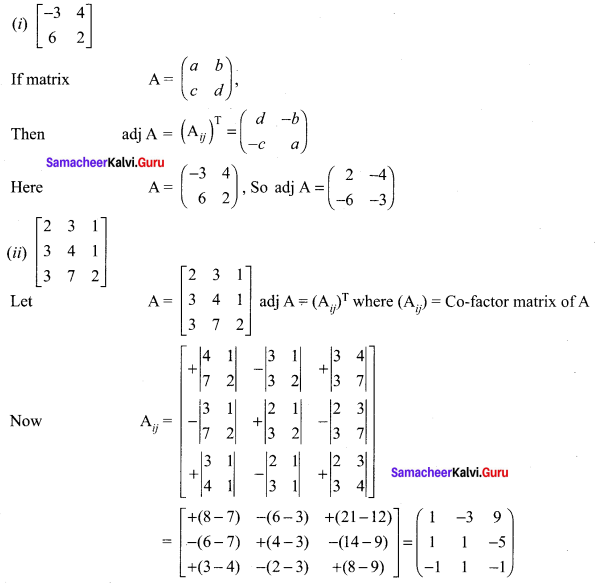
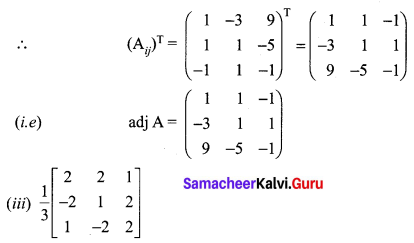
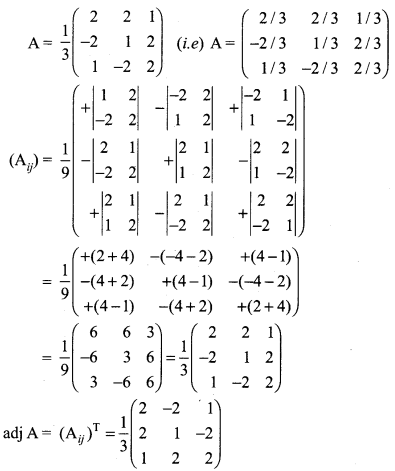
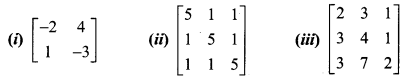
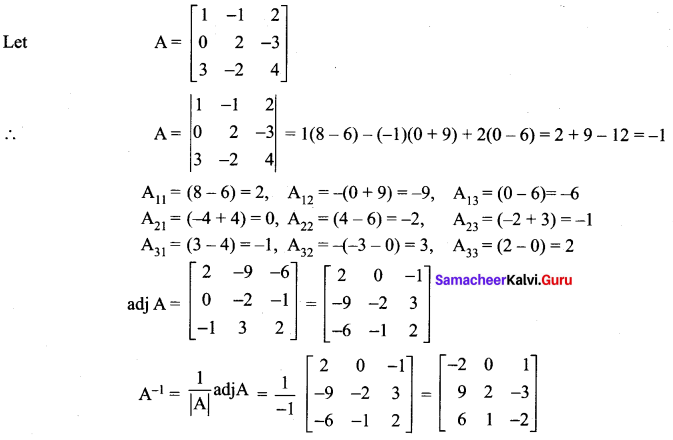
Find the adjoint of the following:
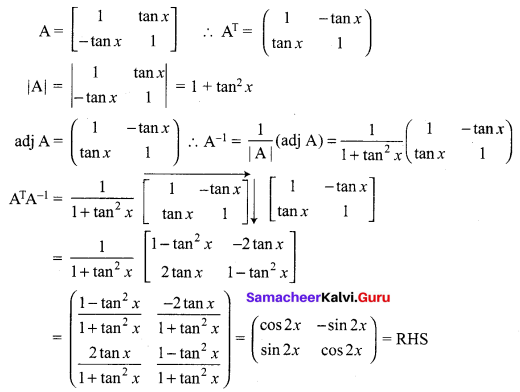
Samacheer Kalvi 12th Maths Solutions Chapter 1 Applications of Matrices and Determinants Ex 1.1 Q1
Solution:
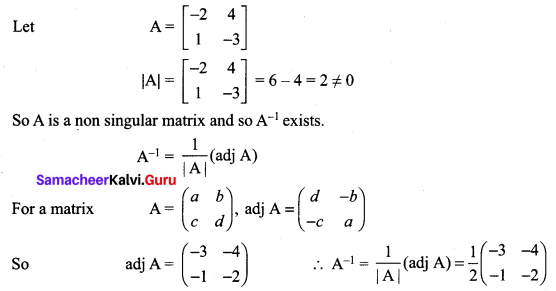
Samacheer Kalvi 12th Maths Solutions Chapter 1 Applications of Matrices and Determinants Ex 1.1 Q1.1
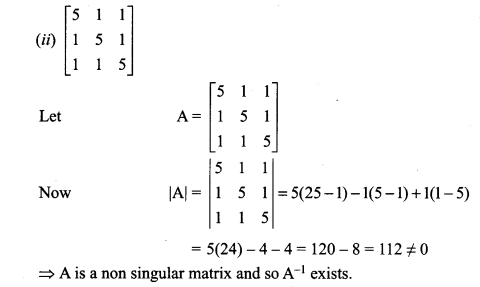
Samacheer Kalvi 12th Maths Solutions Chapter 1 Applications of Matrices and Determinants Ex 1.1 Q1.2
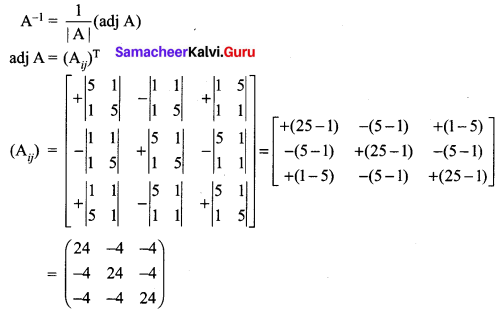
Samacheer Kalvi 12th Maths Solutions Chapter 1 Applications of Matrices and Determinants Ex 1.1 Q1.3

Samacheer Kalvi 12th Maths Solutions Chapter 1 Applications of Matrices and Determinants Ex 1.1

Question 2.
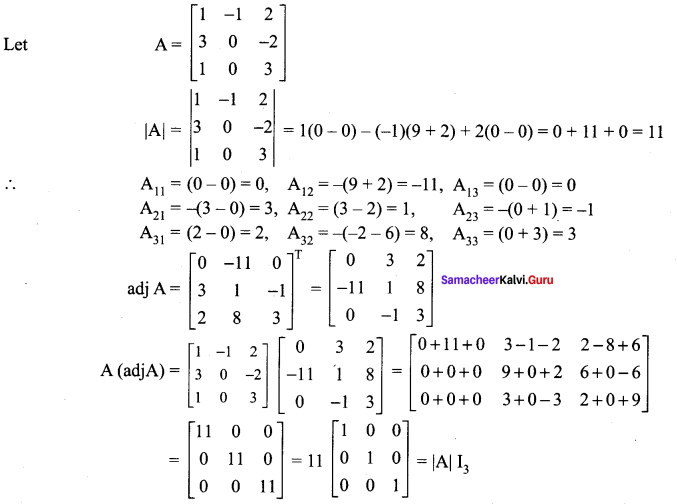
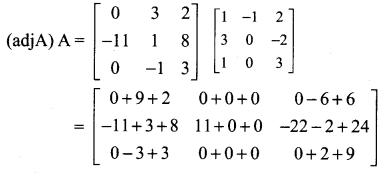
Find the inverse (if it exists) of the following:
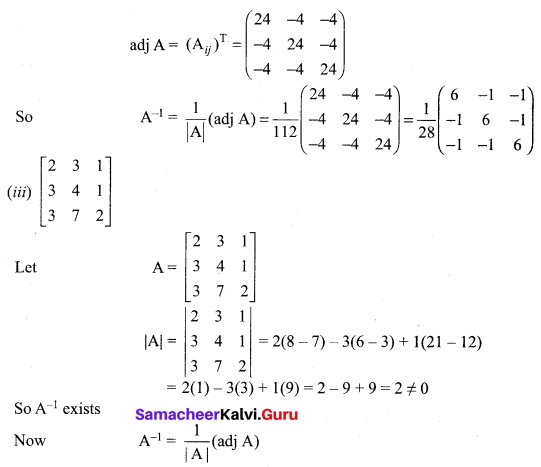
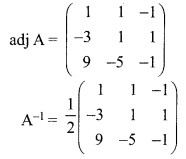
Samacheer Kalvi 12th Maths Solutions Chapter 1 Applications of Matrices and Determinants Ex 1.1 Q2
Solution:
For a matrix A, \(\mathrm{A}^{-1}=\frac{1}{|\mathrm{A}|}(\mathrm{adj} \mathrm{A})\). Where |A| ≠ 0. If |A| = 0 then A is called a singular matrix and so \(\mathrm{A}^{-1}\) does not exist.
Samacheer Kalvi 12th Maths Solutions Chapter 1 Applications of Matrices and Determinants Ex 1.1 Q2.1
Samacheer Kalvi 12th Maths Solutions Chapter 1 Applications of Matrices and Determinants Ex 1.1 Q2.2
Samacheer Kalvi 12th Maths Solutions Chapter 1 Applications of Matrices and Determinants Ex 1.1 Q2.3
Samacheer Kalvi 12th Maths Solutions Chapter 1 Applications of Matrices and Determinants Ex 1.1 Q2.4
Samacheer Kalvi 12th Maths Solutions Chapter 1 Applications of Matrices and Determinants Ex 1.1 Q2.5

Question 3.
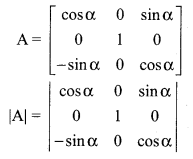
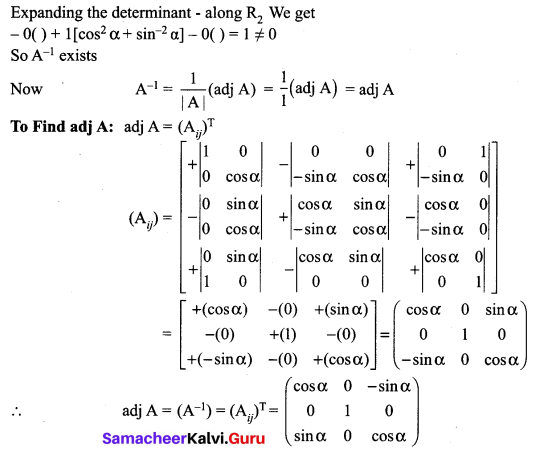
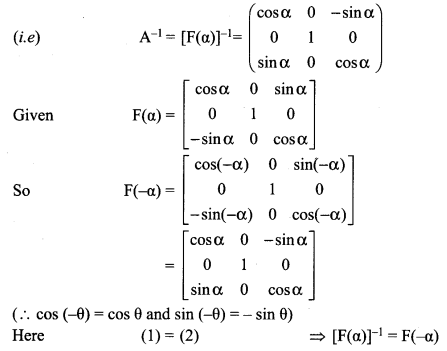
If F(α) = \(\left[\begin{array}{ccc}{\cos \alpha} & {0} & {\sin \alpha} \\ {0} & {1} & {0} \\ {-\sin \alpha} & {0} & {\cos \alpha}\end{array}\right]\) show that \([\mathrm{F}(\alpha)]^{-1}=\mathrm{F}(-\alpha)\)
Solution:
Let A = F (α)
So \([\mathrm{F}(\alpha)]^{-1}=\mathrm{A}^{-1}\)
Now
Samacheer Kalvi 12th Maths Solutions Chapter 1 Applications of Matrices and Determinants Ex 1.1 Q3
Samacheer Kalvi 12th Maths Solutions Chapter 1 Applications of Matrices and Determinants Ex 1.1 Q3.1
Samacheer Kalvi 12th Maths Solutions Chapter 1 Applications of Matrices and Determinants Ex 1.1 Q3.2

Samacheer Kalvi 12th Maths Solutions Chapter 1 Applications of Matrices and Determinants Ex 1.1

Question 4.
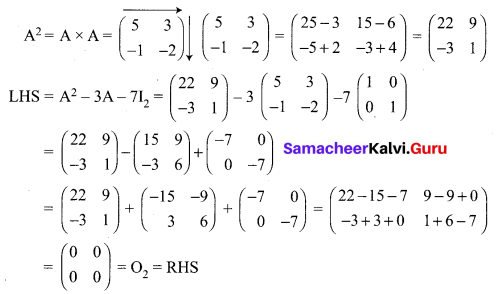
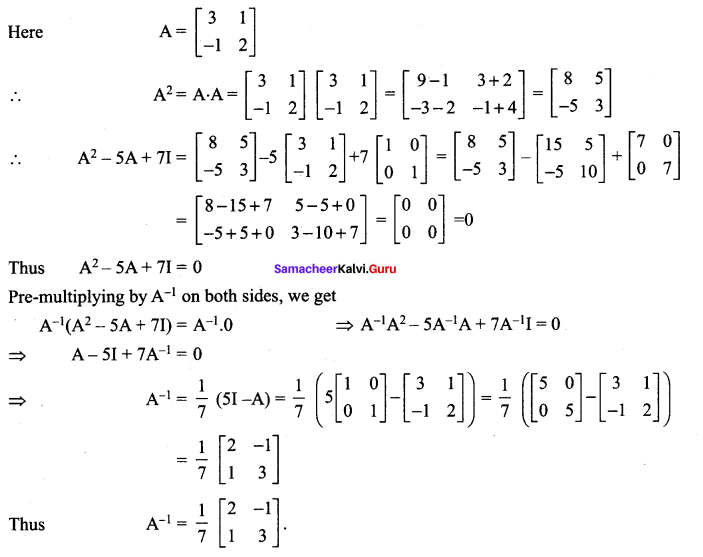
If A = \(\left[\begin{array}{cc}{5} & {3} \\ {-1} & {-2}\end{array}\right]\) show that A2 – 3A – 7I2 = O2. Hence find A-1.
Solution:
A = \(\left[\begin{array}{cc}{5} & {3} \\ {-1} & {-2}\end{array}\right]\)
Samacheer Kalvi 12th Maths Solutions Chapter 1 Applications of Matrices and Determinants Ex 1.1 Q4
To Find A-1
Now we have proved that A2 – 3A – 7I2 = O2
Post multiply by A-1 we get
A – 3I – 7A-1 = O2
Samacheer Kalvi 12th Maths Solutions Chapter 1 Applications of Matrices and Determinants Ex 1.1 Q4.1

Question 5.
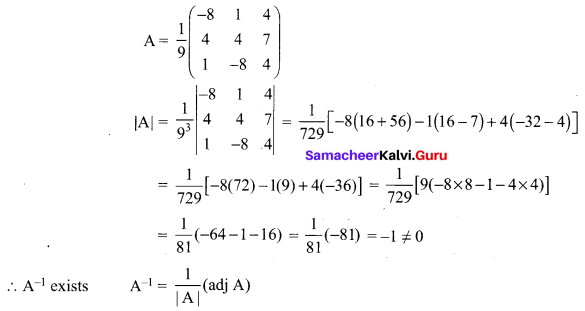
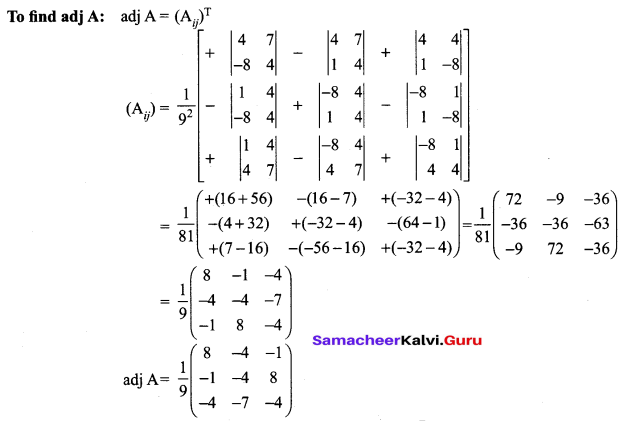
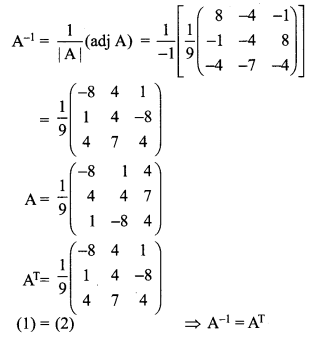
If \(\mathbf{A}=\frac{1}{9}\left[\begin{array}{ccc}{-8} & {1} & {4} \\ {4} & {4} & {7} \\ {1} & {-8} & {4}\end{array}\right]\) prove that A-1 = AT
Solution:
Samacheer Kalvi 12th Maths Solutions Chapter 1 Applications of Matrices and Determinants Ex 1.1 Q5
Samacheer Kalvi 12th Maths Solutions Chapter 1 Applications of Matrices and Determinants Ex 1.1 Q5.1
Samacheer Kalvi 12th Maths Solutions Chapter 1 Applications of Matrices and Determinants Ex 1.1 Q5.2

Question 6.
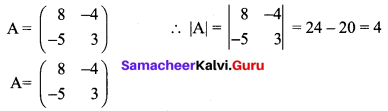
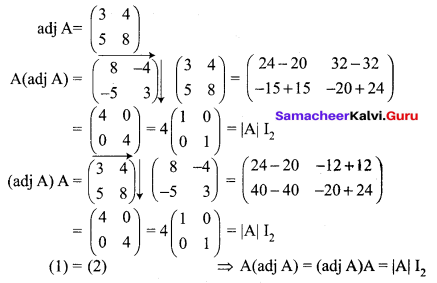
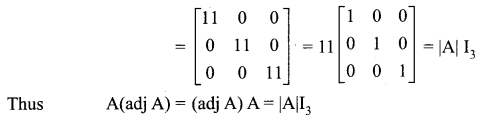
If \(\mathbf{A}=\left[\begin{array}{rr}{8} & {-4} \\ {-5} & {3}\end{array}\right]\), verify that A(adj A) = (adj A)A = |A| I2
Solution:
Samacheer Kalvi 12th Maths Solutions Chapter 1 Applications of Matrices and Determinants Ex 1.1 Q6
Samacheer Kalvi 12th Maths Solutions Chapter 1 Applications of Matrices and Determinants Ex 1.1 Q6.1

Question 7.
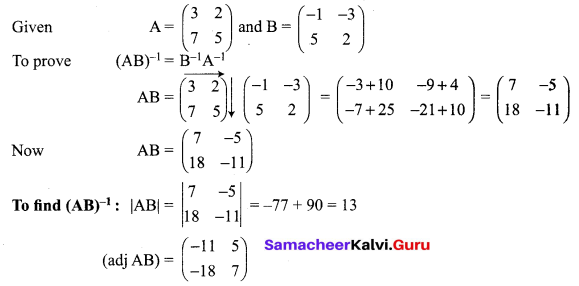
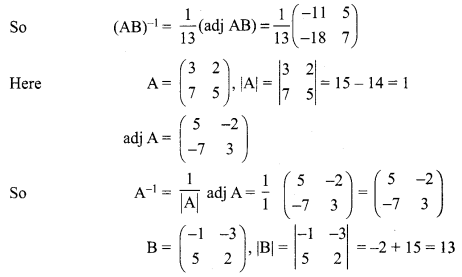
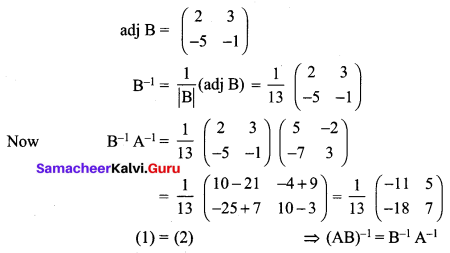
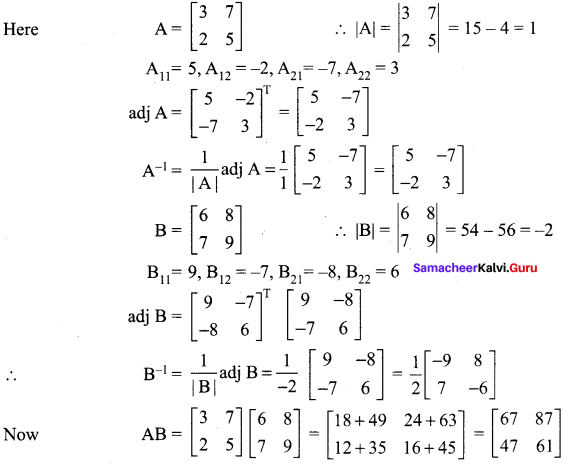
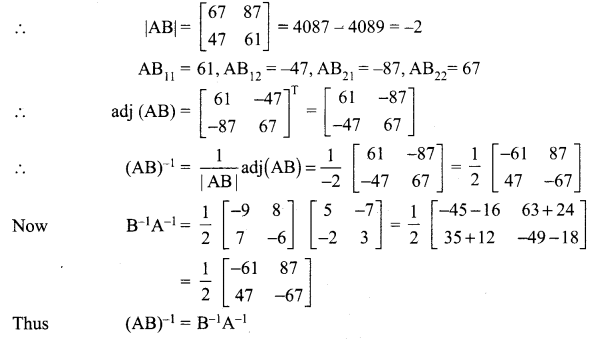
If \(\mathbf{A}=\left[\begin{array}{ll}{3} & {2} \\ {7} & {5}\end{array}\right]\), and \(\mathbf{B}=\left[\begin{array}{cc}{-1} & {-3} \\ {5} & {2}\end{array}\right]\) verify that (AB)-1 = B-1 A-1.
Solution:
Samacheer Kalvi 12th Maths Solutions Chapter 1 Applications of Matrices and Determinants Ex 1.1 Q7
Samacheer Kalvi 12th Maths Solutions Chapter 1 Applications of Matrices and Determinants Ex 1.1 Q7.1
Samacheer Kalvi 12th Maths Solutions Chapter 1 Applications of Matrices and Determinants Ex 1.1 Q7.2

Samacheer Kalvi 12th Maths Solutions Chapter 1 Applications of Matrices and Determinants Ex 1.1

Question 8.
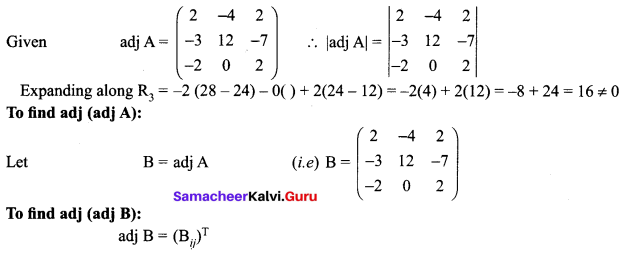
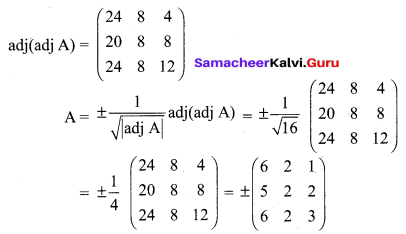
If adj (A) = \(\left[\begin{array}{ccc}{2} & {-4} & {2} \\ {-3} & {12} & {-7} \\ {-2} & {0} & {2}\end{array}\right]\) find A
Solution:
Samacheer Kalvi 12th Maths Solutions Chapter 1 Applications of Matrices and Determinants Ex 1.1 Q8
Samacheer Kalvi 12th Maths Solutions Chapter 1 Applications of Matrices and Determinants Ex 1.1 Q8.1
Samacheer Kalvi 12th Maths Solutions Chapter 1 Applications of Matrices and Determinants Ex 1.1 Q8.2

Question 9.
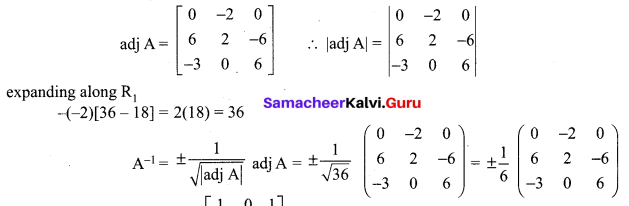
If adj(A) = \(\left[\begin{array}{ccc}{0} & {-2} & {0} \\ {6} & {2} & {-6} \\ {-3} & {0} & {6}\end{array}\right]\) find A-1
Solution:
Samacheer Kalvi 12th Maths Solutions Chapter 1 Applications of Matrices and Determinants Ex 1.1 Q9

Question 10.
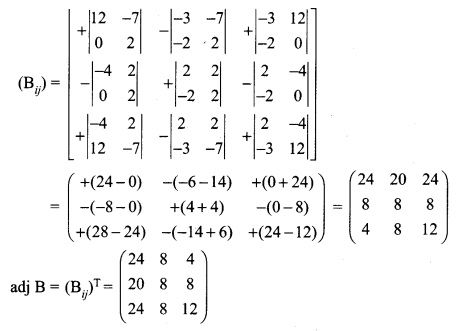
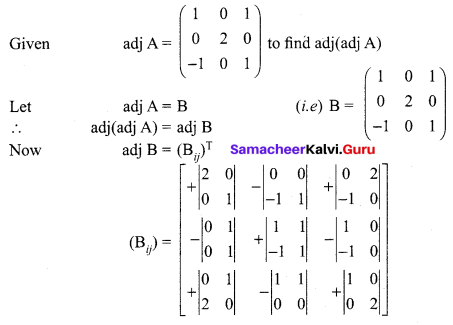
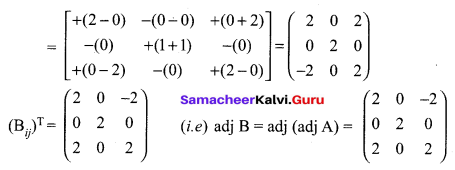
Find adj(adj(A)) if adj A = \(\left[\begin{array}{ccc}{1} & {0} & {1} \\ {0} & {2} & {0} \\ {-1} & {0} & {1}\end{array}\right]\)
Solution:
Samacheer Kalvi 12th Maths Solutions Chapter 1 Applications of Matrices and Determinants Ex 1.1 Q10
Samacheer Kalvi 12th Maths Solutions Chapter 1 Applications of Matrices and Determinants Ex 1.1 Q10.1

Question 11.
Samacheer Kalvi 12th Maths Solutions Chapter 1 Applications of Matrices and Determinants Ex 1.1 Q11
Solution:
Samacheer Kalvi 12th Maths Solutions Chapter 1 Applications of Matrices and Determinants Ex 1.1 Q11.1

Question 12.
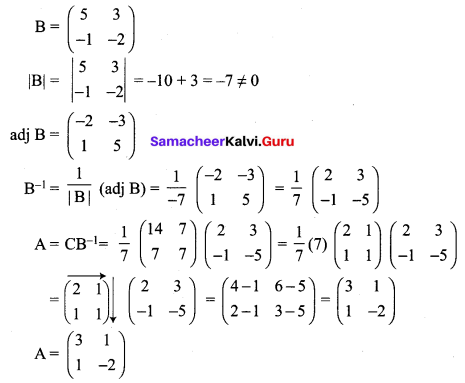
Find the matrix A for which A \(\left[\begin{array}{cc}{5} & {3} \\ {-1} & {-2}\end{array}\right]=\left[\begin{array}{cc}{14} & {7} \\ {7} & {7}\end{array}\right]\)
Solution:
Given A \(\left[\begin{array}{cc}{5} & {3} \\ {-1} & {-2}\end{array}\right]=\left[\begin{array}{cc}{14} & {7} \\ {7} & {7}\end{array}\right]\)
Let \(\mathrm{B}=\left(\begin{array}{cc}{5} & {3} \\ {-1} & {-2}\end{array}\right) \text { and } \mathrm{C}=\left(\begin{array}{cc}{14} & {7} \\ {7} & {7}\end{array}\right)\)
Given AB = C, To find A
Now AB = C
Post multiply by B-1 on both sides
ABB-1 = CB-1 (i.e) A (BB-1) = CB-1
⇒ A(I) = CB-1 (i.e) A = CB-1
To find B-1:
Samacheer Kalvi 12th Maths Solutions Chapter 1 Applications of Matrices and Determinants Ex 1.1 Q12

Question 13.
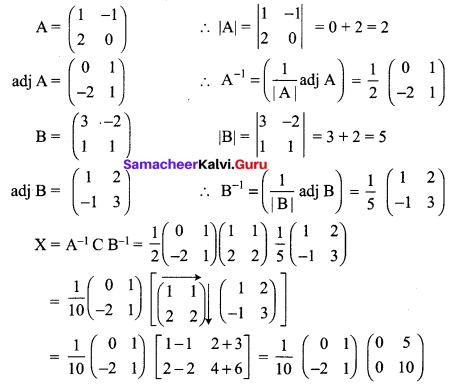
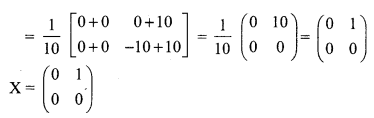
Given \(\mathbf{A}=\left[\begin{array}{cc}{1} & {-1} \\ {2} & {0}\end{array}\right], \mathbf{B}=\left[\begin{array}{cc}{3} & {-2} \\ {1} & {1}\end{array}\right] \text { and } \mathbf{C}\left[\begin{array}{ll}{1} & {1} \\ {2} & {2}\end{array}\right]\), find a matrix X such that AXB = C.
Solution:
A × B = C
Pre multiply by A-1 and post multiply by B-1 we get
A-1 A × BB-1 = A-1CB-1 (i.e) X = A-1CB-1
Samacheer Kalvi 12th Maths Solutions Chapter 1 Applications of Matrices and Determinants Ex 1.1 Q13
Samacheer Kalvi 12th Maths Solutions Chapter 1 Applications of Matrices and Determinants Ex 1.1 Q13.1

Question 14.
Samacheer Kalvi 12th Maths Solutions Chapter 1 Applications of Matrices and Determinants Ex 1.1 Q14
Solution:
Samacheer Kalvi 12th Maths Solutions Chapter 1 Applications of Matrices and Determinants Ex 1.1 Q14.1
Samacheer Kalvi 12th Maths Solutions Chapter 1 Applications of Matrices and Determinants Ex 1.1 Q14.2
Samacheer Kalvi 12th Maths Solutions Chapter 1 Applications of Matrices and Determinants Ex 1.1 Q14.3

Samacheer Kalvi 12th Maths Solutions Chapter 1 Applications of Matrices and Determinants Ex 1.1

Question 15.
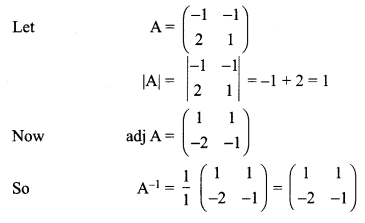
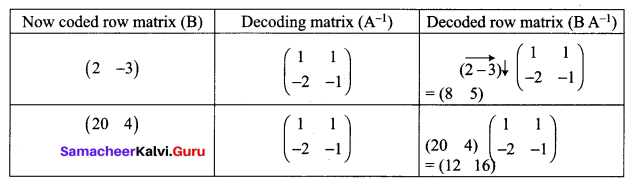
Decrypt the received encoded message \(\left[\begin{array}{cc}{2} & {-3}\end{array}\right]\left[\begin{array}{ll}{20} & {4}\end{array}\right]\) with the encryption matrix \(\left[\begin{array}{cc}{-1} & {-1} \\ {2} & {1}\end{array}\right]\) and the decryption matrix as its inverse, where the system of codes are described by the numbers 1-26 to the letters A- Z respectively, and the number 0 to a blank space.
Solution:
Let the encoding matrix be \(\left[\begin{array}{cc}{-1} & {-1} \\ {2} & {1}\end{array}\right]\)
Samacheer Kalvi 12th Maths Solutions Chapter 1 Applications of Matrices and Determinants Ex 1.1 Q15
Samacheer Kalvi 12th Maths Solutions Chapter 1 Applications of Matrices and Determinants Ex 1.1 Q15.1
So the sequence of decoded matrices is [8 5], [12 16].
Thus the receivers read this message as HELP.

Samacheer Kalvi 12th Maths Solutions Chapter 1 Applications of Matrices and Determinants Ex 1.1 Additional Problems

Question 1.
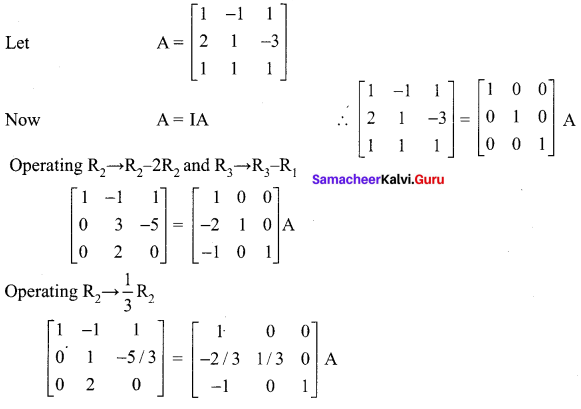
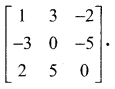
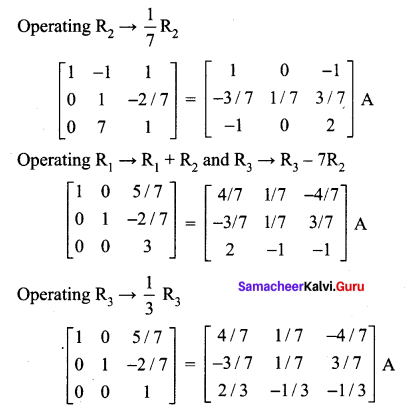
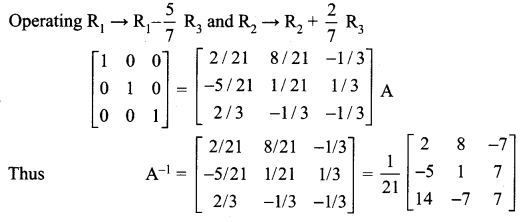
Using elementary transformations find the inverse of the following matrix Samacheer Kalvi 12th Maths Solutions Chapter 1 Applications of Matrices and Determinants Ex 1.1 1
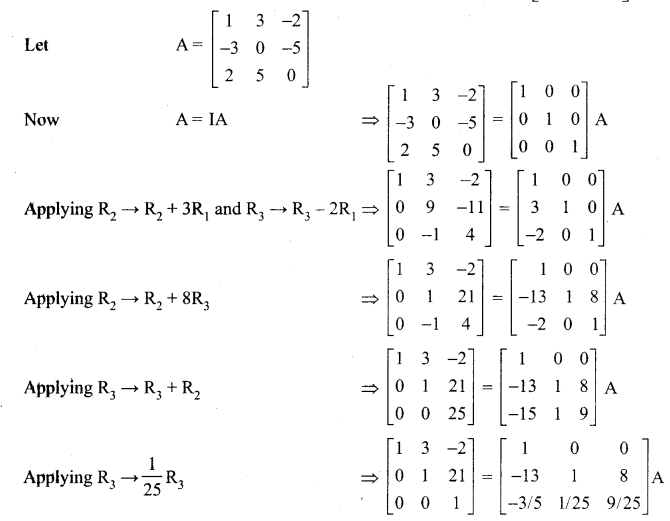
Solution:
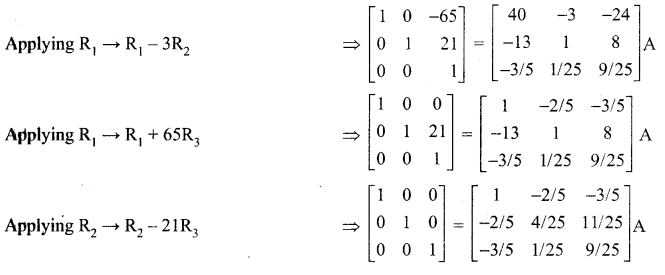
Samacheer Kalvi 12th Maths Solutions Chapter 1 Applications of Matrices and Determinants Ex 1.1 2

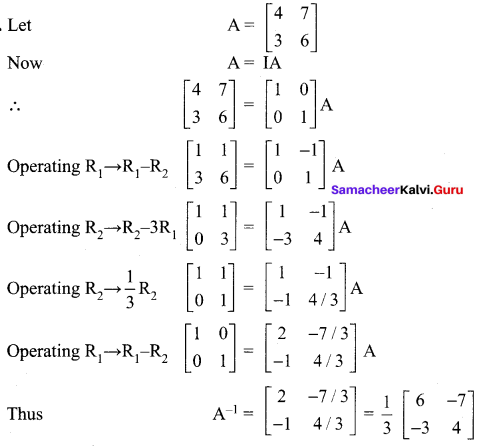
Question 2.
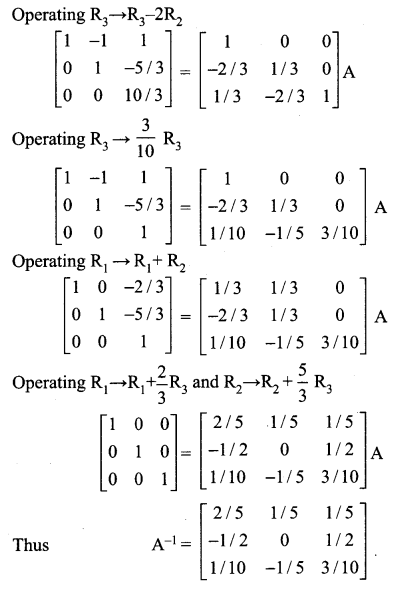
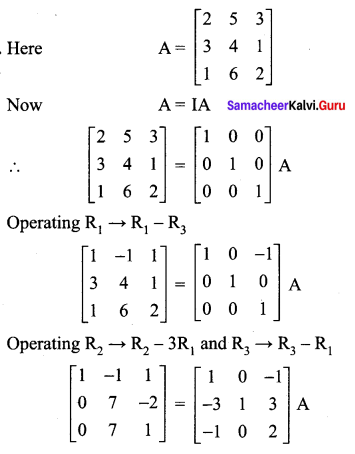
Using elementary transformations find the inverse of the matrix Samacheer Kalvi 12th Maths Solutions Chapter 1 Applications of Matrices and Determinants Ex 1.1 22
Solution:
Samacheer Kalvi 12th Maths Solutions Chapter 1 Applications of Matrices and Determinants Ex 1.1 3
Samacheer Kalvi 12th Maths Solutions Chapter 1 Applications of Matrices and Determinants Ex 1.1 4

Samacheer Kalvi 12th Maths Solutions Chapter 1 Applications of Matrices and Determinants Ex 1.1

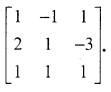
Question 3.
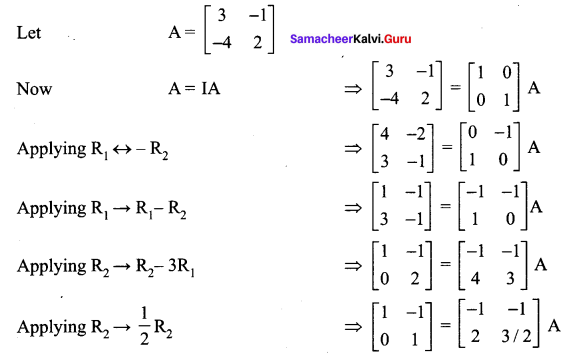
Using elementary transformation find the inverse of the matrix Samacheer Kalvi 12th Maths Solutions Chapter 1 Applications of Matrices and Determinants Ex 1.1 5
Solution:
Samacheer Kalvi 12th Maths Solutions Chapter 1 Applications of Matrices and Determinants Ex 1.1 245
Samacheer Kalvi 12th Maths Solutions Chapter 1 Applications of Matrices and Determinants Ex 1.1 6

Question 4.
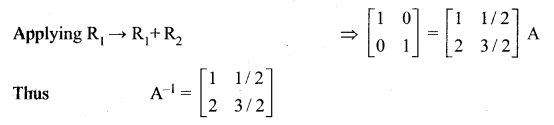
Using elementary transformations find the inverse of the matrix Samacheer Kalvi 12th Maths Solutions Chapter 1 Applications of Matrices and Determinants Ex 1.1 7
Solution:
Samacheer Kalvi 12th Maths Solutions Chapter 1 Applications of Matrices and Determinants Ex 1.1 8
Samacheer Kalvi 12th Maths Solutions Chapter 1 Applications of Matrices and Determinants Ex 1.1 77
Samacheer Kalvi 12th Maths Solutions Chapter 1 Applications of Matrices and Determinants Ex 1.1 9

Question 5.
Using elementary transformation, find the inverse of the following matrix Samacheer Kalvi 12th Maths Solutions Chapter 1 Applications of Matrices and Determinants Ex 1.1 10
Solution:
Samacheer Kalvi 12th Maths Solutions Chapter 1 Applications of Matrices and Determinants Ex 1.1 11
Samacheer Kalvi 12th Maths Solutions Chapter 1 Applications of Matrices and Determinants Ex 1.1 12
Samacheer Kalvi 12th Maths Solutions Chapter 1 Applications of Matrices and Determinants Ex 1.1 13

Question 6.
Samacheer Kalvi 12th Maths Solutions Chapter 1 Applications of Matrices and Determinants Ex 1.1 14
Solution:
Samacheer Kalvi 12th Maths Solutions Chapter 1 Applications of Matrices and Determinants Ex 1.1 15
Samacheer Kalvi 12th Maths Solutions Chapter 1 Applications of Matrices and Determinants Ex 1.1 16
Samacheer Kalvi 12th Maths Solutions Chapter 1 Applications of Matrices and Determinants Ex 1.1 17

Question 7.
Samacheer Kalvi 12th Maths Solutions Chapter 1 Applications of Matrices and Determinants Ex 1.1 18
Solution:
Samacheer Kalvi 12th Maths Solutions Chapter 1 Applications of Matrices and Determinants Ex 1.1 19
Samacheer Kalvi 12th Maths Solutions Chapter 1 Applications of Matrices and Determinants Ex 1.1 20

Samacheer Kalvi 12th Maths Solutions Chapter 1 Applications of Matrices and Determinants Ex 1.1

Question 8.
Samacheer Kalvi 12th Maths Solutions Chapter 1 Applications of Matrices and Determinants Ex 1.1 21
Solution:
Samacheer Kalvi 12th Maths Solutions Chapter 1 Applications of Matrices and Determinants Ex 1.1 222

Question 9.
Samacheer Kalvi 12th Maths Solutions Chapter 1 Applications of Matrices and Determinants Ex 1.1 23
Solution:
Samacheer Kalvi 12th Maths Solutions Chapter 1 Applications of Matrices and Determinants Ex 1.1 244
Samacheer Kalvi 12th Maths Solutions Chapter 1 Applications of Matrices and Determinants Ex 1.1 25
Samacheer Kalvi 12th Maths Solutions Chapter 1 Applications of Matrices and Determinants Ex 1.1 26

Samacheer Kalvi 12th Maths Solutions Chapter 1 Applications of Matrices and Determinants Ex 1.1

Question 10.
Samacheer Kalvi 12th Maths Solutions Chapter 1 Applications of Matrices and Determinants Ex 1.1 28
Solution:
Samacheer Kalvi 12th Maths Solutions Chapter 1 Applications of Matrices and Determinants Ex 1.1 29

Samacheer Kalvi 12th Maths Solutions Chapter 1 Applications of Matrices and Determinants Ex 1.1 Read More »

Samacheer Kalvi 12th English Expand the News Headlines

Students can Download Samacheer Kalvi 12th English Expand the News Headlines, Notes, Samacheer Kalvi 12th English Book Solutions Guide Pdf helps you to revise the complete Tamilnadu State Board New Syllabus and score more marks in your examinations.

Tamilnadu Samacheer Kalvi 12th English Expand the News Headlines

1. Saina Receives Khel Ratna Award
New Delhi: Badminton ace Saina Nehwal, whose phenomenal rise was highlighted by three top-flight international titles, recently, was on Sunday conferred the coveted Rajiv Gandhi Khel Ratna award at a glittering ceremony here on Sunday. Saina’s achievements in the past one year made her an automatic choice for the prestigious award, the highest sporting honour in the country.

Samacheer Kalvi 12th English Expand the News Headlines

2. Forgotten Brother Appears
Jharkhand: A forgotten brother has appeared after a long period of time.Mr.Ranjan and Mr. Anjan were reunited after the latter went missing in a Mela at Jharkand. They are united after 43 long years. Mr. Ranjan was taken care of by a local NGO and has a success story to narrate.

3. Maid Wins Maruti Car as Prize
Trichy: The fortune of a house-maid today changed when she won Maruti car as a prize in the local mela raffle. As she has no one to drive the car in her family, she decided to sell it. However, Mr. Ramakrishnan in whose house she works as a house maid, suggested that she rents it out to earn an extra amount for her family.

4. Crores Approved
Trichy:The municipality has launched a comprehensive drive, at a cost of Rs. 1.41 crore, to clean drainage-canal-tumed irrigation canals, meandering through the town, ahead of the Mahamaham festival.The effort would provide a fresh lease of life to five canals that were once irrigation channels but over the decades got transformed into drainage channels. A lot of development works were being undertaken; the town was being given a facelift ahead of the festival.Public sanitation has been accorded priority, she added.

Samacheer Kalvi 12th English Expand the News Headlines

5. Passerby Sees Woman Jump
ChennaiiA passerby reportedly stopped a woman from jumping off a pedestrian bridge at the Kotturpuram bus stop on Saturday. It is understood that some family duel is the reason for her drastic decision. The woman climbed over the guardrail and sat on it. Some passersby joined hands and forced her to come down.Suicidal Prevention Centre was informed.

6. Difficult Times Ahead
New Delhi: The Finance Minister has predicted difficult times for the Indian Economy in the years ahead. As he enters the final year of the government’s term, he is probably facing as many – if not more – economic problems as he did when he took charge. In fact, one would say if the BJP returns to power, Prime Minister Modi will have to work even harder than he did in his first term to keep the economy on an even keel.

7. Professors Protest Pay Cuts
New Delhi: Days after warning them, the administration of the Jawaharlal Nehru University (JNU) has decided to deduct the salaries of the teachers for participating in protests. The teachers protested against the administration’s decision to scrap the old recruitment and admission policy as well as the multiple show-cause notices against students and teachers. The university’s administration has banned any kind of protest within 20 meters of the building.

Samacheer Kalvi 12th English Expand the News Headlines

8. Tommy The Dog Named Hero
New Delhi: Tommy,the popular dog from Chennai was declared the hero at The Canine Meet held at Delhi. The owner Vijay Prabhakar, says that he has hired Dog trainers from far and wide to train his dogs and this is the second National award for Tommy. Tommy is expected to take part in the International Canine meet in 2020.

9. President Declares Celebration
Mumbai: The President of India, Shri Ram NathKovind, graced and addressed a function organised to declare urban Maharashtra Open. He also inaugurated the centenary year celebrations of the Samadhi of Shri Sai Baba in Shirdi. He was felicitated by the local party members.

10. Security Alert In Bhopal
Bhopal: In the city of Bhopal, after receiving two anonymous calls, police department is on the alert day and night.Bhopal is on the radar of the terrorist outfits. Taking serious note of the intelligence given previously, the State police headquarters has sounded a high alert in the city.

Samacheer Kalvi 12th English Expand the News Headlines

Samacheer Kalvi 12th English Expand the News Headlines Read More »

Samacheer Kalvi 12th Maths Solutions Chapter 10 Ordinary Differential Equations Ex 10.1

You can Download Samacheer Kalvi 12th Maths Book Solutions Guide Pdf, Tamilnadu State Board help you to revise the complete Syllabus and score more marks in your examinations.

Tamilnadu Samacheer Kalvi 12th Maths Solutions Chapter 10 Ordinary Differential Equations Ex 10.1

Question 1.
For each of the following differential equations, determine its order, degree (if exists)
Samacheer Kalvi 12th Maths Solutions Chapter 10 Ordinary Differential Equations Ex 10.1 1
Solution:
Order = 1,
Degree = 1

(ii) Samacheer Kalvi 12th Maths Solutions Chapter 10 Ordinary Differential Equations Ex 10.1 2
Solution:
Samacheer Kalvi 12th Maths Solutions Chapter 10 Ordinary Differential Equations Ex 10.1 3

Samacheer Kalvi 12th Maths Solutions Chapter 10 Ordinary Differential Equations Ex 10.1

(iii) Samacheer Kalvi 12th Maths Solutions Chapter 10 Ordinary Differential Equations Ex 10.1 4
Solution:
Samacheer Kalvi 12th Maths Solutions Chapter 10 Ordinary Differential Equations Ex 10.1 5

(iv) Samacheer Kalvi 12th Maths Solutions Chapter 10 Ordinary Differential Equations Ex 10.1 6
Solution:
Samacheer Kalvi 12th Maths Solutions Chapter 10 Ordinary Differential Equations Ex 10.1 7

(v) Samacheer Kalvi 12th Maths Solutions Chapter 10 Ordinary Differential Equations Ex 10.1 8
Solution:
Samacheer Kalvi 12th Maths Solutions Chapter 10 Ordinary Differential Equations Ex 10.1 9

Samacheer Kalvi 12th Maths Solutions Chapter 10 Ordinary Differential Equations Ex 10.1

(vi) Samacheer Kalvi 12th Maths Solutions Chapter 10 Ordinary Differential Equations Ex 10.1 10
Solution:
Samacheer Kalvi 12th Maths Solutions Chapter 10 Ordinary Differential Equations Ex 10.1 11

(vii) Samacheer Kalvi 12th Maths Solutions Chapter 10 Ordinary Differential Equations Ex 10.1 12
Solution:
Samacheer Kalvi 12th Maths Solutions Chapter 10 Ordinary Differential Equations Ex 10.1 13

(viii) Samacheer Kalvi 12th Maths Solutions Chapter 10 Ordinary Differential Equations Ex 10.1 14
Solution:
Order = 2
Samacheer Kalvi 12th Maths Solutions Chapter 10 Ordinary Differential Equations Ex 10.1 15

(ix) Samacheer Kalvi 12th Maths Solutions Chapter 10 Ordinary Differential Equations Ex 10.1 16
Solution:
Samacheer Kalvi 12th Maths Solutions Chapter 10 Ordinary Differential Equations Ex 10.1 17

(x) Samacheer Kalvi 12th Maths Solutions Chapter 10 Ordinary Differential Equations Ex 10.1 18
Solution:
Samacheer Kalvi 12th Maths Solutions Chapter 10 Ordinary Differential Equations Ex 10.1 19
Order = 1,
degree = Not exist

Samacheer Kalvi 12th Maths Solutions Chapter 10 Ordinary Differential Equations Ex 10.1

Samacheer Kalvi 12th Maths Solutions Chapter 10 Ordinary Differential Equations Ex 10.1 Additional Problems

Question 1.
Find the order and degree of the following differential equations:
Samacheer Kalvi 12th Maths Solutions Chapter 10 Ordinary Differential Equations Ex 10.1 20
Solution:
Order = 1,
Degree = 1
Samacheer Kalvi 12th Maths Solutions Chapter 10 Ordinary Differential Equations Ex 10.1 21

(ii) y’ + y2 + y3 = 0
Solution:
Order = 1,
Degree = 1
Samacheer Kalvi 12th Maths Solutions Chapter 10 Ordinary Differential Equations Ex 10.1 22

Samacheer Kalvi 12th Maths Solutions Chapter 10 Ordinary Differential Equations Ex 10.1

(iii) Samacheer Kalvi 12th Maths Solutions Chapter 10 Ordinary Differential Equations Ex 10.1 23
Solution:
Samacheer Kalvi 12th Maths Solutions Chapter 10 Ordinary Differential Equations Ex 10.1 24

(iv) Samacheer Kalvi 12th Maths Solutions Chapter 10 Ordinary Differential Equations Ex 10.1 25
Solution:
Samacheer Kalvi 12th Maths Solutions Chapter 10 Ordinary Differential Equations Ex 10.1 26
∴ Order = 2
Degree = 2

(v) Samacheer Kalvi 12th Maths Solutions Chapter 10 Ordinary Differential Equations Ex 10.1 27
Solution:
Samacheer Kalvi 12th Maths Solutions Chapter 10 Ordinary Differential Equations Ex 10.1 28
Samacheer Kalvi 12th Maths Solutions Chapter 10 Ordinary Differential Equations Ex 10.1 29

Samacheer Kalvi 12th Maths Solutions Chapter 10 Ordinary Differential Equations Ex 10.1

(vi) Samacheer Kalvi 12th Maths Solutions Chapter 10 Ordinary Differential Equations Ex 10.1 30
Solution:
Samacheer Kalvi 12th Maths Solutions Chapter 10 Ordinary Differential Equations Ex 10.1 31

(vii) Samacheer Kalvi 12th Maths Solutions Chapter 10 Ordinary Differential Equations Ex 10.1 32
Solution:
Samacheer Kalvi 12th Maths Solutions Chapter 10 Ordinary Differential Equations Ex 10.1 33

(viii) Samacheer Kalvi 12th Maths Solutions Chapter 10 Ordinary Differential Equations Ex 10.1 34
Solution:
Samacheer Kalvi 12th Maths Solutions Chapter 10 Ordinary Differential Equations Ex 10.1 35

Samacheer Kalvi 12th Maths Solutions Chapter 10 Ordinary Differential Equations Ex 10.1

(ix) Samacheer Kalvi 12th Maths Solutions Chapter 10 Ordinary Differential Equations Ex 10.1 36
Solution:
Samacheer Kalvi 12th Maths Solutions Chapter 10 Ordinary Differential Equations Ex 10.1 37

(x) sin x(dx + dy) = cos x(dx – dy)
Solution:
Order = 1;
Degree = 1

Samacheer Kalvi 12th Maths Solutions Chapter 10 Ordinary Differential Equations Ex 10.1 Read More »

Samacheer Kalvi 12th Maths Solutions Chapter 2 Complex Numbers Ex 2.8

You can Download Samacheer Kalvi 12th Maths Book Solutions Guide Pdf, Tamilnadu State Board help you to revise the complete Syllabus and score more marks in your examinations.

Tamilnadu Samacheer Kalvi 12th Maths Solutions Chapter 2 Complex Numbers Ex 2.8

Question 1.
If to ω ≠ 1 is a cube root of unity, then show that \(\frac{a+b \omega+c \omega^{2}}{b+c \omega+a \omega^{2}}+\frac{a+b \omega+c \omega^{2}}{c+a \omega+b \omega^{2}}=1\)
Solution:
Since ω is a cube root of unity, we have ω3 = 1 and 1 + ω + ω2 = 0
Samacheer Kalvi 12th Maths Solutions Chapter 2 Complex Numbers Ex 2.8 Q1

Samacheer Kalvi 12th Maths Solutions Chapter 2 Complex Numbers Ex 2.8

Question 2.
Show that \(\left(\frac{\sqrt{3}}{2}+\frac{i}{2}\right)^{5}+\left(\frac{\sqrt{3}}{2}-\frac{i}{2}\right)^{5}=-\sqrt{3}\)
Solution:
Samacheer Kalvi 12th Maths Solutions Chapter 2 Complex Numbers Ex 2.8 Q2
Samacheer Kalvi 12th Maths Solutions Chapter 2 Complex Numbers Ex 2.8 Q2.1

Question 3.
Find the value of \(\left(\frac{1+\sin \frac{\pi}{10}+i \cos \frac{\pi}{10}}{1+\sin \frac{\pi}{10}-i \cos \frac{\pi}{10}}\right)^{10}\)
Solution:
Samacheer Kalvi 12th Maths Solutions Chapter 2 Complex Numbers Ex 2.8 Q3

Question 4.
If 2 cos α = x + \(\frac{1}{x}\) and 2 cos β = y + \(\frac{1}{y}\), show that
Samacheer Kalvi 12th Maths Solutions Chapter 2 Complex Numbers Ex 2.8 Q4
Solution:
(i) 2 cos α = x + \(\frac{1}{x}\)
⇒ 2 cos α = \(\frac{x^{2}+1}{x}\)
⇒ 2x cos α = x2 + 1
⇒ x2 – 2x cos α + 1 = 0
Samacheer Kalvi 12th Maths Solutions Chapter 2 Complex Numbers Ex 2.8 Q4.1
Samacheer Kalvi 12th Maths Solutions Chapter 2 Complex Numbers Ex 2.8 Q4.2
Samacheer Kalvi 12th Maths Solutions Chapter 2 Complex Numbers Ex 2.8 Q4.3

Samacheer Kalvi 12th Maths Solutions Chapter 2 Complex Numbers Ex 2.8

Question 5.
Solve the equation z3 + 27 = 0
Solution:
z3 + 27 = 0
⇒ z3 = -27
⇒ z3 = 33(-1)
⇒ z = 3(-1)1/3
Samacheer Kalvi 12th Maths Solutions Chapter 2 Complex Numbers Ex 2.8 Q5

Question 6.
If ω ≠ 1 is a cube root of unity, show that the roots of the equation (z – 1)3 + 8 = 0 are -1, 1 – 2ω, 1 – 2ω2
Solution:
(z – 1)3 + 8 = 0
⇒ (z – 1 )3 = -8
Samacheer Kalvi 12th Maths Solutions Chapter 2 Complex Numbers Ex 2.8 Q6
The roots are -1, 1 – 2ω, 1 – 2ω2

Question 7.
Find the value of \(\sum_{k=1}^{8}\left(\cos \frac{2 k \pi}{9}+i \sin \frac{2 k \pi}{9}\right)\)
Solution:
\(\sum_{k=1}^{8}\left(\cos \frac{2 k \pi}{9}+i \sin \frac{2 k \pi}{9}\right)\)
We know that 9th roots of unit are 1, ω, ω2, ……., ω8
Sum of the roots:
1 + ω + ω2 + …. + ω8 = 0 ⇒ ω + ω2 + ω3 + …… + ω8 = -1
Samacheer Kalvi 12th Maths Solutions Chapter 2 Complex Numbers Ex 2.8 Q7
The sum of all the terms \(\sum_{k=1}^{8}\left(\cos \frac{2 k \pi}{9}+i \sin \frac{2 k \pi}{9}\right)\) = -1

Question 8.
If ω ≠ 1 is a cube root of unity, show that
(i) (1 – ω + ω2)6 + (1 + ω – ω2)6 = 128
(ii) (1 + ω)(1 + ω2)(1 + ω4)(1 + ω8)……(1 + ω2n) = 1
Solution:
(i) (1 – ω + ω²)6 + (1 + ω – ω²)6
= (-ω + ω)6 + (-ω – ω²)6
= (-2ω)6 + (-2ω²)6
= 26 [ω6 + ω12] [∵ ω6 = 1]
= 64 [1 + 1]
= 64 × 2
= 128
(ii) (1 – ω) (1 + ω²) (1 + ω) (1 + ω2) ….. 2n factors
(-ω²) (-ω) (-ω²) (-ω) ……. 2n factor
(ω³) (ω³) …… 2n factor
= 1.1 …….. 2n factor
= 1

Question 9.
If z = 2 – 2i, find the rotation of z by θ radians in the counter clockwise direction about the origin when
(i) θ = \(\frac{\pi}{3}\)
(ii) θ = \(\frac{2 \pi}{3}\)
(iii) θ = \(\frac{3 \pi}{2}\)
Solution:
(i) z = 2 – 2i = 2 (1 – i) = r(cos θ + i sin θ)
\(r=\sqrt{x^{2}+y^{2}}=2 \sqrt{1+1}=2 \sqrt{2}\)
\(\alpha=\tan ^{-1}=\left|\frac{y}{x}\right|=\tan ^{-1}|1|=\frac{\pi}{4}\)
(1 – i) lies in IV quadrant
θ = -α = \(-\frac{\pi}{4}\)
\(\Rightarrow z=2 \sqrt{2}\left[\cos \left(\frac{-\pi}{4}\right)+i \sin \left(\frac{-\pi}{4}\right)\right]\)
z is rotated by θ = \(\frac{\pi}{3}\) in the counter clock wise direction.
Samacheer Kalvi 12th Maths Solutions Chapter 2 Complex Numbers Ex 2.8 Q9

(ii) z is rotated by θ = \(\frac{2 \pi}{3}\) in the counter clockwise direction.
Samacheer Kalvi 12th Maths Solutions Chapter 2 Complex Numbers Ex 2.8 Q9.1

(iii) z is rotated by θ = \(\frac{3 \pi}{2}\) in the counter clockwise direction.
Samacheer Kalvi 12th Maths Solutions Chapter 2 Complex Numbers Ex 2.8 Q9.2

Samacheer Kalvi 12th Maths Solutions Chapter 2 Complex Numbers Ex 2.8

Question 10.
Prove that the values of \(\sqrt[4]{-1} \text { are } \pm \frac{1}{\sqrt{2}}(1 \pm i)\)
Solution:
Samacheer Kalvi 12th Maths Solutions Chapter 2 Complex Numbers Ex 2.8 Q10
The roots are \(\pm \frac{1}{\sqrt{2}}(1 \pm i)\)

Samacheer Kalvi 12th Maths Solutions Chapter 2 Complex Numbers Ex 2.8 Additional Problems

Question 1.
Samacheer Kalvi 12th Maths Solutions Chapter 2 Complex Numbers Ex 2.8 1
Solution:
Samacheer Kalvi 12th Maths Solutions Chapter 2 Complex Numbers Ex 2.8 2

Question 2.
Samacheer Kalvi 12th Maths Solutions Chapter 2 Complex Numbers Ex 2.8 3
Solution:
Samacheer Kalvi 12th Maths Solutions Chapter 2 Complex Numbers Ex 2.8 4
Samacheer Kalvi 12th Maths Solutions Chapter 2 Complex Numbers Ex 2.8 5

Question 3.
Prove that: (1 + i)4n and (1 + i)4n + 2 are real and purely imaginary respectively.
Solution:
Let z = 1 + i
Samacheer Kalvi 12th Maths Solutions Chapter 2 Complex Numbers Ex 2.8 6
= 2i (-1)n which is purely imaginary.

Samacheer Kalvi 12th Maths Solutions Chapter 2 Complex Numbers Ex 2.8

Question 4.
Samacheer Kalvi 12th Maths Solutions Chapter 2 Complex Numbers Ex 2.8 7
Solution:
Samacheer Kalvi 12th Maths Solutions Chapter 2 Complex Numbers Ex 2.8 8

Question 5.
If a = cos 2α + i sin 2α, b = cos 2β + i sin 2β and c = cos 2γ + i sin 2γ, prove that
Samacheer Kalvi 12th Maths Solutions Chapter 2 Complex Numbers Ex 2.8 9
Solution:
Samacheer Kalvi 12th Maths Solutions Chapter 2 Complex Numbers Ex 2.8 10

Question 6.
Solve: x4 + 4 = 0
Solution:
Samacheer Kalvi 12th Maths Solutions Chapter 2 Complex Numbers Ex 2.8 11

Question 7.
If x = a + b, y = aω + bω2, z = aω2 + bω, show that
(i) xyz = a3 + b3
(ii) x3 + y3 + z3 = 3(a3 + b3)
Solution:
(i) x = a + A; y = aω + bω2, z = aω2 + bω
Now xyz = (a + b) (aω + bω2) (abω2 + bω) = (a+A) [aω3 + abω2 + abω + b2ω3]
= (a + b) (a2 – ab + b2) = a3 + b3
xyz = a3 + b3

(ii) x = a + b, y = aω + bω2, z = aω2 + bω
x + y + z = (a + aω + aω2) + (b + bω2 + bω)
= a (1 + ω + ω2) + b (1 + ω + ω2) = a(0) + b(0) = 0
Now x + y + z = 0 ⇒ x3 + y3 + z3 = 3xyz
Here xyz = a3 + b3
∴ x3 + y3 + z3 = 3 (a3 + b3)

Samacheer Kalvi 12th Maths Solutions Chapter 2 Complex Numbers Ex 2.8 Read More »

Samacheer Kalvi 12th Maths Solutions Chapter 1 Applications of Matrices and Determinants Ex 1.7

You can Download Samacheer Kalvi 12th Maths Book Solutions Guide Pdf, Tamilnadu State Board help you to revise the complete Syllabus and score more marks in your examinations.

Tamilnadu Samacheer Kalvi 12th Maths Solutions Chapter 1 Applications of Matrices and Determinants Ex 1.7

Question 1.
Solve the following system of homogeneous equations.
(i) 3x + 2y + 7z = 0, 4x – 3y – 2z = 0, 5x + 9y + 23z = 0
(ii) 2x + 3y – z = 0, x – y – 2z = 0, 3x + y + 3z = 0
Solution:
(i) The matrix form of the above equations is
Samacheer Kalvi 12th Maths Solutions Chapter 1 Applications of Matrices and Determinants Ex 1.7 Q1
The above matrix is in echelon form.
Here ρ(A, B) = ρ(A) < number of unknowns.
The system is consistent with infinite number of solutions. To find the solutions.
Writing the equivalent equations.
We get 3x + 2y + 7z = 0 ……. (1)
-17y – 34z = 0 ……. (2)
Taking z = t in (2) we get -17y – 34t = 0
⇒ -17y = 34t
⇒ y = -2t
Taking z = t, y = -2t in (1) we get
3x + 2(-2t) + 7t = 0
⇒ 3x – 4t + 7t = 0
⇒ 3x = -3t
⇒ x = -t
So the solution is x = -t; y = -2t; and z = t, t ∈ R
(ii) The matrix form of the equations is
\(\left(\begin{array}{ccc}{2} & {3} & {-1} \\ {1} & {-1} & {-2} \\ {3} & {1} & {3}\end{array}\right)\left(\begin{array}{l}{x} \\ {y} \\ {z}\end{array}\right)=\left(\begin{array}{l}{0} \\ {0} \\ {0}\end{array}\right)\)
(i.e) AX = B
The augmented matrix [A, B] is
Samacheer Kalvi 12th Maths Solutions Chapter 1 Applications of Matrices and Determinants Ex 1.7 Q1.1
The above matrix is in echelon form also ρ(A, B) = ρ(A) = 3 = number of unknowns
The system is consistent with unique solution, x = y = z = 0
(i.e) The system has trivial solution only.

Samacheer Kalvi 12th Maths Solutions Chapter 1 Applications of Matrices and Determinants Ex 1.7

Question 2.
Determine the values of λ for which the following system of equations.
x + y + 3z = 0, 4x + 3y + λz = 0, 2x +y + 2z = 0 has
(i) a unique solution
(ii) a non-trivial solution
Solution:
The matrix form of the equation is
\(\left(\begin{array}{lll}{1} & {1} & {3} \\ {4} & {3} & {\lambda} \\ {2} & {1} & {2}\end{array}\right)\left(\begin{array}{l}{x} \\ {y} \\ {z}\end{array}\right)=\left(\begin{array}{l}{0} \\ {0} \\ {0}\end{array}\right)\)
(i.e) AX = B
The augmented matrix [A, B] is
Samacheer Kalvi 12th Maths Solutions Chapter 1 Applications of Matrices and Determinants Ex 1.7 Q2
The above matrix is in echelon form
Case 1: When λ ≠ 8, ρ(A, B) = ρ(A) = 3 = number of unknowns
The system is consistent with a unique solution.
Case 2: When λ = 8, ρ(A, B) = ρ(A) = 2 < number of unknowns.
The system is consistent with non-trivial solutions.

Question 3.
By using the Gaussian elimination method, balance the chemical reaction equation:
C2H6 + O2 → H2O + CO2
Solution:
We are searching for positive integers x1, x2, x3 and x4 such that
x1C2H6 + x2O2 = x3H2O + x4CO2 ……. (1)
The number of carbon atoms on LHS of (1) should be equal to the number of carbon atoms on the RHS of (1).
So we get a linear homogeneous equation.
2x1 = x4
⇒ 2x1 – x4 = 0 …… (2)
Similarly considering hydrogen and oxygen atoms we get respectively.
2x2 = x3 + 2x4
⇒ 2x2 – x3 – 2x4 = 0 …… (3)
and -2x3+ 3x4 = 0 …… (4)
Equations (2), (3) and (4) constitute a homogeneous system of linear equations in four unknowns.
The augmented matrix (A, B) is
Samacheer Kalvi 12th Maths Solutions Chapter 1 Applications of Matrices and Determinants Ex 1.7 Q3
Now ρ(A, B) = ρ(A) = 3 < number of unknowns.
So the system is consistent and has an infinite number of solutions.
Writing the equations using the echelon form we get
2x1 – x4 = 0 …… (5)
2x2 – x3 – 2x4 = 0 ……. (6)
-2x3 + 3x4 = 0 ……. (7)
Samacheer Kalvi 12th Maths Solutions Chapter 1 Applications of Matrices and Determinants Ex 1.7 Q3.1
Since x1, x2, x3 and x4 are positive integers. Let us choose t = 4t.
Then we get x1 = 2, x2 = 7, x3 = 6, and x4 = 4
So the balanced equation is 2C2H6 + 7O2 → 6H2O + 4CO2.

Samacheer Kalvi 12th Maths Solutions Chapter 1 Applications of Matrices and Determinants Ex 1.7

Samacheer Kalvi 12th Maths Solutions Chapter 1 Applications of Matrices and Determinants Ex 1.7 Additional Problems

Question 1.
Solve the following homogeneous linear equations.
x + 2y – 5z = 0,
3x + 4y + 6z = 0,
x + y + z = 0
Solution:
The given system of equations can be written in the form of matrix equation
Samacheer Kalvi 12th Maths Solutions Chapter 1 Applications of Matrices and Determinants Ex 1.7 1
AX = B
The augmented matrix is
Samacheer Kalvi 12th Maths Solutions Chapter 1 Applications of Matrices and Determinants Ex 1.7 2
This is in the echelon form.
Clearly ρ[A, B] = 3 and ρ(A) = 3
∴ ρ(A) = ρ[A, B] = 3 = number of unknowns
∴ The given system of equations is consistent and has a unique solution. i.e., trivial solution
∴ x = 0, y = 0 and z = 0
Note: Since ρ(A) = 3, | A | ≠ 0 i.e. A is non-singular;
∴ The given system has only trivial solution x = 0, y = 0, z = 0

Question 2.
For what value of n the equations.
x + y + 3z = 0,
4x + 3y + µz = 0,
2x + y + 2z = 0 have a
(i) trivial solution,
(ii) non-trivial solution.
Solution:
The system of equations can be written as AX = B
Samacheer Kalvi 12th Maths Solutions Chapter 1 Applications of Matrices and Determinants Ex 1.7 3
Samacheer Kalvi 12th Maths Solutions Chapter 1 Applications of Matrices and Determinants Ex 1.7 4

Samacheer Kalvi 12th Maths Solutions Chapter 1 Applications of Matrices and Determinants Ex 1.7
Case (i): If µ ≠ 8 then 8 – µ ≠ 0 and hence there are three non-zero rows.
∴ ρ[A] = ρ[A, B] = 3 = the number of unknowns.
∴ The system has the trivial solution x = 0, y = 0, z = 0
Case (ii): If µ = 8 then.
ρ[A, B] = 2 and ρ(A) = 2
∴ ρ(A) = ρ[A, B] = 2 < number of unknowns.
The given system is equivalent to
x + y + 3z = 0; y + 4z = 0
∴ y= – 4z ; x = z
Taking z = k, we get x = k,y = – 4k, z = k [k ∈ R – {0}] which are non-trivial solutions.
Thus the system is consistent and has infinitely many non-trivial solutions.
Note: In case (ii) the system also has trivial solution. For only non-trivial solutions we removed k = 0.

Samacheer Kalvi 12th Maths Solutions Chapter 1 Applications of Matrices and Determinants Ex 1.7 Read More »

Samacheer Kalvi 12th Maths Solutions Chapter 2 Complex Numbers Ex 2.3

You can Download Samacheer Kalvi 12th Maths Book Solutions Guide Pdf, Tamilnadu State Board help you to revise the complete Syllabus and score more marks in your examinations.

Tamilnadu Samacheer Kalvi 12th Maths Solutions Chapter 2 Complex Numbers Ex 2.3

Question 1.
If z1 = 1 – 3i, z2 = -4i, and z3 = 5, show that
(i) (z1 + z2) + z3 = z1 + (z2 + z3)
(ii) (z1 z2) z3 = z1 (z2 z3)
Solution:
(i) Given z1 = 1 – 3i, z2 = -4i, z3 = 5
z1 + z2 = (1 – 3i) + (-4i) = 1 – 7i
(z1 + z2) + z3 = 1 – 7i + 5 = 6 – 7i ……..(1)
z2 + z3 = (-4i) + (5) = 5 – 4i
z1 + (z2 + z3) = (1 – 3i) + (5 – 4i)
= 6 – 7i ………. (2)
From (1) and (2)
(z1 + z2) + z3 = z1 + (z2 + z3)
Hence proved.

Samacheer Kalvi 12th Maths Solutions Chapter 2 Complex Numbers Ex 2.3

(ii) z1 z2 = (1 – 3i) (-4i)
= -4i – 12i²
= -12 – 4i
(z1 z2)z3 = (-12 – 4i)(5)
= – 60 – 20 i …………. (1)
z2 z3 = (-4i) (5) = -20 i
z1(z2 z3) = (1 – 3i) (-20i) = – 20i + 60 i²
= -60 – 20 i …………. (2)
∴ from 1 and 2
(z1 z2)z3 = z1(z2 z3)

Question 2.
If z1 = 3, z2 = -7i, and z3 = 5 + 4i, show that
(i) z1 (z2 + z3) = z1 z2 + z1 z3
(ii) (z1 z2) z3 = z1 z3 + z2 z3
Solution:
(i) z1 = 3, z2 = -7i, z3 = 5 + 4i
z1 (z2 + z3) = 3 (-7i + 5 + 4i)
= 3 (5 – 3i)
= 15 – 9i …… (1)
z1 z2 + z1 z3 = 3 (-7i) + 3 (5 + 4i)
= -21i + 15 + 12i
= 15 – 9i …… (2)
from (1) & (2), we get
∴ z1 (z2 + z3) = z1 z2 + z1 z3

(ii) (z1 + z2) z3 = (3 – 7i) (5 + 4i)
= 15 + 12i – 35i – 28 i2
= 15 – 23i + 28
= 43 – 23i ……. (1)
z1 z3 + z2 z3 = 3(5 + 4i) – 7i(5 + 4i)
= 15 + 12i – 35i – 28 i2
= 15 – 23i + 28
= 43 – 23i ….. (2)
from (1) & (2), we get
∴ (z1 + z2) z3 = z1 z3 + z2 z3

Question 3.
If z1 = 2 + 5i, z2 = -3 – 4i, and z3 = 1 + i, find the additive and multiplicative inverse of z1, z2, and z3.
Solution:
z1 = 2 + 5i
(а) Additive inverse of z1 = -z1 = -(2 + 5i) = -2 – 5i
(b) Multiplicative inverse of
\(z_{1}=\frac{1}{z_{1}}=\frac{1}{2+5 i} \times \frac{2-5 i}{2-5 i}=\frac{(2-5 i)}{4+25}=\frac{2-5 i}{29}\)

z2 = -3 – 4i
(a) Additive inverse of z2 = -z2 = -(-3 – 4i) = 3 + 4i
(b) Multiplicative inverse of
\(z_{2}=\frac{1}{z_{2}} \frac{1}{-3-4 i} \times \frac{-3+4 i}{-3+4 i}=\frac{-3+4 i}{9+16}=\frac{-3+4 i}{25}\)

z3 = 1 + i
Additive inverse z3 is -z3
⇒ -(1 + i) = -1 – i
Multiplicative inverse z3 is (z3)-1
We know
z3 z3-1 = 1
⇒ (1 + i) (u + iv) = 1 [∵ z3-1 = u + iv]
u + iv + iu – v = 1
(u – v) + i (u + v) = 1 + i 0
Equating real and imaginary parts
u – v = 1
u + v = 0
Solving them, we get u = \(\frac {1}{2}\) and v = –\(\frac {1}{2}\)
∵ z3-1 = \(\frac {1}{2}\) (1 – i)

Samacheer Kalvi 12th Maths Solutions Chapter 2 Complex Numbers Ex 2.3 Additional Problems

Question 1.
If z1 = 4 – 7i, z2 = 2 + 3i and z3 = 1 + i show that.
(i) z1 + (z2 + z3) = (Z1 + z2) + Z3
(ii) (Z1 z2) z3 = Z1 (z2 z3)
Solution:
(i) Z1 + (z2 + z13) = 4 – 7i + (2 + 3i + 1 + i) = 4 – 7i + (3 + 4i) = 7 – 3i
(z1 + z2) + z3 = (4 – 7i + 2 + 3i) + (1 + i) = (6 – 4i) + (1 + i)
= 7 – 3i …(2)
From (1) and (2) we get, z1 + (z2 + z3) = (z1 + z2) + z3

(ii) (z1z2) z3 = (4 – 7i) + (2 + 3i) (1 + i) = (8 + 12i – 14 i + 21) (1 + i)
= (29 – 2i)(1 + i) = 29 + 29i – 2i + 2
= 31 + 27i ….(1)
Z1 (z2z3) = (4 – 7i) [(2 + 3i) (1 + i)] = 4 – 7i [2 + 2i + 3i – 3]
= 4 – 7i[5i – 1] = 20i – 4 + 35 + 7i
= 31 + 27i …(2)
From (1) and (2) we get, (Z1Z2) z3 = z1 (z2z3)

Samacheer Kalvi 12th Maths Solutions Chapter 2 Complex Numbers Ex 2.3

Question 2.
Given z1 = 1 + i, z2 = 4 – 3i and z3 = 2 + 5i verify that.
Z1(Z2 Z3) = Z1 Z2 – z1z3
Solution:
Z1 = 1 + i,
z2 = 4 – 3i,
z3 = 2 + 5i
Z1 (z2 – z3) = 1 + i[(4 – 3i) – (2 + 5i)] = 1 + i[2 – 8i] = 2 – 8i + 2i + 8
= 10 – 6i …(1)
Z1 z2 = (1 + i) (4 – 3i) = 4 – 3i + 4i + 3 = 7 + i
Z1Z3= (1 + i) (2 + 5i) = 2 + 5i + 2i – 5 = 7i – 3
Z1Z2 – Z1 z3 = 7 + i – (7i – 3) = 7 + i – 7i + 3
= 10 – 6i …(2)
From (1) and (2) we get, Z1 (z2 – z3) = z1 z2 – z1 z3

Question 3.
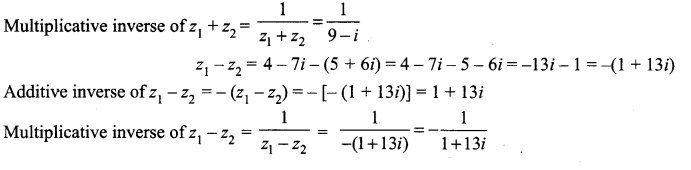
Given z1 = 4 – 7i and z2 = 5 + 6i find the additive and multiplicative inverse of z1 + z2 and Z1 – Z2.
Solution:
Z1 = 4 – 7i, z2 = 5 + 6i
Z1 + z2 = 4 – 7i + 5 + 6i = 9 + i
Additive inverse of z1 + z2 = -(z1 + z2) = -(9 – i) = i – 9
Samacheer Kalvi 12th Maths Solutions Chapter 2 Complex Numbers Ex 2.3 1

Samacheer Kalvi 12th Maths Solutions Chapter 2 Complex Numbers Ex 2.3 Read More »

Samacheer Kalvi 12th Maths Solutions Chapter 2 Complex Numbers Ex 2.2

You can Download Samacheer Kalvi 12th Maths Book Solutions Guide Pdf, Tamilnadu State Board help you to revise the complete Syllabus and score more marks in your examinations.

Tamilnadu Samacheer Kalvi 12th Maths Solutions Chapter 2 Complex Numbers Ex 2.2

Question 1.
Evaluate the following if z = 5 – 2i and w = -1 + 3i
(i) z + w
(ii) z – iw
(iii) 2z + 3w
(iv) zw
(v) z2 + 2zw+ w2
(vi) (z + w)2
Solution:
(i) z + w = (5 – 2i) + (-1 + 3i)
= 4 + i
(ii) z – iw= (5 – 2i) -i (-1 + 3i)
= 5 – 2i + i + 3i² (∵ i² = -1)
= 5 – 2i + i – 3(-1)
= 5 – 2i + i + 3
= 8 – i
(iii) 2z + 3w = 2 (5 – 2i) + 3 (- 1 +3i)
= 10 – 4i – 3 + 9i
= 7 + 5i
(iv) zw = (5 – 2i) (- 1 + 3i)
= -5 + 2i + 15i – 6i²
= -5 + 17i + 6
= 1 + 17i
(v) z2 + 2zw + w2
= (z + w)²
= (4 + i)²
= (4) + 2(4)(i) + (i)²
= 16 + 8i + i²
= 15 + 8i
(vi) (z + w)2 = z² + 2zw + w²
= (z + w)² = (4 + i)²
= 16 + 8i + i²
= 15 + 8i

Samacheer Kalvi 12th Maths Solutions Chapter 2 Complex Numbers Ex 2.2

Question 2.
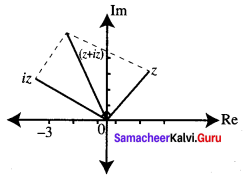
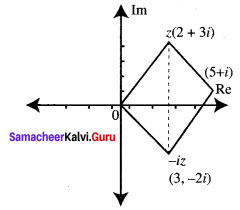
Given the complex number z = 2 + 3i, represent the complex numbers in the Argand diagram.
(i) z, iz, and z + iz
(ii) z, -iz, and z – iz
Solution:
(i) z, iz and z + iz.
z = 2 + 3i
iz = i(2 + 3i) = -3 + 2i
z + iz = 2 + 3i – 3 + 2i = -1 + 5i
Samacheer Kalvi 12th Maths Solutions Chapter 2 Complex Numbers Ex 2.2 Q2
(ii) z = 2 + 3i
-iz = -i(2 + 3i)
= -2i – 3i2
= (3 – 2i)
z – iz = (2 + 3i) + (3 – 2i)
= 5 + i
Samacheer Kalvi 12th Maths Solutions Chapter 2 Complex Numbers Ex 2.2 Q2.1

Question 3.
Find the values of the real numbers x and y, if the complex numbers.
(3 – i) x – (2 – i) y + 2i + 5 and 2x + (-1 + 2i) y + 3 + 2i are equal
Solution:
Given that the complex numbers are equal
(3 – i) x -(2 – i) y + 3 + 2i + 5
= 2x + (-1 + 2i)y + 3 + 2i
3x – ix – 2y + iy + 2i +5
= 2x – y + 2iy + 3 + 2i
(3x – 2y + 5) + i(y – x + 2)
= (2x – y + 3) + i(2y + 2)
Equating real and imaginary parts separately
3x – 2y + 5 = 2x – y + 3
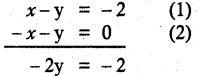
x – y = -2 ………. (1)
y – x + 2 = 2y +
-x – y = 0 ………. (2)
solving 1 and 2
Samacheer Kalvi 12th Maths Guide Chapter 2 Complex Numbers Ex 2.2 3
y = 1
Substituting y = 1 in (1)
x – 1 = -2
x = -2 + 1 = -1
values of x and y are -1, 1
Samacheer Kalvi 12th Maths Solutions Chapter 2 Complex Numbers Ex 2.2

Samacheer Kalvi 12th Maths Solutions Chapter 2 Complex Numbers Ex 2.2 Additional Problems

Question 1.
Find the real values of x and y, if
(i) (3x – 7) + 2 iy = -5y + (5 + x)i
(ii) (1 – i)x + (1 + i)y = 1 – 3i
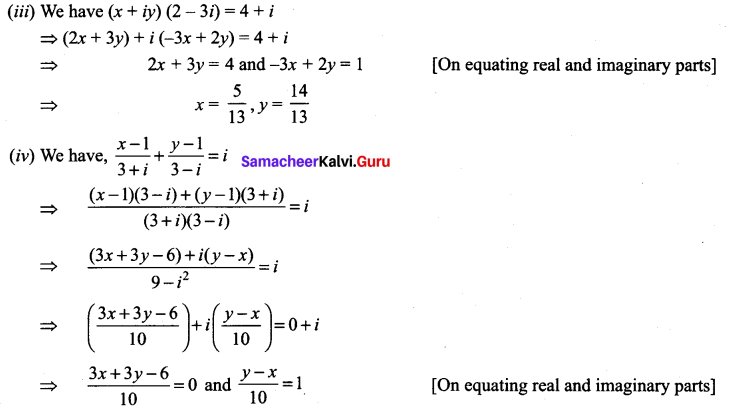
(iii) (x + iy)(2 – 3i) = 4 + i
(iv) Samacheer Kalvi 12th Maths Solutions Chapter 2 Complex Numbers Ex 2.2 1
Solution:
(i) We have (3x – 7) + 2 iy = 5y + (5 + x)i
⇒ 3x – 7 = 5y and 2y = 5 + x
⇒ 3x + 5y = 7 and x – 2y = -5
⇒ x = -1 y = 2

(ii) We have, (1 – i) x + (1 + i)y = 1 – 3i
⇒ (x + y) + i(-x + y) = 1 – 3i
⇒ x + y = 1
and -x + y = 3 [On equating real and imaginary parts]
⇒ x = 2 and y = -1
Samacheer Kalvi 12th Maths Solutions Chapter 2 Complex Numbers Ex 2.2 2
⇒ x + y – 2 = 0 and y – x = 10
⇒ x = -4 , y = 6.

Samacheer Kalvi 12th Maths Solutions Chapter 2 Complex Numbers Ex 2.2

Question 2.
Find the real values of x and y for which the complex numbers -3 + ix2y and x2 + y + 4i are conjugate of each other.
Solution:
Since -3 + ix2y and x2 + y + 4i are complex conjugates.
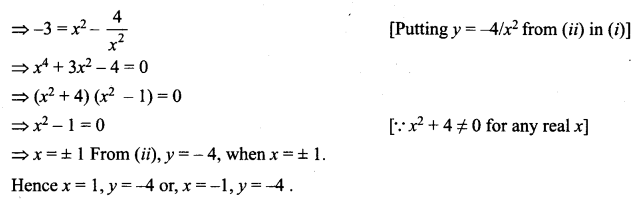
∴ -3 + ix2y = x2 + y + 4i ….. (i) and, x2 y = -4 …… (ii)
Samacheer Kalvi 12th Maths Solutions Chapter 2 Complex Numbers Ex 2.2 3

Question 3.
Given x = 2 – 3i and y = 4 + i
Samacheer Kalvi 12th Maths Solutions Chapter 2 Complex Numbers Ex 2.2 4
Solution:
Do it yourself

Samacheer Kalvi 12th Maths Solutions Chapter 2 Complex Numbers Ex 2.2 Read More »

Samacheer Kalvi 12th Maths Solutions Chapter 2 Complex Numbers Ex 2.1

You can Download Samacheer Kalvi 12th Maths Book Solutions Guide Pdf, Tamilnadu State Board help you to revise the complete Syllabus and score more marks in your examinations.

Tamilnadu Samacheer Kalvi 12th Maths Solutions Chapter 2 Complex Numbers Ex 2.1

Simplify the following:

Question 1.
i1947 + i1950
Solution:
Samacheer Kalvi 12th Maths Solutions Chapter 2 Complex Numbers Ex 2.1 Q1

Samacheer Kalvi 12th Maths Solutions Chapter 2 Complex Numbers Ex 2.1

Question 2.
i1948 – i-1869
Solution:
Samacheer Kalvi 12th Maths Solutions Chapter 2 Complex Numbers Ex 2.1 Q2

Question3.
\(\sum_{n=1}^{12} i^{n}\)
Solution:
Samacheer Kalvi 12th Maths Solutions Chapter 2 Complex Numbers Ex 2.1 Q3

Question 4.
\(i^{59}+\frac{1}{i^{59}}\)
Solution:
Samacheer Kalvi 12th Maths Solutions Chapter 2 Complex Numbers Ex 2.1 Q4

Question 5.
i i2 i3 …….. i2000
Solution:
Samacheer Kalvi 12th Maths Solutions Chapter 2 Complex Numbers Ex 2.1 Q5

Question 6.
\(\sum_{n=1}^{10} i^{n+50}\)
Solution:
Samacheer Kalvi 12th Maths Solutions Chapter 2 Complex Numbers Ex 2.1 Q6

Samacheer Kalvi 12th Maths Solutions Chapter 2 Complex Numbers Ex 2.1

Samacheer Kalvi 12th Maths Solutions Chapter 3 Theory of Equations Ex 2.1 Additional Problems

Question 1.
Evaluate the following:
Samacheer Kalvi 12th Maths Solutions Chapter 2 Complex Numbers Ex 2.1 1
Solution:
135 leaves remainder as 3 when it is divided by 4.
∴ i135 = i3 = -i

(ii) The remainder is 3 when 19 is divided by 4.
∴ i19 = i3 = -i

(iii) We have, i999 = 1/i999
On dividing 999 by 4, we obtain 3 as the remainder.
Samacheer Kalvi 12th Maths Solutions Chapter 2 Complex Numbers Ex 2.1 2

(iv) Samacheer Kalvi 12th Maths Solutions Chapter 2 Complex Numbers Ex 2.1 3

Question 2.
Show that:
Samacheer Kalvi 12th Maths Solutions Chapter 2 Complex Numbers Ex 2.1 4
Solution:
Samacheer Kalvi 12th Maths Solutions Chapter 2 Complex Numbers Ex 2.1 5
Samacheer Kalvi 12th Maths Solutions Chapter 2 Complex Numbers Ex 2.1 6


Samacheer Kalvi 12th Maths Solutions Chapter 2 Complex Numbers Ex 2.1

Question 3.
Samacheer Kalvi 12th Maths Solutions Chapter 2 Complex Numbers Ex 2.1 7
Solution:
Samacheer Kalvi 12th Maths Solutions Chapter 2 Complex Numbers Ex 2.1 8

Samacheer Kalvi 12th Maths Solutions Chapter 2 Complex Numbers Ex 2.1 Read More »

Samacheer Kalvi 12th Maths Solutions Chapter 1 Applications of Matrices and Determinants Ex 1.3

You can Download Samacheer Kalvi 12th Maths Book Solutions Guide Pdf, Tamilnadu State Board help you to revise the complete Syllabus and score more marks in your examinations.

Tamilnadu Samacheer Kalvi 12th Maths Solutions Chapter 1 Applications of Matrices and Determinants Ex 1.3

Question 1.
Solve the following system of linear equations by matrix inversion method:
(i) 2x + 5y = -2, x + 2y = -3
(ii) 2x – y = 8, 3x + 2y = -2
(iii) 2x + 3y – z = 9, x + y + z = 9, 3x – y – z = -1
(iv) x + y + z – 2 = 0, 6x – 4y + 5z – 31 = 0, 5x + 2y + 2z = 13
Solution:
(i) 2x + 5y = -2, x + 2y = -3
The matrix form of the above equations is \(\left(\begin{array}{ll}{2} & {5} \\ {1} & {2}\end{array}\right)\left(\begin{array}{l}{x} \\ {y}\end{array}\right)=\left(\begin{array}{l}{-2} \\ {-3}\end{array}\right)\)
(i.e) AX = B
Samacheer Kalvi 12th Maths Solutions Chapter 1 Applications of Matrices and Determinants Ex 1.3 Q1
Samacheer Kalvi 12th Maths Solutions Chapter 1 Applications of Matrices and Determinants Ex 1.3 Q1.1
Samacheer Kalvi 12th Maths Solutions Chapter 1 Applications of Matrices and Determinants Ex 1.3 Q1.2
Samacheer Kalvi 12th Maths Solutions Chapter 1 Applications of Matrices and Determinants Ex 1.3 Q1.3
Samacheer Kalvi 12th Maths Solutions Chapter 1 Applications of Matrices and Determinants Ex 1.3 Q1.4
Samacheer Kalvi 12th Maths Solutions Chapter 1 Applications of Matrices and Determinants Ex 1.3 Q1.5
Samacheer Kalvi 12th Maths Solutions Chapter 1 Applications of Matrices and Determinants Ex 1.3 Q1.6

Samacheer Kalvi 12th Maths Solutions Chapter 1 Applications of Matrices and Determinants Ex 1.3

Question 2.
If A = \(\left[\begin{array}{ccc}{-5} & {1} & {3} \\ {7} & {1} & {-5} \\ {1} & {-1} & {1}\end{array}\right]\) and B = \(\left[\begin{array}{lll}{1} & {1} & {2} \\ {3} & {2} & {1} \\ {2} & {1} & {3}\end{array}\right]\) find the products AB and BA and hence solve the system of equations x + y + 2z = 1, 3x + 2y + z = 7, 2x + y + 3z = 2.
Solution:
Samacheer Kalvi 12th Maths Solutions Chapter 1 Applications of Matrices and Determinants Ex 1.3 Q2
Samacheer Kalvi 12th Maths Solutions Chapter 1 Applications of Matrices and Determinants Ex 1.3 Q2.1

Question 3.
A man is appointed in a job with a monthly salary of certain amount and a fixed amount of annual increment. If his salary was ₹ 19,800 per month at the end of the first month after 3 years of service and ₹ 23,400 per month at the end of the first month after 9 years of service, find his starting salary and his annual increment. (Use matrix inversion method to solve the problem.)
Solution:
Let his monthly salary be ₹ x and his annual increment be ₹ y
Given x + 3y = 19800 and x + 9y = 23400
Writing the above equations in matrix form, we get
Samacheer Kalvi 12th Maths Solutions Chapter 1 Applications of Matrices and Determinants Ex 1.3 Q3
Samacheer Kalvi 12th Maths Solutions Chapter 1 Applications of Matrices and Determinants Ex 1.3 Q3.1
x = ₹ 18000 and y = ₹ 600
(i.e) monthly salary = ₹ 18000 and annual increment = ₹ 600

Question 4.
4 men and 4 women can finish a piece of work jointly in 3 days while 2 men and 5 women can finish the same work jointly in 4 days. Find the time taken by one man alone and that of one woman alone to finish the same work by using matrix inversion method.
Solution:
Let the work done by man in 1 day be x and the work done by a woman in 1 day be y
Now we are given
4x + 4y = \(\frac { 1 }{ 3 }\) ⇒ 12x + 12y = 1
and 2x + 5y = \(\frac { 1 }{ 4 }\) ⇒ 8x + 20y = 1
The matrix form of the above equations is \(\left(\begin{array}{cc}{12} & {12} \\ {8} & {20}\end{array}\right)\left(\begin{array}{l}{x} \\ {y}\end{array}\right)=\left(\begin{array}{l}{1} \\ {1}\end{array}\right)\)
(i.e) AX = B ⇒ X = A-1B
Here
Samacheer Kalvi 12th Maths Solutions Chapter 1 Applications of Matrices and Determinants Ex 1.3 Q4
Samacheer Kalvi 12th Maths Solutions Chapter 1 Applications of Matrices and Determinants Ex 1.3 Q4.1
(i.e) The work done by a man in 1 day = x = \(\frac{1}{18}\)
The time taken by a man to finish the work = 18 days.
The work done by a woman in 1 day = y = \(\frac{1}{36}\)
The time is taken by a woman to finish the work = 36 days.

Question 5.
The prices of three commodities A, B and C are ₹ x, y and z per units respectively. A person P purchases 4 units of B and sells two units of A and 5 units of C. Person Q purchases 2 units of C and sells 3 units of A and one unit of B . Person R purchases one unit of A and sells 3 unit of B and one unit of C. In the process, P, Q and R earn ₹ 15,000, ₹ 1,000 and ₹ 4,000 respectively. Find the prices per unit of A,B and C. (Use matrix inversion method to solve the problem.)
Solution:
Price of A = ₹ x /unit
Price of B = ₹ y /unit
Price of C = ₹ z /unit
We are given
2x – 4y + 5z = 15000
3x + y – 2z = 1000
-x + 3y + z = 4000
The matrix form of the above equations is \(\left(\begin{array}{rrr}{2} & {-4} & {5} \\ {3} & {1} & {-2} \\ {-1} & {3} & {1}\end{array}\right)\left(\begin{array}{l}{x} \\ {y} \\ {z}\end{array}\right)=\left(\begin{array}{r}{15000} \\ {1000} \\ {4000}\end{array}\right)\)
(i.e) AX = B ⇒ X = A-1B
Here
Samacheer Kalvi 12th Maths Solutions Chapter 1 Applications of Matrices and Determinants Ex 1.3 Q5
Samacheer Kalvi 12th Maths Solutions Chapter 1 Applications of Matrices and Determinants Ex 1.3 Q5.1
Samacheer Kalvi 12th Maths Solutions Chapter 1 Applications of Matrices and Determinants Ex 1.3 Q5.2

Samacheer Kalvi 12th Maths Solutions Chapter 1 Applications of Matrices and Determinants Ex 1.3

Samacheer Kalvi 12th Maths Solutions Chapter 1 Applications of Matrices and Determinants Ex 1.3 Additional Problems

Question 1.
Using matrix method, solve the following system of equations:
x + 2y + z = 7, x + 3z = 11, 2x – 3y = 1
Solution:
The system of equations can be written in the form AX = B, where
Samacheer Kalvi 12th Maths Solutions Chapter 1 Applications of Matrices and Determinants Ex 1.3 1
Samacheer Kalvi 12th Maths Solutions Chapter 1 Applications of Matrices and Determinants Ex 1.3 2
= 9 + 12 – 3 = 18 ≠ 0 Non-singular matrix.
A11 = (0 + 9) = 9, A12 = -(0 – 6) = 6,
A13 = (-3 – 0) = -3
A21 = – (0 + 3) = -3, A22 = (0 – 2) = -2
A23 = -(-3 – 4) = 7
A31 = (6 – 0) = 6, A32 = -(-3 – 1) = -2,
A33 = (0 – 2) = -2
Samacheer Kalvi 12th Maths Solutions Chapter 1 Applications of Matrices and Determinants Ex 1.3 3
Thus x = 2 ,y = 1 and z = 3.

Question 2.
Using matrices, solve the following system of linear equations: x + 2y – 3z = -4, 2x + 3y + 2z = 2, 3x – 3y – 4z = 11.
Solution:
The system of equations can be written in the form AX = B, where
Samacheer Kalvi 12th Maths Solutions Chapter 1 Applications of Matrices and Determinants Ex 1.3 4
Samacheer Kalvi 12th Maths Solutions Chapter 1 Applications of Matrices and Determinants Ex 1.3 5
Thus x = 3,
y = -2 and z = 1

Samacheer Kalvi 12th Maths Solutions Chapter 1 Applications of Matrices and Determinants Ex 1.3

Question 3.
If Samacheer Kalvi 12th Maths Solutions Chapter 1 Applications of Matrices and Determinants Ex 1.3 6 Find A-1. Hence using A-1 solve the system of equations.
2x – 3y + 5z = 11,
3x + 2y – 4z = -5,
x + y – 2z = -3.
Solution:
Samacheer Kalvi 12th Maths Solutions Chapter 1 Applications of Matrices and Determinants Ex 1.3 66

Question 4.
Use product Samacheer Kalvi 12th Maths Solutions Chapter 1 Applications of Matrices and Determinants Ex 1.3 7 to solve the system of equations
x + 3z = 9,
-x + 2y – 2z = 4,
2x – 3y + 4z = -3
Solution:
Samacheer Kalvi 12th Maths Solutions Chapter 1 Applications of Matrices and Determinants Ex 1.3 8

Question 5.
Use product Samacheer Kalvi 12th Maths Solutions Chapter 1 Applications of Matrices and Determinants Ex 1.3 9 to solve the system of equations
x – y + 2z = 1,
2y – 3z = 1,
3x – 2y + 4z = 2
Solution:
Samacheer Kalvi 12th Maths Solutions Chapter 1 Applications of Matrices and Determinants Ex 1.3 10
The system of equations can be written in the form AX = C, where
Samacheer Kalvi 12th Maths Solutions Chapter 1 Applications of Matrices and Determinants Ex 1.3 11

Question 6.
An amount of ₹ 7000 is invested in three types of investments x, y and z at the rate of 3%, 4% and 5% interest respectively. The total annual income is ₹ 280. If the combined income from x and y is ₹ 80 more than that from z, then
(i) Represent the above situation in form of linear equations .
(ii) Is it possible to frame the given linear equations in the form of matrix to obtain the three values x, y and z using matrix multiplication? If yes, find.
(iii) Which value is more beneficial to invest?
Solution:
Samacheer Kalvi 12th Maths Solutions Chapter 1 Applications of Matrices and Determinants Ex 1.3 12
⇒ -40 + 30 + 0 = -10 ≠ 0
Cofactors C11 = +(-20 – 20) = -40
C21 = -(5 – 4) = 9
C31 = +(5 – 4) = 1
C12 = +(-15 – 15) = -30
C22 = +(-5 – 3) = -8
C32 = -(5 – 3) = -2
C13 = +(12 – 12) = 0
C23 = -(4 – 3) = -1
C33 = +(4 – 3) = 1
Samacheer Kalvi 12th Maths Solutions Chapter 1 Applications of Matrices and Determinants Ex 1.3 13
Thus, the three values x = ₹ 2000, y = ₹ 3000 and z = ₹ 2000
(iii) The value of y is more beneficial to invest

Question 7.
Samacheer Kalvi 12th Maths Solutions Chapter 1 Applications of Matrices and Determinants Ex 1.3 16
Solution:
Samacheer Kalvi 12th Maths Solutions Chapter 1 Applications of Matrices and Determinants Ex 1.3 18
In matrix form
Samacheer Kalvi 12th Maths Solutions Chapter 1 Applications of Matrices and Determinants Ex 1.3 19

Samacheer Kalvi 12th Maths Solutions Chapter 1 Applications of Matrices and Determinants Ex 1.3 Read More »

12th English Unit 5 Poem A Father To His Son Paragraph Book Back Answers Samacheer Kalvi

A Father To His Son Book Back Answers Class 12 English Guide Chapter 5 Tamilnadu Solutions

Students can Download English Poem 5 Father to his Son Questions and Answers, Summary, Activity, Notes, Samacheer Kalvi 12th English Book Solutions Guide Pdf helps you to revise the complete Tamilnadu State Board New Syllabus and score more marks in your examinations.

Get a Practical Study with the help of Samacheer Kalvi 12th English Grammar to make learning language much easy for you and score good grades in exams.

12th Standard English 5th Lesson A Father To His Son Questions and Answers

Warm up

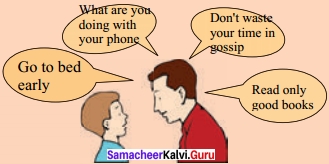
Every parent is anxious about the welfare of his / her children. Parents express their anxiety by advising them almost all the time. What kind of advice do you frequently receive from your parents? Fill in the bubbles. Tick the ones you like to follow implicitly and reasons for the ones you don’t like to follow.
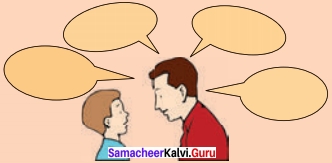
Samacheer Kalvi 12th English Solutions Poem Chapter 5 Father to his Son img-1

Answer:

Samacheer Kalvi 12th English Solutions Poem Chapter 5 Father to his Son img-2

  • Wash your fingers before eating.
  • Don’t stay awake till late night.
  • Who are you talking to over the phone for a long time?

1. I don’t like to tell my parents what I do with the phone. Why should they interfere with my privacy?
2. I don’t gossip; I just share what I enjoyed. My friends tell me what they like. How can my parents call it ‘gossip’?
Time spent in sharing our dreams is not wasted but invested. The other three agree.

Samacheer Kalvi 12th English Father to his Son Textual Questions

1. Fill in the blanks choosing the words from the box given and complete the summary of the poem.

A father sees his son nearing manhood.
What shall he tell that son?
“Life is hard; be steel; be a rock.”
And this might stand him for the storms
and serve him for humdrum monotony

and guide him among sudden betrayals
and tighten him for slack moments.
“Life is a soft loam; be gentle; go easy.”
And this too might serve him.
Brutes have been gentled where lashes failed.

SamacheerKalvi.Guru

The growth of a frail flower in a path up
has sometimes shattered and split a rock.
A tough will counts. So does desire.
So does a rich soft wanting.
Without rich wanting nothing arrives.

Tell him too much money has killed men
and left them dead years before burial:
the quest of lucre beyond a few easy needs
has twisted good enough men
sometimes into dry thwarted worms

Samacheer Kalvi 12th English Solutions Poem Chapter 5 Father to his Son img-3

Tell him time as a stuff can be wasted.
Tell him to be a fool ever so often
and to have no shame over having been a fool
yet learning something out of every folly
hoping to repeat none of the cheap follies

thus arriving at intimate understanding
of a world numbering many fools.
Tell him to be alone often and get at himself
and above all tell himself no lies about himself
whatever the white lies and protective fronts

he may use against other people.
Tell him solitude is creative if he is strong
and the final decisions are made in silent rooms.
Tell him to be different from other people
if it comes natural and easy being different.

Let him have lazy days seeking his deeper motives.
Let him seek deep for where he is born natural.
Then he may understand Shakespeare
and the Wright brothers, Pasteur, Pavlov,
Michael Faraday and free imaginations

Bringing changes into a world resenting change.
He will be lonely enough
to have time for the work
he knows as his own.

Samacheer Kalvi 12th English Solutions Poem Chapter 5 Father to his Son img-4

Lines 1-25

deep desire manhood gentleness mistakes easy
leisure fool life money repeat
tender-flower rock challenges wisdom

The poet Carl Sandburg gives a vivid description of a father’s worldly (1) _______ in directing a son who is at the threshold of his (2) _______ Here the father motivates his son to be like a hard (3) _______ and withstand life’s (4) _______ and sudden betrayals. (5) _______ is like a fertile soil. We can make our life fruitful if we are gentle, and take life as it comes. At times (6) _______ overtakes harshness. The growth of a (7) _______ can split a rock. One should have a (8) _______ and strong will to achieve. Greed for(9) _______ has left men dead before they really die. Good men also have fallen prey in quest for (10) _______ money. Time for (11) _______ is not a waste. When you seek knowledge never feel ashamed to be called a (12) _______ for not knowing, at the same time learn from your (13) _______ and never (14) _______ it.
Answers:

1. wisdom
2. manhood
3. rock
4. challenges
5. life
6. gentleness
7. tender-flower
8. deep desire
9.money
10. easy
11. leisure
12. fool
13.mistakes
14. repeat

Lines 26-44

changes introspect inherent work        | resents
white lies creative final decisions different :

Do (15) ______ often, and do not hesitate to accept your shortcomings, avoid (16) to protect self against other people. Solitude helps to be (17) and (18) are taken in silent rooms. Instead of being one among many, be (19) , if that is your nature. The son may need lazy days to find his (20) abilities, to seek what he is bom for. He will then know how free imaginations bring (21) to the world, which (22) change.
During such resentment, let him know that it is time for him to be on his own, and (23) to achieve like Shakespeare, the Wright brothers, Pasteur, Pavlov, and Michael Faraday.
Answer:

15. introspect
16. white lies
17. creative
18. final decisions
19. different
20. inherent
21. changes
22. resents
23. work

2. Based on your understanding of the poem answer the following questions in one or two sentences.

Question (a)
How would the poet’s advice help his son who is at the threshold of manhood?
Answer:
The poet’s advice helps his son face life’s challenges and sudden betrayals daringly.

SamacheerKalvi.Guru

Question (b)
A tough will counts.’ Explain.
Answer:
One’s physical strength doesn’t matter. Any person with a strong will can achieve great feats. A frail flowering plant succeeds in splitting a rock due to its hard will. Thus a tough will (i.e.) “rich soft wanting” determines one’s success.

Question (c)
What happened to the people who wanted too much money?
Answer:
The people who wanted too much money has left dead before they really die.

Question (d)
What has twisted good men into thwarted worms?
Answer:
One’s desire or love for money should be limited to meeting one’s basic needs like food, clothing, and shelter. Beyond that, inordinate desire to possess a lot of money in a dishonourable way reduces even good men to “thwarted worms”.

Question (e)
How would his being alone help the boy?
Answer:
Being alone would help the boy to be more creative and make him take final decisions.

Question (f)
Where are the final decisions taken?
Answer:
In silent rooms, final decisions are taken.

Question (g)
What are the poet’s thoughts on ‘being different’?
Answer:
The poet says that instead of being one among many, his son should be different if it is work with ease and nature.

Question (h)
Why does the poet advise his son to have lazy days?
Answer:
Lazy days would help the boy to find his inherent abilities and goad him to discover the purpose for which he was bom.

Question (i)
The poet says
‘Without rich wanting nothing arrives’
but he condemns ‘the quest of lucre beyond a few easy needs.’Analyze the difference and write.
Answer:
Everyone needs money to satisfy his desire and wanted things. His motto must be in the right way. One should earn money honestly. He must be contented with what he had in his life. But the search for money illegally should not be entertained. One should not accumulate money beyond essential needs.

3. Here are a few poetic devices used in the poem.

Question (a)
Antithesis – It is a literary device that emphasizes the idea of contrast,
eg. The growth of a frail flower in a path up
has sometimes shattered and split
a rock. Brutes have been gentled where lashes failed.

Question (b)
Transferred Epithet – It is a figure of speech in which an epithet grammatically qualifies a noun other than the person or a thing, it is actually meant to describe.
eg. and left them dead years before burial:
Let him have lazy days seeking his deeper motives.
Bringing changes into a world resenting change.

Question (c)
Repetition – It is a figure of speech.
eg. Tell him to be alone often and get at himself and above all tell himself no lies about himself

Appreciate The Poem

4. Read the lines given below and answer the questions that follow.

(a) “Life is hard; be steel; be a rock.’’

Question (i)
How should one face life?
Answer:
One should face life-like steel.

Question (ii)
Identify the figure of speech in the above line.
Answer:
Metaphor

(b) “Life is a soft loam; be gentle; go easy. ”
And this too might serve him.

SamacheerKalvi.Guru

Question (i)
Why does the poet suggest to take life easy?
Answer:
There are certain occasions one needs to treat life-like wet clay very gently. Take life as it comes without hard resistance. The poet says, “Brutes have been gentled where lashes failed.”

Question (ii)
Identify the figure of speech in the above line.
Answer:
Metaphor

(c) “Tell him solitude is creative if he is strong
and the final decisions are made in silent rooms.”

Question (i)
Can being in solitude help a strong human being? How?
Answer:
Yes, solitude helps the strong person to be creative. Solitude helps even a strong human being to introspect and analyze his own mistakes.

Question (ii)
Identify the figure of speech in the above line.
Answer:
Personification

(d) “Tell him time as a stuff can be wasted.
Tell him to be a fool every so often”

Question (i)
Why does the poet suggest that time can be wasted?
Answer:
Unless one wastes one’s time, one may not commit mistakes and learn from them. Besides learning not to repeat those mistakes would naturally make him wiser.

Question (ii)
Identify the figure of speech in the above line.
Answer:
Simile

SamacheerKalvi.Guru

Question (e)
“Tell him to be a fool ever so often
and to have no shame over having been a fool
yet learning something out of every folly
hoping to repeat none of the cheap follies”

Question (i)
Is it a shame to be a fool at times?
Answer:
No, everyone does commit funny mistakes in life. One might just laugh at them.

Question (ii)
What does one learn from every folly?
Answer:
Every folly teaches a person his limitations and vulnerabilities. By making conscious efforts to avoid them in the future, one will become stronger and wiser.

(f) “______ Free imaginations
Bringing changes into a world resenting change”

Question (i)
How does free imagination help the world?
Answer:
Free imagination brings changes in the world.

Question (ii)
Identify the figure of speech.
Answer:
Personification

Question (e)
Pick out the alliterated words from the poem and write.
“And this might stand him for the storms”
Answer:
The words stand and storms alliterate.

Additional Questions

(a) “And this might stand him for the storms
and serve him for humdrum monotony”

Question (i)
What does the poet mean by storms?
Answer:
The poet means life’s challenges by ‘storms’.

Question (ii)
What can help the son overcome “the boring routine” in life?
Answer:
One can overcome ‘the boring routine’ by keeping a strong steel/rock-like will power and face life boldly.

(b) “and guide him among sudden betrayals
and tighten him for slack moments.”

Question (i)
What could guide the son among unexpected betrayals?
Answer:
Rock/steel-like would guide the son among betrayals.

SamacheerKalvi.Guru

Question (ii)
What could happen to the boy during slack moments?
Answer:
During slack moments, the boy may be betrayed by his trusted friends.

(c) “Brutes have been gentled where lashes failed.’”

Question (i)
When does the Government or law use lashes?
Answer:
When a brute has committed a crime, the law uses lashes to punish him.

Question (ii)
What can transform brutes?
Answer:
Gentleness can transform brutes.

(d) “The growth of a frail flower in a path up has sometimes shattered and split a rock.”

Question (i)
What do you mean by ‘frail’?
Answer:
Frail means weak and delicate.

Question (ii)
How does a frail flower plant split a rock?
Answer:
The plant’s tough will to survive and grow forces the rock to split.

Question (e)
“The quest of lucre beyond a few easy needs
has twisted good enough men
sometimes into dry thwarted worms. ”

Question (i)
What do you mean by ‘quest for lucre?
Answer:
‘Quest for lucre’ means seeking money in a dishonourable way.

Question (ii)
What is the result of such a quest?
Answer:
It results in frustrating and ruining good men.

5. Explain the following lines with reference to the context.

Question (а)
“and guide him among sudden betrayals
and tighten him for slack moments.”
Answer:
Reference: These lines are from the poem “A Father to his Son” written by Carl August Sandburg.
Context and Explanation: The poet says these words while explaining the need to stay strong like a rock or steel. The steel will guide him when confronted with unexpected betrayals from trusted friends. It will also help him to be strong against future experimentations.

Question (b)
“Brutes have been gentled where lashes failed.”
Answer:
Reference: These lines are from the poem “A Father to his Son” written by Carl August Sandburg.
Context and Explanation: The poet highlights the importance of soft but firm will to melt even hardened criminals. Love can transform even criminals. Harsh punishment may harden them but gentleness and love may bring about a change of heart.

Question (c)
“ Yet learning something out of every folly hoping to repeat none of the cheap follies”
Answer:
Reference: These lines are from the poem “A Father to his Son” written by Carl August Sandburg.
Context and Explanation: The poet says these words while hinting at the possibilities of failures in the pursuit of knowledge. People may mock a beginner as a fool. He should not feel ashamed of being called a fool. He must continue the pursuit of knowledge doggedly to achieve success.

Question (d)
“He will be lonely enough
to have time for the work”
Answer:
Reference: These lines are from the poem ‘A Father to his Son” written by Carl August Sandburg.
Context and Explanation: The poet says these words to explain how creative thinkers and those who strive to bring about changes are left alone to fend for themselves. The poet says his son must take advantage of this loneliness to pursue his creative imagination and succeed like Shakespeare, the Wright brothers, Pasteur, Pavlov, and Faraday.

Additional Questions

Question (a)
“and above all tell himself no lies about himself
whatever the white lies and protective fronts”
Answer:
Reference: These lines are from the poem ‘A Father to his Son” written by Carl August Sandburg.
Context and Explanation: The poet says these words to his son as to how to conduct himself after a folly is done. He wants him not to tell lies or defend himself or blame others for his predicament. He must learn from his follies and become wiser.

Question (b)
“Let him have lazy days seeking his deeper motives.
Let him seek deep for where he is born naturally. ”
Answer:
Reference: These lines are from the poem ‘A Father to his Son” written by Carl August Sandburg.
Context and Explanation: The poet says these words while highlighting the advantages of spending leisure hours in introspection. When a person looks within in solitude he will realise his inner strength, innate abilities and also realise the purpose for which he has been created.

SamacheerKalvi.Guru

Question (c)
“Life is hard; be steel; be a rock.”
And this might stand him for the storms”
Answer:
Reference: These lines are from the poem ‘A Father to his Son” written by Carl August Sandburg.
Context and Explanation: The poet emphasizes the need to have rock or steel-like determination to confront the challenges in life. He believes that such a stance would help his son to overcome the boredom of the routine in life.

Question (d)
“A tough will counts. So does desire.
So does a rich soft wanting
Answer:
Reference: These lines are from the poem ‘A Father to his Son” written by Carl August Sandburg.
Context and Explanation: The poet says these words while stressing the need to have the tough will to create a path for success even on rocky terrain. One needs to have a deep passionate desire and a strong will to succeed in life.

Question (e)
“The quest of lucre beyond a few easy needs
has twisted good enough men’”
Answer:
Reference: These lines are from the poem “A Father to his Son” written by Carl August Sandburg.
Context and Explanation: The poet says these words while explaining how ill-gotten wealth suffocates the good men. The money earned through dishonest means frustrates good men and even reduces to the level of worms.

Question (f)
“Tell him too much money has killed men
and left them dead years before burial:”
Answer:
Reference: These lines are from the poem ‘A Father to his Son” written by Carl August Sandburg.
Context and Explanation: The poet says these words while dwelling on the evil effects of amassing wealth beyond the basic needs of men. Oliver Goldsmith says, “Where wealth accumulates, man decays.” The poet says that a man who amasses wealth against ethical principles is spiritually dead.

6. Answer the following questions in about 100-150 words each.

Question (a)
Explain how the poet guides his son who is at the threshold of manhood, to face the challenges of life.
Answer:
The poet shares his wisdom with his son who is at the threshold of manhood. He persuades his son to be hard as steel or rock to withstand challenges and unforeseen betrayals in life. A person with a soft heart will crumble before a breach of trust. Similarly, he wants his son to be discerning enough to be soft when needed to grow like a frail flower plant splitting a rock. Occasionally one has to go with the current because life is at times fertile with a lot of opportunities to grow even among the harshest circumstances. ‘Rich soft wanting’ can help a person to win against all odds. He reiterates this idea by explaining how gentleness can reform a hardened criminal when lashes would, in contrast, harden them further.

Question (b)
How according to the poet is it possible for his son to bring changes into a world that resents change?
Answer:
The poet advises his son to introspect often and not feel ashamed of being called a fool especially when he pursues knowledge. He can examine himself and remove his follies. He must enjoy the advantages of solitude. Solitude would help him to be creative. He would invariably leam that final decision are always taken in silent rooms. Being alone, he can identify his innate potential and talents. His free imagination will bring about changes even if the world resents them. The zest to bring about changes will elevate him to the level of Shakespeare, Pasteur, Wright Brothers, Pavlov, and Michael Faraday. Thus he will be remembered as one of the great men who changed the world.

Listening Activity

Listen to the poem read by the teacher or to the recorded version and write a synopsis in about 100 words. The teacher can choose any three stanzas.

Lincoln’s Letter to his Son’s Teacher:
He will have to learn, I know, that all men are not just, all men are not true. But teach him also that for every scoundrel there is a hero; that for every selfish politician, there is a dedicated leader… Teach him for every enemy there is a friend,

Steer him away from envy, if you can, teach him the secret of quiet laughter.

Let him learn early that the bullies are the easiest to lick… Teach him, if you can, the wonder of books… But also give him quiet time to ponder the eternal mystery of birds in the sky, bees in the sun, and the flowers on a green hillside.

In the school teach him it is far honourable to fail than to cheat…Teach him to have faith in his own ideas, even if everyone tells him they are wrong. Teach him to be gentle with gentle people, and tough with the tough.

Try to give my son the strength not to follow the crowd when everyone is getting on the bandwagon…Teach him to listen to all men.. .but teach him also to filter all he hears on a screen of truth, and take only the good that comes through.

Teach him if you can, how to laugh when he is sad…Teach him there is no shame in tears, Teach him to scoff at cynics and to beware of too much sweetness…Teach him to sell his brawn and brain to the highest bidders but never to put a price-tag on his heart and soul. Teach him to close his ears to a howling mob and to stand and fight if he thinks he’s right. Treat him gently, but do not cuddle him, because only the test of fire makes fine steel.

Let him have the courage to be impatient… Let him have the patience to be brave. Teach him always to have sublime faith in himself, because then he will have sublime faith in mankind. This is a big order, but see what you can do… He is such a fine little fellow, my son!

Abraham Lincoln
Synopsis of the first three stanzas:
Abraham Lincoln’s letter to his son’s teacher is full of his optimism and ethical values he believed in. He asks the teacher to teach his son to have faith in humanity and teach him not to be discouraged by scoundrels, selfish politicians, and enemies. For every selfish politician, there is a dedicated hero. He need not condemn all politicians as bad. There may be enemies but there is a friend for every enemy. Thus, the equations in life are wonderful. He must learn the dignity of labour and hard work. He should be taught the necessity of undergoing the pain of failure in order to appreciate success. He requests his son to stay away from envy and to enjoy quiet laughter. He wants him to teach his son that bullies accept defeat quickly. He also urges him to teach his son the wonders of reading books and deep quiet reflection on the beautiful mysteries of nature.

Given below is a well-known quotation.
“Cowards die many times before their death”.
Study the quotations and identify the adverse human qualities that are worse than ‘death’ and discuss the underlying message conveyed.
Greed and the craze to amass wealth through dishonourable methods is like dying years before one actually dies. Cowardliness is equally worse than death. Shakespeare has said, “the valiant die only once in their lifetime.”

Father to his Son About the Poet
Samacheer Kalvi 12th English Solutions Poem Chapter 5 Father to his Son img-5

“Poetry is the opening and closing of a door, leaving those who look through to guess about what was seen during a moment.” – Carl Sandburg

Sandburg was born in Galesburg, Illinois, to parents of Swedish ancestry. Carl August Sandburg (January 6, 1878 – July 22, 1967) was an American poet, writer, and editor. He won three Pulitzer Prizes. During his lifetime, Sandburg was widely regarded as “a major

figure in contemporary literature”, especially for volumes of his collected verse, including Chicago Poems (1916), Comhuskers (1918), and Smoke and Steel (1920). He enjoyed; unrivaled appeal as a poet in his day. At his death in 1967, President Lyndon B. Johnson observed that “Carl Sandburg was more than the voice of America, more than the poet of its strength and genius. He was America.”

Father to his Son Summary in English

Inheritance of wisdom
Poet Carl Sandburg wants to leave his wisdom to his son who is at the threshold of his manhood. He wants his son to be like steel and rock to confront the harsh challenges and betrayals. But he should use his discernment to go easy because life can be like soft clay too. He explains lucidly how a tender flowering plant with a ‘tough will’ can split a rock. He makes his son understand how gentleness has reformed criminals when lashes failed. One can’t achieve much without a deep desire to achieve success. He advises his son to be cautious with money for the greed of easy money has heralded the downfall of good men. One can’t acquire wisdom or knowledge overnight. One may commit mistakes in life and be called a fool. But one can overcome frailties by consciously avoiding such mistakes.

SamacheerKalvi.Guru

Value of introspection
One has to look within and analyse one’s shortcomings. One must not be defensive but accept one’s own drawbacks. While contemplating in solitude, one gains flashes of insight into one’s own self and becomes creative. The best decisions in life are usually taken in silent rooms. If it is natural on one’s part to be different, ignoring criticisms one can dare to be different.

Changes wrought by free imagination
Great geniuses like Shakespeare, Pasteur, Pavlov, and Michael Faraday achieved grand success in their pursuits because they wanted to use their free imagination to change the world in their own way The world is complacent with the existing order of things and may resent changes. But if one brushes aside the popular resentment and strives hard with free imagination one can achieve success like scientists and social thinkers who have transformed the world.

Conclusion
The greatest legacy a father can possibly leave his son or daughter is not wealth but wisdom and a positive attitude to meet challenges in life.

Father to his Son Summary in Tamil

கவிஞர், கார்ல் ஆகஸ்ட் சான்ட்பர்க் தன்
மகனுக்கு கூறும் அறிவுரையாக இந்தக் கவிதை அமைந்துள்ளது. வாழ்க்கையில் சோதனைகளும், ஏமாற்றங்களையும் எதிர் கொள்ள தன் மகனை இரும்பை போல் அல்லது கல்லைப் போல் கலங்காமல் இருக்கவேண்டும் என்கிறார். வாழ்க்கை களிமண் போன்று மிருதுவாகவும் இருக்கக் கூடும் என்பதால் தன் பகுத்தறிவின்படி தேவைப்படும் போது மென்மையாகவும் நடந்து கொள்ளுமாறு அறிவுறுத்துகிறார். பாறையின் மேல் படர்ந்த மிருதுவான மலர்க்கொடி அப்பாறையைத் துளையிடும் வல்லமை கொண்டது என்பதை தெளிவாக கூறுகிறார். சவுக்கடி தந்தும் திருந்தாத முரடனை நல்ல வார்த்தைகள் திருத்தி மென்மையானவனாக்கி இருக்கிறது. ஒன்றினை அடைவதற்கு ஆழ்ந்த உந்துதல் இல்லையெனில் அதை அடைதல் அரிது. பணத்தின் பால் கவனம் செலுத்துமாறு மகனுக்கு அறிவுறுத்துகிறார். பணத்தின் மீதான் பேராசை காரணமாக பலர் விழுந்திருக்கிறார்கள் என்பதை பிரகடனம் செய்கிறார். ஒரு நாள் இரவில் ஞானத்தைப் பெற்று விட முடியாது. ஒருவன் வாழ்நாளில் தவறுகள் புரிந்து முட்டாள் என பெயர் வாங்கலாம். கவனமாக நடந்து கொண்டால் இந்த பலவீனத்தை தவிர்க்கலாம்.

தற்சோதனையின் மதிப்பு:
ஒருவன் தன்னையே பரிசோதித்து, தன் பலகீனத்தை ஆராய வேண்டும். ஒருவன் தனக்கு இருக்கும் குறைகளை மறுக்காமல் ஒப்புக் கொள்ள வேண்டும். தனியாகத் திட்டமிடும் போது அவனுள்ளே “ஞானம்” பிறந்து அவனை ஆக்கப் பூர்வமானவனாக ஆக்குகிறது. வாழ்க்கையின் முக்கியத் திட்டங்கள் தனிமையில் உதிக்கின்றன. மனிதன் தன் மேல் சாற்றப்படும் தவறான கூற்றுகளைக் கண்டு கொள்ளாதவனாய் அடுத்தவனிடத்திலிருந்து தனித்து நிற்க விரும்பினால் அவ்வாறு துணிந்து நிற்கலாம்.

SamacheerKalvi.Guru

சுயேட்சையாக சிந்திப்பதனால் உண்டான மாற்றங்கள்:
மேதாவிகளான சேக்ஸ்பியர், பாஸ்ச்சர், பாவ்லோவ் மற்றும் மைக்கேல் ஃபாரடே போன்றவர்கள் தாம் மேற்கொண்ட செயல்களில் சுயமாகச் சிந்தித்து உலகை தனக்கு ஏற்றவாறு மாற்ற முயன்றனர்.உலகம் தற்போதைய சூழ்நிலைக்கு ஏற்ற வண்ணம் செல்வதால் மாறுதலை ஆட்சேபிக்கலாம். ஆனால், எதிர்ப்பைத் தவிர்த்து சுயமாக சிந்தித்து செயல்பட்டால் | விஞ்ஞானிகள் மற்றும் சீர்திருத்தவாதிகள் போல் உலகை மாற்றி அமைக்கலாம்.

முடிவுரை:
தகப்பன் மகனுக்கு விட்டுச் செல்லும் பரம்பரைச் சொத்து பணம், பொருள் அல்ல. ஆனால், நல்ல அறிவுரைகளும் உலகை எதிர்கொள்ளத் தன்னம்பிக்கை அளிக்கும் முற்போக்கு சிந்தனைகளுமே ஆகும்.

Father to his Son Glossary

Textual:
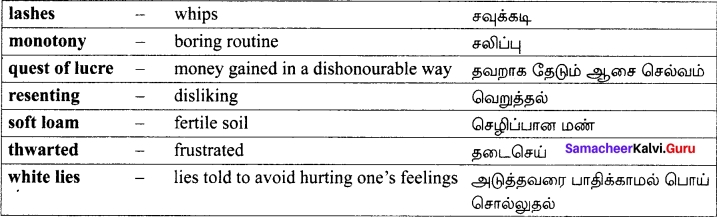
Samacheer Kalvi 12th English Solutions Poem Chapter 5 Father to his Son img-6

Additional:

Samacheer Kalvi 12th English Solutions Poem Chapter 5 Father to his Son img-7

Samacheer Kalvi 12th English Book Solutions Poem

12th English Unit 5 Poem A Father To His Son Paragraph Book Back Answers Samacheer Kalvi Read More »