Class 12

Samacheer Kalvi 12th English Vocabulary Syllabification

Students can Download Samacheer Kalvi 12th English Vocabulary Syllabification, Notes, Samacheer Kalvi 12th English Book Solutions Guide Pdf helps you to revise the complete Tamilnadu State Board New Syllabus and score more marks in your examinations.

Get a Practical Study with the help of Samacheer Kalvi 12th English Grammar to make learning language much easy for you and score good grades in exams.

Tamilnadu Samacheer Kalvi 12th English Vocabulary Syllabification

Read the following rules to answer the questions given below.
Every syllable has only one vowel sound.

Samacheer Kalvi 12th English Vocabulary Syllabification

Rule 1: One-syllable Words. Never divide a one-syllable word. Eg: help, said, take, hop
Rule 2: Digraphs (Ch, Cl, PI, Gr,..) Digraphs are never separated. Eg: buck.le, cloth.ing, feath.er
Rule 3: Compound Words. Divide compound words between the words. Eg: cup.board, pin.hole
Rule 4: If one consonant comes between two vowels, divide after the long vowel if the vowel is long or after the consonant if the vowel is short.
Examples: Long Vowel—bo.nus, la.bor and Short Vowel—silver, grav.el
Rule 5: When two consonants come between vowels in a word, split them. Examples: kit.ten, pup.pet f
Rule 6: When two vowels are together in a word and are sounded separately, divide the vowels. Examples: di.et, cre.ate, ra.di.o
When two vowels are together in a word and make one sound, do not divide between the vowels. Examples: spread, bounce, prowl
Rule 7: When a word contains a prefix, divide the word between the prefix and the base or root word. Examples: re.in.stall, un.plug, o.ver.cast, in.ter.change, re.start
Rule 8: When a word contains a suffix, divide the word between base or root word and the suffix. Examples: soap.y, mind.ful, sing.ing, sheep.ish
Rule 9: When a word ends in le preceded by a consonant, divide the word before the consonant. Examples: kin.dle, man.tle, rum.ble, dim.ple

Samacheer Kalvi 12th English Vocabulary Syllabification

Exercise:

Question 1.
Choose the correct syllabification for ‘ingratitude’.
(a) ingra-titude
(b) in-grat-i-tude
(c) in-gr-at-i-tu-de
(d) ingrat-i-tu-de
Answer:
(b) in-grat-i-tude

Question 2.
Choose the correct syllabification for “accident”.
(a) ac-ci-dent
(b) acc-i-dent
(c) acci-dent
(d) acc-id-ent
Answer:
(a) ac-ci-dent

Question 3.
Choose the correct syllabification for “argumentative”?
(a) arg-u-men-ta-tive
(b) ar-gu-men-ta-tive
(c) argu-men-ta-tive
(d) arg-umen-ta-tive
Answer:
(b) ar-gu-men-ta-tive

Samacheer Kalvi 12th English Vocabulary Syllabification

Question 4.
Choose the correct syllabification for ‘dramatic’.
(a) dram-at-ic
(b) dra-m-atic
(c) dr-ama-tic
(d) dra-mat-ic
Answer:
(d) dra-mat-ic

Question 5.
Choose the correct syllabification for ‘institution’.
(a) m-sti-tu-tion
(b) ins—ti-tu-tion
(c) insti-tu-tion
(d) in-stit-u-tion
Answer:
(a) m-sti-tu-tion

Question 6.
Choose the correct syllabification for ‘inspiration’.
(a) ins-pi-ra-tion
(b) ins-pir-a-tion
(c) in-spi-ra-tion
(d) inspi-ra-tion
Answer:
(c) in-spi-ra-tion

Samacheer Kalvi 12th English Vocabulary Syllabification

Question 7.
Choose the correct syllabification for ‘simultaneous’.
(a) si-mult-a-ne-ous
(b) si-mul-ta-ne-ous
(c) sim-ul-ta-ne-ous
(d) si-mul-tan-eous
Answer:
(b) si-mul-ta-ne-ous

Question 8.
Choose the correct syLlabification for ‘eradicate’.
(a) er-a-di-cate
(b) e-rad-i-cate
(c) e-ra-di-cate
(d) era-di-cate
Answer:
(c) e-ra-di-cate

Question 9.
Choose the correct syllabification for ‘audacious’.
(a) au-da-ci-ous
(b) au-da-cious
(c) au-da-ci-o-us
(d) auda-ci-ous
Answer:
(b) au-da-cious

Samacheer Kalvi 12th English Vocabulary Syllabification

Question 10.
Choose the correct syllabification for ‘fortunate’.
(a) fort-un-ate
(b) for-tun-ate
(c) fort-u-nate
(d) for-tu-nate
Answer:
(d) for-tu-nate

Question 11.
Choose the correct syllabification for ‘facilitate’.
(a) fa-ci-li-t-ate
(b) fa-cil-i-taLe
(c) fac-il-i-tate
(a) fa-ci-li-tate
Answer:
(b) fa-cil-i-taLe

Question 12.
Choose the correct syllabification for ‘diligence’. :
(a) dil-i-gence
(b) di-li-gence
(c) dili-gen-ce
(d) di-hg-ence
Answer:
(a) dil-i-gence

Samacheer Kalvi 12th English Vocabulary Syllabification

Question 13.
Choose the correct syllabification for ‘cloistered’.
(a) cloi-stered
(b) ci-ol-ster-ed
(c) cloi-ste-red
(d) cloiste-red
Answer:
(a) cloi-stered

Question 14.
Choose the correct syllabification for ‘magnificent’.
(a) mag-nif-icent
(b) ma-gni-fi-cent
(c) mag-nif-i-cent
(a) mag-ni-fi-cent
Answer:
(c) mag-nif-i-cent

Question 15.
Choose the correct syllabification for ‘philology’.
(a) phi-loI-o-gy
(b) phil-ol-ogy
(c) phil-ol-o-gy
(d) phil-olo-gy
Answer:
(a) phi-loI-o-gy

Samacheer Kalvi 12th English Vocabulary Syllabification

Question 16.
Choose the correct syllabification for ‘detect’.
(a) det-ec-t
(b) de-te-et
(c) det-ect
(d) de-tect
Answer:
(d) de-tect

Question 17.
Choose the correct syllabification for ‘eccentric’.
(a) ec-cent-ric
(b) ec-cen-tric
(c) ecc-en-tric
(d) ecc-ent-ric
Answer:
(b) ec-cen-tric

Question 18.
Choose the correct syllabification for ‘expression’.
(a) ex-pre-ssion
(b) ex-press-ion
(c) ex-pres-sion
(d) exp-rcs-sion
Answer:
(c) ex-pres-sion

Samacheer Kalvi 12th English Vocabulary Syllabification

Question 19.
Choose the correct syllabification for ‘particular’.
(a) par-ti-cul-ar
(b) part-ic-uI-ar
(c) par-ti-cu-lar
(d) par-tic-u-lar
Answer:
(d) par-tic-u-lar

Question 20.
Choose the correct syllabification for ‘censure’.
(a) c-en-sure
(b) cen-sure
(c) cen-su-re
(d) ce-ns-ure
Answer:
(b) cen-sure

Question 21.
Choose the correct syllabification for ‘democratic’.
(a) de-mo-era-tic
(b) demo-cratic
(c) dem-o-crat-ic
(d) demo-crat-ic
Answer:
(c) dem-o-crat-ic

Samacheer Kalvi 12th English Vocabulary Syllabification

Question 22.
Choose the correct syllabification for ‘establish’.
(a) es-tab-lish
(b) es-ta-blish
(c) est-ab-lish
(d) es-tab-li-sh
Answer:
(a) es-tab-lish

Question 23.
Choose the correct syllabification for ‘communication’.
(a) corn-mu-ni-ca-lion
(b) corn-mu-ni-cat-ion
(c) com-mu-n-ic-ation
(d) com-mu-nic-a-tion
Answer:
(a) corn-mu-ni-ca-lion

Question 24.
Choose the correct syllabification for ‘president’.
(a) pre-side-nt
(b) pre-sid-ent
(c) pre-si-dent
(d) pres-i-dent
Answer:
(c) pre-si-dent

Samacheer Kalvi 12th English Vocabulary Syllabification

Question 25.
Choose the correct syllabification for ‘confidence’.
(a) con-fide-nce
(b) con-fid-ence
(c) conf-i-dence
(d) con-fi-dence
Answer:
(d) con-fi-dence

Identify the number of syllables in the following words:

Question 1.
Choose the tn-syllabic word.
(a) unleashing (b) futility (c) mushroom (d) battered
Answer:
(b) futility

Question 2.
The number of syllables in ‘ceaseless’ is
(a) di (b) tri (c) mono (d) tetra
Answer:
(a) di

Samacheer Kalvi 12th English Vocabulary Syllabification

Question 3.
The number of syllables in ‘sympathetic’ is
(a) tri (b) di (c) penta (d) tetra
Answer:
(d) tetra

Question 4.
The number of syllables in ‘wrong’ is
(a) poly (b) di (c) mono (d) tetra
Answer:
(c) mono

Question 5.
Choose the tetra-syllabic word.
(a) geographical (b) organisation (c) fantastic (d) comprehensive
Answer:
(a) geographical

Question 6.
The number of syllables in ‘participant’ is
(a) di (b) mono (c) tetra (d) penta
Answer:
(c) tetra

Samacheer Kalvi 12th English Vocabulary Syllabification

Question 7.
The number of syllables in ‘autobiography’ is
(a) poly (b) tri (c) penta (ð) tetra
Answer:
(a) poly

Question 8.
Identify the tetra-syllabic word.
(a) taxi (b) calcium (c) calculation (d) dynamic
Answer:
(c) calculation

Question 9.
The number of syllables in ‘experiment’ is
(a) mono (b) tri (c) penta (d) tetra
Answer:
(d) tetra

Question 10.
The number of syllables in ‘entourage’ is
(a) poly (b) di (c) tri (d) tetra
Answer:
(c) tri

Samacheer Kalvi 12th English Vocabulary Syllabification

Question 11.
The number of syllables in ‘protect’ is .
(a) di (b) poly (c) penta (d) tetra
Answer:
(a) di

Question 12.
Choose the poly-syllabic word.
(a) misappropriation (b) organization (c) fantastic (d) establishmentarianism
Answer:
(d) establishmentarianism

Question 13.
The number of syllables in ‘countrymen’ is
(a) mono (b) di (c) tri (d) tetra
Answer:
(c) tri

Samacheer Kalvi 12th English Vocabulary Syllabification

Question 14.
Choose the tetra-syllabic word
(a) permitted (b) comprehensive (c) appreciation (d) important
Answer:
(b) comprehensive

Question 15.
The number of syllables in ‘parchment’ is
(a) di (b) poly (c) penta (d) tetra
Answer:
(a) di

Question 16.
The number of syllables in ‘ultimately’ is
(a) di (b) penta (c) tetra (d) mono
Answer:
(c) tetra

Question 17.
Choose the trisyllabic word.
(a) advantage (b) comprehensive (c) appreciation (d) uncomfortable
Answer:
(a) advantage

Samacheer Kalvi 12th English Vocabulary Syllabification

Question 18.
The number of syllables in ‘legacy’ is
(a) di (b) tri (c) mono (d) tetra
Answer:
(b) tri

Question 19.
The number of syllables in ‘longevity is
(a) mono (b) tri (c) poly (d) tetra
Answer:
(d) tetra

Question 20.
Choose the pentasyllabic word.
(a) observer (b) facilitate (c) intelligent (d) simultaneous
Answer:
(d) simultaneous

Samacheer Kalvi 12th English Vocabulary Syllabification

Samacheer Kalvi 12th English Vocabulary Syllabification Read More »
Samacheer Kalvi 12th English Grammar Articles

Students can Download Samacheer Kalvi 12th English Grammar Articles, Notes, Samacheer Kalvi 12th English Book Solutions Guide Pdf helps you to revise the complete Tamilnadu State Board New Syllabus and score more marks in your examinations. Get a Practical Study with the help of Samacheer Kalvi 12th English Grammar to make learning language much easy for you and score good grades in exams.

Tamilnadu Samacheer Kalvi 12th English Grammar Articles

Fill in the blanks with articles

Question 1.
My grandmother, like everybody’s grandmother, was ……………………… old woman. She had been old and wrinkled for ……………………… twenty years that I had known her.
Answer:
an, the

Samacheer Kalvi 12th English Grammar Articles

Question 2.
She said her morning prayer in ……………………… monotonous sing-song while she bathed and dressed me up. She used to wake me up in ……………………… morning and get me ready for school.
Answer:
a, the

Question 3.
The priest taught us ……………………… alphabet and ……………………… morning prayer.
Answer:
the, the

Question 4.
That was ……………………… turning-point in our friendship. Although we shared ……………………… same room, my grandmother no longer came to school with me.
Answer:
a, the

Samacheer Kalvi 12th English Grammar Articles

Question 5.
I used to go to ……………………… English school in ……………………… motor bus.
Answer:
an, a

Question 6.
There were no dogs in ……………………… streets and she took to feeding sparrows in ……………………… courtyard of our city house.
Answer:
the, the
a, The

Question 7.
When I went for higher studies, I was given ……………………… room of my own ……………………… common link of friendship was snapped.
Answer:
The, the

Question 8.
……………………… sparrows took no notice of ……………………… bread.
Answer:
The, the

Samacheer Kalvi 12th English Grammar Articles

Question 9.
Soon after ……………………… Bangkok championship, I was selected in ……………………… 48kg category.
Answer:
the, the

Question 10.
We were confined to ……………………… sports arena, but what little I saw was pleasing to ……………………… eye.
Answer:
the, the

Question 11.
I was ……………………… only one in the team to get ……………………… medal.
Answer:
the, a

Question 12.
On my return, Delhi gave me ……………………… warm welcome at ……………………… airport.
Answer:
a, the

Samacheer Kalvi 12th English Grammar Articles

Question 13.
I was felicitated in Langol, ……………………… area that houses ……………………… government quarters.
Answer:
an, the

Question 14.
That first international medal, ……………………… silver, will always mean ……………………… lot to me.
Answer:
a, a

Question 15.
……………………… fight and all that followed are clearly etched in ……………………… memory that can never be erased.
Answer:
The, a

Question 16.
I wanted ……………………… job too, for that alone can bring long-term security and ……………………… steady income.
Answer:
a, a

Samacheer Kalvi 12th English Grammar Articles

Question 17.
I had long dreamt of getting ……………………… government job through ……………………… sports quota, and it was finally fulfilled.
Answer:
a, the

Question 18.
……………………… medal haul continued after my marriage, putting ……………………… end to speculation among my family and friends around that particular topic.
Answer:
The, an

Question 19.
I retained ……………………… world title in ……………………… Third World Women’s Boxing Championships at Podolsk in Russia, in 2005.
Answer:
the, the

Question 20.
We were taken to ……………………… Bhagyachandra Open Air Theatre, where ……………………… grand reception was organised.
Answer:
the, a

Samacheer Kalvi 12th English Grammar Articles

Question 21.
He can tell you what ……………………… weather was like in ……………………… long-past August and the name of the provincial hotel.
Answer:
the, a

Question 22.
Is it wrong to tell you about ……………………… vile meal during ……………………… summer.
Answer:
a, the

Question 23.
It is only ……………………… very methodical man, I imagine, who can always remember to take ……………………… medicine his doctor has prescribed for him.
Answer:
a, the

Question 24.
……………………… very prospect of ……………………… new and widely advertised cure-all delights me.
Answer:
The, a

Samacheer Kalvi 12th English Grammar Articles

Question 25.
……………………… commonest form of forgetfulness, I suppose, occurs in ……………………… matter of posting letters.
Answer:
Then, the

Question 26.
As for myself, anyone who asks me to post ……………………… letter is ……………………… poor judge of character.
Answer:
a, a

Question 27.
After that, it has ……………………… unadventurous life till ……………………… long chain of circumstances leads to a number of embarrassing questions being asked.
Answer:
an, a

Question 28.
I have ……………………… old-fashioned taste for them. I buy them frequently but no-sooner do I visit a friend’s house, another stick is on its way into ……………………… lost world.
Answer:
an, the

Samacheer Kalvi 12th English Grammar Articles

Question 29.
I dare not carry ……………………… umbrella for fear of losing it ……………………… ordinary man arrives at his destination with all his bags and trunks safe.
Answer:
an, The

Question 30.
List of articles lost in trains during the year suggests that it is ……………………… young rather ……………………… than adult who forget things.
Answer:
the, the

Samacheer Kalvi 12th English Grammar Articles Read More »

Samacheer Kalvi 12th English Grammar Link Words

Students can Download Samacheer Kalvi 12th English Grammar Link Words, Notes, Samacheer Kalvi 12th English Book Solutions Guide Pdf helps you to revise the complete Tamilnadu State Board New Syllabus and score more marks in your examinations. Get a Practical Study with the help of Samacheer Kalvi 12th English Grammar to make learning language much easy for you and score good grades in exams.

Tamilnadu Samacheer Kalvi 12th English Grammar Link Words

Fill in the blanks with link words.
Question 1.
You can take my car ……………………… you don’t damage it.
Answer:
provided that

Samacheer Kalvi 12th English Grammar Link Words

Question 2.
……………………… he is poor, he lives in a big house.
Answer:
Although

Question 3.
……………………… the rain, she walked to her office.
Answer:
Despite

Question 4.
She arrived late ……………………… she could not help her parents decorate the house.
Answer:
so that

Question 5.
I didn’t have a shower this morning ……………………… my hair was unkept all day.
Answer:
so

Samacheer Kalvi 12th English Grammar Link Words

Question 6.
I really love driving, ……………………… on rainy days.
Answer:
especially

Question 7.
Kavya really enjoys traveling, ……………………… Priya who hates it!
Answer:
unlike

Question 8.
Prices were reduced by 20% ………………………, sales increased.
Answer:
As a result

Question 9.
The trip is too expensive ………………………, I don’t really like hot weather.
Answer:
Besides

Question 10.
You haven’t paid the monthly rent yet ………………………, you owe me money.
Answer:
In addition

Samacheer Kalvi 12th English Grammar Link Words

Samacheer Kalvi 12th English Grammar Link Words Read More »

Samacheer Kalvi 12th Commerce Solutions Chapter 23 Elements of Entrepreneurship

Students can Download Commerce Chapter 23 Elements of Entrepreneurship Questions and Answers, Notes Pdf, Samacheer Kalvi 12th Commerce Book Solutions Guide Pdf helps you to revise the complete Tamilnadu State Board New Syllabus and score more marks in your examinations.

Tamilnadu Samacheer Kalvi 12th Commerce Solutions Chapter 23 Elements of Entrepreneurship

Samacheer Kalvi 12th Commerce Elements of Entrepreneurship Textbook Exercise Questions and Answers

I. Choose the Correct Answer

Question 1.
Which of the below is a factor of production?
(a) Land
(b) Labour
(c) Entrepreneurship
(d) All of the above
Answer:
(d) All of the above

Question 2.
Entrepreneur is not classified as ________
(a) Risk Bearer
(b) Innovator
(c) Employee
(d) Organizer
Answer:
(b) Innovator

Samacheer Kalvi 12th Commerce Solutions Chapter 23 Elements of Entrepreneurship

Question 3.
What are the characteristics of an entrepreneur?
(a) Spirit of enterprise
(b) Flexibility
(c) Self Confidence
(d) All of the above
Answer:
(d) All of the above

Question 4.
Which of the below is not classified into managerial functions?
(a) Planning
(b) Marketing
(c) Organizing
(d) Controlling
Answer:
(c) Organizing

Question 5.
Which of the below is a commercial function?
(a) Accounting
(b) Coordination
(c) Discovery of idea
(d) Planning
Answer:
(a) Accounting

II. Very Short Answer Questions

Question 1.
Mention any two features of entrepreneurs.
Answer:
Features of Entrepreneurs:

  1. Spirit of Enterprise: Entrepreneur should be bold enough to encounter risk arising from the venture undertaken.
  2. Self Confidence: Entrepreneur should have a self confidence in order to achieve high goals in the business.

Question 2.
List down the managerial functions of entrepreneurs.
Answer:

  1. Planning
  2. Organising
  3. Directing
  4. Controlling
  5. Coordination

Samacheer Kalvi 12th Commerce Solutions Chapter 23 Elements of Entrepreneurship

Question 3.
List down the promotional functions of entrepreneurs.
Answer:

  1. Discovery of Idea
  2. Determining the business objectives
  3. Detailed Investigation
  4. Choice of form of enterprise
  5. Fullfillment of the formalities
  6. Preparation of Business Plan
  7. Mobilisation of funds
  8. Procurement of Machines and Materials

Question 4.
Define Intrapreneur.
Answer:
Intrapreneur is one who thinks and acts like an entrepreneur for the firm’s development during the course of employment in an organisation.

Question 5.
List the problems faced by the women entrepreneurs.
Answer:
There is a tremendous growth in the women entrepreneurship in India. But there are certain problems met by women entrepreneurs. They are as follows:-

  1. Problem of Finance: The external sources of funds for the women is limited because they do not generally own properties in their own name. They are depending on their own savings and small loans from friends and relatives.
  2. Lack of Education: Illiterate and semi-literate women entrepreneurs face difficulties in respect of accounts, money matters, marketing and day-to-day operations.
  3. Lack of Network Support: The success of business depends on the support of family members, friends and relatives. But it is reported that the women entrepreneurs get very limited support in times of crisis.
  4. Stiff Competition: They have to face acute competition for their goods from organised sector and from their male counterparts.
  5. Lack of Information: The lack of knowledge or limited knowledge about subsidies, concessions and incentives given by Government will affect the business.

III. Short Answer Questions

Question 1.
Define Entrepreneur.
Answer:
The person who establishes business is termed as entrepreneur. The output of an entrepreneurial process ends up in establishing an enterprise.

Samacheer Kalvi 12th Commerce Solutions Chapter 23 Elements of Entrepreneurship

Question 2.
Distinguish between Entrepreneur and Manager.
Answer:

Basis of difference Entrepreneur Manager
Motive The very motive of an entrepreneur is to start a venture by setting of an entity. The very motive of manager is to render service in an entity setup for execution of venture.
Status Entrepreneur is owner of the entity. Manager is a salaried employee in the entity set up for carrying on the venture.
Risk Bearing Entrepreneur bears the eventual risk and uncertainty in operating the enterprise. Manager doesn’t bear any risk in the venture, where the venture is unsuccessful he/she simply quits the enterprise.

Question 3.
List down the commercial functions of Entrepreneur and explain them shortly.
Answer:
Commercial Functions of Entrepreneur:

(i) Production or Manufacturing: Under production function, entrepreneur has to take decision relating to selection of factory site, design and layout, type of products to be manufactured, research and development, product design, etc.

(ii) Marketing: Entrepreneur has to carry out following functions pertaining to marketing aspect namely consumer research, product planning and development, standardisation, packaging, pricing, warehousing, distribution, promotion etc.

(iii) Accounting: Entrepreneur has to arrange to prepare trading and profit and loss account in order to know the profit or loss incurred out of operation of the business and prepare balance sheet to know the financial status of business at a particular day.

(iv) Finance: In the sphere of financial function, an entrepreneur has to take decisions like choosing the right type of financing, framing the best dividend policy, acquiring of funds, efficiently managing fixed and current assets, maximising shareholders wealth and investing of funds efficiently and effectively.

(v) Human Resource Management: Entrepreneur has to estimate the manpower needs of the enterprise and accordingly decide the size of manpower required for various slots of organisational structure.

Samacheer Kalvi 12th Commerce Solutions Chapter 23 Elements of Entrepreneurship

Question 4.
Explain the promotional functions of entrepreneur.
Promotional Functions of Entrepreneur
Answer:
(i) Discovery of Idea: The first and foremost function of entrepreneur is idea generation. A person may conceive his own ideas or develop the ideas contributed by others. Ideas can be generated through several ways like own experience and exposure of entrepreneur, keen observation of environment, education, training, market survey, environmental scanning and so on.

(ii) Determining the business objectives: Entrepreneur has to develop business objectives in the backdrop of nature of business and type of business activity i.e. nature of business, manufacturing or trading, type of business organisation chosen so that he/she can organise the venture in accordance with the objectives determined by him/her.

(iii) Detailed Investigation: Entrepreneur should investigate commercial feasibility of the product proposed to be produced and conduct market study to ascertain the potential demand for the product.

(iv) Choice of form of enterprise: Entrepreneur has to choose the appropriate form of organisation suited to implement the venture. There are various forms of organisation namely sole proprietor, partnership, company and co-operatives etc. which are in existence.

(v) Fulfilment of the formalities: Having chosen the appropriate type of organisation, entrepreneur has to take necessary steps to establish the form of organisation chosen. As regards sole trader, the formalities are barest minimum. In the case of partnership firm, entrepreneur has to arrange for partnership deed and he has to get the deed registered.

(vi) Preparation of Business Plan: Entrepreneur has to prepare a business plan or project report of the venture that he is proposing to take up.

(vii) Mobilisation of funds: Entrepreneur has to take steps to mobilise capital needed to implement the venture. Entrepreneur has to estimate the fixed capital and working capital required for running the project.

(viii) Procurement of Machines and Materials: Entrepreneur has to locate the various sources of supply of machineries, equipments and materials.

Samacheer Kalvi 12th Commerce Solutions Chapter 23 Elements of Entrepreneurship

Question 5.
Explain the commercial functions of entrepreneur.
Answer:
(i) Production or Manufacturing: Under production function, entrepreneur has to take decision relating to selection of factory site, design and layout, type of products to be manufactured, research and development, product design, etc. The efficient and effective performance of production function depends on the proper production planning and control to a major extent.

(ii) Marketing: Entrepreneur has to carry out following functions pertaining to marketing aspect namely consumer research, product planning and development, standardisation, packaging, pricing, warehousing, distribution, promotion etc. The term marketing mix denotes the combination of four components namely product, price, promotion and physical distribution in the case of physical products and three more components are included in the case of service products namely people, process and physical evidence.

(iii) Accounting: Entrepreneur has to arrange to prepare trading and profit and loss account in order to know the profit or loss incurred out of operation of the business and prepare balance sheet to know the financial status of business at a particular day. Besides, cash flow and fund flow statements are prepared to ensure the adequacy of funds and cash for meeting various working capital needs of the business.

(iv) Finance: In the sphere of financial function, an entrepreneur has to take decisions like choosing the right type of financing, framing the best dividend policy, acquiring of funds, efficiently managing fixed and current assets, maximising shareholders wealth and investing of funds efficiently and effectively.

(v) Human Resource Management: Entrepreneur has to estimate the manpower needs of the enterprise and accordingly decide the size of manpower required for various slots of organisational structure. After determining the required manpower, the entrepreneur has to organise for recruitment procedure

selecting manpower, induction and training, determining compensation structure and incentives, designing motivation programmes, structuring wellbeing measures for employees, putting in place safety mechanism at workplace, performance evaluation and career advancement and structuring social security programmes.

IV. Long Answer Questions

Question 1.
How do you classify entrepreneurs?
Answer:
Entrepreneurs are now broadly classified into three groups namely risk bearer, organiser and
innovator.

1. Entrepreneur as a risk bearer : Entrepreneurs acts as an agent combining all factors of production to produce a product or service in order to sell at uncertain price in future.

2. Entrepreneur as an organiser : Entrepreneur is one who brings together various factors of production and creates an entity to produce product or service and supervise and coordinates several functions in the process.

3. Entrepreneur as an innovator : According to Joseph A. Schumpeter in the year 1934 used innovation as a criterion to define an individual as entrepreneur. According to him, entrepreneur is one who

    • Introduces a brand new product in the market.
    • Institutes new technology to produce a new product.
    • Discovers new course of supply of raw materials.

Question 2.
What are the characteristics of an entrepreneur?
Answer:
Characteristics of an Entrepreneur:

1. Spirit of Enterprise: Entrepreneur should be bold enough to encounter risk arising from Elements of Entrepreneurship 145 the venture undertaken.

2. Self-confidence: Entrepreneur should have self-confidence in order to achieve high goals in the business.

3. Flexibility: Entrepreneur should not doggedly stick to decisions in a rigid fashion.

4. Innovation: Entrepreneur should contribute something new or something unique to meet the changing requirements of customers namely new product, new method of production or distribution, adding new features to the existing product, uncovering a new territory for business, innovating new raw material, etc.

5. Resource Mobilisation: Entrepreneur should have the capability to mobilise both tangible inputs like manpower, money materials, technology, market, method etc., which are scattered over a wide area and certain intangible inputs like motivation, morale and innovativeness.

Question 3.
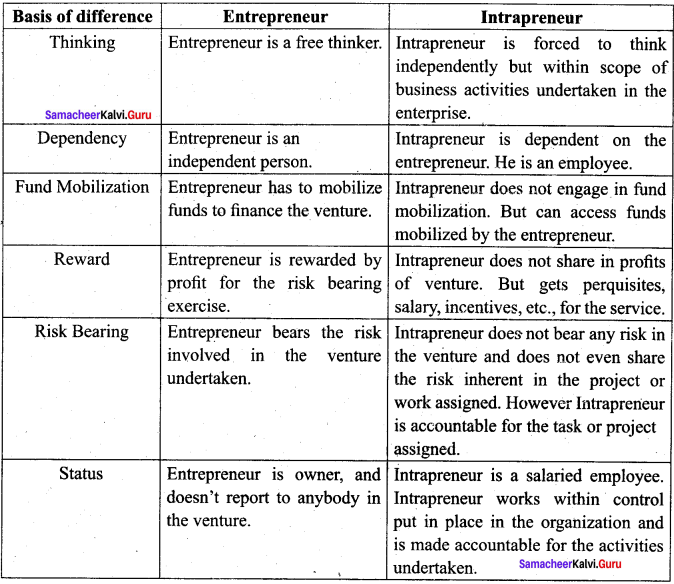
Distinguish between an Entrepreneur and an Intrapreneur.
Answer:

Samacheer Kalvi 12th Commerce Solutions Chapter 23 Elements of Entrepreneurship

Question 4.
Discuss the problems faced by Women Entrepreneurs.
Answer:
There is a tremendous growth in the women entrepreneurship in India. But there are certain problems met by women entrepreneurs.
They are as follows:-

  1. Problem of Finance: The external sources of funds for the women is limited because they do not generally own properties in their own name. They are depending on their own savings and loan from friends and relatives.
  2. Lack of Education: Illiterate and semi-literate women entrepreneurs face difficulties in respect of accounts, money matters, marketing and day-to-day operations.
  3. Lack of Network Support: The success of business depends on the support of family members, friends and relatives. But it is reported that the women entrepreneurs get very limited support in times of crisis.
  4. Stiff Competition: They have to face acute competition for their goods from organised sector and from their male counterparts.
  5. Lack of Information: The lack of knowledge or limited knowledge about subsidies, concessions and incentives given by Government will affect the business.

Samacheer Kalvi 12th Commerce Solutions Chapter 23 Elements of Entrepreneurship

Question 5.
Explain in detail the various functions of an entrepreneur.
Answer:
The functions of an entrepreneur is divided into
(a) Promotional functions,
(b) Managerial functions
(c) Commercial functions.

(a) Promotional functions:
(i) Discovery of Idea: The first and foremost function of entrepreneur is idea generation. A person may conceive his own ideas or develop the ideas contributed by others. Ideas can be generated through several ways like own experience and exposure of entrepreneur, keen observation of environment, education, training, market survey, environmental scanning and so on.

(ii) Detailed Investigation: Entrepreneur should investigate commercial feasibility of the product proposed to be produced and conduct market study to ascertain the potential demand for the product.

(iii) Mobilisation of funds: Entrepreneur has to take steps to mobilise capital needed to implement the venture. Entrepreneur has to estimate the fixed capital and working capital required for running the project.

(b) Managerial functions:
(i) Planning: In this function, the entrepreneur has to lay down the objectives, goals, vision, mission, policies, procedures, programmes, budget, schedules etc., for enabling the venture to proceed towards established destinations.

(ii) Directing: In this function, the entrepreneur has to motivate, lead, guide and communicate with subordinates on an ongoing basis in order to accomplish pre-set goals.

(c) Commercial functions:
(i) Production or Manufacturing: Under production function, entrepreneur has to take decision relating to selection of factory site, design and layout, type of products to be manufactured, research and development.

(ii) Accounting: Entrepreneur has to arrange to prepare trading and profit and loss account in order to know the profit or loss incurred out of operation of the business and prepare balance sheet to know the financial status of business.

Samacheer Kalvi 12th Commerce Solutions Chapter 23 Elements of Entrepreneurship Read More »

Samacheer Kalvi 12th English Grammar Error Spotting

Students can Download Samacheer Kalvi 12th English Grammar Error Spotting, Notes, Samacheer Kalvi 12th English Book Solutions Guide Pdf helps you to revise the complete Tamilnadu State Board New Syllabus and score more marks in your examinations. Get a Practical Study with the help of Samacheer Kalvi 12th English Grammar to make learning language much easy for you and score good grades in exams.

Tamilnadu Samacheer Kalvi 12th English Grammar Error Spotting

Spot the errors in the following sentences and correct them:

Question 1.
No sooner had the teacher entered the class when the students stood up.
Answer:
No sooner had the teacher entered the class than the students stood up.

Samacheer Kalvi 12th English Grammar Error Spotting

Question 2.
He put of his coat.
Answer:
He put off his coat.

Question 3.
He sat beside Philip.
Answer:
He sat beside Philip.

Question 4.
You have to choose among rose milk and almond milk.
Answer:
You have to choose between rose milk and almond milk.

Samacheer Kalvi 12th English Grammar Error Spotting

Question 5.
There were a few incidents of irregularity for the emergency years.
Answer:
There were a few incidents of irregularity during the emergency years.

Question 6.
She only lost her glasses in the stampede.
Answer:
Only she lost her glasses in the stampede.

Question 7.
It is a five – years integrated degree course.
Answer:
It is a five – year integrated degree course.

Question 8.
One must finish his duty on time.
Answer:
One must finish one’s duty on time.

Samacheer Kalvi 12th English Grammar Error Spotting

Question 9.
No less than forty persons were hurt in the accident.
Answer:
No fewer than forty people were hurt in the accident.

Question 10.
It is one of the most memorable day in my life.
Answer:
It is one of the most memorable days in my life.

Question 11.
I regard Ram my friend.
Answer:
I regard Ram as my friend.

Question 12.
It is her who came to see us.
Answer:
It is she who came to see us.

Samacheer Kalvi 12th English Grammar Error Spotting

Question 13.
The mobile phone neither went dead or worked properly.
Answer:
The mobile phone neither went dead nor worked properly.

Question 14.
One must finish his work in time.
Answer:
One must finish one’s work in time.

Question 15.
He absented from the class.
Answer:
He absented himself from the class.

Question 16.
Whom do you think won the prize?
Answer:
Who do you think won the prize?

Question 17.
What book do you read?
Answer:
Which book do you read?

Samacheer Kalvi 12th English Grammar Error Spotting

Question 18.
When learning how to dance, technique is of utmost importance.
Answer:
While learning how to dance, technique is of utmost importance.

Question 19.
Unless you do not work hard, you will not excel in the examination.
Answer:
Unless you work hard, you will not excel in the examination.

Question 20.
She is seventy but her hairs are not grey.
Answer:
She is seventy but her hairs is not grey.

Question 21.
Gopi is one of the tallest boy.
Answer:
Gopi is one of the tallest boys.

Samacheer Kalvi 12th English Grammar Error Spotting

Question 22.
He did not listen to his father’s advices.
Answer:
He did not listen to his father’s advice.

Question 23.
He is a M.Sc student.
Answer:
He is an M.Sc student.

Question 24.
He made an universal appeal to all.
Answer:
He made a universal appeal to all.

Question 25.
He wears a HMT watch presented by his uncle.
Answer:
He wears an HMT watch presented by his uncle.

Samacheer Kalvi 12th English Grammar Error Spotting

Samacheer Kalvi 12th English Grammar Error Spotting Read More »

Samacheer Kalvi 12th Commerce Solutions Chapter 2 Functions of Management

Students can Download Commerce Chapter 2 Functions of Management Questions and Answers, Notes, Samacheer Kalvi 12th Commerce Book Solutions Guide Pdf helps you to revise the complete Tamilnadu State Board New Syllabus and score more marks in your examinations.

Tamilnadu Samacheer Kalvi 12th Commerce Solutions Chapter 2 Functions of Management

Samacheer Kalvi 12th Commerce Functions of Management Textbook Exercise Questions and Answers

I. Choose the Correct Answer

Question 1.
Which is the primary function of management?
(a) Innovating
(b) Controlling
(c) Planning
(d) Decision-making
Answer:
(c) Planning

Samacheer Kalvi 12th Commerce Solutions Chapter 2 Functions of Management

Question 2.
Which of the following is not a main function?
(a) Decision-making
(b) Planning
(c) Organising
(d) staffing
Answer:
(a) Decision-making

Question 3.
Distribution of work in groupwise or sectionwise is called as ________
(a) Co-ordinating
(b) Controlling
(c) Staffing
(d) Organising
Answer:
(d) Organising

Question 4.
Which of the following is verification function?
(a) Planning
(b) Organising
(c) Staffing
(d) Controlling
Answers
(d) Controlling

II. Very Short Answer Questions

Question 1.
Write a short note about Planning.
Answer:
Planning is the primary function of management. Nothing can be performed without planning. Planning is a constructive reviewing of future needs so that present actions can be adjusted in view of the established goal.

Question 2.
What is meant by Motivation?
Answer:
The goals are achieved with the help of motivation. Motivation includes increasing the speed of performance of a work and developing a willingness on the part of workers. This is done by a resourceful leader.

Samacheer Kalvi 12th Commerce Solutions Chapter 2 Functions of Management

Question 3.
What is meant by Controlling?
Answer:
Controlling is performed to evaluate the performance of employees and deciding increments and promotion decisions. The control function helps in identifying under performers and arranging remedial training for them. It is the control function which facilitates synchronization of actual performance with predetermined standards.

Question 4.
How do you coordinate your classroom with peace?
Answer:
All the activities are divided groupwise or sectionwise under organising function. Now, such grouped activities are co-ordinated towards the accomplishment of objectives of a classroom. With the function of co-ordination the classroom must be peaceful and calm.

Question 5.
What is meant by Innovation?
Answer:
Innovation refers to the preparation of personnel and organisation to face the changes made in the business world. Continuous changes are being made in the business. Innovation includes developing new material, new products, new techniques in production, new package, new design of a product and cost reduction.

III. Short Answer Questions

Question 1.
List out the main functions of management.
Answer:
Main functions of management are listed below:

  1. Planning
  2. Organising
  3. Staffing
  4. Directing
  5. Motivating
  6. Controlling and
  7. Co-ordination

Question 2.
State the importance of staffing.
Answer:
Staffing refers to placement of right persons in the right jobs. Staffing includes selection of right persons, training to those needy persons, promotion of best persons, retirement of old persons, performance appraisal of all the personnel, and adequate remuneration of personnel. The success of any enterprise depends upon the successful performance of staffing function.

Samacheer Kalvi 12th Commerce Solutions Chapter 2 Functions of Management

Question 3.
Bring out the subsidiary functions of management.
Answer:

  1. Innovation
  2. Representation
  3. Decision-making
  4. Communication

Question 4.
State the importance of Motivation.
Answer:
The goals are achieved with the help of motivation. Motivation includes increasing the speed of performance of a work and developing a
willingness on the part of workers. This is done by a resourceful leader. The workers expect, favourable climate conditions to work, fair treatment, monetary or non-monetary incentive, effective communication and gentleman approach.

Question 5.
What are the main duties of a manager?
Answer:

  1. A manager has to act as representative of a company.
  2. Manager has dealings with customers, suppliers, government officials, banks, financial institutions, trade unions and the like.
  3. It is the duty of every manager to have good relation with others.

IV. Long Answer Questions

Question 1.
Explain the various functions of management.
Main Functions:

  1. Planning:- Planning is the primary function of management. Planning is a constructive reviewing of future needs so that present actions can be adjusted in view of the established goal.
  2. Organising:- Organising is the process of establishing harmonious relationship among the members of an organisation and the creation of network of relationship among them.
  3. Staffing:- Staffing function comprises the activities of selection and placement of competent personnel.
  4. Directing:- Directing denotes motivating, leading, guiding and communicating with subordinates on an ongoing basis in order to accomplish pre-set goals.
  5. Controlling:- Controlling is performed to evaluate the performance of employees and deciding increments and promotion decisions.
  6. Co-ordination:- Co-ordination is the synchronization of the actions of all individuals, working in the enterprise in different capacities.
  7. Motivating:- The goals are achieved with the help of motivation. Motivation includes increasing the speed of performance of a work and developing a willingness on the part of workers.

Subsidiary Functions:

  1. Innovation:- Innovation includes developing new material, new products, new techniques in production, new package, new design of a product and cost reduction.
  2. Representation:- A manager has to act as representative of a company. It is the duty of every manager to have good relation with others.
  3. Decision-making:- Every employee of an organisation has to take a number of decisions every day. Decision-making helps in the smooth functioning of an organisation.
  4. Communication:- Communication is the transmission of human thoughts, views or opinions from one person to another person. Communication helps the regulation of job and co-ordinates the activities.

Samacheer Kalvi 12th Commerce Functions of Management Additional Questions and Answers

A. Choose the Correct Answer

Question 1.
Match the following:

(a) Management process (i) Two categories
(b) Management functions can be classified (ii) Primary function
(c) Planning (iii) Subsidiary function
(d) Innovation (iv) Management function
(a) (b) (c) (d)
(A) 4 1 2 3
(B) 1 2 3 4
(C) 4 3 2 1
(D) 2 1 4 3

Answer:
(a) 4,1,2,3

Question 2
______ is the subsidiary function of management.
(a) Planning
(b) Co-ordination
(c) Innovation
(d) Controlling
Answer:
(c) Innovation

Samacheer Kalvi 12th Commerce Solutions Chapter 2 Functions of Management

Question 3.
Choose the odd one out.
(a) Directing
(b) Motivating
(c) Staffing
(d) Decision-making
Answer:
(d) Decision-making

Question 4.
Which one is not the main function of management?
(a) Communication
(b) Co-ordination
(c) Directing
(d) Motivating
Answer:
(a) Communication

Question 5.
Assertion (A): Co-ordination is the synchronization of the actions of all individuals.
Reason (R): Co-ordination is one of the subsidiary functions of management.
(a) Both are true
(b) (A) true but (R) is not correct
(c) (A) only true
(d) (R) only correct
Answer:
(b) (A) true but (R) is not correct

Question 6.
There are ______ subsidiary functions of management.
(a) Four
(b) Three
(c) Seven
(d) Six
Answer:
(a) Four

Samacheer Kalvi 12th Commerce Solutions Chapter 2 Functions of Management

Question 7
______ function comprises the activities of selection and placement of competent personnel.
(a) Organising
(b) Planning
(c) Staffing
(d) Controlling
Answer:
(c) Staffing

B. Fill in the blanks

  1. Management functions are called as ______
  2. A manager has to act as a ______ of a company.
  3. ______ helps the regulation of job and co-ordinates the activities.

Answers:

  1. managerial process
  2. representative
  3. Communication

II. Very Short Answer Questions

Question 1.
How the functions of management can be classified?
Answer:
The functions of management can be classified into two categories. They are as follows:
(a) Main functions of Management
(b) Subsidiary functions of Management

III. Short Answer Questions

Question 1.
What do you mean by communication?
Answer:
Communication is the transmission of human thoughts, views or opinions from one person to another person. Workers are informed about what should be done, where it is to be done, how it is do be done and when it is to be done. Communication helps the regulation of job and co-ordinates the activities.

Samacheer Kalvi 12th Commerce Solutions Chapter 2 Functions of Management Read More »

Samacheer Kalvi 12th English Grammar Determiners

Students can Download Samacheer Kalvi 12th English Grammar Determiners, Notes, Samacheer Kalvi 12th English Book Solutions Guide Pdf helps you to revise the complete Tamilnadu State Board New Syllabus and score more marks in your examinations. Get a Practical Study with the help of Samacheer Kalvi 12th English Grammar to make learning language much easy for you and score good grades in exams.

Tamilnadu Samacheer Kalvi 12th English Grammar Determiners

Study the sentences given below:

Samacheer Kalvi 12th English Grammar Determiners

  • I saw a juggler yesterday.
  • My uncle is an officer in the army.
  • This car is very comfortable.
  • Some pictures are really fine.
  • Do you have any complaints about me?
  • She is blind of one eye.

In the above sentences, a, an, the, this, my, some, any and one are words which mark the subsequent arrival of a noun. Each of them modifies the noun which follows it. Such words are called Determiners or Fixing words as they fix the nouns that follow them.

Here is a tentative list of the most frequently used Determiners:
(a) a, an, the – (Article Determiners)
(b) this, that, these, those – (Demonstrative Determiners)
(c) my, our, your, his, her, its, their, one’s – (Possessive Determiners)
(d) one, two, three, etc. – (Definite Numerical Determiners)
(e) some, any, no; all, both; much, many; few, less, several, little – (Indefinite Numeral Determiners)
(i) each, every, either, neither – (Distributive Numeral Determiners)

Samacheer Kalvi 12th English Grammar Determiners

Use Of Some Common Determiners

  • A hen laid an egg yesterday.
  • Bring me the purse I gave you.
  • This car is very beautiful.
  • Aditi lives in that house.
  • These books are yours.
  • Get me those mangoes please.
  • My mother is a teacher.
  • Your brother is calling you.
  • Our school has fifty rooms.
  • Their house is double-storeyed.
  • Five boys are sitting on that bench.
  • He stays on the first floor.
  • There isn’t any sugar in the pot.
  • Will you have some tea?
  • She gave me all the apples.
  • Both the friends refused to part.
  • He has not solved many sums.
  • There are few buses running.
  • He had little money.
  • I play hockey every day.
  • Either book will do.
  • Neither statement is true.

Samacheer Kalvi 12th English Grammar Determiners

Fill in the blanks with suitable determiners.

Question 1.
We have ……………. kilometers to go but there is only a ……………. petrol left in the tank!
Answer:
some, any

Question 2.
There isn’t ……………. time; we’ve only ……………. minutes left before the movie starts.
Answer:
much, a few

Question 3.
I took ……………. apple from ……………. refrigerator and ate it.
Answer:
an, the

Samacheer Kalvi 12th English Grammar Determiners

Question 4.
Quite ……………. trees were blown down by the storm last night ……………. workers were trying to clear them off the road this morning.
Answer:
a few, Many

Question 5.
How ……………. rice is there in the pot? We need only ……………. to feed the cat.
Answer:
much, a little

Question 6.
Don’t add ……………. salt. I have already put in ……………. and the soup is just right.
Answer:
any, enough

Question 7.
……………. goats have wandered into the garden and damaged ……………. plants.
Answer:
Several, the

Samacheer Kalvi 12th English Grammar Determiners

Question 8.
A man may have ……………. wealth and yet not be ……………. happier with it
Answer:
some, any

Question 9.
On Sundays, there is not ……………. traffic along this road.
Answer:
much

Question 10.
I tried to phone her two or three times, but ……………. time there was no reply
Answer:
each

Samacheer Kalvi 12th English Grammar Determiners

Samacheer Kalvi 12th English Grammar Determiners Read More »

Samacheer Kalvi 12th English E-Mail Writing

Students can Download Samacheer Kalvi 12th English E-Mail Writing, Notes, Samacheer Kalvi 12th English Book Solutions Guide Pdf helps you to revise the complete Tamilnadu State Board New Syllabus and score more marks in your examinations. Get a Practical Study with the help of Samacheer Kalvi 12th English Grammar to make learning language much easy for you and score good grades in exams.

Tamilnadu Samacheer Kalvi 12th English E-Mail Writing

E-mail is one of the fastest and latest ways of communication. It is concise and one needs to be more technical. In such communication, both the addresser and addressee need an E-mail ID where one can write a message. It is communicated through a server. So at both ends, there should be a computer or laptop to receive the message.

Samacheer Kalvi 12th English E-Mail Writing

Hints for writing E-mail

– Maintain brevity.
– Make it personal.
– Answer swiftly.
– Use proper structure & layout.
– Do not write in CAPITALS.
– Do not overuse Reply to All.
– Be careful with formatting.
– Use a meaningful subject.
– Use simple and lucid language.
– Use templates for frequently used responses.
– Do not attach unnecessary tiles.
– Do not overuse the high priority option.
– Revise/Review the e-mail before you send it.
– Take care with abbreviations and emoticons.
– Do not use e-mail to discuss confidential matters.

Samacheer Kalvi 12th English E-Mail Writing

The layout of an E-mail

Solved Questions
(i) You are Seema/Suresh, living in Chennai, Tamil Nadu. Write an e-mail to the health officer of your city drawing his attention to the use of single-use plastics in your locality.

To [email protected]
From [email protected]
Subject Use of single-use plastics
Sir
I would like to draw your kind attention to the use of plastics that has pervaded in my locality. It is a new locality where one can find big and beautiful buildings. When it was brought into being a few years ago, the municipal authorities had given a word to look into the needs of the residents. Unfortunately, their promises proved to be mere words. The roads of our locality are littered with polythene bags. The beauty of the entire landscape is lost: During rainy days:

  • drainage gets clogged
  • Though state government has banned single-use plastic in Jan 2019, its use is quite extensive all over the city.

There are no dustbins, people throw the waste material on the roadside.I, therefore, request you to please look into the matter seriously and take steps to curb the menace of plastic overuse. We will be thankful if you address this problem and help us.

Yours sincerely
Seema

Samacheer Kalvi 12th English E-Mail Writing

(ii) You are Varghese/Mary. You have been invited to attend the convocation of your friend’s sister during summer vacation. Write an e-mail to higher regretting your inability to attend it.
Answer:

To [email protected]
From [email protected]
Subject Inability to attend the convocation
Dear Ancy
Thank you for your cordial invitation to the occasion of your convocation function. I, however, regret my inability to be with you on this happy occasion as we shall be leaving for Ooty for a family trip on 19th June, 20XX. Please excuse my absence. Do convey my regards and best wishes to your sister.Yours sincerely
Varghese/Mary

Samacheer Kalvi 12th English E-Mail Writing

(iii) Draft a mail to Prof. Hemalatha inviting her to preside over your school’s English literary Association meeting. School Pupil Leader. You are Swetha/Swithin.
Answer:

To [email protected]
From [email protected]/[email protected]
Subject Inviting to preside over English literary association
Dear Madam
I would like to invite you for presiding over the inauguration of our school’s literary Association scheduled to be held at Auditorium, Presidency Girls Hr. Sec. School, Egmore on 18th July 2019 at 2.30 pm. On behalf of the school, I invite you to deliver the keynote address also. Kindly send your consent by mail as we need to print the invitation cards.Yours sincerely
Swetha/Swithin

Samacheer Kalvi 12th English E-Mail Writing

(iv) You are Dipanshu /Neeta. Write an email to the chairman of the censor board to implement ban or reduce movies that show women in situations portraying them as objects of desire.
Answer:

To [email protected]
From [email protected]/[email protected]
Subject Reg. Non-Social Movie Scenes
Dear Sir

I regret to bring to your notice the recent films do portray women in a bad light. Heroes stalk beautiful girls and get away with it. Such things influence young students adversely. I request the Sensor board to cut such ethically unsound content before screening them to all.

Thanking You.

Yours sincerely
Dipanshu/Neeta

Samacheer Kalvi 12th English E-Mail Writing

(v) Write an email in not less than 50 words to the Technical Officer, Science Park, seeking permission to allow 50 students to see Birla Planetarium. Sign the email as Kathiravan/ Andrea.
Answer:

To [email protected]
From [email protected]/ [email protected]
Subject Permission to Take Photos in the Office Premises
Dear Sir
I, Kathiravan/Andrea, entrusted by our class teacher to write to you to block 50 seats for students and 5 seats for teachers in Birla Planetarium, morning show between 10 am to 11. 30 am. Kindly extend the concession due for students. After receiving your consent letter and entry ticket charges, we shall arrange a bus to reach your premises before 9.45 am. With warm regardsYours sincerely
Kathiravan/Andrea

Samacheer Kalvi 12th English E-Mail Writing

Samacheer Kalvi 12th English E-Mail Writing Read More »

Samacheer Kalvi 12th Commerce Solutions Chapter 27 Company Management

Students can Download Commerce Chapter 27 Company Management Questions and Answers, Notes Pdf, Samacheer Kalvi 12th Commerce Book Solutions Guide Pdf helps you to revise the complete Tamilnadu State Board New Syllabus and score more marks in your examinations.

Tamilnadu Samacheer Kalvi 12th Commerce Solutions Chapter 27 Company Management

Samacheer Kalvi 12th Commerce Company Management Textbook Exercise Questions and Answers

I. Choose the Correct Answer

Question 1.
A person shall hold office as a director in ______ companies as per the Companies Act,2013.
(a) 5 companies
(b) 10 companies
(c) 20 companies
(d) 15 companies
Answer:
(c) 20 companies

Question 2.
Which Director is appointed by a Financial institution?
(a) Nominee
(b) Additional
(c) Women
(d) Shadow
Answer:
(a) Nominee

Samacheer Kalvi 12th Commerce Solutions Chapter 27 Company Management

Question 3.
A Private Company shall have a minimum of ______
(a) Seven directors
(b) Five directors
(c) Three directors
(d) Two directors
Answer:
(d) Two directors

Question 4.
A Public Company shall have a minimum of ______ Directors.
(a) Twelve
(b) Seven
(c) Three
(d) Two
Answer:
(c) Three

Question 5.
A Public Company having a paid up Share Capital of Rs. ______ or more may have a Director, elected by such small shareholders.
(a) One
(b) Three
(c) Five
(d) Seven
Answer:
(c) Five

Question 6.
Under the companies Act, which one of the following powers can be exercised by the Board of Directors?
(a) Power to sell the company’s undertakings
(b) Power to make call
(c) Power to borrow money in excess of the paid up capital
(d) Power to reappoint an auditor
Answer:
(b) Power to make call

Question 7.
Which director need not hold qualifying shares?
(a) Directors appointed to Central Government
(b) Directors appointed to Shareholders
(c) Directors appointed to Managing Director
(d) Directors appointed to Board of Directors
Answer:
(a) Directors appointed to Central Government

Question 8.
What is the status of Directors who regulate money of the company?
(a) Banker
(b) Holder
(c) Agent
(d) Trustees
Answer:
(d) Trustees

Question 9.
According to Companies Act, the Directors must be appointed by the _______
(a) Central Government
(b) Company Law Tribunal
(c) Company in General Meeting
(d) Board of Directors
Answer:
(c) Company in General Meeting

Question 10.
The Board of Directors can exercise the power to appoint directors in the case of _______
(a) Additional Directors
(b) Filling up the Casual vacancy
(c) Alternate Directors
(d) All the above
Answer:
(d) All the above

II. Very Short Answer Questions

Question 1.
Define Director.
Answer:
The Companies Act 2013 section 2 (34) defines a director appointed to the board of a Company is:
“A Person who is appointed or elected member of the Board of Directors of a company and has the responsibility of determining and implementing policies along with others in the board.

Question 2.
Name the companies required to appoint KMP.
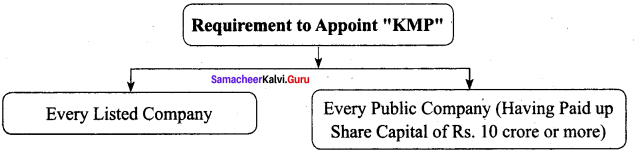
Answer:
Following Companies are required to appoint KMP:

Samacheer Kalvi 12th Commerce Solutions Chapter 27 Company Management

Question 3.
Who is whole time Director?
Answer:
A whole time Director is one who devotes whole of his time of working hours to the company and has a significant personal interest in the company as the source of his income.

Question 4.
Who is called as Managing Director?
Answer:
A Managing Director is one who is employed by the company and has substantial powers of management over the affairs of the company subject to superintendence, direction and control of the board.

Samacheer Kalvi 12th Commerce Solutions Chapter 27 Company Management

Question 5.
Who can be Executive Director?
Answer:
An executive director is a Chief Executive Officer (CEO) or Managing Director of an organization, company, or corporation, who is responsible for making decisions to complete the mission and for the success of the organisation.

III. Short Answer Questions

Question 1.
Differentiate Executive and Non-Executive Directors.
Answer:

Basis for Difference Executive Director Non-Executive Director
1. Meaning An Executive Director can be either a whole-time Director of the Company or a Managing Director. A Non- Executive Director is a Director who is neither a Whole-time Director nor a Managing Director.

Question 2.
When are alternative directors appointed?
Answer:
Alternate director is appointed by the Board of Directors, as a substitute to a director who may be absent from India, for a period which is not less than three months.

Question 3.
Who is a shadow director?
Answer:
A shadow director is a person who is not the member of Board but has some power to run it and can be appointed as the director but according to his/her wish.

Question 4.
What is causal vacancy?
Answer:
If a director is absent from India, for a period which is not less than three months, then it is called casual vacancy. It may be filled by the appointment of alternate director. The appointment ’must be authorised by the articles of association by passing a resolution in the meeting.

Question 5.
State the minimum number of Directors for a private company.
Answer:
Under section 149 (1) of the Companies Act, 2013 states that the requirement of Minimum/ Maximum Number of Directors in a Company.,

Private company:
In case of One Person Company: The requirement of directors is one.
Other Priv ate Companies: The minimum requirement of Directors is two.

IV. Long Answer Questions

Question 1.
Who are the KMP?
Answer:
Companies Act, 2013 has introduced many new concepts and Key Managerial Personnel (KMP) is one of them. KMP covers the traditional roles of managing director and whole time director and also includes some functional heads.
Key Managerial Personnel: The definition of the term Key Managerial Personnel is contained in Section 2(51) of the Companies Act, 2013. This Section states:

  1. The Chief Executive Officer
  2. The Managing Director or Manager
  3. The Company Secretary
  4. The Whole-time Director
  5. The Chief Financial Officer
  6. Such other officer as may be prescribed

Question 2.
Explain composition of the board of directors.
Answer:
Composition of the Board off Directors:

  1. General Optimum Combination: Board of Directors shall have an optimum combination of executive and non-executive directors with at least one woman director.
  2. When the non-executive Director is the Chairperson: In this case, at least one-third of the board of directors shall comprise of independent directors.
  3. When the non-executive chairperson is a promoter or is related to any promoter or person occupying management positions at the level of board of director or at one level below the Board of Directors: In this case, at least one half of the board of directors of the company shall consist of Independent Directors.

Samacheer Kalvi 12th Commerce Solutions Chapter 27 Company Management

Question 3.
Briefly explain different types of Directors.
Types of Directors as per Companies Act 2013:
Answer:

  1. Residential Director: According to Section 149 (3) of Companies Act 2013, every company should appoint a director who has stayed in India for’a total period of 182 days.
  2. Independent Director: An independent director is an alternate director other than a Managing Director who is known as Whole time director or Nominee director.
  3. Small shareholder’s Director: Small shareholders can appoint a single director in a listed company.
  4.  Nominee Director: A director nominated by any financial institution in pursuance of the provisions of law.
  5. Additional Directors: Any Individual can be appointed as Additional Directors by a company.
  6. Alternate Directors: Alternate director is appointed by the Board of Directors, as a substitute who may be absent from India, for a period of 3 months.

Question 4.
State the qualification of directors.
Answer:
Qualifications of Director: As regards to the qualification of directors, there is no direct provision in the Companies Act, 2013. In general, a director shall possess appropriate skills, experience and knowledge in the fields of finance, law, management, sales, marketing, research and other disciplines related to the business. The following are the qualifications:

  1. A director must be a person of sound mind.
  2. A director must hold share qualification, if the article of association provides such.
  3. A director must be an individual.
  4. A director should be a solvent person.
  5. A director should not be convicted by the Court for any offence, etc.

Question 5.
List the disqualification of a directors.
Answer:
Disqualifications of a Director: Section 164 of Companies Act, 2013, has mentioned the disqualification as follows:
A person shall not be capable of being appointed director of a company, if the director is
(a) Of unsound mind
(b) An undercharged insolvent
(c) Has been convicted by a court for any offence
(d) Has not paid any call in respect of shares of the company held by him
(e) An order disqualifying him for appointment as director has been passed by a court
(f) He has not got the Director Identification Number

Question 6.
Explain how director of a company can be removed from the office.
Answer:
A Director of Company can be removed from his Office before the expiry of his term by ‘

  1.  the Shareholders
  2. the Central Government
  3. the Company Law Board

(i) Removal by shareholders (Sec- 169): A company may, by giving a special notice and passing an ordinary resolution, remove a director before the expiry of his period of office.

(ii) Removal by the Central Government: The Central Government has been empowered to remove managerial personnel from office on the recommendation of the Company Law Board under the following situations:
(a) Where a person concerned in the conduct and management of the affairs of a company has been guilty of fraud and negligence.
(b) If the business is managed by a person without sound business principles.
(c) Where the business of a company has been managed by such a person, who likes to cause injury or damage to the business.

(ii) Removal by the Company Law Board: If an application has been made to the Company Law Board against the oppression and mismanagement of the company’s affairs by a director, then the Company Law Board may order to terminate the director.

Question 7.
What is the maximum limit for the Managerial remuneration?
Answer:
Managerial Remuneration: The Managerial remuneration is payable to a person’s appointed u/s 196 of the Act. The Term remuneration means any money or its equivalent given for their services.

Adequate profits: A Public Company can pay remuneration to its directors including Managing Director and Whole-time Directors, and its managers which shall not exceed 11% of the net profit.

Maximum Remuneration Payable by a Company to its Managerial Personnel – No adequate Profits: Remuneration Payable by a company in case where there is no profit or inadequacy of

Where Effective Capital is Limit of yearly Remuneration payable shall not exceed (Rupees)
(i) less than ₹ 5 Crore ₹ 30 lakh
(ii) Above ₹ 5 Crore and less than ₹ 100 Crore ₹ 42 lakh
(iii) ₹ 5 Crore and above but less than ₹ 100 Crore ₹ 60 lakh
(iv) ₹ 250 Crore and above ₹ 60 lakh plus 9.91% of the effective capital in excess of ₹ 250 Crore

Question 8.
What are the duties of a director?
Answer:
Directors act as agents of the shareholders and act as a trustees of shareholders. The following are the duties of directors:

Collective Duties of Directors: Directors as apart of Board perform certain duties collectively. The duties are as follows:

  1. Approval of annual accounts and authentication of annual accounts
  2. Appointment of First Auditors
  3. Passing of resolutions at board meetings
  4. Directors report to shareholders highlighting the performance of the company.

General duties of Directors:

  1. Delegating power to any committee
  2. Issuing instructions to employees for implementation of policy
  3. Appointing their subordinates like Managing director, Manager, Secretary and other employees
  4. Act in Good faith in order to promote the objectives of the company

Question 9.
State the powers of the directors.
Answer:
Powers of Directors: The directors must have powers to carry on objectives of the company. The powers may be of four types:

  1. Statutory Powers of Directors
  2. Managerial Powers of Directors
  3. Powers only with a resolution
  4. Other Powers

Statutory Powers: The following powers must be used in the Board meeting:

  1. Power to make calls on shareholders in respect of money unpaid on their shares
  2. Power to issue debentures
  3. Power to borrow money other than on debentures
  4. Power to invest the funds of the company
  5. Power to approve financial statement and Board report Managerial Powers:
  6. Power to allot, forfeit or transfer shares of company
  7. Power to decide the terms and conditions to issue debentures
  8. Power to appoint Managing Director, Manager and Secretary of the company.

Powers only with a resolution:

  1. To sell or lease any asset of the company
  2. To issue bonus shares
  3. To allow time to the director for repayment of the loan

Other Powers:

  1. Power to fill casual vacancy
  2. Power to appoint the first auditor of the company
  3. Power to appoint alternative directors, additional directors
  4. Power to remove key managerial personnel

Samacheer Kalvi 12th Commerce Solutions Chapter 27 Company Management

Question 10.
State the Criminal liabilities of Directors.
Directors will be liable with a fine and imprisonment or both for fraud of non-compliance of any statutory provisions in the following situations where:

  1. There is mis-statement in Prospectus
  2. There is failure to file return on allotment with the registrar
  3. Failure to give notice to the registrar for conversion of share into stock
  4. Failure to issue Share Certificate and Debenture Certificate
  5. There is default in holding Annual General Meeting
  6. There is failure to provide Financial Statements

Samacheer Kalvi 12th Commerce Company Management Additional Questions and Answers

I. Choose the Correct Answer

Question 1.
A company may appoint more than 15 directors after passing a ______ resolution.
(a) special
(b) ordinary
(c) usual
(d) commanding
Answer:
(a) special

Question 2.
A person can hold the position of Directorship in different companies up to the maximum of ______
(a) 15
(b) 10
(c) 18
(d) 20
Answer:
(d) 20

Samacheer Kalvi 12th Commerce Solutions Chapter 27 Company Management

Question 3.
An ______ can be either a whole time director of the company or a Managing Director.
(a) Executive Director
(c) Non-Executive Director
(b) First Director
(d) Residential Director
Answer:
(a) Executive Director

II. Very Short Answer Questions

Question 1.
Write a note on independent director.
Answer:
According to Section 149 (6), an independent director is an alternate director other than a Managing Director, who is known as Whole Time Director or Nominee Director.

Question 2.
Who is a ‘First Director’?
Answer:
A ‘First Director’ means a director who holds office from the date of incorporation of the company. The first directors are usually named in the Articles of Association.

Samacheer Kalvi 12th Commerce Solutions Chapter 27 Company Management

III. Short Answer Questions

Question 1.
How a director is removed by the Company Law Board?
Answer:
There are three methods of removal of director from the company.
They are:
(a) Removal by shareholders- If the shareholders feel that the policies pursued by the director are not appropriate, then they can remove the director by passing an ordinary resolution in a general meeting.
(b) Removal by the Central Government- The Central Government has been empowered to remove managerial personnel from office on the recommendation of the Company Law Board.
(c) Removal by the Company Law Board- If an application has been made to the Company Law Board against the oppression and mismanagement of the company’s affairs by a director, then the Company Law Board may order for the termination of the director’s tenure.

Samacheer Kalvi 12th Commerce Solutions Chapter 27 Company Management Read More »

Samacheer Kalvi 12th Commerce Solutions Chapter 20 Liberalization, Privatization and Globalization

Students can Download Commerce Chapter 20 Liberalization, Privatization and Globalization Questions and Answers, Notes Pdf, Samacheer Kalvi 12th Commerce Book Solutions Guide Pdf helps you to revise the complete Tamilnadu State Board New Syllabus and score more marks in your examinations.

Tamilnadu Samacheer Kalvi 12th Commerce Solutions Chapter 20 Liberalization, Privatization and Globalization

Samacheer Kalvi 12th Commerce Liberalization, Privatization and Globalization Textbook Exercise Questions and Answers

I. Choose the Correct Answer

Question 1.
_______ is the result of New Industrial Policy which abolished the ‘License System’
(a) Globalisation
(b) Privatisation
(c) Liberalisation
(d) None of these
Answer:
(c) Liberalisation

Question 2
_______ means permitting the private sector to setup industries which were previously reserved for public sector.
(a) Liberalisation
(b) Privatisation
(c) Globalisation
(d) Public Enterprise
Answer:
(b) Privatisation

Samacheer Kalvi 12th Commerce Solutions Chapter 20 Liberalization, Privatization and Globalization

Question 3
_______ ownership makes bold management decisions due to their strong foundation in
the international level.
(a) Private
(b) Public
(c) Corporate
(d) MNC’s
Answer:
(a) Private

Question 4
_______ results from the removal of barriers between national economies to encourage the flow of goods, services, capital and labour.
(a) Privatisation
(b) Liberalisation
(c) Globalisation
(d) Foreign Trade
Answer:
(c) Globalisation

Question 5.
New Economic Policy was introduced in the year _______
(a) 1980
(b) 1991
(c) 2013
(d) 2015
Answer:
(b) 1991

II. Very Short Answer Questions

Question 1.
State the branches of New Economic Policy.
Answer:
There are three dimensions of New Economic Policy.
They are explained as:

  1. Liberalization
  2. Privatization
  3. Globalization

Question 2.
What is Privatisation?
Answer:
Privatization is the incidence or process of transferring ownership of a business enterprise, agency or public service from the government to the private sector.

Question 3.
Mention any three disadvantages of Liberalisation.
Answer:
Disadvantages of Liberalisation:

  1. Increase in unemployment
  2. Loss to domestic units
  3. Increased dependence on foreign nations
  4. Unbalanced development

Question 4.
Name the industries which are reserved for public sector.
Answer:
The number of industries reserved for public sector was reduced from 17 (as per 1956 policy) to only 8 industries viz, Arms and Ammunition, Atomic Energy, Coal and Lignite, Mineral oils, Mining of ores, Mining of copper, lead, zinc, etc., Minerals for atomic energy and Railways.

Samacheer Kalvi 12th Commerce Solutions Chapter 20 Liberalization, Privatization and Globalization

Question 5.
Give any three advantages of Globalisation.
Answer:
Advantages of Globalisation:

  1. Increase in foreign collaboration
  2. Expansion of market
  3. Technological development
  4. Reduction in brain drain

III. Short Answer Questions

Question 1.
What do you mean by Liberalisation?
Answer:
Liberalization refers to laws or rules being liberalized, or relaxed, by a government. Liberalizing trade policy by the government includes removal of tariff, subsidies and other restrictions on the flow of goods and services between countries. Liberalization is the result of New Industrial Policy which abolished the “License system” or “Licence Raj”.

Question 2.
Explain the concept of Privatisation.
Answer:
Privatisation means permitting the private sector to set up industries which were previously reserved for the public sector. Under this policy many Public Sector Units (PSUs) were sold to private sector. The main reason for privatisation was that PSUs were running in losses due to mismanagement and political interference.

Question 3.
What are advantages of disinvestment?
Answer:
Disinvestment in PSUs: The Govt, has started the process of disinvestment in those PSUs which had been running into loss. It means that Govt, has been selling out these industries to private sector. So disinvestment is a system of privatizing government enterprises.

Question 4.
State any three impacts on Globalisation.
Answer:
Impact of Globalization:

  1. Corporations got a competitive advantage from lower operating costs, and access to new raw materials and additional markets.
  2. Multinational corporations (MNCs) can manufacture, buy and sell goods worldwide.
  3. Globalisation has led to a boom in consumer products market.

Samacheer Kalvi 12th Commerce Solutions Chapter 20 Liberalization, Privatization and Globalization

Question 5.
Write a short note on New Economic Policy.
Answer:
India agreed to the conditions of World Bank and IMF and announced New Economic Policy (NEP) which consists of wide range of economic reforms. This new set of economic reforms is commonly known as the LPG or Liberalisation, Privatisation and Globalisation model.

IV. Long Answer Questions

Question 1.
Explain the advantages and disadvantages of liberalisation.
Answer:
Liberalisation means relaxation of various government restrictions in the areas of social and economic policies of the country.
Advantages of Liberalisation:

  1. Increase in foreign investment: If a country liberalises its trade, it will make the country – more attractive for inward investment.
  2. Increase the foreign exchange reserve: Relaxation in the regulations covering foreign investmefit and foreign exchange has paved way for easy access to foreign capital.
  3. Increase in consumption: Liberalization increases the number of goods available for consumption within a country

Disadvantages of Liberalisation:

  1. Increase in unemployment: Due to liberalisation some industries grow, some decline. Therefore, there may be unemployment from certain industries closing.
  2. Increased dependence on foreign nations: Trade liberalisation means firms will face greater competition from abroad.
  3. Unbalanced development: Trade liberalisation may be damaging for developing economies. which cannot compete against free trade.

Question 2.
Explain the impact of LPG on Indian Economy.
Answer:
Impact of Liberalisation:

  1. Liberalization has opened up new business opportunities abroad and increased foreign direct investment.
  2. New market for various goods came into existence and resulted not only in urban but also in rural development.
  3. It became very easy to obtain loans from banks for business expansion.

Impact of Privatisation:

  1. Privatization has a positive impact on the financial growth by decreasing the deficits and debts.
  2. Increase in the efficiency of government undertakings.
  3. Provide better goods and services to the consumers.

Impact of Globalization:

  1. Multinational corporations can manufacture, buy and sell goods worldwide.
  2. Globalisation has led to a boom in consumer products market.
  3. The advent of foreign companies and growth in economy has led to job creation.

Samacheer Kalvi 12th Commerce Liberalization, Privatization and Globalization Additional Questions and Answers

I. Choose the Correct Answer

Question 1.
It is a situation in which a country loses its most educated and talented workers to other countries is known as
(a) Liberalisation
(b) Foreign trade
(c) Brain Drain
(d) Nationalisation
Answer:
(c) Brain Drain

Samacheer Kalvi 12th Commerce Solutions Chapter 20 Liberalization, Privatization and Globalization

Question 2
is the latest outcome of liberalisation.
(a) Privatisation
(b) Globalisation
(c) Foreign collaboration
(d) None of these
Answer:
(c) Foreign collaboration

Question 3.
refers to laws or rules being liberalised or relaxed by a government.
(a) Liberalisation
(b) Privatisation
(c) Nationalisation
(d) Foreign Collaboration
Answer:
(a) Liberalisation

II. Very Short Answer Questions

Question 1.
What do you mean by Globalisation?
Answer:
Globalisation means the interaction and integrati on of the domestic economy with the rest of the world with regard to foreign investment, trade and production.

Samacheer Kalvi 12th Commerce Solutions Chapter 20 Liberalization, Privatization and Globalization

Question 2.
What are the forms of Globalisation?
Answer:
Forms of Globalization:
(a) Foreign trade policy
(b) Export promotion
(c) Freedom to repatriate
(d) Reduction in tariffs
(e) Encouraging open competition

III. Short Answer Questions

Question 1.
Explain the highlights of LPG policy.
Answer:
The salient highlights of the Liberalisation, Privatisation and Globalisation Policy in India:

  1. Introduction of New Foreign Trade Agreements
  2. Foreign Investment (FDI and FII)
  3. MRTP Act, 1969 (Amended)
  4. Deregulation
  5. Opportunities for overseas trade
  6. Tax reforms
  7. Abolition of License

Samacheer Kalvi 12th Commerce Solutions Chapter 20 Liberalization, Privatization and Globalization Read More »