11th English Unit 5 Prose The Convocation Address Paragraph Book Back Answers Samacheer Kalvi
The Convocation Address Book Back Answers Class 11 English Guide Chapter 5 Tamilnadu Solutions
Students can Download English Lesson 5 Convocation Address Questions and Answers, Summary, Activity, Notes, Samacheer Kalvi 11th English Book Solutions Guide Pdf helps you to revise the complete Tamilnadu State Board New Syllabus and score more marks in your examinations. Learn the Samacheer Kalvi 11th English Grammar to enhance your grammar skills like reading comprehension, passage writing, parts of speech, tenses, passive and active voice, and many other concepts in no time.
11th Standard English 5th Lesson The Convocation Address Questions and Answers
Warm up
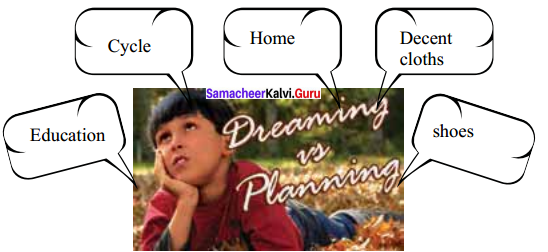
A. Work in pairs. Look at the mind map below and add a few other features of democracy you can think of. Share your answers with the class.
- e.g. sharing and caring
- Protecting nature
- Cleaning environment
- Doing one’s duties
- Enjoying freedom of speech
Answer:
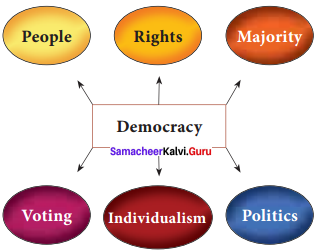
- People
- Rights
- Majority
- Voting
- Individualism
- Politics
B. Given below is a list of items or features you find in a good school. Study the list and classify the items as individual and common.
(textbooks – uniform – smart class room – laboratory – competent teachers – library – mid-day meals – blackboard – stationery – play ground – sports equipment-washrooms)
| Individual | Common |
| e.g. textbooks | play ground |
Answer:
| Individual | Common |
| e.g. textbooks | play ground |
| uniform | smart classroom |
| stationery | library |
| teachers | laboratory |
| mid-day meals | washroom |
| sports equipment | blackboard |
C. Who provides these common facilities? Tick the appropriate source.
- Parents
- Educational institutions
- The Department of Education
- Social Service Organizations
- Other agencies
Answer:
The Department of Education provides these common facilities.
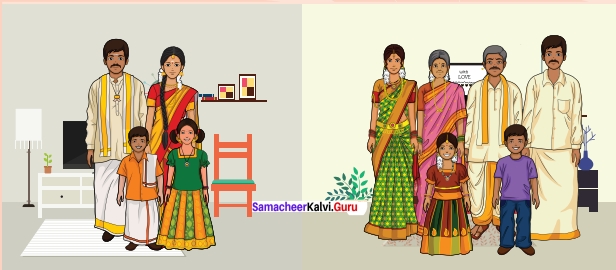
D. Discuss this aspect with your partner and share your views on how students can give back to society.
Students can do a lot in generating ideas which could be helpful to society. Many illiterate people and young children succumb to dengue, malaria, and other diseases as they don’t keep their surroundings clean. NSS, Red Cross, National Green Corps cadets can run successful campaigns to present the spread of such diseases. Water is the most precious wealth of the nation. People tend to waste it without realizing the sordid and potential threat of “zero water day” in Tamil Nadu if we don’t prevent the sand mafia’s from looting riverbed sand.
Besides, farmers do not use advanced scientific methods to make judicious use of water or water harvesting. As a result, their crops fail along with rainfall. More than double, the quantity of water, we beg from Karnataka goes and ends up in the Bay of Bengal. So, students could cite Kajender Singh, a water specialist who made parts of Rajasthan bloom due to water conservation techniques. To popularize water harvesting, judicious use of water and reduce pollution and enhance recycling practices, the student community can interact with a community, conduct rallies or campaigns, and be proud to be a part of the development of the nation.
Samacheer Kalvi 11th English Convocation Address Textual Questions
A. Based on your reading of the speech, answer the following questions briefly in a sentence or two.
Question 1.
Who does the speaker claim to represent?
Answer:
The speaker wishes to represent some of the cardinal principles enunciated by those who offered to graduates in the past. He remarks that his speech would bear the layman’s point of view to the findings of experts in various fields of education. He promises to annotate the speeches of great educationists for the benefit of the graduates.

Question 2.
Why are universities necessary for society?
Answer:
Universities, as the repositories of knowledge and nursing ground for the emissaries of thought wisdom and service, have got a prominent role to play (i.e) to equip graduates to better the society. Universities are necessary to trim, train, guide and lead the youth to the development task. It kindles sweet hopes but demands patience, perseverance, faith and confidence. He should have faith in himself and others. The faith should also be in his inherent ability to shoulder the responsibilities. The universities today have the responsibility to fashion out of the graduate an individual fitted and equipped for the task of making democracy fruitful and effective. So, universities are essential.
Question 3.
What was the role of scholars and poets in the olden days?
Answer:
Scholars and poets adorned the chambers of royalty or the gilded mansions of lords and nobles. Their wisdom was meant for the mansion, not for the market place. Poets and scholars were content to work in secluded spheres. Their work was to weave the costly fabric of philosophy or poetry which, in turn, was to be converted into dazzling garments for the select and the privileged royalty.
Question 4.
In what ways have universities improved society?
Answer:
Universities have improved society by training and guiding an individual before he is asked to do his duty as a citizen of a democracy.
Question 5.
Universities develop broad-mindedness. How does Dr. Radhakrishnan drive home this idea?
Answer:
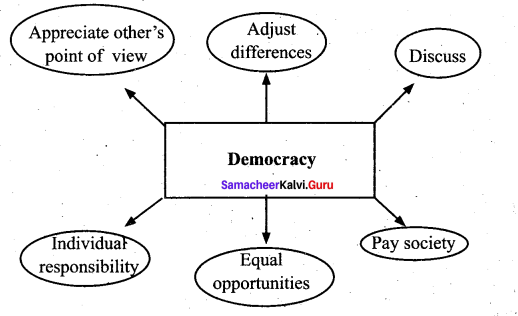
The true spirit of democracy can be developed only in universities. A broad-minded person alone can appreciate other’s points of view and adjust ideological differences through discussions. In universities, a lot of opportunities are made available for debates. Friendly discussions provide ample scope for nurturing the broad-mindedness of the youth.
Question 6.
What should the youngsters aim in life after graduation?
Answer:
The youngsters should aim in life after graduation for an aristocracy of achievements arising out of a democracy of opportunities. As youngsters they should aim at toning up the society, bringing light into dark alleys sunshine into dingy places, solace into the afflicted, hope unto the despondent, and a new life into everyone.
Question 7.
How can a graduate give back to his/her society?
Answer:
The graduates are indebted to society for higher education. They need to replenish the social chest on which they have drawn largely as students. They can contribute to society, not in terms of material goods. But in terms of quality services, through services the graduates, can confer a rich benefit to humanity.
B. Based on your understanding, answer the following questions in three or four sentences each.
Question 1.
‘Wisdom was meant for the mansion, not for the market place’ What does this statement signify?
Answer:
During the monarchical or feudal days, universities had to train scholars and poets to adorn the chambers of royalty or the gilded mansions of the lords and nobles. Those were the days when eminent scholars were not asked to confront the problems of the masses. They were content to work in secluded places. So, the speaker says that their wisdom was meant for the mansion and not for the market place.
Question 2.
According to the speaker, how should Universities mould the students of the present day?
Answer:
Before asking graduates to do the duties as citizens of a democracy, the university must trim, train, guide and lead them to a task which kindles sweet hopes. It should also demand patience and perseverance from them. Universities should inculcate faith and confidence. Faith should be in the graduates and others to shoulder the responsibilities. The universities today should fashion out of them individuals fitted and equipped for the task of making democracy fruitful and effective.
Question 3.
How does Arignar Anna highlight the duties and responsibilities of graduates to society?
Answer:
The graduates must acquire the means of a decent living. But it should be the only objective. As their education is funded by the tax from poor people, they have an obligation to pay back to society if not in cash in terms of service. They must bring light into the dark alleys, sunshine into dingy places, solace into the affiliated hope unto the despondent, and a new life into everyone.
Question 4.
Students are instilled with some of the essential values and skills by the universities. Enumerate them.
Answer:
Universities instill the values of robust optimism, respect for democracy, and appreciation of others’ points of view. It also develops adjustment of differences through discussion; develop patience, perseverance, confidence, faith in themselves and others. They also instill confidence in their ability to shoulder responsibilities.
Question 5.
What are the hindrances a graduate faces in his/her way?
Answer:
The world sometimes dims the hopes of graduates and disturbs their determination. They come face to face with unpleasant kinds of practices contrary to their principles. Tyranny of all sorts stares at them. Self-seekers are enthroned and patient workers are decried. People with robust optimism are discouraged. These hindrances are faced by graduates on their way.
C. Answer the following questions, based on your understanding of the speech of Dr. Arignar Annadurai, adding your own ideas, in a paragraph of about 100-150 words.
Question 1.
How do Universities mould students apart from imparting academic education to them?
Answer:
Universities mould students by providing various opportunities to develop their soft skills and to develop values that would contribute to the process of nation-building. They enable graduates to develop patience and perseverance. They help them develop faith in their own inherent ability to shoulder responsibilities. They are oriented to become citizens of a democracy and repay to the society quality services which would reform the lives of the poor people.
They develop the true spirit of democracy among young graduates. They enable appreciation of others’ points of view. The graduates are also provided opportunities to adjust to differences through amicable discussions. The universities, apart from imparting education mould the students’ character and personality too.
“The quality of a university is measured more by the kind of student it turns out than the kind it takes in.”
Question 2.
The common men contribute to the maintenance of institutions of higher education. Explain this statement.
Answer:
Higher institutes of learning like universities require a lot of funds for their maintenance. These funds often come from the community’s taxes, through the Government students should remember the fact a good proportion of these funds come from farmers, peasants and coolies who did not enjoy even schooling facilities. These illiterates but cultured men willingly face discomforts to ensure better life for the younger generation. These common men contribute to the development and maintenance of institutes of higher education.
“Every child should have the opportunity to receive a quality education.”
Question 3.
How does the speaker highlight the importance of giving back to society?
Answer:
The graduates have drawn largely from the social chest. The largest taken from society needs to be replenished. If graduates fail to pay back, ordinary people’s coffer will be empty. The supervisor’s education enjoins greater responsibility to society. Apart from their own individual advancement, society has got a right to expect an adequate return from the graduates.
Society does not expect them to pay back in cash. But they must payback in terms of service. They should tone up society by bringing light into the dark alleys. They should herald sunshine into dingy places. They must give solace to the affiliated people. They should also give hope unto the despondent and thus ensure a new life unto everyone.
“We Must stop thinking of the individual and start thinking about what’s best for society.”
Question 4.
You were one of the fresh graduates at the convocation function of the University. You had the rare privilege of listening to the enlightening speech of Dr. Arignar Anna. Write a letter to your friend describing the core ideas of his speech and the impact of the speech
on you.
Answer:
3rd March, 20xx
Dear Tim,
I was lucky to be present when Dr. Annadurai gave the Convocation Address. Very rarely one gets such a lifetime opportunity. His genius was explicit in his talk. I could see a great leader and his concern for both the educated and unsung heroes fighting to eke out a living. At the outset, he greeted the graduates and thanked Annamalai University for the unique opportunity. His modesty was evident when he admitted that he was not adequately prepared to offer them appropriate guidelines to succeed but, as a layman, he could quote and annotate the ideas of experts connected to the field of education. He showered rich encomiums on the universities for being the repositories of thought, wisdom, and service. He admired the universities for their role in equipping the youth to better the society.
He compared the universities of feudal days which turned scholars into adornments of royalty but modem universities which are surely for the market and not for mansions. He explained that universities have a role in preparing the graduates to serve society apart from earning a decent living for themselves. He advises the graduates not to be daunted by the adverse and demotivating environment but to draw inspiration from Purananooru, our ancient classic, and overcome societal obstacles to serve the society in an exemplary manner. He completed his convocation address with the wish ‘May your life be a bright one and may its luster brighten the entire land’. The words of the great leader are still ringing in my memory.
With love
Your sincere friend
Joe
To
Tim Smith,
12, Sterling Road,
Chennai
Vocabulary
A. Based on your understanding of paragraphs 6 and 7, complete the mind map.
Answer:
B. Words belonging to the different semantic fields.
Question 1.
Now, read the following statements taken from Arignar Anna’s address:
Answer:
‘The role of the universities today is not cloistered and confined as in the past.
The highlighted word ‘universities’ is used in the field of education. Find other words pertaining to the field of education from the speech of Anna.
Graduate, convocation, theories, principles, annotations, point of view, experts, finding, knowledge, thought, wisdom, service, higher education, guide, lead.
C. Look at the following words and classify them according to their fields.
Clinical, orthopedic, dividend, operations, fertile, Carnatic, diagnostics, industries, keyboard, hacker, desktop, vocal, cultivation, organic, unplugged, disease, harvest, livestock, motherboard, investment, internet, proxy, recycle bin, orchestra, trade, hip-hop, uprooting, guitar, cure, contracts
| Music | |||
| Agriculture | |||
| Computer | |||
| Commerce | |||
| Medicine |
Answer:
| Music | Carnatic Orchestra | Keyboard Hip hop | Vocal Guitar |
| Agriculture | Fertile Livestock | Cultivation Harvesting | Organic Uprooting |
| Computer | Internet Motherboard | Recycle bin Hacker | Desktop Proxy |
| Commerce | Trade contracts | Investment Divided | Industries |
| Medicine | Cure Diagnostics | Orthopaedic Clinical | Operations Disease |
D. Words with different functions
Now, choose the appropriate words to complete the sentences. The first one is done for you.
(frame, guide, book, play, print, plan)
Question 1.
a. We usually _____ tickets for movies in advance.
b. Thirukkural is my favourite _____
Answer:
(a) book
(b) book
Question 2.
a. The _____ of the photo is broken.
b.We _____ questions on all topics.
Answer:
(a) frame
(b) frame
Question 3.
a. My teachers _____ me towards the path of success.
b. The tourist _____ explained the historical importance of the site.
Answer:
(a) guide
(b) guide
Question 4.
a. We enacted a humorous _____ in our school function.
b. The children _____ in the ground every afternoon.
Answer:
(a) play
(b) play
Question 5.
a. My _____ worked out well.
b. We should _____ our work well in advance.
Answer:
(a) plan
(b) plan
Question 6.
a. The _____ is not clear; we cannot read the sentences.
b.We _____ wedding cards here.
Answer:
(a) print
(b) print
E. A belief, attitude, theory, etc. that is referred to by a word ends with the suffix ‘-ism’. Here is a sentence from the speech of Dr. Annadurai: ‘I admit that the environment is such that even people with robust optimism will be discouraged and forced to take to the path of ease and comfort’.
The meaning of the word ‘optimism’ is the hopeful feeling that all is going to turn out well’. Match the ‘ism’ words with the appropriate meanings.
| S.No. | Meanings | Words |
| I. | e.g. love of country and willingness to sacrifice for it | patriotism |
| 2. | a brutal barbarous, savage act | nationalism |
| 3. | the doctrine that your country’s interests are superior | egocentrism |
| 4. | participating in sports as a hobby rather than for money | feminism |
| 5. | belief that the best possible concepts should be pursued | criticism |
| 6. | a serious examination and judgment of something | amateurism |
| 7. | habitual failure to be present at work | barbarism |
| 8. | a doctrine that advocates equal rights for women | idealism |
| 9. | concern for your own interests and welfare | heroism |
| 10. | exceptional courage when facing danger | absenteeism |
Answer:
- patriotism
- barbarism
- nationalism
- amateurism
- idealism
- criticism
- absenteeism
- feminism
- egocentrism
- heroism
Listening Activity
Listen to the information about Vishalini and complete her profile with suitable words/ phrases.
(For listening to the passage refer to our website www.fullcircleeducation.in)
Born in Tirunelveli, a small city of Tamil Nadu, in a middle-class family, Vishalini is no different from other children of her age who love watching cartoons, riding bicycles, and playing games; however, her IQ and intelligence is not of an average 11 -year-old girl. She is a child prodigy blessed with exceptional computer and analytical skills. According to reports, her IQ stands at 225, which is considerably higher than the previous Guinness World Record holder, Kim Ung-Yong, whose IQ is approximately 210. Vishalini’s wonderful accomplishments include the Microsoft Certified Professional and Cisco Certified Network Associate.
Vishalini holds the unique pride of addressing various International conferences as a Chief Guest and Keynote Speaker in the presence of delegates from various countries when she was an 11-year-old child. At the Google India Summit held in New Delhi, the international delegates from about 75 countries were astonished and astounded at Vishalini’s keynote address on ‘Cloud Computing in Google Apps for Education’. There she was also honoured as “The Youngest Google Speaker”. She is the recipient of five international awards. Vishalini, the pride of Tamil Nadu, is undoubtedly a wonderful girl.
Vishalini, hailing from (1) ________ in Tamilnadu is (2) ________ years old. She is endowed with an outstanding (3) ________ and (4) ________ skills. Her IQ is (5) ________ higher than the previous score of (6) ________ She has been the (7) ________ speaker in International conferences. At the Google India Summit, she was honoured as the youngest (8) ________ She is the recipient of (9) ________ international awards. This child prodigy is considered a (10) ________ girl.
Answer:
- Tirunelveli
- 11
- computer
- analytical
- 225
- Kim-ungyoug
- keynote
- Google speaker
- five
- wonder
Speaking Activity
Prepare a formal five-minute speech on the topic ‘The Importance of Education’ and deliver it at your School Assembly.
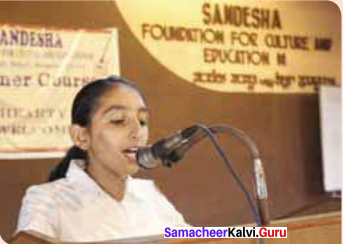
The importance of Education:
Good morning to one and all. Respected Principal, teachers, and my dear friends, I stand before you to speak my views on “The importance of education”. Education gives people the capacity to reason out and choose the best course of action for themselves. It gives them the necessary skills to earn a living. They often can invest the capital gained in schools and colleges to start industries or farms which can offer employment opportunities to their less fortunate kinsmen. Only educated folks can generate awareness among the masses against population explosion, pollution, and promote water harvesting practices to sustain life on earth. Those who are educated in the real sense have a passion for the upliftment of society. They always look for ways to repay the society which invested in their education.
They employ various strategies to enhance the quality or standard of living of laymen. Education teaches young men and women to accept different points of view without coming to blows. It provides them the capacity to appreciate the points of view of others and tolerate differences. Education develops the values of democracy, patience, and perseverance and also the soft skills required to face challenges in life. Immortal poet Thiruvalluvar said, “Those who are educated have a vision and the rest have two sores in the place of eyes. So, I conclude, education is important for all of us. I thank you all for the unique opportunity given to me to share my ideas on the importance of education.
Reading
Have you heard of Open Letters?
An open letter is a letter that is intended to be read by a wide audience, or a letter intended for ‘ an individual, but that is nonetheless widely distributed intentionally through newspapers and other media, such as a letter to the editor or a blog.
Sociologists, scholars, anthropologists, and historians have written open letters. Letters patent are another form of an open letter in which a legal document is both mailed to a person by the government and publicized so that all are made aware of it. Open letters can also be addressed directly to a group rather than any individual.
Reading such letters will also help to improve your vocabulary. Here are some easy ways to improve and expand your vocabulary.
- Read as much as you can. As you read, try to understand the meaning of new words from the context or by referring to a dictionary.
- When you refer to a dictionary, leam the pronunciation, meaning, synonyms, antonyms, and derivatives of the word.
- Note down the new words you leam for future reference.
- Make it a habit to leam one new word a day.
- Play word games such as word search, crossword, scrabble etc. to expand your vocabulary.
- Listen to conversations, leam and discover new words, and then start using them.
The following is a letter by Nobel Laureate Rabindranath Tagore to Mahatma Gandhi. Follow the diction, fluency, and style of the great Indian writer who has contributed excellent writings to Indian Literature. You can improve your vocabulary by familiarising some of the words used in the letter using a dictionary.
Gandhi Letter 23A: From Rabindranath Tagore
Shanti Niketan,
April 12, 1919.
Dear Mahatmaji,
Power in all its forms is irrational – it is like the horse that drags the carriage blindfolded. The moral element in it is only represented in the man who drives the horse. Passive resistance, a force which is not necessarily moral in itself, can be used against truth as well as for it. The danger inherent in all force grows stronger when it is likely to gain success, for then it becomes a temptation. I know your teaching is to fight against evil by the help of the good. But such a fight is for heroes and not for men led by impulses of the moment. Evil on one side naturally begets evil on the other, injustice leading to violence and insult to vengefulness.
Unfortunately, such a force has already been started, and either through panic or through wrath our authorities have shown us the claws, whose sure effect is to drive some of us into the secret path of resentment and others into utter demoralization. In this crisis you, as a great leader of men, have stood among us to proclaim your faith in the ideal which you know to be that of India, the ideal which is both against the cowardliness of hidden revenge and the cowed submissiveness of the terror-stricken…
I have always felt, and said accordingly, that the great gift of freedom can never come to a people through charity. We must win it before we can own it. And India’s opportunity for winning it will come to her when she can prove that she is morally superior to the people who rule her by their right of conquest. Armed with her utter faith in goodness she must stand unabashed before the arrogance that scoffs at the power of the spirit. And you have come to your motherland in the time of her need to remind her of her mission, to lead her in the true path of conquest, to purge her present-day politics of its feebleness which imagines that it has gained its purpose when it struts in the borrowed feathers of diplomatic dishonesty.
This is why I pray most fervently that nothing that tends to weaken our spiritual freedom may intrude into your marching line, that martyrdom for the cause of truth may never degenerate into fanaticism for mere verbal forms, descending into the self-deception that hides behind sacred names. With these few words for an introduction allow me to offer the following as a poet’s contribution to your noble work:
Give me the supreme courage of love,
this is my prayer,
the courage to speak,
to do, to suffer at thy will,
to leave all things or be left alone.
Give me the supreme faith of love,
this is my prayer,
the faith of life in death,
of the victory in defeat,
of the power hidden in the frailness of beauty,
of the dignity of pain that accepts hurt,
but disdains to return it.
Very sincerely yours,
Rabindranath Tagore
A. Answer the following questions.
Question 1.
Who according to Gandhi, can light against evil and how?
Answer:
One can fight against evil with the help of good. Such a fight is led by heroes like Gandhi himself.
Question 2.
What is Gandhiji’s ideal?
Answer:
Gandhi’s ideal is to observe passive resistance against the cowardliness of hidden revenge and the cowed submissiveness of terror.
Question 3.
According to Tagore, when will India get the opportunity to win the gift of freedom?
Answer:
According to Tagore, India’s opportunity of winning freedom will come to her when she can prove that she is morally superior to the people who rule by the right of conquest.
Question 4.
How does Tagore acknowledge Gandhi’s noble work?
Answer:
Tagore acknowledges the noble work of Gandhi in his poem. He appreciates the moral courage he had instilled in Indians to suffer at his will. He appreciates the faith of love, faith of life in death, of the victory in defeat, of the power hidden in the frailness of beauty, and of the dignity of pain that accepts hurt but disdains to return it.
Question 5.
Find words from the passage which mean the same as the following.
(a) a malevolent desire for revenge (para 1)
(b) tactful (para 2)
(c) despise (para 3)
Answer:
(a) vengefulness
(b) diplomatic
(c) disdain
Question 6.
Find words from the passage which are antonyms of the following.
(a) artificially (para 1)
(b) strength (para 2)
Answer:
(a) naturally
(b) feebleness
Grammar
A. Report on the following dialogue.
Prabhu: What are you doing here, Kiran? I haven’t seen you for a few months.
Kiran: I have just come back from my native town Virudhunagar.
Prabhu: Did you enjoy your vacation?
Kiran: Yes. I love the place. It is a clean and busy town.
Prabhu: Where did you go and what did you see?
Kiran: I went to Courtallam falls in Tenkasi.
Prabhu: Share some pictures of your trip.
Kiran: Sure. See you later.
Answer:
Prabhu asked Kiran what she was doing there and said that he hadn’t seen her for a few months. Kiran replied that she had just come back from her native town Virudhunagar. Prabhu asked her if she had enjoyed her vacation. Kiran replied affirmatively and added that she loved the place and it was a clean and busy town. Prabhu further required her where she had gone and what she had seen. Kiran replied that she had gone to Courtallam falls in Tenkasi. Prabhu requested her to share some of the pictures of her trip. Kiran agreed and bade farewell to him.
B. Virat Kohli, the Man of the Match and Man of the Series in the one-day international series between India and South Africa in February 2018 had this to say during the post-match presentation. India won the match by 8 wickets and won the series by 5 – 1, a historic win against South Africa on their home soil.
Rewrite his words in Reported Speech.
Question 1.
“It was a day I felt really good. Last game, I was not in the right kind of mindset. This is a beautiful place to bat under lights. That’s the idea behind bowling first. I like setting up for the short ball. It was a blessing in disguise, and they kept bowling short. I think the pitch got better to bat on under lights! It has been a roller coaster till now. People who are close to me deserve a lot of credit. Obviously, you want to lead from the front, and that’s a wonderful feeling.
I have got eight or nine years left in my career and I want to make the most of every day. It’s a blessing that I am healthy and getting to captain my country. They have shown great character – especially the two young spinners. The way the series went augurs well for us. We’re looking forward to the T20s. The tour is not over yet. After losing the Test series, I am talking to you. I am here talking to you after winning the ODI series.”
Answer:
lt was a day Kohli had felt really good. The previous game he was not in the right mindset. It was a beautiful place to bat under lights. That was the idea behind bowling first. He liked setting up for a short ball. It had been a blessing in disguise and they had kept bowling short. He thought that the pitch got better to bat on under lights. It had been a roller coaster till then. People who were close to him deserved a lot of credit. Obviously one would want to lead from the front and that was a wonderful feeling.
He had got eight or nine years left in his career and he wanted to make the most of it. It was a blessing that he was healthy and got to captain his country. They had shown great character, especially the two young spinners. The way the series had gone augured well for them. They were looking forward to the T20s. The tour was, not over yet. After having lost the test series, he had been talking to them. He was there talking to them after winning the ODI series.
C. Read the given passages and rewrite them in direct speech.
Question 1.
The cyclist warned the driver not to move his car till the police arrived. The driver pleaded that it was not his fault; he was ready to pay a hundred rupees to repair the damaged cycle. The cyclist refused the money and insisted that the police be called.
Answer:
The cyclist : Don’t move your car till the police arrive.
Car driver : Sir, it is not my fault. I’m ready to pay hundred rupees for repairing the damaged cycle.
The cyclist: I don’t want the money. I want to call the police
Question 2.
The striking workers demanded an increase in salary and asked for the withdrawal of all cases. They threatened to continue the strike if the demands were not met. The manager insisted on them calling off the strike and invited them for a discussion. He agreed to listen to their demands
Answer:
Workers: We demanded an increase in salary to withdraw all the cases.
Manager: Call off the strike
Workers: If our demands are not met, we will continue the strike.
Manager: I am willing to look into your demands, please come for a discussion.
Writing

Question 1.
Question (a)
Write an e-mail to your uncle thanking him for the gift that he had sent from abroad.
Answer:
From: [email protected]
To: [email protected]
Sub: Thanks a lot for the gift!
Dear uncle,
I’m fine and I hope my e-mail finds you in robust health. Your gift exactly on my birthday was a bolt from the blue. You had remembered the promise you had made three months ago and sent a marvelous Lap Top. It is light but very cool. I am really proud of you. I pray to God that you get more success in your business venture abroad and help other helpless ’
children too.
Yours lovingly
S. Philip
Question (b)
Write an e-mail to a charitable trust requesting for a scholarship.
Answer:
From: [email protected]
To: [email protected]
Sub: Seeking scholarship
Dear Sir,
I am Ritika about to complete my Std XI in Government Higher Secondary School, Nandhivaran. My father, the only breadwinner, got hurt in an accident. He was working in a private firm. My mom is a homemaker. I am at crossroads now. My mom has taken my dad to Nagercoil. I need to stay in a ladies’ hostel to continue my studies. Could you please consider my request favorably and release a scholarship till I complete my XII public exam – successfully. I hope to avail a Bank loan after I get my results.
Awaiting your favourable reply,
Yours sincerely,
S. Ritika
XI-BGGHSS,
Nandhivaran
Kanchipuram Dt.
Formal Letters
1. Write a letter to the editor of a newspaper about the need to wear seat belts while driving. 18.03.2019 Virudhu Nagar
From
M. Kamaraj,
18, Anna Street,
Kabilan avenue,
Virudhu Nagar
To
The Editor in Chief,
The Hindu,
Mount Road Chennai Dear sir,
Sub: Importance of seat belts
I’m M. Kamaraj living in Virudhunagar. I have been reading every day about road accidents. Though the law-enforcing officers are making appeals to all car drivers to wear a seat-belt, very few do it. It is because cheap car engines start even when the driver has not attached the seat belt. Technically, advanced cars which are above 10 lakhs are better designed and wouldn’t budge if the driver doesn’t wear the seat-belt. Such cars have additional safety mechanisms such as air-pillows that prevent serious injuries in case of accidents. But the cheap cars crash and kill not only the drivers but also their loved ones.
Thrill kills! The government of India should insist on air-bags and technical viability of connecting seat belts to ignition points in a car to ensure the safety of all drivers of cars irrespective of the cost of the cars. I request you to publish this in all your city editions including that of Delhi. This may influence the Transport Minister of Government of India to take positive action on this.
Thank you,
Yours sincerely,
M. Kamaraj
To
The Editor in Chief
The Hindu
Mount Road, Chennai
2. Write a letter to the commissioner of the corporation complaining about the sanitary conditions of the street in your locality.
18.03.2019
Madurai
From
K. Lavanya MIG 14, Anna St,
Amma Colony, Shanthi Nagar Madurai
To
The Commissioner
Corporation of Madurai
Madurai -2
Sir,
Sub: Deteriorating sanitary conditions – a complaint I wish to submit the following painful facts for your consideration and immediate action. There are four big garbage bins kept in my street. For the past three weeks, your corporation vehicles have not come to clear the garbage. Now dust bins are overflowing. People are throwing garbage around the garbage bins. But the stench arising out of the accumulated garbage is nauseating. I’m really worried that some serious diseases may break out. Dengue is still causing anxiety among the residents of Madurai as it has already taken a toll on seven babies, two young boys, and three old men. Please instruct your officers to send vehicles immediately to collect the garbage and send your sanitary inspectors to sprinkle/spray disinfectants to ensure the prevention of infectious diseases like cholera too.
Thanking you in anticipation
Yours truly,
K. Lavanya
To
The Commissioner,
Corporation of Madurai
Madurai -2
3. Write a letter to a sports company ordering sports items for the Physical Education Department of your school.
15.7.2018
Alanganallur
From
M. Jothi,
Sports Secretary,
Government Girl HSS,
Alanganallur-625501
To
The Manager,
M.J. Sports Company,
Good shed Street,
Trichy-1
Sir,
Sub: Ordering sports goods
We propose to organize an Inter-school sports contest in November. We like to buy the following sports materials from you. Please send us the price of the items with the discount, you usually give for school. On delivery, we shall send the money by RTGS. Kindly send your bank account details and reply by e.mail to [email protected] Materials required
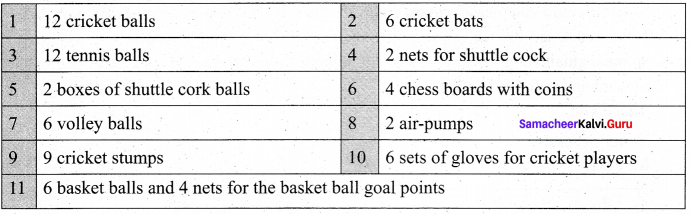
Kindly send the mail with your estimated price inclusive of transportation and GST. Looking forward to your prompt response.
With warm regards Yours sincerely
M. Jothi
To
The Manager,
M.J. Sports Company,
Good shed Street,
Trichy-1
4. Write a letter to the Chief Reservation Supervisor of Railways requesting him to grant a concession for your educational tour.
10.07.2018
Nanguneri
From
M. Prabu,
SPL.GHSS.
Nanguneri.
To
The Chief Reservation Supervisor,
Southern Railways,
Thirunelveli.
Sir,
Sub: GHSS- Educational tour to Bangalore requesting to grant concession – Reg.
I am M. Prabu studying in the XI-D section. I am the school pupil leader. I’ve been asked by my school Headmaster to work out the cost for our educational tour to Bangalore. A team of eighty students intends to go the Bangalore in the month of November. Could I request you to consider extending us concession? Please let us know either through a reply letter or by mail what would be the cost of all 80 tickets (to and fro) and the dates ideal for us to travel. We intend to stay in Bangalore for two days. Kindly check the availability in the 3rd week. If possible could you please request authorities to allot two bogies for us exclusively both ways? I have enclosed the name list of the students for your kind consideration. My e.mail id is [email protected]. An early reply will help me collect the money and meet you to book our onward and return journey.
Thank you,
Yours sincerely,
M. Prabu
To
The Chief Reservation Supervisor,
Southern Railways,
Thirunelveli.
5. Write a letter to the curator of the museum seeking permission for a school visit.
17.06.2018
Thindivanam
From
M. Padmavathy Class leader,
XI-C section,
GGHSS,
Thindivanam
To
The curator,
Museum
Egmore
Chennai
Sir,
Sub: GGHSS – Thindivanam seeking permission to visit the museum – Reg.
A team of SO students wishes to visit your museum on 17.08.2018. We will be coming on two buses. Kindly arrange a guide who can detail each exhibit with its relevance to Indian culture and Tamil History. I leam that curators can help children understand the importance of every exhibit in the museum and effortlessly relate it to the age it belongs to and its relevance to modem times. Could I request you to grant us permission to visit the museum on 17.08.2018 and get the benefit of your expert guidance and a well-experienced guide who can explain things well in Tamil?
Thank you,
Yours sincerely,
M. Padmavathy.
To
The curator,
Museum, Egmore
Chennai
Task:
(a) Respond to the following advertisements.
Classified Advertisement
WANTED 100 part-time Graphic Artists
Experienced in Photoshop and Indesign-
Salary negotiable. Apply to: MM Graphics,
Triplicane, Chennai – 5 or Mail your Resume to [email protected]
Answer:
From: [email protected]
To: [email protected]
Sub: Applying for a part-time graphic artist
Dear Sir,
With reference to your advertisement in The Hindu for the post of 100 – part-time Graphic Artist with experience in Photoshop and Indesign. I hereby wish to apply for the same.
I am doing my second-year B.Sc. (Computer science) in SIEVT college as a part-time student from 4 to 9 p.m. Thereby I am free in the morning from 9 a.m. to 3 p.m. I have a working knowledge too of Photoshop and Indesign. I have also completed a crash course CSC. Please find enclosed my resume for your kind perusal.
Resume
Name : A. Parveen
Father’s Name : K. Akbar
Date of birth : 02.04.1988
Language known : English, Hindi, Urdu & Tamil
Qualification : BSC II year, CSC (Doing) SSLC : 450/500 in Nirmala Girls Hr. Sec School, Triplicane in 2014 HSC : 1100/1200 in Nirmala Girls Hr. Sec school Triplicane in 2016
Technical Qualification : 3 months crash course Indesign in 2015-16 3 months crash course in Photoshop in 2016-17
Salary Expected: Rs. 12000/- P.M
Address For Communication: A. Parveen D/o. Akbar No. 18, Pallivasal Street, Triplicane Chennai. Email Id: [email protected]
Awaiting your e-mail
Yours sincerely,
A. Parveen
b. Block Advertisement
Female IELTS Teachers Required
Postgraduates in English with a minimum
of 3 years’ experience.
Must be bold and confident
Good salary, transport, and food allowance
provided, Apply to:
Arv Institute of Languages,
149B, Bose Road, Coimbatore
Ph: 98400 XXXXX
Email: [email protected]

From: [email protected]
To: [email protected]
Sub: Applying for the post of IELTS teachers- Reg.
Sir
I am glad to learn that you have a position to handle IELTS Class. I got through IELT courses way back in 2015. I’ve been working as a language teacher in Millennium school near Airport. Though I am getting a decent salary, I wish to switch over to training. Training youngsters whose ambitions are sky-high is thrilling. Teaching English to adults is my forte. I’ve already been a trainer in the British council for a year. I’ve enclosed photocopies of my credentials for your reference. Send you a call letter to [email protected]. Looking forward to meeting you.
Yours sincerely,
K. Suguna.
Encl:
1. Resume
2. Photocopies of certificates
Resume
Name: K. Suguna
Date of birth : 03.03.1990
Address : No. 18, Kamban Street,
Ambattur,
Chennai.
Qualification: B.Ed -Teacher Education University 2015-2016 – 55%
MA English – University of Madras 2013-2014 – 60%
B.A. English – Women’s Christian College
Nungambakkam 2012-2013-58%
HSC – Presidency girls HSS Egmore 2008-09 – 80%
SSLC – Presidency girls HSS Egmore 2005-06 — 88%
Experience: Millennium school Alandur since June 2016
The salary drawn: Rs.20,000/- PM
Salary Expected: Rs. 30,000/-PM
Address For communication: [email protected]
Declaration
The details furnished above is a true letter to my knowledge. Looking forward to receiving your call letter
Date: 14.04.20xx
Location: XYZ
x x x x
Signature of the Candidate
Convocation Address About the Author
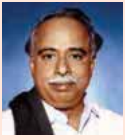
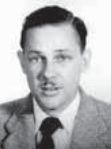
Dr. Conjccvaram Natarajan Annadurai (15 September 1909 – 3 February 1969), popularly called Arignar Anna was an Indian politician who served as the Chief Minister of Tamil Nadu (1967 – 69). He was a great orator and an acclaimed writer in Tamil. Jawaharlal Nehru hailed him as one of the greatest parliamentarians. He has published several novels, short stories and plays which incorporate political and social themes. C.N. Annadurai was awarded the Clubb Fellowship at Yale University, the first non-American to receive this honour. The same year he was awarded an honorary doctorate from Annamalai University.
Convocation Address Summary
Societal development happens only through the hard work of many unsung heroes. Those who develop their potential by drawing on the resources of society need to pay them back after they graduate. Dr. C. M. Annadurai conveyed his gratitude for inviting him to deliver the Convocation Address at Annamalai University in 1967. He wished the fresh graduates a prosperous future. He accepted that it was difficult to provide them with appropriate guidelines for success in life. However, he shared cardinal principles enunciated by those eminent scholars who had done so earlier. He chose to replay those ideas as a common man as he interpreted them without any sophistication of language. Universities in the past gave access to scholars and poets to adorn the chambers of royalty.
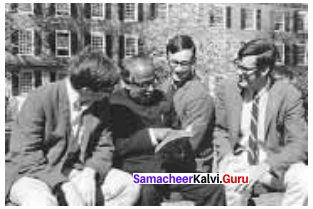
They were for the royal mansion and not for the market place. Today universities have the responsibility to fashion out of every individual fitted and equipped for the task of making democracy fruitful and effective. According to Dr. Radhakrishnan, “Universities ensure the democratic way of life for the future generations.” Though earning a decent living is an important objective, it shouldn’t be the only objective. The university graduate should feel indebted to the community. Universities are sustained by the revenue paid by peasants and poor people. Unless graduates replenish the social chest, it will become an empty offer.
The speaker was quite aware of the social challenges the graduates might face. He advised them to emulate men and women endowed with the spirit of service and carry on the crusade against poverty and other social ills. He was hopeful that Tamils, being the inheritors of a great culture will have the strength to overcome social challenges and serve society to the best of their abilities. He wished that they were bound to win and brighten the entire land.
Convocation Address Glossary
Textual:
- autocracy – government by one ruler
- cloistered – restricted
- conferred – granted a title, degree, benefit or right
- confronting – aggressively resisting
- crusade – campaign for a good cause/holy war
- despondent – depressed, frustrated
- emissaries – deputies
- endowed – gifted
- enunciated – spoke clearly
- eschewed – have nothing to do with
- feudal – having to do with the Middle Ages, old
- indebted – obliged to repay
- inherent – inborn
- inheritors – successors
- lustre – glow of reflected light
- perils – dangers and risks
- perseverance – continued effort, steadfastness
- reiterate – say or do again
- replenish – refill
- repositories – storehouses
- ruggedness – strength, toughness
- secluded spheres – isolated areas
- sermons – speeches on moral subjects
- tillers – persons who produce crops / raise animals, cultivators
- toilers – workers, people who perform
Additional:
- appropriate – suitable
- cardinal (adj) – most important
- concern -worry
- eminent – famous
- emulate – follow
- gratitude – thanks
- indebted – bound
- peasant – poor farmers
- prosperous -rich
- responsibility – obligation
- sophistication – refinement
Convocation Address Synonyms
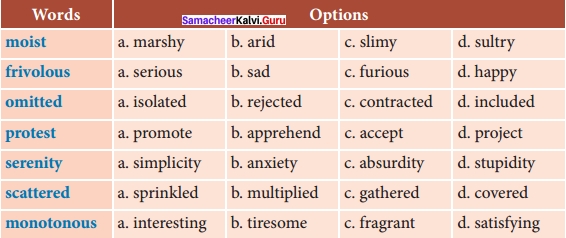
Choose the correct synonyms from the options given below. (Exam model)
Question 1.
A student embarks on a career after graduation.
(a) rupture
(b) begins
(c) completes
(d) summons
Answer:
(b) begins
Question 2.
Society has cradled and nurtured every graduate.
(a) sowed
(b) protected
(c) irrigated
(d) annoyed
Answer:
(b) protected
Question 3.
Graduation is the apt time to give back to society.
(a) misfit
(b) appropriate
(c) irrelevant
(d) ineligible
Answer:
(b) appropriate
Question 4.
I am thankful for the unique honour.
(a) common
(b) special/unusual
(c) drab
(d) conventional
Answer:
(b) special/unusual
Question 5.
This Institution has conferred on my honour.
(a) fielded
(b) granted
(c) defied
(d) withdraw
Answer:
(b) granted
Question 6.
I shall only reiterate some of the cardinal principles.
(a) repeat/say or do again
(b) suspend
(c) reexamine
(d) reciprocate
Answer:
(a) repeat/say or do again
Question 7.
Wise men have enunciated those principles in the past.
(a) beat about the bush
(b) confused
(c) asserted
(d) spoke harshly
Answer:
(c) asserted
Question 8.
I do claim to represent him in all his ruggedness.
(a) meekness
(b) weakness
(c) toughness
(d) feebleness
Answer:
(c) toughness
Question 9.
Universities are repositories of knowledge.
(a) rented houses
(b) own houses
(c) storehouses
(d) leased houses
Answer:
(c) storehouses
Question 10.
Universities are the nursing ground for the emissaries of thought.
(a) admirably
(b) adversary
(c) foe
(d) ambassador/deputies
Answer:
(d) ambassador/deputies
Question 11.
We have eschewed monarchy.
(a) embraced
(b) accepted
(c) avoided
(d) relinquished
Answer:
(c) avoided
Question 12.
We have stayed away from autocracy.
(a) dictatorship
(b) militarism
(c) mobs
(d) royalist
Answer:
(a) dictatorship
Question 13.
We have inaugurated the era of democracy.
(a) Self-government
(b) Monarchy
(c) Bureaucracy
(d) Autocracy
Answer:
(a) Self-government
Question 14.
During the feudal days, universities were different.
(a) old/middle ages
(b) recent
(c) future
(d) modem
Answer:
(a) old/middle ages
Question 15.
Eminent scholars were not asked to confront the problems of the masses.
(a) face/resist
(b) accept
(c) cowed down
(d) brow beaten
Answer:
(a) face/resist
Question 16.
They were content to work in secluded spheres.
(a) isolated
(b) swarmed
(c) crowded
(d) mobbed/congested
Answer:
(a) isolated
Question 17.
University today is not cloistered.
(a) liberated
(b) restricted
(c) limitless
(d) infinite
Answer:
(b) restricted
Question 18.
The task demands patience and perseverance.
(a) low effort
(b) persistence
(c) high loss
(d) heavy loss
Answer:
(b) persistence
Question 19.
Graduates should have faith in their inherent ability to shoulder responsibility.
(a) cultivated
(b) artificial
(c) inborn
(d) nurtured
Answer:
(c) inborn
Question 20.
Their philosophy was turned into the dazzling garments for the privileged.
(a) lackluster
(b) gloomy
(c) glaring
(d) dim
Answer:
(c) glaring
Question 21.
The immediate concern of every individual is to acquire the means for a decent living.
(a) kindness
(b) worry
(c) indifference
(d) love
Answer:
(b) worry
Question 22.
You are deeply indebted to the community.
(a) thankless
(b) grateful
(c) loud
(d) quiet
Answer:
(b) grateful
Question 23.
That revenue comes from tillers of the soil.
(a) manufactures
(b) farmers
(c) pollutants
(d) wasters
Answer:
(b) farmers
Question 24.
The toilers did not enjoy this privilege.
(a) bosses
(b) workers
(c) kings
(d) leaders
Answer:
(b) workers
Question 25.
You should replenish it.
(a) exhaust
(b) refill
(c) consume
(d) deplete
Answer:
(b) refill
Question 26.
You must return hope unto the despondent.
(a) empowered
(b) rejoiced
(c) depressed/frustrated
(d) energized
Answer:
(c) depressed/frustrated
Question 27.
The world will disturb your determination.
(a) instability
(b) laziness
(c) uncertainty
(d) firmness
Answer:
(d) firmness
Question 28.
The sermons would become sweet nothings. .
(a) doctrines
(b) poems
(c) dramas
(d) debates
Answer:
(a) doctrines
Question 29.
Tyranny of all sorts may stare at you.
(a) kindness
(b) autocracy
(c) love
(d) happiness
Answer:
(b) autocracy
Question 30.
A continuous stream of men and women are endowed with the spirit of service.
(a) narrated
(b) gifted
(c) withdrew
(d) submitted
Answer:
(b) gifted
Question 31.
These service-minded people have been carrying on the crusade successfully.
(a) campaign fight
(b) killing
(c) campaign
(d) strike
Answer:
(c) campaign
Question 32.
Tamil are the inheritors of the rich legacy of culture.
(a) proprietors
(b) owners
(c) successors/heirs
(d) legacy
Answer:
(c) successors/heirs
Question 33.
The legacy of culture enables us to overcome even the adverse environment.
(a) bequest
(b) curse
(c) bane
(d) perdition
Answer:
(a) bequest
Question 34.
You are adequately equipped.
(a) legitimately
(b) aptly
(c) sufficiently
(d) legibility
Answer:
(c) sufficiently
Question 35.
I am confident that you are being sent into the wide world.
(a) despondent
(b) hopeful
(c) desperate
(d) annoyed
Answer:
(b) hopeful
Convocation Address Antonyms
Choose the most appropriate antonyms for the underlined words. (Exam model)
Question 1.
A qualified student embarks on his career.
(a) boards
(b) lands/disembarks
(c) climbs
(d) takes off
Answer:
(b) lands/disembarks
Question 2.
Society has nurtured graduates.
(a) caned
(b) protected
(c) contemplated
(d) neglected
Answer:
(d) neglected
Question 3.
I intend to reiterate some of the cardinal principles enunciated by educational experts.
(a) spoken vividly
(b) faltered
(c) delivered
(d) articulated
Answer:
(b) faltered
Question 4.
I do represent him in all ruggedness.
(a) toughness
(b) tenderness
(c) strength
(d) might
Answer:
(b) tenderness
Question 5.
We have eschewed monarchy.
(a) avoided
(b) disturbed
(c) embraced
(d) dodge
Answer:
(c) embraced
Question 6.
It requires individual responsibility.
(a) personal
(b) modem
(c) classical
(d) empty
Answer:
(d) empty
Question 7.
It is the immediate concern of every individual.
(a) worry
(b) apprehension
(c) indifference
(d) anxiety
Answer:
(c) indifference
Question 8.
You are deeply indebted to society.
(a) grateful
(b) thankful
(c) obliged
(d) unaligned
Answer:
(d) unaligned
Question 9.
You need to replenish the social chest.
(a) fill
(b) refill
(c) require
(d) empty
Answer:
(d) empty
Question 10.
Turn despondent into optimistic citizens.
(a) desperate
(b) frustrated
(c) hopeless
(d) hopeless
Answer:
(d) hopeless
Question 11.
You are adequately equipped.
(a) sufficiently
(b) inadequately / insufficiently
(c) enough
(d) required
Answer:
(b) inadequately / insufficiently
Question 12.
They were content to work in secluded spheres.
(a) isolated
(b) congested
(c) interior
(d) inaccessible
Answer:
(b) congested
Question 13.
It is not just material advancement.
(a) progress
(b) backwardness
(c) development
(d) refinement
Answer:
(b) backwardness
Question 14.
In feudal days universities were different.
(a) old
(b) middle
(c) ancient
(d) modem
Answer:
(d) modem
Question 15.
Their wisdom meant for the selected was privileged.
(a) knowledge
(b) information
(c) intelligence
(d) foolishness
Answer:
(d) foolishness
Samacheer Kalvi 11th English Book Solutions Prose













































 . What are the possible values of a and b?