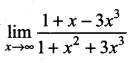
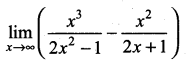
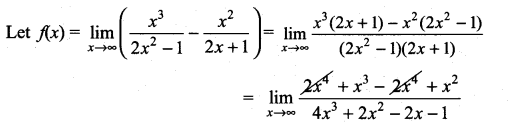
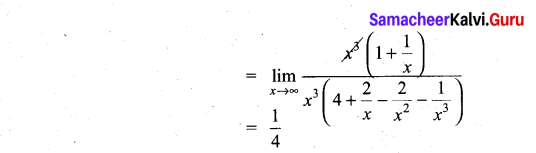
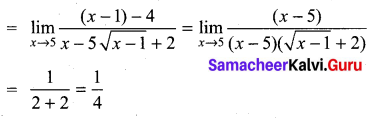
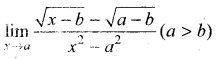
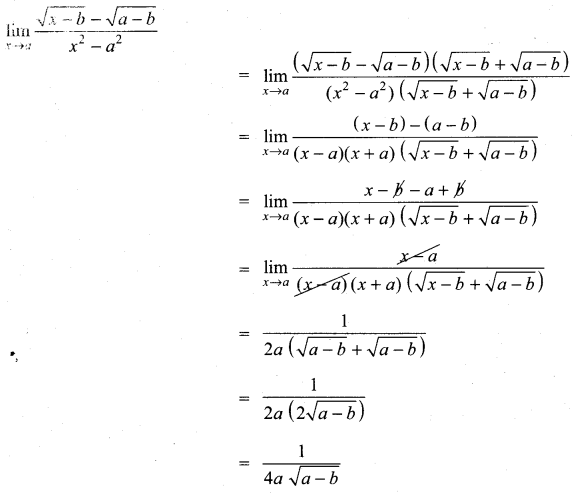
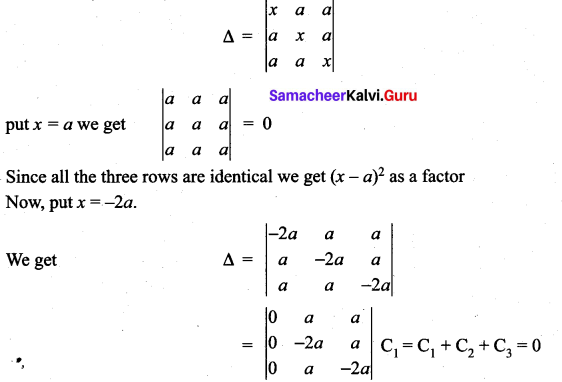
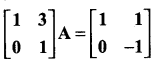
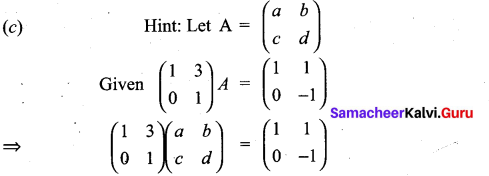
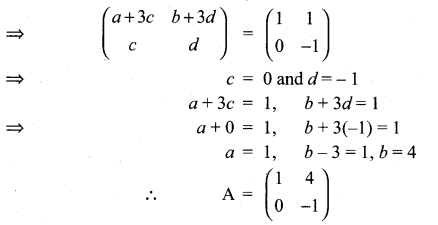
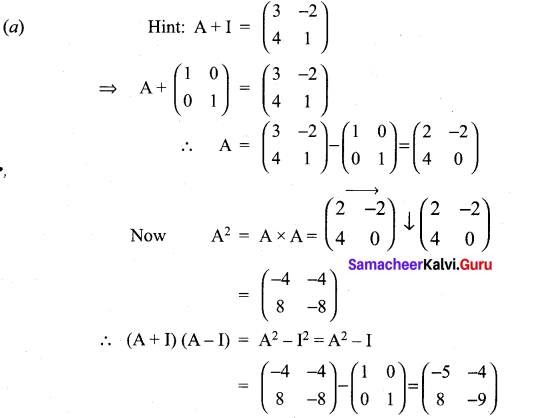
Class 11

Samacheer Kalvi 11th Maths Solutions Chapter 8 Vector Algebra – I Ex 8.2

You can Download Samacheer Kalvi 11th Maths Book Solutions Guide Pdf, Tamilnadu State Board help you to revise the complete Syllabus and score more marks in your examinations.

Tamilnadu Samacheer Kalvi 11th Maths Solutions Chapter 8 Vector Algebra – I Ex 8.2

Question 1.
Verify whether the following ratios are direction cosines of some vector or not.
Samacheer Kalvi 11th Maths Solutions Chapter 8 Vector Algebra - I Ex 8.2 1
Solution:
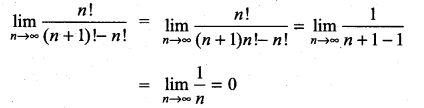
Samacheer Kalvi 11th Maths Solutions Chapter 8 Vector Algebra - I Ex 8.2 2

Question 2.
Find the direction cosines of a vectors whose direction ratios are
(i) 1, 2, 3
(ii) 3, -1, 3
(iii) 0, 0, 7
Solution:
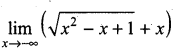
Samacheer Kalvi 11th Maths Solutions Chapter 8 Vector Algebra - I Ex 8.2 3

Question 3.
Find the direction cosines and direction ratios for the following vectors
Samacheer Kalvi 11th Maths Solutions Chapter 8 Vector Algebra - I Ex 8.2 4
Solution:
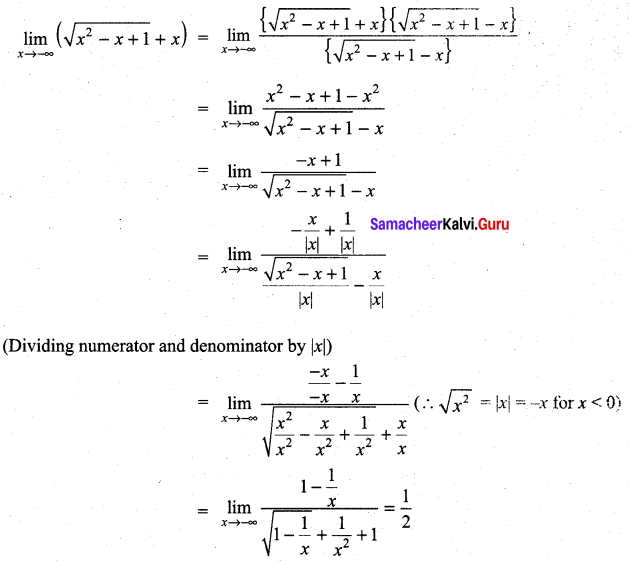
Samacheer Kalvi 11th Maths Solutions Chapter 8 Vector Algebra - I Ex 8.2 5
Samacheer Kalvi 11th Maths Solutions Chapter 8 Vector Algebra - I Ex 8.2 6
Samacheer Kalvi 11th Maths Solutions Chapter 8 Vector Algebra - I Ex 8.2 7

Samacheer Kalvi 11th Maths Solutions Chapter 8 Vector Algebra - I Ex 8.2

Question 4.
A triangle is formed by joining the points (1, 0, 0), (0, 1, 0) and (0, 0, 1). Find the direction cosines of the medians.
Solution:

Samacheer Kalvi 11th Maths Solutions Chapter 8 Vector Algebra - I Ex 8.2 8
Samacheer Kalvi 11th Maths Solutions Chapter 8 Vector Algebra - I Ex 8.2 9
Samacheer Kalvi 11th Maths Solutions Chapter 8 Vector Algebra - I Ex 8.2 51

Question 5.
If \(\frac{1}{2}, \frac{1}{\sqrt{2}}\), a are the direction cosines of some vector, then find a.
Solution:
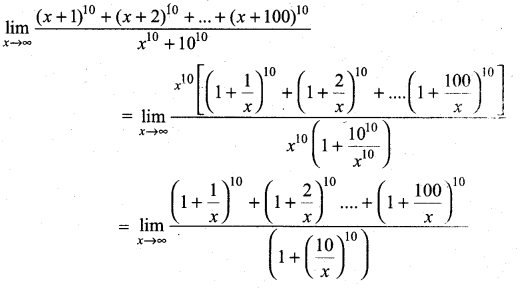
Samacheer Kalvi 11th Maths Solutions Chapter 8 Vector Algebra - I Ex 8.2 10

Question 6.
If (a, a + b, a + b + c) is one set of direction ratios of the line joining (1, 0, 0) and (0, 1, 0), then find a set of values of a, b, c.
Solution:

Given (a, a + b, a + b + c) is one set of direction ratios of the line joining (1, 0, 0) and (0, 1, 0) then find a set of values of a, b, c.
Let the given points be A (1, 0, 0) and B (0, 1, 0)
[The direction ratios of the line joining the points A (x1, y1, z1) and B (x2, y2, z2) are x2 – x1, y2 – y1, z2 – z1 or x1 – x2, y2 – y2, z1,  z1 – z2 j
The direction ratios of the line joining the points A(1, 0, 0) and B(0, 1, 0) are
(0 – 1, 1 – 0, 0 – 0)
(- 1, 1, 0) ………. (1)
Also the direction ratios are
(1 – 0, 0 – 1, 0 – 0)
(1, -1, 0) ………. (2)
Given the direction ratios are
(a, a + b , a + b + c) ………. (3)
Comparing (1) and (3) we have
(-1, 1, 0) = (a, a + b, a + b + c)
a = -1, a + b = 1 ⇒ – 1 + b = 1 ⇒ b = 2
a + b + c = 0 ⇒ – 1 + 2 + c = 0 ⇒ c = – 1
Comparing (2) and (3) we get
a = 1 , a + b = – 1 ⇒ 1 + b = – 1 ⇒ b = – 2
a + b + c = 0 ⇒ 1 – 2 + c = 0 ⇒ c = 1
∴ The required set of values of a, b, c are
a = -1, b = 2, c = – 1 and
a = 1, b = – 2, c = 1

Question 7.
Show that the vectors \(2 \hat{i}-\hat{j}+\hat{k}, 3 \hat{i}-4 \hat{j}-4 \hat{k}, \hat{i}-3 \hat{j}-5 \hat{k}\) form a right angled triangle.
Sol:
Samacheer Kalvi 11th Maths Solutions Chapter 8 Vector Algebra - I Ex 8.2 11
⇒ The given vectors form the sides of a right-angled triangle.

Samacheer Kalvi 11th Maths Solutions Chapter 8 Vector Algebra - I Ex 8.2

Question 8.
Find the value of k for which the vectors \(\vec{a}=3 \hat{i}+2 \hat{j}+9 \hat{k}\) and \(\vec{b}=\hat{i}+\lambda \hat{j}+3 \hat{k}\) are parallel.
Solution:
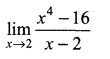
Samacheer Kalvi 11th Maths Solutions Chapter 8 Vector Algebra - I Ex 8.2 12

Question 9.
Show that the following vectors are coplanar.
Samacheer Kalvi 11th Maths Solutions Chapter 8 Vector Algebra - I Ex 8.2 13
Solution:

Let the given three vectors be \(\vec{a}\), \(\vec{b}\) and \(\vec{c}\). When we are able to write one vector as a linear combination of the other two vectors, then the given vectors are called coplanar vectors.
Samacheer Kalvi 11th Maths Solutions Chapter 8 Vector Algebra - I Ex 8.2 14
Samacheer Kalvi 11th Maths Solutions Chapter 8 Vector Algebra - I Ex 8.2 15
Samacheer Kalvi 11th Maths Solutions Chapter 8 Vector Algebra - I Ex 8.2 16
Samacheer Kalvi 11th Maths Solutions Chapter 8 Vector Algebra - I Ex 8.2 17
We are able to write \(\vec{a}\) as a linear combination of \(\vec{b}\) and \(\vec{c}\)
∴ The vectors \(\vec{a}\), \(\vec{b}\), \(\vec{c}\) are coplanar

Question 10.
Show that the points whose position vectors Samacheer Kalvi 11th Maths Solutions Chapter 8 Vector Algebra - I Ex 8.2 18 and Samacheer Kalvi 11th Maths Solutions Chapter 8 Vector Algebra - I Ex 8.2 19 are coplanar
Solution:
Let the given points be A, B, C and D. To prove that the points A, B, C, D are coplanar, we have to prove that the vectors \(\overrightarrow{\mathrm{AB}}, \overrightarrow{\mathrm{AC}}\) and \(\overrightarrow{\mathrm{AC}}\) are coplanar
Samacheer Kalvi 11th Maths Solutions Chapter 8 Vector Algebra - I Ex 8.2 20
Samacheer Kalvi 11th Maths Solutions Chapter 8 Vector Algebra - I Ex 8.2 21
Samacheer Kalvi 11th Maths Solutions Chapter 8 Vector Algebra - I Ex 8.2 22
∴ we are able to write one vector as a linear combination of the other two vectors ⇒ the given vectors \(\vec{a}\), \(\vec{b}\), \(\vec{c}\) are coplanar.
(i.e.,) the given points A, B, C, D are coplanar.

Question 11.
If \(\vec{a}=2 \hat{i}+3 \hat{j}-4 \hat{k}\), \(\vec{b}=3 \hat{i}-4 \hat{j}-5 \hat{k}\) and \(\vec{c}=-3 \hat{i}+2 \hat{j}+3 \hat{k}\), find the magnitude and direction cosines of
(i) \(\vec{a}+\vec{b}+\vec{c}\)
(ii) \(3 \vec{a}-2 \vec{b}+5 \vec{c}\)
Solution:
Samacheer Kalvi 11th Maths Solutions Chapter 8 Vector Algebra - I Ex 8.2 23
Samacheer Kalvi 11th Maths Solutions Chapter 8 Vector Algebra - I Ex 8.2 24>

Question 12.
The position vectors of the vertices of a triangle are Samacheer Kalvi 11th Maths Solutions Chapter 8 Vector Algebra - I Ex 8.2 25 and Samacheer Kalvi 11th Maths Solutions Chapter 8 Vector Algebra - I Ex 8.2 26. Find the perimeter of the triangle
Solution:
Let A, B, C be the vertices of the triangle ABC,
Samacheer Kalvi 11th Maths Solutions Chapter 8 Vector Algebra - I Ex 8.2 27

Question 13.
Find the unit vector parallel to Samacheer Kalvi 11th Maths Solutions Chapter 8 Vector Algebra - I Ex 8.2 28 and Samacheer Kalvi 11th Maths Solutions Chapter 8 Vector Algebra - I Ex 8.2 29
Solution:
Samacheer Kalvi 11th Maths Solutions Chapter 8 Vector Algebra - I Ex 8.2 30
Samacheer Kalvi 11th Maths Solutions Chapter 8 Vector Algebra - I Ex 8.2 31

Question 14.
The position vector \(\vec{a}\), \(\vec{b}\), \(\vec{c}\) three points satisfy the relation \(2 \vec{a}-7 \vec{b}+5 \vec{c}=\overrightarrow{0}\). Are these points collinear?
Solution:
Samacheer Kalvi 11th Maths Solutions Chapter 8 Vector Algebra - I Ex 8.2 32

Samacheer Kalvi 11th Maths Solutions Chapter 8 Vector Algebra - I Ex 8.2

Question 15.
The position vectors of the points P, Q, R, S are Samacheer Kalvi 11th Maths Solutions Chapter 8 Vector Algebra - I Ex 8.2 33 and Samacheer Kalvi 11th Maths Solutions Chapter 8 Vector Algebra - I Ex 8.2 34 respectively. Prove that the line PQ and RS are parallel.
Solution:
Samacheer Kalvi 11th Maths Solutions Chapter 8 Vector Algebra - I Ex 8.2 35

Question 16.
Find the value or values of m for which \(m(\hat{i}+\hat{j}+\hat{k})\) is a unit vector
Solution:
Samacheer Kalvi 11th Maths Solutions Chapter 8 Vector Algebra - I Ex 8.2 36

Question 17.
Show that points A(1, 1, 1), B(1, 2, 3), and C(2, -1, 1) are vertices of an isosceles triangle.
Solution:
Samacheer Kalvi 11th Maths Solutions Chapter 8 Vector Algebra - I Ex 8.2 37

Samacheer Kalvi 11th Maths Solutions Chapter 8 Vector Algebra – I Ex 8.2 Additional Problems

Question 1.
Show that the points whose position vectors given by
Samacheer Kalvi 11th Maths Solutions Chapter 8 Vector Algebra - I Ex 8.2 38
Samacheer Kalvi 11th Maths Solutions Chapter 8 Vector Algebra - I Ex 8.2 39
Solution:
Samacheer Kalvi 11th Maths Solutions Chapter 8 Vector Algebra - I Ex 8.2 40
Samacheer Kalvi 11th Maths Solutions Chapter 8 Vector Algebra - I Ex 8.2 41

Question 2.
Find the unit vectors parallel to the sum of \(3 \hat{i}-5 \hat{j}+8 \hat{k}\) and \(-2 \hat{j}-2 \hat{k}\)
Solution:
Samacheer Kalvi 11th Maths Solutions Chapter 8 Vector Algebra - I Ex 8.2 42

Question 3.
The vertices of a triangle have position vectors Samacheer Kalvi 11th Maths Solutions Chapter 8 Vector Algebra - I Ex 8.2 43 Prove that the triangle is equilateral.
Solution:
Samacheer Kalvi 11th Maths Solutions Chapter 8 Vector Algebra - I Ex 8.2 44
Samacheer Kalvi 11th Maths Solutions Chapter 8 Vector Algebra - I Ex 8.2 45

Samacheer Kalvi 11th Maths Solutions Chapter 8 Vector Algebra - I Ex 8.2

Question 4.
Prove that the points Samacheer Kalvi 11th Maths Solutions Chapter 8 Vector Algebra - I Ex 8.2 46 form an equilateral triangle.
Solution:
Samacheer Kalvi 11th Maths Solutions Chapter 8 Vector Algebra - I Ex 8.2 47

Question 5.
Examine whether the vectors Samacheer Kalvi 11th Maths Solutions Chapter 8 Vector Algebra - I Ex 8.2 48 are coplanar
Solution:
Samacheer Kalvi 11th Maths Solutions Chapter 8 Vector Algebra - I Ex 8.2 49
Samacheer Kalvi 11th Maths Solutions Chapter 8 Vector Algebra - I Ex 8.2 50
⇒ We are not able to write one vector as a linear combination of the other two vectors
⇒ the given vectors are not coplanar.

Samacheer Kalvi 11th Maths Solutions Chapter 8 Vector Algebra – I Ex 8.2 Read More »

Samacheer Kalvi 11th Maths Solutions Chapter 1 Sets Ex 1.4

You can Download Samacheer Kalvi 11th Maths Book Solutions Guide Pdf, Tamilnadu State Board help you to revise the complete Syllabus and score more marks in your examinations.

Tamilnadu Samacheer Kalvi 11th Maths Solutions Chapter 1 Sets Ex 1.4

Question 1.
For the curve y = x3 given in Figure, draw
(i) r = -x3
(ii) y = x3 + 1
(iii) y = x3 – 1
(iv) y = (x + 1)3 with the same scale.
Samacheer Kalvi 11th Maths Solutions Chapter 1 Sets Ex 1.4 1
Samacheer Kalvi 11th Maths Solutions Chapter 1 Sets Ex 1.4 989
Samacheer Kalvi 11th Maths Solutions Chapter 1 Sets Ex 1.4 990
Samacheer Kalvi 11th Maths Solutions Chapter 1 Sets Ex 1.4 991
Samacheer Kalvi 11th Maths Solutions Chapter 1 Sets Ex 1.4 992
Solution:
(i) It is the reflection on y axis
(ii) The graph of y = x3 + 1 is shifted upward to 1 unit.
(iii) The graph of y = x3 – 1 is shifted downward to 1 unit.
(iv) The graph of y = (x + 1)3 is shifted to the left for 1 unit.
Samacheer Kalvi 11th Maths Solutions Chapter 1 Sets Ex 1.4 3

Question 2.
Samacheer Kalvi 11th Maths Solutions Chapter 1 Sets Ex 1.4 4
Solution:
Samacheer Kalvi 11th Maths Solutions Chapter 1 Sets Ex 1.4 5
Samacheer Kalvi 11th Maths Solutions Chapter 1 Sets Ex 1.4 6
Samacheer Kalvi 11th Maths Solutions Chapter 1 Sets Ex 1.4 7 Samacheer Kalvi 11th Maths Solutions Chapter 1 Sets Ex 1.4 8
Samacheer Kalvi 11th Maths Solutions Chapter 1 Sets Ex 1.4 700
Samacheer Kalvi 11th Maths Solutions Chapter 1 Sets Ex 1.4 701

Question 3.
Graph the functions f(x) = x3 and g(x) = \(\sqrt[3]{x}\) on the same coordinate plane. Find fog and graph it on the plane as well. Explain your results.
Solution:
Samacheer Kalvi 11th Maths Solutions Chapter 1 Sets Ex 1.4 9
Samacheer Kalvi 11th Maths Solutions Chapter 1 Sets Ex 1.4 10

Samacheer Kalvi 11th Maths Solutions Chapter 1 Sets Ex 1.4

Question 4.
Write the steps to obtain the graph of the function y = 3(x – 1)2 + 5 from the graph y = x2.
Solution:
Draw the graph of y = x2
To get y = (x – 1)2 we have to shift the curve 1 unit to the right.
Then we have to draw the curve y = 3(x – 1)2 and finally, we have to draw y = 3(x – 1)2 + 5

Question 5.
From the curve y = sin x, graph the functions
(i) y = sin(-x)
(ii) y = -sin(-x)
(iii) y = sin (\(\frac{\pi}{2}\) + x) which is cos x
(iv) y = sin (\(\frac{\pi}{2}\) – x) which is also cos x (refer trigonometry)
Solution:
First we have to draw the curve y = sin x

(i) y = sin (-x) = – sin x = f(x)
Samacheer Kalvi 11th Maths Solutions Chapter 1 Sets Ex 1.4 90

(ii) y = -sin(-x) = -[-sin x] = sin x
Samacheer Kalvi 11th Maths Solutions Chapter 1 Sets Ex 1.4 91 Samacheer Kalvi 11th Maths Solutions Chapter 1 Sets Ex 1.4 92
Samacheer Kalvi 11th Maths Solutions Chapter 1 Sets Ex 1.4 98

Question 6.
From the curve y = x, draw
(i) y = -x
(ii) y = 2x
(iii) y = x + 1
(iv) y = \(\frac{1}{2}\)x + 1
(v) 2x + y + 3 = 0. 2
Solution:
y = x
Samacheer Kalvi 11th Maths Solutions Chapter 1 Sets Ex 1.4 93 Samacheer Kalvi 11th Maths Solutions Chapter 1 Sets Ex 1.4 94

(i) y = -x
Samacheer Kalvi 11th Maths Solutions Chapter 1 Sets Ex 1.4 95 Samacheer Kalvi 11th Maths Solutions Chapter 1 Sets Ex 1.4 96

Samacheer Kalvi 11th Maths Solutions Chapter 1 Sets Ex 1.4

(ii) y = 2x
Samacheer Kalvi 11th Maths Solutions Chapter 1 Sets Ex 1.4 966
Samacheer Kalvi 11th Maths Solutions Chapter 1 Sets Ex 1.4 988
y = 2x the graph moves away from the x-axis, as multiplying factor is 2 which is greater than one.

Samacheer Kalvi 11th Maths Solutions Chapter 1 Sets Ex 1.4

(iii) y = 2x + 1
Samacheer Kalvi 11th Maths Solutions Chapter 1 Sets Ex 1.4 30
Samacheer Kalvi 11th Maths Solutions Chapter 1 Sets Ex 1.4 31

(iv) y = 1/2x + 1
Samacheer Kalvi 11th Maths Solutions Chapter 1 Sets Ex 1.4 32
Samacheer Kalvi 11th Maths Solutions Chapter 1 Sets Ex 1.4 33
y = \(\frac{1}{2}\)x moves towards x – axis by a side factor \(\frac{1}{2}\) which is less than y = \(\frac{1}{2}\)x + 1 upwards by 1 unit.

Samacheer Kalvi 11th Maths Solutions Chapter 1 Sets Ex 1.4

(v) y = -2x – 3
Samacheer Kalvi 11th Maths Solutions Chapter 1 Sets Ex 1.4 34
Samacheer Kalvi 11th Maths Solutions Chapter 1 Sets Ex 1.4 35

Samacheer Kalvi 11th Maths Solutions Chapter 1 Sets Ex 1.4

Question 7.
From the curve y = |x|, draw
(i) y= |x – 1| + 1
(ii) y = |x + 1| – 1
(iii) y = |x + 2| – 3.
Solution:
Given, y = |x|
If y = x
Samacheer Kalvi 11th Maths Solutions Chapter 1 Sets Ex 1.4 50

If y = -x
Samacheer Kalvi 11th Maths Solutions Chapter 1 Sets Ex 1.4 51

(i) y = |x – 1| + 1
y = x – 1 + 1
y = -x + 1 + 1 = x
Samacheer Kalvi 11th Maths Solutions Chapter 1 Sets Ex 1.4 522
Samacheer Kalvi 11th Maths Solutions Chapter 1 Sets Ex 1.4 52

(ii) y = |x + 1| – 1
y = x + 1 – 1 = x
y = -x -1 – 1
y = -x – 2
y = – (x + 2)
Samacheer Kalvi 11th Maths Solutions Chapter 1 Sets Ex 1.4 36

(iii) y = |x + 2| – 3
y = x + 2 – 3 ⇒ x – 1
y = -x – 2 + 3 = 1 – x
y = -(x – 1)
Samacheer Kalvi 11th Maths Solutions Chapter 1 Sets Ex 1.4 37

Question 8.
From the curves = sin x, draw y = sin |x| (Hint: sin(-x) = -sin x.)
Solution:
y = sin |x|
∴ y = sin x
∴ y = sin (-x) = – sin x
y = – sin x
Samacheer Kalvi 11th Maths Solutions Chapter 1 Sets Ex 1.4 53 Samacheer Kalvi 11th Maths Solutions Chapter 1 Sets Ex 1.4 54

Samacheer Kalvi 11th Maths Solutions Chapter 1 Sets Ex 1.4 Read More »

Samacheer Kalvi 11th Maths Solutions Chapter 5 Binomial Theorem, Sequences and Series Ex 5.3

You can Download Samacheer Kalvi 11th Maths Book Solutions Guide Pdf, Tamilnadu State Board help you to revise the complete Syllabus and score more marks in your examinations.

Tamilnadu Samacheer Kalvi 11th Maths Solutions Chapter 5 Binomial Theorem, Sequences and Series Ex 5.3

Question 1.
Find the sum of the first 20-terms of the arithmetic progression having the sum of first 10 terms as 52 and the sum of the first 15 terms as 77.
Solution:
Let ‘a’ be the first term and d be the common difference of A.P.
Samacheer Kalvi 11th Maths Solutions Chapter 5 Binomial Theorem, Sequences and Series Ex 5.3 1 1
Samacheer Kalvi 11th Maths Solutions Chapter 5 Binomial Theorem, Sequences and Series Ex 5.3 2

Question 2.
Samacheer Kalvi 11th Maths Solutions Chapter 5 Binomial Theorem, Sequences and Series Ex 5.3 233
Solution:
Samacheer Kalvi 11th Maths Solutions Chapter 5 Binomial Theorem, Sequences and Series Ex 5.3 234
Samacheer Kalvi 11th Maths Solutions Chapter 5 Binomial Theorem, Sequences and Series Ex 5.3 235

Question 3.
Compute the sum of first n terms of the following series:
(i) 8 + 88 + 888 + 8888 + ……
(i) 6 + 66 + 666 + 6666 + …..
Solution:
Samacheer Kalvi 11th Maths Solutions Chapter 5 Binomial Theorem, Sequences and Series Ex 5.3 7
Samacheer Kalvi 11th Maths Solutions Chapter 5 Binomial Theorem, Sequences and Series Ex 5.3 8

Question 4.
Compute the sum of first n terms of 1 + (1 + 4) + (1 + 4 + 42) + (1 + 4 + 42 + 43) + ……..
Solution:
Samacheer Kalvi 11th Maths Solutions Chapter 5 Binomial Theorem, Sequences and Series Ex 5.3 9

Samacheer Kalvi 11th Maths Solutions Chapter 5 Binomial Theorem, Sequences and Series Ex 5.3

Question 5.
Find the general term and sum to n terms of the sequence \(1, \frac{4}{3}, \frac{7}{9}, \frac{10}{27}, \ldots \ldots \ldots\)
Solution:
Samacheer Kalvi 11th Maths Solutions Chapter 5 Binomial Theorem, Sequences and Series Ex 5.3 10
Denominator 1, 3, 9, 27, which is a G.P. a = 1, r = 3
Samacheer Kalvi 11th Maths Solutions Chapter 5 Binomial Theorem, Sequences and Series Ex 5.3 11
It is an arithmetico Geometric series. Here the nth term is tn = [a + (n – 1)d]rn – 1 where a = 1, d = 3 and r = 1/3
Now the sum to n terms is
Samacheer Kalvi 11th Maths Solutions Chapter 5 Binomial Theorem, Sequences and Series Ex 5.3 12

Question 6.
Samacheer Kalvi 11th Maths Solutions Chapter 5 Binomial Theorem, Sequences and Series Ex 5.3 13
Solution:
Samacheer Kalvi 11th Maths Solutions Chapter 5 Binomial Theorem, Sequences and Series Ex 5.3 14

Question 7.
Show that the sum of (m + n)th and (m – n)th term of an A.P. is equal to twice the mth term.
Solution:
The nth term of an A.P is Tn = a + (n – 1) d
Tm+n = a + (m + n – 1) d
Tm-n = a + (m – n – 1) d
Tm+n + Tm-n = a + (m + n – 1) d + a + (m – n – 1)d
= 2a + [m + n – 1 + m – n – 1) d
= 2a + [2m – 2] d
= 2a + 2 (m – 1) d
= 2 [a + (m – 1] d
Tm+n + Tm-n = 2Tm
Hence the sum of the ( m + n)th term and ( m – n)th term of A.P is equal to twice the mth term.

Question 8.
A man repays an amount of ₹ 3250 by paying ₹ 20 in the first month and then increases the payment by ₹ 15 per month. How long will it take him to clear the amount?
Solution:
a = 20, d = 15, Sn = 3250 to find n.
Samacheer Kalvi 11th Maths Solutions Chapter 5 Binomial Theorem, Sequences and Series Ex 5.3 16
3n2 + 5n – 1300 = 0
3n2 – 60n + 65n – 1300 = 0
3n (n – 20) + 65 (n – 20) = 0
(3n + 65) (n – 20) = 0
n = – 65/3 or 20
n = – 65/3 is not possible
∴ n = 20
So he will take 20 months to clear the amount.

Samacheer Kalvi 11th Maths Solutions Chapter 5 Binomial Theorem, Sequences and Series Ex 5.3

Question 9.
In a race, 20 balls are placed in a line at intervals of 4 meters with the first ball 24 meters away from the starting point. A contestant is required to bring the balls back to the starting place one at a time. How far would the contestant run to bring back all balls?
Solution:
t1 = 24 × 2 = 48, t2 =48 + 8 = 56 or (24 + 4)2, t3 =(28 + 4)2 = 64 which is an A.P.
Here a = 48,
d = 56 – 48 = 8
Samacheer Kalvi 11th Maths Solutions Chapter 5 Binomial Theorem, Sequences and Series Ex 5.3 20
The contestant has to run 2480 m to bring all the balls.

Question 10.
The number of bacteria in a certain culture doubles every hour. If there were 30 bacteria present in the culture originally, how many bacteria will be present at the end of the 2nd hour, 4th hour, and nth hour?
Solution:
Number of bacteria present initially = 30
Number of bacteria at the end of 1 hour = 2 × 30 = 60
Number of bacteria at the end of two hours = 2 × 60 = 120
Number of bacteria at the end of three hours = 2 × 120 = 240
Number of bacteria at the end of four hours = 2 × 240 = 480
Samacheer Kalvi 11th Maths Guide Chapter 5 Binomial Theorem, Sequences and Series Ex 5.3 18
∴ The sequence of a number of bacterias at the end of every hour is
30, 60, 120, 240, 480, …………………………..
30, 30 × 2, 30 × 4, 30 × 8, 30 × 16, …………………
30, 30 × 2, 30 × 22, 30 × 23, 30 × 24, …………………
This sequence is a Geometric sequence with first term a = 30, common ratio r = 2
Number of bacteria at the end of nth hour tn+1 = a. rn
tn+1 = 30(2n)
Number of bacteria at the end of 2nd hour = 120
Number of bacteria at the end of 4th hours = 480
Number of bacteria at the end of nth hour = 30(2n)

Question 11.
What will ₹ 500 amount to in 10 years after its deposit in a bank which pays an annual interest rate of 10% compounded annually?
Solution:
Samacheer Kalvi 11th Maths Solutions Chapter 5 Binomial Theorem, Sequences and Series Ex 5.3 21

Samacheer Kalvi 11th Maths Solutions Chapter 5 Binomial Theorem, Sequences and Series Ex 5.3

Question 12.
In a certain town, a viral disease caused severe health hazards upon its people disturbing their normal life. It was found that on each day, the virus which caused the disease spread in Geometric Progression. The amount of infectious virus particle gets doubled each day, being 5 particles on the first day. Find the day when the infectious virus particles just grow over 1,50,000 units?
Solution:
a = 5, r = 2, tn >150000, To find ‘n’
Samacheer Kalvi 11th Maths Solutions Chapter 5 Binomial Theorem, Sequences and Series Ex 5.3 22
On the 15th day it will grow over 150000 units.

Samacheer Kalvi 11th Maths Solutions Chapter 5 Binomial Theorem, Sequences and Series Ex 5.3 Additional Questions

Question 1.
If the ratio of the sums of m terms and n terms of an A.P. be m2 : n2, prove that the ratio of its mth and nth terms is (2m – 1) : (2n – 1).
Solution:
Let ‘a’ be the first term and d be the common difference of A.P.
Samacheer Kalvi 11th Maths Solutions Chapter 5 Binomial Theorem, Sequences and Series Ex 5.3 23
⇒ 2an + (mn – n)d = 2am + (mn – m)d
⇒ 2an – 2am = (mn – m – mn + n)d
⇒ 2a(n – m) = (n – m)d ⇒ d = 2a, [n – m ≠ 0, as n ≠ m]
Samacheer Kalvi 11th Maths Solutions Chapter 5 Binomial Theorem, Sequences and Series Ex 5.3 232
Hence, the required ratio is (2m – 1) : (2n – 1)

Question 2.
Determine the number of terms of geometric progression {an} if a1 = 3, an = 96, Sn = 189.
Solution:
Samacheer Kalvi 11th Maths Solutions Chapter 5 Binomial Theorem, Sequences and Series Ex 5.3 222
Samacheer Kalvi 11th Maths Solutions Chapter 5 Binomial Theorem, Sequences and Series Ex 5.3 25

Question 3.
The sum of first three terms of a G.P. is to the sum of the first six terms as 125 : 152. Find the common ratio of the G.P.
Solution:
Samacheer Kalvi 11th Maths Solutions Chapter 5 Binomial Theorem, Sequences and Series Ex 5.3 26
Hence, the common ratio of the G.P. is \(\frac{3}{5}\)

Question 4.
Find the sum to n terms the series: (x + y) + (x2 + xy + y2) + (x3 + x2y + xy2 + y3) + …
Solution:
(x + y) + (x2 + xy + y2) + (x3 + x2y + xy2 + y3) + … to n terms
Samacheer Kalvi 11th Maths Solutions Chapter 5 Binomial Theorem, Sequences and Series Ex 5.3 27
Samacheer Kalvi 11th Maths Solutions Chapter 5 Binomial Theorem, Sequences and Series Ex 5.3 28

Question 5.
Sum the series: (1 + x) + (1 + x + x2) + (1 + x + x2 + x3) + … up to n terms
Solution:
Samacheer Kalvi 11th Maths Solutions Chapter 5 Binomial Theorem, Sequences and Series Ex 5.3 29

Samacheer Kalvi 11th Maths Solutions Chapter 5 Binomial Theorem, Sequences and Series Ex 5.3

Question 6.
Sum up to n terms the series: 7 + 77 + 777 + 7777 + …
Solution:
S = 1 + 77 + 777 + 7777 + … to n terms
Samacheer Kalvi 11th Maths Solutions Chapter 5 Binomial Theorem, Sequences and Series Ex 5.3 30

Question 7.
If S1, S2, S3 be respectively the sums of n, 2n, 3n, terms of a G.P. , then prove that S1(S3 – S2) = (S2 – S1)2.
Solution:
Let a be the first term and r be the common ratio of G.P.
Samacheer Kalvi 11th Maths Solutions Chapter 5 Binomial Theorem, Sequences and Series Ex 5.3 31
Samacheer Kalvi 11th Maths Solutions Chapter 5 Binomial Theorem, Sequences and Series Ex 5.3 32

Question 8.
If the sum of the n terms of a G.P be S, their product P and the sum of their reciprocals R, the prove that \(P^{2}=\left(\frac{S}{R}\right)^{n}\)
Solution:
Let a be the first term and r be the common ratio of the G.P.
Samacheer Kalvi 11th Maths Solutions Chapter 5 Binomial Theorem, Sequences and Series Ex 5.3 33

Samacheer Kalvi 11th Maths Solutions Chapter 5 Binomial Theorem, Sequences and Series Ex 5.3 Read More »

Samacheer Kalvi 11th Maths Solutions Chapter 4 Combinatorics and Mathematical Induction Ex 4.5

You can Download Samacheer Kalvi 11th Maths Book Solutions Guide Pdf, Tamilnadu State Board help you to revise the complete Syllabus and score more marks in your examinations.

Tamilnadu Samacheer Kalvi 11th Maths Solutions Chapter 4 Combinatorics and Mathematical Induction Ex 4.5

Question 1.
The sum of the digits at the 10th place of all numbers formed with the help of 2, 4, 5, 7 taken all at a time is ……..
(a) 432

(b) 108
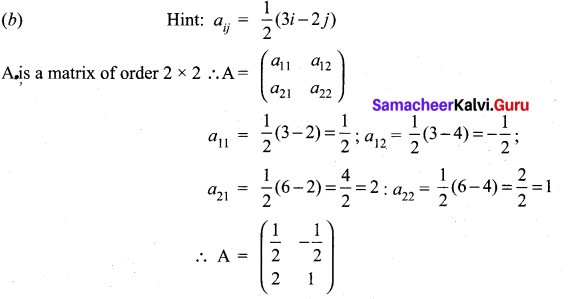
(c) 36
(d) 18
Solution:
(b) 108
Hint.
The given digits are 2, 4, 5 ,7
The unit place can be filled with the digit 2. Then the remaining Ten’s , hundred’s, Thousand’s place can be filled with the remaining three digits 4, 5, 7 in 3P3 ways.
∴ There will be 3 × 2 × 1 = 6 four digit numbers whose unit place is 2.
Similarly, there are 6 four digit numbers whose unit place is 4 , 6 four digit numbers whose unit place is 5 and 6 four digit numbers whose unit place is 7.
∴ Total in the unit place
= 6 × 2 + 6 × 4 + 6 × 5 + 6 × 7
= 6 × (2 + 4 + 5 + 7)
= 6 × 18 = 108
Sum of the digit at the unit place = 108
∴ Sum of the digit at the tens place = 108

Question 2.
In an examination, there are three multiple-choice questions and each question has 5 choices. A number of ways in which a student can fail to get all answer correct is ……..
(a) 125
(b) 124
(c) 64
(d) 63
Solution:
(b) 124
Hint.
Each question has 5 options in which 1 is correct.
So the number of ways of getting the correct answer for all three questions is 53 = 125
So the number of ways in which a student can fail to get all answer correct is < 125 (i.e.) 125 – 1 = 124

Samacheer Kalvi 11th Maths Solutions Chapter 4 Combinatorics and Mathematical Induction Ex 4.5

Question 3.
The number of ways in which the following prize be given to a class of 30 boys first and second in mathematics, first and second in physics, first in chemistry and first in English is ……….
(a) 304 × 292
(b) 303 × 293
(c) 302 × 294
(d) 30 × 295
Solution:
(a) 304 × 292
Hint.
Number of students = 30
First prize can be given to any one of 30 students
= 30 × 30 × 30 × 30 = 304 ways
Second prize can be given to anyone of the remaining 29 students = 29 × 29 = 292 ways
∴ Total number of ways prizes can be given = 304 × 292 ways

Samacheer Kalvi 11th Maths Solutions Chapter 4 Combinatorics and Mathematical Induction Ex 4.5

Question 4.
The number of 5 digit numbers all digits of which are odd is ………
(a) 25
(b) 55
(c) 56
(d) 625
Solution:
(b) 55
Hint. The odd number are 1, 3, 5, 7, 9
Number of odd numbers = 5
We need a five-digit number So the number of five-digit number = 55

Question 5.
In 3 fingers, the number of ways four rings can be worn is …… ways.
(a) 43 – 1
(b) 34
(c) 68
(d) 64
Solution:
(b) 34
Hint.
Number of rings = 4
Each finger can be worn rings in 4 ways.
∴ Number of ways of wearing four rings in three fingers
= 4 × 4 × 4
= 64

Question 6.
Samacheer Kalvi 11th Maths Solutions Chapter 4 Combinatorics and Mathematical Induction Ex 4.5 60
(a) 7 and 11
(b) 6 and 7
(c) 2 and 11
(d) 2 and 6
Solution:
(b) 6 and 7

Question 7.
The product of r consecutive positive integers is divisible by ………
(a) r!
(b) (r – 1)!
(c) (r + 1)!
(d) r!
Solution:
(a) r!
Hint.
The product of r consecutive positive integers is
1 × 2 × 3 × …………… × r = r!
which is divisible by r!
Also, 1 × 2 × 3 × …………… × r = r!
= ( r – 1) ! × r
which is divisible by (r – 1) !

Question 8.
The number of 5 digit telephone numbers which have none of their digits repeated is
(a) 90000
(b) 10000
(c) 30240
(d) 69760
Solution:
(d) 69760
Hint.
The number of 5 digit telephone numbers which have none of their digits repeated is 10P5 = 30240
Thus the required telephone number is 105 – 30240 = 69760

Samacheer Kalvi 11th Maths Solutions Chapter 4 Combinatorics and Mathematical Induction Ex 4.5

Question 9.
If a2aC2 = a2aC4 then the value of ‘a’ is ….
(a) 2
(b) 3
(c) 4
(d) 5
Solution:
(b) 3
Hint.
a2 – a = 2 + 4 = 6
a2 – a – 6 = 0
(a – 3) (a + 2) = 0 ⇒ a = 3

Question 10.
There are 10 points in a plane and 4 of them are collinear. The number of straight lines joining any two points is ……..
(a) 45
(b) 40
(c) 39
(d) 38
Solution:
(b) 40
Hint.
Samacheer Kalvi 11th Maths Solutions Chapter 4 Combinatorics and Mathematical Induction Ex 4.5 10

Question 11.
The number of ways in which a host lady invite 8 people for a party of 8 out of 12 people of whom two do not want to attend the party together is
(a) 2 × 11C7 + 10C8
(b) 11C7 + 10C8
(c) 12C810C6
(d) 10C6 + 2!
Solution:
(c) 12C810C6
Hint.
Number of the way of selecting 8 people from 12 in 12C8
∴ out of the remaining people, 8 can attend in 10C8
The number of ways in which two of them do not attend together = 12C810C6

Question 12.
The number of parallelograms that can be formed from a set of four parallel lines intersecting another set of three parallel lines …….
(a) 6
(b) 9
(c) 12
(d) 18
Solution:
(d) 18
Hint.
Number of parallelograms = 4C2 × 3C2 = 6 × 3 = 18

Samacheer Kalvi 11th Maths Solutions Chapter 4 Combinatorics and Mathematical Induction Ex 4.5

Question 13.
Everybody in a room shakes hands with everybody else. The total number of shake hands is 66. The number of persons in the room is …….
(a) 11
(b) 12
(c) 10
(d) 6
Solution:
(b) 12
Hint.
Samacheer Kalvi 11th Maths Solutions Chapter 4 Combinatorics and Mathematical Induction Ex 4.5 66

Question 14.
The number of sides of a polygon having 44 diagonals is ……….
(a) 4
(b) 4!
(c) 11
(d) 22
Solution:
(c) 11
Hint:
Samacheer Kalvi 11th Maths Solutions Chapter 4 Combinatorics and Mathematical Induction Ex 4.5 65

Question 15.
If 10 lines are drawn in a plane such that no two of them are parallel and no three are concurrent, then the total number of points of intersection are ………
(a) 45
(b) 40
(c) 10!
(d) 210
Solution:
(a) 45
Hint:
Samacheer Kalvi 11th Maths Solutions Chapter 4 Combinatorics and Mathematical Induction Ex 4.5 67

Question 16.
In a plane there are 10 points are there out of which 4 points are collinear, then the number of triangles formed is …….
(a) 110
(b) 10C3
(c) 120
(d) 116
Solution:
(d) 116
Hint:
Samacheer Kalvi 11th Maths Solutions Chapter 4 Combinatorics and Mathematical Induction Ex 4.5 68

Samacheer Kalvi 11th Maths Solutions Chapter 4 Combinatorics and Mathematical Induction Ex 4.5

Question 17.
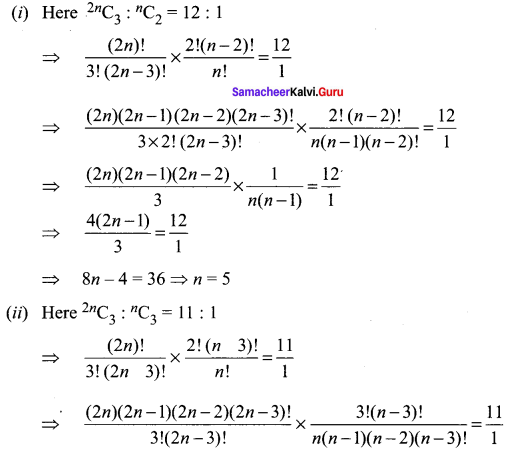
In 2nC3 : nC3 = 11 : 1 then n is ………
(a) 5
(b) 6
(c) 11
(d) 1
Solution:
(b) 6
Hint.
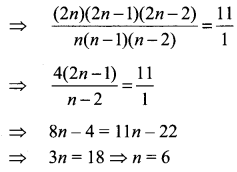
Samacheer Kalvi 11th Maths Solutions Chapter 4 Combinatorics and Mathematical Induction Ex 4.5 69

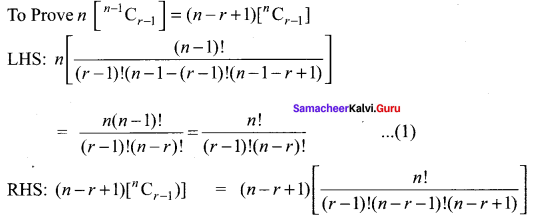
Question 18.
(n – 1)Cr + (n – 1)C(r – 1) is ………
(a) (n + 1)Cr
(b) (n – 1)Cr
(c) nCr
(d) nCr – 1
Solution:
(c) nCr
Samacheer Kalvi 11th Maths Solutions Chapter 4 Combinatorics and Mathematical Induction Ex 4.5 70

Question 19.
The number of ways of choosing 5 cards out of a deck of 52 cards which include at least one king is …….
(a) 52C5
(b) 48C5
(c) 52C5 + 48C5
(d) 52C548C5
Solution:
(d) 52C548C5
Hint.
Selecting 5 from 52 cards = 52C5
selecting 5 from the (non-king cards 48) = 48C5
∴ Number of ways is 52C548C5

Question 20.
The number of rectangles that a chessboard has ……
(a) 81
(b) 99
(c) 1296
(d) 6561
Solution:
(c) 1296
Hint. Number of horizontal times = 9
Number of vertical times = 9
Selecting 2 from 9 horizontal lines = 9C2
Selecting 2 from 9 vertical lines = 9C2
Samacheer Kalvi 11th Maths Solutions Chapter 4 Combinatorics and Mathematical Induction Ex 4.5 150

Question 21.
The number of 10 digit number that can be written by using the digits 2 and 3 is ……..
(a) 10C2 + 9C2
(b) 210
(c) 210 – 2
(d) 10!
Solution:
(b) 210
Hint.
Selecting the number from (2 and 3)
For till the first digit can be done in 2 ways
For till the second digit can be done in 2 ways ….
For till the tenth digit can be done in 2 ways
So, total number of ways in 10 digit number = 2 × 2 × 2 × 2 × 2 × 2 × 2 × 2 × 2 × 2 = 210

Samacheer Kalvi 11th Maths Solutions Chapter 4 Combinatorics and Mathematical Induction Ex 4.5

Question 22.
If Pr stands for rPr then the sum of the series 1 + P1 + 2P2 + 3P3 + … + nPn is ……..
(a) Pn + 1
(b) Pn + 1 – 1
(c) Pn – 1 + 1
(d) (n + 1)P(n – 1)
Solution:
(b) Pn + 1 – 1
Hint:
1 + 1! + 2! + 3! + … + n!
Now 1 + 1 (1!) = 2 = (1 + 1)!
1 + 1 (1!) + 2(2!) = 1 + 1 + 4 = 6 = 3!
1 + 1(1!) + 2(2!)+ 3(3!) = 1 + 1 + 4 + 18 = 24 = 4!
1 + 1(1!) + 2(2!) + 3(3!) ….+ n(n!) = (n + 1) ! – 1
= n + 1Pn + 1 – 1 = Pn + 1 – 1

Question 23.
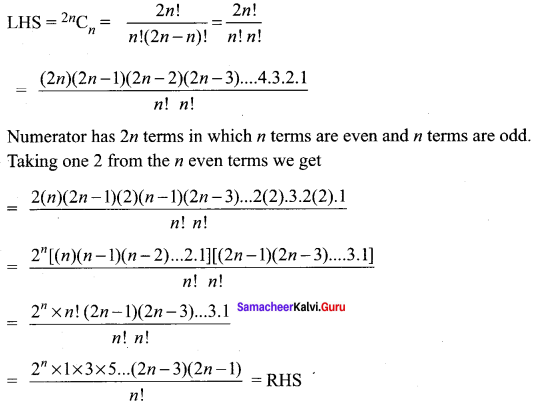
The product of first n odd natural numbers equals …….
Samacheer Kalvi 11th Maths Solutions Chapter 4 Combinatorics and Mathematical Induction Ex 4.5 80
Solution:
Samacheer Kalvi 11th Maths Solutions Chapter 4 Combinatorics and Mathematical Induction Ex 4.5 81
Hint:
Samacheer Kalvi 11th Maths Solutions Chapter 4 Combinatorics and Mathematical Induction Ex 4.5 82

Question 24.
If nC4, nC5, nC6 are in AP the value of n can be ………..
(a) 14
(b) 11
(c) 9
(d) 5
Solution:
(a) 14
Hint:
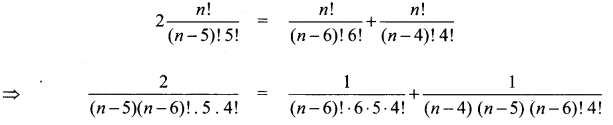
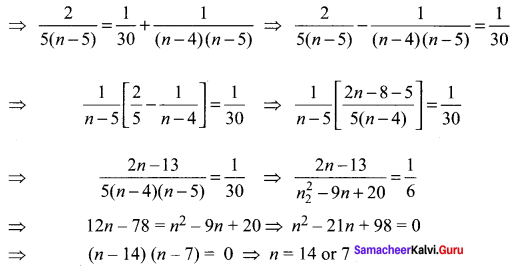
Samacheer Kalvi 11th Maths Solutions Chapter 4 Combinatorics and Mathematical Induction Ex 4.5 83
30 + n2 – 9n + 20 – 12n + 48 = 0
n2 – 21 n + 98 = 0
(n – 7) (n – 14) = 0
n = 7 (or) 14

Question 25.
1 + 3 + 5 + 7 + + 17 is equal to ………
(a) 101
(b) 81
(c) 71
(d) 61
Solution:
(b) 81
Hint:
Samacheer Kalvi 11th Maths Solutions Chapter 4 Combinatorics and Mathematical Induction Ex 4.5 84

Samacheer Kalvi 11th Maths Solutions Chapter 4 Combinatorics and Mathematical Induction Ex 4.5 Read More »

Samacheer Kalvi 11th Maths Solutions Chapter 4 Combinatorics and Mathematical Induction Ex 4.2

You can Download Samacheer Kalvi 11th Maths Book Solutions Guide Pdf, Tamilnadu State Board help you to revise the complete Syllabus and score more marks in your examinations.

Tamilnadu Samacheer Kalvi 11th Maths Solutions Chapter 4 Combinatorics and Mathematical Induction Ex 4.2

Question 1.
If (n – 1) P3 : nP4, find n:
Solution:
Samacheer Kalvi 11th Maths Solutions Chapter 4 Combinatorics and Mathematical Induction Ex 4.2 1

Question 2.
If 10Pr – 1 = 2 × 6Pr, find r.
Solution:
Samacheer Kalvi 11th Maths Solutions Chapter 4 Combinatorics and Mathematical Induction Ex 4.2 2

Question 3.
(i) Suppose 8 people enter an event in a swimming meet. In how many ways could the gold, silver, and bronze prizes be awarded?
Solution:
Number people enter in a swimming meet = 8 Prizes awarded = Gold, silver, bronze.
The gold medal can be awarded to any one of the 8 people in 8 ways. The silver medal can be awarded to any one of the remaining 7 people in 7 ways. The bronze medal can be awarded to any one of the remaining 6 people in 6 ways,
∴ Total number of ways of awarding the prizes = 8 × 7 × 6 = 336

(ii) Three men have 4 coats, 5 waistcoats, and 6 caps. In how many ways can they wear them?
Solution:
Selecting and arranging 3 coats from 4 can be done in 4P3 ways
Selecting and arranging 3 waistcoats from 5 can be done in 5P3 ways Selecting and arranging 3 caps from 6 can be done in 6P3 ways
∴ Total number of ways = 4P3 × 5P3 × 6P3 = 172800 ways

Question 4.
Determine the number of permutations of the letters of the word SIMPLE if all are taken at a time?
Solution:
Number of letters in the word SIMPLE = 6
The total number of the word is equal to the number of arrangements of these letters, taken all at a time
∴ Total number of words = 6P6 = 6!
= 6 × 5 × 4 × 3 × 2 × 1
= 720

Samacheer Kalvi 11th Maths Solutions Chapter 4 Combinatorics and Mathematical Induction Ex 4.2

Question 5.
A test consists of 10 multiple-choice questions. In how many ways can the test be answered if

(i) Each question has four choices?
Solution:
Total number of questions = 10
Each question has four choices.
Each question can be answered in 4 ways.
∴ The total number of ways of answering 10 questions
= 4 × 4 × 4 × 4 × 4 × 4 × 4 × 4 × 4 × 4
= 410

(ii) The first four questions have three choices and the remaining have five choices?
Solution:
The first four questions have three choices and the remaining have five choices
First, four questions have three choices.
∴ The number of ways of answering the first four questions is = 3 × 3 × 3 × 3 = 34
The remaining six questions have 5 choices
∴ The number of ways of answering the remaining 6 questions is = 5 × 5 × 5 × 5 × 5 × 5 = 56
∴ The total number of ways of answering the questions = 34 × 56

(iii) Question number n has n + 1 choices?
Solution:
Question number n has n + 1 choices.
The first question has a 1 + 1 choice.
∴ Number of ways of answering the first question = 2
The second question has 2 + 1 choices
∴ Number ways of answering second question = 3
Samacheer Kalvi 11th Maths Guide Chapter 4 Combinatorics and Mathematical Induction Ex 4.2 5
Tenth question has (10 + 1) choices
∴ Number of ways of answering tenth question = 11
∴ A total number of ways of answering the given 10 questions = 2 × 3 × 4 × ……. × 11 = 11!

Question 6.
A student appears in an objective test which contain 5 multiple-choice questions. Each question has four choices out of which one correct answer.

(i) What is the maximum number of different answers can the students give?
Solution:
Number multiple-choice questions = 5
Number of ways of answering each question = 4
∴ The total number of ways of answering the five questions = 4 × 4 × 4 × 4 × 4 = 45
Hence, the maximum number of different answers = 45

(ii) How will the answer change if each question may have more than one correct answers?
Solution:
When each question has more than 1 correct answer.
Selecting the correct choice from the 4 choice can be done is 4C1 or 4C2 or 4C3 or 4C4 ways.
Samacheer Kalvi 11th Maths Solutions Chapter 4 Combinatorics and Mathematical Induction Ex 4.2 20
Each question can be answered in 15 ways.
Number of questions = 5
∴ Total number of ways = 155

Samacheer Kalvi 11th Maths Solutions Chapter 4 Combinatorics and Mathematical Induction Ex 4.2

Question 7.
How many strings can be formed from the letters of the word ARTICLE, so that vowels occupy the even places?
Solution:
The given word is ARTICLE
Number of letters in the word = 7
Vowels in the given word = A, I, E
Number of vowels in the given word = 3
Samacheer Kalvi 11th Maths Guide Chapter 4 Combinatorics and Mathematical Induction Ex 4.2 7
∴ Number of even places = 3
3 Vowels can occupy the 3 even places in 3P3 = 3! ways
The remaining 4 letters can occupy the remaining places in
4P4 = 4! ways
Hence a total number of ways of arrangement = 4! × 3! = 4 × 3 × 2 × 3 × 2 = 144

Question 8.
8 women and 6 men are standing in a line.
(i) How many arrangements are possible if any individual can stand in any position?
Solution:
Total number of persons in a line = 8 + 6 = 14
The number of ways of standing 14 persons in a line in any position = 14P14 = 14!

(ii) In how many arrangements will all 6 men be standing next to one another?
Solution:
Consider 6 men as one unit.
8 women + 6 men as one unit = 9 can be arranged in 9! ways.
6 men can among themselves be arranged in 6! ways.
∴ A total number of ways of arrangement = 9! × 6!

(iii) In how many arrangements will no two men be standing next to one another?
Solution:
Since no two men be together they have to be placed between 8 women and before and after the women.
w | w | w | w | w | w | w | w
There are 9 places so the 6 men can be arranged in the 9 places in 9P6 ways.
After this arrangement, the 8 women can be arranged in 8! ways.
∴ Total number of arrangements = (9P6) × 8!

Samacheer Kalvi 11th Maths Solutions Chapter 4 Combinatorics and Mathematical Induction Ex 4.2

Question 9.
Find the distinct permutations of the letters of the word MISSISSIPPI?
Solution:
MISSISSIPPI
Number of letters = 11
Here M – 1 time
I – 4 times
S – 4 times
P – 2 times
Samacheer Kalvi 11th Maths Solutions Chapter 4 Combinatorics and Mathematical Induction Ex 4.2 25

Question 10.
How many ways can the product a2b3c4 be expressed without exponents?
Solution:
a2b3c4 = aabbbcccc
Number of letters = 9
a = 2 times,
b = 3 times,
c = 4 times,
Samacheer Kalvi 11th Maths Solutions Chapter 4 Combinatorics and Mathematical Induction Ex 4.2 26

Question 11.
In how many ways 4 mathematics books, 3 physics books, 2 chemistry books and 1 biology book can be arranged on a shelf so that all books of the same subjects are together.
Solution:
Number of subjects = 4
4 subjects can be arranged in the shelf in 4! ways Number of mathematics books = 4
4 Mathematics books keeping together can be arranged in 4! ways
Number of physics books = 3
3 Physics books keeping together can be arranged in 3! ways.
Number of chemistry books =2
2 Chemistry books keeping together can be arranged in 2! ways.
Number of biology books = 1
1 biology book can be arranged in 1! way
Hence, the total numbers of ways of arranging the books
= 4! × 4! × 3! × 2! × 1!
= (4 × 3 × 2 × 1) (4 × 3 × 2 × 1) × (3 × 2) (2 × 1)
= 24 × 24 × 6 × 2
= 6912

Samacheer Kalvi 11th Maths Solutions Chapter 4 Combinatorics and Mathematical Induction Ex 4.2

Question 12.
In how many ways can the letters of the word SUCCESS be arranged so that all Ss are together?
Solution:
The given word is SUCCESS
Number of letters other than S = 4
Treating all S’s together as one letter
Total number of letters in the word = 5
Number of U’s = 1
Number of C’s = 2
Number of E’s = 1
Number of S’s (treated as one letter ) = 1
Number of ways of arranging = \(\frac{5 !}{2 ! \times 1 ! \times 1 ! \times 1 !}\)
= \(\frac{5 \times 4 \times 3 \times 2 \times 1}{2 \times 1}\)
= 5 × 4 × 3
= 60 ways

Question 13.
A coin is tossed 8 times,

(i) How many different sequences of heads and tails are possible?
Solution:
Number of coins tossed = 8
Number of outcome for each toss = 2
Total number of outcomes = 28

(ii) How many different sequences containing six heads and two tails are possible?
Solution:
Getting 6 heads and 2 tails can be done in 8P6 or 8P2 ways
Samacheer Kalvi 11th Maths Solutions Chapter 4 Combinatorics and Mathematical Induction Ex 4.2 28

Question 14.
How many strings are there using the letters of the word INTERMEDIATE, if

(i) The vowels and consonants are alternative
Solution:
INTERMEDIATE
Samacheer Kalvi 11th Maths Solutions Chapter 4 Combinatorics and Mathematical Induction Ex 4.2 29
The number of ways in which vowels and consonants are alternative = \(\frac{6 ! 6 !}{3 ! 2 !}=\) 43200

(ii) All the vowels are together
Solution:
The number of arrangements:
Keeping all the vowels as a single unit. Now we have 6 + 1 = 7 units which can be arranged in 7! ways.
Now the 6 consonants can be arranged in \(\frac{6 !}{2 !}\) (T occurs twice) ways in vowels, I – repeats thrice
and E – repeats twice
Samacheer Kalvi 11th Maths Solutions Chapter 4 Combinatorics and Mathematical Induction Ex 4.2 30

(iii) Vowels are never together (and) (iv) No two vowels are together.
Solution:
Vowels should not be together = No. of all arrangements – No. of all vowels together
Samacheer Kalvi 11th Maths Solutions Chapter 4 Combinatorics and Mathematical Induction Ex 4.2 31
So number of ways in which No two vowels are together = 19958400 – Number of ways in which vowels are together = 19958400 – 151200 = 19807200

Samacheer Kalvi 11th Maths Solutions Chapter 4 Combinatorics and Mathematical Induction Ex 4.2

Question 15.
Each of the digits 1,1, 2, 3, 3 and 4 is written on a separate card. The seven cards are then laid out in a row to form a 6-digit number.

(i) How many distinct 6-digit numbers are there?
Solution:
The given digits are 1, 1, 2, 3, 3, 4
The 6 digits can be arranged in 6! ways
In which 1 and 3 are repeated twice.
Samacheer Kalvi 11th Maths Solutions Chapter 4 Combinatorics and Mathematical Induction Ex 4.2 32

(ii) How many of these 6-digit numbers are even?
Solution:
To find the number even numbers
The digit in unit place is 2 or 4 which can be filled in 2 ways
Samacheer Kalvi 11th Maths Solutions Chapter 4 Combinatorics and Mathematical Induction Ex 4.2 33

(iii) How many of these 6-digit numbers are divisible by 4?
Solution:
To get a number -f- by 4 the last 2 digits should be -r- by 4 So the last two digits will be 12 or 24 or 32.
When the last 2 digits are 1 and 2.
Samacheer Kalvi 11th Maths Solutions Chapter 4 Combinatorics and Mathematical Induction Ex 4.2 34
When the last 2 digits are 3 and the number of 6 digit numbers (remaining number 1, 1, 3, 4)
So there of 6 digit numbers ÷ by 4 = 12 + 6 + 12 = 30

Question 16.
If the letters of the word GARDEN are permuted in all possible ways and the strings thus formed are arranged in the dictionary order, then find the ranks of the words
(i) GARDEN
(ii) DANGER.
Solution:
The given letters are GARDEN.
To find the rank of GARDEN:
The given letters in alphabetical order are A D E G N R
Samacheer Kalvi 11th Maths Solutions Chapter 4 Combinatorics and Mathematical Induction Ex 4.2 35
The rank of GARDEN is 379
To find the rank of DANGER

(ii) The No. of words starting with A = 5! =120
Samacheer Kalvi 11th Maths Solutions Chapter 4 Combinatorics and Mathematical Induction Ex 4.2 36

Question 17.
Find the number of strings that can be made using all letters of the word THING. If these words are written as in a dictionary, what will be the 85th string?
Solution:
(i) Number of words formed = 5! = 120
(ii) The given word is THING
Taking the letters in alphabetical order G H I N T
To find the 85th word
Samacheer Kalvi 11th Maths Solutions Chapter 4 Combinatorics and Mathematical Induction Ex 4.2 38

Samacheer Kalvi 11th Maths Solutions Chapter 4 Combinatorics and Mathematical Induction Ex 4.2

Question 18.
If the letters of the word FUNNY are permuted in all possible ways and the strings thus formed are arranged in the dictionary order, find the rank of the word FUNNY.
Solution:
The given word is FUNNY
Samacheer Kalvi 11th Maths Solutions Chapter 4 Combinatorics and Mathematical Induction Ex 4.2 39

Question 19.
Find the sum of all 4-digit numbers that can be formed using digits 1, 2, 3, 4, and 5 repetitions not allowed?
Solution:
The given digits are 1, 2, 3, 4, 5
The no. of 4 digit numbers
Samacheer Kalvi 11th Maths Solutions Chapter 4 Combinatorics and Mathematical Induction Ex 4.2 40
Sum of the digits = 1 + 2 + 3 + 4 + 5 = 15
Sum of number’s in each place = 24 × 15 = 360
Samacheer Kalvi 11th Maths Solutions Chapter 4 Combinatorics and Mathematical Induction Ex 4.2 41

Question 20.
Find the sum of all 4-digit numbers that can be formed using digits 0, 2, 5, 7, 8 without repetition?
Solution:
The given digits are 0, 2, 5, 7, 8
To get the number of 4 digit numbers
1000’s place can be filled in 4 ways (excluding 0)
100’s place can be filled in 4 ways (excluding one number and including 0)
10’s place can be filled in (4 – 1) = 3 ways
and unit place can be filled in (3 – 1) = 2 ways
So the number of 4 digit numbers = 4 × 4 × 3 × 2 = 96

To find the sum of 96 numbers:

In 1000’s place we have the digits 2, 5, 7, 8. So each number occurs \(\frac{96}{4}\) = 24 times.
Now in 100’s place 0 come 24 times. So the remaining digits 2, 5, 7, 8 occurs 96 – 24 = \(\frac{72}{4}\) = 18 times
Similarly in 10’s place and in-unit place 0 occurs 24 times and the remaining digits 2, 5, 7, 8 occurs 18 times.
Now sum of the digits = 2 + 5 + 7 + 8 = 22
Sum in 1000’s place = 22 × 24 = 528
Sum in 100’s, 10’s and in unit place = 22 × 18 = 396
∴ Sum of the 4 digit numbers is
Samacheer Kalvi 11th Maths Solutions Chapter 4 Combinatorics and Mathematical Induction Ex 4.2 45

Samacheer Kalvi 11th Maths Solutions Chapter 4 Combinatorics and Mathematical Induction Ex 4.2 Additional Questions

Question 1.
Samacheer Kalvi 11th Maths Solutions Chapter 4 Combinatorics and Mathematical Induction Ex 4.2 55
Solution:
Samacheer Kalvi 11th Maths Solutions Chapter 4 Combinatorics and Mathematical Induction Ex 4.2 56

Question 2.
How many 3-digit even numbers can be made using the digits 1, 2, 3, 4, 6, 7 if no digit is repeated?
Solution:
Here total number of digits = 6
The unit place can be filled with any one of the digits 2, 4, 6.
Samacheer Kalvi 11th Maths Solutions Chapter 4 Combinatorics and Mathematical Induction Ex 4.2 57

Samacheer Kalvi 11th Maths Solutions Chapter 4 Combinatorics and Mathematical Induction Ex 4.2

Question 3.
Find n if n – 1P3 : nP4 = 1 : 9
Solution:
Samacheer Kalvi 11th Maths Solutions Chapter 4 Combinatorics and Mathematical Induction Ex 4.2 58

Question 4.
How many words can be formed by using the letters of the word ORIENTAL so that A and E always occupy the odd places?
Solution:
[Hint: There are 4 odd places in the word]
Samacheer Kalvi 11th Maths Solutions Chapter 4 Combinatorics and Mathematical Induction Ex 4.2 59
Now the remaining 6 places filled with remaining 6 letters
Samacheer Kalvi 11th Maths Solutions Chapter 4 Combinatorics and Mathematical Induction Ex 4.2 60
Hence the total number of permutations = 12 × 720 = 8640

Question 5.
Out of 18 points in a plane, no three are in the same line except five points which are collinear. Find the number of lines that can be formed joining the points.
Solution:
Total number of points = 18
Out of 18 numbers, 5 are collinear and we get a straight line by joining any two points.
∴ Total number of straight-line formed by joining 2 points out of 18 points = 18C2
Number of straight lines formed by joining 2 points out of 5 points = 5C2
But 5 points are collinear and we get only one line when they are joined pairwise.
So, the required number of straight lines are
Samacheer Kalvi 11th Maths Solutions Chapter 4 Combinatorics and Mathematical Induction Ex 4.2 61
Hence, the total number of straight lines = 144

Samacheer Kalvi 11th Maths Solutions Chapter 4 Combinatorics and Mathematical Induction Ex 4.2

Question 6.
We wish to select 6 person from 8 but, if the person A is chosen, then B must be chosen. In how many ways can selections be made?
Solution:
Total number of persons = 8
Number of persons to be selected = 6
Condition is that if A is chosen, B must be chosen

Case I: When A is chosen, B must be chosen
Number of ways = 6C4
[∴ A and B are set to be choosen]

Case II: When A is not chosen, then B may be chosen
∴ Number of ways = 7C6
Samacheer Kalvi 11th Maths Solutions Chapter 4 Combinatorics and Mathematical Induction Ex 4.2 62
Hence, the required number of ways = 22

Question 7.
How many 3-digit even numbers can be made using the digits 1, 2, 3, 4, 6, 7, if no digit is repeated?
Solution:
For 3-digit even numbers, the unit’s place can be occupied by one of the 3 digits 2, 4 or 6. The remaining 5 digits can be arranged in the remaining 2 places in 5P2 ways.
Samacheer Kalvi 11th Maths Solutions Chapter 4 Combinatorics and Mathematical Induction Ex 4.2 63
∴ By the multiplication rule, the required number of 3-digit even numbers is 3 × 5P2 = 3 × 5 × 4 = 60.

Samacheer Kalvi 11th Maths Solutions Chapter 4 Combinatorics and Mathematical Induction Ex 4.2

Question 8.
Find the number of 4-digit numbers that can be formed using the digits 1, 2, 3, 4, 5 if no digit is repeated. How many of these will be even?
Solution:
For 4 digit numbers, we have to arrange the given 5 digits in 4 vacant places. This can be done in 5P4 = 5 × 4 × 3 × 2 = 120 ways.
Samacheer Kalvi 11th Maths Solutions Chapter 4 Combinatorics and Mathematical Induction Ex 4.2 64
For 4-digit even numbers, the unit’s place can be occupied by one of the 2 digits 2 or 4. The remaining 4 digits can be arranged in the remaining 3 places in 4P3 ways.
∴ By the multiplication rule, the required number of 4-digit even numbers is 2 × 4P3 = 2 × 4 × 3 × 2 = 48.

Question 9.
Find r if

(i) 5Pr = 2 6Pr – 1 4
Solution:
Samacheer Kalvi 11th Maths Solutions Chapter 4 Combinatorics and Mathematical Induction Ex 4.2 65

(ii) 5Pr = 6Pr – 1
Samacheer Kalvi 11th Maths Solutions Chapter 4 Combinatorics and Mathematical Induction Ex 4.2 66
⇒ 42 – 13r + r2 = 6 ⇒ r2 – 13r + 36 = 0
⇒ (r – 4)(r – 9) = 0 ⇒ r = 4, 9
Now, we know that nPr is meaningful only when r ≤ n.
5Pr and 6Pr – 1 are meaningless when r ≤ 9.
∴ Rejecting r = 9, we have r = 4

Question 10.
How many words, with or without meaning, can be made from the letters of the word MONDAY, assuming that no letter is repeated, if
Samacheer Kalvi 11th Maths Solutions Chapter 4 Combinatorics and Mathematical Induction Ex 4.2 67
(i) 4 letters are used at a time
(ii) all letters are used at a time
(iii) all letters are used but first letter is a vowel?
Solution:
The word MONDAY has 6 distinct letters.

(i) 4 letters out of 6 can be arranged in 6P4 ways.
∴ The required number of words = 6P4 = 6 × 5 × 4 × 3 = 360

(ii) 6 letters can be arranged among themselves in 6P6 ways.
∴ The required number of words = 6P6 = 6! = 1 × 2 × 3 × 4 × 5 × 6 = 720.

(iii) The first place can be filled by anyone Of the two vowels O or A in 2 ways. The remaining 5 letters can be arranged in the remaining 5 places II to VI in 5P5 = 5! ways.
∴ By the multiplication rule, the required number of words = 2 × 5! = 2 × 1 × 2 × 3 × 4 × 5 = 240

Samacheer Kalvi 11th Maths Solutions Chapter 4 Combinatorics and Mathematical Induction Ex 4.2 Read More »

Samacheer Kalvi 11th Maths Solutions Chapter 7 Matrices and Determinants Ex 7.2

You can Download Samacheer Kalvi 11th Maths Book Solutions Guide Pdf, Tamilnadu State Board help you to revise the complete Syllabus and score more marks in your examinations.

Tamilnadu Samacheer Kalvi 11th Maths Solutions Chapter 7 Matrices and Determinants Ex 7.2

Question 1.
Without expanding the determinant, prove thatSamacheer Kalvi 11th Maths Solutions Chapter 7 Matrices and Determinants Ex 7.2 1
Solution:
Samacheer Kalvi 11th Maths Solutions Chapter 7 Matrices and Determinants Ex 7.2 2

Question 2.
Show that Samacheer Kalvi 11th Maths Solutions Chapter 7 Matrices and Determinants Ex 7.2 3
Solution:
Samacheer Kalvi 11th Maths Solutions Chapter 7 Matrices and Determinants Ex 7.2 4
Samacheer Kalvi 11th Maths Solutions Chapter 7 Matrices and Determinants Ex 7.2 5

Question 3.
Prove that Samacheer Kalvi 11th Maths Solutions Chapter 7 Matrices and Determinants Ex 7.2 6
Solution:
LHS
Taking a from C1, b from C2 and c from C3 we get
Samacheer Kalvi 11th Maths Solutions Chapter 7 Matrices and Determinants Ex 7.2 7
Expanding along R1 we get
(2c) (abc) (1) [ab + ab] = abc (2c) (2ab)
1 = (abc) (4abc) = 4a2b2c2
= RHS

Samacheer Kalvi 11th Maths Solutions Chapter 7 Matrices and Determinants Ex 7.2

Question 4.
Samacheer Kalvi 11th Maths Solutions Chapter 7 Matrices and Determinants Ex 7.2 8
Solution:
Samacheer Kalvi 11th Maths Solutions Chapter 7 Matrices and Determinants Ex 7.2 9

Question 5.
Prove that Samacheer Kalvi 11th Maths Solutions Chapter 7 Matrices and Determinants Ex 7.2 10
Solution:
Samacheer Kalvi 11th Maths Solutions Chapter 7 Matrices and Determinants Ex 7.2 11

Question 6.
Show that Samacheer Kalvi 11th Maths Solutions Chapter 7 Matrices and Determinants Ex 7.2 12
Solution:
Samacheer Kalvi 11th Maths Solutions Chapter 7 Matrices and Determinants Ex 7.2 13
Samacheer Kalvi 11th Maths Solutions Chapter 7 Matrices and Determinants Ex 7.2 14

Question 7.
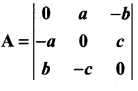
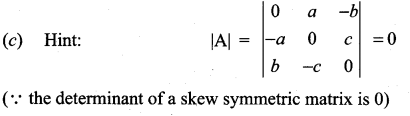
Write the general form of a 3 × 3 skew-symmetric matrix and prove that its determinant is 0.
Solution:
Samacheer Kalvi 11th Maths Solutions Chapter 7 Matrices and Determinants Ex 7.2 15

Question 8.
Samacheer Kalvi 11th Maths Solutions Chapter 7 Matrices and Determinants Ex 7.2 16
Solution:
Samacheer Kalvi 11th Maths Solutions Chapter 7 Matrices and Determinants Ex 7.2 17
we get – (aα2 + 2bα + c) [ac – b2]
So Δ = 0 ⇒ (aα2 + 2bα + c) (ac -b2) = – 0 = 0
⇒ aα2 + 2bα + c = 0 or ac – b2 = 0
(i.e.) a is a root of ax2 + 2bx + c = 0
or ac = b2
⇒ a, b, c are in G.P.

Question 9.
Prove that Samacheer Kalvi 11th Maths Solutions Chapter 7 Matrices and Determinants Ex 7.2 18
Solution:
Samacheer Kalvi 11th Maths Solutions Chapter 7 Matrices and Determinants Ex 7.2 19
Samacheer Kalvi 11th Maths Solutions Chapter 7 Matrices and Determinants Ex 7.2 20

Question 10.
If a, b, c are pth, qth and rth terms of an A.P., find the value of Samacheer Kalvi 11th Maths Solutions Chapter 7 Matrices and Determinants Ex 7.2 21
Solution:
We are given a = tp,b = tq and c = tr
Let a be the first term and d be the common difference
Samacheer Kalvi 11th Maths Solutions Chapter 7 Matrices and Determinants Ex 7.2 22

Samacheer Kalvi 11th Maths Solutions Chapter 7 Matrices and Determinants Ex 7.2

Question 11.
Show that Samacheer Kalvi 11th Maths Solutions Chapter 7 Matrices and Determinants Ex 7.2 23 is divisible by x4
Solution:
Samacheer Kalvi 11th Maths Solutions Chapter 7 Matrices and Determinants Ex 7.2 24
Multiplying R1 by a, R2 by b and R3 by c and
taking out a from C1 b from C2 and c from C3 we get
=Samacheer Kalvi 11th Maths Solutions Chapter 7 Matrices and Determinants Ex 7.2 25=

Question 12.
If a, b, c are all positive, and are pth, qth and rth terms of a G.P., show that
Samacheer Kalvi 11th Maths Solutions Chapter 7 Matrices and Determinants Ex 7.2 26
Solution:
Samacheer Kalvi 11th Maths Solutions Chapter 7 Matrices and Determinants Ex 7.2 27
Samacheer Kalvi 11th Maths Solutions Chapter 7 Matrices and Determinants Ex 7.2 28

Question 13.
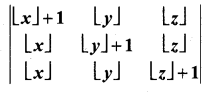
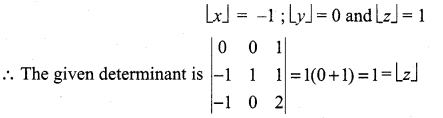
Find the value of Samacheer Kalvi 11th Maths Solutions Chapter 7 Matrices and Determinants Ex 7.2 29 if x, y, z ≠ 1.
Solution:
Expanding the determinant along R1
Samacheer Kalvi 11th Maths Solutions Chapter 7 Matrices and Determinants Ex 7.2 30

Question 14.
Samacheer Kalvi 11th Maths Solutions Chapter 7 Matrices and Determinants Ex 7.2 31
Solution:
Samacheer Kalvi 11th Maths Solutions Chapter 7 Matrices and Determinants Ex 7.2 32
Samacheer Kalvi 11th Maths Solutions Chapter 7 Matrices and Determinants Ex 7.2 33

Question 15.
Without expanding, evaluate the following determinants:
Samacheer Kalvi 11th Maths Solutions Chapter 7 Matrices and Determinants Ex 7.2 34
Solution:
Samacheer Kalvi 11th Maths Solutions Chapter 7 Matrices and Determinants Ex 7.2 35

Question 16.
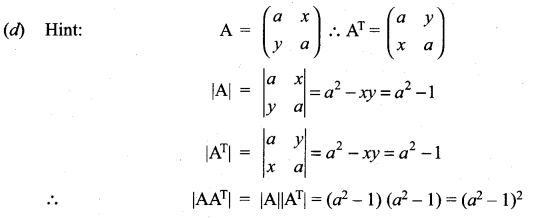
If A is a square matrix and |A| = 2, find the value of |AAT|.
Solution:
Given |A| = 2
[Property 1: The determinant of a matrix remains unaltered if its rows are changed into columns and columns. That is, |A| = |AT|]

|AT| = |A| = 2
∴ |A AT| = |A| |AT|
= 2 × 2 = 4

Samacheer Kalvi 11th Maths Solutions Chapter 7 Matrices and Determinants Ex 7.2

Question 17.
If A and B are square matrices of order 3 such that |A| = -1 and |B| = 3, find the value of |3AB|.
Solution:
Given A and B are square matrices of order 3 such that |A| = -1 and |B| = 3
[It A is a square matrix of order n then det ( kA) = |kA| = kn |A|.]
A and B are square matrices of order 3. Therefore,
AB is also a square matrix of order 3.
|3 AB| = 33 |AB|
= 27 |A| |B|
= 27 × – 1 × 3
|3 AB| = – 81

Question 18.
If λ = -2, determine the value of Samacheer Kalvi 11th Maths Solutions Chapter 7 Matrices and Determinants Ex 7.2 36
Solution:
Given λ = -2
∴ 2λ = -4; λ2 = (-2)2; 3λ2 + 1 = 3 (4) + 1 = 13
6λ – 1 = 6(-2) – 1 = -13
Samacheer Kalvi 11th Maths Solutions Chapter 7 Matrices and Determinants Ex 7.2 37
expanding along R1
0(0) + 4 (0 + 13) + 1 (-52 + 0) = 52 – 52 = 0
Aliter: The determinant value of a skew-symmetric matrix is zero

Question 19.
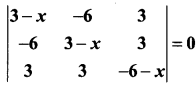
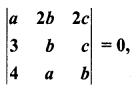
Determine the roots of the equation Samacheer Kalvi 11th Maths Solutions Chapter 7 Matrices and Determinants Ex 7.2 38
Solution:
Samacheer Kalvi 11th Maths Solutions Chapter 7 Matrices and Determinants Ex 7.2 39

Samacheer Kalvi 11th Maths Solutions Chapter 7 Matrices and Determinants Ex 7.2

Given the determinant value is 0
⇒ 30(1 + x) (2 – x) = 0
⇒ 1 + x = 0 or 2 – x = 0
⇒ x = -1 or x = 2
So, x = -1 or 2.

Question 20.
Verify that det (AB) = (det A) (det B) for Samacheer Kalvi 11th Maths Solutions Chapter 7 Matrices and Determinants Ex 7.2 40
Solution:
Samacheer Kalvi 11th Maths Solutions Chapter 7 Matrices and Determinants Ex 7.2 41
Samacheer Kalvi 11th Maths Solutions Chapter 7 Matrices and Determinants Ex 7.2 42
{(-20)(52) (-19) + (10)(38)(—49) + (2)(64)(-17)} – {(-49)(52) (2) + (-17)(38)(-20) + (-19)(64)(10)}
= (19760 – 18620 – 2176) – (-5096 + 12920 – 12160)
= (19760 + 5096 + 12160) – (18620 + 2176 + 12920)
= 37016 – 33716 = 3300 ….(3)
Now (1) × (2) = (3)
(i.e.,) (-33) (-100) = 3300
⇒ det (AB) = (det A), (det B)

Question 21.
Using cofactors of elements of the second row, evaluate |A|, where Samacheer Kalvi 11th Maths Solutions Chapter 7 Matrices and Determinants Ex 7.2 43
Solution:
Samacheer Kalvi 11th Maths Solutions Chapter 7 Matrices and Determinants Ex 7.2 44

Samacheer Kalvi 11th Maths Solutions Chapter 7 Matrices and Determinants Ex 7.2 Additional Problems

Question 1.
Samacheer Kalvi 11th Maths Solutions Chapter 7 Matrices and Determinants Ex 7.2 45
Solution:
Samacheer Kalvi 11th Maths Solutions Chapter 7 Matrices and Determinants Ex 7.2 46
Samacheer Kalvi 11th Maths Solutions Chapter 7 Matrices and Determinants Ex 7.2 47

Question 2.
Samacheer Kalvi 11th Maths Solutions Chapter 7 Matrices and Determinants Ex 7.2 48
Solution:
Samacheer Kalvi 11th Maths Solutions Chapter 7 Matrices and Determinants Ex 7.2 49

Question 3.
Samacheer Kalvi 11th Maths Solutions Chapter 7 Matrices and Determinants Ex 7.2 50
Solution:
Samacheer Kalvi 11th Maths Solutions Chapter 7 Matrices and Determinants Ex 7.2 51
Samacheer Kalvi 11th Maths Solutions Chapter 7 Matrices and Determinants Ex 7.2 52

Question 4.
Samacheer Kalvi 11th Maths Solutions Chapter 7 Matrices and Determinants Ex 7.2 53
Solution:
Samacheer Kalvi 11th Maths Solutions Chapter 7 Matrices and Determinants Ex 7.2 54
Samacheer Kalvi 11th Maths Solutions Chapter 7 Matrices and Determinants Ex 7.2 55
Samacheer Kalvi 11th Maths Solutions Chapter 7 Matrices and Determinants Ex 7.2 56

Question 5.
Samacheer Kalvi 11th Maths Solutions Chapter 7 Matrices and Determinants Ex 7.2 57
Solution:
Samacheer Kalvi 11th Maths Solutions Chapter 7 Matrices and Determinants Ex 7.2 58

Samacheer Kalvi 11th Maths Solutions Chapter 7 Matrices and Determinants Ex 7.2

Question 6.
Samacheer Kalvi 11th Maths Solutions Chapter 7 Matrices and Determinants Ex 7.2 59
Solution:
Samacheer Kalvi 11th Maths Solutions Chapter 7 Matrices and Determinants Ex 7.2 60
Samacheer Kalvi 11th Maths Solutions Chapter 7 Matrices and Determinants Ex 7.2 61

Question 7.
Samacheer Kalvi 11th Maths Solutions Chapter 7 Matrices and Determinants Ex 7.2 62
Solution:
Samacheer Kalvi 11th Maths Solutions Chapter 7 Matrices and Determinants Ex 7.2 63

Question 8.
Samacheer Kalvi 11th Maths Solutions Chapter 7 Matrices and Determinants Ex 7.2 64
Solution:
Samacheer Kalvi 11th Maths Solutions Chapter 7 Matrices and Determinants Ex 7.2 65
Samacheer Kalvi 11th Maths Solutions Chapter 7 Matrices and Determinants Ex 7.2 66

Question 9.
Samacheer Kalvi 11th Maths Solutions Chapter 7 Matrices and Determinants Ex 7.2 67
Solution:
Samacheer Kalvi 11th Maths Solutions Chapter 7 Matrices and Determinants Ex 7.2 68
Samacheer Kalvi 11th Maths Solutions Chapter 7 Matrices and Determinants Ex 7.2 69

Samacheer Kalvi 11th Maths Solutions Chapter 7 Matrices and Determinants Ex 7.2 Read More »