Bhagya

Samacheer Kalvi 6th Social Science Civics Solutions Term 3 Chapter 3 Road Safety

You can Download Samacheer Kalvi 6th Social Science Book Solutions Guide Pdf, Tamilnadu State Board help you to revise the complete Syllabus and score more marks in your examinations.

Tamilnadu Samacheer Kalvi 6th Social Science Civics Solutions Term 3 Chapter 3 Road Safety

Samacheer Kalvi 6th Social Science Road Safety Textual Evaluation

I. Answer the following :

Question 1.
Prepare the slogans for road safety.
Answer:

  1. Alert today – Alive tomorrow
  2. Normal speed meets every need.
  3. You Can’t get home unless you are safe.
  4. Be alert to be safe and secure.
  5. Be alert while driving on the road
  6. Be a driver not clever while driving.

SamacheerKalvi.Guru

Question 2.
Identify the following signs.
Samacheer Kalvi 6th Social Science Civics Solutions Term 3 Chapter 2 Local Bodies - Rural And Urban image - 1
Answer:
a. No U-Turn
b. No Entry
c. Cross Road
d. Hospital

Question 3.
Discuss the statistics of 2017 accidents data.
Answer:

  1. 2017 saw a 3% decline in road accident deaths.
  2. Punjab, West Bengal, and Gujarat have shown a decline.
  3. Bihar, Uttarpradesh, Odhisha, and Madhya Pradesh have reported more deaths.
  4. The data also shows that a maximum decline was reported from Tamil Nadu in Comparison to 2016.
  5. Percentage-wise the Steepest decline was in Punjab at 15.7%

Question 4.
Debate: Is Wearing a helmet necessary?
Answer:

  1. It is important for motorcyclists to understand the risks of riding without a helmet.
  2. Riders who do not wear helmets are at risk of suffering traumatic brain injury if they are in an accident.
  3. Without protection, the head is vulnerable to a traumatic impact in an accident even when travelling at low speeds.
  4. Wearing a helmet is absolutely necessary for riders and pillion riders.

Question 5.
Draw posters related to road safety.
Answer:
Samacheer Kalvi 6th Social Science Civics Solutions Term 3 Chapter 2 Local Bodies - Rural And Urban image - 2

Samacheer Kalvi 6th Social Science Road Safety Additional Questions

I. Choose the correct answer:

Question 1.
Mandatory road signs are_________generally in shape.
(a) Circular
(b) Oval
(c) Square
(d) Hexagonal
Answer:
(a) Circular

SamacheerKalvi.Guru

Question 2.
The pedestrian crossing was instituted in Britain in_________
(a) 1930
(b) 1932
(e) 1934
(d) 1936
Answer:
(c) 1934

Question 3.
Children above_________ years of age should occupy the back seat.
(a) 8
(b) 12
(c) 10
(d) 14
Answer:
(b) 12

Question 4.
The Zebra crossing with black and white stripes was developed after
(a) Cold war
(b) Civil war
(c) First World war
(d) Second World war
Answer:
(d) Second World war

Question 5.
Red rings or circles give_________ instructions
(a) Positive
(b) Negative
(c) Caution
(d) None of the above
Answer:
(b) Negative

II. Fill in the blanks:

  1. Cautionary road signs are generally in_________ shape.
  2. Informatory road signs are generally in_________ shape.
  3. We should wait until_________ a signal appears before proceeding.
  4. Amber means_________
  5. Traffic signs are there to_________traffic.
  6. Answer:
  7. Triangular
  8. Rectangular
  9. Caution
  10. green
  11. Regulate

III. Answer the following questions :

Question 1.
Explain the three types of traffic signs.
Answer:

  1. Mandatory road signs are the ones that give orders regarding do’s and don’ts and are to be followed strictly. They are generally circular in shape.
  2. Cautionary road signs are the ones that were in the road rules regarding the road situation ahead. These signs are generally in a triangular shape.
  3. Informatory road signs are the ones that give information regarding directions, destinations etc. Informatory signs are generally rectangular in shape.

SamacheerKalvi.Guru

Question 2.
What do the three colours Red, Amber, and Green signify?
Answer:

  1. Red means stop – wait behind the stop line.
  2. Amber means CAUTION.
  3. Green means Go-Proceed ahead ensuring that the way is clear.

Question 3.
Mention the languages of the road.
Answer:

  1. Road signs, markings, traffic signals and other traffic devices are there to guide the road users and hence the languages of the road.
  2. Traffic signals are there to regulate traffic, warn about hazards and to guide the road user.

Question 4.
How should children use pavements?
Answer:
Children should be taught to use the pavements. When walking on the road,

  1. Walk on any side of the road if there are food paths.
  2. On roads without food, path walks on your extreme right side facing the oncoming traffic.
  3. Use Zebra crossing, foot over bridge, and subways to cross the roads.
  4. Children below 8 years of age should cross the road with the help of elders.

SamacheerKalvi.Guru

Question 5.
What should not be done by children while crossing the road?
Answer:

  1. Do not cross the road hastily by running.
  2. Do not cross the road in front of or in between parked vehicles.
  3. Do not try to cross the road from blind comers, turnings where you are not visible to the vehicle drivers.
  4. Do not jump over the railings to cross the road.

Samacheer Kalvi 6th Social Science Civics Solutions Term 3 Chapter 3 Road Safety Read More »

Samacheer Kalvi 6th Science Solutions Term 3 Chapter 3 Chemistry in Everyday Life

You can Download Samacheer Kalvi 6th Science Book Solutions Guide Pdf, Tamilnadu State Board help you to revise the complete Syllabus and score more marks in your examinations.

Tamilnadu Samacheer Kalvi 6th Science Solutions Term 3 Chapter 3 Chemistry in Everyday Life

Samacheer Kalvi 6th Science Chemistry in Everyday Life Textual Evaluation

I. Choose the appropriate answer :

Question 1.
Soaps were originally made from _______
(a) proteins
(b) animal fats and vegetable oils
(c) chemicals extracted from the soil
(d) foam booster
Answer.
(b) animal fats and vegetable oils

Question 2.
The saponification of a fat or oil is done using ……….. solution for hot process.
a. potassium hydroxide
b. sodium hydroxide
c. sodium chloride
d. sodium hydroxide
Answer:
b. sodium hydroxide

Question 3.
Gypsum is added to the cement for _______
(a) fast setting
(b) delayed setting
(c) hardening
(d) making paste
Answer:
(b) delayed setting

Question 4.
Phenol is ……..
a. carbolic acid
b. acetic acid
c. benzoic acid
d. hydrochloric acid
Answer:
a. carbolic acid

Question 5.
Natural adhesives are made from _______
(a) Protein
(b) fat
(c) starch
(d) vitamins
Answer:
(c) starch

Samacheer Kalvi 6th Science Solutions Term 3 Chapter 3 Chemistry in Everyday Life

II. Fill in the blanks:

  1. _______ gas causes tears in our eyes, while cutting onions.
  2. Water, coconut oil and ________ are necessary for soap preparation.
  3. _______ is called as farmer’s best friend.
  4. _______ fertilizer is ecoffiendly.
  5. _______ is an example for natural adhesive.

Answers:

  1. Propanethial s-oxide
  2. animal fat
  3. Earthworm
  4. Organic
  5. Starch dissolved in water

Samacheer Kalvi 6th Science Solutions Term 3 Chapter 3 Chemistry in Everyday Life

III. True or False. If False, give the correct statement :

Question 1.
Concentrated phenol is used as a disinfectant.
Answer:
False. Low concentrated phenol is used as a disinfectant.

Question 2.
Gypsum is largely used in medical industries.
Answer:
False. Gypsum is largely used in cement preparation.

Question 3.
Plaster of Paris is obtained from heating gypsum.
Answer:
True.

Question 4.
Adhesives are the substances used to separate the components.
Answer:
False. Adhesives are the substances used to join the components.

Question 5.
NPK are the primary nutrients for plants.
Answer:
True.

Samacheer Kalvi 6th Science Solutions Term 3 Chapter 3 Chemistry in Everyday Life

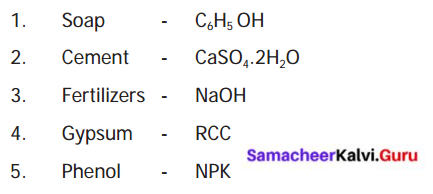
IV. Match the following :
Samacheer Kalvi 6th Science Solutions Term 3 Chapter 3 Chemistry in Everyday Life 1
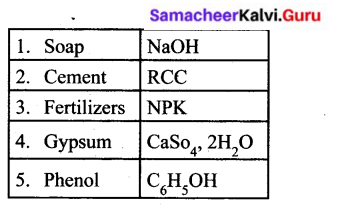
Answer:
Samacheer Kalvi 6th Science Solutions Term 3 Chapter 3 Chemistry in Everyday Life 2

V. Arrange the following statements in correct sequence :

  1. Pour that solution into an empty match box, soap can be obtained after drying.
  2. Take necessary quantity of water in ajar.
  3. Then add coconut oil drop by drop and stir it well.
  4. Add concentrated sodium hydroxide in the jar and allow it to cool.
  5. Try this soap to wash your hand kerchief.
  6. Cover your work area with old newspaper.

Answers:

  1. Cover your work area with old newspaper.
  2. Take necessary quantity of water in a jar.
  3. Add concentrated sodium hydroxide in the jar and allow it to cool.
  4. Then add coconut oil drop by drop and stir it well.
  5. Pour that solution into an empty match box, soap can be obtained after drying.
  6. Try this soap to wash your hand kerchief.

Samacheer Kalvi 6th Science Solutions Term 3 Chapter 3 Chemistry in Everyday Life

VI. Analogy :

Question 1.
Urea : Inorganic fertilizer;
Vermi compost: _______
Answer:
Organic fertilizer.

Question 2.
_______ : Natural adhesives ;
Cello tape : Artifical adhesives.
Answer:
Starch dissolved in water.

Samacheer Kalvi 6th Science Solutions Term 3 Chapter 3 Chemistry in Everyday Life

VII. Give Very Short Answer:

Question 1.
What are the three main constituents of soap?
Answer:

  1. Water (H2O)
  2. Sodium Hydroxide (NaOH)
  3. Coconut Oil (Vegetable Oils / Animal Fats)

Question 2.
What are the two different types of molecules found in the soap?
Answer:

  1. Loving water molecules.
  2. Hating water molecules.

Question 3.
Give an example of inorganic fertilizer.
Answer:

  1. Urea
  2. Super Phosphate
  3. Ammonium Sulphate
  4. Potassium Nitrate

Question 4.
Mention any three physical properties of phenol?
Answer:

  1. Weak acid
  2. High volatile
  3. White crystalline powder.

Question 5.
Explain the uses of plaster of Paris.
Answer:

  1. In making blackboard chalks.
  2. In surgery for setting fractured bones.
  3. For making casts for statues and toys, etc.
  4. In the construction industry.

Question 6.
What are the ingredients of the cement?
Answer:

  1. Limestone
  2. Clay
  3. Gypsum

Question 7.
Why gypsum is used in cement production?
Answer:
Gypsum is added to control the “setting of cement”. So, Gypsum is added to the cement at the final grinding process.

Samacheer Kalvi 6th Science Solutions Term 3 Chapter 3 Chemistry in Everyday Life

VIII. Give Short Answer:

Question 1.
Why earthworm is called a farmer’s friend?
Answer:
Earthworms take organic wastes as food and produce compost castings. So earthworms are known as Farmers’ Friends because of the multitude of services they provide to improve soil health and consequently plant health.

Question 2.
Explain the process of manufacturing cement.
Answer:
The cement is manufactured by crushing naturally occurring minerals such as lime clay and gypsum through a milling process.

Question 3.
What are the uses of Gypsum?
Answer:
Uses of Gypsum:

  1. It is used as fertilizers.
  2. It is used in the process of making cement.
  3. It is used in the process of making Plaster of Paris.

Samacheer Kalvi 6th Science Solutions Term 3 Chapter 3 Chemistry in Everyday Life

IX. Answer in detail:

Question 1.
How are detergents manufactured?
Answer:
Materials required:

  1. 35ml of H2O.
  2. 10ml of NaOH
  3. 60 ml of Coconut Oil

Process:

  1. Cover your work area with an old newspaper.
  2. Take 35 ml of H2O in a jar.
  3. Add 10 ml of Con. NaOH and allow it to cool.
  4. Then add 60 ml of Coconut Oil drop by drop and stir it well.
  5. Pour that solution into an empty matchbox, Soap can be obtained after getting dried.

Samacheer Kalvi 6th Science Solutions Term 3 Chapter 3 Chemistry in Everyday Life

X. Questions based on Higher Order Thinking Skills

Question 1.
Ravi is a farmer; he rears many cattle on his farm. His field has many biowastes. Advise Ravi on how to change this biowaste to compost by using vermicomposting techniques. Explain the benefits of vermi castings.
Answer:

  1. A cement tub is to be constructed to a height of 2’A feet and a breadth of 3 feet.
  2. Put the Bio-wastes in the cement tub with 5 cm height.
  3. Add a few earthworms with the Bio-waste.
  4. Then add sawdust, or coir waste and husk on the top of Bio-wastes.
  5. Then add sand to form a layer of 3 cm.
  6. Then add garden waste on the layer of sand.
  7. Then spray with water.
  8. All layers must be moistened with water.
  9. After 10 to 15 days, we get vermicompost manure.

Benefits:

  1. It is rich in all essential nutrients.
  2. It improves soil structure, texture, and prevents soil corrosion.
  3. It contains valuable hormones like auxons, gibberellin, etc.
  4. It neutralizes the soil protection.

Samacheer Kalvi 6th Science Solutions Term 3 Chapter 3 Chemistry in Everyday Life

XI. Project :

  1. Take 100 ml of hot water in a glass jar.
  2. Add 50 grams of maida powder to the hot water and stir it well.
  3. A paste-like substance is formed. Add a small quantity of copper sulphate for long use.
  4. Now you test this paste by binding your damaged book.

Answer:
Activity to be done by the students themselves

Samacheer Kalvi 6th Science Solutions Term 3 Chapter 3 Chemistry in Everyday Life

Samacheer Kalvi 6th Science Chemistry in Everyday Life Intext Activities

Activity 1

Question 1.
Discuss with your group and list out a few chemicals which we use in our home and school.
_______________________
_______________________
Answer:
We are using the following Chemicals in our home and school:-
Detergents, Air fresheners, Disinfectant, Glass cleaning chemicals, Detergents, Shampoo, Lubricants, Metal polishers, Restroom cleaning chemicals, Naphthalene, Bathing soap, Hit.

Samacheer Kalvi 6th Science Solutions Term 3 Chapter 3 Chemistry in Everyday Life

Activity 2

Preparation of Soap
Materials Required: 35 ml of water, 10 g of Lye (Sodium hydroxide), 60 ml of coconut oil.

Process: Cover your work area with an old newspaper. Take 35 ml of water in a jar. Add 10 grams of concentrated sodium hydroxide and allow it to cool.

Then add 60 ml of coconut oil drop by drop and stir it well. Pour that solution into an empty matchbox, soap can be obtained after getting dried.

Try this soap to wash your handkerchief.
Answer:
Activity to be done by the students themselves

Activity 3

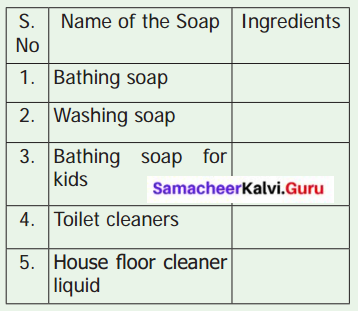
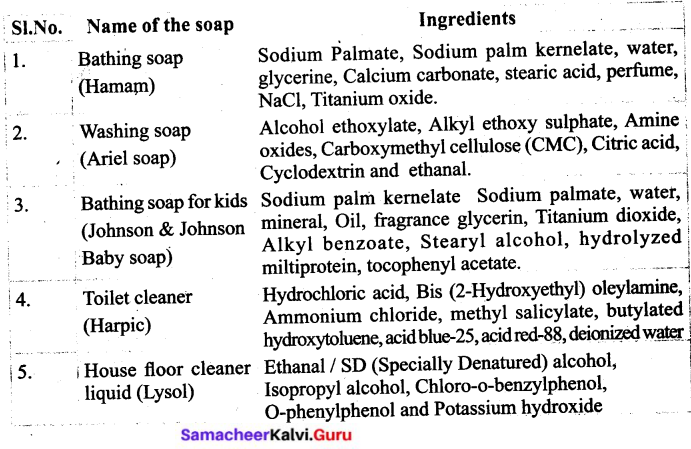
Collect various kinds, of soap wrapper. Complete the following table based on the information provided in the wrapper.
Samacheer Kalvi 6th Science Solutions Term 3 Chapter 3 Chemistry in Everyday Life 3
Inference: The nature of the soaps varies according to its constituents.
Answer:
Samacheer Kalvi 6th Science Solutions Term 3 Chapter 3 Chemistry in Everyday Life 4

Samacheer Kalvi 6th Science Solutions Term 3 Chapter 3 Chemistry in Everyday Life

Activity 4

Make a visit to the agriculture field in your area. List out the various crops and types of fertilizers used there.

S.No Name of the Crop Name of the Fertilizer
1.
2.
3.

Answer:

S.No Name of the Crop Name of the Fertilizer
1. Rice and wheat Urea, Potassium Nitrate
2. Tomato Super Phosphate
3. Potato and Mango Potassium Nitrate

Samacheer Kalvi 6th Science Solutions Term 3 Chapter 3 Chemistry in Everyday Life

Activity 5

Take three empty tumblers of the same size and name them A, B, and C. Add two teaspoonful of cement to each container. Then pour one teaspoonful of water in container A and two spoonfuls of water in B and three spoonfuls of water in C.

After an hour, observe which container of the cement set fast? Touch the containers and see if they are warm or cool. From this experiment, we understand that water and cement should be mixed in a certain ratio for a fast setting.
Answer:
Activity to be done by the students themselves

Samacheer Kalvi 6th Science Chemistry in Everyday Life Additional Questions

I. Choose the appropriate answer:

Question 1.
_______ change results in the change of the substance.
(a) Physical
(b) Chemical
(c) Biological
(d) Zoological
Answer:
(b) Chemical

Question 2.
The percentage composition of Nitrogen in Ureas is ………..
(a) 23%
(b) 13%
(c) 21%
(d) 46%
Answer:
(d) 46%

Question 3.
_______ is the important material in construction industry.
(a) Soap
(b) Adhesives
(c) Cement
(d) Fertilizers

Question 4.
Who invented cement?
(a) Edison
(b) Joseph Aspdin
(c) Robert Hooke
(d) Robert Brown
Answer:
(b) Joseph Aspdin

Question 5.
_______ concrete is a composite material by mixing iron mesh with cement.
(a) Mortar
(b) m-sand
(c) Reinforced cement
(d) Gypsum
Answer:
(c) Reinforced cement

Question 6.
The molecular formula of ‘Plaster of Paris’ is
(a) CaSO4. ½ H2O
(b) CaSO4. H2O
(c) CaSO4. 2H2O
(d) CaSO4. 3H2O
Answer:
(a) CaSO4. ½ H2O

Question 7.
The chemical name of gypsum is
(a) Magnesium sulphate hydrate
(b) Calcium sulphate hemihydrate
(c) Carbolic acid
(d) Calcium sulphate dihydrate
Answer:
(d) Calcium sulphate dihydrate

Question 8.
is used in making blackboard chalks.
(a) Plaster of Paris
(b) Gypsum
(c) Epsom
(d) Phenol
Answer:
(a) Plaster of Paris

Question 9.
_________ is used as surgical antiseptic.
(a) Epsom
(b) Phenol
(c) Gypsum
(d) None of these

Samacheer Kalvi 6th Science Solutions Term 3 Chapter 3 Chemistry in Everyday Life

II. Fill up the blanks:

  1. Burning of paper is the best example of _______ change.
  2. _______ is the branch of science which deals with the study of particles around us.
  3. Salt is a combination of the chemicals _______ and _______.
  4. We could prepare soft idly as a result of a chemical change named _______ takes place in the idly batter.
  5. We are using _______ to remove strong stains on the clothes.
  6. _______ help plant grows and restore soil fertility.
  7. _______ is the organic tertillzer.
  8. _______ invented Portland cement.
  9. _______ is medicine for skin problems.
  10. Calcium sulphate hemihydrate is called as _______
  11. _______ is used in mouthwash in low concentrations.
  12. The adhesive used in puncture shop is _______

Answers:

  1. Chemical
  2. Chemistry
  3. Sodium, Chlorine
  4. fermentation
  5. Wash powder
  6. Organic fertilizers
  7. Compost
  8. Joseph Aspdin
  9. Epsom
  10. Plaster of Paris
  11. Piano
  12. Artificial adhesive

Samacheer Kalvi 6th Science Solutions Term 3 Chapter 3 Chemistry in Everyday Life

III. True or False. If False, give the correct statement:

Question 1.
Water boiling into water vapour is an example of chemical change.
Answer:
False. Water boiling into water vapour is an example of Physical change.

Question 2.
Chemists identify gypsum as a natural indicator.
Answer:
False. Chemists identify turmeric powder as a natural indicator.

Question 3.
The water we drink is a combination of hydrogen and oxygen.
Answer:
True.

Question 4.
When we soak onion in water, then the irritation is increased.
Answer:
False. When we soak onion in water then the irritation is reduced.

Question 5.
Mortar is a paste of cement and sand mixed with water.
Answer:
True.

Question 6.
Fertilizers containing only plant or animal-based materials or those synthesized by microorganisms are called inorganic fertilizers.
Answer:
False. Fertilizers containing only plant or animal-based materials or those synthesized by microorganisms are called organic fertilizers,

Question 7.
‘Portland’ cement resembled the high-quality building stones found in Portland, England.
Answer:
True.

Question 8.
Reinforced Cement Concrete is a mixture of cement, sand, and gravel.
Answer:
False. Concrete is a mixture of cement, sand, and gravel.

Question 9.
Gypsum is used in the process of making cement.
Answer:
True

Question 10.
Gypsum is used in improving plant growth in agriculture.
Answer:
False. Epsom is used in improving plant growth in agriculture.

Samacheer Kalvi 6th Science Solutions Term 3 Chapter 3 Chemistry in Everyday Life

IV. Match the following :

1. Sodium Chloride (a) CaSO41/2H2O
2. Calcium sulphate dihydrate (b) C2H5Oh
3. Magnesium sulphate hydrate (c) CaSO4.2H2O
4. Calcium sulphate hemihydrate (d) NaCl
5. Phenol (e) MgSO4.H2O

Answer:

  1. – d
  2. – c
  3. – e
  4. – a
  5. – b.

Samacheer Kalvi 6th Science Solutions Term 3 Chapter 3 Chemistry in Everyday Life

V. Analogy:

Question 1.
H2O : Water :: NaCl: ________
Answer:
Sodium Chloride.

Question 2.
Used to join components : Adhesives :: Clean the body _______
Answer:
Soaps.

Question 3.
Organic fertilizer : Compost:: Inorganic fertilizer _______
Answer:
Superphosphate.

Question 4.
Used as fertilizer : Gypsum :: Helps nerves function properly : _______
Answer:
Epsom.

Question 5.
Making casts for statues : Plaster of Paris :: Used as mouthwash : _______
Answer:
phenol.

Samacheer Kalvi 6th Science Solutions Term 3 Chapter 3 Chemistry in Everyday Life

VI. Give Short Answer :

Question 1.
Define physical change.
Answer:
In physical change only the shape, size (or) volume changes; the state of the matter may also change.

Question 2.
What is the use of an indicator?
Answer:
The use of an indicator is to identify whether the material is an acid (or) base medium.

Question 3.
How to prepare soft idly?
Answer:
We could prepare soft idly as a result of a chemical change named fermentation that takes place in the idly batter. During fermentation, the idly batter undergoes a chemical change by bacteria.

Question 4.
If we soak onion in water the irritation is reduced. Why?
Answer:
It is due to the presence of a chemical, propanethial s-oxide in onion. This is easily volatile. When we cut onion, some of the cells are damaged and the chemical comes out. It becomes vapour and reaches our eyes result in irritation and tears in the eyes. If we soak onion in water, the chemical is diluted and it cannot reach our eyes. So the irritation is reduced.

Question 5.
Write some materials prepared by chemical changes.
Answer:
Soaps, fertilizers, cement, gypsum, Epsom, plaster of Paris, phenol are the materials.

Samacheer Kalvi 6th Science Solutions Term 3 Chapter 3 Chemistry in Everyday Life

Question 6.
Define Principal nutrients.
Answer:
Nitrogen (N), Phosphorous (P), and Potassium (K) are the three important nutrients among the various nutrients needed for plant growth. These three are called Principal Nutrients.

Question 7.
Differentiate between organic and inorganic fertilizer.
Answer:
Organic fertilizers:

  1. A plant (or) animal-based materials synthesized by micro-organisms
  2. Prepared easily.
  3. Economical
  4. Example: Vermicompost, Compost

Inorganic fertilizers:

  1. Natural elements by making them undergo chemical changes.
  2. Prepared complicated
  3. Not economical
  4. Example: Urea, Superphosphate, Ammonium Phosphate.

Question 8.
Why the cement is called Portland cement?
Answer:
It was named Portland cement because it resembled the high-quality building stones found in Portland, England.

Question 9.
What are the uses of cement?
Answer:

  1. It is used to construct houses.
  2. It is used to construct dams, bridges.

Question 10.
What is the use of Epsom Salt?
Answer:

  1. In medicine, it eases the stress and relaxes the body.
  2. In agriculture, it improves plant growth.
  3. It is used as medicine for skin problems.
  4. Helps muscles and nerves function properly.

Question 11.
Define Adhesives.
Answer:
A paste-like material that is used to join two components together is called adhesive.

Samacheer Kalvi 6th Science Solutions Term 3 Chapter 3 Chemistry in Everyday Life

VII. Answer in detail :

Question 1.
How soaps clean clothes?
Answer:

  1. We are using wash powder to remove strong stains on the clothes.
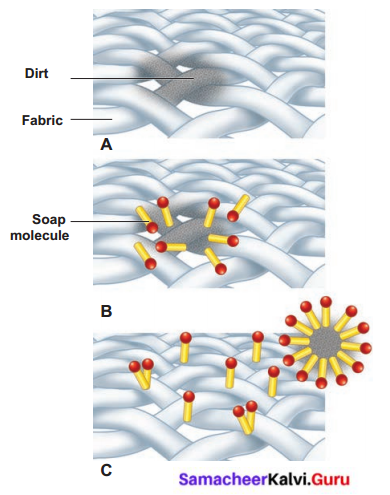
  2. The detergent molecules have two sides, one side “water-loving”, other “water-hating”.
    Samacheer Kalvi 6th Science Solutions Term 3 Chapter 3 Chemistry in Everyday Life 5
  3. Water hating goes and joins with dirt and oil in the cloth while the water-loving joins with the water molecules.
  4. When you agitate the cloth the dirt is surrounded by many molecules and is taken away from the cloth.
  5. The cloth becomes clean, and the dirt surrounded by the detergent molecules floats in the water making it dirty.

Samacheer Kalvi 6th Science Solutions Term 3 Chapter 3 Chemistry in Everyday Life Read More »

Samacheer Kalvi 6th Social Science History Solutions Term 1 Chapter 4 Ancient cities of tamilagam

You can Download Samacheer Kalvi 6th Social Science Book Solutions Guide Pdf, Tamilnadu State Board help you to revise the complete Syllabus and score more marks in your examinations.

Tamilnadu Samacheer Kalvi 6th Social Science History Solutions Term 1 Chapter 4 Ancient cities of tamilagam

Samacheer Kalvi 6th Social Science Textual Evaluation 4 Ancient cities of tamilagam

I. Choose the correct answer

Question 1.
Which of the following region has a city more than 6500 years old?
(a) Iraq
(b) Indus Valley
(c) Tamilagam
(d) Thondaimandalam
Answer:
(b) Indus Valley

Question 2.
Which one of the following is a Tamil city?
(a) Iraq
(b) Harappa
(c) Mohenjo – Daro
(d) Kancheepuram
Answer:
(d) Kancheepuram

Question 3.
Which city is not related to the Bay of Bengal?
(a) Poompuhar
(b) Thondi
(c) Korkai
(d) Kancheepuram
Answer:
(d) Kancheepuram

SamacheerKalvi.Guru

Question 4.
Water management system of Tamils are known from …………………
(a) Kallanai
(b) Tanks in Kancheepuram
(c) Prakirama Pandyan Tank
(d) River Cauvery
(a) a is correct
(b) b is correct
(c) c is correct
(d) a and b are correct
Answer:
(d) a and b are correct

Question 5.
Which is not the oldest city among the following ones?
(a) Madurai
(b) Kancheepuram
(c) Poompuhar
(d) Chennai
Answer:
(d) Chennai

Question 6.
Which city is related to keezhadi excavation?
(a) Madurai
(b) Kancheepuram
(c) Poompuhar
(d) Harappa
Answer:
(a) Madurai

II. Tick the appropriate answer Match the Statement with the Reason.

Question 1.
Statement: Goods were imported and exported from the city Poompuhar.
Reason: Bay of Bengal was suitable for trading with neighbouring countries.
(a) Statement is correct, but reason is wrong.
(b) Statement and its reason are correct.
(c) Statement is wrong, but reason is correct.
(d) Both are wrong.
Answer:
(b) Statement and its reason are correct

SamacheerKalvi.Guru

Question 2.
(a) Thirunavukkarasar said “Kalvyil karaillatha”. This statement refers to the city Kancheepuram.
(b) Hieun Tsang said, “Kancheepuram is one among the seven – sacred places of India”.
(c) Kalidasa said, “Kancheepuram is the best city among the cities”
(a) Only a is correct
(b) Only b is correct
(c) Only c is correct
(d) All are correct
Answer:
(d) All are correct

Question 3.
Find out the correct statement
(a) Naalangadi – Night shop
(b) Allangdi – Day-time shop
(c) Ancient Roman coin factory was found at Poompuhar.
(d) Pearls were exported from Uvari near Korkai.
Answer:
(d) Pearls were exported from Uvari near Korkai

SamacheerKalvi.Guru

Question 4.
Find out the wrong statement.
(a) Megasthanese has mentioned Madurai in his account.
(b) Hien Tsang came to the Tamil city of Kancheepuram.
(c) Kovalan and Kannagi lived in Kancheepuram.
(d) Iraq is mentioned in Pattinapalai.
Answer:
(c) Kovalan and Kannagi lived in Kancheepuram

Question 5.
Find out the correct pair
(a) Koodal nagar – poompuhar
(b) Thoonga nagaram – harappa
(b) Thoonga Nagaram – Harappa
(d) City of Temples -Kancheepuram
Answer:
(d) City of Temples -Kancheepuram

Question 6.
Find out the wrong pair
(a) Vadamalai – Gold
(b) Western Ghats – Sandal
(c) Southern Sea – Pearls
(d) Eastern Sea – Ahil

III. Fill in the blanks :

  1. Kanchi Kailasanathar temple was built by_______
  2. _______ is known as the city of temples
  3. Masathuvan means _______

Answer:

  1. Pallava King Raja Simtia
  2. Kanchi
  3. A big trader

IV. State True or False.

  1. Cultural relationship with the outside world developed in Poompuhar because of its trade relationship with it.
  2. Women also purchased from Allangadi of Madurai without fear.
  3. Many rock cut temples were made during the Pallava period.
  4. Bodhi Dharmar belonged to Kancheepuram.

Answer:

  1. True
  2. True
  3. True
  4. True

V. Answer in one word :

Question 1.
What do you know about the term export?
Answer:
Export means goods and services sold to other countries for foreign currency.

Question 2.
Mention the epic and the Sangam poem you read in the lesson:
Answer:

  1. Epic: Silappathikaram and Manimegalai
  2. Sangam literature: Pattinappaalai

Question 3.
Which is the oldest city in Thondai Nadu?
Answer:
Kanchi is the oldest city in Thondai Nadu.

SamacheerKalvi.Guru

Question 4.
Point out anyone difference between a village and a city
Answer:
The population of a city will be higher than that of a village.

Question 5.
Which civilization is associated with the city Lothal?
Answer:
Indus valley civilization

Question 6.
Name the oldest civilization of the world
Answer:
Mesopotamian civilization

VI. Answer the following :

Question 1.
Write a brief note on ancient cities of India.
Answer:

There are a number of ancient cities in India. Let us see a few of them.

Jhansi:

  1. Jhansi is in the state of Uttar Pradesh.
  2. It is the headquarters of the Jhansi district.
  3. Its original name was Balwant Nagar
  4. It is well connected with all major towns in Uttar Pradesh by road and railway

Net work.

  1. Jhansi has been selected among 98 cities for smart city initiated by the Government of India.
  2. Its nickname is the city of Rani Laxmi Bai.
  3. Jhansi fort, government museum, and Rani Mahal are important tourist centres.

Pataliputra:

  1. It is adjacent to modern-day Patna.
  2. It was the capital of major powers in ancient India such as the Nanda Empire and the Mauryan empire.

Taxila:

  1. Taxila or Takshashila was an ancient city.
  2. Now it is in Pakistan.
  3. It was a centre of learning.
  4. It is considered to have been one of the earliest universities of the world.

Lothal:

  1. Lothal is situated on the banks of a tributary of the Sabarmati river in Gujarat.
  2. It was an important trading centre in ancient India
  3. A naval dockyard has been discovered in Lothal.
  4. It shows the maritime activities of the Indus people.

Harappa:

  1. In 1921 the archaeologists discovered the city of Harappa.
  2. Harappa in Sindhi means ‘Buried city’.
  3. The ruins of the Indus valley civilization are found here.
  4. It was a well-planned city.
  5. Now it is in Pakistan.

Question 2.
Mention the ancient cities of Tamil Nadu
Answer:

  1. Poompuhar
  2. Madurai
  3. Kanchi
  4. Korkai
  5. Vanchi
  6. Thondi
  7. Uraiyur
  8. Musiri
  9. Karavur
  10. Kaayal
  11. Mamallapuram
  12. Thanjavur
  13. Thagadoor

Question 3.
Discuss the sources available to know about Tamil cities.
Answer:

  1. Silappathikaram, Manimegalai, and Pattinapalai speak about Poompuhar.
  2. The accounts of the Greek historian Megasthanese and Chanakya’s Arthasastra speak about Madurai.
  3. Poets Kalidasa and Thirunavukarasar mention Kanchi in their poems.
  4. The Buddhist monk Manimegalai speaks highly of Kanchi.

SamacheerKalvi.Guru

Question 4.
Write about the kings who ruled Madurai?
Answer:

  1. The Pandyas, Cholas, and Kalabras ruled Madurai.
  2. During the medieval times, later Cholas and later Pandyas ruled Madurai.
  3. Then the Nayaks ruled Madurai.

Question 5.
Mention the other names of Madurai.
Answer:

  1. Thoonga Nagaram.
  2. Sangam valavtha Nagaram.
  3. Koodal Nagar.

Question 6.
What is the difference between Naalangadi and Allangadi?
Answer:

  1. Naalangadi is the day market.
  2. Allangadi is the evening market.

Question 7.
Name the scholars who were born at Kancheepuram.
Answer:

  1. Dharmabalar.
  2. Jothi balar.
  3. Sumathi.
  4. Bodhi dharmas.

Question 8.
Which is known as the city of lakes? Why?
Answer:
There are hundreds of lakes in and around the city of Kanchi. So Kanchi is known as the city of lakes.

VII. HOTS:

Question 1.
Write a short note on Iraq.
Answer:

  1. Iraq has a narrow section of coastline on the northern Persian Gulf.
  2. There are several suggestions for the origin of the name Iraq.
  3. One dates back to the Sumerian city of Uruk.
  4. Another suggestion is that Iraq comes from the Aramaic language meaning the land along the banks of rivers.

Question 2.
Write a paragraph about the city of Poompuhar with special reference to trade.
Answer:

  1. Poompuhar is a coastal town near the present-day Mayiladuthufai.
  2. It is located where the river Cauvery drains into the sea.
  3. It was also a port town along the Bay of Bengal.
  4. The ports were established for facilitating maritime trade.
  5. Even in times past, countries began to export their surplus products and import scarce commodities by sea.

Question 3.
Write about the accounts given by scholars about Kanchi.
Answer:
The Chinese traveller Hieun Tsang visited Kanchi Kadigai to pursue his further studies.

  1.  He remarked that Kanchi can be counted as one among the seven sacred places like Budh Gaya and Sanchi.
  2. Poet Kalidasa says, “Kanch is the best of the towns
  3. Tamil poet-saint Thirunavukarasar praises Kanchi as “Kalviyil Karaillatha Kanchi

SamacheerKalvi.Guru

Question 4.
City of Temples. Give short notes
Answer:

  1. Kanchi is known as the temple town.
  2. The famous temple of great architectural beauty, Kailasanathar temple, was built by later Pallava king Rajasimha at Kanchi.
  3. During the Pallava period, a large number of cave temples were built.
  4. It is nicknamed “The City of Thousand Temples”

Question 5.
Kancheepuram was famous for education. Prove this statement.
Answer:

  1. Kanchi was an educational centre.
  2. A place of learning is called school.
  3. Several schools were established in great numbers further the first time in Kancheepuram.
  4. Jains studied in Jainapalli and Buddhists studied in Viharas.
  5. The greatness of Kanchi as an educational centre can be understood from the fact that the Chinese traveller Hieun Tsang visited Kanchi ‘Kadigai’ to pursue his further studies.

VIII. Student Activity :

Question 1.
Make an album about Keezhadi excavations.
Hints: Keezhadi excavations :
Answer:

  1. In 2013 – 2014 the Archaeological Survey of India (ASI) carried out explorations in 293 sites.
  2. It was done along the Vaigai river valley in Theni, Dindugal, Madurai, Sivaganga, and Ramanathapuram districts.
  3. Keezhadi in the Sivagana district was chosen for excavations.
  4. The artifacts unearthed here at Pallichandhai Thidal of Keezhadi pointed to an ancient civilization.
    Samacheer Kalvi 6th Social Science History Solutions Term 1 Chapter 4 Ancient cities of tamilagam image - 1
  5. It might have thrived on the banks of Vaigai.
  6. The settlement belonged to 200 B.C
  7. This proves that urban civilization had existed in Tamil Nadu since the Sangam age

SamacheerKalvi.Guru

Question 2.
Poompuhar was famous for trading activities. Discuss.
Hints :
Answer:

  1. Pattinappalai, Silapathikaram, and Manimegalai have references to the British seaborne trade that took place in the Puhar Port.
  2. In Silappathikaram it is given that Kovalan’s father was a big trader and Kannagi’s father a sea – trader.
  3. This proves that big traders and sea traders had settled in Poompuhar.
  4. Numerous merchants from foreign countries such as Greece and Rome landed at Poompuhar.
  5. Due to busy and continuous trade, many of them stayed on indefinitely in Poompuhar.
  6. The traders of Poompuhar were known for their honesty and integrity.

Question 3.
Collect  ctures of Pallava temple architecture
Hints: Important Lakes of Tamil Nadu :

Answer:
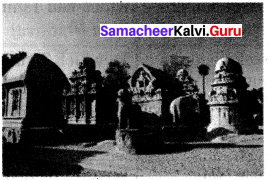
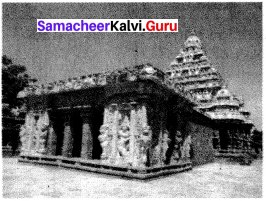
Samacheer Kalvi 6th Social Science History Solutions Term 1 Chapter 4 Ancient cities of tamilagam image - 2
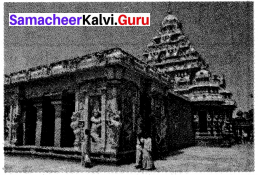
(i) Kailasanathar Temple at Kanchipuram built by Raja Simha.

Samacheer Kalvi 6th Social Science History Solutions Term 1 Chapter 4 Ancient cities of tamilagam image - 3
(ii) Rathas of Mahabalipram

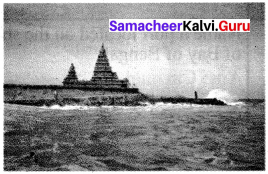
Samacheer Kalvi 6th Social Science History Solutions Term 1 Chapter 4 Ancient cities of tamilagam image - 4
(iii) The shore Temple

Samacheer Kalvi 6th Social Science History Solutions Term 1 Chapter 4 Ancient cities of tamilagam image - 4
(iv) Vaikunta perumal Temple – By Nandhi Varman II

Question 4.
Prepare a booklet describing the famous lakes of Tamil Nadu
Answer:

  1. Chembarambakkam Lake in Kanchipuram Dt, 40km from Chennai.
  2. Kaliveli Lake – Viluppuram Dt.
  3. Kolavai Lake – Kanchipuram Dt.
  4. Pulicat Lake – Coromandel Coast.
  5. Sholavaram Lake – Thiruvallur Dt.
  6. Veeranam Lake – Cuddalore Dt.

SamacheerKalvi.Guru

Question 5.
Make a booklet about the famous cities of Tamil Nadu.
Answer:

  1. Chennai
  2. Coimbatore
  3. Thiruchirapalli
  4. Tiruppur
  5. Salem
  6. Erode
  7. Tirunelveli
  8. Kumbakonam Dt.

IX. Answer Grid

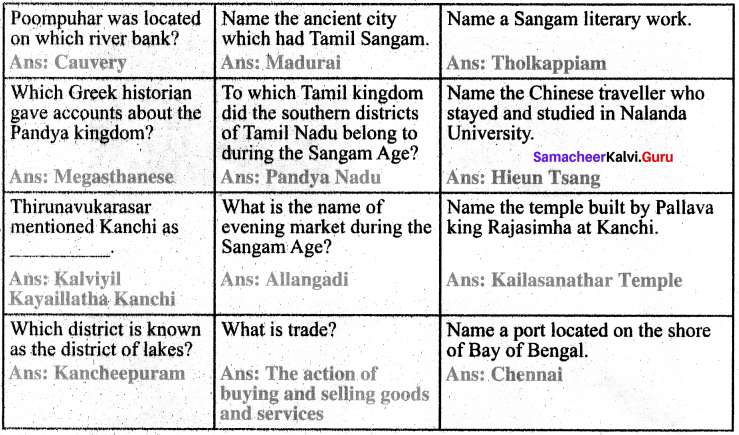
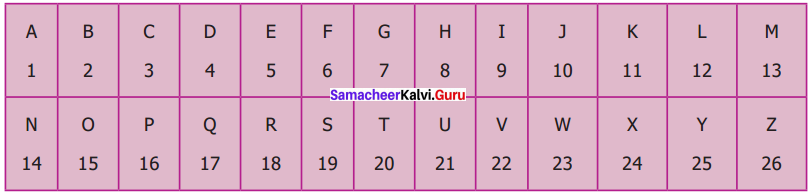
Samacheer Kalvi 6th Social Science History Solutions Term 1 Chapter 4 Ancient cities of tamilagam image - 6

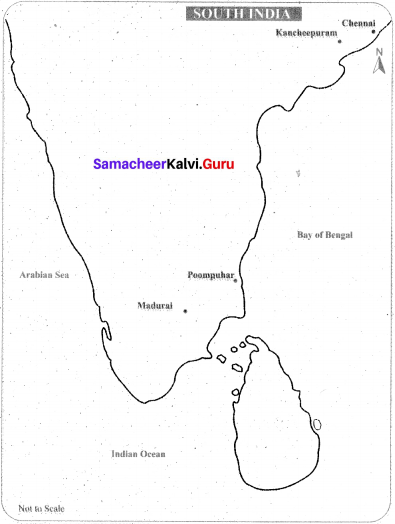
XI. Map work

Question 1.
Mark the following place in a South India map,

(a) Chennai
(b) Madurai
(c) Kancheepuram
(d) Poompuhar
(e) Arabian Sea
(f) Bay of Bengal
(g) Indian Ocean
Answer:
Samacheer Kalvi 6th Social Science History Solutions Term 1 Chapter 4 Ancient cities of tamilagam image - 7

Samacheer Kalvi 6th Social Science 4 Ancient cities of tamilagam Additional Questions

I. Choose the correct answer:

Question 1.
Which is the oldest city among the following ones?
(a) Chennai
(b) Tiruppur
(c) Poompuhar
(d) Salem

Question 2.
The author of Pattinappaalai was …………….
(a) Uruttiranagannanar
(b) Seikkizhar
(c) Nakkeerar
(d) Jeyamkondar
Answer:
(a) Uruttiranagannanar

Question 3.
In Poompuhar the foreign traders began to interact with the local people because,
(a) Loading and unloading of ships took some months.
(b) Foreigners liked the local people.
(c) Foreigners wanted to learn Tamil.
(d) Foreigners wanted to stay in Poompuhar
Answer:
(a) Loading and unloading of ships took some months

SamacheerKalvi.Guru

Question 4.
Which of the following was an educational centre?
(a) Poompuhar
(b) Madurai
(c) Kanchi
(d) Thanjavur
Answer:
(c) Kanchi

Question 5.
We read Puhar kandam in
(a) Manimegalai
(b) Pattinappalai
(c) Arthashastra
(d) Silappathikaram
Answer:
(d) Silappathikaram

Question 6.
Thoonga Nagaram refers to
(a) Kanchi
(b) Poompuhar
(c) Madurai
(d) Korkai
Answer:
(c) Madurai

Question 7.
Pearls were found in abundance in
(a) Chozha Nadu
(b) Pandya Nadu
(c) Thondai Nadu
(d) Chera Nadu
Answer:
(b) Pandya Nadu

II. Match the statement with the Reason. Tick the appropriate answer:

Question 1.
Statement: Kanchi was an educational centre.
Reason: Hieun Tsang pursued his further studies at Kadigai.
(a) Statement and Reason are wrong.
(b) Statement correct but Reason is wrong.
(c) Both statements and Reason are correct.
(d) Statement is wrong but Reason is correct.
Answer:
(c) Both statements and Reason are correct.

Question 2.
(i) Madurai was a prominent town of Tamizhagan.
(ii) An archaeological excavation has been done in Keezhadi near Madurai.
(iii) Women purchased things from Allangadi without any fear.
(a) i) is correct
(b) ii) is correct
(c) iii) is correct
(d) i), ii) and iii) are correct
Answer:
(d) (i), (ii) and (iii) are correct

Question 3.
Find out the correct statement.
(a) Tamil literature provides us information about ancient Tamizhagam.
(b) Madurai had very good maritime trade.
(c) Chandragupta’s minister was Megasthanese.
(d) In Chera Nadu horses were found in abundance.
Answer:
(a) Tamil literature provide us information about ancient Tamizhagam

Question 4.
Find out the wrong statement.
(a) Poompuhar is a coastal town near the present-day Mayiladuthurai.
(b) Madurai is known as city of lakes.
(c) Mohenja-Daro was a popular city of ancient civilisation.
(d) The traders of Poompuhar were known of their honesty.
Answer:
(b) Madurai is known as the city of lakes.

Question 5.
Find out the wrong pair.
(a) Poompuhar – Educational centre
(b) Madurai – Koodal nagar
(c) Manimegalai – Epic
(d) Hieun Tsang – Chinese Traveller
Answer:
(a) Poompuhar – Educational centre

III. Fill in the blanks:

  1. The early Chola kingdom had _______ as its capital
  2. Kadiyalur Uruttirangannanar wrote the book _______
  3. Sangam Valartha Nagaram referred to _______

Answer:

  1. Poompuhar
  2. Pattinappaalai
  3. Madurai

IV. State True or False:

  1. Three sangams were held in Kanchi.
  2. Magasthanese was a historian from Rome.
  3. Chozha Nadu had plenty of elephants.
  4. Hundred of lakes were built in Poompuhar.
  5. Chandra Gupta wrote the book arthashastra.

Answer:

  1. False
  2. False
  3. False
  4. False
  5. False

V. Answer in one word :

Question 1.
Who were Kovalan and Kannagi?

  1. Kovalan and Kannagi were the well-known characters of Silapathikaram.
  2. They lived in Poombuhar.

Question 2.
What does Pattinappaalai say about the traders of Poompuhar?
Answer:

  1. The traders of Poompuhar were known for their honesty and integrity.
  2. Pattinappaalai states that “selling any commodity at a higher price was considered bad”

SamacheerKalvi.Guru

Question 3.
Mention the importance of water management in Kanchi?
Answer:

  1. Puhar was a busy port upto 200 CE.
  2. It might have been either washed away by sea or destroyed by big shore waves,
  3. The remains of that destruction can still be seen in the present Poompuhar town.

Question 4.
What is Thoonga Nagaram?
Answer:

  1. Madurai is known as Thoonga Nagaram.
  2. Thoonga nagaram means the city that never sleeps.

VI. Answer the following:

Question 1.
Write a note on Siiappathikaram.
Answer:

  1. Siiappathikaram speaks about the greatness of Poompuhar.
  2. The lead female character of Siiappathikaram is Kannagi.
  3. Her father is Maanaigan. Sea traders are known by the name Maanaigan.
  4. The male character is Kovalan, who’s father is Maasathuvan, meaning a big trader.
  5. It is clear from the text that Poompuhar was a place where big traders and sea traders had settled down.

Question 2.
What do you know about the trade items of Poompuhar?
Answer:

  1. Horses were imported by sea.
  2. Pepper was procured through the land route.
  3. Gold that came from Vadamalai was polished and exported to the neighbouring countries.
  4. Sandal from the western ghat, pearls from the southern sea, corals from the eastern sea, and food items from Elam were imported.

Question 3.
Mention the importance of water management in Kanchi?
Answer:

  1. Water management played an important role in the agrarian society of those times.
  2. Hundreds of lakes were created for storing water around the town of Kanchi.
  3. These lakes were well connected with canals.
  4. During the later period, Kanchi came to be known as the district of lakes.
  5. Water management skills of the ancient Tamils can be understood from the construction of Kallanai in the Chola country and the lakes and canals in Kanchi

VII. HOTS:

Question 1.
Write about the town of Poompuhar.
Answer:

  1. Poompuhar had been built differently from other towns.
  2. Each social group had a separate settlement for living.
  3. Streets were broad and straight, dotted with well – designed houses
  4. It is believed that there was also a dockyard.

Question 2.
Write a short note on the economy of the ancient Tamil country.
Answer:

  1. The main economic activities were agriculture, weaving, pearl fishery, manufacturing and construction.
  2. Paddy was the most important corp.
  3. Pepper, millets, grams, and sugarcane were other commonly grown crops.
  4. Madurai and Uraiyur were important centres for the textile industry.
  5. Korkai was the centre of the pearl trade.
  6. There was brisk overseas trade with Rome.
  7. Good roads and ports also facilitated the trade.

SamacheerKalvi.Guru

Question 3.
What do you know about education in ancient Tamil country?
Answer:

  1. Education was considered important in ancient Tamilagam.
  2. The rulers and aristocrats of an ancient Tamilagam were always conscious of their duties to their country.
  3. They considered the development of education as an important duty.
  4. Naaladiyar mentions that men gathered books in abundance and filled their house with them.

VII. HOTS :

Question 1.
Write about the town of Poompuhar.
Answer:

  1. Poompuhar had been built differently from other towns.
  2. Each social group had a separate settlement for living.
  3. Streets were broad and straight, dotted with well-designed houses
  4. It is believed that there was also a dockyard.

Question 2.
Write a short note on the economy of the ancient Tamil country.
Answer:

  1. The main economic activities were agriculture, weaving, pearl fishery, manufacturing, and construction.
  2. Paddy was the most important corp.
  3. Pepper, millets, grams, and sugarcane were other commonly grown crops.
  4. Madurai and Uraiyur were important centres for the textile industry.
  5. Korkai was the centre of the pearl trade.
  6. There was brisk overseas trade with Rome.
  7. Good roads and ports also facilitated the trade.

SamacheerKalvi.Guru

Question 3.
What do you know about education in ancient Tamil country?
Answer:

  1. Education was considered important in ancient Tamilagam.
  2. The rulers and aristocrats of an ancient Tamilagam were always conscious of their duties to their country.
  3. They considered the development of education as an important duty.
  4. Naaladiyar mentions that men gathered books in abundance and filled their house with them.
  5. They studied science, mathematics, engineering, astronomy, logic, and ethics.
  6. Libraries were attached to Jainapalli and Buddhist Viharas.
  7. The girls of Sangam Age were given good training in literature, music and drama,
  8. Many women had distinguished themselves in the art of music.
  9. More than fifty women have been ranked among the Sangam poets

Samacheer Kalvi 6th Social Science History Solutions Term 1 Chapter 4 Ancient cities of tamilagam Read More »

Samacheer Kalvi 6th Social Science Hitory Solutions Term 2 Chapter 2 Great Thinkers And New Faiths

You can Download Samacheer Kalvi 6th Social Science Book Solutions Guide Pdf, Tamilnadu State Board help you to revise the complete Syllabus and score more marks in your examinations.

Tamilnadu Samacheer Kalvi 6th Social Science History Solutions Term 2 Chapter 2 Great Thinkers And New Faiths

Samacheer Kalvi 6th Social Science Great Thinkers And New Faiths Textual Evaluation

I. Choose the correct answer:

Questions 1.
What is the name of the Buddhist scripture?
(a) Angas
(b) Tripitakas
(c) Tirukkural
(d) Naladiyar
Answer:
(b) Tripitakas

Questions 2.
Who was the first Tirthankara of Jainism?
(a) Rishabha
(b) Parsava
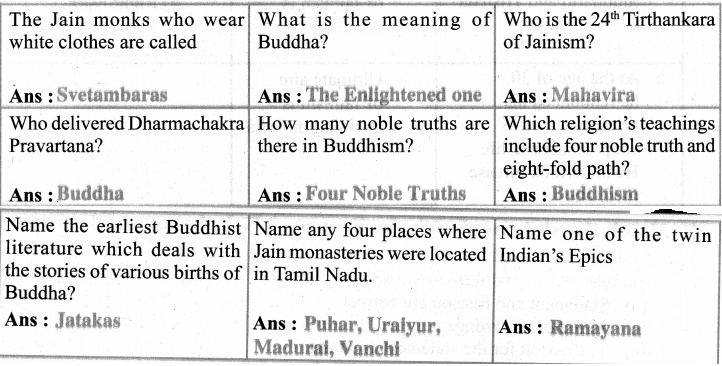
(c) Vardhamana
(d) Buddha
Answer:
(a) Rishabha

Questions 3.
How many Tirthankaras were there in Jainism?
(a) 23
(b) 24
(c) 25
(d) 26
Answer:
(b) 24

SamacheerKalvi.Guru

Questions 4.
Where was the third Buddhist Council convened?
(a) Rajagriha
(b) Vaishali
(c) Pataliputra
(d) Kashmir
Answer:
(c) Pataliputra

Questions 5.
Where did Buddha deliver his first sermon?
(a) Lumbini
(b) Saranath
(c) Taxila
(d) Bodh Gaya
(b) Saranath

II. Match the statement with the Reason, Tick the appropriate answer:

Questions 1.
Statement : A common man could not understand upanishads.
Reason : Upanishads were highly philosophical.
(a) Statement and its Reason are correct.
(b) Statement is wrong.
(c) Statement is true, but the Reason for that is wrong.
(d) Both Statement and Reason are wrong.
Answer:
(a) Statement and its Reason are correct.

SamacheerKalvi.Guru

Questions 2.
Statement : The Jatakas are popular tales.
Reason : Frescoes on the ceilings and walls of Ajanta caves depict the Jataka Tales.
(a) Statement and its Reason are correct
(b) Statement is wrong
(c) Statement is true; but the Reason for that is wrong
(d) Both Statement and Reason are wrong
Answer:
(a) Statement and its Reason are correct

Questions 3.
Find out the correct answer:
Buddha Vlharas are used for

  1. Education
  2. Stay of Buddhist monks
  3. Pilgrims stay
  4. Prayer hall

(a) 2 is correct
(b) Both 1 and 2
(c) 1, 2, 4 are correct
(d) Neither I nor II

Questions 4.
Consider the following statements regarding the causes of the origin of Jainism and Buddhism.

  1. Sacrificial ceremonies were expensive.
  2. Superstitious beliefs and practices confused the common man.

Which of the above statement (s) is/are correct?
(a) Only I
(b) Only II
(c) Both I & II
(d) Neither I nor II
Answer:
(c) Both I & II

Questions 5.
Which of the following about Jainism is correct?
(a) Jainism denies God as the creator of universe.
(b) Jainism accepts God as the creator of universe.
(c) The basic philosophy of Jainism is idol worship.
(d) Jains accept the belief in Last Judgement.
Answer:
(a) Jainism denies God as tlie creator of universe.

SamacheerKalvi.Guru

Questions 6.
Circle the odd one:
Parsava, Mahavira, Buddha, Rishaba
Answer:
Buddha

Questions 7.
Find out the wrong pair:
(a) Ahimsa – not to injure
(b) Satya – to speak truth
(c) Asteya – not to steal
(d) Brahmacharya – married status
Answer:
(d) Brahmadiarya – married status

Questions 8.
All the following statements are true of Siddhartha Gautama except:
(a) He is the founder of Hinduism,
(b) He was bom in Nepal.
(c) He attained Nirvana.
(d) He was known as Sakyamuni.
Answer:
(a) He is the founder of Hinduism.

III. Fill in the blanks :

  1. The doctrine of Mahavira is called_______
  2. _______is a state of freedom from suffering and rebirth.
  3. _______was the founder of Buddhism.
  4. Thiruparthikundram, a village in Kanchipuram was once called_______
  5. _______were built over the remains of Buddha’s body

Answer:

  1. Triratnas
  2. Moksha
  3. Gauthama Buddha
  4. Jinn Ranchi
  5. Sinpas

IV. True or False:

  1. Buddha believed in Karma.
  2. Buddha had faith in caste system.
  3. Gautama Swami compiled the teachings of Mahavira.
  4. Viharas are temples.
  5. Emperor Ashoka followed Buddhism.

Answer:

  1. True
  2. False
  3. True
  4. False
  5. True

V. Match the following:

  1. Angas (a) Vardhamana
  2. Mahavira (b) monks
  3. Buddha (c) Buddhist shrine
  4. Chaitya (d) Sakyamuni
  5. Bhikshus (e) Jain text

Answer:

  1. (e)
  2. (a)
  3. (d)
  4. (c)
  5. (b)

VI. Answer in one or two sentences:

Question 1.
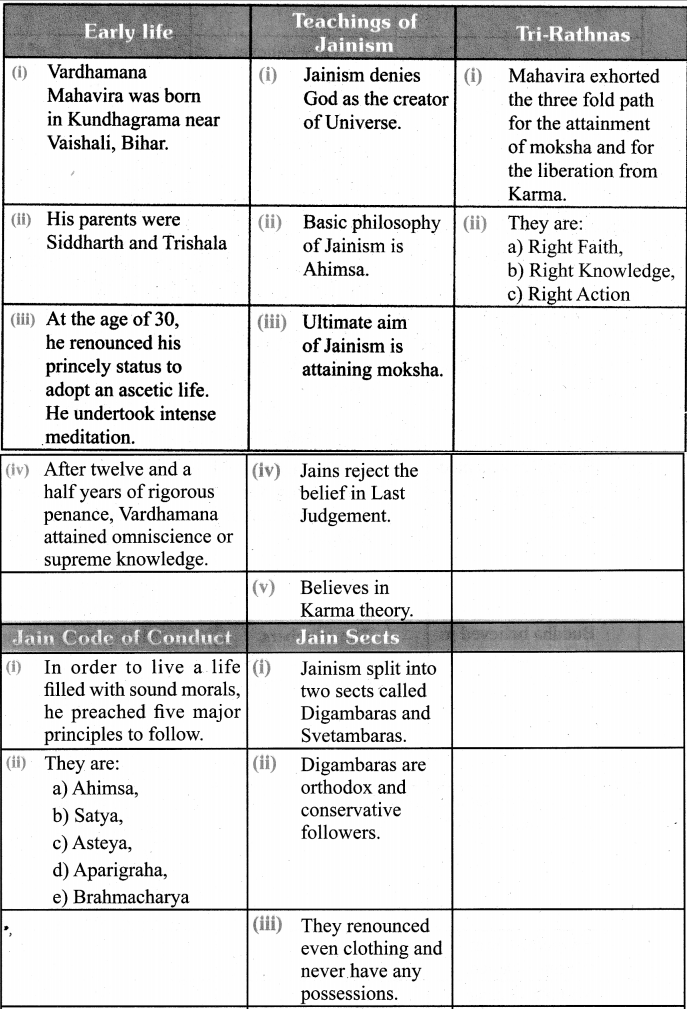
What are the Triratnas (three jewels) of Jainism?
Answer:

  1. Right Faith
  2. Right knowledge
  3. Right action

SamacheerKalvi.Guru

Question 2.
What are the two sects of Buddhism?
Answer:

  1. Hinayana
  2. Mahayana

Question 3.
What does Jina mean?
Answer:
Jina means conquering self and the external world.

Question 4.
Write any two common features of Buddhism and Jainism.
Answer:

  1. Both denied the authority of Vedas
  2. Both opposed blood sacrifices

Question 5.
Write a note on Buddhist Sangha.
Answer:

  1. Buddhist Sangha is a missionary organization.
  2. It is an ‘association’ for the propagation of Buddhism.
  3. The members are called ‘bhikshus (monks)’.

Question 6.
Name the Chinese traveller who visited Kancheepuram in the seventh century AD (CE).
Answer:
Hieun Tsang

Question 7.
Name the female jain monk mentioned in Silapathikaram.
Answer:
Silapathikaram mentions that when Kovalan and Kannagi were on their way to Madurai, Gownthiyadigal a female jain monk blessed the couple and accompanied them.

VII. Answer the following:

Question 1.
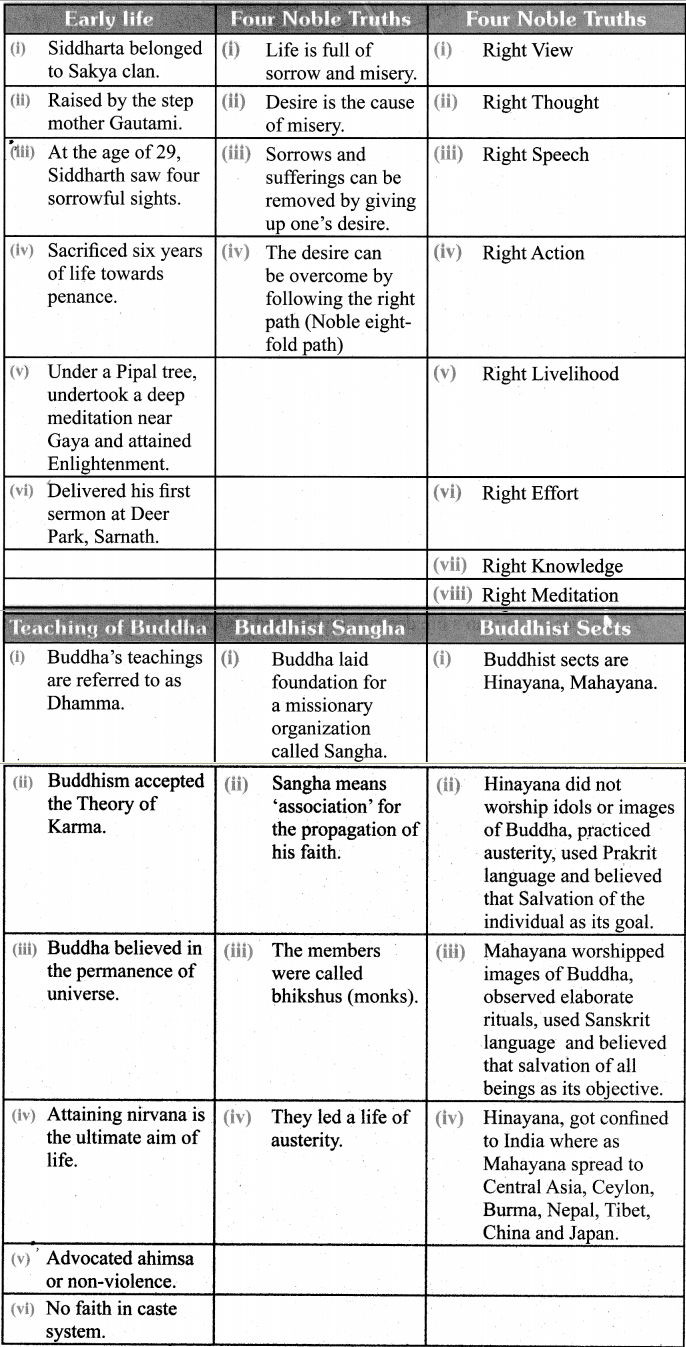
Name the eight-fold path of Buddhism.
Answer:
The Eight Fold Path of Buddhism is given below

  1. Right view
  2. Right Thought
  3. Right Speech
  4. Right Action
  5. Right Livelihood
  6. Right Effort
  7. Right Knowledge
  8. Right Meditation

SamacheerKalvi.Guru

Question 2.
What are the five important rules of conduct in Jainism?
Answer:
Mahavira asked his followers to live a virtuous life. In order to live a life filled with sound morals, he preached five major principles to follow. They are:

  1. Ahimsa – not to injure any living beings
  2. Satya – to speak the truth
  3. Asteya – not to steal
  4. Aparigraha – not to own property
  5. Brahmacharya – Celibacy

Question 3.
Narrate four noble truths of Buddha?
Answer:
Buddha’s Four Noble Truths are given below,

  1. Life is full of sorrow and misery.
  2. Desire is the cause of misery.
  3. Sorrows and sufferings can be removed by giving up one’s desire.
  4. The desire can be overcome by following the right path (Noble eight-fold path)

Question 4.
Write any three differences between Hinayana and Mahayana sects of Buddhism?
Answer:
Hinayana:

  • Did not worship idols or images of Buddha > Practiced austerity
  • Used Prakrit language

Mahayana:

  • Worshiped images of Buddha
  • Observed elaborate rituals
  • Used Sanskrit language

Question 5.
Jainism and Buddhism flourished in Sangam period. Give any two pieces of evidence for each.
Answer:
For Jainism:

  1. There is a reference to Aravor Palli, place of living for Jain monks, in Manimegalai
  2. According to Silapathikaram, when Kovalan and Kannagi were on their way to Madurai, Gownthiyadigal a female jain monk blessed the couple and accompanied them.

For Buddhism:

  1. Manimegalai, one of the epics of the post – sangam age is Buddhist literature.
  2. Hieun Tsang who visited Kanchipuram in the seventh century A.D. noticed the presence of 100 feet stupa built by Ashoka.

SamacheerKalvi.Guru

VIII. HOTS:

Question 1.
Karma – a person’s action. Name any 10 good actions (deeds).
Answer:
Karma means the sum of a person’s actions in this and previous state of existence, viewed as deciding their fate in a future existence.
Some of the good deeds or actions are given below to be followed in our day to day life.

  1. Always remember and respect Matha, Pitha, Guru and Dhaivam (God).
  2. Develop the habit of charity.
  3. Help a friend in need.
  4. Plant a tree.
  5. Donate blood.
  6. Be kind to everyone especially to animals
  7. Be polite and respect people.
  8. Conserve energy.
  9. Be smiling because most smiles are started by another smile.
  10. Be Positive always.
  11. Have patience with stressful people.
  12. Give a compliment.
  13. Volunteer for a charity.
  14. Be tidy and clean
  15. Donate books to the library.

IX. Student Activity

Question 1.
Read any one story from Jatakas and write a similar story on your own.
THE OX WHO ENVIED THE GOAT
Once upon a time, there was an Ox named Big White. He had a younger brother named Little White. These two brothers did all the carting on a large farm.

The farmer had one daughter and she was soon to be married.

The farmer’s wife gave orders that the Goat, on the farm, should be fattened for the wedding feast.

Little White noticed that the Goat was fed on choice food.

He said to his brother, “How is it, Big White, that I and you are given only straw and grass to eat, while we do all the hard work on the farm? That lazy Goat does nothing S but eats the choice food the farmer gives him.”

Said his brother, “My dear Little White, don’t envy him. That little Goat is eating the? food of death! He is being fattened for the wedding feast. Eat your straw and grass and; be content and live long.”

Not long afterward the fattened Goat was killed and cooked for the wedding feast. Then Big White said, “Did you see what happened to the Goat after all his fine feeding?’ “Yes,” said the little brother, “we can go on eating plain food for years, but the poor little j Goat ate the food of death and now he is dead. His feed was so good while it lasted, but I the Goat did not last long.”

Moral: Be content with what you have and don’t envy others.

SamacheerKalvi.Guru

Question 2.
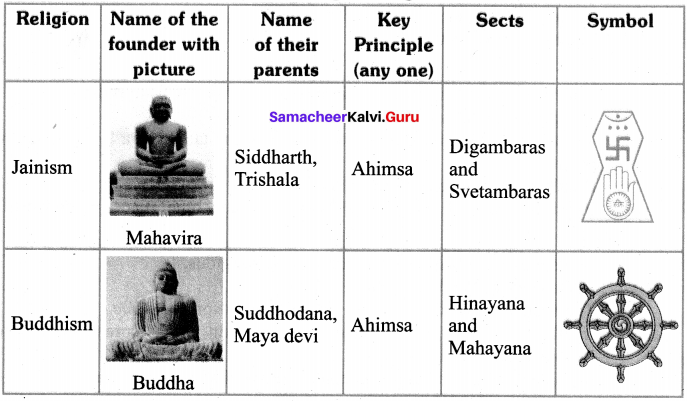
Make a tabular column in the following headings.

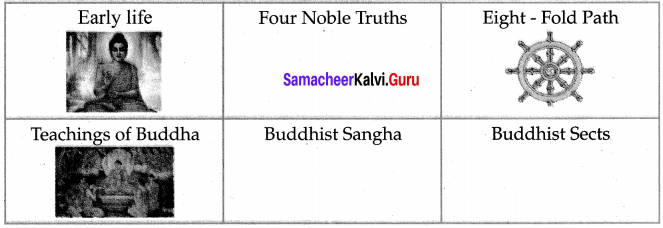
Samacheer Kalvi 6th Social Science Hitory Solutions Term 2 Chapter 2 Great Thinkers And New Faiths image - 1

Question 3.
Place the following word In the appropriate column.
Words: Jinn, Mahayana, Ttrthankarai, Stupas Nirvana, Digambara, Tripitakas, Agama
Jainism:
Jina

  1. Tirthankaras
  2. Digambara
  3. Agama

Buddhism:

  1. Mahayana
  2. Stupas
  3. Nirvana
  4. Tripitaka’s

Question 4.
Task cards activity:
Make informative cards for the following religions. Hinduism, Christianity, Islam, Buddhism, Jainism
Hinduism:

  1. It is an Indian Religion or dharma or a way of life.
  2. It is widely practiced in the Indian subcontinent.
  3. Hinduism has been called the oldest religion in the world.
  4. It is a synthesis of various Indian cultures and traditions with diverse roots and no founder.
  5. Vedic texts Shrutis and Smritis play a great role in Hinduism.

Christianity:

  1. Christianity’s religion is based on the life and teachings of Jesus.
  2. Jesus is known by Christians as the Christ or Messiah.
  3. Christ is the focal point of the Christian Faith.
  4. It is the world’s largest religion.
  5. Christians behave that Jesus is the Son of God and the Saviour of Humanity.
  6. Christianity has played a major role in shaping western civilization.
  7. Their holy book is the Bible.

Islam:

  1. Islam teaches that there is only one God, Allah.
  2. Mohammed is a prophet and the Messenger of God.
  3. It is the world’s second-largest religion.
  4. Islam teaches that God is merciful, all-powerful, unique.
  5. Its followers are known as Muslims.
  6. Their holy book is the Quran.

Buddhism:

  1. Buddhism came into existence in the 6th Century BC (BCE) in India.
  2. Gautama Buddha was the founder of Buddhism.
  3. Tlie teaching of Lord Buddha was simple and taught in a language known to people.
  4. Buddhist Sanghas propagated his faith.
  5. It spread to Central Asia, China, Japan, and many other places in the world.

Jainism:

  1. Jainism is one of the world’s oldest living religions.
  2. Mahavira was the founder of Jainism.
  3. The basic philosophy of Jainism is Ahimsa or Non- violence.
  4. Intelligible teachings and perseverance of Jain monks spread the religion in various parts of India.
  5. In ancient Tamil Literature, Jainism is referred to as Samana.

Question 5.
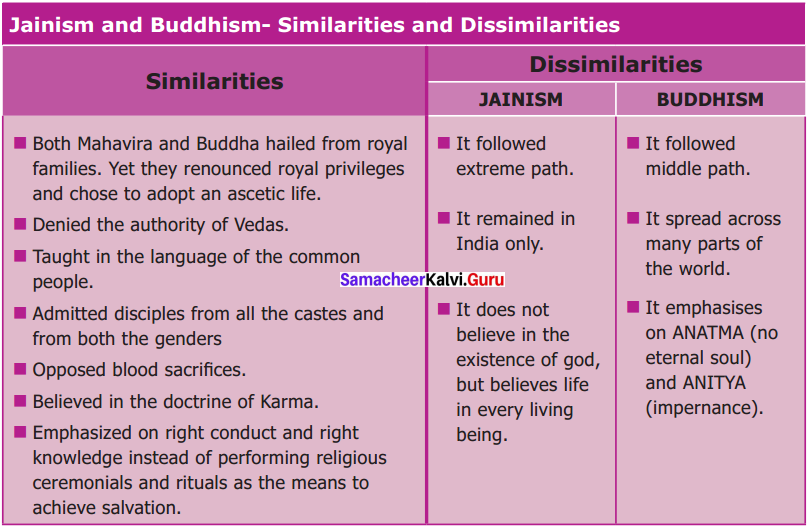
Make A Venn diagram to indicate similarities and dissimilarities of Jainism and Buddhism.
Answer:
Samacheer Kalvi 6th Social Science Hitory Solutions Term 2 Chapter 2 Great Thinkers And New Faiths image - 2

Question 6.
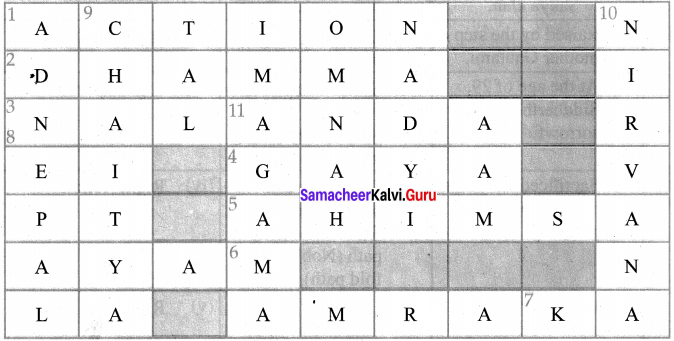
Solve the Puzzle

Samacheer Kalvi 6th Social Science Hitory Solutions Term 2 Chapter 2 Great Thinkers And New Faiths image - 3

Left to right

1. One of the Tri Rathna: Right
2. Buddha’s teachings are referred to as
3. A great center of education
4. The place where Buddha attained enlightenment
5. Not to injure any living being

Answer:
1. ACTION
2. DHAMMA
3. NALANDA
4. GAYA
5. AHIMSA

Right to left
6. Mother of Siddhartha
7. The Quality of man’s life depends on his deed
Answer:
6. MAYA
7. KARMA

Top to bottom
8. Lumbini is in
9. Buddhist prayer hall
10. A state of freedom from, birth
11. Jain scripture comply
Answer:
1. NEPAL
2. CHAITYA
3. NIRVANA
4. AGAMA

SamacheerKalvi.Guru

X. Life Skills
Question 1.
Create a storyboard for Jainism/Buddhistii in a chart.

Samacheer Kalvi 6th Social Science Hitory Solutions Term 2 Chapter 2 Great Thinkers And New Faiths image - 4

A Story Board Model I
(a) Buddhism

Samacheer Kalvi 6th Social Science Hitory Solutions Term 2 Chapter 2 Great Thinkers And New Faiths image - 5

A Story Board – Model II
(b) Jainism

Samacheer Kalvi 6th Social Science Hitory Solutions Term 2 Chapter 2 Great Thinkers And New Faiths image - 8

XI. Answer Grid:

Samacheer Kalvi 6th Social Science Hitory Solutions Term 2 Chapter 2 Great Thinkers And New Faiths image - 12

Samacheer Kalvi 6th Social Science Great Thinkers And New Faiths Additional Questions

I. Choose the correct answer:

Question 1.
Vardhamana was born in
(a) Lumbini
(b) Kundhagrama
(c) Sanchi
(d) Gaya
Answer:
(b) Kundhagrama

Question 2.
Siddhartha saw four sorrowful sights at the age of ………………
(a) 19
(b) 29
(c) 39
(d) 49
Answer:
(b) 29

Question 3.
Vardhamiana means
(a) Healthy
(b) Wealthy
(c) Happy
(d) Prosperous
Answer:
(d) Prosperous

SamacheerKalvi.Guru

Question 4.
The language used in Mahayana is …………….
(a) Sanskrit
(b) Prakrit
(c) Brahmi
(d) Aramic
Answer:
(a) Sanskrit

Question 5.
Samanam refers to
(a) Hindusim
(b) Buddhism
(c) Jainism
(d) None of the above
Answer:
(c) Jainism

SamacheerKalvi.Guru

Question 6.
Sakya Muni refers to
(a) Buddha
(b) Mahavira
(c) Sages
(d) Tirthankara
Answer:
(a) Buddha

Question 7.
Buddha was opposed to
(a) rituals
(b) sacrifices
(c) caste system
(d) All of the above
Answer:
(d) AH of the above

SamacheerKalvi.Guru

Question 8.
Sangha means
(a) Prayer Hall
(b) Monument
(c) Monastries
(d) Association
Answer:
(d) Association

Question 9.
Mahayana sect used to spread the principles of Buddhism
(a) Sanskrit
(b) Tamil
(c) Prakrit
(d) All of the above
Answer:
(a) Sanskrit

Question 10.
Buddhism received royal patronage from
(a) Ashoka
(b) Kanishka
(c) Harsha
(d) All of the above
Answer:
(d) All of the above

Question 11.
The classical epic gives an elaborate description of Kanchipuram,
(a) Kundalakesi
(b) Valaiyapathi
(c) Manimekalai
(d) Jeevaka Chinthamani
Answer:
(c) Manimekalai

II. Match the statements with the Reason. Tick the appropriate answer:
Question 1.
Statement: Vardhamana was known as kevala,
Reason: Vardhamana attained omniscience or supreme knowledge
(a) Statement and Reason are correct.
(b) Statement is wrong.
(c) The reason for the statement is wrong.
(d) Both Statement and Reason are reduce space wrong.
Answer:
(a) Statement and Reason are correct

SamacheerKalvi.Guru

Question 2.
Statement: Teachings of Lord Buddha were single and reached people.
Reason: Buddha taught in a language which people used for communication.
(a) Statement is wrong.
(b) Statement is true.
(c) Statement and Reason are correct. –
(d) Both Statement and Reason are wrong.
Answer:
(c) Statement and Reason are correct

Question 3.
Find out the correct answer:
Hinayana Sect of Buddhism followed

  1. Elaborate Rituals
  2. Prakrit language
  3. Worship of the images of the Buddha
  4. The salvation of the individual.

(a) 1 is correct
(b) 2 and 4 are correct
(c) 3 is correct
(d) 1 and 3 are correct
Answer:
(b) 2 and 4 are correct

Question 4.

Consider the following statements regarding the causes of the spread of Buddhism.

  1. Buddha’s emphasis was on the observance of Dhamma.
  2. Buddhist Sanghas played an important role in spreading the messages of Buddha

Which of the above statement(s) is/are correct?
(a) Only I
(b) Only II
(c) Both I and II
(d) Neither I nor II
Answer:
(c) Both I and II

Question 5.
Which of the following about Buddhism is correct?
(a) The fourth Buddhist council was held at Rajagriha.
(b) Buddhism spread to Tamil Nadu much later than Jainism.
(c) Hieun Tsang visited Madurai in the seventh century AD.
(d) Buddhism followed the extreme path.
Answer:
(b) Buddhism spread to Tamil Nadu much later than Jainism, j

Question 6.
Circle the odd one:
(a) Chaitya
(b) Stupas
(c) Agama Siddharta
(d) Viharas
Answer:
(e) Agama Siddharta

SamacheerKalvi.Guru

Question 7.
(a) Angans – Jain Texts
(b) Satya – Truth
(c) Digambaras – Progressive
(d) Dharmapala – Great Scholar
Answer:
(c) Digambaras – Progressive

Question 8.
All the following statements are true of the teachings of Buddha except
(a) Buddhism denied the theory of Karma.
(b) Buddha’s teachings are referred to as Dhammas.
(c) Buddha believed in the laws of the universe.
(d) Buddha advocated Ahimsa.
Answer:
(a) Buddhism denied the theory of Karma.

III. Fill in the blanks:

  1. Historian Will Durant referred to 6th century BC as _______
  2. Vardhamana was bom in Kundhagrama near _______ Bihar
  3. The word Jain derives from the Sanskrit word _______
  4. Basic Philosophy of Jainism is _______
  5. Literature from the cycle of birth and death is known as _______
  6. A chief disciple of Mahavira was _______
  7. Digambaras are the _______ followers of Jainism.
  8. In ancient Tamil literature, Jainism is referred to as _______
  9. Silappathikaram mentions a female Jain Monk called _______
  10. Siddharta was raised by his stepmother _______
  11. At the age of _______ Siddhartha left the palace and became a hermit.
  12. Dharma Chakra Pravartana means _______
  13. The members of the Sangha were called _______
  14. Buddhist monasteries became great centres of _______
  15. Buddhism crossed the frontiers of _______

Answers:

  1. Shower of stars
  2. Vaishali
  3. Jina
  4. Ahimsa
  5. Moksha
  6. Gautama swami
  7. Orthodox
  8. Samanam
  9. Gownthiyadigal
  10. Gautami
  11. 29
  12. Turning of the Wheel of Law
  13. Bhikshus / Monks
  14. Education
  15. Indian sub-continent

IV. State True or False:

  1. ‘Shower of Stars’, the remark was given by Will Durant.
  2. Gender discrimination contributed to the New awakening.
  3. Mahavir did not like meditation.
  4. The real founder of Jainism was Rishaba.
  5. Pandavar Padukkai is the bed of Jain Saints.
  6. Buddha sat under a Neem Tree for Meditation.
  7. Desire causes misery.
  8. The wheel of life represents the Jain view of the world.
  9. Buddhism spread to Central Asia, Ceylon, and Burma.
  10. Nalanda was a Chaitya.
  11. Buddhism and Jainism Denied the authority of Vedas.
  12. The second Buddhist council was held at Vaishali.

Answer:

  1. True
  2. True
  3. False
  4. False
  5. True
  6. False
  7. True
  8. False
  9. True
  10. False
  11. True
  12. True

V. Match the following:

  1. Rishaba (a) Not to own property
  2. Tri Rathna (b) Karuvur
  3. Aparigraha (c) Samath
  4. Vanchi (d) Tirthankara
  5. Deer Park (e) Three Jewels [Ans

Answer:

  1. (d)
  2. (e)
  3. (a)
  4. (b)
  5. (c)

VI. Answer In one or two sentences :

Question 1.
Why Is Vardhamana called Kevala?
Answer:

  1. After twelve and a half years of rigorous penance, Vardhamana attained omniscience or supreme knowledge.
  2. Hence Vardhamana Mahavira known as Kevala.

Question 2.
What is “Dharma Chakra Pravartana”?
Answer:

  1. Buddha delivered his first sermon at Deer Park in Sarnath.
  2. This was called “Dharma Chakra Pravartana”.

Question 3.
Mention the causes for the spread of Jainism in India.
Answer:
The use of people’s language, Intelligible teachings, Support from rulers and traders, and the Perseverance of Jain monks all were the main causes for the spread of Jainism in India.

SamacheerKalvi.Guru

Question 4.
Name the Royal patronage who helped the spread of Buddhism.
Answer:

  1. Ashoka
  2. Kanishka
  3. Harsha

Question 5.
Why was Buddha known as Sakya Muni?
Answer:

  1. Siddhartha was a Kshatriya prince.
  2. He belonged to the ruling Sakya clan.
  3. Hence Buddha was known as Sakya Muni.

Question 6.
What are Fresco Paintings?
Answer:

  1. Frescoes are paintings of the Ajanta caves in Aurangabad, Maharashtra.
  2. They depict the Jataka Tales.

Question 7.
Explain the term middle path.
Answer:
The middle path refers to neither indulging in an extreme attachment to worldly pleasure nor committing severe penance.

VII. Answer the following :

Question 1.
Mention the causes for the spread of Buddhism.
Answer:

  1. The simplicity of the teachings of Buddha in the local language appealed to people.
  2. Buddhism rejected elaborate religious customs whereas the practice of the orthodox Vedic religion insisted on expensive rituals and sacrifices.
  3. Buddha’s emphasis was on the observance of Dhamma.
  4. Buddhist Sanghas played an important role in spreading the messages of Buddha.
  5. Royal patronage under Ashoka, Kanishka, and Harsha also helped the causes of Buddhism.
  6. Viharas or the Buddhist monasteries became great centers of education.
  7. One such center was Nalanda, where Hiuen Tsang, the Chinese pilgrim, studied for many years.

Question 2.
Explain the similarities of Buddhism and Jainism,
Answer:

  1. Both Mahavira and Buddha hailed from royal families.
  2. Yet they renounced royal privileges and chose to adopt an ascetic life.
  3. Denied the authority of Vedas.
  4. Taught in the language of the common people.
  5. Admitted disciples from all the castes and from both genders.
  6. Opposed blood sacrifices.
  7. Believed in the doctrine of Karma.
  8. Emphasized right conduct and right knowledge instead of performing religious ceremonials and rituals as the means to achieve salvation.

Question 3.
Write about the influence of Buddhism in Tamil Nadu.

  1. Buddhism spread to Tamil Nadu much later than Jainism.
  2. Manimekalai, one of the epics of the post-Sangam age is Buddhist literature.
  3. There is an elaborate description of Kanchipuram in the classical epic Manimegalai.
  4. Kanchipuram was a famous Buddhist Centre, from where Dinnaga, the famous Buddhist logician, and Dharmapala, a great scholar of Nalanda University hailed.
  5. Hieun Tsang visited Kanchipuram in the seventh century A.D. (CE). noticed the presence of 100 feet stupa built by Ashoka there.

Question 4.
Write a note on
a) Confucianism
b) Zoroastrianism

(a) Confucianism

  1. Confucianism originated in China.
  2. It is also known as Ruism.
  3. The Chinese philosopher Confucius contributed his teachings.
  4. He emphasized the importance of the family and social harmony, rather than on spiritual values.
  5. The core of Confucianism is humanistic.

(b) Zoroastrianism

  1. Zoroastrianism is one of the world’s oldest religions that remain active.
  2. It originated in Persia (Iran)
  3. The Iranian speaking prophet Zoroaster exalts a deity of wisdom, Ahura Mazda as its Supreme Being.
  4. Zend Avesta is the most important text of this religion.
  5. Zoroastrians usually pray in the presence of some form of fire.

VIII. HOTS:

Question 3.
Thiruparathi Kundram, Sithanavasal, and Chithara Malai are closely connected with Jainism – how?
Answer:
(a) Tbiruparthi Kundra

  1. It is located in the suburbs of Kanchipuram.
  2. The Jain Temple here in a standing example of the existence of Jainism in Kanchipuram in the ancient period.
  3. Built-in 9th Century by Pallavas, there are two Jain temples named Trilokyanatha temple and Chandra Prabha temple.
  4. The suburb where these twin temples are located is called Jain Kanchi.
  5. Tourists can see beautiful paintings on the ceilings of the temple.
  6. The main deity Mahavira was made up of bright pink stone.
  7. Temple was built out of yellow stone.
  8. It has inscriptions belonging to the 9th Century.
  9. Currently the temple is under the control of Tamil Nadu Archaeological Department.

(b) SittanaVasal

  1. It Sittanavasal is a small hamlet in the Pudukottai district of Tamil Nadu.
  2. It is known for the Sittanavasal cave, a 2nd-century Jain cave complex.
  3. From the 7th to 9th Century AD the village flourished as a Jain Centre.
  4. The Sittanavasal cave is also known as Arivar Kovil.
  5. It is a Jain monastery of the 7th Century, small in size.
  6. It is noted for its fresco paintings.
  7. The painting themes depict a beautiful lotus pond and figures, lilies, fish, geese, buffaloes, and elephants.
  8. The cave temples has the sculpture of Jain Thirthankaras.
  9. Ezhadippattam or Jaina beds is a natural cave, marked by horizontal floor space. It is laid out with well-polished rock
  10. beds that were used by Jaina ascetics.

(c) The Chitharal Malai

  1. The Chitharal Jain monuments is also known as Chitharal Malai kovil.
  2. It is literally on the hill.
  3. It is also known as Bhagawathi temple.
  4. Chitharal is situated on the Thiruchanathar Malai near Chitharal Village, Kanyakumari district.
  5. Chitharal hills are locally known as Chokkanthoongi Hills.
  6. There are two monuments found here.
  7. They were likely built by Digambara Jains in the Ninth Century when the region was under the influence of Jainism.
  8. Jain influence in this region was due to the king Mahendra Varma.

Samacheer Kalvi 6th Social Science Hitory Solutions Term 2 Chapter 2 Great Thinkers And New Faiths Read More »

Samacheer Kalvi 6th Social Science Hitory Solutions Term 2 Chapter 3 From Chiefdoms To Empires

You can Download Samacheer Kalvi 6th Social Science Book Solutions Guide Pdf, Tamilnadu State Board help you to revise the complete Syllabus and score more marks in your examinations.

Tamilnadu Samacheer Kalvi 6th Social Science History Solutions Term 2 Chapter 3 From Chiefdoms To Empires

Samacheer Kalvi 6th Social Science From Chiefdoms To Empires Textual Evaluation

I. Choose the correct answer:

Question 1.
The Kingdom which was most powerful among the four Mahajanapadas
(a) Anga
(b) Magadha
(c) Kosala
(d) Vajji
Answer:
(b) Magadhaj

Question 2.
Among the following who was the contemporary of Gautama Buddha?
(a) Ajatasatru
(b) Bindusara
(c) Padmanabha Nanda
(d) Brihadratha
Answer:
(a) Ajatasatru

Question 3.
Which of the following are the sources of the Mauryan period?
(a) Artha Sastra
(b) Indica
(c) Mudrarakshasa
(d) All
Answer:
(d) All

SamacheerKalvi.Guru

Question 4.
Chandra Gupta Maurya abdicated the thrown and went to Sravanbelgola along with Jaina Saint …………….
(a) Badrabahu
(b) Stulabahu
(c) Parswanatha
(d) Rushabhanatha
Answer:
(a) Badrabahu

Question 5.
was the ambassador of Seleucus Nicator.
(a) Ptolemy
(b) Kautilya
(c) Xerxes
(d) Megasthenese
Answer:
(d) Megasthenese

Question 6.
Who was the last emperor of the Mauryan Dynasty?
(a) Chandragupta Maurya
(b) Ashoka
(c) Brihadratha
(d) Bindusara
Answer:
(c) Brihadratha

II. Match the statement with the Reason / Tick the appropriate answer:

Question 1.
Statement (A): Ashoka is considered one of India’s greatest rulers.
Reason (R): He ruled according to the principle of Dhamma.
(a) Both A and R are true and R is the correct explanation of A.
(b) Both A and R are true but R is not the correct explanation of A.
(c) A is true but R is false.
(d) A is false but R is true.
Answer:
(a) Both A and R are true and R is the correct explanation of A.

Question 2.
Which of the statements given below is/are correct?
Statement 1: Chandragupta Maurya was the first ruler who unified entire India under one political unit.
Statement 2: The Arthashastra provides information about the Mauryan administration
(a) only 1
(b) only 2
(c) both 1 and 2
(d) neither 1 nor 2
Answer:
(b) only 2

SamacheerKalvi.Guru

Question 3.
Consider the following statements and find out which of the following statement is/are correct.

  1. Chandragupta Maurya was the first king of Magadha.
  2. Rajagriha was the capital of Magadha.

(a) only 1
(b) only 2
(c) both and 2
(d) neither 1 nor 2
Answer:
(b) only 2

Question 4.
Arrange the following dynasties in chronological order.
(a) Nanda – Sishunaga – Haryanka – Maurya
(b) Nanda – Sishunaga -Maurya – Haryanka
(c) Haryanka – Sishunaga – Nanda – Maurya
(d) Sishunaga – Maurya – Nanda – Haryanka
Answer:
(c) Haryanka – Sishunaga – Nanda – Maurya]

Question 5.
Which of the following factors contributed to the rise of the Magadhan Empire?

  1. Strategic location
  2. Thick forest supplied timber and elephant
  3. Control oversea
  4. Availability of rich deposits of iron ores

(a) 1, 2 and 3 only
(b) 3 and 4 only
(c) 1, 2 and 4 only
(d) All of these
Answer:
(c) 1, 2, and 4 only

III. Fill in the blanks :

  1. ______ was the earliest capital of Magadha.
  2. Mudrarakshasa was written by______
  3. ______ was the son of Bindusara.
  4. The founder of the Maurya Empire was______
  5. ______ were appointed to spread Dhamma all over the empire.

Answer:

  1. Rajagriha
  2. Visakadatta
  3. Ashoka
  4. Chandragupta Maurya
  5. Mahamattas

IV. State True or False:

  1. The title Devanam Piya was given to Chandragupta Maurya.
  2. Ashoka gave up war after his defeat in Kalinga.
  3. Ashoka’s Dhamma was based on the principle of Buddhism.
  4. The lions on the currency notes are taken from the Rampurwa bull capital.

Answer:

  1. False
  2. False
  3. True
  4. False

V. Match the following :

a. Gana 1. Arthasastra
b. Megasthenese 2. Religious tours
c. Chanakya 3. people
d. Dharmayatras 4. Indica
(a) 3 4 1 2
(b) 2 4 3 1
(c) 3 1 2 4
(d) 2 1 4 3
Answer:
(a) 3 4 1 2

VI. Answer in one or two sentences

Question 1.
Mention any two literary sources of the Mauryan period.
Answer:

  1. Arthasastra
  2. Mudrarakshasa

Question 2.
What is a stupa?
Answer:

  1. A stupa is a semi-spherical dome-like structure. It is constructed on brick or stone.
  2. The buddha’s relics were placed in the centre.

SamacheerKalvi.Guru

Question 3.
Name the dynasties of Magadha.
Answer:

  1. The Haryanka dynasty
  2. The Shishunaga dynasty
  3. The Nanda dynasty
  4. The Maury a dynasty

Question 4.
What were the sources of revenue during the Mauryan period?
Answer:

  1. The land was the most important source of revenue for the state. The land tax (Bhaga) was 1/6 of the total produce.
  2. Additional revenue was taxes on forests, mines, salt, and irrigation.

Question 5.
Who assisted Nagarika in the administration of towns?
Answer:

  1. Sthanika
  2. Gopa

Question 6.
What do you know from the Rock Edicts II and XIII of Ashoka?
Answer:
The Rock Edicts II and XIII of Ashoka refer to the names of three dynasties.

  1. Pandyas
  2. Cholas
  3. The Keralaputras and the Sathyaputras.

Question 7.
Which classical Tamil poetic works have the reference of Maurvans?
Answer:
Mamulanar’s poem in Agananuru

VII. Answer the following :

Question 1.
What did Ashoka do to spread Buddhism?
Answer:

  1. Ashoka sent his son Mahinda and Sanghamitta to Srilanka to propagate Buddhism.
  2. He also sent missionaries to West Asia, Egypt, and Eastern Europe to spread the message of Dhamma.
  3. Ashoka created the Dhamma – mahamattas, a new cadre of officials, to spread – dhamma all over the empire.

Question 2.
Write any three causes for the rise of Magadha.
Answer:

  1. Magadha was located on the lower part of the Gangetic plain. The plain was fertile which ensured the rich agricultural yield. This provided income to the state.
  2. The thick forests supplied timber for the construction of buildings and elephants for the army.
  3. The abundance of natural resources especially iron enabled them to equip themselves with weapons made of iron.

VIII. HOTS:

Question 1.
Kalinga war became a turning point in Ashoka’s life. How?
Answer:

  1. Ashoka fought the Kalinga war in 261 BC. He won the war.
  2. The horror of war was described by Ashoka himself in the Rock Edict XIII.
  3. After the war, Ashoka became a Buddhist.
  4. He undertook tours to spread the policy of Dhamma.
  5. His policy contained the noblest ideas of humanism forming the essence of all religions.
  6. He laid stress on compassion, charity, purity, etc.
  7. He sent his son and daughter to Srilanka to propagate Buddhism.
  8. He sent missionaries to West Asia, Egypt, and Eastern Europe.
  9. To spread Dhamma all over the empire he created new officials Dhamma – mahamattas.

SamacheerKalvi.Guru

Question 2.
Write any five welfare measures you would do if you were a king like Ashoka.
Answer:

  1. Free education to all.
  2. Free food for the disabled, the aged, the sick, and the needy.
  3. Free medical treatment to all the citizens.
  4. Free shelter for the homeless.
  5. Justice for all. Equality of gender, religion, caste.

IX. Picture Study

Question 1.
This is the picture of an Ashokan edict.

Samacheer Kalvi 6th Social Science Hitory Solutions Term 2 Chapter 3 From Chiefdoms To Empires image - 1

a. What are edicts?
b. How are Ashokan edicts useful?
c. Where were these edicts inscribed?
d. Name the script used in Sanchi Inscription.
e. How many Rock Edicts are there?
Answer:
(a) An Edict is an official order or proclamation issued by a person in authority or a king.
(b) Edicts are very informative about Ashoka’s belief in peace, righteousness, justice, and his concern for the welfare of the people.
(c) The edicts were inscribed on the pillars as well as boulders and cave walls made by Emperor Ashoka.
(d) Brahmi Script.
(e) 33 Rock Edicts.

X. Who am I

  1. I belonged to Haryanka dynasty. I extended territory by matrimonial alliances. My son is Ajatasatru – who am I?
  2. I played a significant role in the transformation of society. I am used to making ploughshare – Who am I?
  3. I was known as Devanampiya. I embraced the path of peace – Who am I?
  4. I established the first largest empire in India. I performed Sallekhana. Who am I?
  5. I am found in the Lion Capital of Ashoka. I am at the centre of our national flag. Who am I?

Answer:

  1. Bimbisara
  2. Iron
  3. Ashoka
  4. Chandra Gupta Maurya
  5. Ashoka Chakra

XI. Decipher the code – The Mauryan Empire.
Samacheer Kalvi 6th Social Science Hitory Solutions Term 2 Chapter 3 From Chiefdoms To Empires image - 2

  1. The first dynasty that ruled over Magadha was ______ (8, 1, 18, 25, 1, 14, 11, 1).
  2. ______ empire was the first largest empire (13, 1, 21,18, 25, 1).
  3.  ______ laid the foundation of the new capital at Pataliputra. (21, 4, 1,25, 9,14).
  4.  ______ was one of the main exports (19, 16, 9, 3, 5, 19).
  5.  ______ became later the most renowned seat of learning. (14, 1, 12, 1, 14, 4, 1).
  6. Revenue from agricultural produce was called ______ (2, 8, 1, 7, 1).
  7. The horror of war was described in ______ (18, 15, 3, 11, 5, 4, 9, 3, 20)
  8. Greeks called Bindusara as ______ (1, 13, 9, 20, 18, 1,7, 1, 20, 8, 1)
  9. The crowning element in Saranath Pillar is ______ (4, 8,1, 18,13,1, 3, 8,1,11,18,1)
  10. Council of ministers were known as ______ (13, 1, 14, 4, 18, 9, 16, 1, 18, 9, 19, 8, 1,4)

Answer:

  1. HARYANKA
  2. MAURY
  3. UDAYIN
  4. SPICKS
  5. NALANDA
  6. HAGA
  7. ROCK EDICT
  8. AMITRAG AT HA
  9. DHARMA CHAKRA
  10. MANDRIPARISHAD

XIII Map Work

  1. Mark the extent of the Ashokan Empire.
  2. Mark the following places the river map of India

a. Taxila
b. Pataliputra
c. Ujjain
d. Sanchi
e. Indraprastha

Samacheer Kalvi 6th Social Science Hitory Solutions Term 2 Chapter 3 From Chiefdoms To Empires image - 3

XIV Life Skill

Question 1.
Make a model of Ashoka Chakra.

Samacheer Kalvi 6th Social Science Hitory Solutions Term 2 Chapter 3 From Chiefdoms To Empires image - 4

Question 2.
Make a model of Sanchi Stupa.

Samacheer Kalvi 6th Social Science Hitory Solutions Term 2 Chapter 3 From Chiefdoms To Empires image - 5

Question 3.
Draw and colour our National Flag

Samacheer Kalvi 6th Social Science Hitory Solutions Term 2 Chapter 3 From Chiefdoms To Empires image - 6

XV. Answer Grid:

Samacheer Kalvi 6th Social Science Hitory Solutions Term 2 Chapter 3 From Chiefdoms To Empires image - 7

Samacheer Kalvi 6th Social Science From Chief Doms To Empires Additional Questions

I. Choose the correct answer:

Question 1.
The earliest gathering places of men were
(a) Kingdoms
(b) Janapadas
(c) Mahajanapadas
(d) Republics
Answer:
(b) Janapadas

SamacheerKalvi.Guru

Question 2.
The capital city Pataliputra had ……………. gates to the city.
(a) 24
(b) 32
(c) 49
(d) 64
Answer:
(d) 64

Question 3.
Udavin belonged to ……….. the dynasty.
(a) Nanda
(b) Shishunaga
(c) Haryanka
(d) Maurya
Answer:
(c) Haryanka

Question 4.
Kalasoka belonged to ……………. dynasty.
(a) Haryanka
(b) Shishunaga
(c) Nanda
(d) Maurya
Answer:
(b) Shishunaga

Question 5.
The name Vishnu Gupta refers to ……….
(a) Ajata satru
(b) Ashoka
(c) Dhana Nanda
(d) Chanakya
Answer:
(d) Chanakya

Question 6.
Simhasena refers to
(a) Chandragupta
(b) Bambisara
(c) Udayin
(d) Bindusara
Answer:
(a) Chandragupta

Question 7.
Ashoka sent his son and daughter to
(a) China
(b) Burma
(c) Srilanka
(d) Indonesia
Answer:
(c) Srilanka

Question 8.
Under the Mauryas, the king was
(a) Sovereign authority
(b) head of the Judiciary
(c) Commander of the Army
(d) All the three
Answer:
(d) All the three

Question 9.
The terms Sthanika and Gopa are related to Mauryan
(a) Council
(b) Assembly
(c) Army
(d) Town Administration
Answer:
(a) Council

Question 10.
Mashakas were made out of
(a) copper
(b) gold
(c) silver
(d) paper
Answer:
(a) copper

SamacheerKalvi.Guru

Question 11.
Dasharatha Maurya was the grandson of
(a) Bindusara
(b) Bimbisara
(c) Dhana Nanda
(d) Ashoka
Answer:
(d) Ashoka

II. Match the statement with the Reason. Tick the appropriate answer:

Question 1.
Statement (A): Magadha’s gradual rise to political supremacy began with the Bimbisara of the Haryanka dynasty.
Reason (R): Bimbisara extended the territory of the Magadhan Empire by matrimonial alliances
(a) Both A and R are true but R is not the correct explanation of A.
(b) A is true but R is false.
(c) Both A and R are true and R is the correct explanation of A.
(d) A is false but R is true.
Answer:
(c) Both A and R are true and R is the correct explanation of A.

Question 2.
Which of the statement given below is/are correct?
Statement I: Megasthenese was an Ambassador from Greece in the court of Chandragupta Maurya.
Statement II: Megasthenese – work ‘Indica’ is one of the main sources of the Mauryan Empire.
(a) Only II
(b) Only I
(c) Neither I nor II
(d) Both I and II
Answer:
(d) Both I and II

Question 3.
Consider the following statements and find out which of the following statements is/are correct.

  1. Trade flourished under the Maurvans.
  2. Spices and Ivory works formed the main exports under the Mauryans.

(a) only 1
(b) only 2
(c) Both 1 and 2
(d) Neither 1 nor 2
Answer:
(c) Both 1 and 2

Question 4.
Arrange the following rulers in Chronological order
(a) Bimbisara, Kalasoka, Mahapadma Nanda, Chandra Gupta
(b) Chandra Gupta, Mahapadma Nanda, Bimbisara, Kalasoka
(c) Kalasoka, Bimbisara, Chandra Gupta, Mahapadma Nanda
(d) Mahapadma Nanda, Chandra Gupta, Kalasoka, Bimbisara
Answer:
(a) Bimbisara, Kalasoka, Mahapadma Nanda, Chandra Gupta

Question 5.
Which of the following factors contributed to the decline of the Mauryan Empire?

  1. Weak successors
  2. Continuous revolts
  3. Invasion by Bactrian Greeks
  4. Regular and substantial income to the state.

(a) 3 and 4 only
(b) All of these
(c) 1, 2, and 3 only
(d) 1, 2 and 4 only.
Answer:
(c) 1,2 and 3 only

III. Fill in the blanks:

  1. The term ‘Gana’ means ______.
  2. Sixteen dotted the Indo – Gangetic plain in the sixth century BC
  3. The thick forests supplied _______ for the construction of buildings
  4. Kalasoka belonged to ______dynasty
  5. Mahapadma Nanda was succeeded by his eight sons known as_______
  6. The tearm nalanda means_______
  7. Megasthanese stayed in India for _________ Years.
  8. The teacher and advisor to Emperor Chandra Gupta Maurya was ______
  9. Chandragupta performed ________ in Sravanbelgola.
  10. Chandragupta Maurya’s son was ______
  11. Bindusara was succeeded by his son ______
  12. Ashoka was known as ‘Devanam Piya’ which means ______
  13. Ashoka’s Dhamma contained the essence of ________
  14. The third Buddhist council was held at ______
  15. The first Buddhist council was held at ______
  16. The second Buddhist council was held at ______
  17. The foundation for the new capital at Pataliputra was laid by _____
  18. The highest court of appeal under the Mauryans was _______
  19. Status of Yakshas and Yakshis belonged to the _______
  20. Three caves in Barabar hills have dedicative inscriprion of __________

Answer:

  1. people of equal status
  2. Mahajanapadas
  3. timber
  4. Sishunaga
  5. Navanandas
  6. No stopping of the gift of knowledge
  7. 14
  8. Chanakya / Vishnugupta/ Kautilyal
  9. Sallekhanai
  10. Bindusaral
  11. Ashoka
  12. beloved of the Gods
  13. All religions
  14. Pataliputraj
  15. Rajagriha
  16. Vaishali
  17. Udayin
  18. The king
  19. Indigenous
  20. Ashoka

IV. State True or False:

  1. Mahavira and Buddha represented the new awakening in the sixth century BC (BCE)
  2. Among the four Mahajana padas, Vatsa emerged as an empire.
  3. Haryanka dynasty was succeeded by the Sishunaga dynasty.
  4. Seleucus wrote the book Indica.
  5. Chanakya is called the Architect of the Mauryan Empire.
  6. After the battle of Kalinga, Ashoka became a Buddhist.
  7. Ashoka emphasised obedience and respect for parents, preceptors, and elders.
  8. Council of Ministers referred to Mantriparishad.
  9. Mauryans were not aware of the spy system.
  10. Under the Mauryan administration, punishments were very mild.

Answer:

  1. True
  2. False
  3. False
  4. False
  5. True
  6. True
  7. True
  8. True
  9. False
  10. False

V. Match the following:

  1. Panchala (a) Foreign Notice
  2. Mahavamsa (b) Daughter
  3. Ashoka (c) Proclamation
  4. Sangamithra (d) Mahajanapada
  5. Edict (e) Governor of Ujjain

Answer:

  1. (d)
  2. (a)
  3. (e)
  4. (c)

VI. Answer in one or two sentences :

Question 1.
Explain the term kingdom.
Answer:

  1. Kingdom means a territory ruled by a king or queen.
  2. In a kingdom (monarchy), a family, which rules for a long period becomes a dynasty.
  3. Usually, these kingdoms adhered to orthodox Vedic traditions.

Question 2.
Who was Bhadrabahu?
Answer:

  1. Bhadrabahu was a Jain monk.
  2. He took Chandragupta Maurya to South India.

Question 3.
Name the sixteen Mahajanapadas.
Answer:
Name of the Sixteen Mahajanapadas are
Anga, Magadha, Vajji, Malla, Kasi, Kura, Kosala, Avanti, Chedi, Vatsa, Panchala, Machcha, Surasena, Assaka, Gandhara and Kamboja.

Question 4.
Write a note on Megasthenese.
Answer:

  1. Megasthenese was the ambassador of the Greek ruler, Seleucus.
  2. He lived in the court of Chandragupta Maurya.
  3. He stayed in India for 14 years.
  4. He wrote the book Indica, one of the main sources for the study of the Mauryan Empire.

Question 5.
Write about Pataliputra.
Answer:

  1. Pataliputra was the capital of the Mauryan Empire.
  2. It has 64 gates to the city with 570 watchtowers.

Question 6.
Why is Chanakya known as the architect of the Mauryan Empire?
Answer:

  1. Chanakya was the teacher and advisor to Emperor Chandragupta Mauryan.
  2. His treatise on statecraft ‘Arthashastra’ was a very great guide for rulers.
  3. Hence he is referred to as the architect of the Mauryan empire.

Question 7.
Explain Ashoka’s Dhamma.
Answer:

  1. The meaning of Dhamma is explained in Ashoka’s – Pillar Edict II.
  2. It contained the noblest ideas of humanism, forming the essence of all religions.
  3. He laid stress On Compassion, Charity, Purity, Saintliness, Self-control, Truthfulness, Obedience, and respect for parents, preceptors, and elders.

SamacheerKalvi.Guru

Question 8.
Mention the different wings of the Mauryan army.
Answer:

  1. Under the Mauryan army, a board of 30 members divided into six committees with five members on each, monitored
  2. Navy, Armoury (transport and supply), Infantry, Cavalry, The war chariots, and The war elephants.

Question 9.
Mention the regions which produced specialised textiles under the Mauryas.
Answer:
The regions which produced specialised textiles under the Mauryas were Kasi (Benares), Vanga (Bengal), Kamarupa (Assam), and Madurai in Tamilnadu.

Question 10.
What were the exports and imports of the Mauryans?
Answer:

  1. Main exports were Spices, Pearls, Diamonds, Cotton textiles, Ivory Works, Conch Shells.
  2. Main Imports were Horses, Gold, Glassware, Linen.

Question 11.
Mention the two divisions of Mauryan art.
Answer:
Mauryan art can be divided into two.

  1. Indigenous Art – Statues of Yakshas and Yakshis.
  2. Royal Art – Palaces and Public buildings, Monolithic Pillars, Rock-cut Architecture, ‘ Stupas.

Question 12.
Who were Yakshas and Yakshis?
Answer:

  1. Yakshas were deities connected with water, fertility, trees, the forest, and wilderness,
  2. Yakshis were their female counterpart.

VII. Answer the following:

Question 1.
Mention the role of iron in changing society.
Answer:

  1. Iron played a significant role in this transformation of society.
  2. The fertile soil of the Gangetic Valley and the use of iron ploughshares improved, agricultural productivity.
  3. Iron facilitated craft production.
  4. Agrarian surplus and an increase in craft products resulted in the emergence of trading and exchange centres.
  5. There was a rise in towns and cities.

Question 2.
Write about the revenue system of the Mauryans.

  1. The land was the most important source of revenue for the state.
  2. Bali and Bagha as taxes collected from people.
  3. The land tax (Bhaga) collected was 1/6 of the total produce.
  4. Revenue from taxes on forests, mines, salt, and irrigation provided additional revenue to the government.
  5. Much of the State revenue was spent on paying the army, the officials of the royal government, on charities, and on different public works.

Question 3.
Mention the reasons for the decline of the Mauryan empire.
Answer:

  1. Ashoka’s successors were very weak.
  2. Continuous revolts in different parts of the empire.
  3. Invasion by the Bactrian Greeks weakened the empire.
  4. The pacifist policy of Ashoka weakened military strength.
  5. Last Maurya ruler Brihadratha was killed by his commander Pushyamitra Sungha.

VIII. HOTS:

Question 1.
State the salient feature of the Lion Capital of Ashoka.
Answer:

  1. The lion capital of Ashoka is a sculpture of four Asiatic lions standing back to back on an elaborate base.
  2. This base includes other animals.
  3. A graphic representation of it was adopted as the official emblem of India in 1950.
  4. It was originally placed atop the Ashoka pillar at the important Buddhist site of Samath by Emperor Ashoka, in about 250 BCE.
  5. The pillar, sometimes called the Ashoka Column, is still in its original location.
  6. But the Lion Capital is now in the Samath Museum, in the state of Uttar Pradesh.
  7. It is 7 feet high including the base.
  8. The Ashoka Chakra is a depiction of the Buddhist Dharma Chakra with 24 spokes.

Question 2.
One of the seven wonders of the Ancient world – Great wall of China – Prove.
Answer:

  1. The Great Wall of China is a series of fortifications made of stone, brick, tamped earth, wood, and other materials.
  2. It is built along an east-to-west line across the historical northern borders of China.
  3. It was built to protect the Chinese states and empires against the raids and invasions of the various nomadic groups of the Eurasian Steppe.
  4. It was built by Qin Shi Huang, the first Emperor of China. Little of that wall remains.
  5. The Great Wall has been rebuilt, maintained, and enhanced over various dynasties.

SamacheerKalvi.Guru

Question 3.
The temple of Zeus at Olympia is an important piece of art in Greek history. – Do you agree?
Answer:

  1. The temple of Zeus at Olympia was an ancient Greek temple in Olympia, Greece.
  2. It was dedicated to the God Zeus.
  3. The temple was built in the second quarter of the 5th Century BCE.
  4. Zeus is the Sky and Thunder God in ancient Greek religion, who rules as king of the Gods of Mount Olympus.

Question 4.
What do you about the Lomas Rishi cave, Barabar?
Answer:

  1. The Lomas Rishi Cave also called the Grotto of Lomas Rishi, is one of the man¬’ made Barabar Caves in the Barabar and Nagarjuna hills of Jehanabad district in Bihar.
  2. This rock-cut cave was carved out as a sanctuary.
  3. It was built during the Ashokan period of the Maurya Empire in the 3rd century BC.

Question 5.
Nalanda served as a great source of knowledge. Prove.
Answer:

  1. Nalanda was a large Buddhist monastery, in the ancient kingdom of Magadha (modern-day Bihar) in India.
  2. It is a UNESCO World Heritage Site.
  3. Nalanda flourished under the patronage of the Gupta Empire in the 5th and 6th centuries.
  4. The word Nalanda is a Sanskrit combination of three words Na + Alam + daa meaning “no stopping of the gift of knowledge”.
  5. The school attracted scholars and students from near and far with some travelling from Tibet, China, Korea, and Central Asia

SamacheerKalvi.Guru

Question 6.
State the importance of Girnar Inscription of Rudradaman.
Answer:

  1. The Junagarh / Gimar Inscription gives information about the Sudarshana Lake
  2. This lake was an artificial reservoir.
  3. The construction was begun during the time of Chandra Gupta Maurya and completed during Ashoka’s reign.
  4. It was built by the Mauryan kings to check floods.
  5. Around 150AD, the lake was repaired by the Shaka ruler Rudradaman I.
  6. Again it was repaired under the Skandagupta’s reign by his Governor Pamadatta.

IX. Who am I

  1. I Practise egalitarian traditions.
  2. I supply elephants for the army.
  3. I was overthrown by Chandra Gupta Maurya.
  4. I wrote a treatise on statecraft.
  5. I was called by the Greeks as a ‘slayer of enemies’.
  6. I carry an official order or proclamation issued by a king.
  7. I am the crowning element of Saranath Pillar.
  8. I am known as Patna now. Originally who was I?

Answer:

  1. Gana-Sangha
  2. Thick forests
  3. Dhana Nanda
  4. Chanakya
  5. Bindusara
  6. Edict
  7. Dharmachakra
  8. Pataliputra

X. Decipher the code – The Mauryan. Empire.
Samacheer Kalvi 6th Social Science Hitory Solutions Term 2 Chapter 3 From Chiefdoms To Empires image - 2

  1. It means a territory ruled by a king or queen ______ (11, 9, 14, 7, 4, 15, 13).
  2. He shifted the Capital from Rajagirha to Pataliputra. (11, 1, 12,1, 19, 15, 11, 1).
  3. One of the religions sources of the Mauryan Empire ______ (16,21,18,1,14,1, 19).
  4. It is a part of our National Flag. (1, 19, 18,15, 11, 1,3,8, 1, 11, 19, 1).
  5. Construction of this lake was begun during the time of Chandra Gupta Mauryan and completed during Ashoka’s reign ______ (19, 21, 4, 1, 18, 19, 8, 1, 14, 1).
  6. One of the main exports of the Mauryan Period. (4, 9, 1, 13, 15, 14, 4, 19).
  7. Statues of Yakshas and Yakshi come under the ______ art of the Mauryans,(9, 14, 4, 9, 7, 5, 14, 15, 14,21, 19)
  8. Ancient name of Odisha. (11, 1, 12, 9, 14, 7, 1).

Answers:

  1. KINGDOM
  2. KALASOK
  3. PURANAS
  4. ASHOKA CHAKRA
  5. SUDARSHANA
  6. DIAMONDS
  7. INDIGENOUS
  8. KALINGA

Samacheer Kalvi 6th Social Science Hitory Solutions Term 2 Chapter 3 From Chiefdoms To Empires Read More »

Samacheer Kalvi 6th Science Solutions Term 2 Chapter 1 Heat

You can Download Samacheer Kalvi 6th Science Book Solutions Guide Pdf, Tamilnadu State Board help you to revise the complete Syllabus and score more marks in your examinations.

Tamilnadu Samacheer Kalvi 6th Science Solutions Term 2 Chapter 1 Heat

Samacheer Kalvi 6th Science Heat Textual Evaluation

I. Choose the appropriate answer:

Question 1.
When an object is heated, the molecules that make up the object
(a) begin to move faster
(b) lose energy
(c) become heavier
(d) become lighter
Answer:
(a) begin to move faster

Question 2.
The unit of heat is
(a) newton
(b) joule
(c) volt
(d) Celsius
Answer:
(b) Joule

Question 3.
One litre of water at 30°C is mixed with one litre of water at 50°C. The temperature of the mixture will be
(a) 80°C
(b) More than 50°C but less than 80°C
(c) 20°C
(d) around 40°C
Answer:
(d) around 40°C

Question 4.
An iron ball at 50°C is dropped in a mug containing water at 50°C. The heat will
(a) flow from iron ball to water.
(b) not flow from iron ball to water or from water to iron ball.
(c) flow from water to iron ball.
(d) increase the temperature of both.
Answer:
(b) not flow from iron ball to water or from water to iron ball

Samacheer Kalvi 6th Science Solutions Term 2 Chapter 1 Heat

II. Fill up the blanks:

  1. Heat flows from a ______ body to a ______ body.
  2. The hotness of the object is determined by its ______
  3. The SI unit of temperature is ______
  4. Solids on heating and ______ on cooling.
  5. Two bodies are said to be in the state of thermal ______ if there is no transfer of heat taking place.

Answers:

  1. higher temperature, lower temperature
  2. temperature
  3. kelvin
  4. expand, contract
  5. equilibrium

Samacheer Kalvi 6th Science Solutions Term 2 Chapter 1 Heat

III. True or False. If False, give the correct statement:

Question 1.
Heat is a kind of energy that flows from a hot body to a cold body.
Answer:
True

Question 2.
Steam is formed when heat is released from water.
Answer:
False. Ice is formed when heat is released from water.

Question 3.
Thermal expansion is always a nuisance.
Answer:
False. Thermal expansion is always beneficial.

Question 4.
Borosilicate glass do not expand much on being heated.
Answer:
True

Question 5.
The unit of heat and temperature are the same.
Answer:
False. The unit of heat and temperature are different

Samacheer Kalvi 6th Science Solutions Term 2 Chapter 1 Heat

IV. Give reasons for the following:

Question 1.
An ordinary glass bottle cracks when boiling water is poured into it, but a borosilicate glass bottle does not.
Answer:
The borosilicate glass is pyrex glass. They do not expand much on being heated and therefore they do not crack.

Question 2.
The electric wire which sag in summer become straight in winter.
Answer:
In summer the electric wire is expanded by high temperature. So it sags in summer. In winter die electric wire is contracted by low temperature. Hence it becomes straight in winter.

Question 3.
|Rivet is heated before fixing in the hole to join two metal plates.
Answer:
In order to make the other end of the rivet to form a new “rivet-head” by hammering, the rivet is heated. It becomes malleable when the rivet is in red-hot condition.

Samacheer Kalvi 6th Science Solutions Term 2 Chapter 1 Heat

V. Match the following:

1. Heat 0°C
2. Temperature 100°C
3. Thermal Equilibrium kelvin
4. Ice cube No heat flow
5. Boiling water joule

Answer:

1. Heat

joule

2. Temperature kelvin
3. Thermal,Equilibrium No heat flow
4. Ice cube 0°C
5. Boiling water 100°C

Samacheer Kalvi 6th Science Solutions Term 2 Chapter 1 Heat

VI. Analogy:

Question 1.
Heat: Joule :: Temperature : _______
Answer:
kelvin

Question 2.
Ice cube : 0°C :: Boiling water : _______
Answer:
100°C

Question 3.
Total Kinetic Energy of molecules: Heat:: Average Kinetic Energy: _______
Answer:
Temperature

Samacheer Kalvi 6th Science Solutions Term 2 Chapter 1 Heat

VII. Give Very Short Answer:

Question 1.
Make a list of electrical equipment at home from which we get heat.
Answer:
The water heater, iron box, electric cattle, etc.,

Question 2.
What is the temperature?
Answer:

  1. The measurement of the warmness or coldness of a substance is known as temperature.
  2. SI unit is Kelvin.
  3. Other units: Celsius, Fahrenheit

Question 3.
What is thermal expansion?
Answer:
The expansion of a substance on heating is called the thermal expansion of that substance.

Question 4.
What do you understand by thermal equilibrium?
Answer:
Thermal equilibrium exists when two objects in thermal contact no longer affect each other’s temperature (or) Both the objects are in same temperature they are in thermal equilibrium.

Samacheer Kalvi 6th Science Solutions Term 2 Chapter 1 Heat

VIII. Give Short Answer:

Question 1.
What difference do you think heating the solid will make in their molecules?
Answer:
Heat expands solids. The molecules in the solid move faster, spread apart and occupy more space.

Question 2.
Distinguish between heat and temperature.
Answer:

S.No, Heat Temperature

1.

Heat not only depends on the temperature of the substance but also depends on how many molecules are there in the object. Temperature is related to how fast the atoms or molecules move or vibrate within the substance
2. Heat measures the total Kinetic Energy of the molecules in the substance. Temperature measures the average kinetic energy of molecules.
3. SI Unit: Joule SI Unit: Kelvin
4. Unit: Joules, Calories Unit: Fahrenheit, Celsius, Kelvin
5. It has the ability to do work It can be used to measure the degree of heat

Samacheer Kalvi 6th Science Solutions Term 2 Chapter 1 Heat

IX. Answer in detail:

Question 1.
Explain thermal expansion with suitable examples.
Answer:
The expansion of a substance on heating is called, the thermal expansion of those substances.

  1. Gaps are left in between rails while laying on a railway track. The reason is during summer thermal expansion takes place.
  2. Gaps are left in between two joints of a concrete bridge because of thermal expansion.
  3. Electric wires between electric posts contract on cold days and sag in summer.
  4. By fitting the iron rim on the wooden wheel they will heat the iron rim expansion takes place. They will fit with the wheel when the rim is cold, it will not slip.
  5. Riveting: To join two steel plates together, a hot rivet is driven through the hole of the plates.
    One end of the rivet is hammered to form new heat when cooled the rivet will contract and hold tightly.

Samacheer Kalvi 6th Science Solutions Term 2 Chapter 1 Heat

X. Questions based on Higher Order Thinking Skills:

Question 1.
When a window is accidentally left open on a winter night, will you feel uncomfortable because the cold is getting in, or because the heat is escaping from the room?
Answer:
1. Heat moves to cold. i.e. Heat energy flows from higher temperature to lower temperature.
2. Hot air rises upwards.

Thinking about these two rules of nature will help us see how air moves in and around our house and how that relates to cooling or heating efficiency.

In the winter, suppose it is 36 degrees Celsius inside our house and 22 degrees Celsius outside. If we open a window, the heat will escape from the room. Like water, heat constantly seeks equilibrium; heat moves to cold until everything is the same temperature. As the heat is escaping from the room, then the cold air is getting into the house through tiny gaps around doors.

Therefore, we feel uncomfortable because the heat Is escaping from the room, based on the rule that heat energy flows from higher temperature to lower temperature.

Question 2.
Suppose your normal body temperature were lower than what it is. How would the sensation of hot and cold change?
Answer:
If the normal body temperature, (37°C or 98.6°F) is lower than what it is, then it is called hypothermia.

In such a case, the body feels cold sensation. When we are too cold, our blood vessels narrow. This reduces blood flow to our skin to save body heat. We may start to shiver. When the muscles tremble this way, it helps to make more heat.

Hypothermia can be a serious or even deadly. Low body temperature usually happens from being out in cold weather. But it may also be caused by alcohol or drug use, going into shock, or certain disorders such as diabetes or low thyroid.

A low body temperature may occur with an infection. This is most common in newborns, older adults, or people who are frail. A very bad infection may also cause an abnormally low body temperature.

Question 3.
If you heat a circular disk with a hole, what change do you expect in the diameter of the hole? Remember that the effect of heating increases the separation between any pair of particles.
Answer:
Many of us “expect” that the diameter of the hole will decrease because the circular disk is free to expand in all directions as well. Note that expansion of metal due to heating is not like gas spreading out wherever space is available. The correct way to think about it is as follows: Hole size is irrelevant in this case. So we can think that hole is very large.

If we carve a hole so large that its radius is slightly less than that of the circular disk itself, then we will have a ring. It is obvious that the radius of the ring will increase, as atoms have more energy so their oscillation amplitude will increase. As the diameter of the ring increases, the diameter of the hole will also increase.

For example, if you want to insert one hallow pipe inside another hollow pipe of the same diameter, just heat anyone and insert the second one into the heated pipe. This explains the answer in an easy way. So it says that diameter will increase with increasing temperature.

Samacheer Kalvi 6th Science Solutions Term 2 Chapter 1 Heat

Samacheer Kalvi 6th Science Heat Intext Activities

Activity 1

Question 1.
Take three bowls. Pour very cold water in the first bowl. (you can also add an ice cubes for cooling). Place lukewarm water in the second. Half fill the third with hot water (-not hot enough to burn!)
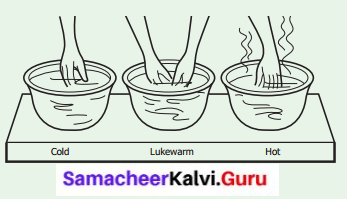
Samacheer Kalvi 6th Science Solutions Term 2 Chapter 1 Heat 1
Set them in a row on the table, with the lukewarm water in the center. Place your right hand in the cold water, and your left hand in the hot water. Keep them in for a few minutes. Then take them out, shake off the water, and put both into the middle bowl. How do they feel?
Answer:
I feel that my right hand’s coldness is changed into warm condition because my right hand’s temperature is increased.
I feel that my left hand’s heat is decreased and it is also in warm condition. Here, my left hand’s temperature is decreased.

Samacheer Kalvi 6th Science Solutions Term 2 Chapter 1 Heat

Activity 2

Question 1.
The Temperature of Boiling Water.
Take water in a vessel and place the vessel on a stove. Fix the thermometer as shown in figure (Caution: The thermometer should not touch the vessel in which the water is being heated. Otherwise the thermometer will be broken at high temperature.)
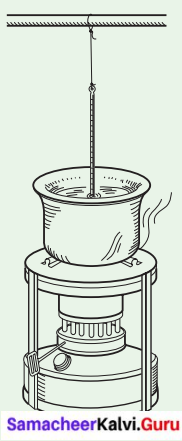
Samacheer Kalvi 6th Science Solutions Term 2 Chapter 1 Heat 2
All students have to read the temperature of the water and note the reading on the blackboard. Do you notice that the temperature is rising?
What is the temperature of the water when it is boiling? _______
Answer:
The temperature of the water when boiling is 100°C.

Question 2.
Does the temperature of the boiling water rise further after that?
Answer:
No. the temperature of the boiling water does not rise further after 100°C.

Guess and Write:
(Check your assumption with the help of a thermometer.)
The approximate temperature of the tea when you drink ________
The approximate temperature of cool lemon juice when you drink ________
Answer:
The approximate temperature of the tea when you drink 70°C.
The approximate temperature of cool lemon juice when you drink 20°C.

Question 3.
Is Neela correct?
Beaker A and B have water at 80°C. Then pour the water of A and B to an empty beaker C. Now, What is the A temperature of the water in the beaker C? Neela says it will be 160°C.
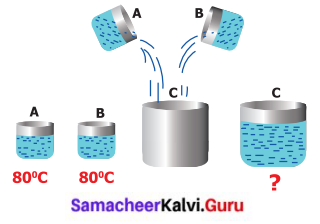
Samacheer Kalvi 6th Science Solutions Term 2 Chapter 1 Heat 3
What is your opinion? Does Neela say correctly? Make a guess and verify it experimentally.
Answer:
My opinion is that the temperature will not change. Approximately it will be 80°C only. Neela’s answer is wrong.
Beaker A and Beaker B have water at 80°C. So both beaker has 80°C temperature. Two beakers are in thermal equilibrium. So heat is not transferred to other objects.

Samacheer Kalvi 6th Science Solutions Term 2 Chapter 1 Heat

Activity 3

Question 1.
Take one litre of water in a pan, and heat it on a stove. Calculate the time taken to start boiling, (i.e. the time taken to thermometer reading goes up to 100°C). Take five-liter water in another pan and heat it on the same stove. Calculate the time taken by the water to start boiling.
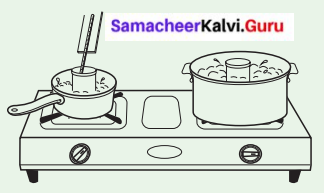
Samacheer Kalvi 6th Science Solutions Term 2 Chapter 1 Heat 4
In which pan the water starts to boil earlier?
[ ] One litre water
[ ] Five litre water.
Answer:
[✓] One litre water

Question 2.
Both, however, show a temperature of 100°C at the boiling point. Five-liter water takes more time to boil i.e. more heat is needed to boil the larger amount of water. So, five-liter boiling water has more heat energy than one litre water. Place an open can of lukewarm water in each pan. Observe their temperature to find out which can get hotter.
In which can water show a quick rise in temperature?
[ ] Can in One litre boiled water
[ ] Can in five-liter boiled water.
Answer:
[✓] Can in five-liter boiled water.

Question 3.
You can see that the five-liter water pan will raise the can of water to a higher temperature. Though, both pans of boiling water have a temperature of 100°C the five-liter water can give off more heat energy than one liter water. Because it has more heat energy and gives more energy to the water in the can.
Which has more heat energy in each pair? Put ✓ mark.
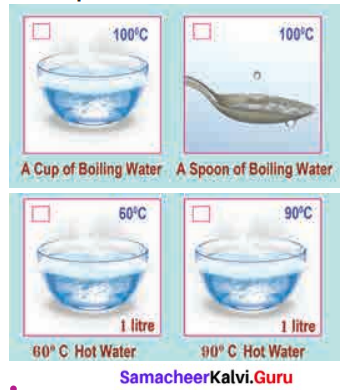
Samacheer Kalvi 6th Science Solutions Term 2 Chapter 1 Heat 5
The temperature determines the direction of flow of heat.

Question 1.
You are holding a hot cup of coffee, would the Heat energy transfer from

Samacheer Kalvi 6th Science Solutions Term 2 Chapter 1 Heat 6
(a) Your body to the coffee, or
(b) The coffee to your body?
Answer:
(b) The coffee to your body

Question 2.
You are standing outside on a summer day. It is 40°C outside (note that normal body temperature is 37°C). Would the Heat energy transfer from.
Samacheer Kalvi 6th Science Solutions Term 2 Chapter 1 Heat 7
(a) Your body to the air particles, or
(b) The air particles to your body?
Answer:
(b) The air particles to your body

Question 3.
You are standing outside on a winter day. It is 23°C outside. Would the heat’ energy transfer from:

Samacheer Kalvi 6th Science Solutions Term 2 Chapter 1 Heat 8
(a) Your body to the air particles, or
(b) The air particles to your body?
Answer:
(a) Your body to the air particles

Samacheer Kalvi 6th Science Solutions Term 2 Chapter 1 Heat

Activity 4
Hammer a nail into a tin can. Ease the nail out. Put it in again to make sure that the hole is large enough for the nail. Then, holding the nail with a pair of pliers, scissors, or forceps, heat the nail over a candle, in hot water, or over the stove. Try to put it into the hole in the can.
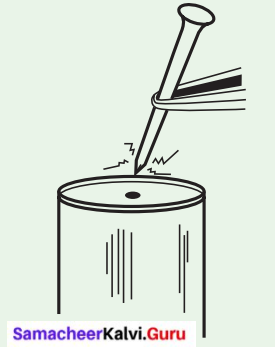
Samacheer Kalvi 6th Science Solutions Term 2 Chapter 1 Heat 9
I see that: ________________________________
Answer:
I will see that, now it is hard to put the nail into the hole. Heat expands solids.
The molecules in the solid move faster, spread apart and occupy more space.

Activity 5

Question 1.

Linear Expansion
Take a bulb, dry cell, candle, cycle spoke, coin (or broad-headed nail), and two wooden blocks.

Place one end of the cycle spoke on a wooden block and connect an electric wire to it. Put a stone over the spoke) to hold it firmly in place on the wooden block, as shown in Figure. The spoke should be parallel to the ground. Place the second wooden block under the free end of the spoke. Wrap some electric wire around the coin (or nail) and place it on the block. You may put a stone over the coin to hold it in place.
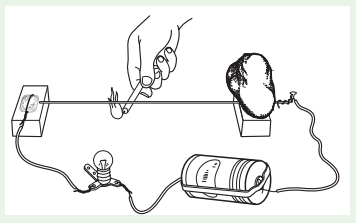
Samacheer Kalvi 6th Science Solutions Term 2 Chapter 1 Heat 10
Connect a bulb and dry cell to the free ends of the wires connected to the coin and the spoke and make the circuit shown in the figure.

When the tip of the free end of the spoke touches the coin, the circuit is completed and the bulb lights up. Check to ensure this. If the bulb does not light up, it means the circuit is not complete, so check your connections properly. (Note: We will learn about electric circuit elaborately in electricity lesson.) Now slide a page of your book between the coin and spoke and then slide it out. That way you would get a gap between the coin and spoke equal to the thickness of the sheet of paper,

  1. Does the bulb light up? If it does not, what could be the reason? ___________________
    You saw that the bulb does not light up when the spoke does not touch the coin. Now light the candle and heat the spoke with it.
  2. Did the bulb light up after the spoke was heated for some time?
  3. If it did, then explain how the spoke touched the coin after it was heated.
  4. Why does the bulb go off sometime after the candle is taken away from the spoke?
  5. What happens to the length of the spoke when it is heated or cooled?

Answer:

  1. The bulbs are not light up, because, the coin and the spoke do not touch it. The circuit is not completed.
  2. Yes, the bulb is light up, because the spoke is heated the circuit is completed.
  3. When the spoke is heated, it will be expanded. Here, linear expansion takes place. So it touched the coin.
  4. After removing the candle, the spoke does not get the heat.
  5. The spoke is returned to its original state. So it does not touch the coin once again and the bulb goes off.
  6. The length of the spoke is expanded when the spoke is heated.

Samacheer Kalvi 6th Science Solutions Term 2 Chapter 1 Heat

Activity 6

Question 1.
Cubical Expansion
Take a metal ring and metal ball of such size that the ball just passes through the ring.
Heat the ball and check whether it passes through the ring.
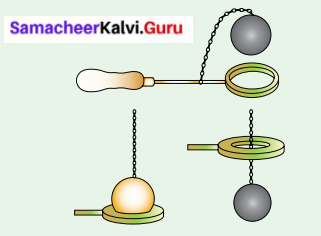
Samacheer Kalvi 6th Science Solutions Term 2 Chapter 1 Heat 11
[ ] Passed through
[ ] Not passed through
Answer:
[✓] Not passed through

Question 2.
Now let the ball cool down, and check whether it passes through the ring.
[ ] Passed through
[ ] Not passed through
Answer:
[✓] passed through
Solids expand due to heat and come back to the original state if heat is removed.

Give Reasons for the following

Question 1.
Gaps are left in between rails while laying a railway track.
Answer:
Samacheer Kalvi 6th Science Solutions Term 2 Chapter 1 Heat 12
On summer days, the temperature rises and the rails expand. So, in order to allow expansion at the joints of the rails, a small gap is left in between the rails, while laying a railway track. If such a gap is not left at the joints of the rails, the track will get deformed due to thermal expansion. It will cause the derailment of trains.

Question 2.
Gaps are left in between two joints of a concrete bridge.
Answer:
Samacheer Kalvi 6th Science Solutions Term 2 Chapter 1 Heat 13
The gaps in the concrete bridges are known as expansion joints, Expansion joints are basically gaps in the bridge that allow the bridge to expand (during summer) and contract (during winter). Without these gaps, the bridge will fall apart.

Question 3.
The photographs below show an expansion joint at the end of a bridge in winter and in summer. Which season is shown in each picture? Explain how do you know?
Samacheer Kalvi 6th Science Solutions Term 2 Chapter 1 Heat 14
Answer:
Bridges are made of concrete and steel. These components expand with higher temperature during summer and the gap is minimized in between the joints. So, the summer season is shown in Picture B.

During winter, the components (concrete and steel) contract due to lower temperatures. Therefore the gap is at maximum in between the joints. So, winter season is shown in Picture A.

Samacheer Kalvi 6th Science Solutions Term 2 Chapter 1 Heat

Samacheer Kalvi 6th Science Heat Numerical problems

Question 1.
I put a kettle containing 1 litre of cold water on the gas stove, and it takes 5 minutes to reach the boiling point. My friend puts on a small electric kettle, containing 1/2 litre of cold water, and it takes 5 minutes to get up to a boiling point. Which gives more heat in 5 minutes?
a. the gas supply; or
b. the electricity supply? Can you say how many times as much?
Answer:
The gas supply, Two times as much.

Question 2.
One calorie heat energy is needed to raise the temperature of the water from 30°C to 31°C. How much heat energy is needed to raise the temperature of the water from 30°C to 35°C.
Answer:
For 1°C change in temperature, heat energy needed = 1 Calorie
∴ For 5°C change in temperature heat energy needed = 5 Calories.

Samacheer Kalvi 6th Science Heat Additional Questions

I. Choose, the appropriate answer:

Question 1.
We reduce the heat by adding ________ while preparing fruit juice.
(a) sugar
(b) lime
(d) ice cubes
(d) salt
Answer:
(c) ice cubes

Question 2.
The SI unit of temperature is ………..
(a) Calorie
(b) Joule
(c) Celsius
(d) Kelvin
Answer:
(d) Kelvin

Question 3.
Our normal body temperature is _______
(a) 34°C
(b) 36°C
(c) 35°C
(d) 37°C
Answer:
(d) 37°C

Question 4.
Two tumblers of A and B have water at 50°C temperature. If the water from A and B is poured into tumbler C. The temperature of C is ………….
(a) 100° C
(b) 0° C
(c) 50° C
(d) between 0° C to 100° C
Answer:
(c) 50°

Question 5.
______ exists when two objects In thermal contact no longer affect each other’s temperature.
(a) Thermal expansion
(b) Thermal equilibrium
(c) average temperature
(d) coolness
Answer:
(b) Thermal equilibrium

II. Fill in the blanks:

  1. We feel the heat on our body when the _______ shines.
  2. _______ energy can be generated by the burning of fuels like coal, wood, charcoal, gasoline etc.
  3. When _______ flows through a conductor, heat energy is produced.
  4. _______ is a form of energy.
  5. _______ determines the direction of the flow of heat.
  6. The coldest temperature in the world was measured in the _______ continent.
  7. Temperature measures the _______ kinetic energy of molecules.

Answers:

  1. Sun
  2. Heat
  3. Electric current
  4. Heat
  5. Temperature
  6. Antarctic
  7. average

Samacheer Kalvi 6th Science Solutions Term 2 Chapter 1 Heat

III. True or False. If False, give the correct statement:

Question 1.
The sun gives us light and heat.
Answer:
True

Question 2.
We can absorb heat by rubbing two surfaces of some substances .
Answer:
False. We can generate heat by rubbing two surfaces of some substances.

Question 3.
In the past, people used to rub two wooden pieces together to light fire.
Answer:
False. In the past, people used to rub two stones together to light fire.

Question 4.
When we cool the object the temperature of the object will be increased.
Answer:
False. When we heat the object the temperature of the object will be increased.

Question 5.
Two objects are said to be in thermal contact if they can exchange heat energy.
Answer:
True.

Question 6.
The expansion in volume is called linear expansion.
Answer:
False. The expansion in length is called linear expansion.

Samacheer Kalvi 6th Science Solutions Term 2 Chapter 1 Heat

IV. Match the following:

1. Source of heat (a) heat energy
2. Electric current (b) calorie
3. Gasoline (c) 37°C
4. Unit of heat (d) Electric kettle
5. Human body temperature (e) sun

Answer:

  1. – e
  2. – d
  3. – a
  4. – b
  5. – c.

Samacheer Kalvi 6th Science Solutions Term 2 Chapter 1 Heat

V. Analogy:

Question 1.
Movement of molecules : Heat.
Heat energy: _______
Answer:
calorie

Question 2.
Expansion is length : Linear expansion.
Expansion in volume : _______
Answer:
cubical expansion

Question 3.
Ordinary glass : Glass tumbler.
Pyrex glass: _______
Answer:
Laboratory glassware.

VI. Give Short Answers:

Question 1.
How can heat energy be generated?
Answer:
Heat energy can be generated by the burning of fuels like wood, Kerosene, Coal, charcoal, gasoline/petrol, oil, etc.

Question 2.
What is heat? Give its units.
Answer:

  1. Heat is an energy that raises the temperature of a thing by causing the molecules in that thing to move faster.
  2. Units are Joule, Calorie.

Question 3.
What are the units of heat used?
Answer:
SI unit of heat is Joule. The unit calorie is also used.

Question 4.
Define one calorie.
Answer:

  1. Total heat is measured by calorie.
  2. The amount of heat needed to raise one gram of water by one degree centigrade.

Question 5.
Define – Calorie.
Answer:
The amount of heat needed to raise one gram of water by one degree Centigrade.

Question 6.
What is thermal expansion?
Answer:
The expansion of a substance on heating is called the thermal expansion of that substance.

Question 7.
Differentiate linear expansion and cubical expansion.
Answer:
Linear expansion:

  1. The expansion is in length.
  2. Ex.: Expansion of railway track rod.

Cubical expansion:

  1. The expansion is in volume.
  2. Ex.: Expansion of metal ball.

Question 8.
How solids are expanded on heating?
Answer:
The molecules in the substance move faster when heating, spread apart and occupy more space. So substances expand when heated.

Question 9.
How heat energy is transferred?
Answer:
Heat energy flows from higher temperature to lower temperature.

Question 10.
What type of glassware is used in laboratories? Why?
Answer:
Pyrex glass is used in Laboratory because pyrex glass (Borosilicate glass) do not expand much on being heated and therefore they do not crack.

Samacheer Kalvi 6th Science Solutions Term 2 Chapter 1 Heat

VII. Answer in detail.

Question 1.
List and describe the sources of heat.
Answer:

  1. Sun: It is the primary source of light and it gives us light and heat.
  2. Combustion: Heat energy can be generated by the burning of fuels like wood, Kerosene, Coal, Charcoal, Petrol, etc.
  3. Friction: We can generate heat by rubbing two surfaces of some substances.
  4. In the past, people used to rub two stones together to light fire.
  5. Electricity: When Electric current flows through a conductor, heat energy is produced. Ex.: Iron box, Electric kettle.

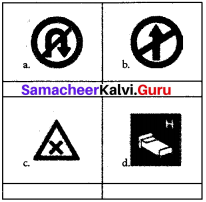
Samacheer Kalvi 6th Science Solutions Term 2 Chapter 1 Heat Read More »

Samacheer Kalvi 6th Science Solutions Term 1 Chapter 7 Computer – An Introduction

You can Download Samacheer Kalvi 6th Science Book Solutions Guide Pdf, Tamilnadu State Board help you to revise the complete Syllabus and score more marks in your examinations.

Tamilnadu Samacheer Kalvi 6th Science Solutions Term 1 Chapter 7 Computer – An Introduction

Samacheer Kalvi 6th Science Computer – An Introduction Textual Evaluation

I. Choose the Correct answer.

Question 1.
Who is the father of Computer?
(a) Martin Luther King
(b) Graham Bell
(c) Charlie Chaplin
(d) Charles Babbage
Answer:
(d) Charles Babbage

Question 2.
Which of the following is another form of computer?
a. Blackboard
b. Mobile
c. Radio
d. Book
Answer:
b. Mobile

Question 3.
When was the first computer introduced?
(a) 1980
(b) 1947
(c) 1946
(d) 1985
Answer:
(c) 1946

Question 4.
Who is the computer’s first programmer?
a. Lady Wellington
b. Augusta ado Lovelace
c. Mary Curie
d. Mary Comb
Answer:
b. Augusta ado Lovelace

Question 5.
Pick out the odd one.
(a) Calculator
(b) Abacus
(c) Flash card
(d) Laptop
Answer:
(c) Flash card

Samacheer Kalvi 6th Science Solutions Term 1 Chapter 7 Computer - An Introduction

II. Fill in the blanks.

  1. Data is ______ information.
  2. World’s first general purpose computer is ______
  3. Information is ______ data.
  4. Fifth generation computer had ______ intelligence.
  5. ______ is the device that uses Index number.

Answers:

  1. unprocessed
  2. Abacus
  3. Processed
  4. artificial
  5. Analog Computer

Samacheer Kalvi 6th Science Solutions Term 1 Chapter 7 Computer - An Introduction

III. State True or False.

Question 1.
Computer is an Electronic device.
Answer:
True

Question 2.
Sir Isaac Newton invented Computer.
Answer:
False. Charles Babbage invented Computer.

Question 3.
Computer can do calculations fast.
Answer:
True

Samacheer Kalvi 6th Science Solutions Term 1 Chapter 7 Computer - An Introduction

IV. Match the following.

1. First generation Computer a. Artificial Intelligence
2. Second generation Computer b. Integrated Circuit
3. Third generation Computer c. Vacuum tubes
4. Fourth generation Computer d. Transistor
5. Fifth generation computer e. Micro processor

Answer:

  1. c
  2. d
  3. b
  4. e
  5. a

Samacheer Kalvi 6th Science Solutions Term 1 Chapter 7 Computer - An Introduction

V. Answer the following.

Question 1.
What is a computer?
Answer:
The computer is an electronic device that processes data and information according to our needs. We can save the data and convert it into information.

Question 2.
Who are the pioneers/forerunners of a computer?
Answer:
Charles Babbage and Augusta Ada Lovelace are the pioneers/forerunners of the computer.

Question 3.
Write a short note on Data.
Answer:
Data is the information that has to be processed. Generally, data are in the form of numbers, alphabet, and images.

Question 4.
Name any four input devices.
Answer:
Keyboard, Mouse, Scanner and Web camera, etc.

Question 5.
Differentiate Hardware and Software
Answer:
Hardware:

  1. It is available on the computer.
  2. It helps the software to work.

Software:

  1. It is used to run a particular program.
  2. It is used for painting, playing on the computer.

Samacheer Kalvi 6th Science Solutions Term 1 Chapter 7 Computer - An Introduction

VI. Answer in detail.

Question 1.
Explain in detail the Applications of computers.
Answer:

  1. Computers are used in textile shops, Railway stations, Banks, ATM’s and in many places.
  2. Computers are used to draw, paint and play games
  3. Computers help to learn and develop general knowledge
  4. Computers are used in various fields such as Business, Education, Medical, Science, Communication.
  5. It helps to collect data and information.

Samacheer Kalvi 6th Science Solutions Term 1 Chapter 7 Computer - An Introduction

Samacheer Kalvi 6th Science Computer – An Introduction Additional Questions

I. Fill in the blanks.

  1. ______ is also a computer.
  2. Computers are available in ______
  3. ______ and ______ are different types of computers.

Answers:

  1. Smartphone
  2. different shapes
  3. Laptops and tablets

Samacheer Kalvi 6th Science Solutions Term 1 Chapter 7 Computer - An Introduction

II. Short Answers.

Question 1.
Mention the two types of software.
Answer:

  1. Operating software
  2. Application software

Question 2.
Give any two examples of operating software.
Answer:
Windows and Linux are operating software.

Question 3.
Mention any two output devices.
Answer:
Printers and Monitors are output devices.

Samacheer Kalvi 6th Science Solutions Term 1 Chapter 7 Computer – An Introduction Read More »

Samacheer Kalvi 6th Science Solutions Term 1 Chapter 2 Force and Motion

You can Download Samacheer Kalvi 6th Science Book Solutions Guide Pdf, Tamilnadu State Board help you to revise the complete Syllabus and score more marks in your examinations.

Tamilnadu Samacheer Kalvi 6th Science Solutions Term 1 Chapter 2 Force and Motion

Samacheer Kalvi 6th Science Force and Motion Textual Evaluation

I. Choose the correct answer.

Question 1.
Unit of speed is
(a) m
(b) s
(c) kg
(d) m/s
Answer:
(d) m/s

Question 2.
Oscillatory motion among the following is
a. Rotation of the earth about its axis
b. Revolution of the moon about the earth
c. To and fro movement of a vibrating string
d. All of these.
Answer:
c. To and fro movement of a vibrating string

Question 3.
The correct relation among the following is
(a) Speed = distance × time
(b) speed = distance / time
(c) Speed = time / distance
(d) speed = 1/ (distance × time)
Answer:
(b) speed = distance / time

Question 4.
Gita rides with her father’s bike to her uncle’s house which is 40 km away from her home. She takes 40 minutes to reach there.
Statement 1 : She travels with a speed of 1 km/minute
Statement 2: She travels with a speed of 1 km/hour
a. Statement 1 alone is correct.
b. Statement 2 alone is correct
c. Both statement 1 and 2 are correct.
d. Neither statement 1 nor statement 2 is correct.
Answer:
a. Statement 1 alone is correct.

Samacheer Kalvi 6th Science Solutions Term 1 Chapter 2 Force and Motion

II. Find whether the following statements are true or false. – if false give the correct answer.

Question 1.
To and fro motion is called oscillatory motion.
Answer:
True.

Question 2.
Vibratory motion and rotatory motion are periodic motions.
Answer:
False.
Vibratory motion and oscillatory motion are periodic motions.

Question 3.
Vehicles moving with varying speeds are said to be in uniform motion.
Answer:
False.
Vehicles moving with varying speeds are said to be in non-uniform motion.
(OR)
Vehicles moving with uniform speeds are said to be in uniform motion.

Question 4.
Robots will replace humans in the future.
Answer:
False. Robots will not replace humans in the future.

Samacheer Kalvi 6th Science Solutions Term 1 Chapter 2 Force and Motion

III. Fill in the blanks.

  1. A bike moving on a straight road is an example of _______ motion.
  2. Gravitational force is a _______ force.
  3. The motion of a potter’s wheel is an example of _______ motion.
  4. When an object covers equal distances in equal interval of time, it is said to be in _______ motion.

Answers:

  1. Linear
  2. Non-Contact Force
  3. rotatory
  4. uniform

IV. Match the following
Samacheer Kalvi 6th Science Solutions Term 1 Chapter 2 Force and Motion 1
Samacheer Kalvi 6th Science Solutions Term 1 Chapter 2 Force and Motion 25
Answers:

  1. c
  2. d
  3. b
  4. a
  5. e

Samacheer Kalvi 6th Science Solutions Term 1 Chapter 2 Force and Motion

V. Analogy

Question 1.
kicking a ball: contact force :: falling of leaf: ________?
Answer:
Noncontact force.

Question 2.
Distance : metre :: speed : _______ ?
Answer:
metre/second.

Question 3.
circulatory motion :: a spinning top :: oscillatory motion : _______ ?
Answer:
Swinging of a pendulum.

Samacheer Kalvi 6th Science Solutions Term 1 Chapter 2 Force and Motion

VI. Given below Is the distance-traveled by an elephant across a forest with uniform speed. Complete the data of the table given below with the idea of uniform speed.
Samacheer Kalvi 6th Science Solutions Term 1 Chapter 2 Force and Motion 2
Answer:
Samacheer Kalvi 6th Science Solutions Term 1 Chapter 2 Force and Motion 3
(i) Distance/Time = \(\frac { 4 }{ 2 } \) × 4 = \(\frac { 16 }{ 22 } \) = 8
(ii) Distance / Time = \(\frac { 4 }{ 2 } \) × 8 = \(\frac { 32 }{ 2 } \) = 16
(iii) Time/Distance = \(\frac{1 \emptyset}{2 \emptyset}\) × 12 = \(\frac { 12 }{ 2 } \) = 6

VII. Complete the web chart.
Samacheer Kalvi 6th Science Solutions Term 1 Chapter 2 Force and Motion 4
Answer:
Samacheer Kalvi 6th Science Solutions Term 1 Chapter 2 Force and Motion 5

VIII. Give one word for the following statements.

Question 1.
The force acts on an object without physical contact with it.
Answer:
non-contact forces.

Question 2.
A change in the position of an object with time.
Answer:
Motion.

Question 3.
The motion repeats itself after a fixed interval of time.
Answer:
Oscillatory motion.

Question 4.
The motion of an object travels equal distances in equal intervals of time.
Answer:
Uniform motion.

Question 5.
A machine capable of carrying out a complex series of actions automatically.
Answer:
Artificial intelligence.

Samacheer Kalvi 6th Science Solutions Term 1 Chapter 2 Force and Motion

IX. Answer the following in a sentence or two.

Question 1.
Define force.
Answer:
Force is a push or pull by an animate or inanimate agency.

Question 2.
Name different types of motion based on the path.
Answer:

  1. Linear motion;
  2. Curvilinear;
  3. Circular motion;
  4. Rotatory motion;
  5. Oscillatory motion
  6. Irregular motion.

Question 3.
If you are sitting in a moving car, will you be at rest or motion with respect to your friend sitting next to you?
Answer:
I will be at rest with respect to my friend sitting with me in a moving car.

Question 4.
The rotation of the earth is a periodic motion. Justify
Answer:
Rotation of the earth is a periodic motion because it takes an equal interval of time for all rotations.

Question 5.
Differentiate between rotational and curvilinear motion.
Answer:
Rotational motion:
The movement of a body about its own axis
Ex: Rotating tape

Curvilinear motion:
Movement of a body along a curved path
Ex. Throwing a ball.

Samacheer Kalvi 6th Science Solutions Term 1 Chapter 2 Force and Motion

X. Calculate

Question 1.
A vehicle covers a distance of 400 km in 5 hours. Calculate its average speed.
Answer:
Distance covered by the vehicle = 400 km
Time taken = 5 hour
Samacheer Kalvi 6th Science Solutions Term 1 Chapter 2 Force and Motion 6

XI. Answer in detail.

Question 1.
What is motion? Classify different types of motion with examples.
Answer:
Motion is a change in the position of an object with respect to time.
Types of motion based on the path:

  1. Linear motion: moving in a straight line, like a person walking on a straight path.
  2. Curvilinear motion: moving ahead by changing direction like a throwing ball.
  3. Circular motion: moving in a circular path. Ex. Swirling store tied to the rope.
  4. Rotatory motion: The movement of a body about its own axis. Ex. Revolution of the earth around the sun.
  5. Oscillatory motion: Coming back to the same position after a fixed time interval. Ex pendulum.
  6. Zigzag (irregular): like the motion of a bee or people walking in a crowded street.

Motion-based on duration:
Periodic motion: motion repeated in equal intervals of time. Ex. Revolution of the moon around the earth.
Nonperiodic motion: motion is not repeated in equal interval Ex. Sabing swing.

Motion-based on speed :
Uniform motion: The object covers the uniform distance in uniform intervals.
Non- uniform motion: if an object covers different distances at different intervals of times. Ex. The motion of a vehicle.

Samacheer Kalvi 6th Science Solutions Term 1 Chapter 2 Force and Motion

XII. Fill with examples.
Samacheer Kalvi 6th Science Solutions Term 1 Chapter 2 Force and Motion 7
Answer:
Samacheer Kalvi 6th Science Solutions Term 1 Chapter 2 Force and Motion 8

Samacheer Kalvi 6th Science Force and Motion Intext Activities

Activity – 1

Can you identify whether it is push or pull that results in motion in the following cases?
Samacheer Kalvi 6th Science Solutions Term 1 Chapter 2 Force and Motion 9
Event 2:
The girl on the swing is moving with respect to the seat of the swing.
She is at rest with respect to the garden.

Event 3:
Nisha is going to her grandmother’s house by bicycle The girl on the bicycle is moving with respect to the road.
She is at rest with respect to the bicycle.

Activity – 2

Moon or Cloud?
Observe the moon on a windy night with a fair bit of cloud cover in the sky. As a cloud passes in front of the moon you sometimes think it is the moon which is moving behind the cloud. What would you think if you were to observe a tree at the same time?
Samacheer Kalvi 6th Science Solutions Term 1 Chapter 2 Force and Motion 10
Answer:
Activity to be done by the students themselves

Activity – 3

Fill in the empty spaces.
Samacheer Kalvi 6th Science Solutions Term 1 Chapter 2 Force and Motion 11
Answer:
Samacheer Kalvi 6th Science Solutions Term 1 Chapter 2 Force and Motion 12

Can you give example for contact and non-contact forces?
Samacheer Kalvi 6th Science Solutions Term 1 Chapter 2 Force and Motion 13
Answer:
Samacheer Kalvi 6th Science Solutions Term 1 Chapter 2 Force and Motion 14

Activity – 4
Play with a pencil
Please do what Shanthi did…

  1. Shanthi took a pencil and sharpened it with a sharpener.
  2. Then she drew a circle using the pencil and a compass.
  3. Later she took her ruler (scale) and drew a straight line in another paper.
  4. Then she kept the pencil between her finger and moved it back and forth.

Samacheer Kalvi 6th Science Solutions Term 1 Chapter 2 Force and Motion 15

Now, look at the motion of the pencil in all these four cases. How was it?

  1. In the first case, the pencil rotated in its axis.
  2. In the second case, it went in a circle.
  3. In the third case, the pencil travelled in a straight line.
  4. The fourth case, the pencil tip moved back and forth, that is it oscillated like a swing.

Samacheer Kalvi 6th Science Solutions Term 1 Chapter 2 Force and Motion

Activity – 5
Samacheer Kalvi 6th Science Solutions Term 1 Chapter 2 Force and Motion 16

Activity – 6
Classify the following according to the path it takes.

Linear, Curvilinear, Circular, Rotatory, Oscillatory, Zigzag (irregular)

  • A sprinter running a 100 m race – Linear Motion
  • A coconut falling from a tree – Linear Motion
  • striking a coin in a carom board game – Zigzag Motion
  • Motion of flies and mosquitoes – Zigzag Motion
  • Beating of heart – Oscillatory Motion
  • Children playing in a swing – Oscillatory Motion
  • The tip of hands of a clock – Rotatory Motion
  • Flapping of elephant’s ears – Oscillatory Motion
  • A stone is thrown into the air at an angle – Curvilinear Motion
  • Movement of people in a bazaar – Zigzag Motion
  • Athlete running around a track – Circular Motion
  • Revolution of the moon around the earth – Circular Motion
  • The movement of a ball kicked in a football match – Curvilinear Motion
  • Motion of a spinning top – Rotatory Motion
  • Revolution of the earth around the sun – Circular Motion
  • Swinging of a pendulum – Oscillatory Motion
  • Children skidding on a sliding board – Linear Motion
  • Skidding down a playground slide – Zigzag Motion
  • Wagging tail of a dog – Oscillatory Motion
  • Flapping of a flag in wind – Oscillatory Motion
  • A car driving around a curve – Circular Motion
  • Woodcutter cutting with a saw – Linear Motion
  • Motion of water wave – Oscillatory Motion
  • Motion of piston inside a syringe – Linear Motion
  • Bouncing ball – Oscillatory Motion

add five motions you observe to this list:

  • Falling fruits from the tree – Linear Motion
  • Ceiling fan running – Rotatory Motion
  • Car running on the straight road – Linear Motion
  • Swirling stone tied to the rope – Circular Motion
  • Motion of sewing machine needle – Oscillatory Motion

Samacheer Kalvi 6th Science Solutions Term 1 Chapter 2 Force and Motion

Activity
Samacheer Kalvi 6th Science Solutions Term 1 Chapter 2 Force and Motion 17
Answer:
The Taxi driver travelled at the highest speed.

How do we say? Let us calculate how long they travelled in One Hour?
Distance travelled by Car in One Hour = 80 km (160 ÷ 2)
Distance travelled by the Bus in One Hour = 50 km (200 ÷ 4)
Distance travelled by Truck in One Hour = 60 km (300 ÷ 5)

Have you found out? say now.
Fastest Taxi, Slowest Bus.

Samacheer Kalvi 6th Science Solutions Term 1 Chapter 2 Force and Motion

Our speed…

Let us play a small game. Go to the playground with your friends. Mark 100 metre distance for a race. Conduct a friendly running race and calculate the time they took to complete the distance by stopwatch. Now fill up the following table.
Samacheer Kalvi 6th Science Solutions Term 1 Chapter 2 Force and Motion 20

Compute the following Numerical Problems.

  1. If you travel 10 kilometres in 2 hours, your speed is 5 km per hour. (10 km/2 hours)
  2. If you travel 15 kilometres in 1/2 hour, you would travel 30 km in one hour, and your speed is 30 km per hour. (15 km × 2/1 hours)
  3. If you run fast at 20 kilometres per hour for 2 hours, you will cover 40 km. (20 km × 2 hours)

Activity

Multiple Motion to a Sewing Machine
Samacheer Kalvi 6th Science Solutions Term 1 Chapter 2 Force and Motion 21

The motion of the needle
Periodic (or) Oscillatory motion

The motion of the wheel
Rotatory motion

Motion of footrest
Oscillatory motion

Samacheer Kalvi 6th Science Solutions Term 1 Chapter 2 Force and Motion

Activity – 7

Simple Spinner

Let us enjoy by making a simple spinner. Make it by the following instruction.

Cut a 2cm long piece from an old ball-pen refill and make a hole in its center with a divider point (Fig 1).
Samacheer Kalvi 6th Science Solutions Term 1 Chapter 2 Force and Motion 22
Take a thin wire of length 9cm and fold it into a U-shape (Fig 2).

Weave the refill spinner in the U-shaped wire (Fig 3).

Wrap the two ends of the wire on the plastic refill, leaving enough clearance for the spinner to rotate (Fig 4).

On blowing through the refill, the spinner rotates (Fig 5).

For obtaining maximum speed – adjust the wires so that air is directed towards the ends of the spinner.

Have you enjoyed with a simple spinner? Do you observe the motions in the toy? Can you answer the following question?

  1. Motion of the air in tube is _____________ motion.
  2. Motion of the refill stick _____________ motion.
  3. The toy converts _____________ motion into _____________ motion.

Answers:

  1. Linear
  2. Rotatory
  3. Linear, Rotatory

Samacheer Kalvi 6th Science Solutions Term 1 Chapter 2 Force and Motion

Samacheer Kalvi 6th Science Force and Motion Additional Questions

I. Choose the correct answer:

Question 1.
_______ is an ancient Indian astronomer.
(a) C.V. Raman
(b) Aryabhata
(c) Usain Bolt
(d) Edison
Answer:
(b) Aryabhata

Question 2.
What is the path of the housefly buzzing around the room?
(a) Periodic motion
(b) Non- Periodic motion
(c) circular motion
(d) None of the above
Answer:
(b) Non- Periodic motion

Question 3.
Identify the Periodic motion among the following :
(a) a horse running in a race
(b) the revolution of the moon around the earth
(c) a coconut falling from a tree
(d) paper flight moving
Answer:
(b) the revolution of the moon around the earth

Question 4.
The cheetah the fastest animal among terrestrial animals run with an average speed of
(a) 100 km /hr
(b) 200 km/hr
(c) 112 km/hr
(d) 10 km /hr.
Answer:
(c) 112 km/hr

Question 5.
_______ are robots scaled down to microscopic size in order to put them into very small spaces to perform a function.
(a) Car robots
(b) Home robots
(c) Game robots
(d) Nanobots
Answer:
(d) Nanobots

Question 6.
A _______ is the fastest land animal.
(a) Horse
(b) Lion
(c) Cheetah
(d) Tiger
Answer:
(c) Cheetah

Question 7.
A cheetah can run with an average speed of _______
(a) 112 km/h
(b) 121 km/h
(c) 211 km/h
(d) 122 km/h
Answer:
(a) 112 km/h

Samacheer Kalvi 6th Science Solutions Term 1 Chapter 2 Force and Motion

II. Find whether the following sentences are true or false. If false Correct the statement.

Question 1.
Motion occurs when the object is pulled or pushed by an agency.
Answer:
True.

Question 2.
Force executed by touching the body is called non – contact force.
Answer:
False. Force executed by touching the body is called contact force.

Question 3.
Gravity pushes the ripen coconut from the tree to the ground.
Answer:
False. Gravity pulls the ripen coconut from the tree to the ground.

Question 4.
Throwing paper aeroplane is the best example of linear motion.
Answer:
False. Throwing paper aeroplane is the best example of curvilinear motion.

Question 5.
The movement of a body about its own axis like a rotating top is linear motion.
Answer:
False. The movement of a body about its own axis like a rotating top is Rotatory

Question 6.
Motion repeated in equal intervals of time is called as periodic motion.
Answer:
True.

Samacheer Kalvi 6th Science Solutions Term 1 Chapter 2 Force and Motion

III. Fill in the blanks.

  1. _________ are push or pull by an animate or inanimate agency.
  2. Application of force in an object results in motion from a state of _________
  3. Fast oscillations are referred to as _________
  4. Motion repeated in equal intervals of time is called _________
  5. _________ are automatic machines.
  6. The term Robots comes from a tech word _________
  7. _________ is die study of robots in science.

Answers:

  1. Forces
  2. rest
  3. vibrations
  4. periodic motion
  5. Robots
  6. robota
  7. Robotics

Samacheer Kalvi 6th Science Solutions Term 1 Chapter 2 Force and Motion

IV. Complete the web chart.
Samacheer Kalvi 6th Science Solutions Term 1 Chapter 2 Force and Motion 23
Answer:

  • A – In animate factors,
  • B – Contact forces.

V. Answer the following in one or two sentences.

Question 1.
What is meant by the State of Rest?
Answer:
When there is no change of position of an object with respect to time and if it remains stationary it is called rest.

Question 2.
What is a non-contact force?
Answer:
The force applied without touching the object is known as non-contact force.

Question 3.
What is the contact force?
Answer:
When the force is in contact with the object then it is known as contact force.

Question 4.
Give the properties of force.
Answer:

  1. Forces can change the state of a body from rest to motion or motion to rest.
  2. Forces can change the shape of the body.

Question 5.
A bus moves with a speed of 40 km and crosses 200 km and then how many hours has that bus taken to travel?
Answer:
Time (t) = \(\frac{distence}{AverageSpeed}\)
Time (t) = \(\frac{200 km}{400 km/h}\) = 5 hours

Question 6.
Define Average speed.
Answer:
The distance travelled by an object in unit time is called average speed.
Samacheer Kalvi 6th Science Solutions Term 1 Chapter 2 Force and Motion 24

Question 7.
List out the types of motion on the basis of speed.
Answer:
There are two types:

  1. Uniform motion,
  2. Non-uniform motion.

Question 8.
Define uniform motion.
Answer:
If an object covers uniform distances in uniform intervals, then the motion of the object is called uniform motion.

Question 9.
Why robots are used in many places?
Answer:
Robots can perform mechanical and repetitive jobs faster, more accurately than human beings. It can also handle dangerous materials and explore distant planets.

Question 10.
What are the important parts of a robot?
Answer:
Electronic sensors are a robot’s eyes and ears. These are the important parts.

Question 11.
What are nanobots?
Answer:
Nanobots are robots scaled down to microscopic size in order to put them into very small places to perform a function.

Question 12.
What are the uses of future robots?
Answer:

  1. It could be placed in the bloodstream to perform surgical procedures.
  2. It could target cancer cells and destroy them without touching healthy cells nearby.

Samacheer Kalvi 6th Science Solutions Term 1 Chapter 2 Force and Motion

VI. Answer in Detail.

Question 1.
Classify the following motions according to the path it takes.

  1. A coconut falling from a tree
  2. Heartbeat
  3. A stone is thrown into the air at an angle
  4. Movement of people in a bazaar
  5. The motion of a spinning top

Answers:

  1. A coconut falling from a tree – Linear Motion
  2. Heartbeat – Oscillatory Motion
  3. A stone is thrown into the air at an angle – Curvilinear Motion
  4. Movement of people in a Bazar – Zigzag Motion
  5. The motion of a spinning top – Rotatory Motion

Question 2.
Classify the following motions based on duration and speed.

  1. Coconut falls to the ground
  2. A cart pulled by a bullock
  3. Train journey
  4. A bouncing ball
  5. Revolution of the Moon around the earth

Answers:

  1. Non-periodic Motion
  2. Non-periodic Motion
  3. Non-uniform Motion
  4. Periodic Motion
  5. Uniform Motion

Samacheer Kalvi 6th Science Solutions Term 1 Chapter 2 Force and Motion Read More »

Samacheer Kalvi 6th Science Solutions Term 2 Chapter 4 Air

You can Download Samacheer Kalvi 6th Science Book Solutions Guide Pdf, Tamilnadu State Board help you to revise the complete Syllabus and score more marks in your examinations.

Tamilnadu Samacheer Kalvi 6th Science Solutions Term 2 Chapter 4 Air

Samacheer Kalvi 6th Science Air Textual Evaluation

I. Choose the appropriate answer:

Question 1.
_______ is the percentage of nitrogen in air
(a) 78%
(b) 21%
(c) 0.03%
(d) 1%
Answer:
(a) 78%

Question 2.
Gas exchange takes place in plants using …………
(a) Stomata
(b) Chlorophyll
(c) Leaves
(d) Flowers
Answer:
(a) Stomata

Question 3.
The constituent of air that supports combustion is _______
(a) Nitrogen
(b) carbon-di-oxide
(c) Oxygen
(d) water vapour
Answer:
(c) Oxygen

Question 4.
Nitrogen is used in the food packaging industry because of it …………
(a) provides colour to the food
(b) provides oxygen to the food
(c) adds proteins and minerals to the food
(d) keeps the food fresh
Answer:
(d) keeps the food fresh

Question 5.
_______ and _______ are the two gases, which when taken together, make up about 99 percentage of air.
I. Nitrogen
II. carbon-di-oxide
III. Noble gases
IV. Oxygen
(a) I and II
(b) I and III
(c) I and II
(d) I and IV
Answer:
(d) I and IV

Samacheer Kalvi 6th Science Solutions Term 2 Chapter 4 Air

II. Fill in the blanks:

  1.  _______ is the active component of air.
  2. The gas given out during photosynthesis is _______
  3. _______ gas is given to the patients having breathing problems.
  4. _______ can be seen moving in a beam of sunlight in a dark room.
  5. _______ gas turns lime water milky.

Answers:

  1. Oxygen
  2. Oxygen
  3. Oxygen
  4. Dust particles
  5. Carbon-di-oxide

III. True or False. If False, give the correct statement:

Question 1.
Inhaled air contains a large amount of carbon-di-oxide.
Answer:
False, Inhaled air contains a large amount of Oxygen.

Question 2.
Planting trees help in decreasing global warming.
Answer:
True

Question 3.
The composition of air is always exactly the same.
Answer:
False, The composition of air changes slightly place to place.

Question 4.
Whales come up to the water surface to breathe in oxygen.
Answer:
True

Question 5.
The balance of oxygen in atmosphere is maintained through photosynthesis in animals and respiration in plants.
Answer:
False. The balance of oxygen in atmosphere is maintained through photosynthesis in plants and respiration in animals.

IV. Match the following:

Question 1.

1. Moving Air Photosynthesis
2. Layer in which we live Troposphere
3. Stratosphere Wind
4. Oxygen Ozone layer
5. carbon-di-oxide Combustion

Answer:

1. Moving Air Wind
2. Layer in which we live Troposphere
3. Stratosphere Ozone layer
4. Oxygen Combustion
5. carbon-di-oxide Photosynthesis

V. Arrange the following statements in the correct sequence.

Question 1.

  1. Plants manufacture food by a process called photosynthesis.
  2. Plants require energy for their growth.
  3. Plants take in oxygen and release carbon-di-oxide just as animals.
  4. Plants take carbon-di-oxide from the atmosphere, use chlorophyll in the presence of sunlight, and prepare food.
  5. Such oxygen is available to animals and human beings for breathing.
  6. During this process, oxygen is released by plants.

Answers:

  1. Plants manufacture food by a process called photosynthesis.
  2. Plants require energy for their growth.
  3. Plants take in oxygen and release carbon dioxide just as animals.
  4. Plant take carbon dioxide from the atmosphere use chlorophyll in the presence of sunlight and prepare food.
  5. Such oxygen is available to animals and human beings for breathing.
  6. During this process, oxygen is released by plants.

Samacheer Kalvi 6th Science Solutions Term 2 Chapter 4 Air

VI. Analogy:

Question 1.
Photosynthesis : _______ :: Respiration : Oxygen.
Answer:
Carbon – dioxide.

Question 2.
78% of air : Does not support combustion :: ________ : Supports combustion
Answer:
21% of air.

Samacheer Kalvi 6th Science Solutions Term 2 Chapter 4 Air

VII. Observe the given figure carefully and answer the questions:

Question 1.
What will happen if we remove plants from the aquarium?
Answer:
If we remove the plants from the aquarium, the oxygen percentage will be decreased. So fishes would die.

Question 2.
What will happen if we remove the fish from the aquarium and keep it (with green plants) in a dark place?
Samacheer Kalvi 6th Science Solutions Term 2 Chapter 4 Air 1
Answer:
If the aquarium is kept in a dark place, the green plants will not prepare their food due to lack of sunlight and carbon dioxide. So the plants get spoiled.

Samacheer Kalvi 6th Science Solutions Term 2 Chapter 4 Air

VIII. Give a very short answer:

Question 1.
What is the atmosphere? Name the five layers of the atmosphere.
Answer:
Our earth is surrounded by a huge envelope of air called the atmosphere.
It is made up of five layers. They are:

  1. Troposphere
  2. Stratosphere
  3. Mesosphere
  4. Ionosphere
  5. Exosphere

Question 2.
How do the roots of land plants get oxygen for breathing?
Answer:
The roots can absorb oxygen from the small air spaces in the soil.

Question 3.
What should be done if the clothes of a person catch fire accidentally? Why?
Answer:
If the clothes of a person catch fire accidentally, then immediately we should follow these three steps to put out the flames:

  1. “STOP” Don’t run. The fire victim must stop still. Ceasing any movement may fan the flames or hamper those attempting to put the fire out.
  2. “DROP” The fire victim must drop to the ground, lying down if possible, covering their face with their hands to avoid facial injury.
  3. “ROLL” The fire victim must roll on the ground in an effort to extinguish the fire by depriving it of oxygen.
  4. COOL off as soon as possible with water for first and second-degree bums.

Question 4.
What will happen if you breathe through your mouth?
Answer:
Anyone can develop a habit of breathing through their mouth, but certain conditions increase your risk. These include:-

  1. Chronic allergies
  2. Hay fever
  3. Chronic or recurring Sinus infections
  4. Asthma
  5. Chronic Stress and Anxiety.

Samacheer Kalvi 6th Science Solutions Term 2 Chapter 4 Air

IX. Give a short answer:

Question 1.
Biscuits kept open on a plate during monsoon days lose their crispness. Why?
Answer:
Air also contains more water vapour in the rainy season (monsoon days). So, Biscuits kept open on a plate during monsoon days loses its crispness.

Question 2.
Why do traffic assistants wear a mask on duty?
Answer:
Traffic assistants are continually exposed to smoke coming from the vehicles. The smoke and the suspended particles in it if inhaled can cause breathing and lung problems. So traffic assistants wear masks.

Samacheer Kalvi 6th Science Solutions Term 2 Chapter 4 Air

X. Answer in detail:

Question 1.
How do plants and animals maintain the balance of oxygen and carbon-di-oxide in the air?
Answer:
Respiration in plants:
During respiration, plants take in oxygen and release carbon-di-oxide, just as animals also do. Gaseous exchange with air in the atmosphere takes place in plants with stomata.

Photosynthesis:
During photosynthesis, carbon-di-oxide from the air and water from the soil react in the presence of sunlight to produce food. Plants release oxygen during photosynthesis which is much more than the oxygen consumed by the plants during respiration.

Respiration in animats:
When we breathe in air, the oxygen present in the air reacts chemically with digested food within the body to produce carbon-di-oxide gas. The inhaled air contains more oxygen while the exhaled air contains more carbon-di-oxide.

So plants sent out more oxygen during photosynthesis. Animals sent out more carbon-di-oxide during respiration. Plants take carbon-di-oxide for photosynthesis. Animals take oxygen during respiration. So plants and animals maintain the balance of oxygen and carbon-di-oxide in the air.

Question 2.
Why is the atmosphere essential for life on earth?
Answer:
Our earth is surrounded by a huge envelope of air called the atmosphere.

The atmosphere extends to more than 800 km above the surface of the earth and is held in place by the earth’s gravity. The atmosphere protects us from many harmful rays coming from the sun. The air envelope is thicker near the earth’s surface and as we go higher the density and the availability of air gradually decreases. This is because, as we go higher, the force of gravity decreases, so it is not able to hold a large amount of air.

The atmosphere is made of five different layers – the troposphere, the stratosphere, the mesosphere, the ionosphere and the exosphere.

The troposphere is the layer closest to the earth. It is the layer in which we live. It extends upwards for about 16 km above the surface of the earth. The movement of wind takes place in this layer. It also contains water vapour, which is responsible for making clouds. This layer is responsible for the weather we experience on earth.

Air crafts usually fly above this layer to avoid strong winds and bad weather.

The stratosphere lies above the troposphere. This layer has the ozone layer in it. The ozone layer protects all life on earth from the harmful ultraviolet rays of the sun.

The atmosphere contains a large amount of air. Air is used by plants and animals for breathing. It is used for burning fuels like wood, coal, kerosene. LPG etc. Air plays an important role in maintaining the water cycle in nature. So the atmosphere is essential for life on earth.

Samacheer Kalvi 6th Science Solutions Term 2 Chapter 4 Air

XI. Questions Based on Higher Order Thinking Skills:

Question 1.
Can you guess why fire extinguishers throw a stream of carbon-di-oxide while putting – off the fire?
Answer:
The reasons behind fire extinguishers throw a stream of CO, while putting-off fire:-

  1. CO2 is a colourless and in normal concentrations, odourless gas. It doesn’t react with burning materials, so it doesn’t create any toxic or other by-products while putting-off fire.
  2. Carbon dioxide doesn’t conduct electricity, making it an ideal fire suppressant for use in places where a large amount of electricity may be present.
  3. CO2 acts on fires in two ways: The release of the gas under pressure has a cooling effect, as can be seen by the resulting mist cloud and ice particles; the gas also displaces the oxygen that’s necessary to maintain combustion.

Samacheer Kalvi 6th Science Solutions Term 2 Chapter 4 Air

Samacheer Kalvi 6th Science Air Intext Activities

Activity 1

Air is everywhere
Let us take an empty glass bottle. Is it really empty or does it have something inside?
Samacheer Kalvi 6th Science Solutions Term 2 Chapter 4 Air 2
Now, shall we turn the glass bottle upside down? Can you agree that there is still something inside the empty glass bottle? Let us do the following activity to find what is there inside an empty glass bottle.
Dip the open mouth of the bottle into the trough filled with water as shown in Fig 1.
Observe the bottle. Does water enter the bottle? _______

Now tilt the bottle slightly. Now again dip the open mouth of the bottle as shown in Fig 2.
Do you think that water will enter the bottle? _______
Kindly observe Fig 2 carefully. You can see bubbles coming out of the bottle.
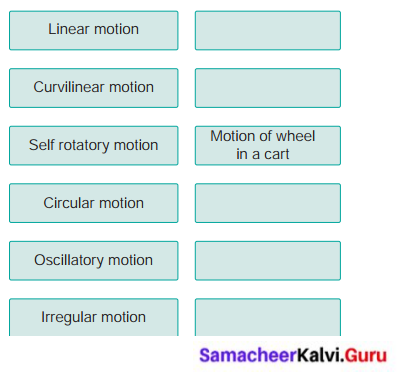
When you perform the experiment, can you hear the bubbly sound? can you now guess what was inside the bottle? _______
Yes, you are right. It is “air” that was present in the bottle.
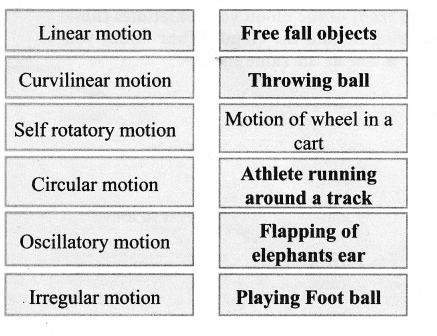
The bottle was not empty at all. In fact, it was filled completely with air even when you turned it upside down. That is why we notice that water does not enter the bottle when it is pushed in an inverted position, as there was no space for air to escape.
When the bottle was tilted, the air was able to come out in the form of bubbles and water-filled up the empty space that the air has occupied.
Hence we can see that air fills all the space inside the bottle.
Answer:
Fig. – 1 – No.
Fig – 2 – Yes.
Yes, I can hear a bubbly sound. Yes, the bottle has full of ‘Air’.

Activity 2

Samacheer Kalvi 6th Science Solutions Term 2 Chapter 4 Air 3
Take a healthy branch of Hydrilla and place it in a funnel. Invert the funnel in a beaker of water as shown in the figure. Invert a test tube over the stem of the funnel. The stem of the funnel should be kept immersed inside the water Leave the beaker in sunlight for some time. You will notice some bubbles rising in the test tube. The bubbles contain oxygen released by the plant during photosynthesis. If we show a glowing splinter to the collected air, it burns brightly. This shows that the collected gas is oxygen.

Samacheer Kalvi 6th Science Solutions Term 2 Chapter 4 Air

Activity 3

We know that iron undergoes rusting with oxygen and forms iron oxide. This process can be used to estimate the percentage of oxygen in the air, which has been removed by the rusting reaction.

Samacheer Kalvi 6th Science Solutions Term 2 Chapter 4 Air 4

Take a small portion of iron wool, press it into a 20 ml graduated test tube and wet it with water. Tip away excess of water. Take a 500ml beaker and fill half of the beaker with water. Invert the test tube and place it in air. Leave the arrangement at least for a week without making any disturbance to the test tube.

Observe the changes that had happened in the iron wool and to the level of water inside the test tube. We could see that the water level has increased inside the test tube. The rise in water is because of oxygen in air which has been removed by the rusting reaction. This will be about 20% which is approximately the percentage of oxygen in the air.

Samacheer Kalvi 6th Science Solutions Term 2 Chapter 4 Air

Activity 4

Oxygen is necessary for burning

Place two candles on a table. Ensure that both the candles are of the same size and height. Mark them as candle 1 and candle 2 using a chalk piece. Light both the candles. Now, cover candle 2 with a glass tumbler as shown in the figure. Observe the happenings at both the candles.

What does happen to candle 1?
_________________________
What does happen to candle 2?
_________________________
Can you guess why did the covered candle extinguish?
_________________________

Let us summarize the happenings.

Candle 1 continues to bum unless it is blown – off by strong moving air or any other external force. This is because fresh air is continuously available to the candle for its burning process.

Candle 2 glows for a while and then gets put – off. When the burning candle is covered with a glass tumbler, the candle can use the oxygen available in the air inside the glass tumbler. Since only a small amount of air is present inside the glass tumbler – only a small portion of the oxygen is available for the candle to continue glowing. When all the oxygen of the air inside the gas jar is used up, then the burning candle gets extinguished.

Samacheer Kalvi 6th Science Solutions Term 2 Chapter 4 Air 5

Now, repeat the candle – glowing experiment taking four containers of different sizes. Lor example, you can take a 250ml conical flask, a 500ml bottle, a one-liter jar, a two-liter jar. Cover the burning candle one by one with these containers and find out how long it takes for the candle to extinguish in each case. Record your observations in the following table.
Answer:

S.No.

The volume of the container (ml)

Time is taken for the candle to extinguish (second)

1. 250 6 seconds
2. 500 12 seconds
3. 1000 24 seconds
4. 2000 48 seconds

The time taken for the candle to extinguish depends upon the volume of the containers. Lor less volume, the time taken is less. Lor more volume, the time taken is more.

Samacheer Kalvi 6th Science Solutions Term 2 Chapter 4 Air

Samacheer Kalvi 6th Science Additional Questions

I. Choose the correct answer:

Question 1.
Movement of wind takes place in _______ layer
(a) Troposphere
(b) ozone
(c) stratosphere
(d) ionosphere
Answer:
(a) Troposphere

Question 2.
A component of air used by green plants to prepare their food is
(a) N2
(b) O2
(c) He
(d) CO2
Answer:
(d) CO2

Question 3.
_______ layer contain ozone layer.
(a) Troposphere
(b) Stratosphere
(c) Mesosphere
(d) Exosphere
Answer:
(b) Stratosphere

Question 4.
The percentage of oxygen in the exhaled air of respiration is
(a) 78%
(b) 16%
(c) 4%
(d) 21%
Answer:
(b) 16%

Question 5.
During respiration, carbon-di-oxide is exhaled out of the body through the _______
(a) Lungs
(b) Heart
(c) Kidney
(d) Skin
Answer:
(a) Lungs

Question 6.
_______ respire using their skin.
(a) Fish
(b) Frogs
(c) Rats
(d) Human beings
Ans:
(b)Frogs

Question 7.
_______ gas cylinders are used for breathing purpose for a diver going deep into the sea
(a) Hydrogen
(b) Carbon-di-oxide
(c) Oxygen
(d) Nitrogen
Answer:
(c) Oxygen

Samacheer Kalvi 6th Science Solutions Term 2 Chapter 4 Air

II. Fill in the blanks:

  1. The atmosphere is held in place by the earth’s _______
  2. The atmosphere is made of _______ different layers.
  3. A _______ shows the direction in which the air is moving at a particular place.
  4. The ozone layer protects all life on earth from the harmful _______ rays of the sun.
  5. Highly reactive gas was later names ‘oxygen’ by _______
  6. _______ discovered nitrogen.
  7. Air contains a small amount of CO2, Water vapour and some other gases like _______ etc.
  8. Air contains more _______ in rainy season

Answers:

  1. gravity
  2. five
  3. weathercock
  4. ultraviolet
  5. Lavoisier
  6. Daniel Rutherford
  7. argon, helium
  8. water vapour

Samacheer Kalvi 6th Science Solutions Term 2 Chapter 4 Air

III. Find whether the following sentences are true or false. If false Correct the statement:

Question 1.
When air is moving with cool and soothing, it is called a cyclone.
Answer:
False. When air is moving with cool and soothing is called a breeze.

Question 2.
Exosphere has a high temperature.
Answer:
False. Exosphere has a low temperature.

Question 3.
Jan Ingenhousz showed that chlorophyll is essential to the plant to carry out photosynthesis.
Answer:
False. Jan Ingenhousz showed that sunlight is essential to the plant to carry out photosynthesis.

Question 4.
The second major component of air is oxygen.
Answer:
True.

Question 5.
Air also contains a small amount of carbon-di-oxide, water vapour, and some other gases like argon, helium, etc.
Answer:
True.

Question 6.
The amount of water vapour in the air is more in windy places than in other areas.
Answer:
False. The amount of dust in the air is more in windy places than in other areas.

IV. Match the following:

1. More industrial cities (a) dust particles
2. Coastal areas b) Humidity
3. Rainy season c) Carbon dioxide
4. Windy places (d) water vapour

Answer:

  1. – c
  2. – d
  3. – b
  4. – a

Samacheer Kalvi 6th Science Solutions Term 2 Chapter 4 Air

V. Analogy:

Question 1.
Cool and soothing wind : Breeze.
uproot trees wind : ________
Answer:
Cyclone

Question 2.
Weather changes : Trophosphere.
Ozone layer: ________
Answer:
Stratosphere

Question 3.
Oxygen : Joseph Priestley.
Nitrogen : ________
Answer:
Daniel Rutherford

Question 4.
Respire through skin: ________
Respire through gills: Fish
Answer:
Frogs

Samacheer Kalvi 6th Science Solutions Term 2 Chapter 4 Air

VI. Give Short Answer:

Question 1.
Define – Atmosphere.
Answer:
Our earth is surrounded by a huge envelope of air. It is called the atmosphere.

Question 2.
The air envelope is thicker near the earth’s surface and we go higher the density and availability of air gradually decreases. Why?
Answer:
When altitude increases, a number of gas molecules will be decreased. Therefore, the density is also decreased when we go higher. Gravity pulls most of the atmosphere’s gas molecules close to the Earth’s surface. Air rises as it is heated because it becomes less dense.

Question 3.
Define troposphere.
Answer:

  1. This layer is closest to the earth.
  2. It is the layer in which we live.
  3. The movement of wind takes place in this layer.
  4. It also contains water vapour, which is responsible for making clouds.
  5. It is responsible for the weather we experience on earth.

Question 4.
Why aircraft usually fly above the troposphere layer?
Answer:
Aircraft usually fly above the troposphere to avoid strong winds and bad weather.

Question 5.
How to show that the presence of carbon-di-oxide in the air?
Answer:
Pour some lime water in a glass tumbler Bubble some air using a straw through the liter water. After a few minutes, lime water will produce a white precipitate and that the lime water will turn to a milky white solution. This shows the presence of Carbon- dioxide in air.

Question 6.
Write the composition of air.
Answer:
The major component of air is nitrogen. Almost four-fifth of air is nitrogen. The second major component of air is oxygen. Air also contains a small amount of Carbon-dioxide, water vapour, and some other gases like argon, helium, etc. The air may also contain some dust particles.

Question 7.
The composition of air changes slightly from place to place. Give examples.
Answer:

  1. The air over industrial cities has a higher amount of carbon-di-oxide in it.
  2. The air in coastal areas may have more water vapour than inland areas.
  3. Air also contains more water vapour in the rainy season.
  4. The amount of dust in the air is more in windy places.

Question 8.
What is meant by burning?
Answer:
The process of burning a substance in the presence of oxygen and releasing a large amount of light and heat is called burning.

Question 9.
In Rockets, along with fuel, oxygen is also carried for combustion – why?
Answer:
In Rockets, as they go high in the atmosphere, the availability of oxygen is considerably reduced. So rockets along with the fuel, oxygen is also carried for combustion.

Samacheer Kalvi 6th Science Solutions Term 2 Chapter 4 Air

Question 10.
Write the equation of photosynthesis.
Answer:
Samacheer Kalvi 6th Science Solutions Term 2 Chapter 4 Air 6

Question 11.
What is dry ice? What is its use?
Answer:

  1. When carbon-di-oxide is cooled to -57°C, it directly becomes a solid, without changing to its liquid state. It is called dry ice.
  2. Dry ice is used in trucks or freight cars for refrigerating meat and fish while transporting them.

Question 12.
Write the uses of windmills.
Answer:
The windmills are used

  1. to draw water by running pumps
  2. run flour mills
  3. to generate electricity.

Question 13.
Give the components present in the air with a percentage?
Answer:
The components present in the air with percentage Nitrogen – 78%, Oxygen – 21%, Carbon di oxide, Argon, Water vapour, and other gases – 1%.

Samacheer Kalvi 6th Science Solutions Term 2 Chapter 4 Air

VII. Answer in detail:

Question 1.
Prove by an experiment that Oxygen is released during photosynthesis.
Answer:

  1. Take a healthy branch of Hydrilla and place it in a funnel. Invert the funnel in a beaker of water as shown in the figure.
  2. Invert a test tube over the stem of the funnel.
  3. The stem of the funnel should be kept immersed inside the water Leave the beaker in sunlight for some time.
  4. You will notice some bubbles rising in the test tube.
    Samacheer Kalvi 6th Science Solutions Term 2 Chapter 4 Air 7
  5. The bubbles contain oxygen released by the plant during photosynthesis.
  6. If we show a glowing splinter to the collected air, it bums brightly.
  7. This shows that the collected gas is oxygen.

Question 2.
Prove by an experiment that oxygen is necessary for burning.
Answer:

  1. Place two candles on a table.
  2. Ensure that both the candles are of the same size and height.
  3. Mark them as candle 1 and candle 2 using a chalk piece.
  4. Light both the candles. Now, cover candle 2 with a glass tumbler as shown in the figure.
  5. Observe the happenings at both the candle.
    Samacheer Kalvi 6th Science Solutions Term 2 Chapter 4 Air 8
  6. Candle 1 continues to burn unless it is blown – off by strong moving air or any other external force.
  7. This is because fresh air is continuously available to the candle for its burning process.
  8. Candle 2 glows for a while and then gets put – off.
  9. When the burning candle is covered with a glass tumbler, the candle can use the oxygen available in the air inside the glass tumbler.
  10. Since only a small amount of air is present inside the glass tumbler – only a small portion of the oxygen is available for the candle to continue glowing.
  11. When all the oxygen of the air inside the gas jar is used up, then the burning candle gets extinguished.

Samacheer Kalvi 6th Science Solutions Term 2 Chapter 4 Air

Question 3.
Compare the composition of inhaled air and exhaled air.
Answer:

Component Inhaled air Exhaled air
Nitrogen 78% 78%
Oxygen 21% 16%
Carbon-di -oxide 0.03% 4%
Water vapour Variable amount amount increases in exhaled air
Noble gases 0.95% 0.95%
Dust Variable amount none
Temperature Room temperature Body temperature

Question 4.
Write the uses of air.
Answer:

  1. Air is used by plants and animals for breathing.
  2. Air is used for burning fuels like wood, coal, kerosene, LPG, etc.
  3. Compressed air is used to fill tyres of various kinds of vehicles.
  4. The ozone layer, present in the atmosphere, helps in preventing harmful radiations of the sun from reaching the earth’s surface.
  5. Under extraordinary conditions such as:
    • a patient having breathing difficulties,
    • a mountaineer climbing a high mountain,
    • a diver going deep into the sea, oxygen gas cylinders are used for breathing purposes.
  6. Blowing air is used to turn the blades of windmills. The windmills are used to draw water by running pumps, run flour mills, and to generate electricity.

Samacheer Kalvi 6th Science Solutions Term 2 Chapter 4 Air Read More »

Samacheer Kalvi 6th Science Solutions Term 1 Chapter 5 Living World of Animals

You can Download Samacheer Kalvi 6th Science Book Solutions Guide Pdf, Tamilnadu State Board help you to revise the complete Syllabus and score more marks in your examinations.

Tamilnadu Samacheer Kalvi 6th Science Solutions Term 1 Chapter 5 Living World of Animals

Samacheer Kalvi 6th Science Living World of Animals Textual Evaluation

I. Choose the appropriate answer

Question 1
The study of living things or organisms is called _______
(a) Psychology
(b) Biology
(c) Zoology
(d) Botany
Answer:
(b) Biology

Question 2
Which of the following are characteristics of living beings?
i. Respiration
ii. Reproduction
iii. Adaptation
iv. Excretion
Choose the correct sequence
a. i, ii, and iv only
b. i, ii only
c. ii and iv only
d. i, iv, ii and iii
Answer:
d. i, iv, ii and iii

Question 3
Lizards breathe through their _______
(a) Skin
(b) Gills
(c) Lungs
(d) Trachea
Answer:
(c) Lungs

Question 4
All animals need
a. Food and water only
b. Water only
c. Air, food and water
d. Food only
Answer:
d. Air, food and water

Question 5.
Which animal has the special organs of breathing called gills?
(a) Earthworm
(b) Fox
(c) Fish
(d) Frog
Answer:
(c) Fish

Samacheer Kalvi 6th Science Solutions Term 1 Chapter 5 Living World of Animals

Question 6.
Choose the set that represents only biotic components of a habitat
a. Tiger, Deer, Grass, Soil
b. Rocks, Soil, Plants, Air
c. Sand, Turtle, Crab, Rocks
d. Aquatic plant, Fish, Frog, Insects
Answer:
d. Aquatic plant, Fish, Frog, Insects

Question 7.
Which of the following cannot be called as a habitat?
(a) A desert with camels
(b) A pond with fish and snails
(c) Cultivated land with grazing cattle
(d) Ajungle with wild animals
Answer:
(c) Cultivated land with grazing cattlel

Question 8.
Birds fly in the air with the help of
a. heavy and strong Bones
b. Soft and thick Bones
c. Hollow and light Bones
d. Flat and thick Bones
Answer:
c. Hollow and Light Bones

Question 9.
Paramecium moves from one place to other with the help of _______
(a) Pseudopodia
(b) Flagella
(c) Foot
(d) Cilia
Answer:
(d) Cillai

Question 10.
Kangaroo rat lives in
a. Aquatic habitat
b. Desert habitat
c. Grassland habitat
d. Mountain habitat
Answer:
b. Desert habitat

Samacheer Kalvi 6th Science Solutions Term 1 Chapter 5 Living World of Animals

II. Multiple Choice Questions.

Complete the following with appropriate word(s).

  1. Aquatic, deserts, mountains are called _______
  2. Based on the number of cells present, animals are classified into _______ and _______
  3. Tail of a bird acts as a rudder which helps to .
  4. Amoeba moves with the help of _______

Answers:

  1. Habitats
  2. unicellular, multicellular
  3. control the direction of the movements
  4. Pseudopodia (false foot)

Samacheer Kalvi 6th Science Solutions Term 1 Chapter 5 Living World of Animals

III. True or False, If False gives the correct answer.

Question 1.
A habitat is a living or dwelling place of an organism.
Answer:
True.

Question 2.
The geographical features and environmental conditions on earth remain the same from one place to another.
Answer:
False. The geographical features and environmental conditions on earth differ from one place to another.

Question 3.
Amoeba is a unicellular organism and moves with pseudopodia.
Answer:
True.

Question 4.
Birds can see only one object at a time.
Answer:
False. Birds can see two objects at a time. (Binocular vision)

Question 5.
Paramoecium is a multicellular organism.
Answer:
False. Paramoecium is a unicellular organism.

Samacheer Kalvi 6th Science Solutions Term 1 Chapter 5 Living World of Animals

IV. Complete the following.

  1. Tropical rain forests, grasslands, and deserts are known as _______
  2. Some living things are made of a single cell, they are called _______ organism.
  3. The breathing organ of a fish is known as _______
  4. The lizard _______ on the ground with its claw on its feet.
  5. Camel stores _______ in its hump.

Answers:

  1. Habitats
  2. unicellular
  3. gills
  4. move
  5. fat

Samacheer Kalvi 6th Science Solutions Term 1 Chapter 5 Living World of Animals

V. Very Short Answer Questions.

Question 1.
How do the birds catch their prey?
Answer:
The birds catch their prey with the help of a pair of clawed feet.

Question 2.
Where can we see Camels in India?
Answer:
We can see Camels in Rajasthan.

Question 3.
Name the locomotory organ of an amoeba.
Answer:
The locomotory organ of Amoeba is pseudopodia.

Question 4.
What are the body parts of a snake?
Answer:
Head, eyes, nostrils, mouth, belly, tail.

Question 5.
Which structure helps the bird to change its direction while flying in the air?
Answer:
The tail of the bird helps it to change direction while flying in the air.

Samacheer Kalvi 6th Science Solutions Term 1 Chapter 5 Living World of Animals

VI. Short Answer Type Questions.

Question 1.
Differentiate between Unicellularand Multicellular organisms.
Answer:
Unicellular Organisms:

  1. They are made up of single cells.
  2. They can perform all the functions of life.
  3. They are very small (microscopic) in size
  4. They lack tissues, organs, and organ systems
  5. Growth occurs by an increase in the size of the cell.
  6. Eg. Amoeba, Paramecium, Euglena.

Mukkellubr Organisms

  1. They are made up of many cells.
  2. Different cells perform different functions.
  3. They are mostly large in size. They are seen through naked eyes.
  4. They are composed of tissues, and organ yems.
  5. Growth occurs by an increase in the number of cells by cell division.
  6. Eg. Earthworms, Fish, Frogs, Lizard and Human being.

Question 2.
Write the adaptive features of Polar bear and Penguin.
Answer:
Samacheer Kalvi 6th Science Solutions Term 1 Chapter 5 Living World of Animals 1

Samacheer Kalvi 6th Science Solutions Term 1 Chapter 5 Living World of Animals

Question 3.
Mention the feature that helps a bird to fly in the air.
Answer:

  1. Birds have a streamlined body covered with feathers.
  2. This body shape provides minimum resistance to air.
  3. They have a pair of wings that are modified forelimbs.
  4. They have hollow and light bones.
  5. They have strong chest muscles which help them withstand the pressure of the air while flapping their wings during flight.

Question 4.
What are the different types of invertebrates?
Answer:

  1. Sponges (Porifera)
  2. Comb jellies (Ctenophora)
  3. Hydras, jellyfishes, sea anemones, and corals (Cnidaria)
  4. Starfishes, sea urchins, sea cucumbers (Echinodermata)
  5. Flatworms (Platyhelminthes)
  6. Round or threadworms (Nematoda)
  7. Earthworms and leeches (Annelida)
  8. Insects and arachnids (Arthropoda)
  9. Snails, and octopuses (Mollusca)

VII. Answer in detail.

Question 1.
Describe the various features which help camel dwell well in the desert?
Answer:

  1. The camel has long legs which help it to keep its body away from the hot sand in the desert.
  2. A camel can drink a large amount of water (when it is available) and store it in the body.
  3. It passes a small amount of Urine. It does not sweat. It loses very little water from its body. So it can live for many days without drinking water.
  4. A camel’s hump has fat stored in it. In case of emergency, a camel can break down stored fat for nourishment.
  5. It has large and flat padded feet. So it walks easily on sand.
  6. Camel has long eyelashes and hairs to protect its eyes and ears from the blowing dust.
  7. It can keep its nostrils closed to avoid dust.

Samacheer Kalvi 6th Science Living World of Animals Intext Activities

Activity 1
Samacheer Kalvi 6th Science Solutions Term 1 Chapter 5 Living World of Animals 2
Look at the above picture and prepare a chart for the following interpretation.
How does the climate differ in these habitats?
Name some animals that exist in these habitats.
Can an animal survive if it is shifted from one habitat to another contrasting habitat?
Answer:
In terrestrial habitat, the temperature is more. In water habitat, the temperature is less.
(i) Terrestrial habitat animals: Cow, Rabbit, Lizard.
(ii) Water habitat animals: Duck, fish.
No. For example, in the water habitat fish can live in. But in terrestrial habitat, it cannot survive, because of the adaptation.

Samacheer Kalvi 6th Science Solutions Term 1 Chapter 5 Living World of Animals

Activity 2

Question 1.
Collect the pictures of various ecosystems like lakes, ponds, forests, deserts, mountains, and Polar regions and prepare a chart of animals in these places.
Answer:
Activity to be done by the students themselves

Samacheer Kalvi 6th Science Living World of Animals Additional Questions

I. Choose the correct answer.

Question 1.
Which is not a biotic community among the following?
(a) Plants
(b) Birds
(c) Air
(d) Elephant
Answer:
(c) Air

Question 2.
The locomotory organ of amoeba,
(a) pseudopodia
(b) cilia
(c) flagella
(d) None of these.
Answer:
(a) pseudopodia

Question 3.
Jurong Birds Park is located in
(a) America
(b) Singapore
(c) Japan
(d) Germany
Answer:
(b) Singapore

Question 4.
The animal that never drinks water,
(a) rat
(b) cat
(c) dog
(d) cow
Answer:
(a) rat

Question 5.
Lizards walk with four legs and it is known as
(a) Bipedal
(b) Tripedal
(c) Monopedal
(d) quadripedal
Answer:
(d) quadripedal

Question 6.
Vedanthangal is ………. sanctuary
(a) Birds sanctuary
(b) Tiger sanctuary
(c) Elephant sanctuary
(d) Deer sanctuary
Answer:
(a) Birds sanctuary

Question 7.
The movement of animals to a different location due to seasonal change is called
(a) Hibernation
(b) Aestivation
(c) Migration
(d) Adaptation
Answer:
(c) Migration

Question 8.
_______ can live for many days without drinking water.
(a) Dog
(b) Elephant
(c) Cow
(d) Camel
Answer:
(d) Camel

Question 9.
Camel passes _______ amount of urine.
(a) small
(b) large
(c) moderate
(d) too large
Answer:
(a) small

Samacheer Kalvi 6th Science Solutions Term 1 Chapter 5 Living World of Animals

II. Complete the following.

  1. Living things are made of small units called ________
  2. Organisms that are made of many cells are called ________
  3. Unicellular Organisms are small, usually ________ nature, and cannot be seen with the naked eye.
  4. In Amobea ________ help in excretion.
  5. The fish has fins for ________
  6. ________ have web in the toes and able to glide or parachute the air and make soft landings.
  7. Birds have streamlined body covered with ________
  8. ________ is called the Ship of the Desert.

Answers:

  1. Cells
  2. multicellular organisms
  3. microscopics
  4. Contractile vacuoles
  5. Swimming
  6. Dinosaurs
  7. feathers
  8. Camel

Samacheer Kalvi 6th Science Solutions Term 1 Chapter 5 Living World of Animals

III. True or false. If false give the correct answer.

Question 1.
Fishes are a unicellular organisms.
Answer:
False. Fishes are a multicellular organisms.

Question 2.
In Amoeba, reproduction is by simple diffusion through the body surface.
Answer:
False. In Amoeba, respiration is by simple diffusion through the body surface.

Question 3.
In unicellular organisms, the growth occurs by an increase in the size of the cell.
Answer:
True.

Question 4.
The streamlined body shape of fish helps it to move through the water easily.
Answer:
True

Question 5.
Some fishes have the capacity to rotate the head around the head joint.
Answer:
False. Some lizards have the capacity to rotate the head around the head joint.

Question 6.
The movement of animals to different locations due to the season changes is said to be an adaptation.
Answer:
False. The movement of animals to different locations due to the season changes is said to be Migration.

Question 7.
Spending the hot and dry period in an inactive state is known as Aestivation.
Answer:
True.

Samacheer Kalvi 6th Science Solutions Term 1 Chapter 5 Living World of Animals

IV. Match the following.

Question 1.

  1. Polar bear – (a) Strong hooves for running, long hair to protect from cold
  2. Penguin – (b) Strong and fast runner has sharp claws to catch prey
  3. Mountain goat – (c) Paddle to swim, walk with two legs
  4. Lion – (d) Thick skin for protection, white fur

Answer:

  1. d
  2. c
  3. a
  4. b

Question 2.

  1. Bird – (a) stores water in the body
  2. Fish – (b) rotates its head around the head joint
  3. Lizard – (c) wings that are modified forelimbs
  4. Camel – (d) gills as respiratory organ lAns

Answer:

  1. – c
  2. – d
  3. – b
  4. – a

Samacheer Kalvi 6th Science Solutions Term 1 Chapter 5 Living World of Animals

V. Complete the given analogy.

Question 1.
Fish : Water : : Elephant : _______
Answer:
Land

Question 2.
Euglena: Flagellum
_______ : Paramecium
Answer:
Cilia

Question 3.
Euglena: unicellular organism.
_______ : Multicellular organism
Answer:
Man

Question 4.
Fish respiratory organ : Gills
Bird’s Breathing organ: _______
Answer:
Lungs

Question 5.
Fins: Fish
Feather: _______
Answer:
Bird

Question 6.
Turtle: Hibernation
_______ : Aestivation
Answer:
Snail

Question 7.
Beak: Bird’s mouth
_______ : Fat stored in Camel.
Answer:
Hump

Samacheer Kalvi 6th Science Solutions Term 1 Chapter 5 Living World of Animals

V. Short Answers.

Question 1.
List the locomotory organ of unicellular organisms.
Answer:

  1. Protozoa – pseudopodia
  2. Paramecium – cilia
  3. Euglena – flagellum

Question 2.
List any two differences between Paramecium and Euglena.
Answer:
Paramecium:

  1. Its locomotory organ is the cilia
  2. Absence of chloroplast

Euglena:

  1. Its locomotory organ is the flagellum
  2. Presence of chloroplast

Question 3.
What is meant by aestivation?
Answer:
Spending the hot and dry period in an inactive state is known as aestivation. (eg) Snail.

Question 4.
Mention the important adaptive features of fish.
Answer:
Gills is the respiratory organ of fish. It helps to absorb oxygen dissolved in water for breathing and not from the atmosphere. It is the adaptive feature of fish.

Question 5.
What is Binocular vision?
Answer:
At a time birds can see one object with one eye and another object with the other eye is. known binocular vision.

Question 6.
Define – Migration.
Answer:
When an animal moves its location as the season changes it is said to be Migration.

Question 7.
Which is called a ship of the desert? Why it is called so?
Answer:
Camel is called a ship of the desert.
A camel has large and flat padded feet which help it to walk easily on soft sand.

Question 8.
From which countries many birds migrate to our Vedanthangal?
Answer:
There are many birds from foreign countries like Siberia and Russia that migrate to our Vedanthangal.

Samacheer Kalvi 6th Science Solutions Term 1 Chapter 5 Living World of Animals

VII. Long Answer.

Question 1.
Describe various adaptive features of birds.
Answer:

  1. Birds have a streamlined body covered with feathers.
  2. This body shape provides minimum resistance to air.
  3. They have beak instead of the mouth.
  4. They breathe through the lungs.
  5. They have hollow and light bones.
  6. The tail of the bird helps it to control the direction of the movements.
  7. They have strong chest muscles.
  8. They have binocular vision.

Question 2.
List the adaptation present in the lizard.
Answer:

  1. Lizards have strong four limbs.
  2. Lizards have the capacity to rotate the head around the head joint.
  3. They respire through the lungs.
  4. Lizards have teeth adapted for grabbing and holding.
  5. Some lizards have web in the toes and are able to glide or parachute the air and make soft landings.

Samacheer Kalvi 6th Science Solutions Term 1 Chapter 5 Living World of Animals Read More »