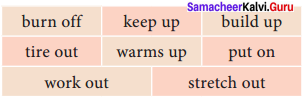
Bhagya

11th English Unit 3 Prose Forgetting Paragraph Book Back Answers Samacheer Kalvi

Forgetting Book Back Answers Class 11 English Guide Chapter 3 Tamilnadu Solutions

Students can Download English Lesson 3 Forgetting Questions and Answers, Summary, Activity, Notes, Samacheer Kalvi 11th English Book Solutions Guide Pdf helps you to revise the complete Tamilnadu State Board New Syllabus and score more marks in your examinations. Learn the Samacheer Kalvi 11th English Grammar to enhance your grammar skills like reading comprehension, passage writing, parts of speech, tenses, passive and active voice, and many other concepts in no time.

11th Standard English 3rd Lesson Forgetting Questions and Answers

Warm up

Question 1.
How forgetful are you?
Answer:
We are all forgetful at times and would like to find ways of improving our memories.

A. How sharp is your memory?

Take this five-minute memory test. The teacher will read out a series of 30 words, one by one. Some of them will be repeated. Whenever you hear a word for the first time, write ‘N’ (for New) in the corresponding box and when you hear a repeated word write ‘R’ After completing this task, check your results. Compare it with your friends and see where you stand.

A set of 30 words is provided here. You can ask your teacher or a friend to read out the words. Hear carefully and do this activity yourself.

1 11 21
2 12 22
3 13 23
4 14 24
5 15 25
6 16 26
7 17 27
8 18 28
9 19 29
10 20 30

Answer:

1 astonished 11 safety 21 giants
2 available 12 approach 22 reluctant
3 doubt 13 chemist 23 devotee
4 statistical 14 methodical 24 perambulator
5 ordinary 15 doubt 25 memory
6 fortune 16 perfection 26 audacious
7 devotee 17 memory 27 eccentric
8 seldom 18 scarcely 28 common
9 reluctant 19 thousand 29 statistical
10 important 20 visitor 30 efficient

B. Have you ever lost or misplaced anything of value due to forget fulness?

Yes, I have misplaced my hall ticket. I was tensed. My Headmaster asked me not to panic. He identified me to the hall supervisor and allowed me to write my examination in Std X.

At times, instances of forgetfulness may land us in a tight spot or in a difficult situation. Therefore, we need to find ways to remember what we have to do or carry with us. One way is to make a mental check-list that we can verify before starting any activity.

Now discuss with your partner and think of some practical ideas to overcome forgetfulness, in your day-to-day activities.

e.g. setting an alarm

Answer:

e.g. setting an alarm Keeping a diary
Checklist Write on calendar
Sticky notes PDA – Personal Digital Assistant

C. Discuss and share your views with the class on the following. Is forgetfulness a result of carelessness or preoccupation?

Team A : We think it is a result of carelessness. If we really attach great importance to details, we will never forget.
Team B : Perhaps, things you are interested in, you don’t tend to forget.
Team C : We think forgetting is mostly by preoccupation with something. Brain can do , multi-tasking but not always. If your mind is focussed on a serious problem and ways of solving it, the brain shuts down all other memory files for a while. It is purely a temporary issue.
Team A&B : Yes, we agree;with team‘C’.

Samacheer Kalvi 11th English Forgetting Textual Questions

1. Based on your understanding of the essay, answer the following questions in one or two sentences each.

Question (a)
What does lynd actually wonder at?
Answer:
Lynd actually wonders at the efficiency of human memory which remembers many things.

Samacheer Kalvi 11th English Solutions Prose Chapter 3 Forgetting

Question (b)
Name a few things that a person remembers easily.
Answer:
A man easily remembers all the items of clothing, shutting the door before leaving the home, turning off lights before going upstairs, etc,

Question (c)
How do psychologists interpret forgetfulness?
Answer:
Psychologists tell us that people forget things because they wish to forget them.

Question (d)
What is the commonest type of forgetfulness, according to Lynd?
Answer:
Commonest type of forgetfulness occurs in the matters of posting letters. The author himself has forgotten to post his own letters many times.

Question (e)
What does the author mean when he says the letter in his pocket leads an unadventurous life?
Answer:
The letter in his pocket leads an unadventurous life as it is kept safe inside his pocket for a long time without him remembering about it.

Question (f)
What are the articles the writer forgets most often?
Answer:
The poet often forgets his books and walking sticks.

Question (g)
Who are the citizens of ‘dreamland’? Why?
Answer:
Sportsmen are the citizens of dreamland because even after returning from their games their mind is still filled with the imagination of playing.

Question (h)
What is common about the ‘angler’ and the ‘poet’?
Answer:
The angler enjoys his sport of fishing so intensely that he forgets his fishing rod. Likewise, the poet, who often roams in his own world of imagination, may forget to post a letter. Both the angler’s and the poet’s loss of memory is a tribute to the intensity of their enjoyment.

2. Based on your reading, answer the following questions in two to four sentences each,

Question (a)
What made people wonder about the absentmindedness of their fellow-beings?
Answer:
The people wondered about the list of articles published for sale which were lost by railway travellers.

Samacheer Kalvi 11th English Solutions Prose Chapter 3 Forgetting

Question (b)
What are our memories filled with?
Answer:
Our memories are filled with names of cricketers, footballers, murderers,. actors and actresses. Our memories are filled with many routine activities.

Question (c)
When does human memory work with less than its usual capacity?
Answer:
Human memory works with less than its usual capacity when we forget things as we wish to forget them and when we have antipathy towards something.

Question (d)
Why, according to Lynd, should taking medicines be one of the easiest actions to remember?
Answer:
Taking medicines should be one of the easiest actions to remember because doctor has prescribed the medicine to recover from illness. Besides, there is a need to take it either before or after meals. Everytime one takes meals, one should easily remember medicine.

Question (e)
How,do the chemists make fortunes out of the medicines people forget to take? Similar to the author, many remember to forget medicine as soon as the appointed time arrives.
Answer:
The medicine which is kept for long without swallowing may soon become expiry and cannot be used anymore. Tims chemists make fortunes out of the medicines people forget to take.

Question (f)
The list of articles lost in trains suggest that sportsmen have worse memories than their ordinary serious-minded fellows. Why does Lynd say this?
Answer:
Considerable number of footballs and cricket bats were forgotten by young sportsmen. Serious – minded ordinary citizens forget less. The author Lynd infers that the sportsmen’s forgetfulness is justified as their minds are full of vision of the playing field. Their heads are in the stars and among the clouds. Keeping their hearts in boots, young sportsmen rush home to talk about their exploits and are naturally more absent-minded than serious- minded ordinary folks.

Question (g)
What kind of absent-mindedness is regarded as a virtue by Lynd?
Answer:
The poet forgetting to post a letter is regarded as a virtue by Lynd because this absent-minded as his mind is filled with glorious matter.

Samacheer Kalvi 11th English Solutions Prose Chapter 3 Forgetting

Question (h)
Narrate the plight of the baby on its day out.
Answer:
A father offered to take the baby out in a perambulator. On a sunny morning, he was tempted to have a glass of beer. He entered a pub leaving the perambulator in the street opposite to the pub. A little later, his wife found the baby asleep in the perambulator. Her husband was not found anywhere. She took the perambulator home anticipating her husband’s remorse over the stolen baby. But to her obvious dismay, he walked in cheerfully and asked her what was the lunch. He had completely forgotten the baby on its day out.

3. Answer the following in a paragraph of about 100-150 words each.

Question (a)
You have borrowed a branded cricket bat from your reluctant friend for an outstation match. After returning home you realize you have absent-mindedly left it in the hotel room. Write a letter of apology and regret to your friend.

12, Dhandapani Street,
T. Nagar
13.07.2018.

Dear Madhan / Seema,

I’m. fine. I hope this letter finds you in the best of your health. I’m penning this letter to express my profound sorrow for forgetting to bring your branded cricket bat. I have left it behind in the hotel room in Mumbai. I’m terribly sorry. I was late for the train to Chennai. As I rushed to the station, I just forgot the packed bat. I rang up the hotel. I am told that the bat is safe. Next week, my cousin is coming home. I have asked him to bring it from the hotel. Kindly bear with me. Please do forgive my mistake. I shall certainly return your bat in a fortnight.
With deep regrets

Yours loving friend
Arun / Vanitha

To
K. Madhan
S/0 Krishna
17, Valluvar St,
Urappakam

Question (b)
Kahlil Gibran states ‘Forgetfulness is a form of freedom.’ Write an article for your school magazine, linking your ideas logically and giving appropriate examples.
Answer:
“Forgetfulness is a form of freedom”. To a greater extent, this statement is true. Forgetting is the apparent loss of information already encoded and stored in an individual’s long-term memory. It is a gradual process in which old memories are unable to be recalled from memory storage.

There is no use crowding all activities in our minds forever. This may naturally lead to many health hazards. On the other hand, a person with forgetfulness leads a peaceful life because he lives for the present moment without any botheration about the past. Scientists, poets, philosophers, and creative people are most notorious for their absent-minded ways.

Several anecdotes revolve around Albert Einstein and Sir Isaac Newton due to their scattered, forgetful ways. Einstein once called the university he worked at to ask for his own address as he had forgotten it. Persian Poet Sumi says, “Mindlessness help you unite with the divine.” So there is nothing wrong with being forgetful. Far from being is negative, it is a desirable state that not everyone can aspire to.

Question (c)
Will you sympathise or ridicule someone who is intensely forgetful? Write an essay justifying your point of view.
Answer:
Forgetfulness, if deemed a form of freedom, must be welcome. But what one forgets matters. Similar to the father who forgot the baby in the perambulator if one forgets main duties, he would become an anathema to even family members. I wouldn’t be hasty to ridicule a person who “suffers” from acute or intense forgetfulness. I would observe, in the first place, what are the items he forgets routinely. Are they trifles or serious things? If a married man forgets his wife and children and forgets his filial duties, then he deserves chastisement and not ridicule.

If forgetting leads to comic situations like wearing chappals in the wrong foot, or wearing the tie in a funny manner, sometimes a person of extraordinary intelligence may forget his residential address similar to Einstein. Scientists and great philosophers like Socrates and Rabindranath Tagore suddenly went into spells of deep contemplation totally forgetting where they were heading to. Once it so happened that socrates went into a trance on a road. His disciples and friends stood around him the whole day. Night came. Friends bought mats and pillows and slept around him hoping to listen to his words of wisdom as soon as the spell breaks and remembers what he saw in his world of imagination.

Towards dawn, the spell broke. Socrates saw the people sleeping around him. He just carefully walked back home. I have my heart-felt sympathies for my friends who study just before examination and forget what they learnt in the examination hall. I’ve my conviction that those who forget naturally need to be treated with a sympathetic understanding because they really don’t know that they forget. Those who suffer from selective amnesia, I mean politicians who give tall promises before elections but remember to forget them soon after winning the elections need to be ridiculed by funny cartoons and in public places because they have done a breach of trust.

“There is some pleasure even in words, when they bring forgetfulness of present miseries.”

Additional Questions

A Give answers to the following question in 100-150 word each.

Question (a)
Why is Robert Lynd amazed at the efficiency of humans to remember things?
Answer:
Robert Lynd is amazed by the efficiency of human memory. Modem man remembers telephone numbers, names of film stars, cricketers, football champions and even notorious murderers. He remarks with jest that man does not forget a single item of his clothing. No one forgets to shut the door when leaving the house. The institution of family survives in modem cities because ordinary people have efficient memory power. In the ordinary life, man remembers almost everything he is expected to remember like birthdays and Valentine’s day. He remembers appointments for dinner and lunch. He remembers what the weather was in a . long-part August. Not even one in thousand forgets, simple things like switching off lights before going upstairs or a single item of dressing. Almost everybody remembers to do the right things of the right moment till it is time to go to bed.

Samacheer Kalvi 11th English Solutions Prose Chapter 3 Forgetting

Question (b)
What according to Robert Lynd are the causes for forgetting?
Answer:
In some matters, the memory is less than perfect, causes could be psychological. We tend to forget things we don’t wish to remember. For example, many people forget to take medicines. Medicine needs to be taken before / after meals. Robert Lynd remarks that chemists make a lot of money because people tend to forget to take medicines. It aggravates the disease and people are forced to buy more and more medicines. It may be due to their antipathy to pills and poisons that many people fail to remember them at the appointed hours. The author is quizzed at the fact as to how a life-long devotee of medicines like himself is forgetful of them as those who take them up unwillingly. He admits that even if he has the pills in his pockets as soon as the time of consumption arrives, he forgets it.

Question (c)
Describe the circumstances leading to the vexation of the mother on the baby’s day out.
Answer:
Once a father took his baby out in a perambulator in the morning. He walked into a pub to have a glass of beer. The child was sitting in the perambulator outside in the street. After sometime his wife came that way for shopping. She was shocked to find her baby sleeping in the perambulator. She decided to teach him a lesson. She took the’baby home. She expected her husband to come and apologize for losing the child. But he just walked in and casually asked his wife cheerfully what was there for lunch. Very few people like Einstein or Socrates would be capable of such absent-mindedness.

Question (d)
What are the observations of Robert Lynd on the capacity of humans to remember and forget things?
Answer:
Robert Lynd is amazed by the efficiency of human memory. Modem man remembers telephone numbers, names of film stars, cricketers, football champions and even notorious murderers. He remarks wittily that man does not forget a single item of his clothing. No one forgets to shut the door when leaving the house. The institution of family survives in modem cities because ordinary people have extraordinary memory power. In some matters, the memory is less than perfect, causes could be psychological. We tend to forget things we don’t wish to remember. For example, many people forget to take medicines.

Medicine needs to be taken before / after meals. Robert Lynd remarks that chemists make a lot of money because people tend to forget to take medicines. It aggravates ithe disease and people are forced to buy more and more medicines. Most people forget to post letters. The author himself would not trust his letters to be posted by others. The author himself never remembered to post letters entrusted to him. He had to apologise for the unposted letters kept with him for long. Likewise, the author forgets his walking sticks often.

Question (e)
How does the author prove that absent-mindedness is a boon as well as a bane?
Answer:
Absent – mindedness of people shocked the author when the Railway department published the list of lost articles. It was startling to note that young people forget bats, balls etc. The author attributes it to the abundant imagination and dreams. They are citizens of dreamland. Anglers also forget their fishing rods. Absent – mindedness is often a blessing in disguise. People can forget their unhappiness and live in a world of Utopia. Great thinkers, poets and philosophers are absent – minded because their minds are full of lofty ideas and imagination. Socrates the philosopher and S.T. Coleridge the poet were absent – minded people. Similarly, Politicians have bad memories. States are yet to produce ideal statesmen. Great writers, composers of music have amazingly great memories.

Memory is half the substance of their art. Once a father took his baby out in a perambulator in the morning. He walked into a pub to have a glass of beer. The child was sitting in the perambulator outside in the street. After sometime, his wife came that way for shopping. She was shocked to find her baby sleeping in the perambulator. She decided to teach her husband a lesson. She took the baby home. She expected her husband to come and apologize for losing the child. But he just walked in and casually asked his wife cheerfully what was there for lunch. Very few people like Einstein or Socrates would be capable of such absent-mindedness. Men should forget unpleasant things and remember pleasant things. Thus Absent – mindedness is both a boon and a bane.

Vocabulary

A. Homonyms and Heteronyms.

Complete the sentences by choosing a suitable word from those given in the brackets.

  1. Nobody can say (1) _______ there will be an improvement in the (2) _______ (whether / weather)
  2. Your ring is (1) _______ Do not (2) _______ it.(loose / lose) .
  3. We found a (1) _______ of biscuits in the old man’s shirt (2) _______ (pocket /packet)
  4. When the pole vaulter cleared 28. (1) _______ it was declared a record (2) _______ (feet/feat)
  5. Explain the (1) _______ ‘Cut your (2) _______ according to your cloth.’ (coat / quote)
  6. The’stranger (1) _______ for a few minutes before he (2) _______ . my house.(paused /passed)
  7. The (1) _______ dancer turned (2) _______ after the final performance, (weary /wiry)
  8. The chain that I presented to my sister was not made of gold; it was just (1) _______ Iam suffering from a sense of (2) _______ (guilt / gilt)

Answers:

  1. whether, weather
  2. loose, lose
  3. packet, pocket
  4. feet, feat
  5. quote, coat
  6. paused, passed
  7. wiry, weary
  8. gilt, guilt

Form meaningful sentences using the given words to bring out at least two different meanings.

  1. train – You must train yourself to catch the train in time.
  2. tear – The tear in the uniform brought tears in the eyes of the student.
  3. wind – It is time to wind up the programme because it is very windy and it might rain soon.
  4. light – As the bag was very light, the boy was able carry it though there was no light in his street.
  5. file – She filed all the documents carefully in a file.
  6. bear – The bear couldn’t bear the mischief of the visitor; he took him into the cage and mauled him very badly.

B. Clipped Words
Now, write the clipped and unclipped form of the given words and complete the table.

UNCLIPPED CLIPPED
chimpanzee ___________
___________ photo
___________ mike
cafeteria ___________
___________ gas
helicopter ___________
telephone ___________
___________ varsity
___________ memo
influenza ___________
___________ hippo
bridegroom ___________
___________ fan
demonstration ___________
refrigerator ___________

Answer:

UNCLIPPED CLIPPED
chimpanzee chimp
photograph photo
microphone mike
cafeteria cafe
gasoline gas
helicopter copter
telephone phone
university varsity
memorandum memo
influenza flu
hippopotamus hippo
bridegroom groom
ceiling fan or fanatic fan
demonstration demo
refrigerator fridge

C. Refer to a dictionary and match the professions with their relevant job descriptions

A B
1. pathologist studies languages and their structure
2. ornithologist studies atmosphere, weather and climate
3. entomologist studies the matter that constitutes the Earth
4. archaeologist studies earthquakes
5. sociologist studies reptiles and amphibians
6. geologist studies functioning of human society
7. linguist studies artefacts and. physical remains
8. seismologist studies birds
9. herpetologist studies insects
10. meteorologist studies diseases

Answer:

  1. studies diseases
  2. studies birds
  3. studies insects
  4. studies artefacts and physical remains
  5. studies functioning of human society
  6. studies the matter that constitutes the Earth
  7. studies languages and their structure
  8. studies earthquakes
  9. studies reptiles and amphibians
  10. studies atmosphere, weather and climate

D. Fill in the blanks choosing the words from the box. Refer to a dictionary if required. One has been done for you.

(thespian, sadist, polyglot, ambidextrous, philanthropist, misanthrope, bibliophile, nonagenarian, teetotaller, globetrotter, optimist)

(i) Peter always refuses alcohol, when it is offered to him at parties and takes a soft drink instead. He says he always has and always will abstain from alcohol and it is a matter of principle for him. We can call Peter a ________

(ii) Aruna always looks at the bright side of things. Even in the face of misfortune, she firmly believes that everything will workout for the best in the end. What can we call Aruna? ________

(iii) The rich industrialist donated a huge sum of money to set up a public library in his native village. He is a ________ and a social reformer.

(iv) The Chair person of our company keeps travelling all over the world to attend conferences and we call her a ________

(v) Antony has the amazing ability to use both his hands, equally well. He can write, draw and perform various other tasks with equal speed and efficiency with his left as well as his right hand. Antony is ________

(vi) Due to some disturbing incidents in her childhood, Neetu grew into a reclusive adult. She tends to keep aloof and avoids all kinds of social activities. Neetu is a ________

(vii) Tharini serves as an interpreter at meetings between statesmen from different countries. She is also a much sought-after tour guide, as she is well-versed and fluent in multiple languages. Tharini is a ________

(viii) My grandparents are in their nineties. I am glad that this ________ couple are active, cheerful and in good health.

(ix) Richard Burton was a gifted theatre artist. He donned several roles with ease and is especially famous for the Shakespearean parts he played on stage. Mr. Burton is a born ________

(x) The Chairman of this concern seems to derive pleasure from inflicting pain on others. He humiliates and hurts his subordinates for no reason. He is a real ________

Answers:

(i) tee totaller
(ii) optimist
(iii) philanthropist
(iv) globetrotter
(v) ambidextrous
(vi) misanthrope
(vii) polyglot
(viii) nonagenarian
(ix) thespian
(x) sadist

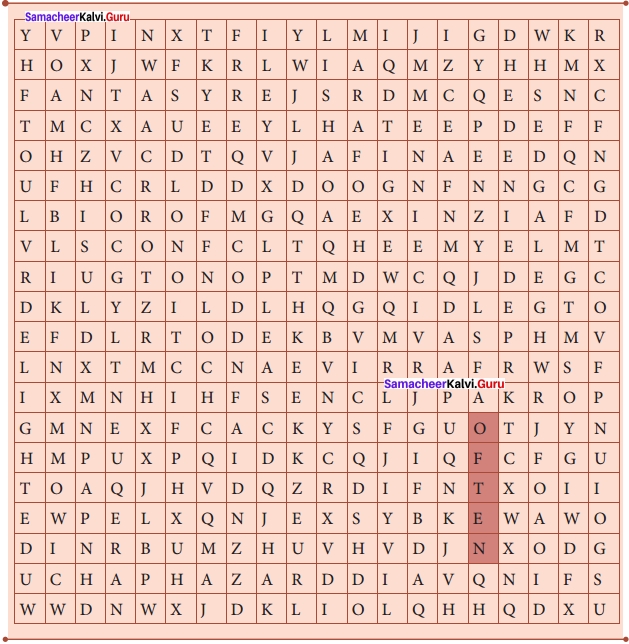
E. Find the antonyms of the following words in the puzzle and shade them with a pencil. The first one has been done for you.

  1. seldom,
  2. admitted,
  3. methodical,
  4. reality,
  5. virtue,
  6. vile,
  7. indignant,
  8. relish,
  9. fact Spot the word

Samacheer Kalvi 11th English Solutions Prose Chapter 3 Forgetting

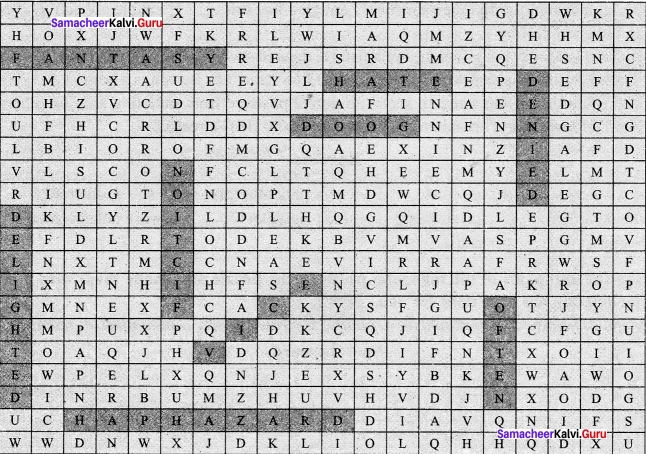
Answers:

  1. often
  2. denied
  3. haphazard
  4. fantasy
  5. vice
  6. good
  7. delighted
  8. hate
  9. fiction

Samacheer Kalvi 11th English Solutions Prose Chapter 3 Forgetting

Listening Activity

A. First, read the incomplete sentences given below. Listen to two interesting anecdotes about two scientists that your teacher will read aloud or play on the recorder. Then, based on your understanding, complete the sentences suitably.

(For listening to the passage refer to our website www.fullcircleeducation.in) Thomas Alva Edison stepped from a train in Orange, New Jersey and walked down the platform. The station master knew how forgetful the famous inventor was. Therefore, he would always ask him a customary question. He asked Edison if he had left anything behind. Edison confidently replied that he had not left anything and everything was safe with him. Then, he began taking a count of his suitcases. As he was doing so, he happened to look up at the train. With a start, he dropped his bags and raced back to the car in which he had been travelling. What prompted that burst of activity was the face of his bride, with whom he had just married and returned from a honeymoon trip, staring from a window.

Albert Einstein was working at the Princeton University. One day when he was going back home he forgot his home address. The driver of the cab aid not recognize him. Einstein asked the driver if he knew Einstein’s home. The driver exclaimed that there could be no one who did not know Einstein’s address. He added that everyone in Princeton knew where Einstein lived and asked him if he wanted to meet Einstein. Einstein with a sheepish grin replied that he was Einstein and he had forgotten his residential address. He requested the cabbie if he could take him there. The astonished driver drove him home and dropped him safely. The cabbie considered driving Einstein a great honour and refused to charge him for the service.

  1. Edison travelled to New Jersey by ______
  2. The station master enquired if Edison ______
  3. Edison raced back to the car, when he saw ______
  4. Albert Einstein was working in ______
  5. One day, when he was going back home, he ______
  6. Einstein asked the cab driver if he knew ______
  7. The driver was so good that he ______

Answers:

  1. a train
  2. had left anything behind
  3. the face of his bride
  4. Princeton university
  5. forgot his residential address
  6. Einstein’s residence
  7. refused to charge him for his

Speaking Activity

Work with a partner and take turns to share your views and suggestions with the class.

Question (i)
You are travelling in a train. When the Train Ticket Examiner enters your compartment, much to your shock, you realize you have forgotten to bring your train ticket. How will you handle the situation?
Answer:
TTE : Please show me your ticket.
Ragu : Oh! sorry! I left my printed ticket on my table.
TTE : Well, this is a reserved compartment, Don’t you know?
Ragu : Sir, I have reserved my ticket. It is 28 UB, S7 in Pandiyan Express.
TTE : Well, what you say might be true. But I want the ticket.
Ragu : Sir, could you please give me five minutes.
TTE : Why?
Ragu : I will ask my sister to scan the ticket and send it to my phone by WhatsApp.
TTE : Okay. But get it in five minutes.
Ragu : Thank you so much sir.

Samacheer Kalvi 11th English Solutions Prose Chapter 3 Forgetting

Question (ii)
You forget to wish your best friend on his/her birthday. He gets very angry. How will you try to pacify him/her? Construct a dialogue of about 4 to 5 exchanges and enact a role play.
Answer:
Ramesh : Ravi, aren’t you my best friend?
Ravi : Why do you doubt it?
Ramesh : You didn’t even wish me. Yesterday evening I was waiting for you till 9 pm. Ravi : I’m terribly sorry! I was at the Chepauk stadium watching CSK batting under trying conditions.
Ramesh : Oh! when it comes to cricket, you forget even your weekly tests.
Ravi : Friend, forgive me. Accept my belated wishes.
Ramesh : Okay. Let us forget it and talk about the match.

Question (iii)
‘Forgetfulness is the beginning of happiness’ Do you agree or disagree? Discuss in class.
Answer:
In “Ode to skylark,” Shelly beautifully portrays the human beings’ boundless capacity to worry about dead yesterday, unborn tomorrow and spoil the happiness of a perfectly beautiful present. He says, “We look before and after and pine for what is not. Our sincerest laughter with some pain is fraught”. Human mind has a soft comer for harbouring hurts and pain. It replays them like a broken record often and sustains hostility between individuals. It requires a mature mind to forgive and forget. The road to recovery of any invisible hurt starts the moment one forgives the person and casually forgets all unpleasant memories connected to it. Human mind, according to Robert Lynd, forgets what it chooses to forget. We are in a civilized society because everyone remembers to dress properly and remember the names of friends and relatives. If one develops the attitude to remember only pleasant things, the mind will train itself to forget insignificant bad memories. Thus forgetting is the beginning of real happiness.

Question (iv)
Is there a link between intelligence and absent-mindedness? Share your views on this subject.
Answer:
Of course yes, the person who is smart and extremely intelligent focusses his entire being on an issue or an invention. Thus all other things are abstracted. Great genius like Einstein and philosophers like Tagore tend to forget mundane affairs. Their minds are always preoccupied with lofty ideas and the ills of the society. So, it is believed that eccentricity like absent mindedness is common among very intelligent people. The best example is Einstiein. He sat in the railway coach leaving behind his newly married bride in the car. Only on seeing her furious face, he realized the fact that he forgot to take her along into the railway coach.

Reading Activity

Now, read the following biographical extract on Sujatha Rangarajan, a Science-fiction writer, and answer the questions that follow.

1. Sujatha is the allonym of the Tamil author S. Rangarajan and it is this name that is recognised at Once by the Tamil Sci-Fi reading community. You might have heard of Chitti and his extraordinary exhibition of different qualities in an incredible manner. The robot could excel a human being in any act beyond one’s imagination. Jeeno, a robotic dog which appeared in Sujatha’s science fiction novel “En Iniya Iyandhira” (My Dear Robot) formed the basis of Chitti’s character. Like Chitti, Jeeno was an all-rounder who could cook, clean and fight.

Very high tech computer technology terms are used in the story. Jeeno, a pet robot, plays an important role throughout the story. As the story proceeds, it behaves and starts to think on its own like-a human and instructs Nila, a human being, on how to carry on further.

Samacheer Kalvi 11th English Solutions Prose Chapter 3 Forgetting

2. In the preface of ‘En Iniya Iyandhira’,the writer states the reason for his attraction to the genre: “Science gives us the wonderful freedom to analyse thousands and thousands of alternative possibilities. While using it, and while playing with its new games, a writer needs to be cautious only about one thing. The story should draw some parallels or association from the emotions and desires of the present humankind. Only then it becomes interesting. Jeeno, the robot dog, was intelligent.

But the character became popular only because of the robot’s frequently displayed human tendencies. It is no wonder that his works echo these words about him and will reflect in the minds of the readers who enjoy reading his novels to have a lifetime experience.

3. It was Sujatha, who set the trend in sci-fi stories. He had tracked the origin from Mary Shelly’s Frankenstein to his short stories. He has written 50 sci-fi short stories published in various Tamil magazines.

His stories have inspired many readers to extend their reading to English sci-fi writers like Isaac Asimov. The themes were bold even if there was a dependence on very well – established characterisation of English fiction. Sujatha opened up a new world to us with his writings on holograms, computers and works like ‘En Iniya Iyanthira’, inspire many to study computer science.

4. He has been a great writer for more than four decades. He combined reasoning and science in his writings. Being a multifaceted hi-fi and sci-fi humanistic author, he expressed his views distinctively. He was the one who took Tamil novels to the next level. As an MIT alumnus and an engineer at BHEL, he was very good at technology. So, he narrated sci-fi stories, impressively. His readers always enjoyed reading all his detective and sci-fi novels which featured the most famous duo Ganesh and Vasanth.

5. Sujatha has played a crucial role as a playwright for various Tamil movies which have fascinated movie lovers. Hence, it is fathomable that the writer’s perspective of future India enthuses every reader and paves a new way to reading sci-fi stories in English.

A. Answer the following questions in a sentence or two.

Question (i)
How was Jeeno different from other robots?
Answer:
Other robots did tasks only as per the commands issued. But Jeeno frequently displayed human tendencies. It behaved and thought like a human being.

Question (ii)
What precaution should one take while writing Science fiction stories?
Answer
The writer should ensure that the story draws some parallel or association from emotions and desires of the present humankind. Only then the science-fiction would be interesting.

Question (iii)
What inspired Sujatha’s themes?
Answer:
Sujatha had bold trend in sci-fi stories. He had tracked the origin from Mary Shelley’s Frankenstein to his short stories. He opened up a new world to the readers with his writings on holograms, computers, robots who feel and behave like humans, (e.g) “En Iniya Iyanthira”. In short, Sujatha’s themes were inspired by reasoning, science, technology, computers and humanoids.

Samacheer Kalvi 11th English Solutions Prose Chapter 3 Forgetting

Question (iv)
Why were Sujatha’s sci-fi stories impressive?
Answer:
Sujatha’s sci-fi stories have really inspired Tamil readers to move on to read Isaac Asimov. He combined reasoning with science in his writings. Being a multi-faceted hi-fi and sci-fi humanistic author, he expressed his views distinctly. Being an alumni of MIT, he was good at technology. Thus his sci-fi stories were always impressive with interesting characters like Chitti, the robot; Jeeno the robot-dog and detective duo Ganesh and Vasanth.

B. Find words from the passage which mean the same as the following.

  1. difficult to believe (para 1) incredible
  2. a style or category of art, music or literature (para 2) genre
  3. having many sides (para 4) multifaceted
  4. capable of being understood (para 5) fathomable

Grammar

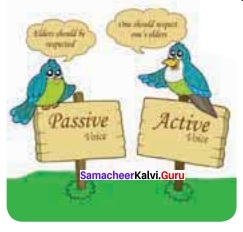
A. Identify the changes in these pairs of active and passive constructions.
Samacheer Kalvi 11th English Solutions Prose Chapter 3 Forgetting

Question 1.
The pilot flew the airplane to Bengaluru.
Answer:
The airplane was flown to Bengaluru by the pilot. In the second sentence, the object has been shifted to the place of subject. It remains passive and allows the work to be done by the noun.

Question 2.
The bananas were eaten by the monkey.
Answer:
The monkey ate the bananas. Here the subject is shifted to the place of object.

B. Change the voice of the following sentences.

Question 1.
Mohammed follows the rules.
Answer:
The rules are followed by Mohammed.

Question 2.
Mohan has completed the course.
Answer:
The course has been completed by Mohan.

Question 3.
Magdalene is singing the prayer.
Answer:
The prayer is being sung by Magdelene.

Question 4.
Who wrote this complaint?
Answer:
By whom was this complaint written?

Question 5.
May God bless you with happiness!
Answer:
May you be blessed with happiness by God.

Samacheer Kalvi 11th English Solutions Prose Chapter 3 Forgetting

Question 6.
A house is being constructed by them.
Answer:
They are constructing a house.

Question 7.
Let the door not be slammed.
Answer:
Don’t slam the door.

Question 8.
The team was trained by the coach.
Answer:
The coach trained the team.

C. Make sentences using the passive forms of the verbs.

Question 1.
Tagore/award/Nobel prize/
Tagore was awarded Nobel prize.

Question 2.
IIM Ahmedabad / establish /1961
Answer:
IIM Ahmedabad was established in 1961.

Question 3.
Chhattisgarh/ form / 2000
Answer:
Chhattisgarh was formed in 2000.

Question 4.
First passenger train /inaugurated /India /1853
Answer:
The first passenger train was inaugurated in 1853.

Question 5.
Indian Airlines /set up /1953 ! Indian Airlines was set up in 1953.

D. Look at the newspaper items given below. Use the information in the headlines to complete the sentence.

Question 1.
HEAVY RAINS LASH CHENNAI
______ threw normal life out of gear.
Answer:
Heavy rains threw normal life out of gear.

Question 2.
NEET CLASSES TO BEGIN ON SEPT. 20th
The Centre co-ordinator informed the candidates ______ Sept. 20th
Answer:
The centre coordinator informed the candidates about the commencement of NEET classes on September 20th.

Samacheer Kalvi 11th English Solutions Prose Chapter 3 Forgetting

Question 3.
12 INJURED AS BUSES COLLIDE
About at the Dindigul bus terminus here today.
Answer:
About 12 passengers were injured as buses collided at Dindigul.

E. Expand the following news headlines in a sentence.

Question 1.
MUNICIPAL ELECTIONS IN DECEMBER
Answer:
Municipal Elections will be held in December.

Question 2.
TELEPHONE CUSTOMERS TO GET VIDEO PHONE BSNL
Answer:
proposes to give video phone to its customers at a low cost.

Question 3.
CARD LICENSE TO REPLACE PAPER DRIVING LICENSE
Answer:
Transport Minister announced that paper licenses will be replaced with card licenses.

Question 4.
ATM WITHOUT SECURITY GUARD TO CLOSE RBI
Answer:
announced that all ATMS which have no security guard will be closed.

F. Describing a process

1. Complete the passage by filling the blanks with the passive forms of the verbs.

Samacheer Kalvi 11th English Solutions Prose Chapter 3 Forgetting

The water should be boiled in a vessel. Then tea leaves and milk (1) _____ to the water. The vessel (2) _____ with a lid. The tea (3) _____ and (4) _____ into the tups. Sugar (5) _____ . and (6) _____ The tea (7) _____ hot.
Answers:

  1. should be added
  2. must be covered
  3. should be filtered
  4. poured
  5. should be added
  6. stirred
  7. should be served

2. Here is a recipe to make chocolate cake in a pressure cooker. Rewrite the instructions in passive voice. The first one has been done for you.

Question (i)
First sift the flour, cocoa powder and baking powder in a mixing bowl.
Answer:
The flour, cocoa powder and baking powder are first sifted in a mixing bowl.

Samacheer Kalvi 11th English Solutions Prose Chapter 3 Forgetting

Question (ii)
Add butter, sugar, salt, water and vanilla and beat the ingredients using a whisk.
Answer:
Butter, sugar, salt, water, and vanilla should be added and the ingredients must be beaten using a whisk. .

Question (iii)
Add the eggs and beat the batter until it is smooth.
Answer:
The eggs must be added and the batter must be beaten until it is smooth.

Question (iv)
Transfer the batter into the baking tin.
Answer:
The batter must be transferred into the baking tin.

Question (v)
Heat the pressure cooker, covered with the lid but without the pressure, for 3-4 minutes on high heat. Then place the cake tin in the empty cooker (Do not add water in the cooker).
Answer:
The pressure cooker must be heated. It should be covered with the lid but without the pressure. It must be left for 3-4 minutes on high heat. The cake tin must be kept in the empty cooker. (Let not water be added in the cooker)

Question (vi)
Close the lid (without the pressure), lower the flame and let it cook for about 30 minutes.
Answer:
Let the lid be closed without the pressure. The flame must be lowered and it must be let to cook for about thirty minutes.

3. Write the process of wrapping a Christmas gift in a paragraph in passive form, with the help of the pictures given below.
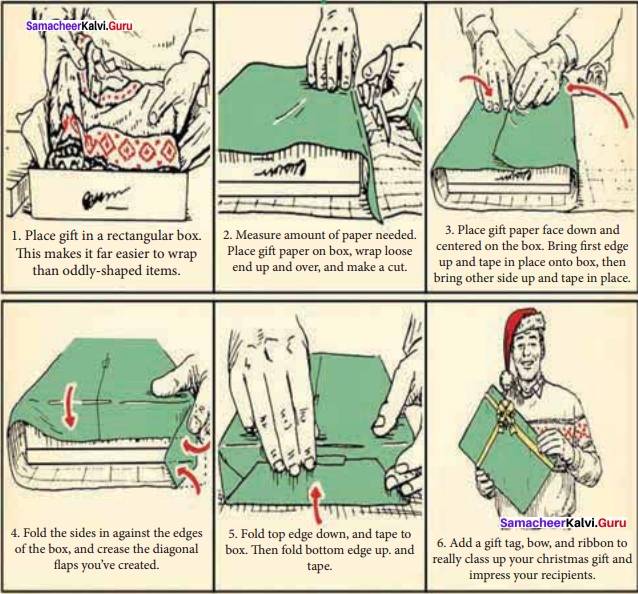
Samacheer Kalvi 11th English Solutions Prose Chapter 3 Forgetting

Answers:

  1. The gift must be placed in a rectangular box.
  2. The required paper must be measured. The gift paper must be placed on the box. It must be wrapped loose end up and over and a cut must be made.
  3. The gift paper must be placed face down and centred on the box. The first edge must be brought up and taped in place on to box. Then it must be brought other side up and taped in place.
  4. The sides should be folded in against the edges of the box. The diagonal flaps you have created must be creased.
  5. The top edge should be folded down. Then bottom edge should be folded up and taped.
  6. A gift tag must be added with a bow and ribbon to really class up your Christmas gift and impress recipients of your gift.

Subject and Verb Agreement (Concord)
A. Underline the correct verb in these sentences.

  1. The girl and her sisters _______ (watch, watches) television every day.
  2. Ravi _______ (doesn’t, don’t) like sports.
  3. My classmates _______ (study, studies) before a test.
  4. One of the cookies _______ (is, are) missing.
  5. A lady with ten cats _______ (live, lives) in that big house.
  6. Measles _______ (is, are) very serious.
  7. The committee _______ (decide, decides) when to adjourn.
  8. Our team _______ (is, are) the best.
  9. Everybody _______ (enjoy, enjoys) a good song.
  10. Either of these _______ (is, are) suitable.

Answers:

  1. watch
  2. doesn’t
  3. study
  4. is
  5. lives
  6. is
  7. decides
  8. is
  9. enjoys
  10. is

B. Correct the following passage.

Where does the deer and the antelope play? One place is Yellowstone National Park. It were created in 1872. Parts of the park is in Wyoming, Montana and Idaho. The park are a safe place for many animals. Bears, moose, buffalo, deer and antelope lives there. Beavers, otters, fish and eagles also enjoys the park. For them, Yellowstone be ‘home sweet home.’
Answer
Where do the deer and the antelope play? One place is Yellowstone National Park. It was created in 1872. Parts of the park are in Wyoming, Montana and Idaho. The park is a safe place for many animals. Bears, moose, buffalo, deer and antelope live there. Beavers, otters, fish and eagles also enjoy the park. For them, Yellowstone is ‘Home, sweet home.’

Writing

Biographical sketch:

A biographical sketch is a brief summary of a person’s life and his achievements. It should include a description of the person’s physical appearance, education, work, achievements and other salient personal traits. The main focus of a biographical sketch is to portray the person in an admirable way.

(a) Given below are hints about a renowned British science fiction writer Arthur C. Clarke. Write a biographical sketch on the author in not more than 80-100 words based on the information given below.

Name Arthur C. Clarke
Pen names Charles Willis, E.G.O’Brien
Birth 16 Dec 1917, England
Career Novelist, Television host, inventor and film screen writer.
Genre Science Fiction, Television series, film screen play
Awards and Honours 1961, Kalinga Prize – an award given by UNESCO for

popularising science

Hugo and Nebula Awards

Chairman of the Interplanetary Society

Highest Civil Honour of Sri Lanka – ‘Sri Lankabhimanya 2005’

Titles Clarke, Robert Heinlein and Isaac Asimov – ‘Big Three’ of Science Fiction

‘The Prophet of the Space Age’

Famous Works Childhood’s End 2001: A Space Odyssey Rendezvous with Rana

Arthur C. Clark was bom on 16th December, 1917 in England. He was a novelist, television host, inventor and film screen writer all bundled into one. He gained popularity in science fiction, sensational T.V serials and screen play writing. In recognition of his exceptional skills, he was awarded Kalinga prize for popularising science. This award was given to him by UNESCO in 1961..He was made the chairman of Interplanetary Society and also conferred Hugo and Nebula awards, He was given the highest civilian (award) honour of Sri Lanka ‘Sir Lankabhimanya in 2005’. Clarke is often regarded as one of the triumvirs of sci-fi writers, (i.e) Robert Heinlein, Asimov and himself. He is hailed as “The Prophet of Space Age”. He is widely remembered world over for his famous work “Childhood End”, “2001: A space Odysey”: and “Rendezvous with Rana”.

Report Writing:

Question (a)
You have recently attended a seminar on ‘Science and Literature’ in which writers presented papers on Science Fiction and literature and focused on the creativity of young writers. Write a short report about it for a leading newspaper in about 100-120 words.
Answer:
The seminar on “Science and Literature” was held at American college, Madurai. It was organized in memory of Prof. Vasanth. Students from various colleges, Government Higher Secondary Schools and Matriculation schools were present. Dr. Paul Luv inaugurated the seminar. Students from Manjakkuppam Higher Secondary School talked about novels of Jules Verne-(i.e) Journey to the center of the earth, Twenty thousand leagues under the sea, From earth to the moon, Around the world in eighty days, Five weeks in a balloon, Off on a comet, An Antartic mystery has prophesied man’s potential ability to carryout space travel, explore.

Antarctica, do deep water Research, mission to moon and other celestial bodies. It is mind-boggling to realize that he wrote about these latest developments before 1905. Students were ‘ much impressed by the prolific sci-fi writings of the French novelist more than a century ago.

Prof. Sangeetha spoke on Aldous Huxley’s brave new world which predicted Human genome project and how science can help produce babies with special attributes, size, colour and ’ character traits. All of us, know the cloning of ‘Dolly’. Student from Government Hr. Sec. School D. Kala spoke about Alvin Toffler and how he had predicted revolution due to technological break through in his most famous books. “Future shock”, “The third wave” and “power shift”. He discusses modem technologies including the digital revolution, and the communication revolution. Malathy talked about Sujatha, Tamil Sci-fi writer who influenced large number of children and adults to fall in love with computers and robotics. His imaginary characters Chitti and Jeeno I have endeared him to the masses.

Asimov has written large number of Sci-fi stories in collaboration with Robert A. Heinlein and Arthur C. Clarke. Asimov’s most famous work is the “Foundation series” and Galactic empire”. Asimov has written Lucky start series of Juvenile science-fiction using the pen name Paul French. The seminar ended with the note that many sci-fi writers have greatly contributed to the giant strides science and Technology has made in recent times. Students must read and write sci-fi fiction to influence the development of love for science.

Samacheer Kalvi 11th English Solutions Prose Chapter 3 Forgetting

Question (b)
You are the School Pupil Leader. Your school organised an Inter-School Sports event at Nehru Stadium. Write a report on the special events conducted in 100-120 words for the school souvenir.
Answer:
Hon Balakrishna Reddy, the minister for sports inaugurated the sports meet in the presence of state project officer RMSA Dr. V.C. Rameswara Murugan. Mr. Peter the physical director from Salem coordinated all the events. In the track and field events, Meena and Tamilselvi from Ashok Nagar Girl’s School bagged gold and silver medals. In the men’s event, Kandan

Subbu from Government Boys High School, Nungambakkam bagged Gold and Silver medals. Third position was bagged by Presidency School girl Suba. In boy’s event, Ambedkar School Sukumar bagged a silver medal.

Maheswari of Girl’s School, Guduvancherry won the gold in weightlifting. It was heartening to note many Government School students playing tough against even private schools which give special coaching in sports and games. Chandran, the Chief Inspector of Physical Education gave away the prizes to all the winners of various sports and games events.

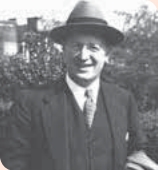
Forgetting About the Author
Samacheer Kalvi 11th English Solutions Prose Chapter 3 Forgetting

Robert Lynd is an Anglo-Irish writer, essayist and a poet. He is respected as one of the greatest essayists of the 20th century. He wrote many articles for leading journals and newspapers like Daily News, the New Statesman and Nation. He wrote under the pseudonym name “Y.Y His essays dealt with interesting and simple topics. His essays arc humourous delightful, ironical and satirical. I le was awarded with an honorary literary Doctorate by Queen’s University. He was confessed silver medal by the Royal Society of Literature.

Forgetting Summary

Robert Lynd is a humorous and delightful essayist. His essays are simple, playful and satirical. His style of writing is elegant and charming. In his essay “Forgetting”, he writes about the root causes of forgetting and also explains what items are usually forgotten by people.
Samacheer Kalvi 11th English Solutions Prose Chapter 3 Forgetting

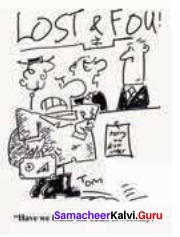
Robert Lynd is amazed by the efficiency of human memory. Modem man remembers telephone numbers, names of film stars, cricketers, football champions and even notorious murderers. He remarks wittily that man does not forget a single item of his clothing; No one forgets to shut the door when leaving the house. The institution of family survives in modem cities because ordinary people have extraordinary memory power. In some matters the memory is less than perfect, causes could be psychological. We tend to forget things we don’t wish to remember.

For example, many people forget to take medicines. Medicine needs to be taken before / after meals. Robert Lynd remarks that chemists make a lot of money because people tend to forget to take medicines. It aggravates the disease and people are forced to buy more and more medicines. Most people forget to post letters. The author himself would not trust his letters to be posted by others. The author himself never remembered to post letters entrusted to him. He had to apologise for the unposted letters kept with him for long. Likewise, the author forgets his walking sticks often.

The Absent-mindedness of people shocked the author when the Railway department published the list of lost articles. It was startling to note that young people forget bats, balls etc. The author attributes it to the abundant imagination and dreams. They are citizens of dreamland. Anglers also forget their fishing rods. Absent-mindedness is often a blessing in disguise. People can forget their unhappiness and live in a world of Utopia. Great thinkers, poets and philosophers are absent-minded because their minds are full of lofty ideas and imagination.

Socrates the philosopher and S.T. Coleridge the poet were absent-minded people. Similarly, Politicians have bad memories. States are yet to produce ideal Statesmen. Great writers, composers of music have amazingly great memories . Memory is half the substance of their art. Once a father took his baby out in a perambulator in the morning. He walked into a pub to have a glass of beer. The child was sitting in the perambulator outside in the street. After sometime, his wife came that way for shopping. She was shocked to find her baby sleeping in the perambulator.

She decided to teach her husband a lesson. She took the baby home. She expected her husband to come and apologize for losing the child. but he just walked in and casually asked his wife cheerfully what was there for the lunch. Very few people like Einstein or Socrates would be capable of such absent-mindedness. Men should forget unpleasant things and remember pleasant things.

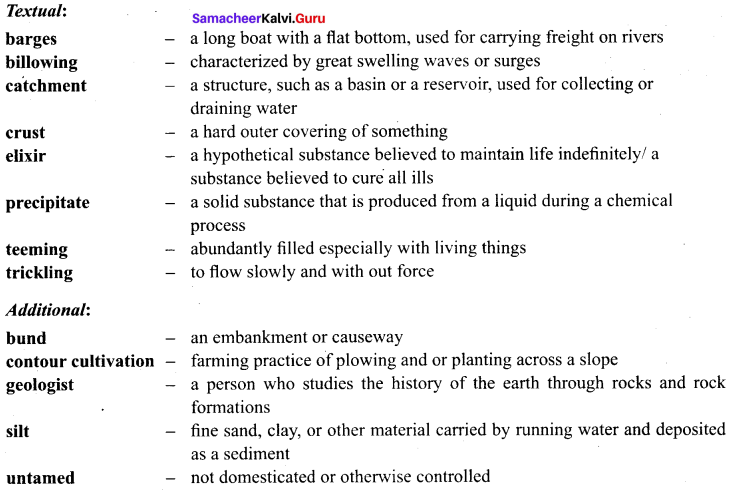
Textual:

  • abstracted – lacking concentration on what is
  • happening around
  • antipathy – strong dislike
  • audacious – bold and daring
  • delinquent – a young person who is regularly
  • involved in wrongdoing
  • eccentric – tending to act strangely
  • exploits – daring or heroic acts or actions, feats
  • fallible – capable of making mistakes
  • fortunes – huge sums of money
  • indignant – being very angry.
  • mediocre – not very good, ordinary
  • prosaic – dull
  • quivering – trembling, shivering
  • reluctant -unwilling
  • sieve – strainer or filter
  • vexation – irritation, annoyance
  • vintage – wine of high quality produced in a particular year

Additional:

  • Antipathy – dislike
  • Magnificent – spectacular
  • Prosaic – dull

Forgetting Synonyms

Choose the most appropriate synonym for the underlined word. (Exam model)

Question 1.
The ordinary man seldom forgets things.
(a) frequently
(b) rarely
(c) never
(d) often
Answer:
(b) rarely

Samacheer Kalvi 11th English Solutions Prose Chapter 3 Forgetting

Question 2.
A very methodical man remembers to take medicine.
(a) chaotic
(d) organized
(c) disarrayed
(d) inefficient
Answer:
(d) organized

Question 3.
I am always reluctant to trust a visitor to post my letters.
(a) willing
(b) unwilling
(c) like
(d) hatred
Answer:
(b) unwilling

Question 4.
It is because of their antipathy to pills.
(a) love
(b) affinity
(c) like
(d) aversion
Answer:
(d) aversion

Question 5.
Chemists make their fortunes out of medicines people forget to take.
(a) riches/wealth
(b) poverty
(c) paucity
(d) luck
Answer:
(a) riches/wealth

Question 6.
A long chain of circumstances leads to a number of embarrassing questions.
(a) comfortable
(b) interesting.
(c) anxious
(d) awkward
Answer:
(d) awkward

Question 7.
I am no delinquent in such matters.
(a) activist
(b) wrongdoer
(c) volunteer
(d) strategist
Answer:
(b) wrongdoer

Question 8.
I dare not carry an umbrella because I forget it often.
(a) believe
(b) refuse
(c) accept
(d) fear
Answer:
(d) fear

Samacheer Kalvi 11th English Solutions Prose Chapter 3 Forgetting

Question 9.
He did not even have the grimmest jawed umbrella.
(a) pleasant
(b) charming
(c) beautiful
(d) unpleasant
Answer:
(d) unpleasant

Question 10.
An absent-minded angler is good at inventing magnificent lies.
(a) dull
(b) drab
(c) cluster
(d) spectacular
Answer:
(d) spectacular

Question 11.
One has no time to remember the mediocre.
(a) great
(b) exceptional
(c) ordinary
(d) excellent
Answer:
(c) ordinary

Question 12.
He has a memory like sieve.
(a) glass
(b) filter
(c) fitter
(d) sleeve
Answer:
(d) sleeve

Question 13.
He is an audacious perverter of the truth.
(a) daring / bold
(b) timid
(c) frightened
(d) alarmed
Answer:
(a) daring / bold

Question 14.
We regard a person who does not possess a good memory as eccentric.
(a) usual
(b) conventional
(c) controversial
(d) strange / queer
Answer:
(d) strange / queer

Question 15.
Being indignant at her husband’s behaviour, she decided to teach him a lesson.
(a) cool
(b) calm
(c) anxious
(d) angry
Answer:
(d) angry

Question 16.
She anticipated her husband’s white face with quivering lips confessing the theft of the child.
(a) solid
(b) daring
(c) trembling
(d) cold.
Answer:
(c) trembling

Question 17.
Her husband’s cheerful entry and enquiry about lunch and forgetting the baby was her vexation.
(a) joy
(b) bliss
(c) ecstasy
(d) annoyance / irritation
Answer:
(d) annoyance / irritation

Question 18.
Most of us are bom with prosaically efficient memories.
(a) elated
(b) cheerfully
(c) normally
(d) dull
Answer:
(d) dull

Question 19.
They are abstracted from the world outside them.
(a) actual
(b) distracted
(c) stupid
(d) concrete
Answer:
(b) distracted

Question 20.
Men with fallible memories try to make out a case for their superiority.
(a) infallible
(b) valuable
(c) error-prone
(d) malicious
Answer:
(c) error-prone

Forgetting Antonyms

Choose the most appropriate antonym for the underlined word. (Exam model)

Question 1.
Many people who read the list of lost articles in the trains would be astonished.
(a) unexpected
(b) unpredictable
(c) surprised
(d) expected
Answer:
(d) expected

Question 2.
Modem man remembers even telephone numbers.
(a) recalls
(b) retrieves
(c) recollects
(d) forgets
Answer:
(d) forgets

Question 3.
The ordinary man seldom forgets to turn off lights.
(a) rarely
(b) almost never
(c) scarcely
(d) frequently
Answer:
(d) frequently

Question 4.
Moral giants remember to take medicines regularly.
(a) periodically
(b) intermittently
(c) irregularly
(d) continuously
Answer:
(c) irregularly

Question 5.
The fact remains.
(a) truth
(b) verity
(c) veracity’
(d) lie / fiction
Answer:
(d) lie / fiction

Question 6.
Some forget pills due to their antipathy.
(a) strong dislike
(b) aversion
(c) hostility
(d) affinity
Answer:
(d) affinity

Samacheer Kalvi 11th English Solutions Prose Chapter 3 Forgetting

Question 7.
Chemists make their fortunes out of the medicines forgotten to take.
(a) luck
(b) wealth
(c) bounty
(d) misfortunes
Answer:
(d) misfortunes

Question 8.
I am always reluctant to trust a visitor to post my letters.
(a) unwilling
(b) indisposed
(c) ill-disposed
(d) willing
Answer:
(d) willing

Question 9.
I put it for safety into one of my pockets.
(a) protection
(b) danger
(c) defence
(d) asylum
Answer:
(b) danger

Question 10.
I get weary of holding it in my hands.
(a) exhausted
(b) tired
(c) depleted
(d) energetic / fresh
Answer:
(d) energetic / fresh

Question 11.
A methodical man always remembers everything.
(a) organized
(b) disciplined
(c) chaotic/unorganized
(d) regular
Answer:
(c) chaotic/unorganized

Question 12.
A long chain of circumstances leads to a number of embarrassing questions’.
(a) awkward
(b) uneasy
(c) comforting
(d) discomforting
Answer:
(c) comforting

Question 13.
I am no great delinquent in such matters.
(a) irresponsible
(b) careless
(c) responsible
(d) negligent
Answer:
(c) responsible

Question 14.
I dare not carry an umbrella.
(a) defy
(b) fear
(c) avoid / dodge
(d) encounter
Answer:
(c) avoid / dodge

Question 15.
Memories prevent them from doing prosaic things.
(a) dull
(b) drab
(c) interesting
(d) boring
Answer:
(c) interesting

Question 16.
The angler who invents magnificent lies after a day’s fishing is bound to be absent-minded.
(a) spectacular
(b) fabulous
(c) weak / feeble
(d) strong
Answer:
(c) weak / feeble

Question 17.
Absent’ – minded great people have no time to remember the mediocre.
(a) average
(b) drab
(c) common
(d) exceptional / excellent
Answer:
(d) exceptional / excellent

Question 18.
People with fallible memories occasionally assert their superiority.
(a) likely to do mistakes
(b) infallible
(c) insatiable
(d) inscrutable
Answer:
(b) infallible

Question 19.
Memory is half the substance of their art.
(a) remembrance
(b) forgetfulness
(c) recollection
(d) retrieval
Answer:
(b) forgetfulness

Question 20.
He is an audacious perverter of truth.
(a) bold
(b) daring
(c) diligent
(d) timid
Answer:
(d) timid

Samacheer Kalvi 11th English Solutions Prose Chapter 3 Forgetting

Question 21.
A man who does not possess a good memory is often regarded eccentric.
(a) strange
(b) queer
(c) unconventional
(d) ordinary / conventional
Answer:
(d) ordinary / conventional

Question 22.
What was her vexation?
(a) worry
(b) annoyance
(c) regret
(d) pleasure
Answer:
(d) pleasure

Question 23.
Great Statesmen have the genius of memory and intellect combined.
(a) mental ability
(b) dunce
(c) sharp witted
(d) brilliance
Answer:
(b) dunce

Question 24.
She was indignant at her husband’s behaviour.
(a) furious
(b) ruffled
(c) angry
(d) contented / composed
Answer:
(d) contented / composed

Question 25.
She arrived home anticipating with angry relish the white face and quivering lips.
(a) enjoyment
(b) like
(c) dislike
(d) pleasure
Answer:
(c) dislike

Samacheer Kalvi 11th English Book Solutions Prose

11th English Unit 3 Prose Forgetting Paragraph Book Back Answers Samacheer Kalvi Read More »

Hobby – Turns A Successful Career Book Back Answers 8th Standard Term 1 English Chapter 1 Samacheer Kalvi

8th Standard English Guide Term 1 Unit 1 Prose Hobby – Turns A Successful Career Book Back Answers

Students can Download English lesson 1 Hobby – Turns A Successful Career Questions and Answers, Summary, Activity, Notes, Samacheer Kalvi 8th English Book Solutions Guide Pdf  helps you to revise the complete Tamilnadu State Board New Syllabus and score more marks in your examinations.

Hobby – Turns A Successful Career 8th Standard English 1st Lesson Question and Answer

Section – I

Read And Understand

A. Say true or false.

  1. Mani’s hobby is playing cricket.
  2. Hobbies are unique to people.
  3. People have hobbies only to pass time.

Answer:

  1. False
  2. True
  3. False

B. Choose the correct answer.

Question 1.
Mani imagined a world with_______
(a) music and musicians
(b) Building and sculptures
(c) magic and magicians
Answer:
(c) magic and magicians

Samacheer Kalvi 8th English Solutions Term 1 Prose Chapter 1 Hobby - Turns A Successful Career

Question 2.
When Mani started writing things, he was unable to_______
(a) describe them accurately
(b) describe them fluently
(c) describe them imaginatively
Answer:
(a) describe them accurately

Question 3.
Mani feels writing is like_______
(a) painting the voice
(b) engraving the voice
(c) designing the voice
Answer:
(a) painting the voice

Section – II
Read And Understand

A. Say true or false.

  1. Ajay Garg is an artist.
  2. Asha Devi taught Ajay the miniature painting.
  3. Ajay displayed 150 paintings.
  4. Ajay was awarded by the Indian president Dr. A. P. J. Abdul Kalam.

Answer:

  1. True
  2. True
  3. True
  4. True

B. Answer the following questions.

Question 1.
What was Ajay gifted with?
Answer:
Ajay was gifted with painting.

Question 2.
How was he honoured?
Answer:
He was honoured by the Indian President Dr. A.P.J. Abdul Kalam with a national award of accomplishment.

Samacheer Kalvi 8th English Solutions Term 1 Prose Chapter 1 Hobby - Turns A Successful Career

Question 3.
What did Ajay’s current goal?
Answer:
His current goal is to revitalize the dying art of traditional miniature. Indian paintings.

Question 4.
Is Ajay’s hobby become a successful career? How?
Answer:
Yes, Ajay’s hobby has become a successful career because his work became popular all throughout India, the United States and the United Kingdom. He has also become the executive member of the ‘Deaf and Dumb’ Association in Rajasthan

Section – III

Read And Understand

A. Fill in the blanks.

  1. Mani feels writing is like
  2. Ajay mastered the techniques of
  3. Ilavazhagi won her first match against

Answer:

  1. Paintaing the voice
  2. Prepare colours and brushes
  3. Her father

B. Choose correct synonyms for the italic word.

Question 1.
Writing is a unique hobby.
(a) common
(b) beneficial
(c) uncommon
Answer:
(c) uncommon

Question 2.
Ajay started to paint happily.
(a) depressed
(b) joyfully
(c) unhappily
Answer:
(b) joy fully

Samacheer Kalvi 8th English Solutions Term 1 Prose Chapter 1 Hobby - Turns A Successful Career

Question 3.
Miniature paintings depict Indian culture.
(a) warp
(b) portray
(c) twist
Answer:
(b) portray

C. Choose correct antonyms for the italic word.

Question 1.
Ajay suffered an injury.
(a) sorrow
(b) endure
(c) hurt
Answer:
(b) endure

Question 2.
Ajay mastered the techniques of painting.
(a) skilled
(b) proficient
(c) unskilled
Answer:
(c) unskilled

Samacheer Kalvi 8th English Solutions Term 1 Prose Chapter 1 Hobby - Turns A Successful Career

Question 3.
Ilavazhagi won the world championship in
(a) win
(b) succeed
(c) defeat
Answer:
(c) defeat

D. Answer the following questions in one or two sentences.

Question 1.
What happened to Ajay at the age of three?
Answer:
Ajay suffered an injury in his ear at the age of three. He had taken treatments but the treatment left him permanently deaf.

Question 2.
What did Asha Devi teach Ajay?
Answer:
Asha Devi taught Ajay the old and dying technique of ‘Traditional Indian Miniature Painting’.

Question 3.
Why writing is beneficial according to Mani?
Answer:
According to Mani, writing is very beneficial, because it opens his mind to think beyond the little things with a broader mind.

E. Answer the following questions in 100 words.

Question 1.
How did Ajay’s father find his son’s talent?
Answer:
Ajay Kumar Garg’s childhood was going well, until he suffered an injury at the age of three. Ajay was treated, but that treatment left him permanently deaf. His parents tried many hospitals to cure his disability but it was useless. One day, his father bought him a paint set to play. Ajay started painting happily on the walls and floors. He looked happy, while using the paint set. Soon Ajay father realised that Ajay was talented in painting. When Ajay was five years, a court artist of Dholpur, Shri Sua Lai was impressed with Ajay’s work. He took Ajay with him and started training him.

Question 2.
Write a note on Ilavazhagi.
Answer:
Ilavalazhagi is an accomplished carrom player. She was born into an economically backward family in Vyasarpadi, Chennai. Her father was a fish – cart driver. He was a district-level champion in carrom, but he could not become a champion, because of his poverty. He encouraged his daughter to become a champion in carom. He used to take ger to the club to play the game. One day her father called her for a match, and she won the match, which gave her confidence. The confidence made her gain the world championship. She has played for the state for almost 14 years. Illavalgi is a member of the Thiruvalluvar District Carrom Association. Her Victory included the Asia Cup, and SAARC Cup, and the World Championship. In 2008, she gained the Indian National Carrom Championship. In the same year, she won Carrom World Championships and became a World Champion in the women’s Singles.

Vocabulary

Homophone

a. Pick out the correct homophone.

  1. I am not ____ to drink soda, (aloud, allowed)
  2. The wind _____ the leaves, (blue, blew)
  3. I will _____ my friend, (meat, meet)
  4. He will play the _____ in the second play, (role, roll)
  5. I have_______movie before.(scene,seen)

Answer:

  1. allowed
  2. blew
  3. meet
  4. role
  5. seen

b. Choose the correct homophone.

Question 1.
Every morning my father likes to look at the ______ on the grass
(a) due
(b) dew
Answer:
(b) dew

Samacheer Kalvi 8th English Solutions Term 1 Prose Chapter 1 Hobby - Turns A Successful Career

Question 2.
Chennai is the____ of Tamilnadu
(a) capitol
(b) capital
Answer:
(b) capital

Question 3.
Their words had a negative
(a) affect
(b) effect
Answer:
(b) effect

Question 4.
I was very last weekend because my friends made plans that
(a) bored
(b) board
Answer:
(a) bored

Question 5.
The cat caught the
(a) scent
(b) cent
Answer:
(a) scent

Abbreviation And Acronyms

(a) & (b) Expand the following:
Answer:

1.

GST

Goods and Services Tax.

2.

ECG

Electrocardiography

3.

ILO

International Labour Organization

4.

SCERT

State Council of Educational Research and Training

5.

IIT

Indian Institute of Technology

6.

ISRO

Indian Space Research Organisation

7.

FIR

First Information Report

8.

UNESCO

United Nations Educational, Scientific and Cultural Organization

9.

UNICEF

United Nations International Children’s Emergency Fund

10

NASA

National Aeronautics and Space Administration

Listening

Questions on passage. (*Listening passage is given at the end of the third unit.)

Question 1.
What is philately?
Answer:
Stamp collection is known as philately.

Question 2.
What is numismatics?
Answer:
The hobby of collecting coins from different countries is known as numismatics.

Question 3.
Do you know where the rarest and the most beautiful shells are found?
Answer:
The rarest and the most beautiful shells are found in the Indo Pacific, Caribbean, and Mediterranean regions.

Question 4.
Painting can help unleash your creative side. How?
Answer:
Painting allows you to tap into the thoughts, desires and feelings in your head and translate them into something beautiful. It relaxes our mind and helps us to focus better.

Samacheer Kalvi 8th English Solutions Term 1 Prose Chapter 1 Hobby - Turns A Successful Career

Question 5.
What is your friend’s hobby? How does it differ from yours? Discuss and write.
Answer:
My hobby is cooking. It is a life skill. My friend’s bobby is gardening.

Speaking

Role-play the conversation in the class.
Continue this conversation with your friends atleast five to ten dialogues each.
Answer:
Naveen: Hi Ajay! How are you?
Ajay: I am Fine, and what about you?
Naveen: I am fine too. What are you doing in this early morning?
Ajay: I am taking care of my garden. The garden is running to weeds.
Naveen: oh! What a beautiful garden it is !
Ajay: It is beautiful as I work every day in it.
Naveen: Who helps you in your work?
Ajay: I have done this. It is my and who I have cultivated vegetable hobby.
Naveen: Oh! thats nice. How long have you been doing this?
Ajay: I have been doing this for three years.
Naveen: What vegetables are grown here?
Ajay: Tomatoes, Chillies, Brinjals, Lady’s fingers, and some greens.
Naveen: Wonderful! You have a mini vegetable market here.
Ajay: Of course, My mother uses these vegetables for cooking
Naveen: It is a very good idea.
Ajay: Yes it is! You benefit a lot by this.
Naveen: It is good for our health because we don’t use any chemicals here.
Ajay: Exactly! Gardening also develops a green atmosphere and the environment.
Naveen: It’s interesting. Let me also do this.

Reading (Tongue Twisters)

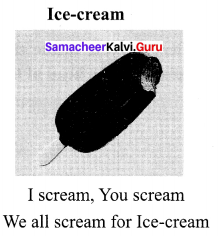
  • I Scream. I scream you scream, let’s all scream, for ice cream!
  • No need to light a night-light on a light night like tonight.
  • Green glass globes glow greenly.
  • She sells seashells on the seashore.
  • He would chuck, he would, as much as he could.

Writing

Using the given letter as a model, write a complaining letter on any one of the topics given below.

a) To the Police commissioner about the noise caused by the loudspeaker in a music shop near your school.
Answer:

Chennai,
3rd March 2019.

From
Adiya
VIII Std ‘A’,
Government Higher Secondary School,
Chennai – 600 Oil.

To
The Police Commissioner,
Perambur, Chennai – 600 Oil.

Sir,
Sub: Complaint about the noise caused by the loudspeaker regarding.
We, the students of Government Higher Secondary School, are getting distracted by the noise caused by the loudspeaker in a music shop near our school. We are unable to listen to the lessons taught and concentrate on our studies. The noise from the loudspeaker is unbearable.

We request you to look into the matter immediately and take the necessary action to stop this problem.

Thank you,
Yours faithfully,

Aditya
VIII Std ‘A’ Section.
Address on the Cover:

To
The Police Commissioner, Perambur,
Chennai – 600011.

b) To the Postmaster General on non – receipt of book parcel.
Answer:
Tiruchirappalli,
10th May 2019.

From
G. Alex
School Pupil Leader,
SSR Higher Secondary School,
Tiruchirappalli – 620 001

To
The Postmaster General
Sangiliyandapuram,
Tiruchirappalli – 620 001.

Sir,
Sub: Complaint on the non-receipt of a book parcel – reg.

I had ordered some books from a publishing company, two weeks back. When I contacted the publishing company, they told us that they had sent us the books in a registered parcel two days back. But so far, we have not received the parcel.

You are requested to enquire into the matter and do the needful.

Thank you,
Yours faithfully,
G. Alex.

Address on the Cover:

To
The Postmaster General
Sangiliyandapuram,
Tiruchirappalli – 620 001,

c) To the Transport Manager, TNSTC on the non- stopping of buses near your school bus stop.
Answer:
Chennai,
4th June 2019.

From
Manisha. K VIII Std ‘B’,
Anitha Hr. Sec. School,
Vepery, Chennai – 600 007.

To
The Transport Manager,
TNSTC,
Chennai – 600 002.

Sir,
Sub: Non-stopping of buses near the school bus stop – reg.

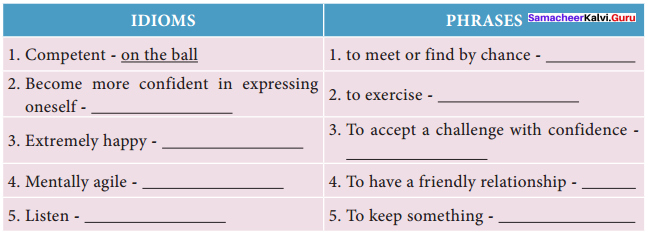
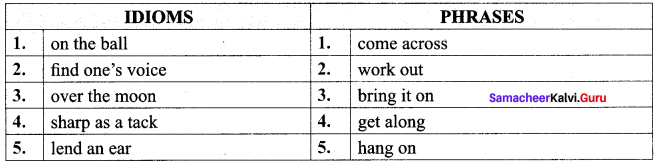
This is to bring to your notice that TNSTC buses do not stop near our school bus stop. The students are finding it difficult to commute to school. They had to walk a long distance to come to school and then go home from school. It takes a lot of time for all of us.

We request you to kindly look ‘ into this matter and take necessary action for the benefit of our school students.

Thank you,

Yours faithfully,
Manisha. K

Address on the Cover:

To
The Transport Manager, TNSTC,
Chennai – 600 002.

Grammar

A. NOUN
a. Pick out the words from the list and put them appropriately on the table.

David, Madurai, parrot, happiness, book, thought, green, tiger, Trichy, computer, Narayanan, fan, sister, Kalam, woman, pencil, Bharthi, problem, brother, Mumbai, swan, elephant, Vijay, solution, success, school, convent.
Answer:

Person

Place Animals Things

Ideas/feelings

David Madurai parrot book happiness
Narayanan Trichy tiger computer thought
sister Mumbai swan fan green
Kalam school elephant pencil problem
woman convent solution
Bharthi success
brother
Vijay

b. Write the common noun for the following proper nouns.
Answer:

No. Proper Noun Common Noun
1. Priya girl
2. Saran boy
3. Tiger animal
4. India country
5. Peacock Bird
6. Coimbatore place
7. Lion animal
8. Dove bird
9. Kabilan boy
10. Saleema girl

c. Read the following paragraph and pick out the different types of nouns and put them in the table.
A hobby is an activity we enjoy doing in our free time. It keeps us busy in our leisure time. People choose their hobbies on the basis of their interests and personality. Do you know what Dr. A. P. J. Abdul Kalam’s hobby was?
Answer:

Proper Noun Common Noun Collective Noun Abstract Noun
Dr. A.P.J. Abdul Kalam Hobby activity personality
people leisure interests
time
busy

d. Fill in the blanks.
( flock, swarm, bunch, herd)

  1. a______ of cows.
  2. a______ of birds.
  3. a______ of ants.
  4. a______ of grapes.

Answer:

  1. herd
  2. flock
  3. swarm
  4. bunch

Samacheer Kalvi 8th English Solutions Term 1 Prose Chapter 1 Hobby - Turns A Successful Career

B.pronoun

a. Complete with the subject personal pronoun.

  1. My name is Preethi. (Preethi)______ am a student and this is my family.
  2. My mom’s name is princy a housewife.
  3. Albert is my dad. (My dad)
  4. Benjamin is my brother. (Benjamin)
  5. (Preethi and Benjamin) are twins.

Answer:

  1. I
  2. She
  3. He
  4. He
  5. They

b. Change the underlined words with the correct pronoun.

(they, he, him, it, she )
Question 1.
I saw Mr. Balu this morning and gave Mr. Balu my homework.
Answer:
I saw Mr. Balu this morning and gave him my homework.

Question 2.
Muthu likes computer games but he doesn’t play computer games very often.
Answer:
Muthu likes computer games but he doesn’t play it very often.

Question 3.
My aunt lives in Trichy but, my aunt often comes to visit my family.
Answer:
My aunt lives in Trichy but, she often comes to visit my family.

Question 4.
Neil Armstrong was born in 1930. Neil Armstrong landed on the moon in 1969.
Answer:
Neil Armstrong was born in 1930. He landed on the moon in 1969.

C. Change the possessive adjective into a possessive pronoun.

  1. This is my pen.
  2. She missed her purse.
  3. Her speech is nice.
  4. My book is new.
  5. My bike is costly.

Answer:

  1. This pen is mine.
  2. The missed purse is hers.
  3. The nice speech is hers.
  4. The new book is mine.
  5. The costly bike is mine.

C- VERB
List out the transitive and intransitive verbs in the following words.
(come, buy, teach, learn, arrive, sing, run, draw, jump, write )
Answer:

Transitive

Intransitive

buy

come

teach

arrive

learn

run

sing

jump

draw

write

Hobby – Turns A Successful Career Additional Questions

I. Choose the correct Synonyms for the italic word.

Question 1.
We do it in our spare time.
(a) busy time
(b) down time
(c) free time
(d) work time
Answer:
(c) free time

Question 2.
Writing is just a hobby for me, yet it is very beneficial.
(a) useful
(b) harmful
(c) wonderful
(d) frightful
Answer:
(a) useful

Samacheer Kalvi 8th English Solutions Term 1 Prose Chapter 1 Hobby - Turns A Successful Career

Question 3.
He was very impressed with Ajay’s work.
(a) disappointed
(b) bored
(c) lazy
(d) amazed
Answer:
(d) amazed

Question 4.
I was unable to describe them accurately.
(a) exactly
(b) definitely
(c) commonly
(d) suddenly
Answer:
(a) exactly

Question 5.
Soon he became an accomplished artist.
(a) finished
(b) unskilled
(c) fulfilled
(d) worked
Answer:
(a) finished

Question 6.
Ajay exhibited his work and sold 144 paintings.
(a) closed
(b) showed
(c) hid
(d) conceded
Answer:
(b) showed

Question 7.
Her passion for carom took her to the level of world champion.
(a) desire
(b) dread
(c) enmity
(d) honour
Answer:
(a) desire

Question 8.
Her father’s dream shattered.
(a) combined
(b) built
(c) destroyed
(d) fulfilled
Answer:
(c) destroyed

Question 9.
The confidence led her to win the Asia Cup.
(a) peace
(b) love
(c) hatred
(d) hope
Answer:
(d) hope

Question 10.
His parents tried several hospitals to cure his impairment.
(a) ability
(b) disability
(c) failure
(d) destruction
Answer:
(b) disability

II. Choose the correct Antonyms for the italic word.

Question 1.
Mani found it difficult to read and write.
(a) hard
(b) easy
(c) sharp
(d) bad
Answer:
(b) easy

Samacheer Kalvi 8th English Solutions Term 1 Prose Chapter 1 Hobby - Turns A Successful Career

Question 2.
Same is the case with me.
(a) fair
(b) Identical
(c) different
(d) ordinary
Answer:
(c) different

Question 3.
I sit with small children and entertain them.
(a) amuse
(b) cheer
(c) fascinate
(d) Annoy
Answer:
(d) Annoy

Question 4.
It opens my mind to think with a broader mind,
(a) narrower
(b) outer
(c) wider
(d) smother
Answer:
(a) narrower

Question 5.
But that treatment left Ajay permanently deaf.
(a) temporarily
(b) abruptly
(c) suddenly
(d) accurately
Answer:
(a) temporarily

Question 6.
Asha Devi taught Ajay the old and dying technique of Traditional Indian Miniature Painting’
(a) conventional
(b) modern
(c) standard
(d) normal
Answer:
(b) modern

Question 7.
His family did not encourage and support him.
(a) support
(b) motivate
(c) entertain
(d) discourage
Answer:
(d) discourage

Question 8.
Hard working people always chase their dream.
(a) follow
(b) run
(c) walk
(d) retreat
Answer:
(d) retreat

Question 9.
Her victories included the Asia Cup and SAARC Cup.
(a) added
(b) excluded
(c) existed
(d) outcast
Answer:
(b) excluded

Question 10.
She won the Championship beating a former world champion Rashmi kumari in the final.
(a) previous
(b) first
(c) future
(d) beginner
Answer:
(c) future

III. Choose the Correct Answer (MCQ)

Question 1.
Mani found it difficult to read and ______
(a) learn
(b) write
(c) speak
(d) talk
Answer:
(b) write

Question 2.
Hobbies are the_____that we do in our spare time.
(a) projects
(b) tasks
(c) activities
(d) assignments
Answer:
(c) activities

Question 3.
When I write thines. my_____is at its best.
(a) handwriting
(b) creations
(c) work
(d) imagination
Answer:
(d) imagination

Question 4.
It makes me more_____about mv life.
(a) passionate
(b) pleasant
(c) inquisitive
(d) accurate
Answer:
(a) passionate

Samacheer Kalvi 8th English Solutions Term 1 Prose Chapter 1 Hobby - Turns A Successful Career

Question 5.
Aiay started to paint_____
(a) sorrowful
(b) vaguely
(c) happily
(d) regretful
Answer:
(C) happily

Question 6.
Ajay turned his hobby into a _____career.
(a) medical
(b) successful
(c) vocational
(d)good
Answer:
(b) successful

Question 7.
Irudavarai was determined to achieve his_____
(a) preference
(b) request
(c) dream
(d) fancy
Answer:
(c) dream

Question 8.
The confidence led Ilavazhaki to win her_____
(a) victories
(b) demands
(c) claims
(d) conditions
Answer:
(a) victories

Question 9.
Ilavazhaki’s father was a_____level champion in carom
(a) world
(b) state
(c) International
(d) district
Answer:
(d) district

Question 10.
Her passion for_____took her to the level of world champion.
(a) carom
(b) cricket
(c) hockey
(d) kabaddi
Answer:
(a) carom

IV. Very Short Questions with Answers.

Question 1.
What is a hobby?
Answer:
The hobby is an activity we enjoy doing in our free time.

Question 2.
What is your hobby?
Answer:
My hobbies are Reading and Singing.

Question 3.
What does the term ‘pastime’ mean?
Answer:
The term ‘pastime’ means, an activity regularly done for enjoying rather than work. To pass the leisure time relaxingly.

Question 4.
Who is the best friend for a reader while travelling on a train?
Answer:
Books are the best friends for a reader while travelling alone on a train.

Question 5.
Name any two socially useful hobbies.
Answer:
Cooking and Painting.

V. Short Questions with Answers.

Question 1.
What was Mani’s problem?
Answer:
Mani had difficulty in reading and writing.

Question 2.
What did his Grandfather do?
Answer:
His grandfather helped him by reading bedtime stories.

Question 3.
Why does Mani say that writing is a unique hobby?
Answer:
Mani says that writing is unique because most people don’t want to exhaust themselves in their spare time.

Question 4.
What did Ajay’s father buy him?
Answer:
Ajay’s father bought him a paint set to play with.

Question 5.
What was Ajay gifted with?
Answer:
Ajay was gifted with the practice of creating images on a grain of rice.

Question 6.
What was Irudayaraj?
Answer:
Irudayaraj was a fish-cart driver, who used to transport materials like pipes to make a living.

Samacheer Kalvi 8th English Solutions Term 1 Prose Chapter 1 Hobby - Turns A Successful Career

Question 7.
Who did Ilavazhagi beat in the women’s singles?
Answer:
Ilavazhagi beat P. Nirmala in the finals of the Carom World Championship with 25-11, 25-11 victory.

VI. Paragraph Question with Answer.

Question 1.
How beneficial was the hobby of writing to Mani?
Answer:
Mani felt the hobby of writing very beneficial to him. He felt writing is like painting his voice’. When he got free time, he picked a pen and a notebook. He started writing stories, poems, and sometimes about his feelings. His mind used to relax when he poured his thoughts as words. His imagination is at its best when he writes things. Writing opened his mind to think beyond the little things with a broader mind. It made him more passionate about his life and learn new things. It also helped him in school too and made him a good writer.

Hobby – Turns A Successful Career Grammar Additional

I. Guide proper names for the common nouns :

Eg: Butter – Amul

  1. Pencil – ________
  2. Ball Pen – ________
  3. Hospital – ________
  4. Soft Drink – ________
  5. Car – ________

Answer:

  1. Apsara
  2. Reynolds
  3. Apollo
  4. Pepsi
  5. Toyota

II. Collective nouns:

  1. ______ of bees.
  2. ______ of keys.
  3. ______ of cards.
  4. ______ of players
  5. ______ of books.

Answer:

  1. Swarm
  2. Bunch
  3. Pack
  4. Team
  5. Libary

III.Form abstract nouns from these adjectives:

Eg: Soft – Softness

  1. Cruel – ________
  2. Polite – ________
  3. Honest – ________
  4. Beautiful – ________
  5. Lazy – ________

Answer:

  1. Cruelty
  2. Politeness
  3. Honesty
  4. Beauty
  5. Laziness

IV. Use singular pronouns and fill in the blanks :

  1. _____gave_____a gift.
  2. _____went out when_____rained.
  3. _____do not want_____to steal things.
  4. When he met_____I gave_____an advice.

Answer:

  1. He, her
  2. She, it
  3. I, you
  4. me, him

V. Use Plural pronouns and fill in the blanks:

  1. Raj and Rahul are brothers and live in the same house.
  2. They are my friends, I meet in the park.
  3. My father and I went to the mall, but it was closed.
  4. We won the match. Everybody congratulated

Answer:

  1. They
  2. Them
  3. we
  4. us

VI. Fill in the blanks with possessive pronouns:

  1. The travellers brought a lot of goods. The goods were _______
  2. A man was riding a motor bike. The bike was _______
  3. She stitched the torn dresses from her cupboard. The dresses were _______
  4. The certificates belong to me. They are _______
  5. This classroom belongs to us. It is certainly _______
  6. The photos look so good. They are _______
  7. The dog has a puppy. It is _______

Answer:

  1. theirs
  2. his
  3. hers
  4. mine
  5. ours
  6. yours
  7. its

VII. Use the simple present tense of the verb in the bracket and fill the blanks:

  1. Look! He (fly)______the kite high
  2. Yesterday he went by car, but today he (go)on a cycle.
  3. If he (pass)the exam, he will get a good job.
  4. Mohan will jump in joy if he (see) you coming.
  5. If Vijay (run)fast, he will be able to catch the train.

Answer:

  1. Flies
  2. goes
  3. passes
  4. sees
  5. runs

VIII. Use simple past tense of the verb in the bracket and fill the blanks:

  1. I (buy) this coat from the boutique.
  2. Dad (leave)for office an hour ago.
  3. My sister (write) an essay that was published in the magazine.
  4. We (come)home, (take) some rest, and (spend)time playing cards.

Answer:

  1. bought
  2. left
  3. wrote
  4. came / took /spent

IX. Use simple future tense of the verb in the bracket and fill the blanks:

  1. I (leave)_______for Paris next week.
  2. We (party)_______at the Taj on my birthday.
  3. You (move)_______to Delhi next month on promotion.
  4. Ten students failed the exam. They (write)_______their exams again from Monday.
  5. The sun rise was at 6 a.m. It (set)_______at 5.45 p.m this evening.

Answer:

  1. will leave
  2. will party
  3. will move
  4. will write
  5. will set

Samacheer Kalvi 8th English Solutions Term 1 Prose Chapter 1 Hobby - Turns A Successful Career

X. Insert the correct form of infinitive using the given verbs in the brackets:

  1. It would be nice to______(meet) Dr. Abdul Kalam again.
  2. To______(cook) this recipe, you will need 500 grams of minced meet
  3. Ravi wants to______(take) raji to the amusement park
  4. I need to______(wash) my hands before I have my food.
  5. We discussed whether to______(invite) Rajiv or not.

Answer:

  1. meet
  2. cook
  3. take
  4. wash
  5. invite

XI. Fill in the blanks with suitable Gerund (verb+ing):

  1. ______(meet) is a periodic event.
  2. She loves______(eat) ice creams.
  3. I like______(celebrate) festivals.
  4. ______(wait) is torturing.
  5. He was awarded for______(run) fast
  6. I achieve by______(work)
  7. I don’t like______(play) cards
  8. ______(cook) is my hobby.
  9. Do you enjoy______(swim)
  10. He loves______(sing) songs.

Answera:

  1. Meeting
  2. eating
  3. celebrating
  4. Waiting
  5. running
  6. working
  7. playing
  8. Cooking
  9. swimming
  10. singing

Section – I

Hobby – Turns A Successful Career Summary

A boy named Mani had difficulty in reading and writing. His grandfather noticed this and helped  him by reading bedtime stories. Gradually, Mani started reading on his own. After some days, he also  started writing his own stories. In this section, he wrote an essay on hobbies.

Hobbies are the activities done during our free time. They are special to people. Some people  like gardening, a few like photography and many have book reading as their hobby. Hobbies help people to learn new things, relax after a tiring day, and energies our body and mind. Mani’s hobby was writing. Though many people feel writing is tough, he felt ‘writing’ was like ‘painting our voice’.

When he wrote things, he imagined a world with magic and magicians. Writing opened his mind to think beyond the little things with a broader mind. It made him learn new things and enjoy every moment of his life. His hobby of writing helped him in school too. He could describe things better in  his stories. He had no problem in writing English essays or stories, as it was his hobby. Thus it is important to always learn and improve Our hobbies.

Samacheer Kalvi 8th English Solutions Term 1 Prose Chapter 1 Hobby - Turns A Successful Career

Section – II

Ajay Kumar Garg, a very talented young artist lived in Jaipur, India. He suffered an injury at the age of three and became deaf. His parents tried many hospitals to cure his disability. But it was useless. Ajay used to paint on the walls and floors. Realizing his interest in painting, a court artist of Dholpur, Shri Sua Lai started educating him in painting. After completing his education, Ajay became an apprentice of Asha Devi, who taught him the ‘Miniature Painting’. Soon, Ajay became an ‘accomplished artist’ in the miniature style. He was gifted in the practice of creating images on a grain of rice.

Ajay exhibited his work and sold 144 out of 150 paintings displayed in the exhibition. His work became famous throughout India, the United States, and the United Kingdom. In 2004, he was awarded a national award of accomplishment from the Indian President, Dr. A.P.J. Abdul Kalam.

Ajay also involved in the welfare of people with hearing disabilities and gave them free training. He has been the executive member of’Deaf and Dumb’ Association in Rajasthan. One of Ajay’s current goals is to re-energize the dying art of traditional miniature Indian paintings. Thus, Ajay’s life shows us that we can turn our hobby into a successful career if we are ready to learn and develop our skills.

Section – III

Ilavazhagi achieved her dream amidst all odds. Her father, A. Irudayaraj, was a district level champion in Carom. His dream of achieving success in it, shattered, as he was not encouraged and supported by his family members. He determined to achieve his dream through his daughter. So he began coaching her and carried her to the local clubs frequently. She won the match against her father and that gave her the confidence in achieving success. Later she won the Asia Cup, the SAARC cup, and the world championship.

She lived with her family in a small one-room apartment in Vysarpadi, Chennai. This was not enough to accommodate her family and to preserve her trophies. She has been playing for the state for almost 14 years yet, she found it difficult to finance her trips for the matches.

Ilavazhagi is a member of the Thiruvallur District Carom Association. She also represented India at the Carom World Championships. She won the 2008 Indian National Carom Championship and became a world champion in the women’s singles after beating P. Nirmala in the finals with 25-11, 25-11 victory. Thus her passion for Carom took her to the level of world champion.

Samacheer Kalvi 8th English Prose

Hobby – Turns A Successful Career Book Back Answers 8th Standard Term 1 English Chapter 1 Samacheer Kalvi Read More »
Empowered Women Navigating The World Book Back Answers 10th Standard English Chapter 3 Samacheer Kalvi

10th Standard English Unit 3 Prose Empowered Women Navigating The World Book Back Answers

You can Download Empowered Women Navigating The World Questions and Answers, Summary, Activity, Notes, Samacheer Kalvi 10th English Book Solutions Guide Pdf Prose Chapter 3 help you to revise complete Tamilnadu State Board New Syllabus and score more marks in your examinations.

Attempt all english grammar practice sections covered in the Samacheer Kalvi 10th English Grammar Book and excel in reading, writing, and speaking english with great fluency.

Empowered Women Navigating The World 10th Standard English 3rd Lesson Question and Answer

Empowered Women Navigating The World warm up:

1 Read the statements given below and match the issues accordingly.

  1. The marriage of a young girl below 18.
  2. A transfer ofdurable goods/property that the bride’s family gives to the bridegroom as a condition of the marriage.
  3. The intentional killing of a baby girl due to the preference for male babies in the family.
  4. Repeated and unwelcome sexual comments, looks, or physical contact at work place made by men that could offend women.
  5. A women deciding to remarry despite opposition from relatives /society.
  6. Women excelling in many fields overcoming many hurdles.

Samacheer Kalvi 10th English Solutions Prose Chapter 3 Empowered Women Navigating The World 1
Answer:
Samacheer Kalvi 10th English Solutions Prose Chapter 3 Empowered Women Navigating The World 2

2. Discuss with your friend the role of a women in building a family. What are the roles played by her?
Answer:
Women are the forerunners of a nation. Indian culture attaches great importance to women. Women comprise half of world’s population. Women are the key to sustainable development and quality of life in the family. The varieties of role the women assume in the family are those of spouse, leader, manager, supervisor of family income and last but not the least important the role of a mother.

3. What do you think of the status of women in the modern society.
Answer:
Status of Indian Women has changed radically during the modem period. Both the structural and cultural changes provided equality of opportunities to women. With the help of these changes, exploitation of women, to a great extent was reduced. More freedom and better orientation were provided to the women’s organisation to pursue their interest in all fields.

4. Compare the status of women in the past with the present.
Answer:
Women of the past were generally the keeper of the home. She made the family’s clothes; provided meal and took care of the home needs. She catered to her children all of this by herself until the female children were old enough to be of use. She was more a husband’s slave. She had no power to decide and just obeyed her husband’s orders. But today the role in the family that women play is more so an equal partnership to the man. They both work together to make the family function. Many a times, it is a single mom trying to mn the household chores. She works outside the home and inside the home; feeds her children at home and does whatever she can. She plays the role of a mother and a father sometimes. She does take decisions for the welfare of her family.

5. What is the role of women in the modern society discuss.
Answer:
Now-a-days women have the freedom to be what they want to be, who they want to be and how they want to live. Never before, women had the degree of freedom and self-determination they are experiencing today in this modem society. Yet there are problems and obstacles to be overcome. Sometimes, one feels that the young women of yesterday were freed from a style that narrowed them in numerous ways, only to be forced into another style that confines them today. Women should be free to choose whatever career or lifestyle interests them. Women are surely accepted as our partners in life; our work place; and in our goals to survive and move on.

6. Divide the class into small groups, choose any one eminent women personality of the world. List out her characters. achievements, etc and speak a minute about her?
Answer:
Samacheer Kalvi 10th English Solutions Prose Chapter 3 Empowered Women Navigating The World 1
Mother Teresa, the founder of the Order of the Missionaries of Charity, a Roman Catholic congregation of women dedicated her life to helping the poor.

In 1979 she received the Nobel Peace Prize for her humanitarian work. She died in September 1997 and was beatified in October 2003. In December 2015, Pope Francis recognized a second miracle attributed to Mother Teresa, clearing the way for her to be canonized on September 4, 2016. Considered one of the 20th Century’s greatest humanitarians, she was canonized as Saint Teresa of Calcutta in 2016.

Mother Teresa, a Nun and missionary known in the Catholic Church as Saint Teresa of Calcutta, devoted her life to caring the sick and the poor. Mother Teresa was born on August 26, 1910, in Skopje, the current capital of the Republic of Macedonia. The following day, she was baptized as Agnes Gonxha Bojaxhiu.

She taught in India for 17 years having experienced her “call within a call” in 1946.

Sakshi Malik born on September 3, 1992, is an Indian wrestler who has won a bronze medal in the 58 Kg category at the 2016 Rio Summer Olympics. She has become the first female Indian wrestler who has bagged a medal at the Olympics. Apart from Olympics, Malik had participated and won a silver in the 2014 Commonwealth Games in Glasgow and a bronze at the 2015 Asian Wrestling Championships in Doha.

Sakshi Malik hails from Mokhra village of Rohtak district in Haryana. Her father, Sukhbir Malik, is a bus conductor and her mother, Sudeh Malik, is a supervisor at a local health Anganwadi. She was inspired by her grandfather who was also a wrestler. Her wrestling training started when she was just 12. Her coach, Ishwar Dahiya trained her at Rohtak.

Malik is an employee of Indian Railways in its Delhi division and in the commercial department in the Northern Railway Zone. After she won a bronze medal in the Rio Olympics, she was promoted to gazetted officer rank from being a senior clerk at the Indian Railways. She has pursued her post-graduation in Physical Education from Maharshi Dayanand University in Rohtak.

Malik earned her first bronze medal in the 5 8 Kg freestyle event at the Junior World Championships in 2010. Her determination became stronger with this medal, which motivated her to win a gold in 60 Kg category at the 2014 Dave Schultz International Tournament. At the 2014 Glasgow Commonwealth Games, she came out with a bronze medal in the 60 Kg category at the 2015 Asian Championships in Doha, Qatar 2016 Rio Olympics.

Aung San Suu Kyi, also called Daw Aung San Suu Kyi, was born on June 19, 1945, Rangoon, Burma. She was a politician and opposition leader of Myanmar, daughter of Aung San and Khin Kyi and winner of the Nobel Prize for Peace in 1991. She held multiple governmental posts since 2016, including that of state counselor, which essentially made her the de facto leader of the country.

Aung San Suu Kyi was two years old when her father, then the de facto prime minister of what would shortly become independent Burma, was assassinated. She attended schools in Burma until 1960, when her mother was appointed ambassador to India. After further study in India, she attended the University of Oxford, where she met her future husband, the British scholar Michael Aris. She and Aris had two children and lived a rather quiet life until 1988, when she returned to Burma to nurse her dying mother, leaving her husband and sons behind.

Suu Kyi was freed from house arrest in July 1995, although restrictions were placed on her ability to travel outside Yangon. In 2008 the conditions of her house arrest were somewhat loosened, allowing her to receive some magazines as well as letters from her children, who were both living abroad. In May 2009, shortly before her most recent sentence was to be completed, Suu Kyi was arrested and charged with having breached the terms of her house arrest after an intruder (a U.S. citizen) entered her house compound and spent two nights there.

In August she was convicted and sentenced to three years in prison, though the sentence immediately was reduced to 18 months, and she was allowed to serve it while remaining under house arrest. At the time of her conviction, the belief was widespread both within and outside M/anmar that this latest ruling was designed to prevent Suu Kyi from participating in multiparty parliamentary elections (the first since 1990) scheduled for 2010.

The daughter of a candid social activist and educator, Malala Yousafzai was an outstanding student. Her father, who established and administered Khushal Girls High School and College in the city of Mingora where she was educated, encouraged her to follow his path.

Malala Yousafzai was born on July 12, 1997, Mingora, Swat Valley in Pakistan. She gained global attention when she survived an assassination attempt at age 15. In 2014 Yousafzai and Kailash Satyarthi were jointly awarded the Nobel Prize for Peace on behalf of children’s rights.

On September 1, 2008, when Yousafzai was 11 years old, her father took her to a local press club in Peshawar to protest the school closings. Her first speech, “How Dare the Taliban Take Away My Basic Right to Education?” was publicized throughout Pakistan. The British Broadcasting Corporation (BBC) approached Yousafzai’s father in search of someone who might blog for them about TTP me. Under the name Gul Makai, Yousafzai began writing regular entries for BBC Urdu about her daily life.

In October 2011 she was nominated by human rights activist Desmond Tutu for the International Children’s Peace Prize. In December of that year she was awarded Pakistan’s first National Youth Peace Prize later renamed the National Malala Peace Prize.

Empowered Women Navigating The World InText Questions

Question 1.
Wiyat does INSV stand for?
Answer:
INSV stands for Indian Naval Ship Vessel.

Question 2.
When was INSV Tarini commissioned to Indian Navy service?
Answer:
INSV Tarini was commissioned to Indian Navy service on 18th February 2017.

Question 3.
Who is Tara-Tarini? After whom was the sailboat named?
Answer:
INSV stands for Indian Naval Ship Vessel.
Tara-Tarini is the patron deity for sailors. The sailboat was named after the famous ‘Tara- Tarini’ temple in Ganjam district of Odisha.

Question 4.
Where did the crew undergo their basic training?
Answer:
The crew underwent their basic training courses in Mumbai at the Indian Navy Waterman ship Training centre.

Question 5.
How long were they trained to undertake this voyage?
Answer:
They were trained for almost three years to undertake this voyage.

Question 6.
Which skill was considered important in the selection process?
Answer:
Little survival skills were considered important in the selection process.

Question 7.
Who mentored the crew?
Answer:
The crew was mentored by Commander Dilip Donde.

Question 8.
Which quality of the skipper helped to bring out a successful expedition?
Answer:
The quality of honesty helped them to bring out a successful expedition.

Question 9.
Who among the crew mentioned about teamwork?
Answer:
Among the crew, it was Payal Gupta who mentioned about teamwork.

Question 10.
When did they witness the brilliant southern lights from the sea? How did the sky appear there?
Answer:
When they were crossing the Tasman sea, they witnessed the brilliant southern lights from the sea. The entire sky was lit up in green light.

Question 11.
What festival did they celebrate during their expedition?
Answer:
They celebrated Diwali during their expedition.

Empowered Women Navigating The World Textual Questions

A. Read the statements given below and state whether they are true or false. If false , then write the correct answer in the space given.

Question 1.
Indian Navy’s all-women crew was the first-ever to circumnavigate the globe.
Answer:
True.

Question 2.
The crew consists of six members of men and women Indian Navy service.
Answer:
False – The crew consisted of all women crew in Indian Navy Service.

Question 3.
Vartika Joshi skippered the crew to circumnavigate the globe.
Answer:
True

Question 4.
The crew started their expedition on 10 July 2017 from Mumbai.
Answer:
False – The crew started their expedition on 10 September, 2017 from Goa.

Question 5.
Dilip Donde was the first person to go on a non-stop solo circumnavigation.
True.

Additional Questions

Question 1.
Navika Sagar Parikrama was a project undertaken with the National policy to empower both men and women to attain their full potential.
Answer:
False – Navika Sagar Parikrama was a project undertaken with the National policy to empower women to attain their full potential.

Question 2.
In the North Pacific, the crew encountered a storm where the seas were almost nine to ten meters high and the winds were picking up to 60-70 knots.
Answer:
False – In the South Pacific, the crew encountered a storm where the seas were almost nine to ten meters high and the winds were picking up to 60-70 knots.

Question 3.
Team effort actually helped in navigating through the 20 hours long storm.
Answer:
True

Question 4.
Two of the crew members were well acquainted with a sail boat or ocean-going boat.
Answer:
False – None of them were acquainted with a sail boat or ocean-going boat.

Question 5.
It covered the expedition in five legs with stop-overs at five ports.
Answer:
False – It covered the expedition in five legs with stop-overs only at four ports.

B. Answer the following questions briefly.

Question 1.
Mention the special features of INSV Tarini.
Answer:
INSV Tarini is the second sailboat of the Indian Navy. The boat had all facilities and encouraged eco-friendly resources. It collected and updated meteorological, ocean, and wave data regularly.

Question 2.
What does the term circumnavigation mean?
Answer:
The term, circumnavigate means to travel all the way around something, especially the earth.

Question 3.
How did the all-women Indian Navy crew go about their voyage?
Answer:
The all-women Indian Navy crew started from Goa. It covered the expedition in five legs with stop-overs at four ports.

Question 4.
When did the crew start their voyage? When did they return back to India? How many days did it take to complete the expedition?
Answer:
The crew started their voyage on 10th September, 2017 from Goa. They returned back to India on 21st May, 2018. It took them 254 days to complete the expedition.

Question 5.
What sort of training did the crew undergo before their expedition?
Answer:
The crew underwent some theoretical courses on navigation, communication, and weather prediction. They also learned how to repair things and how to deal with emergencies.

Question 6.
How did the crew members work as a team to make their expedition successful?
Answer:
The crew members have all sailed and trained the same amount and everybody has their own way of dealing with situations. This was a good thing because they could discuss different ways of solving a problem and choose the best one. When they were at sea, teamwork is vital in the middle of the crisis. Even during the storm when three people would be out on watch, the other three staying inside would be restless. When one would heat the water, the other would heat the gloves because it was also raining.

Question 7.
What challenging tasks did the team face during their voyage?
Answer:
They faced a storm in the South Pacific. The seas were almost nine to ten meters high. The winds were picking up to 60-70 knots.

Question 8.
What sort of activities did the crew engage in during their long voyage?
Answer:
During circumnavigation, the crew picked up some hobbies and kept posting pictures of delicacies like golgappas and cakes. They also read books when the weather was pleasant and did some quilling and craft work. While team leader Joshi read comics and the Ramayana during her journey, Swathi loved cooking and so indulged in baking. Swathi also liked crafting I a lot and made some lampshades. They were always entertained being in a group of six. They watched movies and sometimes listened to music. They made parathas, baked cakes and breads, and even made halwa and rasgullas!

Question 9.
Mention the celebrations which the crew enjoyed during their expeditions.
Answer:
They celebrated Diwali, three birthdays, and the first birthday of the sailboat.

Question 10.
Which factor motivated the crew to undertake this expedition?
Answer:
The crew knew that the entire country was watching them and praying for them. So they never wanted them to have a single day thinking that they were in trouble. They knew that it was going to happen but the people out there did not know what kind of challenges they were facing. So, one of the motives that they kept in mind was that they did not want to frighten anyone.

Additional Questions

Question 1.
Why is Tara-Tarini worshipped?
Answer:
Tara – Tarini is worshipped for safety and success at sea.

Question 2.
What is the meaning of Tarini?
Answer:
The word ‘Tarini’ means ‘boat’ and in Sanskrit it means ‘Saviour’.

Question 3.
What were the problems they faced during their training voyage?
Answer:
As the boat was old, it had minor leaks and repairs. They also ran out of water and food soon.

Question 4.
In what way was the training voyage a tutorial to them?
Answer:
The trip was a tutorial for them on how to manage food, water and even electricity during the big voyage.

Question 5.
What made Aishwarya have second thoughts?
Answer:
When Aishwarya was told about the flare- ups at sea, she had second thoughts about joining the team.

Question 6.
How many applied to be shortlisted to six members of the crew?
Thirty women applied for six of them to be shortlisted, as members of the crew.

Question 7.
What did they mistake a dead sperm whale to be?
Answer:
They mistook a dead whale sperm to be an island from a distance as it was so huge.

Question 8.
What did they do when they witnessed something new in their journey?
As they were not specialists, whenever they spotted something new in the sea, they googled and browsed information to learn more about the species.

Question 9.
How did they plan to manage a storm?
Answer:
Even during the storm when three people would be out on watch, the other three who would be inside wouldn’t be able to rest. When somebody heated the water, the other person would heat the gloves because it was raining also.

Question 10.
How many hours was the storm and what helped them to stay safe?
Answer:
Team effort helped them to stay safe and navigate through the 20 hours long storm.

Question 11.
Who were the all-women crew members?
Answer:
Indian Navy’s all-women crew was skippered by Lt. Commander Vartika Joshi. The other members in the women team were Lt. Cdr. Pratibha Jamwal, Lt. Cdr. Swathi Patarapalli, Lt. Aishwarya Boddapati, Lt. Sh. Vijaya Devi and Lt. Payal Gupta.

C. Answer the following in about 100-150 words:

Question 1.
Highlight the factors responsible for the all-women Indian Navy crew to carry out their expedition.
Answer:
Introduction:
Women occupy almost all the major roles in society. Women’s achievements are remarkable in various fields. One of the achievements is the all-women Indian Navy who went round the world for 254 days all alone in a sailboat.

Navika Sagar Parikrama:
Navika Sagar Parikarma was a project, it was undertaken to empower women. It is initiated in the navy for Nari Sakthi. It depicts the Government of India’s thrust for women’s power. INSV stands for Indian Naval Ship Vessel. INSV Tarini is the second sailboat of the Indian Navy.

Sort of Training:
“Make in India”- sailing in INSV Tarini INSV Tarini has many special features. The boat had all facilities and encouraged eco-friendly resources. A crew of six army women was selected for a voyage. They were selected based on their skills. They started classroom courses. Later they were given hands-on training.

The time of the voyage:
The voyage aimed to showcase the “Make in India” initiative. The crew was skippered by It. Commander Vartika Joshi. The voyage started from Goa on 10 Sep. 2017. It returned to Goa on 21 May 2018 after 254 days. They faced unpredictable challenges during their expedition.

Conclusion:
They overcome all these challenges and completed their expedition. This voyage proved empowerment. They showed that they can do anything.

Moral: Women are the real architects of society

Question 2.
Write in detail about the selection and training process which the crew underwent
Answer:
Indian Navy’s all-women adventure sailing crew, which aimed at several record-making I achievements with an ambitious circumnavigation of the globe, was in the capital to meet Prime Minister Narendra Modi and the top brass of the Navy, before it embarked on a voyage to circumnavigate earth.

The selection process was indeed not an easy one. In order to promote ocean sailing activities and to encourage women empowerment, the Indian Navy conceptualized this idea of the First Indian All Women Circumnavigation of the Globe. Out of the thirty women who had applied, six of them were shortlisted, based on the little survival skills they showcased. They were led by Lieutenant Commander Vartika Joshi.

These officers had done basic sail training courses at INWTC Mumbai followed by Navigation, Seamanship, Communication and Meteorology courses at various naval training schools at Kochi. After completion of theoretical courses, the officers sailed INSV Mhadei to Vizag for the International Fleet Review 2016 and thereafter to Mauritius and back.

Following that, they sailed the boat on a gruelling voyage to Cape Town in December. Lt. Commander Jamwal revealed that they were selected from different cadres and trained extensively for three-years where they learnt about navigation, communication, weather prediction and sailing.

The selected team was extensively mentored and trained by Dilip Donde, the first Indian to circumnavigate the globe from the Navy in the project ‘Sagar Parikrama’.Classroom courses were different from sailing outside.

So, they were given hands-on training, like, how to repair things and how to deal with emergencies, when the weather got rough. They underwent basic sail training courses in Mumbai at the Indian Naval Waterman ship Training Centre (INWTC), and at various schools in the southern naval base in Kochi.

They even sailed on INSV Mhadei to Mauritius (in 2016 and 2017) and back and also to Cape Town in December 2016. They were trained for almost three years to prepare for the voyage.
“Confidence comes from discipline and training.”

Additional Questions

Question 1.
What do you know about the Navikaa Sagar Parikrama?
Answer:
Navika Sagar Parikrama was a project undertaken in consonance with the National policy to empower women to attain their full potential. The Project is considered essential towards promoting ocean sailing activities in the Navy while depicting Government of India’s thrust for Nari Shakti which means women power.

The Chief of the Naval Staff, Admiral Sunil Lanba gave his welcome speech when this project was launched. The voyage was aimed to show ‘case ‘Make in India’ initiative by sailing on-board indigenously-built INSV Tarini. The special feature of this sailboat is that it encouraged use of environment friendly non-conventional renewable energy resources such as the wind; collected and updated meteorological, ocean and wave data on regular basis for accurate weather forecast by India Meteorological Department (IMD) and also collected data for monitoring marine pollution on high seas.
“The goal is not to sail the boats, bat rather to help the boat sail herself.”

Question 2.
Describe the challenge they faced with the weather condition.
Answer:
One day they were hit by a storm – it was scary to see very high waves, around 9-10 metres high surging the boat at a wind speed of 60 to 70 knots. Though they were prepared for the storm, it was quite challenging. Mountainous waves were surging from behind, pushing them forward. They were in the South Pacific. Luckily, they were sailing downwind. They took turns in steering the boat. When three of them were doing the watch at a time the other three rested.

It was so cold that it was difficult to stand outside for more than an hour. They watched enormous waves break over the top of the boat and sweep across the deck. One can imagine that a blast of saltwater soaking them completely. Sometimes the water would have gushed inside their living space, soaking all their clothes in sea water. The place would have been a mess.
“Accept the challenges so that you can feel the exhiliration of victory.”

Vocabulary:

D. Pick out the idioms and phrases from the box and write them in the blanks equivalent to their meanings. One is done for you.

Samacheer Kalvi 10th English Solutions Prose Chapter 3 Empowered Women Navigating The World 2Samacheer Kalvi 10th English Solutions Prose Chapter 3 Empowered Women Navigating The World 3
Answers:
Samacheer Kalvi 10th English Solutions Prose Chapter 3 Empowered Women Navigating The World 4

E. Read the given sentences carefully and fill in with appropriate phrasal verbs. Choose them from the help box.

Samacheer Kalvi 10th English Solutions Prose Chapter 3 Empowered Women Navigating The World 5

  1. The air hostess instructed the passengers to wear the seat belts during the …………….. .
  2. Venkat felt happy to……………… the neighbours in the new locality.
  3. There will be a ……………… next week in the office.
  4. Doing ………………… every day in the morning keeps one healthy.
  5. The mother instructed the maid to ………………….. the child carefully.

Answers:

  1. takeoff
  2. get along with
  3. shutdown
  4. warm-up
  5. look after

F. Read the given passage carefully and fill in the blanks with suitable phrasal verbs from the help box.

Samacheer Kalvi 10th English Solutions Prose Chapter 3 Empowered Women Navigating The World 6

Riya is a young dancer who feels contented and satisfied with herself. Let’s hear from her.
Hi, everyone! I am Riya. I suppose I’m really lucky because I don’t (1) ………………… weight easily. I never (2) ……………… in the gym and the only time I (3) ……………… is when I need something from the top shelf. I tried aerobics several times but I couldn’t (4) ……………….. with the others. I take my pet for a walk thrice a day though, and that helps to (5) ………………. the calories. I usually watch what I eat but I sometimes binge on ice cream. My sister Diya, is a real fitness fanatic. Before she works out she (6) ………………. every day with push-ups, sit-ups, stretches and a jog around the park. She says it’s important to (7) ………………. good levels of strength and stamina. I don’t want to overdo it though. A fitness regime like hers would (8) …………… me (9) …………………..!
Answers

  1. put on
  2. tire out
  3. work out
  4. keep up
  5. bum off out
  6. warms up
  7. buildup
  8. stretch

Listening Activity:

G. Listen to the passage read by the teacher and say whether the given statement is true or false.

Preethi Srinivasan is a former cricketer from Tamil Nadu who played domestic cricket in the 1990’s. At the age of eight, she was the youngest girl to play in the State cricket team. At the age of 17, she captained the Tamil Nadu women’s under-19 cricket team in a national tournament in 1997, and registered its only victory ever.

She was also a state-level gold winner in 50 m breaststroke swimming event. But the following year, she suffered a spinal cord injury in an accident in Puducherry that left her quadriplegic. Her own trauma inspired her to create SoulFree, a foundation that aims to help Indian youth to cope with disabilities related to spinal – cord injuries, and how suitable precautions can help them out.

Instead of the term ‘differently-abled’, SoulFree employs the term ‘positively-abled’ for those suffering from a disability. She is active in social life and earned many honours too. In 2018, she received the Kalpana Chawla Award for Courage and Daring Enterprise.

  1. Preethi Srinivasan is a former cricketer from Tamil Nadu.
  2. At the age of seventeen, she captained the Indian Women’s cricket team.
  3. Preethi Srinivasan was not only a cricketer but also a runner.
  4. Preethi’s own trauma inspired her to create SoulFree, a foundation for those suffering from mental illness.
  5. Preethi received the Kalpana Chawla Award for Courage and Daring Enterprise.

Answers:

  1. True
  2. False
  3. False
  4. False
  5. True

Speaking Activity:

Story Telling:
Storytelling is an art which involves planning, research and skill. A good storyteller makes decisions ahead that drive their stories forward, engage their audience and relate information important to the telling of the story.

Techniques and Presentation skills:
There are certain techniques that help narrate a story perfectly.

  • Remember and recall the plot.
  • Create story frame to remember the key events
  • Self-narrate the story as a rehearsal
  • Change the volume, pitch and tempo of your voice to make the narration effective.
  • Use appropriate facial expressions and gestures.
  • Include questions and answer them during the narration.
  • Retain focus and maintain concentration on what you are narrating
  • Sustain eye contact and grab the attention of the audience.

H. Read the clues given below and develop your story. Narrate your story to the class. Robert Bruce – King – lying on the ground in a dejected mood – failed to defeat his enemies – was thinking of giving up the attempt – saw a spider falling down from the ceiling – the ceiling far away – wondered how it would get there – the spider fell back again – again it tried – again it fell – it made nine such attempts – no success – climbed up once more – at last succeeded in reaching the roof – Bruce imitated its example – he too tried once again – was successful.

Once upon a time, there was a king by name, Robert Bruce. He was both brave and wise in spite of the defeat he had faced recently. Battle after battle Bruce had fought and was lying on the ground in a dejected mood. He had failed to defeat his enemies and hence was almost giving up another attempt against his foes.

It seemed to him that there was no use for him to try to do anything more. As Robert Bruce lay contemplating and looking at the ceiling, he noticed a spider falling over his head trying to weave her web. He watched her as she worked slowly and with great care. Nine times the spider tried to throw her thread from one edge of the dilapidated room wall to another.

All the nine times her thread fell short. Success was not the spider’s cup of tea. King Robert Bruce too was in a similar situation. Victory over his enemies was not his cup of tea. But to his astonishment, he saw the spider climbing up once more. At last, it succeeded in reaching the roof. Now, King Robert Bruce was inspired by the spider which did not lose hope.

He dismissed his defeat and hopeless nature and swung to action. So he got up and called his men together. He instructed his men of his plans and sent them out with hopeful messages to cheer the discouraged people. Very soon, he set out with an army of brave men around him and now Success was his!

I. Develop a story with the given pictures and narrate it to your class. Your story must have a plot and vivid details.
Samacheer Kalvi 10th English Solutions Prose Chapter 3 Empowered Women Navigating The World 7Samacheer Kalvi 10th English Solutions Prose Chapter 3 Empowered Women Navigating The World 8Samacheer Kalvi 10th English Solutions Prose Chapter 3 Empowered Women Navigating The World 9Samacheer Kalvi 10th English Solutions Prose Chapter 3 Empowered Women Navigating The World 10
Samacheer Kalvi 10th English Solutions Prose Chapter 3 Empowered Women Navigating The World 11

Santiago, Ranthambore and Bevis happily started for their underwater expedition to the extreme northern coastal area of Charlotte islands. They were well equipped and it was one of the usual underwater expedition. However, 19th May, 1968 wasn’t quite the normal one. The ship, ‘Probably Never Sinks’ did sink into the sea. The three of them dove into the sea 150 miles before Charlotte island.

This disaster turned a blessing in disguise for the three of them. They did find a lot of underwater sea creatures and many coral reefs. Ranthambore, who was a specialist at venturing deep into coral reefs spotted a visage of a fallen emperor.

On being alerted with flashlights, Santiago and Bevis helped Ranthambore to push aside and take the ruin to the surface of the ocean. To their astonishment, they were awestruck at the chest of precious stones under it. They rejoiced at their luck yet knew their civic responsibilities and proceeded towards the Department of Tourism. All the local newspapers and television channels reported their marvellous experience.

Reading:

I. Read the data below and answer the following questions.

Samacheer Kalvi 10th English Solutions Prose Chapter 3 Empowered Women Navigating The World 12

Choose the correct answer:

1. What is the data about?
(a) women empowerment
(b) women power
(c) women at work
(d) women at home
Answer:
(c) women at work

2. Identify the three jobs where the same percentage of women work.
(a) Technical Field, Medicine, Environmental
(b) Information Technology, Environmental, Technical Field
(c) Administration/ Human Resources, Earthmoving Workshop, Logistics
(d) Environmental, Technical Field, Earthmoving Workshop
Answer:
(b) Information Technology, Environmental, Technical Field

3. In which field of work is women’s involvement in the second highest?
(a) Logistics stores
(b) Home maker
(c) Medicine
(d) Administration/Human resource
Answer:
(c) Medicine

4. Percentage of women working in finance is the same as
(a) Home maker
(b) Information Technology
(c) Technical Field
(d) Administration / Human Resources
Answer:
(d) Administration / Human Resources

5. What is the difference between the percentage of women working in logistics and Medicine?
(a) 8
(b) 11
(c) 13
(d) 5
Answer:
(d) 5

Writing:

J. Read the given slogans and match them appropriately with their theme.

Samacheer Kalvi 10th English Solutions Prose Chapter 3 Empowered Women Navigating The World 13
Answer:
Samacheer Kalvi 10th English Solutions Prose Chapter 3 Empowered Women Navigating The World 14


K. Look at the images of familiar advertisements given below. Identify the products and try to frame your own slogans for each one of them.

Samacheer Kalvi 10th English Solutions Prose Chapter 3 Empowered Women Navigating The World 15
Answer:
Samacheer Kalvi 10th English Solutions Prose Chapter 3 Empowered Women Navigating The World 16Samacheer Kalvi 10th English Solutions Prose Chapter 3 Empowered Women Navigating The World 17Samacheer Kalvi 10th English Solutions Prose Chapter 3 Empowered Women Navigating The World 18Samacheer Kalvi 10th English Solutions Prose Chapter 3 Empowered Women Navigating The World 19

L. Look at the pitcures given below and frame your own slogans:

Samacheer Kalvi 10th English Solutions Prose Chapter 3 Empowered Women Navigating The World 20 Samacheer Kalvi 10th English Solutions Prose Chapter 3 Empowered Women Navigating The World 21Samacheer Kalvi 10th English Solutions Prose Chapter 3 Empowered Women Navigating The World 22Samacheer Kalvi 10th English Solutions Prose Chapter 3 Empowered Women Navigating The World 23

Letter Writing:

M. Exercise:

1. Imagine that you have parked your vehicle (two-wheeler)/ bicycle inside the school premises. You find it missing in the evening. Write a complaint to the head of the school regarding this issue.
From
Ms. XYZ,
(Student of Std X-C)
D/O Mr. Alagesan
9, South Boag Road,
Officer’s colony,
Jawaharpet,
Dindivanam – 604172
2nd August, 2019
To
The Principal,
Sankalwar High School,
43 & 44 Rajarajastreet,
Permalpuram,
Dindivanam – 604174

Sir / Madam,
Subject: Complaint about my Bicycle – Reg.
This morning, I had parked my brand new bicycle which was gifted to me last birthday by my grandparents in the usual place near the school canteen allotted for bicycle parking along with many other cycles. However, I am alarmed to note that the bicycle is missing at the parking lot when I went at 5.10 p.m. after the Remedial class for Mathematics. I do remember seeing my bicycle during the lunch break.

It is a BSA Ladybird Breeze 26T Steel Bicycle, Pink in colour with a Pink seat cover. I request you to kindly look into the matter and do the needful.
Looking forward to your immediate action and thanking you in advance for the same.
Thank you,
Yours faithfully,
XYZ
To
The Principal,
Sankalwar High School,
43 & 44 Rajarajastreet,
Permalpuram,
Dindivanam – 604174

2. Write a complaint to the officer of the PWD department to take immediate actions of maintaining cleanliness in the Children’s Park in your locality.’
From
ABC,
10, Margostreet,
Alandur,
Manamadhurai-630606.
4th December 2021.
To
The PWD Officer,
Alandur,
Manamadhurai- 630606
Respected Sir,
Sub: Garbage to be removed inside the Children’s Park
I am a resident of Margo street in Alandur. As a resident, I hereby bring to your notice the poor sanitation conditions of this locality. Sanitation is very bad here. The roads here are not swept regularly. Almost every litter area is overflowing with garbage. They have not cleaned the area for nearly a week. Colony children go to the Children’s park on Sullivan street. A foul smell arises from the garbage area there. It has become a place for mosquitoes to breed. Recently, we noticed many children affected by fever. Some are even diagnosed to be suffering from dengue, malaria, etc.
So, I request you to look into this matter seriously and improve the sanitation in this locality. Looking forward to your continued co-operation and stringent action against the sanitation staff in-charge of this locality.
Thank you,
Yours faithfully,
ABC
To
The PWD Officer,
Alandur,
Manamadhurai- 630606

3. Write a letter to the manager of a famous daily, ordering subscription for your school library.
From
The Librarian,
ABC School,
Rajakilpakam,
Chennai – 600073
1st December 2019
To
The Manager,
Chandana Publishing House,
Kodambakkam,
Chennai – 600024
Dear Sir,
Subject: Subscription for magazines
I hereby request you to renew our Annual subscription for five copies of Chandamama Quest, two copies each of India Today, Periwinkle and Reader’s Digest for the year 2020.
As per the telecommunication, please find enclosed the cheque for 8750/- only in favour of Chandamama Publishing House.
Thanking you in advance for your continued cooperation.
In anticipation,
Yours sincerely,
Mrs. Rani Rajan
(School Librarian)
To
The Manager,
Chandana Publishing House,
Kodambakkam,
Chennai – 600024

Grammar:

Tenses:

A. Complete the sentences in present tense forms.

  1. Saravanan always ……………….. (go) for a walk in the morning.
  2. We …………………. (gather) here for a meeting and the chair person is yet to arrive.
  3. Arun has ……………… eagerly …………… (wait) to meet her friend since morning.
  4. Sheeba …………… (move) to a new house next week.
  5. Naseera …………… (attend) music classes regularly.
  6. Ilakiya and Adhira …………….. (enjoy) each other’s company very much.
  7. Mani ……………… (work) in this school for five years.
  8. It ……………. (pour) outside now.

Answers:

  1. goes
  2. are gathered
  3. been, waiting
  4. is moving/moves
  5. attends
  6. enjoy/are enjoying
  7. is working
  8. is pouring

B. Complete the sentences in past tense forms.

  1. I ……………… (go) to her place on foot.
  2. The children …………… (play) in the ground when the teacher arrived.
  3. They …………… (request) him when the manager arrived.
  4. If you ……………..(work) hard, you would have won the relay match
  5. Joanna and Joy ……………… already ……………….. (leave) for Ooty, when the others reached the station.
  6. We all ……………… (sing) in the choir last week.
  7. Nancy ……………… always ………………… (ask) for help.
  8. The office goers …………….. (wait) for the train.

Answers

  1. went
  2. were playing
  3. requested
  4. had worked
  5. had, left
  6. sang
  7. would, ask
  8. waited

C. Fill in the blanks using the verbs in the brackets in the future form.

  1. We …………… not ……………… to the market, in case it rains, (go)
  2. Keerthi ……………. his work by next week.(do)
  3. The peon …………….. the bell by the time I reach the school.(ring)
  4. I …………….. my sister’s house next April if I go to Uttarkhand. (visit)
  5. If you listen carefully, you ……………… my point, (understand)
  6. By next year, I ………….. in Chennai for fifteen years, (live)
  7. The new edition of this book ………………. out shortly, (come)
  8. She hopes you …………….. her. (help)

Answers:

  1.  will, go
  2. will do/will be doing
  3. will ring
  4. will visit
  5. will understand
  6. would have lived
  7. will come
  8. will help

D. Underline the verbs and identify the tense forms.

  1. I am working hard day and night. …………………………………………………….
  2. The Moon revolves around the Earth. ………………………………………………
  3. Were the milk men milking the cow? ………………………………………………..
  4. He received your messages last night. ……………………………………………..
  5. I have been ill for a couple of days. …………………………………………………..

Answers:

  1. Present Continuous
  2. Simple Present
  3. Past Continuous
  4. Simple Past
  5. Present Perfect

E. In the following passage, some words are missing. Choose the correct words from the given options to complete the passage.

Raghav (1) ……………….. in a middle-class family. He is a (2) ……………… boy of 8. His mother (3) ……………………….. as a software engineer in an MNC. (4) ………………… is his favourite hobby. He (5) …………………….. the first prize in school level competition for drawing last week. He (6)………………. drawing at the age of 3. His mother (7) …………. he (8) ………………. a great painter in the future.
(a) (i) will be born (ii) is born (iii) born (iv) has born
(b) (i) school-going (ii) going to school (iii) school coming (iv) school gone
(c) (i) working (ii) works (iii) has worked (iv) will work
(d) (i) drawn (ii) had drawn (iii) drawing (iv) having drawn
(e) (i) win (ii) was winning (iii) wins (iv) won
(f) (i) was starting (ii) starting (iii) started (iv) is starting
(g) (i) hoped (ii) hoping (iii) hopes (iv) has hoped
(h) (i) will become (ii) becomes (iii) would become (iv) will be becoming
Answers

  1. is born
  2. school-going
  3. works
  4. Drawing
  5. won
  6. started
  7. hopes
  8. will become

F. The following passage has not been edited. There is one error in the tense of the verb in each line. Write the wrong word as well as the correct word in the given place. One is done for you.
Samacheer Kalvi 10th English Solutions Prose Chapter 3 Empowered Women Navigating The World 24

G. Read the story and rewrite it using the simple past tense.

Juno the elephant is lonely and tries to make friends with the other animals in the forest. But, the other animals refuse to play with Juno because of his size. One day, all the animals are running away from Dera the tiger who is eating everyone he finds. Juno goes and gives Dera a swift kick. Dera immediately runs away. Juno is now everyone’s friend.
Answer:
Juno the elephant was lonely and tried to make friends with the other animals in the forest. But, the other animals refused to play with Juno because of his size. One day, all the animals were running away from Dera the tiger who was eating everyone he found. Juno went and ‘ gave Dera a swift kick. Dera immediately ran away. Juno was now everyone’s friend.

H. Read the situations given and frame two suitable sentences in the appropriate form of the tenses.

Samacheer Kalvi 10th English Solutions Prose Chapter 3 Empowered Women Navigating The World 25
Answer:
Samacheer Kalvi 10th English Solutions Prose Chapter 3 Empowered Women Navigating The World 26Samacheer Kalvi 10th English Solutions Prose Chapter 3 Empowered Women Navigating The World 27

Samacheer Kalvi 10th English Solutions Prose Chapter 3 Empowered Women Navigating The World 28Samacheer Kalvi 10th English Solutions Prose Chapter 3 Empowered Women Navigating The World 29

Empowered Women Navigating The World Summary:

Samacheer Kalvi 10th English Solutions Prose Chapter 3 Empowered Women Navigating The World 30

Introduction:
History unveils records of women who faught wars and won accords from age immemorial. Today the advancing technology is bringing to prominence the presence of the empowered women worldwide.
Samacheer Kalvi 10th English Solutions Prose Chapter 3 Empowered Women Navigating The World 31

Modern Day Women
Modem day women in India have fought for their freedom and set a very good example for others. The real power of women is currently projected to the world by the advancement of technology and media.
Samacheer Kalvi 10th English Solutions Prose Chapter 3 Empowered Women Navigating The World 32

Women’s endeavour into sea Nowadays, women occupy almost all the major positions in society and their accomplishments are tremendous. One such achievement is the All-women Indian Navy crew who circumnavigated the world for 254 days all alone, in a sailboat called Indian Naval Ship Vessel – Tarini. Tara- Tarini is the patron deity for sailors and is worshipped for safety and success at sea.
Samacheer Kalvi 10th English Solutions Prose Chapter 3 Empowered Women Navigating The World 33

INSV Tarini
INSV Tarini is the second sailboat of the Indian Navy and the first was the INSV Mhadei. It is a 55-foot sailing vessel built indigenously in India by M/s Aquarius Shipyard Pvt. Ltd, located in Goa. After undergoing extensive sea trials, she was commissioned on 18th February 2017.
Samacheer Kalvi 10th English Solutions Prose Chapter 3 Empowered Women Navigating The World 34

The boat was named after the famous ‘Tara-Tarini’ temple in the Ganjam district of Odisha. The word ‘Tarini’ means ‘boat and in Sanskrit, it means ‘Saviour’. INSV Tarini has advance Raymarine navigation suite and an array of satellite communication systems for perfect navigation anywhere in the world.
Samacheer Kalvi 10th English Solutions Prose Chapter 3 Empowered Women Navigating The World 35

Navika Sagar Parikrama
Navika Sagar Parikrama was a project undertaken in consonance with the National policy to empower women. The Project is considered essential towards promoting ocean sailing activities in the Navy while depicting Government of India thrust for Nari Shakti which means women power said Chief of the Naval Staff, Admiral Sunil Lanba in his welcome speech. The voyage was aimed to show the case ‘Make in India’ initiative. The special feature of this sailboat is that it encouraged the use of environment-friendly resources, accurate weather forecast by India Meteorological Department (IMD), and also data for monitoring marine pollution on high seas.
Samacheer Kalvi 10th English Solutions Prose Chapter 3 Empowered Women Navigating The World 36

Navy’s six women crew
Indian Navy’s all-women crew was the first-ever to circumnavigate the globe skippered by Lt. Commander Vartika Joshi. The all-women team has also Lt. Cdr. Pratibh Jamwal, Lt. Cdr. Swathi Patarapalli, Lt. Aishwarya Boddapati, Lt. Sh. Vijaya Devi and Lt. Payal Gupta as its crew members. The crew started its voyage on 10 September 2017 from Goa, flagged off by the Defence Minister of India. It covered the expedition in five legs with stop-overs at four ports for the replenishment of ration and repair. They went around the globe within 254-days and reached Goa port on 21 May 2018.
Samacheer Kalvi 10th English Solutions Prose Chapter 3 Empowered Women Navigating The World 37

Conclusion:
Thus we feel proud of women in all fields whatsoever. She landed on the moon and she is out in the sea venturing around. So, women are motivated and bring out your best in all that you do.
Samacheer Kalvi 10th English Solutions Prose Chapter 3 Empowered Women Navigating The World 38

Empowered Women Navigating The World Glossary:
Textual:
Samacheer Kalvi 10th English Solutions Prose Chapter 3 Empowered Women Navigating The World 39

Additional:
Samacheer Kalvi 10th English Solutions Prose Chapter 3 Empowered Women Navigating The World 40

Synonyms:

Choose the most appropriate synonym of the underlined word.

1. Gone are the days, where women in India remained indoors.
(a) stayed
(b) realised
(c) regained
(d) signed
Answer:
(a) stayed

2. Women were permitted to go out only with an escort.
(a) enigma
(b) enemy
(c) attendant
(d) competent
Answer:
(c) attendant

3. The real power of women is seen in the advancement of technology and media.
(a) alteration
(b) alignment
(c) deterioration
(d) development
Answer:
(d) development

4. Currently, women’s accomplishments are tremendous in many fields.
(a) tragedy
(b) remarkable
(c) treacherous
(d) changeable
Answer:
(b) remarkable

5. All-women Indian Navy crew circumnavigated the world for 254 days all alone.
(a) brew
(b) alerted
(c) soldiers
(d) team
Answer:
(d) team

6. Tara-Tarini is the patron deity for sailors.
(a) patriotic
(b) supporter
(c) partridge
(d) balancing
Answer:
(b) supporter

7. The vessel is built indigenously in India.
(a) locally
(b) indirectly
(c) invisibly
(d) laboriously
Answer:
(a) locally

8. INSV Tarini has an array of satellite communication systems.
(a) collection
(b) rainbow
(c) disorder
(d) variety
Answer:
(a) collection

9. NSP was a project undertaken in consonance with the National policy.
(a) agreement
(b) alignment
(c) arrangement
(d) continuation
Answer:
(a) agreement

10. The voyage was aimed to show case ‘Make in India’ initiative.
(a) intuition
(b) inventiveness
(c) interrogation
(d) management
Answer:
(b) inventiveness

Antonyms:

Choose the most appropriate antonym of the underlined word.

1. The real power of women though realised earlier, is currently being projected to the world.
(a) presently
(b) formerly
(c) carefully
(d) electrically
Answer:
(b) formerly

2. India Meteorological Department collected data for monitoring marine pollution.
(a) distributed
(b) cancelled
(c) threshold
(d) bridge
Answer:
(a) distributed

3. It covered the expedition in five legs with stop-overs at four ports.
(a) shielded
(b) protected
(c) exposed
(d) hid
Answer:
(c) exposed

4. I wanted to make sure that I complete this journey with ultimate honesty.
(a) honourable
(b) dishonesty
(c) rectitude
(d) scrupulousness
Answer:
(b) dishonesty

5. So my contention was to go by the rules of circumnavigation.
(a) disagreement
(b) agreement
(c) dispute
(d) deputation
Answer:
(b) agreement

6. You don’t have to use any auxiliary means of repulsion.
(a) disgust
(b) revolution
(c) repercussions
(d) attraction
Answer:
(d) attraction

7. In fact, I’d say it was easier for us to collaborate and work together.
(a) difficult
(b) calmer
(c) tranquility
(d) quicker
Answer:
(a) difficult

8. It is about a hurricane force of wind on land.
(a) farce
(b) vigour
(c) weakness
(d) potency
Answer:
(c) weakness

9. I gave my crew members the best dishes with the limited resources.
(a) limitations
(b) partial
(c) incomplete
(d) boundless
Answer:
(d) boundless

10. It is a great boost to women in the country.
(a) broaden
(b) increase
(c) knock
(d) brew
Answer:
(c) knock

Samacheer Kalvi 10th English Book Solutions Prose

Empowered Women Navigating The World Book Back Answers 10th Standard English Chapter 3 Samacheer Kalvi Read More »

Water – The Elixir of Life Book Back Answers 9th Standard English Chapter 5 Samacheer Kalvi

9th Standard English Unit 5 Prose Water – The Elixir of Life Book Back Answers

You can Download Water – The Elixir of Life Questions and Answers, Summary, Activity, Notes, Samacheer Kalvi 9th English Book Solutions Guide Pdf Prose Chapter 5 help you to revise complete Tamilnadu State Board New Syllabus and score more marks in your examinations.

Exploring the textbook concepts is not enough for students who dreamt to do a cakewalk in English grammar. Consistently do your learning and practicing session with Samacheer Kalvi 9th English Grammar study material and achieve all your dreams.

Water – The Elixir of Life 9th Standard English 5th Lesson Question and Answer

Water – The Elixir of Life Warm Up:

Question 1.
Do you think the living organisms in this planet can survive without water? Why?
Answer:
No, because water is required by all living organisms in various processes for their survival.
Samacheer Kalvi 9th English Solutions Prose Chapter 5 Water – The Elixir of Life 1

Question 2.
Where do you get your drinking water from?
Answer:
I get drinking water from borewell and corporation pumps.

Question 3.
Is the drinking water you use in your home treated?
Answer:
No, the drinking water we use is not treated.

Question 4.
If not, how do you purify it?
Answer:
Water is purified by filtration.

Water – The Elixir of Life Intext Questions

Question 1.
What is the imaginary elixir of life?
Answer:
Divine Amritha is the imaginary elixir of life.

Question 2.
What according to the writer is the real elixir of life?
Answer:
According to the writer, water is the real elixir of life.

Question 3.
What is the ‘wonderful difference’ the writer talks about in the passage?
Answer:
The sea of billowing sand without a speck of green or a single living thing on it was on one side. On the other side lay the most fertile and densely populated area teeming with life and vegetation. The writer (author) talks about this wonderful difference.

Question 4.
What is the ‘cheering sight’ mentioned in the paragraph?
Answer:
The rain-fed tanks that are so common in South India are a cheering sight when they are full.

Question 5.
What does the writer compare water in a landscape to?
Answer:
The writer(author) compares water in a landscape to the eyes iii a human face.

Question 6.
How does the water in rainfed tanks get its colour?
Answer:
The water in the rain fed tank carry slit or finely divided soil in suspension. This is the origin of the characteristic colour of the water in the rain fed tanks.

Question 7.
What is the main cause of soil erosion?
Answer:
Sudden burst of excessively heavy rain in large run of surplus water is the principal cause of soil erosion.

Question 8.
What other factors add to the erosion of precious soil?
Answer:
The slope of land, removal of natural protective coat of vegetation, the existence of ruts along which the water can flow with rapidly gathering momentum and the absence of any checks of such flow are the other factors that add to the erosion of precious soil.

Question 9.
How can soil erosion be prevented?
Answer:
Soil erosion can be prevented by:

  1. Terracing of land
  2. Construction of bunds to check the flow of water
  3. The practice of contour cultivation
  4. The planting of appropriate types of vegetation.

Question 10.
How does the prevention of soil erosion serve a double purpose?
Answer:
The prevention of soil erosion would help to conserve and keep the water where it is wanted, in other words, on and in the soil. Thus it serves a double purpose.

Question 11.
What are the two sources of water?
Answer:
The artesian water and rain or snow fall are the two sources of water.

Question 12.
What happens to the rainwater?
Answer:
The rainwater flows down into the streams and rivers and ultimately finds its way to the sea.

Question 13.
What is the idea of the civilized forest?
Answer:
The systematic planting of suitable trees in every possible or impossible areas and their development is called civilized forests. It is the most urgent need of India. Such plantation will prove a source of untold wealth to the country.

Question 14.
How can you check soil erosion?
Answer:
The terracing of the land, the construction of bunds, the practice of contour cultivation and the planting of some types of vegetation are the measures that can be used to check soil erosion.

Question 15.
What are the cheapest means of transport?
Answer:
The cheapest means of transport in a country is by boats and barges through canals and rivers.

Question 16.
How can you make a difference in the countryside?
Answer:
The availability of electric power would make a tremendous difference to the life of the countryside and enable rural economy to be improved in various directions.

Water – The Elixir of Life Textual Questions

A. Answer the following questions briefly in one or two sentences.

Question 1.
What makes water one of the most powerful and wonderful things on earth?
Answer:
Water has played a role of vast significance in shaping the course of the earth’s history. It continues to play a key role in life on the surface of our planet. Thus it makes the most powerful and wonderful things on earth.

Question 2.
How does water help in the formation of fertile lands?
Answer:
The water has its power to carry slit or finely divided soil in suspension. The great tracts of land formed by slit thus deposited is evident on an examination of the soil in alluvial areas. Thus, water helps in the formation of fertile lands.

Question 3.
How does soil erosion happen and what are its main causes?
Answer:
Sudden bursts of excessive heavy rain, slope of the land, removal of the natural protective coat of vegetation, the existence if ruts along which the water flows rapidly and the absence of checks to such flow are the causes of soil erosion.

Question 4.
What are some measures that are used to prevent soil erosion?
Answer:
The terracing of land and construction of bunds to check the flow of water, the practice of contour cultivation, and the planting of appropriate types of vegetation are few measures to check erosion.

Question 5.
How, according to Sir C. V. Raman, can rainwater as well as the water of rivers be, prevented from going to waste?
Answer:
The harnessing of our rivers must be considered and dealt with on the national line. The systematic planting of trees would check soil erosion and conserve the rainfall from flowing away to waste, according to Sir C.V. Raman.

Additional Questions

Question 1.
How will development of hydro-electric power be a resource?
Answer:
Development of hydro-electric power will enable tapping of underground water which requires electricity and thus overcome the inadequacies of other sources of water.

Question 2.
What is far from an exhausted field of research?
Answer:
The investigation of nature and properties of water is considered the highest scientific interest and is far from an exhausted field of research.

Question 3.
When and where did the author notice not a single living being?
Answer:
The author noticed not a single living being while standing on the line which separated the Libyan Desert from the Valley of the Nile in Egypt. The desert was without a speck of green.

Question 4.
How is the Nile valley soil created?
Answer:
Nile valley soil is created by the river itself. It is brought down as the finest silt in its flood waters, from the highlands of Abyssinia and from remote Central Africa. It is laid down through the ages in the trough through which the Nile flows into the sea.

Question 5.
How is the great tracts of land formed by deposition of silt evident on an examination of the soil in alluvial areas?
Answer:
Great tracts of land formed by silt deposition is evident on an examination of the soil in alluvial areas. When silt-laden water mixes with the salt water of the sea, there is rapid precipitation of the suspended matter. The colour of the water changes successively from red or brown shades of silt through varying shades of yellow and green before it becomes blue of the deep sea.

Question 6.
Why is physiological activity impossible where fluid does not play an important role?
Answer:
Water is the elixir of all life. Even fauna and flora contains a considerable proportion of free or combined water in its body. Hence, physiological activity is impossible where the fluid does not play an important role.

Question 7.
State the national problem which must be considered and dealt with on national lines.
Answer:
Water conservation is a national problem which must be considered and dealt with on national lines. Unbelievably, large quantities of the precious fluid are not conserved. Our rivers, mostly run to waste and harnessing it is vital.

B. Answer the following in about 80-100 words.

Question 1.
How does C.V. Raman show that water Is the real elixir of life?
Answer:
Title: Water – The Elixir of Life
Author: Sir C.V.Raman
Character: The author
Theme: “Waste not, Want not”

According to Sir C.V. Raman, water is the elixir of life. Water is the most wonderful and powerful thing on earth. In ancient times civilization developed near the rivers. It has shaped the course of the earth’s history. It continues to play the key role in life on the surface of our planet. Water adds to the beauty of the country side.

Water is the basis of all life. Water is necessary for animal life. The moisture in the soil is imperative for the life and growth of plants and trees. The vast areas of land could be turned into fertile and prosperous land by well planned action.

Water is the commonest of liquids. But it is uncommon of liquids with amazing properties. They are responsible for maintaining human, animal and plant life. The study of the nature and properties of water is of the highest interest. It is far from an exhausted field of research.

“Make hay while the sun shines”

Question 2.
Water exists in all plant and animal forms – Explain.
Answer:
If there is plenty of water and abundant rainfall, there will be good growth of plants. The population of animals depending on these plants will increase. On the other hand, if there is a drought, there will be a smaller supply of plants. The animals depending on these plants will decrease in population as a result of the decrease in the plant population. Water is the fundamental necessity for both animal and plant forms.

Question 3.
Life cannot exist on earth without water – Explain.
Answer:
Title: “Water – The Elixir of Life”
Author: Sir C.V. Raman
Theme: No life is possible without water.
“Water is the basis of all life”

Life cannot exit on earth without water. This common substance, in our everyday life, is the most potent and most powerful thing on the earth. It has played a significant role in shaping the earth’s history and continues the leading role in the drama of life. Water is the basis of all life. Every animal or plant contains a large proportion of water in its body.

No physiological activities is possible in which the fluid does not play an essential part. Water is necessary for animal life. Moisture in the soil is a must for the life and growth of plants and trees, But the quantity varies greatly with the species. Water is essential in human life too. It is, thus, fundamental for human welfare.
“Only water that matters in all life”

Additional:

Question 1.
How is Artesian Water Created?
Answer:
Springs become artesian when the water flows to the surface under natural pressure without pumping. Water flows down a decline into a porous substance such as rock, sand or gravel. The hard rock surrounding the porous substance prevents water to escape through it. In some places the overlying impermeable rocks are broken by joints or faults. A pressure starts building up between two impermeable surfaces. The water underneath is forced out by this pressure and it may escape through the faults to rise to the surface. Most of the times the escape is a well, which becomes the source of the artesian water.

C. Given below are some idioms related to water. Match the idioms with its meaning.

Samacheer Kalvi 9th English Solutions Prose Chapter 5 Water – The Elixir of Life 2
Answers:
1. (d), 2. (i), 3. (f), 4. (b), 5. (j), 6. (h), 7. (a), 8. (c), 9. (g), 10. (e).

D. Water is a scarce resource. Discuss the causes, problems and solutions to water scarcity and write them below.

Samacheer Kalvi 9th English Solutions Prose Chapter 5 Water – The Elixir of Life 3
Causes :
Conflict: A conflict over an area of land may make it difficult to access the water located there.
Distance: Many areas face water scarcity because they aren’t close to any source of water.
Drought: Some areas do not get enough rainfall to be able to sustain life.
Overuse of Water: The overuse of water on people, animals, land, or recreational activities can cause water scarcity.
Pollution: Water might get polluted by anything from oil, to carcasses, to chemicals, and to fecal matter.

Problems:
Diseases: If we don’t have clean water access, we will be more likely to get diseases.
Hunger: Due to a shortage of water, agricultural lands will not be watered properly. This may cause crop deficiency and people and animals will have to go hungry.
Lack of Drinking Water: The worst outcome of water scarcity is the non-availability of clean drinking water.
Lack of Education: Children might be too sick to even go to school.
Sanitation Issues: The absence of clean water makes it difficult to clean food, dishes, or even to take a bath.

Solutions:
Technology: New and modem methods of water conservation can be applied.
Education: By educating people about water scarcity, we can prevent the problem from becoming worse in the future.
Improved Farming: We must think of farming and irrigation techniques that don’t use much water.
Recycle Water: We can recycle rainwater and use it in factories and homes.
Support Clean Water Initiatives: We can fund such organizations that bring clean water to areas that don’t have it.

Listening:

E. On the basis of the listening passage, choose the correct answer from the given options.

Question 1.
Severn Suzuki represents an organization called ECO which stands for _________.
(a) Ecological Cooperation.
(b) Environmental Coordinating Organization.
(c) Environmental Children’s Organization.
(d) Ecological Children’s Organization.
Answer:
(c) Environmental Children’s Organization

Question 2.
“I am fighting for my future.” The ‘fight’ refers to her ________.
(a) fight to win an election.
(b) fight to gain a few points in share market.
(c) fight against corruption.
(d) fight against environmental pollution.
Answer:
(d) fight against environmental pollution

Question 3.
Animals and fish are becoming extinct because ___________.
(a) they have no place to go.
(b) they die of diseases.
(c) their food and habitat are polluted.
(d) all the above.
Answer:
(d) all the above.

Question 4.
It is evident that Severn Suzuki is concerned about all other species too as,____________.
(a) she considers them all belonging to one world.
(b) they have nobody except her to speak for.
(c) they belong to her.
(d) they are all children.
Answer:
(a) she considers them all belonging to one world

Question 5.
Severn Suzuki condemns the people of her country for ____________.
(a) contributing large amounts of waste and not sharing the excess with the needy.
(b) being afraid of the poor.
(c) being angry with the poor belonging to other countries.
(d) being wealthy.
Answer:
(a) contributing large amounts of waste and not sharing the excess with the needy

Question 6.
Which of the following statements is not true? __________________.
(a) Canada is a rich country and people have in plenty.
(b) Canadian children are privileged.
(c) A Brazilian child was willing to share because she was rich.
(d) Northern countries will not share with the needy
Answer:
(c) Canada is a rich country and people have in plenty

F. Answer the following questions briefly.

Question 1.
What is the humb

le request of the twelve- year -old to the elders?
Answer:
She requests adults to change their ways and save nature for the future.

Question 2.
The dream of Severn Suzuki is
Answer:
She has dreamt of seeing the great herds of wild animals, jungles and rain forests, full of birds and butterflies.

Question 3.
The fear and agony of Severn Suzuki is
Answer:
We make so much waste.

Question 4.
How does she proclaim that she represents the future generation?
Answer:
She calls herself as one of the children starving in Somalia or a victim of war in the Middle East or a beggar in India.

Question 5.
The duties and responsibilities of the parents are
(a) to comfort their children saying that everything will be all right.
(b) _____________.
(c) _____________.
Answer:
(b) To teach children to respect others.
(c) To clean up their mess and not to hurt other creatures.

Speaking:

G. You are the President of CO GREEN, the Environment Club of your school. On the occasion of World Environment Day, you have been asked to address the school on the topic, ‘The Nature of Our Future Depends on the Future of Our Nature’
Answer:

Good morning, esteemed Chief Guest, the Head Master, teachers, dear friends and invitees. I am Shobha, Secretary of GO GREEN, the Environment Club of our school. Today, I stand before you to share my views on the topic “Stopping pollution is the best solution”. We humans have always deceived ourselves by thinking that someone else will save our planet.

Can you imagine… for the past 200 years we have been conquering nature, and now we are beating it to death by constantly polluting it. The Earth is not dying, it is being killed and the people who are killing it have names and addresses. All the human actions in this modem world directly impact the whole ecosystem. Industrial emissions, poor disposal of wastes, mining, deforestation, use of fossil fuels and agricultural activities, ultimately harm the nature which is the sole provider of pure oxygen, food and other requirements of man and animal.

Animals are becoming extinct. There are newer diseases evolving for which diagnosis has become impossible and so takes longer time to find a cure. Due to pollution, the number of various chemical elements is increasing in the atmosphere which ultimately causes irregular rainfall and global warming. Who is responsible? It is time we start thinking and doing our bit to be conservative and eco-friendly.

Let us walk or cycle to our work places/school. Let us not use plastic bags. Let us all keep our surroundings clean and plant at least one tree. As quoted by Lady Bird Johnson, “The Environment is Where we all meet; Where we all have a Mutual Interest; It is the one thing we all Share”. So, let’s be eco-friendly and go green. Thank you. Have a good day.

H. A class of super heroes:

‘CHANGE IS NEEDED, AND IT IS NEEDED NOW’. Let’s meet a class of superheroes who have taken simple sustainability projects upon themselves to tackles the environmental problems in their campus.

Grammar:
Simple present tense

A. Choose the correct form of the present tense verb from the options given.

  1. All children something new every day. (learn / learns / learned)
  2. A good student always hard, (work/works / worked)
  3. Engineers bridges, (build / builds / built)
  4. My sister is an architect. She skyscrapers. (design / designs / designed)
  5. The Himalayas India from the cold winds. (protect / protects / protected)
  6. It always here in the afternoon, (drizzle/drizzles / drizzled)
  7. My mother in a factory, (work/works / worked)
  8. Chella English very well, but she doesn’t understand Hindi. (speak / speaks / spoke)
  9. Cows us milk, (give / gives/ gave)
  10. The trains to Chennai always on time, (run / runs / ran)

Answer:

  1. learn
  2. works
  3. build
  4. designs
  5. protect
  6. drizzles
  7. works
  8. speaks
  9. give
  10. run

Present Continuous Tense:

B. Make sentences in the present continuous tense using the verb given in brackets.

  1. Who is that boy _________ on the table? (stand)
  2. What are you _______? (do) I ________ (listen) to music.
  3. My brother _________ (work) in London now.
  4. I ________ (wait) for my mother.
  5. It is better not to disturb her, she ___________ (work).

Answer:

  1. standing
  2. doing, am listening
  3. is working
  4. am waiting
  5. is working

C. What are they doing? Use the verbs below and write sentences.
eat, cry, play, read, sing, watch.
Answer:

  1. Anu is singing.
  2. Peter is watching.
  3. Sudhan is playing.
  4. Velu is reading.
  5. Kalai is crying.

D. Look at the picture again and answer the questions.

  1. Is Tom reading? __________.
  2. Is Velu eating? _____________.
  3. Is Kalai dancing? _____________.
  4. Is Peter watching TV? _____________.
  5. Is Anu crying? _____________.

Answer:

  1. No, Tom is eating
  2. No, Velu is reading
  3. No, Kalai is crying
  4. No, Peter is watching through a telescope
  5. No, Anu is singing

E. Write the -ing form of the verbs.

  1. Come _____________.
  2. Take _____________.
  3. Fly _____________.
  4. Swim _____________.
  5. Study _____________.
  6. Read _____________.

Answer:

  1. Coming
  2. Taking
  3. Flying
  4. Swimming
  5. Studying
  6. Reading

F. Write negative sentences.

  1. He is learning to read.
  2. I am having a bath.
  3. I’m reading a fantastic book.
  4. Raja is driving a new car.
  5. I’m looking for my bag.

Answer:

  1. No, he isn’t learning to read.
  2. No, I am not having a bath.
  3. No, I am not reading a fantastic book.
  4. No, Raju isn’t driving a new car.
  5. No, I am not looking for my bag.

G. Write questions for the answers.

1. _________________?
No, they aren’t singing.
Answer:
Are they singing?

2. _________________?
Yes, She is writing a new book.
Answer:
Is she writing a new book?

3. _________________?
Yes, It is working.
Answer:
Is it working?

4. _________________?
No, he isn’t doing the project.
Answer:
Is he doing the project?

5. _________________?
Yes, We are planning to go.
Answer:
Are we planning to go?

H. Fill in the blanks with verbs in the present continuous.

  1. You (listen) to the music.
  2. He (cry).
  3. I (swim) in the pool.
  4. Latha (wait) for her daughter.
  5. she (watch) TV?
  6. Who he (help)?
  7. Her father (not / cook) dinner.
  8. Akila Y, (not /sing) a song.
  9. My brother (not / do) his homework.
  10. your mother (work) today?
  11. Amutha and Praba (play) tennis.
  12. Amith and Ravi (not / swim) in the lake.

Answer:

  1. are listening
  2. is crying
  3. am swimming
  4. is waiting
  5. is, watching
  6. is, helping
  7. is not cooking the
  8. is not singing
  9. is not doing
  10. is, working
  11. are playing
  12. are not swimming

Present Perfect Tense:

I. Make sentences in the present perfect tense using the verbs in brackets.

1. She to _______________ anybody, (never apologized, has never apologized, have never apologized)
Answer:
has never apologized

2. My mother to _______________ London, (has been, being in, have been)
Answer:
has been

3. I _______________ all the plays of Shakespeare, (read, had read, have read)
Answer:
have read

4. Have you _______________ your lunch? (finish, finished, had finished)
Answer:
finished

5. _______________ he brought his bike? (Had, Has, Have)
Answer:
has

 Present perfect with “ever and never”

J. Have you ever…?
Question:
Have you ever eaten a kiwi fruit?
Answer:
Yes, I have eaten a kiwi fruit.
Or No, I have never eaten a kiwi fruit.

Samacheer Kalvi 9th English Solutions Prose Chapter 5 Water – The Elixir of Life 4
Answer:
Samacheer Kalvi 9th English Solutions Prose Chapter 5 Water – The Elixir of Life 5

Present perfect continuous tense:

K. Make sentences in the present perfect continuous tense using the verbs in brackets.

1. How long _______________ ? (are you waiting, have you been waiting, have you waited)
Answer:
have you been waiting

2. She _______________ in the garden since morning, (is working, has been working, work)
Answer:
has been working

3. I _______________ this mobile for three years, (am using, has used, have been using)
Answer:
have been using

4. The children _______________ in the park, (has been playing, have been playing, had been playing)
Answer:
have been playing

5. The workers _______________ higher wages for a long time, (has been demanding, have been demanding, demand)
Answer:
have been demanding

Simple Past Tense:

L. Complete the story using the past tense of the verbs.
Samacheer Kalvi 9th English Solutions Prose Chapter 5 Water – The Elixir of Life 6
Answer:

  1. Knew
  2. could
  3. was
  4. said
  5. had
  6. found
  7. told
  8. hid
  9. began
  10. ran
  11. was
  12. thought
  13. decided
  14. fell
  15. woke up
  16. saw
  17. was
  18. was
  19. ran
  20. couldn’t
  21. sat
  22. got up
  23. turned
  24. won

M. Finish each clue by changing the verb within brackets to an irregular past-tense verb.Then complete the crossword puzzle.
Samacheer Kalvi 9th English Solutions Prose Chapter 5 Water – The Elixir of Life 7

Across:

  1. The lake (freeze) ………. overnight.
  2. Hema (buy) ………. a new bicycle.
  3. Aravind (give) ………. me a slice of pizza.
  4. We (drink) ……….. milk.
  5. The dog (sleep) ………… on the sofa.
  6. He (write) …………… a letter to his cousin in America.

Down:

  1. I (find) ………… a coin on the ground.
  2. Tony (teach) …………. his cat to use the litter box.
  3. Selvi (blow) ……….. out the candle.

Answers:
Samacheer Kalvi 9th English Solutions Prose Chapter 5 Water – The Elixir of Life 8

Past Continuous Tense:

N. Make sentences in the past continuous tense using the verb in brackets.

1. The children _________ (wait) for the bus.
Answer:
were waiting

2. The girls __________ (leam) their lessons.
Answer:
were learning

3. I ____________ (play) in the rain all evening.
Answer:
was playing

4. Vijay ____________. (repair) his car.
Answer:
was repairing

5. Hari ____________ (work) hard to pass the entrance
Answer:
was working

Past Perfect Tense:

O. Complete the sentences using the past perfect tense.

  1. Kalai didn’t complete his homework because ……………… .
  2. By the time Sundar got up ………….. .
  3. When we reached the park,…………. .
  4. Saralah didn’t want to see her …………. .
  5. Manohar was laughing because ………….. .

Answers:

  1. he had slept
  2. his brother had gone for work
  3. our friend had already reached
  4. brother, though her brother had hoped the same
  5. he had smelt the laughing gas

Past Perfect Continuous Tense:

P. Circle the correct verb form in each of the following sentences.

  1. Ezhil baked / had been baking a cake when they came.
  2. Veeran cleaned/ had been cleaning the room since morning.
  3. We worked / had been working in the city for ten years before we moved to the village.
  4. The cat had been waiting/was waiting for the mice to come out of its hole.
  5. Kannan had been looking/ have been looking for a job for a long time.

Answers:

  1. had been baking
  2. had been cleaning
  3. had been working
  4. had been waiting
  5. had been looking

Simple Future Tense:

Q. Complete the sentences using the correct form of the verbs in brackets.

  1. We hope you …………. (have) a great time in Ooty.
  2. I think Manju ……………. (visit) her grandparents during the vacation.
  3. Be careful, that mirror ……………. (fall) on the floor.
  4. As soon as my father arrives, we …………….(go) to watch the film.
  5. When your train arrives, I …………….. (wait) for you at the station.

Answers:

  1. will have
  2. will visit
  3. will fall
  4. will go
  5. will wait

Future Continuous Tense:

R. Make sentences in the future continuous tense using the verb in brackets.

  1. Ashwin …………. (complete) M.B.A.in another two years.
  2. I …………….. (go) to Thanjavur by this time tomorrow.
  3. Prabha ……………(receive) the best student award in six months’ time.
  4. The plane ……………… (leave) at 3 o’clock.
  5. He …………… (attend) the conference.

Answers:

  1. will be completing
  2. will be going
  3. will be receiving
  4. will be leaving
  5. will be attending

S. What is Amala going to do? Given below is Amala’s schedule for next week. Read it and answer the questions using the future continuous tense.

Amala’s Schedule
Samacheer Kalvi 9th English Solutions Prose Chapter 5 Water – The Elixir of Life 9

Question 1.
What will Amala do on Sunday morning?
Answer:
She will be visiting her grand mother.

Question 2.
What is Amala planning to do on Saturday afternoon?
Answer:
She will be preparing sweets.

Question 3.
Where is Amala going on Wednesday morning?
Answer:
Amala will be going to the library to return the books.

Question 4.
Who is Amala meeting on Tuesday morning?
Answer:
Amala will be meeting her friends.

Question 5.
What will she buy on Monday afternoon?
Answer:
Amala will be buying groceries for the week.

Future Perfect Tense:

T. Match words from the different columns to make reasonable predictions. Then write them down in the space below. One has been done as an example.

Samacheer Kalvi 9th English Solutions Prose Chapter 5 Water – The Elixir of Life 10

Write the sentences:

  1. In 50 years the ice cap will have melted.
  2. …………………………………………………………
  3. …………………………………………………………
  4. …………………………………………………………
  5. …………………………………………………………
  6. …………………………………………………………
  7. …………………………………………………………

Answers:

  1.  In 50 years the ice cap will have melted.
  2. In 10 years, the world’s population will have reached 10 billion
  3. In 50 years, India will have become the world’s richest country.
  4. In 10 years, women will have obtained equal rights with men.
  5. In 10 years, Scientists will have discovered a complete cure for cancer.
  6. In 50 years, India will have launched a space centre in moon.
  7. In 50 years, U.K. will have become one country.

Water – The Elixir of Life About The Author:

Sir Chandrasekhara Venkata Raman (1888-1970) was an Indian physicist bom in Tiruchirappalli. In 1904, he stood first and won the gold medal in physics in the Bachelor of Arts examination of University of Madras. He carried out ground-breaking work in the field of light scattering, which earned him the 1930 Nobel Prize for Physics. He discovered changes in wavelength of some of the deflected light when light traverses a transparent material. This phenomenon, subsequently known as Raman Scattering, results from the Raman effect. To commemorate it, February 28th is celebrated as the National Science Day. In 1954, India honoured him with its highest civilian award, the Bharat Ratna.

Water – The Elixir of Life Summary:

Samacheer Kalvi 9th English Solutions Prose Chapter 5 Water – The Elixir of Life 11

Since ages man has sought in vain for an imaginery elixir of life – the divine Amrita which confers immortality. But in reality the true elixir is the water that is freely available. The author remembers once standing on the line that separates Libyan Desert from the valley of the Nile. He could observe a wonderful difference between the desert where there was no life to be seen. On the other side, due to the presence of river Nile the valley has become the most fertile and densely populated land on earth. Geologists explain that this fertility is totally attributed to the river Nile, which flows from the highlands and from remote Central Africa. The Egyptian civilization is sustained by the waters that flow from Nile river.

Water, which we take for granted in our everyday lives, has played a vital role in shaping the course of Earth’s history and continues to do so. Moreover, it adds so much to the beauty of the countryside, such as the streams or ponds and so on. The rainfed tanks are so common in South India and its sad to see its neglected maintenance, though it is a cheering site when they are full. South Indian agriculture is completely dependent on these tanks. Some of these tanks are large enough so that the sun rise or set can be seen over one of them. Water in a landscape may be compared to the eyes in a human face, which reflects the mood of the hour, being bright and gay during the day and turns dark and gloomy when the sky is overcast.

Water has the remarkable feature of carrying silt or finely divided soil in suspension which contributes to the characteristic colour of the water in rainfed tanks. Swiftly flowing water can carry fairly large and heavy particles. These particles are deposited on the areas they flow and settle. The variation in the different layers of soil can be seen in alluvial areas. Such lands are usually very fertile. The flow of water thus has played an important role in shaping the earth. On the contrary it has led to soil erosion which led to heavy loss in agriculture especially in many parts of India.

Soil erosion occurs in successive steps being unnoticed in,the early stages and later forming deep gullies and ravines which make all agriculture impossible. Heavy rains are the prime reason for soil erosion, others include; slope of the land, removal of the natural protective coat of vegetation, the existence of ruts. It calls for urgent prevention measures which includes; terracing of land, construction of bunds, practice of contour cultivation and the planting of appropriate types of vegetation.

In a country like India, such measures has to be taken as they completely depend on seasonal rainfall. Water forms the basis of all life. Every animal or plant requires water for all kinds of physiological activities. In India, afforestation has to be checked and planting of suitable trees in every possible area, and the development of what one can call civilized forests, as distinguished from wild and untamed jungle should be carried out. Such plantation would directly and indirectly prove a source of untold wealth to the country.

Water – The Elixir of Life Glossary:

Samacheer Kalvi 9th English Solutions Prose Chapter 5 Water – The Elixir of Life 12

Samacheer Kalvi 9th English Book Solutions Prose

Water – The Elixir of Life Book Back Answers 9th Standard English Chapter 5 Samacheer Kalvi Read More »
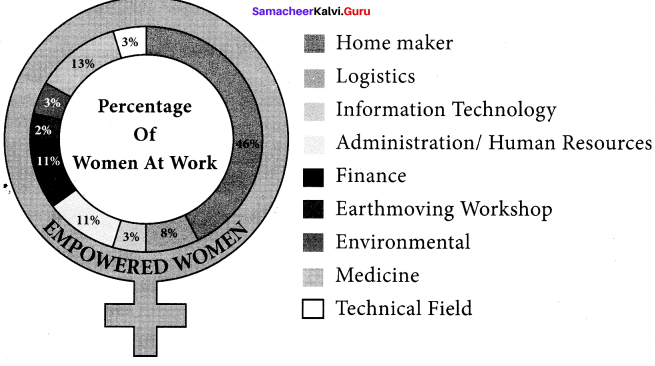
Old Man River Book Back Answers 9th Standard English Chapter 3 Samacheer Kalvi

9th Standard English Unit 3 Prose Old Man River Book Back Answers

You can Download Old Man River Questions and Answers, Summary, Activity, Notes, Samacheer Kalvi 9th English Book Solutions Guide Pdf Prose Chapter 3 help you to revise complete Tamilnadu State Board New Syllabus and score more marks in your examinations.

Exploring the textbook concepts is not enough for students who dreamt to do a cakewalk in English grammar. Consistently do your learning and practicing session with Samacheer Kalvi 9th English Grammar study material and achieve all your dreams.

Old Man River 9th Standard English 3rd Lesson Question and Answer

Old Man River Warm Up:

Look at these pictures of cyclone, floods, earthquake and tsunami.

Samacheer Kalvi 9th English Solutions Prose Chapter 3 Old Man River 1

A. Discuss in pairs for two minutes on any one of these natural disasters. You may use the following points.

  • Causes
  • Damages
  • Precautions

Floods:
Floods are an overabundance of water in an otherwise dry area. A flood can be caused by large quantities of water gushing from a water body, such as ocean, rivers, lakes or ponds, which can swell due to heavy rainfall or mountain snowmelt. If the rivers and lakes receive too much rain then the water will not be confined within their banks. It will flow into the drylands, causing huge destruction.

Flash floods are short-term, intense and quickly-developing floods. Sudden thunderstorms create temporary puddles of water everywhere and cause small rivers and lakes to swell. In coastal areas, cyclones often cause upheavals in the water level. This creates a giant wall of water heading toward land. Depending on the size of the tide and how hard it hits land, it can often be a dangerous phenomenon, literally washing away buildings and structures along the coast.
In the flood-prone areas, the following actions need to be taken:

  1. Protect your home – elevate the electric appliances, install check valves in sewer traps, seal
    walls in basements to avoid seepage, store adequate food, candles, and drinking water.
  2. Listen to radio/TV emergency alerts and instructions.
  3. Seek higher grounds and be ready to evacuate if instructed.
  4. Do not try to drive through a flooded road. If your vehicle stalls, abandon it and seek an alternate route.
  5. After a flood, stay away from floodwater.
  6. Be aware of areas where water has receded. Roads may have weakened or power lines may have fallen.
  7. Do not drink tap water until hygiene standards are guaranteed by the health department.
  8. Clean the home, especially the kitchen with safe chemical cleaners.

B. Fill the word web with words related to natural disasters. One example is done for you.

Samacheer Kalvi 9th English Solutions Prose Chapter 3 Old Man River 2
Answer:
Samacheer Kalvi 9th English Solutions Prose Chapter 3 Old Man River 3

C. Imagine a situation where your house is surrounded by water and answer the following.

Question (i).
What health hazards caused when water stagnates around your place?
Answer:
Dangerous diseases, stench smell, mosquitoes breeding, etc.

Question (ii).
When there is a power shutdown for long hours during floods, what will you do?
Answer:
I will collect rainwater for drinking and other purposes and will try to finish the daily chores before dusk.

Question (iii).
What precautions would you take if there is an announcement about flooding in your area?
Answer:
I will move to a safer place, at a higher altitude.

D. List out the Human activities which have an impact on nature. Complete the tabular column. One is done for you.

Samacheer Kalvi 9th English Solutions Prose Chapter 3 Old Man River 4
Answer:
Samacheer Kalvi 9th English Solutions Prose Chapter 3 Old Man River 5

Old Man River Intext Questions

E. Discuss with your partner and answer the following questions:

Question 1.
What were the girls doing in the living room?
Answer:
Amy and Rose were knitting. Betty was looking at a magazine.

Question 2.
Why was Mother not able to come home?
Answer:
Mother couldn’t get home from Mrs. Brant’s as the bridges between Mrs. Brant’s house and town are underwater.

Question 3.
How did Jim want the girls to ‘get organised’?
Answer:
Jim asked the girls to be organized. He asked Betty to search and bring flashlights, candles, lamps, and lanterns; Rose to fill the tubs and pails; Amy to check on food, blankets, and coats. Jim also asked them to be ready with a first-aid kit.

Question 4.
Which two important things did Jim want the girls to do to avoid getting scared?
Answer:
Jim instructed the girls not to show off to others how much each one was afraid of the situation and cause fear in others. Next to get all the things together like water, food, blankets, coats, lights and to climb into the attic and on to the roof.

Question 5.
Where did Jim want the girls to climb up? How’ was it going to help them?
Answer:
Jim wanted the girls to climb up to the roof. It would help them as they could wave the flashlight and someone would see it and come for their rescue.

Question 6.
Who went to get Sara? Where was she?
Answer:
Jim went to get Sara. Sara was on the playhouse porch.

F. Discuss with your partner and answer the following questions:

Question 1.
What were the important objects that the girls and Jim try to move to the attic? Why?
Answer:
Flashlight, candles, lamps, lanterns, food, blankets, coats, books and jewels were some of the articles that the girls and Jim tried to move to the attic. By night, they were expecting the water to enter into the house. To be safe until the rescue arrived, they planned to stay in the attic.

Question 2.
Who came to rescue the children?
Answer:
Mr. Peters and Miss Marsh came to rescue the children.

Question 3.
What happened to Sara?
Answer:
Sara’s right leg just below the knee was hurt as she climbed down the ladder from the playhouse.

Question 4.
Who is Miss Marsh? How does she help Sara?
Answer:
Miss Marsh is the Red Cross Nurse. She understands that Sara has broken her right leg just below the knee. She splints it up with pillows and an umbrella and lifts her safely into the boat. She also decides to take her to the emergency Red Cross hospital in Armoury.

Question 5.
Who was taken in the boat? Who was left behind?
Answer:
Left behind in the house are Amy and Jim. Others were in the boat – Betty, Sara, Rose, along with Mr. Peter and Miss Marsh.

Question 6.
How does Red Cross help the children?
Answer:
Red Cross helps the children by rescuing them from the flooded area and by saving their lives. ‘

Old Man River Textual Questions

A. Based on your understanding of the play, choose the correct answer and fill in the blanks.

1. The radio announced that ………………
(i) the river was above the flood stage.
(ii) the Bumet Dam had given way.
(iii) there will be a cloud burst.
(iv) they will be a cyclone.
Answer:
(i) the river was above the flood stage.

2. Mother couldn’t get home from Mrs. Brant’s because ……………….
(i) it was raining heavily.
(ii) the bridges between home and the town were underwater.
(iii) there was an emergency at Mrs. Brant’s house.
(iv) she had broken her leg.
Answer:
(ii) the bridges between home and the town were underwater.

3. The Burnett Dam gave away as …………………
(i) it rained for days.
(ii) the dam was weak.
(iii) it rained heavily and the snow was melting.
(iv) the maintenance was poor.
Answer:
(iii) it rained heavily and the snow was melting.

4. There was no power because ………………..
(i) the powerhouse was out of commission.
(ii) the powerhouse was flooded.
(iii) the dam gave away.
(iv) there was the fire.
Answer:
(ii) the powerhouse was flooded.

5. Why did they splint up Sara’s leg with pillows?
(i) She was unconscious out of fear.
(ii) She had broken her leg below the knee.
(iii) She was too lazy to walk.
(iv) She was making a fuss.
Answer:
(ii) She had broken her leg below the knee.

B. Based on your reading, answer the following in two or three sentences each.

Question 1.
Why did Jim run from school?
Answer:
As the river was rising fast, Jim had to run every step of the way from school. The Burnett Dam gave way an hour ago and its condition was very bad.

Question 2.
Where was Amy’s mother?
Answer:
Amy’s mother took Dick to the dentist and was going to stop at Mrs. Brant’s for a recipe before reaching home.

Question 3.
Why did Amy ask Betty to fill in the water tubs?
Answer:
Amy asked Betty to fill the bowls, tubs, pails, and pitchers with fresh water because the town supply might be cut off or could become unsafe to drink.

Question 4.
According to Jim what are the two things that a person should remember in times of emergency?
Answer:
First thing, we must not let others see how scared we are. Next to get all the things together in one place like water, food, blankets, coats, light, etc.

Question 5.
Why is Jim climbing on the roof?
Answer:
Jim wanted to be on top of the roof thinking that he would signal for help from the roof. Coast Guard would send a boat to rescue them.

Question 6.
Who was there in the living room? What were they doing?
Answer:
Amy, Betty, and Rose were sitting in the living room. Amy and Rose were knitting while Betty was looking at pictures in a magazine.

Question 7.
Why were they going to sleep in the attic?
Answer:
To save themselves from getting floated along with the rising water, they decided to climb into the attic and onto the roof because they were living in a bungalow instead of a two-story house.

Question 8.
Who came in the boat?
Answer:
Tom Peter and Miss Marsh came in the rescue boat. (Tom Peter is a member of the Red Cross Disaster Committee and Penny Marsh is the Red Cross nurse.)

Question 9.
Who is the founder of the Junior Red Cross?
Answer:
Jean Henry Dunant

C. Match the following by ‘drawing a line across columns A and B.

Samacheer Kalvi 9th English Solutions Prose Chapter 3 Old Man River 6

Samacheer Kalvi 9th English Solutions Prose Chapter 3 Old Man River 7
Answers:
1. (e), 2. (c), 3. (h), 4. (g), 5. (i), 6. (d), 7. (j), 8. (f), 9. (b), 10. (a).

D. Based on your understanding of the text, answer the following in about three to four sentences each:

1. Describe the ‘home alone’ experience of the children.
Answer:
Amy Marshall and Betty Marshall were left alone in the home and due to cyclones, the water level was rising around their house. They were lucky enough to have their friends cum neighbour Rose field. Sara Field and Jim Hall in their house to fight against the disastrous moment. Amy’s mother had taken Dick to the dentist and on her way back she was supposed to meet Mrs. Brant for a recipe. Amy’s father was in Chicago on some business matters.

2. Elaborate on the rescue operation undertaken by Mr. Peter.
Answer:
Tom Peters and Miss. Marsh, a member of the Red Cross Disaster Committee and Red Cross nurse respectively, were on a boat calling out for Mr. Marshall’s family to know whether they were safe. Jim responded and guided the rescue team to know where they were. Mr. Peter was shocked to know’ that there were children and no adults inside the house. When they were climbing down the ladder Sara fell and got hurt. She was wrapped in a blanket. Mr. Peter suggested that more than the pain it is the fear that is not making them function well and asked them to be composed. Sara has broken her right leg just below the knee. They splint it up with pillows and an umbrella to lift her safely into the boat. They took her to the emergency Red Cross hospital in the Armoury.

3. How did Jim prove himself as a good rescuer in the flood situation?
Answer:
Jim Hall a neighbour, came to the rescue of all three girls luckily during the crisis time. Mr. Marshall and Mrs. Marshall were away due to valid reasons – one on business at Chicago and the other on a visit to the dentist along with Dick. Jim Hall acted very wisely by giving all the three girls directions to collect flashlights, fill water, candles and first-aid kit. Jim advised them to climb into the attic and onto the roof because the house they were staying in was a bungalow and not a two-story house. It was dangerous as water might have entered the house anytime.

4. Briefly narrate the happenings of the play in Scene II.

(a) How did Amy manage the situation at home?
Answer:
Amy, Rose and Betty had three candles on the table. Sara was asleep covered with the blanket in a big chair. Betty was trying to read with the help of candle-light. Amy would suggest them to sleep.

(b) How did Marshall save the children?
Answer:
Mr. Peters was carrying Sara and gave her confidence by stating that she was more frightened than hurt. Miss Marsh splint right leg of Sara up with pillows and umbrella just below the knee to lift her safely into the boat. Then they took her to the emergency Red Cross hospital in the Armoury.

Think and answer:
You are one of the survivors of an earthquake that has affected your city a lot. Share the trauma you underwent and what helped you to sail through it. Give a talk for two minutes.

E. Using a dictionary, find out the synonyms and the antonyms of the words given below. One has been done for you.

Samacheer Kalvi 9th English Solutions Prose Chapter 3 Old Man River 8
Answer:
Samacheer Kalvi 9th English Solutions Prose Chapter 3 Old Man River 9

Listening:

F. Listen to the paragraph and fill in the blanks.

The 2015 South Indian floods resulted from heavy rainfall generated by the annual northeast monsoon in November- December 2015. They affected the Coromandel Coast region of the South Indian states of Tamil Nadu and Andhra Pradesh, and the union territory of Puducherry, with Tamil Nadu and the city of Chennai particularly hard- hit. More than 500 people were killed and over 18 lakh people were displaced. With estimates of damages and losses ranging from nearly 200 billion rupees to over 1 trillion rupees, the floods were the costliest to have occurred in 2015 and were among the costliest natural, disasters of the year. The flooding has been attributed to the2014-16 El-Nino event.
(For listening to the script refer to our website www.fullcircleeducation. in)

The (1) ……………… South Indian floods resulted from heavy rainfall generated by the
annual northeast monsoon in (2) ……………… 2015. They affected the (3) …………….. region of the South Indian states of (4) …………….., and the Union Territory of (5) ……………….., with Tamil Nadu and the city of (6) ………………. particularly hard-hit. More than (7) ………………. people were killed and over 18 lakh people were (8) …………………. With estimates of damages and losses ranging from nearly 200 billion rupees to over 1 trillion rupees, the (9) ………………… were the costliest to have occurred in 2015, and were among the costliest natural disasters of the year. The flooding has been attributed to 2014-16 (10) ………………..
Answers

  1. 2015
  2. November
  3. Coromandel Coast
  4. Tamil Nadu and Andhra Pradesh
  5. Puducherry
  6. Chennai
  7. 500
  8. displaced
  9. floods
  10. El-Nino event

Writing:

G. As a local government official working in the flood-affected area you are talking to an old lady who has lost her belongings. Write a dialogue between you and the old woman. Complete the conversation.

You: Good morning Madam.
Old lady: Good morning.
You: I am from the Fire and Rescue department. How can I help you?
Old lady : (i) ……………………………………………..
You : (ii) ………………………………………………
Old lady : (iii) ………………………………………….
You : (iv) …………………………………………………
Old lady : (v) ……………………………………………
You : (vi) ………………………………………………..
Old lady : (vii) ……………………………………..
You : (viii) …………………………………………..
Old lady : (ix) …………………………………………
Answers:
(i) I have left a very important casket in my closet, can you please bring if for me?
(ii) The water level is rising. It would be really life-threatening to go to that place.
(iii) Yeah, I do understand that. To me, yes it is impossible, can you try for my sake, please.
(iv) One person cannot do that, we may have to work as a team.
(v) Then do so, please. I can’t live without that casket.
(vi) Madam please understand the human power/resource must/can be used to rescue mankind. Amma, life is more important than a casket.
(vii) Yes, I don’t deny that. Can you please take that after you finish this work or when you go to my house or nearby places?
(viii) OK amma, I shall surely try. Take a rest. Health is more important for us.
(ix) Thank you child; May God bless you!! Please try for my sake.

Creative Writing:

H. Write a letter to your friend about your experiences during the recent ‘Gaja’ cyclone.

29 May 2018
XXXX

Dear Malathi,
Hope this letter finds you in the best of health and spirits. Here, I am fine. But recently I have had the worst experience of my wife which I want to share with you. You must have heard about the cyclone ‘Gaja’ that devastated parts of Sri Lanka and India. It was the most intense tropical cyclone in the Arabian Sea since Cyclone Megh in 2015. It started as an area of low pressure in the eastern Andaman Sea on November 21 and within a few days grew into a deep depression. Ockhi intensified into a Cyclonic Storm on November 30 and caused huge damage to property and life in my city. Hundreds of people died and so many were injured. Thousands of trees were uprooted. We had no power supply for a couple of days. Food, drinking water and medicines were out of reach. Even after the cyclone subsided our area was cut off from

Writing:

G. As a local government official working in the flood-affected area you are talking to an old lady who has lost her belongings. Write a dialogue between you and the old woman. Complete the conversation.

You : Good morning Madam.
Old lady : Good morning.
You : I am from the Fire and Rescue department. How can I help you?
Old lady : (i) …………………………………………….
You : (ii) ……………………………………………………
Old lady : (iii) ……………………………………………
You : (iv) …………………………………………………..
Old lady : (v) …………………………………………….
You : (vi) …………………………………………………..
Old lady : (vii) …………………………………………..
You : (viii) ………………………………………………..
Old lady : (ix) …………………………………………..
Answers:
(i) I have left a very important casket in my closet, can you please bring if for me?
(ii) The water level is rising. It would be really life threating to go to that place.
(iii) Yeah, I do understand that. To me, yes it is impossible, can you try for my sake please.
(iv) One person cannot do that, we may have to work as a team.
(v) Then do so please. I can’t live without that casket.
(vi) Madam please understand the human power/resource must/can be used to rescue mankind. Amma, life is more important than casket.
(vii) Yes, I don’t deny that. Can you please take that after you finish this work or when you go to my house or nearby places.
(viii) OK amma, I shall surely try. Take rest. Health is more important for us.
(ix) Thank you child; May God bless you!! Please try for my sake.

Creative Writing

H. Write a letter to your friend about your experiences during the recent ‘Gaja’ cyclone.

29 May 2018
XXXX

Dear Malathi,
Hope this letter finds you in the best of health and spirits. Here, 1 am fine. But recently I have had the worst experience of my wife which I want to share with you. You must have heard about the cyclone ‘Gaja’ that devastated parts of Sri Lanka and India. It was the most intense tropical cyclone in the Arabian Sea since Cyclone Megh in 2015. It started as an area of low pressure in the eastern Andaman Sea on November 21 and within a few days grew into a deep depression. Ockhi intensified into a Cyclonic Storm on November 30 and caused huge damage to property and life in my city.

Hundreds of people died and so many were injured. Thousands of trees were uprooted. We had no power supply for a couple of days. Food, drinking water, and medicines were out of reach. Even after the cyclone subsided our area was cut off from the main market due to blocked roads. It was a terrible experience for me. I wish not to have any such experience again. Life has started to get normal now. I feel better after writing to you regarding this. Awaiting eagerly to listen from you.

Yours friendly,
Shivani

Address on the envelope:
Samacheer Kalvi 9th English Solutions Prose Chapter 3 Old Man River 10

I. Make a poster of any natural disaster, giving details about the devastations caused.

Samacheer Kalvi 9th English Solutions Prose Chapter 3 Old Man River 11

The recent dust storm that swept through India was one of its deadliest. The scale and intensity of this storm stretched from the western state of Rajasthan to the eastern state of Uttar Pradesh and hit Delhi, which lies between them. The dust storm caused more than 100 reported fatalities. Most of the fatalities occurred when intense wind knocked over large structures, killing or injuring those in its way.
J. You are a volunteer in your locality to serve people who are affected by floods. How will you caution them to move to a safer place taking only their bare necessities? Describe.
If I am a volunteer serving people affected by floods, I will first ask them to remain calm and have patience. Then, in a gentle voice I will give them the following instructions:

  • Be prepared! We may need to move to a safer place as the floods are getting worse.
  • Pack a bag with only your important items.
  • Take a few clothes, a pair of bedsheets and a blanket.
  • Keep your official documents, like degrees, license, PAN card, etc.
  • Pack some eatables that can last long.
  • Take some medicines.
  • Turn off utilities at the main switches or valves.
  • Disconnect all electrical appliances.
  • If you have to walk in water, wherever possible, walk where the water is not moving.
  • Take a stick to check the firmness of the ground in front of you.
  • While moving out, please be together with your family and take care of each other.
  • Do not panic. It is going to be alright soon. We will return home when authorities indicate it is safe.

Think and Do

K. Given below are some qualities that the characters in the play displayed during the floods for survival. Identify and write the character with the qualities.

Samacheer Kalvi 9th English Solutions Prose Chapter 3 Old Man River 12
Answers:
Samacheer Kalvi 9th English Solutions Prose Chapter 3 Old Man River 13

Read the following passage about mountaineering.

Scaling Heights

1. Mountains have a great fascination for men and people. Mountain climbing, however, is not without risks. Is a challenge to the unconquerable spirit of man and his love of adventure. That is is a dangerous sport that cannot be denied. As one climbs higher and higher, breathing becomes more and more difficult. Some climbers, therefore, carry a heavy apparatus from which they inhale oxygen.

2. Mountain climbing is dangerous in the extreme. There are snowstorms and bizzards. It is difficult to walk through the snow. It is still more difficult to climb on ice because it is difficult to keep foothold and cut steps with axes in order to make progress. The cold is so severe that the climber’s skin, feet, toes, fingers and tissues freeze, become numb and they may suffer frostbite. The most serious difficulty is the climber at a high altitude gets exhausted with a little effort.

3. Mountain climbing requires proper training, skill and knowledge. The climbers must be well- equipped. They must be in good physical condition and should possess courage, perseverance and power of endurance. They should carry with them maps, compasses and other equipment so that they are able to find out where they are in the absence of any tracks. They must travel through dense woods as they approach a mountain and then climb steep rocks. Near the summit of a peak, the climbers have to move over snowfields and glaciers. In dangerous areas they use ropes to tie themselves in groups.

4. The climbers carry with them packs loaded with first-aid supplies, food and extra clothing for sudden changes of weather. They display spirit of sportsmanship and fellow-feeling and face the severe risks of life undaunted. Mountain climbing is a common sport in Europe. There are mountaineering clubs where training in mountaineering is imparted.

5. There are high peaks in India and there have been successful expeditions to scale these highest peaks. After the conquest of Everest by Tensing and Hillary in 1953, the Mountaineering Institute ar Darjeeling was established to develop an interest in mountain-climbing among the Indians. Expeditions have been sent to climb the highest peaks in the country.

6. Mountain climbing is a thrilling adventure. It brings into play the heroic qualities of humankind. Mountaineers deserve all praise for their courage and heroism. In recent years. Mt. Everest has been scaled several times by foreign climbers. India too has organized several expeditions to Everest. Lately, an Indian Sherpa scaled Everest without the use of oxygen. Mrs. Bachchendri pal also succeeded in scaling Everest. She is the first Indian woman to do it.

L. Based on your reading answer the following questions in a sentence or two.

  1. Is mountaineering a dangerous sport? Why? (para 1)
  2. What is frostbite? (para 2)
  3. What are the qualities of a good climber? (para 3)
  4. What do climbers carry with them? (para 4)
  5. Where is the Mountaineering Institute situated in India? (para 5)
  6. What qualities of humankind are brought out by this adventurous sport? (para 6)
  7. Why do mountaineers deserve praise? (para 6)
  8. What kind of visitors does Mt. Everest get (para 6)

Grammar:

A. Identify the dependent clauses or phrases in the following sentences and underline them.

  1. Texting on his phone, the man swerved into a ditch.
  2. It isn’t necessary to cram all night if you have studied a little each day.
  3. We climbed up the hill to enjoy the view.
  4. I enjoy painting during my holidays.
  5. Whether he attends the party or not, I have decided to go.
  6. I will stop playing the drums when you go to sleep.

Answers:

  1. Texting on his phone
  2. if you have studied a little each day
  3. to enjoy the view
  4. during my holidays
  5. when you go to sleep

B. Complete the following sentences using appropriate prepositional phrases.

1. I would like to order coffee …………….. tea.
(a) instead of
(b) instead from
(c) instead to
Answer:
(a) instead of

2. …………….. the rains, we went out.
(a) In spite of
(b) In spite
(c) In spite on
Answer:
(a) In spite of

3 fire, break the glass to escape.
(a) In case of
(b) In case
(c) In case with
Answer:
(a) In case of

4. I am standing here my friends.
(a) In behalf of
(b) on behalf of
(c) on behalf
Answer:
(b) on behalf of

5. We solved the problem a new device developed by our engineers.
(a) by means of
(b) by means
(c) by means to
Answer:
(a) by means of

6 we are impressed with their performance.
(a) In general
(b) On general
(c) In generally
Answer:
(a) In general

C. Look at the action words in bold. Identify whether they are either finite or non-finite verb.

Samacheer Kalvi 9th English Solutions Prose Chapter 3 Old Man River 14
Answers:

  1. non-finite
  2. finite
  3. finite
  4. finite
  5. finite
  6. finite

D. Read the following pairs of sentences:     

1. Travelling might satisfy your desire for new experiences.
The study abroad program might satisfy your desire for new experiences.
Identify the subject in the first sentence …………………..
Answer:
Travelling

2. They do not appreciate my singing.
They do not appreciate my assistance.
Identify the direct object in the first sentence ………………..
Answer:
my singing

3. My cat’s favourite activity is sleeping.
My cat’s favourite food is salmon.
Identify the subject complement in the first sentence …………………
Answer:
sleeping

4. The police arrested him for speeding.
The police arrested him for criminal activity.
Identify the object of the preposition in the first sentence ……………..
Answer:
speeding

E. You may role-play the conversation.

Teacher:This is Mr. Gerund, you may have seen him after these verbs ‘enjoy’, ‘finish’, ‘keep’, ‘mind’, ‘suggest’, forgive, ‘excuse’, ‘postpone’, ‘go’
Gerund: I come after a preposition too.
Teacher: Mr. Gerund comes in handy to describe a real action.
Infinittive: Hello friends, I am Infinitive. Words such as ‘like’, ‘refuse’ are followed by me.
Dinesh: I know you. I take your help to describe a general or future action.
(I think I need to get up early tomorrow to complete my grammar exercise.)
Divya: you have helped me to express ‘reason’, ‘intention’, ‘purpose’.
(I wish to finish my assigment by tonight.)
Gerund: Do you know, after verbs like ‘begin’, ‘love’, ‘continue’, ‘try’, Team’, ‘start’, ‘neglect’ you can use either of us?
Infinitive: But remember we mean different things when used after ‘stop’.
Dinesh: Divya, when we saw Rajesh at the mall, I stopped to talk to him. why didn’t you wait?
Divya: Don’t you know I stopped talking to him?
Gemnd: I am also used after these phrases- ‘It’s no use’, ‘It’s no good’
Dinesh and divya: Thank you, mam. bye Mr. Gemnd and Ms. Infinitive.

F. Now, work in pairs and help Dinesh and Divya complete the exercise given below.

Write the gerund/infinitive form of the verbs in the blanks.

  1. The astronauts managed ……………… (complete) their training in record time.
  2. They learned how ……………….. (survive) in space without gravity.
  3. The best astronaut almost quit …………….. (try) to leam the complex information.
  4. Their mission appeared ……………….. (be) in jeopardy.
  5. Then Marina encouraged him by saying, “It’s no good ………………….(quit) the project right at the end.”
  6. Being an astronaut will enable you …………….. (achieve) great success in life.
  7. If you give up ………………….. (study) now, our mission will be scrubbed.
  8. Think of your fellow astronauts who wouldn’t hesitate …………….. (help) you in time of treble.
  9. We astronauts must keep on ………………. (prepare) for our space launch.
  10. some say it’s no use …………………… (travel) to distant planets because it takes too long.
  11. But we really want ………………….. (visit) other planets and find out if life exists on them.
  12. Can you imagine ………………. (walk) up to a Martian and shaking hands and ………………… (say), “Hello, how are you?”
  13. We really look forward ………………….. (meet) alien creatures and ………………… (find) out what they are really like.
  14. Many scientists have warned us not ……………… (take) this dangerous journey, but we are not discouraged.
  15. Travelling to far away planets involves …………………… (risk) our lives for the thrill of discovery.
  16. However we won’t delay blast off into space.
  17. Would you like ………………… (accompany) us on our journey if you could?
  18. During our training we have got used to ……………….. (be) weightless and ……………………. (live) under difficult conditions.
  19. Scientists admit to ……………………… (be) intensely curious about life on other planets.
  20. I’m sure they would also enjoy ……………….. (travel) with our crew.
  21. We told them …………………… (come) with us on our trip, but some of them think it is a waste of time ……………… (search) for life that doesn’t exist.
  22. We have been taught how ……………… (endure) hardships during our training and now we can’t afford ………………….(waste) money. We’re on our way!

Answers:

  1. to complete
  2. to survive
  3. trying
  4. to be
  5. quitting
  6. to achieve
  7. studying
  8. to help
  9. preparing
  10. travelling
  11. to visit
  12. walking, saying
  13. to meet, finding
  14. to take
  15. risking
  16. blasting
  17. to accompany
  18. being, living
  19. being
  20. travelling
  21. to come, searching
  22. to endure, to waste

Old Man River Summary:

Samacheer Kalvi 9th English Solutions Prose Chapter 3 Old Man River 15

In this drama, the author pictures life in times of crisis. Its purpose is to highlight the central idea of security. Though in fear and confusion, the characters deal bravely with flood. The scene opens on a late afternoon in March. A group of children find themselves alone at home during heavy rains. The bridges seem to be under water. Amy gets a call from her mother that she wouldn’t be able to return home since the routes are flooded. Amy’s father is in Chicago. Amy’s friend Rose is asked to stay back for the night. The children soon realise that the river is swelling.

They advise each other to be calm and brave. They arrange food, water, flashlights and other necessary things. Each one of them takes responsibility for cooking, safety, etc. Amy tries to save her parents’ valuable articles. In the night, a rescue boat arrives. Rose’s sister Sara gets hurt by chance. The rescue team takes Sara to the emergency Red Cross Hospital. The play focuses on the importance of acting during a crisis and first-aid awareness. We can take a lesson from the children how they help one another and stay calm till help arrives.

Old Man River Glossary:

cloudburst – a sudden violent rainstorm.
gasp – catch one’s breath with an open mouth, owing to pain or astonishment.
hark – listen, pay attention.
lantern – a lamp with a transparent case protecting the flame or electric bulb, and typically having a handle by which it may be carried or hung.
pickaback – a piggyback ride, on the back and shoulders of another person.
pitcher – a large jug.
shudder – shiver typically as a result of fear or revulsion.
splint – a long flat object used as a support for a broken bone so that the bone stays in a particular position while it heals.
stamping – bring down (one’s foot) heavily on the ground.
thumping – hitting or striking heavily, especially with fist or a blunt instrument.
wink – close and open one eye quickly, shine or flash intermittently.

Samacheer Kalvi 9th English Book Solutions Prose

Old Man River Book Back Answers 9th Standard English Chapter 3 Samacheer Kalvi Read More »
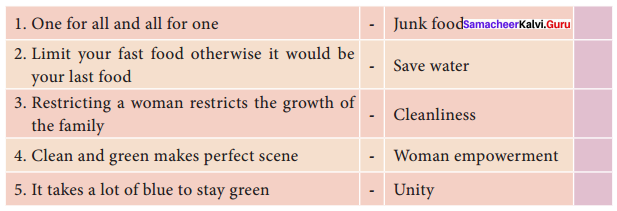
Samacheer Kalvi 9th Science Solutions Chapter 4 Electric Charge and Electric Current

You can Download Samacheer Kalvi 9th Science Book Solutions Guide Pdf, Tamilnadu State Board help you to revise the complete Syllabus and score more marks in your examinations.

Tamilnadu Samacheer Kalvi 9th Science Solutions Chapter 4 Electric Charge and Electric Current

Samacheer Kalvi 9th Science Electric Charge and Electric Current Textbook Exercises

I. Choose the correct answer.

Question 1.
In current electricity, a positive charge refers to,………………
(a) presence of electron
(b) presence of proton
(c) absence of electron
(d) absence of proton
Answer:
(c) absence of electron

Question 2.
Rubbing of comb with hair ……………………
(a) creates electric charge
(b) transfers electric charge
(c) either (a) or (b)
(d) neither (a) nor (b)
Answer:
(c) either (a) or (b)

Samacheer Kalvi 9th Science Solutions Chapter 4 Electric Charge and Electric Current

Question 3.
Electric field lines ………….. from positive charge and ………. in negative charge.
(a) start; start
(b) start; end
(c) start: end
(d) end; end
Answer:
(b) start; end

Question 4.
Potential near a charge is the measure of its ………… to bring a positive charge at that point.
(a) force
(b) ability
(c) tendency
(d) work
Answer:
(d) work

Question 5.
In an electrolyte the current is due to the flow of …………. .
(a) electrons
(b) positive ions
(c) both (a) and (b)
(d) neither (a) nor (b)
Answer:
(a) electrons

Question 6.
Heating effect of current is called
(a) Joule heating
(b) Coulomb heating
(c) Voltage heating
(d) Ampere heating
Answer:
(a) Joule heating

Samacheer Kalvi 9th Science Solutions Chapter 4 Electric Charge and Electric Current

Question 7.
Electroplating is an example for
(a) heating effect
(b) chemical effect
(c) flowing effect
(d) magnetic effect
Answer:
(b) chemical effect

Question 8.
Resistance of a wire depends on
(a) temperature
(b) geometry
(c) nature of material
(d) all the above
Answer:
all the above

II. Match the following.

Column-I

Column-II

1. Electric Charge (a) ohm
2. Potential difference (b) ampere
3. Electric field (c) coulomb
4. Resistance (d) newton per coulomb
5. Electric current (e) volt

Answer:

  1. (c)
  2. (e)
  3. (d)
  4. (a)
  5. (b)

III. True or False.

Question 1.
Electrically neutral means it is either zero or equal positive and negative charges
Answer:
True

Samacheer Kalvi 9th Science Solutions Chapter 4 Electric Charge and Electric Current

Question 2.
Ammeter is connected in parallel in any electric circuit
Answer:
False
Correct Statement: An ammeter is connected in series with a device to measure its current.

Question 3.
The anode in electrolyte is negative
Answer:
False
Correct Statement: The anode in electrolyte is positive.

Question 4.
Current can produce magnetic field
Answer:
True

IV. Fill in the blanks.

  1. Electrons move from ………….. potential to …………….. potential.
  2. The direction opposite to the movement of electron is called ……………….. current.
  3. The e.m.f of a cell is analogous to ……………. of a pipe line.
  4. The domestic electricity in India is an ac with a frequency of ………… Hz.
  5. Trip switch is an …………. safety device.

Answer:

  1. higher, lower
  2. Conventional
  3. a pump
  4. 50
  5. electromechanical

V. Conceptual questions.

Question 1.
A bird sitting on a high power electric line is still safe. How?
Answer:
Birds can sit on power lines and not get electric shocks because the electricity is always looking for a way to get to the ground (i.e.) the current is not flowing out of its body to any other material.

Current flows in a loop (which means the circuit is closed). A bird sitting on a transmission line does not complete the circuit. If the same bird keeps one leg on one line and another leg or any part of its body on another line or the neutral points, then it will get burnt.

Question 2.
Does a solar cell always maintain the potential across its terminals constant? Discuss.
Answer:
The electro-chemical process inside a battery provides electrons at the negative terminal and draws electrons from the positive terminal to maintain the current being drawn. By providing energy to the electrons, the cell is capable of maintaining an electric potential difference across the two ends of the external circuit.

Question 3.
Can electroplating be possible with the alternating current?
Answer:
The heating effect and the chemical effect experiments have to be performed only with a dc cell of around 9V. The 9V dc cell will not give any electrical shock.

At any cost, we should not use the main domestic electric supply which is 220V ac voltage. If it is used it will give a heavy electric shock leading to severe damage to our body.

VI. Answer the following.

Question 1.
On what factors does the electrostatic force between two charges depend?
Answer:
The numerical value (magnitude) of electric force between two charges depend on the,

  • value of charges on them,
  • distance between them and
  • nature of medium between them.

Samacheer Kalvi 9th Science Solutions Chapter 4 Electric Charge and Electric Current

Question 2.
What are the electric lines of force?
Answer:
The direction of the electric field is the direction of the force that would act on a small positive charge. Therefore the lines representing the electric field are called ‘electric lines of force’.

Question 3.
Define electric field.
Answer:
The electric field is the region around a charged body within which its influence can be experienced (i.e) within which it can attract or repel another charged body.

Question 4.
Define electric current and give its unit.
Answer:
Current is the rate at which charges flow past a point on a circuit. Current (I) is represented as, I = \(\frac { q }{ t }\)
The standard SI unit for current is ampere with symbol A.

Question 5.
State Ohm’s law.
Answer:
Ohm’s law states that the current passing through a conductor is directly proportional to the potential difference across its ends, provided the physical conditions like temperature, density, etc. remain unchanged. V α I or V = IR.

Question 6.
Name any two appliances which work under the principle of heating effect of current.
Answer:
The principle of all-electric heating appliances like an iron box, water heater, toaster, etc. works under the principle of heating effect of current.

Samacheer Kalvi 9th Science Solutions Chapter 4 Electric Charge and Electric Current

Question 7.
How are the home appliances connected in general, in series or parallel? Give reasons.
Answer:
In a household electric circuit, different home appliances are connected in parallel to one another due to the following reasons:

  • The appliances can be operated independently. If one appliance is switched off, others remain unaffected.
  • Each appliance gets the same constant voltage.
  • In parallel connection of electrical appliances, the overall resistance of the circuit is reduced due to which the current from the power supply is high.

Question 8.
List the safety features while handling electricity.
Safety features to be followed are:

  • Ground connection
  • Trip switch
  • Fuse.

VII. Exercises.

Question 1.
Rubbing a comb on hair makes the comb get -0.4C.
(a) Find which material has lost an electron and which one gained it.
Answer:
The material is a comb that gained electrons and the hair gained it.

(b) Find how many electrons are transferred in this process.
Answer:
Charge on 1 electron, e = 1.6 × 10– 19C
q = ne or n = \(\frac { q }{ e }\)
n = \(\frac { 0.4 }{ 1.6 }\) × 10– 19 = 0.25 × 1019 = 2.5 × 10¹⁸

Question 2.
Calculate the amount of charge that would flow in 2 hours through an element of an electric bulb drawing a current of 2.5A.
Answer:
Given: Time ‘t’ = 2 hours = 2 × 60 × 60s
t = 7200s
I = 2.5A
Amount of charge, Q = I × t
= 2.5 × 7200
Q = 18000C

Question 3.
The values of current I flowing through a resistor for various potential differences V across the resistor are given below. What is the value of resistor?
Answer:

I (ampere) 0.5 1.0 2.0 3.0 4.0
V (volt) 1.6 3.4 6.7 10.2 13.2

[Hint: plot V-I a graph and take slope].
Samacheer Kalvi 9th Science Solutions Chapter 4 Electric Charge and Electric Current 1
Resistance(R) = \(\frac { ∆V }{ ∆I }\)
= 10.2 – \(\frac { 6.7 }{ 3 }\) – 2 = 3.5/1
R = 3.5Ω

Samacheer Kalvi 9th Science Electric Charge and Electric Current In Text Problems

Question 1.
How many electrons will be there in one coulomb of charge?
Solution:
Charge on 1 electron, e = 1.6 × 10– 19C
q = ne or n = \(\frac { q }{ e }\)
number of electrons in 1 coulomb = \(\frac{1}{1.6 \times 10^{-19}}\) = 6.25 × 10¹⁸ electrons

Samacheer Kalvi 9th Science Solutions Chapter 4 Electric Charge and Electric Current

Question 2.
If, 25 C of charge is determined to pass through a wire of any cross-section in 50 s, what is the measure of current?
Samacheer Kalvi 9th Science Solutions Chapter 4 Electric Charge and Electric Current 2
Solution:
I = \(\frac { q }{ t }\) = \(\frac { (20C) }{50s}\) = 0.5 \(\frac { C }{ s }\) = 0.5 A

Question 3.
The current flowing through a lamp is 0.2A. If the lamp is switched on for one hour, what is the total electric charge that passes through the lamp?
Solution:
I = \(\frac { q }{ t }\);q = I × t
1hr = 1 × 60 × 60 s = 3600 s
q = I × t = 0.2A × 3600s = 720C

Question 4.
The e.m.f of a cell is 1.5 V. What is the energy provided by the cell to drive 0.5 C of charge around the circuit?
Solution:
ℰ = 1.5V and q = 0.5C
ℰ = \(\frac { W }{ q }\); W= ℰ × q ; Therefore W = 1.5 × 0.5 = 0.75J

Question 5.
A charge of 2 × 10⁴ C flows through an electric heater. The amount of electrical energy converted into thermal energy is 5 MJ. Compute the potential difference across the ends of the heater.
Solution:
V = \(\frac { W }{ q }\) that is 5 × 10⁶ \(\frac { J }{ 2 }\) × 104 C = 250 V

Samacheer Kalvi 9th Science Electric Charge and Electric Current Additional Questions

I. Short answers questions.

Question 1.
What is a positive and a negative ion?
Answer:
If an electron is removed from the atom, it becomes positively charged. Hence it is called a positive ion. When an electron is added to an atom, it becomes negatively charged. Hence it is called a negative ion.

Samacheer Kalvi 9th Science Solutions Chapter 4 Electric Charge and Electric Current

Question 2.
Define Electric potential.
Answer:
Electric potential is a measure of work done on the unit positive charge to bring it to that point against all electrical forces. It is represented as ‘V’.

Question 3.
What are the effects of electric current?
Answer:
When current flows in a circuit, it exhibits various effects. The main effects are; heating, chemical, and magnetic effects.

Question 4.
What is resistance?
Answer:
The resistance (R) is the measure of opposition offered by the component to the flow of electric current through it.

Question 5.
What is common to both direct and alternating current?
Answer:
Joule’s heating effect of current is common to both direct and alternating current.

Question 6.
What is a trip switch?
Answer:
It is an electromechanical device which does not allow a current beyond a particular value by automatically switching off the connection.

Samacheer Kalvi 9th Science Solutions Chapter 4 Electric Charge and Electric Current

Question 7.
What are the advantages of AC over DC?
Answer:
Advantages of AC over DC are;

  1.  The voltage of an AC can be varied easily using a transformer.
  2.  The AC can be carried over long distances using step-up transformers.
  3.  The loss of energy while distributing current in the form of AC is negligible.
  4.  DC cannot be transmitted as such, but AC can be easily converted to DC.
  5.  Generating AC is easier than DC, AC can produce electromagnetic induction which is useful in several ways.

Question 8.
What is the ground connection?
Answer:
A ground connection is a safety feature. The metal bodies of all electrical appliances are connected to the ground by a third wire, apart from the two wires used for electrical connection. The ground connection wire is green in colour, All the ground wires from various electrical sockets are connected together finally to a thick copper wire, hurried deep in the ground, so that excess current flows down instead of entering our body.

Question 9.
Write a short note on the different electrical circuits.
Answer:
There are two types of electrical circuits – Series circuit and Parallel circuit.

  • Series circuit – A series circuit has only one path for electricity to flow from one point to another. The amount of electricity in the circuit is constant throughout the circuit. When electricity flows through the circuit, there will be no fluctuation in its speed.
  •  Parallel circuit – A parallel circuit has multiple paths for electricity to flow, horizontally and vertically. The components of the parallel circuit will have the same voltage across their ends.

Question 10.
What is the difference between electromagnetic force and potential difference?
Answer:
The e.m.f. refers to the voltage developed across the terminals of an electrical source when it does not produce current in the circuit.

Potential difference refers to the voltage developed between any two points in an electric circuit when there is current in the circuit.

II. Long Answers Questions.

Question 1.
Draw and explain the electric circuit diagram.
Answer:
Samacheer Kalvi 9th Science Solutions Chapter 4 Electric Charge and Electric Current 3
To represent an electrical wiring or solve problem involving electric circuits, the circuit diagrams are made. The four main components of any circuits namely the,

  1.  cell,
  2.  connecting wire,
  3.  switch and
  4.  resistor or load are given above. In addition to the above many other electrical components are also used in an actual circuit. A uniform system of symbols has been evolved to describe them. It is like learning a sign language, but useful in understanding circuit diagrams.

Samacheer Kalvi 9th Science Solutions Chapter 4 Electric Charge and Electric Current

Question 2.
What is the magnetic effect of electricity?
Answer:
A wire or a conductor carrying current develops a magnetic field perpendicular to the direction of the flow of current. This is called magnetic effect of current. The discovery of the scientist Oersted and the ‘right hand thumb rule’ are detailed in the chapter on Magnetism and Electromagnetism in this book. Direction of current is shown by the right hand thumb and the direction of magnetic field is shown by other fingers of the same right hand.
Samacheer Kalvi 9th Science Solutions Chapter 4 Electric Charge and Electric Current 4

Question 3.
Explain fuse.
Answer:
Samacheer Kalvi 9th Science Solutions Chapter 4 Electric Charge and Electric Current 5
A fuse is another safety mechanism which works on the joule heating principle. Fuse is a wire made up of a Nickel and Chromium alloy which has a definite melting point. If current passes through the fuse beyond a particular desired value, the excess heat produced melts the fuse wire, thus the electrical connection is cut-off. Fuse has to be kept in tight a ceramic enclosure to avoid the melting heat from producing fire accidents.

Question 4.
Name any ten symbols with a diagram.
Answer:
Samacheer Kalvi 9th Science Solutions Chapter 4 Electric Charge and Electric Current 6

Samacheer Kalvi 9th Science Solutions Chapter 4 Electric Charge and Electric Current Read More »

Samacheer Kalvi 7th Maths Solutions Term 2 Chapter 1 Number System Intext Questions

Students can Download Maths Chapter 1 Number System Intext Questions and Answers, Notes Pdf, Samacheer Kalvi 7th Maths Book Solutions Guide Pdf helps you to revise the complete Tamilnadu State Board New Syllabus and score more marks in your examinations.

Tamilnadu Samacheer Kalvi 7th Maths Solutions Term 2 Chapter 1 Number System Intext Questions

Exercise 1.1
(Try These Text book Page No. 2)

Question 1.
Observe the following and write the fraction of the shaded portion and mention in decimal form also.
Samacheer Kalvi 7th Maths Solutions Term 2 Chapter 1 Number System Intext Questions 1
Solution:
(i) Total parts = 8
Shaded parts = 4
Samacheer Kalvi 7th Maths Solutions Term 2 Chapter 1 Number System Intext Questions 2

(ii)
Samacheer Kalvi 7th Maths Solutions Term 2 Chapter 1 Number System Intext Questions 3

(iii)
Samacheer Kalvi 7th Maths Solutions Term 2 Chapter 1 Number System Intext Questions 5

Question 2.
Represent the following fractions in decimal form by converting denominator into ten or powers of 10.
Samacheer Kalvi 7th Maths Solutions Term 2 Chapter 1 Number System Intext Questions 4
Solution:
Samacheer Kalvi 7th Maths Solutions Term 2 Chapter 1 Number System Intext Questions 6

Samacheer Kalvi 7th Maths Solutions Term 2 Chapter 1 Number System Intext Questions

Question 3.
Give any two life situations where we use decimal numbers.
Solution:
(i) Measuring weight of gold.
(ii) Weighing our height

(Try These Text book Page No. 3)

Question 1.
Represent the following decimal numbers pictorially.
(i) 5 ones and 3 tenths
(ii) 6 tenths
(iii) 7 ones and 9 tenths
(iv) 6 ones and 4 tenths
(v) Seven tenths
Solution:
(i) 5 ones and 3 tenths
Samacheer Kalvi 7th Maths Solutions Term 2 Chapter 1 Number System Intext Questions 21
(ii) 6 tenths
Samacheer Kalvi 7th Maths Solutions Term 2 Chapter 1 Number System Intext Questions 8
(iii) 7 ones and 9 tenths
Samacheer Kalvi 7th Maths Solutions Term 2 Chapter 1 Number System Intext Questions 9
(iv) 6 ones and 4 tenths
Samacheer Kalvi 7th Maths Solutions Term 2 Chapter 1 Number System Intext Questions 10
(v) Seven tenths
Samacheer Kalvi 7th Maths Solutions Term 2 Chapter 1 Number System Intext Questions 11

Samacheer Kalvi 7th Maths Solutions Term 2 Chapter 1 Number System Intext Questions

(Try These Text book Page No. 5 & 6)

Question 1.
Express the following decimal numbers in an expanded form and place value grid form.
(i) 56.78
(ii) 123.32
(iii) 354.56
Solution:
(i) 56.78
(a) Expanded form
56.78 = 5 × 101 + 6 × 100 + 7 × 10⁻¹ + 8 × 10⁻²

(b) Place value grid
Samacheer Kalvi 7th Maths Solutions Term 2 Chapter 1 Number System Intext Questions 12

(ii) 123.32
(a) Expanded form
123.32 = 1 × 10² + 2 × 101 + 3 × 100 + 3 × 10⁻¹ +2 × 10⁻²

(b) Place value grid
Samacheer Kalvi 7th Maths Solutions Term 2 Chapter 1 Number System Intext Questions 13

(iii) 354.56
(a) Expande form
354.56 = 3 × 10² + 5 × 101 + 4 × 100+ 5 × 10⁻¹ + 6 × 10⁻²

(b) Place value grid
Samacheer Kalvi 7th Maths Solutions Term 2 Chapter 1 Number System Intext Questions 14

Samacheer Kalvi 7th Maths Solutions Term 2 Chapter 1 Number System Intext Questions

Question 2.
Express the following measurements in terms of metre and in decimal form. One is done for you.
Samacheer Kalvi 7th Maths Solutions Term 2 Chapter 1 Number System Intext Questions 22
Solution:
Samacheer Kalvi 7th Maths Solutions Term 2 Chapter 1 Number System Intext Questions 16

Question 3.
Write the following numbers in the place value grid and find the place value of the underlined digits.
(i) 36.37
(ii) 267.06
(iii) 0.23
(iv) 27.69
(v) 53.27
Solution:
Samacheer Kalvi 7th Maths Solutions Term 2 Chapter 1 Number System Intext Questions 17
(i) Place value of 3 in 36.37 is Tenths.
(ii) Place value of 6 in 267.06 is Hundredths.
(iii) Place value of 2 in 0.23 is Tenths.
(iv) Place value of 9 in 27.69 is Hundredths.
(v) Place value of 2 in 53.27 is Tenths.

Exercise 1.2

(Try These Text book Page No. 10)

Question 1.
Convert the following fractions into the decimal numbers.
(i) \(\frac { 16 }{ 1000 } \)
(ii) \(\frac { 638 }{ 10 } \)
(iii) \(\frac { 1 }{ 20 } \)
(iv) \(\frac { 3 }{ 50 } \)
Solution:
(i) \(\frac { 16 }{ 1000 } \) = 0.016
(ii) \(\frac { 638 }{ 10 } \) = 63.8
(iii) \(\frac { 1 }{ 20 } \) = \(\frac{1 \times 5}{20 \times 5}\) = \(\frac { 5 }{ 100 } \) = 0.05
(iv) \(\frac { 3 }{ 50 } \) = \(\frac{3 \times 2}{50 \times 2}\) = \(\frac { 6 }{ 100 } \) = 0.06

Samacheer Kalvi 7th Maths Solutions Term 2 Chapter 1 Number System Intext Questions

Question 2.
Write the fraction for each of the following:
(i) 6 hundreds + 3 tens + 3 ones + 6 hundredths + 3 thousandths.
(ii) 3 thousands + 3 hundreds + 4 tens + 9 ones + 6 tenths.
Solution:
(i) 6 hundreds + 3 tens + 3 ones + 6 hundreds + 3 thousandths.
= 6 × 100 + 3 × 10 + 3 × 1 + 0 × \(\frac { 1 }{ 10 } \) + 6 × \(\frac { 1 }{ 100 } \) + 3 × \(\frac { 1 }{ 1000 } \)
= 600 + 30 + 3 + 0 + \(\frac { 6 }{ 100 } \) + \(\frac { 3 }{ 1000 } \)
= 633 + 0.06 + 0.003
= 633.063

(ii) 3 thousands + 3 hundreds + 4 tens + 9 ones + 6 tenths.
= 3 × 1000 + 3 × 100 + 4 × 10 + 9 × 1 + 6 × \(\frac { 1 }{ 10 } \)
= 3000 + 300 + 40 + 9 + \(\frac { 6 }{ 10 } \)
= 3349 + 0.6
= 3349.6

Question 3.
Convert the following decimals into fractions.
(i) 0.0005
(ii) 6.24
Solution:
(i) 0.0005 = \(\frac { 5 }{ 10000 } \) = \(\frac{5 \div 5}{10000 \div 5}\) = \(\frac { 1 }{ 2000 } \)
(ii) 6.24 = \(\frac { 624 }{ 100 } \) = \(\frac{624 \div 4}{100 \div 4}\) = \(\frac { 156 }{ 25 } \)

Exercise 1.4

(Try These Text book Page No. 22)

Question 1.
Mark the following decimal numbers on the number line.
(i) 0.3
(ii) 1.7
(iii) 2.3
Solution:
(i) 0.3
We know that 0.3 is more than 0, but less than 1.
There are 3 tenths in it. Divide the unit lenght between O and 1 on the number line
into 10 equal parts and take 3 parts, which represent 0.3.
Samacheer Kalvi 7th Maths Solutions Term 2 Chapter 1 Number System Intext Questions 18

(ii) 1.7
We know that 1.7 is more than 1, but less than 2.
There are one ones and 7 tenths in it. Divide the unit length between 1 and 2 on the number line into 10 equal parts and take 7 parts which represents 1.7 = 1 + 0.7
Samacheer Kalvi 7th Maths Solutions Term 2 Chapter 1 Number System Intext Questions 19

(iii) We know that 2.3 is more than 2 and less than 3.
There are 2 ones and 3 tenths in it. Divide the unit length between 2 and 3 into 10 equal parts and take 3 parts, which represents 2.3 = 2 + 0.3
Samacheer Kalvi 7th Maths Solutions Term 2 Chapter 1 Number System Intext Questions 20

Samacheer Kalvi 7th Maths Solutions Term 2 Chapter 1 Number System Intext Questions

Question 2.
Identify any two decimal numbers between 2 and 3.
Solution:
2.5 and 2.9

Question 3.
Write any decimal number which is greater than 1 and less than 2.
Solution:
1.7, 1.9, 1.6, ………………..

Samacheer Kalvi 7th Maths Solutions Term 2 Chapter 1 Number System Intext Questions Read More »

Samacheer Kalvi 10th English Grammar Determiners

You can Download Samacheer Kalvi 10th English Book Solutions Guide Pdf, Tamilnadu State Board help you to revise the complete Syllabus and score more marks in your examinations. Attempt all english grammar practice sections covered in the Samacheer Kalvi 10th English Grammar Book and excel in reading, writing, and speaking english with great fluency.

Tamilnadu Samacheer Kalvi 10th English Grammar Determiners

Study the sentences given below:
I saw a juggler yesterday. – My uncle is an officer in the army.
This car is very comfortable. – Some pictures are really fine.
Do you have any complaints against me? – She is blind of one eye.

Samacheer Kalvi 10th English Grammar Determiners

In the above sentences, a, an, the, this, my, some, any and one are words which mark the subsequent arrival of a noun. Each of them modifies the noun which follows it. Such words are called Determiners or Fixing words as they fix the nouns that follow them.
Here is a tentative list of the most frequently used Determiners:

(a) a, an, the – (Article Determiners)
(b) this, that, these, those – (Demonstrative Determiners)
(c) my, our, your, his, her, its, their, one’s – (Possessive Determiners)
(d) one, two, three, etc. – (Definite Numerical Determiners)
(e) some, any, no; all, both; much, many; few, less, several, little – (Indefinite Numeral Determiners)
(J) each, every, either, neither – (Distributive Numeral Determiners)

Use Of Some Common Determiners

A hen laid an egg yesterday.
Bring me the purse I gave you.
This car is very beautiful.
Aditi lives in that house.
These books are yours.
Get me those mangoes please.
My mother is a teacher.
Your brother is calling you.
Our school has fifty rooms.
Their house is double-storeyed.
Five boys are sitting on that bench.
He stays on the first floor.
There isn’t any sugar in the pot.
Will you have some tea?
She gave me all the apples.
Both friends refused to part.
He has not solved many sums.
There are a few buses running.
He had little money.
I play hockey every day.
Either book will do.
Neither statement is true.

 Fill in the blanks with suitable determiners.

Samacheer Kalvi 10th English Grammar Determiners

Question 1.
She has not solved ……………………….. sums, (many, any)
Answer:
any

Question 2.
……………………….. books are missing from the library. (Any, Some)
Answer:
some

Question 3.
This book is mine but ……………………….. is yours, (that, any)
Answer:
that

Question 4.
……………………….. boys have done their work. (That, These)
Answer:
these

Question 5.
He didn’t make ……………………….. progress, (much, many)
Answer:
much

Question 6.
He has forgotten ……………………….. of the details, (some, many)
Answer:
some

Question 7.
The District Magistrate visited ……………………….. flood affected area, (every, either)
Answer:
every

Question 8.
……………………….. villa is this? (Whose, What)
Answer:
whose

Question 9.
He is the ……………………….. boy who has joined this gym. (first, whose)
Answer:
first

Question 10.
I met her ……………………….. week, (this, those)
Answer:
this

Samacheer Kalvi 10th English Grammar Determiners

Question 11.
Does your cow give ……………………….. milk? (much, many)
Answer:
much

Question 12.
Ramesh bought ……………………….. ice-cream for the family, (some, many)
Answer:
some

Question 13.
Good manners are needed ……………………….. where, (every, each)
Answer:
every

Question 14.
The calves were grazing in the field with ……………………….. mothers for many years, (that, their)
Answer:
there

Question 15.
I shall meet him ……………………….. week, (next, last)
Answer:
next

Samacheer Kalvi 10th English Grammar Determiners Read More »

The House on Elm Street Book Back Answers 10th Standard English Chapter 7 Samacheer Kalvi

10th Standard English Unit 7 Poem The House on Elm Street Book Back Answers

You can Download The House on Elm Street Questions and Answers, Summary, Activity, Notes, Samacheer Kalvi 10th English Book Solutions Guide Pdf Poem Chapter 7 help you to revise complete Tamilnadu State Board New Syllabus and score more marks in your examinations.

Attempt all english grammar practice sections covered in the Samacheer Kalvi 10th English Grammar Book and excel in reading, writing, and speaking english with great fluency.

The House on Elm Street 10th Standard English 7th Lesson Question and Answer

The House on Elm Street Textual Questions

A. Read the given lines and answer the questions given below.

(i) It sat alone.
What happened there is still today unknown.
It is a very mysterious place,
And inside you can tell it has a ton of space,
But at the same time, it is bare to the bone.
(a) What does ‘It’ refer to?
(b) Pick out the line that indicates the size of the house?
Answer:
(a) ‘It’ refers to the mysterious house
(b) It has a ton of space

The House On Elm Street Figure Of Speech Additional:
(a) Do you know what happened inside that house?
(b) What is meant by ‘bare to the bone’?
(c) Which adjective is used to describe the house?
(d) Mention the figure of speech in the last line.
(e) Give the rhyming word for place and bone.
It Sat Alone What Is The Figure Of Speech Answer:
(a) No, I don’t know what happened inside the house.
(b) ‘Bare to the bone’ means there isn’t anything in the house.
(c) The adjective ‘mysterious’ is used to describe the house.
(d) The figure of speech is alliteration in the last line. (eg. barebone)
(e) The rhyming word for place is spacious and for bone, it is unknown and alone,

(ii) I drive past the house almost every day.
The house seems to be a bit brighter.
On this warm summer day in May.
It plays with your mind.
(a) To whom does ‘I’ refer to?
(b) Pick out the alliterated words in the 2nd line.
Answer:
(a) ‘I’ refers to the poetess, Nadia Bush.
(b) The alliterated words in the second line are a bit brighter.

I Sat Alone Figure Of SpeechAdditional:
(a) How does the house appear in May?
(b) How is the day in Summer?
(c) Pick out the rhyming words in the above stanza.
(d) What is the rhyme scheme followed in this stanza?
(e) What plays with your mind?
(f) How often does the poetess see this house?
Answer:
(a) The house appears a bit brighter in May.
(b) The day is warm and bright in summer.
(c) The rhyming words are day and May in the above stanza.
(d) The rhyme scheme followed in this stanza is ‘abac’.
(e) The thought about the house plays with your mind.
(f) The poetess sees this house almost every day.

(iii) It never grows leaves,
Not in the winter, spring, summer or fall.
It just sits there never getting small or ever-growing tall
(a) What does ‘it’ refer to?
(b) In what way the tree is a mystery?
Answer:
(a) The tree is a mystery because no leaves grow in it during any one of the seasons. It neither grows tall nor does it become short.
(b) Winter, spring, summer, and fall

Additional:
(a) Why is the poet using the word ‘fall’?
(b) What do you understand by the word, ‘fall’?
(c) Which are the four seasons mentioned here?
(d) What sits there without getting small nor growing tall?
(e) What is the rhyming word for ‘fall’?
(f) Give the American English word for autumn.
Answer:
(a) The poet is using the word ‘fall’ because the poetess is an American.
(b) Autumn is the season which represents the season ‘fall’.
(c) The four seasons mentioned here are winter, spring, summer, and fall.
(d) The tree which never grows leaves beside the mysterious house sits there without getting small nor growing tall.
(e) Tall is the rhyming word for fall.
(f) The American English word for autumn is fall.

(iv) Rumors are constantly being made,
And each day the house just begins to fade.
What happened inside that house?
(a) Does the house remain the same every day?
(b) How does the poet consider the house to be a mystery?
Answer:
(a) No the house doesn’t remain the same as it has started to fade away.
(b) There are many rumours about the house and hence the poetess considers the house to be a mystery.

Words That Rhyme With Fade Additional:
(a) Give the rhyming word for ‘fade’.
(b) Give the British English spelling for ‘Rumor’.
(c) What do you understand by the word, ‘constantly’?
(d) Which line indicates the mysterious nature?
Answer:
(a) The rhyming word for fade is made.
(b) The British English spelling for Rumor is Rumour.
(c) Here ‘constantly’ means regularly.
(d) ‘What happened inside that house?’ is the line that indicates that the house is mysterious,

(v) What happened inside that house?
I really don’t know I guess it will always be a mystery
(a) Does the poet know what happened in the house?
(b) What is the mystery about the house?
Answer:
(a) No, the poet does not know what happened in the house.
(b) No one knows about the house in detail. So it is a mystery.

Additional:
(a) Who does ‘I’ refer to?
(b) What is the guess made by the poetess, Nadia Bush?
Answer:
(a) ‘I’ refers to the poetess, Nadia Bush.
(b) The guess made by the poetess, Nadia Bush is that the house will be a mystery forever.

Additional Questions

(i) At night the house seems to be alive,
Lights flicker on and off.
I am often tempted to go to the house,
To just take a look and see what it is really about,
But fear takes over me.
(а) When is the house filled with life?
(b) How does one know that there is life in the house?
(c) What is the temptation of the poetess?
(d) Does the poetess go inside the house?
(e) Why doesn’t the poetess go inside the house?
(f) What is ‘flicker’?
Answer:
(a) The house is filled with life at night.
(b) One knows that there is life in the house when you see the lights switched on and switched off.
(c) The temptation of the poetess is to enter the house and see what is inside.
(d) The poetess doesn’t go inside the house.
(e) The poetess doesn’t go inside the house because she is frightened because of the mystery behind the house.
(f) ‘Flicker’ is flash or glimmer.

The House On The Elm Street Textual Questions

B. Answer the following in a paragraph.

Question 1.
Where is the house located? Why is it a mysterious place?
Answer:
Introduction:
The poem “The house on Elm Street” is written by Nadia Bush. She decided to write about a house that no one knows because she was told to write a “dark” poem.

House on Elm Street:
The house is located on Elm Street. The poetess Nadia Bush pictures a photographic view of the mysterious house. It stood all alone with a ton of space but bare to the bone.

Mystery of the house:
During nights lights flicker on and off. The house looks brighter in the hot summer. The brightness of the house begins to fade every day. The house remains a mystery always. It tempts the poetess. But, she doesn’t go inside due to fear.

Mysterious tree:
Beside the house, there is a tree without leaves. The tree neither grows tall nor gets smaller. The poetess is astonished at the sight.

Conclusion:
She doesn’t understand the happenings inside the house. So the poet assumes that the house on Elm Street is a mystery. Here the poetess metaphorically tells us that our life in this world is a mystery. We can’t go deep inside to know the purpose of the mystery behind our life.

Question 2.
How is the mystery depicted in the poem?
Answer:
Nadia Bush the poetess talks about a house that stood alone in an isolated place on Elm Street. No one knows what happens inside that house and it is very mysterious. Even by looking from outside, one can easily say that it has a vast space but at the same time it is bare to the bone meaning there is no one living inside the mysterious house or no basic necessities inside the house on Elm Street. Generally, at night, the house looks like it is alive with people in it. Lights are switched on and off.

It gives a feel that someone is inside the house. When Nadia sees such a situation, she is tempted to go inside the house to just take a look and see what is actually happening inside the house. However, Nadia, the poetess is frightened and never dares to do so. Every day the poetess drives past the house. The house seems to look a bit brighter. The very thought of this mysterious house plays with your mind since it is just one house of this kind in the area around.

Next to the house, is also a tree with no leaves the entire year. It doesn’t grow tall nor does it shrink in size. The tree too is mysterious like the house since it has no leaves in any of the seasons to make one wonder how a tree could survive without any leaves or without any growth. Every day, the house also begins to fade making it all the more mysterious.
‘ The best secrets are the most twisted. ’

The House On Elm Street Additional Questions

Question 1.
Describe the tree which adds to the mystery of the house.
Answer:
The poem, ‘The House on Elm Street’ by Nadia Bush is a dark poem. The house and the tree depict darkness and also a mysterious feel. Trees generally grow green. It is a representation of fertility and robust nature. Unlike a tree’s characteristic features the tree beside the mysterious house is also mysterious. The tree stands erect with no leaves in them. There is no fall of leaves during autumn and there is no leaves sprouting during spring. There aren’t any leaves on the tree for the leaves to dry during summer nor for the snow to cover the leaves with snow during winter. This tree doesn’t grow tall nor does it get small. It is quite a mystery to see a living tree appearing lifeless!
‘Mystery creates wonder and wonder is the basis of man s desire to understand.’

The House on Elm Street Poem Figure Of Speech Textual Questions

C. Read the poem and write the rhyming words and rhyme scheme for the given stanzas.

Samacheer Kalvi 10th English Solutions Poem Chapter 7 The House on Elm Street 1
Samacheer Kalvi 10th English Solutions Poem Chapter 7 The House on Elm Street 2
Answers:

  1. unknown
  2. bone
  3. face
  4. day
  5. kind
  6. be
  7. fall

D. Identify the poetic lines where the following figures of speech are employed and complete the tabular column.

Samacheer Kalvi 10th English Solutions Poem Chapter 7 The House on Elm Street 3 Samacheer Kalvi 10th English Solutions Poem Chapter 7 The House on Elm Street 4

The House on Elm Street (.Nadia Bush)
Literary Devices At A Glance (Figures of Speech)
Samacheer Kalvi 10th English Solutions Poem Chapter 7 The House on Elm Street 5

The House on Elm Street by Nadia Bush About the Poet and Biography
The House on Elm Street was published by Nadia Bush a budding poetess in April 2017. Born on September 24th, she lives in Somerset, Pennsylvania. She loves the movie Paranormal Activity. TRVL channel’s Ghost Adventures is one of her favorite programmes. She has a pet cat and perhaps her lifestyle makes her pen such a mysterious poem about the dark when it was given as an assignment.

The House On Elm Street Poem Summary By Nadia Bush

The House On Elm Street Poem Summary By Nadia Bush 1

Introduction:
Nadia Bush wasn’t really sure what to write at first. She wrote this poem for her English class because they were told to write a “dark” poem. She decided to write about a house that no one knows what happened inside, but they did know something is definitely not right about it.
Samacheer Kalvi 10th English Solutions Poem Chapter 7 The House on Elm Street 6

A strange house:
Nadia Bush the poetess talks about a house that stood alone in an isolated place on Elm Street. No one knows what happens inside that house and it is very mysterious. Even by looking from outside, one can easily say that it has a vast space but at the same time, it is bare to the bone meaning there is no one living inside the mysterious house or no basic necessities inside the house on Elm Street.
Samacheer Kalvi 10th English Solutions Poem Chapter 7 The House on Elm Street 7

Nadia’s curiosity:
Generally, at night, the house looks like it is alive with people in it. Lights are switched on and off. When Nadia sees such a situation, she is tempted to go inside the house to just take a look and see what is actually happening inside the house. However, Nadia, the poetess is frightened and never dares to do so.
Samacheer Kalvi 10th English Solutions Poem Chapter 7 The House on Elm Street 8

Thoughts on the mysterious house
Every day the poetess drives past the house. The house seemed to look a bit brighter on one fine warm summer day in the month of May. The very thought of this mysterious house plays with your mind since it is just one house of this kind in the areas known to her.
Samacheer Kalvi 10th English Solutions Poem Chapter 7 The House on Elm Street 9

Strange barren tree:
Next to the house, is a tree. The tree is mysterious like the house since it has no leaves in any of the seasons. The tree is barren during winter, spring, summer, and autumn. The poetess says that the tree just stays there and never grows tall nor becomes short. She wonders how a tree could survive without any leaves or without any growth.
Samacheer Kalvi 10th English Solutions Poem Chapter 7 The House on Elm Street 10

Rumours spread:
There are rumours always spreading regularly about this house on Elm Street. Every day, the house begins to fade. No one knows what happens inside the house just as she is unaware of the same. The poetess guesses that it will always be a mystery about this house on Elm Street.
Samacheer Kalvi 10th English Solutions Poem Chapter 7 The House on Elm Street 11

Conclusion:
Though it is fictional, the poet creates an impression that such a house exists and stimulates a craving in us to visit the house. This is the highlight of the poem.
Samacheer Kalvi 10th English Solutions Poem Chapter 7 The House on Elm Street 12

The House on Elm Street Glossary:
Textual:
Samacheer Kalvi 10th English Solutions Poem Chapter 7 The House on Elm Street 13

Samacheer Kalvi 10th English Book Solutions Poem

The House on Elm Street Book Back Answers 10th Standard English Chapter 7 Samacheer Kalvi Read More »
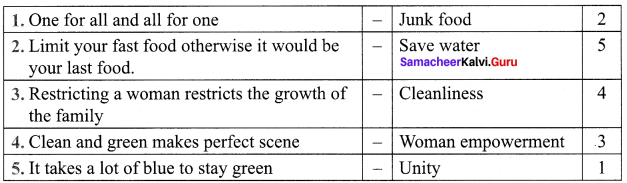
Samacheer Kalvi 10th English Vocabulary Idioms

You can Download Samacheer Kalvi 10th English Book Solutions Guide Pdf, Tamilnadu State Board help you to revise the complete Syllabus and score more marks in your examinations.

Attempt all english grammar practice sections covered in the Samacheer Kalvi 10th English Grammar Book and excel in reading, writing, and speaking english with great fluency.

Tamilnadu Samacheer Kalvi 10th English Vocabulary Idioms

Match the following idioms with suitable meanings:
1.

(i) Add fuel to fire (a) A secret advantage
(ii) Ace up one’s sleeve (b) Create confusion
(iii) Stir up a hornet’s nest (c) Caught between two great dangers
(iv) Pour oil on troubled waters (d) Calm down a difficult situation
(v) Between the devil and the deep blue sea (e) Make a bad situation worse.

Answer:
(i) – (c),
(ii) – (a),
(iii) – (d),
(iv) – (b),
(v) – (c)

2.

(i) A bleeding heart (a) To praise oneself
(ii) To blow one’s own horn (b) Return to the beginning because of failure
(iii) To beat around the bush (c) Either partner in marriage
(iv) Back to square one (d) A soft-hearted person
(v) Better half (e) To talk about things in a round about way

Answer:
(i) – (d),
(ii) – (a),
(iii) – (c),
(iv) – (b),
(v) – (c)

Samacheer Kalvi 10th English Vocabulary Idioms

3.

(i) Birds of the same feather flock together (a) It proved to be the only but a dangerous weakness
(ii) Don’t beat around the bush (b) Start. I’m listening
(iii) Go ahead!  I’m all ears (c) Come to the point. Be precise
(iv) The king’s blind love for his wife (d) Come totally unexpected. It caught us unaware
(v) The announcement of the special test came as a bolt from the blue (d) People with a common interest join together

Answer:
(i) – (c),
(ii) – (c),
(iii) – (b),
(iv) – (a),
(v) – (d)

Choose the correct meaning for the following idioms:

Question 1.
Atthedropofahat
(a) To hear rumors about someone
(b) Do or say something exactly right
(c) To go to bed
(d) Without any hesitation; instantly
Answer:
(d) Without any hesitation; instantly

Question 2.
Barking at the wrong tree
(a) To hear rumors about someone
(b) Accusing the wrong person
(c) To go to bed
(d) A rare happening
Answer:
(b) Accusing the wrong person

Question 3.
Best of both worlds
(a) All the advantages
(b) Dislike to choose or make a decision
(c) Accusing the wrong person
(d) To take on a task that is way too big
Answer:
(a) All the advantages

Question 4.
Bite more than you can chew
(a) Do not put all the resources in one.
(b) To take on a task that is way too big
(c) Some good that isn’t recognized at first
(d) Accomplish two things at the same time
Answer:
(b) To take on a task that is way too big

Question 5.
Burn the midnight oil
(a) Dislike to choose or make a decision
(b) All the advantages
(c) To take on a task that is way too big
(d) To work late into the night
Answer:
(d) To work late into the night

Question 6.
Wouldn’t be caught dead
(a) Dislike to choose or make a decision
(b) All the advantages
(c) To deceive someone into thinking well of them
(d) Would never like to do something
Answer:
(d) Would never like to do something

Question 7.
Costs an arm and a leg
(a) Come to the point – leave out details
(b) Something is very expensive
(c) Be optimistic, even difficult times will lead to better days
(d) Asking what someone is thinking
Answer:
(b) Something is very expensive

Samacheer Kalvi 10th English Vocabulary Idioms

Question 8.
Cry over spilt milk.
(a) Complaining a loss from the past
(b) Cannot judge based on appearance
(c) Believe someone’s statement, without proof
(d) An activity that is easy or simple
Answer:
(a) Complaining a loss from the past

Question 9.
Curiosity killed the cat
(a) Inquisitiveness leads to unpleasantness
(b) The final problem in a series of problems
(c) Failure leads to a time to start all over
(d) Everything about the case
Answer:
(a) Inquisitiveness leads to unpleasantness

Question 10.
Cut corners
(a) Hear from the authoritative source
(b) Do something to save money
(c) Feeling slightly ill
(d) Everything about the case
Answer:
(b) Do something to save money

Question 11.
Devil’s Advocate
(a) Some good that isn’t recognized at first
(b) Indirectly talking about an issue
(c) To present a counter-argument
(d) Hear from the authoritative source
Answer:
(c) To present a counter-argument

Question 12.
Elvis has left the building
(a) Would never like to do something
(b) To work late into the night
(c) The show has ended. It’s all over
(d) Not to be serious about others talk
Answer:
(c) The show has ended. It’s all over

Question 13.
Straight from the horse’s mouth
(a) Overwhelmed by the happening
(b) Hear from the authoritative source
(c) Take the credit for something you don’t deserve
(d) Someone who lacks intelligence
Answer:
(b) Hear from the authoritative source

Question 14.
Far cry from
(a) Very different from
(b) Take the credit for something you don’t deserve
(c) Something is very expensive
(d) Not to be serious about others talk
Answer:
(a) Very different from

Question 15.
Feel a bit under the weather
(a) Feeling slightly ill
(b) Would never like to do something
(c) To deceive someone into thinking well of them
(d) The show has ended. It’s all over
Answer:
(a) Feeling slightly ill

Samacheer Kalvi 10th English Vocabulary Idioms
Use Of Some Common Idioms

1. A hot potato Current issues spoke by many people
2. A penny for your thoughts Asking what someone is thinking
3. At the drop of a hat Without any hesitation; instantly
4. Back to the drawing board Failure leads to a time to start all over
5. Ball is in your court Up to you to make the decision
6. Barking up the wrong tree Accusing the wrong person
7. Beat around the bush Indirectly talking about an issue
8. Best of both worlds All the advantages
9. Bite more than you can chew To take on a task that is way too big
10. Blessing in disguise Some good that isn’t recognized at first
11. Bum the midnight oil To work late into the night
12. Wouldn’t be caught dead .dislike something very much
13. Caught between two stools Difficulty in choosing
14. Costs an arm and a leg Something very expensive
15. Cry over spilt milk Complaining a loss from the past
16. Curiosity killed the cat Inquisitiveness leads to unpleasantness
17. Cut comers Do something to save money
18. Devil’s Advocate To present a counter argument
19. Don’t put all eggs in one basket Do not put all resources in one
20. Whole nine yards Everything about the case
21. Elvis has left the building The show has ended. It’s all over
22. Straight from the horse’s mouth Hear from the authoritative source
23. Far cry from Very different from
24. Feel a bit under the weather Feeling slightly ill
25. Take with a grain of salt Not to be serious about others talk
26. Hear it on the grapevine To hear rumors about someone
27. Hit the nail on the head Do or say something exactly right
28. Hit the sack sheets hay To go to bed
29. In the heat of the moment Overwhelmed by the happening
30. Jump on the bandwagon Join a popular trend or activity
31. Keep something at bay Keep something away
32. Kill two birds with one stone Accomplish two things at the same time
33. Last straw The final problem in a series of problems
34. Steal someone’s thunder Take the credit for something you don’t deserve
35. Let the cat out of the bag Share information that was hidden
36. Make a long story short Come to the point – leave out details
37. Miss the boat To miss an opportunity
38. Not a spark of decency No manners
39. Not playing with a lull deck Someone who lacks intelligence
40. On the ball To understand the situation well
41. Piece of cake An activity that is easy or simple
42. Put wool over other’s eyes To deceive someone into thinking well of them
43. Add insult to injury To make a situation worse
44. Sit on the fence Dislike to choose or make a decision
45. Speak of the devil The person you are talking about arrives
46. Back to the wall Hard-pressed situation with no escape
47. Don’t judge a book by its cover Cannot judge based on appearance
48. Give the benefit of the doubt Believe someone’s statement, without proof
49. Below the belt Unfair or unsupporting behavior
50. Have cold feet Be afraid or frightened

Samacheer Kalvi 10th English Vocabulary Idioms Read More »