Class 10

Samacheer Kalvi 10th Science Solutions Chapter 16 Plant and Animal Hormones

You can Download Samacheer Kalvi 10th Science Book Solutions Guide Pdf, Tamilnadu State Board help you to revise the complete Syllabus and score more marks in your examinations.

Tamilnadu Samacheer Kalvi 10th Science Solutions Chapter 16 Plant and Animal Hormones

Samacheer Kalvi 10th Science Plant and Animal Hormones Textual Evaluation Solved

I. Choose the Correct Answer.

Question 1.
Gibberellins cause _____.
(a) Shortening of genetically tall plants
(b) Elongation of dwarf plants
(c) Promotion of rooting
(d) Yellowing of young leaves.
Answer:
(c) Promotion of rooting

Question 2.
The hormone which has positive effect on apical dominance is:
(a) Cytokinin
(b) Auxin
(c) Gibberellin
(d) Ethylene
Answer:
(b) Auxin

Question 3.
Which one of the following hormones is naturally not found in plants?
(a) 2, 4 – D
(b) GA3
(c) Gibberellin
(d) IAA.
Answer:
(a) 2, 4 – D

Question 4.
Avena coleoptile test was conducted by:
(a) Darwin
(b) N. Smit
(c) Paal
(d) F.W. Went
Answer:
(d) F.W. Went

Question 5.
To increase the sugar production in sugarcanes they are sprayed with _____.
(a) Auxin
(b) Cytokinin
(c) Gibberellins
(d) Ethylene.
Answer:
(d) Ethylene.

SamacheerKalvi.Guru

Question 6.
LH is secreted by:
(a) Adrenal gland
(b) Thyroid gland
(c) Anterior pituitary
(d) Hypothalamus
Answer:
(c) Anterior pituitary

Question 7.
Identify the exocrine gland _____.
(a) Pituitary gland
(b) Adrenal gland
(c) Salivary gland
(d) Thyroid gland.
Answer:
(c) Salivary gland

Question 8.
Which organ acts as both exocrine gland as well as endocrine gland?
(a) Pancreas
(b) Kidney
(c) Liver
(d) Lungs
Answer:
(a) Pancreas

Question 9.
Which one is referred to as “Master Gland”?
(a) Pineal gland
(b) Pituitary gland
(c) Thyroid gland
(d) Adrenal gland.
Answer:
(b) Pituitary gland

II. Fill in the blanks.

Question 1.
______ causes cell elongation, apical dominance and prevents abscission.
Answer:
Auxin.

Question 2.
______ is a gaseous hormone involved in abscission of organs and acceleration of fruit ripening.
Answer:
Ethylene.

Question 3.
____ causes stomatal closure.
Answer:
Abscisic acid.

Question 4.
Gibberellins induce stem elongation in _____ plants.
Answer:
Corn and Pea.

Question 5.
The hormone which has a negative effect on apical dominance is _____.
Answer:
Cytokinin.

SamacheerKalvi.Guru

Question 6.
Calcium metabolism of the body is controlled by _____.
Answer:
Parathormone.

Question 7.
In the Islets of Langerhans, beta cells secrete _____.
Answer:
Insulin.

Question 8.
The growth and functions of the thyroid gland are controlled by _____.
Answer:
Hormone T3 and T4

Question 9.
Decreased secretion of thyroid hormones in the children leads to _____.
Answer:
Cretinism.

III. Match the following.

Question 1.
(a) Match the Column I with Columns II and III.

Column I Column II Column III
Auxin Gibberella fujikuroi Abscission
Ethylene Coconut milk Intermodal elongation
Abscisic acid Coleoptile tip Apical dominance
Cytokinin Chloroplast Ripening
Gibberellins Fruits Cell division

(b) Match the following hormones with their deficiency states.

Hormones Disorders
1. Thyroxine (a) Acromegaly
2. Insulin (b) Tetany
3. Parathormone (c) Simple goitre
4. Growth hormone (d) Diabetes insipidus
5. ADH (e) Diabetes mellitus

Answer:
(a)

Column I Column II Column III
Auxin Coleoptile tip Apical dominance
Ethylene Fruits Ripening
Abscisic acid Chloroplast Abscission
Cytokinin Coconut milk Cell division
Gibberellins Gibberella fujikuroi Intermodal elongation

(b)
1. (c) Simple goitre
2. (e) Diabetes mellitus
3. (b) Tetany
4. (a) Acromegaly
5. (d) Diabetes insipidus

IV. State whether True or false, If false write the correct statement.

Question 1.
A plant hormone concerned with stimulation of cell division and promotion of nutrient mobilization is cytokinin.
Answer:
True.

Question 2.
Gibberellins cause parthenocarpy in tomato.
Answer:
True.

SamacheerKalvi.Guru

Question 3.
Ethylene retards senescence of leaves, flowers and fruits.
Answer:
False.
Correct Statement: Ethylene hastens the senescence of leaves, flowers and fruits.

Question 4.
Exophthalmic goitre is due to the over secretion of thyroxine.
Answer:
True.

Question 5.
The pituitary gland is divided into four lobes.
Answer:
False.
Correct Statement: The Pituitary gland is composed of two lobes and performs different functions.

Question 6.
Estrogen is secreted by corpus luteum.
Answer:
False.
Correct Statement: Estrogen is produced by the Graafian follicles of the ovary.

V. Assertion and Reasoning Questions

Direction: In each of the following questions a statement of assertion (A) is given and a corresponding statement of Reason (R) is given just below it. Mark the correct statement as,
(a) If both A and R are true and R is the correct explanation of A
(b) If both A and R are true but R is not the correct explanation of A
(c) A is true but R is false
(d) Both A and R are false.

Question 1.
Assertion: Application of cytokinin to marketed vegetables can keep them fresh for several days.
Reason: Cytokinins delay senescence of leaves and other organs by mobilisation of nutrients.
Answer:
(d) Both A and R are false.

Question 2.
Assertion (A): Pituitary gland is referred to as “Master gland”.
Reason (R): It controls the functioning of other endocrine glands.
Answer:
(a) If both A and R are true and R is the correct explanation of A.

Question 3.
Assertion (A): Diabetes mellitus increases blood sugar levels.
Reason (R): Insulin decreases blood sugar levels.
Answer:
(a) If both A and R are true and R is the correct explanation of A.

VI. Answer in a word or sentence.

Question 1.
Which hormone promotes the production of male flowers in Cucurbits?
Answer:
Gibberellins promote the production of male flowers in Cucurbits.

Question 2.
Write the name of synthetic auxin.
Answer:
2, 4 Dichloro phenoxy Acetic Acid is the synthetic hormone.

SamacheerKalvi.Guru

Question 3.
Which hormone induces parthenocarpy in tomatoes?
Answer:
Gibberellins are efficient in the formation of seedless fruit, inducing parthenocarpy in tomatoes.

Question 4.
What is the hormone responsible for the secretion of milk in female after child birth?
Answer:
Prolactin stimulates the secretion of milk in female after child birth.

Question 5.
Name the hormones which regulate water and mineral metabolism in man.
Answer:
Antidiuretic or vasopressin hormone regulates water and mineral metabolism in man.

Question 6.
Which hormone is secreted during emergency situation in man?
Answer:
Adrenaline and Noradrenaline is secreted during emergency situation in man.

Question 7.
Which gland secretes digestive enzymes and hormones?
Answer:
The pancreas is exocrine and endocrine in nature. The exocrine pancreas secretes pancreatic juice which plays a role in digestion. The endocrine portion (Islets of Langerhans) secrete hormones.

Question 8.
Name the endocrine glands associated with kidneys.
Answer:
Adrenal gland is associated with kidneys.

VII. Short Answer Questions.

Question 1.
What are synthetic auxins? Give examples.
Answer:
Artificially synthesized auxins, which have the properties like auxins are called as synthetic auxins, eg. 2, 4-D (2, 4-Dichlorophenoxy Acetic acid, Indole-3-Propionic Acid, alpha – Naphthalene Acetic Acid (NAA), 2, 4, 5-T (2, 4, 5-Trichlorophenoxy Acetic acid) are some of the synthetic auxins.

Question 2.
What is bolting? How can it be induced artificially?
Answer:
Rosette plant (genetic dwarfism) plant exhibit excessive intermodal growth when they are treated with gibberellins. This sudden elongation of a stem followed by flowering is called bolting.

Question 3.
Bring out any two physiological activities of abscisic acid.
Answer:

  • During water stress and drought conditions, Abscisic acid causes stomatal closure.
  • ABA induces bud dormancy towards the approach of winter in trees like birch.

Question 4.
What will you do to prevent leaf fall and fruit drop in plants? Support your answer with reason.
Answer:
Artificially synthesized auxin to be sprayed to prevent leaf fall and fruit drop as Auxin prevent the formation of abscission layer.

Question 5.
What are chemical messengers?
Answer:
A chemical messenger is any compound that serves to transmit a message. A chemical messenger refers to hormones.

SamacheerKalvi.Guru

Question 6.
Write the differences between endocrine and exocrine gland.
Answer:
The exocrine gland secretes juices, which plays a role in digestion. An endocrine portion is made up of endocrine glands, which secrete hormones. The pancreas is exocrine and endocrine in nature.

Question 7.
What is the role of parathormone?
Answer:
Parathormone regulates calcium and phosphorous metabolism in the body. They act on bone, kidney and intestine to maintain blood calcium levels.

Question 8.
What are the hormones secreted by the posterior lobe of the pituitary gland? Mention the tissues on which they exert their effect.
Answer:

  • Vasopressin or Antidiuretic hormone.
  • Oxytocin is the two hormones of the posterior lobe of the pituitary gland.

In kidney tubules, the vasopressin hormone increases the reabsorption of water. It reduces the loss of water through urine.
Oxytocin helps in the contraction of the smooth muscles of the uterus at the time of childbirth and ” milk ejection from the mammary gland after childbirth.

Question 9.
Why are thyroid hormones refered as personality hormone?
Answer:
Thyroid hormones are essential for normal, physical, mental and personality development. So, it is called as personality hormone.

Question 10.
Which hormone requires iodine for its formation? What will happen if the intake of iodine in our diet is low?
Answer:
The hormones secreted by the thyroid gland are:

  • Triiodothyronine (T3)1
  • Tetraiodothyronine or Thyroxin (T4), which need an amino acid tyrosine and Iodine for its formation.

If the intake of Iodine in our diet is low or due to the inadequate supply of iodine in our diet leads to the enlargement of the thyroid gland, which protrudes, as swelling in the neck and is called as goitre.

VIII. Long Answer Questions

Question 1.
(a) Name the gaseous plant hormone. Describe its three different actions in plants.
Answer:
Ethylene is a gaseous plant hormone.

  1. Ethylene promotes the ripening of fruits. Eg: Tomato, Apple, Mango, Banana, etc.
  2. Ethylene inhibits the elongation of stem and root in dicots.
  3. Ethylene hastens the senescence of leaves and flowers.

(b) Which hormone is known as a stress hormone in plants? Why?
Answer:
Abscisic acid increases the tolerance of plants to various kinds of stress. So, it is also called a stress hormone. It is found in the chloroplast of plants.

Question 2.
Describe an experiment which demonstrates that growth-stimulating hormone is produced at the tip of the coleoptile?
Answer:
Went’s experiment was done by Frits warm out. This experiment demonstrates the growth-stimulating hormone Auxin is produced at the tip of the coleoptile.

He did a series of experiments in Avena Coleoptiles. In his first experiment, he removed the tips of Avena coleoptiles. The cut tips did not grow, indicating that the tips produced something essential for growth.
In his second experiment, he placed the agar blocks on the decapitated coleoptile tips. The coleoptile tips did not show any response.

In his third experiment, he placed the detached coleoptile tips on agar blocks. After an hour, the tips were discarded and placed this agar block on the decapitated coleoptile. It grew straight up, indicating that some chemical had diffused from the cut coleoptile tips into the agar block, which stimulated the growth.

From these experiments, Went concluded that, the chemical diffusing from the tip of coleoptile was responsible for the growth and he named it as “Auxin”.

SamacheerKalvi.Guru

Question 3.
Write the physiological effects of gibberellins.
Answer:

  1. Application of gibberellins on plants stimulate extraordinary elongation of intemode. Eg: Com and Pea.
  2. Treatment of rosette plants with gibberellin induces sudden shoot elongation followed by flowering. This is called bolting.
  3. Gibberellins promote the production of male flowers in monoecious plants (Cucurbits).
  4. Gibberellins break dormancy of potato tubers.
  5. Gibberellins are efficient than. auxins in inducing the formation of seedless fruit – Parthenocarpic fruits (Development of fruits without fertilization) Eg: Tomato.

Question 4.
Where are estrogens produced? What is the role of estrogens in the human body?
Answer:
Estrogen, the female sex hormone is produced by the Graafian follicles of the ovary.
Role of estrogen:

  • It brings about the changes that occur during puberty.
  • It initiates the process of oogenesis.
  • It stimulates the maturation of ovarian follicles in the ovary.
  • It promotes the development of secondary sexual characters (breast development and high pitched voice, etc).

Question 5.
What are the conditions which occur due to lack of ADH and insulin? How are the conditions different from one another?
Answer:
ADH:
Deficiency of ADH causes a disorder called diabetes insipidus.
Deficiency of ADH reduces the reabsorption of water and causes an increase in urea output (polyuria). This deficiency disorder is called Diabetes insipidus.

IX. Higher Order Thinking Skills (HOTS) Questions

Question 1.
What would be expected to happen if,

  1. Gibberellin is applied to rice seedlings?
  2. A rotten fruit gets mixed with unripe fruits.
  3. When cytokinin is not added to the culture medium.

Answer:

  1. When gibberellins are applied, it stimulates, the extraordinary elongation of internodes.
  2. The mass of undifferentiated cell is called callus. If the rotten fruits get mixed with unripe fruits, then the ethylene produced from the rotten fruits will hasten the ripening of the unripe fruits.
  3. If cytokinin is not added to the culture medium, then the cell division, growth and differentiation will not be observed.

Question 2.
A plant hormone was first discovered in Japan when rice plants were suffering from Bakanae disease caused by Gibberella fujikoroi. Based on this information answer the following questions:
(a) Identify the hormone involved in this process.
Answer:
Gibberellin is involved in this process.

(b) Which property of this hormone causes the disease?
Answer:
It stimulates extraordinary elongation of intemode.

(c) Give two functions of this hormone.
Answer:

  1. Gibberellin break dormancy of potato tubers.
  2. Gibberellin promotes the production of male flower in monoecious plant (Cucurbits).

SamacheerKalvi.Guru

Question 3.
Senthil has high blood pressure, protruded eyeball and increased body temperature. Name the endocrine gland involved and hormone secretion responsible for this condition.
Answer:
The endocrine gland is Thyroid gland, and the hormones secreted are Triiodothyronine (T3) and Tetraiodothyronine or Thyroxine (T4). The excess secretion of the Thyroid hormone leads to Grave’s disease. The symptoms are protrusion of eyeballs (exophthalmia), increased metabolic rate, high body temperature, profuse sweating, loss of body weight and nervousness.

Question 4.
Sanjay is sitting in the exam hall. Before the start of the exam, he sweats a lot, with increased rate of heart beat. Why does this condition occur?
Answer:
It is due to secretion of Epinephrine and Norepinephrine as it produced during conditions of stress and emotion. They are called as “Emergency hormones” or flight, fright and fight hormone.

Question 5.
Susan’s father feels very tired and frequently urinates. After clinical diagnosis, he was advised to take an injection daily to maintain his blood glucose level. What would be the possible cause for this? Suggest preventive measures.
Answer:
The deficiency of insulin causes Diabetes mellitus. He has Diabetes mellitus. Increase in blood sugar level (Hyperglycemia). He was advised to take an injection, Insulin, which helps in the conversion of glucose into glycogen, which is stored in the liver. It decreases the concentration of glucose in the blood.
Preventive measures:

  • Manage the weight
  • Exercise regularly
  • Eat a balanced healthy diet
  • Limit alcohol intake
  • Quit smoking
  • Control the blood pressure

Textbook Activities Solved

Activity 1.
Place two or three unripe tomatoes in a brown paper bag with a ripe banana and roll the top closed. In another bag place two or three unripe tomatoes only and roll the top closed, Observe what happens to the tomatoes? Why?
Answer:
As the banana continues to ripen in the first bag, it produces ethylene gas. The gas trapped in the bag will cause tomatoes to ripen. The tomatoes remain unripe in the second bag.

Samacheer Kalvi 10th Science Plant and Animal Hormones Additional Questions Solved

I. Fill in the blanks.

Question 1.
The chemical substances produced by plants are called _____.
Answer:
Hormones.

Question 2.
Tie two lobes of thyroid glands are connected by means of a narrow band of tissue called _____.
Answer:
Isthmus.

Question 3.
The chief cells of parathyroid glands are _____.
Answer:
Parathormone.

Question 4.
The other name for adrenal gland is _____.
Answer:
Supra Renal.

Question 5.
The hormones secreted by the adrenal cortex are _____.
Answer:
Corticosteroids

Question 6.
During water stress and drought conditions _______ causes stomatal closure.
Answer:
Abscisic acid.

Question 7.
Glucagon helps the break down of ______ to glucose in the liver.
Answer:
Glycogen.

SamacheerKalvi.Guru

Question 8.
The adrenal medulla is composed of ______ cells.
Answer:
Chromaffin.

Question 9.
The male sex hormone _______ is responsible for the development of secondary sexual characters.
Answer:
Testosterone.

Question 10.
_______ is a gaseous plant hormone, mainly concerned with maturation and ripening of fruits.
Answer:
Ethylene.

Question 11.
The other name for pituitary gland is _____.
Answer:
Hypophysis.

Question 12.
The glandular follicles of the thyroid gland are filled with colloid material called _____.
Answer:
Thyroglobulin.

II. Match the following.

Question 1.

1. Morphogenesis (a) Chromaffin cells
2. Bakanae disease (b) Male sex hormone
3. Tetany (c) Thymus
4. Testosterone (d) Gibberella fujikuroi
5. Adrenal medulla (e) Female sex hormone
6. Thymosin (f) Callus in tissue culture
7. Estrogen (g) Muscle spasm

Answer:

  1. (f) Callus in tissue culture
  2. (d) Gibberella fujikuroi
  3. (g) Muscle spasm
  4. (b) Male sex hormone
  5. (a) Chromaffin cells
  6. (c) Thymus
  7. (e) Female sex hormone.

III. Choose the odd one out.

Question 1.
Auxins, Parthenocarpy, apical dominance, Parathormone?
Answer:
Parathormone.

Question 2.
Senescence, Dormancy, Estrogen, abscission?
Answer:
Estrogen.

Question 3.
Glucagon, Endocrine, Exocrine, Gibberellins?
Answer:
Gibberellins.

Question 4.
Norepinephrine, Isthmus, tyrosine, thyroglobulin?
Answer:
Norepinephrine.

Question 5.
Gonads, Thyroid, Cytokinin, Thymus?
Answer:
Cytokinin.

IV. Match the following endocrine glands with their location.

Question 1.

1. Pituitary gland (a) Female sex gland
2. Thyroid gland (b) Male sex gland
3. Parathyroid (c) Above the kidney
4. Islets of Langerhans (d) The posterior surface of the thyroid lobe
5. Adrenal gland (e) The upper part of the chest, the lower end of the trachea
6. Testes (f) Base of midbrain
7. Ovary (g) Pancreas
8. Thymus (h) Trachea

Answer:

  1. (f) Base of midbrain
  2. (h) Trachea
  3. (d) The posterior surface of the thyroid lobe
  4. (g) Pancreas
  5. (c) Above the kidney
  6. (b) Male sex gland
  7. (a) Female sex gland
  8. (e) The upper part of the chest, the lower end of Trachea.

V. Write ‘True’ or ‘False’ for the following statements. Write the correct statement for false:

Question 1.
Auxins, cytokinins and gibberellins inhibit plant growth, while abscisic acid and Ethylene promote plant growth.
Answer:
False.
Correct Statement: Auxins, cytokinins and gibberellins promote plant growth, while abscisic acid and ethylene inhibit plant growth.

SamacheerKalvi.Guru

Question 2.
Glucagon helps in the breakdown of glycogen to glucose in the liver.
Answer:
True.

Question 3.
The thymus is partly an endocrine gland and partly a lymphoid gland.
Answer:
True.

Question 4.
Leydig cells from the cells of a female. Gonads located in the pelvic cavity.
Answer:
False.
Correct Statement: Leydig cells from the endocrine part of the testes.

Question 5.
Cretinism is caused due to increased secretion of the thyroid hormones in children.
Answer:
False.
Correct Statement: Cretinism is caused due to decreased secretion of the thyroid hormones in children.

Question 6.
Cytokinin promotes the growth of lateral buds even in the presence of apical buds.
Answer:
True.

VI. Answer the following in a word or with a sentence.

Question 1.
Where are Auxins produced?
Answer:
Auxins are produced at the tip of stems and roots from where they migrate to the zone of elongation.

Question 2.
What is Richmond Lang effect?
Answer:
Delaying the process of ageing in plants with the application of cytokinin is called Richmond Lang effect.

Question 3.
What is Richmond Lang effect?
Answer:
Application of cytokinin delays the process of ageing in plants. This is called Richmond Lang effect.

Question 4.
Give the uses of progesterone.
Answer:
Progesterone maintains pregnancy and regulates the menstrual cycle.

Question 5.
What are the secretions of alpha and beta cells of Islets of Langerhans?
Answer:
Alpha cells secrete glucagon and beta cells secrete Insulin.

Question 6.
What is the main function of Glucogen.
Answer:
Glucogon converts excess amount of glycogen stored under the muscle and liver to glucose. Thus raising the blood glucose level.

SamacheerKalvi.Guru

Question 7.
Name the two types of sex glands.
Answer:
Testes and Ovaries.

Question 8.
Specify the symptoms of acromegaly.
Answer:
Acromegaly leads to abnormal enlargement of head, face, hand and feet.

Question 9.
Name the three layers of the adrenal cortex.
Answer:

  • Zona glomerulosa
  • Zona fasciculata
  • Zona reticularis

Question 10.
What is Endocrinology?
Answer:
The branch of biology which deals with the study of the endocrine glands is called Endocrinology.

VII. Answer the following briefly.

Question 1.
Name the types of plant hormones.
Answer:

  • Auxins
  • Cytokinins
  • Gibberellins
  • Abscisic acid
  • Ethylene.

Question 2.
Growth hormone is important for normal growth. Explain.
Answer:
Growth hormone promotes the development and enlargement of all tissues •of the body. It stimulates the growth of muscles, cartilage and long bones. It controls cell metabolism.

Question 3.
What are Ductless glands? Why are they called so?
Answer:
Endocrine glands are called ductless glands because their secretions are diffused into the bloodstream, and are carried to the different parts of the body. They do not have specific ducts to carry the hormones.

Question 4.
Why pancreas is called as dual gland?
Answer:
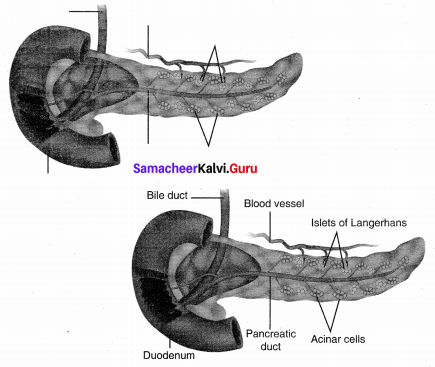
The exocrine part of the pancreas produces pancreatic juice. The endocrine part produce islets of Langerhans, consists of two cells namely alpha cells that produce a hormone called glucagon and Beta cells that produce insulin. So, it is called as dual gland.

Question 5.
Write any three physiological effects of cytokinins.
Answer:

  • Cytokinins induce cell division.
  • Cytokinins promote the growth of lateral buds even in the presence of apical buds.
  • Cytokinesis causes cell enlargement.

Question 6
Which gland is a link between endocrine and lymphoid gland.
Answer:
Thymus is partly an endocrine gland and partly a lymphoid gland. It is located in the upper part of the chest covering the lower end of trachea. Thymosin is the hormone secreted by the thymus.

SamacheerKalvi.Guru

Question 7.
What are the functions of thyroid hormones? Write any three points.
Answer:

  • Production of energy by maintaining the Basal Metabolic Rate (BMR) of the body.
  • Helps to maintain normal body temperature.
  • Influences the activity of the Central Nervous System.

Question 8.
What are plant hormones?
Answer:
Plant hormones are organic molecules that are produced at extremely low concentration in plants. These molecules control morphological, physiological and biochemical responses.

Question 9.
Explain any three functions of Testosterone.
Answer:

  • It influences the process of spermatogenesis.
  • It stimulates protein synthesis and controls muscular growth.
  • Responsible for the development of secondary sexual characters (distribution of hair on body and face and deep voice pattern, etc.).

Question 10.
Write a short note on the thymus gland.
Answer:
The thymus gland is partly an endocrine gland and partly a lymphoid gland. It is located in the upper part of the chest covering the lower end of the trachea. Thymosin is the hormone secreted by Thymus.
Functions:

  • It has a stimulatory effect on the immune function.
  • It stimulates the production and differentiation of lymphocytes.

VIII. Draw a labelled diagram for the following.

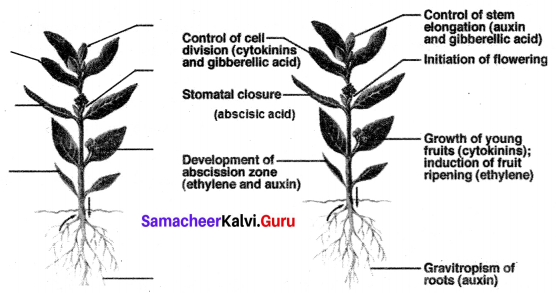
Question 1.
Hormonal interaction in plant growth and development.
Answer:
Samacheer Kalvi 10th Science Solutions Chapter 16 Plant and Animal Hormones 1

Question 2.
Pancreas
Answer:
Samacheer Kalvi 10th Science Solutions Chapter 16 Plant and Animal Hormones 2

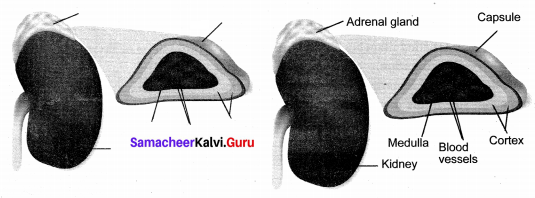
Question 3.
Adrenal gland
Answer:
Samacheer Kalvi 10th Science Solutions Chapter 16 Plant and Animal Hormones 3

IX. Answer the following in detail.

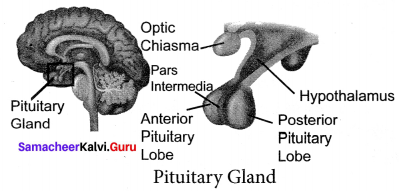
Question 1.
With a neat labelled diagram, explain the pituitary gland and the types of hormones.
Answer:
Samacheer Kalvi 10th Science Solutions Chapter 16 Plant and Animal Hormones 4
The pituitary gland is a pea-shaped compact mass of cells located at the base of the midbrain. As it regulates and controls the other endocrine glands, it is called “Master gland”

1. Hormones secreted by anterior pituitary:
(a) Growth Hormone (GH): It promotes the development and enlargement of all tissues. It stimulates the growth of muscles, cartilage and long bones. It controls cell metabolism. Decreased secretion of growth hormone leads to Dwarfism in children characterised by stunted growth, delayed skeletal formation and mental disability. Oversecretion of growth hormone leads to gigantism in children. Characterised by abnormal enlargement of head, face, hands and feet.

(b) Thyroid Stimulating Hormone (TSH) – a growth of thyroid gland.

(c) Adrenocorticotrophic hormone (ACTH) – Protein synthesis in the adrenal cortex.

(d) Gonadotrophic hormones (GTH) – for the normal development of Gonads.
The other two hormones are Follicle Stimulating Hormone (FSH); Luteinizing Hormones (LH)

(e) Prolactin (PRL) Initiates the development of mammary glands during pregnancy and production of milk after childbirth.

2. Hormones secreted by the posterior lobe:
(a) Vasopressin or Antidiuretic hormone (ADH) – It reduces the loss of water through urine. Deficiency of ADH reduces the reabsorption of water and causes an increase in urine output (polyuria). This deficiency disorder is called Diabetes insipidus.

(b) Oxytocin – It helps in the contraction of the smooth muscles of the uterus at the time of childbirth and milk ejection from the mammary gland after childbirth.

Question 2.
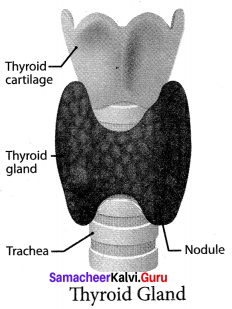
With a neat labelled diagram, explain thyroid gland, functions of thyroid hormones and the thyroid dysfunction.
Answer:
The thyroid gland is composed of two distinct lobes lying one on either side of the trachea. The two lobes are connected by means of a narrow band of tissue called as the isthmus, the gland is composed of glandular follicles and lined by cuboidal epithelium. The follicles are filled with colloid material called thyroglobulin. An amino acid tyrosine and iodine are involved in the formation of thyroid hormone.
The hormones secreted by the thyroid gland are:

  1. Triiodothyronine (T3)
  2. Tetraiodothyronine or Thyroxine (T4)
    Samacheer Kalvi 10th Science Solutions Chapter 16 Plant and Animal Hormones 5

Functions of Thyroid hormone:

  • Production of energy by maintaining the Basal Metabolic Rate (BMR) of the body.
  • Helps to maintain normal body temperature.
  • Influences the activity of the Central Nervous System.
  • Controls growth of the body and bone formation.
  • Essential for normal physical, mental and personality development. So it is called personality hormone.
  • Regulates cell metabolism.

When the thyroid gland fails to secrete the normal level of hormone, the condition is called thyroid dysfunction. It leads to the following conditions:
1. Hypothyroidism: It is caused due to the decreased secretion of the thyroid hormones.

  • Goitre: Goitre is caused due to the inadequate supply of iodine in our diet. It leads to the enlargement of the thyroid gland, protruded, marked swelling in the neck and is called goitre.
  • Cretinism: It is caused due to decreased secretion of thyroid hormone in children. The conditions are stunted growth, mental defect, lack of skeletal development and deformed bones. They are called as cretins.
  • Myxoedema: It is caused by the deficiency of thyroid hormone in adults. They are mentally sluggish, increase in body weight, puffiness of the face, hand etc.

2. Hyperthyroidism: It is caused due to the excess secretion of the thyroid hormone, which leads to Grave’s disease. The symptoms are protrusion of the eyeballs (Exopthalmia), increased metabolic rate, high body temperature, sweating, loss of body weight and nervousness.

Samacheer Kalvi 10th Science Solutions Chapter 16 Plant and Animal Hormones Read More »

Samacheer Kalvi 10th English Grammar Conditional Clause

You can Download Samacheer Kalvi 10th English Book Solutions Guide Pdf, Tamilnadu State Board help you to revise the complete Syllabus and score more marks in your examinations. Attempt all english grammar practice sections covered in the Samacheer Kalvi 10th English Grammar Book and excel in reading, writing, and speaking english with great fluency.

Tamilnadu Samacheer Kalvi 10th English Grammar Conditional Clause

Definition of a conditional clause
A conditional clause is a type of subordinate clause, most commonly introduced by the conjunction ‘if’ or ‘unless’. Like most subordinate clauses introduced by a conjunction, the conditional clause can either go before the main clause, or after it.

Example:
If I have enough money (conditional clause), I will go to Japan (main clause).

First, Second, and Third Conditional

Samacheer Kalvi 10th English Grammar Conditional Clause

  1. First conditional: If I have enough money, I will go to Japan.
  2. Second conditional: If I had enough money, I would go to Japan.
  3. Third conditional: If I had, had enough money, I would have gone to Japan.

Learn the following structures and learn the verbs:

1. If you study well,
(simple present)
you will get centum
(simple future)

2. If you studied well,
(simple past)
you would get centum
(future past form)

3. If you had studied well,
(past perfect)
you would have got centum
(future perfect – past form)

As per the aforesaid structures do the following exercises:

1. He wants to pass the test. He has to work harder.
If he wants to pass the test, he has to work harder.

2. You may meet her. Then please ask her to come over here.
If you will meet him, ask her to come over here.

3. We should work hard. Then we will get good marks.
If we work hard, we will get good marks.

4. Obey the rules. Otherwise, you will be punished.
If you do not obey the rules, you will be punished.

5. You have to invite him. He will come.
If you invite him, he will come.

Samacheer Kalvi 10th English Grammar Conditional Clause

6. I don’t know her email so I can’t send her an invitation
If I knew her email, I could send her an invitation.

7. You waste drinking water now. There will be scarcity of potable water in future.
If you waste drinking water now, there will be scarcity of potable water in future.

8. I was busy so I didn’t have enough time to go to the departmental store.
If I hadn’t been so busy, I would have had enough time to go to the departmental store.

9. Shalini didn’t play tennis because she had broken her leg.
If Shalini hadn’t broken her leg she would have played tennis.

10. I’d like to buy a new bike but I haven’t got enough money.
If I had enough money I would buy a new bike.

Fill in the conditional clause appropriately

1. If you run fast, you ……………………… (catch) the train.
2. If I won a lottery, I ……………………… (buy) a house.
3. I ……………………… (tell) you if I knew the answer.
4. If I were rich, I ……………………… (open) a school for the poor.
5. If he ……………………… (left) early, he might have caught the train.
6. If he ……………………… (inform) me, I would have received him at the railway station.
9. If you ……………………… (meet) him, tell him to come here.
10. If only he ……………………… (remember) to post that letter, I would have received it on time.
Answer:
1. might catch
2. would buy
3. would tell
4. would open
5. had left
6. had informed
7. can take
8. must work
9. should meet
10. had remembered

Samacheer Kalvi 10th English Grammar Conditional Clause

Samacheer Kalvi 10th English Grammar Conditional Clause Read More »

Samacheer Kalvi 10th English Message Writing

You can Download Samacheer Kalvi 10th English Book Solutions Guide Pdf, Tamilnadu State Board help you to revise the complete Syllabus and score more marks in your examinations. Attempt all english grammar practice sections covered in the Samacheer Kalvi 10th English Grammar Book and excel in reading, writing, and speaking english with great fluency.

Tamilnadu Samacheer Kalvi 10th English Message Writing

A Message is an informal means of communication. The receiver of the message has to sift through the given message and pick out the most vital bits of information. Then, he/she should be able to reproduce that information in order to convey it to the person for whom it is intended.

Samacheer Kalvi 10th English Message Writing

1. Srijith, a student of class ten, is instructed by his teacher to convey to her classmates about the Inter-school competitions which are to be held on 09.09.2020 in a nearby Government school.

5 Aug 2020
Dear Friends
Our teacher asked me to inform you about the Inter-school competitions on 9th September at the nearby Government Secondary School. Kindly inform your parents and bring Rs. 250/ – to attend the event. If you wish to participate contact me at the earliest.V Srijith

2. You are the office admin of your school. The Principal instructs you to send a message to all the parents to inform them about the holiday due to heavy rains that has been predicted for the next few days.

27 Nov 2020
Dear Parents
The school will remain closed from 28th Nov to 30th Nov due to the heavy rains that is predicted for the next few days. So kindly take the necessary precautions and be safe.S. Ramani.
P.A. to Principal

3. You are the office admin of your school. The Principal instructs you to send a message to all the parents to inform the postponement of exams due to the forthcoming elections.

25 Feb 2020
Dear Parents
Final exams postponed due to the forthcoming elections. New dates will be intimated tomorrow. Please check notice board for students to prepare accordingly.S. Manohar

4. Radha, a student of class ten, is instructed by her teacher to convey to her classmates Regarding the date of submission of the assignments given on 23rd Jan 2020.

23 Jan 2020
Dear Friends
This is to inform you that 20th Jan 2020 is the final date of submission for English assignments. She has advanced the dates as Mrs. Enoch is going on leave for a week. So kindly submit it as soon as possible.K. Radha

Samacheer Kalvi 10th English Message Writing

5. Meera, a student of class ten, is instructed by her teacher to convey to her classmates regarding the change of plans in the school excursion.

02 Feb 2020
Dear Friends
Our class teacher has asked me to inform all of you about the change of location for the school excursion. We will be going to Kodaikanal instead of Ootv as there are no tickets and the hotel rooms are not available on 20 and 21st of February 2020. Please inform your parents.K. Meera

Samacheer Kalvi 10th English Message Writing Read More »

Samacheer Kalvi 10th English Grammar Simple, Compound and Complex Sentences

You can Download Samacheer Kalvi 10th English Book Solutions Guide Pdf, Tamilnadu State Board help you to revise the complete Syllabus and score more marks in your examinations. Attempt all english grammar practice sections covered in the Samacheer Kalvi 10th English Grammar Book and excel in reading, writing, and speaking english with great fluency.

Tamilnadu Samacheer Kalvi 10th English Grammar Simple, Compound and Complex Sentences

The table given below contains the basic principles to transform the sentences:

S.No SIMPLE COMPLEX
(subordinating conjunction)
COMPOUND
(coordinating conjunction)
1. too ………………….. to so ………………….. that very ………………….. and so
2. In case of / In the event of On account of If/Unless….. (not)
SamacheerKalvi.Guru
or, or else, otherwise
3. In spite of/ Despite+Noun phrase Though/although/even though but, yet, still
4. Being, Having On+verb+ing (gerund)
Till, after, before+ ‘v’ ing
As/since/because All ‘Wh’ words like when, who, where, why, what, which, etc. Till, after, before+v (ed) and, and so, and then, and therefore

A. Transform the sentences according to the instructions given in the bracket:

1. He was sick and didn’t attend the party, (change into a simple sentence)
Being sick, he didn’t attend the party.

2. Climbing up the tree, he plucked some apple. (change into a compound sentence)
He climbed up the tree and plucked some apple.

Samacheer Kalvi 10th English Grammar Simple, Compound and Complex Sentences

3. I have informed him of his success. (Change into complex sentence)
I have informed him that he has succeeded.

4. It is said that Malini is a good doctor. (Change into a simple sentence)
Malini is a said to be a good doctor.

5. What he advised did not prove successful. (Change into complex sentence)
His advice did not prove successful.

6. She was too poor to educate her child, (change into a compound sentence)
She was so poor that she could not educate her child.

7. When Shyam was challenged they ran away. (Change into a simple sentence)
On being challenged Shyam ran away.

8. His looks proclaim his guilt. (Change into complex sentence)
His looks proclaim that he is guilty.

9. He liked what I suggested. (Change into a simple sentence)
He liked my suggestion.

10. Getting up, he walked away. (Change into compound sentence)
He got up and walked away.

B. Change or combine into a compound sentence
1. Being guilty he went into hiding.
He was guilty and went into hiding.

2. Being innocent, he never thought of running away.
He was innocent and never thought of running away.

3. Besides being sent to prison, he was heavily fined for smoking in the campus.
He was not only sent to prison but also heavily fined.

4. The old man stood in a corner, drinking.
The old man stood in a comer and drank.

5. He must run fast to catch the train.
He must run fast or he will not catch the train.

6. Besides being pretty, she is clever.
She is not only pretty but also clever.

7. Coming home she had lunch.
She came home and had lunch.

Samacheer Kalvi 10th English Grammar Simple, Compound and Complex Sentences

8. In spite of his illness, he attended all the classes.
He was ill, but he attended all the classes.

9. If you come late again, you will be punished.
You must not come late again otherwise you will be punished.

10. Going to the office I will write the article.
I will go to the office and will write the article.

C. Combine into a single sentence using ‘though” or ‘although’.

1. Ramasamy is very old. But he enjoys good health.
Though Ramasamy is very old he enjoys good health.

2. Ramu was very tired. Yet he completed the work.
Though Ramu was very tired, he completed the work.

3. The doctors gave her the best medical care. Still they could not save her.
Although the doctors gave her the best medical care, they could not save her.

4. Rajasekar left home early. But he was late for the seminar.
Though Rajasekar left home early, he was late for school.

5. Mala had the required qualifications. Still she did not get her dream job.
Although Mala had the required qualifications, she did not get the job.

6. I had some money on me. But I didn’t buy anything.
Although I had some money on me, I didn’t buy anything.

7. Our hockey team played well. But they lost the match.
Though our hockey team played well, they lost the match. ,

8. Mohan was annoyed. He didn’t say anything.
Although Mohan was annoyed, he didn’t say anything./Mohan didn’t say anything though he was annoyed.

9. The constable ran as fast as he could. Still he could not catch the thief.
Though the constable ran as fast as he could, he could not catch the thief.

Samacheer Kalvi 10th English Grammar Simple, Compound and Complex Sentences

10. Savitha is rich and famous. Still she is unhappy.
Though Savitha is rich and famous she is unhappy./She is unhappy though she is rich and famous.

D. Change into a simple sentence

1. Besides a house, he gave them some land also.
He gave them not only a house but some land also.

2. The storm subsided and we continued our journey.
The storm having subsided, we continued our journey.

3. Bharathi types quickly. Bharathi types correctly.
Besides typing quickly, Bharathi types correctly.

4. Not only the crops, but cattle and sheep also were destroyed by the flood.
Besides the crops, cattle and sheep were also destroyed by the flood.

5. You must take your medicine, otherwise you cannot get well.
You must take your medicine in order to get well.

6. He is rich, yet he is not happy.
In spite of being rich he is not happy.

7. He completed his work but it was not up to standard.
In spite of completing his work, it was not up to standard.

8. Tell me when the meeting will be held.
Tell me the time of the meeting.

9. I completed my homework. I set out to play.
On completing my homework, I set out to play,
(or)
After completing my homework, I set out to play.

10. I have no money that I can lend you.
I have no money to lend you.

E. Rewrite as Directed

1. We won’t miss the train if we leave now. (Use ‘unless’)
Unless we leave now, we will miss the train.

Samacheer Kalvi 10th English Grammar Simple, Compound and Complex Sentences

2. Sheela didn’t want to tell me the truth, but I found it out anyway. (Begin with ‘although’)
Although Sheela didn’t want to tell me the truth, I found it out anyway.

3. I have never seen such a mess. (Begin with ‘never’)
Never have I seen such a mess.

4. If you should need any help, just give me a ring. (Begin with ‘should’)
Should you need any money, just give me a ring.

5. You are obliged to obey your parents. (Use a quasimodal)
You ought to obey your parents.

6. You are sleepy in the morning because you are always late to bed. (Begin with ‘If’)
If you are always late to bed you will be sleepy in the morning.

7. If we do not finish our work a little early today we will not be able to attend the lecture, (unless)
Unless we finish our work a little early today we will not be able to attend the lecture.

8. If you are late once again, you will lose your job. (Begin the sentence with ‘should’)
Should you be late once again, you will lose your job.

9. I trust him but others think that he is lying. (Use ‘Though’)
I trust him though others think that he is lying.

Samacheer Kalvi 10th English Grammar Simple, Compound and Complex Sentences

10. If she should tell me the truth, she would not be punished. (Begin with ‘Should’)
Should she tell me the truth, she would not be punished.

Samacheer Kalvi 10th English Grammar Simple, Compound and Complex Sentences Read More »

No Men Are Foreign Book Back Answers 10th Standard English Chapter 6 Samacheer Kalvi

10th Standard English Unit 6 Poem No Men Are Foreign Book Back Answers

You can Download No Men Are Foreign Questions and Answers, Summary, Activity, Notes, Samacheer Kalvi 10th English Book Solutions Guide Pdf Poem Chapter 6 help you to revise complete Tamilnadu State Board New Syllabus and score more marks in your examinations.

Attempt all english grammar practice sections covered in the Samacheer Kalvi 10th English Grammar Book and excel in reading, writing, and speaking english with great fluency.

No Men Are Foreign 10th Standard English 6th Lesson Question and Answer

No Men Are Foreign Textual Questions

A. Based on the understanding of the poem, read the following lines, and answer the questions given below.

(i) Beneath all uniforms, a single body breathes
Like ours: the land our brothers walk upon
Is earth like this, in which we all shall lie.

(a) What is found beneath all uniforms?
Answer:
Though the outward appearance of people may change because of the difference in their attire, there is an inherent similarity between all human beings. All people live and breathe in a similar fashion. Militaries in the world may don different uniforms but they comprise of human beings who essentially are the same anywhere in the world.

(b) What is the same for every one of us?
Answer:
When we die, we all shall meet this same earth in the end where we shall be buried in it the same way.

(c) Where are we all going to lie finally?
Answer:
The poet says that at the end of our respective lives, we all shall lie buried in the same earth. He means to draw our attention to the common fate that awaits us regardless of our nationality.

Additional:
(a) What makes men strange and countries foreign?
(b) Who is referred to as ‘our brothers’ in this stanza?
(c) What lesson can we learn from these lines?
(d) What should we remember?
(e) What uniforms is the poet talking about?
(f) Where do our brothers walk?
(g) Name the poem and the poet.
(h) What is the figure of speech in the first line?
(i) Explain the metaphor in the first line.
(j) What breathes beneath all uniforms?
Answer:
(a) Geographical boundaries in segregate countries. We consider countries other than ours to be ‘foreign’ and the people living in these countries to be ‘strange’.
(b) The people who live in countries other than ours have been referred to as our brothers.
(c) These lines teach us the lesson of peace, universal brotherhood and harmony.
(d) We should remember that no men are strange and no country is foreign.
(e) The poet is talking about the different uniforms worn by different people in different countries.
(f) Our brothers walk on this earth which is the same for all.
(g) The name of the poem is ‘No Men Are Foreign’ and the name of the poet is ‘James Kirkup’.
(h) Beneath all uniforms, a single body breathes – Metaphor is the figure of speech employed here. Beneath all uniforms, a single body breathes.
(i) ‘Uniforms’ here basically stand for militaries that different countries in the world have. These uniforms may be different in colour, design, shape and culture, but people donning them are the same anywhere in the world. So the word uniform is indirectly compared to the militaries of different countries.
(j) A single type of body breathes beneath all uniforms.

(ii) They, too, aware of sun and air and water,
Are fed by peaceful harvests, by war’s long winter started.
(a) What is common for all of us?
(b) How are we fed?
(c) Mention the season referred to here?
Answer:
(a) Sun, air and water is common for all of us.
(b) We the people of the world are nourished and nurtured equally by the elements of Nature like sun, air and water, enjoying the harvests in peaceful times and dreading starvation caused by long-drawn wars.
(c) The season mentioned here is winter.

Additional:
(a) Who does ‘they’ refer to in the first line?
(b) What are they aware of?
(c) What are all men fed by?
(d) What do you mean by peaceful harvest?
(e) What do you mean by ‘wars’ long winter?
(f) What are they starved by?
(g) Which poetic device has been used in “war’s long winter starv’d”?
(h) Why has war’s winter been called long?
(i) What is the figure of speech in the line, war’s long winter starv’d?
(j) Explain war’s long winter starv’d?
Answer:
(a) ‘They’ refers to the people of countries other than ours, whom we consider as strangers.
(b) They are aware of the benefits of sun, air and water drawing sustenance from these elements of nature.
(c) All men are fed by peaceful harvests.
(d) By peaceful harvests, we mean the crops grown during the period of peace.
(e) It means the painful days of the war when we are kept indoors.
(f) They are starved by long winter.
(g) The poetic device used in “war’s long winter starv’d” is a ‘metaphor’.
(h) The winter of war has been called ‘long’ because unlike the naturalness it is self-inflicted trouble that not only robs the warmth of peace but also never ending.
(i) The starvation caused by the harsh winter has been compared indirectly to the wartime destruction. So it is a Metaphor. The poetic device can also be Alliteration where the initial consonants in war and winter are repeated.
(j) Here the starvation experienced during unproductive and harsh winter describes the want and hunger faced during war-time. Both these conditions lead to ultimate destruction.

(iii) Their hands are ours, and in their lines we read
A labour not different from our own. –
(a) Who does ‘their’ refer to?
(b) What does the poet mean by ‘lines we read’?
(c) What does not differ?
(d) “Are fed by peaceful harvest, by war’s long winter starved” What is the figure of speech
Answer:
(a) Their refers to men from different countries.
(b) Lines that show hard work done by the hands.
(c) Labour does not differ.
(d) in this line transferred epithet

Additional:
(а) Explain the expression: ‘Their hands are ours’.
(b) Explain: ‘A labour not different from our own’.
Answer:
(a) ‘Their hands are ours’ means that they too work hard like us with their hands to earn their livelihood.
(b) This expression means that the hard work done by the people who live in other countries is not different in any way from the one that we do. All of us have to toil and work hard in a similar way for survival.

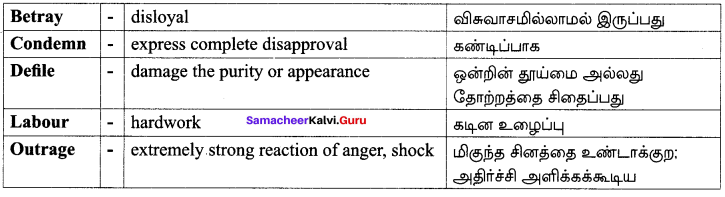
(iv) Let us remember, whenever we are told To hate our brothers, it is ourselves That we shall dispossess, betray, condemn
(а) Who tells us to hate our brothers?
(b) What happens when we hate our brothers?
(c) What do we do to ourselves?
Answer:
(a) The opportunist and leaders and politicians craving for power and authority, in short the selfish people, who control all wartime affairs, tell us to hate our brothers.
(b) When we hate our brothers, we hate ourselves unknowingly.
(c) We dispose and be disloyal to ourselves expressing complete disapproval to our deeds.

Additional:
(a) What are we doing to our fellow beings?
(b) Why do we sometimes hate our brothers?
(c) How shall we dispossess ourselves?
(d) Whom do we harm by going to war?
(e) What are the aftermaths of hatred?
(f) Why does the poet call all strangers and foreigners ‘brothers’?
Answer:
(a) We are disposing of; betraying and criticising our fellow beings.
(b) We sometimes hate our brothers because we allow vested and unscrupulous politicians and religious leaders to instigate us. We are taken in by their lies about our differences and begin to consider our brothers as strange and foreign.
(c) We shall dispossess ourselves by disliking our brothers in other parts of the world when we are told by the politically driven people to do so. These brothers cannot become foreign or strange just because they belong to different countries, races and cultures.
(d) By going to war, we harm ourselves as much as we harm the enemy. The environmental pollution makes this earth an equally unhealthy place to live in for both sides that go to war.
(e) The aftermaths of hatred are violence, communal disharmony and inhuman behaviour.
(f) All of them are bound by the common bond of humanity. Hence the poet calls all the , strangers and foreigners as brothers.

(v) Our hells of fire and dust outrage the innocence
Of air that is everywhere our own,
Remember, no men are foreign, and no countries strange.
(a) What outrages the innocence?
(b) Who is not foreign?
(c) What is not strange?
Answer:
(a) The fire and the dust during a war outrage the innocence.
(b) The people of this earth are not foreign.
(c) Every country on this earth is not strange.

Additional:
(a) Explain: ‘hells of fire and dust’.
(b) Explain: ‘the innocence of air’.
Answer:
(a) ‘Hells of fire and dust’ stands for the devastation created and caused by the arms and ammunition used in wars. The dust and smoke thus caused pollute the very air we breathe.
(b) ‘Innocence of air’ means the freshness and purity of air that nature has blessed us with. It also indicates the innocence of the human mind.

Additional Questions

(i) Remember they have eyes like ours that wake
Or sleep, and strength that can be won
By love. In every land is a common life
That all can recognise and understand.”
(a) What do all people have in common?
(b) Who does the word, ‘they’ refer to?
(c) Who do the words, ‘ours’ refer to?
(d) What do the eyes do?
(e) How can strength be won?
(f) What is common in every land?
(g) What can all recognize and understand?
(h) Explain: ‘they have eyes like ours that wake or sleep’.
(i) According to the poet, how can we win other people?
(j) What do you understand by ‘common life’?
(k) What should we remember about men?
(l) What should we remember about countries?
(m) What advice does the poet give us in these lines?
Answer:
(a) All people have eyes, sleep and strength in common.
(b) ‘They’ refers to people whom we discriminate and all the people of different countries whom we consider to be strange.
(c) ‘Ours’ refers to the people living in our own country whom we consider to be like us.
(d) The eyes wake and sleep.
(e) Strength can be won by love.
(f) Life is common in every land.
(g) All can recognise and understand that life is common in every land.
(h) The poet is trying to bring home the idea that those people whom we consider strange m or foreign are similar to us in every way. They sleep and wake up each new day just ’ like us. Even though the colour and shape of their eyes is different from ours, they perform a similar function.
(i) The poet says that the strength of other people can be won by love and kindness, not by force or war.
(j) ‘Common life’ means life anywhere in the world that has similar patterns and features – birth and death, joys and sorrows, youth and old age, and so on and so forth. This commonness of ‘common life’ is experienced by all the people of the world regardless of the country in which they live.
(k) We should remember that no men are strange.
(l) We should remember that no countries are foreign.
(m) The poet advises us to ignore the orders of those who incite us to hate and abuse others because by doing so we harm ourselves.

(ii) “It is the human earth that we defile
Our hells of fire and dust outrage the innocence
Of air that is everywhere our own,
Remember, no men are foreign, and no countries strange”
(a) What are we doing to the earth?
(b) What is outraging this earth?
(c) How do we outrage the innocence of air?
(d) What do you mean by ‘hells of fire and dust’?
(e) What can we call our own?
(f) Is there any strange country?
(g) What is ‘human earth’?
(h) What does the poet want to convey by telling us that “It is the human earth that we defile”?
(i) How do we defile human earth?
(j) How do we humiliate the mother earth?
(k) What should a man remember?
Answer:
(a) We are polluting this earth.
(b) Hells of fire and dust are outraging this earth.
(c) We outrage the innocence of air by our poisonous ideas and deeds.
(d) ‘Hells of fire and dust’ means the wars that cause a lot of destruction.
(e) We can call the air our own.
(f) No, there isn’t any strange country.
(g) ‘Human earth’ is the human world that is comprised of all countries, races, cultures and creeds.
(h) The poet wants to convey that wars cause enormous destruction of life and possessions. They ruin the clean and green surroundings of the earth and breed disgust and hostility. Hence, no one profits from war because the damage caused to earth is to be tolerated similarly, for we all share the same earth.
(i) We defile or pollute the human earth by using arms and ammunition to cause extensive , death and destruction. Contemporary weapons cause irreparable damage to the environment. So, we defile the earth by our polluted ideas and hellish deeds.
(j) We humiliate the mother earth by fighting and killing one another.
(k) A man should remember that no men are foreign and no countries are strange.

NCERT Class 9 English Poem 6 No Men Are Foreign MCQ Question Answers.

B. Based on your understanding of the poem, complete the summary using the phrases given below.

This poem is about the ……………… (a) ……………… of all men. The subject of the poem is the …………… (b) …………. race, despite of the difference in colour, caste, creed, religion, country, etc. All human beings are the same. We walk on the …………….. (c) ………….. and we will be buried under it. Each and every one of us is related to the other. We all are born the same and die in the same way. We may wear different uniforms like ………………… (d) ………….. during wars the opposing side will also have the same …………… (e) …………….. like ours. We as human do the same labour with ……………. (f) …………… and look at the world with the …………… (g) ……………… Waging war against others as they belong to a different country is like attacking our own selves. It is the ………………(h) ……………. we impair. We all share the same ……………… (i) …………… We are similar to each other. So the poet concludes that we shouldn’t have wars as it is ……………. (j) ……………… to fight against us.
(unity of human, dreams and aspirations, same land, our hands, unnatural, breathing body, same eyes, brotherhood, language, human-earth)
Answers:
(a) brotherhood
(b) unity of human
(c) same land
(d) language
(e) breathing body
(f) our hands
(g) same eyes
(h) dreams and aspirations
(i) human earth
(j) unnatural

C. Based on your understanding of the poem answer the following questions in a ‘paragraph of about 100-150 words.

Question 1.
‘What is the central theme of the poem ‘No men are foreign’?
Answer:
Introduction:
In this poem “No men are foreign” James Falconer Kirkup discusses the dreams and aspirations of all men.

The theme of the poem:
The theme of the poem ¡s the unity of the human race, despite the differences in colour, caste, creed, religion, country, etc.

All are equal:
All human beings are the same. We walk on the human earth and we will be buried under it. Breathing, walking and lying are the same for every one of us.

Life is common:
We can read and understand the hard work of everyone through their palm lines. We can understand that life is common in every land.

Never hate our brothers:
When we hate our brothers. We hate ourselves. We deprive, deceive, and condemn ourselves when we hate them. The men who fight only pollute the earth waging war against others is like attacking ourselves.

Conclusion:
The poem concludes that we shouldn’t have war, since it is unnatural to fight against ourselves. The poet asks us to remember the people of other countries are not foreign and the other countries are not strange.

Question 2.
The poem ‘No men are foreign ’ has greater relevance in today’s world. Elucidate. The poet, James Kirkup, quotes various instances to prove that no men are foreign. The very title of the poem is thought-provoking and forces the reader to think about the issue of people living in other countries as foreigners and strangers.

As the poem advances, the poet recurrently emphasises that all human beings are indistinguishable in their nature and tactics. All live on the same earth; enjoy air, sun, and water; love peace, and are opposed to war. They all have mutual experiences and toil in a similar manner to earn the living. The realistic reasoning put forth by the poet and the numerous reminders fully satisfy the reader that no men are foreign. He gets the message that alienation from fellow brethren is equally damaging to himself.

He also understands that by treating other men as foreign, the world stands exposed to the risk of war which can lead to permanent destruction and pollution of mother earth. It is true that many people have been telling us to live harmoniously for since long. We never follow their message. We also know that our greed to get more wealth and power cannot give us a peaceful life.

But some deep-rooted evils in our society make us draw a distinction between people. We know that all customs and conventions have been made by people. We start to hate even our family members due to our ego to be more powerful. By doing so, we at last harm ourselves. In society, people dislike selfish people. So before going to hurt other’s feelings, first of all we should think whether doing such act with others are justified by other people or society.

‘Smile at strangers and you just might change a life. ’

Additional Questions

Question 1.
How are we alike? Explain in context with the poem, ‘No Men Are Foreign’.
Answer:
All human beings are the same. We have a similar body structure. All of us need air to breathe, sunlight and warmth to live and water for our survival. Our daily routine is also similar. We wake up in the morning, bathe, and have breakfast before going on with our daily chores. All of us long for love and affection. We all sleep at night and wake up in the morning. When our needs and feelings are the same, then isn’t it right to treat all men alike? We should not look down upon anybody on the basis of his/her colour, caste, region, or gender.

We should treat everyone as our brother and sister. Unfortunately, some self-centered people fight with others and hurt them. They think that others have harmed them. We should not think that other people are ‘others’. They are also our brothers. If they make one mistake, we should forgive them or compromise with them.

‘Acceptance for one another is the key to living.’

Question 2.
‘ The land our brothers walk upon
Is earth like this, in which we all shall lie.’
What does the poet mean to say in the above lines? Explain.
Answer:
The poet means to say in these lines that it is the same land on which we walk and tread. After our death, we would be buried in the same earth. Through these lines the poet tells us that we do all our activities on this same land. We get food for our survival from this same land. We make our houses on this land and we get many other things from the same land. Therefore, why should we consider some as strangers? No one is foreign or strange. We live in the same house or universe as a family.

Then why do we create discrimination against some people? Why do we fight with our brothers? It is all because of our greed to get more wealth and power. We want to have more wealth and power than others. In our quest to fulfil this desire, we fight with others and hurt them. The poet also tells us that one day all of us will die. Nothing would remain ours. We cannot take any of our possessions with us. We will have to leave all things on this same earth. Finally when we die, all of us will be buried in this same earth.

‘All are alike. ’

Question 3.
In what way do we dispossess, betray and condemn ourselves by hating our brothers and taking up arms against them?
Answer:
By hating our brothers and taking up arms against them, we ‘dispossess’ ourselves as we rob ourselves of their love. When we hate them, they too react destructively and stop loving us. Mutually, we deprive each other of the noble emotion of love. We deceive ourselves as our hatred leads to wars, and wars cause widespread death and devastation. This leads to the piling up of waste that pollutes our own mother earth. The dust and smoke from war obstruct the air that we breathe.

So, hatred of fellow beings, in fact, leads to betrayal of our own selves. Further, this earns us condemnation as we disrupt the purity of the elements of nature. We threaten our own existence by ruining the systems that sustain us. Hence, hating our brothers and taking up arms against them does more damage to us.

‘The universal brotherhood of man is our most precious possession. ‘

No Men Are Foreign (James Falconer Kirkup)
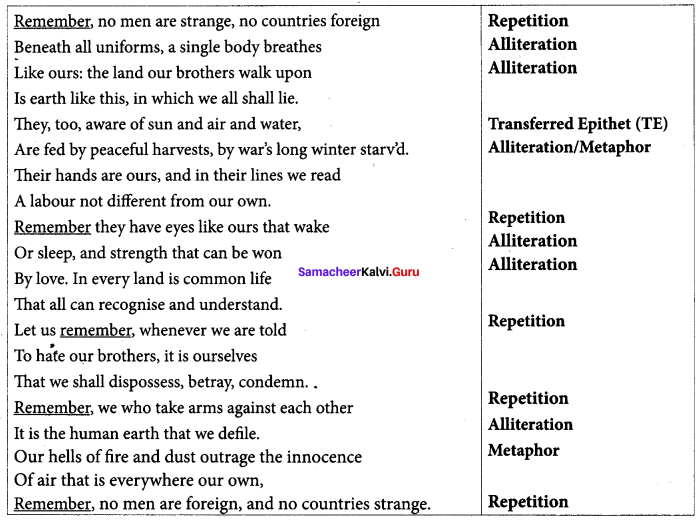
Literary Devices At A Glance (Figures of Speech)

Samacheer Kalvi 10th English Solutions Poem Chapter 6 No Men Are Foreign 1

No Men Are Foreign by James Falconer Kirkup about the poet:
James Falconer Kirkup was born on April 23, 1918, in South Shields, Durham, England to James Harold Joseph and Mary Virginia. He attended Westoe Secondary School before studying Modem Languages at Armstrong College where he co-produced the poetry magazines Dint and Fulcrum, which featured his earliest verse. James Kirkup, who died on Sunday 10 May, aged 91, at his Andorran home, was an internationally celebrated English poet, travel writer, memoirist, novelist, playwright and translator. Dining the Second World War, Kirkup secured conscientious objector status, working as a farm labourer and for the Forestry Commission.

No Men Are Foreign summary:

Samacheer Kalvi 10th English Solutions Poem Chapter 6 No Men Are Foreign 2

Introduction:
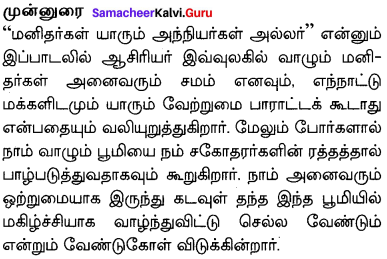
In the poem ‘No men are foreign’ the poet stresses the fact that all human beings are equal. He is requesting his countrymen to not treat people unequally. Moreover, the poet conveys that we are scarring the earth by shedding the blood of our brethren in wars. Therefore the poet is putting forth a request to people to live their lives in harmony on this beautiful earth that God has given us.
Samacheer Kalvi 10th English Solutions Poem Chapter 6 No Men Are Foreign 3

World fraternity:
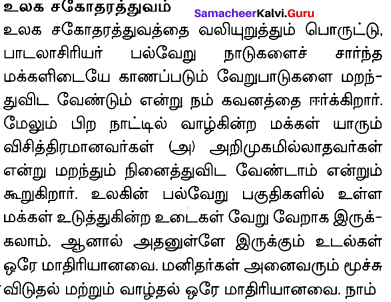
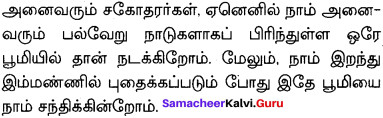
Emphasising the value of universal brotherhood, the poet draws our attention to the absence of any differences amongst the people of different countries. He asks us never to forget that people living in other countries are not strange or unfamiliar. The uniforms worn by people in different parts of the world may be different, but the bodies beneath them are the same. All human bodies live and breathe in a similar fashion. We are all brothers because we walk upon the same earth that we have divided into countries. Also, we shall all meet this same earth when we die and be buried in it.
Samacheer Kalvi 10th English Solutions Poem Chapter 6 No Men Are Foreign 4
Samacheer Kalvi 10th English Solutions Poem Chapter 6 No Men Are Foreign 5

All men are our friends:
All the people of the world are nourished and nurtured equally by the elements of Nature like sun, air and water. We are all human beings. We have a common soul. Everyone is united by the sameness of spirit. Therefore wars and the bloodshed that takes place in the name of caste, class, creed and country are futile and must be condemned. They too prosper during peace but have to suffer poverty, hunger and even dread starvation caused by long-drawn wars. They too toil to earn the livelihood and their destiny is similar to ours.

We should remember that our eyes that wake, sleep and love are similar to eyes all over the world. The poet asks us to remember that the so-called ‘strange’ and ‘foreign’ people experience sleep and wakefulness like us. It is a fact that wherever we may be, we can win powerful strength with love. Their experiences of life are similar to those of ours. Hence, we all find something familiar in each other’s life and realise a common identity with one another.
Samacheer Kalvi 10th English Solutions Poem Chapter 6 No Men Are Foreign 6

Hate others and hate yourself:
The poet says whenever we are asked by our leaders or rulers to hate and exploit the people of other countries, we must remember that this hatred would have a negative effect on us. We should keep in mind that if we hate others it means that we hate ourselves. We would find ourselves cheated as it would deprive us of the bliss of universal brotherhood. We would condemn ourselves to a life of enmity and strangeness.
Samacheer Kalvi 10th English Solutions Poem Chapter 6 No Men Are Foreign 7

Mother Earth’s mercy:
The poet again retells us in the end that people are contaminating this earth by their deeds. The fatal weapons emit fire and ashes that spread all over and pollute the environment. War is futile as it spoils the very earth for which we take up arms against each other. We should protect our atmosphere and keep in mind that this universe is the creation of God and we all are one. All will one day or the other die and return to earth only. This robs the air of its pureness and the world becomes a more difficult place to live in. The earth that one walks upon is the same for all people from diverse countries. People in every part of the world get the sunshine, air and water in equal methods. It is, therefore, imperative not to consider any human being as foreign and any country as strange. We must build common respect and trust.
Samacheer Kalvi 10th English Solutions Poem Chapter 6 No Men Are Foreign 8

Conclusion:
The poet tries to convey that one must shed the difference of opinion and be united and make this earth a haven. To treat anybody as a foreigner is an insult to the one who cultivates.
Samacheer Kalvi 10th English Solutions Poem Chapter 6 No Men Are Foreign 9

No Men Are Foreign Glossary:
Textual:
Samacheer Kalvi 10th English Solutions Poem Chapter 6 No Men Are Foreign 10

Samacheer Kalvi 10th English Book Solutions Poem

No Men Are Foreign Book Back Answers 10th Standard English Chapter 6 Samacheer Kalvi Read More »

A Day in 2889 of an American Journalist Book Back Answers 10th Standard English Chapter 5 Samacheer Kalvi

10th Standard English Unit 5 Supplementary A Day in 2889 of an American Journalist Book Back Answers

You can Download A Day in 2889 of an American Journalist Questions and Answers, Summary, Activity, Notes, Samacheer Kalvi 10th English Book Solutions Guide Pdf Supplementary Chapter 5 help you to revise complete Tamilnadu State Board New Syllabus and score more marks in your examinations.

Attempt all english grammar practice sections covered in the Samacheer Kalvi 10th English Grammar Book and excel in reading, writing, and speaking english with great fluency.

A Day in 2889 of an American Journalist 10th Standard English 5th Lesson Question and Answer

A Day in 2889 of an American Journalist Textual Questions

A. Answer the following questions in two or three lines.

Question 1.
Why did Francis Bennett wake up with a bad temper?
Answer:
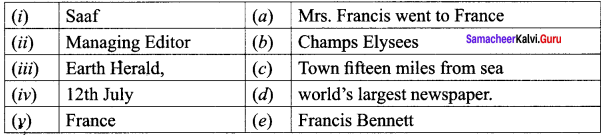
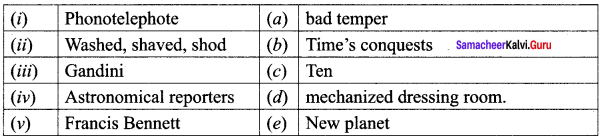
Francis Bennett’s wife had gone to France eight days ago. He was feeling lonely and bored. So he woke up with a bad temper.

Question 2.
What was a mechanized dressing room?
Answer:
The machine in the mechanised dressing room washes a person, shaves him, dresses him, and buttons him from top to toe on the threshold of his office.

Question 3.
How was food served to him?
Answer:
Food was served to him through a network of pneumatic tubes. It was an expensive system with better cooking.

Question 4.
Why was Bennett curious about astronomy?
Answer:
Bennett was curious about astronomy because one of the astronomers had just determined the
elements of the new planet ‘Gandini’. He was delighted to know about the accuracy of it.

Question 5.
Why did he visit Niagara?
Answer:
He visited Niagara to see his accumulator work. Thereafter using the force of cataracts to produce energy, he sold or hired it out to the customers.

Question 6.
How did Bennett travel?
Answer:
Bennett travelled by aero-car which shot across space at a speed of about four hundred miles ‘ an hour. Within half an hour, he reached his works at Niagara.

Question 7.
Give three instances of how mechanization has changed life at home in 2889?
Answer:
At home, through phonotelephote vision and speech are transmitted. In two minutes, without the help of an attendant, the machine gets a person to be ready for his office. Food is served through pneumatic tubes.

Question 8.
How is advertising in this age different from what we have today?
Answer:
The gigantic advertisement signs are reflected on the clouds, so large that they can be seen all over the country. From that gallery, a thousand projectors were unendingly employed in sending to the clouds, on which they were reproduced in colour, these exorbitant advertisements.

Additional Questions

Question 1.
What is the story Jules Verne talks about?
Answer:
Jules Verne talks about the people of the twenty-ninth century who live in fairyland.

Question 2.
Who is the central character and what is his role?
Answer:
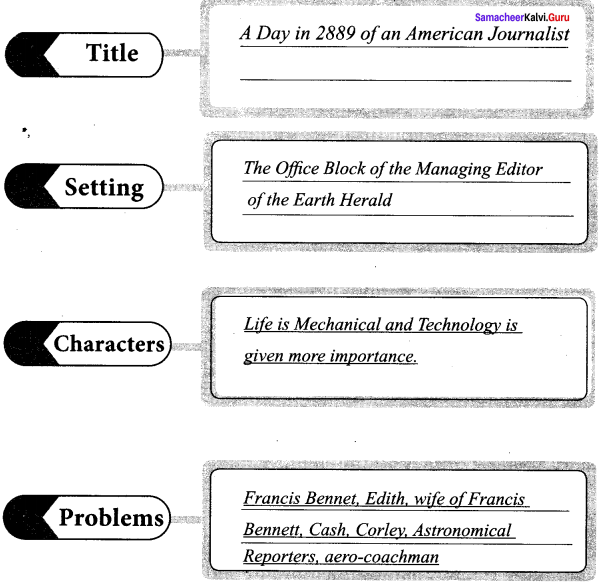
The central character is an American Journalist, Francis Bennett who is the Managing Editor of the Earth Herald, the world’s largest newspaper.

Question 3.
What does Jules Verne visualize?
Answer:
Jules Verne visualizes in 1889 the world in 2889, a thousand years later where the world is filled with technological advancements.

Question 4.
What changed the mood of Bennett?
Answer:
The device, Phonotelephote when switched on changed the mood of Bennett since he could speak and see his wife Edith.

Question 5.
What was the latest advancement in Technology which was a boon to Bennett when his wife was in France?
Answer:
The latest advancement was the transmission of vision along with speech. This was indeed a boon since Bennett missed seeing his wife Edith.

Question 6.
How many reporters did Bennett have and what was their job?
Answer:
Bennett had fifteen hundred reporters who passed on to subscribers the news which had come in during the night from the four quarters of the earth.

Question 7.
Were the subscribers able to hear only the news?
Answer:
No, the subscribers besides hearing the news reported directly over telephones also had the sight of these events through commutators.

Question 8.
Who did Francis Bennett question about the recent discoveries in the Stellar world?
Answer:
Cash, one of the ten astronomical reporters was questioned by Bennett about the recent discoveries in the stellar world.

Question 9.
Which news by Cash made Bennett curious about the stellar world?
Answer:
The news about Phototelegrams from Mercury, Venus and Mars stated by Cash made Bennett curious to know more about the stellar world.

Question 10.
What was determined by one of the Earth Herald’s astronomers?
Answer:
One of the Earth Herald’s astronomers had determined Gandini a new planet.

Question 11.
What was determined by one of the Earth Herald’s astronomers?
Answer:
One of Earth Herald’s astronomers had determined Gandini a new planet.

Question 12.
Describe the elements of the new planet, Gandini.
Answer:
The new planet, Gandini is at a distance of 12,841,348,284,623 metres and 7 decimetres. This planet orbits round the sun in 572 years, 194 days, 12 hours, 43 minutes and 9.8 seconds.

Question 13.
What did Bennett do when the clock struck twelve?
Answer:
When the clock struck twelve, Bennett, the director of the Earth Herald left the hall and sat down in a rolling armchair. In a few minutes he reached his dining room half a mile away, at the far end of the office where he had arranged to have lunch at the same time with Edith.

Question 14.
Why did Bennett abandon domestic cooking?
Answer:
Francis Bennett abandoned domestic cooking because he was served with thousand types of dishes through a network of pneumatic tubes by the Society for Supplying Food to the Home. Though it was expensive, cooking was better.

Question 15.
What was the work awaiting Bennett at the waiting room of the Earth Herald?
Answer:
Bennett had to choose among the different proposals the right choice he gave to his petitioners among his daily audience.

Question 16.
What was the second inventor hoping to do?
Answer:
A second inventor, using as a basis some old experiments that dated from the 19th century, had the idea of moving a whole city in a single block. He suggested, as a demonstration, the town of Saaf, situated fifteen miles from the sea into a seaside resort.

B. Identify the character/speaker.

Question 1.
As soon as he woke up, he switched on his phonotelephote.
Answer:
Francis Bennett

Question 2.
Well, Cash, what have you got?
Answer:
Francis Bennett

Question 3.
‘Phototelegrams from Mercury, Venus, and Mars, Sir.’
Answer:
Cash

Question 4.
‘Interesting! And Jupiter?’
Answer:
Francis Bennett

Question 5.
‘Not yet, Mr.Bennett.’
Answer:
Cash

Question 6.
‘No, it’s the inhabitants.’
Answer:
Corley

Question 7.
‘Where are we going, Sir?’
Answer:
Aero-coachman

Question 8.
‘Then, Sir, I shall really have discovered the absolute.’
Answer:
A young man/petitioner

Question 9.
‘Are you saying you’re going to be able to construct a human being?’
Answer:
Francis Bennett

Question 10.
‘I’m going to start this moment.’
Answer:
Edith

Additional:

Question 1.
Francis … dear Francis!…
Answer:
Edith

Question 2.
Well, Cash, what have you got?
Answer:
Bennett

Question 3.
Phototelegrams from Mercury, Venus and Mars, Sir.
Answer:
Cash

Question 4.
Interesting! And Jupiter?
Answer:
Bennett

Question 5.
Nothing so far!
Answer:
Cash

Question 6.
We cannot understand the signals the Jovian’s make.
Answer:
Cash

Question 7.
Perhaps ours haven’t reached them?
Answer:
Bennett

Question 8.
Aren’t you getting some result from the moon?
Answer:
Bennett

Question 9.
No it’s the inhabitants.
Answer:
Corley

Question 10.
On the face it turns towards us, at any rate.
Answer:
Corley

Question 11.
Who knows whether on the other side…’
Answer:
Corley

Question 12.
‘Well, there’s a very simple method of finding out.’
Answer:
Bennett

Question 13.
To turn the moon round!
Answer:
Bennett

Question 14.
Good! Hurry up and tell the reportage service about it.
Answer:
Bennett

Question 15.
I’m anxious for the news to appear in today’s issue!
Answer:
Bennett

Question 16.
‘I’m going to start this moment.
Answer:
Edith

Question 17.
‘By tube or aero-train?’
Answer:
Bennett

Question 18.
‘By tube’.
Answer:
Edith

Question 19.
‘Then you’ll be here? At eleven fifty-nine this evening.’
Answer:
Bennett

Question 20.
‘Paris time?’
Answer:
Edith

Question 21.
‘No, no! … Centropolis time’
Answer:
Bennett

Question 22.
‘Goodbye then, and above all don’t miss the tube!’
Answer:
Bennett

Question 23.
Then, Sir, I shall really have discovered the absolute’
Answer:
Bennett

Question 24.
When do you expect to get back to Centropolis?
Answer:
Francis Bennett

Question 25.
Well, Sir, I’m on the point of reducing the three to one.
Answer:
Bennett

Question 26.
He was lunching in solitude.
Answer:
Francis Bennett

Question 27.
Where are we going, Sir?
Answer:
Aero-coachman

Question 28.
Let’s see. I’ve got time…
Answer:
Francis Bennett

Question 29.
Take me to my accumulator works at Niagara.
Answer:
Francis Bennett

Question 30.
It travels at a speed of about 400 miles an hour.
Answer:
Aero Car

Question 31.
Within half an hour, he reached Niagara.
Answer:
Francis Bennett

Question 32.
Sir, elements were estimated at seventy five, it has now been reduced to three, as no doubt you are aware.
Answer:
The young man with broad brow

Question 33.
And the results of that discovery?
Answer:
The young man with broad brow

Question 34.
Are you saying you’re going to construct a human being?
Answer:
The young man with broad brow

Question 35.
He is one of the subscribers to the Society for Supplying Food to the Home.
Answer:
Francis Bennett

Question 36.
At twelve, he left the hail and sat down In a rolling armchair.
Answer:
The director of the Earth Herald, Mr. Bennett

Question 37.
The table was laid and he took his place at it.
Answer:
The director of the Earth Herald

Question 38.
Within reach of his hand was placed a series of taps.
Answer:
The director of the Earth Herald

Question 39.
They started working out some mechanical means of turning the satellite right round.
Answer:
The scientists of the Bennett factory

Question 40.
Well, this time, you can’t blame optical science!
Answer:
The director of the Earth Herald, Mr. Bennett

Question 41.
He woke in rather a bad temper.
Answer:
Bennett

Question 42.
Eight days ago, she had gone to Champs Elysees.
Answer:
Edith

C. Choose the best answer.

1. Bennette’s wife was in …………………
(i) Germany
(ii) Australia
(iii) France
(iv) Holland
Answer:
(iii) France

2. The data from the stellar world was gathered by …………………
(i) Bennette
(ii) astronomical
(iii) the computer
(iv) telephote
Answer:
(ii) astronomical reporters

3. The food was being delivered through ……………. tubes.
(i) pneumatic
(ii) shallow
(iii) hollow
(iv) virtual
Answer:
(i) pneumatic

4. The wayfarers were carried from one place to another by the.
(i) bullet train
(ii) jet
(iii) moving pavement
(iv) heli-taxi
Answer:
(iii) moving pavement

Additional:

1. A day in 2889 of an American Journalist is written by ……………….
(a) Asha Nehemiah
(b) Matsuo Basho
(c) Jules Verne
Answer:
(c) Jules Verne

2. The story, ‘A Day IN 2889’ speaks about the people of the …………………
(a) twenty-ninth century
(b) twentieth century
(c) twenty-fifth century
Answer:
(a) twenty-ninth century

3. The year is 2889 and the date is ………………….
(a) 12th November
(b) 25th July
(c) 5th October
Answer:
(b) 25th July

4. Bennett is the Managing Editor of the ………………………
(a) Earth Herald, the world’s largest newspaper
(b) Herald Earth, the world’s futuristic story
(c) The Universe
Answer:
(a) Earth Herald, the world’s largest newspaper

5. As soon as Bennett woke up, he switched on his …………………….. .
(a) phonotelephote
(b) telephone
(c) electricity
Answer:
(a) phonotelephote

6. The wires led to the house he owned in the ……………………….. .
(a) Champs – Burtey
(b) Champs – Falcon
(c) Champs-Elysees
Answer:
(c) Champs-Elysees

7. Bennett had …………………. reporters.
(a) 1500
(b) 15000
(c)500
Answer:
(a) 1500

8. In addition to his telephone, each reporter has a series of ………………….. .
(a) commutators
(b) telephones
(c) Jovians
Answer:
(a) commutators

9. Francis Bennett questioned one of the ……………… astronomical reporters.
(a) Fifty
(b) ten
(c) fifteen
Answer:
(b) ten

10. We haven’t been able to understand the signals the ……………… make.
(a) Astronomers
(b) Jovians
(c) Mercurians
Answer:
(b) Jovians

D. Fill in the story map given below.

Samacheer Kalvi 10th English Solutions Supplementary Chapter 5 A Day in 2889 of an American Journalist 1

Samacheer Kalvi 10th English Solutions Supplementary Chapter 5 A Day in 2889 of an American Journalist 2
Samacheer Kalvi 10th English Solutions Supplementary Chapter 5 A Day in 2889 of an American Journalist 3

Additional:

A. Rearrange the following sentences in coherent order.

1. a. In this world of technological advancements newspapers are not printed but ‘spoken’.
b. Francis Bennett is the Managing Editor of the Earth Herald.
c. This story speaks about the people of the twenty-ninth century.
d. Earth Herald is the world’s largest newspaper.
e. The year is 2889, the date 25th July and the place is the office block.
Answers:
c, e, b, d, a
c. This story speaks about the people of the twenty-ninth century.
e. The year is 2889, the date 25th July and the place is the office block.
b. Francis Bennett is the Managing Editor of the Earth Herald.
d. Earth Herald is the world’s largest newspaper.
a. In this world of technological advancements newspapers are not printed but ‘spoken’.

2. a. As soon as he awoke, Francis Bennett switched on his phonotelephote.
b. Eight days ago his wife had been to France and he was feeling a little lonely.
c. Francis Bennett was in a bad temper.
d. The reason was the absence of his wife with him.
e. The wires of his Phonotelephote led to the house he owned in the Champs-Elysees.
Answers:
c, d, b, a, e
c. Francis Bennett was in a bad temper.
d. The reason was the absence of his wife with him.
b. Eight days ago his wife had been to France and he was feeling a little lonely.
a. As soon as he awoke, Francis Bennett switched on his phonotelephote.
e. The wires of his Phonotelephote led to the house he owned in the Champs-Elysees.

B. Fill in the blanks with the appropriate phrases given below to form a complete meaningful paragraph.

1. (by the electric current /to the house /could also be transmitted/completed by the telephote / As soon as)

(i) ………………… Francis Bennett woke up, he switched on his phonotelephote. The wires led (ii) ……………… he owned in the Champs-Elysees.The telephone, (iii) ……………………., is another of our time’s conquests! Though the transmission of speech (iv) …………………….. was already very old, it was only since yesterday that vision (v) ………………. was possible.
Answers:
(i) As soon as
(ii) to the house
(iii) completed by the telephote
(iv) by the electric current
(v) in the stellar world

2. (a series of taps /of his home in Paris / took his place/in spite of the distance/at the same time)

The table was laid and he (i) …………………. at it. Within reach of his hand was placed (ii) …………….. and before him was the curved surface of a phonotelephote, on which appeared the dining room (iii) …………….. Mr. and Mrs. Bennett had arranged to have lunch (iv) ……………….. nothing could be more pleasant than to be face to face (v) ……………….. to see one another and talk by means of the phonotelephotic apparatus.
Answers:
(i) took his place
(ii) a series of taps
(iii) of his home in Paris
(iv) at the same time
(v) in spite of the distance

C. Match the following appropriately:

1. Samacheer Kalvi 10th English Solutions Supplementary Chapter 5 A Day in 2889 of an American Journalist 4
Answers:
(i)(c), (ii)(e), (iii)(d), (iv)(a), (v)(b)

2. Samacheer Kalvi 10th English Solutions Supplementary Chapter 5 A Day in 2889 of an American Journalist 5
Answers:
(i)(b), (ii)(d), (iii)(e), (iv)(c), (v)(a)

D. Read the passage given below and answer the questions that follow:

1. That morning Francis Bennett awoke in rather a bad temper. This was eight days since his wife had been in France and he was feeling a little lonely. As soon as he awoke, Francis Bennett switched on his phonotelephote whose wires led to the house he owned in the Champs-Elysees. The telephone, completed by the telephote, is another of our time’s conquests! Though the transmission of speech by the electric current was already very old, it was only since yesterday that vision could also be transmitted.

A valuable discovery, and Francis Bennett was by no means the only one to bless its inventor when, in spite of the enormous distance between them, he saw his wife appear in the telephotic mirror. ‘Francis … dear FtancisL.’His name, spoken by that sweet voice, gave a happier turn to Francis Bennett’s mood. He quickly jumped out of bed and went into his mechanized dressing room.

(а) Why was Francis Bennett in a bad temper?
Answer:
Francis Bennett was feeling lonely as his wife had been to France eight days ago and so he was in a bad temper.

(b) What did he do as soon as he woke up?
Answer:
As soon as Francis woke up, he switched on the phonotelephote whose wires connected to his house in Champs Elysees where his wife was staying.

(c) What was the valuable discovery made just a day before 25th July?
Answer:
The valuable discovery was the telephotic mirror where Francis could see his wife appear on screen apart from hearing his voice.

(d) What changed the mood of Francis Bennett?
Answer:
When Francis heard his wife’s sweet voice say, ‘Francis…Francis’, his mood changed into a happy feel.

(e) What is considered a Time’s conquest?
Answer:
Telephone completed by telephote, resulting in phonotelephote is a Time’s conquest.

2. His name, spoken by that sweet voice, gave a happier turn to Francis Bennett’s mood. He quickly jumped out of bed and went into his mechanized dressing room.
Two minutes later, without needing the help of a valet, the machine deposited him, washed, shaved, shod, dressed and buttoned from top to toe, on the threshold of his office. The day’s work was going to begin. Francis Bennett went on into the reporters’ room.

His fifteen hundred reporters, placed before an equal number of telephones, were passing on to subscribers the news which had come in during the night from the four quarters of the earth. In addition to his telephone, each reporter has in front of him a series of commutators, which allow him to get into communication with this or that telephotic line. Thus the subscribers have not only the story but the sight of these events.

(a) What did Francis Bennett do when he became happy hearing wife’s sweet voice?
Answer:
As soon as Francis Bennett heard his wife’s voice he quickly jumped out of bed and went into his mechanized dressing room.

(b) What happened two minutes later?
Answer:
Two minutes later, without needing the help of a valet, the machine deposited Francis, washed, shaved, shod, dressed and buttoned him from top to toe, on the threshold of his office.

(c) How many reporters were there in the reporters’ room?
Answer:
There were about fifteen hundred reporters in the reporters’ room.

(d) What were the reporters doing when Francis entered the reporters’ room?
Answer:
The reporters were placed before an equal number of telephones and were passing on to subscribers the news which had come in during the night from the four quarters of the earth.

(e) What was the additional benefit that the subscribers were enjoying in recent times?
Answer:
In addition to a telephone, each reporter had in front of him a series of commutators, which allow him to get into communication with any onetelephotic line. Thus the subscribers had not only the story but the sight of all the events.

A Day in 2889 of an American Journalist by Jules Verne About the Author:

Jules Verne was bom in the city of Nantes, France on February 8th, 1828. His father was a lawyer, and at the beginning, Veme wanted to study law as well. When he was nineteen, – he started writing long pieces of literature, but his father wanted him to earn money as a lawyer, not as a writer. He decided to give up being a lawyer, and become a full-time professional writer instead. Veme married Aimee du Fraysse de Viane in January 1857 with his father’s blessing and continued to write until his death. On 24th of March 1905, Veme, who was sick with diabetes, died at his home in Amiens, France.

A Day in 2889 of an American Journalist Summary:

Samacheer Kalvi 10th English Solutions Supplementary Chapter 5 A Day in 2889 of an American Journalist 6

Introduction:
The author explains the life on earth after thousand years and that the daily activities of a normal human will be assisted by machines. For example the author envisions that travelling will be made easy. In this story the office block of the Earth Herald, the world’s largest newspaper, is illustrated during the year 2889.
Samacheer Kalvi 10th English Solutions Supplementary Chapter 5 A Day in 2889 of an American Journalist 7

Francis Bennett and his office One early morning, Francis Bennett woke up bad tempered because his wife Edith had gone to Champs Elysees eight days ago. He switched on his phonotelephote whose wires led to the house he owned in the Champs-Elysees. The telephone, completed by the telephote, was another of their time’s conquests! From yesterday,vision could also be transmitted along with speech. Bennett blessed its inventor as he saw his wife appear in the telephotic mirror. Her voice and face changed his mood.
Samacheer Kalvi 10th English Solutions Supplementary Chapter 5 A Day in 2889 of an American Journalist 8

He went into his mechanized dressing room within two minutes, washed, shaved, shod, dressed and buttoned from top to toe, on the threshold of his office. The day’s work started at the reporters’ room. His fifteen hundred reporters, with their telephones, were speaking the news received from the four quarters of the earth to subscribers. Besides telephone, all reporters have commutators, which allow communication on telephotic line with visual sights.

Bennett questioned one of the ten astronomical reporters Cash about the recent discoveries in the stellar world. Cash replied that it was Phototelegrams from Mercury, Venus and Mars, and nothing from Jupiter since the Jovians signal could not be understood. He added that even results from the Moon wasn’t possible and one can’t blame optical science though moon was six hundred times nearer than Mars. Corley another reporter said it was the inhabitants which was refuted by Bennett who said the simplest way was to turn the moon round and find out.
Samacheer Kalvi 10th English Solutions Supplementary Chapter 5 A Day in 2889 of an American Journalist 9

Bennett’s scientific lab
From then on, the scientists of the Bennett factory started working on turning satellite. One of the Earth Herald’s astronomers had just determined the elements of the new planet Gandini and Bennett was delighted at his accuracy. He wanted the reporters to pass on the news to the subscribers immediately. The broad gallery for such a journal as the Earth Herald brought in an average of three million dollars daily.
Samacheer Kalvi 10th English Solutions Supplementary Chapter 5 A Day in 2889 of an American Journalist 10

Luxury life of Bennett
When the clock struck twelve, the director of the Earth Herald sat in a rolling armchair and reached his dining room half a mile away. The table was laid before him and in front of him was the phonotelephote. The couple had arranged to have lunch at the same time, see and talk by phonotelephote. Francis Bennett was one of the subscribers to the expensive, Society for Supplying Food to the Home with thousand varieties through pneumatic tubes. He was finishing his coffee in solitude when Mrs. Bennett appeared in the telephote screen after work.

He then sped past to his accumulator works at Niagara by the aero-car at a speed of about four hundred miles an hour. Below him were the towns with moving pavements which carry the wayfarers along the streets. He returned, by way of Philadelphia, Boston and New York, to Centropolis, where his aero-car put him down about five o’clock. The waiting- room of the Earth Herald was crowded awaiting Bennett to return.
Samacheer Kalvi 10th English Solutions Supplementary Chapter 5 A Day in 2889 of an American Journalist 11

New Researches of Bennet
He chose carefully among the different proposals. The best was a young man whose broad brow indicated intelligence. He told Bennett about the elements estimated at seventy five now reduced to three to which Bennett told him that it would reduce to one in three weeks if he had money. He knew for sure that he would have discovered absolute, and the resultant, a human-being without a soul was confirmed by Bennett. The young fellow was assigned to the scientific editorial department of Bennett’s journal.
Samacheer Kalvi 10th English Solutions Supplementary Chapter 5 A Day in 2889 of an American Journalist 12

A second inventor, had the idea of moving a whole city in a single block. As a demonstration, the town of Saaf, situated fifteen miles from the sea would be transformed into a seaside resort. Francis Bennett, attracted by this project, agreed to take a half-share in it. Francis Bennett sat in an easy-chair in the audition-room to hear the proposal. Pressing a button, he communicated with the Central Concert. Re was charmed on a series of delicious harmonico-algebraic formulae.
Samacheer Kalvi 10th English Solutions Supplementary Chapter 5 A Day in 2889 of an American Journalist 13

Time for family
During his meal, phonotelephotic communication was tuned to speak to Edith. Edith told him that she was leaving to Centropolis the very moment by tube. He confirmed her arrival at Centropolis at 11:59 p.m. according to Centropolis time. These submarine tubes, travels from Paris in two hundred and ninety-five minutes than the aero-trains travelling at six hundred miles an hour. Francis Bennett, felt tired and went for a bath before going to bed. He touched the button and got ready for bath.
Samacheer Kalvi 10th English Solutions Supplementary Chapter 5 A Day in 2889 of an American Journalist 14

Conclusion:
This story brings out the fact that as long as humans aspire and work hard, there will be developments and innovations in this world. Smoke-free vehicles and machines that would instantly do what you desire will come forth. Therefore humans will achieve maximum heights in the field of Science and Technology.
Samacheer Kalvi 10th English Solutions Supplementary Chapter 5 A Day in 2889 of an American Journalist 15

A Day in 2889 of an American Journalist Glossary:

Textual:
Samacheer Kalvi 10th English Solutions Supplementary Chapter 5 A Day in 2889 of an American Journalist 16

Additional:
Samacheer Kalvi 10th English Solutions Supplementary Chapter 5 A Day in 2889 of an American Journalist 17

Samacheer Kalvi 10th English Book Solutions Supplementary

A Day in 2889 of an American Journalist Book Back Answers 10th Standard English Chapter 5 Samacheer Kalvi Read More »

His First Flight Book Back Answers 10th Standard English Chapter 1 Samacheer Kalvi

10th Standard English Unit 1 Prose His First Flight Book Back Answers

You can Download His First Flight Questions and Answers, Summary, Activity, Notes, Samacheer Kalvi 10th English Book Solutions Guide Pdf Prose Chapter 1 helps you to revise the complete Tamilnadu State Board New Syllabus and score more marks in your examinations.

Attempt all english grammar practice sections covered in the Samacheer Kalvi 10th English Grammar Book and excel in reading, writing, and speaking english with great fluency.

His First Flight 10th Standard English 1st Lesson Question and Answer

His first flight Warm up:

1. Marco Polo. Christopher Columbus, Ibis Battuta, Amerigo Vespucci, Xuanzang. Ferdinand Magellan. Bartolomeu Dias, Herodotus. Captain James Cook. Vasco DeGama What is common among these individuals? Browse Internet or refer books and share some information about them.
Answer:
Marco Polo was an Italian merchant, explorer, and writer, bom in the Republic of Venice. Christopher Columbus was an Italian explorer, navigator and colonist, who completed four voyages across the Atlantic Ocean under the auspices of the Catholic Monarchs of Spain. Ibn Battuta was a Muslim Moroccan scholar and explorer, who widely travelled the medieval world.

Amerigo Vespucci was a Florentine merchant and navigator, who made at least two transatlantic trips to the New World, voyages that inspired cartographer Martin Wardseemiiller to label the new continent “America” in 1507. Xuanzang was a Chinese Buddhist monk, scholar, traveller and translator, who travelled to India in the seventh century and described the interaction between Chinese Buddhism and Indian Buddhism during the early Tang Dynasty.

Portuguese explorer Ferdinand Magellan set out from Spain in 1519 to discover a western sea route to the Spice Islands. En route he discovered what is now known as the Strait of Magellan and became the first European to cross the Pacific Ocean. Bartolomeu Dias was a Portugese navigator whose 1487-88 Atlantic voyage around the southern tip of Africa opened sea routes between Europe and Asia.

Herodotus is the ancient writer and reporter called “The Father of History.” He was a colorful writer and commentator; his most famous work, The Histories, remains a widely-read account of ancient facts and legends of the Persian invasion of ancient Greece.

Captain James Cook was an English naval explorer whose expeditions in the 1770s charted much of the lands of the Pacific, including New Zealand, Australia and Hawaii. Naval commander Vasco da Gama’s 1497 expedition from Lisbon opened a route to India and led to Portugese dominance of the Eastern spice trade.

2. Discuss, why it was considered as an adventurous and dangerous thing to travel in those days?
Answer:
Those days it was considered as an adventurous and dangerous thing to travel because there wasn’t any means of instantaneous communication while travelling

3. Mahatma Gandhi. Che Guevera. Guru Nanak and Gauthama Buddha are some of the famous personalities and thinkers who made extensive journeYs to understand life. Do you think journeys can be life changing?
Answer:
Yes, Journeys can be life changing since you gain a lot of experience while travelling and meeting different people who follow different traditions, religious practices, food habits and culture.

4. Share a memorable trip from your life.
Answer:
One of my memorable trip is to Matheran near Navi Mumbai. It is a pollution-free hillstation and you travel up the mountain top either by walk or on horses and ponies. No vehicles are allowed and even your daily needs are brought by wheelbarrows. It is this part that really pains your heart to see men pulling and pushing wheelbarrows. It is a rare sight to see the sunset and the sunrise at different points. The mountain train is also a treat to our eyes apart from the scenic beauty we experience every moment.

5. Have you ever been on an adventurous journey? 1f yes. Share your experience
Answer:
My adventurous journey is to Darjeeling when the sun plays truant most of the time and you are at the mercy of nature. Many a times, the tour plan turned topsy-turvy and we had to pitch tent in the thick forest and pray to stay safe.

6. That’s one small step for a man, one giant leap for mankind Neil Armstrong – Discuss
Answer:
Armstrong personally meant that for being just one man, all that was required was “one small step” from the lowest stair of his spaceship’s ladder, and suddenly he was standing on the Moon. But for humanity as a whole, Armstrong served as a representative: when he stepped onto the Moon, at the same time it was humanity touching the Moon. It was a total advancement for human technology, ambition, and wonder.

7. Have you ever seen a bird making it’s first ever attempt to fly?
Answer:
No, I have not seen it but I surely can imagine the number of failed attempts before it succeeds.

His First Flight InText Questions

Question (a).
Why did the seagull fail to fly?
Answer:
The seagull was afraid to fly. So he failed to fly.

Question (b).
What did the parents do, when the young seagull failed to fly?
Answer:
The young sea gull’s parents regularly taunted him for his cowardice and threatened to leave him alone starving at the ledge unless he flew away.

Question (c).
What was the first catch of the young seagull’s older brother?
Answer:
The seagull’s older brother first caught the herring.

Question (d).
What did the young seagull manage to find in his search for food on the ledge?
Answer:
The young seagull managed to find a dried piece of mackerel’s tail at the far end of his ledge.

Question (e).
What did the young bird do to seek the attention of his parents?
Answer:
The young bird pretended to fall asleep. Later, it uttered a low cackle to seek his parent’s attention.

Question (f).
What made the young seagull go mad?
Answer:
The young sea gull’s mother tore at a piece of fish that lay at her feet, and then scraped each side of her beak on the rock. The sight of the food on the mother’s beak maddened the young seagull.

Question (g).
Why did the young bird utter a joyful scream?
Answer:
The seagull’s mother had a piece of fish. She was coming near to him. So, he uttered a joyful scream.

Question (h).
Did the mother bird offer any food to the young bird?
Answer:
Yes, the mother bird offered a piece of fish to the young bird.

Question (i).
How did the bird feel when it started flying for the first time?
Answer:
The young bird was no longer afraid. With a joyous scream, he flapped his wings. He started to dive and soar.

Question (j).
What did the young bird’s family do when he started flying?
Answer:
The family saw the young seagull making his first flight and floating on the ocean. They flew and landed on the water just ahead of him. They were beckoning to him with a shrill voice. They were praising and rewarding him by offering scraps of fish to him.

His First Flight Textual Questions

A. Answer the following questions in a sentence or two.

Question 1.
How was the young seagull’s first attempt to fly?
Answer:
The young seagull attempted to flap his wings and became afraid.

Question 2.
How did the parents support and encourage the young seagull’s brothers and sister?
Answer:
The young seagull’s parents flew about with his brothers and sister perfecting them in the art of flight. They taught them how to skim the waves and how to dive for fish. When his older brother caught his first herring and devoured it, his parents circled around raising a proud cackle.

Question 3.
Give an instance that shows the pathetic condition of the young bird.
Answer:
The bird was afraid to fly with his brothers and sisters. He was alone. He had no food. He even chewed the dried pieces of eggshell.

Question 4.
How did the bird try to reach its parents without having to fly?
Answer:
The young bird trotted back and forth from one end of the ledge to the other with his long grey legs stepping daintily, trying to find some means of reaching his parents without having to fly.

Question 5.
Do you think that the young seagull’s parents were harsh to him? Why?
Answer:
No, the seagull’s parents were not harsh. They wanted the young seagull to learn the skill of flying.

Question 6.
What prompted the young seagull to fly finally?
Answer:
The young seagull was extremely hungry and felt the heat because of starvation. His mother was standing on a little high hump on the plateau on the other side and tore at a piece of fish that lay at her feet, and then scraped each side of her beak on the rock and even flew across to him with it. He leaned out eagerly, tapping the rock with his feet, trying to get nearer to her as she flew across. The mother was very near to him with the fish in her beak. Maddened by hunger, he dived at the fish and managed to fly up and down into space with a loud scream.

Question 7.
What happened to the young seagull when it landed on the green sea?
Answer:
The young seagull’s feet sank into the green sea and it was floating on it.

Additional Questions

Question 1.
Why was the young seagull afraid to fly?
Answer:
The young seagull hesitated and feared to fly. He thought that his wings would not support him.

Question 2.
Do you think all young birds are afraid to make their first flight or are some birds timider than others? Do you think a human baby also finds it a challenge to take its first steps?
Answer:
Yes, all young birds are afraid to make their first flight. It is quite possible that some of them may be more timid than the others. A human baby also finds it a challenge to take the first step. Only after trials and errors of many months, the baby learns to take its first step.

Question 3.
“The sight of the food maddened him…” What does this suggest? What compelled the young seagull to finally fly?
Answer:
The seagull was quite hungry and yearned for food. When he saw a piece of fish in the beak of his mother, the sight was quite tempting for him. He was maddened at the sight of the food and suddenly dived at the fish forgetting that he didn’t know how to fly. It compelled the young seagull to finally fly into space.

Question 4.
“They were beckoning to him, calling shrilly.” Why did the seagull’s father and mother threaten him and cajole him to fly?
Answer:
His parents, two brothers and his sister regularly taunted him for his cowardice. The seagull’s father and mother threatened that they would leave him alone starving at the ledge unless he flew away. In this way, they tried to cajole him to fly.

Question 5.
Have you ever had a similar experience, where your parents encouraged you to do something that you were too scared to try? Discuss this in pairs or groups.
Answer:
Everyone has such experience at some time. I too had such an experience when my parents encouraged me when I was learning cycling. I hesitated and feared. I thought that I would not be able to hold and balance it properly. One day, my father made me sit on the bicycle and gave a push from behind. I cried but soon handled it properly and completed a circle without falling down. I learnt how to ride a bicycle on that very day.

Question 6.
In the case of a bird flying, it seems a natural act, and a foregone conclusion that it should succeed. In the examples you have given as answer to the previous question, was your success guaranteed or was it important for you to try, regardless of a possibility of failure?
Answer:
In the case of a bird flying, it seems a natural act. Actually, it is not so. Every young bird has to learn how to fly. After constant efforts, he becomes perfect in flying. Even in my case, success was not a foregone conclusion. Constant encouragement by my parents and my own practice made me a perfect cyclist.

Question 7.
Where did the young seagull sit alone? What did he watch from there?
Answer:
The young seagull was alone on his ledge. In the whole family, he was the only one who didn’t know how to fly. Only the day before, his two brothers and his sister had flown away with their parents. When he tried to flap his wings, he was seized with fear. Hence, he sat alone on the ledge watching his family flying over the sea.

Question 8.
Why didn’t the young seagull take the plunge? What stopped him from doing so?
Answer:
The young seagull was the only one in the family who couldn’t fly in the air. His brothers and sister had far shorter wings than his wings but they had already learnt the art of flying. He felt certain that his wings would never support him. So he was hesitant and afraid of flapping his wings and go deep in the air.

Question 9.
Did upbraiding and threatening of his parents help him in flying?
Answer:
The parents of the young seagull did try to teach his young one the art of flying. He wouldn’t simply move from his ledge. They would fly around him encouraging and challenging him to follow them. When he wouldn’t budge, his parents would fly around calling to him shrilly. They would upbraid and threaten to let him starve unless he flew away.

Question 10.
How were his two brothers and sister different from the young seagull?
Answer:
His two brothers and. his sister had far shorter wings than he had. But still they had flown away only the day before. He would watch his parents perfecting them in the art of flying. They were taught how to skim the waves and dive for the fish. The young seagull had seen his older brother catch his first herring and devour it.

Question 11.
How did the hungry seagull try to pretend to attract his mother’s attraction?
Answer:
The whole family had flown away. Only the young seagull sat alone on the ledge. He had not eaten anything since the previous nightfall. He stepped slowly out to the brink of the ledge. He stood on one leg. He closed his eyes pretending to be falling asleep. But all his tactics failed. Only his mother took notice of him. All others ignored him.

Question 12.
What was the mother doing standing on a little high hump on the plateau?
Answer:
All others ignored the hungry young seagull. Only his mother was looking at him. She was standing on a little high hump. Now and again, she tore a piece of fish. The fish lay at her feet. Then she scrapped each side of her beak on the rock. She loved to tear the food that way.

Question 13.
Why did the young seagull cry “Ga, ga, ga”? Did her mother oblige him?
Answer:
When he saw his mother holding a piece of a fish in her beak, the young seagull became almost mad with hunger. He cried “Ga, ga, ga”. He begged her mother to bring him some food. When he saw his mother flying across to him with a piece of fish, he uttered a joyful scream. He started tapping the rock with his feet impatiently. He was almost within the reach of the fish but failed to get at it.

Question 14.
What did the young seagull do when he was maddened by hunger? Did hunger motivate him to dive at the fish in the air?
Answer:
The young seagull saw his mother flying around him with a piece of fish in her beak. Maddened by hunger, he dived at the fish. With a loud scream, he fell outwards and downwards into space. Then he was seized with fear and his heart stood still. But the fear lasted only for a minute. The very next moment he felt his wings spread outwards. Truly, hunger motivated him to dive at the fish and flap his wings into the space.

Question 15.
How did the young seagull overcome his fear and soared gradually towards the sea during his first flight?
Answer:
The young seagull had taken the final plunge. Maddened by hunger, he dived at the fish which his mother was carrying in her beak. With a loud scream he fell outwards and downwards. He was seized with fear and his heart stood still. But the fear lasted only for a minute. He overcame it. The next moment he felt his wings spread outwards. Now he was soaring downwards over the blue sea.

Question 16.
Describe the seagull’s first flight.
Answer:
The young seagull was very hungry. So he dived at the fish that was in his mother’s beak. But he fell into space and became terribly afraid. His heart stood still. He could hear nothing. But it only lasted for a minute. The next moment he felt his wings spread outwards. He began to fly and was no longer afraid.

Question 17.
How did his parents, two brothers and sister celebrate the first flight of the young seagull?
Answer:
The family saw the young seagull making his first flight. When they saw him floating on the ocean, they flew and landed on the water just ahead of him. They were beckoning to him calling shrilly. They were praising and rewarding him by offering scraps of fish to him.

Question 18.
What is the message that Liam O’ Flaherty wants to give to the readers through the lesson, ‘His first Flight’?
Answer:
Success can’t be taken for granted. One has to struggle to see success. The story of the young seagull is the story of overcoming hesitations, doubts and fears that stand between us and our success. Hunger makes him take the final plunge. This leads him to make his first flight and soar into the space.

B. Answer each of the following questions in a paragraph of about 100 – 150 words.

Question 1.
Describe the struggles underwent by the young seagull to overcome its fear of flying.
Answer:
The Young Seagull was afraid to fly and was alone on his ledge. He was more frightened than his siblings. His attempts failed. He had taken a little run forward and tried to flap his wings. But that was all he could do. He felt that his wings would not support him. He failed to muster up the courage and fly. His parents taunted, scolded and threatened him to leave him starving at the ledge unless he flew away.

But nothing could make him fly. The seagull helplessly watched his parents flying with his brothers and sisters. The whole family went on taunting him for his cowardice. Only his mother was looking at him. She had picked a piece of fish and was flying across to him with it. He leaned out eagerly. The mother was very near to him with the fish in her beak. Maddened by hunger, he dived at the fish. With a loud scream, he fell outwards and downwards into space. A terror seized him.

His heart stood still. His mother swooped past him. He answered her with another scream. He saw his two brothers and sister flying around him. The seagull completely forgot that he was not able to fly. He let himself free to dive, soar and curve at will. He was shrieking shrilly. He saw a green sea beneath him.

He was tired and weak with hunger. His feet sank into the green sea and his belly touched it. He sank no farther. Now, his family was praising him and their beaks were offering him scraps of fish. He had made his first flight.
“Flying is learning how to throw yourself to the ground and miss.”

Question 2.
Your parents sometimes behave like the young bird’s parents. They may seem cruel and unrelenting. Does it mean that they do not care for you? Explain your views about it with reference from the story.
Answer:
There is no doubt that sometimes parents do behave the same way like the young bird’s parents. ‘However all parental acts are for the betterment of the children though they may seem cruel and unrelenting. It doesn’t mean they do not care for us. It is the ardent wish of every parent that they may teach all skills to their young ones so that they may succeed in life. If the young ones don’t act then they also indulge in scolding, taunting and humiliating them to shed off their hesitations and fears.

This is exactly what the parents of the young seagull did when he failed to fly. They were successful in teaching the art of flying to his two brothers and sister. They also tried their best to embolden him to take the plunge. Particularly, the mother-seagull went on flying around him with a piece of fish in her beak. It was her attempt to tempt her starving son to dive at the fish and succeeded in her aim.
“At the end of the day, the most overwhelming key to a child’s success is the positive involvement of parents.”

Additional Questions

Question 1.
Yes the young seagull same at the beginning and at the end of the lesson? Compare and contrast the two kinds of the same seagull in the lesson.
Answer:
No, the young seagull was not the same bird at the beginning and at the end of the lesson. In the beginning, the young seagull used to be all alone on his ledge. His two brothers and his sister had flown away the day before. He had been afraid of flying with them. Whenever he tried to flap his wings, he was seized with fear. He felt certain that his wings would never support him. His father and mother flew around calling to him shrilly. They were constantly scolding and taunting him.

They were threatening to let him starve on his ledge unless he flew away. However, the young seagull was more confident and sure of his success in the end. Maddened by hunger, he dived at the fish. After trials and errors, his wings spread outwards. He was soaring gradually downwards forgetting all his hesitations and fears. He could float on the ocean now. His success was welcomed by his family. They were praising him now and their beaks were offering him their scraps of dog-fish.
“Positivity, confidence and persistence are key in life – so never give up in life.”

Question 2.
‘All parental acts are for the betterment of the children.’ It is true. However, one has to make efforts through trials and errors shedding off one’s early hesitations and fears to succeed in any enterprise. Justify this statement by taking points from the lesson, ‘His First Flight’.
Answer:
There is no doubt about it. All parental acts are for the betterment of the children. It is the ardent wish of every parent that they may teach all skills to their young ones so that they may succeed in life. First of all, they can learn all things which their parents have taught in life. If the young ones don’t act then they also indulge in scolding, taunting and humiliating them to shed off their hesitations and fears. This is exactly what the parents of the young seagull did.

They were successful in teaching the art of flying to his two brothers and sister. They also tried their best to embolden him to take the plunge. Particularly, the mother- seagull went on flying around him with a piece of fish in her beak. It was her attempt – to tempt her starving son to dive at the fish. And she succeeded in her aim. The young seagull did dive at the fish and it led to his success in the end.
“Parenting is not about meeting the needs of the offspring – but preparing them to stand on their own legs”

Question 3.
‘Maddened by hunger, he dived at the fish,’ says the narrator about the young seagull. Do you feel hunger was the main motivating force that made the young seagull take the plunge that taught him how to fly in the air?
Answer:
Food is the most essential ingredient that sustains all life – of humans, animals as well as birds. Hunger motivates many of their actions. The young seagull used to sit all alone on his ledge. Whenever he tried to flap his wings to fly, he was seized with fear. He felt certain that his wings would never support him. He had seen his older brother catch his first herring and devour it. It compounded his helplessness even more. He uttered a joyful scream when he saw his mother holding a piece of fish in her beak and flying quite near him.

He wondered why she didn’t come to him and offer that piece of fish to him. Maddened by hunger, he dived at the fish. With a loud scream he fell outwards and downwards into space. Then a monstrous terror seized him but only for a minute. The next moment he felt his wings spread outwards. He began to soar downwards towards the sea. The fear left him. He began to float on the sea. admiring family offered him pieces of fish flying around him.
“ Your hunger must be absolutely compelling in order to overcome the obstacles that will invariably come your way.”

Question 4.
Describe the humiliation and taunting that the young seagull faced from his family when he used to sit alone on his ledge without mustering his courage to fly in the air.
Answer:
The young seagull used to sit on ledge all alone. He used to see his two brothers and sister flying around him. They had learnt flying only the day before. Not that he didn’t try before. He had come to the edge of the ledge and tried to flap his wings. But he became afraid soon. He felt certain that his wings would never support him. So he bent his head and ran away to the little hole under the ledge. His brothers and sister had far shorter wings than his own. But they succeeded flapping their wings and flew away.

He failed to muster his courage to take the plunge. His father and mother flew around him scolding and taunting him. They also threatened to let him starve on his ledge unless he flew away. The thing that compounded his agony was that his elder brother had caught his first herring and devoured it. His parents circled around his brother raising a proud cackle. On the other hand, the family had walked down the opposite cliff taunting him with his cowardice.
“There is no humiliation more abusive than hunger.”

Question 5.
Hesitations and fears play necessary parts in human life but we get success in any enterprise only when we overcome our doubts, hesitations and fears. Justify this statement in the light of the young seagull’s efforts to muster courage to fly in the air.
Answer:
Nothing in life can be taken for granted. Skills have to be learnt in life with our own efforts. Parents can only help in teaching and encouraging us to learn things. But we have to learn them through our own efforts of trials and errors. Who doesn’t suffer from hesitations and fears in the beginning? It takes time to take the final plunge. So it happened with the young seagull. In spite of constant encouragements and motivations, he couldn’t muster the courage to fly.

He was certain that his wings would not support him. He faced regular taunting and humiliations of his family. They even threatened to let him starve at the ledge unless he flew away. But they say that necessity is the mother of invention. Maddened by hunger, he dived at the fish which his mother was carrying in her beak. He felt his wings spreading outwards. Finally, he soared to come down over the sea. When he floated on the sea, his family celebrated his success by offering pieces of fish to him.
“Life is a balance of fear and overcoming it.”

Vocabulary:

C. Change the parts of speech of the given words in the chart.
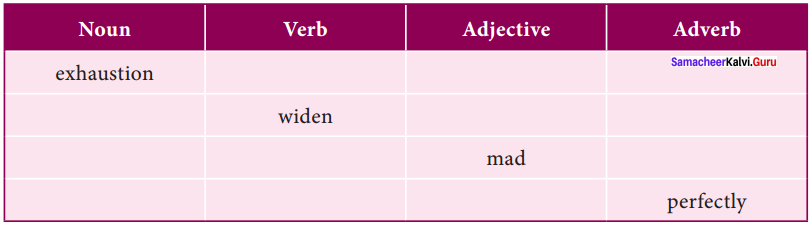
Samacheer Kalvi 10th English Solutions Prose Chapter 1 His First Flight 1
Answer:
Samacheer Kalvi 10th English Solutions Prose Chapter 1 His First Flight 2

D. Read the following sentences and change the form of the underlined words as directed.

1. His family was screaming and offering him food, (to adjective)
The screaming family offered him food.

2. ‘The young seagull gave out a loud call, (to adverb)
The young sea gull called out loudly.

3. The bird cackled amusedly while flying, (to noun)
The bird cackled with amusement while flying.

4. The depth of the sea from the ledge scared the seagull, (to adjective)
The deep sea scared the seagull on the ledge.

5. The successful flight of the bird was a proud moment for the seagull’s family, (to verb)
It was a proud moment for the seagull’s family when the bird flew successfully.

E. Use the following words to construct meaningful sentences on your own.

  1. coward – I hate to be a coward for I have always been a bold person.
  2. gradual – There is a gradual increase in the water level at Mettur dam.
  3. praise – Sylvia is worthy of all the praise and honour.
  4. courageous – I hope to be courageous at all circumstances.
  5. starvation – People in Somalia die of starvation almost every day.

Listening Activity:

F. Here is a travelogue by the students of Government Girls Higher Secondary School, Pattukkottai after their trip to Darjeeling. Listen to the travelogue and answer the following questions.

A Trip to Remember Forever:
Our trip to this wonderful city, Darjeeling started with a breath-taking view. We parted the curtains of our hotel room and there it was, Kanchenjunga, the third highest mountain in the world! The entire range was in front of us in lull view, snow-capped and dazzling in the sun. Our trip started early in the morning the next day. We woke up at 4 a.m. and reached Tiger hill at 5 a.m. to view the sunrise as the place has earned international fame for the best sunrise view.

Tiger hill is situated at an altitude of 2590 meters and is 13 kilometers away from the city. Although Kanchenjunga was visible from the window of our hotel room, viewing it from tiger hill was a different experience altogether. It was not a very cloudy day so we were lucky enough to get a glimpse of the Mount Everest. After Tiger hill, we visited Senchal Lake which is another picnic spot nearby. We were told that the lake supplies drinking water to the city.

The next spot on our list was Batasia Loop, a spiral railway near Ghum. The loop is situated 5 kilometer from the city and is a gigantic railway loop where the toy train runs and takes a 360 degree turn. It is a beautiful place with manicured garden, streams and waterfalls. While travelling on the toy train, one gets a breath-taking view of Darjeeling’s scenic beauty.

We would suggest the toy train only for people with lot of patience as the train travels at a speed of 15 kilometers per hour and covers 14 kilometers in three hours which might be an utter disappointment for some. Altogether we had a memorable and enjoyable school trip with our friends and it will linger in our thoughts forever.

(i) Fill in the blanks with suitable words.

  1. The students visited …………… city.
  2.  …………. is the third highest mountain in the world.
  3. ………….. hill is 13 km away from Darjeeling.
  4. The drinking water is supplied by …………… lake to the city.
  5. After Senchal lake, they visited …………… .

Answers:

  1. Darjeeling
  2. Kanchenjunga
  3. Tiger
  4. Senchal
  5. Batasia Loop

(ii) Do you think they had a memorable and enjoyable school trip?
Answer:
Yes, they had a memorable and enjoyable school trip.

(iii) Name a few places that you wish to visit with your classmates as a school trip.
Answer:
Thanjavur, Nagapattinam, Velankanni, and Karaikal

(iv) State whether the following statements are True or False.

  1. As the sky was cloudy, they could get a glimpse of Mount Everest.
    False
  2. The toy train covers 14 km in three hours.
    True
  3. Tiger hill has earned international fame for the best sunset view.
    True

Speaking Activity:

G. Here is a dialogue between a father and his daughter. Continue the dialogue with at least five utterances and use all the clues given above.

Father: Hi Mary, it has been a very long time since we went on a trip. Let’s plan one.
Mary : Yes, dad. I am also longing to go. Why don’t we plan one for this weekend?
Father: Sure. Tell me, where shall we go?
Mary : Some place nearby but for at least two days.
Father: Hmm… I think we should go to the reserved forest nearby.
Mary : Yeah. I’ve never been to a forest. I have seen a forest only on the TV and movies. The forest is a good choice!
Father : OK. If we are going to the forest, we must list out what we should carry with us for two days.
Mary : I think we should carry suitable clothes like (1) ………………………………………………….. .
Father: What about the food? Do you have any idea, Mary?
Mary : Yeah. For food, I suggest (2) ……………………………………………………… .
Father: (3) ……………………………………………………………………….. .
Mary : (4) ……………………………………………………………………. .
Answers:

  1. moisture-wicking garments covering our hands and legs, hand gloves, gaiters, and head wear.
  2. we take dehydrated foods. A packet of instant coffee packets and tea bags, energy bars, chocolates, nuts, sandwich-making materials, kaakaras (dry chappathi), cheese and cup noodles will be of great help.
  3. I think we need to wear proper trekking shoes and take our sleeping bags too. Do you think we need to take anything else?
  4. Yes dad, a torch light and mosquito repellent is a must. I think we are all set to go on our journey.

Reading:

H. Read the following passage and answer the questions that follow.

Bungee – Jumping
Bungee jumping is an activity that involves jumping from a tall structure while connected to a long elastic cord. The tall structure is usually a fixed object, such as a building, bridge or crane; but it is also possible to jump from a movable object, such as a hot-air-balloon or helicopter, that has the ability to hover above the ground. The thrill comes from the free- falling and the rebound. When the person jumps, the cord stretches and the jumper flies upwards again as the cord recoils, and continues to oscillate up and down until all the kinetic energy is dissipated.

Jumping Heights, located in Mohan Chatti village, in Rishikesh has been rated as one of the most preferred bungee jumping destinations in India at a height of 83 meters. It is the only place in India where bungee jumping can be done from a fixed platform. This is also India’s only fixed platform Bungee- performed from a professional cantilever, to separate it from entertainment parks, and create instead, an extreme adventure zone. The Bungee has been designed by David Allardice of New Zealand.

The Cantilever platform is built over a rocky cliff over-looking the river Hall, a tributary of River Ganges. Bungee-ing amidst the vastness of nature lends the experience an absolutely breathtaking quality. Jumping heights is well known for its safety measures and experienced staff. It costs around Rs 2500 per jump, a bit expensive, but totally worth the experience. The Bungee jumping experience has been set amidst the astoundingly stunning landscape of Rishikesh. To Bungee jump, one must be at least 12 years and should weigh between 40-110 kg.

Question 1.
What is Bungee Jumping?
Answer:
Bungee jumping is an activity that involves jumping from a tall structure while connected to a long elastic cord.

Question 2.
Can Bungee be performed from a movable object? How?
Answer:
Bungee can be performed from a movable object, such as a hot-air-balloon or helicopter, that has the ability to hover above the ground.

Question 3.
When do you think Bungee becomes thrilling?
Answer:
Bungee becomes thrilling from the free-falling and rebound.

Question 4.
What is the experience when one falls off the platform?
Answer:
It is extremely astounding, adventurous, stunning and thrilling.

Question 5.
Where is the Bungee jumping point located in India?
Answer:
The Bungee – jumping point is located in Mohan Chatti village, in Rishikesh in India.

Question 6.
What is the minimum age to Bungee jump?
Answer:
The minimum age to Bungee jump is 12 years.

Writing:

I. Prepare attractive advertisements using the hints given below.

1. Home appliances – Aadi Sale – 20-50% – Special Combo Offers – Muthusamy & Co., Raja Street, Gingee.

Samacheer Kalvi 10th English Solutions Prose Chapter 1 His First Flight 3

2. Mobile Galaxy – Smart phones – accessories – SIM cards – Recharge – Free Power banks on Mobile purchase – No.l, Toll gate, Trichy

Samacheer Kalvi 10th English Solutions Prose Chapter 1 His First Flight 4

J. Write a report of the following events in about 100-120 words.

1. ‘Educational Development Day’ was organized in your school on 15th July. The District Collector was the Chief Guest of the event. As part of the event, many competitions were Jield and the prizes were distributed to the winners and participants. It was a grand and successful event. Now, as the member of the organizing committee, write a report on the event in about 120 words.
Answer:
Jawahar Higher Secondary School, Karuvalipat, celebrated the Educational Development Day on the 15th of July, 2019 in the school premises. As part of the event, many competitions were held from the morning for students. Primary School children actively participated in the Drawing Competition depicting Education Development Day. Oratorical contest on the topic, ‘The importance of education’ was held for students of Std VI to VIII.

A Debate on the topic, ‘Development is vivid only with an educated society’ was conducted for Std IX to XII Students. At 2 p.m., The District Collector, Ms. Yasmin Begum presided over the Valedictory function and addressed the students on the importance of being a literate. She encouraged students to pursue higher education and reach great heights. The Chief Guest distributed the trophies to the winners and all the participants were given certificates. It was a grand and successful event and a day to be remembered for ever.
Member Of The Organising Committee
Shanmathy Velayudham

Question 2.
You are the School Pupil Leader. You have been asked to write a report on the Inaugural Ceremony of English Literary Association of your school which was held recently. Write a report on the same in not more than 120 words.
Answer:
Inauguration Of English Literary Association
English Literary Association was inaugurated in the Fathima Hall of St. Joseph’s convent on 19th June, 2019. Mrs. Thomas, the Choir Mistress led the choir to sing a prayer song. Sister Joan, Principal lighted the traditional lamp along with the Head of the English Department Mrs. Judy Enoch, the School Pupil Leader Beverley Shunker and the Secretary of the English Literary Association Vinnie Varghese. The Secretary welcomed the gathering and highlighted the aims and objectives of the association.

Sr.Joan advised the students to improve their communicative skills in English and motivated the students to refrain from using vernacular language in the school campus. The Special Guest for the inaugural ceremony was Mrs. Swamamala, a noted journalist. She was felicitated with a shawl and memento by the Vice Principal Mrs.Shyla Augustine. The keynote address by the special guest insisted in learning English as the universal and official language for communication in any country. The vote of thanks was given by Shanthini, a student of Std X. The event was compeered by Parvathi, a student of Std XL

School Pupil Leader
Beverley Shunker

Question 3.
You are the Coordinator of the Science Forum of your school. An event had been organized on account of National Science Day for the members of the forum. Now, write a report on the observation of “National Science Day” at your school.
Answer:
National Science Day
National Science Day was observed by the students of Violet Matriculation Higher Secondary School on 28th February, 2019 to mark the discovery of the Raman effect in 1928 by Indian physicist Sir C. V. Raman. The Director of the District Science Museum, Mr.Shanthakumar presided over the function. This event, organized on account of National Science Day for the members of the forum was led by Mrs.Leema, Physics teacher of our school.

The celebration included public speeches, watching the night sky, live projects, debates and many more activities. Every year, NSD is celebrated to widely spread a message about the Importance of science used in the daily life of the people. It is also celebrated to discuss all the issues and implement new technologies for the development in the field of science. The theme of the year 2019, “Science for the People, and the People for Science” was extensively discussed.
Coordinator Of The Science Forum
Rajalakshmi Venkataraman

Grammar Modals:

A. Complete these sentences using appropriate modals. The clues in the brackets will help you.

  1. When I was a child, I climb trees easily but now I can’t, (ability in the past)
  2. I …………….. win this singing contest, (determination)
  3. You ……………. buy this book. It is worth buying, (advice or suggestion)
  4. Poongothai ………………. speak several languages, (ability in the present)
  5. I swear I ……………. tell lies again, (promise)
  6. My father …………….. play badminton in the evenings when he was at college, (past habit)
  7. You ……………. do as I say! (command)
  8. ……………….. I have another glass of water? (request)
  9. Sibi has not practised hard but he ……………… win the race, (possibility)
  10. We ………….. preserve our natural resources, (duty)

Answers:

  1. used to/could
  2. will
  3. shall
  4. can
  5. shall
  6. used to
  7. shall/ought to
  8. Could
  9. can/will
  10. should

B. Rewrite the following sentences by rectifying the errors in the use of modals.

1. Would I have your autograph?
Could I have your autograph?

2. I can be fifteen next April.
I will be fifteen next April.

3. Take an umbrella. It should rain later.
Take an umbrella. It may rain later.

4. The magistrate ordered that he might pay the fine.
The magistrate ordered that he must pay the fine.

5. Make me a cup of tea, shall you?
Make me a cup of tea, will you?

6. You may speak politely to the elders.
You must speak politely to the elders.

7. You will get your teeth cleaned at least once a year.
You should get your teeth cleaned at least once a year.

8. We could grow vegetables in our kitchen garden but we don’t do it now.
We used to grow vegetables in our kitchen garden but we don’t do it now.

9. Must I get your jacket? The weather is cold.
Should I get your jacket? The weather is cold.

10. Could the train be on time?
Will the train be on time?

C. Read the dialogue and fill in the blanks with suitable modals.

Dad : ……………. (1) …………. we go out for dinner tonight?
Charan : Yes, Dad. We ……………. (2) ……………….. go to a restaurant where I …………… (3) …………… have some ice cream.
Dad : OK. Then, I (4) be home by 7 p.m. Mom and you …………… (5) ………………… be ready by then.
Charan : Sure. We …………… (6) …………… My friend told me that there is a magic show nearby. …………….. (7) …………….. you please take us there?
Dad : We ……………….. (8) …………….. not have time to go for the magic show, I suppose. If we have enough time left, we ………….. (9) ………….. plan.
Charan : By the way …………….(10) ………….. we inform our gate keeper about our outing?
Dad : Yes, we ……………… (11) …………… so that he …………….. (12) ……………… be aware we aren’t at home.
Charan : ………….. (13) …………… I call up Mom and tell her about our plan today?
Dad : You ………….. (14) ………………. to. Otherwise, we might be in trouble when she returns home.
Charan : Hmm… by the time you come home in the evening, we ……………… (15) …………….. be waiting for you. Hope you ……………. (16) ……………… be late. Bye.
Answers:

  1. Shall
  2. should
  3. can
  4. will
  5. should
  6. will
  7. Could
  8. may
  9. can
  10. should
  11.  should
  12. will
  13.  Shall
  14. ught
  15. will
  16. won’t

D. Read the following dialogues and supply appropriate modals.
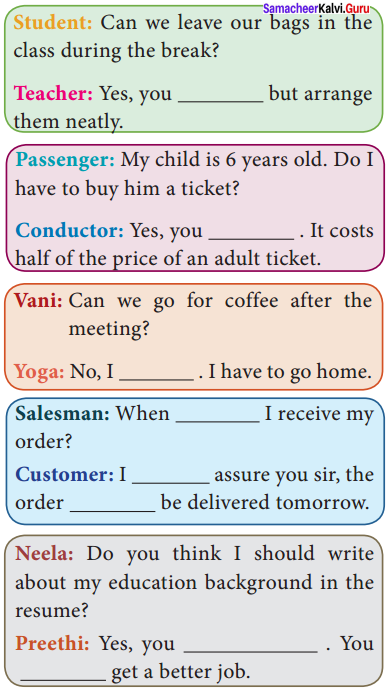
Samacheer Kalvi 10th English Solutions Prose Chapter 1 His First Flight 5

Student : Can we leave our bags in the class during the break?
Teacher : Yes, you ………….. (1) ……………. but arrange them neatly.
Passenger : My child is 6 years old. Do I have to buy him a ticket?
Conductor : Yes, you ……………… (2) …………… It costs half of the price of an adult ticket.
Vani : Can we go for coffee after the meeting?
Yoga : No, I ……………… (3) ……………… I have to go home.
Salesman : When ……………. (4) ………….. I receive my order?
Customer : I ……………. (5) …………… assure you sir, the order …………….. (6) …………….. be delivered tomorrow.
Neela : Do you think I should write about my education background in the resume?
Preethi : Yes, you ……………… (7) …………….. You ………….. (8) …………….. get a better job.
Answers:

  1. can
  2. should
  3. can’t
  4. can
  5. can
  6. will
  7. should
  8. will/may

Imagine you have been to Thanjavur recently. Based on your experience and the data given below about Thanjavur, suggest and guide your friend who wishes to visit Thanjavur and places nearby, using modals in your sentences.
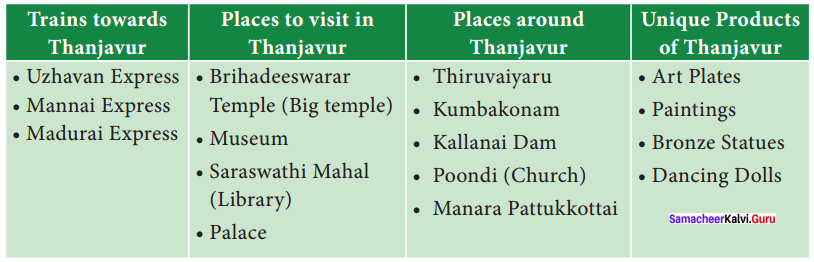
Samacheer Kalvi 10th English Solutions Prose Chapter 1 His First Flight 6

E. Here are a few sentences already done for you. The clues given would be helpful to \make more sentences on your own.

1. I would suggest that you take the Uzhavan Express to Thanjavur from Chennai.
2. You will be more comfortable if you could book 3 tier A/C.
3. You could enjoy ………………………………………………….
4. You should visit ………………………………………………….
5. You mustn’t miss ……………………………………………….
6. You can buy ………………………………………………………..
7. ……………………………………………………………………………..
8. ……………………………………………………………………………..
9. ……………………………………………………………………………..
10. ……………………………………………………………………………
Answers:
3. the Kallanai Dam near Thanjavur
4. the Big Temple
5. the Museum in Thanjavur
6. Art Plates and Dancing dolls
7. Saraswathi Mahal, a library is a must to visit in Thanjavur.
8. You may take the Madurai Express to go to Thanjavur.
9. You should visit the church at Poondi near Thanjavur.
10. Don’t miss Thiruvaiyaru. You ought to experience its grandeur.

Active And Passive:

F. Change the following sentences to the other voice.

1. The manager appointed many office assistants.
Many office assistants were appointed by the manager.

2. You are making a cake now.
Now, the cake is being made by you.

3. That portrait was painted by my grandmother.
My grandmother painted that portrait.

4. Malini had bought a colourful hat for her daughter.
A colourful hat had been bought by Malini for her daughter.

5. They have asked me to pay the fine.
I have been asked to pay the fine by them.

6. The militants were being taken to prison by the police.
The police were taking the militants to prison.

7. His behaviour vexes me.
I am vexed by his behaviour.

8. Rosy will solve the problem.
The problem will be solved by Rosy, v

9. Our army has defeated the enemy.
The enemy has been defeated by our army.

10. The salesman answered all the questions patiently.
All the questions were answered patiently by the salesman.

G. Change the following into Passive voice.

1. Please call him at once.
Request him to be called at once.

2. How did you cross the river?
How was the river crossed by you?

3. No one is borrowing the novels from the library.
The novels from the library are not being borrowed by anyone.

4. Will you help me?
Will I be helped by you?

5. Go for a jog early in the morning.
You are advised to go for a jog early in the morning.

6. Why have you left your brother at home?
Why has your brother been left at home by you?

7. Nobody should violate the rules.
Let the rules not be violated by anyone.

8. Someone has to initiate it immediately.
It has to be initiated by someone immediately.

9. Have you invited Raman to the party?
Has Raman been invited by you to the party?

10. Please do not walk on the grass.
You are requested not to walk on the grass.

11. Cross the busy roads carefully.
You are instructed to cross the busy roads carefully.
Let the busy roads be crossed by you carefully.

12. When will you book the tickets to Bengaluru?
When will the tickets to Bengaluru be booked by you?

H. In the following sentences the verbs have two objects namely Direct and Indirect objects. Change each of the following sentences into two passives using a direct object as the subject in one and indirect in the other.

1. John gave a bar of chocolate to Jill.
(a): Jill was given ………………………………………………………………………………..
(b): A bar of chocolate was given ……………………………………………………….

2. Pragathi lent a pencil to Keerthana.
(a): ……………………………………………………………………………………………………….
(b): ……………………………………………………………………………………………………….

3. Sudha told the truth to her friend.
(a): ………………………………………………………………………………………………………..
(b): ………………………………………………………………………………………………………..

4. They offered the job to Venkat.
(a): …………………………………………………………………………………………………………
(b): …………………………………………………………………………………………………………

5. The boss showed the new computer to Kaviya.
(a): ………………………………………………………………………………………………………….
(b): ………………………………………………………………………………………………………….
Answers:
1. (a) a bar of chocolate by John
(b) by John to Jill

2. (a) Keerthana was lent a pencil by Pragathi
(b) A pencil was lent by Pragathi to Keerthana

3. (a) Sudha’s friend was told the truth by Sudha
(b) The truth was told by Sudha to her friend

4. (a) Venkat was offered the job by them
(b) The job was offered by them to Venkat

5. (a) Kaviya was shown the new computer by the boss
(b) The new computer was shown by the boss to Kaviya

I. Rewrite the following passage in Passive Voice.

A few days ago, someone stole Ambrose’s motorbike. Ambrose had left it outside his house. He reported the theft to the police. The police told him that they would try to find his motorbike. This morning, they found his motorbike. The police called Ambrose to the police station. The thieves had painted it and then sold it to someone else. The new owner had parked the motorbike outside a mall when the police found it. After an enquiry, the police arrested the thieves.

Ambrose’s motorbike was stolen by someone a few days ago. It had been left outside his house by Ambrose. The theft was reported to the police by him. He was told by the police that they would try to find his motorbike. This morning, his motorbike was found. Ambrose was called to the police station by the police. It had been painted by the thieves and then it was sold to someone else. The motorbike had been parked by the new owner outside a mall when it was found by the police. After an enquiry, the thieves were arrested by the police.

J. Write a recipe for your favorite dish in the passive voice. Remember to list out the ingredients of the dish you have chosen and their quantity. Use Simple Present tense to write your recipe.

Ingredients: A bottle of Mixed Fruit jam, A packet of Cheese slices, A loaf of Sandwich bread A box of sweetened Butter, A nonstick pan
Recipe

  1. A pan with one teaspoon of sweetened butter is taken.
  2. Two slices of sandwich bread are taken and roasted slightly on both sides.
  3. A tablespoon of Mixed Fruit Jam is spread evenly on one side of the sandwich bread.
  4. A slice of cheese is placed in between the two slices of bread.
  5. The comers of the bread slices are sliced and the bread slice is split diagonally into two.
  6. The sandwich is ready to be served.

K. Write a report of an event held at your school using Passive voice. Use Simple Past Tense to narrate the event.

The Annual day was celebrated by Glenmark Global School, on July 17, 2019, at the school premises with pomp and grandeur. The school was decorated elegantly by the staff and students. A stage was set up with a beautiful backdrop depicting the theme of the year. The welcome address was given by the School Pupil Leader.

The Chief Guest Mrs. Indira Janardhanan, CEO was introduced and felicitated by the Principal Mrs. Jeyanthi Radhakrishnan. Many cultural programs viz western dance, traditional dance, English Play, Tamil Pattimandram were all a treat to the eyes of the audience.

The Annual report was presented by the Principal. Prizes were given away to the toppers and many students who had brought laurels to the school in various competitions and contests. The Vote of Thanks was delivered by the Assistant School Pupil Leader.

His First Flight by Liam O’Flaherty About the Author: 

Liam O’Flaherty, born on August 28, 1896, at Aran Islands, Ireland died on September 7, 1984 at Dublin. He is an Irish novelist and short-story writer. He became a popular literary figure with his best-selling novel, The Informer. The next novel Return of the Brute was also a great success. O’ Flaherty will be remembered as a major voice in the Irish literary renaissance and a founding member of the Communist Party of Ireland. He spent most of his time in travelling and lived comfortably and quietly outside the spotlight.

His First Flight Summary:
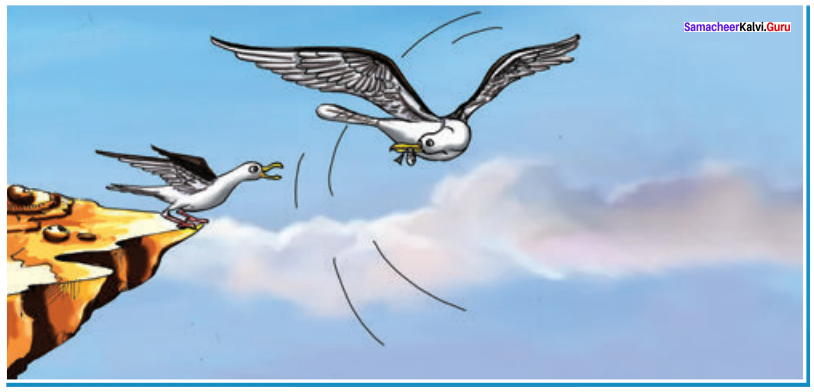
Samacheer Kalvi 10th English Solutions Prose Chapter 1 His First Flight 7 Introduction:
‘His First Flight’ is a story of hesitation, trial and error and ultimately succeeding in the task. It is an interesting story of a hesitant and timid seagull learning the art of flying. While his two brothers and sister master the art of flying, his fear and hesitation prevent him from doing so. His diving at the fish due to hunger proves a blessing in disguise. After a shaky start, he spreads out his wings and starts flying upwards and downwards. That’s his first flight. Thus the message is conveyed by O’Flaherty that no one attains success instantly. Perseverance and continuous striving help one to succeed.
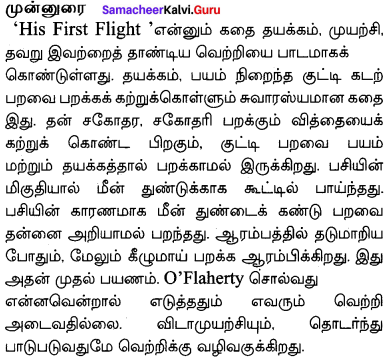
Samacheer Kalvi 10th English Solutions Prose Chapter 1 His First Flight 8

Fear to fly
The young seagull was alone on his ledge. His two brothers and his sister had already learnt the art of flying just a day before. He tried in vain because of his fear. He had taken a little run forward and tried to flap his wings but that was all he could do. He feared that his wings would not support him. So he bent his head and ran back to the little hole where he slept the previous night.
Samacheer Kalvi 10th English Solutions Prose Chapter 1 His First Flight 9

Threatened by Parents His brothers and his sister had wings far shorter than his own wings. But he failed to muster up the courage and fly. His parents criticized, admonished, and threatened him to leave him starving at the ledge. However, nothing could make him fly.
Samacheer Kalvi 10th English Solutions Prose Chapter 1 His First Flight 10

Parents perfected siblings The seagull helplessly watched his parents flying with his brothers and sister. They were perfecting them in the art of flying. They were teaching them how to skim the waves and how to dive for fish. The whole family went on taunting him for his cowardice.
Samacheer Kalvi 10th English Solutions Prose Chapter 1 His First Flight 11

Mother’s trick works His mother was looking at him. She had picked a piece of fish. She was flying across tp him with it. He leaned out eagerly. The mother was very near to him with the fish in her beak. Maddened by hunger, he dived at the fish. With a loud scream, he fell outwards and downwards into space. A terror seized him. His heart stood still. His mother plunged past him. He answered her with another scream. He saw his two brothers and sister flying around him.
Samacheer Kalvi 10th English Solutions Prose Chapter 1 His First Flight 12

Seagull flies!
The seagull completely forgot that he was not able to fly. He let himself free to dive, soar and curve at will. He was squealing shrilly. He saw a green sea beneath him. His parents, his brothers and sister were signaling to him with a shrill voice. He was tired and weak with hunger. His feet sank into the green sea and his belly touched it. He sank no farther. His family were praising him and their beaks were offering him scraps of fish. He had, at last, made it and it was his first flight.
Samacheer Kalvi 10th English Solutions Prose Chapter 1 His First Flight 13
Samacheer Kalvi 10th English Solutions Prose Chapter 1 His First Flight 14

Conclusion:
The story arrives at the conclusion that nothing is impossible. Fear is the impediment to success. Shed the fears and succeed in whatsoever you desire.
Samacheer Kalvi 10th English Solutions Prose Chapter 1 His First Flight 15

His First Flight Glossary:
Textual:
Samacheer Kalvi 10th English Solutions Prose Chapter 1 His First Flight 16

Additional:
Samacheer Kalvi 10th English Solutions Prose Chapter 1 His First Flight 17

Synonyms:

Choose the most appropriate synonym of the underlined word.

1. The young seagull was alone on his ledge.
(a) sill
(b) window
(c) nest
(d) lift
Answer:
(a) sill

2. The great expanse of sea stretched a long way down.
(a) express
(b) expense
(c) stretch
(d) vision
Answer:
(c) stretch

3. He felt certain that his wings would never support him.
(a) curtain
(b) screen
(c) sure
(d) unsure
Answer:
(c) sure

4. His brothers and his little sister ran to the brink.
(a) bark
(b) sea
(c) water
(d) edge
Answer:
(d) edge

5. He failed to muster up courage to take that plunge.
(a) dust
(b) gather
(c) strength
(d) marvel
Answer:
(b) gather

6. He saw his brothers and sister perfecting in the art of flight.
(a) achieving
(b) trying
(c) finishing
(d) balancing
Answer:
(a) achieving

7. He saw his older brother devour his first catch.
(a) consume
(b) devein
(c) divide
(d) smell
Answer:
(a) consume

8. His parents circled around raising a proud cackle.
(d) cough
(b) screech
(c) walk
(d) tackle
Answer:
(b) screech

9. The whole family walked about on the big plateau.
(a) highland
(b) pinnacle
(c) lake
(d) valley
Answer:
(a) highland

10. All his siblings laughed at his cowardice.
(a) weakness
(b) craze
(c) cooperation
(d) awkwardness
Answer:
(a) weakness

11. He even gnawed at the dried pieces of eggshell.
(a) gasped
(b) annoyed
(c) chewed
(d) devoured
Answer:
(c) chewed

12. He then trotted back and forth from one end of the ledge to the other.
(a) trailed
(b) scurried
(c) jolted
(d) rolled
Answer:
(b) scurried

13. His long gray legs stepped daintily to reach his parents.
(a) elegantly
(b) drearily
(c) dancing
(d) lethargically
Answer:
(a) elegantly

14. The ledge ended in a sheer fall of precipice with the sea beneath.
(a) steep
(b) gentle
(c) clean
(d) distant
Answer:
(a) steep

15. The precipice was sheer.
(a) cliff
(b) precipitation
(c) effervescence
(d) recap
Answer:
(a) cliff

16. His father was preening the feathers on his white back.
(a) picking
(b) cleaning
(c) screening
(d) wilting
Answer:
(b) cleaning

17. She was standing on a little high hump on the plateau.
(a) mound
(b) dip
(c) hollow
(d) table
Answer:
(a) mound

18. Her white breast thrust forward.
(a) shove
(b) burst
(c) backward
(d) thirsted
Answer:
(a) shove

19. The sight of the food maddened him.
(a) light
(b) bring
(c) blight
(d) view
Answer:
(d) view

20. He scraped his beak now and again to whet it!
(a) rubbed
(b) screened
(c) wet
(d) sharpened
Answer:
(a) rubbed

21. He uttered a low cackle.
(a) expressed
(b) screamed
(c) mocked
(d) udder
Answer:
(a) expressed

22. She screamed back mockingly.
(a) admiringly
(b) scornfully
(e) meekly
(d) brightly
Answer:
(b) scornfully

23. He kept calling plaintively.
(a) plainly
(b) blatantly
(c) sadly
(d) palpably
Answer:
(c) sadly

24. She was just opposite to him, abreast of the ledge.
(a) well-informed
(b) tuned
(c) approved
(d) disapproved
Answer:
(a) well-informed

25. His mother had swooped upwards.
(a) swung
(b) leapt
(c) fell
(d) danced
Answer:
(b) leapt

Antonyms

Choose the most appropriate antonym of the underlined word.

1. The sun was now ascending the sky.
(a) soaring
(b) rising
(c) mounting
(d) downhill
Answer:
(d) downhill

2. He ran a little forward to the brink of the ledge.
(a) centre
(b) brim
(c) threshold
(d) bridge
Answer:
(a) centre

3. He waited a moment in surprise.
(a) weighted
(b) sat
(c) began
(d) astonished
Answer:
(c) began

4. He felt the heat because he had not eaten since the previous nightfall.
(a) warmness
(b) coldness
(c) seat
(d) hearth
Answer:
(b) coldness

5. He searched among the rough, dirt-caked straw nest.
(a) coarse
(b) smooth
(c) bumpy
(d) blunt
Answer:
(b) smooth

6. He failed to muster up courage to take that plunge.
(a) dive
(b) climb
(c) fall
(d) plume
Answer:
(b) climb

7. Between them, there was a deep, wide crack.
(a) cavernous
(b) dip
(c) narrow
(d) shallow
Answer:
(d) shallow

8. Maddened by hunger, he dived at the fish.
(a) surfeit
(b) famine
(c) appetite
(d) heat
Answer:
(a) surfeit

9. He even gnawed at the dried pieces of eggshell.
(a) parched
(b) dehydrated
(c) fresh
(d) new other.
Answer:
(c) fresh

10. He then trotted back and forth from one end of the ledge to the
(a) scurried
(b) sauntered
(c) tracked
(d) rolled
Answer:
(b) sauntered

11. As he passed beneath her, he heard the swish of her wings.
(a) underneath
(b) below
(c) above
(d) finite
Answer:
(c) above

12. The next moment, he felt his wings spread outwards.
(a) centrifugally
(b) inwards
(c) beautifully
(d) aloft
Answer:
(b) inwards

13. He flapped his wings and soared upwards.
(a) downwards
(b) inwards
(c) outwards
(d) lethargically
Answer:
(a) downwards

14. The precipice was sheer.
(a) steep
(b) gentle
(c) effervescence
(d) recap
Answer:
(b) gentle

15. The wind rushed against his breast feathers.
(a) gushed
(b) relaxed
(c) flushed
(d) plumes
Answer:
(b) relaxed

16. He completely forgot his inability to fly.
(a) overlooked
(b) remembered
(c) ignored
(d) disregarded
Answer:
(b) remembered

17. His parents had landed in front of him.
(a) visible
(b) detectable
(c) behind
(d) anterior
Answer:
(c) behind

18. They were beckoning to him, calling shrilly.
(a) summoning
(b) signaling
(c) dismissing
(d) requesting
Answer:
(c) dismissing

19. He was tired and weak with hunger.
(a) scrawny
(b) puny
(c) week
(d) view
Answer:
(d) view

20. Hqwas floating on it.
(a) flowing
(b) fluctuating
(c) flinging
(d) strong
Answer:
(d) strong

21. His family was screaming and praising him.
(a) diluting
(b) adulation
(c) exaltation
(d) fixed
Answer:
(d) fixed

22. She was standing on a little high hump on the plateau.
(a) mountain
(b) dip
(c) hollow
(d) highland
Answer:
(c) hollow

23. He scraped his beak now and again to whet it!
(a) rubbed
(b) blunt
(c) wet
(d) sharpened
Answer:
(b) blunt

24. The great expanse of the sea stretched down a long way down.
(a) short
(b) lengthy
(c) straight
(d) vision
Answer:
(a) short

25. He felt certain that his wings would never support him.
(a) nearer
(b) forever
(c) surely
(d) always
Answer:
(d) always

Samacheer Kalvi 10th English Book Solutions Prose

His First Flight Book Back Answers 10th Standard English Chapter 1 Samacheer Kalvi Read More »

Zigzag Book Back Answers 10th Standard English Chapter 2 Samacheer Kalvi

10th Standard English Unit 2 Supplementary Zigzag Book Back Answers

You can Download Zigzag Questions and Answers, Summary, Activity, Notes, Samacheer Kalvi 10th English Book Solutions Guide Pdf Supplementary Chapter 2 help you to revise complete Tamilnadu State Board New Syllabus and score more marks in your examinations.

Zigzag 10th Standard English 2nd Lesson Question and Answer

Zigzag Textual Questions

A. Identify the speaker/character.

1. ‘Even though I clearly said no!’
Answer:
Dr. Krishnan

2. ‘The one that spits deadly poison straight into its opponent’s eyes’
Answer:
Maya

3. ‘Remember the. tiny penknife the gave me last year’.
Answer:
Maya

4. ‘It’s Somu’s thoughtless ways that reduce me to tears’.
Answer:
Mrs. Krishnan

5. ‘Gome in, Zigzag, come in dear!’
Answer:
Visu, the old cook

Additional Questions

Question 1.
‘Find Visu! I will not keep Zigzag here another minute!’
Answer:
Dr. Ashok T Krishnan

Question 2.
‘Don’t you dare sleep!’
Answer:
Dr. Krishnan

Question 3.
‘May I take Zigzag to school, Papa?’
Answer:
Arvind

Question 4.
We’ve been truly blessed!
Answer:
Lakshmi

Question 5.
Just wait till Zigzag settles down in this new home.
Answer:
Visu

Question 6.
‘And what about the aboriginal boomerang?
Answer:
Arvind

Question 7.
Then you can have a great time listening to him.
Answer:
Visu

Question 8.
It’s raining papayas and bananas in this room!’
Answer:
Lakshmi

Question 9.
‘But Zigzag is different. Somu says we are sure to love Zigzag.’
Answer:
Dr. Krishnan

Question 10.
Most of these so-called “favourite” possessions that he has given us were absolute nuisances!’
Answer:
Mrs. Krishnan

Question 11.
‘Remember the rare insect-eating plant he brought back from the rainforest!
Answer:
Mrs. Krishnan

Question 12.
I thought it was a scientific fact that birds couldn’t snore.’
Answer:
Maya

Question 13.
That wretched plant requires a room heater to keep it alive.
Answer:
Mrs. Krishnan

Question 14.
‘Ma! Uncle Somu’s given us some really fabulous gifts.’
Answer:
Arvind

B. Read the story again and write how these characters reacted in these situations:

1. You’re both quite mistaken.
Answer:
Dr. Krishnan hastened to explain.
Mrs. Krishnan was horrified on hearing about Zigzag.

2. It’s Somu’s thoughtless ways that reduce me to tears.
Answer:
Mrs. Krishnan spoke irritably.
Dr. Krishnan was in a hurry to his clinic.

3. Just wait till zigzag settles down in this new home.
Answer:
Visu comforted everyone.
Arvind and Maya excited to listen to the bird’s talk.

4. Zigzag hardly never sleeps.
Answer:
Somu sent an email to Dr. Krishnan about zigzag.
Dr. Krishnan’s prediction was ridiculously simple.

5. You are an absolute treasure……….
Answer:
Dr.Krishnan sighed and spoke to Zigzag
Zigzag didn’t bother to reply.

C. Complete the given tabular column.

Samacheer Kalvi 10th English Solutions Supplementary Chapter 2 Zigzag 1

Samacheer Kalvi 10th English Solutions Supplementary Chapter 2 Zigzag 2
Answers:

  1. liking the new nuisance.
  2. painting exhibition to be held the next week.
  3. dropped one wizened eyelid in another solemn wink as he sank his beak into plump guava.
  4. it rained papayas and bananas.
  5. ask him to find out what they should do.
  6. predicted the reply to be ridiculously simple.
  7. I have never heard a Zigzag snore.
  8. not accustomed to being kept waiting and was already making his way to the clinic where he perched himself on the nurse’s reception table.
  9. realised what an absolute treasure he was!

D. Answer the following question in one or two sentences:

Question 1.
Why did Dr. Asholds cousin call him?
Answer:
Dr. Ashok’s cousin called him to shelter zigzag, his pet bird when he left for Alaska.

Question 2.
Mention at least two expressions which show that Mrs. Krishnan was not willing to have Zigzag at home?
Answer:
The following two expressions show that Mrs. Krishnan was not willing to have Zigzag at home.
(i) “I am going crazy with the sound of Zigzag snoring, plus all these angry telephone calls.”
(ii) “And my beautiful painting…”

Question 3.
What other various pets did Somu have?
Answer:
Somu had a giant green and gold fighting beetle and an African snake.

Question 4.
What was Mrs. Krishnan busy with?
Answer:
Mrs. Krishnan was busy with her paintings to be displayed for sale the following week.

Question 5.
What commotion did the boomerang cause in the neighborhood?
Answer:
Boomerang sliced through all the TV aerials in the neighbourhood. It caused permanent damage to several cars in the parking lot. It also knocked out their watchman cold with the force thrown by Aravind.

Question 6.
What happened when Somu left Zigzag with the Krishnan’s?
Answer:
Zigzag transferred all the walnuts and the fruits to the Chandelier and on the blades of the ceiling fan. Then it perched on the curtain rod, went off to sleep.

Question 7.
How did Zigzag communicate with the Krishnan’s?
Answer:
Zigzag did not communicate with the Krishnas although everyone tried several times in different languages to speak to him, he only slept and snored.

Question 8.
What was the e-mail message sent to Somu by Dr.Krishnan?
Answer:
Krishnan sent an e-mail to Somu, asking for instructions on how to stop Zigzag from snoring.

Question 9.
What did Aravind confess?
Answer:
Aravind confessed that for the first time in his life he was actually looking forward to go to school. The school Was as calm as a monastery compared to the house.

Question 10.
Why did Mrs. Jhunjhunwalla buy the painting?
Answer:
Mrs. Jhunjhunwalla bought the painting because she liked the new technique of painting.

E. Answer the following questions in about 100 -150 words:

Question 1.
Write in your own words the various commotions caused by Zigzag at Dr. Krishnan’s residence.
Answer:
Introduction:
This story is about a weird bird named zigzag. It was Dr. Somu’s pet bird. He left it with Dr. Krishnan when he went for Alaska. Now, we are going to see about the commotions caused by zigzag in Dr. Krishnan’s house.

Introduction of Zigzag:
Dr. Somu went for Alaska. He left his pet bird zigzag to Krishnan. Dr. Somu’s cook Visu brought the bird. He told that zigzag can speak 21 languages. It was a multi-lingual bird. But, he didn’t speak any word.

Commotions caused by zigzag:
Aravind brought some fruits and nuts. Zigzag did not eat them but transferred them on the fan blades. Then he perched on the curtain rod and slept. At once he started to snore. He snored loudly. When the fan was switched on, the fruits spoiled Mrs. Krishnan’s painting.

Zigzag’s talent:
Dr. Krishnan took it to the clinic. Suddenly, a zigzag flew on the nurse table. Surprisingly, zigzag ordered the naughty kids to be silent. Zigzag recited French poetry and kindly comforted the crying children.

Conclusion:
Thus, Dr. Krishnan was surprised and wanted to keep zigzag with them. Mrs. Krishnan’s painting was also sold for Rs. 5000. Thus, zigzag was an absolute treasure for them.

Question 2.
What was the turn of events when Zigzag was taken to the clinic?
Answer:
When Zigzag was taken into the clinic, he was asked to wait in the car by Dr. Krishnan. He warned him not to sleep and snore. But Zigzag was not accustomed to being kept waiting. So he made his way to the reception and perched himself on the nurse’s reception table.

Krishnan had hardly walked through the swinging half-door that separated his clinic from the waiting room when he heard a voice. The voice was from Zigzag. It was clear and commanding. There was pin-drop silence in the room as everyone waited, open-mouthed, for Zigzag s next sentence. Dr. Krishnan was amazed. Zigzags bored and grumpy expressions were gone. Instead, the bird ‘ looked happy and alert as it went about the job.

It had been trained for this job with the doctors. Thus Dr. Krishnan’s clinic, which was usually a noisy sea of tears and outbursts, was transformed into a calm, orderly place. He efficiently soothed the patients and naughty ones.

Question 3.
Narrate the story Zigzag in your own words.
Answer:
Title: Zigzag
Author: Asha Nehemiah
Characters: Zigzag, the Krishnan’s and family, Dr. Somu, Visu, the old cook.
Theme: “What is coming is better than what is gone”

This story is about Zigzag, a multilingual bird. Dr. Krishnan’s clinic usually sounded noisy as there was shouting and crying of children. His friend Dr. Somu asked him to shelter his pet zigzag because he left for Alaska.

When zigzag was brought to his house, he did not speak to anyone. He could talk and sing in 21 languages. But he transferred the fruits and nuts given to him to a chandelier and the plates of a ceiling fan. Then he perched on a curtain rod and went off to sleep. When the maid switched on the fan, the fruits and nuts fell down.

The papaya slices splattered on the painting of Mrs. Krishnan and spoilt it. Mrs. Krishnan got irritated and told Dr. Krishnan to send the bird to Visu’s house. Dr. Krishnan took Zigzag to his clinic. He commanded the patients and changed the clinic a calm and orderly place. The bird spoilt the painting but it was considered a new technique. Mrs. Krishnan was happy to sell it for Rs. 5000. Mrs. Krishnan wanted to keep Zigzag with them for one more week.

Additional:

Question 1.
Describe the entry of ZigZag and his behaviour thereafter as soon as he entered the residence of Krishnan.
Answer:
Into Krishnan’s residence tottered the strangest, weirdest-looking bird, ZigZag. He was brought in by Somu’s cook, Visu. About a foot and a half tall, its bald head was fringed with a crown of shocking pink feathers while the rest of its plumage was in various shades of the muddiest and sludgiest brown. Its curved beak was sunflower-yellow and its eyes were the qolour of cola held to sunlight.

Visu introduced ZigZag as Ziggy-Zagga-king-of-the-Tonga añd that he talks very beautifully. He even added that he could recite French Poetry! In spite of all the praise showered on him, he stood cool and unmoved, with an expression of almost- human grumpiness in bis cola-colored eyes.

Arvind tried his best to make ZigZag speak. He dashed into the kitchen and brought a plate with juicy fruit slices and some nuts. Bored eyes brightened as Zigzag picked up a walnut. It refused to speak., dropped one wrinkled eyelid in a solemn wink, and flew clumsily to deposit the nut on the enormous chandelier hanging from the ceiling. Silently and slowly, all the fruit on the plate was transferred to the chandelier and the blades of the ceiling fan. As soon as the cook Visu left, Zigzag, still perched on the curtain rod, went off to sleep.
“Zigzag is Queer and Weird.”

Additional Questions

A. Rearrange the following sentences in a coherent order.

1. a. Their nine-year-old daughter Maya was excited about Zigzag’s arrival.
b. Mrs.Ashok was busy getting ready for the painting exhibition.
c. Zigzag is an unusual bird that speaks in 21 different languages.
d. Due to the commotion Somu mistook Ashok’s commitment to keeping zigzag.
e. Dr. Ashok’s clinic usually sounded like an ancient Chinese torture chamber.
Answers:
e, d, b, a, c
e. Dr. Ashok’s clinic usually sounded like an ancient Chinese torture chamber.
d. Due to the commotion Somu mistook Ashok’s commitment to keeping zigzag.
b. Mrs. Ashok was busy getting ready for the painting exhibition.
a. Their nine-year-old daughter Maya was excited about Zigzag’s arrival.
c. Zigzag is an unusual bird that speaks in 21 different languages.

2. a. Apparently, Zigzag was bred by a genuine African witch doctor.
b. But most of his possessions were absolute nuisances!
c. Isn’t that Uncle Somu’s prized giant green-and-gold fighting beetle?
d. Somu says the bird is an absolute treasure and real help.
e. Somu had cured the witch doctor’s son last month.
Answers:
c, a, e, d, b
c. Isn’t that Uncle Somu’s prized giant green-and -gold fighting beetle?
a. Apparently, Zigzag was bred by a genuine African witch doctor,
e. Somu had cured the witch doctor’s son last month.
d. Somu says the bird is an absolute treasure and real help.
b. But most of his possessions were absolute nuisances!

B. Fill in the blanks with the appropriate phrases given below to form a complete meaningful paragraph.

1. (crying so loudly / for your exhibition next week / who were his patients / to ask whether /more like an)

Dr. Ashok T. Krishnan’s clinic usually sounded (i) ……………….. ancient Chinese torture chamber than a child specialist’s clinic. This was because the tiny children (ii) ……………….. left out a variety of blood-curdling yells and ear-splitting sobs. ‘It’s all because my patients were making so much noise and (iii) ……………. He rang me in the clinic (iv) …………… we could keep zigzag with us when he leaves for Alaska. I know you are busy getting your painting ready (v) ……………….
Answers:
(i) more like an
(ii) who were his patients
(iii) crying so loudly
(iv) to ask whether
(v) for your exhibition next week

2. (went off to sleep / fell asleep,/ when Zigzag stubbornly refused / Even though they tried/perched comfortably)

Zigzag (i) …………………. on a curtain rod and dropped one wizened eyelid in another solemn wink. Visu comforted the children, noticing how disappointed they looked (ii) ……………….. to say a single word to them, (iii) …………………. speaking to him in English, Hindi, Tamil, and French, Zigzag spoke no word. As soon as Visu left, Zigzag, still perched on the curtain rod, (iv) …………… And the moment he (v) ………………….., he began to SNORE!
Answers:
(i) perched comfortably
(ii) when Zigzag stubbornly refused
(iii) Even though they tried
(iv) went off to sleep
(v) fell asleep

C. Choose the correct answer.
1. Somu was leaving for ……………………
(a) Alaska
(b) Antarctica
(c) Africa
(d) Amazon
Answer:
(a) Alaska

2. Maya mistook Zigzag to be ………………….
(a) snake
(b) beetle
(c) cat
(d) insect
Answer:
(b) beetle

3. Zigzag was bred by a genuine African ……………………………
(a) Witchdoctor
(b) witch
(c) tribe
(d) Witch surgeon
Answer:
(d) Witch surgeon

4. Mrs. Krishnan applied a dab of yellow-ochre paint on Sunset at ………………………….
(a) Bengal
(b) Kanyakumari
(c) Besant
(d) Marina
Answer:
(d) Marina

5. The rare insect-eating plant came from Amazonian ……………………………..
(a) Rainforest
(b) Black forest
(c) White forest
(d) Jungle
Answer:
(a) Rainforest

6. That wretched plant required a ………………. to keep it alive in Chennai!
(a) water heater
(b) room heater
(c) air cooler
(d) hair conditioner
Answer:
(b) room heater

7. The aboriginal boomerang was a gift from ………………………
(a) Africa
(b) Amazon
(c) Australia
(d) America
Answer:
(c) Australia

8. Zigzag could speak in ……………………. different languages.
(a) twenty-four
(b) twelve
(c) seven
(d) twenty-one
Answer:
(d) twenty-one

9. When Zigzag sings, it moves the listeners to ……………………..
(a) tears
(b) laughter
(c) sighs
(d) boredom
Answer:
(a) tears

10. Arvind wants to display Zigzag in the ………………………… exhibition.
(a) Tradefair
(b) Children’s
(c) Science
(d) Arts
Answer:
(c) Science

D. Match the following appropriately:

1. Samacheer Kalvi 10th English Solutions Supplementary Chapter 2 Zigzag 3
Answer:
2. Samacheer Kalvi 10th English Solutions Supplementary Chapter 2 Zigzag 4
Answer:

3. Samacheer Kalvi 10th English Solutions Supplementary Chapter 2 Zigzag 5
Answer:

E. Read the passage given below and answer the questions that follow:

1. Dr. Ashok T. Krishnan’s clinic usually sounded more like an ancient Chinese torture chamber than a child specialist’s clinic. This was because the tiny children who were his patients left out a variety of blood -curdling yells and ear-splitting sobs. ‘It’s all because my patients were making so much noise and crying so loudly, ‘ he apologized to his wife one evening, ‘that Somu couldn’t hear me properly. He rang me in the clinic to ask whether we could keep zigzag with us when he leaves for Alaska. And now Somu thinks I said “yes”, even though I clearly said “no”! I know you are busy getting your painting ready for your exhibition next week. ’
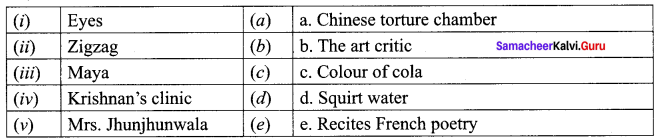
(a) What was Dr.Ashok T.Krishnan’s specialisation in the medical field?
Answer:
Dr. Ashok T. Krishnan specialised in children’s health and so he was a Paediatrician or a child specialist.

(b) How did Dr. Krishnan’s clinic generally sound?
Answer:
Dr.Krishnan’s clinic generally sounded like an ancient Chinese torture chamber.

(c) Why couldn’t Somu hear the telephonic conversation with Ashok clearly?
Answer:
Somu couldn’t hear Ashok clearly over the telephone because the children in the clinic were making so much noise and crying loudly.

(d) Where was Somu going to?
Answer:
Somu was going on an official trip to Alaska.

(e) What did Ashok say was the reason to deny Somu’s request?
Answer:
Ashok said that he denied Somu’s request since he knew about his wife’s painting exhibition next week.

2. ‘Zigzag! ’ interrupted their nine-year-old daughter Maya.
Isn’t that Uncle Somu’s prized giant green-and -gold fighting beetle. The one that spits deadly poison straight into its opponent’s eye?’
‘No, no,’ corrected her older brother Arvind, eyes shining in pure delight. ‘The beetle is called Spitfire. Zigzag must be Uncle Somu’s pet snake. The African sidewinder! You know, the one that slithers zigzag all over his house!’
‘You’re both quite mistaken,’ their father hastened to explain, seeing his wife’s horrified expression. ‘Zigzag is a mostly harmless, unusual, and lovable bird. Apparently, it was bred by a genuine African witch doctor, who gifted it to Somu when he being a child specialist like me cured the witch doctor’s son while he was touring the deepest jungles of equatorial Africa last month. Somu says the bird is an absolute treasure and real help. It’s his favourite pet, you know’.

(а) Who is Maya?
Answer:
Maya is Dr. Krishnan’s nine-year-old daughter.

(b) What did Maya mistake Zigzag to be?
Answer:
Maya mistook Zigzag to be Uncle Somu’s prized giant and gold fighting beetle, Spitfire.

(c) According to Maya’s brother, who was Zigzag? Why?
Answer:
According to Maya’s brother Arvind, Zigzag was Uncle Somu’s pet snake, the African sidewinder that slithers zigzag all over his house.

(d) Why did Ashok hasten to explain to his children the mistaken identity?
Answer:
Ashok observed his wife’s a horrified expression and hastened to explain to his children.

(e) Who was Zigzag according to Ashok?
Answer:
Zigzag was a harmless, unusual, and lovable bird bred by a genuine African doctor who gifted it to Somu as a gift for treating his son while touring the jungles of equatorial Africa.

F. Study the given mind map and fill in the incomplete details:
Samacheer Kalvi 10th English Solutions Supplementary Chapter 2 Zigzag 6
Answers:
(i) picked up a walnut.
(ii) all the fruit on the plate was transferred to the chandelier.
[iii) comfortably on a curtain rod.
(iv) great time listening to him.
(v) went off to sleep and began to

Samacheer Kalvi 10th English Solutions Supplementary Chapter 2 Zigzag 7
Answers:
(i) but he was saved by the telephone bell.
(ii) rang up to demand some peace
(iii) Zigzag slept on unconcerned
(iv) an exhausted Mrs.Krishnan
(v) I am going crazy with the sound of Zigzag snoring

Zigzag by Asha Nehemiah About the Author:

Asha Nehemiah born in 1958 in Chennai has lived, studied and worked in eight different cities and small towns and is now a resident of Bangalore. She has always been interested in writing. Her love for reading led her to study Literature in college. If she had not been a writer, she would have been a teacher. Humour, fantasy mystery and adventure are the strong elements in her work. She loves baking, walking, reading and travelling.

Zigzag Summary:

Samacheer Kalvi 10th English Solutions Supplementary Chapter 2 Zigzag 8

Introduction:
Author Asha Nehemiah unfolds the delicate love a bird can exhibit to the astonishment of the inmates. Interesting facts about plants and animals will draw the attention of students. Let us read the family’s reaction towards the wonder bird Zigzag.
Samacheer Kalvi 10th English Solutions Supplementary Chapter 2 Zigzag 9

Zigzag finds new home:
Dr. Ashok T Krishnan’s family shelters Somu’s new pet, ZigZag, a queer-looking African bird, who is known for talking and singing in twenty-one different languages brought in by Visu after a telephonic conversation which wasn’t audible due to the variety of blood-curdling yells and ear-splitting sobs. Mr. Krishnan knows about Mrs. Krishnan’s painting exhibition the next week and denies the plea of Somu to shelter the pet.
Samacheer Kalvi 10th English Solutions Supplementary Chapter 2 Zigzag 10

An Unusual Bird:
Zigzag is the most harmless, unusual and lovable bird bred by a genuine African witch doctor, who gifted it to Somu when he, being a child specialist like Dr. Krishnan cured the witch doctor’s son, while he was touring the deepest jungles of Africa a month ago.
Samacheer Kalvi 10th English Solutions Supplementary Chapter 2 Zigzag 11

Mistaken conversation:
To Somu, the bird is an absolute treasure and real help. However, Somu mistakes Krishnan to have agreed to the request. Their son Arvind and daughter Maya are keen on bringing the pet home. They both discuss the unique gifts given by Uncle Somu such as the insect-eating plant, tiny penknife with the genuine shark’s tooth blade, the aboriginal boomerang, and so on. But this strange guest turns out to be a disappointment for the Krishnan family.
Samacheer Kalvi 10th English Solutions Supplementary Chapter 2 Zigzag 12

A sleeping bird:
Zigzag does nothing but sleeps and snores all the time at home that even the neighbours complain about the noise in person and over the phone. All attempts to awaken the bird go in vain. They finally feel a big escape to leave home and stay far away from the sound of snoring. The bird at first before resorting to a steadfast sleep eats the nuts and fruits, keeps them safe in the chandelier and the fan blades.
Samacheer Kalvi 10th English Solutions Supplementary Chapter 2 Zigzag 13

Maid makes a mess:
The maid Lakshmi shrieks when she switches on the fan in an excited manner thinking she is blessed with papayas and bananas raining inside the room not knowing the bird’s play. Mbs. Krishnan is annoyed at the slice of overripe? papaya whizzing off the fan and splattering all over her unfinished masterpiece – sunset at Marina spreading streaks of gooey orange pulp and shiny black seeds all over it.
Samacheer Kalvi 10th English Solutions Supplementary Chapter 2 Zigzag 14

Six Frantic Days:
Dr. Krishnan leaves an e-mail message for Somu, asking him for clear instructions on how to stop Zigzag from snoring. Six frantic days of checking their e-mail day and night make them dumbstruck by the reply from Somu on the seventh day that the bird never sleeps nor snores. Mrs. Krishnan wants it to be sent to Visu as her friends and experts will come home and choose her paintings for the exhibition.
Samacheer Kalvi 10th English Solutions Supplementary Chapter 2 Zigzag 15

Dr. Krishnan takes it to clinic:
Krishnan takes Zigzag in the car and hopes to find Visu so that Zigzag’s snore doesn’t add to the din of the sobs and shrieks produced by the tiny patients waiting for him. However, Ziggy-Zagga, King-of-the- Tonga was not familiar to being kept waiting and was already making his way to the clinic where he perched himself on the nurse’s reception table. Dr. Krishnan warned Zigzag fiercely as he went towards his room.
Samacheer Kalvi 10th English Solutions Supplementary Chapter 2 Zigzag 16

Zigzag Speaks:
Dr. Krishnan had barely walked through the door that separated his clinic from the waiting room when he heard a strange voice say, ‘You there in the blue T-shirt, don’t jump on the sofa and you in the red dress, don’t swing on the curtain.’ It was Zigzag’s voice, clear and commanding. There was pin-drop silence in the room as everyone waited for Zigzag’s next sentence. Dr. Krishnan was amazed!
Samacheer Kalvi 10th English Solutions Supplementary Chapter 2 Zigzag 17

Cheerful Zigzag:
Gone was Zigzag’s bored and grumpy expression. Instead, the bird looked happy and alert as it went about the job it had been trained for, first with the African witch doctor and then with Dr.Somu. To top it all, Zigzag never slept nor snored. ZigZag was an absolute treasure and Dr. Krishnan never wanted Visu to take away ZigZag.
Samacheer Kalvi 10th English Solutions Supplementary Chapter 2 Zigzag 18

Mrs. Krishnan rewarded for the art:
Mrs. Krishnan too calls at the same time sounding very pleased with herself. She said that ‘Mrs. Jhunjhunwula, the art critic did not want to exhibit ‘Sunset at Marina’ since she would buy it for herself, for Rs. 5,000/- for she loved my new technique of painting! She simply adored those streaky orangey bits!
Samacheer Kalvi 10th English Solutions Supplementary Chapter 2 Zigzag 19

Dr. Krishnan rewards the bird:
Dr. Krishnan gave the bird a toffee from his desk as a compliment, but he just ate the toffee, paper wrapper and all, and then lowered one crinkly eyelid in a knowing wink.
Samacheer Kalvi 10th English Solutions Supplementary Chapter 2 Zigzag 20

Conclusion:
Zigzag attracts Rnshnan’s family after all the mess and irritating snores. It is interesting to watch the activities of a wild bird that belongs to the deepest jungles of Africa. The lesson has amazing facts about African animals and plants adding to the students delight.
Samacheer Kalvi 10th English Solutions Supplementary Chapter 2 Zigzag 21

Zigzag Glossary:

Textual:
Samacheer Kalvi 10th English Solutions Supplementary Chapter 2 Zigzag 22

Additional:
Samacheer Kalvi 10th English Solutions Supplementary Chapter 2 Zigzag 23

Samacheer Kalvi 10th English Book Solutions Supplementary

Zigzag Book Back Answers 10th Standard English Chapter 2 Samacheer Kalvi Read More »

The Secret of the Machines Book Back Answers 10th Standard English Chapter 5 Samacheer Kalvi

10th Standard English Unit 5 Poem The Secret of the Machines Book Back Answers

You can Download The Secret of the Machines Questions and Answers, Summary, Activity, Notes, Samacheer Kalvi 10th English Book Solutions Guide Pdf Poem Chapter 5 help you to revise complete Tamilnadu State Board New Syllabus and score more marks in your examinations.

Attempt all english grammar practice sections covered in the Samacheer Kalvi 10th English Grammar Book and excel in reading, writing, and speaking english with great fluency.

The Secret of the Machines 10th Standard English 5th Lesson Question and Answer

The Secret of the Machines Textual Questions

A. Answer the following questions briefly.

Question 1.
Who does ‘we’ refer to in the first stanza?
(a) Human beings
(b) Machines
Answer:
(b) Machines

Question 2.
Who are the speakers and listeners of this poem?
Answer:
The machines are the speakers. The readers are the listeners.

Question 3.
What metals are obtained from ores and mines?
Answer:
The metals obtained from ores are iron ores and minerals from mines.

Question 4.
Mention a few machines which are hammered to design
Answer:
The wheel, axle, pulley, wedge, screw, lever, etc are hammered to design.

Question 5.
Mention the names of a few machines that run on water, coal, or oil.
Answer:
Power Station, Pipeline transport, Water Heaters, Train, Car, Plane, Ship are a few machines that run on water, coal or oil.

Question 6.
Mention a few machines used for pulling, pushing, lifting, driving, printing, ploughing, reading, and writing etc.
Answer:
Pompey, crane, winch, printer, tiller machine, computer, telephone, etc.

Question 7.
Are machines humble to accept the evolution of the human brain? Why?
Answer:
The machines humble themselves only before God and not humble to accept the evolution, of the human brain since they warn us to be humble and tell us about their power to wipe out mankind. (The poetic lines related to the answer to this question is not given in the textbook.)

Question 8.
What feelings are evoked in us by the machines in this poem?
Answer:
Love, pity and forgiveness are the feelings evoked in us by the machines.

Question 9.
‘And a thousandth of an inch to give us play:’
Which of the following do the machines want to prove from this line?
(a) Once Machines are fed with fuel, they take a very long time to start.
(b) Once Machines are fed with fuel, they start quickly.
Answer:
(b) Once Machines are fed with fuel, they start quickly.

Question 10.
“And now, if you will set us to our task,
We will serve you four and twenty hours a day!”
(a) Who does the pronoun ‘you’ refer to here?
(b) Whose task is referred to as ‘our task’ here?
(c) Open conditional clause is used in the given line. Why is the future tense ‘will set’ and ‘will serve’ used both in the ‘if clause’ and in the ‘main clause?’
(d) Do the machines serve us twenty-four hours a day?
(e) Rewrite the given lines with the ending ‘365 days a year.’
Answer:
(a) The pronoun ‘you’ refers to the people
(b) The work of the machines is referred to as ‘our task’ here.
(c) The future tense is used in both the clauses because the people do not make use of the machines properly and maintain them correctly. So the poet stresses that if they are set to their work properly, they will work perfectly.
(d) Yes, the machines serve us twenty-four hours a day
(e) And now, if you will set us to our task, we will serve you, 365 days a year.

Additional Questions

Question 1.
Which stanza shows us that the machines have mastered almost all the common ”
human activities?
Answer:
We can pull and haul and push and lift and drive,
We can print and plough and weave and heat and light,
We can run and race and swim and fly and dive,
We can see and hear and count and read and write!

Question 2.
Is there anything that the machines are incapable of doing?
Answer:
Machines cannot detect a lie. Besides, machines cannot emote nor comprehend feelings. Therefore, machines are incapable of loving, pitying or forgiving.

Question 3.
What is the warning issued by the machines?
Answer:
We must accept the fact that our dependency on machines are increasing day by day. A . time will come when people will depend on a machine to wake them from sleep and then to put them back to sleep, walk and eat. If this really happens, life will be different, similar to a robotic life – without feelings, sympathy, pity, forgiveness and love.

Question 4.
Which lines tell us that for every little input, the machines are able to provide constant, daily service to humans?
Answer:
Some water, coal, and oil is all we ask,
‘And a thousandth of an inch to give us play:
And now, if you will set us to our task,
We will serve you four and twenty hours a day!

Question 5.
How did machines come to life?
Answer:
Machines had taken a long way before they came to life. First their basic raw building materials were dug out as iron ores from ore-beds and minerals from mines. After processing ores in the hot furnaces, metals were formed and every machine was given a specific shape by casting and hammering. This then followed a more accurate process which includes cutting and measuring and tooling.

Question 6.
Can we really rely upon machines?
Answer:
No, we cannot always rely on machines as with people. Suddenly some simple apparatus will fail. If the machine is faulty, it can even go to the extent of killing us.

Question 7.
Should we depend on machines?
Answer:
To an extent, we should depend on machines in transport, communication, and education, which mostly get complicated. This is inevitable as we move further into the technological age of computers and increasing automation. We must accept the fact that our lives depend on machines day by day.

Question 8.
What do machines symbolise?
Answer:
Machines symbolise man’s progress.

B. Write your favourite stanza from the poem and find the rhyming scheme.

Though our smoke may hide the Heavens from your eyes, a
It will vanish and the stars will shine again, b
Because, for all our power and weight and size, a
We are nothing more than children of your brain! a

C. Read the poem and find the Sines for the following poetic devices or write your own example.

Alliteration:
filed to fit; pull and push; print and plough; run and race; hide the heavens;

Own Example:

  1. The cat, clawing the couch is creating chaos.
  2. Michael made mellow music on the mike.
  3. Rudolph the red-nosed reindeer raced rapidly from the room.

Assonance:
Oil is all; pull and push; weave and heat; fly and dive

Own Example:

  1. mellow wedding bells
  2. crumbling thunder
  3. she bleats when she speaks

Personification:
Some water, coal and oil is all we ask We can pull and push and lift and drive Bui remember, please, the Law by which we live We are nothing more than children of your brain!

Own Example:

  1. Two Sunflowers Move into the Yellow Room.
  2. The popcorn leapt out of the bowl.
  3. The sun glared at me from the sky.
  4. The fire ran wild.

Simile:
Nil

Own Example:

  1. The flowers were as soft as thoughts of budding love.
  2. You are soft as the nesting dove.
  3. She hung her head like a dying flower.
  4. Her eyes are like the eyes of statues.

Additional Questions

Anaphora: Anaphora is the technique of repeating a specific word or phrase at the beginning of a line or passage. The repetition of a word can intensify the overall meaning of the piece. We were taken from the ore-bed and the mine,
We were melted in the furnace and the pit We were cast and wrought and hammered to design,
We were cut and filed and tooled and gauged to fit.
We can pull and haul and push and lift and drive,
We can print and plough and weave and heat and light,
We can run and race (jump) and swim and fly and dive,
We can see and hear and count and read and write!
Own Example

  1. Charles Dickens – It was the best of times, it was the worst of times, it was the age of wisdom, it was the age of foolishness, it was the epoch of belief, it was the epoch of incredulity, it was the season of Light, it was the season of Darkness, it was the spring of hope, it was the winter of despair.
  2. Winston Churchill – We shall fight in France, we shall fight on the seas and oceans, we shall fight with growing confidence.
  3. Martin Luther King Jr’s – “I have a dream that one day this nation will rise up and live out the true meaning of its creed: I have a dream that one day on the red hills of Georgia the sons of former slaves and the sons of former slave owners will be able to sit down together.

Answer each of the following questions in a paragraph of about 100 – 150 words.

Question 1.
Describe in your own words how the poem, The Secret of the Machines’ by Rudyard Kipling has importance to current life.
Answer:
This poem written at the beginning of the twentieth century is about Industrialization. The poet starts by describing how the machines are created, wrought and taken from the ore-bed and mines. The only requirement for the machines is water, coal and oil. Further, Kipling enumerates the various skills of machines, such as pulling, carrying, pushing, lifting, driving, printing, ploughing, weaving, heating, lighting, running, racing, swimming, flying, diving, seeing, hearing, counting, reading and writing. Machines do. exactly as it is programmed.

These machines have no feelings and any wrong handling can be dangerous for they are just machines with power invented by humans. The first intention of the poem reveals the progress of machines which is indeed a good thing for mankind. They make many things easier and facilitate the work of humans. The second purpose is to express that a machine can never replace a human being because a machine is devoid of feelings being the child of the human brain.

Hence man has full control over it, dependent on humans. By choosing the headline, “The secret of the machines” the poet wants to simplify that machines also have secret flaws where they don’t possess feelings nor identify a lie. Any slip in handling it means instant death.

At the time of mechanization, people gave importance to machines. So Rudyard Kipling wanted to make known the advantages and disadvantages of machines. I have come to the conclusion that the poem by Rudyard Kipling still has a current importance today and that for all advantages there are also disadvantages while using machines.

‘Industrialisation based on machinery is a revolution wrought by technology’.

Question 2.
What is the theme of the poem?
Answer:
The theme of the poem is a period when a man gives more importance to industrialization. To live a life man will depend on machines for Machines will make many things easier and facilitate the work of human beings. The most important fact is that any wrong handling of the machines can be extremely dangerous for it cannot understand a lie. This poem brings out the greatness of modem technology. The ability to change the nature of all things is also vividly explained.

However, Machines cannot replace human-beings for they do know how to emote or understand feelings. After all, machines are just brain child of a man and not the creation of God Almighty. Therefore there will be fatal disasters if man doesn’t know to handle it. An important concept in Kipling is ‘the Law by which we live’. It is an unshakeable moral imperative. In this case, the machines represent a form of absolute truth that is particularly difficult for human beings to understand.

‘The country that is more developed industrially shows the underdeveloped it’s own future.’

Question 3.
Elucidate – We are nothing more than children of your brain.
Answer:
“The Secret of the Machines” looks back to the poems rejoicing modem technology which had pre-occupied Kipling during the mid-1990s. This poem by Rudyard Kipling, a famous British poet, is about the status of machines in the age of industrial progress. I The poet qualifies machines to define the situation from their point of view! In many of those poems, it is the machines themselves who speak, taking on human characteristics and feelings.

In “The Secret of the Machines” the anthropomorphism is choral, with the machines conveying their message in a collective chant, informing the reader, posing rhetorical questions, offering a stem warning about their potential strength and finally submitting to their masters – the human brain. This is yet another example of Kipling’s constant, though often tilted is the denial of religion. The machines have the ability to change the environment of all created things except The Gods, the creator of human- beings.

The machines assert that they have produced a kind of smoke-screen which is momentarily covering the fact that it is you, the human beings, who are the true gods, with the machines nothing more than children of your brain! If the machines are to function to their full capacity they must be dutifully controlled by the Gods who have created them. That is why it is so important for a man to understand the Law that machines ‘are not built to comprehend a lie.’

‘ Your beliefs become your thoughts
Your thoughts-your words
Technology is your Destiny.’

Read the following excerpts from the poem and answer the questions that follow:
(i) “We were taken from the ore-bed and the mine,
We were melted in the furnace and the pit-
We were cast and wrought and hammered to design,
We were cut and filed and tooled and gauged to fit.”
(a) What is a furnace?
(b) What is ‘wrought’?
(c) What is hammered?
(d) Why is it hammered?
(e) Give the meaning of the word, ‘gauged’.
(f) What was taken from the ore-bed and the mine?
(g) What is a pit?
(h) All the four lines begin with the words, ‘We were’. Which poetic device does it indicate?
Answer:
(a) A furnace is a highly heated oven to melt ores in large quantities.
(b) Wrought is the third form of the verb, ‘work’.
(c) The molten metal is hammered.
(d The molted metal is hammered to shape it.
(e) The meaning of the word, ‘gauged’ is measured.
(f) Raw materials for machines such as the iron ore from ore-bed and minerals from mines are taken.
(g) A pit is a mine.
(h) It indicates the poetic device, ‘Anaphora’.

(ii) “Some water, coal, and oil is all we ask,
And a thousandth of an inch to give us play:
And now, if you will set us to our task,
We will serve you four and twenty hours a day!”
(a) What is the requirement of the machines?
(b) What is the figure of speech in the first line?
(c) What does the second line indicate?
(d) What is the rhyme scheme of the above lines?
(e) Explain the poetic device in the last line.
(f) And a thousandth of an inch to give us play – Explain
(g) Give the rhyming word for play and task.
Answer:
(a) The requirement of the machines is water, coal and oil.
(b) Assonance is the figure of speech. The initial vowel sound in oil and all makes it an assonance.
(c) The second line indicates the close arrangement of the nuts, screws and bolts.
(d) ‘abab’ is the rhyme scheme in the above lines.
(e) The poetic device is hyperbole which is the exaggeration of the machine working round the clock without any rest.
(f) Parts are closely arranged with bolts, nuts, leaving only less than an inch for the movement of wheels.
(g) The rhyming word for play is day and for task is ask.

(iii) “We can pull and haul and push and lift and drive,
We can print and plough and weave and heat and light,
We can run and race (jump) and swim and fly and dive,
We can see and hear and count and read and write”
(a) What is meant by ‘haul’?
(b) What is the figure of speech in the last line?
(c) Pick out the alliterated words on the third line.
(d) Give the example of Anaphora in the above stanza.
(e) What is the rhyme scheme of the above four lines?
(f) Mention the figure of speech in the first line.
(g) What is personified?
(h) Write the alliterated words in the second line.
(i) Give the rhyming word for drive and light.
Answer:
(a) ‘Haul’ means ‘carry’.
(b) The figure of speech in the last line is Imagery.
(c) The alliterated words are ‘run and race’.
(d) The words ‘we can’ is the example of Anaphora in the above stanza.
(e) The rhyme scheme is ‘abab’ in the above four lines.
(f) Personification is the figure of speech in the first line.
(g) The Machines are personified since they talk about the various tasks it performs.
(h) The alliterated words are print and plough.
(i) The rhyming words are dive and write respectively for drive and light.

(iv) “But remember, please, the Law by which we live,
We are not built to comprehend a lie,
We can neither love nor pity nor forgive,
If you make a slip in handling us you die!”
(a) What can a machine not understand?
(b) What can a machine not do?
(c) What will happen if a mistake is done by man?
(d) What do you understand by the word, ‘slip’?
(e) What is the Law by which a machine lives?
(f) What is the warning given in the above lines?
(g) What is the reminder given by the machines?
Answer:
(a) The machine cannot understand if the command is a lie.
(b) A machine cannot love, show pity or forgive.
(c) If a mistake is done by man, they will be destroyed and put to death.
(d) A slip is nothing but a mistake.
(e) The Law is the way in which the machine is designed and programmed to work when the command is given.
(f) The caution is the perils and hazards of mechanization.
(g) The reminder given by the machines is the law by which a machine lives to do the work of a man.

(v) “Though our smoke may hide the Heavens from your eyes,
It will vanish and the stars will shine again,
Because, for all our power and weight and size,
We are nothing more than children of your brain!”
(a) What is the brain child of man?
(b) What is the figure of speech in the first line?
(c) Pick out the alliterated words in the first line.
(d) From where does the smoke come?
(e) What does the smoke hide?
(f) What is of no use in front of God?
Answer:
(a) The brain child of man is the machines made by man.
(b) The figure of speech is alliteration.
(c) The alliterated words are hide the Heavens.
(d) The smoke comes from the factories.
(e) The smoke hides the sight of the heavens in the sky where the stars shine bright.
(f) The power, weight and size is of no use in front of God.

The Secret of the Machines (Rudyard Kipling)
Literary Devices At A Glance (Figures of Speech)
Samacheer Kalvi 10th English Solutions Poem Chapter 5 The Secret of the Machines 1

The Secret Of The Machines by Rudyard Kipling About the Poet:
A noble prize winner at 42, Rudyard Kipling was born on December 30, 1865, in Mumbai, India. He was educated in England but returned to India in 1882. He was fascinated by the advance made in science and technology and mechanisation through the Historical Revolution. A decade later, Kipling married Caroline Baluster and settled in Brattle boro, Vermont, where he wrote The Jungle Book (1894), among a host of other works that made him successful. Kipling was the recipient of the 1907 Nobel Prize in I Literature. He died in 1936.

The Secret of the Machines Summary:

Samacheer Kalvi 10th English Solutions Poem Chapter 5 The Secret of the Machines 2

Introduction:
The poem by Rudyard Kipling deals with problems of technology and automation. The unquestioned utility of man-made inventions is highlighted.
Samacheer Kalvi 10th English Solutions Poem Chapter 5 The Secret of the Machines 3

Process of making machines
In the first stanza, the poet highlights the way machines are shaped and how they are managed. The raw material, iron- ore and minerals for machines are taken from the ores and mines accordingly. They were further melted in the blast furnace and in the mine. Metals were melted and turned into various designs using the hammer to be fashioned. They were also cut into different sizes and measured fit according to the required weight.
Samacheer Kalvi 10th English Solutions Poem Chapter 5 The Secret of the Machines 4

Machines:
Second stanza states that the only requirement for the machine is water, coal and oil. The moving parts may have a clearance of a thousandth of an inch which may be the permissible variation from the required dimensions. These parts are closely arranged with bolts and nuts leaving only less than an inch for the movement of wheels. With such a setup, the machines are willing to work round the clock, non-stop without any rest.
Samacheer Kalvi 10th English Solutions Poem Chapter 5 The Secret of the Machines 5
Samacheer Kalvi 10th English Solutions Poem Chapter 5 The Secret of the Machines 6

Machines reduce manual jobs:
In the third stanza, the machines elucidate how they can serve human race by doing all the possible human activities mastered by machines. They say they can do various tasks such as pulling, carrying, pushing, lifting, driving, printing, ploughing, weaving, heating, lighting, mining, racing, swimming, flying, diving, seeing, hearing, counting, reading and writing.
Samacheer Kalvi 10th English Solutions Poem Chapter 5 The Secret of the Machines 7

Friend indeed!
The machines in the fourth stanza caution the readers with an unshakeable moral imperative – the Law by which it Jives! The machines represent a form of absolute truth that is particularly difficult for mankind to understand. Here machines tell us that they don’t emote nor understand different feelings such as love, pity or apology. It reiterates its dangerous nature by simply stating that a slip while handling it means instant death.
Samacheer Kalvi 10th English Solutions Poem Chapter 5 The Secret of the Machines 8

Man-made wonder:
In the last stanza the design of the machine just changes. The dream of the “perfect machinery” suddenly seems to fade out. Machines aren’t perfect. Nature always wins over. Machines aren’t miraculous creations but just a creation of the human brain. Therefore, machines although capable of great deeds, are still nothing more then creations of the human brain
Samacheer Kalvi 10th English Solutions Poem Chapter 5 The Secret of the Machines 9

Conclusion:
The use of machines in everyday life has clearly established the fact that without them life comes to a standstill. Such is our dependence on machines which carry the instructions given by us. The perpetual use of machines in all fields shows the scalable heights it has reached.
Samacheer Kalvi 10th English Solutions Poem Chapter 5 The Secret of the Machines 10

The Secret Of The Machines Glossary:
Textual:
Samacheer Kalvi 10th English Solutions Poem Chapter 5 The Secret of the Machines 11

Additional:
Samacheer Kalvi 10th English Solutions Poem Chapter 5 The Secret of the Machines 12

Samacheer Kalvi 10th English Book Solutions Poem

The Secret of the Machines Book Back Answers 10th Standard English Chapter 5 Samacheer Kalvi Read More »

The Story of Mulan Book Back Answers 10th Standard English Chapter 3 Samacheer Kalvi

10th Standard English Unit 3 Supplementary The Story of Mulan Book Back Answers

You can Download The Story of Mulan Questions and Answers, Summary, Activity, Notes, Samacheer Kalvi 10th English Book Solutions Guide Pdf Supplementary Chapter 3 help you to revise complete Tamilnadu State Board New Syllabus and score more marks in your examinations.

Attempt all english grammar practice sections covered in the Samacheer Kalvi 10th English Grammar Book and excel in reading, writing, and speaking english with great fluency.

The Story of Mulan 10th Standard English 3rd Lesson Question and Answer

The Story of Mulan Textual Questions

A. Choose the best answers.

1. Mulan goes to the battle instead of her father because ……………….. .
(a) she wants to be a soldier
(b) she was asked to join the army
(c) her father is old
(d) her brother is sick
Answer:
(c) her father is old

2. What did Mulan do before leaving the house?
(a) took leave from her mother
(b) cut off her hair
(c) prayed
(d), made a dress for war
Answer:
(b) cut off her hair

3. What is the story about?
(a) winning
(b) friendship
(c) women empowerment
(d) patriotism
Answer:
(c) women empowerment

4. The emperor asked Mulan to stay with him in the palace as his ……………….. .
(a) wife
(b) royal adviser
(c) army general
(d) friend
Answer:
(b) royal adviser

5. The emperor gave Mulan ……………….. .
(a) six horses and six swords
(b) a death sentence
(c) gold
(d) six camels
Answer:
(a) six horses and six swords

6. How did people of the village react to Mulan after her return from the battle?
(a) cheered her
(b) mocked her
(c) punished her
(d) scolded her
Answer:
(a) cheered her

Additional Questions

1. The classic story of Mulan is based on the legend of ………………….. .
(a) Hua Mulan
(b) Hans Mulan
(c) Fa Mulan
(d) Hua Mulan
Answer:
(a) Hua Mulan

2. Many years ago, China was in the …………………. of a great war.
(a) beginning
(b) end
(c) middle
(d) process
Answer:
(c) middle

3. Mulan, a …………… girl who lived in a faraway village of China, heard the news.
(a) young
(b) married
(c) widowed
(d) teenage
Answer:
(d) teenage

4. Mulan heard the Emperor’s command while ……………….. .
(a) grazing the cows
(b) feeding the horses
(c) washing clothes
(d)making porridge
Answer:
(c) washing clothes

5. Mulan’s father was sitting in a chair, ……………………. a piece of wood.
(a) carving
(b) chiseling
(c) scraping
(d) fixing
Answer:
(a) carving

6. Mulan’s father said that Mulan’s brother was a ……………. .
(a) sickly child
(b) child
(c)deserter
(d) traitor
Answer:
(b) child

7. Mulan poured her father a cup of …………… and handed it to him.
(a) coffee
(b) green tea
(c)cold coffee
(d) tea
Answer:
(d) tea

8. Mulan cut off her long, ……………….. hair.
(a) blonde
(b) grey
(c) black
(d) lustrous
Answer:
(c) black

9. For years, Mulan was trained in ………….. by her father.
(a) Judo
(b) Kung Fu
(c) Taekwondo
(d) Aikido
Answer:
(b) Kung Fu

10. Mulan climbed on a family ………….. and set off to join the Emperor’s army.
(a) pony
(b) elephant
(c) tiger
(d) horse
Answer:
(d) horse

B. Identify the character or speaker of the following lines.

1. I heard about it in town.
Answer:
Mulan’s father

2. I am your son now.
Answer:
Mulan

3. The General is a woman?
Answer:
The soldiers

4. Mulan, stay with me in the palace.
Answer:
The Emperor of China

5. You are too kind sir.
Answer:
Mulan

Additional Questions

1. One man from each Chinese family must join the army.
Answer:
The Emperor

2. Did you hear what the Emperor says each family must do?
Answer:
Mulan

3. Well, I may as well go pack up.
Answer:
Mulan’s father

4. Why at your age must you keep up with all those young men?
Answer:
Mulan

5. What else can be done?
Answer:
Mulan’s father

6. Of course that’s true.
Answer:
Mulan

7. Please sit for a minute. I will be right
Answer:
back.
Mulan

8. Look at me. I am your son now.
Answer:
Mulan

9. I will go to your place. I will do my part for China.
Answer:
Mulan

10. “Na, you c.unot do this!
Answer:
Mulan’s father :

11. You showed me boss to use a sword.
Answer:
Mulan

12. Only so that you could stay safe
Answer:
Mulan’s father

13. I never meant for you logo to war.
Answer:
Mulan’s father

14. You know as well as I do that you will die!
Answer:
Mulan’s father

15. Take care of yourself.
Answer:
Mulan

16. What I wish most of all is to return home to my family.
Answer:
Mulan

17. “How can this be?”
Answer:
Some soldiers

18. “She tricked us!”
Answer:
Some soldiers

19. “We will not fight for a woman!”
Answer:
Some soldiers

20. “Punish her! Make her pay!
Answer:
Some soldiers

21. The cost is for her to die!
Answer:
Some soldiers

22. With Mulan, we win every battle!”
Answer:
Other soldiers

23. “Stay away from our General!”
Answer:
Other soldiers

24. “Everyone! A surprise attack is coming!”
Answer:
A soldier

25. Someone as smart as you would be a fine royal adviser.
Answer:
The Emperor

26. Then at least take these fine gifts.
Answer:
The Emperor

27. So everyone at your home and village will know I think of you.
Answer:
The Emperor

28. Tell my brother I said goodbye.
Answer:
Mulan

29. I love you.
Answer:
Mulan to her father

30. Listen please.
Answer:
Mulan

C. Answer the following questions in a sentence or two.

Question 1.
What was the emperor’s order?
Answer:
The emperor’s order was that one man from each Chinese family must join the army.

Question 2.
Where did Mulan’s father hear about the emperor’s order?
Answer:
Mulan’s father heard about the Emperor’s order in town.

Question 3.
Why couldn’t Mulan’s brother go to war?
Answer:
Mulan’s brother was a little child. So he couldn’t go to war.

Question 4.
Why did Mulan disguise herself as a man?
Answer:
Mulan disguised herself as a man because women were not allowed to join the army.

Question 5.
How did the soldiers become sick?
Answer:
A bad fever swept through the army. So, many soldiers became sick.

Question 6.
How would she be punished if found guilty?
Answer:
if found guilty, she would be killed.

Question 7.
Why did the emperor give her fine gifts?
Answer:
She won the battle and saved china. So the emperor gave her fine gifts.

Question 8.
How did the soldiers come to know about Mulan’s real identity?
Answer:
When a bad fever swept the army, all the soldiers became sick. Even Mulan was affected by this fever. When the doctor examined Mulan in her tent, the doctor came to know that she was a woman and informed the soldiers.

Additional Questions

Question 1.
Where did the story of Mulan come from?
Answer:
Hua Mulan was a Chinese warrior woman who lived during the Northern and Southern dynasties, which was between 420 and 589 CE and her story was told through the “Ballad of Mulan.”

Question 2.
How do you know that the story of Mulan ¡s a true story?
Answer:
Any legend is a story from ancient times and it is believed to be based mostly on true stories. Now, it’s possible that she was a real person, but it is largely believed that her story is fictional.

Question 3.
Why did Mutan take a decision risking her life?
Answer:
In response to the Emperor’s order, Mulan decided to risk her life since her father was aged and her only brother was a child. To add to these, she was also trained in Kung Fu by her father to stay safe.

Question 4.
Why should Mutan be considered a hero?
Answer:
Hua Mulan should be considered as a hero because she joined the all-male army to interchange her father’s place. It was really hard for a woman to make this choice in ancient China. She is my hero because she showed filial respect for her father, made an impact among her countrymen and was brave.

D. Answer the following questions in a paragraph.

Question 1.
Sketch the character of Mulan.
Answer:
Introduction:
Mulan was a legendary Chinese warrior described in a ballad. The emperor ordered that every person from each family should join the army.

Mulan’s decision:
Mulan decided to go to war as her father was too old and her brother was too young. She thought that it was her moral duty. Thus, Mulan disguised herself as a boy. She cut her hair shortly like a boy.

As a soldier:
Mulan joined the army. She participated in the war bravely and fought vigorously. She ended the war successfully. Every time, she was put in charge of soldiers. She became the Governor-General of the army.

Truth revealed:
Suddenly a fever swept through the army. Mulan became sick. The doctor found that Mulan was a girl. But, admiring her bravery and courage, the emperor asked her to be his royal advisor.

Conclusion:
Thus, Mulan returned home with fine gifts and six horses and swords from the emperor, thus Mulan saved China from enemies.

Question 2.
Do you agree with Mulan’s decision to go to war? Justify.
Answer:
Yes, Mulan’s decision to go to the war was correct. She is a patriotic girl who wanted to fight for her country. When the Emperor of China insisted that one man from each family should join the army, she was ready to join the army disguised as a man. At first, her father decided to join the army. But Mulan protested that he could not go as he was old and sick. Her brother was a child. So she decided to join the army. Her father was afraid that the Emperor would kill her, if he knew that she was a woman. But Mulan was confident that no one would find her. She cut her hair like a man and picked up the sword. She bade him goodbye, climbed on a horse and went to join the Emperor’s army.

Additional:

A. Rearrange the following sentences in coherent order.

1. a. With her sword, she cut off her long, black hair.
b. No, my daughter, you cannot do this!
c. Many years ago, China was in the middle of a great war.
d. Look at me, I am your son now.
e. I will do my part for China.
Answers:
c, a, d, e, b
c. Many years ago, China was in the middle of a great war.
a. With her sword, she cut off her long, black hair.
d. Look at me, I am your son now.
e. I will do my part for China.
b. No, my daughter, you cannot do this!

2. a. But, I never meant for you to go to war.
b. Father, for years, you trained me in Kung Fu.
c. No one will find out, Father, said Mulan and kissed him goodbye.
d. Take care of yourself, father and tell my brother I said goodbye.
e. If they find out you are a woman, you know as well as I do that you will die!
Answers:
b, a, e, c, d
b. Father, for years, you trained me in Kung Fu.
a. But, I never meant for you to go to war.
e. If they find out you are a woman, you know as well as I do that you will die!
c. No one will find out, Father, said Mulan and kissed him goodbye.
d. Take care of yourself, father and tell my brother I said goodbye.

B. Fill in the blanks with the appropriate phrases given below to form a complete meaningful paragraph.

1. (put on/cannot do this / into her room /cut off her long / Going back to her father)

Mulan went (i) ………………. With her sword, she (ii) ……………., black hair. She (iii) …………… her father’s robe, (iv) …………….., Mulan said, “Look at me. I am your son now. I will go in your place. I will do my part for China.” “No, my daughter!” said the old man. “You (v) ……………. !”
Answers:
(i) into her room
(ii) cut off her long
(iii) put on
(iv) Going back to her father
(v) cannot do this

2. (she was safe / returned to her village / stay with me in the palace / smart as you / so glad that)

The Emperor was (i) ……………. Mulan had ended the long war. He set aside the rule about being a woman. “Mulan, (ii) ………………..,” he said. “Someone as (iii) …………….. would be a fine royal adviser.” Politely refusing the offer, Mulan (iv) ………….. with six fine horses and six fine swords. Everyone cheered that (v) ……………. The person who had saved China was their very own Mulan!
Answers:
(i) so glad that
(ii) stay with me in the palace
(iii) smart as you
(iv) returned to her village
(v) she was safe

C. Match the following appropriately:

1.
Samacheer Kalvi 10th English Solutions Supplementary Chapter 3 The Story of Mulan 1Samacheer Kalvi 10th English Solutions Supplementary Chapter 3 The Story of Mulan 2
Answer:
(i)(c), (ii)(e), (iii)(d), (iv)(b), (v)(a).

2. Samacheer Kalvi 10th English Solutions Supplementary Chapter 3 The Story of Mulan 3
Answer:
(i) (d), (ii) (e), (iii) (a), (iv) (c), (v) (b).

D. Read the passage given below and answer the questions that follow:

1. Many years ago, China was in the middle of a great war. The Emperor said that one man from each Chinese family must leave his family to join the army. Mulan, a teenage girl who lived in a faraway village of China, heard the news when she was outside, washing clothes.

Mulan ran into the house. Her father was sitting in a chair, carving a piece of wood. “Father!” she said. “Did you hear what the Emperor says each family must do?” “Yes,” said her old father, “I heard about it in town. Well, I may as well go pack up.” He put down his carving, stood up and walked very slowly to his room.“Wait!” said Mulan, “Father, you have not been well.

If I may say so, why at your age must you keep up with all those young men?” “What else can be done?” said her father. “Your brother is a child. He cannot go.” “Of course that’s true,” said Tvfrulan. “He is too little. But I have an idea.” She poured her father a cup of tea and handed it to him. “Father, have some tea. Please sit for a minute. I will be right back.” “Very well, dear,” said the father.

Mulan went into her room. With her sword, she cut off her long, black hair. She put on her father’s robe. Going back to her father, Mulan said, “Look at me. I am your son now. I will go in your place. I will do my part for China.” “No, my daughter!” said the old man. “You cannot do this!”

(а) What was order to the people of China in the middle of war from the Emperor?
Answer:
The Emperor ordered that one man from every Chinese family must leave his family to join the army.

(b) How did Mulan react to this order from the Emperor?
Answer:
Mulan, a teenage girl heard the news when she was washing clothes outside and decided to replace her dad who wasn’t feeling well.

(c) What was Mulan’s father doing at home when she ran into the house?
Answer:
When Mulan ran into the house, her father who was unwell was sitting on a chair and carving a piece of wood.

(d) Why didn’t Mulan want her father to respond to the Emperor’s order?
Answer:
Mulan did not want her father to go to war because he was aged and was unwell. She was sure that he would not be able to keep up with all the young men in the opponent’s army.

(e) How did Mulan prove to be a different kind of a girl child?
Answer:
Mulan was quick in thinking. She quickly went in, cut off her long black hair with her sword, put on her father’s robe and told her father that she would go as a son of a family to fight in the war.

2. “Father, listen please,” said Mulan. “For years, you trained me in Kung Fu. You showed me how to use a sword.” Mulan swung the sword back and forth with might.
“Only so that you could stay safe!” said her father. “I never meant for you to go to war. If they find out you are a woman, you know as well as I do that you will die!”
“No one will find out, Father,” said Mulan. She picked up her sword.
“Mulan!” said the Father. He tried to get up but had to hold on to his chair.

The daughter kissed him goodbye. “I love you, Father,” she said. “Take care of yourself. Tell my brother I said goodbye.” She climbed on a family horse. And off she went to join the Emperor’s army.

In the army, Mulan proved to be a brave soldier. In time, she was put in charge of other soldiers. Her battles went so well that she was put in charge of more soldiers. Her battles kept on going well. After a few years Mulan was given the top job – she would be General of the entire army. Not long after that, a very bad fever swept through the army. Many soldiers were sick. And Mulan, the General of the Army, became sick, too. When the doctor came out of Mulan’s tent, he knew the truth.

(a) What martial art did Mulan’s father teach her? Why?
Answer:
Mulan’s father taught her the art of Kung Fu. He showed her how to use the sword so that she could stay safe and protect herself.

(b) What did the father fear about Mulan’s decision?
Answer:
Mulan’s father feared that she would be put to death if the army men found out that she was a woman and not a man.

(c) What did Mulan do before leaving to war?
Answer:
Mulan kissed her father goodbye and said that she loved him. She also asked him to take care of himself and convey her ‘goodbye’ to her little brother who was a child.

(d) What were Mulan’s accomplishments in the army?
Answer:
In the army, Mulan proved to be a brave soldier. Within a short time, she was put in charge of other soldiers. Her battles went so well that she was put in charge of more soldiers and after a few years she was given the top job – General of the entire army.

(e) What caused the other’s to identify Mulan’s identify?
Answer:
A bad fever swept through the army and Mulan was also a prey to it. This fever revealed her identity to others through the doctor who came to treat her.

E. Study the given mind map and fill in the incomplete details:

Samacheer Kalvi 10th English Solutions Supplementary Chapter 3 The Story of Mulan 4
Answers:
(i) was in the middle of a great war.
(ii) one man from each Chinese family must leave his family.
(iii) heard the news when she was outside, washing clothes.
(iv) carving a piece of wood.
(v) what the Emperor says each family must do.

Samacheer Kalvi 10th English Solutions Supplementary Chapter 3 The Story of Mulan 5
Answers:
(i) swept through the army.
(ii) Mulan, the General of the army,
(iii) he knew the truth
(iv) “The General is a woman?
(v) With Mulan, we win every battle! Stay away

The Story of Mulan Summary:

Samacheer Kalvi 10th English Solutions Supplementary Chapter 3 The Story of Mulan 6

Introduction:
The Story of Mulan portrays the legendary Chinese warrior Hua Mulan and is mostly based on the information of her from the poem, ‘The Ballad of Mulan’. This restating of the old Chinese folktale is about the story of the young Chinese maiden who learns that her wizened, old and frail father is to be called up into the army in order to fight the invading Huns by the Chinese Emperor.
Samacheer Kalvi 10th English Solutions Supplementary Chapter 3 The Story of Mulan 7

Announcement from the Chinese:
When the Huns invade China, one man from every family is called to arms. She hears of the order that every family must send one man to the army while washing clothes. She discusses the same with her father who had also heard of it when he had gone to the town. Mulan’s father, who is frail and aged decides to fight for his country and the honour of his family though it is clear that he will not survive an enemy encounter. He decides to go to war but is prevented by her daughter with her outrageous decision. Knowing that her father will never endure the rigours of war in his frail state, she decides to disguise herself and join in his place without second thoughts yet convincing him. Mulan’s only brother who is a small child cannot pitch in.
Samacheer Kalvi 10th English Solutions Supplementary Chapter 3 The Story of Mulan 8

Mulan joins the battle:
She takes blessings from her father, kisses him goodbye, wore his army clothes and rode on his horse after cutting her long hair short. In the army, Mulan proves to be a brave soldier who is later put in charge of other soldiers. Her battles go so well that more soldiers are added. After a few years, Mulan becomes the General of the entire army.
Samacheer Kalvi 10th English Solutions Supplementary Chapter 3 The Story of Mulan 9

Truth about Mulan:
Suddenly, bad fever swept through the army. Many soldiers including Mulan become prey. The arrival of the doctor brings to light the hidden truth. Many soldiers disprove such a thought and want her to be punished to death because of gender disparity. However, some soldiers are broad minded and see the winning chances.
Samacheer Kalvi 10th English Solutions Supplementary Chapter 3 The Story of Mulan 10

Mulan’s bravery and the acceptance of soldiers:
Just then a soldier announces the surprise attack by the enemies. With no time to debate, the soldiers spring to action at the command of the General who hears this from inside her tent. She gets dressed and goes outside. Though not strong, she stands tall. She instructs the soldiers to attack knowing very well her strategic planning that all her soldiers acknowledge. It worked! The battle was won. It was such a big victory that the enemy gave up, at last. The war was over, and China was saved! You can be sure that after that last battle, no one cared anymore that Mulan was a woman.
Samacheer Kalvi 10th English Solutions Supplementary Chapter 3 The Story of Mulan 11

Mulan’s final decision and the emperor’s gift:
The Emperor was glad that Mulan had ended the long war that he set aside the rule about being a woman. He wanted Mulan to stay with him in the palace and be an advisor but she chose to go to her family, thanking the emperor. The emperor gave her six horses and six fine swords so that her people will know that he thinks of her. Everyone cheered that she was safe and well honoured.
Samacheer Kalvi 10th English Solutions Supplementary Chapter 3 The Story of Mulan 12

Conclusion:
The story depicts the daughter’ love for her father. Father wanted the girl to be able to defend herself and thus taught her sword fight and Kung Fu. How this girl hails to become a commander of an army from learning the art of war from her father is narrated in a fine manner to readers delight.
Samacheer Kalvi 10th English Solutions Supplementary Chapter 3 The Story of Mulan 13

The Story of Mulan Glossary:

Textual:
Samacheer Kalvi 10th English Solutions Supplementary Chapter 3 The Story of Mulan 14Samacheer Kalvi 10th English Solutions Supplementary Chapter 3 The Story of Mulan 15

Additional:
Samacheer Kalvi 10th English Solutions Supplementary Chapter 3 The Story of Mulan 16

Samacheer Kalvi 10th English Book Solutions Supplementary

The Story of Mulan Book Back Answers 10th Standard English Chapter 3 Samacheer Kalvi Read More »