Prasanna

Samacheer Kalvi 6th Maths Solutions Term 3 Chapter 3 Perimeter and Area Additional Questions

You can Download Samacheer Kalvi 6th Maths Book Solutions Guide Pdf, Tamilnadu State Board help you to revise the complete Syllabus and score more marks in your examinations.
Samacheer Kalvi 6th Maths Solutions Term 3 Chapter 3 Perimeter and Area Additional Questions

Tamilnadu Samacheer Kalvi 6th Maths Solutions Term 3 Chapter 3 Perimeter and Area Additional Questions

Question 1.
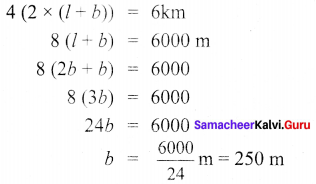
The length of a rectangular field is twice its breadth. Ramu runs around it four times and covered a distance of 6 km. What is the length of the field.
Solution:
Breadth of rectangular field = b m
Length of the field = 2b m
Distance covered in one round = perimeter
Distance covered in 4 rounds = 4 × perimeter
Samacheer Kalvi 6th Maths Solutions Term 3 Chapter 3 Perimeter and Area Additional Questions 1
Length of the field = 2 × 250 = 500 m
Samacheer Kalvi 6th Maths Solutions Term 3 Chapter 3 Perimeter and Area Additional Questions

Question 2.
How many tiles whose length and breadth are 12 cm and 5 cm respectively will be needed to fit in a rectangular region whose length and breadth are 70 cm and 36 cm?
Solution:
Given length of the rectangular region = 70 cm
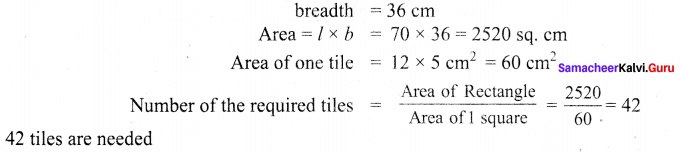
Samacheer Kalvi 6th Maths Solutions Term 3 Chapter 3 Perimeter and Area Additional Questions 2

Question 3.
A room is 4m long and 3m 50cm wide, How many square metres of carpet is needed to cover the floor of the room?
Solution:
Given length of the room = 4 m
Breadth = 3 m 50 cm = 3 m + 50 cm
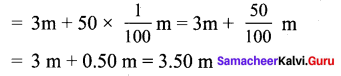
Samacheer Kalvi 6th Maths Solutions Term 3 Chapter 3 Perimeter and Area Additional Questions 3
Carpet needed = Area of the floor = length × breadth
= 4 × 3.5 m = 14 sq. m

Samacheer Kalvi 6th Maths Solutions Term 3 Chapter 3 Perimeter and Area Additional Questions

Question 4.
Find the area of the square Whose side is 14 cm.
Solution:
Side of the square = 14 cm
Area of the square = side × side = (14 × 14) cm2 = 196 sq cm.

Question 5.
Two sides of a triangle are 12 cm and 14 cm. The perimeter of the triangle is 36 cm. What is its third side.
Solution:
Given two sides of a triangle = 12 cm and 14 cm
∴ Perimeter = 36 cm
12 cm + 14 cm + third side = 36 cm
Third side = 36 – 26 = 10 cm
∴ Length of the third side

Samacheer Kalvi 6th Maths Solutions Term 3 Chapter 3 Perimeter and Area Additional Questions Read More »

Samacheer Kalvi 10th Maths Solutions Chapter 3 Algebra Ex 3.7

You can Download Samacheer Kalvi 10th Maths Book Solutions Guide Pdf, Tamilnadu State Board help you to revise the complete Syllabus and score more marks in your examinations.

Tamilnadu Samacheer Kalvi 10th Maths Solutions Chapter 3 Algebra Ex 3.7

Question 1.
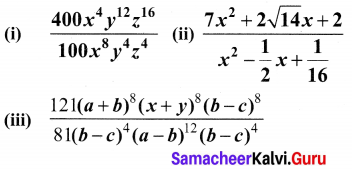
Find the square root of the following rational expressions.
Samacheer Kalvi 10th Maths Chapter 3 Algebra Ex 3.7 1
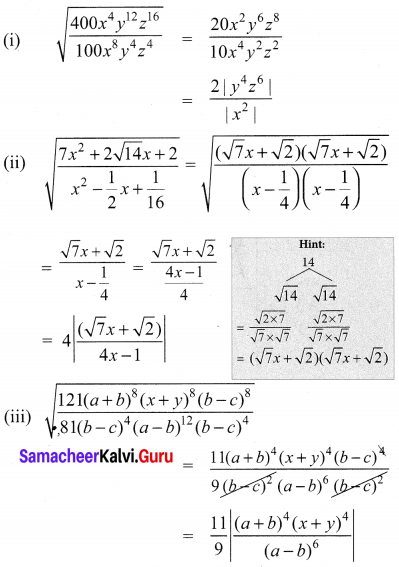
Solution:
Samacheer Kalvi 10th Maths Chapter 3 Algebra Ex 3.7 2

Samacheer Kalvi 10th Maths Solutions Chapter 3 Algebra Ex 3.7

Question 2.
Find the square root of the following
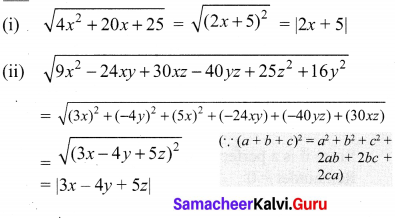
(i) 4x2 + 20x + 25
(ii) 9x2 – 24xy + 30xz – 40yz + 25z2 + 16y2
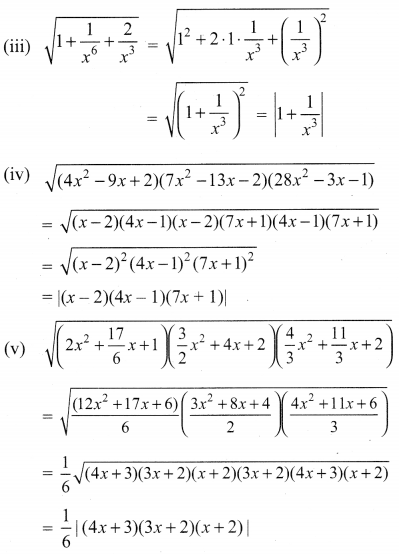
(iii) 1 + \(\frac{1}{x^{6}}+\frac{2}{x^{3}}\)
(iv) (4x2 – 9x + 2) (7x2 – 13x – 2) (28x2 – 3x – 1)
(v) ( 2x2 + \(\frac{17}{6} x\) + 1) (\(\frac{3}{2} x^{2}\) + 4x + 2)(\(\frac{4}{3} x^{2}+\frac{11}{3} x\) + 2)
Solution:
Samacheer Kalvi 10th Maths Chapter 3 Algebra Ex 3.7 3
Samacheer Kalvi 10th Maths Chapter 3 Algebra Ex 3.7 4

Samacheer Kalvi 10th Maths Solutions Chapter 3 Algebra Ex 3.7 Read More »

Samacheer Kalvi 10th Social Science Economics Solutions Chapter 1 Gross Domestic Product and its Growth: an Introduction

You can Download Samacheer Kalvi 10th Social Science Book Solutions Guide Pdf, Tamilnadu State Board help you to revise the complete Syllabus and score more marks in your examinations.

Tamilnadu Samacheer Kalvi 10th Social Science Economics Solutions Chapter 1 Gross Domestic Product and its Growth: an Introduction

Gross Domestic Product and its Growth: an Introduction Textual Exercise

I. Choose the correct answer.

Question 1.
GNP equals …………
(a) NNP adjusted for inflation
(b) GDP adjusted for inflation
(c) GDP plus net property income from abroad
(d) NNP plus net property income or abroad
Answer:
(c) GDP plus net property income from abroad

Question 2.
National Income is a measure of:
(a) Total value of money
(b) Total value of producer goods
(c) Total value of consumption goods
(d) Total value of goods and services
Answer:
(d) Total value of goods and services

Question 3.
Primary sector consist of ………………
(a) Agriculture
(b) Automobiles
(c) Trade
(d) Banking
Answer:
(a) Agriculture

Question 4
………………….. approach is the value added by each intermediate good is summed to estimate the value of the final good.
(a) Expenditure approach
(b) Value-added approach
(c) Income approach
(d) National Income
Answer:
(b) Value-added approach

Question 5.
Which one sector is highest employment in the GDP?
(a) Agricultural sector
(b) Industrial sector
(c) Service sector
(d) None of the above.
Answer:
(c) Service sector

Samacheer Kalvi 10th Social Science Economics Solutions Chapter 1 Gross Domestic Product and its Growth: an Introduction

Question 6.
Gross value added at current prices for services sector is estimated at …………………..
(a) 91.06
(b) 92.26
(c) 80.07
(d) 98.29
Answer:
(b) 92.26

Question 7.
India is …………… larger producer in agricultural product.
(a) 1st
(b) 3rd
(c) 4th
(d) 2nd
Answer:
(d) 2nd

Question 8.
India’s life expectancy at birth is ………………. years.
(a) 65
(b) 60
(c) 70
(d) 55
Answer:
(a) 65

Question 9.
Which one is a trade policy?
(a) irrigation policy
(b) import and export policy
(c) land-reform policy
(d) wage policy
Answer:
(b) import and export policy

Question 10.
Indian economy is:
(a) Developing Economy
(b) Emerging Economy
(c) Dual Economy
(d) All the above
Answer:
(d) All the above

II. Fill in the Blanks.

1. …………….. sector is largest sector in India.
2. GDP is the indicator of ………………. economy.
3. Secondary sector otherwise called as …………..
4. ……………… sector is the growth engine of Indian economy.
5. India is …………….. largest economy of the world.
6. India is ………………. fastest growing nation of the world.
7. ………………. policy envisages rapid industrialization with modernization for attaining rapid economic growth of GDP.
Answers:
1. Service
2. a country’s
3. industry sector
4. Service
5. sixth
6. fifth
7. Industrial

III. Choose the Correct Statement.

Question 1.
The rate of saving is low in India for the following reason
(i) Low per capita income.
(ii) Poor performance and less contribution of public sector.
(iii) Poor contribution of household sector.
(iv) Savings potential of the rural sector not tapped fully.

(a) i, ii and iv are correct
(b) i, ii and iii are correct
(c) i, ii, iii and iv are correct
(d) i, iii and iv are correct
Answer:
(a) i, ii and iv are correct

IV. Match the Following.
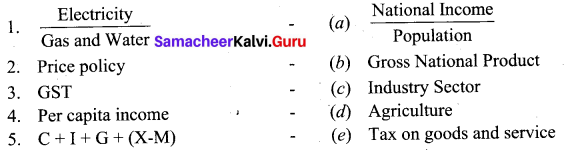
Samacheer Kalvi 10th Social Science Economics Solutions Chapter 1 Gross Domestic Product and its Growth an Introduction 1
Answers:
1. (c)
2. (d)
3. (e)
4. (a)
5 .(b)

V. Give Short Answers.

Question 1.
Define National Income.
Answer:
National Income is a measure of the total value of goods and services produced by an economy over a period of time, normally a year. Commonly National Income is called a Gross National product (or) National Dividend.

Question 2.
What is meant by Gross domestic product?
Answer:
The GDP is the market value of all the final goods and services produced in the country during a time period.

Question 3.
Write the importance of Gross Domestic product.
Answer:

  1. It helps in the study of economic growth of an economy.
  2. To understand to unequal distribution of wealth in an economy.
  3. To analyse the problem of inflation and deflation.
  4. To compare domestic country with the developed countries of the world.
  5. To estimate the purchasing power of the economy.
  6. Helps public sector to frame suitable policies for development.
  7. It acts as a guide to economic planning.

Question 4.
What is per capita income?
Answer:
Per capita income or PCI is an indicator to show the living standard of people in a country. It is obtained by dividing the National Income by the population of a country.

Samacheer Kalvi 10th Social Science Economics Solutions Chapter 1 Gross Domestic Product and its Growth: an Introduction

Question 5.
Define the value added approach with example.
Answer:
The value of each intermediate good is added together to estimate the value of the final good. It is called as value added approach. Eg: In order to find the value of a cup of tea, we need to add the value of tea powder plus milk plus sugar. Here Tea powder, milk and sugar are intermediate goods, whereas tea is the final good. Eg: Tea powder – ₹ 3 /-, Milk – ₹ 5 /-, Sugar – ₹ 2 /- Market price of one cup of tea is ₹ 10 /- (3 + 5 + 2).

Question 6.
Name the sectors contribute to the GDP with examples.
Answer:
Name of the sectors are: (i) Primary sector, (ii) Secondary sector and (Hi) Tertiary sector.

Question 7.
Write the sector wise Indian GDP composition in 2017.
Answer:
Sector wise contribution in GDP of India for the year 2016 – 2017
Primary Sector – 17.09%
Secondary Sector – 29.03%
Tertiary Sector – 52.08%

Question 8.
What are the factors supporting to develop the Indian Economy?
Answer:

  1. A fast growing working age population
  2. Strong Legal system
  3. Many English language speakers
  4. Low wage cost
  5. Highly advanced space technology
  6. External economics of scale.

Question 9.
Write the name of economic policies in India.
Answer:
Name of economic policies in India are:

  • Agriculture Policy
  • Industrial Policy
  • New Economic Policy
  • Trade Policy
  • Employment Policy
  • Currency and Banking Policy
  • Fiscal and Monetary Policy
  • Wage Policy
  • Population Policy

Question 10.
Write a short note on
(i) Gross National Happiness (GNH)
(ii) Human Development Index (HDI).
Answer:
(i) Gross National Happiness: This term was introduced in 1972, by the King of Bhutan Jigme Wang chuck. It is an index which is used to measure the collective happiness and well-being of a population.
(ii) Human Development Index: This term was introduced in 1990 by a Pakistani Economist at the United Nations. It is a composite index of life expectancy at birth, adult literacy rate and standard of living measured in terms of GDP adjusted to purchasing power parity.

VI. Write in detail answer.

Question 1.
Briefly explain various terms associated with measuring of national income.
Answer:
Various terms associated with measuring of national income.
(i) Gross National Product or GNP is the total value of goods and services produced and income received in a year by domestic residents of a country. It excludes profits earned from capital invested abroad.

(ii) Gross Domestic Product or GDP is the total value of output of goods and services produced by the factors of production within the geographical boundaries of the country.

(iii) Net National Product or NNP refers to gross national product, i.e., the total market value of all final goods and services produced by the factors of productions of a country or other polity during a given time period, minus depreciation.

(iv) Net Domestic Product or NDP is a part of Gross Domestic Product. It is obtained from the Gross Domestic Productby deducting the Quantum of ten wear and tear expenses (depreciation).
NDP = GDP – Depreciation

(v) Per Capita Income or PCI is an indicator to show the living standard of people in a country. It is obtained by dividing the National Income by the population of a country.
Per Capita Income = \(\frac{\text { National Income }}{\text { Population }}\)

(vi) Personal Income or PI is the total money income received by individuals and households of a country from all possible services before direct taxes. Personal income can be expressed as follows:
PI = NI Corporate Income Texes – Undistributed Corporate Profits – Social Security Contributions + Transfer payment.

(vii) Disposable Income or DI means actual income which can be spent on consumption by . individuals and families. It can expressed as DPI = PI – Direct Taxes.

Question 2.
What are the methods of calculating Gross Domestic Product?
Answer:
Explain it.
There are three methods to calculate Gross Domestic Product.
(i) Expenditure Approach
(ii) Income Approach
(iii) Value-Added Approach

(i) Expenditure Approach: According to this method, the expenditure on all the final goods and services produced in the country during a specific period are added together, to get the GDP.
Y = C + I + G + (X – M)
Y – National Income
C – Consumption Expenditure,
I – Investment Expenditure
G – Government Expenditure,
X – Exports
M – Imports.

(ii) The Income Approach: In this method, the earnings of all the men and women who are involved in producing goods and services are added together to measure GDP.
Y = W + R + I + π
Y = National Income, W- Wages,
R – rent, I – interest, π – profit

(iii) Value-Added Approach: In this method, the value of each intermediate good is added together to estimate the value of final goods. The sum of the value of all the final goods gives us the total value of the final goods produced in the economy, which is Measured as GDP.

GDP = Sum of final goods produced in the economy Sf
Sf = Sum of Intermediate goods produced in the economy.

Question 3.
Write about the composition of GDP in India.
Answer:
Indian economy is broadly divided into three sectors which contribute to the GDP –
(i) Primary Sector – It includes agriculture-based allied activities, production of raw materials such as cattle farm, fishing, mining, forestry etc. It is also called agricultural sector.

(ii) Secondary Sector – It includes industries that produce a finished, usable product or are involved in construction. This sector generally takes the output of the primary sector and manufactures finished goods. It is also called industrial sector.

(iii) Tertiary Sector – It is known as service sector and includes transport, insurance, banking, trade, education, health care etc. ’

Question 4.
Write the differences between the growth and development.
Answer:
Differences between the Economic growth and Economic development

Economic Growth Economic Development
(i) It is the positive quantitative change in the output of an economy in a particular time period (i) It consider the rise in the output in an economy along with the advancement of HDI index which considers a rise in living standards, advancement in technology and overall happiness index of a nation.
(ii) Economic growth is the ‘narrower’ concept. (ii) Economic development is the ‘broader’ concept.
(iii) Quantitative in nature. (iii) Qualitative in nature.
(iv) Rise in parameters like, GDP, GNP, FDI, FII etc. (iv) Rise in life expectancy rate, infant, improvement in literacy fate, infant mortality rate and poverty rate etc.
(v) Short term in nature. (v) Long-term in nature.
(vi) It is applicable in developed nations. (vi) It is applicable in developing co countries.
(vii) It is measured by increase in national income.                    , (vii) It is measured by increase in real national income, i.e., per capita income.
(viii) It occurs in a certain period of time. (viii) It is a continuous process.

Question 5.
Explain the development path based on GDP and employment.
Answer:

  1. In the earlier stages of Indian Independence, India remained as closed economy and the interaction with the outside world remained limited.
  2. The reason for closed trade was to give importance to domestic industries and reduce the dependence on foreign products and companies.
  3. Later in the year 1991, India adopted free trade policy, and liberalised the economy.
  4. It has given permission for the foreign companies to enter into the Indian economy.
  5. To give employment to the increasing size of work force, a thrust was given to employment generation under the Five year plans.
  6. Rural Development was also given special importance.
  7. Eradication of poverty became a very important part in context of Rural Development.
  8. The private companies and Industries were subject to strict rules and regulations.
  9. It was believed that the social welfare of the people could be possible only by the government, therefore it gained importance.
  10. India’s Per Capita Income have doubled in 12 years.
  11. India falls under Middle Income country category.
  12. There is reduction in poverty percentage and the life expectancy at birth is 65 years.
  13. 44% of children under 5 are malnourished.
  14. The literacy rate for the population of 15 years of age is only 63% compared to 71% of other middle income countries.
  15. India has followed a different path of development by moving from agricultural sector to service sector very quickly. This help India to expect emerging Industrialists in Indian Economy.

Question 6.
Explain the following the economic policies
1. Agricultural Policy
2. Industrial policy
3. New economic policy.
Answer:
Many economic policies have been framed by the Government of India since independence for increasing rate of economic growth and economic development. The important economic policies are :
(i) Agricultural Policy – This policy is the set of Government decisions and actions relating to domestic agriculture and imports of foreign agricultural products. Governments usually implement agricultural policies with the goal of achieving a specific outcome in the domestic agricultural product markets. Some agricultural policies are price policy, land reform policy, irrigation policy, food policy etc.

(ii) Industrial Policy – It is a very important aspect of any economy. It create employment, promotes research and development, leads to modernisation and ultimately make the economy self sufficient. Several industrial policies since 1948 have come into existence – textile industrial policy, sugar industry policy, price policy of industrial growth etc.

(iii) New Economic Policy – The economy of India had undergone a significant policy shifts in the beginning of the 1990s. This new model of economic reforms is commonly known as the LPG or Liberalisation, Privatisation and Globalisation model. The primary objective of this model was to make the economy of India the fastest developing economy in the globe with capabilities that help at match up with the biggest economies of the world. These economic reforms influenced the overall economic growth of the country in a significant manner.

Gross Domestic Product and its Growth: an Introduction Additional Questions

I. Choose the correct answer.

Question 1.
What is ‘H’ in GNH?
(a) Holislic
(b) Happiness
(c) Human
(d) Hazardous
Answer:
(b) Happiness

Question 2.
Goods are …………………
(a) Tangible
(b) Intangible
(c) Both (a) and (b)
(d) services
Answer:
(a) Tangible

Question 3.
What is India’s world rank in industrial sector?
(a) 6
(b) 7
(c) 8
(d) 9
Answer:
(a) 6

Question 4.
…………………. is the market value of all goods and services produced in the country.
(a) GNP
(b) GDP
(c) NNP
(d) NDP
Answer:
(b) GDP

Question 5.
India finally decided to liberalise its economy in the year …………..
(a) 1991
(b) 1995
(c) 2000
(d) 2001
Answer:
(a) 1991

Question 6.
The Goods and Services are measured in terms of ………………… of that country.
(a) wealth
(b) currency
(c) type
(d) size
Answer:
(b) currency

Question 7.
Income method sums all forms of …………
(a) Expenditure
(b) Income
(c) Savings
Answer:
(b) Income

Question 8.
Only those goods and services that has a market value are included in the …………………
(a) GNP
(b) GDP
(c) NNP
(d) NDP
Answer:
(b) GDP

Question 9.
The primary function of the Government is …………….
(a) to maintain law and order
(b) Military defence
(c) Social Security measures
Answer:
(a) to maintain law and order

Question 10.
According to Economists Tyler and Alex, Final goods and services a part of other goods and services ………………… a part of other goods and services
(a) will be
(b) will not be
(c) fully
(d) None
Answer:
(b) will not be

Question 11.
Economic development is the process as well as an increase in real …………. income.
(a) individual
(b) family
(c) national
Answers:
(c) national

Samacheer Kalvi 10th Social Science Economics Solutions Chapter 1 Gross Domestic Product and its Growth: an Introduction

II. Fill in the Blanks:

1. Economic development focuses on balanced and ……….. distribution of wealth among all individuals and tries to uplift the downgrade society.
2. The GDP of the United States of America is 19.3 trillion USD and ranked ………….
3. Human development Index is apt tool to measure the real development in an …………….
4 ………….. has emerged as a hub of global software business.
5. In India the GDP is measured both annually and …………….
6. Economic growth means an increase in ……………. and …………. in an economy.
7. Human Resources are ……………. for economic development.
8. Per capita income is calculated by dividing National Income by ……………
9. Per capita income is an indicator of …………… in a country.
10. Economic development is economic growth and allocation of resources from primary sector ………… to sector.
11. Tertiary sector is known as ……………
Answers:
1. equitable
2. one
3. economy
4. Bangalore
5. quarterly
6. production of good, services
7. instruments
8. population
9. living standard of people
10. tertiary
11. service sector

III. Match the Following.

Samacheer Kalvi 10th Social Science Economics Solutions Chapter 1 Gross Domestic Product and its Growth an Introduction 4
Answers:
1. (d)
2. (a)
3. (e)
4. (c)
5. (b)

IV. Answer in brief.

Question 1.
What are the four pillars of Gross National Happiness Index?
Answer:
The four pillars of GNHI are

  1. Sustainable and equitable socio-economic development
  2. Environmental conservation
  3. Preservation and Promotion of culture
  4. Good Governance

Question 2.
“India has followed a different path of development from many other countries”. Explain.
Answer:
India has gone more quickly from agriculture to services that tend to be less tightly regulated than heavy industry. There are some emerging manufacturing giants in the Indian economy.

Question 3.
What do you understand by the term ‘double counting’?
Answer:
The value of final goods are included in the calculation of GDP, but not the value of Intermediate goods. This is because the value of the Intermediate goods is already included in the final good. So, if it is added again it will result in double counting.

Question 4.
What are the nine domains of Gross National Happiness or GNH?
Answer:
The nine domains of GNH are – psychological well-being, health, time use, education, cultural diversity and resilience, good governance, community vitality, ecological diversity and resilience, and living standards.

Question 5.
What is meant by Market value?
Answer:
The price at which the goods and services are sold in the market is called as Market value.

Question 6.
Write a note on Income method.
Answer:

  • Income method is one of the methods of calculating National Income.
  • In this method, the income and payments received by all the people in the country are calculated.

Question 7.
What are the key parameters of Economic Growth?
Answer:
The key parameters of Economic Growth in an economy are its Gross Domestic Product (GDP) and Gross National Product (GNP) which helps in measuring the actual size of an economy.

Samacheer Kalvi 10th Social Science Economics Solutions Chapter 1 Gross Domestic Product and its Growth: an Introduction

Question 8.
What is Net Domestic Product?
Answer:
Net Domestic Product is obtained from the Gross Domestic Product by deducting the Quantum of tear and wear expenses (depreciation).
NDP = GDP (-) Depreciation.

Question 9.
What are the nine domains of GNHI?
Answer:

  1. Psychological well-being
  2. health
  3. time-use
  4. Education
  5. Cultural diversity and Resilience
  6. Good governance
  7. Community vitality
  8. Ecological diversity
  9. Living standards.

Question 10.
What are the basic concepts of National Income?
Answer:

  1. Gross National Product (GNP)
  2. Gross Domestic Product (GDP)
  3. Net National Product (NNP)
  4. Net Domestic Product (NDP)
  5. Per Capita Income (PCI)
  6. Personal Income (PI)
  7. Disposable Income (DI)

Question 11.
What is meant by GNP Deflator?
Answer.
It means the change in the Gross National Product (GNP) with the change in the price levels symbolically.\(\frac{\Delta \mathrm{GNP}}{\Delta \mathrm{P}}\)

Question 12.
What are called sectors?
Answer:
Sectors are the groups of various economic activities that produced goods and services.

Question 13.
Why is the primary sector also called agricultural and related sector?
Answer:
Since most of the natural products we get are from Agriculture based allied activities. Production of raw materials such as cattle farm, dairy, fishing, mining, forestry, com and coal. The primary sector is also called agriculture and related sector.

Question 14.
Why is the tertiary sector also called the ‘Service Sector’?
Answer:
Since the activities that fall under the tertiary sector generate services rather than goods, this sector is also called the service sector.

V. Answer in detail.

Question 1.
What are the limitations of the Gross Domestic Product?
Answer:
The GDP is the most widely used measure of the state of the economy. While appreciating its usefulness, we should be aware of some of its limitations –
(i) Several important goods and services are left out of the GDP – The GDP includes only the goods and services sold in the market. Clean air. which is vital for a healthy life, has no market value and is left out of the GDP.

(ii) GDP measures only quantity but not quality – In the 1970s schools and banks were not allowed to use ball point pens r because of their poor quality. Since then, not only has these been a substantial increase in the quantity of ballpoint pens produced in India but their quality has also improved a lot. The improvement in quality of goods is very important but it is not captured by the GDP.

(iii) GDP does not tell us about the way income is distributed in the country – The GDP of a country’ may be growing rapidly but income may be distributed to unequally that only a small percentage of people may be benefiting from it.

(iv) GDP does not tell us about the kind of life people are living – A high level of per capita real GDP can go hand – in – hand with very low health condition of people, an undemocratic political system, high pollution and high suicide rate.

Samacheer Kalvi 10th Social Science Economics Solutions Chapter 1 Gross Domestic Product and its Growth: an Introduction

Question 2.
Write a detailed note on the measurement of GDP.
Answer:
(i) The GDP Gross Domestic Product of a country measures the market value of goods and services produced during a particular period of time.

(ii) In the measurement of GDP, the GDP of the previous years are not included. Eg: the GDP of 2018 will include the market value of goods and services produced only during 2018.

(iii) In India, GDP is measured both annually and in quarterly.

(iv) The Annual GDP financial year (2017-18) is from 1st April 17 to 31st March 18.

(v) The quarterly GDP for any financial year is calculated by dividing the year into 4 quarters with 3 months each.

1st Quarter – April, May, June (Q1)
2nd Quarter – July, Aug, Sept (Q2)
3rd Quarter – Oct, Nov ,Dec (Q3)
4th Quarter – Jan, Feb, March (Q4)
(vi) The GDP of Q2 will not include GDP of Q1 and vice versa. This means, only the goods and services produced in that quarter is included for the measurement of GDP.

Samacheer Kalvi 10th Social Science Economics Solutions Chapter 1 Gross Domestic Product and its Growth: an Introduction Read More »

Samacheer Kalvi 7th Maths Solutions Term 1 Chapter 3 Algebra Ex 3.2

Students can Download Maths Chapter 3 Algebra Ex 3.2 Questions and Answers, Notes Pdf, Samacheer Kalvi 7th Maths Book Solutions Guide Pdf helps you to revise the complete Tamilnadu State Board New Syllabus and score more marks in your examinations.

Tamilnadu Samacheer Kalvi 7th Maths Solutions Term 1 Chapter 3 Algebra Ex 3.2

Question 1.
Fill in the blanks
(i) The addition of – 7b and 2b is _______
(ii) The subtraction of 5m from -3m is ______
(iii) The additive inverse of -37xyz is _____
Solution:
(i) -5b
(ii) -8m
(iii) 37xyz

Question 2.
Say True or False
(i) The expressions 8x + 3y and 7x + 2y cannot be added
(ii) If x is a natural number, then x + 1 is its predecessor.
Hint: x – 1 is its predecessor.
(iii) Sum of a – b + c and -a + b – c is zero
Solution:
(i) False
(ii) False
(iii) True

Question 3.
Add: (i) 8x, 3x
(ii) 7mn, 5mn
(iii) -9y, 11y, 2y
Solution:
(i) 8x + 3x = (8 + 3) x = 11x
(ii) 7mn + 5mn = (7 + 5)mn = 12mn
(iii) -9y + 11y + 2y =(-9 + 11 + 2 )y = (2 + 2)y = 4y

Question 4.
Subtract:
(i) 4k from 12k
(ii) 15q from 25q
(iii) 7xyz from 17xyz
Solution:
(i) 4k from 12k
12k – 4k = (12 – 4) k = 8k
(ii) 15q from 25q
25q – 15q = (25 – 15)q = 10q
(iii) 7xyz from 17xyz
17xyz – 7xyz = (17 – 7)xyz = 10xyz

SamacheerKalvi.Guru

Question 5.
Find the sum of the following expressions
(i) 7p + 6q, 5p – q, q + 16p
Solution:
(7p + 6q) + (5p – q) + (q + 16p) = 7p + 6q + 5p – q + q + 16p
= (7p + 5p + 16p) + (6q – q + q)
= (7 + 5 + 16) p + (6 – 1 + 1) q
= (12 + 16) p + 6q = 28p + 6q

(ii) a + 5b + 7c, 2a + 106 + 9c
Solution:
(a + 5b + 7c) + (2a + 10b + 9c) = a + 5b + 7c + 2a + 10b + 9c
= a + 2a + 5b + 10b + 7c + 9c
= (1 + 2)a + (5 + 10)b + (7 + 9)c
= 3a + 15b + 16c

(iii) mn + t, 2mn – 2t, – 3t + 3mn
Solution:
(mn + t) + (2mn – 2t) + (-3t + 3mn)
= mn + t + 2mn – 2t + (-3t) + 3mn
= (mn + 2mn + 3mn) + (t – 2t – 3t)
= (1 + 2 + 3) mn + (1 – 2 – 3) t
= 6mn + (1 – 5)t
= 6mn + (- 4) t
= 6mn – 4t

(iv) u + v, u – v, 2u + 5v, 2u – 5v
Solution:
(u + v) + (u – v) + (2u + 5v) + (2u – 5v)
= u + v + u – v + 2u + 5v + 2u – 5v
= u + u + 2u + 2u + v – v + 5v – 5v
= (1 + 1 + 2 + 2) u +(1 – 1 + 5 – 5)v = 6u + 0v
= 6u

(v) 5xyz – 3xy, 3zxy – 5yx
Solution:
5xyz – 3xy + 3zxy – 5yx = 5xyz + 3xyz – 3xy – 5xy
= (5 + 3) xyz + [(-3) + (-5)] xy = 8xyz + (-8) xy
= 8xyz – 8xy

Question 6.
Subtract
(i) 13x + 12y – 5 from 27x + 5y – 43
Solution:
27x + 5y – 43 – (13x + 12y – 5) = 27z + 5y – 43 + (-13x – 12y + 5)
= 27x + 5y – 43 – 13x – 12y + 5
= (27 – 13) x + (5 – 12)y + (- 43) + 5
= 14x + (- 7) y + (- 38) = 14x – 7y – 38

(ii) 3p + 5 from p – 2q + 7
Solution:
p – 2q + 7 – (3p + 5) = p – 2q + 7 + (- 3p – 5)
= p – 2q + 7 – 3p – 5 = p – 3p – 2q + 7 – 5
= (1 – 3)p – 2q + 2 = -2p – 2q + 2

(iii) m + n from 3m – 7n
Solution:
3m – 7n – (m + n) = 3m – 7n + (-m – n)
= 3m – 7n – m – n = (3m – m) + (-7n – n)
= (3 – 1 )m + (-7 – 1) n = 2m + (-8) n
= 2m – 8n

(iv) 2y + z from 6z – 5y
Solution:
6z – 5y – (2y + z) = 6z – 5y + (-2y – z)
= 6z – 5y – 2y – z = 6z – z – 5y – 2y
= (6 – 1) z + (-5 -2) y = 5z + (-7) y
= 5z – 7y = -7y + 5z

Question 7.
Simplify
(i) (x + y – z) + (3x – 5y + 7z) – (14x + 7y – 6z)
Solution:
(x + y – z) + (3x – 5y + 7z) – (14x – 7y – 6z)
= (x + y – z) + (3x – 5y + 7z) + (-14x – 7y + 6z)
= (x + 3x – 14x) + (y – 5y – 7y) + (-z + 7z + 6z)
= (1 + 3 – 14) x + (1 – 5 – 7)y + (-1 + 7 + 6) z
= – 10x – 11y + 12z

(ii) p + p + 2 + p + 3 + p – 4 – p – 5 + p + 10
Solution:
p + p + 2 + 3 – p – 4 – p – 5 + p + 10 = (p + p + p – p – p + p) + (2 + 3 – 4 – 5 + 10)
= (1 + 1 + 1 – 1 – 1 + 1) p + 6 = 2p + 6

(iii) n + (m + 1) + (n + 2) + (m + 3) + (n + 4) + (m + 5)
Solution:
n + (m + 1) + (n + 2) + (m + 3) + (n + 4) + (m + 5)
= n + m + 1 + n + 2 + m + 3 + n + 4 + m + 5
= n + n + n + m + m + m + 1 + 2 + 3 + 4 + 5
= (1 + 1 + 1)n + (1 + 1 + 1)m + 15
= 3n + 3m + 15 = 3m + 3n + 15

Objective Type Questions

Question 8.
The addition of 3mn, -5mn, 8mn and – 4mn is
(i) mn
(ii) – mn
(iii) 2mn
(iv) 3mn
Solution:
(iii) 2mn
Hint: = 3 mn + 8mn – 5 mn – 4 mn = 11 mn – 9 mn = 2 mn

SamacheerKalvi.Guru

Question 9.
When we subtract ‘a’ from ‘-a’, we get ______
(i) a
(ii) 2a
(iii) -2a
(iv) -a
Solution:
(iii) -2a
Hint: – a – a = – 2a

Question 10.
In an expression, we can add or subtract only _____
(i) like terms
(ii) unlike terms
(iii) all terms
(iv) None of the above
Solution:
(i) like terms

Samacheer Kalvi 7th Maths Solutions Term 1 Chapter 3 Algebra Ex 3.2 Read More »

Samacheer Kalvi 7th Maths Solutions Term 1 Chapter 4 Direct and Inverse Proportion Additional Questions

Students can Download Maths Chapter 4 Direct and Inverse Proportion Additional Questions and Answers, Notes Pdf, Samacheer Kalvi 7th Maths Book Solutions Guide Pdf helps you to revise the complete Tamilnadu State Board New Syllabus and score more marks in your examinations.

Tamilnadu Samacheer Kalvi 7th Maths Solutions Term 1 Chapter 4 Direct and Inverse Proportion Additional Questions

Exercise 4.1

Question 1.
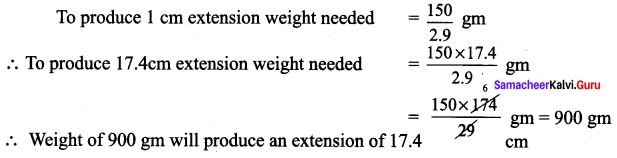
The amount of extension in an elastic spring varies directly as the weight hung on it. If a weight of 150 gm produces an extension of 2.9 cm, then what weight would produce an extension of 17.4 cm?
Solution:
To produce 2.9 cm extension weight needed = 150 gm
Samacheer Kalvi 7th Maths Solutions Term 1 Chapter 4 Direct and Inverse Proportion Additional Questions 74

Question 2.
Reeta types 540 words during half on hour. How many words would she type in 12 minutes?
Solution:
In \(\frac{1}{2}\) an hour number of words typed = 540
i.e., In 30 min No. of words typed = 540
Samacheer Kalvi 7th Maths Solutions Term 1 Chapter 4 Direct and Inverse Proportion Additional Questions 75
= 18
In 12 minutes number of words typed = 18 × 12
= 216
216 words can be typed in 12 min

Question 3.
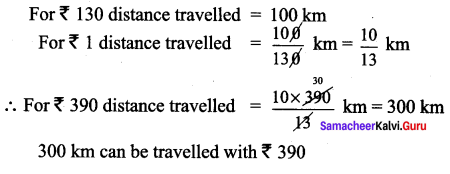
A call taxi charges ₹ 130 for 100 km. How much would one travel for ₹ 390?
Solution:
Samacheer Kalvi 7th Maths Solutions Term 1 Chapter 4 Direct and Inverse Proportion Additional Questions 76

Exercise 4.2

Question 1.
In the following table find out x and y vary directly or inversely?
Samacheer Kalvi 7th Maths Solutions Term 1 Chapter 4 Direct and Inverse Proportion Additional Questions 40
Solution:
From the table itself we observe that as x increases y decreases.
∴ x and y are inversely proportional
∴ xy = 8 × 32 = 16 × 16 = 32 × 8 = 256 × 1 = 256

Question 2.
If x and y vary inversely as each other and x = 10 when y = 6. Find y when x = 15.
Solution:
Since x and y vary inversely as each other
xy = constant
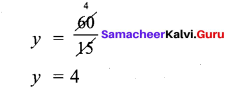
10 × 6 = 15 xy
60 = 15y
Samacheer Kalvi 7th Maths Solutions Term 1 Chapter 4 Direct and Inverse Proportion Additional Questions 41

Question 3.
If x and y vary inversely and if y = 35 find x when constant of variation is 7.
Solution:
Given x andy are inversely proportional
xy = constant
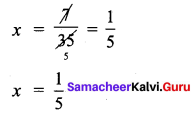
when y = 35 and constant = 7 ; x × 35 = 7
Samacheer Kalvi 7th Maths Solutions Term 1 Chapter 4 Direct and Inverse Proportion Additional Questions 42

Exercise 4.3

Question 1.
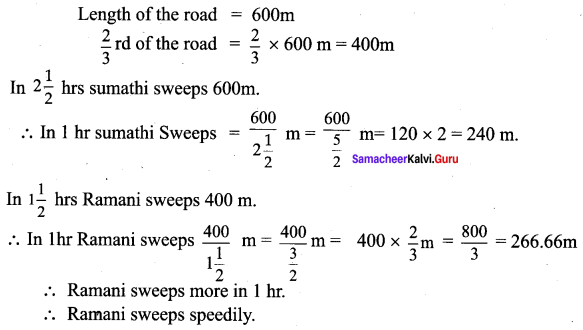
Sumathi sweeps 600 m long road in 2\(\frac{1}{2}\) hrs. Ramani sweeps \(\frac{2}{3}\) rd of same road in 1\(\frac{1}{2}\) hrs. Who sweeps more speedily?
Solution:
Samacheer Kalvi 7th Maths Solutions Term 1 Chapter 4 Direct and Inverse Proportion Additional Questions 33

Question 2.
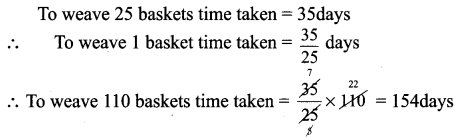
Suma weaves 25 baskets in 35 days. In how many days will she weave 110 baskets?
Solution:
Samacheer Kalvi 7th Maths Solutions Term 1 Chapter 4 Direct and Inverse Proportion Additional Questions 34

Samacheer Kalvi 7th Maths Solutions Term 1 Chapter 4 Direct and Inverse Proportion Additional Questions Read More »

Samacheer Kalvi 6th Maths Solutions Term 2 Chapter 5 Information Processing Additional Questions

You can Download Samacheer Kalvi 6th Maths Book Solutions Guide Pdf, Tamilnadu State Board help you to revise the complete Syllabus and score more marks in your examinations.
Samacheer Kalvi 6th Maths Solutions Term 2 Chapter Chapter 5 Information Processing Additional Questions

Tamilnadu Samacheer Kalvi 6th Maths Solutions Term 2 Chapter 5 Information Processing Additional Questions

Question 1.
Draw tree diagrams for the following questions:
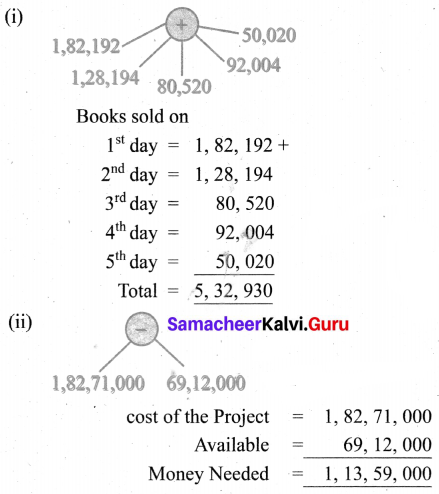
(i) The number of books sold in a book fair is as follows. First day 1,82,192, Second day 1,28,194, Third day 80,520 fourth day 92,004 and the fifth day 50,020. Find the total number of the book sold.
(ii) A water purification project cost 1,82,71,000. The machinery was bought for ₹ 69,12,000. What is the amount needed to complete the project?
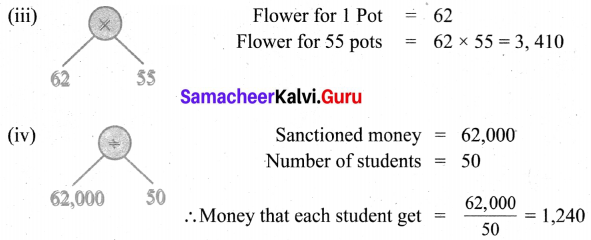
(iii) The number of flowers needed to arrange in a flower pot is 62. Find the number of flowers needed to arrange in 55 pots?
(iv) If the total scholarship money sanctioned for 50 students are ₹ 62,000. Find the amount that each student can get?
Solution:
Samacheer Kalvi 6th Maths Solutions Term 2 Chapter 5 Information Processing Additional Questions Q1
Samacheer Kalvi 6th Maths Solutions Term 2 Chapter 5 Information Processing Additional Questions Q1.1

Samacheer Kalvi 6th Maths Solutions Term 2 Chapter Chapter 5 Information Processing Additional Questions

Question 2.
Convert into tree diagrams
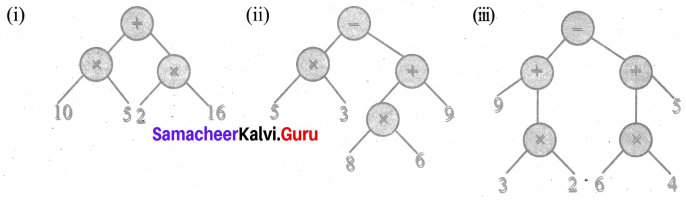
(i) (10 × 5) + (2 × 16)
(ii) (5 × 3) – (8 × 6) + 9
(iii) [9 + (3 × 2)] – [(6 × 4) + 5]
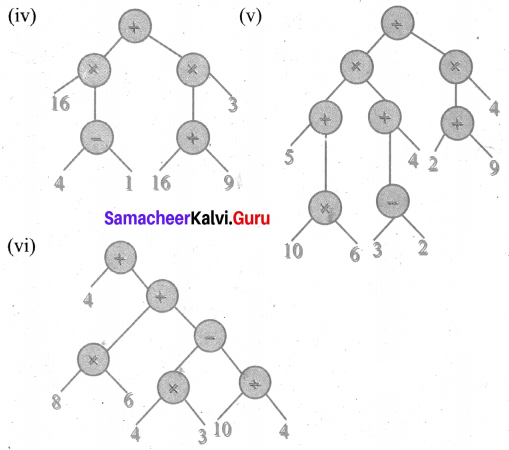
(iv) [(4 – 1) × 16] + [(16 + 9) × 3]
(v) {[(10 × 6) + 5] × [ 4 + (3 – 2)]} ÷ [4 × (2 + 9)]
(vi) 4 + [8 × 6 + {(4 × 3) – (10 ÷ 4)}]
Solution:
Samacheer Kalvi 6th Maths Solutions Term 2 Chapter 5 Information Processing Additional Questions Q2
Samacheer Kalvi 6th Maths Solutions Term 2 Chapter 5 Information Processing Additional Questions Q2.1

Question 3.
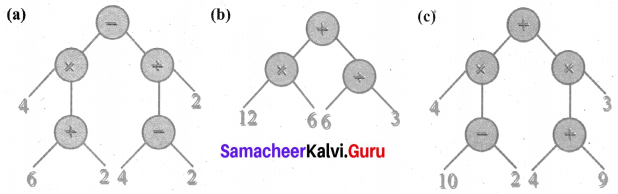
Convert the following tree diagrams into numerical expressions.
Samacheer Kalvi 6th Maths Solutions Term 2 Chapter 5 Information Processing Additional Questions Q3

Samacheer Kalvi 6th Maths Solutions Term 2 Chapter Chapter 5 Information Processing Additional Questions

Solution:
(a) [4 × (6 + 2)] – [(4 – 2) ÷ 2]
(b) (12 × 6) + (6 ÷ 3)
(c) [4 × (10 – 2)] + [(4 + 9) × 3]

Samacheer Kalvi 6th Maths Solutions Term 2 Chapter 5 Information Processing Additional Questions Read More »

Samacheer Kalvi 6th Maths Solutions Term 3 Chapter 1 Fractions Ex 1.2

You can Download Samacheer Kalvi 6th Maths Book Solutions Guide Pdf, Tamilnadu State Board help you to revise the complete Syllabus and score more marks in your examinations.
Samacheer Kalvi 6th Maths Solutions Term 3 Chapter 1 Fractions Ex 1.2

Tamilnadu Samacheer Kalvi 6th Maths Solutions Term 3 Chapter 1 Fractions Ex 1.2

Miscellaneous Practice Problems

Question 1.
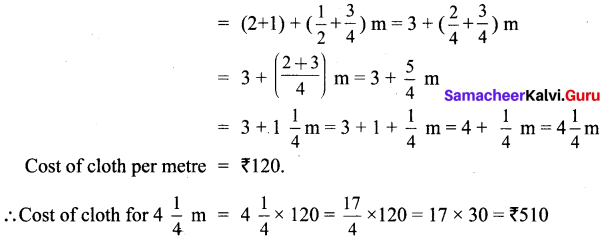
Sankari purchased 2\(\frac{1}{2}\) m cloth to stitch a long skirt and 1\(\frac{3}{4}\) m cloth to stitch blouse. If the cost is ₹ 120 per metre then find the cost of cloth purchased by her
Solution:
Cloth to stitch a long skirt = 2\(\frac{1}{2}\) m
Cloth to stitch a blouse = 1\(\frac{3}{4}\) m
Total length of the cloth = \(2 \frac{1}{2}+1 \frac{3}{4} m=2+\frac{1}{2}+1+\frac{3}{4}\) m
Samacheer Kalvi 6th Maths Solutions Term 3 Chapter 1 Fractions Ex 1.2 1
Cost of cloth purchased by Sankari = ₹ 510

Question 2.
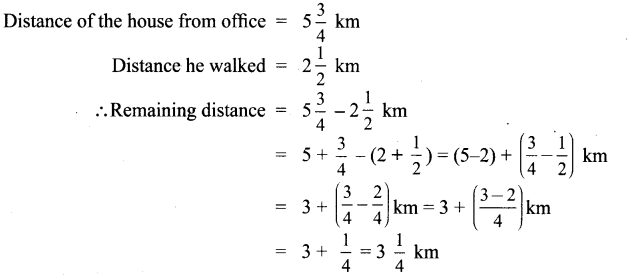
From his office, a person wants to reach his house on foot which is at a distance of 5\(\frac{3}{4}\) km. If he had walked 2\(\frac{1}{2}\) km, how much distance still he has to walk to reach his house?
Solution:
Samacheer Kalvi 6th Maths Solutions Term 3 Chapter 1 Fractions Ex 1.2 2
Distance still he has to be walked = 3\(\frac{1}{4}\) km

Samacheer Kalvi 6th Maths Solutions Term 3 Chapter 1 Fractions Ex 1.2

Question 3.
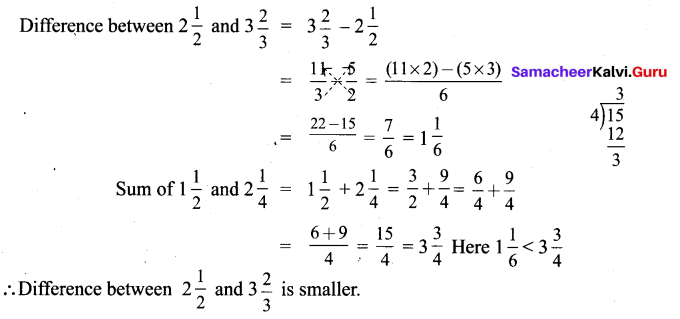
Which is smaller? The difference between \(\frac{1}{2}\) and 3\(\frac{2}{3}\) or the sum of 1\(\frac{1}{2}\) and 2\(\frac{1}{4}\)
Solution:
Samacheer Kalvi 6th Maths Solutions Term 3 Chapter 1 Fractions Ex 1.2 3

Question 4.
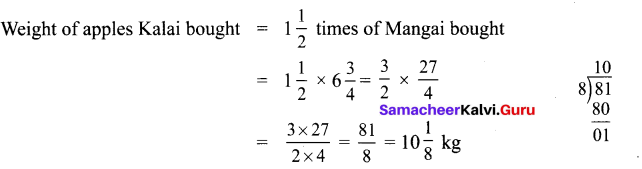
Mangai bought 6\(\frac{3}{4}\) kg of apples. If Kalai bought 1\(\frac{1}{2}\) times as Mangai bought, then how many kilograms of apples did Kalai buy?
Solution:
Weight of apples Mangai bought = 6\(\frac{3}{4}\) kg
Samacheer Kalvi 6th Maths Solutions Term 3 Chapter 1 Fractions Ex 1.2 4
Weight of apples Kalai bought = 10\(\frac{1}{8}\) kg

Question 5.
The length of the staircase is 5 \(\frac{1}{2}\) m. If one step is set at \(\frac{1}{4}\) m, then how many steps will be there in the staircase?
Solution:
Length of the staircase = 5\(\frac{1}{2}\) m
Distance between each step = \(\frac{1}{4}\) m
∴ Number of steps in the staircase = \(5 \frac{1}{2} \div \frac{1}{4}=\frac{11}{2} \div \frac{1}{4}=\frac{11}{2} \times \frac{4}{1}\) = 22
There will be 22 steps in the staircase

Challenge Problems

Question 6.
By using the following clues, find who am I?
(i) Each of my numerator and denominator is a single-digit number.
(ii) The sum of my numerator and denominator is a multiple of 3.
(iii) The product of my numerator and denominator is a multiple of 4
Solution:
The numerator may be any one of!, 2, 3,4, 5, 6, 7, 8, 9 and the denominator may be any one of 1, 2,3,4, 5,6, 7,8,9. Sum of numerator and denominator is a multiple of 3.
∴ Possible proper fractions are \(\frac{1}{2}, \frac{1}{5}, \frac{1}{8}, \frac{2}{4}, \frac{2}{7}, \frac{3}{6}, \frac{3}{9}, \frac{4}{5}, \frac{4}{8}, \frac{5}{7}, \frac{6}{9}\)
Also given the product of numerator and denominator is a multiple of 4.
∴ Possible fractions are \(\frac{1}{8}, \frac{2}{4}, \frac{4}{5}, \frac{4}{8}\)

Question 7.
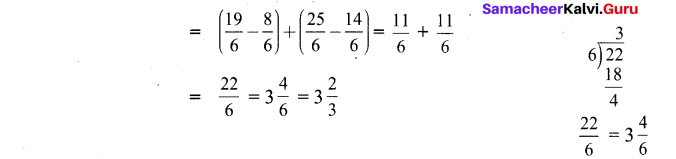
Add the difference between 1\(\frac{1}{3}\) and 3\(\frac{1}{6}\) and the difference between 4\(\frac{1}{6}\) and 2\(\frac{1}{3}\)
Solution:
Samacheer Kalvi 6th Maths Solutions Term 3 Chapter 1 Fractions Ex 1.2 5
Samacheer Kalvi 6th Maths Solutions Term 3 Chapter 1 Fractions Ex 1.2 6

Samacheer Kalvi 6th Maths Solutions Term 3 Chapter 1 Fractions Ex 1.2

Question 8.
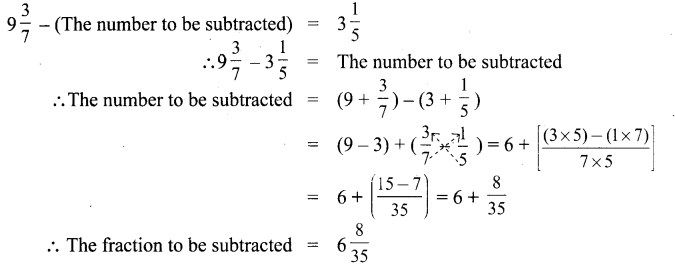
What fraction is to be subtracted from 9\(\frac{3}{7}\) to get 3\(\frac{1}{5}\) ?
Solution:
Samacheer Kalvi 6th Maths Solutions Term 3 Chapter 1 Fractions Ex 1.2 7

Question 9.
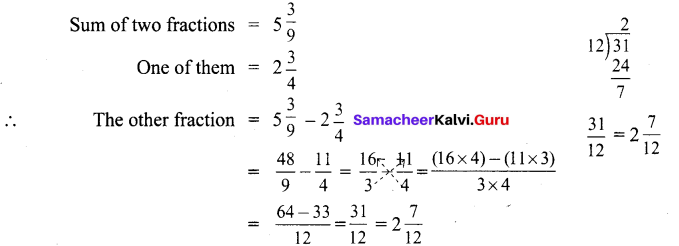
The sum of two fractions is 5\(\frac{3}{9}\). If one of the fractions is 2\(\frac{3}{4}\), find the other fraction.
Solution:
Samacheer Kalvi 6th Maths Solutions Term 3 Chapter 1 Fractions Ex 1.2 8
The other number is 2\(\frac{7}{12}\)

Samacheer Kalvi 6th Maths Solutions Term 3 Chapter 1 Fractions Ex 1.2

Question 10.
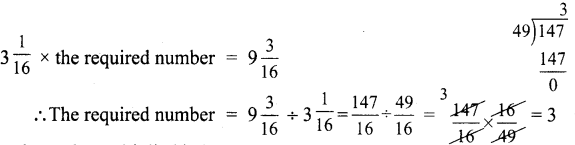
By what number should 3\(\frac{1}{16}\) be multiplied to get 9\(\frac{3}{16}\) ?
Solution:
Samacheer Kalvi 6th Maths Solutions Term 3 Chapter 1 Fractions Ex 1.2 9
The number to be multiplied is 3.

Question 11.
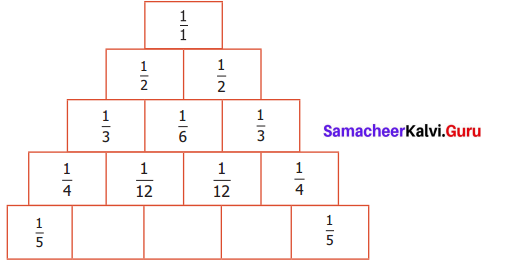
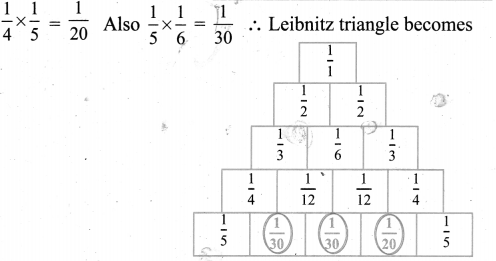
Complete the fifth row in the Leibnitz triangle which is based on subtraction.
Samacheer Kalvi 6th Maths Solutions Term 3 Chapter 1 Fractions Ex 1.2 10
Solution:
Samacheer Kalvi 6th Maths Solutions Term 3 Chapter 1 Fractions Ex 1.2 11

Question 12.
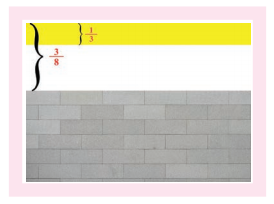
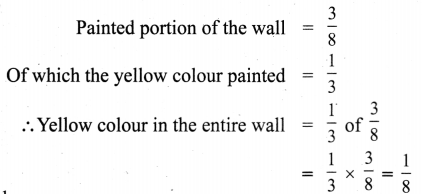
A painted \(\frac{3}{8}\) of the wall of which one third is painted in yellow colour. What fraction is the yellow colour of the entire wall?
Samacheer Kalvi 6th Maths Solutions Term 3 Chapter 1 Fractions Ex 1.2 12
Solution:
Samacheer Kalvi 6th Maths Solutions Term 3 Chapter 1 Fractions Ex 1.2 13
\(\frac{1}{8}\) of the wall is painted yellow.

Samacheer Kalvi 6th Maths Solutions Term 3 Chapter 1 Fractions Ex 1.2

Question 13.
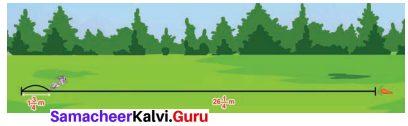
A rabbit has to cover 26\(\frac{1}{4}\) m to fetch its food. If it covers 1\(\frac{3}{4}\) m in one jump, then how many jumps will it take to fetch its food?
Samacheer Kalvi 6th Maths Solutions Term 3 Chapter 1 Fractions Ex 1.2 14
Solution:
Total distance to be covered by the rabbit = 26\(\frac{1}{4}\)m
Distance covered in one jump = 1\(\frac{3}{4}\) m
Samacheer Kalvi 6th Maths Solutions Term 3 Chapter 1 Fractions Ex 1.2 15
∴ The rabbit jumps 15 times to fetch its food.

Question 14.
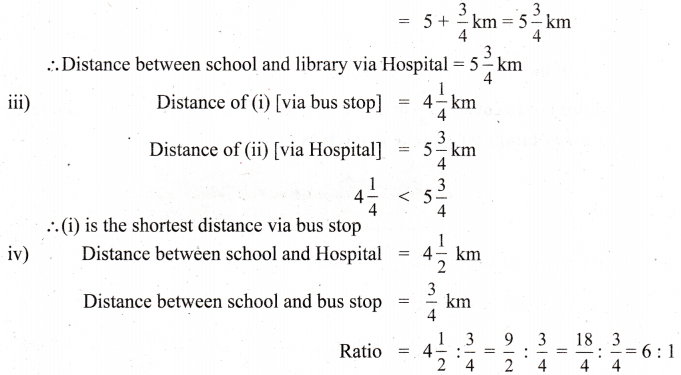
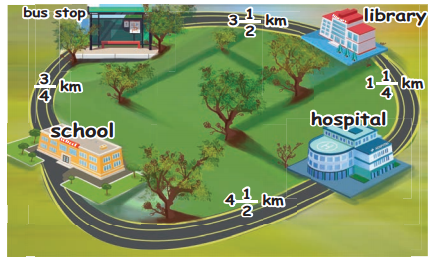
Look at the picture and answer the following questions :
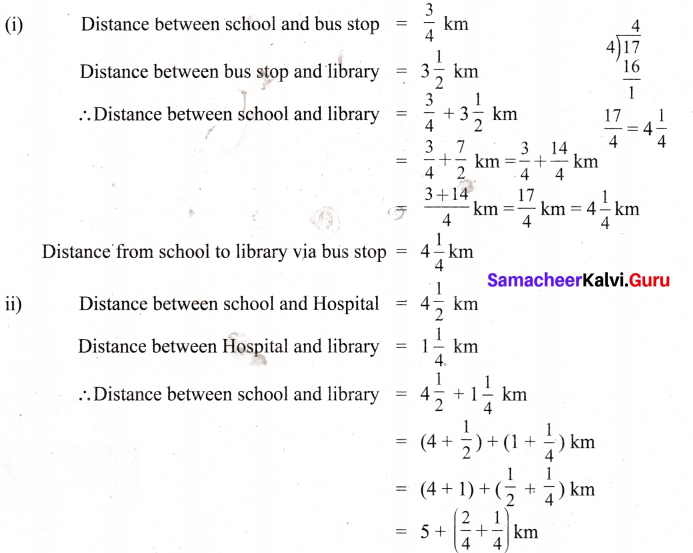
(i) What is the distance from School to the library via bus stop?
(ii) What is the distance between school and library via Hospital?
(iii) Which is the shortest distance between (i) and (ii)?
(iv) The distance between School and Hospital is ____ times the distance between the school and Bus stop.
Samacheer Kalvi 6th Maths Solutions Term 3 Chapter 1 Fractions Ex 1.2 16
Solution:
Samacheer Kalvi 6th Maths Solutions Term 3 Chapter 1 Fractions Ex 1.2 17
Samacheer Kalvi 6th Maths Solutions Term 3 Chapter 1 Fractions Ex 1.2 18
The distance between school and Hospital is 6 times the distance between school and bus stop.

Samacheer Kalvi 6th Maths Solutions Term 3 Chapter 1 Fractions Ex 1.2 Read More »

Samacheer Kalvi 7th Maths Solutions Term 1 Chapter 3 Algebra Ex 3.1

Students can Download Maths Chapter 3 Algebra Ex 3.1 Questions and Answers, Notes Pdf, Samacheer Kalvi 7th Maths Book Solutions Guide Pdf helps you to revise the complete Tamilnadu State Board New Syllabus and score more marks in your examinations.

Tamilnadu Samacheer Kalvi 7th Maths Solutions Term 1 Chapter 3 Algebra Ex 3.1

Question 1.
Fill in the blanks
(i) The variable in the expression 16x – 7 is _____
(ii) The constant term of the expression 2y – 6 is _____
(iii) In the expression 25m + 14M, the type of the terms are ______ terms
(iv) The number of terms in the expression 3ab + 4c – 9 is _____
Hint: Terms are 3ab, 4c – 9.
(v) The numerical co-efficient of the term -xy is ______
Hint: -x,y = (- 1 )xy.
Solution:
(i) x
(ii) -6
(iii) unlike
(iv) three
(v) -1

Question 2.
Say true or False
(i) x + (-x) = 0.
(ii) The co-efficient of ab in the term 15 abc is 15.
Hint: Coefficient of ab is 15c
(iii) 2pq and – 7qp are like terms.
(iv) When y = -1, the value of the expression 2y – 1 is 3.
Hint: 2(-1) – 1 = -2 – 1 = – 3
Solution:
(i) True
(ii) False
(iii) True
(iv) False

Question 3.
Fing the numerical co-efficient of each of the following terms: -3yx, 12k, y, 121bc, -x, 9pq, 2ab.
Solution:
(i) Numerical co-efficient of-3yx is – 3
(ii) Numerical co-efficient of 12k is 12
(iii) Numerical coefficient of y is 1
(iv) Numerical co-efficient of 1216c is 121
(v) Numerical co-efficient of – x is – 1
(vi) Numerical co-efficient of 9pq is 9
(vii) Numerical co-efficient of 2ab is 2

SamacheerKalvi.Guru

Question 4.
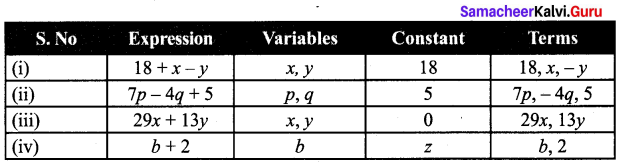
Write the variables, constants and terms of the following expressions,
(i) 18 + x – y
(ii) 7p – 4q + 5
(iii) 29x + 13y
(iv) b + 2
Solution:
Samacheer Kalvi 7th Maths Solutions Term 1 Chapter 3 Algebra Ex 3.1 1

Question 5.
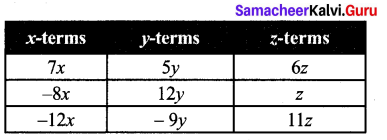
Identify the like terms among the following 7x, 5y, -8x, 12y, 6z, z, -12x, -9y, 11 z
Solution:
Samacheer Kalvi 7th Maths Solutions Term 1 Chapter 3 Algebra Ex 3.1 2

Question 6.
If x = 2 andy = 3, then find the value of the following expressions,
(i) 2x – 3y
(ii) x + y
(iii) 4y – x
(iv) x + 1 – y
Solution:
Given x = 2; y = 3.
(i) 2x – 3y = 2 (2) – 3 (3) = 4 – 9
= 4 + (Additive inverse of 9)
= 4 +(-9) = -5
(ii) x + y = 2 + 3 = 5
(iii) 4y – x = 4 (3) – 2 = 12 – 2 = 10
(iv) x + 1 – y = 2 + 1 – 3 = 3 – 3 = 0

Objective Type Questions

Question 1.
An algebraic statement which is equivalent to the verbal statement “Three times the sum of ‘x’ and ‘y’ is
(i) 3 (x + y)
(ii) 3 + x + y
(iii) 3x + y
(iv) 3 + xy
Solution:
(i) 3 [(x + y)]

Question 2.
The numerical co-efficient of -7mn is
(i) 7
(ii) -7
(iii) p
(iv) -p
Solution:
(ii) -7

Question 3.
Choose the pair of like terms
(i) 7p, 7x
(ii) 7r, 7x
(iii) – 4x, 4
(iv) – 4x, 7x
Solution:
(iv) -4x, 7x

SamacheerKalvi.Guru

Question 4.
The value of 7a – 4b when a = 3, b = 2 is
(i) 21
(ii) 13
(iii) 8
(iv) 32
Solution:
(ii) 13
Hint: 7(3) – 4(2) = 21 – 8 = 13

Samacheer Kalvi 7th Maths Solutions Term 1 Chapter 3 Algebra Ex 3.1 Read More »

Samacheer Kalvi 6th Maths Solutions Term 2 Chapter 3 Bill, Profit and Loss Intext Questions

You can Download Samacheer Kalvi 6th Maths Book Solutions Guide Pdf, Tamilnadu State Board help you to revise the complete Syllabus and score more marks in your examinations.
Samacheer Kalvi 6th Maths Solutions Term 2 Chapter Chapter 3 Bill, Profit and Loss Intext Questions

Tamilnadu Samacheer Kalvi 6th Maths Solutions Term 2 Chapter 3 Bill, Profit and Loss Intext Questions

Try These (Textbook Page No.49)

Question 1.
Arrange in ascending order
(i) C.P, M.P, Discount
(ii) M.P., S.P., Discount
Solution:
(i) Discount < C.P < M.P.
(ii) Discount < S.P < M.P

Samacheer Kalvi 6th Maths Solutions Term 2 Chapter Chapter 3 Bill, Profit and Loss Intext Questions

Question 2.
Which is greater S.P or M.P?
Solution:
M.P is greater than S.P

Samacheer Kalvi 6th Maths Solutions Term 2 Chapter 3 Bill, Profit and Loss Intext Questions Read More »

Samacheer Kalvi 6th Maths Solutions Term 2 Chapter 3 Bill, Profit and Loss Additional Questions

You can Download Samacheer Kalvi 6th Maths Book Solutions Guide Pdf, Tamilnadu State Board help you to revise the complete Syllabus and score more marks in your examinations.

Tamilnadu Samacheer Kalvi 6th Maths Solutions Term 2 Chapter 3 Bill, Profit and Loss Additional Questions

Question 1.
______ is the difference between S.P and C.P., when S.P > C.P.
Solution:
Profit

Question 2.
Samacheer Kalvi 6th Maths Solutions Term 2 Chapter 3 Bill, Profit and Loss Additional Questions Q1
(a) What is the total bill amount?
(b) Which item is the costliest one?
(c) Write the name of the shop?
Solution:
(a) ₹ 4,050
(b) Tables
(c) ABC Furnitures, Madurai

Question 3.
A vegetable vendor bought a dozen drum sticks for ₹ 42. Two of them become dry. If he has to get a profit of ₹ 8. Find the S.P of each drumstick.
Solution:
12 drumsticks cost price = ₹ 42
Profit = ₹ 8
Profit = S.P – C.P
⇒ 8 = S.P – 42
⇒ S.P = 8 + 42 = ₹ 50
S.P of 10 drumsticks = ₹ 50
S.P of each drumstick = \(\frac { 50 }{ 10 }\) = ₹ 5

Question 4.
Rice is being sold at ₹ 1800 per bag of 25kg at profit of ₹ 250. Find the Cost price of the rice bag.
Solution:
S.P = ₹ 1800
Profit = ₹ 250
Profit = S.P – C.P
⇒ 250 = 1800 – C.P
⇒ C.P = 1800 – 250 = ₹ 1550

Question 5.
Mangai buys a book for ₹ 300. She wants to sell it at a profit of ₹ 50 after making a discount of ₹ 30. What is the M.P of a book?
Solution:
Profit = S.P – C.P
⇒ 50 = S.P – 300
⇒ S.P = 50 + 300 = 350
S.P = M.P – Discount
⇒ 350 = M.P – 30
⇒ M.P = 350 + 30 = ₹ 380

Question 6.
Manila buys a dress for ₹ 750. She wants to sell it at a profit of ₹ 75 on sales and she marks ₹ 900. What is the discount that she will give to her customers?
Solution:
Profit = S.P – C.P
⇒ 75 = S.P – 750
⇒ S.P = 75 + 750 = ₹ 825
S.P = M.P – Discount
⇒ 825 = 900 – Discount
⇒ Discount = 900 – 825 = ₹ 75

Question 7.
Complete the following table:
Samacheer Kalvi 6th Maths Solutions Term 2 Chapter 3 Bill, Profit and Loss Additional Questions Q6
Solution:
(i) Profit = S.P – C.P = 60 – 50 where CP < SP = ₹ 10
(ii) S.P = C.P – loss = 80 – 15 = ₹ 65

Samacheer Kalvi 6th Maths Solutions Term 2 Chapter 3 Bill, Profit and Loss Additional Questions Read More »