Class 6

Samacheer Kalvi 6th Maths Solutions Term 1 Chapter 6 Information Processing Intext Questions

You can Download Samacheer Kalvi 6th Maths Book Solutions Guide Pdf, Tamilnadu State Board help you to revise the complete Syllabus and score more marks in your examinations.
Samacheer Kalvi 6th Maths Solutions Term 1 Chapter 6 Information Processing Intext Questions

Tamilnadu Samacheer Kalvi 6th Maths Solutions Term 1 Chapter 6 Information Processing Intext Questions

Try These (Textbook Page No. 138)

Question 1.
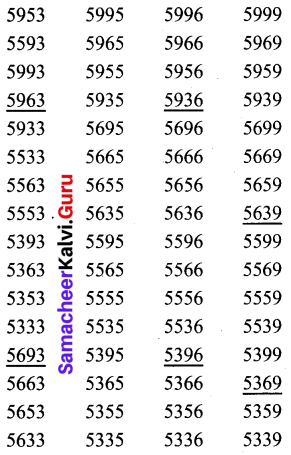
Now drop the condition that each digit must be used exactly once. List the numbers that are possible now and find the numbers that were not listed above.
Solution:
Here repetition of digits allowed.
Fixing 9 for a thousand places we have
Samacheer Kalvi 6th Maths Solutions Term 1 Chapter 6 Information Processing Intext Questions 138 Q1
Fixing 6 for thousand places we have
Samacheer Kalvi 6th Maths Solutions Term 1 Chapter 6 Information Processing Intext Questions 138 Q1.1

Samacheer Kalvi 6th Maths Solutions Term 1 Chapter 6 Information Processing Intext Questions

Fixing 5 for thousands place
Samacheer Kalvi 6th Maths Solutions Term 1 Chapter 6 Information Processing Intext Questions 138 Q1.2
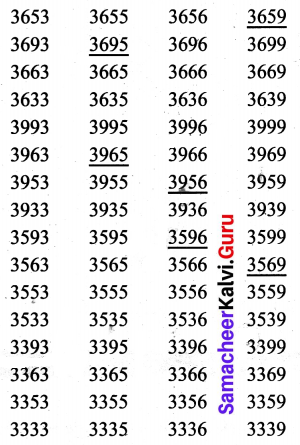
Fixing 3 for thousands place, we get


Thus we have 4 × 4 × 4 × 4 = 256 numbers.
(ii) The underlined 24 numbers were listed as the numbers with non-repeated digits. Remaining numbers are not listed in the previous list.

Samacheer Kalvi 6th Maths Solutions Term 1 Chapter 6 Information Processing Intext Questions

Question 2.
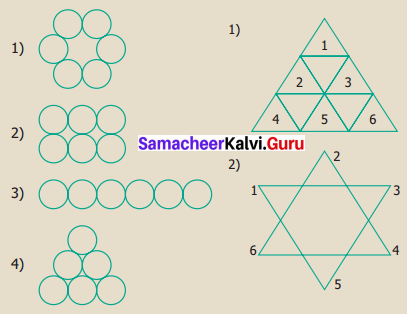
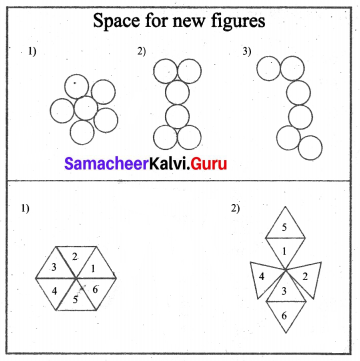
Mother had a lot of wooden pieces in different shapes with her. She gave 6 triangles to Kannagi and 6 circles to Madhan and asked them to create different figures using them. They tried and got some interesting figures. Can you create figures like them that are nice and interesting?
Samacheer Kalvi 6th Maths Solutions Term 1 Chapter 6 Information Processing Intext Questions 138 Q2
Solution:
Samacheer Kalvi 6th Maths Solutions Term 1 Chapter 6 Information Processing Intext Questions 138 Q2.1

Try These (Textbook Page No. 139)

Question 1.
Form a group with two of your friends and try this. All three of you together have to draw a scene. First, one of your friends should draw one part, next the other friend has to continue it, and finally you have to complete it. No discussion or any other communication is allowed. Finally, each person tells what (s)he actually intended to draw the full picture.
Solution:
Activity to be done by the students themselves.

Samacheer Kalvi 6th Maths Solutions Term 1 Chapter 6 Information Processing Intext Questions Read More »

Samacheer Kalvi 6th Maths Solutions Term 1 Chapter 2 Introduction to Algebra Intext Questions

You can Download Samacheer Kalvi 6th Maths Book Solutions Guide Pdf, Tamilnadu State Board help you to revise the complete Syllabus and score more marks in your examinations.

Tamilnadu Samacheer Kalvi 6th Maths Solutions Term 1 Chapter 2 Introduction to Algebra Intext Questions

Samacheer Kalvi 6th Maths Solutions Term 1 Chapter 2 Introduction to Algebra Intext Questions
Try These (Text hook Page No. 41)

Question 1.
Observe the following patterns and complete them.
(i) 5, 8, 11, 14, ___, ____, ____
(ii) If 15873 × 7 = 111111 and 15873 × 14 = 222222 then, what is 15873 × 21 = ? and 15873 × 28 = ?
Solution:
(i) 17, 20, 23
Hint: 5 + 3 = 8, 8 + 3 = 11, 11+3 = 14
(ii) 15873 × 21 = 333333; 15873 × 28 = 444444
Hint: 15873 × 14 = 15873 × 7 × 2 = 111111 × 2 = 222222

Question 2.
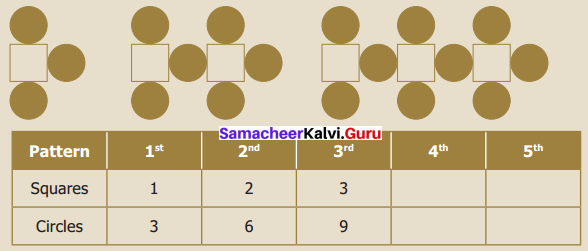
Draw the next two patterns and complete the table.
Samacheer Kalvi 6th Maths Term 1 Chapter 2 Introduction to Algebra Intext Questions Q2
Solution:
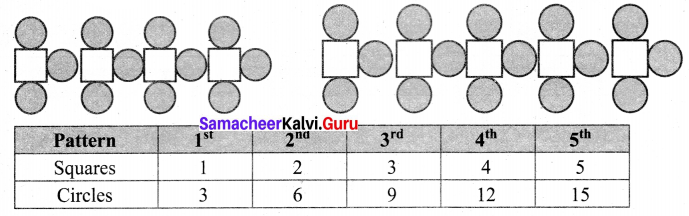
The next two patterns:
Samacheer Kalvi 6th Maths Term 1 Chapter 2 Introduction to Algebra Intext Questions Q2.1

Samacheer Kalvi 6th Maths Solutions Term 1 Chapter 2 Introduction to Algebra Intext Questions

Question 3.
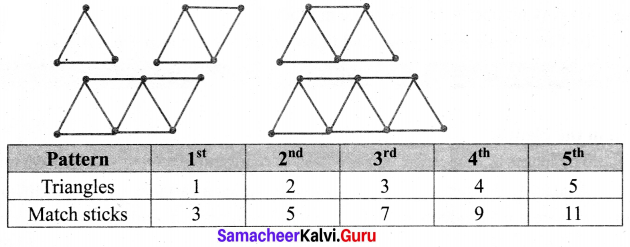
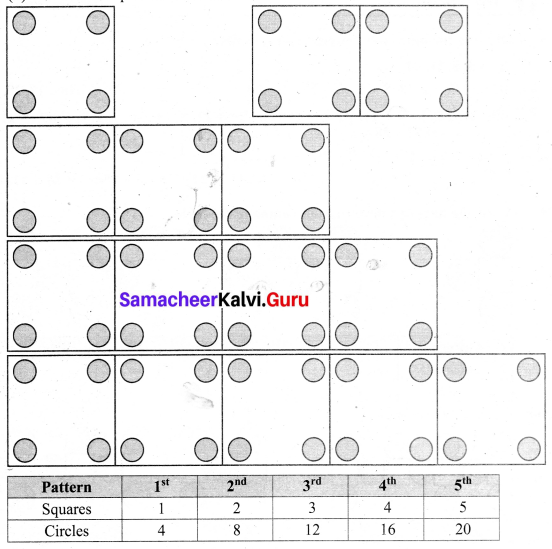
Create your own patterns of shapes and prepare a table.
Solution:
(i) Match stick pattern of triangles.
Samacheer Kalvi 6th Maths Term 1 Chapter 2 Introduction to Algebra Intext Questions Q3
(ii) Pattern of squares and circles.
Samacheer Kalvi 6th Maths Term 1 Chapter 2 Introduction to Algebra Intext Questions Q3.1

Try These (Text hook Page No. 46 to 48)

Question 4.
Samacheer Kalvi 6th Maths Term 1 Chapter 2 Introduction to Algebra Intext Questions Q4
Solution:
Samacheer Kalvi 6th Maths Term 1 Chapter 2 Introduction to Algebra Intext Questions Q4.1

Samacheer Kalvi 6th Maths Solutions Term 1 Chapter 2 Introduction to Algebra Intext Questions

Question 5.
Samacheer Kalvi 6th Maths Term 1 Chapter 2 Introduction to Algebra Intext Questions Q5
Solution:
Samacheer Kalvi 6th Maths Term 1 Chapter 2 Introduction to Algebra Intext Questions Q5.1

Question 6.
Find the unknown.
(i) 37 + 43 = 43 + ____
(ii) (22 + 10) + 15 = ____ + (10 + 15)
(iii) If 7 × 46 = 322, then 46 × 7 = _____
Solution:
(i) 37 + 43 = 43 + 37
(ii) (22 + 10) + 15 = 22 + (10 + 15)
(iii) If 7 × 46 = 322, then 46 × 7 = 322

Question 7.
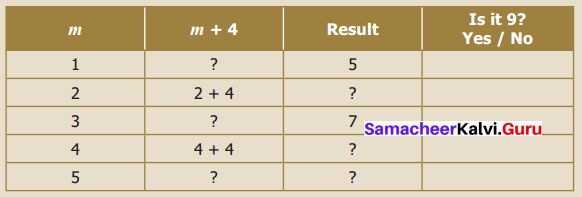
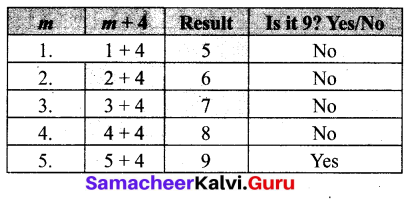
Find the suitable value of ‘m’, to get a sum of 9?
Samacheer Kalvi 6th Maths Term 1 Chapter 2 Introduction to Algebra Intext Questions Q7
Solution:
Samacheer Kalvi 6th Maths Term 1 Chapter 2 Introduction to Algebra Intext Questions Q7.1

Samacheer Kalvi 6th Maths Solutions Term 1 Chapter 2 Introduction to Algebra Intext Questions

Samacheer Kalvi 6th Maths Solutions Term 1 Chapter 2 Introduction to Algebra Intext Questions Read More »

Samacheer Kalvi 6th Maths Solutions Term 1 Chapter 6 Information Processing Additional Questions

You can Download Samacheer Kalvi 6th Maths Book Solutions Guide Pdf, Tamilnadu State Board help you to revise the complete Syllabus and score more marks in your examinations.
Samacheer Kalvi 6th Maths Solutions Term 1 Chapter 6 Information Processing Additional Questions

Tamilnadu Samacheer Kalvi 6th Maths Solutions Term 1 Chapter 6 Information Processing Additional Questions

Question 1.
In a meeting, breakfast is served with coffee, Tea and Milk. Breakfast items are Idly, Dosai and Pongal. Each one can have a drink and breakfast. How many such combinations can be there?
Solution:
Samacheer Kalvi 6th Maths Solutions Term 1 Chapter 6 Information Processing Additional Questions 1 Q1
So they have 9 combinations such as

  1. Coffee and Idly
  2. Coffee and Dosai
  3. Coffee and Pongal
  4. Milk and Idly
  5. Milk and Dosai
  6. Milk and Pongal
  7. Tea and Idly
  8. Tea and Dosai
  9. Tea and Pongal.

Question 2.
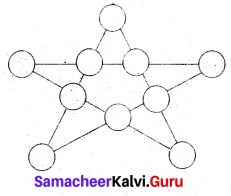
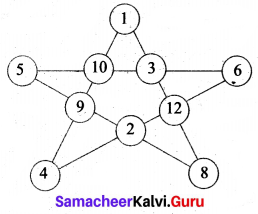
Place the numbers from 1 to 12 exactly once in the circles so that the sum of numbers in each of the 5 lines of the star is 24.
Samacheer Kalvi 6th Maths Solutions Term 1 Chapter 6 Information Processing Additional Questions 2 Q1
Solution:
By trial and error, we arrange the numbers to get the sum 24.
Samacheer Kalvi 6th Maths Solutions Term 1 Chapter 6 Information Processing Additional Questions 2 Q1.1

Samacheer Kalvi 6th Maths Solutions Term 1 Chapter 6 Information Processing Additional Questions

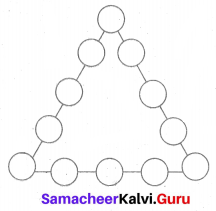
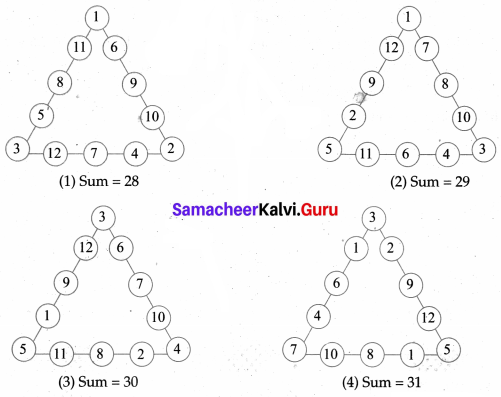
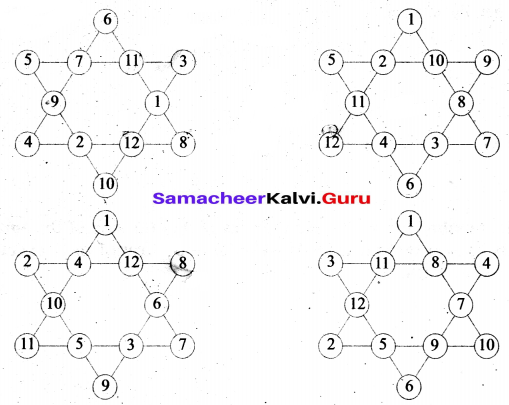
Question 3.
Place the numbers from 1 to 12 in the circles without repetition to get a sum of 28, 29, 30 and 31.
Samacheer Kalvi 6th Maths Solutions Term 1 Chapter 6 Information Processing Additional Questions 2 Q2
Solution:
Samacheer Kalvi 6th Maths Solutions Term 1 Chapter 6 Information Processing Additional Questions 2 Q2.1

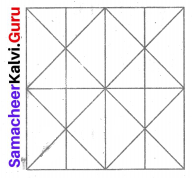
Question 4.
Find the minimum number of straight lines used in forming the figure.
Samacheer Kalvi 6th Maths Solutions Term 1 Chapter 6 Information Processing Additional Questions 3 Q1
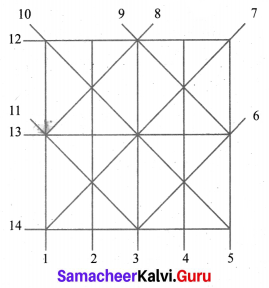
Solution:
Samacheer Kalvi 6th Maths Solutions Term 1 Chapter 6 Information Processing Additional Questions 3 Q1.1
The straight lines may be labelled as
Vertical lines = 5
Horizontal lines = 3
Standing lines = 6
Total of 14 lines are needed.

Question 5.
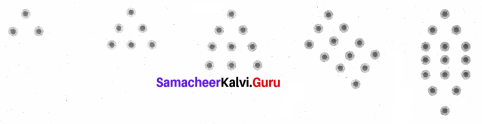
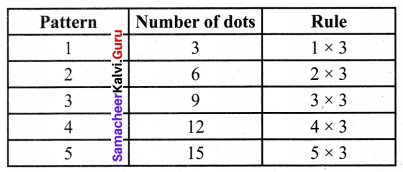
Find the dots in the 12th figure of the following:
Samacheer Kalvi 6th Maths Solutions Term 1 Chapter 6 Information Processing Additional Questions 3 Q2
Solution:
Samacheer Kalvi 6th Maths Solutions Term 1 Chapter 6 Information Processing Additional Questions 3 Q2.1
10th figure will have 10 × 3 = 30 dots.
And 12th figure will have 12 × 3 = 36 dots.

Samacheer Kalvi 6th Maths Solutions Term 1 Chapter 6 Information Processing Additional Questions Read More »

Samacheer Kalvi 6th Maths Solutions Term 1 Chapter 4 Geometry Intext Questions

You can Download Samacheer Kalvi 6th Maths Book Solutions Guide Pdf, Tamilnadu State Board help you to revise the complete Syllabus and score more marks in your examinations.
Samacheer Kalvi 6th Maths Solutions Term 1 Chapter 4 Geometry Intext Questions

Tamilnadu Samacheer Kalvi 6th Maths Solutions Term 1 Chapter 4 Geometry Intext Questions

Try These (Textbook Page No. 80, 81)

Question 1.
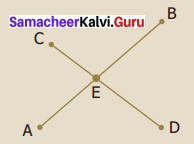
Name all the line segments.
Samacheer Kalvi 6th Maths Term 1 Chapter 4 Geometry Intext Questions 80 Q1
Solution:
\(\overline{\mathrm{AB}}, \overline{\mathrm{AE}}, \overline{\mathrm{EB}}, \overline{\mathrm{CD}}, \overline{\mathrm{CE}} \text { and } \overline{\mathrm{ED}}\)

Question 2.
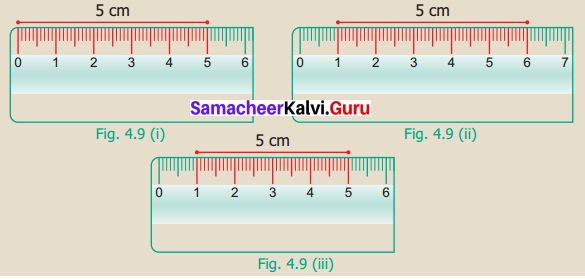
If AB = 5 cm, say which of the following measures are correct in fig 4.9.
Samacheer Kalvi 6th Maths Term 1 Chapter 4 Geometry Intext Questions 80 Q2
Solution:
Fig 4.9(i) and fig 4.9(ii) measures are correct.

Samacheer Kalvi 6th Maths Solutions Term 1 Chapter 4 Geometry Intext Questions

Try These (Textbook Page No. 85)

Question 1.
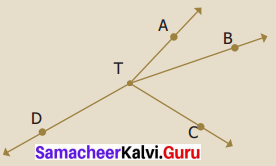
Samacheer Kalvi 6th Maths Term 1 Chapter 4 Geometry Intext Questions 85 Q1
1. Name the rays in the given figure.
2. What is the common point of all these rays?
Solution:
1. \(\overrightarrow{\mathrm{TA}}, \overrightarrow{\mathrm{TB}}, \overrightarrow{\mathrm{TC}} \text { and } \overrightarrow{\mathrm{TD}}\) are the rays given
2. Point T is the common point of all these rays.

Try These (Textbook Page No. 90, 95)

Question 1.
Which direction will you face if you start facing West and take three right turns clockwise?
Solution:
Will be facing South.

Question 2.
Which direction will you face if you start facing North and take two right turns anticlockwise?
Solution:
Will be facing South.

Question 3.
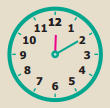
Adjust the hands of the clock for following time, note the angle made between the hour hand and the minute hand and write the type of angle.
Samacheer Kalvi 6th Maths Term 1 Chapter 4 Geometry Intext Questions 95 Q3
Samacheer Kalvi 6th Maths Term 1 Chapter 4 Geometry Intext Questions 95 Q3.1
Solution:
Samacheer Kalvi 6th Maths Term 1 Chapter 4 Geometry Intext Questions 95 Q3.2

Samacheer Kalvi 6th Maths Solutions Term 1 Chapter 4 Geometry Intext Questions

Samacheer Kalvi 6th Maths Solutions Term 1 Chapter 4 Geometry Intext Questions Read More »

Samacheer Kalvi 6th Maths Solutions Term 1 Chapter 2 Introduction to Algebra Additional Questions

You can Download Samacheer Kalvi 6th Maths Book Solutions Guide Pdf, Tamilnadu State Board help you to revise the complete Syllabus and score more marks in your examinations.

Tamilnadu Samacheer Kalvi 6th Maths Solutions Term 1 Chapter 2 Introduction to Algebra Additional
Samacheer Kalvi 6th Maths Solutions Term 1 Chapter 2 Introduction to Algebra Additional questions
Questions

Question 1.
Additive identity ____
Solution:
0

Question 2.
Multiplicative identity ____
Solution:
1

Question 3.
Express to an algebraic statement.
(i) ‘t’ is added to 100
(ii) 4 less to 9 times of y.
Solution:
(i) t + 100
(ii) 9y – 4

Question 4.
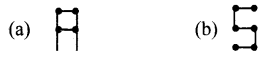
Find the rule which gives the number of sticks in the following pattern.
Samacheer Kalvi 6th Maths Term 1 Chapter 2 Introduction to Algebra Additional Questions Q1
Solution:
Let ‘x’ be the no. of R’s formed.
Samacheer Kalvi 6th Maths Term 1 Chapter 2 Introduction to Algebra Additional Questions Q2
The rule is 6x.
Let y ’ be the no. of S’s formed.
Samacheer Kalvi 6th Maths Term 1 Chapter 2 Introduction to Algebra Additional Questions Q2.1
The rule is 5y.

Samacheer Kalvi 6th Maths Solutions Term 1 Chapter 2 Introduction to Algebra Additional questions

Question 5.
How old was Suja 6 years from now?
Solution:
Let Suja’s present age be ‘a’ years.
6 years from now Suja will be (a + 6) years old.

Question 6.
Price of Apple per kg is ₹ 50 more than price of orange per kg. What is the cost of Apple per kg?
Solution:
Let the price of orange be ₹ b
Price of Apple will be ₹ (b + 50)

Question 7.
Given ‘n’ students like ice cream. What may 2n show?
Solution:
2n shows double the number of students who like ice cream.

Question 8.
Price of oil per litre is ₹ 5 more than three times the price of cool drinks ₹ ‘p’ Express algebraically.
Solution:
Price of cool drinks per kg = ₹ p
Three times = 3p
5 Rs. more = 3p + 5
Price of oil per kg = ₹ (3p + 5)

Question 9.
Complete the table and by inspection of the table find the value of m when m + 10 = 16.
Samacheer Kalvi 6th Maths Term 1 Chapter 2 Introduction to Algebra Additional Questions Q3
Solution:
Samacheer Kalvi 6th Maths Term 1 Chapter 2 Introduction to Algebra Additional Questions Q3.1
From the table m+ 10 = 16 when m = 6.

Samacheer Kalvi 6th Maths Solutions Term 1 Chapter 2 Introduction to Algebra Additional questions

Question 10.
Express algebraically (a) y divided by r (b) double times x is subtracted from 10
Solution:
(a) \(\frac{y}{r}\)
(b) 10 – 2x

Question 11.
Give verbal expression of
(a) 7x + 18
(b) \(\frac{4 x}{3}\)
Solution:
(a) 18 added to 7 times x
(b) 4 times x divided by 3.

Question 12.
Rajini’s Father’s age is 5 years more than 3 times Rajini’s age. What is her father’s age?
Solution:
3x + 5

Question 13.
Samacheer Kalvi 6th Maths Term 1 Chapter 2 Introduction to Algebra Additional Questions Q7
Find the rule for the above pattern.
Solution:
2p

Question 14.
Prepare a table for 3x + 10. From the table find the value of x when 3x + 10 = 25.
Solution:
5

Question 15.
Complete the table and find the solution of the equation \(\frac{z}{3}=4\) using the table.
Samacheer Kalvi 6th Maths Term 1 Chapter 2 Introduction to Algebra Additional Questions Q9
Solution:
Samacheer Kalvi 6th Maths Term 1 Chapter 2 Introduction to Algebra Additional Questions Q9.1

Question 16.
Form the expression for which Ramu is 3 years younger than Mathu.
Solution:
m – 3

Samacheer Kalvi 6th Maths Solutions Term 1 Chapter 2 Introduction to Algebra Additional questions

Question 17.
A tap is to be pasted along the edges of a square shaped gift box. Its length is 4 cm. What is the length of tap needed for one side.
Solution:
\(\frac{4 p}{4}=p\)

Question 18.
The value of y in 7y – 20 = 99.
Solution:
y = 17

Question 19.
Nine added to two times x gives 301. Find the value of x.
Solution:
x = 146

Question 20.
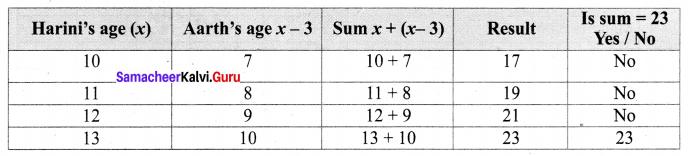
Aarthi is 3 years younger to Harini. If the sum of their ages is 23, how old is Harini?
Solution:
Let Harini’s age be x years
Aarthi’s age is x – 3 years
Given sum of their ages is 23.
i.e., x + (x – 3) = 23
Samacheer Kalvi 6th Maths Term 1 Chapter 2 Introduction to Algebra Additional Questions Q14

Samacheer Kalvi 6th Maths Solutions Term 1 Chapter 2 Introduction to Algebra Additional questions

Samacheer Kalvi 6th Maths Solutions Term 1 Chapter 2 Introduction to Algebra Additional Questions Read More »

Samacheer Kalvi 6th Maths Solutions Term 1 Chapter 1 Numbers Additional Questions

You can Download Samacheer Kalvi 6th Maths Book Solutions Guide Pdf, Tamilnadu State Board help you to revise the complete Syllabus and score more marks in your examinations.

Tamilnadu Samacheer Kalvi 6th Maths Solutions Term 1 Chapter 1 Numbers Additional Questions

Answer the following questions.

Samacheer Kalvi 6th Maths Solutions Term 1 Chapter 1 Numbers Additional Questions
Question 1.
How many thousands are there in 1 lakhs?
Solution:
\(\frac{1,00,0000}{1000}\) = 100 Thousands

Question 2.
The difference between successor and predecessor of any number is 2. Is it true? Justify your answer.
Solution:
It is true that the difference between successor and predecessor of any number is 2.
Because the difference between any number and its predecessor is 1.
Also the difference between the number and its successor is 1.
The total difference is 2.

Question 3.
The expanded form of the number 6,00,001 is given as 6 × 100000 + 1 × 1. Can you write like this Comment.
Solution:
Yes. We can write the expansion of the number 600001 as 6 × 100000 + 1 × 1.
Because 6 × 100000 + 1 × 1 = 600000 + 1 = 600001

Question 4.
Write the greatest five digit number using the digits 2, 3, 4, 0 and 7.
Solution:
Greatest five digit number = 74320

Question 5.
Can you write the least five digit number using the digits 2,3,4,0 and 7 as 02347. Why? What will be the correct number?
Solution:
No, we cannot write the least five digit number using the digits 2, 3, 4, 0 and 7 as 02347. If it is 02347, the left most zero has no value. It becomes 4 digit number 2347.
The correct number will be 20347.

Samacheer Kalvi 6th Maths Solutions Term 1 Chapter 1 Numbers Additional Questions

Question 6.
Write the relation between Largest two digit number and Smallest three digit number.
Solution:
Largest two digit number + 1 = Smallest three digit number.
99 + 1 = 100

Question 7.
Name the property being illustrated in each of the cases.

  1. (30 + 20) + 10 = 30 + (20 + 10)
  2. 10 × 35 = (10 × 30) + (10 × 5)

Solution:

  1. Associativity
  2. Distribution of multiplication over addition.

Question 8.
10 crore = ____
Solution:
100 million

Question 9.
The heights of five boys in class VI are 135, 141, 129, 132, 145 (in centimetres) in height. Arrange their heights as how they stand in the assembly?
Solution:
129 cm < 132 cm < 135 cm < 141 cm < 145 cm

Question 10.
The number lock has the password number with 3 digits. The number is the least even number and less than 200. Middle digit has no value separately. Find the password. The digits are used only once.
Solution:
102

Question 11.
Arrange in ascending order. 123456, 123546, 123623, 123511
Solution:
123456 < 123511 < 123546 < 123623 Question 12. Arrange in descending order. 8461, 7535, 2943, 6214 Solution: 8461 > 7535 > 6214 > 2943

Samacheer Kalvi 6th Maths Solutions Term 1 Chapter 1 Numbers Additional Questions

Question 13.
Find the numbers between 572634 and 562634 which is approximated to ten thousand place.
Solution:
562634 < 570000 < 572634

Question 14.
Evaluate the following:
(a) 44 ÷ 2 + (7 + 80 ÷ 10) – 14 + 23
(b) 17 × 6 – 4 – 2 + 20 – (22 + 18)
(c) 16 × 144 ÷ 16 ÷ 9 + 16 + 15 – 20
(d) 12 × 36 ÷ 12 ÷ 3 + 5 + 6 – 2
(e) 15 – [17 + 30 ÷ 6 – (6 + 6) + 7]
Solution:
(a) 44 ÷ 2 + (7 + 80 ÷ 10) – 14 + 23 (Given)
= 44 ÷ 2 + (7 + 8) – 14 + 23 (To complete the bracket ÷ done first)
= 44 ÷ 2 + 15 – 14 + 23 (Bracket completed second)
= 22 + 15 – 14 + 23 (÷ completed third)
= 37 – 37 (+ completed fourth)
= 0 (- completed last)
∴ 44 ÷ 2 + (7 + 80 ÷ 10) – 14+ 23 = 0.

(b) 17 × 6 – 4 – 2 + 20 – (22 + 18) (Given)
= 17 × 6 – 4 – 2 + 20 – 40 (Bracket completed first)
= 102 – 4 – 2 + 20 – 40 (× completed second)
= 102 – 4 – 22 – 40 (+ completed third)
= 98 – 22 – 40 (÷ completed one by one)
= 76 – 40
= 36
∴ 17 × 6 – 4 – 2+ 20 – (22 + 18) = 36

(c) 16 × 144 ÷ 16 ÷ 9 + 16 + 15 – 20 (Given)
= 16 × 9 ÷ 9+16 + 15 – 20 (÷ completed first)
= 16 × 1 + 16 + 15 – 20 (÷ completed second)
= 16 + 16 + 15 – 20 (× completed third)
= 32 + 15 – 20 (+ completed fourth)
= 47 – 20 (+ completed fifth)
= 27 (- completed last)
∴ 16 × 144 ÷ 16 ÷ 9 + 16 + 15 – 20 = 27

(d) 12 × 36 ÷ 12 ÷ 3 + 5 + 6 – 2 (Given)
= 12 × 3 ÷ 3 + 5 + 6 – 2 (÷ completed first)
= 12 × 1 + 5 + 6 – 2 (÷ completed second)
= 12 + 5 + 6 – 2 (× completed third)
= 17 + 6 – 2 (+ completed forth)
= 23 – 2 (+ completed fifth)
= 21 (- completed last)
∴ 12 × 36 ÷ 12 ÷ 3 + 5 + 6 – 2 = 21

(e) 15 – [17 + 30 ÷ 6 – (6 + 6) + 7] (Given)
= 15 – [17 + 30 ÷ 6 – 12 + 7] (Inner bracket completed first)
= 15 – [17 + 5 – 12 + 7] (÷ completed second)
= 15 – [22 – 19] (+ completed third)
= 15 – 3 (bracket completed forth)
= 12 (- completed last)
∴ 15 – [17 + 30 ÷ 6 – (6 + 6) + 7] = 12.

Samacheer Kalvi 6th Maths Solutions Term 1 Chapter 1 Numbers Additional Questions

Question 15.
An export company produced 235219 shirts, 158342 trousers and 11704 jackets in a year. What is the total production of all the three items in that year?
Solution:
Number of shirts produced = 235219
Number of trousers produced = 158342
Number of jackets produced = 11704
Total production of all items = 405265
Total production of all items in that year = 4,05,265

Question 16.
India’s population has been steadily increasing from 439 million in 1961 to 1028 million in 2001. Find the total increase in population from 1961 to 2001. Write the increase in population in the Indian system of Numeration using commas suitably.
Solution:
Population of India in 1961 = 439 millions = 439,000,000
Population of India in 2001 = 1028 millions = 1,028,000,000
Increase in population from 1961 to 2001 = Population in 2001 – Population in 1961
= 1028000000 – 439000000
= 589000000
= 589 million.
Increase in population in Indian System = 58,90,00,000

Question 17.
A person had ₹ 10,00,000 with him. He purchased a flat for ₹ 8,70,000. With the remaining money, he has to buy a T.V. for 1 lakh. How much money was left with him to buy a T.V?
Solution:
Total money the person had = ₹ 10,00,000
Cost of flat = ₹ 8,70,000
Remaining money = ₹ 1,30,000
Now he has ₹ 1,30,000. So it is enough to buy a TV for ₹ 1,00,000.

Question 18.
A box contains 50 packets of biscuits, each weighing 120g. How many such boxes can be loaded in a van, which cannot carry more than 900 kg?
Solution:
Given: Total number of packets = 50.
Weight of each packet = 120 g
Weight of a box = 50 × 120 g = 6000 g = 6 kg [∵ 1000 g = 1 kg]
Required number of boxes = \(\frac{900}{6}\) = 150.
150 boxes are required.

Question 19.
How much money was collected from 5342 students for a charity show, if each student contributed ₹ 670?
Solution:
Total number of students = 5342
Contribution of each student = ₹ 670
Total money collected = 5342 × 670 = ₹ 35,79,140
Total money collected = ₹ 35,79,140

Question 20.
Estimate the following to the nearest hundreds
(a) 439 + 334 + 4317
(b) 1,08,734 – 47,599
(c) 8325 – 491
(d) 4,89,348 – 48,365
Solution:
(a) 439 + 334 + 4317
439 ⇒ 400
334 ⇒ 300
4317 ⇒ 4300
Sum = 5,000

(b) 1,08,734 – 47,599
1,08,734 ⇒ 1,08,700
47,599 ⇒ 47,600
Difference = 61,100

(c) 8325 – 491
8325 ⇒ 8300
491 ⇒ 500
Differences = 7,800

(d) 4,89,348 – 48,365
4,89,348 ⇒ 4,89,300
48,365 ⇒ 48,400
Difference = 4,40,900

Samacheer Kalvi 6th Maths Solutions Term 1 Chapter 1 Numbers Additional Questions

Question 21.
Estimate the following products:
(a) 578 × 161
(b) 5281 × 3491
(c) 1291 × 592
(d) 9250 × 29
Solution:
(a) 578 × 161
578 ⇒ 600
161 ⇒ 200
Estimated product is 600 × 200 = 1,20,000

(b) 5281 × 3491
5281 ⇒ 5000
3491 ⇒ 3500
Estimated Product = 5000 × 3500 = 1,75,00,000

(c) 1291 × 592
1291 ⇒ 1300
592 ⇒ 600
Estimated Product is = 1300 × 600 = 7,80,000

(d) 9250 × 29
9250 ⇒ 9000
29 ⇒ 30
Estimated Product is 9000 × 30 = 2,70,000

Question 22.
Are all whole numbers are natural numbers? Justify your answer?
Solution:
No, all whole numbers are not natural numbers.
Because ‘0’ belongs to the whole number system. But it is not in a natural number system.
All whole numbers except ‘0’ are natural numbers.

Question 23.
Use associative property of addition to add 847 + 306 + 453
Solution:
847 + 306 + 453
= (847 + 453) + 306
= 1300 + 306
= 1606
∴ 847 + 306 + 453 = 1606

Question 24.
Find the value of (1063 × 127) – (1063 × 27)
Solution:
(1063 × 127) – (1063 × 27)
= 1063 (127 – 27) [Taking 1063 as common]
= 1063 × 100
= 106300.
i.e (1063 × 127) – (1063 × 27) = 106300

Question 25.
Find the product using suitable properties
(a) 738 × 103
(b) 1005 × 168
Solution:
(a) We have 738 × 103
= 738 × (100 + 3)
= 738 × 100 + 738 × 3 [By distributive property of multiplication over addition]
= 73800 + 2214
= 76014

(b) 1005 × 168
= (1000 + 5) × 168
= (168 × (1000 + 5) (By commutative property)
= (168 × 1000) + (168 × 5)
= 1,68,000 + 840
= 1,68,840

Samacheer Kalvi 6th Maths Solutions Term 1 Chapter 1 Numbers Additional Questions

Question 26.
Write the largest six-digit number and write the number names in words using the Indian and International system.
Solution:
The largest six-digit number is 999999
Number names are nine lakh ninety-nine thousand nine hundred and ninety-nine
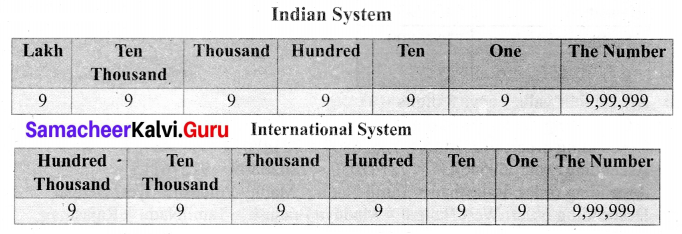
Samacheer Kalvi 6th Maths Term 1 Chapter 1 Numbers Additional Questions Q5

Question 27.
In a mobile store, the number of mobiles sold during a month is 1250, Assuming that the same number of mobiles are sold every month, find the number of mobiles sold in 2 years.
Solution:
Number of mobiles sold in 1 month = 1250
1 year = 12 months
2 years = 2 × 12 = 24 months
Number of mobiles sold in 24 months = 1250 × 24= 30,000
Number of mobiles sold in 2 years = 30,000

Question 28.
Simplify 24 + 2 × 8 ÷ 2 – 1
Solution:
24 + 2 × 8 ÷ 2 – 1
= 24 + 2 × 4 – 1
= 24 + 8 – 1
= 32 – 1
= 31
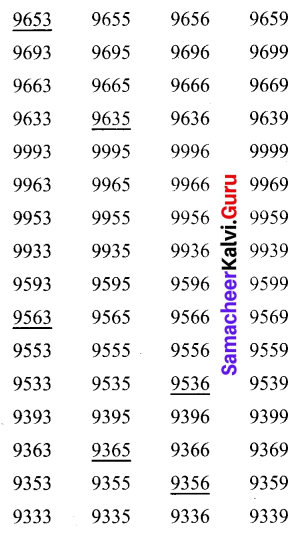
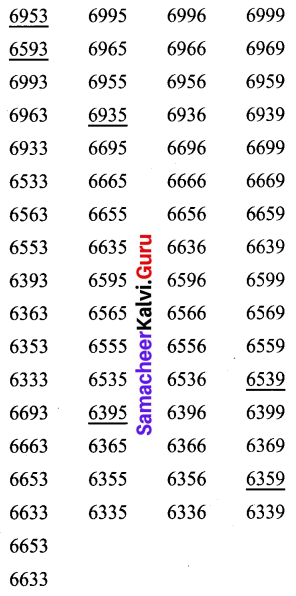
Samacheer Kalvi 6th Maths Solutions Term 1 Chapter 1 Numbers Additional Questions

Samacheer Kalvi 6th Maths Solutions Term 1 Chapter 1 Numbers Additional Questions Read More »

Samacheer Kalvi 6th Maths Solutions Term 1 Chapter 6 Information Processing Ex 6.2

You can Download Samacheer Kalvi 6th Maths Book Solutions Guide Pdf, Tamilnadu State Board help you to revise the complete Syllabus and score more marks in your examinations.
Samacheer Kalvi 6th Maths Solutions Term 1 Chapter 6 Information Processing Ex 6.2

Tamilnadu Samacheer Kalvi 6th Maths Solutions Term 1 Chapter 6 Information Processing Ex 6.2

Question 1.
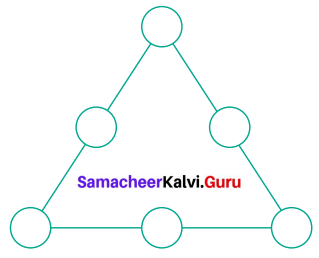
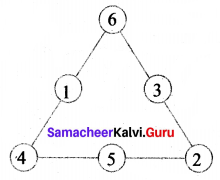
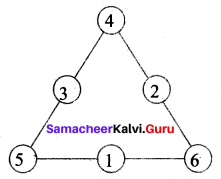
In the following magic triangle, arrange the numbers from 1 to 6, so that you get the same sum on all its sides.
Samacheer Kalvi 6th Maths Term 1 Chapter 6 Information Processing Ex 6.2 Q1
Solution:
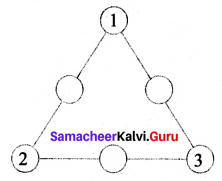
Step 1: Complete the corners with smaller numbers 1, 2 and 3.
Samacheer Kalvi 6th Maths Term 1 Chapter 6 Information Processing Ex 6.2 Q1.1
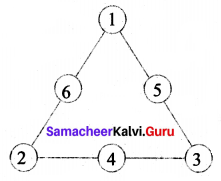
Step 2: The side having smallest numbers 1 & 2 are to be filled with the greatest number 6, the second smallest 1 & 3 side to be filled with the second largest 5 at the middle and so on.
Samacheer Kalvi 6th Maths Term 1 Chapter 6 Information Processing Ex 6.2 Q1.2
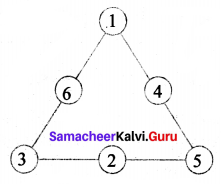
The magic sum is 1 + 6 + 2 = 2 + 4 + 3 = 3 + 5 + 1 = 9. Some other ways are given below.
Samacheer Kalvi 6th Maths Term 1 Chapter 6 Information Processing Ex 6.2 Q1.3
The magic sum = 1 + 6 + 3 = 3 + 2 + 5 = 5 + 4 + 1 = 10.
Samacheer Kalvi 6th Maths Term 1 Chapter 6 Information Processing Ex 6.2 Q1.4
The magic sum 6 + 1 + 4 = 4 + 5 + 2 = 2 + 3 + 6 = 11.
Samacheer Kalvi 6th Maths Term 1 Chapter 6 Information Processing Ex 6.2 Q1.5
The magic sum 4 + 3 + 5 = 5 + 1 + 6 = 6 + 2 + 4 = 12.

Question 2.
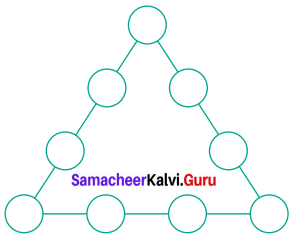
Using the numbers from 1 to 9
(i) Can you form a magic triangle?
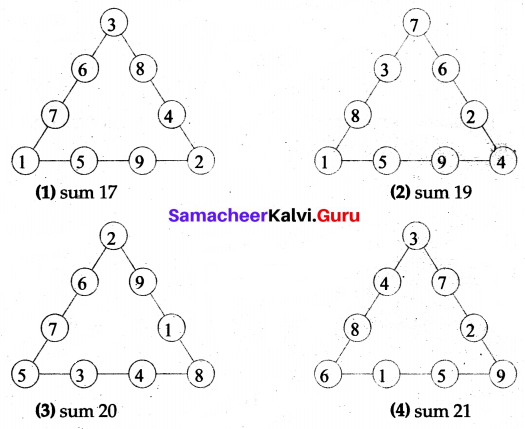
(ii) How many magic triangles can be formed?
(iii) What are the sums of the sides of the magic triangle?
Samacheer Kalvi 6th Maths Term 1 Chapter 6 Information Processing Ex 6.2 Q2
Solution:
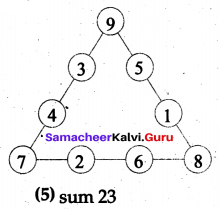
(i) Yes, we can form
(ii) 5
(iii)
Samacheer Kalvi 6th Maths Term 1 Chapter 6 Information Processing Ex 6.2 Q2.1
Samacheer Kalvi 6th Maths Term 1 Chapter 6 Information Processing Ex 6.2 Q2.2
Sums are 17, 19, 20, 21, and 23.

Samacheer Kalvi 6th Maths Solutions Term 1 Chapter 6 Information Processing Ex 6.2

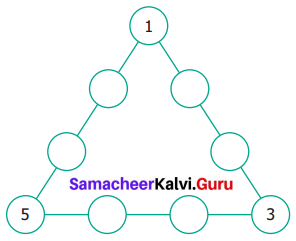
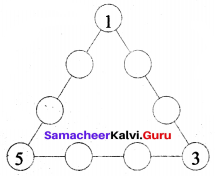
Question 3.
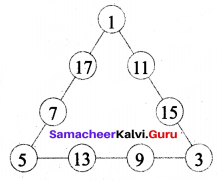
Arrange the odd numbers from 1 to 17 without repetition to get a sum of 30 on each side of the magic triangle.
Samacheer Kalvi 6th Maths Term 1 Chapter 6 Information Processing Ex 6.2 Q3
Solution:
The odd numbers between 1 to 17 are 1, 3, 5, 7, 9, 11, 13, 15, 17.
Step 1: Place the smaller numbers 1, 3, 5 on the comers.
Samacheer Kalvi 6th Maths Term 1 Chapter 6 Information Processing Ex 6.2 Q3.1
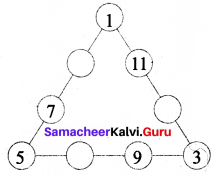
Step 2: Arrange another set of smaller numbers 7, 9, and 11 on each side.
Samacheer Kalvi 6th Maths Term 1 Chapter 6 Information Processing Ex 6.2 Q3.2
Step 3: Arrange the remaining numbers 13,15,17 to give the total 30.
Samacheer Kalvi 6th Maths Term 1 Chapter 6 Information Processing Ex 6.2 Q3.3
Magic sum = 30.

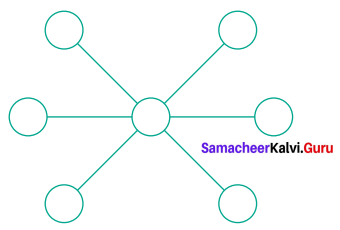
Question 4.
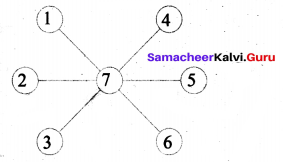
Put the numbers 1, 2, 3, 4, 5, 6, and 7 in the circles so that each straight line of three numbers add up to the same total.
Samacheer Kalvi 6th Maths Term 1 Chapter 6 Information Processing Ex 6.2 Q4
Solution:
Here there is even number of terms. Also we know that 1 + 6 = 7, 2 + 5 = 7, 3 + 4 = 7; so placing 7 at the centre, and the pairs (1, 6) (2, 5) and (3, 4) at. the opposite ends we get, the answer.
Samacheer Kalvi 6th Maths Term 1 Chapter 6 Information Processing Ex 6.2 Q4.1

Samacheer Kalvi 6th Maths Solutions Term 1 Chapter 6 Information Processing Ex 6.2

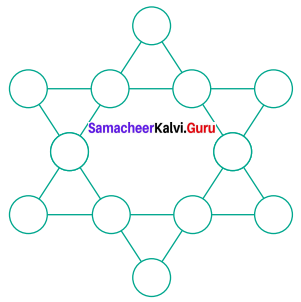
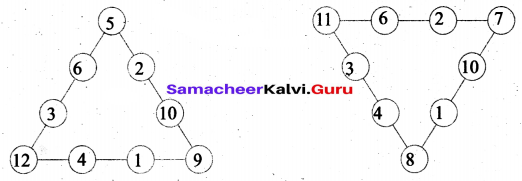
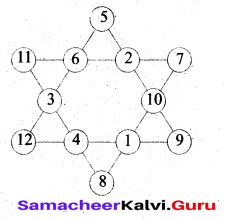
Question 5.
Place the number 1 to 12 in the 12 circles so that the sum of the numbers in each of the six lines of the star is 26. Use each number from 1 to 12 exactly once. Find more possible ways.
Samacheer Kalvi 6th Maths Term 1 Chapter 6 Information Processing Ex 6.2 Q5
Solution:
The given star can be viewed as two magical triangular as.
Samacheer Kalvi 6th Maths Term 1 Chapter 6 Information Processing Ex 6.2 Q5.1
Now the required arrangement is
Samacheer Kalvi 6th Maths Term 1 Chapter 6 Information Processing Ex 6.2 Q5.2
Some other arrangements are
Samacheer Kalvi 6th Maths Term 1 Chapter 6 Information Processing Ex 6.2 Q5.3

Samacheer Kalvi 6th Maths Solutions Term 1 Chapter 6 Information Processing Ex 6.2 Read More »

Samacheer Kalvi 6th Maths Solutions Term 1 Chapter 5 Statistics Ex 5.4

You can Download Samacheer Kalvi 6th Maths Book Solutions Guide Pdf, Tamilnadu State Board help you to revise the complete Syllabus and score more marks in your examinations.
Samacheer Kalvi 6th Maths Solutions Term 1 Chapter 5 Statistics Ex 5.4

Tamilnadu Samacheer Kalvi 6th Maths Solutions Term 1 Chapter 5 Statistics Ex 5.4

Miscellaneous Practice Problems

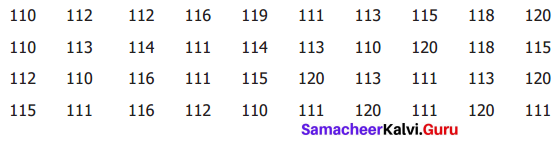
Question 1.
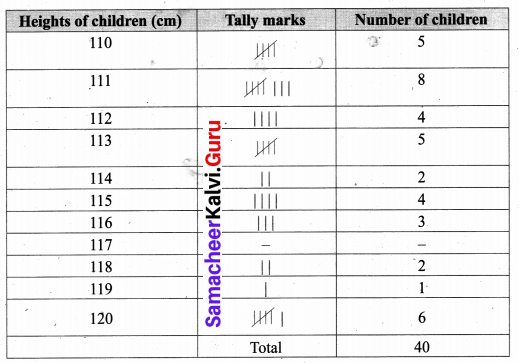
The heights (in centimetres) of 40 children are
Samacheer Kalvi 6th Maths Term 1 Chapter 5 Statistics Ex 5.4 Q1
Prepare a tally mark table.
Solution:
Samacheer Kalvi 6th Maths Term 1 Chapter 5 Statistics Ex 5.4 Q1.1

Question 2.
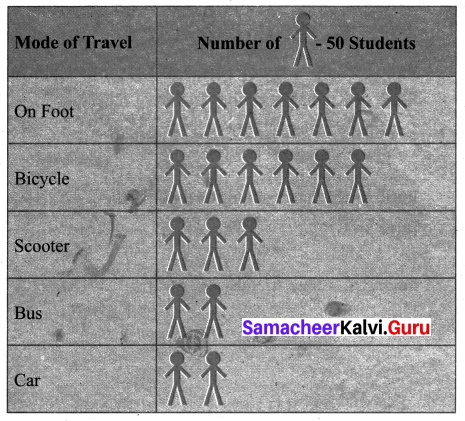
There are 1000 students in a school. Data regarding the mode of transport of the students as given below. Draw a pictograph to represent the data.
Samacheer Kalvi 6th Maths Term 1 Chapter 5 Statistics Ex 5.4 Q2
Solution:
The pictograph for the mode of transport of students.
Samacheer Kalvi 6th Maths Term 1 Chapter 5 Statistics Ex 5.4 Q2.1

Samacheer Kalvi 6th Maths Solutions Term 1 Chapter 5 Statistics Ex 5.4

Question 3.
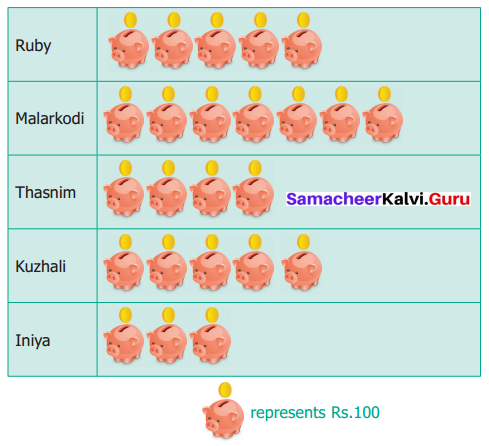
The following pictograph shows the total savings of a group of friends in a year. Each picture represents a saving of Rs. 100. Answer the following questions.
Samacheer Kalvi 6th Maths Term 1 Chapter 5 Statistics Ex 5.4 Q3
(i) What is the ratio of Ruby’s saving to that of Thasnim’s?
(ii) What is the ratio of Kuzhali’s savings to that of others?
(iii) How much is Iniya’s savings?
(iv) Find the total amount of savings of all your friends?
(v) Ruby and Kuzhali save the same amount. Say True or False.
Solution:
(i) Ratio of Ruby’s saving to that of Thasnim’s
\(=\frac{\text { Ruby’s saving }}{\text { Thasnim’s saving }}=\frac{5 \times 100}{4 \times 100}=\frac{5}{4}=5: 4\)
Ratio of Ruby’s saving to that of Thasnims = 5 : 4
(ii) Ratio of Kuzhali’s savings to that of others
\(=\frac{\text { kuzhali’s saving }}{\text { others saving }}=\frac{5 \times 100}{19 \times 100}=\frac{5}{19}=5: 19\)
Ratio of Kuzhali’s saving to that of others = 5 : 19
(iii) Iniya’s saving = 3 × 100 = ₹ 300
(iv) Saving of all the friends = (5 + 7 + 4 + 5 + 3) × 100 = 24 × 100 = ₹ 2400.
Total savings = ₹ 2400
(v) True.

Challenging Problems

Question 4.
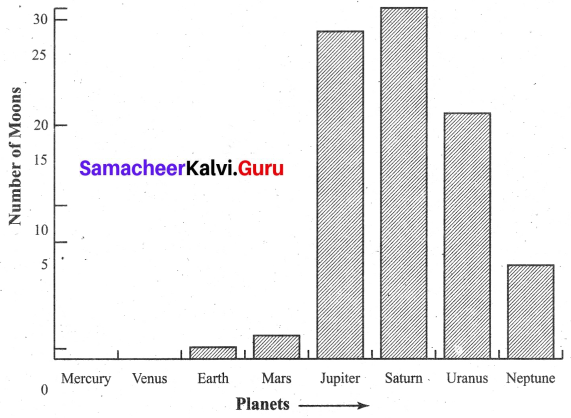
The table shows the number of moons that orbit each of the planets in our solar system.
Samacheer Kalvi 6th Maths Term 1 Chapter 5 Statistics Ex 5.4 Q4
Make a Bar graph for the above data.
Solution:
Samacheer Kalvi 6th Maths Term 1 Chapter 5 Statistics Ex 5.4 Q4.1

Question 5.
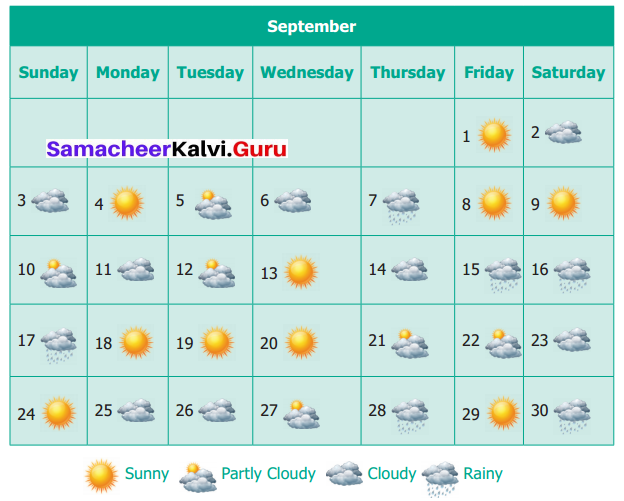
The predictions of Weather in the month of September is given below:
Samacheer Kalvi 6th Maths Term 1 Chapter 5 Statistics Ex 5.4 Q5
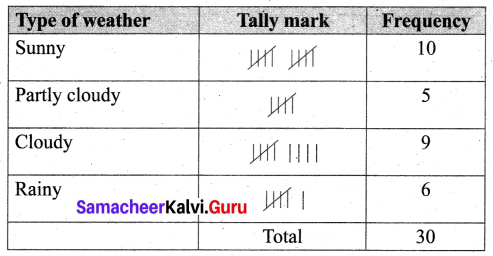
(i) Make a frequency table of the types of weather by reading the calender.
(ii) How many days are either cloudy or partly cloudy
(iii) How many days do not have rain? Give two ways to find the answer?
(iv) Find the ratio of the number of sunny days to Rainy days.
Solution:
Frequency Table for the Type of weather for the month of September
Samacheer Kalvi 6th Maths Term 1 Chapter 5 Statistics Ex 5.4 Q5.1
(ii) 14 days.
(iii) For 24 days there is no rain.
(a) From the total 30 days, we subtract the rainy days i.e 30 – 6 = 24 days (from the frequency table)
(b) From the picture, we can count the non-rainy days.
(iv) Ratio of number of Sunny day to Rainy days
\(=\frac{\text { Number of Sunny days }}{\text { Number of Rainy days }}=\frac{10}{6}=\frac{5}{3}=5: 3\)
The ratio of a number of Sunny days to Rainy days = 5 : 3.

Samacheer Kalvi 6th Maths Solutions Term 1 Chapter 5 Statistics Ex 5.4

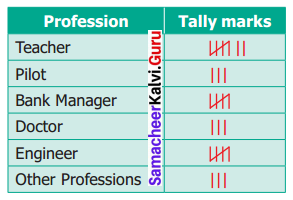
Question 6.
26 students were interviewed to find out what they want to become in the future. Their responses are given in the following table.
Samacheer Kalvi 6th Maths Term 1 Chapter 5 Statistics Ex 5.4 Q6
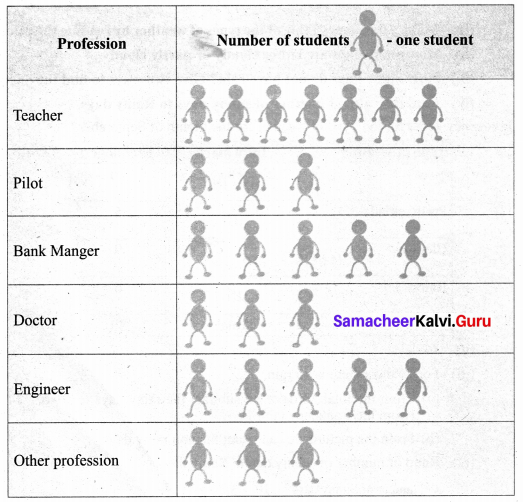
Represent this data using the pictograph
Solution:
Samacheer Kalvi 6th Maths Term 1 Chapter 5 Statistics Ex 5.4 Q6.1

Question 7.
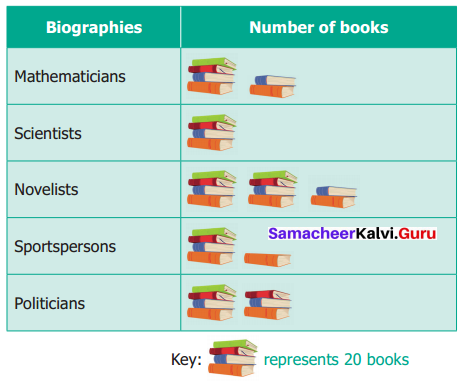
Yasmin of class VI was given a task to count the number of books which are biographies, in her school library. The information collected by her is represented as follows.
Samacheer Kalvi 6th Maths Term 1 Chapter 5 Statistics Ex 5.4 Q7
Observe the pictograph and answer the following questions.
(i) Which title has the maximum number of biographies?
(ii) Which title has the minimum number of biographies?
(iii) Which title has exactly half the number of biographies as Novelists?
(iv) How many biographies are there on the title of Sportspersons?
(v) What is the total number of biographies in the library?
Solution:
(i) ‘The title Novelists’ have the maximum number of biographies
(ii) ‘The title Scientists’ have a minimum number of biographies.
(iii) ‘Sportspersons’ title has exactly half the number of biographies as Novelist.
(iv) \((1 \times 20)+\frac{20}{4}=20+5=25\) biographies are there in the title sportsperson.
(v) 8 × 20 = 160 biographies are there in the library.

Question 8.
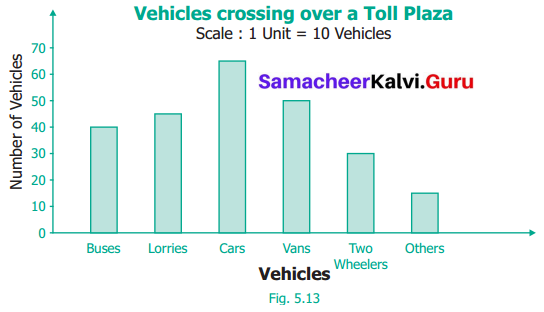
The bar graph illustrates the results of a survey conducted on vehicles crossing over a Toll Plaza in one hour.
Samacheer Kalvi 6th Maths Term 1 Chapter 5 Statistics Ex 5.4 Q8
Observe the bar graph carefully and fill up the following table.
Samacheer Kalvi 6th Maths Term 1 Chapter 5 Statistics Ex 5.4 Q8.1
Solution:
Samacheer Kalvi 6th Maths Term 1 Chapter 5 Statistics Ex 5.4 Q8.2

Question 9.
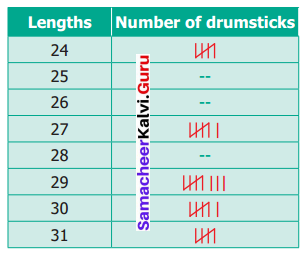
The lengths (in the nearest centimetre) of 30 drumsticks are given as follows.
Samacheer Kalvi 6th Maths Term 1 Chapter 5 Statistics Ex 5.4 Q9
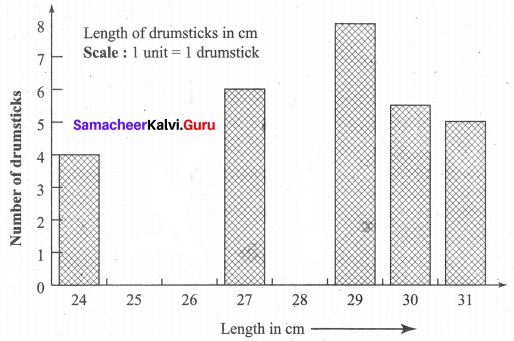
Draw the bar graph showing the same information.
Solution:
The bar graph showing the same information is given below:
Samacheer Kalvi 6th Maths Term 1 Chapter 5 Statistics Ex 5.4 Q9.1

Samacheer Kalvi 6th Maths Solutions Term 1 Chapter 5 Statistics Ex 5.4

Question 10.
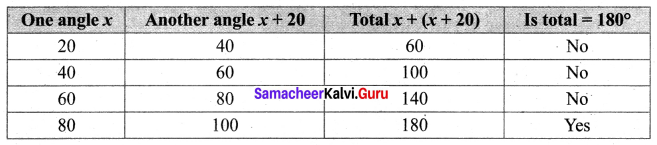
Given two angles are supplementary i.e. their sum = 180°.
Solution:
Let the angle be x.
Then anothcf angle = x + 20 (given)
Samacheer Kalvi 6th Maths Term 1 Chapter 5 Statistics Ex 5.4 Q10
The two angles are 80° and 100°

Samacheer Kalvi 6th Maths Solutions Term 1 Chapter 5 Statistics Ex 5.4 Read More »

Samacheer Kalvi 6th Maths Solutions Term 3 Chapter 1 Fractions Ex 1.1

You can Download Samacheer Kalvi 6th Maths Book Solutions Guide Pdf, Tamilnadu State Board help you to revise the complete Syllabus and score more marks in your examinations.
Samacheer Kalvi 6th Maths Solutions Term 3 Chapter 1 Fractions Ex 1.1

Tamilnadu Samacheer Kalvi 6th Maths Solutions Term 3 Chapter 1 Fractions Ex 1.1

Question 1.
Fill in the blanks.
(i) 7\(\frac{3}{4}\) + 6\(\frac{1}{2}\) = _______
(ii) The sum of whole number and a proper fraction is called ______
(iii) 5\(\frac{1}{3}\) – 3\(\frac{1}{2}\) = ______
(iv) 8 ÷ \(\frac{1}{2}\) = ______
(v) The number which has its own reciprocal is _______.
Solution:
(i) 14\(\frac{1}{4}\)
(ii) Mixed Fraction
(iii) 1\(\frac{5}{6}\)
(iv) 16
(v) 1

Question 2.
Say True or False.
(i) 3\(\frac{1}{2}\) can be written as 3 + \(\frac{1}{2}\).
(ii) The sum of any two proper fractions is always an improper fraction.
Hint: \(\frac{1}{2}+\frac{1}{4}=\frac{3}{4}\)
(iii) The mixed fraction of \(\frac{13}{4}\) is 3\(\frac{1}{4}\)
(iv) The reciprocal of an improper fraction is always a proper fraction.
(v) 3\(\frac{1}{4}\) × 3\(\frac{1}{4}\) = 9\(\frac{1}{16}\)
Solution:
(i) True
(ii) False
(iii) True
(iv) True
(v) False

Samacheer Kalvi 6th Maths Solutions Term 3 Chapter 1 Fractions Ex 1.1

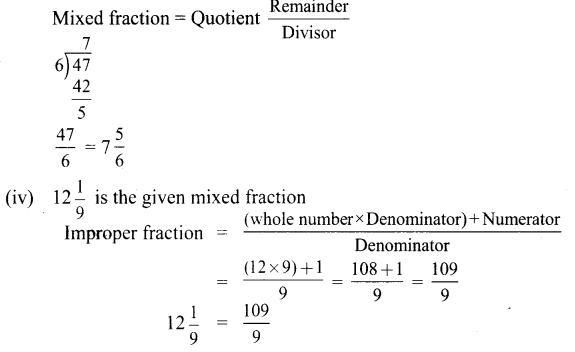
The mixed number 2 2 3 as an improper fraction.

Question 3.
Answer the following :
Solution:
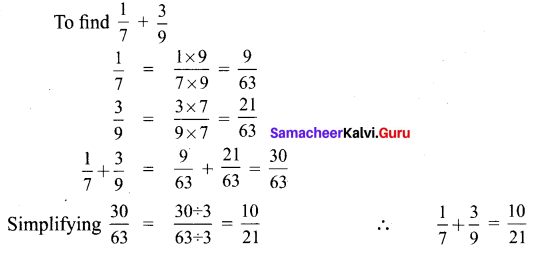
(i) Find the sum of \(\frac{1}{7}\) and \(\frac{3}{9}\)
Samacheer Kalvi 6th Maths Solutions Term 3 Chapter 1 Fractions Ex 1.1 1

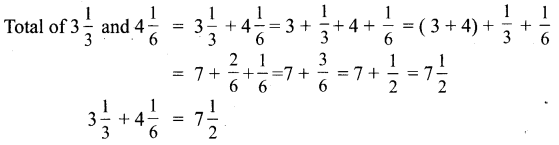
(ii) What is the total of 3\(\frac{1}{3}\) and 4\(\frac{1}{6}\).
Samacheer Kalvi 6th Maths Solutions Term 3 Chapter 1 Fractions Ex 1.1 2

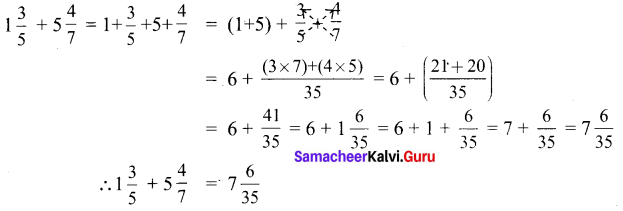
(iii) Simplify : 1\(\frac{3}{5}\) + 5\(\frac{4}{7}\)
Samacheer Kalvi 6th Maths Solutions Term 3 Chapter 1 Fractions Ex 1.1 3

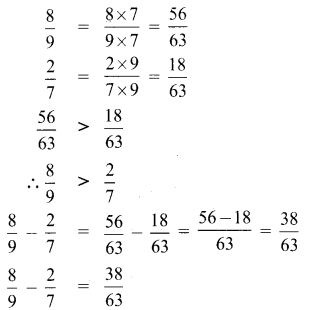
(iv) Find the difference between \(\frac{8}{9}\) and \(\frac{2}{7}\)
Samacheer Kalvi 6th Maths Solutions Term 3 Chapter 1 Fractions Ex 1.1 4

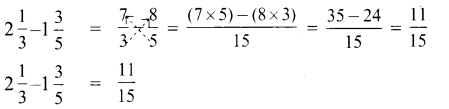
(v) Subtract 1\(\frac{3}{5}\) and 2\(\frac{1}{3}\)
Samacheer Kalvi 6th Maths Solutions Term 3 Chapter 1 Fractions Ex 1.1 5

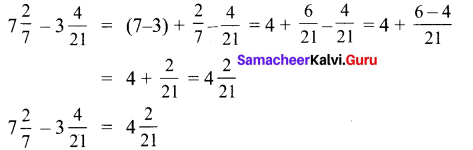
(vi) Simplify: 7\(\frac{2}{7}\) – 3\(\frac{4}{21}\)
Samacheer Kalvi 6th Maths Solutions Term 3 Chapter 1 Fractions Ex 1.1 6

fraction and whole number calculator

Question 4.
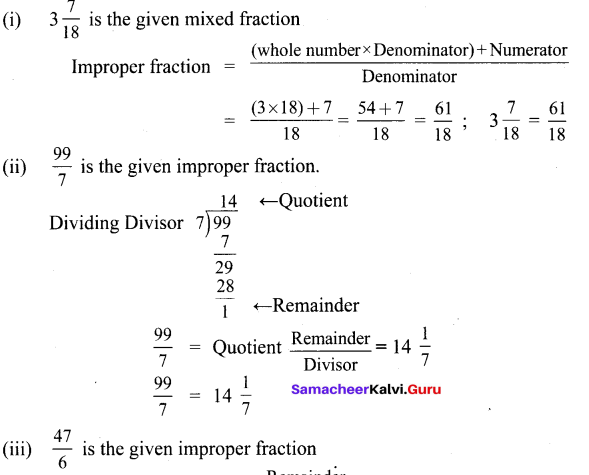
Convert mixed fraction into improper fractions and vice versa:
Samacheer Kalvi 6th Maths Solutions Term 3 Chapter 1 Fractions Ex 1.1 7
Solution:
Samacheer Kalvi 6th Maths Solutions Term 3 Chapter 1 Fractions Ex 1.1 8
Samacheer Kalvi 6th Maths Solutions Term 3 Chapter 1 Fractions Ex 1.1 9

Samacheer Kalvi 6th Maths Solutions Term 3 Chapter 1 Fractions Ex 1.1

Question 5.
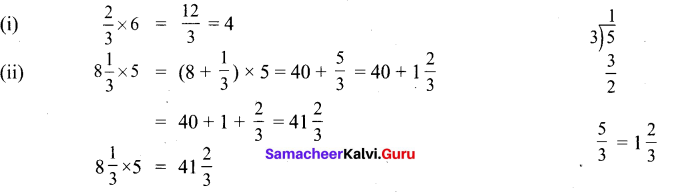
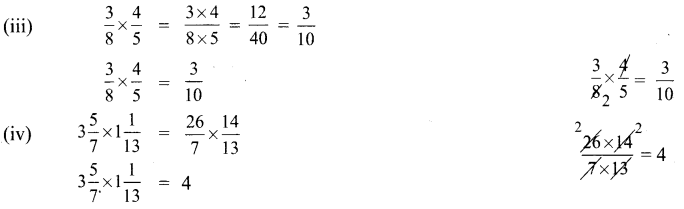
Multiply the following :
Samacheer Kalvi 6th Maths Solutions Term 3 Chapter 1 Fractions Ex 1.1 10
Solution:
Samacheer Kalvi 6th Maths Solutions Term 3 Chapter 1 Fractions Ex 1.1 11
Samacheer Kalvi 6th Maths Solutions Term 3 Chapter 1 Fractions Ex 1.1 12

Question 6.
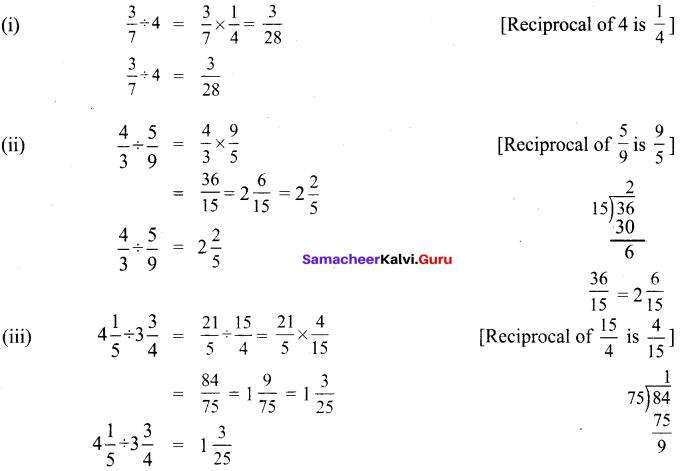
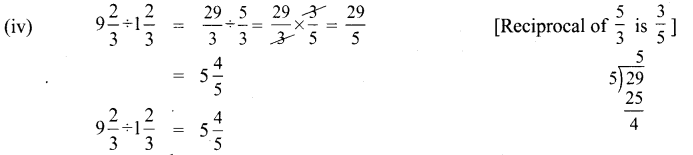
Divide the following:
Samacheer Kalvi 6th Maths Solutions Term 3 Chapter 1 Fractions Ex 1.1 13
Solution:
Samacheer Kalvi 6th Maths Solutions Term 3 Chapter 1 Fractions Ex 1.1 14
Samacheer Kalvi 6th Maths Solutions Term 3 Chapter 1 Fractions Ex 1.1 15

Question 7.
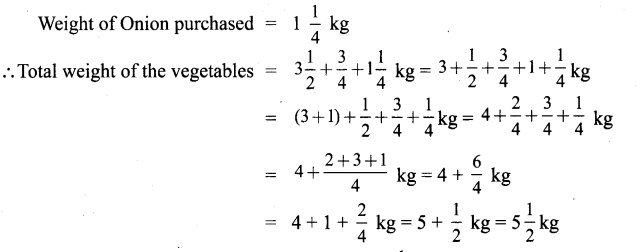
Gowri purchased 3\(\frac{1}{2}\) kg of tomatoes, \(\frac{3}{4}\) kg of brinjal and 1\(\frac{1}{4}\) kg of onion, what is the total weight of the vegetables she bought?
Solution:
Weight of tomatoes Gowri purchased = 3\(\frac{1}{2}\) kg
Weight of Brinjal purchased = \(\frac{3}{4}\) kg
Samacheer Kalvi 6th Maths Solutions Term 3 Chapter 1 Fractions Ex 1.1 16
Total weight of vegetables that Gowri purchased = 5\(\frac{1}{2}\) kg

Samacheer Kalvi 6th Maths Solutions Term 3 Chapter 1 Fractions Ex 1.1

Question 8.
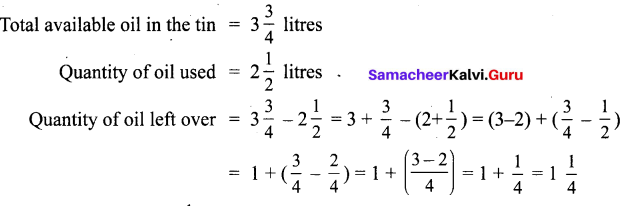
An oil tin contains 3\(\frac{3}{4}\) litres of oil of which 2\(\frac{1}{2}\) litres of oil is used. How much oil is left over?
Solution:
Samacheer Kalvi 6th Maths Solutions Term 3 Chapter 1 Fractions Ex 1.1 17
Quantity of oil leftover = 1\(\frac{1}{4}\) litres.

Question 9.
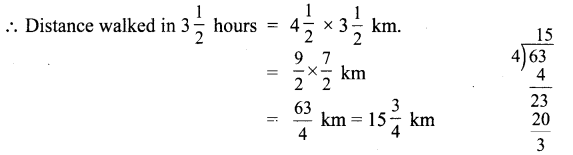
Nilavan can walk 4\(\frac{1}{2}\)km in an hour. How much distance will he cover in 3\(\frac{1}{2}\) hours?
Solution:
Distance walked by Nilavan in one hour = 4\(\frac{1}{2}\) km.
Samacheer Kalvi 6th Maths Solutions Term 3 Chapter 1 Fractions Ex 1.1 18
Nilavan walks 15\(\frac{3}{4}\) km in 3\(\frac{1}{2}\) hours

Samacheer Kalvi 6th Maths Solutions Term 3 Chapter 1 Fractions Ex 1.1

Question 10.
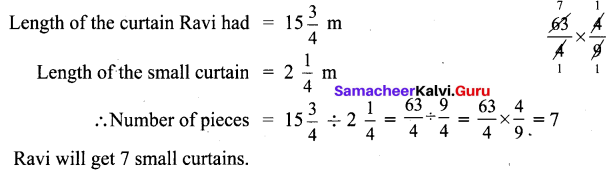
Ravi bought a curtain of length 15\(\frac{3}{4}\) m. If he cut the curtain into small pieces each of length 2\(\frac{1}{4}\) m, then how many small curtains will he get?
Solution:
Samacheer Kalvi 6th Maths Solutions Term 3 Chapter 1 Fractions Ex 1.1 19

Objective Type Questions

Question 11.
Which of the following statement is incorrect?
Samacheer Kalvi 6th Maths Solutions Term 3 Chapter 1 Fractions Ex 1.1 20
Solution:
(d)\(\frac{10}{11}<\frac{9}{10}\)
Hint:
Samacheer Kalvi 6th Maths Solutions Term 3 Chapter 1 Fractions Ex 1.1 21

Question 12.
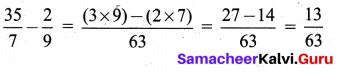
The difference between \(\frac{3}{7}\) and \(\frac{2}{7}\) is
Samacheer Kalvi 6th Maths Solutions Term 3 Chapter 1 Fractions Ex 1.1 22
Solution:
(a) \(\frac{13}{63}\)
Hint:
Samacheer Kalvi 6th Maths Solutions Term 3 Chapter 1 Fractions Ex 1.1 23

Question 13.
The reciprocal of \(\frac{53}{17}\) is
Samacheer Kalvi 6th Maths Solutions Term 3 Chapter 1 Fractions Ex 1.1 24
Solution:
(c) \(\frac{17}{53}\)
Hint:
\(\frac{\frac{1}{53}}{\frac{53}{17}}=\frac{17}{53}\)

Samacheer Kalvi 6th Maths Solutions Term 3 Chapter 1 Fractions Ex 1.1

Question 14.
If \(\frac{6}{7}\) = \(\frac{A}{49}\), then the value of A is
(a) 42
(b) 36
(c) 25
(d) 48
Solution:
(a) 42

Question 15.
Pugazh has been given four choices for his pocket money by his father. Which of the choices should he take in order to get the maximum money?
Samacheer Kalvi 6th Maths Solutions Term 3 Chapter 1 Fractions Ex 1.1 25
Solution:
(c) \(\frac{4}{5}\) of ₹150

Samacheer Kalvi 6th Maths Solutions Term 3 Chapter 1 Fractions Ex 1.1 Read More »

Samacheer Kalvi 6th Maths Solutions Term 2 Chapter 2 Measurements Ex 2.2

You can Download Samacheer Kalvi 6th Maths Book Solutions Guide Pdf, Tamilnadu State Board help you to revise the complete Syllabus and score more marks in your examinations.
Samacheer Kalvi 6th Maths Solutions Term 2 Chapter Chapter 2 Measurements Ex 2.2

Tamilnadu Samacheer Kalvi 6th Maths Solutions Term 2 Chapter 2 Measurements Ex 2.2

Question 1.
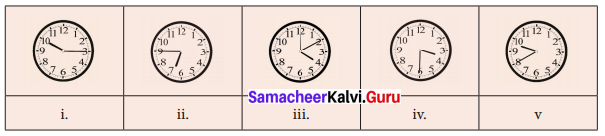
Say the time in two ways:
Samacheer Kalvi 6th Maths Solutions Term 2 Chapter 2 Measurements Ex 2.2 Q1
Solution:
(i) 10 : 15 hours, quarter past 10
(ii) 6 : 45 hours, quarter to 7
(iii) 4 : 10 hours, 10 minutes past 4
(iv) 3 : 30 hours, half past 3
(v) 9 : 40 hours, 20 minutes to 10

Question 2.
Match the following:
(i) 9.55 – (a) 20 minutes past 2
(ii) 11.50 – (b) quarter past 4
(iii) 4.15 – (c) quarter to 8
(iv) 7.45 – (d) 5 minutes to 10
(v) 2.20 – (e) 10 minutes to 1?
Solution:
(i) 9.55 – (d) 5 minutes to 10
(ii) 11.50 – (e) 10 minutes to 12
(iii) 4.15 – (b) quarter past 4
(iv) 7.45 – (c) quarter to 8
(v) 2.20 – (a) 20 minutes past 2

Question 3.
Convert the following :
(i) 20 minutes into seconds
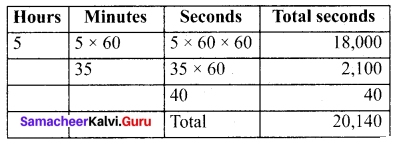
(ii) 5 hours 35 minutes 40 seconds into seconds
(iii) 3\(\frac { 1 }{ 2 }\) hours into minutes
(iv) 580 minutes into hours
(v) 25200 seconds into hours
Solution:
(i) 20 minutes into seconds
20 minutes = 20 × 60 seconds = 1200 seconds
(ii) 5 hours 35 minutes 40 seconds into seconds
Samacheer Kalvi 6th Maths Solutions Term 2 Chapter 2 Measurements Ex 2.2 Q3
∴ 5 hours 35 minutes 40 seconds = 20,140 seconds
(iii) 3\(\frac { 1 }{ 2 }\) hours into minutes
3\(\frac { 1 }{ 2 }\) hours = 3 hours 30 minutes
= 3 × 60 minutes + 30 minutes
= 180 minutes + 30 minutes
= 210 minutes
∴ 3\(\frac { 1 }{ 2 }\) hours = 210 minutes
(iv) 5580 minutes into hours
580 minutes = \(\frac{580}{60}\) hours = 9 hours 40 minutes
∴ 580 minutes = 9 hours 40 minutes
(v) 25200 seconds into hours
25200 seconds = \(\frac{25200}{60}\) minutes = 420 minutes = \(\frac{420}{60}\) hours = 7 hours
∴ 25200 seconds = 7 hours

Samacheer Kalvi 6th Maths Solutions Term 2 Chapter Chapter 2 Measurements Ex 2.2

Question 4.
The duration of electricity consumed by the farmer for his pump set on Monday and Tuesday was 7 hours 20 minutes 35 seconds and 3 hours 44 minutes 50 seconds respectively. Find the total duration of consumption of electricity.
Solution:
Electricity consumption on Monday = 7 hours + 20 minutes + 35 seconds
Electricity consumption on Tuesday = 3 hours + 44 minutes + 50 seconds
Total consumption = 10 hours + 64 minutes + 85 seconds
= 10 hours + (60 + 4) minutes + (60 + 25) seconds
= 1o hours + 1 hrs 4 minutes + 1 minutes 25 seconds
= 11 hours 5 minutes 25 seconds
∴ Total consumption of electricity = 11 hours 5 minutes 25 seconds

Question 5.
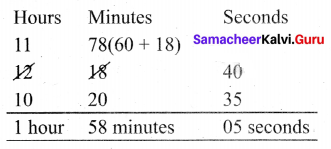
Subtract 10 hrs 20 min 35 sec from 12 hrs 18 min 40 sec.
Solution:
Samacheer Kalvi 6th Maths Solutions Term 2 Chapter 2 Measurements Ex 2.2 Q5
1 hour 58 minutes 05 seconds

Question 6.
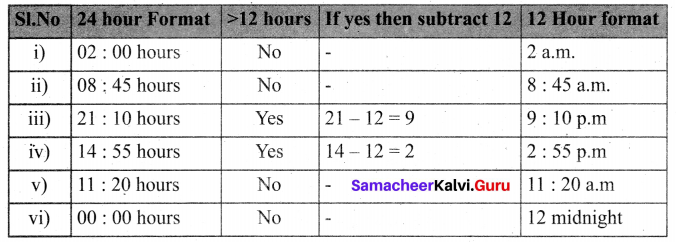
Change the following into 12 hour format:
(i) 02 : 00 hours
(ii) 08 : 45 hours
(iii) 21 : 10 hours
(iv) 11 : 20 hours
(v) 00 : 00 hours
Solution:
Samacheer Kalvi 6th Maths Solutions Term 2 Chapter 2 Measurements Ex 2.2 Q6

Question 7.
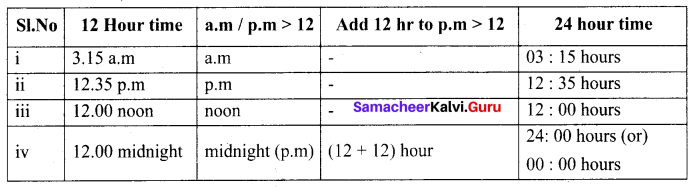
Change the following into 24-hour format.
(i) 3.15 a.m.
(ii) 12.35 p.m.
(iii) 12.00 noon
(iv) 12.00 midnight.
Solution:
Samacheer Kalvi 6th Maths Solutions Term 2 Chapter 2 Measurements Ex 2.2 Q7

Question 8.
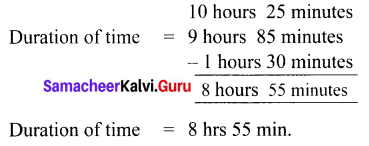
Calculate the duration of time.
(i) from 5.30 a.m to 12.40 p.m
(ii) from 1.30 p.m to 10.25 p.m
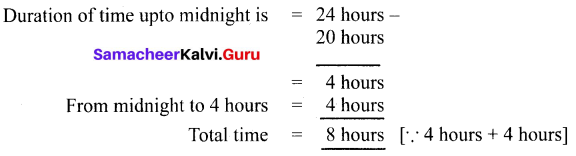
(iii) from 20:00 hours to 4:00 hours
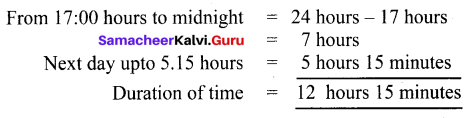
(iv) from 17:00 hours to 5 :15 hours
Solution:
(i) From 5.30 am to 12.40 pm
= (5.30 am to 12 pm) + 12 pm to 12.40 pm
= 6 hrs 30 min + 40 min
= 6 hrs 70 min
= 7 hrs 10 min
(ii) from 1.30 pm to 10.25 p.m.
Samacheer Kalvi 6th Maths Solutions Term 2 Chapter 2 Measurements Ex 2.2 Q8
(iii) from 20 : 00 hrs to 4 : 00 hrs.
Samacheer Kalvi 6th Maths Solutions Term 2 Chapter 2 Measurements Ex 2.2 Q8.1
(iv) from 17 : 00 hours to 5 : 15 hours.
Samacheer Kalvi 6th Maths Solutions Term 2 Chapter 2 Measurements Ex 2.2 Q8.2

Samacheer Kalvi 6th Maths Solutions Term 2 Chapter Chapter 2 Measurements Ex 2.2

Question 9.
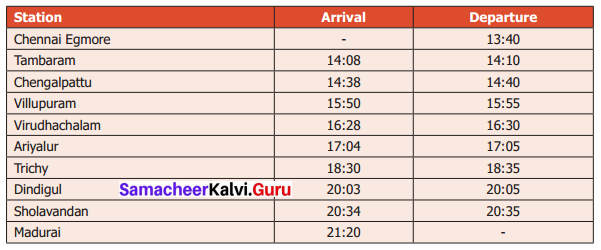
The departure and arrival timing of the Vaigai Superfast Express (No. 12635) from Chennai Egmore to Madurai Junction are given. Read the details and answer the following.
Samacheer Kalvi 6th Maths Solutions Term 2 Chapter 2 Measurements Ex 2.2 Q9
(i) At what time does the Vaigai Express start from Chennai and arrive at Madurai?
(ii) How many halts are between there Chennai and Madurai?
(iii) How long does the train halt at the Villupuram junction?
(iv) At what time does the train come to Sholavandan?
(v) Find the journey time from Chennai Egmore to Madurai?
Solution:
(i) It starts from Chennai at 13 : 40 hrs and arrive at Madurai at 21 : 20 hrs.
(ii) There are 8 halts.
(iii) Departure from Villupuram = 15 hours 55 minutes
Arrival at Villupuram = 15 hours 50 minutes
The train halt at Villupuram for = 05 minutes
(iv) At 20 : 34 hours the train come to Sholavandan
(v) Arrival time at Madurai = 20 hours 80 (20 + 60) minutes
Departure time from Chennai Egmore = 13 hours 40 minutes
Journey Time = 07 hours 40 minutes

Question 10.
Manickam joined a chess class on 20.02.2017 and due to exam, he left practice after 20 days. Again he continued practice from 10.07.2017 to 31.03.2018. Calculate how many days did he practice?
Solution:
Before Exams, he practiced for 20 days.
Days From 10.07.2017 to 31.03.2018
July – 22 Days (From 10.7.2017)
August – 31 Days

September – 30 Days
October – 31 Days

November – 30 Days
December – 31 Days

January 2018 – 31 Days

February – 28 Days
March – 31 Days (upto 31.3.2018)
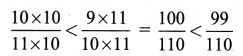
Total – 265 Days
Total number of days practiced = Number of days practiced before exam + Number of days practiced after exam
= 20 + 265
= 285 days.
∴ He practiced for 285 days.

This age difference calculator determines the age gap in relationships or the simple time difference between the births of two people.

Question 11.
A clock gains 3 minutes every hour. If the clock is set correctly at 5 a.m, find the time shown by the clock at 7 p.m?
Solution:
5 a.m. = 5.00 hours
7 p.m = 19.00 hours
Difference = 19.00 – 5.00 = 14.00 hours
Time gain = 14 × 3 = 42 minutes
Time shown by the clock = 7.42 p.m

Question 12.
Find the number of days between republic day and kalvi valarchi day in 2020.
Solution:
2020 is a leap year republic day – 26.01.2020
Kalvi valarchi day – 15.07.2020
Jan – 5
Feb – 29
Mar – 31

April – 30
May – 31
June – 30
July – 14
Total – 170 days

Question 13.
If the 11th of January 2018 is Thursday, what is the day on 20th July of the same year?
Solution:
January – 21 Days (31 – 10)
February – 28 Days
March – 31 Days
April – 30 Days
May – 31 Days
June – 30 Days
July – 19 Days
Total – 190 Days
190 days ÷ 7
190 days = 27 weeks + 1 day
The required day is the first day after Thursday.
∴ 20th of July is Friday.

Samacheer Kalvi 6th Maths Solutions Term 2 Chapter Chapter 2 Measurements Ex 2.2

Question 14.
(i) Convert 480 days into years
(ii) Convert 38 months into years
Solution:
(i) Convert 480 days into years.
We know that 1 year = 365 days. [∵ 480 – 365 = 115 days ]
480 days = 1 year 115 days.
115 days = \(\frac{115}{30}\) months = 3 months 25 days
∴ 480 days = 1 year 3 months 25 days.
(ii) Convert 38 months into years
1 year has 12 months.
38 months = \(\frac{38}{12}\) years = 3 years 2 months
∴ 38 months = 3 years 2 months.

Question 15.
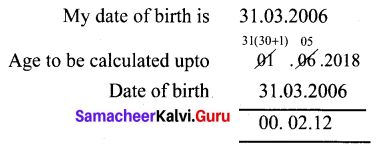
Calculate your age as on 01.06.2018
Solution:
Samacheer Kalvi 6th Maths Solutions Term 2 Chapter 2 Measurements Ex 2.2 Q15
Age is 12 years 2 months

Our free age calculator will calculate your age today, or at any point in past or future. Find how old you are in years, months weeks and days.

Objective Type Questions

Question 16.
2 days = …….. hours
(i) 38
(ii) 48
(iii) 28
(iv) 40
Solution:
(ii) 48

Question 17.
3 weeks = _____ days.
(a) 21
(b) 7
(c) 14
(d) 28
Solution:
(a) 21

Question 18.
Number of ordinary years between two consecutive leap years is
(i) 4 years
(ii) 2 years
(iii) 1 year
(iv) 3 years
Solution:
(iv) 3 years

Question 19.
What time will it 5 hours after 22 : 35 hours?
(a) 2 : 30 hrs
(b) 3 : 35 hrs
(c) 4 : 35 hrs
(d) 5 : 35 hrs
Solution:
(b) 3 : 35 hrs

Question 20.
2 \(\frac{1}{2}\) years is equal to months.
(i) 25
(ii) 30
(iii) 24
(iv) 5
Solution:
(ii) 30

Samacheer Kalvi 6th Maths Solutions Term 2 Chapter Chapter 2 Measurements Ex 2.2

Samacheer Kalvi 6th Maths Solutions Term 2 Chapter 2 Measurements Ex 2.2 Read More »