Class 11

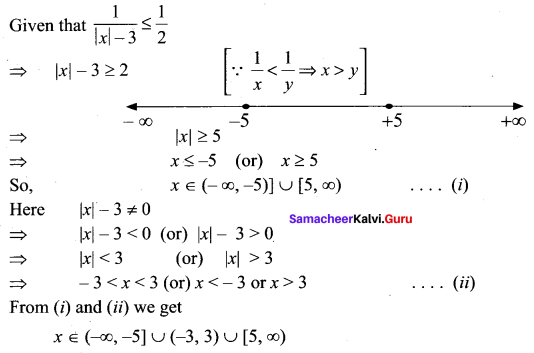
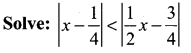
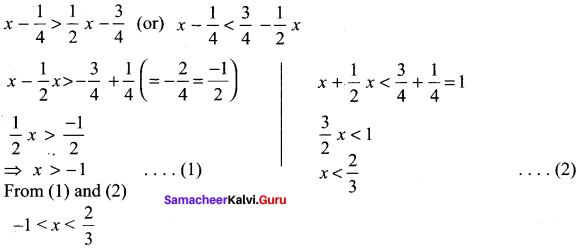
Samacheer Kalvi 11th Maths Solutions Chapter 10 Differentiability and Methods of Differentiation Ex 10.1

You can Download Samacheer Kalvi 11th Maths Book Solutions Guide Pdf, Tamilnadu State Board help you to revise the complete Syllabus and score more marks in your examinations.

Tamilnadu Samacheer Kalvi 11th Maths Solutions Chapter 10 Differentiability and Methods of Differentiation Ex 10.1

Question 1.
Find the derivatives of the following functions using first principle.
(i) f(x) = 6
Solution:
Given f(x) = 6
f(x + h) = 6
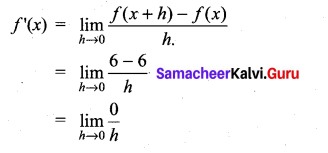
Samacheer Kalvi 11th Maths Solutions Chapter 10 Differentiability and Methods of Differentiation Ex 10.1 1
[h → 0 means h is very nears to zero from left to right but not zero]

(ii) f(x) = -4x + 7
Solution:
Given f(x) = -4x + 7
f(x + h) = -4(x + h) + 7
= -4x – 4h + 7
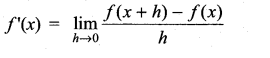
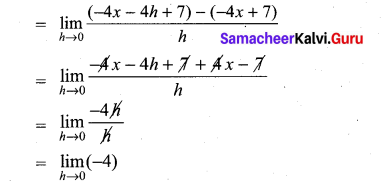
Samacheer Kalvi 11th Maths Solutions Chapter 10 Differentiability and Methods of Differentiation Ex 10.1 2
Samacheer Kalvi 11th Maths Solutions Chapter 10 Differentiability and Methods of Differentiation Ex 10.1 3

(iii) f(x) = -x2 + 2
Given f(x) = -x2 + 2
f(x + h) = -(x + h)2 + 2
= -x2 – h2 – 2xh + 2
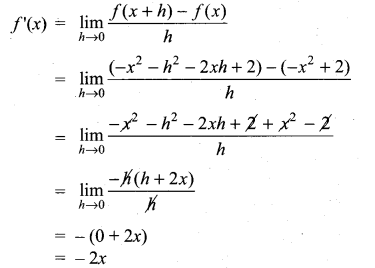
Samacheer Kalvi 11th Maths Solutions Chapter 10 Differentiability and Methods of Differentiation Ex 10.1 4

Question 2.
Find the derivatives from the left and from the right at x = 1 (if they exist) of the following functions. Are the functions differentiable at x = 1?
(i) f(x) = |x – 1|
Solution:
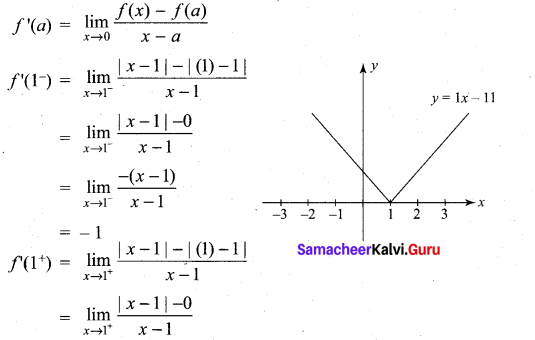
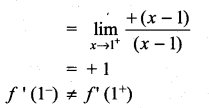
Samacheer Kalvi 11th Maths Solutions Chapter 10 Differentiability and Methods of Differentiation Ex 10.1 5
Samacheer Kalvi 11th Maths Solutions Chapter 10 Differentiability and Methods of Differentiation Ex 10.1 6
f'(1) does not exist
∴ ‘f’ is not differentiable at x = 1.

(ii) f(x) = \(\sqrt{1-x^{2}}\)
Solution:
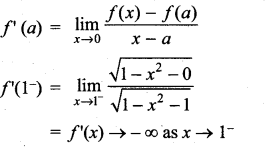
Samacheer Kalvi 11th Maths Solutions Chapter 10 Differentiability and Methods of Differentiation Ex 10.1 7
∴ ‘f’ is not differentiable at x = 1.

(iii)
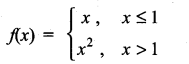
Samacheer Kalvi 11th Maths Solutions Chapter 10 Differentiability and Methods of Differentiation Ex 10.1 8
Solution:
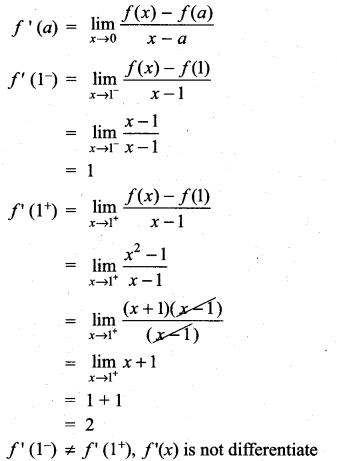
Samacheer Kalvi 11th Maths Solutions Chapter 10 Differentiability and Methods of Differentiation Ex 10.1 9
‘f’ is not differentiable at x = 1

Samacheer Kalvi 11th Maths Solutions Chapter 10 Differentiability and Methods of Differentiation Ex 10.1

Question 3.
Determine whether the following functions is differentiable at the indicated values.
(i) f(x) = x |x| at x = 0
Solution:
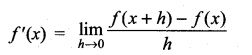
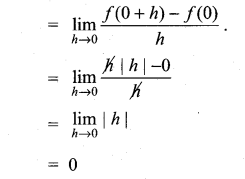
Samacheer Kalvi 11th Maths Solutions Chapter 10 Differentiability and Methods of Differentiation Ex 10.1 10
Samacheer Kalvi 11th Maths Solutions Chapter 10 Differentiability and Methods of Differentiation Ex 10.1 11
Limits exists
Hence ‘f’ is differentiable at x = 0.

(ii) f(x) = |x2 – 1| at x = 1
Solution:
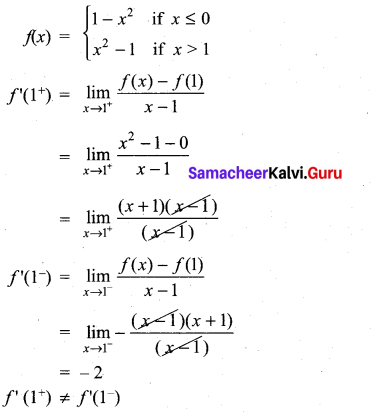
Samacheer Kalvi 11th Maths Solutions Chapter 10 Differentiability and Methods of Differentiation Ex 10.1 12
f(x) is not differentiable at x = 1.

(iii) f(x) = |x| + |x – 1| at x = 0, 1
Solution:
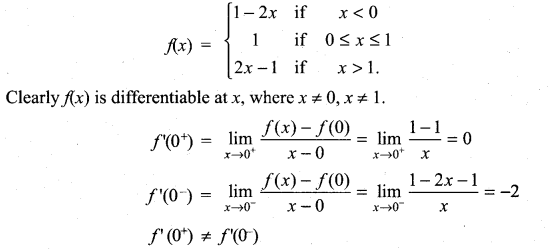
Samacheer Kalvi 11th Maths Solutions Chapter 10 Differentiability and Methods of Differentiation Ex 10.1 13
∴ f(x) is not differentiable at x = 0.
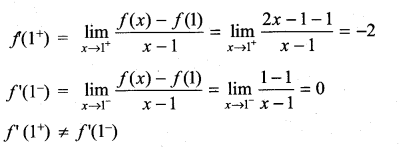
Samacheer Kalvi 11th Maths Solutions Chapter 10 Differentiability and Methods of Differentiation Ex 10.1 14
∴ f(x) is not differentiable at x = 1.

(iv) f(x) = sin |x| at x = 0
Solution:
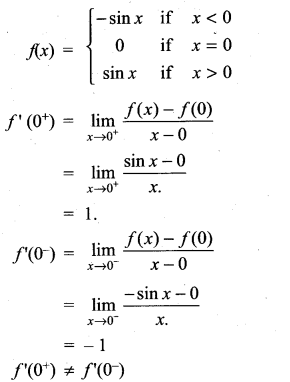
Samacheer Kalvi 11th Maths Solutions Chapter 10 Differentiability and Methods of Differentiation Ex 10.1 15
∴ f(x) is not differentiable at x = 0.

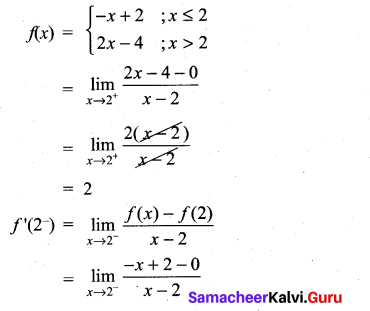
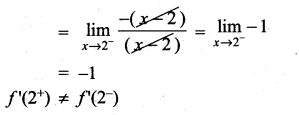
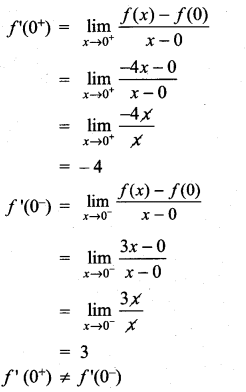
Question 4.
Show that the following functions are not differentiable at the indicated value of x.
(i) Samacheer Kalvi 11th Maths Solutions Chapter 10 Differentiability and Methods of Differentiation Ex 10.1 16
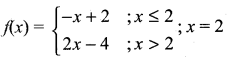
Solution:
Samacheer Kalvi 11th Maths Solutions Chapter 10 Differentiability and Methods of Differentiation Ex 10.1 17
Samacheer Kalvi 11th Maths Solutions Chapter 10 Differentiability and Methods of Differentiation Ex 10.1 18
f(x) is not differentiable at x = 2.

(ii) Samacheer Kalvi 11th Maths Solutions Chapter 10 Differentiability and Methods of Differentiation Ex 10.1 19
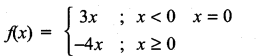
Solution:
Samacheer Kalvi 11th Maths Solutions Chapter 10 Differentiability and Methods of Differentiation Ex 10.1 20
f(x) is not differentiable at x = 0.

Samacheer Kalvi 11th Maths Solutions Chapter 10 Differentiability and Methods of Differentiation Ex 10.1

Question 5.
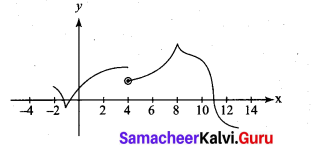
The graph off is shown below. State with reasons that x values (the numbers), at which f is not differentiable.
Solution:
Samacheer Kalvi 11th Maths Solutions Chapter 10 Differentiability and Methods of Differentiation Ex 10.1 21
(i) at x = – 1 and x = 8. The graph is not differentiable since ‘ has vertical tangent at x = -1 and x = 8 (also At x = -1. The graph has shape edge v] and at x = 8; The graph has shape peak.
(ii) At x = 4: The graph f is not differentiable, since at x =4. The graph f’ is not continuous.
(iii) At x = 11; The graph f’ is not differentiable, since at x = 11. The tangent line of the graph is perpendicular.

Question 6.
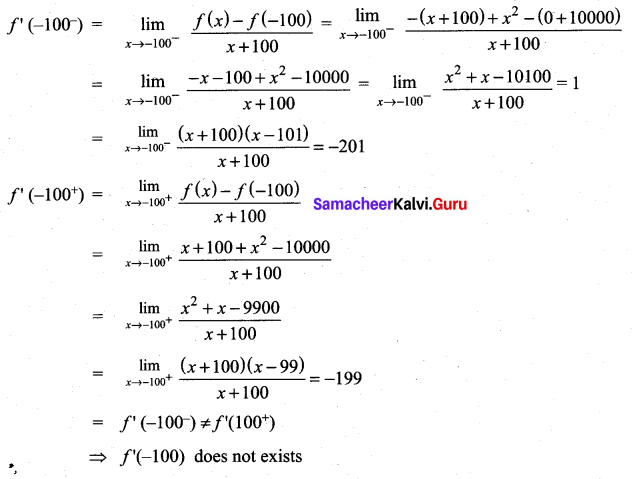
If f(x) = |x + 100| + x2, test whether f’ (-100) exists.
Solution:
f(x) = |x + 100| + x2
Samacheer Kalvi 11th Maths Solutions Chapter 10 Differentiability and Methods of Differentiation Ex 10.1 22

Question 7.
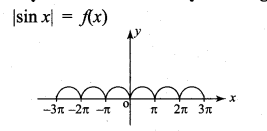
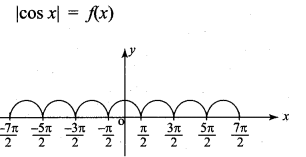
Examine the differentiability of functions in R by drawing the diagrams.
(i) |sin x|
Solution:
Samacheer Kalvi 11th Maths Solutions Chapter 10 Differentiability and Methods of Differentiation Ex 10.1 23
The limit exists and continuous for all x ∈ R clearly, differentiable at R — {nπ n ∈ z) Not differentiable at x = nπ, n ∈ z.

(ii) |cos x|
Solution:
Samacheer Kalvi 11th Maths Solutions Chapter 10 Differentiability and Methods of Differentiation Ex 10.1 24
Limit exist and continuous for all x ∈ R clearly, differentiable at R {(2n + 1)π/2/n ∈ z} Not differentiable at x = (2n + 1) \(\frac{\pi}{2}\), n ∈ Z.

Samacheer Kalvi 11th Maths Solutions Chapter 10 Differentiability and Methods of Differentiation Ex 10.1 Additional Questions

Question 1.
Is the function f(x) = |x| differentiable at the origin. Justify your answer.
Solution:
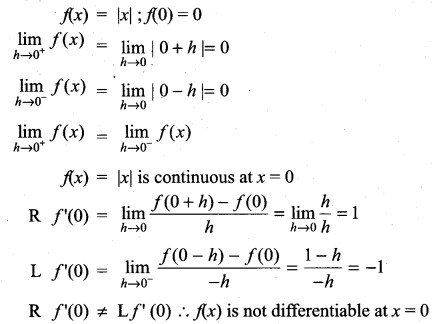
Samacheer Kalvi 11th Maths Solutions Chapter 10 Differentiability and Methods of Differentiation Ex 10.1 25

Samacheer Kalvi 11th Maths Solutions Chapter 10 Differentiability and Methods of Differentiation Ex 10.1

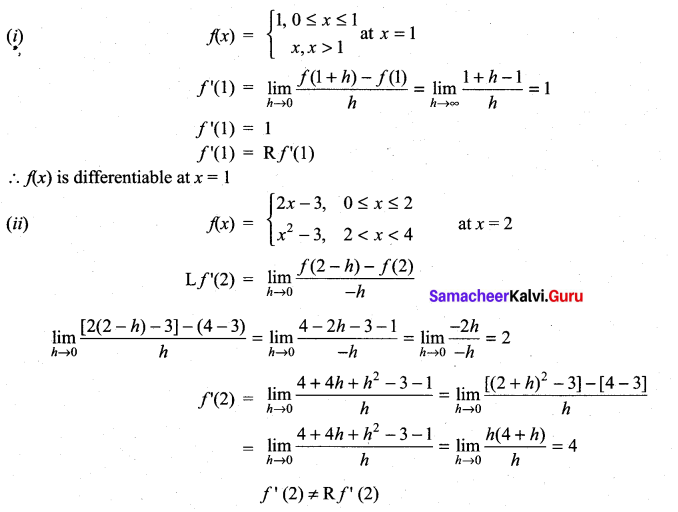
Question 2.
Discuss the differentiability of the functions:

Samacheer Kalvi 11th Maths Solutions Chapter 10 Differentiability and Methods of Differentiation Ex 10.1 26
Solution:
Samacheer Kalvi 11th Maths Solutions Chapter 10 Differentiability and Methods of Differentiation Ex 10.1 27
∴ f(2) is not differentiable at x = 2. Similarly, it can be proved for x = 4.
Samacheer Kalvi 11th Maths Solutions Chapter 10 Differentiability and Methods of Differentiation Ex 10.1 Read More »

Samacheer Kalvi 11th Maths Solutions Chapter 2 Basic Algebra Ex 2.13

You can Download Samacheer Kalvi 11th Maths Book Solutions Guide Pdf, Tamilnadu State Board help you to revise the complete Syllabus and score more marks in your examinations.

Tamilnadu Samacheer Kalvi 11th Maths Solutions Chapter 2 Basic Algebra Ex 2.13

Choose the correct or the most suitable questions.

Question 1.
If |x + 2| ≤ 9, then x belongs to
(a) (-∞, -7)
(b) [-11, 7]
(c) (-∞, -7) ∪ [11, ∞)
(d)(-11, 7)
Solution:
(b) [-11, 7]
Hint:
Given |x + 2| ≤ 9
– 9 ≤ (x + 2) ≤ 9
– 9 – 2 ≤ x ≤ 9 – 2
– 11 ≤ x ≤ 7
∴ x ∈ [-11, 7]

Question 2.
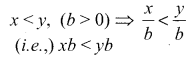
Given that x, y and b are real numbers x < y, b ≥ 0, then ……..
(a) xb < yb (b) xb > yb
(c) xb ≤ vb
(d) xlb ≥ ylb
Solution:
(a) xb < yb
Hint:
Samacheer Kalvi 11th Maths Solutions Chapter 2 Basic Algebra Ex 2.13 1

Question 3.
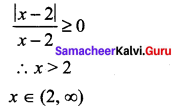
Samacheer Kalvi 11th Maths Solutions Chapter 2 Basic Algebra Ex 2.13 3
(a) [2, ∞]
(b) (2, ∞)
(c) (-∞, 2)
(d) (-2, ∞)
Solution:
(b) (2, ∞)
Hint:
Samacheer Kalvi 11th Maths Solutions Chapter 2 Basic Algebra Ex 2.13 4

Question 4.
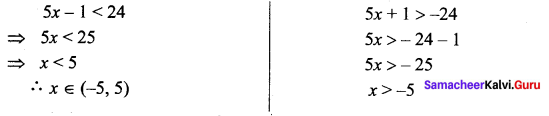
The solution of 5x – 1 < 24 and 5x + 1 > -24 is …….
(a) (4, 5)
(b) (-5, -4)
(c) (-5, 5)
(d) (-5, 4)
Solution:
(c) (-5, 5)
Hint:
Samacheer Kalvi 11th Maths Solutions Chapter 2 Basic Algebra Ex 2.13 5

Samacheer Kalvi 11th Maths Solutions Chapter 2 Basic Algebra Ex 2.13

Question 5.
The solution set of the following inequality |x – 1| ≥ |x – 3| is …….
(a) [0, 2]
(b) (2, ∞)
(c) (0, 2)
(d) (-∞, 2)
Solution:
(b) (2, ∞)

Question 6.
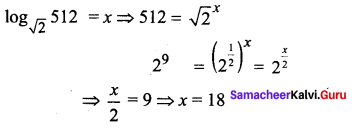
Samacheer Kalvi 11th Maths Solutions Chapter 2 Basic Algebra Ex 2.13 6
(a) 16
(b) 18
(c) 9
(d) 12
Solution:
(b) 18
Hint:
Samacheer Kalvi 11th Maths Solutions Chapter 2 Basic Algebra Ex 2.13 7

Question 7.
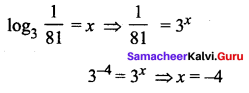
Samacheer Kalvi 11th Maths Solutions Chapter 2 Basic Algebra Ex 2.13 8
(a) -2
(b) -8
(c) -4
(d) -9
Solution:
(c) -4
Hint:
Samacheer Kalvi 11th Maths Solutions Chapter 2 Basic Algebra Ex 2.13 9

Question 8.
Samacheer Kalvi 11th Maths Solutions Chapter 2 Basic Algebra Ex 2.13 10
(a) 0.5
(b) 2.5
(c) 1.5
(d) 1.25
Solution:
(a) 0.5
Hint:
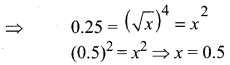
Samacheer Kalvi 11th Maths Solutions Chapter 2 Basic Algebra Ex 2.13 11

Question 9.
Samacheer Kalvi 11th Maths Solutions Chapter 2 Basic Algebra Ex 2.13 12
(a) 2
(b) 1
(c) 3
(d) 4
Solution:
(b) 1
Hint:
Samacheer Kalvi 11th Maths Solutions Chapter 2 Basic Algebra Ex 2.13 13

Samacheer Kalvi 11th Maths Solutions Chapter 2 Basic Algebra Ex 2.13

Question 10.
If 3 is the logarithm of 343, then the base is ……
(a) 5
(b) 7
(c) 6
(d) 9
Solution:
(b) 7
Hint.
Given logx 343 = 3
343 = x3
7 × 7 × 7 = x3
73 = x3
x = 7
Base of the logarithm x = 7

Question 11.
Find a so that the sum and product of the roots of the equation 2x2 + (a – 3)x + 3a – 5 = 0 are equal is ……..
(a) 1
(b) 2
(c) 0
(d) 4
Solution:
(b) 2
Hint:
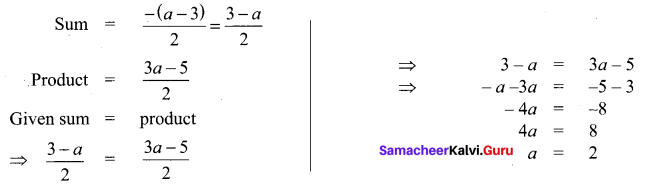
Samacheer Kalvi 11th Maths Solutions Chapter 2 Basic Algebra Ex 2.13 14

Question 12.
If a and b are the roots of the equation x2 – kx + 16 = 0 and satisfy a2 + b2 = 32, then the value of k is ……
(a) 10
(b) -8
(c) (-8, 8)
(d) 6
Solution:
(c) -8, 8
Hint:
Given a and b are the roots of x2 – kx + 16 = 0 satisfying a2 + b2 = 32
Sum of the roots a + b = \(\frac{-(-k)}{1}\)
a + b = k
Product of the roots ab = \(\frac{16}{1}\)
ab = 16
a2 + b2 = (a + b)2 – 2ab
32 = k2 – 2 × 16
32 = k2 – 32
k2 = 32 + 32 = 64
k = ± 8

Question 13.
The number of solutions of x2 + |x – 1| = 1 is ………
(a) 1
(b) 0
(c) 2
(d) 3
Solution:
(c) 2
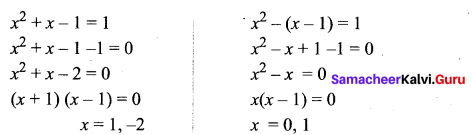
Samacheer Kalvi 11th Maths Solutions Chapter 2 Basic Algebra Ex 2.13 15
We have two solutions 0, 1

Question 14.

The equations whose roots are numerically equal but opposite in sign to the roots of 3x2 – 5x – 7 = 0 is ……
(a) 3x2 – 5x – 7 = 0
(b) 3x2 + 5x – 7 = 0
(c) 3x2 – 5x + 7 = 0
(d) 3x2 + x – 7 = 0
Solution:
(b) 3x2 + 5x – 7 = 0
Hint:
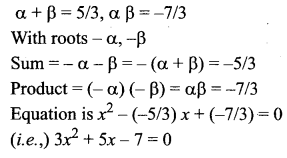
Samacheer Kalvi 11th Maths Solutions Chapter 2 Basic Algebra Ex 2.13 16

Samacheer Kalvi 11th Maths Solutions Chapter 2 Basic Algebra Ex 2.13

Question 15.
If 8 and 2 are the roots of x2 + ax + c = 0 and 3, 3 are the roots of x2 + ax + b = 0, then the roots of the equation x2 + ax + b = 0 are …….
(a) 1, 2
(b) -1, 1
(c) 9, 1
(d) -1, 2
Solution:
(c) 9, 1
Hint:
Sum = 8 + 2 = 10 = -a ⇒ a = -10
Product = 3 × 3 = 9 = b ⇒ b = 9
Now the equation x2 + ax + b = 0
⇒ x2 – 10x + 9 = 0
⇒ (x- 9) (x – 1) = 0
x = 1 or 9

Question 16.
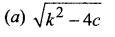
If a and b are the real roots of the equation x2 – kx + c = 0, then the distance
between the points (a, 0) and (b, 0) is ……..
Samacheer Kalvi 11th Maths Solutions Chapter 2 Basic Algebra Ex 2.13 17
Solution:
Samacheer Kalvi 11th Maths Solutions Chapter 2 Basic Algebra Ex 2.13 18
Hint:
a + b = k, ab = c
Samacheer Kalvi 11th Maths Solutions Chapter 2 Basic Algebra Ex 2.13 19

Question 17.
Samacheer Kalvi 11th Maths Solutions Chapter 2 Basic Algebra Ex 2.13 20
(a) 1
(b) 2
(c) 3
(d) 4
Solution:
(c) 3
Samacheer Kalvi 11th Maths Solutions Chapter 2 Basic Algebra Ex 2.13 21

Question 18.
Samacheer Kalvi 11th Maths Solutions Chapter 2 Basic Algebra Ex 2.13 22
(a) -1/2
(b) -2/3
(c) 1/2
(d) 2/3
Solution:
(a) -1/2
Hint:
Samacheer Kalvi 11th Maths Solutions Chapter 2 Basic Algebra Ex 2.13 23

Samacheer Kalvi 11th Maths Solutions Chapter 2 Basic Algebra Ex 2.13

Question 19.
The number of real roots of (x + 3)4 + (x + 5)4 = 16 is ……
(a) 4
(b) 2
(c) 3
(d) 0
Solution:
(a) 4
Hint:
The given equation is (x + 3)4 + (x + 5)4 = 16
Since it is a fourth degree equation it has four roots.
∴ Number of roots = 4

Question 20.
The value of log3 11 . log11 13 . log13 15 . log15 27 . log27 81 is …….
(a) 1
(b) 2
(c) 3
(d) 4
Solution:
(d) 4
Solution:
(d) 4
Hint.
log3 11 . log11 13 . log 13 15 . log 15 27 . log 27 81
= log3 13 . log 13 15 . log 15 27 . log 27 81
= log 3 15 . log 15 27 . log 27 81
= log 3 27 . log 27 81
= log 3 81
= log 334
= 4 log 33
= 4 × 1
= 4
Samacheer Kalvi 11th Maths Solutions Chapter 2 Basic Algebra Ex 2.13 50

Samacheer Kalvi 11th Maths Solutions Chapter 2 Basic Algebra Ex 2.13 Read More »

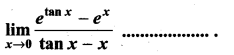
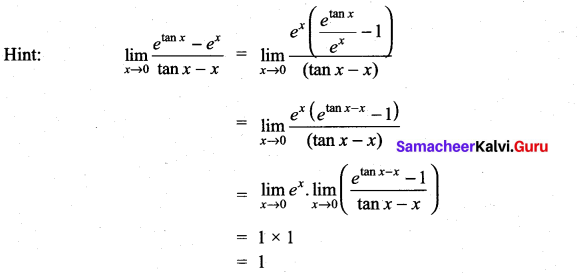
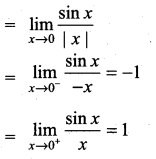
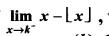
Samacheer Kalvi 11th Maths Solutions Chapter 9 Limits and Continuity Ex 9.6

You can Download Samacheer Kalvi 11th Maths Book Solutions Guide Pdf, Tamilnadu State Board help you to revise the complete Syllabus and score more marks in your examinations.

Tamilnadu Samacheer Kalvi 11th Maths Solutions Chapter 9 Limits and Continuity Ex 9.6

Choose the correct or the most suitable answer from the given four alternatives
Question 1.
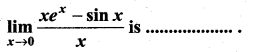
Samacheer Kalvi 11th Maths Solutions Chapter 9 Limits and Continuity Ex 9.6 1
(a) 1
(b) 0
(c) ∞
(d) -∞
Solution:
(b) 0
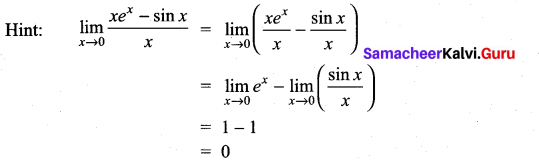
Samacheer Kalvi 11th Maths Solutions Chapter 9 Limits and Continuity Ex 9.6 2

Question 2.
Samacheer Kalvi 11th Maths Solutions Chapter 9 Limits and Continuity Ex 9.6 3
(a) 2
(b) 1
(c) -2
(d) 0
Solution:
(c) -2
Samacheer Kalvi 11th Maths Solutions Chapter 9 Limits and Continuity Ex 9.6 4

Question 3.
Samacheer Kalvi 11th Maths Solutions Chapter 9 Limits and Continuity Ex 9.6 5
(a) 0
(b) 1
(c) 2
(d) does not exist
Solution:
(d) does not exist
Samacheer Kalvi 11th Maths Solutions Chapter 9 Limits and Continuity Ex 9.6 6

Samacheer Kalvi 11th Maths Solutions Chapter 9 Limits and Continuity Ex 9.6

Question 4.
Samacheer Kalvi 11th Maths Solutions Chapter 9 Limits and Continuity Ex 9.6 7
(a) 1
(b) -1
(c) 0
(d) 2
Solution:
(a) 1
Samacheer Kalvi 11th Maths Solutions Chapter 9 Limits and Continuity Ex 9.6 8

Question 5.
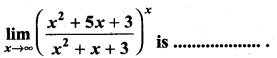
Samacheer Kalvi 11th Maths Solutions Chapter 9 Limits and Continuity Ex 9.6 9
(a) e4
(b) e2
(c) e3
(d) 1
Solution:
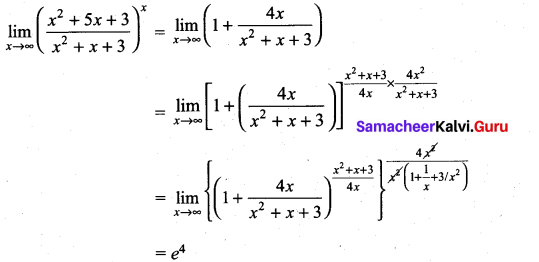
(a) e4
Samacheer Kalvi 11th Maths Solutions Chapter 9 Limits and Continuity Ex 9.6 10

Samacheer Kalvi 11th Maths Solutions Chapter 9 Limits and Continuity Ex 9.6

Question 6.
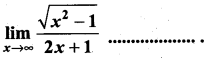
Samacheer Kalvi 11th Maths Solutions Chapter 9 Limits and Continuity Ex 9.6 11
(a) 1
(b) 0
(c) -1
(d) \(\frac{1}{2}\)
Solution:
(d) \(\frac{1}{2}\)
Samacheer Kalvi 11th Maths Solutions Chapter 9 Limits and Continuity Ex 9.6 12

Question 7.
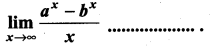
Samacheer Kalvi 11th Maths Solutions Chapter 9 Limits and Continuity Ex 9.6 13
(a) log ab
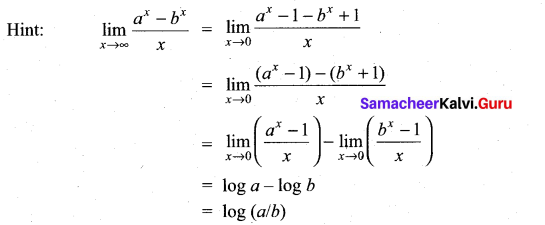
(b) log \(\left(\frac{a}{b}\right)\)
(c) log \(\left(\frac{b}{a}\right)\)
(d) \(\frac{a}{b}\)
Solution:
(b) log \(\left(\frac{a}{b}\right)\)
Samacheer Kalvi 11th Maths Solutions Chapter 9 Limits and Continuity Ex 9.6 14

Question 8.
Samacheer Kalvi 11th Maths Solutions Chapter 9 Limits and Continuity Ex 9.6 15
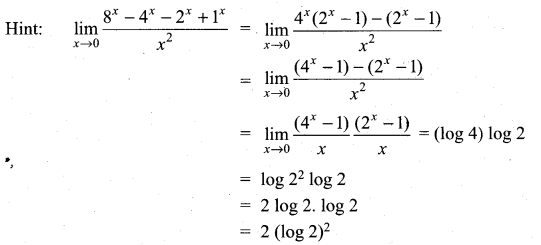
(a) 2 log 2
(b) 2 (log 2)2
(c) log 2
(d) 3 log 2
Solution:
(b) 2 (log 2))2
Samacheer Kalvi 11th Maths Solutions Chapter 9 Limits and Continuity Ex 9.6 16

Question 9.
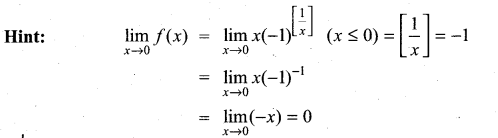
If f(x) = \(x(-1)^{ \left\lfloor \frac { 1 }{ x } \right\rfloor }\), x ≤ θ, then the value of Samacheer Kalvi 11th Maths Solutions Chapter 9 Limits and Continuity Ex 9.6 17 is equal to …………….
(a) -1
(b) 0
(c) 2
(d) 4
Solution:
(b) 0
Samacheer Kalvi 11th Maths Solutions Chapter 9 Limits and Continuity Ex 9.6 18

Question 10.
Samacheer Kalvi 11th Maths Solutions Chapter 9 Limits and Continuity Ex 9.6 19
(a) 2
(b) 3
(c) does not exist
(d) 0
Solution:
(c) does not exist
Samacheer Kalvi 11th Maths Solutions Chapter 9 Limits and Continuity Ex 9.6 20
Limit does not exist

Question 11.
Let the function f be defined f(x) = Samacheer Kalvi 11th Maths Solutions Chapter 9 Limits and Continuity Ex 9.6 21then ……………
Samacheer Kalvi 11th Maths Solutions Chapter 9 Limits and Continuity Ex 9.6 22
Solution:
Samacheer Kalvi 11th Maths Solutions Chapter 9 Limits and Continuity Ex 9.6 23
The limit does not exist

Samacheer Kalvi 11th Maths Solutions Chapter 9 Limits and Continuity Ex 9.6

Question 12.
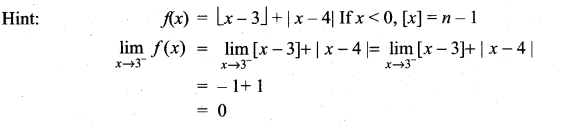
If f: R → R is defined by f(x) = \(\lfloor x-3\rfloor+|x-4|\) for x ∈ R, then Samacheer Kalvi 11th Maths Solutions Chapter 9 Limits and Continuity Ex 9.6 24 is equal to …………..
(a) -2
(b) -1
(c) 0
(d) 1
Solution:
(c) 0
Samacheer Kalvi 11th Maths Solutions Chapter 9 Limits and Continuity Ex 9.6 25

Question 13.
Samacheer Kalvi 11th Maths Solutions Chapter 9 Limits and Continuity Ex 9.6 26
(a) 1
(b) 2
(c) 3
(d) 0
Solution:
(d) 0
Samacheer Kalvi 11th Maths Solutions Chapter 9 Limits and Continuity Ex 9.6 27

Question 14.
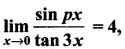
If Samacheer Kalvi 11th Maths Solutions Chapter 9 Limits and Continuity Ex 9.6 28 then the value of p is ………….
(a) 6
(b) 9
(c) 12
(d) 4
Solution:
(c) 12
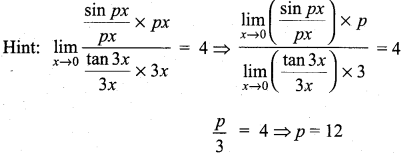
Samacheer Kalvi 11th Maths Solutions Chapter 9 Limits and Continuity Ex 9.6 29

Question 15.
Samacheer Kalvi 11th Maths Solutions Chapter 9 Limits and Continuity Ex 9.6 30
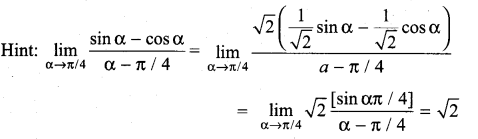
(a) \(\sqrt{2}\)
(b) \(\frac{1}{\sqrt{2}}\)
(c) 1
(d) 2
Solution:
(a) \(\sqrt{2}\)
Samacheer Kalvi 11th Maths Solutions Chapter 9 Limits and Continuity Ex 9.6 31

Question 16.
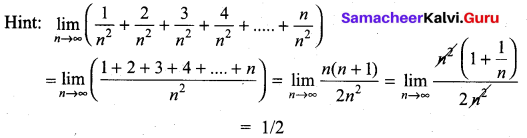
Samacheer Kalvi 11th Maths Solutions Chapter 9 Limits and Continuity Ex 9.6 32
(a) \(\frac{1}{2}\)
(b) 0
(c) 1
(d) ∞
Solution:
(a) \(\frac{1}{2}\)
Samacheer Kalvi 11th Maths Solutions Chapter 9 Limits and Continuity Ex 9.6 33

Samacheer Kalvi 11th Maths Solutions Chapter 9 Limits and Continuity Ex 9.6

Question 17.
Samacheer Kalvi 11th Maths Solutions Chapter 9 Limits and Continuity Ex 9.6 34
(a) 1
(b) e
(c) \(\frac{1}{e}\)
(d) 0
Solution:
(a) 1
Samacheer Kalvi 11th Maths Solutions Chapter 9 Limits and Continuity Ex 9.6 35

Question 18.
Samacheer Kalvi 11th Maths Solutions Chapter 9 Limits and Continuity Ex 9.6 36
(a) 1
(b) e
(c) \(\frac{1}{2}\)
(d) 0
Solution:
(a) 1
Samacheer Kalvi 11th Maths Solutions Chapter 9 Limits and Continuity Ex 9.6 37

Question 19.
The value of Samacheer Kalvi 11th Maths Solutions Chapter 9 Limits and Continuity Ex 9.6 38 is ……………
(a) 1
(b) -1
(c) 0
(d) ∞
Solution:
(d) ∞
Hint:
Samacheer Kalvi 11th Maths Solutions Chapter 9 Limits and Continuity Ex 9.6 39
So limit does not exist

Question 20.
The value of Samacheer Kalvi 11th Maths Solutions Chapter 9 Limits and Continuity Ex 9.6 40 where k is an integer is …………..
(a) -1
(b) 1
(c) 0
(d) 2
Solution:
(b) 1
Samacheer Kalvi 11th Maths Solutions Chapter 9 Limits and Continuity Ex 9.6 41

Samacheer Kalvi 11th Maths Solutions Chapter 9 Limits and Continuity Ex 9.6

Question 21.
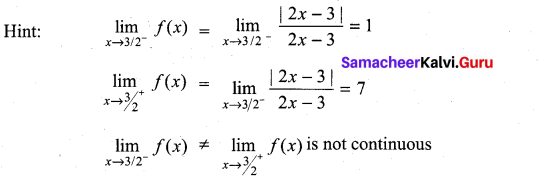
At x = \(\frac{3}{2}\) the function f(x) = \(\frac{|2 x-3|}{2 x-3}\) is ………….
(a) Continuous
(b) discontinuous
(c) Differentiate
(d) non-zero
Solution:
(b) discontinuous
Samacheer Kalvi 11th Maths Solutions Chapter 9 Limits and Continuity Ex 9.6 42

Question 22.
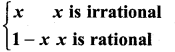
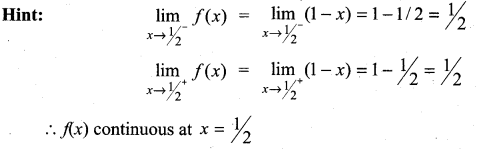
Let f: R → R be defined by f(x) = Samacheer Kalvi 11th Maths Solutions Chapter 9 Limits and Continuity Ex 9.6 43 then f is ……………
(a) Discontinuous at x = \(\frac{1}{2}\)
(b) Continuous at x = \(\frac{1}{2}\)
(c) Continuous everywhere
(d) Discontinuous everywhere
Solution:
(b) Continuous at x = \(\frac{1}{2}\)
Samacheer Kalvi 11th Maths Solutions Chapter 9 Limits and Continuity Ex 9.6 44

Question 23.
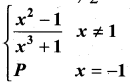
The function f(x) = Samacheer Kalvi 11th Maths Solutions Chapter 9 Limits and Continuity Ex 9.6 45 is not defined for x = -1. The value of f(-1) so that the function extended by this value is continuous is …………..
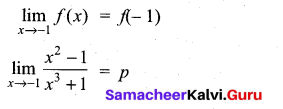
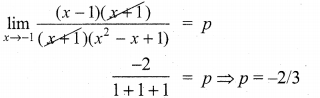
(a) \(\frac{2}{3}\)
(b) \(-\frac{2}{3}\)
(c) 1
(d) 0
Solution:
(b) \(-\frac{2}{3}\)
Hint: For the function to be continuous at x = 1
Samacheer Kalvi 11th Maths Solutions Chapter 9 Limits and Continuity Ex 9.6 46
Samacheer Kalvi 11th Maths Solutions Chapter 9 Limits and Continuity Ex 9.6 47

Question 24.
Let f be a continuous function on [2, 5]. If f takes only rational values for all x and f(3) = 12, then f(4.5) is equal to ……………
(a) \(\frac{f(3)+f(4.5)}{7.5}\)
(b) 12
(c) 17.5
(d) \(\frac{f(4.5)-f(3)}{1.5}\)
Solution:
(b) 12

Samacheer Kalvi 11th Maths Solutions Chapter 9 Limits and Continuity Ex 9.6

Question 25.
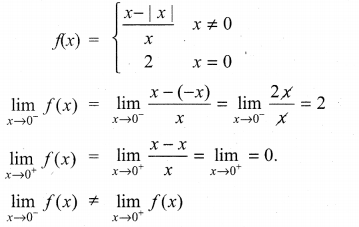
Let a function f be defined by f(x) = \(\frac{x-|x|}{x}\) for x ≠ 0 and f(0) = 2. Then f is …………..

(a) Continuous nowhere
(b) Continuous everywhere
(c) Continuous for all x except x = 1
(d) Continuous for all x except x = 0
Solution:
(d) Continuous for all x except x = 0
Hint:
Samacheer Kalvi 11th Maths Solutions Chapter 9 Limits and Continuity Ex 9.6 48
∴ f(x) is not continuous at x = 0
⇒ f(x) is continuous for all except x = 0

Samacheer Kalvi 11th Maths Solutions Chapter 9 Limits and Continuity Ex 9.6 Read More »

Samacheer Kalvi 11th Maths Solutions Chapter 2 Basic Algebra Ex 2.1

You can Download Samacheer Kalvi 11th Maths Book Solutions Guide Pdf, Tamilnadu State Board help you to revise the complete Syllabus and score more marks in your examinations.

Tamilnadu Samacheer Kalvi 11th Maths Solutions Chapter 2 Basic Algebra Ex 2.1

Question 1.
Samacheer Kalvi 11th Maths Solutions Chapter 2 Basic Algebra Ex 2.1 1
Solution:
Samacheer Kalvi 11th Maths Solutions Chapter 2 Basic Algebra Ex 2.1 2
3.14 ∈ Q
0, 4 are integers and 0 ∈ Z, 4 ∈ N, Z, Q
\(\frac{22}{7} \in \mathrm{Q}\)

Samacheer Kalvi 11th Maths Solutions Chapter 2 Basic Algebra Ex 2.1

Question 2.
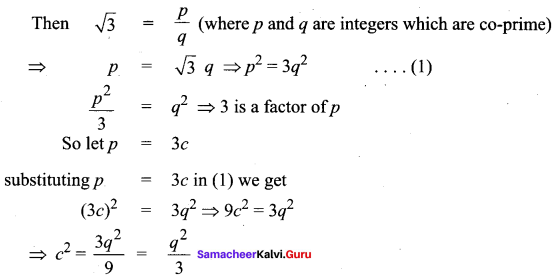
Prove that \(\sqrt{3}\) is an irrational number.
(Hint: Follow the method that we have used to prove \(\sqrt{2}\) ∉ Q.
Solution:
Suppose that \(\sqrt{3}\) is rational P
Samacheer Kalvi 11th Maths Solutions Chapter 2 Basic Algebra Ex 2.1 3
⇒ 3 is a factor of q also
so 3 is a factor ofp and q which is a contradiction.
⇒ \(\sqrt{3}\) is not a rational number
⇒ \(\sqrt{3}\) is an irrational number

Question 3.
Are there two distinct irrational numbers such that their difference is a rational number? Justify.
Solution:
Let the two irrational numbers be 2 + √5 and 4 + √5
Their difference = (2 + √5) – (4 + √5)
= 2 + √5 – 4 – √5
= 2 – 4 = – 2
which is a rational number.
Samacheer Kalvi 11th Maths Solutions Chapter 2 Basic Algebra Ex 2.1

Question 4.
Find two irrational numbers such that their sum is a rational number. Can you find two irrational numbers whose product is a rational number?
Solution:
Let the two irrational numbers be 3 + √5 and 7 – √5
Their sum = 3 + √5 + 7 – √5 = 3 + 7 = 10
which is a rational number
Consider the two irrational numbers 2 + √3, 2 – √3
Their product = (2 + √3) (2 – √3)
= 22 – (√3)2 = 4 – 3 = 1
which is a rational number.

Question 5.
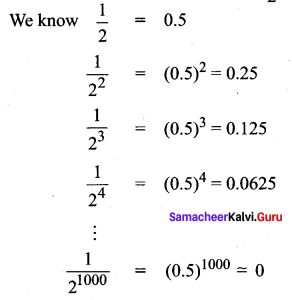
Find a positive number smaller than \(\frac{1}{2^{1000}}\). Justify.
Solution:
Samacheer Kalvi 11th Maths Solutions Chapter 2 Basic Algebra Ex 2.1 4
There will not be a positive number smaller than 0.
So there will not be a +ve number smaller than \(\frac{1}{2^{1000}}\)

Samacheer Kalvi 11th Maths Solutions Chapter 2 Basic Algebra Ex 2.1 Additional Questions

Question 1.
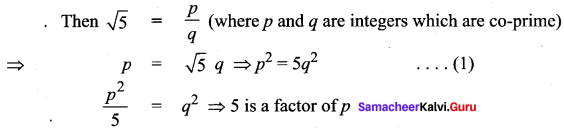
Prove that \(\sqrt{5}\) is an irrational number.
Solution:
Suppose that \(\sqrt{5}\) is rational
Samacheer Kalvi 11th Maths Solutions Chapter 2 Basic Algebra Ex 2.1 5
So let p = 5c
substitute p = 5c in (1) we get
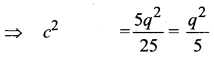
(5c)2 = 5q2 ⇒ 25c2 = 5q2
Samacheer Kalvi 11th Maths Solutions Chapter 2 Basic Algebra Ex 2.1 6
⇒ 5 is a factor of q also
So 5 is a factor of p and q which is a contradiction.
⇒ \(\sqrt{5}\) is not a rational number
⇒ \(\sqrt{5}\) is an irrational number

Samacheer Kalvi 11th Maths Solutions Chapter 2 Basic Algebra Ex 2.1

Question 2.
Prove that 0.33333 = \(\frac{1}{3}\)
Solution:
Let x = 0.33333….
10x = 3.3333 ….
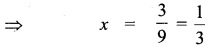
10x – x = 9x = 3
Samacheer Kalvi 11th Maths Solutions Chapter 2 Basic Algebra Ex 2.1 7

Samacheer Kalvi 11th Maths Solutions Chapter 2 Basic Algebra Ex 2.1 Read More »

Samacheer Kalvi 11th Maths Solutions Chapter 11 Integral Calculus Ex 11.3

You can Download Samacheer Kalvi 11th Maths Book Solutions Guide Pdf, Tamilnadu State Board help you to revise the complete Syllabus and score more marks in your examinations.

Tamilnadu Samacheer Kalvi 11th Maths Solutions Chapter 11 Integral Calculus Ex 11.3

Integrate the following w.r.to x.
Question 1.
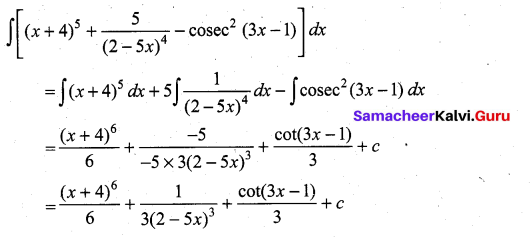
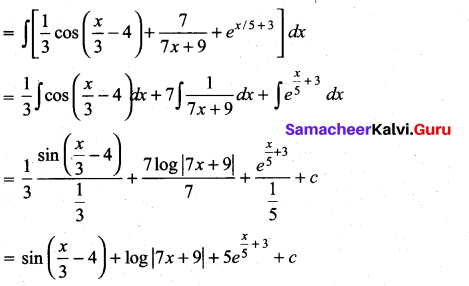
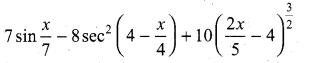
(x + 4)5 + \(\frac{5}{(2-5 x)^{4}}\) – cosec2(3x – 1)
Solution:
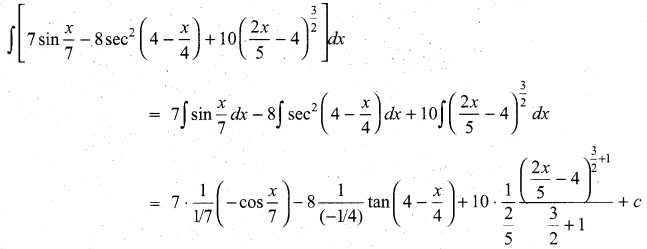
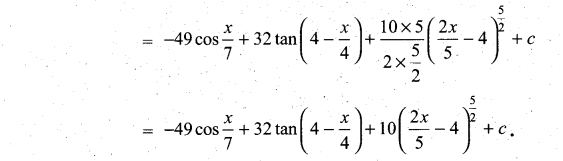
Samacheer Kalvi 11th Maths Solutions Chapter 11 Integral Calculus Ex 11.3 1

Question 2.
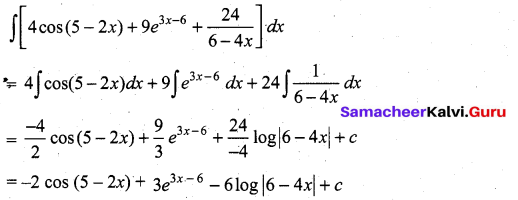
4cos(5 – 2x) + 9e3x-6 + \(\frac{24}{6-4 x}\)
Solution:
Samacheer Kalvi 11th Maths Solutions Chapter 11 Integral Calculus Ex 11.3 2

Question 3.
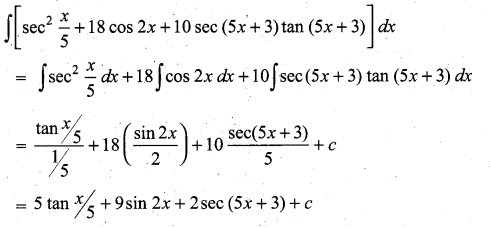
sec2\(\frac{x}{5}\) + 18 cos 2x + 10 sec (5x + 3) tan (5x + 3)
Solution:
Samacheer Kalvi 11th Maths Solutions Chapter 11 Integral Calculus Ex 11.3 3

Samacheer Kalvi 11th Maths Solutions Chapter 11 Integral Calculus Ex 11.3

Question 4.
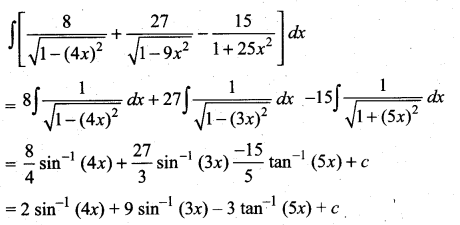
\(\frac{8}{\sqrt{1-(4 x)^{2}}}+\frac{27}{\sqrt{1-9 x^{2}}}-\frac{15}{1+25 x^{2}}\)
Solution:
Samacheer Kalvi 11th Maths Solutions Chapter 11 Integral Calculus Ex 11.3 4

Question 5.
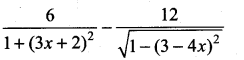
Samacheer Kalvi 11th Maths Solutions Chapter 11 Integral Calculus Ex 11.3 5
Solution:
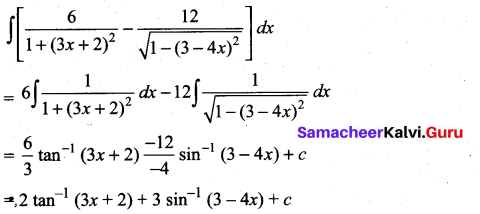
Samacheer Kalvi 11th Maths Solutions Chapter 11 Integral Calculus Ex 11.3 6

Question 6.
Samacheer Kalvi 11th Maths Solutions Chapter 11 Integral Calculus Ex 11.3 7
Solution:
Samacheer Kalvi 11th Maths Solutions Chapter 11 Integral Calculus Ex 11.3 8

Samacheer Kalvi 11th Maths Solutions Chapter 11 Integral Calculus Ex 11.3 Additional Problems

Question 1.
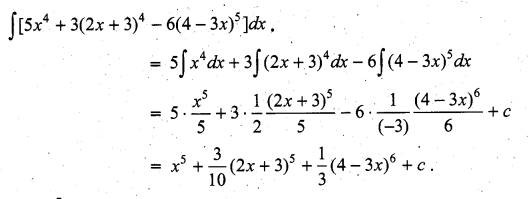
5x4 + 3(2x + 3)4 – 6(4 – 3x)5
Solution:
Samacheer Kalvi 11th Maths Solutions Chapter 11 Integral Calculus Ex 11.3 9

Question 2.
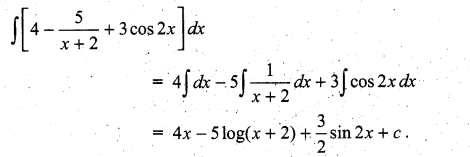
4 – \(\frac{5}{x+2}\) + 3 cos 2x
Solution:
Samacheer Kalvi 11th Maths Solutions Chapter 11 Integral Calculus Ex 11.3 10

Question 3.
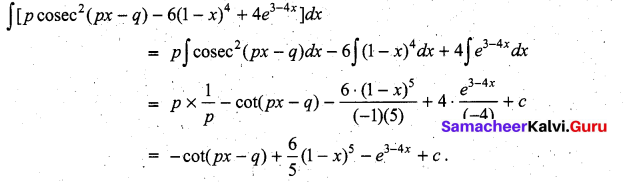
9 cosec2(px – q) – 6(1 – x)4 + 4e3 – 4x
Solution:
Samacheer Kalvi 11th Maths Solutions Chapter 11 Integral Calculus Ex 11.3 11
Samacheer Kalvi 11th Maths Solutions Chapter 11 Integral Calculus Ex 11.3

Question 4.
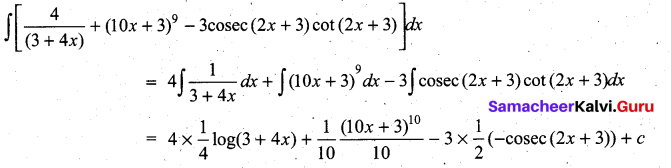
\(\frac{4}{(3+4 x)}\) + (10x + 3)9 – 3cosec(2x + 3) cot (2x + 3)
Solution:
Samacheer Kalvi 11th Maths Solutions Chapter 11 Integral Calculus Ex 11.3 12
Samacheer Kalvi 11th Maths Solutions Chapter 11 Integral Calculus Ex 11.3 13

Question 5.
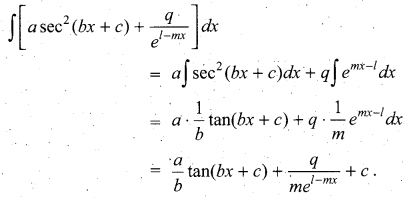
a sec2(bx + c) + \(\frac{q}{e^{l-m x}}\)
Solution:
Samacheer Kalvi 11th Maths Solutions Chapter 11 Integral Calculus Ex 11.3 14

Question 6.
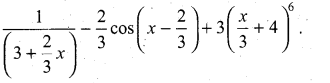
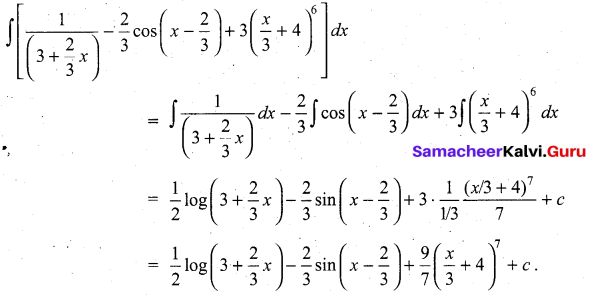
Samacheer Kalvi 11th Maths Solutions Chapter 11 Integral Calculus Ex 11.3 18
Solution:
Samacheer Kalvi 11th Maths Solutions Chapter 11 Integral Calculus Ex 11.3 15

Samacheer Kalvi 11th Maths Solutions Chapter 11 Integral Calculus Ex 11.3

Question 7.
Samacheer Kalvi 11th Maths Solutions Chapter 11 Integral Calculus Ex 11.3 19
Solution:
Samacheer Kalvi 11th Maths Solutions Chapter 11 Integral Calculus Ex 11.3 16
Samacheer Kalvi 11th Maths Solutions Chapter 11 Integral Calculus Ex 11.3 17

Samacheer Kalvi 11th Maths Solutions Chapter 11 Integral Calculus Ex 11.3 Read More »

Samacheer Kalvi 11th Maths Solutions Chapter 5 Binomial Theorem, Sequences and Series Ex 5.5

You can Download Samacheer Kalvi 11th Maths Book Solutions Guide Pdf, Tamilnadu State Board help you to revise the complete Syllabus and score more marks in your examinations.

Tamilnadu Samacheer Kalvi 11th Maths Solutions Chapter 5 Binomial Theorem, Sequences and Series Ex 5.5

Choose the correct or the most suitable answer:

Question 1.
The value of 2 + 4 + 6 + … + 2n is …..
Samacheer Kalvi 11th Maths Solutions Chapter 5 Binomial Theorem, Sequences and Series Ex 5.5 1
Solution:
(d) n(n + 1)
Samacheer Kalvi 11th Maths Solutions Chapter 5 Binomial Theorem, Sequences and Series Ex 5.5 2

Question 2.
The coefficient of x6 in (2 + 2x)10 is ……….
(a) 10C6
(b) 26
(c) 10C626
(d) 10C6210
Solution:
(d) 10C6210
Hint.
tr + 1 = 210(nCr)
To find coefficient of x6 put r = 6
∴ coefficient of x6 = 210 [10C6]

Question 3.
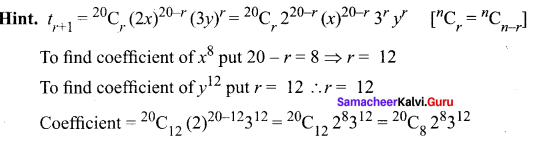
The coefficient of x8y12 in the expansion of (2x + 3y)20 is …….
(a) 0
(b) 28312
(c) 28312 + 21238
(d) 20C828312
Solution:
(d) 20C828312
Samacheer Kalvi 11th Maths Solutions Chapter 5 Binomial Theorem, Sequences and Series Ex 5.5 3

Samacheer Kalvi 11th Maths Solutions Chapter 5 Binomial Theorem, Sequences and Series Ex 5.5

Question 4.
If nC10 > nCr for all possible r, then a value of n is ……..
(a) 10
(b) 21
(c) 19
(d) 20
Solution:
(d) 20
Hint.
20C10 > 20Cr for all possible value of r.
n = 20

Question 5.
If a is the arithmetic mean and g is the geometric mean of two numbers, then ……..

(a) a ≤ g
(b) a ≥ g
(c) a = g
(d) a > g
Solution:
(b) a ≥ g
Hint. AM ≥ GM

∴ a ≥ g

Question 6.

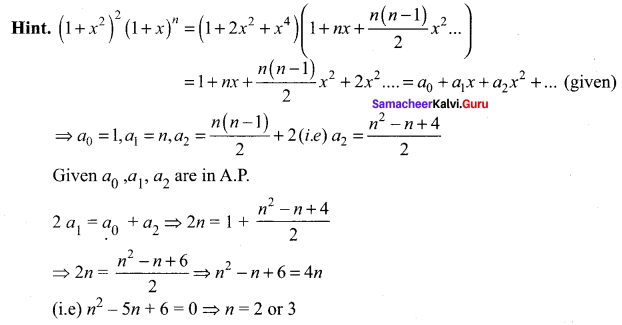
If (1 + x2)2 (1 + x)n = a0 + a1x + a2x2 + …. + xn + 4 and if a0, a1, a2 are in AP, then n is ……
(a) 1
(b) 2
(c) 3
(d) 4
Solution:
(b or c)n = 2 or 3
Samacheer Kalvi 11th Maths Solutions Chapter 5 Binomial Theorem, Sequences and Series Ex 5.5 20

Question 7.
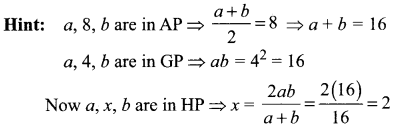
If a, 8, b are in A.P, a, 4, b are in G.P, if a, x, b are in HP then x is ……
(a) 2
(b) 1
(c) 4
(d) 16
Solution:
(a) 2
Samacheer Kalvi 11th Maths Solutions Chapter 5 Binomial Theorem, Sequences and Series Ex 5.5 21

Question 8.
Samacheer Kalvi 11th Maths Solutions Chapter 5 Binomial Theorem, Sequences and Series Ex 5.5 22
(a) AP
(b) GP
(c) HP
(d) AGP
Solution:
(c) HP

Samacheer Kalvi 11th Maths Solutions Chapter 5 Binomial Theorem, Sequences and Series Ex 5.5

Question 9.
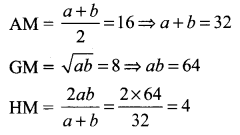
The HM of two positive numbers whose AM and GM are 16, 8 respectively is ………
(a) 10
(b) 6
(c) 5
(d) 4
Solution:
(d) 4
Hint.
Let the two numbers be a and b
Samacheer Kalvi 11th Maths Solutions Chapter 5 Binomial Theorem, Sequences and Series Ex 5.5 23

Question 10.
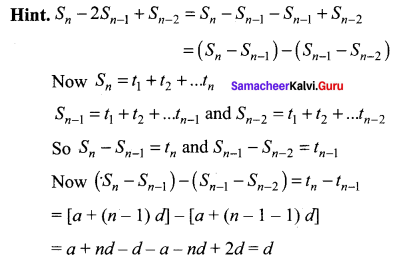
If Sn denotes the sum of n terms of an AP whose common difference is d, the value of \(\mathrm{S}_{n}-2 \mathrm{S}_{n-1}+S_{n-2}\) is ……
(a) d
(b) 2d
(c) 4d
(d) d2
Solution:
(a) d
Samacheer Kalvi 11th Maths Solutions Chapter 5 Binomial Theorem, Sequences and Series Ex 5.5 24

Samacheer Kalvi 11th Maths Solutions Chapter 5 Binomial Theorem, Sequences and Series Ex 5.5

Question 11.
The remainder when 3815 is divided by 13 is …….
(a) 12
(b) 1
(c) 11
(d) 5
Solution:
(a) 12
Hint.
(38)15 = (39 – 1)15
= (39)15 – 15C1(39 )14 + 15C2(39)13 + . . . . . . . + 15C14 (39) – 1
In the Binomial expansion , all the terms except the last term (- 1) are divisible by 13
∴ The remainder = 13 – 1 = 12

Question 12.
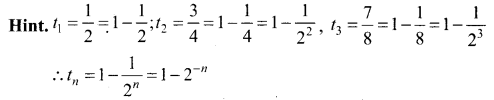
The nth term of the sequence 1, 2, 4, 7, 11, …… is
Samacheer Kalvi 11th Maths Solutions Chapter 5 Binomial Theorem, Sequences and Series Ex 5.5 25
Solution:
(d) \(\frac{n^{2}-n+2}{2}\)

Question 13.
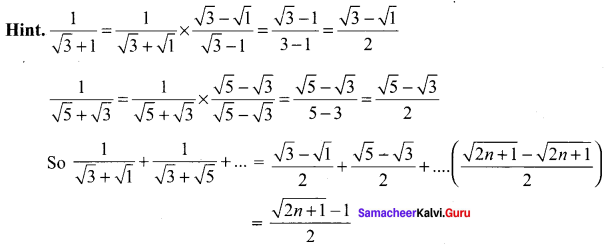
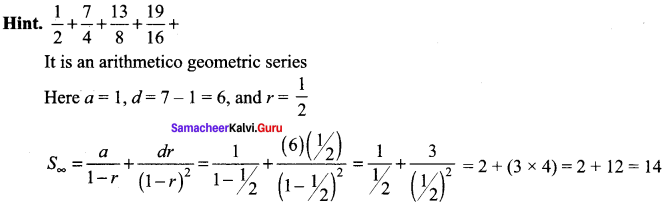
Samacheer Kalvi 11th Maths Solutions Chapter 5 Binomial Theorem, Sequences and Series Ex 5.5 26
Solution:
Samacheer Kalvi 11th Maths Solutions Chapter 5 Binomial Theorem, Sequences and Series Ex 5.5 27
Solution:
(d) \(\frac{\sqrt{2 n+1}-1}{2}\)
Samacheer Kalvi 11th Maths Solutions Chapter 5 Binomial Theorem, Sequences and Series Ex 5.5 277

Question 14.
Samacheer Kalvi 11th Maths Solutions Chapter 5 Binomial Theorem, Sequences and Series Ex 5.5 28
Samacheer Kalvi 11th Maths Solutions Chapter 5 Binomial Theorem, Sequences and Series Ex 5.5 299
Solution:
Samacheer Kalvi 11th Maths Solutions Chapter 5 Binomial Theorem, Sequences and Series Ex 5.5 29

Samacheer Kalvi 11th Maths Solutions Chapter 5 Binomial Theorem, Sequences and Series Ex 5.5

Question 15.
Samacheer Kalvi 11th Maths Solutions Chapter 5 Binomial Theorem, Sequences and Series Ex 5.5 30
Samacheer Kalvi 11th Maths Solutions Chapter 5 Binomial Theorem, Sequences and Series Ex 5.5 31
Solution:
(c) \(\frac{n(n+1)}{\sqrt{2}}\)
Samacheer Kalvi 11th Maths Solutions Chapter 5 Binomial Theorem, Sequences and Series Ex 5.5 32

Question 16.
Samacheer Kalvi 11th Maths Solutions Chapter 5 Binomial Theorem, Sequences and Series Ex 5.5 33
(a) 14
(b) 7
(c) 4
(d) 6
Solution:
(a) 14
Samacheer Kalvi 11th Maths Solutions Chapter 5 Binomial Theorem, Sequences and Series Ex 5.5 34

Question 17.
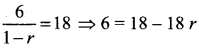
The sum of an infinite GP is 18. If the first term is 6, the common ratio is ………
(a) \(\frac{1}{3}\)
(b) \(\frac{2}{3}\)
(c) \(\frac{1}{6}\)
(d) \(\frac{3}{4}\)
Solution:
(b) \(\frac{2}{3}\)
Hint:
Samacheer Kalvi 11th Maths Solutions Chapter 5 Binomial Theorem, Sequences and Series Ex 5.5 35
18r = 18 – 6 = 12
r = 12/18 = 2/3

Question 18.
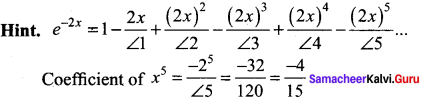
The coefficient of x5 in the series e-2x is ………
(a) \(\frac{2}{3}\)
(b) \(\frac{3}{2}\)
(c) \(\frac{-4}{15}\)
(d) \(\frac{4}{15}\)
Answer:
(c) \(\frac{-4}{15}\)
Samacheer Kalvi 11th Maths Solutions Chapter 5 Binomial Theorem, Sequences and Series Ex 5.5 50

Samacheer Kalvi 11th Maths Solutions Chapter 5 Binomial Theorem, Sequences and Series Ex 5.5

Question 19.
Samacheer Kalvi 11th Maths Solutions Chapter 5 Binomial Theorem, Sequences and Series Ex 5.5 51
Answer:
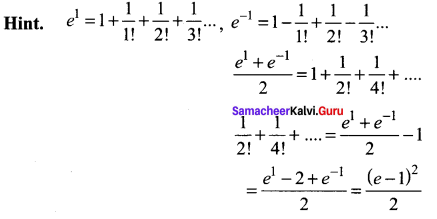
(c) \(\frac{(e-1)^{2}}{2 e}\)
Samacheer Kalvi 11th Maths Solutions Chapter 5 Binomial Theorem, Sequences and Series Ex 5.5 52

Question 20.
Samacheer Kalvi 11th Maths Solutions Chapter 5 Binomial Theorem, Sequences and Series Ex 5.5 53
Samacheer Kalvi 11th Maths Solutions Chapter 5 Binomial Theorem, Sequences and Series Ex 5.5 54
Solution:
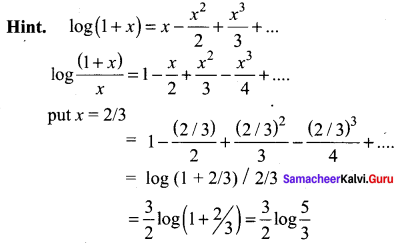
(b) \(\frac{3}{2} \log \left(\frac{5}{3}\right)\)
Samacheer Kalvi 11th Maths Solutions Chapter 5 Binomial Theorem, Sequences and Series Ex 5.5 55

Samacheer Kalvi 11th Maths Solutions Chapter 5 Binomial Theorem, Sequences and Series Ex 5.5 Read More »

Samacheer Kalvi 11th Maths Solutions Chapter 2 Basic Algebra Ex 2.8

You can Download Samacheer Kalvi 11th Maths Book Solutions Guide Pdf, Tamilnadu State Board help you to revise the complete Syllabus and score more marks in your examinations.

Tamilnadu Samacheer Kalvi 11th Maths Solutions Chapter 2 Basic Algebra Ex 2.8

Question 1.
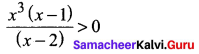
Find all values of x for which \(\frac{x^{3}(x-1)}{(x-2)}\) > 0
Solution:
Samacheer Kalvi 11th Maths Solutions Chapter 2 Basic Algebra Ex 2.8 1
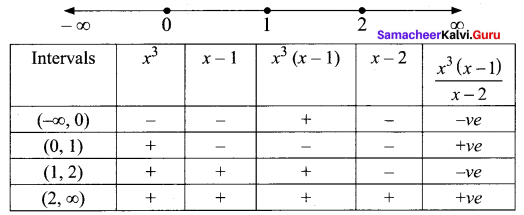
Now we have to find the signs of
x3, x – 1 and x – 2 as follows
x3 = 0; x – 1 = 0 ⇒ x = 1; x – 2 = 0 ⇒ x = 2
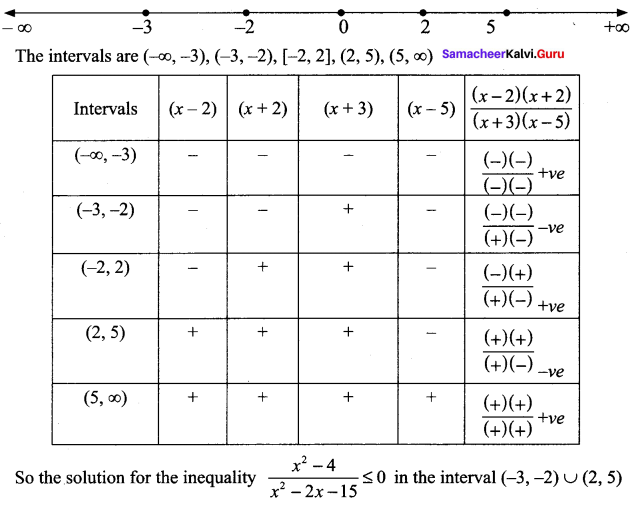
Plotting the points in a number line and finding intervals
Samacheer Kalvi 11th Maths Solutions Chapter 2 Basic Algebra Ex 2.8 2
So the solution set = (0, 1) ∪ (2, ∞)
Samacheer Kalvi 11th Maths Solutions Chapter 2 Basic Algebra Ex 2.8

Question 2.
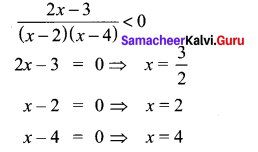
Samacheer Kalvi 11th Maths Solutions Chapter 2 Basic Algebra Ex 2.8 3
Solution:
Samacheer Kalvi 11th Maths Solutions Chapter 2 Basic Algebra Ex 2.8 4
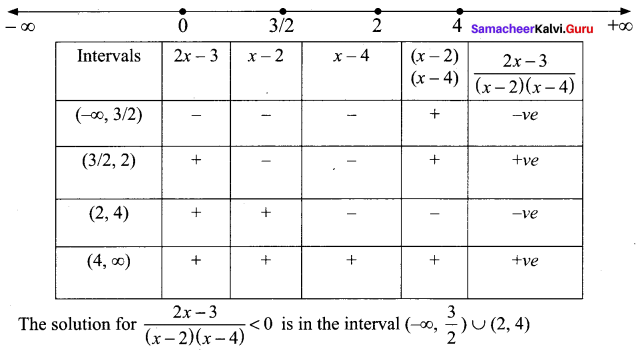
Plotting the points 3/2, 2 and 4 on the number line and taking the intervals.
Samacheer Kalvi 11th Maths Solutions Chapter 2 Basic Algebra Ex 2.8 5

Samacheer Kalvi 11th Maths Solutions Chapter 2 Basic Algebra Ex 2.8

Question 3.
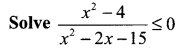
Samacheer Kalvi 11th Maths Solutions Chapter 2 Basic Algebra Ex 2.8 6
Solution:
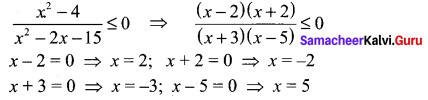
Samacheer Kalvi 11th Maths Solutions Chapter 2 Basic Algebra Ex 2.8 7
Samacheer Kalvi 11th Maths Solutions Chapter 2 Basic Algebra Ex 2.8 70

Samacheer Kalvi 11th Maths Solutions Chapter 2 Basic Algebra Ex 2.8 Additional Questions

Question 1.
Samacheer Kalvi 11th Maths Solutions Chapter 2 Basic Algebra Ex 2.8 8
Solution:
Samacheer Kalvi 11th Maths Solutions Chapter 2 Basic Algebra Ex 2.8 9
Samacheer Kalvi 11th Maths Solutions Chapter 2 Basic Algebra Ex 2.8 10

Samacheer Kalvi 11th Maths Solutions Chapter 2 Basic Algebra Ex 2.8 Read More »

Samacheer Kalvi 11th Maths Solutions Chapter 11 Integral Calculus Ex 11.2

You can Download Samacheer Kalvi 11th Maths Book Solutions Guide Pdf, Tamilnadu State Board help you to revise the complete Syllabus and score more marks in your examinations.

Tamilnadu Samacheer Kalvi 11th Maths Solutions Chapter 11 Integral Calculus Ex 11.2

Integrate the following functions w.r.to ‘x’.
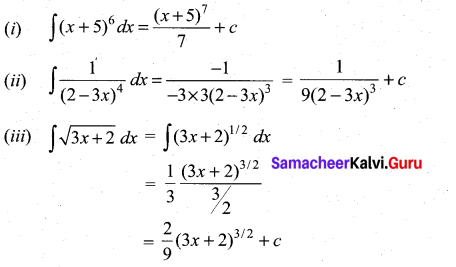
Question 1.
(i) (x + 5)6
(ii) \(\frac{1}{(2-3 x)^{4}}\)
(iii) \(\sqrt{3 x+2}\)
Solution:
Samacheer Kalvi 11th Maths Solutions Chapter 11 Integral Calculus Ex 11.2 1

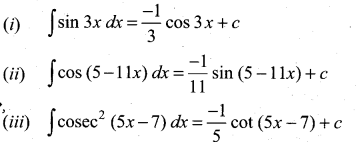
Question 2.
(i) sin 3x
(ii) cos (5 – 11x)
(iii) cosec2 (5x – 7)
Solution:
Samacheer Kalvi 11th Maths Solutions Chapter 11 Integral Calculus Ex 11.2 2

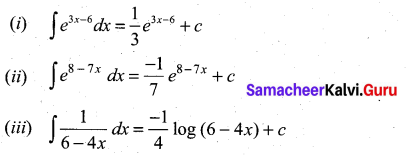
Question 3.
(i) e3x – 6
(ii) e8 – 7x
(iii) \(\frac{1}{6-4 x}\)
Solution:
Samacheer Kalvi 11th Maths Solutions Chapter 11 Integral Calculus Ex 11.2 3

Samacheer Kalvi 11th Maths Solutions Chapter 11 Integral Calculus Ex 11.2

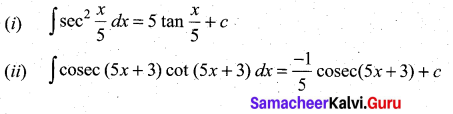
Question 4.
(i) sec2\(\frac{x}{5}\)
(ii) cosec (5x + 3) cot (5x + 3)
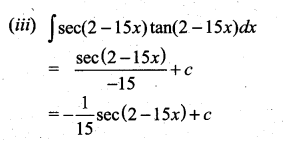
(iii) sec (2 – 15x) tan (2 – 15x)
Solution:
Samacheer Kalvi 11th Maths Solutions Chapter 11 Integral Calculus Ex 11.2 4
Samacheer Kalvi 11th Maths Solutions Chapter 11 Integral Calculus Ex 11.2 5

Question 5.
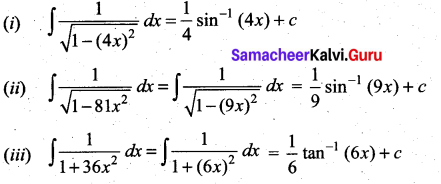
(i) \(\frac{1}{\sqrt{1-(4 x)^{2}}}\)
(ii) \(\frac{1}{\sqrt{1-81 x^{2}}}\)
(iii) \(\frac{1}{1+36 x^{2}}\)
Solution:
Samacheer Kalvi 11th Maths Solutions Chapter 11 Integral Calculus Ex 11.2 6

Samacheer Kalvi 11th Maths Solutions Chapter 11 Integral Calculus Ex 11.2 Additional Problems

Question 1.
(3x + 4)6
Solution:
Samacheer Kalvi 11th Maths Solutions Chapter 11 Integral Calculus Ex 11.2 7

Question 2.
\(\frac{1}{(x+5)^{4}}\)
Solution:
Samacheer Kalvi 11th Maths Solutions Chapter 11 Integral Calculus Ex 11.2 8

Question 3.
\(\frac{1}{p+q x}\)
Solution:
Samacheer Kalvi 11th Maths Solutions Chapter 11 Integral Calculus Ex 11.2 9

Question 4.
cos(4x + 5)
Solution:
Samacheer Kalvi 11th Maths Solutions Chapter 11 Integral Calculus Ex 11.2 10

Question 5.
cosec2(7 – 11x)
Solution:
Samacheer Kalvi 11th Maths Solutions Chapter 11 Integral Calculus Ex 11.2 11

Samacheer Kalvi 11th Maths Solutions Chapter 11 Integral Calculus Ex 11.2

Question 6.
sec(3 + x) tan(3 + x)
Solution:
Samacheer Kalvi 11th Maths Solutions Chapter 11 Integral Calculus Ex 11.2 12

Question 7.
cosec(3 – 2x) cot(3 – 2x)
Solution:
Samacheer Kalvi 11th Maths Solutions Chapter 11 Integral Calculus Ex 11.2 13

Question 8.
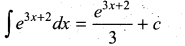
e3x + 2
Solution:
Samacheer Kalvi 11th Maths Solutions Chapter 11 Integral Calculus Ex 11.2 14

Question 9.
\(\frac{1}{\sin ^{2}(l-m x)}\)
Solution:
Samacheer Kalvi 11th Maths Solutions Chapter 11 Integral Calculus Ex 11.2 15

Question 10.
(lx + m)1/2
Solution:
Samacheer Kalvi 11th Maths Solutions Chapter 11 Integral Calculus Ex 11.2 16

Samacheer Kalvi 11th Maths Solutions Chapter 11 Integral Calculus Ex 11.2 Read More »

Samacheer Kalvi 11th Maths Solutions Chapter 8 Vector Algebra – I Ex 8.4

You can Download Samacheer Kalvi 11th Maths Book Solutions Guide Pdf, Tamilnadu State Board help you to revise the complete Syllabus and score more marks in your examinations.

Tamilnadu Samacheer Kalvi 11th Maths Solutions Chapter 8 Vector Algebra – I Ex 8.4

Question 1.
Find the magnitude of Samacheer Kalvi 11th Maths Solutions Chapter 8 Vector Algebra - I Ex 8.4 1
Solution:
Samacheer Kalvi 11th Maths Solutions Chapter 8 Vector Algebra - I Ex 8.4 2

Question 2.
Show that Samacheer Kalvi 11th Maths Solutions Chapter 8 Vector Algebra - I Ex 8.4 3
Solution:
Samacheer Kalvi 11th Maths Solutions Chapter 8 Vector Algebra - I Ex 8.4 4

Question 3.
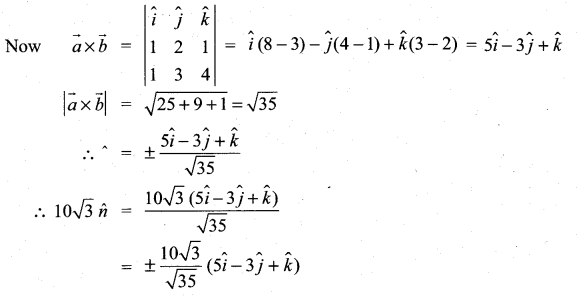
Find the vectors of magnitude \(10 \sqrt{3}\) that are perpendicular to the plane which contains \(\hat{i}+2 \hat{j}+\hat{k}\) and \(\hat{i}+3 \hat{j}+4 \hat{k}\)
Solution:
Samacheer Kalvi 11th Maths Solutions Chapter 8 Vector Algebra - I Ex 8.4 5
Samacheer Kalvi 11th Maths Solutions Chapter 8 Vector Algebra - I Ex 8.4 6

Samacheer Kalvi 11th Maths Solutions Chapter 8 Vector Algebra - I Ex 8.4

Question 4.
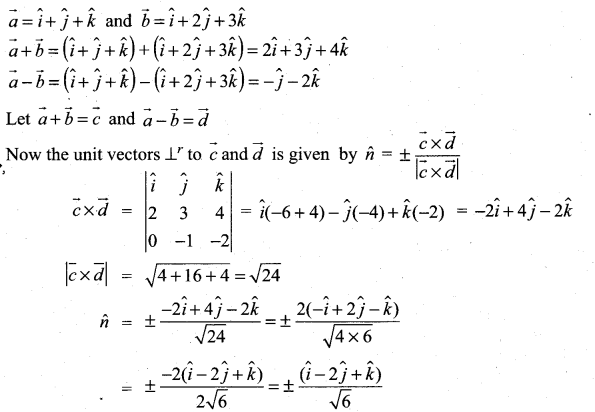
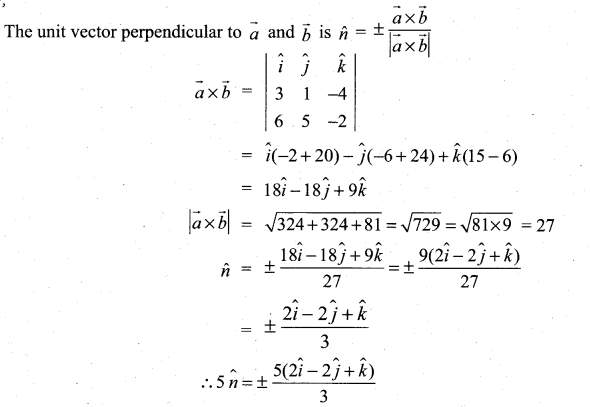
Find the unit vectors perpendicular to each of the vectors
Samacheer Kalvi 11th Maths Solutions Chapter 8 Vector Algebra - I Ex 8.4 7
Solution:
Samacheer Kalvi 11th Maths Solutions Chapter 8 Vector Algebra - I Ex 8.4 8

Question 5.
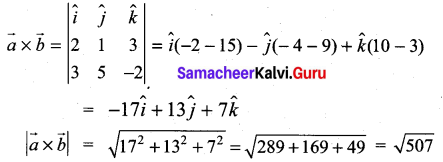
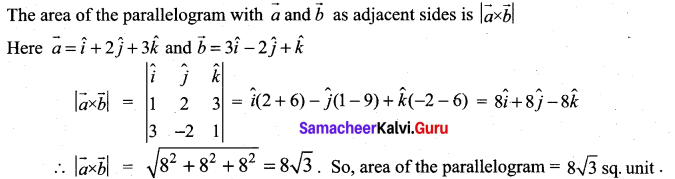
Find the area of the parallelogram whose two adjacent sides are determined by the vectors \(\hat{i}+2 \hat{j}+3 \hat{k}\) and \(3 \hat{i}-2 \hat{j}+\hat{k}\)
Solution:
Samacheer Kalvi 11th Maths Solutions Chapter 8 Vector Algebra - I Ex 8.4 9

Question 6.
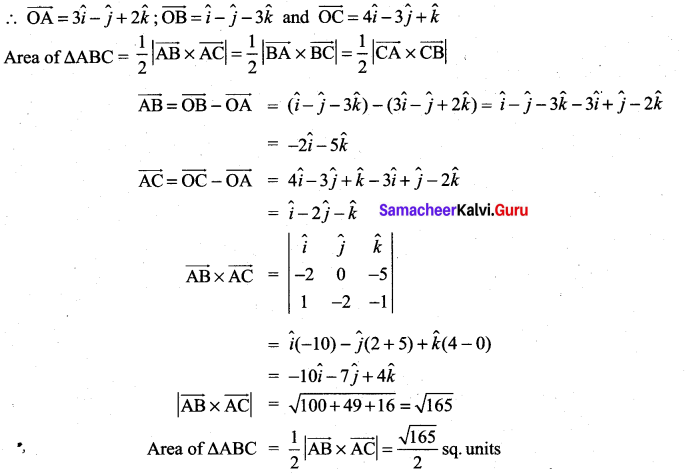
Find the area of the triangle whose vertices are A(3, -1, 2), B(1, -1, -3) and C(4, -3, 1)
Solution:
A = (3, -1, 2); B = (1, -1, -3) and C = (4, -3, 1)
Samacheer Kalvi 11th Maths Solutions Chapter 8 Vector Algebra - I Ex 8.4 10

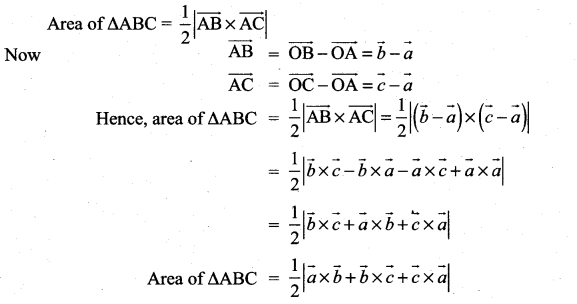
Question 7.
If \(\vec{a}, \vec{b}, \vec{c}\) are position vectors of the vertices A, B, C of a triangle ABC, show that the area of the triangle ABC is \(\frac{1}{2}|\vec{a} \times \vec{b}+\vec{b} \times \vec{c}+\vec{c} \times \vec{a}|\). Also deduce the condition for collinearity of the points A, B, C
Solution:
Samacheer Kalvi 11th Maths Solutions Chapter 8 Vector Algebra - I Ex 8.4 11
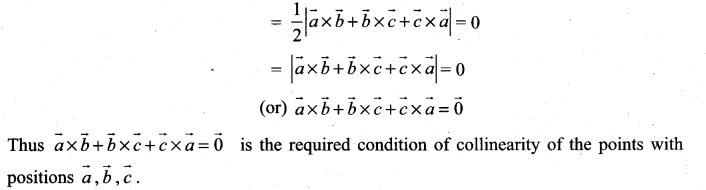
If the points A, B, C are collinear, then the area of ∆ABC = 0.
Samacheer Kalvi 11th Maths Solutions Chapter 8 Vector Algebra - I Ex 8.4 12

Question 8.
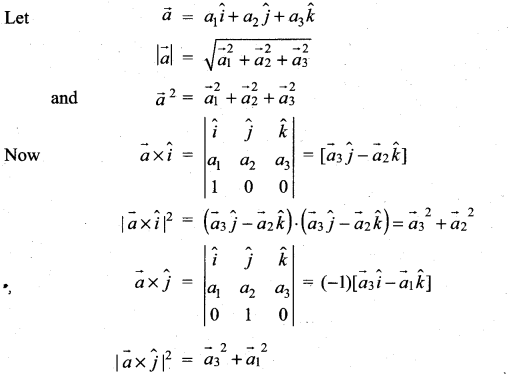
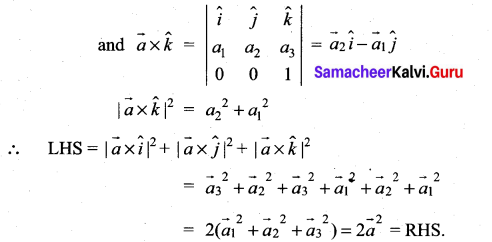
For any vector \(\vec{a}\) prove that Samacheer Kalvi 11th Maths Solutions Chapter 8 Vector Algebra - I Ex 8.4 13
Solution:
Samacheer Kalvi 11th Maths Solutions Chapter 8 Vector Algebra - I Ex 8.4 14
Samacheer Kalvi 11th Maths Solutions Chapter 8 Vector Algebra - I Ex 8.4 15

Samacheer Kalvi 11th Maths Solutions Chapter 8 Vector Algebra - I Ex 8.4

Question 9.
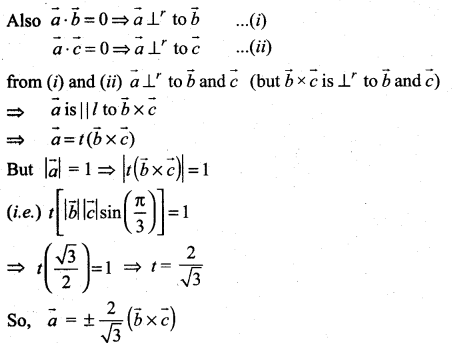
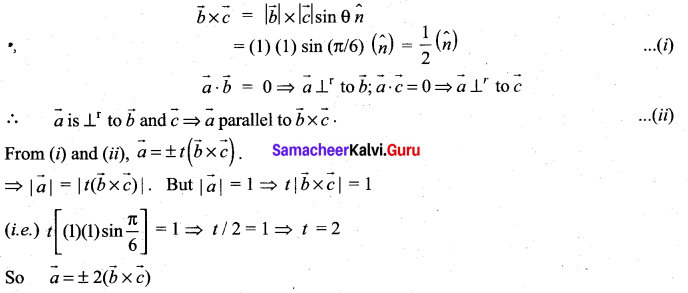
Let \(\vec{a}, \vec{b}, \vec{c}\) be unit vectors such that \(\overrightarrow{\boldsymbol{a}} \cdot \overrightarrow{\boldsymbol{b}}=\overrightarrow{\boldsymbol{a}} \cdot \overrightarrow{\boldsymbol{c}}=\mathbf{0}\) and the angle between \(\vec{b} \text { and } \vec{c} \text { is } \frac{\pi}{3}\). Prove that \(\vec{a}=\pm \frac{2}{\sqrt{3}}(\vec{b} \times \vec{c})\)
Solution:
Given \(|\vec{a}|=|\vec{b}|=|\vec{c}|\) = 1
Samacheer Kalvi 11th Maths Solutions Chapter 8 Vector Algebra - I Ex 8.4 16

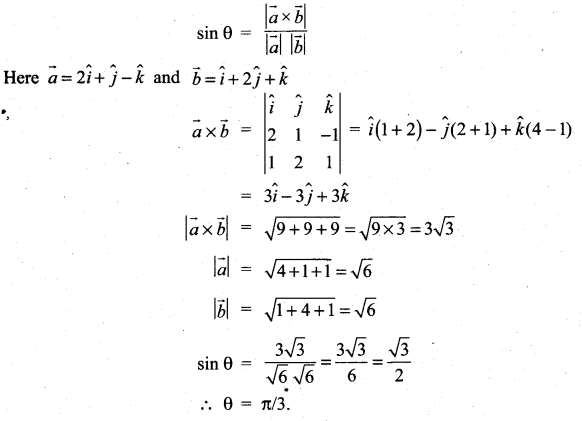
Question 10.
Find the angle between the vectors Samacheer Kalvi 11th Maths Solutions Chapter 8 Vector Algebra - I Ex 8.4 17 using vector product
Solution:
The angle between \(\vec{a}\) and \(\vec{b}\) using vector product is given by
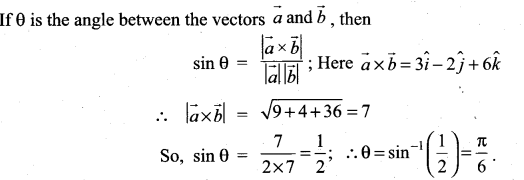
Samacheer Kalvi 11th Maths Solutions Chapter 8 Vector Algebra - I Ex 8.4 18

Samacheer Kalvi 11th Maths Solutions Chapter 8 Vector Algebra – I Ex 8.4 Additional Problems

Question 1.
Samacheer Kalvi 11th Maths Solutions Chapter 8 Vector Algebra - I Ex 8.4 19
Solution:
Samacheer Kalvi 11th Maths Solutions Chapter 8 Vector Algebra - I Ex 8.4 20

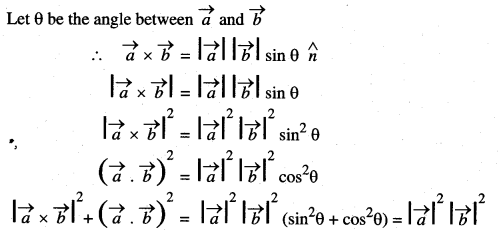
Question 2.
If \(\vec{a}\), \(\vec{b}\) are any two vectors, then prove that Samacheer Kalvi 11th Maths Solutions Chapter 8 Vector Algebra - I Ex 8.4 21
Solution:
Samacheer Kalvi 11th Maths Solutions Chapter 8 Vector Algebra - I Ex 8.4 22

Question 3.
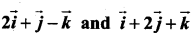
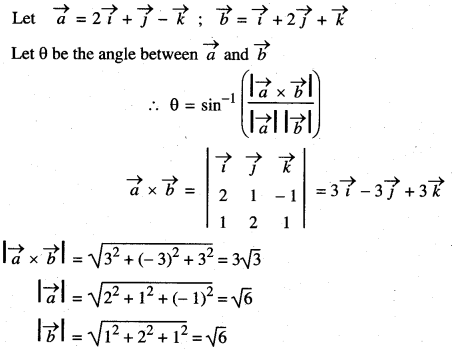
Find the angle between the vectors Samacheer Kalvi 11th Maths Solutions Chapter 8 Vector Algebra - I Ex 8.4 23 by using cross product.
Solution:
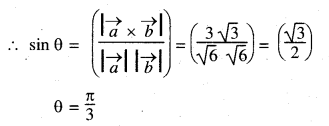
Samacheer Kalvi 11th Maths Solutions Chapter 8 Vector Algebra - I Ex 8.4 24
Samacheer Kalvi 11th Maths Solutions Chapter 8 Vector Algebra - I Ex 8.4 25

Question 4.
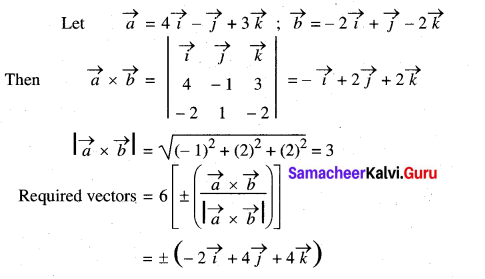
Find the vector of magnitude 6 which are perpendicular to both the vectors Samacheer Kalvi 11th Maths Solutions Chapter 8 Vector Algebra - I Ex 8.4 26
Solution:
Samacheer Kalvi 11th Maths Solutions Chapter 8 Vector Algebra - I Ex 8.4 27

Question 5.
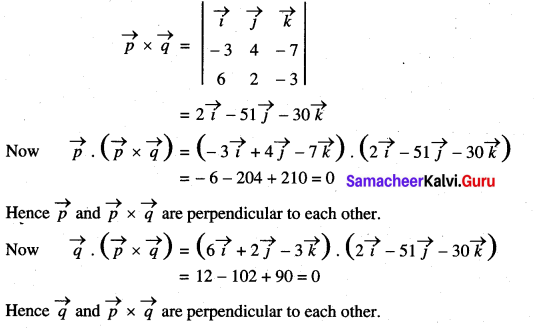
Find the vectors whose length 5 which are perpendicular to the vectors Samacheer Kalvi 11th Maths Solutions Chapter 8 Vector Algebra - I Ex 8.4 28
Solution:
Samacheer Kalvi 11th Maths Solutions Chapter 8 Vector Algebra - I Ex 8.4 29

Samacheer Kalvi 11th Maths Solutions Chapter 8 Vector Algebra - I Ex 8.4

Question 6.
Samacheer Kalvi 11th Maths Solutions Chapter 8 Vector Algebra - I Ex 8.4 30
Solution:
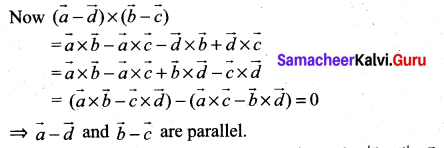
Given \(\vec{a} \times \vec{b}=\vec{c} \times \vec{d}\) and \(\vec{a} \times \vec{c}=\vec{b} \times \vec{d}\)
Samacheer Kalvi 11th Maths Solutions Chapter 8 Vector Algebra - I Ex 8.4 31

Question 7.
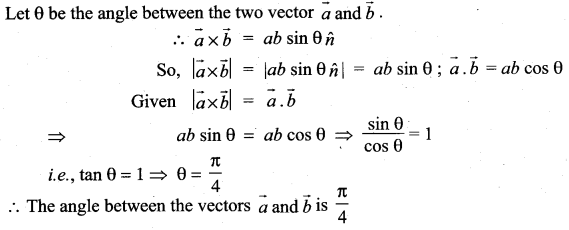
Find the angle between two vectors \(\vec{a}\) and \(\vec{b}\) if \(|\overrightarrow{\boldsymbol{a}} \times \overrightarrow{\boldsymbol{b}}|=\overrightarrow{\boldsymbol{a}} \cdot \overrightarrow{\boldsymbol{b}}\)
Solution:
Samacheer Kalvi 11th Maths Solutions Chapter 8 Vector Algebra - I Ex 8.4 32

Question 8.
Samacheer Kalvi 11th Maths Solutions Chapter 8 Vector Algebra - I Ex 8.4 33
Solution:
Samacheer Kalvi 11th Maths Solutions Chapter 8 Vector Algebra - I Ex 8.4 34

Question 9.
If Samacheer Kalvi 11th Maths Solutions Chapter 8 Vector Algebra - I Ex 8.4 35 find the angle between \(\vec{a}\) and \(\vec{b}\)
Solution:
Samacheer Kalvi 11th Maths Solutions Chapter 8 Vector Algebra - I Ex 8.4 36

Samacheer Kalvi 11th Maths Solutions Chapter 8 Vector Algebra – I Ex 8.4 Read More »

Samacheer Kalvi 11th Maths Solutions Chapter 2 Basic Algebra Ex 2.2

You can Download Samacheer Kalvi 11th Maths Book Solutions Guide Pdf, Tamilnadu State Board help you to revise the complete Syllabus and score more marks in your examinations.

Tamilnadu Samacheer Kalvi 11th Maths Solutions Chapter 2 Basic Algebra Ex 2.2

Question 1.
Solve for x.

(i) |3 – x| < 7
Solution:
– 7 < 3 – x < 7
– 7 – 3 < – x < 7 – 3
– 10 < – x < 4 10 > x > – 4
– 4 < x < 10
∴ The solution set is x ∈ (-4, 10)

(ii) |4x – 5| ≥ -2
Solution:
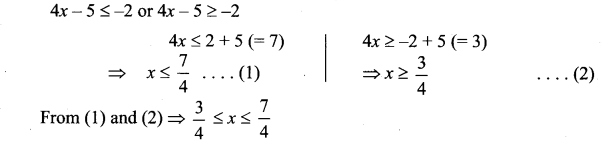
Samacheer Kalvi 11th Maths Solutions Chapter 2 Basic Algebra Ex 2.2 5

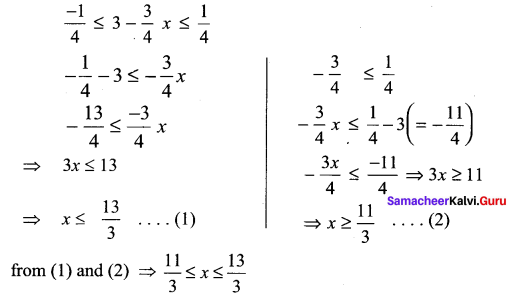
(iii)
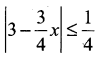
Samacheer Kalvi 11th Maths Solutions Chapter 2 Basic Algebra Ex 2.2 55
Solution:
Samacheer Kalvi 11th Maths Solutions Chapter 2 Basic Algebra Ex 2.2 56

(iv) |x| – 10 < -3
Solution:
|x| < -3 + 10 (= 7)
|x| < 7 ⇒ -7 < x < 7

Samacheer Kalvi 11th Maths Solutions Chapter 2 Basic Algebra Ex 2.2

Question 2.
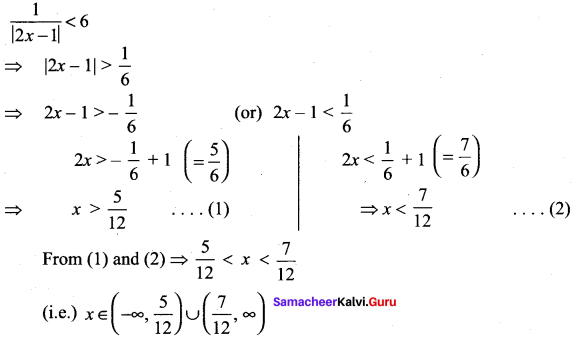
Solve \(\frac{1}{|2 x-1|}<6\) and express the solution using the interval notation.
Solution:
Samacheer Kalvi 11th Maths Solutions Chapter 2 Basic Algebra Ex 2.2 7

Question 3.
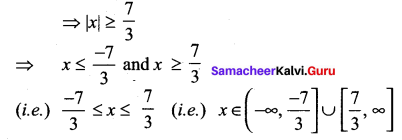
Solve -3|x| + 5 ≤ – 2 and graph the solution set in a number line.
Solution:
-3 |x| + 5 ≤ – 2
-3 |x| ≤ – 2 – 5
-3 |x| ≤ – 7
3 |x| ≥ 7
|x| ≥ \(\frac{7}{3}\)
Samacheer Kalvi 11th Maths Solutions Chapter 2 Basic Algebra Ex 2.2 8

Samacheer Kalvi 11th Maths Solutions Chapter 2 Basic Algebra Ex 2.2

Question 4.
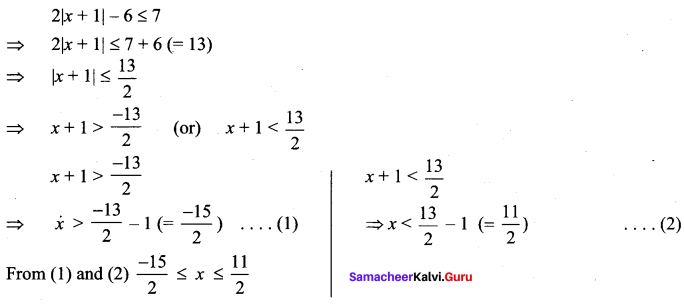
Solve 2|x + 1| – 6 ≤ 7 and graph the solution set in a number line.
Solution:
Samacheer Kalvi 11th Maths Solutions Chapter 2 Basic Algebra Ex 2.2 9

Question 5.
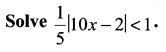
Samacheer Kalvi 11th Maths Solutions Chapter 2 Basic Algebra Ex 2.2 10
Solution:
Samacheer Kalvi 11th Maths Solutions Chapter 2 Basic Algebra Ex 2.2 11

Samacheer Kalvi 11th Maths Solutions Chapter 2 Basic Algebra Ex 2.2

Question 6.
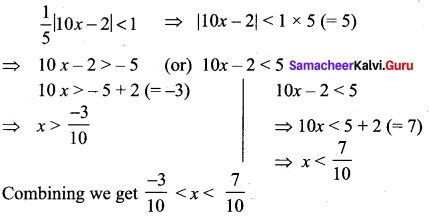
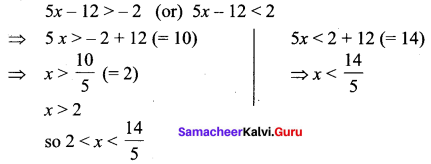
Solve |5x – 12| < -2
Solution:
Samacheer Kalvi 11th Maths Solutions Chapter 2 Basic Algebra Ex 2.2 12

Samacheer Kalvi 11th Maths Solutions Chapter 2 Basic Algebra Ex 2.2 Additional Questions

Question 1.
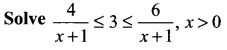
Samacheer Kalvi 11th Maths Solutions Chapter 2 Basic Algebra Ex 2.2 13
Solution:
Samacheer Kalvi 11th Maths Solutions Chapter 2 Basic Algebra Ex 2.2 14

Question 2.
Samacheer Kalvi 11th Maths Solutions Chapter 2 Basic Algebra Ex 2.2 15
Solution:
Samacheer Kalvi 11th Maths Solutions Chapter 2 Basic Algebra Ex 2.2 16
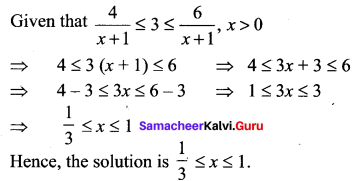
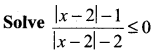
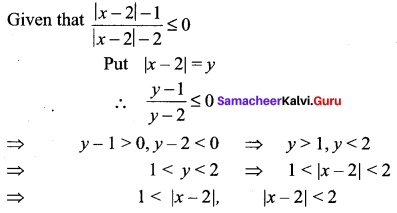
⇒ x – 2 < – 1 (or) x – 2 > 1 and – 2 < x – 2 < 2
⇒ x < 1 (or) x > 3 and -2 + 2 < x < 2 + 2
⇒ x < 1 (or) x > 3 and 0 < x < 4 Hence, the required solution is (0, 1) ∪ (3, 4)

Samacheer Kalvi 11th Maths Solutions Chapter 2 Basic Algebra Ex 2.2

Question 3.
Samacheer Kalvi 11th Maths Solutions Chapter 2 Basic Algebra Ex 2.2 17
Solution:
Samacheer Kalvi 11th Maths Solutions Chapter 2 Basic Algebra Ex 2.2 18

Question 4.
Solve: |x – 1| ≤ 5, |x| ≥ 2
Solution:
|x – 1| ≤ 5 and |x| ≥ 2
⇒ -5 ≤ x – 1 ≤ 5 and x ≤ -2 (or) x > 2
⇒ – 5 + 1 ≤ x ≤ 5 + 1
⇒ -4 ≤ x ≤ 6 and x ≤ -2 (or) x ≥ 2
Hence x < [-4, -2] ∪ [2, 6]
Samacheer Kalvi 11th Maths Solutions Chapter 2 Basic Algebra Ex 2.2

Question 5.
Samacheer Kalvi 11th Maths Solutions Chapter 2 Basic Algebra Ex 2.2 20
Solution:
Samacheer Kalvi 11th Maths Solutions Chapter 2 Basic Algebra Ex 2.2 21

Samacheer Kalvi 11th Maths Solutions Chapter 2 Basic Algebra Ex 2.2 Read More »