Class 11

Samacheer Kalvi 11th Economics Solutions Chapter 5 Market Structure and Pricing

Students can Download Economics Chapter 5 Market Structure and Pricing Questions and Answers, Notes Pdf, Samacheer Kalvi 11th Economics Book Solutions Guide Pdf helps you to revise the complete Tamilnadu State Board New Syllabus and score more marks in your examinations.

Tamilnadu Samacheer Kalvi 11th Economics Solutions Chapter 5 Market Structure and Pricing

Samacheer Kalvi 11th Economics Market Structure and Pricing Text Book Back Questions and Answers

Part – A

Multiple Choice Questions

Question 1.
In which of the following is not a type of market structure Price will be very high?
(a) Perfect competition
(b) Monopoly
(c) Duopoly
(d) Oligopoly
Answer:
(a) Perfect competition

Samacheer Kalvi 11th Economics Solutions Chapter 5 Market Structure and Pricing

Question 2.
Equilibrium condition of a firm is …………………….
(a) MC = MR
(b) MC > MR
(c) MC < MR
(d) MR = Price
Answer:
(a) MC = MR

Question 3.
Which of the following is a feature of monopolistic competition?
(a) One seller
(b) Few sellers
(c) Product differentiation
(d) No entry
Answer:
(c) Product differentiation

Question 4.
A firm under monopoly can earn ………………… in the short run.
(a) Normal profit
(b) Loss
(c) Supernormal profit
(d) More loss
Answer:
(c) Supernormal profit

Question 5.
There is no excess capacity under ______
(a) Monopoly
(b) Monopolistic competition
(c) Oligopoly
(d) Perfect competition
Answer:
(d) Perfect competition

Question 6.
Profit of a firm is obtained when ……………………
(a) TR < TC (b) TR – MC (c) TR > TC
(d) TR = TC
Answer:
(c) TR > TC

Question 7.
Another name of price is ______
(a) Average Revenue
(b) Marginal Revenue
(c) Total Revenue
(d) Average Cost
Answer:
(a) Average Revenue

Question 8.
In which type of market, AR and MR are equal ………………………
(a) Duopoly
(b) Perfect competition
(c) Monopolistic competition
(d) Oligopoly
Answer:
(b) Perfect competition

Question 9.
In monopoly, MR curve lies below ______
(a) TR
(b) MC
(c) AR
(d) AC
Answer:
(c) AR

Question 10.
Perfect competition assumes ……………………..
(a) Luxury goods
(b) Producer goods
(c) Differentiated goods
(d) Homogeneous goods
Answer:
(d) Homogeneous goods

Question 11.
Group equilibrium is analysed in ______
(a) Monopolistic competition
(b) Monopoly
(c) Duopoly
(d) Pure competition
Answer:
(a) Monopolistic competition

Question 12.
In monopolistic competition, the essential feature is …………………….
(a) Same product
(b) Selling cost
(c) Single seller
(d) Single buyer
Answer:
(b) Selling cost

Question 13.
Monopolistic competition is a form of ______
(a) Oligopoly
(b) Duopoly
(c) Imperfect competition
(d) Monopoly
Answer:
(c) Imperfect competition

Question 14.
Price leadership is the attribute of ………………………
(a) Perfect competition
(b) Monopoly
(c) Oligopoly
(d) Monopolistic competition
Answer:
(c) Oligopoly

Samacheer Kalvi 11th Economics Solutions Chapter 5 Market Structure and Pricing

Question 15.
Price discrimination will always lead to ______
(a) Increase in output
(b) Increase in profit
(c) Different prices
(d) b and c
Answer:
(d) b and c

Question 16.
The average revenue curve under monopolistic competition will be …………………….
(a) Perfectly inelastic
(b) Perfectly elastic
(c) Relatively elastic
(d) Unitary elastic
Answer:
(c) Relatively elastic

Question 17.
Under perfect competition, the shape of demand curve of a firm is ______
(a) Vertical
(b) Horizontal
(c) Negatively sloped
(d) Positively sloped
Answer:
(b) Horizontal

Question 18.
In which market form, does absence of competition prevail?
(a) Perfect competition
(b) Monopoly
(c) Duopoly
(d) Oligopoly
Answer:
(b) Monopoly

Question 19.
Which of the following involves maximum exploitation of consumers?
(a) Perfect competition
(b) Monopoly
(c) Monopolistic competition
(d) Oligopoly
Answer:
(b) Monopoly

Question 20.
An example of selling cost is ………………………
(a) Raw material cost
(b) Transport cost
(c) Advertisement cost
(d) Purchasing cost
Answer:
(c) Advertisement cost

Part – B

Answer the following questions in one or two sentences

Question 21.
Define Market.
Answer:

  1. Market refers to a physical place, where commodities and services are bought and sold. In Economics, the term “market” refers to a system of exchange between the buyers and the sellers of a commodity.
  2. Besides direct exchanges, there are exchanges that are carried out through correspondence, telephones, online, e-mail, etc.

Samacheer Kalvi 11th Economics Solutions Chapter 5 Market Structure and Pricing

Question 22.
Who is price – taker?
Answer:
A large number of buyers’ implies that each individual buyer buys a very, very small quantum of a product as compared to that found in the market. This means that he has no power to fix the price of the product. He is only a price taker and not a price-maker.

Question 23.
Point out the essential features of pure competition.
Answer:
Features of the Perfect Combination:

  1. A large number of Buyers and Sellers.
  2. Homogeneous Product and Uniform Price.
  3. Free Entry and Exit.
  4. Absence of Transport Cost.
  5. Perfect Mobility of Factors of Production.
  6. Perfect knowledge of the Market.
  7. No Government Intervention.

Question 24.
What is selling costs?
Answer:

  1. Selling Cost is the discussion of “ Product differentiation”.
  2. We can infer that the producer under monopolistic competition has to incur expenses to popularize his brand.
  3. This involved in selling the product is called selling cost.
  4. According to Prof. Chamberlin, selling cost is “The cost incurred in order to alter the position or shape of the demand curve for a product”.

Question 25.
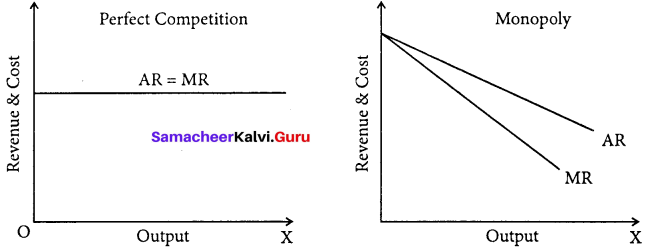
Draw demand curve of a firm for the following:
Answer:
(a) Perfect Competition
(b) Monopoly
Samacheer Kalvi 11th Economics Solutions Chapter 5 Market Structure and Pricing 1
Under perfect competition, as uniform price prevails AR = MR and the demand curve (AR) is horizontal to X-axis.
A monopoly firm faces a downward-sloping demand curve.

Question 26.
Mention any two type of price discrimination?
Answer:

  1. Personal
  2. Geographical
  3. On the basis of use.

Question 27.
Define “Excess capacity”.
Answer:

  1. Excess capacity is the difference between the optimum output that can be produced and the actual output produced by the firm.
  2. In the long run, a monopolistic firm produces deliberate output that is less than the optimum output that is the output corresponding to the minimum average cost.
  3. This leads to excess capacity which is actually a waste in monopolistic competition.

Part – C

Answer the following questions in One Paragraph

Question 28.
What are the features of a market?
Answer:
A market has the following characteristic features:

  1. Buyers and sellers of a commodity or a service.
  2. A commodity to be bought and sold.
  3. Price agreeable to buyer and seller.
  4. Direct or indirect exchange.

Question 29.
Specify the nature of entry of competitors in perfect competition and monopoly.
Answer:
Nature of entry of competitors in perfect competition:

  1. A large number of Buyers and Sellers.
  2. Homogeneous Product and Uniform Price.
  3. Free Entry and Exit.
  4. Absence of Transport Cost.
  5. Perfect Mobility of Factors of Production.
  6. Perfect Knowledge of the Market.
  7. No Government Intervention.

Nature of entry of competitors in Monopoly:

  1. There is a single producer/seller of a product.
  2. The product of a monopolist is unique and has no close substitute.
  3. There is a strict barrier to entry of any new firm.
  4. The monopolist is a price-maker.
  5. The monopolist earns maximum profit / abnormal profit.

Samacheer Kalvi 11th Economics Solutions Chapter 5 Market Structure and Pricing

Question 30.
Describe the degree of price discrimination?
Answer:
Degrees of Price Discrimination:
Price discrimination has become widespread in almost all monopoly markets. According to A.C.Pigou, there are three degrees of price discrimination.

1. First degree price discrimination:
A monopolist charges the maximum price that a buyer is willing to pay. This is called as perfect price discrimination. This price wipes out the entire consumer’s surplus. This is maximum exploitation of consumers. Joan Robinson named it as “Perfect Discriminating Monopoly”.

2. Second degree price discrimination:
Under this degree, buyers are charged prices in such a way that a part of their consumer’s surplus is taken away by the sellers. This is called as imperfect price discrimination. Joan Robinson named it as “Imperfect Discriminating Monopoly”.

Under this degree, buyers are divided into different groups and a different price is charged for each group. For example, in cinema theatres, prices are charged for same film show from viewers of different classes. In a theatre the difference between the first row of first-class and the last row in the second class is smaller as compared to the differences in charges.

3. Third degree price discrimination:
The monopolist splits the entire market into a few sub-market and charges different price in each sub-market. The groups are divided on the basis of age, sex and location. For example, railways charge lower fares from senior citizens. Students get discounts in museums, and exhibitions.

Question 31.
State the meaning of selling cost with an example.
Answer:

Selling Cost:
1. Selling Cost is the discussion of “ Product differentiation”, we can infer that the producer under monopolistic competition has to incur expenses to popularize his brand. This expenditure involved in selling the product is called selling cost. According to Prof. Chamberlin, Selling cost is “The cost incurred in order to alter the position or shape of the demand curve for a product”.

2. Most important form of selling cost is an advertisement. Sales promotion by an advertisement is called non – price competition.

3. Product differentiation through effective advertisement is another method. This is known as sales promotion. Be frequently advertising the brand of the product through Press, Film, Radio, and TV. The consumers are made to feel that the brand produced by the firm in question is superior to that of other brands sold by other firms.

4. Product differentiation may also be affected by offering customers some benefits with the sale of the product. Facilities like free servicing, home delivery, acceptance of returned goods, etc.

Example: Most important form of selling cost is advertisement [This is known as sales promotion]. By frequently advertising the brand of the product through press, film, radio, T.V.

Question 32.
Mention the similarities between perfect competition and monopolistic competition,
Answer:

  1. In both perfect competition and monopolistic competition number of firms are large.
  2. Competition exists between the firms.
  3. There are no barriers for entry and exit in both the markets.
  4. Equilibrium occurs at the point where MC curve intersects MR curve.
  5. In short run there is supernormal profit or loss and in long run there is only normal profits in both market structures.

Question 33.
Differentiate between ‘firm’ and ‘industry’.
Answer:
Firm :
A firm refers to a single production unit in an industry, producing a large or a small quantity of a commodity or service, and selling it at a price in the market. Its main objective is to earn a profit.

Industry :
An industry refers to a group of firms producing the same product or service in an economy.
(Eg.) A group of firms producing cement is called a cement industry.

Samacheer Kalvi 11th Economics Solutions Chapter 5 Market Structure and Pricing

Question 34.
State the features of duopoly.
Answer:

  1. Each seller is fully aware of his rival’s motive and actions.
  2. Both sellers may collude, (they agree on all matters regarding the sale of the commodity).
  3. They may enter into cut-throat competition.
  4. There is no perfect differentiation.
  5. They fix the price for their product with a view to maximizing their profit.

Part – D

Answer the following questions in about a page

Question 35.
Bring out the features of perfect competition.
Answer:
Features of the perfect competition:
1. a Large Number of Buyers and sellers:

  • “A large number of buyers” implies that each individual buyer buys a very, very small quantum of a product as compared to that found in the market.
  • This means that he has no power to fix the price of the product.
  • He is only a price-taker and not a price-maker
  • A large number of sellers implies that the share of each individual seller is a very, very small quantum of a product.
  • No power to fix the price of the product.

2. Homogeneous Product and Uniform Price:

  • The product sold and bought is homogeneous in nature, in the sense that the units of the product are perfectly substitutable.
  • All the units of the product are identical i.e., of the same size, shape, colour, quality, etc.
  • Therefore, a uniform price prevails in the market.

3. Free Entry and Exit:

  • In the short run, it is possible for the very efficient producer, producing the product at a very low cost, to earn supernormal profits.
  • An inefficient producer, who is unable to bring down the cost incurs a loss.

4. Absence of Transport Cost:

  • The prevalence of the uniform price is also due to the absence of the transport cost.

5. Perfect Mobility of Factors of Production:

  • The prevalence of the uniform price is also due to the perfect mobility of the factors of production.
  • As they enjoy perfect freedom to move from one place to another and from one occupation to another, the price gets adjusted.

6. Perfect Knowledge of the Market:

  • All buyers and sellers have a thorough knowledge of the quality of the product, prevailing price, etc.

7. No Government Intervention:

  • There is no government regulation on the supply of raw materials, and in the determination of price, etc.

Samacheer Kalvi 11th Economics Solutions Chapter 5 Market Structure and Pricing

Question 36.
How price and output are determined under the perfect competition?
Answer:
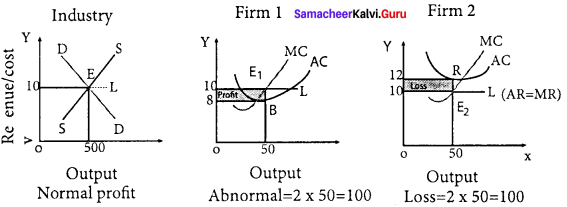
In the short run at least a few factors of production are fixed. The firms under perfect .competition take the price (10) from the industry and start adjusting their quantities produced.
For example
Qd = 100 -5P and
Qs = 5p
At equilibrium Qd = Qs
100 – 5p = 5p
100 = 5p + 5p
p = 10
Qd = 100 – 5(10)
= 50
Qs = 5(10) = 50
Qd = Qs
50 = 50
Samacheer Kalvi 11th Economics Solutions Chapter 5 Market Structure and Pricing 2

SS – market supply, DD – market demand, AR – Average Revenue, AC – Average Cost, MR – Marginal Revenue, MC – Marginal Cost This diagram consists of three panels.
First part:
The equilibrium of an industry is explained. The demand and supply forces of the firms interact and the price is fixed as Rs.10. The equilibrium of an industry is obtained at 50 units of output.

Second part:
AC curve is lower than the price line. Equilibrium is achieved where
MC = MR. Equilibrium quantity is 50. With price Rs. 10, it experiences supernormal profit
AC = Rs. 8
AR = Rs. 10
TR – 50 x 10 = 500
TC = 50 x 8 = 400
Profit = 500-400= 100.

Third part:
Firm’s cost curve is above the price line. Equilibrium MC = MR. Quantity is 50 with price Rs. 10, it experiences loss (AC > AR)
TR = 50 x 10 = 500
TC = 50 x 12 = 600
Loss = 600-500= 100
If profit prevails in the market, new firms emerge results in declining price and if loss occurs the existing loss making firm exits results in increasing price consequent upon the entry and exit of new firms into the industry, firms always earn ‘normal profit’ in the long run.

Price and output determination in long run :
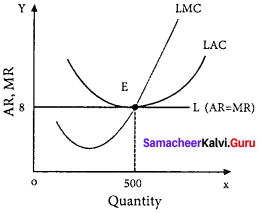
Long run equilibrium of the firm is illustrated in the diagram. Under perfect competition, long run equilibrium is only at minimum point of LAC. At point E,
LMC = MR = AR = LAC
Samacheer Kalvi 11th Economics Solutions Chapter 5 Market Structure and Pricing 3

In the diagram AR = AC. Equilibrium is at point E where price is 8 and output is 500. At this point, the profit of the firm is only normal. Thus condition for the long-run equilibrium of the firm is
Price = AR = MR = Minimum AC

At equilibrium SAC > LAC. Hence in the long-run equilibrium price is lower and quantity is larger compared to the short-run equilibrium price and quantity.

Question 37.
Describe the features oligopoly.
Answer:

  1. Few large firms: Very few big firms own the major control of the whole market by producing a major portion of the market demand.
  2. Interdependence among firms: The price and quality decisions of a particular firm are dependent on the price and quality decisions of the rival firms.
  3. Group behavior: The firms under oligopoly realize the importance of mutual co-operation.
  4. Advertisement cost: The oligopolist could raise sales either by advertising or improving the quality of the product.
  5. Nature of product: Perfect oligopoly means homogeneous products and imperfect oligopoly deals with heterogeneous products.
  6. Price rigidity: It implies that prices ate difficult to be changed. The oligopolistic firms do not change their prices due to the fear of rival’s reaction.

Samacheer Kalvi 11th Economics Solutions Chapter 5 Market Structure and Pricing

Question 38.
Illustrate price and output determination under monopoly.
Answer:
Monopoly is a market structure characterized by a single seller, selling the unique product with the restriction for a new firm to enter the market.

Price and Output Determination under Monopoly :
Nature of cost and revenue curves :
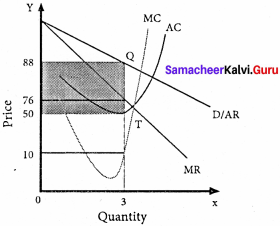
A monopoly is a one-firm industry. Therefore, a monopolist firm faces a downward-sloping demand curve. Since AR falls, MR lies below the AR curve (MR < AR)
The monopolist will continue to sell his product as long as his MR > MC
Samacheer Kalvi 11th Economics Solutions Chapter 5 Market Structure and Pricing 4

Condition for equilibrium :
Monopolists attain equilibrium at the level of output when MC = MR.
From the diagram, till he sells 3 units output, MR is greater than MC, and when he exceeds this output level, MR is less than MC. At equilibrium where MR = MC, price (AR) is Rs. 88. To know the profit of monopolists at equilibrium output, the average revenue curves and the average cost curves are used at equilibrium Output 3
AR= 88
AC = 50
Profit per unit = 88-50
= 38
= (AR – AC) × Total output
= (88 – 50) × 3
= 38 × 3
= 114

Question 39.
Explain price and output determined under monopolistic competition with help of diagram.
Answer:
Monopolistic competition refers to a market situation where there are many firms selling a differentiated product.

Price and output determination :
Nature of cost and revenue curves :
The monopolistic firm sell large quantity at less price. So, it faces a downward-sloping demand curve. AR curve is fairly elastic. MR curve falls below AR. AC curve will be ‘U’ shaped.

Condition for equilibrium :
MC = MR, MC curve should cut MR from below. If MC is less than MR, the sellers will find it profitable to expand their output.

Short-run equilibrium :
Samacheer Kalvi 11th Economics Solutions Chapter 5 Market Structure and Pricing 5

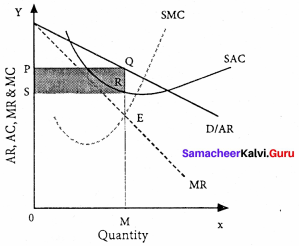
Profit is maximised when MC = MR. From the diagram.
OM – Equilibrium output OP – Equilibrium price
TR – OMQP TC – OMRS
Profit = OMQP-OMRS
= PQRS
This is super normal profit under short-run.
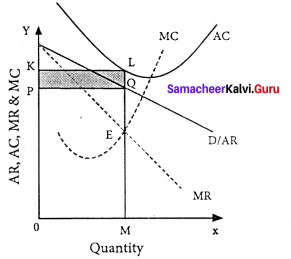
A monopolistic competitive firm may also incur loss in the short-run.
Samacheer Kalvi 11th Economics Solutions Chapter 5 Market Structure and Pricing 6

As shown in the diagram, the AR and MR curves are fairly elastic.
At equilibrium output is OM , price is OP
TR – OMQP
TC-OMLK
Total loss = TR-TC
= OMQP – OMLK
= PQLK

Long-run equilibrium :
In the long run, AR curve is more elastic or flatter. Hence, the firms will only earn normal profit.
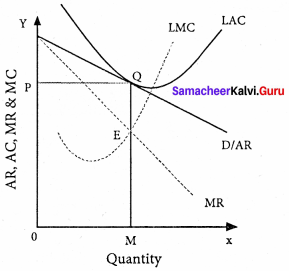
Samacheer Kalvi 11th Economics Solutions Chapter 5 Market Structure and Pricing 7

Samacheer Kalvi 11th Economics Market Structure and Pricing Additional Questions and Answers

Part -A

Choose the best options

Question 1.
In the real world what type of market we see?
(a) Imperfect
(b) Perfect
(c) Monopoly
(d) Oligopoly
Answer:
(a) Imperfect

Samacheer Kalvi 11th Economics Solutions Chapter 5 Market Structure and Pricing

Question 2.
First condition for equilibrium of the firm _______
(a) AC = AR
(b) AC = MC
(c) MC = MR
(d) AR = MR
Answer:
(c) MC = MR

Question 3.
How many types of price discrimination under monopoly?
(a) Three
(b) Two
(c) Five
(d) Seven
Answer:
(a) Three

Question 4.
Indian railways is an example of _______ competition.
(a) Perfect competition
(b) Monopoly
(c) Monopolistic competition
(d) Oligopoly
Answer:
(b) Monopoly

Question 5.
Monopoly power achieved through patent right is called ………………………..
(a) Duopoly
(b) Oligopoly
(c) Legal monopoly
(d) Monopolistic competition
Answer:
(c) Legal monopoly

Question 6.
Differentiated products are seen in _______
(a) Perfect competition
(b) Monopoly
(c) Monopolistic
(d) Monopsony
Answer:
(c) Monopolistic

Question 7.
Under perfect competition, the firms are producing …………………………
(a) Firm
(b) Sales
(c) Public sector
(d) Homogeneous
Answer:
(d) Homogeneous

Samacheer Kalvi 11th Economics Solutions Chapter 5 Market Structure and Pricing

Question 8.
In perfect competition, short run equilibrium is determined by
(a) MC = MR
(b) MC = AC
(c) MR = AR
(d) AR = AC
Answer:
(a) MC = MR

Question 9.
A firm and Industry are one and the same under ……………………
(a) Perfect competition
(b) Duopoly
(c) Oligopoly
(d) Monopoly
Answer:
(d) Monopoly

Question 10.
Group behaviour is seen in _______
(a) Perfect competition
(b) Monopoly
(c) Monopolistic competition
(d) Oligopoly
Answer:
(d) Oligopoly

Question 11.
When the monopoly will be an equilibrium?
(a) MC = MR
(b) AC = AR
(c) AC = MR
(d) MC = AR
Answer:
(a) MC = MR

Samacheer Kalvi 11th Economics Solutions Chapter 5 Market Structure and Pricing

Question 12.
_______ degree of price discrimination wipes out the entire consumer’s surplus.
(a) First
(b) Second
(c) Third
(d) None
Answer:
(a) First

Question 13.
In monopolistic competition, the demand curve is
(a) More elastic
(b) Inelastic
(c) Less elastic
(d) None
Answer:
(a) More elastic

Question 14.
Government controls monopoly by _______
(a) Taxation
(b) Legal methods
(c) Both
(d) None
Answer:
(c) Both

Question 15.
The important feature of non-price competition is _______
(a) Product differentiation
(b) Advertisement
(c) Sales promotion
(d) All the above
Answer:
(d) All the above

Question 16.
The concept of Imperfect Competition was
(a) J.M. Keynes
(b) Irving Fisher
(c) Marshall propounded by
(d) Joan Robinson
Answer:
(d) Joan Robinson

Question 17.
Identify the wrong statement about the features of Duopoly.
(a) There is product differentiation
(b) They fix the price for their product to maximise their profit
(c) Each seller is fully aware of his rival’s motive and actions
(d) Both sellers may collude regarding the sale of commodity.
Answer:
(a) There is product differentiation

Match the following and choose the answer using the codes given below

Question 1.
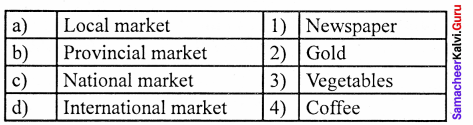
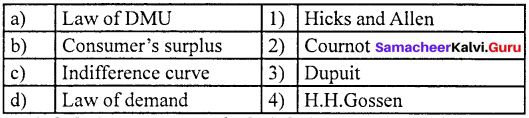
Samacheer Kalvi 11th Economics Solutions Chapter 5 Market Structure and Pricing 8
(a) 1 2 3 4
(b) 2 4 1 3
(c) 4 3 2 1
(d) 3 4 1 2
Answer:
(b) 2 4 1 3

Question 2.
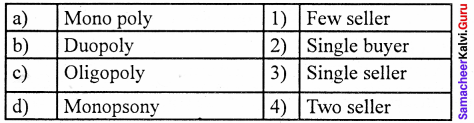
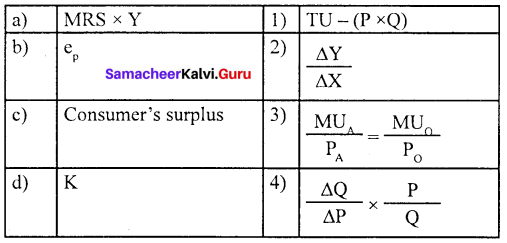
Samacheer Kalvi 11th Economics Solutions Chapter 5 Market Structure and Pricing 9
(a) 2 4 1 3
(b) 3 1 4 2
(c) 3 4 1 2
(d) 1 2 3 4
Answer:
(d) 1 2 3 4

Choose the incorrect pair

Question 3.

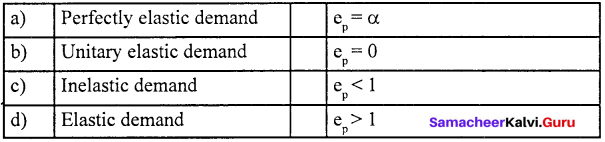
Samacheer Kalvi 11th Economics Solutions Chapter 5 Market Structure and Pricing 10
Answer:
(d) Sub-market (iv) Fourth degree price discrimination

Question 4.
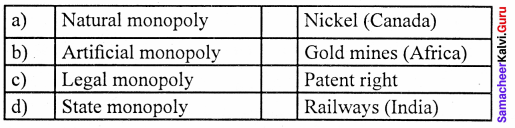
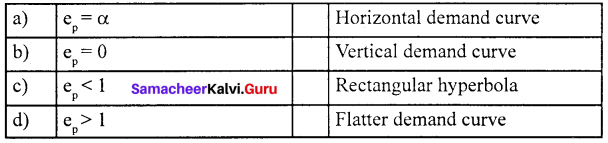
Samacheer Kalvi 11th Economics Solutions Chapter 5 Market Structure and Pricing 11
Answer:
(b) Artificial monopoly (ii) Gold mines (Africa)

Choose the odd one out

Question 5.
(a) Personal
(b) Geographical
(c) On the basis of use
(d) Price taker
Answer:
(c) On the basis of use

Question 6.
(a) Individual behaviour
(b) Few large firms
(c) Group behaviour
(d) Price rigidity
Answer:
(a) Individual behaviour

Samacheer Kalvi 11th Economics Solutions Chapter 5 Market Structure and Pricing

Question 7.
(a) Market period
(b) Short period market
(c) Very long period market
(d) Whole sale market
Answer:
(d) Whole sale market

Choose the incorrect statement

Question 8.
In perfect competition
(a) There are large number of buyers and sellers
(b) Free entry and exit of firm
(c) Price competition is essential
(d) Independent price policy
Answer:
(c) Price competition is essential

Question 9.
(a) In a market there is no exchange of goods.
(b) Commodities will be bought and sold in market.
(c) In market prices are agreeable to buyer and seller.
(d) In market there are buyer and seller of a commodity.
Answer:
(a) In a market there is no exchange of goods.

Analyse the reason for the following 

Question 10.
Assertion (A) : Perfect competition is that no one is big enough to have any appreciable
influence over market price.
Reason (R) : Perfect competition is a market situation where there are infinite number of sellers.
(a) Both (A) and (R) are true, (R) is the correct explanation of (A)
(b) Both (A) and (R) are true, (R) is not the correct explanation of (A)
(c) Both (A) and (R) are false.
(d) (A) is true but (R) is false.
Answer:
(a) Both (A) and (R) are true, (R) is the correct explanation of (A)

Question 11.
Assertion (A) : At equilibrium MC cuts MR from below.
Reason (R) : MC cuts MR at two points.
(a) Both (A) and (R) are true, (R) is the correct explanation of (A)
(b) Both (A) and (R) are true, (R) is not the correct explanation of (A)
(c) (A) is true but (R) is false.
(d) (A) is false but (R) is true.
Answer:
(b) Both (A) and (R) are true, (R) is not the correct explanation of (A)

Samacheer Kalvi 11th Economics Solutions Chapter 5 Market Structure and Pricing

Question 12.
Assertion (A) : In monopoly there exist price discrimination.
Reason (R) : A monopolist is a price maker.
(a) Both (A) and (R) are true, (R) is the correct explanation of (A)
(b) Both (A) and (R) are false
(c) (A) is true but (R) is false.
(d) (A) is false but (R) is true.
Answer:
(a) Both (A) and (R) are true, (R) is the correct explanation of (A)

Choose the incorrect pair 

Question 13.

Samacheer Kalvi 11th Economics Solutions Chapter 5 Market Structure and Pricing 12
Answer:
(c) Monopolistic competition (iii) Non – price discrimination

Question 14.

Samacheer Kalvi 11th Economics Solutions Chapter 5 Market Structure and Pricing 13
Answer:
(b) Oligopoly (ii) Group behaviour

Fill in the blanks with suitable option given below 

Question 15.
Supply curve in the very short period is ________
(a) Horizontal
(b) Slopes downward
(c) Slopes upward
(d) Vertical
Answer:
(d) Vertical

Question 16.
Differentiated products are seen in ________
(a) Perfect competition
(b) Monopoly
(c) Monopolistic competition
(d) Monopsony
Answer:
(c) Monopolistic competition

Samacheer Kalvi 11th Economics Solutions Chapter 5 Market Structure and Pricing

Question 17.
Government controls monopoly by ________
(a) Taxation
(b) Legal method
(c) Both
(d) None
Answer:
(c) Both

Choose the best option 

Question 18.
________ classified market based on time
(a) Marshall
(b) Adam smith
(c) Chamberlin
(d) Hicks
Answer:
(a) Marshall

Question 19.
In monopolistic competition the demand curve is
(a) Inelastic
(b) More elastic
(c) Less elastic
(d) None
Answer:
(b) More elastic

Question 20.
The important feature of non-price competition is ________
(a) Product differentiation
(b) Advertisement
(c) Sales promotion
(d) All the above
Answer:
(d) All the above

Part – B

Answer the following questions in one or two sentences

Question 1.
Define duopoly?
Answer:
In a duopoly, there are only two sellers who are completely independent and no agreement exists between them.

Question 2.
Define “ Imperfect competition”?
Answer:
Imperfect competition is a competitive market situation where there are many sellers, but they are selling heterogeneous (dissimilar) goods as opposed to the perfect competitive market scenario. As the name suggests, competitive markets are imperfect in nature.

Question 3.
Classify market based on time.
Answer:

  1. Very short period market (or) Market period.
  2. Short period market
  3. Long period market
  4. Very long period market (or) Secular period market.

Question 4.
How is market classified based on the quantify of a commodity?
Answer:

  1. Whole-sale market
  2. Retail market

Samacheer Kalvi 11th Economics Solutions Chapter 5 Market Structure and Pricing

Question 5.
How can you classify market-based on the competition?
Answer:

  1. Perfect competition market.
  2. Imperfect competition market which comprises monopoly, monopolistic competition, duopoly, oligopoly etc.

Question 6.
Define long-run average cost curve.
Answer:
In the long run all the factors are variable. The LAC curve is an envelope curve as it contains a few average cost curves. It is a flatter ‘U’ shaped one. It is also called as planning curve.

Question 7.
Write a note imperfect competition.
Answer:
This concept was introduced by Joan Robinson and E.H.Chamberlin. Imperfect competition is a competitive market situation where there are many sellers, but they are selling heterogeneous goods. Competitive markets are imperfect in nature.

Question 8.
Explain monopoly.
Answer:
‘Mono’ refers to a single and ‘poly’ to seller. In this way, monopoly refers to a market situation in which there is only one seller of a commodity. There is no scope for competition.

Question 9.
What is dumping?
Answer:
Dumping refers to practice of the monopolist charging higher price for his product in the local market and lower price in the foreign market. It is called as ‘International price discrimination’.

Question 10.
What is monopsony?
Answer:
Monopsony is a market structure in which there is only one buyer of a good or service.

Question 11.
What is a Bilateral monopoly?
Answer:
If a single producer of a product faces a single buyer of that product, then it is called as bilateral monopoly.

Question 12.
What are the conditions for short, run and long-run equilibrium in the monopolistic competition ?
Answer:
Short – run equilibrium : MC = MR
Long – run equilibrium has two conditions : MC = MR and AC = AR

Question 13.
Give example for perfect competition.
Answer:

  1. Online ticket auctions.
  2. Truck farming
  3. Salt
  4. Gravel
  5. Garage sales
  6. Online sales in general

Question 14.
What is oligopoly?
Answer:
Oligopoly is a market situation in which there are a few firms selling homogeneous or differentiated products.

Part – C

Answer the following questions in One Paragraph

Question 1.
Explain the types of markets based on area.
Answer:
The market is classified not only on its geographical spread but also on the nature of the goods exchanged.
1. Local market:
It refers to the products or services which are sold and bought in the place of their production. (Eg.) Fruits, Vegetables etc.

2. Provincial market:
It arises when products or services are sold and bought in a restricted circle. (Eg.) : Provincial newspaper.

3. National market:
It arises when products and services are sold and bought throughout a country. (Eg.) Tea, Coffee, Cement etc.

4. International market:
It arises when products and services are sold and bought at the world level. (Eg.) Petrol, Gold etc.

Question 2.
What are the Duopoly and the characteristics of Duopoly?
Answer:
Duopoly is a special case of the theory of oligopoly in which there are only two sellers. Both the sellers are completely independent and no agreement exists between them. Even though they are independent, a change in the price and output of one will affect the other, and may set a chain of reactions. A seller may, however, assume that his rival is unaffected by what he does, in that case he takes only his own direct influence on the price.

Characteristics of Duopoly:

  1. Each seller is fully aware of his rival’s motive and actions.
  2. Both sellers may collude (they agree on all matters regarding the sale of the commodity).
  3. They may enter into cut-throat competition.
  4. There is no product differentiation.
  5. They fix the price for their product with a view to maximizing their profit.
  6. Describe the features of monopolistic competition.

Features of monopolistic competition:

  1. There are a large number of buyers and many sellers.
  2. Firms under monopolistic competition are price makers. They set their own prices.
  3. Firms produce differentiated products. It is the key element of monopolistic competition.
  4. There is a free entry and exit of firms.
  5. Firms compete with each other by incurring selling cost or expenditures on sales promotion of their products.
  6. Non – price competition is an essential part of monopolistic competition.
  7. A firm can follow an independent price policy.

Question 3.
Classify markets based on quantity of the commodity.
Answer:
1. Whole-sale market:
It is for bulk selling and buying of goods. The price is likely to be low compared to the retail market. (Eg.) Clothing, Grocery etc.

2. Retail market:
It is the market for commodities in small quantities .(Eg.) Clothing, Vegetable, etc.

Samacheer Kalvi 11th Economics Solutions Chapter 5 Market Structure and Pricing

Question 4.
Explain the total cost curve approach.
Answer:
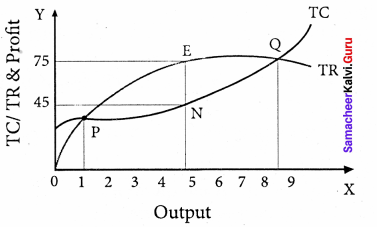
In the TC – TR approach, profit is obtained by a firm, through the difference between the TC and the TR.
Equilibrium is obtained at the point where the maximum difference between the TC and TR occurs.
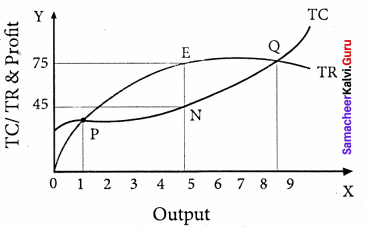
Samacheer Kalvi 11th Economics Solutions Chapter 5 Market Structure and Pricing 14

Question 5.
State the two conditions for equilibrium using the marginal curve approach.
Answer:
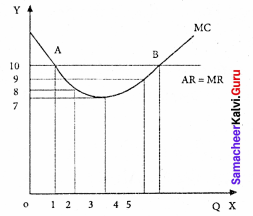
Samacheer Kalvi 11th Economics Solutions Chapter 5 Market Structure and Pricing 15
1. MC = MR
A rational seller will not be in equilibrium at output level 1, though MC = MR at that point. He continues his production till 5 units where MC < MR. Beyond 5 units of Q, MC > MR where the seller incurs loss. So condition for equilibrium MC – MR. It is a necessary but not a sufficient condition.

2. MC cuts MR curve from below (Sufficient conditions):
MC curve is ‘U’ shaped. MR cuts MC both from above (at point A) and also from below (at point B). Only at point B the equilibrium condition is fulfilled.

Thus for equilibrium under all market situations the two conditions are MC = MR and MC cuts MR from below.

Question 6.
Explain the features of monopoly.
Answer:

  1. There is a single producer/seller of a product.
  2. The product of a monopolist is unique and has no close substitute. There is a strict barrier to entry of any new firm.
  3. The monopolist is a price – maker.
  4. The monopolist earns maximum profit / abnormal profit.

Question 7.
Explain the sources of monopoly power.
Answer:
1. Natural monopoly :
Ownership of the natural raw materials. (Eg.) Gold mines (Africa)

2. State monopoly :
Single supplier of some special services. (Eg.) Railways in India

3. Legal monopoly :
A monopoly firm can get its monopoly power by getting patent rights, trade mark from
the government.

Samacheer Kalvi 11th Economics Solutions Chapter 5 Market Structure and Pricing

Question 8.
Explain the features of monopolistic competition.
Answer:

  1. There are a large number of buyers and sellers.
  2. Firms under monopolistic competition are price makers.
  3. They produce differentiated products.
  4. There is a free entry and exit of firms.
  5. Finns compete with each other by incurring selling costs or expenditure on sales promotion.
  6. Non-price competition is an essential part of monopolistic competition.
  7. A firm can follow an independent price policy.

Question 9.
Explain the types of price discrimination.
Answer:
1. Personal :
Different prices are charged for different individuals.
(Eg.) Tickets at a concessional rate to the senior citizens in railways.

2. Geographical:
Different prices are charged at different places for the same product.
(Eg.) A book sold within India at a price is sold in a foreign country at a lower price.

3. On the basis of use :
Different prices are charged according to the use of a product.
(Eg.) TNEB charges lower rate for domestic use of electricity and higher rate for commercial uses.

Part – D

Answer the following questions in about a page

Question 1.
Explain long-run equilibrium in perfect competition.
Answer:
In the long run, all the factors are variable.
The LAC curve is an envelope curve as it contains a few average cost curves.
It is a flatter ‘U’ shaped one. It is also known as the planning curve.

  1. The firms will earn an only normal profit.
  2. All the firms in the market are in equilibrium. So entry and exit of a firm is not possible.
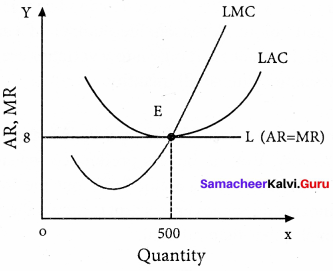
    Samacheer Kalvi 11th Economics Solutions Chapter 5 Market Structure and Pricing 16

A firm under perfect competition, in the long run, is a price-taker. It takes the price of the product from the industry. And it superimposes its cost curves on the revenue curves.

Long-run equilibrium is at the minimum point of LAC. In the diagram AC = AR, at equilibrium E price is 8 and output is 500. At this point, the profit of the firm is only normal.

The condition for the long-run equilibrium of the price is.
Price = AR = MR = Minimum AC. At this equilibrium.

  1. SAC > LAC
  2. Long run equilibrium price is lower than the short-run equilibrium price.
  3. Long run equilibrium quantity is larger than short-run equilibrium quantity.

Question 2.
Describe the wastes of monopolistic competition?
Answer:
Wastes of Monopolistic Competition:
Generally there are five kinds of wastages under monopolistic competition.
1. Excess capacity:

  • Un-utilized capacity is the difference between the optimum output that can be produced and the actual output produced by the firm.
  • In the long run, a monopolistic firm produces delibourately output which is less than the optimum output that is the output corresponding to the minimum average cost.
  • This leads to excess capacity which is actually as waste in monopolistic competition.

2. Unemployment:

  • Under monopolistic competition, the firms produce less than optimum output.
  • As a result, the productive capacity is not used to the fullest extent.
  • This will lead to unemployment of human resources also.

3. Advertisement:

  • There is a lot of waste in competitive advertisements under monopolistic competition.
  • The wasteful and competitive advertisements lead to high cost to consumers.

4. Too many varieties of Goods:

  • The goods differ in size, shape, style and colour. A reasonable number of varieties would be sufficient.

5. Inefficient firms:
Under monopolistic competition, inefficient firms charge prices higher than their marginal cost. Efficient firms cannot drive out inefficient firms.

Samacheer Kalvi 11th Economics Solutions Chapter 5 Market Structure and Pricing

Question 3.
Explain long-run equilibrium in perfect competition.
Answer:
Similarities :

  1. The motive of both the type of market is profit maximisation.
  2. Condition for equilibrium is MC = MR

Dissimilarities :

Perfect Competition:

  1. Price taker. As the contribution of a single seller is less he cannot determine the price
  2. At equilibrium MC = MR = AR (Price)
  3. AR curve is perfectly elastic and horizontal to X-axis. MR curve is equal to AR and coincides with AR. AR = MR
  4. Equilibrium is attained at increasing marginal cost conditions.
  5. In the short – run the firm earns super normal profit. In the long run, attracted by super-normal profit new firms enter the industry, which results in normal profit.
  6. The firms produce optimum quantity of output.
  7. Price discrimination is not possible, because of the perfectly elastic demand curve.
  8. Output is maximum and price is minimum.
  9. Possibility for consumer’s surplus.

Monopoly:

  1. Price maker. As the firm and industry remains the same, producer fix price for his product.
  2. At equilibrium MC = MR < AR (Price)
  3. AR curve is a downward-sloping curve. MR falls below AR.
  4. Equilibrium can be attained during increasing, decreasing and constant marginal cost conditions.
  5. In both short-run and long-run the firm earns super-normal profit because of the barrier to entry.
  6. The firm produces less than the optimum quantity of output.
  7. Price discrimination is possible.
  8. Output is minimum and price is maximum.
  9. As the price is high there is no possibility for a consumer’s surplus.

Question 4.
Explain long-run equilibrium of the firm and the group equilibrium in monopolistic competition.
Answer:
In the short run, the firm may earn super normal profit or incur loss. But in the long run, the entry of the new firms in the industry will wipe out the super normal profit earned by the existing firms. The entry of new firms and exit of loss making firms will result in normal profit for the firms in the industry.

In the long run AR curve is more elastic or flatter. Because plenty of substitutes are available.
Samacheer Kalvi 11th Economics Solutions Chapter 5 Market Structure and Pricing 17

In the diagram, equilibrium is achieved at point E The equilibrium output is ‘OM’ and the equilibrium price is ‘OP’. AR is ‘MQ’ and MC is also ‘MQ’.

In the long run, the condition for equilibrium is AR = AC And MC = MR. It means that a firm earns a normal profit. AR is tangent to the Long-run Average Cost (LAC) curve at point ‘Q’.

Samacheer Kalvi 11th Economics Solutions Chapter 5 Market Structure and Pricing Read More »
Samacheer Kalvi 11th English Grammar Homographs

Students can Download Samacheer Kalvi 11th English Grammar Homographs, Notes, Samacheer Kalvi 11th English Book Solutions Guide Pdf helps you to revise the complete Tamilnadu State Board New Syllabus and score more marks in your examinations. Learn the Samacheer Kalvi 11th English Grammar to enhance your grammar skills like reading comprehension, passage writing, parts of speech, tenses, passive and active voice, and many other concepts in no time.

Tamilnadu Samacheer Kalvi 11th English Grammar Homographs

Homographs are words (usually a pair) that are spelled alike but differ in meaning. They may or may not be pronounced the same way.

Homo­graphs Meaning 1 Meaning 2
affect to change a person’s emotions
alternate to switch back and forth the second choice
attribute a characteristic to give regard to
bass a type of a fish/the low tones of music or a stringed instrument which plays low tones bow a device to shoot an arrow/to bend one’s head down or the front of a ship
buffet a blow or be affected by blows
Samacheer Kalvi 11th English Grammar Homographs
a large sideboard or a self-served meal of various dishes
close to be near to shut
combine a farming machine which threshes to put together
conduct one’s behavior to lead (oops there is another one) such as a symphony
content to be satisfied that which is contained within
contest to compete in a match of skills make an argument against something
convert to change one’s belief system one whose belief system has been changed
converse to talk the opposite
convict a prisoner to find one guilty of a charge
deliberate to carefully consider to purposely do
desert to abandon an arid or barren area
digest to convert food to simpler compounds to condense a written work
do the first tone of the diatonic scale to accomplish
dove a bird to have jumped off
drawer one who draws
Samacheer Kalvi 11th English Grammar Homographs
a boxlike compartment that pushes in and pulls out
entrance an entryway to put into a trance
excuse to pardon or forgive an explanation offered to justify or obtain forgiveness
gyro short for gyroscope a type of sandwich with roasted lamb
house a dwelling to provide living quarters
intimate personal to hint
laminate to make in layers a composite made of layers
lead to guide Samacheer Kalvi 11th English Grammar Homographs a soft dense metal
live verb meaning to have life adjective meaning to have life or being on
minute small sixty seconds
moderate of medium or average quality to preside or direct
number a mathematical integer like 1, 2, 3,… to deprive of further feeling
object something perceptible to dissent
pasty medium consistency a meat pie
perfect to make correct that which is correct
permit to allow something to be done a document giving permission
present a gift or that which is happening now to give a talk or demonstration
produce vegetables to bring forth
project to thrust outward a plan or housing development
putting to hit a golf ball on a green to place in a specific location
rebel to resist Samacheer Kalvi 11th English Grammar Homographs one who resists
record to write down a list or phonograph disk
recreation a leisurely pastime to remake
reside to live in a place to change a side
resign to quit to sign again
row a series of objects in a straight line a fight
sake purpose a Japanese rice drink
secrete to generate to conceal
separate to divide into groups disunited or a garment
sewer one who sews a conduit for transporting sewage
slough a swamp to shed Samacheer Kalvi 11th English Grammar Homographs
sow to scatter seeds an adult female hog
subject the theme or topic to force one’s will onto another
tear liquid drops secreted by the eye to pull apart
wind to encircle moving air
wound to have been wrapped in a circular manner an injury

Samacheer Kalvi 11th English Grammar Homographs

Samacheer Kalvi 11th English Grammar Homographs Read More »

Samacheer Kalvi 11th Commerce Solutions Chapter 31 Discharge and Breach of a Contract

Students can Download Commerce Chapter 31 Discharge and Breach of a Contract Questions and Answers, Notes Pdf, Samacheer Kalvi 11th Commerce Book Solutions Guide Pdf helps you to revise the complete Tamilnadu State Board New Syllabus and score more marks in your examinations.

Samacheer Kalvi 11th Commerce Solutions Chapter 31 Discharge and Breach of a Contract

Samacheer Kalvi 11th Commerce Discharge and Breach of a Contract Textbook Exercise Questions and Answers

I. Choose the Correct Answer

Question 1.
On the valid performance of the contractual obligation by the parties, the contract ……………….
(a) Is discharged
(b) Becomes enforceable
(c) Becomes void
(d) None of these
Answer:
(a) Is discharged

Question 2.
An agreement to do an act impossible in itself under Section 56 is ……………….
(a) Void
(b) Valid
(c) Voidable
(d) Unenforceable
Answer:
(a) Void

Samacheer Kalvi 11th Commerce Solutions Chapter 31 Discharge and Breach of a Contract

Question 3.
Any agreement which becomes impossible to perform under various circumstances.
(a) Voidable
(b) Void
(c) Valid
(d) None of these
Answer:
(b) Void

Question 4.
Discharge by mutual agreement may involve ……………….
(a) Novation
(b) Rescission
(c) Alteration
(d) All of the above
Answer:
(d) All of the above

Question 5.
The compensation given for breach of contract is ……………….
(a) Damage
(b) Remuneration
(c) Money
(d) Cheque
Answer:
(a) Damage

II. Very Short Answer Questions

Question 1.
What are the kinds of consent?
Answer:
Consent can be classified into four types, namely; Implied Consent, Expressed consent, Informed Consent, and Unanimous consent.

Samacheer Kalvi 11th Commerce Solutions Chapter 31 Discharge and Breach of a Contract

Question 2.
What are the types of Impossibility of Performance?
Answer:
There are two types of the impossibility of performance, such as –

  1. Impossibility existing at the time of the agreement.
  2. Impossibility arising subsequent to the formation of the contract.

Question 3.
What is Quantum merit?
Answer:
The meaning of the phrase quantum merit is ‘as much as earned’. It has been arising if a contract performed by one party has become discharged by breach of the other party. The claim is not for the original contract that has been discharged or void, but on an implied promise by the other party to pay for what he has done.

III. Short Answer Questions

Question 1.
What are the different modes of discharge by implied consent?
Answer:
Different modes of discharge by implied consent are:

  1. Novation
  2. Alteration
  3. Recession
  4. Remission
  5. Accord and Satisfaction
  6. Waiver
  7. Merger

Question 2.
Define discharge by Performance.
Answer:
Performance implies carrying out the obligation of the contract. Performance must be completed according to the real intentions of the agreement. Performance must be done according to the time and manner prescribed. Performance of contract may be of two types namely

  1. Actual performance
  2. Attempted performance.

Samacheer Kalvi 11th Commerce Solutions Chapter 31 Discharge and Breach of a Contract

Question 3.
What are the reasons for impossibility arising after the formation of a contract?
Answer:
Impossibility arising subsequent to the formation of a contract or supervening impossibility may be:

  1. By some event beyond the control of the parties; or
  2. By some act either of the promisor or of the promisee.

Question 4.
What are the various rules regarding damages?
Answer:
Damages are monetary compensation awarded by the court to the injured party for the loss or injury suffered by him. The following are the rules regarding damages

  • As per the contract, one party can claim damages if the other parties breach the contract.
  • The main purpose of awarding the damages is to make good the loss suffered by him. It is known as the doctrine of restitution.
  • Section 73 of the Indian Contract Act, 1872 deals with the compensation for loss or damages caused by a party for breach of contract.

IV. Long Answer Questions

Question 1.
Explain the ways of discharge of Contract?
Answer:
Different modes of discharge of contract have been provided under different sections of the Act:
1. Discharge by Performance: Performance implies carrying out the obligation of the contract. Performance must be completed according to the real intentions of the agreement. Performance must be done according to time and manner prescribed. Performance of contract may be of two types namely:

  • Actual performance
  • Attempted performance

2. By Agreement on Consent: Agreement between the parties comes to an end by mutually agreeing for it. Any contract is created by an agreement, hence in the same way, it can be discharged by an agreement. The consent may be of the following types:

  • Express consent
  • Implied consent

3. By Impossibility of Performance: A contract may be discharged if its performance becomes impossible. There are two types of the impossibility of performance, such as –

  • Impossibility existing at the time of the agreement.
  • Impossibility arising subsequent to the formation of the contract.

4. By Lapse of Time: According to the Limitation Act, 1963 a contract must be performed within a specified time. If it is not performed within this specified time limit and against which if no action is taken by the promisee in the Court of Law within a specified time, then the promisee is deprived of his remedy at law. In such cases, the contract is discharged.

5. By Operation of Law: A contract can be discharged by the operation of law. The operation of law by which contract can be discharged are as follows:

  • By Death
  • By Merger
  • By Insolvency
  • Unauthorized Alteration of the Terms of a Contract
  • Rights and liabilities vesting in the same person

Question 2.
Write about the various remedies for breach of contract.
Answer:
All parties to a contract are expected to perform their promises. When one party refuses to perform his promise, then the breach of contract takes place. The other party or parties are called aggrieved or injured party or parties. There are various types of remedies for the injured parties listed as follows:
The recession of Contract:
In case of breach of contract by one party, then the other parties may rescind the contract and thereby the party is absolved from all obligations under the contract.

Claim for Specific Performance:
In some specific cases if the damages are not an adequate remedy, then the court can direct the party in breach for the specific performance of the contract. In such a case, the promise is carried out as per the terms and conditions of the contract.

Claim for Injunction:
The injunction is an order passed by a competent court restraining a person from doing some act. An injunction can be defined as a mode of securing the specific performance of the negative terms of a contract. Negative terms of contract imply doing something, which a party has promised not to do. The injunction is an order which is granted by the court restraining the person to do what he had promised not to do.

Claim for Quantum Merit:
The claim for quantum merit may arise if a contract performed by one party has become
discharged by breach of the other party. The meaning of the phrase quantum merit is ‘as much as earned’. The claim is not for the original contract that has been discharged or void, but on an implied promise by the other party to pay for what he has done.

Claim for damages:
Damages are monetary compensation awarded by the court to the injured party for the loss or injury suffered by him. As per the contract, one party can claim damages if other parties breach the contract. The main purpose of awarding the damages is to make good the loss suffered by him. It is known as the doctrine of restitution. Section 73 of the Indian Contract Act, 1872 deals with the compensation for loss or damages caused by a party for breach of contract.

Samacheer Kalvi 11th Commerce Solutions Chapter 31 Discharge and Breach of a Contract

Question 3.
Discuss the different types of damages awarded to the injured party.
Answer:
The following are the different types of damages awarded to the injured party:
1. Ordinary damages:
The damages which arise in the ordinary course of events from the breach of contract are called ordinary damages. These damages constitute the direct loss suffered by the aggrieved party.

2. Special Damages:
Special damages are those damages that are payable for the loss arising on account of some special or unusual circumstances. They are not due to the natural and probable consequences of the breach of the contract. Special damages can be recovered only when the other party while signing the contract, is informed of the special circumstances which are responsible for the special losses.

3. Exemplary or Vindictive Damages:
These damages are awarded against the party who has committed a breach of the contract with the object of punishing the erring as defaulting party and compensating the aggrieved party. These damages are awarded in the case of action on lost or breach of promise.

4. Nominal damages:
Nominal damages are awarded to the aggrieved party when there is only a technical violation of the legal rights. Here no substantial loss is caused. These damages are very small in amount. They are awarded simply to recognize the right of the party to claim damages for the breach of the contract.

Samacheer Kalvi 11th Commerce Solutions Chapter 31 Discharge and Breach of a Contract Read More »

Samacheer Kalvi 11th English Grammar Framing Sentences

Students can Download Samacheer Kalvi 11th English Grammar Framing Sentences, Notes, Samacheer Kalvi 11th English Book Solutions Guide Pdf helps you to revise the complete Tamilnadu State Board New Syllabus and score more marks in your examinations. Learn the Samacheer Kalvi 11th English Grammar to enhance your grammar skills like reading comprehension, passage writing, parts of speech, tenses, passive and active voice, and many other concepts in no time.

Tamilnadu Samacheer Kalvi 11th English Grammar Framing Sentences

Question 1.
Use the word “equal” as a noun, adjective, verb and adverb in your own sentences.
Answer:

  • Sangeetha treated Tarun and Kavin as equals, (noun)
  • Father gave equal share of his property to his sons and daughters, (adj)
  • One plus one equals two. (verb)
  • We decided to divide the amount equally, (adverb)

Samacheer Kalvi 11th English Grammar Framing Sentences

Question 2.
Use the word ‘tear’ as a noun, verb, adjective and adverb in your own sentences.
Answer:

  • Don’t shed tears over loss of money, (noun)
  • Don’t tear the book, (verb)
  • She was given a tearful farewell, (adj)
  • Sheela tearfully left the hall, (adverb)

Question 3.
Use the word ‘like’ as a noun, verb, adjective and preposition in your own sentences.
Answer:

  • Great gurus are above likes and dislikes, (noun)
  • You need to carry out your duties whether you like it or not. (verb)
  • You must befriend like-minded persons, (adj)
  • Raj an looks like his father, (preposition)

Samacheer Kalvi 11th English Grammar Framing Sentences

Question 4.
Use the word ‘well’ as a noun, verb and an adjective in your own sentences.
Answer:

  • There is an unused well behind my house, (noun)
  • Tears welled up in her eyes on hearing her father’s death, (verb)
  • Sangeetha is well qualified for the Professor post, (adj)

Question 5.
Use the word “fine” as an adjective, a noun and a verb.
Answer:

  • She wore a fine jewel which caught everyone’s eyes, (adj)
  • The driver was asked to pay fine for skipping the red signal, (noun)
  • I was fined for over-speeding, (verb)

Samacheer Kalvi 11th English Grammar Framing Sentences

Question 6.
Use the word “after” as an adverb, a preposition and conjunction.
Answer:

  • Jill came tumbling after, (adv)
  • He returned after the accident, (prep)
  • After Martin finished his studies, he returned to India, (conjunction)

Question 7.
Use the word “wrong” as an adjective, adverb and a noun.
Answer:

  • You have taken the wrong road, (adj)
  • Hari was wrongly arrested, (adv)
  • We must differentiate the right and wrong, (noun)

Samacheer Kalvi 11th English Grammar Framing Sentences

Question 8.
Use the word “each” as an adjective and a pronoun.
Answer:

  • Each day brings its opportunity, (adj)
  • I received a rupee from each, (pronoun)

Question 9.
Use the word “as” as an adverb and a conjunction.
Answer:

  • We walked as fast as we could, (adv)
  • As he was late, we went without him. (conj)

Question 10.
Use the word “fast” as a noun, an adjective and adverb.
Answer:

  • He didn’t take anything during the fast, (noun)
  • I missed the fast train, (adj)
  • She speaks fast, (adv)

Samacheer Kalvi 11th English Grammar Framing Sentences

Samacheer Kalvi 11th English Grammar Framing Sentences Read More »

Samacheer Kalvi 11th Commerce Solutions Chapter 12 Functions of Commercial Banks

Students can Download Commerce Chapter 12 Functions of Commercial Banks Questions and Answers, Notes Pdf, Samacheer Kalvi 11th Commerce Book Solutions Guide Pdf helps you to revise the complete Tamilnadu State Board New Syllabus and score more marks in your examinations.

Samacheer Kalvi 11th Commerce Solutions Chapter 12 Functions of Commercial Banks

Samacheer Kalvi 11th Commerce Functions of Commercial Banks Textbook Exercise Questions and Answers

I. Choose the Correct Answer
Question 1.
Electronic banking can be done through ………………
(a) Computers
(b) Mobile phones
(c) ATM
(d) All of the above
Answer:
(d) All of the above

Question 2.
Minimum how much amount can be transferred through RTGS?
(a) Any amount
(b) 50,000
(c) 2 lakh
(d) 5 lakh
Answer:
(c) 2 lakh

Samacheer Kalvi 11th Commerce Solutions Chapter 12 Functions of Commercial Banks

Question 3.
The largest commercial bank of India is ………………
(a) ICICI
(b) SBI
(c) PNB
(d) RBI
Answer:
(b) SBI

Question 4.
In which kind of account, it is compulsory to deposit a certain amount at a certain time?
(a) Saving deposit
(b) Fixed deposit
(c) Current deposit
(d) Recurring deposit
Answer:
(d) Recurring deposit

Question 5.
Which of the following is not a type of advance provided by a commercial bank?
(a) Collecting and supplying business information
(b) Overdraft
(c) Cash credit
(d) Discounting of bills
Answer:
(a) Collecting and supplying business information

II. Very Short Answer Questions

Question 1.
What is Mobile Banking?
Answer:
Most of the commercial banks have designed computer programs called apps with this app in the smartphone a customer can operate his account transactions from anywhere. This service is known as mobile banking.

Question 2.
Briefly explain the need for a Debit card.
Answer:
An ATM card is also called a debit card. This card is more useful in the purchase of goods and services anywhere in India if the shop maintains a swiping machine facility.

Samacheer Kalvi 11th Commerce Solutions Chapter 12 Functions of Commercial Banks

Question 3.
Briefly explain the term – Credit card.
Answer:
Banks issue credit cards to customers and other eligible persons. With this card, the holder can purchase goods and services on credit at any shop in India. If the dues are paid within the stipulated time no interest is charged. The credit limit is fixed by the issuing bank based on the income of the cardholder.

Question 4.
What do you mean by ATM?
Answer:
The Auto Mated Teller Machine is a machine built into the wall of a bank or other building which allows people to take out money from their bank account by using the ATM card given by their bank. Nowadays debit cards are used as ATM cards.

Question 5.
Write a note on – ECS.
Answer:
Electronic Clearing Service (ECS) was launched by the RBI in 1995. It is an electronic method of fund transfer from a bank to another bank.

III. Short Answer Questions

Question 1.
What is E-Banking?
Answer:
Using electronic means funds can be transferred directly from one account to another, rather than by cheque or cash. It helps to have easy and safe access to the bank account. The main advantage of e-banking is using our own computer and personal finance software to coordinate the total personal financial management process leads to prompt financial analysis and decision-making process.

Question 2.
Write a short note on – RTGS.
Answer:
Real-Time Gross Settlement Systems (RTGS) was launched by the RBI in 2013. The transactions are settled on real time basis. Gross settlement means the transaction is settled between one bank and another bank without adding any other transactions.

Samacheer Kalvi 11th Commerce Solutions Chapter 12 Functions of Commercial Banks

Question 3.
Briefly explain the Diversified banking services of commercial banks.
Answer:
The diversified financial services rendered by commercial banks are purely other than banking services. It is also called universal banking.
It includes the following services:

  • Bank Assurance: It refers to the offering of insurance policies by a bank in association with another insurance company.
  • Merchant banking: It may offer services like project counseling, underwriting, etc. required for starting a company.
  • Retail Banking (Personal Banking): It refers to mass-market banking which reaches out to a large number of individual end customers.
  • Housing Finance: It is provided against the security of the immovable property of land and buildings.
  • Mutual Fund: Helps the investors to invest in diversified portfolio securities.
  • Venture Capital Fund Provides start-up share capital to new ventures of private business.
  • Factoring: It is a continuing arrangement between the financial intermediary(factor) and a business concern(client).

Question 4.
Explain NEFT.
Answer:
National Electronic Fund Transfer (NEFT) was launched by the RBI in 2005. Under this electronic funds transfer system, the bulk transfer of transactions is settled in batches during specific timings across India. Individuals and institutions which maintain accounts with an NEFT enabled bank branch are eligible for using NEFT.

Question 5.
What do you mean by Core Banking Solutions?
Answer:
‘CORE’ stands for ‘Centralized Online Real-time Exchange’. In the centralized server of the bank, all the details of all the accounts of all the branches of the bank are available. A customer can withdraw money through a cheque at any branch of that bank throughout the similarly anyone can deposit money into the account.

The entry of the transactions is recorded in the centralized server of the bank in real-time and can be seen in all the branches of the bank. This facility is called core banking solutions.

IV. Long Answer Questions

Question 1.
Discuss the various primary functions performed by the commercial banks.
Answer:
The primary functions of a commercial bank are of three types. They are:

  1. Accepting Deposits
  2. Granting Loans and Advances
  3. Creation of Credit

1. Accepting Deposits: The basic deposit accounts offered by commercial banks are listed below. Broadly deposit accounts can be classified into demand deposits and time deposits.

A. Demand Deposits: These deposits are repayable on demand on any day. This consists of savings deposits and current deposits.

a. Savings Deposits: General public deposits their savings into this account. This account can be opened in one individual’s name or more than one name.
b. Current Deposits: This account is suitable for business institutions. Individuals too can open this account. A higher minimum balance should be kept in this account.

B. Time Deposits: These include fixed deposits and recurring deposits which are repayable after a period.

a. Fixed Deposits (FD): Certain amount is deposited for a fixed period for a fixed rate of interest.
b. Recurring Deposits (RD): Certain sum is deposited into the account every month for one year or five years or the agreed period. Interest rate is more than savings deposits and almost equal to fixed deposits.

Granting Loans and Advances: The second primary function of commercial banks is lending money in order to earn interest income.

A. Advances
a. Overdraft: It is a credit facility extended mostly to the current account holding business community customers.
b. Cash Credit: It is a secured credit facility given mostly to business institutions. Stock in hand, raw materials, other tangible assets, etc. are provided as collateral.
c. Discounting of Bills: Business customers approach banks to discount the commercial bills of exchanges and provide money.

B. Loans:
Short-term and medium-term loans are provided by commercial banks against eligible collateral to business concerns.

  • Housing Loan
  • Consumer Loans
  • Vehicle Loans
  • Educational Loan
  • Jewel Loan

3. Creation of Credit: Apart from the currency money issued by the RBI, the credit money in circulation created by commercial banks influence the economic activities of a country to a large extent. Credit money of commercial banks is far greater in volume than the currency money.

Samacheer Kalvi 11th Commerce Solutions Chapter 12 Functions of Commercial Banks

Question 2.
Explain the various secondary functions of commercial banks.
Answer:
Apart from the basic function, the commercial banks render various other services. These services can be broadly classified into agency services and general utility services. They are:
Agency functions:
Banks act as agents of customers and provide certain services. They are called agency functions which are as follows:
Transfer of funds

  • Periodic payment of premiums, rent, etc.
  • Collection and payment of cheques
  • Acting as Executors, trustees, and Attorneys
  • Conduct share market transactions
  • Preparation of Income Tax Return
  • Dealing in Foreign Exchange
  • Acting as correspondent

General Utility Function:
In addition to the various functions, the commercial banks offer some services for the general welfare of the customers. They are as follows:

  • Issue of demand drafts and banker’s cheques
  • Accepting bills of exchange on behalf of the customers
  • Safety locker
  • Letters of credit
  • Traveler’s cheques
  • Gift cheques
  • Reference services.

Samacheer Kalvi 11th Commerce Cooperative Organisation Additional Questions and Answers

I. Choose the Correct Answer:

Question 1.
The primary functions of a commercial bank are of ……………. types.
(a) One
(b) Two
(c) Three
(d) Four
Answer:
(c) Three

Question 2.
FD is also called ……………. deposit.
(a) RD
(b) Savings
(c) Term
(d) Current
Answer:
(c) Term

Samacheer Kalvi 11th Commerce Solutions Chapter 12 Functions of Commercial Banks

Question 3.
Overdraft facility is given ……………. account holders.
(a) Savings
(b) Current
(c) Fixed
(d) Recurring
Answer:
(b) Current

Question 4.
Electronic Clearing Services (ECS) was launched by the RBI in …………….
(a) 1995
(b) 1998
(c) 1990
(d) 1991
Answer:
(a) 1995

Question 5.
National Electronic Funds Transfer (NEFT) was launched by the RBI in …………….
(a) 1995
(b) 2000
(c) 2005
(d) 2010
Answer:
(c) 2005

II. Very Short Answer Questions

Question 1.
Give the features of Smart card.
Answer:
Nowadays smart card is used for day to day purposes.

  1. Strong device security.
  2. Biometrics

Question 2.
What is Internet Banking?
Answer:
Internet banking refers to performing banking operations through the internet, using computers and mobile phones.

Samacheer Kalvi 11th Commerce Solutions Chapter 12 Functions of Commercial Banks

Question 3.
What is Capital Formation?
Answer:
Banks encourage savings habit among people and accumulate their small dormant savings. These funds can be fruitfully channelized for the productive purposes of the economy.

Case Study

Question 1.
A person forgot his password or Debit card, How to get a password? Give guidelines to him.
Answer:
The first step we ask for his registered phone number in the bank. If he has given a phone number, we can get a one-time password through the registered phone number and get a new password easily.

The second step, he can get the password with the mobile in the ATM also. He has to insert the debit card into the ATM machine. It will ask for the password. If he has forgotten the password, it will ask for the phone number. If he types the phone number, he can get a new password from the bank through his mobile number.

Third step: He can ask the branch manager, who will guide him properly and help him get the new password.

Samacheer Kalvi 11th Commerce Solutions Chapter 12 Functions of Commercial Banks Read More »

Samacheer Kalvi 11th Commerce Solutions Chapter 15 Insurance

Students can Download Commerce Chapter 15 Insurance Questions and Answers, Notes Pdf, Samacheer Kalvi 11th Commerce Book Solutions Guide Pdf helps you to revise the complete Tamilnadu State Board New Syllabus and score more marks in your examinations.

Samacheer Kalvi 11th Commerce Solutions Chapter 15 Insurance

Samacheer Kalvi 11th Commerce Insurance Textbook Exercise Questions and Answers

I. Choose the Correct Answer

Question 1.
The basic principle of insurance is …………….
(a) Insurable Interest
(b) Co – operation
(c) Subrogation
(d) Proximate cause
Answer:
(a) Insurable Interest

Question 2.
……………. is not a type of general insurance.
(a) Marine Insurance
(b) Life Insurance
(c) Fidelity Insurance
(d) Fire Insurance
Answer:
(b) Life Insurance

Samacheer Kalvi 11th Commerce Solutions Chapter 15 Insurance

Question 3.
Which of the following is not a function of insurance?
(a) Lending Funds
(b) Risk sharing
(c) Assist in capital formation
(d) Protection of life
Answer:
(d) Protection of life

Question 4.
Which of the following in not applicable in insurance contract?
(a) Unilateral contract
(b) Conditional contract
(c) Indemnity contract
(d) Inter – personal contract
Answer:
(c) Indemnity contract

Question 5.
Which one of the following is a type of marine insurance?
(a) Money back
(b) Mediclaim
(c) Hull insurance
(d) Cargo insurance
Answer:
(d) Cargo insurance

II. Very Short Answer Questions

Question 1.
List any five important types of policies.
Answer:

  1. Life Insurance (or) Life Assurance
  2. Non-life Insurance (or) General Insurance
  3. Fire Insurance
  4. Marine Insurance
  5. Health Insurance

Question 2.
What is health insurance?
Answer:
In the mid-’80s, most of the hospitals in India were government-owned and treatment was free of cost. With the advent of Private Medical Care, the need for Health Insurance was felt and various Insurance Companies introduced Health Insurance as a Product. Presently the health insurance exists primarily in the form of ‘Mediclaim policy’.

III. Short Answer Questions

Question 1.
Define Insurance.
Answer:
“Insurance is a plan by themselves which a large number of people associate and transfer to the shoulders of all, the risk that attacks to individuals” – According to John Merge.

Question 2.
Give the meaning of crop insurance.
Answer:
This policy is to provide financial support to farmers in case of crop failure due to drought or flood. It generally covers all risks of loss or damages relating to the production of rice, wheat, millets, oilseeds, and pulses, etc.

Samacheer Kalvi 11th Commerce Solutions Chapter 15 Insurance

Question 3.
Write a note on IRDAI.
Answer:
IRDAI – Insurance Regulatory Development and Authority of India is the statutory, independent and apex body that governs, regulates, and supervises the Insurance Industry in India. It was constituted in the year 2000 by the Parliament of India act called IRDAI Act, 1999. Presently IRDAI headquarters is in Hyderabad.

IV. Long Answer Questions

Question 1.
Explain the various types of Insurance.
Answer:
The insurance covers various types of risks. All. contract of insurance can be broadly classified as follows:

  1. Life Insurance (or) Life Assurance
  2. Non – life Insurance (or) General Insurance

It can be further classified into:

  1. Fire Insurance
  2. Marine Insurance
  3. Health Insurance and
  4. Miscellaneous Insurance.

1. Life Insurance:
Life Insurance may be defined as a contract in which the insurance company called insurer undertakes to insure the life of a person called assured in exchange of a sum of money called a premium which may be paid in one lump sum or monthly, quarterly, half yearly or yearly and * promises to pay a certain sum of money either on the death of the assured or on expiry of certain period.

2. Non – Life Insurance or General insurance:
It refers as insurance not related to humans but related to properties.

3. Fire Insurance:
Fire insurance is a contract whereby the insurer, in consideration of the premium paid, undertakes to make good any loss or damage caused by a fire during a specified period upto the amount specified in the policy.

4. Marine Insurance:
Marine insurance is a contract of insurance under which the insurer undertakes to indemnify the insured in the manner and to the extent thereby agreed against marine losses. The insured pays the premium in consideration of the insurer’s (underwriter’s) guarantee to make good the losses arising from marine perils or perils of the sea.

5. Health Insurance:
In the mid-’80s, most of the hospitals in India were government-owned and treatment was free of cost. With the advent of Private Medical Care, the need for Health Insurance was felt and various Insurance Companies introduced Health Insurance as a Product. Presently the health insurance exists primarily in the form of ‘Mediclaim policy’.

Question 2.
Explain the principles of insurance.
Answer:
Insurance was started to distributed risk among a group of people. Co-operation is the basis behind every Insurance contract.
The following are the important principles of Insurance:
Utmost Good faith:
According to this principle, both insurer and insured should enter into a contract in good faith. Insured should provide all the information that impacts the subject matter. The insurer should provide all the details regarding the insurance contract. Both the insurer and the insured should display good faith towards each other in regard to the contract.

Insurable Interest:
The insured must have an insurable interest in the subject matter of insurance. Insurable interest means some pecuniary interest in the subject matter of the insurance contract. The insured must have an interest in the preservation of the thing or life insured so that they will suffer financially on the happening of the event against which they are insured.

Indemnity:
Indemnity means security or compensation against loss or damages. In insurance, the insured would be compensated with the amount equivalent to the actual loss and not the amount exceeding the loss. This principle ensures that the insured does not make any profit out of the insurance. This principle of indemnity is applicable to property insurance alone.

Causa Proxima:
The word ‘Causa Proxima’ means ‘nearest cause’. According to this principle, when the loss is the result of two or more causes, the proximate cause, i.e. the direct. The direct, the most dominant, and most effective cause of a loss should be taken into consideration. The insurance company is not liable for the remote cause.

Contribution:
The same subject matter may be insured with more than one insurer then it is known as ‘Double Insurance’. In such a case, the insurance claim to be paid to the insured must be shared on contributed by all insurers in proportion to the sum assured by each one of them. It may be noted that in the case of multiple insurances, the insured can claim the loss from any of the insurers subject to the condition that the insured cannot recover more than the amount of actual loss from all taken together.

Question 3.
Discuss the causes of risk.
Answer:
Business risks arise due to a variety of causes, which are classified as follows:
Natural Causes:
Human beings have little control over natural calamities like floods, earthquakes, lightning, heavy rains, famine, etc. These result in heavy loss of life, property, and income in the business.

Human Causes:
Human causes include such unexpected events as dishonesty, carelessness or negligence of employees, stoppage of work due to power failure, strikes, riots, management inefficiency, etc.

Economic Causes
These include uncertainties relating to demand for goods, competition, price, collection of dues from customers, change of technology or method of production, etc. Financial problems like rising in interest rates for borrowing, levy of higher taxes, etc., also come under this type of causes as they result in the higher unexpected cost of operation of the business.

Other Causes
These are unforeseen events like political disturbances, mechanical failures such as the bursting of the boiler, fluctuations in exchange rates, etc. which lead to the possibility of business risks.

Samacheer Kalvi 12th Commerce Insurance Additional Questions and Answers

I. Choose the Correct Answer:

Question 1.
Presently IRDAI headquarters is in ……………..
(a) Hyderabad
(b) Chennai
(c) Mumbai
(d) Delhi
Answer:
(a) Hyderabad

Samacheer Kalvi 11th Commerce Solutions Chapter 15 Insurance

Question 2.
‘Stepping the shoes on others’ means ……………..
(a) Subrogation
(b) Contribution
(c) Nearest cause
(d) Indemnity
Answer:
(b) Contribution

II. Very Short Answer Questions

Question 1.
What do you mean by Cargo Insurance?
Answer:
When a marine insurance policy is taken by the cargo owner to be compensated for loss caused to his cargo during the journey, it is known as cargo insurance.

Samacheer Kalvi 11th Commerce Solutions Chapter 15 Insurance

Question 2.
What is Hull or ship insurance?
Answer:
When a ship is insured against any type of danger, it is known as hull insurance. This policy is taken to indemnify the insured for losses caused by damage to the ship.

III. Short Answer Questions

Question 1.
What are the objectives of IRDAI?
Answer:

  1. To promote the interest and rights of policyholders.
  2. To promote and ensure the growth of the Insurance Industry.
  3. To ensure speedy settlement of genuine claims and to prevent frauds and malpractices.

Samacheer Kalvi 11th Commerce Solutions Chapter 15 Insurance Read More »

Samacheer Kalvi 11th English Grammar Clipped Words

Students can Download Samacheer Kalvi 11th English Grammar Clipped Words, Notes, Samacheer Kalvi 11th English Book Solutions Guide Pdf helps you to revise the complete Tamilnadu State Board New Syllabus and score more marks in your examinations. Learn the Samacheer Kalvi 11th English Grammar to enhance your grammar skills like reading comprehension, passage writing, parts of speech, tenses, passive and active voice, and many other concepts in no time.

Tamilnadu Samacheer Kalvi 11th English Grammar Clipped Words

Question 1.
Choose the clipped word for ‘microphone’.
(a) micro
(b) mice
(c) phone
(d) mike
Answer:
(d) mike

Samacheer Kalvi 11th English Grammar Clipped Words

Question 2.
Choose the clipped word for “helicopter”.
(a) heli
(b) cop
(c) copt
(d) copter
Answer:
(d) copter

Question 3.
Choose the clipped word for the word “demonstration”.
(a) demon
(b) station
(c) demo
(d) dems
Answer:
(c) demo

Samacheer Kalvi 11th English Grammar Clipped Words

Question 4.
Choose the clipped word for “advertisement
(a) advent
(b) adment
(c) advertise
(d) ad
Answer:
(d) ad

Question 5.
Choose the clipped word for “memorandum i”.
(a) memes
(b) memo
(c) memory
(d) memorise
Answer:
(b) memo

Question 6.
Choose the clipped word for “diskette”.
(a) desk
(b) desket
(c) docket
(d) disc
Answer:
(d) disc

Samacheer Kalvi 11th English Grammar Clipped Words

Question 7.
Choose the clipped word for “gymnasium”.
(a) gymna
(b) nasium
(c) gym
(d) masium
Answer:
(c) gym

Question 8.
Choose the clipped word for “hamburger”.
(a) burg
(b) burger
(c) bike
(d) ham
Answer:
(b) burger

Question 9.
Choose the clipped word for “laboratory”.
(a) labs
(b) labor
(c) labo
(d) lab
Answer:
(d) lab

Samacheer Kalvi 11th English Grammar Clipped Words

Question 10.
Choose the clipped word for “omnibus”.
(a) Omni
(b) bus
(c) omnibus
(d) nib
Answer:
(b) bus

Samacheer Kalvi 11th English Grammar Clipped Words Read More »

Samacheer Kalvi 11th English Grammar Foreign Words and Phrases

Students can Download Samacheer Kalvi 11th English Grammar Foreign Words and Phrases, Notes, Samacheer Kalvi 11th English Book Solutions Guide Pdf helps you to revise the complete Tamilnadu State Board New Syllabus and score more marks in your examinations. Learn the Samacheer Kalvi 11th English Grammar to enhance your grammar skills like reading comprehension, passage writing, parts of speech, tenses, passive and active voice, and many other concepts in no time.

Tamilnadu Samacheer Kalvi 11th English Grammar Foreign Words and Phrases

1. From French:

a. Avant-garde – This term applies to art, culture, and politics. It is when someone or something uses unusual or experimental ideas and challenges what people see as normal. For example, Lady GaGa is considered avant garde for her fashion choices.

Samacheer Kalvi 11th English Grammar Foreign Words and Phrases

b. Bon voyage – This term is generally used to express well wishes to someone who’is embarking • on a trip or journey. For example, “Have a safe trip and bon voyage ”

c. Deja vu – This is a popular phrase and at times is used incorrectly. Deja vu is the feeling that you have been through an experience or to a place before, though you never actually have. You are experiencing something for the first time, but in a way it feels familiar. “The castle gave me a sense of deja vu.”

d. Faux pas – A faux pas is an embarrassing social mistake. For example, wearing all white to a wedding at which you are not the bride. “She committed a faux pas at the wedding.”

e. RSVP – This is actually a French abbreviation for the phrase responder’s ’il Vous plait.” It literally translates as “please respond.” This is most often used on an invitation to an event.

f. Ballet – This is a form of dance that is popular all over the world. It’s important to note how the word “ballet’ is pronounced. Here you don’t pronounce the “t” at the end. Instead, the second syllable should sound like “lay,” with the same vowel sound as the letter “a”.

Example: My niece and nephew are in ballet class, so. I watched their five-hour ballet performance on Saturday. It was pretty long.

Samacheer Kalvi 11th English Grammar Foreign Words and Phrases

Here are a few other examples of French loanwords that end in “-et” but are pronounced like an “a” at the end: “buffet,” “gourmet,” “filet,” “chalet’ and even the car company “Chevrolet.”

g. Cafe – In English, this is the name for a small, usually informal restaurant. It often has small tables, and sometimes there are also tables outside. It- is written both with the accent mark (cafe) and without it (cafe) in English.

“Cafe” comes from the French word “coffee,” but it’s also very similar to other words related to coffee in many other languages. Usually, cafes do serve coffee, but if a place serves only coffee (and not any other food), then it’s normally called a “coffee shop.”

Also note that there’s a similar word, “cafeteria,” that causes some confusion. Generally, a cafeteria is like a small restaurant that is for a specific group of people. Cafeterias at schools or large companies are for the people who study or work there.

Example: I have only about 20 minutes for lunch, so I’ll just stop at a cafe for a quick lunch.

h. Croissant – Some of the most common loanwords are related to food. That’s because many foods are closely connected to a particular culture and other languages often don’t always have words for foods from other cultures.

Samacheer Kalvi 11th English Grammar Foreign Words and Phrases

A croissant is a type of pastry or bread that is light and flaky (leaves lots of little crumbs on your plate when you eat it). A similar type of bread in English is a “crescent roll.”

Example: Tina really loves to make croissants because they taste better than other types of bread.

1. Entrepreneur
This is definitely a word that you should hear pronounced, since it can be a little tricky even for native English speakers. An entrepreneur is a person who starts their own company. Other common forms of the word include “entrepreneurship” (a norm) or “entrepreneuriar (an adjective).

Example: Elon Musk, the man who started SpaceX and Tesla Motors, is one of the most famous entrepreneurs in the world.

2. From Latin
a. Alma mater – An alma mater is a school or university that one has attended or graduated from. For example, “Yale is my alma mater. ” It can also mean the school song and it literally translates as “loving mother.”

b. Quid pro quo – This term translates as “this for that.” It is used generally when two parties exchange something of value, e.g., “Criminals do not do something for nothing, there is always quid pro quo involved.”

Samacheer Kalvi 11th English Grammar Foreign Words and Phrases

c. Status quo – This phrase means “the existing state of affairs.” It describes what a culture or particular group deem “normal.” For example, “The government tried to maintain the status quo.’’’’

d. Genre – In French, this word means “kind” or “style.” In English, it‘s used to describe a category of something, especially when talking about entertainment. You’ll especially hear people using this word to talk about books, movies and music.

Example: Roy likes many types of music, but his favourite genre is heavy metal.

e. Rendezvous – In English, this word is used to describe either a place where people plan to meet, or the action of meeting a person at a specific time.
Example: We’re in a new city and I’m sure you all want to explore it a bit. It’s 2:00 now, so let’s rendezvous back here at 6:00. Then we’ll go for dinner.

3. From German
a. Kindergarten – Translated literally, this word means “children’s garden.” It’s a common type of school in many parts of the world. Children often go to a year or two of kindergarten when they’re five years old before they start elementary school.

Example:- Our daughter is going to turn five next year, so we’ve been trying to find a good kindergarten for her.

b. Waltz – A waltz is a type of formal dance. The word is also used to describe the type of music that plays during those dances and it can also be used as a verb to describe the action of performing this dance.

Example: My friends say that dancing the waltz is easy, but I can’t do it.

Samacheer Kalvi 11th English Grammar Foreign Words and Phrases

c. Rucksack – A rucksack is another name for a backpack. “Ruck” comes from the German word Riicken (back) and Sack means a bag.

Example: Alan is going to travel to Europe this summer, but he’s planning on taking one rucksack. He’ll have to pack carefully if he wants everything to fit!

d. Glitch – A glitch describes a small problem, but usually it’s a problem that doesn’t make it impossible to finish something.

Example: I planned to go downtown to meet with Betty, but I ran into & glitch: the bus wasn’t running because it was a holiday. So I just took a taxi instead.

e. Guerrilla – In Spanish, this word literally means “little war.” In both Spanish and English it can be used to describe an unofficial group of people fighting the government. In English, it’s most commonly used as an adjective, in phrases like “guerrilla warfare” or “guerrilla marketing.” Note that in Spanish, the “11” sound is different than in English. As a result, in English this word sounds basically the same as “gorilla,” the animal.

Example: The guerrilla fighters took control of the capital of the country, which gave them control of the government. .

f. Macho – This word describes a person who is very strong or masculine. It can also be used to describe a person who is arrogant about his manhood. It’s also used in the name of a professional wrestler and a popular disco song from the 1970’s.

Example: Peter is a real macho guy, but that’s annoying sometimes. He says that “real men don’t cry,” but I think he’s wrong.

g. Patio – In English, “patio” generally describes an area outside a house which often has a table and chairs, but no roof.

Example: It was very hot today, so we decided to go out to the patio to drink a cold glass of lemonade. There are some trees there, too, so the sun wasn’t as bad.

Samacheer Kalvi 11th English Grammar Foreign Words and Phrases

h. Plaza – A “plaza” describes a public open area in a city, which can sometimes be called a “square.” Plaza is also used in the names of many shopping malls, corporate building areas or other large open areas.

Example: Victoria needed to buy some Christmas presents for her friends, so she went downtown to the new shopping plaza to check out some of the stores,

i. Siesta – A “siesta” is a nap that one takes in the middle of the day, especially after eating or while taking a break from work.
Example: Wow, since I ate that big plate of spaghetti, now I’m feeling super tired. I think I’ll take a quick siesta before I get back to work.

4. From Japanese

a. Karaoke – It is a form of entertainment in which people take turns to sing popular songs into a microphone over pre-recorded backing tracks.

Example: David really likes singing karaoke, even though he doesn’t have an amazing voice. But that doesn’t matter—the important thing is to have fun with friends!

b. Karate – It describes a popular martial art that originated in Japan. There, the word “karate” means “empty hand,” since you don’t need any special equipment or weapons to do it.

Samacheer Kalvi 11th English Grammar Foreign Words and Phrases

Example: Lisa has a black belt in karate, so you’d better not try to steal her things.

c. Ninja – It means “spy” in Japanese, but in English it’s used to describe a person who can move and attack silently, without being seen. In modem use, people who can do something incredibly well are often called “ninjas.”

Example: You should try Karl’s cookies—they’re delicious! Karl is a real baking ninjal

d. Origami – Origami is the art of folding small pieces of paper into interesting shapes.

Example:
These days children are interested in learning origami. It’s good fun!

e. Tsunami – It is a gigantic (very large) sea wave that is usually caused by an earthquake. Unfortunately, the word has become more well-known ever since the 2004 south-east Asia tsunami and the 2011 Japan tsunami.

Example: The recent tsunamis in Asia killed hundreds of thousands of people.

Samacheer Kalvi 11th English Grammar Foreign Words and Phrases

5. From Chinese

a. Gung-ho – In Chinese this phrase means “work together,” but in English it’s used casually to express that you’re excited or enthusiastic about something. We generally use it as an adjective. Example: I was really gung-ho to eat dim sum, but when we got to the Chinese restaurant it was closed for a holiday! We were all really disappointed.

b. Kungfu – It is another popular style of martial arts. In “kung fu”, generally fighters only use their hands and feet, but not weapons.
Example: I’m tired of bullies beating me up. I’m going to learn kung fu so I can defend myself if they attack me again!

c. Tofu – This is a word that originally started in Chinese (as “dou fu”). But before it was adopted into English, it passed through Japanese and became “tofu.” In Chinese, “dou” means “bean” and “fu” means “rotten” or “sour.”

Example: This restaurant serves wonderful vegetarian dishes, especially tofu.

d. Typhoon – This word finds its origin in the Chinese word “taifeng,” which means “big wind.” A typhoon is just another name for a hurricane or a cyclone.

Example: In 2014 Typhoon Haiyan hit the Philippines and caused a lot of damage.

e. Yin and Yang – In Chinese, “yin” represents feminine, dark and night time, while “yang” represents the opposite: masculine, light and daytime things. In English, these words are used to represent any opposites.

Samacheer Kalvi 11th English Grammar Foreign Words and Phrases

Example: Mary is the yi/i to Peter’s .yang. They’re complete opposites, but they have a happy marriage. I guess it’s true that “opposites attract”!

6. Some Important Words from Other Languages

a. Moped (from Swedish) – “Moped” is a combination of the Swedish words “motor” and “pedaler.” Those words are nearly the same as their English equivalents “motor” and “pedals.” It’s basically a bicycle with a motor.

Example: On my last birthday, my father gifted me a moped.

b. Sheikh (from Arabic) – A “sheikh” is a ruler or leader of a group of people in Arab cultures. It’s used in English as a title for rulers in some countries, instead of words like “king” or “president.”

Example: When meeting sheikhs, many foreign leaders hold hands with them as a sign of respect or friendship.

c. Taekwondo (from Korean) – In Korean, “taekwondo” means “kick fist art” and in English it’s used to describe that popular martial art.

Example: I want to learn a martial art and I have chosen taekwondo.

Samacheer Kalvi 11th English Grammar Foreign Words and Phrases

Samacheer Kalvi 11th English Grammar Foreign Words and Phrases Read More »

Samacheer Kalvi 11th Economics Solutions Chapter 2 Consumption Analysis

Students can Download Economics Chapter 2 Consumption Analysis Questions and Answers, Notes Pdf, Samacheer Kalvi 11th Economics Book Solutions Guide Pdf helps you to revise the complete Tamilnadu State Board New Syllabus and score more marks in your examinations.

Tamilnadu Samacheer Kalvi 11th Economics Solutions Chapter 2 Consumption Analysis

Samacheer Kalvi 11th Economics Consumption Analysis Text Book Back Questions and Answers

Part – A

Multiple Choice Questions

Question 1.
Pick the odd one out
(a) Luxuries
(b) Comforts
(c) Necessaries
(d) Agricultural
Answer:
(d) Agricultural

Question 2.
Choice is always constrained or limited by the …………………… of our resources.
(a) Scarcity
(b) Supply
(c) Demand
(d) Abundance
Answer:
(a) Scarcity

Samacheer Kalvi 11th Economics Solutions Chapter 2 Consumption Analysis

Question 3.
The chief exponent of the Cardinal utility approach was
(a) J.R.Hicks
(b) R.G.D.Allen
(c) Marshall
(d) Stigler
Answer:
(c) Marshall

Question 4.
Marginal Utility is measured by using the formula of ……………………..
(a) TUn – TUn-1
(b) TUn – TUn+1
(c) TUn + TUn+1
(d) TUn – TUn+1
Answer:
(a) TUn – TUn-1

Question 5.
When marginal utility reaches zero, the total utility will be
(a) Minimum
(b) Maximum
(c) Zero
(d) Negative
Answer:
(b) Maximum

Question 6.
Gossen’s first law is known as ……………………..
(a) Law of equi-marginal utility
(b) Law of diminishing marginal utility
(c) Law of demand
(d) Law of Diminishing returns.
Answer:
(b) Law of diminishing marginal utility

Question 7.
The basis for the law of demand is related to
(a) Law of diminishing marginal utility
(b) Law of supply
(c) Law of Equi-marginal utility.
(d) Gossen’s Law.
Answer:
(a) Law of diminishing marginal utility

Question 8.
The concept of consumer’s surplus is associated with ……………………….
(a) Adam smith
(b) Marshall
(c) Robbins
(d) Ricardo
Answer:
(b) Marshall

Question 9.
Given the potential price is Rs.250 and the actual price is Rs.200. Find the consumer surplus,
(a) 375
(b) 175
(c) 200
(d) 50
Answer:
(d) 50

Question 10.
Indifference curve approach is based on ………………………..
(a) Ordinal approach
(b) Cardinal approach
(c) Subjective approach
(d) Psychological approach
Answer:
(a) Ordinal approach

Question 11.
The concept of elasticity of demand was introduced by
(a) Ferguson
(b) Keynes
(c) Adam Smith
(d) Marshall
Answer:
(d) Marshall

Question 12.
Increase in demand is caused by ……………………..
(a) Increase in tax
(b) Higher subsidy
(c) Increase in interest rate
(d) decline in population
Answer:
(b) Higher subsidy

Question 13.
The movement on or along the given demand curve is known as _______.
(a) Extension and contraction of demand.
(b) Shifts in the demand,
(c) Increase and decrease in demand.
(d) All the above
Answer:
(a) Extension and contraction of demand.

Samacheer Kalvi 11th Economics Solutions Chapter 2 Consumption Analysis

Question 14.
In case of relatively more elastic demand, the shape of the curve is ……………………..
(a) Horizontal
(b) Vertical
(c) Steeper
(d) Flatter
Answer:
(d) Flatter

Question 15.
A consumer is in equilibrium when marginal utilities from two goods are
(a) Minimum
(b) Inverse
(c) Equal
(d) Increasing
Answer:
(c) Equal

Question 16.
Indifference curve was first introduced by ………………………..
(a) Hicks
(b) Allen
(c) Keynes
(d) Edgeworth
Answer:
(d) Edgeworth

Question 17.
The elasticity of demand is equal to one indicates
(a) Unitary Elastic Demand
(b) Perfectly Elastic Demand
(c) Perfectly Inelastic Demand
(d) Relatively Elastic Demand
Answer:
(a) Unitary Elastic Demand

Question 18.
The locus of the points which gives the same level of satisfaction is associated with ……………………….
(a) Indifference Curves
(b) Cardinal Analysis
(c) Law of Demand
(d) Law of Supply
Answer:
(a) Indifference Curves

Question 19.
Ordinal Utility can be measured by
(a) Ranking
(b) Numbering
(c) Wording
(d) None of these
Answer:
(a) Ranking

Question 20.
The indifference curve are ………………………..
(a) Vertical
(b) Horizontal
(c) Positive sloped
(d) Negatively sloped
Answer:
(d) Negatively sloped

Part – B

Answer the following questions in one or two sentences

Question 21.
Define Utility.
Answer:

  1. The utility is the capacity of a commodity to satisfy human wants.
  2. The utility cannot be cardinally measured but can be ranked or compared or ordered by an ordinal number such as I, II, III, and so on.

Question 22.
Mention the classifications of wants.
Answer:
(a) Necessaries
(b) Comforts
(c) Luxuries.

Question 23.
Name the basic approaches to consumer behavior.
Answer:
The Basic Approaches to Consumer Behaviour:

  1. Cardinal Utility Analysis
  2. Ordinal Utility Analysis

Question 24.
What are the degrees of price elasticity of Demand?
Answer:
The Degrees of Price Elasticity of Demand:

  1. Perfectly Elastic Demand (Ep = α)
  2. Perfectly Inelastic Demand (Ep = 0)
  3. Relatively Elastic Demand (Ep >1)
  4. Relatively Inelastic Demand (Ep < 1)
  5. Unitary Elastic Demand (Ep =1).

Question 25.
State the meaning of indifference curves?
Answer:
Indifference curves mean all those combinations of any two goods which give equal satisfaction to the consumer.

Question 26.
Write the formula of consumer surplus.
Answer:
Consumer’s surplus = Potential price – Actual price.
Consumer’s surplus = TU-(P × Q)
TU – Total Utility,
P – Price,
Q – Quantity.

Samacheer Kalvi 11th Economics Solutions Chapter 2 Consumption Analysis

Question 27.
What are Giffen goods? Why it is called that?
Answer:
The Giffen goods are inferior goods which are an exception to the law of demand. When the price of an inferior good falls, the poor will buy less and vice versa.

Part – C

Answer the following questions in One Paragraph

Question 28.
Describe the feature of human wants.
Answer:
The Feature of Human:

  1. Wants are unlimited
  2. Wants become habits
  3. Wants are satiable
  4. Wants are alternative
  5. Wants are competitive
  6. Wants are complementary
  7. Wants are recurring.

Question 29.
Mention the relationship between marginal utility and total utility.
Answer:
Total Utility:

  1. If Total utility increases
  2. If Total utility reaches maximum.
  3. If Total utility diminishes

Marginal Utility:

  1. Marginal utility declines
  2. Marginal utility reaches zero
  3. Marginal utility becomes negative

MUn = TUn – TUn-1.

Question 30.
Explain the concept of consumer’s equilibrium with a diagram.
Answer:
Consumer surplus is the difference between the potential price and the actual price. Consumer’s surplus = Potential price – Actual price.
(or)
Consumer’s surplus = TU – (P × Q)
TU – Total Utility, P – Price, Q – Quantity
Samacheer Kalvi 11th Economics Solutions Chapter 2 Consumption Analysis 1
In the diagram, X-axis shows the amount demanded and Y-axis represents the price. DD shows the consumer’s utility from the purchase of different amounts of a commodity.
Hence Actual price of OPCQ
Potential price ODCQ
Consumer’ surplus = ODCQ – OPCQ = PCD.

Question 31.
Explain the theory of “ Consumer’s Surplus ”?
Answer:
The concept of consumer’s surplus is based on the law of diminishing marginal utility. Alfred Marshall defines consumer’s surplus as “The excess of price which a person would be willing to pay rather than go without the thing, over that which he actually does pay is the economic measure of this surplus satisfaction. This may be called a consumer’s surplus.

Question 32.
Distinguish between extension and contraction of demand.
Answer:
If the changes in the quantity demanded is due to the change in price alone then it is called extension and contraction of demand. Buying more at a lower price is an extension of demand and less at a higher price is the contraction of demand.

Question 33.
What are the properties of indifference curves?
Answer:

  1. The indifference curve must have a negative slope.
  2. Indifference curves are convex to the origin.
  3. The indifference curve cannot intersect.
  4. Indifference curves do not touch the horizontal or vertical axis.

Question 34.
Briefly explain the concept of consumer’s equilibrium.
Answer:

The consumer reaches equilibrium at the point where the budget line is tangent on the indifference curve.
T is the point of equilibrium as budget line AB is tangent on indifference curve IC3 the upper IC which implies a maximum possible level of satisfaction.

At equilibrium point, the slope of IC refers to MRSxy and the slope of BL (Budget Line) refers to the ratio of the price of X to the price of Y i.e. Px / Py. Therefore MRSx,y = Px / Py.
Samacheer Kalvi 11th Economics Solutions Chapter 2 Consumption Analysis 2

Part – D

Answer the following questions in about a page

Question 35.
Explain the law of demand and its exceptions.
Answer:
The law of demand was first stated by Augustin Cournot in 1838. Later it was refined and elaborated by Alfred Marshall.
Definition:
The law of demand says as “The quantity demanded increases with a fall in price and diminishes with a rise in price” -Marshall.

Assumptions of the law:

  1. The income, taste, habit, and preference of the consumer remain the same.
  2. No change in the prices of related goods.
  3. No substitutes for the commodity.
  4. The demand for the commodity must be continuous.
  5. No change in the quality of the commodity.

If there is change even in one of these assumptions, the law will not operate.
Demand schedule:
Samacheer Kalvi 11th Economics Solutions Chapter 2 Consumption Analysis 18Samacheer Kalvi 11th Economics Solutions Chapter 2 Consumption Analysis
From the above schedule if the price of the good is 5 then the quantity demanded is 1 unit and if the price decrease to 1 quantity demanded raises to 5 which shows the inverse relationship between price and quantity demanded.

Diagram:
Samacheer Kalvi 11th Economics Solutions Chapter 2 Consumption Analysis 3
In the above diagram, X-axis represents the quantity demanded and Y-axis represents the price. DD is the demand curve which has a negative slope. It indicates that when the price falls, the demand expands and when price rises, the demand contracts.

Market demand for a commodity:
Samacheer Kalvi 11th Economics Solutions Chapter 2 Consumption Analysis 4
The market demand curve for a commodity is derived by adding the quantum demanded of the commodity by all the individuals in the market.
Exceptions to the law of demand:

  1. There are some unusual demand curves which slope upwards from left to right. It is known as the exceptional demand curve.
  2. In the case of an exceptional demand curve, a fall in price brings about contraction and a rise in price brings about an extension of demand.

Reasons for exceptional demand curve:

  1. Giffen paradox
  2. Veblen or demonstration
  3. Ignorance
  4. Speculative effect
  5. Fear of shortage

Samacheer Kalvi 11th Economics Solutions Chapter 2 Consumption Analysis

Question 36.
Elucidate the law of diminishing marginal utility with a diagram.
Answer:
H.H. Gosen, an Austrian Economist first formulated this law in 1854. Hence Jevons called this law “Gossen’s first law of consumption”. Marshall perfected this law on the basis of cardinal analysis and it is based on the characteristics of human wants, its wants are satiable.

Definition:
Marshall states that “The additional benefit which a person derives from a given increase of his stock of a thing diminishes with every increase in the stock that he already has”
Assumptions:

  1. The utility can be measured cardinally.
  2. The marginal utility of money remains constant.
  3. The consumer is a rational economic man.
  4. The units of the commodity consumed must be reasonable in size.
  5. The commodity consumed should be homogenous in all aspects.
  6. Consumption takes place continuously at a given period of time.
  7. No change in the taste, habits, preferences, fashions, income, and character of the consumer during the process of consumption.

Explanation:
The law states that if a consumer continues to consume more or more units of the same commodity, its marginal utility diminishes.

Illustration:
This law can be explained with a simple illustration. Suppose a consumer wants to consume apples one after another the utility from the first apple is 20. But the utility from the second apple will be less than the first (say 15), the third less than the second (say 10), and so on. Finally, the utility from the fifth apple becomes zero.

The utilities from the sixth and seventh apples are negative. This tendency is called “The . law of diminishing marginal utility’”.
Samacheer Kalvi 11th Economics Solutions Chapter 2 Consumption Analysis 5
From the above table and diagram. We find that the total utility goes on increasing but at a diminishing rate. Whereas marginal utility goes on diminishing. When marginal utility becomes zero, the total utility is maximum, when marginal utility becomes negative, the total utility diminishes.

Criticisms:

  1. As utility is subjective, it cannot be measured numerically.
  2. This law is based on unrealistic assumptions.
  3. This law is not applicable to indivisible commodities.

Question 37.
Explain the law of Equi-marginal utility.
Answer:
To satisfy unlimited wants a consumer needs more than one commodity. So, the law of diminishing marginal utility is extended and is called the “Law of Equi-marginal utility”. It is also called the “Law of substitution” “The law of consumer’s equilibrium”, “Gossen second law” and “The law of maximum satisfaction”.

Definition:
Marshall states the law as, “If a person has a thing which he can put to several uses, he will distribute it among these uses in such a way that it has the same marginal utility in all. For if it had a greater marginal utility in one use than another he would gain by taking away some of it from the second use and applying it to first”.
Assumptions:

  1. The rational consumer wants to maximize his satisfaction.
  2. The utility is measurable cardinally.
  3. The marginal utility of money remains constant.
  4. The income of the consumer is given.
  5. There is perfect competition in the market.
  6. The prices of the commodities are given.
  7. The law of diminishing marginal utility operates.

Explanation:
The law can be explained with the help of an example. Suppose a consumer wants to spend his limited income on Apple and Orange. He is said to be in equilibrium, only when he gets maximum satisfaction with his limited income. Therefore, he will be in equilibrium, when

Samacheer Kalvi 11th Economics Solutions Chapter 2 Consumption Analysis 6
K – Constant marginal unity of money

Table:
Samacheer Kalvi 11th Economics Solutions Chapter 2 Consumption Analysis 7
Let us assume that the consumer wants to spend his entire income (Rs.11) on Apple add Orange. The price of an Apple and Orange is Rs. 1 each.
If the consumer wants to attain maximum utility he should buy 6 units of Apples and 5 units of Oranges so that he can get 150 units.
Samacheer Kalvi 11th Economics Solutions Chapter 2 Consumption Analysis
Diagram:
Samacheer Kalvi 11th Economics Solutions Chapter 2 Consumption Analysis 8
In the diagram, X-axis represents the amount of money spent and the Y-axis marginal utilities of Apple and Orange. If the consumer spends Rs. 6 on Apple and Rs. 5 on Orange, the marginal utilities of both are equal (ie) AA, = BB, Hence he gets maximum utility.

Samacheer Kalvi 11th Economics Solutions Chapter 2 Consumption Analysis

Question 38.
What are the methods of measuring the Elasticity of demand?
Answer:
There are three methods of measuring the elasticity of demand.

1. The percentage method:
Samacheer Kalvi 11th Economics Solutions Chapter 2 Consumption Analysis
It is also known as the ratio method when we measure the ratio as
Samacheer Kalvi 11th Economics Solutions Chapter 2 Consumption Analysis
% ∆Q = perCentage change in demand, %∆P = Percentage change in price.

2. Total outlay method:
Marshall suggested that the simplest way to decide whether demand is elastic or inelastic is to examine the change in the total outlay of the consumer or total revenue of the firm.
Total revenue = Price × Quantity sold
TR = P × Q
Total outlay method:
Samacheer Kalvi 11th Economics Solutions Chapter 2 Consumption Analysis 9
Demand is elastic, if there is an inverse relation between price and total outlay and direct relation means inelastic. Elasticity is unity when the total outlay is constant.

Question 3.
Point or geometrical elasticity:
Answer:
The point elasticity of a linear demand curve is shown by the ratio of the segments of the line to the right and to the left of the particular point.

Samacheer Kalvi 11th Economics Solutions Chapter 2 Consumption Analysis

EP – Point Elasticity, L – Lower Segment, U – Upper Segment.

Samacheer Kalvi 11th Economics Consumption Analysis Additional Questions and Answers

Part – A

Choose the best options

Question 1.
The utility cannot be measured, because the utility is ………………………. concept.
(a) Social
(b) Subjective
(c) Political
(d) Scientific
Answer:
(b) Subjective

Samacheer Kalvi 11th Economics Solutions Chapter 2 Consumption Analysis

Question 2.
_________ law is helpful in attaining social justice.
(a) Law of Equi-marginal utility
(b) Law of demand
(c) Law of diminishing marginal utility
(d) Law of marginal utility
Answer:
(c) Law of diminishing marginal utility

Question 3.
Consumer surplus is …………………….
(a) Potential price – Actual price
(b) MV = TV – TV
(c) Demand = Supply
(d) None
Answer:
(a) Potential price – Actual price

Question 4.
Income elasticity of demand is the degree of responsiveness of change in demand to
(a) Change is price
(b) Elasticity of demand
(c) Change in substitutes
(d) Change in income
Answer:
(d) Change in income

Question 5.
Marshallian utility approach is …………………….. analysis.
(a) Subjective
(b) Psychological
(c) Ordinal
(d) Cardinal
Answer:
(d) Cardinal

Question 6.
_________ is the major determinant of demand.
(a) Consumption
(b) Price
(c) Supply
(d) All the above
Answer:
(b) Price

Question 7.
Principle of Economics” was defined by ………………….
(a) Marshall
(b) Hicks
(c) Allen
(d) Keynes
Answer:
(a) Marshall

Question 8.
The formula for point method
(a) Upper segment / Lower segment
(b) Middle segment / Upper segment
(c) Lower segment / Upper segment
(d) Upper segment / Left segment
Answer:
(c) Lower segment / Upper segment

Samacheer Kalvi 11th Economics Solutions Chapter 2 Consumption Analysis

Question 9.
What is the other name of the budget line?
(a) Price ratio line
(b) Quantity ratio line
(c) Equilibrium ratio line
(d) Compulsory ratio line
Answer:
(a) Price ratio line

Question 10.
_________ is the basis of all the laws of consumption.
(a) Law of demand
(b) Law of consumerism
(c) Law of elasticity
(d) Law of diminishing marginal utility
Answer:
(d) Law of diminishing marginal utility

Question 11.
Give the consumer’s surplus is 75 and the actual price 372, Find the potential price
(a) 447
(b) 50
(c) 375
(d) 474
Answer:
(a) 447

Choose the correct statement

Question 1.
(a) Consumption is the beginning of economic science
(b) Production is the beginning of economic science
(c) Distribution is the beginning of economic science
(d) Exchange is the beginning of economic science
Answer:
(a) Consumption is the beginning of economic science

Question 2.
(a) The law of diminishing marginal utility is called Gresham’s law.
(b) The law Equi marginal utility is called Marshall’s law.
(c) The law of diminishing marginal utility is called Gossen’s first law of consumption.
(d) The law of demand is called Gossen’s second law of consumption.
Answer:
(c) The law of diminishing marginal utility is called Gossen’s first law of consumption.

Match the following and choose the answer using the codes given below

Question 3.
Samacheer Kalvi 11th Economics Solutions Chapter 2 Consumption Analysis 10
(a) 1 2 3 4
(b) 3 4 2 1
(c) 2 3 4 1
(d) 4 3 2 1
Answer:
(b) 3 4 2 1

Question 4.
Samacheer Kalvi 11th Economics Solutions Chapter 2 Consumption Analysis 11
(a) 4 3 2 1
(b) 2 1 4 3
(c) 3 4 2 1
(d) 3 1 4 2
Answer:
(d) 3 1 4 2

Choose the odd one out

Question 5.
(a) Giffen paradox
(b) Demonstration effect
(c) Speculative effect
(d) Edge worth approach
Answer:
(d) Edge worth approach

Question 6.
(a) F.W. Edge worth
(b) Alfred Marshall
(c) Vilfredo Pareto
(d) J.R. Hicks and R.G.D. Allen
Answer:
(b) Alfred Marshall

Samacheer Kalvi 11th Economics Solutions Chapter 2 Consumption Analysis

Question 7.
(a) Percentage method
(b) Point method
(c) Total outlay method
(d) Income elasticity method
Answer:
(d) Income elasticity method

Choose the incorrect pair

Question 8.
Samacheer Kalvi 11th Economics Solutions Chapter 2 Consumption Analysis 12
Answer:
(a) Point (i) Upper segment/Lower segment.

Question 9.
Samacheer Kalvi 11th Economics Solutions Chapter 2 Consumption Analysis 13
Answer:
(b) Unptary elastic demand (i) ep= 0.

Question 10.
Samacheer Kalvi 11th Economics Solutions Chapter 2 Consumption Analysis 14
Answer:
(c) ep < 1 (iii) Rectangular hyperbola

Analyze the reason for the following.

Question 11.
Assertion (A): Savings and demand are inversely related.
Reason (R): Increased savings leads to a decrease in consumption.
(a) Both (A) and (R) are true, (R) is the correct explanation of (A)
(b) Both (A) and (R) are true, (R) is not the correct explanation of (A)
(c) (A) is true but, (R) is false.
(d) Both (A) and (R) are false.
Answer:
(a) Both (A) and (R) are true, (R) is the correct explanation of (A)

Question 12.
Assertion (A): When the price of inferior goods falls, the poor will buy less.
Reason (R): Poor consume less amount of inferior goods.
(a) Both (A) and (R) are true
(b) Both (A) and (R) are false
(c) (A) is true but (R) is false.
(d) (A) is false but (R) is true.
Answer:
(c) (A) is true but (R) is false.

Choose the incorrect statement

Question 13.
(a) The exceptional demand curve slopes upwards,
(b) The good salt is price inelastic
(c) Elasticity is unity when total outlay is constant
(d) Demand is more elastic in the short run than is long run
Answer:
(a) The exceptional demand curve slopes upwards

Samacheer Kalvi 11th Economics Solutions Chapter 2 Consumption Analysis

Question 14.
(a) The law of DMU is based on the characteristics of human wants.
(b) The law of consumer surplus is based on the law of DMU
(c) The indifference curve approach is based on the scale of preference.
(d) None of the above.
Answer:
(d) None of the above.

Fill in the blanks with the suitable option given below

Question 15.
Diamond – water paradox was given by
(a) Adam Smith
(b) Marshall
(c) Robbins
(d) Samuelson
Answer:
(a) Adam Smith

Question 16.
_________ law is helpful in attaining social justice.
(a) Law of demand
(b) Law of diminishing marginal utility
(c) Law of Equi-marginal utility
(d) None of the above
Answer:
(b) Law of diminishing marginal utility

Question 17.
_________ is the basis of all the laws of consumption.
(a) Law of demand
(b) Law of consumerism
(c) Law of elasticity
(d) Law of diminishing marginal utility
Answer:
(d) Law of diminishing marginal utility

Choose the best option

Question 18.
_________ is the major determinant of demand.
(a) Consumption
(b) Price
(c) Supply
(d) All the above
Answer:
(b) Price

Question 19.
If the total utility is maximum then marginal utility is _________
(a) Zero
(b) Negative
(c) Positive
(d) Maximum
Answer:
(a) Zero

Question 20.
Mathematically consumer’s surplus is
(a) TU – TUn-1
(b) TR – (P×Q)
(c) TU – (P×Q)
(d) TC – (Q×P)
Answer:
(c) TU-(P×Q)

Part – B

Answer the following questions in one or two sentences

Question 1.
Define “Consumption”?
Answer:
Consumption plays an important role in Economics. “ Consumption is the sole end and object of economic activity” – J.M. Keynes. Consumption is the beginning of economic science. In the absence of consumption, there can be no production; exchange, or distribution. Consumption is also an end of production. Producers produce goods to satisfy the wants of the people.

Samacheer Kalvi 11th Economics Solutions Chapter 2 Consumption Analysis

Question 2.
What is the law of demand?
Answer:
“The quantity demanded increases with a fall in price and diminishes with a rise in price” – Marshall.

Question 3.
Write the characteristics of demand?
Answer:
Characteristics of demand:

  1. Price: Demand is always related to price.
  2. Time: Demand always means demand per unit of time, per day, per week, per month on per year.
  3. Market: Demand is always related to the market, buyer, and sellers.
  4. Amount: Demand is always a specific quantity that a consumer is willing to purchase.

Question 4.
What is marginal utility?
Answer:
Marginal utility is the utility derived from the last or marginal unit of consumption.

Question 5.
What is demand?
Answer:
Demand is the desire backed by the ability to pay and the willingness to buy it.

Question 6.
What is the elasticity of demand?
Answer:
The elasticity of demand is the degree of responsiveness of the quantity demand for a commodity to a change in its price.

Question 7.
What are the determinants of elasticity of demand?
Answer:

  1. Availability of substitutes
  2. The proportion of consumer’s income
  3. Number of uses of the commodity
  4. Complementarity between goods.

Part – C

Answer the following questions in One Paragraph

Question 1.
What is an indifference map?
Answer:
An indifference map is a family or collection or set of indifference curves corresponding to different levels of satisfaction. In the diagram, the indifference curves IC1, IC2, and IC3 represent the indifference map, upper IC representing a higher level of satisfaction compared to lower IC.

Samacheer Kalvi 11th Economics Solutions Chapter 2 Consumption Analysis 15

Question 2.
Write the importance of the law of diminishing marginal utility?
Answer:

  1. This law of DMU is one of the fundamental laws of consumption. It has applications in several fields of study.
  2. The law of DMU is the basis for other consumption laws such as the law of Demand, Elasticity of Demand, Consumer Surplus, and the Law of Substitution, etc.
  3. The law emphasizes the equitable distribution of wealth. The MU of money to the more -moneyed is low. Hence redistribution of income from rich to poor is justified.

Samacheer Kalvi 11th Economics Solutions Chapter 2 Consumption Analysis

Question 3.
What are the determinants of demand?
Answer:

  1. Changes in tastes and fashions
  2. Change in weather
  3. Taxation and subsidy
  4. Change in expectations
  5. Changes in savings
  6. State of trade activity
  7. Advertisement
  8. Change in income
  9. Change in population.

Question 4.
What is a scale of preference?
Answer:

  1. A rational consumer usually prefers the combination of goods which gives him a maximum level of satisfaction.
  2. Thus the consumer can arrange goods and their combination in order of their satisfaction.
  3. Such an arrangement of a combination of goods in the order of level of satisfaction is called the “Scale of preference”.

Samacheer Kalvi 11th Economics Solutions Chapter 2 Consumption Analysis Read More »

Samacheer Kalvi 11th Economics Solutions Chapter 9 Development Experiences in India

Students can Download Economics Chapter 9 Development Experiences in India Questions and Answers, Notes Pdf, Samacheer Kalvi 11th Economics Book Solutions Guide Pdf helps you to revise the complete Tamilnadu State Board New Syllabus and score more marks in your examinations.

Tamilnadu Samacheer Kalvi 11th Economics Solutions Chapter 9 Development Experiences in India

Samacheer Kalvi 11th Economics Development Experiences in India Text Book Back Questions and Answers

Part – A
Multiple Choice Questions

Question 1.
Which of the following is the way of Privatisation?
(a) Disinvestment
(b) Denationalization
(c) Franchising
(d) All the above
Answer:
(d) All the above

Question 2.
Countries today are to be ______ for their growth.
(a) Dependent
(b) Interdependent
(c) Free trade
(d) Capitalist
Answer:
(b) Interdependent

Samacheer Kalvi 11th Economics Solutions Chapter 9 Development Experiences in India

Question 3.
The Arguments against LPG is ______
(a) Economic growth
(b) More investment
(c) Disparities among people and regions
(d) Modernization
Answer:
(c) Disparities among people and regions

Question 4.
Expansion of FDI ______
(a) Foreign Private Investment
(b) Foreign Portfolio
(c) Foreign Direct Investment
(d) Forex Private Investment
Answer:
(c) Foreign Direct Investment

Question 5.
India is the largest producer of ______ in the world.
(a) fruits
(b) gold
(c) petrol
(d) diesel
Answer:
(a) fruits

Question 6.
Foreign investment includes ______
(a) FDI only
(b) FPI and FFI
(c) FDI and FPI
(d) FDI and FFI
Answer:
(a) FDI only

Question 7.
The Special Economic Zones policy was announced in ______
(a) April 2000
(b) July 1990
(c) April 1980
(d) July 1970
Answer:
(a) April 2000

Question 8.
Agricultural Produce Market Committee is a ______
(a) Advisory body
(b) Statutory body
(c) Both a and b
(d) none of these above
Answer:
(b) Statutory body

Question 9.
Goods and Services Tax is ______
(a) a multi point tax
(b) having cascading effects
(c) like Value Added Tax
(d) a single point tax with no cascading effects.
Answer:
(d) a single point tax with no cascading effects.

Question 10.
The New Foreign Trade Policy was announced in the year ______
(a) 2000
(b) 2002
(c) 2010
(d) 2015
Answer:
(d) 2015

Question 11.
Financial Sector reforms mainly related to ______
(a) Insurance Sector
(b) Banking Sector
(c) Both a and b
(d) Transport Sector
Answer:
(c) Both a and b

Question 12.
The Goods and Services Tax Act came in to effect on ______
(a) 1st July 2017
(b) 1st July 2016
(c) 1st January 2017
(d) 1st January 2016
Answer:
(a) 1st July 2017

Question 13.
The new economic policy is concerned with the following ______
(a) foreign investment
(b) foreign technology
(c) foreign trade
(d) all the above
Answer:
(d) all the above

Question 14.
The recommendation of Narashimham Committee Report was submitted in the year ______
(a) 1990
(b) 1991
(c) 1995
(d) 2000
Answer:
(b) 1991

Samacheer Kalvi 11th Economics Solutions Chapter 9 Development Experiences in India

Question 15.
The farmers have access to credit under Kisan credit card scheme through the following except ______
(a) co-operative banks
(b) RRBs
(c) Public sector banks
(d) private banks
Answer:
(a) co-operative banks

Question 16.
The Raja Chelliah Committee on Trade Policy Reforms suggested the peak rate on import duties at ______
(a) 25%
(b) 50%
(c) 60%
(d) 100%
Answer:
(b) 50%

Question 17.
The first ever SEZ in India was set up at
(a) Mumbai
(b) Chennai
(c) Kandla
(d) Cochin
Answer:
(c) Kandla

Question 18.
‘The Hindu Rate of Growth’ coined by Raj Krishna refers to ______
(a) low rate of economic growth
(b) high proportion of Hindu population
(c) Stable GDP
(d) none
Answer:
(a) low rate of economic growth

Question 19.
The highest rate of tax under GST ______ is (as on July, 2017)
(a) 18%
(b) 24%
(c) 28%
(d) 32%
Answer:
(c) 28%

Question 20.
The transfer of ownership from the public sector to the private sector is known as ______
(a) Globalization
(b) Liberalization
(c) Privatization
(d) Nationalization
Answer:
(c) Privatization

Part – B
Answer the following questions in one or two sentences

Question 21.
Why was structural reform implemented in the Indian Economy?
Answer:

  1. Indian Economy responded to the crisis by introducing a set of policies known as Structural Reforms.
  2. These policies were aimed at correcting the weaknesses and rigidities in the various sectors of the economy such as industry, trade, fiscal, and agriculture.

Question 22.
State the reasons for implementing LPG.
Answer:
To correct the weaknesses and rigidities in the various sectors of the economy India implemented LPG which is the triple pillar of New Economic Policy.

Question 23.
State the meaning of Privatization.
Answer:
Privatization means the transfer of ownership and management of enterprises from the public sector to the private sector.

Question 24.
Define disinvestment.
Answer:
Disinvestment means selling of government securities of public sector undertakings to other PSUs or private sector or banks.

Question 25.
Write three policy initiatives introduced in 1991 – 1992 to correct the fiscal imbalance.
Answer:
The important policy initiatives introduced in the budget for the year 1991-92 for correcting the fiscal imbalance were:

  1. Reduction in fertilizer subsidy
  2. Abolition of subsidy on sugar.
  3. Disinvestment of a part of the government’s equity holdings in select public sector undertakings.

Question 26.
State the meaning of Special Economic Zones.
Answer:
SEZs is an area in which business and trade laws are different from the rest of the country mainly aiming at increasing trade, investment, and job creation.

Question 27.
State the various components of Central government schemes under post-harvest measures.
Answer:

  1. Mega food parks, Integrated Cold Chain, Value Addition Preservation, Infrastructure and Modernization of Slaughterhouse.
  2. Scheme for Quality Assurance, Codex Standards, Research and Development, and Other promotional activities.

Part – C
Answer the following questions in One Paragraph

Question 28.
How do you justify the merits of Privatisation?
Answer:
Privatization was necessitated because of the belief that the private sector was not given enough opportunities to earn more money.

Samacheer Kalvi 11th Economics Solutions Chapter 9 Development Experiences in India

Question 29.
What are the measures taken towards Globalization?
Answer:

  1. As globalization measures tend to integrate all economies of the world and bringing them all under one umbrella.
  2. They pave the way for the redistribution of economic power at the world level.
  3. Well-developed countries are favoured in this process and the welfare of the less- developed countries will be neglected.
  4. Globalization refers to the integration of the domestic (Indian) economy with the rest of the world.
  5. Import liberalization through reduction of tariff and non-tariff barriers, opening the doors to Foreign Direct Investment (FDI) and Foreign Portfolio Investment (FPI) are some of the measures towards globalization.

Question 30.
Write a note on Foreign investment policy?
Answer:
The major feature of the economic reform opened the gate to foreign investment and foreign technology. Foreign investment including FDI and FPI were allowed.

In 1991, the government announced a specified list of industries wherein automatic permission was granted for FDI. Foreign Investment Promotion Board (FIPB) has been set up to negotiate with international firms and approve the foreign direct investment in select areas.

Question 31.
Give a short note on Cold storage.
Answer:

  1. India is the largest producer of fruits and the second-largest producer of vegetables in the world.
  2. In spite of that per capita availability of fruits and vegetables is quite low because of post-harvest losses which account for about 25% to 30% of production.
  3. Besides, the quality of a sizable quantity of produce also deteriorates by the time it reaches the consumer.
  4. Most of the problems relating to the marketing of fruits and vegetables can be traced to their perishability.
  5. Perishability is responsible for high marketing costs, market gluts, price fluctuations, and other similar problems.
  6. In order to overcome this constraint, the Government of India and the Ministry of Agriculture promulgated an order known as “Cold Storage Order, 1964” under section 3 of the Essential Commodities Act., 1955.

Question 32.
Mention the functions of APMC.
Answer:

  1. To promote public-private partnership in the ambit of agricultural markets.
  2. To provide market-led extension services to farmers.
  3. To promote agricultural activities.
  4. To bring transparency in pricing systems and market transactions.
  5. To ensure payments to the farmer for the sale on the same day.
  6. To display data on arrivals and rates from time to time in the market.

Question 33.
List out the features of the new trade policy.
Answer:
The main feature of the new trade policy as it has evolved over the years since 1991 are as follows: Free imports and exports:

  1. Prior to 1991, in India imports were regulated.
  2. From 1992, imports were regulated by a limited negative list.
  3. The trade policy of 1 April 1992 freed imports of almost all intermediate and capital goods. Rationalization of tariff structure and removal of quantitative restrictions:
  4. The Chelliah Committee’s Report had suggested a drastic reduction in import duties.
  5. It had suggested a peak rate of 50 percent.
  6. With a gradual reduction in the tariffs, the 1991-92 budget had reduced the peak rate of import duty from more than 300 percent to 150 percent.
  7. The process of lowering the customs tariffs was carried further in successive budgets.

The Chelliah Committee’s report had suggested a drastic reduction in import duties. As a first step towards a gradual reduction in the tariffs, the 1991 -92 budget had reduced the peak rate of import duty.

Question 34.
What is GST? Write its advantages.
Answer:
GST is a comprehensive indirect tax levied on the manufacture, sale, and consumption of goods as well as services.

Advantages of GST :

  1. Removing cascading tax effect.
  2. Single point tax.
  3. Higher threshold for registration
  4. Composition scheme for small business.
  5. The online simpler procedure under GST.
  6. Defined treatment for e-commerce.
  7. Increased efficiency in logistics

Samacheer Kalvi 11th Economics Solutions Chapter 9 Development Experiences in India

Question 35.
Discuss the important initiatives taken by the Government of India towards Industrial Policy?
Answer:
The policy has brought changes in the following aspects of industrial regulation.

  • Industrial delicensing.
  • De-reservation of the Industrial Sector.
  • Public sector policy (dereservation and reform of PSEs).
  • Abolition of MRTP Act.
  • Foreign Investment policy and foreign technology policy.

Industrial delicensing policy:

  • The most important objective of the new Industrial policy of 1991 was the end of the Industrial licensing or the license raj or red-tapism.
  • The Industrial licensing policies, private sector firms had to secure licenses to start an Industry.

Dereservation of the Industrial Sector:

  • The public sector was given reservation especially in the capital goods and key industries.
  • Industrial deregulation, most of the industrial sectors were opened to the private sector as well.
  • The new industrial policy, only three sectors viz., atomic energy, mining, and railways will continue as reserved for the public sector.

Reforms related to the Public Sector enterprises:

  • Reforms in the public sector were aimed at enhancing the efficiency and competitiveness of the sector.
  • The government identified strategic and priority areas for the public sector concentrate.

Abolition of MRTP Act:

  • The New Industrial Policy of 1991 has abolished the Monopoly and Restrictive Trade Practices Act 1969.
  • In 2010, the Competition Commission has emerged as the watchdog in monitoring competitive practices in the economy.

Foreign Investment Policy:

  • Foreign investment including FDI and FPI were allowed.
  • In 1991, the government announced a specified list of high-technology and high-investment priority Industries.
  • Foreign Direct Investment (FDI) upto 51 percent foreign equity.
  • Foreign Investment Promotion Board has been set up to negotiate with International firms and approve Foreign Direct Investment.

Question 36.
Explain the objectives and characteristics of SEZs?
Answer:

  1. The Special Economic Zones [SEZs] Policy was announced in April 2000.
  2. The Special Economic Zones Act of 2005, the government has so far notified about 400 such zones in the country.

1. Major objectives of SEZs:

  • To enhance foreign investment, especially to attract foreign direct investment [FDI] and thereby increasing GDP.
  • To increase shares in Global Export (International Business).
  • To generate additional economic activity.
  • To create employment opportunities.
  • To develop infrastructure facilities.
  • To exchange technology in the global market.

2. Main Characteristics of SEZ:

  • The geographically demarked area with physical security.
  • Administrated by single body authority.
  • Streamlined procedures.
  • Having separate custom area.
  • Governed by more liberal economic laws.
  • Greater freedom to the firms located in SEZs.

Question 37.
Describe the salient features of EXIM policy (2015 – 2020)
Answer:
The new EXIM policy has been formulated focusing on increasing in exports Scenario, boosting production, and supporting the concepts like Make in India and Digital India. Salient Features:

  • Reduce export obligations by 25% and give a boost to domestic manufacturing supporting the “Make in India” concept.
  • As a step to Digital India concept, the online procedure to upload digitally signed document by CA /CS / Cost Accountant are developed and further mobile app for filing tax, stamp duty has been developed.
  • Repeated submission of physical copies of documents available on Exporter Importer Profile is not required.
  • Export obligation period for export items related to defense, military store, aerospace, and nuclear energy to be 24 months.
  • EXIM policy 2015 – 2020 is expected to double the share of India in World Trade from the present level of 3% by the year 2020. This appears to be too ambitious.

Samacheer Kalvi 11th Economics Development Experiences in India Additional Questions and Answers

Part-A
Choose the best options

Question 1.
The expansion of FDI is
(a) Foreign comprehensive investment ______
(b) Foreign direct investment
(c) Foreign indirect investment
(d) Foreign private investment
Answer:
(b) Foreign direct investment

Question 2.
India ranked ______ position in Asia’s GDP.
(a) 4
(b) 3
(c) 1
(d) 2
Answer:
(b) 3

Question 3.
The monopoly and Restrictive Trade Practices Act was abolished in ______
(a) 1919
(b) 1971
(c) 1991
(d) 1791
Answer:
(c) 1991

Samacheer Kalvi 11th Economics Solutions Chapter 9 Development Experiences in India

Question 4.
The crop Insurance scheme was launched on
(a) 2009
(b) 2014
(c) 2016
(d) 2012
Answer:
(c) 2016

Question 5.
The expansion of KCC ______
(a) Kisan Crop Card
(b) Kisan Cash Card
(c) Kisan Credit Card
(d) None of the above
Answer:
(c) Kisan Credit Card

Question 6.
EPZ means ______
(a) Export Pay Zone
(b) Export Policy Zone
(c) Export Processing Zone
(d) Special Economic Zone
Answer:
(c) Export Processing Zone

Question 7.
Goods and Services Tax came into effect on ______
(a) 30,h June 2017
(b) 1st July 2016
(c) 1st July 2017
(d) 1st April 2017
Answer:
(c) 1st July 2017

Question 8.
Fiscal deficit should not exceed ______ percent of GDP
(a) 2
(b) 4
(c) 3
(d) 5
Answer:
(c) 3

Match the following and choose the answer using the codes given below

Question 1.
Samacheer Kalvi 11th Economics Solutions Chapter 9 Development Experiences in India
(a) 1 2 3 4
(b) 2 1 4 3
(c) 3 4 2 1
(d) 1 2 4 3
Answer:
(b) 2 1 4 3

Question 2.

(a) 4 3 2 1
(b) 3 2 4 1
(c) 1 2 3 4
(d) 3 1 4 2
Answer:
(d) 3 1 4 2

Choose the correct option

Question 3.
New economic policy was introduced in
(a) 2010
(b) 1991
(c) 1884
(d) 1894
Answer:
(b) 1991

Question 4.
Kisan card was introduced in
(a) 2000
(b) 2015
(c) 1998
(d) 2017
Answer:
(c) 1998

Samacheer Kalvi 11th Economics Solutions Chapter 9 Development Experiences in India

Question 5.
was one of the first in Asia to recognize the effectiveness of the export processing zone
(a) India
(b) China
(c) America
(d) the Soviet Union
Answer:
(a) India

Fill in the blanks with the suitable option given below

Question 6.
Disinvestment means
(a) Selling of government securities
(b) Selling of public sectors
(c) Selling of private securities
(d) None
Answer:
(a) Selling of government securities

Question 7.
was set up to encourage FDI
(a) Domestic investment promotion board
(b) Foreign investment promotion board
(c) Both
(d) None
Answer:
(b) Foreign investment promotion board

Question 8.
The share of India to Asia’s GDP is
(a) 7.50%
(b) 6.50%
(c) 8.50%
(d) 9.50%
Answer:
(c) 8.50%

Choose the incorrect statement

Question 9.
(a) Prime minister’s crop insurance scheme was launched on 2016
(b) New industrial policy was established on 1991
(c) Kisan credit card was introduced by RBI and NABARD
(d) Goods and Services Tax was introduced in 2015
Answer:
(d) Goods and Services Tax was introduced in 2015

Question 10.
(a) New foreign trade policy was introduced on 2015
(b) First ever export processing zone was set up by China
(c) Cold storage order was introduced in 1964.
(d) India’s GDP crossed 2 trillion dollars in 2015-16
Answer:
(b) First ever export processing zone was set up by China

Choose the incorrect pair

Question 11.
Samacheer Kalvi 11th Economics Solutions Chapter 9 Development Experiences in India
(a) 1 2 3 4
(b) 2 1 4 3
(c) 3 4 2 1
(d) 1 2 4 3
Answer:
(b) 2 1 4 3

Question 12.
Samacheer Kalvi 11th Economics Solutions Chapter 9 Development Experiences in India
(a) 4 3 2 1
(b) 3 2 4 1
(c) 1 2 3 4
(d) 3 1 4 2
Answer:
(c) Chelliah committee (iii) GST

Choose the correct pair

Question 13.
Samacheer Kalvi 11th Economics Solutions Chapter 9 Development Experiences in India
Answer:
(d) Cash reserve ratio (iv) 1991

Question 14.
Samacheer Kalvi 11th Economics Solutions Chapter 9 Development Experiences in India
Answer:
(a) Dr.Raj Krishna (i) Low rate of economic growth

Pick the odd one out

Question 15.
(a) Liberalization
(b) Industrialization
(c) Privatization
(d) Globalization
Answer:
(b) Industrialization

Samacheer Kalvi 11th Economics Solutions Chapter 9 Development Experiences in India

Question 16.
(a) Crop insurance
(b) Cold storage
(c) Agriculture subsidy reduction
(d) Kisan credit card
Answer:
(c) Agriculture subsidy reduction

Choose the correct statement

Question 17.
(a) China is the largest producer of fruits.
(b) India is the largest producer of vegetables.
(c) Agricultural produce market committee (ADMC) promotes agricultural activities.
(d) Tobacco is a plantation crop
Answer:
(c) Agricultural produce market committee (ADMC) promotes agricultural activities.

Question 18.
(a) Privatization measures discourage the continuance of monopoly.
(b) Disinvestment process was fully implemented
(c) New industrial policy abolished the MRTP act.
(d) Foreign investment includes FDI and FII
Answer:
(c) New industrial policy abolished the MRTP act.

Analyze the reason for the following

Question 19.
Assertion (A): Agriculture in India is highly prone to risks like droughts and floods.
Reason (R): Agriculture is a seasonal activity.
(a) (A) and (R) are true; (R) is the correct explanation of (A)
(b) (A) and (R) are true. (R) is not the correct explanation of (A)
(c) Both (A) and (R) are false.
(d) (A) is true (R) is false.
Answer:
(a) (A) and (R) are true; (R) is the correct explanation of (A)

Question 20.
Assertion (A): GST is a comprehensive indirect tax.
Reason (R): GST is a multi-point tax
(a) (A) is true (R) is false.
(b) (A) is false (R) is true
(c) Both (A) and (R) are true.
(d) Both (A) and (R) are false.
Answer:
(a) (A) is true (R) is false.

Part -B
Answer the following questions in one or two sentences

Question 1.
What is an industrial delicensing policy or Red Tapism?
Answer:
The new industrial policy of 1991 abolished the procedure of securing licenses (Red Tapism) to start an industry which is called an industrial delicensing policy.

Question 2.
What is liberalization?
Answer:
Liberalization refers to the removal of the relaxation of governmental restrictions in all stages in the industry.

Question 3.
What is the Statutory Liquidity Ratio (SLR)?
Answer:
SLR refers to the amount that the commercial banks require to maintain in the form of cash or gold or government approved securities before providing credit to the customers. Agricultural Produce Market Committee (APMC) is a statutory body constituted by the state government in order to trade in agricultural or horticultural or livestock production.

Question 5.
Write a note on Kisan Credit Card.
Answer:
A Kisan Credit Card (KCC) is a credit delivery mechanism that is aimed at enabling farmers to have quick and timely access to affordable credit. It was launched in 1998 by RBI and NABARD.

Question 6.
What is globalization?
Answer:
Globalization stands for the consolidation of the various economies of the world.

Samacheer Kalvi 11th Economics Solutions Chapter 9 Development Experiences in India

Question 7.
Explain the agrarian crisis after the economic reforms of 1991.
Answer:

  1. High input costs
  2. The cutback in agricultural subsidies
  3. Reduction of import duties
  4. The paucity of credit facilities.

Part – C
Answer the following questions in One Paragraph

Question 1.
What is a crop insurance scheme?
Answer:
To protect the farmers from natural calamities and ensure their credit eligibility for the next season, the Government of India introduced many agricultural schemes throughout the country.

One of the schemes is the Pradhan Mantri Fasal Bima Yojana which was launched on 18 February 2016. It envisages a uniform premium of 2% for Kharif and 1.5% for Rabi and 5% for commercial and horticultural crops.

Question 2.
State the arguments against LPG.
Answer:

  1. Liberalization measures favor the unrestricted entry of foreign companies which prevents the growth of the local manufactures.
  2. Privatization measures favor the continuance of the monopoly power.
  3. Only the developed countries are favored under globalization but the welfare of (he less developed countries will be neglected.

Samacheer Kalvi 11th Economics Solutions Chapter 9 Development Experiences in India

Question 3.
Explain the major changes in India after 1991.
Answer:

  1. Foreign exchange reserves started rising.
  2. There was rapid industrialization.
  3. The pattern of consumption started improving.
  4. Infrastructure facilities such as express highways, metro rails, flyovers, and airports started expanding (but the local people were thrown away).

Part -D
Answer the following questions in about a page

Question 1.
Explain the measures taken in the Ranking system under the new economic policy 1991.
Answer:

  1. Reduction in statutory liquidity ratio (SLR) and the Cash Reserve Ratio (CRR) was recommended by the Narasimham Committee Report 1991.
  2. Interest rate liberalization.
  3. Greater competition among public, private, and foreign banks and elimination of administrative constraints.
  4. Liberalization of bank branch licensing policy.
  5. Banks were given the freedom to relocate branches and open specialized branches.
  6. Guidelines for opening new private sector banks.
  7. New accounting norms regarding the classification of assets and provisions of bad debt were introduced.

Samacheer Kalvi 11th Economics Solutions Chapter 9 Development Experiences in India Read More »