Class 8

Samacheer Kalvi 8th Maths Solutions Term 1 Chapter 5 Information Processing Ex 5.2

Students can Download Maths Chapter 5 Information Processing Ex 5.2 Questions and Answers, Notes Pdf, Samacheer Kalvi 8th Maths Book Solutions Guide Pdf helps you to revise the complete Tamilnadu State Board New Syllabus and score more marks in your examinations.

Samacheer Kalvi 8th Maths Solutions Term 1 Chapter 5 Information Processing Ex 5.2

Tamilnadu Samacheer Kalvi 8th Maths Solutions Term 1 Chapter 5 Information Processing Ex 5.2

Question 1.
Colour the following patterns with as few colours as possible but make sure that no two adjacent sections are of the same colour.
Solution:
Samacheer Kalvi 8th Maths Term 1 Chapter 5 Information Processing Ex 5.2 1

Question 2.
Ramya wants to paint a pattern in her living room wall with a minimum budget. Help her to colour the pattern with 2 colours but make sure that no two adjacent boxes are the same colour. The pattern is shown in the picture.
Samacheer Kalvi 8th Maths Term 1 Chapter 5 Information Processing Ex 5.2 50
Solution:
Samacheer Kalvi 8th Maths Term 1 Chapter 5 Information Processing Ex 5.2 2

Samacheer Kalvi 8th Maths Solutions Term 1 Chapter 5 Information Processing Ex 5.2

Question 3.
Colour the countries in the following maps with as few colours as possible but make
sure that no two adjacent countries are of the same colour.
Samacheer Kalvi 8th Maths Term 1 Chapter 5 Information Processing Ex 5.2 3
Solution:
Samacheer Kalvi 8th Maths Term 1 Chapter 5 Information Processing Ex 5.2 4

Samacheer Kalvi 8th Maths Solutions Term 1 Chapter 5 Information Processing Ex 5.2 Read More »

Samacheer Kalvi 8th Maths Solutions Term 1 Chapter 4 Geometry Ex 4.1

Students can Download Maths Chapter 4 Geometry Ex 4.1 Questions and Answers, Notes Pdf, Samacheer Kalvi 8th Maths Book Solutions Guide Pdf helps you to revise the complete Tamilnadu State Board New Syllabus and score more marks in your examinations.
Samacheer Kalvi 8th Maths Solutions Term 1 Chapter 4 Geometry Ex 4.1

Tamilnadu Samacheer Kalvi 8th Maths Solutions Term 1 Chapter 4 Geometry Ex 4.1

Question 1.
From the figure given, prove that ∆ABC ~ ∆DEF.
Samacheer Kalvi 8th Maths Term 1 Chapter 4 Geometry Ex 4.1 1
Solution:
From the ∆ABC,
AB = AC
It is an isosceles triangle
Angles opposite to equal sides are equal
∴ ∠B = ∠C = 65°
∴ ∠B + ∠C = 65° + 65°
= 130°
We know that .sum of three angles is a triangle = 180°
∠A + ∠B + ∠C = 180°
∠A + 130° = 180°
∠A = 180°-130°
∠A = 50°
From ∆DEF, ∠D = 50°
∴ Sum of Remaining angles = 180° – 50° = 130°
DE = FD
∴ ∠D = ∠F
From ∆ABC and ∆DEF
Samacheer Kalvi 8th Maths Term 1 Chapter 4 Geometry Ex 4.1 2
∠A = ∠D = 50°
∠B = ∠E = 65°
∠C = ∠F = 65°
∴ By AAA criteria ∆DEF ~ ∆ABC

Question 2.
Prove that ∆GUM ~ ∆ BOX from the given figure.
Samacheer Kalvi 8th Maths Term 1 Chapter 4 Geometry Ex 4.1 5
Solution:
Samacheer Kalvi 8th Maths Term 1 Chapter 4 Geometry Ex 4.1 6
Samacheer Kalvi 8th Maths Term 1 Chapter 4 Geometry Ex 4.1 7
That is their corresponding sides are proportional.
∴ By SSS similarity ∆GUM ~ ∆BOX.

Question 3.
In the given figure YH ||TE Prove that ∆WHY ~ ∆WET and also find HE and TE.
Samacheer Kalvi 8th Maths Term 1 Chapter 4 Geometry Ex 4.1 8
Solution:
Samacheer Kalvi 8th Maths Term 1 Chapter 4 Geometry Ex 4.1 9
Samacheer Kalvi 8th Maths Term 1 Chapter 4 Geometry Ex 4.1 10
Samacheer Kalvi 8th Maths Term 1 Chapter 4 Geometry Ex 4.1 60

Samacheer Kalvi 8th Maths Solutions Term 1 Chapter 4 Geometry Ex 4.1

Question 4.
In the given figure, if ∆EAT ~ ∆BUN find the measure of all angles.
Samacheer Kalvi 8th Maths Term 1 Chapter 4 Geometry Ex 4.1 11
Solution:
Given ∆EAT ≡ ∆BUN
∴ Corresponding angles are equal
∴ ∠E = ∠B ..(1)
∠A = ∠U ..(2)
∠T = ∠N ..(3)
∠E = x°
∠A = 2x°
Sum of three angles of a triangle = 180°
In ∆EAT, x + 2x + ∠T = 180°
∠T = 180° – (x° + 2x° )
∠T = 180°- 3x° …(4)
Also in ∆BUN
(x + 40)° + + ∠U = 180°
x + 40° + x + ∠U = 180°
2x° + 40° + ∠U = 180°
∠U = 180° – 2x – 40°
= 140° – 2x°
Now by (2)
∠A = ∠U
2x = 140° – 2x
2x + 2x = 140°
4x = 140°
Samacheer Kalvi 8th Maths Term 1 Chapter 4 Geometry Ex 4.1 12
∠A = 2x° = 2 × 35° = 70°
∠N = x + 40°
= 35° + 40° = 75°
∴ ∠T = ∠N = 75°
∠E = ∠B = 35°
∠A = ∠U = 70°

Question 5.
From the given figure, UB || AT and CU ≡ CB Prove that ∆CUB ~ ∆CAT and hence ∆CAT is isosceles.
Samacheer Kalvi 8th Maths Term 1 Chapter 4 Geometry Ex 4.1 40
Solution:
Samacheer Kalvi 8th Maths Term 1 Chapter 4 Geometry Ex 4.1 41

Question 6.
In the figure, ∠CIP ≡ ∠COP and ∠HIP ≡ ∠HOP. Prove that IP ≡ OP.
Samacheer Kalvi 8th Maths Term 1 Chapter 4 Geometry Ex 4.1 42
Solution:
Samacheer Kalvi 8th Maths Term 1 Chapter 4 Geometry Ex 4.1 43

Samacheer Kalvi 8th Maths Solutions Term 1 Chapter 4 Geometry Ex 4.1

Question 7.
In the given triangle, AC ≡ AD and ∠CBD ≡ ∠DEC. Prove that ∆BCF ≡ ∆EDF.
Samacheer Kalvi 8th Maths Term 1 Chapter 4 Geometry Ex 4.1 13
Solution:
Samacheer Kalvi 8th Maths Term 1 Chapter 4 Geometry Ex 4.1 14

Question 8.
In the given figure, ∆ BCD is isosceles with base BD and ∠BAE ≡ ∠DEA. Prove that AB ≡ ED .
Samacheer Kalvi 8th Maths Term 1 Chapter 4 Geometry Ex 4.1 15
Solution:
Samacheer Kalvi 8th Maths Term 1 Chapter 4 Geometry Ex 4.1 16
Samacheer Kalvi 8th Maths Term 1 Chapter 4 Geometry Ex 4.1 80

Question 9.
In the given figure, D is the midpoint of OE and ∠CDE = 90°. Prove that ∆ODC ≡ ∆EDC.
Samacheer Kalvi 8th Maths Term 1 Chapter 4 Geometry Ex 4.1 17
Solution:
Samacheer Kalvi 8th Maths Term 1 Chapter 4 Geometry Ex 4.1 18

Question 10.
In the figure, if SW ≡ SE and ∠NWO ≡ ∠NEO. then, prove that NS bisects WE and ∠NOW = 90°
Samacheer Kalvi 8th Maths Term 1 Chapter 4 Geometry Ex 4.1 19
Proof:
Samacheer Kalvi 8th Maths Term 1 Chapter 4 Geometry Ex 4.1 20
Samacheer Kalvi 8th Maths Term 1 Chapter 4 Geometry Ex 4.1 21

Samacheer Kalvi 8th Maths Solutions Term 1 Chapter 4 Geometry Ex 4.1

Question 11.
Is ∆PRQ ≡ ∆QSP ? Why ?
Samacheer Kalvi 8th Maths Term 1 Chapter 4 Geometry Ex 4.1 22
Solution:
In ∠PRQ = ∠PSQ = 90° given
PR = QS = 3 cm given
PQ = PQ = 5 cm common
It satisfies RHS criteria
∴ ∆PRQ congruent to ∆QSP.

Question 12.
Fill in the blanks with the most correct term from the given list.
(in proportion, similar, corresponding, congruent shape, area, equal)
Statements Reasons

Question 1.
Corresponding sides of similar triangles are ___.
Solution:
in proportion

Question 2.
Similar triangles have the same ___ but not necessarily the same size.
Solution:
shape

Question 3.
In similar triangles, ___ sides are opposite to equal angles.
Solution:
equal

Question 4.
The symbol ~ is used to represent ___ triangles.
Solution:
congruent

Question 5.
The symbol ~ is used to represent ____ triangles.
Solution:
similar

Objective Type Questions

Question 13.
Two similar triangles will always have ___ angles
(A) acute
(B) obtuse
(C) right
(D) matching
Solution:
(D) matching

Question 14.
If in triangles PQR and XYZ, \(\frac{P Q}{X Y}=\frac{Q R}{Z X}\) then they will be similar if
Solution:
(C) Q = ∠X

Samacheer Kalvi 8th Maths Solutions Term 1 Chapter 4 Geometry Ex 4.1

Question 15.
A flag pole 15 cm high casts a shadow of 3 m at 10 a.m. The shadow cast by a building at the same time is 18.6 m. The height of the building is
(A) 90 m
(B) 91 m
(C) 92 m
(D) 93 m
Solution:
(D) 93 m

Question 16.
If ∆ABC ~ ∆PQR in which ∠A = 53° and ∠Q = 77°, then ∠R is
(A) 50°
(B) 60°
(C) 70°
(D) 80°
Solution:
(A) 50°

Question 17.
In the figure, which of the following statements is true?
(A) AB = BD
(B) BD < CD
(C) AC = CD
(D) BC = CD
Samacheer Kalvi 8th Maths Term 1 Chapter 4 Geometry Ex 4.1 50
Solution:
(C) AC = CD

Samacheer Kalvi 8th Maths Solutions Term 1 Chapter 4 Geometry Ex 4.1 Read More »

Samacheer Kalvi 8th Maths Solutions Term 1 Chapter 2 Measurements Ex 2.2

Students can Download Maths Chapter 2 Measurements Ex 2.2 Questions and Answers, Notes Pdf, Samacheer Kalvi 8th Maths Book Solutions Guide Pdf helps you to revise the complete Tamilnadu State Board New Syllabus and score more marks in your examinations.
Samacheer Kalvi 8th Maths Solutions Term 1 Chapter 2 Measurements Ex 2.2

Tamilnadu Samacheer Kalvi 8th Maths Solutions Term 1 Chapter 2 Measurements Ex 2.2

Question 1.
Find the perimeter and area of the combined figures given below, (π = \(\frac{22}{7}\))
Samacheer Kalvi 8th Maths Term 1 Chapter 2 Measurements Ex 2.2 1
Solution:
Samacheer Kalvi 8th Maths Term 1 Chapter 2 Measurements Ex 2.2 2
∴ Perimeter = Sum of all lengths of sides that form the closed boundary
P = 11 + 10 + 7 + 10m
Perimeter = 38 m
Area = Area of the rectangle – Area of semicircle
Samacheer Kalvi 8th Maths Term 1 Chapter 2 Measurements Ex 2.2 3
= 50.75 m2 (approx)
Area of the figure = 50.75m2 approx.

(ii) Perimeter = sum of outside lengths
Samacheer Kalvi 8th Maths Term 1 Chapter 2 Measurements Ex 2.2 4

Question 2.
Find the area of the shaded part of the following figures. (π = 3.14 )
Samacheer Kalvi 8th Maths Term 1 Chapter 2 Measurements Ex 2.2 5
Solution:
Area of the shaded part = Area of 4 quadrant circles of radius \(\frac{10}{2}\) cm
= 4 × \(\frac{1}{4}\) × πr2 = 3.14 × \(\frac{10}{2} \times \frac{10}{2}\) cm2
= \(\frac{314}{4}\) cm2 = 78.5cm2
Area of the shaded part = 78.5 cm2
Area of the unshaded part = Area of the square – Area of shaded part
= a2 – 78.5 cm2 = (10 × 10) – 78.5 cm2
= 100 – 78.5 cm2 = 21.5 cm2
Area of the unshaded part = 21.5 cm2 (approximately)

(ii) Area of the shaded part = Area of semicircle – Area of the triangle
Samacheer Kalvi 8th Maths Term 1 Chapter 2 Measurements Ex 2.2 6
∴ Area of the shaded part = 27.93 cm2 (approximately)

Question 3.
Find the area of the combined figure given which is got by joining of two parallelograms.
Samacheer Kalvi 8th Maths Term 1 Chapter 2 Measurements Ex 2.2 7
Solution:
Area of the figure = Area of 2 parallelograms with base 8 cm and height 3 cm
= 2 × (bh) sq. units
= 2 × 8 × 3 cm2 = 48 cm2
∴ Area of the given figure = 48 cm2

Samacheer Kalvi 8th Maths Solutions Term 1 Chapter 2 Measurements Ex 2.2

Question 4.
Find the area of the combined figure given, formed by joining a semicircle of diameter 6 cm with a triangle of base 6 cm and height 9 cm. (π = 3.14 )
Samacheer Kalvi 8th Maths Term 1 Chapter 2 Measurements Ex 2.2 8
Solution:
Area of the figure = Area of the semicircle of radius 3 cm + 2 (Area of triangle with b = 9 cm and h = 3 cm)
Samacheer Kalvi 8th Maths Term 1 Chapter 2 Measurements Ex 2.2 9
= 14.13 + 27 cm2 = 41.13 cm2
∴ Area of the figure = 41.13 cm2 (approximately)
The door mat which is in a hexagonal shape

Question 5.
The door mat which is in a hexagonal shape has the following measures as given in the figure. Find its area.
Samacheer Kalvi 8th Maths Term 1 Chapter 2 Measurements Ex 2.2 10
Solution:
Area of the doormat = Area of 2 trapezium
Height of the trapezium h = \(\frac{70}{2}\) cm;
a = 90 cm; b = 70 cm
∴ Area of the trapezium
= \(\frac{1}{2}\)h (a + b) sq. units
Area of the door mat
= 2 × \(\frac{1}{2}\) × 35 (90 + 70) cm2
= 35 × 160 cm2 = 5600 cm2
∴ Area of the door mat = 5600 cm2

Question 6.
Find the area of an invitation card which has two semicircles attached to a rectangle as in the figure given. (π = \(\frac{22}{7}\))
Samacheer Kalvi 8th Maths Term 1 Chapter 2 Measurements Ex 2.2 11
Solution:
Area of the card = Area of the rectangle + area of 2 semicircles
Length of the rectangle l = 30 cm
Breadth b = 21 cm
Radius of the semicircle = \(\frac{21}{27}\)
∴ Area of the card
= (l × b) + (2 × \(\frac{1}{2}\) πr2) sq. units
= 30 × 21 + \(\frac{22}{7} \times \frac{21}{2} \times \frac{21}{2}\) cm2 = 630 + 346.5
= 976.5 cm2 (approximately)
∴ Area of the Invitation card = 976.5 cm2

Question 7.
Find the area of the combined figure given, which has two triangles attached to a rectangle.
Samacheer Kalvi 8th Maths Term 1 Chapter 2 Measurements Ex 2.2 12
Solution:
Area of the combined shape = Area of the rectangle + Area of 2 triangles
Length of the rectangle l = 10 cm
Breadth b = 8 cm
Base of the triangle base = 8 cm
Height h = 6 cm
∴ Area of the shape = (l × b) + (2 × \(\frac{1}{2}\) × base × h) cm2
= (10 × 8) + (8 × 6) cm2 = 80 + 48 cm2 = 128 cm2
Area of the given shape = 128 cm2

Samacheer Kalvi 8th Maths Solutions Term 1 Chapter 2 Measurements Ex 2.2

Question 8.
A rocket drawing has the measures as given in the figure. Find its area.
Samacheer Kalvi 8th Maths Term 1 Chapter 2 Measurements Ex 2.2 13
Solution:
Area = Area of a rectangle + Area of a triangle + Area of a trapezium
For rectangle length l = 120 – 20 – 20 cm = 80 cm
Breadth b = 30 cm
For the triangle base = 30 cm
Height = 20 cm
For the trapezium height h = 20 cm
Parallel sided a = 50 cm
b = 30 cm
∴ Area of the figure = (l × b) + (\(\frac{1}{2}\) × base × height) + \(\frac{1}{2}\) × h × (a + b) sq. units
= (80 × 30) + ( \(\frac{1}{2}\) × 30 × 20) + \(\frac{1}{2}\) × 20 × (50 + 30) cm2
= 2400 + 300 + 800 cm2 = 3500 cm2
Area of the figure = 3500 cm2

Question 9.
Find the area of the glass painting which has a triangle on a square as given in the figure.
Samacheer Kalvi 8th Maths Term 1 Chapter 2 Measurements Ex 2.2 14
Solution:
Area of the glass painting = Area of the square + Area of the triangle
Side of the square a = 30 cm
Base of the triangle b = 30 cm
Height of the triangle h = 8 cm
∴ Area of the painting = (a)2 + (\(\frac{1}{2}\) bh) sq. units
= (30 × 30) + (\(\frac{1}{2}\) × 30 × 8) cm2 = 900 + 120 cm2
= 1020 cm2
Area of the glass painting = 1020 cm2

Question 10.
Find the area of the irregular polygon shaped fields given below.
Samacheer Kalvi 8th Maths Term 1 Chapter 2 Measurements Ex 2.2 15
Solution:
(i) Area of the irregular field = Area of ∆AHF + Area of trapezium FHIE + Area of triangle EID + Area of ∆JDC + Area of rectangle BGJC + Area of ∆AGB
Samacheer Kalvi 8th Maths Term 1 Chapter 2 Measurements Ex 2.2 16

(ii) Area of the field = Area of trapezium FBCH + Area of ∆DHC + Area of ∆EGD + Area of ∆EGA + Area of ∆BFA
Samacheer Kalvi 8th Maths Term 1 Chapter 2 Measurements Ex 2.2 17

Samacheer Kalvi 8th Maths Solutions Term 1 Chapter 2 Measurements Ex 2.2 Read More »

Samacheer Kalvi 8th Maths Solutions Term 1 Chapter 3 Algebra Additional Questions

Students can Download Maths Chapter 3 Algebra Additional Questions and Answers, Notes Pdf, Samacheer Kalvi 8th Maths Book Solutions Guide Pdf helps you to revise the complete Tamilnadu State Board New Syllabus and score more marks in your examinations.
Samacheer Kalvi 8th Maths Solutions Term 1 Chapter 3 Algebra Additional Questions

Tamilnadu Samacheer Kalvi 8th Maths Solutions Term 1 Chapter 3 Algebra Additional Questions

Additional Questions And Answers

Exercise 3.1

Very Short Answers [2 Marks]

Question 1.
Find the product of the following.
(i) (x, y)
(ii) (10x, 5y)
(iii) (2x2, 5y2)
Solution:
(i) x × y = xy
(ii) 10x × 5y = (10 × 5) x × xy
= 50 xy
(iii) 2x2 x 5y2 = (2 x 5) x (x2 + y2)
= 10x2y2

Short Answers [3 Marks]

Question 1.
Find the product of the following.
(i) 3ab2 c3 by 5a3b2c
(ii) 4x2yz by \(\frac{3}{2}\) x2yz2
Solution:
(i) (3ab3c3) × (5a3b2c)
= (3 × 5)(a × a3 × b2 × b2 × c2 × c)
= 15a1+3.b2+2.c3+1 = 15a4b4c4

(ii) 4x2yz by \(\frac{3}{2}\) x2yz2
= (4 × \(\frac{3}{2}\)) × (x2 × x2 × y × y × z × z2)
= -6x2+2 y1+1 x1+2 = -6x4y2z3

Long Answers [5 Marks]

Question 1.
Simplify (3x – 2) (x – 1) (3x + 5).
Solution:
(3x – 2) (x – 1) (3x + 5)
= {(3x – 2) (x – 1)} × (3x + 5) [∴Multiplication in associative]
= {3x (x – 1) – 2 x – 1)} × (3x + 5)
= (3x2 – 3x – 2x + 2) × (3x + 5)
= (3x2 – 5x + 2) (3x + 5)
= 3x2 × (3x + 5) – 5x (3x + 5) + 2 (3x + 5)
= (9x3 + 15x2) + (-15x2 – 25x) + (6x + 10)
= 9x3 + 15x2 – 15x2 – 25x + 6x + 10
= 9x3 – 19x + 10

Samacheer Kalvi 8th Maths Solutions Term 1 Chapter 3 Algebra Additional Questions

Question 2.
Simplify (5 – x) (3 – 2x) (4 – 3x).
Solution:
(5 – x) (3 – 2x) (4 – 3x)
= {(5 – x)(3 – 2x)} × (4 – 3x) [∴ Multiplication in association]
= {5 (3 – 2x) -x (3 – 2x)} × (4 – 3x)
= (15 – 10x – 3x + 2x2) × (4 – 3x)
= (2x2 – 13x + 15) (4 – 3x)
= 2x2 × (4 – 3x) – 13x (4 – 3x) + 15 (4 – 3x)
= 8x3 – 63 – 52x + 39x2 + 60 – 45x
= -6x3 + 47x2 – 97x + 60

Exercise 3.2

Very Short Answers [2 Marks]

Question 1.
Divide.
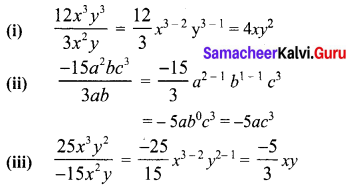
(i) 12x3y3 by 3x2y
(ii) -15a2 bc3 by 3ab
(iii) 25x3y2 by – 15x2y
Solution:
Samacheer Kalvi 8th Maths Term 1 Chapter 3 Algebra Additional Questions 1

Short Answers [3 Marks]

Question 1.
Divide
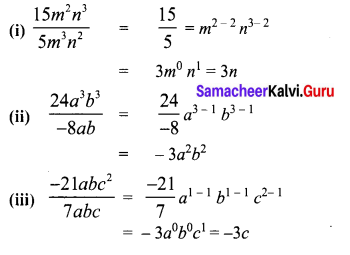
(i) 15m2n3 by 5m2n2
(ii) 24a3b3 by -8ab
(iii) -21 abc2 by 7 abc
Solution:
Samacheer Kalvi 8th Maths Term 1 Chapter 3 Algebra Additional Questions 2

Question 2.
Divide
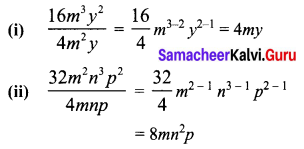
(i) 16m3y2 by 4m2y
(ii) 32m2 n3p2 by 4mnp
Solution:
Samacheer Kalvi 8th Maths Term 1 Chapter 3 Algebra Additional Questions 3

Long Answers [5 Marks]

Question 1.
Divide.
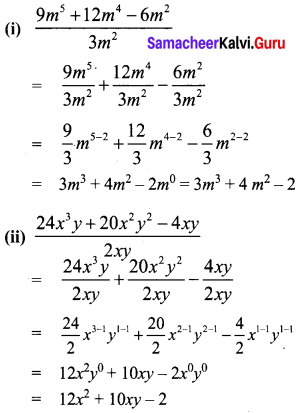
(i) 9m5 + 12m4 – 6m2 by 3m2
(ii) 24x3y + 20x2y2 – 4xy by 2xy
Solution:
Samacheer Kalvi 8th Maths Term 1 Chapter 3 Algebra Additional Questions 4

Exercise 3.3

Question 1.
Evaluate:
(i) (2x + 3y)2
(ii) (2x – 3y)2
Solution:
(i) (2x + 3y)2
= (2x)2 + 2 × (2x) × (3y) + (3y)2
[using (a + b)2 = a2 + 2ab + b2]
= 4x2 + 12xy + 9y2

(ii) (2x – 3y)2
= (2x)2 – 2(2x) (3y) + (3y)2
[∵ using (a – b)2 = a2 – 2ab + b2]
= 4x2 – 12xy + 9y2

Short Answers [3 Marks]

Question 1.
Evaluate the following
(i) (2x – 3) (2x + 5)
(ii) (y – 7) (y + 3)
(iii) 107 × 103
Solution:
(i) (2x – 3) (2x + 5)
= (2x)2 + (-3 + 5) (2x) + (-3) (5)
[∵ (x + a) (x + b) = x2 + (a + b)x + ab]
= 22x2 + 2 × 2x + (-15)
= 4x2 + 4x – 15

(ii) (y – 7) (y + 3)
= y2 + (-7 + 3)y + (-7) (3)
[∵ (x + a)(x + b) = x2 + (a + b)x + ab]
= y2 – 4y + (-21) = y2 – 4y – 21

(iii) 107 × 103
= (100 + 7) × (100+ 3)
= 1002 + (7 + 3) × 100 +(7 × 3)
= 10000 + 10 × 100 + 21 = 10000 + 1000 + 21 = 11021

Samacheer Kalvi 8th Maths Solutions Term 1 Chapter 3 Algebra Additional Questions

Long Answers [5 Marks]

Question 1.
If x + y = 12 and xy = 14 find x2 + y2.
Solution:
(x + y)2 = x2 + y2 + 2xy
122 = x2 + y2 + 2 × 14
144 = x2 + y2 + 28
x2 + y2 = 144 – 28
x2 + y2 = 116

Question 2.
If 3x + 2y = 12 and xy = 6 find the value of 9x2 + 4y2.
Solution:
(3x + 2y)2 = (3x)2 + (2y)2 + 2 (3x) (2y)
= 9x2 + 4y2 + 12xy
122 = 9x2 + 4y2 + 12 × 6
144 = 9x2 + 4y2 + 72
144 – 72 = 9x2 + 4y2
∴ 9x2 + 4y2 = 72

Exercise 3.4

Question 1.
Factorize:
(i) 7(2x + 5) + 3 (2x + 5)
(ii) 12x3y4 + 16x2y5 – 4x5y2
Solution:
(i) 7(2x + 5) + 3 (2x + 5)
= (2x + 5) (7 + 3)
(ii) 12x3y4 + 16x2y5 – 4x5y2
= 4x2y2 (3xy2 + 4y3 – x3)

Short Answers [3 Marks]

1. Factorize
(i) 81a2 – 121b2
(ii) x2 + 8x + 16
Solution:
(i) 81a2 – 121b2
= (9a)2 – (11b)2
[∵ using a2 – b2 = (a + b)2]
= (9a + 11b) (9a – 11b)

(ii) x2 + 8x + 16 = x2 + 2 × x × 4 + 42
[∵ using a2 + 2ab + b2 = (a + b)2]
= (x + 4)2 = (x + 4)(x + 4)

Long Answers [5 Marks]

Question 1.
Factorize
(i) x2 + 2xy + y2 – a2 + 2ab – b2
(ii) 9 – a6 + 2a3 – b6
Solution:
(i) x2 + 2xy + y2 – a2 + 2ab – b2.
= (x2 + 2xy + y2) – (a2 – 2ab + b2)
= (x + y)2 – (a – b)2
= {(x + y) + (a – b)} {(x + y) – (a – b)}
= (x + y + a – b) (x + y – a + b)

(ii) a – a6 + 2a3b3 – b6
= 9 – (a6 – 2a3b3 + b6)
= 32 -{(a3)2 – 2 × a3 × b3 + (b3)2}
= 32 – (a3 – 63)2
= {3 + (a3 – b3)} {3 – (a3 – b3)}
= (3 + a3 – b3) (3 – a3 + b3)
= (a3 – b3 + 1){-a3 + b3 + 3)

Question 2.
Factorize
(i) 100 (x + y )2 – 81 (a + b)2
(ii)(x + 1)2 – (x – 2)2
Solution:
(i) 100 (x + y)2 – 81 (a + b)2
= {10 (x + y)}2 – {(a (a + b)}2
= {10 (x + y) + 9 (a + b)}
{10 (x + y) – 9(a + b)}
= (10x + 10y + 9a – 9b)}
(10x + 10y – 9a – 9b)

(ii) (x – 1)2 – (x – 2)2
= {(x – 1 +(x – 2)}
{(x – 1) – (x – 2)}
= (2x – 3) – (x – 1 – x + 2)
= (2x – 3) × 1 = 2x – 3

Samacheer Kalvi 8th Maths Solutions Term 1 Chapter 3 Algebra Additional Questions Read More »

Samacheer Kalvi 8th Maths Solutions Term 1 Chapter 4 Geometry Ex 4.2

Students can Download Maths Chapter 4 Geometry Ex 4.2 Questions and Answers, Notes Pdf, Samacheer Kalvi 8th Maths Book Solutions Guide Pdf helps you to revise the complete Tamilnadu State Board New Syllabus and score more marks in your examinations.
Samacheer Kalvi 8th Maths Solutions Term 1 Chapter 4 Geometry Ex 4.2

Tamilnadu Samacheer Kalvi 8th Maths Solutions Term 1 Chapter 4 Geometry Ex 4.2

Miscellaneous Practice Problems

Question 1.
In the given figure, find PT given that l1 || l2
Samacheer Kalvi 8th Maths Term 1 Chapter 4 Geometry Ex 4.2 1
Solution:
Given that l1 || l2
∴ In ∆PQS and ∆PRT
∠P is common
∠Q = ∠R [∵ PR is the transversal for l1 and l2 corresponding angles]
∠S = ∠T [∵ corresponding angles]
∴ ∆PQS ~ ∆PRT [∵ By AAA congruency]
In similar triangles, corresponding angles are proportional.
Samacheer Kalvi 8th Maths Term 1 Chapter 4 Geometry Ex 4.2 50

Question 2.
From the diagram, prove that ∆SUN ~ ∆RAY
Samacheer Kalvi 8th Maths Term 1 Chapter 4 Geometry Ex 4.2 2
Proof:
From the ∆SUN and ∆RAY
SU = 10;
UN = 12;
SN = 14;
RA = 5,
AY = 6;
RY = 7
We have
Samacheer Kalvi 8th Maths Term 1 Chapter 4 Geometry Ex 4.2 51
Samacheer Kalvi 8th Maths Term 1 Chapter 4 Geometry Ex 4.2 61

Question 3.
The height of a tower is measured by a mirror on the ground by which the top of the tower’s reflection is seen. Find the height of the tower.
Solution:
The image and its reflection make similar shapes
Samacheer Kalvi 8th Maths Term 1 Chapter 4 Geometry Ex 4.2 52

Samacheer Kalvi 8th Maths Solutions Term 1 Chapter 4 Geometry Ex 4.2

Question 4.
In the figure, given that ∠1 = ∠2 and ∠3 ≡ ∠4 Prove that ∆MUG ≡ ∆ TUB.
Samacheer Kalvi 8th Maths Term 1 Chapter 4 Geometry Ex 4.2 53
Proof:
Samacheer Kalvi 8th Maths Term 1 Chapter 4 Geometry Ex 4.2 54

Question 5.
If ∆WAR ≡ ∆MOB, name the additional pair of corresponding parts. Name the criterion used by you.
Solution:
Samacheer Kalvi 8th Maths Term 1 Chapter 4 Geometry Ex 4.2 55
Given ∆WAR ≡ ∆MOB
∠RWA ≡ ∠BMO [∵ sum of three angles of a triangle are 180°]
∴ Criteria used here is angle sum property of triangles.

Question 6.
In the figure, ∠TMA ≡ ∠IAM and ∠TAM ≡ ∠IMA. P is the midpoint of MI and N is the midpoint of AI. Prove that ∆ PIN ~ ∆ ATM.
Samacheer Kalvi 8th Maths Term 1 Chapter 4 Geometry Ex 4.2 65
Solution:
Samacheer Kalvi 8th Maths Term 1 Chapter 4 Geometry Ex 4.2 56
Samacheer Kalvi 8th Maths Term 1 Chapter 4 Geometry Ex 4.2 57

Samacheer Kalvi 8th Maths Solutions Term 1 Chapter 4 Geometry Ex 4.2

Question 7.
In the figure, if ∠FEG = ∠1 then, prove that DG2 = DE.DF.
Samacheer Kalvi 8th Maths Term 1 Chapter 4 Geometry Ex 4.2 58
Proof:
Samacheer Kalvi 8th Maths Term 1 Chapter 4 Geometry Ex 4.2 59
Samacheer Kalvi 8th Maths Term 1 Chapter 4 Geometry Ex 4.2 60
Samacheer Kalvi 8th Maths Term 1 Chapter 4 Geometry Ex 4.2 100

Question 8.
In the figure, ∠TEN ≡ ∠TON = 90° and TO = TE. Prove that ∠ORN ≡ ∠ERN
Samacheer Kalvi 8th Maths Term 1 Chapter 4 Geometry Ex 4.2 71
Solution:
Samacheer Kalvi 8th Maths Term 1 Chapter 4 Geometry Ex 4.2 62
Samacheer Kalvi 8th Maths Term 1 Chapter 4 Geometry Ex 4.2 63

Question 9.
In the figure, PQ ≡ TS, Q is the midpoint of PR, S is the midpoint TR and ∠POU ≡ ∠TSU. Prove that QU ≡ SU.
Samacheer Kalvi 8th Maths Term 1 Chapter 4 Geometry Ex 4.2 64
Proof:
Samacheer Kalvi 8th Maths Term 1 Chapter 4 Geometry Ex 4.2 656

Samacheer Kalvi 8th Maths Solutions Term 1 Chapter 4 Geometry Ex 4.2

Question 10.
In the figure ∆TOP ≡ ∆ARM . Explain why?
Solution:
In ∆TOP and ∆ARM
OP = RM given
∠TOP = ∠ARM = 90°
given ∠OTP = ∠RAM
given ∠OPT = ∠RMA Remaining angle, by angle sum property.
∴ By ASA criteria we can say that ∆TOP ≡ ∆ARM

Samacheer Kalvi 8th Maths Solutions Term 1 Chapter 4 Geometry Ex 4.2 Read More »

Samacheer Kalvi 8th Maths Solutions Term 1 Chapter 3 Algebra Ex 3.5

Students can Download Maths Chapter 3 Algebra Ex 3.5 Questions and Answers, Notes Pdf, Samacheer Kalvi 8th Maths Book Solutions Guide Pdf helps you to revise the complete Tamilnadu State Board New Syllabus and score more marks in your examinations.
Samacheer Kalvi 8th Maths Solutions Term 1 Chapter 3 Algebra Ex 3.5

Tamilnadu Samacheer Kalvi 8th Maths Solutions Term 1 Chapter 3 Algebra Ex 3.5

Miscellaneous Practice Problems

Question 1.
Subtract: -2(xy)2 (y3 + 7x2y + 5) from 5y2 (x2y3 – 2x4y + 10x2)
Solution:
5y2 (x2y3 – 2x4y + 10x2) – [(-2)(xy)2 (y3 + 7x2y + 5)]
= [5y2 (x2y3) – 5y2 (2x4y) + 5y2 (10x2)] – [(-2)x2y2 (y3 + 7x2y + 5)]
= (5y55x2 – 10x4y3 + 50x2y2)
= 5x2y5 – 10x4y3 + 50x2y2 – [(-2x2y5) – 14x4y3 – 10x2y2]
= 5x2y5 – 10x4y3 + 50x2)y2 + 2x2 y5 + 14x4)y3 + 10x2)y2
= (5 + 2)x2y5 + (-10 + 14)x4y3 + (+50 + 10)x2y2
= 7x2y5 + 4x4y3 + 60x2y2

Question 2.
Multiply (4x2 + 9) and (3x – 2).
Solution:
(4x2 + 9) (3x – 2) = 4x2(3x – 2) + 9(3x – 2)
= (4x2)(3x) – (4x2)(2) + 9(3x) – 9(2) = (4 × 3 × x × x2) – (4 × 2 × x2) + (9 × 3 × x) – 18
= 12x3 – 8x2 + 27x – 18 (4x3 + 9) (3x – 2) = 12x3 – 8x2 + 27x – 18

Samacheer Kalvi 8th Maths Solutions Term 1 Chapter 3 Algebra Ex 3.5

Question 3.
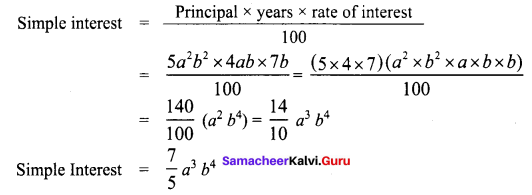
Find the simple interest on Rs. 5a2b2 for 4ab years at 7b% per annum.
Solution:
Samacheer Kalvi 8th Maths Term 1 Chapter 3 Algebra Ex 3.5 1

Question 4.
The cost of a note book is Rs. 10ab. If Babu has Rs. (5a2b + 20ab2 + 40ab). Then how many note hooks can he buy?
Solution:
For ₹ 10 ab the number of note books can buy = 1.
Samacheer Kalvi 8th Maths Term 1 Chapter 3 Algebra Ex 3.5 65
Samacheer Kalvi 8th Maths Term 1 Chapter 3 Algebra Ex 3.5 66

Samacheer Kalvi 8th Maths Solutions Term 1 Chapter 3 Algebra Ex 3.5

Question 5.
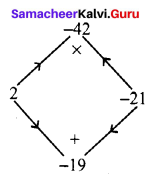
Factorise : (7y2 – 19y – 6)
Solution:
7y2 – 19y – 6 is of the form ax2 + bx + c where a = 7; b = -19; c = – 6
Samacheer Kalvi 8th Maths Term 1 Chapter 3 Algebra Ex 3.5 67
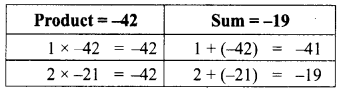
The product a × c = 7 × -6 = -42
sum b = – 19
Samacheer Kalvi 8th Maths Term 1 Chapter 3 Algebra Ex 3.5 80
The middle term – 19y can be written as – 21y + 2y
7y2 – 19y – 6 = 7y2 – 21y + 2y – 6
= 7y(y – 3) + 2(y – 3) = (y – 3)(7y + 2)
7y2 – 19y – 6 = (y – 3)(7y + 2)

Challenging Problems

Question 6.
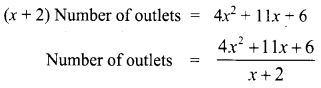
A contractor uses the expression 4x2 + 11x + 6 to determine the amount of wire to order when wiring a house. If the expression comes from multiplying the number of rooms times the number of outlets and he knows the number of rooms to be (x + 2), find the number of outlets in terms of ‘x’ [Hint: factorise 4x2 + 11x + 6]
Solution:
Given Number of rooms = x + 2
Number of rooms × Number of outlets = amount of wire.
Samacheer Kalvi 8th Maths Term 1 Chapter 3 Algebra Ex 3.5 81
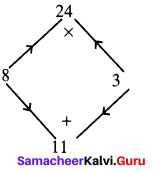
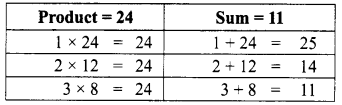
Now factorising 4x2 + 11x + 6 which is of the form ax2 + bx + c with a = 4 b = 11 c = 6.
The product a × c = 4 × 6 = 24
sum b = 11
Samacheer Kalvi 8th Maths Term 1 Chapter 3 Algebra Ex 3.5 85
Samacheer Kalvi 8th Maths Term 1 Chapter 3 Algebra Ex 3.5 86
The middle term 11x can be written as 8x + 3x
∴ 4x2 + 11x + 6 = 4x2 + 8x + 3x + 6 = 4x (x + 2) + 3 (x + 2)
4x2 + 11x + 6 = (x + 2) (4x + 3)
Now from (1) the number of outlets
Samacheer Kalvi 8th Maths Term 1 Chapter 3 Algebra Ex 3.5 96
∴ Number of outlets = 4x + 3

Samacheer Kalvi 8th Maths Solutions Term 1 Chapter 3 Algebra Ex 3.5

Question 7.
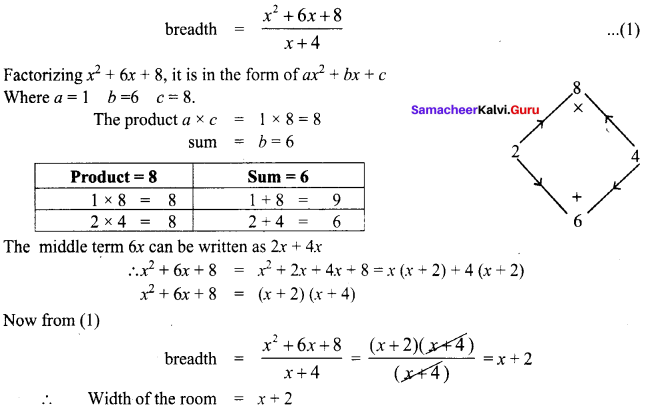
A mason uses the expression x2 + 6x + 8 to represent the area of the floor of a room. If the decides that the length of the room will be represented by (x + 4), what will the width of the room be in terms of x ?
Solution:
Given length of the room = x + 4
Area of the room = x2 + 6x + 8
Length × breadth = x2 + 6x + 8
Samacheer Kalvi 8th Maths Term 1 Chapter 3 Algebra Ex 3.5 88

Samacheer Kalvi 8th Maths Solutions Term 1 Chapter 3 Algebra Ex 3.5

Question 8.
Find the missing term: y2 + (-) x + 56 = (y + 7)(y + -)
Solution:
We have (x + a) (x + b) = x2 + (a + b)x + ab
56 = 7 × 8 .
∴ y2 + (7 + 8)x + 56 = (y + 7)(y + 8)

Question 9.
Factorise: 16p4 – 1
Solution:
16p4 – 1 = 24p4 – 1 = (22)2(p2)2 – 12
Comparing with a2 – b2 = (a + b)(a – b) where a = 22p2 and b = 1
∴ (22p2)2 – 12 = (22p2 + 1) (22p2 – 1) = (4p2 + 1) (4p2 – 1)
∴ 16p4 – 1 = (4p2 + 1)(4p2 – 1)(4p2 + 1)(22p2 – 12)
= (4p2 + 1) [(2p)2– 12] = (4p2 + 1) (2p + 1)(2p – 1)
[∵ using a2 – b2 = (a + b) (a – b)]
∴ 16p4 – 1 = (4psup>2 + 1)(2p + 1)(2p – 1)

Samacheer Kalvi 8th Maths Solutions Term 1 Chapter 3 Algebra Ex 3.5

Question 10.
Factorise : x6 – 64y3
Solution:
x6 – 64y3 = (x2)3 – 43y3 = (x2)3 – (4y)3
This is of the form a3 – b3 with a = x2, b = 4y
a3 – b3 = (a – b)(a2 + ab + b2)
(x2)3 – (4y)3 = (x2 – 4y) [(x2)2 + (x2)(4y) + (4y)2]
= (x2 – 4y) [x4 + 4x2y + 16y2]
∴ x6 – 64y3 = (x2 – 4y) [x4 + 4x2y + 16y2]

Samacheer Kalvi 8th Maths Solutions Term 1 Chapter 3 Algebra Ex 3.5 Read More »

Samacheer Kalvi 8th Maths Solutions Term 1 Chapter 5 Information Processing Intext Questions

Students can Download Maths Chapter 5 Information Processing Intext Questions and Answers, Notes Pdf, Samacheer Kalvi 8th Maths Book Solutions Guide Pdf helps you to revise the complete Tamilnadu State Board New Syllabus and score more marks in your examinations.
Samacheer Kalvi 8th Maths Solutions Term 1 Chapter 5 Information Processing Intext Questions

Tamilnadu Samacheer Kalvi 8th Maths Solutions Term 1 Chapter 5 Information Processing Intext Questions

Try these (TextBook Page No 122)

Question 1.
Find the number of all possible triangles that can be formed from the triangle given below.
Solution:
Samacheer Kalvi 8th Maths Term 1 Chapter 5 Information Processing Intext Questions 1

Question 2.
Use the given figure to form a 3 × 3 magic square.
Samacheer Kalvi 8th Maths Term 1 Chapter 5 Information Processing Intext Questions 2
Solution:
Samacheer Kalvi 8th Maths Term 1 Chapter 5 Information Processing Intext Questions 3

Question 3.
Convert the tree diagram into a numeric expression
Samacheer Kalvi 8th Maths Term 1 Chapter 5 Information Processing Intext Questions 4
Solution:
(10 × 5) + (9 × 4)

Question 4.
(i) Find out the total time taken by the bus to reach from A to E via B , C and D.
(ii) Find which is the shortest route from A to E.
Solution:
Samacheer Kalvi 8th Maths Term 1 Chapter 5 Information Processing Intext Questions 5
(i) Route ⇒ 2A ➝ B ➝ C ➝ D ➝ E
Time taken ⇒ (7 + 5 + 3 + 6) hrs = 21 hrs
Samacheer Kalvi 8th Maths Term 1 Chapter 5 Information Processing Intext Questions 6

Samacheer Kalvi 8th Maths Solutions Term 1 Chapter 5 Information Processing Intext Questions

Try this (TextBook Page No 127)

Question 1.
Kumar has four different hats. He always wears a hat. Sometimes he wears the same hat more than once in a week as in the figure.
Samacheer Kalvi 8th Maths Term 1 Chapter 5 Information Processing Intext Questions 7
In how many different ways might he decide to wear his hats in one week?
Solution:
Samacheer Kalvi 8th Maths Term 1 Chapter 5 Information Processing Intext Questions 8
H1, H2, H3, H4 be Hat 1, Hat 2, Hat 3, Hat 4 respectively.
∴ In 7 × 4 = 28 different ways kumar may decide to wear his hat in one week.

Exercise 5.1

Try these (TextBook Page No 134)

Question 1.
Find any four SETs among these set of cards.
Samacheer Kalvi 8th Maths Term 1 Chapter 5 Information Processing Intext Questions 9
Solution:
Samacheer Kalvi 8th Maths Term 1 Chapter 5 Information Processing Intext Questions 10

Question 2.
This is an example for a magic square in SETs, can you make another one?
Samacheer Kalvi 8th Maths Term 1 Chapter 5 Information Processing Intext Questions 11
Solution:
Samacheer Kalvi 8th Maths Term 1 Chapter 5 Information Processing Intext Questions 12

Samacheer Kalvi 8th Maths Solutions Term 1 Chapter 5 Information Processing Intext Questions

Try this (TextBook PageNo 137)

Question 1.
Think why this graph colouring is invalid?
Samacheer Kalvi 8th Maths Term 1 Chapter 5 Information Processing Intext Questions 13
Solution:
The objective of graph colouring is to assign minimum number of colours to the verties do not have the same colour.
Here adjacent edges have the same colour.
∴ It is invalid.

Samacheer Kalvi 8th Maths Solutions Term 1 Chapter 5 Information Processing Intext Questions Read More »

Samacheer Kalvi 8th Maths Solutions Term 1 Chapter 1 Rational Numbers Intext Questions

Students can Download Maths Chapter 1 Rational Numbers Intext Questions and Answers, Notes Pdf, Samacheer Kalvi 8th Maths Book Solutions Guide Pdf helps you to revise the complete Tamilnadu State Board New Syllabus and score more marks in your examinations.
Samacheer Kalvi 8th Maths Solutions Term 1 Chapter 1 Rational Numbers Intext Questions

Tamilnadu Samacheer Kalvi 8th Maths Solutions Term 1 Chapter 1 Rational Numbers Intext Questions

Exercise 1.1
Try This (Textbook Page No. 6)
Question 1.
Is the number \(\frac{7}{-5}\) a fraction or a rational number ? Why?
Solution:
\(\frac{7}{-5}\) is a rational number
Because of rational number is a rational number which is of the form \(\frac{p}{q}\) , q ≠ 0 and p and q are integers.
But fraction is part of a whole.

Question 2.
Write any 6 rational numbers of your choice.
Solution:
0, \(\frac{-1}{2}\), \(\frac{1}{2}\), \(\frac{3}{4}\), \(\frac{6}{7}\), -5, 6

Try This (Textbook Page No. 7)

Question 1.
Explain why the following statements are true?
(i) 0.8 = \(\frac{4}{5}\)
(ii) 1.4 > \(\frac{1}{4}\)
(iii) 0.74 < \(\frac{3}{4}\) (iv) 0.4 > 0.386
(v) 0.096 < 0.24
(vi) 1.128 = 0.1280
Solution:
Samacheer Kalvi 8th Maths Term 1 Chapter 1 Rational Numbers Intext Questions 1
Samacheer Kalvi 8th Maths Term 1 Chapter 1 Rational Numbers Intext Questions 2
(vi) 0.128 = \(\frac{128}{1000}=\frac{1280}{10000}\)
0.1280 = \(\frac{1280}{10000}\)
∴ Both are equal. i.e., 0.128 = 0.1280

Samacheer Kalvi 8th Maths Solutions Term 1 Chapter 1 Rational Numbers Intext Questions

Try This (Textbook Page No. 9)

Question 1.
Which of the pairs are equivalent rational numbers?
Samacheer Kalvi 8th Maths Term 1 Chapter 1 Rational Numbers Intext Questions 3
Solution:
Samacheer Kalvi 8th Maths Term 1 Chapter 1 Rational Numbers Intext Questions 4

Question 2.
Find the standard form of
(i) \(\frac{36}{-96}\)
(ii) \(\frac{-56}{-72}\)
(iii) \(\frac{27}{18}\)
Solution:
Samacheer Kalvi 8th Maths Term 1 Chapter 1 Rational Numbers Intext Questions 5
Samacheer Kalvi 8th Maths Solutions Term 1 Chapter 1 Rational Numbers Intext Questions

Question 3.
Mark the following rational numbers on a number line.
(i) \(\frac{-2}{3}\)
(ii) \(\frac{-8}{-5}\)
(iii) \(\frac{5}{-4}\)
Solution:
(i) \(\frac{-2}{3}\) lies between 0 and -1.
The unit part between 0 and -1 is divided into 3 equal parts and second part is taken.
Samacheer Kalvi 8th Maths Term 1 Chapter 1 Rational Numbers Intext Questions 6

(ii) \(\frac{-8}{-5}=1 \frac{3}{5}\)
\(1 \frac{3}{5}\) lies between 1 and 2. The unit part between 1 and 2 is divided into 5 equal parts and the third part is taken.
Samacheer Kalvi 8th Maths Term 1 Chapter 1 Rational Numbers Intext Questions 7

(iii) \(\frac{5}{-4}=-\frac{5}{4}=-1 \frac{1}{4}\)
\(-1 \frac{1}{4}\) lies between -1 and The unit part between -1 and -2 is divided into four equal parts and the first part is taken.
Samacheer Kalvi 8th Maths Term 1 Chapter 1 Rational Numbers Intext Questions 8

Try This (Textbook Page No. 15)

Question 1.
Are there any rational numbers between \(\frac{-7}{11}\) and \(\frac{6}{-11}\) ?
Solution:
Samacheer Kalvi 8th Maths Term 1 Chapter 1 Rational Numbers Intext Questions 9

Try This (Textbook Page No. 19)

Question 1.
Divide: (i) 5 by \(\frac{-7}{3}\)
(ii) \(\frac{-7}{3}\) by 5
Solution:
Samacheer Kalvi 8th Maths Term 1 Chapter 1 Rational Numbers Intext Questions 10

Exercise 1.2
Try This (Textbook Page No. 25)

Question 1.
The closure property on integers holds for subtraction and not for division. What about rational numbers? Verify.
Solution:
Let 0 and \(\frac{1}{2}\) be two rational numbers 0 – \(\frac{1}{2}\) = \(\frac{1}{2}\) is a rational number
∴ Closure property for subtraction holds for rational numbers.
But consider the two rational number \(\frac{5}{2}\) and 0.
\(\frac{5}{2} \div 0=\frac{5}{2 \times 0}=\frac{5}{0}\)
Here denominator = 0 and it is not a rational number.
∴ Closure property is not true for division of rational numbers.

Samacheer Kalvi 8th Maths Solutions Term 1 Chapter 1 Rational Numbers Intext Questions

Question 2.
Check whether \(\frac{3}{5}-\frac{7}{8}=\frac{7}{8}-\frac{3}{5}\)
Solution:
Samacheer Kalvi 8th Maths Term 1 Chapter 1 Rational Numbers Intext Questions 11
∴ Subtraction of rational numbers is not commutative

Question 3.
Is \(\frac{3}{5} \div \frac{7}{8}=\frac{7}{8} \div \frac{5}{3}\)? So, what do you conclude?
Solution:
Samacheer Kalvi 8th Maths Term 1 Chapter 1 Rational Numbers Intext Questions 12
∴ Commutative property not hold good for division of rational numbers.

Try This (Textbook Page No. 26)

Question 1.
Check whether the associative property holds for subtraction and division.
Solution:
Consider the rational numbers \(\frac{2}{3}\), \(\frac{1}{2}\) and \(\frac{3}{4}\)
Samacheer Kalvi 8th Maths Term 1 Chapter 1 Rational Numbers Intext Questions 13
Samacheer Kalvi 8th Maths Term 1 Chapter 1 Rational Numbers Intext Questions 14
∴ Associative property does not hold for division of rational numbers

Samacheer Kalvi 8th Maths Solutions Term 1 Chapter 1 Rational Numbers Intext Questions

Question 2.
Observe that
Samacheer Kalvi 8th Maths Term 1 Chapter 1 Rational Numbers Intext Questions 15
Use your reasoning skills, to find the sum of the first 7 numbers in the pattern given above.
Solution:
Samacheer Kalvi 8th Maths Term 1 Chapter 1 Rational Numbers Intext Questions 16

Samacheer Kalvi 8th Maths Solutions Term 1 Chapter 1 Rational Numbers Intext Questions Read More »

Samacheer Kalvi 8th Maths Solutions Term 1 Chapter 5 Information Processing Ex 5.1

Students can Download Maths Chapter 5 Information Processing Ex 5.1 Questions and Answers, Notes Pdf, Samacheer Kalvi 8th Maths Book Solutions Guide Pdf helps you to revise the complete Tamilnadu State Board New Syllabus and score more marks in your examinations.
Samacheer Kalvi 8th Maths Solutions Term 1 Chapter 5 Information Processing Ex 5.1

Tamilnadu Samacheer Kalvi 8th Maths Solutions Term 1 Chapter 5 Information Processing Ex 5.1

I. Choose the best answer.

Question 1.
How many outcomes can you get when you toss three coins once?
(A) 6
(B) 8
(C) 3
(D) 2
Solution:
(B) 8

Question 2.
In how many ways can you answer 3 multiple choice questions, with the choices A, B, C and D ?
(1) 4
(2) 3
(3) 12
(4) 64
Solution:
(4) 64

Question 3.
How many 2 digit numbers contain the number 7 ?
(A) 10
(B) 18
(C) 19
(D) 20
Solution:
(B) 18

Samacheer Kalvi 8th Maths Solutions Term 1 Chapter 5 Information Processing Ex 5.1

II. Answer the following.

Question 1.
You are going to have an ice cream or a cake. There are three flavours (chocolate, strawberry , vanilla) in ice creams, and two flavours (orange or red velvet) in the cake. In how many possible ways can you choose an ice cream or the cake?
Samacheer Kalvi 8th Maths Term 1 Chapter 5 Information Processing Ex 5.1 1
Solution:
We are going to have either a ice cream or a cake.
Ice cream can be selected from 3 flavors and cake from two flavors. Both the events cannot occur simultaneously selecting ice cream and cake.
∴ Number of possible ways = 3 + 2
= 5 ways

Question 2.
In how many ways, can the teacher choose 3 students, in all one each from 10 students in VI std, 15 students in VII std and 20 students in VIII std to go to an excursion?
Solution:
The teacher is going to selected one student from class VI out of 10 students in 10 ways from
class VII out of 15 students in 15 ways and from class VIII out of 20 students in 20 ways.
∴ Number of ways 3 students can be selected
= 10 + 15 + 20 = 45 ways

Question 3.
If you have 2 school bags and 3 water bottles then, in how many different ways can you carry a school bag and a water bottle, while going to school?
Solution:
We can select one school bag from 2 and one bottle from 3 as follows.
Samacheer Kalvi 8th Maths Term 1 Chapter 5 Information Processing Ex 5.1 3
∴ A bag and a water bottle can be selected in 2 × 3 = 6 ways.

Samacheer Kalvi 8th Maths Solutions Term 1 Chapter 5 Information Processing Ex 5.1

Question 4.
Roll numbers are created with a letter followed by 3 digits in it. From the letter A, B, C, D, E and any 3 digits from 0 to 9. Then, in how many possible ways can the roll numbers be generated?
Solution:
We have a letter followed by 3 digits in the roll number.
The letter is selected from A, B, C, D, E.
For these 5 letters we have to select a 3 digit number using the digits 0 to 9.
Once place can be formed using any one of the 10 number 0 to 9 in 10 ways.
Tens place can be formed in 10 ways.
∴ A two digit number can be formed in 10 × 10 = 100 ways.
Thousands place can be formed in 10 ways
∴ A 3 digit number can be formed in 10 × 10 × 10 = 1000 ways.
∴ 5 letters can be attached in 5 × 1000 = 5000 ways.
∴ The roll number can be formed in 5000 ways.

Question 5.
A safety locker in a jewel shop requires a 4 digit unique code. The code has the digits from 0 to 9. How many unique codes are possible ?
Samacheer Kalvi 8th Maths Term 1 Chapter 5 Information Processing Ex 5.1 4
Solution:
The unique code has 4 digits.
Each digit is formed using any of the 10 numbers from 0 to 9.
∴ Single digit number can be formed in 10 ways.
A double digit number can be formed in 10 × 10 ways.
A three digit number can be formed in 10 × 10 × 10 ways.
A four digit number can be formed in 10 × 10 × 10 × 10 ways. = 10,000 ways

Samacheer Kalvi 8th Maths Solutions Term 1 Chapter 5 Information Processing Ex 5.1 Read More »

Samacheer Kalvi 8th Maths Solutions Term 2 Chapter 1 Life Mathematics Ex 1.1

Students can Download Maths Chapter 1 Life Mathematics Ex 1.1 Questions and Answers, Notes Pdf, Samacheer Kalvi 8th Maths Book Solutions Guide Pdf helps you to revise the complete Tamilnadu State Board New Syllabus and score more marks in your examinations.
Samacheer Kalvi 8th Maths Solutions Term 2 Chapter 1 Life Mathematics Ex 1.1

Tamilnadu Samacheer Kalvi 8th Maths Solutions Term 1 Chapter 1 Life Mathematics Ex 1.1

Question 1.
Fill in the blanks:

Question (i)
If 30% of x is 150, then x is ………….
Answer:
500
Hint:
Given 30% of x is 150
Samacheer Kalvi 8th Maths Solutions Term 2 Chapter 1 Life Mathematics Ex 1.1 1

Question (ii)
2 minutes is ………… % to an hour.
Answer:
3\(\frac{1}{3}\)%
Hint:
Let 2 min be x% of an hour
and 1 hr = 60 min
x% = \(\frac{2}{60}\) x 100 = \(\frac{200}{3}\) = \(\frac{10}{3}\) = 3\(\frac{1}{3}\)
x = 3\(\frac{1}{3}\)

Samacheer Kalvi 8th Maths Solutions Term 2 Chapter 1 Life Mathematics Ex 1.1

Question (iii)
If x % of x = 25, then x = …………
Answer:
50
Hint:
Given that x % of x is 25
∴ \(\frac{x}{100}\) = 25
x2 = 25 x 100 = 2500
∴ x = \(\sqrt{2500}\) = 50

Question (iv)
In a school of 1400 students, there are 420 girls. The percentage of boys in the school is ………….
Answer:
70
Hint:
Given total number of students in school = 1400
Number of girls in school = 420
Number of boys in school = 1400 – 420 = 980
Samacheer Kalvi 8th Maths Solutions Term 2 Chapter 1 Life Mathematics Ex 1.1 2
% of boys = 70%

Question (v)
0.5252 is ………….. %.
Answer:
52.52%
Hint:
Given a number, and to express as a percentage, we need to multiply by 100
∴ to express 0.5252 as percentage, we should multiply by 100
∴ 0.5252 x 100 = 52.52%

The Percentage Difference Calculator (% difference calculator) will find the percent difference between two positive numbers greater than 0.

Question 2.
Rewrite each underlined portion using percentage language.

Question (i)
One half of the cake is distributed to the children.
Answer:
Answer:
50% of the cake is distributed to the children
Hint:
One half is nothing but \(\frac{1}{2}\) as percentage, we need to multiply by 100
\(\frac{1}{2}\) x 100 = 50%

Samacheer Kalvi 8th Maths Solutions Term 2 Chapter 1 Life Mathematics Ex 1.1

Question (ii)
Aparna scored 7.5 points out of 10 in a competition.
Answer:
Aparna scored 75% in a competition
Hint:
7.5 points out of 10 is \(\frac{7.5}{10}\) = 0.75
For percentage, we need to multiply by 100
∴ We get 0.75 x 100 = 75%

Question (iii)
The statue was made of pure silver.
Answer:
96% students participated in sports
Hint:
Pure silver means there are no other metals
so, 100 out of 100 parts is made of silver = \(\frac{100}{100}\)
∴ to express as percentage, \(\frac{100}{100}\) x 100% = 100%

Question (iv)
48 out of 50 students participated in sports
Answer:
96% students participated in sports
Hint:
48 out of 50 students in fraction form is \(\frac{48}{50}\).
As a percentage, we need to multiply by 100
Samacheer Kalvi 8th Maths Solutions Term 2 Chapter 1 Life Mathematics Ex 1.1 3

Question (v)
Only 2 persons out of 3 will be selected in the interview
Answer:
Only 66\(\frac{2}{3}\)% persons will be selected in the interview.
Hint:
2 out of 3 in fraction form is \(\frac{2}{3}\) to express as percentage, we need to multiply by 100
\(\frac{2}{3}\) x 100 = \(\frac{200}{3}\) = 66\(\frac{2}{3}\)%

Online percentage off calculator tool makes the calculation faster, and it displays the percentage off of the product in a fraction of seconds.

Question 3.
48 is 32% of what number?
Solution:
Let the number required to be found be ‘x’
Given that 32% of x is 48
Samacheer Kalvi 8th Maths Solutions Term 2 Chapter 1 Life Mathematics Ex 1.1 4

Question 4.
A bank pays ₹ 240 as interest for 2 years for a sum of ? 3000 deposited as savings. Find the rate of interest given by the bank.
Solution:
The formula for simple interest is given by
Interest (I) = \(\frac{PxRxT}{100}\) 100
Where P is principal amount; R is rate of interest in percentage; t is time period Substituting given values in formula, we get
P = 3000, t = 2 yrs, I = Rs 240
Samacheer Kalvi 8th Maths Solutions Term 2 Chapter 1 Life Mathematics Ex 1.1 5

Samacheer Kalvi 8th Maths Solutions Term 2 Chapter 1 Life Mathematics Ex 1.1

Question 5.
A Welfare Association has a sports club where 30% of the members play cricket, 28% play volleyball, 22% play badminton and the rest play indoor games. If 30 member play indoor games.

  1. How many members are there in the sports club?
  2. How many play cricket, volleyball and badminton?

Solution:
Given data
Members who play Cricket = 30% …..(1)
Members who play Vollyball = 28% …..(2)
Members who play Batminton = 22% ……(3)
Members who play outdoor games = (1) + (2) + (3) = 30
Members who play indoor games = 100 – 80 = 20%
Also given 30 members play indoor games
Let total no of members be ‘x’
∴ \(\frac{30}{x}\) = 20
∴ x = \(\frac{30×100}{20}\) = 15

1. Total number of members is 150

2. Members who play Cricket = 30% of total = \(\frac{30}{100}\) x 150
Samacheer Kalvi 8th Maths Solutions Term 2 Chapter 1 Life Mathematics Ex 1.1 6

Question 6.
What is 25% of 30% of 400?
Solution:
Required to find 25% of 30% of 400
Samacheer Kalvi 8th Maths Solutions Term 2 Chapter 1 Life Mathematics Ex 1.1 7

Question 7.
If the difference between 75% of a number and 60% of the same number is 82.5, then find 20% of the number.
Solution:
Given that 75% of number less 60% of number is 82.5. Let the number be ‘x’
∴ \(\frac{75}{100}\) × x = 82.5
∴ 0.75 – 0.6.60x = 82.5
∴ 0.15x = 82.5
∴ x = \(\frac{82.5}{0.15}\) = \(\frac{8250}{15}\) = 550
Required to find 20% of number ie 20% of x.
Samacheer Kalvi 8th Maths Solutions Term 2 Chapter 1 Life Mathematics Ex 1.1 8

Samacheer Kalvi 8th Maths Solutions Term 2 Chapter 1 Life Mathematics Ex 1.1

Question 8.
If a car is sold for ₹ 2,00,000 from its original price of? 3,00,000 find the percentage for decrease in the value of the car.
Samacheer Kalvi 8th Maths Solutions Term 2 Chapter 1 Life Mathematics Ex 1.1 9
Solution:
Original price of car = ₹ 3,00,000
actual selling price of car = ₹ 2,00,000
Decrease in amount from original = 3,00,000 – 2,00,000 = 1,00,000
Samacheer Kalvi 8th Maths Solutions Term 2 Chapter 1 Life Mathematics Ex 1.1 10

Question 9.
A number when increased by 18% gives 236. Find the number.
Solution:
Let the number be x. Given that when it is increased by 18%, we get 236.
x + \(\frac{18}{100}\) = 236
\(\frac{100x+18x}{100}\) = 236
\(\frac{118}{100}\)x = 236
The number = x = \(\frac{236×100}{118}\) = 200

Samacheer Kalvi 8th Maths Solutions Term 2 Chapter 1 Life Mathematics Ex 1.1

Question 10.
A number when decreased by 20% gives 80. Find the number.
Solution:
Let the number be x. Given that when it is increased by 20% we get 80.
Samacheer Kalvi 8th Maths Solutions Term 2 Chapter 1 Life Mathematics Ex 1.1 11

Question 11.
A number is increased by 25% and then decreased by 20%. Find the change in that number.
Solution:
Method 1:
Let the number be x. First it is increased by 25%
Samacheer Kalvi 8th Maths Solutions Term 2 Chapter 1 Life Mathematics Ex 1.1 12
Method 2:
[to understand, let us assume that number is 100]
So, first when we increase by 25%, we get
Samacheer Kalvi 8th Maths Solutions Term 2 Chapter 1 Life Mathematics Ex 1.1 13
We get back 100 ⇒ No change

Question 12.
If the numerator of a fraction is increased by 25% and the denominator is increased by 10%, it becomes \(\frac{2}{5}\). Find the original fraction.
Solution:
Let the fraction be \(\frac{N}{D}\) where N is numerator & D is denominator
It is given that numerator is include by 25%
Samacheer Kalvi 8th Maths Solutions Term 2 Chapter 1 Life Mathematics Ex 1.1 14

Question 13.
A fruit vendor bought some mangoes of which 10% were rotten. He sold 33 \(\frac{1}{3}\)% of the rest. Find the total number of mangoes bought by him initially, if he still has 240 mangoes with him.
Samacheer Kalvi 8th Maths Solutions Term 2 Chapter 1 Life Mathematics Ex 1.1 15
Solution:
Let the number of mangoes bought by fruit seller initially be x.
Given that 10% of mangoes were rotten
∴ Number of rotten mangoes = \(\frac{10}{100}\) × x
Number of good mangoes = x – no. of rotten mangoes
= x – \(\frac{10}{100}\)x = \(\frac{100x-10x}{100}\) = \(\frac{90}{100}\)x …(1)
Number of mangoes sold = 33\(\frac{1}{3}\)% of good mangoes = \(\frac{100}{3}\)%
∴ Mangoes sold = \(\frac{100}{3}\) x \(\frac{90}{100}\)x × \(\frac{1}{100}\) = \(\frac{30}{100}\)x
Number of mangoes remaining = No. of good mangoes – No. of mangoes sold
From (1) and (2)
Samacheer Kalvi 8th Maths Solutions Term 2 Chapter 1 Life Mathematics Ex 1.1 16

Question 14.
A student gets 31% marks in an examination but fails by 12 marks. If the pass percentage is 35%, find the maximum marks of the examination.
Solution:
Let the maximum marks in the exam be ‘x’. Pass percentage is given as 35%
∴ Pass mark = \(\frac{35}{100}\) × x = \(\frac{35}{100}\)x
Student gets 31 % marks = \(\frac{31}{100}\) × x = \(\frac{31}{100}\)x
But student fails by 12 marks → meaning his mark is 12 less than pass mark.
∴ \(\frac{31}{100}\)x = \(\frac{35}{100}\)x – 12
∴ \(\frac{35}{100}\)x – \(\frac{31}{100}\)x = 12
∴ \(\frac{35x-31x}{100}\) = 12 ⇒ \(\frac{4x}{100}\) = 12
∴ \(\frac{12×100}{4}\) = 300

Samacheer Kalvi 8th Maths Solutions Term 2 Chapter 1 Life Mathematics Ex 1.1

Question 15.
The ratio of boys and girls in a class is 5:3. If 16% of boys and 8% of girls failed in an examination, then find the percentage of passed students.
Solution:
Let number of boys be ‘6’ and number of girls be ‘g’
Ratio of boys and girls is given as 5:3
b:g = 5:3 ⇒ \(\frac{b}{g}\) = \(\frac{5}{3}\) …..(A)
Failure in boys = 16% = \(\frac{16}{100}\) x b = \(\frac{16b}{100}\)
Failure in girls = 8% = \(\frac{8}{100}\) x g = \(\frac{8g}{100}\)
Pass in boys = 100 – 16% = 84% \(\frac{84}{100}\)b …..(1)
Pass in girls = 100 – 8% = 92% = \(\frac{92}{100}\)g
From A, we have \(\frac{b}{g}\) = \(\frac{5}{3}\), = adding 1 on both sides, we get
\(\frac{b}{g}\) + 1 = \(\frac{5}{3}\) + 1
\(\frac{b+g}{g}\) = \(\frac{5+3}{3}\) = \(\frac{8}{3}\)
∴ g = \(\frac{3}{8}\)(b + g)
Similarly b = \(\frac{5}{8}\)(b + g)
Total pass = Pass in girls + Pass in boys
= (1) + (2) = \(\frac{84}{100}\)b + \(\frac{92}{100}\)g
Samacheer Kalvi 8th Maths Solutions Term 2 Chapter 1 Life Mathematics Ex 1.1 17

Samacheer Kalvi 8th Maths Solutions Term 2 Chapter 1 Life Mathematics Ex 1.1

Objective Type Questions

Question 16.
12% of 250 litres is the same as ………. of 150 liters
(a) 10%
(b) 15%
(c) 20%
(d) 30%
Answer:
(c) 20%
Hint:
12% of 250 = \(\frac{12}{100}\) x 250 = 30 lit
Percentage : \(\frac{30}{150}\) x 100 = 20%

Question 17.
If three candidates A, B and C is 3 in a school election got 153, 245 and 102 votes respectively, the percentage of votes for the winner is ……..
(a) 48%
(b) 49%
(c) 50%
(d) 45%
Answer:
(b) 49%
Hint:
Candidate 1: 153
Candidate 2: 245 – winner [as maximum votes]
Candidate 3: 102
Total votes = 1 + 2 + 3 = 153 + 245 + 102 = 500
Samacheer Kalvi 8th Maths Solutions Term 2 Chapter 1 Life Mathematics Ex 1.1 18

Question 18.
15% of 25% of 10000 = ………..
(a) 375
(b) 400
(c) 425
(d) 475
Answer:
(a) 375
Hint:
15% of 25% of 10000 is
First let us do 25% of 10,000, which is
Samacheer Kalvi 8th Maths Solutions Term 2 Chapter 1 Life Mathematics Ex 1.1 19
Next 15% of the above is \(\frac{15}{100}\) x 2500 = 375

Question 19.
When 60 is subtracted from 60% of a number to give 60, the number is –
(a) 60
(b) 100
(c) 150
(d) 200
Answer:
(d) 200
Hint:
Let the number be ‘x’.
60% of the number is \(\frac{60}{100}\) × x = \(\frac{60x}{100}\)
Given that when 60 is subtracted from 60%, we get 60
i.e \(\frac{60}{100}\)x – 60 = 60
∴ \(\frac{60}{100}\)x = 60 + 60 = 120
∴ x = \(\frac{120×100}{60}\) = 200

Samacheer Kalvi 8th Maths Solutions Term 2 Chapter 1 Life Mathematics Ex 1.1

Question 20.
If 48% of 48 = 64% of x, then x =
(a) 64
(b) 56
(c) 42
(d) 36
Answer:
(d) 36
Hint:
Given that 48% of 48 48 = 64% of x
Samacheer Kalvi 8th Maths Solutions Term 2 Chapter 1 Life Mathematics Ex 1.1 20

Samacheer Kalvi 8th Maths Solutions Term 2 Chapter 1 Life Mathematics Ex 1.1 Read More »