Class 11

Samacheer Kalvi 11th Maths Solutions Chapter 6 Two Dimensional Analytical Geometry Ex 6.3

You can Download Samacheer Kalvi 11th Maths Book Solutions Guide Pdf, Tamilnadu State Board help you to revise the complete Syllabus and score more marks in your examinations.

Tamilnadu Samacheer Kalvi 11th Maths Solutions Chapter 6 Two Dimensional Analytical Geometry Ex 6.3

Question 1.
Show that the lines are 3x + 2y + 9 = 0 and 12x + 8y – 15 = 0 are parallel lines.
Solution:
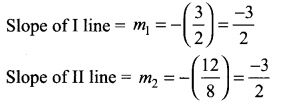
Samacheer Kalvi 11th Maths Solutions Chapter 6 Two Dimensional Analytical Geometry Ex 6.3 1
Here m1 = m2 ⇒ the two lines are parallel.

Question 2.
Find the equation of the straight line parallel to 5x – 4y + 3 = 0 and having x – intercept 3.
Solution:
Equation of a line parallel to ax + by + c = 0 will be of the form ax + by + k = 0
So equation of a line parallel to 5x – 4y + 3 = 0 will be of the form 5x – 4y = k
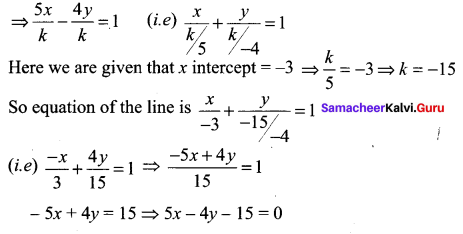
Samacheer Kalvi 11th Maths Solutions Chapter 6 Two Dimensional Analytical Geometry Ex 6.3 2

Samacheer Kalvi 11th Maths Solutions Chapter 6 Two Dimensional Analytical Geometry Ex 6.3

Question 3.
Find the distance between the line 4x + 3y + 4 = 0 and a point
(i) (-2, 4)
(ii) (7, -3)
Solution:
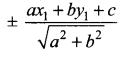
The distance between the line ax + by + c = 0 and the point(x1, y1) is given by
Samacheer Kalvi 11th Maths Solutions Chapter 6 Two Dimensional Analytical Geometry Ex 6.3 3

(i) Now the distance between the line 4x + 3y + 4 = 0 and (-2, 4) is
Samacheer Kalvi 11th Maths Solutions Chapter 6 Two Dimensional Analytical Geometry Ex 6.3 4

(ii) The distance between the line 4x + 3y + 4 = 0 and (7, -3) is
Samacheer Kalvi 11th Maths Solutions Chapter 6 Two Dimensional Analytical Geometry Ex 6.3 5

Question 4.
Write the equation of the lines through the point (1, -1)
(i) Parallel to x + 3y – 4 = 0
(ii) Perpendicular to 3x + 4y = 6
Solution:
(i) Parallel to x + 3y – 4 = 0
The equation of any line parallel to the line
x + 3y – 4 = 0 is x + 3y + k = 0 ………… (1)
This line passes through the point (1, – 1)
∴ (1) ⇒ 1 + 3 (-1 ) + k = 0
1 – 3 + k = 0 ⇒ k = 2
∴ The equation of the required line is
x + 3y + 2 = 0

(ii) Perpendicular to 3x + 4y = 6
The equation of any line perpendicular to 3x + 4y = 6 is
4x – 3y + k = 0 …………. (2)
This line passes through the point (1,-1)
(2) ⇒ (4) 1 – 3 (-1) + k = 0
4 + 3 + k = 0 ⇒ k = – 7
∴ The required equation is 4x – 3y – 7 = 0

Question 5.
If (- 4, 7) is one vertex of a rhombus and if the equation of one diagonal is 5x – y + 7 = 0, then find the equation of another diagonal.
Solution:
Let the equation of the diagonal AC be 5x – y + 7 = 0 ……….. (1)
Since (-4, 7) does not satisfy equation (1), (- 4, 7 ) represents neither A nor C.
Let (-4, 7) represent the vertex D.
The diagonal BD is perpendicular to AC
The equation of any line perpendicular to line (1) is – x – 5y + k = 0 ……….. (2)
This line passes through the point D (-4, 7)
∴ (2) ⇒ -(-4) – 5(7) + k = 0
4 – 35 + k = 0 ⇒ k = 31
∴ The equation of the other diagonal is
-x – 5y + 31 = 0
x + 5y – 31 = 0

Question 6.
Find the equation of the lines passing through the point of intersection lines 4x – y + 3 = 0 and 5x + 2y +7 = 0, and
(i) Through the point (-1, 2)
(ii) Parallel to x – y + 5 = 0
(iii) Perpendicular to x – 2y + 1 = 0.
Solution:
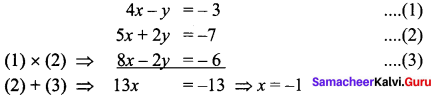
To find the point of intersection of the lines we have to solve them
Samacheer Kalvi 11th Maths Solutions Chapter 6 Two Dimensional Analytical Geometry Ex 6.3 80
Substituting x = -1 in equation (2) we get
-5 + 2y = -7
⇒ 2y = – 7 + 5 = -2
⇒ y = -1
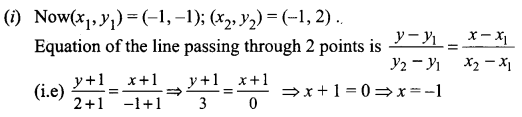
So the point of intersection is (-1, -1)
Samacheer Kalvi 11th Maths Solutions Chapter 6 Two Dimensional Analytical Geometry Ex 6.3 81

(ii) Parallel to x – y + 5 = 0
Given that the line (1) is parallel to the line
x – y + 5 = 0 ………. (2)
∴ Slope of line (1) = Slope of line (2)
(4x – y + 3) + λ (5x + 2y + 7) = 0
4x – y + 3 + 5λx + 2λy + 7λ = 0
(4 + 5λ)x + (2λ – 1)y + 3 + 7λ = 0
Slope of this line = \(-\frac{4+5 \lambda}{2 \lambda-1}\)
Slope of line (2) = –\(\frac{1}{-1}\) = 1
These two slopes are equal
\(-\frac{4+5 \lambda}{2 \lambda-1}\) = 1
– (4 + 5λ) = 2λ – 1
– 4 – 5λ = 2λ – 1
2λ + 5λ – 1 + 4 = 0
7λ + 3 = 0 ⇒ λ = –\(-\frac{3}{7}\)
Substituting the value of λ in equation (1), we have
(4x – y + 3) –\(-\frac{3}{7}\) (5x + 2y + 7) = 0
7 (4x – y + 3) – 3 (5x + 2y + 7) = 0
28x – 7y + 21 – 15x – 6y – 21 =0
13x – 13y = 0
x – y = 0

(iii) Equation of a line perpendicular to x – 2y+ 1 =0 will be of the form 2x + y + k = 0. It passes through (-1, -1) ⇒ -2 – 1 + k = 0 ⇒ k = 3.
So the required line is 2x + y + 3 = 0

Samacheer Kalvi 11th Maths Solutions Chapter 6 Two Dimensional Analytical Geometry Ex 6.3

Question 7.
Find the equations of two straight lines which are parallel to the line 12x + 5y + 2 = 0 and at a unit distance from the point (1, -1).
Solution:
Equation of a line parallel to 12x + 5y + 2 = 0 will be of the form 12x + 5y + k = 0.
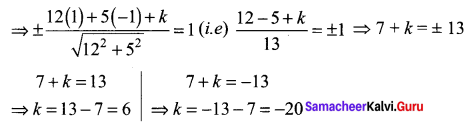
We are given that the perpendicular distance form (1, -1) to the line 12x + 5y + k = 0 is 1 unit.
Samacheer Kalvi 11th Maths Solutions Chapter 6 Two Dimensional Analytical Geometry Ex 6.3 85
So the required line will be 12x + 5y + 6 = 0 or 12x + 5y – 20 = 0

Question 8.
Find the equations of straight lines which are perpendicular to the line 3x + 4y – 6 = 0 and are at a distance of 4 units from (2, 1).
Solution:
Given equation of line is 3x + 4y – 6 = 0.
Any line perpendicular to 3x + 4y – 6 = 0 will be of the form 4x – 3y + k = 0
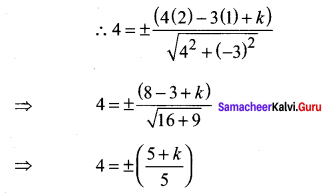
Given perpendicular distance is 4 units from (2, 1) to line (1)
Samacheer Kalvi 11th Maths Solutions Chapter 6 Two Dimensional Analytical Geometry Ex 6.3 86
∴ 20 = + (5 + k) or 20 = – (5 + k)
⇒ k = 20 – 5 or k = -(20 + 5)
k = 15 or k : = -25
∴ Required equation of the lines are 4x – 3y + 15 = 0 and 4x – 3y – 25 = 0

Question 9.
Find the equation of a straight line parallel to 2x + 3y = 10 and which is such that the sum of its intercepts on the axes is 15.
Solution:
The equation of the line parallel to 2x + 3y = 10 will be of the form 2x + 3y = k .
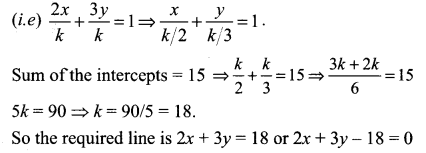
Samacheer Kalvi 11th Maths Solutions Chapter 6 Two Dimensional Analytical Geometry Ex 6.3 87

Question 10.
Find the length of the perpendicular and the co-ordinates of the foot of the perpendicular from (-10, -2) to the line x + y – 2 = 0.
Solution:
Length of the perpendicular from (-10, -2) to x + y – 2 = 0 is
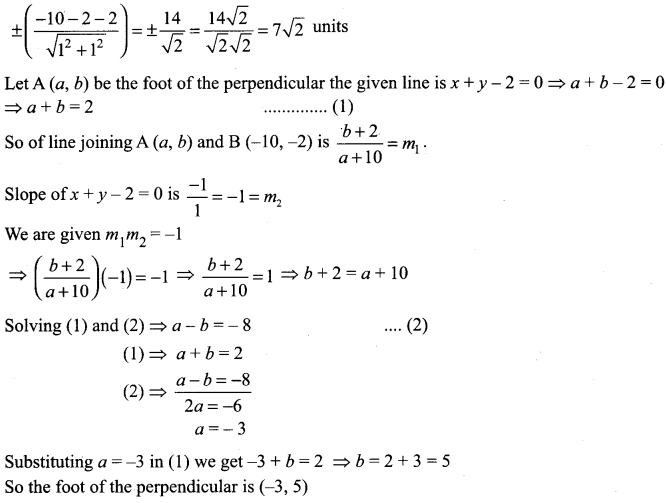
Samacheer Kalvi 11th Maths Solutions Chapter 6 Two Dimensional Analytical Geometry Ex 6.3 88

Question 11.
If p1 and p2 are the lengths of the perpendiculars from the origin to the straight lines. sec θ +y cosec θ = 2a and x cos θ – y sin θ = a cos 2θ, then prove that p_{1}^{2}+p_{2}^{2}=a^{2}
Solution:
p1 = length of perpendicular from (0, 0) to x sec θ + y cosec θ = 2a
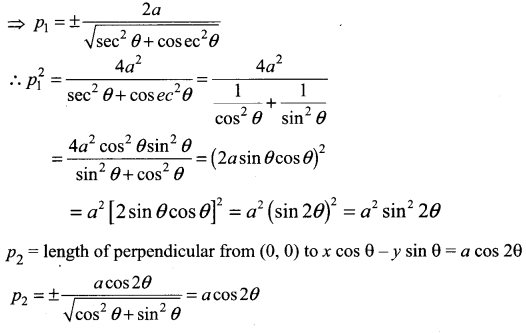
Samacheer Kalvi 11th Maths Solutions Chapter 6 Two Dimensional Analytical Geometry Ex 6.3 89
Samacheer Kalvi 11th Maths Solutions Chapter 6 Two Dimensional Analytical Geometry Ex 6.3 90

Question 12.
Find the distance between the parallel lines
(i) 12x + 5y = 7 and 12x + 5y + 7 = 0
(ii) 3x – 4y + 5 = 0 and 6x – 8y – 15 = 0.
Solution:
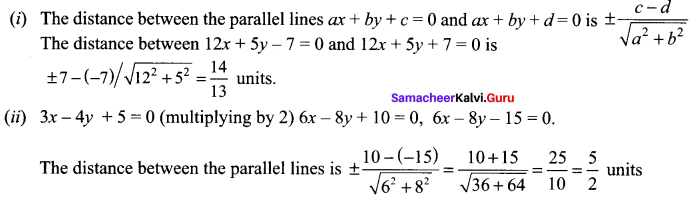
Samacheer Kalvi 11th Maths Solutions Chapter 6 Two Dimensional Analytical Geometry Ex 6.3 91

Question 13.
Find the family of straight lines
(i) Perpendicular
(ii) Parallel to 3x + 4y – 12 = 0.
Solution:
(i) The equation of the family of straight lines perpendicular to 3x + 4y – 12 = 0 is 4x – 3y + k = 0 where k ∈ R
(ii) The equation of the family of straight lines parallel to the straight line 3x + 4y – 12 = 0 is 3x + 4y + λ = 0 , λ ∈ R

Question 14.
If the line joining two points A (2, 0) and B (3, 1) is rotated about A in an anti-clockwise direction through an angle of 15°, then find the equation of the line in the new position.
Solution:
Samacheer Kalvi 11th Maths Solutions Chapter 6 Two Dimensional Analytical Geometry Ex 6.3 92
This line is rotated about 15° in an anti-clockwise direction
⇒ New slope = tan (45° + 15°) = tan 60° = \(\sqrt{3}\) (i.e) m = \(\sqrt{3}\).
Point A = (2, 0)
Samacheer Kalvi 11th Maths Solutions Chapter 6 Two Dimensional Analytical Geometry Ex 6.3 93

Samacheer Kalvi 11th Maths Solutions Chapter 6 Two Dimensional Analytical Geometry Ex 6.3

Question 15.
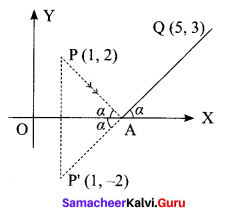
A ray of light coming from the point (1, 2) is reflected at a point A on the x-axis and it passes through the point (5, 3). Find the coordinates of point A.
Solution:
The image of the point P (1, 2) will be P’ (1, -2).
Since ∠OAP = ∠XAQ (angle of inches = angle of reflection) So ∠OAP’ = ∠XAQ = a (Vertically opposite angles)
⇒ P’, A, Q lie on the same line.
Samacheer Kalvi 11th Maths Solutions Chapter 6 Two Dimensional Analytical Geometry Ex 6.3 94
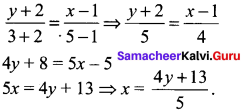
Now equation of the line P’, Q is [where P’ = (1, -2), Q = (5, 3)]
Samacheer Kalvi 11th Maths Solutions Chapter 6 Two Dimensional Analytical Geometry Ex 6.3 95
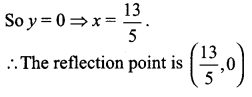
Since we find a point of intersection with the x-axis we put y = 0.
Samacheer Kalvi 11th Maths Solutions Chapter 6 Two Dimensional Analytical Geometry Ex 6.3 96

Question 16.
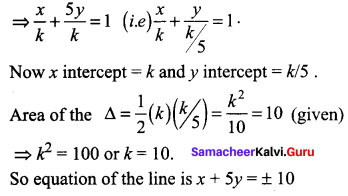
A line is drawn perpendicular to 5x = y + 7. Find the equation of the line if the area of the triangle formed by this line with co-ordinate axes is 10 sq. units.
Solution:
Equation of the given lines 5x = y + 7 ⇒ 5x – y = 7.
So its perpendicular will be of the form x + 5y = 7
Samacheer Kalvi 11th Maths Solutions Chapter 6 Two Dimensional Analytical Geometry Ex 6.3 97

Question 17.
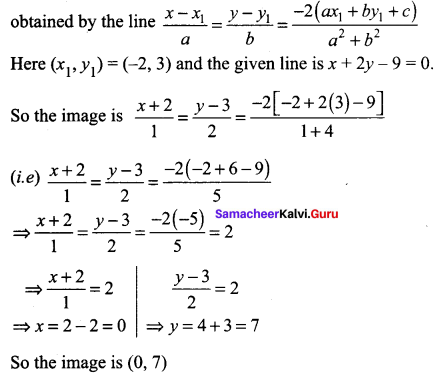
Find the image of the point (-2, 3) about the line x + 2y – 9 = 0.
Solution:
The coordinates of the image of the point (x1, y1) with respect to the line ax + by + c = 0 can be
Samacheer Kalvi 11th Maths Solutions Chapter 6 Two Dimensional Analytical Geometry Ex 6.3 98

Question 18.
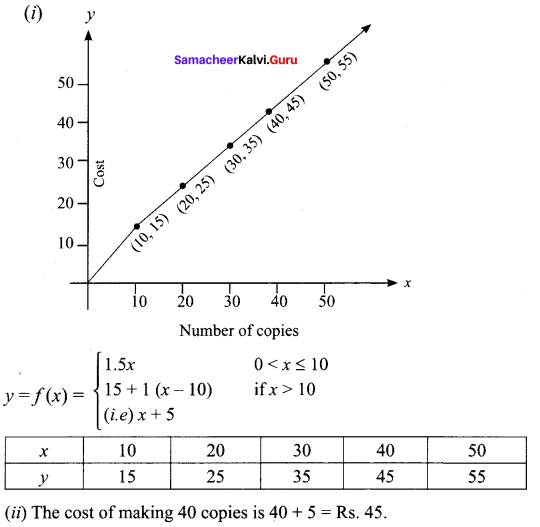
A photocopy store charges Rs. 1.50 per copy for the first 10 copies and Rs. 1.00 per copy after the 10th copy. Let x be the number of copies, and let y be the total cost of photocopying.
(i) Draw a graph of the cost as x goes from 0 to 50 copies.
(ii) Find the cost of making 40 copies
Solution:
Samacheer Kalvi 11th Maths Solutions Chapter 6 Two Dimensional Analytical Geometry Ex 6.3 99

Samacheer Kalvi 11th Maths Solutions Chapter 6 Two Dimensional Analytical Geometry Ex 6.3

Question 19.
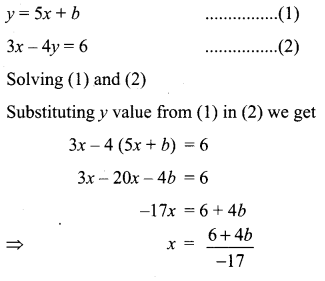
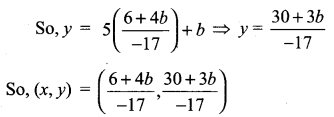
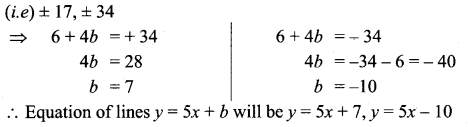
Find atleast two equations of the straight lines in the family of the lines y = 5x + b, for which b and the x-coordinate of the point of intersection of the lines with 3x – 4y = 6 are integers.
Solution:
y = 5x + b …….. (1)
3x-4y = 6 …….. (2)
Solving (1) and (2)
Substituting y value from (1) in (2) we get
Samacheer Kalvi 11th Maths Solutions Chapter 6 Two Dimensional Analytical Geometry Ex 6.3 100
Samacheer Kalvi 11th Maths Solutions Chapter 6 Two Dimensional Analytical Geometry Ex 6.3 50
Since x coordinate and 6 are integers 6 + 46 must be a multiple of 17
Samacheer Kalvi 11th Maths Solutions Chapter 6 Two Dimensional Analytical Geometry Ex 6.3 51

Question 20.
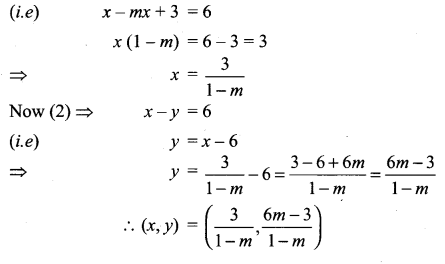
Find all the equations of the straight lines in the family of the lines y = mx – 3, for which m and the x-coordinate of the point of intersection of the lines with x – y = 6 are integers.
Solution:
Equation of the given lines are
y= mx – 3 …….. (1)
and x – y = 6 ……. (2)
Solving (1) and (2)
x – (mx – 3) = 6
Samacheer Kalvi 11th Maths Solutions Chapter 6 Two Dimensional Analytical Geometry Ex 6.3 52
Since m and x coordinates are integers
1 – m is the divisor of 3 (i.e) ± 1, ± 3
Samacheer Kalvi 11th Maths Solutions Chapter 6 Two Dimensional Analytical Geometry Ex 6.3 53
So equation of lines are (y = mx – 3) ,y = mx – 3
(i) When m = 0, y = -3
(ii) When m = 2, y = 2x – 3
(iii) When m = -2, y = -2x – 3 or 2x + y + 3 = 0
(iv) When m = 4, y = 4x – 3

Samacheer Kalvi 11th Maths Solutions Chapter 6 Two Dimensional Analytical Geometry Ex 6.3 Additional Questions

Question 1.
Find the equation of the line passing through the point (5, 2) and perpendicular to the line joining the points (2, 3) and (3, -1).
Solution:
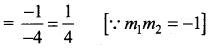
Slope of the line joining the points (2, 3) and (3, -1) is
Samacheer Kalvi 11th Maths Solutions Chapter 6 Two Dimensional Analytical Geometry Ex 6.3 54
Slope of the required line which is perpendicular to it
Samacheer Kalvi 11th Maths Solutions Chapter 6 Two Dimensional Analytical Geometry Ex 6.3 55
Equation of the line passing through the point (5, 2) is
Samacheer Kalvi 11th Maths Solutions Chapter 6 Two Dimensional Analytical Geometry Ex 6.3 56
Hence, the required equation is x – 4y + 3 = 0.

Question 2.
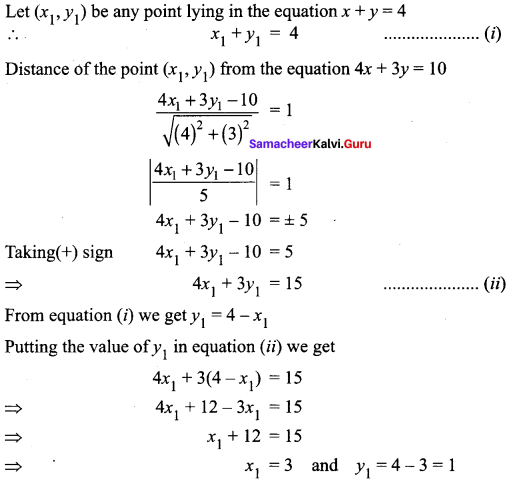
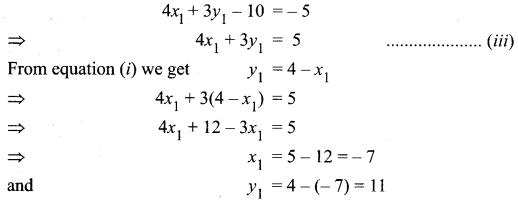
Find the points on the line x + y = 4 which lie at a unit distance from the line 4x + 3y = 10. Solution:
Samacheer Kalvi 11th Maths Solutions Chapter 6 Two Dimensional Analytical Geometry Ex 6.3 57
So, the required point is (3, 1)
Now taking(-) sign, we have
Samacheer Kalvi 11th Maths Solutions Chapter 6 Two Dimensional Analytical Geometry Ex 6.3 59
So, the required point is (- 7, 11)
Hence, the required points on the given line are (3, 1) and (-7, 11).

Samacheer Kalvi 11th Maths Solutions Chapter 6 Two Dimensional Analytical Geometry Ex 6.3

Question 3.
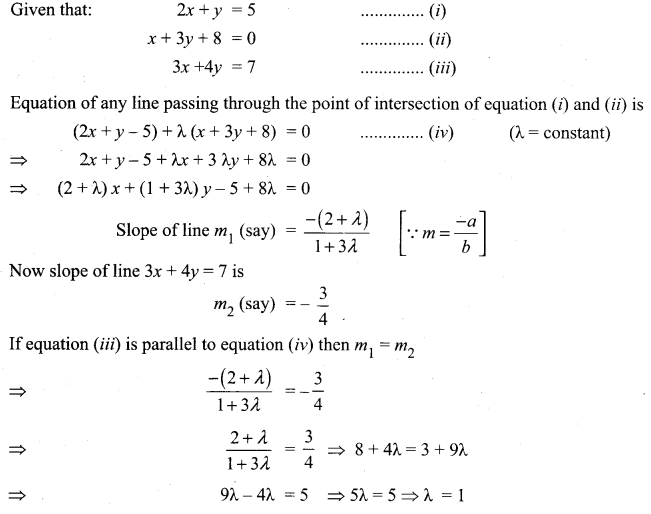
Find the equation of the line passing through the point of intersection 2x + y = 5 and x + 3y + 8 = 0 and parallel to the line 3x +4y = 7.
Solution:
Samacheer Kalvi 11th Maths Solutions Chapter 6 Two Dimensional Analytical Geometry Ex 6.3 30
On putting the value of λ in equation (iv) we get
(2x + y – 5) + 1 (x + 3y + 8) = 0
⇒ 2x + y – 5 + x + 3y + 8 = 0
⇒ 3x + 4y + 3 = 0
Hence, the required equation is 3x + 4y + 3 = 0

Question 4.
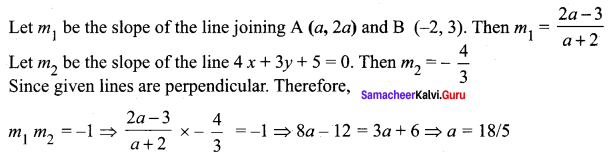
A line passing through the points (a, 2a) and (-2, 3) is perpendicular to the line 4 x + 3y + 5 = 0, find the value of a.
Solution:
Samacheer Kalvi 11th Maths Solutions Chapter 6 Two Dimensional Analytical Geometry Ex 6.3 31

Samacheer Kalvi 11th Maths Solutions Chapter 6 Two Dimensional Analytical Geometry Ex 6.3

Question 5.
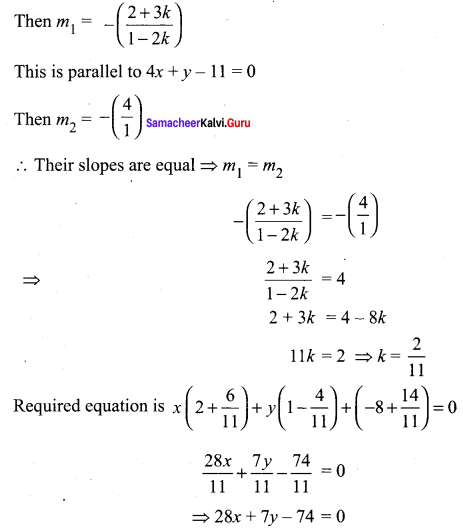
Find the equation of the straight line which passes through the intersection of the straight lines 2x + y = 8 and 3x – 2y + 7 = 0 and is parallel to the straight line 4x + y – 11 = 0.
Solution:
Equation of line through the intersection of straight lines 2x + y = 8 and 3x – 2y + 7 = 0 is 2x + y – 8 + k (3x – 2y + 7) = 0
x(2 + 3k) + y (1 – 2k) +(-8 + 7k) = 0
Samacheer Kalvi 11th Maths Solutions Chapter 6 Two Dimensional Analytical Geometry Ex 6.3 32
⇒ 28x + 7y – 74 = 0

Question 6.
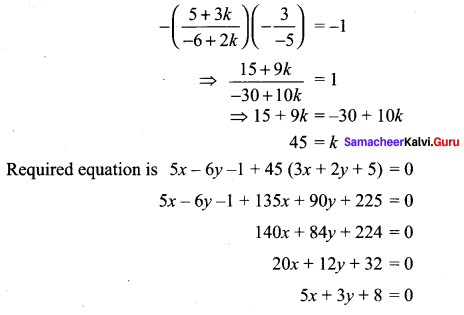
Find the equation of the straight line passing through intersection of the straight lines 5x – 6y = 1 and 3x + 2y + 5 = 0 and perpendicular to the straight line 3x – 5y + 11 = 0.
Solution:
Equation of line through the intersection of straight lines 5x – 6y = 1 and 3x + 2y + 5 = 0 is
5x – 6y – 1 + k (3x + 2y + 5) = 0
x (5 + 3k) + y (-6 + 2k) + (-1 + 5k) = 0
This is perpendicular to 3x – 5y + 11 = 0
That is, the product of their slopes is -1
Samacheer Kalvi 11th Maths Solutions Chapter 6 Two Dimensional Analytical Geometry Ex 6.3 34

Samacheer Kalvi 11th Maths Solutions Chapter 6 Two Dimensional Analytical Geometry Ex 6.3 Read More »

Samacheer Kalvi 11th Maths Solutions Chapter 4 Combinatorics and Mathematical Induction Ex 4.4

You can Download Samacheer Kalvi 11th Maths Book Solutions Guide Pdf, Tamilnadu State Board help you to revise the complete Syllabus and score more marks in your examinations.

Tamilnadu Samacheer Kalvi 11th Maths Solutions Chapter 4 Combinatorics and Mathematical Induction Ex 4.4

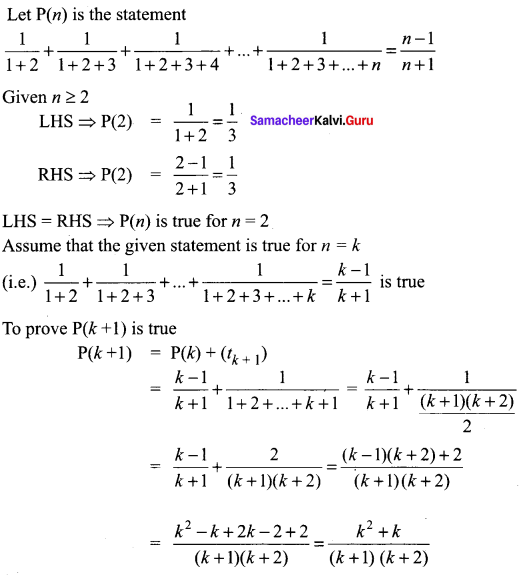
Question 1.
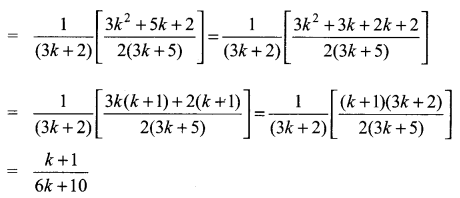
By the principle of mathematical induction, prove that, for n ≥ 1
Samacheer Kalvi 11th Maths Solutions Chapter 4 Combinatorics and Mathematical Induction Ex 4.4 1
Solution:
Samacheer Kalvi 11th Maths Solutions Chapter 4 Combinatorics and Mathematical Induction Ex 4.4 2
∴ P(k+ 1) is true.
Thus P(K) is true ⇒ (k + 1) is true.
Hence by principle of mathematical induction, P(n) is true for all n ∈ N.

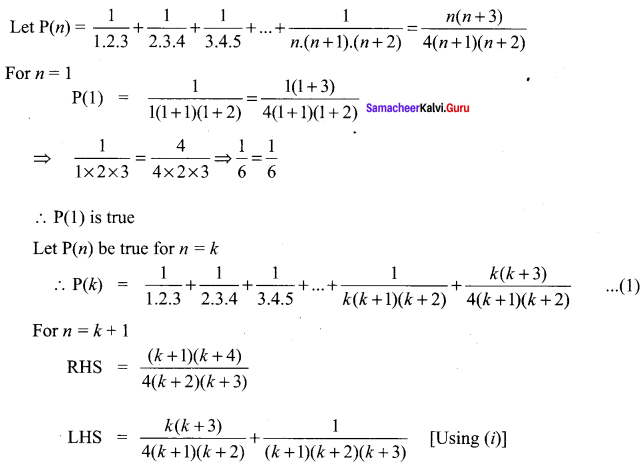
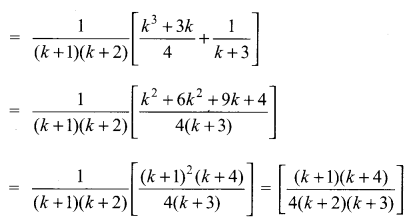
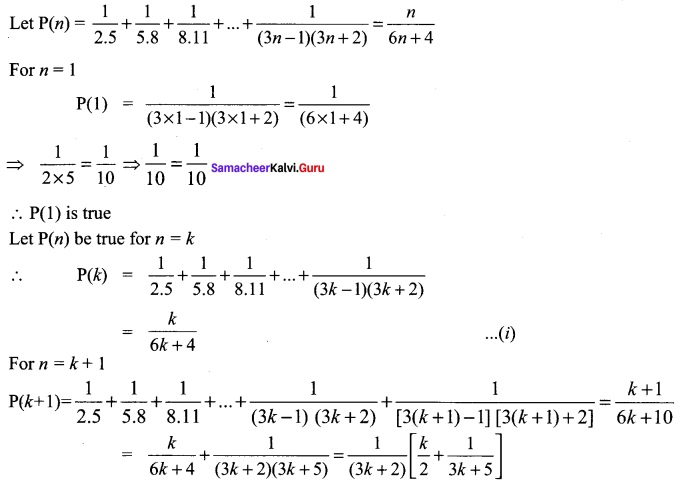
Question 2.
By the principle of mathematical induction, prove that, for n > 1
Samacheer Kalvi 11th Maths Solutions Chapter 4 Combinatorics and Mathematical Induction Ex 4.4 3
Solution:
Samacheer Kalvi 11th Maths Solutions Chapter 4 Combinatorics and Mathematical Induction Ex 4.4 4
∴ P(1) is true
Let P(n) be true for n = k
Samacheer Kalvi 11th Maths Solutions Chapter 4 Combinatorics and Mathematical Induction Ex 4.4 5
∴ P(k + 1) is true
Thus P(k) is true ⇒ P(k + 1) is true. Hence by the principle of mathematical induction, P(k) is true for all n ∈ N.

Samacheer Kalvi 11th Maths Solutions Chapter 4 Combinatorics and Mathematical Induction Ex 4.4

Question 3.
Prove that the sum of the first n non-zero even numbers is n2 + n.
Solution:
Let P(n) = 2 + 4 + 6 + ………….. + 2n = n2 + n

Step 1:
Let us verify the statement for n = 1
P (1 ) = 2 = 12 + 1 = 1 + 1 = 2.
∴ The given result is true for n = 1.

Step 2:
Let us assume that the given result is true for n = k
P ( k) = 2 + 4 + 6 + ………… + 2k = k2 + k

Step 3:
Let us prove the result for n = k + 1
P (k+ 1 ) = 2 + 4 + 6+ + 2k + (2k + 2 )
P(k+ 1 ) = P(k) + (2k + 2)
= k2 + k + 2k + 2
= k2 + 3k + 2
= k2 + 2k + k + 2
= k(k +2) + 1(k + 2)
P(k+ 1 ) = (k+ 1) (k + 2) ……….. (1)
P (k) = k2 + k
= k (k + 1 )
P(k+ 1) = (k + 1) (k + 1 + 1)
= (k + 1) (k + 2)
This implies P (k + 1) is true.
∴ Thus, we have proved the result for n = k + 1.
Hence by the principle of mathematical induction, the result is true for all natural numbers n.
2 + 4 + 6 + ………….. + 2n = n2 + n
is true for all natural numbers n.

Question 4.
By the principle of Mathematical induction, prove that, for n ≥ 1.
Samacheer Kalvi 11th Maths Solutions Chapter 4 Combinatorics and Mathematical Induction Ex 4.4 7
Solution:
Samacheer Kalvi 11th Maths Solutions Chapter 4 Combinatorics and Mathematical Induction Ex 4.4 8
Samacheer Kalvi 11th Maths Solutions Chapter 4 Combinatorics and Mathematical Induction Ex 4.4 9
∴ P(k + 1) is true
Thus P(k) is true ⇒ P(k + 1) is true
Hence by the principle of mathematical induction, P(n) is true for all n ∈ N

Question 5.
Using the Mathematical induction, show that for any natural number n ≥ 2,
Samacheer Kalvi 11th Maths Solutions Chapter 4 Combinatorics and Mathematical Induction Ex 4.4 10
Solution:
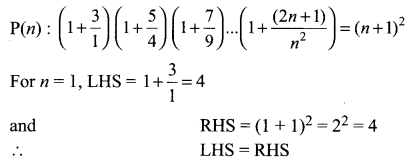
Samacheer Kalvi 11th Maths Solutions Chapter 4 Combinatorics and Mathematical Induction Ex 4.4 11
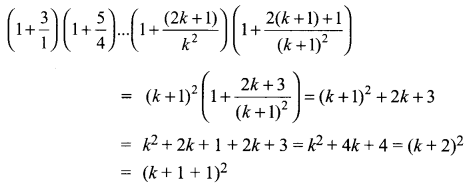
Samacheer Kalvi 11th Maths Solutions Chapter 4 Combinatorics and Mathematical Induction Ex 4.4 12
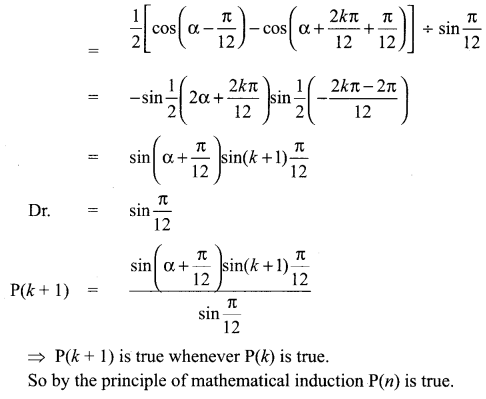
⇒ P(k + 1) is true when P(k) is true so by the principle of mathematical induction P(n) is true.

Question 6.
Using the Mathematical induction, show that for any natural number n ≥ 2,
Samacheer Kalvi 11th Maths Solutions Chapter 4 Combinatorics and Mathematical Induction Ex 4.4 13
Solution:
Samacheer Kalvi 11th Maths Solutions Chapter 4 Combinatorics and Mathematical Induction Ex 4.4 14
Samacheer Kalvi 11th Maths Solutions Chapter 4 Combinatorics and Mathematical Induction Ex 4.4 15
⇒ P(k + 1) is true when P(k) is true so by the principle of mathematical induction P(n) is true for n ≥ 2.

Samacheer Kalvi 11th Maths Solutions Chapter 4 Combinatorics and Mathematical Induction Ex 4.4

Question 7.
Using the Mathematical induction, show that for any natural number n
Samacheer Kalvi 11th Maths Solutions Chapter 4 Combinatorics and Mathematical Induction Ex 4.4 16
Solution:
Samacheer Kalvi 11th Maths Solutions Chapter 4 Combinatorics and Mathematical Induction Ex 4.4 17
Samacheer Kalvi 11th Maths Solutions Chapter 4 Combinatorics and Mathematical Induction Ex 4.4 18
∴ P(k + 1) is true
Thus p(k) is true ⇒ P(k + 1) is true
Hence by the principle of mathematical induction,
p(n) is true for all n ∈ z

Question 8.
Using the Mathematical induction, show that for any natural number n,
Samacheer Kalvi 11th Maths Solutions Chapter 4 Combinatorics and Mathematical Induction Ex 4.4 19
Solution:
Samacheer Kalvi 11th Maths Solutions Chapter 4 Combinatorics and Mathematical Induction Ex 4.4 20
Samacheer Kalvi 11th Maths Solutions Chapter 4 Combinatorics and Mathematical Induction Ex 4.4 200
∴ P(k + 1) is true
Thus P(k) is true ⇒ P(k + 1) is true. Hence by the principle of mathematical induction, P(n) is true for all n ∈ N.

Samacheer Kalvi 11th Maths Solutions Chapter 4 Combinatorics and Mathematical Induction Ex 4.4

Question 9.
Prove by Mathematical Induction that
1! + (2 × 2!) + (3 × 3!) + … + (n × n!) = (n + 1)! – 1
Solution:
Let p(n) = 1! + (2 × 2 !) + (3 × 3!) +…. .+ (n × n!) = (n + 1)! – 1

Step 1:
First let us verify the result for n = 1
P(1) = 1! = (1 + 1)! – 1
P(1) = 1! = 2! – 1
P(1) = 1 = 2 – 1 = 1
∴ We have verified the result for n = 1.

Step 2:
Let us assume that the result is true for n = k
P(k) = (1 × 1 !) + (2 × 2!) + (3 × 3!) + …………. + (k × k!) = (k + 1)! – 1

Step 3:
Let us prove the result for n = k + 1
P(k + 1)=(1 × 1!) + (2 × 2!) + (3 × 3!) + ………….. + (k × k!) + ((k + 1) × (k + 1)!)
P(k + 1) = P(k) + ((k + 1) × (k + 1)!)
P(k + 1) = (k + 1)! – 1 + (k + 1) × (k + 1)!
= (k + 1)! + (k + 1) (k + 1)! – 1
= (k + 1)! (1 + k + 1) – 1
= (k + 1)! (k + 2) – 1
= (k + 2)! – 1
P(k + 1) = ((k + 1) + 1)! – 1
This implies P (k + 1) is true.
∴ Thus, we have proved the result for n = k + 1.
Hence by the principle of mathematical induction, the result is true for all natural numbers n.
(1 × 1!) + (2 × 2!) + (3 × 3!) + …………… + (n × n!) = (n + 1)! – 1
is true for all natural numbers n.

Question 10.
Using the Mathematical induction, show that for any natural number n, x2n – y2n is divisible by x +y.
Solution:
Let P(n) = x2n – y2n is divisible by x + y
Step 1:
First, let us verify the result for n = 1.
P ( 1 ) = x2(1) – y2(1) = x2 – y2
P(1) = (x + y) (x – y) which is divisible by x + y
∴ The result is true for n = 1

Step 2:
Let us assume that the result is true for n = k
P(k) = x2k – y2k which is divisible by x + y
∴ P (k) = x2k – y2k = λ (x + y) where λ ∈ N ——— (1)

Step 3:
Let us prove the result for n = k + 1
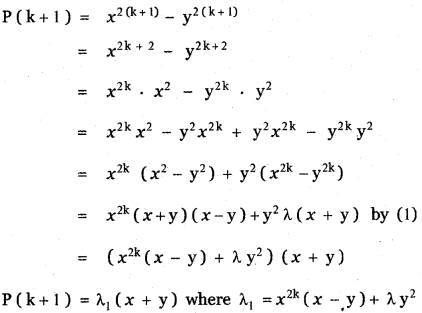
Samacheer Kalvi 11th Maths Guide Chapter 4 Combinatorics and Mathematical Induction Ex 4.4 43
∴ P ( k + 1) is divisible by x + y
This implies P (k + 1) is true.
∴ Thus, we have proved the result for n = k + 1.
Hence by the principle of mathematical induction, the result is true for all natural numbers n.
x2n – y2n is divisible by x + y
for all natural numbers n.

Samacheer Kalvi 11th Maths Solutions Chapter 4 Combinatorics and Mathematical Induction Ex 4.4

Question 11.
By the principle of mathematical induction, prove that, for n ≥ 1,
Samacheer Kalvi 11th Maths Solutions Chapter 4 Combinatorics and Mathematical Induction Ex 4.4 80
Solution:
Samacheer Kalvi 11th Maths Solutions Chapter 4 Combinatorics and Mathematical Induction Ex 4.4 90
Samacheer Kalvi 11th Maths Solutions Chapter 4 Combinatorics and Mathematical Induction Ex 4.4 91

Question 12.
Use induction to prove that n3 – 7n + 3, is divisible by 3, for all natural numbers n.
Solution:
Let P ( n) = n3 – 7n + 3 is divisible by 3

Step 1:
First let us verify the results for n = 1
P(I) = 13 – 7 × 1 + 3
= 1 – 7 + 3
P (1) = – 3
which is divisible by 3
∴ The result is true for n = 1

Step 2:
Let us assume that the result is true for n = k
P(k) = k3 – 7k + 3 is divisible by 3
P(k) = k3 – 7k + 3 = 3λ where λ ∈ N

Step 3:
Let us prove the result for n = k + 1
P(k + 1) = (k + 1)3 – 7(k + 1 ) + 3
= k3 + 3k2 + 3k + 1 – 7k – 7 + 3
= k3 + 3k2 – 4k – 3
= k3 – 4k – 3k + 3k – 3 + 6 – 6 + 3k2
= k3 – 7k + 3 + 3k – 6 + 3k2
= (k3 – 7k + 3) + 3(k2 + k – 2)
= 3λ + 3 (k2 + k – 2)
P(k + 1) = 3 (λ + k2 + k – 2 )
which is a multiple of 3, hence divisible by 3
This implies P (k + 1) is true.
∴ Thus, we have proved the result for n = k + 1.
Hence by the principle of mathematical induction, the result is true for all natural numbers n.
n3 – 7n + 3 is divisible by 3 for all natural numbers n.

Question 13.
Use induction to prove that 5n + 1 + 4 × 6n when divided by 20 leaves a remainder 9, for all natural numbers n.
Solution:
P(n) is the statement 5n + 1 + 4 × 6n – 9 is ÷ by 20
P(1) = 51 + 1 + 4 × 61 – 9 = 52 + 24 – 9
= 25 + 24 – 9 = 40 ÷ by 20
So P(1) is true
Assume that the given statement is true for n = k
(i.e) 5k + 1 + 4 × 6n – 9 is ÷ by 20
P(1) = 51 + 1 + 4 × 61 – 9
= 25 + 24 – 9
So P(1) is true
To prove P(k + 1) is true
P(k + 1) = 5k + 1 + 1 + 4 × 6k + 1 + 1 – 9
= 5 × 5 k + 1 + 4 × 6 × 6k – 9
= 5[20C + 9 – 4 × 6k] + 24 × 6k – 9 [from(1)]
= 100C + 45 – 206k + 246k – 9
= 100C + 46k + 36
= 100C + 4(9 + 6k)
Now for k = 1 ⇒ 4(9 + 6k) = 4(9 + 6)
= 4 × 15 = 60 ÷ by 20 .
for k = 2 = 4(9 + 62) = 4 × 45 = 180 ÷ 20
So by the principle of mathematical induction 4(9 + 6k) is ÷ by 20
Now 100C is ÷ by 20.
So 100C + 4(9 + 6k) is ÷ by 20
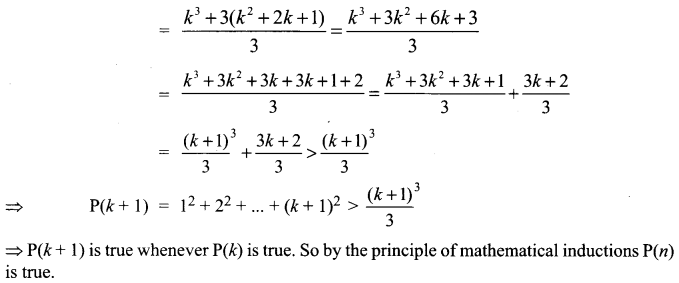
⇒ P(k + 1) is true whenever P(k) is true. So by the principle of mathematical induction P(n) is true.

Samacheer Kalvi 11th Maths Solutions Chapter 4 Combinatorics and Mathematical Induction Ex 4.4

Question 14.
Use induction to prove that 10n + 3 × 4n + 2 + 5, is divisible by 9, for all natural numbers n.
Solution:
P(n) is the statement 10n + 3 × 4n + 2 + 5 is ÷ by 9
P(1) = 101 + 3 × 42 + 5 = 10 + 3 × 16 + 5
= 10 + 48 + 5 = 63 ÷ by 9
So P(1) is true. Assume that P(k) is true
(i.e.) 10k + 3 × 4k + 2 + 5 is ÷ by 9
(i.e.) 10k + 3 × 4k + 2 + 5 = 9C (where C is an integer)
⇒ 10k = 9C – 5 – 3 × 4k + 2 ……(1)
To prove P(k + 1) is true.
Now P(k + 1) = 10k + 1 + 3 × 4k + 3 + 5
= 10 × 10k + 3 × 4k + 2 × 4 + 5
= 10[9C – 5 – 3 × 4k + 2] + 3 × 4k + 2 × 4 + 5
= 10[9C – 5 – 3 × 4k + 2] + 12 × 4k + 2 + 5
= 90C – 50 – 30 × 4k + 2 + 12 × 4k + 2 + 5
= 90C – 45 – 18 × 4k + 2
= 9[10C – 5 – 2 × 4k + 2] which is ÷ by 9
So P(k + 1) is true whenever P(K) is true. So by the principle of mathematical induction P(n) is true.

Question 15.
Prove that using the Mathematical induction
Samacheer Kalvi 11th Maths Solutions Chapter 4 Combinatorics and Mathematical Induction Ex 4.4 111
Solution:
Samacheer Kalvi 11th Maths Solutions Chapter 4 Combinatorics and Mathematical Induction Ex 4.4 112
Samacheer Kalvi 11th Maths Solutions Chapter 4 Combinatorics and Mathematical Induction Ex 4.4 113
Samacheer Kalvi 11th Maths Solutions Chapter 4 Combinatorics and Mathematical Induction Ex 4.4 114
Samacheer Kalvi 11th Maths Solutions Chapter 4 Combinatorics and Mathematical Induction Ex 4.4 115

Samacheer Kalvi 11th Maths Solutions Chapter 4 Combinatorics and Mathematical Induction Ex 4.4 Additional Questions

Question 1.
Prove by induction the inequality (1 + x)n ≥ 1 + nx, whenever x is positive and n is a positive integer.
Solution:
P(n) : (1 +x)n ≥ 1 +nx
P(1): (1 + x)1 ≥ 1 + x
⇒ 1 + x ≥ 1 + x, which is true.
Hence, P(1) is true.
Let P(k) be true
(i.e.) (1 + x)k ≥ 1 + kx
We have to prove that P(k + 1) is true.
(i.e.) (1 + x)k + 1 ≥ 1 + (k + 1)x
Now, (1 + x)k + 1 ≥ 1 + kx [∵ p(k) is true]
Multiplying both sides by (1 + x), we get
(1 + x)k(1 + x) ≥ (1 + kx)(1 + x)
⇒ (1 + x)k + 1 ≥ 1 + kx + x + kx2
⇒ (1 + x)k + 1 ≥ 1 + (k + 1)x + kx2 ….. (1)
Now, 1 + (k + 1) x + kx2 ≥ 1 + (k + 1)x …… (2)
[∵ kx2 > 0]
From (1) and (2), we get
(1 + x)k + 1 ≥ 1 + (k + 1)x
∴ P(k + 1) is true if P(k) is true.
Hence, by the principle of mathematical induction, P(n) is true for all values, of n.

Question 2.
32n – 1 is divisible by 8.
Solution:
P(n) = 32n – 1 is divisible by 8
For n = 1, we get
P(1) = 32.1 – 1 = 9 – 1 = 8
P(1) = 8, which is divisible by 8.
Let P(n) be true for n = k
P(k) = 32k – 1 is divisible by 8 ….. (1)
Now, P(k + 1) = 3(2k + 2) – 1 = 32k.32 – 1
= 32(32k – 1) + 8
Now, 32k – 1 is divisible by 9. [Using (1)]
∴ 32 (32k – 1) + 8 is also divisible by 8.
Hence, 32n – 1 is divisible by 8 ∀ n E N

Samacheer Kalvi 11th Maths Solutions Chapter 4 Combinatorics and Mathematical Induction Ex 4.4

Question 3.
Prove by the principle of mathematical induction if x and y are any two distinct integers, then xn – yn is divisible by x – y. [OR]
xn – yn is divisible by x – y, where x – y ≠ 0.
Solution:
Let the given statement be P(n).
(i.e.) P(n): xn – yn = M(x – y), x – y ≠ 0

Step I.
When n = 1,
xn – yn = x – y = M(x – y) ….(1)
⇒ P(1) is true.

Step II.
Assume that P(k) is true.
(i.e.) xk – yk = M(x – y), x – y ≠ 0
We shall now show that P(k + 1) is true
Now, xk + 1 – yk + 1 = xk + 1 – xky + xk + 1y – yk + 1
= xk(x – y) + y(xk – yk)
= xk(x – y) + yM(x – y) [Usng ….. (1)]
= (x – y)(xk – yM)
∴ By the principle of mathematical induction, P(n) is true for all n ∈ N

Question 4.
Prove by the principle of mathematical induction that for every natural number n, 32n + 2 – 8n – 9 is divisible by 8.
Solution:
Let P(n): 32n + 2 – 8n – 9 is divisible by 8.
Then, P(1): 32.1 + 2 – 8.1 – 9 is divisible by 8.
(i.e.) 34 – 8 – 9 is divisible by 8 or 81 – 8 – 9 is divisible by 8
(or) 64 is divisible by 8, which is true.
Suppose P(k) is true, then
P(k) : 32k + 2 – 8k – 9 is divisible by 8
(i.e.) 32k + 2 – 8k – 9 = 8m, where m ∈ N (or)
32k + 2 = 8m + 8k + 9
P(k + 1) is the statement given by, …(1)
P(k + 1) : 32(k + 1) + 2 – 8(k + 1) – 9
Samacheer Kalvi 11th Maths Solutions Chapter 4 Combinatorics and Mathematical Induction Ex 4.4 25
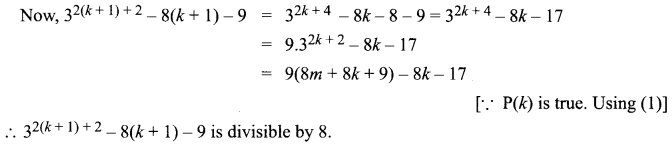
∴ P(k + 1) is true
Hence, by the principle of mathematical induction, P(n) is true for all n ∈ N

Question 5.
Use the principle of mathematical induction to prove that for every natural number n.
Samacheer Kalvi 11th Maths Solutions Chapter 4 Combinatorics and Mathematical Induction Ex 4.4 26
Solution:
Let P(n) be the given statement, i.e.
Samacheer Kalvi 11th Maths Solutions Chapter 4 Combinatorics and Mathematical Induction Ex 4.4 27
⇒ P(1) is true.
We note that P(n) is true for n = 1.
Assume that P(k) is true
Samacheer Kalvi 11th Maths Solutions Chapter 4 Combinatorics and Mathematical Induction Ex 4.4 288
Now, we shall prove that P(k + 1) is true whenever P(k) is true. We have,
Samacheer Kalvi 11th Maths Solutions Chapter 4 Combinatorics and Mathematical Induction Ex 4.4 277
∴ P(k + 1) is also true whenever P(k) is true
Hence, by the principle of mathematical induction, P(n) is also true for all n ∈ N.

Question 6.
n3 – n is divisible by 6, for each natural number n ≥ 2.
Solution:
Let P(n) : n3 – n

Step 1 :
P(2): 23 – 2 = 6 which is divisible by 6. So it is true for P(2).

Step 2 :
P(A): k3 – k = 6λ. Let it is be true for k ≥ 2
⇒ k3 = 6λ + k …(i)

Step 3 :
P(k + 1) = (k + 1)3 – (k + 1)
= k3 + 1 + 3k2 + 3k – k – 1 = k3 – k + 3(k2 + k)
= k3 – k + 3(k2 + k) = 6λ + k – k + 3(k2 + k)
= 6λ + 3(k2 + k) [from (i)]
We know that 3(k2 + k) is divisible by 6 for every value of k ∈ N.
Hence P(k + 1) is true whenever P(k) is true.

Samacheer Kalvi 11th Maths Solutions Chapter 4 Combinatorics and Mathematical Induction Ex 4.4

Question 7.
For any natural number n, 7n – 2n is divisible by 5.
Solution:
Let P(n) : 7n – 2n

Step 1:
P(1) : 71 – 21 = 5λ which is divisible by 5. So it is true for P(1).

Step 2:
P(k): 7k – 2k = 5λ. Let it be true for P(k)

Step 3:
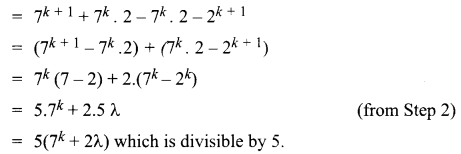
P(k + 1) = 7k + 1 – 2k + 1
Samacheer Kalvi 11th Maths Solutions Chapter 4 Combinatorics and Mathematical Induction Ex 4.4 50

So, it is true for P(k + 1)
Hence, P(k + 1) is true whenever P(k) is true.

Question 8.
n2 < 2n, for all natural numbers n ≥ 5.
Solution:
Let P(n) : n2 < 2n for all natural numbers, n ≥ 5

Step 1 :
P(5) : 15 < 25 ⇒ 1 < 32 which is true for P(5)

Step 2 :
P(k): k2 < 2k. Let it be true for k ∈ N

Step 3 :
P(k + 1): (k + 1)2 < 2k + 1
From Step 2, we get k2 < 2k
⇒ k2 < 2k + 1 < 2k + 2k + 1
Samacheer Kalvi 11th Maths Solutions Chapter 4 Combinatorics and Mathematical Induction Ex 4.4 55
Samacheer Kalvi 11th Maths Solutions Chapter 4 Combinatorics and Mathematical Induction Ex 4.4 56
From eqn. (i) and (ii), we get (k + 1)2 < 2k + 1
Hence, P(k + 1) is true whenever P(k) is true for k ∈ N, n ≥ 5.

Question 9.
In 2n < (n + 2)! for all natural number n.
Solution:
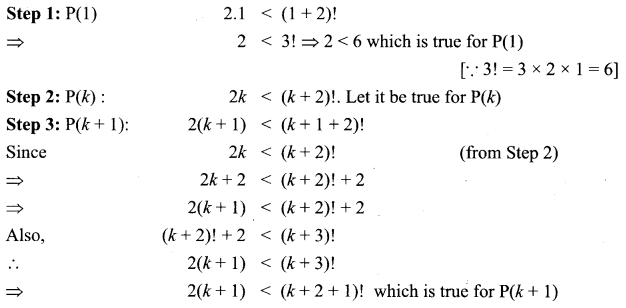
Let P(n) : 2n < (n + 2)! for all k ∈ N.
Samacheer Kalvi 11th Maths Solutions Chapter 4 Combinatorics and Mathematical Induction Ex 4.4 566
Hence, P(k + 1) is true whenever P(k) is true.

Question 10.
1 + 5 + 9 + … + (4n – 3) = n(2n – 1), ∀ n ∈ N.
Solution:
Let P(n) : 1 + 5 + 9 + … + (4n – 3) = n(2n – 1), ∀ n ∈ N

Step 1:
P(1) : 1 = 1(2.1 – 1) = 1 which is true for P(1)

Step 2:
P(k) : 1 + 5 + 9 + … + (4k – 3) = k(2k – 1). Let it be true.

Step 3:
P(k + 1) : 1 + 5 + 9 + … + (4k – 3) = k(4k + 1)
= k(2k – 1) + (4k + 1) = 2k2 – k + 4k + 1
= 2k2 + 3k + 1 = 2k2 + 2k + k + 1
= 2k(k + 1) + 1 (k + 1) = (2k + 1)(k + 1)
= (k+ 1) (2k + 2 – 1) = (k + 1) [2(k + 1) – 1]
Which is true for P(k + 1).
Hence, P(k + 1) is true whenever P(k) is true.

Samacheer Kalvi 11th Maths Solutions Chapter 4 Combinatorics and Mathematical Induction Ex 4.4 Read More »

Samacheer Kalvi 11th Maths Solutions Chapter 1 Sets Ex 1.3

You can Download Samacheer Kalvi 11th Maths Book Solutions Guide Pdf, Tamilnadu State Board help you to revise the complete Syllabus and score more marks in your examinations.

Tamilnadu Samacheer Kalvi 11th Maths Solutions Chapter 1 Sets Ex 1.3

Question 1.
Suppose that 120 students are studying in 4 sections of eleventh standard in a school. Let A denote the set of students and B denote the set of the sections. Define a relation from A to B as “x related toy if the student x belongs to the section y”. Is this relation a function? What can you say about the inverse relation? Explain your answer.
Solution:
(i) A = {set of students in 11th standard}
B = {set of sections in 11sup>th standard}
R : A ➝ B ⇒ x related to y
⇒ Every students in eleventh Standard must in one section of the eleventh standard.
⇒ It is a function.
Inverse relation cannot be a function since every section of eleventh standard cannot be related to one student in eleventh standard.

Question 2.
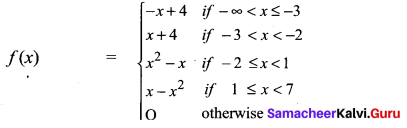
Write the values of f at – 4, 1, -2, 7, 0 if
Samacheer Kalvi 11th Maths Solutions Chapter 1 Sets Ex 1.3 1
Solution:
f(-4) = -(-4) + 4 = 8
f(1) = 1 – 12 = 0
f(-2) = (-2)2 – (-2) = 4 + 2 = 6
f(7) = 0
f(0) = 0

Question 3.
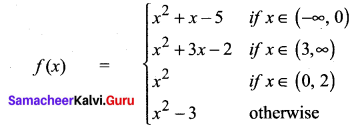
Write the values of f at -3, 5, 2, -1, 0 if
Samacheer Kalvi 11th Maths Solutions Chapter 1 Sets Ex 1.3 2
Solution:
f(-3) = (-3)2 – 3 – 5 = 9 – 8 = 1
f(5) = (5)2 + 3(5) – 2 = 25 + 15 – 2 = 38
f(2) = 4 – 3 = 1
f(-1) = (-1)2 + (-1) – 5 = 1 – 6 = -5
f(0) = 0 – 3 = -3

Samacheer Kalvi 11th Maths Solutions Chapter 1 Sets Ex 1.3

Question 4.
State whether the following relations are functions or not. If it is a function check for one-to-oneness and ontoness. If it is not a function, state why?
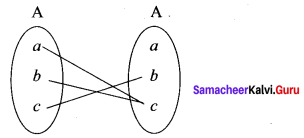
(i) If A = {a, b, c] and/= {(a, c), (b, c), (c, b)};(f: A ➝ A).
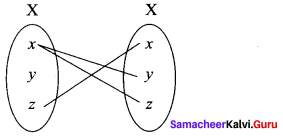
(ii) If X = {x, y, z} and/= {(x, y), (x, z), (z, x)}; (f: X ➝ X).
Solution:
(i) f : A ➝ A
Samacheer Kalvi 11th Maths Solutions Chapter 1 Sets Ex 1.3 50
It is a function but it is not 1 – 1 and not onto function.

(ii) f : X ➝ X
Samacheer Kalvi 11th Maths Solutions Chapter 1 Sets Ex 1.3 51
x ∈ X (Domain) has two images in the co-domain x. It is not a function.

Question 5.
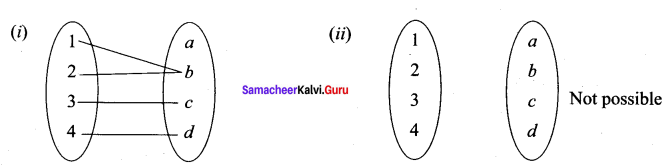
Let A = {1, 2, 3, 4} and B = {a, b, c, d}. Give a function from A ➝ B for each of the following:
(i) neither one-to-one nor onto.
(ii) not one-to-one but onto.
(iii) one-to-one but not onto.
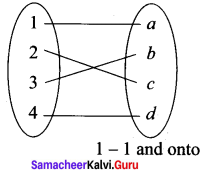
(iv) one-to-one and onto.
Solution:
A = {1, 2, 3, 4}
B = {a, b, c, d}.
Samacheer Kalvi 11th Maths Solutions Chapter 1 Sets Ex 1.3 60
R = {(1, b) (2, b) (3, c) (4, d)} is not 1-1 and not onto

(iii) Not possible

(iv) Samacheer Kalvi 11th Maths Solutions Chapter 1 Sets Ex 1.3 68

Question 6.
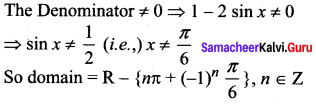
Find the domain of \(\frac{1}{1-2 \sin x}\)
Solution:
Samacheer Kalvi 11th Maths Solutions Chapter 1 Sets Ex 1.3 69

Question 7.
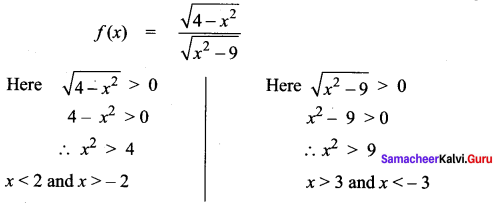
Find the largest possible domain of the real valued function f(x) = \(\frac{\sqrt{4-x^{2}}}{\sqrt{x^{2}-9}}\)
Solution:
Samacheer Kalvi 11th Maths Solutions Chapter 1 Sets Ex 1.3 70
∴ No largest possible domain
The domain is null set

Samacheer Kalvi 11th Maths Solutions Chapter 1 Sets Ex 1.3

Question 8.
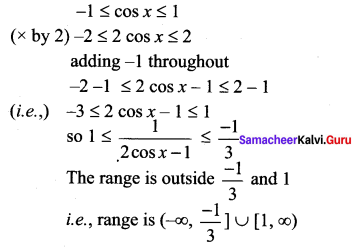
Find the range of the function \(\frac{1}{2 \cos x-1}\)
Solution:
The range of cos x is – 1 to 1
Samacheer Kalvi 11th Maths Solutions Chapter 1 Sets Ex 1.3 75

Samacheer Kalvi 11th Maths Solutions Chapter 1 Sets Ex 1.3

Question 9.
Show that the relation xy = -2 is a function for a suitable domain. Find the domain and the range of the function.
Solution:
(i) Let f: R → R defined as f: x → \(-\frac{2}{x}\) then
f(x) = \(-\frac{2}{x}\) or y = \(-\frac{2}{x}\)
⇒ xy = – 2
f (x) is not a function since f(x) is not defined for x = 0

(ii) Let f: R – {0} → R defined as f(x) = \(-\frac{2}{x}\)
⇒ y = \(-\frac{2}{x}\) = xy = – 2
f is one – one but not onto because 0 has no preimage.
f : R – {0} → R {0} is a function which is one- one and onto
Domain = R – {0}
Range = R – {0}

Question 10.
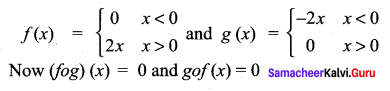
If f, g : R ➝ R are defined by f(x) = |x| + x and g(x) = |x| – x, find gof and fog.
Solution:
Samacheer Kalvi 11th Maths Solutions Chapter 1 Sets Ex 1.3 71

Question 11.
If f, g, h are real-valued functions defined on R, then prove that
(f + g)oh = foh + goh. What can you say about fo(g + h)? Justify your answer.
Solution:
Let f + g = k
Samacheer Kalvi 11th Maths Solutions Chapter 1 Sets Ex 1.3 72
= (f + g((h(x))
= f[h(x)] + g [h(x)]
= foh + goh
(i.e.,)(f + g)(o)h = foh + goh
fo(g + h) is also a function

Samacheer Kalvi 11th Maths Solutions Chapter 1 Sets Ex 1.3

Question 12.
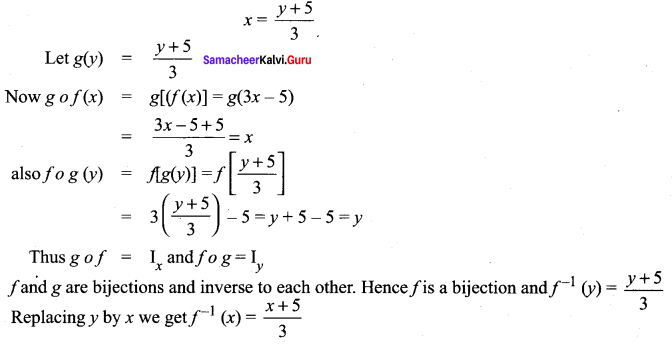
If f: R ➝ R is defined by f(x) = 3x – 5, prove that f is a bijection and find its inverse.
Solution:
P(x) = 3x – 5
Let y = 3x – 5 ⇒ 3x = y + 5
Samacheer Kalvi 11th Maths Solutions Chapter 1 Sets Ex 1.3 80

Question 13.
The weight of the muscles of a man is a function of his bodyweight x and can be expressed as W(x) = 0.35x. Determine the domain of this function.
Solution:
Given W(x) = 0.35x
W(0) = W(1) = 0.35, W(2) = 0.7 ………….. W ( ∞ ) = ∞
Since x. denotes the bodyweight of a man, it will take only positive integers. That is x > 0.
W(x) : (0, ∞) → (0, ∞)
Domain = (0, ∞) , Range = (0, ∞)

Samacheer Kalvi 11th Maths Solutions Chapter 1 Sets Ex 1.3

Question 14.
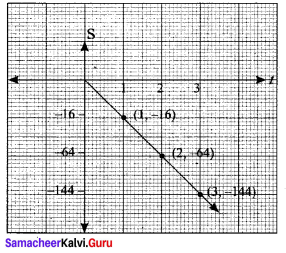
The distance of an object falling is a function of time t and can be expressed as s(t) = -16t2. Graph the function and determine if it is one-to-one.
Solution:
s(t) = -16t2
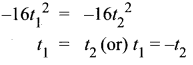
Suppose S(t1) = S(t2)
Samacheer Kalvi 11th Maths Solutions Chapter 1 Sets Ex 1.3 85
since time cannot be negative, we to take t1 = t2
Hence it is one-one.

t 0 1 2 3
s 0 -16 -64 -144

Samacheer Kalvi 11th Maths Solutions Chapter 1 Sets Ex 1.3 868

Question 15.
The total cost of airfare on a given route is comprised of the base cost C and the fuel surcharge S in rupee. Both C and S are functions of the mileage m; C(m) = 0.4m + 50 and S(m) = 0.03m. Determine a function for the total cost of a ticket in terms of the mileage and find the airfare for flying 1600 miles.
Solution:
Given the cost of airfare function and fuel surcharge functions are as follows.
C(m) = 0.4 m+ 50 ———- (1)
S (m) = 0.03 m ———- (2)
Total cost of a ticket = C(m) + S(m)
f(x) = 0.4 m + 50 + 0.03 m
f(x) = 0.43 m + 50
Given m = 1600 miles
The cost of Airfare for flying 1600 miles
f( 1600 ) = 0.43 × 1600 + 50
= 688 + 50
= 738
∴ Airfare for flying 1600 miles is Rs. 738.

Samacheer Kalvi 11th Maths Solutions Chapter 1 Sets Ex 1.3

Question 16.
A salesperson whose annual earnings can be represented by the function A(x) = 30, 000 + 0.04x, where x is the rupee value of the merchandise he sells. His son is also in sales and his earnings are represented by the function S(x) = 25, 000 + 0.05x. Find (A + S)(x) and determine the total family income if they each sell Rupees 1,50,00,000 worth of merchandise.
Solution:
A(x) = 30, 000 + 0.04x, where x is merchandise rupee value
S(x) = 25000 + 0.05 x
(A + S) (x) = A(x) + S(x)
= 30000 + 0.04x + 25000 + 0.05 x
= 55000 + 0.09x
(A + S) (x) = 55000+ 0.09x
They each sell x = 1,50,00,000 worth of merchandise
(A + S) x = 55000 + 0.09 (1,50,00,000)
= 55000 + 13,50,000
∴ Total income of family = ₹ 14,05,000

Question 17.
The function for exchanging American dollars for Singapore Dollar on a given day is f(x) = 1.23x, where x represents the number of American dollars. On the same day, the function for exchanging Singapore Dollar to Indian Rupee is g(y) = 50.50y, where y represents the number of Singapore dollars. Write a function which will give the exchange rate of American dollars in terms of the Indian rupee.
Solution:
f(x) = 1. 23x where x is number of American dollars.
g(y) = 50.50y where y is number of Singapore dollars.
gof(x) = g(f(x))
= g(1. 23x)
= 50.50 (1.23x)
= 62.115 x

Samacheer Kalvi 11th Maths Solutions Chapter 1 Sets Ex 1.3

Question 18.
The owner of a small restaurant can prepare a particular meal at a cost of Rupees 100. He estimates that if the menu price of the meal is x rupees, then the number of customers who will order that meal at that price in an evening is given by the function D(x) = 200 – x. Express his day revenue, total cost and profit on this meal as functions of x.
Solution:
Number of customers = 200 – x
Cost of one meal = Rs. 100
Cost of (200 – x) meals = (200 – x) × 100
Menu price of the meal = Rs. x
∴ Total menu price of (200 – x) meals = (200 – x) x
Profit = Menu price – Cost
= (200 – x) x – (200 – x) 100
Profit = (200 – x) (x – 100)

Question 19.
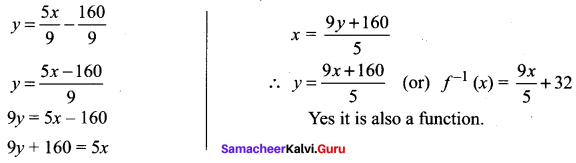
The formula for converting from Fahrenheit to Celsius temperatures is \(y=\frac{5 x}{9}-\frac{160}{9}\)
Find the inverse of this function and determine whether the inverse is also a function.
Solution:
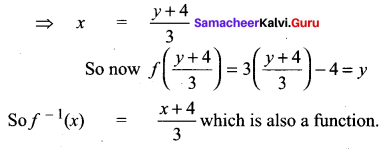
Samacheer Kalvi 11th Maths Solutions Chapter 1 Sets Ex 1.3 56

Question 20.
A simple cipher takes a number and codes it, using the function f(x) = 3x – 4. Find the inverse of this function, determine whether the inverse is also a function and verify the symmetrical property about the line y = x (by drawing the lines).
Solution:
f(x) = 3x – 4
Let y = 3x – 4
Samacheer Kalvi 11th Maths Solutions Chapter 1 Sets Ex 1.3 57

Samacheer Kalvi 11th Maths Solutions Chapter 1 Sets Ex 1.3 Additional Questions

Question 1.
Find the domain and range of the function \(f(x)=\frac{1}{\sqrt{x-5}}\)
Solution:
Given that : f(x) \(f(x)=\frac{1}{\sqrt{x-5}}\)
Here, it is clear that / (x) is real when x – 5 > 0 ⇒ x > 5
Hence, the domain = (5, ∞)
Now to find the range put
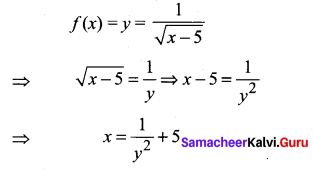
Samacheer Kalvi 11th Maths Solutions Chapter 1 Sets Ex 1.3 90
For x ∈ (5, ∞), y ∈ R+.
Hence, the range of f = R+.

Samacheer Kalvi 11th Maths Solutions Chapter 1 Sets Ex 1.3

Question 2.
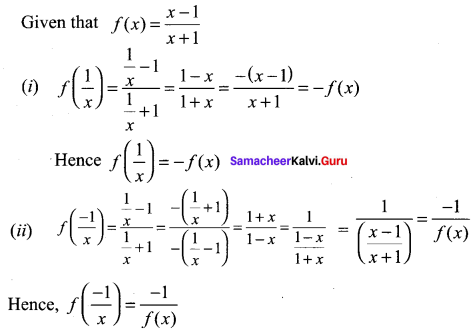
If \(f(x)=\frac{x-1}{x+1}\), then show that
Samacheer Kalvi 11th Maths Solutions Chapter 1 Sets Ex 1.3 91
Solution:
Samacheer Kalvi 11th Maths Solutions Chapter 1 Sets Ex 1.3 92

Question 3.
Find the domain of each of the following functions given by:
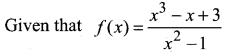
\(f(x)=\frac{x^{3}-x+3}{x^{2}-1}\)
Solution:
Samacheer Kalvi 11th Maths Solutions Chapter 1 Sets Ex 1.3 93
Here, f(x) is not defined if x2 – 1 ≠ 0
(x – 1) (x + 1) ≠ 0
x ≠ 1, x ≠ -1
Hence, the domain of f = R – {-1, 1}

Samacheer Kalvi 11th Maths Solutions Chapter 1 Sets Ex 1.3

Question 4.
Find the range of the following functions given by
f(x) = 1 + 3 cos 2x
Solution:
Given that: f(x) = 1 + 3 cos 2x
We know that -1 ≤ cos 2x ≤ 1
⇒ -3 ≤ 3 cos 2x ≤ 3 ⇒ -3 + 1 ≤ 1 + 3 cos 2x ≤ 3 + 1
⇒ -2 ≤ 1 + 3 cos 2x ≤ 4 ⇒ -2 ≤ f(x) ≤ 4
Hence the range of f = [-2, 4]

Question 5.
Find the domain and range of the function \(f(x)=\frac{x^{2}-9}{x-3}\)
Solution:
Samacheer Kalvi 11th Maths Solutions Chapter 1 Sets Ex 1.3 55
Domain off: Clearly f(x) is not defined for x – 3 = 0 i.e. x = 3.
Therefore, Domain (f) = R – {3}
Range off: Let f(x) = y. Then,
Samacheer Kalvi 11th Maths Solutions Chapter 1 Sets Ex 1.3 65
It follows from the above relation that y takes all real values except 6 when x takes values in the set R – {3}. Therefore, Range (f) = R {6}.

Samacheer Kalvi 11th Maths Solutions Chapter 1 Sets Ex 1.3

Question 6.
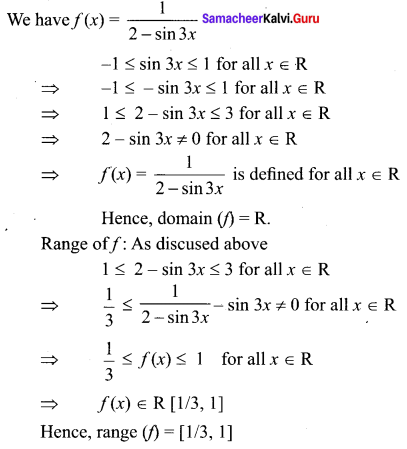
Find the range of the following functions given by f(x) = \(\frac{1}{2-\sin 3 x}\)
Solution:
Samacheer Kalvi 11th Maths Solutions Chapter 1 Sets Ex 1.3 565

Samacheer Kalvi 11th Maths Solutions Chapter 1 Sets Ex 1.3 Read More »

Samacheer Kalvi 11th Maths Solutions Chapter 8 Vector Algebra – I Ex 8.1

You can Download Samacheer Kalvi 11th Maths Book Solutions Guide Pdf, Tamilnadu State Board help you to revise the complete Syllabus and score more marks in your examinations.

Tamilnadu Samacheer Kalvi 11th Maths Solutions Chapter 8 Vector Algebra – I Ex 8.1

Question 1.
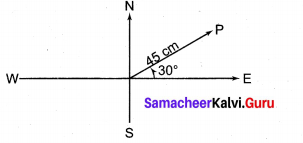
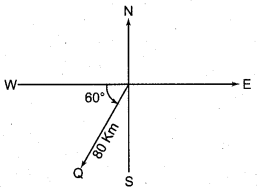
Represent graphically the displacement of
(i) 45 cm 30 ° north of east
(ii) 80 km, 60° south of west
Solution:
(i) 45 cm 30 0 north of east
Samacheer Kalvi 11th Maths Solutions Chapter 8 Vector Algebra - I Ex 8.1 1
(ii) 80 km 60° south of west
Samacheer Kalvi 11th Maths Solutions Chapter 8 Vector Algebra - I Ex 8.1 2

Question 2.
Prove that the relation R defined on the set V of all vectors by \(\vec{a}\) R \(\vec{b}\) if \(\vec{a}=\vec{b}\) is an equivalence relation on V.
Solution:
\(\vec{a}\) R \(\vec{b}\) is given as \(\vec{a}=\vec{b}\).
(i) \(\vec{a}\) = \(\vec{a}\) ⇒ \(\vec{a}\) R \(\vec{a}\)
(i.e.,) the relation is reflexive.

(ii) \(\vec{a}=\vec{b}\) ⇒ \(\vec{b}\) = \(\vec{a}\)
(i.e.,) \(\vec{a}\) R \(\vec{b}\) – \(\vec{b}\) R \(\vec{a}\)
So, the relation is symmetric.

(iii) \(\vec{a}=\vec{b} ; \vec{b}=\vec{c} \Rightarrow \vec{a}=\vec{c}\)
(i.e) \(\vec{a}\) R \(\vec{b}\) ; \(\vec{b}\) R \(\vec{c}\) ⇒ \(\vec{a}\) R \(\vec{c}\)
So the given relation is transitive
So, it is an equivalence relation.

Question 3.
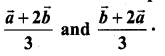
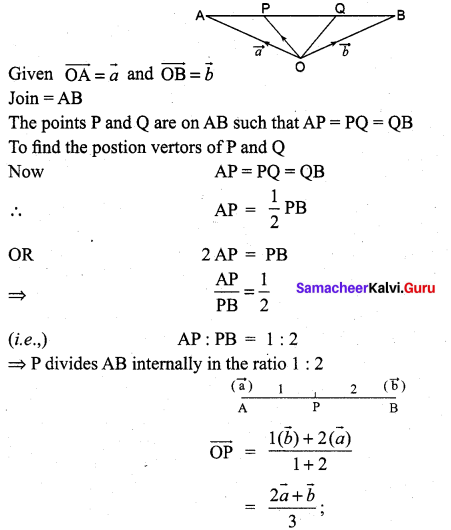
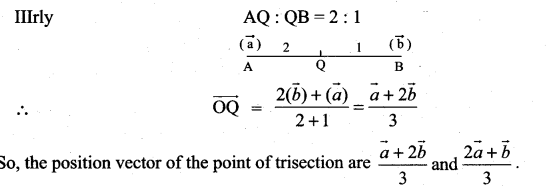
Let \(\vec{a}\) and \(\vec{a}\) be the position vectors of points A and B. Prove that the position vectors of the points which trisect the line segment AB are Samacheer Kalvi 11th Maths Solutions Chapter 8 Vector Algebra - I Ex 8.1 3
Solution:
Samacheer Kalvi 11th Maths Solutions Chapter 8 Vector Algebra - I Ex 8.1 4
Samacheer Kalvi 11th Maths Solutions Chapter 8 Vector Algebra - I Ex 8.1 5

Samacheer Kalvi 11th Maths Solutions Chapter 8 Vector Algebra - I Ex 8.1

Question 4.
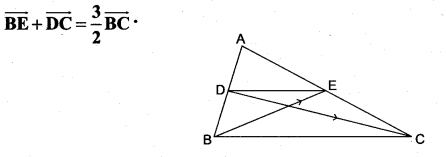
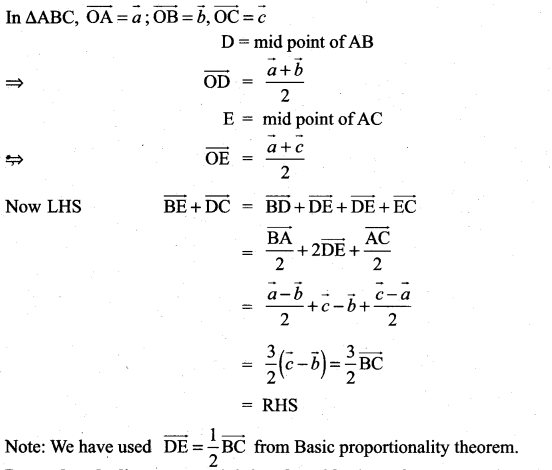
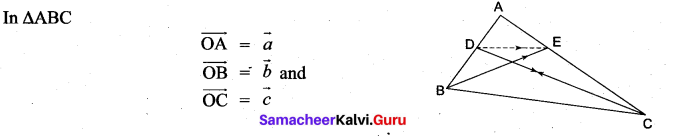
If D and E are the midpoints of the sides AB and AC of a triangle ABC, prove that
Samacheer Kalvi 11th Maths Solutions Chapter 8 Vector Algebra - I Ex 8.1 6
Solution:
Samacheer Kalvi 11th Maths Solutions Chapter 8 Vector Algebra - I Ex 8.1 7

Question 5.
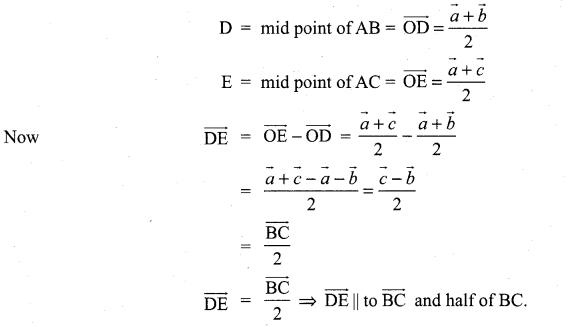
Prove that the line segment joining the midpoints of two sides of a triangle is parallel to the third side whose length is half of the length of the third side.
Solution:
Samacheer Kalvi 11th Maths Solutions Chapter 8 Vector Algebra - I Ex 8.1 8
Samacheer Kalvi 11th Maths Solutions Chapter 8 Vector Algebra - I Ex 8.1 9

Question 6.
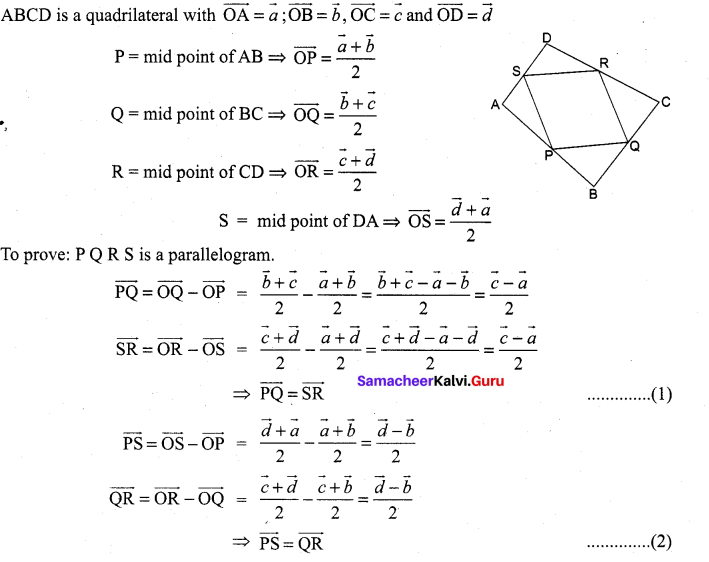
Prove that the line segments joining the midpoints of the adjacent sides of a quadrilateral form a parallelogram.
Solution:
Samacheer Kalvi 11th Maths Solutions Chapter 8 Vector Algebra - I Ex 8.1 10
In a quadrilateral when opposite sides are equal and parallel it is a parallelogram So, PQRS is a parallelogram, from (1) and (2).

Question 7.
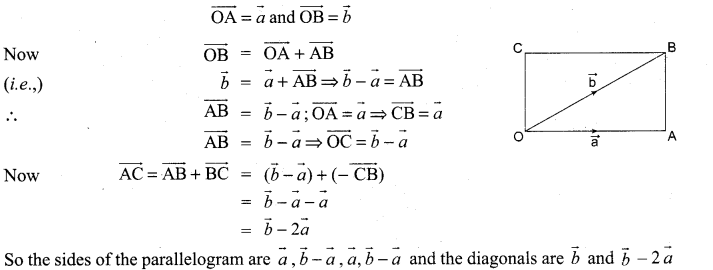
If \(\vec{a}\) and \(\vec{b}\) represent a side and a diagonal of a parallelogram, find the other sides and the other diagonal.
Solution:
OABC is a parallelogram where
Samacheer Kalvi 11th Maths Solutions Chapter 8 Vector Algebra - I Ex 8.1 11

Samacheer Kalvi 11th Maths Solutions Chapter 8 Vector Algebra - I Ex 8.1

Question 8.
If \(\overrightarrow{\mathrm{PO}}+\overrightarrow{\mathrm{OQ}}=\overrightarrow{\mathrm{QO}}+\overrightarrow{\mathrm{OR}}\), prove that the points P, Q, R are collinear.
Solution:
Samacheer Kalvi 11th Maths Solutions Chapter 8 Vector Algebra - I Ex 8.1 12
But Q is a common point.
⇒ P, Q, R are collinear.

Question 9.
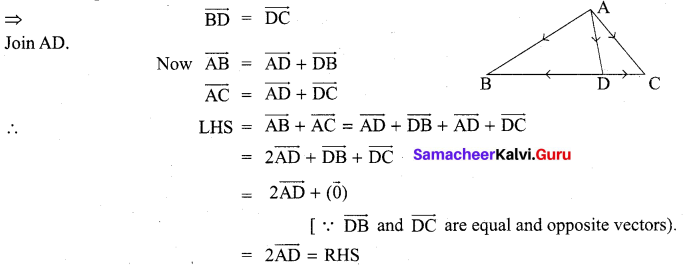
If D is the midpoint of the side BC of a triangle ABC, prove that \(\overrightarrow{\mathbf{A B}}+\overrightarrow{\mathbf{A C}}=2 \overrightarrow{\mathbf{A D}}\)
Solution:
D is the midpoint of ∆ ABC.
Samacheer Kalvi 11th Maths Solutions Chapter 8 Vector Algebra - I Ex 8.1 13

Question 10.
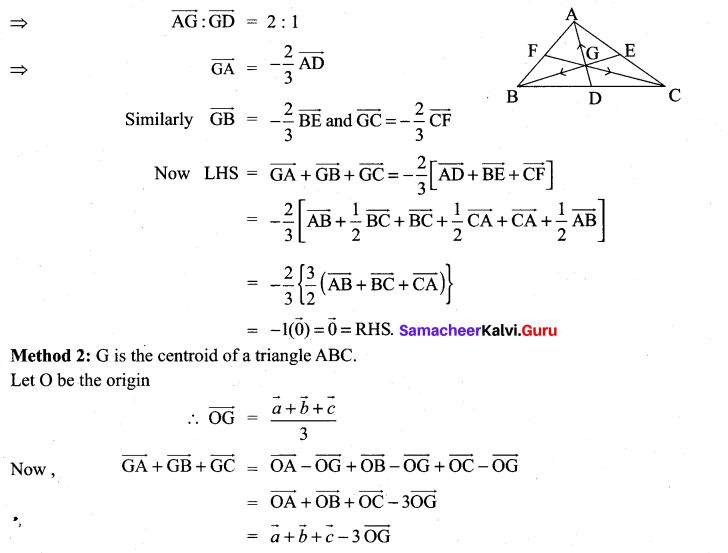
If G is the centroid of a triangle ABC, prove that \(\overrightarrow{\mathrm{GA}}+\overrightarrow{\mathrm{GB}}+\overrightarrow{\mathrm{GC}}=0\)
Solution:
For any triangle ABC,
\(\overrightarrow{\mathrm{GA}}+\overrightarrow{\mathrm{GB}}+\overrightarrow{\mathrm{GC}}=0\)
Now G is the centroid of ∆ABC, which divides the medians (AD, BE and CF) in the ratio 2 : 1.
Samacheer Kalvi 11th Maths Solutions Chapter 8 Vector Algebra - I Ex 8.1 14
Samacheer Kalvi 11th Maths Solutions Chapter 8 Vector Algebra - I Ex 8.1 15

Question 11.
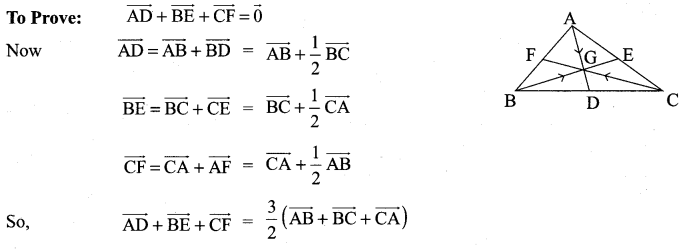
Let A, B, and C be the vertices of a triangle. Let D, E, and F be the midpoints of the sides BC, CA, and AB respectively. Show that \(\overrightarrow{\mathrm{AD}}+\overrightarrow{\mathrm{BE}}+\overrightarrow{\mathrm{CF}}=\overrightarrow{0}\)
Solution:
In ∆ABC, D, E, F are the midpoints of BC, CA, and AB respectively.
Samacheer Kalvi 11th Maths Solutions Chapter 8 Vector Algebra - I Ex 8.1 16
Samacheer Kalvi 11th Maths Solutions Chapter 8 Vector Algebra - I Ex 8.1 17

Question 12.
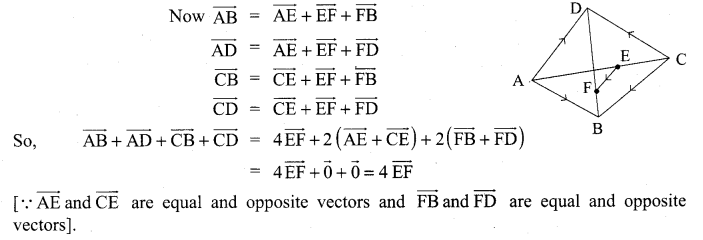
If ABCD is a quadrilateral and E and F are the midpoints of AC and BD respectively, then prove that \(\overrightarrow{\mathbf{A B}}+\overrightarrow{\mathbf{A D}}+\overrightarrow{\mathbf{C B}}+\overrightarrow{\mathbf{C D}}=4 \overrightarrow{\mathrm{EF}}\)
Solution:
ABCD is a quadrilateral in which E and F are the midpoints of AC and BD respectively.
Samacheer Kalvi 11th Maths Solutions Chapter 8 Vector Algebra - I Ex 8.1 18

Samacheer Kalvi 11th Maths Solutions Chapter 8 Vector Algebra – I Ex 8.1 Additional Problems

Question 1.
Shown that the points with position vectors Samacheer Kalvi 11th Maths Solutions Chapter 8 Vector Algebra - I Ex 8.1 22 are collinear.
Solution:
To prove the points P, Q, R are collinear we have to prove that \(\overrightarrow{\mathrm{PQ}}\) = t \(\overrightarrow{\mathrm{PR}}\) where t is a scalar.
Let the given points be P, Q, R.
Samacheer Kalvi 11th Maths Solutions Chapter 8 Vector Algebra - I Ex 8.1 19
So, the points P, Q, R are collinear (i.e,) the given points are collinear.

Question 2.
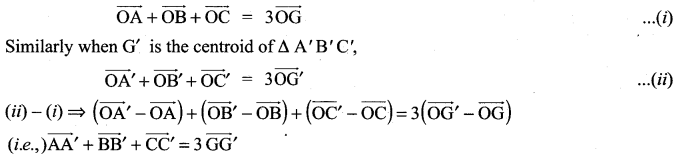
If ABC and A’B’C’ are two triangles and G, G’ be their corresponding centroids, prove that \(\overrightarrow{\mathrm{AA}^{\prime}}+\overrightarrow{\mathrm{BB}^{\prime}}+\overrightarrow{\mathrm{CC}^{\prime}}=3 \overrightarrow{\mathrm{GG}}\)
Solution:
Let O be the origin.
We know when G is the centroid of ∆ ABC,
Samacheer Kalvi 11th Maths Solutions Chapter 8 Vector Algebra - I Ex 8.1 20

Samacheer Kalvi 11th Maths Solutions Chapter 8 Vector Algebra - I Ex 8.1

Question 3.
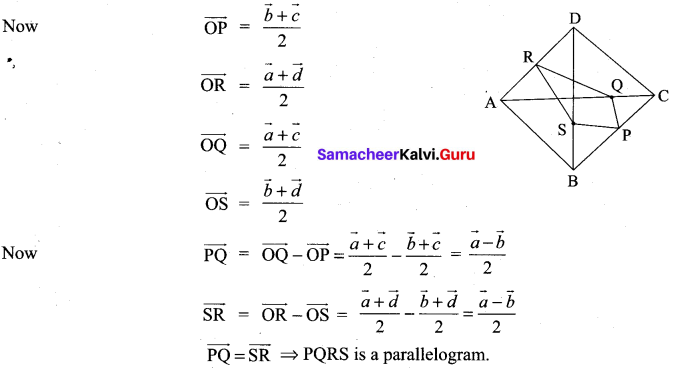
Prove using vectors the mid-points of two opposite sides of a quadrilateral and the mid-points of the diagonals are the vertices of a parallelogram.
Solution:
ABCD is a quadrilateral with position vectors
OA = \(\vec{a}\), OB = \(\vec{b}\), OC = \(\vec{c}\) and OD = \(\vec{d}\)
P is the midpoint of BC and R is the midpoint of AD.
Q is the midpoint of AC and S is the midpoint of BD.
To prove PQRS is a parallelogram. We have to prove that \(\overrightarrow{\mathrm{PQ}}=\overrightarrow{\mathrm{SR}}\)
Samacheer Kalvi 11th Maths Solutions Chapter 8 Vector Algebra - I Ex 8.1 21

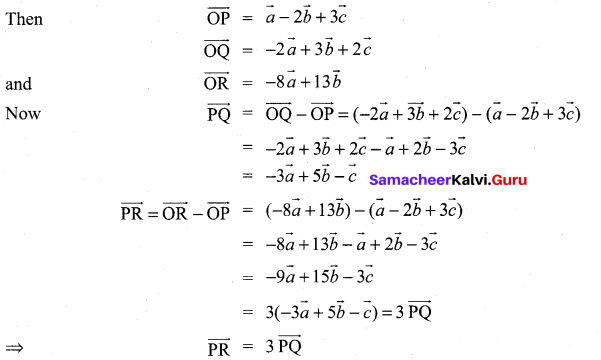
Samacheer Kalvi 11th Maths Solutions Chapter 8 Vector Algebra – I Ex 8.1 Read More »

Samacheer Kalvi 11th Maths Solutions Chapter 1 Sets Ex 1.2

You can Download Samacheer Kalvi 11th Maths Book Solutions Guide Pdf, Tamilnadu State Board help you to revise the complete Syllabus and score more marks in your examinations.

Tamilnadu Samacheer Kalvi 11th Maths Solutions Chapter 1 Sets Ex 1.2

Question 1.
Discuss the following relations for reflexivity, symmetricity and transitivity:

(i) The relation R defined on the set of all positive integers by “mRn if m divides n”.
Solution:
Let Z = {1, 2, 3, ……….}
R is a relation defined on the set of all positive integers by m R n if m divides n
R = { (m, n) : \(\frac{\mathrm{m}}{\mathrm{n}}\) for all m, n ∈ Z } n

(a) Reflexive:
m divides m for all m ∈ Z
∴ (m, m) ∈ R for all m ∈ Z
Hence R is reflexive

(b) Symmetric:
Let (m, n) ∈ R ⇒ m divides n
⇒ n = km for some integers k
But km need not divide m, ie. n need not divide m
∴ (n, m) ∉ R
Hence R is not symmetric.

(c) Transitive:
Let (m, n), (n, r) ∈ R
Then m divides n ⇒ n = km and
n divides r ⇒ r = k1n
r = k1(km) = (k1k) m
m divides r
∴ (m, r) ∈ R
Hence R is transitive.

(ii) Let P denote the set of all straight lines in a plane. The relation R defined by “lRm if l is perpendicular to m”.
Solution:
P = {set of all straight lines in a plane}
lRm ⇒ l is perpendicular to m

(a) lRl ⇒ l is not perpendicular to l
⇒ It is not reflexive

(b) lRm ⇒ l is perpendicular to m
mRl ⇒ m is perpendicular to l
It is symmetric

(c) l perpendicular to m ⇒ m perpendicular to n ⇒ l is parallel to n It is not transitive
Samacheer Kalvi 11th Maths Solutions Chapter 1 Sets Ex 1.2

(iii) Let A be the set consisting of all the members of a family. The relation R defined by “aRb if a is not a sister of b”.
Solution:
Let F = Father,
M = Mother
G = Male child
H = Female child
A = { F, M, G, H }
The relation R is defined by
a R b if a is not a sister of b.
R = {(F, F), (F, M), (F, G), (F, H), (M, F), (M, M), (M, G), (M, H), (G, F), (G, M), (G, G), (G, H), (H, F), (H, M), (H, H)}

(a) Reflexive:
(F, F) , (M , M), (G, G), ( H, H ) ∈ R
∴ R is reflexive.

(b) Symmetric:
For (G, H) ∈ R, we have (H, G) ∉ R
∴ R is not symmetric.

(c) Transitive:
Suppose in a family if we take mother M , male child-G and female child-H.
H is not a sister of M ⇒ HRM, (H, M) ∈ R
M is not a sister of G ⇒ MRG, (M, G) ∈ R
But H is a sister of G ⇒ HRG, (H, G) ∉ R
Thus, for (H, M), (M, G) ∈ R
we have (H, G) ∉ R
∴ R is transitive.

(iv) Let A be the set consisting of all the female members of a family. The relation R
defined by “aRb if a is not a sister of b”.
Solution:
A = {set of all female members of a family}

(a) aRa ⇒ a is a sister of a
It is reflexive

(b) aRb ⇒ a is a sister of b
bRa ⇒ b is the sister of a
⇒ It is symmetric

(c) aRb ⇒ a is a sister of b bRc ⇒ b is a sister of c aRc ⇒ a can be the sister of c It is not transitive.

(v) On the set of natural numbers the relation R defined by “xRy if x + 2y = 1”.
Solution:
x + 2y = 1 for x, y ∈ N
There is no x , y ∈ N satisfying x + 2y = 1
∴ The relation R is an empty relation.
An empty relation is symmetric and transitive.
∴ R is symmetric and transitive.
R is not reflexive

Samacheer Kalvi 11th Maths Solutions Chapter 1 Sets Ex 1.2

Question 2.
Let X = {a, b, c, d} and R = {(a, a), {b, b), (a, c)}. Write down the minimum number
of ordered pairs to be included to R to make it
(i) reflexive
(ii) symmetric
(iii) transitive
(iv) equivalence
Solution:
X = {a, b, c, d}
R = {(a, a), (b, b), (a, c)}
(i) To make R reflexive we need to include (c, c) and (d, d)
(ii) To make R symmetric we need to include (c, a)
(iii) R is transitive
(iv) To make R reflexive we need to include (c, c)
To make R symmetric we need to include (c, c) and (c, a) for transitive
∴ The relation now becomes
R = {(a, a), (b, b), (a, c), (c, c), (c, a)}
∴ R is equivalence relation.

Question 3.
Let A = {a, b, c} and R = {(a, a), (b, b), (a, c)}. Write down the minimum number of ordered pairs to be included to R to make it
(i) reflexive
(ii) symmetric
(iii) transitive
(iv) equivalence
Solution:
Given A = {a, b, c }
R = { (a, a), (b, b),(a, c) }
(i) The minimum ordered pair to be included to R in order to make it reflexive is (c, c).
(ii) The minimum ordered pair to be included to R in order to make it symmetrical is (c, a).
(iii) R is transitive. We need not add any pair.
(iv) After including the ordered pairs (c, c),(c, a) to R the new relation becomes
R1 = { (a, a), (b, b), (c, c) , (a, c) , (c, a) }
R1 is reflexive symmetric and transitive.
∴ R1 is an equivalence relation.

Samacheer Kalvi 11th Maths Solutions Chapter 1 Sets Ex 1.2

Question 4.
Let P be the set of all triangles in a plane and R be the relation defined on P as aRb if a is
similar to b. Prove that R is an equivalence relation.
Solution:
P = {set of all triangles in a plane}
aRb ⇒ a similar to b

(a) aRa ⇒ every triangle is similar to itself
∴ aRa is reflexive

(b) aRb ⇒ if a is similar to b ⇒ b is also similar to a.
⇒ It is symmetric

(c) aRb ⇒ bRc ⇒ aRc
a is similar to b and b is similar to c
⇒ a is similar to a
⇒ It is transitive
∴ R is an equivalence relation

Samacheer Kalvi 11th Maths Solutions Chapter 1 Sets Ex 1.2

Question 5.
On the set of natural numbers let R be the relation defined by aRb if 2a + 3b = 30. Write down the relation by listing all the pairs. Check whether it is
(i) reflexive
(ii) symmetric
(iii) transitive
(iv) equivalence
Solution:
N = {set of natural numbers}
R ={(3, 8), (6, 6), (9, 4), (12, 2)}

(a) (3, 3) ∉ R ⇒ R is not reflexive
2a + 3b = 30
3b = 30 – 2a
b = \(\frac{30-2 a}{3}\)

(b) (3, 8) ∈ R(8, 3) ∉ R
⇒ R is not symmetric

(c) (a, b) (b, c) ∉ R ⇒ R is transitive
∴ It is not an equivalence relation.

Question 6.
Prove that the relation “friendship” is not an equivalence relation on the set of all people in Chennai.
Solution:
If a is a friend of b and b is a friend of c, then a need not be a friend of c.
a R b and b R c does not imply a R c.
∴ R is not transitive.
∴ The relation is not an equivalence relation.

Samacheer Kalvi 11th Maths Solutions Chapter 1 Sets Ex 1.2

Question 7.
On the set of natural numbers let R be the relation defined by aRb if a + b ≤ 6. Write down the relation by listing all the pairs. Check whether it is
(i) reflexive
(ii) symmetric
(iii) transitive
(iv) equivalence
Solution:
Set of all natural numbers aRb if a + b ≤ 6
R= {(1, 1), (1, 2), (1, 3), (1, 4), (1, 5), (2, 1), (2, 2), (2, 3), (2, 4), (3, 1), (3, 2), (3, 3), (4, 1), (4, 2), (5, 1)}
(i) (5, 1) ∈ R but(5, 5) ∉ R
It is not reflexive

(ii) aRb ⇒ bRa ⇒ It is symmetric

(iii) (4, 2), (2, 3) ∈ R ⇒ (4, 3) ∉ R
∴ It is not transitive

(iv) ∴ It is not an equivalence relation

Question 8.
Let A = {a, b, c}. What is the equivalence relation of smallest cardinality on A? What is the equivalence relation of largest cardinality on A?
Solution:
A = { a, b, c }
Let R1 = { (a, a),(b, b),(c, c) }
Clearly, R1 is reflexive, symmetric, and transitive.
Thus R1 is the equivalence relation on A of smallest cardinality, n (R1) = 3
Let R2 = { (a, a), (b, b), (c, c), (a, b), (b, a), (b, c), (c, b), (c, a), (a, c)}

(i) Reflexive:
(a, a) , (b, b) , (c, c) ∈ R
∴ R2 is reflexive.

(ii) Symmetric:
(a , b) ∈ R2 we have (b, a) ∈ R2
(b , c) ∈ R2 we have (c, b) ∈ R2
(c , a) ∈ R2 we have (a, c) ∈ R2
∴ R2 is symmetric.

(iii) Transitive:
(a, b), (b, c) ∈ R2 ⇒ (a, c) ∈ R2
(b, c), (c, a) ∈ R2 ⇒ (b, a) ∈ R2
(c, a) , (a, b) ∈ R2 ⇒ (c, b) ∈ R2
∴ R2 is transitive and R2 is an equivalence relation of largest cardinality.
n (R2) = 9

Samacheer Kalvi 11th Maths Solutions Chapter 1 Sets Ex 1.2

Question 9.
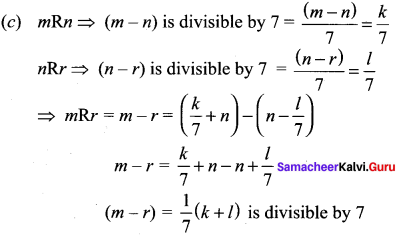
In the set Z of integers, define mRn if m – n is divisible by 7. Prove that R is an equivalence relation.
Solution:
mRn if m – n is divisible by 7
(a) mRm = m – m = 0
0 is divisible by 7
∴ It is reflexive

(b) mRn = {m – n) is divisible by 7
nRm = (n – m) = – {m – n) is also divisible by 7
It is symmetric
Samacheer Kalvi 11th Maths Solutions Chapter 1 Sets Ex 1.2 1

It is transitive
mRn if m – n is divisible by 7
∴ R is an equivalence relation.

Samacheer Kalvi 11th Maths Solutions Chapter 1 Sets Ex 1.2 Additional Questions

Question 1.
Find the range of the function.
f = {(1, x), (1, y), (2, x), (2, y), (3, z)}
Solution:
The range of the function is {x, y, z}.

Question 2.
For n, m ∈ N, It means that it is a factor of n & m. Then find whether the given relation is an equivalence relation.
Solution:
Since n is a factor of n. So the relation is reflexive.
When n is a factor of m (where m ≠ n) then m cannot be a factor of n.
So the relation is not symmetric when n is a factor of m and m is a factor of p then n will be a factor of p. So the given relation is transitive. So it is not an equivalence relation.

Samacheer Kalvi 11th Maths Solutions Chapter 1 Sets Ex 1.2

Question 3.
Verify whether the relation “is greater than” is an equivalence relation.
Solution:
You can do it yourself.

Samacheer Kalvi 11th Maths Solutions Chapter 1 Sets Ex 1.2 Read More »

Samacheer Kalvi 11th Maths Solutions Chapter 7 Matrices and Determinants Ex 7.1

You can Download Samacheer Kalvi 11th Maths Book Solutions Guide Pdf, Tamilnadu State Board help you to revise the complete Syllabus and score more marks in your examinations.

Tamilnadu Samacheer Kalvi 11th Maths Solutions Chapter 7 Matrices and Determinants Ex 7.1

Question 1.
Construct an m × n matrix A = [aij], where aij is given by
Samacheer Kalvi 11th Maths Solutions Chapter 7 Matrices and Determinants Ex 7.1 1
Solution:
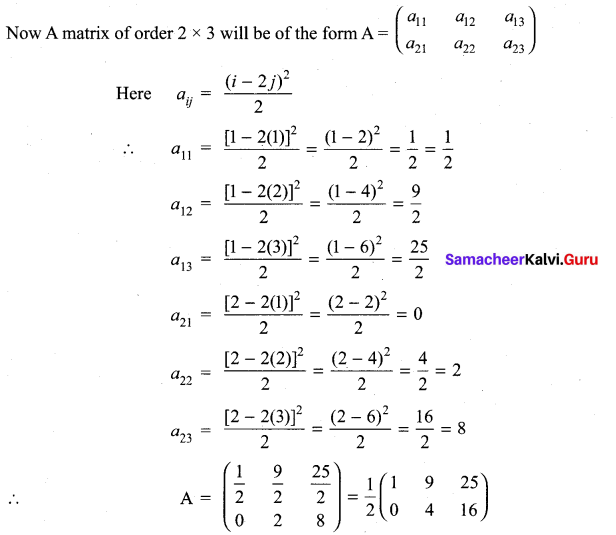
(i) aij = \(\frac{(i-2 j)^{2}}{2}\)
Here m = 2, n = 3
So we have to construct a matrix of order 2 × 3
Samacheer Kalvi 11th Maths Solutions Chapter 7 Matrices and Determinants Ex 7.1 2

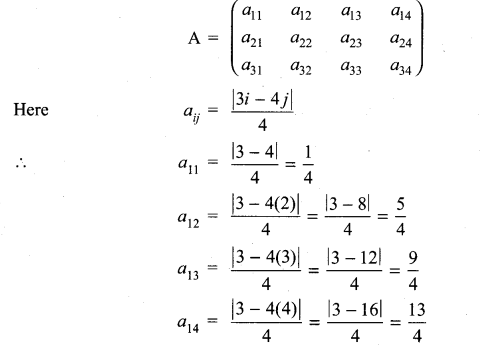
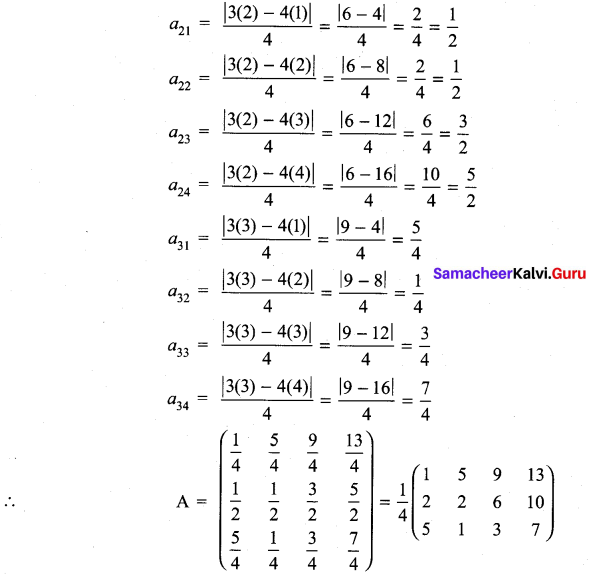
(ii) Here m = 3 and n = 4
So we have to construct a matrix order 3 × 4
The general form of a matrix of order 3 × 4 will be
Samacheer Kalvi 11th Maths Solutions Chapter 7 Matrices and Determinants Ex 7.1 3
Samacheer Kalvi 11th Maths Solutions Chapter 7 Matrices and Determinants Ex 7.1 4

Question 2.
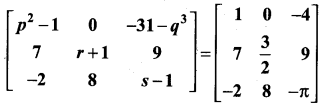
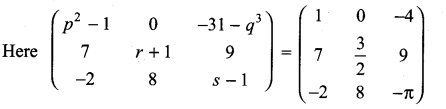
Find the values of p, q, r and s if
Samacheer Kalvi 11th Maths Solutions Chapter 7 Matrices and Determinants Ex 7.1 5
Solution:
When two matrices (of the same order) are equal then their corresponding entries are equal.
Samacheer Kalvi 11th Maths Solutions Chapter 7 Matrices and Determinants Ex 7.1 6
p2 – 1 = 1 ………… (1)
– 31 – q3 = – 4 ……….. (2)
r + 1 = \(\frac{3}{2}\) ……… (3)
s – 1 = – π ……….. (4)
(1) ⇒ p2 – 1 ⇒ p2 = 1 + 1 = 2
p = ±√2
(2) ⇒ – 31 – q3 – 4
31 + q3 = 4
q3 = 4 – 31 = – 27
q3 = (-3)3
q = – 3
(3) ⇒ r + 1 = \(\frac{3}{2}\)
r = \(\frac{3}{2}\) – 1 = \(\frac{1}{2}\)
(4) ⇒ s – 1 = – π
s = 1 – π
∴ The required values are
p = ±√2,
q = 3,
r = \(\frac{1}{2}\),
s = 1 – π

Samacheer Kalvi 10th Maths Solutions Chapter 3 Algebra Additional Questions

Question 3.
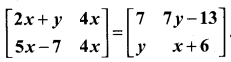
Determine the value of x + y if Samacheer Kalvi 11th Maths Solutions Chapter 7 Matrices and Determinants Ex 7.1 7
Solution:
\(\left[ \begin{matrix} 2x\quad +\quad y & 4x \\ 5x\quad -\quad 7 & 4x \end{matrix} \right] \) = \(\left[ \begin{matrix} 7 & 7y\quad -\quad 13 \\ y & x\quad +\quad 6 \end{matrix} \right]\)
Equating the corresponding entries
2x + y = 7 ………. (1)
4x = 7y – 13
4x – 7y = – 13 ………. (2)
5x – 7 = y
5x – y = 7 ………. (3)
4x = x + 6
4x – x = 6
3x = 6
x = \(\frac{6}{3}\) = 2 ………. (4)
Substituting for x in equation (1)
(1) ⇒ 2 × 2 + y = 7
y = 7 – 4 = 3
The required values are x = 2 and y = 3
x + y = 2 + 3 = 5
x + y = 5

Question 4.
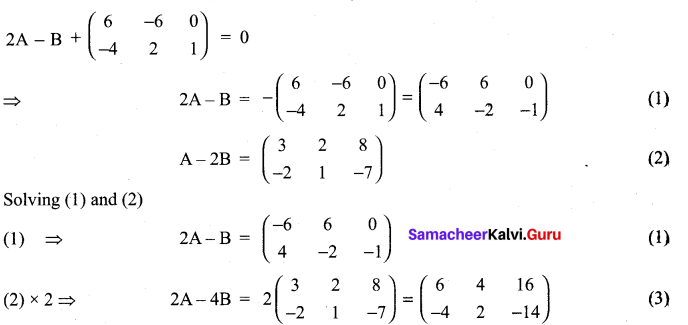
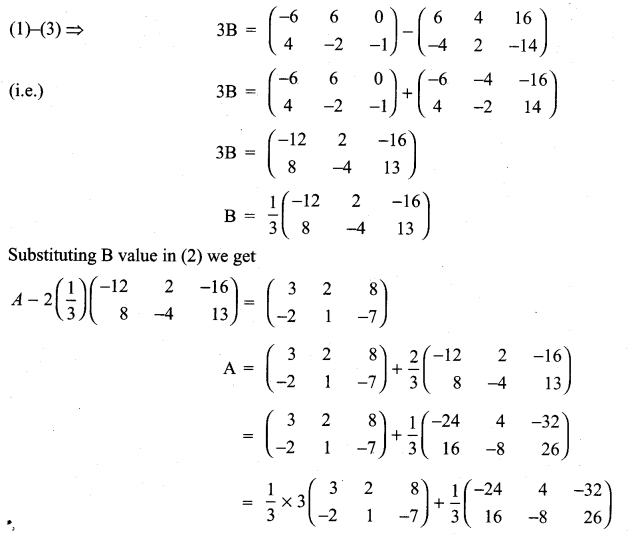
Determine the matrices A and B if they satisfy
Samacheer Kalvi 11th Maths Solutions Chapter 7 Matrices and Determinants Ex 7.1 8
Solution:
Samacheer Kalvi 11th Maths Solutions Chapter 7 Matrices and Determinants Ex 7.1 9
Samacheer Kalvi 11th Maths Solutions Chapter 7 Matrices and Determinants Ex 7.1 10
Samacheer Kalvi 11th Maths Solutions Chapter 7 Matrices and Determinants Ex 7.1 11

Question 5.
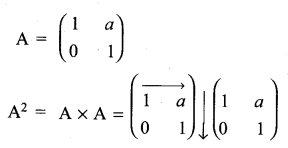
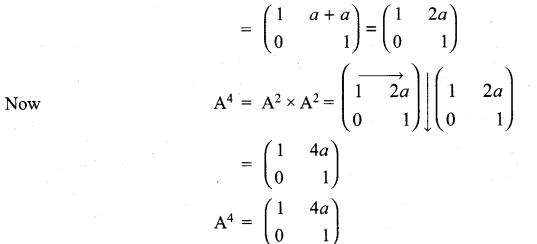
If A = \(\left[\begin{array}{ll}{\mathbf{1}} & {\boldsymbol{a}} \\ {\mathbf{0}} & {\mathbf{1}}\end{array}\right]\), then compute A4
Solution:
Samacheer Kalvi 11th Maths Solutions Chapter 7 Matrices and Determinants Ex 7.1 12
Samacheer Kalvi 11th Maths Solutions Chapter 7 Matrices and Determinants Ex 7.1 13

Question 6.
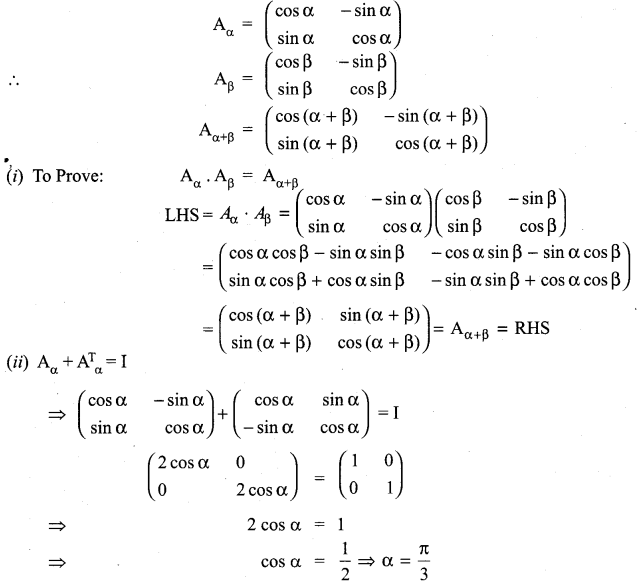
Consider the matrix Aα = \(\left[\begin{array}{cc}{\cos \alpha} & {-\sin \alpha} \\ {\sin \alpha} & {\cos \alpha}\end{array}\right]\)
(i) Show that AαAβ = Aα + β.
(ii) Find all possible real values of satisfying the condition Aα + ATα = 1.
Solution:
Samacheer Kalvi 11th Maths Solutions Chapter 7 Matrices and Determinants Ex 7.1 14
General solution is α = 2nπ + \(\frac{\pi}{3}\), n ∈ Z

Question 7.
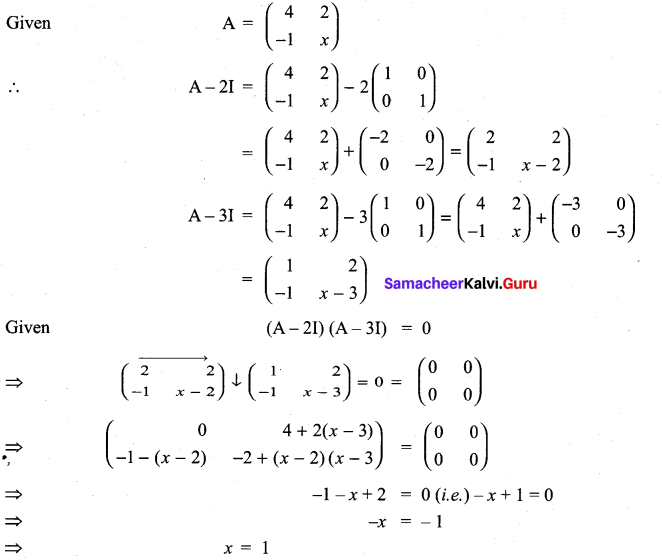
If A = \(\left[\begin{array}{rr}{4} & {2} \\ {-1} & {x}\end{array}\right]\) such that (A – 2I) (A – 3I) = 0, find the value of x.
Solution:
Samacheer Kalvi 11th Maths Solutions Chapter 7 Matrices and Determinants Ex 7.1 15

Question 8.
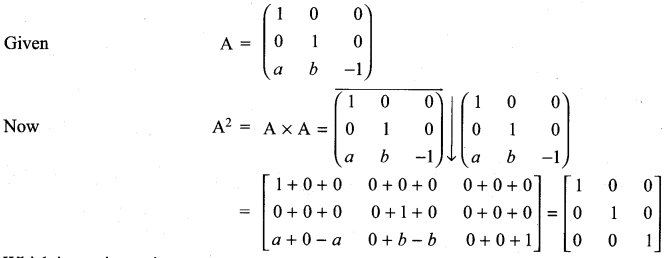
If A = \(\left[\begin{array}{ccc}{\mathbf{1}} & {\mathbf{0}} & {\mathbf{0}} \\ {\mathbf{0}} & {\mathbf{1}} & {\mathbf{0}} \\ {\boldsymbol{a}} & {\boldsymbol{b}} & {-\mathbf{1}}\end{array}\right]\), show that A2 is a unit matrix.
Solution:
Samacheer Kalvi 11th Maths Solutions Chapter 7 Matrices and Determinants Ex 7.1 16

Question 9.
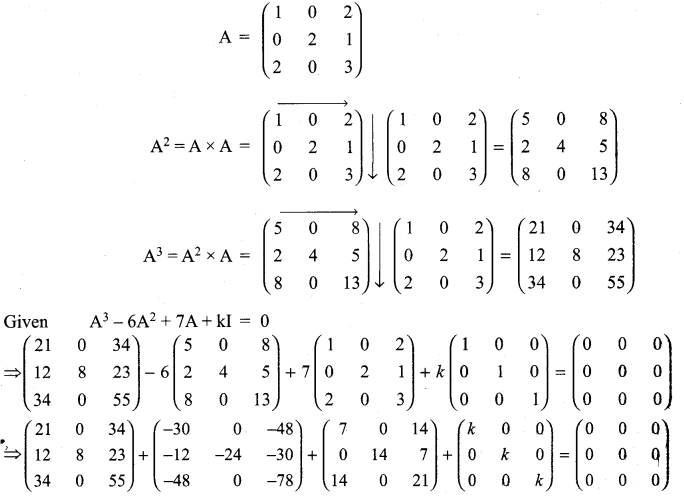
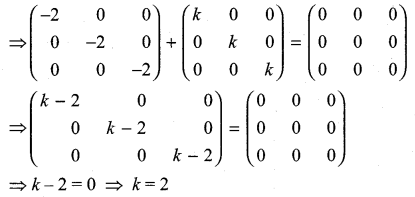
If A = Samacheer Kalvi 11th Maths Solutions Chapter 7 Matrices and Determinants Ex 7.1 17 and A3 – 6A2 + 7A + KI = 0, find the value of k.
Solution:
Samacheer Kalvi 11th Maths Solutions Chapter 7 Matrices and Determinants Ex 7.1 18
Samacheer Kalvi 11th Maths Solutions Chapter 7 Matrices and Determinants Ex 7.1 19

Question 10.
Give your own examples of matrices satisfying the following conditions in each case:
(i) A and B such that AB ≠ BA.
(ii) A and B such that AB = 0 = BA, A ≠ 0 and B ≠ 0.
(iii) A and B such that AB = 0 and BA ≠ 0.
Solution:
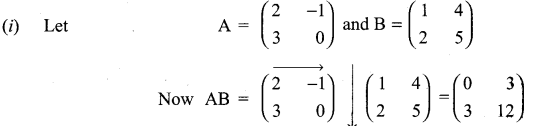
Samacheer Kalvi 11th Maths Solutions Chapter 7 Matrices and Determinants Ex 7.1 20
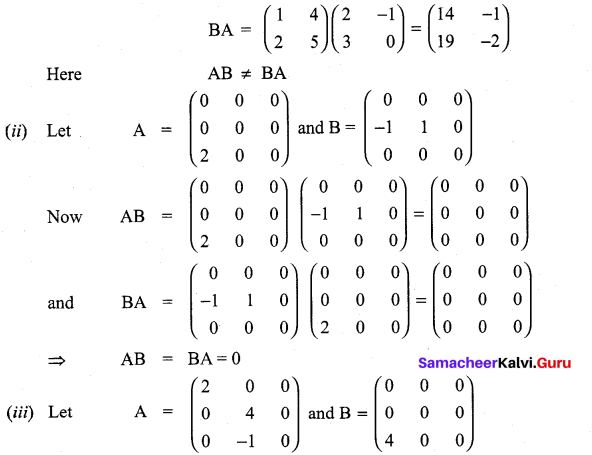
Samacheer Kalvi 11th Maths Solutions Chapter 7 Matrices and Determinants Ex 7.1 21
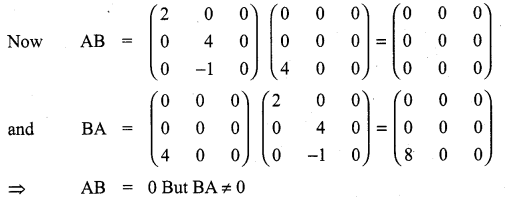
Samacheer Kalvi 11th Maths Solutions Chapter 7 Matrices and Determinants Ex 7.1 22

Question 11.
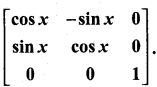
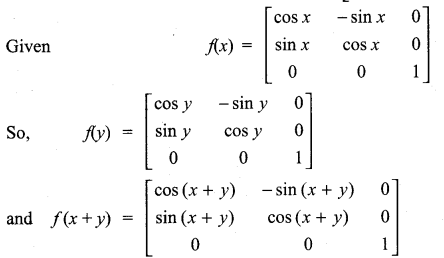
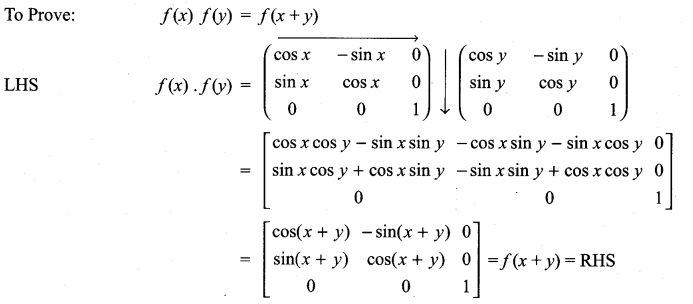
Show that f(x) f(y) = f(x + y), where f(x) = Samacheer Kalvi 11th Maths Solutions Chapter 7 Matrices and Determinants Ex 7.1 23
Solution:
Samacheer Kalvi 11th Maths Solutions Chapter 7 Matrices and Determinants Ex 7.1 24
Samacheer Kalvi 11th Maths Solutions Chapter 7 Matrices and Determinants Ex 7.1 25

Question 12.
If A is a square matrix such that A2 = A, find the value of 7A – (I + A)3.
Solution:
Given A is a square matrix such that A2 = A.
(I + A)3 = (I + A) (I + A) (I + A)
= (I . I + I . A + A . I + A . A) (I + A)
= (I + A + A + A2) (I + A)
= (I + 2A + A ) (I + A)
[Given A2 = A]
= (I + 3A) (I + A)
= I . I + I . A + 3A . I + 3A . A
= I + A + 3A + 3A2
= I + 4A + 3A
[Given A2 = A]
(I + A)3 = I + 7A
∴ 7A – (I + A)2 = 7A – (I + 7A)
= 7A – I – 7A
7A – (I + A)2 = – I

Question 13.
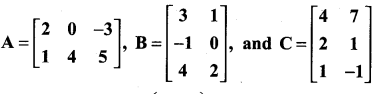
Verify the property A (B + C) = AB + AC, when the matrices A, B, and C are given by
Samacheer Kalvi 11th Maths Solutions Chapter 7 Matrices and Determinants Ex 7.1 26
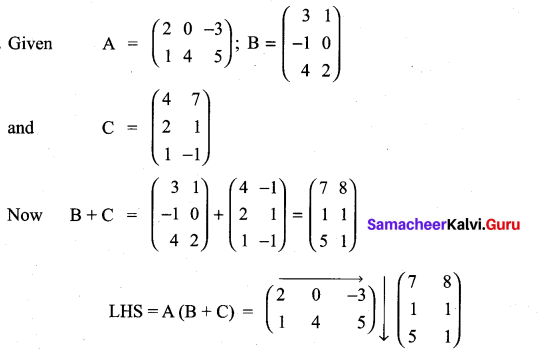
Solution:
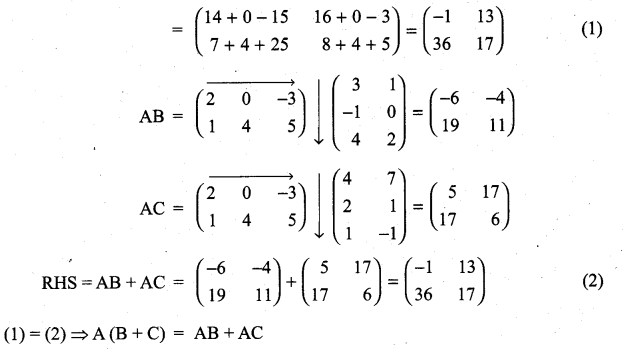
Samacheer Kalvi 11th Maths Solutions Chapter 7 Matrices and Determinants Ex 7.1 27
Samacheer Kalvi 11th Maths Solutions Chapter 7 Matrices and Determinants Ex 7.1 28

Question 14.
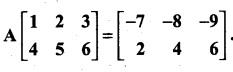
Find the matrix A which satisfies the matrix relation Samacheer Kalvi 11th Maths Solutions Chapter 7 Matrices and Determinants Ex 7.1 29
Solution:
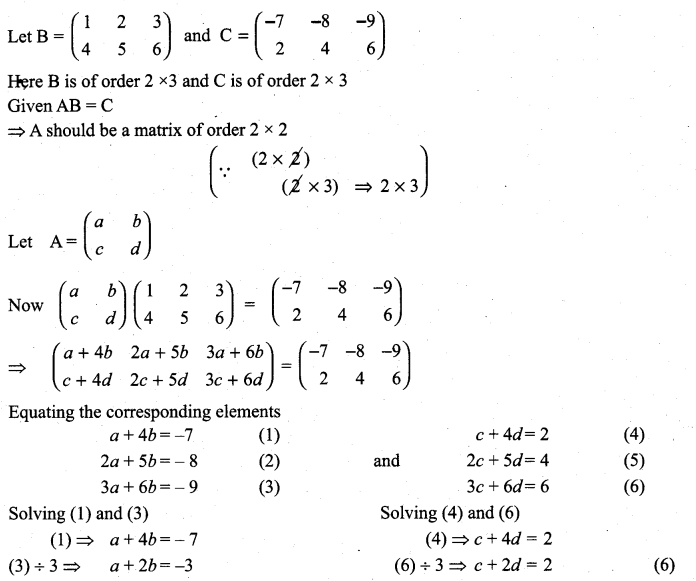
Samacheer Kalvi 11th Maths Solutions Chapter 7 Matrices and Determinants Ex 7.1 30
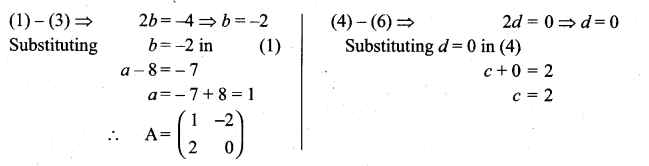
Samacheer Kalvi 11th Maths Solutions Chapter 7 Matrices and Determinants Ex 7.1 31

Question 15.
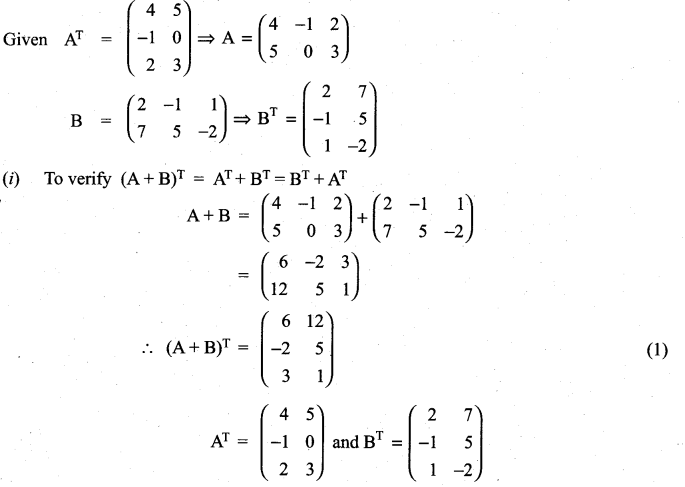
Samacheer Kalvi 11th Maths Solutions Chapter 7 Matrices and Determinants Ex 7.1 32
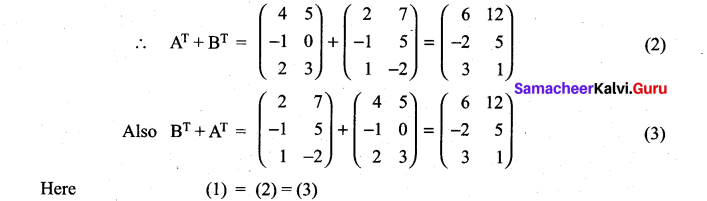
(i) (A + B)T = AT + BT = BT + AT
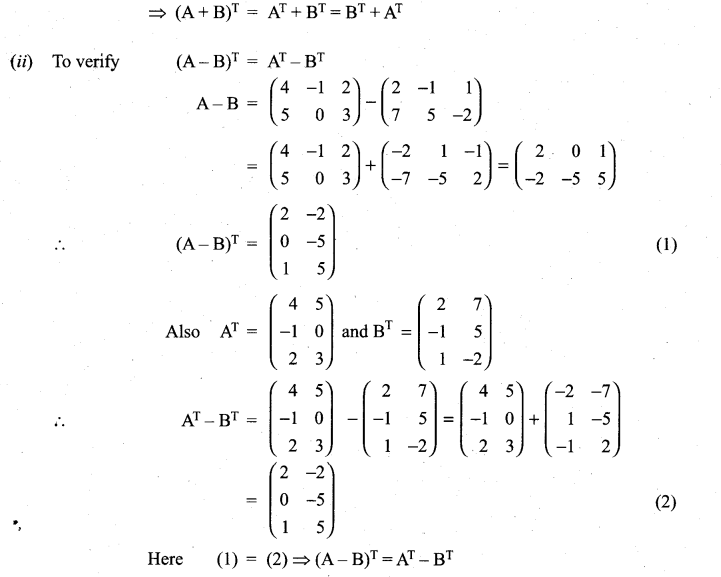
(ii) (A – B)T = AT – BT
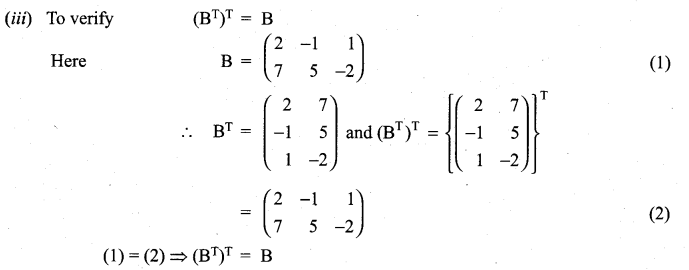
(iii) (BT)T = B.
Solution:
Samacheer Kalvi 11th Maths Solutions Chapter 7 Matrices and Determinants Ex 7.1 33
Samacheer Kalvi 11th Maths Solutions Chapter 7 Matrices and Determinants Ex 7.1 34
Samacheer Kalvi 11th Maths Solutions Chapter 7 Matrices and Determinants Ex 7.1 35
Samacheer Kalvi 11th Maths Solutions Chapter 7 Matrices and Determinants Ex 7.1 36

Question 16.
If A is a 3 × 4 matrix and B is a matrix such that both ATB and BAT are defined, what is the order of the matrix B?
Solution:
Given Order of A = 3 × 4
∴ Order of AT = 4 × 3
Given that ATB is defined.
∴ Number of columns of AT = Number of rows of B
Number of rows of B = 3
Also given BAT is defined.
∴ Number of columns of B = Number of rows of AT
Number of columns of B = 4
∴ Order of B = 3 × 4

Question 17.
Express the following matrices is the sum of a symmetric matrix and a skew-symmetric matrix:
Samacheer Kalvi 11th Maths Solutions Chapter 7 Matrices and Determinants Ex 7.1 37
Solution:
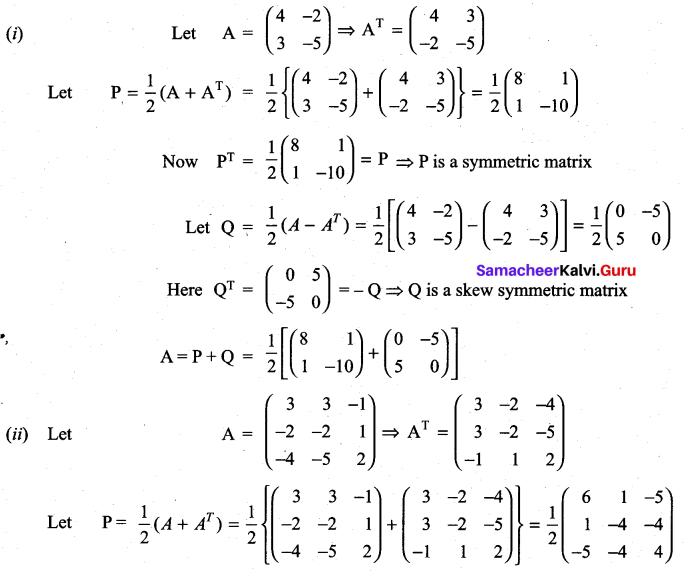
Samacheer Kalvi 11th Maths Solutions Chapter 7 Matrices and Determinants Ex 7.1 38
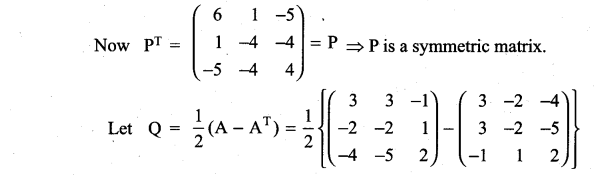
Samacheer Kalvi 11th Maths Solutions Chapter 7 Matrices and Determinants Ex 7.1 39
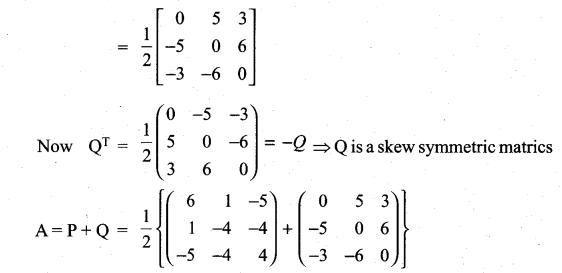
Samacheer Kalvi 11th Maths Solutions Chapter 7 Matrices and Determinants Ex 7.1 40

Question 18.
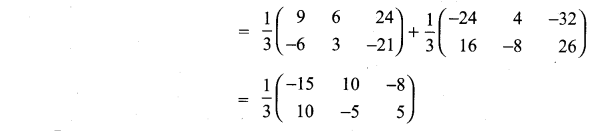
Find the matrix A such that Samacheer Kalvi 11th Maths Solutions Chapter 7 Matrices and Determinants Ex 7.1 41
Solution:
Samacheer Kalvi 11th Maths Solutions Chapter 7 Matrices and Determinants Ex 7.1 42
Samacheer Kalvi 11th Maths Solutions Chapter 7 Matrices and Determinants Ex 7.1 43

Question 19.
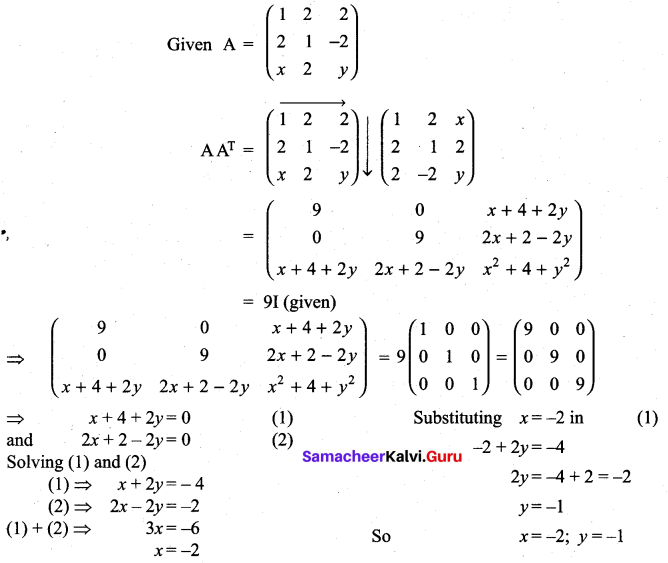
If A = Samacheer Kalvi 11th Maths Solutions Chapter 7 Matrices and Determinants Ex 7.1 44 is a matrix such that AAT = 9I, find the values of x and y.
Solution:
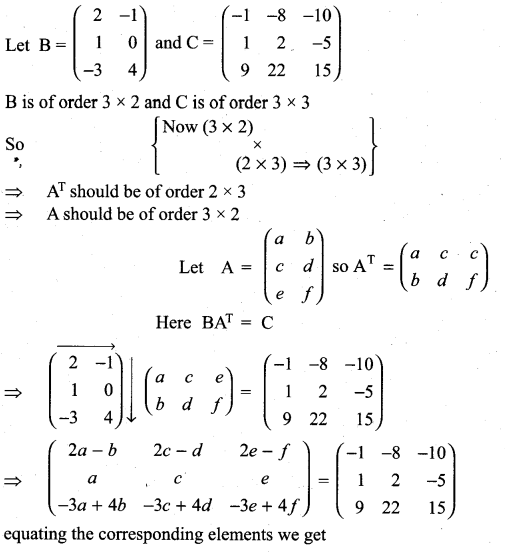
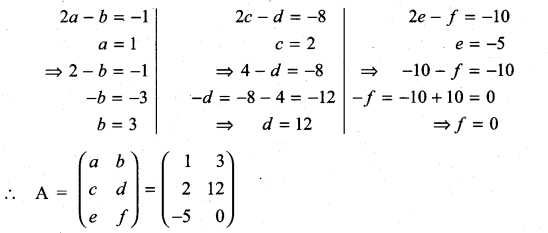
Samacheer Kalvi 11th Maths Solutions Chapter 7 Matrices and Determinants Ex 7.1 45

Question 20.
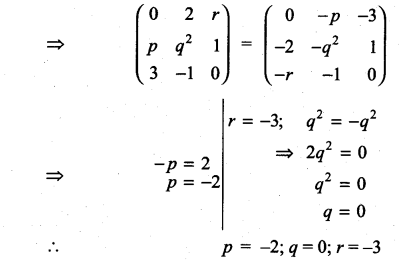
Samacheer Kalvi 11th Maths Solutions Chapter 7 Matrices and Determinants Ex 7.1 46
Solution:
Samacheer Kalvi 11th Maths Solutions Chapter 7 Matrices and Determinants Ex 7.1 47
Samacheer Kalvi 11th Maths Solutions Chapter 7 Matrices and Determinants Ex 7.1 48

Question 21.
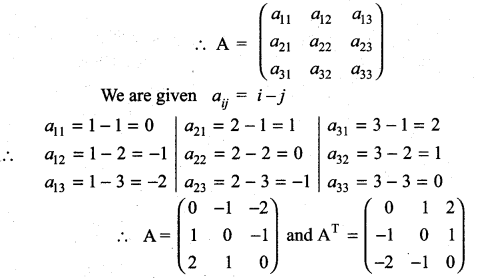
Construct the matrix A = [aij]3×3, where aij = i- j. State whether A is symmetric or skew- symmetric.
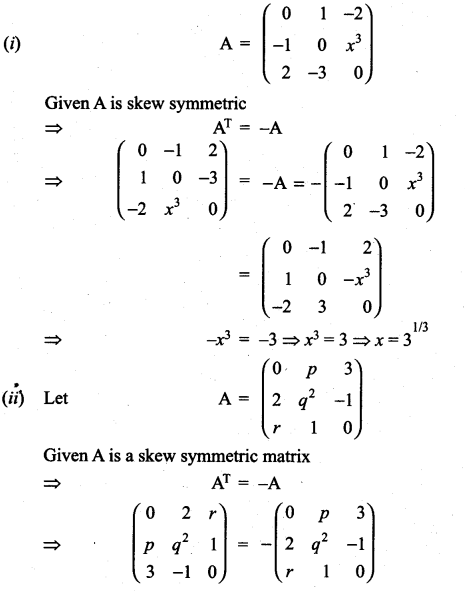
Solution:
Given A is a matrix of order 3 × 3
Samacheer Kalvi 11th Maths Solutions Chapter 7 Matrices and Determinants Ex 7.1 49
Here AT = -A
⇒ A is skew-symmetric

Question 22.
Let A and B be two symmetric matrices. Prove that AB = BA if and only if AB is a symmetric matrix.
Solution:
Let A and B be two symmetric matrices
⇒ AT = A and BT = B …………….. (1)
Given that AB = BA (2)
To prove AB is symmetric:
Now (AB)T = BTAT = BA
(from(1)) But (AB)T = AB by ………….. (2)
⇒ AB is symmetric.
Conversely, let AB be a symmetric matrix.
⇒ (AB)T = AB
i.e. BTAT = AB
i.e. BA = AB (from (1))
⇒ AB is symmetric

Question 23.
If A and B are symmetric matrices of the same order, prove that
(i) AB + BA is a symmetric matrix.
(li) AB – BA is a skew-symmetric matrix.
Solution:
Given A and B are symmetric matrices of the same order.
∴ AT = A , BT = B

(i) AB + BA is a symmetric matrix
(AB + BA)T = (AB )T + (BA)T
= BTAT + ATBT
= BA + AB
= AB + BA
∴ AB + BA is a symmetric matrix.

(ii) AB – BA is a skew – symmetric matrix
(AB – BA)T = (AB )T (BA )T
= BTAT – ATBT
= BA – AB
(AB – BA)T = – (AB – BA)
∴ AB – BA is a skew symmetric matrix.

Question 24.
A shopkeeper in a Nuts and Spices shop makes gift packs of cashew nuts, raisins, and almonds.
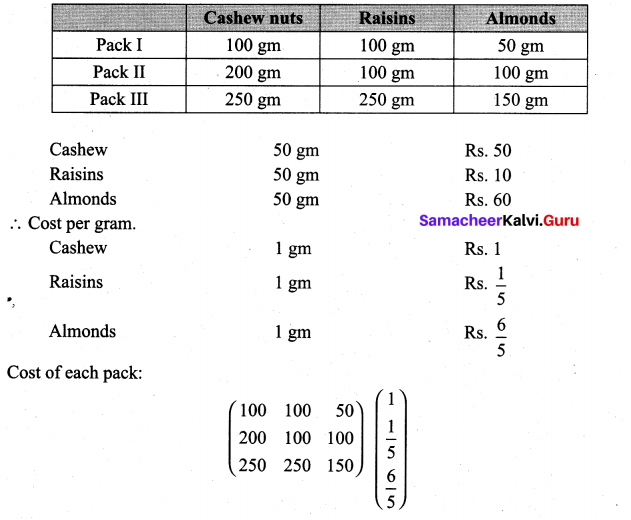
The pack-I contains 100 gm of cashew nuts, 100 gm of raisins, and 50 gm of almonds. Pack-II contains 200 gm of cashew nuts, 100 gm of raisins, and 100 gm of almonds. Pack-III contains 250 gm of cashew nuts, 250 gm of raisins, and 150 gm of almonds. The cost of 50 gm of cashew nuts is ₹ 50, 50 gm of raisins is ₹ 10, and 50 gm of almonds is₹ 60. What is the cost of each gift pack?
Solution:
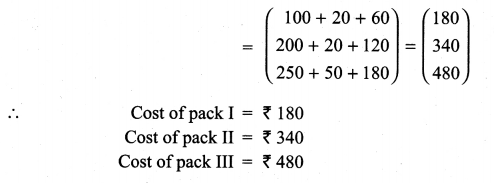
Samacheer Kalvi 11th Maths Solutions Chapter 7 Matrices and Determinants Ex 7.1 50
Samacheer Kalvi 11th Maths Solutions Chapter 7 Matrices and Determinants Ex 7.1 51

Samacheer Kalvi 11th Maths Solutions Chapter 7 Matrices and Determinants Ex 7.1 Additional Problems

Question 1.
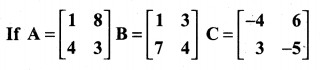
Samacheer Kalvi 11th Maths Solutions Chapter 7 Matrices and Determinants Ex 7.1 52
Prove that (i) AB ≠ BA
(ii) A(BC) = (AB) C
(iii) A(B + C) = AB + AC
(iv) AI = IA = A
Solution:
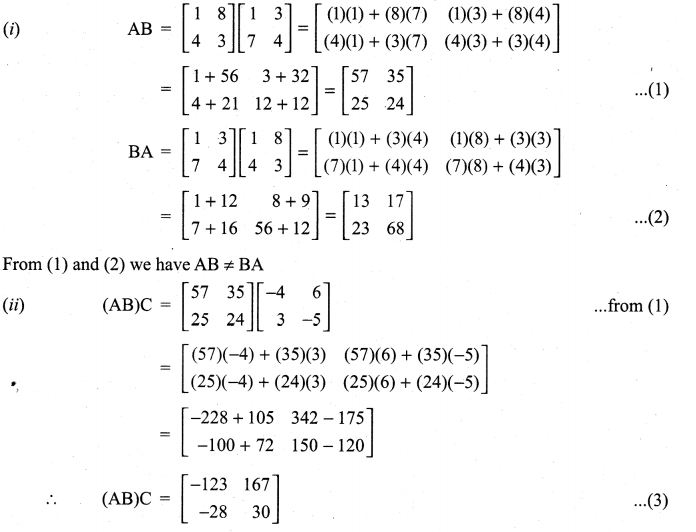
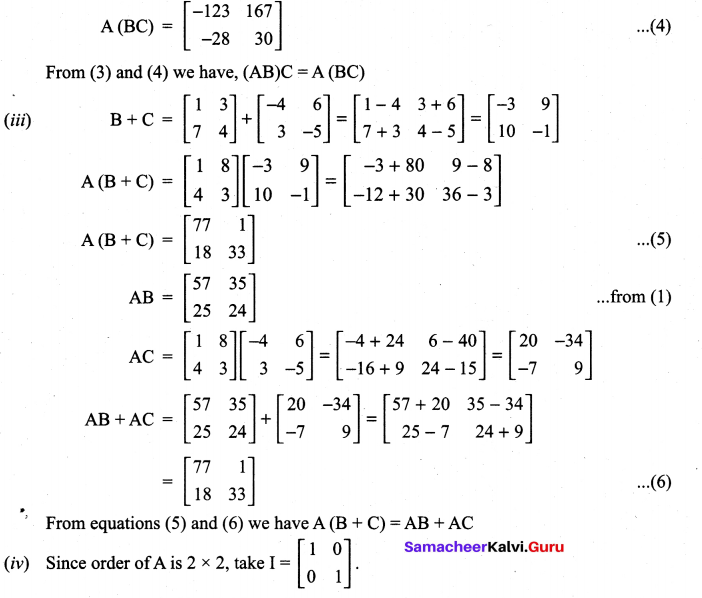
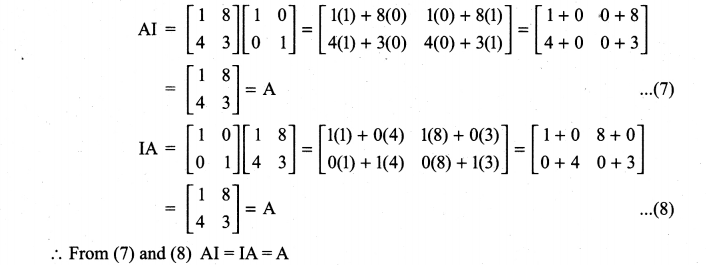
Samacheer Kalvi 11th Maths Solutions Chapter 7 Matrices and Determinants Ex 7.1 53
Samacheer Kalvi 11th Maths Solutions Chapter 7 Matrices and Determinants Ex 7.1 54
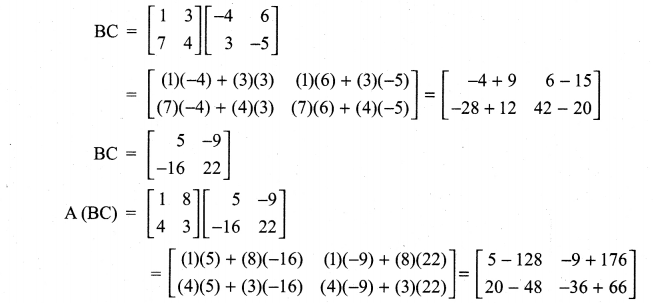
Samacheer Kalvi 11th Maths Solutions Chapter 7 Matrices and Determinants Ex 7.1 55
Samacheer Kalvi 11th Maths Solutions Chapter 7 Matrices and Determinants Ex 7.1 56

Question 2.
If A = \(\left[\begin{array}{ll}{2} & {3} \\ {4} & {5}\end{array}\right]\) find A2 – 7A – 2I.
Solution:
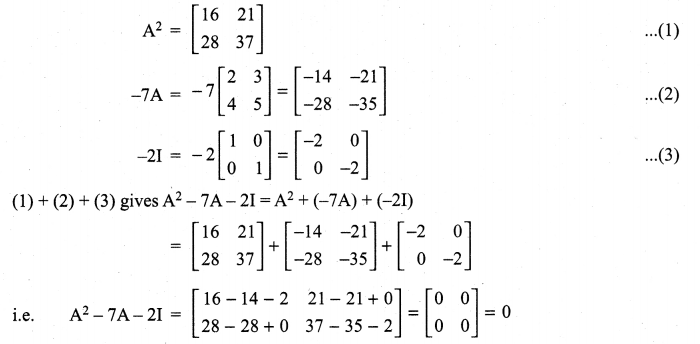
Samacheer Kalvi 11th Maths Solutions Chapter 7 Matrices and Determinants Ex 7.1 57
Samacheer Kalvi 11th Maths Solutions Chapter 7 Matrices and Determinants Ex 7.1 58

Question 3.
Samacheer Kalvi 11th Maths Solutions Chapter 7 Matrices and Determinants Ex 7.1 59
Solution:
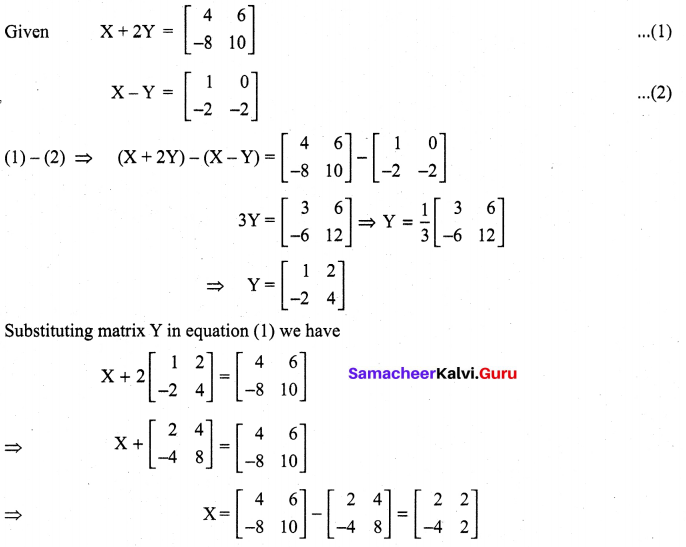
Samacheer Kalvi 11th Maths Solutions Chapter 7 Matrices and Determinants Ex 7.1 60

Samacheer Kalvi 11th Maths Solutions Chapter 7 Matrices and Determinants Ex 7.1 61

Question 4.
Samacheer Kalvi 11th Maths Solutions Chapter 7 Matrices and Determinants Ex 7.1 62
Solution:
Samacheer Kalvi 11th Maths Solutions Chapter 7 Matrices and Determinants Ex 7.1 63
Samacheer Kalvi 11th Maths Solutions Chapter 7 Matrices and Determinants Ex 7.1 64
Samacheer Kalvi 11th Maths Solutions Chapter 7 Matrices and Determinants Ex 7.1 65

Question 5.
If A = \(\left[\begin{array}{rr}{3} & {-5} \\ {-4} & {2}\end{array}\right]\), show that A2 – 5A – 14I = 0 where I is the unit matrix of order 2.
Solution:
Samacheer Kalvi 11th Maths Solutions Chapter 7 Matrices and Determinants Ex 7.1 66

Samacheer Kalvi 10th Maths Solutions Chapter 3 Algebra Additional Questions

Question 6.
If A = \(\left[\begin{array}{rr}{3} & {-2} \\ {4} & {-2}\end{array}\right]\), find k so that A2 = kA – 2I
Solution:
Samacheer Kalvi 11th Maths Solutions Chapter 7 Matrices and Determinants Ex 7.1 67
Samacheer Kalvi 11th Maths Solutions Chapter 7 Matrices and Determinants Ex 7.1 68

Question 7.
If A = \(\left[\begin{array}{lll}{1} & {2} & {2} \\ {2} & {1} & {2} \\ {2} & {2} & {1}\end{array}\right]\), show that A2 – 4A – 5I = 0
Solution:
Samacheer Kalvi 11th Maths Solutions Chapter 7 Matrices and Determinants Ex 7.1 69
Samacheer Kalvi 11th Maths Solutions Chapter 7 Matrices and Determinants Ex 7.1 70

Question 8.
Samacheer Kalvi 11th Maths Solutions Chapter 7 Matrices and Determinants Ex 7.1 71
Solution:
Samacheer Kalvi 11th Maths Solutions Chapter 7 Matrices and Determinants Ex 7.1 72
Samacheer Kalvi 11th Maths Solutions Chapter 7 Matrices and Determinants Ex 7.1 73
Samacheer Kalvi 11th Maths Solutions Chapter 7 Matrices and Determinants Ex 7.1 74
Samacheer Kalvi 11th Maths Solutions Chapter 7 Matrices and Determinants Ex 7.1 75

Question 9.
Samacheer Kalvi 11th Maths Solutions Chapter 7 Matrices and Determinants Ex 7.1 76
Solution:
Samacheer Kalvi 11th Maths Solutions Chapter 7 Matrices and Determinants Ex 7.1 77
Samacheer Kalvi 11th Maths Solutions Chapter 7 Matrices and Determinants Ex 7.1 78

Samacheer Kalvi 10th Maths Solutions Chapter 3 Algebra Additional Questions

Question 10.
Samacheer Kalvi 11th Maths Solutions Chapter 7 Matrices and Determinants Ex 7.1 79
Solution:
Samacheer Kalvi 11th Maths Solutions Chapter 7 Matrices and Determinants Ex 7.1 80
Samacheer Kalvi 11th Maths Solutions Chapter 7 Matrices and Determinants Ex 7.1 81

Samacheer Kalvi 11th Maths Solutions Chapter 7 Matrices and Determinants Ex 7.1 Read More »

Samacheer Kalvi 11th Maths Solutions Chapter 5 Binomial Theorem, Sequences and Series Ex 5.4

You can Download Samacheer Kalvi 11th Maths Book Solutions Guide Pdf, Tamilnadu State Board help you to revise the complete Syllabus and score more marks in your examinations.

Tamilnadu Samacheer Kalvi 11th Maths Solutions Chapter 5 Binomial Theorem, Sequences and Series Ex 5.4

Expanding Binomials Calculator online with solution and steps.

Question 1.
Expand the following in ascending powers of x and find the condition on x for which the binomial expansion is valid.
Solution:
Samacheer Kalvi 11th Maths Solutions Chapter 5 Binomial Theorem, Sequences and Series Ex 5.4 1
Samacheer Kalvi 11th Maths Solutions Chapter 5 Binomial Theorem, Sequences and Series Ex 5.4 2
Samacheer Kalvi 11th Maths Solutions Chapter 5 Binomial Theorem, Sequences and Series Ex 5.4 3

Question 2.
Find \(\sqrt[3]{1001}\) approximately (two decimal places).
Solution:
Samacheer Kalvi 11th Maths Solutions Chapter 5 Binomial Theorem, Sequences and Series Ex 5.4 4

Question 3.
Samacheer Kalvi 11th Maths Solutions Chapter 5 Binomial Theorem, Sequences and Series Ex 5.4 5
Solution:
Samacheer Kalvi 11th Maths Solutions Chapter 5 Binomial Theorem, Sequences and Series Ex 5.4 6

Question 4.
Samacheer Kalvi 11th Maths Solutions Chapter 5 Binomial Theorem, Sequences and Series Ex 5.4 7
Solution:
Samacheer Kalvi 11th Maths Solutions Chapter 5 Binomial Theorem, Sequences and Series Ex 5.4 8
Samacheer Kalvi 11th Maths Solutions Chapter 5 Binomial Theorem, Sequences and Series Ex 5.4 9

Question 5.
Write the first 6 terms of the exponential series
(i) e5x
(ii) e-2x
(iii) \(e^{\frac{x}{2}}\)
Solution:
Samacheer Kalvi 11th Maths Solutions Chapter 5 Binomial Theorem, Sequences and Series Ex 5.4 10
Samacheer Kalvi 11th Maths Solutions Chapter 5 Binomial Theorem, Sequences and Series Ex 5.4 11

Samacheer Kalvi 11th Maths Solutions Chapter 5 Binomial Theorem, Sequences and Series Ex 5.4

Question 6.
Write the first 4 terms of the logarithmic series
(i) log(1 + 4x),
(ii) log(1 – 2x),
(iii) \(\log \left(\frac{1+3 x}{1-3 x}\right)\)
(iv) \(\log \left(\frac{1-2 x}{1+2 x}\right)\).
Find the intervals on which the expansions are valid.
Solution:
Samacheer Kalvi 11th Maths Solutions Chapter 5 Binomial Theorem, Sequences and Series Ex 5.4 111
Samacheer Kalvi 11th Maths Solutions Chapter 5 Binomial Theorem, Sequences and Series Ex 5.4 12
Samacheer Kalvi 11th Maths Solutions Chapter 5 Binomial Theorem, Sequences and Series Ex 5.4 13

Question 7.
Samacheer Kalvi 11th Maths Solutions Chapter 5 Binomial Theorem, Sequences and Series Ex 5.4 17
Solution:
Samacheer Kalvi 11th Maths Solutions Chapter 5 Binomial Theorem, Sequences and Series Ex 5.4 18

Question 8.
Samacheer Kalvi 11th Maths Solutions Chapter 5 Binomial Theorem, Sequences and Series Ex 5.4 19
Solution:
Samacheer Kalvi 11th Maths Solutions Chapter 5 Binomial Theorem, Sequences and Series Ex 5.4 20

Samacheer Kalvi 11th Maths Solutions Chapter 5 Binomial Theorem, Sequences and Series Ex 5.4

Question 9.
Samacheer Kalvi 11th Maths Solutions Chapter 5 Binomial Theorem, Sequences and Series Ex 5.4 21
Solution:
Samacheer Kalvi 11th Maths Solutions Chapter 5 Binomial Theorem, Sequences and Series Ex 5.4 22

Question 10.
Samacheer Kalvi 11th Maths Solutions Chapter 5 Binomial Theorem, Sequences and Series Ex 5.4 23
Solution:
Samacheer Kalvi 11th Maths Solutions Chapter 5 Binomial Theorem, Sequences and Series Ex 5.4 24
Samacheer Kalvi 11th Maths Solutions Chapter 5 Binomial Theorem, Sequences and Series Ex 5.4 25

Samacheer Kalvi 11th Maths Solutions Chapter 5 Binomial Theorem, Sequences and Series Ex 5.4 Additional Questions

Question 1.
Samacheer Kalvi 11th Maths Solutions Chapter 5 Binomial Theorem, Sequences and Series Ex 5.4 26
Solution:
Samacheer Kalvi 11th Maths Solutions Chapter 5 Binomial Theorem, Sequences and Series Ex 5.4 27

Samacheer Kalvi 11th Maths Solutions Chapter 5 Binomial Theorem, Sequences and Series Ex 5.4

Question 2.
Write the four terms in the expansions of the following:
Samacheer Kalvi 11th Maths Solutions Chapter 5 Binomial Theorem, Sequences and Series Ex 5.4 28
Solution:
Samacheer Kalvi 11th Maths Solutions Chapter 5 Binomial Theorem, Sequences and Series Ex 5.4 29
Samacheer Kalvi 11th Maths Solutions Chapter 5 Binomial Theorem, Sequences and Series Ex 5.4 30

Question 3.
Evaluate the following:
Samacheer Kalvi 11th Maths Solutions Chapter 5 Binomial Theorem, Sequences and Series Ex 5.4 31
Solution:
Samacheer Kalvi 11th Maths Solutions Chapter 5 Binomial Theorem, Sequences and Series Ex 5.4 32

Samacheer Kalvi 11th Maths Solutions Chapter 5 Binomial Theorem, Sequences and Series Ex 5.4

Question 4.
Samacheer Kalvi 11th Maths Solutions Chapter 5 Binomial Theorem, Sequences and Series Ex 5.4 33
Solution:
Samacheer Kalvi 11th Maths Solutions Chapter 5 Binomial Theorem, Sequences and Series Ex 5.4 34

Question 5.
Samacheer Kalvi 11th Maths Solutions Chapter 5 Binomial Theorem, Sequences and Series Ex 5.4 35
Solution:
Samacheer Kalvi 11th Maths Solutions Chapter 5 Binomial Theorem, Sequences and Series Ex 5.4 36

Samacheer Kalvi 11th Maths Solutions Chapter 5 Binomial Theorem, Sequences and Series Ex 5.4 Read More »

Samacheer Kalvi 11th Commerce Solutions Chapter 32 Direct Taxes

Students can Download Commerce Chapter 32 Direct Taxes Questions and Answers, Notes Pdf, Samacheer Kalvi 11th Commerce Book Solutions Guide Pdf helps you to revise the complete Tamilnadu State Board New Syllabus and score more marks in your examinations.

Samacheer Kalvi 11th Commerce Solutions Chapter 32 Direct Taxes

Samacheer Kalvi 11th Commerce Direct Taxes Textbook Exercise Questions and Answers

I. Choose the Correct Answer

Question 1.
Income Tax is ……………
(a) a business tax
(b) a direct tax
(c) an indirect tax
(d) none of these
Answer:
(b) a direct tax

Question 2.
Period of assessment year is ……………
(a) 1st April to 31st March
(b) 1st March to 28st Feb
(c) 1st July to 30st June
(d) 1st Jan to 31st Dec
Answer:
(a) 1st April to 31st March

Samacheer Kalvi 11th Commerce Solutions Chapter 32 Direct Taxes

Question 3.
The year in which income is earned is known as ……………
(a) Assessment Year
(b) Previous Year
(c) Light Year
(d) Calendar Year
Answer:
(b) Previous Year

Question 4.
The aggregate income under five heads is termed as ……………
(a) Gross Total Income
(b) Total Income
(c) Salary Income
(d) Business Income
Answer:
(b) Total Income

Question 5.
Agricultural income earned in India is ……………
(a) Fully Taxable
(b) Fully Exempted
(c) Not Considered for Income
(d) None of the above
Answer:
(b) Fully Exempted

II. Very Short Answer Questions

Question 1.
What is Income tax?
Answer:
Income tax is a direct tax under which tax is calculated on the income, gains or profits earned by a person such as individuals and other artificial entities.

Question 2.
What is meant by the previous year?
Answer:
The year in which income is earned is called the previous year. It is also normally consisting of a period of 12 months commencing on 1st April every year and ending on 31st March of the following year. It is also called a financial year immediately following the assessment year.

Samacheer Kalvi 11th Commerce Solutions Chapter 32 Direct Taxes

Question 3.
Define the term person?
Answer:
According to the Income Tax 1961, the term Person includes, “ individual, Hindu Undivided Family, Fìrrn, Company, local authority, Association of person or Body of Individual or any other artificial juridical persons.

Question 4.
Define the term assessee?
Answer:
Assessee means a person by whom any tax or any other sum of money is payable under this Act. It includes every person in respect of whom any proceeding has been taken for the assessment of his income or assessment of fringe benefits.

Question 5.
What is an assessment year?
Answer:
The term has been defined under section 2(9). The year in which tax is paid iš called the assessment year. It normally consisting of a period óf 12 months còrnmencing on 1st April every year and ending on 31 st March of the following year.

III. Short Answer Questions

Question 1.
What is Gross Total Income?
Answer:
Income from the five heads, namely – Salaries, House Property, Profits and Gains of Business or Profession, Capital Gains, and Other Sources – is computed separately according to the provisions given in the Act. Income computed under these heads shall be aggregated after adjusting past and present losses and the total so arrived at is known as ‘Gross Total Income’.

Question 2.
List out the five heads of income.
Answer:

  1. Income from Salaries
  2. Income from House Property
  3. Income from Business or Profession
  4. Income from Capital Gain
  5. Income from Other Sources

Samacheer Kalvi 11th Commerce Solutions Chapter 32 Direct Taxes

Question 3.
Write a note on Agricultural Income.
Answer:
Any rent or revenue derived from land which is situated in India and is used for agriculture purposes. Agricultural income is fully exempted from tax u/s 10(1) and as such does not form part of total income.

Question 4.
What do you mean by Total Income?
Answer:
According to Section 2 (45) of the Income Tax Act 1961, the income which is earned out of the Gross Total Income, after allowing the deductions under section 80 is known as total income.

Question 5.
Write short notes on:

  1. Direct Tax
  2. Indirect Tax

Answer:
1. Direct Tax:
If a tax levied on the income or wealth of a person and is paid by that person (or his office) directly to the Government, , it is called a direct tax, for example, Income – Tax, Wealth Tax, Capital Gains Tax, Securities Transaction Tax, Fringe Benefits Tax (from 2005), Banking Cash Transaction Tax (for Rs,50,000 and above – from 2005), etc. In India, all direct taxes are levied and administered by the Central Board of Direct Taxes.

2. Indirect Tax:
If tax is levied on the goods or services of a person (seller). It is collected from, the buyers and is paid by the seller to the Government. It is called indirect tax example GST.

IV. Long Answer Questions

Question 1.
Elucidate any five features of Income Tax.
Answer:
Meaning: Income tax is a direct tax under which tax is calculated on the income, gains or profits earned by a person such as individuals and other artificial entitled.
Levied as Per the Constitution
Income tax is levied in India by virtue of entry No. 82 of list 1 (Union List) of Seventh Schedule to Article 246 of the Constitution of India.

Levied by Central Government
Income tax is charged by the Central Government on all incomes other than agricultural income. However, the power to charge income tax on agricultural income has been vested with the State Government as per entry 46 of List II, i.e., State List.

Direct Tax
Income tax is a direct tax. It is because the liability to deposit and ultimate burden are on the same person. The person earning income is liable to pay income tax out of his own pocket and cannot pass on the burden of tax to another person.

Annual Tax
Income tax is an annual tax because it is the income of a particular year which is chargeable to tax.

Tax on Person
It is a tax on income earned by a person. The term ‘person’ has been defined under the Income-tax Act. It includes individual, Hindu Undivided Family, Firm, Company, local authority, Association of person or Body of Individual or any other artificial juridical persons.

Samacheer Kalvi 11th Commerce Solutions Chapter 32 Direct Taxes

Question 2.
Define Tax. Explain the term direct tax and indirect tax with an example.
Answer:
Tax is a compulsory contribution to state revenue by the Government. It is levied on the income or profits from business of individuals and institutions. It may be added to the price of goods, services or transactions. Tax is the basic source of revenue to the Government. This revenue is utilised for the expenses of civil administration, internal and external security, building infrastructure, etc.

There are two types of taxes – direct taxes and indirect, taxes.

1. Direct Tax:
If a tax levied on the income or wealth of a person and is paid by that person (or his office) directly to the Government, it is called direct tax, e.g., Income – Tax, Wealth Tax, Capital Gains Tax, Securities Transaction Tax, Fringe Benefits Tax (from 2005), Banking Cash Transaction Tax (for Rs.50,000 and above – from 2005), etc. In India all direct taxes are levied and administered by Central Board of Direct Taxes.

2. Indirect Tax:
If tax is levied on the goods or services of a person (seller). It is collected from the buyers and is paid by seller to the Government. It is called indirect tax. example GST.

Question 3.
List out any ten kinds of incomes chargeable under the head income tax.
Answer:
According to section 2(24) of the Income Tax Act, Income includes the following:

  1. Profits and gains of business or profession.
  2. Dividend
  3. Export incentives, like duty drawback, cash compensatory support, sale of licenses, etc.,
  4. Interest, salary, bonus, commission or remuneration earned by a partner of a firm from such firm.
  5. Capital gains chargeable u/s 45. viii. Profits and gains from the business of banking carried on by a co-operative society with its members.
  6. Winnings from lotteries, crossword puzzles, races including horse races, card games, and other games of any sort or from gambling or betting of any form or nature whatsoever.
  7. Deemed income u/s 41 or 59.
  8. Amount received under key man. insurance policy including bonus thereon.
  9. Benefit or perquisite received from a company, by a director or a person holding substantial interest or a relative of the director or such person.
  10. Gift as defined u/s 56 (2) (vi) and others.

Samacheer Kalvi 11th Commerce Solutions Chapter 32 Direct Taxes

Question 4.
Discuss the various kinds of assessments.
Answer:
Assessee means a person by whom any tax or any other sum of money is payable under this Act. It includes every person in respect of whom any proceeding has been taken for the assessment of his income or assessment of fringe benefits. The term ‘person’ includes the following:

  1. an individual
  2. a Hindu Undivided Family (HUE)
  3. a company
  4. a firm
  5. an Association Of Persons or a Body Of Individual, whether incorporated or not
  6. a local authority, and
  7. every artificial juridical person example an idol or deity.

Samacheer Kalvi 11th Commerce Solutions Chapter 32 Direct Taxes Read More »

Samacheer Kalvi 11th English Speaking Group Discussion

Students can Download Samacheer Kalvi 11th English Speaking Group Discussion, Notes, Samacheer Kalvi 11th English Book Solutions Guide Pdf helps you to revise the complete Tamilnadu State Board New Syllabus and score more marks in your examinations. Learn the Samacheer Kalvi 11th English Grammar to enhance your grammar skills like reading comprehension, passage writing, parts of speech, tenses, passive and active voice, and many other concepts in no time.

Tamilnadu Samacheer Kalvi 11th English Speaking Group Discussion

(i) Intelligent Quotient (IQ) Versus Emotional Quotient (EQ)

RAJ:
According to my opinion, those who have a good IQ level will always have the ability to reason out things and find an amicable solution to any problem that he/she faces in life. Even in today’s world, when a young aspirant is made to face an interview with a board of panelist, one of the key methods to finalise the situation is a problem solving abilities a candidate possesses. Nowadays, your mental appearance is more important than your physical appearance. Though eloquence in communication was given weight age, the skill and ability to convince others is much more important than flamboyant language. Presence of mind, common sense and practicality is more important than bookish knowledge. Therefore people with more IQ is needed than people with better EQ.

Samacheer Kalvi 11th English Speaking Group Discussion

Chandran:
According to my understanding, I strongly contradict the views of Raj. It is the character that brings you huge success and I think good character, good personalities and good leaders are mostly driven by emotions.

Emotional quotient and intelligence quotient are undoubtedly the most important aspects of a person’s life and can make a huge difference between an average life and a successful life. To be successful, one may want to have a great IQ but, that success will not last long if your EQ is not appropriate. But on the contrary, if you have a good EQ and a little less IQ, then the chances of you becoming successful to carry on a successful career increases.

LEELA:
Everyone is equal. All should be recognised. One needs to be balanced with all qualities just as a balanced diet is needed for healthy living. It is illogical for learned people to say that IQ is much more needed than EQ or vice versa. I feel everyone is unique and is important. There is always something that one can contribute to. It needs to be balanced. Team play is vital at such a situation. A person with better IQ/EQ has his own workspace and methodology he contributes to the work differently as a person with different IQ/EQ. One who has a high IQ level can work smartly to do even the toughest tasks easily and hence procure popularity and wealth. Likewise, one who has better EQ can develop the same popularity and also leadership qualities. He/She can withstand adverse condition and overcome them.

Samacheer Kalvi 11th English Speaking Group Discussion

Let me detail you with examples. To manage a team, a person of high EQ is needed whereas someone who needs to plan tasks and perform it in the best possible way, a person with high IQ should be there.

A person with higher IQ may work on any area and be extremely successful but may lack good social circle. This will surely lead to depression or emotional setbacks.

A person with higher EQ may win a large social circle of friends and supporters who are a big pillar of support at difficult times but due to their lack of technical abilities that needs better IQ, will turn out to be failure.

Hence, I want to reiterate that a person with an average IQ level and an equal amount of EQ level will be the best to survive in the present society. He can work anywhere happily with a fair wealth and fair emotional stability. He would be the most satisfied person.

Therefore a balanced IQ & EQ is the most desirable to be successful.

Samacheer Kalvi 11th English Speaking Group Discussion

RAJ:
But I strongly feel that IQ is more important than EQ. Emotions are the biggest barrier to decision-making abilities. If we think about what others say and starts taking into consideration of others opinion, we get messed up and hence lack in making the right decision. Aren’t we living in a world where everything changes in an instant. So, we need someone who is confident of themselves and not get carried away by emotions. Hence I would prefer IQ over EQ,

Chandran:
I strongly opine that you consider the weight age of EQ more than IQ because if you . are perfect in EQ then you can manage with less IQ. For instance, if you have the qualities of EQ such as good personality skills, a better way of communication, and good attitude you can face any competitive situation. On the contrary, although you have strong IQ but poor EQ, then no one will take you seriously or you will be less focused leading to a few people joining you. So overall conclusion is that you don’t need to have a balanced or same level of IQ or EQ. If you are the best in EQ, then you can easily survive in this competitive era with less IQ.

Samacheer Kalvi 11th English Speaking Group Discussion

LEELA:
There is no point in Mr. Raj arguing for IQ and Mr.Chandran taking sides with those who have better EQ, IQ and EQ have their own importance in our life and both should be in balanced proportion. I feel IQ makes us ambitious but EQ put limits on these ambitions. High IQ and Low EQ are the traits that can be observed in terrorists. So today, our topic is IQ vs EQ. I stay strong in both needed for a successful person. EQ is important for our social . life. AS we live in a society, we need good EQ levels for our personal and social behaviour and character to be well accepted in the society. Whereas, better IQ is surely the need for enhancing our knowledge to take the right decisions in this society and be a successful person. A balance between both is the need of the hour for both act as the two wheels in our journey of a successful life cycle.

(ii) To Live or Not

Kiruba:
We live in a world where most of us have a pet at home. When they fall sick, we rush them to the hospital. When our heart melts to see an animal or a bird suffer because of sickness, how will our conscience allow us to kill a fellow human being just because he is incurably ill? Moreover, he has done no harm to the society and his illness is not because of his fault.Therefore, we must provide him proper treatment and allow him to live as long as nature and God has willed his life span to be in this world.

Samacheer Kalvi 11th English Speaking Group Discussion

Suganthi:
Exactly. Well said. God has gifted us life. So, he alone has the right to take it back. No human being has the right to interfere in His decisions or will for us in this world. Every man/woman has the right to live as long as God intends him/her to lead a life in this world.

Therefore, the illogical reasoning that a man suffering from an incurable disease, should be put to death is inexcusable beyond reason and a thought to be condemned.

Babu:
This world is governed by Darwin’s survival of the fittest principle. Darwin drew parallels between his own economic theories and his biological ones: “This survival of the fittest”, which he had sought to express in mechanical terms, is that which he has also called ‘natural selection’, or the preservation of favoured races in the struggle for life. An incurably diseased person is weak and has no value whatsoever to the society. More so, he has no means to live. Therefore, it would be in the fitness of things to kill him even against his wish. Therefore I bring to your kind notice that it is the natural selection to kill a person who cannot live befitting the needs of the society.

Samacheer Kalvi 11th English Speaking Group Discussion

Kiruba:
Now a days, new vistas of progress have been opened in medical sciences and alternative ‘ medicine like Acupuncture, Acupressure, Reiki Pranik healing, Touch therapy, Herbal therapy, Diet therapy, etc. hold a ray of hope for the so called incurably diseased persons. So, why snatch life from them? When the kith and kin are ready to try all the means for survival, why should one interfere and speak things agaainst their survival. Miracles do happen and ‘ prayers are surely answered. Nothing wrong in giving a chance for someone fighting and struggling to live. We have no right to speak about putting another person to death.

Babu:
An incurably diseased person is the cause of constant worry to his family. His demands are unending and not withstanding the best possible attention, care and treatment given to him, he always remains dissatisfied and disgruntled. This adversely affects the peace of mind and comfort of the family members and all those who are trying to help them. Many a times, the physical worry and mental agony faced by the caretakers fall a prey to many other difficult situations and even fall sick being in an unhealthy environment for weeks and months. Therefore, the best way out of such a situation is to put an end to his life.

Samacheer Kalvi 11th English Speaking Group Discussion

Suganthi:
It is not always the case that incurably diseased persons spread contagious diseases as some might argue. Even in those rare cases where it may be true, these persons are not real health hazards because it is medically established now that all incurable diseases are not contagious. However, as a precautionary measure, we should open separate hospitals or isolation wards for persons suffering from incurable contagious diseases and thus quarantine them. Isn’t that a better solution than thinking of putting an end to their life? To me, it’s a murder under legal permits.

Babu:
But these days we are burdened with the responsibility of reducing our rapidly increasing population. The many diseased persons constitute a good part of it. Even otherwise their contribution to society is a burden. It would be justified and reasonable not to allow them to drag on their agonizing life. Killing an incurably diseased person will put an end to research work in medical science. As I have already stated, there are many hospitals and many doctors who start experimenting with diseased persons. Even otherwise, suffering people have been the subject of research work for those who are into higher education. Thereby, its appropriate to free them from pain and suffering!

Samacheer Kalvi 11th English Speaking Group Discussion

Kiruba:
Such an act only points out to the degenerated values in this society. It is almost compared to that of an individual throwing an appliance when it is old and doesn’t yield good results. Isn’t there a difference between living and non-living? How can a living human being be treated like a material object? What has happened to the values that students were taught or imbibed in their life? Such a thinking is only an assertion of degenerated moral values.

Conclusion:
India is a land of values. We are a secular society. We believe in respecting each other. Let us not be carried away by degenerated moral values and learn to respect one another and help them to live in peace without a feeling of guilt.

Samacheer Kalvi 11th English Speaking Group Discussion

Samacheer Kalvi 11th English Speaking Group Discussion Read More »

Samacheer Kalvi 11th Chemistry Solutions Chapter 9 Solutions

Students can Download Chemistry Chapter 9 Solutions Questions and Answers, Notes Pdf, Samacheer Kalvi 11th Chemistry Solutions Guide Pdf helps you to revise the complete Tamilnadu State Board New Syllabus and score more marks in your examinations.

Tamilnadu Samacheer Kalvi 11th Chemistry Solutions Chapter 9 Solutions

Samacheer Kalvi 11th Chemistry Chapter 9 Solutions Textual Evaluation Solved

Samacheer Kalvi 11th Chemistry Solutions Multiple Choice Questions

Question 1.
The molality of a solution containing 1 .8g of glucose dissolved in 250g of water is …………
(a) 0.2 M
(b) 0.01 M
(c) 0.02 M
(d) 0.04 M
Answer:
(d) 0.04 M
Solution:

Samacheer Kalvi 11th Chemistry Solutions Chapter 9 Solutions-1

Question 2.
Which of the following concentration terms is/are independent of temperature?
(a) molality
(b) molarity
(c) mole fraction
(d) (a) and (c)
Answer:
(d) (a) and (c)
Solution:
Molality and mole fraction are independent of temperature.

Samacheer Kalvi 11th Chemistry Solutions Chapter 9 Solutions

Question 3.
Stomach acid, a dilute solution of HCI can be neutralised by reaction with Aluminium hydroxide
Al(OH)3 + 3HCl(aq) → AlCl3 + 3H2O
How many millilitres of 0.1 M Al(OH)3 solution are needed to neutralise 21 mL of 0.1 M HCl
(a) 14 mL
(b) 7 mL
(c) 21 mL
(d) none of these
Answer:
(b) 7 mL
Solution:
M1 x V1 = M2 x V2
∵ 0.1 M Al(OH)3 gives 3 x 0.1 = 0.3 M OH– ions .
0.3 x V1 = 0.1 x 21
V1= \(\frac { 0.1 x 21 }{ 0.3 }\) = 7ml

Question 4.
The partial pressure of nitrogen in air is 0.76 atm and its Henry’s law constant is 7.6 x 10⁴ atm at 300K. What is the mole fraction of nitrogen gas in the solution obtained when air is bubbled through water at 300K?
(a) 1 x 10⁻⁴
(b) 1 x 10⁻⁶
(c) 2 x 10⁻⁵
(d) 1 x 10⁻⁵
Answer:
(d) 1 x 10⁻⁵
Solution:
PN2 = 0.76atm
KH = 7.6 x 10⁴
x = ?
PN2 = KH . x
0.76 = 7.6 x 10⁴x x
x = \(\frac { 0.76 }{ 7.6\times { 10 }^{ 4 } }\) = 1 x 10⁻⁵

Samacheer Kalvi 11th Chemistry Solutions Chapter 9 Solutions

Question 5.
The Henry’s law constant for the solubility of Nitrogen gas in water at 350K is 8 x 10⁴ atm. The mole fraction of nitrogen in air is 0.5. The number of moles of Nitrogen from air dissolved in 10 moles of water at 350K and 4 atm pressure is ………….
(a) 4 x 10⁻⁴
(b) 4 x 10⁴
(c) 2 x 10⁻²
(d) 2.5 x 10⁻⁴
Answer:
(d) 2.5 x 10⁻⁴
Solution:
KH = 8 x 10⁴
(xN2 )in air = 0.5
Total pressure = 4 atm
Partial pressure of nitrogen = Mole fraction Total pressure
= O.5 x 4 = 2
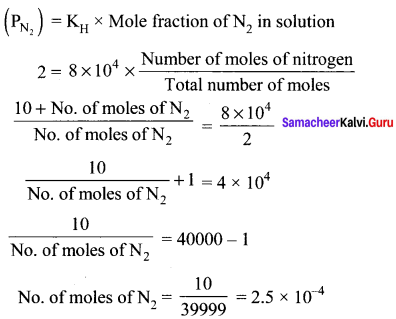
Samacheer Kalvi 11th Chemistry Solutions Chapter 9 Solutions-3

Question 6.
Which one of the following is incorrect for ideal solution?
(a) ∆Hmix = 0
(b) ∆Umix = o
(c) ∆P = PObserved – PCalculated by raoults law = 0
(d) ∆Gmix = 0
Answer:
(d) ∆Gmix = 0
Solution:
For an ideal solution, ∆Smix \(\neq\) 0; Hence ∆Gmix \(\neq\) 0
∴ Incorrect is ∆Gmix = 0

Question 7.
Which one of the following gases has the lowest value of Henry’s law constant?
(a) N2
(b) He
(c) CO2
(d) H2
Answer:
(c) CO2
Solution:
Carbon dioxide; most stable gas and has lowest value of Henry’s Law constant.

Question 8.
P1 and P2 are the vapour pressures of pure liquid components, 1 and 2 respectively of an ideal binary solution if x1 represents the mole fraction of component 1, the total pressure of the solution formed by 1 and 2 will be ………
(a) P1 + x1(P2 – P1)
(b) P2 – x1(P2 + P1)
(c) P1 – x2(P1 – P2)
(d) P1 + x2(P1 – P2)
Answer:
(c) P1 – x2(P1 – P2)
Solution:
Ptotal = P1 + P2
= P1 x1 + P2x2
= P1(1 – x2) + P2x2
= P1 – P1x2 + P2x2 = P1 – x2(P1 – P2)
[∵x1 + x2 = 1
x1 = 1 – x2]

Samacheer Kalvi 11th Chemistry Solutions Chapter 9 Solutions

Question 9.
Osomotic pressure (π) of a solution is given by the relation ……………
(a) π = nRT
(b) πV = nRT
(c) πRT = n
(d) none of these
Answer:
(b) πV = nRT
Solution:
n = CRT
n = \(\frac { n }{ V }\)
π V = nRT

Question 10.
Which one of the following binary liquid mixtures exhibits positive deviation from Raoults law?
(a) Acetone + chloroform
(b) Water + nitric acid
(c) HCI + water
(d) ethanol + water
Answer:
(d) ethanol + water

Question 11.
The Henry’s law constants for two gases A and B are x and y respectively. The ratio of mole fractions of A to B is 0.2. The ratio of mole fraction of B and A dissolved in water will be …………
(a) \(\frac { 2x }{ y }\)
(b) \(\frac { y }{ 0.2x }\)
(c) \(\frac { 0.2x }{ y }\)
(d) \(\frac { 5x }{ y }\)
Answer:
(d) \(\frac { 5x }{ y }\)
Solution:
Given,
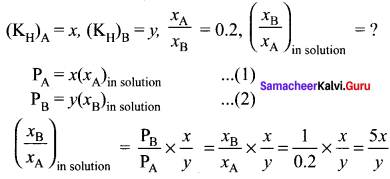
Samacheer Kalvi 11th Chemistry Solutions Chapter 9 Solutions-4

Question 12.
At 100°C the vapour pressure of a solution containing 6.5g a solute in 100g water is 732mm. If Kb = 0.52, the boiling point of this solution will be …………..
(a) 102°C
(b) 100°C
(c) 101°C
(d) 100.52°C
Answer:
(c) 101°C
Solution:
\(\frac { ΔP }{ P° }\) = \(\frac { { n }_{ 2 } }{ { n }_{ 1 } }\)
W2 = 6.5g
W1 = 100g
Kb = 0.52
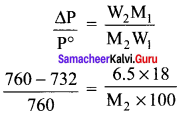
Samacheer Kalvi 11th Chemistry Solutions Chapter 9 Solutions-5
Samacheer Kalvi 11th Chemistry Solutions Chapter 9 Solutions-6

Question 13.
According to Raoult’s law, the relative Lowering of vapour pressure for a solution is equal to…
(a) mole fraction of solvent
(b) mole fraction of solute
(c) number of moles of solute
(d) number of moles of solvent
Answer:
(b) mole fraction of solute
Solution:
\(\frac { ∆P }{ P° }\) = x2 (Mole fraction of the solute)

Samacheer Kalvi 11th Chemistry Solutions Chapter 9 Solutions

Question 14.
At same temperature. which pair of the following solutions are isotonic?
(a) 0.2 M BaCl2 and 0.2M urea
(b) 0.1 M glucose and 0.2 M urea
(c) 0.1 MNaCl and 0.1 MK2SO4
(d) 0.1 MBa(NO3)2 and 0.1 MNa2 SO4
Answer:
(d) 0.1 M Ba (NO3)2 and 0.1 M Na2 SO4
Solution:
0.1 x 3 ion [Ba2 + 2NO3–], 0.1 x 3 ion [2Na+, SO4–]

The formula of normality a solution is the gram equivalent weight of a solute per liter of solution.

Question 15.
The empirical formula of a non-electrolyte(X) is CH2O. A solution containing six gram of X exerts the same osmotic pressure as that of 0.025 M glucose solution at the same temperature. The molecular formula of X is
(a) C2H4O2
(b) C8H16O8
(c) C4H8O4
(d) CH2O
Answer:
(b) C8H16O8
Solution:
(π1)non electrolute = (π2)glucose
C1RT = C2RT

Samacheer Kalvi 11th Chemistry Solutions Chapter 9 Solutions-7
\(\frac { 6 }{ n(30) }\) = 0.025
n = \(\frac { 6 }{ 0.025 x 30 }\) = 30
∴ Molecular formula C8H16O8

Question 16.
The KH for the solution of oxygen dissolved in water is 4 x 10⁴ atm at a given temperature. If the partial pressure of oxygen in air is 0.4 atm, the mole fraction of oxygen in solution is …………..
(a) 4.6 x 10³
(b) 1.6 x 10⁴
(c) 1 x 10⁻⁵
(d) 1 x 10⁵
Answer:
(c) 1 x 10⁻⁵
Solution:
KH = 4 x 10⁴ atm,
(PO2)air = 0.4 atm,
(xo2)in solution = ?
air – in solution
(PO2)air = KH(xo2)in solution
0.4 = 4 x 10⁴(xo2)in solution
(xo2)in solution = \(\frac { 0.4 }{ 4\times { 10 }^{ 4 } }\) = 1 x 10⁻⁵

Samacheer Kalvi 11th Chemistry Solutions Chapter 9 Solutions

Question 17.
Normality of 1.25M sulphuric acid is …………
(a) 1.25 N
(b) 3.75 N
(c) 2.5 N
(d) 2.25 N
Answer:
(c) 2.5 N
Solution:
Normality of H2SO4 = (No. of replacable H+) x M = 2 x 1.25 = 2.5 N

Question 18.
Two liquids X and Y on mixing gives a warm solution. The solution is …………..
(a) ideal
(b) non-ideal and shows positive deviation from Raoults law
(c) ideal and shows negative deviation from Raoults Law
(d) non – ideal and shows negative deviation from Raoults Law
Answer:
(d) non – ideal and shows negative deviation from Raoults Law
Solution:
∆Hmix is negative and show negative deviation from Raoults law.

Samacheer Kalvi 11th Chemistry Solutions Chapter 9 Solutions

Question 19.
The relative lowering of vapour pressure of a sugar solution in water is 3.5 x 10⁻³. The mole fraction of water in that solution is …………
(a) 0.0035
(b) 0.35
(c) 0.0035/18
(d) 0.9965
Answer:
(d) 0.9965
Solution:
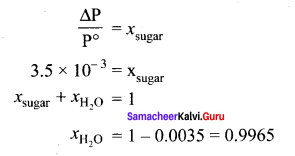
Samacheer Kalvi 11th Chemistry Solutions Chapter 9 Solutions-9

Question 20.
The mass of a non-volatile solute (molar mass 80 g mol-1) which should be dissolved in 92g of toluene to reduce its vapour pressure to 90% ………..
(a) 10g
(b) 20g
(c) 9.2 g
(d) 8.89g
Answer:
(d) 8.89g
Solution:
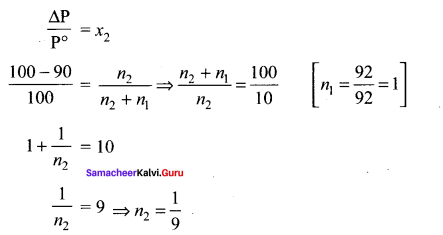
Samacheer Kalvi 11th Chemistry Solutions Chapter 9 Solutions-10
Samacheer Kalvi 11th Chemistry Solutions Chapter 9 Solutions-11

Question 21.
For a solution, the plot of osmotic pressure (π) verses the concentration (e in mol L-1) gives a straight line with slope 310 R where ‘R’ is the gas constant. The temperature at which osmotic pressure measured is ………..
(a) 310 x 0.082 K
(b) 3 10°C
(c) 37°C
(d) \(\frac { 310 }{ 20.082}\)
Answer:
(c) 37°C
Solution:
π = CRT
y = x(m)
m = RT
310 R = RT
T = 310 K
= 37°C

Samacheer Kalvi 11th Chemistry Solutions Chapter 9 Solutions

Question 22.
200 ml of an aqueous solution of a protein contains 1 .26g of protein. At 300K, the osmotic pressure of this solution is found to be 2.52 x 10⁻³ bar. The molar mass of protein will be (R =0.083 Lhar mol-1 K-1) ……………
(a) 62.22 Kg mol-1
(b) 12444 g mol-1
(c) 300g mol-1
(d) none of these
Answer:
(a) 62.22 Kg mol-1
Solution:
π = CRT
M = \(\frac { WRT }{ π1 }\) = \(\frac { 1.26\times 0.083\times 300 }{ 2.52\times { 10 }^{ -3 }\times 0.2 }\) = 62.22Kg mol-1

Question 23.
The Van’t Hoff factor (i) for a dilute aqueous solution of the strong electrolyte barium hydroxide is ………..
(a) 0
(b) 1
(c) 2
(d) 3
Answer:
(b) 1
Solution:
Ba(OH)2 dissociates to form Ba2+ and 2OH-1 ion
α = \(\frac { (i – 1) }{ (n – 1) }\)
i = α (n – 1) + 1
n = i = 3 ( for Ba (OH)2, α = 1 )

Question 24.
What is the molality of a 10% w/w aqueous sodium hydroxide solution?
(a) 2.778
(b) 2.5
(c) 10
(a) 0.4
Answer:
(b) 2.5
Solution:
100% \(\frac { w }{ w }\) aqueous NaOH solution means that 10 g of sodium hydroxide in 100g solution.

Samacheer Kalvi 11th Chemistry Solutions Chapter 9 Solutions-13

Question 25.
The correct equation for the degree of an associating solute, ‘n’ molecules of which undergoes association in solution, is ………
(a) α = \(\frac { n(i – 1) }{ n – 1 }\)
(b) α2 = \(\frac { n(1 – i) }{ n – 1 }\)
(c) α = \(\frac { n(i – 1) }{ 1 – n }\)
(d) α = \(\frac { n(1 – i) }{ n(1 – i) }\)
Answer:
(c) α = \(\frac { n(i – 1) }{ 1 – n }\)
Solution:
α = \(\frac { (i – 1)n }{ (n – 1) }\) (or) \(\frac { n(i – 1) }{ (1 – n) }\)

Samacheer Kalvi 11th Chemistry Solutions Chapter 9 Solutions

Question 26.
Which of the following aqueous solutions has the highest boiling point?
(a) 0.1 M KNO3
(b) 0.1 M Na3PO4
(c) 0.1 M BaCl2
(d) 0.1 M K2SO4
Answer:
(a) 0.1 M KNO3
Solution:
Elevation of boiling point is more in the case of Na3PO4(no. of ions 4; 3 Na+, PO43-)

Question 27.
The freezing point depression constant for water is 1.86° k kg mo1-1 . If 5g Na2SO4 is dissolved in 45g water, the depression in freezing point is 3.64°C. The van’t Hoff factor for Na2SO4 is ……..
(a) 2.50
(b) 2.63
(c) 3.64
(d) 5.50
Answer:
(a) 2.50
Solution:
Kf = 1.86
W2 = 5g
∆Tf = 3.64
M2 = 142
W1 = 45g
ΔTf = i x Kf
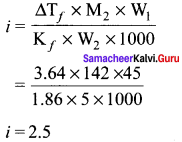
Samacheer Kalvi 11th Chemistry Solutions Chapter 9 Solutions-14

Question 28.
Equimolal aqueous solutions of NaCI and KCI are prepared. If the freezing point of NaCI is – 2°C, the freezing point of KCI solution is expected to be ………
(a) – 2°C
(b) – 4°C
(c) – 1°C
(d) 0°C
Answer:
(a) – 2°C
(b) – 4°C
(c) – 1°C
(d) 0°C
Solution:
Equimolal aqueous solution of KCI also shows 2° C depression in freezing point.

Samacheer Kalvi 11th Chemistry Solutions Chapter 9 Solutions

Question 29.
Phenol dimerises in henzene having van’t Hoff factor 0.54. What is the degree of association?
(a) 0.46
(b) 92
(c) 46
(d) 0.92
Answer:
(d) 0.92
Solution:
α = \(\frac { (1-i)n }{ (n-1) }\) = \(\frac { (1 – 0.54)2 }{ (2 – 1) }\) = 0.46 x 2 = 0.92
Question 30.
Assertion: An ideal solution obeys Raoult’s Law
Reason: In an ideal solution, solvent-solvent, as well as solute-solute interactions, are similar to solute-solvent interactions.
(a) both assertion and reason are true and reason is the correct explanation of assertion
(b) both assertion and reason are true but reason is not the correct explanation of assertion
(c) assertion is true but reason is false
(d) both assertion and reason are false
Answer:
(a) both assertion and reason are true and reason is the correct explanation of assertion

Samacheer Kalvi 11th Chemistry Solutions Short Answer Questions

Question 31.
Define

  1. Molality
  2. Normality

Answer:
1. Molality (m):
It is defined as the number of moles of the solute present in 1 kg of the solvent

Samacheer Kalvi 11th Chemistry Solutions Chapter 9 Solutions-15

2. Normality (N):
It is defined as the number of gram equivalents of solute in I litre of the solution.

Samacheer Kalvi 11th Chemistry Solutions Chapter 9 Solutions-16

Question 32.
What is a vapour pressure of liquid? What is relative lowering of vapour pressure?
Answer:
1. The pressure of the vapour in equilibrium with its liquid ¡s called vapour pressure of the liquid at the given temperature.

2. The relative lowering of vapour pressure is defined as the ratio of lowering of vapour. pressure to vapour pressure of pure solvent. Relative lowering of vapour pressure
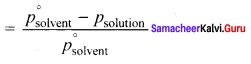
Samacheer Kalvi 11th Chemistry Solutions Chapter 9 Solutions-17

Question 33.
State and explain Henry’s law.
Answer:
“The partial pressure of the gas in vapor phase (vapour pressure of the solute) is directly proportional to the mole fraction (x) of the gaseous solute in the solution at low concentrations”. This statement is known as Henry’s law.
Henry’s law can be expressed as,
Psolute α xsolute in solution
Psolute = KH xsolute solution
Here, Psolute represents the partial pressure of the gas in vapour state which is commonly called vapour pressure. Xsolute in solution represents the mole fraction of solute in the solution. KH is an empirical constant with the dimensions of pressure.

Samacheer Kalvi 11th Chemistry Solutions Chapter 9 Solutions

Question 34.
State Raoult law and obtain expression for lowering of apour pressure when the nonvolatile solute is dissolved in solvent.
Answer:
Raoult’s law:
This law states that “in the case of a solution of volatile liquids the partial vapour pressure of each component (A & B) of the solution is directly proportional to its mole fraction.
PA ∝ x A
when xA = 1,
then k = P°A
(P°A = vapour pressure of pure component)
PA = P°A . xa
PB = P°B . xb
when a non-volatile is dissolved in pure water, the vapour pressure of the pure solvent will decrease. In such a solution, the vapours pressure of the solution will depend only on the solvent molecules as the solute is non-volatile.
Psolution ∝ xA
Psolution = k . xA
xA = 1, k = P°solvent
P°solution = P°solvent – Psolution
Lowering of vapour pressure = P°solvent – Psolution
Relative lowering of vapour pressure = \(\frac { P° – P }{ P° }\) = xB
where xB = Mole fraction of solute.

Samacheer Kalvi 11th Chemistry Solutions Chapter 9 Solutions

Question 35.
What is molal depression constant? Does it depend on nature of the solute?
Answer:
Kf = molar freezing point depression constant or cryoscopic constant.
∆Tf = Kf . m,
where
∆Tf = depression in freezing point.
m = molality of the solution
Kf = cryoscopic constant
If m = I
∆Tf = Kf
i.e., cryoscopic constant is equal to the depression in freezing point for 1 molal solution cryoscopic constant depends on the molar concentration of the solute particles. Kf is directly proportional to the molal concentration of the solute particles.

Samacheer Kalvi 11th Chemistry Solutions Chapter 9 Solutions-18
WB = mass of the solute
WA = mass of solvent
MB = molecular mass of the solute.

Question 36.
What is osmosis?
Answer:
“The phenomenon of the flow of solvent through a semipermeable membrane from pure solvent to the solution is called osmosis”. Osmosis can also be defined as “the excess pressure which must be applied to a solution to prevent the passage of solvent into it through the semipermeable membrane”. Osmotic pressure is the pressure applied to the solution to prevent osmosis.

Question 37.
Define the term isotonic
Answer:
1. Two solutions having same osmotic pressure at a given temperature are called isotonic solutions.

2. When such solutions arc separated by a semipermeable membrane, solvent flow between one to the other on either direction is same. i.e. the net solvent flow between two isotonic solutions is zero.

Samacheer Kalvi 11th Chemistry Solutions Long Answer Questions

Question 38.
You are provided with a solid ‘A’ and three solutions of A dissolved in water – one saturated, one unsaturated, and one supersaturated. How would you determine each solution?
Answer:
1. Saturated solution:
When the maximum amount of solute is dissolved in a solvent, any more addition of solute will result in precipitation at a given temperature and pressure. Such a solution is called a saturated solution.

2. Unsaturated solution:
When the minimum amount of solute is dissolved in a solvent at a given temperature and pressure is called an unsaturated solution.

3. Supersaturated solution:
It is a solution that holds more solute than it normally could in its saturated form.

Example:

  1. A saturated solution where the addition of more compound would not dissolve in the solution. 359 g of NaCI in 1 litre of water at 25°C.
  2. An unsaturated solution has the capacity to dissolve more of the compound. 36 g of NaCI in 1 litre of water at 25°C.
  3. A supersaturated solution is a solution in which crystals can start growing. 500 g of NaCI in 1 litre of water at 25°C.

Samacheer Kalvi 11th Chemistry Solutions Chapter 9 Solutions

Question 39.
Explain the effect of pressure on solubility.
Answer:
Generally, the change in pressure does not have any significant effect on the solubility of solids and liquids as they are not compressible. However, the solubility of gases generally increases with an increase in pressure.

Consider a saturated solution of a gaseous solute dissolved in a liquid solvent in a closed container. In such a system, the following equilibrium exists.
Gas (in a gaseous state) ⇌ Gas (in solution)

According to the Le-Chatelier principle, the increase in pressure will shift the equilibrium in the direction which will reduce the pressure. Therefore, more gaseous molecules dissolve in the solvent, and the solubility increases.

Question 40.
A sample of 12 M Concentrated hydrochloric acid has a density of 1.2 gL-1. Calculate the molality.
Answer:
Given:
Molarity = 12 M HCI
Density of the solution = 1.2 g L-1
In the 12 M HCl solution, there are 12 moles of HCl in 1 litre of the solution.
Samacheer Kalvi 11th Chemistry Solutions Chapter 9 Solutions-19
Calculate mass of water (solvent)
Mass of 1 litre HCI solution = density x volume
= 1.2gmL-1 x 1000 mL
= 1200g
Mass of LICI = No. of moles of HCI x molar mass of HCI
= 12mol x 36.5 g mol-1
= 438g
Mass of waler = mass of HCI solution – mass of HCI
Mass of waler = 1200 – 438 = 762 g
Molalily =\(\frac { 12 }{ 0.762 }\) = 15.75m

Question 41.
A 0.25 M glucose solution at 370.28 K has approximately the pressure as blood. What is the osmotic pressure of blood?
Solution.
C = 0.25 M
T = 370.28 K
(π)glucose = CRT
(π) = 0.25 mol L-1 × 0.082L atm K-1mol-1 × 370.28K
= 7.59 atm

Question 42.
Calculate the molarity of a solution containing 7.5g of glycine (NH2 – CH2 – COOH) dissolved in 500g of water.
Solution:
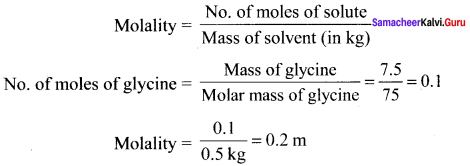
Samacheer Kalvi 11th Chemistry Solutions Chapter 9 Solutions-20

Question 43.
Which solution has the lower freezing point? 10g of methanol (CH3OH) in 100g of water (or) 20g of ethanol (C2H5HO) In 200g of water.
Solution:
∆Tf = Kf . m i.e. ∆Tf ∝ m
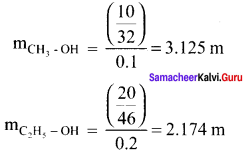
Samacheer Kalvi 11th Chemistry Solutions Chapter 9 Solutions-21
∴ Depression in freezing point is more in methanol solution and it will have a lower freezing point.

Question 44.
How many moles of solute particles are present in one litre of 10-4 M potassium sulphate?
Solution:
In 10-4M K2SO4 solution, there are 10-4 moles of potassium sulphate.
K2SO4 molecule contains 3 ions (2 K+ and 1SO42-)
1 mole of K2SO4 contains 3 x 6.023 x 1023 ions
10 mole of K2SO4 contains 3 x 6.023 x 102 x 10-4 ions = 18.069 x 10¹⁹

Samacheer Kalvi 11th Chemistry Solutions Chapter 9 Solutions

Question 45.
Henry’s law constant for solubility of methane in benzene is 4.2 x 10⁻⁵ mm Hg at a particular constant temperature. At this temperature, calculate the solubility of methane at

  1. 750 mm Hg
  2. 840 mmHg

Solution:
(KH)Benzene = 4.2 x 10⁻⁵ mm Hg. Solubility of methane = ? P = 750 mm Hg, p = 840 mm Hg
According to Henry’s Law,
P = KH . xsolution
750 mm Hg = 4.2 x 10⁻⁵ mm Hg . xsolution

Samacheer Kalvi 11th Chemistry Solutions Chapter 9 Solutions-24

Question 46.
The observed depression in the freezing point of water for a particular solution is 0.093°C. Calculate the concentration of the solution in molality. Given that the molal depression constant for water is 1.86 K kg mol-1.
Solution:
T1= 0.093°C = 0.093K
m = ?
Kf = 1.86K kg mol-1
∆Tf = kf . m
Samacheer Kalvi 11th Chemistry Solutions Chapter 9 Solutions-24

Question 47.
The vapour pressure of pure benzene (C6H6) at a given temperature is 640 mm Hg. 2.2 g of non-volatile solute is added to 40 g of benzene. The vapour pressure of the solution is 600 mm Hg. Calculate the molar mass of the solute?
Solution:
P0C6H6 = 640 mm Hg
W2 = 2.2 g (non volatile solute)
W1 = 40 g (benzene)
Psolution = 600 mm Hg
M2 = ?
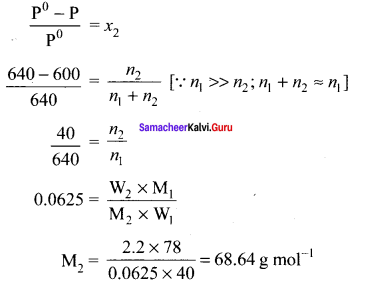
Samacheer Kalvi 11th Chemistry Solutions Chapter 9 Solutions-25

Samacheer Kalvi 11th Chemistry Solutions In Text Questions – Evaluate Yourself

Question 1.
If 5.6 g of KOH is present in (a) 500 mL and (b) I litre of solution, calculate the molarity of each of these solutions.
Solution.
Mass of KOH = 5.6g
No. of moles = \(\frac { 5.6 }{ 5.6 }\) = 0.1 mol
1. Volume of the solution = 500 ml = 0.5 L

2. Volume of the solution = IL
Samacheer Kalvi 11th Chemistry Solutions Chapter 9 Solutions-26

3. Volume of the solution = IL
Molarity = \(\frac { 0.1 }{ 1 }\) M

Question 2.
2.82 g of glucose is dissolved in 30 g of water. Calculate the mole fraction of glucose and water.
Solution:
Mass of glucose = 2.82 g
No. of moles of glucose = \(\frac { 2.82 }{ 180 }\) = 0.0 16
Mass of water = 30g = \(\frac { 30 }{ 18 }\) = 1.67
xH2O = \(\frac { 1.67 }{ 1.67 + 0.016 }\) = \(\frac { 1.67 }{ 1.686 }\) = 0.99
xH2O + xglucose = 1
0.99 + xglucose = 1
xglucose = 1 – 0.99 = 0.01

Samacheer Kalvi 11th Chemistry Solutions Chapter 9 Solutions

Question 3.
The antiseptic solution of iodopovidone for the use of external application contains 10% w/v of iodopovidone. Calculate the amount of iodopovidone present in a typical dose of 1.5 mL.
Solution:
10% \(\frac { w }{ v }\) means that 10 g of solute in 100 ml solution
∴ Amount of iodopovidone in 1.5 ml = \(\frac { 10g }{ 100ml }\) x 1.5 ml = 0.15 g

Question 4.
A litre of sea water weighing about 1.05 kg contains 5 mg of dissohed oxygen (O2). Express the concentration of dissolved oxygen in ppm.
Solution:
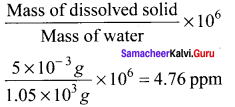
Samacheer Kalvi 11th Chemistry Solutions Chapter 9 Solutions-28

Question 5.
Describe how would you prepare the following solution from pure solute and solvent

  1. 1 L of aqueous solution of 1.5 M COCI2.
  2. 500 mL of 6.0 % (v/v) aqueous methanol solution.

Solution:

  1. mass of 1.5 moles of COCI2 = 1.5 x 129.9 = 194.85g
  2. 194.85g anhydrous cobalt chloride is dissolved in water and the solution is make up to one litre in a standard flask.

Question 6.
How much volume of 6 M solution of NaOH is required to prepare 500 mL of 0.250 M NaOH solution.
Solution:
6% \(\frac { v }{ v }\) aqueous solution contains 6g of methanol in 100 ml solution. To prepare 500 ml of 6% v/v solution of methanol 30g methanol is taken in a 500 ml standard flask and required quantity of water is added to make up the solution to 500 ml.

Question 7.
Calculate the proportion of O2 and N2 dissolved in water at 298 K. When air containing 20% O2 and 80% N2 by volume is in equilibrium with water at 1 atm pressure. Henry’s law constants for two gases are KH(O2) = 4.6 x atm and KH (N2) 8.5 x 10⁴ atm.
Solution:
C1V1 = C2V2
6M (V1) = 0.25M x 500 ml
V1 = \(\frac { 0.25 x 500 }{ 6 }\)
V1 = 20.3 mL

Samacheer Kalvi 11th Chemistry Solutions Chapter 9 Solutions

Question 8.
Explain why the aquatic species are more comfortable in cold water during winter season rather than warm water during the summer.
Solution:
Total pressure = 1 atm
PN2 = \((\frac { 80 }{ 100 })\) x Total pressure = \(\frac { 80 }{ 100 }\) x 1 atm = 0.8 atm
PO2 = \((\frac { 20 }{ 100 })\) x 1 = 0.2 atm
According to Henry’s Law
Psolute = KH x solute in solution
PN2 = (KH)Nitrogen x Mole fraction of Nitrogen in solution
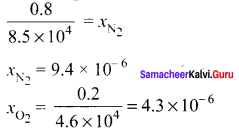
Samacheer Kalvi 11th Chemistry Solutions Chapter 9 Solutions-29

Question 9.
Calculate the mole fractions of benzene and naphthalene in the vapour phase when an ideal liquid solution is formed by mixing 128 g of naphthalene with 39g of benzene. It is given that the vapour pressure of pure benzene is 50.71 mm Hg and the vapour pressure of pure naphthalene is 32.06 mm Hg at 300 K.
Solution:
P0pure benzene = 50.71 mm Hg
P0nepthalene = 32.06 mm Hg
Number of moles of benzene = \(\frac { 39 }{ 78 }\) = 0.5 mol
Number of moles of naphthalcne = \(\frac { 128 }{ 128 }\) =1 mol
Mole fraction of benzene = \(\frac { 0.5 }{ 1.5 }\) = 0.33
Mole fraction of naphthalene = 1 – 0.33 = 0.67
Partial vapour pressure of benzene =P0benzene x Mole fraction of benzene
= 50.71 x 0.33 = 16.73 mm Hg
Partial vapour pressure of naphthalene = 32.06 x 0.67 = 21.48mm Hg
Mole fraction of benzene in vapour phase = \(\frac { 16.73 }{ 16.73 + 21.48 }\) = \(\frac { 16.73 }{ 38.21 }\) = 0.44
Mole fraction of naphthalene in vapour phase = 1 – 0.44 = 0.56

Samacheer Kalvi 11th Chemistry Solutions Chapter 9 Solutions

Question 10.
Vapour pressure of a pure liquid A is 10.0 torr at 27°C. The vapour pressure is lowered to 9.0 torr on dissolving one grani of B in 20g of A. If the molar mass of A is 200 g mol-1 then calculate the molar mass of B.
Solution:
P0A = 10 torr
Psolution = 9 torr
WA = 20 g
WB = 1 g
MA = 200 g mol-1
MB = ?
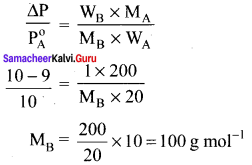
Samacheer Kalvi 11th Chemistry Solutions Chapter 9 Solutions-30

Question 11.
2.56g of Sulphur is dissolved in 100g of carbon disuiphide. The solution boils at 319.692K. What is the molecular formula ofSulphur in solution? The boiling pointof CS2 is 319. 450K. Given that Kb for CS2 = 2.42 K kg mol-1
Solution:
W2 = 2.56g
W1 = 100g
T = 319.692 K
Kb = 2.42 K kg mol-1
∆Tb = (319.692 – 319.450) K = 0.242 K

Samacheer Kalvi 11th Chemistry Solutions Chapter 9 Solutions-31
M2 = 256g mol-1
Molecular mass of sulphur in solulion = 256 g mol-1
Atomic mass of one mole of sulphur atom = 32
No. of atoms in a molecule of sulphur = \(\frac { 256 }{ 32 }\) = 8
Hence, molecular tòrmula of sulphur is S8.

Question 12.
2g of a non-electrolyte solute dissolved in 75g of benzene lowered the freezing point of benzene by 0.20 K. The freezing point depression constant of benzene is 5.12 K Kg mol-1. Find the molar mass of the solute.
Solution:
W2 = 2g
W1 = 75g
∆Tf = 0.2 K
kf = 5.12 K kg mol-1
M2 = ?

Samacheer Kalvi 11th Chemistry Solutions Chapter 9 Solutions-32

Question 13.
What is the mass of glucose (C6H12O6) in its one-litre solution is isotonic with 6g L-1 of urea (NH2CONH2)?
Solution:
The osmotic pressure of urea solution (π1) = CRT
\(\frac { { W }_{ 2 } }{ { M }_{ 2 }V }\)RT = \(\frac { 6 }{ 60 x 1 }\) x RT
The osmotic pressure of glucose solution
(π2) \(\frac { { W }_{ 2 } }{ 180\times 1 }\) x RT
For isotonic solution, π1 = π2
\(\frac { 6 }{ 60 }\) = \(\frac { { W }_{ 2 } }{ 180\times 1 }\) RT
⇒ W2 = \(\frac { 6 }{ 60 }\) x 180
⇒ W2 = 18 g

Question 14.
0.2m aqueous solution of KCI freezes at – 0.68°C calculate van’t Hoff factor. Kf for water is 1.86 K kg mol-1.
Solution:

Samacheer Kalvi 11th Chemistry Solutions Chapter 9 Solutions-36
Given,
∆Tf = 0.680 K
m = 0.2 m,
∆Tf (observed) = 0.680K
∆Tf (Calculated) = kf
m = 1.86 K kg mol-1 x 0.2 mol kg-1 = 0.372K

Samacheer Kalvi 11th Chemistry Solutions Chapter 9 Solutions-37

Samacheer Kalvi 11th Chemistry Solutions Example problems Solved

Question 1.
What volume of 4M HCI and 2M HCI should be mixed to get 500 mL of 2.SM HCI?
Solution:
Let the volume of 4M HCl required to prepare 500 mL of 2.5 M HCI = x mL
Therefore, the required volume of 2M HCI = (500 – x) mL
We know from the equation x = \(\frac { 250 }{ 2 }\) = 125 mL
Hence, volume of 4M HCI required = 125 mL
Volume of 2M HCl required = (500 – 125) mL = 375 mL

Question 2.
0.24g of a gas dissolves in 1 L of water at 1.5 atm pressure. Calculate the amount of dissolved gas when the pressure is raised to 6.0 atm at constant temperature.
Solution:
Psolute = KH xsolute in solution
At pressure 1.5 atm, p1 = KH x1 ………..(1)
At pressure 6.0 atm, p2 = KHx2 …………..(2)
Dividing equation (1) by (2)
Weget
\(\frac { { P }_{ 1 } }{ { P }_{ 2 } }\) = \(\frac { { x }_{ 1 } }{ { x }_{ 2 } }\)
\(\frac { 1.5 }{ 6.0 }\) = \(\frac { { 0.24 } }{ { x }_{ 2 } }\)
Therefore
x2 = \(\frac { 0.24×6.0 }{ 1.5 }\) = 0.96 g/L

Samacheer Kalvi 11th Chemistry Solutions Chapter 9 Solutions

Question 3.
An aqueous solution of 2% nonvolatile solute exerts a pressure of 1.004 bar at the boiling point of the solvent. What is the molar mass of the solute when PA° is 1.013 bar?
Solution:
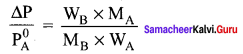
Samacheer Kalvi 11th Chemistry Solutions Chapter 9 Solutions-38
In a 2% solution weight of the solute is 2g and solvent is 98g
ΔP = PA0 – Psolution = 1.013 – 1.004 bar = 0.009 bar
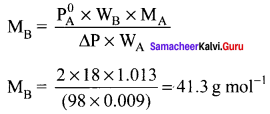
Samacheer Kalvi 11th Chemistry Solutions Chapter 9 Solutions-39

Question 4.
0.75 g of an unknown substance is dissolved in 200 g solvent. If the elevation of boiling point is 0.15 K and molal elevation constant is 7.5K kg more then, calculate the molar mass of unknown substance.
Solution:
∆Tb = Kb m = Kb x W2 x 1000/M2 x W1
M2 = Kb x W2 x 1000/∆Tb x W1
= 7.5 x 0.75 x 1000/0.15 x 200 = 187.5g mol-1

Question 5.
Ethylene glycol (C2H6O2) can be used as an antifreeze in the radiator of a car. Calculate the temperature when ice will begin to separate from a mixture with 20 mass percent of glycol in water used in the car radiator. Kf for water = 1.86 K kg mol-1 and molar mass of ethylene glycol is 62g mol-1.
Solution:
Weight of solute (W2) = 20 mass percent of solution means 20g of ethylene glycol
Weight of solvent (water) W1 = 100 – 20 = 80g

Samacheer Kalvi 11th Chemistry Solutions Chapter 9 Solutions-40
The temperature at which the ice will begin to separate is the freezing of water after the addition of solute i.e. 7.5 K lower than the normal freezing point of water (273 – 7.5)K = 265.5K

Question 6.
At 400K 1.5 g of an unknown substance is dissolved in solvent and the solution is made to 1.5 L. Its osmotic pressure is found to be 0.3 bar. Calculate the molar mass of the unknown substance.
Solution:
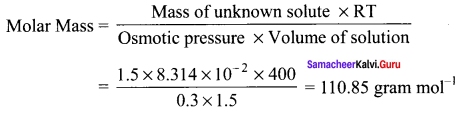
Samacheer Kalvi 11th Chemistry Solutions Chapter 9 Solutions-41

Question 7.
The depression in freezing point is 0.24K obtained by dissolving 1g NaCI in 200g water. Calculate van’t – Hoff factor. The molal depression constant is 1.86 K kg mol-1.
Solution:
Sol. Molar mass of solute
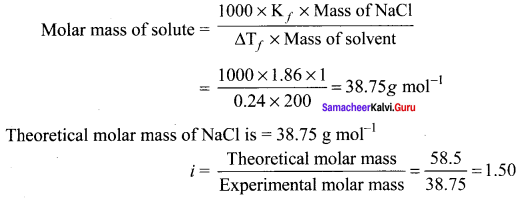
Samacheer Kalvi 11th Chemistry Solutions Chapter 9 Solutions-42

Samacheer Kalvi 11th Chemistry Solutions Additional Questions Solved

Samacheer Kalvi 11th Chemistry Solutions 1 Mark Questions and Answers

I. Choose the correct answer.

Question 1.
Among the following, which one is mostly present in seawater?
(a) NaCI
(b) Nal
(c) KCI
(d) MgBr2
Answer:
(a) NaCI

Question 2.
Statement I: The most common property of seawater and air is homogeneity.
Statement II: The homogeneity implies uniform distribution of their constituents through the mixture.
(a) Statements I and II arc correct and II are the correct explanation of I.
(b) Statements I and II are correct but II is not the correct explanation of I.
(c) Statement I is correct but II is wrong.
(d) Statement I is wrong but II is correct.
Answer:
(a) statement I and II are correct and II is the correct explanation I.

Question 3.
Which one of the following is a homogeneous mixture?
(a) Seawater
(b) Air
(c) Alloys
(d) All the above
Answer:
(d) All the above

Samacheer Kalvi 11th Chemistry Solutions Chapter 9 Solutions

Question 4.
Statement I: The salt solution is an aqueous solution.
Statement II: If water is used as the solvent, the resultant solution is called an aqueous solution.
(a) Statements I and II are correct but II is not the correct explanation of I.
(b) Statements I and II are correct and II is the correct explanation of I.
(c) Statement I is correct but statement II is wrong.
(d) Statement I is wrong but statement II is correct.
Answer:
(b) Statements I and II are correct and II is the correct explanation of I.

Question 5.
Statement I: The dissolution of ammonium nitrate increases steeply with an increase in temperature.
Statement II: The dissolution process of ammonium nitrate is endothermic in nature.
(a) Statement I and II are correct and statement II is the correct explanation of statement I.
(b) Statement I and II are correct but II is not the correct explanation of I.
(c) Statement I is correct but II is wrong.
(d) Statement I is wrong but II is correct.
Answer:
(a) Statement I and II are correct and statement II is the correct explanation of statement I.

Question 6.
In which of the following compound the solubility decreases with the increase of temperature?
(a) sodium chloride
(b) ammonium nitrate
(c) ceric sulphate
(d) calcium chloride
Answer:
(c) ceric sulphate

Question 7.
Which of the following is not an ideal solution?
(a) Benzene & toluene
(b) n – Hexane & n – Heptane
(c) Ethyliodide & ethyl bromide
(d) Ethanol and water
Answer:
(d) Ethanol and water

Question 8.
Which one of the following shows positive deviation from Raoult’s law?
(a) Ethyliodide and Ethyl bromide
(b) Ethyl alcohol and cyclohexane
(c) Chioro benzene & bromo benzene
(d) Benzene & toluenc
Answer:
(b) Ethyl alcohol and cyclohexane

Question 9.
Which one of the following is not a non-ideal solution showing positive deviation?
(a) Benzene & acetone
(b) CCl4 & CHCl3
(c) Acetone & ethyl alcohol
(d) Benzene and toluene
Answer:
(d) Benzene and toluene

Samacheer Kalvi 11th Chemistry Solutions Chapter 9 Solutions

Question 10.
Which of the following shows a negative deviation from Raoult’s law?
(a) Phenol and aniline
(b) Benzene and toluene
(c) Acetone and ethanol
(d) Bcnzene and acetone
Answer:
(a) Phenol and aniline

Question 11.
Which of the following is not a non-ideal solution showing negative deviation?
(a) Phenol and aniline
(b) Ethanol and water
(c) Acetone + Chloroform
(d) n – Heptane and n – Hexane
Answer:
(d) n – Heptane and n-Hexane

Question 12.
Statement I: A solution of potassium chloride in water deviates from ideal behavior.
Statement II: The solute dissociates to give K and Cl ions which form strong ion-dipole interaction with water molecules.
(a) Statement I & II are correct and II is the correct explanation of I
(b) Statement I & II are correct but II is not the correct explanation of I
(c) Statement I is correct but statement II is wrong.
(d) Statement I is wrong but statement II is correct.
Answer:
(a) Statement I & II are correct and II is the correct explanation of I

Question 13.
Statement I: Acetic acid deviates from ideal behavior.
Statement II: Acetic acid exists as a dimer by forming intermolecular hence deviates from Raoult’s law.
(a) Statement I & II are correct and II is the correct explanation of I.
(b) Statement I & II are correct but II is not the correct explanation of I.
(c) Statement I is true but II is wrong.
(d) Statement I is wrong but II is correct.
Answer:
(a) Statement I & II are correct but II is the correct explanation of I.

Samacheer Kalvi 11th Chemistry Solutions Chapter 9 Solutions

Question 14.
Which one of the following has found to have abnormal molar mass? hydrogen bonds and
(a) NaCl
(b) KCI
(c) Acetic acid
(d) all the above
Answer:
(d) All the above

Question 15.
What would be the value of the van’t Hoff factor for a dilute solution of K2SO4 in water?
(a) 3
(b) 2
(c) 1
(d) 4
Answer:
(a) 3
Solution:
ions produced = n = 3
Since
K2SO4 → 2K+ + SO42-
K2SO4 is completely dissociated so
∝ = \(\frac { i – 1 }{ n – 1 }\) = \(\frac { i – 1 }{ 3 – 1 }\) = 1
i – 1 = 1 x 2
i – 1 = 2
i = 2+1 = 3

Question 16.
In the determination of the molar mass of AB using a colligative property, what may be the value of van’t Hoff factor if the solute is 50% dissociates?
(a) 0.5
(b) 1.5
(c) 2.5
(d) 1
Answer:
(b) 1.5
Solution:
∝ = \(\frac { i – 1 }{ n – 1 }\) = 0.5
\(\frac { i – 1 }{ 2 – 1 }\) = 0.5
i – 1 = 0.5
i = 0.5 + 1 = 1.5

Question 17.
Which of the following solution has the highest boiling point?
(a) 5.85% solution of NaCI
(b) 18.0% solution of glucose
(c) 6.0% solution of urea
(d) All have the same boiling point
Answer:
(a) 5.85% solution of NaCl

Question 18.
Which one of the following pair is called an ideal solution?
(a) nicotine – water
(b) water – ether
(c) water – alcohol
(d) Chiorobenzene – bromobenzene
Answer:
(d) Chiorobenzene – bromobenzene

Samacheer Kalvi 11th Chemistry Solutions Chapter 9 Solutions

Question 19.
Which of the following is not a colligative property?
(a) optical activity
(b) osmotic pressure
(c) elevation boiling point
(d) depression in freezing point
Answer:
(a) optical activity

Question 20.
On dissolving sugar in water at room temperature solution feels cool to touch. Under which of the following cases dissolution of sugar will be most rapid?
(a) Sugar crystals in cold water
(b) Sugar crystals in hot water
(c) powdered sugar in cold water
(d) powdered sugar in hot water
Answer:
(d) powdered sugar in hot water

II. Match the following.
Question 1.
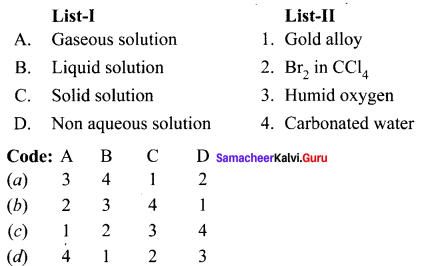
Samacheer Kalvi 11th Chemistry Solutions Chapter 9 Solutions-43
Answer:
(a) 3 4 1 2

Question 2.
Samacheer Kalvi 11th Chemistry Solutions Chapter 9 Solutions-44
Answer:
(d) 3 4 2 1

Question 3.
Samacheer Kalvi 11th Chemistry Solutions Chapter 9 Solutions-45
Answer:
(c) 2 4 1 3

Question 4.
Samacheer Kalvi 11th Chemistry Solutions Chapter 9 Solutions-46
Answer:
(a) 4 3 1 2

Question 5.
Samacheer Kalvi 11th Chemistry Solutions Chapter 9 Solutions-47
Answer:
(b) 2 4 1 3

III. Fill in the blanks.

Question 1.
……… covers more than 70% of the earth’s surface.
Answer:
Seawater

Question 2.
……… is an important naturally occurring solution.
Answer:
Air

Question 3.
An example of solid homogeneous mixture is ……….
Answer:
Brass

Question 4.
A mixture of N2, O2, CO2 and other traces of gases is known as ………
Answer:
Air

Question 5
……… a non – aqueous solution.
Answer:
Br2 in CCl4

Question 6.
……… is an example of a gaseous solution.
Answer:
Camphor in nitrogen gas

Question 7.
……… is used for a dental filling.
Answer:
Amalgam of potassium

Samacheer Kalvi 11th Chemistry Solutions Chapter 9 Solutions

Question 8.
Carbonated water is an example for ………
Answer:
Liquid solution

Question 9.
Humid oxygen is an example of ………
Answer:
Gaseous solution

Question 10.
The concentration of commercially available H2O2 is ………
Answer:
3%

Question 11.
The molality of the solution containing 45g of glucose dissolved in 2kg of water is ………
Answer:
0.125m

Samacheer Kalvi 11th Chemistry Solutions Chapter 9 Solutions-48

Question 12.
5.845 g of NaCl is dissolved in water and the solution was made up to 500 mL using a standard flask. The strength of the solution in molarity is ………
Answer:
0.2 M
Solution:

Samacheer Kalvi 11th Chemistry Solutions Chapter 9 Solutions-49

Question 13.
3.15 g of oxalic acid dihydrate is dissolved in water and the solution was made up to 100 ml using a standard flask. The strength of the solution in normality is ………
Answer:
0.5N
Solution:
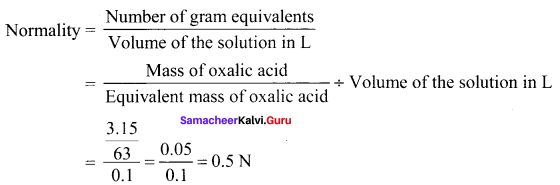
Samacheer Kalvi 11th Chemistry Solutions Chapter 9 Solutions-50

Question 14.
5.85 g of NaCl is dissolved in water and the solution was made upto 500 ml using a standard flask. The strength of the solution in formality is ………
Answer:
0.2 F
Solution:

Samacheer Kalvi 11th Chemistry Solutions Chapter 9 Solutions-51

Question 15.
Neomycin, aminoglycoside antibiotic cream contains 300 mg of neomycin sulphate the active ingredient in 30 g of ointment base. The mass percentage of neomycin is ………
Answer:
1%
Solution:
The mass percentage of neomycin
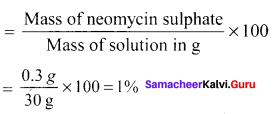
Samacheer Kalvi 11th Chemistry Solutions Chapter 9 Solutions-52

Question 16.
0.5 mole of ethanol is mixed with 1.5 moles of water. Then the mole fraction of ethanol and water are ……….
Answer:
0.25, 0.75
Solution:

Samacheer Kalvi 11th Chemistry Solutions Chapter 9 Solutions-53
= \(\frac { 0.5 }{ 1.5 + 0.5 }\) = \(\frac { 0.5 }{ 2.0 }\) = 0.25
Mole fraction of water = \(\frac { 1.5 }{ 2.0 }\) = 0.75

Question 17.
50 mL of tincture of benzoin, an antiseptic solution contains 10 ml of benzoin. The volume percentage of benzoin is ……….
Answer:
20%
Solution:
Volume percentage of benzoin

Samacheer Kalvi 11th Chemistry Solutions Chapter 9 Solutions-54
= \(\frac { 10 }{ 50 }\) x 100 = 20%

Question 18.
A 60 ml of paracetamol pediatric oral suspension contains 3g of paracetamol. The mass percentage of paracetamol is …………
Answer:
5%
Solution:
Mass percentage of paracetamol =
Samacheer Kalvi 11th Chemistry Solutions Chapter 9 Solutions-55
= \(\frac { 3 }{ 60 }\) x 100 = 5%

Question 19.
50 ml of tap water contains 20 mg of dissolved solids. The TDS value in ppm is ………..
Answer:
400 ppm
Solution:
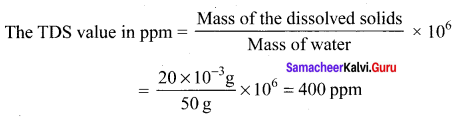
Samacheer Kalvi 11th Chemistry Solutions Chapter 9 Solutions-56

Question 20.
The concentration term used in the neutralisation reactions is …………
Answer:
Normality

Question 21.
The concentration term is used in the calculation of vapour pressure of the solution is …………..
Answer:
Mole fraction

Question 22.
The term used to express the active ingredients present in therapeutics is ………
Answer:
Percentage units

Question 23.
When the maximum amount of solute is dissolved in a solvent at a given temperature, the solution is called ………..
Answer:
Saturated solution

Samacheer Kalvi 11th Chemistry Solutions Chapter 9 Solutions

Question 24.
The solvent in which sodium chloride readily dissolves is …………
Answer:
Water

Question 25.
………… is used by deep-sea divers.
Answer:
Helium, nitrogen and oxygen

Question 26.
The mathematical expression of Raoult’s law is ………..
Answer:
PA = PA0 . XA

Question 27.
……….. is an ideal solution?
Answer:
Chloro benzene & bromo benzene

Question 28.
………….. is important in some vital biological systems.
Answer:
osmotic pressure

Question 29.
………. is not a colligative property.
Answer:
vapour pressure

Question 30.
According to van’t Hoff equation. the value of osmotic pressure t is equal to …………
Answer:
π = CRT

Question 31.
The osmotic pressure of the blood cells is approximately equal to 37°C.
Answer:
7 atm.

Question 32.
Which one of the following is applied in water purification?
Answer:
reverse osmosis

Samacheer Kalvi 11th Chemistry Solutions Chapter 9 Solutions

Question 33.
In the commercial reverse osmosis process, the semi-permeable membrane used is ………..
Answer:
cellulose acetate

Question 34.
The degree of dissociation α is equal to ……….
Answer:
\(\frac { i – 1 }{ n – 1 }\)

Question 35.
The degree of association a is equal to ……….
Answer:
\(\frac { (i – 1)n }{ n – 1 }\)

Question 36.
The estimated vantt Hoff factor for acetic acid solution in benzene is ………..
Answer:
0.5

Question 37.
The estimated van’t Hoff factor for sodium chloride in water is ………..
Answer:
2

Question 38.
Number of moles of the solute dissolved per dm3 of solution is ……….
Answer:
molarity

Question 39.
Molarity of pure water is ………….
Answer:
55.55
Solution:
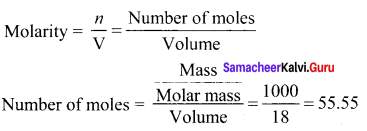
Samacheer Kalvi 11th Chemistry Solutions Chapter 9 Solutions-57
Question 40.
18 g of glucose is dissolved in 90 g of water. The relative lowering of vapour pressure is equal to ………..
Answer:
0.1
Solution:
\(\frac { P° – P }{ P° }\) = x2
x2 = No. of moles of glucose
\(\frac { 18 }{ 180 }\) = 0.1
\(\frac { P° – P }{ P° }\) = 0.1

Question 41.
When NaCl is dissolved in water, boiling point ………..
Answer:
increases

Question 42.
Use of glycol as antifreeze in an automobile is an important application of …………….
Answer:
Colligative property

Samacheer Kalvi 11th Chemistry Solutions Chapter 9 Solutions

Question 43.
Ethylene glycol is mixed with water and used as antifreeze in radiators because …………..
Answer:
it lowers the freezing point of water

Question 44.
The colligative properties of a solution depend on ………… present in it.
Answer:
Number of solute particles

Question 45.
Low concentration of oxygen in the blood and tissues of people living at high altitude is due to ………….
Answer:
low atmospheric pressure

IV. Choose the odd one out.

Question 1.
(a) Air
(b) Camphor in nitrogen gas
(c) Humid oxygen
(d) Saltwater
Answer:
(d) Saltwater.
a, b and e are gaseous solutions whereas d is a liquid solution.

Question 2.
(a) CO2 dissolve in water
(b) Saltwater
(c) Solution of H2 in palladium
(d) Ethanol dissolved in water
Answer:
(c) Solution of H2 in palladium
a, b and d are liquid solutions whereas c is a solid solution.

Question 3.
(a) Amalgam of potassium
(b) Camphor in nitrogen gas
(c) Solution of H2 in palladium
(d) Gold alloy
Answer:
(b) Camphor in nitrogen gas
a, b and d arc solid solutions whereas b is the gaseous solution.

Samacheer Kalvi 11th Chemistry Solutions Chapter 9 Solutions

Question 4.
(a) Vapour pressure
(b) Lowering of vapour pressure
(c) Osmotic pressure
(d) Elevation of boiling point
Answer:
(a) Vapour pressure
b, e and dare colligative properties whereas a is a physical property.

Question 5.
(a) Benzene and tolucne
(b) Chlorobenzene and Bromobenzene
(c) Benzene and acetone
(d) n – hexane and n – heptane
Answer:
(a) Benzene and acetone
a, b, and d are ideal solutions whereas c is a non-ideal solution.

Question 6.
(a) Ethyl alcohol and cyclohexane
(b) Ethyl bromide and ethyl iodide
(c) Acetone and ethyl alcohol
(d) Benzene and acetone
Answer:
(a) Ethyl bromide and ethyl iodide
a, e and dare non-ideal solutions whereas b is an ideal solution.

V. Choose the correct pair.

Question 1.
(a) Humid oxygen – Liquid solution
(b) Gold alloy – Solid solution
(c) Saltwater – Gaseous solution
(d) Solution of H2 in palladium – Gaseous solution
Answer:
(b) Gold alloy – Solid solution

Question 2.
(a) Air – Gaseous solution
(b) Amalgam of potassium – Liquid solution
(c) Saltwater – Solid solution
(d) Carbonated water – Solid solution
Answer:
(a) Air – Gaseous solution

Samacheer Kalvi 11th Chemistry Solutions Chapter 9 Solutions

Question 3.
(a) Benzene and toluene – Non-ideal solution
(b) Benzcnc and acetone – Non-ideal solution
(c) Chlorobenzene and bromo henzene – Non-ideal solution
(d) Carbon tetrachloride and Chloroform – the ideal solution
Answer:
(b) Benzene and acetone – Non-ideal solution

Question 4.
(a) Benzene and toluene – Ideal solution
(b) n-hexane and n-heptane – Non-ideal solution
(c) Ethyl iodide and ethyl bromide – Non-ideal solution
(d) Chiorobenzene and bromo benzene – Non-ideal solution
Answer:
(a) Benzene and toluene – Ideal solution

VI. Choose the incorrect pair.
Question 1.
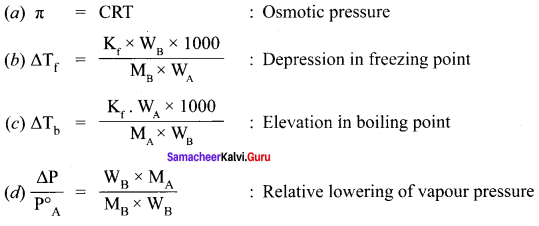
Samacheer Kalvi 11th Chemistry Solutions Chapter 9 Solutions-59
Answer:
Samacheer Kalvi 11th Chemistry Solutions Chapter 9 Solutions-60

Question 2.
(a) Benzene and acetone – Ideal solution
(b) Ethyl alcohol and cyclohexane – Non-ideal solution
(C) n-hexane and n-heptane – Ideal solution
(d) Chioro benzene – Ideal solution
Answer:
(a) Benzene and acetone – Ideal solution

VII Assertion & Reason.

Question 1.
Assertion (A): When NaCI is added to water, depression in the freezing point is observed.
Reason (R): The lowering of vapour pressure of a solution causes the depression in freezing point.
(a) Assertion and Reason are correct and R is the correct explanation of A.
(b) Both A and R are correct but R is not the correct explanation of A.
(c) A is correct but R is wrong
(d) A is wrong but R is correct
Answer:
(a) Assertion and Reason are correct and R is the correct explanation of A.

Samacheer Kalvi 11th Chemistry Solutions Chapter 9 Solutions

Question 2.
Assertion (A): Ammonia reacts with water does not obey Henry’s law.
Reason (R): The gases reacting with the solvent does not obey Henry’s law.
(a) Both (A) and (R) are correct and (R) is the correct explanation of (A).
(b) Both (A) and (R) are correct but (R) is not the correct explanation of (A).
(c) (A) is correct hut (R) is wrong.
(d) (A) is wrong but (R) is correct.
Answer:
(a) Both (A) and (R) are correct and (R) is the correct explanation of (A).

Question 3.
Assertion (A): Acetic acid solution deviates from Raoult’s law.
Reason (R): Association of solute molecules exists as a dimer by forming intermolecular. hydrogen bonds and hence deviates from Raoult’s law.
(a) Both (A) and (R) arc wrong.
(b) Both (A) and (R) are correct and (R) is the correct explanation of (A).
(c) (A) is correct but (R) is wrong.
(d) (A) is wrong but (R) is correct.
Answer:
(b) Both (A) and (R) are correct and (R) is the correct explanation of (A).

VIII. Choose the correct statement.

Question 1.
(a) Raoult’s law is applicable to volatile solid solute in liquid solvent
(b) Henry’s law is applicable to solution containing solid solute in liquid solvent
(c) For very dilute solutions, the solvent obeys Raoult’s law and the solute obeys Henry’s law.
(d) For saturated solution containing volatile solid solute in liquid solvent both laws are obeyed.
Answer:
(c) For very dilute solutions. the solvent obeys Raoult’s law and the solute obeys LIenrys law.

Samacheer Kalvi 11th Chemistry Solutions 2 Marks Questions and Answers

I. Write brief answer to the following questions:

Question 1.
Define solution.
Answer:
A solution is a homogeneous mixture of two or more substances, consisting of atoms, ions or molecules. The constituent of the homogeneous mixture present in a lower amount is called the solute, and the one present in a larger amount is called the solvent. For example, when a small amount of NaCl dissolved in water.

Samacheer Kalvi 11th Chemistry Solutions Chapter 9 Solutions

Question 2.
Define the solution with an example.
Answer:
1. A solution is a homogeneous mixture of two or more substances consisting of atoms. ions or molecules.

2. For example, when a small amount of NaCl is dissolved in water, a homogeneous solution is obtained. In this solution, Na+ and C– ions are uniformly distributed in the water. Here NaCI is the solute and water is the solvent.

Question 3.
What is an unsaturated solution?
Answer:
An unsaturated solution is one that contains less amount of solute than its capacity to dissolve.

Question 4.
Define molality.
Answer:
Molality is defined as the number of moles of solute present in 1 kg of the solvent.
Samacheer Kalvi 11th Chemistry Solutions Chapter 9 Solutions-61

Question 5.
Define molarity.
Answer:
Molarity is defined as the number of moles of solute present in 1 litre of the solution.

Samacheer Kalvi 11th Chemistry Solutions Chapter 9 Solutions-62

Question 6.
Define normality.
Answer:
Normality is defined as the number of gram equivalents of solute present in 1 litre of the solution.
Samacheer Kalvi 11th Chemistry Solutions Chapter 9 Solutions-63

Question 7.
Define formality.
Answer:
Formality (F) is defined as the number of formula weight of solute present in 1 litre of the solution.

Samacheer Kalvi 11th Chemistry Solutions Chapter 9 Solutions-64

Question 8.
Define mole fraction.
Answer:
The mole fraction of a component is the ratio of a number of moles of the component to the total number of moles of all components present in the solution.

Samacheer Kalvi 11th Chemistry Solutions Chapter 9 Solutions-65

Question 9.
Show that the sum of mole fraction of a solution is equal to one.
Answer:
Consider a solution containing two components A and 13 whose mole fractions are xA and xB respectively. Let the number of moles of two components A and B are nA and nB respectively.
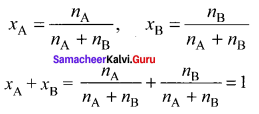
Samacheer Kalvi 11th Chemistry Solutions Chapter 9 Solutions-66

Question 10.
Define mass percentage.
Answer:
Mass percentage is defined as the ratio of the mass of the solute in g to the mass of solution in g multiplied by 100.

Samacheer Kalvi 11th Chemistry Solutions Chapter 9 Solutions-67

Question 11.
Define volume percentage.
Answer:
Volume percentage is defined as the ratio of volume of solute in mL to the volume of solution in ml multiplied by 100.

Samacheer Kalvi 11th Chemistry Solutions Chapter 9 Solutions-68

Question 12.
Define mass by volume percentage.
Answer:
It is defined as the ratio of the mass of the solute in g to the volume of the solution in ml multiplied by 100.

Samacheer Kalvi 11th Chemistry Solutions Chapter 9 Solutions-69

Question 13.
What is meant by ppm? Where is it used?
Answer:
1. part per million =
Samacheer Kalvi 11th Chemistry Solutions Chapter 9 Solutions-70

2. ppm is used to express the quantity of solutes present in small amounts in solutions.

Question 14.
What is the elevation of boiling point? Give it.
Answer:
The temperature difference between the solution and pure solvent is called elevation of boiling point,
∆Tb = T – T°
Unit of ∆Tb is K Kg mole-1.

Samacheer Kalvi 11th Chemistry Solutions Chapter 9 Solutions

Question 15.
Define solubility.
Answer:
The solubility of a substance is defined as the amount of the solute that can be dissolved in loo g of the solvent at a given temperature to form a saturated solution.

Question 16.
Ammonia is more soluble than oxygen in water. Why?
Answer:
Ammonia forms hydrogen bonding with water molecules, this intermolecular bonds arc very strong and thus the ammonia is more soluble in water. Ammonia is strongly interact with water to form ammonium hydroxide. But oxygen is more electronegative it is not able to interact with water more. So NH3 is more soluble than O2 in water.

Question 17.
Solubility of a solid solute in a liquid solvent increases with increase in temperature. Justify this statement.
Answer:
When the temperature is increased,the average kinetic energy of the molecules of the solute and the solvent increases. The increase in the kinetic energy facilitates the solvent molecules to break the intermolecular attractive forces that keep the solute molecules together and hence the solubility increases.

Question 18.
Dissolution of ammonium nitrate increases with increase in temperature. Why?
Answer:
The dissolution process of ammonium nitrate is endothermic. So the solubility increases with increase in temperature.

Question 19.
What is the relationship between the solubility of eerie sulphate with temperature?
Answer:
The dissolution of eerie sulphate is exothermic and the solubility decreases with the increase in temperature.

Question 20.
Why in the dissolution of CaCl2, the solubilit increases moderately with high temperature?
Answer:
Even though the dissolution of CaCI2, is cxothcrmic, the soluhility increases moderately with increase in temperature. Here the entropy factor plays a significant role in deciding the position of equilibrium.

Question 21.
Why the carbonated drinks are stored in pressurized container?
Answer:
1. The carbonated beverages contain CO2 dissolved in them. To dissolve the CO2 in these drinks, CO2 gas is bubbled through them under high pressure.

2. These containers are sealed to maintain the pressure. When we open these containers at atmospheric pressure, the pressure of the CO2 drops to the atmospheric pressure level and hence bubbles of CO2 rapidly escape from the solution and show effervescence.

Samacheer Kalvi 11th Chemistry Solutions Chapter 9 Solutions

Question 22.
Define

  1. Evaporation
  2. Condensation.

Answer:
1. Evaporation:
If the kinetic energy of molecules in the liquid state overcomes the intermolecular force of attraction between them, then the molecules will escape from the liquid state. This process is called evaporation.

2. Condensation:
The vapour molecules are in random motion during which they collide with each other and also with the walls of the container. As the collision is inelastic, they lose their energy and as a result, the vapour returns back to a liquid state. This process is called condensation.

Question 23.
State Dalton’s law of partial pressure.
Answer:
According to Dalton’s law of partial pressure, the total pressure in a closed vessel will be equal to the sum of the partial pressure of the individual components.
Ptotal = PA + PB

Question 24.
Give the reason behind the lowering of vapour pressure in the dissolution of NaCl in water?
Answer:
NaCI is a non volatile solute. When a non-volatile solute is dissolved in a pure solvent, the vapour pressure of pure solvent will decrease. In such a solution, vapour pressure of the solution will depend only on the solvent molecules as the solute is non-volatile.

Samacheer Kalvi 11th Chemistry Solutions Chapter 9 Solutions

Question 25.
What is the ideal solution? Give example.
Answer:
An ideal solution is a solution in which each component i.e., the solute as well as the solvent obeys Raoult’s law over the entire range of concentration.

Question 26.
What is volume percentage?
Answer:
It is defined as the volume of the component present in 100mL of the solution. If Va is a volume of solute and Vb is the volume of solvent, then
Vollume percentage of solute = \(\frac{V_{a} \times 100}{V_{a}+V_{b}}\)

Question 27.
What are colligative properties? Give example.
Answer:
The properties which do not depend on the chemical nature of the solute but depend only on the number of solute particles present in the solution are called colligative properties. e.g.,

  1. Relative lowering of vapour pressure – \(\frac { P° – P}{ P° }\)
  2. Osmotic pressure – π
  3. Elevation of the boiling point – ∆Tb
  4. Depression in freezing point – ∆Tf

Question 28.
What is meant by elevation of boiling point?
Answer:
1. The boiling point of a liquid is the temperature at which its vapour pressure becomes equal to the atmospheric pressure.

2. When a non-volatile solute is added to pure solvent at its boiling point, the vapour pressure of the solution is lowered below 1 atm. To bring the vapour pressure again to 1 atm, the temperature of the solution has to be increased.

3. As a result, the solution boils at a higher temperature (Tb) than the boiling point of pure solvent (Tb°). This increase in the boiling point is known as the elevation of boiling point.

Question 29.
Define ebullioscopic constant.
Answer:
Ebullioscopic constant kb, is equal to the elevation in boiling point for 1 molal solution.
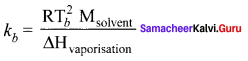
Samacheer Kalvi 11th Chemistry Solutions Chapter 9 Solutions-71

Question 30.
What is Van’t Hoff factor?
Answer:
It is defined as the ratio of the actual molar mass to the abnormal (calculated) molar mass of the solute. Here, the abnormal molar mass is the molar mass calculated using the experimentally determined colligative property.
i = \(\frac{\text { Normal (actual) molar mass }}{\text { obseved (abnormal) molar mass }}\)

Samacheer Kalvi 11th Chemistry Solutions Chapter 9 Solutions

Question 31.
Write the Van’t Hoff equation of osmotic pressure.
Answer:
Van’t Hoff equation states that for dilute solutions, the osmotic pressure is directly proportional to the molar concentration of the solute and the temperature of the solution.
π = CRT
where
π = Osmotic pressure
C = concentration
T = Temperature
R = gas constant

Question 32.
Define Van’t Hoff factor.
Answer:
van’t Hoff factor (I) is defined as the ratin of the actual molar mass to the abnormal molar mass of the solute.
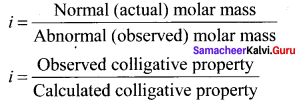
Samacheer Kalvi 11th Chemistry Solutions Chapter 9 Solutions-72

Question 33.
How is degree of dissociation and degree of association are related with van’t Hoff factor?
Answer:
The degree of dissociation or association can be related to van’t Hoff factor
1. using the following relationship

  • αdissociation = \(\frac { i – 1 }{ n – 1 }\)
  • αassociation = \(\frac { (1 – i)n }{ n – 1 }\)

where n = number of solute particles

Question 34.
Give an example of a solid solution ¡n which the solute is a gas.
Answer:
Solution of hydrogen in palladium.

Question 35.
Why the carbonated drinks are stored in a pressurized container?
Answer:
The carbonated beverages contain carbon dioxide dissolved in them. To dissolve the carbon dioxide in these drinks, the CO2 gas is bubbled through them under high pressure. These containers are sealed to maintain the pressure. When we open these containers at atmospheric pressure, the pressure of the CO2 drops to the atmospheric level, and hence bubbles of CO2 rapidly escape from the solution and show effervescence. The burst of bubbles is even more noticeable if the soda bottle in warm condition.

Question 36.
Why do gases always tend to be less soluble in liquids as the temperature is raised?
Answer:
Mostly dissolution of gases in liquid is an exothermic process. it is because of the fact that this process involves a decrease of entropy. Thus, an increase in temperature tends to push the equilibrium towards a backward direction as a result of which solubility of the gas decrease with a rise in temperature.
(Gas + Solvent \(\rightleftharpoons\) Solution + Heat)

Question 37.
Why is the freezing point depression of 0.1 M NaCl solution nearly twice that of 0.1M glucose solution?
Answer:
NaCl is an electrolyte and it dissociates completely whereas glucose being a non-electrolyte does not dissociate. Hence, the number of particles in 0.1 M NaCl solution is nearly double for NaCI solution than that for glucose solution of same molarity.

Therefore depression in freezing point being a colligative property ¡s nearly twice for NaCl solution than that for glucose solution of same molarity.

Question 38.
Why a person suffering from high blood pressure is advised to take a minimum quantity of common salt?
Answer:
Osmotic pressure is directly proportional to the concentration of solutes. Our body fluid contains a number of solutes. On taking large amount of salt, ions entering into the body fluid thereby raises the concentration of solutes. As a result, osmotic pressure increases which may rupture the blood cells.

Samacheer Kalvi 11th Chemistry Solutions 3 Marks Questions and Answers

Question 1.
What are gaseous solution? Give its various types with example
Answer:
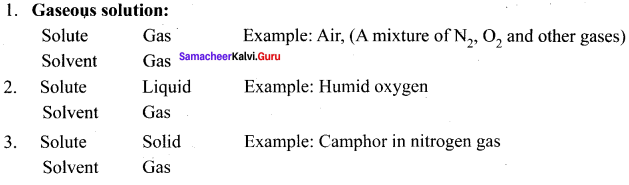
Samacheer Kalvi 11th Chemistry Solutions Chapter 9 Solutions-73

Question 2.
What are liquid solutions ? Explain with example
Answer:
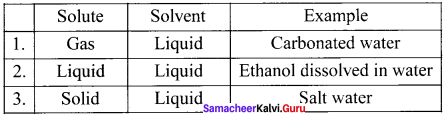
Samacheer Kalvi 11th Chemistry Solutions Chapter 9 Solutions-74

Question 3.
What are solid solution? Give example.
Answer:
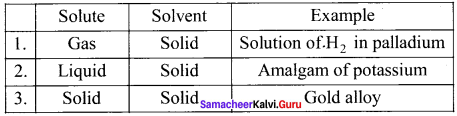
Samacheer Kalvi 11th Chemistry Solutions Chapter 9 Solutions-75

Question 4.
How will you prepare a standard solution?
Answer:

  1. A standard solution or a stock solution is a solution whose concentration is accurately known.
  2. A standard solution of required concentration can be prepared by dissolving a required amount of a solute in a suitable amount of solvent.
  3. It is done by transforming a known amount of solute to a standard flask of definite volume. A small amount of water is added lo the flask and shaken well to dissolve the salt.
  4. Then water is added to the flask to bring the solution level lo the mark indicated at the top end of the flask.
  5. The flask is stoppered and shaken well to make concentration uniform.

Samacheer Kalvi 11th Chemistry Solutions Chapter 9 Solutions

Question 5.
What are the advantages of standard solution.
Answer:
1. The error due to weighing the solute can be minimised by using concentrated stock solution that requires large quantities of solute.

2. We can prepare working standards of different concentrations by diluting the stock solution which is more efficient since consistency is maintained.

3. Some of the concentrated solutions are more stable and are less likely to support microbial growth than working standards used in the experiments.

Question 6.
Explain the solubilities of ammonium nitrate, calcium chloride, ceric sulphate and sodium chloride in water at different temperature with a graph.
Answer:
1. The solubility of sodium chloride does not vary appreciably as the maximum solubility is achieved at normal temperature. In fact, there is only 10% increase in solubility between 0°C to 100°C.

2. The dissolution process of ammonium nitrate is endothermic, the solubility increases with

3. In the case of eerie sulphate. the dissolution is exothermic and the solubility decreases with increase in temperature.

4. Even though the dissolution of calcium chloride is exothermic, the solubility increases moderately with increase in temperature. Here the entropy factor also plays a significant role in deciding the position of equilibrium.
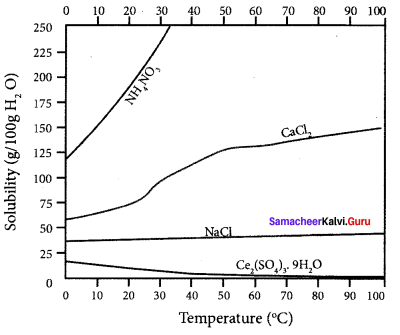
Samacheer Kalvi 11th Chemistry Solutions Chapter 9 Solutions-76

Question 7.
Explain the effect of temperature gaseous solute ¡n liquid solvent.
Answer:
1. In the case of gaseous solute in liquid solvent, the solubility decreases with increase in temperature.

2. When a gaseous solute dissolves in a liquid solvent, its molecules interact with solvent molecules with weak inter molecular forces when the temperature increases, the average. kinetic energy of the molecules present in the solution also increases.

3. The increase in kinetic energy breaks (he weak inter molecular forces between the gaseous solute and liquid solvent with results in the release of the dissolved gas molecules to gaseous state.

4. The dissolution of most of the gases in Liquid solvents is an endothermic process, the increase in temperature decreases the dissolution of gaseous molecules.

Question 8.
Give reason why aquatic species are less sustained in hot water?
Answer:
There will be decrease in solubility of gases in solution with increase in temperature. During summer, in hot water rivers, due to high temperature. the availability of dissolved oxygen decreases. So the aquatic species are less sustained in hot water.

Question 9.
Deep – sea divers use air diluted with helium gas in their tanks. Why? (or) Justify this statement.
Answer:
1. Deep-sea divers carry a compressed air tank for breathing at high pressure under water. This air tank contains nitrogen and oxygen which are not very soluble in blood and other body fluids at normal pressure.

2. As the pressure at the depth is far greater than the surface atmospheric pressure, more nitrogen dissolves in the blood when the diver breathes from tank.

3. When the divers ascends to the surface, the pressure decreases, the dissolved nitrogen comes out of the blood quickly forming bubbles in the blood stream.

These bubbles restrict blood flow, affect the transmission of nerve impulses and can even burst the capillaries or block them. This condition is called “the bends” which are painful and dangerous to life.

4. To avoid such dangerous condition they use air diluted with helium gas (11.7 % helium, 56.2% nitrogen and 32.1% oxygen) of lower solubility of helium in the blood than nitrogen.

Question 10.
What are the limitations of Henry’s law?
Answer:

  1. Henry’s law is applicable at moderate temperature and pressure only.
  2. Only the less soLuble gases obey Henry’s law.
  3. The gases reacting with solvent do not obey Henry’s law.
  4. The gases obeying Henrys law should not be associated or dissociated while dissolving in the solvent.

Question 11.
Explain how benzene in toluene obeys Raoult’s law.
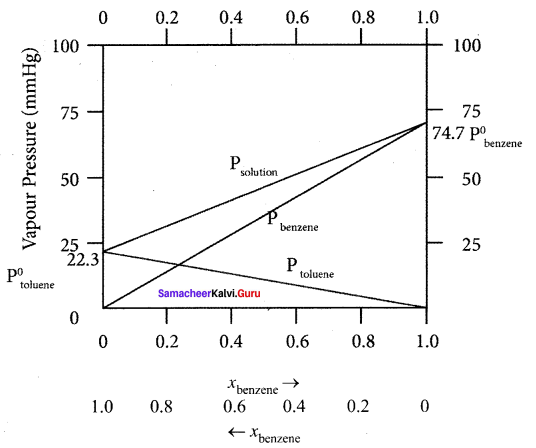
Samacheer Kalvi 11th Chemistry Solutions Chapter 9 Solutions-77
Answer:
The variation of vapour pressure of pure benzene and toluenc with its mole fraction is given in the graph.
1. The vapour pressure of pure toluene and pure benzene are 22.3 and 74.7 mm Hg respectively.

2. The graph shows the partial vapour pressure of pure components increases linearly with the increase of the mole fraction of the respective components. The total pressure at any composition of the solute and solvent is given by the straight line.

3. Psolution = P0toluene + xbenzene (P0benzene – P0toluene)

Question 12.
Derive the relationship between the relative lowering of vapour pressure and mole fraction of the solute.
Answer:
Psolution ∝ xA by Raoult’s law. where xA is the mole fraction of the solvent.
Psolution = k . xA
When
xA = 1
k = P0solvent
P0solvent = partial pressure of pure solvent
Psolution = P0solvent . xA
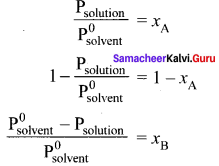
Samacheer Kalvi 11th Chemistry Solutions Chapter 9 Solutions-78
where
xB = mole fraction of the solute
xA + xB = 1
xB = 1 – xA
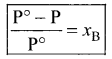
Samacheer Kalvi 11th Chemistry Solutions Chapter 9 Solutions-79

Question 13.
The depression in freezing point is 0.24 K obtained by dissolving 1 g NaCl in 200g water. Calculate van’t – Hoff factor. The molar depression constant in 1.86 K Kg mol-1
Solution :
Molar mass of solute = \(\frac{1000 \times K_{f} \times \text { mass of } N a C l}{\Delta T_{f} \times \text { mass of solvent }}\)

= \(\frac{1000 \times 1.86 \times 1}{0.24 \times 200}\)
= 38.75 g mol-1

Theoretical molar mass of NaCl is = 58.5 g mol-1

i = \(\frac{\text { Theoretical molar mass }}{\text { Experimental molar mass }}\)
= \(\frac{58.5}{38.75}\) = 1.50

Question 14.
What are the necessary conditions for an ideal solution? Give two examples. For an ideal solution
1. There is no change in volume on mixing two components (solute and solvent)
∆Vmixing = O

2. There is no exchange of heat when the solute is dissolved in solvent (∆Hmixing = 0)

3. Escaping tendency of the solute and the solvent present in it should be the same as in pure liquids.

4. Examples – For ideal solution: Benzene and toluene, n-Hexane and n-Heptane, ethyl bromide and ethyl iodide, chlorobenzene and bromobenzene.

Samacheer Kalvi 11th Chemistry Solutions Chapter 9 Solutions

Question 15.
Explain how non-ideal solutions show positive deviation from Raoult’s law.
Answer:

  1. Let us consider the positive deviation shown by a solution of ethyl alcohol and water.
  2. In this solution, the hydrogen bonding interaction between ethanol and water is weaker than those hydrogen bonding interactions amongst themselves (ethyl alcohol-ethyl alcohol and water-water interaction).
  3. This results in the increased evaporation of both components from the aqueous solution of ethanol.
  4. Consequently, the vapour pressure of the solution is greater than the vapour pressure predicted by Raoult’s law.
  5. Here, the mixing OCCSS is endothermic i.e., (∆Hmixing > O) and there will be a slight increase in volume (∆Vmixing > O)
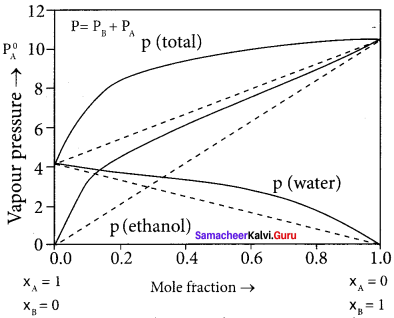
Samacheer Kalvi 11th Chemistry Solutions Chapter 9 Solutions-80

Question 16.
Explain with suitable example about negative deviation from law.
Answer:
1. Let us consider a solution of phenol and aniline. Both phenol and aniline form hydrogen-bonding interactions amongst themselves.

2. When mixed with aniline, the phenol molecule forms hydrogen bonding interactions with aniline, which are Stronger than the hydrogen bonds formed amongst themselves.

3. Formation of new hydrogen bonds considerably reduces the escaping tendency of phenol and aniline from the solution.

4. Asa result, the vapour pressure of the solution is less and there is a slight decrease in volume (∆Vmixing < 0) on mixing.

5. During this process evolution of heat takes place i.e., ∆Vmixing < 0 (exothermic).

6. Examples – Acetone + Chloroform, Chloroform + Diethyl ether
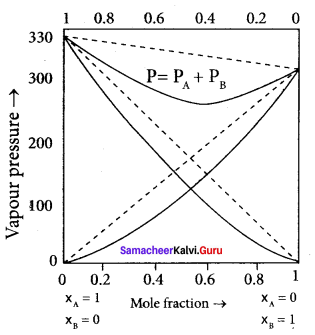
Samacheer Kalvi 11th Chemistry Solutions Chapter 9 Solutions-81

Question 17.
The vapour pressure of a solution containing a nonvolatile, non-electrolyte solute is always lower than that of pure solvent. Give reason.
Answer:
1. The vapour pressure of a solution (P) containing a full volatile solute is lower than that of pure solvent (P°).

2. Consider a closed system is which a pure solvent is in equilibrium with its vapour. At equilibrium the molar Gibbs free energies of solvent in a liquid and gaseous phase are equal (∆G = O).

3. When a solute is added to this solvent the dissolution takes place and its free energy (G) decreases due to increase in entropy.

4. In order to maintain the equilibrium, the free energy of the vapour phase must also decrease.

5. At a given temperature, the only way to lower the free energy of the vapour is to reduce its pressure.

6. Thus the vapour pressure of the solution must decrease to maintain the equilibrium.

Samacheer Kalvi 11th Chemistry Solutions Chapter 9 Solutions

Question 18.
Show that relative lowering of vapour pressure is a colligative property.
Answer:
According to Raoult’s law,
Psolution xA, where xA = mole fraction of solvent.
Psolution = k . xA, where k = proportionality constant
For a pure solvent,
Vapour pressure = P°, xA = 1
P°solution = k x 1 = k
Substituting P°solvent in Raoult’s law
Psolution = P°solvent . xA
Relative lowenng of vapour pressure
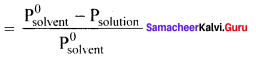
Samacheer Kalvi 11th Chemistry Solutions Chapter 9 Solutions-82
substituting Psolution as P°xB in the above eaquation
Relative lowering of vapour pressure

Samacheer Kalvi 11th Chemistry Solutions Chapter 9 Solutions-83
xA + xB = I
where xB = mole fraction of solute. It is clear that the relative lowering of vapour pressure depends only on the mole fraction ofthe solute (xB) and is independent of its nature. Therefore relative lowering of vapour pressure is a colligative property.

Question 19.
Explain why boiling point of solution is greater than that of pure solvent?
Answer:
When a non volatile solute is added to a pure solvent at its boiling point, the vapour pressure of the solution is lowered below 1 atm. To bring the vapour pressure again to I atm the temperature of the solution has to be increased.

As a result, the solution boils at a higher temperature (Tb) than the boiling point of the pure solvent (T°b). This increase in the boiling point is known as elevation of boiling point ∆Tb = Tb – T°b.

Question 20.
Graphically prove that Tb ¡s greater than T°b.
Answer:
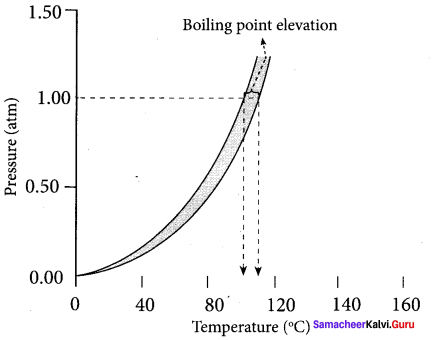
Samacheer Kalvi 11th Chemistry Solutions Chapter 9 Solutions-84
1. The vapour pressure of the solution increases with increase in temperature. The variation of vapour pressure with respect to temperature of pure water is given by the curve – A.

2. At 100°C, the vapour pressure of water is equal to I atm. Hence, the boiling point of water is 100°C (T°b).

3. When a solute is added to water, the vapour pressure of the resultant solution is lowered. The variation of vapour pressure with respect to temperature for the solution is given by curve-B.

4. From the graph, it is evident that the vapour pressure of the solution is equal to 1 atm. pressure at the temperature Tb which is greater than T°b. The difference between these two temperatures (Tb – T°b) gives the elevation of boiling point.
∆Tb = Tb T°b.

Question 21.
Derive the relationship between the elevation of boiling point and molar mass of non volatile solute.
Answer:
The elevation of boiling point ∆Tb = Tb T°b.
∆Tb is directly proportional to the concentration of the solute particles.
∆Tb ∝ m, (m = molaLiiy)
∆Tb = kb. m, where kb = ebullioscopic constant
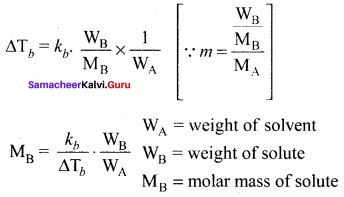
Samacheer Kalvi 11th Chemistry Solutions Chapter 9 Solutions-85

Question 22.
Define

  1. freezing point
  2. Depression in freezing point.

Explain with graph.
Answer:
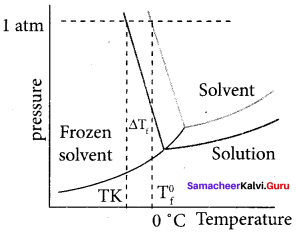
Samacheer Kalvi 11th Chemistry Solutions Chapter 9 Solutions-86
1. Freezing point is defined as the temperature at which the solid and the liquid states of the substances have the same vapour pressure.

2. When a non volatile solute is added to water at its freezing point, the freezing point of water is lowered from 0°C. The lowering of freezing point of the solvent when a solute is added is called depression in freezing point AT1..

3. ∆Tf = T0f – Tf

Question 23.
Define

  1. cryoscopic constant
  2. ebullioscopic constant

Answer:

1. ∆Tf = kf. m, where kf = cryoscopic constant. If m = 1. then ATf = kf
kf is defined as depression in freezing point for 1 molal solution.

2. ∆Tf = kf. m where kf ebullioscopic constant. If m = 1 then ATf = kf
kb is defined as elevation in boiling point for 1 molal solution.

Question 24.
What are the significances of osmotic pressure over other colligative properties ?
Answer:
1. Unlike elevation of boiling point and the depression in freezing point, the magnitude of osmotic pressure is large.

2. The osmotic pressure can be measured at room temperature enables to determine the molecular mass of biomolecules which are unstable at higher temperature.

3. Even for a very dilute solution, the osmotic pressure is large.

Samacheer Kalvi 11th Chemistry Solutions Chapter 9 Solutions

Question 25.
What is haemolysis ? intravenous fluid are isotonic to blood?
Answer:
1. The osmotic pressure of the blood cells is approximately equal to 7 atm at 37°C.

2. The intravenous injections should have saine osmotic pressure as that of the blood (isotonic vith blood).

3. If the intravenous solutions are too dilute that is hypotonie, the solvent from outside of the cells flow into the cell to normalise the osmotic pressure and this process is called haernolysis causes the cells to burst.

4. On the other hand, if the solution is too concentrated, that is hypertonic. the solvent molecules will flow out of the cells,which causes the cells to shrink and die.

5. For this reason, the intravenous fluids are prepared such that they are isotonic to blood (0.9% mass/volume sodium chloride solution).

Question 26.
Explain reverse osmosis.
Answer:
1. The pure water moves through the semipermeable membrane to the NaCl solution due to osmosis.

2. This process can be reversed by applying pressure greater than the osmotic pressure to the solution side. Now the pure water moves from the solution side to the solvent side and this process is called reverse osmosis.

3. Reverse osmosis can be defined as a process in which a solvent passes through a semipermeable membrane in the opposite direction of osmosis, when subjected to a hydrostatic pressure greater than the osmotic pressure.

Question 27.
Explain about the application of reverse osmosis in water purification.
Answer:
1. Reverse osmosis is used in the desalination of sea water and also in the purification of drinking water.

2. When a pressure higher than the osmotic pressure is applied on the solution side (sea water) the water molecules moves from solution side to the solvent side through semi permeable membrane (opposite to osmotic flow). The pure water can be collected.

3. Cellulose acetate (or) polyamide membranes are commonly used in commercial system.
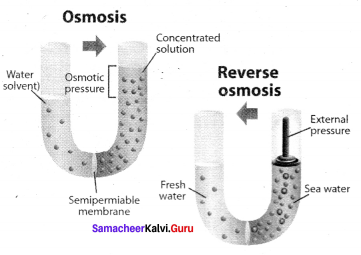
Samacheer Kalvi 11th Chemistry Solutions Chapter 9 Solutions-87

Question 28.
Acetic acid is found to have molar mass as 120 g mol-1. Prove it.
Answer:
1. In certain solvent, solute molecules associate to form a dimer. This reduces the total number of molecules formed in solution and as a result the calculated molar mass will be higher than the actual molar mass.

2. Acetic acid in benzene exist as a dimer
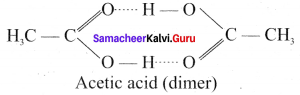
Samacheer Kalvi 11th Chemistry Solutions Chapter 9 Solutions-88

3. The molar mass of acetic acid calculate using colligative properties is found to be around 120 g mol-1 is two times of the actual molar mass 60 g mol-1.

Question 29.
Depression in freezing point of NaCI is twice that of in urea. Why?
Answer:
1. The electrolyte NaCI dissociates completely into its constituent ions in their aqueous solution. This causes an increase in the total number olparticles present in the solution.

2. When we dissolve 1 mole of NaCI in water it. dissociates and gives 1 mole of Na+ and 1 mole of Cl–. Hence the solution will have 2 moles of particles.

But when we dissolve 1 mole of urea (non electrolyte) in water it appears as 1 mole only. So the colligative property value would be double in NaCl than in urea.

Samacheer Kalvi 11th Chemistry Solutions Chapter 9 Solutions

Question 30.
What is van’t Hoff factor? Calculate the van’t Hoff factor value for

  1. acetic acid
  2. NaCl

Answer:
1. van’t Hoff factor is defined as the ratio ofthe actual molar mass to the abnormal (calculated) molar mass of the solute.

2.
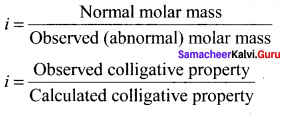
Samacheer Kalvi 11th Chemistry Solutions Chapter 9 Solutions-89
van’t Hoff factor (1) for acetic acid = \(\frac { 60 }{ 120 }\) = 0.5

3. van’t Hoff factor (2) for NaCl = \(\frac { 117 }{ 58.5 }\) = 2

Question 31.
Differentiate between ideal solution and non-ideal solution.
Answer:
Ideal solution
An ideal solution is a solution in which each component obeys the Raoult’s law over the entire range of concentration.
For an ideal solution,

  • ∆Hmixing = 0
  • ∆Vmixing = 0

Example: Benzenc and toluene n – Hexane and n – Heptane

Non-ideal solution
The solutions which do not obey Raoult’slaw over the entire range of concentrationsare called non-ideal solution.
For a non-ideal solution.

  • ∆Hmixing \(\quad \neq\) 0
  • ∆Vmixing \(\quad \neq\) 0

Example: Ethyl alcohol and Cyclohexane, Benzene and acetone.

Question 32.
Explain the factors when i = 1, i < 1 and i >1 ?
Answer:
1. For a solute that does not dissociate or associate the vant’s hoff factor is equal to 1 (i = 1) and the molar mass will be close to the actual molar mass.

2. For that solute that associate to form higher oligomers in solution, the van’t Hoff factor will be less than 1 (i < 1) and the observed molar mass will be greater than the actual molar mass.

3. For solutes that dissociates into their constituent ions the van’t Hoff factor will be more than one (i > 1) and the observed molar mass will be less than the normal molar mass.

Samacheer Kalvi 11th Chemistry Solutions Chapter 9 Solutions

Question 33.
State Henry’s law and mention some of its important applications.
Answer:
Henry’s law: The solubility of a gas in a liquid is directly proportional to the pressure of the gas.
Application of Henry’s law:

  1. In the production of carbonated beverages
    (as solubility of CO2 increase at high pressure).
  2. In the deep sea diving.
  3. In the function of lungs.
  4. For climbers or people living at high altitudes,

Question 34.
What type of non – idealities are exhibited by cyclohexane – ethanol and acetone – chloroform mixture? Give reason for your answer.
Answer:
Ideal solutions are those which obey Raoult’s law over extreme range of concentration. Ideal solutions have another important properties:

  • ∆Hmix = 0
  • ∆Vmix = 0

Here-forces of attraction between A – A. B – B and A – B are of the same order. Non ideal solutions do not obey Raoult’s law over the entire range of concentration.
∆Hmixing\(\quad \neq\) 0 and ∆Vmixing\(\quad \neq\) 0

Cyclohexane – ethanol mixture shows positive deviation from Raoult’s law because forces of attraction between cyclohexane and ethanol are less than in between pure cyclohexane as well as pure ethanol.

Acetone-Chloroform mixture shows negative deviation from Raoults law because forces of attraction between acetone and chloroform are higher than that in between pure acetone and pure chloroform molecules.

Samacheer Kalvi 11th Chemistry Solutions Chapter 9 Solutions

Question 35.
Given below is the sketch of a plant for carrying out a process.
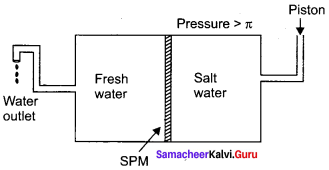
Samacheer Kalvi 11th Chemistry Solutions Chapter 9 Solutions-90

  1. Name the process occurring in the above plant.
  2. To which container does the net flow of solvent take place?
  3. Name one SPM which can he used in this plant.
  4. Give one practical use of the plant.

Answer:

  1. Reverse osmosis
  2. In fresh water container from salt water container.
  3. Cellulose acetate is semipermeable membrane (SPM)
  4. Purification of water

Samacheer Kalvi 11th Chemistry Solutions Chapter 9 Solutions

Question 36.
Define the term osmotic pressure. Describe how the molecular mass of a substance can be determined by a method based on measurement of osmotic pressure?
Answer:
π = CRT
π = \(\frac { n }{ V }\)RT
πV = nRT
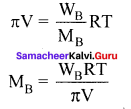
Samacheer Kalvi 11th Chemistry Solutions Chapter 9 Solutions-91
Osmotic pressure is inversely proportional to the molecular mass of the soLute.

Question 37.
1. Menthol is a crystalline substance with peppermint taste. A 6.2% solution of menthol in cyclohexane freezes at – 1.95°C.

Determine the formula mass of menthol. The freezing point and molal depression constant of cyclohexane are 6.5°C and 20.2 K m-1, respectively.

2. State Henry’s Law and mention its two important applications.

3. Which of the following has higher boiling point and why? 0.1 M NaCl or 0.1 M Glucose
Answer:
1.
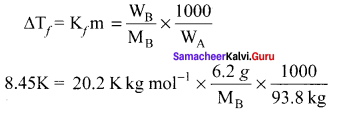
Samacheer Kalvi 11th Chemistry Solutions Chapter 9 Solutions-92
MB = 158 g mol-1

2. Henry’s Law:
The solubility of a gas in a liquid is directly proportional to the pressure of the gas.
Applications:

  • Solubility of CO2 is increased at high pressure.
  • Mixture of He and O2 are used by deep sea divers because he is less soluble than nitrogen.

3. 0.1 M NaCI, because it dissociates in solution and furnishes greater number of particles per unit volume while glucose being a non-electrolyte does not dissociate.

Samacheer Kalvi 11th Chemistry Solutions Chapter 9 Solutions

Question 38.
Water is a universal solvent. But alcohol also dissolves most of the substances soluble in water and also many more. Boiling point of water is 100°C and that of alcohol is 80°C. The specific heat of water is much higher than the specific heat of alcohol.

  1. List out three possible differences if instead of water as the liquid ¡n our body we had alcohol.
  2. What value can you derive from this special property of water and its innumerable uses in sustaining life on earth?

Answer:
1.
(i) Even a small rise in temperature in the surroundings will raise the temperature of’ the body because the specific heat of alcoholis much less than the specific heat of water. So, in order to cool the body, more sweating will take place.

(ii) As there is less H bonding in alcohol, it will gel evaporated faster. The alcohol will be evaporated at such a faster rate that the liquid has to be ingested all the time.

(iii) Ice which floats on water helps aquatic life to exist even in winter as water insulates the heat from liquid below it to go back to the surroundings. Solid alcohol does not have such special properties.

2. Praise is to the almighty that has so thoughtfully given such special properties to water and made it a liquid that could sustain life on earth.

Question 39.
State Henry’s law for solubility of a gas in a liquid. Explain the significance of Henry’s law constant (KH). At the same temperature, hydrogen is more soluble in water than helium. Which of theni will have a higher value of KH and Why?
Answer:
Henry’s law states that the solubility of a gas in liquid at a given temperature is directly proportional to the partial pressure of the gas.
P = KH x
where P is the pressure of the gas, x is the mole fraction of the gas in the solution and KH is the Henry’s law constant. KH is a function of the nature oIgas.

Higher the value of KH at a given temperature. lower is the solubility of the gas in the liquid. As helium is less soluble in water, so it has a higher value of KH than hydrogen.

Henry’s Law:
As dissolution of agar in liquid is an exothermic process, therefore, the solubility should decrease with in increase in temperature.

Question 40.
What is meant by positive and negative deviations from Raoult’s law and how is the sign ∆Hmix of related to positive and negative deviations from Raoult’s law?
Answer:
Negative deviations:
In these type of deviations, the partial vapour pressure of each component A and B of solution is higher than the vapour pressure calculated from Raoult’s law. For example -Water and ethanol, chloroform and water.

Positive deviations:
In case of positive deviation A – B interactions are weaker than those between A – A or B – B. This means that in such solutions molecules or A (or B) will find it easier to positive deviation from Raoult’s law.

Samacheer Kalvi 11th Chemistry Solutions 5 Marks Questions and Answers

II. Answer the following questions in detail:

Question 1.

  1. Define solution.
  2. Explain the types of solutions with suitable example.

Answer:
1. A solution is a homogeneous mixture of two or more substances, consisting of atoms. ions or molecules.

2. Types and examples of solution.
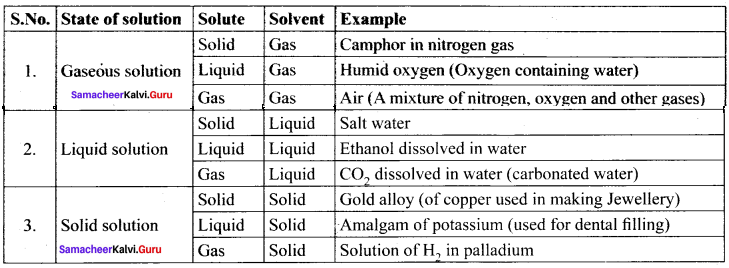
Samacheer Kalvi 11th Chemistry Solutions Chapter 9 Solutions-93

Question 2.

  1. Define Solubility
  2. Explain the factors that influences the solubility

Answer:

1. The solubility of a substance at a given temperature is defined as the amount of the solute that can be dissolved in 100 g of the solvent at a given temperature to form a saturated solution.

2. Factors influencing solubility
(a) Nature of solute and solvent: Sodium chloride, an ionic compound readily dissolves in polar solvent such as water but it does not dissolve in non polar solvent such as benzene. Most of the organic compounds dissolve in organic solvent and do not dissolve in water.

(b) Effect of temperature: Generally, the solubility of a solid solute in a liquid solvent increases with increase in temperature. The dissolution of NaCl does not vary as the maximum solubility is achieved at normal temperature.

The dissolution of ammonium nitrate is endothermic, the solubility increases with increase in temperature. The dissolution of eerie sulphate is exothermic and the solubility decreases with increase of temperature. In the case of gaseous solute in liquid solvent the soluhility decreases with increase in temperature.

Effect of pressure:
Generally the change in pressure does not have any significant effect in the solubility of solids and l?quids as they are not compressible. However, the solubility of gases generally increases with increase of pressure.

Question 3.
Explain about the factors that are responsible for deviation from Raoult’s law.
Answer:
1. Solute-solvent interactions:
For an ideal solution, the interaction between the solvent molecules (A – A), the solute molecules (B – B) and between the solvent and solute molecules (A – B) are expected to be similar. if these interactions are dissimilar, there will be a deviation from ideal behaviour.

2. Dissolution of solute:
When a solute present in a solution dissociates to give its constituent ions, the resultant ions interact strongly with the solvent and causes deviation from Raoult’s law. e.g., KCI in water deviates from ideal behaviour due to dissociation as K+ and Cl– ion which form strong ion-dipole interaction with water molecules.

3. Association of solute:
Association of solute molecules can also cause deviation from ideal behaviour. For example in solution acetic acid exists as a dimer by forming intermolecular hydrogen bonds and hence deviates from Raoult’s law.

4. Temperature:
An increase in temperature of the solution increases the average kinetic energy of the molecules present in the solution which cause decrease in the attractive force between them. As result, the solution deviates from Raoult’s law.

5. Pressure:
At high pressure, the molecules tends to stay close to each other and therefore there will be an increase in their intermolecular attraction. Thus a solution deviates from Raoult’s law at high pressure.

6. Concentration:
When the concentration is increased by adding solute, the solvent-solute interaction becomes significant. This causes deviation from Raoult’s law.

Samacheer Kalvi 11th Chemistry Solutions Chapter 9 Solutions

Question 4.
How would you determine molar mass from relative lowering of vapour pressure.
Answer:
1. The measurement of relative lowering of vapour pressure can be used to determine the molar mass of a non-volatile solute.

2. A known mass of the solute is dissolved in a known quantity of solvent. The relative lowering of vapour pressure is measured experimentally.

3. According to Raoult’s law, the relative lowering of vapour pressure is
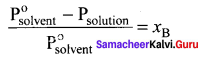
Samacheer Kalvi 11th Chemistry Solutions Chapter 9 Solutions-94
WA = weight of solvent
WB = weight of solute
MA = Molar mass of solvent
MB = molar mass of solute
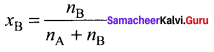
Samacheer Kalvi 11th Chemistry Solutions Chapter 9 Solutions-95
where nA = number of moles of solvent
nB = number of moles of solute.
For dilute solution, nA > > nB, nA + nB = nA
Then, Samacheer Kalvi 11th Chemistry Solutions Chapter 9 Solutions-96
Number of moles of solvent and solute arc
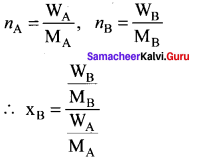
Samacheer Kalvi 11th Chemistry Solutions Chapter 9 Solutions-97
Samacheer Kalvi 11th Chemistry Solutions Chapter 9 Solutions-98
From the above equation, molar mass of the solute MB can be calculated using the known values of WA, WB, MA and the measured relative lowering of vapour pressure.

Samacheer Kalvi 11th Chemistry Solutions Chapter 9 Solutions

Question 5.
How would you determine the molar mass from osmotic pressure.
Answer:
According to van’t Hoff equation
π = CRT
C = \(\frac { n }{ V }\)
Here n = number of moles of solute dissolved in ‘V’ litre of the solution.
π = \(\frac { n }{ V }\) . RT = πV = nRT
If the solution is prepared by dissolving WB of the non-volatile solute in WA g of solvent, then the number of moles of ‘n’ is
Samacheer Kalvi 11th Chemistry Solutions Chapter 9 Solutions-99
where
MB = molar mass of the solute
Substituting n value, we get
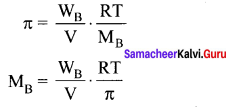
Samacheer Kalvi 11th Chemistry Solutions Chapter 9 Solutions-100
From the above equation, we can calculate the molar mass of the solute.

Question 6.
What are ideal and non-ideal solutions? Explain with suitable diagram the behaviour of ideal solutions.
Answer:
Ideal solutions:
The solutions which obey Raoult’s law over the entire range of concentration are known as ideal solutions. Ideal solutions are formed by mixing the two components which are identical in molecular size, in structure and have almost identical intermolecular forces.

Examples:

  1. Benzene and toluene
  2. n – Hexane and n-Heptane
  3. Chiorobenzene and bromobenzene.

Characteristics:

  1. They must obey Raoult’s law.
  2. ∆H mixing should be zero.
  3. ∆W mixing should be zero, i.e. volume change on mixing is zero.

Non – ideal solutions:
The solutions which do not obey Raoult’s law are called non-ideal solutions. In case of non – ideal solutions there is a change in volume and heat energy when the two components are mixed.
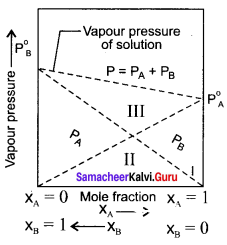
Samacheer Kalvi 11th Chemistry Solutions Chapter 9 Solutions-101

Characteristics:

  1. They does not obey Raoult’s law.
  2. ∆Vmix \(\quad \neq\) 0
  3. ∆Hmix \(\quad \neq\) 0

Behaviour of Ideal Solutions:
A plot of P1 or P2 versus the mole fraction x1 and x2 for an ideal solution gives a linear plot. These Lines (I and II)pass through the points and respectively whenx1 and x2 is equal to unity.

Similarly the plot (Line III) of Ptotal versus x2 is also linear. The minimum value of is P1° and the maximum value is P2°, assuming that component 1 is less volatile than component 2, i.e. P1° < P20.

Samacheer Kalvi 11th Chemistry Solutions Chapter 9 Solutions

Question 7.
Explain with a suitable diagram and appropriate example, why some non-ideal solution shows positive deviation from Raou It’s law.
Answer:
Some non-ideal solutions show positive deviation from Raoult’s law. Consider a solution of two components A and B.  If A-B interactions in the solution are weaker than the A – A and B – B interactions in the two liquids forming the solution, then the escaping tendency of molecules A and B from the solution become more than in pure liquids.

The total vapour pressure will be greater than the corresponding vapour pressure as expected on the basis of Raoult’s law. This type of behaviour of solution is called positive deviation from Raoult’s law. The boiling point of such solutions are lowered. Mathematically,
PA < PA0 xA
PB < PB0 xB
The total vapour pressure is less than PA + PB
P < PA + PB
P < P°A x xA + P°B xB
Hence
P1 = PA
P2 = PB
Examples of solutions showing positive deviations

  1. Ethyl alcohol and water
  2. Benzene and acetone
  3. Ethyl alcohol and cyclohcxanc
  4. Carbon tetrachloride and chloroform.

Samacheer Kalvi 11th Chemistry Solutions Chapter 9 Solutions-102

Question 8.

  1. What is Osmotic pressure and how is it related to the molecular mass of a non volatile substances?
  2. What advantage the osmotic pressure method has over the elevation of boiling point method for determining the molecular mass?

Answer:
1. Osmotic pressure:
It is the pressure of the solution column that can prevent the entry of solvent molecules through a semi-permeable membrane, when the solution and the solvent are separated by the same. It is denoted by π. Its unit is mm 11g or atmosphere.
We know that, π = CRT
where π is the osmotic pressure and R is the gas constant
π = \(\frac { { n }_{ 2 } }{ V }\) RT
where V is volume of solution per litre containing n2 moles of solute.
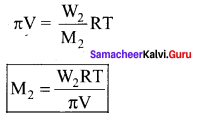
Samacheer Kalvi 11th Chemistry Solutions Chapter 9 Solutions-103
By the above relation molar mass of solute can be calculated.

2. The osmotic pressure method has the advantage over other methods as pressure measurement is around the room temperature and molarity of the solution is used instead of molality.

The technique of osmotic pressure for determination of molar mass of solutes is particularly useful for biomolecules as they are generally not stable at higher temperature and polymers have poor solubility.

III. Numerical Problems

Question 1.
Calculate the mole fraction of benzene ¡n solution containing 30% by mass in carbon tetrachioride.
Solution:
30% of benzene in carbon tetrachloride by mass means that Mass of benzene in the solution = 30g
Mass of solution = 100g
Mass of carbon tetrachloride = 100g – 30g = 70g
Molar mass of benzene (C6H6) = 78 g mol-1
Molar mass of CCl4 = 12 + (4 x 35.5) 154g mol-1
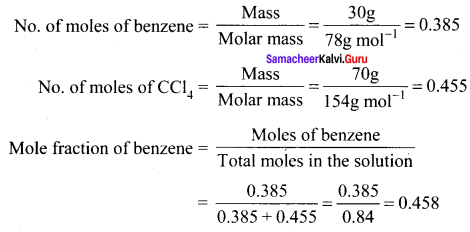
Samacheer Kalvi 11th Chemistry Solutions Chapter 9 Solutions-104

Question 2.
Calculate (he molarity of each of the following solutions:
Solution:

  1. 30 g of CO(NO3)2. 6H2O = in 4.3 L of solution
  2. 30 mL of 0.5 M H2SO4 diluted to 500 mL.

1. Molar mass of CO(NO3)2. 6H2O = 58.7 + 2(14 + 48) + (6 x 8)g mol-1
= 58.7 + 124 + 108g mol-1 = 290.7 gmol-1

Samacheer Kalvi 11th Chemistry Solutions Chapter 9 Solutions-105
Volume of solution = 4.3 L
Samacheer Kalvi 11th Chemistry Solutions Chapter 9 Solutions-106

2. 1000 mL of 0.5 M H2SO4 Contain H2SO4 = 0.5 moles
30 mL of 0.5 M H2SO4 contain H2SO4 = \(\frac { 0.5 }{ 1000 }\) x 30 mole = 0.015 mole
Volume of solution = 500 mL = 0.500 L

Samacheer Kalvi 11th Chemistry Solutions Chapter 9 Solutions-107

Question 3.
Calculate the mass of urea (NH2CONH2) required in making 2.5 kg of 0.25 molal aqueous solution.
Solution:
0.25 molal aqueous solution means that
Moles of urea = 0.25 mole
Mass of solvent (water) = 1 kg = 1000 g
Molar mass of urea = 14 + 2 + 12 + 16 + 14 + 2 = 6Og mol-1
0.25 mole of urea = 60 x 0.25 mole = 15 g
Total mass of the solution = 1000 + 15 g = 1015 g = 1.015 g
Thus, 1.015 kg of solution contain urea = 15 g
2.5 kg of solution will require urea = \(\frac { 15 }{ 1.015 }\) x 2.5 kg = 37g

Samacheer Kalvi 11th Chemistry Solutions Chapter 9 Solutions

Question 4.
H2S, a toxic gas with rotten egg like smell is used for the qualitative analysis. 1f the solubility of H2S in water at STP is 0.195 m. Calculate Henrvs law constant.
Solution:
Solubility of H2S gas = 0.195 m
= 0.195 mole in 1 kg of the Solvent (water)
1 kg of the solvent (water) = 1000 g Samacheer Kalvi 11th Chemistry Solutions Chapter 9 Solutions-108
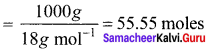
Mole fraction of H2S gas in the solution (x) = \(\frac { 0.195 }{ 0.195 + 55.55 }\) = 0.0035
Pressure at STP = 0.98 7 bar
Applying Henry’s law
PH2S = KH x xH2S

Samacheer Kalvi 11th Chemistry Solutions Chapter 9 Solutions-109

Question 5.
Vapour pressure of pure water at 298 K is 23.8 mm Hg. 50 g of urea (NH2CONH2) is dissolved in 850 g of water. Calculate the vapour pressure of water for this solution and its relative lowering.
Solution:
Here
P°1 = 23.8 mm
W2 = 50g
M2 (urea) = 60g mol-1
W1 = 850g
M1(Water) = 18g mol-1
Here we have to calculate Ps
Applying Raoult’s law,
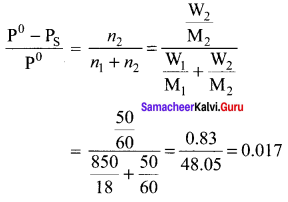
Samacheer Kalvi 11th Chemistry Solutions Chapter 9 Solutions-110
Thus, relative lowering of vapour pressure = 0.017
Substituting P° = 23.8 mm Hg
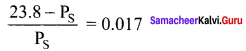
Samacheer Kalvi 11th Chemistry Solutions Chapter 9 Solutions-111
We get,
23.8 – Ps = 0.017 Ps
Ps = 23.4 mm Hg
Thus, vapour pressure of water in the solution = 23.4 mm Hg

Samacheer Kalvi 11th Chemistry Solutions Chapter 9 Solutions

Question 6.
Boiling point of water at 750 mm Hg is 99.63°C. How much sucrose is to be added to 500g of water such that it boils at 100°C? .
Solution:
Elevation in boiling point required, ∆Tb = 100 – 99.63° = 0.37°
Mass of solvent (water) W1 = 500g
Mass of solute, C12H22O11 = 342 g mol-1
Molar mass of solvent M1 = 18 g mol-1
Applying the formula,
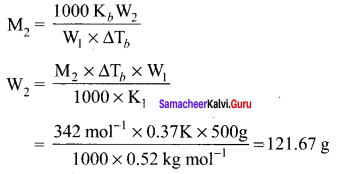
Samacheer Kalvi 11th Chemistry Solutions Chapter 9 Solutions-112

Question 7.
Concentrated nitric acid used in laboratory work is 68% nitric acid by mass in aqueous solution. What should be the molarity of such a sample of the acid if the density of the solution is 1.504g mL-1?
Solution:
68% nitric acid by mass means that
Mass of nitric acid = 68 g
Mass of solution = 100 g
Molar mass of HNO3 = 63g mol-1
68g HNO3 = mole = 1.079 mole
Density of solution = 1.504 g mL-1
Volume of solution = \(\frac { 100 }{ 1.504 }\) mL = 66.5 mL = 0.0665 L

Samacheer Kalvi 11th Chemistry Solutions Chapter 9 Solutions-113

Question 8.
A solution is obtained by mixing 300 g of 25% solution and 400 g of 40% solution by mass. Calculate tile mass percentage of the resulting solution.
Solution:
300 g of 25% solution contains solute = 75g
400g of 40% solution contains solute = 160 g
Total mass of solute = 160 + 75 = 235 g
Total mass oÍ’ solution = 300 + 400 = 700 g
% of solute in the final solution = \(\frac { 235 }{ 700 }\) x 1oo = 33.5%
% of water in the finaI solution = 100 – 33.5 = 66.5%

Samacheer Kalvi 11th Chemistry Solutions Chapter 9 Solutions

Question 9.
A sample of drinking water was found to be severely contaminated with chloroform (CHCI3) supposed to be a carcinogen. The level of contamination was 15 ppm (by mass)

  1. express this in percentage by mass
  2. determine the molality of chloroform in the water sample.

Solution:
1. 15 ppm means 15 parts in million (106) parts by mass in the solution
% of mass = \(\frac { 15 }{ { 10 }^{ 6 } }\) x 100 = 1.5 x 10⁻⁴

2. Taking 15g chloroform in 106g of the solution
Mass of the solvent = 106 g
Molar mass of CHCl3 = 12 + 1 + (3 x 35.5) = 119.5 g mol-1
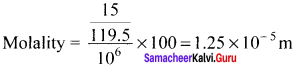
Samacheer Kalvi 11th Chemistry Solutions Chapter 9 Solutions-114

Question 10.
An aqueous solution of 2% non-volatile solute exerts a pressure of 1.004 bar at normal boiling point of the solvent. What is the molar mass of the solute?
Solution:
Vapour pressure of pure water at the boiling point
(P°) = 1 atm 1.013 bar
Vapour pressure of solution Ps = 1.004 bar
M1 = 18 g mol-1
M2 = ?
Mass of solute = W2 = 2g
Mass of solution = 100g
Mass of solvent W1 = 98 g
Applying Raoult’s law for dilute solution
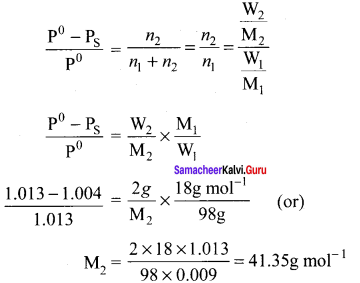
Samacheer Kalvi 11th Chemistry Solutions Chapter 9 Solutions-115

Question 11.
A 5% solution (by mass) of cane sugar in water has freezing point of 271 K. Calculate the freezing point of 5% glucose in water if freezing point of pure water is 273.15K.
Solution:
Molar mass of cane sugar
C12H22O11 = 342 g mol-1
Molality of sugar = \(\frac { 5 x 1000 }{ 342 x 100 }\) = 0.146
∆T2 for sugar solution = 273.15 – 271 = 2.15°
∆Tf = Kf x m
Kf = \(\frac { 2.15 }{ 0.146 }\)
Molality of glucose solution = \(\frac { 5 }{ 180 }\) x \(\frac { 1000 }{ 100 }\) = 0.278 m
∆Tf (Glucose) = \(\frac { 2.15 }{ 0.146 }\) x 0.278 = 4.09°K
Freezing point of glucose solution = 273.15 – 4.09 = 269.06 K

Samacheer Kalvi 11th Chemistry Solutions Chapter 9 Solutions

Question 12.
Calculate the amount of benzoic acid (C6HCOOH) required for preparing 250 mL of 0.15 M solution in methanol.
Solution:
0.15 M solution means that 0.15 moles of C6H5COOH is present in IL
= 1000 mL of the solution
Molar mass of C6H5COOH = 72 + 5 + 12 + 32 + 1 = 122 g mol-1
Thus, 1000 mL of solution contains benzoic acid = 18.3g
250 mL of solution will contain benzoic acid
= \(\frac { 18.3 }{ 1000 }\) x 250 = 4.575 g

Question 13.
A solution containing 8 g of a substance in 100 g of diethyl ether boils at 36.86°C, whereas pure ether boils at 35.60 °C. Determine the molecular mass of the solute (For ether Kb 2.02 K kg mol-1)
Solution:
We have, mass of solute, W2 = 8 g
Mass of solvent, W1 = 100 g
Elevation of boiling point
∆Tb = 36.86 – 35.60 = 1.260C
Kb = 2.02
Molecular mass of the solute

Samacheer Kalvi 11th Chemistry Solutions Chapter 9 Solutions-116
= 128.25g mol-1

Question 14.
Ethylene glycol (molar mass = 62 g mol-1) is a common automobile antifreeze. Calculate the freezing point of a solution containing 12.4 of this substance in 100 g of water. Would it be advisable to keep this substance ¡n the car radiator during summer? (Kf for water = 1.86 k kg/mol-1) (Kb for water = 0.512 K kg/mol-1)
Solution:
Samacheer Kalvi 11th Chemistry Solutions Chapter 9 Solutions-117
Since water boils at 100°C, so a solution containing ethylene glycol will boil at 101.024 °C, SO it is advisable to keep this substance in car radiator during summer.

Question 15.
15.0 g of an unknown molecular material is dissolved in 450g of water. The resulting solution freezes at – 0.34°C. What is the molar mass of the material? Kf for water = 1.86 K kg mol-1.
Solution:
W(solute) = 1 5.0 g
W(solvent) = 450 g
∆Tf = T°f – Tf = 0 – ( – 0.34) = 0.34 °C
∆Tf = kf m
0.34 = 1.86 x \(\frac { 15 }{ M }\) x \(\frac { 1000 }{ 450 }\)
M = \(\frac { 1.86 x 15 x 1000 }{ 0.34 x 450 }\) = 182.35 g mol-1

Samacheer Kalvi 11th Chemistry Solutions Chapter 9 Solutions

Common Errors
Common Errors:

  1. Students are writing solute, solvent, students get confused to write A (or) B, 1 (or)2.
  2. Mole, mole fraction may be confused.
  3. In writing osmosis definition Students get confused in mentioning concentration terms.
  4. van’t Hoff factor I formula may be con fused.
  5. Students may get contused rhen they write solute and solvent.
  6. Mole and mole fraction may be confused by students.
  7. Standard solutions must be known.
  8. When students write Raoult’s law, they get confused with solute and solvent.
  9. When they write the definition of osmosis, the conc. term may be little con fused.
  10. van’t Hoff equation may be written wrongly.

Rectifications:

  1. Always solvent is first so it is denoted as A (or) 1 solute is second so, it is denoted as B (or)2.
  2. Mole = n ; Mole fraction x
  3. Osmosis-movenient of solvent from low concentration to high concentration through a semipermeable membrane.
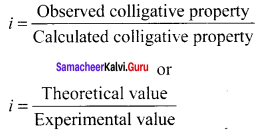
  4. Samacheer Kalvi 11th Chemistry Solutions Chapter 9 Solutions-118
  5. For e.g.. solid in liquid means solid is the solute and liquid is the solvent.
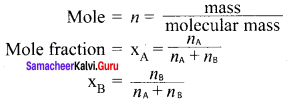
  6. Samacheer Kalvi 11th Chemistry Solutions Chapter 9 Solutions-119
  7. 1 N = 1 normal solution, 0.1 N Decinormal solution, 0.01 N = Centinormal solution
  8. In Raoult’s law, “A” is always solvent and “B” is always solute.
  9. In osmosis, always solvent rnoes through semi permeable membrane from low concentration to high concentration.
  10. van’t Hoff factory = i

    Samacheer Kalvi 11th Chemistry Solutions Chapter 9 Solutions-120
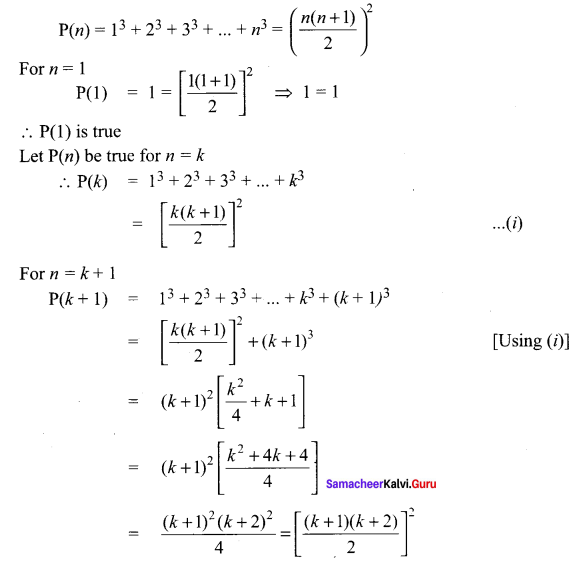
Samacheer Kalvi 11th Chemistry Solutions Chapter 9 Solutions Read More »