Class 8

Samacheer Kalvi 8th Maths Solutions Term 2 Chapter 1 Life Mathematics Ex 1.4

Students can Download Maths Chapter 1 Life Mathematics Ex 1.4 Questions and Answers, Notes Pdf, Samacheer Kalvi 8th Maths Book Solutions Guide Pdf helps you to revise the complete Tamilnadu State Board New Syllabus and score more marks in your examinations.

Tamilnadu Samacheer Kalvi 8th Maths Solutions Term 2 Chapter 1 Life Mathematics Ex 1.4

Miscellaneous Practise Problems

Question 1.
Nanda’s marks in 3 Math tests Tl, T2 and T3 were 38 out of 40,27 out of 30 and 48 out of 50. In which test did he do well? Find his overall percentage in all the 3 tests.
Solution:
Nanda’s marks are as follows
In Test 1 → T1 \(\frac{38}{40}\)
Test 2 → T2 \(\frac{27}{30}\)
Test 3 → T3 \(\frac{48}{50}\)
For percentage, multiply by 100
T1 = \(\frac{38}{40}\) x 100 = 95%
T2 = \(\frac{27}{30}\) x 100 = 90%
T3 = \(\frac{48}{50}\) x 100 = 96%
Hence, he has scored highest percentage in test 3
∴ He is done well in T3
Overall percentage is the average of the 3 percentages.
i.e \(\frac{90+95+96}{3}\) = \(\frac{281}{50}\) = 93\(\frac{2}{3}\)%

Samacheer Kalvi 8th Maths Solutions Term 2 Chapter 1 Life Mathematics Ex 1.4

Question 2.
Sultana bought the following things from a general store. Calculate the total bill amount to be paid by her.
(i) Medicines costing ₹ 800 with GST @ 5% ………..
Samacheer Kalvi 8th Maths Solutions Term 2 Chapter 1 Life Mathematics Ex 1.4 1
(ii) Cosmetics costing ₹ 650 with GST @ 12% ………….
Samacheer Kalvi 8th Maths Solutions Term 2 Chapter 1 Life Mathematics Ex 1.4 2
(iii) Cereals costing ₹ 900 with GST @ 0% …………
Samacheer Kalvi 8th Maths Solutions Term 2 Chapter 1 Life Mathematics Ex 1.4 3
(iv) Sunglass costing ₹ 1750 with GST @ 18 % ………..
Samacheer Kalvi 8th Maths Solutions Term 2 Chapter 1 Life Mathematics Ex 1.4 4
(v) Air Conditioner costing ₹ 28500 with GST @ 28% ………..
Samacheer Kalvi 8th Maths Solutions Term 2 Chapter 1 Life Mathematics Ex 1.4 5
Solution:
Samacheer Kalvi 8th Maths Solutions Term 2 Chapter 1 Life Mathematics Ex 1.4 6
(i) Medicine : bill amount is 800(1 + \(\frac{5}{100}\)) = 800 x \(\frac{105}{100}\) = 840
(ii) Cosmetics: Bill amount is 650(1 + \(\frac{12}{100}\)) = 650 x \(\frac{112}{100}\) = 728
(iii) Cereals : Bill amount is 900(1 + \(\frac{0}{100}\)) = 900
(iv) Sunglass: bill amount is 1750(1 + \(\frac{18}{100}\)) = 1750 x \(\frac{118}{100}\) = 2065
(v) AC : Bill amount is 28500(1 + \(\frac{28}{100}\)) = 28500 x \(\frac{128}{100}\) = 36480
∴ Total bill amount = 840 + 728 + 900 + 2065 + 36480
= ₹ 41,013 (total bill amount)

Question 3.
P’s income is 25% more than that of Q. By what percentage is Q’s income less than P’s?
Solution:
Let Q’s income be 100.
P’s income is 25% more than that of Q
∴ P’s income = 100 + \(\frac{25}{100}\) x 100 = 125
Q’s income is 25 less than that of P
In percentage terms, Q’s income is less than P’s with respect to P’s income is
\(\frac{P-Q}{P}\) x 100 = \(\frac{125-100}{125}\) x 100 = \(\frac{25}{100}\) x 100 = 20%

Question 4.
Gopi sold a laptop at 12% gain. If it had been sold for ₹ 1200 more, the gain would have been 20%. Find the cost price of the laptop.
Samacheer Kalvi 8th Maths Solutions Term 2 Chapter 1 Life Mathematics Ex 1.4 7
Solution:
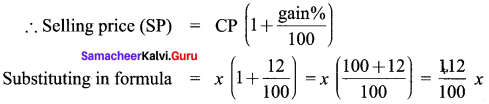
Let the cost price of the laptop be ‘x’
Gain = 12%
Samacheer Kalvi 8th Maths Solutions Term 2 Chapter 1 Life Mathematics Ex 1.4 8
If the selling price was 1200 more
i.e \(\frac{112}{100}\)x +1200, the gain is 20%
i.e new selling price = x(1 + \(\frac{2}{100}\))
= \(\frac{112}{100}\)x + 1200 = x(100 + \(\frac{20}{100}\)) = \(\frac{112}{100}\)x
∴ 1200 = \(\frac{120}{100}\)x = \(\frac{112}{100}\)x = \(\frac{8}{100}\)x
∴ x = \(\frac{120×100}{8}\) = 15000
Cost price of the laptop is ₹ 15000

Question 5.
Vaidegi sold two sarees for ₹ 2200 each. On one she gains 10% and on the other she loses 12%. Calculate her gain or loss percentage in the sales.
Samacheer Kalvi 8th Maths Solutions Term 2 Chapter 1 Life Mathematics Ex 1.4 9
Solution:
Saree 1:
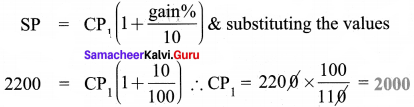
The selling price is ₹ 2200, let cost price be CP1, gain is 10%
Cost price ₹ Using the formula
Samacheer Kalvi 8th Maths Solutions Term 2 Chapter 1 Life Mathematics Ex 1.4 10
Saree 2:
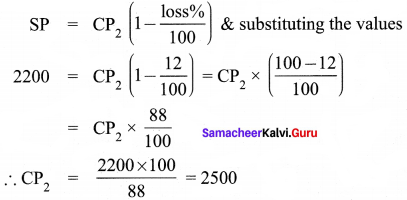
The selling price is 2200, let cost price be CP2, loss is given as 12%. We need to find CP2 using the formula as before,
Samacheer Kalvi 8th Maths Solutions Term 2 Chapter 1 Life Mathematics Ex 1.4 11
Cost price of both together is CP1 + CP2
= 2000 + 2500 = 4500 ……(1)
Selling price of both together is 2 x 2200 = 4400 …….(2)
Since net selling price is less than net cost price, there is a loss.
loss% = \(\frac{loss}{cost price}\) x 100
Loss = Net cost price – Net selling price
(1) – (2) = 4500 – 4400 = 100
∴ loss% = \(\frac{100}{4500}\) x 100 = \(\frac{100}{45}\) = \(\frac{20}{9}\) = 2\(\frac{2}{9}\)%
= 2\(\frac{2}{9}\)% loss

Samacheer Kalvi 8th Maths Solutions Term 2 Chapter 1 Life Mathematics Ex 1.4

Question 6.
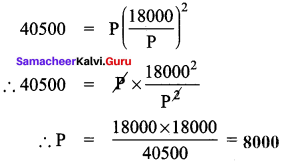
A sum of money becomes ₹ 18000 in 2 years and ₹ 40500 in 4 years on compound interest. Find the sum.
Solution:
Let the sum of money be ‘P’
Given that sum ‘P’ becomes 18000 in 2yrs.
i.e Amount (A) = P(1 + \(\frac{r}{100}\))n
18000 = P(1 + \(\frac{r}{100}\))2
(1 + \(\frac{r}{100}\))2 = \(\frac{18000}{P}\) ⇒ (1 + \(\frac{r}{100}\))4 = (\(\frac{18000}{P}\))2 ……(1)
Also given that sum ‘P’ becomes46500 in 4 yrs.
i.e Amount (A) = P(1 + \(\frac{r}{100}\))n
40500 = P(1 + \(\frac{r}{100}\))4
Substituting (1) in (2), we get
Samacheer Kalvi 8th Maths Solutions Term 2 Chapter 1 Life Mathematics Ex 1.4 12

Question 7.
Find the difference in the compound interest on ₹ 62500 for 1\(\frac{1}{2}\) years at 8% p.a compounded annually and when compounded half-yearly.
Solution:
Case 1:
P = ₹ 62500
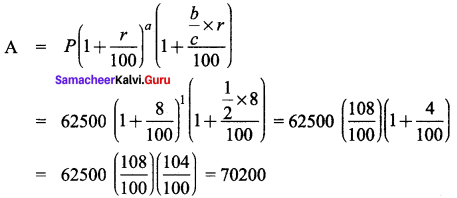
n = 1\(\frac{1}{2}\)yrs. (a\(\frac{b}{c}\)) formula
r = 8% Compound annully
CI = A – P
Samacheer Kalvi 8th Maths Solutions Term 2 Chapter 1 Life Mathematics Ex 1.4 13
CI = A – P = 70200 – 62500 = 7700 ……(1)
CAse 2:
P = ₹ 62500
n = 1\(\frac{1}{2}\)yrs.
r = 8% p.a when compound half yearly
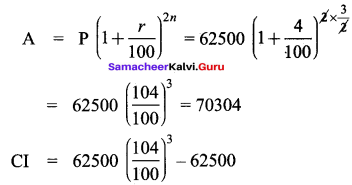
r = 4% compound half yearly
Samacheer Kalvi 8th Maths Solutions Term 2 Chapter 1 Life Mathematics Ex 1.4 14
= 70304 – 62500 = ₹ 7804
Difference between case 1 & case 2 is (2) – (1)
∴ (2) – (1) = 7804 – 7700 = ₹ 104

Challenging Problems

Question 8.
If the first number is 20% less than the second number and the second number is 25% more than 100, then find the first number.
Solution:
Second number is 25% more than 100
∴ 2nd number is 100 + \(\frac{25}{100}\) x 100= 125
First number is 20% less than second no.
Samacheer Kalvi 8th Maths Solutions Term 2 Chapter 1 Life Mathematics Ex 1.4 15
1st number is 100

Question 9.
A shopkeeper gives two successive discounts on an article whose marked price is ? 180 and selling price is ? 108. Find the first discount percent if the second discount is 25%.
Solution:
Marked price is given as ? 180
Let 1st discount be d1% = ? (to find)
2nd discount be d2% = 25%
Selling price is 108 (given)
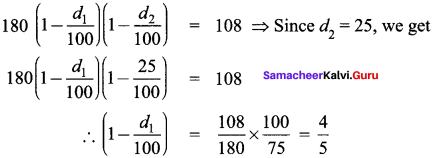
Price after 1st discount = 180(1 – \(\frac { d_{ 1 } }{ 100 } \)) = P1
Price after 2nd discount = P1(1 – \(\frac { d_{ 2 } }{ 100 } \)) = 108
Substituting for P1 from (1), we get
Samacheer Kalvi 8th Maths Solutions Term 2 Chapter 1 Life Mathematics Ex 1.4 16
∴ 1 – \(\frac { d_{ 1 } }{ 100 } \) = \(\frac{4}{5}\)
∴ \(\frac { d_{ 1 } }{ 100 } \) = 1 – \(\frac{4}{5}\) = \(\frac{1}{5}\)
∴ d1 = \(\frac{1}{5}\) x 100 = 20%

Samacheer Kalvi 8th Maths Solutions Term 2 Chapter 1 Life Mathematics Ex 1.4

Question 10.
A man bought an article on 30% discount and sold it at 40% more than the marked price. Find the profit made by him.
Solution:
Let marked price be ‘P’
Discounted price = P(1 – \(\frac{d}{100}\)) where d is the discount %
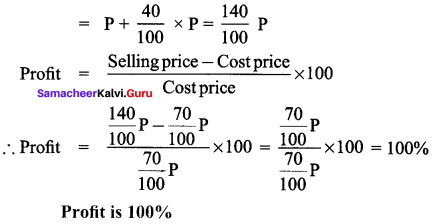
∴ Discounted price = P(1 – \(\frac{30}{100}\)) = \(\frac{70}{100}\)P → this is the cost price.
Selling price = 40% more than marked price
Samacheer Kalvi 8th Maths Solutions Term 2 Chapter 1 Life Mathematics Ex 1.4 17

Question 11.
Find the rate of compound interest at which a principal becomes 1.69 times itself in 2 years.
Solution:
Let principal be ‘P’
Amount is given to be 1.69 times principal
i.e 1.69 P
Time period is 2yrs. = (n)
Rate of interest = r = ? (required)
Applying the formula,
Amount = Principal (1 + \(\frac{r}{100}\))n
Substituting, 1.69 P = P (1 + \(\frac{r}{100}\))2
∴ (1 + \(\frac{r}{100}\))2 = \(\frac{1.69P}{P}\)
Taking square root on both sides, we get
\(\sqrt{1.69}\) = 1 + \(\frac{r}{100}\)
∴ 1 + \(\frac{r}{100}\) = 1.3
∴ \(\frac{r}{100}\) = 1.3
r = 30%
∴ rate of compound interst is 30%

Samacheer Kalvi 8th Maths Solutions Term 2 Chapter 1 Life Mathematics Ex 1.4

Question 12.
The simple interest on a certain principal for 3 years at 10% p.a is ₹ 300. Find the compound interest accrued in 3 years.
Solution:
Let principal be ‘P’
Rate of interest is 10% p.a (r)
Time period (n) = 3 yrs.
Formula for simple interest
∴ P = \(\frac{300×100}{10×3}\) = 1000
Compound Interest = CI = A – P
Amount (A) = P (1 + \(\frac{r}{100}\))n
= 1000(1 + \(\frac{10}{100}\))3 = 1000 x (\(\frac{10o+10}{100}\))3
= 1000 x \(\frac{110}{100}\) x \(\frac{110}{100}\) x \(\frac{110}{100}\) = 1331
Compound Interest (Cl) = Amount – Principal
= 1331 – 1000 = 331
Compound Interest = ₹ 331

Samacheer Kalvi 8th Maths Solutions Term 2 Chapter 1 Life Mathematics Ex 1.4 Read More »

Samacheer Kalvi 8th Maths Solutions Term 2 Chapter 2 Algebra Additional Questions

Students can Download Maths Chapter 2 Algebra Additional Questions and Answers, Notes Pdf, Samacheer Kalvi 8th Maths Book Solutions Guide Pdf helps you to revise the complete Tamilnadu State Board New Syllabus and score more marks in your examinations.

Tamilnadu Samacheer Kalvi 8th Maths Solutions Term 2 Chapter 2 Algebra Additional Questions

Samacheer Kalvi 8th Maths Solutions Term 2 Chapter 2 Algebra Additional Questions

Question 1.
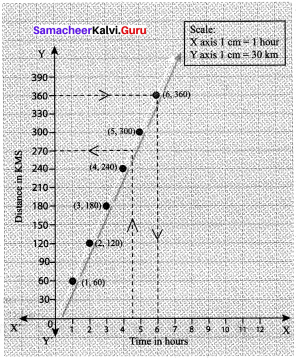
A bus runs constantly at a speed of 60 km/hr. Draw a time-distance graph for the situation. Also find the

  1. Time taken to cover 360 km.
  2. Distance covered in 4\(\frac{1}{2}\) hours.

Solution:
Given the bus runs constantly at a speed of 60 km/hr.
i.e. for 1 hour = 60 km
2 hours = 2 x 60 = 120 km
3 hours = 3 x 60 = 180 km
We can tabulate as below,
Samacheer Kalvi 8th Maths Solutions Term 2 Chapter 2 Algebra add 1
Take a suitable scale:

  1. Mark the number of hours on the x – axis
  2. Mark the distance in km on the y – axis
  3. Plot the points (1, 60), (2,120), (3, 180), (4, 240) and (5, 300)
  4. Join the points and get a straight line from the graph.
    • Time taken to cover 360 km is 6 hours.
    • Distance covered in 4\(\frac{1}{2}\) hours is

Samacheer Kalvi 8th Maths Solutions Term 2 Chapter 2 Algebra add 2

Question 2.
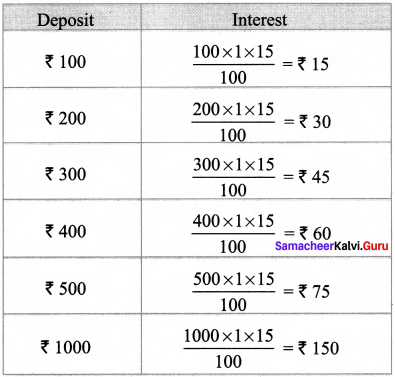
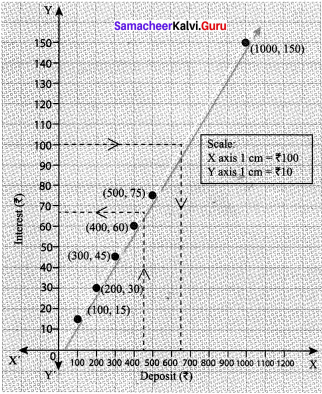
A company dealing with finance gives 15% simple interest on deposits made by senior citizens. Illustrate by a graph the relation between the deposit and the interest gained. Use the graph to complete the following.

  1. The annual interest obtainable for investment of ₹ 450
  2. The amount a senior citizen has to invest to get an annual simple interest of ₹ 100.

Solution:
Using the formula for calculating the simple interest, the following table of values is prepared.
Samacheer Kalvi 8th Maths Solutions Term 2 Chapter 2 Algebra add 3
Samacheer Kalvi 8th Maths Solutions Term 2 Chapter 2 Algebra add 4
These are the points to be plotted in the graph sheet, let us take the deposits along x – axis and annual simple interest along y – axis.
We choose the scale as follows.
Then we plot the points and draw the straight line.
From the graph we find.

  1. Corresponding to ₹ 450 on the x – axis, we get the interest as ₹ 67.5 on the y – axis.
  2. Corresponding to ₹ 100 on the y – axis we get the deposit as ₹ 666 on the x – axis.

Samacheer Kalvi 8th Maths Solutions Term 2 Chapter 2 Algebra add 5

Samacheer Kalvi 8th Maths Solutions Term 2 Chapter 2 Algebra Additional Questions

Question 3.
The following table gives the quantity of petrol and its cost
Samacheer Kalvi 8th Maths Solutions Term 2 Chapter 2 Algebra add 6
Plot the graph.
Solution:

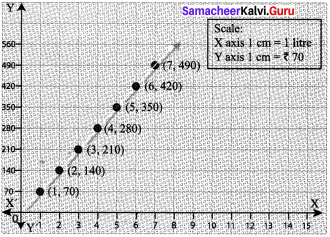
  1. Take a suitable scale on both the axes. Here we take on the x – axis
    1 cm = 1 litre, on the y axis 1 cm = 70 rupees.
  2. Mark number of litres of petrol along the x – axis
  3. Mark the cost of petrol along the y – axis.
  4. Plot the points (1, 70), (2, 140), (3, 210), (4, 280), (5, 350), (6, 420) and (7,490)
  5. Join the points.

The graph can help us to estimate few more things also.
Samacheer Kalvi 8th Maths Solutions Term 2 Chapter 2 Algebra add 7

Samacheer Kalvi 8th Maths Solutions Term 2 Chapter 2 Algebra Additional Questions Read More »

Samacheer Kalvi 8th Maths Solutions Term 2 Chapter 1 Life Mathematics Additional Questions

Students can Download Maths Chapter 1 Life Mathematics Additional Questions and Answers, Notes Pdf, Samacheer Kalvi 8th Maths Book Solutions Guide Pdf helps you to revise the complete Tamilnadu State Board New Syllabus and score more marks in your examinations.

Samacheer Kalvi 8th Maths Solutions Term 2 Chapter 1 Life Mathematics Additional Questions

Additional Questions and Answers

Question 1.
Fill in the blanks

Question (a)
Percent means ……….
Answer:
Per hundred or out of hundred.

Question (b)
Percent is useful in ………
Answer:
Comparing quantities easily

Samacheer Kalvi 8th Maths Solutions Term 2 Chapter 1 Life Mathematics Additional Questions

Question (c)
The formula to find the increased quantity ………
Answer:
I = (1 + \(\frac{x}{100}\))

Question (d)
The formula to find the decreased quantity ………
Answer:
D = (1 + \(\frac{x}{100}\))

Question (e)
Gain or profit % ……..
Answer:
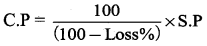
(\(\frac{Profit}{C.P}\) x 100)%

Question (f)
Loss % = ………..
Answer:
(\(\frac{Loss}{C.P}\) x 100)%

Question (g)
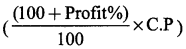
S.P = ………. (if gain % is given)
Answer:
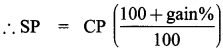
Samacheer Kalvi 8th Maths Solutions Term 2 Chapter 1 Life Mathematics Additional Questions 1

Question (h)
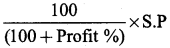
C.P = ……… (if gain % is given)
Answer:
Samacheer Kalvi 8th Maths Solutions Term 2 Chapter 1 Life Mathematics Additional Questions 2

Question (f)
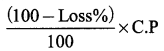
S.P = ………. (if loss % is given)
Answer:
Samacheer Kalvi 8th Maths Solutions Term 2 Chapter 1 Life Mathematics Additional Questions 3

Question (h)
C.P = ………. (if loss % is given)
Answer:
Samacheer Kalvi 8th Maths Solutions Term 2 Chapter 1 Life Mathematics Additional Questions 4

Question (k)
Selling price = Marked price – …………
Answer:
Discount

Samacheer Kalvi 8th Maths Solutions Term 2 Chapter 1 Life Mathematics Additional Questions

Question (l)
Cost price = Cost price + ……….
Answer:
Over head expenses

Question 2.
If y% of ₹ 1000 is 600, find the value ofy.
Solution:
y% of 1000 = 600
\(\frac{y}{100}\) x 1000 = 600
y = \(\frac{600}{10}\)
y = 60

Question 3.
A number when decreased by 10% becomes 900. Then find the number.
Solution:
Let the number be ‘x’
Given x – \(\frac{10}{100}\)x = 900
\(\frac{100x-10x}{100}\) = 900
\(\frac{90x}{100}\) = 900
x = \(\frac{900×100}{90}\) = 1000

Question 4.
If the population in a city has increased from 5,00,000 to 7,00,000 in a year, find the percentage increase in population.
Solution:
Increase in population = 7,00,000 – 5,00,000 = 2,00,000
Percentage increase in population = \(\frac{2,00,000}{5,00,000}\) x 100 = 40%

Samacheer Kalvi 8th Maths Solutions Term 2 Chapter 1 Life Mathematics Additional Questions

Question 5.
If the selling price of a refrigerator is equal to \(\frac{10}{8}\) of its cost price, then find the gain/ profit percent.
Solution:
Let the C.P of the refrigerator be x
S.P = \(\frac{10}{8}\)x
Profit = S.P – C.P = \(\frac{10}{8}\)x – x = \(\frac{10x-8x}{8}\) = \(\frac{2x}{8}\)
Samacheer Kalvi 8th Maths Solutions Term 2 Chapter 1 Life Mathematics Additional Questions 5

Question 6.
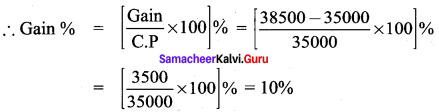
Karnan bought a dishwasher for ₹ 32,300 and paid ₹ 2700 for its transportation. Then he sold it for X 38,500. Find his gain or loss percent.
Solution:
Total C.P of the dishwasher = C.P + Overhead expenses.
= ₹ 32300 + ₹ 2700 = ₹ 35000
S.P = ₹ 38500
Therefore, we find S.P > C.P
Samacheer Kalvi 8th Maths Solutions Term 2 Chapter 1 Life Mathematics Additional Questions 6

Question 7.
The value of a car 2 years ago was ₹ 1,40,000. It depreciates at the rate of 4% p.a. Find its present value.
Solution:
Depreciated value = P(1 + \(\frac{r}{100}\))n = 1,40,000(1 – \(\frac{4}{100}\))2
= 1,40,000(\(\frac{96}{100}\)) x (\(\frac{96}{100}\)) = ₹ 1,29,024

Samacheer Kalvi 8th Maths Solutions Term 2 Chapter 1 Life Mathematics Additional Questions

Question 8.
Find the difference in C.I and S.I for P = ₹ 10,000, r = 4% p.a, n = 2 years.
Solution:
C.I – S.I = P(\(\frac{r}{100}\))2 = 10,000(\(\frac{4}{100}\))2
= 10,000 x \(\frac{4}{100}\) x \(\frac{4}{100}\) = ₹ 16

Question 9.
Find the C.I for the given Principal = ₹ 8,000, r = 5% p.a, n = 2 years
Amount A = P(1 + \(\frac{r}{100}\))n = 8000(1 + \(\frac{5}{100}\))2
= 8000 x \(\frac{105}{100}\) x \(\frac{105}{100}\)
= 8000 x \(\frac{21}{20}\) x \(\frac{21}{20}\)
A = ₹ 8820
Cl = A – P = 8820 – 8000 = 820

Question 10.
Find the S.I for the principal P = ₹ 16,000, r = 5% p.a, n = 3 years
Solution:
P = ₹ 16,000, n= 3 years, r = 5%
S.I = \(\frac{Pnr}{100}\) = \(\frac{16000x3x5}{100}\) = ₹ 2400

Samacheer Kalvi 8th Maths Solutions Term 2 Chapter 1 Life Mathematics Additional Questions Read More »

Samacheer Kalvi 8th Maths Solutions Term 2 Chapter 1 Life Mathematics Ex 1.3

Students can Download Maths Chapter 1 Life Mathematics Ex 1.3 Questions and Answers, Notes Pdf, Samacheer Kalvi 8th Maths Book Solutions Guide Pdf helps you to revise the complete Tamilnadu State Board New Syllabus and score more marks in your examinations.

Tamilnadu Samacheer Kalvi 8th Maths Solutions Term 2 Chapter 1 Life Mathematics Ex 1.3

Question 1.
Fill in the blanks

Question (i)
The compound interest on ₹ 5000 at 12% p.a for 2 years compounded annually is ………..
Answer:
₹ 1272
Hint:
Compound Interest (Cl) formula is
Cl = Amount – Principal
Amount = A (1 + \(\frac{r}{100}\))n = 5000 (1 + \(\frac{12}{100}\))2
= 5000 (1 + \(\frac{112}{100}\))2 = 6272
∴ Cl = 6272 – 5000 = ₹ 1272

Samacheer Kalvi 8th Maths Solutions Term 2 Chapter 1 Life Mathematics Ex 1.3

Question (ii)
The compound interest on ₹ 8000 at 10% p.a for 1 year, compounded half yearly is …………
Answer:
₹ 820
Hint:
Compound interest (CI) = Amount – Principal
∴ Amount = P (1 + \(\frac{r}{100}\))2n [2n as it is compounded half yearly]
r = 10% p.a, for half yearly r = 1 + \(\frac{10}{2}\) = 5
A = 8000 (1 + \(\frac{5}{100}\))2×1 = 8000 x (\(\frac{105}{100}\))2 = 8820
CI = Amount – principal
= 8820 – 8000 = ₹ 820

Question (iii)
The annual rate of growth in population of a town is 10%. If its present population is 26620, the population 3 years ago was ………..
Answer:
₹ 20,000
Hint:
Rate of growth of population r = 10%; Present population = 26620
Let population 3 years ago be x
∴ Applying the formula for population growth which is similar to compound interest,
26620 = x (1 + \(\frac{r}{100}\))3
∴ 26620 = x (1 + \(\frac{10}{100}\))3 = x (\(\frac{110}{100}\))3
∴ x = 26620 x (\(\frac{110}{100}\))3
= ₹ 20,000
The population 3 years ago was ₹ 20,000

Questions (iv)
The amount if the compound interest is calculated quarterly, is found using the formula ………….
Answer:
A = P (1 + \(\frac{r}{400}\))4n
Hint:
Quarterly means 4 times in a year.
∴ The formula for compound interest is
A = P (1 + \(\frac{r}{400}\))4n

Question (v)
The difference between the S.I and C.I for 2 years for a principal of ₹ 5000 at the rate of interest 8% p.a is …….
Answer:
₹ 32
Hint:
Difference between S.I & C.I is given by the formula
CI – SI = P (\(\frac{r}{100}\))2
Principal (P) = 5000, r = 8% p.a
∴ CI – SI = 5000 (\(\frac{8}{100}\))2 = 5000 x \(\frac{8}{100}\) x \(\frac{8}{100}\) = ₹ 32

Samacheer Kalvi 8th Maths Solutions Term 2 Chapter 1 Life Mathematics Ex 1.3

Question 2.
Say True or False

Question (i)
Depreciation value is calculated by the formula P (1 – \(\frac{r}{100}\))n
Answer:
True
Hint:
Depreciation formula is P (1 – \(\frac{r}{100}\))n

Question (ii)
If the present population of a city is P and it increases at the rate of r % p.a, then the population n years ago would be P (1 + \(\frac{r}{100}\))n.
Answer:
False
Hint:
Let the population ‘n’ yrs ago be ‘x’
Present population (P) = x × (1 + \(\frac{r}{100}\))n
x = \(\frac { P }{ (1+\frac { r }{ 100 } )^{ n } } \)

Question (iii)
The present value of a machine is ₹ 16800. It depreciates @25% p.a. Its worth after 2 years is ₹ 9450.
Answer:
True
Hint:
Present value of machine = ₹ 16800
Depreciation rate (n) = 25%
Value after 2 years = P (1 – \(\frac{r}{100}\))n = 16800 (1 – \(\frac{25}{100}\))2
= 16800 x (1 – \(\frac{1}{4}\))2 = 16800 x \(\frac{3}{4}\) x \(\frac{3}{4}\) = 9450

Question (iv)
The time taken for ₹ 1000 to become ₹ 1331 @20% p.a compounded annually is 3 years.
Answer:
False
Principal money = 1000
rate of interest Amount = 20%
Amount = 1331, applying in formula we get
A = (1 + \(\frac{r}{100}\))n
1331 = 1000(1 + \(\frac{r}{100}\))n
∴ \(\frac{1331}{1000}\) = (1 – \(\frac{1}{5}\))n
\(\frac{1331}{1000}\) = (\(\frac{6}{5}\))n
∴ n ≠ 3 (False)

Samacheer Kalvi 8th Maths Solutions Term 2 Chapter 1 Life Mathematics Ex 1.3

Question (v)
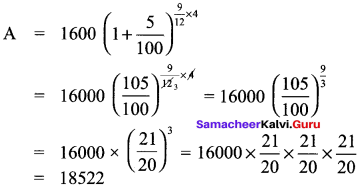
The compound interest on ₹ 16000 for 9 months @20% p.a, compounded quarterly is ₹ 2522.
Answer:
True
Hint:
Principal (P) = 16000
n = 9 months = \(\frac{9}{12}\) years
r = 20% p.a
For compounding quarterly, we have to use below formula.
Amount (A) = P x (1 + \(\frac{r}{100}\))4n
Since quarterly we have to divide r by 4
r = \(\frac{20}{4}\)
Samacheer Kalvi 8th Maths Solutions Term 2 Chapter 1 Life Mathematics Ex 1.3 1
∴ Interest = A – P = 18522 – 16000 = 2522 (True)

Question 3.
Find the compound interest on ₹ 3200 at 2.5% p.a for 2 years, compounded annually.
Solution:
Principal (P) = ₹ 3200
r = 2.5% p.a
n = 2 years comp, annually
∴ Amount (A) = (1 + \(\frac{r}{100}\))n = (1 + \(\frac{2.5}{100}\))2
= 3200 x (1.025)2 = 3362
Compound interest (Cl) = Amount – Principal = 3362 – 3200 = ₹ 162

Question 4.
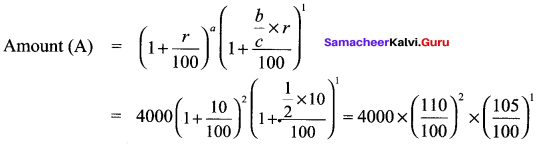
Find the compound interest for 2\(\frac{1}{2}\) years on ₹ 4000 at 10% p.a if the interest is compounded yearly.
Solution:
Principal (P) = ₹ 4000
r = 10% p.a
Compounded yearly n = 2\(\frac{1}{2}\) years. Since it is of the form a\(\frac{b}{c}\) years
Samacheer Kalvi 8th Maths Solutions Term 2 Chapter 1 Life Mathematics Ex 1.3 2
= 4000x 1.1 x 1.1 x 1.05 = 5082
∴ Cl = Amount – Principal = 5082 – 4000 = 1082

Question 5.
Magesh invested ₹ 5000 at 12% p.a for one year. If the interest is compounded half yearly, find the amount he gets at the end of the year.
Solution:
Principal (P) = ₹ 5000
Interest compounded half yearly
r = 12% p.a = \(\frac{12}{2}\) = 6% for half yearly
t = 1 yr.
Since compounded half yearly, the formula to be used is
Amount A = P (1 + \(\frac{r}{100}\))2n
A = 5000 (1 + \(\frac{6}{100}\))2×1 = 5000 x (\(\frac{106}{100}\))2 = ₹ 5618

Question 6.
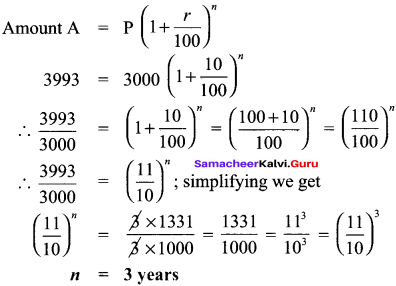
At what time will a sum of ₹ 3000 will amount to ₹ 3993 at 10% p.a compounded annually?
Solution:
Amount A = ₹ 3993
Principal = ₹ 3000
r = 10% p.a
n = ?
Samacheer Kalvi 8th Maths Solutions Term 2 Chapter 1 Life Mathematics Ex 1.3 3

Question 7.
A principal becomes ₹ 2028 in 2 years at 4% p.a compound interest. Find the Principal.
Solution:
n = 2 years
r = rate of interest = 4% p.a
Amount A = ₹ 2028
Amount (A) = P (1 + \(\frac{r}{100}\))n
2028 = P (1 + \(\frac{4}{100}\))n
2028 = P (\(\frac{r}{100}\))2
∴ P = \(\frac{2028x100x100}{104×104}\) = ₹ 1875

Samacheer Kalvi 8th Maths Solutions Term 2 Chapter 1 Life Mathematics Ex 1.3

Question 8.
At what rate percentage p.a will ₹ 5625 amount to ₹ 6084 in 2 years at compound interest?
Solution:
Principal (P) = ₹ 5625
Amount (A) = ₹ 6084
n = 2 years
r = ?
Amount (A) = P (1 + \(\frac{r}{100}\))n [Applying in formula]
6084 = 5625 (1 + \(\frac{r}{100}\))2
(1 + \(\frac{r}{100}\))2 = \(\frac{6084}{5625}\)
Taking square root on both sides, we get
1 + \(\frac{r}{100}\) = \(\frac{78}{75}\)
\(\frac{r}{100}\) = \(\frac{78}{75}\) – 1 = \(\frac{3}{75}\) = \(\frac{1}{25}\)
∴ r = \(\frac{1}{25}\) x 100 = 4%

Question 9.
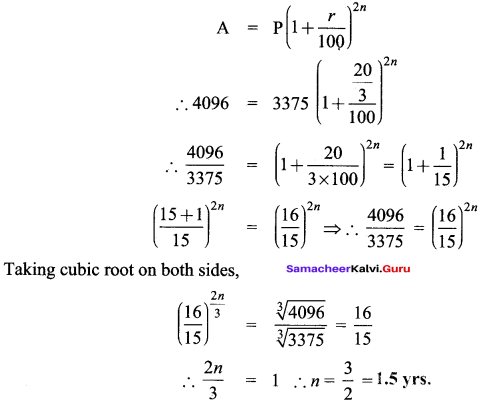
In how many years will ₹ 3375 amount to ₹ 4096 at 13\(\frac{1}{3}\)% p.a where interest is compounded half-yearly?
Solution:
Principal = ₹ 3375
Amount = ₹ 4096
r = 13\(\frac{1}{3}\)% p.a = \(\frac{40}{3}\)% p.a
Compounded half yearly r = \(\frac { \frac { 40 }{ 3 } }{ 2 } \) = \(\frac{2}{3}\)
Let no. of years be n
for compounding half yearly, formula is
Samacheer Kalvi 8th Maths Solutions Term 2 Chapter 1 Life Mathematics Ex 1.3 4

Question 10.
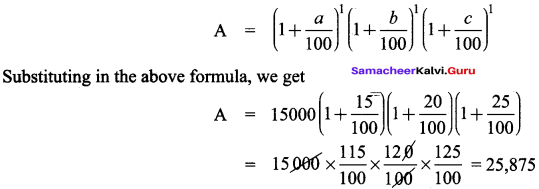
Find the C.I on ₹ 15000 for 3 years if the rates of interest is 15%, 20% and 25% for I, II and III years respectively.
Solution:
Principal (P) = ₹ 15000
rate of interest 1 (a) = 15% for year I
rate of interest 2 (b) = 20% for year II
rate of interest 3 (c) = 25% for year III
Formula for amount when rate of interest is different for different years is
Samacheer Kalvi 8th Maths Solutions Term 2 Chapter 1 Life Mathematics Ex 1.3 5
Compound Interest (Cl) = A – P = 25,875 – 15,000 = 10,875
Cl = ₹ 10,875

Question 11.
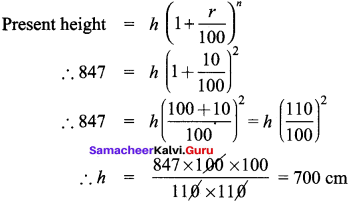
The present height of a tree is 847 cm. Find its height two years ago, if it increases at 10 % p.a.
Samacheer Kalvi 8th Maths Solutions Term 2 Chapter 1 Life Mathematics Ex 1.3 6
Solution:
Present height of tree = 847 cm
Present height = ‘h’
n = 2 yrs
rate of growth = 10% p.a
Applying in formula, we get
Samacheer Kalvi 8th Maths Solutions Term 2 Chapter 1 Life Mathematics Ex 1.3 7
∴ Original height of tree = 70 cm

Question 12.
Find the difference between the C.I and the S.I on ₹ 5000 for 1 year at 2% p.a, if the interest is compounded half yearly.
Solution:
Principal (P) = ₹ 5000
time period (n) = 1 yr.
Rate of interest (r) = 2% p.a
for half yearly r = 1%
Difference between Cl & SI is given by the formula
CI – SI = P (\(\frac{r}{100}\))2n [for half yearly compounding]
CI – SI = P (\(\frac{1}{100}\))2×1
= 5000 x \(\frac{1}{100}\) x \(\frac{1}{100}\) = ₹ 0.50

Samacheer Kalvi 8th Maths Solutions Term 2 Chapter 1 Life Mathematics Ex 1.3

Question 13.
What is the difference in simple interest and compound interest on 115000 for 2 years at 6% p.a compounded annually.
Solution:
Principal (P) = ₹ 15,000
Time period (n) = 2 yrs.
Rate of interest (r) = 6% p.a compounded annually
Difference between CI and SI given by
CI – SI = P (\(\frac{r}{100}\))n = 15000 (\(\frac{6}{100}\))2
= 15000 x \(\frac{6}{100}\) x \(\frac{6}{100}\)
= ₹ 54

Question 14.
Find the rate of interest if the difference between the C.I and S.I on ₹ 8000 compounded annually for 2 years is ₹ 20.
Solution:
Principal (P) = ₹ 8000
time period (n) = 2 yrs.
rate of interest (r) = ?
Difference between Cl & SI is given by the formula
CI – SI = P (1 + \(\frac{r}{100}\))n
Difference between Cl & SI is given as 20
∴ 20 = 8000 x (\(\frac{r}{100}\))2
∴ (\(\frac{r}{100}\))2 = \(\frac{20}{8000}\) = \(\frac{1}{400}\)
Taking square root on both sides
\(\frac{r}{100}\) = \(\sqrt { \frac { 1 }{ 400 } } \) = \(\frac{1}{20}\)
∴ r = \(\frac{100}{20}\)

Question 15.
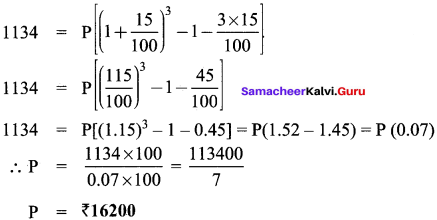
Find the principal if the difference between C.I and S.I on it at 15% p.a for 3 years is ₹ 1134.
Solution:
Rate of interest (r) = 15% p.a
time period (n) = 3 years
Difference between Cl & SI is given as 1134
Principal = ? → required to find
Simple Interest SI = \(\frac{Pnr}{100}\)
Compound Interest CI = P (1 + i)n – P
Cl – SI = P [(1 + i)n – 1 – \(\frac{nr}{100}\)]
Samacheer Kalvi 8th Maths Solutions Term 2 Chapter 1 Life Mathematics Ex 1.3 8

Objective Type Questions

Question 16.
The number of conversion periods, if the interest on a principal is compounded every two months is ……………
(a) 2
(b) 4
(c) 6
(d) 12
Answer:
(c) 6
Hint:
Conversion period is the time period after which the interest is added to the principal. If principal is compounded every two months then in a year, there will be 6\(\frac{12}{2}\) conversation periods.

Question 17.
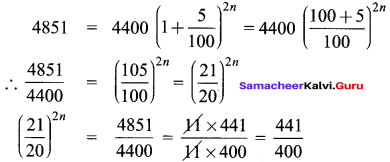
The time taken for ₹ 4400 to become ₹ 4851 at 10%, compounded half yearly is
(a) 6 months
(b) 1 year
(c) 1\(\frac{1}{2}\) years
(d) 2years
Answer:
(b) 1 year
Hint:
Principal = ₹ 4400
Amount = ₹ 4851
Rate of interest = 10% p.a
for half yearly, divide by 2,
r = \(\frac{10}{2}\) = 5 %
Compounded half yearly, so the formula is
A = P (1 + \(\frac{r}{100}\))2n
Substuting in the above formula, we get
Samacheer Kalvi 8th Maths Solutions Term 2 Chapter 1 Life Mathematics Ex 1.3 9
Taking square root on both sides, we get
(\(\frac{21}{20}\))2n = (\(\frac{21}{20}\))2
Equating power on both sides
∴ 2n = 2,
n = 1

Samacheer Kalvi 8th Maths Solutions Term 2 Chapter 1 Life Mathematics Ex 1.3

Question 18.
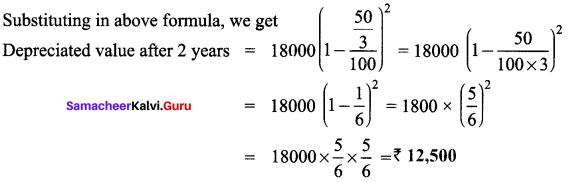
The cost of a machine is ₹ 18000 and it depreciates at 16\(\frac{2}{3}\)% annually. Its value after 2 years will be ………..
(a) ₹ 12000
(b) ₹ 12500
(c) ₹ 15000
(d) ₹ 16500
Answer:
(b) ₹ 12500
Hint:
Cost of machine = ₹ 18000
Depreciation rate = 16\(\frac{2}{3}\)% = \(\frac{50}{3}\)% p.a
time period = 2 years
∴ As per depreciation formula,
Depriciated value = Original value (1 – \(\frac{r}{100}\))n
Substituting in above formula, we get
Samacheer Kalvi 8th Maths Solutions Term 2 Chapter 1 Life Mathematics Ex 1.3 10

Question 19.
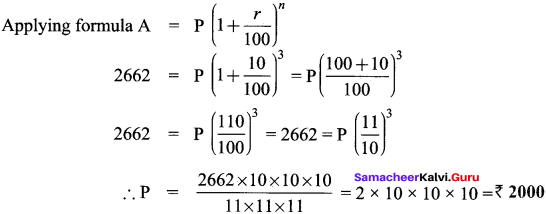
The sum which amounts to ₹ 2662 at 10% p.a in 3 years compounded yearly is ………..
(a) ₹ 2000
(b) ₹ 1800
(c) ₹ 1500
(d) ₹ 2500
Answer:
(a) ₹ 2000
Hint:
Amount = ₹ 2662
rate of interest = 10% p.a
Time period = 3 yrs. Compounded yearly
Principal (P) → required to find?
Applying formula A = P (1 + \(\frac{r}{100}\))n
Samacheer Kalvi 8th Maths Solutions Term 2 Chapter 1 Life Mathematics Ex 1.3 11

Question 20.
The difference between simple and compound interest on a certain sum of money for 2 years at 2% p.a is ₹ 1 the sum of money is ……….
(a) ₹ 2000
(b) ₹ 1500
(c) ₹ 3000
(d) ₹ 2500
Answer:
(d) ₹ 2500
Difference between Cl and SI is given as Re 1
Time period (n) = 2 yrs.
Rate of interest (r) = 2% p.a
Formula for difference is
CI – SI = P x (1 + \(\frac{r}{100}\))n
Substituting the values in above formula, we get
1 = P x (\(\frac{2}{100}\))2
∴ P = 1 x (\(\frac{100}{2}\))2
= 1 x (50)2 = ₹ 2500

Samacheer Kalvi 8th Maths Solutions Term 2 Chapter 1 Life Mathematics Ex 1.3 Read More »

Samacheer Kalvi 8th Maths Solutions Term 2 Chapter 2 Algebra Ex 2.1

Students can Download Maths Chapter 2 Algebra Ex 2.1 Questions and Answers, Notes Pdf, Samacheer Kalvi 8th Maths Book Solutions Guide Pdf helps you to revise the complete Tamilnadu State Board New Syllabus and score more marks in your examinations.

Tamilnadu Samacheer Kalvi 8th Maths Solutions Term 2 Chapter 2 Algebra Ex 2.1

Question 1.
Fill in the blanks

Question (i)
The value of x in the equation x +5 12 ¡s ……….
Answer:
7
Hint:
Given,
x + 5 = 12
x = 12 – 5 = 7 (by transposition method)
Value of x is 7

Samacheer Kalvi 8th Maths Solutions Term 2 Chapter 2 Algebra Ex 2.1

Question (ii)
The value ofy in the equation y – 9 = (-5) + 7 is ……….
Answer:
11
Hint:
Given,
y – 9 = (- 5) + 7
y – 9 = 7 – 5 (re-arranging)
y – 9 = 2
∴ y = 2 + 9 = 11 (by transposition method)

Question (iii)
The value of m in the equation 8m = 56 is ………
Answer:
7
Hint:
Given,
8m = 56
Divided by 8 on both sides
\(\frac{8xm}{8}\) = \(\frac{56}{8}\)
∴ m = 7

Question (iv)
The value ofp in the equation \(\frac{2p}{3}\) = 10 is ……….
Answer:
1
Hint:
Given,
\(\frac{2p}{3}\) = 10
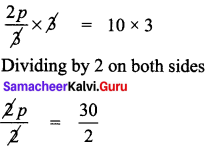
Multiplying by 3 on both sides,
Samacheer Kalvi 8th Maths Solutions Term 2 Chapter 2 Algebra Ex 2.1 1
∴ p = 15

Question (v)
The linear equation in one variable has ……… Solution.
Answer:
one.

Question 2.
Say True or False.

Samacheer Kalvi 8th Maths Solutions Term 2 Chapter 2 Algebra Ex 2.1

Question (i)
The shifting of a number from one side of an equation to other is called transposition.
Answer:
True

Question (ii)
Linear equation in one variable has only one variable with power 2.
Answer:
False
[Linear equation in one variable has only one variable with power one – correct statement]

Question 3.
Match the following :
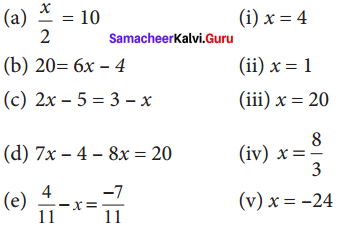
Samacheer Kalvi 8th Maths Solutions Term 2 Chapter 2 Algebra Ex 2.1 2
(A) (i), (ii), (iv), (iii), (v)
(B) (iii), (iv), (i), (ii), (v)
(C) (iii), (i), (iv), (v), (ii)
(D) (iii), (i), (v), (iv), (ii)
Answer:
(C) (iii),(i), (iv), (v), (ii)
Hint:
a. \(\frac{x}{2}\) = 10,
multiplying by 2 on both sides, we get
\(\frac{x}{2}\) x 2 = 10 x 2 ⇒ x = 20

b. 20 = 6x – 4
by transposition ⇒ 20 + 4 = 6x
6x = 24
dividing by 6 on both sides,
\(\frac{6x}{6}\) = \(\frac{24}{6}\) ⇒ x = 4

c. 2x – 5 = 3 – x
By transposing the variable ‘x’, we get
2x – 5 + x = 3
by transposing – 5 to other side,
2x + x = 3 + 5
∴ 3x = 8
Samacheer Kalvi 8th Maths Solutions Term 2 Chapter 2 Algebra Ex 2.1 3
∴ x = \(\frac{8}{3}\)

d. 7x – 4 – 8x = 20
by transposing – 4 to other side,
7x – 8x = 20 + 4
– x = 24
∴ x = – 24
\(\frac{4}{11}\) – x = \(\frac{-7}{11}\)
Transposing \(\frac{4}{11}\) to other side,
– x = \(\frac{-7}{11}\)\(\frac{-4}{11}\) = \(\frac{-7-4}{11}\) = \(\frac{-11}{11}\) = – 1
∴ – x = – 1 ⇒ x = 1

Samacheer Kalvi 8th Maths Solutions Term 2 Chapter 2 Algebra Ex 2.1

Question 4.
Find x:

Question (i)
\(\frac{2x}{3}\) – 4 = \(\frac{10}{3}\)
Solution:
Transposing -4 to other side, it becomes +4
∴ \(\frac{2x}{3}\) = \(\frac{10}{3}\) + 4
Taking LCM & adding,
\(\frac{2x}{3}\) = \(\frac{10}{3}\) + \(\frac{4}{1}\) = \(\frac{10+12}{3}\) = \(\frac{22}{3}\)
\(\frac{2x}{3}\) = \(\frac{22}{3}\)
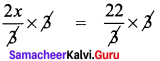
Multiplying by 3 on both sides
Samacheer Kalvi 8th Maths Solutions Term 2 Chapter 2 Algebra Ex 2.1 4
⇒ 2x = 22
dividing by 2 on both sides,
We get \(\frac{2x}{2}\) = \(\frac{22}{2}\)
∴ x = 11

Question (ii)
y + \(\frac{1}{6}\) – 3y = \(\frac{2}{3}\)
Solution:
Transposing \(\frac{1}{6}\) to the other side,
y – 3y = \(\frac{2}{3}\) – \(\frac{1}{6}\)
Taking LCM,
– 2y = \(\frac{2}{3}\) – \(\frac{1}{6}\) = \(\frac{2×2-1}{6}\) = \(\frac{3}{6}\) = \(\frac{1}{2}\)
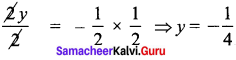
∴ – 2y = \(\frac{1}{2}\) ⇒ 2y = – \(\frac{1}{2}\)
dividing by 2 or both sides.
Samacheer Kalvi 8th Maths Solutions Term 2 Chapter 2 Algebra Ex 2.1 5

Question (iii)
\(\frac{1}{3}\) – \(\frac{x}{3}\) = \(\frac{7x}{12}\) + \(\frac{5}{4}\)
Transposing \(\frac{-x}{3}\) to the other side, it becomes + \(\frac{x}{3}\)
∴ \(\frac{1}{3}\) = \(\frac{7x}{12}\) + \(\frac{5}{4}\) + \(\frac{x}{3}\)
Transposing \(\frac{5}{4}\) to the other side, it becomes \(\frac{-5}{4}\)
\(\frac{1}{3}\) + \(\frac{5}{4}\) = \(\frac{7x}{12}\) + \(\frac{x}{3}\)
Multiply by 12 throughout
[we look at the denominators 3,4, 12, 3 and take the LCM, which is 12]
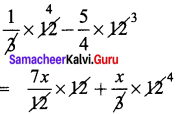
Samacheer Kalvi 8th Maths Solutions Term 2 Chapter 2 Algebra Ex 2.1 6
4 – 15 = 7x + x × 4
-11 = 7x + 4x
11x = – 11
x = -1

Samacheer Kalvi 8th Maths Solutions Term 2 Chapter 2 Algebra Ex 2.1

Question 5.
Find x:

Question (i)
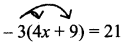
-3(4x + 9) = 21
Solution:
Samacheer Kalvi 8th Maths Solutions Term 2 Chapter 2 Algebra Ex 2.1 7
Expanding the bracket,
-3 × 4x + (-3) × 9 = 21
-12x + (-27) = 21
-12x – 27 = 21
Transposing – 27 to other side, it becomes +27
-12x = 21 + 27 = 48
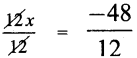
12x = 48 ⇒ 12x = -48
Dividing by 12 on both sides
Samacheer Kalvi 8th Maths Solutions Term 2 Chapter 2 Algebra Ex 2.1 8
⇒ x = – 4

Question (ii)
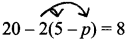
20 – 2 ( 5 – p) = 8
Solution:
Samacheer Kalvi 8th Maths Solutions Term 2 Chapter 2 Algebra Ex 2.1 9
Expanding the bracket,
20 – 2 x 5 – 2 x (-p) = 8
20 – 10 + 2 + p = 8 (-2 x -P = 2p)
10 + 2p = 8 transporting 10 to other side
2P = 8 – 10 = -2
∴ 2p = -2
∴ p = -1

Question (iii)
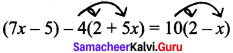
(7x – 5) – 4(2 + 5x) = 10(2 – x)
Solution:
Samacheer Kalvi 8th Maths Solutions Term 2 Chapter 2 Algebra Ex 2.1 10
Expanding the brackets,
7x – 5 – 4 × 2 – 4 × 5x = 10 × 2 + 10 × (-x)
7x – 5 – 8 – 20x = 20 – 10x
7x – 13 – 20x = 20 – 10x
Transposing 10x & -13, we get
7x – 13 – 20x + 10x = 20
7x – 20x + 10x = 20 + 13,
Simplifying,
-3x = 33
∴ 3x = -33
x = \(\frac{-33}{3}\) = -11
x = -11

Samacheer Kalvi 8th Maths Solutions Term 2 Chapter 2 Algebra Ex 2.1

Question 6.
Find x and m:

Question (i)
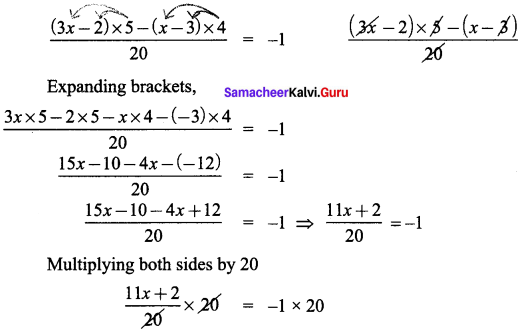
\(\frac{3x-2}{4}\) – \(\frac{(x-3)}{5}\) = -1
Solution:
\(\frac{3x-2}{4}\) – \(\frac{(x-3)}{5}\)
Taking LCM on LHS, [LCM of 4 & 5 is 20]
Samacheer Kalvi 8th Maths Solutions Term 2 Chapter 2 Algebra Ex 2.1 11
∴ 11x + 2 = -20
∴ 11x = – 20 – 2 = – 22
x = \(\frac{-22}{11}\) = -2
x = -2

Question (ii)
\(\frac{m+9}{3m+15}\) = \(\frac{5}{3}\)
Solution:
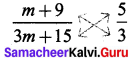
\(\frac{m+9}{3m+15}\) = \(\frac{5}{3}\)
Cross multiplying, we get
Samacheer Kalvi 8th Maths Solutions Term 2 Chapter 2 Algebra Ex 2.1 12
∴ (m + 9) x 3 = 5 x (3m + 15)
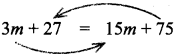
m x 3 + 9 x 3 = 5 x 3m + 5 x 15
Samacheer Kalvi 8th Maths Solutions Term 2 Chapter 2 Algebra Ex 2.1 13
Transporting 3m & 75, we get
27 – 75 = 15m – 3m
-48 = 12m
Samacheer Kalvi 8th Maths Solutions Term 2 Chapter 2 Algebra Ex 2.1 14
⇒ m = -4

Samacheer Kalvi 8th Maths Solutions Term 2 Chapter 2 Algebra Ex 2.1 Read More »

Samacheer Kalvi 8th Maths Solutions Term 2 Chapter 1 Life Mathematics Ex 1.2

Students can Download Maths Chapter 1 Life Mathematics Ex 1.2 Questions and Answers, Notes Pdf, Samacheer Kalvi 8th Maths Book Solutions Guide Pdf helps you to revise the complete Tamilnadu State Board New Syllabus and score more marks in your examinations.

Tamilnadu Samacheer Kalvi 8th Maths Solutions Term 2 Chapter 1 Life Mathematics Ex 1.2

Question 1.
Fill in the blanks:

Question (i)
Loss or gain percent is always calculated on the ………
Answer:
Cost price

Samacheer Kalvi 8th Maths Solutions Term 2 Chapter 1 Life Mathematics Ex 1.2

Question (ii)
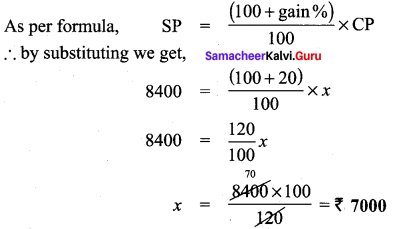
A mobile phone is sold for ? 8400 at a gain of 20%. The cost price of the mobile phone is …………
Answer:
₹ 7000
Hint:
Let cost price of mobile be ₹ x. Given that selling price is ? 8400 and gain is 20%
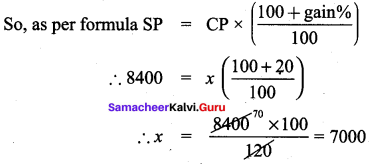
Samacheer Kalvi 8th Maths Solutions Term 2 Chapter 1 Life Mathematics Ex 1.2 1

Question (iii)
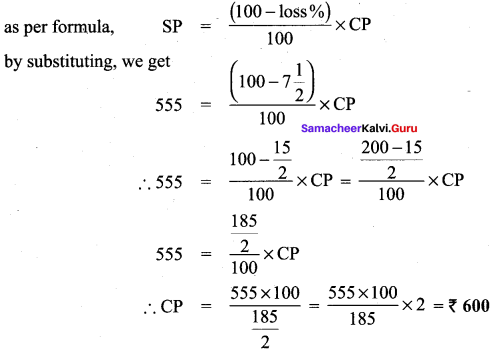
An article is sold for ₹ 555 at a loss of 7\(\frac{1}{2}\)% the cost price qfthe article is ……….
Answer:
₹ 600
Hint:
Given selling price is ₹ 555 & loss is 7\(\frac{1}{2}\)%
as per formula,
Samacheer Kalvi 8th Maths Solutions Term 2 Chapter 1 Life Mathematics Ex 1.2 2

Question (iv)
The marked price of a mixer grinder is ₹ 4500 is sold for ₹ 4140 after discount. The rate of discount is ……..
Answer:
8%
Hint:
Marked price is X 4500. Discounted price in ₹ 4140
∴ Discount = Marked price – Discounted price = 4500 – 4140 – 360
Samacheer Kalvi 8th Maths Solutions Term 2 Chapter 1 Life Mathematics Ex 1.2 3

Question (v)
The total bill amount of a shirt costing ₹ 575 and a T-shirt costing ₹ 325 with GST of 5% is ………..
Answer:
₹ 945
Hint:
Cost price of shirt = ₹ 575 (CP)
GST = 5%
Samacheer Kalvi 8th Maths Solutions Term 2 Chapter 1 Life Mathematics Ex 1.2 4
= 575 x (\(\frac { (100+5) }{ 100 } \)) = 575 x \(\frac { 105 }{ 100 } \)
= ₹ 603.75
Cost price of T-shirt = ₹ 325 (CP)
GST = 5%
Samacheer Kalvi 8th Maths Solutions Term 2 Chapter 1 Life Mathematics Ex 1.2 5
= 325 x (\(\frac { (100+5) }{ 100 } \))
Total bill amount = ₹ 603.75 + ₹ 341.25 = ₹ 945

Question 2.
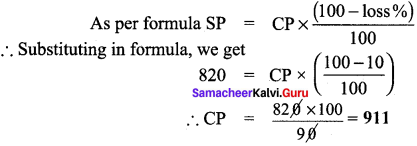
If selling an article for ₹ 820 causes 10% loss on the selling price, find its cost price.
Solution:
Given that selling price (SP) = ₹ 820
Loss % = 10 %
Samacheer Kalvi 8th Maths Solutions Term 2 Chapter 1 Life Mathematics Ex 1.2 6

Question 3.
If the profit earned on selling an article for ₹ 810 is the same as loss on selling it for ₹ 530, then find the cost price of the article.
Solution:
Case 1: Profit = Selling price (SP) – Cost price (CP)
Case 2: Loss = Cost price (CP) – Selling price (SP)
Given that profit of case 1 = loss of case 2
∴ P = 810 – CP
L = CP – 530
Since profit (P) = loss (L)
810 – CP = CP – 530
∴ 2CP = 810 + 530 = 1340 ⇒ C.P = \(\frac{1340}{2}\)
∴ CP = 670

Samacheer Kalvi 8th Maths Solutions Term 2 Chapter 1 Life Mathematics Ex 1.2

Question 4.
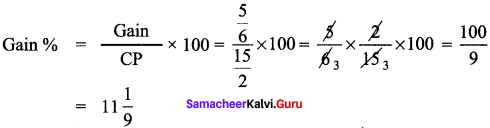
Some articles are bought at 2 for ₹ 15 and sold at 3 for ₹ 25. Find the gain percentage.
Solution:
Let cost price of one article be C.P
Given that 2 are bought for ₹ 15
∴ 2 x CP = 15 ⇒ CP = \(\frac{15}{2}\)
Let selling price of one article be SP
Given that 3 are sold for ₹ 25
∴ 3 x CP = 25 ⇒ SP = \(\frac{25}{3}\)
∴ Gain = SP – CP = \(\frac{25}{3}\) – \(\frac{15}{2}\) = \(\frac{50-45}{6}\) = \(\frac{5}{6}\)
Samacheer Kalvi 8th Maths Solutions Term 2 Chapter 1 Life Mathematics Ex 1.2 7

Question 5.
If the selling price of 10 rulers is the same as the cost price of 15 rulers, then find the gain percentage.
Solution:
Let cost price of one ruler be x
Given that selling price (SP) of 10 rulers
i.e., same as cost price (CP) of 15 rulers
∴ SP of 10 rulers = 15 × x = 15x
SP of 1 ruler = \(\frac{15x}{10}\) = 1.5x
∴ Gain = SP of 1 ruler – CP of ruler = 1.5x -x = 0.5x
Samacheer Kalvi 8th Maths Solutions Term 2 Chapter 1 Life Mathematics Ex 1.2 8

Question 6.
By selling a speaker for ₹ 768, a man loses 20%. In order to gain 20% how much should he sell the speaker?
Samacheer Kalvi 8th Maths Solutions Term 2 Chapter 1 Life Mathematics Ex 1.2 9
Solution:
Selling price (SP) of speaker = ₹ 768
Loss % = 20%
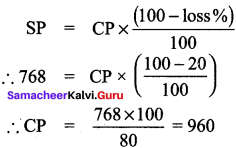
as per formula
Samacheer Kalvi 8th Maths Solutions Term 2 Chapter 1 Life Mathematics Ex 1.2 10
For gain of 20%, we should now calculate the selling price
Samacheer Kalvi 8th Maths Solutions Term 2 Chapter 1 Life Mathematics Ex 1.2 11
= 960 (\(\frac{100+20}{100}\)) = 960 x \(\frac{120}{100}\)
= 96 x 12 = ₹ 1152

Samacheer Kalvi 8th Maths Solutions Term 2 Chapter 1 Life Mathematics Ex 1.2

Question 7.
A man sold two gas stoves for ₹ 8400 each. He sold one at a gain of 20% and the other at a loss of 20%. Find his gain or loss % in the whole transaction.
Samacheer Kalvi 8th Maths Solutions Term 2 Chapter 1 Life Mathematics Ex 1.2 12
Solution:
Let the CP of gas stove 1 be x and gas stove 2 be y
Given that selling price (SP) for both is the same = ₹ 8400
Case i:
First gastove: Cost price (CP) = x
Selling Price (SP) = ₹ 8400
Gain % = 20%
Samacheer Kalvi 8th Maths Solutions Term 2 Chapter 1 Life Mathematics Ex 1.2 13
Cost price of first gas stove = ₹ 7000

Case 2:
Second gastove: Cost price (CP) = y
Selling price (SP) = ₹ 8400
loss % = 20%
Samacheer Kalvi 8th Maths Solutions Term 2 Chapter 1 Life Mathematics Ex 1.2 14
∴ Cost price of second stove = ₹ 10,500
From (1) and (2),
Total cost price = Cost of stove 1 + Cost of stove 2
= 7000+ 10500 = 17,500
Total selling price = SP of stove 1 + SP of stove 2
= 8400 + 8400 = 16,800
Now, we find that total selling price is less than total cost price, therefore it is a loss
∴ Loss = CP – SP= 17,500 – 16,800 = 700
Loss % = \(\frac{loss}{CP}\) x 100 = \(\frac{700}{17500}\) x 100 = 4%
Loss % = 4 %

Question 8.
Find the unknowns x, y and z
Samacheer Kalvi 8th Maths Solutions Term 2 Chapter 1 Life Mathematics Ex 1.2 15
Solution:
(i) Book marked price = ₹ 225 discount = 8%
Samacheer Kalvi 8th Maths Solutions Term 2 Chapter 1 Life Mathematics Ex 1.2 16
∴ 225 x (\(\frac { (100-8) }{ 100 } \))
= 225 x (\(\frac { 92 }{ 100 } \)) = ₹ 207

(ii) LED TV selling price = 11970 discount = 5%,
Samacheer Kalvi 8th Maths Solutions Term 2 Chapter 1 Life Mathematics Ex 1.2 17
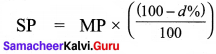
∴ 11970 = y x \(\frac { (100-d%) }{ 100 } \)
∴ y = \(\frac { 11970×100 }{ 95 } \) = 126 x 100 = ₹ 12,600

(iii) Digital clock marked price (MP) = ₹ 750, MP = ₹ 12,600
Selling price (SP) = ₹ 615, Discount = z
Samacheer Kalvi 8th Maths Solutions Term 2 Chapter 1 Life Mathematics Ex 1.2 18
∴ 615 = 750 x \(\frac { (100-z) }{ 100 } \)
∴ (100 – z) = \(\frac { 615×100 }{ 700 } \)
100 – z = 82
∴ z = 100 – 82
Discouont = 18%

Question 9.
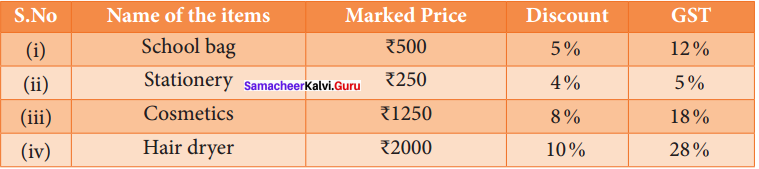
Find the total bill amount for the data below.
Samacheer Kalvi 8th Maths Solutions Term 2 Chapter 1 Life Mathematics Ex 1.2 19
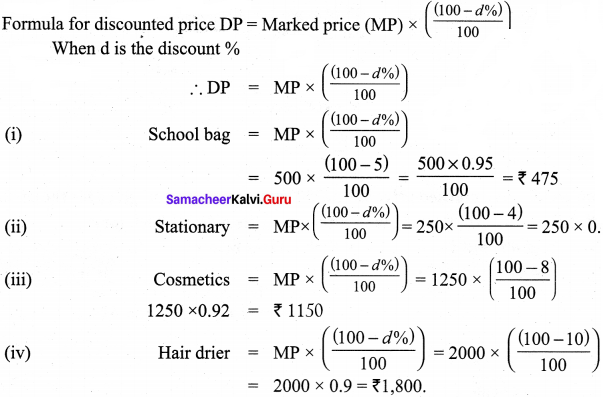
Solution:
Samacheer Kalvi 8th Maths Solutions Term 2 Chapter 1 Life Mathematics Ex 1.2 20
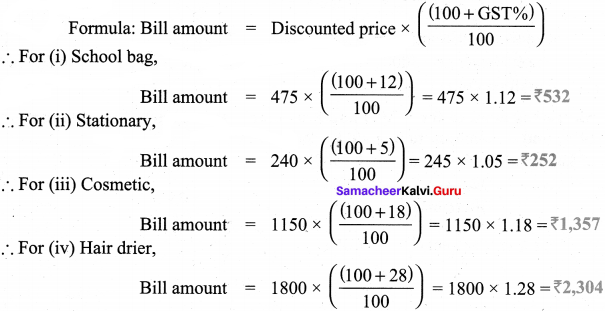
For bill amount, we should apply GST on the discounted value of the items.
Samacheer Kalvi 8th Maths Solutions Term 2 Chapter 1 Life Mathematics Ex 1.2 21
Total bill amount = Bill amount of School bag + Stationary + Cosmetics + Hair drier
= 532 + 252 + 1357 + 2304
= ₹ 4,445

Samacheer Kalvi 8th Maths Solutions Term 2 Chapter 1 Life Mathematics Ex 1.2

Question 10.
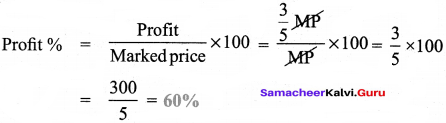
A shopkeeper buys goods at \(\frac { 4 }{ 5 } \) of its marked price and sells them at \(\frac { 4 }{ 5 } \) of the marked price find his profit percentage.
Solution:
Let marked price be MP
Given that he buys good at \(\frac { 4 }{ 5 } \) of marked price
∴ CP (cost price) = \(\frac { 4 }{ 5 } \) MP
Given that selling price (SP) = \(\frac { 7 }{ 5 } \) x MP
∴ Profit = Selling price – Cost price = \(\frac { 7 }{ 5 } \) MP – \(\frac { 4 }{ 5 } \) MP = \(\frac { 3 }{ 5 } \)  MP
Samacheer Kalvi 8th Maths Solutions Term 2 Chapter 1 Life Mathematics Ex 1.2 22

Question 11.
A branded AC has a marked price of ₹ 37250. There are 2 options given for the customer.

  1. Selling Price is ₹ 37250 along with attractive gifts worth ₹ 3000 (or)
  2. Discount of 8% but no free gifts. Which offer is better?

Samacheer Kalvi 8th Maths Solutions Term 2 Chapter 1 Life Mathematics Ex 1.2 23
Marked price of AC = ₹ 37,250
Option 1:
Selling price = ₹ 37250 & gifts worth ₹ 3000
∴ Net gain for customer = ₹ 3000 as there is no discount on AC

Option 2:
Discount of 8%, but no gift
Samacheer Kalvi 8th Maths Solutions Term 2 Chapter 1 Life Mathematics Ex 1.2 24
= 37250 x \(\frac { (100-8) }{ 100 } \) = 37250 x 0.92 = 34270
∴ Savings for customer = 37250 – 34270 = ₹ 2980
Therefore, the customer gets 3000 gift in option 1 where as he is able to save only ₹ 2980 in option 2. Therefore, option 1 is better.

Question 12.
If a mattress is marked for ₹ 7500 and is available at two successive discount of 10% and 20%, find the amount to be paid by the customer.
Solution:
Marked price of mattress = ₹ 7500
Discount d1 = 10%
Discount d2 = 20%
Samacheer Kalvi 8th Maths Solutions Term 2 Chapter 1 Life Mathematics Ex 1.2 25
= 7500 x \(\frac { (100-10) }{ 100 } \) = 7500 x \(\frac { 90 }{ 100 } \) = 6750
Samacheer Kalvi 8th Maths Solutions Term 2 Chapter 1 Life Mathematics Ex 1.2 26
= 6750 x \(\frac { (100-20) }{ 100 } \) = ₹ 5400

Objective Type Questions

Samacheer Kalvi 8th Maths Solutions Term 2 Chapter 1 Life Mathematics Ex 1.2

Question 13.
A fruit vendor sells fruits for ₹ 200 gaining ₹ 40. His gain percentage is –
(a) 20%
(b) 22%
(c) 25%
(d) 16\(\frac { 2 }{ 3 } \)
Answer:
(c) 25%
Hint:
Selling price = ₹ 200
Gain = 40
∴ CP = Selling price – gain = 200 – 40 = 160
Gain % = \(\frac { Gain }{ CP } \) x 100 = \(\frac { 40 }{ 160 } \) x 100 = 25%

Question 14.
By selling a flower pot for ₹ 528, a woman gains 20%. At what price should she sell it to gain 25%?
(a) ₹ 500
(b) ₹ 550
(c) ₹ 553
(d) ₹ 573
Answer:
(b) ₹ 550
Hint:
If selling price (SP) = ₹ 528
Gain % = 20%
∴ CP = ?
Samacheer Kalvi 8th Maths Solutions Term 2 Chapter 1 Life Mathematics Ex 1.2 27
∴ 528 = CP x \(\frac { 100+20 }{ 100 } \)
∴ CP = \(\frac { 528×100 }{ 120 } \)
If gain % = 25 %, Selling ?
Samacheer Kalvi 8th Maths Solutions Term 2 Chapter 1 Life Mathematics Ex 1.2 28
= 440 x \(\frac { (100+gain%) }{ 100 } \) = 440 x \(\frac { 125 }{ 100 } \)
= ₹ 550

Question 15.
A man buys an article for ₹ 150 and makes overhead expenses which are 12% of the cost price. At what price must he sell it to gain 5%?
(a) ₹ 180
(b) ₹ 168
(c) ₹ 176.40
(d) ₹ 85
Answer:
(c) ₹ 176.40
Hint:
Cost price of article = ₹ 150
Over head expenses = 12% of cost price = \(\frac { 12 }{ 100 } \) x 150 = ₹ 85
∴ Effective cost of article = 150 + 18 = ₹ 168
Now, to gain 5%, he has to sell at
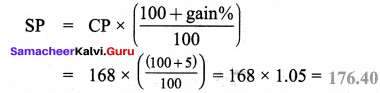
Samacheer Kalvi 8th Maths Solutions Term 2 Chapter 1 Life Mathematics Ex 1.2 29

Question 16.
The price of a hat is ₹ 210. What was the marked price of the hat if it is bought at 16% discount?
(a) ₹ 243
(b) ₹ 176
(c) ₹ 230
(d) ₹ 250
Answer:
(d) ₹ 250
Hint:
Let marked price be MP
Discounted price = ₹ 210
Rate of discount = 16%
As per formula:
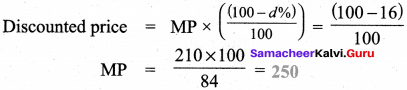
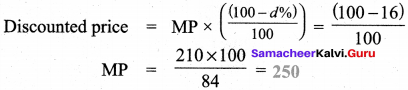
Samacheer Kalvi 8th Maths Solutions Term 2 Chapter 1 Life Mathematics Ex 1.2 30

Samacheer Kalvi 8th Maths Solutions Term 2 Chapter 1 Life Mathematics Ex 1.2

Question 17.
The single discount which is equivalent to two successive discount of 20% and 25% is –
(a) 40%
(b) 45%
(c) 5%
(d) 22.5%
Answer:
(a) 40%
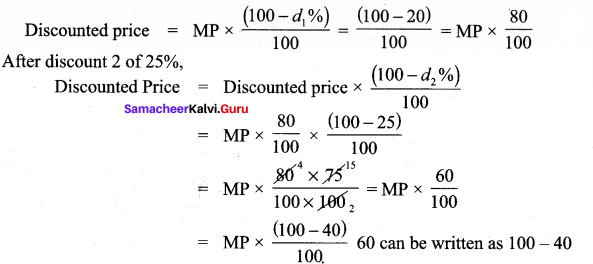
Let marked price be MP, after discount 1 of 20%,
Samacheer Kalvi 8th Maths Solutions Term 2 Chapter 1 Life Mathematics Ex 1.2 31
After discount 2 of 25%,
Samacheer Kalvi 8th Maths Solutions Term 2 Chapter 1 Life Mathematics Ex 1.2 32
Comparing with formula, we get
∴ This is equivalent to a single discount of 40%

Samacheer Kalvi 8th Maths Solutions Term 2 Chapter 1 Life Mathematics Ex 1.2 Read More »

Samacheer Kalvi 8th Maths Solutions Term 2 Chapter 1 Life Mathematics Intext Questions

Students can Download Maths Chapter 1 Life Mathematics Intext Questions and Answers, Notes Pdf, Samacheer Kalvi 8th Maths Book Solutions Guide Pdf helps you to revise the complete Tamilnadu State Board New Syllabus and score more marks in your examinations.
Samacheer Kalvi 8th Maths Solutions Term 2 Chapter 1 Life Mathematics Intext Questions

Tamilnadu Samacheer Kalvi 8th Maths Solutions Term 2 Chapter 1 Life Mathematics Intext Questions

Exercise 1.1
Try This (Text book Page no. 1)

Question 1.
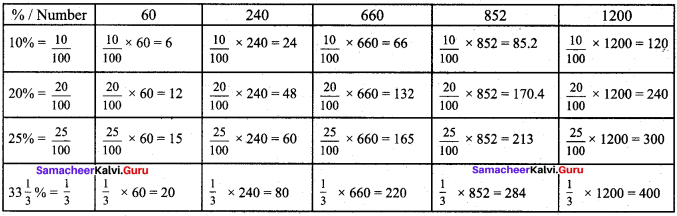
Find the indicated percentage value of the given numbers
Solution:
Samacheer Kalvi 8th Maths Solutions Term 2 Chapter 1 Life Mathematics Intext Questions 1

Think (Text book page no. 6)

Question 1.
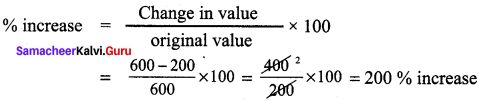
An increase from 200 to 600 ¡s clearly a 200%increase. Isn’t it? (check!). With a lot of pride, the traffic police commiuêener of a city reported that the accidents had decreased by 200% ¡n one year. He cameupwith this number stating that the accidents had gone down from 600 last year to 2this year. Is the decrease from 600 to 200, the same 200% as above? Justify.
Solution:
Increase from original value 200 to 600
Samacheer Kalvi 8th Maths Solutions Term 2 Chapter 1 Life Mathematics Intext Questions 2
Decrease from original value 600 to 200
Samacheer Kalvi 8th Maths Solutions Term 2 Chapter 1 Life Mathematics Intext Questions 3
here original value is 600
% decrease = \(\frac{600-200}{600}\) x 100 = \(\frac{400}{600}\) x 100 = 66.67% decrease
Increase from 200 → 600 and % decrease from 600 → 200 are not the same

Try This (Text book page no. 7)

Question 1.
What percent of a day is 10 hours?
Solution:
In a day, there are 24 hours
10 hrs out of 24 hrs is \(\frac{10}{24}\)
As a percentage, we need to multiply by 100
∴ Percentage = \(\frac{10}{24}\) x 100 = 41.67%

Samacheer Kalvi 8th Maths Solutions Term 2 Chapter 1 Life Mathematics Intext Questions

Question 2.
Divide ₹ 350 among P, Q and R such that P gets 50% of what Q gets and Q gets 50% of what R gets.
Solution:
Let R get x, Q gets 50% of what R gets
∴ Q gets = \(\frac{50}{100}\) × x = \(\frac{x}{2}\)
P gets 50% of what Q gets
∴ P gets = \(\frac{50}{100}\) x \(\frac{x}{2}\) = \(\frac{x}{4}\)
Since 350 is divided among the three
∴ 350 = x + \(\frac{x}{2}\) + \(\frac{x}{4}\)
350 = \(\frac{4x+2x+x}{4}\) = \(\frac{7x}{4}\) = 350
x = \(\frac{350×4}{7}\) = 200
Q gets = \(\frac{x}{2}\) = \(\frac{200}{2}\) = 100,
P gets = \(\frac{x}{4}\) = \(\frac{200}{4}\) = 50
∴ P = 50
Q = 100
R = 200

Exercise 1.2
Think (Text book Page No. 13)

Question 1.
A shopkeeper marks the price of a marker board 15% above the cost price and then allows a discount of 15% on the marked price. Does he gain or lose in the transaction?
Solution:
Let cost price of marker board be 100
CP = 100 Marks it 15% above CP
∴ Marked price = MP = \(\frac{15}{100}\) x CP + CP = \(\frac{15}{100}\) 100 + 100 = 15 + 100 = 115
Discount % = 15%
Samacheer Kalvi 8th Maths Solutions Term 2 Chapter 1 Life Mathematics Intext Questions 4
∴ He sells it 97.75 which is less than his cost price. Therefore he loses
Loss = 97.75 – 100 = – 2.25

Try This (Text book Page No. 14)

Question 1.
By selling 5 articles, a man gains the cost price of 1 article. Find his gain percentage.
Solution:
Let cost price of article be C.P. Let S.P of 1 articles be SP by selling 5 articles at SP he makes a gain of cost price of one article.
Gain on 1 article = SP – CP; ⇒ Gain% = \(\frac{SP-CP}{CP}\) x 100
Gain on 2 articles = 2 x (SP – CP)
Gain on 5 articles = 5 x (SP – CP)
Given than gain on 5 articles is CP of 1 article
∴ 5(SP – CP) = CP
\(\frac{SP-CP}{CP}\) = \(\frac{1}{5}\)
Gain percentage \(\frac{SP-CP}{CP}\) x 100 = \(\frac{1}{5}\) x 100 % = 20%

Samacheer Kalvi 8th Maths Solutions Term 2 Chapter 1 Life Mathematics Intext Questions

Question 2.
By selling 8 articles, a shopkeeper gains the selling price of 3 articles. Find his gain percentage.
Solution:
Let cost price of 1 article be CP. Let selling price of 1 article be SP.
Gain on 1 article = SP – CP
Gain on 8 articles = 8 x (SP – CP)
Given that gain on 8 articles in selling price of 3 articles
8(SP – CP) = 3 x SP
∴ \(\frac{SP-CP}{CP}\) = \(\frac{3}{8}\)
∴ \(\frac{SP}{SP-CP}\) = \(\frac{8}{3}\)
Subtracting 1 on both sides
\(\frac{SP}{SP-CP}\) – 1 = \(\frac{8}{3}\) – 1 = \(\frac{SP-(SP-CP)}{SP-CP}\)= \(\frac{8-3}{3}\)
\(\frac{SP-SP-CP}{SP-CP}\) = \(\frac{5}{3}\) ⇒ \(\frac{CP}{SP-CP}\) = \(\frac{5}{3}\)
\(\frac{SP-CP}{CP}\) = \(\frac{3}{5}\) (taking reciprocals on both sides)
Gain% \(\frac{SP-CP}{CP}\) x 100 = \(\frac{3}{5}\) x 100 = 3 x 20 = 60%

Question 3.
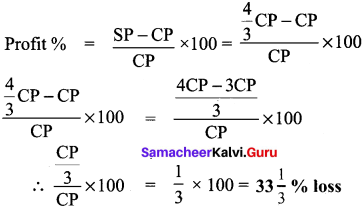
If the C.P of 20 articles is equal to the S.P of 15 articles, find the profit or loss percentage.
Solution:
Given CP of 20 article = SP of 15 articles
∴ SP of 15 articles = CP of 20 articles
∴ SP of 1 article = \(\frac{1}{15}\) x CP of 20 articles
SP = \(\frac{1}{15}\) x 20 CP = \(\frac{20}{15}\) CP = \(\frac{4}{3}\) CP
∴ SP = \(\frac{4}{3}\) CP ⇒ SP is greater than CP
It is a profit.
Samacheer Kalvi 8th Maths Solutions Term 2 Chapter 1 Life Mathematics Intext Questions 5

Exercise 1.3
Try This (Text book Page No. 23)

Samacheer Kalvi 8th Maths Solutions Term 2 Chapter 1 Life Mathematics Intext Questions

Question 1.
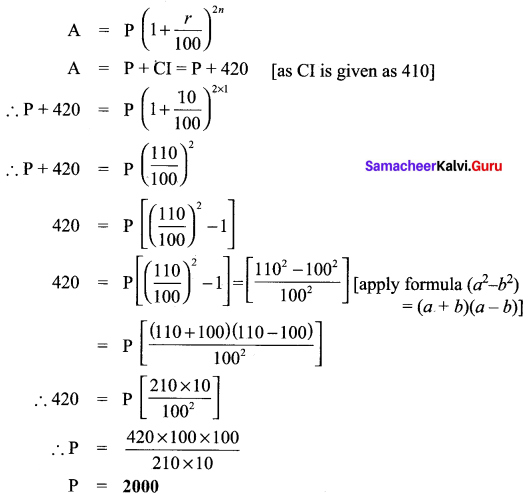
Find the principal which gives ₹ 420 as C.I @ 20% p.a compounded half yearly for one year.
Solution:
CI = ₹420
Rate = ₹ 20% p.a
Principle = ₹ [required to find] Time period (n) = 1 year.
However, let us value of r to be 20% p.a so for half yearly, r is \(\frac{20}{2}\) = 10%
Formula for Amount (A) when compounded half yearly is
Samacheer Kalvi 8th Maths Solutions Term 2 Chapter 1 Life Mathematics Intext Questions 6

Question 2.
The price of a laptop depreciates @ 4% p.a. If its present price is ₹ 24,000, find its price after 3 years.
Solution:
Let original price of laptop be ‘P’, Rate of depreciation is 4% p.a,
Present price is ₹ 24,000 (D).
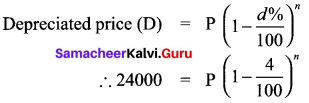
Formula for depreciation is
Samacheer Kalvi 8th Maths Solutions Term 2 Chapter 1 Life Mathematics Intext Questions 7
Price after 3 years from now is
P(1 – \(\frac{4}{100}\))n+3 = ? ⇒ (1 – \(\frac{4}{100}\))n (1 – \(\frac{4}{100}\))3
From (1)
24,000 x (1 – \(\frac{4}{100}\))3
24,000 x \(\frac{96}{100}\) x \(\frac{96}{100}\) x \(\frac{96}{100}\) = 21233.66

Actvity I (text book Page No. 23)

Question 1.
Mukunthan invests 30,000/- for 3 months in a bank which gives C.I at the rate of 12% compounded monthly. A private company offers his S.l at the rate of 12% p.a What is the difference in the interests received by Mukunthan? Do by traditional method and verify your answer by calculator.
Solution:
Principal = 30,000
Time period = 3 months
In Bank rate of interest for CI = 12% compounded monthly
∴ A = (1 + \(\frac{r}{100}\))n = 30,000(1 + \(\frac{12}{100}\))3
30,000 x \(\frac{112}{100}\) x \(\frac{112}{100}\) x \(\frac{112}{100}\) = 42147.84
∴ CI = A – P = 42147.84 – 30,000
CI = 12147.84
In private company,
Rate of single Interest SI = 12% p.a
So, for 3 months, i.e \(\frac{3}{12}\) = \(\frac{1}{4}\) year,
Samacheer Kalvi 8th Maths Solutions Term 2 Chapter 1 Life Mathematics Intext Questions 8
∴ Difference in interest = CI – SI = 12,147.84 – 900 = 11247.84

Samacheer Kalvi 8th Maths Solutions Term 2 Chapter 1 Life Mathematics Intext Questions Read More »

Friendship Book Back Answers 8th Standard Term 1 English Chapter 2 Samacheer Kalvi

8th Standard English Guide Term 1 Unit 2 Prose Friendship Book Back Answers

Students can Download English Lesson 2 Friendship Questions and Answers, Summary, Activity, Notes, Samacheer Kalvi 8th English Book Solutions Guide Pdf  helps you to revise the complete Tamilnadu State Board New Syllabus and score more marks in your examinations.

Friendship 8th Standard English 2nd Lesson Question and Answer

Read And Understand

A. Choose the correct answer.

Question 1.
Vetri went to Asif ‘s _______
(a) home
(b) office
(c) room
Answer:
(b) office

Samacheer Kalvi 8th English Solutions Term 1 Prose Chapter 2 Friendship

Question 2.
Vetri came to Chennai to visit his _______
(a) father
(b) friend
(c) brother
Answer:
(b) friend

Question 3.
Asif saw his friend through the _______
(a) camera
(b) window
(c) glass
Answer:
(a) camera

B. Choose correct synonyms for the italic word.

Question 1.
Vetri constructed a bungalow.
(a) design
(b) build
(c) foundation
(d) destroy
Answer:
(b) build

Question 2.
The brothers started a business, separately.
(a) apart
(b) alone
(c) united
(d) combined
Answer:
(a) apart

Samacheer Kalvi 8th English Solutions Term 1 Prose Chapter 2 Friendship

Question 3.
I am living in the outskirts of the village.
(a) border
(b) outpost
(c) center
(d) region
Answer:
(b) outpost

Question 4.
Asif quarreled with his friend.
(a) fight
(b) differ
(c) peace
(d) fun
Answer:
(a) fight

Question 5.
He stood astounded.
(a) happy
(b) surprised
(c) shocked
(d) excited
Answer:
(c) shocked

C. Choose correct Antonyms for the italic word.

Question 1.
The wife replied angrily.
(a) calm
(b) annoyed
(c) irritate
Answer:
(a) calm

Samacheer Kalvi 8th English Solutions Term 1 Prose Chapter 2 Friendship

Question 2.
The vegetables look fresh.
(a) rotten
(b) dull
(c) new
Answer:
(a) rotten

Question 3.
Vetri had a strong will to start a new business.
(a) desire
(b) thin
(c) weak
Answer:
(c) weak

Question 4.
Vetri was surprised by his friend.
(a) unsurprised
(b) expected
(c) shocked
Answer:
unsurprised

Question 5.
He spoke nervously
(a) Scared
(b) confident
(c) anxious
(b) confident
Answer:
(b) confident

D. Answer the following questions in one or two words.

Question 1.
What was the name of Vetri’s company?
Answer:
The name of his company was “Vetri Constructions”.

Question 2.
Why did he sell his properties?
Answer:
He sold his properties to pay his loans.

Question 3.
Which was the home town of Vetri and Asif?
Answer:
The home town of Vetri and Asif was Keelakudi near Coimbatore.

Question 4.
When was the school established?
Answer:
The school was on the outskirts of Keelakudi village. It was in middle school.

Question 5.
When did Vetri receive a call from Asif’s office?
Answer:
Vetri received a call from Asif’s office two days later.

E. Answer the following questions in 100 words.

Question 1.
How Vetri lost his properties?
Answer:
Vetri was once a successful businessman in Coimbatore. His Vetri Construction was a leading construction company. After his father’s death, his brothers demanded to split the wealth, as they wanted to start their business separately. From then on, Vetri found it difficult to establish his business. He took loans to run his company, but he could not pay the loan. So he sold all his properties and paid the loans. His family then moved to a very small house. He found a job and started to lead a normal life.

Samacheer Kalvi 8th English Solutions Term 1 Prose Chapter 2 Friendship

Question 2.
What happened when Vetri met Asif?
Answer:
Vetri went straight to Asifs office to meet him. When he reached Asifs office, Asif saw Vetri through CCTV camera came out and pat told him on his back. There they discussed their school days and the fun they had. After that Asif took Vetri to his home for lunch. Vetri was surprised to see that everyone knows him. He stayed till evening and Asif dropped him in the railway station.

Question 3.
How did Asif show his friendship?
Answer:
Asif was a true friend of Vetri. When Vetri came to his office, he came to receive him, as he saw through the CCTV camera. He gave Vetri a pat on his back. Vetri was speechless on seeing him. He took to his cabin. They spoke about their school days and the fun they had. They discussed their business. Asif took Vetri to his home for lunch. Vetri was surprised to see that everyone knows him. Vetri stayed there till evening. Asif dropped him at the railway station. After two days, he invited Vetri to his office and assigned him a project.

Vocabulary

Compound Words

A. Match the following compound words and write them:
Answer:

First word

Second word

New word

match mark matchbox
air cut airport
blood port blood bank
Pop gum popcorn
sky bank sky blue
hair blue hair cut
book corn book mark
chewing box. chewing gum

B. Choose the best answer to make a compound word.

Question 1.
Which can be placed after ‘soft’?
(a) play
(b) ware
(c) run
(d) cycle
Answer:
(b) software

Samacheer Kalvi 8th English Solutions Term 1 Prose Chapter 2 Friendship

Question 2.
Which can be placed before ‘light’?
(a) try
(b) sun
(c) horse
(d) cat
Answer:
(b) sunlight

Question 3.
Which can be placed after ‘safe’?
(a) chair
(b) guard
(c) shop
(d) van
Answer:
(b) safeguard

Question 4.
Which can be placed after ‘blue’?
(a) cane
(b) print
(c) see
(d) land
Answer:
(b) blueprint

Question 5.
Which can be placed after ‘water’?
(a) food
(b) stick
(c) fall
(d) out
Answer:
(c) waterfall

Singular, Plural

Write the plural form of the given words :
Answer:

No.

Singular

Plural

1. food food
2. radius radii
3. governor-general governors-general
4. syllabus syllabi
5. datum data
6. commander-in-chief commanders-in-chief
7. thesis theses
8. forum fora
9. cattle cattle
10. genius geniuses / genii

Listening
Listen carefully to the passage given in the QR code and answer the following questions.

Questions:

Question 1.
Whose speech is it?
Answer:
It is Rahim’s speech.

Samacheer Kalvi 8th English Solutions Term 1 Prose Chapter 2 Friendship

Question 2.
What did Rahul engrave?
Answer:
He engraved in his heart that his friend Rahim had helped him.

Question 3.
Who is lucky?
Answer:
Rahim is lucky.

Question 4.
Who bagged the ‘all-rounder’ award?
Answer:
Rahul bagged an all-rounder medal in school.

Question 5.
Whose birthday party is it?
Answer:
It is Rahul’s birthday party.

Writing
Arrange the picture in order by writing the numbers 1,2,3 and 4 in the given boxes and write this familiar story in about 100 words.
Make use of the words given below.

(thirsty, village, pitcher, disappointment, pebbles, water level )
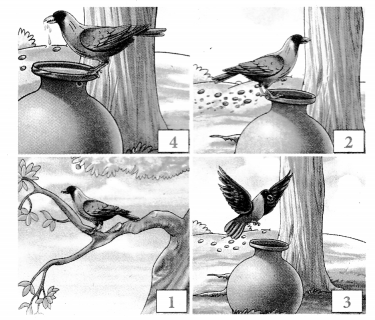
Samacheer Kalvi 8th English Solutions Term 1 Prose Chapter 2 Frindship 1
Answer:
One hot day, a thirsty crow in a village, searched for water everywhere. At last, it found a pitcher. But there was a disappointment for the crow, as the water level in the pitcher was very low. The crow got an idea. It saw some pebbles nearby. It started putting pebbles in the pitcher. Slowly, the water level raised. The crow drank the water and flew away happily.

Grammar

Degrees Of Comparison

a. Fill in the blanks:
Answer:

Positive Comparative Superlative
tall taller tallest
smart smarter smartest
large larger largest
more more most
late Later/latter latest (last)

Let’s compare two things.

Question 1.
Which is faster a train or a plane?
Answer:
plane is faster than a train.

Question 2.
Which is cheaper gold or silver?
Answer:
Silver is cheaper than gold.

Question 3.
Which is larger, city, or village?
Answer:
A city is larger than a village.

Question 4.
Which is bigger, a sea or an ocean?
Answer:
An ocean is bigger than the sea.

Samacheer Kalvi 8th English Solutions Term 1 Prose Chapter 2 Friendship

Question 5.
Which is taller, a giraffe or a camel?
Answer:
A giraffe is taller than a camel.

Let’s compare three things.

EG: Donkey, horse, and elephant (strong)
A donkey is strong.
The horse is stronger than a donkey.
An elephant is the strongest.

Question 1.
Town – city – village (quiet)
Answer:
A city is quiet.
Town is quieter than the city.
The village is the quietest.

Question 2.
Istanbul – Moscow – London (populated)
Answer:
Istanbul is populated.
Moscow is more populated than Istanbul.
London is the most populated.

Question 3.
Windy weather – warm weather – rainy weather (good)
Answer:
Windy weather is good.
Warm weather is better than windy weather.
Rainy weather is the best.

Question 4.
Ocean – river – lake (deep)
Answer:
River is deep.
Lake is deeper than the river.
Ocean is the deepest.

Samacheer Kalvi 8th English Solutions Term 1 Prose Chapter 2 Friendship

Question 5.
The USA – Russia – Spain (large)
Answer:
Hitl Spain is a large country.
The USA is larger than Spain.
Russia is the largest country.

Question 6.
The Mahanadi – The Cauvery – The Ganga (long)
Answer:
The cauvery is a long river.
The Mahanadi is longer than the Cauvery.
Ganga is the longest river in our country.

Question 7.
Chennai – Hyderabad – Bangaluru (modern)
Answer:
Chennai is a modern city.
Hyderabad is more modern than Chennai.
Bengaluru is the most modern city.

Friendship Additional Questions

I. Choose the correct Synonyms for the italic word

Question 1.
After his father’s death, his brothers demanded to split the wealth.
(a) break up
(b) brush
(c) open
(d) close
Answer:
(a) break up

Question 2.
But he always long to start a new construction company.
(a) fabrication
(b) devastation
(c) real estate
(d) building formation
Answer:
(d) building formation

Question 3.
He told his wife about his decision.
(a) hesitation
(b) delay
(c) judgment
(a) Abnormal
Answer:
(c) judgment

Question 4.
They lived in the beautiful village of Keelakudi.
(a) ugly
(b) awful
(c) vile
(d) Pretty
Answer:
(d) Pretty

Samacheer Kalvi 8th English Solutions Term 1 Prose Chapter 2 Friendship

Question 5.
Their friendship grew stronger with time.
(a) weaker
(b) slender
(c) firmer
(d) Punier
Answer:
(c) firmer

Question 6.
Asif consoled him with chocolate.
(a) comforted
(b) distressed
(c) troubled
(d) annoyed
Answer:
(a) comforted

Question 7.
I don’t know if you will get an appointment.
(a) employment
(b) dismissal
(c) arrangement for meeting
(d) discharge
Answer:
(c) arrangement for meeting

Question 8.
Vetri was dumbfounded.
(a) speechless
(b) mindful
(c) conscious
(d) Casual
Answer:
(a) speechless

Question 9.
Our MD Mr. Asif has assigned a project to you.
(a) refused
(b) cancelled
(c) given
(d) relieved
Answer:
(c) given

Question 10.
The security was astounded.
(a) annoyed
(b) irked
(c) upset
(d) surprised
Answer:
(d) surprised

II. Choose the correct Antonyms for the italic word.

Question 1.
Vetri was once a successful businessman in Coimbatore.
(a) powerful
(b) unsuccessful
(c) wonderful
(d) awful
Answer:
(b) unsuccessful

Question 2.
Vetri found it difficult to establish his business.
(a) abolish
(b) setup
(c) deal
(d) offer
Answer:
(a) abolish

Question 3.
He started to lead a normal life.
(a) usual
(b) same
(c) ordinary
(d) abnormal
Answer:
(d) abnormal

Question 4.
His brothers demanded to split the wealth.
(a) offered
(b) searched
(c) rushed
(d) ordered
Answer:
(a) offered

Samacheer Kalvi 8th English Solutions Term 1 Prose Chapter 2 Friendship

Question 5.
One day he discussed with his wife.
(a) ignored
(b) considered
(c) examined
(d) argued
Answer:
(a) ignored

Question 6.
To everyone’s surprise, they continued to be good friends.
(a) lingered
(b) extended
(c) discontinued
(d) lasted
Answer:
(a) lingered

Question 7.
One day there was a quarrel between Vetri and Asif’s families.
(a) row
(b) fight
(c) contest
(d) agreement
Answer:
(d) agreement

Question 8.
The results and marks never affected their friendship.
(a) moved
(b) stirred
(c) unaffected
(d) pretended
Answer:
(c) unaffected

Question 9.
Two days later, Vetri received a call.
(a) paid
(b) gave
(c) lived
(d) took
Answer:
(b) gave

Question 10.
Vetri told his wife everything in detail.
(a) same
(b) anything
(c) nothing
(d) all
Answer:
(c) nothing

III. Choose the Correct Answer [MCQ]

Question 1.
Vetri’s constructions was once a ________ construction company.
(a) small
(b) leading
(c) dull
(d) vague
Answer:
(b) leading

Question 2.
Everything went well, until his ________ died
(a) father
(b) sister
(c) uncle
(d) brother
Answer:
(a) father

Question 3.
They were always together in learning and ________
(a) writing
(b) reading
(c) studying
(d) playing
Answer:
(d) playing

Question 4.
They also helped others with their ________
(a) homework
(b) lessons
(c) projects
(d) assignment
Answer:
(b) lessons

Question 5.
The security was ________
(a) surprised
(b) astounded
(c) arrogant
(d) bold
Answer:
(b) astounded

Samacheer Kalvi 8th English Solutions Term 1 Prose Chapter 2 Friendship

Question 6.
They spoke about their school days and the ________ they had.
(a) boring
(b) lethargic
(c) fun
(d) indolent
Answer:
(c) fun

Question 7.
Then they discussed about their ________
(a) business
(b) children
(c) relatives
(d) plans
Answer:
(a) business

Question 8.
Asif dropped him in the ________ station.
(a) police
(b) railway
(c) bus
(d) fire
Answer:
(b) railway

IV. Short Questions with Answers.

Question 1.
What did Vetri’s Constructions construct? ‘
Answer:
Vetri’s constructions constructed many shopping complexes, houses, and a few apartments in and around Coimbatore.

Question 2.
What happened after his father’s death?
Answer:
After his father’s death, his brothers demanded to split the wealth, as they wanted to start their business separately.

Question 3.
Whom did Vetri decide to meet? Why?
Answer:
Vetri decided to meet his friend Asif in Chennai for help.

Question 4.
How strong was their friendship?
Answer:
Vetri and Asif studied in the same school at Keelakudi village. They were always together in learning and playing. They continued to be good friends till their X Std. After that, Asif had to move to Chennai.

Question 5.
Who stopped Vetri at the gate of Asif’s office?
Answer:
The security stopped Vetri at the gate and asked who does he wants to meet.

Samacheer Kalvi 8th English Solutions Term 1 Prose Chapter 2 Friendship

Question 6.
How did Asif know that Vetri had come to his office?
Answer:
Asif saw him through the CCTV camera and came to receive him.

V. Paragraph Questions with Answers.

Question 1.
How did Vetri and Asif’s friendship start?
Answer:
Their friendship started on the first day of school. When Vetri’s parents dropped him at the school, he started crying. Asif consoled him with chocolate and asked him not to cry. From that day, they stayed together, played together, and even exchanged their food. Their friendship grew stronger with time. They were always good in their studies and helped each other in lessons. There was always a healthy competition between them. Surprisingly, the exams, results, and marks never affected their friendship. Their friendship continued till the tenth standard. Then Asif moved to Chennai

Friendship Grammer Additional

Degrees of Comparison

I. Fill in the blanks.

Question 1.

Positive Comparative Superlative
big
costlier
hardest
short
simpler
tallest
long
faster

Answer:

Positive Comparative Superlative
big bigger biggest
costly costlier costliest
hard harder hardest
short shorter shortest
simple simpler simplest
tall taller tallest
long longer longest
fast faster fastest

Question 2.

Positive Comparative Superlative
beautiful
more different
most enjoyable
effectively
more delicious
most useful
honest most honest
more qualified

Answer:

Positive Comparative Superlative
beautiful more beautiful most beautiful
different more different most different
enjoyable more enjoyable most enjoyable
effectively more effectively most effectively
delicious more delicious most delicious
useful more useful most useful
honest more honest most honest
qualified more qualified most qualified

Question 3.

Adjectives

Comparative

Superlative

bad

drier

far (place)

farthest
far (time)

furthest

better

late (time)

latest
late (order) latter

less

most

safe

simple

simpler

Answer:

Adjectives Comparative Superlative
bad worse worst
dry drier driest
far (place) farther farthest
far (time) further furthest
good better best
late (time) later latest
late (order) latter last
little less least
many more most
safe safer safest
simple simpler simplest

II. Change the following sentences into comparative degree sentences.

Question 1.
India is not as large as China.
Answer:
China is larger than India.

Question 2.
Water is not as light as air.
Answer:
Air is lighter than water.

Samacheer Kalvi 8th English Solutions Term 1 Prose Chapter 2 Friendship

Question 3.
My brother is not as tall as I am.
Answer:
I am taller than my brother.

Question 4.
Ravi is not as intelligent as Magesh.
Answer:
Magesh is more intelligent than Ravi.

Question 5.
No other problem facing our country is as serious as unemployment.
Answer:
Unemployment is more serious than any other problem facing our country.

III. Change the following sentences into Superlative degree sentences.

Question 1.
Chandrasekar is richer than any other man in this town.
Answer:
Chandrasekar is the richest man in this town.

Question 2.
Vijay is taller than any other student in this class.
Answer:
Vijay is the tallest student in this class.

Question 3.
Shakespeare is greater than any other English poet.
Answer:
Shakespeare is the greatest of English Poets.

Question 4.
Greenland is larger than any other island.
Answer:
Greenland is the largest island.

Samacheer Kalvi 8th English Solutions Term 1 Prose Chapter 2 Friendship

Question 5.
Anita is prettier than any other girl in my class.
Answer:
Anita is the prettiest girl in my class.

Friendship Summary

Section – I

This is a story about the Friendship between Vetri and Asif. Vetri was a successful businessman in Coimbatore. His Vetri construction company constructed many shopping complexes, houses, and a few apartments in and around Coimbatore. After his father’s death, he was forced to split the wealth to his brothers. From then on, Vetri found it difficult to establish his business. He could not pay the loans taken to run his company. So he sold all his properties and paid the loans. He moved to a very small house with his family.

He found a job and led a normal life. But he desired to start a company again. No one was ready to lend him money. One day, his wife suggested him to ask his friend Asif for help. But Vetri hesitated to ask him for help, as he had not seen him for a long time. After deep thought, he decided to meet his friend Asif who was in Chennai.

Fill in the blanks :

  1. _________ constructions was once a leading company
  2. He took a_________to run his company.
  3. Vetri’s friend is_________

Answers:

  1. Vetri
  2. loan
  3. Asif

Samacheer Kalvi 8th English Solutions Term 1 Prose Chapter 2 Friendship

Section – II

Vetri boarded the train to Chennai. His memory went back to his school days. They lived in the beautiful village of Keelakudi near Coimbatore. Vetri and Asif studied in a school in the outskirts of the village Keelakudi. The teachers and the students would never forget Vetri and Asif and their friendship. They were always together in learning and playing.

Their friendship started on the first day of school. On the first day, when Vetri started crying, Asif consoled him with chocolate and told him not to cry. After that day, they stayed together played together, and even exchanged their food. They were always good in their studies and helped each other in lessons.

One day, there was a quarrel between Vetri and Asif’s families. But this did not affect their friendship. Their exams, results and marks never affected their friendship. After their tenth standard, Asif moved to Chennai and Vetri settled in Coimbatore.

Say True or False.

  1. Keelakudi was a native of Vetri.
  2. The school was a middle school.
  3. Vetri and Asif were good in their studies.
  4. Vetri never visited Chennai.
  5. Asif was a businessman.

Answer:

  1. True
  2. True
  3. True
  4. True
  5. True

Section – III

When Vetri went to Asif’s office, he was stopped by the security. Vetri told him that he wanted to meet his friend Asif. He directed Vetri to the Receptionist. When Vetri was asking the receptionist whether he could meet Asif his friend, Vetri got a pat on his back. It was Asif his friend. Asif saw him through the CCTV camera and came down to receive him. Vetri was speechless and apologized to Asif that he did not get a chance to visit Chennai till then. He said that since he had come to attend his friend’s wedding he thought that he could meet him.

They spoke about their school days, the fun they had. They discussed their business. Asif took Vetri to his home to lunch. Vetri was surprised to see that everyone knows him. In the evening, Asif dropped him at the railway station. Vetri reached home and told his wife everything in detail. Two days later, he received a call from Asif’s office stating that Asif, their M.D. had assigned a project to Vetri.

Samacheer Kalvi 8th English Prose
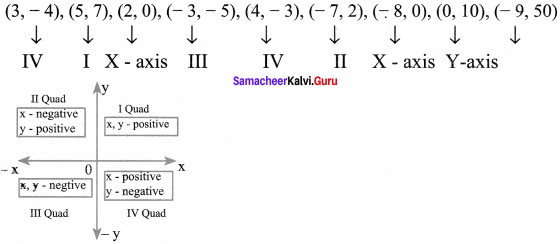
Friendship Book Back Answers 8th Standard Term 1 English Chapter 2 Samacheer Kalvi Read More »

Jim Corbett, A Hunter Turned Naturalist Book Back Answers 8th Standard Term 1 English Chapter 1 Samacheer Kalvi

8th Standard English Guide Term 1 Unit 1 Supplementary Jim Corbett, A Hunter Turned Naturalist Book Back Answers

Students can Download English Lesson 1 Jim Corbett, A Hunter Turned Naturalist Questions and Answers, Summary, Activity, Notes, Samacheer Kalvi 8th English Book Solutions Guide Pdf helps you to revise the complete Tamilnadu State Board New Syllabus and score more marks in your examinations.

Jim Corbett, A Hunter Turned Naturalist 8th Standard English 1st Lesson Question and Answer

A. Fill in the blanks.

  1. Jim Corbett was born on _________
  2. Corbett shot wild animals in his _________
  3.  _________ was the first man-eater shot by Corbett.
  4. Corbett shot the tigress dead, near the _________

Answer:

  1. 25th July 1875
  2. cine film camera
  3. The Champawat Tiger
  4. Chataar Bridge

B. Read the following passage and answer the questions given below.

Jim Corbett played a key role in establishing, India’s first national park in the Kumaon Hills, the Hailey National Park, in Uttarakhand, India. It was initially named after, Lord Malcolm Hailey. Jim Corbett died on 19 April 1955. The park was renamed in 1957 as, The Jim Corbett National Park. It was named after him to honour his role in establishing this protected area in 1930s.

Question 1.
Who played a key role in establishing the national park?
Answer:
Jim Carbett played a key role in establishing the national park.

Samacheer Kalvi 8th English Solutions Term 1 Supplementary Chapter 1 Jim Corbett, A Hunter Turned Naturalist

Question 2.
Why was the park named Hailey National Park?
Answer:
The park was named ‘Hailey National Park’ to honour the Governor of United Provinces ‘Lord Malcolm Hailey’.

Question 3.
When was it renamed Jim Corbett National Park?
Answer:
The park was renamed Jim Corbett National Park in 1957, to honour his role in establishing this protected area in the 1930’s.

C. Answer the following in one or two words.

Question 1.
What was the birth name of Jim Corbett?
Answer:
The birth name of Jim Corbett was Edward James Corbett.

Samacheer Kalvi 8th English Solutions Term 1 Supplementary Chapter 1 Jim Corbett, A Hunter Turned Naturalist

Question 2.
What was the name of Corbett’s dog?
Answer:
The name of his dog was “Robin”.

Question 3.
How many kills did the Champawat Tiger record?
Answer:
The Champawat Tiger recorded 436 deaths in Nepal and the Kumaon area of India. Her attacks have been listed in the Guinness Book of World Records as the highest number of death from a tiger.

Question 4.
Who was the last kill of the Champawat Tiger?
Answer:
A 16 – year old girl was the last kill of the Tiger.

Question 5.
When did Jim Corbett die?
Answer:
Jim Corbett died on 19th April 1955.

D. Answer the following in 100 words.

Question 1.
According to Corbett, why a tiger turns into a man-eater?
Answer:
According to his theory, a tiger starts to eat humans, when it becomes old or get hurt. As they are unable to run fast, they start killing humans. People can not run as fast as animals, so they become easy prey. If a tiger starts to eat human flesh once, it will not eat any other flesh. These reasons make a tiger turn into a man-eater.

Samacheer Kalvi 8th English Solutions Term 1 Supplementary Chapter 1 Jim Corbett, A Hunter Turned Naturalist

Question 2.
How was the Champawat Tiger killed?
Answer:
Jim Corbett camped in the Kumaon District and started tracking the tigress. He moved around the villages and limited the activities of the man-eater. After several unsuccessful attempts, Corbett managed to kill the tiger. When a 16 year old girl was killed by the tigress, it left a trail of blood, which was followed by Jim. After a whole day of search, Jim, decided to organise a bait, the next day. With the help of the Thasildar of Champawat, the bait was organised with about 300 villagers. The next day, Corbett shot the tigress dead, near the Chataar Bridge in Champawat.

Question 3.
What were the findings of the postmortem?
Answer:
The postmortem showed that the upper and lower canine teeth on the right side of her mouth had been broken. This injury was a result of an old gunshot from a game hunter who failed to track and kill it. According to Corbett, probably this injury prevented them from hunting her natural prey, and so the tigress started to hunt humans.

Step To Success

Analogy – verbal reasoning questions.
There is a certain relation between two given words, find the relation to find the missing word.

Question 1.
Reading : Knowledge, Work: ?
(a) Experience
(b) Engagement
(c) Experiment
(d) Employment
Answer:
(a) Experience

Samacheer Kalvi 8th English Solutions Term 1 Supplementary Chapter 1 Jim Corbett, A Hunter Turned Naturalist

Question 2.
Cricket: Bat, Hokey: ?
(a) Field
(b) Stick
(c) Player
(d) Ball
Answer:
(b) Stick

Question 3.
Dog : Rabies, Mosquito : ?
(a) Plague
(b) Death
(c) Malaria
(d) Sting
Answer:
(c) Malaria

Question 4.
Man : Biography, Nation : ?
(a) Leader
(b) People
(c) Geography
(d) History
Answer:
(d) History

Question 5.
Bread: Bakery, Brick: ?
(a) Mint
(b) Kiln
(c) Furnace
(d) Mine
Answer:
(b) Kiln

Samacheer Kalvi 8th English Solutions Term 1 Supplementary Chapter 1 Jim Corbett, A Hunter Turned Naturalist

Question 6.
Doctor: Diagnosis, Judge : ?
(a) Court
(b) Punishment
(c) Lawyer
(d) Judgement
Answer:
(d) Judgement

Connecting To Self

Try to know whether your hobby makes things easy.
Answer:
Samacheer Kalvi 8th English Solutions Term 1 Supplementary Chapter 1 Jim Corbett, A Hunter Turned Naturalist 1

Jim Corbett, A Hunter Turned Naturalist Additional Questions

I. Choose the Correct Answers (MCQ).

Question 1.
Jim Corbett was a wildlife photographer
(a) American
(b) British
(c) German
(d) French
Answer:

Question 2.
Though he was an expert hunter, he admired
(a) game hunt
(b) birds
(c) wildlife
(d) travel
Answer:

Question 3.
He took no joy from the .
(a) kill
(b) chase
(c) deaths
(d) survival
Answer:
(d) kill

Samacheer Kalvi 8th English Solutions Term 1 Supplementary Chapter 1 Jim Corbett, A Hunter Turned Naturalist

Question 4.
There she continued her killings in the district.
(a) Kumaon
(b) Wayanad
(c) Vadodara
(d) Kolar
Answer:
(a) Kumaon

Question 5.
The British government Jim Corbett to help the villagers.
(a) advised
(b) ordered
(c) commanded
(d) requested
Answer:
(d) requested

II. Identify the Character / Speaker.

  1. “He had a lot of experience with tigers and other wild animals”.
  2. “She was shot in 1907 by Jim Corbett”.
  3. “He camped in the Kumaon district”.
  4. “He took no joy from the kill”.
  5. “All her kills happened during the daylight”.

Answer:

  1. Jim Corbett
  2. Bengal tigress
  3. Jim Corbett
  4. Jim Corbett
  5. Bengal tigress

III. Write True or False against each statement.

  1. Jim often hunted with his horse Robin.
  2. The Bengal tigress was responsible for nearly 336 deaths in Nepal and Kumoan area.
  3. The British government requested Jim Corbett to help the villagers.
  4. Jim Corbett was always against game hunting.
  5. People were not terrified to go out into the forest.

Answer:

  1. False
  2. False
  3. True
  4. True
  5. False

IV. Very Short Questions with Answers.

Question 1.
What did Jim Corbett hunt?
Answer:
Jim Corbett hunted a number of man-eating tigers and leopards in India.

Samacheer Kalvi 8th English Solutions Term 1 Supplementary Chapter 1 Jim Corbett, A Hunter Turned Naturalist

Question 2.
What did Jim admire?
Answer:
Corbett admired wildlife.

Question 3.
Did he kill wildlife for pleasure or sport?
Answer:
No, he did not kill wildlife for pleasure or sport.

Question 4.
When was the tiger shot?
Answer:
The tiger was shot in 1907 by Jim Corbett.

Question 5.
How old was the girl killed by the tiger?
Answer:
She was 16 years old.

V. Short Questions with Answers.

Question 1.
Where did the tiger begin her attacks?
Answer:
The tiger began her attacks in a Rupal village in western Nepal, Himalayas.

Question 2.
What did the Nepalese army do?
Answer:
The Nepalese army, after failing to kill the tiger, drove her across the border into India.

Question 3.
How were the people to go out and refused to leave?
Answer:
The people were terrified to go out and refused to leave their hunts for work after hearing the tigress’ roar from the forest.

Question 4.
According to Jim, what were the main cause of the mischief of wild animals?
Answer:
Deforestation and human encroachment were the main cause of the mischief of wild animals.

Question 5.
What did Jim educate the people?
Answer:
Jim went on lecturing tours to educate the people about their natural heritage and the need to conserve forests and their wildlife

VI. Paragraph Questions with Answers.

Question 1.
Describe the attacks of the Bengal tigress?
Answer:
The tigress began her attacks in a Rupal village in Western Nepal, Himalayas. Hunters were sent to kill the tiger, but she managed to escape from them. The Nepalese army failed to capture or kill the tigress. It drove the tigress across the border into India. There the tigress continued her killings in the Kumaon District. She killed the people mostly during the day time. After several incidents, people stopped going into the forest to collect firewood, fruits, roots and other things. They were terrified to go out, after hearing her roar from the forest.

VII. mind map

Question 1.
Samacheer Kalvi 8th English Solutions Term 1 Supplementary Chapter 1 Jim Corbett, A Hunter Turned Naturalist 2
Answer:

  1. killing humans
  2. as animals
  3. easy prey
  4. a tiger
  5. man-eaters

Question 2.
Samacheer Kalvi 8th English Solutions Term 1 Supplementary Chapter 1 Jim Corbett, A Hunter Turned Naturalist 3
Answer:

  1. The Champawat Tiger
  2. Bengal Tigress
  3. Guinness Book of World Records
  4. fatalities
  5. 1907

VIII. Rearrange the Jumbled Sentences.

A.

1. Jim Corbett died on 19th April 1955.
2. Jim played a key role in establishing India’s first national park in the Kumaon Hills.
3. It was named after him to honour his role in establishing this protected area in 1930s.
4. It was initially named after Lord Malcolm Hailey.
5. The park was renamed in 1957 as ‘The Jim Corbett National Park’.
Answer:
2,4,1, 5, 3
2. Jim played a key role in establishing India’s first national park in the Kumaon Hills.
4. It was initially named after Lord Malcolm Hailey.
1. Jim Corbett died on 19th April 1955.
5. The park was renamed in 1957 as ‘The Jim Corbett National Park’.
3. It was named after him to honour his role in establishing this protected area in 1930s.

Samacheer Kalvi 8th English Solutions Term 1 Supplementary Chapter 1 Jim Corbett, A Hunter Turned Naturalist

IX. Read the passage and answer the questions.

A. Edward James Corbett, popularly known as Jim Corbett was a British wildlife photographer, hunter, tracker, naturalist, and writer. He has hunted a number of man-eating tigers and leopards in India. He had a lot of experience with tigers and other wild animals to shoot with his cine film ‘ camera.

Question 1.
Who was Jim Corbett?
Answer:
Jim Corbett was a wildlife photographer, hunter, tracker, naturalist and writer.

Question 2.
How did he shoot tigers and other wild animals?
Answer:
He shot the tigers and other wild animals with his cine film camera.

Question 3.
What was the name given to Jim by his parents?
Answer:
Jim was given the name ‘Edward James Corbett’ by his parents.

B. Jim Corbett was always against game hunting. He strongly advocated that deforestation and human encroachment were the main cause of the mischief of wild animals. He went on lecturing tours to educate the people about their natural heritage and the need to conserve forests and their wildlife.

Question 1.
Who was against game hunting?
Answer:
Jim Corbett was against game hunting.

Samacheer Kalvi 8th English Solutions Term 1 Supplementary Chapter 1 Jim Corbett, A Hunter Turned Naturalist

Question 2.
According to Jim, what were the main cause of the mischief of wild animals?
Answer:
Deforestation and human encroachment were the main causes of the mischief of wild animals.

Question 3.
What did Jim educate the people?
Answer:
Jim went on lecturing tours to educate the people about their natural heritage and the need to conserve wildlife.

Jim Corbett, A Hunter Turned Naturalist Additional Questions:

Jim Corbett was a British wildlife photographer, hunter, tracker, naturalist and writer. His birth name was Edward James Corbett. He had hunted a lot of man-eating tigers and leopards in India. He used to shoot the tigers and the wild animals with his cine film camera. His dog, Robin accompanied him for the hunt. Jim Corbett hunted these animals only to help the people and at the request of the government.

His first man-eating tiger hunt was ‘The Champawat Tiger’. It was a Bengal tigress which was responsible for nearly 436 deaths in Nepal and the Kumaon area of India. Her attacks have been listed in the Guinness Book of World Records as the highest number of deaths from a tiger. The tigress began her attacks in a Rupal village in Western Nepal, Himalayas. She continued her killings even in the Kumaon District. Hunters were sent to kill the tigress, but she managed to escape. People were frightened to go to the forest to collect firewood, fruits, roots and other things. Then the British government requested Jim Corbett to help the villagers.

Samacheer Kalvi 8th English Solutions Term 1 Supplementary Chapter 1 Jim Corbett, A Hunter Turned Naturalist

He camped in the Kumaon District and started tracking the tigress. After several unsuccessful attempts, Corbett managed to kill the tigress. When it left a trail of blood, after killing a 16-year-old girl, Corbett followed it. He organised a bait with about 300 villagers. The next day, he shot the tigress dead near the Chataar Bridge in Champawat in the year 1907.

Jim Corbett was always against game hunting. He promoted ‘The Association for the Preservation of Game” and the “All India conference for the Preservation of Wildlife”. He played a key role in establishing India’s first national park – ‘the Hailey National Park’. After Jim Corbett’s death on 19th April 1955, the park was renamed in 1957 as “The Jim Corbett National Park”.

Samacheer Kalvi 8th English Book Back Answers

Jim Corbett, A Hunter Turned Naturalist Book Back Answers 8th Standard Term 1 English Chapter 1 Samacheer Kalvi Read More »

Sir Isaac Newton – The Ingenious Scientist Book Back Answers 8th Standard Term 2 English Chapter 1 Samacheer Kalvi

8th Standard English Guide Term 2 Unit 1 Prose Sir Isaac Newton – The Ingenious Scientist Book Back Answers

Students can Download English Lesson 1 Sir Isaac Newton – The Ingenious Scientist Questions and Answers, Summary, Activity, Notes, Samacheer Kalvi 8th English Book Solutions Guide  helps you to revise the complete Tamilnadu State Board New Syllabus and score more marks in your examinations.

Sir Isaac Newton – The Ingenious Scientist 8th Standard English 1st Lesson Question and Answer

Read and Understand

A. Choose the correct antonym for the italicized word.

Question 1.
His Grandmother was very kind to him.
(a) affectionate
(b) loving
(c) disrespectful
(d) cruel
Answer:
(d) cruel

Question 2.
The boy seemed to have a taste for mathematics.
(a) delicious
(b) sweet
(c) distaste
(d) against
Answer:
(c) distaste

Question 3.
Isaac possessed a wonderful faculty of acquiring knowledge.
(a) owned
(b) controlled
(c) lacks
(d) have
Answer:
(c) lacks

Question 4.
He was observed to be usually busy with his tools.
(a) Common
(b) rarely
(c) unwantedly
(d) usually
Answer:
(b) rarely

Samacheer Kalvi 8th English Solutions Term 2 Prose Chapter 1 Sir Isaac Newton – The Ingenious Scientist

B. Answer the following questions in a sentence or two.

Question 1.
Who was taking care of Newton after his father’s death?
Answer:
Newton was left to the care of his good old grandmother.

Question 2.
What did Isaac manufacture at his young age?
Answer:
Isaac manufactured a set of little tools and saws of various sizes.

Question 3.
How did the young boy find the strength of the wind?
Answer:
Issac would jump against the wind. By the length of the jump, he could calculate the force of the wind.

Question 4.
Why were his friends attracted by the windmill?
Answer:
His friends were attracted by the windmill because they thought that they had not seen anything so pretty and wonderful in the whole world.

Question 5.
How was he honoured by the king?
Answer:
Newton received the honor of knighthood from the king and became Sir Issac Newton.

Samacheer Kalvi 8th English Solutions Term 2 Prose Chapter 1 Sir Isaac Newton – The Ingenious Scientist

C. Answer the following in about 100 words.

Question 1.
Why did some of Newton’s friend’s advice his grandmother to apprentice him to a clockmaker?
Answer:
In his early years, Newton was chiefly remarkable in his ability to invent things. He had manufactured a set of little tools and saws of various sizes. With the help of these things, he invented curious articles, at which he worked with so much skill. His friends and neighbours admired the things manufactured by him. Some of his friends advised his grandmother to apprentice him to a clockmaker because, besides his mechanical skill, Newton seemed to have a taste for mathematics, which would be very useful to him in that profession. After sometimes he could set up one for himself.

Question 2.
How did Newton learn about the way a windmill operated?
Answer:
Issac visited the windmill often. He examined its parts. He examined the internal machinery also. The sails were moved by the wind. The mill-stones revolved. The grain was crushed. He observed the process. He gained a thorough knowledge of its construction. Then he constructed a model of the windmill.

Question 3.
Mention some of Newton’s inventions.
Answer:
Sir Isaac Newton is best known for his laws of motion. In mathematics, his inventions included laying the groundwork for differential and integral calculus. His inventions in mechanics and gravitation were summarised in ‘The Principia’.

The reflecting telescope and Binomial Theorem were also some of his best inventions. He was the first to find out the nature of light. He invented the reflecting telescope which was used to view and map out the orbits of the planets. He also used his theory of gravity to calculate the elliptical orbits of planets around the sun accurately.

Samacheer Kalvi 8th English Solutions Term 2 Prose Chapter 1 Sir Isaac Newton – The Ingenious Scientist

Vocabulary

Homonyms

Two or more having the same spelling but different meanings and origins
Samacheer Kalvi 8th English Solutions Term 2 Prose Chapter 1 Sir Isaac Newton – The Ingenious Scientist 1

Write a sentence of your own for each homonym.

Question 1.
(a) Bright – very smart or intelligent
Answer:
He was a bright student

(b) Bright – filled with light
Answer:
The hall was bright with colourful lights

Question 2.
(a) Express – something is done fast
Answer:
Please send it by express mail.

(b) Express – convey
Answer:
She expressed her sorrow to her friends

Question 3.
(a) Kind – type
Answer:
Please show us this kind of material.

(b) Kind – caring
Answer:
Her teacher was kind to her.

Question 4.
(a) Well – in good health
Answer:
I did surprisingly well in my history test.

(b) Well – water
Answer:
There is a big well at back of this building.

Samacheer Kalvi 8th English Solutions Term 2 Prose Chapter 1 Sir Isaac Newton – The Ingenious Scientist

Phrasal Verbs

A phrase that consists of a verb with a preposition or adverb or both, the meaning of which is different from the meaning of its separate parts :
“Catch on” is a phrasal verb which means to understand
Samacheer Kalvi 8th English Solutions Term 2 Prose Chapter 1 Sir Isaac Newton – The Ingenious Scientist 2

Samacheer Kalvi 8th English Solutions Term 2 Prose Chapter 1 Sir Isaac Newton – The Ingenious Scientist

Write the meaning for the phrasal verbs.

  1. look into
  2. give up
  3. put off
  4. get on
  5. take off

Answers:

  1. to examine
  2. surrender
  3. postpone
  4. manage
  5. depart

Use the following phrasal verbs in your own sentence.

  1. put up with: I can’t put up with it any longer.
  2. keep on: Keep on going and never give up.
  3. look after: She looked after her old grandmother.
  4. take over: Who will take over the leadership of the club?
  5. go through: I apologize for what you had to go through.

Samacheer Kalvi 8th English Solutions Term 2 Prose Chapter 1 Sir Isaac Newton – The Ingenious Scientist

Listening

Listen to the passage carefully and write the answer:

Fleming’s thought at breakfast

Sir Alexander Fleming, who discovered penicillin, was once forced into an interview in New York by two journalists just as he was about to have breakfast. One of them asked him, ‘Sir, what are you thinking about right now? We wish to know what a great scientist think while getting ready for breakfast’.

Fleming mused a while on the question and he replied, ‘I am thinking of something very special.’ The journalist, who were all ears, drew themselves forward. ‘I am thinking, whether to have one egg or two’.

Question 1.
Name the scientist.
Answer:
The name of the scientist was Sir Alexander Fleming.

Question 2.
What did he discover?
Answer:
He discovered Penicillin

Question 3.
Who approached the scientist?
Answer:
Two journalists approached the scientist.

Question 4.
What was the question asked by the journalist?
Answer:
The journalist asked what Alexander Fleming was thinking then while getting ready for breakfast.

Question 5.
When did they meet the scientist?
Answer:
The journalists met the scientist in New York as he was about to have his breakfast.

Samacheer Kalvi 8th English Solutions Term 2 Prose Chapter 1 Sir Isaac Newton – The Ingenious Scientist

Speaking

The intelligence of animals was being discussed in the court of king Krishna devaraya. “Cats are most intelligent,” said one minister. Others in the court agreed with the minister. They started describing how clever their own cats were. Each one claimed his own cat was the smartest.

The king wanted to hold a competition for cats. “The cat that does something which no other cat can do will be declared the winner,” announced the king.

The following week, the courtiers came with their cats. Raman of Tenali also brought his cat to the court. The king wanted to give a treat to the cats first. Milk was served to the cats in golden plates.

The moment they saw the milk, all cats rushed towards it. Only one cat ran in the opposite direction— away from the milk. The king was surprised to see this strange behavior. Raman said with a smile, “Maharaj, all cats ran towards milk. My cat ran away from milk. My cat has done what no other cat has done.” Krishnadevaraya agreed and declared Raman’s cat as the winner.

When Raman came to collect the prize, the king asked him how he trained his cat to do what no other cat could do. Raman smiled. “I wanted to make sure that my cat gets the best milk. So, I boiled the milk and poured it in a plate to cool it. The moment he saw milk, my cat came running to lick it up. Before I could stop him, he had the first lick and burnt his tongue. Since that day, whenever he sees milk in a plate he runs away.” The king and Raman had a hearty laugh.

Join in any group. Pick and support or oppose any one of the characters. Say some sentences for the oneybu suppdrt and say some sentences against the other one, to win.
Answer:
Tenali Raman:

King Krishnadevaraya’s minister Tenali Raman. He is generally known for his wit and humour. He manages to outwit everybody. He cleverly manages to win the competition for cats. The explanation he gives for his victory is witty and apt. He had an answer to any question thrown at him. His way of solving the problems faced by the king is amazing.

King Krishnadevaraya:

He has a well-organised administration system. He is the most feared and perfect king. But I would like to oppose his deeds in his court. Instead of spending his time on the welfare of his subjects, he has held a competition for cats to decide that the cats are the most intelligent animals. So I strongly oppose his act.

Samacheer Kalvi 8th English Solutions Term 2 Prose Chapter 1 Sir Isaac Newton – The Ingenious Scientist

Writing

E-mail

Write a formal email to the young scientist Mr. Sundar Pitchai CEO, Google requesting him for an appointment to interview .him.
Answer:
To: [email protected]
Subject: An appointment for an interview.

Dear sir,

I am working on the news channel NDTV. I would like you to spare your precious time for us. We would like to interview you. We would be happy to know all about you and your achievements in Google. If you could give us an appointment to interview you, we would be extremely happy. Kindly let us know your acceptance date and timings for this interview.

Thank you,
Regards,
Ganesh Malhotra.

Samacheer Kalvi 8th English Solutions Term 2 Prose Chapter 1 Sir Isaac Newton – The Ingenious Scientist

Grammar

Conjunctions

1. Fill in the blanks in the following sentences with suitable conjunctions from the box:

If, after, unless, until, and, till, although, so, because, but.

  1. I returned home the bus had started.
  2. I respect him he is very strict.
  3. Sudharshan will succeed he works hard.
  4. Aravinth Arun is classmates from their childhood.
  5. You can’t have the fruits you take your food.

Answers:

  1. after
  2. although
  3. because
  4. and
  5. unless

2. Choose the correct conjunctions from the options given in the brackets.

  1. Everyone likes him _______ he is very helpful, (because/for)
  2. _______ it was cloudy, we decided to take an umbrella, (so/as)
  3. Rathi found her watch _______ she left it. (wherever/where)
  4. I don’t know _______ I can afford to buy a new dress, (whether/why)
  5. _______ he was ill, he went to the doctor, (as / though)

Answers:

  1. because
  2. so
  3. where
  4. whether
  5. as

3. Underline the conjunctions in the following sentences.

Question 1.
Revathy and Rohini are friends.
Answer:
Revathy and Rohini are friends.

Question 2.
If you say so, I will believe it.
Answer:
If you say so, I will believe it.

Question 3.
Shekar is intelligent but careless.
Answer:
Shekar is intelligent but careless.

Question 4.
The bus was overcrowded so Arun avoided travelling in it.
Answer:
The bus was overcrowded so Arun avoided travelling in it.

Question 5.
Though Vinay is ill, he doesn’t skip the class.
Answer:
Though Vinay is ill, he doesn’t skip the class.

Samacheer Kalvi 8th English Solutions Term 2 Prose Chapter 1 Sir Isaac Newton – The Ingenious Scientist

Sir Isaac Newton – The Ingenious Scientist Additional Questions

I. Choose the correct Synonyms for the Italicized words:

Question 1.
A ship is seen tossing up and down on the waves.
(a) moving
(b) rotating
(c) spinning
(d) circulating
Answer:
(a) moving

Question 2.
His grandmother was never weary of talking about him.
(a) fresh
(b) energetic
(c) tired
(d) active
Answer:
(c) tired

Question 3.
He could calculate the force of a tempest.
(a) gale
(b) breeze
(c) flood
(d) violent storm
Answer:
(d) violent storm

Question 4.
He looked up with reverential curiosity at the stars.
(a) unconcern
(b) eagerness
(c) disregard
(d) normality
Answer:
(b) eagerness

Question 5.
He might have made the miniature figure of a man.
(a) giant
(b) enormous
(c) very small model
(d) jumbo
Answer:
(c) very small model

Question 6.
He pried into its internal machinery.
(a) ignored
(b) failed
(c) neglected
(d) investigated
Answer:
(d) investigated

Samacheer Kalvi 8th English Solutions Term 2 Prose Chapter 1 Sir Isaac Newton – The Ingenious Scientist

II. Choose the correct antonyms for the Italicized words.

Question 1.
Isaac contrived to make many curious articles.
(a) created
(b) uncontrived
(c) invented
(d) planned
Answer:
(b) uncontrived

Question 2.
– or rather Newton ceased to live on earth.
(a) stopped
(b) closed
(c) quit
(d) continued
Answer:
(d) continued

Question 3.
Newton lived to be a very old man, a renowned thinker.
(a) unknown
(b) celebrated
(c) notorious
(d) notable
Answer:
(a) unknown

Question 4.
Isaac’s playmates were enchanted with his new windmill.
(a) delighted
(b) spellbound
(c) bored
(d) charmed
Answer:
(c) bored

Question 5.
His mother’s second husband is now dead.
(a) deceased
(b) alive
(c) departed
(d) lifeless
Answer:
(b) alive

Question 6.
He was the first to find out the nature of Light.
(a) primary
(b) second
(c) last
(d) ahead
Answer:
(c) last

Samacheer Kalvi 8th English Solutions Term 2 Prose Chapter 1 Sir Isaac Newton – The Ingenious Scientist

III. Choose the right answer (MCQ):

Question 1.
Isaac Newton was born on _______ day, in the year 1642.
(a) New year
(b) Christmas
(c) Republic
(d) Independence
Answer:
(b) Christmas

Question 2.
Isaac seemed to have born with a saw and _______ in his hand.
(a) chisel
(b) nail
(c) hammer
(d) knife
Answer:
(a) chisel

Question 3.
The windmill crushed the grains that were put into the _______
(a) mouth
(b) sails
(c) hopper
(d) box
Answer:
(c) hopper

Question 4.
The windmill’s broad sails were set in motion by the _______
(a) wind
(b) fan
(c) electricity
(d) water
Answer:
(a) wind

Question 5.
Isaac’s playmates were _______ with his new windmill.
(a) fancied
(b) enchanted
(c) admired
(d) bored
Answer:
(b) enchanted

Question 6.
Isaac engaged in Some books of _______ and philosophy.
(a) science
(b) mathematics
(c) accounts
(d) economics
Answer:
(b) mathematics

Question 7.
Isaac’s mind was so bent on becoming a _______
(a) teacher
(b) farmer
(c) scholar
(d) pilot
Answer:
(c) scholar

Question 8.
The story of an _______ falling on his head led him to discover the force of gravitation.
(a) orange
(b) apple
(c) apricot
(d) coconut
Answer:
(b) apple

Question 9.
Isaac cared little for earthly
(a) fame
(b) riches
(c) positions
(d) degrees
Answer:
(a) fame

Samacheer Kalvi 8th English Solutions Term 2 Prose Chapter 1 Sir Isaac Newton – The Ingenious Scientist

IV. Circle the Odd word:

  1. Windmill, sundial (steam engine), water clock
  2. (lightening), gentle breeze, brisk gale, tempest

V. Very Short Questions and Answers:

Question 1.
How did Newton create many curious articles?
Answer:
Newton created many curious articles with the help of his little tools and saws of various sizes.

Question 2.
Which object made by Newton was of great wonderment to all the people?
Answer:
The water-clock made by Newton was a wonderment to all the people.

Question 3.
How did Newton’s grandmother know the time in the shade and in the sunlight?
Answer:
The water-clock told the time in the shade and the sun-dial in the sunlight.

Question 4.
Why did Isaac visit the windmill frequently?
Answer:
Isaac went to the windmill frequently to examine its various parts.

Question 5.
What was the size of the windmill made by Newton?
Answer:
The windmill made by Isaac was of the size of the box-traps which boys set to catch squirrels. ‘

Question 6.
What had Newton forgotten while making the windmill?
Answer:
Newton had forgotten to make a miller for the windmill.

Question 7.
Sir Isaac Newton died in 1727. Express it in another way.
Answer:
Sir Isac Newton ceased to live on earth.

Question 8.
Name another astronomer besides Newton who was gifted with mechanical genius.
Answer:
David Rittenhouse.

Samacheer Kalvi 8th English Solutions Term 2 Prose Chapter 1 Sir Isaac Newton – The Ingenious Scientist

VI. Give Short Answers :

Question 1.
What do you know about Newton’s grandmother?
Answer:
Newton’s old grandmother was kind and good to him. She sent him to school and never weary of talking pride words about him. She always believed that Issac would be a capital workman, do well in the world and be a rich man before he died. Grandma lived near a windmill. She used the sun-dial and water-dock made by Newton to know the time.

Question 2.
Describe the clock made by Newton.
Answer:
Newton made a clock that nobody had ever heard of before. It was set going, not by wheels and weights, like other clocks, but by the dropping of water. It was an object of wonderment to all the people around.

Question 3.
How did Newton gain a thorough knowledge of the windmill and why?
Answer:
Newton gained a thorough knowledge of the windmill by frequently visiting the windmill near his grandma’s house. He spent many hours examining its parts, studied its internal machines when the windmill was not working. When the sails were moving by the wind, he observed the process by which the mill-stones were made to revolve and crush the grains that were put into the hopper. Newton gained a thorough knowledge of the windmill to construct a similar model of the windmill on his own.

Question 4.
Describe the sails of the windmill which Newton made.
Answer:
The little sails of the windmill constructed by Newton were made of linen. They whirled round very swiftly when the mill was placed before a current of air. Even a little puff of air was sufficient to set the sails in motion.

Question 5.
What truth does Newton reveal when he speaks about Miller?
Answer:
Newton reveals that few two-legged often are dishonest like the small four-legged animals. Newton did not make a miller for his windmill. He could have made a miniature figure of a man, but it would not operate the windmill. Hence the author writes that some human is dishonest.

Question 6.
Why did Newton’s mother send him back to school?
Answer:
After Newton’s stepfather died, his mother made him leave school and assist her in managing the farm at Woolsthorpe. Newton tried to put his attention on farming but couldn’t, as his mind was bent on becoming a scholar. So his mother sent him back to school.

Question 7.
What is the comment of the author Nathaniel Hawthorne about Sir Isaac Newton after his death?
Answer:
The author Nathaniel Hawthorne says that even after the spirit of Isaac Newton left his mortal body, it is still searching for the endless wisdom and goodness of God and Creator even more sincerely. He also says that the fame of Isaac would stay forever as, his name is written in letters of light, formed by the stars in the mid sky.

Samacheer Kalvi 8th English Solutions Term 2 Prose Chapter 1 Sir Isaac Newton – The Ingenious Scientist

VII. Answer in detail:

Question 1.
Explain the hard work put by Isaac Newton while he contrived various things?
Answer:
Isaac put in great and different ways of hard work. To find the strength of the wind, he jumped against the wind. He often walked to the windmill near his grandmother’s house. He spent many hours examining, observing, gaining knowledge, and unusually busy working with his tools.

As Isaac grew older, he isolated himself, thought deeply, read books. At right, he looked at the stars for hours. He never permitted his mind to rest, until he searched all the laws about the sky, stars, and planets. While doing researches on these, he spent night after night in a lofty tower, gazing at the heavenly bodies through the telescope without sleeping.

Question 2.
What were the queries Isaac had in his mind about the ‘heavenly bodies’?
Answer:
Isaac wondered if the stars were worlds like our own, how great was their distance from the earth, and what was the power that kept the stars in their courses. When the apple fell on his head, it made him think what made it fall down.

When he had once got hold of this idea, he never permitted his mind to rest until he had searched and made his findings. He felt he knew very little in comparison to what remained to be known by him.

Samacheer Kalvi 8th English Solutions Term 2 Prose Chapter 1 Sir Isaac Newton – The Ingenious Scientist

Vocabulary – Additional

Homonyms

Write a sentence of your own for each homonym

Question 1.
(a) park – to leave a vehicle temporarily
Answer:
Don’t park your car near my house.

(b) park – public land for recreation
Answer:
I go to the park regularly.

Question 2.
(a) rose – a flower
Answer:
He has a rose garden.

(b) rose – past tense of ‘rise’
Answer:
Sales rose by 30% in the last month.

Question 3.
(a) letter – to write letters on a paper
Answer:
I wrote a letter to my friend.

(b) letter – a written symbol/character
Answer:
‘A’ is the first letter of the alphabet.

Question 4.
(a) nail – the claw of a mammal
Answer:
I have broken my nail.

(b) nail – a pointed piece of a metal
Answer:
I hang the key on a nail.

Samacheer Kalvi 8th English Solutions Term 2 Prose Chapter 1 Sir Isaac Newton – The Ingenious Scientist

Phrasal Verbs

I. Write the meaning for the phrasal verbs:

  1. bear with
  2. carry out
  3. give away
  4. put out
  5. step down
  6. passed away
  7. in vain
  8. inferior to
  9. thirst for
  10. endowed with

Answers:

  1. tolerate
  2. perform
  3. distribute
  4. extinguish
  5. resign
  6. died
  7. in failure
  8. of a lower level
  9. yearn
  10. naturally to have a particular quality

Samacheer Kalvi 8th English Solutions Term 2 Prose Chapter 1 Sir Isaac Newton – The Ingenious Scientist

II. Use the following phrasal verbs in your own sentence:

  1. passed away: The old man passed away yesterday.
  2. in vain: The attempts of the police to trace the dacoits were in vain.
  3. inferior to: Junk foods are inferior to home-made dishes.
  4. thirst for: Today’s youth thirst for challenging tasks.
  5. endowed with: My grandmother is endowed with a healing touch.

Writing Skills – E-Mail

Last week you were caught in a sudden shower of rain. Write an e-mail to your friend describing the experience.
Answer:
E-mail

Date: Monday, 16 March 2019
From: [email protected]
Jo: [email protected]
Sub: showers of rain

Dear Shamini,

Hi!

Thanks for the lovely birthday gift you gave me. On my return from the movie show and after you left for your home, I got caught in a sudden shower of rain. The sky darkened and the heaven opened and I was caught in a heavy downpour. I have no umbrella or raincoat. I was completely drenched. Luckily, I saw a street vendor nearby selling umbrellas. I hastily bought one. I think I used it just for five minutes. When the rain stopped and the sun started shining, my wet cloth got dried immediately. When I reached home. I looked as fresh as I was before the rain.

With Love.
Padmini

Samacheer Kalvi 8th English Solutions Term 2 Prose Chapter 1 Sir Isaac Newton – The Ingenious Scientist

Grammar Additional

Conjunctions

A conjunction is a joining word that joins words, groups of words, or sentences.

Question 1.
Coordinating conjunctions join sentences of equal rank.
Eg: Ravi is singing and Raj is playing the guitar.

Question 2.
Subordinating conjunctions join sentences of unequal rank.
Eg: I rang up my mother because she was not at home.

Question 3.
Correlative conjunctions are used in pairs.
Eg: Produce your hall ticket so that you may write the exam.

Samacheer Kalvi 8th English Solutions Term 2 Prose Chapter 1 Sir Isaac Newton – The Ingenious Scientist

I. Join the pair of sentences using – and, but, or.

Question 1.
Our English teacher is fair. Our science teacher is dark.
Answer:
Our English teacher is fair but-our science teacher is dark.

Question 2.
My brother has a motorbike. He has a car, too.
Answer:
My brother has a motor bik& an&a-car.

Question 3.
The cup fell. It did not break.
Answer:
The cup fell but it did not break.

Question 4.
Keep quiet. Go away.
Answer:
Keep quiet or go away.

Question 5.
He is honest. He is hard working.
Answer:
He is honest and hard-working.

Samacheer Kalvi 8th English Solutions Term 2 Prose Chapter 1 Sir Isaac Newton – The Ingenious Scientist

II. Complete these sentences by adding suitable endings.

  1. He is old and _______
  2. They were punished because _______
  3. Mother telephoned at ten O’clock but _______
  4. Finish your homework quickly or _______
  5. Give me the keys and _______
  6. They returned early because _______
  7. Come back soon or _______
  8. Neha is clever but _______

Answers:

  1. can’t walk fast
  2. they were absent
  3. I did not pick
  4. I will not take you to the fair
  5. I will open the door
  6. the programme got over soon
  7. cancel the order
  8. not shrewd

Samacheer Kalvi 8th English Solutions Term 2 Prose Chapter 1 Sir Isaac Newton – The Ingenious Scientist

III.
(a) Fill in the blanks with Co-ordinating conjunctions :

  1. Eat the cake with a spoon _______ fork, (but, so, or, for)
  2. Priya refuses to eat eggs _______ will she touch mutton, (for, nor, so, or)
  3. Brinda will be late to school _______ she has a doctor appointment, (but, or, for,’nor)
  4. I am a man _______ I don’t wear a sari, (so, yet, nor, but)
  5. I am a diabetic _______ I eat sweets often, (or, for, so, yet)

Answers:

  1. or
  2. nor
  3. for
  4. so
  5. yet

(b) Fill in the blanks with Subordinating conjunctions :

  1. ______ you see them, you will recognise them. (Once, For, And, After)
  2. Did he inform you ______ he left? (unless, before, once, If)
  3. ______ it rain, the school will work (When, Once, Even if, Unless)
  4. I met him ______ I was in Delhi, (after, when, because, if)
  5. I will never be the same ______ I joined this school, (since, yet, inspite of, if)

Answers:

  1. Once
  2. before
  3. Even if
  4. when
  5. since

(c) Fill in the blanks with Correlative conjunctions :

  1. I will eat sandwich _______ noodles for breakfast, (either, or / neither, nor / such, that)
  2. The company deals in _______ hardware _______ software (whether, or / both, and / not only, but also)
  3. Prabhu likes _______ cricket _______ hockey (either, or / neither, nor / both, and)
  4. I didn’t know _______ you will come _______ not (neither, nor / either, or / whether, or)
  5. I can drive a bike a car (neither, nor / either, or / not only, but also)

Answers:

  1. either, or
  2. both, an
  3. neither, nor
  4. whether, or
  5. not only, but also

Samacheer Kalvi 8th English Solutions Term 2 Prose Chapter 1 Sir Isaac Newton – The Ingenious Scientist

Sir Isaac Newton – The Ingenious Scientist Summary

Section – I

Isaac Newton was born in 1642 in a village in England.

He was brought up by his kind grandmother. During his school days, he was remarkable for his ingenuity. He invented curious articles with his tools. His neighbours and grandmother admired his inventions and believed he would be a capital workman in the future.

Samacheer Kalvi 8th English Solutions Term 2 Prose Chapter 1 Sir Isaac Newton – The Ingenious Scientist 3

His friends wanted him to be an apprentice for a clockmaker. Newton was good in mechanical and maths skills. He made curious clocks like the dancing figures, the sailing ship as the pendulum vibrates and the clock that worked by the dropping of water.

Newton also made a sun-dial which is still in his house at Woolsthorpe. He could acquire knowledge in simple ways. Like, to find the strength of the wind, he jumped against the wind, and by the length of his jump, he calculated the force of the wind.

Samacheer Kalvi 8th English Solutions Term 2 Prose Chapter 1 Sir Isaac Newton – The Ingenious Scientist 4

Newton frequently went to the new windmill near his house and examined its parts and internal machines for many hours. When the windmill was working, he watched the process by which the mill-stones revolved and crushed the grains. Thus he learned about the construction of the windmill and he made his own small windmill with available materials like box-traps, linen for sails. When this windmill was placed in the air, even a puff of wind from Newton’s mouth made the windmill work and the handful of grains put into it turned to snow-white flour.

Samacheer Kalvi 8th English Solutions Term 2 Prose Chapter 1 Sir Isaac Newton – The Ingenious Scientist

Read and Understand

A. Fill iii the blanks.

  1. Issac Newton was born at _______
  2. Grandmother was advised to apprentice him to a _______
  3. Isaac made a clock, by the dropping of _______
  4. The sun-dial made by Isaac is still in existence at _______
  5. Isaac constructed a model of the _______

Answers:

  1. The small village of Woolsthorpe in England
  2. clockmaker
  3. water
  4. woolsthorpe
  5. wind will

B. Choose the correct synonyms for the italicized words.

Question 1.
Isaac was chiefly remarkable for his ingenuity.
(a) common
(b) notable
(c) neglected
(d) unknown
Answer:
(b) notable

Question 2.
He will make a capital workman.
(a) wealth
(b) excellent
(c) profitable
(d) head
Answer:
(a) wealth

Question 3.
Nobody could tell what the sunshine was composed of.
(a) made
(b) known
(c) full
(d) felt
Answer:
(a) made

Question 4.
But he cared little for earthly fame and honors.
(a) disrespect
(b) attraction
(c) proud
(d) popularity
Answer:
(d) popularity

Samacheer Kalvi 8th English Solutions Term 2 Prose Chapter 1 Sir Isaac Newton – The Ingenious Scientist

Section – II

Isaac Newton’s playmates always admired his toys, particularly the windmills. But one of his friends said that he had forgotten something in the making of the windmill when Isaac was sure that it lacked nothing. It lacked a miller.

As Isaac grew older, he started thinking beyond making toys. He isolated himself, thought deeply, read some book of mathematics or philosophy, and at nights he observed the stars. He asked himself many curious questions about the world of stars, their distance from earth, their orbits, hold force, and so on.
Samacheer Kalvi 8th English Solutions Term 2 Prose Chapter 1 Sir Isaac Newton – The Ingenious Scientist 5
After fourteen years he helped his widow mother, but his mind was bent to become a scholar. So his mother sent him to the University of Cambridge.

Isaac was the first to find the nature of Light. When an apple fell on his head, he discovered the force of gravitation. He tracked the orbits of the planets and stars in the sky. When he was doing his researches, he spent all night on a tower, gazing at the heavenly bodies through a telescope. His mind was above this world. He spent most of his life in the world that lie millions of miles away.

Sir Isaac Newton died in 1727 when he was 85 years old. He was a Member of Parliament and received the honour of knighthood from the king. But he was not proud of his earthly fame or knowledge. His name is written in letters of light, formed by the stars in mid sky. Mr. George and Mr. Temple remark that if Isaac had lived longer, he would have found all the other inventions of today too.

Samacheer Kalvi 8th English Prose
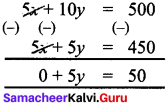
Sir Isaac Newton – The Ingenious Scientist Book Back Answers 8th Standard Term 2 English Chapter 1 Samacheer Kalvi Read More »